EP0529201A2 - Chromatographisches Verfahren mit micellarer Anreicherung in der Säule - Google Patents
Chromatographisches Verfahren mit micellarer Anreicherung in der Säule Download PDFInfo
- Publication number
- EP0529201A2 EP0529201A2 EP92107423A EP92107423A EP0529201A2 EP 0529201 A2 EP0529201 A2 EP 0529201A2 EP 92107423 A EP92107423 A EP 92107423A EP 92107423 A EP92107423 A EP 92107423A EP 0529201 A2 EP0529201 A2 EP 0529201A2
- Authority
- EP
- European Patent Office
- Prior art keywords
- sample
- surfactant
- column
- micelles
- analytes
- Prior art date
- Legal status (The legal status is an assumption and is not a legal conclusion. Google has not performed a legal analysis and makes no representation as to the accuracy of the status listed.)
- Granted
Links
- 238000004587 chromatography analysis Methods 0.000 title description 5
- 239000004094 surface-active agent Substances 0.000 claims abstract description 58
- 239000000693 micelle Substances 0.000 claims abstract description 28
- 238000010828 elution Methods 0.000 claims abstract description 17
- 238000002156 mixing Methods 0.000 claims abstract description 8
- 239000002904 solvent Substances 0.000 claims description 29
- 238000000034 method Methods 0.000 claims description 19
- 238000000926 separation method Methods 0.000 claims description 15
- 239000012491 analyte Substances 0.000 claims description 11
- 150000001413 amino acids Chemical class 0.000 claims description 8
- ZORQXIQZAOLNGE-UHFFFAOYSA-N 1,1-difluorocyclohexane Chemical compound FC1(F)CCCCC1 ZORQXIQZAOLNGE-UHFFFAOYSA-N 0.000 claims description 4
- 235000011069 sorbitan monooleate Nutrition 0.000 claims description 4
- 239000001593 sorbitan monooleate Substances 0.000 claims description 4
- 229940035049 sorbitan monooleate Drugs 0.000 claims description 4
- 238000007865 diluting Methods 0.000 claims description 3
- JNYAEWCLZODPBN-JGWLITMVSA-N (2r,3r,4s)-2-[(1r)-1,2-dihydroxyethyl]oxolane-3,4-diol Chemical compound OC[C@@H](O)[C@H]1OC[C@H](O)[C@H]1O JNYAEWCLZODPBN-JGWLITMVSA-N 0.000 claims description 2
- 239000000203 mixture Substances 0.000 abstract description 16
- 239000002798 polar solvent Substances 0.000 abstract description 5
- 239000012071 phase Substances 0.000 description 35
- 239000000306 component Substances 0.000 description 20
- 239000000243 solution Substances 0.000 description 13
- 230000005526 G1 to G0 transition Effects 0.000 description 9
- 238000004458 analytical method Methods 0.000 description 8
- XLYOFNOQVPJJNP-UHFFFAOYSA-N water Substances O XLYOFNOQVPJJNP-UHFFFAOYSA-N 0.000 description 7
- WEVYAHXRMPXWCK-UHFFFAOYSA-N Acetonitrile Chemical compound CC#N WEVYAHXRMPXWCK-UHFFFAOYSA-N 0.000 description 6
- 238000001514 detection method Methods 0.000 description 5
- 238000002360 preparation method Methods 0.000 description 5
- KFZMGEQAYNKOFK-UHFFFAOYSA-N Isopropanol Chemical compound CC(C)O KFZMGEQAYNKOFK-UHFFFAOYSA-N 0.000 description 4
- 230000008901 benefit Effects 0.000 description 4
- 230000015556 catabolic process Effects 0.000 description 4
- 238000006731 degradation reaction Methods 0.000 description 4
- 238000002347 injection Methods 0.000 description 4
- 239000007924 injection Substances 0.000 description 4
- -1 octadecyl silane-modified silica Chemical class 0.000 description 4
- 102000004169 proteins and genes Human genes 0.000 description 4
- 108090000623 proteins and genes Proteins 0.000 description 4
- 238000005086 pumping Methods 0.000 description 4
- 239000007790 solid phase Substances 0.000 description 4
- 239000000126 substance Substances 0.000 description 4
- OKKJLVBELUTLKV-UHFFFAOYSA-N Methanol Chemical compound OC OKKJLVBELUTLKV-UHFFFAOYSA-N 0.000 description 3
- 238000009792 diffusion process Methods 0.000 description 3
- 238000010790 dilution Methods 0.000 description 3
- 239000012895 dilution Substances 0.000 description 3
- 230000000694 effects Effects 0.000 description 3
- 150000002334 glycols Chemical class 0.000 description 3
- 230000014759 maintenance of location Effects 0.000 description 3
- 238000012856 packing Methods 0.000 description 3
- 102000007079 Peptide Fragments Human genes 0.000 description 2
- 108010033276 Peptide Fragments Proteins 0.000 description 2
- WYURNTSHIVDZCO-UHFFFAOYSA-N Tetrahydrofuran Chemical compound C1CCOC1 WYURNTSHIVDZCO-UHFFFAOYSA-N 0.000 description 2
- 238000002835 absorbance Methods 0.000 description 2
- 239000007864 aqueous solution Substances 0.000 description 2
- 150000002170 ethers Chemical class 0.000 description 2
- 239000000463 material Substances 0.000 description 2
- 239000002736 nonionic surfactant Substances 0.000 description 2
- 108090000765 processed proteins & peptides Proteins 0.000 description 2
- 238000011002 quantification Methods 0.000 description 2
- 230000035945 sensitivity Effects 0.000 description 2
- 238000000638 solvent extraction Methods 0.000 description 2
- XZIIFPSPUDAGJM-UHFFFAOYSA-N 6-chloro-2-n,2-n-diethylpyrimidine-2,4-diamine Chemical compound CCN(CC)C1=NC(N)=CC(Cl)=N1 XZIIFPSPUDAGJM-UHFFFAOYSA-N 0.000 description 1
- 229920001213 Polysorbate 20 Polymers 0.000 description 1
- VYPSYNLAJGMNEJ-UHFFFAOYSA-N Silicium dioxide Chemical compound O=[Si]=O VYPSYNLAJGMNEJ-UHFFFAOYSA-N 0.000 description 1
- VMHLLURERBWHNL-UHFFFAOYSA-M Sodium acetate Chemical compound [Na+].CC([O-])=O VMHLLURERBWHNL-UHFFFAOYSA-M 0.000 description 1
- 238000000862 absorption spectrum Methods 0.000 description 1
- 125000000217 alkyl group Chemical group 0.000 description 1
- 230000015572 biosynthetic process Effects 0.000 description 1
- 239000012503 blood component Substances 0.000 description 1
- 239000000872 buffer Substances 0.000 description 1
- 150000001733 carboxylic acid esters Chemical class 0.000 description 1
- 230000008859 change Effects 0.000 description 1
- 150000001875 compounds Chemical class 0.000 description 1
- 230000003247 decreasing effect Effects 0.000 description 1
- 230000001934 delay Effects 0.000 description 1
- 230000003111 delayed effect Effects 0.000 description 1
- 238000004090 dissolution Methods 0.000 description 1
- 150000002148 esters Chemical class 0.000 description 1
- 239000005350 fused silica glass Substances 0.000 description 1
- 229930182478 glucoside Natural products 0.000 description 1
- 150000008131 glucosides Chemical class 0.000 description 1
- 238000010438 heat treatment Methods 0.000 description 1
- 238000004128 high performance liquid chromatography Methods 0.000 description 1
- 230000000977 initiatory effect Effects 0.000 description 1
- 239000002563 ionic surfactant Substances 0.000 description 1
- 239000007788 liquid Substances 0.000 description 1
- 238000005259 measurement Methods 0.000 description 1
- 230000001404 mediated effect Effects 0.000 description 1
- 238000013508 migration Methods 0.000 description 1
- 230000005012 migration Effects 0.000 description 1
- 238000012986 modification Methods 0.000 description 1
- 230000004048 modification Effects 0.000 description 1
- 239000000575 pesticide Substances 0.000 description 1
- 239000000256 polyoxyethylene sorbitan monolaurate Substances 0.000 description 1
- 235000010486 polyoxyethylene sorbitan monolaurate Nutrition 0.000 description 1
- 235000010482 polyoxyethylene sorbitan monooleate Nutrition 0.000 description 1
- 229920001451 polypropylene glycol Polymers 0.000 description 1
- 229920000053 polysorbate 80 Polymers 0.000 description 1
- 102000004196 processed proteins & peptides Human genes 0.000 description 1
- XTUSEBKMEQERQV-UHFFFAOYSA-N propan-2-ol;hydrate Chemical compound O.CC(C)O XTUSEBKMEQERQV-UHFFFAOYSA-N 0.000 description 1
- 230000000717 retained effect Effects 0.000 description 1
- 238000004007 reversed phase HPLC Methods 0.000 description 1
- 239000000523 sample Substances 0.000 description 1
- 238000011896 sensitive detection Methods 0.000 description 1
- 235000017281 sodium acetate Nutrition 0.000 description 1
- 239000001632 sodium acetate Substances 0.000 description 1
- 239000002689 soil Substances 0.000 description 1
- 229940035044 sorbitan monolaurate Drugs 0.000 description 1
- 235000010356 sorbitol Nutrition 0.000 description 1
- 229910001220 stainless steel Inorganic materials 0.000 description 1
- 239000010935 stainless steel Substances 0.000 description 1
- 230000009897 systematic effect Effects 0.000 description 1
- YLQBMQCUIZJEEH-UHFFFAOYSA-N tetrahydrofuran Natural products C=1C=COC=1 YLQBMQCUIZJEEH-UHFFFAOYSA-N 0.000 description 1
Images
Classifications
-
- G—PHYSICS
- G01—MEASURING; TESTING
- G01N—INVESTIGATING OR ANALYSING MATERIALS BY DETERMINING THEIR CHEMICAL OR PHYSICAL PROPERTIES
- G01N30/00—Investigating or analysing materials by separation into components using adsorption, absorption or similar phenomena or using ion-exchange, e.g. chromatography or field flow fractionation
- G01N30/02—Column chromatography
- G01N30/04—Preparation or injection of sample to be analysed
- G01N30/16—Injection
-
- G—PHYSICS
- G01—MEASURING; TESTING
- G01N—INVESTIGATING OR ANALYSING MATERIALS BY DETERMINING THEIR CHEMICAL OR PHYSICAL PROPERTIES
- G01N30/00—Investigating or analysing materials by separation into components using adsorption, absorption or similar phenomena or using ion-exchange, e.g. chromatography or field flow fractionation
- G01N30/02—Column chromatography
- G01N30/04—Preparation or injection of sample to be analysed
- G01N30/06—Preparation
- G01N30/08—Preparation using an enricher
-
- G—PHYSICS
- G01—MEASURING; TESTING
- G01N—INVESTIGATING OR ANALYSING MATERIALS BY DETERMINING THEIR CHEMICAL OR PHYSICAL PROPERTIES
- G01N30/00—Investigating or analysing materials by separation into components using adsorption, absorption or similar phenomena or using ion-exchange, e.g. chromatography or field flow fractionation
- G01N30/02—Column chromatography
- G01N30/04—Preparation or injection of sample to be analysed
- G01N30/16—Injection
- G01N2030/167—Injection on-column injection
-
- G—PHYSICS
- G01—MEASURING; TESTING
- G01N—INVESTIGATING OR ANALYSING MATERIALS BY DETERMINING THEIR CHEMICAL OR PHYSICAL PROPERTIES
- G01N30/00—Investigating or analysing materials by separation into components using adsorption, absorption or similar phenomena or using ion-exchange, e.g. chromatography or field flow fractionation
- G01N30/02—Column chromatography
- G01N30/26—Conditioning of the fluid carrier; Flow patterns
- G01N30/28—Control of physical parameters of the fluid carrier
- G01N30/34—Control of physical parameters of the fluid carrier of fluid composition, e.g. gradient
Definitions
- the present invention relates to chemical analysis systems, and more particularly, to an enhanced chromatographic method for separating sample analytes having a wide range of polarities.
- Chromatography refers to a class of techniques involving partitioning analytes between a stationary phase and a mobile phase. The analytes flow with the mobile phase, but are delayed in proportion to their partitioning to the stationary phase. The delays result in the analytes being separated in the mobile phase.
- HPLC high performance liquid chromatography
- Separation is achieved by selective component retention by the solid phase. Retention time for a component is related to its capacity factor k', which can be expressed as the product of the distribution coefficient and stationary phase volume divided by the interstitial mobile phase volume. Separation of different components requires that they have different capacity factors. If the capacity factors of different sample components are too small, the separation will be poor. Large capacity factors improve separations but increase band width and lengthen analysis times.
- sample components pass through the separation column in relatively discrete bands.
- the bands then emerge from the separation column in increasing order of their distribution coefficients.
- the analytes can be collected and/or detected seriatim as they elute.
- Components can be identified by the time of retention by the column and can be quantified by the corresponding detection peak area, which corresponds to the amount of the component responsible for the peak.
- the degree to which analytes having similar capacity factors can be resolved depends in part on the length of the sample plug at the head of the column at the onset of the separation process.
- the length of this plug is proportional to the sample volume, which is the volume of sample in solution.
- the amount of solvent should be minimized to minimize sample volume, and yet be sufficient to dissolve the entire sample.
- On-column enrichment is a technique for attaining a shorter plug for a given sample volume by using a chromatographically weak solvent, i.e ., a solvent that causes analytes to have relatively large capacity factors. Due to the larger capacity factors, analytes in a chromatographically weak solvent distribute preferentially to the solid phase. The analyte molecules can be thus “held up", causing the analytes to be concentrated at the head of the column.
- a chromatographically weak solvent i.e ., a solvent that causes analytes to have relatively large capacity factors. Due to the larger capacity factors, analytes in a chromatographically weak solvent distribute preferentially to the solid phase. The analyte molecules can be thus "held up", causing the analytes to be concentrated at the head of the column.
- This on-column enrichment results in an initially narrower sample plug.
- the subsequent introduction of a chromatographically strong mobile phase causes the analytes to elute through the column at rates corresponding to their capacity factors. While band broadening inevitably occurs during separation, the eluting bands are narrower to the extent that enrichment narrowed the initial sample plug. The narrower analyte bands are more readily resolved.
- On-column enrichment thus enhances the detection and quantification of analytes, especially when small quantities are involved. See P. Schauwecker et al . in “Trace Enrichment Techniques in Reversed-Phase High-Performance Liquid Chromatography," Journal of Chromatography 136 (1977) 63-72.
- the chromatographically weak solvent used for on-column enrichment is also used as the mobile phase for separating a sample, excessive band broadening can occur.
- Analytes have larger capacity factors in a chromatographically weak mobile phase. Therefore, the analytes distribute more preferentially to the solid phase and progress through a column more slowly. As a result, there is more time for diffusion to effect band broadening.
- Excessive band broadening can be combatted by using reverse-phase gradient elution, in which the mobile phase is gradually changed from a relatively polar (weak) solvent to a relatively nonpolar (strong) solvent.
- a relatively polar solvent weak
- nonpolar components are preferentially distributed in the stationary phase and the polar components advance through the column.
- the nonpolar components begin to separate and follow the polar components through the column.
- the method shortens the time that nonpolar compounds are retained on the column and therefore reduces diffusion.
- gradient elution improves peak shape and thus increases effective detection sensitivity.
- Samples with a wide range of polarities pose a challenge to on-column enrichment. If the solvent is too weak, it may fail to dissolve some of the more polar analytes. Alternatively, the relatively high concentration of weak solvent required to dissolve all analytes can substantially offset the advantages of on-column enrichment. On the other hand, use of a stronger solvent eliminates or diminishes the effectiveness of on-column enrichment. What is needed is a method that more effectively attains the advantages of on-column enrichment given a sample with a wide range of polarities.
- the prior, non-prepublished European patent application 444441A2 discloses a method for separating the component analytes of a sample, comprising the steps of mixing a surfactant with a sample to produce a sample-surfactant mixture, introducing the mixture onto a chromatographic column, diluting the sample and separating the analytes by flowing a mobile phase through the column.
- This prior, non-prepublished reference does not disclose a specific concentration of the solution of the solvent, does not show a specific concentration of the surfactant and does not disclose a timing of the reverse phase gradient elusion with regard to the breaking-up of the micelles.
- a solution of sample, polar solvent, and surfactant is introduced onto a column.
- concentration of the polar solvent is sufficient to dissolve polar analytes, but insufficient to dissolve at least some nonpolar analytes in the absence of the surfactant.
- the surfactant forms micelles with the nonpolar analytes, aiding in their dissolution.
- sample introduction is complete, the solution is diluted so that the micelles break up.
- a reverse-phase gradient elution is then used to separate the analytes.
- the preferred surfactant can be a polyoxyethylenated sorbitan such as polyoxyethylenated sorbitan monooleate.
- the steps of the inventive method need not proceed discretely. More generally, micelles should be maintained until at least a predominant proportion of the sample is on the column head. Also, a predominant proportion of the micelles should break up before a predominant proportion of the separation has occurred. "Predominant proportion" herein means more than half. For best results, the predominant proportion in each instance should be as close to unity as possible.
- a major advantage of the present invention is that it allows on-column enrichment of a sample with a wide range of polarities, such as samples containing a variety of amino acids. As a result, more concentrated analyte peaks and, thus, more sensitive detection and quantitation are provided. Empirical studies indicate that this enhanced sensitivity is attained without a comparable decrease in band separation in the eluting bands.
- the addition of surfactant causes the range of polarities to be compressed temporarily for the purpose of on-column enrichment in preparation for a separation during which the range of polarities is at least partially restored.
- the relatively narrow sample plug resulting from on-column enrichment yields greater resolution. Concomitantly, peak heights are increased, providing more reliable detections and more precise quantification of analytes.
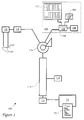
- FIGURE 1 is a schematic illustration of an analytical system in which the method of the present invention is practiced.
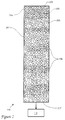
- FIGURE 2 is a detailed view of a portion of a chromatography column of the system of FIG. 1.
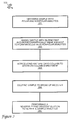
- FIGURE 3 is a flow chart of the method of the present invention.
- chromatographic column 110 is first introduced with reference to FIG. 1 and stationary phase packing material 203 is first introduced with reference to FIG. 2. This is intended to aid the reader in locating referents.
- a chromatographic system 100 comprises a sample preparation device such as a protein sequencer 102, a sample manipulator 104, a sample 105 containing analytes, a source 106 of preparation solvents, cleaving solvents, and surfactants, a sample-surfactant reservoir 108, a chromatographic column 110, a detector 112, and a peak processor 114, as shown in FIG. 1.
- the sample 105 issuing from sample manipulator 104 is mixed with a surfactant solution 107 also stored in source 106, to yield a sample-surfactant mixture 109 which is stored in sample-surfactant reservoir 108.
- Sample-surfactant mixture 109 is then injected onto column 110 by a sample injector 116.
- a column pumping system 118 pumps mobile phase solvents 120, stored in mobile-phase containers 121, through column 110.
- the composition of the mobile phase is mediated by a gradient programmer 122.
- the temperatures of sample-surfactant reservoir 108 and column 110 are controlled by temperature controllers 126 and 128, respectively.
- Column 110 comprises an elongated stainless steel tube 201 filled with packing 203 of octadecyl silane-modified silica spheres, as shown in FIG. 2. Packing 203 serves as the stationary phase for elution.
- Column 110 has a column head 204 where a sample plug 202 is formed when mixture 109 is introduced through an inlet end 205.
- Tube 201 has an inner diameter of about 2.1 millimeters (mm) and is 10-30 centimeters (cm) long.
- Detector 112 is a UV-visible spectrophotometer which measures the absorbance and/or the absorption spectra of components. The concentrations of the respective analytes are readily calculable from the absorbances of component bands 206.
- a sample is obtained, at step 301 of FIG. 3, pursuant to an Edman degradation using sequencer 102.
- the sample comprises a number phenylthiohydantoin amino acids having a wide range of polarities.
- the sample is mixed with the water-surfactant mixture 107 at step 302.
- the sample is dissolved in the solution.
- the water alone is sufficient to dissolve the more polar analytes.
- the surfactant is required to dissolve the nonpolar analytes.
- Sufficient surfactant is added so that the concentration of surfactant in the sample-surfactant solution 109 exceeds the critical micelle concentration to form micelles of nonpolar analytes. Micelles are not formed with the already dissolved polar analytes. Elevated mixture temperatures can enhance enrichment by increasing micellar solubility. Therefore, temperature controller 126 is provided for heating sample-surfactant reservoir 108. Micelle formation is addressed by Rosen & Goldsmith in Systematic Analysis of Surface-Active Agents (Wiley, New York, 2d ed. 1972), pp. 18 ff .
- the sample-surfactant solution 109 is introduced, at step 303, onto chromatographic column 110, which is packed with a nonpolar solid phase.
- chromatographic column 110 which is packed with a nonpolar solid phase.
- water is a chromatographically weak solvent.
- Introduction of the sample-surfactant solution effects on-column enrichment.
- the sample is diluted, at 304, so that the micelles are broken up on column. Dilution is effected simply by pumping mobile phase without surfactant onto the column. In practice, it is possible that the mobile phase will wash additional sample onto the column. Conservatively, more than half the sample is on column before surfactant-free mobile phase is pumped onto the column. As the pumped mobile phase mixes with sample-surfactant solution, the surfactant concentration falls below the critical micelle concentration, initiating breakup of the micelles. Further introduction of mobile phase insures the breakup and washes surfactant from the column. Surfactant, including that associated with the micelles, elutes prior to the analytes and/or is not detected, thus avoiding interference with the peaks of interest.
- Sample components are then separated, at step 305, during reverse-phase gradient elution.
- Water and 15% acetonitrile is the initial polar solvent in the reverse-phase gradient elution.
- the micelles are effectively gone relatively early in the separation process.
- isopropanol is introduced into the mobile phase, which thus becomes less polar and chromatographically stronger.
- the proportion of isopropanol in the water-isopropanol mobile phase is gradually increased to unity.
- the analyte peaks are detected in a conventional manner as they elute from column 110.
- Sample 105 is provided by sequencer 102 which implements an Edman degradation procedure useful in peptide analysis. Edman degradation can produce picomole quantities of samples containing components with a wide range of polarities.
- the sample output from sequencer 102 is collected and dried.
- Surfactant solution 107 is preferably a 0.1% aqueous solution of polyoxyethylenated sorbitan monooleate, manufactured under the tradename "Tween 80" by Atlas Chemical Industries, Wilmington, Delaware.
- Water used in the preparation of the aqueous solution must be purified and deionized, as, for example, by a HP661A water purifier (manufactured by Hewlett-Packard Co., USA). The water can be two times glass-distilled or quartz-distilled, avoiding contact with plastic, which causes ghost peaks.
- the surfactant is stored in surfactant and solvent source 106. Fifty to one hundred ⁇ L of the surfactant solution is mixed with the dried sample. Sample-surfactant mixture 109 is immediately injected onto column 110 via injector 116.
- Other embodiments alternatively use solutions of lower concentrations or greater concentrations so long as the injection concentration of surfactant remains above the critical micelle concentration.
- Injector 116 includes a valve loop injector under sequencer control. The injector removes at least some of the mixture from sample-surfactant reservoir 108 and injects the mixture onto column 110. Once the sample is injected, injector 116 couples column pumping system 118 to column 110 so that elution can begin.
- Column pumping system 118 forces one or more mobile phase solvents 120 through column 110.
- the mixture of one or more of the mobile phase solvents can be varied by mediation of gradient programmer 122 to decrease the polarity of the mobile phase.
- the gradient program can provide for gradual or stepwise gradient elution as desired.
- the polar and the entrained nonpolar components are then separated as they pass through column 110 to detector 112. Components are then identified by their time of elution as reflected in chromatogram 124.
- the increased effectiveness of the system resulting from the present invention allows the use of a shorter column 110, or alternatively allows the separation of more complex samples.
- the time of analysis can be decreased, so that a sample that decomposes within hours, such as some components of the product of Edman degradation, can be injected without delay and processed rapidly.
- mixing occurs by diffusion in the sample-surfactant reservoir 108
- other mixing methods are compatible with the invention.
- the mixing of the surfactant and sample can be accomplished by adding the surfactant to the sample and blending them, or by any other method of combination of sample and surfactant.
- a diluted surfactant is added to a dried sample.
- surfactant can be added to a partially dissolved sample.
- the sample and surfactant can be manually mixed before injection onto column 110.
- the samples can be injected simultaneously onto the column so that they mix during injection.
- the sample can be injected onto a surfactant-filled head.
- the surfactant can be injected onto the sample plug. In some cases, dilution will begin before all of the sample is on the column head. However, at least the predominant proportion of the sample should be on-column before dilution begins.
- Surfactants can include nonionic and ampholytic surfactants.
- nonionic surfactants are provided for, including a preparation of polyoxyethylenated sorbitan monolaurate manufactured as "Tween 20" by Atlas Chemical Industries; other esters, ethers, and glycols, including long-chain carboxylic esters of glycols, glucosides, and sorbitols; ethers of glycols, such as alkyl and alkylphenyl ethers of (poly)oxyethylene glycols; and polyoxyethylenated polyoxypropylene glycols.
- Mobile phase solvents can include commonly used reverse-phase solvents such as water, methanol, acetonitrile, and tetrahydrofuran, and buffers such as sodium acetate.
- the present invention is applicable to a wide range of sample materials, including peptides such as proteins, protein fragments, peptide chains, and peptide fragments, and to soils and pesticide analyses, and analyses of endogenous and exogenous blood components.
- peptides such as proteins, protein fragments, peptide chains, and peptide fragments
- Other sequencers are compatible with the invention, including sequenators.
- Other sources for the eluted sample are also provided for.
- sample injection may also be used, including an automatic sample injector with a syringe which is guided by robot control.
- Other detectors are also compatible with the invention. If a fused-silica tube is used, quantitative concentration measurements can be taken without disturbing equilibria under consideration, and thus can be used to detect eluate bands 206 while they are still on column 110.
Landscapes
- Physics & Mathematics (AREA)
- Health & Medical Sciences (AREA)
- Life Sciences & Earth Sciences (AREA)
- Chemical & Material Sciences (AREA)
- Analytical Chemistry (AREA)
- Biochemistry (AREA)
- General Health & Medical Sciences (AREA)
- General Physics & Mathematics (AREA)
- Immunology (AREA)
- Pathology (AREA)
- Treatment Of Liquids With Adsorbents In General (AREA)
- Investigating Or Analysing Biological Materials (AREA)
Applications Claiming Priority (2)
| Application Number | Priority Date | Filing Date | Title |
|---|---|---|---|
| US750153 | 1985-07-01 | ||
| US07/750,153 US5135657A (en) | 1990-03-01 | 1991-08-26 | Chromatographic method with micellar on-column enrichment |
Publications (3)
| Publication Number | Publication Date |
|---|---|
| EP0529201A2 true EP0529201A2 (de) | 1993-03-03 |
| EP0529201A3 EP0529201A3 (en) | 1994-09-28 |
| EP0529201B1 EP0529201B1 (de) | 1997-09-24 |
Family
ID=25016731
Family Applications (1)
| Application Number | Title | Priority Date | Filing Date |
|---|---|---|---|
| EP19920107423 Expired - Lifetime EP0529201B1 (de) | 1991-08-26 | 1992-04-30 | Chromatographisches Verfahren mit micellarer Anreicherung in der Säule |
Country Status (3)
| Country | Link |
|---|---|
| EP (1) | EP0529201B1 (de) |
| JP (1) | JPH05196610A (de) |
| DE (1) | DE69222384T2 (de) |
Cited By (2)
| Publication number | Priority date | Publication date | Assignee | Title |
|---|---|---|---|---|
| RU2217744C2 (ru) * | 2000-04-20 | 2003-11-27 | Всероссийский научно-исследовательский институт селекции плодовых культур | Способ качественного и количественного определения железа |
| WO2004058378A1 (de) * | 2002-12-24 | 2004-07-15 | Bezhan Chankvetadze | Vorrichtung zur trennung von substanzgemischen mittels flüssigchromatographie |
Family Cites Families (2)
| Publication number | Priority date | Publication date | Assignee | Title |
|---|---|---|---|---|
| AU597924B2 (en) * | 1985-12-11 | 1990-06-14 | Natinco Nv | Solubilization of protein aggregates |
| EP0343233B1 (de) * | 1987-11-27 | 1994-02-02 | Battelle Memorial Institute | Überkritische mizellentrennung in der flüssig-umkehrphase |
-
1992
- 1992-04-30 EP EP19920107423 patent/EP0529201B1/de not_active Expired - Lifetime
- 1992-04-30 DE DE1992622384 patent/DE69222384T2/de not_active Expired - Fee Related
- 1992-08-26 JP JP25071392A patent/JPH05196610A/ja active Pending
Cited By (2)
| Publication number | Priority date | Publication date | Assignee | Title |
|---|---|---|---|---|
| RU2217744C2 (ru) * | 2000-04-20 | 2003-11-27 | Всероссийский научно-исследовательский институт селекции плодовых культур | Способ качественного и количественного определения железа |
| WO2004058378A1 (de) * | 2002-12-24 | 2004-07-15 | Bezhan Chankvetadze | Vorrichtung zur trennung von substanzgemischen mittels flüssigchromatographie |
Also Published As
| Publication number | Publication date |
|---|---|
| DE69222384T2 (de) | 1998-04-02 |
| JPH05196610A (ja) | 1993-08-06 |
| EP0529201B1 (de) | 1997-09-24 |
| EP0529201A3 (en) | 1994-09-28 |
| DE69222384D1 (de) | 1997-10-30 |
Similar Documents
| Publication | Publication Date | Title |
|---|---|---|
| US5135657A (en) | Chromatographic method with micellar on-column enrichment | |
| Zimmerman et al. | Rapid analysis of amino acid phenylthiohydantoins by high-performance liquid chromatography | |
| Croubels et al. | Use of metal chelate affinity chromatography and membrane-based ion-exchange as clean-up procedure for trace residue analysis of tetracyclines in animal tissues and egg | |
| Kaliszan et al. | Gradient HPLC in the determination of drug lipophilicity and acidity | |
| Alvarez-Coque et al. | Direct injection of physiological fluids in micellar liquid chromatography | |
| Zimmerman et al. | [5] High-performance liquid chromatography of amino acid derivatives | |
| EP0563865B1 (de) | Verfahren und Vorrichtung für die Analyse von Haemoglobinen und Lösung zum Unterdrücken der Verschlechterung der Kolonne zum Gebrauch darin | |
| JP5054439B2 (ja) | イオン交換および順相カラムによる2次元液体クロマトグラフ | |
| Long et al. | Method for the isolation and liquid chromatographic determination of chloramphenicol in milk | |
| Boyer et al. | Determination of vitamins D 2, D 3, K 1 and K 3 and some hydroxy metabolites of vitamin D 3 in plasma using a continuous clean-up–preconcentration procedure coupled on-line with liquid chromatography–UV detection | |
| Grob et al. | Attempt for an on-line size exclusion chromatography-gas chromatography method for analyzing pesticide residues in foods | |
| Euerby et al. | Step-gradient capillary electrochromatography | |
| Campins-Falco et al. | Column-switching techniques for screening of diuretics and probenecid in urine samples | |
| EP0529201B1 (de) | Chromatographisches Verfahren mit micellarer Anreicherung in der Säule | |
| Sottrup-Jensen et al. | Analysis of amino acid phenylthiohydantoins by high-performance liquid chromatography using gradient elution with ethanol | |
| Wyss et al. | Determination of highly protein bound in plasma using high-performance liquid chromatography and column switching, exemplified by the retinoids | |
| Rasmussen et al. | Solid-phase extraction and high-performance liquid chromatographic determination of flumequine and oxolinic acid in salmon plasma | |
| Long et al. | Method for the isolation and liquid chromatographic determination of furazolidone in milk | |
| Hubert et al. | Automatic determination of indomethacin in human plasma using liquid-solid extraction on disposable cartridges in combination with HPLC | |
| Burke et al. | A novel approach to reversed-phase preparative high-performance liquid chromatography of peptides | |
| Kirschner et al. | Recent advances in sample introduction for supercritical fluid chromatography | |
| EP4314803A1 (de) | Automatisierte flüssigkeitschromatographie mit halbpräpariertem gradientenrecycling | |
| Meuth et al. | Separation of amino acid phenylthiohydantoin derivatives by high-pressure liquid chromatography | |
| Schenck et al. | Matrix solid phase dispersion (MSPD) isolation and liquid chromatographic determination of clorsulon in milk | |
| Nicoll-Griffith et al. | Automated derivatization and high-performance liquid chromatographic analysis of ibuprofen enantiomers |
Legal Events
| Date | Code | Title | Description |
|---|---|---|---|
| PUAI | Public reference made under article 153(3) epc to a published international application that has entered the european phase |
Free format text: ORIGINAL CODE: 0009012 |
|
| AK | Designated contracting states |
Kind code of ref document: A2 Designated state(s): DE FR GB NL |
|
| PUAL | Search report despatched |
Free format text: ORIGINAL CODE: 0009013 |
|
| AK | Designated contracting states |
Kind code of ref document: A3 Designated state(s): DE FR GB NL |
|
| 17P | Request for examination filed |
Effective date: 19941024 |
|
| GRAG | Despatch of communication of intention to grant |
Free format text: ORIGINAL CODE: EPIDOS AGRA |
|
| 17Q | First examination report despatched |
Effective date: 19961108 |
|
| GRAH | Despatch of communication of intention to grant a patent |
Free format text: ORIGINAL CODE: EPIDOS IGRA |
|
| GRAH | Despatch of communication of intention to grant a patent |
Free format text: ORIGINAL CODE: EPIDOS IGRA |
|
| GRAA | (expected) grant |
Free format text: ORIGINAL CODE: 0009210 |
|
| AK | Designated contracting states |
Kind code of ref document: B1 Designated state(s): DE FR GB NL |
|
| REF | Corresponds to: |
Ref document number: 69222384 Country of ref document: DE Date of ref document: 19971030 |
|
| ET | Fr: translation filed | ||
| PGFP | Annual fee paid to national office [announced via postgrant information from national office to epo] |
Ref country code: NL Payment date: 19980320 Year of fee payment: 7 |
|
| PLBE | No opposition filed within time limit |
Free format text: ORIGINAL CODE: 0009261 |
|
| STAA | Information on the status of an ep patent application or granted ep patent |
Free format text: STATUS: NO OPPOSITION FILED WITHIN TIME LIMIT |
|
| 26N | No opposition filed | ||
| PGFP | Annual fee paid to national office [announced via postgrant information from national office to epo] |
Ref country code: FR Payment date: 19990331 Year of fee payment: 8 |
|
| PG25 | Lapsed in a contracting state [announced via postgrant information from national office to epo] |
Ref country code: NL Free format text: LAPSE BECAUSE OF NON-PAYMENT OF DUE FEES Effective date: 19991101 |
|
| NLV4 | Nl: lapsed or anulled due to non-payment of the annual fee |
Effective date: 19991101 |
|
| REG | Reference to a national code |
Ref country code: GB Ref legal event code: 732E |
|
| REG | Reference to a national code |
Ref country code: GB Ref legal event code: 732E |
|
| PG25 | Lapsed in a contracting state [announced via postgrant information from national office to epo] |
Ref country code: FR Free format text: LAPSE BECAUSE OF NON-PAYMENT OF DUE FEES Effective date: 20001229 |
|
| REG | Reference to a national code |
Ref country code: FR Ref legal event code: ST |
|
| REG | Reference to a national code |
Ref country code: GB Ref legal event code: IF02 |
|
| PGFP | Annual fee paid to national office [announced via postgrant information from national office to epo] |
Ref country code: GB Payment date: 20040421 Year of fee payment: 13 |
|
| PGFP | Annual fee paid to national office [announced via postgrant information from national office to epo] |
Ref country code: DE Payment date: 20040601 Year of fee payment: 13 |
|
| PG25 | Lapsed in a contracting state [announced via postgrant information from national office to epo] |
Ref country code: GB Free format text: LAPSE BECAUSE OF NON-PAYMENT OF DUE FEES Effective date: 20050430 |
|
| PG25 | Lapsed in a contracting state [announced via postgrant information from national office to epo] |
Ref country code: DE Free format text: LAPSE BECAUSE OF NON-PAYMENT OF DUE FEES Effective date: 20051101 |
|
| GBPC | Gb: european patent ceased through non-payment of renewal fee |
Effective date: 20050430 |