EP0526658B1 - Thiazolidine-2,4-dione derivative, salt thereof, and production of the same - Google Patents
Thiazolidine-2,4-dione derivative, salt thereof, and production of the same Download PDFInfo
- Publication number
- EP0526658B1 EP0526658B1 EP92905305A EP92905305A EP0526658B1 EP 0526658 B1 EP0526658 B1 EP 0526658B1 EP 92905305 A EP92905305 A EP 92905305A EP 92905305 A EP92905305 A EP 92905305A EP 0526658 B1 EP0526658 B1 EP 0526658B1
- Authority
- EP
- European Patent Office
- Prior art keywords
- group
- carbon atoms
- general formula
- same
- thiazolidine
- Prior art date
- Legal status (The legal status is an assumption and is not a legal conclusion. Google has not performed a legal analysis and makes no representation as to the accuracy of the status listed.)
- Expired - Lifetime
Links
- 0 CB*N(*)c1cccc(C(C)(C(N2)=O)SC2=O)c1 Chemical compound CB*N(*)c1cccc(C(C)(C(N2)=O)SC2=O)c1 0.000 description 6
Classifications
-
- C—CHEMISTRY; METALLURGY
- C07—ORGANIC CHEMISTRY
- C07D—HETEROCYCLIC COMPOUNDS
- C07D417/00—Heterocyclic compounds containing two or more hetero rings, at least one ring having nitrogen and sulfur atoms as the only ring hetero atoms, not provided for by group C07D415/00
- C07D417/02—Heterocyclic compounds containing two or more hetero rings, at least one ring having nitrogen and sulfur atoms as the only ring hetero atoms, not provided for by group C07D415/00 containing two hetero rings
- C07D417/12—Heterocyclic compounds containing two or more hetero rings, at least one ring having nitrogen and sulfur atoms as the only ring hetero atoms, not provided for by group C07D415/00 containing two hetero rings linked by a chain containing hetero atoms as chain links
-
- A—HUMAN NECESSITIES
- A61—MEDICAL OR VETERINARY SCIENCE; HYGIENE
- A61P—SPECIFIC THERAPEUTIC ACTIVITY OF CHEMICAL COMPOUNDS OR MEDICINAL PREPARATIONS
- A61P3/00—Drugs for disorders of the metabolism
- A61P3/08—Drugs for disorders of the metabolism for glucose homeostasis
-
- A—HUMAN NECESSITIES
- A61—MEDICAL OR VETERINARY SCIENCE; HYGIENE
- A61P—SPECIFIC THERAPEUTIC ACTIVITY OF CHEMICAL COMPOUNDS OR MEDICINAL PREPARATIONS
- A61P3/00—Drugs for disorders of the metabolism
- A61P3/08—Drugs for disorders of the metabolism for glucose homeostasis
- A61P3/10—Drugs for disorders of the metabolism for glucose homeostasis for hyperglycaemia, e.g. antidiabetics
-
- A—HUMAN NECESSITIES
- A61—MEDICAL OR VETERINARY SCIENCE; HYGIENE
- A61P—SPECIFIC THERAPEUTIC ACTIVITY OF CHEMICAL COMPOUNDS OR MEDICINAL PREPARATIONS
- A61P5/00—Drugs for disorders of the endocrine system
- A61P5/48—Drugs for disorders of the endocrine system of the pancreatic hormones
- A61P5/50—Drugs for disorders of the endocrine system of the pancreatic hormones for increasing or potentiating the activity of insulin
-
- C—CHEMISTRY; METALLURGY
- C07—ORGANIC CHEMISTRY
- C07D—HETEROCYCLIC COMPOUNDS
- C07D277/00—Heterocyclic compounds containing 1,3-thiazole or hydrogenated 1,3-thiazole rings
- C07D277/02—Heterocyclic compounds containing 1,3-thiazole or hydrogenated 1,3-thiazole rings not condensed with other rings
- C07D277/20—Heterocyclic compounds containing 1,3-thiazole or hydrogenated 1,3-thiazole rings not condensed with other rings having two or three double bonds between ring members or between ring members and non-ring members
- C07D277/32—Heterocyclic compounds containing 1,3-thiazole or hydrogenated 1,3-thiazole rings not condensed with other rings having two or three double bonds between ring members or between ring members and non-ring members with hetero atoms or with carbon atoms having three bonds to hetero atoms with at the most one bond to halogen, e.g. ester or nitrile radicals, directly attached to ring carbon atoms
- C07D277/34—Oxygen atoms
Definitions
- the present invention relates to thiazolidine-2,4-dione derivatives possessing blood sugar-lowering action and aldose reductase-inhibitory action, their salts, their preparation processes and a drug containing them.
- aldose reductase-inhibitory agents particular thiazolidine-2,4-dione derivatives are already publicly known (JP-A-57-28073, Chem. Pharm. Bull. 30 (10), 3601, (1982)). Namely, it is publicly known that 5-phenylthiazolidine-2,4-dione derivatives represented by a general formula [wherein R denotes a hydrogen atom, lower alkyl group, hydroxyl group, alkoxy group, nitro group, amino group, lower acylamino group, halogen or trifluoromethyl group], have aldose reductase-inhibitory action.
- JP-A-59-137 472 discloses 5-phenylthiazolidine-2,4-dione derivatives for use in therapy of chronic diabetic complication.
- the purpose of the present invention is to provide compounds having superior blood sugar-lowering action and simultaneously strong aldose reductase-inhibitory action and being useful as effective and highly-safe drugs capable of preventing and treating diabetes and complication thereof.
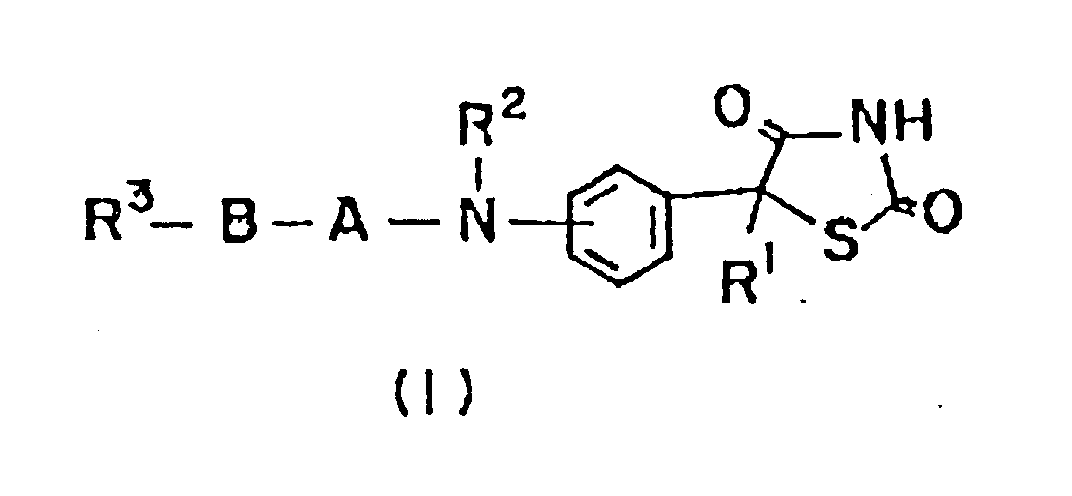
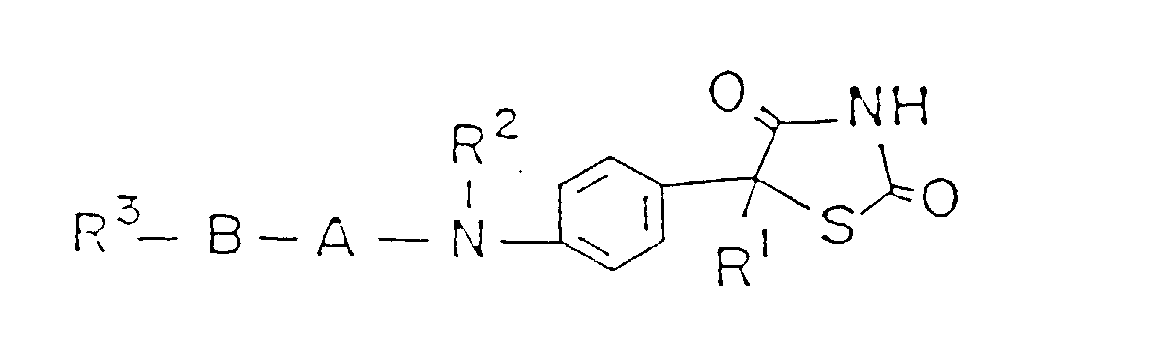
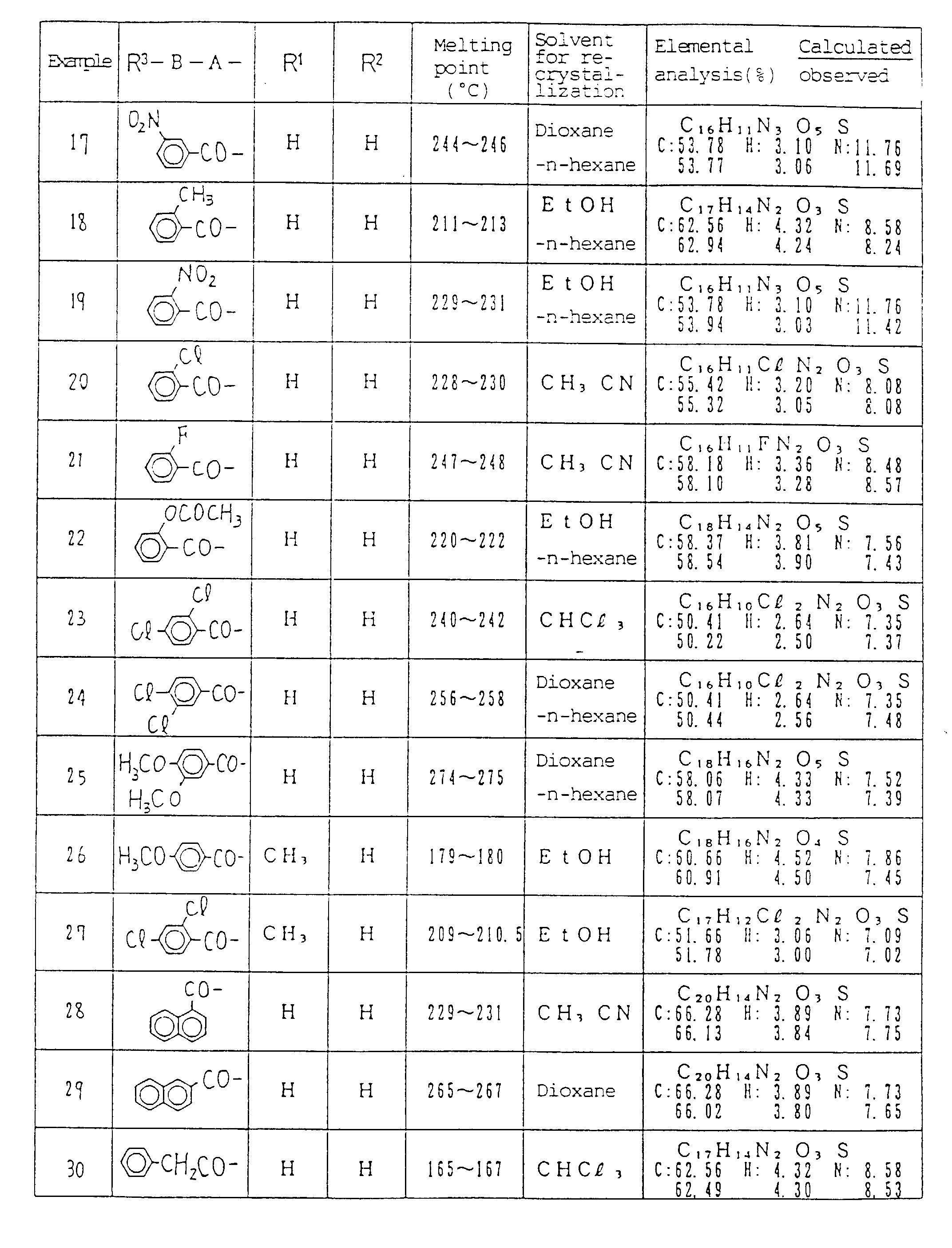
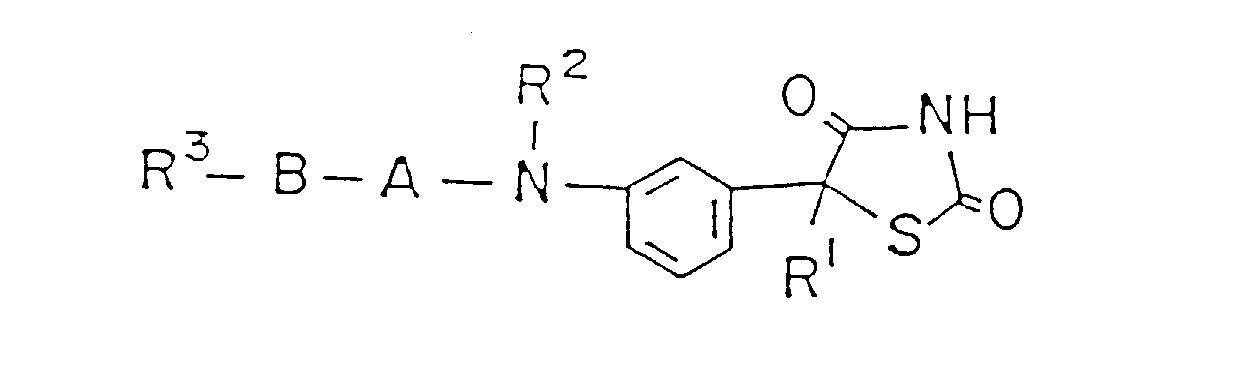
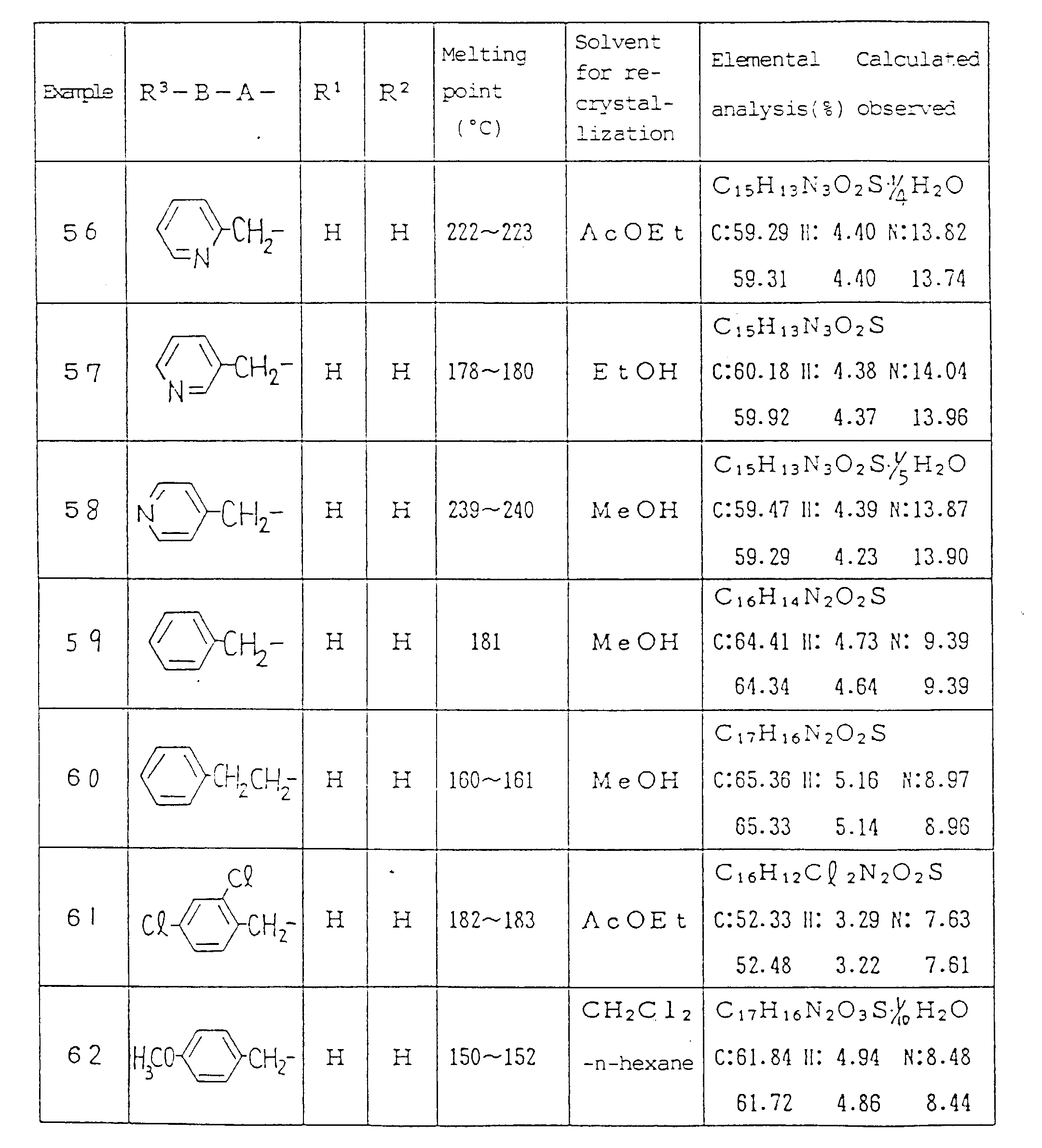
- thiazolidine-2,4-dione derivatives represented by the general formula (1) [wherein R 1 and R 2 each independently represent hydrogen atoms or lower alkyl groups having 1 to 6 carbon atoms, R 3 denotes a phenyl group, naphthyl group, benzoyl group or 5-membered or 6-membered heteroring containing one or more nitrogen, oxygen and sulfur atoms and its benzene-condensed ring, which may have one or more substituents selected from the group consisting of halogen, lower alkyl group having 1 to 6 carbon atoms, hydroxyl group, lower alkoxy group having 1 to 6 carbon atoms, nitro group, amino group, phenyl group, lower alkanoyloxy group having 1 to 4 carbon atoms, carboxyl group, methylenedioxy group, sulfamoyl group and trifluoromethyl group, A denotes a carbonyl group,
- lower alkyl shown in the present invention, means straight chain or branched ones with carbon atoms of 1 to 6 such as methyl, ethyl, n-propyl and i-propyl.
- phenyl group, naphthyl group, benzoyl group or 5-membered or 6-membered heteroring and its benzene-condensed ring means halogen, lower alkyl group, hydroxyl group, lower alkoxy group, nitro group, amino group (said amino group may be substituted with lower alkyl group, lower alkanoyl group or benzoyl group), phenyl group( this phenyl group may be substituted with halogen, lower alkyl group or lower alkoxy group), lower alkanoyloxy group, carboxyl group, methylenedioxy group, sulfamoyl group (this sulfamoyl group may be substituted with lower alkyl group), trifluoromethyl group.
- halogen fluorine, chlorine, bromine and iodine are exemplified.
- the "lower alkoxy” means straight chain or branched ones with carbon atoms of 1 to 6 such as methoxy, ethoxy, n-propoxy and i-propoxy.
- the "lower alkanoyl” means ones with carbon atoms of 1 to 4 such as acetyl and propionyl.
- the “lower alkanoyloxy” means ones with carbon atoms of 1 to 4 such as acetyloxy and propionyloxy.
- the "5-membered or 6-membered heteroring and its benzene-condensed ring” mean saturated or unsaturated monocyclic or polycyclic heterocyclic groups capable of containing one or more nitrogen, oxygen and sulfur atoms and, piperidyl, piperazinyl, furyl, thienyl, imidazolyl, thiazolyl, pyridyl, benzofuryl, benzothienyl, indolyl, quinazolyl can be exemplified.
- “Lower alkylene” means ones with carbon atoms of 1 to 6 and methylene, ethylene, trimethylene are exemplified. "Lower alkenylene” applied similarly to “lower alkylene” but has carbon atoms of 2 to 6 and unsaturated bond(s).
- the "eliminating group” is halogen, lower alkoxy or hydroxy and preferable one is halogen.
- “Their salts” mean salts admissible as drugs and, for example, salts with cations such as sodium and potassium or with inorganic acids (e.g. hydrochloric acid and sulfuric acid) or organic acids (e.g. p-toluenesulfonic acid) can be included.
- the compounds of the present invention can be prepared through processes shown below.
- This reaction can be conducted beneficially in a solvent such as dioxane, dimethylformamide or ethyl acetate in the presence of alkali metal hydride such as sodium hydride, for example, alkali metal hydroxide such as sodium hydroxide, for example, alkali metal carbonate such as potassium carbonate, for example, or organic base such as pyridine or triethylamine, for example, as a base.
- alkali metal hydride such as sodium hydride
- alkali metal hydroxide such as sodium hydroxide
- alkali metal carbonate such as potassium carbonate
- organic base such as pyridine or triethylamine
- condensing agents for example, dicyclohexylcarbodiimide and diethylphosphoryl cyanide are exemplified.
- the reaction temperature is within a range from 0 to 120 °C and the reaction completes for 1 to 5 hours.
- This reaction can be conducted in a solvent inert to reaction such as ethanol, toluene or xylene, for example, in the presence of, for example, p-toluenesulfonic acid as a catalyst or in the absence of catalyst.
- the reaction is conducted within a range from room temperature to the boiling point of solvent and the reaction completes for 1 to 5 hours.
- This reaction can be conducted in a solvent inert to reaction such as methanol, ethanol, ether or tetrahydrofuran, for example in the presence of, for example, sodium borohydride or lithium aluminum hydride as a reducing agent.
- the reaction is conducted within a range from 0 °C to the boiling point of the solvent and the reaction completes for 1 to 5 hours.
- the compounds obtainable through said processes can be isolated and purified by publicly known separation and purification means, for example, solvent extraction, recrystallization or chromatography.
- salts of compounds represented by the general formula (1) or general formula (2) can be obtained by reacting with cation-copossessing bases such as sodium hydroxide and potassium hydroxide, for example, inorganic acids such as hydrochloric acid and sulfuric acid, for example, and organic acids such as fumaric acid and oxalic acid, for example.
- bases such as sodium hydroxide and potassium hydroxide
- inorganic acids such as hydrochloric acid and sulfuric acid
- organic acids such as fumaric acid and oxalic acid
- inventive compounds represented by the general formula (1) and general formula (2) have one or more asymmetric carbon atoms, there exist optical isomers, but the invention also includes those optical isomers and racemic modifications.
- rats were orally administered with the compound of Example 23 once daily for 5 days at 10 mg/kg/day, they were fasted for 18 hours and then insulin was intraperitoneally injected at 0.1 unit/kg. Blood samples were collected from the tail vein 0 and 1 hour after the injection of insulin for the determination of blood glucose (Table 1).
- mice Genetically obese mice (CS57BL ob/ob mice) were orally administered with the compound of Example 23 once daily for 5 days at 10, 30 or 100 mg/kg/day, respectively. They were fasted for 18 hours and then 2 g/kg of glucose was orally administered. Blood samples were collected from the tail vein 0, 30, 60 and 120 minutes after the administration of glucose for the determination of blood glucose (Table 2).
- novel thiazolidine-2,4-dione derivatives and their salts in accordance with the invention possess superior blood sugar-lowering action together with remarkable aldose reductase-inhibitory action, thus they are useful as the drugs for the therapy and prevention of diabetes and the complication thereof.
Landscapes
- Chemical & Material Sciences (AREA)
- Organic Chemistry (AREA)
- Health & Medical Sciences (AREA)
- Diabetes (AREA)
- General Chemical & Material Sciences (AREA)
- General Health & Medical Sciences (AREA)
- Veterinary Medicine (AREA)
- Public Health (AREA)
- Engineering & Computer Science (AREA)
- Chemical Kinetics & Catalysis (AREA)
- Endocrinology (AREA)
- Medicinal Chemistry (AREA)
- Nuclear Medicine, Radiotherapy & Molecular Imaging (AREA)
- Bioinformatics & Cheminformatics (AREA)
- Pharmacology & Pharmacy (AREA)
- Life Sciences & Earth Sciences (AREA)
- Animal Behavior & Ethology (AREA)
- Emergency Medicine (AREA)
- Obesity (AREA)
- Hematology (AREA)
- Pharmaceuticals Containing Other Organic And Inorganic Compounds (AREA)
- Thiazole And Isothizaole Compounds (AREA)
- Plural Heterocyclic Compounds (AREA)
Abstract
Description


with compounds represented by the general formula (4)
in the presence of a suitable base or condensing agent.
or their salts with compounds represented by the general formula (5)
m.p. 240.0 - 245.0 °C
| Element alanalysis (%) | As C16H12N2 O3 S | ||
| Calculated | C 61.53 | H 3.87 | N 8.97 |
| Observed | C 61.65 | H 3.88 | N 8.75 |
m.p. 275.0 - 277.0 °C
| Element alanalysis (%) | As C17H12N2 O5 S | ||
| Calculated | C 57.30 | H 3.39 | N 7.86 |
| Observed | C 57.39 | H 3.28 | N 7.81 |
m.p. 215.0 - 218.0 °C
| Element alanalysis (%) | As C16H14N2 O4 S2 | ||
| Calculated | C 53.02 | H 3.89 | N 7.73 |
| Observed | C 53.29 | H 3.86 | N 7.75 |




m.p. 216.5 - 218.0 °C
| Element alanalysis (%) | As C16H10Cl2 N2 O2 S | ||
| Calculated | C 52.62 | H 2.76 | N 7.67 |
| Observed | C 52.58 | H 2.74 | N 7.68 |
m.p. 132.0 - 133.0 °C
| Element alanalysis (%) | As C16H12Cl2 N2 O2 S | ||
| Calculated | C 52.32 | H 3.29 | N 7.63 |
| Observed | C 52.26 | H 3.28 | N 7.64 |


| Group | n | 0 hour value - 1 hour value (mg %) |
| Reference (insulin only) | 5 | 11. 0± 0. 8 |
| Example 23 10mg/kg | 5 | 19. 4 ± 1. 5 |
| Compound | OGTT (% of control) | ||
| 10mg/kg | 30mg/kg | 100mg/kg | |
| Example 23 | 93. 5 | 89. 2 | 74. 1 |
| Compound | IC50 value |
| Example 23 | 9 × 10⁻⁸ M |
| Compound | ED50 value (mg/kg/day) | |
| Nerve | Retina | |
| Example 23 | 14. 5 | 26. 5 |
Claims (7)
- A process for preparing thiazolidine-2,4-dione derivatives represented by the general formula (1)[wherein R1 and R2 each independently represent hydrogen atoms or lower alkyl groups having 1 to 6 carbon atoms, R3 denotes a phenyl group, naphthyl group, benzoyl group or 5-membered or 6-membered heteroring containing one or more nitrogen, oxygen and sulfur atoms and its benzene-condensed ring, which may have one or more substituents selected from the group consisting of halogen, lower alkyl group having 1 to 6 carbon atoms, hydroxyl group, lower alkoxy group having 1 to 6 carbon atoms, nitro group, amino group, phenyl group, lower alkanoyloxy group having 1 to 4 carbon atoms, carboxyl group, methylenedioxy group, sulfamoyl group and trifluoromethyl group, A denotes a carbonyl group, sulfonyl group or bonding hand, and B denotes a lower alkylene group having 1 to 6 carbon atoms, lower alkenylene group having 2 to 6 carbon atoms or bonding hand], or their salts, characterized by reacting compounds represented by the general formula (3)
 [wherein R1 and R2 are the same as defined above], or their salts with compounds represented by the general formula (4)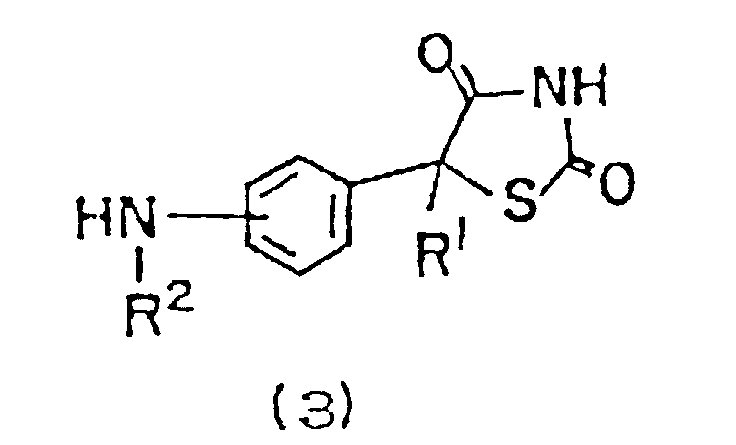
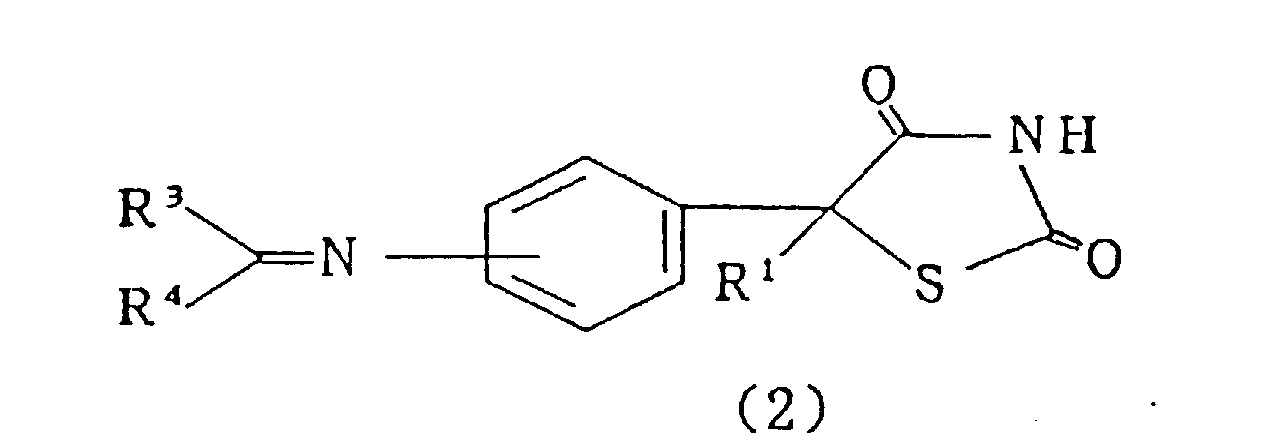
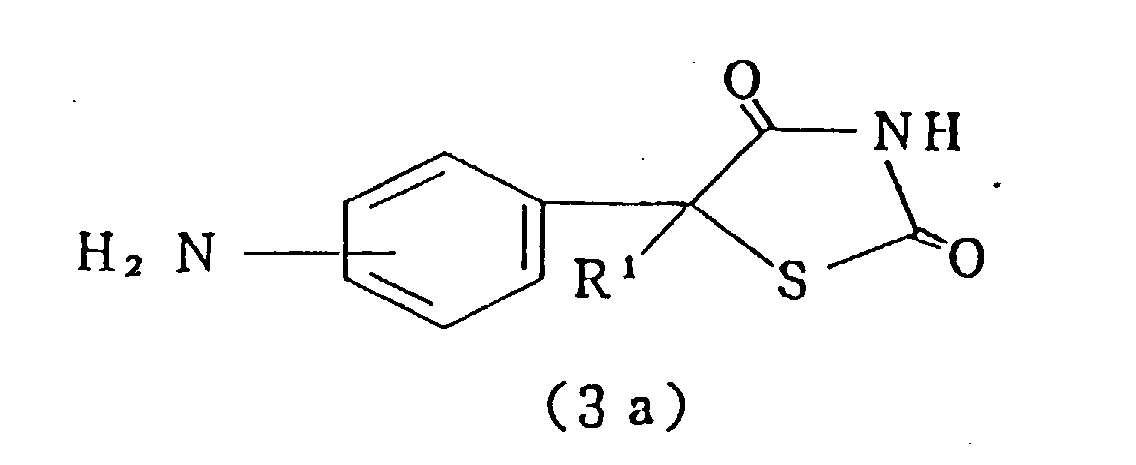
- A process for preparing thiazolidine-2,4-dione derivatives represented by the general formula (2)[wherein R4 denotes a hydrogen atom or lower alkyl group having 1 to 6 carbon atoms, and R1 and R3 are the same as defined in claim 1] or their salts, characterized by reacting compounds represented by the general formula (3a)
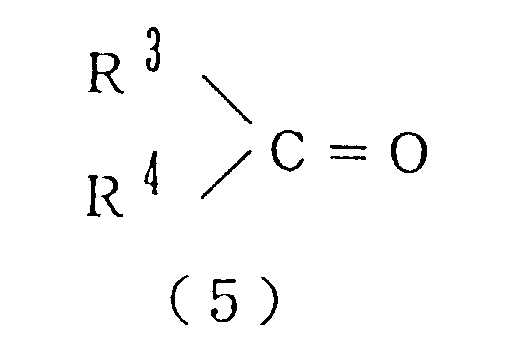
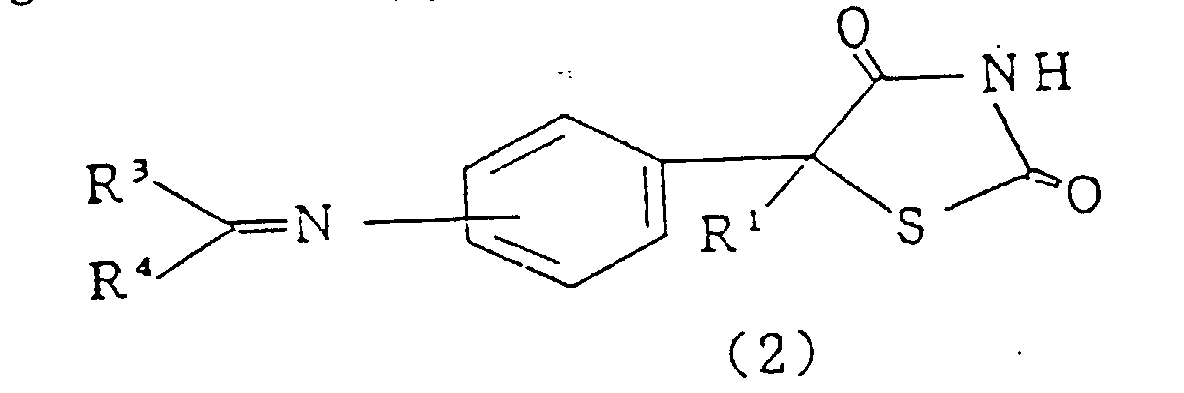 [wherein R1 is the same as defined in claim 1], or their salts with compounds represented by the general formula (5)
 [wherein R3 and R4 are the same as defined above].
- A process for preparing the thiazolidine-2,4-dione derivatives or their salts of claim 1, wherein R2 is a hydrogen atom, A is a bonding hand and B is a lower alkylene group having 1 to 6 carbon atoms, characterized by reducing compounds represented by the general formula (2)[wherein R1, R3 and R4 are the same as defined in claim 2].
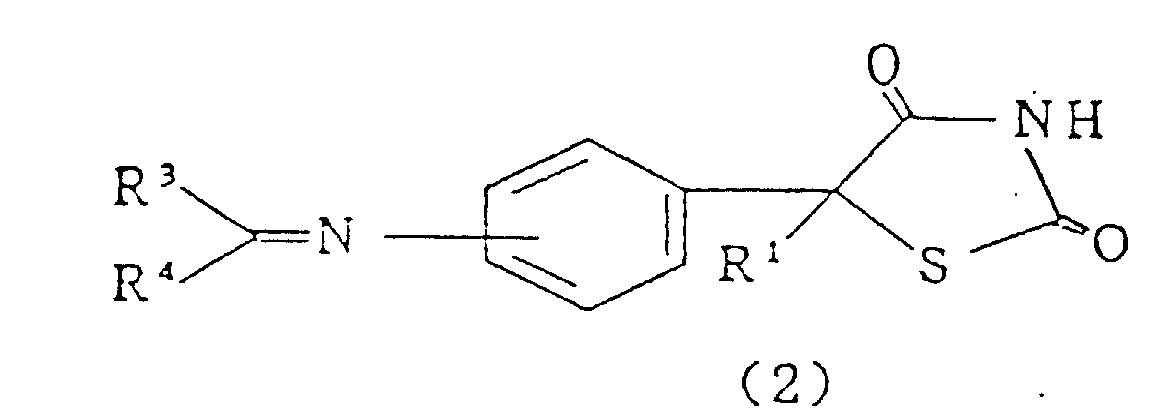
Applications Claiming Priority (5)
| Application Number | Priority Date | Filing Date | Title |
|---|---|---|---|
| JP53275/91 | 1991-02-25 | ||
| JP5327591 | 1991-02-25 | ||
| JP72496/92 | 1992-02-21 | ||
| JP4072496A JP3053490B2 (en) | 1991-02-25 | 1992-02-21 | Thiazolidine-2,4-dione derivative, salt thereof and production method |
| PCT/JP1992/000189 WO1992014719A1 (en) | 1991-02-25 | 1992-02-24 | Thiazolidine-2,4-dione derivative, salt thereof, and production of the same |
Publications (3)
| Publication Number | Publication Date |
|---|---|
| EP0526658A1 EP0526658A1 (en) | 1993-02-10 |
| EP0526658A4 EP0526658A4 (en) | 1993-04-21 |
| EP0526658B1 true EP0526658B1 (en) | 1998-09-23 |
Family
ID=26393992
Family Applications (1)
| Application Number | Title | Priority Date | Filing Date |
|---|---|---|---|
| EP92905305A Expired - Lifetime EP0526658B1 (en) | 1991-02-25 | 1992-02-24 | Thiazolidine-2,4-dione derivative, salt thereof, and production of the same |
Country Status (12)
| Country | Link |
|---|---|
| US (1) | US5342850A (en) |
| EP (1) | EP0526658B1 (en) |
| JP (1) | JP3053490B2 (en) |
| KR (1) | KR960012206B1 (en) |
| AT (1) | ATE171448T1 (en) |
| AU (1) | AU645886B2 (en) |
| CA (1) | CA2081113C (en) |
| DE (1) | DE69227080T2 (en) |
| DK (1) | DK0526658T3 (en) |
| ES (1) | ES2122991T3 (en) |
| HU (1) | HU217116B (en) |
| WO (1) | WO1992014719A1 (en) |
Families Citing this family (16)
| Publication number | Priority date | Publication date | Assignee | Title |
|---|---|---|---|---|
| NO303782B1 (en) * | 1994-03-23 | 1998-08-31 | Sankyo Co | Thiazolidine and oxazolidine derivatives and pharmaceutical preparations containing them, as well as their use in the manufacture of medicaments |
| FR2733685B1 (en) * | 1995-05-05 | 1997-05-30 | Adir | USE OF BENZOPYRANE DERIVATIVES FOR OBTAINING PHARMACEUTICAL COMPOSITIONS FOR THE TREATMENT OF CONDITIONS RELATED TO THE C1- / HC03-, NA + INDEPENDENT EXCHANGER |
| JP3906935B2 (en) * | 1995-12-18 | 2007-04-18 | 杏林製薬株式会社 | N-substituted dioxothiazolidylbenzamide derivative and process for producing the same |
| ID24878A (en) * | 1997-12-19 | 2000-08-31 | Merck & Co Inc | ARILTIAZOLIDINEDION DOWN |
| US6008237A (en) | 1997-12-19 | 1999-12-28 | Merck & Co., Inc. | Arylthiazolidinedione derivatives |
| US6756360B1 (en) * | 1998-12-24 | 2004-06-29 | Metabasis Therapeutics, Inc. | Combination of FBPase inhibitors and insulin sensitizers for the treatment of diabetes |
| EP1194146B1 (en) * | 1999-06-18 | 2006-07-19 | Merck & Co., Inc. | Arylthiazolidinedione and aryloxazolidinedione derivatives |
| US6380191B1 (en) | 1999-06-18 | 2002-04-30 | Merck & Co. Inc. | Arylthiazolidinedione and aryloxazolidinedione derivatives |
| CN1740182A (en) * | 1999-12-22 | 2006-03-01 | 症变治疗公司 | Novel bisamidate phosphonate prodrugs |
| ATE340168T1 (en) * | 2000-02-01 | 2006-10-15 | Kyorin Seiyaku Kk | ALKALINE METAL SALT OF THIAZOLIDINE-2,4-DIONE DERIVATIVES |
| AU4882801A (en) | 2000-04-25 | 2001-11-07 | Kyorin Pharmaceutical Co. Ltd. | Novel stable crystal of thiazolidinedione derivative and process for producing the same |
| US7563774B2 (en) * | 2000-06-29 | 2009-07-21 | Metabasis Therapeutics, Inc. | Combination of FBPase inhibitors and antidiabetic agents useful for the treatment of diabetes |
| ITRM20020016A1 (en) * | 2002-01-15 | 2003-07-15 | Sigma Tau Ind Farmaceuti | FENYL ACID DERIVATIVES (ALCHYL) CARBOXYL AND DYNIC PHENYLALKYL THEROCYCLIC DERIVATIVES, THEIR USE AS MEDICATIONS WITH HYPOGLYCEMIC ACTIVITY |
| EP1778250A2 (en) * | 2004-08-18 | 2007-05-02 | Metabasis Therapeutics, Inc. | Novel thiazole inhibitors of fructose 1,6-bisphosphatase |
| US8686048B2 (en) * | 2010-05-06 | 2014-04-01 | Rhizen Pharmaceuticals Sa | Immunomodulator and anti-inflammatory compounds |
| KR102384153B1 (en) | 2018-01-09 | 2022-04-06 | 주식회사 엘지에너지솔루션 | Battery pack comprising release paper cover |
Family Cites Families (4)
| Publication number | Priority date | Publication date | Assignee | Title |
|---|---|---|---|---|
| JPS5522636A (en) * | 1978-08-04 | 1980-02-18 | Takeda Chem Ind Ltd | Thiazoliding derivative |
| JPS5728073A (en) * | 1980-07-29 | 1982-02-15 | Takeda Chem Ind Ltd | Inhibitor for aldose reducing enzyme |
| ATE45574T1 (en) * | 1983-01-17 | 1989-09-15 | Pfizer | ALDOSE REDUCTASE INHIBITORS 5-(2ALKOXYPHENYL)THIAZOLIDINEDIONES. |
| ATE186724T1 (en) * | 1987-09-04 | 1999-12-15 | Beecham Group Plc | SUBSTITUTED THIAZOLIDINEDIONE DERIVATIVES |
-
1992
- 1992-02-21 JP JP4072496A patent/JP3053490B2/en not_active Expired - Fee Related
- 1992-02-24 EP EP92905305A patent/EP0526658B1/en not_active Expired - Lifetime
- 1992-02-24 AU AU12059/92A patent/AU645886B2/en not_active Ceased
- 1992-02-24 WO PCT/JP1992/000189 patent/WO1992014719A1/en not_active Ceased
- 1992-02-24 HU HU9203284A patent/HU217116B/en not_active IP Right Cessation
- 1992-02-24 ES ES92905305T patent/ES2122991T3/en not_active Expired - Lifetime
- 1992-02-24 KR KR1019920702622A patent/KR960012206B1/en not_active Expired - Fee Related
- 1992-02-24 DK DK92905305T patent/DK0526658T3/en active
- 1992-02-24 DE DE69227080T patent/DE69227080T2/en not_active Expired - Fee Related
- 1992-02-24 US US07/934,519 patent/US5342850A/en not_active Expired - Fee Related
- 1992-02-24 CA CA002081113A patent/CA2081113C/en not_active Expired - Fee Related
- 1992-02-24 AT AT92905305T patent/ATE171448T1/en not_active IP Right Cessation
Also Published As
| Publication number | Publication date |
|---|---|
| AU645886B2 (en) | 1994-01-27 |
| EP0526658A1 (en) | 1993-02-10 |
| DE69227080D1 (en) | 1998-10-29 |
| US5342850A (en) | 1994-08-30 |
| HU9203284D0 (en) | 1992-12-28 |
| CA2081113A1 (en) | 1992-08-26 |
| AU1205992A (en) | 1992-09-15 |
| JP3053490B2 (en) | 2000-06-19 |
| KR937000469A (en) | 1993-03-15 |
| HU217116B (en) | 1999-11-29 |
| CA2081113C (en) | 2001-03-06 |
| KR960012206B1 (en) | 1996-09-16 |
| ES2122991T3 (en) | 1999-01-01 |
| DE69227080T2 (en) | 1999-05-20 |
| DK0526658T3 (en) | 1999-06-14 |
| JPH0592960A (en) | 1993-04-16 |
| ATE171448T1 (en) | 1998-10-15 |
| EP0526658A4 (en) | 1993-04-21 |
| WO1992014719A1 (en) | 1992-09-03 |
| HUT66972A (en) | 1995-01-30 |
Similar Documents
| Publication | Publication Date | Title |
|---|---|---|
| EP0526658A1 (en) | Thiazolidine-2,4-dione derivative, salt thereof, and production of the same | |
| CA1088073A (en) | Hydantoin therapeutic agents | |
| US5948803A (en) | N-substituted dioxothiazolidylbenzamide derivatives and process for producing the same | |
| JP3162721B2 (en) | Novel thiazolidinedione and pharmaceutical preparation containing it | |
| RU2169144C2 (en) | 5-phenoxyalkyl-2,4-thiazolidinediones, methods of their synthesis, pharmaceutical composition containing thereof and intermediate compounds | |
| JPH09188677A (en) | Substituted imidazolidine-2,4-dione-compounds as pharmaceutically active substances | |
| EP1180519A1 (en) | Hydrochloride of fused-heterocycle compound | |
| US4996204A (en) | Pyrido[2,3-d]pyridazinones as aldose reductase inhibitors | |
| KR20080032096A (en) | Use of thiazole derivatives and analogs used in diseases caused by free fatty acids | |
| JPS635035B2 (en) | ||
| JPH0825877B2 (en) | Ophthalmic composition | |
| US4714765A (en) | Rhodanine derivatives and process for preparing the same | |
| JPS63230689A (en) | Benzoxazine derivative | |
| EP0527232B1 (en) | Thiazolidine-2,4-dione derivative, salt thereof, and production thereof | |
| AU662658B2 (en) | New thiazolidinedione compounds, a process for their preparation and pharmaceutical compositions containing them | |
| JPH0573754B2 (en) | ||
| WO2004017966A1 (en) | Five-membered heterocyclic compounds in the treatment of chronic and acute pain | |
| FR2508457A1 (en) | PYRROLO (2,1-B) QUINAZOLINES AND PYRIDO (2,1-B) QUINAZOLINES SUBSTITUTED, THEIR PREPARATION AND THEIR THERAPEUTIC USES | |
| JPS63280080A (en) | Substituted quinoxalyl-imidazolidine-2,4-dione | |
| JPH09169747A (en) | Novel substituted phenylthiazolidine-2,4-dione derivative and process for producing the same | |
| JP3086519B2 (en) | Thiazoline derivatives | |
| JP2891367B2 (en) | Tetracyclic compound | |
| CA2121596A1 (en) | Novel thiosemicarbazonethiones | |
| KR20070022094A (en) | Sulfonamide compounds |
Legal Events
| Date | Code | Title | Description |
|---|---|---|---|
| PUAI | Public reference made under article 153(3) epc to a published international application that has entered the european phase |
Free format text: ORIGINAL CODE: 0009012 |
|
| AK | Designated contracting states |
Kind code of ref document: A1 Designated state(s): AT BE CH DE DK ES FR GB GR IT LI LU NL SE |
|
| A4 | Supplementary search report drawn up and despatched |
Effective date: 19930303 |
|
| AK | Designated contracting states |
Kind code of ref document: A4 Designated state(s): AT BE CH DE DK ES FR GB GR IT LI LU NL SE |
|
| 17P | Request for examination filed |
Effective date: 19930301 |
|
| 17Q | First examination report despatched |
Effective date: 19950918 |
|
| GRAG | Despatch of communication of intention to grant |
Free format text: ORIGINAL CODE: EPIDOS AGRA |
|
| GRAG | Despatch of communication of intention to grant |
Free format text: ORIGINAL CODE: EPIDOS AGRA |
|
| GRAH | Despatch of communication of intention to grant a patent |
Free format text: ORIGINAL CODE: EPIDOS IGRA |
|
| GRAH | Despatch of communication of intention to grant a patent |
Free format text: ORIGINAL CODE: EPIDOS IGRA |
|
| GRAA | (expected) grant |
Free format text: ORIGINAL CODE: 0009210 |
|
| AK | Designated contracting states |
Kind code of ref document: B1 Designated state(s): AT BE CH DE DK ES FR GB GR IT LI LU NL SE |
|
| REF | Corresponds to: |
Ref document number: 171448 Country of ref document: AT Date of ref document: 19981015 Kind code of ref document: T |
|
| REG | Reference to a national code |
Ref country code: CH Ref legal event code: NV Representative=s name: A. BRAUN, BRAUN, HERITIER, ESCHMANN AG PATENTANWAE Ref country code: CH Ref legal event code: EP |
|
| REF | Corresponds to: |
Ref document number: 69227080 Country of ref document: DE Date of ref document: 19981029 |
|
| ET | Fr: translation filed | ||
| REG | Reference to a national code |
Ref country code: ES Ref legal event code: FG2A Ref document number: 2122991 Country of ref document: ES Kind code of ref document: T3 |
|
| REG | Reference to a national code |
Ref country code: DK Ref legal event code: T3 |
|
| PLBE | No opposition filed within time limit |
Free format text: ORIGINAL CODE: 0009261 |
|
| STAA | Information on the status of an ep patent application or granted ep patent |
Free format text: STATUS: NO OPPOSITION FILED WITHIN TIME LIMIT |
|
| 26N | No opposition filed | ||
| REG | Reference to a national code |
Ref country code: GB Ref legal event code: IF02 |
|
| PGFP | Annual fee paid to national office [announced via postgrant information from national office to epo] |
Ref country code: LU Payment date: 20030128 Year of fee payment: 12 |
|
| PGFP | Annual fee paid to national office [announced via postgrant information from national office to epo] |
Ref country code: FR Payment date: 20030129 Year of fee payment: 12 |
|
| PGFP | Annual fee paid to national office [announced via postgrant information from national office to epo] |
Ref country code: ES Payment date: 20030130 Year of fee payment: 12 |
|
| PGFP | Annual fee paid to national office [announced via postgrant information from national office to epo] |
Ref country code: NL Payment date: 20030131 Year of fee payment: 12 |
|
| PGFP | Annual fee paid to national office [announced via postgrant information from national office to epo] |
Ref country code: SE Payment date: 20030211 Year of fee payment: 12 |
|
| PGFP | Annual fee paid to national office [announced via postgrant information from national office to epo] |
Ref country code: DK Payment date: 20030214 Year of fee payment: 12 |
|
| PGFP | Annual fee paid to national office [announced via postgrant information from national office to epo] |
Ref country code: CH Payment date: 20030219 Year of fee payment: 12 Ref country code: GB Payment date: 20030219 Year of fee payment: 12 |
|
| PGFP | Annual fee paid to national office [announced via postgrant information from national office to epo] |
Ref country code: AT Payment date: 20030220 Year of fee payment: 12 |
|
| PGFP | Annual fee paid to national office [announced via postgrant information from national office to epo] |
Ref country code: DE Payment date: 20030225 Year of fee payment: 12 |
|
| PGFP | Annual fee paid to national office [announced via postgrant information from national office to epo] |
Ref country code: GR Payment date: 20030227 Year of fee payment: 12 |
|
| PGFP | Annual fee paid to national office [announced via postgrant information from national office to epo] |
Ref country code: BE Payment date: 20030423 Year of fee payment: 12 |
|
| PG25 | Lapsed in a contracting state [announced via postgrant information from national office to epo] |
Ref country code: LU Free format text: LAPSE BECAUSE OF NON-PAYMENT OF DUE FEES Effective date: 20040224 Ref country code: GB Free format text: LAPSE BECAUSE OF NON-PAYMENT OF DUE FEES Effective date: 20040224 Ref country code: AT Free format text: LAPSE BECAUSE OF NON-PAYMENT OF DUE FEES Effective date: 20040224 |
|
| PG25 | Lapsed in a contracting state [announced via postgrant information from national office to epo] |
Ref country code: SE Free format text: LAPSE BECAUSE OF NON-PAYMENT OF DUE FEES Effective date: 20040225 Ref country code: ES Free format text: LAPSE BECAUSE OF NON-PAYMENT OF DUE FEES Effective date: 20040225 |
|
| PG25 | Lapsed in a contracting state [announced via postgrant information from national office to epo] |
Ref country code: BE Free format text: LAPSE BECAUSE OF NON-PAYMENT OF DUE FEES Effective date: 20040228 |
|
| PG25 | Lapsed in a contracting state [announced via postgrant information from national office to epo] |
Ref country code: LI Free format text: LAPSE BECAUSE OF NON-PAYMENT OF DUE FEES Effective date: 20040229 Ref country code: CH Free format text: LAPSE BECAUSE OF NON-PAYMENT OF DUE FEES Effective date: 20040229 |
|
| PG25 | Lapsed in a contracting state [announced via postgrant information from national office to epo] |
Ref country code: DK Free format text: LAPSE BECAUSE OF NON-PAYMENT OF DUE FEES Effective date: 20040301 |
|
| BERE | Be: lapsed |
Owner name: *KYORIN PHARMACEUTICAL CO. LTD Effective date: 20040228 |
|
| PG25 | Lapsed in a contracting state [announced via postgrant information from national office to epo] |
Ref country code: NL Free format text: LAPSE BECAUSE OF NON-PAYMENT OF DUE FEES Effective date: 20040901 Ref country code: DE Free format text: LAPSE BECAUSE OF NON-PAYMENT OF DUE FEES Effective date: 20040901 |
|
| PG25 | Lapsed in a contracting state [announced via postgrant information from national office to epo] |
Ref country code: GR Free format text: LAPSE BECAUSE OF NON-PAYMENT OF DUE FEES Effective date: 20040903 |
|
| REG | Reference to a national code |
Ref country code: DK Ref legal event code: EBP |
|
| EUG | Se: european patent has lapsed | ||
| GBPC | Gb: european patent ceased through non-payment of renewal fee |
Effective date: 20040224 |
|
| REG | Reference to a national code |
Ref country code: CH Ref legal event code: PL |
|
| PG25 | Lapsed in a contracting state [announced via postgrant information from national office to epo] |
Ref country code: FR Free format text: LAPSE BECAUSE OF NON-PAYMENT OF DUE FEES Effective date: 20041029 |
|
| NLV4 | Nl: lapsed or anulled due to non-payment of the annual fee |
Effective date: 20040901 |
|
| REG | Reference to a national code |
Ref country code: FR Ref legal event code: ST |
|
| PG25 | Lapsed in a contracting state [announced via postgrant information from national office to epo] |
Ref country code: IT Free format text: LAPSE BECAUSE OF NON-PAYMENT OF DUE FEES;WARNING: LAPSES OF ITALIAN PATENTS WITH EFFECTIVE DATE BEFORE 2007 MAY HAVE OCCURRED AT ANY TIME BEFORE 2007. THE CORRECT EFFECTIVE DATE MAY BE DIFFERENT FROM THE ONE RECORDED. Effective date: 20050224 |
|
| REG | Reference to a national code |
Ref country code: ES Ref legal event code: FD2A Effective date: 20040225 |