EP0526569B1 - Aqueous printing inks having improved freeze-thaw properties - Google Patents
Aqueous printing inks having improved freeze-thaw properties Download PDFInfo
- Publication number
- EP0526569B1 EP0526569B1 EP91909218A EP91909218A EP0526569B1 EP 0526569 B1 EP0526569 B1 EP 0526569B1 EP 91909218 A EP91909218 A EP 91909218A EP 91909218 A EP91909218 A EP 91909218A EP 0526569 B1 EP0526569 B1 EP 0526569B1
- Authority
- EP
- European Patent Office
- Prior art keywords
- mole
- pigment
- polyester
- ink
- component
- Prior art date
- Legal status (The legal status is an assumption and is not a legal conclusion. Google has not performed a legal analysis and makes no representation as to the accuracy of the status listed.)
- Expired - Lifetime
Links
- 239000000976 ink Substances 0.000 title abstract description 113
- MTHSVFCYNBDYFN-UHFFFAOYSA-N diethylene glycol Chemical compound OCCOCCO MTHSVFCYNBDYFN-UHFFFAOYSA-N 0.000 claims abstract description 100
- 229920000728 polyester Polymers 0.000 claims abstract description 93
- DNIAPMSPPWPWGF-UHFFFAOYSA-N Propylene glycol Chemical compound CC(O)CO DNIAPMSPPWPWGF-UHFFFAOYSA-N 0.000 claims abstract description 87
- 239000000203 mixture Substances 0.000 claims abstract description 58
- QQVIHTHCMHWDBS-UHFFFAOYSA-N isophthalic acid Chemical compound OC(=O)C1=CC=CC(C(O)=O)=C1 QQVIHTHCMHWDBS-UHFFFAOYSA-N 0.000 claims abstract description 51
- FQORROGUIFBEFC-UHFFFAOYSA-N OC(=O)C1=CC([Na])=CC(C(O)=O)=C1S(O)(=O)=O Chemical compound OC(=O)C1=CC([Na])=CC(C(O)=O)=C1S(O)(=O)=O FQORROGUIFBEFC-UHFFFAOYSA-N 0.000 claims abstract description 30
- 239000000049 pigment Substances 0.000 claims description 57
- XLYOFNOQVPJJNP-UHFFFAOYSA-N water Substances O XLYOFNOQVPJJNP-UHFFFAOYSA-N 0.000 claims description 38
- YIMQCDZDWXUDCA-UHFFFAOYSA-N [4-(hydroxymethyl)cyclohexyl]methanol Chemical compound OCC1CCC(CO)CC1 YIMQCDZDWXUDCA-UHFFFAOYSA-N 0.000 claims description 33
- 239000000758 substrate Substances 0.000 claims description 18
- -1 poly(vinylidene chloride) Polymers 0.000 claims description 13
- 239000002253 acid Substances 0.000 claims description 12
- 239000000123 paper Substances 0.000 claims description 11
- 239000000463 material Substances 0.000 claims description 10
- QPFMBZIOSGYJDE-UHFFFAOYSA-N 1,1,2,2-tetrachloroethane Chemical compound ClC(Cl)C(Cl)Cl QPFMBZIOSGYJDE-UHFFFAOYSA-N 0.000 claims description 8
- 239000000654 additive Substances 0.000 claims description 8
- 239000011888 foil Substances 0.000 claims description 8
- 125000002887 hydroxy group Chemical group [H]O* 0.000 claims description 8
- 239000002904 solvent Substances 0.000 claims description 8
- LFQSCWFLJHTTHZ-UHFFFAOYSA-N Ethanol Chemical compound CCO LFQSCWFLJHTTHZ-UHFFFAOYSA-N 0.000 claims description 6
- 229910052751 metal Inorganic materials 0.000 claims description 6
- 239000002184 metal Substances 0.000 claims description 6
- GWEVSGVZZGPLCZ-UHFFFAOYSA-N Titan oxide Chemical compound O=[Ti]=O GWEVSGVZZGPLCZ-UHFFFAOYSA-N 0.000 claims description 5
- 239000003086 colorant Substances 0.000 claims description 5
- 239000013530 defoamer Substances 0.000 claims description 5
- 239000011521 glass Substances 0.000 claims description 5
- CARJPEPCULYFFP-UHFFFAOYSA-N 5-Sulfo-1,3-benzenedicarboxylic acid Chemical compound OC(=O)C1=CC(C(O)=O)=CC(S(O)(=O)=O)=C1 CARJPEPCULYFFP-UHFFFAOYSA-N 0.000 claims description 4
- ISWSIDIOOBJBQZ-UHFFFAOYSA-N Phenol Chemical compound OC1=CC=CC=C1 ISWSIDIOOBJBQZ-UHFFFAOYSA-N 0.000 claims description 4
- 239000003139 biocide Substances 0.000 claims description 4
- 239000004927 clay Substances 0.000 claims description 4
- XCJYREBRNVKWGJ-UHFFFAOYSA-N copper(II) phthalocyanine Chemical compound [Cu+2].C12=CC=CC=C2C(N=C2[N-]C(C3=CC=CC=C32)=N2)=NC1=NC([C]1C=CC=CC1=1)=NC=1N=C1[C]3C=CC=CC3=C2[N-]1 XCJYREBRNVKWGJ-UHFFFAOYSA-N 0.000 claims description 4
- 239000004094 surface-active agent Substances 0.000 claims description 4
- 239000002655 kraft paper Substances 0.000 claims description 3
- 239000003381 stabilizer Substances 0.000 claims description 3
- 239000004952 Polyamide Substances 0.000 claims description 2
- 239000004793 Polystyrene Substances 0.000 claims description 2
- 229920001328 Polyvinylidene chloride Polymers 0.000 claims description 2
- 230000003115 biocidal effect Effects 0.000 claims description 2
- 238000003490 calendering Methods 0.000 claims description 2
- 229910052799 carbon Inorganic materials 0.000 claims description 2
- 229920002678 cellulose Polymers 0.000 claims description 2
- 239000012141 concentrate Substances 0.000 claims description 2
- 239000011087 paperboard Substances 0.000 claims description 2
- 229920002647 polyamide Polymers 0.000 claims description 2
- 229920000515 polycarbonate Polymers 0.000 claims description 2
- 239000004417 polycarbonate Substances 0.000 claims description 2
- 229920002223 polystyrene Polymers 0.000 claims description 2
- 239000004627 regenerated cellulose Substances 0.000 claims description 2
- 239000002562 thickening agent Substances 0.000 claims description 2
- 229940110337 pigment blue 1 Drugs 0.000 claims 2
- 229940099800 pigment red 48 Drugs 0.000 claims 2
- SOFRHZUTPGJWAM-UHFFFAOYSA-N 3-hydroxy-4-[(2-methoxy-5-nitrophenyl)diazenyl]-N-(3-nitrophenyl)naphthalene-2-carboxamide Chemical compound COc1ccc(cc1N=Nc1c(O)c(cc2ccccc12)C(=O)Nc1cccc(c1)[N+]([O-])=O)[N+]([O-])=O SOFRHZUTPGJWAM-UHFFFAOYSA-N 0.000 claims 1
- FWTBRYBHCBCJEQ-UHFFFAOYSA-N 4-[(4-phenyldiazenylnaphthalen-1-yl)diazenyl]phenol Chemical compound C1=CC(O)=CC=C1N=NC(C1=CC=CC=C11)=CC=C1N=NC1=CC=CC=C1 FWTBRYBHCBCJEQ-UHFFFAOYSA-N 0.000 claims 1
- OKTJSMMVPCPJKN-UHFFFAOYSA-N Carbon Chemical compound [C] OKTJSMMVPCPJKN-UHFFFAOYSA-N 0.000 claims 1
- RYGMFSIKBFXOCR-UHFFFAOYSA-N Copper Chemical compound [Cu] RYGMFSIKBFXOCR-UHFFFAOYSA-N 0.000 claims 1
- YJVBLROMQZEFPA-UHFFFAOYSA-L acid red 26 Chemical compound [Na+].[Na+].CC1=CC(C)=CC=C1N=NC1=C(O)C(S([O-])(=O)=O)=CC2=CC(S([O-])(=O)=O)=CC=C12 YJVBLROMQZEFPA-UHFFFAOYSA-L 0.000 claims 1
- VYXSBFYARXAAKO-UHFFFAOYSA-N ethyl 2-[3-(ethylamino)-6-ethylimino-2,7-dimethylxanthen-9-yl]benzoate;hydron;chloride Chemical compound [Cl-].C1=2C=C(C)C(NCC)=CC=2OC2=CC(=[NH+]CC)C(C)=CC2=C1C1=CC=CC=C1C(=O)OCC VYXSBFYARXAAKO-UHFFFAOYSA-N 0.000 claims 1
- 235000010187 litholrubine BK Nutrition 0.000 claims 1
- 229920000098 polyolefin Polymers 0.000 claims 1
- 159000000000 sodium salts Chemical class 0.000 claims 1
- ORLQHILJRHBSAY-UHFFFAOYSA-N [1-(hydroxymethyl)cyclohexyl]methanol Chemical compound OCC1(CO)CCCCC1 ORLQHILJRHBSAY-UHFFFAOYSA-N 0.000 abstract description 3
- 229920000642 polymer Polymers 0.000 description 45
- 239000006185 dispersion Substances 0.000 description 36
- BDERNNFJNOPAEC-UHFFFAOYSA-N propan-1-ol Chemical compound CCCO BDERNNFJNOPAEC-UHFFFAOYSA-N 0.000 description 28
- 230000000052 comparative effect Effects 0.000 description 17
- 239000007787 solid Substances 0.000 description 17
- 238000000034 method Methods 0.000 description 16
- 239000004615 ingredient Substances 0.000 description 15
- 230000000903 blocking effect Effects 0.000 description 12
- 239000000499 gel Substances 0.000 description 11
- 238000009472 formulation Methods 0.000 description 9
- 238000002360 preparation method Methods 0.000 description 9
- 238000010992 reflux Methods 0.000 description 9
- 239000012463 white pigment Substances 0.000 description 9
- VXUYXOFXAQZZMF-UHFFFAOYSA-N titanium(IV) isopropoxide Chemical compound CC(C)O[Ti](OC(C)C)(OC(C)C)OC(C)C VXUYXOFXAQZZMF-UHFFFAOYSA-N 0.000 description 8
- DHVLDKHFGIVEIP-UHFFFAOYSA-N 2-bromo-2-(bromomethyl)pentanedinitrile Chemical compound BrCC(Br)(C#N)CCC#N DHVLDKHFGIVEIP-UHFFFAOYSA-N 0.000 description 7
- KFZMGEQAYNKOFK-UHFFFAOYSA-N Isopropanol Chemical compound CC(C)O KFZMGEQAYNKOFK-UHFFFAOYSA-N 0.000 description 7
- 229910052782 aluminium Inorganic materials 0.000 description 7
- XAGFODPZIPBFFR-UHFFFAOYSA-N aluminium Chemical compound [Al] XAGFODPZIPBFFR-UHFFFAOYSA-N 0.000 description 7
- LHENQXAPVKABON-UHFFFAOYSA-N 1-methoxypropan-1-ol Chemical compound CCC(O)OC LHENQXAPVKABON-UHFFFAOYSA-N 0.000 description 5
- 238000005481 NMR spectroscopy Methods 0.000 description 5
- VMHLLURERBWHNL-UHFFFAOYSA-M Sodium acetate Chemical compound [Na+].CC([O-])=O VMHLLURERBWHNL-UHFFFAOYSA-M 0.000 description 5
- 239000012153 distilled water Substances 0.000 description 5
- 238000010438 heat treatment Methods 0.000 description 5
- 239000001993 wax Substances 0.000 description 5
- 238000009736 wetting Methods 0.000 description 5
- IJGRMHOSHXDMSA-UHFFFAOYSA-N Atomic nitrogen Chemical compound N#N IJGRMHOSHXDMSA-UHFFFAOYSA-N 0.000 description 4
- LYCAIKOWRPUZTN-UHFFFAOYSA-N Ethylene glycol Chemical group OCCO LYCAIKOWRPUZTN-UHFFFAOYSA-N 0.000 description 4
- LRHPLDYGYMQRHN-UHFFFAOYSA-N N-Butanol Chemical compound CCCCO LRHPLDYGYMQRHN-UHFFFAOYSA-N 0.000 description 4
- 239000001055 blue pigment Substances 0.000 description 4
- 230000009477 glass transition Effects 0.000 description 4
- 239000000243 solution Substances 0.000 description 4
- 238000003756 stirring Methods 0.000 description 4
- NECRQCBKTGZNMH-UHFFFAOYSA-N 3,5-dimethylhex-1-yn-3-ol Chemical compound CC(C)CC(C)(O)C#C NECRQCBKTGZNMH-UHFFFAOYSA-N 0.000 description 3
- OKKJLVBELUTLKV-UHFFFAOYSA-N Methanol Chemical compound OC OKKJLVBELUTLKV-UHFFFAOYSA-N 0.000 description 3
- 238000013019 agitation Methods 0.000 description 3
- 229940040526 anhydrous sodium acetate Drugs 0.000 description 3
- 239000007864 aqueous solution Substances 0.000 description 3
- 239000003054 catalyst Substances 0.000 description 3
- 238000000576 coating method Methods 0.000 description 3
- 238000000113 differential scanning calorimetry Methods 0.000 description 3
- 239000004815 dispersion polymer Substances 0.000 description 3
- 238000001035 drying Methods 0.000 description 3
- 150000002148 esters Chemical class 0.000 description 3
- 150000002334 glycols Chemical class 0.000 description 3
- 150000008054 sulfonate salts Chemical class 0.000 description 3
- 238000012360 testing method Methods 0.000 description 3
- 238000010257 thawing Methods 0.000 description 3
- ARXJGSRGQADJSQ-UHFFFAOYSA-N 1-methoxypropan-2-ol Chemical compound COCC(C)O ARXJGSRGQADJSQ-UHFFFAOYSA-N 0.000 description 2
- CURLTUGMZLYLDI-UHFFFAOYSA-N Carbon dioxide Chemical compound O=C=O CURLTUGMZLYLDI-UHFFFAOYSA-N 0.000 description 2
- 230000032683 aging Effects 0.000 description 2
- 238000010923 batch production Methods 0.000 description 2
- 235000011089 carbon dioxide Nutrition 0.000 description 2
- 238000006243 chemical reaction Methods 0.000 description 2
- 238000001816 cooling Methods 0.000 description 2
- 239000006184 cosolvent Substances 0.000 description 2
- 230000032050 esterification Effects 0.000 description 2
- 238000005886 esterification reaction Methods 0.000 description 2
- 238000007710 freezing Methods 0.000 description 2
- 230000008014 freezing Effects 0.000 description 2
- 229910052739 hydrogen Inorganic materials 0.000 description 2
- WGCNASOHLSPBMP-UHFFFAOYSA-N hydroxyacetaldehyde Natural products OCC=O WGCNASOHLSPBMP-UHFFFAOYSA-N 0.000 description 2
- 239000001023 inorganic pigment Substances 0.000 description 2
- 229910052757 nitrogen Inorganic materials 0.000 description 2
- 239000012860 organic pigment Substances 0.000 description 2
- 239000008188 pellet Substances 0.000 description 2
- 239000004014 plasticizer Substances 0.000 description 2
- 229920006267 polyester film Polymers 0.000 description 2
- 229920006254 polymer film Polymers 0.000 description 2
- 239000000047 product Substances 0.000 description 2
- 238000010926 purge Methods 0.000 description 2
- 235000017281 sodium acetate Nutrition 0.000 description 2
- 239000001632 sodium acetate Substances 0.000 description 2
- 230000007928 solubilization Effects 0.000 description 2
- 238000005063 solubilization Methods 0.000 description 2
- 229910001220 stainless steel Inorganic materials 0.000 description 2
- 239000010935 stainless steel Substances 0.000 description 2
- 239000007858 starting material Substances 0.000 description 2
- 239000000126 substance Substances 0.000 description 2
- 239000010936 titanium Substances 0.000 description 2
- 239000003039 volatile agent Substances 0.000 description 2
- LDMRLRNXHLPZJN-UHFFFAOYSA-N 3-propoxypropan-1-ol Chemical compound CCCOCCCO LDMRLRNXHLPZJN-UHFFFAOYSA-N 0.000 description 1
- ULFSNQUHLQGAMF-UHFFFAOYSA-N COC(=O)C1=CC([Na])=CC(C(=O)OC)=C1S(O)(=O)=O Chemical compound COC(=O)C1=CC([Na])=CC(C(=O)OC)=C1S(O)(=O)=O ULFSNQUHLQGAMF-UHFFFAOYSA-N 0.000 description 1
- 229920001634 Copolyester Polymers 0.000 description 1
- XZMCDFZZKTWFGF-UHFFFAOYSA-N Cyanamide Chemical compound NC#N XZMCDFZZKTWFGF-UHFFFAOYSA-N 0.000 description 1
- 239000006057 Non-nutritive feed additive Substances 0.000 description 1
- 239000004698 Polyethylene Substances 0.000 description 1
- 239000004743 Polypropylene Substances 0.000 description 1
- 229920002125 Sokalan® Polymers 0.000 description 1
- 150000008065 acid anhydrides Chemical class 0.000 description 1
- 239000000443 aerosol Substances 0.000 description 1
- 150000001298 alcohols Chemical class 0.000 description 1
- 238000004458 analytical method Methods 0.000 description 1
- 239000002518 antifoaming agent Substances 0.000 description 1
- 125000003118 aryl group Chemical group 0.000 description 1
- 239000011324 bead Substances 0.000 description 1
- 239000011230 binding agent Substances 0.000 description 1
- 238000009835 boiling Methods 0.000 description 1
- 125000004432 carbon atom Chemical group C* 0.000 description 1
- 125000003178 carboxy group Chemical group [H]OC(*)=O 0.000 description 1
- 150000001768 cations Chemical class 0.000 description 1
- 239000007795 chemical reaction product Substances 0.000 description 1
- 150000001805 chlorine compounds Chemical class 0.000 description 1
- 150000001875 compounds Chemical class 0.000 description 1
- 125000001142 dicarboxylic acid group Chemical group 0.000 description 1
- VNGOYPQMJFJDLV-UHFFFAOYSA-N dimethyl benzene-1,3-dicarboxylate Chemical compound COC(=O)C1=CC=CC(C(=O)OC)=C1 VNGOYPQMJFJDLV-UHFFFAOYSA-N 0.000 description 1
- 239000000986 disperse dye Substances 0.000 description 1
- 230000000694 effects Effects 0.000 description 1
- 125000001495 ethyl group Chemical group [H]C([H])([H])C([H])([H])* 0.000 description 1
- 238000001704 evaporation Methods 0.000 description 1
- 230000008020 evaporation Effects 0.000 description 1
- 230000001815 facial effect Effects 0.000 description 1
- 239000010408 film Substances 0.000 description 1
- 239000012530 fluid Substances 0.000 description 1
- 238000000227 grinding Methods 0.000 description 1
- 230000003301 hydrolyzing effect Effects 0.000 description 1
- QQVIHTHCMHWDBS-UHFFFAOYSA-L isophthalate(2-) Chemical compound [O-]C(=O)C1=CC=CC(C([O-])=O)=C1 QQVIHTHCMHWDBS-UHFFFAOYSA-L 0.000 description 1
- JMMWKPVZQRWMSS-UHFFFAOYSA-N isopropanol acetate Natural products CC(C)OC(C)=O JMMWKPVZQRWMSS-UHFFFAOYSA-N 0.000 description 1
- 229940011051 isopropyl acetate Drugs 0.000 description 1
- GWYFCOCPABKNJV-UHFFFAOYSA-N isovaleric acid Chemical compound CC(C)CC(O)=O GWYFCOCPABKNJV-UHFFFAOYSA-N 0.000 description 1
- 239000007788 liquid Substances 0.000 description 1
- 238000004519 manufacturing process Methods 0.000 description 1
- 229910021645 metal ion Inorganic materials 0.000 description 1
- OJURWUUOVGOHJZ-UHFFFAOYSA-N methyl 2-[(2-acetyloxyphenyl)methyl-[2-[(2-acetyloxyphenyl)methyl-(2-methoxy-2-oxoethyl)amino]ethyl]amino]acetate Chemical compound C=1C=CC=C(OC(C)=O)C=1CN(CC(=O)OC)CCN(CC(=O)OC)CC1=CC=CC=C1OC(C)=O OJURWUUOVGOHJZ-UHFFFAOYSA-N 0.000 description 1
- 238000003801 milling Methods 0.000 description 1
- 238000002156 mixing Methods 0.000 description 1
- YKYONYBAUNKHLG-UHFFFAOYSA-N n-Propyl acetate Natural products CCCOC(C)=O YKYONYBAUNKHLG-UHFFFAOYSA-N 0.000 description 1
- QJGQUHMNIGDVPM-UHFFFAOYSA-N nitrogen group Chemical group [N] QJGQUHMNIGDVPM-UHFFFAOYSA-N 0.000 description 1
- 239000003973 paint Substances 0.000 description 1
- 239000002985 plastic film Substances 0.000 description 1
- 229920006255 plastic film Polymers 0.000 description 1
- 229920006149 polyester-amide block copolymer Polymers 0.000 description 1
- 229920000573 polyethylene Polymers 0.000 description 1
- 229920001223 polyethylene glycol Polymers 0.000 description 1
- 229920002959 polymer blend Polymers 0.000 description 1
- 239000002861 polymer material Substances 0.000 description 1
- 229920001155 polypropylene Polymers 0.000 description 1
- 229940090181 propyl acetate Drugs 0.000 description 1
- 125000001436 propyl group Chemical group [H]C([*])([H])C([H])([H])C([H])([H])[H] 0.000 description 1
- 239000002994 raw material Substances 0.000 description 1
- 239000011369 resultant mixture Substances 0.000 description 1
- 238000005070 sampling Methods 0.000 description 1
- 239000004576 sand Substances 0.000 description 1
- 239000011734 sodium Substances 0.000 description 1
- 238000013112 stability test Methods 0.000 description 1
- BDHFUVZGWQCTTF-UHFFFAOYSA-M sulfonate Chemical compound [O-]S(=O)=O BDHFUVZGWQCTTF-UHFFFAOYSA-M 0.000 description 1
- 125000001273 sulfonato group Chemical group [O-]S(*)(=O)=O 0.000 description 1
- 230000008719 thickening Effects 0.000 description 1
- 229910052719 titanium Inorganic materials 0.000 description 1
- 239000004408 titanium dioxide Substances 0.000 description 1
- NQPDZGIKBAWPEJ-UHFFFAOYSA-N valeric acid Chemical compound CCCCC(O)=O NQPDZGIKBAWPEJ-UHFFFAOYSA-N 0.000 description 1
Classifications
-
- C—CHEMISTRY; METALLURGY
- C09—DYES; PAINTS; POLISHES; NATURAL RESINS; ADHESIVES; COMPOSITIONS NOT OTHERWISE PROVIDED FOR; APPLICATIONS OF MATERIALS NOT OTHERWISE PROVIDED FOR
- C09D—COATING COMPOSITIONS, e.g. PAINTS, VARNISHES OR LACQUERS; FILLING PASTES; CHEMICAL PAINT OR INK REMOVERS; INKS; CORRECTING FLUIDS; WOODSTAINS; PASTES OR SOLIDS FOR COLOURING OR PRINTING; USE OF MATERIALS THEREFOR
- C09D11/00—Inks
- C09D11/02—Printing inks
- C09D11/10—Printing inks based on artificial resins
- C09D11/102—Printing inks based on artificial resins containing macromolecular compounds obtained by reactions other than those only involving unsaturated carbon-to-carbon bonds
- C09D11/104—Polyesters
Definitions
- the present invention concerns printing inks having improved freeze-thaw properties which contain certain water-dispersible polyesters and propylene glycol.
- Aqueous printing inks which use a water-dispersible or dissipatable polyester as, for example, a pigment carrier or binder, are known in the art as taught in, for example, U.S. Patents 4,883,714; 4,847,316; 4,704,309; and 4,738,785.
- the polyesters described in these prior art patents require the presence of a poly(ethylene glycol) moiety (the definition of which includes diethylene glycol), as well as a metal sulfonate moiety attached to an aromatic nucleus.
- Inks containing such a polyester have many desirable properties such as good adhesion to a variety of substrates and a wide viscosity range.
- a given ink formulation can have ideal properties for some applications and poor properties for other applications.
- water resistance of certain of such aqueous inks on substrates such as aluminum can depend upon the particular species of polyester material employed (see Serial No. 513,724, filed even date herewith in the names of Linda Jane Adams and George J. O'Neill). While the inks containing these particular polyesters have excellent water resistance when printed onto aluminum, we have unexpectedly discovered that these same inks have poor freeze-thaw stability. In order to solve the problem of poor freeze-thaw stability of these inks, we have incorporated propylene glycol into these inks in amounts and under conditions as hereinafter described.
- the present invention is directed to an ink composition or concentrate thereof comprising
- the amount of propylene glycol (i.e., component (D)) is necessary to improve the freeze-thaw stability of the ink relative to a control ink without the propylene glycol.
- ink or "ink composition” is used herein in its broad sense as including the use thereof for coatings in all forms such as letters, patterns, and coatings without design, whether or not such coatings contain colorants such as pigments, and include finished inks, overprints, and primers.
- water-dissipatable or “water-dispersible”
- water-dispersible refers to the activity of a water or aqueous solution on the applicable polymer. The term is specifically intended to cover those situations wherein the solution dissolves and/or disperses the polymer material therein and/or therethrough.
- the amount of component (D) is from about 0.5 to about 10 weight percent (based on the total weight of components (A) through (D)); a more preferred amount is about 2 to about 5 weight percent, and the most preferred amount is about 3 to about 5 weight percent.
- lower amounts of propylene glycol e.g., 0.5 weight percent
- the polyester material described in Example 1 of U.S. Patent 4,883,714 may be used for this purpose.
- an amount of about 1.0 to about 40.0 weight percent, based on the weight of component (A) is employed.
- component (A) is present in an amount of about 5 to 40 weight percent, that component (B) is present in an amount of about 0 to 35 weight percent, and that component (C) is present in an amount of about 15 to 95 weight percent, more preferably 35 to 90 weight percent, such percentages being based on the total weight of components (A) through (D).
- component (B) is present in an amount of about 5 to 40 weight percent
- component (B) is present in an amount of about 0 to 35 weight percent
- component (C) is present in an amount of about 15 to 95 weight percent, more preferably 35 to 90 weight percent, such percentages being based on the total weight of components (A) through (D).
- at least about 0.5 weight percent of pigment (component (B)) is present. More typically, in inks, at least about 1 weight percent of pigment is present, preferably at least about 5 weight percent.
- the ink composition contains an organic pigment, typically such an organic pigment is present in an amount of about 17.5 weight percent or less of the total composition. If the ink composition contains an inorganic pigment, typically such inorganic pigment is present in an amount of about 50 weight percent or less of the total composition.
- the ink compositions can optionally contain up to about 15 weight percent of the total composition, preferably up to about 3 weight percent, of one or more additional additives.
- additional additives include waxes such as Jonwax (trademark) 26, Jonwax 120 (available from S. C.
- Vanwax (trademark) 35 available from Vantage, Garfield, New Jersey 07026); surfactants such as Surfynol (trademark) 104 or Surfynol 440 (available from Air Products and Chemicals, Allentown, Pennsylvania 18105), Carbowet 990 (available from Vantage), and Aerosol (trademark) OT-75 (available from American Cyanamid, Wayne, New Jersey 07470); defoamers such as Foamaster (trademark) 111 (available from Henkel Corporation, Morristown, New Jersey 07960); alcohols containing 1 to 10 carbon atoms such as ethanol, methanol, n-propyl alcohol, or isopropyl alcohol; biocides; pH stabilizers; thickeners such as Acrysol (trademark) RM-825 (available from Rohm & Haas, Philadelphia, Pennsylvania 19105); and the like.
- surfactants such as Surfynol (trademark) 104 or Surfynol 440 (available from Air Products and Chemicals, Allentown, Pennsylvania
- glycols or glycol ethers other than propylene glycol such as propylene glycol monomethyl ether
- propylene glycol monomethyl ether do not improve freeze-thaw stability
- such compounds may be desirable to incorporate into inks for other reasons such as improving wet out or drying rates.
- pH stabilizers it is desirable to add a small amount of one or more pH stabilizers to the ink compositions to keep the pH within a desired range. For example, it is common to add about 0.1 weight percent sodium acetate to an ink or aqueous solution/dispersion of polyester.
- Component Weight Percent Wax (a) 0.0 - 3.0 Surfactant (b) 0.0 - 3.0 Defoamer (c) 0.0 - 2.0 Alcohol (d) 0.0 - 10.0 (a) e.g., Jonwax 26,120, Vanwax 35 (b) e.g., Surfynol 104,440 (c) e.g., Foamaster 111 (d) e.g., n-Propyl Alcohol, Isopropyl Alcohol
- a defoamer or antifoam in an amount of about 0.05 to 0.25 weight percent; more preferred is about 0.1 to 0.25 weight percent.
- Biocides are typically present in an amount of from 0 to about 1 weight percent. Waxes are especially useful in certain ink compositions, especially overprints, and such inks typically contain at least 0.01 weight percent of one or more of said waxes.
- the inks of the present invention have a flash point of more than about 100°F (37.78°C).
- polyesters useful in the inks of the present invention can be prepared in accordance with the methodology described in the Examples section of this disclosure and the prior art patents cited therein.
- repeating unit of a particular component in the polyester useful in the invention means that repeating unit of the particular component known in the art to be incorporated into a polyester.
- a "1,4-cyclohexanedimethanol repeating unit” is a moiety of the structure:
- a "isophthalic acid repeating unit” is a moiety of the structure:
- a "5-sulfoisophthalic acid repeating unit” is of the structure:
- a "diethylene glycol repeating unit” is of the structure: ( ⁇ O ⁇ CH2 ⁇ CH2 ⁇ O ⁇ CH2 ⁇ CH2 ⁇ O) ⁇ .
- repeating units describe internal polymer structures and the external (terminal) repeating units will typically terminate with a hydroxyl or carboxyl group.
- any chemical derivative which will result in the desired repeating unit can be used to prepare the polyester of the present invention.
- the corresponding acid anhydrides, esters, and acid chlorides (as well as the free diacids themselves) can be used as the particular starting material for incorporating the desired dicarboxylic acid repeating unit into the polyester.
- the total amount of acid moiety repeating units in the polyester useful in the present invention is 100 mole %.
- the acid moiety repeating units in the polyester of the invention are components (a) and (b); therefore, the total mole percentage of components (a) plus (b) in the polyester is 100 mole %.
- the total amount of hydroxy moiety repeating units in the polyester useful in the present invention is 100 mole %.
- the hydroxy moiety repeating units in the polyester of the invention are components (c) and (d); therefore, the total mole percentage of components (c) plus (d) in the polyester is 100 mole %. It follows then that the total of all acid moiety and hydroxy moiety repeating units in the polyester totals 200 mole %.
- component (b) i.e., the 5-sulfoisophthalic acid
- component (b) is typically in the form of a metallic sulfonate salt.
- the metal ion of the sulfonate salt group may be Na+, Li+, K+, Mg++, Ca++, Cu++, Fe++, or Fe+++. It is also possible that the sulfonate salt is non-metallic and can be a nitrogen-containing base as described in U.S. Patent 4,304,901, incorporated herein by reference.
- the most preferred component or moiety is 5-sodiosulfoisophthalic acid.
- the inherent viscosities (I.V.) of the particular water-dissipatable polyester materials useful herein are at least about 0.1 as determined according to ASTM D2857-70 procedure, in a Wagner Viscometer of Lab Glass, Inc., of Vineland, New Jersey, having a 1/2 mL capillary bulb, using a polymer concentration of about 0.5% by weight in 60/40 by weight of phenol/tetrachloroethane. It is preferred that the I.V. of the polyester (component (A) of the ink) is about 0.1 to about 1.0, more preferably about 0.2 to about 0.6.
- the procedure for determining I.V. is carried out by heating the polymer/solvent system at 120°C for 15 minutes, cooling the solution to 25°C and measuring the time of flow at 25°C. The I.V. is calculated from the equation where:
- polyesters useful as component (A) of the ink of the invention include: wherein component (a) is about 91 mole % isophthalic acid, component (b) is about 9 mole % 5-sodiosulfoisophthalic acid, component (c) is about 75 mole % 1,4-cyclohexanedimethanol, and component (d) is about 25 mole % diethylene glycol; wherein component (a) is about 93 mole % isophthalic acid, component (b) is about 7 mole % 5-sodiosulfoisophthalic acid, component (c) is about 70 mole % 1,4-cyclohexanedimethanol, and component (d) is about 30 mole % diethylene glycol; wherein component (a) is about 93 mole % isophthalic acid, component (b) is about 7 mole % 5-sodiosulfoisophthalic acid, component (c) is about 85 mole % 1,4
- the ink composition is printed onto a substrate such as metal foil, newsprint, bleached and unbleached kraft paper, clay coated paper, glass, calendered paper, stainless paper, paper board, and films or other substrates of polyester, polycarbonate, cellulose ester, regenerated cellulose, poly(vinylidene chloride), polyamide, polypropylene, polyethylene or polystyrene;
- a substrate such as metal foil, newsprint, bleached and unbleached kraft paper, clay coated paper, glass, calendered paper, stainless paper, paper board, and films or other substrates of polyester, polycarbonate, cellulose ester, regenerated cellulose, poly(vinylidene chloride), polyamide, polypropylene, polyethylene or polystyrene;
- the ink compositions of this invention can be for any of the typical ink applications such as flexographic, gravure, letterpress, ink-jet, or screen-process printing applications.
- the ink compositions of the present invention have excellent adhesion to a wide variety of substrates including plastic films such as polyester; aluminum foil; glass; and paper.
- the ink compositions of the present invention generally have a pH of about 8.2 or lower; preferred is a pH of about 5 to 8. If the pH is higher than about 8.2, there is a danger of the polymer(s) hydrolyzing which can result in gelling of the system under certain circumstances.
- the polyester material can be dispersed in water or aqueous solution using the techniques described herein or known in the art and then blended with the other components.
- the following procedure can be used for dispersing the polyester in water:
- the water should be preheated to about 140°F (60°C) to about 200°F (93.33°C) and the polyester in pellet form is added rapidly to the vortex under high shear stirring.
- a Cowles Dissolver, Waring (trademark) blender, or similar equipment may be used.
- dispersion of the pellets should be complete within about 15 minutes to about 2 hours with agitation. It may be desirable to add the total amount of polyester in portions over a period of time.
- Viscosities of the dispersions remain low up to polyester levels of 25 percent to 30 percent and viscosities increase sharply above these levels. Viscosities of the dispersions will be influenced by the degree of polymer dispersion obtained which is affected by the dispersing temperature, shear, and time.
- the polyester content typically may range from about 15 percent to about 50 percent by weight of the aqueous dispersion with the preferred for most applications being from about 26 percent to about 38 percent.
- the inks, overprints, and primers of this invention can be prepared, for example, as disclosed in U.S. Patent 4,148,779, which is incorporated herein by reference in its entirety.
- the printing ink, overprint, or primer may be prepared as follows:
- the pigment is added to the polymer dispersion and, at a properly adjusted viscosity, dispersed there into with ball mill, sand mill, high-shear fluid flow mill, Cowles Dissolver, Kady Mill or the like.
- the pigments also may be dispersed directly in the polymer by milling on a heated two-roll mill at about 220° to 360°F (104.44° to 182.22°C) and using processing aids as desired, such as solvents or plasticizers.
- the viscosity and printing characteristics of the ink composition may be modified further by addition of water, solvents, plasticizers, sequestered wax, surfactants, and the like to suit the particular printing needs.
- water, solvents, plasticizers, sequestered wax, surfactants, and the like to suit the particular printing needs.
- the amounts and nature of these optional additives have been previously described herein.
- the present invention is not limited to any type of colorant and can accommodate any pigment or disperse dye which can be dispersed, milled, mixed, blended or dissolved in any manner in either the polyester, water, or aqueous polymer system.
- Exemplary useful C.I. pigments for use in the present invention are given in the following table:
- propylene glycol is added. It can be added to the polymer dispersion or directly to the finished ink. Typically, to get complete dispersion or solubilization of the propylene glycol, it is required to apply heat (e.g., 90°C) and agitation for a sufficient time to achieve complete dispersion or solubilization.
- heat e.g. 90°C
- the inks of the present invention may also have improved water-resistance, blocking resistance, flow-out, high temperature stability, adhesion, substrate wetting, and/or rewettability of the printing cylinder after temporary stopping of the printing machine.
- Freeze-thaw stability can be defined as no substantial change in viscosity after the inks thaw within 4-8 hours at an ambient temperature after storing in freezer at -30°C for about 18-24 hours.
- no substantial increase in viscosity is meant that an ink has less than or equal to a 30% increase in viscosity after being subjected to one freeze-thaw cycle as described above. Any ink undergoing greater than a 30% increase in viscosity after such a freeze-thaw cycle is considered freeze-thaw unstable. Freeze-thaw stability can be determined by the procedures described in the examples hereof.
- an ink of the present invention has improved gloss, adhesion, water resistance, ink stability and film forming ability, as compared to the same ink without propylene glycol (component (D)).
- the polymers prepared are copolyesters comprising isophthalate moieties (I), 5-sodiosulfoisophthalate moieties (SIP), diethylene glycol moieties (DEG), and 1,4-cyclohexanedimethanol (CHDM) moieties.
- the starting materials, I and SIP can be present as either the acid, dimethyl ester, diethylene glycol esters, or other suitable esters (e.g., ethyl, mixed DEG, CHDM) or that can be reacted with the glycols and the subsequent reaction product either removed or incorporated into the system as the DEG diester would be (see U.S. Patents 3,546,008; 3,734,874; and 3,779,993).
- 0.5 Mole of polymer is prepared in the laboratory by the following technique.
- a polymer is prepared with acid components consisting of 97 mole % isophthalate acid and 3 mole % 5-sodiosulfoisophthalate acid, glycol of 54 mole % diethylene glycol and 46 mole % 1,4-cyclohexanedimethanol (cis/trans ratio of about 35/65).
- the following are weighed directly into a 500 ml round-bottom flask or are weighed and transferred:
- the bath was heated to 220°C and the flask and contents were inserted in the bath and stirred for 80 minutes.
- the temperature was increased to 265°C over about a 10 minute period and the system was placed under reduced pressure over 5 minutes time [ ⁇ 10 mm torr ( ⁇ 1.33 kPa)] and held for 10 minutes.
- the system was returned to the nitrogen purge, the polymer was cooled and removed from the flask and ground.
- the polymer had an I.V. (inherent viscosity in 60/40 phenol/tetrachloroethane) of 0.296.
- the polymer had an inherent viscosity of 0.405 and a composition by NMR of 10.9 mole % 5-sodiosulfoisophthalate and 89.1 mole % isophthalic acid; the glycols were analyzed as 43.7 mole % diethylene glycol and 56.3 mole % 1,4-cyclohexanedimethanol.
- the polymer had a second cycle glass transition temperature of 58.5°C by DSC analysis.
- Polymers could also be prepared in larger quantities in stainless steel batch process equipment in a pilot facility.
- An example of such a preparation is outlined below. The following were charged to a stirred reactor:
- the resulting product had an I.V. of 0.40 and a composition by NMR of 2.6 mole % 5-sodiosulfoisophthalic acid and 97.4 mole % isophthalic acid; 46.2 mole % 1,4-cyclohexanedimethanol and 53.8 mole % diethylene glycol.
- the second cycle glass transition temperature was 41°C.
- Example C Using the same type reactor as in Method 2, Example C, the following materials were charged to the reactor: 8.65 lbs (3923.55 g) isophthalic acid 2.57 lbs (1165.73 g) of the diethylene glycol diester of 5-sodiosulfoisophthalic acid at 46.5 weight percent in diethylene glycol 7.39 lbs (3352.03 g) 1,4-cyclohexanedimethanol 20.09 g of titanium tetraisopropoxide in n-butanol (2.54 weight percent Ti) 10.21 g of anhydrous sodium acetate The temperature of the heating medium was increased to 255°C and held for 1 hour.
- the temperature of the heating medium was increased to 285°C and the system was placed under ⁇ 4000 microns pressure ( ⁇ 0.533 kPa) and held for 20 minutes.
- the polymer was extruded and cooled.
- the polymer had an I.V. of 0.43 and a composition by NMR of 5.5 mole % 5-sodiosulfoisophthalic acid and 94.5 mole % isophthalic acid; 79.3 mole % 1,4-cyclohexanedimethanol and 20.7 mole % diethylene glycol.
- the second cycle glass transition temperature by DSC was 67.7°C.
- the polymers can also be prepared in conventional continuous unit pilot plant or production equipment. Polymer with the following composition was obtained on such equipment.
- the polymer systems can be dispersed in a solvent system consisting mainly of water but generally a cosolvent such as n-propanol or i-propanol is needed to obtain % solids of 20-35%.
- a cosolvent such as n-propanol or i-propanol is needed to obtain % solids of 20-35%.
- the amount of cosolvent required to disperse the polymers depends on the polymer composition, but generally all the polymers can be dispersed in refluxing (3:1 H2O:n-propanol). Azeotrope can be removed to give a lower percent alcohol and higher percent solids.
- the system was heated again to reflux and 4743.6 g (5477.7 ml) was removed.
- the sample was cooled and filtered through a coarse screen.
- the dispersion contained 29.7% solids and 9.61% n-propanol.
- Example 12 The method shown in Example 12 was used to prepare dispersions of the following polymers at 30% solids and 10% n-propanol.
- Dispersion Example Polymer Example Polymer Target Composition Mole % IPA 5-Sodiosulfoisophthalic Acid CHDM DEG O E 97 3 85 15 P (Comparative) C 97 3 46 54 Q D 95 5 85 15 R G 95 5 70 30 S F 93 7 85 15 T H 93 7 70 30 U (Comparative) B 90 10 60 40 V J 91 9 75 25
- polyester X a comparative polyester was prepared in accordance with Example 1 of U.S. Patent 4,883,714.
- This comparative example contains 82 mole % IPA, 18 mole % SIP, 54 mole % DEG and 46 mole % CHDM and will be referred to hereinafter as "polyester X".
- This example illustrates the preparation and composition of blue millbase employed in formulating water-based inks.
- the blue pigment i.e., Blue B2GA
- Hoechst corporation Color Index Pigment Blue 15:3
- defoamer from Hoechst corporation
- polyester dispersion and water are mixed using a paint shaker containing 400.0 g of glass beads for 4 hours.
- the material is filtered through cheesecloth.
- the composition of the blue millbase is as follows: Ingredients Amount g % wt Blue pigment 100 25.0 Dispersion of Polyester X (30% Solids) 202 50.5 Defoamer 2 0.5 Water 96 24.0
- the polyester dispersion is used as a grinding vehicle to prepare the millbase.
- This example illustrates the preparation and composition of white millbase employed in formulating an aqueous ink.
- Titanium dioxide is used as white pigment.
- the white pigment is from either Kemira or Du Pont.
- the white pigment and clay (ASP-072 from Engelhard) are added to the polyester dispersion.
- the ingredients are mixed vigorously using a blender for about half an hour.
- the resultant mixture is filtered using cheesecloth.
- the composition of the white millbase is as follows: Ingredients Amount g % wt TiO2 (white pigment) 540 54.0 Clay 60 6.0 Polyester dispersion (30% solid) 400 40.0
- the dispersions of the polyester of Example V and Polyester X are used for preparing white millbases.
- the blue millbase prepared in accordance with Example 1 is used to formulate a water-based blue ink.
- the blue millbase is added to the polyester dispersion containing the polyester of Example V in the presence of additives.
- the blue ink contains the following ingredients. Ingredients Amount g % wt Polyester dispersion (30% solid of the polyester of Example V) 100 91.6 Blue millbase 6 5.5 Propylene Glycol 3 2.7 Tektamer (trademark) (a biocide) 0.2 0.2 0.2
- the freeze-thaw stability of inks is monitored by viscosity change after aging the sample for 18-24 hours in the freezer at -22°F (-30°C).
- the inks are completely gelled after freezing, but thaw at ambient temperature in 4-6 hours.
- the initial ink viscosity measured by Zahn Cup # 2 is about 20 sec, which increases only about 5-10% after freeze-thaw in the presence of propylene glycol which demonstrates that the ink is freeze-thaw stable.
- the inks remain stable after five freeze-thaw cycles.
- the pigments can be incorporated in aqueous inks in the range of 2-50% by weight depending upon type of pigment and desired end-use of the ink.
- the water-based ink prepared in accordance with Example 3 is used for evaluating printing process parameters.
- the ink is applied on aluminum foil, polyester film and coated papers with number 3 and 6 Meyer rods. These samples are allowed to dry for 24 hours at ambient temperature or dried in the oven at 100°C for 3 sec.
- the water resistance of the samples is determined by a water spot test. Distilled water drops are left for 5, 10, 15 and 20 minutes and then wiped off gently with a facial tissue. The integrity of the ink film is visually assessed.
- the water spot test is rated as follows:
- the water-based ink prepared in accordance with Example 3 is tested for blocking resistance.
- the ink is applied on the substrates as described in Example 4. These samples are evaluated for blocking temperature using the PI Sentinel Heat Sealer at 40 psi (275.79 kPa) for 5 sec. The samples are folded face-to-face printed surface, then placed under sealer at different temperatures. The test is repeated until the blocking occurred. The integrity of the printed film is visually assessed.
- the blocking resistance is rated as follows:
- the water-based ink prepared in accordance with Example 3 also exhibits excellent wetting on aluminum foil, polymer film and paper.
- the ink shows excellent hardness, adhesion, gloss, drying, rewetting of printed cylinder and scuff resistance on different substrates.
- Example 3 illustrates the importance of propylene glycol in the water-based inks.
- Example 3 is repeated with the exception that an aqueous ink is formulated without propylene glycol.
- the blue ink contains the following ingredients. Ingredients Amount g % wt Polyester dispersion (30% solid of the polyester of Example V) 100 94.2 Blue millbase 6 0.2 Tektamer 0.2 0.2
- a white ink is prepared which contains the following ingredients: Ingredients Amount g % wt Polyester dispersion (30% solid of the polyester of Example V) 100 74.5 White pigment 30 22.3 Propylene Glycol 4 3.0 Tektamer 0.3 0.2
- the ink exhibits excellent freeze-thaw stability, wetting of the substrates, adhesion, rewetting of the cylinder, gloss, hardness, drying and scuff resistance, water resistance and blocking temperature.
- Example 8 is repeated with the exception that the propylene glycol is eliminated from the formulation.
- the aqueous ink does not exhibit freeze-thaw stability.
- Example 3 is repeated with the exception that polyester X is used instead of the polyester of Example V in formulating water-based inks.
- the ink contains the following ingredients. Ingredients Amount g % wt Polyester dispersion (30% solid of polyester X) 100.0 44.0 Blue millbase 108.6 47.8 Jonwax 26 from S. C. Johnson 6.8 3.0 Propylene Glycol 11.4 5.0 Tektamer 0.6 0.2
- the ink shows excellent freeze-thaw stability, gloss, adhesion, wettability, blocking resistance and scuff-resistance on several printed substrates such as aluminum foil, paper and polyester films.
- Example 10 is repeated with the exception that propylene glycol is removed from the formulation.
- the performance of the ink is poor in terms of water resistance on aluminum foil; however, the ink exhibits excellent freeze-thaw stability.
- the ink contains the following composition: Ingredients Amount g % wt Polyester dispersion (30% solid of the polyester of Example V) 100.0 62.0 White pigment 43.2 26.8 Clay ASP-072 4.8 3.0 Jonwax 26 4.8 3.0 Propylene Glycol 8.1 5.0 Tektamer 0.3 0.2
- the ink exhibits excellent freeze-thaw stability, gloss, wetting, adhesion, water-resistance, film forming ability, scuff-resistance on several substrates like metal foils, coated and uncoated papers, and polymer films.
- Example 12 is repeated with the exception that the propylene glycol is removed from the formulation.
- the ink performance is also poor in terms of blocking-resistance and film forming ability of the printing substrates.
- Blends containing at least about 15 wt. % of polyester X in the polyester of Example V improve freeze-thaw stability.
- a small amount of propylene glycol (about 0.5% to 3% by weight) in many such blends renders them freeze-thaw stable.
- a water-based ink is formed by using a polymer blend as described above. The ink composition is as follows: Ingredients Amount g % wt Polyester dispersion blend (30% solid) (20% polyester X and 80% polyester of Example V) 100.0 90.0 Blue pigment 7.6 6.8 Propylene Glycol 3.3 3.0 Tektamer 0.2 0.2
- the ink exhibits excellent freeze-thaw stability at -22°F (-30°C).
- the performance of the ink is excellent in terms of water-resistance, gloss, blocking resistance, wettability and adhesion on various substrates.
- Example 14 is repeated with the exception that the blue pigment is replaced with white pigment.
- the amount of white pigment incorporated in the ink is 15.0% instead of 6.8%.
- the ink is freeze-thaw stable, and performance of the ink is excellent on various substrates.
- Examples 3, 8, 10 (Comparative), 12 and 14 are repeated with the exception that the pigments are removed from the formulations, and the resultant formulations are used as aqueous-based overprints.
- the overprint formulations are freeze-thaw stable at -22°F (-30°C).
- the performance of the overprints is excellent in terms of gloss, blocking resistance, water-resistance and adhesion.
- White millbase prepared in accordance with Example 2 is employed to formulate a water-based white ink.
- the white millbase is added to the polyester dispersion containing the polyester of Example V in the presence of additives.
- the white ink contains the following ingredients. Ingredients Amount g % wt Polyester dispersion (30% solid of the polyester of Example V) 100 74.5 White pigment 30 22.3 Methyl Propasol (Propylene Glycol Monomethyl Ether) 4 3.0 Tektamer 0.3 0.2
- the ink is placed in the freezer for 18-24 hours at -22°F (-30°C).
- the ink is completely gelled and remains gel after thawing at room temperature, i.e., is freeze-thaw unstable.
- Example 17 is repeated with the exception that methyl propasol is 6.0 g instead of 4.0 g in the formulation.
- the ink is converted to a gel at -22°F (-30°C) and remains gel after thawing at room temperature, i.e., is freeze-thaw unstable.
- Example 17 is repeated with the exception that propyl propasol (propylene glycol monopropyl ether) is used instead of methyl propasol.
- the formulated ink is converted to a gel at -22°F (-30°C) and remains in the gel state after thawing at room temperature, i.e., is freeze-thaw unstable.
- Example 17 is repeated with the exception that isopropyl acetate is used instead of methyl propasol.
- the formulated ink is converted to a gel at -22°F (-30°C) and remains semi-gel at room temperature, i.e., is freeze-thaw unstable.
- Example 17 is repeated with the exception that propyl acetate is used instead of methyl propasol.
- the ink is converted to a gel at -22°F (-30°C) and remains in the semi-gel form at room temperature, i.e., is freeze-thaw unstable.
- Freeze-thaw stability of an ink or an overprint is monitored by viscosity reading before and after aging the samples for 17 hours in the freezer at 0°F (-17.78°C).
- the samples after freezing are allowed to thaw completely at room temperature and their viscosity is then measured to determine if there had been any change in viscosity. If the viscosity changes are too high (more than 30%) or the samples are too thick to measure, the inks or overprints are considered as unstable.
Landscapes
- Chemical & Material Sciences (AREA)
- Chemical Kinetics & Catalysis (AREA)
- Life Sciences & Earth Sciences (AREA)
- Engineering & Computer Science (AREA)
- Materials Engineering (AREA)
- Wood Science & Technology (AREA)
- Organic Chemistry (AREA)
- Inks, Pencil-Leads, Or Crayons (AREA)
- Paints Or Removers (AREA)
- Image Input (AREA)
Abstract
Description
- The present invention concerns printing inks having improved freeze-thaw properties which contain certain water-dispersible polyesters and propylene glycol.
- Aqueous printing inks which use a water-dispersible or dissipatable polyester as, for example, a pigment carrier or binder, are known in the art as taught in, for example, U.S. Patents 4,883,714; 4,847,316; 4,704,309; and 4,738,785. The polyesters described in these prior art patents require the presence of a poly(ethylene glycol) moiety (the definition of which includes diethylene glycol), as well as a metal sulfonate moiety attached to an aromatic nucleus. Inks containing such a polyester have many desirable properties such as good adhesion to a variety of substrates and a wide viscosity range.
- However, because of the wide range of printing conditions and substrates used in the printing industry, a given ink formulation can have ideal properties for some applications and poor properties for other applications. For example, it has been shown that water resistance of certain of such aqueous inks on substrates such as aluminum can depend upon the particular species of polyester material employed (see Serial No. 513,724, filed even date herewith in the names of Linda Jane Adams and George J. O'Neill). While the inks containing these particular polyesters have excellent water resistance when printed onto aluminum, we have unexpectedly discovered that these same inks have poor freeze-thaw stability. In order to solve the problem of poor freeze-thaw stability of these inks, we have incorporated propylene glycol into these inks in amounts and under conditions as hereinafter described.
- The present invention is directed to an ink composition or concentrate thereof comprising
- (A) about 4 to 80 weight percent of at least one linear, water-dissipatable polyester having an inherent viscosity of at least about 0.1 as measured in a 60/40 parts by weight solution of phenol/tetrachloroethane at 25°C and at a concentration of 0.5 gram of polyester in 100 ml of solvent, the polyester containing substantially equimolar proportions of acid moiety repeating units (100 mole %) to hydroxy moiety repeating units (100 mole %), the polyester comprising repeating units of components (a), (b), (c) and (d), as follows wherein all stated mole percentages are based on the total of all acid and hydroxy moiety repeating units being equal to 200 mole %:
- (a) about 90 to about 97 mole % isophthalic acid,
- (b) about 3 to about 10 mole % 5-sulfoisophthalic acid,
- (c) about 70 to about 85 mole % 1,4-cyclohexanedimethanol, and
- (d) about 15 to about 30 mole % diethylene glycol;
- (B) 0 to about 60 weight percent colorant;
- (C) 0 to about 95 weight percent water; and
- (D) 0.5 to 10 wt.% of propylene glycol.
- The amount of propylene glycol (i.e., component (D)) is necessary to improve the freeze-thaw stability of the ink relative to a control ink without the propylene glycol.
- The term "ink" or "ink composition" is used herein in its broad sense as including the use thereof for coatings in all forms such as letters, patterns, and coatings without design, whether or not such coatings contain colorants such as pigments, and include finished inks, overprints, and primers.
- Whenever the term "water-dissipatable" or "water-dispersible" is used in this description, it will be understood to refer to the activity of a water or aqueous solution on the applicable polymer. The term is specifically intended to cover those situations wherein the solution dissolves and/or disperses the polymer material therein and/or therethrough.
- The amount of component (D) is from about 0.5 to about 10 weight percent (based on the total weight of components (A) through (D)); a more preferred amount is about 2 to about 5 weight percent, and the most preferred amount is about 3 to about 5 weight percent. Although lower amounts of propylene glycol (e.g., 0.5 weight percent) can sometimes be employed to improve the freeze-thaw stability of the ink, in many of such formulations it is desirable to employ other polyesters or polyesteramide materials known in the art which impart good freeze-thaw stability to inks, in addition to the polyester required in the inks of the present invention. For example, the polyester material described in Example 1 of U.S. Patent 4,883,714 may be used for this purpose. When such a different polymer is desirable, typically an amount of about 1.0 to about 40.0 weight percent, based on the weight of component (A), is employed.
- In the ink compositions of the present invention, it is preferred that component (A) is present in an amount of about 5 to 40 weight percent, that component (B) is present in an amount of about 0 to 35 weight percent, and that component (C) is present in an amount of about 15 to 95 weight percent, more preferably 35 to 90 weight percent, such percentages being based on the total weight of components (A) through (D). If the ink composition is a finished ink, it is preferred that at least about 0.5 weight percent of pigment (component (B)) is present. More typically, in inks, at least about 1 weight percent of pigment is present, preferably at least about 5 weight percent. If the ink composition contains an organic pigment, typically such an organic pigment is present in an amount of about 17.5 weight percent or less of the total composition. If the ink composition contains an inorganic pigment, typically such inorganic pigment is present in an amount of about 50 weight percent or less of the total composition.
- The ink compositions can optionally contain up to about 15 weight percent of the total composition, preferably up to about 3 weight percent, of one or more additional additives. Such additional additives include waxes such as Jonwax (trademark) 26, Jonwax 120 (available from S. C. Johnson and Sons, Inc., Racine, Wisconsin 43403, U.S.A.), or Vanwax (trademark) 35 (available from Vantage, Garfield, New Jersey 07026); surfactants such as Surfynol (trademark) 104 or Surfynol 440 (available from Air Products and Chemicals, Allentown, Pennsylvania 18105), Carbowet 990 (available from Vantage), and Aerosol (trademark) OT-75 (available from American Cyanamid, Wayne, New Jersey 07470); defoamers such as Foamaster (trademark) 111 (available from Henkel Corporation, Morristown, New Jersey 07960); alcohols containing 1 to 10 carbon atoms such as ethanol, methanol, n-propyl alcohol, or isopropyl alcohol; biocides; pH stabilizers; thickeners such as Acrysol (trademark) RM-825 (available from Rohm & Haas, Philadelphia, Pennsylvania 19105); and the like.
- Although we have found that certain glycols or glycol ethers other than propylene glycol, such as propylene glycol monomethyl ether, do not improve freeze-thaw stability, such compounds may be desirable to incorporate into inks for other reasons such as improving wet out or drying rates.
- Typically, it is desirable to add a small amount of one or more pH stabilizers to the ink compositions to keep the pH within a desired range. For example, it is common to add about 0.1 weight percent sodium acetate to an ink or aqueous solution/dispersion of polyester.
- Preferred amounts of certain additional additives in ink compositions of the present invention are set forth in the following table.
Component Weight Percent Wax(a) 0.0 - 3.0 Surfactant(b) 0.0 - 3.0 Defoamer(c) 0.0 - 2.0 Alcohol(d) 0.0 - 10.0 (a)e.g., Jonwax 26,120, Vanwax 35 (b)e.g., Surfynol 104,440 (c)e.g., Foamaster 111 (d)e.g., n-Propyl Alcohol, Isopropyl Alcohol - It is especially preferred to use a defoamer or antifoam in an amount of about 0.05 to 0.25 weight percent; more preferred is about 0.1 to 0.25 weight percent. Biocides are typically present in an amount of from 0 to about 1 weight percent. Waxes are especially useful in certain ink compositions, especially overprints, and such inks typically contain at least 0.01 weight percent of one or more of said waxes.
- As appreciated in the art, the exact components and properties of components desired for any given ink application can vary, and, therefore, routine experimentation may be required to determine the optional components and proportions of components for a given application and desired properties.
- Of course, it is contemplated that two or more of any of the components (A) through (D) of the ink compositions of the present invention can be employed. In addition, for safety reasons it is preferred that the inks of the present invention have a flash point of more than about 100°F (37.78°C).
- The polyesters useful in the inks of the present invention can be prepared in accordance with the methodology described in the Examples section of this disclosure and the prior art patents cited therein.
- The term "repeating unit" of a particular component in the polyester useful in the invention means that repeating unit of the particular component known in the art to be incorporated into a polyester. Thus, a "1,4-cyclohexanedimethanol repeating unit" is a moiety of the structure:

a "isophthalic acid repeating unit" is a moiety of the structure: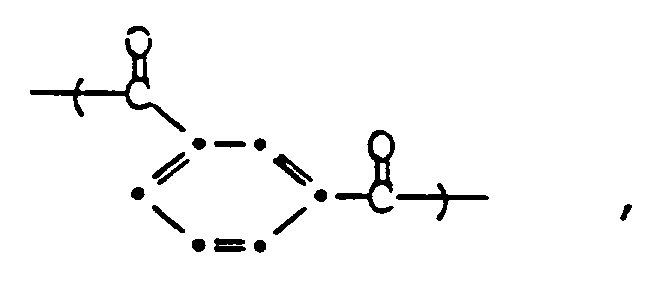
a "5-sulfoisophthalic acid repeating unit" is of the structure:
and a "diethylene glycol repeating unit" is of the structure:
(̵O―CH₂―CH₂―O―CH₂―CH₂―O)̵ . - Of course, the above-described repeating units describe internal polymer structures and the external (terminal) repeating units will typically terminate with a hydroxyl or carboxyl group.
- Therefore, any chemical derivative which will result in the desired repeating unit can be used to prepare the polyester of the present invention. For example, the corresponding acid anhydrides, esters, and acid chlorides (as well as the free diacids themselves) can be used as the particular starting material for incorporating the desired dicarboxylic acid repeating unit into the polyester. The total amount of acid moiety repeating units in the polyester useful in the present invention is 100 mole %. The acid moiety repeating units in the polyester of the invention are components (a) and (b); therefore, the total mole percentage of components (a) plus (b) in the polyester is 100 mole %. Likewise, the total amount of hydroxy moiety repeating units in the polyester useful in the present invention is 100 mole %. The hydroxy moiety repeating units in the polyester of the invention are components (c) and (d); therefore, the total mole percentage of components (c) plus (d) in the polyester is 100 mole %. It follows then that the total of all acid moiety and hydroxy moiety repeating units in the polyester totals 200 mole %.
- In the polyester, component (b), i.e., the 5-sulfoisophthalic acid, is typically in the form of a metallic sulfonate salt. The metal ion of the sulfonate salt group may be Na⁺, Li⁺, K⁺, Mg⁺⁺, Ca⁺⁺, Cu⁺⁺, Fe⁺⁺, or Fe⁺⁺⁺. It is also possible that the sulfonate salt is non-metallic and can be a nitrogen-containing base as described in U.S. Patent 4,304,901, incorporated herein by reference. The most preferred component or moiety is 5-sodiosulfoisophthalic acid.
- The inherent viscosities (I.V.) of the particular water-dissipatable polyester materials useful herein are at least about 0.1 as determined according to ASTM D2857-70 procedure, in a Wagner Viscometer of Lab Glass, Inc., of Vineland, New Jersey, having a 1/2 mL capillary bulb, using a polymer concentration of about 0.5% by weight in 60/40 by weight of phenol/tetrachloroethane. It is preferred that the I.V. of the polyester (component (A) of the ink) is about 0.1 to about 1.0, more preferably about 0.2 to about 0.6. The procedure for determining I.V. is carried out by heating the polymer/solvent system at 120°C for 15 minutes, cooling the solution to 25°C and measuring the time of flow at 25°C. The I.V. is calculated from the equation

where: - (η) =
- inherent viscosity at 25°C at a polymer concentration of 0.5 g/100 mL of solvent;
- ln =
- natural logarithm;
- ts =
- sample flow time;
- to =
- solvent-blank flow time; and
- C =
- concentration of polymer in grams per 100 mL of solvent = 0.5.
- The units of the inherent viscosity throughout this application are in deciliters/gram.
- Specific preferred polyesters useful as component (A) of the ink of the invention include:
wherein component (a) is about 91 mole % isophthalic acid, component (b) is about 9 mole % 5-sodiosulfoisophthalic acid, component (c) is about 75 mole % 1,4-cyclohexanedimethanol, and component (d) is about 25 mole % diethylene glycol;
wherein component (a) is about 93 mole % isophthalic acid, component (b) is about 7 mole % 5-sodiosulfoisophthalic acid, component (c) is about 70 mole % 1,4-cyclohexanedimethanol, and component (d) is about 30 mole % diethylene glycol;
wherein component (a) is about 93 mole % isophthalic acid, component (b) is about 7 mole % 5-sodiosulfoisophthalic acid, component (c) is about 85 mole % 1,4-cyclohexanedimethanol, and component (d) is about 15 mole % diethylene glycol;
wherein component (a) is about 95 mole % isophthalic acid, component (b) is about 5 mole % 5-sodiosulfoisophthalic acid, component (c) is about 85 mole % 1,4-cyclohexanedimethanol, and component (d) is about 15 mole % diethylene glycol;
wherein component (a) is about 95 mole % isophthalic acid, component (b) is about 5 mole % 5-sodiosulfoisophthalic acid, component (c) is about 70 mole % 1,4-cyclohexanedimethanol, and component (d) is about 30 mole % diethylene glycol; and
wherein component (a) is about 97 mole % isophthalic acid, component (b) is about 3 mole % 5-sodiosulfoisophthalic acid, component (c) is about 85 mole % 1,4-cyclohexanedimethanol, and component (d) is about 15 mole % diethylene glycol. - It is preferred that the ink composition is printed onto a substrate such as metal foil, newsprint, bleached and unbleached kraft paper, clay coated paper, glass, calendered paper, stainless paper, paper board, and films or other substrates of polyester, polycarbonate, cellulose ester, regenerated cellulose, poly(vinylidene chloride), polyamide, polypropylene, polyethylene or polystyrene;
- The ink compositions of this invention can be for any of the typical ink applications such as flexographic, gravure, letterpress, ink-jet, or screen-process printing applications. The ink compositions of the present invention have excellent adhesion to a wide variety of substrates including plastic films such as polyester; aluminum foil; glass; and paper.
- The ink compositions of the present invention generally have a pH of about 8.2 or lower; preferred is a pH of about 5 to 8. If the pH is higher than about 8.2, there is a danger of the polymer(s) hydrolyzing which can result in gelling of the system under certain circumstances.
- The polyester material can be dispersed in water or aqueous solution using the techniques described herein or known in the art and then blended with the other components. The following procedure can be used for dispersing the polyester in water: The water should be preheated to about 140°F (60°C) to about 200°F (93.33°C) and the polyester in pellet form is added rapidly to the vortex under high shear stirring. A Cowles Dissolver, Waring (trademark) blender, or similar equipment may be used. Depending upon the volume prepared, dispersion of the pellets should be complete within about 15 minutes to about 2 hours with agitation. It may be desirable to add the total amount of polyester in portions over a period of time. Continued agitation with cooling may be desirable to prevent thickening at the surface due to water evaporation. Viscosities of the dispersions remain low up to polyester levels of 25 percent to 30 percent and viscosities increase sharply above these levels. Viscosities of the dispersions will be influenced by the degree of polymer dispersion obtained which is affected by the dispersing temperature, shear, and time. The polyester content typically may range from about 15 percent to about 50 percent by weight of the aqueous dispersion with the preferred for most applications being from about 26 percent to about 38 percent.
- The inks, overprints, and primers of this invention can be prepared, for example, as disclosed in U.S. Patent 4,148,779, which is incorporated herein by reference in its entirety. For example, the printing ink, overprint, or primer may be prepared as follows: The pigment is added to the polymer dispersion and, at a properly adjusted viscosity, dispersed there into with ball mill, sand mill, high-shear fluid flow mill, Cowles Dissolver, Kady Mill or the like. The pigments also may be dispersed directly in the polymer by milling on a heated two-roll mill at about 220° to 360°F (104.44° to 182.22°C) and using processing aids as desired, such as solvents or plasticizers. The viscosity and printing characteristics of the ink composition may be modified further by addition of water, solvents, plasticizers, sequestered wax, surfactants, and the like to suit the particular printing needs. The amounts and nature of these optional additives have been previously described herein.
- The present invention is not limited to any type of colorant and can accommodate any pigment or disperse dye which can be dispersed, milled, mixed, blended or dissolved in any manner in either the polyester, water, or aqueous polymer system.
- Exemplary useful C.I. pigments for use in the present invention are given in the following table:


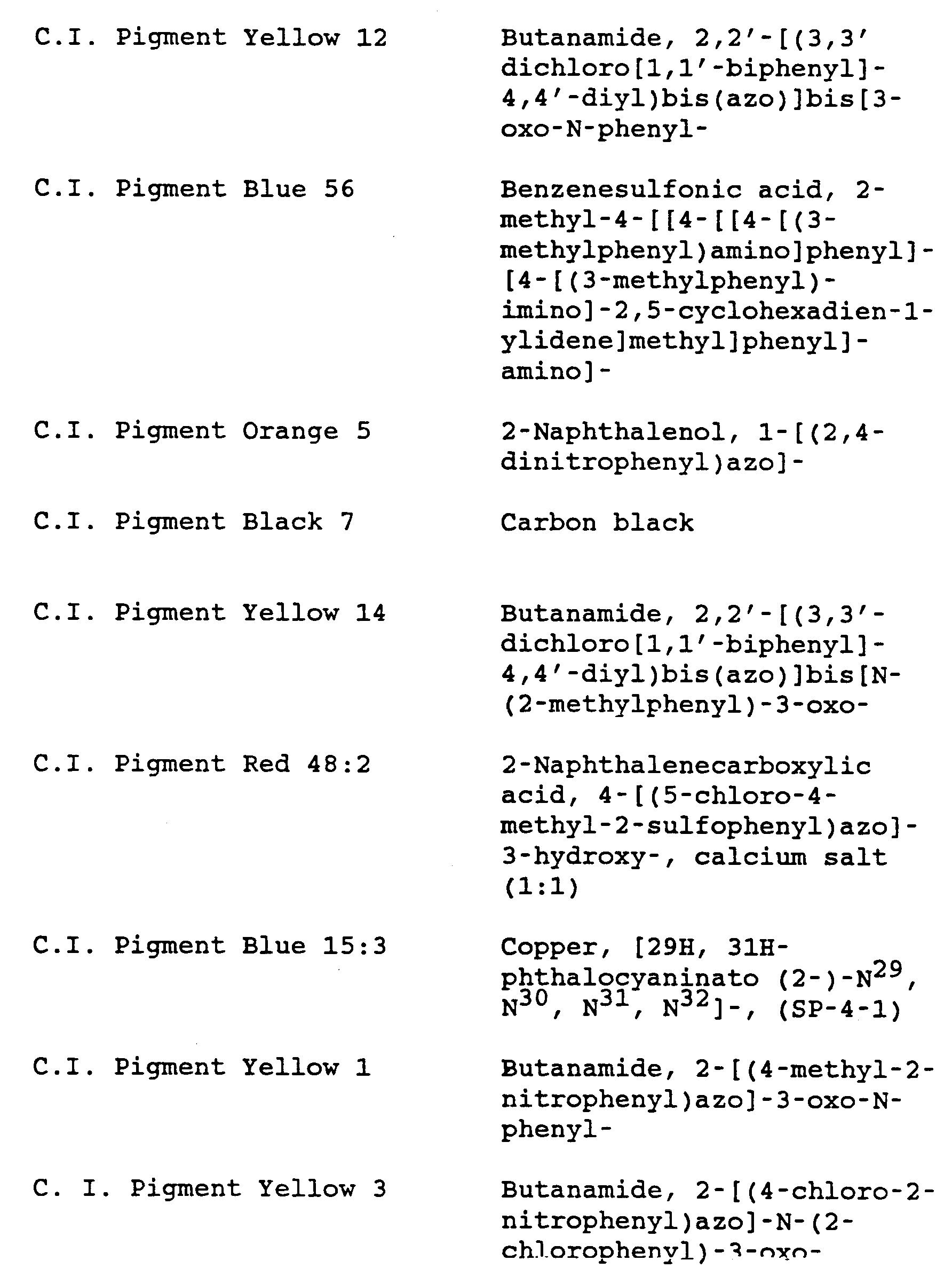


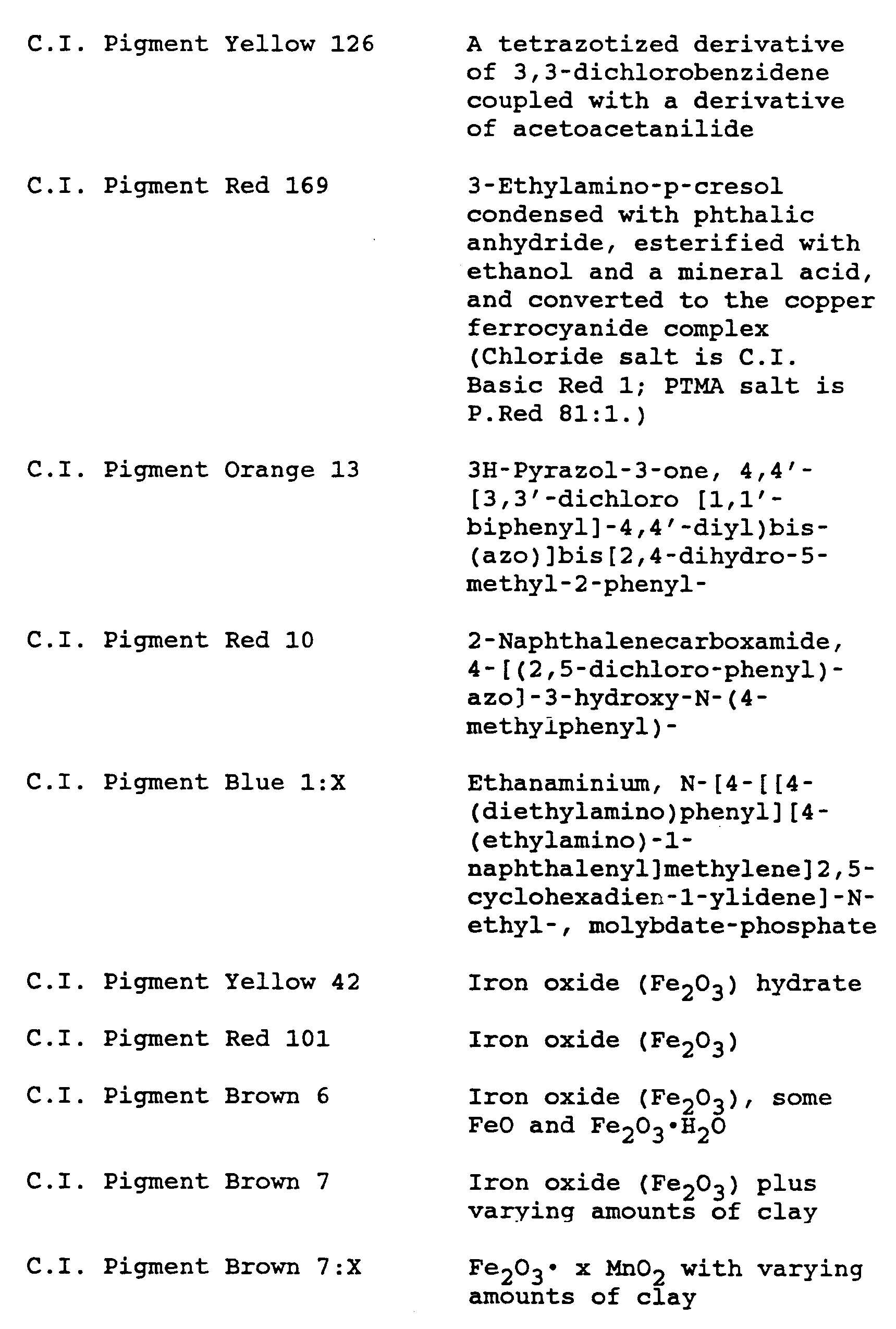

- Other useful pigments, in addition to those specifically identified above, include those described in NPIRI Raw Materials Data, Vol. 4, Pigments (1983).
- During preparation of an ink, it is not particularly critical when the propylene glycol is added. It can be added to the polymer dispersion or directly to the finished ink. Typically, to get complete dispersion or solubilization of the propylene glycol, it is required to apply heat (e.g., 90°C) and agitation for a sufficient time to achieve complete dispersion or solubilization.
- In addition to improved freeze-thaw stability, the inks of the present invention may also have improved water-resistance, blocking resistance, flow-out, high temperature stability, adhesion, substrate wetting, and/or rewettability of the printing cylinder after temporary stopping of the printing machine.
- Freeze-thaw stability can be defined as no substantial change in viscosity after the inks thaw within 4-8 hours at an ambient temperature after storing in freezer at -30°C for about 18-24 hours. By the phrase "no substantial increase in viscosity" is meant that an ink has less than or equal to a 30% increase in viscosity after being subjected to one freeze-thaw cycle as described above. Any ink undergoing greater than a 30% increase in viscosity after such a freeze-thaw cycle is considered freeze-thaw unstable. Freeze-thaw stability can be determined by the procedures described in the examples hereof. It is preferred that, in addition to improved freeze-thaw stability, an ink of the present invention has improved gloss, adhesion, water resistance, ink stability and film forming ability, as compared to the same ink without propylene glycol (component (D)).
- The following examples are to illustrate the invention but should not be interpreted as a limitation thereon. All percentages are by weight unless indicated otherwise.
- The polymers prepared are copolyesters comprising isophthalate moieties (I), 5-sodiosulfoisophthalate moieties (SIP), diethylene glycol moieties (DEG), and 1,4-cyclohexanedimethanol (CHDM) moieties. The starting materials, I and SIP, can be present as either the acid, dimethyl ester, diethylene glycol esters, or other suitable esters (e.g., ethyl, mixed DEG, CHDM) or that can be reacted with the glycols and the subsequent reaction product either removed or incorporated into the system as the DEG diester would be (see U.S. Patents 3,546,008; 3,734,874; and 3,779,993). Also other cations could be substituted for Na on the sulfonate as outlined in U.S. Patents 3,546,008; 3,734,874; and 3,779,993. Generally, typical catalysts used for esterification, ester exchange, and polyesterification can be used in the polymer preparation (see U.S. Patents 3,546,008; 3,734,874; and 3,779,993). The polymers are prepared by conventional polyesterification methods.
- 0.5 Mole of polymer is prepared in the laboratory by the following technique. A polymer is prepared with acid components consisting of 97 mole % isophthalate acid and 3 mole % 5-sodiosulfoisophthalate acid, glycol of 54 mole % diethylene glycol and 46 mole % 1,4-cyclohexanedimethanol (cis/trans ratio of about 35/65). The following are weighed directly into a 500 ml round-bottom flask or are weighed and transferred:
- 80.51 g (0.485 mole) isophthalic acid
4.02 g (0.015 mole) 5-sodiosulfoisophthalic acid
54.06 g (0.51 mole) diethylene glycol
37.44 g (0.26 mole) 1,4-cyclohexanedimethanol
0.123 g (0.0015 mole) anhydrous sodium acetate
1.02 ml (100 ppm) titaniumtetraisopropoxide catalyst
A stainless steel stirrer shaft and blade were used to stir the system to facilitate reaction and removal of volatiles. A Belmont metal bath placed in a heating mantle connected to a temperature controller was used as the heating medium. The system was purged with nitrogen and kept under a N₂ blanket during the run. Dry ice traps were used to collect volatiles. An oil based vacuum pump was used to place the system under reduced pressure for molecular weight buildup after the esterification stage. - The bath was heated to 220°C and the flask and contents were inserted in the bath and stirred for 80 minutes. The temperature was increased to 265°C over about a 10 minute period and the system was placed under reduced pressure over 5 minutes time [<10 mm torr (<1.33 kPa)] and held for 10 minutes. The system was returned to the nitrogen purge, the polymer was cooled and removed from the flask and ground. The polymer had an I.V. (inherent viscosity in 60/40 phenol/tetrachloroethane) of 0.296. Analysis by nuclear magnetic resonance spectroscopy (NMR) showed a composition of 3 mole % 5-sodiosulfoisophthalic acid, 97 mole % isophthalic acid, 47 mole % 1,4-cyclohexanedimethanol and 53 mole % diethylene glycol. The polymer had a second cycle glass transition temperature of 40°C by differential scanning calorimetry (DSC).
- Similar equipment was used to prepare a polymer with a target composition of 90 mole % isophthalic acid, 10 mole % 5-sodiosulfoisophthalic acid, 60 mole % cyclohexanedimethanol and 40 mole % diethylene glycol. The following components were used:
87.30 g (0.450 mole) dimethyl isophthalate
14.80 g (0.050 mole) dimethyl 5-sodiosulfoisophthalate
45.36 g (0.315 mole) 1,4-cyclohexanedimethanol
42.40 g (0.400 mole) diethylene glycol
0.410 g (0.005 mole) anhydrous sodium acetate
0.75 cc (75 ppm) titanium tetraisopropoxide catalyst solution at 1.45% Ti
The materials were charged to the flask and heated at 200°C for about 1 hour, the temperature was increased to 240°C and held for about 30 minutes, the temperature was then increased to 280°C and the system was placed under <1.0 mm Hg (<0.133 kPa) pressure and held for 25-30 minutes. The polymer had an inherent viscosity of 0.405 and a composition by NMR of 10.9 mole % 5-sodiosulfoisophthalate and 89.1 mole % isophthalic acid; the glycols were analyzed as 43.7 mole % diethylene glycol and 56.3 mole % 1,4-cyclohexanedimethanol. The polymer had a second cycle glass transition temperature of 58.5°C by DSC analysis. - Polymers could also be prepared in larger quantities in stainless steel batch process equipment in a pilot facility. An example of such a preparation is outlined below. The following were charged to a stirred reactor:
- 9.40 lbs (4263.75 g) isophthalic acid
212.86 g 5-sodiosulfoisophthalic acid
6.19 lbs (2807.72 g) diethylene glycol
4.25 lbs (1927.76 g) 1,4-cyclohexanedimethanol
27.0 g titanium tetraisopropoxide in n-butanol
5.90 g sodium acetate
The materials were placed under N₂ purge and then heated to 230°C and held for 1.5 hours. The temperature was increased to about 265°C and placed under <4000 microns pressure (<0.533 kPa) for about 20 minutes. The molten polymer was extruded and cooled in dry ice. The resulting product had an I.V. of 0.40 and a composition by NMR of 2.6 mole % 5-sodiosulfoisophthalic acid and 97.4 mole % isophthalic acid; 46.2 mole % 1,4-cyclohexanedimethanol and 53.8 mole % diethylene glycol. The second cycle glass transition temperature was 41°C. - Using the same type reactor as in Method 2, Example C, the following materials were charged to the reactor:
8.65 lbs (3923.55 g) isophthalic acid
2.57 lbs (1165.73 g) of the diethylene glycol diester of 5-sodiosulfoisophthalic acid at 46.5 weight percent in diethylene glycol
7.39 lbs (3352.03 g) 1,4-cyclohexanedimethanol
20.09 g of titanium tetraisopropoxide in n-butanol (2.54 weight percent Ti)
10.21 g of anhydrous sodium acetate
The temperature of the heating medium was increased to 255°C and held for 1 hour. The temperature of the heating medium was increased to 285°C and the system was placed under <4000 microns pressure (<0.533 kPa) and held for 20 minutes. The polymer was extruded and cooled. The polymer had an I.V. of 0.43 and a composition by NMR of 5.5 mole % 5-sodiosulfoisophthalic acid and 94.5 mole % isophthalic acid; 79.3 mole % 1,4-cyclohexanedimethanol and 20.7 mole % diethylene glycol. The second cycle glass transition temperature by DSC was 67.7°C. - Using similar reaction conditions but varying the ratio of the components to achieve a different composition, the polymers shown below were prepared:
Example IPA 5-Sodiosulfoisophthalic Acid CHDM DEG I.V. Tg (°C) E 97.2 2.8 82.7 17.3 0.42 67 F 92.9 7.1 82.0 18.0 0.36 69 G 94.2 5.8 71.7 28.3 0.44 61 H 93.5 6.5 71.4 28.6 0.44 62 - In addition to batch process reactors, the polymers can also be prepared in conventional continuous unit pilot plant or production equipment. Polymer with the following composition was obtained on such equipment.
Example IPA 5-Sodiosulfoisophthalic Acid CHDM DEG I.V. Tg (°C) I 89.1 10.9 71.1 28.9 0.375 54.7 J 90.7 9.3 75.2 24.8 0.352 66.8 - The polymer systems can be dispersed in a solvent system consisting mainly of water but generally a cosolvent such as n-propanol or i-propanol is needed to obtain % solids of 20-35%. The amount of cosolvent required to disperse the polymers depends on the polymer composition, but generally all the polymers can be dispersed in refluxing (3:1 H₂O:n-propanol). Azeotrope can be removed to give a lower percent alcohol and higher percent solids.
- 20.0 Grams of n-propanol and 60.0 g distilled water were weighed into a three-necked flask. The sample was heated to reflux (about 88°C) and 20 g of polymer (having a composition of 96 mole % isophthalic acid, 4 mole % 5-sodiosulfoisophthalic acid, 76 mole % cyclohexanedimethanol, and 24 mole % diethylene glycol) was introduced and the dispersion was stirred at reflux for 1 hour. A still head condenser was then used to remove 32 ml of azeotrope to give a dispersion with <2% n-propanol and about 28% solids.
- 128.8 Grams distilled water and 42.5 g n-propanol were charged to a flask and heated to reflux. 60.0 Grams of polymer (93% I, 7% 5-sodiosulfoisophthalate, 15 mole % diethylene glycol, 85 mole % 1,4-cyclohexanedimethanol) was introduced and the dispersion was stirred at reflux for 1 hour. 36.2 Grams of distillate was removed to give a final dispersion containing 30% polymer solids and 10% n-propanol.
- 12.0 Grams distilled water and 2.0 g n-propanol were placed in a flask and heated to reflux in boiling water using a magnetic stir bar and stirrer hot plate. 6.0 Grams of polymer (91 mole % I, 9 mole % 5-sodiosulfoisophthalate, 25 mole % diethylene glycol, and 75 mole % 1,4-cyclohexanedimethanol) was added to make a dispersion. The dispersion was stirred one hour, a thin, slightly opaque dispersion was obtained with theoretical 30% polymer solids and 10% n-propanol.
- 19,905 Grams of distilled water and 6,435 g n-propanol were charged to a 50-liter flask and stirred and heated to reflux (about 88°C). 9,085 Grams of polymer (Example I) was charged as rapidly as possible to the flask via a funnel on the side arm. The dispersion was allowed to return to reflux and was boiled and stirred for 1 hour. The system was cooled 10°C and then changed to accept a take-off receiver.
- The system was heated again to reflux and 4743.6 g (5477.7 ml) was removed. The sample was cooled and filtered through a coarse screen. The dispersion contained 29.7% solids and 9.61% n-propanol.
- The method shown in Example 12 was used to prepare dispersions of the following polymers at 30% solids and 10% n-propanol.
Dispersion Example Polymer Example Polymer Target Composition, Mole % IPA 5-Sodiosulfoisophthalic Acid CHDM DEG O E 97 3 85 15 P (Comparative) C 97 3 46 54 Q D 95 5 85 15 R G 95 5 70 30 S F 93 7 85 15 T H 93 7 70 30 U (Comparative) B 90 10 60 40 V J 91 9 75 25 A method similar to Example L, except scaled up to 50-liter size, was used to prepare the following dispersion at 10% n-propanol, 30% solids: W 9 91 9 75 25 - In addition to the above-described polyesters, a comparative polyester was prepared in accordance with Example 1 of U.S. Patent 4,883,714. This comparative example contains 82 mole % IPA, 18 mole % SIP, 54 mole % DEG and 46 mole % CHDM and will be referred to hereinafter as "polyester X".
- This example illustrates the preparation and composition of blue millbase employed in formulating water-based inks. The blue pigment (i.e., Blue B2GA) from Hoechst corporation (Color Index Pigment Blue 15:3), defoamer, polyester dispersion and water are mixed using a paint shaker containing 400.0 g of glass beads for 4 hours.
- The material is filtered through cheesecloth. The composition of the blue millbase is as follows:
Ingredients Amount g % wt Blue pigment 100 25.0 Dispersion of Polyester X (30% Solids) 202 50.5 Defoamer 2 0.5 Water 96 24.0 - The polyester dispersion is used as a grinding vehicle to prepare the millbase.
- This example illustrates the preparation and composition of white millbase employed in formulating an aqueous ink. Titanium dioxide is used as white pigment. The white pigment is from either Kemira or Du Pont. The white pigment and clay (ASP-072 from Engelhard) are added to the polyester dispersion. The ingredients are mixed vigorously using a blender for about half an hour. The resultant mixture is filtered using cheesecloth. The composition of the white millbase is as follows:
Ingredients Amount g % wt TiO₂ (white pigment) 540 54.0 Clay 60 6.0 Polyester dispersion (30% solid) 400 40.0 - The dispersions of the polyester of Example V and Polyester X are used for preparing white millbases.
- The blue millbase prepared in accordance with Example 1 is used to formulate a water-based blue ink. The blue millbase is added to the polyester dispersion containing the polyester of Example V in the presence of additives. The blue ink contains the following ingredients.
Ingredients Amount g % wt Polyester dispersion (30% solid of the polyester of Example V) 100 91.6 Blue millbase 6 5.5 Propylene Glycol 3 2.7 Tektamer (trademark) (a biocide) 0.2 0.2 - The freeze-thaw stability of inks is monitored by viscosity change after aging the sample for 18-24 hours in the freezer at -22°F (-30°C). The inks are completely gelled after freezing, but thaw at ambient temperature in 4-6 hours. The initial ink viscosity measured by Zahn Cup # 2 is about 20 sec, which increases only about 5-10% after freeze-thaw in the presence of propylene glycol which demonstrates that the ink is freeze-thaw stable. The inks remain stable after five freeze-thaw cycles. The pigments can be incorporated in aqueous inks in the range of 2-50% by weight depending upon type of pigment and desired end-use of the ink.
- The water-based ink prepared in accordance with Example 3 is used for evaluating printing process parameters. The ink is applied on aluminum foil, polyester film and coated papers with number 3 and 6 Meyer rods. These samples are allowed to dry for 24 hours at ambient temperature or dried in the oven at 100°C for 3 sec. The water resistance of the samples is determined by a water spot test. Distilled water drops are left for 5, 10, 15 and 20 minutes and then wiped off gently with a facial tissue. The integrity of the ink film is visually assessed. The water spot test is rated as follows:
- 1. Poor: Total film removed
- 2. Fair: Partial film removed
- 3. Good: Dull or discolor film, but no removal
- 4. Excellent: The film is substantially unchanged
- The water-based ink prepared in accordance with Example 3 is tested for blocking resistance. The ink is applied on the substrates as described in Example 4. These samples are evaluated for blocking temperature using the PI Sentinel Heat Sealer at 40 psi (275.79 kPa) for 5 sec. The samples are folded face-to-face printed surface, then placed under sealer at different temperatures. The test is repeated until the blocking occurred. The integrity of the printed film is visually assessed. The blocking resistance is rated as follows:
- 1. Poor: Picked and complete film removed
- 2. Fair: Picked, but partial film removed
- 3. Good: Slightly picked, but no film removed
- 4. Excellent: No picking and no film removed
- The water-based ink prepared in accordance with Example 3 also exhibits excellent wetting on aluminum foil, polymer film and paper. The ink shows excellent hardness, adhesion, gloss, drying, rewetting of printed cylinder and scuff resistance on different substrates.
- This example illustrates the importance of propylene glycol in the water-based inks. Example 3 is repeated with the exception that an aqueous ink is formulated without propylene glycol. The blue ink contains the following ingredients.
Ingredients Amount g % wt Polyester dispersion (30% solid of the polyester of Example V) 100 94.2 Blue millbase 6 0.2 Tektamer 0.2 0.2 - The ink gels at -8°F (-22.22°C) and does not thaw at room temperature. Moreover, adhesion, wetting, and film forming ability are extremely poor for the ink. These results demonstrate that the presence of propylene glycol can dramatically improve several desired properties of the printed ink films.
- A white ink is prepared which contains the following ingredients:
Ingredients Amount g % wt Polyester dispersion (30% solid of the polyester of Example V) 100 74.5 White pigment 30 22.3 Propylene Glycol 4 3.0 Tektamer 0.3 0.2 - The ink exhibits excellent freeze-thaw stability, wetting of the substrates, adhesion, rewetting of the cylinder, gloss, hardness, drying and scuff resistance, water resistance and blocking temperature.
- Example 8 is repeated with the exception that the propylene glycol is eliminated from the formulation. The aqueous ink does not exhibit freeze-thaw stability.
- Example 3 is repeated with the exception that polyester X is used instead of the polyester of Example V in formulating water-based inks. The ink contains the following ingredients.
Ingredients Amount g % wt Polyester dispersion (30% solid of polyester X) 100.0 44.0 Blue millbase 108.6 47.8 Jonwax 26 from S. C. Johnson 6.8 3.0 Propylene Glycol 11.4 5.0 Tektamer 0.6 0.2 - The ink shows excellent freeze-thaw stability, gloss, adhesion, wettability, blocking resistance and scuff-resistance on several printed substrates such as aluminum foil, paper and polyester films.
- Example 10 is repeated with the exception that propylene glycol is removed from the formulation. The performance of the ink is poor in terms of water resistance on aluminum foil; however, the ink exhibits excellent freeze-thaw stability.
- This example illustrates the preparation of water-based white ink with surprisingly improved performance. The ink contains the following composition:
Ingredients Amount g % wt Polyester dispersion (30% solid of the polyester of Example V) 100.0 62.0 White pigment 43.2 26.8 Clay ASP-072 4.8 3.0 Jonwax 26 4.8 3.0 Propylene Glycol 8.1 5.0 Tektamer 0.3 0.2 - The ink exhibits excellent freeze-thaw stability, gloss, wetting, adhesion, water-resistance, film forming ability, scuff-resistance on several substrates like metal foils, coated and uncoated papers, and polymer films.
- Example 12 is repeated with the exception that the propylene glycol is removed from the formulation. The ink gels at -8°F (-22.22°C), and does not convert to liquid ink even after several days at an ambient temperature. The ink performance is also poor in terms of blocking-resistance and film forming ability of the printing substrates.
- This example illustrates that the properties and performance of the polyester of Example V and polyester X can be improved drastically by blending the two polymer dispersions. Blends containing at least about 15 wt. % of polyester X in the polyester of Example V improve freeze-thaw stability. A small amount of propylene glycol (about 0.5% to 3% by weight) in many such blends renders them freeze-thaw stable. A water-based ink is formed by using a polymer blend as described above. The ink composition is as follows:
Ingredients Amount g % wt Polyester dispersion blend (30% solid) (20% polyester X and 80% polyester of Example V) 100.0 90.0 Blue pigment 7.6 6.8 Propylene Glycol 3.3 3.0 Tektamer 0.2 0.2 - The ink exhibits excellent freeze-thaw stability at -22°F (-30°C). The performance of the ink is excellent in terms of water-resistance, gloss, blocking resistance, wettability and adhesion on various substrates.
- Example 14 is repeated with the exception that the blue pigment is replaced with white pigment. The amount of white pigment incorporated in the ink is 15.0% instead of 6.8%. The ink is freeze-thaw stable, and performance of the ink is excellent on various substrates.
- Examples 3, 8, 10 (Comparative), 12 and 14 are repeated with the exception that the pigments are removed from the formulations, and the resultant formulations are used as aqueous-based overprints. The overprint formulations are freeze-thaw stable at -22°F (-30°C). The performance of the overprints is excellent in terms of gloss, blocking resistance, water-resistance and adhesion.
- White millbase prepared in accordance with Example 2 is employed to formulate a water-based white ink. The white millbase is added to the polyester dispersion containing the polyester of Example V in the presence of additives. The white ink contains the following ingredients.
Ingredients Amount g % wt Polyester dispersion (30% solid of the polyester of Example V) 100 74.5 White pigment 30 22.3 Methyl Propasol (Propylene Glycol Monomethyl Ether) 4 3.0 Tektamer 0.3 0.2 - For freeze-thaw stability, the ink is placed in the freezer for 18-24 hours at -22°F (-30°C). The ink is completely gelled and remains gel after thawing at room temperature, i.e., is freeze-thaw unstable.
- Example 17 is repeated with the exception that methyl propasol is 6.0 g instead of 4.0 g in the formulation. The ink is converted to a gel at -22°F (-30°C) and remains gel after thawing at room temperature, i.e., is freeze-thaw unstable.
- Example 17 is repeated with the exception that propyl propasol (propylene glycol monopropyl ether) is used instead of methyl propasol. The formulated ink is converted to a gel at -22°F (-30°C) and remains in the gel state after thawing at room temperature, i.e., is freeze-thaw unstable.
- Example 17 is repeated with the exception that isopropyl acetate is used instead of methyl propasol. The formulated ink is converted to a gel at -22°F (-30°C) and remains semi-gel at room temperature, i.e., is freeze-thaw unstable.
- Example 17 is repeated with the exception that propyl acetate is used instead of methyl propasol. The ink is converted to a gel at -22°F (-30°C) and remains in the semi-gel form at room temperature, i.e., is freeze-thaw unstable.
- Freeze-thaw stability of an ink or an overprint is monitored by viscosity reading before and after aging the samples for 17 hours in the freezer at 0°F (-17.78°C). The samples after freezing are allowed to thaw completely at room temperature and their viscosity is then measured to determine if there had been any change in viscosity. If the viscosity changes are too high (more than 30%) or the samples are too thick to measure, the inks or overprints are considered as unstable.
- Three, five and ten grams of propylene glycol are added to 100 grams of the polyesters of Examples D, H and V with stirring. These samples are then put in the freezer along with samples of the polyesters of Examples D, H and V without propylene glycol for the freeze-thaw stability test as described above. The results are listed as follows:
Polyester Propylene Glycol (Wt. %) 0 3 5 10 Example D No* No No Yes** Example H No Yes Yes Yes Example V No No Yes Yes Polyester X (Example 1 of U.S. Patent 4,883,714) Yes Yes Yes Yes *No means unstable **Yes means stable
Claims (17)
- An ink composition or concentrate thereof comprising:(A) 4 to 80 weight percent of at least one linear, water-dissipatable polyester having a inherent viscosity of at least 0.1 as measured in a 60/40 parts by weight solution of phenol/tetrachloroethane at 25°C and at a concentration of 0.5 gram of polyester in 100 ml of solvent, the polyester containing substantially equimolar proportions of acid moiety repeating units (100 mole %) to hydroxy moiety repeating units (100 mole %), the polyester comprising repeating units of components (a), (b), (c) and (d), as follows wherein all stated mole percentages are based on the total of all acid and hydroxy moiety repeating units being equal to 200 mole %:(a) 90 to 97 mole % isophthalic acid,(b) 3 to 10 mole % 5-sulfoisophthalic acid,(c) 70 to 85 mole % 1,4-cyclohexanedimethanol, and(d) 15 to 30 mole % diethylene glycol;(B) 0 to 60 weight percent colorant;(C) 0 to 95 weight percent water; and(D) from 0.5 to 10 weight percent of propylene glycol.
- The ink composition of Claim 1 wherein Component (B) is present in an amount of at least 0.5 weight percent.
- The ink composition of Claim 1 wherein Component (A) is present in an amount of 5 to 40 weight percent, Component (B) is present in an amount of 0 to 35 weight percent, and Component (C) is present in an amount of 35 to 90 weight percent.
- The ink composition of Claim 3 wherein Component (D) is present in an amount of 3 to 5 weight percent.
- The ink composition of Claim 1 additionally comprising up to 15 weight percent of one or more additional additives.
- The ink composition of Claim 1 additionally containing up to 3 weight percent of one or more additional additives selected from the group consisting of a surfactant, a wax defoamer, a biocide, a thickener, a pH stabilizer, an alcohol, and a mixture thereof.
- The ink composition of Claim 1 further comprising 5.0 to 30.0 weight percent, based on the weight of Component (A), of a different water-dispersible polyester.
- The ink composition of Claim 1 wherein said colorant is one or a mixture of the following color index materials: C.I. Pigment Yellow 17, C.I. Pigment Blue 27, C.I. Pigment Red 49:2, C.I. Pigment Red 81:1, C.I. Pigment Red 81:3, C.I. Pigment Red 81:x, C.I. Pigment Yellow 83, C.I. Pigment Red 57:1, C.I. Pigment Red 49:1, C.I. Pigment Violet 23, C.I. Pigment Green 7, C.I. Pigment Blue 61, C.I. Pigment Red 48:1, C.I. Pigment Red 52:1, C.I. Pigment Violet 1, C.I. Pigment White 6, C.I. Pigment Blue 15, C.I. Pigment Yellow 12, C.I. Pigment Blue 56, C.I. Pigment Orange 5, C.I. Pigment Black 7, C.I. Pigment Yellow 14, C.I. Pigment Red 48:2, C.I. Pigment Blue 15:3, C.I. Pigment Yellow 1, C.I. Pigment Yellow 3, C.I. Pigment Yellow 13, C.I. Pigment Orange 16, C.I. Pigment Yellow 55, C.I. Pigment Red 41, C.I. Pigment Orange 34, C.I. Pigment Blue 62, C.I. Pigment Red 22, C.I. Pigment Red 170, C.I. Pigment Red 88, C.I. Pigment Yellow 151, C.I. Pigment Red 184, C.I. Pigment Blue 1:2, C.I. Pigment Red 3, C.I. Pigment Blue 15:1, C.I. Pigment Red 23, C.I. Pigment Red 112, C.I. Pigment Yellow 126, C.I. Pigment Red 169, C.I. Pigment Orange 13, C.I. Pigment Red 1-10, 12, C.I. Pigment Blue 1:X, C.I. Pigment Yellow 42, C.I. Pigment Red 101, C.I. Pigment Brown 6, C.I. Pigment Brown 7, C.I. Pigment Brown 7:X, C.I. Pigment Black 11, C.I. Pigment Metal 1, or C.I. Pigment Metal 2.
- The ink of Claim 1 wherein the polyester of component (A) comprises 91 mole % isophthalic acid, 9 mole % 5-sodiosulfoisophthalic acid, 75 mole % 1,4-cyclohexanedimethanol, and 25 mole % diethylene glycol.
- The ink of Claim 1 wherein the polyester of component (A) comprises 93 mole % isophthalic acid, 7 mole % 5-sodiosulfoisophthalic acid, 70 mole % 1,4-cyclohexanedimethanol, and 30 mole % diethylene glycol.
- The ink of Claim 1 wherein the polyester of component (A) comprises 93 mole % isophthalic acid, 7 mole % 5-sodiosulfoisophthalic acid, 85 mole % 1,4-cyclohexanedimethanol, and 15 mole % diethylene glycol.
- The ink of Claim 1 wherein the polyester of component (A) comprises 95 mole % isophthalic acid, 5 mole % 5-sodiosulfoisophthalic acid, 85 mole % 1,4-cyclohexanedimethanol, and 15 mole % diethylene glycol.
- The ink of Claim 1 wherein the polyester of component (A) comprises 95 mole % isophthalic acid, 5 mole % 5-sodiosulfoisophthalic acid, 70 mole % 1,4-cyclohexanedimethanol, and 30 mole % diethylene glycol.
- The ink of Claim 1 wherein the polyester of component (A) comprises 97 mole % isophthalic acid, 3 mole % 5-sodiosulfoisophthalic acid, 85 mole % 1,4-cyclohexanedimethanol, and 15 mole % diethylene glycol.
- The ink of Claim 1 wherein the component (b) of the polyester of component (A) is in the form of a sodium salt.
- The ink of Claim 1 wherein the polyester of component (A) has an inherent viscosity of 0.2 to 0.6.
- The ink of Claim 1 coated onto a substrate selected from the group consisting of metal foil, newsprint, bleached kraft paper, unbleached kraft paper, clay coated paper, glass, calendered paper, stainless paper, paper board, polyester, polycarbonate, cellulose ester, regenerated cellulose, poly(vinylidene chloride), polyamide, polyolefin, and polystyrene.
Applications Claiming Priority (3)
| Application Number | Priority Date | Filing Date | Title |
|---|---|---|---|
| US513748 | 1990-04-24 | ||
| US07/513,748 US5129947A (en) | 1990-04-24 | 1990-04-24 | Aqueous printing inks having improved freeze-thaw properties |
| PCT/US1991/002748 WO1991016382A2 (en) | 1990-04-24 | 1991-04-22 | Aqueous printing inks having improved freeze-thaw properties |
Publications (2)
| Publication Number | Publication Date |
|---|---|
| EP0526569A1 EP0526569A1 (en) | 1993-02-10 |
| EP0526569B1 true EP0526569B1 (en) | 1995-10-11 |
Family
ID=24044534
Family Applications (1)
| Application Number | Title | Priority Date | Filing Date |
|---|---|---|---|
| EP91909218A Expired - Lifetime EP0526569B1 (en) | 1990-04-24 | 1991-04-22 | Aqueous printing inks having improved freeze-thaw properties |
Country Status (10)
| Country | Link |
|---|---|
| US (1) | US5129947A (en) |
| EP (1) | EP0526569B1 (en) |
| JP (1) | JPH05507509A (en) |
| AT (1) | ATE129003T1 (en) |
| CA (1) | CA2080838C (en) |
| DE (1) | DE69113793T2 (en) |
| DK (1) | DK0526569T3 (en) |
| ES (1) | ES2078520T3 (en) |
| GR (1) | GR3018121T3 (en) |
| WO (1) | WO1991016382A2 (en) |
Families Citing this family (18)
| Publication number | Priority date | Publication date | Assignee | Title |
|---|---|---|---|---|
| US4912157A (en) * | 1987-05-18 | 1990-03-27 | Eastman Kodak Company | Ink compositions and preparation |
| MY109293A (en) | 1991-12-18 | 1996-12-31 | Gillette Co | Fiber marker including an erasable ink |
| US5599853A (en) | 1993-01-29 | 1997-02-04 | The Gillette Company | Erasable inks |
| US5446082A (en) * | 1992-05-08 | 1995-08-29 | Toyo Boseki Kabushiki Kaisha | Water-dispersible polyester composition for image recording medium |
| US5464883A (en) * | 1994-06-03 | 1995-11-07 | Eastman Chemical Company | Waterborne correction fluid for correcting laser-jet and photocopied markings |
| WO1996003467A1 (en) * | 1994-07-25 | 1996-02-08 | Eastman Chemical Company | Ink and coating compositions containing a blend of water-dispersible polyester and carboxylic acids |
| US6025412A (en) * | 1995-09-29 | 2000-02-15 | Xerox Corporation | Colored particulates for ink jet inks |
| FR2742355B1 (en) * | 1995-12-14 | 1998-02-06 | Aimco Sa | PROCESS FOR HOMOGENOUSLY DISPERSING AT LEAST ONE REAGENT IN A FLUID MATRIX AND PRODUCTS OBTAINED |
| US5891231A (en) * | 1997-05-13 | 1999-04-06 | Lexmark International Inc. | Process for preparing pigment dispersions used in inks |
| US6171685B1 (en) * | 1999-11-26 | 2001-01-09 | Eastman Chemical Company | Water-dispersible films and fibers based on sulfopolyesters |
| JP2004107481A (en) * | 2002-09-18 | 2004-04-08 | Sharp Corp | Ink composition, recording method and recorded image using the same, and ink set and ink head |
| KR100754175B1 (en) * | 2005-05-19 | 2007-09-03 | 삼성전자주식회사 | Aqueous pigment dispersions with improved freeze thaw stability |
| US8357621B2 (en) * | 2009-06-29 | 2013-01-22 | E.I. Du Pont De Nemours And Company | Soil resist method |
| US7901589B2 (en) * | 2009-06-29 | 2011-03-08 | E.I. Du Pont De Nemours And Company | Propanediol soil resist compositions |
| JP6118207B2 (en) * | 2013-07-30 | 2017-04-19 | 花王株式会社 | Water-based ink for inkjet recording |
| US9745415B2 (en) | 2014-02-21 | 2017-08-29 | Ester Industries Limited | Sulfonated co-polyesters and method for manufacturing |
| WO2017217544A1 (en) * | 2016-06-17 | 2017-12-21 | 花王株式会社 | Aqueous ink |
| US11773293B2 (en) | 2017-11-15 | 2023-10-03 | S. C. Johnson & Son, Inc. | Freeze-thaw stable water-in-oil emulsion cleaner and/or polish compositions |
Family Cites Families (25)
| Publication number | Priority date | Publication date | Assignee | Title |
|---|---|---|---|---|
| US3151093A (en) * | 1960-05-18 | 1964-09-29 | Ashland Oil Inc | Freeze resistant latex |
| US3563942A (en) * | 1967-11-29 | 1971-02-16 | Du Pont | Aqueous dispersion of copolyesters modified with a sulfonated aromatic compound |
| US3546008A (en) * | 1968-01-03 | 1970-12-08 | Eastman Kodak Co | Sizing compositions and fibrous articles sized therewith |
| US3779993A (en) * | 1970-02-27 | 1973-12-18 | Eastman Kodak Co | Polyesters and polyesteramides containing ether groups and sulfonate groups in the form of a metallic salt |
| US3734874A (en) * | 1970-02-27 | 1973-05-22 | Eastman Kodak Co | Polyesters and polyesteramides containing ether groups and sulfonate groups in the form of a metallic salt |
| FR2311820A1 (en) * | 1975-05-22 | 1976-12-17 | Eastman Kodak Co | COMPOSITIONS OF COLORANTS AND THERMOPLASTIC MATERIALS CAPABLE OF BEING DISPERSE IN WATER AND THEIR APPLICATION TO THERMAL TRANSFER PRINTING |
| US4152485A (en) * | 1977-08-05 | 1979-05-01 | Toyo Boseki Kabushiki Kaisha | Magnetic recording medium |
| US4145469A (en) * | 1977-10-11 | 1979-03-20 | Basf Wyandotte Corporation | Water-insoluble treated textile and processes therefor |
| US4233196A (en) * | 1979-04-30 | 1980-11-11 | Eastman Kodak Company | Polyester and polyesteramide compositions |
| JPS5688454A (en) * | 1979-12-21 | 1981-07-17 | Toyobo Co Ltd | Aqueous dispersion |
| US4304900A (en) * | 1980-04-28 | 1981-12-08 | Eastman Kodak Company | Water dissipatable polyesters |
| US4304901A (en) * | 1980-04-28 | 1981-12-08 | Eastman Kodak Company | Water dissipatable polyesters |
| US4335220A (en) * | 1981-04-06 | 1982-06-15 | Eastman Kodak Company | Sequestering agents and compositions produced therefrom |
| US4704309A (en) * | 1985-06-07 | 1987-11-03 | Eastman Kodak Company | Printing processes employing water dispersible inks |
| JPS6221380A (en) * | 1985-07-19 | 1987-01-29 | Matsushita Electric Ind Co Ltd | dual screen tv receiver |
| US4916177A (en) * | 1986-06-02 | 1990-04-10 | Eastman Kodak Company | Ink compositions and preparation |
| CA1322805C (en) * | 1986-06-02 | 1993-10-05 | Charles Herbert Coney | Ink compositions and preparation |
| US4738785A (en) * | 1987-02-13 | 1988-04-19 | Eastman Kodak Company | Waste treatment process for printing operations employing water dispersible inks |
| US4847316A (en) * | 1987-05-06 | 1989-07-11 | Eastman Kodak Company | Aqueous dispersion blends of polyesters and polyurethane materials and printing inks therefrom |
| CA1328943C (en) * | 1987-05-18 | 1994-04-26 | Eastman Chemical Company | Ink compositions and preparation |
| US4883714A (en) * | 1987-05-18 | 1989-11-28 | Eastman Kodak Company | Ink compositions and preparation |
| US4912157A (en) * | 1987-05-18 | 1990-03-27 | Eastman Kodak Company | Ink compositions and preparation |
| US4772491A (en) * | 1987-08-13 | 1988-09-20 | Eastman Kodak Company | Coating process |
| US4855344A (en) * | 1987-08-13 | 1989-08-08 | Eastman Kodak Company | Ink compositions and their preparation |
| US4804719A (en) * | 1988-02-05 | 1989-02-14 | Eastman Kodak Company | Water-dissipatable polyester and polyester-amides containing copolymerized colorants |
-
1990
- 1990-04-24 US US07/513,748 patent/US5129947A/en not_active Expired - Fee Related
-
1991
- 1991-04-22 DE DE69113793T patent/DE69113793T2/en not_active Expired - Fee Related
- 1991-04-22 EP EP91909218A patent/EP0526569B1/en not_active Expired - Lifetime
- 1991-04-22 DK DK91909218.9T patent/DK0526569T3/en active
- 1991-04-22 CA CA002080838A patent/CA2080838C/en not_active Expired - Fee Related
- 1991-04-22 ES ES91909218T patent/ES2078520T3/en not_active Expired - Lifetime
- 1991-04-22 WO PCT/US1991/002748 patent/WO1991016382A2/en not_active Ceased
- 1991-04-22 JP JP91508662A patent/JPH05507509A/en active Pending
- 1991-04-22 AT AT91909218T patent/ATE129003T1/en not_active IP Right Cessation
-
1995
- 1995-11-20 GR GR950403238T patent/GR3018121T3/en unknown
Also Published As
| Publication number | Publication date |
|---|---|
| WO1991016382A2 (en) | 1991-10-31 |
| WO1991016382A3 (en) | 1991-11-28 |
| DE69113793T2 (en) | 1996-03-14 |
| GR3018121T3 (en) | 1996-02-29 |
| CA2080838A1 (en) | 1991-10-25 |
| US5129947A (en) | 1992-07-14 |
| EP0526569A1 (en) | 1993-02-10 |
| ES2078520T3 (en) | 1995-12-16 |
| ATE129003T1 (en) | 1995-10-15 |
| DE69113793D1 (en) | 1995-11-16 |
| CA2080838C (en) | 1996-12-31 |
| JPH05507509A (en) | 1993-10-28 |
| DK0526569T3 (en) | 1995-11-27 |
Similar Documents
| Publication | Publication Date | Title |
|---|---|---|
| EP0526528B1 (en) | Water-dispersible polyesters imparting improved water resistance properties to inks | |
| EP0356341B1 (en) | Ink composition containing a blend of a polyester and an acrylic polymer | |
| EP0365388B1 (en) | Ink composition containing a blend of a polyester, an acrylic polymer and a vinyl polymer | |
| US5129947A (en) | Aqueous printing inks having improved freeze-thaw properties | |
| EP0290359B1 (en) | Aqueous dispersion blends of polyesters and polyurethane materials and printing inks therefrom | |
| US4883714A (en) | Ink compositions and preparation | |
| US10010838B2 (en) | Dispersing resins | |
| KR19990066982A (en) | Water-based ink containing a near infrared fluorophore | |
| US4940744A (en) | Insolubilizing system for water based inks | |
| US5554675A (en) | Ink compositions and preparation | |
| WO1992012210A1 (en) | Ink millbase and method for preparation thereof | |
| US4772491A (en) | Coating process | |
| US4855344A (en) | Ink compositions and their preparation | |
| EP0291759B1 (en) | Ink compositions and preparation | |
| EP0309476B1 (en) | Ink compositions and preparation | |
| AU599672B2 (en) | Polyester printing ink | |
| EP0291758B1 (en) | Ink compositions and preparation | |
| EP0473450B1 (en) | Resinous binders having improved dilution | |
| US4916177A (en) | Ink compositions and preparation | |
| US5041489A (en) | Ink compositions and preparation | |
| WO1998024855A2 (en) | Triethanolamine titanates as additives for sulphonated polyesters |
Legal Events
| Date | Code | Title | Description |
|---|---|---|---|
| PUAI | Public reference made under article 153(3) epc to a published international application that has entered the european phase |
Free format text: ORIGINAL CODE: 0009012 |
|
| AK | Designated contracting states |
Kind code of ref document: A1 Designated state(s): AT BE CH DE DK ES FR GB GR IT LI LU NL SE |
|
| 17P | Request for examination filed |
Effective date: 19921105 |
|
| 17Q | First examination report despatched |
Effective date: 19931123 |
|
| RAP1 | Party data changed (applicant data changed or rights of an application transferred) |
Owner name: EASTMAN CHEMICAL COMPANY |
|
| GRAA | (expected) grant |
Free format text: ORIGINAL CODE: 0009210 |
|
| AK | Designated contracting states |
Kind code of ref document: B1 Designated state(s): AT BE CH DE DK ES FR GB GR IT LI LU NL SE |
|
| REF | Corresponds to: |
Ref document number: 129003 Country of ref document: AT Date of ref document: 19951015 Kind code of ref document: T |
|
| ITF | It: translation for a ep patent filed | ||
| REF | Corresponds to: |
Ref document number: 69113793 Country of ref document: DE Date of ref document: 19951116 |
|
| REG | Reference to a national code |
Ref country code: DK Ref legal event code: T3 |
|
| REG | Reference to a national code |
Ref country code: ES Ref legal event code: FG2A Ref document number: 2078520 Country of ref document: ES Kind code of ref document: T3 |
|
| REG | Reference to a national code |
Ref country code: GR Ref legal event code: FG4A Free format text: 3018121 |
|
| ET | Fr: translation filed | ||
| PLBE | No opposition filed within time limit |
Free format text: ORIGINAL CODE: 0009261 |
|
| STAA | Information on the status of an ep patent application or granted ep patent |
Free format text: STATUS: NO OPPOSITION FILED WITHIN TIME LIMIT |
|
| 26N | No opposition filed | ||
| PGFP | Annual fee paid to national office [announced via postgrant information from national office to epo] |
Ref country code: DK Payment date: 19970317 Year of fee payment: 7 |
|
| PGFP | Annual fee paid to national office [announced via postgrant information from national office to epo] |
Ref country code: SE Payment date: 19970319 Year of fee payment: 7 Ref country code: GB Payment date: 19970319 Year of fee payment: 7 |
|
| PGFP | Annual fee paid to national office [announced via postgrant information from national office to epo] |
Ref country code: AT Payment date: 19970324 Year of fee payment: 7 |
|
| PGFP | Annual fee paid to national office [announced via postgrant information from national office to epo] |
Ref country code: NL Payment date: 19970331 Year of fee payment: 7 |
|
| PGFP | Annual fee paid to national office [announced via postgrant information from national office to epo] |
Ref country code: FR Payment date: 19970411 Year of fee payment: 7 |
|
| PGFP | Annual fee paid to national office [announced via postgrant information from national office to epo] |
Ref country code: GR Payment date: 19970415 Year of fee payment: 7 |
|
| PGFP | Annual fee paid to national office [announced via postgrant information from national office to epo] |
Ref country code: LU Payment date: 19970424 Year of fee payment: 7 Ref country code: ES Payment date: 19970424 Year of fee payment: 7 |
|
| PGFP | Annual fee paid to national office [announced via postgrant information from national office to epo] |
Ref country code: DE Payment date: 19970428 Year of fee payment: 7 |
|
| PGFP | Annual fee paid to national office [announced via postgrant information from national office to epo] |
Ref country code: BE Payment date: 19970505 Year of fee payment: 7 |
|
| PGFP | Annual fee paid to national office [announced via postgrant information from national office to epo] |
Ref country code: CH Payment date: 19970630 Year of fee payment: 7 |
|
| PG25 | Lapsed in a contracting state [announced via postgrant information from national office to epo] |
Ref country code: LU Free format text: LAPSE BECAUSE OF NON-PAYMENT OF DUE FEES Effective date: 19980422 Ref country code: GB Free format text: LAPSE BECAUSE OF NON-PAYMENT OF DUE FEES Effective date: 19980422 Ref country code: AT Free format text: LAPSE BECAUSE OF NON-PAYMENT OF DUE FEES Effective date: 19980422 |
|
| PG25 | Lapsed in a contracting state [announced via postgrant information from national office to epo] |
Ref country code: SE Free format text: LAPSE BECAUSE OF NON-PAYMENT OF DUE FEES Effective date: 19980423 Ref country code: ES Free format text: LAPSE BECAUSE OF EXPIRATION OF PROTECTION Effective date: 19980423 |
|
| PG25 | Lapsed in a contracting state [announced via postgrant information from national office to epo] |
Ref country code: LI Free format text: LAPSE BECAUSE OF NON-PAYMENT OF DUE FEES Effective date: 19980430 Ref country code: GR Free format text: LAPSE BECAUSE OF NON-PAYMENT OF DUE FEES Effective date: 19980430 Ref country code: FR Free format text: THE PATENT HAS BEEN ANNULLED BY A DECISION OF A NATIONAL AUTHORITY Effective date: 19980430 Ref country code: DK Free format text: LAPSE BECAUSE OF NON-PAYMENT OF DUE FEES Effective date: 19980430 Ref country code: CH Free format text: LAPSE BECAUSE OF NON-PAYMENT OF DUE FEES Effective date: 19980430 Ref country code: BE Free format text: LAPSE BECAUSE OF NON-PAYMENT OF DUE FEES Effective date: 19980430 |
|
| BERE | Be: lapsed |
Owner name: EASTMAN CHEMICAL CY Effective date: 19980430 |
|
| PG25 | Lapsed in a contracting state [announced via postgrant information from national office to epo] |
Ref country code: NL Free format text: LAPSE BECAUSE OF NON-PAYMENT OF DUE FEES Effective date: 19981101 |
|
| GBPC | Gb: european patent ceased through non-payment of renewal fee |
Effective date: 19980422 |
|
| REG | Reference to a national code |
Ref country code: CH Ref legal event code: PL |
|
| NLV4 | Nl: lapsed or anulled due to non-payment of the annual fee |
Effective date: 19981101 |
|
| EUG | Se: european patent has lapsed |
Ref document number: 91909218.9 |
|
| PG25 | Lapsed in a contracting state [announced via postgrant information from national office to epo] |
Ref country code: DE Free format text: LAPSE BECAUSE OF NON-PAYMENT OF DUE FEES Effective date: 19990202 |
|
| REG | Reference to a national code |
Ref country code: FR Ref legal event code: ST |
|
| REG | Reference to a national code |
Ref country code: DK Ref legal event code: EBP |
|
| REG | Reference to a national code |
Ref country code: ES Ref legal event code: FD2A Effective date: 20000201 |
|
| PG25 | Lapsed in a contracting state [announced via postgrant information from national office to epo] |
Ref country code: IT Free format text: LAPSE BECAUSE OF NON-PAYMENT OF DUE FEES;WARNING: LAPSES OF ITALIAN PATENTS WITH EFFECTIVE DATE BEFORE 2007 MAY HAVE OCCURRED AT ANY TIME BEFORE 2007. THE CORRECT EFFECTIVE DATE MAY BE DIFFERENT FROM THE ONE RECORDED. Effective date: 20050422 |