EP0518352B1 - Process for forming super high-contrast negative images and silver halide photographic material and developer being used therefor - Google Patents
Process for forming super high-contrast negative images and silver halide photographic material and developer being used therefor Download PDFInfo
- Publication number
- EP0518352B1 EP0518352B1 EP92109912A EP92109912A EP0518352B1 EP 0518352 B1 EP0518352 B1 EP 0518352B1 EP 92109912 A EP92109912 A EP 92109912A EP 92109912 A EP92109912 A EP 92109912A EP 0518352 B1 EP0518352 B1 EP 0518352B1
- Authority
- EP
- European Patent Office
- Prior art keywords
- negative
- silver halide
- developer
- derivative
- salts
- Prior art date
- Legal status (The legal status is an assumption and is not a legal conclusion. Google has not performed a legal analysis and makes no representation as to the accuracy of the status listed.)
- Expired - Lifetime
Links
Classifications
-
- G—PHYSICS
- G03—PHOTOGRAPHY; CINEMATOGRAPHY; ANALOGOUS TECHNIQUES USING WAVES OTHER THAN OPTICAL WAVES; ELECTROGRAPHY; HOLOGRAPHY
- G03C—PHOTOSENSITIVE MATERIALS FOR PHOTOGRAPHIC PURPOSES; PHOTOGRAPHIC PROCESSES, e.g. CINE, X-RAY, COLOUR, STEREO-PHOTOGRAPHIC PROCESSES; AUXILIARY PROCESSES IN PHOTOGRAPHY
- G03C1/00—Photosensitive materials
- G03C1/005—Silver halide emulsions; Preparation thereof; Physical treatment thereof; Incorporation of additives therein
- G03C1/06—Silver halide emulsions; Preparation thereof; Physical treatment thereof; Incorporation of additives therein with non-macromolecular additives
- G03C1/067—Additives for high contrast images, other than hydrazine compounds
-
- G—PHYSICS
- G03—PHOTOGRAPHY; CINEMATOGRAPHY; ANALOGOUS TECHNIQUES USING WAVES OTHER THAN OPTICAL WAVES; ELECTROGRAPHY; HOLOGRAPHY
- G03C—PHOTOSENSITIVE MATERIALS FOR PHOTOGRAPHIC PURPOSES; PHOTOGRAPHIC PROCESSES, e.g. CINE, X-RAY, COLOUR, STEREO-PHOTOGRAPHIC PROCESSES; AUXILIARY PROCESSES IN PHOTOGRAPHY
- G03C5/00—Photographic processes or agents therefor; Regeneration of such processing agents
- G03C5/26—Processes using silver-salt-containing photosensitive materials or agents therefor
- G03C5/29—Development processes or agents therefor
- G03C5/30—Developers
Definitions
- the present invention relates to an image forming process suitable for forming very high-contrast negative images useful for printing photomechanical process in graphic arts.
- the present invention relates to a process of forming super high-contrast negative images by developing a silver halide photographic material with a photographic developer containing at least an aminophenol derivative developing agent and a reductone compound in the existence of an organic compound having a negative reduction potential and capable of forming super high-contrast negative images after imagewise exposing the silver halide photographic material.
- the present invention relates to a silver halide photographic material and a photographic developer being used for the foregoing image-forming process.
- a lith-type silver halide photographic material having a silver halide emulsion layer composed of a silver chlorobromide emulsion having a silver chloride content of more than 50%, and preferably more than 70% with a lith developer (lithographic developer) having a very low free sulfite ion concentration (usually, not higher than 0.1 mol/liter) has been used.
- the foregoing high-contrast image-forming system using acylhydrazine derivative has various disadvantages. That is, the use of the foregoing image-forming system can give high-contrast negative images but at the same time is accompanied by the formation of pepper (black spot), which causes a serious problem in the photomechanical process.
- the pepper means black sesame-like spots formed at none-image area, i.e., undeveloped portions among dots, which causes serious damage on the commercial value of the light-sensitive materials for photomechanical process.
- various efforts have been made for developing a pepper-restraining technique but the attempt of restraining the formation of pepper is frequently accompanied by lowering the sensitivity and gamma.
- the development of an image-forming system for attaining a high sensitivity and a high contrast without accompanied by the formation of pepper has been strongly desired.
- a second disadvantage of the conventional high-contrast image-forming systems is that a large amount of hydroquinone which is expensive and becomes a material causing an environmental pollution must be used for keeping the activity of the developer constant.
- a lith developer is easily air-oxidized owing to a low sulfite ion concentration in the developer to greatly consume hydroquinone which is the developing agent.
- the developer for the high-contrast image-forming system using a hydrazine derivative is allowed to contain a sulfite at a high concentration but the developer is liable to be air-oxidized owing to the high pH (from 11 to 12.3) to greatly consume hydroquinone. Therefore, for keeping the developing activity of these developers, it is necessary to keep the amount of hydroquinone in the developer above a definite level by using a large amount of hydroquinone which is expensive and becomes a material causing an environmental pollution as described above or by replenishing the amount of hydroquinone consumed by the air-oxidation.
- the development of a high-contrast image-forming system by a developer causing less consumption of hydroquinone or without using hydroquinone as the developing agent has been desired.
- EP-A-0 476 613 which is a document in accordance with Article 54(3) EPC, describes a superhigh contrast negative image forming process.
- This process comprises the steps of imagewise exposing a substantially surface latent image-type silver halide photographic material which is spectrally sensitized with a sensitizing dye and then developing said material with a developer.
- the material contains a specific heterocyclic thione compound and said developer comprises an aminophenol derivative developing agent, a reductone compound, a quaternary ammonium salt and a compound of the formula: wherein R 1 , R 2 and R 3 independently represent a hydrogen atom, a nitro group, a halogen atom or a cyano group.
- the development processing is performed in the presence of at least one kind of a polyalkylene oxide or a derivative thereof.
- a first object of the present invention is, therefore, to provide a process of forming negative images having a very high contrast of over 10 in gamma and forming less pepper by processing a silver halide photographic material with a developer without using hydroquinone as the developing agent.
- a second object of the present invention is to provide a silver halide photographic material which is effectively used in the foregoing image-forming process.
- a third object of the present invention is to provide a photographic developer without using hydroquinone as the developing agent, having low pH and being stable, which is effectively used for the foregoing image-forming process.
- the object of the present invention can be achieved by an image-forming process as defined in claim 1.
- the foregoing second object can be achieved by a negative-type silver halide as defined in claim 14.
- the foregoing third object of the present invention can be achieved by a developer for a negative-type silver halide photographic material as defined in any one of the claims 18 to 26.
- the image-exposed silver halide photographic material is developed with the foregoing alkaline developer in the existence of an organic compound having a negative reduction potential or the organic compound and a polyalkylene oxide or a derivative thereof.
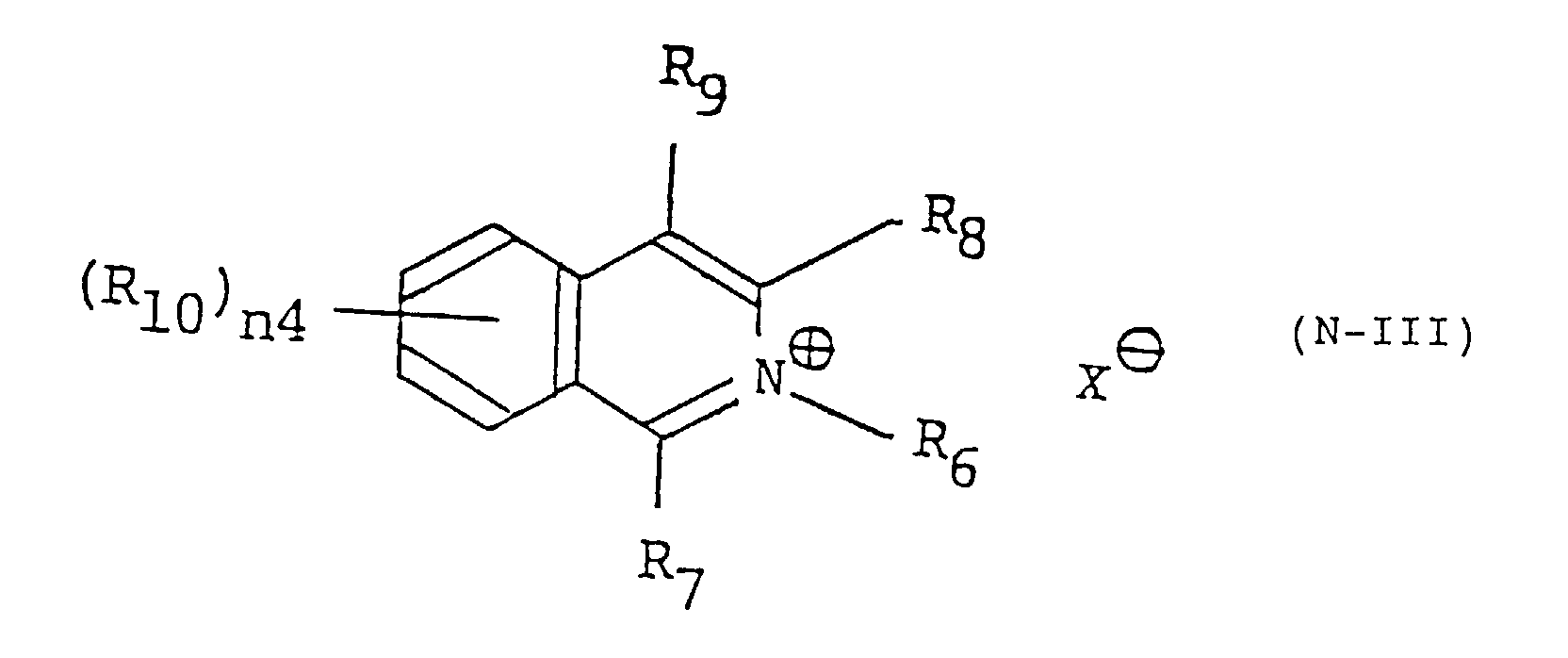
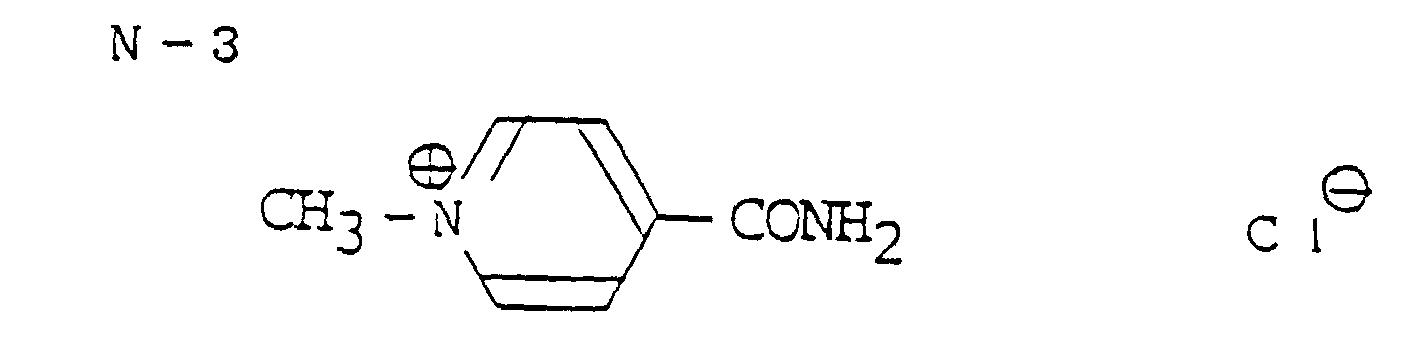
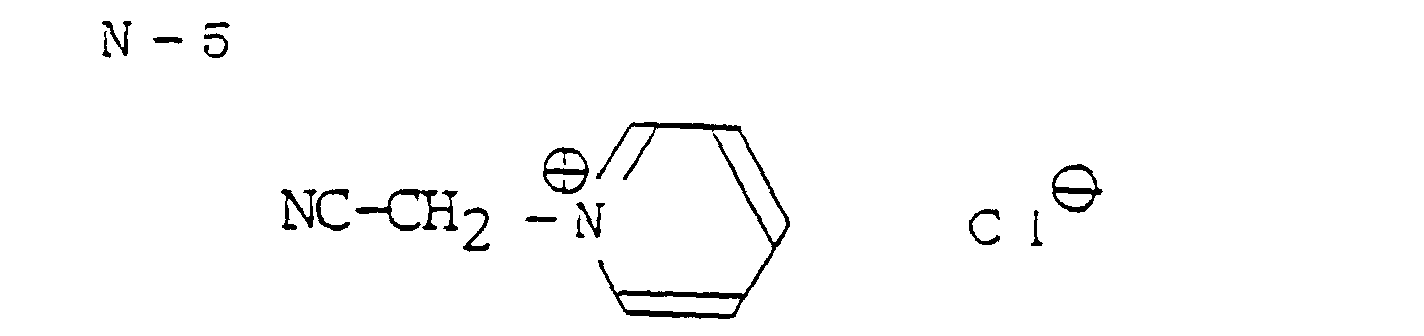
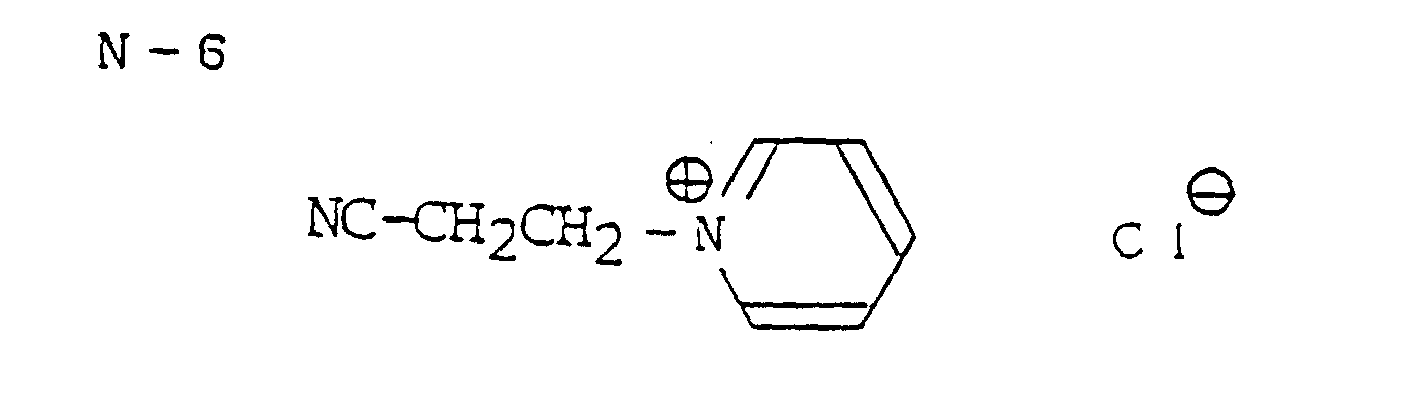
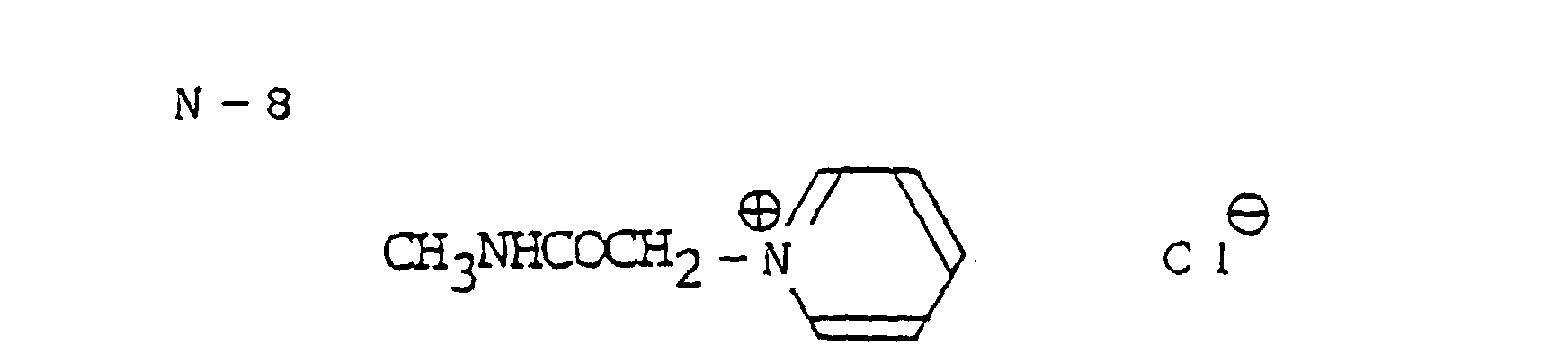
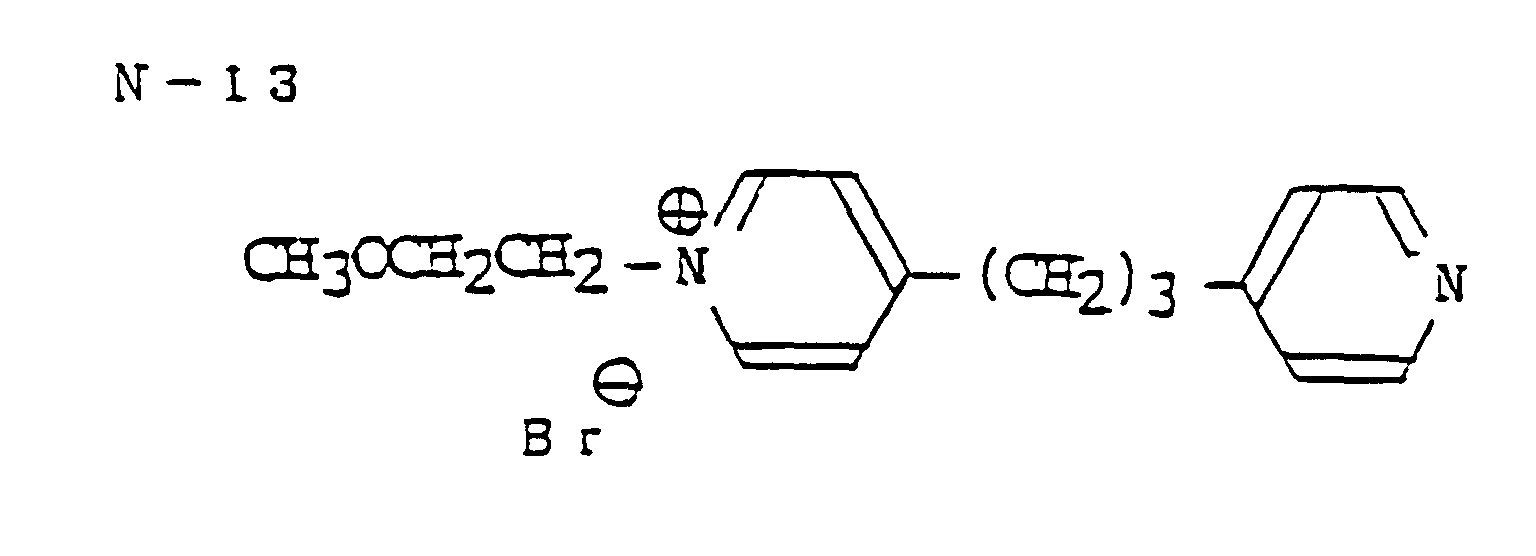
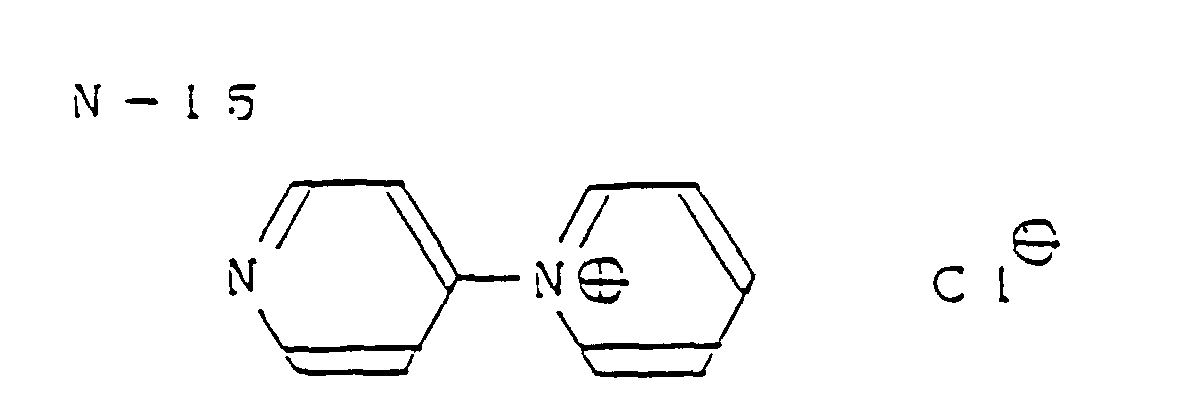
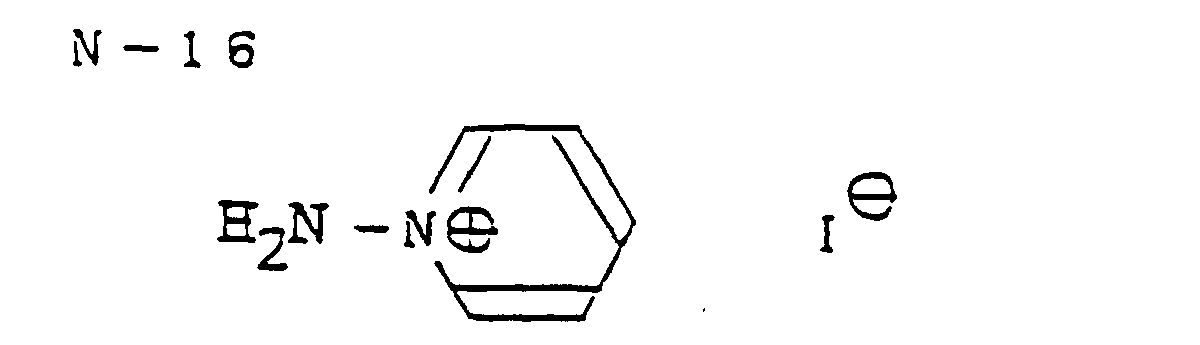
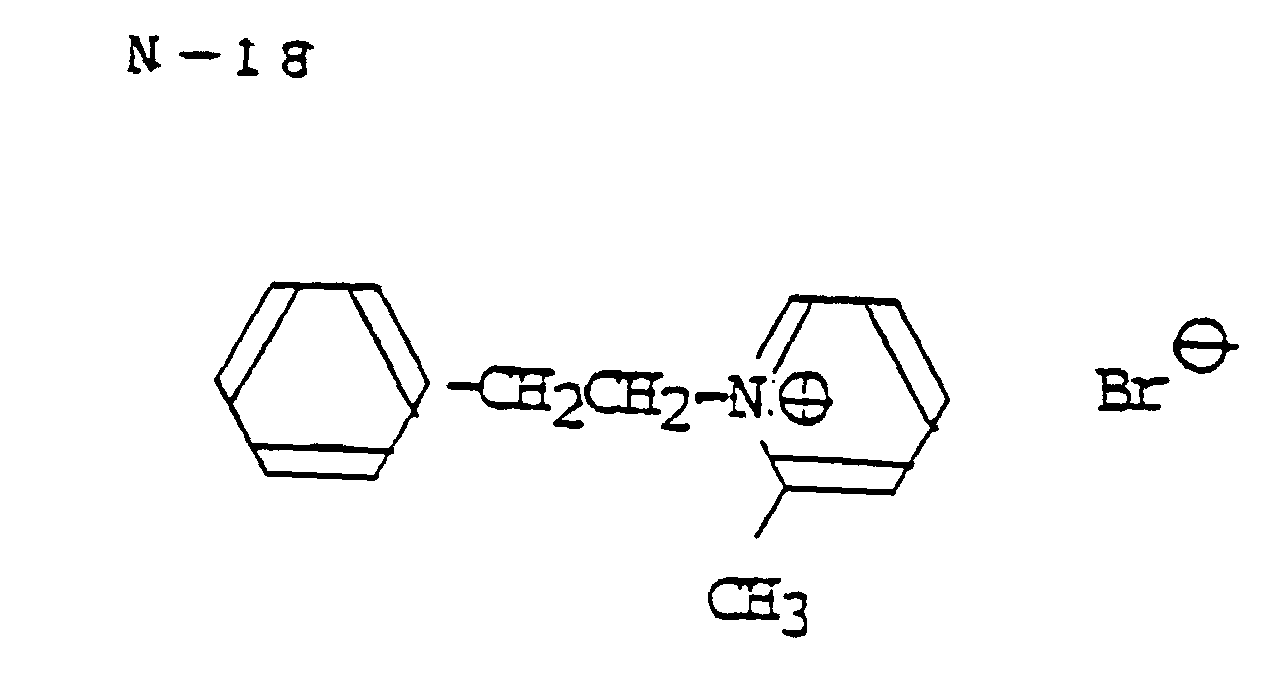
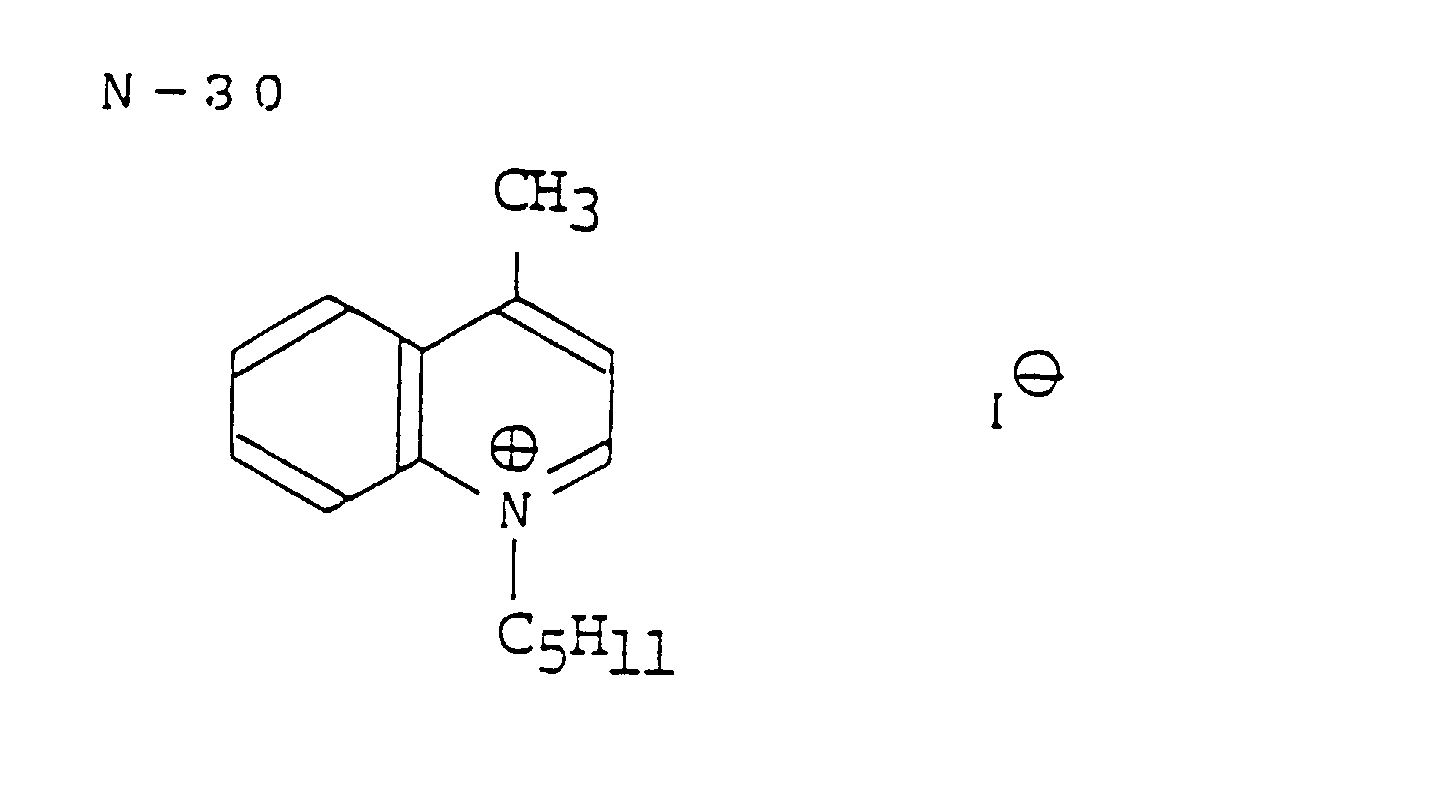
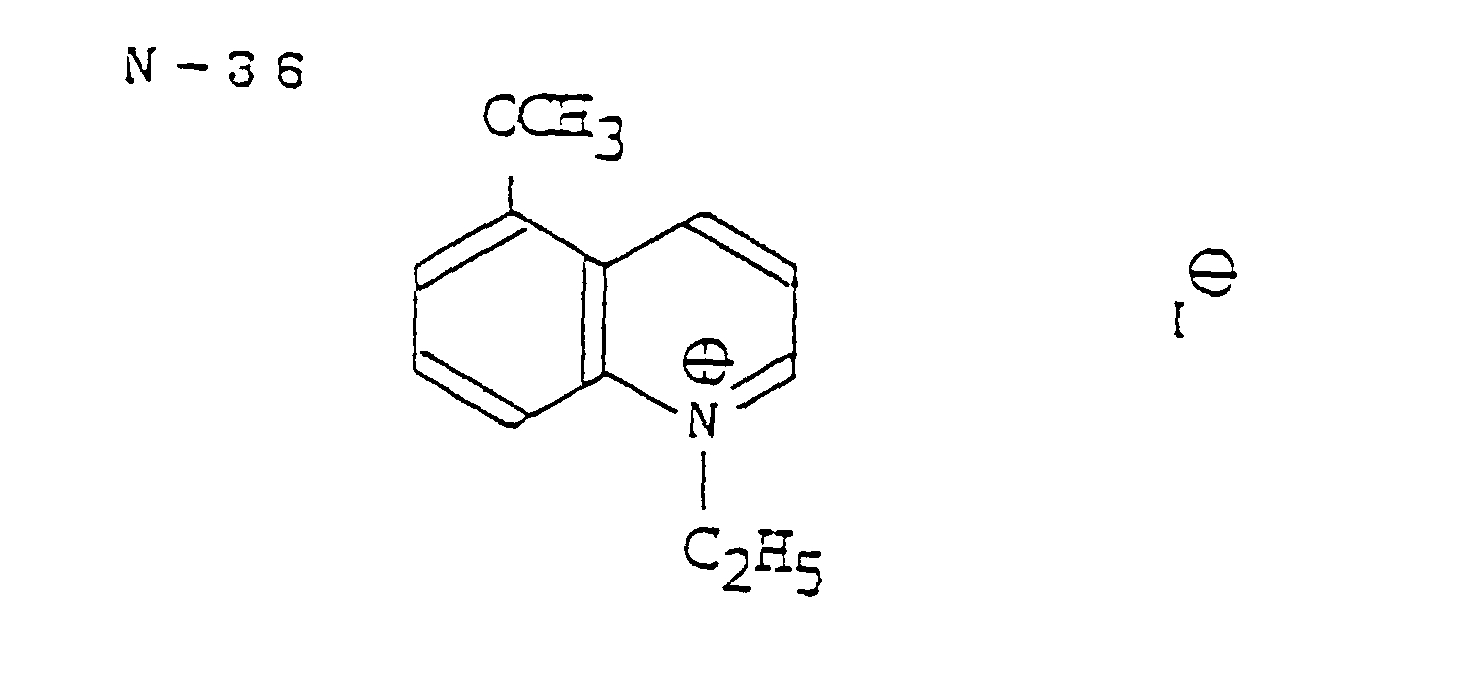
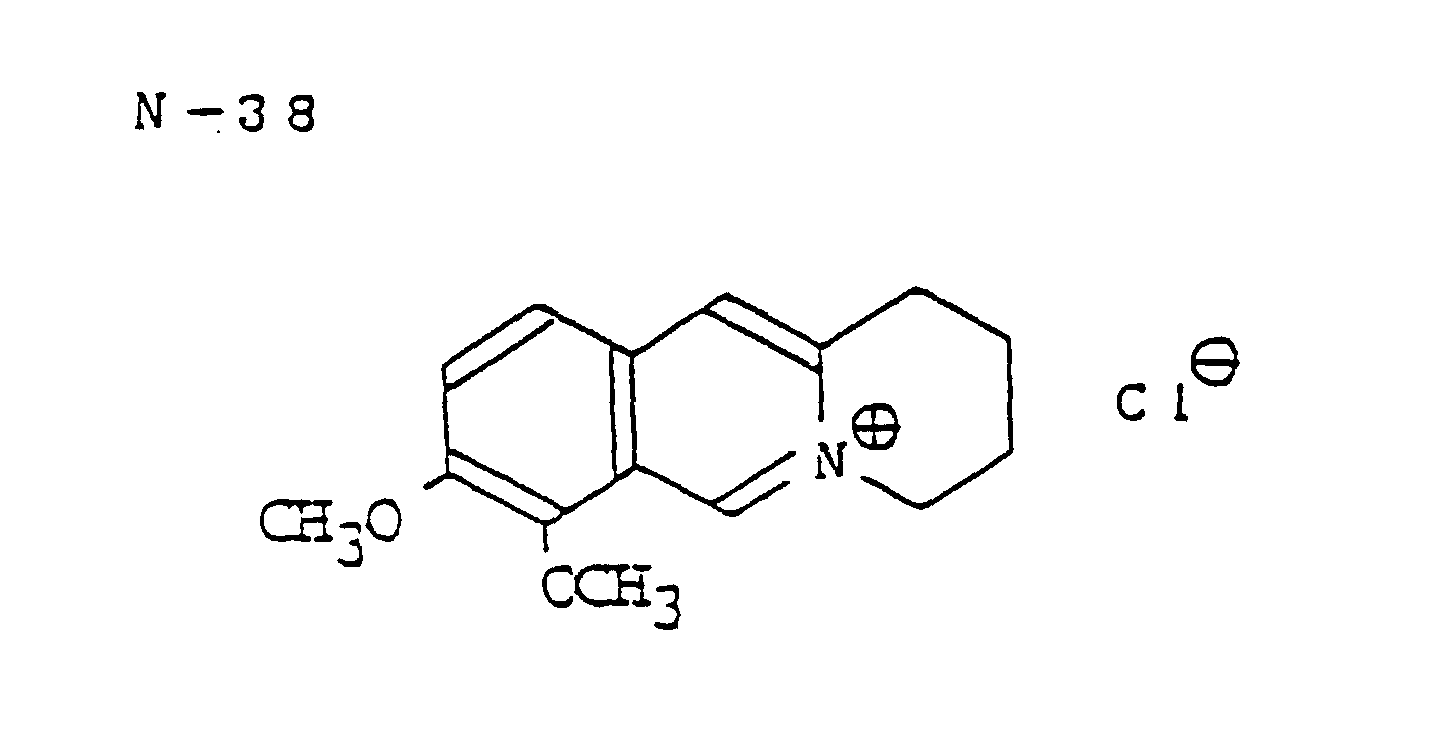
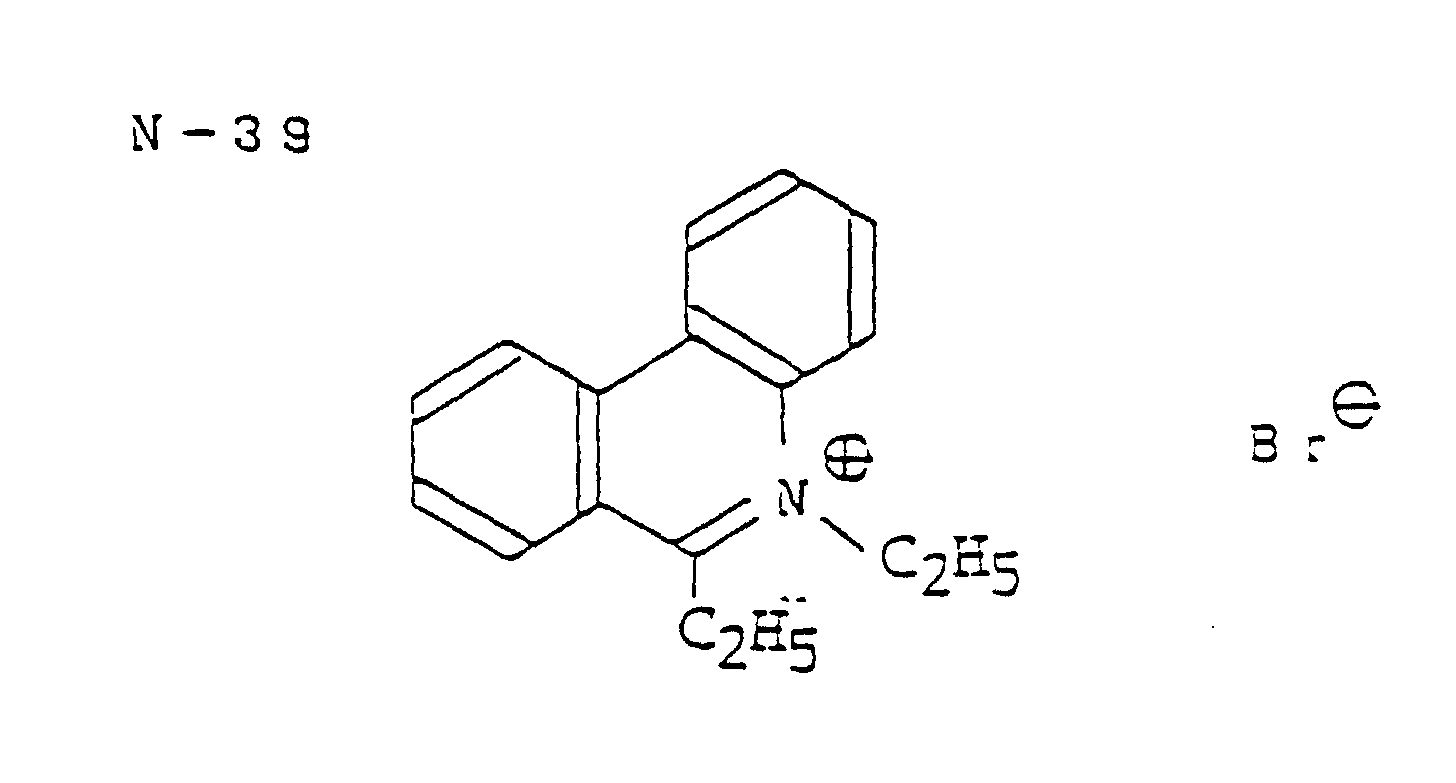
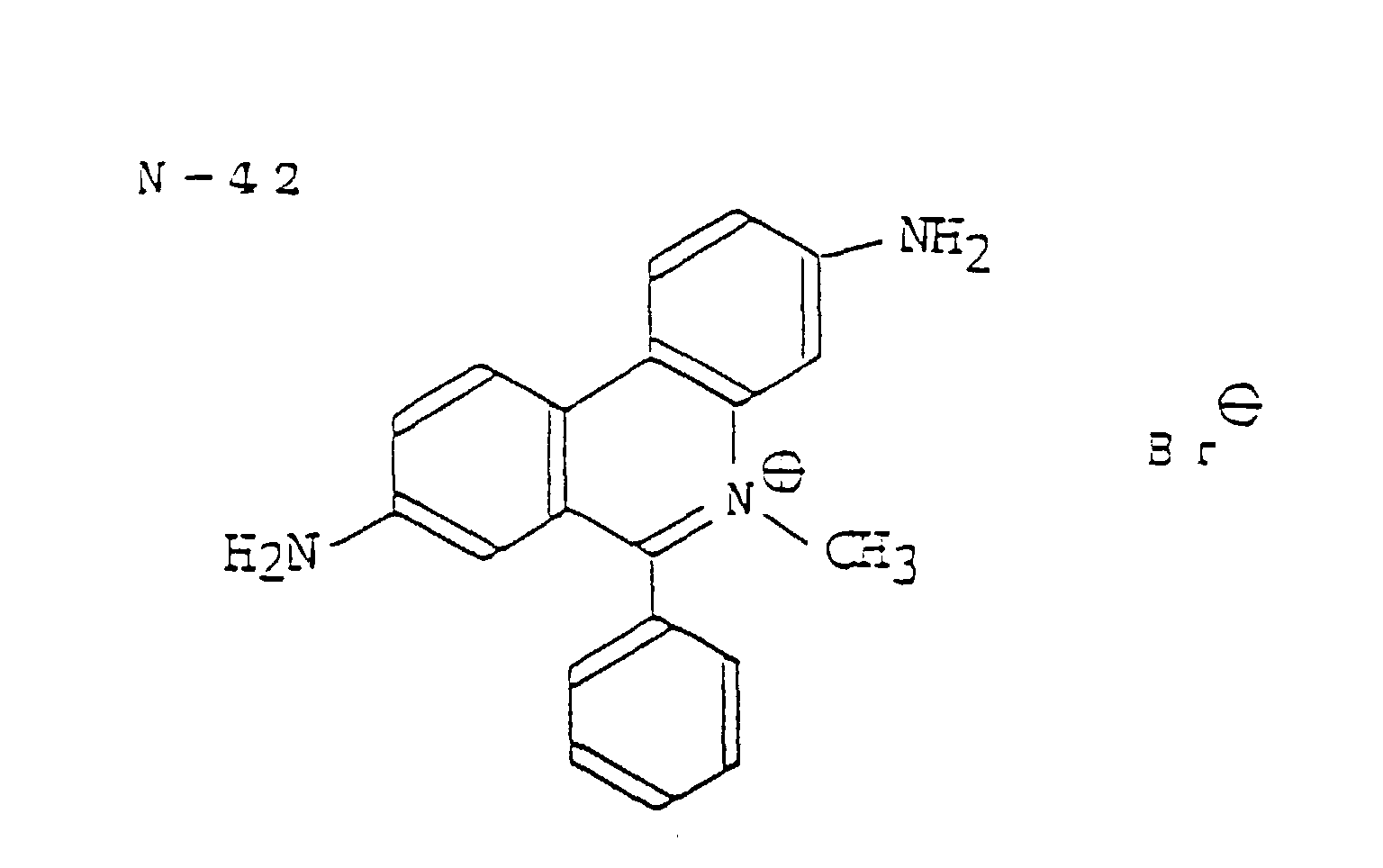
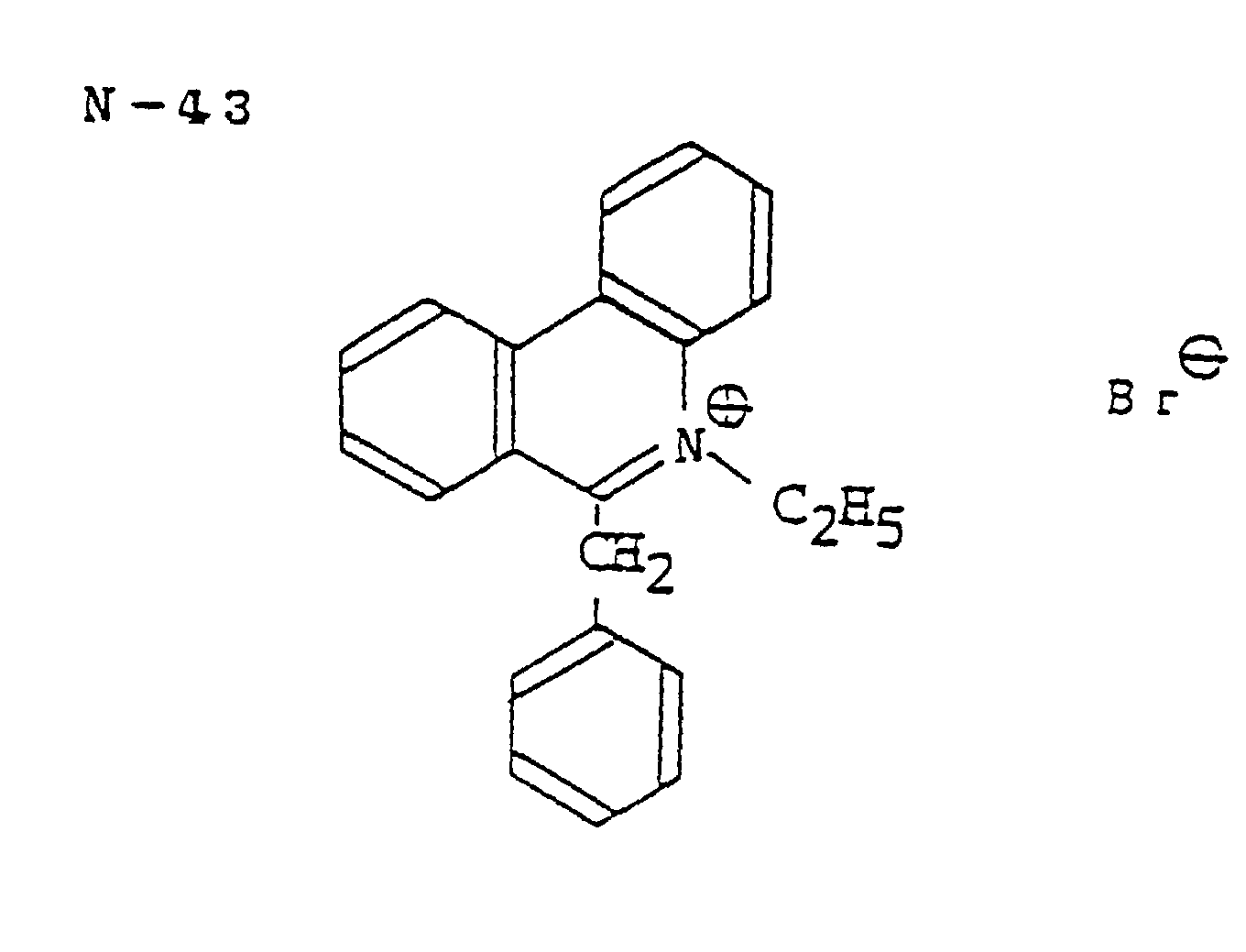
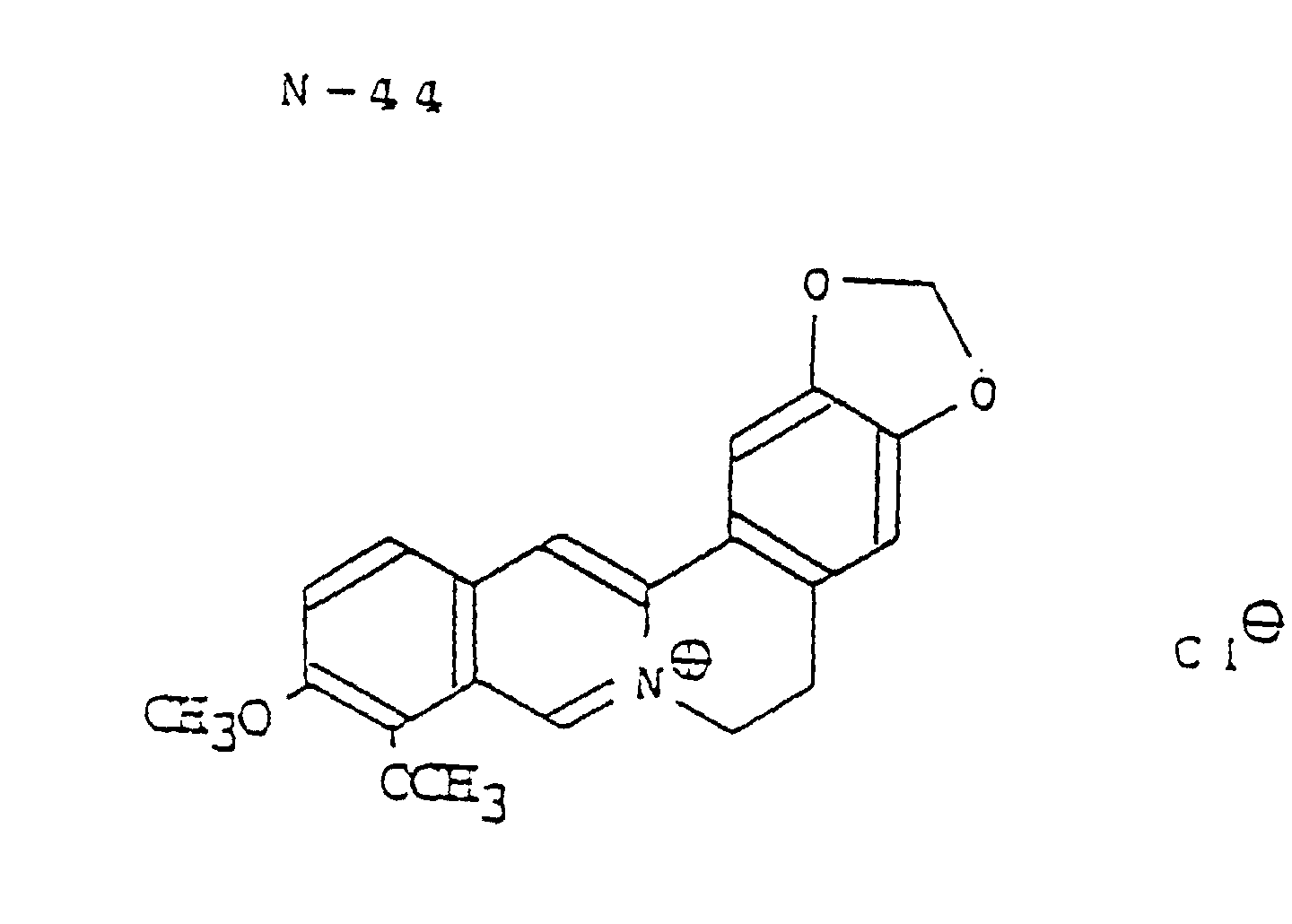
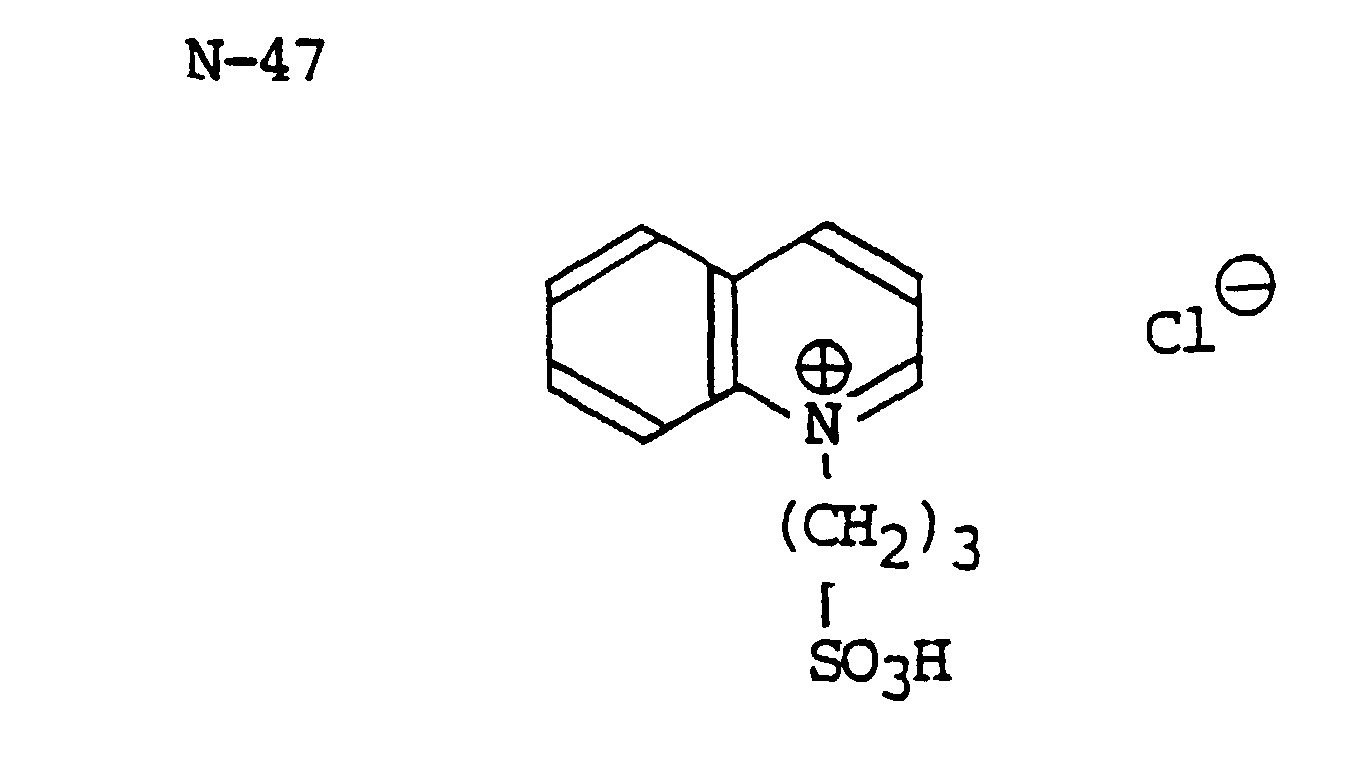
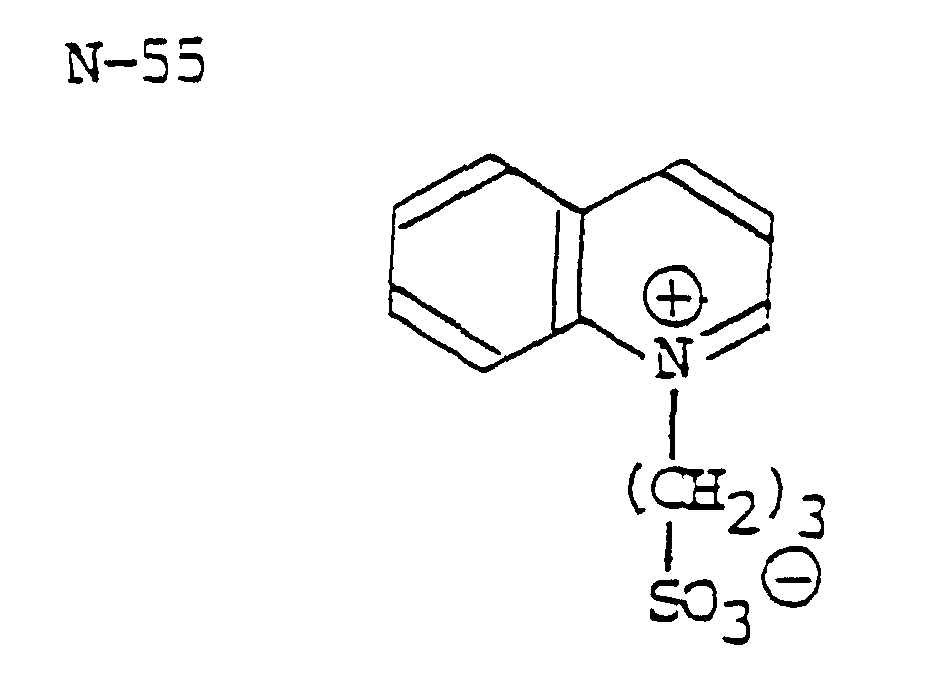
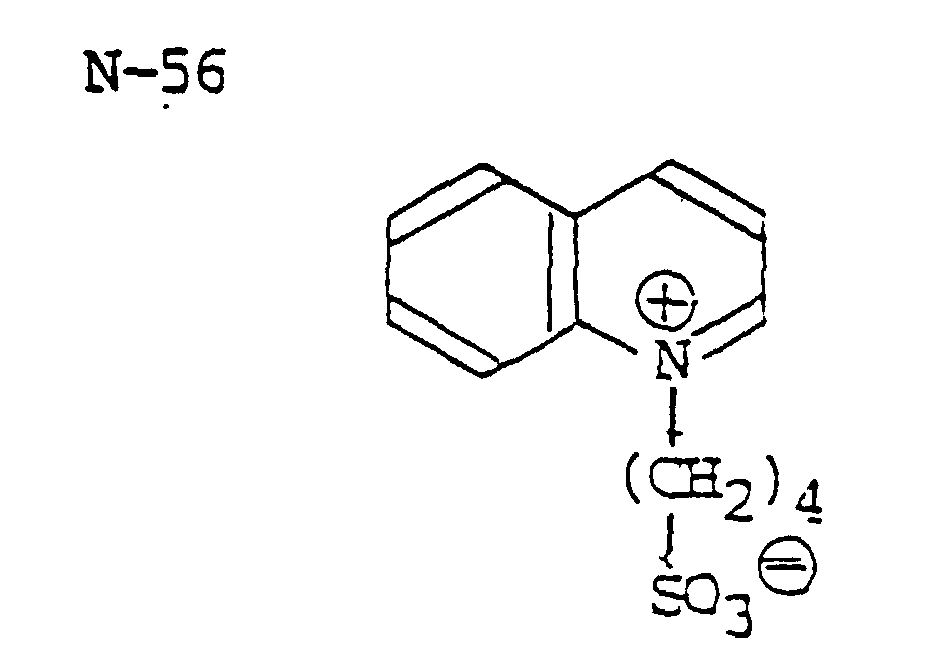
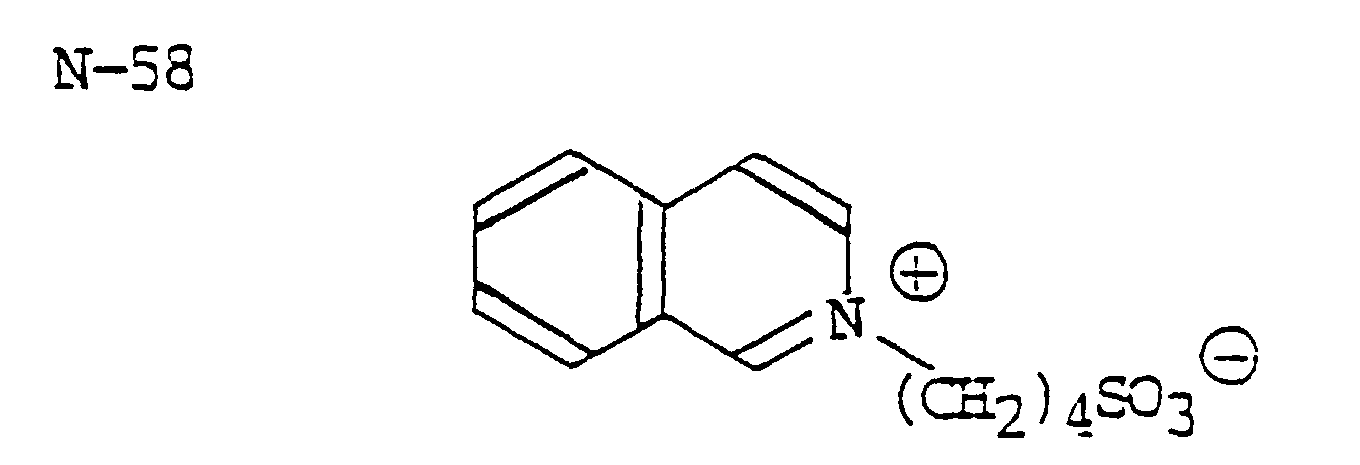
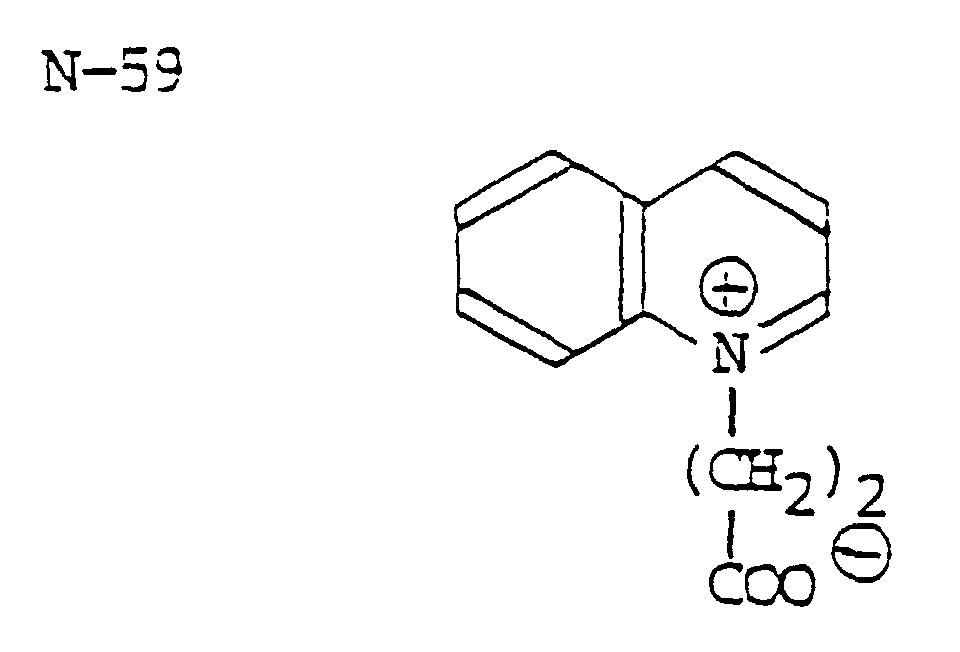
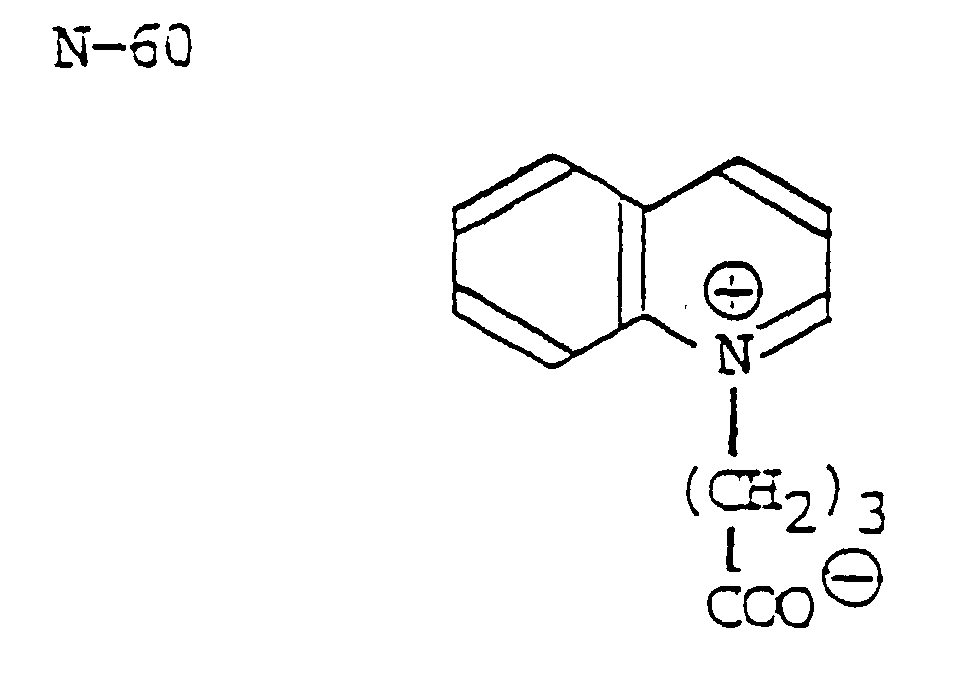
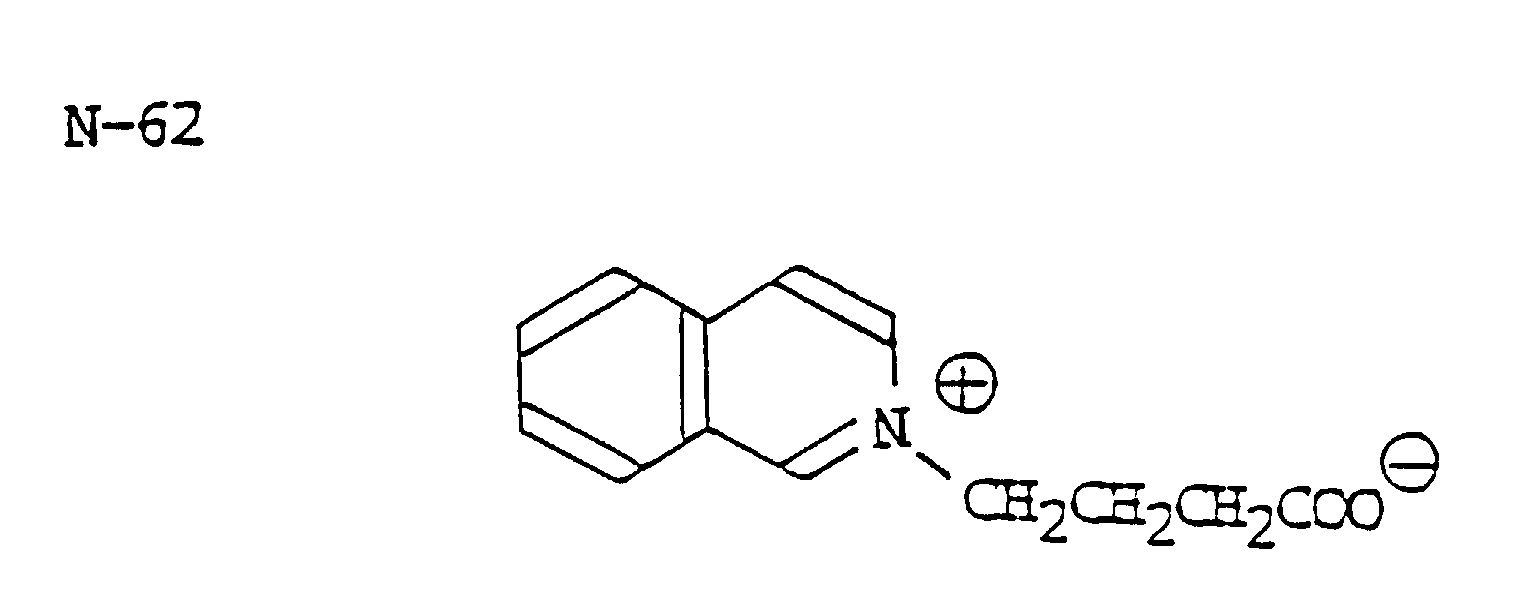
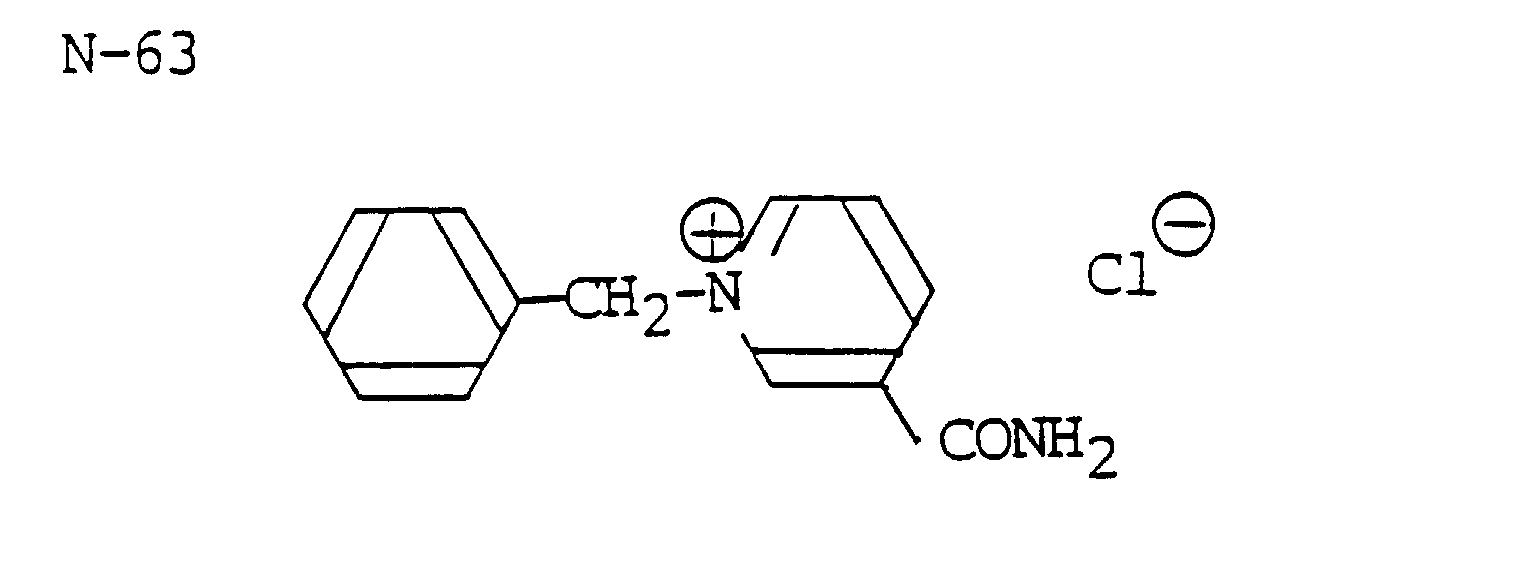
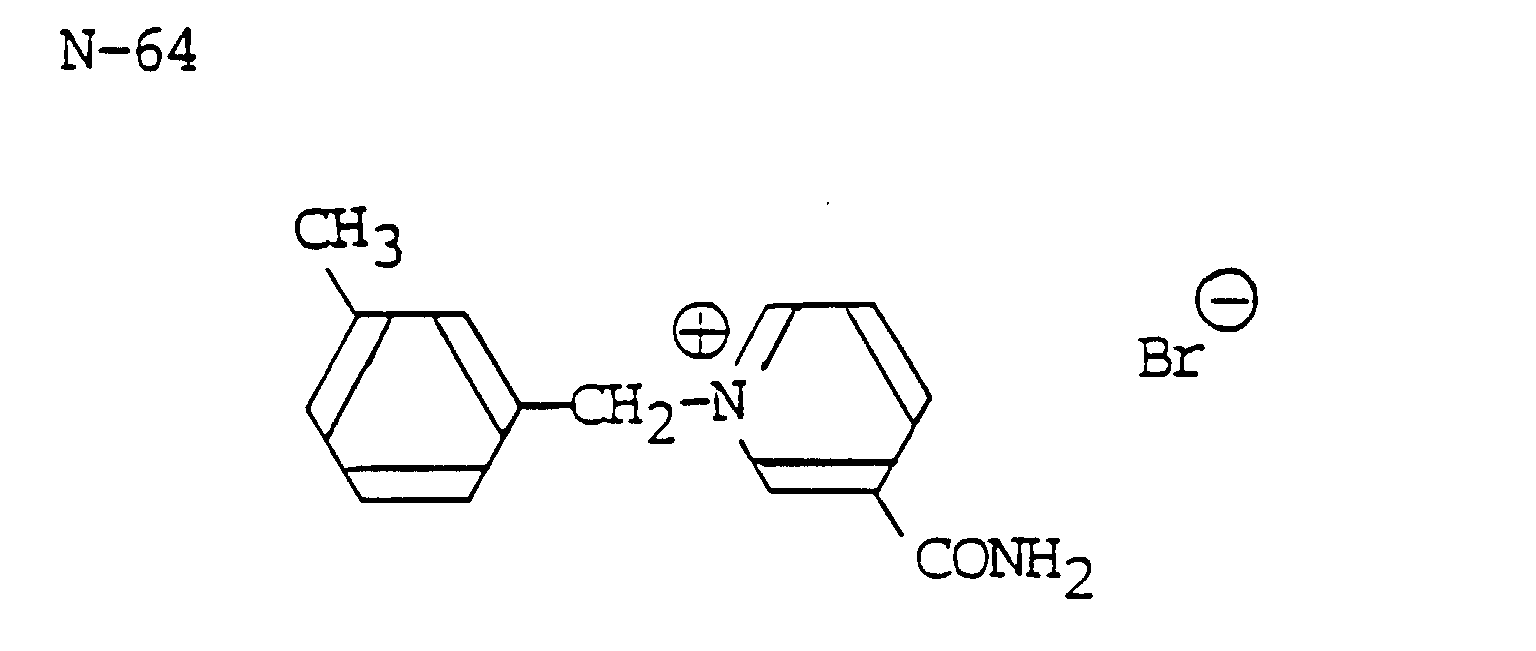
- pyridinium salts or the derivatives thereof represented by the following formula (N-I), quinolinium salts or the derivatives thereof represented by the following formula (N-II), and isoquinolinium salts or the derivatives thereof represented by the following formula (N-III) are particularly preferred.
- R 3 represents a substituted or unsubstituted lower alkyl group
- R 4 and R 5 each independently represents a halogen atom, an alkyl group, a substituted alkyl group, or an alkoxy group
- n2 and n3 each independently represents 0, 1, or 2, and when n2 and n3 each is 2, R 4 s and R 5 s each may be the same or different
- X - represents an anion such as an iodine ion, a bromine ion, a chlorine ion, a p-toluenesulfonic acid ion, a perchloric acid ion, a methylsulfuric acid ion, but when formula (N-II) is a betaine structure, X - does not exist.
- R 6 represents an alkyl group or a substituted alkyl group and said R 6 may form a 6-membered ring or a 5-membered ring with R 8 ;
- R 7 represents a hydrogen atom, an alkyl group, a substituted alkyl group, or an aryl group;
- R 8 and R 9 each independently represents a hydrogen atom, an alkyl group, an alkyl group substituted with a hydroxy group, an alkoxy group, an aromatic group, an alkoxy group, or an amide group; said R 8 and R 9 may form together an aromatic ring;
- R 10 represents a halogen atom, an alkyl group which may be substituted, an alkoxy group, or an amino group which may be substituted with an alkyl group;
- n4 represents 0, 1, or 2, when n4 is 2, R 10 s may be the same or different;
- X - represents an anion such as an iodine ion, a bromine ion,
- the value of the reduction potential (Ered) in this invention means a potential at which the dyes or the pyridinium salt derivatives each is reduced by the injection of electron at the cathode in a voltammetry.
- the value of the reduction potential (Ered) can be correctly measured by a voltammetry. That is, the voltammogram of from 1 ⁇ 10 -3 M to 1 ⁇ 10 -4 M of the dye or the pyridinium salt derivative is measured in acetonitrile containing 0.1M of tetra-n-butylammonium perchlorate as a supporting electrolyte and the value of Ered is determined as a half wave potential obtained therefrom.
- SCE saturated calomel electrode
- a negative-working silver halide photographic material having on a support at least one negative-working silver halide emulsion layer, wherein said silver halide emulsion layer and/or at least one other hydrophilic colloidal layer contains at least one kind of the dyes or the pyridinium salt derivatives each having a negative reduction potential; at least one kind of the dyes or the pyridinium salt derivatives each having a negative reduction potential and at least one kind of polyalkylene oxides and the derivatives thereof; or at least one kind of the dyes or the pyridinium salt derivatives each having a negative reduction potential and at least one kind of an inorganic or organic compound having an acidic dissociation constant (pKa) of lower than 11 or the salts thereof.
- pKa acidic dissociation constant
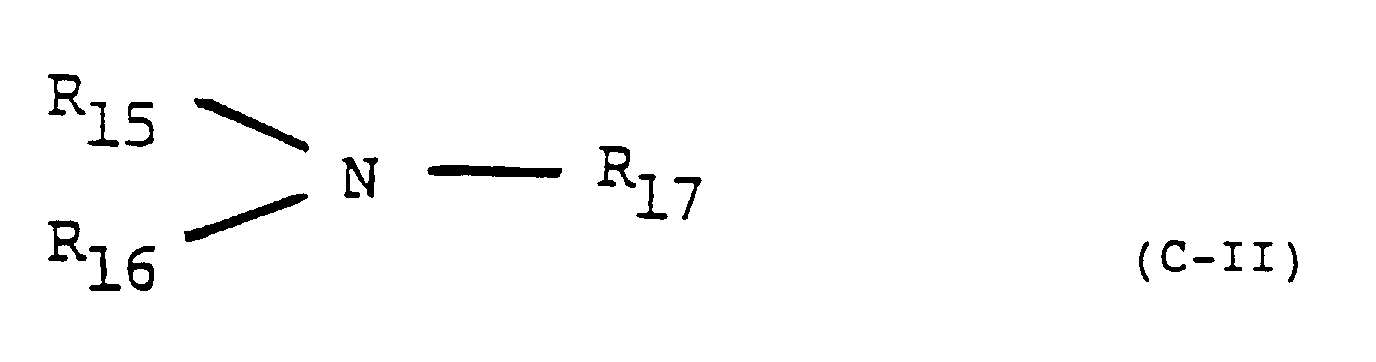
- R 15 , R 16 , and R 17 each independently represents a hydrogen atom, an alkyl group having from 1 to 10 carbon atoms which may be unsubstituted or substituted, a cycloalkyl group having from 3 to 10 carbon atoms which may be unsubstituted or substituted, an aralkyl group having from 7 to 10 carbon atoms which may be unsubstituted or substituted, or an aryl group having from 6 to 10 carbon atoms which may be unsubstituted or substituted, a ring may be formed by optional two groups selected from R 15 , R 16 , and R 17 , with the exception that R 15 , R 16 , and R 17 are simultaneously a hydrogen atom.
- R 18 , R 19 , R 20 , and R 21 each independently represents a hydrogen atom, an alkyl group having from 1 to 8 carbon atoms which may be unsubstituted or substituted, or a cycloalkyl group having from 3 to 8 carbon atoms, a ring may be formed by optional two groups selected from R 18 , R 19 , R 20 , and B represents an alkylene group having from 2 to 8 carbon atoms, -(E-CH 2 CH 2 -) f -, or -(E-CH 2 CH 2 CH 2 -) g - (wherein E represents an oxygen atom, a sulfur atom or -NH- and f and g each represents an integer of from 1 to 4).
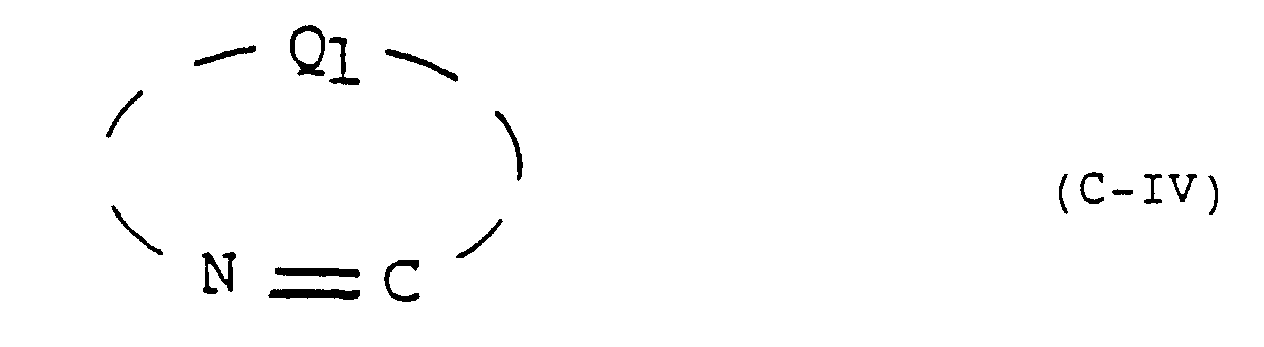
- Q 1 represents a nonmetallic atomic group necessary for forming an aromatic nitrogen-containing heterocyclic ring and as the aromatic nitrogen-containing heterocyclic ring completed by Q 1 , there are a pyridine ring, a quinoline ring, an isoquinoline ring, an acridine ring, a pyridazine ring, a pyrimidine ring, a pyrazine ring, a cinnoline ring, a quinazoline ring, a quinoxaline ring, a phthalazine ring, and a phenazine ring, each may be unsubstituted or substituted.
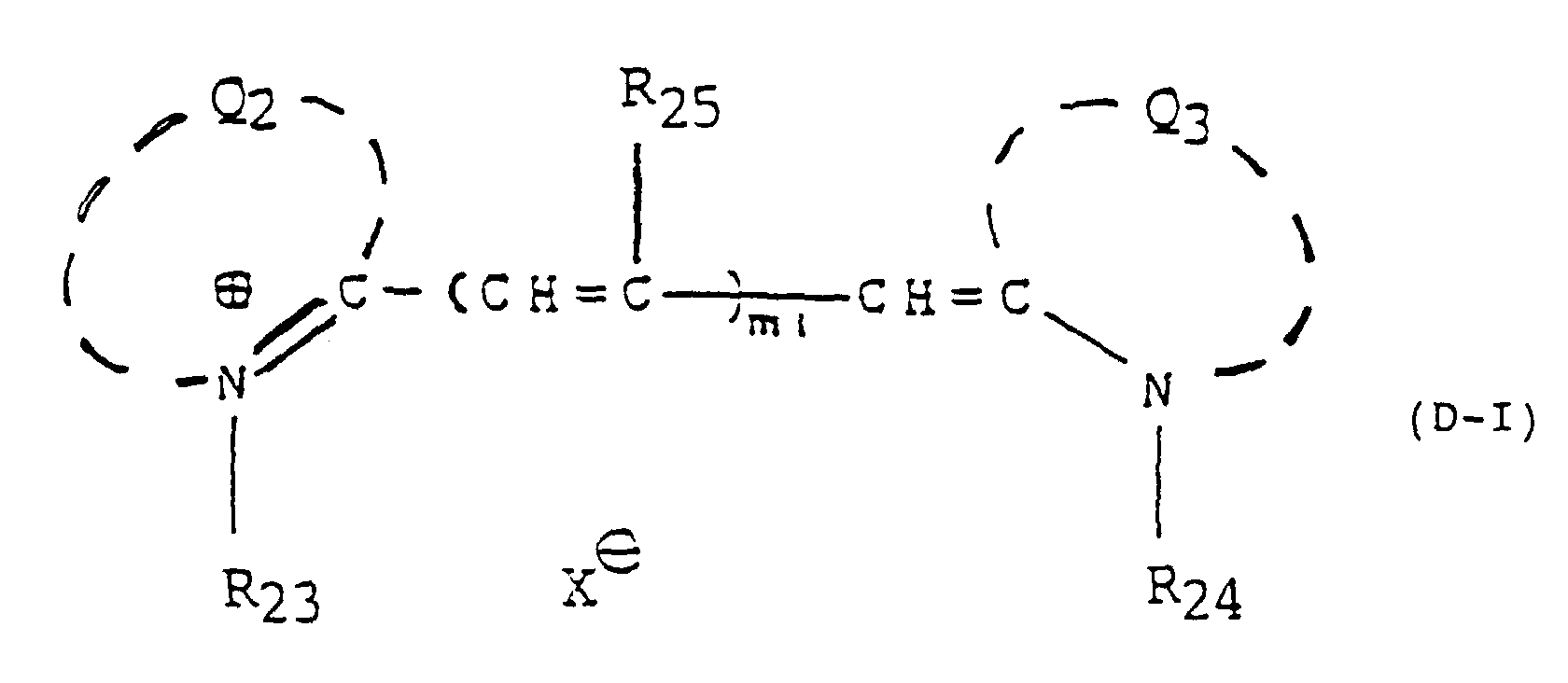
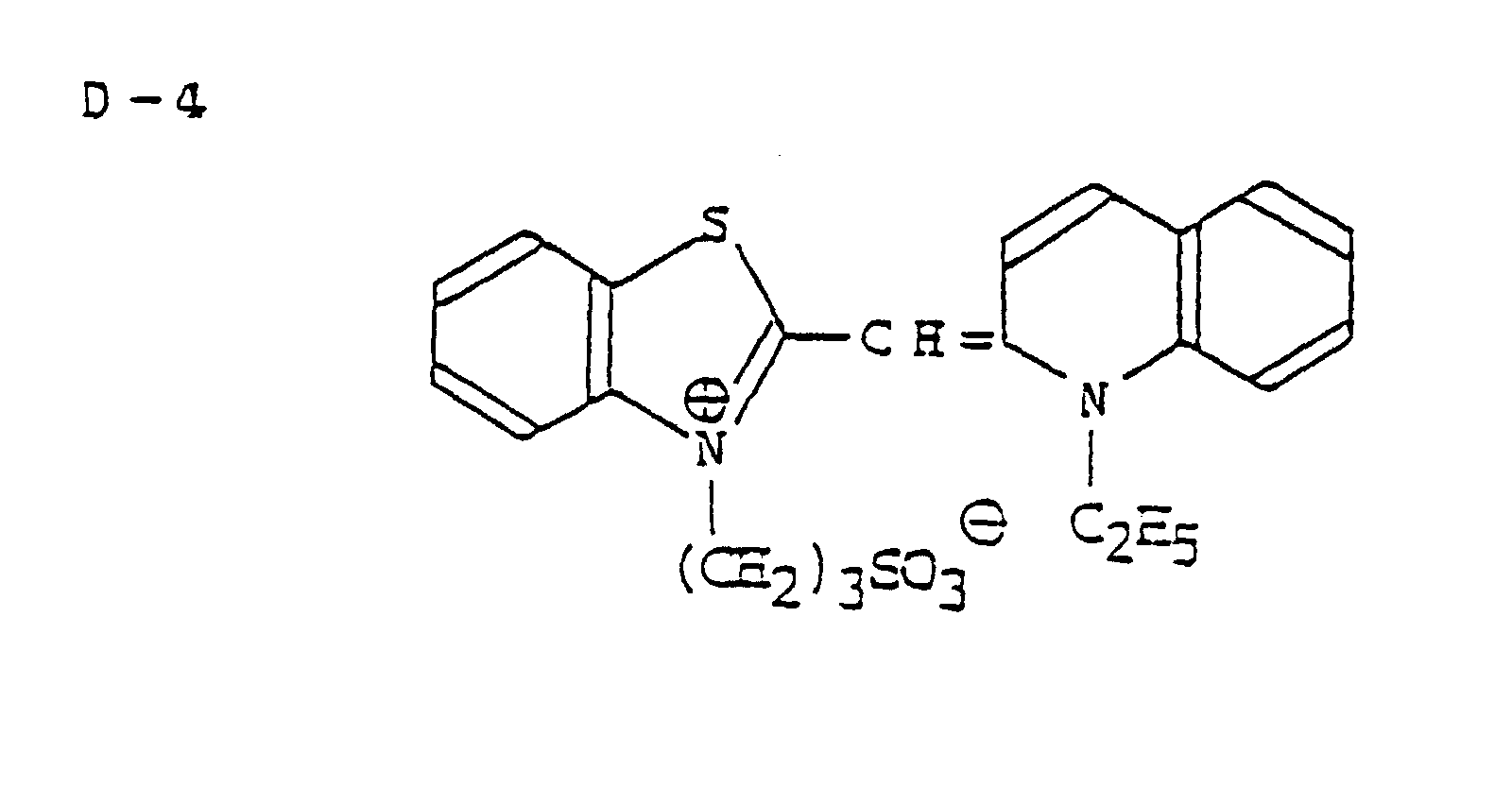
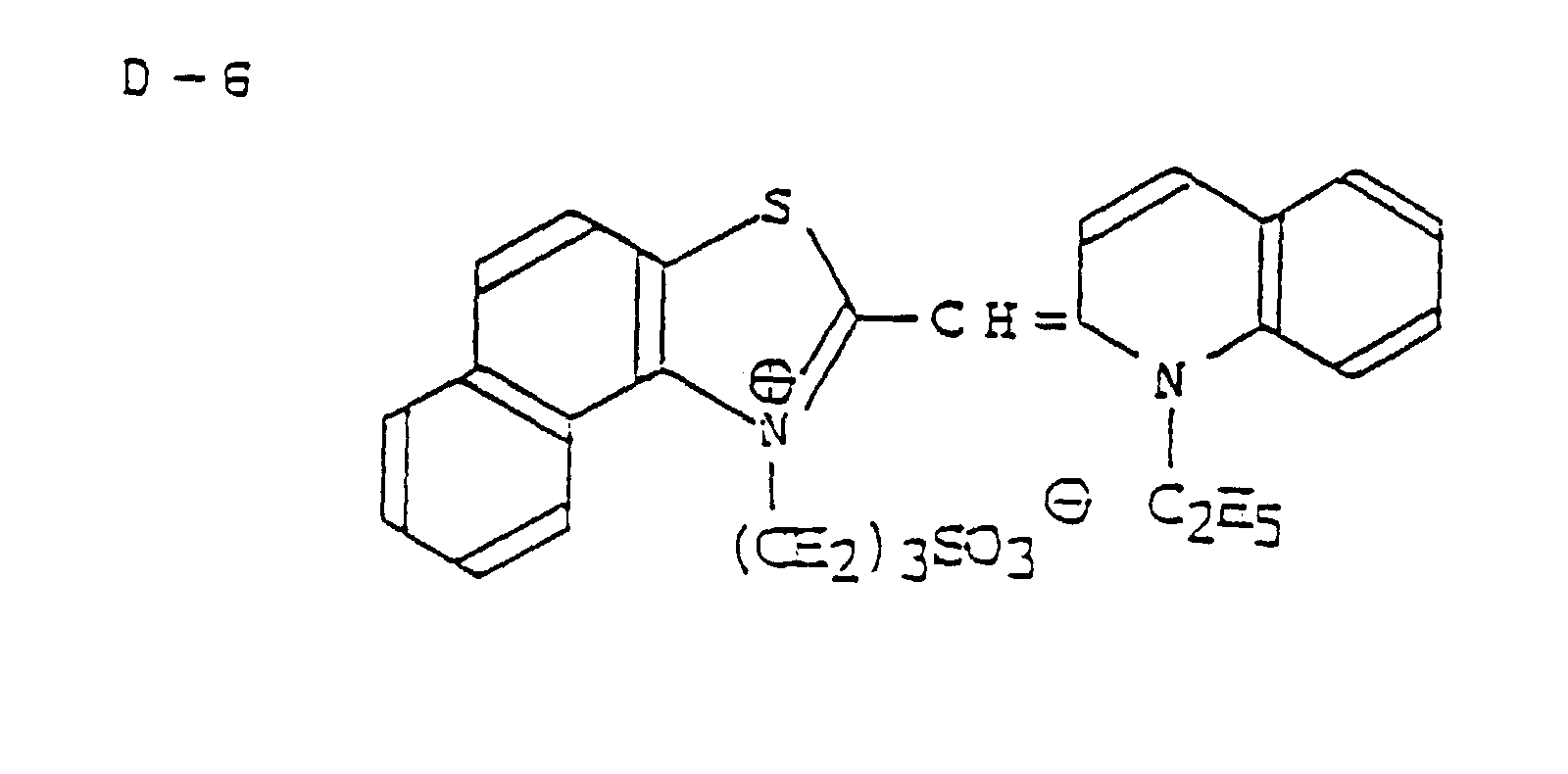
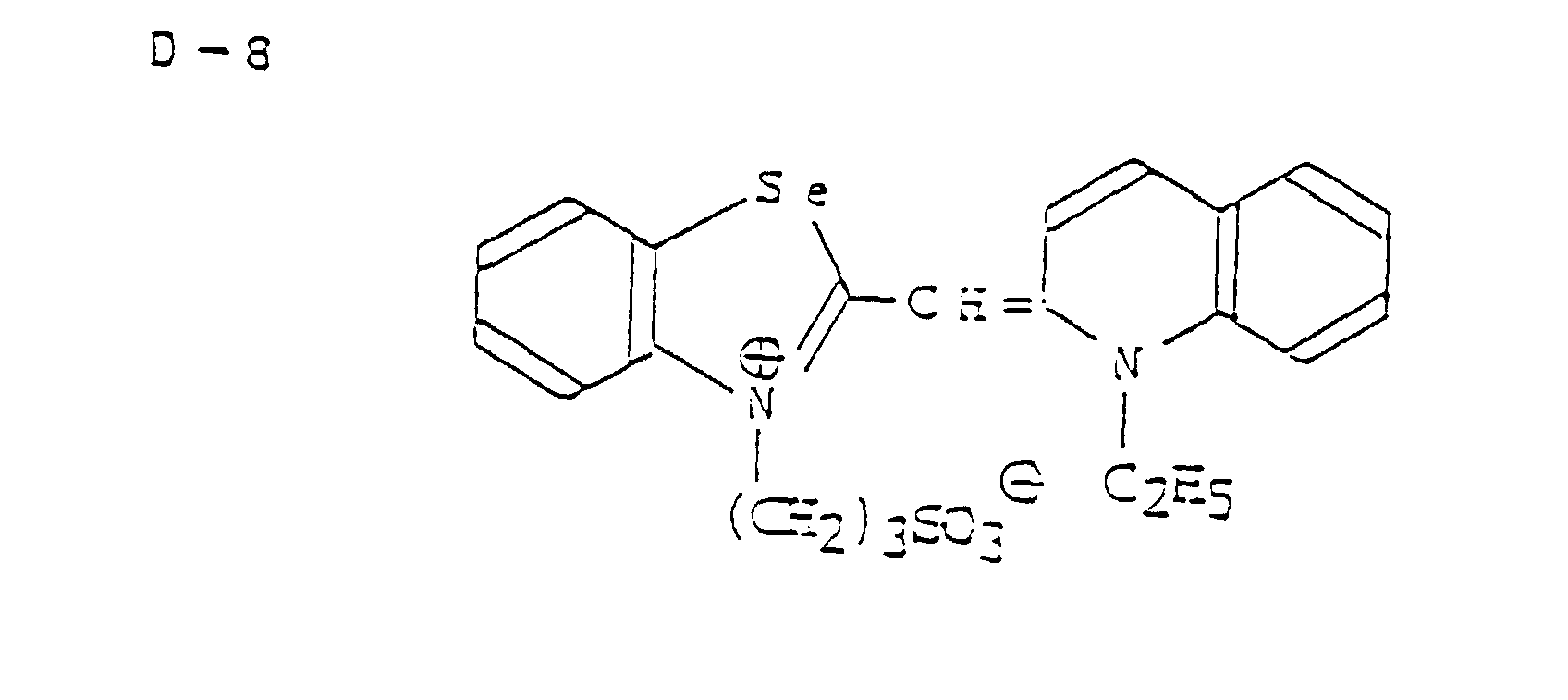
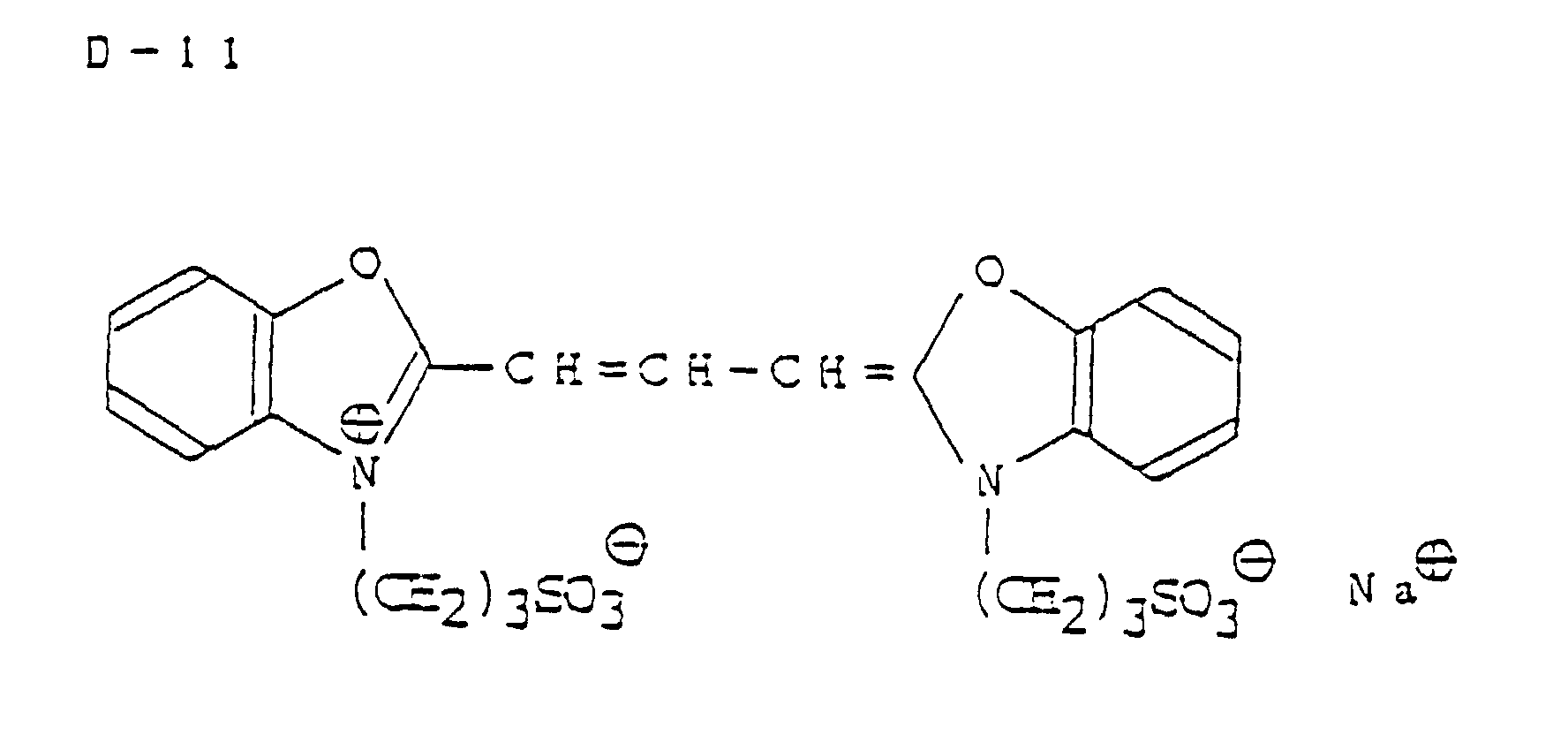
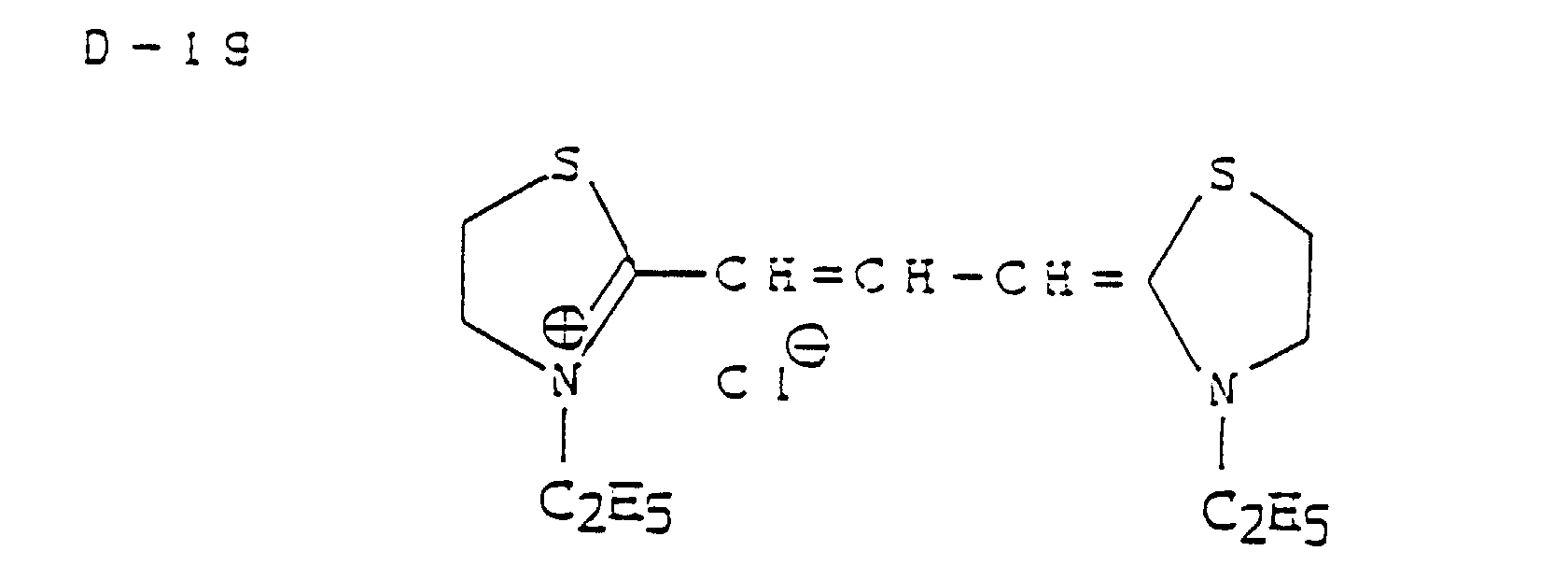
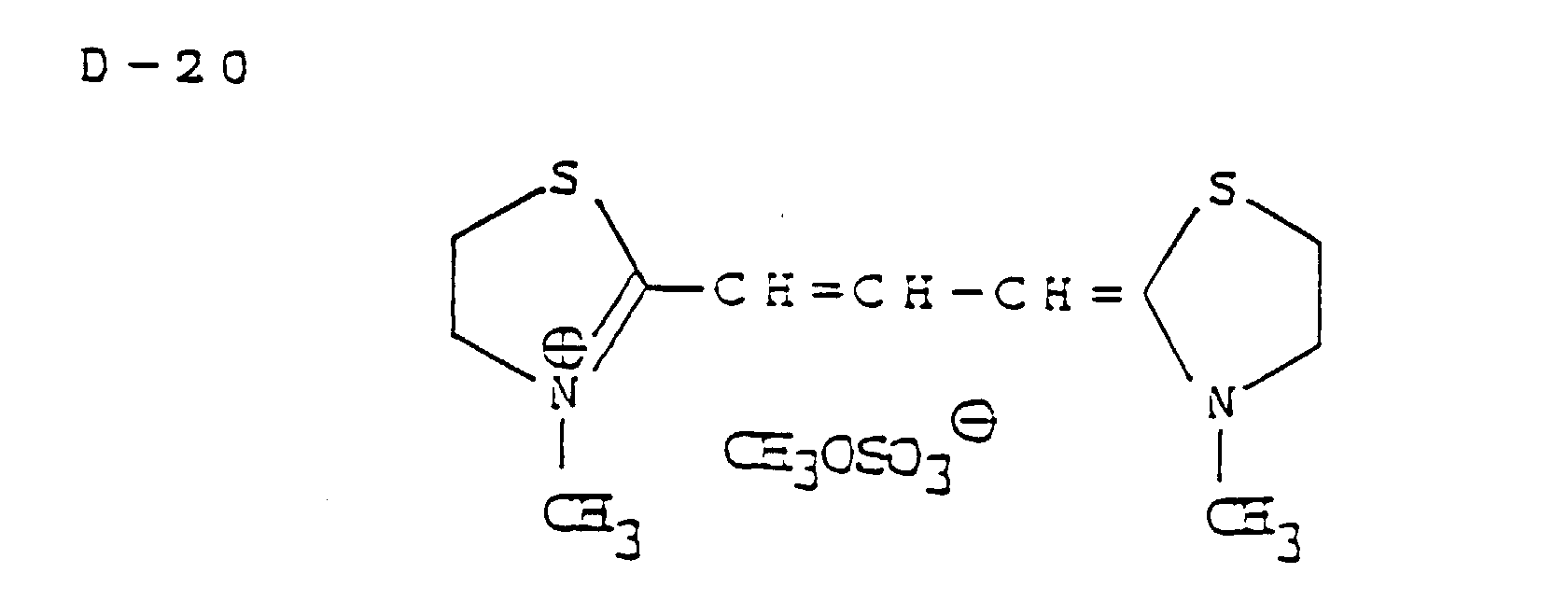
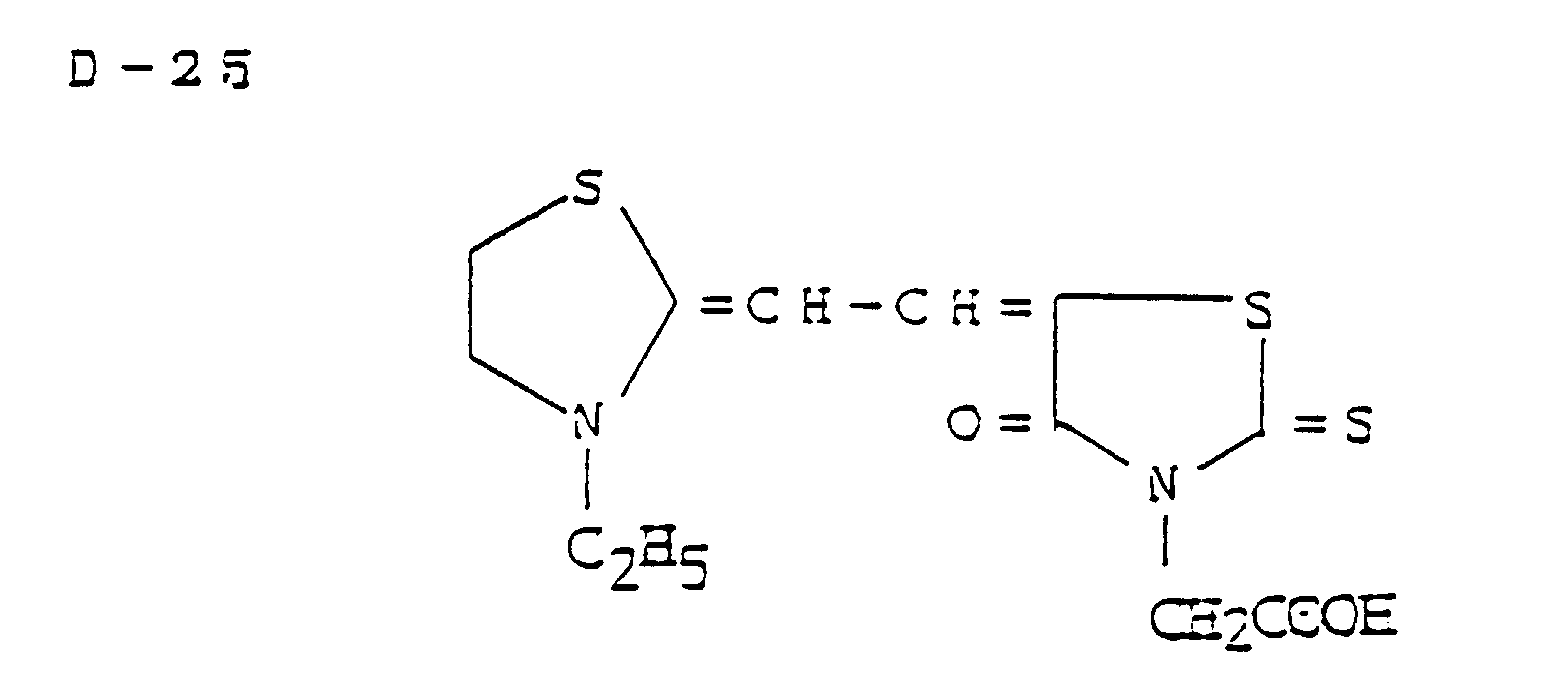
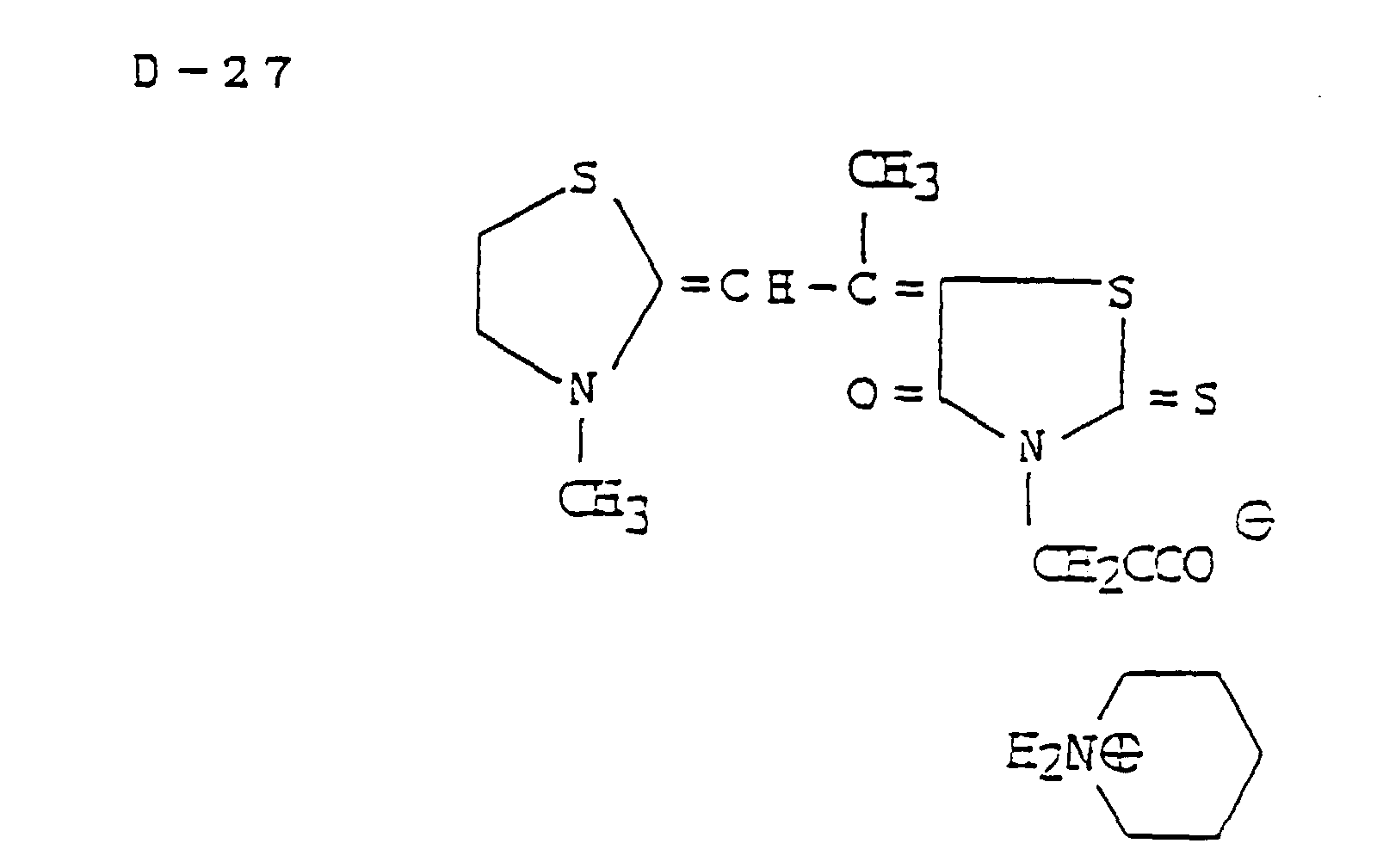
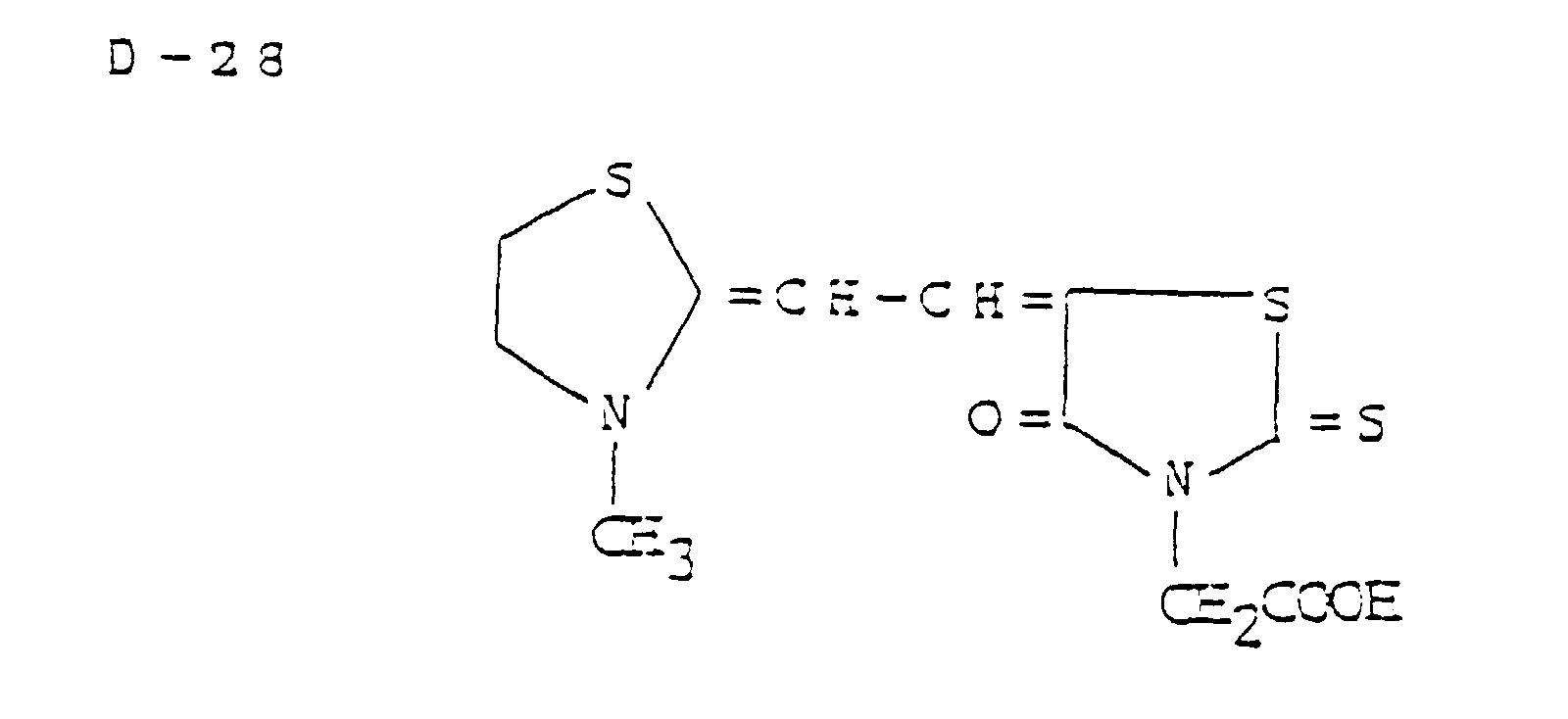
- dyes for use in the present invention symmetric type and asymmetric type cyanin dyes and merocyanine dyes are useful.
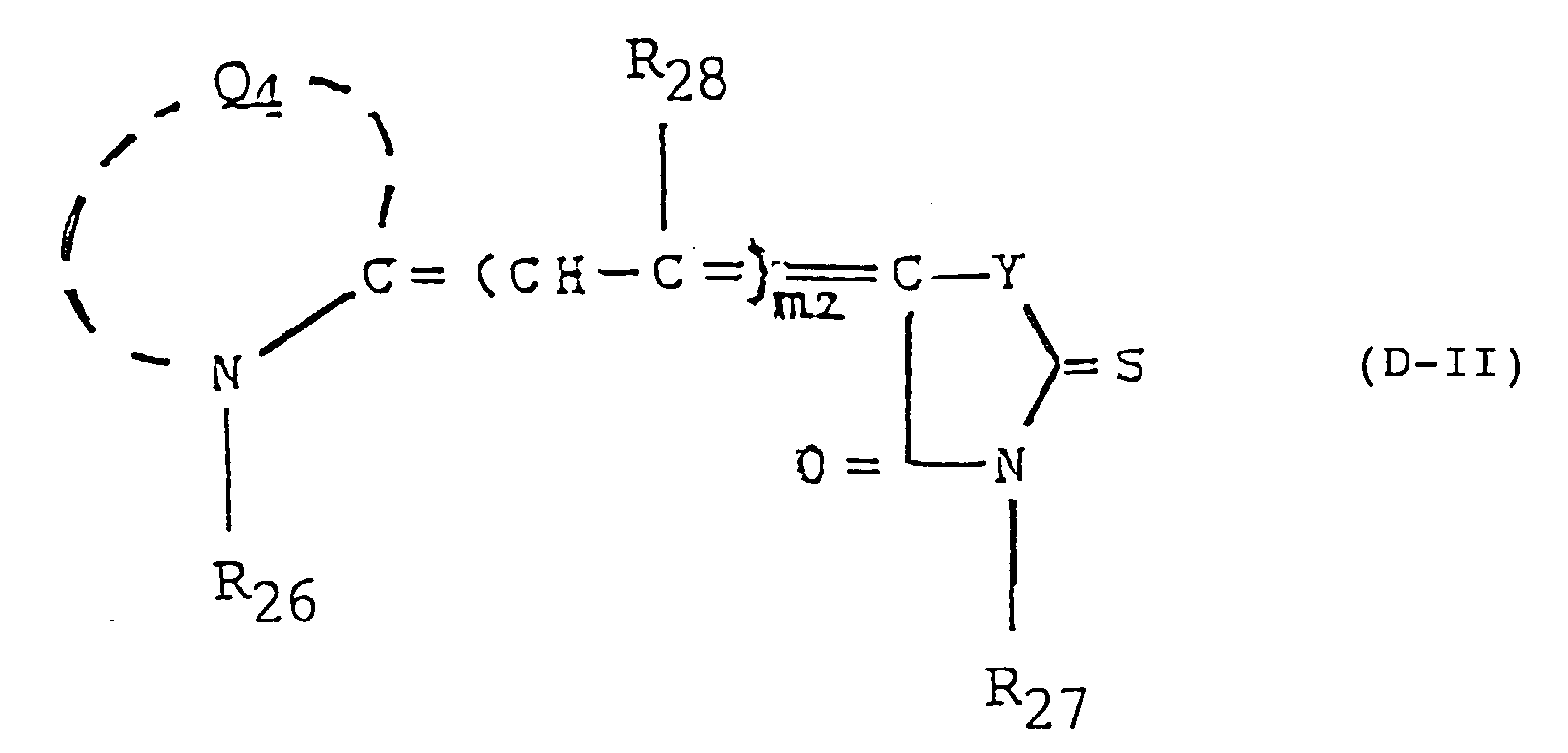
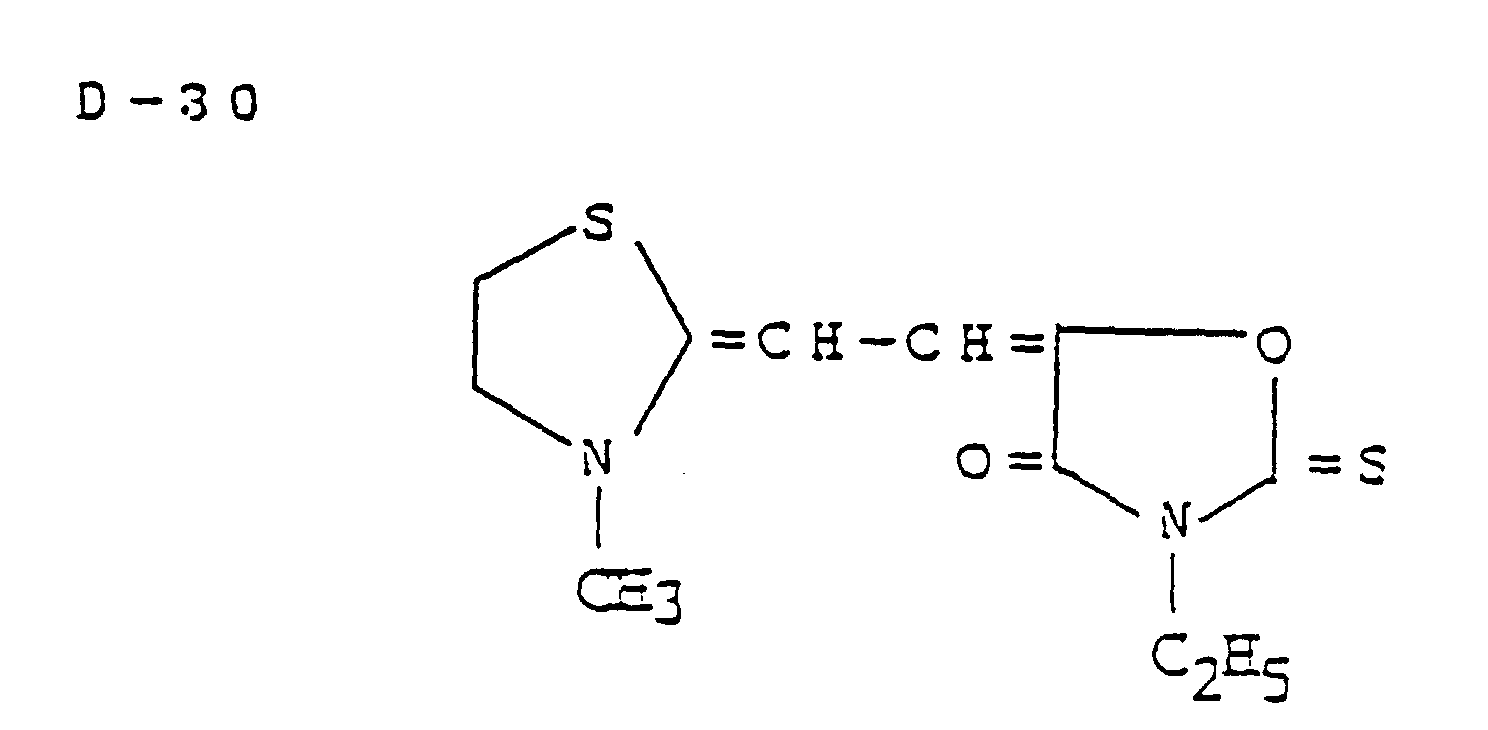
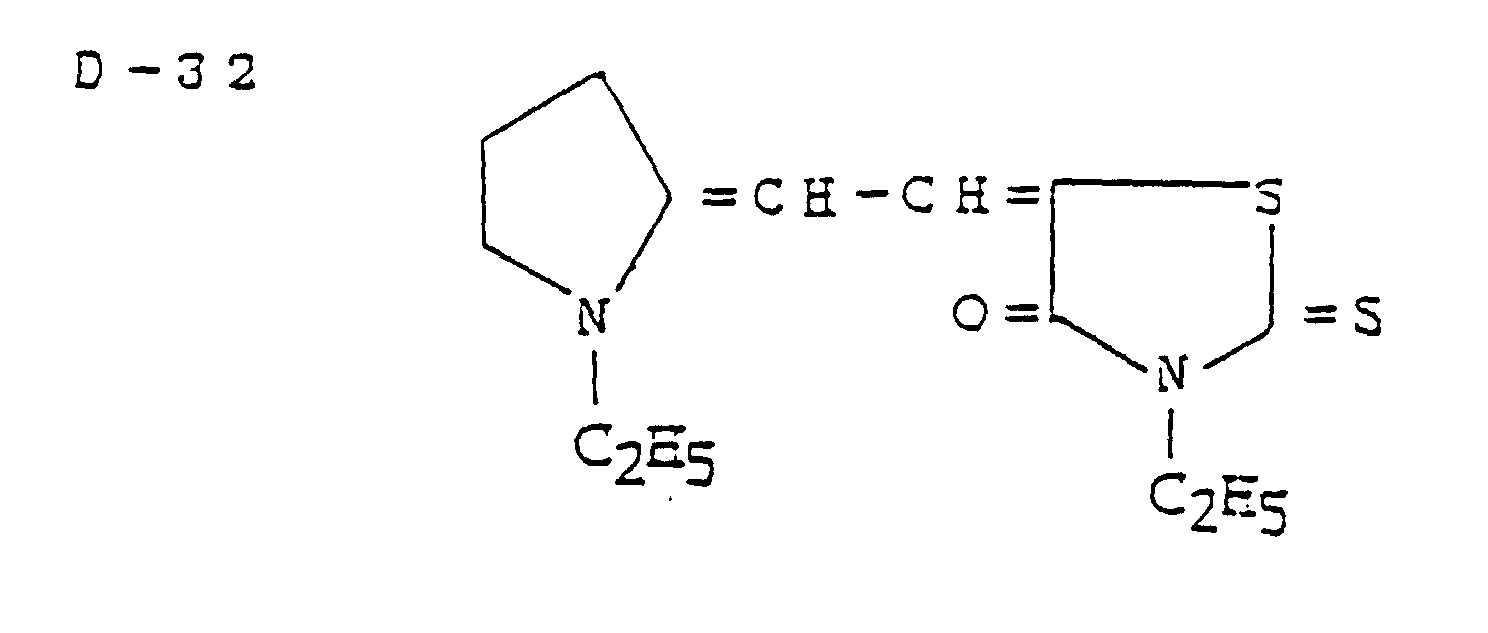
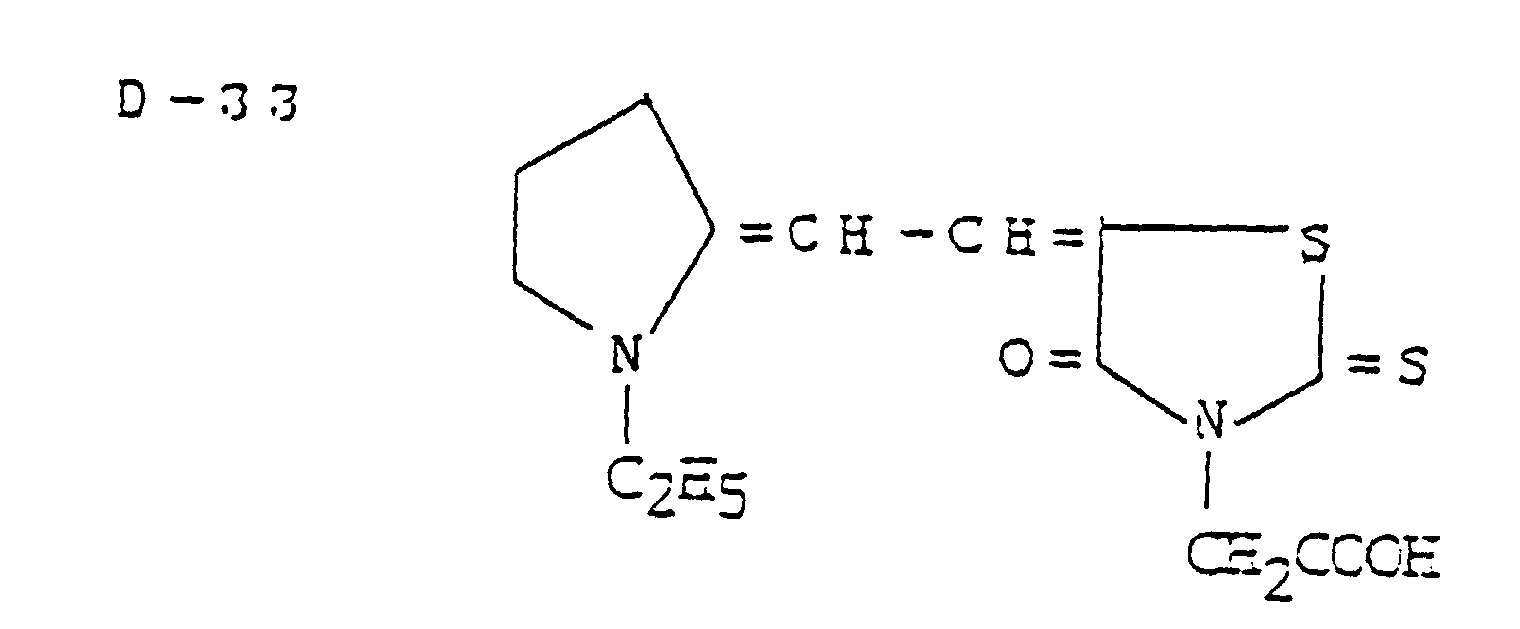
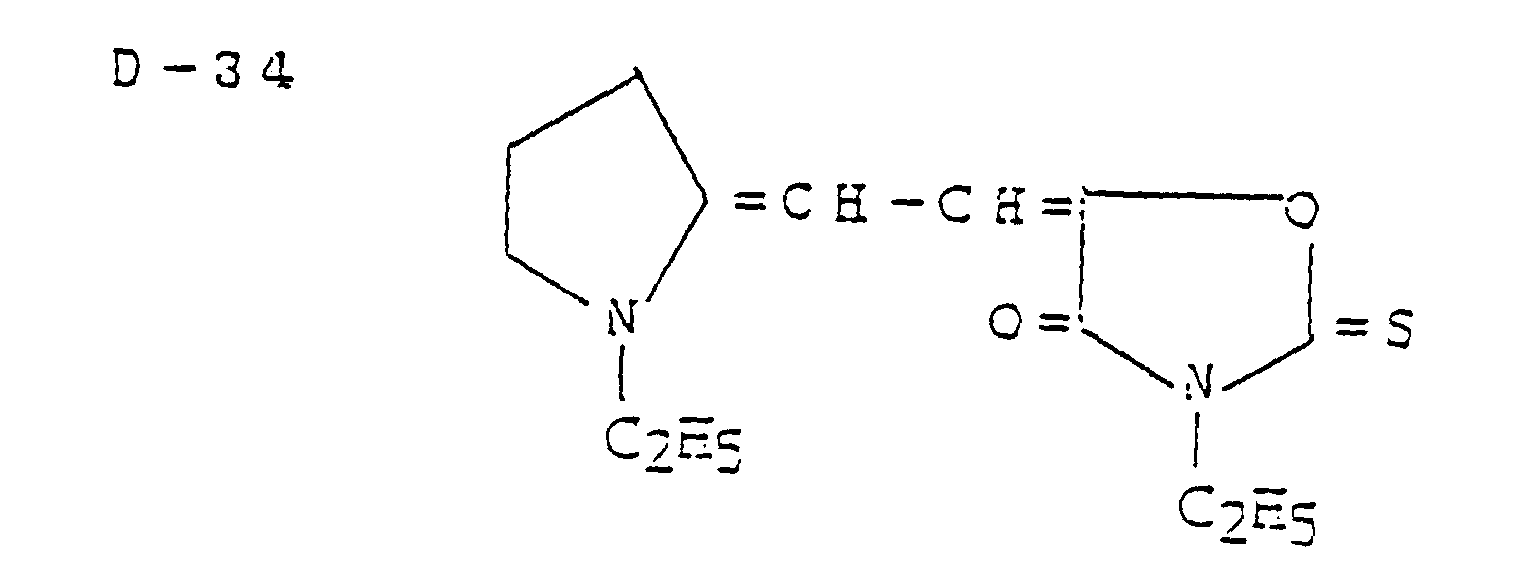
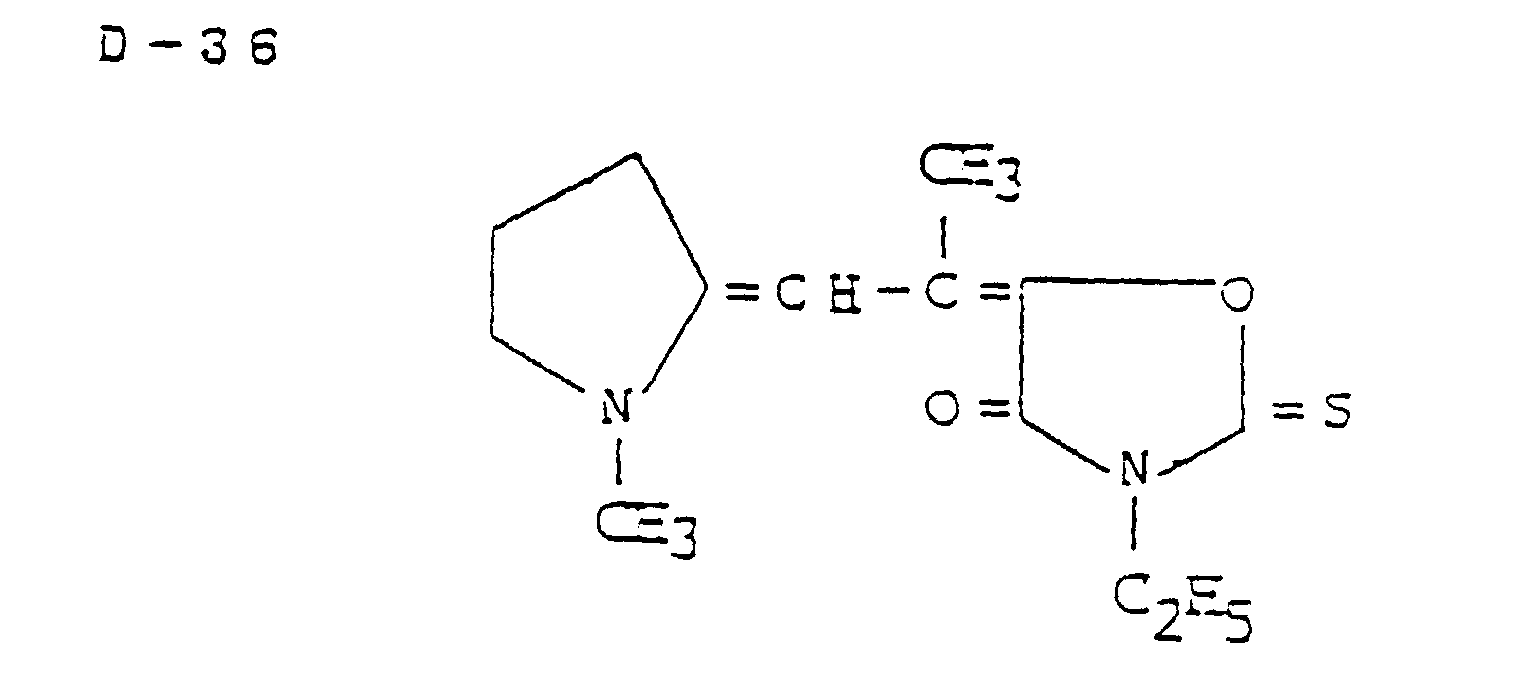
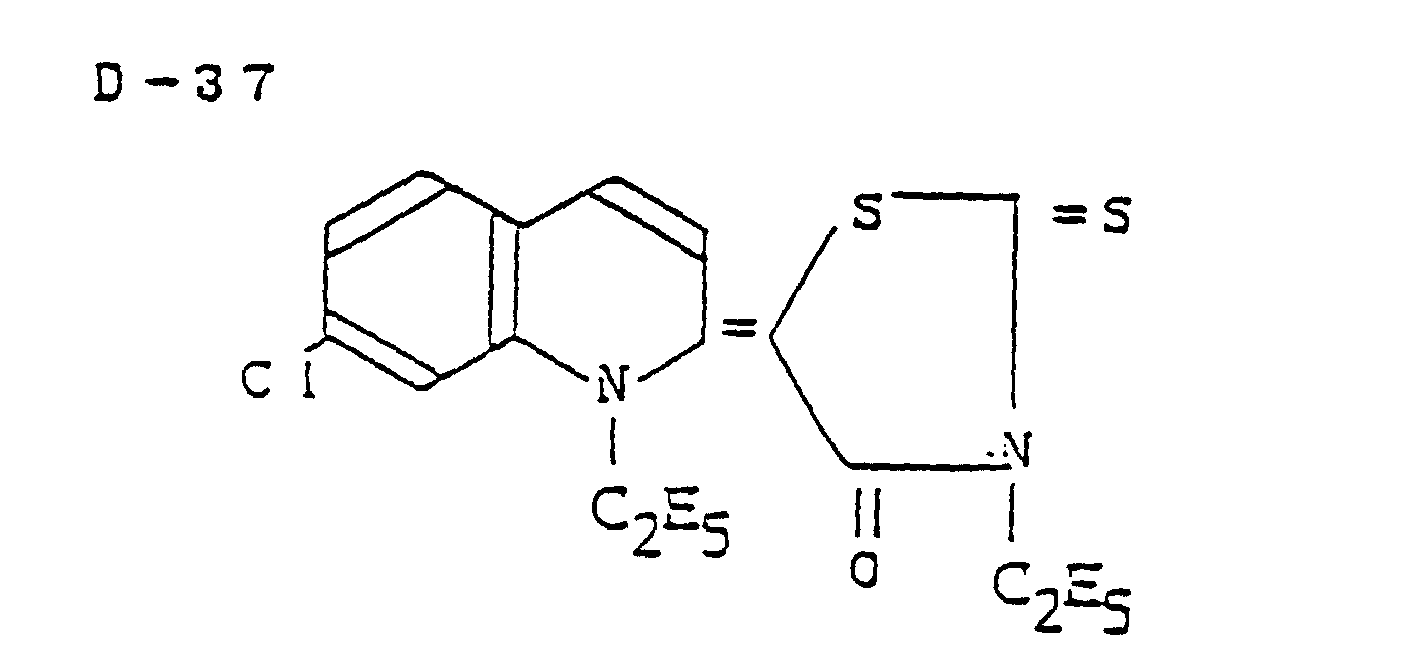
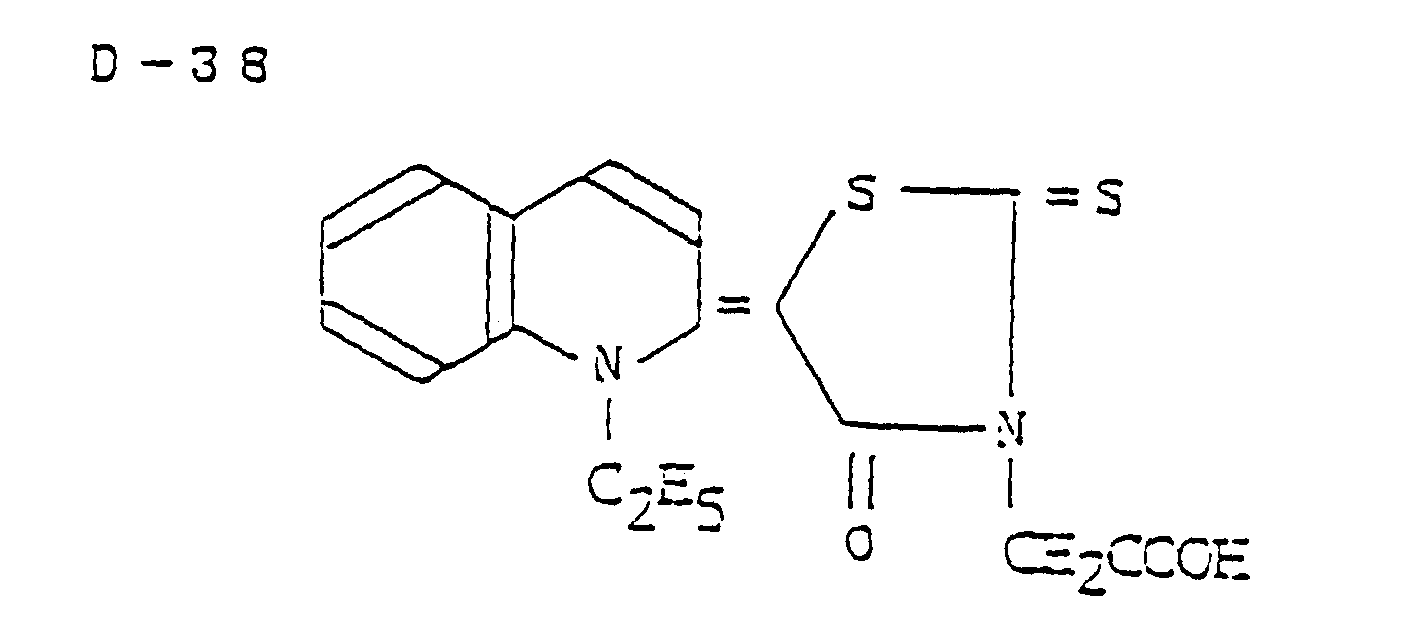
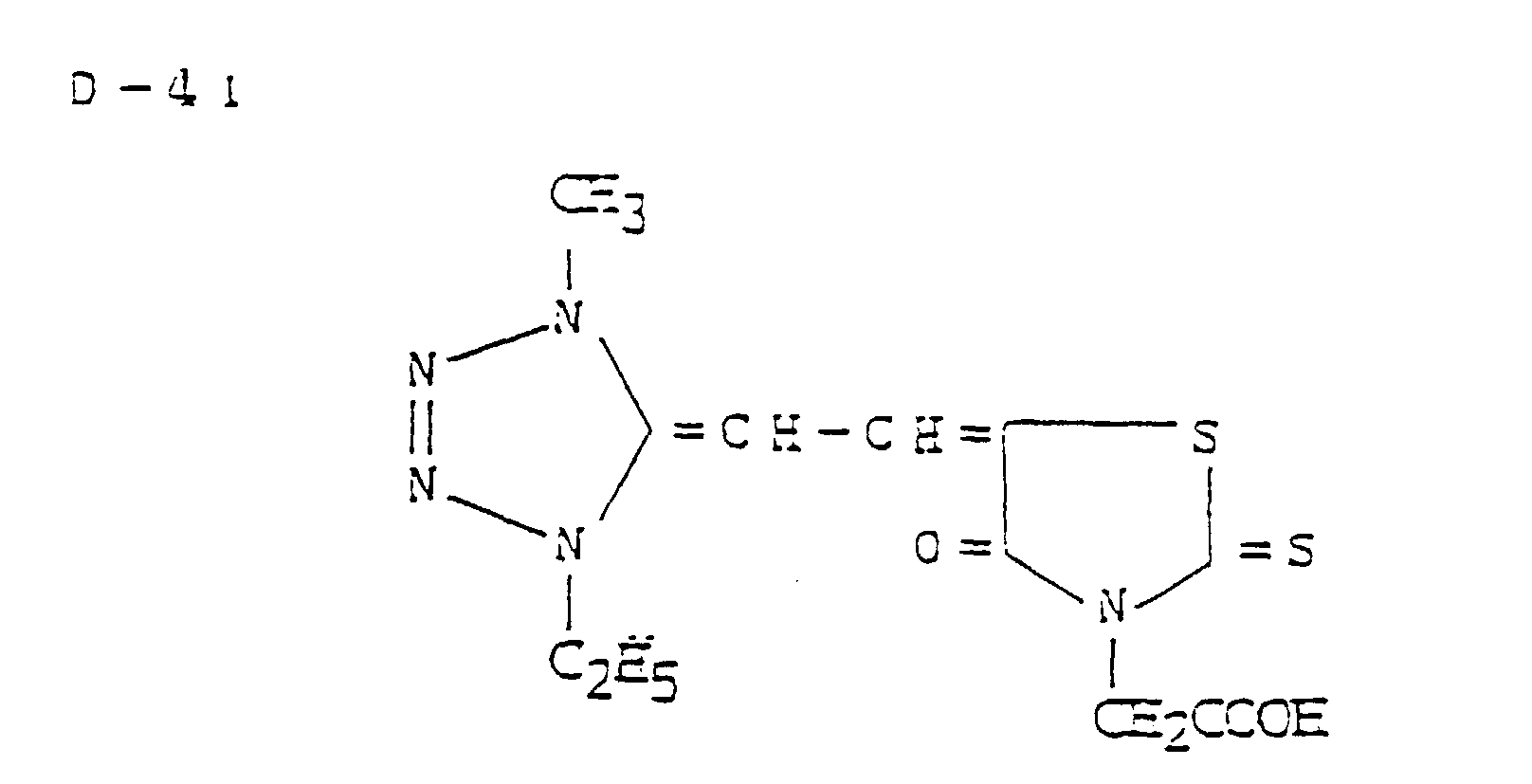
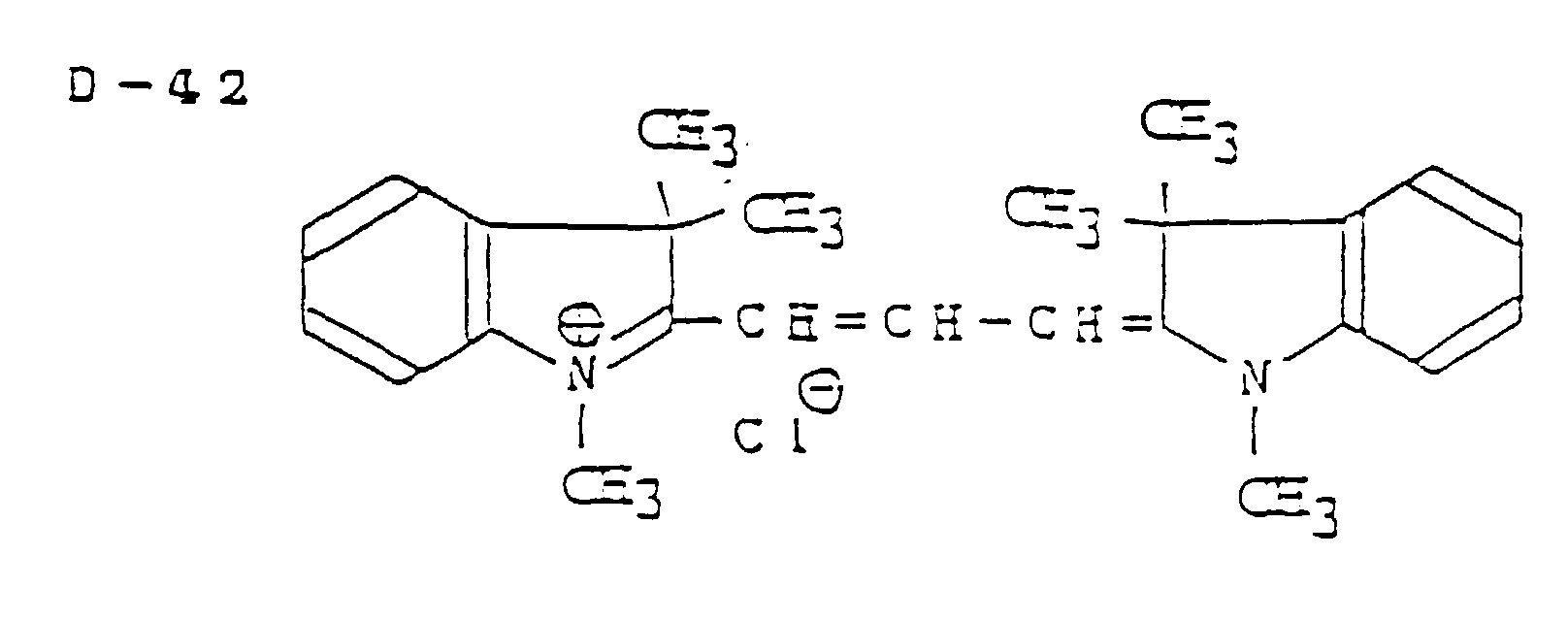
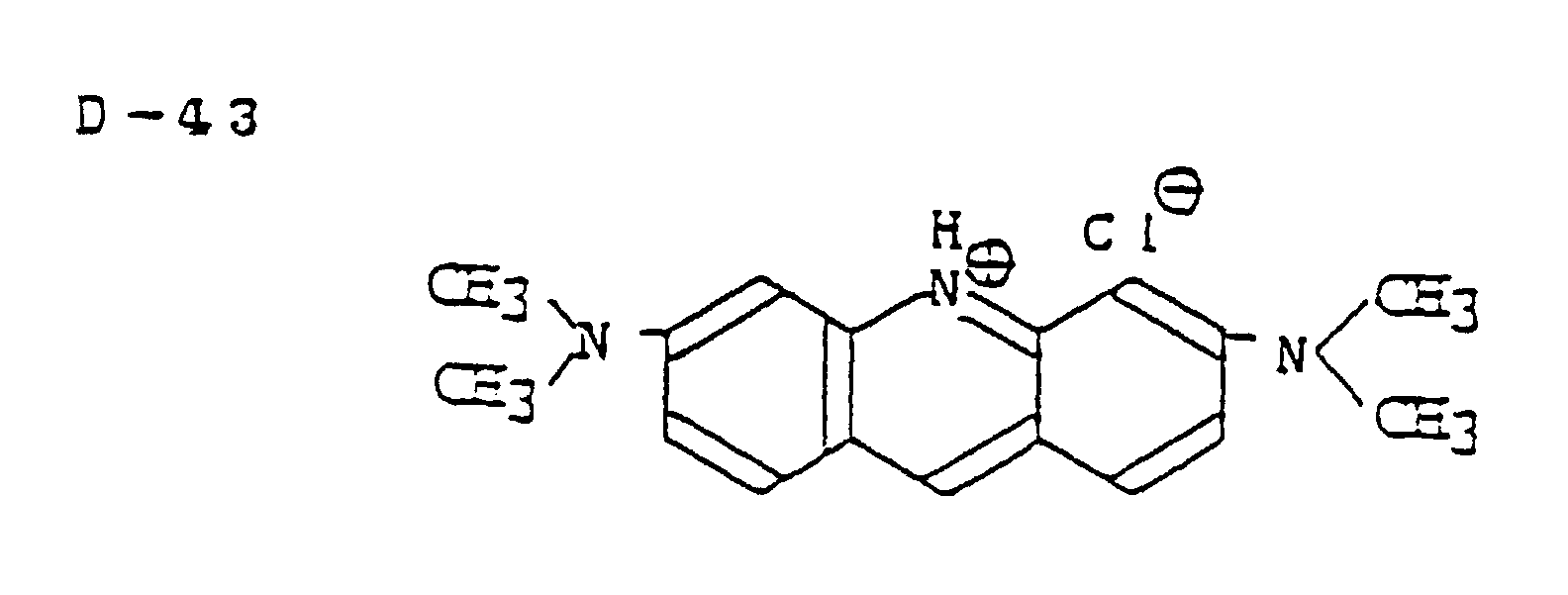
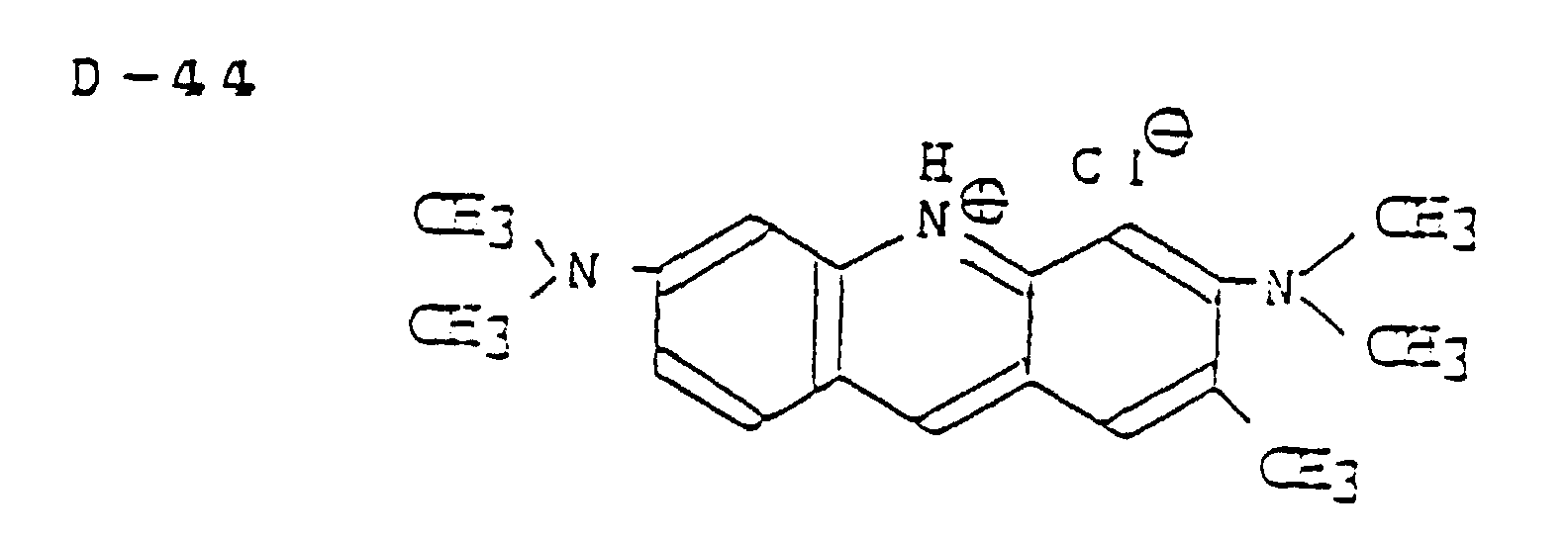
- Particularly useful dyes for use in this invention are compounds represented by the following formula (D-I), (D-II), (D-III), or (D-IV) each having a reduction potential of more negative than -0.80 volt; wherein m1 represents 0 or 1; Q 2 and Q 3 each represents a nonmetallic atomic group necessary for forming a nitrogen-containing heterocyclic ring such as, e.g., a benzothiazole ring, a naphthothiazole ring, a benzoselenazole ring, a benzoxazole ring, a quinoline ring, and a thiazoline ring each may be substituted with an alkyl group such as methyl, ethyl, etc., a halogen atom, an alkoxy group such as methoxy, etc.; R 23 and R 24 each represents an alkyl group such as methyl, ethyl, propyl, etc., a substituted alkyl group having a
- Y represents an oxygen atom or a sulfur atom
- m2 represents 0 or 1
- Q 4 represents a nonmetallic atomic group necessary for forming a nitrogen-containing heterocyclic ring such as a thiazole ring, a thiazoline ring, a pyrroline ring, a quinoline ring, a tetrazole ring, each may be substituted with an alkyl group such as methyl, ethyl, a halogen atom, an alkoxy group such as methoxy
- R 26 and R 27 each represents an alkyl group such as methyl, ethyl, a substituted alkyl group having a carboxy group (including a carboxy group containing a quaternary ammonium salt such as a trimethylammonium salt, such as carboxymethyl, ⁇ -carboxyethyl, a substituted alkyl group having a hydroxy group, such as hydroxymethyl, ⁇ -hydroxyethyl,
- R 29 represents a hydrogen atom or an alkyl group such as methyl, ethyl, propyl
- R 30 , R 31 , R 32 , and R 33 each independently represents a hydrogen atom, a halogen atom, an alkyl group such as methyl, ethyl, an amino group, or an amino group substituted with an alkyl group such as methyl, ethyl
- R 34 represents an unsubstituted phenyl group or a phenyl group substituted with an amino group, a dialkylamino group, a carboxyl group
- X - represents an anion which is usually used for forming a dye salt, such as an iodine ion, a bromine ion, a chlorine ion, a perchloric acid ion, a p-toluenesulfonic acid ion, a methylsulfuric acid ion, wherein Q 5 represents a nonmetallic
- the foregoing dyes can be easily synthesized by the methods described, e.g., in F.H. Hamer, The cyanine Dyes and Related Compounds , published by Interscience Publishers, N.Y., 1964, page 55 et seq. and similar methods to them.
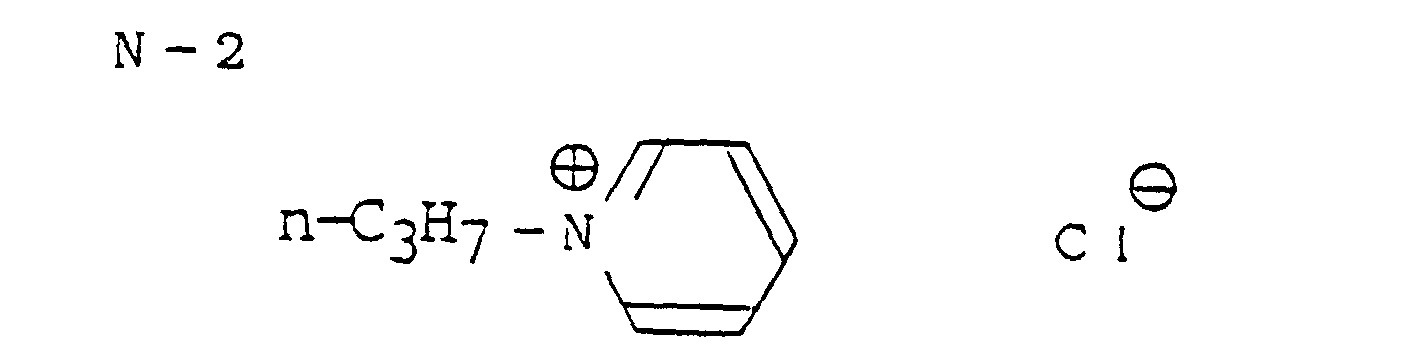
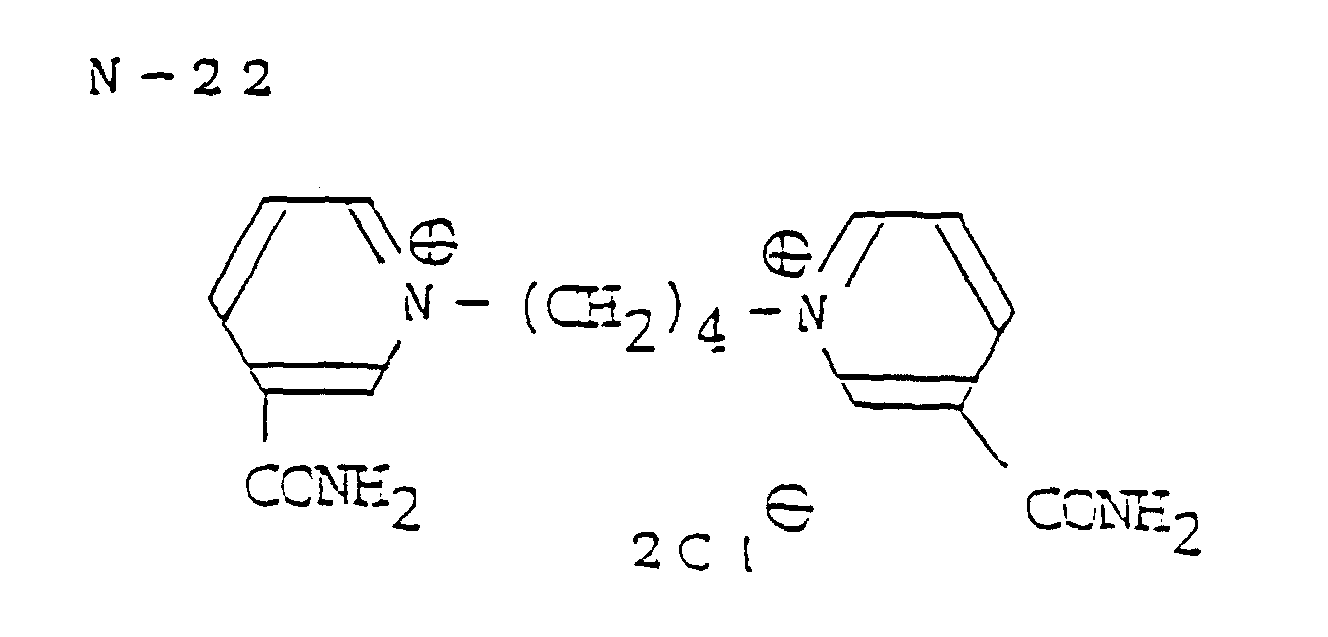
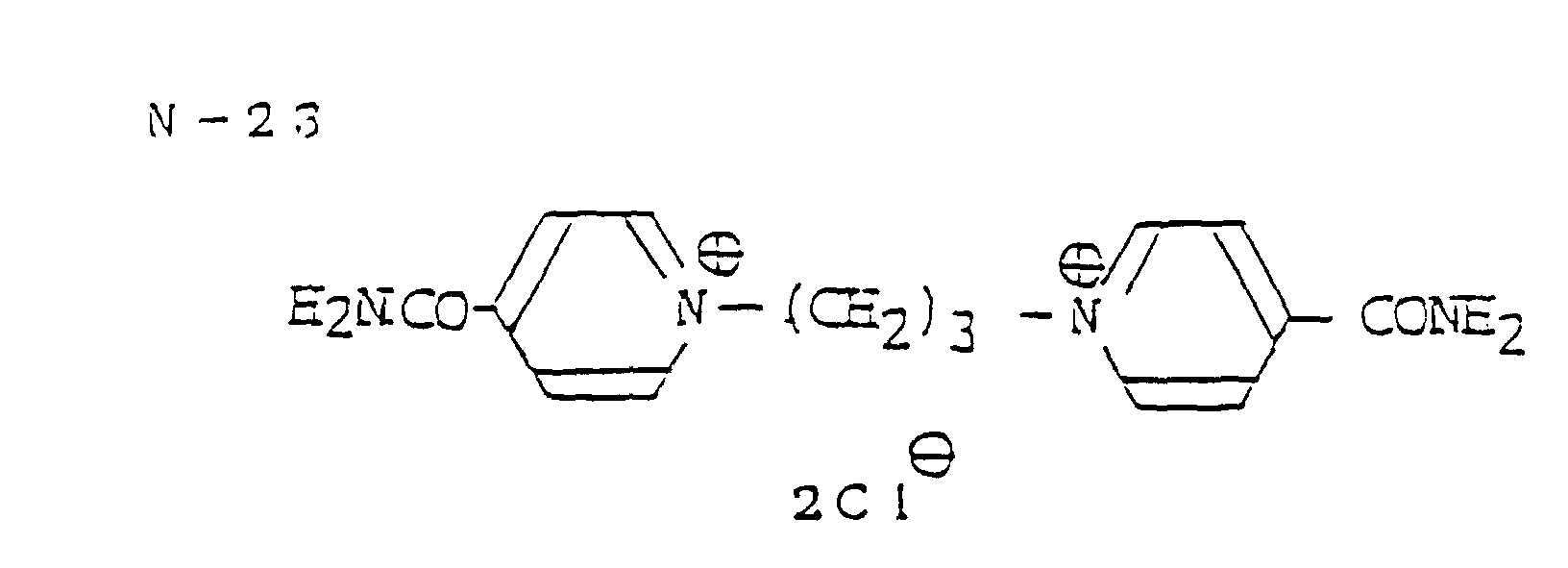
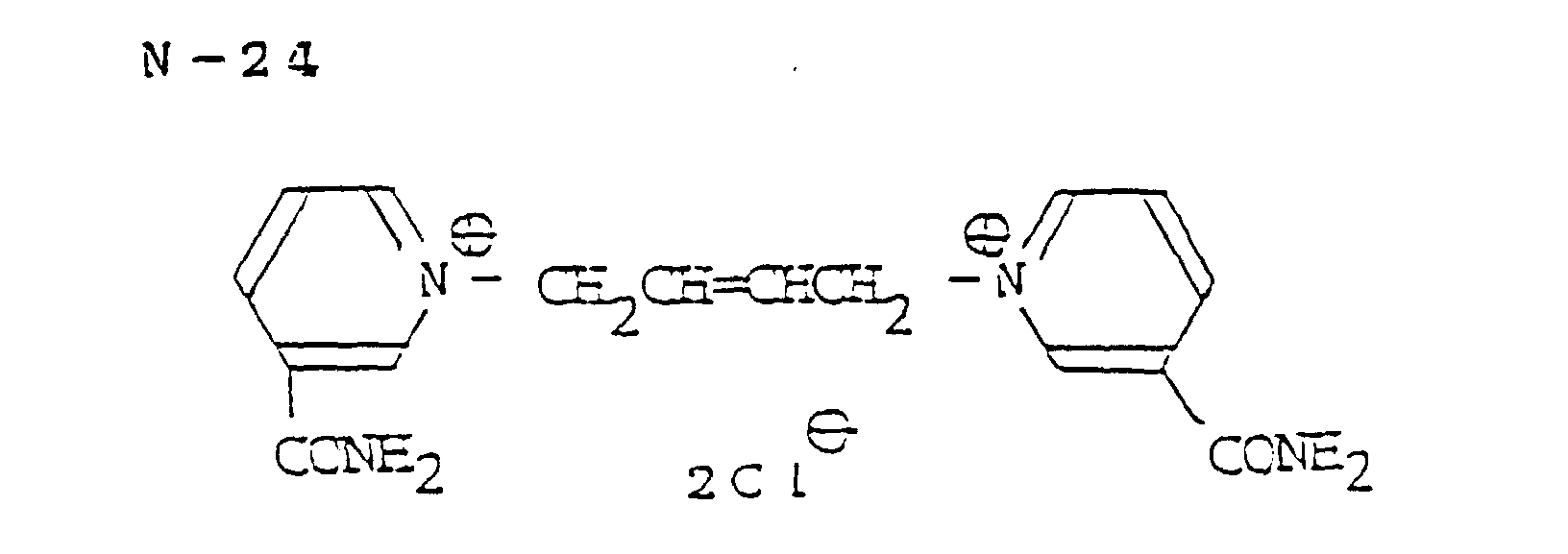
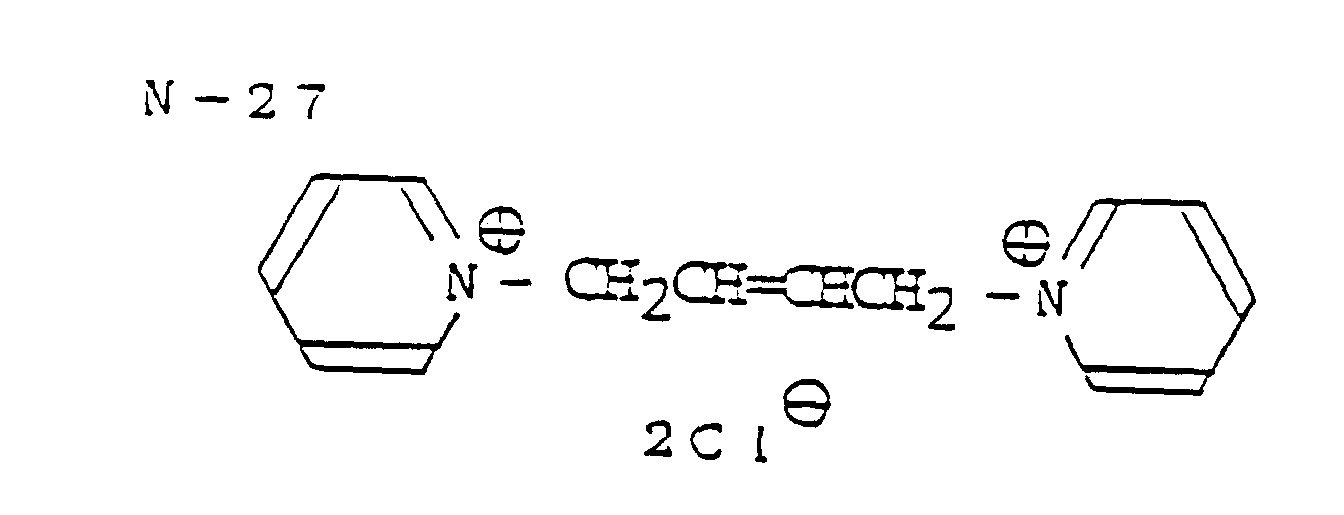
- the pyridinium salt derivatives useful for use in the present invention are the compounds shown by formula (N-I), (N-II), or (N-III) described above.
- R 2 represents an alkyl group (methyl, ethyl, propyl, butyl), an alkyl group substituted with a hydroxy group, an alkoxy group, or an aromatic group such as phenyl, pyridyl, [e.g., 2-hydroxyethyl, 3-hydroxypropyl, 2-methoxyethyl, 4-ethoxybutyl, benzyl, 2-phenylethyl, and 3-(4-pyridyl)propyl], or an amide group (such as -CONH 2 , -CONHCH 3 ); nl represents 0 or an integer of from 1 to 3; when plural R 2 s exist, they may be the same or different; and X - represents an anion such as an iodine ion, a bromine ion, a chlorine ion, a p-toluenesulfonic acid ion, a perchlor
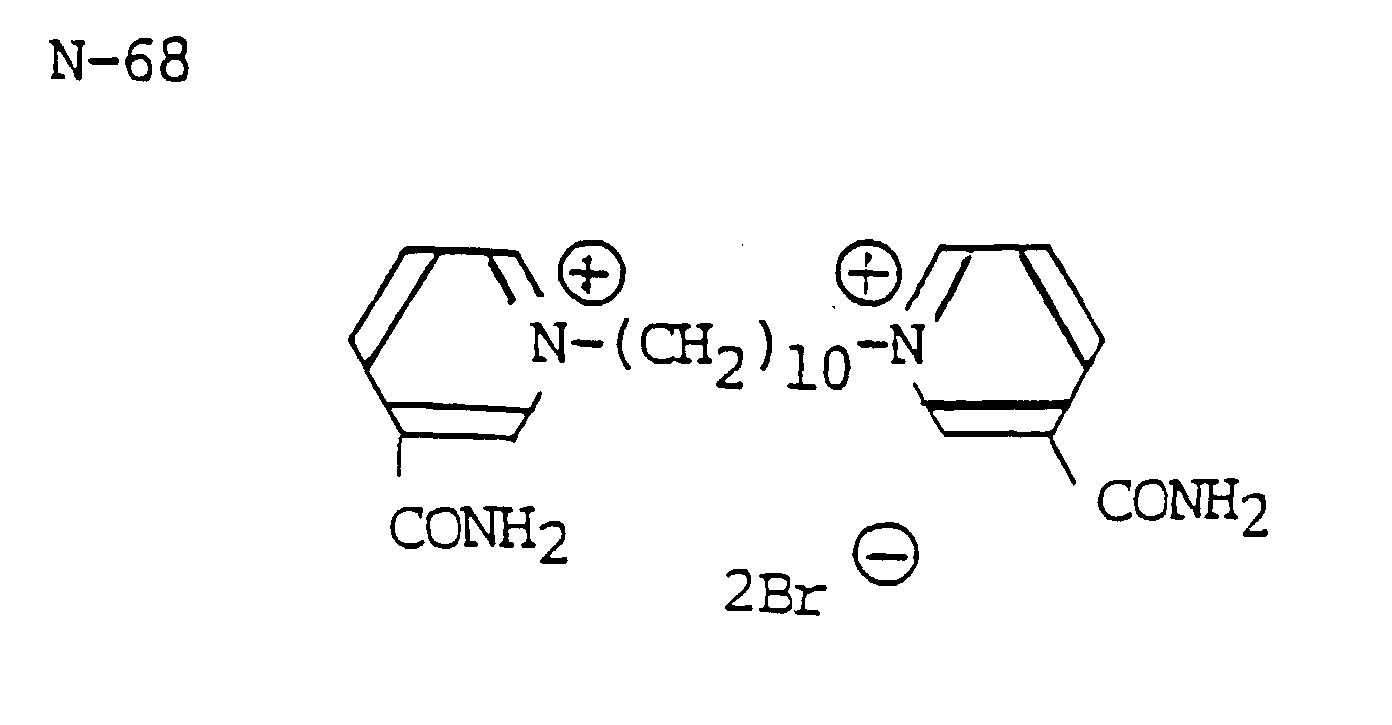
- R 3 are methyl, ethyl, n-propyl, isopropyl, n-butyl, isobutyl, pentyl, 2-hydroxyethyl, 3-hydroxypropyl, 2-methoxyethyl, 3-ethoxypropyl, 2-phenylethyl, 3-acetylpropyl, 2-benzoylethyl, 2-methoxycarbonylethyl, 2-cyanoethyl, and 2-carbamoylethyl.
- R 4 and R 5 each independently represents a halogen atom, an alkyl group (e.g., methyl, ethyl, n-propyl, isopropyl, n-butyl, isobutyl, and pentyl), a substituted alkyl group, or an alkoxy group (e.g., methoxy and ethoxy).
- an alkyl group e.g., methyl, ethyl, n-propyl, isopropyl, n-butyl, isobutyl, and pentyl
- a substituted alkyl group e.g., methoxy and ethoxy
- an alkoxy group e.g., methoxy and ethoxy
- substituted alkyl group examples include hydroxymethyl, 2-hydroxyethyl, 3-hydroxypropyl, 2-methoxyethyl, 2-ethoxyethyl, benzyl, 2-phenylethyl, and 2-tolylethyl.
- n2 and n3 each independently represents 0, 1, or 2.
- R 4 s and/or R 5 s may be the same or different.
- X - represents an anion as an iodine ion, a bromine ion, a chlorine ion, a p-toluenesulfonic acid ion, a perchloric acid ion, a methylsulfuric acid, etc., but when formula (N-II) is a betaine structure, X - does not exist.
- R 6 represents an alkyl group (such as methyl, ethyl, propyl, butyl, pentyl, etc.) or a substituted alkyl group; said R 6 may form a 6-membered ring or a 5-membered ring together with R 8 ;
- R 7 represents a hydrogen atom, an alkyl group (such as methyl, ethyl, propyl, butyl, pentyl), a substituted alkyl group, or an aryl group (such as phenyl, alkyl-substituted phenyl).
- substituted alkyl group examples include 2-hydroxyethyl, 3-hydroxypropyl, 2-methoxyethyl, 2-ethoxyethyl, 3-methoxypropyl, benzyl, and 2-phenylethyl.
- R 8 and R 9 each independently represents a hydrogen atom, an alkyl group (such a methyl, ethyl, propyl), an alkyl group substituted with a hydroxy group, an alkoxy group, an aromatic group, (such as 2-hydroxyethyl, 3-hydroxypropyl, 2-methoxyethyl, 3-ethoxypropyl, benzyl, 2-phenylethyl), an alkoxy group (such as methoxy, ethoxy), or an amide group. Furthermore, R 8 and R 9 may form together an aromatic ring.
- an alkyl group such a methyl, ethyl, propyl
- R 10 represents a halogen atom (chlorine, bromine), an alkyl group which may be unsubstituted or substituted (such as methyl, ethyl, propyl, 2-hydroxyethyl, 3-hydroxypropyl, 2-methoxyethyl, benzyl), an alkoxy group (such as methoxy, ethoxy), or an amino group which may be substituted with an alkyl group.
- n4 represents 0, 1, or 2. When plural R 10 s exist, they may be the same or different.
- X - represents an anion such as an iodine ion, a bromine ion, a chlorine ion, a p-toluenesulfonic acid ion, a perchloric acid ion, a methylsulfuric acid ion, etc., but when formula (N-III) is a betaine structure, X - does not exist.
- pyridinium salt derivatives can be synthesized by reacting corresponding pyridine derivatives, quinoline derivatives, or isoquinoline derivatives and alkyl halides as described in Munio Kotake, Dai Yuuki Kagaku (Principal Organic Chemistry) , Vol. 16, (III), pages 7 and 125, published by Asakura Shoten, 1959. Practical synthetic methods of them are described in A. Grob and E. Renk, Helv. Chim. Acta. , 37 , 1672(1954); R.E. Lyle, E.F. Perlowski, H.J. Troscianiec, and G.G. Lyle, J. Org. Chem. , 20 , 1716(1955); M.R.
- the foregoing dye or pyridinium salt derivative for use in this invention can contain in at least one negative-working silver halide emulsion constituting the silver halide photographic material or other light-insensitive layer composed of a hydrophilic colloidal layer such as a protective layer, an interlayer, an antihalation layer, a filter layer, etc.
- the addition amount of the dye and the pyridinium salt derivative to the silver halide photographic material is suitable in the range of from 1 ⁇ 10 -6 mol to 1 ⁇ 10 -2 mol per mol of silver halide, and in the case of adding the dye alone, the amount is preferably from 1 ⁇ 10 -3 mol to 1 ⁇ 10 -1 mol, and in the case of the pyridinium salt derivative alone, the amount is preferably from 1 ⁇ 10 -4 mol to 1 ⁇ 10 -2 mol, and when a polyalkylene oxide or the derivative thereof (hereinafter, they are referred to as simply polyalkylene oxide derivatives) exists, the amount of the dye or the pyridinium salt derivative is particularly preferably from 1 ⁇ 10 -5 mol to 1 ⁇ 10 -3 mol.
- the dyes and the pyridinium salt derivatives for use in the present invention can be used singly or as a combination of them.
- the dye or the pyridinium salt derivative for use in this invention may be added to the negative-working silver halide emulsion or an aqueous solution of a light-insensitive hydrophilic colloid for use in this invention as a solution thereof in water or an organic solvent miscible with water, such as alcohols, ketones, esters, amides, etc.
- the dye or the pyridinium salt derivative for use in this invention can be added thereto at any desired step during the production of the silver halide photographic material.
- the compound in the case of adding to the negative-working silver halide emulsion, can be added thereto at an optional time from the initiation of the chemical ripening of the silver halide emulsion before coating the emulsion but it is preferred to add the compound at an optional time after chemical ripening of the silver halide emulsion and immediately before coating.
- the compound may be added to the silver halide photographic material after imagewise exposing the silver halide photographic material.
- the dye and/or the pyridinium salt derivative for use in this invention may be added to a developer and in this case, the content thereof is preferably from 1 ⁇ 10 -6 mol/liter to 1 ⁇ 10 -1 mol/liter.
- the action and mechanism of the dyes and the pyridinium salt derivatives for use in this invention have not yet been clarified but since it is not always necessary that they exist at image exposure of the silver halide photographic material, the dyes do not take part in the ordinary spectral sensitization. It is assumed that the dyes and the pyridinium salt derivatives for use in this invention act as contrast-increasing agents for increasing the sensitivity and the contrast of the silver halide photographic material at development thereof.
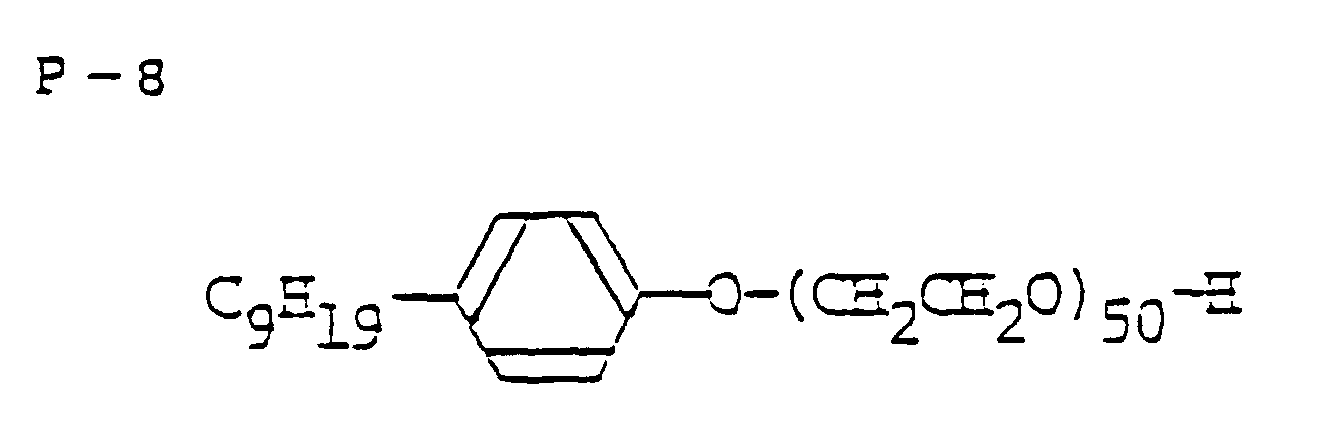
- polyalkylene oxide derivative for use in the present invention there are a polyalkylene oxide such as polyethylene oxide, polypropylene oxide, etc., an addition polymer of a polyalkylene oxide such as polyethylene oxide, polypropylene oxide, and at least one compound selected from water, aliphatic alcohols, phenols, glycols, fatty acids, and organic amines; a condensate of a polyalkylene oxide and one compound selected from the foregoing compounds, and a block copolymer of various alkylene oxides with each other (e.g., ethylene oxide and propylene oxide).
- a polyalkylene oxide such as polyethylene oxide, polypropylene oxide, etc.
- an addition polymer of a polyalkylene oxide such as polyethylene oxide, polypropylene oxide, and at least one compound selected from water, aliphatic alcohols, phenols, glycols, fatty acids, and organic amines
- the number-average molecular weight of the polyalkylene oxide derivative for use in this invention is preferably from 500 to 20,000 and particularly preferably from 1,000 to 10,000.
- the polyalkylene oxide derivative for use in this invention may be incorporated in the silver halide photographic material or the developer but is preferably incorporated in the silver halide photographic material.
- the compound may be added to the negative-working silver halide emulsion layer or other light-insensitive hydrophilic colloidal layer such as a protective layer, an interlayer, an antihalation layer, a filter layer, etc.
- the polyalkylene oxide derivative is added to the negative-working silver halide emulsion for use in this invention.
- the compound may be added to the negative-working silver halide emulsion for use in this invention or an aqueous light-insensitive hydrophilic colloidal solution as a solution thereof in water or an organic solvent miscible with water, such as alcohols, ketones, esters, amides, etc.
- the addition amount of the polyalkylene oxide derivative for use in this invention to the silver halide photographic material is suitable in the range of from 0.1 g to 10 g, and particularly preferably in the range of from 1 g to 5 g per mol of silver halide.
- the compound can be added thereto at any desired step during the production of the silver halide photographic material.
- the addition amount of the compound is from 0.1 g to 15 g per liter of the developer.
- the inorganic compound having an acidic dissociation constant pKa of lower than 11 and the salts thereof for use in the present invention the inorganic compound having an acidic dissociation constant pKa of lower than 11 shown in Table 8.178 described in Kagaku Binran (Chemcal Handbook), the Foundation , page 994, edited by Nippon Kagaku Kai, published by Maruzen K.K., 1975 and the table "Acid Dissociation Constant pKa of Inorganic Compound in Water" in Table 5-7 described in John A. Dean, Lange's Handbook of Chemistry , the 13th revised edition, pages 5-14 to 5-17, published by McGraw-Hill Book Company, 1985 can be selectively used.
- the inorganic compound having an acidic dissociation constant pKa of lower than 11 and the salts thereof for use in this invention are acids such as nitric acid, sulfuric acid, sulfurous acid, bisulfurous acid, phosphoric acid, phosphorous acid, hypophosphoric acid, metaphosphoric acid, hypophosphorous acid, amidophosphoric acid, carbonic acid, bicarbonic acid, hydrochloric acid, hydrobromic acid, hydroiodic acid, orthoboric acid, metaboric acid, aluminic acid, amidosulfuric acid, hydrazinosulfuric acid, sulfamic acid, and the alkaline metal salts, alkaline earth metal salts, aluminum salts, ammonium salts, and hydrazinium salts of these acids.
- acids such as nitric acid, sulfuric acid, sulfurous acid, bisulfurous acid, phosphoric acid, phosphorous acid, hypophosphoric acid, metaphosphoric acid, hypophosphorous acid, amidophosphoric acid, carbonic acid, bi
- the acid in the case of using strong acids having a negative dissociation constant pKa, such as nitric acid, sulfuric acid, hydrochloric acid, hydrobromic acid, etc., in the foregoing acids, it is preferred to use the acid as the salt thereof, such as the aluminum salt, ammonium salt, or hydrazinium salt.
- strong acids having a negative dissociation constant pKa such as nitric acid, sulfuric acid, hydrochloric acid, hydrobromic acid, etc.
- the acid as the salt thereof, such as the aluminum salt, ammonium salt, or hydrazinium salt.
- the acid inorganic compound which is preferably used in this invention are amidosulfuric acid, ammonium amidosulfate, amidophosphoric acid, ammonium sulfite, potassium sulfite, potassium hydrogensulfite, sodium sulfite, sodium hydrogensulfite, sodium aluminate, magnesium aluminate, aluminum chloride, ammonium chloride, primary hydrazine chloride, secondary hydrazine chloride, ammonium magnesium chloride, orthoboric acid, orthophosphosphoric acid, potassium tetraborate, aluminum bromide, ammonium bromide, ammonium nitrate, aluminum nitrate, primary hydrazine nitrate, secondary hydrazine nitrate, hypophosphoric acid, sodium hypophosphate, disodium dihydrogen hypophosphate, sulfonylimide, ammonium carbonate, ammonium hydrogencarbonate, potassium hydrogencarbonate, sodium hydrogencarbonate, potassium magnesium hydrogencarbonate, lithium hydrogencarbonate,
- the organic compounds having an acidic dissociation constant pKa of lower than 11 for use in this invention the organic compounds having the pKa value of lower than 11 shown in Table 8.179 described in Kagaku Binran (Chemical Handbook), the Foundation , pages 994 to 998, edited by Nippon Kagaku Kai, published by Maruzen K.K., 1975 and the table of "Acid Dissociation Constant pKa of Organic Compounds in Water” in Table 5-8 described in John A. Dean, Lange's Handbook of Chemistry, the 13th revised edition, pages 5-18 to 5-60, published by McGraw-Hill Book Company, 1985 can be selectively used.
- organic compound isovaleric acid, isobutyric acid, octanic acid, cyclohexanecarboxylic acid, lactic acid, acetic acid, ammonium acetate, aluminum acetate, hydrazinium acetate, sodium acetate, potassium acetate, lithium acetate, cerium acetate, magnesium acetate, calcium acetate, strontium acetate, barium acetate, butyric acid, crotonic acid, azelaic acid, citric acid, succinic acid, oxalic acid, tartaric acid, fumaric acid, malonic acid, malic acid, lauric acid, myristic acid, palmitic acid, stearic acid, anisic acid, benzoic acid, p-aminobenzoic acid, naphthoic acid, terephthalic acid, pyromellitic acid, asparagine, aspartic acid, 4-aminobutyric acid,
- the forgoing compound having an acidic dissociation constant pKa of lower than 11 and the salt thereof for use in the present invention is incorporated in at least one hydrophilic colloidal layer constituting the silver halide photographic material, and preferably in a light-insensitive hydrophilic colloidal layer which is coated adjacent to the negative-working silver halide emulsion layer, such as a protective layer, an interlayer an antihalation layer, or a filter layer.
- the compound may be added to the negative-working silver halide emulsion for use in this invention or an aqueous light-insensitive hydrophilic colloidal solution as a solution thereof in water or an organic solvent miscible with water, such as alcohols, ketones, esters, amides, etc.
- the addition amount of the compound having an acidic dissociation constant pKa of lower than 11 or the salt thereof for use in this invention to a hydrophilic colloidal layer is suitable in the range of from 1 ⁇ 10 -5 mol to 5 mols, and particularly preferably in the range of from 5 ⁇ 10 -3 mol to 1 mol per mol of silver halide.
- the silver halide photographic material of this invention has at least one emulsion layer composed of a negative-working silver halide emulsion.
- a negative-working silver halide emulsion There is no particular restriction on the halogen composition of the silver halide emulsion being used and silver chloride, silver chlorobromide, silver iodobromide, silver iodobromochloride, etc., can be used.
- the content of silver iodide of the silver halide emulsion is preferably not more than 5 mol%, and more preferably not more than 3 mol%.
- the silver halide grains for use in this invention can have a relatively broad grain size distribution, but has preferably a narrow grain size distribution, and in particular, a monodispersed silver halide emulsion containing silver halide grains 90% of the total silver halide grains of which are within ⁇ 40% of the mean grain size is preferred.
- the mean grain size of the silver halide grains for use in this invention is preferably not larger than 0.7 ⁇ m, and particularly preferably not larger than 0.4 ⁇ m.
- the silver halide grains may have a regular crystal form such as cubic, octahedral, etc., or may have an irregular crystal form such as spherical, tabular, rounded wedge shape, etc.
- the silver halide emulsion for use in this invention can be prepared by an optional known method. That is, an acid method, a neutral method, an ammoniacal method, etc., may be used and for the mixing process of a soluble silver salt and a soluble halide, a single jet method, a reverse mixing method, a double jet method, or a combination thereof can be used.
- a pAg controlled double jet method C.D.J.
- a monodispersed silver halide emulsion containing silver halide grains having a uniform crystal form and almost uniform grain sizes is obtained.
- a cadmium salt, an iridium salt, or a rhodium salt may exist in the system for increase the contrast of the silver halide emulsion formed.
- the content of the binder contained in the silver halide photographic emulsion layer for use in the present invention is not over 250 g per mol of the silver halide.
- binder gelatin is most preferable but other hydrophilic colloids than gelatin can be used.
- albumin, casein, graft polymers of gelatin and other polymers, hydrophilic synthetic polymers such as polyvinyl alcohol, polyacrylamide, etc. can be used.
- the silver halide emulsion for use in this invention may not be chemically sensitized but usually is chemically sensitized.
- a sulfur sensitizing method, a reduction sensitizing method, a noble metal sensitizing method, or a combination thereof is used but a particularly preferred chemical sensitizing method for the practice of this invention is a sulfur sensitizing method and a combination of a sulfur sensitization and a gold sensitization which is one of noble metal sensitization.
- active gelatin active gelatin, thiosulfates, thioureas, allylthiocarbamide, etc.
- gold sensitization HAuCl 4 , Au(SCN) 2 - salt, Au(S 2 O 3 ) 2 3- salt, etc., can be used.
- the silver halide emulsion for use in this invention may be spectrally sensitized using one or more kinds of sensitizing dyes for imparting a spectral sensitivity at a desired wavelength region.
- the silver halide photographic material of the present invention has at least one layer containing a negative-working silver halide emulsion on a support and may have other light-insensitive hydrophilic colloidal layers such as a protective layer, an interlayer, an antihalation layer, a filter layer, etc.
- hydrophilic colloidal layers may contain an inorganic or organic hardening agent.
- chromium salts chromium alum, etc.
- aldehydes formaldehyde, glyoxal, etc.
- N-methylol compounds dimethylolurea, methyloldimethylhydantoin, etc.
- active halogen compounds (2,4-dichloro-6-hydroxy-s-triazine, mucochloric acid, etc.
- active vinyl compounds (1,3,5-triacryloyl-hexahydro-s-triazine, etc.
- epoxy derivatives and aziridine derivatives hardening agents can be used.
- hydrophilic colloidal layer(s) for use in this invention can contain, if necessary, various photographic additives such as emulsion stabilizers (hydroxytetraazaindene compounds such as 6-hydroxy-4-methyl-1,3,3a,7-tetraazaindene, etc.), spreading agents (saponin, etc.), gelatin plasticizers (copolymers of acrylic acid esters, etc.), antistatic agents, coating aids, various kinds of surface active agents (cationic, anionic, nonionic, and amphoteric surface active agents) for various purposes such as the improvement of photographic characteristics (e.g., a development acceleration and the increase of contrast, etc.), antifoggants (hydroquinone, 5-methylbenzotriazole, 1-phenyl-5-mercaptotetrazole, etc.), matting agents, water-insoluble or sparingly water-soluble polymer latexes (homo- or copolymers of alkyl acrylate, alkyl methacrylate, acrylic acid,
- the developer of this invention is an alkaline developer containing at least an aminophenol derivative developing agent and a reductone compound.
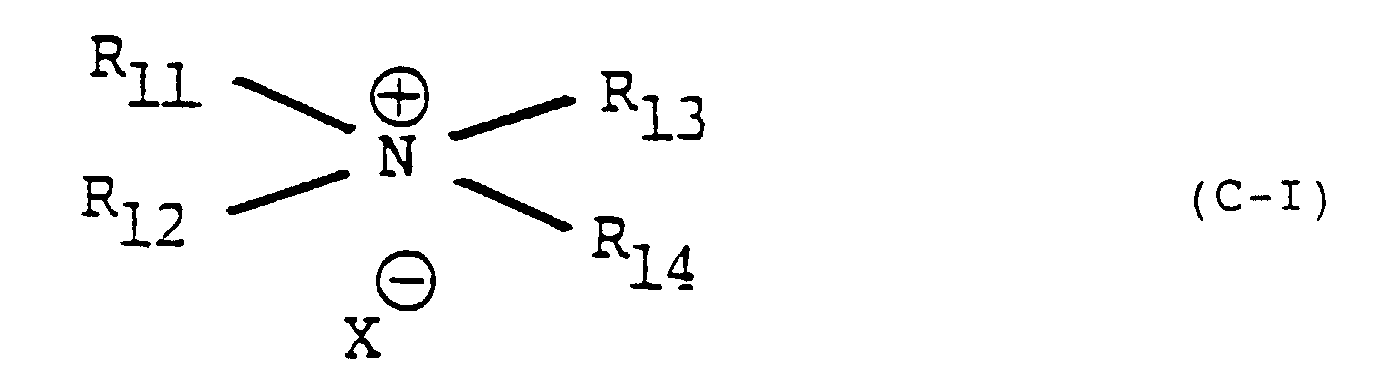
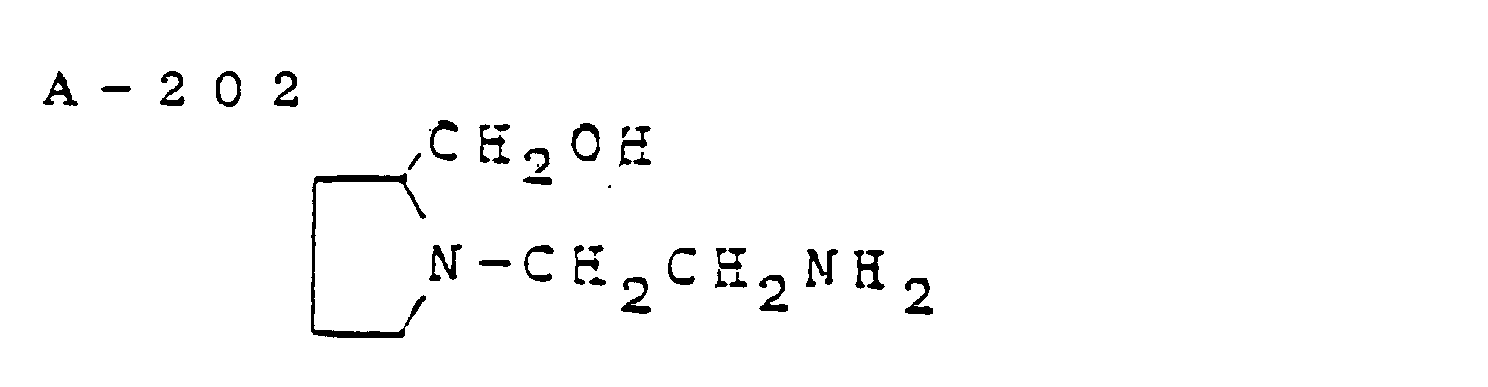
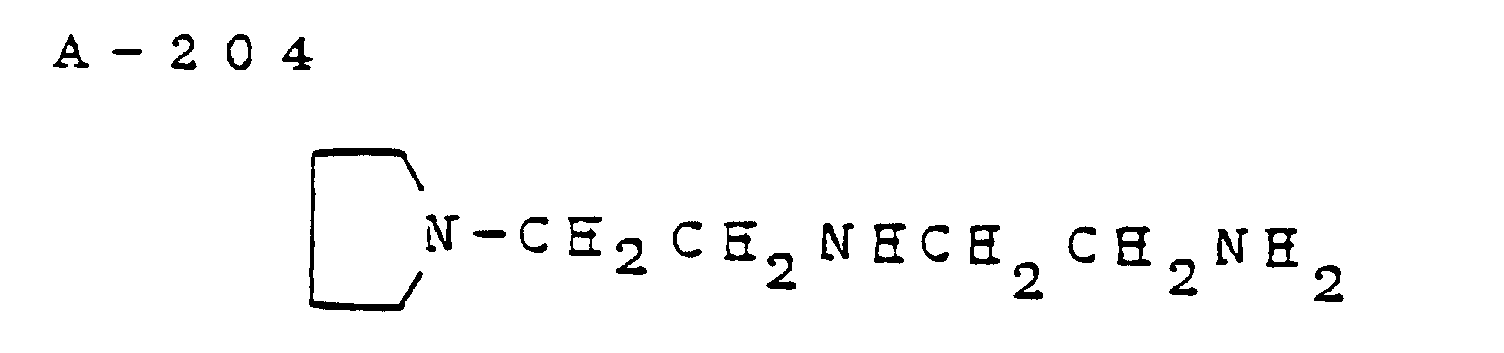
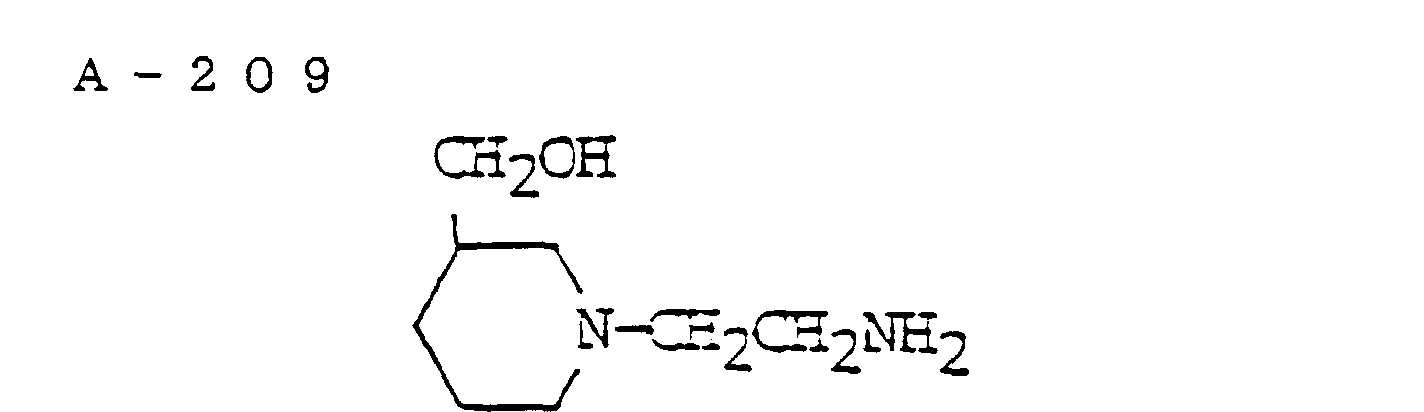
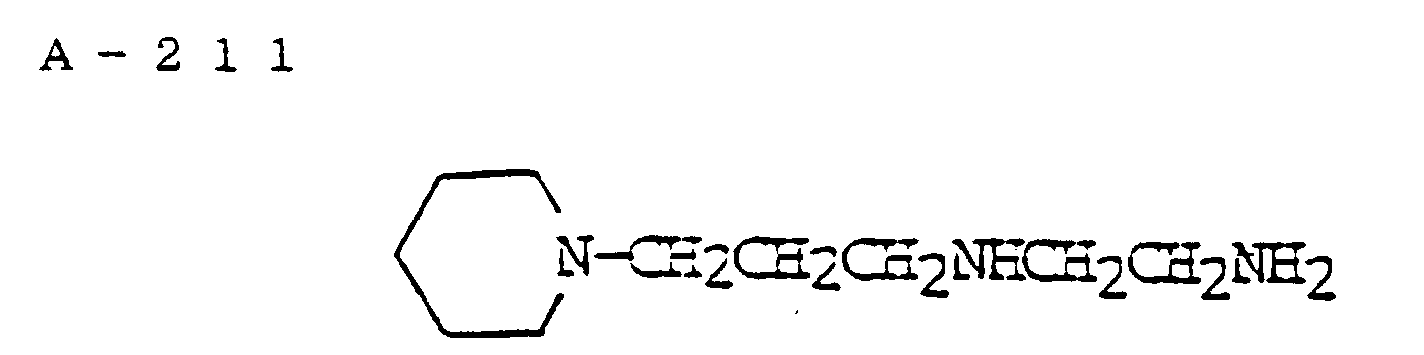
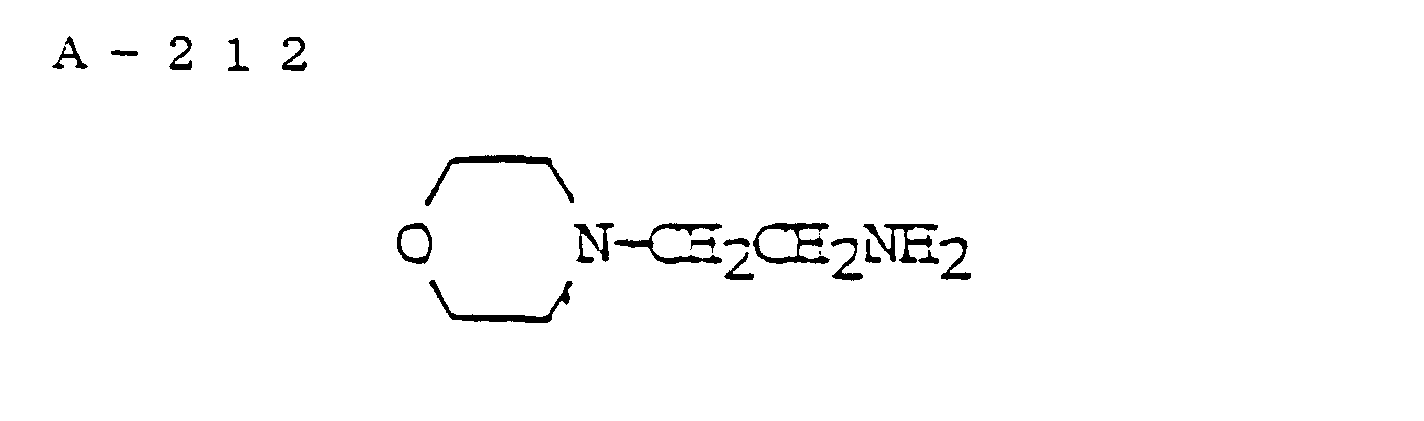
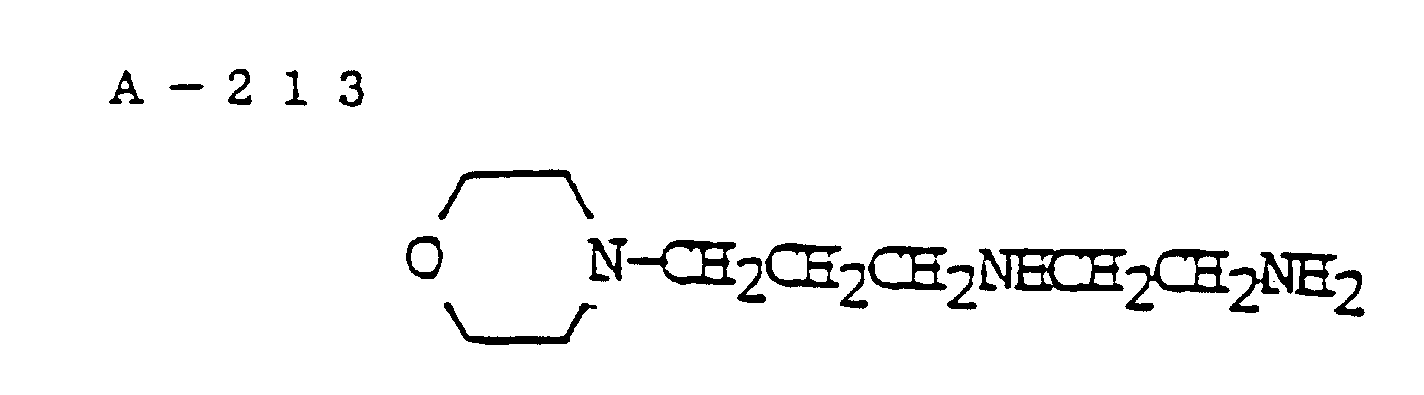
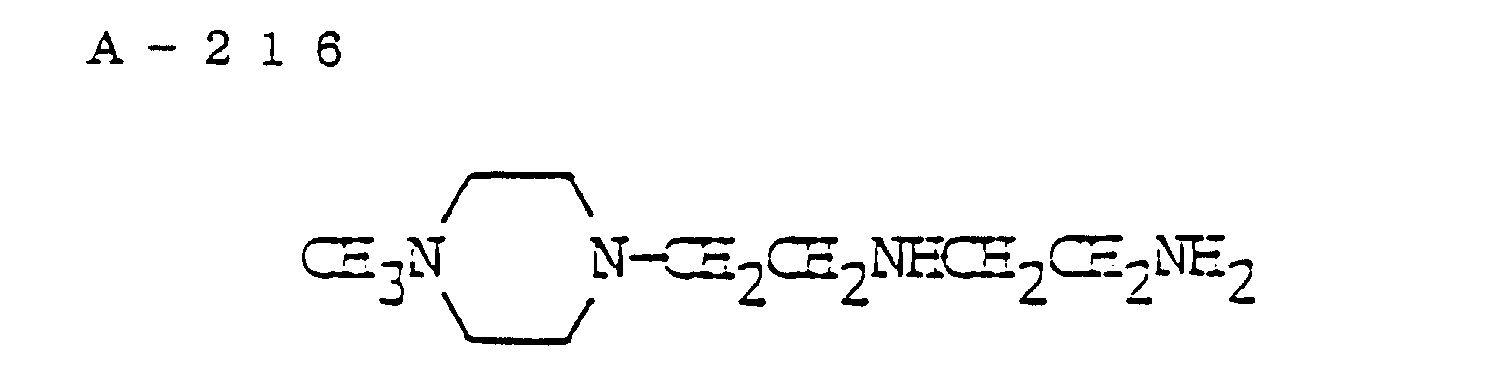
- the developer can contain at least one kind of the quaternary ammonium salt compounds shown by formula (C-I) described above, the amines shown by formula (C-II) or (C-III) described above, and the cyclic imino compounds shown by (C-IV) described above as a third component.
- an alkyl group having from 1 to 14 carbon atoms is particularly preferred and examples thereof are methyl, ethyl, propyl, isopropyl, n-butyl, n-hexyl, n-octyl, n-decyl, n-dodecyl, and n-tetradecyl.
- these alkyl groups may have a substituent such as preferably a halogen atom, a hydroxy group, an alkoxy group, an acyloxy group, a carbamoyl group, and a trialkylammonium group.
- substituted alkyl group examples include 2-bromoethyl, hydroxyethyl, 3-hydroxypropyl, methoxyethoxymethyl, 2-acetoxyethyl, 2-n-propionyloxyethyl, 2-carbamoylethyl, 6-trimethylammoniumhexyl, and 10-trimethylammonium-n-decyl.
- an alkenyl group having from 2 to 8 carbon atoms is particularly preferable and examples thereof are vinyl, allyl, 2-butenyl, 3-hexenyl, and 4-octenyl.
- cycloalkyl group shown by R 11 , R 12 , R 13 , and R 14 cyclopentyl and cyclohexyl are preferred. These cycloalkyl groups may be substituted with, preferably, an alkyl group (methyl, ethyl, etc.), a hydroxy group, or a hydroxyalkyl group (hydroxymethyl, 2-hydroxyethyl, etc.).
- substituted cyaloalkyl group examples include 2-hydroxycyclopentyl, 3-hydroxycyclohexyl, 4-hydroxycyclohexyl, 3-(2'-hydroxyethyl)cyclopentyl, 3-(2'-hydroxyethyl)cyclohexyl, and 2-methylcyclopentyl.
- benzyl p-methoxybenzyl, p-methylbenzyl, p-hydroxymethylbenzyl, and m-hydroxymethylbenzyl are preferable.
- phenyl, p-tolyl, and p-hydroxymethylphenyl are preferable.
- X - in formula (C-I) represents an anion such as an iodine ion, a bromine ion, a chlorine ion, a perchloric acid ion, a p-toluenesulfonic acid ion, a methylsulfuric acid ion, etc.
- an alkyl group having from 1 to 6 carbon atoms is particularly preferable and examples thereof are methyl, ethyl, propyl, isopropyl, n-butyl, and n-hexyl.
- These alkyl groups may be substituted with, preferably, a hydroxy group, a hydroxyalkoxy group, a hydroxyalkylthio group, or a carboxy group.
- substituted alkyl group examples include 2-hydroxyethyl, 3-hydroxypropyl, 2,3-dihydroxypropyl, 2-(2'-hydroxyethoxy)ethyl, 2-(2'-hydroxythioethyl)ethyl, carboxymethyl, 2-carboxyethyl, and 5-carboxypentyl.
- cycloalkyl group having from 3 to 10 carbon atoms shown by R 15 , R 16 , and R 17 cyclopentyl and cyclohexyl are preferred. These cycloalkyl groups may be substituted with preferably an alkyl group (methyl, ethyl, etc.), a hydroxy group, a hydroxyalkyl group (hydroxymethyl, 2-hydroxyethyl, etc.), or a carboxy group.
- substituted cycloalkyl group examples include 2-hydroxycyclopentyl, 3-hydroxycyclohexyl, 4-hydroxycyclohexyl, 3-(2'-hydroxyethyl)cyclopentyl, 3-(2'-hydroxyethyl)cyclohexyl, 2-methylcyclopentyl, and 4-carboxycyclohexyl.
- benzyl, p-methoxybenzyl, p-methylbenzyl, p-hydroxymethylbenzyl, m-hydroxymethylbenzyl, and p-carboxybenzyl are preferable.
- aryl group having from 6 to 10 carbon atoms which may be substituted, shown by R 15 , R 16 , and R 17 , phenyl, p-tolyl, p-hydroxymethylphenyl, o-carboxyphenyl, and p-carboxyphenyl are preferable.
- a saturated 5-membered, or 6-membered, or 7-membered ring is preferred and examples thereof are pyrrolidine, piperidine, morpholine, and hexamethyleneimine.
- alkyl group having from 1 to 8 carbon atoms shown by R 18 , R 19 , R 20 , and R 21 in formula (C-III) methyl, ethyl, propyl, isopropyl, n-butyl, and n-hexyl are preferable.
- These alkyl groups may be substituted with preferably a hydroxy group, a hydroxyalkoxy group, or a hydroxyalkylthio group.
- Specific examples of the substituted alkyl group are 2-hydroxyethyl, 3-hydroxypropyl, 2,3-dihydroxypropyl, 2-(2'-hydroxyethoxy)ethyl, and 2-(2'-hydroxythioethyl)ethyl.
- cyclopentyl and cyclohexyl are preferable.
- These cycloalkyl groups may be substituted with preferably an alkyl group (methyl, ethyl, etc.), a hydroxy group, or a hydroxylakyl group (hydroxymethyl, 2-hydroxyethyl, etc.) and specific examples of the substituted cycloalkyl group are 2-hydroxycyclopentyl, 3-hydroxycyclohexyl, 4-hydroxycyclohexyl, 2-hydroxymethylcyclopentyl, 3-hydroxymethylcyclohexyl, and 2-methylcyclopentyl.
- alkylene group having from 2 to 8 carbon atoms shown by B ethylene, trimethylene, tetramethylene, pentamethylene, and hexamethylene are preferable.
- a saturated 5-membered or 6-membered ring is preferred and examples thereof are pyrrolidine, piperidine, morpholine, and piperazine.
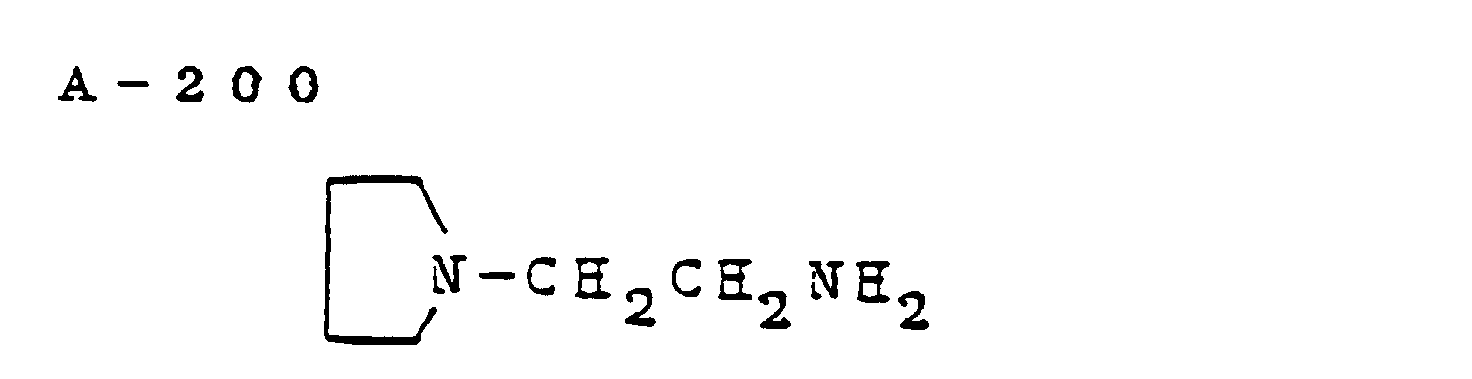
- Q 1 represents a nonmetallic atomic group necessary for forming an aromatic nitrogencontaining heterocyclic ring such as pyridine, quinoline, isoquinoline, acridine, pyridazine, pirimidine, pyrazine, cinnoline, quinazoline, quinoxaline, phthalazine, and phenazine.
- aromatic nitrogen-containing ring may be substituted with an alkyl group such as methyl, ethyl, propyl, butyl, etc., a halogen atom, an alkoxy group, a hydroxy group, a carbamoyl group, an acetyl group, or an amino group.
- the addition amount of each of the compounds shown by formulae (C-I), (C-II), (C-III), (C-IV) for use in this invention to the developer is from 0.01 g to 100 g, and preferably from 0.1 g to 50 g per liter of the developer.
- the foregoing compounds may be used singly or as a combination of them.
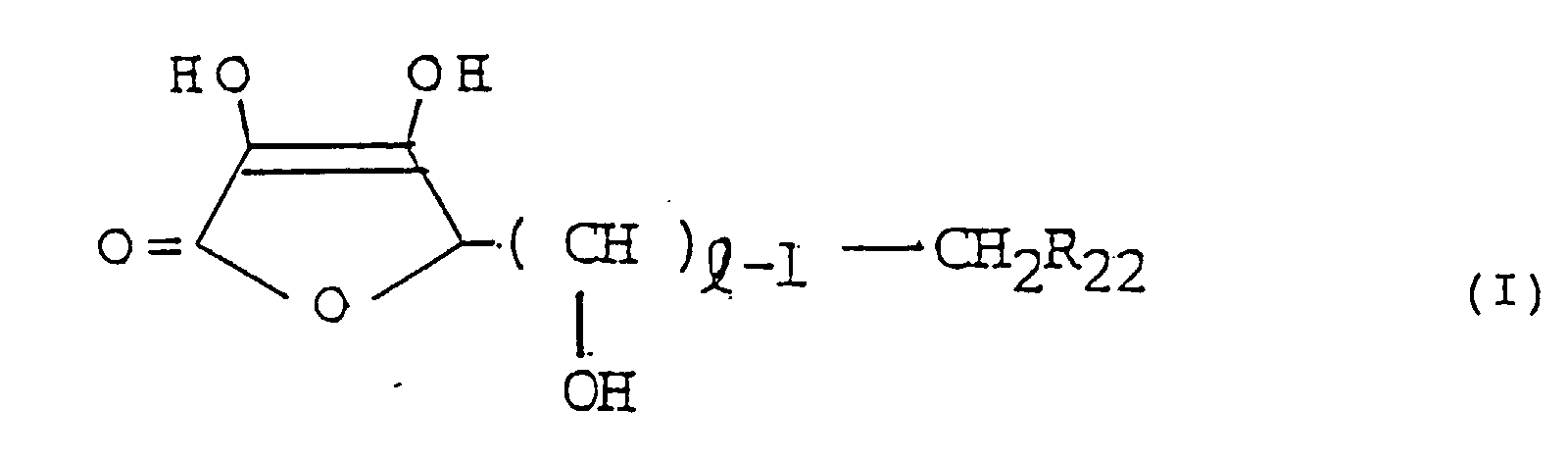
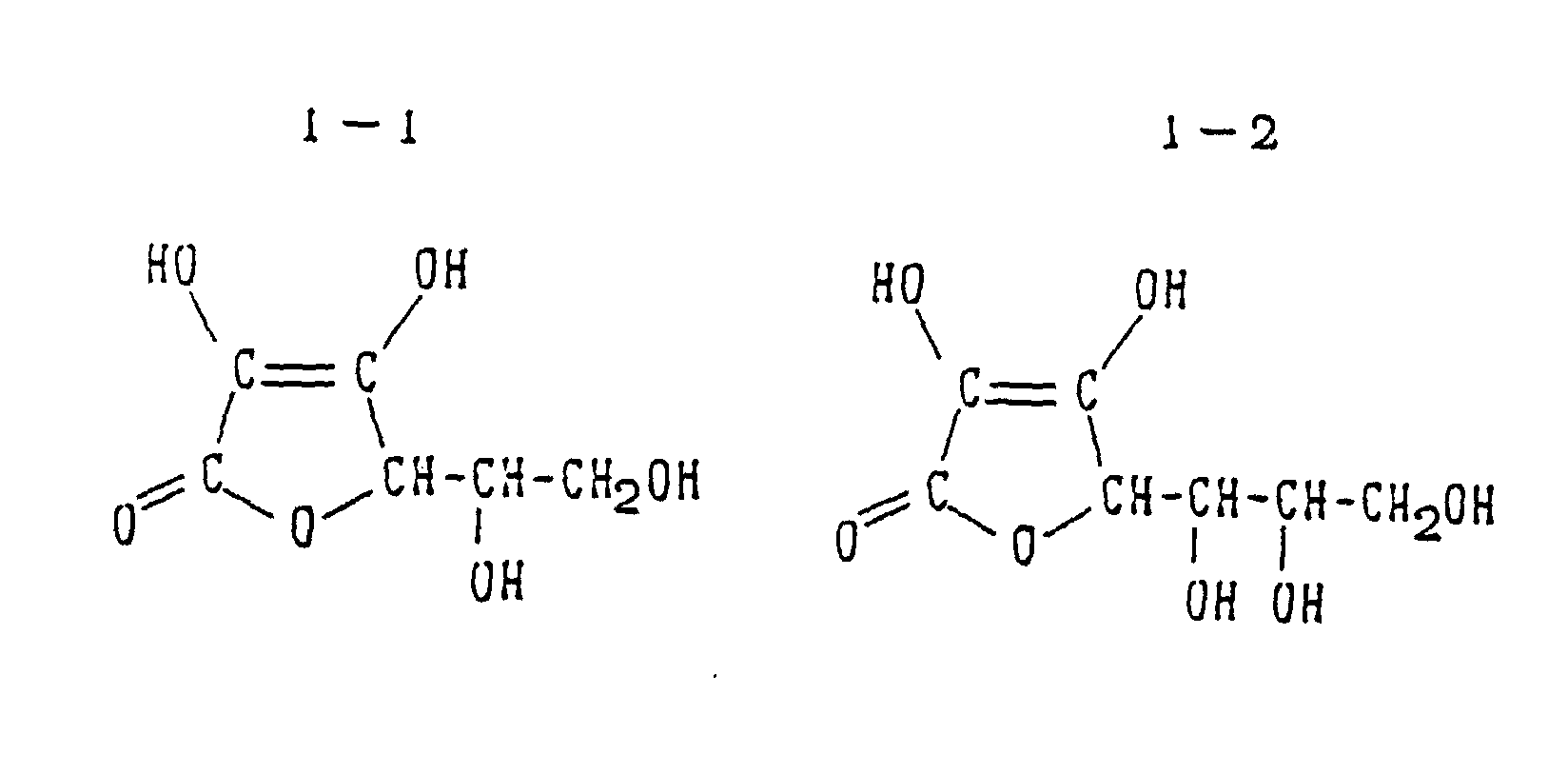
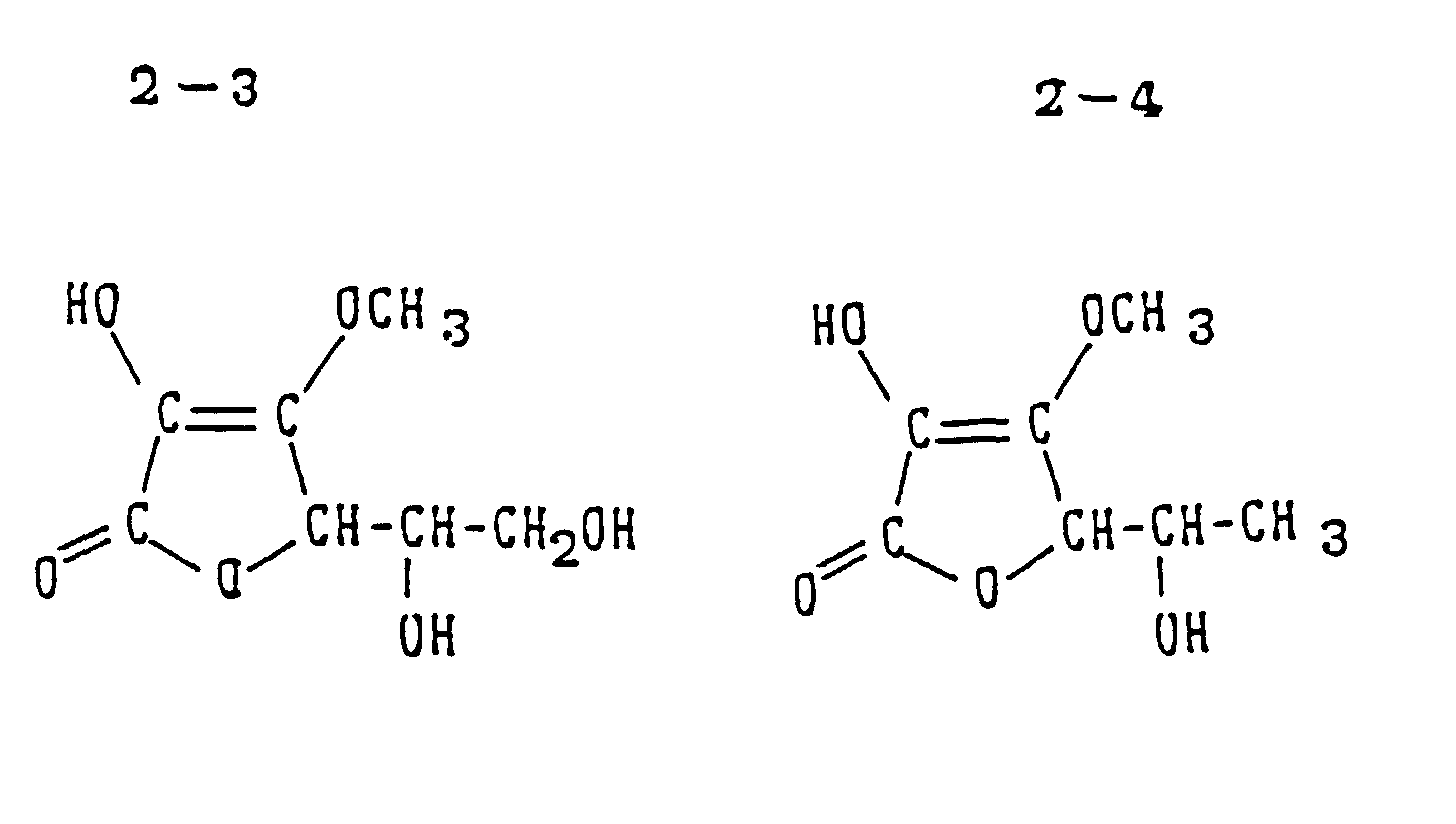
- the reductone compounds which are used for the developer of the present invention are generally known as endiol type compounds, enaminol type compounds, endiamine type compounds, thiol-enol type compounds, and enaminethiol type compounds.
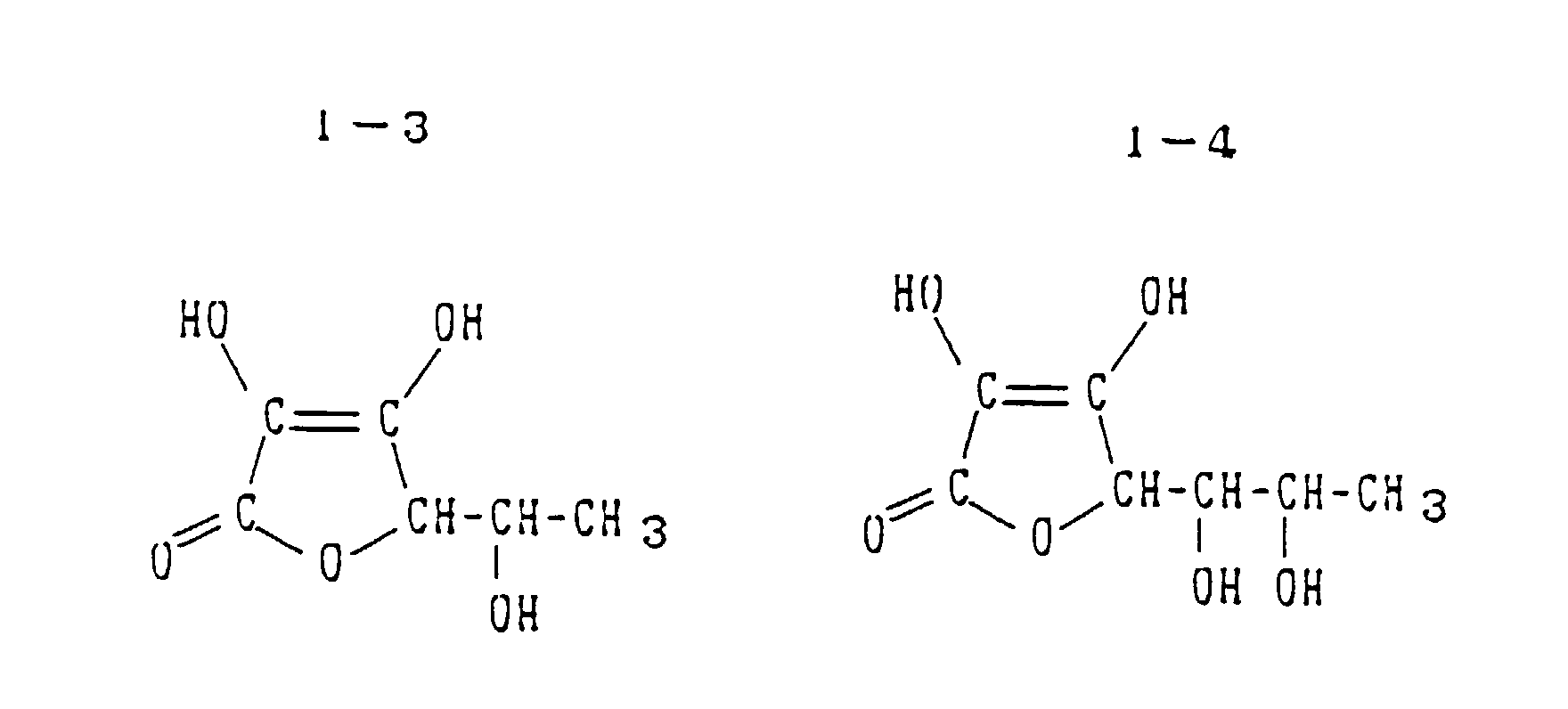
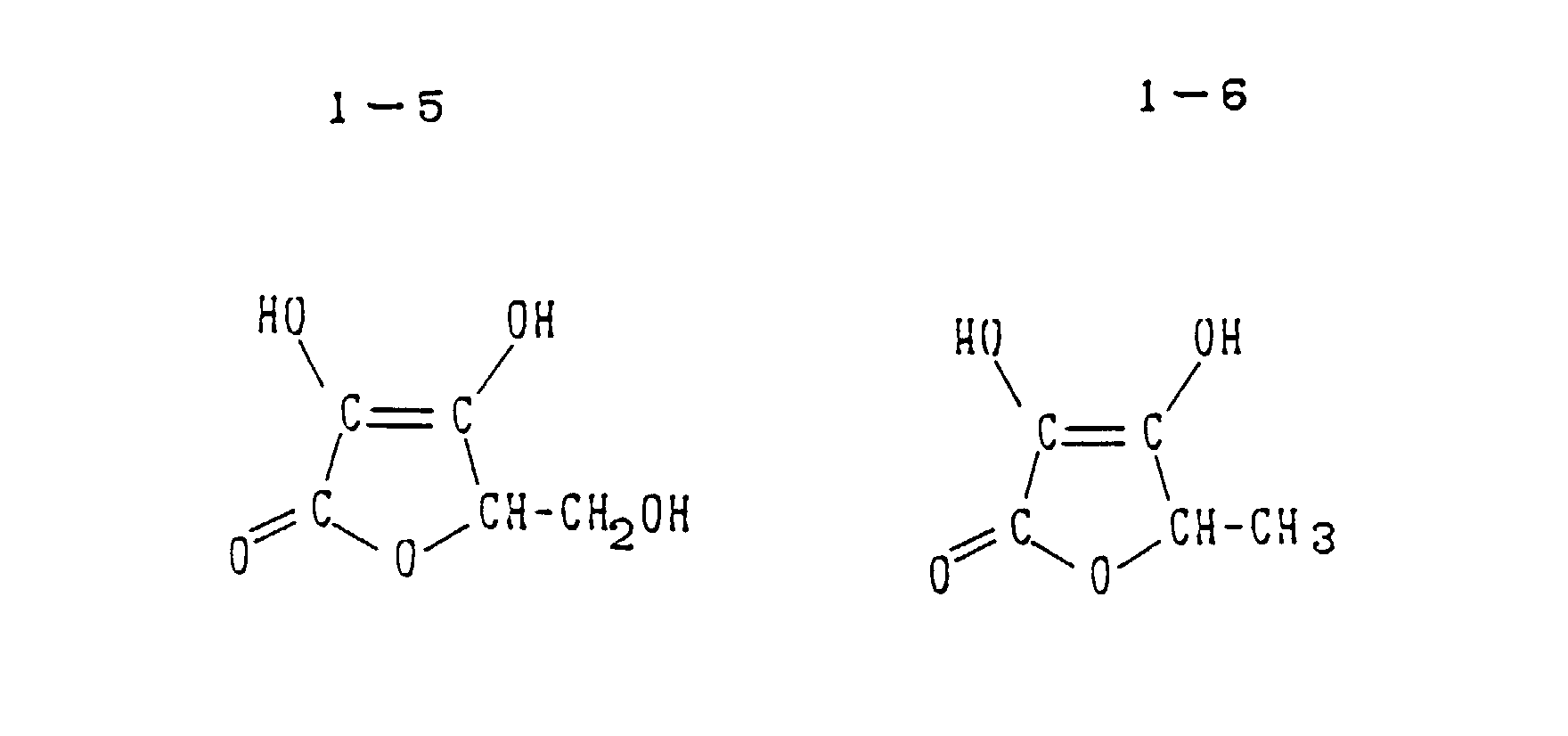
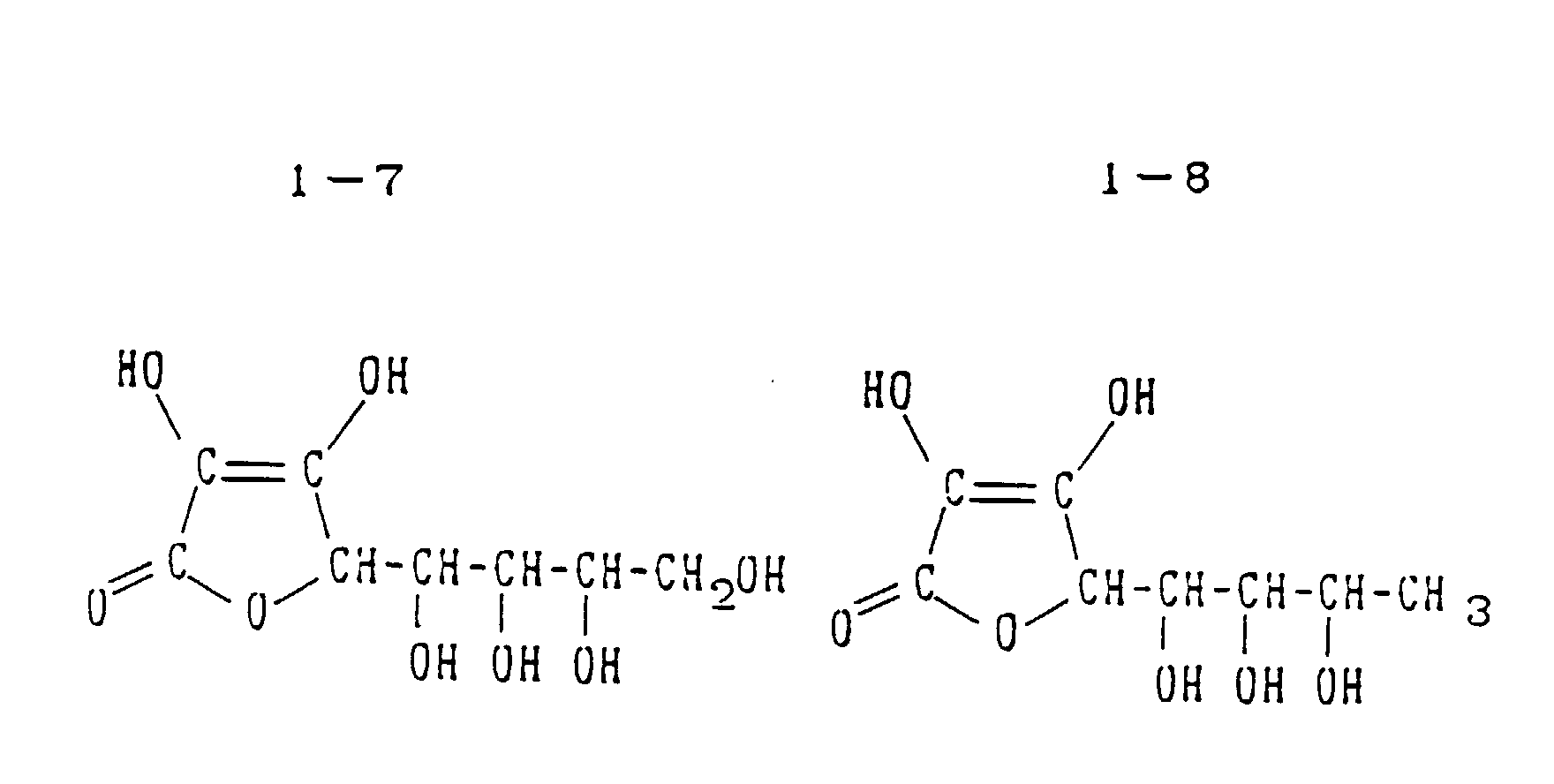
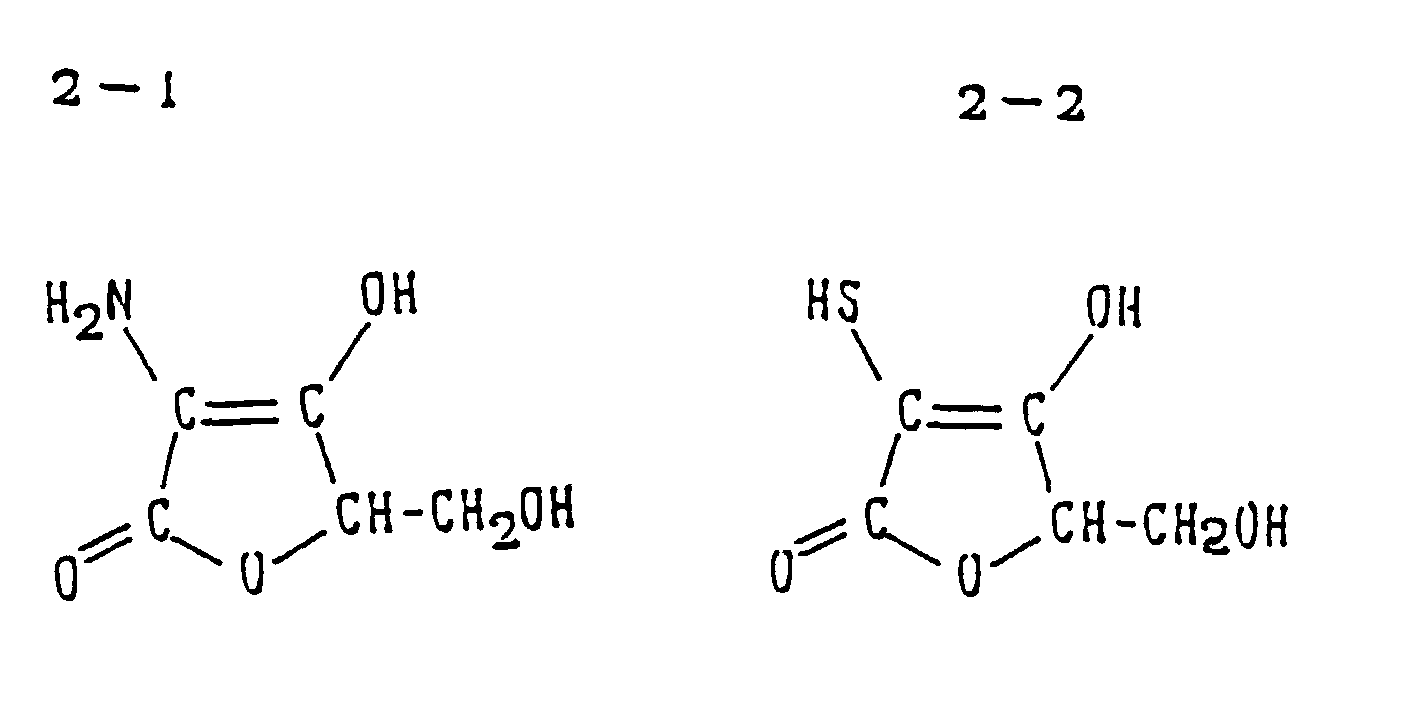
- the particularly preferred reductone compounds for use in this invention are the compounds shown by formula (I) described above.
- the reductone compounds for use in this invention can be used as the forms of the alkali metal salts such as lithium salts, sodium salts, potassium salts, etc. It is preferred that the reductone compound is used in an amount of from 1 to 100 g per liter of the developer.
- an aminophenol derivative developing agent is used.
- the aminophenol derivative developing agent there are 4-aminophenol, 4-amino-3-methylphenol, 4-(N-methyl)aminophenol, 2,4-diaminophenol, N-(4-hydroxyphenyl)glycine, N-(2'-hydroxyethyl)-2-aminophenol,2-hydroxymethyl-4-aminophenol, 2-hydroxymethyl-4-(N-methyl)aminophenol, etc., and the hydrochlorides and sulfates of these compounds, and N-methyl-4-aminophenol sulfate (Metol) is particularly preferred.
- the addition amount of the aminophenol derivative developing agent to the developer is from 0.5 g to 10 g per liter of the developer.
- the developer further contains a preservative and alkali in addition to the foregoing necessary components.
- sulfites can be used.
- the sulfites there are sodium sulfite, potassium sulfite, lithium sulfite, ammonium sulfite, sodium bisulfite, potassium bisulfite, potassium metabisulfite, etc.
- the addition amount of the preservative is preferably not more than 0.5 mol per liter of the developer.
- the alkali is added to the developer for controlling pH of the developer to 9 or higher, and preferably from 10 to 11.
- an ordinary water-soluble inorganic alkali metal salt such as sodium hydroxide, potassium hydroxide, sodium carbonate, potassium carbonate, potassium tertiary phosphate, etc., can be used.
- the developer of this invention can also contain, if necessary, a water-soluble acid (e.g., acetic acid and boric acid), a pH buffer (e.g., sodium tertiary phosphate, sodium carbonate, potassium carbonate, sodium metaborate, and lithium tetraborate), an inorganic antifoggant (e.g., sodium bromide and potassium bromide), an organic antifoggant (e.g., 1-phenyl-5-mercaptotetrazole and 5-nitroindazole), an organic solvent (e.g., ethylene glycol, diethylene glycol, and methyl cellosolve), a color toning agent, a surface active agent, a defoaming agent, a hard water softener, etc., in addition to the foregoing components in the range of not reducing the effects of the invention.
- a water-soluble acid e.g., acetic acid and boric acid
- a pH buffer e.g., sodium
- the processing temperature of the developer of the present invention is in the range of from 18°C to 50°C, and preferably from 20°C to 40°C.
- a composition generally used can be used.
- thiosulfates, thiocyanates, and organic sulfur compounds which are known to have the effect as a fixing agent can be used.
- an acid agent e.g., acetic acid and citric acid
- a preservative e.g., sodium sulfite
- a buffer e.g., boric acid
- a hardening agent e.g., potassium alum, aluminum alum, and aluminum sulfate
- the silver halide emulsion obtained contained 80 g of gelatin per mol of silver halide.
- the silver halide emulsion was split into two portions. To one of the split emulsions was added no sensitizing dye and to another split emulsion was added a sensitizing dye (D-18, reduction potential -1.24 volt) at 8,000 ⁇ 10 -6 mol per mol of silver halide, and each of the split emulsions was coated each of polyethylene terephthalate bases each having a subbing layer at a silver coverage of 40 mg/dm 2 .
- D-18 reduction potential -1.24 volt
- a gelatin protective layer containing formaldehyde and dimethylolurea as hardening agents was coated on each emulsion layer followed by drying to provide film sample No. 1 (using the emulsion containing no sensitizing dye) and film sample No. 2 (using the emulsion containing the sensitizing dye).
- each sample was developed with each of developers 1, 2, 3, and 4 having the following compositions, stopped, fixed, washed, and dried.
- Composition of Developer 1 Metol 2.5 g Sodium Ascorbate (sodium salt of reductone 1-1) 10.0 g Potassium Bromide 1.0 g Sodium Metaborate ⁇ Tetra-hydrate 35.0 g Water to make 1.0 liter pH 10.8
- Composition of Developer 2 Water 750 ml Metol 1.0 g Anhydrous Sodium Sulfite 75.0 g Hydroquinone 9.0 g Sodium Carbonate Monohydrate 30.0 g Potassium Bromide 5.0 g Water to make 1.0 liter pH 10.3
- Composition of Developer 3 Water 500 ml Anhydrous Sodium Sulfite 35.0 g Paraformaldehyde 9.0 g Sodium Hydrogensulfite 2.5 g Boric Acid 8.0 g Hydroquinone 25.0 g Potassium Bromide 2.0 g Water to make 1.0 liter pH 10.2
- Composition of Developer 4 Hydroquinone 35.0 g Metol 0.8 g Sodium Hydroxide 9.0 g Potassium Phos
- the relative sensitivity was the relative value of the reciprocal of the exposure amount of giving density 3.0 of the sample being evaluated from which fog was subtracted with the sensitivity of film sample No. 1 in Test No. 1 developed with Developer 1 for 5 minutes at 20°C being defined as 100.
- the gamma was shown by the mean slope between the densities 0.5 and 3.0 from which fog was subtracted and the fog was shown by the density at the unexposed area.
- each emulsion was coated on a polyethylene terephthalate (PET) base at a silver coverage of 40 mg/dm 2 followed by drying.
- PET polyethylene terephthalate
- gelatin protective layer containing formaldehyde and dimethylolurea as hardening agents was coated on each emulsion layer followed by drying to provide film sample Nos. 3 to 28.
- Each of the film samples was exposed to a tungsten lamp of 2666°K using an LB-200 filter through a step wedge having a step difference of 0.15 for 5 seconds as in Example 1, developed with Developer 1 in Example 1 for 5 minutes at 20°C, stopped, fixed, washed, and dried.
- the relative sensitivity is the relative value of the reciprocal of the exposure amount of giving density 3.0 excluding fog to each film sample with the sensitivity of Film Sample No. 3 developed with Developer 1 for 5 minutes at 20°C being defined as 100.
- the gamma is the mean slope between densities 0.5 and 3.0 excluding fog
- the fog is the density at the unexposed area.
- the pepper is evaluated by 5 ranks by observing the unexposed portion of each film sample by a magnifying lens of 50 magnifications, wherein A shows the best quality (substantially no pepper) and E shows the worst quality. Ranks A and B are suitable for practical use, rank C is a low quality but acceptable for practical use, and ranks D and E are unacceptable.
- the relative sensitivity is shown by the relative sensitivity of the reciprocal of the exposure amount giving each sample density of 3.0 excluding fog with the sensitivity of Sample No. 29 developed with Developer 1 for 5 minutes at 20°C being defined as 100.
- the gamma is shown by the mean slope between densities of 0.5 and 3.0 excluding the fog, and the fog is shown by the density at the undeveloped area.
- the pepper is evaluated in 5 ranks by observing the unexposed portion of the film sample with a magnifying lens of 50 magnifications, wherein A shows the best quality (substantially no pepper) and E shows the worst quality. Ranks A and B are suitable for practical use, Rank C is a low quality but acceptable for practical use, and ranks D and E are unacceptable.
- the compound(s) having a negative reduction potential for use in this invention not always exist at image-exposure of the silver halide photographic material but may exist at development. In this case, peppers did not occur in any film samples of the present invention.
- Example 2 the photographic characteristics were evaluated as in Example 2 and the results obtained are shown in Table 8 below.
- Test No. Developer No. Relative Sensitivity Gamma Fog Pepper 9 (Comparison) 1 100 3.5 0.06 - 10 (Invention) 5 270 13.0 0.09 A 11 (Invention) 6 260 12.0 0.07 A 12 (Invention) 7 280 14.5 0.07 A 13 (Invention) 8 305 15.7 0.07 A 14 (Invention) 9 295 14.8 0.06 A
- the relative sensitivity is the relative value with the sensitivity of Test No. 15 (this example) being as 100.
- Other photographic characteristics are same as in Example 2.
- Each of the emulsion layers was protected with a gelatin protective layer containing formaldehyde and dimethylolurea as hardening agents.
- Each of the film samples thus prepared was exposed as in Example 2, developed with each of Developer 1 in Example 1 and Developers 16 and 17 formed by adding the dye (D-9: reduction potential -1.29 volt) or the pyridinium salt derivative (N-63: reduction potential -1.08 volt) to Developer 1 as shown in Table 12 for 3 minutes at 30°C, stopped, fixed, washed, and dried.
- Developer No. Added Compound Reduction Potential V vs SCE Addition Amount (g/liter) 1 none - - 16 D-9 -1.29 0.5 17 N-63 -1.08 0.02
- the relative sensitivity is the relative value with the sensitivity of Sample No. 42 developed with Developer 1 of Test No. 21 (Comparison Example) being defined as 100.
- Other photographic characteristics are same as in Example 2.
- composition of Developer 18 Metol 2.5 g Sodium Ascorbate (Sodium salt of reductone I-1) 10.0 g Potassium Bromide 1.0 g Sodium Metaborate ⁇ tetrahydrate 70.0 g 5-Methylbenzotriazole 4.5 mg Water to make 1.0 liter pH 10.8 Developer No.
- each sample was stopped, fixed, washed, and dried to provide a sample being evaluation and the photographic characteristics were measured.
- the development time is the development time required from the initiation of the development to the density excluding fog becoming 3.0 shown by a 15 second unit.
- the relative sensitivity, fog, gamma, and pepper are values when the density of each evaluation sample excluding fog is 3.0.
- the relative sensitivity is the relative value of the reciprocal of the exposure amount giving density 3.0 excluding fog with the sensitivity of the sample developed Developer No. 18 containing no compound for use in this invention for 3 minutes being defined as 100.
- Other photographic characteristics as same as in Example 2. Developer No. Develoing Time min.:sec.
- Relative Sensitivity Fog Gamma Pepper 18 (Invention) 3:00 100 0.05 17.2 A 19 (Invention) 2:00 110 0.05 19.3 A 20 (Invention) 2:00 97 0.05 20.5 A 21 (Invention) 2:00 102 0.05 19.6 A 22 (Invention) 2:00 97 0.05 17.5 A 23 (Invention) 1:45 108 0.05 20.9 A 24 (Invention) 2:00 100 0.05 17.5 A 25 (Invention) 1:15 98 0.05 20.2 A 26 (Invention) 1:15 104 0.05 21.0 A 27 (Invention) 1:45 103 0.05 19.1 A 28 (Invention) 2:00 101 0.05 19.9 A 29 (Invention) 1:30 107 0.05 20.6 A 30 (Invention) 2:00 105 0.05 21.1 A
- each film sample was developed with Developer 18 in Example 7 containing Metol as an aminophenol derivative developing agent and ascorbic acid (1-1) as the reductone compound, stopped, fixed, washed and dried.
- the developing condition was 30°C and the developing time was changed from 30 seconds to 5 minutes, whereby the change of the photographic characteristics with the change of the developing time was measured.
- the photographic characteristics obtained are shown in Table 17.
- Table 17 As the photographic performance in Table 17, the developing time necessary for giving the maximum density 3.0 to each sample is shown by a 15 second unit and the photographic performance at the case is shown. Also, the value when the developing time is 6 minute is shown.
- the relative sensitivity is the relative value of the reciprocal of the exposure amount giving density 3.0 excluding fog to each sample with the sensitivity of the sample of Film Sample No. 56 developed for 1 minute and 45 seconds at 30°C being defined as 100.
- the gamma is shown by the mean slope between densities 0.5 and 3.0 excluding fog, the fog is the density at the unexposed area, and Dmax is the maximum density of the film excluding fog.
- the coating amount of the protective layer was measured and the addition amount of 5-sulfosalicylic acid per mol of the coated silver amount was calculated.
- the photographic characteristics obtained are shown in Table 19.
- the developing time necessary for giving the maximum density 3.0 to each sample is shown by a 15 second unit and the photographic performance at the case is shown. Also, the value when the developing time is 5 minutes is shown.
- the relative sensitivity is the relative value of the reciprocal of the exposure time giving density 3.0 excluding fog to each sample with the sensitivity of the film sample developed with Developer 31 for S minutes at 30°C being defined as 100.
- the gamma is the mean slope between densities 0.5 and 3.0 excluding fog, and the fog is the density at the unexposed area.
- aqueous silver nitrate solution By simultaneously adding an aqueous silver nitrate solution and an aqueous potassium bromide solution containing 3.0 ⁇ 10 -7 mol of sodium hexabromorhodate(III) per mol of silver to an aqueous gelatin solution kept at 60°C while keeping pAg at 7.0 over a period of 60 minutes, a monodispersed silver bromide emulsion containing the cubic crystal silver halide grains having a mean grain size of 0.22 ⁇ m was prepared. After removing soluble salts by an ordinary method, 25 ⁇ 10 -5 mol of sodium thiosulfate per mol of silver halide was added to the emulsion and the emulsion was subjected to chemical ripening for 70 minutes at 60°C.
- the emulsion was coated on a polyethylene terephthalate base at a silver coverage of 40 mg/dm 2 .
- the coated amount of the added compound was measured by the same manner as in Example 8.
- Film Sample Compound added to Protective Layer (pKa: in water, 25°C) Amount (mmol/mole Ag) 59 none - 60
- Sodium Sulfite ( 1.8 , 7.2 ) 442
- Sodium Citrate ( 3.1 , 4.8 , 6.4 ) 195
- Sodium p-toluenesulfonate ( 1.7 ) 261
- Glycin 2.4 , 9.8 ) 277
- Ethyl 3-Oxobutanate ( 10.7 ) 146 65 m-Cresol ( 10.0 ) 62
- the underlined value is pKa of lower than 11.
- Example 2 Each of Film Samples 59 to 65 was exposed as in Example 2, developed with each of Developers 18 and 29 in Example 7 and Developers 31 to 35 in Example 9 for a time of from 30 seconds to 5 minutes at 30°C, stopped, fixed, washed, and dried.
- Example 9 the values when the developing time required to give density 3.0 excluding fog from the initiation of the development was shown by a 15 second unit and the values at the developing time of 5 minutes.
- the relative sensitivity was the relative value of the reciprocal of the exposure amount giving density 3.0 excluding fog with the sensitivity of Film No. 59 of this invention in Test No. 37 developed with Developer 29 for 2 minutes at 30°C being defined as 100.
- the film containing the compound having a negative reduction potential and the compound having an acidic dissociation constant pKa of lower than 11 was developed with the developer containing the aminophenol derivative developing agent, the reductone compound, and the amino compound, the development can be more efficiently carried out and high-contrast images can be stably formed.
- Example 2 Each of Film Sample Nos. 52 and 55 prepared in Example 8 and Film Sample Nos. 62 and 64 prepared in Example 10 was imagewise exposed as in Example 2, developed with Developer 36 having the following composition for 20, 30, and 40 seconds at 38°C, stopped, fixed, washed, and dried.
- Composition of Developer 36 Metol 7.5 g Sodium Ascorbate (sodium salt of Reduction 1-1) 30.0 g Potassium Bromide 1.0 g Sodium Metaborate ⁇ Tetrahydrate 70.0 g 5-Nitroindazole 4.5 mg Pyrazine (amino compound A-132) 1.0 g Water to make 1.0 liter pH 10.8
- the relative sensitivity is the relative value of the reciprocal of the exposure amount of giving density 3.0 excluding fog with the sensitivity of the sample of Film No. 52 of this invention developed for 30 seconds at 38°C being defined as 100.
- the fog and the gamma are same as in Example 2.
- Dmax is the maximum density of each film excluding fog.
Landscapes
- Physics & Mathematics (AREA)
- Chemical & Material Sciences (AREA)
- General Physics & Mathematics (AREA)
- Spectroscopy & Molecular Physics (AREA)
- Chemical Kinetics & Catalysis (AREA)
- Engineering & Computer Science (AREA)
- Materials Engineering (AREA)
- Silver Salt Photography Or Processing Solution Therefor (AREA)
Description














































- P - 1
- HO-(CH2CH2O)n-H
(molecular weight: about 1,000-20,000)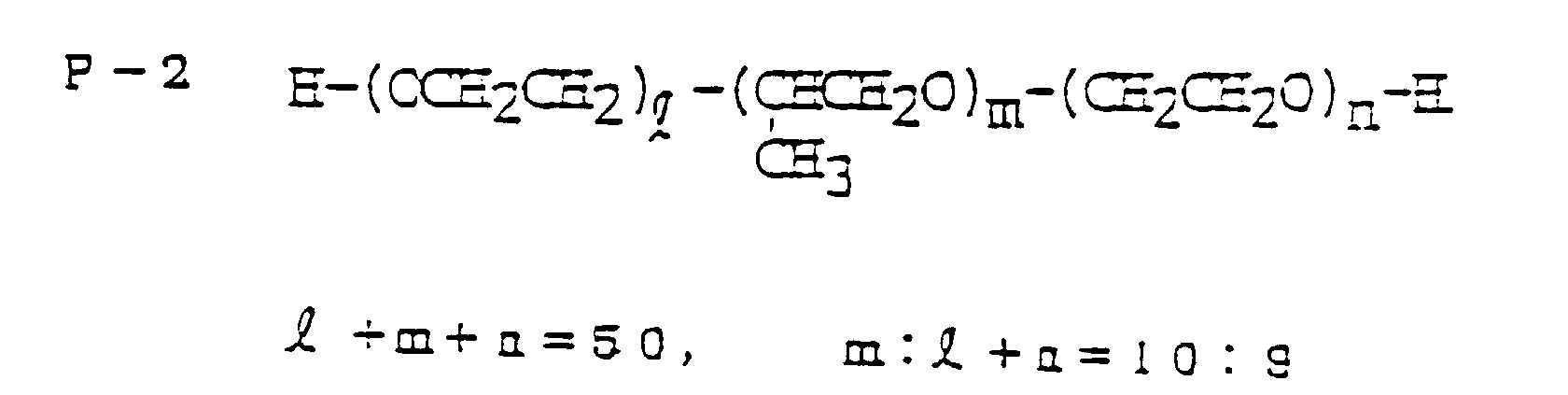
- P - 3
- C12H25O-(CH2CH2O)20-H
- P - 4
- C16H33O-(CH2CH2O)25-H
- P - 5
- C16H33O-(CH2CH2O)40-H



- P - 10
- C11H23CCO-(CH2CH2O)30-H


- P - 13
- C8H17CH=CHC8H16O-(CH2CH2O)15-H

- A-1:
- Tetramethylammonium bromide
- A-2:
- Tetraethylammonium chloride
- A-3:
- Ethyltrimethylammonium iodide
- A-4:
- Methyltriethylammonium chloride
- A-5:
- Ethyltri-n-propylammonium iodide
- A-6:
- Tetra-n-propylammonium bromide
- A-7:
- Tetra-n-butylammonium bromide
- A-8:
- Tetra-n-amylammonium bromide
- A-9:
- n-Hexyltrimethylammonium bromide
- A-10:
- n-Octyltrimethylammonium bromide
- A-11:
- n-Dodecyltrimethylammonium chloride
- A-12:
- n-Dodecyltrimethylammonium bromide
- A-13:
- n-Dodecyl-n-butyldimethylammonium bromide
- A-14:
- n-Tetradecyltrimethylammonium bromide
- A-15:
- Bromocholine bromide
- A-16:
- Choline bromide
- A-17:
- 2-Hydroxyethyltriethylammonium iodide
- A-18:
- 2-Methoxyethoxymethyltriethylammonium chloride
- A-19:
- Acetylcholine bromide
- A-20:
- n-Butyrylcholine bromide
- A-21:
- Carbamylcholine chloride
- A-22:
- Hexamethonium bromide
- A-23:
- Decamethonium iodide
- A-24:
- Trimethylvinylammonium bromide
- A-25:
- Diallyldimethylammonium chloride
- A-26:
- 2-Butenyltrimethylammonium bromide
- A-27:
- 3-Hexenyltrimethylammonium chloride
- A-28:
- 4-Octenyltrimethylammonium bromide
- A-29:
- Cyclopentyltrimethylammonium bromide
- A-30:
- Cyclohexyltrimethylammonium bromide
- A-31:
- 2-Hydroxycyclopentyltrimethylammonium bromide
- A-32:
- 3-Hydroxycyclohexyltrimethylammonium bromide
- A-33:
- 4-Hydroxycyclohexyltrimethylammonium bromide
- A-34:
- 3-(2'-Hydroxyethyl)cyclopentyltrimethylammonium bromide
- A-35:
- 3-(2'-Hydroxyethyl)cyclohexyltrimethylammonium bromide
- A-36:
- 2-Methylcyclopentyltrimethylammonium bromide
- A-37:
- Trimethylbenzylammonium chloride
- A-38:
- Trimethylbenzylammonium bromide
- A-39:
- Triethylbenzylammonium bromide
- A-40:
- Trimethyl-p-methoxybenzylammonium bromide
- A-41:
- Trimethyl-p-methylbenzylammonium bromide
- A-42:
- Trimethyl-p-hydroxymethylbenzylammonium chloride
- A-43:
- Trimethyl-m-hydroxymethylbenzylammonium chloride
- A-44:
- Phenyltriethylammonium iodide
- A-45:
- Trimethyltolylammonium bromide
- A-46:
- Triethyl-p-hydroxymethylphenylammonium bromide
- A-47:
- Methylamine
- A-48:
- Ethylamine
- A-49:
- Propylamine
- A-50:
- Isopropylamine
- A-51:
- n-Butylamine
- A-52:
- Isobutylamine
- A-53:
- n-Amylamine
- A-54:
- Isoamylamine
- A-55:
- n-Hexylamine
- A-56:
- 2-Heptylamine
- A-57:
- Dimethylamine
- A-58:
- Diethylamine
- A-59:
- Dipropylamine
- A-60:
- Diisopropylamine
- A-61:
- Di-n-butylamine
- A-62:
- Trimethylamine
- A-63:
- Triethylamine
- A-64:
- Cyclopentylamine
- A-65:
- 2-Methylcyclopentylamine
- A-66:
- Cyclohexylamine
- A-67:
- N-Methylcyclopentylamine
- A-68:
- N-Merthylcyclohexylamine
- A-69:
- Benzylamine
- A-70:
- p-Methylbenzylamine
- A-71:
- p-Methoxybenzylamine
- A-72:
- N-Methylbenzylamine
- A-73:
- N-Methyl-p-methylbenzylamine
- A-74:
- N-Methyl-p-methoxybenzylamine
- A-75:
- Aniline
- A-76:
- o-Toluidine
- A-77:
- m-Toluidine
- A-78:
- p-Toluidine
- A-79:
- o-Aminobenzyl alcohol
- A-80:
- p-Aminobenzyl alcohol
- A-81:
- Methylaniline
- A-82:
- Pyrrolidine
- A-83:
- Piperidine
- A-84:
- Hexamethyleneimine
- A-85:
- Ethanolamine
- A-86:
- 3-Amino-1-propanol
- A-87:
- 2-Amino-1-propanol
- A-88:
- 4-Amino-1-butanol
- A-89:
- 2-Amino-1-butanol
- A-90:
- 5-Amino-1-pentanol
- A-91:
- 6-Amino-1-hexanol
- A-92:
- 2-Hydroxycyclopentylamine
- A-93:
- 3-Hydroxycyclohexylamine
- A-94:
- 4-Hydroxycyclohexylamine
- A-95:
- 3-(2'-Hydroxyethyl)cyclopentylamine
- A-96:
- 3-(2'-Hydroxyethyl)cyclohexylamine
- A-97:
- p-Hydroxymethylbenzylamine
- A-98:
- m-Hydroxymethylbenzylamine
- A-99:
- p-Hydroxymethylaniline
- A-100:
- 2-(Ethylamino)ethanol
- A-101:
- 2-Anilinoethanol
- A-102:
- N-Benzylaminoethanol
- A-103:
- N-(p-Methoxybenzyl)aminoethanol
- A-104:
- 2-Dimethylaminoethanol
- A-105:
- 2-Diethylaminoethanol
- A-106:
- 3-Dimethylamino-1-propanol
- A-107:
- l-Dimethylamino-2-propanol
- A-108:
- 3-Diethylamino-l-propanol
- A-109:
- 3-Dimethylamino-1,2-propanediol
- A-110:
- 3-Diethylamino-1,2-propanediol
- A-111:
- 3-Piperidino-1,2-propanediol
- A-112:
- 3-Pyrrolidino-1,2-propanediol
- A-113:
- 4-Dimethylamino-l-butanol
- A-114:
- Morpholine
- A-115:
- 1-Piperidinoethanol
- A-116:
- Diethanolamine
- A-117:
- N-Ethyldiethanolamine
- A-118:
- 2,2'-(n-Butylimino)diethanol
- A-119:
- N-Phenyldiethanolamine
- A-120:
- N-Benzyldiethanolamine
- A-121:
- N-Phenetyldiethanolamine
- A-122:
- Triethanolamine
- A-123:
- Triisopropanolamine
- A-124:
- 2-(N,N-Diethylaminoethoxy)ethanol
- A-125:
- 2-(N,N-Diethylamino-2'-ethylthio)ethanol
- A-126:
- Glycine
- A-127:
- β-Alanine
- A-128:
- Serine
- A-129:
- 2-Aminobutyric acid
- A-130:
- 5-Amino-n-caproic acid
- A-131:
- 1-Aminocyclohexanecarboxylic acid
- A-132:
- 3-Aminocyclohexanecarboxylic acid
- A-133:
- p-Carboxybenzylamine
- A-134:
- o-Aminobenzoic acid
- A-135:
- p-Aminobenzoic acid
- A-136:
- Ethylenediamine
- A-137:
- N-Ethylethylenediamine
- A-138:
- N,N'-Dimethylethylenediamine
- A-139:
- N,N'-Diethylethylenediamine
- A-140:
- N,N-Dimethylethylenediamine
- A-141:
- N,N,N'N'-Tetramethylethylenediamine
- A-142:
- 1,3-Diaminopropane
- A-143:
- N,N-Dimethyl-1,3-diaminopropane
- A-144:
- N,N,N'N'-Tetramethyl-1,3-diaminopropane
- A-145:
- 1,4-Diaminobutane
- A-146:
- N,N,N',N'-Tetramethyl-1,4-diaminobutane
- A-147:
- 1,5-Diaminopentane
- A-148:
- 2,2-Dimethyl-1,5-diaminopentane
- A-149:
- N,N-Dimethylneopentanediamine
- A-150:
- 1,6-Diaminohexane
- A-151:
- N,N'-Dimethyl-1,6-diaminohexane
- A-152:
- 1,7-Diaminopentane
- A-153:
- 1,8-Diaminooctane
- A-154:
- 2-(2'-Aminoethylamino)ethanol
- A-155:
- 2-[(2'-Aminoethylamino)ethylamino]ethanol
- A-156:
- 3,3'-Diaminopropylamine
- A-157:
- Piperazine
- A-158:
- N-Methylpiperazine
- A-159:
- N,N'-Dimethylpiperazine
- A-160:
- 1-(2'-Aminoethyl)piperazine
- A-161:
- Hexamethylenetetramine
- A-162:
- 1,4-Diazabicyclo[2,2,2]octane
- A-163:
- Polyethyleneimine
- A-164:
- Pyridine
- A-165:
- 2-Acetylpyridine
- A-166:
- 3-Aminopyridine
- A-167:
- 3-Bromopyridine
- A-168:
- 4-Ethylpyridine
- A-169:
- 3-n-Butylpyridine
- A-170:
- 2-Picoline
- A-171:
- Nicotinic acid amide
- A-172:
- 2-Methoxypyridine
- A-173:
- 5-Aminoquinoline
- A-174:
- 5,6,7,8-Tetrahydroisoquinoline
- A-175:
- 3-Methylpyridazine
- A-176:
- 2-Aminopyrimidine
- A-177:
- Pyrimidine
- A-178:
- Pyrazine
- A-179:
- 2-Methylpyrazine
- A-180:
- Cinnoline
- A-181:
- Quinazoline
- A-182:
- Quinoxaline
- A-183:
- Phthalazine
- A-184:
- Phenazine
- A-185:
- 9-Aminoacridine
- A-186:
- H2N(CH2CH2NH)2H
- A-187:
- H2N(CH2CH2NH)3H
- A-188:
- H2N(CH2CH2NH)4H
- A-189:
- H2N(CH2CH2CH2NH)2H
- A-190:
- H2N(CH2CH2XH2NH)3H
- A-191:
- H2N(CH2CH2CH2NH)4H
- A-192:
- (CH3)2NCH2CH2OCH2CH2N(CH3)2
- A-193:
- (CH3)2N-(CH2CH2O)2CH2CH2N(CH3)2
- A-194:
- (CH3)2N-(CH2CH2O)3CH2CH2N(CH3)2
- A-195:
- (CH3)2N-(CH2CH2O)4CH2CH2N(CH3)2
- A-196:
- (CH3)2NCH2CH2SCH2CH2N(CH3)2
- A-197:
- (CH3)2N-(CH2CH2S)2CH2CH2N(CH3)2
- A-198:
- (CH3)2N-(CH2CH2S)3CH2CH2N(CH3)2
- A-199:
- (CH3)2N-(CH2CH2S)4CH2CH2N(CH3)2








| Composition of Developer 1: | |
| Metol | 2.5 g |
| Sodium Ascorbate (sodium salt of reductone 1-1) | 10.0 g |
| Potassium Bromide | 1.0 g |
| Sodium Metaborate·Tetra-hydrate | 35.0 g |
| Water to make | 1.0 liter |
| pH | 10.8 |
| Composition of Developer 2: | |
| Water | 750 ml |
| Metol | 1.0 g |
| Anhydrous Sodium Sulfite | 75.0 g |
| Hydroquinone | 9.0 g |
| Sodium Carbonate Monohydrate | 30.0 g |
| Potassium Bromide | 5.0 g |
| Water to make | 1.0 liter |
| pH | 10.3 |
| Composition of Developer 3: | |
| Water | 500 ml |
| Anhydrous Sodium Sulfite | 35.0 g |
| Paraformaldehyde | 9.0 g |
| Sodium Hydrogensulfite | 2.5 g |
| Boric Acid | 8.0 g |
| Hydroquinone | 25.0 g |
| Potassium Bromide | 2.0 g |
| Water to make | 1.0 liter |
| pH | 10.2 |
| Composition of Developer 4: | |
| Hydroquinone | 35.0 g |
| Metol | 0.8 g |
| Sodium Hydroxide | 9.0 g |
| Potassium Phosphate, Tribasic | 74.0 g |
| Potassium Sulfite | 90.0 g |
| Ethylenediaminetetraacetic Acid Disodium Salt | 1.0 g |
| Potassium Bromide | 4.0 g |
| 5-Methylbenzotriazole | 0.5 g |
| 3-Diethylamino-1,2-propanediol | 20.0 g |
| Water to make | 1.0 liter |
| pH | 11.6 |
| Test No. | Developer No. | Film No. | Development Condition | Photographic Characteristics | |||
| °C | Min. | R.S. | Fog | Gamma | |||
| 1 | 1 | 1 | 20 | 5 | 100 | 0.04 | 3.3 |
| 2 | 1 | 2 | 20 | 5 | 3500 | 0.07 | 19.9 |
| 3 | 2 | 1 | 20 | 4.5 | 190 | 0.04 | 4.2 |
| 4 | 2 | 2 | 20 | 4.5 | 500 | 0.05 | 3.6 |
| 5 | 3 | 1 | 20 | 3 | 69 | 0.03 | 3.4 |
| 6 | 3 | 2 | 20 | 3 | 470 | 0.04 | 3.3 |
| 7 | 4 | 1 | 35 | 0.5 | 138 | 0.03 | 3.2 |
| 8 | 4 | 2 | 35 | 0.5 | 525 | 0.04 | 3.4 |
| R.S.: Relative sensitivity Test No. 2: The test of this invention Other Test Nos: Comparison tests |
| Film Sample No. | Added Compound | Addition Amount (mmol/mole Ag) | Reduction Potential V vs. SCE |
| 3 | none | - | - |
| 4 | D-7 | 8.0 | -1.09 |
| 5 | D-9 | 8.0 | -1.29 |
| 6 | D-13 | 8.0 | -1.10 |
| 7 | D-17 | 8.0 | -0.83 |
| 8 | D-18 | 8.0 | -1.24 |
| 9 | D-20 | 8.0 | -1.23 |
| 10 | D-25 | 8.0 | <-1.0 |
| 11 | D-46 | 8.0 | -1.16 |
| 12 | N-4 | 8.0 | -1.08 |
| 13 | N-5 | 8.0 | -1.02 |
| 14 | N-24 | 8.0 | <-1.0 |
| 15 | N-28 | 8.0 | -0.92 |
| 16 | N-44 | 8.0 | -1.14 |
| 17 | N-68 | 8.0 | -1.10 |
| Sample No. 3 only is a comparison sample and other samples are samples of this invention. |
| Film Sample No. | Compound | Amount (mmol/mole Ag) | PEO | Amount (g/mole Ag) |
| 18 | none | - | P-8 | 2.0 |
| 19 | D-7 | 0.3 | P-8 | 2.0 |
| 20 | D-18 | 0.3 | P-8 | 2.0 |
| 21 | D-18 | 0.3 | P-5 | 2.0 |
| 22 | D-18 | 0.3 | P-10 | 3.0 |
| 23 | D-18 | 0.3 | P-14 | 2.5 |
| 24 | D-20 | 0.3 | P-8 | 2.0 |
| 25 | D-46 | 0.3 | P-8 | 2.0 |
| 26 | N-4 | 0.8 | P-8 | 2.0 |
| 27 | N-5 | 0.8 | P-8 | 2.0 |
| 28 | N-28 | 0.8 | P-8 | 2.0 |
| Sample No. | Relative Sensitivity | Gamma | Fog | Pepper |
| 3 | 100 | 3.5 | 0.06 | A |
| 4 | 295 | 18.2 | 0.09 | A |
| 5 | 347 | 23.3 | 0.11 | A |
| 6 | 130 | 15.0 | 0.08 | A |
| 7 | 230 | 10.4 | 0.18 | A |
| 8 | 340 | 20.1 | 0.06 | A |
| 9 | 275 | 21.4 | 0.08 | A |
| 10 | 280 | 22.0 | 0.09 | A |
| 11 | 302 | 13.2 | 0.10 | A |
| 12 | 470 | 13.9 | 0.07 | A |
| 13 | 790 | 20.8 | 0.08 | A |
| 14 | 630 | 20.8 | 0.15 | A |
| 15 | 440 | 19.5 | 0.12 | A |
| 16 | 501 | 13.9 | 0.16 | B |
| 17 | 460 | 20.3 | 0.11 | A |
| 18 | 102 | 4.3 | 0.05 | A |
| 19 | 300 | 17.0 | 0.07 | A |
| 20 | 315 | 15.0 | 0.07 | A |
| 21 | 330 | 21.0 | 0.06 | A |
| 22 | 315 | 20.0 | 0.07 | A |
| 23 | 325 | 19.0 | 0.07 | A |
| 24 | 295 | 15.0 | 0.08 | A |
| 25 | 290 | 13.6 | 0.06 | A |
| 26 | 890 | 15.5 | 0.08 | A |
| 27 | 825 | 19.5 | 0.08 | A |
| 28 | 495 | 20.5 | 0.13 | A |
| Sample Nos. 3 and 18 are comparison samples and the other samples are samples of this invention. |
| Film Sample No. | Coated Compound | Reduction V vs. SCE | PEO |
| 29 | none | - | - |
| 30 | D-4 | -1.15 | - |
| 31 | D-9 | -1.29 | - |
| 32 | D-34 | <-1.2 | - |
| 33 | D-45 | -1.13 | - |
| 34 | N-1 | -1.27 | - |
| 35 | N-7 | -1.21 | - |
| 36 | N-12 | <-1.2 | - |
| 37 | N-30 | -0.98 | - |
| 38 | D-4 | -1.15 | P-8 |
| 39 | D-9 | -1.29 | P-8 |
| 40 | N-1 | -1.27 | P-8 |
| 41 | N-12 | <-1.2 | P-8 |
| Sample No. | Relative Sensitivity | Gamma | Fog | Pepper |
| 29 | 100 | 3.5 | 0.06 | - |
| 30 | 280 | 21.3 | 0.07 | A |
| 31 | 310 | 21.2 | 0.10 | A |
| 32 | 325 | 19.2 | 0.07 | A |
| 33 | 296 | 19.0 | 0.07 | A |
| 34 | 575 | 15.3 | 0.07 | A |
| 35 | 435 | 15.8 | 0.08 | A |
| 36 | 642 | 14.7 | 0.08 | B |
| 37 | 340 | 15.3 | 0.08 | A |
| 38 | 275 | 19.4 | 0.07 | A |
| 39 | 315 | 20.1 | 0.09 | A |
| 40 | 482 | 20.4 | 0.08 | A |
| 41 | 365 | 21.5 | 0.09 | A |
| Developer No. | Added Compound | Reduction Potential V vs SCE | Addition Amount (g/liter) |
| 1 | none | - | - |
| 5 | D-17 | -0.83 | 3.0 |
| 6 | D-18 | -1.24 | 3.0 |
| 7 | D-25 | <-1.0 | 0.05 |
| 8 | N-24 | <-1.1 | 0.03 |
| 9 | N-63 | -1.08 | 0.02 |
| Test No. | Developer No. | Relative Sensitivity | Gamma | Fog | Pepper |
| 9 (Comparison) | 1 | 100 | 3.5 | 0.06 | - |
| 10 (Invention) | 5 | 270 | 13.0 | 0.09 | A |
| 11 (Invention) | 6 | 260 | 12.0 | 0.07 | A |
| 12 (Invention) | 7 | 280 | 14.5 | 0.07 | A |
| 13 (Invention) | 8 | 305 | 15.7 | 0.07 | A |
| 14 (Invention) | 9 | 295 | 14.8 | 0.06 | A |
| Developer No. | ||||||
| Component (g/ℓ) | 10 | 11 | 12 | 13 | 14 | 15 |
| Potassium Bromide | 1.0 | 1.0 | 1.0 | 1.0 | 1.0 | 1.0 |
| Sodium metaborate·tetrahydrate | 35 | 35 | 35 | 35 | 35 | 35 |
| Metol | 2.5 | 2.5 | 10.0 | 2.5 | - | 2.5 |
| p-Aminophenol | - | - | - | - | 2.5 | - |
| Sodium ascorbate | 10 | 10 | 10 | 10 | 10 | - |
| Reductone I-3 | - | - | - | - | - | 10 |
| Sodium Sulfite | - | - | - | 5.0 | - | - |
| PEO | P-8 | P-14 | P-8 | P-8 | P-10 | P-8 |
| Amount of PEO | 2.0 | 2.0 | 2.0 | 2.0 | 2.0 | 2.0 |
| Test No. | Developer No. | Relative Sensitivity | Gamma | Fog | Pepper |
| 15 (Invention) | 10 | 100 | 19.0 | 0.07 | A |
| 16 (Invention) | 11 | 99 | 19.2 | 0.07 | A |
| 17 (Invention) | 12 | 107 | 20.4 | 0.11 | B |
| 18 (Invention) | 13 | 93 | 17.8 | 0.07 | A |
| 19 (Invention) | 14 | 91 | 14.3 | 0.06 | A |
| 20 (Invention) | 15 | 98 | 18.2 | 0.07 | A |
| Film Sample No. | PEO | Addition Amount (g/mole Ag) |
| 42 | P-8 | 5.0 |
| 43 | P-8 | 10.0 |
| 44 | P-10 | 5.0 |
| 45 | P-12 | 6.5 |
| 46 | P-14 | 7.5 |
| Developer No. | Added Compound | Reduction Potential V vs SCE | Addition Amount (g/liter) |
| 1 | none | - | - |
| 16 | D-9 | -1.29 | 0.5 |
| 17 | N-63 | -1.08 | 0.02 |
| Test No. | Sample No. | Developer No. | Relative Sensitivity | Gamma | Fog | Pepper |
| 21 (Comparison) | 42 | 1 | 100 | 3.6 | 0.05 | - |
| 22 (Comparison) | 43 | 1 | 120 | 3.6 | 0.06 | - |
| 23 (Comparison) | 44 | 1 | 115 | 3.5 | 0.06 | - |
| 24 (Comparison) | 45 | 1 | 98 | 3.3 | 0.06 | - |
| 25 (Comparison) | 46 | 1 | 89 | 3.2 | 0.05 | - |
| 26 (Invention) | 42 | 16 | 565 | 21.5 | 0.05 | A |
| 27 (Invention) | 43 | 16 | 631 | 25.0 | 0.06 | A |
| 28 (Invention) | 44 | 16 | 608 | 23.8 | 0.07 | A |
| 29 (Invention) | 45 | 16 | 583 | 17.9 | 0.08 | A |
| 30 (Invention) | 46 | 16 | 535 | 18.7 | 0.07 | A |
| 31 (Invention) | 42 | 17 | 355 | 17.2 | 0.06 | A |
| 32 (Invention) | 43 | 17 | 370 | 18.3 | 0.07 | A |
| 33 (Invention) | 44 | 17 | 360 | 17.8 | 0.07 | A |
| 34 (Invention) | 45 | 17 | 345 | 16.5 | 0.06 | A |
| 35 (Invention) | 46 | 17 | 305 | 16.3 | 0.06 | A |
| Composition of Developer 18: | |
| Metol | 2.5 g |
| Sodium Ascorbate (Sodium salt of reductone I-1) | 10.0 g |
| Potassium Bromide | 1.0 g |
| Sodium Metaborate·tetrahydrate | 70.0 g |
| 5-Methylbenzotriazole | 4.5 mg |
| Water to make | 1.0 liter |
| pH | 10.8 |
| Developer No. | Added Compound (General Formula) | Addition (g/ℓ) | |
| 18 (Invention) | none | - | |
| 19 (Invention) | A-4 | (C-I) | 5.0 |
| 20 (Invention) | A-15 | (C-I) | 1.0 |
| 21 (Invention) | A-44 | (C-I) | 5.0 |
| 22 (Invention) | A-71 | (C-II) | 0.1 |
| 23 (Invention) | A-111 | (C-II) | 20.0 |
| 24 (Invention) | A-116 | (C-II) | 25.0 |
| 25 (Invention) | A-158 | (C-III) | 5.0 |
| 26 (Invention) | A-159 | (C-III) | 10.0 |
| 27 (Invention) | A-193 | (C-III) | 10.0 |
| 28 (Invention) | A-164 | (C-IV) | 5.0 |
| 29 (Invention) | A-178 | (C-IV) | 10.0 |
| 30 (Invention) | A-182 | (C-IV) | 0.1 |
| Developer No. | Develoing Time min.:sec. | Relative Sensitivity | Fog | Gamma | Pepper |
| 18 (Invention) | 3:00 | 100 | 0.05 | 17.2 | A |
| 19 (Invention) | 2:00 | 110 | 0.05 | 19.3 | A |
| 20 (Invention) | 2:00 | 97 | 0.05 | 20.5 | A |
| 21 (Invention) | 2:00 | 102 | 0.05 | 19.6 | A |
| 22 (Invention) | 2:00 | 97 | 0.05 | 17.5 | A |
| 23 (Invention) | 1:45 | 108 | 0.05 | 20.9 | A |
| 24 (Invention) | 2:00 | 100 | 0.05 | 17.5 | A |
| 25 (Invention) | 1:15 | 98 | 0.05 | 20.2 | A |
| 26 (Invention) | 1:15 | 104 | 0.05 | 21.0 | A |
| 27 (Invention) | 1:45 | 103 | 0.05 | 19.1 | A |
| 28 (Invention) | 2:00 | 101 | 0.05 | 19.9 | A |
| 29 (Invention) | 1:30 | 107 | 0.05 | 20.6 | A |
| 30 (Invention) | 2:00 | 105 | 0.05 | 21.1 | A |
| Film Sample | Compound added to Protective Layer (pKa: in water, 25°C) | Amount (mmol/mole Ag) |
| 47 (Invention) | Boric Acid (9.3, 12.7, 13.5) | 740 |
| 48 (Invention) | Phosphoric Acid (2.2, 7.2, 12.4) | 100 |
| 49 (Invention) | Ammonium Chloride (9.3) | 446 |
| 50 (Invention) | Sodium Sulfamate (1.0) | 232 |
| 51 (Invention) | Citric Acid (3.1, 4.8, 6.4) | 176 |
| 52 (Invention) | Malic Acid (3.4, 5.3) | 410 |
| 53 (Invention) | Pyromellitic Acid (1.9, 2.4, 4.5, 5.6) | 51 |
| 54 (Invention) | Glycine (2.4, 9.8) | 304 |
| 55 (Invention) | 5-Sulfosalicylic Acid (2.5, 12.0) | 83 |
| 56 (Invention) | m-Cresol (10.0) | 48 |
| 57 (Invention) | Ethyl 3-Oxobutanate (10.7) | 134 |
| 58 (Invention) | 2,6-Dimethylpyridine Hydrochloride (6.7) | 300 |
| Note): The underlined value shows that pKa is lower than 11. |
| Film Sample No. | Developing Time min.:sec. | Relative Sensitivity | Fog | Gamma | Dmax |
| 47 (Invention) | 2:00 | 95 | 0.04 | 18.6 | 3.0 |
| 6:00 | 101 | 0.06 | 20.4 | 4.2 | |
| 48 (Invention) | 2:30 | 99 | 0.04 | 18.3 | 3.0 |
| 6:00 | 102 | 0.05 | 19.9 | 4.0 | |
| 49 (Invention) | 2:00 | 95 | 0.04 | 21.5 | 3.1 |
| 6:00 | 105 | 0.06 | 22.3 | 4.4 | |
| 50 (Invention) | 2:00 | 97 | 0.05 | 18.1 | 3.1 |
| 6:00 | 101 | 0.07 | 20.6 | 3.9 | |
| 51 (Invention) | 1:30 | 105 | 0.05 | 17.9 | 3.0 |
| 6:00 | 112 | 0.06 | 22.0 | 4.6 | |
| 52 (Invention) | 1:15 | 103 | 0.05 | 21.0 | 3.2 |
| 6:00 | 107 | 0.07 | 22.4 | 4.5 | |
| 53 (Invention) | 1:45 | 98 | 0.05 | 18.2 | 3.0 |
| 6:00 | 102 | 0.06 | 21.7 | 4.1 | |
| 54 (Invention) | 2:00 | 98 | 0.05 | 17.8 | 3.2 |
| 6:00 | 102 | 0.06 | 21.6 | 4.2 | |
| 55 (Invention) | 1:30 | 103 | 0.05 | 20.4 | 3.2 |
| 6:00 | 110 | 0.06 | 22.2 | 4.6 | |
| 56 (Invention) | 1:45 | 100 | 0.05 | 19.0 | 3.1 |
| 6:00 | 104 | 0.06 | 21.8 | 4.4 | |
| 57 (Invention) | 2:00 | 101 | 0.05 | 18.7 | 3.0 |
| 6:00 | 104 | 0.06 | 20.9 | 4.0 | |
| 58 (Invention) | 2:30 | 97 | 0.05 | 17.9 | 3.0 |
| 6:00 | 99 | 0.05 | 19.5 | 3.9 |
| Developer No. | Compound | Amount (g/ℓ) |
| 31 (Invention) | A-83 | 4.0 |
| 32 (Invention) | A-101 | 8.0 |
| 33 (Invention) | A-115 | 20.0 |
| 34 (Invention) | A-144 | 4.0 |
| 35 (Invention) | A-150 | 0.08 |
| Photographic Performance | ||||
| Film Sample No. | Developing Time min.:sec. | Relative Sensitivity | Fog | Gamma |
| 31 (Invention) | 1:00 | 98 | 0.04 | 20.0 |
| 5:00 | 100 | 0.06 | 24.6 | |
| 32 (Invention) | 1:00 | 96 | 0.04 | 19.3 |
| 5:00 | 99 | 0.06 | 22.5 | |
| 33 (Invention) | 1:00 | 96 | 0.04 | 17.7 |
| 5:00 | 98 | 0.06 | 21.8 | |
| 34 (Invention) | 1:00 | 99 | 0.04 | 22.8 |
| 5:00 | 101 | 0.06 | 23.3 | |
| 35 (Invention) | 1:00 | 100 | 0.04 | 20.5 |
| 5:00 | 102 | 0.06 | 24.4 |
| Film Sample | Compound added to Protective Layer (pKa: in water, 25°C) | Amount (mmol/mole Ag) |
| 59 | none | - |
| 60 | Sodium Sulfite (1.8, 7.2) | 442 |
| 61 | Sodium Citrate (3.1, 4.8, 6.4) | 195 |
| 62 | Sodium p-toluenesulfonate (1.7) | 261 |
| 63 | Glycin (2.4, 9.8) | 277 |
| 64 | Ethyl 3-Oxobutanate (10.7) | 146 |
| 65 | m-Cresol (10.0) | 62 |
| Note: The underlined value is pKa of lower than 11. |
| . | Performance | |||||
| Test No. | Developer No. | Film No. | Developing Time min.:sec | Sensitivity | Fog | Gamma |
| 36 (Invention) | 18 | 59 | 3:00 | 94 | 0.05 | 16.8 |
| 5:00 | 96 | 0.07 | 18.3 | |||
| 37 (Invention) | 29 | 59 | 2:00 | 100 | 0.04 | 17.1 |
| 5:00 | 102 | 0.06 | 20.5 | |||
| 38 (Invention) | 18 | 60 | 2:00 | 95 | 0.04 | 18.0 |
| 5:00 | 100 | 0.06 | 22.8 | |||
| 39 (Invention) | 31 | 61 | 1:00 | 99 | 0.04 | 20.4 |
| 5:00 | 104 | 0.06 | 23.6 | |||
| 40 (Invention) | 32 | 62 | 1:00 | 101 | 0.04 | 19.3 |
| 5:00 | 105 | 0.06 | 23.6 | |||
| 41 (Invention) | 33 | 63 | 1:00 | 102 | 0.04 | 19.6 |
| 5:00 | 108 | 0.06 | 23.0 | |||
| 42 (Invention) | 34 | 64 | 1:00 | 99 | 0.04 | 18.8 |
| 5:00 | 103 | 0.06 | 22.6 | |||
| 43 (Invention) | 35 | 65 | 1:00 | 101 | 0.04 | 19.6 |
| 5:00 | 106 | 0.06 | 23.8 |
| Composition of Developer 36: | |
| Metol | 7.5 g |
| Sodium Ascorbate (sodium salt of Reduction 1-1) | 30.0 g |
| Potassium Bromide | 1.0 g |
| Sodium Metaborate·Tetrahydrate | 70.0 g |
| 5-Nitroindazole | 4.5 mg |
| Pyrazine (amino compound A-132) | 1.0 g |
| Water to make | 1.0 liter |
| pH | 10.8 |
| Photographic Performance | ||||||
| Test No. | Film Sample No. | Developing Time | Relative sensitivity | Fog | Gamma | Dmax |
| 44 (Invention) | 52 | 20 | 98 | 0.04 | 22.8 | 3.8 |
| 30 | 100 | 0.05 | 23.2 | 4.2 | ||
| 40 | 100 | 0.06 | 23.4 | 4.3 | ||
| 45 (Invention) | 55 | 20 | 94 | 0.04 | 22.6 | 3.9 |
| 30 | 95 | 0.05 | 23.4 | 4.4 | ||
| 40 | 95 | 0.06 | 23.8 | 4.6 | ||
| 46 (Invention) | 62 | 20 | 190 | 0.04 | 20.2 | 4.3 |
| 30 | 195 | 0.04 | 22.6 | 4.5 | ||
| 40 | 198 | 0.05 | 22.8 | 4.8 | ||
| 47 (Invention) | 64 | 20 | 195 | 0.04 | 21.5 | 4.5 |
| 30 | 200 | 0.04 | 23.0 | 4.7 | ||
| 40 | 202 | 0.05 | 23.2 | 4.8 |
Claims (26)
- A process of forming a super high-contrast negative image, which comprises the steps of imagewise exposing a negative-working silver halide photographic material comprising a support having thereon one or more hydrophilic colloidal layers, at least one of said one or more hydrophilic colloidal layers being a negative-working silver halide emulsion layer, and then developing the photographic material with a developer containing an aminophenol derivative developing agent and a reductone compound and metaboric acid, aluminic acid and the alkaline metal salts, alkaline earth metal salts, aluminium salts, ammonium salts and hydrazinium salts thereof, in the existence of an organic compound selected from the group consisting of a dye, a pyridinium salt or a derivative thereof, a quinolinium salt or a derivative thereof, and an isoquinolinium salt or a derivative thereof, said organic compound having a reduction potential more negative than -0.8 volt.
- The process of forming a super high-contrast negative image of claim 1, wherein the organic compound having a reduction potential more negative than -0.8 volt exists in said one or more hydrophilic colloidal layers.
- The process of forming a super high-contrast negative image of claim 1, wherein the organic compound having a reduction potential more negative than -0.8 volt exists in the developer.
- The process of forming a super high-contrast negative image of claim 1, wherein a polyalkylene oxide or the derivative thereof exists in said one or more hydrophilic colloidal layers.
- The process of forming a super high-contrast negative image of claim 1, wherein a polyalkylene oxide or the derivative thereof exists in the developer.
- The process of forming a super high-contrast negative image of claim 1, wherein the silver halide photographic material further contains an inorganic or organic compound having an acidic dissociation constant pKa of lower than 11 in said one or more hydrophilic colloidal layers.
- The process of forming a super high-contrast negative image of claim 1, wherein the developer contains an amine.
- The process of forming a super high-contrast negative image of claim 1, wherein the developer contains a cyclic imino compound.
- The process of forming a super high-contrast negative image of claim 1, wherein the developer contains a quaternary ammonium salt compound.
- The process of forming a super high-contrast negative image of claim 1, wherein the organic compound having a reduction potential more negative than -0.8 volt is a dye.
- The process of forming a super high-contrast negative image of claim 1, wherein the organic compound having a reduction potential more negative than -0.8 volt is a pyridinium salt or the derivative thereof.
- The process of forming a super high-contrast negative image of claim 1, wherein the organic compound having a reduction potential more negative than -0.8 volt is a quinolinium salt or the derivative thereof.
- The process of forming a super high-contrast negative image of claim 1, wherein the organic compound having a reduction potential more negative than -0.8 volt is an isoquinolinium salt or the derivative thereof.
- A negative-working silver halide photographic material for forming a very high contrast negative image comprising a support having thereon one or more hydrophilic colloidal layers, at least one of said one or more hydrophilic colloidal layers being a negative-working silver halide emulsion layer, wherein at least one layer of said one or more hydrophilic colloidal layers contains an organic compound selected from the group consisting of a dye, a pyridinium salt or a derivative thereof, a quinolinium salt or a derivative thereof, and an isoquinolinium salt or a derivative thereof, said organic compound having a reduction potential more negative than -0.8 volt.
- The negative-working silver halide photographic material of claim 14, wherein said one or more hydrophilic colloidal layers further contain a polyalkylene oxide or the derivative thereof.
- The negative-working silver halide photographic material of claim 14, wherein said one or more hydrophilic colloidal layers further contain an inorganic or organic compound having an acidic dissociation constant pKa of lower than 11.
- A negative-working silver halide photographic material of claim 14, wherein said organic compound is present in an amount of 1 x 10⁻⁵ to 1 x 10⁻³ mol per mol of silver halide and effective to increase contrast to higher than 10 in gamma, and wherein said at least one layer of said one or more hydrophilic colloidal layers optionally contains a polyalkylene oxide or derivative thereof in an amount of 0.1 to 10 g per mol of silver halide.
- A developer for a negative-working silver halide photographic material, which comprises (1) an aminophenol derivative developing agent, (2) a reductone compound, (3) metaboric acid, aluminic acid and the alkaline metal salts, alkaline earth metal salts, aluminium salts, ammonium salts and hydrazinium salts thereof, and (4) an organic compound having a reduction potential more negative than -0.8 volt.
- The developer for a negative-working silver halide photographic material of claim 18, wherein the organic compound having a reduction potential more negative than -0.8 volt is a dye.
- The developer for a negative-working silver halide photographic material of claim 18, wherein the organic compound having a reduction potential more negative than -0.8 volt is a pyridinium salt or the derivative thereof.
- The developer for a negative-working silver halide photographic material of claim 18, wherein the organic compound having a reduction potential more negative than -0.8 volt is a quinolinium salt or the derivative thereof.
- The developer for a negative-working silver halide photographic material of claim 18, wherein the organic compound having a reduction potential more negative than -0.8 volt is an isoquinolinium salt or the derivative thereof.
- A developer for a negative-working silver halide photographic material, which comprises (1) an aminophenol derivative developing agent, (2) a reductone compound, (3) aluminic acid and the alkaline metal salts, alkaline earth metal salts, aluminium salts, ammonium salts and hydrazinium salts thereof, and (4) a polyalkylene oxide or the derivative thereof.
- A developer for a negative-working silver halide photographic material, which comprises (1) an aminophenol derivative developing agent, (2) a reductone compound, (3) aluminic acid and the alkaline metal salts, alkaline earth metal salts, aluminium salts, ammonium salts and hydrazinium salts thereof, and (4) an amine.
- A developer for a negative-working silver halide photographic material, which comprises (1) an aminophenol derivative developing agent, (2) a reductone compound, (3) aluminic acid and the alkaline metal salts, alkaline earth metal salts, aluminium salts, ammonium salts and hydrazinium salts thereof, and (4) a cyclic imino compound.
- A developer for a negative-working silver halide photographic material, which comprises (1) an aminophenol derivative developing agent, (2) a reductone compound, (3) aluminic acid and the alkaline metal salts, alkaline earth metal salts, aluminium salts, ammonium salts and hydrazinium salts thereof, and (4) a quaternary ammonium salt compound.
Applications Claiming Priority (12)
| Application Number | Priority Date | Filing Date | Title |
|---|---|---|---|
| JP141891/91 | 1991-06-13 | ||
| JP14189191 | 1991-06-13 | ||
| JP151675/91 | 1991-06-24 | ||
| JP15167591 | 1991-06-24 | ||
| JP221629/91 | 1991-09-02 | ||
| JP22162991 | 1991-09-02 | ||
| JP310755/91 | 1991-11-26 | ||
| JP31075591 | 1991-11-26 | ||
| JP23738/92 | 1992-02-10 | ||
| JP2373892 | 1992-02-10 | ||
| JP3065892 | 1992-02-18 | ||
| JP30658/92 | 1992-02-18 |
Publications (2)
| Publication Number | Publication Date |
|---|---|
| EP0518352A1 EP0518352A1 (en) | 1992-12-16 |
| EP0518352B1 true EP0518352B1 (en) | 1998-04-22 |
Family
ID=27549118
Family Applications (1)
| Application Number | Title | Priority Date | Filing Date |
|---|---|---|---|
| EP92109912A Expired - Lifetime EP0518352B1 (en) | 1991-06-13 | 1992-06-12 | Process for forming super high-contrast negative images and silver halide photographic material and developer being used therefor |
Country Status (3)
| Country | Link |
|---|---|
| US (2) | US5372911A (en) |
| EP (1) | EP0518352B1 (en) |
| DE (1) | DE69225166T2 (en) |
Families Citing this family (22)
| Publication number | Priority date | Publication date | Assignee | Title |
|---|---|---|---|---|
| US5362621A (en) * | 1992-08-20 | 1994-11-08 | Dainippon Ink And Chemicals, Inc. | Direct positive silver halide photographic material and method for forming high contrast positive image using the same |
| DE4310327A1 (en) * | 1993-03-30 | 1994-10-06 | Du Pont Deutschland | Method of producing negative images with ultra-contrast contrast |
| US5500668A (en) * | 1994-02-15 | 1996-03-19 | Xerox Corporation | Recording sheets for printing processes using microwave drying |
| JPH07248583A (en) * | 1994-03-08 | 1995-09-26 | Konica Corp | Developing method for silver halide photographic sensitive material |
| US5925493A (en) * | 1994-05-09 | 1999-07-20 | Fuji Photo Film Co., Ltd. | Development processing method of silver halide photographic material and image forming method |
| EP0694808B1 (en) * | 1994-07-29 | 2001-12-05 | Dainippon Ink And Chemicals, Inc. | Process of forming super high-contrast negative images and silver halide photographic material and developer being used therefor |
| US5691121A (en) * | 1994-09-27 | 1997-11-25 | Agfa-Gevaert. N.V. | Method for making negative lith images direct positive images |
| EP0704751A1 (en) * | 1994-09-27 | 1996-04-03 | Agfa-Gevaert N.V. | Method for making negative lith images or direct positive images |
| US5858611A (en) * | 1994-10-14 | 1999-01-12 | Fuji Photo Film Co., Ltd. | Development processing method of silver halide black-and-white photographic material |
| EP0731381B1 (en) * | 1995-02-21 | 1999-12-08 | Agfa-Gevaert N.V. | Developing solution and method for developing an exposed silver halide photographic material |
| EP0731382A1 (en) * | 1995-02-21 | 1996-09-11 | Agfa-Gevaert N.V. | Method for processing an exposed photographic silver halide material |
| JP3555788B2 (en) * | 1995-06-21 | 2004-08-18 | 富士写真フイルム株式会社 | Developing method of silver halide photographic material |
| JP3448724B2 (en) * | 1995-11-29 | 2003-09-22 | コニカ株式会社 | Developer for silver halide photographic material and processing method thereof |
| EP0793140B1 (en) * | 1996-03-04 | 2000-08-09 | Fuji Photo Film Co., Ltd. | Processing composition for silver halide photographic light-sensitive material, developer and processing method using the same |
| JP3523416B2 (en) * | 1996-03-05 | 2004-04-26 | 富士写真フイルム株式会社 | Liquid developer for silver halide photographic material and method for developing silver halide photographic material |
| EP0846981A1 (en) * | 1996-12-03 | 1998-06-10 | Konica Corporation | Method for processing black-and-white silver halide photographic light-sensitive material |
| GB9626281D0 (en) * | 1996-12-18 | 1997-02-05 | Kodak Ltd | Photographic high contrast silver halide material |
| US5998112A (en) * | 1997-05-09 | 1999-12-07 | Konica Corporation | Developer for silver halide light sensitive photographic material and processing method by use thereof |
| US5874191A (en) * | 1997-06-12 | 1999-02-23 | Eastman Kodak Company | Auxiliary layers for imaging elements applied from aqueous coating compositions containing fluoropolymer latex |
| US5866285A (en) * | 1997-06-12 | 1999-02-02 | Eastman Kodak Company | Auxiliary layer for imaging elements containing solvent-soluble fluoropolymer |
| PL190755B1 (en) * | 1999-01-07 | 2006-01-31 | Pharmena Sp Z Oo | Perpetration for use in therapy and prophylactics of dermatological diseases |
| CN114560856B (en) * | 2022-03-16 | 2023-04-14 | 中原工学院 | Sulfosalicylic acid berberine dye supramolecular salt and preparation method thereof |
Family Cites Families (31)
| Publication number | Priority date | Publication date | Assignee | Title |
|---|---|---|---|---|
| BE530885A (en) | 1953-08-03 | |||
| GB1225241A (en) * | 1967-04-21 | 1971-03-17 | ||
| US3759901A (en) * | 1969-04-28 | 1973-09-18 | Eastman Kodak Co | Certain arylhydrazonalkyl quaternary salts |
| FR2205683B1 (en) * | 1972-11-03 | 1985-12-27 | Agfa Gevaert | |
| JPS52114328A (en) * | 1976-03-23 | 1977-09-26 | Fuji Photo Film Co Ltd | Method for image formation |
| GB1579956A (en) * | 1976-06-07 | 1980-11-26 | Fuji Photo Film Co Ltd | Silver halide photographic image-forming process |
| GB1560005A (en) * | 1976-08-11 | 1980-01-30 | Fuji Photo Film Co Ltd | Silver halide photographic emulsions |
| JPS5344025A (en) * | 1976-08-27 | 1978-04-20 | Fuji Photo Film Co Ltd | Image formation method |
| JPS5814664B2 (en) * | 1976-12-30 | 1983-03-22 | 富士写真フイルム株式会社 | Processing method for silver halide photographic materials |
| JPS5917826B2 (en) * | 1977-01-31 | 1984-04-24 | コニカ株式会社 | Processing method for silver halide photographic materials |
| GB2027920B (en) * | 1978-08-11 | 1983-02-02 | Kodak Ltd | Photographic silver halide developer composition |
| US4650746A (en) * | 1978-09-22 | 1987-03-17 | Eastman Kodak Company | High contrast photographic emulsions and elements and processes for their development |
| US4269929A (en) * | 1980-01-14 | 1981-05-26 | Eastman Kodak Company | High contrast development of photographic elements |
| JPS5729041A (en) * | 1980-07-29 | 1982-02-16 | Fuji Photo Film Co Ltd | Photographic sensitive silver halide material |
| JPS58221843A (en) * | 1982-06-19 | 1983-12-23 | Konishiroku Photo Ind Co Ltd | Method for developing photosensitive silver halide material |
| US4471044A (en) * | 1983-06-13 | 1984-09-11 | Eastman Kodak Company | Silver halide emulsions and photographic elements containing adsorbable alkynyl substituted heterocyclic quaternary ammonium salts |
| JPS613135A (en) * | 1984-06-15 | 1986-01-09 | Fuji Photo Film Co Ltd | Preparation of silver halide emulsion and silver halide photographic sensitive material |
| US4740453A (en) * | 1984-12-27 | 1988-04-26 | Fuji Photo Film Co., Ltd. | Silver halide photosensitive material containing a compound capable of releasing a photographically useful group |
| US4725532A (en) * | 1986-01-30 | 1988-02-16 | Fuji Photo Film Co., Ltd. | Silver halide photographic light-sensitive material and high contrast negative image forming process using them |
| JPH0668615B2 (en) | 1986-04-08 | 1994-08-31 | 富士写真フイルム株式会社 | Ultra-high contrast negative photographic material |
| JPH07120008B2 (en) * | 1987-01-28 | 1995-12-20 | 富士写真フイルム株式会社 | Silver halide photographic light-sensitive material |
| JPS6422612A (en) * | 1987-07-16 | 1989-01-25 | Nissan Motor | Vehicle attitude controller |
| JP2684714B2 (en) * | 1987-12-25 | 1997-12-03 | 大日本インキ化学工業株式会社 | Silver halide photographic light-sensitive material and method for forming high-contrast photographic image using the same |
| JPH01200245A (en) * | 1988-02-04 | 1989-08-11 | Fuji Photo Film Co Ltd | Silver halide photographic sensitive material |
| JPH01200246A (en) * | 1988-02-04 | 1989-08-11 | Fuji Photo Film Co Ltd | Silver halide photographic sensitive material |
| JPH0396940A (en) * | 1989-09-11 | 1991-04-22 | Fuji Photo Film Co Ltd | Silver halide photographic sensitive material |
| JP2926414B2 (en) * | 1989-11-14 | 1999-07-28 | 富士写真フイルム株式会社 | Silver halide color photographic materials |
| US4994365A (en) * | 1990-05-24 | 1991-02-19 | Eastman Kodak Company | High contrast photographic element including an aryl sulfonamidophenyl hydrazide containing an alkyl pyridinium group |
| JP2961850B2 (en) * | 1990-09-19 | 1999-10-12 | 大日本インキ化学工業株式会社 | Method for forming ultra-high contrast negative image |
| US5275915A (en) * | 1991-06-05 | 1994-01-04 | Dainippon Ink And Chemicals, Inc. | Developer for light-sensitive material |
| US5362621A (en) * | 1992-08-20 | 1994-11-08 | Dainippon Ink And Chemicals, Inc. | Direct positive silver halide photographic material and method for forming high contrast positive image using the same |
-
1992
- 1992-06-11 US US07/897,098 patent/US5372911A/en not_active Expired - Fee Related
- 1992-06-12 DE DE69225166T patent/DE69225166T2/en not_active Expired - Fee Related
- 1992-06-12 EP EP92109912A patent/EP0518352B1/en not_active Expired - Lifetime
-
1994
- 1994-07-22 US US08/278,823 patent/US5460919A/en not_active Expired - Fee Related
Also Published As
| Publication number | Publication date |
|---|---|
| DE69225166T2 (en) | 1998-09-24 |
| US5372911A (en) | 1994-12-13 |
| US5460919A (en) | 1995-10-24 |
| DE69225166D1 (en) | 1998-05-28 |
| EP0518352A1 (en) | 1992-12-16 |
Similar Documents
| Publication | Publication Date | Title |
|---|---|---|
| US5460919A (en) | Process of forming super high-contrast negative images and silver halide photographic material and developer being used therefor | |
| EP0481565B1 (en) | High contrast photographic elements containing ballasted hydrophobic isothioureas | |
| US4233400A (en) | Light-sensitive silver halide photographic material containing tetrazolium compounds | |
| JPH0588288A (en) | Silver halide material for photograph containing aryl hydrazide | |
| US5217842A (en) | Superhigh contrast negative image forming process | |
| GB1589593A (en) | Light-sensitive silver halide photographic material and method of processing thereof | |
| US5284733A (en) | High-contrast image forming process | |
| JPH0713304A (en) | Method for forming high contrast negative image | |
| JP3237197B2 (en) | Ultra-high contrast negative image forming method and silver halide photosensitive material and developer used therefor | |
| GB1600571A (en) | Method of processing a light-sensitive silver halide photographic material | |
| US3740221A (en) | Development of photographic material | |
| US3723117A (en) | Method for developing silver halide emulsions | |
| EP0585745B1 (en) | Direct positive silver halide photographic material and method for forming high contrast positive image using the same | |
| JP2870939B2 (en) | Ultra-high contrast negative image forming method | |
| JPH0432838A (en) | Ultra-high contrast negative image forming method | |
| JP3298228B2 (en) | Photographic developer and method for forming a high contrast image using the same | |
| JP3298209B2 (en) | Silver halide photographic material for direct positive and positive image forming method using the same | |
| JP2515140B2 (en) | Silver halide photographic material | |
| JPH06102633A (en) | Ultrahigh contrast negative image forming method and developer used therefor | |
| JPS5837636A (en) | Formation of high contrast silver image | |
| JP3306536B2 (en) | Developing method of silver halide photographic material | |
| JP3225688B2 (en) | Method for forming high contrast negative image, silver halide photographic light-sensitive material and photographic developer used therein | |
| JP2926916B2 (en) | Ultra-high contrast negative image forming method using surface latent image type silver halide photographic light-sensitive material | |
| JPH07209824A (en) | Development processing method of silver halide photographic light-sensitive material | |
| JPH07110556A (en) | Hard-tone image forming method |
Legal Events
| Date | Code | Title | Description |
|---|---|---|---|
| PUAI | Public reference made under article 153(3) epc to a published international application that has entered the european phase |
Free format text: ORIGINAL CODE: 0009012 |
|
| AK | Designated contracting states |
Kind code of ref document: A1 Designated state(s): DE FR GB |
|
| 17P | Request for examination filed |
Effective date: 19930202 |
|
| 17Q | First examination report despatched |
Effective date: 19960625 |
|
| GRAG | Despatch of communication of intention to grant |
Free format text: ORIGINAL CODE: EPIDOS AGRA |
|
| GRAG | Despatch of communication of intention to grant |
Free format text: ORIGINAL CODE: EPIDOS AGRA |
|
| GRAH | Despatch of communication of intention to grant a patent |
Free format text: ORIGINAL CODE: EPIDOS IGRA |
|
| GRAH | Despatch of communication of intention to grant a patent |
Free format text: ORIGINAL CODE: EPIDOS IGRA |
|
| GRAA | (expected) grant |
Free format text: ORIGINAL CODE: 0009210 |
|
| AK | Designated contracting states |
Kind code of ref document: B1 Designated state(s): DE FR GB |
|
| REF | Corresponds to: |
Ref document number: 69225166 Country of ref document: DE Date of ref document: 19980528 |
|
| ET | Fr: translation filed | ||
| PLBE | No opposition filed within time limit |
Free format text: ORIGINAL CODE: 0009261 |
|
| STAA | Information on the status of an ep patent application or granted ep patent |
Free format text: STATUS: NO OPPOSITION FILED WITHIN TIME LIMIT |
|
| 26N | No opposition filed | ||
| REG | Reference to a national code |
Ref country code: GB Ref legal event code: IF02 |
|
| PGFP | Annual fee paid to national office [announced via postgrant information from national office to epo] |
Ref country code: GB Payment date: 20020606 Year of fee payment: 11 |
|
| PGFP | Annual fee paid to national office [announced via postgrant information from national office to epo] |
Ref country code: FR Payment date: 20020627 Year of fee payment: 11 Ref country code: DE Payment date: 20020627 Year of fee payment: 11 |
|
| PG25 | Lapsed in a contracting state [announced via postgrant information from national office to epo] |
Ref country code: GB Free format text: LAPSE BECAUSE OF NON-PAYMENT OF DUE FEES Effective date: 20030612 |
|
| PG25 | Lapsed in a contracting state [announced via postgrant information from national office to epo] |
Ref country code: DE Free format text: LAPSE BECAUSE OF NON-PAYMENT OF DUE FEES Effective date: 20040101 |
|
| GBPC | Gb: european patent ceased through non-payment of renewal fee |
Effective date: 20030612 |
|
| PG25 | Lapsed in a contracting state [announced via postgrant information from national office to epo] |
Ref country code: FR Free format text: LAPSE BECAUSE OF NON-PAYMENT OF DUE FEES Effective date: 20040227 |
|
| REG | Reference to a national code |
Ref country code: FR Ref legal event code: ST |