EP0517536A2 - A resinous composition for powder coating - Google Patents
A resinous composition for powder coating Download PDFInfo
- Publication number
- EP0517536A2 EP0517536A2 EP92305172A EP92305172A EP0517536A2 EP 0517536 A2 EP0517536 A2 EP 0517536A2 EP 92305172 A EP92305172 A EP 92305172A EP 92305172 A EP92305172 A EP 92305172A EP 0517536 A2 EP0517536 A2 EP 0517536A2
- Authority
- EP
- European Patent Office
- Prior art keywords
- functional group
- acrylic resin
- reactive functional
- reactive
- hardener
- Prior art date
- Legal status (The legal status is an assumption and is not a legal conclusion. Google has not performed a legal analysis and makes no representation as to the accuracy of the status listed.)
- Granted
Links
Classifications
-
- C—CHEMISTRY; METALLURGY
- C09—DYES; PAINTS; POLISHES; NATURAL RESINS; ADHESIVES; COMPOSITIONS NOT OTHERWISE PROVIDED FOR; APPLICATIONS OF MATERIALS NOT OTHERWISE PROVIDED FOR
- C09D—COATING COMPOSITIONS, e.g. PAINTS, VARNISHES OR LACQUERS; FILLING PASTES; CHEMICAL PAINT OR INK REMOVERS; INKS; CORRECTING FLUIDS; WOODSTAINS; PASTES OR SOLIDS FOR COLOURING OR PRINTING; USE OF MATERIALS THEREFOR
- C09D5/00—Coating compositions, e.g. paints, varnishes or lacquers, characterised by their physical nature or the effects produced; Filling pastes
- C09D5/03—Powdery paints
-
- C—CHEMISTRY; METALLURGY
- C08—ORGANIC MACROMOLECULAR COMPOUNDS; THEIR PREPARATION OR CHEMICAL WORKING-UP; COMPOSITIONS BASED THEREON
- C08G—MACROMOLECULAR COMPOUNDS OBTAINED OTHERWISE THAN BY REACTIONS ONLY INVOLVING UNSATURATED CARBON-TO-CARBON BONDS
- C08G59/00—Polycondensates containing more than one epoxy group per molecule; Macromolecules obtained by polymerising compounds containing more than one epoxy group per molecule using curing agents or catalysts which react with the epoxy groups
- C08G59/18—Macromolecules obtained by polymerising compounds containing more than one epoxy group per molecule using curing agents or catalysts which react with the epoxy groups ; e.g. general methods of curing
- C08G59/40—Macromolecules obtained by polymerising compounds containing more than one epoxy group per molecule using curing agents or catalysts which react with the epoxy groups ; e.g. general methods of curing characterised by the curing agents used
- C08G59/42—Polycarboxylic acids; Anhydrides, halides or low molecular weight esters thereof
-
- C—CHEMISTRY; METALLURGY
- C08—ORGANIC MACROMOLECULAR COMPOUNDS; THEIR PREPARATION OR CHEMICAL WORKING-UP; COMPOSITIONS BASED THEREON
- C08G—MACROMOLECULAR COMPOUNDS OBTAINED OTHERWISE THAN BY REACTIONS ONLY INVOLVING UNSATURATED CARBON-TO-CARBON BONDS
- C08G59/00—Polycondensates containing more than one epoxy group per molecule; Macromolecules obtained by polymerising compounds containing more than one epoxy group per molecule using curing agents or catalysts which react with the epoxy groups
- C08G59/18—Macromolecules obtained by polymerising compounds containing more than one epoxy group per molecule using curing agents or catalysts which react with the epoxy groups ; e.g. general methods of curing
- C08G59/20—Macromolecules obtained by polymerising compounds containing more than one epoxy group per molecule using curing agents or catalysts which react with the epoxy groups ; e.g. general methods of curing characterised by the epoxy compounds used
- C08G59/32—Epoxy compounds containing three or more epoxy groups
- C08G59/3218—Carbocyclic compounds
-
- C—CHEMISTRY; METALLURGY
- C09—DYES; PAINTS; POLISHES; NATURAL RESINS; ADHESIVES; COMPOSITIONS NOT OTHERWISE PROVIDED FOR; APPLICATIONS OF MATERIALS NOT OTHERWISE PROVIDED FOR
- C09D—COATING COMPOSITIONS, e.g. PAINTS, VARNISHES OR LACQUERS; FILLING PASTES; CHEMICAL PAINT OR INK REMOVERS; INKS; CORRECTING FLUIDS; WOODSTAINS; PASTES OR SOLIDS FOR COLOURING OR PRINTING; USE OF MATERIALS THEREFOR
- C09D133/00—Coating compositions based on homopolymers or copolymers of compounds having one or more unsaturated aliphatic radicals, each having only one carbon-to-carbon double bond, and at least one being terminated by only one carboxyl radical, or of salts, anhydrides, esters, amides, imides, or nitriles thereof; Coating compositions based on derivatives of such polymers
- C09D133/04—Homopolymers or copolymers of esters
- C09D133/06—Homopolymers or copolymers of esters of esters containing only carbon, hydrogen and oxygen, the oxygen atom being present only as part of the carboxyl radical
Definitions
- the present invention relates to a resinous composition for powder coating comprising an acrylic resin which contains, as constituents, a particular amount of t-butyl methacrylate and/or t-butyl acrylate and reactive functional group bearing ethylenically unsaturated monomer, and a hardener.
- a resinous composition for powder coating which is specifically useful for the coating of construction materials, automobile parts and the like, is excellent in such properties as blocking resistance, low temperature curability, storage stability solid-state reaction resistance and the like and is capable of resulting, even then used a stored material, a coating having excellent film properties.
- powder coating has been widely used from the standview of operational easiness, environmental pollution remedy and the like.
- Most of the heretofore proposed powder coatings are based on a resinous composition comprising a base resin having reactive functional group, as polyester resin, epoxy resin and the like, and a hardener, and are cured by baking at a higher temperature of around 180°C.
- an object of the invention to provide a resinous composition for powder coating based on an acrylic resin, which is excellent in low temperature curability, blocking resistance and solid-state reaction resistance.
- the abovementioned object can be attained with a resinous composition for powder coating comprising (A) an acrylic resin and (B) a hardener, the acrylic resin being composed of (a) t-butyl methacrylate (TBMA) and/or t-butyl acrylate (TBA), (b) an ethylenically unsaturated monomer having a reactive functional group and (c) other ethylenically unsaturated monomer(s) than the said (a) and (b) which is (are) non-reactive with the reactive functional group possessed by (b), whose reactive functional group content is 0.0010 0.0046 mol per gram of resin, glass transition temperature (Tg) is in a range of 30 and 110°C and number average molecular weight is in a range of 1000 and 20000, and the hardener having in its molecule 2 or more functional groups being reactive with the abovementioned reactive functional group possessed by the acrylic resin.
- TMA t-butyl methacrylate
- a base resin a particular type of acrylic resin is used.
- This resin has a number of functional groups reactive with a hardener co-used, at the side chains thereof and however, is characterized in that a particular amount of t-butyl groups is contained for the purpose of stearic protection of the abovementioned functional groups.
- the first constituting element (a) of the present acrylic resin is t-butyl methacrylate and/or t-butyl acrylate, which is used in an amount of 5 to 80 weight % of the total monomers. If the amount of this particular monomer is less than 5% by weight, there is a shortage of the number of t-butyl groups which will afford steric protection for the reactive functional groups in the acrylic resin, resulting powder coating which is insufficient in the solid-state reaction resistance.
- t-butyl methacrylate and/or t-butyl acrylate is therefore, preferably selected in a range of 5 and 80% by weight, more preferably 8 ⁇ 70% by weight and most preferably 10 ⁇ 55% by weight of the total monomers.
- the amount of t-butyl methacrylate and/or t-butyl acrylate is determined by taking account of the reactive functional group content. That is, when the reactive functional group content is low, it is only enough to give the desired protection with the least amount of t-butyl group and vice versa. In this sense, it is important to maintain the molar ratio of (a) (TBMA, TBA) / (b) (reactive functional group) per gram of resin in a range of 0.1 ⁇ 3.0.
- More preferable molar ratio is in a range of 0.15 ⁇ 1.6.
- the ethylenically unsaturated monomer (b) having reactive functional groups various monomers may be used providing giving the acrylic resin the desired functional groups reactive with the hardener co-used.
- reactive functional group is defined in this invention by the reactivity with the functional group possessed by hardener.
- the following combination of groups are commonly used in the combination of base resin and hardener: epoxy group and carboxyl group, epoxy group and amino group, N-methylolamide group and hydroxyl group, oxazoline group and carboxyl group, active hydrogen bearing group and blocked isocyanate group and the like. Therefore, in this invention, one of the defined combination is possessed by a base resin as reactive functional group and the other is possessed by a base resin as reactive functional group and the other is possessed by a hardener co-used.
- Examples of such ethylenically unsaturated monomers (b) having reactive functional groups are a compound having both ⁇ , ⁇ -ethylenic unsaturation bond and epoxy group as glycidyl acrylate and glycidyl methacrylate; a compound having both ⁇ , ⁇ -ethylenic unsaturation bond and hydroxyl group as hydroxyethyl acrylate, hydroxyethyl methacrylate, hydroxy propyl acrylate and hydroxy propyl methacrylate; a compound having both ⁇ , ⁇ -ethylenic unsaturation bond and carboxyl group as acrylic acid, methacrylic acid and the like; vinyl oxazoline, N-methylol acrylamide and the like.
- the amount of reactive functional groups in the resin is preferably selected in a range of 0.001 ⁇ 0.0046 mol per gram of the resin. If it is lesser than the said range, it is unable to obtain the desired film strength due to the in sufficient curing, and if it exceeds over the said range, there is undesired increase in film hardeness, resulting the fil with less fluibility.
- Examples of such monomers (c) are acrylates and methacrylates other than t-butyl (meth) acrylate as methyl acrylate, ethyl acrylate, n-propyl acrylate, isopropyl acrylate, n-butyl acrylate, iso-butyl acrylate, cyclohexyl acrylate, 2-ethyl hexyl acrylate, octyl acrylate, 2-ethyl octyl acrylate, docecyl acrylate, benzyl acrylate, phenyl acrylate and their corresponding methacrylate, dialkyl phosphate alkyl acrylate, dialkyl phosphate alkyl methacrylate and the like; ethylenically unsaturated monomers as diethyl fumarate, dibutyl fumarate, diethyl itaconate, dibutyl itaconate, styrene,
- the said monomers (c) are not limited to the abovementioned members and any of the ethylenically unsaturated monomers other than (a) and (b) may be satisfactory used providing being unreactive with the functional group possessed by (b).
- the formed resin may be subjected to post-treatment with phosphoric acid, amine or the like.
- the present acrylic resin should have a glass transition temperature (Tg) of 30 ⁇ 110°c. This is because, if its Tg is less than 30°C, blocking resistance of the resulted powder coating is no good, and if it exceeds over 110°C, flowability of the powder coating in the film-forming step is no good. Both are not desired.
- Tg glass transition temperature
- the present acrylic resin should have a number average molecular weight of 1000 ⁇ 20000, preferably 2000 10000.
- the abovementioned acrylic resin having reactive functional groups is compounded with a hardener.
- This hardener is a compound having in its molecule, 2 or more functional groups which are reactive with the reactive functional groups of the acrylic resin.
- the functional groups possessed by the hardener are appropriately selected according to the type of functional groups of the acrylic resin. Examples of the hardener used are polyvalent carboxylic acids, polyamines, polyhydric alcohols, blocked isocyanates and the like.
- the most preferable resinous composition comprises an epoxy containing acrylic resin and a polyvalent carboxylic acid hardener.
- polyvalent carboxylic acid examples include dicarboxylic acids as glutaric acid, adipic acid, pimelic acid, suberic acid, azelaic acid, sebacic acid, 1,12-dodecane dicarboxylic acid, 1,20-eicosane dicarboxylic acid, citric acid, maleic acid, citraconic acid, itaconic acid, glutaric acid, phthalic acid, isophthalic acid, hexahydrophthalic acid and the like; and polyvalent carboxylic acids as trimellitic acid and the like.
- the acrylic resin may preferably have an epoxy group as reactive functional group.
- the equivalent ratio of the carboxyl groups in the polycarboxylic acid to epoxy groups in the acrylic resin is appropriately selected in a range of 0.5 ⁇ 2.0.
- pigments as titanium dioxide, red oxide, yellow iron oxide, carbon black, phthalocyanine blue, phthalocyanine green, quinacridone red pigment and the like; and surface conditioner (as polysiloxane, acrylic resin), plasticizer, UV absorber, antioxidant, antifoaming agent, pigment dispersant, and catalyst (as amine compound, imidazole compound, cationic polymerization initiator and the like).
- surface conditioner as polysiloxane, acrylic resin
- plasticizer plasticizer
- UV absorber antioxidant
- antifoaming agent pigment dispersant
- catalyst as amine compound, imidazole compound, cationic polymerization initiator and the like
- other resins as acrylic resin, epoxy resin and the like may be co-used.
- the present powder coating may be blended with other organic resin microparties if desired.
- the required materials are pre-mixed, melt-mixed, pulverized and sieved in a conventional way.
- a spray-drying method by using the molten mixture.
- powder coating may be applied on a substrate by using any of the conventional methods as electrostatic spray coating, fluidized bed coating and the like.
- the coating substrate mention is made of iron plate, zinc-phosphated steel plate, aluminium plate and the like.
- the inventors having studied the protection means of solid-state reaction of powder coating from the standview that the desired effect might be obtained by preventing the direct contact of reactive functional groups of the base resin with the co-used hardener by the bulky side chains of the said resin, have found that introduction of t-butyl bearing side chains in the base resin is very effective for the abovesaid object.
- acrylic resins 2 to 9 were prepared. However, in the case of the resin 6, dibutyl phosphate was dropwise added at 80°C to the post-reaction mixture and maintained at the same temperature for 90 minutes. Thereafter, the solvent was removed. Thus, the resin 6 was phosphor modified. Tg and number average molecular weight of the respective resins are shown in Table 1 and 2.
- Example 1 Following the procedures of Example 1 and using the materials shown in Tables 3 to 5, various powder coatings were prepared. These powder coatings were applied, following the procedures of Example 1, onto the similar aluminum plates and zinc phosphated steel (0.8 mm thickness) and the film performances were evaluated and shown in Tables 3 to 5.
- baking was carried out in a hot furnace maintained at 140°C for 20 minutes.
- Solvent resistance rubbing test with xylene was carried out.
- ⁇ ... good X no good
- Solid-state reaction resistance After storring 2 months at 30°C, the storred powder coating was applied on a substrate and baked. The coating appearance was compared with that of unstorred powder coating. ⁇ ... difference in appearance is very small X ... difference in appearance is very large
- Initial coating appearance Unstorred powder coating was applied on a substrate and baked. Coating surface smoothness was visually measured.
- ⁇ ... good X ... no good Blocking resistance About 30 ml of test powder coating was placed in a 50 ml sample bottle and maintained at 30°C for 2 months. Aggregation of the powder was examined. ⁇ ... no aggregation X ... solidified
Landscapes
- Chemical & Material Sciences (AREA)
- Organic Chemistry (AREA)
- Health & Medical Sciences (AREA)
- Chemical Kinetics & Catalysis (AREA)
- Medicinal Chemistry (AREA)
- Polymers & Plastics (AREA)
- Life Sciences & Earth Sciences (AREA)
- Engineering & Computer Science (AREA)
- Materials Engineering (AREA)
- Wood Science & Technology (AREA)
- Paints Or Removers (AREA)
Abstract
the acrylic resin is composed of (a) t-butyl methacrylate (TBMA) and/or t-butyl acrylate (TBA), (b) an ethylenically unsaturated monomer having a reactive functional group and (c) one or more ethylenically unsaturated monomer(s) other than (a) or (b) and which is (are) non-reactive with the reactive functional group of (b); and has a reactive functional group content of from 0.0010 to 0.0046 mol per gram of resin, a glass transition temperature (Tg) of from 30 to 100°C, and a number average molecular weight of from 1000 to 20000; and
the hardener has in its molecule two or more functional groups being reactive with the reactive functional group present in the acrylic resin.
Description
- The present invention relates to a resinous composition for powder coating comprising an acrylic resin which contains, as constituents, a particular amount of t-butyl methacrylate and/or t-butyl acrylate and reactive functional group bearing ethylenically unsaturated monomer, and a hardener.
- More particularly, it concerns a resinous composition for powder coating which is specifically useful for the coating of construction materials, automobile parts and the like, is excellent in such properties as blocking resistance, low temperature curability, storage stability solid-state reaction resistance and the like and is capable of resulting, even then used a stored material, a coating having excellent film properties.
- In coating construction materials, automobile parts and the like, powder coating has been widely used from the standview of operational easiness, environmental pollution remedy and the like. Most of the heretofore proposed powder coatings are based on a resinous composition comprising a base resin having reactive functional group, as polyester resin, epoxy resin and the like, and a hardener, and are cured by baking at a higher temperature of around 180°C.
- However, in order to cut the energy cost involved, it is much preferred to carry out the curing reaction at a lower temperature and public attentions have been concentrated in the studies on low temperature curable compositions. When glass transition temperature (Tg) of the base resin is lowered, there is undesired decrease in blocking resistance of the formed powder, and when the number of functional groups in the resin is increased, there is undesired solid-state reaction of the powder during storage, resulting only poor appearance coating.
- From the favorable natures of weather resistances, smoothness, gloss and the like, various baking type coating compositions based on the combination of acrylic resin and polyvalent carboxylic acid have been studied, and however, in a powder coating area, none of the coating compositions which are satisfiable from the standview of low temperature curing, solid-state reaction resistance, blocking resistance and the like have been found out.
- It is, therefore, an object of the invention to provide a resinous composition for powder coating based on an acrylic resin, which is excellent in low temperature curability, blocking resistance and solid-state reaction resistance.
- According to the invention, the abovementioned object can be attained with a resinous composition for powder coating comprising
(A) an acrylic resin and (B) a hardener, the acrylic resin being composed of (a) t-butyl methacrylate (TBMA) and/or t-butyl acrylate (TBA), (b) an ethylenically unsaturated monomer having a reactive functional group and (c) other ethylenically unsaturated monomer(s) than the said (a) and (b) which is (are) non-reactive with the reactive functional group possessed by (b), whose reactive functional group content is 0.0010 0.0046 mol per gram of resin, glass transition temperature (Tg) is in a range of 30 and 110°C and number average molecular weight is in a range of 1000 and 20000, and the hardener having in its molecule 2 or more functional groups being reactive with the abovementioned reactive functional group possessed by the acrylic resin. - In this invention, as a base resin, a particular type of acrylic resin is used. This resin has a number of functional groups reactive with a hardener co-used, at the side chains thereof and however, is characterized in that a particular amount of t-butyl groups is contained for the purpose of stearic protection of the abovementioned functional groups.
- The first constituting element (a) of the present acrylic resin is t-butyl methacrylate and/or t-butyl acrylate, which is used in an amount of 5 to 80 weight % of the total monomers. If the amount of this particular monomer is less than 5% by weight, there is a shortage of the number of t-butyl groups which will afford steric protection for the reactive functional groups in the acrylic resin, resulting powder coating which is insufficient in the solid-state reaction resistance.
- Whereas, when the said amount exceeds over 80% by weight, there is undesired decrease, in contrast thereto, in the amount of functional groups reactive with the hardener, resulting a coating with poor film properties. The amount of t-butyl methacrylate and/or t-butyl acrylate is therefore, preferably selected in a range of 5 and 80% by weight, more preferably 8∼70% by weight and most preferably 10∼55% by weight of the total monomers.
- In practice, the amount of t-butyl methacrylate and/or t-butyl acrylate is determined by taking account of the reactive functional group content. That is, when the reactive functional group content is low, it is only enough to give the desired protection with the least amount of t-butyl group and vice versa. In this sense, it is important to maintain the molar ratio of (a) (TBMA, TBA) / (b) (reactive functional group) per gram of resin in a range of 0.1∼3.0.
- Even if the amount of TBMA and/or TBA exceeds over the abovementioned ratio, there is particular change in the solid-state reaction probiliting activity, but rather decrease in design freedom of the resin. When the said amount is smaller than the abovementioned ratio, there is undesired decrease in the solid-state reaction prohibiliting activity.
- More preferable molar ratio is in a range of 0.15∼1.6. As the ethylenically unsaturated monomer (b) having reactive functional groups, various monomers may be used providing giving the acrylic resin the desired functional groups reactive with the hardener co-used.
- The terms "reactive functional group" is defined in this invention by the reactivity with the functional group possessed by hardener. In a powder coating area, the following combination of groups are commonly used in the combination of base resin and hardener: epoxy group and carboxyl group, epoxy group and amino group, N-methylolamide group and hydroxyl group, oxazoline group and carboxyl group, active hydrogen bearing group and blocked isocyanate group and the like. Therefore, in this invention, one of the defined combination is possessed by a base resin as reactive functional group and the other is possessed by a base resin as reactive functional group and the other is possessed by a hardener co-used.
- Examples of such ethylenically unsaturated monomers (b) having reactive functional groups are a compound having both α,β-ethylenic unsaturation bond and epoxy group as glycidyl acrylate and glycidyl methacrylate; a compound having both α,β-ethylenic unsaturation bond and hydroxyl group as hydroxyethyl acrylate, hydroxyethyl methacrylate, hydroxy propyl acrylate and hydroxy propyl methacrylate; a compound having both α,β-ethylenic unsaturation bond and carboxyl group as acrylic acid, methacrylic acid and the like; vinyl oxazoline, N-methylol acrylamide and the like.
- Among them, particular puference is given to epoxy containing monomers and especially glycidyl methacrylate, glycidyl acrylate and the like.
- The amount of reactive functional groups in the resin is preferably selected in a range of 0.001∼0.0046 mol per gram of the resin. If it is lesser than the said range, it is unable to obtain the desired film strength due to the in sufficient curing, and if it exceeds over the said range, there is undesired increase in film hardeness, resulting the fil with less fluibility.
- In the present acrylic resin, other ethylenically unsaturated monomer(s) (c) than the abovementioned (a) t-butyl methacrylate and/or t-butyl acrylate and (b) ethylenically unsaturated monomer having reactive functional group and being unreactive with the said functional group of (b) monomer is (are) included as constituting element(s). Examples of such monomers (c) are acrylates and methacrylates other than t-butyl (meth) acrylate as methyl acrylate, ethyl acrylate, n-propyl acrylate, isopropyl acrylate, n-butyl acrylate, iso-butyl acrylate, cyclohexyl acrylate, 2-ethyl hexyl acrylate, octyl acrylate, 2-ethyl octyl acrylate, docecyl acrylate, benzyl acrylate, phenyl acrylate and their corresponding methacrylate, dialkyl phosphate alkyl acrylate, dialkyl phosphate alkyl methacrylate and the like; ethylenically unsaturated monomers as diethyl fumarate, dibutyl fumarate, diethyl itaconate, dibutyl itaconate, styrene, vinyl toluene, -methyl styrene, acrylonitrile, methacrylonitrile, acrylamide, methacrylamide, vinyl acetate, vinyl propionate, lauryl vinyl ether and the like. However, the said monomers (c) are not limited to the abovementioned members and any of the ethylenically unsaturated monomers other than (a) and (b) may be satisfactory used providing being unreactive with the functional group possessed by (b).
- In carrying out the polymerization of these monomers, any of the conventional methods may be satisfactorily used. If desired, the formed resin may be subjected to post-treatment with phosphoric acid, amine or the like.
- The present acrylic resin, however, should have a glass transition temperature (Tg) of 30∼110°c. This is because, if its Tg is less than 30°C, blocking resistance of the resulted powder coating is no good, and if it exceeds over 110°C, flowability of the powder coating in the film-forming step is no good. Both are not desired.
- The present acrylic resin should have a number average molecular weight of 1000∼20000, preferably 2000 10000.
- If the molecular weight is too small, there is a shortage in film strength and if the molecular weight is too large, it is unable to obtain a coating with good appearance due to an insufficient flowability.
- In this invention, the abovementioned acrylic resin having reactive functional groups is compounded with a hardener. This hardener is a compound having in its molecule, 2 or more functional groups which are reactive with the reactive functional groups of the acrylic resin. The functional groups possessed by the hardener are appropriately selected according to the type of functional groups of the acrylic resin. Examples of the hardener used are polyvalent carboxylic acids, polyamines, polyhydric alcohols, blocked isocyanates and the like.
- In practice, the most preferable resinous composition comprises an epoxy containing acrylic resin and a polyvalent carboxylic acid hardener.
- Examples of such polyvalent carboxylic acid are dicarboxylic acids as glutaric acid, adipic acid, pimelic acid, suberic acid, azelaic acid, sebacic acid, 1,12-dodecane dicarboxylic acid, 1,20-eicosane dicarboxylic acid, citric acid, maleic acid, citraconic acid, itaconic acid, glutaric acid, phthalic acid, isophthalic acid, hexahydrophthalic acid and the like; and polyvalent carboxylic acids as trimellitic acid and the like.
- Already stated, in the case of using such a polyvalent carboxylic acid as a hardener, the acrylic resin may preferably have an epoxy group as reactive functional group.
- At that time, the equivalent ratio of the carboxyl groups in the polycarboxylic acid to epoxy groups in the acrylic resin is appropriately selected in a range of 0.5∼2.0.
- In preparing powder coating with the present resinous composition, one may use the following additives as required: pigments as titanium dioxide, red oxide, yellow iron oxide, carbon black, phthalocyanine blue, phthalocyanine green, quinacridone red pigment and the like; and surface conditioner (as polysiloxane, acrylic resin), plasticizer, UV absorber, antioxidant, antifoaming agent, pigment dispersant, and catalyst (as amine compound, imidazole compound, cationic polymerization initiator and the like). Furthermore, other resins as acrylic resin, epoxy resin and the like may be co-used.
- The present powder coating may be blended with other organic resin microparties if desired.
- In the actual preparation of powder coating, the required materials are pre-mixed, melt-mixed, pulverized and sieved in a conventional way. Of course, one may use a spray-drying method by using the molten mixture.
- Thus obtained powder coating may be applied on a substrate by using any of the conventional methods as electrostatic spray coating, fluidized bed coating and the like.
- As the coating substrate, mention is made of iron plate, zinc-phosphated steel plate, aluminium plate and the like.
- The inventors, having studied the protection means of solid-state reaction of powder coating from the standview that the desired effect might be obtained by preventing the direct contact of reactive functional groups of the base resin with the co-used hardener by the bulky side chains of the said resin, have found that introduction of t-butyl bearing side chains in the base resin is very effective for the abovesaid object.
- The inventors have also found that since t-butyl (meth) acrylate has the optimum Tg for powder coating, employment of this particular monomer is very useful for the purpose of improving solid-state reaction resistance without decreasing blocking resistance of powder coating and appearance of coating.
- The invention shall be now more fully explained in the following Examples. Unless otherwise being stated, all parts and % are by weight.
- 63 parts of xylene were placed in a reactor and heated to 130°C.
- To this, a monomer mixture of 45 parts of glycidyl methacrylate, 28.3 parts of t-butyl methacrylate, 20 parts of styrene and 6.7 parts of methyl methacrylate and 5.7 parts of t-butyl peroctoate were dropwise added separately in 3 hours under nitrogen atmosphere. After maintaining the same temperature for 30 minutes, 1.0 part of t-butyl peroctoate was again dropwise added in 30 minutes and the combined was maintained at 130°C for 1 hour. Thereafter, the solvent was removed off under vacuum at 130°C to obtain an acrylic resin I. Tg of this resin was 61°C and number average molecular weight was 4,000.
- Following the same processes as stated in Synthetic Example 1 and using the materials shown in Tables 1 and 2, acrylic resins 2 to 9 were prepared. However, in the case of the resin 6, dibutyl phosphate was dropwise added at 80°C to the post-reaction mixture and maintained at the same temperature for 90 minutes. Thereafter, the solvent was removed. Thus, the resin 6 was phosphor modified. Tg and number average molecular weight of the respective resins are shown in Table 1 and 2.


- After combining 48.2 parts of the acrylic resin 1 obtained in Synthetic Example 1, 12.0 parts of 1,10-decane dicarboxylic acid (DDA), 0.29 part of benzoin, 0.10 part of YF-3919 (polysiloxane surface conditioner, manufactured by Toshiba Silicon) and 2.2 parts of YD-012 (bisphenol A type epoxy resin, manufactured by Tohto Kasei), the thus obtained mixture was subjected to melt mixing in Busco Kneader (Bus Co.), Pulverized, and sieved (150 mesh) to obtain a powder coating 1. In the abovementioned resin composition, the functional group ratio of COOH/epoxy was 0.68. Using an electrostatic coating machine (Sames Co.), the thus obtained powder coating was applied on aluminum plate (surface of cast aluminum of 1 cm thickness was previously ground and used) to a film thickness of 60 microns and baket at 150°C for 10 minutes and then at 140°C for 20 minutes. Thus prepared coatings were evaluated and film properties of the respective coating were shown in Table 3.
- Following the procedures of Example 1 and using the materials shown in Tables 3 to 5, various powder coatings were prepared. These powder coatings were applied, following the procedures of Example 1, onto the similar aluminum plates and zinc phosphated steel (0.8 mm thickness) and the film performances were evaluated and shown in Tables 3 to 5.
- However, in the case of zinc phosphated steel, baking was carried out in a hot furnace maintained at 140°C for 20 minutes.
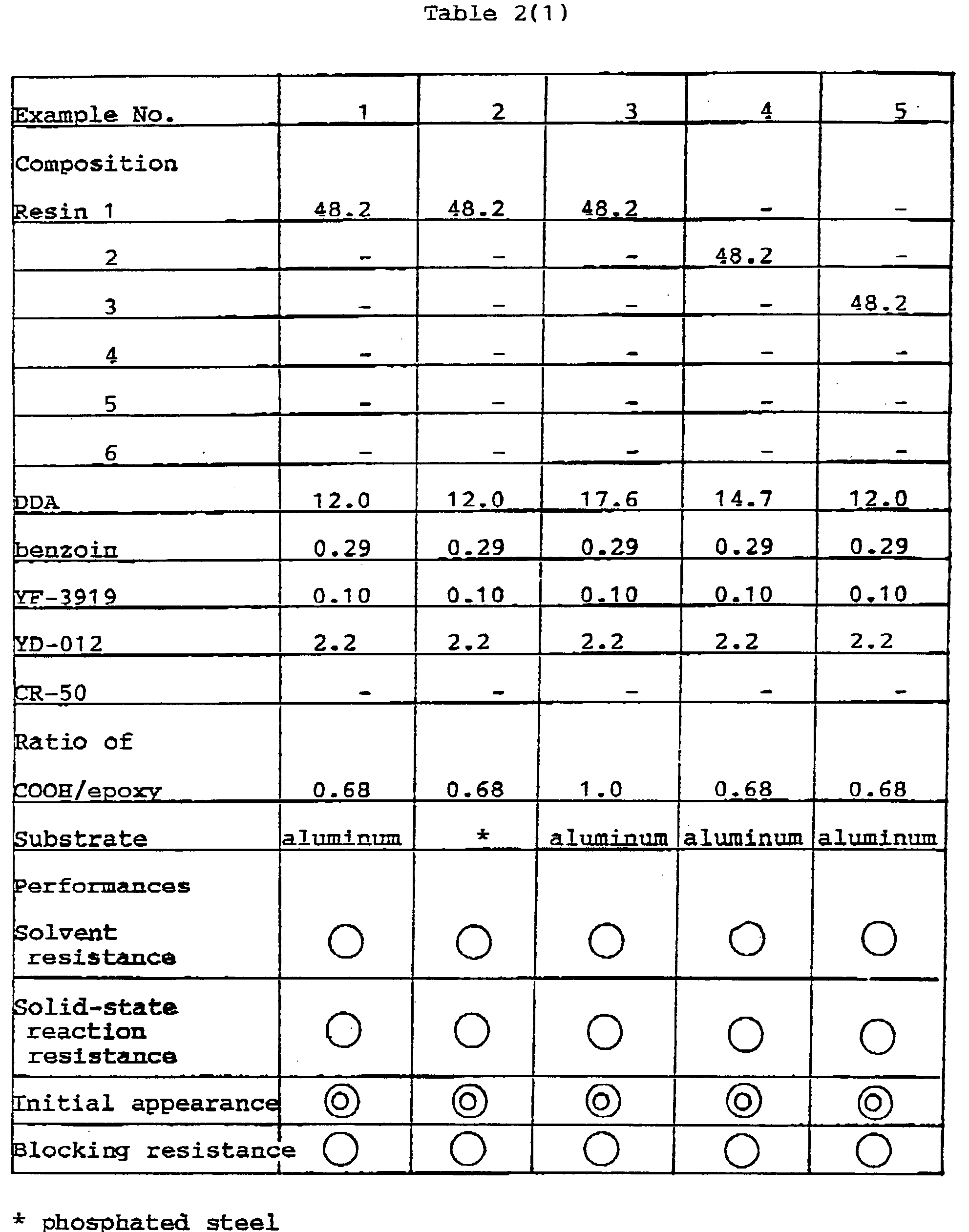


- Solvent resistance:
rubbing test with xylene was carried out.
○ ... good
X ... no good
Solid-state reaction resistance:
After storring 2 months at 30°C, the storred powder coating was applied on a substrate and baked. The coating appearance was compared with that of unstorred powder coating.
○ ... difference in appearance is very small
X ... difference in appearance is very large
Initial coating appearance:
Unstorred powder coating was applied on a substrate and baked.
Coating surface smoothness was visually measured.
○ ... good
X ... no good
Blocking resistance:
About 30 ml of test powder coating was placed in a 50 ml sample bottle and maintained at 30°C for 2 months. Aggregation of the powder was examined.
○ ... no aggregation
X ... solidified
Claims (3)
- A resinous composition for powder coating comprising (A) an acrylic resin and (B) a hardener characterised in that
the acrylic resin is composed of (a) t-butyl methacrylate (TBMA) and/or t-butyl acrylate (TBA), (b) an ethylenically unsaturated monomer having a reactive functional group and (c) one or more ethylenically unsaturated monomer(s) other than (a) or (b) and which is (are) non-reactive with the reactive functional group of (b); and has a reactive functional group content of from 0.0010 to 0.0046 mol per gram of resin, a glass transition temperature (Tg) of from 30 to 100°C, and a number average molecular weight of from 1000 to 20000; and
the hardener has in its molecule two or more functional groups being reactive with the reactive functional group present in the acrylic resin. - A composition according to claim 1 wherein the ratio of the molar amount of (a) to molar amount of (b) per gram of the acrylic resin is 0.1 to 3.0.
- A composition according to claim 1 or claim 2, wherein the reactive functional group of (b) is an epoxy group and the hardener is a polyvalent carboxylic acid having in its molecule two or more carboxyl groups.
Applications Claiming Priority (2)
| Application Number | Priority Date | Filing Date | Title |
|---|---|---|---|
| JP3233670A JP2774985B2 (en) | 1991-06-06 | 1991-06-06 | Resin composition for powder coating |
| JP233670/91 | 1991-06-06 |
Publications (3)
| Publication Number | Publication Date |
|---|---|
| EP0517536A2 true EP0517536A2 (en) | 1992-12-09 |
| EP0517536A3 EP0517536A3 (en) | 1993-02-03 |
| EP0517536B1 EP0517536B1 (en) | 1996-12-18 |
Family
ID=16958694
Family Applications (1)
| Application Number | Title | Priority Date | Filing Date |
|---|---|---|---|
| EP92305172A Expired - Lifetime EP0517536B1 (en) | 1991-06-06 | 1992-06-05 | A resinous composition for powder coating |
Country Status (6)
| Country | Link |
|---|---|
| US (1) | US5266652A (en) |
| EP (1) | EP0517536B1 (en) |
| JP (1) | JP2774985B2 (en) |
| KR (1) | KR930000633A (en) |
| CA (1) | CA2070555A1 (en) |
| DE (1) | DE69215967T2 (en) |
Cited By (8)
| Publication number | Priority date | Publication date | Assignee | Title |
|---|---|---|---|---|
| EP0773267A4 (en) * | 1994-07-25 | 1997-12-10 | Kansai Paint Co Ltd | Thermosetting powder coating composition |
| GB2326883A (en) * | 1997-06-30 | 1999-01-06 | Kansai Paint Co Ltd | Resin solution used for production of a powder coating |
| WO2000012581A1 (en) * | 1998-08-31 | 2000-03-09 | Ppg Industries Ohio, Inc. | Thermosetting compositions containing epoxy functional polymers prepared by atom transfer radical polymerization |
| WO2000012583A1 (en) * | 1998-08-31 | 2000-03-09 | Ppg Industries Ohio, Inc. | Thermosetting compositions containing carboxylic acid functional polymers and epoxy functional polymers prepared by atom transfer radical polymerisation |
| US6200639B1 (en) | 1996-12-14 | 2001-03-13 | Herberts Gmbh., Kg | Coating agent, the manufacture and uses thereof |
| DE10029548A1 (en) * | 2000-06-15 | 2002-01-10 | Basf Coatings Ag | Self-crosslinking powder coating based on epoxy resins and its use |
| US6426147B1 (en) | 1997-08-16 | 2002-07-30 | Basf Coatings Ag | Substrate having a multilayer coat and method for its production |
| US6624229B1 (en) | 1998-10-31 | 2003-09-23 | Basf Coatings Ag | Powder paints and the use thereof for producing low-noise powder paint coatings |
Families Citing this family (11)
| Publication number | Priority date | Publication date | Assignee | Title |
|---|---|---|---|---|
| US5407707A (en) * | 1993-11-01 | 1995-04-18 | Ppg Industries, Inc. | Powder coating composition based on epoxy containing polymers and polyacid curing agents |
| EP0773268A3 (en) * | 1995-11-09 | 1998-04-29 | Nippon Paint Co., Ltd. | Powder coating composition, and method for forming coated film |
| US5844048A (en) * | 1995-11-29 | 1998-12-01 | Ems-Inventa Ag | Thermosetting powder-type coating compositions |
| DE19544930C2 (en) * | 1995-12-01 | 1999-08-12 | Inventa Ag | Process for the production of powder coatings and use of the powder coating produced in accordance with the process |
| DE19752759A1 (en) | 1997-11-28 | 1999-07-01 | Basf Coatings Ag | Triboelectrically chargeable powder coatings |
| US7122585B2 (en) * | 2003-05-13 | 2006-10-17 | Rohm And Haas Company | Coating powders, methods of manufacture thereof, and articles formed therefrom |
| EP2921859B1 (en) * | 2006-01-23 | 2021-08-18 | Nexus Biosystems, Inc. | Sample vial picking module |
| EP2710079A1 (en) * | 2011-05-18 | 2014-03-26 | Coatings Foreign IP Co. LLC | Powder coating composition |
| JP6404757B2 (en) * | 2015-03-27 | 2018-10-17 | 信越化学工業株式会社 | Polymer for resist underlayer film material, resist underlayer film material, and pattern forming method |
| JP6953851B2 (en) * | 2017-07-14 | 2021-10-27 | 大日本印刷株式会社 | Polymer dispersant and its manufacturing method, color material dispersion liquid, colored resin composition, color filter, liquid crystal display device, and light emission display device |
| CN113088184B (en) * | 2021-03-17 | 2022-07-22 | 威士伯涂料(上海)有限公司 | High temperature resistant powder coating compositions and articles |
Family Cites Families (14)
| Publication number | Priority date | Publication date | Assignee | Title |
|---|---|---|---|---|
| JPS4843036A (en) * | 1971-09-30 | 1973-06-22 | ||
| JPS4992128A (en) * | 1972-10-25 | 1974-09-03 | ||
| JPS523745B2 (en) * | 1973-07-25 | 1977-01-29 | ||
| CA1041691A (en) * | 1973-09-06 | 1978-10-31 | John D. Nordstrom | Powder coating compositions comprising a glycidyl ester copolymer and carboxy terminated polymeric crosslinking agent |
| CA1045277A (en) * | 1973-09-06 | 1978-12-26 | Ford Motor Company Of Canada | Powder coating compositions comprising a copolymer of a glycidyl ester and a crosslinking agent |
| GB1478522A (en) * | 1973-11-02 | 1977-07-06 | Goodyear Tire & Rubber | Acrylic interpolymer coating compositions |
| JPS5155324A (en) * | 1974-11-11 | 1976-05-15 | Toray Industries | NETSUKOKASEIFUNTAITORYOSOSEIBUTSU |
| DE2541635B1 (en) * | 1975-09-18 | 1977-01-27 | Hoechst Ag | HEAT-CURABLE, POWDERED COATING MIXED FROM A MIXTURE OF GLYCIDYL-CONTAINING COPOLYMERISATES AND HARDENING AGENTS |
| DE2540921C2 (en) * | 1975-09-13 | 1981-11-26 | Hoechst Ag, 6000 Frankfurt | Thermosetting, powdery coating agent from a mixture of copolymers containing glycidyl groups and hardening agents. Process for its production and its use |
| JPS5238543A (en) * | 1975-09-18 | 1977-03-25 | Hoechst Ag | Powdered coating agent and production thereof |
| JPS5238542A (en) * | 1975-09-18 | 1977-03-25 | Hoechst Ag | Powdered coating agent and production thereof |
| CH645501GA3 (en) * | 1981-07-24 | 1984-10-15 | ||
| JPH01104666A (en) * | 1987-10-19 | 1989-04-21 | Nippon Paint Co Ltd | Thermosetting resin composition |
| DE4112688A1 (en) * | 1991-04-18 | 1992-10-22 | Hoechst Ag | POWDERED COATING AGENTS |
-
1991
- 1991-06-06 JP JP3233670A patent/JP2774985B2/en not_active Expired - Fee Related
-
1992
- 1992-06-05 EP EP92305172A patent/EP0517536B1/en not_active Expired - Lifetime
- 1992-06-05 US US07/894,757 patent/US5266652A/en not_active Expired - Fee Related
- 1992-06-05 DE DE69215967T patent/DE69215967T2/en not_active Expired - Fee Related
- 1992-06-05 CA CA002070555A patent/CA2070555A1/en not_active Abandoned
- 1992-06-08 KR KR1019920009881A patent/KR930000633A/en not_active Ceased
Cited By (12)
| Publication number | Priority date | Publication date | Assignee | Title |
|---|---|---|---|---|
| EP0773267A4 (en) * | 1994-07-25 | 1997-12-10 | Kansai Paint Co Ltd | Thermosetting powder coating composition |
| US5945487A (en) * | 1994-07-25 | 1999-08-31 | Kansai Paint Company, Ltd. | Thermosetting powder coating composition |
| US6200639B1 (en) | 1996-12-14 | 2001-03-13 | Herberts Gmbh., Kg | Coating agent, the manufacture and uses thereof |
| GB2326883A (en) * | 1997-06-30 | 1999-01-06 | Kansai Paint Co Ltd | Resin solution used for production of a powder coating |
| GB2326883B (en) * | 1997-06-30 | 2001-07-11 | Kansai Paint Co Ltd | Process for production of a powder coating |
| US6426147B1 (en) | 1997-08-16 | 2002-07-30 | Basf Coatings Ag | Substrate having a multilayer coat and method for its production |
| WO2000012581A1 (en) * | 1998-08-31 | 2000-03-09 | Ppg Industries Ohio, Inc. | Thermosetting compositions containing epoxy functional polymers prepared by atom transfer radical polymerization |
| WO2000012583A1 (en) * | 1998-08-31 | 2000-03-09 | Ppg Industries Ohio, Inc. | Thermosetting compositions containing carboxylic acid functional polymers and epoxy functional polymers prepared by atom transfer radical polymerisation |
| US6624229B1 (en) | 1998-10-31 | 2003-09-23 | Basf Coatings Ag | Powder paints and the use thereof for producing low-noise powder paint coatings |
| DE10029548A1 (en) * | 2000-06-15 | 2002-01-10 | Basf Coatings Ag | Self-crosslinking powder coating based on epoxy resins and its use |
| DE10029548C2 (en) * | 2000-06-15 | 2002-07-04 | Basf Coatings Ag | Self-crosslinking powder coating based on epoxy resins and its use |
| US6749896B2 (en) | 2000-06-15 | 2004-06-15 | Basf Coatings Ag | Self-cross linking powder paint based on epoxy resins and the use thereof |
Also Published As
| Publication number | Publication date |
|---|---|
| JPH04359971A (en) | 1992-12-14 |
| DE69215967T2 (en) | 1997-05-22 |
| DE69215967D1 (en) | 1997-01-30 |
| EP0517536B1 (en) | 1996-12-18 |
| CA2070555A1 (en) | 1992-12-07 |
| EP0517536A3 (en) | 1993-02-03 |
| US5266652A (en) | 1993-11-30 |
| JP2774985B2 (en) | 1998-07-09 |
| KR930000633A (en) | 1993-01-15 |
Similar Documents
| Publication | Publication Date | Title |
|---|---|---|
| US5266652A (en) | Resinous composition for powder coating | |
| CA1334699C (en) | Hybrid powder coating curing system | |
| US6191225B1 (en) | Thermosetting compositions containing carboxylic acid functional polymers and epoxy functional polymers prepared by atom transfer radical polymerization | |
| US6670043B2 (en) | Thermosetting compositions containing carboxylic acid functional polymers prepared by atom transfer radical polymerization | |
| JP2810500B2 (en) | Powder paint | |
| TW593595B (en) | Binder for powdered thermosetting composition, powdered thermosetting composition for coatings and method of preparing it | |
| KR960005429B1 (en) | Composition for thermosetting powder coating | |
| US5576389A (en) | Powder coating composition | |
| JPH04103678A (en) | Powder coating composition | |
| EP1112299B1 (en) | Thermosetting compositions containing epoxy functional polymers prepared by atom transfer radical polymerization | |
| CA1274643A (en) | Low temperature curing maintenance coatings | |
| US6265489B1 (en) | Thermosetting compositions containing carboxylic acid functional polymers prepared by atom transfer radical polymerization | |
| CA2070553A1 (en) | Powder coating which is excellent in stain resistance | |
| KR100583265B1 (en) | Coating composition | |
| JPS5821411A (en) | Resin composition for coating | |
| JPH01115969A (en) | Resin composition for powder coating | |
| EP0953587B1 (en) | Coating composition containing a non-halogen onium salt | |
| JP2650285B2 (en) | Curable resin composition | |
| JPS6226676B2 (en) | ||
| EP0379809A2 (en) | A heat-curing type resinuous composition and powder coating containing the same | |
| JPH0735494B2 (en) | Two-component urethane coating composition | |
| JPH07309931A (en) | Curable resin composition | |
| JP2000309745A (en) | Resin composition for thermosetting coating | |
| JPS6150109B2 (en) | ||
| JPH0224371A (en) | Coating resin composition |
Legal Events
| Date | Code | Title | Description |
|---|---|---|---|
| PUAI | Public reference made under article 153(3) epc to a published international application that has entered the european phase |
Free format text: ORIGINAL CODE: 0009012 |
|
| AK | Designated contracting states |
Kind code of ref document: A2 Designated state(s): DE FR GB IT |
|
| PUAL | Search report despatched |
Free format text: ORIGINAL CODE: 0009013 |
|
| AK | Designated contracting states |
Kind code of ref document: A3 Designated state(s): DE FR GB IT |
|
| 17P | Request for examination filed |
Effective date: 19930719 |
|
| 17Q | First examination report despatched |
Effective date: 19941007 |
|
| GRAG | Despatch of communication of intention to grant |
Free format text: ORIGINAL CODE: EPIDOS AGRA |
|
| GRAH | Despatch of communication of intention to grant a patent |
Free format text: ORIGINAL CODE: EPIDOS IGRA |
|
| GRAH | Despatch of communication of intention to grant a patent |
Free format text: ORIGINAL CODE: EPIDOS IGRA |
|
| GRAA | (expected) grant |
Free format text: ORIGINAL CODE: 0009210 |
|
| AK | Designated contracting states |
Kind code of ref document: B1 Designated state(s): DE FR GB IT |
|
| ITF | It: translation for a ep patent filed | ||
| REF | Corresponds to: |
Ref document number: 69215967 Country of ref document: DE Date of ref document: 19970130 |
|
| ET | Fr: translation filed | ||
| PGFP | Annual fee paid to national office [announced via postgrant information from national office to epo] |
Ref country code: FR Payment date: 19970610 Year of fee payment: 6 |
|
| PLBE | No opposition filed within time limit |
Free format text: ORIGINAL CODE: 0009261 |
|
| STAA | Information on the status of an ep patent application or granted ep patent |
Free format text: STATUS: NO OPPOSITION FILED WITHIN TIME LIMIT |
|
| 26N | No opposition filed | ||
| PGFP | Annual fee paid to national office [announced via postgrant information from national office to epo] |
Ref country code: GB Payment date: 19980527 Year of fee payment: 7 |
|
| PGFP | Annual fee paid to national office [announced via postgrant information from national office to epo] |
Ref country code: DE Payment date: 19980612 Year of fee payment: 7 |
|
| PG25 | Lapsed in a contracting state [announced via postgrant information from national office to epo] |
Ref country code: FR Free format text: LAPSE BECAUSE OF NON-PAYMENT OF DUE FEES Effective date: 19990226 |
|
| REG | Reference to a national code |
Ref country code: FR Ref legal event code: ST |
|
| PG25 | Lapsed in a contracting state [announced via postgrant information from national office to epo] |
Ref country code: GB Free format text: LAPSE BECAUSE OF NON-PAYMENT OF DUE FEES Effective date: 19990605 |
|
| GBPC | Gb: european patent ceased through non-payment of renewal fee |
Effective date: 19990605 |
|
| PG25 | Lapsed in a contracting state [announced via postgrant information from national office to epo] |
Ref country code: DE Free format text: LAPSE BECAUSE OF NON-PAYMENT OF DUE FEES Effective date: 20000503 |
|
| PG25 | Lapsed in a contracting state [announced via postgrant information from national office to epo] |
Ref country code: IT Free format text: LAPSE BECAUSE OF NON-PAYMENT OF DUE FEES Effective date: 20050605 |