EP0515714B1 - Verfahren zur rechnergestützten Verarbeitung binärer Rasterbilder - Google Patents
Verfahren zur rechnergestützten Verarbeitung binärer Rasterbilder Download PDFInfo
- Publication number
- EP0515714B1 EP0515714B1 EP91108731A EP91108731A EP0515714B1 EP 0515714 B1 EP0515714 B1 EP 0515714B1 EP 91108731 A EP91108731 A EP 91108731A EP 91108731 A EP91108731 A EP 91108731A EP 0515714 B1 EP0515714 B1 EP 0515714B1
- Authority
- EP
- European Patent Office
- Prior art keywords
- text
- connection components
- letters
- plausibility check
- combined
- Prior art date
- Legal status (The legal status is an assumption and is not a legal conclusion. Google has not performed a legal analysis and makes no representation as to the accuracy of the status listed.)
- Expired - Lifetime
Links
Images


Classifications
-
- G—PHYSICS
- G06—COMPUTING OR CALCULATING; COUNTING
- G06V—IMAGE OR VIDEO RECOGNITION OR UNDERSTANDING
- G06V30/00—Character recognition; Recognising digital ink; Document-oriented image-based pattern recognition
- G06V30/40—Document-oriented image-based pattern recognition
- G06V30/41—Analysis of document content
- G06V30/414—Extracting the geometrical structure, e.g. layout tree; Block segmentation, e.g. bounding boxes for graphics or text
Definitions
- capturing documents as an electronic facsimile entails a considerable saving in space:
- CCITT Group 4 standard approx. 40,000 pages can be stored on an optical disk with a capacity of 4 GB.
- the user is not yet served by simply scanning the paper templates.
- Editing the template in CAD systems requires, for example, the conversion of the raster image into the corresponding data structures of the CAD system. This means that the system must be able to recognize, for example, arc segments or polygons in groups of black pixels.
- OCR Optical Character Recognition
- the conversion into the corresponding ASCII or EBCDIC codes is required in order to be able to process the document further with a text editor.
- the invention relates to a method for recognizing and segmenting the Layouts of documents with mostly textual content.
- the first preprocessing step to analyze a Document consists of scanning the paper template. To do this commonly used flatbed scanners or cameras. The Resolution requirements (at least 200 dpi) will be today fulfilled by all commercially available devices.
- the scanned gray-scale image must be processed further binarized, i.e. be converted into a binary image.
- a global threshold value formation is carried out, which all pixels (pixels) whose sample value is above one Threshold lies, the value 1 (generally for black, foreground) assigns, and the other pixels the background value 0 assigns.
- the raster image of the document must be before the other Processing for the purpose of rotational position compensation algorithmic be rotated.
- There are procedures for this in the Location are the preferred writing direction of one template on several Arc minutes to determine exactly and the raster image parallel to the horizontal axis (W.Postl 1982, "Halftone recognition by an experimental text and facsimile workstation ", Proc. of the 6th International Conference on Pattern Recognition, Kunststoff, F.R.G., pp. 489-491; J.P.
- the following processing step is called connected component analysis denotes and transfers the raster image not again in another raster image, but in one qualitatively different data structure.
- the Image matrix topologically connected sets of black Pixel extracted the so-called connected components (Harberecker, “Digital Image Processing", Hansa-Verlag Kunststoff 1985, Page 71 ff; Ballard, Brown: “Computer Vision,” “Prentice Hall Englewood Cliffs, N.J. 1982, pp. 235 ff).
- This process step has opted for more demanding tasks in binary image processing generally enforced and also becomes Implementation of the method according to the invention is required.
- Nagy, Seth and Stoddard describe a procedure (G. Nagy, S.C. Seth, S.D. Stoddard, 1986, , Document Analysis with an Expert System, Pattern Recognition in Practice II (E.S. Gelsema, L.N. Canal, eds.), North Holland, pp. 149-159), which on a run length presentation of the document image touches down.
- E.S. Gelsema, L.N. Canal, eds. North Holland, pp. 149-159
- This method is applied recursively until one side is closed Row blocks was segmented.
- EP 0206 214 A1 describes a method for uniform symbolic description of document patterns in the form of Data structures known in a machine in which indoor and outer edges of image parts in the context of a hierarchical data structure can be saved.
- the invention has for its object a method for computer-aided processing of binary raster images, especially for segmenting the layout of documents specify which of the disadvantages described above methods known from the literature overcomes.
- This task is using a computer-based process Processing of binary raster images, especially for Segmentation of the layout of documents with characteristics Claim 1 solved.
- a binary raster image becomes topologically connected sets of black pixels, which are referred to as related components.
- related components are represented internally in the computer with the aid of a hierarchical data structure in which inner and outer edges are shown together with statistical features of these related components.
- Using statistical characteristics of the related components they are classified as belonging to the text type or not belonging to the text type, such as the graphic type.
- the related components of the text type are then combined into text blocks depending on their horizontal and vertical distances from adjacent related components or text blocks.
- the text blocks formed in this way are subjected to a plausibility check on the basis of statistics on the characteristics of the constituent components which constitute them, and if the plausibility check is negative, they are re-segmented, the text blocks concerned being rejected. Text blocks are built up repeatedly and resegmented until the plausibility check is positive. This procedure is used within the text blocks for the construction of multi-component letters and then for the construction of lines and within the lines for the construction of words.
- Figure 1 shows a graphical representation of the hierarchical Data structure in which the related components and the objects composed of them and the information about the internal structure of these objects from the related components is saved.
- Figure 2 shows a text block in a document template as Binary image.
- FIG. 3 shows a breakdown of this text block into related components.
- Figure 4 shows the segmentation of the text block within of the document.
- Figure 5 shows the segmentation of compound letters.
- Figure 6 shows the segmentation of individual lines within of the text block.
- Figure 7 shows the segmentation of words within Lines.
- Figure 8 shows the type of distance measurement between related components.
- Figure 10 shows the result of the segmentation for the test document from FIG. 9.
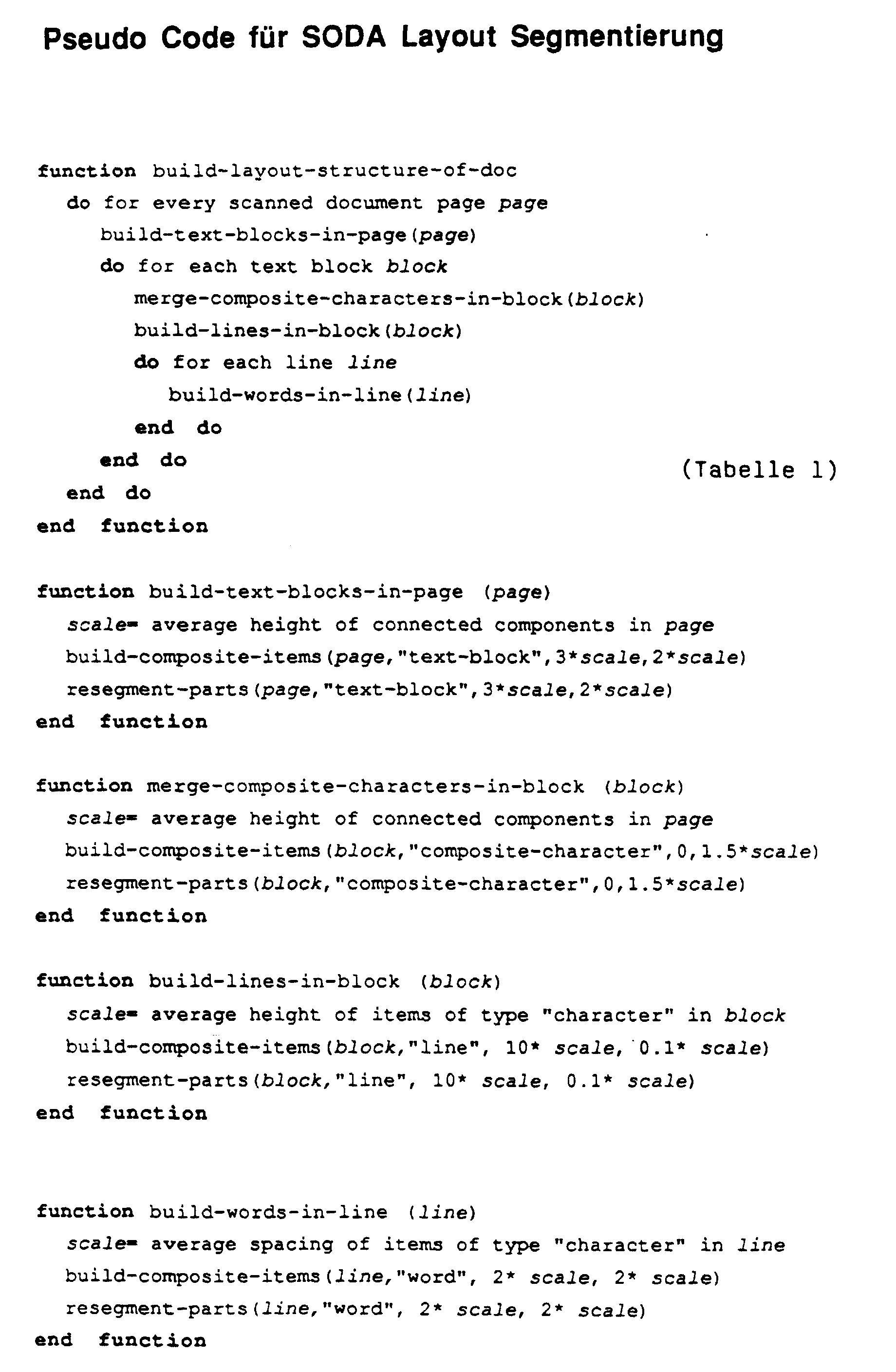
- Table 1 shows a basic procedure of the Method according to the invention with the aid of a pseudo code representation reproduced.
- Table 2 contains the values of typical parameters for implementation the layout segmentation.
- the first processing step to analyze a document consists of scanning the paper template. This is preferred a flatbed scanner or a camera. When scanning or following the scanning of the document this binarized. Global thresholding is common, the all pixels whose samples are above the Threshold, a value of 1 for e.g. black or Assigns foreground and the other pixels the background value assigns from zero.
- This procedure uses one uniform lighting and one of the color distribution forth homogeneous template ahead, which in the case of documents, which consist of black printed white paper and one Scanning with a scanner with integrated lighting in the general is given. If these requirements are not met, Instead, an adaptive threshold value formation must be carried out become. The brightness limit between the front and background from the medium brightness in the area made dependent on the viewed pixel.
- the raster image does not turn into another raster image is converted, but in which one qualitatively new data structure emerges is the related component analysis.
- the image matrix becomes the topologically connected Extracted amounts of black pixels, the so-called
- Connected components Z (Haberecker 1985, Ballard and Brown, 1982). This process step has been chosen for more demanding ones Tasks in binary image processing generally enforced. As part of the described here The process becomes a computer internal representation of the Connected components Z a hierarchical data structure used as shown in Figure 1. Be in it the edges of an object (both outer and inner edges) in two different levels of resolution, the so-called descriptors and fine margins. In addition, the containment relation noted from inner edges to their outer edges. This representation enables an efficient calculation of statistical characteristics for those described in the next point Text-graphic classification are needed, as well as the calculation of those features required for character recognition according to the angle cutting method are necessary (L.Bernhardt 1984). This can be done from this hierarchical data structure original raster image can be completely reconstructed.
- the neighborhood relationship between related components Z is used to form a syntactic feature, namely their linear arrangement. If there are several neighboring ones Related components of comparable size on a straight line, which can have any direction and they are also close enough together, they become a new one Object, a so-called word.
- the text-graphic classification is based on these words, which are basically the first stage of an explicit representation of the inherent Neighborhood relationships, i.e. the syntactic structure of a document.
- the preprocessing of the binary image document is now on which builds up the method according to the invention.
- the document is in a hierarchical data structure, in which the document with the help of related components Z and their statistical characteristics are represented. From this The document can be displayed without any loss of information can be completely reconstructed as a binary image.
- the actual layout segmentation is now described. In this description becomes the term word in another Meaning used as in the previous description of the Text-graphic separation.
- a word in the sense of layout segmentation, as described below can therefore, but does not have to be in one word in the sense of the text-graphic separation procedure be identical.
- the distance between connected components Z is defined as the distance between the opposite sides of the rectangles circumscribing them (FIG. 8).
- the threshold values or limit values Dx or Dy depend, of course, on the type of object to be formed (text block, line, word) and on a suitable standardization factor s, which detects the influences dependent on the specific document image.
- the threshold values Dx and Dy result as products from a non-direction-dependent normalization factor s and a parameter cx or cy, which is generally to be chosen in each case for the x and y directions, typical values for the normalization factor s and the parameters cx and cy are summarized in Table 2.
- the layout objects formed in this way can be checked for their plausibility using simple methods and, if necessary, ie if the course of the plausibility check is negative, can be subjected to a re-segmentation.
- the variance of the character height within a text block should not be too large. If this is the case, the text block can be removed and the segmentation step can be repeated with new parameters that are better adapted to the conditions of the document area. Resegmentation steps are repeated until the plausibility check at this level is positive.
- Table 1 shows a general formulation of the layout segmentation method using a pseudocode representation. Parameters of the layout segmentation process layout object to be formed horizontal distance cx vertical distance cy Standardization parameters see Text block 3.0 2.0 average character height of the page row 3.0 0.1 average character height in the text block word 2.0 2.0 middle letter spacing in the line
- FIGS. 2, 3, 4, 5, 6 and 7 The sequence of the layout segmentation process and the process involved segmentation results are shown in FIGS. 2, 3, 4, 5, 6 and 7 are clearly shown.
- Figure 2 shows one Text block TB of a document template as a binary image.
- Figure 3 shows the segmentation of this text block into individual related components Z, i.e. in topologically related quantities black pixel. It can clearly be seen that, for example i-points still separated from the body parts of this letter are. This result becomes the definition of connected components Z fair.
- Figure 4 shows the result of Text block segmentation, in which it can be seen that the paragraph was segmented correctly by the envelope that wraps this paragraph Rectangle TB was found.
- Figure 5 shows the segmented Layout according to which consists of several related components Letters assembled into compound letters have been. Accordingly, the i-points are in this figure together with the body parts of this letter to form a segment merged.
- Figure 6 shows the result of the line segmentation.
- Figure 7 finally shows the segment
- Figures 9 and 10 show the results of the method for Layout segmentation for various document templates. Out These figures show that the process sufficiently robust against rotation for layout segmentation the document template, fluctuating line spacing and uneven Letter sizes is.
Landscapes
- Engineering & Computer Science (AREA)
- Physics & Mathematics (AREA)
- Computer Vision & Pattern Recognition (AREA)
- Computer Graphics (AREA)
- Geometry (AREA)
- Artificial Intelligence (AREA)
- General Physics & Mathematics (AREA)
- Multimedia (AREA)
- Theoretical Computer Science (AREA)
- Character Input (AREA)
Description
Unter Verwendung einer Komprimierung der abgetasteten Dokumente nach CCITT-Norm Gruppe 4 lassen sich auf einer optischen Platte von 4 GByte Kapazität ca. 40.000 Seiten abspeichern. Im allgemeinen jedoch ist dem Anwender mit dem alleinigen Abtasten der Papiervorlagen noch nicht gedient. Eine Bearbeitung der Vorlage in CAD-Systemen erfordert z.B. die Umsetzung des Rasterbildes in die entsprechenden Datenstrukturen des CAD-Systems. Dies bedeutet, daß das System in der Lage sein muß, in Gruppen von schwarzen Bildpunkten z.B. Kreisbogensegmente oder Polygone zu erkennen. Im Falle von Textdokumenten ist die Erkennung der Schriftzeichen (OCR = Optical Character Recognition) und die Umsetzung in die entsprechenden ASCII oder EBCDIC Codes erforderlich, um das Dokument mit einem Texteditor weiterbearbeiten zu können.
Bei einem Brief wird z.B. ein Datum durch seine Position rechts oben auf der Seite als Absendedatum des Briefes gekennzeichnet. Ein breiter Textblock in der Seitenmitte wird normalerweise ein Inhaltsblock des Briefes sein. Auch ein menschlicher Leser orientiert sich zunächst einmal am Layout eines Dokuments um seine Art (Brief, Bericht, etc.) und die ihn interessierenden Teile schnell erfassen zu können. Eine Voraussetzung für die logische Erfassung eines Dokuments ist daher neben der Schriftzeichenerkennung die Erkennung des Dokumentenlayouts.
welche als Zusammenhangskomponenten bezeichnet werden, extrahiert. Diese Zusammenhangskomponenten werden rechnerintern mit Hilfe einer hierarchischen Datenstruktur repräsentiert, in welcher Innen- und Außenränder zusammen mit statistischen Merkmalen dieser Zusammenhangskomponenten dargestellt werden. Anhand von statistischen Merkmalen der Zusammenhangskomponenten werden diese als zum Texttyp oder als nicht zum Texttyp wie z.B. zum Graphiktyp gehörig klassifiziert. Die Zusammenhangskomponenten vom Texttyp werden daraufhin in Abhängigkeit von ihren horizontalen und vertikalen Abständen von benachbarten Zusammenhangskomponenten oder Textblöcken zu Textblöcken zusammengefaßt. Die so gebildeten Textblöcke werden anhand einer Statistik über Merkmale der sie konstituierenden Zusammenhangskomponenten einer Plausibilitätsprüfung unterworfen und bei negativem Verlauf dieser Plausibilitätsprüfung resegmentiert, wobei die betroffenen Textblöcke verworfen werden. Textblöcke werden wiederholt aufgebaut und resegmentiert bis die Plausibilitätsprüfung positiv verläuft. Diese Vorgehensweise wird innerhalb der Textblöcke zum Aufbau von mehrkomponentigen Buchstaben und anschließend zum Aufbau von Zeilen und innerhalb der Zeilen zum Aufbau von Worten angewendet.
Es werden diejenigen Objekte zu einer Einheit zusammengefaßt, deren Abstand voneinander einen bestimmten Wert nicht überschreitet. Genauer: Jede Zusammenhangskomponente, deren horizontaler und vertikaler Abstand dx bzw. dy von dem gerade zu bildenden zusammengesetzten Objekt kleiner als ein bestimmter Grenzwert Dx bzw. Dy ist, wird als neues Teil dieses Objekts betrachtet. Dabei wird der Abstand von Zusammenhangskomponenten als der Abstand der gegenüberliegenden Seiten der sie umschreibenden Rechtecke definiert. Die Grenzwerte oder Schwellwerte Dx bzw. Dy hängen dabei natürlich von der Art des zu bildenden Objekts ab sowie von einem geeignet zu wählenden Normierungsfaktor, welcher die vom konkreten Dokumentbild abhängigen Einflüsse subsummiert.
- die Anzahl der Zusammenhangskomponenten im Wort;
- die aufsummierte Länge aller Innenränder, die sich im Wort befinden;
- die Autokorrelationskoeffizienten der Richtungsverteilung der Außenränder der Wortteile;
- der sog. Extremwertwinkel;
- das Minimum von Mittelwert und Streuung der Projektionen des Wortbildes in vier verschiedene Richtungen (0°, 45°, 90° und 135°);
- das Verhältnis der Gesamtfläche der Schwarzkomponenten eines Wortes zu der Fläche einer Polygonapproximation seiner konvexen Hülle.

| Parameter des Verfahrens zur Layoutsegmentierung | |||
| zu bildendes Layoutobjekt | horizontaler Abstand cx | vertikaler Abstand cy | Normierungsparameter s |
| Textblock | 3.0 | 2.0 | mittlere Zeichenhöhe der Seite |
| Zeile | 3.0 | 0.1 | mittlere Zeichenhöhe im Textblock |
| Wort | 2.0 | 2.0 | mittlerer Buchstabenabstand in der Zeile |
Claims (5)
- Verfahren zur Verarbeitung binärer Rasterbilder, insbesondere zur Segmentierung des Layouts von Dokumenten mit folgenden Schritten:a) aus einem binären Rasterbild werden topologisch zusammenhängende Mengen schwarzer Pixel, die Zusammenhangskomponenten (Z) extrahiert;b) die Zusammenhangskomponenten (Z) werden mit Hilfe einer hierarchischen Datenstruktur repräsentiert, in welcher Innen- und Außenränder zusammen mit statistischen Merkmalen von Zusammenhangskomponenten (Z) dargestellt werden;c) statistische Merkmale der Zusammenhangskomponenten (Z) werden dazu verwendet, diese als zum Text-Typ bzw. zu einem anderen, z.B. zum Graphik-Typ gehörig zu klassifizieren;d) Zusammenhangskomponenten vom Text-Typ oder aus diesen zusammengesetzte Objekte werden in Abhängigkeit von ihren statistischen Merkmalen zu Textblöcken zusammengefaßt und in der hierarchischen Datenstruktur gespeichert, wobei der Aufbau der Textblöcke aus Zusammenhangskomponenten ebenfalls in der hierarchischen Datenstruktur gespeichert wird.
- Verfahren nach Anspruch 1, bei dem Zusammenhangskomponenten auf folgende Weise zu Objekten zusammengefaßt werden:a) die Zusammenhangskomponenten vom Text-Typ werden in Abhängigkeit von ihren horizontalen und vertikalen Abständen von benachbarten Zusammenhangskomponenten oder Textblöcken zu Textblöcken (TB) zusammengefaßt;b) die so gebildeten Textblöcke (TB) werden anhand einer Statistik über Merkmale der sie konstituierenden Zusammenhangskomponenten (Z) einer ersten Plausibilitätsprüfung unterworfen und bei negativem Verlauf dieser ersten Plausibilitätsprüfung einer Resegmentierung unterzogen, welche die betroffenen Textblöcke (TB) verwirft;c) Textblöcke (TB) werden wiederholt aufgebaut und resegmentiert bis die erste Plausibilitätsprüfung positiv verläuft;d) innerhalb der Textblöcke werden Zusammenhangskomponenten (Z) in Abhängigkeit von ihren horizontalen und vertikalen Abständen und ihrem Größenverhältnis zu benachbarten Zusammenhangskomponenten (Z) zu mehrkomponentigen Buchstaben (ZB) zusammengefaßt;e) die so gebildeten Buchstaben werden anhand einer Statistik über Merkmale der sie konstituierenden Zusammenhangskomponenten einer zweiten Plausibilitätsprüfung unterworfen und bei negativem Verlauf dieser zweiten Plausibitätsprüfung einer Resegmentierung unterzogen, welche die betroffenen Buchstaben verwirft;f) Buchstaben werden wiederholt gebildet und resegmentiert bis die zweite Plausibilitätsprüfung positiv verläuft;g) innerhalb der Textblöcke (TB) werden Zusammenhangskomponenten (Z) und mehrkomponentige Buchstaben (ZB) in Abhängigkeit von ihren horizontalen und vertikalen Abständen zu benachbarten Zusammenhangskomponenten, mehrkomponentigen Buchstaben oder Textzeilen desselben Textblockes zu Textzeilen (ZS) zusammengefaßt;h) die so gebildeten Textzeilen (ZS) werden anhand einer Statistik über Merkmale der sie konstituierenden Zusammenhangskomponenten (Z) und mehrkomponentigen Buchstaben (ZB) einer dritten Plausibilitätsprüfung unterworfen und bei negativem Verlauf dieser dritten Plausibilitätsprüfung einer Resegmentierung unterzogen, welche die betroffenen Textzeilen (ZS) verwirft;i) Textzeilen (ZS) werden wiederholt aufgebaut und resegmentiert bis die dritte Plausibilitätsprüfung positiv verläuft;j) innerhalb der Textzeilen (ZS) werden Zusammenhangskomponenten (Z) und mehrkomponentige Buchstaben (ZB) in Abhängigkeit von ihren horizontalen und vertikalen Abständen zu benachbarten Zusammenhangskomponenten, mehrkomponentigen Buchstaben oder Worten (WS) derselben Textzeile zu Worten zusammengefaßt;k) die so gebildeten Worte (WS) werden anhand einer Statistik über Merkmale der sie konstituierenden Zusammenhangskomponenten (Z) oder mehrkomponentigen Buchstaben (ZB) einer vier ten Plausibilitätsprüfung unterworfen und bei negativem Verlauf dieser vierten Plausibilitätsprüfung einer Resegmentierung unterzogen, welche die betroffenen Worte (WS) verwirft;l) Worte (WS) werden wiederholt gebildet und resegmentiert bis die vierte Plausibilitätsprüfung positiv verläuft.
- Verfahren nach einem der vorherigen Ansprüche, bei dem die Zusammenhangskomponenten vom Text-Typ oder aus diesen zusammengesetzte Objekte in Abhängigkeit von ihren Lagen zu Objekten zusammengefaßt werden.
- Verfahren nach einem der vorherigen Ansprüche, bei dem die Zusammenhangskomponenten vom Text-Typ oder aus diesen zusammengesetzte Objekte in Abhängigkeit von ihren Größen zu Objekten zusammengefaßt werden.
- Verfahren nach einem der vorherigen Ansprüche, bei dem die Zusammenhangskomponenten vom Text-Typ oder aus diesen zusammengesetzte Objekte in Abhängigkeit von ihren Abständen zu anderen Zusammenhangskomponenten oder Objekten zu Objekten zusammengefaßt werden.
Priority Applications (2)
| Application Number | Priority Date | Filing Date | Title |
|---|---|---|---|
| DE59109114T DE59109114D1 (de) | 1991-05-28 | 1991-05-28 | Verfahren zur rechnergestützten Verarbeitung binärer Rasterbilder |
| EP91108731A EP0515714B1 (de) | 1991-05-28 | 1991-05-28 | Verfahren zur rechnergestützten Verarbeitung binärer Rasterbilder |
Applications Claiming Priority (1)
| Application Number | Priority Date | Filing Date | Title |
|---|---|---|---|
| EP91108731A EP0515714B1 (de) | 1991-05-28 | 1991-05-28 | Verfahren zur rechnergestützten Verarbeitung binärer Rasterbilder |
Publications (2)
| Publication Number | Publication Date |
|---|---|
| EP0515714A1 EP0515714A1 (de) | 1992-12-02 |
| EP0515714B1 true EP0515714B1 (de) | 1999-03-24 |
Family
ID=8206778
Family Applications (1)
| Application Number | Title | Priority Date | Filing Date |
|---|---|---|---|
| EP91108731A Expired - Lifetime EP0515714B1 (de) | 1991-05-28 | 1991-05-28 | Verfahren zur rechnergestützten Verarbeitung binärer Rasterbilder |
Country Status (2)
| Country | Link |
|---|---|
| EP (1) | EP0515714B1 (de) |
| DE (1) | DE59109114D1 (de) |
Families Citing this family (5)
| Publication number | Priority date | Publication date | Assignee | Title |
|---|---|---|---|---|
| JP2821658B2 (ja) * | 1993-11-11 | 1998-11-05 | 大日本スクリーン製造株式会社 | 製版用部品データ管理方法 |
| WO1997038382A1 (de) * | 1996-04-03 | 1997-10-16 | Siemens Aktiengesellschaft | Verfahren zur automatischen klassifikation eines auf einem dokument aufgebrachten textes nach dessen transformation in digitale daten |
| CN105027142A (zh) * | 2012-10-16 | 2015-11-04 | 海因策格雷特尔Pc公司 | 文本阅读辅助工具 |
| US9124841B2 (en) | 2013-11-26 | 2015-09-01 | Xerox Corporation | Connected component analysis with multi-thresholding to segment halftones |
| CN116932492B (zh) * | 2023-09-15 | 2023-11-17 | 北京点聚信息技术有限公司 | 用于版式文件识别数据存储优化方法 |
Family Cites Families (1)
| Publication number | Priority date | Publication date | Assignee | Title |
|---|---|---|---|---|
| DE3666988D1 (en) * | 1985-06-18 | 1989-12-21 | Siemens Ag | Method for a uniform symbolic description of document patterns in the form of data structures in an automated apparatus |
-
1991
- 1991-05-28 EP EP91108731A patent/EP0515714B1/de not_active Expired - Lifetime
- 1991-05-28 DE DE59109114T patent/DE59109114D1/de not_active Expired - Fee Related
Also Published As
| Publication number | Publication date |
|---|---|
| EP0515714A1 (de) | 1992-12-02 |
| DE59109114D1 (de) | 1999-04-29 |
Similar Documents
| Publication | Publication Date | Title |
|---|---|---|
| DE4311172C2 (de) | Verfahren und Einrichtung zum Identifizieren eines Schrägenwinkels eines Vorlagenbildes | |
| DE69832411T2 (de) | Speicherverwaltungssystem für bilddokumenten-datenbank | |
| DE69516751T2 (de) | Bildvorverarbeitung für Zeichenerkennungsanlage | |
| DE69517564T2 (de) | Verfahren und Gerät zur Erzeugung einer hybriden Datenstruktur zur Anzeige eines Rasterbildes | |
| DE3881392T2 (de) | System und Verfahren für automatische Segmentierung. | |
| DE69429962T2 (de) | Bildverarbeitungsvorrichtung und -verfahren | |
| DE60305573T2 (de) | Verfahren zur Darstellung von gemischten Bildrasterinhaltsebenen | |
| DE69621992T2 (de) | Anlage und verfahren zur automatischen seitenerfassung und detektion von formularen | |
| DE69421117T2 (de) | Gerät zur Bildinformationsverarbeitung und -wiedergabe | |
| DE68922772T2 (de) | Verfahren zur Zeichenkettenermittlung. | |
| DE10308014B4 (de) | System und Verfahren zum Lokalisieren eines nichttextlichen Bereichs eines elektronischen Dokumentes oder Bildes, der mit einer benutzerdefinierten Beschreibung des Bereichs übereinstimmt | |
| DE69519323T2 (de) | System zur Seitensegmentierung und Zeichenerkennung | |
| DE60303202T2 (de) | System und verfahren zum identifizieren und extrahieren von zeichenketten aus erfassten bilddaten | |
| DE69523970T2 (de) | Dokumentspeicher- und Wiederauffindungssystem | |
| DE69623569T2 (de) | System zur Zeichenerkennung und Übersetzung | |
| DE60129872T2 (de) | Verfahren zur Extrahierung von Titeln aus numerischen Bildern | |
| DE69724755T2 (de) | Auffinden von Titeln und Photos in abgetasteten Dokumentbildern | |
| DE69432585T2 (de) | Verfahren und Gerät zur Auswahl von Text und/oder Non-Text-Blöcken in einem gespeicherten Dokument | |
| DE69525401T2 (de) | Verfahren und Gerät zur Identifikation von Wörtern, die in einem portablen elektronischen Dokument beschrieben sind | |
| DE60118240T2 (de) | Methode zur bildanalyse | |
| DE3485953T2 (de) | Verfahren und anlage zur on-line-erkennung handgeschriebener muster. | |
| DE69428475T2 (de) | Verfahren und Gerät zur automatischen Spracherkennung | |
| DE69606535T2 (de) | Verfahren und gerät zur kontaktlosen unterschriftbildung | |
| DE69033079T2 (de) | Aufbereitung von Text in einem Bild | |
| DE69332459T2 (de) | Verfahren und Vorrichtung zur Zeichenerkennung |
Legal Events
| Date | Code | Title | Description |
|---|---|---|---|
| PUAI | Public reference made under article 153(3) epc to a published international application that has entered the european phase |
Free format text: ORIGINAL CODE: 0009012 |
|
| AK | Designated contracting states |
Kind code of ref document: A1 Designated state(s): AT BE CH DE DK ES FR GB GR IT LI LU NL SE |
|
| 17P | Request for examination filed |
Effective date: 19921216 |
|
| RBV | Designated contracting states (corrected) |
Designated state(s): DE FR GB |
|
| 17Q | First examination report despatched |
Effective date: 19961219 |
|
| GRAG | Despatch of communication of intention to grant |
Free format text: ORIGINAL CODE: EPIDOS AGRA |
|
| GRAG | Despatch of communication of intention to grant |
Free format text: ORIGINAL CODE: EPIDOS AGRA |
|
| GRAH | Despatch of communication of intention to grant a patent |
Free format text: ORIGINAL CODE: EPIDOS IGRA |
|
| GRAH | Despatch of communication of intention to grant a patent |
Free format text: ORIGINAL CODE: EPIDOS IGRA |
|
| GRAA | (expected) grant |
Free format text: ORIGINAL CODE: 0009210 |
|
| AK | Designated contracting states |
Kind code of ref document: B1 Designated state(s): DE FR GB |
|
| REF | Corresponds to: |
Ref document number: 59109114 Country of ref document: DE Date of ref document: 19990429 |
|
| ET | Fr: translation filed | ||
| GBT | Gb: translation of ep patent filed (gb section 77(6)(a)/1977) |
Effective date: 19990527 |
|
| PLBE | No opposition filed within time limit |
Free format text: ORIGINAL CODE: 0009261 |
|
| STAA | Information on the status of an ep patent application or granted ep patent |
Free format text: STATUS: NO OPPOSITION FILED WITHIN TIME LIMIT |
|
| 26N | No opposition filed | ||
| PGFP | Annual fee paid to national office [announced via postgrant information from national office to epo] |
Ref country code: GB Payment date: 20000511 Year of fee payment: 10 |
|
| PGFP | Annual fee paid to national office [announced via postgrant information from national office to epo] |
Ref country code: FR Payment date: 20000523 Year of fee payment: 10 |
|
| PGFP | Annual fee paid to national office [announced via postgrant information from national office to epo] |
Ref country code: DE Payment date: 20000717 Year of fee payment: 10 |
|
| PG25 | Lapsed in a contracting state [announced via postgrant information from national office to epo] |
Ref country code: GB Free format text: LAPSE BECAUSE OF NON-PAYMENT OF DUE FEES Effective date: 20010528 |
|
| GBPC | Gb: european patent ceased through non-payment of renewal fee |
Effective date: 20010528 |
|
| PG25 | Lapsed in a contracting state [announced via postgrant information from national office to epo] |
Ref country code: FR Free format text: LAPSE BECAUSE OF NON-PAYMENT OF DUE FEES Effective date: 20020131 |
|
| PG25 | Lapsed in a contracting state [announced via postgrant information from national office to epo] |
Ref country code: DE Free format text: LAPSE BECAUSE OF NON-PAYMENT OF DUE FEES Effective date: 20020301 |