EP0511684B1 - Gyroscope à fibre optique avec modulation de phase - Google Patents
Gyroscope à fibre optique avec modulation de phase Download PDFInfo
- Publication number
- EP0511684B1 EP0511684B1 EP92108242A EP92108242A EP0511684B1 EP 0511684 B1 EP0511684 B1 EP 0511684B1 EP 92108242 A EP92108242 A EP 92108242A EP 92108242 A EP92108242 A EP 92108242A EP 0511684 B1 EP0511684 B1 EP 0511684B1
- Authority
- EP
- European Patent Office
- Prior art keywords
- light
- component
- fibre
- gyroscope
- phase modulation
- Prior art date
- Legal status (The legal status is an assumption and is not a legal conclusion. Google has not performed a legal analysis and makes no representation as to the accuracy of the status listed.)
- Expired - Lifetime
Links
- 230000001427 coherent effect Effects 0.000 claims description 5
- 230000001360 synchronised effect Effects 0.000 claims description 3
- 239000013307 optical fiber Substances 0.000 description 12
- 238000012545 processing Methods 0.000 description 10
- 238000010276 construction Methods 0.000 description 6
- 230000000694 effects Effects 0.000 description 5
- 230000005284 excitation Effects 0.000 description 5
- 239000000835 fiber Substances 0.000 description 4
- 238000001514 detection method Methods 0.000 description 3
- 230000003287 optical effect Effects 0.000 description 3
- 230000000717 retained effect Effects 0.000 description 3
- 230000035945 sensitivity Effects 0.000 description 3
- 238000013459 approach Methods 0.000 description 2
- 230000008878 coupling Effects 0.000 description 2
- 238000010168 coupling process Methods 0.000 description 2
- 238000005859 coupling reaction Methods 0.000 description 2
- 238000005259 measurement Methods 0.000 description 2
- 238000000034 method Methods 0.000 description 2
- 230000003321 amplification Effects 0.000 description 1
- 238000006243 chemical reaction Methods 0.000 description 1
- 238000013461 design Methods 0.000 description 1
- 230000002452 interceptive effect Effects 0.000 description 1
- 238000012544 monitoring process Methods 0.000 description 1
- 238000003199 nucleic acid amplification method Methods 0.000 description 1
- 230000000737 periodic effect Effects 0.000 description 1
- 230000010363 phase shift Effects 0.000 description 1
- 239000004065 semiconductor Substances 0.000 description 1
- 238000006467 substitution reaction Methods 0.000 description 1
Images

Classifications
-
- G—PHYSICS
- G01—MEASURING; TESTING
- G01C—MEASURING DISTANCES, LEVELS OR BEARINGS; SURVEYING; NAVIGATION; GYROSCOPIC INSTRUMENTS; PHOTOGRAMMETRY OR VIDEOGRAMMETRY
- G01C19/00—Gyroscopes; Turn-sensitive devices using vibrating masses; Turn-sensitive devices without moving masses; Measuring angular rate using gyroscopic effects
- G01C19/58—Turn-sensitive devices without moving masses
- G01C19/64—Gyrometers using the Sagnac effect, i.e. rotation-induced shifts between counter-rotating electromagnetic beams
- G01C19/72—Gyrometers using the Sagnac effect, i.e. rotation-induced shifts between counter-rotating electromagnetic beams with counter-rotating light beams in a passive ring, e.g. fibre laser gyrometers
Definitions
- This invention relates to a phase modulated fiber-optic gyroscope according to the preamble of claim 1.
- the fiber-optic gyroscope is an apparatus for measuring the angular velocity of a moving object.
- Monochromatic light is launched at opposite ends of a coil of many turns of a single-mode optical fiber and is transmitted clockwise and counterclockwise simultaneously, with the light emerging from one end of the coil interfering with the light emerging from the other end. If the fiber-optic coil is rotating about its own axis, a phase difference appears between the two light beams. Since this phase difference is proportional to the angular velocity of the rotation, one can determine the angular velocity of the rotation from the phase difference.
- phase difference ⁇ In practice, however, it is not easy to detect the phase difference ⁇ because it contains non-rotational offsets inherent in the optical system. These offsets are subject to significant variations due to temperature changes.
- a further problem is that the output of a light-receiving device appears in the form of ( 1 + cos ⁇ ) in a fiber-optic gyroscope of the most primitive design. This results in low sensitivity and failure to detect the direction of rotation if ⁇ is small.
- the present invention relates to a fiber-optic gyroscope that operates on the principle of phase modulation.
- phase modulation is produced from a piezoelectric device around which one end portion of the optical fiber cable in the sensor coil is wound. By picking up the first-order term of the modulated wave, the phase difference can be determined in the form of sin ⁇ .
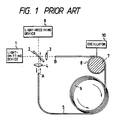
- Coherent light issuing from a light-emitting device 1 is split into two beams by a beam splitter 2.
- One of the two beams is converged by a coupling lens 4 and launched into end A of an optical fiber cable 5. This beam is transmitted through the sensor coil 6 counterclockwise.
- the other beam is converged by a coupling lens 3, launched into end B of the optical fiber 5 and transmitted through the sensor coil 6 clockwise.
- the greater part of the optical fiber cable 5 forms the sensor coil 6 and only the part close to end B is wound around the piezoelectric device to form a phase modulation device 7.
- An oscillator 10 produces an oscillating voltage that causes the piezoelectric device to expand or contract.
- the phase modulating part 8 of the optical fiber cable is wound onto the piezoelectric device, so it will expand or contract together with the piezoelectric device to produce a light signal containing a modulated component.
- the light beam transmitted clockwise through the phase modulating part 8 and the sensor coil 6 will emerge from end A, and the other beam transmitted counterclockwise through the sensor coil 6 and the phase modulating part 8 will emerge at end B.
- the emerging light beams are recombined by the beam splitter 2 and launched as a single beam into a light-receiving device 9, which performs square-law detection on the light of interference.
- phase modulation device 7 Since the phase modulation device 7 is located asymmetrically with respect to the fiber-optic cable 5, the light being transmitted clockwise is phase-modulated at a slightly different time than the light being transmitted counterclockwise.
- the time, ⁇ , required for the light to pass through the sensor coil 6 is given by: where L is the fiber length of the sensor coil 6 and n is the refractive index of the fiber core. If the phase modulation device 7 is positioned close to end B, the light being transmitted clockwise will be first phase-modulated before it is launched into the sensor coil 6. On the other hand, the light being transmitted counterclockwise passes through the sensor coil 6 before it is launched into the phase modulation device 7.
- ⁇ ⁇ ⁇
- the Sagnac effect introduces a phase difference of ⁇ between the light transmitted clockwise and the light transmitted counterclockwise, and the phase modulation applied on the two light beams creates an additional phase difference of ⁇ in the phase-modulated portion.
- E L E o sin ⁇ t - ⁇ 2 + b sin ( ⁇ t) ⁇
- D.C. denotes the dc component
- ⁇ is the number of vibrations of light waves, with 2 ⁇ representing a component having twice the number of vibration ⁇ .
- Such a fast signal cannot be detected by the light-receiving device 9 and hence is zero.
- the output signal from the light-receiving device 9 contains the phase-modulated component ⁇ , so the phase difference ⁇ can be determined in association with the amplitude of the modulation signal.
- This can be expanded in terms of Bessel functions.
- the fundamental component P 2 E o 2J1 ( ⁇ )cos ⁇ t sin ⁇
- Q (t) 2 E o 2J2 ( ⁇ )cos 2 ⁇ t cos ⁇
- the fundamental component P is detected to determine ⁇ .
- J1 ( ⁇ ) is maximized.
- JP-A-60-135816 (the term "JP-A” as used herein means an "unexamined published Japanese patent application”) proposes a control system that provides a constant dc component in output signal. But the problem associated with the quantity of reflected light is not discussed in this patent.
- reflected light is meant those components of light which are reflected from the edge faces of lenses, fiber and other parts of the optical system. These components will not contribute to the measurement of angular velocity but simply become noise. In contrast, signal light passes through the sensor coil and contributes to the measurement of angular velocity.
- the light-receiving device receives both signal light and reflected light.
- the reflected light does not pass through the sensor coil.
- the control system described in JP-A-60-135816 assumes either the absence of reflected light or the presence of reflected light that will vary in the same way as does the signal light. Only in that case is valid the statement that holding the dc component constant is equivalent to controlling the amplitude of the light to be constant. In practice, however, a quantity of reflected light that is by no means negligible is launched into the light-receiving device. Reflected light will not fluctuate in the same way as does the signal light, or one may say that it will hardly fluctuate. The phase modulation index will also sometimes fluctuate. Therefore, holding the dc component constant does not necessarily result in a constant amplitude of the signal light.
- the prior art fiber-optic gyroscope suffers the problem that substantial variations occur in the quantity of light that is issued from the light-emitting device to be launched into the optical fiber cable. In other words, substantial variations can occur in the amplitude E o . Thus, apparently different outputs will be produced for the same angular velocity on account of these variations in the quantity of light.
- JP-A-61-147106 proposes a control system that is capable of maintaining a constant level of the dc component in the signal.
- JP-A-60-135816 already cited above proposes that the effects of variations in the quantity of light be cancelled by dividing the phase-modulated frequency component of the signal by the dc component.
- a phase-modulated fiber-optic gyroscope that operates with the second harmonic component controlled to be constant has also been proposed (see the already cited Japanese Patent Application No. 59-244641).
- the second harmonic component contains J2( ⁇ ) and holding it constant was considered to be equivalent to controlling the phase modulation index to become constant. However, holding the dc component constant is by no means equivalent to controlling the quantity of light to be constant.
- the dc component contains ⁇ in the form of cos ⁇ .
- the invention described in Japanese Patent Application No. 59-244641 adopts the approximation of ⁇ 0 and controls the dc component to become constant on the assumption that it is proportional to the intensity of the light issuing from the light-emitting device.
- the phase difference ⁇ sometimes has such a great magnitude that it cannot be neglected. If ⁇ is substantial, the approximation of ⁇ 0 will produce inaccuracy.
- the second harmonic component Q has not only the J2( ⁇ ) term but also the cos ⁇ term.
- the second harmonic component is held constant on the basis of the approximation that ⁇ is nearly equal to zero. However, this approximation is by no means exact if ⁇ is great. This will eventually result in failure to maintain a constant value of the phase modulation index.
- a control system in which the constant DC component or the amplitude of the second harmonic of the output signal is additionally measured is also known from the following document: Carl Cranz Deutschen e.V., Oberpfaffenhofen, Lehrgang: "Sensoren in inertialen Mess-und Navigationssystemen", held in Braunschweig, DE, October 17-21, 1988; W. Auch: “Faseroptician Rotationssensoren", Section 1.
- the gyroscope according to the preamble of claim 1 is known from the EP-A-0 185 385.
- the phase modulation type fibre-optic gyroscope known from this reference has an improved output stability without a large increase in the number of basic components of the gyroscope system.
- the DC component of the output of a light detecting element which provides the two circulating beams is sensed and employed to control the output of the light emitting element so as to be constant.
- the fiber-optic gyroscope of the present invention may operate on the following principles:
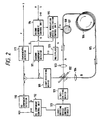
- a light-emitting device 101 is a light source of coherent light and may be composed of any apparatus such as a semiconductor laser, a super-luminescent diode or gas laser.
- a beam splitter 102 divides the coherent light from the light-emitting device 101 into two light beams.
- the term "beam splitter” is used herein to mean a light dividing device in its broad sense.
- the two split light beams are converged by lenses 103 and 104 and launched into an optical fiber cable 105 at opposite ends A and B.
- the optical fiber cable 105 is made of a single-mode optical fiber and includes a sensor coil 106 consisting of many turns of the optical fiber and a portion 108 wound around a phase modulation device 107. The sensor coil detects the angular velocity of rotation.
- the phase modulation device 107 comprises a piezoelectric device, typically in cylindrical form, that is provided with electrodes on an outside and an inside surface and around which the optical fiber cable is wound.
- the phase modulation device 107 imparts periodic phase changes to the light being transmitted through the fiber-optic cable.
- a modulation voltage of a frequency ⁇ from a phase modulation device excitation control unit 115.
- the amplitude of the applied voltage is proportional to the phase modulation index.
- the light beam launched at end A is transmitted clockwise through the sensor coil 106, whereas the light beam launched at end B is transmitted counterclockwise.
- the two light beams emerging from the fiber-optic cable are re-combined by the beam splitter 102 and are launched as a single beam into a light-receiving device 109.
- the light-receiving device 109 detects the intensity of the light of interference and produces it as an output.
- the output from the light-receiving device contains the dc component D, the fundamental component P, the second harmonic component Q and harmonics of higher orders.
- the dc component control unit 112 supplies a light-emitting device control circuit 113 with a drive current W for the light-emitting device.
- the control unit 112 controls the dc component D of the output from the light-receiving device in such a way that said dc component is held constant when a stop signal U is supplied or when the final output S is zero.
- the stop signal U need not refer to a "stop” in the strict sense of the term and a state close to "stop” may also be indicated. The same is true with the final output S and it need only be close to zero.
- the fundamental component P of the output from the light-receiving device 109 is detected by the fundamental detector 117.
- a sync signal is supplied from the phase modulation device excitation control unit 115.
- the second harmonic component Q of the output from the light-receiving device 109 is detected by a second harmonic detector 111.
- the modulation signal from the control unit 115 is doubled in a multiplier 120 to produce a sync signal.
- the modulation index of the control unit 115 is controlled in such a way as to provide a constant level of the second harmonic component.
- the modulation index is theoretically expressed by b but since it is proportional to ⁇ , ⁇ may also be designated as the modulation index.
- the second harmonic component is not always controlled to be constant. Only when a stop signal U is supplied from another sensor or if the final output S from the gyroscope is either equal or close to zero is the second harmonic component controlled to become equal to a predetermined value Q o .
- Such an intermittent control is performed by a second harmonic control unit 114.
- the gyroscope which is at rest or in a state very close to it is identified by the supply of either a stop signal from another sensor or a substantially zero output S from the gyroscope.
- the value of the second harmonic component Q in that instance is adopted by the control unit 114 which compares it with Q o and supplies the modulation index ⁇ of the phase modulation device excitation control unit 115 in such a way that the difference between Q and Qo will be minimized.
- the fundamental component P appears as the output of the fundamental detector 117, which serves as the final output S.
- the intensity of the light E o 2 can be held constant.
- the phase modulation index ⁇ can be held constant.
- the coefficients in equation (24) are held constant, and ⁇ can be determined from the final output S in the form of sin ⁇ .
- the second harmonic component is detected and controlled to be constant in order to maintain a constant level of the phase modulation index. It should, however, be noted that in place of the second harmonic component, the third or fourth harmonic component may be controlled to be constant in order to maintain a constant level of the phase modulation index. This is possible since all the harmonics of interest contain the phase modulation index.
- the dc component D of the output from the light-receiving device can be rewritten as: 1 2 (E12 + E22) + E1 E2 J o ( ⁇ ) cos ⁇
- the amplitude of the light transmitted clockwise is substantially equal to that of the light transmitted counterclockwise as expressed below: E1 ⁇ E2
- the modulation index ⁇ may assume any value but here a special case is considered.
- the first-order Bessel function J1( ⁇ ) need be maximized, with ⁇ selected at a value of approximately 1.8.
- the zero-order Bessel function J o ( ⁇ ) is approximately 0.3.
- phase modulation index ⁇ can be controlled to be constant
- the final output S or the fundamental component P is expressed as follows from equation (24):
- the coefficients preceding sin ⁇ are invariable constants and the exact value of ⁇ can be determined from the output S. This effect can never be attained simply by controlling the quantity of light or the modulation index alone.
- Fig. 3 shows another embodiment of the present invention which employs the construction shown in Fig. 2.
- the components which are the same as those shown in Fig. 2 are identified by like numerals and will not be described in detail.
- the dc component detector 110 is supplied with the output from the light-receiving device 109 and produces the dc component of said output as a voltage signal, which is converted to a digital signal in an A/D converter 122.
- a control signal for controlling the quantity of the light issuing from the light-emitting device in such a way that the dc component D becomes equal to the preset value D o is calculated and constructed.
- This control signal is converted to an analog signal in a D/A converter 121 and supplied to the light-emitting device output control circuit 113.
- the control signal constructed for the previous case where the gyroscope was at rest is retained and delivered as an output. Since it is handled as a digital signal by a digital processing unit 116, the control signal can be easily retained and continuously supplied as an output.
- the light-emitting device output control circuit 113 controls the quantity of the light emerging from the light-emitting device.
- An oscillator 118 generates a modulation signal having a frequency ⁇ .
- the output of the oscillator 118 is fed to a multiplier 119 where it is amplified by an appropriate factor.
- the amplified phase modulation signal is applied to the electrodes of the phase modulation device 107.
- ⁇ or the modulation amplitude b which is to be provided by the phase modulation device 107 can be freely adjusted by controlling the factor of amplification with the multiplier 119.
- the fundamental component P is fed to an A/D converter 124 and thence supplied into the digital processing unit 116.
- Multiplier 120 multiplies the phase modulation signal from the oscillator 118 to form a sync signal having a frequency of 2 ⁇ .
- the second harmonic detector 111 detects the second harmonic component Q of the output from the light-receiving device. The detected signal is fed to an A/D converter 125 where it is converted to a digital signal which is thereafter supplied to the digital processing unit 116.
- the digital processing unit 116 recognizes this situation either by its own final output S or in response to a stop signal U supplied from another sensor. In the latter case, a state signal from another sensor is supplied into the digital processing unit 116 through a state signal detecting interface 126. The digital processing unit 116 then determines as to whether the applied state signal indicates that the gyroscope is at rest and if this is the case, a stop signal U is constructed. Alternatively, another sensor may itself produce a stop signal U when the gyroscope is at rest, which stop signal is then supplied into the digital processing unit 116. Of course, the gyroscope may itself produce a final output S which is nearly equal to zero.
- the digital processing unit 116 When the fiber-optic gyroscope is at rest or in a state very close to it, the digital processing unit 116 performs the following two operations. First, it compares the dc component D with the preset reference D o and controls the output of the light-emitting device in such a way that the difference is minimized. The control signal is supplied into the light-emitting device output control unit 113 through the D/A converter 121. Second, the processing unit compares the second harmonic component Q with the preset reference Q o and controls the phase modulation index ⁇ in such a way that the difference is minimized. The control signal is supplied into the multiplier 119 through the D/A converter 123.
- the angular velocity of the rotating gyroscope can be determined from the fundamental component P.
Landscapes
- Physics & Mathematics (AREA)
- Engineering & Computer Science (AREA)
- Optics & Photonics (AREA)
- Electromagnetism (AREA)
- Power Engineering (AREA)
- General Physics & Mathematics (AREA)
- Radar, Positioning & Navigation (AREA)
- Remote Sensing (AREA)
- Gyroscopes (AREA)
Claims (3)
- Gyroscope à fibre optique modulé en phase pour mesurer la vitesse angulaire d'un objet mobile, comprenant :
un moyen de modulation de phase (107) ;
un moyen de câble à fibre optique (105) comportant deux extrémités, ledit moyen de câble à fibre optique comprenant une bobine de capteur (106) et une partie (108) munie dudit moyen de modulation de phase positionné de façon asymétrique par rapport audit moyen de câble à fibre optique ;
un dispositif émetteur de lumière (101) pour émettre une lumière cohérente ;
un moyen de séparateur de faisceau (102) pour séparer la lumière cohérente provenant dudit dispositif émetteur de lumière selon deux faisceaux qui sont envoyés dans les deux extrémités dudit moyen de câble à fibre optique et pour recombiner les faisceaux lumineux transmis au travers dudit moyen de câble à fibre optique (105) ;
un moyen de réception de lumière (109) pour recevoir depuis les deux extrémités dudit moyen de câble à fibre optique les faisceaux lumineux qui ont été transmis au travers dudit moyen de câble à fibre optique et qui sont recombinés par ledit moyen de séparateur de faisceau ;
un moyen de détecteur de composante continue (110) qui reçoit le signal de sortie dudit moyen de réception de lumière pour détecter la composante continue du signal de sortie ; et
un moyen de détecteur synchrone (111, 117) pour recevoir un signal de sortie provenant dudit moyen de réception de lumière pour détecter une composante de fréquence modulée en phase du signal de sortie dudit moyen de réception de lumière,
caractérisé en ce que :
ledit moyen de détecteur synchrone comprend un moyen de détecteur d'harmonique (111) pour détecter une composante d'harmonique présentant une fréquence qui est un multiple entier approprié de la fréquence de modulation de phase angulaire, soit Ω ; et
un moyen de détecteur d'onde fondamentale (117) pour détecter une composante fondamentale du signal de sortie, c'est-à-dire le terme de premier ordre du développement de la fréquence de modulation Ω selon des ondes d'harmoniques, provenant dudit moyen de réception de lumière ; et en ce que
le gyroscope comprend en outre un moyen (112, 113, 114) pour commander à la fois le signal de sortie dudit moyen émetteur de lumière et un indice de modulation de phase ξ pour amener la composante continue et la composante d'harmonique, dans le cas où le gyroscope est pratiquement au repos, proches de valeurs respectives prédéterminées, l'indice de modulation de phase ξ étant rapporté à l'amplitude b du fait de l'action du moyen de modulation de phase (107) et à la différence de phase φ du fait de la différence temporelle τ de réalisation de ladite action sur lesdits deux faisceaux par les équations :
- Gyroscope à fibre optique modulé en phase selon la revendication 1, comprenant en outre un moyen (112, 113) pour bloquer la composante continue du signal de sortie provenant dudit moyen de réception de lumière lorsque le gyroscope est pratiquement au repos et pour commander le signal de sortie dudit moyen d'émetteur de lumière de telle sorte qu'un niveau de la composante continue bloquée soit maintenu constant.
- Gyroscope à fibre optique modulé en phase selon la revendication 1 ou 2, comprenant en outre un moyen (114) pour bloquer une composante d'harmonique d'ordre deux Q du signal de sortie provenant dudit moyen de réception de lumière lorsque le gyroscope est pratiquement au repos et pour commander l'indice de modulation de phase de telle sorte qu'un niveau de la composante d'harmonique d'ordre deux Q soit maintenu constant.
Applications Claiming Priority (7)
| Application Number | Priority Date | Filing Date | Title |
|---|---|---|---|
| JP57635/89 | 1989-03-08 | ||
| JP5763589A JPH02236112A (ja) | 1989-03-08 | 1989-03-08 | 位相変調方式光フアイバジヤイロ |
| JP5763789A JPH02236114A (ja) | 1989-03-08 | 1989-03-08 | 位相変調方式光フアイバジヤイロ |
| JP57636/89 | 1989-03-08 | ||
| JP5763689A JPH02236113A (ja) | 1989-03-08 | 1989-03-08 | 位相変調方式光フアイバジヤイロ |
| JP57637/89 | 1989-03-08 | ||
| EP90104363A EP0386739B1 (fr) | 1989-03-08 | 1990-03-07 | Gyroscope à fibre optique avec modulation de phase |
Related Parent Applications (1)
| Application Number | Title | Priority Date | Filing Date |
|---|---|---|---|
| EP90104363.8 Division | 1990-03-07 |
Publications (3)
| Publication Number | Publication Date |
|---|---|
| EP0511684A2 EP0511684A2 (fr) | 1992-11-04 |
| EP0511684A3 EP0511684A3 (en) | 1993-01-13 |
| EP0511684B1 true EP0511684B1 (fr) | 1995-08-30 |
Family
ID=27296322
Family Applications (2)
| Application Number | Title | Priority Date | Filing Date |
|---|---|---|---|
| EP90104363A Expired - Lifetime EP0386739B1 (fr) | 1989-03-08 | 1990-03-07 | Gyroscope à fibre optique avec modulation de phase |
| EP92108242A Expired - Lifetime EP0511684B1 (fr) | 1989-03-08 | 1990-03-07 | Gyroscope à fibre optique avec modulation de phase |
Family Applications Before (1)
| Application Number | Title | Priority Date | Filing Date |
|---|---|---|---|
| EP90104363A Expired - Lifetime EP0386739B1 (fr) | 1989-03-08 | 1990-03-07 | Gyroscope à fibre optique avec modulation de phase |
Country Status (4)
| Country | Link |
|---|---|
| US (1) | US5048961A (fr) |
| EP (2) | EP0386739B1 (fr) |
| CA (1) | CA2011698C (fr) |
| DE (2) | DE69009533T2 (fr) |
Families Citing this family (13)
| Publication number | Priority date | Publication date | Assignee | Title |
|---|---|---|---|---|
| US5080489A (en) * | 1989-03-29 | 1992-01-14 | Kubota, Ltd. | Fiber optic gyroscope for detecting angular velocity of rotation using equivalent time sampling |
| US5196904A (en) * | 1990-12-31 | 1993-03-23 | Honeywell Inc. | Fiber optic gyroscope bias modulation amplitude determination |
| US5289257A (en) * | 1991-05-17 | 1994-02-22 | Mitsubishi Precision Co., Ltd. | Signal processing apparatus for optical gyro |
| US5412472A (en) * | 1992-01-30 | 1995-05-02 | Japan Aviation Electronics Industry Limited | Optical-interference type angular velocity or rate sensor having an output of improved linearity |
| US5283626A (en) * | 1992-04-17 | 1994-02-01 | Honeywell Inc. | Fiber optic gyroscope bias modulation amplitude determination with reset means |
| EP0569993B1 (fr) * | 1992-05-14 | 1996-01-31 | Japan Aviation Electronics Industry, Limited | Capteur de vitesse angulaire du type interferomètre optique |
| GB2276000B (en) * | 1993-02-27 | 1996-10-09 | British Aerospace | Laser gyroscopes |
| WO1998021551A1 (fr) * | 1996-11-14 | 1998-05-22 | Talltec Technologies Holdings Foundation | Gyrometre a fibre optique multimode, a resolution et a stabilite ameliorees |
| RU2142118C1 (ru) * | 1998-06-29 | 1999-11-27 | Производственное объединение "Корпус" | Малогабаритный трехосный волоконно-оптический измеритель угловой скорости |
| DE10138154C2 (de) * | 2001-08-03 | 2003-06-05 | Litef Gmbh | Verfahren und Einrichtung zur Erhöhung der Langzeit-Betriebszuverlässigkeit eines faseroptischen Interferometers |
| RU2227272C2 (ru) * | 2002-07-17 | 2004-04-20 | ФГУП ПО "Корпус" | Широкодиапазонный волоконно-оптический измеритель угловой скорости |
| US9354063B2 (en) * | 2014-04-30 | 2016-05-31 | Honeywell International Inc. | Systems and methods for providing intensity stabilization for a resonator fiber optic gyroscope |
| RU2626553C1 (ru) * | 2016-05-19 | 2017-07-28 | Федеральное государственное казенное военное образовательное учреждение высшего образования "Военный учебно-научный центр Военно-воздушных сил "Военно-воздушная академия имени профессора Н.Е. Жуковского и Ю.А. Гагарина" (г. Воронеж) Министерства обороны Российской Федерации | Полосовой усилитель |
Family Cites Families (6)
| Publication number | Priority date | Publication date | Assignee | Title |
|---|---|---|---|---|
| JPS60135816A (ja) * | 1983-12-26 | 1985-07-19 | Sumitomo Electric Ind Ltd | 光フアイバジヤイロ |
| JPS61124817A (ja) * | 1984-11-21 | 1986-06-12 | Agency Of Ind Science & Technol | 位相変調方式光フアイバジヤイロ |
| JPH0743263B2 (ja) * | 1984-12-21 | 1995-05-15 | 工業技術院長 | 位相変調方式光ファイバジャイロ |
| JPH0680405B2 (ja) * | 1985-11-06 | 1994-10-12 | 株式会社東芝 | 光フアイバジヤイロ |
| US4796993A (en) * | 1987-04-13 | 1989-01-10 | Hitachi, Ltd. | Phase modulation type fiber optic gyroscope |
| US4883358A (en) * | 1987-09-02 | 1989-11-28 | Japan Aviation Electronics Industry Limited | Fiber optic gyro stabilized by harmonic components of detected signal |
-
1990
- 1990-03-07 DE DE69009533T patent/DE69009533T2/de not_active Expired - Fee Related
- 1990-03-07 CA CA002011698A patent/CA2011698C/fr not_active Expired - Fee Related
- 1990-03-07 EP EP90104363A patent/EP0386739B1/fr not_active Expired - Lifetime
- 1990-03-07 DE DE69022072T patent/DE69022072T2/de not_active Expired - Fee Related
- 1990-03-07 US US07/489,556 patent/US5048961A/en not_active Expired - Fee Related
- 1990-03-07 EP EP92108242A patent/EP0511684B1/fr not_active Expired - Lifetime
Also Published As
| Publication number | Publication date |
|---|---|
| EP0386739B1 (fr) | 1994-06-08 |
| EP0511684A2 (fr) | 1992-11-04 |
| US5048961A (en) | 1991-09-17 |
| EP0386739A2 (fr) | 1990-09-12 |
| CA2011698A1 (fr) | 1990-09-08 |
| DE69009533D1 (de) | 1994-07-14 |
| EP0511684A3 (en) | 1993-01-13 |
| DE69009533T2 (de) | 1994-09-29 |
| DE69022072T2 (de) | 1996-02-15 |
| DE69022072D1 (de) | 1995-10-05 |
| EP0386739A3 (en) | 1990-12-19 |
| CA2011698C (fr) | 1994-08-23 |
Similar Documents
| Publication | Publication Date | Title |
|---|---|---|
| US4765739A (en) | Fiber optical rotation sensor utilizing the Sagnac phase difference | |
| EP0532679B1 (fr) | Commande de la frequence de modulation dans un detecteur de rotation a fibre optique | |
| EP2221579B1 (fr) | Correction d'erreurs de modulation dans un RFOG | |
| US4545682A (en) | Optical gyroscope | |
| US4863272A (en) | Multi-mode fiber optic resonator gyroscope | |
| US5946097A (en) | Vibration rectification error reducer for fiber optic gyroscope | |
| US5090810A (en) | Ring resonator gyroscope controlling two servo control loops based on the output of a single interference detector | |
| EP0614069A1 (fr) | Gyroscopes à laser | |
| JPH03210417A (ja) | ファイバー光測定装置、ジャイロメータ、セントラルナビゲーション、及び安定化システム | |
| EP0511684A2 (fr) | Gyroscope à fibre optique avec modulation de phase | |
| US5080489A (en) | Fiber optic gyroscope for detecting angular velocity of rotation using equivalent time sampling | |
| US6028668A (en) | Fiber optic gyroscope having improved readout and modulation index control | |
| EP3086091A1 (fr) | Gyroscope à fibre optique polarisée en rotation | |
| EP0431474B1 (fr) | Gyroscope à fibre optique | |
| EP0535164B1 (fr) | Demodulation de source de signaux de reference | |
| CA2021073A1 (fr) | Gyroscope serrodyne double a resonateur a fibre optique | |
| US5031988A (en) | Fiber optic gyro | |
| US4863273A (en) | D.C. component controlled fiber optic gyroscope | |
| US5285257A (en) | Optic rotation sensing apparatus and related method including providing synchronous detection at a phase at which the AM noise is minimized | |
| US4840489A (en) | Interferometer gyroscope having two feedback loops | |
| CA2061772C (fr) | Demodulateur synchrone | |
| EP0501461A1 (fr) | Gyroscope à fibre optique | |
| EP0492580B1 (fr) | Gyroscope à fibre optique | |
| EP0802397A1 (fr) | Gyroscope à fibre optique | |
| EP0501002B1 (fr) | Appareil optique pour mesurer une rotation et procédé en relation avec cet appareil |
Legal Events
| Date | Code | Title | Description |
|---|---|---|---|
| PUAI | Public reference made under article 153(3) epc to a published international application that has entered the european phase |
Free format text: ORIGINAL CODE: 0009012 |
|
| AC | Divisional application: reference to earlier application |
Ref document number: 386739 Country of ref document: EP |
|
| AK | Designated contracting states |
Kind code of ref document: A2 Designated state(s): DE FR GB IT SE |
|
| PUAL | Search report despatched |
Free format text: ORIGINAL CODE: 0009013 |
|
| AK | Designated contracting states |
Kind code of ref document: A3 Designated state(s): DE FR GB IT SE |
|
| 17P | Request for examination filed |
Effective date: 19930303 |
|
| 17Q | First examination report despatched |
Effective date: 19941017 |
|
| GRAA | (expected) grant |
Free format text: ORIGINAL CODE: 0009210 |
|
| AC | Divisional application: reference to earlier application |
Ref document number: 386739 Country of ref document: EP |
|
| AK | Designated contracting states |
Kind code of ref document: B1 Designated state(s): DE FR GB IT SE |
|
| PG25 | Lapsed in a contracting state [announced via postgrant information from national office to epo] |
Ref country code: IT Free format text: LAPSE BECAUSE OF FAILURE TO SUBMIT A TRANSLATION OF THE DESCRIPTION OR TO PAY THE FEE WITHIN THE PRE;WARNING: LAPSES OF ITALIAN PATENTS WITH EFFECTIVE DATE BEFORE 2007 MAY HAVE OCCURRED AT ANY TIME BEFORE 2007. THE CORRECT EFFECTIVE DATE MAY BE DIFFERENT FROM THE ONE RECORDED.SCRIBED TIME-LIMIT Effective date: 19950830 |
|
| ET | Fr: translation filed | ||
| REF | Corresponds to: |
Ref document number: 69022072 Country of ref document: DE Date of ref document: 19951005 |
|
| PG25 | Lapsed in a contracting state [announced via postgrant information from national office to epo] |
Ref country code: SE Effective date: 19951130 |
|
| PLBE | No opposition filed within time limit |
Free format text: ORIGINAL CODE: 0009261 |
|
| STAA | Information on the status of an ep patent application or granted ep patent |
Free format text: STATUS: NO OPPOSITION FILED WITHIN TIME LIMIT |
|
| 26N | No opposition filed | ||
| PGFP | Annual fee paid to national office [announced via postgrant information from national office to epo] |
Ref country code: GB Payment date: 20000301 Year of fee payment: 11 |
|
| PGFP | Annual fee paid to national office [announced via postgrant information from national office to epo] |
Ref country code: DE Payment date: 20000306 Year of fee payment: 11 |
|
| PGFP | Annual fee paid to national office [announced via postgrant information from national office to epo] |
Ref country code: FR Payment date: 20000310 Year of fee payment: 11 |
|
| PG25 | Lapsed in a contracting state [announced via postgrant information from national office to epo] |
Ref country code: GB Free format text: LAPSE BECAUSE OF NON-PAYMENT OF DUE FEES Effective date: 20010307 |
|
| GBPC | Gb: european patent ceased through non-payment of renewal fee |
Effective date: 20010307 |
|
| PG25 | Lapsed in a contracting state [announced via postgrant information from national office to epo] |
Ref country code: FR Free format text: LAPSE BECAUSE OF NON-PAYMENT OF DUE FEES Effective date: 20011130 |
|
| REG | Reference to a national code |
Ref country code: FR Ref legal event code: ST |
|
| PG25 | Lapsed in a contracting state [announced via postgrant information from national office to epo] |
Ref country code: DE Free format text: LAPSE BECAUSE OF NON-PAYMENT OF DUE FEES Effective date: 20020101 |