EP0507288A2 - Methode zur Aufbereitung von CPMAS-NMR-Spektren - Google Patents
Methode zur Aufbereitung von CPMAS-NMR-Spektren Download PDFInfo
- Publication number
- EP0507288A2 EP0507288A2 EP92105646A EP92105646A EP0507288A2 EP 0507288 A2 EP0507288 A2 EP 0507288A2 EP 92105646 A EP92105646 A EP 92105646A EP 92105646 A EP92105646 A EP 92105646A EP 0507288 A2 EP0507288 A2 EP 0507288A2
- Authority
- EP
- European Patent Office
- Prior art keywords
- pulse
- frequency
- phase
- nuclear species
- cross
- Prior art date
- Legal status (The legal status is an assumption and is not a legal conclusion. Google has not performed a legal analysis and makes no representation as to the accuracy of the status listed.)
- Granted
Links
- 238000000034 method Methods 0.000 title claims abstract description 37
- 238000005384 cross polarization magic-angle spinning Methods 0.000 title claims abstract description 36
- 238000000279 solid-state nuclear magnetic resonance spectrum Methods 0.000 title description 5
- 238000005388 cross polarization Methods 0.000 claims abstract description 28
- 230000003595 spectral effect Effects 0.000 claims abstract description 21
- 238000001208 nuclear magnetic resonance pulse sequence Methods 0.000 claims abstract description 19
- 230000005415 magnetization Effects 0.000 claims abstract description 7
- 238000012565 NMR experiment Methods 0.000 claims abstract description 3
- 230000005855 radiation Effects 0.000 claims abstract 15
- 150000001721 carbon Chemical class 0.000 claims description 4
- 238000001228 spectrum Methods 0.000 description 69
- 238000002474 experimental method Methods 0.000 description 34
- 125000001570 methylene group Chemical group [H]C([H])([*:1])[*:2] 0.000 description 23
- 230000008878 coupling Effects 0.000 description 19
- 238000010168 coupling process Methods 0.000 description 19
- 238000005859 coupling reaction Methods 0.000 description 19
- 229910052799 carbon Inorganic materials 0.000 description 16
- OKTJSMMVPCPJKN-UHFFFAOYSA-N Carbon Chemical compound [C] OKTJSMMVPCPJKN-UHFFFAOYSA-N 0.000 description 15
- 125000002496 methyl group Chemical group [H]C([H])([H])* 0.000 description 14
- 239000004793 Polystyrene Substances 0.000 description 13
- 229920002223 polystyrene Polymers 0.000 description 13
- 239000000126 substance Substances 0.000 description 13
- CZMRCDWAGMRECN-UGDNZRGBSA-N Sucrose Chemical compound O[C@H]1[C@H](O)[C@@H](CO)O[C@@]1(CO)O[C@@H]1[C@H](O)[C@@H](O)[C@H](O)[C@@H](CO)O1 CZMRCDWAGMRECN-UGDNZRGBSA-N 0.000 description 12
- 229930006000 Sucrose Natural products 0.000 description 12
- 230000000694 effects Effects 0.000 description 12
- 239000005720 sucrose Substances 0.000 description 12
- 238000005481 NMR spectroscopy Methods 0.000 description 10
- 230000003993 interaction Effects 0.000 description 10
- 239000007787 solid Substances 0.000 description 10
- 238000005004 MAS NMR spectroscopy Methods 0.000 description 4
- 239000002131 composite material Substances 0.000 description 4
- 238000010586 diagram Methods 0.000 description 4
- 239000007788 liquid Substances 0.000 description 4
- 238000000371 solid-state nuclear magnetic resonance spectroscopy Methods 0.000 description 4
- 238000012360 testing method Methods 0.000 description 4
- UHOVQNZJYSORNB-UHFFFAOYSA-N Benzene Chemical compound C1=CC=CC=C1 UHOVQNZJYSORNB-UHFFFAOYSA-N 0.000 description 3
- 230000010287 polarization Effects 0.000 description 3
- 230000001629 suppression Effects 0.000 description 3
- 230000036962 time dependent Effects 0.000 description 3
- 238000012546 transfer Methods 0.000 description 3
- XILIYVSXLSWUAI-UHFFFAOYSA-N 2-(diethylamino)ethyl n'-phenylcarbamimidothioate;dihydrobromide Chemical compound Br.Br.CCN(CC)CCSC(N)=NC1=CC=CC=C1 XILIYVSXLSWUAI-UHFFFAOYSA-N 0.000 description 2
- 230000008859 change Effects 0.000 description 2
- 230000001427 coherent effect Effects 0.000 description 2
- 230000001419 dependent effect Effects 0.000 description 2
- 230000005284 excitation Effects 0.000 description 2
- 238000012986 modification Methods 0.000 description 2
- 230000004048 modification Effects 0.000 description 2
- 230000003094 perturbing effect Effects 0.000 description 2
- 230000010363 phase shift Effects 0.000 description 2
- 238000009987 spinning Methods 0.000 description 2
- 238000001644 13C nuclear magnetic resonance spectroscopy Methods 0.000 description 1
- 238000012935 Averaging Methods 0.000 description 1
- OKTJSMMVPCPJKN-OUBTZVSYSA-N Carbon-13 Chemical compound [13C] OKTJSMMVPCPJKN-OUBTZVSYSA-N 0.000 description 1
- 238000004458 analytical method Methods 0.000 description 1
- 125000004429 atom Chemical group 0.000 description 1
- 230000033228 biological regulation Effects 0.000 description 1
- 125000004432 carbon atom Chemical group C* 0.000 description 1
- 238000001460 carbon-13 nuclear magnetic resonance spectrum Methods 0.000 description 1
- 150000001875 compounds Chemical class 0.000 description 1
- 238000005100 correlation spectroscopy Methods 0.000 description 1
- 230000003247 decreasing effect Effects 0.000 description 1
- 230000003292 diminished effect Effects 0.000 description 1
- 125000000524 functional group Chemical group 0.000 description 1
- 230000006698 induction Effects 0.000 description 1
- 230000002452 interceptive effect Effects 0.000 description 1
- 230000001678 irradiating effect Effects 0.000 description 1
- 238000002955 isolation Methods 0.000 description 1
- 230000000155 isotopic effect Effects 0.000 description 1
- 238000002372 labelling Methods 0.000 description 1
- SNVLJLYUUXKWOJ-UHFFFAOYSA-N methylidenecarbene Chemical compound C=[C] SNVLJLYUUXKWOJ-UHFFFAOYSA-N 0.000 description 1
- 238000012544 monitoring process Methods 0.000 description 1
- 238000000655 nuclear magnetic resonance spectrum Methods 0.000 description 1
- 230000000737 periodic effect Effects 0.000 description 1
- 238000004321 preservation Methods 0.000 description 1
- 230000008569 process Effects 0.000 description 1
- 238000012552 review Methods 0.000 description 1
- 239000011343 solid material Substances 0.000 description 1
- 238000010996 solid-state NMR spectroscopy Methods 0.000 description 1
- 238000004611 spectroscopical analysis Methods 0.000 description 1
- 238000004481 total suppression of sideband Methods 0.000 description 1
- 230000009466 transformation Effects 0.000 description 1
- 230000001052 transient effect Effects 0.000 description 1
- XLYOFNOQVPJJNP-UHFFFAOYSA-N water Substances O XLYOFNOQVPJJNP-UHFFFAOYSA-N 0.000 description 1
Images


Classifications
-
- G—PHYSICS
- G01—MEASURING; TESTING
- G01R—MEASURING ELECTRIC VARIABLES; MEASURING MAGNETIC VARIABLES
- G01R33/00—Arrangements or instruments for measuring magnetic variables
- G01R33/20—Arrangements or instruments for measuring magnetic variables involving magnetic resonance
- G01R33/44—Arrangements or instruments for measuring magnetic variables involving magnetic resonance using nuclear magnetic resonance [NMR]
- G01R33/46—NMR spectroscopy
- G01R33/4641—Sequences for NMR spectroscopy of samples with ultrashort relaxation times such as solid samples
Definitions
- This invention relates to solid-state NMR spectroscopy and, in particular, to radio-frequency pulse sequences for selectively suppressing resonance lines in CPMAS spectra.
- Nuclear magnetic resonance is a phenomenon exhibited by a select group of atomic nuclei and is based upon the existence of nuclear magnetic moments in these nuclei (termed “gyromagnetic" nuclei).
- gyromagnetic nuclei When a gyromagnetic nucleus is placed in a strong, uniform and steady magnetic field (a so-called “Zeeman field") and perturbed by means of a weak radio-frequency (RF) magnetic field, it precesses at a natural resonance frequency known as a Larmor frequency, which is characteristic of each nuclear type and is dependent on the applied field strength in the location of the nucleus.
- Typical gyromagnetic nuclei include 1H (protons), 13C, 19F and 31P.
- the resonant frequencies of the nuclei can be observed by monitoring the transverse magnetization which results after a strong RE pulse. It is common practice to convert the measured signal to a frequency spectrum by means of Fourier transformation.
- the aforementioned chemical shift anisotropy is usually greatly reduced by orienting the solid sample at a "magic angle" (54°44') with respect to the applied Zeeman field and physically rotating the solid at a relatively rapid rate causing the anisotropic field components to average to zero.
- a conventional NMR technique which is used obtain NMR spectra of organic solids involves obtaining an output from 13C nuclei in the solid of interest. However, the 13C nuclei are not directly excited. Instead, 1H nuclei (protons) in the test sample are excited and various RF pulse sequences are used to transfer polarization from the protons to the 13C nuclei which are then observed.
- This technique is carried out in the presence of magic angle spinning and is referred to as Cross-Polarized Magic Angle Spinning or CPMAS. The technique is described in more detail in "Solid State NMR for Chemists", Colin A. Fyfe, CFC Press, P.O.
- the sample is subject to cross-polarization during which RF pulses or continuous RF energy is applied to both the protons and the 13C nuclei, which causes the transfer of coherence or polarization from the protons to the 13C nuclei under observation.
- the cross-polarization period is followed by data acquisition in which the cross-polarizing energy is removed and a free induction decay (F D) occurs in the 13C nuclei and the resonance frequencies of the 13C nuclei are measured.
- F D free induction decay
- the CPMAS technique produces well-differentiated spectra of the carbon nuclei in the test sample with good chemical shift resolutionN
- the CPMAS spectra appear very similar to 13C NMR spectra of samples in solution, and they are used in much the same way.
- the carbon atoms in a particular sample may be arranged so that resonance peaks or lines overlap and obscure each other.
- the carbon spins typically can be differentiated by means of various spectral "editing" techniques.
- various well-known editing techniques are commonly used to differentiate carbon spins according to the number of directly bonded protons.
- An example of such a technique is the so-called DEPT RF pulse sequence described in "Proton-polarization Transfer Enhancement of a Heteronuclear Spin Multiplet with Preservation of Phase Coherency and Relative Component Intensities", D. T. Pegg, D.M. Doddrell, M.R. Bendall, Journal of Chemical Physics , v. 77, n. 6, pp. 2745-2752 (1982).
- the DEPT technique can differentiate between resonances resulting from CH, CH2 and CH3 functional groups.
- the normal CPMAS experiment is modified to provide for spectral editing.
- the conventional CPMAS experiment is performed with the proton decoupling RF applying at a frequency slightly different than the proton resonance frequency in order to suppress methylene (CH2) resonances more severely than CH and CH3 resonances.
- the RF pulse sequence normally using during the cross-polarization period is replaced with another new sequence which has the effect of suppressing the CH and CH3 resonances, thereby leaving the CH2 resonances.
- Figure 1A schematically illustrates the proton channel of a conventional CPMAS experiment indicating the RF energy applied to the protons.
- Figure 1B schematically illustrates the carbon channel of a conventional CPMAS experiment indicating the RF energy applied to the 13C nuclei.
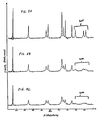
- Figure 2A shows a sucrose spectrum of signal amplitude versus frequency obtained with the conventional CPMAS experiment with the proton decoupling RF applied at the proton resonance frequency.
- Figure 2B shows a sucrose spectrum of signal amplitude versus frequency with the proton decoupling RF applied at an offset of 2500 Hz from the proton resonance frequency.
- Figure 2C shows a sucrose spectrum of signal amplitude versus frequency with the proton decoupling RF applied at an offset of 3500 Hz from the proton resonance frequency.
- Figure 3A shows a polystyrene spectrum of signal amplitude versus frequency obtained with the conventional CPMAS experiment with the proton decoupling RF applied at the proton resonance frequency.
- Figure 3B shows a polystyrene spectrum of signal amplitude versus frequency with the proton decoupling RF applied at an offset of 2500 Hz from the proton resonance frequency.
- Figure 3C shows a polystyrene spectrum of signal amplitude versus frequency with the proton decoupling RF applied at an offset of 5000 Hz from the proton resonance frequency.
- Figure 3D shows a polystyrene spectrum of signal amplitude versus frequency with the proton decoupling RF applied at an offset of 7500 Hz from the proton resonance frequency.
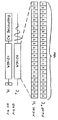
- Figure 4A schematically illustrates the proton channel of a CPMAS experiment modified in accordance with one embodiment of the invention indicating the RF energy applied to the protons.
- Figure 4B schematically illustrates the carbon channel of a CPMAS experiment modified in accordance with one embodiment of the invention indicating the RF energy applied to the 13C nuclei.
- FIG 4C schematically illustrates the WIM sequence applied to the protons for cross-polarization in the experiment illustrated by Figures 4A and 4B.
- Figure 4D schematically illustrates the WIM sequence applied to the 13C nuclei for cross-polarization in the experiment illustrated by Figures 4A and 4B.
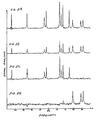
- Figure 5A shows a sucrose spectrum of signal amplitude versus frequency obtained in the CPMAS experiment illustrated in Figures 4A-4D in which the rotor period was set equal to three times the WIM sequence time and the spectra was obtained after four WIM sequences.
- Figure 5B shows a sucrose spectrum of signal amplitude versus frequency obtained in the CPMAS experiment illustrated in Figures 4A-4D in which the rotor period was set equal to three times the WIM sequence time and the spectra was obtained after three WIM sequences.
- Figure 5C is a composite signal spectrum diagram of signal amplitude versus frequency obtained by subtracting the signal amplitudes of the spectrum shown in Figure 5B from the signal amplitudes of the spectrum shown in Figure 5A with slight adjustments.
- Figure 5D is a composite signal spectrum diagram of signal amplitude versus frequency obtained by subtracting the signal amplitudes of the spectrum shown in Figure 5A from doubled signal amplitudes of the spectrum shown in Figure 5B with slight adjustments.
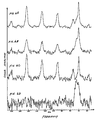
- Figure 6A shows a polystyrene spectrum of signal amplitude versus frequency obtained in the CPMAS experiment illustrated in Figures 4A-4D in which the rotor period was set equal to three times the WIM sequence time and the spectra was obtained after four WIM sequences.
- Figure 6B shows a polystyrene spectrum of signal amplitude versus frequency obtained in the CPMAS experiment illustrated in Figures 4A-4D in which the rotor period was set equal to three times the WIM sequence time and the spectra was obtained after three WIM sequences.
- Figure 6C is a composite signal spectrum diagram of signal amplitude versus frequency obtained by subtracting the signal amplitudes of the spectrum shown in Figure 6B from the signal amplitudes of the spectrum shown in Figure 6A with slight adjustments.
- Figure 6D is a composite signal spectrum diagram of signal amplitude versus frequency obtained by subtracting the signal amplitudes of the spectrum shown in Figure 6A from doubled signal amplitudes of the spectrum shown in Figure 6B with slight adjustments.
- FIG. 1A and 1B A conventional CPMAS experiment is schematically illustrated in Figures 1A and 1B which shown the proton and carbon channels, respectively.
- Figures 1A and 1B show only the RF portion of the experiment.
- the test sample is placed in a rotor with an axis canted at the magic angle to the applied main Zeeman field and rotated at high speed in a conventional fashion.
- the sample protons are placed in a excited, coherent non-equilibrium state by the application of a single RF ⁇ pulse 100 to the sample in a known fashion. No RF energy is applied to the carbon nuclei at this time.
- the sample is subjected to cross-polarization energy during which continuous-wave RF energy, 102, is applied to both the protons and the 13C nuclei at the respective resonant frequencies.
- continuous energy amplitudes are adjusted to meet a condition known as the "Hartmann-Hahn" condition as is well-known.
- the cross-polarization period is followed by a data acquisition period 104 in which the cross-polarizing energy is removed and an FID 106 occurs in the 13C nuclei and the resonance frequencies of the 13C nuclei are measured. During this period it is conventional to apply continuous wave RF decoupling energy 108 at the proton resonance frequency to the protons.
- the conventional CPMAS experiment illustrated in Figures 1A and 1B is performed with modified proton decoupling RF energy at point 108.
- this energy effectively decouples the protons from the 13C nuclei and suppresses heteronuclear couplings.
- spectral editing can be performed by applying proton decoupling RF energy at a frequency purposely off the proton resonance frequency (typically about 3 or 4 KHz off-resonance) depending on the decoupling strength. If the CPMAS experiment is run with the decoupling RF so modified, then the protons are not totally decoupled from the 13C nuclei and, as will be explained below, methylene resonances (CH2) are effectively suppressed.
- methylene resonances CH2
- the nuclear spins change or evolve in time in known ways which can be described mathematically by means of a mathematical operator known as the Hamiltonian operator.
- the overall Hamiltonian can be considered as the sum of the Hamiltonian operators each of which results from separate perturbations such as dipolar coupling, chemical shifts, susceptibility and field gradient.
- the effect of the off-resonance decoupling can be seen by examining the heteronuclear dipolar Hamiltonian.
- the decoupling RF field strength can be expressed in terms of a resonant "frequency" since the nuclear resonant frequency is proportional to the RF field strength.
- the decoupling RF field strength is denoted by ⁇ rf Hz and the frequency offset of the decoupling field from the proton resonance frequency is ⁇ off Hz
- H IS (eff) H IS ⁇ off / ⁇ rf
- H IS (eff) The effect of H IS (eff) is to broaden the spectral lines to a greater or lesser extent according to the proton-carbon coupling strength and as H IS (eff) increases, the broadening effect also increases.
- This broadening has the effect of suppressing methylene resonances more severely than CH and CH3 resonances, since it is generally true that methylene groups have the strongest coupling.
- Methyl groups normally have much weaker coupling due to rotational motion, and CH couplings are also weaker than methylene couplings since only one proton is involved instead of two.
- FIG. 2A-2C A comparison of a conventional sucrose spectrum with sucrose spectra produced by the inventive technique is shown in Figures 2A-2C.
- the spectra shown in Figures 2A-2C were obtained using an unmodified model MSL-400 NMR spectrometer manufactured by Bruker Instruments, Inc., 19 Fortune Drive, Manning Park, Billerica, MA 01821.
- the spectrometer was adjusted according to a conventional and well-known CRAMPS (Combined Rotation and Magic Angle Spinning) tuning procedure.
- a 5mm sphere of water was used to tune the proton channel, and a similar sphere of 13C enriched benzene was used to tune the carbon channel.
- the rotation rate of the MAS rotor was controlled by active regulation in a conventional fashion.
- the plots are of signal amplitude versus frequency.
- the vertical axis is nominal, only relative signal amplitudes are of significance. Since the Larmor frequencies are dependent on the magnetic field strength, it is customary to express frequency in terms of a standard calibration frequency. Thus, the horizontal axis is marked in terms of parts per million of the calibration frequency.
- Figure 2A shows the sucrose spectrum obtained with the conventional CPMAS experiment with the proton decoupling RF applied at the proton resonance frequency.
- Figure 2B shows a sucrose spectrum with the proton decoupling RF applied at an offset of 2500 Hz from the proton resonance frequency and
- Figure 2C shows a sucrose spectrum with the proton decoupling RF applied at an increased offset of 3500 Hz from the proton resonance frequency.
- FIGS 3A-3D illustrate CPMAS spectra of polystyrene obtained under the same conditions as the sucrose spectra illustrated in Figures 2A-2C. More particularly, Figure 3A shows the polystyrene spectrum obtained with the conventional CPMAS experiment with the proton decoupling RF applied at the proton resonance frequency. Figure 3B shows a polystyrene spectrum with the proton decoupling RF applied at an offset of 2500 Hz from the proton resonance frequency.
- Figure 3C shows a polystyrene spectrum with the proton decoupling RF applied at an offset of 5000 Hz from the proton resonance frequency
- Figure 3D shows a polystyrene spectrum with the proton decoupling RF applied at an offset of 7500 Hz from the proton resonance frequency.
- the pulse sequence illustrated in Figures 4C and 4D when the WIM pulse sequence illustrated in Figures 4C and 4D is applied simultaneously to both the protons and carbons in the CPMAS experiment, the pulse sequence has the effect of isolating the protons from each other while allowing the protons and carbons to remain coupled.
- each box in the sequence which is designated with an X or Y marking comprises a single RF pulse applied to the system.
- the applied fields are referenced to a Cartesian coordinate system with the applied Zeeman field pointing along the Z-axis.
- the applied RF fields are polarized 90° to the Zeeman field or along the X and Y axes. Since the X and Y axes are arbitrary directional designations, the pulse designations of X and Y are taken to represent relative phases of the signals. For example a RF pulse designated as an X pulse has a relative phase shift of 90° with respect to an RF pulse designated as a Y pulse.
- an RF pulse designated as X or -X has a relative phase shift of 180° with respect to an X pulse.
- the rotation rate of the sample is adjusted such that the rotor rotation period is an integral number of WIM cycle times 400.
- the spectral editing effect of the illustrative method may be understood by considering in detail the effect of magic angle spinning on the heteronuclear dipolar coupling of isolated CH and CH2 groups. As before, this interaction is described by the heteronuclear dipolar Hamiltonian H is .
- H ⁇ I z S z (1 - 3 cos2 ⁇ ) (3)
- ⁇ constant describing the coupling strength between the proton and carbon nucleus
- I z is a spin operator for the proton
- S z is a spin operator for the carbon nucleus
- ⁇ is the MAS rotor angle with respect to the applied Zeeman field.
- Average Hamiltonian theory is a known simplification which is described in more detail in an article by U. Haeberlen and J.S. Waugh, Physical Review , v. 175, p. 453 (1968); "Advances in Magnetic Resonance", U. Haeberlen, v. 12, suppl. 1, edited by J.S. Waugh, Academic Press (1982) and "Transient Techniques in NMR of Solids", B.C. Gerstein and C.R. Dybowski, Academic Press (1985), which article and references are hereby incorporated by reference.
- heteronuclear dipolar Hamiltonian H is in this case is given by where the subscripts 1 and 2 refer to the two protons.
- the magnetization will not "echo" back to the protons at the end of each rotor rotation.
- the magnetization can be expected to rapidly reach a state of thermal equilibrium between the two spin systems, in much the same way it does when the conventional Hartmann-Hahn cross polarization is used in a CPMAS experiment.
- the editing effect of the WIM pulse sequence becomes immediately clear. If the system is allowed to cross-polarize under simultaneous proton and carbon WIM excitation for an integer number of rotor periods, theoretically, only the methylene resonances should appear in the output. In actual practice, complete suppression of the CH and CH3 resonances does not occur for two reasons. First, the theoretical discussion does not take into account direct dipolar coupling between the CH and CH3 carbons and more distant protons. Second, the WIM sequence itself is not perfect. Although the sequence removes most of the proton-proton coupling, some coupling between protons will remain due to higher order terms in the WIM average Hamiltonian which are not completely time averaged to zero, and due to interference between the WIM pulse sequence and the sample rotation.
- Figures 5A-5D shows a CPMAS spectra of sucrose obtained with the same spectrometer and tuning conditions as the spectra in Figures 2A-2C and 3A-3D.
- the WIM pulse sequence was used for cross-polarization and decoupling energy was applied at the proton resonance frequency and the rotor period was adjusted to be exactly three times the WIM cycle time. Accordingly, the CH and CH3 resonances should be suppressed at outputs taken at integral multiples of the rotor period.
- Figure 5A shows an output spectra taken after four WIM cycles and thus it is not an a rotor period multiple.
- Figure 5B shows a spectra taken after three WIM cycles or at a rotor period multiple. According to the theoretical analysis above, the CH and CH3 resonances should be suppressed in the Figure 5B spectrum.
- a comparison of the Figures 5A and 5B spectra clearly shows a selective suppression of the non-methylene resonance lines when the system was allowed to cross polarize for exactly one rotor period as shown in Figure 5B.
- Figure 6A shows an output spectra taken after four WIM cycles and thus it is not an a rotor period multiple.
- Figure 6B shows a spectra taken after three WIM cycles or at a rotor period multiple.
- Figure 6C shows a difference spectrum obtained by subtracting the spectrum shown in Figure 6B from that shown in Figure 6A with some adjustment of the relative spectral amplitudes and
- Figure 6D shows a difference spectrum obtained by doubling the amplitude of the Figure 6B spectrum before subtracting the Figure 6A spectrum and adjusting the relative signal amplitudes.
- the only methylene resonance is the broad line at a frequency of 45 ppm.
- the second inventive embodiment serves not only to identify the methylene resonance, but also to deconvolute it from an overlapping methyl resonance at a frequency of 42 ppm.
- inventive method may be used in combination with conventional dipolar dephasing editing techniques.
- inventive methods are also applicable to heteronuclear cross-polarization experiments involving other nuclei as well.
- inventive methods can also be combined in a straightforward way with spinning sideband suppression techniques such as SELTICS and TOSS.
Landscapes
- Physics & Mathematics (AREA)
- Spectroscopy & Molecular Physics (AREA)
- High Energy & Nuclear Physics (AREA)
- Condensed Matter Physics & Semiconductors (AREA)
- General Physics & Mathematics (AREA)
- Magnetic Resonance Imaging Apparatus (AREA)
- Crystals, And After-Treatments Of Crystals (AREA)
- Measuring Magnetic Variables (AREA)
Applications Claiming Priority (2)
| Application Number | Priority Date | Filing Date | Title |
|---|---|---|---|
| US68157191A | 1991-04-05 | 1991-04-05 | |
| US681571 | 1991-04-05 |
Publications (3)
| Publication Number | Publication Date |
|---|---|
| EP0507288A2 true EP0507288A2 (de) | 1992-10-07 |
| EP0507288A3 EP0507288A3 (de) | 1992-10-21 |
| EP0507288B1 EP0507288B1 (de) | 1996-02-14 |
Family
ID=24735848
Family Applications (1)
| Application Number | Title | Priority Date | Filing Date |
|---|---|---|---|
| EP92105646A Expired - Lifetime EP0507288B1 (de) | 1991-04-05 | 1992-04-02 | Methode zur Aufbereitung von CPMAS-NMR-Spektren |
Country Status (2)
| Country | Link |
|---|---|
| EP (1) | EP0507288B1 (de) |
| DE (1) | DE69208277T2 (de) |
Cited By (2)
| Publication number | Priority date | Publication date | Assignee | Title |
|---|---|---|---|---|
| DE10015265A1 (de) * | 2000-03-28 | 2001-10-11 | Siemens Ag | Spektroskopisches Bildgebungsverfahren |
| CN110441344A (zh) * | 2019-06-25 | 2019-11-12 | 北京大学 | 一种基于固体核磁共振技术检测rna结构的方法 |
Family Cites Families (1)
| Publication number | Priority date | Publication date | Assignee | Title |
|---|---|---|---|---|
| US5170120A (en) * | 1990-07-19 | 1992-12-08 | Varian Associates, Inc. | Rotor synchronized cross polarization of solid state nmr |
-
1992
- 1992-04-02 DE DE1992608277 patent/DE69208277T2/de not_active Expired - Fee Related
- 1992-04-02 EP EP92105646A patent/EP0507288B1/de not_active Expired - Lifetime
Cited By (5)
| Publication number | Priority date | Publication date | Assignee | Title |
|---|---|---|---|---|
| DE10015265A1 (de) * | 2000-03-28 | 2001-10-11 | Siemens Ag | Spektroskopisches Bildgebungsverfahren |
| DE10015265C2 (de) * | 2000-03-28 | 2002-04-11 | Siemens Ag | Spektroskopisches Bildgebungsverfahren für ein Magnetresonanzgerät |
| US6640125B2 (en) | 2000-03-28 | 2003-10-28 | Siemens Aktiengesellschaft | Spectroscopic imaging method |
| CN110441344A (zh) * | 2019-06-25 | 2019-11-12 | 北京大学 | 一种基于固体核磁共振技术检测rna结构的方法 |
| CN110441344B (zh) * | 2019-06-25 | 2020-09-29 | 北京大学 | 一种基于固体核磁共振技术检测rna结构的方法 |
Also Published As
| Publication number | Publication date |
|---|---|
| DE69208277D1 (de) | 1996-03-28 |
| DE69208277T2 (de) | 1996-10-24 |
| EP0507288A3 (de) | 1992-10-21 |
| EP0507288B1 (de) | 1996-02-14 |
Similar Documents
| Publication | Publication Date | Title |
|---|---|---|
| Smallcombe et al. | WET solvent suppression and its applications to LC NMR and high-resolution NMR spectroscopy | |
| Tycko et al. | Overtone NMR spectroscopy | |
| Yannoni | High-resolution NMR in solids: the CPMAS experiment | |
| Tannús et al. | Adiabatic pulses | |
| US6184683B1 (en) | Method to improve resolution of two-dimensional heteronuclear correlation spectra in solid-state NMR | |
| US20030052677A1 (en) | Method and apparatus for high resolution ex-situ NMR spectroscopy | |
| US4587489A (en) | Method for rapid acquisition of NMR data | |
| Hürlimann | Carr–Purcell sequences with composite pulses | |
| US5126671A (en) | Method for exciting transverse magnetization in nmr pulse experiments | |
| US5926023A (en) | Method of improving the resolution in two-dimensional heteronuclear correlation spectra of solid state NMR | |
| US5117186A (en) | Method for increasing resolution in two-dimensional solid-state nmr heteronuclear correlation spectra | |
| Zhang et al. | Local monitoring of proton spin diffusion in static and rotating samples via spy detection | |
| Kentgens | Off-resonance nutation NMR spectroscopy of half-integer quadrupolar nuclei | |
| US5245284A (en) | Method for editing CPMAS solid-state NMR spectra | |
| Hays | High-resolution carbon-13 solid-state nuclear magnetic resonance spectroscopy | |
| EP0507288A2 (de) | Methode zur Aufbereitung von CPMAS-NMR-Spektren | |
| US5532594A (en) | Method for suppressing solvent resonance signals in NMR experiments | |
| Parella | Spin-state-selective excitation in gradient-selected heteronuclear cross-polarization NMR experiments | |
| Boeffel et al. | Deuterium NMR 2D exchange spectroscopy in liquid crystalline solutions and its application to the cope rearrangement in bullvalene | |
| Mutzenhardt et al. | Behavior of longitudinal spin orders in NMR measurements of self‐diffusion coefficients using radiofrequency field gradients | |
| US5229718A (en) | Method for increasing resolution in solid-state nmr spectra of abundant nuclei | |
| Nehra et al. | Low-power 14N decoupling at fast MAS of 70 kHz | |
| Hosur et al. | Fourier transform NMR | |
| Zilm et al. | Applications of zero field and 2-dimensional nmr methods to fossil fuels | |
| Barros Jr et al. | Fast single-gradient simultaneous measurement of D and T2 in liquids via the distant dipolar field |
Legal Events
| Date | Code | Title | Description |
|---|---|---|---|
| PUAI | Public reference made under article 153(3) epc to a published international application that has entered the european phase |
Free format text: ORIGINAL CODE: 0009012 |
|
| PUAL | Search report despatched |
Free format text: ORIGINAL CODE: 0009013 |
|
| AK | Designated contracting states |
Kind code of ref document: A2 Designated state(s): CH DE FR GB LI |
|
| AK | Designated contracting states |
Kind code of ref document: A3 Designated state(s): CH DE FR GB LI |
|
| 17P | Request for examination filed |
Effective date: 19930402 |
|
| 17Q | First examination report despatched |
Effective date: 19930521 |
|
| GRAA | (expected) grant |
Free format text: ORIGINAL CODE: 0009210 |
|
| AK | Designated contracting states |
Kind code of ref document: B1 Designated state(s): CH DE FR GB LI |
|
| PG25 | Lapsed in a contracting state [announced via postgrant information from national office to epo] |
Ref country code: FR Effective date: 19960214 |
|
| REF | Corresponds to: |
Ref document number: 69208277 Country of ref document: DE Date of ref document: 19960328 |
|
| REG | Reference to a national code |
Ref country code: CH Ref legal event code: NV Representative=s name: TROESCH SCHEIDEGGER WERNER AG |
|
| PG25 | Lapsed in a contracting state [announced via postgrant information from national office to epo] |
Ref country code: LI Effective date: 19960430 Ref country code: CH Effective date: 19960430 |
|
| PG25 | Lapsed in a contracting state [announced via postgrant information from national office to epo] |
Ref country code: GB Effective date: 19960514 |
|
| EN | Fr: translation not filed | ||
| REG | Reference to a national code |
Ref country code: CH Ref legal event code: PL |
|
| PLBE | No opposition filed within time limit |
Free format text: ORIGINAL CODE: 0009261 |
|
| STAA | Information on the status of an ep patent application or granted ep patent |
Free format text: STATUS: NO OPPOSITION FILED WITHIN TIME LIMIT |
|
| PG25 | Lapsed in a contracting state [announced via postgrant information from national office to epo] |
Ref country code: DE Effective date: 19970101 |
|
| GBPC | Gb: european patent ceased through non-payment of renewal fee |
Effective date: 19960514 |
|
| 26N | No opposition filed |