EP0506077B1 - Mid-green sensitizing dyes for photographic materials - Google Patents
Mid-green sensitizing dyes for photographic materials Download PDFInfo
- Publication number
- EP0506077B1 EP0506077B1 EP92105300A EP92105300A EP0506077B1 EP 0506077 B1 EP0506077 B1 EP 0506077B1 EP 92105300 A EP92105300 A EP 92105300A EP 92105300 A EP92105300 A EP 92105300A EP 0506077 B1 EP0506077 B1 EP 0506077B1
- Authority
- EP
- European Patent Office
- Prior art keywords
- photographic
- methyl
- dye
- dyes
- dye according
- Prior art date
- Legal status (The legal status is an assumption and is not a legal conclusion. Google has not performed a legal analysis and makes no representation as to the accuracy of the status listed.)
- Expired - Lifetime
Links
- 230000001235 sensitizing effect Effects 0.000 title claims abstract description 23
- 239000000975 dye Substances 0.000 title abstract description 93
- 239000000463 material Substances 0.000 title abstract description 11
- -1 methylthio, fluoro-substituted methyl Chemical group 0.000 claims abstract description 58
- 229910052709 silver Inorganic materials 0.000 claims abstract description 41
- 239000004332 silver Substances 0.000 claims abstract description 41
- 125000002496 methyl group Chemical group [H]C([H])([H])* 0.000 claims abstract description 17
- 229910052739 hydrogen Chemical group 0.000 claims abstract description 15
- 239000001257 hydrogen Chemical group 0.000 claims abstract description 11
- UFHFLCQGNIYNRP-UHFFFAOYSA-N Hydrogen Chemical compound [H][H] UFHFLCQGNIYNRP-UHFFFAOYSA-N 0.000 claims abstract description 7
- 125000001495 ethyl group Chemical group [H]C([H])([H])C([H])([H])* 0.000 claims abstract description 6
- 125000004051 hexyl group Chemical group [H]C([H])([H])C([H])([H])C([H])([H])C([H])([H])C([H])([H])C([H])([H])* 0.000 claims abstract description 5
- 125000002816 methylsulfanyl group Chemical group [H]C([H])([H])S[*] 0.000 claims abstract description 5
- 150000002431 hydrogen Chemical group 0.000 claims abstract description 4
- 125000002023 trifluoromethyl group Chemical group FC(F)(F)* 0.000 claims description 55
- 239000000839 emulsion Substances 0.000 claims description 36
- 125000001424 substituent group Chemical group 0.000 claims description 10
- 230000001939 inductive effect Effects 0.000 claims description 3
- 125000004205 trifluoroethyl group Chemical group [H]C([H])(*)C(F)(F)F 0.000 claims description 2
- 238000010521 absorption reaction Methods 0.000 claims 1
- 125000004964 sulfoalkyl group Chemical group 0.000 claims 1
- 238000001228 spectrum Methods 0.000 abstract description 8
- 238000000034 method Methods 0.000 description 18
- 239000010410 layer Substances 0.000 description 16
- 238000011160 research Methods 0.000 description 12
- 108010010803 Gelatin Proteins 0.000 description 11
- 239000008273 gelatin Substances 0.000 description 11
- 229920000159 gelatin Polymers 0.000 description 11
- 235000019322 gelatine Nutrition 0.000 description 11
- 235000011852 gelatine desserts Nutrition 0.000 description 11
- OKKJLVBELUTLKV-UHFFFAOYSA-N Methanol Chemical compound OC OKKJLVBELUTLKV-UHFFFAOYSA-N 0.000 description 9
- 239000011248 coating agent Substances 0.000 description 9
- 238000000576 coating method Methods 0.000 description 9
- 239000000203 mixture Substances 0.000 description 8
- 239000000126 substance Substances 0.000 description 8
- 206010070834 Sensitisation Diseases 0.000 description 7
- 238000012545 processing Methods 0.000 description 7
- 230000008313 sensitization Effects 0.000 description 7
- WEVYAHXRMPXWCK-UHFFFAOYSA-N Acetonitrile Chemical compound CC#N WEVYAHXRMPXWCK-UHFFFAOYSA-N 0.000 description 6
- 229910052799 carbon Inorganic materials 0.000 description 6
- 150000001875 compounds Chemical class 0.000 description 6
- 230000035945 sensitivity Effects 0.000 description 6
- BQCADISMDOOEFD-UHFFFAOYSA-N Silver Chemical compound [Ag] BQCADISMDOOEFD-UHFFFAOYSA-N 0.000 description 5
- 239000013078 crystal Substances 0.000 description 5
- 230000005855 radiation Effects 0.000 description 5
- 230000000717 retained effect Effects 0.000 description 5
- 230000003595 spectral effect Effects 0.000 description 5
- GQHTUMJGOHRCHB-UHFFFAOYSA-N 2,3,4,6,7,8,9,10-octahydropyrimido[1,2-a]azepine Chemical compound C1CCCCN2CCCN=C21 GQHTUMJGOHRCHB-UHFFFAOYSA-N 0.000 description 4
- 230000015572 biosynthetic process Effects 0.000 description 4
- VEXZGXHMUGYJMC-UHFFFAOYSA-M Chloride anion Chemical compound [Cl-] VEXZGXHMUGYJMC-UHFFFAOYSA-M 0.000 description 3
- ZMXDDKWLCZADIW-UHFFFAOYSA-N N,N-Dimethylformamide Chemical compound CN(C)C=O ZMXDDKWLCZADIW-UHFFFAOYSA-N 0.000 description 3
- ZLMJMSJWJFRBEC-UHFFFAOYSA-N Potassium Chemical compound [K] ZLMJMSJWJFRBEC-UHFFFAOYSA-N 0.000 description 3
- YXFVVABEGXRONW-UHFFFAOYSA-N Toluene Chemical compound CC1=CC=CC=C1 YXFVVABEGXRONW-UHFFFAOYSA-N 0.000 description 3
- 238000002835 absorbance Methods 0.000 description 3
- 239000000084 colloidal system Substances 0.000 description 3
- 238000011161 development Methods 0.000 description 3
- 150000002500 ions Chemical class 0.000 description 3
- 230000003647 oxidation Effects 0.000 description 3
- 238000007254 oxidation reaction Methods 0.000 description 3
- 239000004848 polyfunctional curative Substances 0.000 description 3
- 239000011591 potassium Substances 0.000 description 3
- 229910052700 potassium Inorganic materials 0.000 description 3
- 238000010992 reflux Methods 0.000 description 3
- 238000003860 storage Methods 0.000 description 3
- 238000003786 synthesis reaction Methods 0.000 description 3
- BRUMVIYSFNDFLJ-UHFFFAOYSA-M 1,2-dimethyl-3-(2,2,2-trifluoroethyl)-5-(trifluoromethyl)benzimidazol-1-ium;trifluoromethanesulfonate Chemical compound [O-]S(=O)(=O)C(F)(F)F.FC(F)(F)C1=CC=C2[N+](C)=C(C)N(CC(F)(F)F)C2=C1 BRUMVIYSFNDFLJ-UHFFFAOYSA-M 0.000 description 2
- 125000003903 2-propenyl group Chemical group [H]C([*])([H])C([H])=C([H])[H] 0.000 description 2
- CPELXLSAUQHCOX-UHFFFAOYSA-M Bromide Chemical compound [Br-] CPELXLSAUQHCOX-UHFFFAOYSA-M 0.000 description 2
- RTZKZFJDLAIYFH-UHFFFAOYSA-N Diethyl ether Chemical compound CCOCC RTZKZFJDLAIYFH-UHFFFAOYSA-N 0.000 description 2
- LFQSCWFLJHTTHZ-UHFFFAOYSA-N Ethanol Chemical compound CCO LFQSCWFLJHTTHZ-UHFFFAOYSA-N 0.000 description 2
- DGAQECJNVWCQMB-PUAWFVPOSA-M Ilexoside XXIX Chemical compound C[C@@H]1CC[C@@]2(CC[C@@]3(C(=CC[C@H]4[C@]3(CC[C@@H]5[C@@]4(CC[C@@H](C5(C)C)OS(=O)(=O)[O-])C)C)[C@@H]2[C@]1(C)O)C)C(=O)O[C@H]6[C@@H]([C@H]([C@@H]([C@H](O6)CO)O)O)O.[Na+] DGAQECJNVWCQMB-PUAWFVPOSA-M 0.000 description 2
- KDLHZDBZIXYQEI-UHFFFAOYSA-N Palladium Chemical compound [Pd] KDLHZDBZIXYQEI-UHFFFAOYSA-N 0.000 description 2
- 239000002253 acid Substances 0.000 description 2
- 238000004220 aggregation Methods 0.000 description 2
- 230000002776 aggregation Effects 0.000 description 2
- 125000000217 alkyl group Chemical group 0.000 description 2
- 238000004458 analytical method Methods 0.000 description 2
- 150000001450 anions Chemical class 0.000 description 2
- 230000008033 biological extinction Effects 0.000 description 2
- 150000001768 cations Chemical class 0.000 description 2
- 229920002678 cellulose Polymers 0.000 description 2
- 238000001816 cooling Methods 0.000 description 2
- PCHJSUWPFVWCPO-UHFFFAOYSA-N gold Chemical compound [Au] PCHJSUWPFVWCPO-UHFFFAOYSA-N 0.000 description 2
- 229910052737 gold Inorganic materials 0.000 description 2
- 239000010931 gold Substances 0.000 description 2
- 239000003112 inhibitor Substances 0.000 description 2
- 230000031700 light absorption Effects 0.000 description 2
- 229910052757 nitrogen Inorganic materials 0.000 description 2
- 230000001590 oxidative effect Effects 0.000 description 2
- 239000000049 pigment Substances 0.000 description 2
- BASFCYQUMIYNBI-UHFFFAOYSA-N platinum Chemical compound [Pt] BASFCYQUMIYNBI-UHFFFAOYSA-N 0.000 description 2
- 108090000623 proteins and genes Proteins 0.000 description 2
- 102000004169 proteins and genes Human genes 0.000 description 2
- 239000011541 reaction mixture Substances 0.000 description 2
- ADZWSOLPGZMUMY-UHFFFAOYSA-M silver bromide Chemical compound [Ag]Br ADZWSOLPGZMUMY-UHFFFAOYSA-M 0.000 description 2
- ZUNKMNLKJXRCDM-UHFFFAOYSA-N silver bromoiodide Chemical compound [Ag].IBr ZUNKMNLKJXRCDM-UHFFFAOYSA-N 0.000 description 2
- 239000011734 sodium Substances 0.000 description 2
- 229910052708 sodium Inorganic materials 0.000 description 2
- 125000000020 sulfo group Chemical group O=S(=O)([*])O[H] 0.000 description 2
- ANRHNWWPFJCPAZ-UHFFFAOYSA-M thionine Chemical compound [Cl-].C1=CC(N)=CC2=[S+]C3=CC(N)=CC=C3N=C21 ANRHNWWPFJCPAZ-UHFFFAOYSA-M 0.000 description 2
- JOXIMZWYDAKGHI-UHFFFAOYSA-N toluene-4-sulfonic acid Chemical compound CC1=CC=C(S(O)(=O)=O)C=C1 JOXIMZWYDAKGHI-UHFFFAOYSA-N 0.000 description 2
- 229920002554 vinyl polymer Polymers 0.000 description 2
- XLYOFNOQVPJJNP-UHFFFAOYSA-N water Substances O XLYOFNOQVPJJNP-UHFFFAOYSA-N 0.000 description 2
- VDMJCVUEUHKGOY-JXMROGBWSA-N (1e)-4-fluoro-n-hydroxybenzenecarboximidoyl chloride Chemical compound O\N=C(\Cl)C1=CC=C(F)C=C1 VDMJCVUEUHKGOY-JXMROGBWSA-N 0.000 description 1
- QIOYCRVQIQHGRR-UHFFFAOYSA-N 1,2-dimethyl-5-(trifluoromethyl)benzimidazole Chemical compound FC(F)(F)C1=CC=C2N(C)C(C)=NC2=C1 QIOYCRVQIQHGRR-UHFFFAOYSA-N 0.000 description 1
- RTMMSCJWQYWMNK-UHFFFAOYSA-N 2,2,2-trifluoroethyl trifluoromethanesulfonate Chemical compound FC(F)(F)COS(=O)(=O)C(F)(F)F RTMMSCJWQYWMNK-UHFFFAOYSA-N 0.000 description 1
- PQBJQCFTCFEANK-UHFFFAOYSA-N 2-[3-ethyl-2-methyl-6-(trifluoromethyl)benzimidazol-3-ium-1-yl]acetamide;chloride Chemical compound [Cl-].FC(F)(F)C1=CC=C2[N+](CC)=C(C)N(CC(N)=O)C2=C1 PQBJQCFTCFEANK-UHFFFAOYSA-N 0.000 description 1
- 125000000069 2-butynyl group Chemical group [H]C([H])([H])C#CC([H])([H])* 0.000 description 1
- 125000001731 2-cyanoethyl group Chemical group [H]C([H])(*)C([H])([H])C#N 0.000 description 1
- 241000283690 Bos taurus Species 0.000 description 1
- 239000004132 Calcium polyphosphate Substances 0.000 description 1
- KIWBPDUYBMNFTB-UHFFFAOYSA-N Ethyl hydrogen sulfate Chemical compound CCOS(O)(=O)=O KIWBPDUYBMNFTB-UHFFFAOYSA-N 0.000 description 1
- 239000004606 Fillers/Extenders Substances 0.000 description 1
- AFVFQIVMOAPDHO-UHFFFAOYSA-N Methanesulfonic acid Chemical compound CS(O)(=O)=O AFVFQIVMOAPDHO-UHFFFAOYSA-N 0.000 description 1
- OAICVXFJPJFONN-UHFFFAOYSA-N Phosphorus Chemical compound [P] OAICVXFJPJFONN-UHFFFAOYSA-N 0.000 description 1
- 239000004952 Polyamide Substances 0.000 description 1
- BUGBHKTXTAQXES-UHFFFAOYSA-N Selenium Chemical compound [Se] BUGBHKTXTAQXES-UHFFFAOYSA-N 0.000 description 1
- 229910021607 Silver chloride Inorganic materials 0.000 description 1
- PJANXHGTPQOBST-VAWYXSNFSA-N Stilbene Natural products C=1C=CC=CC=1/C=C/C1=CC=CC=C1 PJANXHGTPQOBST-VAWYXSNFSA-N 0.000 description 1
- NINIDFKCEFEMDL-UHFFFAOYSA-N Sulfur Chemical compound [S] NINIDFKCEFEMDL-UHFFFAOYSA-N 0.000 description 1
- SJOOOZPMQAWAOP-UHFFFAOYSA-N [Ag].BrCl Chemical compound [Ag].BrCl SJOOOZPMQAWAOP-UHFFFAOYSA-N 0.000 description 1
- 150000001241 acetals Chemical class 0.000 description 1
- 239000003929 acidic solution Substances 0.000 description 1
- 230000002411 adverse Effects 0.000 description 1
- 238000007754 air knife coating Methods 0.000 description 1
- 239000003513 alkali Substances 0.000 description 1
- 150000001408 amides Chemical class 0.000 description 1
- 239000002216 antistatic agent Substances 0.000 description 1
- 238000000149 argon plasma sintering Methods 0.000 description 1
- 125000003118 aryl group Chemical group 0.000 description 1
- 239000011230 binding agent Substances 0.000 description 1
- 230000005540 biological transmission Effects 0.000 description 1
- 239000007844 bleaching agent Substances 0.000 description 1
- 210000000988 bone and bone Anatomy 0.000 description 1
- 125000000484 butyl group Chemical group [H]C([*])([H])C([H])([H])C([H])([H])C([H])([H])[H] 0.000 description 1
- 239000000298 carbocyanine Substances 0.000 description 1
- 125000003178 carboxy group Chemical group [H]OC(*)=O 0.000 description 1
- 239000000969 carrier Substances 0.000 description 1
- 239000001913 cellulose Substances 0.000 description 1
- 239000003795 chemical substances by application Substances 0.000 description 1
- 229920001577 copolymer Polymers 0.000 description 1
- 238000010219 correlation analysis Methods 0.000 description 1
- 238000007766 curtain coating Methods 0.000 description 1
- 125000004093 cyano group Chemical group *C#N 0.000 description 1
- IRUNKQSGDBYUDC-UHFFFAOYSA-N diethoxymethyl acetate Chemical compound CCOC(OCC)OC(C)=O IRUNKQSGDBYUDC-UHFFFAOYSA-N 0.000 description 1
- 125000001028 difluoromethyl group Chemical group [H]C(F)(F)* 0.000 description 1
- 238000003618 dip coating Methods 0.000 description 1
- 239000006185 dispersion Substances 0.000 description 1
- 238000009826 distribution Methods 0.000 description 1
- 238000007606 doctor blade method Methods 0.000 description 1
- 238000001035 drying Methods 0.000 description 1
- 150000002148 esters Chemical class 0.000 description 1
- 125000001153 fluoro group Chemical group F* 0.000 description 1
- 125000004216 fluoromethyl group Chemical group [H]C([H])(F)* 0.000 description 1
- 230000006870 function Effects 0.000 description 1
- 239000000499 gel Substances 0.000 description 1
- YVIYNOINIIHOCG-UHFFFAOYSA-N gold(1+);sulfide Chemical compound [S-2].[Au+].[Au+] YVIYNOINIIHOCG-UHFFFAOYSA-N 0.000 description 1
- 238000010438 heat treatment Methods 0.000 description 1
- BHEPBYXIRTUNPN-UHFFFAOYSA-N hydridophosphorus(.) (triplet) Chemical compound [PH] BHEPBYXIRTUNPN-UHFFFAOYSA-N 0.000 description 1
- XMBWDFGMSWQBCA-UHFFFAOYSA-N hydrogen iodide Chemical compound I XMBWDFGMSWQBCA-UHFFFAOYSA-N 0.000 description 1
- XLYOFNOQVPJJNP-UHFFFAOYSA-M hydroxide Chemical compound [OH-] XLYOFNOQVPJJNP-UHFFFAOYSA-M 0.000 description 1
- 238000007654 immersion Methods 0.000 description 1
- 238000011534 incubation Methods 0.000 description 1
- 239000011229 interlayer Substances 0.000 description 1
- 229910052741 iridium Inorganic materials 0.000 description 1
- GKOZUEZYRPOHIO-UHFFFAOYSA-N iridium atom Chemical compound [Ir] GKOZUEZYRPOHIO-UHFFFAOYSA-N 0.000 description 1
- 238000005259 measurement Methods 0.000 description 1
- 150000002734 metacrylic acid derivatives Chemical class 0.000 description 1
- JZMJDSHXVKJFKW-UHFFFAOYSA-M methyl sulfate(1-) Chemical compound COS([O-])(=O)=O JZMJDSHXVKJFKW-UHFFFAOYSA-M 0.000 description 1
- 238000002156 mixing Methods 0.000 description 1
- 239000003607 modifier Substances 0.000 description 1
- 230000007935 neutral effect Effects 0.000 description 1
- 230000003287 optical effect Effects 0.000 description 1
- 229910052762 osmium Inorganic materials 0.000 description 1
- SYQBFIAQOQZEGI-UHFFFAOYSA-N osmium atom Chemical compound [Os] SYQBFIAQOQZEGI-UHFFFAOYSA-N 0.000 description 1
- 229910052763 palladium Inorganic materials 0.000 description 1
- 125000001147 pentyl group Chemical group C(CCCC)* 0.000 description 1
- VLTRZXGMWDSKGL-UHFFFAOYSA-M perchlorate Inorganic materials [O-]Cl(=O)(=O)=O VLTRZXGMWDSKGL-UHFFFAOYSA-M 0.000 description 1
- VLTRZXGMWDSKGL-UHFFFAOYSA-N perchloric acid Chemical compound OCl(=O)(=O)=O VLTRZXGMWDSKGL-UHFFFAOYSA-N 0.000 description 1
- 229910052697 platinum Inorganic materials 0.000 description 1
- 229920002401 polyacrylamide Polymers 0.000 description 1
- 229920002647 polyamide Polymers 0.000 description 1
- 229920000139 polyethylene terephthalate Polymers 0.000 description 1
- 239000005020 polyethylene terephthalate Substances 0.000 description 1
- 229920000642 polymer Polymers 0.000 description 1
- 229920002689 polyvinyl acetate Polymers 0.000 description 1
- 229920002451 polyvinyl alcohol Polymers 0.000 description 1
- 229920002717 polyvinylpyridine Polymers 0.000 description 1
- 238000001556 precipitation Methods 0.000 description 1
- 125000001436 propyl group Chemical group [H]C([*])([H])C([H])([H])C([H])([H])[H] 0.000 description 1
- 230000001681 protective effect Effects 0.000 description 1
- 239000001397 quillaja saponaria molina bark Substances 0.000 description 1
- 238000009877 rendering Methods 0.000 description 1
- 238000007763 reverse roll coating Methods 0.000 description 1
- 229910052702 rhenium Inorganic materials 0.000 description 1
- WUAPFZMCVAUBPE-UHFFFAOYSA-N rhenium atom Chemical compound [Re] WUAPFZMCVAUBPE-UHFFFAOYSA-N 0.000 description 1
- 238000007761 roller coating Methods 0.000 description 1
- 229930182490 saponin Natural products 0.000 description 1
- 150000007949 saponins Chemical class 0.000 description 1
- 229910052711 selenium Inorganic materials 0.000 description 1
- 239000011669 selenium Substances 0.000 description 1
- 238000000926 separation method Methods 0.000 description 1
- HKZLPVFGJNLROG-UHFFFAOYSA-M silver monochloride Chemical compound [Cl-].[Ag+] HKZLPVFGJNLROG-UHFFFAOYSA-M 0.000 description 1
- VGTPCRGMBIAPIM-UHFFFAOYSA-M sodium thiocyanate Chemical compound [Na+].[S-]C#N VGTPCRGMBIAPIM-UHFFFAOYSA-M 0.000 description 1
- AKHNMLFCWUSKQB-UHFFFAOYSA-L sodium thiosulfate Chemical compound [Na+].[Na+].[O-]S([O-])(=O)=S AKHNMLFCWUSKQB-UHFFFAOYSA-L 0.000 description 1
- 235000019345 sodium thiosulphate Nutrition 0.000 description 1
- GGCZERPQGJTIQP-UHFFFAOYSA-N sodium;9,10-dioxoanthracene-2-sulfonic acid Chemical compound [Na+].C1=CC=C2C(=O)C3=CC(S(=O)(=O)O)=CC=C3C(=O)C2=C1 GGCZERPQGJTIQP-UHFFFAOYSA-N 0.000 description 1
- 239000007787 solid Substances 0.000 description 1
- 239000000243 solution Substances 0.000 description 1
- 238000001179 sorption measurement Methods 0.000 description 1
- 241000894007 species Species 0.000 description 1
- 238000003892 spreading Methods 0.000 description 1
- 239000003381 stabilizer Substances 0.000 description 1
- PJANXHGTPQOBST-UHFFFAOYSA-N stilbene Chemical compound C=1C=CC=CC=1C=CC1=CC=CC=C1 PJANXHGTPQOBST-UHFFFAOYSA-N 0.000 description 1
- 235000021286 stilbenes Nutrition 0.000 description 1
- 125000000547 substituted alkyl group Chemical group 0.000 description 1
- 229910052717 sulfur Inorganic materials 0.000 description 1
- 239000011593 sulfur Substances 0.000 description 1
- 229910052714 tellurium Inorganic materials 0.000 description 1
- PORWMNRCUJJQNO-UHFFFAOYSA-N tellurium atom Chemical compound [Te] PORWMNRCUJJQNO-UHFFFAOYSA-N 0.000 description 1
- 229940071240 tetrachloroaurate Drugs 0.000 description 1
- 238000012546 transfer Methods 0.000 description 1
- ZMANZCXQSJIPKH-UHFFFAOYSA-O triethylammonium ion Chemical compound CC[NH+](CC)CC ZMANZCXQSJIPKH-UHFFFAOYSA-O 0.000 description 1
- 125000005034 trifluormethylthio group Chemical group FC(S*)(F)F 0.000 description 1
Classifications
-
- C—CHEMISTRY; METALLURGY
- C09—DYES; PAINTS; POLISHES; NATURAL RESINS; ADHESIVES; COMPOSITIONS NOT OTHERWISE PROVIDED FOR; APPLICATIONS OF MATERIALS NOT OTHERWISE PROVIDED FOR
- C09B—ORGANIC DYES OR CLOSELY-RELATED COMPOUNDS FOR PRODUCING DYES, e.g. PIGMENTS; MORDANTS; LAKES
- C09B23/00—Methine or polymethine dyes, e.g. cyanine dyes
- C09B23/02—Methine or polymethine dyes, e.g. cyanine dyes the polymethine chain containing an odd number of >CH- or >C[alkyl]- groups
- C09B23/06—Methine or polymethine dyes, e.g. cyanine dyes the polymethine chain containing an odd number of >CH- or >C[alkyl]- groups three >CH- groups, e.g. carbocyanines
-
- G—PHYSICS
- G03—PHOTOGRAPHY; CINEMATOGRAPHY; ANALOGOUS TECHNIQUES USING WAVES OTHER THAN OPTICAL WAVES; ELECTROGRAPHY; HOLOGRAPHY
- G03C—PHOTOSENSITIVE MATERIALS FOR PHOTOGRAPHIC PURPOSES; PHOTOGRAPHIC PROCESSES, e.g. CINE, X-RAY, COLOUR, STEREO-PHOTOGRAPHIC PROCESSES; AUXILIARY PROCESSES IN PHOTOGRAPHY
- G03C1/00—Photosensitive materials
- G03C1/005—Silver halide emulsions; Preparation thereof; Physical treatment thereof; Incorporation of additives therein
- G03C1/06—Silver halide emulsions; Preparation thereof; Physical treatment thereof; Incorporation of additives therein with non-macromolecular additives
- G03C1/08—Sensitivity-increasing substances
- G03C1/10—Organic substances
- G03C1/12—Methine and polymethine dyes
- G03C1/14—Methine and polymethine dyes with an odd number of CH groups
- G03C1/18—Methine and polymethine dyes with an odd number of CH groups with three CH groups
Definitions
- This invention relates to dyes, and more particularly to their use as mid-green sensitizers for photographic materials.
- Silver halide photography usually involves the exposure of silver halide with light in order to form a latent image that is developed during photographic processing to form a visible image.
- Silver halide is intrinsically sensitive only to light in the blue region of the spectrum.
- Sensitizing dyes are chromophoric compounds (usually cyanine dye compounds) that are adsorbed to the silver halide.
- Sensitizing dyes can also be used to augment the sensitivity of silver halide in the blue region of the spectrum.
- the silver halide is removed from the material. With black and white materials, the silver halide that was not exposed is removed. In either case, it is desirable to remove the sensitizing dye as well. Sensitizing dye that is not removed tends to cause retained dye stain, which adversely affects the image recorded in the photographic material. The problem of retained sensitizing dye stain is further aggravated by the increasing use of tabular grain emulsions and high chloride emulsions. Tabular grain emulsions have a high surface area per mole of silver, which can lead to higher levels of sensitizing dye and thus, higher levels of retained dye stain. High chloride emulsions necessitate the use of sensitizing dyes having enhanced adsorption to silver halide, and are also often subjected to rapid processing, which can aggravate dye stain problems.
- Benzimidazolocarbocyanine, oxacarbocyanine, and benzimidazolooxacarbocyanine dyes are all well known classes of spectral sensitizing dyes which absorb light in the green region of the spectrum. Species of these classes of dyes are disclosed in, for example, U.S. Patent Nos.
- Benzimidazolocarbocyanine dyes are very efficient at utilizing light energy and their high basicity allows them to be protonated and removed in processes which use acidic solutions, leaving low residual stain. These dyes function best as J-aggregates on the silver halide grain surface. Such benzimidazolocarbocyanine aggregates, however, generally absorb light at 560 to 590 nm, the long green region of the spectrum. As such, it has been heretofore necessary to use a different class of dyes, e.g. the oxacarbocyanines or benzimidazolooxacarbocyanines, for sensitization in the mid-green region. These dyes, however, being less basic tend to leave unacceptably high levels of retained dye after processing.
- Another feature of many benzimidazolo-carbocyanines is their relatively low oxidation potential which may lead to poor storage stability of the photographic film or paper in which they have been incorporated caused by the oxidative instability of the sensitizing dye. This poor keeping may be manifested as an increase in fog and/or a loss of photographic speed with storage or incubation of the photographic material.
- sensitizing dyes that aggregate and sensitize efficiently in the 540 to 555 nm region of the spectrum and that leave very low levels of residual dye stain in photographic elements after processing.
- a further object of the invention is to provide such dyes which are also very stable upon storage.
- the dyes of formula I are effective sensitizers for silver halide photographic materials. They form J-aggregates in the 540-555 nm region of the spectrum, and photographic materials comprising silver halide sensitized with such dyes exhibit low dye stain compared to other classes of sensitizing dyes.
- R2 and R4 are defined as substituted or unsubstituted C 1 to C 6 alkyl.
- unsubstituted R2 and R4 include lower alkyls such as methyl, ethyl, propyl, butyl, pentyl, and hexyl.
- substituents include one or more of sulfo, sulfato, carboxyl, fluoro, amides, esters, cyano, substituted or unsubstituted aryls, and other substituents commonly used in photographic sensitizing dyes.
- substituted alkyl R2 and R4 examples include sulfopropyl, sulfobutyl, trifluoroethyl, allyl, 2-butynyl, N,N-dimethyl-carbamoylmethyl, methylsulfonylcarbamoylmethyl, sulfoethylcarbamoylmethyl, cyanoethyl, cyanomethyl, ethoxycarbonylmethyl, etc.
- X1 through X4 are each methyl, methylthio, fluoro-substituted methyl or methylthio, or hydrogen.
- fluoro-substituted methyl and methylthio are fluoromethyl, difluoromethyl, trifluoromethyl, fluoromethylthio, difluoromethylthio, and trifluoromethylthio.
- a counter ion Y may be necessary to balance the charge of the dye molecule. For example, if the dye molecule is substituted with two anionic substituents (e.g., sulfo), then Y will be a cation. If the dye molecule is substituted with only one anionic substituent, the counterion Y is not present. If the dye molecule is substituted with no anionic substituents, Y will be an anion.
- Such counter ions are well known in the art and examples thereof include cations such as sodium, potassium, triethylammonium, and the like, and anions such as chloride, bromide, iodide, p-toluene sulfonate, methane sulfonate, methyl sulfate, ethyl sulfate, perchlorate, fluoroborate, and the like.
- Examples of compounds according to formula I include the dyes of Table I below. TABLE I Dye R1 R2 R3 R4 X1 X2 X3 X4 * I-1 Me SP - Me SP - H SMe H SMe * I-2 Me Et Me Et H SMe H SMe * I-3 Me Me Me Me SP - Me Me H CF 3 * I-4 Et SP - Me Et H CF 3 Me Me * I-5 Et SP - Me Me H CF 3 H Me * I-6 Me Et Me SP - H SMe H CF 3 * I-7 Me SP - Me Et H CF 3 H CF 3 * I-8 Et Et Me SP - H CF 3 H CF 3 I-9 Me TFE Me SP - H CF 3 H CF 3 * I-10 Me SP - Me SP - H CF 3 H CF 3 I-11 Et TFE Me SP - H CF 3 H CF 3 I-12 Me TFE Me TFE H CF 3 H CF 3 I-13 Me Et Me Et SMe CF 3
- Dye I-1 has a potassium counterion Y
- dyes I-2, I-13, I-22 and I-24 have p-toluene sulfonate counterions Y
- dye I-10 has a sodium counterion Y
- dye I-12 has a fluoroborate counterion Y
- dye I-25 has a bromide counterion Y associated therewith.
- the particular counterion is not critical, however, and others may be selected, for example, from those listed above.
- substituents R1-R4 and X1-X4 are selected to fit the following equation (i): (i) 0.455 ⁇ i (R1-R4) + 0.144 ⁇ p (X1-X4) + 0.610 ⁇ 0.68 where the small sigmas are electronic substituent constants, ⁇ i being Taft's sigma(inductive) constant, and ⁇ p being Hammett's sigma(para) constant. It has been found that dyes with an oxidation potential greater than or equal to 0.68 are more stable toward speed loss in a stored photographic element.
- Equation (i) is a quantitative expression for the oxidation potential of a benzimidazolocarbocyanine dye based on its chemical structure. Values for the above constants and a discussion of their meaning can be found in Hansch and Leo, Substituent Constants for Correlation Analysis in Chemistry and Biology , John Wiley & Sons, New York 1979. As shown in examples 2 and 3 below, when substituents R1 through R4 and X1 through X4 are chosen so that the sum of their Taft's sigma(inductive) constants and Hammett's sigma(para) constants fit equation (i), speed loss due to oxidative instability can be avoided.
- the dyes of formula I can be prepared according to techniques that are well-known in the art, such as described in Hamer, Cyanine Dyes and Related Compounds , John Wiley & Sons, New York, 1964 and James, Theorv of the Photoaraphic Process 4th, Macmillan Publishing Co., New York, 1977.
- the amount of sensitizing dye that is useful in the invention is preferably in the range of 0.1 to 1.0 millimoles per mole of silver halide and more preferably from 0.2 to 0.7 millimoles per mole of silver halide.
- Optimum dye concentrations will depend on the intended end use of the photographic material and can be determined by methods known in the art.
- the silver halide used in the practice of the invention can be of any known type, such as silver bromoiodide, silver bromide, silver chloride, silver chlorobromide, and the like.
- the type of silver halide grain used in the invention is not critical and essentially any type of silver halide grains can be used in the practice of the invention. Since the dyes of the invention are low in retained dye stain, they may advantageously be used in combination with tabular grain emulsions, which have a greater surface area, allowing for greater amounts of dye to be used, which can aggravate dye stain problems.
- Tabular silver halide grains are grains having two substantially parallel crystal faces that are larger than any other crystal face on the grain.
- Tabular grain emulsions preferably have at least 50% of the grain population accounted for by tabular grains that satisfy the formula AR/t > 25. In this formula, AR stands for aspect ratio, which equals D/t.
- the grain diameter D is the diameter of the grain in micrometers and t is the thickness of the grain between the two substantially parallel crystal faces in micrometers.
- the grain diameter D is determined by taking the surface area of one of the substantially parallel crystal faces, and calculating the diameter of a circle having an area equivalent to that of the crystal face.
- the grain size of the silver halide may have any distribution known to be useful in photographic compositions, and may be either polydisperse or monodisperse.
- the silver halide grains to be used in the invention may be prepared according to methods known in the art, such as those described in Research Disclosure , Item 308119, December, 1989 [hereinafter referred to as Research Disclosure I ] and James, The Theory of the Photographic Process , referred to above. Research Disclosure is published by Kenneth Mason Publications, Ltd., Dudley Annex, 21a North Street, Emsworth, Hamphire P010 70Q, England. These include methods such as ammoniacal emulsion making, neutral or acid emulsion making, and others known in the art. These methods generally involve mixing a water soluble silver salt with a water soluble halide salt in the presence of a protective colloid, and controlling the temperature, pAg, pH values, etc, at suitable values during formation of the silver halide by precipitation.
- the silver halide to be used in the invention may be advantageously subjected to chemical sensitization with compounds such as gold sensitizers (e.g., aurous sulfide) and others known in the art.
- gold sensitizers e.g., aurous sulfide
- Compounds and techniques useful for chemical sensitization of silver halide are known in the art and described in Research Disclosure I and the references cited therein.
- the silver halide may be sensitized by the dye of formula I by any method known in the art, such as described in Research Disclosure I .
- the dye may be added to an emulsion of the silver halide grains and a hydrophilic colloid at any time prior to (e.g., during or after chemical sensitization) or simultaneous with the coating of the emulsion on a photographic element.
- the dye/silver halide emulsion may be mixed with a dispersion of color image-forming coupler immediately before coating or in advance of coating (e.g., 2 hours).
- sensitizing dyes can be used alone, or may be used in combination with other sensitizing dyes, e.g. to also provide the silver halide with sensitivity to wavelengths of light outside the mid-green region or to supersensitize the silver halide.
- the sensitizing dyes of the invention are used to sensitize silver halide in photographic emulsions, which can be coated as layers on photographic elements.
- photographic emulsions e.g., negative-working emulsions such as surface-sensitive emulsions of unfogged internal latent image-forming emulsions, direct-positive emulsions such as surface fogged emulsions, or others described in, for example, Research Disclosure I ) may be used.
- Photographic emulsions generally include a vehicle for coating the emulsion as a layer of a photographic element.
- Useful vehicles include both naturally occurring substances such as proteins, protein derivatives, cellulose derivatives (e.g., cellulose esters), gelatin (e.g., alkali-treated gelatin such as cattle bone or hide gelatin, or acid treated gelatin such as pigskin gelatin), gelatin derivatives (e.g., acetylated gelatin, phthalated gelatin, and the like), and others as described in Research Disclosure I .
- Also useful as vehicles or vehicle extenders are hydrophilic water-permeable colloids.
- polystyrene resin examples include synthetic polymeric peptizers, carriers, and/or binders such as poly(vinyl alcohol), poly(vinyl lactams), acrylamide polymers, polyvinyl acetals, polymers of alkyl and sulfoalkyl acrylates and methacrylates, hydrolyzed polyvinyl acetates, polyamides, polyvinyl pyridine, methacrylamide copolymers, and the like, as described in Research Disclosure I .
- the vehicle can be present in the emulsion in any amount known to be useful in photographic emulsions.
- the emulsion can also include any of the addenda known to be useful in photographic emulsions. These include chemical sensitizers, such as active gelatin, sulfur, selenium, tellurium, gold, platinum, palladium, iridium, osmium, rhenium, phosphorous, or combinations thereof. Chemical sensitization is generally carried out at pAg levels of from 5 to 10, pH levels of from 5 to 8, and temperatures of from 30 to 80°C, as illustrated in Research Disclosure , June 1975, item 13452 and U.S. Patent No. 3,772,031.
- chemical sensitizers such as active gelatin, sulfur, selenium, tellurium, gold, platinum, palladium, iridium, osmium, rhenium, phosphorous, or combinations thereof. Chemical sensitization is generally carried out at pAg levels of from 5 to 10, pH levels of from 5 to 8, and temperatures of from 30 to 80°C, as illustrated in Research Disclosure , June 1975, item 13452 and U.S
- addenda include antifoggants, stabilizers, filter dyes, light absorbing or reflecting pigments, vehicle hardeners such as gelatin hardeners, coating aids, dye-forming couplers, and development modifiers such as development inhibitor releasing couplers, timed development inhibitor releasing couplers, and bleach accelerators.
- the emulsion may also include brighteners, such as stilbene brighteners.
- brighteners are well-known in the art and are used to counteract dye stain, although the dyes of formula I generally have minimal dye stain even if no brightener is used.
- the emulsion layer containing silver halide sensitized with the dye of formula I can be coated simultaneously or sequentially with other emulsion layers, subbing layers, filter dye layers, interlayers, or overcoat layers, all of which may contain various addenda know to be included in photographic elements.
- these include antifoggants, oxidized developer scavengers, DIR couplers, antistatic agents, optical brighteners, light-absorbing or light-scattering pigments, and the like.
- the layers of the photographic element can be coated onto a support using techniques well-known in the art. These techniques include immersion or dip coating, roller coating, reverse roll coating, air knife coating, doctor blade coating, stretch-flow coating, and curtain coating, to name a few.
- the coated layers of the element may be chill-set or dried, or both. Drying may be accelerated by known techniques such as conduction, convection, radiation heating, or a combination thereof.
- Photographic elements comprising the composition of the invention can be black and white or color.
- a color photographic element generally contains three silver emulsion layers or sets of layers: a blue-sensitive layer having a yellow dye-forming color coupler associated therewith; a green-sensitive layer having a magenta dye-forming color coupler associated therewith; and a red-sensitive layer having a cyan dye-forming color coupler associated therewith.
- Dye-forming couplers are well-known in the art and are disclosed, for example, in Research Disclosure I .
- Photographic elements comprising the composition of the invention can be processed in any of a number of well-known photographic processes utilizing any of a number of well-known processing compositions, described, for example, in Research Disclosure I , or in James, The Theory of the Photogranhic Process 4th, 1977.
- the dye could be recrystallized from a mixture of ethanol and acetonitrile. Lambda max (methanol): 492 nm. Extinction coefficient: 169,000 L/mole-cm. Analysis: Calculated for C 25 H 19 BF 16 N 4 : 43.5%C, 2.8%H, 8.1%N Found: 43.4%C, 2.7%H, 8.0%N
- Photographic elements were prepared by coating on a support a silver halide emulsion layer containing chemically sensitized 0.2 ⁇ m cubic silver bromoiodide (2.6 mole% I) at 10.8 mg Ag/dm 2 , hardened gelatin at 73 mg/dm 2 , and sensitizing dye as indicated below at 0.6 millimole dye per mole of Ag.
- the elements were given a wedge spectral exposure and processed with Kodak RP X-Omat processing.
- the sensitometric data is presented in Table II below.
- Aggregation Peak is the wavelength of maximum light absorption by the adsorbed dye in the emulsion coating.
- Absorptance refers to the percent of light absorbed at the wavelength of maximum light absorption by the dye in the coating.
- Speed is defined as the speed at lambda max (in log E units multiplied by 100) minus the intrinsic speed of the dyed emulsion at 400 nm (in log E units multiplied by 100) plus 200. This measurement of speed allows for comparison of the spectral sensitivity provided by the dyes while using a uniform chemical sensitization that is not optimized for each sensitizing dye.
- Stain was measured by placing the processed film in front of a scanning spectrophotometer. The total transmission (T) against an undyed reference was measured between 400 nm and 900 nm. The data was plotted as absorbance (-log 1/T). The stain was then calculated as the maximum absorbance at any wavelength in this range.
- benzimidazolocarbocyanine dyes of the invention aggregate in the mid-green region and have low post-process stain.
- Comparison dye A in which all X1-X4 are hydrogen, did not aggregate and was a poor sensitizer.
- Comparison dye B in which X3 and X4 are Cl, formed an aggregate which absorbed at too long a wavelength, outside the mid-green region.
- Comparison dye C in which all R1-R4 are methyl, did not form an aggregate in the mid green region.
- Comparison dye D in which both R1 and R3 are ethyl, formed an aggragate which absorbed at too long a wavelength, outside the mid-green region.
- Comparison dyes E,F, and G are oxacarbocyanines and exhibited greater stain.
- Dye G also was a poor sensitizer. Only the dyes of the invention formed aggregates which absorbed in the mid-green region and exhibited minimal dye stain.
- a silver bromide tabular grain emulsion (1.7 microns equivalent circular diameter by 0.13 micron) chemically sensitized with 3.5 mg potassium tetrachloroaurate, 0.45 mg potassium selenocyanate, 3.4 mg sodium thiosulfate, and 20 mg sodium thiocyanate per mole of silver was dyed with either 0.5 or 0.75 mmoles dye/mole silver.
- Dyes I-4 and I-11 of Table I above and comparison dyes H and J (illustrated below) were evaluated.
- Tetraazaindene (2.1 g/mole Ag) was also added as an antifoggant.
- the emulsion was coated on Estar poly(ethylene terephthalate) support at a level of 390 mg gel and 200 mg silver per square foot with 1% bisvinylsulfonylmethyl ether hardener and 1% saponin as a spreading agent.
- Strips were given a 1/50" wedge spectral exposure and processed in a Kodak RP X-OMAT process. Photographic speed was measured at a density of 0.3 above Dmin.
- One set of strips were incubated for one week at 49°C, 50% Relative Humidity, and processed again to compare fog growth. The following results were obtained (Table III). TABLE III Dye mmole/mole Ag Speed Sens. Peak Fog (Init.) Fog (After 1 wk.
- Equation (i) values were calculated using the ⁇ i values for Me (-0.04), Et (-0.05), TFE (+0.14), SP - (-0.1), 3SB - (-0.1) and allyl (0); and ⁇ p values for Me (-0.17), Cl (+0.23), H (0), CF 3 (+0.54), and SMe (0).
- the dyes which had values of less than 0.68 from equation (i) showed substantial fog growth while the dye of the invention having a value greater than 0.68 in accordance with equation (i) not only sensitized at 550 nm, but showed no fog growth at all.
Landscapes
- Chemical & Material Sciences (AREA)
- Physics & Mathematics (AREA)
- Organic Chemistry (AREA)
- Spectroscopy & Molecular Physics (AREA)
- Chemical Kinetics & Catalysis (AREA)
- Engineering & Computer Science (AREA)
- Materials Engineering (AREA)
- General Physics & Mathematics (AREA)
- Silver Salt Photography Or Processing Solution Therefor (AREA)
- Agricultural Chemicals And Associated Chemicals (AREA)
- Non-Silver Salt Photosensitive Materials And Non-Silver Salt Photography (AREA)
Abstract
Description
- This invention relates to dyes, and more particularly to their use as mid-green sensitizers for photographic materials.
- Silver halide photography usually involves the exposure of silver halide with light in order to form a latent image that is developed during photographic processing to form a visible image. Silver halide is intrinsically sensitive only to light in the blue region of the spectrum. Thus, when silver halide is to be exposed to other wavelengths of radiation, such as green or red light in a multicolor element or infrared radiation in an infrared-sensitive element, a spectral sensitizing dye is required. Sensitizing dyes are chromophoric compounds (usually cyanine dye compounds) that are adsorbed to the silver halide. They absorb light or radiation of a particular wavelength and transfer the energy to the silver halide to form the latent image, thus effectively rendering the silver halide sensitive to radiation of a wavelength other than the blue intrinsic sensitivity. Sensitizing dyes can also be used to augment the sensitivity of silver halide in the blue region of the spectrum.
- During processing of color photographic materials, the silver halide is removed from the material. With black and white materials, the silver halide that was not exposed is removed. In either case, it is desirable to remove the sensitizing dye as well. Sensitizing dye that is not removed tends to cause retained dye stain, which adversely affects the image recorded in the photographic material. The problem of retained sensitizing dye stain is further aggravated by the increasing use of tabular grain emulsions and high chloride emulsions. Tabular grain emulsions have a high surface area per mole of silver, which can lead to higher levels of sensitizing dye and thus, higher levels of retained dye stain. High chloride emulsions necessitate the use of sensitizing dyes having enhanced adsorption to silver halide, and are also often subjected to rapid processing, which can aggravate dye stain problems.
- Most photographic films needing green sensitization require a high degree of sensitivity at the wavelengths of the mid-green region of the spectrum (540-555 nm, the maximum sensitivity range of the human eye) for adequate speed, color separation, and color reproduction. Also, absorbance of light in the mid-green region is important for radiographic elements employing phosphor screens which emit light in this region. Benzimidazolocarbocyanine, oxacarbocyanine, and benzimidazolooxacarbocyanine dyes are all well known classes of spectral sensitizing dyes which absorb light in the green region of the spectrum. Species of these classes of dyes are disclosed in, for example, U.S. Patent Nos. 4,425,425 and 4,425,426 (Reexamination Certificate 907) of Abott et al., U.S. Patent No. 4,510,235 of Ukai et al., U.S. Patent No. 4,801,526 of Yoshida et al., and U.S. Patent No. 4,837,140 of Ikeda et al.
- Benzimidazolocarbocyanine dyes are very efficient at utilizing light energy and their high basicity allows them to be protonated and removed in processes which use acidic solutions, leaving low residual stain. These dyes function best as J-aggregates on the silver halide grain surface. Such benzimidazolocarbocyanine aggregates, however, generally absorb light at 560 to 590 nm, the long green region of the spectrum. As such, it has been heretofore necessary to use a different class of dyes, e.g. the oxacarbocyanines or benzimidazolooxacarbocyanines, for sensitization in the mid-green region. These dyes, however, being less basic tend to leave unacceptably high levels of retained dye after processing.
- Another feature of many benzimidazolo-carbocyanines is their relatively low oxidation potential which may lead to poor storage stability of the photographic film or paper in which they have been incorporated caused by the oxidative instability of the sensitizing dye. This poor keeping may be manifested as an increase in fog and/or a loss of photographic speed with storage or incubation of the photographic material.
- It is thus an object of the invention to provide sensitizing dyes that aggregate and sensitize efficiently in the 540 to 555 nm region of the spectrum and that leave very low levels of residual dye stain in photographic elements after processing. A further object of the invention is to provide such dyes which are also very stable upon storage.
- These and other objects are met in accordance with the present invention which provides benzimidazolocarbocyanine dyes of the following formula I:
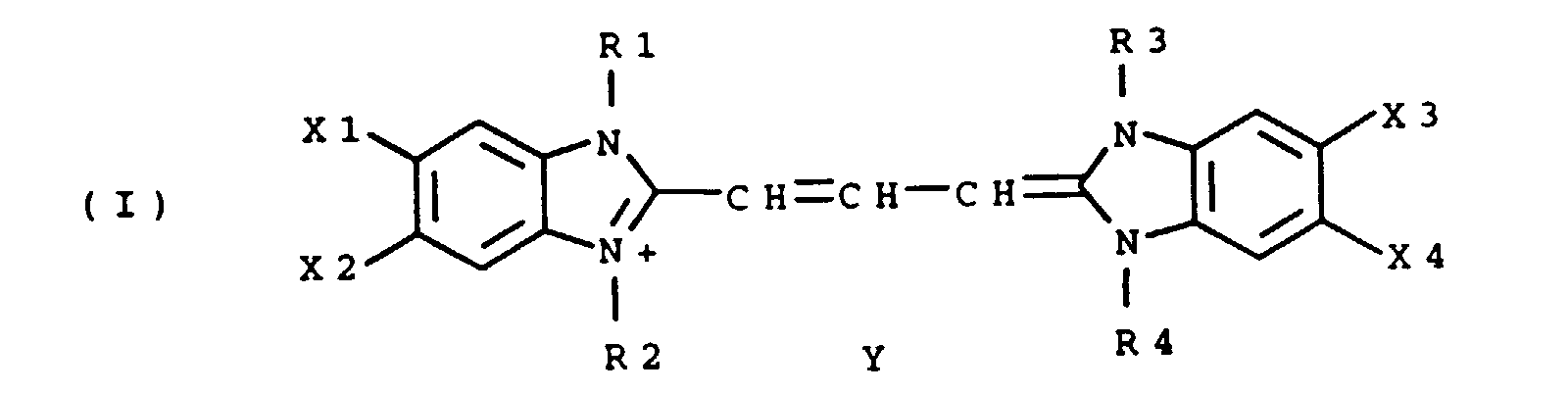
- R1 and R3 are methyl or ethyl, at least one of R1 and R3 being methyl;
- R2 and R4 are substituted or unsubstituted C1 to C6 alkyl, provided that R2 and R4 are not both methyl;
- X1, X2, X3, and X4 are each independently methyl, methylthio, fluoro-substituted methyl or methylthio, or hydrogen, provided that at least one of X1 and X2 and at least one of X3 and X4 are not hydrogen; and
- Y represents an ion as needed to balance the charge of the molecule.
- The combination of substituents R1-R4 and X1-X4 are selected to fit equation (i), set forth hereinafter.
- The dyes of formula I are effective sensitizers for silver halide photographic materials. They form J-aggregates in the 540-555 nm region of the spectrum, and photographic materials comprising silver halide sensitized with such dyes exhibit low dye stain compared to other classes of sensitizing dyes.
- In formula I above, R2 and R4 are defined as substituted or unsubstituted C1 to C6 alkyl. Examples of unsubstituted R2 and R4 include lower alkyls such as methyl, ethyl, propyl, butyl, pentyl, and hexyl. Examples of substituents include one or more of sulfo, sulfato, carboxyl, fluoro, amides, esters, cyano, substituted or unsubstituted aryls, and other substituents commonly used in photographic sensitizing dyes. Examples of substituted alkyl R2 and R4 include sulfopropyl, sulfobutyl, trifluoroethyl, allyl, 2-butynyl, N,N-dimethyl-carbamoylmethyl, methylsulfonylcarbamoylmethyl, sulfoethylcarbamoylmethyl, cyanoethyl, cyanomethyl, ethoxycarbonylmethyl, etc.
- X1 through X4 are each methyl, methylthio, fluoro-substituted methyl or methylthio, or hydrogen. Examples of fluoro-substituted methyl and methylthio are fluoromethyl, difluoromethyl, trifluoromethyl, fluoromethylthio, difluoromethylthio, and trifluoromethylthio.
- Depending upon substituents R2 and R4, a counter ion Y may be necessary to balance the charge of the dye molecule. For example, if the dye molecule is substituted with two anionic substituents (e.g., sulfo), then Y will be a cation. If the dye molecule is substituted with only one anionic substituent, the counterion Y is not present. If the dye molecule is substituted with no anionic substituents, Y will be an anion. Such counter ions are well known in the art and examples thereof include cations such as sodium, potassium, triethylammonium, and the like, and anions such as chloride, bromide, iodide, p-toluene sulfonate, methane sulfonate, methyl sulfate, ethyl sulfate, perchlorate, fluoroborate, and the like.
- Examples of compounds according to formula I include the dyes of Table I below.
TABLE I Dye R1 R2 R3 R4 X1 X2 X3 X4 * I-1 Me SP- Me SP- H SMe H SMe * I-2 Me Et Me Et H SMe H SMe * I-3 Me Me Me SP- Me Me H CF3 * I-4 Et SP- Me Et H CF3 Me Me * I-5 Et SP- Me Me H CF3 H Me * I-6 Me Et Me SP- H SMe H CF3 * I-7 Me SP- Me Et H CF3 H CF3 * I-8 Et Et Me SP- H CF3 H CF3 I-9 Me TFE Me SP- H CF3 H CF3 * I-10 Me SP- Me SP- H CF3 H CF3 I-11 Et TFE Me SP- H CF3 H CF3 I-12 Me TFE Me TFE H CF3 H CF3 I-13 Me Et Me Et SMe CF3 SMe CF3 I-14 Me CH2COOMe Me SP- H CF3 H CF3 I-15 Et CH2COOMe Me SP- H CF3 H CF3 I-16 Me CH2COOMe Et SP- H CF3 H CF3 I-17 Et CH2CONH2 Me SP- H CF3 H CF3 I-18 Et CH2COOEt Me SP- H CF3 H CF3 I-19 Et CH2COOPr Me SP- H CF3 H CF3 I-20 Et CH2CONMe2 Me SP- H CF3 H CF3 I-21 Me SECM- Me TFE SMe CF3 SMe CF3 I-22 Me TFE Et TFE Me CF3 Me CF3 I-23 Me CH2CN Et SP- H CF3 H CF3 I-24 Me Et Me Et CF3 CF3 CF3 CF3 I-25 Me TFE Me CH2COOMe Me CF3 Me CF3 I-26 Me SECM- Me Et H CF3 H CF3 I-27 Me TFE Me 4SB- H CF3 H CF3 I-28 Me TFE Me 3SB- H CF3 H CF3 I-29 Me TFE Me SE- H CF3 H CF3 I-30 Me TFE Me MSCM- H CF3 H CF3 Me - Methyl
Et - Ethyl
TFE - Trifluoroethyl
SE- - Sulfoethyl
SP- - Sulfopropyl
MSCM- - Methylsulfonylcarbamoylmethyl
SECM- - Sulfoethylcarbamoylmethyl
SMe - Methylthio
3SB - 3-sulfobutyl
4SB- - 4-sulfobutyl* outside the scope of Claim 1 - Dye I-1 has a potassium counterion Y, dyes I-2, I-13, I-22 and I-24 have p-toluene sulfonate counterions Y, dye I-10 has a sodium counterion Y, dye I-12 has a fluoroborate counterion Y, and dye I-25 has a bromide counterion Y associated therewith. The particular counterion is not critical, however, and others may be selected, for example, from those listed above.
- Further according to the present invention, the combination of substituents R1-R4 and X1-X4 are selected to fit the following equation (i):

- The dyes of formula I can be prepared according to techniques that are well-known in the art, such as described in Hamer, Cyanine Dyes and Related Compounds, John Wiley & Sons, New York, 1964 and James, The Theorv of the Photoaraphic Process 4th, Macmillan Publishing Co., New York, 1977.
- The amount of sensitizing dye that is useful in the invention is preferably in the range of 0.1 to 1.0 millimoles per mole of silver halide and more preferably from 0.2 to 0.7 millimoles per mole of silver halide. Optimum dye concentrations will depend on the intended end use of the photographic material and can be determined by methods known in the art.
- The silver halide used in the practice of the invention can be of any known type, such as silver bromoiodide, silver bromide, silver chloride, silver chlorobromide, and the like.
- The type of silver halide grain used in the invention is not critical and essentially any type of silver halide grains can be used in the practice of the invention. Since the dyes of the invention are low in retained dye stain, they may advantageously be used in combination with tabular grain emulsions, which have a greater surface area, allowing for greater amounts of dye to be used, which can aggravate dye stain problems. Tabular silver halide grains are grains having two substantially parallel crystal faces that are larger than any other crystal face on the grain. Tabular grain emulsions preferably have at least 50% of the grain population accounted for by tabular grains that satisfy the formula AR/t > 25. In this formula, AR stands for aspect ratio, which equals D/t. D is the diameter of the grain in micrometers and t is the thickness of the grain between the two substantially parallel crystal faces in micrometers. The grain diameter D is determined by taking the surface area of one of the substantially parallel crystal faces, and calculating the diameter of a circle having an area equivalent to that of the crystal face. The grain size of the silver halide may have any distribution known to be useful in photographic compositions, and may be either polydisperse or monodisperse.
- The silver halide grains to be used in the invention may be prepared according to methods known in the art, such as those described in Research Disclosure, Item 308119, December, 1989 [hereinafter referred to as Research Disclosure I] and James, The Theory of the Photographic Process, referred to above. Research Disclosure is published by Kenneth Mason Publications, Ltd., Dudley Annex, 21a North Street, Emsworth, Hamphire P010 70Q, England. These include methods such as ammoniacal emulsion making, neutral or acid emulsion making, and others known in the art. These methods generally involve mixing a water soluble silver salt with a water soluble halide salt in the presence of a protective colloid, and controlling the temperature, pAg, pH values, etc, at suitable values during formation of the silver halide by precipitation.
- The silver halide to be used in the invention may be advantageously subjected to chemical sensitization with compounds such as gold sensitizers (e.g., aurous sulfide) and others known in the art. Compounds and techniques useful for chemical sensitization of silver halide are known in the art and described in Research Disclosure I and the references cited therein.
- The silver halide may be sensitized by the dye of formula I by any method known in the art, such as described in Research Disclosure I. The dye may be added to an emulsion of the silver halide grains and a hydrophilic colloid at any time prior to (e.g., during or after chemical sensitization) or simultaneous with the coating of the emulsion on a photographic element. The dye/silver halide emulsion may be mixed with a dispersion of color image-forming coupler immediately before coating or in advance of coating (e.g., 2 hours).
- The above-described sensitizing dyes can be used alone, or may be used in combination with other sensitizing dyes, e.g. to also provide the silver halide with sensitivity to wavelengths of light outside the mid-green region or to supersensitize the silver halide.
- In a preferred embodiment, the sensitizing dyes of the invention are used to sensitize silver halide in photographic emulsions, which can be coated as layers on photographic elements. Essentially any type of emulsion (e.g., negative-working emulsions such as surface-sensitive emulsions of unfogged internal latent image-forming emulsions, direct-positive emulsions such as surface fogged emulsions, or others described in, for example, Research Disclosure I) may be used.
- Photographic emulsions generally include a vehicle for coating the emulsion as a layer of a photographic element. Useful vehicles include both naturally occurring substances such as proteins, protein derivatives, cellulose derivatives (e.g., cellulose esters), gelatin (e.g., alkali-treated gelatin such as cattle bone or hide gelatin, or acid treated gelatin such as pigskin gelatin), gelatin derivatives (e.g., acetylated gelatin, phthalated gelatin, and the like), and others as described in Research Disclosure I. Also useful as vehicles or vehicle extenders are hydrophilic water-permeable colloids. These include synthetic polymeric peptizers, carriers, and/or binders such as poly(vinyl alcohol), poly(vinyl lactams), acrylamide polymers, polyvinyl acetals, polymers of alkyl and sulfoalkyl acrylates and methacrylates, hydrolyzed polyvinyl acetates, polyamides, polyvinyl pyridine, methacrylamide copolymers, and the like, as described in Research Disclosure I. The vehicle can be present in the emulsion in any amount known to be useful in photographic emulsions.
- The emulsion can also include any of the addenda known to be useful in photographic emulsions. These include chemical sensitizers, such as active gelatin, sulfur, selenium, tellurium, gold, platinum, palladium, iridium, osmium, rhenium, phosphorous, or combinations thereof. Chemical sensitization is generally carried out at pAg levels of from 5 to 10, pH levels of from 5 to 8, and temperatures of from 30 to 80°C, as illustrated in Research Disclosure, June 1975, item 13452 and U.S. Patent No. 3,772,031.
- Other addenda include antifoggants, stabilizers, filter dyes, light absorbing or reflecting pigments, vehicle hardeners such as gelatin hardeners, coating aids, dye-forming couplers, and development modifiers such as development inhibitor releasing couplers, timed development inhibitor releasing couplers, and bleach accelerators. These addenda and methods of their inclusion in emulsion and other photographic layers are well-known in the art and are disclosed in Research Disclosure I and the references cited therein.
- The emulsion may also include brighteners, such as stilbene brighteners. Such brighteners are well-known in the art and are used to counteract dye stain, although the dyes of formula I generally have minimal dye stain even if no brightener is used.
- The emulsion layer containing silver halide sensitized with the dye of formula I can be coated simultaneously or sequentially with other emulsion layers, subbing layers, filter dye layers, interlayers, or overcoat layers, all of which may contain various addenda know to be included in photographic elements. These include antifoggants, oxidized developer scavengers, DIR couplers, antistatic agents, optical brighteners, light-absorbing or light-scattering pigments, and the like.
- The layers of the photographic element can be coated onto a support using techniques well-known in the art. These techniques include immersion or dip coating, roller coating, reverse roll coating, air knife coating, doctor blade coating, stretch-flow coating, and curtain coating, to name a few. The coated layers of the element may be chill-set or dried, or both. Drying may be accelerated by known techniques such as conduction, convection, radiation heating, or a combination thereof.
- Photographic elements comprising the composition of the invention can be black and white or color. A color photographic element generally contains three silver emulsion layers or sets of layers: a blue-sensitive layer having a yellow dye-forming color coupler associated therewith; a green-sensitive layer having a magenta dye-forming color coupler associated therewith; and a red-sensitive layer having a cyan dye-forming color coupler associated therewith. Dye-forming couplers are well-known in the art and are disclosed, for example, in Research Disclosure I.
- Photographic elements comprising the composition of the invention can be processed in any of a number of well-known photographic processes utilizing any of a number of well-known processing compositions, described, for example, in Research Disclosure I, or in James, The Theory of the Photogranhic Process 4th, 1977.
- The invention is described further in the following synthesis and photographic examples.
-
a) 1,2-Dimethyl-5-trifluoromethylbenzimidazole (5.35 g, 0.025 mole) and 2,2,2-trifluoroethyl trifluoromethanesulfonate (6.5 mL, 0.044 mole) were combined in 20 mL of toluene. The mixture was heated at 105°C for 27 hours. The product, 1,2-dimethyl-3-(2,2,2-trifluoroethyl)-5-trifluoromethylbenzimidazolium trifluoromethanesulfonate, separated as an oil which crystallized upon cooling. The yield was 9.9 g, 0.022 mole, 89%.
b) 1,2-Dimethyl-3-(2,2,2-trifluoroethyl)-5-trifluoromethylbenzimidazolium trifluoromethanesulfonate (4.02 g,0.009 mole) was dissolved in 15 mL of dimethylformamide. Diethoxymethyl acetate (1.1 mL, 0.0067 mole) and 1,8-diazabicyclo[5.4.0]undec-7-ene (1.0 mL, 0.0067 mole) were added and the mixture was heated to reflux for 10 minutes. Excess sodium fluoroborate in methanol solution was added to the cooled reaction mixture to precipitate dye I-12. The yield was 2.1 g, 0.0030 mole, 67%. The dye could be recrystallized from a mixture of ethanol and acetonitrile. Lambda max (methanol): 492 nm.
Extinction coefficient: 169,000 L/mole-cm.Analysis: Calculated for C25H19BF16N4: 43.5%C, 2.8%H, 8.1%N Found: 43.4%C, 2.7%H, 8.0%N - 3-Carbamoylmethyl-1-ethyl-2-methyl-5-trifluoromethylbenzimidazolium chloride (1.61 g, 0.005 mole) and anhydro-2-acetanilidovinyl-1-methyl-3-(3-sulfopropyl)-5-trifluoromethylbenzimidazolium hydroxide (2.40 g, 0.005 mole) were suspended in 35 mL of acetonitrile. 1,8-Diazabicyclo[5.4.0]undec-7-ene (0.80 mL, 0.0054 mole) was added and the mixture was heated to reflux over 15 minutes. Reflux was maintained for 25 minutes and dye separated from the reaction mixture. After cooling the solid dye I-17 was collected. The yield was 1.95 g, 0.0031 mole, 62%. Lambda max (methanol): 497 nm. Extinction coefficient: 165,000 L/mole-cm.
Analysis: Calculated for C27H27F6N5O4S: 51.4%C, 4.3%H, 11.1%N Found: 51.1%C, 4.3%H, 11.2%N - Photographic elements were prepared by coating on a support a silver halide emulsion layer containing chemically sensitized 0.2 µm cubic silver bromoiodide (2.6 mole% I) at 10.8 mg Ag/dm2, hardened gelatin at 73 mg/dm2, and sensitizing dye as indicated below at 0.6 millimole dye per mole of Ag. The elements were given a wedge spectral exposure and processed with Kodak RP X-Omat processing. The sensitometric data is presented in Table II below.
- In Table II, "Aggregation Peak" is the wavelength of maximum light absorption by the adsorbed dye in the emulsion coating. "Absorptance" refers to the percent of light absorbed at the wavelength of maximum light absorption by the dye in the coating. "Speed" is defined as the speed at lambda max (in log E units multiplied by 100) minus the intrinsic speed of the dyed emulsion at 400 nm (in log E units multiplied by 100) plus 200. This measurement of speed allows for comparison of the spectral sensitivity provided by the dyes while using a uniform chemical sensitization that is not optimized for each sensitizing dye. "Stain" was measured by placing the processed film in front of a scanning spectrophotometer. The total transmission (T) against an undyed reference was measured between 400 nm and 900 nm. The data was plotted as absorbance (-log 1/T). The stain was then calculated as the maximum absorbance at any wavelength in this range.
- In addition to dyes of formula (I) according to the invention, comparison dyes A through G illustrated below were also evaluated.
TABLE II Dye Aggregation Peak Absorptance Speed Stain I-1 545 29.4 177 0.0 I-2 547 37.6 209 0.0 I-3 553 53.3 266 0.0 I-4 549 51 247 0.0 I-5 556 43.2 262 0.0 I-6 545 49.4 196 0.0 I-7 545 57.0 261 <0.01 I-8 551 58.0 249 <0.01 I-9 542 56.1 258 0.01 I-10 542 49.0 246 0.01 I-11 546 66.5 250 0.015 I-14 544 57.0 258 <0.01 I-15 548 54.9 257 <0.01 I-16 546 53.2 257 <0.01 I-17 555 55.3 256 <0.01 I-18 554 54.0 263 0.015 I-19 554 51.6 261 0.015 I-20 549 62.2 243 <0.01 I-27 543 65.0 252 0.01 I-28 542 65.3 248 0.01 I-29 542 64.8 243 0.02 I-30 545 65.1 253 0.03 A 492* 15.2 --- 0.0 B 571 52.3 250 0.0 C 431* 26.4 201 0.01 D 562 58 237 0.01 E 544 26 245 0.07 F 545 30 236 0.04 G 514 18 156 0.02 * These dyes did not form J-aggregates 


- The above data demonstrates that the benzimidazolocarbocyanine dyes of the invention (dyes of formula (I)) aggregate in the mid-green region and have low post-process stain. Comparison dye A, in which all X1-X4 are hydrogen, did not aggregate and was a poor sensitizer. Comparison dye B, in which X3 and X4 are Cl, formed an aggregate which absorbed at too long a wavelength, outside the mid-green region. Comparison dye C, in which all R1-R4 are methyl, did not form an aggregate in the mid green region.
Comparison dye D, in which both R1 and R3 are ethyl, formed an aggragate which absorbed at too long a wavelength, outside the mid-green region. Comparison dyes E,F, and G are oxacarbocyanines and exhibited greater stain. Dye G also was a poor sensitizer. Only the dyes of the invention formed aggregates which absorbed in the mid-green region and exhibited minimal dye stain. - A silver bromide tabular grain emulsion (1.7 microns equivalent circular diameter by 0.13 micron) chemically sensitized with 3.5 mg potassium tetrachloroaurate, 0.45 mg potassium selenocyanate, 3.4 mg sodium thiosulfate, and 20 mg sodium thiocyanate per mole of silver was dyed with either 0.5 or 0.75 mmoles dye/mole silver. Dyes I-4 and I-11 of Table I above and comparison dyes H and J (illustrated below) were evaluated. Tetraazaindene (2.1 g/mole Ag) was also added as an antifoggant. The emulsion was coated on Estar poly(ethylene terephthalate) support at a level of 390 mg gel and 200 mg silver per square foot with 1% bisvinylsulfonylmethyl ether hardener and 1% saponin as a spreading agent. Strips were given a 1/50" wedge spectral exposure and processed in a Kodak RP X-OMAT process. Photographic speed was measured at a density of 0.3 above Dmin. One set of strips were incubated for one week at 49°C, 50% Relative Humidity, and processed again to compare fog growth. The following results were obtained (Table III).
TABLE III Dye mmole/mole Ag Speed Sens. Peak Fog (Init.) Fog (After 1 wk. inc.) Equation (i) value H 0.5 224 570 0.11 0.55 0.514 0.75 235 570 0.16 0.95 J 0.5 213 570 0.14 0.23 0.523 0.75 232 570 0.16 0.37 I-4 0.5 231 550 0.09 0.14 0.530 0.75 239 550 0.08 0.22 I-11 0.5 282 550 0.05 0.06 0.743 0.75 284 550 0.08 0.07 

- Equation (i) values were calculated using the σi values for Me (-0.04), Et (-0.05), TFE (+0.14), SP- (-0.1), 3SB- (-0.1) and allyl (0); and σp values for Me (-0.17), Cl (+0.23), H (0), CF3 (+0.54), and SMe (0).
- The dyes which had values of less than 0.68 from equation (i) showed substantial fog growth while the dye of the invention having a value greater than 0.68 in accordance with equation (i) not only sensitized at 550 nm, but showed no fog growth at all.
Claims (11)
- A photographic sensitizing dye according to the following formula I:
 R1 and R3 are methyl or ethyl, at least one of R1 and R3 being methyl;R2 and R4 are substituted or unsubstituted C1 to C6 alkyl, provided that R2 and R4 are not both methyl;X1, X2, X3, and X4 are each independently methyl, methylthio, fluoro-substituted methyl or methylthio, or hydrogen, provided that at least one of X1 and X2 and at least one of X3 and X4 are not hydrogen; andY represents an ion as needed to balance the charge of the molecule and wherein the adsorbed dye forms on a photographic silver halide emulsion sensitized with such dye a J-aggregate with a maximum absorption between 540 to 555 nm, and the combination of substituents R1-R4 and X1-X4 are selected to fit the following equation (i):where the small sigmas are electronic substituent constants, σi being Taft's sigma(inductive) constant, and
σp being Hammett's sigma(para) constant. - A photographic dye according to claim 1,
wherein R1 is methyl and R3 is methyl or ethyl. - A photographic dye according to claim 1 or claim wherein at least one of X1, X2, X3 and X4 is trifluoromethyl.
- A photographic dye according to claim 1, 2 or 3 wherein at least one of R2 and R4 is sulfoalkyl.
- A photographic dye according to claim 1, 2 or 3 wherein at least one of R2 an R4 is a fluoro-substituted alkyl.
- A photographic dye according to any preceding claim, wherein both X2 and X4 are not hydrogen.
- A photographic dye according to claim 1,
wherein at least one of R2 and R4 is a fluoro-substituted alkyl and X2 and X4 are both trifluoromethyl. - A photographic dye according to claim 7,
wherein X1 and X3 are both hydrogen. - A photographic dye according to claim 1,
wherein at least one of R2 and R4 is trifluoroethyl and X2 and X4 are both trifluoromethyl. - A photographic dye according to claim 9,
wherein X1 and X3 are both hydrogen. - A photographic element comprising a support having thereon a silver halide emulsion layer sensitized with a sensitizing dye according to any one of claims 1 to 10.
Applications Claiming Priority (2)
| Application Number | Priority Date | Filing Date | Title |
|---|---|---|---|
| US07/676,913 US5210014A (en) | 1991-03-28 | 1991-03-28 | Mid-green sensitizing dyes for photographic materials |
| US676913 | 1991-03-28 |
Publications (2)
| Publication Number | Publication Date |
|---|---|
| EP0506077A1 EP0506077A1 (en) | 1992-09-30 |
| EP0506077B1 true EP0506077B1 (en) | 1997-06-04 |
Family
ID=24716537
Family Applications (1)
| Application Number | Title | Priority Date | Filing Date |
|---|---|---|---|
| EP92105300A Expired - Lifetime EP0506077B1 (en) | 1991-03-28 | 1992-03-27 | Mid-green sensitizing dyes for photographic materials |
Country Status (6)
| Country | Link |
|---|---|
| US (1) | US5210014A (en) |
| EP (1) | EP0506077B1 (en) |
| JP (1) | JPH0588293A (en) |
| AT (1) | ATE154142T1 (en) |
| CA (1) | CA2062570A1 (en) |
| DE (1) | DE69220124T2 (en) |
Families Citing this family (7)
| Publication number | Priority date | Publication date | Assignee | Title |
|---|---|---|---|---|
| JP3408282B2 (en) * | 1993-04-28 | 2003-05-19 | 富士写真フイルム株式会社 | Novel benzimidazolocarbocyanine dye and silver halide photographic material containing the dye |
| GB9320284D0 (en) * | 1993-10-01 | 1993-11-17 | Minnesota Mining & Mfg | A silver halide photographic light sensitive element for medical radiography |
| FR2736206B1 (en) * | 1995-06-30 | 1997-08-08 | Commissariat Energie Atomique | METHOD FOR PRODUCING AN INTERCONNECTION SUBSTRATE FOR CONNECTING A CHIP TO A RECEIVING SUBSTRATE |
| US5830629A (en) * | 1995-11-01 | 1998-11-03 | Eastman Kodak Company | Autoradiography assemblage using transparent screen |
| JP4533538B2 (en) * | 1998-10-20 | 2010-09-01 | 富士フイルム株式会社 | Optical filter |
| US6485897B1 (en) | 2001-05-22 | 2002-11-26 | Eastman Kodak Company | Spectral sensitized silver halide element for electronic filmwriter device |
| US6485881B1 (en) | 2001-06-28 | 2002-11-26 | Eastman Kodak Company | Asymmetric speed portal imaging assembly and method of use |
Family Cites Families (12)
| Publication number | Priority date | Publication date | Assignee | Title |
|---|---|---|---|---|
| GB1031367A (en) * | 1963-04-19 | 1966-06-02 | Ilford Ltd | Photographic light-sensitive materials |
| GB1020295A (en) * | 1963-06-11 | 1966-02-16 | Ilford Ltd | Cyanine dyes production and use |
| DE1569797A1 (en) * | 1965-06-03 | 1971-04-15 | Ilford Ltd | Cyanine dyes and processes for their preparation |
| US3623883A (en) * | 1966-03-16 | 1971-11-30 | Ilford Ltd | Silver halide emulsion containing benzimidazole cyanine dyes |
| BE697009A (en) * | 1966-04-13 | 1967-09-18 | ||
| GB1231079A (en) * | 1968-12-18 | 1971-05-05 | ||
| BE787340A (en) * | 1971-08-12 | 1973-02-09 | Agfa Gevaert Nv | SENSITIVE, THERMICALLY DEVELOPABLE MATERIAL BASED ON SPECTRALLY SENSITIZED ORGANIC SILVER SALTS |
| US4425425A (en) * | 1981-11-12 | 1984-01-10 | Eastman Kodak Company | Radiographic elements exhibiting reduced crossover |
| US4425426A (en) * | 1982-09-30 | 1984-01-10 | Eastman Kodak Company | Radiographic elements exhibiting reduced crossover |
| US4510235A (en) * | 1983-04-28 | 1985-04-09 | Fuji Photo Film Co., Ltd. | Silver halide photographic emulsions |
| EP0212968A3 (en) * | 1985-08-20 | 1990-01-24 | Konica Corporation | Silver halide photographic light-sensitive material |
| JPS62287250A (en) * | 1986-06-06 | 1987-12-14 | Fuji Photo Film Co Ltd | Color image forming method and silver halide color photographic sensitive material |
-
1991
- 1991-03-28 US US07/676,913 patent/US5210014A/en not_active Expired - Lifetime
-
1992
- 1992-03-10 CA CA002062570A patent/CA2062570A1/en not_active Abandoned
- 1992-03-27 DE DE69220124T patent/DE69220124T2/en not_active Expired - Fee Related
- 1992-03-27 EP EP92105300A patent/EP0506077B1/en not_active Expired - Lifetime
- 1992-03-27 AT AT92105300T patent/ATE154142T1/en not_active IP Right Cessation
- 1992-03-27 JP JP4070815A patent/JPH0588293A/en active Pending
Also Published As
| Publication number | Publication date |
|---|---|
| ATE154142T1 (en) | 1997-06-15 |
| US5210014A (en) | 1993-05-11 |
| CA2062570A1 (en) | 1992-09-29 |
| JPH0588293A (en) | 1993-04-09 |
| DE69220124T2 (en) | 1998-01-22 |
| EP0506077A1 (en) | 1992-09-30 |
| DE69220124D1 (en) | 1997-07-10 |
Similar Documents
| Publication | Publication Date | Title |
|---|---|---|
| US6165703A (en) | Color photographic material having enhanced light absorption | |
| EP0451816B1 (en) | Sensitizing dye for photographic materials | |
| EP0985967B1 (en) | Photographic material having enhanced light absorption | |
| US5210014A (en) | Mid-green sensitizing dyes for photographic materials | |
| US6066443A (en) | Blue sensitizing dyes with heterocyclic substituents | |
| US5518876A (en) | Red sensitizers for high silver chloride emulsions | |
| US6620581B1 (en) | Photographic material having enhanced light absorption | |
| US5418126A (en) | Furan or pyrrole substituted dye compounds and silver halide photographic elements containing such dyes | |
| US4097284A (en) | Method for supersensitizing silver halide photographic emulsions | |
| US5196299A (en) | Tabular grain emulsion containing radiographic elements exhibiting reduced dye stain | |
| EP0301508A2 (en) | Method for producing a silver halide photographic emulsion | |
| US5387502A (en) | Silver halide photographic material | |
| US5695918A (en) | Cyanine dyes with chain sulfone substituent photographic materials comprising | |
| EP0766132A1 (en) | Red sensitizing dye combinations for high chloride emulsions | |
| US5340711A (en) | Green sensitized silver halide emulsions | |
| US5459025A (en) | Methine compound and silver halide photographic material comprising same | |
| US5354651A (en) | Hydroxyarylacyl dye compounds and silver halide photographic elements containing such dyes | |
| US5466822A (en) | Benzimidazolocarbocyanine dye and silver halide photographic material containing said dye | |
| JP2779718B2 (en) | Silver halide photographic material | |
| EP0508390A2 (en) | Light-sensitive silver halide photographic material | |
| US5219723A (en) | Green sensitizing dyes for variable contrast photographic elements | |
| US6291154B1 (en) | Green sensitized tabular grain photographic emulsions | |
| EP0735415A1 (en) | Photographic elements with tetra-nuclear merocyanine sensitizers | |
| EP0354798A2 (en) | High sensitive silver halide photographic light-sensitive material | |
| JPH0959527A (en) | Benzimidazolocarbocyanine coloring matter and photographic material containing the same |
Legal Events
| Date | Code | Title | Description |
|---|---|---|---|
| PUAI | Public reference made under article 153(3) epc to a published international application that has entered the european phase |
Free format text: ORIGINAL CODE: 0009012 |
|
| AK | Designated contracting states |
Kind code of ref document: A1 Designated state(s): AT BE CH DE DK ES FR GB IT LI NL SE |
|
| 17P | Request for examination filed |
Effective date: 19930311 |
|
| 17Q | First examination report despatched |
Effective date: 19960124 |
|
| GRAG | Despatch of communication of intention to grant |
Free format text: ORIGINAL CODE: EPIDOS AGRA |
|
| GRAH | Despatch of communication of intention to grant a patent |
Free format text: ORIGINAL CODE: EPIDOS IGRA |
|
| GRAH | Despatch of communication of intention to grant a patent |
Free format text: ORIGINAL CODE: EPIDOS IGRA |
|
| GRAA | (expected) grant |
Free format text: ORIGINAL CODE: 0009210 |
|
| AK | Designated contracting states |
Kind code of ref document: B1 Designated state(s): AT BE CH DE DK ES FR GB IT LI NL SE |
|
| PG25 | Lapsed in a contracting state [announced via postgrant information from national office to epo] |
Ref country code: IT Free format text: LAPSE BECAUSE OF FAILURE TO SUBMIT A TRANSLATION OF THE DESCRIPTION OR TO PAY THE FEE WITHIN THE PRE;WARNING: LAPSES OF ITALIAN PATENTS WITH EFFECTIVE DATE BEFORE 2007 MAY HAVE OCCURRED AT ANY TIME BEFORE 2007. THE CORRECT EFFECTIVE DATE MAY BE DIFFERENT FROM THE ONE RECORDED.SCRIBED TIME-LIMIT Effective date: 19970604 Ref country code: DK Effective date: 19970604 Ref country code: ES Free format text: THE PATENT HAS BEEN ANNULLED BY A DECISION OF A NATIONAL AUTHORITY Effective date: 19970604 Ref country code: BE Effective date: 19970604 Ref country code: LI Effective date: 19970604 Ref country code: NL Free format text: LAPSE BECAUSE OF FAILURE TO SUBMIT A TRANSLATION OF THE DESCRIPTION OR TO PAY THE FEE WITHIN THE PRESCRIBED TIME-LIMIT Effective date: 19970604 Ref country code: CH Effective date: 19970604 Ref country code: AT Effective date: 19970604 |
|
| REF | Corresponds to: |
Ref document number: 154142 Country of ref document: AT Date of ref document: 19970615 Kind code of ref document: T |
|
| REG | Reference to a national code |
Ref country code: CH Ref legal event code: EP |
|
| REF | Corresponds to: |
Ref document number: 69220124 Country of ref document: DE Date of ref document: 19970710 |
|
| PG25 | Lapsed in a contracting state [announced via postgrant information from national office to epo] |
Ref country code: SE Effective date: 19970904 |
|
| ET | Fr: translation filed | ||
| NLV1 | Nl: lapsed or annulled due to failure to fulfill the requirements of art. 29p and 29m of the patents act | ||
| REG | Reference to a national code |
Ref country code: CH Ref legal event code: PL |
|
| PLBE | No opposition filed within time limit |
Free format text: ORIGINAL CODE: 0009261 |
|
| STAA | Information on the status of an ep patent application or granted ep patent |
Free format text: STATUS: NO OPPOSITION FILED WITHIN TIME LIMIT |
|
| 26N | No opposition filed | ||
| REG | Reference to a national code |
Ref country code: GB Ref legal event code: IF02 |
|
| PGFP | Annual fee paid to national office [announced via postgrant information from national office to epo] |
Ref country code: GB Payment date: 20030204 Year of fee payment: 12 |
|
| PGFP | Annual fee paid to national office [announced via postgrant information from national office to epo] |
Ref country code: FR Payment date: 20030303 Year of fee payment: 12 |
|
| PGFP | Annual fee paid to national office [announced via postgrant information from national office to epo] |
Ref country code: DE Payment date: 20030331 Year of fee payment: 12 |
|
| PG25 | Lapsed in a contracting state [announced via postgrant information from national office to epo] |
Ref country code: GB Free format text: LAPSE BECAUSE OF NON-PAYMENT OF DUE FEES Effective date: 20040327 |
|
| PG25 | Lapsed in a contracting state [announced via postgrant information from national office to epo] |
Ref country code: DE Free format text: LAPSE BECAUSE OF NON-PAYMENT OF DUE FEES Effective date: 20041001 |
|
| GBPC | Gb: european patent ceased through non-payment of renewal fee |
Effective date: 20040327 |
|
| PG25 | Lapsed in a contracting state [announced via postgrant information from national office to epo] |
Ref country code: FR Free format text: LAPSE BECAUSE OF NON-PAYMENT OF DUE FEES Effective date: 20041130 |
|
| REG | Reference to a national code |
Ref country code: FR Ref legal event code: ST |