EP0505322B1 - Aminoguanidines - Google Patents
Aminoguanidines Download PDFInfo
- Publication number
- EP0505322B1 EP0505322B1 EP92810191A EP92810191A EP0505322B1 EP 0505322 B1 EP0505322 B1 EP 0505322B1 EP 92810191 A EP92810191 A EP 92810191A EP 92810191 A EP92810191 A EP 92810191A EP 0505322 B1 EP0505322 B1 EP 0505322B1
- Authority
- EP
- European Patent Office
- Prior art keywords
- alkyl
- hydrogen
- formula
- hydroxy
- compound
- Prior art date
- Legal status (The legal status is an assumption and is not a legal conclusion. Google has not performed a legal analysis and makes no representation as to the accuracy of the status listed.)
- Expired - Lifetime
Links
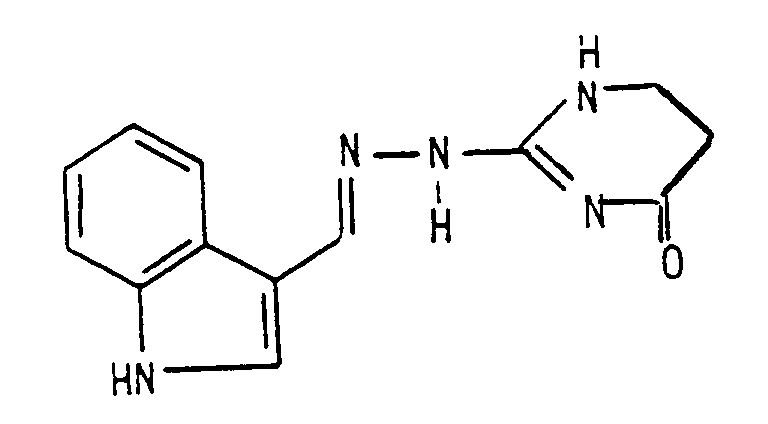
- 0 CC(CN*1)NCCC1O Chemical compound CC(CN*1)NCCC1O 0.000 description 4
Classifications
-
- C—CHEMISTRY; METALLURGY
- C07—ORGANIC CHEMISTRY
- C07D—HETEROCYCLIC COMPOUNDS
- C07D487/00—Heterocyclic compounds containing nitrogen atoms as the only ring hetero atoms in the condensed system, not provided for by groups C07D451/00 - C07D477/00
- C07D487/02—Heterocyclic compounds containing nitrogen atoms as the only ring hetero atoms in the condensed system, not provided for by groups C07D451/00 - C07D477/00 in which the condensed system contains two hetero rings
- C07D487/04—Ortho-condensed systems
-
- C—CHEMISTRY; METALLURGY
- C07—ORGANIC CHEMISTRY
- C07D—HETEROCYCLIC COMPOUNDS
- C07D403/00—Heterocyclic compounds containing two or more hetero rings, having nitrogen atoms as the only ring hetero atoms, not provided for by group C07D401/00
- C07D403/02—Heterocyclic compounds containing two or more hetero rings, having nitrogen atoms as the only ring hetero atoms, not provided for by group C07D401/00 containing two hetero rings
- C07D403/12—Heterocyclic compounds containing two or more hetero rings, having nitrogen atoms as the only ring hetero atoms, not provided for by group C07D401/00 containing two hetero rings linked by a chain containing hetero atoms as chain links
-
- A—HUMAN NECESSITIES
- A61—MEDICAL OR VETERINARY SCIENCE; HYGIENE
- A61P—SPECIFIC THERAPEUTIC ACTIVITY OF CHEMICAL COMPOUNDS OR MEDICINAL PREPARATIONS
- A61P1/00—Drugs for disorders of the alimentary tract or the digestive system
-
- A—HUMAN NECESSITIES
- A61—MEDICAL OR VETERINARY SCIENCE; HYGIENE
- A61P—SPECIFIC THERAPEUTIC ACTIVITY OF CHEMICAL COMPOUNDS OR MEDICINAL PREPARATIONS
- A61P1/00—Drugs for disorders of the alimentary tract or the digestive system
- A61P1/04—Drugs for disorders of the alimentary tract or the digestive system for ulcers, gastritis or reflux esophagitis, e.g. antacids, inhibitors of acid secretion, mucosal protectants
-
- C—CHEMISTRY; METALLURGY
- C07—ORGANIC CHEMISTRY
- C07D—HETEROCYCLIC COMPOUNDS
- C07D209/00—Heterocyclic compounds containing five-membered rings, condensed with other rings, with one nitrogen atom as the only ring hetero atom
- C07D209/02—Heterocyclic compounds containing five-membered rings, condensed with other rings, with one nitrogen atom as the only ring hetero atom condensed with one carbocyclic ring
- C07D209/04—Indoles; Hydrogenated indoles
- C07D209/10—Indoles; Hydrogenated indoles with substituted hydrocarbon radicals attached to carbon atoms of the hetero ring
- C07D209/14—Radicals substituted by nitrogen atoms, not forming part of a nitro radical
-
- C—CHEMISTRY; METALLURGY
- C07—ORGANIC CHEMISTRY
- C07D—HETEROCYCLIC COMPOUNDS
- C07D333/00—Heterocyclic compounds containing five-membered rings having one sulfur atom as the only ring hetero atom
- C07D333/50—Heterocyclic compounds containing five-membered rings having one sulfur atom as the only ring hetero atom condensed with carbocyclic rings or ring systems
- C07D333/52—Benzo[b]thiophenes; Hydrogenated benzo[b]thiophenes
- C07D333/54—Benzo[b]thiophenes; Hydrogenated benzo[b]thiophenes with only hydrogen atoms, hydrocarbon or substituted hydrocarbon radicals, directly attached to carbon atoms of the hetero ring
- C07D333/58—Radicals substituted by nitrogen atoms
-
- C—CHEMISTRY; METALLURGY
- C07—ORGANIC CHEMISTRY
- C07D—HETEROCYCLIC COMPOUNDS
- C07D409/00—Heterocyclic compounds containing two or more hetero rings, at least one ring having sulfur atoms as the only ring hetero atoms
- C07D409/02—Heterocyclic compounds containing two or more hetero rings, at least one ring having sulfur atoms as the only ring hetero atoms containing two hetero rings
- C07D409/12—Heterocyclic compounds containing two or more hetero rings, at least one ring having sulfur atoms as the only ring hetero atoms containing two hetero rings linked by a chain containing hetero atoms as chain links
-
- C—CHEMISTRY; METALLURGY
- C07—ORGANIC CHEMISTRY
- C07D—HETEROCYCLIC COMPOUNDS
- C07D417/00—Heterocyclic compounds containing two or more hetero rings, at least one ring having nitrogen and sulfur atoms as the only ring hetero atoms, not provided for by group C07D415/00
- C07D417/02—Heterocyclic compounds containing two or more hetero rings, at least one ring having nitrogen and sulfur atoms as the only ring hetero atoms, not provided for by group C07D415/00 containing two hetero rings
- C07D417/12—Heterocyclic compounds containing two or more hetero rings, at least one ring having nitrogen and sulfur atoms as the only ring hetero atoms, not provided for by group C07D415/00 containing two hetero rings linked by a chain containing hetero atoms as chain links
-
- C—CHEMISTRY; METALLURGY
- C07—ORGANIC CHEMISTRY
- C07D—HETEROCYCLIC COMPOUNDS
- C07D471/00—Heterocyclic compounds containing nitrogen atoms as the only ring hetero atoms in the condensed system, at least one ring being a six-membered ring with one nitrogen atom, not provided for by groups C07D451/00 - C07D463/00
- C07D471/02—Heterocyclic compounds containing nitrogen atoms as the only ring hetero atoms in the condensed system, at least one ring being a six-membered ring with one nitrogen atom, not provided for by groups C07D451/00 - C07D463/00 in which the condensed system contains two hetero rings
- C07D471/04—Ortho-condensed systems
-
- C—CHEMISTRY; METALLURGY
- C07—ORGANIC CHEMISTRY
- C07F—ACYCLIC, CARBOCYCLIC OR HETEROCYCLIC COMPOUNDS CONTAINING ELEMENTS OTHER THAN CARBON, HYDROGEN, HALOGEN, OXYGEN, NITROGEN, SULFUR, SELENIUM OR TELLURIUM
- C07F7/00—Compounds containing elements of Groups 4 or 14 of the Periodic Table
- C07F7/02—Silicon compounds
- C07F7/08—Compounds having one or more C—Si linkages
- C07F7/0803—Compounds with Si-C or Si-Si linkages
- C07F7/081—Compounds with Si-C or Si-Si linkages comprising at least one atom selected from the elements N, O, halogen, S, Se or Te
- C07F7/0812—Compounds with Si-C or Si-Si linkages comprising at least one atom selected from the elements N, O, halogen, S, Se or Te comprising a heterocyclic ring
- C07F7/0814—Compounds with Si-C or Si-Si linkages comprising at least one atom selected from the elements N, O, halogen, S, Se or Te comprising a heterocyclic ring said ring is substituted at a C ring atom by Si
-
- C—CHEMISTRY; METALLURGY
- C07—ORGANIC CHEMISTRY
- C07F—ACYCLIC, CARBOCYCLIC OR HETEROCYCLIC COMPOUNDS CONTAINING ELEMENTS OTHER THAN CARBON, HYDROGEN, HALOGEN, OXYGEN, NITROGEN, SULFUR, SELENIUM OR TELLURIUM
- C07F9/00—Compounds containing elements of Groups 5 or 15 of the Periodic Table
- C07F9/02—Phosphorus compounds
- C07F9/547—Heterocyclic compounds, e.g. containing phosphorus as a ring hetero atom
- C07F9/553—Heterocyclic compounds, e.g. containing phosphorus as a ring hetero atom having one nitrogen atom as the only ring hetero atom
- C07F9/572—Five-membered rings
- C07F9/5728—Five-membered rings condensed with carbocyclic rings or carbocyclic ring systems
Definitions
- the present invention relates to aminoguanidines having pharmaceutical utility, processes for their production, pharmaceutical compositions comprising them and their use as pharmaceuticals.
- Aminoguanidines are disclosed in EP-A1-87218, Indian Journal of Chemistry, 15B, 1977, 1129-1132 and C.A., vol. 77, 1972, 70181y; however, these compounds comprise an aminoguanidine residue attached to a phenyl, pyrimidine or benzoyl residue.
- US-A-2,855,398 describes indol-3-yl amidines having diuretic, anti-emetic and spasmolytic properties.
- US-A-3,317,560 discloses indol-3-yl alkylguanidines exhibiting strong spasmolytic and central depressive activities as well as dilating effects on the coronary vessels.
- C.A., vol. 67, 1967, 64162 v describes 1-acyl-2-(indol-3-yl-methylene) hydrazines and their in vitro activity as monoamine oxidase inhibitors.
- Indol-3-ylalkyl hydrazides useful in psychopharmacology against serotonin, aminooxidases, and inflammations are disclosed in C.A., vol. 67, 1967, 32590s.
- physiologically-hydrolysable and-acceptable ethers and esters as applied to the compounds of formula I when R 5 is hydroxy, is meant ethers in which R 5 is etherified and esters in which R 5 is esterified and which are hydrolysable under physiological conditions to yield an alcohol or acid which is physiologically acceptable, i.e. which is non-toxic at the desired dosage levels.
- ether group as R 5 examples include e.g. C 1-6 alkoxy; C 1-6 alkoxy substituted by hydroxy, C 1-4 alkoxy, acyloxy, NR a R' b , CONR a R b or CSNR a R b wherein R a , R b and R' b are as defined above; C 2-6 alkenyloxy.
- ester groups as R 5 include e.g. acyloxy and pyridyl-carbonyloxy.
- R 5 is an ester group, it is preferably pyridyl-carbonyloxy.
- R 5 as an ester group is preferably acyloxy or pyridyl-carbonyloxy.
- alkyl groups and moieties may be branched or straight chain.
- R 5 , R 10 or R' 10 are substituted alkyl, the substituent is preferably located at the end of the alkyl chain.
- halogen is preferably meant fluorine or chlorine.
- R 5 is hydroxy-substituted C 1-6 alkoxy, it may also be alkoxy polysubstituted with hydroxy, e.g. 2,3-dihydroxy-propoxy.
- Aryl is preferably phenyl or naphthyl, preferably phenyl, and may be substituted.
- ArylC 1-4 alkyl is preferably phenyl-C 1-4 alkyl, e.g. benzyl or phenethyl, and may be substituted on the phenyl ring.
- Aryloxy is preferably phenoxy, and may be substituted.
- ArylC 1-6 alkoxy is e.g. benzyloxy, and may be substituted on the phenyl ring. When aryl or the aryl moiety are substituted, they may be mono-or polysubstituted, for example by halogen, C 1-4 alkyl or C 1-6 alkoxy. Examples are e.g. phenyl or phenyl moiety mono-or disubstituted by chlorine, methyl or methoxy.
- Acyl groups or acyl moieties in acyloxy are preferably RCO, where R is C 1-10 alkyl, C 2-10 alkenyl, C 5-7 cycloalkyl or aryl, preferably C 1-10 alkyl.
- each of R 1 and R 11 independently is C 1-6 alkylcarbonyl, benzoyl or phenylC 1-4 alkylcarbonyl, it is particularly C 1-6 alkylcarbonyl.
- R 10 is C 1-10 alkylcarbonyl, benzoyl or phenylC 1-4 alkylcarbonyl, it is particularly C 1-10 alkylcarbonyl.
- R 5 is acyloxy, it is preferably R'-CO-O- where R' is C 1-6 alkyl, phenyl or phenyl C 1-6 alkyl.
- alkyl substituted by a heterocyclic radical examples include 2-(2-pyrrolidone-1-yl)-ethyl, 3-benzimidazolyl-propyl.
- B is a radical (b) wherein R 10 is hydrogen and X 2 is NR 3 R' 10 , preferably R 3 and R' 10 are not both hydrogen.
- R 10 is hydrogen and X 2 is NR 3 R' 10 , preferably R 3 and R' 10 are not both hydrogen.
- More particularly preferred compounds of formula I are those wherein R 1 , Z, R 7 and R 5 have one of the significances given above and B is a radical or a radical of formula (b)
- Salt forms may include acid addition salts and salt forms obtainable when R 5 is carboxy.
- Suitable pharmaceutically acceptable acid addition salt forms for use in accordance with the present invention as hereinafter described include, for example, the hydrochloride, sulfate, acetate, oxalate, maleinate and fumarate salts.
- suitable salts are e.g. alkali metal salts such as sodium or potassium, or substituted or unsubstituted ammonium salts.
- the present invention also provides a method for the production of compounds of formula I, which method comprises:
- Process step a) may be performed analogously to known methods, e.g. conveniently in the presence of an acid, for example an inorganic acid such as hydrochloric acid or hydrobromic acid, or an organic acid such as acetic acid, p-toluene sulfonic acid or pyridinium p-toluenesulfonic acid.
- an acid for example an inorganic acid such as hydrochloric acid or hydrobromic acid, or an organic acid such as acetic acid, p-toluene sulfonic acid or pyridinium p-toluenesulfonic acid.
- the reaction may conveniently be effected in the presence of a protic solvent, for example methanol, ethanol or isopropanol.
- the reaction may advantageously be performed at a temperature between room temperature and reflux temperature.
- Process step b) may be carried out in accordance with known hydrogenation methods.
- R 5 is benzyloxy it may simultaneously be cleaved to a hydroxy group.
- Process step c) may be carried out by methods known in the art.
- Alkylation or acylation of the compounds of formula Ia may be conveniently effected by reaction with an alkyl, cycloalkyl or aryl halide or acyl halide or anhydride, respectively, preferably in the presence of a base, for example triethylamine or a Hunig base.
- Carbamoylation may be conveniently carried out, by reaction with an isocyanate such as R 14 NCO, preferably in the presence of a solvent, for example dimethylformamide.
- Process step d) may be effected analogously to methods known in the art for ether cleavage.
- R 5a is benzyloxy
- it may for example conveniently be performed by hydrogenation in the presence of a catalyst, e.g. Pd on charcoal.
- This reaction may be carried out in a solvent, for example an alcohol, at a temperature of from room temperature to 60°C.
- R 5a may be alkoxy, substituted alkoxy, alkenyloxy or benzyloxy.
- Process step e) may e.g. be effected by reacting a compound of formula I wherein R 5 is hydroxy with an acyl halide, preferably acyl chloride.
- Compounds of formula I wherein R 5 is pyridyl-carbonyloxy may be prepared by reacting a compound of formula I wherein R 5 is hydroxy with a nicotine acid halide. The reaction may conveniently be performed in a solvent such as trifluoroacetic acid or trifluoromethane sulfonic acid.
- Compounds of formula IV above may be conveniently prepared by reacting a compound of formula V with a Bredereck reagent, for example (CH 3 ) 2 NCH(OCH 3 ) 2 , in the absence of a solvent or in the presence of a solvent such as pyrrolidine, followed by reduction, for example with hydrogen in the presence of a palladium catalyst or with hydrazine in the presence of Raney nickel.
- a Bredereck reagent for example (CH 3 ) 2 NCH(OCH 3 ) 2
- a solvent such as pyrrolidine
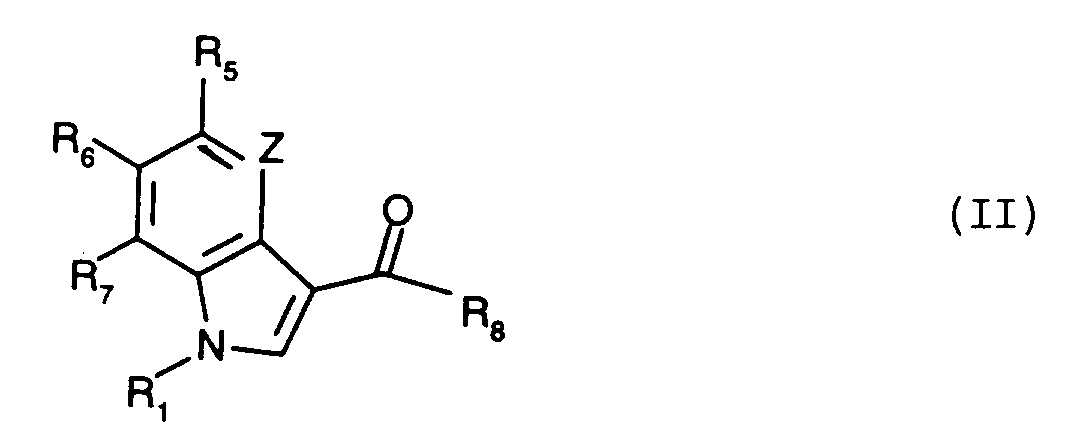
- Compounds of formula II may conveniently be produced by submitting a compound of formula IV to a modified Vilsmeier reaction and then alkylating or acylating.
- the modified Vilsmeier reaction may be performed by using a dimethyl alkylamide in the presence of POCl 3 , according to methods known in the art.
- Alkylation or acylation may be effected in a known manner, for example in the presence of a base, e.g. K 2 CO 3 or C 2 H 5 MgBr, in a solvent such as dimethylformamide or tetrahydrofurane.
- the starting materials may be produced as follows:
- 5-Benzyloxy-6-fluoro-indole-3-carboxyaldehyde used as starting material may be produced as follows:
- R 7 and R' 10 are as defined in Table IV below.
- 5-(Dimethylphosphine oxide)-indole-3-carboxaldehyde used as starting material for the production of the compound of Example 52 may be prepared according to Example 4 d) from indol-5-dimethylphosphine oxide.
- Indole-5-dimethylphosphine oxide may be prepared as follows:
- the compounds of formula I and their pharmaceutically acceptable salts exhibit pharmaceutical activity and are, therefore, useful as pharmaceuticals.
- compounds of the invention have a stimulatory effect on gastrointestinal motility as may be shown in standard test models, for example as follows:
- Monopolar electrodes are implanted on the serosal side of the gut wall along the small intestine of Beagle dogs. From these electrodes, signals are fed into a preamplifier and filtered for the registration of low and high frequency potentials, in order to separate slow waves from spikes. The number of spike bursts ocurring in 2 min. periods are determined. From this the following data are extracted: duration of phase I - III, interval between 2 consecutive phase III blocks, propagation velocity. One or two cycles are recorded prior to drug administration which is done subcutaneously 10-15 min after a Phase III has passed the most distal electrodes. Control experiments are performed routinely by means of solvent administration. In fed dogs, the number of spikes per 30 min. is determined additionally. In this test the compounds of the invention stimulate myoelectric activity at dosages of the order of from about 0.001 to 10 mg/kg s.c.
- the stimulatory effect on gastrointestinal motility of compounds of invention is also indicated e.g. by their effects on the peristaltic reflex in the isolated guinea-pig ileum.
- Peristalsis is elicited for 30 s by increasing the intraluminal pressure from zero by 1 to 4 cm H 2 O. Measurements are made of longitudinal muscle responses by using an isotonic force-displacement transducer and of circular muscle activity by employing a pressure transducer. The area under the curve (AUC) of peristaltic contractions is determined and concentration response curves are established by plotting the AUC representing the circular and longitudinal muscle activity. Each preparation is used as its own control, taking the peristaltic activity before the administration of the compounds to be tested as 100%. Compounds to be tested are added to the serosal side and are left in contact with the tissue for 15 min. In this test compounds of the invention have a stimulatory effect on the peristaltic activity at concentrations of the order of from about 10 -10 M to 10 -7 M.
- Compounds of the invention are therefore useful for the treatment of gastrointestinal motility disorders, for example to normalize or to improve the gastric emptying and intestinal transit in subjects having a disturbed motility, e.g. gastro-oesophageal reflux disease, decreased peristalsis of the oesophagus and/or stomach and/or small and/or large intestine, or to treat oesophagitis, gastroparesis, dyspepsia, non-ulcer dyspepsia, pseudo-obstruction, impaired colonic transit, ileus, irritable bowel syndrome, constipation, epigastric pain, postoperative gut atony, recurrent nausea and vomiting, anorexia nervosa or dyskinesias of the biliary system.
- a disturbed motility e.g. gastro-oesophageal reflux disease, decreased peristalsis of the oesophagus and/or stomach and/or small and/or large intestine
- the compounds of the invention are also indicated for use in the treatment of dyskinesias of the urinary bladder, the modulation of cortisol/aldosterone release, or for improving memory and learning.
- An indicated daily dosage is in the range of from about 0.01 to about 3 mg, e.g. from about 0.01 to about 1 mg for parenteral use, and of from about 0.1 to about 3 mg for oral use, conveniently administered once, in divided dosages 2 to 4 x/day, or in sustained release form.
- Unit dosage forms for oral administration accordingly comprise from about 0.0025 to about 1.5 mg active ingredient (i.e. compound or pharmaceutically acceptable salt of the invention) admixed with an appropriate solid or liquid, pharmaceutically acceptable, diluent or carrier therefor.
- the present invention also provides:
- compounds of the invention have an antiserotoninergic effect specifically at the 5-HT 4 receptors as may be shown in standard test models, for example as follows:
- the isolated longitudinal muscle of the guinea pig ileum with its adhering myenteric plexus is a well established model which permits investigations of the mechanism of action of various neurotransmitters.
- the Tyrode solution is of the following composition (mmol/l): NaCl 137.0; CaCl 2 1.8; KCl 2.7; MgCl 2 1.05; NaHCO 3 11.9; NaHPO 4 0.4; glucose 5.6; and methysergide 0.1 ⁇ M.
- the strips are maintained under a resting tension of 500 mg. Contractions are recorded with an isotonic pendulum lever. After equilibration for 30 min a set concentration of carbachol is applied in 10 min intervals until a consistant reaction is achieved.
- Non-cumulative concentration-response curves for 5-HT are established by adding increasing concentrations of the agonist to the organ bath at intervals of at least 15 min. Preceding experiments showed that the intervals were long enough to avoid tachyphylaxis. Each concentration is left in contact with the tissue for 1 min. Each strip is only used to record two concentration-response curves; the first for 5-HT alone and the second for 5-HT in the presence of a set concentration of antagonist, each strip thus serving as its own control. Antagonists are allowed to preequilibrate for at least 10 min prior to addition of 5-HT. The contractions expressed as percentage of the maximal response to 5-HT obtained from several preparations are plotted as mean values in order to obtain log-concentration-response curves. Inhibition constants are expressed in the form of pA 2 values which are graphically determined according to conventional methods (Arunlakshana et al, 1959, McKay 1978).
- 5-HT elicits a concentration-dependent contractile effect.
- 5-HT induces its major contractile effects in the longitudinal muscle strip of the guinea pig ileum by releasing substance P from nerve endings within this tissue. Its effect is mediated by two different 5-HT receptors.
- 5-HT activates a neuronal receptor which causes substance P release.
- the liberated substance P activates neuronal substance P receptors and this causes the release of acetylcholine which subsequently activates muscarinic receptors located on smooth muscle cells and brings about contraction.
- 5-HT activates a second neuronal receptor which results in release of substance P to cause activation of substance P receptors on smooth muscle cells and thereby exerting contraction.
- Compounds of the invention block preferentially the high affinity 5-HT 4 receptors thereby inhibiting 5-HT-induced contraction e.g. at concentrations from about 10 -8 to about 10 -6 mol/l. They exert less antagonistic activity at the low affinity 5-HT 3 receptor sites.
- Compounds of the invention are therefore useful for the treatment of gastro-intestinal motility disorders such as tachygastria, problems of gastric emptying due to tachygastria, irritable bowel syndrome, intestinal spasms, intestinal cramps, constipation due to increased large intestinal tone, gastro-oesophageal reflex disease and dyskinesias of the biliary system.
- gastro-intestinal motility disorders such as tachygastria, problems of gastric emptying due to tachygastria, irritable bowel syndrome, intestinal spasms, intestinal cramps, constipation due to increased large intestinal tone, gastro-oesophageal reflex disease and dyskinesias of the biliary system.
- Compounds of the invention also inhibit gastric lesions induced by necrotizing agents as indicated in standard tests, e.g. using rats with ethanol-induced gastric lesions.
- the tests are carried out employing male rats (200-250 g) fasted overnight but with free access to water.
- the test substance is administered s.c. or orally by a metal stomach tube.
- Absolute ethanol is given orally 30 min after administration of the test substance and the animals are killed 1 hour later.
- the stomach is cut open along the greater curvature and pinned flat.
- Hemorrhagic erosions are quantified in two ways: area and length of the erosions.
- Compounds of the invention are accordingly indicated for use in the prophylactic or curative treatment of gastrointestinal disorders such as peptic ulcer diseases.
- the compounds of the invention are further indicated for treating diarrhea, inflammatory diseases of the stomach and bowel, e.g. gastritis, duodenitis, including inflammatory bowel disease, nausea and vomiting. Furthermore they are also indicated for the treatment of arrhythmias, tachycardia, dyskinesia of the urinary bladder, e.g. incontinence, for reducing the occurrence of stroke, or for modulating stress responses.
- Unit dosage forms for oral administration accordingly comprise from about 0.025 to about 50 mg of a compound of the invention admixed with an appropriate solid or liquid, pharmaceutically acceptable, diluent or carrier therefor.
- the present invention also provides:
- the compounds of the invention have an antagonist effect at the central 5HT-1C receptors.
- Compounds of the invention have a potent binding affinity to central 5HT-1C receptors as e.g. measured according to the method disclosed by D. Hoyer et al., Eur. J. Pharmacol., 118 , 13 - 23 (1985).
- mCPP m-chlorophenyl-piperazine
- Compounds of the invention are therefore useful for the prophylactic treatment of migraine or for the treatment of psychiatric disorders e.g. anxiety, obsessive compulsive disorders, panic attacks, depression, bulimia, schizophrenia, situations of increased intracranial pressure and priapism.
- psychiatric disorders e.g. anxiety, obsessive compulsive disorders, panic attacks, depression, bulimia, schizophrenia, situations of increased intracranial pressure and priapism.
- An indicated daily dosage is in the range of from about 0.5 to about 300 mg, conveniently administered once, in divided dosages 2 to 4 x/day, or in release form.
- the present invention also provides:
- Compounds of the invention also have an agonist effect on 5HT-1D receptors.
- Their binding affinity to 5HT-1D receptors has been determined e.g. according to the method disclosed by C. Waeber et al., Naunyn-Schmiedeberg's Arch. Pharmacol., 337 , 595 - 601 (1988).
- Anterior cerebral arteries are excised from pig brains obtained from the local slaughterhouse. Circular segments of 3-4 mm length are mounted between two L-shaped metal prongs and placed in temperature-controlled (37° C) organ baths filled with Krebs solution that is continuously gassed with 5% CO2 in oxygen. Agonist-induced vascular contractions are measured isometrically. In order to measure only 5-HT1D receptor mediated effects, ketanserin (10-7 M), which prevents contractions via 5-HT2 receptors, is added to the bath solution. Compounds of the invention induce vascular contractions at a concentration of from 10 -10 to 10 -5 M, particularly 10 -9 to 10 -7 M.
- Compounds of the invention are therefore useful in treating conditions associated with cephalic pain, in particular in the treatment of migraine, cluster headache, chronic paroxysmal hemicrania and headache associated with vascular disorders and in alleviating the symptoms associated therewith.
- An indicated daily dosage is in the range of from about 0.5 to about 300 mg, conveniently administered once, in divided dosages 2 to 4 x/day, or in sustained release form.
- the present invention also provides:
- the compounds of the invention may be administered by any conventional route, in particular nasally, enterally, preferably orally, e.g. in the form of tablets or capsules, or parenterally e.g. in the form of injectable solutions or suspensions or in a suppository form.
- the compounds of the invention may be administered in free form or in pharmaceutically acceptable salt form.
- Such salts may be prepared in conventional manner and exhibit the same order of activity as the free compounds.
- Suitable pharmaceutically acceptable salts of the compounds of the invention include for example the hydrochlorides.
- Compounds of formula I wherein R 1 and/or R 7 is other than hydrogen have e.g. an antiserotoninergic effect specifically at the 5-HT 4 receptors and inhibit gastric lesions induced by necrotizing agents and are therefore useful as an antiulcer or antimotility agent in the method of the invention for treating gastrointestinal disturbances and for the prophylactic or curative treatment of peptic ulcer diseases. They are also indicated for treating diarrhea, inflammatory diseases of the stomach and bowel, e.g. gastritis, duodenitis, including inflammatory bowel disease, nausea and vomiting, arrhythmias, tachycardia, dyskinesia of the urinary bladder, e.g. incontinence, for reducing the occurrence of stroke, or for modulating stress responses. Compounds of Examples 89, 90 and 97 are preferred.
Landscapes
- Chemical & Material Sciences (AREA)
- Organic Chemistry (AREA)
- Health & Medical Sciences (AREA)
- General Health & Medical Sciences (AREA)
- Life Sciences & Earth Sciences (AREA)
- Nuclear Medicine, Radiotherapy & Molecular Imaging (AREA)
- Animal Behavior & Ethology (AREA)
- Engineering & Computer Science (AREA)
- Bioinformatics & Cheminformatics (AREA)
- Chemical Kinetics & Catalysis (AREA)
- General Chemical & Material Sciences (AREA)
- Medicinal Chemistry (AREA)
- Biochemistry (AREA)
- Pharmacology & Pharmacy (AREA)
- Molecular Biology (AREA)
- Public Health (AREA)
- Veterinary Medicine (AREA)
- Pharmaceuticals Containing Other Organic And Inorganic Compounds (AREA)
- Indole Compounds (AREA)
- Acyclic And Carbocyclic Compounds In Medicinal Compositions (AREA)
- Solid Fuels And Fuel-Associated Substances (AREA)
- Plural Heterocyclic Compounds (AREA)
- Organic Low-Molecular-Weight Compounds And Preparation Thereof (AREA)
- Nitrogen Condensed Heterocyclic Rings (AREA)
- Saccharide Compounds (AREA)
Abstract
Description

- R1
- is hydrogen; C1-6alkyl; (C1-6alkyl)carbonyl; benzoyl; or phenylC1-4alkyl-carbonyl;
- R5
- is hydrogen; halogen; C1-6alkyl; hydroxy; nitro; amino; C1-4alkylamino; C1-10alkylcarbonylamino; C2-6alkoxycarbonyl; SO2NRaRb wherein each of Ra and Rb independently is hydrogen or C1-6alkyl; cyano; or trimethylsilyl; C1-6alkyl substituted by -SO2-C1-6alkyl, -SO2NRaRb, -CONRaRb, -NH-SO2-C1-6alkyl, -N(C1-6alkyl)-SO2-(C1-6alkyl), -NRaR'b wherein R'b is hydrogen or C1-6alkyl, C2-6alkoxycarbonyl or -PO(C1-4alkyl)2; carboxy; -CONRaRb; -PO(C1-4alkyl)2; OCONRcRd, wherein each of Rc and Rd independently is C1-6alkyl;
- R6
- is hydrogen or, when R5 is OH, R6 is hydrogen or halogen,
- Z
- is -CR4= wherein R4 is hydrogen, halogen, hydroxy or C1-6alkyl or, when R5 is hydrogen or hydroxy, Z is also -N=,
- R7
- is hydrogen, halogen, C1-6alkyl or C1-6alkoxy,
- X--Y
- is -CR8=N- or -CH(R8)-NH- wherein R8 is hydrogen or C1-6alkyl, and
- B
- is a radical of formula (a) or (b),

- n
- is 1 or 2,
- A1
- is C=O or CH2,
- X1
- is S; NR11 wherein R11 is hydrogen C1-6alkylcarbonyl, benzoyl, or phenylC1-4alkyl-carbonyl; or CR12R13, wherein each of R12 and R13 independently is hydrogen or C1-4alkyl,
- R10
- is hydrogen; C1-12alkyl; C1-6alkyl substituted by hydroxy,
aryl, aryloxy, adamantyl, a heterocyclic radical,
-NH15-CO-R16 or -NH-SO2-aryl; C5-7cycloalkyl; adamantyl;
(C1-10alkyl)carbonyl; benzoyl; phenyl(1-4alkyl)carbonyl; or
-CONHR14,
wherein - R14
- is C1-10alkyl or C5-7cycloalkyl,
- R15
- is hydrogen or C1-4alkyl, and
- R16
- is C1-6alkyl, C5-7cycloalkyl, C5-7cycloalkyl-C1-4alkyl, aryl or arylC1-4alkyl,
- wherever
- "aryl" appears as is or in the significances "aryloxy", "-NH-SO2-aryl" or "aryl(C1-4alkyl)" in the above definition, it is phenyl or phenyl substituted by halogen, C1-4alkyl or C1-6alkoxy; and
- wherever
- "heterocyclic radical" appears in the above
definition, it is pyridyl, imidazolyl, benzimidazolyl,
pyrrolidinyl, pyrrolidonyl, piperidino,
pyrazinyl, perhydroindolyl or a radical of
formula (c), (d) or (e)


- R22
- is hydrogen or C1-4alkyl,
- B1
- is -CH2CH2-, -COCH2- or -(CH2)3- in which one or two H thereof can be replaced by C1-4alkyl, or 1,2-phenylene,
- E
- is -CH2OH2-, -CH2N(R17)- or -(CH2)3- in which one or two H thereof can be replaced by C1-6alkyl, or 1,2-phenylene,
- E1
- is CO or CH2,
- R17
- is hydrogen or C1-4alkyl,
- G
- is CO, -CHCOOR18, -CHCOR19, 5,5-dimethyl-1,3-dioxan-2-ylidene or 1,3-dioxolan-2-ylidene, wherein R18 is hydrogen or C1-6alkyl and R19 is C1-6alkyl, and
- n'
- is 0 or 1
and - X2
- is -SR20 or -NR3R'10 wherein R20 is C1-6alkyl, R3 is hydrogen or C1-6alkyl and R'10 has one of the significances given for R10 above, or R3 and R'10 together with the nitrogen atom to which they are attached form a heterocyclic radical as defined above;
and a physiologically-hydrolysable and -acceptable ether or ester thereof when R5 is hydroxy, in free form or in salt form.

- H5
- is hydrogen; C1-6alkyl; hydroxy, C1-6alkoxy; C1-6alkoxy substituted by hydroxy, C1-4alkoxy, (C1-6alkyl)carbonyloxy, benzoyloxy, phenyl(C1-4alkyl)carbonyloxy, NHaR'b, CONRaRb or CSNRaRb wherein each of Ra and Rb independently is hydrogen or C1-6alkyl and R'b is hydrogen, C1-6alkyl, C3-7cycloalkyl, C3-6alkenyl, phenyl or phenyl-C1-3alkyl wherein the phenyl ring is optionally substituted; C2-6alkenyloxy; pyridylcarbonyloxy; nitro; amino; C1-4alkylamino; C1-10alkylcarbonylamino; C2-6alkoxycarbonyl; SO2NRaRb; cyano; trimethylsilyl; C1-6alkyl substituted by -SO2-C1-6alkyl, -SO2NRaRb, -CONRaRb, -NH-SO2-C1-6alkyl, -N(C1-6alkyl)-SO2-(C1-6alkyl), -NRaR'b, C2-6alkoxycarbonyl or -PO(C1-4alkyl)2; (C1-6alkyl)carbonyloxy, benzoyloxy, phenyl(C1-4alkyl)carbonyloxy, carboxy; CONRaRb; -PO(C1-4alkyl)2; or OCONRcRd, wherein each of Rc and Rd independently is C1-6alkyl.


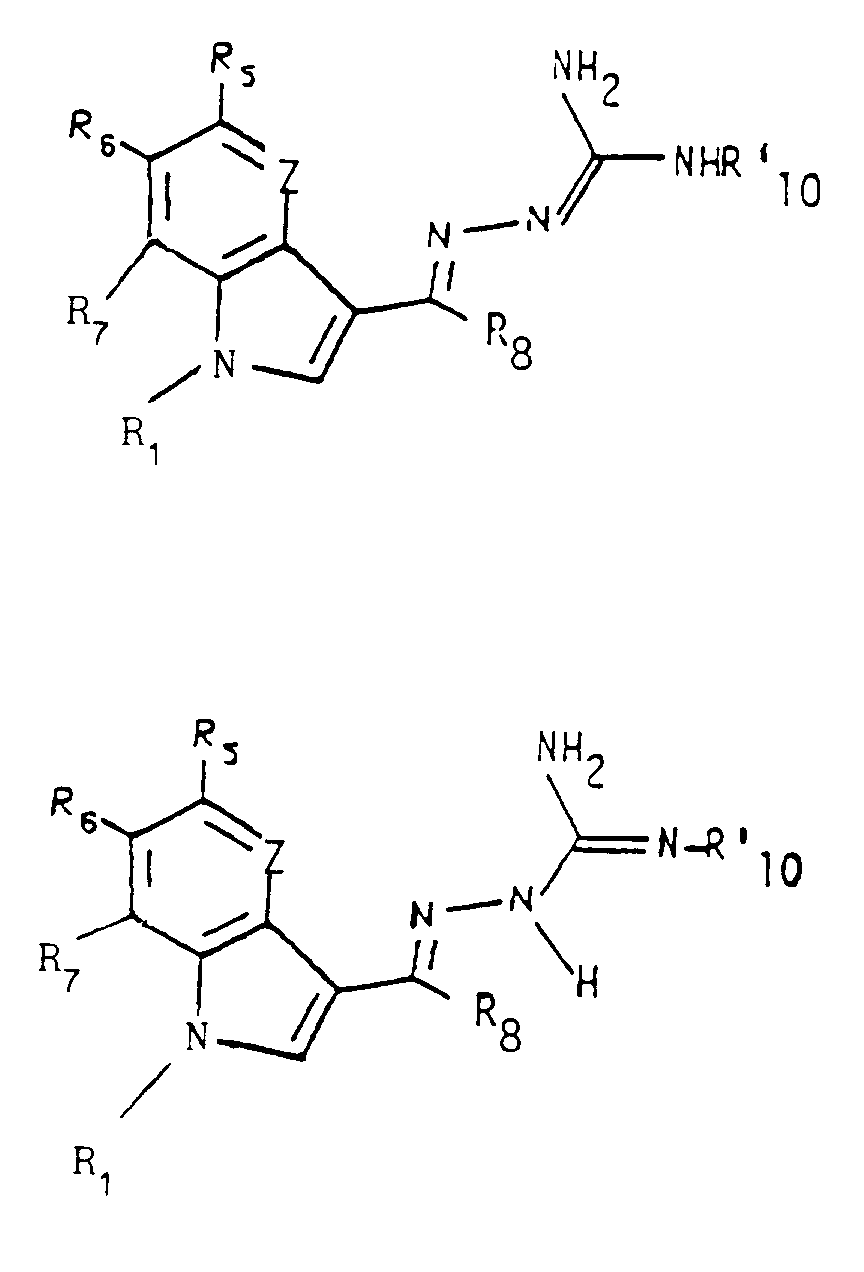


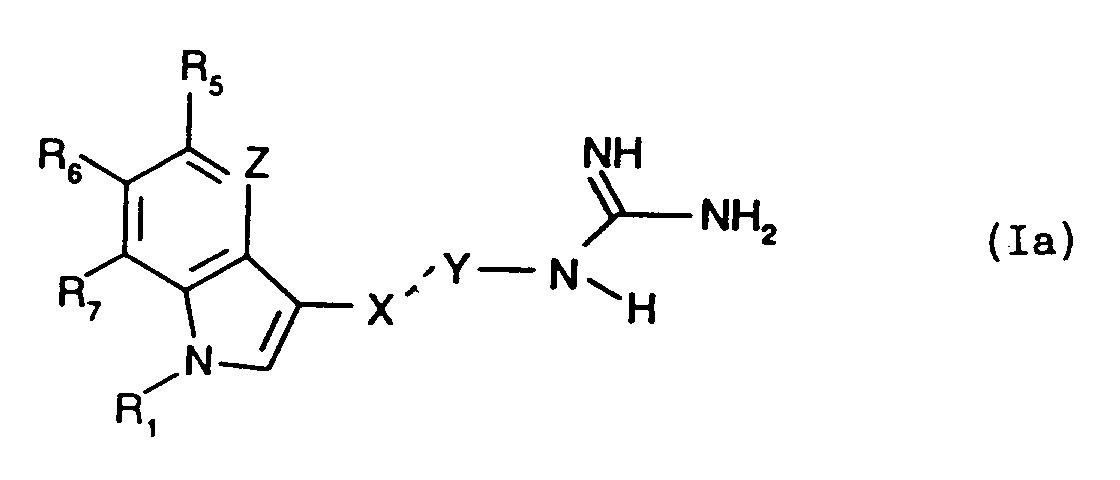
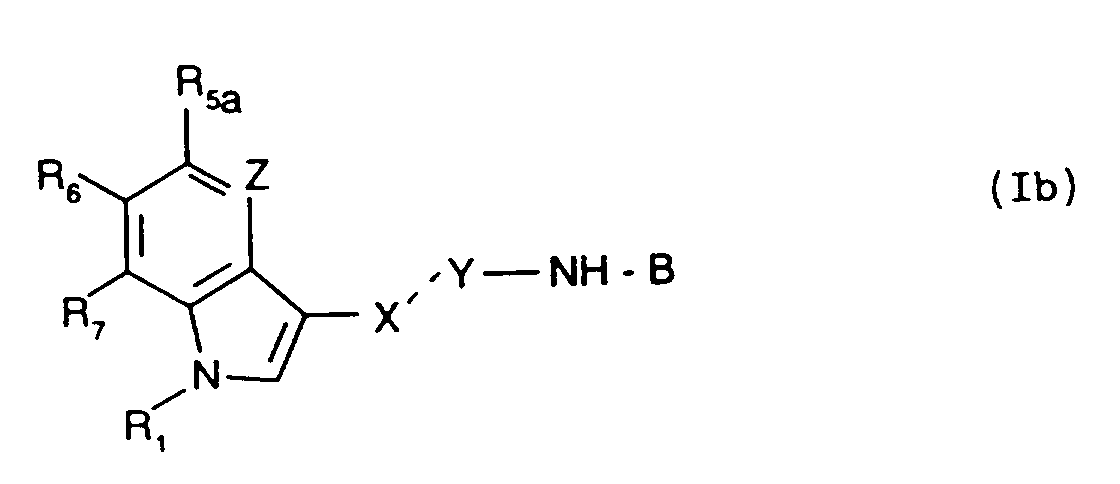
Z, R1, R6, R7, X--Y and B are as defined above, and
R5a is a cleavable ether group; or
and recovering compounds of formula I or a physiologically-hydrolysable and -acceptable ether or ester thereof thus obtained, in free form or in salt, solvate or hydrate form.


- R10
- is as defined above and
- R21
- is either -NR3R'10 or -NHNH2

- THF
- = tetrahydrofurane
- DMF
- = dimethylformamide
- EtOH
- = ethanol
- MeOH
- = methanol
- AcOEt
- = ethyl acetate
- (F)
- = foaming
- (S)
- = sintering

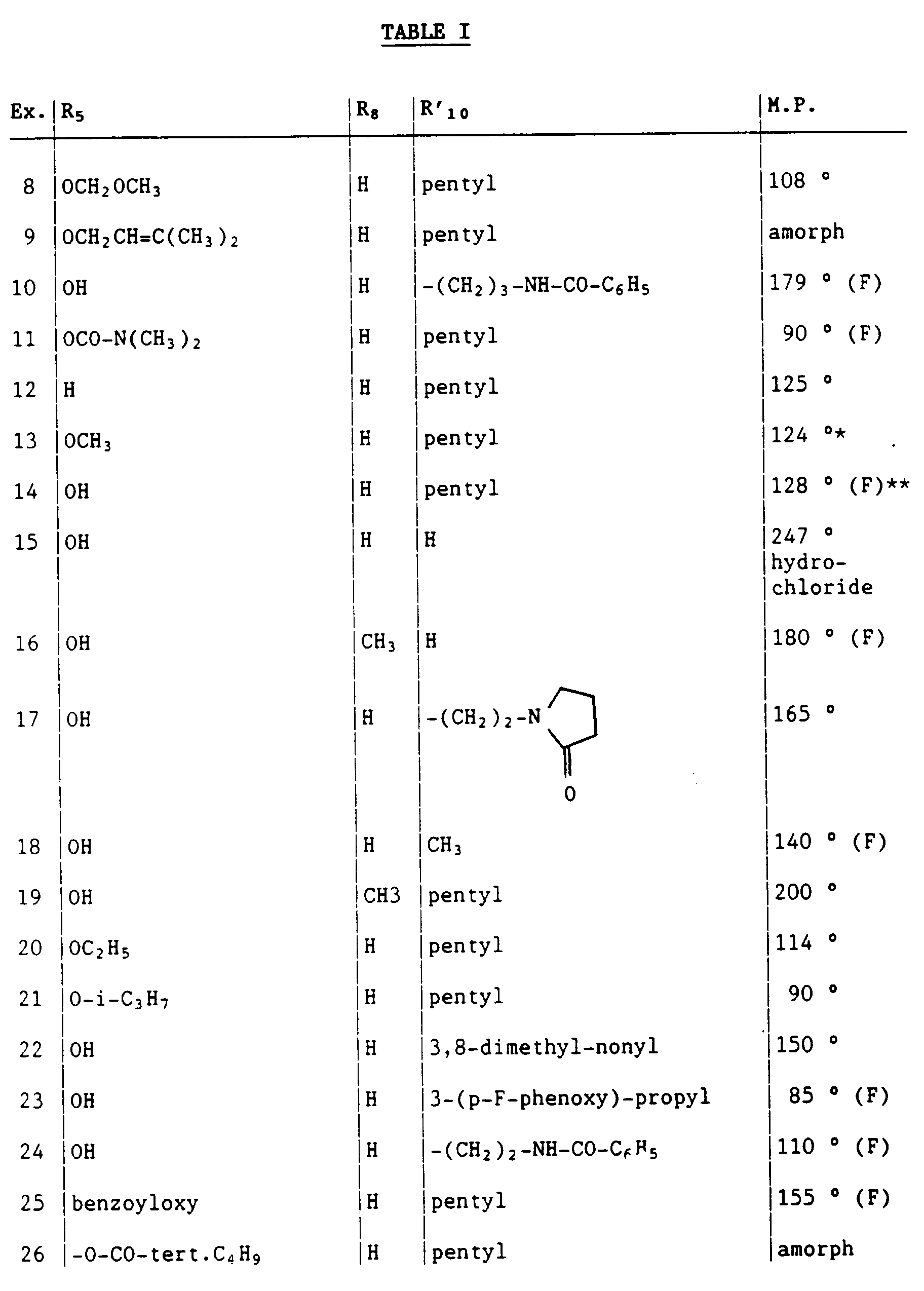
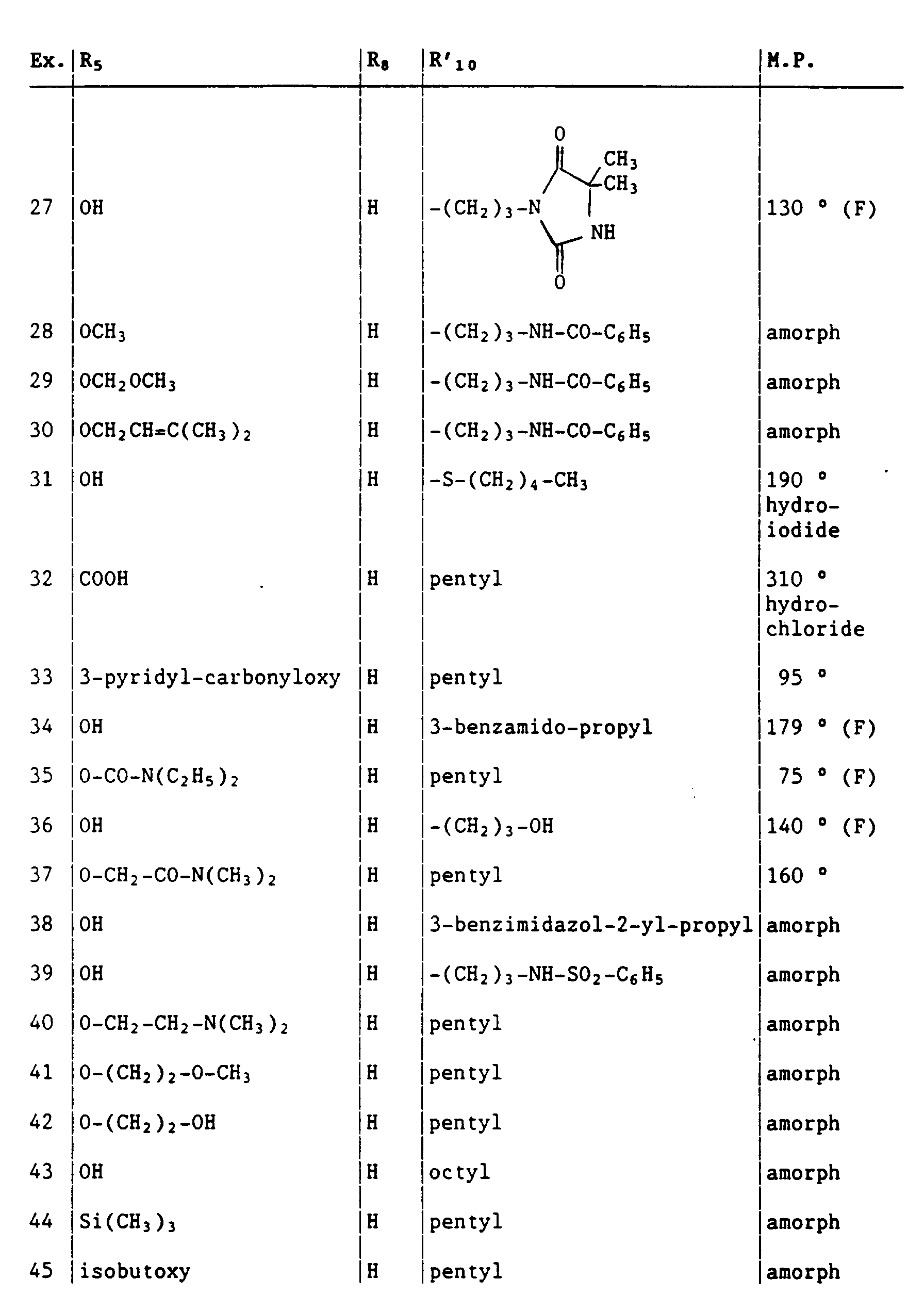
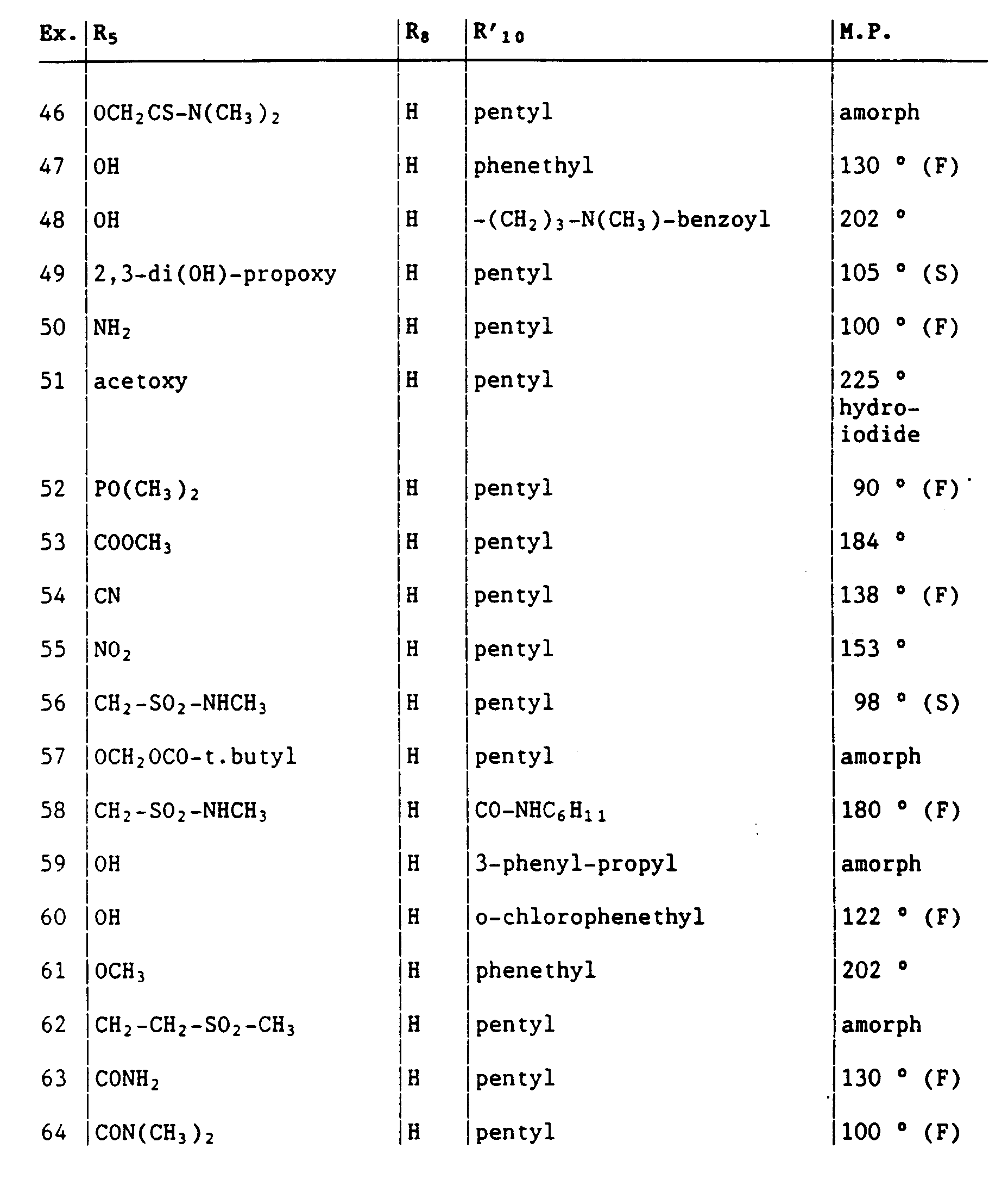
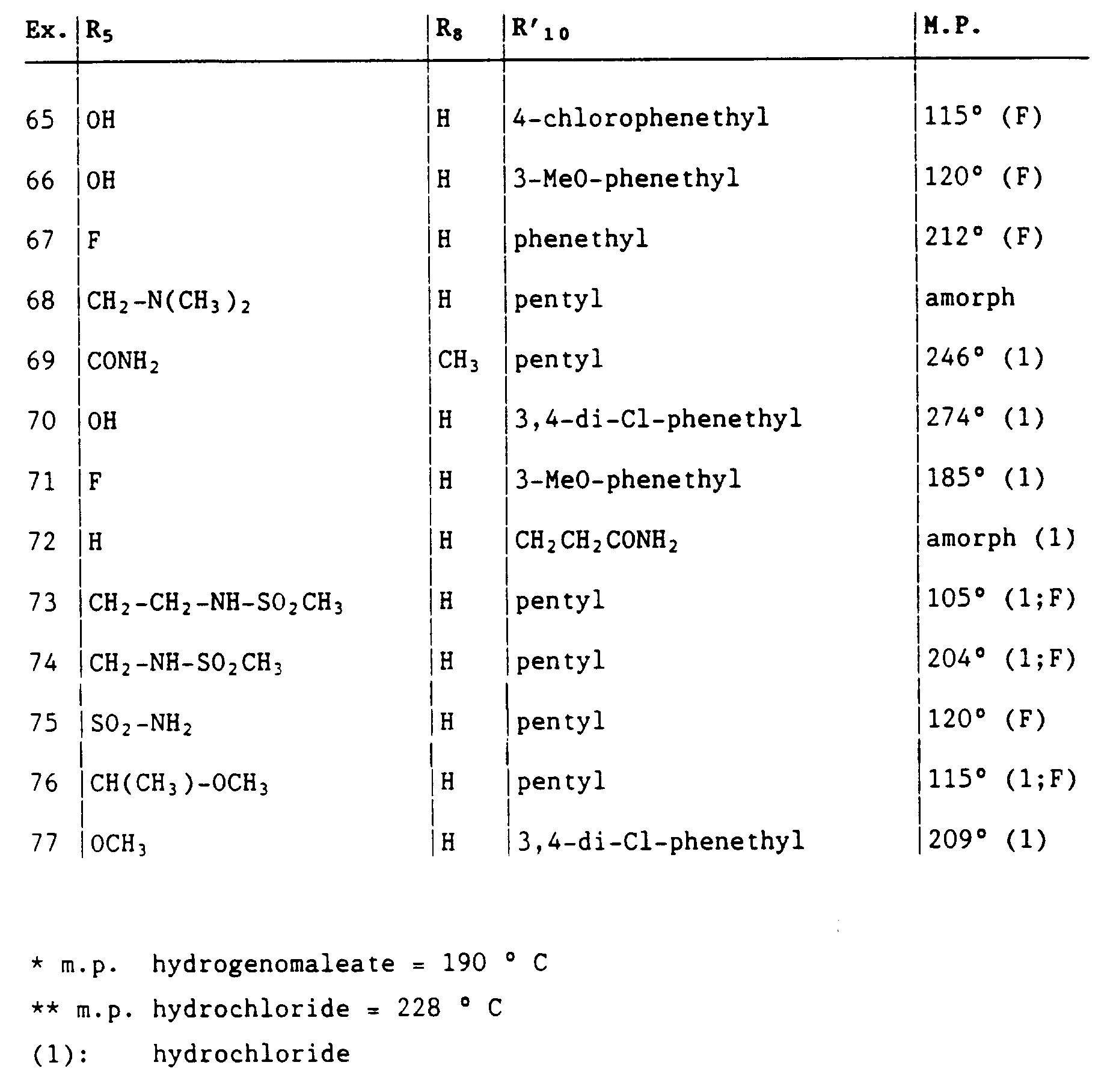

| Ex. | R5 | R8 | X | M.P. |
| 78 | OH | H | NH | 178 ° (F) |
| 79 | OH | CH3 | NH | 240 ° |
| 80 | OH | H | CH2 | 297 ° chlorhydrate |
| 81 | OH | H | S | 165 ° |
| 82 | OCH3 | H | CH2 | 248 ° chlorhydrate (F) |
| 83 | CON(CH3)2 | H | NH | 225 ° |
| 84 | CH2SO2NHCH3 | H | NH | 253 ° |
| 85 | CH2SO2NHCH3 | CH3 | NH | 249 ° |
| 86 | OH | H | NH | 140 ° (F) |

| Ex. | R1 | R4 | R7 | R5 | R3 | R'10 | M.P. |
| 89 | H | H | CH3 | OH | H | pentyl | 130 ° (F) |
| 90 | C2H5 | H | H | OH | H | pentyl | 144 ° |
| 91 | H | CH3 | H | OH | H | pentyl | 105 ° (F) |
| 92 | H | OH | H | H | H | pentyl | 147 ° |
| 93 | H | H | H | OH | piperidino | 164 ° (E) | |
| 94 | H | H | H | OH | perhydroindolyl | 170 ° (S) | |
| 95 | H | H | H | OH | CH3 | pentyl | 100 ° (F) |
| 96 | H | H | H | OCH3 | CH3 | pentyl | 139 ° |
| 97 | H | H | CH3 | OH | CH3 | pentyl | 120 ° (S) |
| 98 | H | H | CH3 | OCH3 | CH3 | pentyl | amorph |
| 99 | C2H5 | H | H | OH | CH3 | pentyl | 138 ° (F) |
| 100 | H | CH3 | H | OH | H | 3-benzimidazol-2-yl-propyl | amorph |
| 101 | H | H | CH3 | H | H | 3-benzimidazol-2-yl-propyl | 120 ° (F) |
| 102 | H | H | OCH3 | H | H | 3-benzimidazol-2-yl-propyl | 135 ° (F) |
| 103 | H | H | CH3 | OCR3 | H | 3,4-di-Cl-phenethyl | 220 ° (1) |

| Ex. | R7 | R'10 | M.P. |
| 104 | H | pentyl | amorph |
| 105 | H | phenethyl | 192 ° |
| 106 | CH3 | pentyl | 195 ° |
| 107 | H | CH2CH2NHCOC6H5 | 220 ° |
| 108 | H | benzyl | 203 ° |

Claims (12)
- A compound of formula Iwherein
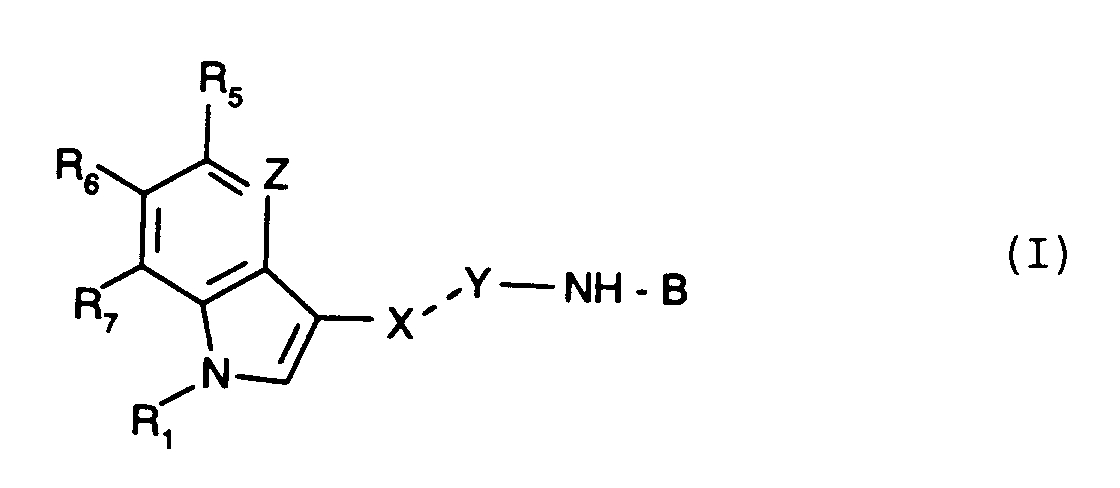
- R1
- is hydrogen; C1-6alkyl; (C1-6alkyl)carbonyl; benzoyl; or phenylC1-4alkyl-carbonyl;
- R5
- is hydrogen; halogen; C1-6alkyl; hydroxy; nitro; amino; C1-4alkylamino; C1-10alkylcarbonylamino; C2-6alkoxycarbonyl; SO2NRaRb wherein each of Ra and Rb independently is hydrogen or C1-6alkyl; cyano; or trimethylsilyl; C1-6alkyl substituted by -SO2-C1-6alkyl, -SO2NRaRb, -CONRaRb, -NH-SO2-C1-6alkyl, -N(C1-6alkyl)-SO2-(C1-6alkyl), -NRaR'b wherein R'b is hydrogen or C1-6alkyl, C2-6alkoxycarbonyl or -PO(C1-4alkyl)2; carboxy; CONRaRb; -PO(C1-4alkyl)2; OCONRcRd, wherein each of Rc and Rd independently is C1-6alkyl;
- R6
- is hydrogen or, when R5 is OH, R6 is hydrogen or halogen,
- Z
- is -CR4= wherein R4 is hydrogen, halogen, hydroxy or C1-6alkyl or, when R5 is hydrogen or hydroxy, Z is also -N=,
- R7
- is hydrogen, halogen, C1-6alkyl or C1-6alkoxy,
- X--Y
- is -CR8=N- or -CH(R8)-NH- wherein R8 is hydrogen or C1-6alkyl, and
- B
- is a radical of formula (a) or (b),

- n
- is 1 or 2,
- A1
- is C=O or CH2,
- X1
- is S; NR11 wherein R11 is hydrogen,(C1-6alkyl)carbonyl, benzoyl or phenylC1-4alkyl-carbonyl; or CR12R13, wherein each of R12 and R13 independently is hydrogen or C1-4alkyl,
- R10
- is hydrogen; C1-12alkyl; C1-6alkyl substituted by hydroxy,
aryl, aryloxy, adamantyl, a heterocyclic radical,
-NR15-CO-R16 or -NH-SO2-aryl ; C5-7cycloalkyl; adamantyl;
(C1-10alkyl)carbonyl; benzoyl; phenyl(1-4alkyl)carbonyl; or
-CONHR14,
wherein - R14
- is C1-10alkyl or C5-7cycloalkyl,
- R15
- is hydrogen or C1-4alkyl, and
- R16
- is C1-6alkyl, C5-7cycloalkyl, C5-7cycloalkyl-C1-4alkyl, aryl or arylC1-4alkyl,
- wherever
- "aryl" appears as is or in the significances "aryloxy", "-NH-SO2-aryl" or "aryl(C1-4alkyl)" in the above definition, it is phenyl or phenyl substituted by halogen, C1-4alkyl or C1-6alkoxy; and
- wherever
- "heterocyclic radical" appears in the above
definition, it is pyridyl, imidazolyl, benzimidazolyl,
pyrrolidinyl, pyrrolidonyl, piperidino,
pyrazinyl, perhydroindolyl or a radical of
formula (c), (d) or (e)

- R22
- ishydrogen or C1-4alkyl,
- B1
- is -CH2CH2-, -COCH2- or -(CH2)3- in which one or two H thereof can be replaced by C1-4alkyl, or 1,2-phenylene,
- E
- is -CH2CH2-, -CH2N(R17)- or -(CH2)3- in which one or two H thereof can be replaced by C1-6alkyl, or 1,2-phenylene,
- E1
- is CO or CH2,
- R17
- is hydrogen or C1-4alkyl,
- G
- is CO, -CHCOOR18, -CHCOR19, 5,5-dimethyl-1,3-dioxan-2-ylidene or 1,3-dioxolan-2-ylidene, wherein R18 is hydrogen or C1-6alkyl and R19 is C1-6alkyl, and
- n'
- is 0 or 1
and - X2
- is -SR20 or -NR3R'10 wherein R20 C1-6alkyl, R3 is hydrogen or C1-6alkyl and R'10 has one of the significances given for R10 above, or R3 and R'10 together with the nitrogen atom to which they are attached form a heterocyclic radical as defined above;
and a physiologically-hydrolysable and -acceptable ether or ester thereof when R5 is hydroxy, in free form or in salt form. - A compound of formula Iwherein
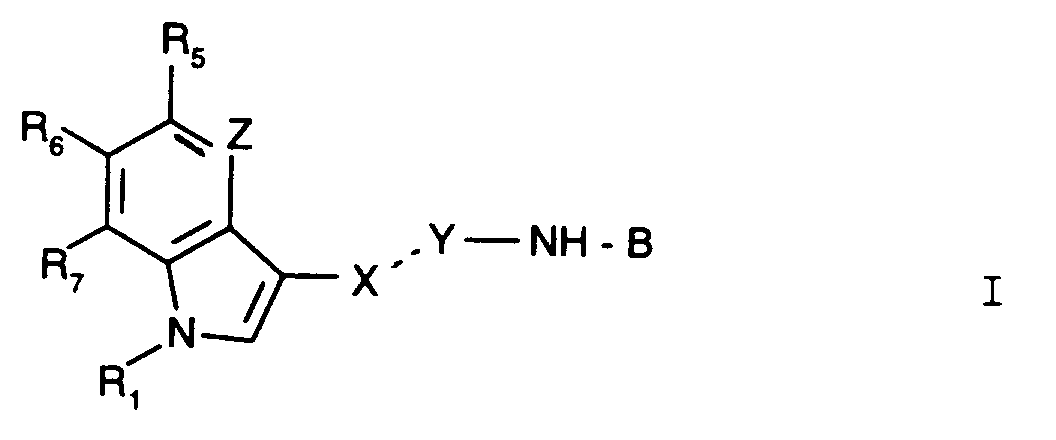
- R1, R7, X--Y
- and B are as defined in claim 1,
- Z
- is -CR4= wherein R4 is hydrogen, halogen, hydroxy or C1-6 alkyl, and
- R5
- is hydrogen; C1-6alkyl; hydroxy; C1-6alkoxy; C1-6alkoxy substituted by hydroxy, C1-4alkoxy, (C1-6alkyl)carbonyloxy, benzoyloxy, phenylC1-4alkylcarbonyloxy, NRaR'b, CONRaRb or CSNRaRb wherein each of Ra, Rb and R'b independently is hydrogen or C1-6alkyl; C2-6alkenyloxy; pyridyl-carbonyloxy; nitro; amino; C1-4alkylamino; C1-10-alkylcarbonylamino; C2-6-alkoxycarbonyl; SO2NRaRb; cyano; or trimethylsilyl; C1-6alkyl substituted by -SO2-C1-6alkyl, -SO2NRaRb, -CONRaRb, -NH-SO2-C1-6alkyl, -N(C1-6alkyl)-SO2-(C1-6alkyl), -NRaR'b, C2-6alkoxycarbonyl or -PO(C1-4alkyl)2; (C1-6alkyl)carbonyloxy; benzoyloxy; phenylC1-4alkyl-carbonyloxy; carboxy; CONRaRb; -PO(C1-4alkyl)2; or OCONRcRd, wherein each of Rc and Rd independently is C1-6alkyl,
in free form or in salt form. - A compound according to claim 1 or 2 wherein R1 is H, R7 is H and Z is -CH=.
- A compound according to claim 1 wherein R1 is H, R7 is H, Z is -N= and R5 is hydroxy.
- A compound according to any one of claims 1, 2 or 3 wherein R5 is hydrogen, hydroxy, C1-6alkoxy, carboxy, C2-6-alkoxycarbonyl, CONRaRb, SO2NH (C1-6 alkyl), C1-6 alkyl substituted by SO2C1-6 alkyl or PO(C1-6alkyl)2, R1 is H, R7 is H, Z is -CH= and R6 is hydrogen.
- A compound according to any one of the preceding claims wherein B is a radical of formula (b) wherein X2 is -NR3R'10.
- 5-methoxy-indole-3-carboxaldehyde amino-(pentyl-amino)methylenehydrazone, in free form or in salt form.
- A compound which is 5-hydroxy-indole-3-carboxaldehydeamino(N-cyclo-hexylureido)methylenehydrazone, 5-hydroxy-indole-3-carboxaldehyde amino(3-benzimidazol-2-yl-propylamino)methylenehydrazone, 5-carbamoyl-indole-3-carboxaldehydeamino(pentyl-amino)methylenehydrazone, 5-hydroxy-7-methyl-indole-3-carboxaldehyde amino(pentyl-amino)methylene-hydrazone, 1-ethyl-5-hydroxy-indole-3-carboxaldehyde amino(pentyl-amino)methylenehydrazone, 5-hydroxy-7-methyl-indole-3-carboxaldehyde amino (N-methyl-N-pentyl-amino)methylenehydrazone and 5-oxo-4-aza-indole-3-carboxaldehyde amino(pentyl-amino)methylenehydrazone, in free form or in salt form.
- A process for the preparation of a compound of formula I as defined in claim 1, comprisingand recovering compounds of formula I or a physiologically-hydrolysable and -acceptable ether or ester thereof thus obtained, in free form or in salt, solvate or hydrate form.a) for the production of a compound of formula I wherein X--Y is -CR8=N- reacting a compound of formula II,wherein Z, R1, R5, R6, R7 and R8 are as defined in claim 1, with a compound of formula III,
 b) for the production of a compound of formula I wherein X--Y is -CHR8-NH- hydrogenating a compound of formula I wherein Y--X is -CR8=N-; orc) for the production of a compound of formula I, wherein B is a radical of formula (b'), subjecting to alkylation, acylation or carbamoylation a compound of formula Ia,wherein Z, R1, R5, R6, R7 and X--Y are as defined in claim 1,
 d) for the production of a compound of formula I wherein R5 is hydroxy subjecting to ether cleavage a compound of formula Ibwherein
Z, R1, R6, R7, X--Y and B are as defined in claim 1, and R5a is a cleavable ether group; ore) for the production of a physiologically-hydrolysable and -acceptable ether or ester of a compound of formula I wherein R5 is hydroxy etherifying or acylating a compound of formula I wherein R5 is hydroxy - A compound according to any one of claims 1 to 8 for use as a pharmaceutical.
- A pharmaceutical composition comprising a compound according to any one of claims 1 to 8 or a pharmaceutically acceptable salt thereof, together with a pharmaceutically acceptable diluent or carrier therefor.
- Use of a compound according to any one of the claims 1 to 8 or a pharmaceutically acceptable salt thereof in the manufacture of a pharmaceutical composition for use in treating gastro-intestinal motility disorders or migraine.
Applications Claiming Priority (4)
| Application Number | Priority Date | Filing Date | Title |
|---|---|---|---|
| GB9106179 | 1991-03-22 | ||
| GB919106179A GB9106179D0 (en) | 1991-03-22 | 1991-03-22 | Improvements in or relating to organic compounds |
| GB9107927 | 1991-04-15 | ||
| GB919107927A GB9107927D0 (en) | 1991-04-15 | 1991-04-15 | Improvements in or relating to organic compounds |
Publications (2)
| Publication Number | Publication Date |
|---|---|
| EP0505322A1 EP0505322A1 (en) | 1992-09-23 |
| EP0505322B1 true EP0505322B1 (en) | 1998-09-09 |
Family
ID=26298625
Family Applications (1)
| Application Number | Title | Priority Date | Filing Date |
|---|---|---|---|
| EP92810191A Expired - Lifetime EP0505322B1 (en) | 1991-03-22 | 1992-03-17 | Aminoguanidines |
Country Status (22)
| Country | Link |
|---|---|
| US (1) | US5510353A (en) |
| EP (1) | EP0505322B1 (en) |
| JP (1) | JP2593022B2 (en) |
| KR (1) | KR100198018B1 (en) |
| AT (1) | ATE170838T1 (en) |
| AU (1) | AU651442B2 (en) |
| CA (1) | CA2063671C (en) |
| CZ (1) | CZ284339B6 (en) |
| DE (1) | DE69226894T2 (en) |
| DK (1) | DK0505322T3 (en) |
| ES (1) | ES2121836T3 (en) |
| FI (2) | FI102371B (en) |
| HU (2) | HUT64023A (en) |
| IE (1) | IE920895A1 (en) |
| IL (1) | IL101312A (en) |
| MX (1) | MX9201244A (en) |
| MY (1) | MY108158A (en) |
| NO (1) | NO179171C (en) |
| NZ (1) | NZ242069A (en) |
| RO (1) | RO109194B1 (en) |
| SG (1) | SG43221A1 (en) |
| SK (1) | SK279214B6 (en) |
Cited By (19)
| Publication number | Priority date | Publication date | Assignee | Title |
|---|---|---|---|---|
| US5637593A (en) * | 1992-12-21 | 1997-06-10 | Smithkline Beecham Plc | Tryptamine analogues as 5-ht1-like agonists |
| US5763459A (en) * | 1992-05-23 | 1998-06-09 | Smithkline Beecham P.L.C. | Medicaments for the treatment of anxiety |
| AU762829B2 (en) * | 1998-08-21 | 2003-07-03 | Novartis Ag | New oral formulation for 5-HT4 agonists or antagonists |
| WO2003068740A1 (en) * | 2002-02-14 | 2003-08-21 | Wyeth | Pyrrolylalkylidene-hydrazinecarboximidamide derivatives as 5-hydroxytryptamine-6 ligands |
| EP2088154A1 (en) | 2004-03-09 | 2009-08-12 | Ironwood Pharmaceuticals, Inc. | Methods and compositions for the treatment of gastrointestinal disorders |
| EP2246360A1 (en) | 2003-01-28 | 2010-11-03 | Ironwood Pharmaceuticals, Inc. | Compositions for the treatment of gastrointestinal disorders |
| WO2011069038A2 (en) | 2009-12-03 | 2011-06-09 | Synergy Pharmaceuticals, Inc. | Agonists of guanylate cyclase useful for the treatment of hypercholesterolemia, atherosclerosis, coronary heart disease, gallstone, obesity and other cardiovascular diseases |
| WO2014029983A1 (en) | 2012-08-21 | 2014-02-27 | Ardelyx, Inc. | Compounds and methods for inhibiting nhe-mediated antiport in the treatment of disorders associated with fluid retention or salt overload and gastrointestinal tract disorders |
| WO2014151206A1 (en) | 2013-03-15 | 2014-09-25 | Synergy Pharmaceuticals Inc. | Agonists of guanylate cyclase and their uses |
| WO2014151200A2 (en) | 2013-03-15 | 2014-09-25 | Synergy Pharmaceuticals Inc. | Compositions useful for the treatment of gastrointestinal disorders |
| EP2810951A2 (en) | 2008-06-04 | 2014-12-10 | Synergy Pharmaceuticals Inc. | Agonists of guanylate cyclase useful for the treatment of gastrointestinal disorders, inflammation, cancer and other disorders |
| EP2998314A1 (en) | 2007-06-04 | 2016-03-23 | Synergy Pharmaceuticals Inc. | Agonists of guanylate cyclase useful for the treatment of gastrointestinal disorders, inflammation, cancer and other disorders |
| EP3241839A1 (en) | 2008-07-16 | 2017-11-08 | Synergy Pharmaceuticals Inc. | Agonists of guanylate cyclase useful for the treatment of gastrointestinal, inflammation, cancer and other disorders |
| WO2018129552A1 (en) | 2017-01-09 | 2018-07-12 | Ardelyx, Inc. | Compounds useful for treating gastrointestinal tract disorders |
| WO2018129557A1 (en) | 2017-01-09 | 2018-07-12 | Ardelyx, Inc. | Inhibitors of nhe-mediated antiport |
| WO2018129556A1 (en) | 2017-01-09 | 2018-07-12 | Ardelyx, Inc. | Compounds and methods for inhibiting nhe-mediated antiport in the treatment of disorders associated with fluid retention or salt overload and gastrointestinal tract disorders |
| EP3351248A1 (en) | 2008-12-31 | 2018-07-25 | Ardelyx, Inc. | Compounds and methods for inhibiting nhe-mediated antiport in the treatment of disorders associated with fluid retention or salt overload and gastrointestinal tract disorders |
| US10272079B2 (en) | 2013-04-12 | 2019-04-30 | Ardelyx, Inc. | NHE3-binding compounds and methods for inhibiting phosphate transport |
| US10376481B2 (en) | 2012-08-21 | 2019-08-13 | Ardelyx, Inc. | Compounds and methods for inhibiting NHE-mediated antiport in the treatment of disorders associated with fluid retention or salt overload and gastrointestinal tract disorders |
Families Citing this family (61)
| Publication number | Priority date | Publication date | Assignee | Title |
|---|---|---|---|---|
| JPH07508276A (en) * | 1992-06-27 | 1995-09-14 | スミスクライン・ビーチャム・パブリック・リミテッド・カンパニー | Pharmaceutical products containing 5-HT↓4 receptor antagonists |
| GB9226537D0 (en) * | 1992-12-21 | 1993-02-17 | Smithkline Beecham Plc | Compounds |
| JP3035818B2 (en) * | 1997-10-21 | 2000-04-24 | 日本精工株式会社 | Ball bearing |
| KR100364086B1 (en) | 1998-04-16 | 2002-12-11 | 도시바 라이텍쿠 가부시키가이샤 | High-Pressure Electrical Discharge Lamp and Lighting Device |
| RU2260424C9 (en) * | 1998-08-21 | 2006-05-20 | Новартис Аг | New composition for oral administration |
| TWI263496B (en) * | 1999-12-10 | 2006-10-11 | Novartis Ag | Pharmaceutical combinations and their use in treating gastrointestinal disorders |
| US20040092511A1 (en) * | 1999-12-10 | 2004-05-13 | Billstein Stephan Anthony | Pharmaceutical combinations and their use in treating gastrointestinal and abdominal viscera disorders |
| GB0019357D0 (en) | 2000-08-07 | 2000-09-27 | Melacure Therapeutics Ab | Novel phenyl guanidines |
| GB0019359D0 (en) | 2000-08-07 | 2000-09-27 | Melacure Therapeutics Ab | Novel guanidines |
| AU2002323776B2 (en) | 2001-08-10 | 2008-07-31 | Nippon Chemiphar Co., Ltd. | Activator for peroxisome proliferator-responsive receptor Delta |
| JP4276074B2 (en) | 2001-10-12 | 2009-06-10 | 日本ケミファ株式会社 | Activator of peroxisome proliferator-responsive receptor δ |
| US6906095B2 (en) | 2002-05-10 | 2005-06-14 | Wyeth | Indolylalkylidenehydrazine-carboximidamide derivatives as 5-hydroxytryptamine-6 ligands |
| US6951881B2 (en) | 2002-05-10 | 2005-10-04 | Wyeth | (1-substituted-indol-3-yl) alkylidenehydrazinecarboximidamide derivatives as 5-hydroxytryptamine-6 ligands |
| MY137386A (en) * | 2003-07-24 | 2009-01-30 | Novartis Ag | Stable modifications of tegaserod hydrogen maleate |
| JP2007514000A (en) * | 2003-12-16 | 2007-05-31 | テバ ファーマシューティカル インダストリーズ リミティド | Polymorphic forms of tegaserod base and its salts |
| US20060106086A1 (en) * | 2004-04-26 | 2006-05-18 | Santiago Ini | Preparation of tegaserod and tegaserod maleate |
| WO2006002212A1 (en) * | 2004-06-23 | 2006-01-05 | Dr. Reddy's Laboratories Ltd. | Tegaserod hemimaleate |
| WO2006045120A2 (en) * | 2004-10-19 | 2006-04-27 | Teva Pharmaceutical Industries Ltd. | Purification of tegaserod maleate |
| RU2007132704A (en) * | 2005-01-31 | 2009-03-10 | Новартис АГ (CH) | ORGANIC COMPOUNDS |
| CZ298399B6 (en) * | 2005-05-02 | 2007-09-19 | Zentiva, A. S. | Process for preparing 2-[(5-methoxy-1 H-indol-3-yl) methylene]-N-pentylcarbazimidamide (tegaserod) |
| WO2006116953A1 (en) * | 2005-05-02 | 2006-11-09 | Zentiva, A.S. | A method for the preparation of tegaserod and slected salts thereof |
| JP2007145827A (en) * | 2005-10-27 | 2007-06-14 | Teijin Pharma Ltd | Benzo[b]thiophene derivative and production method thereof |
| GB0524668D0 (en) * | 2005-12-02 | 2006-01-11 | Novartis Ag | Organic compounds |
| GB0601953D0 (en) * | 2006-01-31 | 2006-03-15 | Novartis Ag | Organic compounds |
| ZA200809148B (en) | 2006-04-18 | 2010-01-27 | Nippon Chemiphar Co | Activating agent for peroxisome proliferator activated receptor delta |
| CN100412059C (en) * | 2006-06-06 | 2008-08-20 | 江苏奥赛康药业有限公司 | A kind of preparation method of tegaserod |
| AU2007316586A1 (en) * | 2006-11-09 | 2008-05-15 | Generics [Uk] Limited | Novel process |
| EP1939176A1 (en) * | 2006-12-22 | 2008-07-02 | Novartis AG | Salts of Tegaserod |
| WO2008149140A2 (en) * | 2007-06-04 | 2008-12-11 | Generics [Uk] Limited | Tegaserod oxalate and polymorphic forms |
| WO2008149136A1 (en) * | 2007-06-04 | 2008-12-11 | Generics [Uk] Limited | Tegaserod besylate and polymorphic forms |
| WO2008149137A2 (en) * | 2007-06-04 | 2008-12-11 | Generics [Uk] Limited | Tegazerod benzoate and polymorphic forms |
| WO2008149139A2 (en) * | 2007-06-04 | 2008-12-11 | Generics [Uk] Limited | Tegaserod fumarate and polymorphic forms |
| WO2008149138A1 (en) * | 2007-06-04 | 2008-12-11 | Generics [Uk] Limited | Tegaserod malate and polymorphic forms |
| WO2008149154A2 (en) * | 2007-06-05 | 2008-12-11 | Generics [Uk] Limited | Tegaserod succinate and polymorphic forms |
| US20090082419A1 (en) * | 2007-09-26 | 2009-03-26 | Protia, Llc | Deuterium-enriched tegaserod |
| WO2009053733A2 (en) | 2007-10-24 | 2009-04-30 | Generics [Uk] Limited | Novel crystalline forms |
| WO2009053754A2 (en) | 2007-10-24 | 2009-04-30 | Generics [Uk] Limited | Novel crystalline forms |
| WO2009053732A1 (en) | 2007-10-24 | 2009-04-30 | Generics [Uk] Limited | Novel salt |
| WO2009053750A2 (en) | 2007-10-24 | 2009-04-30 | Generics [Uk] Limited | Novel crystalline and amorphous forms |
| JP5474769B2 (en) | 2008-04-15 | 2014-04-16 | 日本ケミファ株式会社 | Peroxisome proliferator-activated receptor activator |
| WO2010039429A1 (en) * | 2008-09-19 | 2010-04-08 | Cytokine Pharmasciences, Inc | Guanylhydrazones for treatment of postoperative intestinal inflammation |
| JP6265583B2 (en) | 2008-10-17 | 2018-01-24 | ウィスコンシン アルムニ リサーチ ファンデイション | Method for producing bioactive alpha beta peptide |
| WO2011014520A2 (en) | 2009-07-29 | 2011-02-03 | Irm Llc | Compounds and compositions as modulators of gpr119 activity |
| EA021275B9 (en) | 2009-09-03 | 2015-08-31 | Байоэнердженикс | Heterocyclic compounds, pharmaceutical composition comprising same and use thereof for treatment of pask-mediated disease |
| EA201200570A1 (en) | 2009-10-09 | 2012-11-30 | Айрм Ллк | COMPOUNDS AND COMPOSITIONS AS GPR119 ACTIVITY MODULATORS |
| US8394858B2 (en) | 2009-12-03 | 2013-03-12 | Novartis Ag | Cyclohexane derivatives and uses thereof |
| US8697739B2 (en) | 2010-07-29 | 2014-04-15 | Novartis Ag | Bicyclic acetyl-CoA carboxylase inhibitors and uses thereof |
| CN103402997B (en) | 2011-02-25 | 2015-08-26 | 柳韩洋行 | Diaminopyrimidine derivatives and process for preparing same |
| EP2681207B1 (en) | 2011-03-02 | 2016-12-28 | Bioenergenix | Heterocyclic compounds for the inhibition of pask |
| WO2014019092A1 (en) | 2012-08-01 | 2014-02-06 | The Hospital For Sick Children | Inhibitors of peptidyl arginine deiminase (pad) enzymes and uses thereof |
| WO2014052619A1 (en) | 2012-09-27 | 2014-04-03 | Irm Llc | Piperidine derivatives and compositions as modulators of gpr119 activity |
| EP2724723A1 (en) | 2012-10-25 | 2014-04-30 | Universitätsklinikum Hamburg-Eppendorf | Tegaserod for use in the treatment of nerve injuries |
| KR101657616B1 (en) | 2013-05-24 | 2016-09-19 | 주식회사유한양행 | Bicyclic derivatives containing pyrimidine ring and processes for the preparation thereof |
| CN103467358B (en) * | 2013-08-15 | 2015-09-02 | 蚌埠丰原医药科技发展有限公司 | The preparation method of Zelnorm |
| US10278955B1 (en) * | 2017-12-13 | 2019-05-07 | Macau University Of Science And Technology | Methods of treating cancer |
| TWI833113B (en) * | 2020-09-28 | 2024-02-21 | 日商日本精工股份有限公司 | Angled ball bearings |
| CN112979528B (en) * | 2021-02-01 | 2023-02-28 | 青岛海洋生物医药研究院 | Tegaserod water-soluble organic acid salt and preparation method and application thereof |
| CN113845464B (en) * | 2021-10-28 | 2023-05-02 | 西安交通大学 | Indolyl guanidine compound and preparation method and application thereof |
| CN113801052B (en) * | 2021-10-28 | 2023-06-27 | 西安交通大学 | Indolylguanidine compound containing aromatic acid ester, and preparation method and application thereof |
| WO2023242102A1 (en) | 2022-06-13 | 2023-12-21 | KHR Biotec GmbH | Novel ras inhibitors |
| EP4596561A1 (en) * | 2022-10-27 | 2025-08-06 | Suzhou Genhouse Bio Co., Ltd. | Phosphorus-containing compound, pharmaceutical composition and use thereof |
Family Cites Families (9)
| Publication number | Priority date | Publication date | Assignee | Title |
|---|---|---|---|---|
| GB842325A (en) * | 1956-10-01 | 1960-07-27 | Ici Ltd | Pharmaceutical compositions containing aminoguanidine derivatives |
| GB842322A (en) * | 1956-10-01 | 1960-07-27 | Ici Ltd | Aminoguanidine derivatives |
| GB842323A (en) * | 1956-10-01 | 1960-07-27 | Ici Ltd | Aminoguanidine derivatives |
| GB842324A (en) * | 1956-10-01 | 1960-07-27 | Ici Ltd | Aminoguanidine derivatives |
| US2855398A (en) * | 1956-11-19 | 1958-10-07 | Searle & Co | Amidines of the indole series |
| US3317560A (en) * | 1963-01-03 | 1967-05-02 | Philips Corp | Indol-3-yl alkylguanidine derivatives |
| DE3360148D1 (en) * | 1982-02-10 | 1985-06-05 | Beecham Group Plc | Guanidine derivatives |
| US5095031A (en) * | 1990-08-20 | 1992-03-10 | Abbott Laboratories | Indole derivatives which inhibit leukotriene biosynthesis |
| FR2669927B1 (en) * | 1990-11-29 | 1994-04-08 | Adir Cie | NOVEL GUANIDINE DERIVATIVES, THEIR PREPARATION PROCESS AND THE PHARMACEUTICAL COMPOSITIONS CONTAINING THEM. |
-
1992
- 1992-03-06 HU HU9200761A patent/HUT64023A/en unknown
- 1992-03-17 DK DK92810191T patent/DK0505322T3/en active
- 1992-03-17 AT AT92810191T patent/ATE170838T1/en active
- 1992-03-17 ES ES92810191T patent/ES2121836T3/en not_active Expired - Lifetime
- 1992-03-17 EP EP92810191A patent/EP0505322B1/en not_active Expired - Lifetime
- 1992-03-17 SG SG1996005765A patent/SG43221A1/en unknown
- 1992-03-17 DE DE69226894T patent/DE69226894T2/en not_active Expired - Lifetime
- 1992-03-18 MY MYPI92000449A patent/MY108158A/en unknown
- 1992-03-20 RO RO92-200369A patent/RO109194B1/en unknown
- 1992-03-20 NZ NZ242069A patent/NZ242069A/en not_active IP Right Cessation
- 1992-03-20 IL IL101312A patent/IL101312A/en active Protection Beyond IP Right Term
- 1992-03-20 IE IE089592A patent/IE920895A1/en not_active IP Right Cessation
- 1992-03-20 MX MX9201244A patent/MX9201244A/en unknown
- 1992-03-20 CA CA002063671A patent/CA2063671C/en not_active Expired - Lifetime
- 1992-03-20 NO NO921104A patent/NO179171C/en not_active IP Right Cessation
- 1992-03-20 CZ CS92858A patent/CZ284339B6/en not_active IP Right Cessation
- 1992-03-20 AU AU13092/92A patent/AU651442B2/en not_active Expired
- 1992-03-20 SK SK858-92A patent/SK279214B6/en not_active IP Right Cessation
- 1992-03-20 FI FI921222A patent/FI102371B/en not_active IP Right Cessation
- 1992-03-21 KR KR1019920004680A patent/KR100198018B1/en not_active Expired - Lifetime
- 1992-03-21 JP JP4064281A patent/JP2593022B2/en not_active Expired - Lifetime
-
1995
- 1995-01-09 US US08/370,038 patent/US5510353A/en not_active Expired - Lifetime
- 1995-06-21 HU HU95P/P00315P patent/HU211510A9/en unknown
-
2001
- 2001-01-11 FI FI20010060A patent/FI20010060L/en unknown
Cited By (25)
| Publication number | Priority date | Publication date | Assignee | Title |
|---|---|---|---|---|
| US5763459A (en) * | 1992-05-23 | 1998-06-09 | Smithkline Beecham P.L.C. | Medicaments for the treatment of anxiety |
| US5637593A (en) * | 1992-12-21 | 1997-06-10 | Smithkline Beecham Plc | Tryptamine analogues as 5-ht1-like agonists |
| AU762829B2 (en) * | 1998-08-21 | 2003-07-03 | Novartis Ag | New oral formulation for 5-HT4 agonists or antagonists |
| WO2003068740A1 (en) * | 2002-02-14 | 2003-08-21 | Wyeth | Pyrrolylalkylidene-hydrazinecarboximidamide derivatives as 5-hydroxytryptamine-6 ligands |
| US6727270B2 (en) * | 2002-02-14 | 2004-04-27 | Wyeth | Pyrrolylalkylidene-hydrazinecarboximidamide derivatives as 5-hydroxytryptamine-6 ligands |
| EP2246360A1 (en) | 2003-01-28 | 2010-11-03 | Ironwood Pharmaceuticals, Inc. | Compositions for the treatment of gastrointestinal disorders |
| EP2088154A1 (en) | 2004-03-09 | 2009-08-12 | Ironwood Pharmaceuticals, Inc. | Methods and compositions for the treatment of gastrointestinal disorders |
| EP2998314A1 (en) | 2007-06-04 | 2016-03-23 | Synergy Pharmaceuticals Inc. | Agonists of guanylate cyclase useful for the treatment of gastrointestinal disorders, inflammation, cancer and other disorders |
| EP2810951A2 (en) | 2008-06-04 | 2014-12-10 | Synergy Pharmaceuticals Inc. | Agonists of guanylate cyclase useful for the treatment of gastrointestinal disorders, inflammation, cancer and other disorders |
| EP3241839A1 (en) | 2008-07-16 | 2017-11-08 | Synergy Pharmaceuticals Inc. | Agonists of guanylate cyclase useful for the treatment of gastrointestinal, inflammation, cancer and other disorders |
| EP3351248A1 (en) | 2008-12-31 | 2018-07-25 | Ardelyx, Inc. | Compounds and methods for inhibiting nhe-mediated antiport in the treatment of disorders associated with fluid retention or salt overload and gastrointestinal tract disorders |
| EP3939964A1 (en) | 2008-12-31 | 2022-01-19 | Ardelyx, Inc. | Combinations for inhibiting nhe-mediated antiport in the treatment of disorders associated with fluid retention or salt overload and gastrointestinal tract disorders |
| WO2011069038A2 (en) | 2009-12-03 | 2011-06-09 | Synergy Pharmaceuticals, Inc. | Agonists of guanylate cyclase useful for the treatment of hypercholesterolemia, atherosclerosis, coronary heart disease, gallstone, obesity and other cardiovascular diseases |
| EP2923706A1 (en) | 2009-12-03 | 2015-09-30 | Synergy Pharmaceuticals Inc. | Agonists of guanylate cyclase useful for the treatment of hypercholesterolemia |
| US10376481B2 (en) | 2012-08-21 | 2019-08-13 | Ardelyx, Inc. | Compounds and methods for inhibiting NHE-mediated antiport in the treatment of disorders associated with fluid retention or salt overload and gastrointestinal tract disorders |
| WO2014029983A1 (en) | 2012-08-21 | 2014-02-27 | Ardelyx, Inc. | Compounds and methods for inhibiting nhe-mediated antiport in the treatment of disorders associated with fluid retention or salt overload and gastrointestinal tract disorders |
| WO2014151200A2 (en) | 2013-03-15 | 2014-09-25 | Synergy Pharmaceuticals Inc. | Compositions useful for the treatment of gastrointestinal disorders |
| WO2014151206A1 (en) | 2013-03-15 | 2014-09-25 | Synergy Pharmaceuticals Inc. | Agonists of guanylate cyclase and their uses |
| US10272079B2 (en) | 2013-04-12 | 2019-04-30 | Ardelyx, Inc. | NHE3-binding compounds and methods for inhibiting phosphate transport |
| US10940146B2 (en) | 2013-04-12 | 2021-03-09 | Ardelyx, Inc. | NHE3-binding compounds and methods for inhibiting phosphate transport |
| WO2018129552A1 (en) | 2017-01-09 | 2018-07-12 | Ardelyx, Inc. | Compounds useful for treating gastrointestinal tract disorders |
| WO2018129557A1 (en) | 2017-01-09 | 2018-07-12 | Ardelyx, Inc. | Inhibitors of nhe-mediated antiport |
| WO2018129556A1 (en) | 2017-01-09 | 2018-07-12 | Ardelyx, Inc. | Compounds and methods for inhibiting nhe-mediated antiport in the treatment of disorders associated with fluid retention or salt overload and gastrointestinal tract disorders |
| US11147884B2 (en) | 2017-01-09 | 2021-10-19 | Ardelyx, Inc. | Inhibitors of NHE-mediated antiport |
| US11242337B2 (en) | 2017-01-09 | 2022-02-08 | Ardelyx, Inc. | Compounds useful for treating gastrointestinal tract disorders |
Also Published As
Similar Documents
| Publication | Publication Date | Title |
|---|---|---|
| US5510353A (en) | Certain aminoguanidine compounds, pharmaceutical compositions containing them and their use in treating gastrointestinal motility disorders and disorders associated with cephalic pain | |
| DE10253426B4 (en) | Novel hydroxyindoles, their use as inhibitors of phosphodiesterase 4 and methods for their preparation | |
| CA2428468C (en) | New 7-azaindoles, their use as inhibitors of phosphodiesterase 4, and a method for synthesizing them | |
| IE861000L (en) | Heterocyclic compounds | |
| NZ204482A (en) | Alpha-(3-(omega-aminoalkyl)indol-5-yl)alkanesulphonamides | |
| US6391891B1 (en) | Bicyclic compounds as ligands for 5-HT1 receptors | |
| PL153341B1 (en) | Method for manufacturing new heterocyclic carboxyamides | |
| US4898863A (en) | Heterocyclic carboxamides | |
| RU2349592C2 (en) | 7-azaindoles and their use as medicinal agents | |
| HK1011028B (en) | Aminoguanidines | |
| US7067536B2 (en) | 4-,6- or 7-hydroxyindoles with N-oxide groups and the use thereof as therapeutic agents | |
| US20040266760A1 (en) | 5-hydroxyindoles with N-oxide groups and the use thereof as therapeutic agents | |
| RU2095347C1 (en) | Aminoguamidines, method of preparation thereof, and pharmaceutical composition based thereon | |
| BE897208A (en) | CARBOSTYRYLE COMPOUNDS | |
| PL170147B1 (en) | A method of producing aminoguanidines | |
| CA2233842C (en) | Novel heterocyclic derivatives having indoline, indole or tetrahydroquinoline ring and pharmaceutical use thereof | |
| PL167468B1 (en) | Method for producing aminoguanidines | |
| AU661052B2 (en) | Process for the preparation of substituted indoles |
Legal Events
| Date | Code | Title | Description |
|---|---|---|---|
| PUAI | Public reference made under article 153(3) epc to a published international application that has entered the european phase |
Free format text: ORIGINAL CODE: 0009012 |
|
| AK | Designated contracting states |
Kind code of ref document: A1 Designated state(s): AT BE CH DE DK ES FR GB GR IT LI LU NL PT SE |
|
| 17P | Request for examination filed |
Effective date: 19930205 |
|
| 17Q | First examination report despatched |
Effective date: 19950803 |
|
| RAP1 | Party data changed (applicant data changed or rights of an application transferred) |
Owner name: SANDOZ ERFINDUNGEN VERWALTUNGSGESELLSCHAFT M.B.H. Owner name: SANDOZ-PATENT-GMBH Owner name: NOVARTIS AG |
|
| GRAG | Despatch of communication of intention to grant |
Free format text: ORIGINAL CODE: EPIDOS AGRA |
|
| GRAG | Despatch of communication of intention to grant |
Free format text: ORIGINAL CODE: EPIDOS AGRA |
|
| RAP1 | Party data changed (applicant data changed or rights of an application transferred) |
Owner name: SANDOZ-ERFINDUNGEN VERWALTUNGSGESELLSCHAFT M.B.H. Owner name: NOVARTIS AG |
|
| GRAG | Despatch of communication of intention to grant |
Free format text: ORIGINAL CODE: EPIDOS AGRA |
|
| GRAH | Despatch of communication of intention to grant a patent |
Free format text: ORIGINAL CODE: EPIDOS IGRA |
|
| RAP1 | Party data changed (applicant data changed or rights of an application transferred) |
Owner name: NOVARTIS-ERFINDUNGEN VERWALTUNGSGESELLSCHAFT M.B. Owner name: NOVARTIS AG |
|
| GRAH | Despatch of communication of intention to grant a patent |
Free format text: ORIGINAL CODE: EPIDOS IGRA |
|
| GRAA | (expected) grant |
Free format text: ORIGINAL CODE: 0009210 |
|
| AK | Designated contracting states |
Kind code of ref document: B1 Designated state(s): AT BE CH DE DK ES FR GB GR IT LI LU NL PT SE |
|
| REF | Corresponds to: |
Ref document number: 170838 Country of ref document: AT Date of ref document: 19980915 Kind code of ref document: T |
|
| REG | Reference to a national code |
Ref country code: CH Ref legal event code: EP |
|
| REF | Corresponds to: |
Ref document number: 69226894 Country of ref document: DE Date of ref document: 19981015 |
|
| ET | Fr: translation filed | ||
| REG | Reference to a national code |
Ref country code: ES Ref legal event code: FG2A Ref document number: 2121836 Country of ref document: ES Kind code of ref document: T3 |
|
| REG | Reference to a national code |
Ref country code: PT Ref legal event code: SC4A Free format text: AVAILABILITY OF NATIONAL TRANSLATION Effective date: 19981123 |
|
| REG | Reference to a national code |
Ref country code: DK Ref legal event code: T3 |
|
| PLBE | No opposition filed within time limit |
Free format text: ORIGINAL CODE: 0009261 |
|
| 26N | No opposition filed | ||
| REG | Reference to a national code |
Ref country code: GB Ref legal event code: IF02 |
|
| REG | Reference to a national code |
Ref country code: CH Ref legal event code: SPCF Free format text: PRODUCT NAME: TEGASEROD; REGISTRATION NUMBER/DATE: IKS 55454 20011030 Filing date: 20020228 |
|
| REG | Reference to a national code |
Ref country code: CH Ref legal event code: SPCG Free format text: PRODUCT NAME: TEGASEROD; REGISTRATION NO/DATE:IKS 55689 20011030 Spc suppl protection certif: C00505322/01 Filing date: 20020228 Extension date: 20161030 |
|
| PGFP | Annual fee paid to national office [announced via postgrant information from national office to epo] |
Ref country code: DK Payment date: 20110310 Year of fee payment: 20 |
|
| PGFP | Annual fee paid to national office [announced via postgrant information from national office to epo] |
Ref country code: FR Payment date: 20110317 Year of fee payment: 20 Ref country code: NL Payment date: 20110317 Year of fee payment: 20 Ref country code: LU Payment date: 20110415 Year of fee payment: 20 Ref country code: IT Payment date: 20110322 Year of fee payment: 20 Ref country code: SE Payment date: 20110311 Year of fee payment: 20 Ref country code: PT Payment date: 20110303 Year of fee payment: 20 Ref country code: CH Payment date: 20110314 Year of fee payment: 20 Ref country code: AT Payment date: 20110228 Year of fee payment: 20 |
|
| PGFP | Annual fee paid to national office [announced via postgrant information from national office to epo] |
Ref country code: GR Payment date: 20110217 Year of fee payment: 20 |
|
| PGFP | Annual fee paid to national office [announced via postgrant information from national office to epo] |
Ref country code: ES Payment date: 20110414 Year of fee payment: 20 Ref country code: BE Payment date: 20110311 Year of fee payment: 20 Ref country code: DE Payment date: 20110309 Year of fee payment: 20 Ref country code: GB Payment date: 20110316 Year of fee payment: 20 |
|
| REG | Reference to a national code |
Ref country code: DE Ref legal event code: R071 Ref document number: 69226894 Country of ref document: DE |
|
| REG | Reference to a national code |
Ref country code: DE Ref legal event code: R071 Ref document number: 69226894 Country of ref document: DE |
|
| REG | Reference to a national code |
Ref country code: NL Ref legal event code: V4 Effective date: 20120317 |
|
| REG | Reference to a national code |
Ref country code: PT Ref legal event code: MM4A Free format text: MAXIMUM VALIDITY LIMIT REACHED Effective date: 20120317 |
|
| REG | Reference to a national code |
Ref country code: CH Ref legal event code: PL |
|
| BE20 | Be: patent expired |
Owner name: *NOVARTIS A.G. Effective date: 20120317 |
|
| REG | Reference to a national code |
Ref country code: DK Ref legal event code: EUP |
|
| REG | Reference to a national code |
Ref country code: GB Ref legal event code: PE20 Expiry date: 20120316 |
|
| PG25 | Lapsed in a contracting state [announced via postgrant information from national office to epo] |
Ref country code: DE Free format text: LAPSE BECAUSE OF EXPIRATION OF PROTECTION Effective date: 20120318 |
|
| REG | Reference to a national code |
Ref country code: GR Ref legal event code: MA Ref document number: 980402683 Country of ref document: GR Effective date: 20120318 |
|
| PG25 | Lapsed in a contracting state [announced via postgrant information from national office to epo] |
Ref country code: PT Free format text: LAPSE BECAUSE OF EXPIRATION OF PROTECTION Effective date: 20120326 |
|
| PG25 | Lapsed in a contracting state [announced via postgrant information from national office to epo] |
Ref country code: GB Free format text: LAPSE BECAUSE OF EXPIRATION OF PROTECTION Effective date: 20120316 |
|
| REG | Reference to a national code |
Ref country code: SE Ref legal event code: EUG |
|
| REG | Reference to a national code |
Ref country code: AT Ref legal event code: MK07 Ref document number: 170838 Country of ref document: AT Kind code of ref document: T Effective date: 20120317 |
|
| REG | Reference to a national code |
Ref country code: ES Ref legal event code: FD2A Effective date: 20130723 |
|
| PG25 | Lapsed in a contracting state [announced via postgrant information from national office to epo] |
Ref country code: ES Free format text: LAPSE BECAUSE OF EXPIRATION OF PROTECTION Effective date: 20120318 |
|
| REG | Reference to a national code |
Ref country code: CH Ref legal event code: SPCL Spc suppl protection certif: C00505322/01 |