EP0505302B1 - Authentisierungsprotokolle für Kommunikationsnetzwerke - Google Patents
Authentisierungsprotokolle für Kommunikationsnetzwerke Download PDFInfo
- Publication number
- EP0505302B1 EP0505302B1 EP92480018A EP92480018A EP0505302B1 EP 0505302 B1 EP0505302 B1 EP 0505302B1 EP 92480018 A EP92480018 A EP 92480018A EP 92480018 A EP92480018 A EP 92480018A EP 0505302 B1 EP0505302 B1 EP 0505302B1
- Authority
- EP
- European Patent Office
- Prior art keywords
- user
- response
- challenge
- secret
- correct
- Prior art date
- Legal status (The legal status is an assumption and is not a legal conclusion. Google has not performed a legal analysis and makes no representation as to the accuracy of the status listed.)
- Expired - Lifetime
Links
Images




Classifications
-
- H—ELECTRICITY
- H04—ELECTRIC COMMUNICATION TECHNIQUE
- H04L—TRANSMISSION OF DIGITAL INFORMATION, e.g. TELEGRAPHIC COMMUNICATION
- H04L63/00—Network architectures or network communication protocols for network security
- H04L63/08—Network architectures or network communication protocols for network security for authentication of entities
-
- G—PHYSICS
- G06—COMPUTING OR CALCULATING; COUNTING
- G06F—ELECTRIC DIGITAL DATA PROCESSING
- G06F21/00—Security arrangements for protecting computers, components thereof, programs or data against unauthorised activity
- G06F21/30—Authentication, i.e. establishing the identity or authorisation of security principals
- G06F21/44—Program or device authentication
- G06F21/445—Program or device authentication by mutual authentication, e.g. between devices or programs
-
- H—ELECTRICITY
- H04—ELECTRIC COMMUNICATION TECHNIQUE
- H04L—TRANSMISSION OF DIGITAL INFORMATION, e.g. TELEGRAPHIC COMMUNICATION
- H04L9/00—Cryptographic mechanisms or cryptographic arrangements for secret or secure communications; Network security protocols
- H04L9/002—Countermeasures against attacks on cryptographic mechanisms
-
- H—ELECTRICITY
- H04—ELECTRIC COMMUNICATION TECHNIQUE
- H04L—TRANSMISSION OF DIGITAL INFORMATION, e.g. TELEGRAPHIC COMMUNICATION
- H04L9/00—Cryptographic mechanisms or cryptographic arrangements for secret or secure communications; Network security protocols
- H04L9/32—Cryptographic mechanisms or cryptographic arrangements for secret or secure communications; Network security protocols including means for verifying the identity or authority of a user of the system or for message authentication, e.g. authorization, entity authentication, data integrity or data verification, non-repudiation, key authentication or verification of credentials
- H04L9/3218—Cryptographic mechanisms or cryptographic arrangements for secret or secure communications; Network security protocols including means for verifying the identity or authority of a user of the system or for message authentication, e.g. authorization, entity authentication, data integrity or data verification, non-repudiation, key authentication or verification of credentials using proof of knowledge, e.g. Fiat-Shamir, GQ, Schnorr, ornon-interactive zero-knowledge proofs
-
- H—ELECTRICITY
- H04—ELECTRIC COMMUNICATION TECHNIQUE
- H04L—TRANSMISSION OF DIGITAL INFORMATION, e.g. TELEGRAPHIC COMMUNICATION
- H04L9/00—Cryptographic mechanisms or cryptographic arrangements for secret or secure communications; Network security protocols
- H04L9/32—Cryptographic mechanisms or cryptographic arrangements for secret or secure communications; Network security protocols including means for verifying the identity or authority of a user of the system or for message authentication, e.g. authorization, entity authentication, data integrity or data verification, non-repudiation, key authentication or verification of credentials
- H04L9/3271—Cryptographic mechanisms or cryptographic arrangements for secret or secure communications; Network security protocols including means for verifying the identity or authority of a user of the system or for message authentication, e.g. authorization, entity authentication, data integrity or data verification, non-repudiation, key authentication or verification of credentials using challenge-response
-
- G—PHYSICS
- G06—COMPUTING OR CALCULATING; COUNTING
- G06F—ELECTRIC DIGITAL DATA PROCESSING
- G06F2221/00—Indexing scheme relating to security arrangements for protecting computers, components thereof, programs or data against unauthorised activity
- G06F2221/21—Indexing scheme relating to G06F21/00 and subgroups addressing additional information or applications relating to security arrangements for protecting computers, components thereof, programs or data against unauthorised activity
- G06F2221/2103—Challenge-response
Definitions
- the invention generally relates to methods for maintaining security against unauthorized network users or other network entities, such as a program.
- it relates to methods for authenticating that a user attempting to establish communications with another network user or node is, in fact, the user that it represents itself to be.
- Authentication of users in a network allows a pair of users who wish to communicate to prove their identities to each other.
- authentication protocols There are many variations of authentication protocols that are discussed in the literature. Some require the use of a shared secret, such as a secret digital key or a secret mathematical function, that is applied to a suitable parameter or parameters; others use public-key types of protocols.
- This invention is concerned primarily with authentication protocols using shared secrets, although it can be easily adapted for use in public-key systems.
- U. S. patent 4,890,323 "Data Communication Systems and Methods, issued on Dec. 26, 1989 to Beker, describes a file and sender authentication method in which an encrypted check-sum is computed on the contents of a message using a first private key. This check-sum is issued as a "challenge" to a user who computes a result using a second private key. The result is appended to the response as an authentication code before return transmission. A recipient of the response equipped with the same first and second cryptographic keys can therefore check both the contents of the message and the identity of the sender by computing an expected authentication code from the received response and comparing it with the code received.
- An execution node transmits a capability and a signature to an invocation node.
- the capability includes an identifier of and access rights to a file.
- the signature is formed at the execution node by encryption of the capability with a key that is unique to the invocation node and is stored only in the execution node.
- a request for access to the file is transmitted with the capability and the signature from the invocation node to the execution node.
- the request is authenticated by encryption of the capability with the encryption key that is associated with the invocation node. Access to the file is authorized only when the signature generated by the execution node matches the signature received from the invocation node.
- This authentication is accomplished by comparing a password designation supplied by the user with a prestored version of the password which has been notarized by having been encrypted with the cryptographic function using a notarizing cryptographic key derived from the identifier of the corresponding authorized user and an interchange key.
- U.S. patent 4,218,738, "Method for Authenticating the Identity of a User of an Information System", issued to S. M. Matyas et.al. on August 19, 1980 discloses yet another method of attempting to authenticate users in a network.
- a user verification number is a function of the user's identity, a separately entered password associated with the user, and a stored test pattern.
- the test pattern for a user is generated under physical security of a central computer using a variation of a host computer master key.
- A sends its computed response to B and B compares this response with its calculation. It is said that A can authenticate B in a similar manner.
- Saada does not point out that this prior art protocol can be easily broken in a general network environment. Rather, Saada attempts to solve the problem posed by the prior art method when A and B do not share an item of information I, but rather have their own individual items of information Ia and Ib. Saada applies the summarized prior art method to this new scenario and concludes that resulting protocol can easily be broken.
- Saada's invention is to allow the users to authenticate each other when each has different information units Ia and Ib.
- a and B share a function f() and a secret S.
- A has an item of information Ia; B has an item of information Ib.
- A sends Ia and a nonce Na to B.
- B returns item Ib and another nonce Nb to A.
- A compares K2 with its result R1 to authenticate B and B compares K1 with its result R2 to authenticate A. It is said that this protocol insures that A and B are part of the same group, because of the secret S, and that A and B are who they say they are, because the items Ia and Ib are authenticated one-to-the-other via the symmetric function p(). It is seen that Saada's algorithm requires a minimum of four message flows. It is the fourth flow that prevents this method from being broken by methods that are described briefly below.
- an intruder X pretending to be A, initiates the attack by sending the first challenge Na to B (message 1).
- B returns the encrypted value of the first challenge E(Na), plus the second challenge Nb (message 2).
- X who does not know the secret key, obtains the correct encryption of Nb by initiating another connection (called a reference connection throughout the description) with the real A, or some other user C who knows the key, and transmits Nb as the first challenge of the reference connection.
- A, or C returns E(Nb) to X as a response.
- X then sends E(Nb) to B as the answer to the second challenge of the initial attack connection.
- X intercepts the first message containing Na from A intended for B.
- X pretending to be B, initiates a reference connection with A (or C) and sends Na in message 1 of the reference connection.
- a (or C) responds with E(Na) and a second nonce Nb.
- X then terminates the reference connection and sends E(Na) in the second message to A on the attack connection.
- One embodiment of the invention involves the method and means of authenticating a user on a communications connection in a network.
- a first user A transmits a challenge N1 to a second user B.
- User B returns a response to the challenge to user A, which verifies that the response is correct.
- the response is of the minimum form
- a second embodiment of the invention is a method and means of mutually authenticating users.
- a first challenge N1 is transmitted from a first user A to a second user B.
- B In response to the first challenge, B generates and transmits a first response to the challenge and second challenge N2 to A.
- A then generates and transmits a second response to the second challenge to B, where the second response is verified.
- the first response must be of a minimum form
- a specific authentication protocol designed in accordance with the second embodiment is secure from so-called initiate attacks.
- Initiate attacks are those in which an intruder first initiates a connection with a user by sending it the first challenge and, after receiving the response and second challenge, the intruder initiates a second reference connection with a user to gain information to aid in its response to the second challenge.
- the secrets may reside in the specific functions f() and g() that are used.
- data encryption can be used, with the secret residing in the specific encryption key or keys that are used.
- the two embodiments of the invention may be combined into one protocol.
- the function f() will include some indication of the direction D1 of flow of the message containing f(), as in f(S1, N1, D1,).
- Such protocols that satisfy all of the above conditions of the combined embodiments are as secure from both initiate and intercept types of attacks as is the underlying secret or secret shared by authorized users.
- S1 can equal S2, if desired.
- the secret or secrets can be of virtually any type whatsoever.
- a secret might be the particular key or keys that are used to perform encryption of data.
- the secrets might be the particular functions f() and g() that are used between authorized users.
- the secret might be the particular algorithm or algorithms that are used to encrypt or decrypt data, etc.
- the method of authenticating a plurality of users or a unique user according to the present invention comprises the steps that are set in claims 1 and 5.
- This method is to be used in connection with an arrangement set in claim 14 dedicated to the authentication of a plurality of users, and in claim 18 dedicated to the authentication of a unique user.
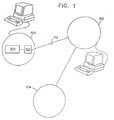
- FIG. 1 shows a general layout of an illustrative data communication system in which the invention may be practiced.
- This illustrative system includes a number of data processing users 100, 102 and 104.
- Each user includes or has access to a computer or data processing unit, such as 106, and appropriate peripheral units 108 for communicating with other users of the system via channels such a 110.
- a computer at a user may be any type of general or special purpose computer capable of being programmed in accordance with the principles disclosed herein. In the preferred embodiment, such computers include System 370 computers marketed by the IBM Company.
- a user 100 wishes to establish a logical connection with another user 102, it is required that both users share knowledge of a secret S, and that the users authenticate each other by means of an appropriate authentication protocol before meaningful communication is allowed over the logical connection.
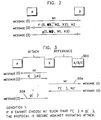
- Fig. 2 shows the general form of a family of protocols that may be secure against attack by an intruder X.
- a user A initiating a connection sends a message 1 containing a challenge N1 to the user B with which communication is to be established.
- N1 and all challenges are preferably random numbers, or nonces. In any event, challenges should be freshly generated so there can be no possibility of use by intruders based on historical events.
- B returns a message 2 to A of the form f(S, N1, N2, X2), N2; where f() is a function which is the response to the challenge N1, S represents a secret shared by legitimate users A and B that is required to generate the response and N2 is a challenge from B to A.
- the variables S and N1 in f() are shown in bold in Fig. 2 to indicate that these variables must be present in some form in function f().
- the remaining variables N2 and X2 may or may not be present.
- X2 is a general variable used here to represent any desired constant or expression that might be included in f().
- X2 might include access information, names, time stamps, etc. It is assumed that nothing contained in X2 is part of the secret S. In other words, it is assumed that an intruder X knows X2.
- User A then returns message 3 containing the response g(S, N2, N1, X3) to the challenge N2.
- the variables S and N2 in g() are similarly shown in bold to indicate that they must be present in some form within function g().
- X3 is similar to X2 in that it represents any desired constant or expression that might be included in g(). It is assumed that X knows X3.
- Fig. 3 shows the use of a reference connection by an intruder to gather information to attack a real connection.
- the intruder X initiates a connection with user A by sending the first challenge N1 in message 1 of the attack connection.
- A returns its response f() to the challenge and a challenge N2 to X at message 2 of the attack connection.
- X does not know the secret S required to generate the response to N2.
- X initiates a reference connection by sending another first challenge N1' to a user at 300.
- This secondary user may be A or some other user B or C. It doesn't matter as long as the selected other user knows the secret S.
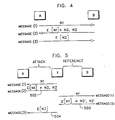
- Fig. 4 shows a specific protocol which appears to be secure, but which in fact can be broken easily because it does not satisfy condition C1.
- N2' is also known because it is received as the clear text challenge in the same message 2 of the reference connection
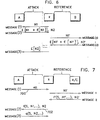
- Fig. 6 shows an illustrative protocol that is secure against initiating attacks.
- Eq. 6 f() E[N1 + E[N1]]
- Eq. 7 g() E [N2].
- f() satisfies the conditions that it is a function of the challenge N1 and a secret S and that g() is a function of challenge N2 and secret S.
- C1 we test condition C1 to determine if the protocol is really secure against initiate attacks.
- FIG. 7 shows such an attack in terms of an attack connection and a reference connection.
- X lies in wait and eventually intercepts an initial challenge from user A destined for another user B.
- X then initiates a reference connection ⁇ with a third user.
- the third user can be A or C.
- the reference user can't be the original intended recipient B.
- Intercept attacks where an intruder merely intercepts messages from A and forwards them on to their intended destination B are equivalent to the intruder X merely watching the data flow by from A to B. These attacks can never be defended against with user authentication protocols. If one is concerned about such attacks because, for example, their data lines can't be physically secured from taps, then one must protect subsequent connection data flow with additional measures, such as data encryption.
- an indicator D be included in f() that represents the direction of message flow, as shown in Fig. 8. This is shown as f(S,N1,D,...) in message 2, where D is the flow direction indicator. It doesn't matter what form D takes, so long as it is unique to a particular direction. For example, D might be equal to the sending users identification, which is B in Fig. 8. Alternatively, if A and B are the users in question, A could use B for its direction indicator and B could use A. All that is required is that on a given connection, the flow indicator be unique for any direction of flow of a message.
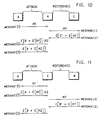
- Fig. 10 shows an example of a protocol that passes condition C2. That is, it is secure from intercept attacks. However, it will be seen that the protocol is insecure against initiate attacks.
- Eq. 19 f() E[D + E[N1]]
- Eq. 20 g() E[D + E[N2]]
- D is the flow direction indicator.
- D is different for f() and g() because the flow direction is different for each of these functions.
- Equation 23 can be split into two different equations in an attempt to solve it.
- Eq. 24 C' B
- Eq. 25 E[N1'] E[N1].
- X can successfully initiate an attack against this protocol by merely setting N1' in message 1 of the reference connection equal to N2, which is received from A in message 2 of the attack connection.
- Fig. 12 shows a specific protocol that is secure against both initiate and intercept attacks.
- Eq. 32 f() E[B + E[N1]]
- Eq. 33 g() E[N2].
- Fig. 13 shows the general format of a family of protocols that fit the four requirements outlined above for security. Some of the specific protocols that fit this general form are secure and some are not. The conditions C1 and C2 must be tested for any specific protocol.
- the response to the first challenge N1 is of the form E[q op E[r]].
- the response to the second challenge N2 is of the form E[t].
- the element N2 in k() adds additional randomness to the response to message 2. This element could also be eliminated and the protocol will operate satisfactorily.
- the element E(N1) in k() is required by condition C1. It is essential to have user A's challenge in user B's response. While it is not essential that this element be encrypted, doing so adds additional strength to the protocol.
- FIG. 16 A final example of a family of protocols that meet the general format and the conditions outlined above is now presented.
- This family incorporates the message flow direction indicator into the secret key that is used for encryption, rather than explicitly incorporating it into the data that is encrypted.
- One member of the family is illustrated in Fig. 16.
- Both users A and B know a secret key K.
- B prepares its response in message 2 to A's challenge N1 by encrypting it with K + B, where B represents B's identity.
- the '+' operator is again taken as the boolean EXCLUSIVE-OR operation, although it can be any other type of boolean or mathematical operation.
- A encrypts its response to B's challenge N2 by encrypting it using the unmodified value of K.
- B's response to the challenge N1 is a secret function of the challenge N1.
- A's response to the challenge N2 is a secret function of N2.
- the direction of flow of a message is incorporated into the responses, in a way that both A and B can derive, by use of different encryption keys used to encode the responses. Now let's test the result according to conditions C1 and C2.
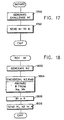
- FIG. 17 Illustrative flowcharts of the authentication process are shown in Figs. 17 through 21. These particular flowchart examples are based on the protocol shown in Fig. 15 and the use of an encryption key (Kab) shared between A and B.
- Kab encryption key
- Each of these processes in Figs. 17 through 21 are present at each user and is executed at the appropriate time depending on the particular role of the user, primary (user A) or secondary (user B), and the point within the protocol exchange.
- Fig. 17 is executed by A attempting to initiate communications with B.
- Step 1700 generates a nonce N1 as the challenge to B.
- Step 1702 sends the challenge N1 to B and the process terminates waiting for the arrival of the response to N1 and a new challenge N2.
- Step 2104 EXCLUSIVE-ORS N1 with the identity of this user (B) and then EXCLUSIVE-ORS that result with S2 to obtain an encrypted value R, which is returned to the calling process in Fig. 18.
- Step 1806 of Fig. 18 assigns the returned encrypted value R to variable R1 and returns R1 along with the new challenge N2 to user A at step 1808.
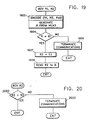
- Fig. 19 The process in Fig. 19 is executed at A in response to receipt of R1 and challenge N2.
- N1, N2 and the shared key Kab are then passed to subroutine ENCODE.
- ENCODE computes the correct response to the initial challenge N1 and returns the answer in variable R.
- Step 1904 compares the correct response in R to the response R1 received from user B. If R is not equal to R1, the authentication fails and step 1906 terminates this communication immediately. If R equals R1, however, then B has properly authenticated itself to A.
- step 2000 compares the variable S2 with the response R2 from A. If this comparison does not match exactly, then A has not properly authenticated itself to B. In this case, step 2002 immediately terminates the communication. If the values match, then A is properly authenticated. In this case, the process in Fig. 20 merely exits to allow the users to communicate further.
Landscapes
- Engineering & Computer Science (AREA)
- Computer Security & Cryptography (AREA)
- Computer Networks & Wireless Communication (AREA)
- Signal Processing (AREA)
- Theoretical Computer Science (AREA)
- Computer Hardware Design (AREA)
- General Engineering & Computer Science (AREA)
- Software Systems (AREA)
- Physics & Mathematics (AREA)
- General Physics & Mathematics (AREA)
- Computing Systems (AREA)
- Data Exchanges In Wide-Area Networks (AREA)
- Small-Scale Networks (AREA)
- Computer And Data Communications (AREA)
Claims (18)
- Ein Verfahren zur Authentisierung von Benutzern in einer Kommunikationsverbindung in einem Netzwerk, das Schritte enthält um(a) eine erste Aufforderung N1 von einem ersten Benutzer A an einen zweiten Benutzer B zu übertragen,(b) eine erste Antwort an die erste Aufforderung N1 und eine zweite Aufforderung N2 von dem zweiten Benutzer B an den ersten Benutzer A zu übertragen,(c) bei dem ersten Benutzer A zu überprüfen, daß die erste Antwort richtig ist,(d) eine zweite Antwort an die zweite Aufforderung N2 von dem ersten Benutzer A an den zweiten Benutzer B zu übertragen, und(e) bei dem zweiten Benutzer B zu überprüfen, daß die zweite Antwort richtig ist,wobei das Verfahren zur Authentisierung dadurch gekennzeichnet wird, daßdie erste und zweite Antwort jeweils von minimalen Formen sind
f(S1, N1, ...) und g(S2, N2, ...),wobei S1 und S2 gemeinsame Geheimnisse zwischen dem ersten und zweiten Benutzer (A,B) sind und f() und g() ausgewählte Funktionen sind, so daß
f'(S1, N1', ...) = g(S2, N2, ...)
für N1' ohne die Kenntnis von S1 und S2 nicht gelöst werden kann, wobei f'() und N1' Ausdrücke in einer Referenzverbindung mit einem Benutzer darstellen, der S1 oder S2 kennt und der die richtigen ersten oder zweiten Antworten überträgt. - Das Verfahren aus Anspruch 1, wobei das Geheimnis S1 die mathematische Funktion f() ist und S2 die mathematische Funktion g () ist.
- Das Verfahren aus den Ansprüchen 1 oder 2, wobei S1 = S2 = S ist und S ein Datenchiffrierschlüssel ist.
- Das Verfahren aus Anspruch 3, wobei in f() außerdem eine Angabe von der Richtung D1 des Nachrichtenflußes integriert ist, der f() enthält wie in
f(S1, N1, D1, ...) und f() ausgewählt wird, so daß
f'(S, N1', D1', ...) = f(S, N2, D1, ...)
für N1' ohne die Kenntnis von S1 und S2 nicht gelöst werden kann, wobei D1' die Flußrichtungsanzeige der Nachricht ist, welche f'() in der Referenzverbindung mit einem Benutzer enthält, der S1 oder S2 kennt und der die richtige erste oder die richtige zweite Antwort überträgt. - Das Verfahren aus Anspruch 1, das auf ein Verfahren zur Authentisierung eines Benutzers in einer Kommunikationsverbindung in einem Netzwerk eingeschränkt werden kann, indem- in Schritt (b) vergessen wird, diese zweite Aufforderung N2 von dem zweiten Benutzer B an den ersten Benutzer A zu übertragen;- vergessen wird, diese zweite Antwort an die zweite Aufforderung N2 von dem ersten Benutzer A an den zweiten Benutzer B zu übertragen; und- bei dem ersten Benutzer A nur überprüft wird, daß die erste Antwort richtig ist, wobei die erste Antwort von minimaler Form istwobei S1 ein gemeinsames Geheimnis zwischen dem ersten und zweiten Benutzer (A,B) ist, D1 eine Flußrichtungsanzeige der Nachricht ist, die f() enthält und f() eine ausgewählte Funktion ist, so daß
f(S1, N1, D1...),
f'(S1, N1', D1', ...) = f(S1, N1, D1,...)
für N1' ohne die Kenntnis von S1 nicht gelöst werden kann, wobei f'(), N1' und D1' Ausdrücke in einer Referenzverbindung mit einem Benutzer darstellen, der das Geheimnis S1 kennt und die richtige erste Antwort überträgt. - Das Verfahren aus Anspruch 5, wobei das Geheimnis S1 die mathematische Funktion f() ist und S1 ein Datenchiffrierschlüssel ist.
- Das Verfahren wie in den Ansprüchen 4 bis 5 ausgeführt, wobeif() = E[q op E[r]], undg() = E[t], wobei
op eine mathematische oder logische Funktion ist,q = q(N1, ...),r = r(D1, ...),t = t(N2, ...),E = Datenverschlüsselung mit einem Chiffrierschlüssel. - Das Verfahren wie in den Ansprüchen 4 bis 5 ausgeführt, wobeif() = E[q op E[r]], undg() = E[t], wobei
op eine mathematische oder logische Funktion ist,q = q(D1, ...),r = r(N1, ...),t = t(N2, ...),E = Datenverschlüsselung mit einem Chiffrierschlüssel. - Das Verfahren wie in den Ansprüchen 4, 5 oder 8 ausgeführt, wobeif() = E[D1 op E[N1]] undg() = E[N2].
- Das Verfahren wie in den Ansprüchen 4, 5 oder 8 ausgeführt, wobeif() = E[N1 op E[D1]] undg() = E[N2].
- Das Verfahren wie in den Ansprüchen 4, 5 oder 8 ausgeführt, wobeif() = E[N1 op [D1 op E[N2 op E[N1]]]] undg() = E[N2 op E[N1 op E[N1]]].
- Das Verfahren wie in den Ansprüchen 4, 5 oder 8 ausgeführt, wobeif() = E[N1 op [D1 op E[N2 op E[N1]]]] undg() = E[N2 op E[N1]].
- Das Verfahren wie in den Ansprüchen 4, 5 oder 8 ausgeführt, wobeif() = Eb[N1] undg() = E[N2].wobei Eb = Verschlüsselung mit Datenchiffrierschlüssel K op D1.
- Eine Anordnung in einem Netzwerkknoten zur Authentisierung von Netzwerkbenutzern mitMitteln, um eine erste Aufforderung N1 an einen Benutzer zu übertragen,Mitteln, um eine erste Antwort auf die erste Aufforderung und eine zweite Aufforderung N2 von dem Benutzer zu empfangen,Mitteln, um die erste Antwort zu überprüfen,Mitteln, um eine zweite Antwort auf die zweite Aufforderung an den Benutzer zu übertragen, undMitteln, um die zweite Antwort bei dem Benutzer zu überprüfen, dadurch gekennzeichnet, daßdie erste Antwort von minimaler Form ist
f(S1, N1, ...)
und die zweite Antwort von minimaler Form ist
g(S2, N2, ...),wobei S1 und S2 gemeinsame Geheimnisse zwischen berechtigten Benutzern sind und f() und g() ausgewählte Funktionen sind, so daß
f'(S1, N1', ...) = g(S2, N2, ...)
für N1' ohne die Kenntnis von S1 und S2 nicht gelöst werden kann, wobei f'() und N1' Ausdrücke in einer Referenzverbindung mit einem Benutzer darstellen, der S1 oder S2 kennt und der die richtigen ersten oder zweiten Antworten überträgt. - Die Anordnung aus Anspruch 14, wobei das Geheimnis S1 die mathematische Funktion f() ist und S2 die mathematische Funktion g () ist.
- Die Anordnung aus den Ansprüchen 14 oder 15, wobei S1 = S2 = S ist und S ein Datenchiffrierschlüssel ist.
- Die Anordnung aus den Ansprüchen 14, 15 oder 16, wobei in f() außerdem eine Angabe von der Richtung D1 des Nachrichtenflußes integriert ist, der f() enthält wie in
f(S1, N1, D1, ...)
und f() ausgewählt wird, so daß
f'(S, N1', D1', ...) = f(S, N2, D1, ...)
für N1' ohne die Kenntnis von S1 und S2 nicht gelöst werden kann, wobei f'() einen Ausdruck in der Referenzverbindung darstellt und D1' die Flußrichtungsanzeige der Nachricht ist, welche f'() in der Referenzverbindung mit einem Benutzer enthält, der S1 oder S2 kennt und der die richtige erste oder die richtige zweite Antwort überträgt. - Eine Anordnung in einem Netzwerkknoten zur Authentisierung eines Netzwerkbenutzers mitMitteln, um eine erste Aufforderung N1 an einen Benutzer zu übertragen, undMitteln, um eine Antwort auf die Aufforderung von dem Benutzer zu empfangen, undMitteln, um die Antwort zu überprüfen, dadurch gekennzeichnet, daß die Antwort von minimaler Form ist
f(S1, N1, D1...),
wobei S1 ein gemeinsames Geheimnis zwischen dem ersten und zweiten Benutzer ist, D1 eine Flußrichtungsanzeige der Nachricht ist, die f() enthält und f() eine ausgewählte Funktion ist, so daß
f'(S1, N1', D1', ...) = f(S1, N1, D1,...)
für N1' ohne die Kenntnis von S1 nicht gelöst werden kann, wobei f'(), N1' und D1' Ausdrücke in einer Referenzverbindung mit einem Benutzer darstellen, der S1 kennt und die richtige erste Antwort überträgt.
Applications Claiming Priority (2)
| Application Number | Priority Date | Filing Date | Title |
|---|---|---|---|
| US07/672,226 US5148479A (en) | 1991-03-20 | 1991-03-20 | Authentication protocols in communication networks |
| US672226 | 1991-03-20 |
Publications (2)
| Publication Number | Publication Date |
|---|---|
| EP0505302A1 EP0505302A1 (de) | 1992-09-23 |
| EP0505302B1 true EP0505302B1 (de) | 1996-08-28 |
Family
ID=24697681
Family Applications (1)
| Application Number | Title | Priority Date | Filing Date |
|---|---|---|---|
| EP92480018A Expired - Lifetime EP0505302B1 (de) | 1991-03-20 | 1992-02-11 | Authentisierungsprotokolle für Kommunikationsnetzwerke |
Country Status (5)
| Country | Link |
|---|---|
| US (1) | US5148479A (de) |
| EP (1) | EP0505302B1 (de) |
| JP (1) | JP2823103B2 (de) |
| CA (1) | CA2059172C (de) |
| DE (1) | DE69213062T2 (de) |
Families Citing this family (63)
| Publication number | Priority date | Publication date | Assignee | Title |
|---|---|---|---|---|
| NL9101796A (nl) * | 1991-10-25 | 1993-05-17 | Nederland Ptt | Werkwijze voor het authenticeren van communicatiedeelnemers, systeem voor toepassing van de werkwijze en eerste communicatiedeelnemer en tweede communicatiedeelnemer voor toepassing in het systeem. |
| US5276735A (en) * | 1992-04-17 | 1994-01-04 | Secure Computing Corporation | Data enclave and trusted path system |
| US5369705A (en) * | 1992-06-03 | 1994-11-29 | International Business Machines Corporation | Multi-party secure session/conference |
| US5596718A (en) * | 1992-07-10 | 1997-01-21 | Secure Computing Corporation | Secure computer network using trusted path subsystem which encrypts/decrypts and communicates with user through local workstation user I/O devices without utilizing workstation processor |
| US5311596A (en) * | 1992-08-31 | 1994-05-10 | At&T Bell Laboratories | Continuous authentication using an in-band or out-of-band side channel |
| US5491752A (en) * | 1993-03-18 | 1996-02-13 | Digital Equipment Corporation, Patent Law Group | System for increasing the difficulty of password guessing attacks in a distributed authentication scheme employing authentication tokens |
| US5475763A (en) * | 1993-07-01 | 1995-12-12 | Digital Equipment Corp., Patent Law Group | Method of deriving a per-message signature for a DSS or El Gamal encryption system |
| US5483598A (en) * | 1993-07-01 | 1996-01-09 | Digital Equipment Corp., Patent Law Group | Message encryption using a hash function |
| US5351295A (en) * | 1993-07-01 | 1994-09-27 | Digital Equipment Corporation | Secure method of neighbor discovery over a multiaccess medium |
| US5544246A (en) * | 1993-09-17 | 1996-08-06 | At&T Corp. | Smartcard adapted for a plurality of service providers and for remote installation of same |
| WO1995008885A1 (en) * | 1993-09-20 | 1995-03-30 | International Business Machines Corporation | System and method for changing the key or password in a secure distributed communications network |
| US5381480A (en) * | 1993-09-20 | 1995-01-10 | International Business Machines Corporation | System for translating encrypted data |
| EP0656708A1 (de) * | 1993-12-03 | 1995-06-07 | International Business Machines Corporation | System und Verfahren zur Übertragung und Gültigkeitsprüfung eines aktualisierten kryptographischen Schlüssels zwischen zwei Benutzern |
| US5594921A (en) * | 1993-12-17 | 1997-01-14 | Object Technology Licensing Corp. | Authentication of users with dynamically configurable protocol stack |
| US5491750A (en) * | 1993-12-30 | 1996-02-13 | International Business Machines Corporation | Method and apparatus for three-party entity authentication and key distribution using message authentication codes |
| US5491749A (en) * | 1993-12-30 | 1996-02-13 | International Business Machines Corporation | Method and apparatus for entity authentication and key distribution secure against off-line adversarial attacks |
| USRE38898E1 (en) | 1994-05-24 | 2005-11-29 | Sony Corporation | Video data bus communication system and method |
| US5699426A (en) * | 1994-05-24 | 1997-12-16 | Sony Corporation | Video data bus communication system and method |
| EP0693836A1 (de) * | 1994-06-10 | 1996-01-24 | Sun Microsystems, Inc. | Verfahren und Einrichtung für ein Schlüsselmanagementschema für Internet-Protokolle |
| GB9422389D0 (en) * | 1994-11-05 | 1995-01-04 | Int Computers Ltd | Authenticating access control for sensitive functions |
| US5822431A (en) * | 1996-01-19 | 1998-10-13 | General Instrument Corporation Of Delaware | Virtual authentication network for secure processors |
| GB9606593D0 (en) * | 1996-03-29 | 1996-06-05 | Symmetricom Inc | An antenna system |
| US20060195595A1 (en) | 2003-12-19 | 2006-08-31 | Mendez Daniel J | System and method for globally and securely accessing unified information in a computer network |
| US20020133412A1 (en) * | 1997-03-07 | 2002-09-19 | David M. Oliver | System for management of transactions on networks |
| US7324972B1 (en) | 1997-03-07 | 2008-01-29 | Clickshare Service Corporation | Managing transactions on a network: four or more parties |
| US5953424A (en) * | 1997-03-18 | 1999-09-14 | Hitachi Data Systems Corporation | Cryptographic system and protocol for establishing secure authenticated remote access |
| JP3864401B2 (ja) * | 1997-04-23 | 2006-12-27 | ソニー株式会社 | 認証システム、電子機器、認証方法、および記録媒体 |
| US6591291B1 (en) * | 1997-08-28 | 2003-07-08 | Lucent Technologies Inc. | System and method for providing anonymous remailing and filtering of electronic mail |
| US6263446B1 (en) * | 1997-12-23 | 2001-07-17 | Arcot Systems, Inc. | Method and apparatus for secure distribution of authentication credentials to roaming users |
| US7328350B2 (en) * | 2001-03-29 | 2008-02-05 | Arcot Systems, Inc. | Method and apparatus for secure cryptographic key generation, certification and use |
| US6151676A (en) * | 1997-12-24 | 2000-11-21 | Philips Electronics North America Corporation | Administration and utilization of secret fresh random numbers in a networked environment |
| US6243811B1 (en) * | 1998-07-31 | 2001-06-05 | Lucent Technologies Inc. | Method for updating secret shared data in a wireless communication system |
| EP1038369A2 (de) * | 1998-10-14 | 2000-09-27 | Aegis Systems Inc. | Verfahren und vorrichtung zum senden und empfangen gesicherter daten unter verwendung von anonymen schlüsseln |
| US6941454B1 (en) | 1998-10-14 | 2005-09-06 | Lynn Spraggs | System and method of sending and receiving secure data with a shared key |
| US6349338B1 (en) * | 1999-03-02 | 2002-02-19 | International Business Machines Corporation | Trust negotiation in a client/server data processing network using automatic incremental credential disclosure |
| US6507908B1 (en) | 1999-03-04 | 2003-01-14 | Sun Microsystems, Inc. | Secure communication with mobile hosts |
| US7549056B2 (en) | 1999-03-19 | 2009-06-16 | Broadcom Corporation | System and method for processing and protecting content |
| US6424953B1 (en) * | 1999-03-19 | 2002-07-23 | Compaq Computer Corp. | Encrypting secrets in a file for an electronic micro-commerce system |
| US7257554B1 (en) | 1999-03-19 | 2007-08-14 | Hewlett-Packard Development Company, L.P. | Anonymous purchases while allowing verifiable identities for refunds returned along the paths taken to make the purchases |
| US7810152B2 (en) * | 2002-05-08 | 2010-10-05 | Broadcom Corporation | System and method for securely controlling access to device functions |
| US6826686B1 (en) * | 2000-04-14 | 2004-11-30 | International Business Machines Corporation | Method and apparatus for secure password transmission and password changes |
| US7870599B2 (en) * | 2000-09-05 | 2011-01-11 | Netlabs.Com, Inc. | Multichannel device utilizing a centralized out-of-band authentication system (COBAS) |
| US7596223B1 (en) | 2000-09-12 | 2009-09-29 | Apple Inc. | User control of a secure wireless computer network |
| US6769060B1 (en) | 2000-10-25 | 2004-07-27 | Ericsson Inc. | Method of bilateral identity authentication |
| JP4149126B2 (ja) | 2000-12-05 | 2008-09-10 | ジーイー・メディカル・システムズ・グローバル・テクノロジー・カンパニー・エルエルシー | 画像処理方法、画像処理装置および画像撮影装置 |
| US7116668B2 (en) * | 2001-10-09 | 2006-10-03 | Telefunaktiebolaget Lm Ericsson (Publ) | Method for time stamp-based replay protection and PDSN synchronization at a PCF |
| DE50212956D1 (de) * | 2002-04-05 | 2008-12-11 | Abb Research Ltd | Verfahren zur Fernsteuerung eines Systems |
| ITMI20022339A1 (it) * | 2002-11-05 | 2004-05-06 | Paolo Rucco | Metodo e dispositivi per eseguire controlli di sicurezza |
| US7293284B1 (en) | 2002-12-31 | 2007-11-06 | Colligo Networks, Inc. | Codeword-enhanced peer-to-peer authentication |
| US7519815B2 (en) * | 2003-10-29 | 2009-04-14 | Microsoft Corporation | Challenge-based authentication without requiring knowledge of secret authentication data |
| US8108429B2 (en) | 2004-05-07 | 2012-01-31 | Quest Software, Inc. | System for moving real-time data events across a plurality of devices in a network for simultaneous data protection, replication, and access services |
| US7565661B2 (en) | 2004-05-10 | 2009-07-21 | Siew Yong Sim-Tang | Method and system for real-time event journaling to provide enterprise data services |
| US7680834B1 (en) | 2004-06-08 | 2010-03-16 | Bakbone Software, Inc. | Method and system for no downtime resychronization for real-time, continuous data protection |
| US7979404B2 (en) | 2004-09-17 | 2011-07-12 | Quest Software, Inc. | Extracting data changes and storing data history to allow for instantaneous access to and reconstruction of any point-in-time data |
| US7904913B2 (en) | 2004-11-02 | 2011-03-08 | Bakbone Software, Inc. | Management interface for a system that provides automated, real-time, continuous data protection |
| KR100848541B1 (ko) * | 2005-05-13 | 2008-07-25 | 삼성전자주식회사 | 이동 아이피 버전 6에서 재전송 공격을 방지하기 위한 방법 |
| US7689602B1 (en) | 2005-07-20 | 2010-03-30 | Bakbone Software, Inc. | Method of creating hierarchical indices for a distributed object system |
| US7788521B1 (en) | 2005-07-20 | 2010-08-31 | Bakbone Software, Inc. | Method and system for virtual on-demand recovery for real-time, continuous data protection |
| US8059819B2 (en) | 2007-01-17 | 2011-11-15 | Panasonic Electric Works Co., Ltd. | Systems and methods for distributing updates for a key at a maximum rekey rate |
| US8131723B2 (en) | 2007-03-30 | 2012-03-06 | Quest Software, Inc. | Recovering a file system to any point-in-time in the past with guaranteed structure, content consistency and integrity |
| US8364648B1 (en) | 2007-04-09 | 2013-01-29 | Quest Software, Inc. | Recovering a database to any point-in-time in the past with guaranteed data consistency |
| CN101447872B (zh) * | 2007-11-27 | 2011-09-28 | 阿里巴巴集团控股有限公司 | 一种用户身份验证方法、系统及验证码生成维护子系统 |
| KR20090067551A (ko) * | 2007-12-21 | 2009-06-25 | 삼성전자주식회사 | 클러스터 기반의 컨텐츠 사용 제한 및 컨텐츠 사용 방법,컨텐츠 접근 권한 인증 방법, 장치, 및 기록매체 |
Family Cites Families (24)
| Publication number | Priority date | Publication date | Assignee | Title |
|---|---|---|---|---|
| US4193131A (en) * | 1977-12-05 | 1980-03-11 | International Business Machines Corporation | Cryptographic verification of operational keys used in communication networks |
| US4218738A (en) * | 1978-05-05 | 1980-08-19 | International Business Machines Corporation | Method for authenticating the identity of a user of an information system |
| US4386233A (en) * | 1980-09-29 | 1983-05-31 | Smid Miles E | Crytographic key notarization methods and apparatus |
| FR2530053B1 (fr) * | 1982-07-08 | 1986-04-25 | Bull Sa | Procede pour certifier la provenance d'au moins une information enregistree dans une memoire d'un premier dispositif electronique et transmise a un deuxieme dispositif electronique, et systeme pour la mise en oeuvre d'un tel procede |
| US4723284A (en) * | 1983-02-14 | 1988-02-02 | Prime Computer, Inc. | Authentication system |
| US4926480A (en) * | 1983-08-22 | 1990-05-15 | David Chaum | Card-computer moderated systems |
| JPS619052A (ja) * | 1984-06-25 | 1986-01-16 | Toshiba Corp | 通信ネツトワ−クシステム |
| US4649233A (en) * | 1985-04-11 | 1987-03-10 | International Business Machines Corporation | Method for establishing user authenication with composite session keys among cryptographically communicating nodes |
| LU86203A1 (fr) * | 1985-12-11 | 1987-07-24 | Cen Centre Energie Nucleaire | Procede et appareil verifiant l'authenticite de documents lies a une personne et l'identite de leurs porteurs |
| EP0239749B1 (de) * | 1986-03-05 | 1990-07-25 | Holger Sedlak | Kryptographie-Verfahren und Kryptographie-Prozessor zur Durchführung des Verfahrens |
| JPS62210791A (ja) * | 1986-03-12 | 1987-09-16 | Pioneer Electronic Corp | Catvシステムの盗視聴防止方式 |
| EP0246823A3 (en) * | 1986-05-22 | 1989-10-04 | Racal-Guardata Limited | Data communication systems and methods |
| US4748668A (en) * | 1986-07-09 | 1988-05-31 | Yeda Research And Development Company Limited | Method, apparatus and article for identification and signature |
| GB2194415B (en) * | 1986-08-20 | 1990-10-17 | Plessey Co Plc | Improvements in or relating to methods of achieving key variable exchange with mutual authentication of participants |
| US4850017A (en) * | 1987-05-29 | 1989-07-18 | International Business Machines Corp. | Controlled use of cryptographic keys via generating station established control values |
| US4933970A (en) * | 1988-01-19 | 1990-06-12 | Yeda Research And Development Company Limited | Variants of the fiat-shamir identification and signature scheme |
| JP2521785B2 (ja) * | 1988-02-08 | 1996-08-07 | 日本電信電話株式会社 | 端末認証処理システム |
| AU3560989A (en) * | 1988-03-16 | 1989-10-05 | David Chaum | One-show blind signature systems |
| JP3102692B2 (ja) * | 1988-05-19 | 2000-10-23 | エヌ・シー・アール・インターナショナル・インコーポレイテッド | カードの真性を証明する方法 |
| IL87549A0 (en) * | 1988-08-24 | 1989-01-31 | Amos Fiat | Rsa computation method for efficient batch processing |
| JPH082051B2 (ja) * | 1988-08-31 | 1996-01-10 | 日本電信電話株式会社 | 資格認証方法 |
| US4919545A (en) * | 1988-12-22 | 1990-04-24 | Gte Laboratories Incorporated | Distributed security procedure for intelligent networks |
| US4932056A (en) * | 1989-03-16 | 1990-06-05 | Yeda Research And Development Company Limited | Method and apparatus for user identification based on permuted kernels |
| DE69019593T2 (de) * | 1989-04-27 | 1996-01-25 | Ibm | Sichere Handhabung von Schlüsseln unter Verwendung von Kontrollvektoren mit Mehrwegüberwachung. |
-
1991
- 1991-03-20 US US07/672,226 patent/US5148479A/en not_active Expired - Fee Related
-
1992
- 1992-01-10 CA CA002059172A patent/CA2059172C/en not_active Expired - Fee Related
- 1992-02-11 DE DE69213062T patent/DE69213062T2/de not_active Expired - Fee Related
- 1992-02-11 EP EP92480018A patent/EP0505302B1/de not_active Expired - Lifetime
- 1992-03-17 JP JP4060593A patent/JP2823103B2/ja not_active Expired - Fee Related
Also Published As
| Publication number | Publication date |
|---|---|
| DE69213062T2 (de) | 1997-03-13 |
| JPH07170257A (ja) | 1995-07-04 |
| US5148479A (en) | 1992-09-15 |
| CA2059172C (en) | 1996-01-16 |
| JP2823103B2 (ja) | 1998-11-11 |
| DE69213062D1 (de) | 1996-10-02 |
| CA2059172A1 (en) | 1992-09-21 |
| EP0505302A1 (de) | 1992-09-23 |
Similar Documents
| Publication | Publication Date | Title |
|---|---|---|
| US5148479A (en) | Authentication protocols in communication networks | |
| CN109728909B (zh) | 基于USBKey的身份认证方法和系统 | |
| US8239676B2 (en) | Secure proximity verification of a node on a network | |
| EP0651533B1 (de) | Verfahren und Vorrichtung zur Geheimhaltung und Authentifizierung in einem mobilen drahtlosen Netz | |
| US6732270B1 (en) | Method to authenticate a network access server to an authentication server | |
| US5706347A (en) | Method and system for authenticating a computer network node | |
| US20250202688A1 (en) | Quantum key transmission method, apparatus, and system | |
| WO2002051049A1 (en) | One time password entry to access multiple network sites | |
| KR20010004791A (ko) | 인터넷 환경의 이동통신시스템에서 사용자 정보 보안 장치 및그 방법 | |
| GB2357229A (en) | Security protocol with messages formatted according to a self describing markup language | |
| EP1079565A2 (de) | Verfahren zum sicheren Aufbau einer sicheren Verbindung über ein unsicheres Kommunikationsnetzwerk | |
| CN114707160A (zh) | 一种基于量子密钥的vpn密钥管理系统、方法、设备及计算机可读介质 | |
| EP1090478B1 (de) | Verfahren zum vereiteln eines schlüsselkomponentenangriffs | |
| KR20220135899A (ko) | 차량의 전자 제어 장치, 게이트웨이 장치 및 이들을 포함하는 차량 | |
| JPH10242957A (ja) | ユーザ認証方法およびシステムおよびユーザ認証用記憶媒体 | |
| CN114363077B (zh) | 基于安全访问服务边缘的管理系统 | |
| CN114679262A (zh) | 一种融合非对称体制的量子密钥分发系统及方法 | |
| CN117294539B (zh) | 用户侧终端可信认证方法、装置、设备及存储介质 | |
| Meadows et al. | A representation of protocol attacks for risk assessment. | |
| CN112035820B (zh) | 一种用于Kerberos加密环境下的数据解析方法 | |
| Chen et al. | Key distribution without individual trusted authentification servers | |
| Gohel | Introduction to Network & Cybersecurity | |
| EP4401356A1 (de) | Verfahren und anordnungen zur berücksichtigung eines geheimnisses bei einer benutzervorrichtung | |
| Chen et al. | Authentication using minimally trusted servers | |
| CN120546861A (zh) | 认证方法、认证系统及融合安全管理平台 |
Legal Events
| Date | Code | Title | Description |
|---|---|---|---|
| PUAI | Public reference made under article 153(3) epc to a published international application that has entered the european phase |
Free format text: ORIGINAL CODE: 0009012 |
|
| AK | Designated contracting states |
Kind code of ref document: A1 Designated state(s): DE FR GB IT |
|
| 17P | Request for examination filed |
Effective date: 19930120 |
|
| 17Q | First examination report despatched |
Effective date: 19950515 |
|
| GRAH | Despatch of communication of intention to grant a patent |
Free format text: ORIGINAL CODE: EPIDOS IGRA |
|
| GRAH | Despatch of communication of intention to grant a patent |
Free format text: ORIGINAL CODE: EPIDOS IGRA |
|
| GRAA | (expected) grant |
Free format text: ORIGINAL CODE: 0009210 |
|
| AK | Designated contracting states |
Kind code of ref document: B1 Designated state(s): DE FR GB IT |
|
| REF | Corresponds to: |
Ref document number: 69213062 Country of ref document: DE Date of ref document: 19961002 |
|
| ITF | It: translation for a ep patent filed | ||
| ET | Fr: translation filed | ||
| PLBE | No opposition filed within time limit |
Free format text: ORIGINAL CODE: 0009261 |
|
| 26N | No opposition filed | ||
| REG | Reference to a national code |
Ref country code: GB Ref legal event code: IF02 |
|
| PGFP | Annual fee paid to national office [announced via postgrant information from national office to epo] |
Ref country code: FR Payment date: 20020219 Year of fee payment: 11 |
|
| PGFP | Annual fee paid to national office [announced via postgrant information from national office to epo] |
Ref country code: GB Payment date: 20030203 Year of fee payment: 12 |
|
| PG25 | Lapsed in a contracting state [announced via postgrant information from national office to epo] |
Ref country code: FR Free format text: LAPSE BECAUSE OF NON-PAYMENT OF DUE FEES Effective date: 20031031 |
|
| REG | Reference to a national code |
Ref country code: FR Ref legal event code: ST |
|
| PGFP | Annual fee paid to national office [announced via postgrant information from national office to epo] |
Ref country code: DE Payment date: 20040102 Year of fee payment: 13 |
|
| PG25 | Lapsed in a contracting state [announced via postgrant information from national office to epo] |
Ref country code: GB Free format text: LAPSE BECAUSE OF NON-PAYMENT OF DUE FEES Effective date: 20040211 |
|
| GBPC | Gb: european patent ceased through non-payment of renewal fee |
Effective date: 20040211 |
|
| PG25 | Lapsed in a contracting state [announced via postgrant information from national office to epo] |
Ref country code: IT Free format text: LAPSE BECAUSE OF NON-PAYMENT OF DUE FEES Effective date: 20050211 |
|
| PG25 | Lapsed in a contracting state [announced via postgrant information from national office to epo] |
Ref country code: DE Free format text: LAPSE BECAUSE OF NON-PAYMENT OF DUE FEES Effective date: 20050901 |