EP0505061B1 - Borosilicate glass composition - Google Patents
Borosilicate glass composition Download PDFInfo
- Publication number
- EP0505061B1 EP0505061B1 EP92301914A EP92301914A EP0505061B1 EP 0505061 B1 EP0505061 B1 EP 0505061B1 EP 92301914 A EP92301914 A EP 92301914A EP 92301914 A EP92301914 A EP 92301914A EP 0505061 B1 EP0505061 B1 EP 0505061B1
- Authority
- EP
- European Patent Office
- Prior art keywords
- mol
- glass composition
- glass
- composition according
- amount
- Prior art date
- Legal status (The legal status is an assumption and is not a legal conclusion. Google has not performed a legal analysis and makes no representation as to the accuracy of the status listed.)
- Expired - Lifetime
Links
Classifications
-
- C—CHEMISTRY; METALLURGY
- C03—GLASS; MINERAL OR SLAG WOOL
- C03C—CHEMICAL COMPOSITION OF GLASSES, GLAZES OR VITREOUS ENAMELS; SURFACE TREATMENT OF GLASS; SURFACE TREATMENT OF FIBRES OR FILAMENTS MADE FROM GLASS, MINERALS OR SLAGS; JOINING GLASS TO GLASS OR OTHER MATERIALS
- C03C3/00—Glass compositions
- C03C3/04—Glass compositions containing silica
- C03C3/076—Glass compositions containing silica with 40% to 90% silica, by weight
- C03C3/089—Glass compositions containing silica with 40% to 90% silica, by weight containing boron
- C03C3/091—Glass compositions containing silica with 40% to 90% silica, by weight containing boron containing aluminium
- C03C3/093—Glass compositions containing silica with 40% to 90% silica, by weight containing boron containing aluminium containing zinc or zirconium
-
- C—CHEMISTRY; METALLURGY
- C03—GLASS; MINERAL OR SLAG WOOL
- C03C—CHEMICAL COMPOSITION OF GLASSES, GLAZES OR VITREOUS ENAMELS; SURFACE TREATMENT OF GLASS; SURFACE TREATMENT OF FIBRES OR FILAMENTS MADE FROM GLASS, MINERALS OR SLAGS; JOINING GLASS TO GLASS OR OTHER MATERIALS
- C03C3/00—Glass compositions
- C03C3/04—Glass compositions containing silica
- C03C3/076—Glass compositions containing silica with 40% to 90% silica, by weight
- C03C3/095—Glass compositions containing silica with 40% to 90% silica, by weight containing rare earths
-
- B—PERFORMING OPERATIONS; TRANSPORTING
- B64—AIRCRAFT; AVIATION; COSMONAUTICS
- B64G—COSMONAUTICS; VEHICLES OR EQUIPMENT THEREFOR
- B64G1/00—Cosmonautic vehicles
- B64G1/22—Parts of, or equipment specially adapted for fitting in or to, cosmonautic vehicles
- B64G1/42—Arrangements or adaptations of power supply systems
- B64G1/44—Arrangements or adaptations of power supply systems using radiation, e.g. deployable solar arrays
- B64G1/443—Photovoltaic cell arrays
-
- C—CHEMISTRY; METALLURGY
- C03—GLASS; MINERAL OR SLAG WOOL
- C03C—CHEMICAL COMPOSITION OF GLASSES, GLAZES OR VITREOUS ENAMELS; SURFACE TREATMENT OF GLASS; SURFACE TREATMENT OF FIBRES OR FILAMENTS MADE FROM GLASS, MINERALS OR SLAGS; JOINING GLASS TO GLASS OR OTHER MATERIALS
- C03C3/00—Glass compositions
- C03C3/04—Glass compositions containing silica
- C03C3/076—Glass compositions containing silica with 40% to 90% silica, by weight
- C03C3/089—Glass compositions containing silica with 40% to 90% silica, by weight containing boron
- C03C3/091—Glass compositions containing silica with 40% to 90% silica, by weight containing boron containing aluminium
-
- C—CHEMISTRY; METALLURGY
- C03—GLASS; MINERAL OR SLAG WOOL
- C03C—CHEMICAL COMPOSITION OF GLASSES, GLAZES OR VITREOUS ENAMELS; SURFACE TREATMENT OF GLASS; SURFACE TREATMENT OF FIBRES OR FILAMENTS MADE FROM GLASS, MINERALS OR SLAGS; JOINING GLASS TO GLASS OR OTHER MATERIALS
- C03C3/00—Glass compositions
- C03C3/04—Glass compositions containing silica
- C03C3/076—Glass compositions containing silica with 40% to 90% silica, by weight
- C03C3/11—Glass compositions containing silica with 40% to 90% silica, by weight containing halogen or nitrogen
- C03C3/112—Glass compositions containing silica with 40% to 90% silica, by weight containing halogen or nitrogen containing fluorine
- C03C3/115—Glass compositions containing silica with 40% to 90% silica, by weight containing halogen or nitrogen containing fluorine containing boron
-
- C—CHEMISTRY; METALLURGY
- C03—GLASS; MINERAL OR SLAG WOOL
- C03C—CHEMICAL COMPOSITION OF GLASSES, GLAZES OR VITREOUS ENAMELS; SURFACE TREATMENT OF GLASS; SURFACE TREATMENT OF FIBRES OR FILAMENTS MADE FROM GLASS, MINERALS OR SLAGS; JOINING GLASS TO GLASS OR OTHER MATERIALS
- C03C3/00—Glass compositions
- C03C3/04—Glass compositions containing silica
- C03C3/076—Glass compositions containing silica with 40% to 90% silica, by weight
- C03C3/11—Glass compositions containing silica with 40% to 90% silica, by weight containing halogen or nitrogen
- C03C3/112—Glass compositions containing silica with 40% to 90% silica, by weight containing halogen or nitrogen containing fluorine
- C03C3/115—Glass compositions containing silica with 40% to 90% silica, by weight containing halogen or nitrogen containing fluorine containing boron
- C03C3/118—Glass compositions containing silica with 40% to 90% silica, by weight containing halogen or nitrogen containing fluorine containing boron containing aluminium
-
- H—ELECTRICITY
- H10—SEMICONDUCTOR DEVICES; ELECTRIC SOLID-STATE DEVICES NOT OTHERWISE PROVIDED FOR
- H10F—INORGANIC SEMICONDUCTOR DEVICES SENSITIVE TO INFRARED RADIATION, LIGHT, ELECTROMAGNETIC RADIATION OF SHORTER WAVELENGTH OR CORPUSCULAR RADIATION
- H10F19/00—Integrated devices, or assemblies of multiple devices, comprising at least one photovoltaic cell covered by group H10F10/00, e.g. photovoltaic modules
- H10F19/80—Encapsulations or containers for integrated devices, or assemblies of multiple devices, having photovoltaic cells
-
- H—ELECTRICITY
- H10—SEMICONDUCTOR DEVICES; ELECTRIC SOLID-STATE DEVICES NOT OTHERWISE PROVIDED FOR
- H10F—INORGANIC SEMICONDUCTOR DEVICES SENSITIVE TO INFRARED RADIATION, LIGHT, ELECTROMAGNETIC RADIATION OF SHORTER WAVELENGTH OR CORPUSCULAR RADIATION
- H10F77/00—Constructional details of devices covered by this subclass
- H10F77/80—Arrangements for preventing damage to photovoltaic cells caused by corpuscular radiation, e.g. for space applications
-
- Y—GENERAL TAGGING OF NEW TECHNOLOGICAL DEVELOPMENTS; GENERAL TAGGING OF CROSS-SECTIONAL TECHNOLOGIES SPANNING OVER SEVERAL SECTIONS OF THE IPC; TECHNICAL SUBJECTS COVERED BY FORMER USPC CROSS-REFERENCE ART COLLECTIONS [XRACs] AND DIGESTS
- Y02—TECHNOLOGIES OR APPLICATIONS FOR MITIGATION OR ADAPTATION AGAINST CLIMATE CHANGE
- Y02E—REDUCTION OF GREENHOUSE GAS [GHG] EMISSIONS, RELATED TO ENERGY GENERATION, TRANSMISSION OR DISTRIBUTION
- Y02E10/00—Energy generation through renewable energy sources
- Y02E10/50—Photovoltaic [PV] energy
-
- Y—GENERAL TAGGING OF NEW TECHNOLOGICAL DEVELOPMENTS; GENERAL TAGGING OF CROSS-SECTIONAL TECHNOLOGIES SPANNING OVER SEVERAL SECTIONS OF THE IPC; TECHNICAL SUBJECTS COVERED BY FORMER USPC CROSS-REFERENCE ART COLLECTIONS [XRACs] AND DIGESTS
- Y10—TECHNICAL SUBJECTS COVERED BY FORMER USPC
- Y10S—TECHNICAL SUBJECTS COVERED BY FORMER USPC CROSS-REFERENCE ART COLLECTIONS [XRACs] AND DIGESTS
- Y10S501/00—Compositions: ceramic
- Y10S501/90—Optical glass, e.g. silent on refractive index and/or ABBE number
- Y10S501/905—Ultraviolet transmitting or absorbing
Definitions
- the present invention relates to borosilicate glass compositions. More particularly, the invention relates to borosilicate glass compositions which incorporate cerium oxide and which are suitable for use as protective covers for solar cells, especially solar cells constructed from gallium arsenide for use in satellites.
- US Patent 4 746 634 describes a range of borosilicate glass compositions for use in the protection of silicon solar cells. They have coefficients of linear expansion in the range 73.5 - 76.7 x 10 -7 /deg.C.
- European Patent 0261885 we describe an improved range of borosilicate glass compositions having coefficients of linear expansion which match the coefficient of linear expansion of silicon.
- the glass compositions must be capable of being produced in the form of thin sheets of glass having a thickness of from 50 to 500 microns.
- a protective cover made from such glass compositions must also exhibit the following properties:
- Solar energy cells constructed from gallium arsenide are being developed for use in space satellites.
- Such cells can be glazed with protective covers if made from known glass compositions provided that an adhesive layer is used to bond the protective cover to the solar cell.
- the glass must have a coefficient of linear expansion which is the same as, or very close to, that of the material from which the solar cell is made.
- cerium oxide in the glass composition used to form the protective cover. From about 2 to 5% by weight cerium oxide, preferably more than 3% by weight cerium oxide, is known to have the desired effect for protective covers for silicon cells. In order to be able to manufacture sheets of glass which are sufficiently thin to be suitable for use as protective covers for solar cells, it is necessary to keep the liquidus temperature of the glass composition (in relation to the viscosity of the melt) at a low value. The presence of cerium oxide at the preferred concentration range of 2 to 5% by weight generally causes the liquidus temperature of the glass to be increased above the liquidus temperature of the cerium-free base glass composition.
- the glass composition contains a high proportion of the more acidic network-forming oxides such as Si0 2 or B 2 0 3 or Al 2 0 3 .
- the coefficient of linear expansion from rising above the desired upper limit of 70.0 x 10 -7 /deg.C it is necessary to work with glass compositions which contain relatively high concentrations of these acidic oxides and this can lead to glass compositions which have relatively high, undesirable, liquidus temperatures.
- a borosilicate glass composition characterised in that the glass composition consists essentially of the following components:- Si0 2 57 - 77 mol%, Al 2 0 3 0 - 8.5 mol%, B 2 0 3 4.6 - 23.0 mol%, the total amount of Si0 2 + Al 2 0 3 + B 2 0 3 being from 81 to 91 mol%, Li 2 0 0 - 1.5 mol%, Na 2 0 2 - 7.5 mol%, K 2 0 2 - 7.5 mol%, the total amount of Li 2 0 + Na 2 0 + K 2 0 being from 7.6 to 10.6 mol%, Ce0 2 0.7 - 2.0 mol%, Sb 2 0 3 0 - 0.3 mol%, As 2 0 3 0 - 0.3 mol%, Ti0 2 0 - 2.0 mol%, F 2 0 - 2.0 mol%, and one or more of Mg
- the amounts of Si0 2 , Al 2 0 3 and B 2 0 3 fall in the following ranges:- Si0 2 65 - 70 mol%, Al 2 0 3 0 - 2 mol%, B 2 0 3 8 - 22 mol%.
- Cerium may be introduced as either the oxidised ceric form (Ce0 2 - often referred to as ceric oxide) or as the reduced cerous form (Ce 2 0 3 ). In the glass both oxide forms are often present, regardless of how the cerium is added, but the reduced cerous form Ce 2 0 3 generally predominates. However, because ceric oxide (Ce0 2 ) is the most common source of cerium, it is common practice to express cerium contents as if all the cerium is present as Ce0 2 .
- the quantities of MgO, CaO, SrO, BaO, ZnO, PbO in the glass compositions of the invention fall within the following ranges:- Mg0 0-5 mol%, Ca0 0-3.5 mol%, Sr0 0-2 mol%, Ba0 0-2 mol%, Zn0 0-2.5 mol%, Pb0 0-7 mol%.
- the preferred range of the sum total of MgO + CaO + SrO + BaO + ZnO + PbO is from 0 to 3.5 mol%.
- a protective cover for a gallium arsenide solar cell the cover being made from a borosilicate glass composition according to the first aspect of the invention.
- the thickness of such protective covers will be within the range 50 to 500 microns.
- the thickness of the glass sheet will partly be governed by the composition of the glass. For example, some compositions have a colouration which is too dark to be suitable for making glass sheet having a thickness at the upper region of the quoted thickness range.
- Ce0 2 + Ti0 2 ceria + titania
- the total amount of Ce0 2 + Ti0 2 needs to be high, typically greater than 1.5 mol%, to give the required UV absorption.
- many such compositions with more than 1.5% Ce0 2 + Ti0 2 will be coloured too darkly to be suitable for the thicker glass sheet (ie. having a thickness above about 150 microns).
- These high UV absorbing glasses may be bleached to some extent by increasing the concentration of antimony oxide to value of above 0.3%, but maximum levels of Ce0 2 + Ti0 2 are not necessary for the thicker covers (i.e. above about 150 microns in thickness) and it would therefore also be possible to use Ce0 2 + Ti0 2 levels below 1.5% in these cases.
- Bonding techniques that can be used for the glass compositions of the present invention are electrostatic bonding, teflon bonding and rigid adhesive bonding.
- Table 1 shows the compositions in terms of mol percentages
- Table 2 shows the same compositions as Table 1, but the components in Table 2 are shown in weight percentages, based on the total weight of the glass composition.
- the glass compositions in each of the examples exhibited a coefficient of linear expansion within the range 64 to 70 x 10 -7 /deg.C.
Landscapes
- Chemical & Material Sciences (AREA)
- Engineering & Computer Science (AREA)
- Life Sciences & Earth Sciences (AREA)
- Chemical Kinetics & Catalysis (AREA)
- General Chemical & Material Sciences (AREA)
- Geochemistry & Mineralogy (AREA)
- Materials Engineering (AREA)
- Organic Chemistry (AREA)
- Sustainable Development (AREA)
- Remote Sensing (AREA)
- Aviation & Aerospace Engineering (AREA)
- Glass Compositions (AREA)
Description
- The present invention relates to borosilicate glass compositions. More particularly, the invention relates to borosilicate glass compositions which incorporate cerium oxide and which are suitable for use as protective covers for solar cells, especially solar cells constructed from gallium arsenide for use in satellites.
- US Patent 4 746 634 describes a range of borosilicate glass compositions for use in the protection of silicon solar cells. They have coefficients of linear expansion in the range 73.5 - 76.7 x 10⁻⁷/deg.C. In our earlier European Patent 0261885 we describe an improved range of borosilicate glass compositions having coefficients of linear expansion which match the coefficient of linear expansion of silicon.
- The need to match the coefficient of linear expansion of the glass composition to that of a substrate, e.g. a silicon substrate, arises from the need to bond a protective cover made from said glass composition directly to the solar cell.
- Furthermore, in order to be suitable for use in making such protective covers for solar cells, the glass compositions must be capable of being produced in the form of thin sheets of glass having a thickness of from 50 to 500 microns.
- A protective cover made from such glass compositions must also exhibit the following properties:
- (i) good spectral transmission with at least 80% of incident light being transmitted at 400 nm and 85% of incident light being transmitted at 450 nm (for a sample having a thickness in the range of 50 to 500 microns);
- (ii) low ultra-violet light transmission i.e. high UV absorption at wavelengths below 320 nm, with less than 5% incident radiation being transmitted, more preferably less than 2% incident radiation being transmitted (for a sample having a thickness in the range of 50 to 500 microns); and
- (iii) absence of significant discolouration (also known as radiation stability) when exposed to solar radiation of space which comprises, inter alia, ultra-violet light, low energy electrons, protons, X-rays and gamma rays.
- Solar energy cells constructed from gallium arsenide are being developed for use in space satellites. Such cells can be glazed with protective covers if made from known glass compositions provided that an adhesive layer is used to bond the protective cover to the solar cell. However, if it is desired to bond the protective cover directly to the solar cell, then the glass must have a coefficient of linear expansion which is the same as, or very close to, that of the material from which the solar cell is made.
- Experiments have shown that for direct bonding to gallium arsenide, a coefficient of linear expansion of between 64.0 and 70.0 x 10⁻⁷/deg.C is required. A match of coefficient of linear expansion is particularly important for gallium arsenide because of its fragility and brittleness.
- It is well known that high stability to space radiation can be achieved by the inclusion of cerium oxide in the glass composition used to form the protective cover. From about 2 to 5% by weight cerium oxide, preferably more than 3% by weight cerium oxide, is known to have the desired effect for protective covers for silicon cells. In order to be able to manufacture sheets of glass which are sufficiently thin to be suitable for use as protective covers for solar cells, it is necessary to keep the liquidus temperature of the glass composition (in relation to the viscosity of the melt) at a low value. The presence of cerium oxide at the preferred concentration range of 2 to 5% by weight generally causes the liquidus temperature of the glass to be increased above the liquidus temperature of the cerium-free base glass composition. This is particularly true when the glass composition contains a high proportion of the more acidic network-forming oxides such as Si02 or B203 or Al203. Unfortunately, to prevent the coefficient of linear expansion from rising above the desired upper limit of 70.0 x 10⁻⁷/deg.C it is necessary to work with glass compositions which contain relatively high concentrations of these acidic oxides and this can lead to glass compositions which have relatively high, undesirable, liquidus temperatures.
- We have found a narrow range of borosilicate glass compositions which have the desired radiation stability and light transmission, a coefficient of linear expansion within the desired range and which also have liquidus temperatures which are sufficiently low in relation to the viscosity of the melt to make the glass compositions suitable for the manufacture of sheets of glass which are sufficiently thin for use as protective covers for solar cells made of gallium arsenide.
- According to a first aspect of the present invention, there is provided a borosilicate glass composition characterised in that the glass composition consists essentially of the following components:-
Si02 57 - 77 mol%, Al203 0 - 8.5 mol%, B203 4.6 - 23.0 mol%, Li20 0 - 1.5 mol%, Na20 2 - 7.5 mol%, K20 2 - 7.5 mol%, Ce02 0.7 - 2.0 mol%, Sb203 0 - 0.3 mol%, As203 0 - 0.3 mol%, Ti02 0 - 2.0 mol%, F2 0 - 2.0 mol%,
and in that the glass composition exhibits a coefficient of linear expansion within the range 64.0 - 70.0 x 10⁻⁷/deg.C. - In a particularly preferred group of glass compositions in accordance with the invention the amounts of Si02, Al203 and B203 fall in the following ranges:-
Si02 65 - 70 mol%, Al203 0 - 2 mol%, B203 8 - 22 mol%. - Cerium may be introduced as either the oxidised ceric form (Ce02 - often referred to as ceric oxide) or as the reduced cerous form (Ce203). In the glass both oxide forms are often present, regardless of how the cerium is added, but the reduced cerous form Ce203 generally predominates.
However, because ceric oxide (Ce02) is the most common source of cerium, it is common practice to express cerium contents as if all the cerium is present as Ce02. - Advantageously, the quantities of MgO, CaO, SrO, BaO, ZnO, PbO in the glass compositions of the invention fall within the following ranges:-
Mg0 0-5 mol%, Ca0 0-3.5 mol%, Sr0 0-2 mol%, Ba0 0-2 mol%, Zn0 0-2.5 mol%, Pb0 0-7 mol%. - The preferred range of the sum total of MgO + CaO + SrO + BaO + ZnO + PbO is from 0 to 3.5 mol%.
- According to a further aspect of the invention there is provided a protective cover for a gallium arsenide solar cell, the cover being made from a borosilicate glass composition according to the first aspect of the invention.
- Typically, the thickness of such protective covers will be within the range 50 to 500 microns. The thickness of the glass sheet will partly be governed by the composition of the glass. For example, some compositions have a colouration which is too dark to be suitable for making glass sheet having a thickness at the upper region of the quoted thickness range.
- We have found that for producing glass sheet which is thinner than about 100 microns the total amount of Ce02 + Ti02 (ceria + titania) needs to be high, typically greater than 1.5 mol%, to give the required UV absorption. However, many such compositions with more than 1.5% Ce02 + Ti02 will be coloured too darkly to be suitable for the thicker glass sheet (ie. having a thickness above about 150 microns). These high UV absorbing glasses may be bleached to some extent by increasing the concentration of antimony oxide to value of above 0.3%, but maximum levels of Ce02 + Ti02 are not necessary for the thicker covers (i.e. above about 150 microns in thickness) and it would therefore also be possible to use Ce02 + Ti02 levels below 1.5% in these cases.
- Bonding techniques that can be used for the glass compositions of the present invention are electrostatic bonding, teflon bonding and rigid adhesive bonding.
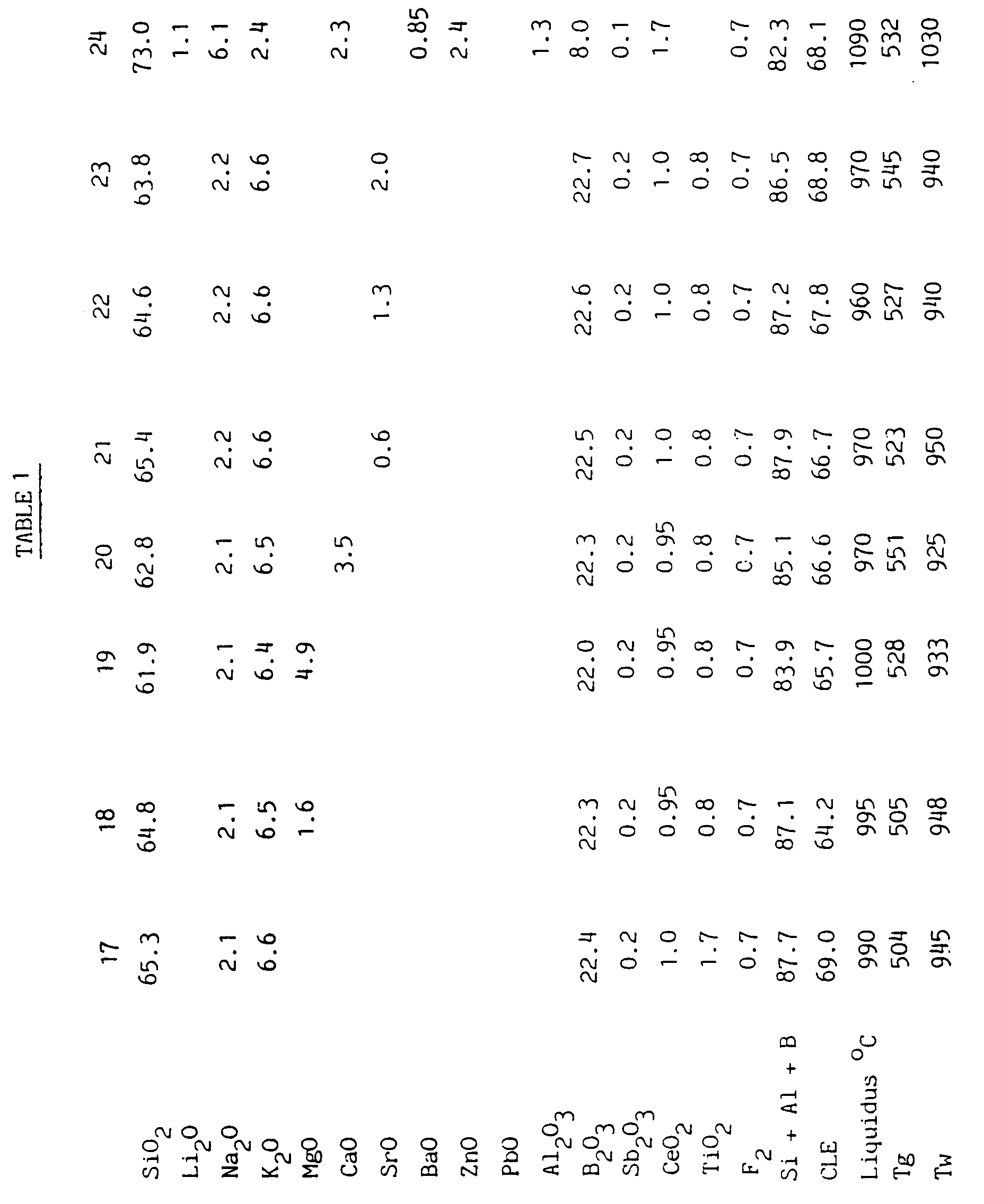
- The present invention is illustrated by the following Examples. Table 1 shows the compositions in terms of mol percentages, whereas Table 2 shows the same compositions as Table 1, but the components in Table 2 are shown in weight percentages, based on the total weight of the glass composition.
- The glass compositions in each of the examples exhibited a coefficient of linear expansion within the range 64 to 70 x 10-7/deg.C.
- In the following Tables:-
CLE represents the coefficient of linear expansion of the glass composition measured at 20 - 550°C (x10-7/deg.C),
Tg represents the glass transition temperature (in°C), and
Tw represents the working point (in°C).



Claims (10)
- A borosilicate glass composition characterised in that the glass composition consists essentially of the following components:-
Si02 57 - 77 mol%, Al203 0 - 8.5 mol%, B203 4.6 - 23.0 mol%, Li20 0 - 1.5 mol%, Na20 2 - 7.5 mol%, K20 2 - 7.5 mol%, Ce02 0.7 - 2.0 mol%, Sb203 0 - 0.3 mol%, As203 0 - 0.3 mol%, Ti02 0 - 2.0 mol%, F2 0 - 2.0 mol%,
and in that the glass composition exhibits a coefficient of linear expansion within the range 64.0 - 70.0 x 10⁻⁷/deg.C. - A glass composition according to claim 1, wherein the amounts of Si02, Al203 and B203 fall in the following ranges:-
Si02 65 - 70 mol%, Al203 0 - 2 mol%, B203 8 - 22 mol%. - A glass composition according to claim 1 or 2, wherein the amount of MgO is from 0 to 5 mol%.
- A glass composition according to claim 1, 2 or 3, wherein the amount of CaO is from 0 to 3.5 mol%.
- A glass composition according to any one of the preceding claims, wherein the amount of SrO is from 0 to 2 mol%.
- A glass composition according to any one of the preceding claims, wherein the amount of BaO is from 0 to 2 mol%.
- A glass composition according to any one of the preceding claims, wherein the amount of ZnO is from 0 to 2.5 mol%.
- A glass composition according to any one of the preceding claims, wherein the amount of PbO is from 0 to 7 mol%.
- A glass composition according to any one of the preceding claims, wherein the sum total of MgO + CaO + SrO + BaO + ZnO + PbO is from 0 to 3.5 mol%.
- A protective cover for a gallium arsenide solar cell, the said cover being made from a borosilicate glass as claimed in any one of the preceding claims.
Applications Claiming Priority (2)
| Application Number | Priority Date | Filing Date | Title |
|---|---|---|---|
| GB9106086 | 1991-03-22 | ||
| GB919106086A GB9106086D0 (en) | 1991-03-22 | 1991-03-22 | Glass composition |
Publications (3)
| Publication Number | Publication Date |
|---|---|
| EP0505061A2 EP0505061A2 (en) | 1992-09-23 |
| EP0505061A3 EP0505061A3 (en) | 1993-05-05 |
| EP0505061B1 true EP0505061B1 (en) | 1996-11-06 |
Family
ID=10692007
Family Applications (1)
| Application Number | Title | Priority Date | Filing Date |
|---|---|---|---|
| EP92301914A Expired - Lifetime EP0505061B1 (en) | 1991-03-22 | 1992-03-05 | Borosilicate glass composition |
Country Status (7)
| Country | Link |
|---|---|
| US (1) | US5219801A (en) |
| EP (1) | EP0505061B1 (en) |
| JP (1) | JP3158221B2 (en) |
| KR (1) | KR100240253B1 (en) |
| DE (1) | DE69214985T2 (en) |
| ES (1) | ES2096025T3 (en) |
| GB (1) | GB9106086D0 (en) |
Families Citing this family (44)
| Publication number | Priority date | Publication date | Assignee | Title |
|---|---|---|---|---|
| US5362687A (en) * | 1992-02-04 | 1994-11-08 | Narumi China Corporation | Lead-free frit glaze |
| IL103372A (en) * | 1992-10-04 | 1995-08-31 | Technion Res & Dev Foundation | Glass compositions and uses thereof |
| JP2747871B2 (en) * | 1993-06-08 | 1998-05-06 | 株式会社オハラ | Low level α-ray glass and method for producing the same |
| US5942793A (en) * | 1993-06-08 | 1999-08-24 | Kabushiki Kaisya Ohara | Low alpha-ray level glass and method for manufacturing the same |
| DE4430710C1 (en) * | 1994-08-30 | 1996-05-02 | Jenaer Glaswerk Gmbh | Low boric acid borosilicate glass and its use |
| US5714422A (en) * | 1994-09-16 | 1998-02-03 | Favrot; Guy A. | Transparent glass |
| FR2724647B1 (en) * | 1994-09-16 | 1997-01-17 | Favrot Guy A | TRANSPARENT GLASS |
| FR2728557A1 (en) * | 1994-12-27 | 1996-06-28 | Corning France | NEW LENSES AND OPHTHALMIC LENSES |
| CN1130315C (en) * | 1995-09-22 | 2003-12-10 | 株式会社村田制作所 | Glass composition having low dielectric constant for high-frequency circuits |
| JPH0986955A (en) * | 1995-09-29 | 1997-03-31 | Murata Mfg Co Ltd | Insulator glass composition, insulator paste, and thick film printed circuit |
| DE19536708C1 (en) * | 1995-09-30 | 1996-10-31 | Jenaer Glaswerk Gmbh | Boro-silicate glass contg. zirconium and lithium oxide(s) |
| GB9525111D0 (en) * | 1995-12-08 | 1996-02-07 | Pilkington Plc | Glass and glass products |
| US5961852A (en) * | 1997-09-09 | 1999-10-05 | Optical Coating Laboratory, Inc. | Laser scribe and break process |
| US6207603B1 (en) * | 1999-02-05 | 2001-03-27 | Corning Incorporated | Solar cell cover glass |
| KR100464703B1 (en) * | 2001-12-28 | 2005-01-05 | 김병일 | borosilicate cellular glass and manufacture method of cellular glass using it |
| JP4530618B2 (en) * | 2002-09-27 | 2010-08-25 | コニカミノルタオプト株式会社 | Glass composition and glass substrate |
| DE10245880B4 (en) * | 2002-09-30 | 2004-08-05 | Schott Glas | White glasses / borosilicate glasses with a special UV edge |
| JP4795651B2 (en) * | 2003-06-06 | 2011-10-19 | ショット アクチエンゲゼルシャフト | Highly chemical-resistant UV-absorbing glass, particularly for fluorescent lamps, manufacturing method and method of use |
| DE102004027119A1 (en) * | 2003-06-06 | 2004-12-30 | Schott Ag | Production of a UV-absorbed glass used in the production of gas discharge lamps, fluorescent lamps, xenon lamps, LCD displays, computer monitors and telephone displays comprises melting a raw material and producing a melt |
| CN100592452C (en) * | 2005-07-29 | 2010-02-24 | 松下电器产业株式会社 | Method for preparing phosphor suspension, fluorescent lamp, backlight unit, direct type backlight unit, and liquid crystal display device |
| DE202005019945U1 (en) * | 2005-12-17 | 2006-03-23 | Solarwatt Ag | Crystalline photovoltaic solar module |
| DE102008001496A1 (en) * | 2008-04-30 | 2009-11-05 | Schott Ag | Borosilicate glass, useful in pharmaceutical packaging, comprises silicon dioxide, boron oxide, aluminum oxide, titanium dioxide, lithium oxide, potassium oxide, sodium oxide, alkaline earth oxide, zirconium oxide and ferric oxide |
| CN101353225B (en) * | 2008-07-11 | 2012-04-04 | 河南安彩高科股份有限公司 | Soda-lime silicate plate glass and manufacturing method thereof |
| DE102008043317B4 (en) * | 2008-10-30 | 2013-08-08 | Schott Ag | Use of a solarization-resistant glass with a defined slope of the UV edge for a spotlight for weathering systems |
| US8341976B2 (en) * | 2009-02-19 | 2013-01-01 | Corning Incorporated | Method of separating strengthened glass |
| DE102009027110B4 (en) * | 2009-06-23 | 2012-02-16 | Schott Ag | Leaded space glass, its manufacture and use |
| JP5416631B2 (en) * | 2010-03-25 | 2014-02-12 | 株式会社日立製作所 | Glass composition and conductive paste for aluminum electrode wiring, electronic component including the aluminum electrode wiring, and method for manufacturing the electronic component |
| US20130112246A1 (en) * | 2011-11-07 | 2013-05-09 | Primestar Solar, Inc. | Rib elements for photovoltaic devices and methods of their manufacture |
| JPWO2014088066A1 (en) * | 2012-12-07 | 2017-01-05 | 旭硝子株式会社 | High transmission glass |
| EP3004004B1 (en) | 2013-06-03 | 2019-07-17 | Council Of Scientific & Industrial Research | Novel soda lime silicate glass composition comprising colemanite and a process for the preparation thereof |
| JP6955320B2 (en) * | 2014-04-07 | 2021-10-27 | 日本電気硝子株式会社 | Manufacturing method of laminate and semiconductor package |
| WO2015156075A1 (en) * | 2014-04-07 | 2015-10-15 | 日本電気硝子株式会社 | Supporting glass substrate and laminate using same |
| US9670088B2 (en) | 2014-05-20 | 2017-06-06 | Corning Incorporated | Scratch resistant glass and method of making |
| JP6829548B2 (en) * | 2016-04-20 | 2021-02-10 | 株式会社オハラ | Optical glass |
| DE102018112069A1 (en) | 2018-05-18 | 2019-11-21 | Schott Ag | Use of a flat glass in electronic components |
| DE102018112070A1 (en) | 2018-05-18 | 2019-11-21 | Schott Ag | Flat glass, process for its production and its use |
| DE202022104982U1 (en) | 2022-09-05 | 2023-02-01 | Schott Ag | Non flat shape glass |
| WO2024203958A1 (en) * | 2023-03-29 | 2024-10-03 | Agc株式会社 | Glass |
| DE102023118163A1 (en) * | 2023-07-10 | 2025-01-16 | Schott Ag | Disc-shaped glass article, preferably for solar applications, and process for its manufacture |
| CN122422268A (en) * | 2023-12-20 | 2026-07-17 | 康宁股份有限公司 | Glass substrate, solar panel including the glass substrate, and building window including the glass substrate |
| CN122459261A (en) * | 2023-12-20 | 2026-07-24 | 康宁股份有限公司 | Glass substrate for reducing potential induced degradation and improving thermal tempering, solar panel and architectural window comprising same |
| WO2025136837A1 (en) * | 2023-12-20 | 2025-06-26 | Corning Incorporated | Glass substrate, solar panel including same, and architectural window including same |
| WO2025136839A1 (en) * | 2023-12-20 | 2025-06-26 | Corning Incorporated | Glass substrate, solar panel including same, and architectural window including same |
| KR102782774B1 (en) * | 2023-12-28 | 2025-03-19 | 주식회사 해동엔지니어링 | Fire-resistant BIPV |
Family Cites Families (9)
| Publication number | Priority date | Publication date | Assignee | Title |
|---|---|---|---|---|
| US3463646A (en) * | 1964-11-20 | 1969-08-26 | Sybron Corp | Semi-crystalline ground coats having controlled p2o5/b2o3 ratio |
| US3671277A (en) * | 1968-10-08 | 1972-06-20 | Nippon Kogaku Kk | Ultraviolet ray cutting pink glass for color photography |
| GB1353935A (en) * | 1971-07-06 | 1974-05-22 | Glasforskningsinstitutet | Glass for the manufacture of art and household glassware |
| GB2115403B (en) * | 1982-02-20 | 1985-11-27 | Zeiss Stiftung | Optical and opthalmic glass |
| DE3222567C2 (en) * | 1982-06-16 | 1986-06-05 | Schott Glaswerke, 6500 Mainz | Colorless barium silicate glass containing cerium and phosphorus with good scintillation properties |
| JP2507418B2 (en) * | 1986-05-02 | 1996-06-12 | 旭硝子株式会社 | Circuit board composition |
| GB8623214D0 (en) * | 1986-09-26 | 1986-10-29 | Pilkington Brothers Plc | Glass compositions |
| US4746634A (en) * | 1987-05-28 | 1988-05-24 | Corning Glass Works | Solarization-resistant glass microsheet |
| US5039631A (en) * | 1990-01-11 | 1991-08-13 | Schott Glass Technologies, Inc. | Strengthenable, high non-nd lanthanoid-containing glasses |
-
1991
- 1991-03-22 GB GB919106086A patent/GB9106086D0/en active Pending
-
1992
- 1992-03-05 ES ES92301914T patent/ES2096025T3/en not_active Expired - Lifetime
- 1992-03-05 US US07/846,627 patent/US5219801A/en not_active Expired - Lifetime
- 1992-03-05 EP EP92301914A patent/EP0505061B1/en not_active Expired - Lifetime
- 1992-03-05 DE DE69214985T patent/DE69214985T2/en not_active Expired - Lifetime
- 1992-03-16 KR KR1019920004285A patent/KR100240253B1/en not_active Expired - Lifetime
- 1992-03-18 JP JP06256792A patent/JP3158221B2/en not_active Expired - Fee Related
Also Published As
| Publication number | Publication date |
|---|---|
| JPH0585768A (en) | 1993-04-06 |
| KR100240253B1 (en) | 2000-01-15 |
| KR920017964A (en) | 1992-10-21 |
| DE69214985D1 (en) | 1996-12-12 |
| EP0505061A2 (en) | 1992-09-23 |
| EP0505061A3 (en) | 1993-05-05 |
| DE69214985T2 (en) | 1997-06-05 |
| GB9106086D0 (en) | 1991-05-08 |
| JP3158221B2 (en) | 2001-04-23 |
| US5219801A (en) | 1993-06-15 |
| ES2096025T3 (en) | 1997-03-01 |
Similar Documents
| Publication | Publication Date | Title |
|---|---|---|
| US5219801A (en) | Borosilicate glass composition | |
| EP0261885B1 (en) | Glass compositions | |
| EP0779252B1 (en) | Radiation stable glass and glass products | |
| US20030114291A1 (en) | Flat glass having high transmittance | |
| EP1026130A1 (en) | Solar cell cover glass | |
| US20050151116A1 (en) | Uv-blocking borosilicate glass, the use of the same, and a fluorescent lamp | |
| EP0149740A2 (en) | Cladding glass for optical fiber | |
| US5858896A (en) | Ultraviolet and infrared radiation absorbing glass | |
| EP0662933B1 (en) | Novel composites for glass | |
| US4746634A (en) | Solarization-resistant glass microsheet | |
| JPH0427179B2 (en) | ||
| JP7769316B2 (en) | Glass substrates for space solar power generation | |
| CA2163497A1 (en) | Colorless ophthalmic glasses | |
| EP0412656A1 (en) | Fast response photosensitive opal glasses | |
| EP0748776A2 (en) | Ultraviolet and infrared radiation absorbing glasses | |
| US2584975A (en) | Optical glass | |
| JP3043076B2 (en) | Low fluorescent glass | |
| JP2010100440A (en) | Soda lime-based glass composition | |
| EP0869925B1 (en) | Brown glass which absorbs ultraviolet radiation | |
| JP2000185934A (en) | Ultraviolet and infrared absorbing glass | |
| US2523264A (en) | Ophthalmic glass | |
| US20250331315A1 (en) | Front-face substrate for a solar module | |
| JPH06211539A (en) | Low radiation glass | |
| JP2562803B2 (en) | Window glass for EP-ROM package | |
| CN121889351A (en) | Glass |
Legal Events
| Date | Code | Title | Description |
|---|---|---|---|
| PUAI | Public reference made under article 153(3) epc to a published international application that has entered the european phase |
Free format text: ORIGINAL CODE: 0009012 |
|
| AK | Designated contracting states |
Kind code of ref document: A2 Designated state(s): BE DE ES FR GB IT NL SE |
|
| PUAL | Search report despatched |
Free format text: ORIGINAL CODE: 0009013 |
|
| AK | Designated contracting states |
Kind code of ref document: A3 Designated state(s): BE DE ES FR GB IT NL SE |
|
| 17P | Request for examination filed |
Effective date: 19931028 |
|
| 17Q | First examination report despatched |
Effective date: 19940711 |
|
| GRAH | Despatch of communication of intention to grant a patent |
Free format text: ORIGINAL CODE: EPIDOS IGRA |
|
| GRAH | Despatch of communication of intention to grant a patent |
Free format text: ORIGINAL CODE: EPIDOS IGRA |
|
| GRAA | (expected) grant |
Free format text: ORIGINAL CODE: 0009210 |
|
| AK | Designated contracting states |
Kind code of ref document: B1 Designated state(s): BE DE ES FR GB IT NL SE |
|
| REF | Corresponds to: |
Ref document number: 69214985 Country of ref document: DE Date of ref document: 19961212 |
|
| ITF | It: translation for a ep patent filed | ||
| PG25 | Lapsed in a contracting state [announced via postgrant information from national office to epo] |
Ref country code: SE Effective date: 19970206 |
|
| ET | Fr: translation filed | ||
| REG | Reference to a national code |
Ref country code: ES Ref legal event code: FG2A Ref document number: 2096025 Country of ref document: ES Kind code of ref document: T3 |
|
| PLBE | No opposition filed within time limit |
Free format text: ORIGINAL CODE: 0009261 |
|
| 26N | No opposition filed | ||
| REG | Reference to a national code |
Ref country code: GB Ref legal event code: IF02 |
|
| PGFP | Annual fee paid to national office [announced via postgrant information from national office to epo] |
Ref country code: IT Payment date: 20110315 Year of fee payment: 20 Ref country code: NL Payment date: 20110317 Year of fee payment: 20 Ref country code: FR Payment date: 20110317 Year of fee payment: 20 |
|
| PGFP | Annual fee paid to national office [announced via postgrant information from national office to epo] |
Ref country code: ES Payment date: 20110414 Year of fee payment: 20 Ref country code: GB Payment date: 20110302 Year of fee payment: 20 Ref country code: DE Payment date: 20110302 Year of fee payment: 20 Ref country code: BE Payment date: 20110311 Year of fee payment: 20 |
|
| REG | Reference to a national code |
Ref country code: DE Ref legal event code: R071 Ref document number: 69214985 Country of ref document: DE |
|
| REG | Reference to a national code |
Ref country code: DE Ref legal event code: R071 Ref document number: 69214985 Country of ref document: DE |
|
| REG | Reference to a national code |
Ref country code: NL Ref legal event code: V4 Effective date: 20120305 |
|
| REG | Reference to a national code |
Ref country code: GB Ref legal event code: PE20 Expiry date: 20120304 |
|
| BE20 | Be: patent expired |
Owner name: *PILKINGTON P.L.C. Effective date: 20120305 |
|
| PG25 | Lapsed in a contracting state [announced via postgrant information from national office to epo] |
Ref country code: DE Free format text: LAPSE BECAUSE OF EXPIRATION OF PROTECTION Effective date: 20120306 |
|
| PG25 | Lapsed in a contracting state [announced via postgrant information from national office to epo] |
Ref country code: GB Free format text: LAPSE BECAUSE OF EXPIRATION OF PROTECTION Effective date: 20120304 |
|
| REG | Reference to a national code |
Ref country code: ES Ref legal event code: FD2A Effective date: 20130801 |
|
| PG25 | Lapsed in a contracting state [announced via postgrant information from national office to epo] |
Ref country code: ES Free format text: LAPSE BECAUSE OF EXPIRATION OF PROTECTION Effective date: 20120306 |