EP0504228B1 - Membranes for absorbent packets - Google Patents
Membranes for absorbent packets Download PDFInfo
- Publication number
- EP0504228B1 EP0504228B1 EP91900533A EP91900533A EP0504228B1 EP 0504228 B1 EP0504228 B1 EP 0504228B1 EP 91900533 A EP91900533 A EP 91900533A EP 91900533 A EP91900533 A EP 91900533A EP 0504228 B1 EP0504228 B1 EP 0504228B1
- Authority
- EP
- European Patent Office
- Prior art keywords
- water
- absorbent article
- film
- packet
- membrane
- Prior art date
- Legal status (The legal status is an assumption and is not a legal conclusion. Google has not performed a legal analysis and makes no representation as to the accuracy of the status listed.)
- Expired - Lifetime
Links
Classifications
-
- A—HUMAN NECESSITIES
- A61—MEDICAL OR VETERINARY SCIENCE; HYGIENE
- A61L—METHODS OR APPARATUS FOR STERILISING MATERIALS OR OBJECTS IN GENERAL; DISINFECTION, STERILISATION OR DEODORISATION OF AIR; CHEMICAL ASPECTS OF BANDAGES, DRESSINGS, ABSORBENT PADS OR SURGICAL ARTICLES; MATERIALS FOR BANDAGES, DRESSINGS, ABSORBENT PADS OR SURGICAL ARTICLES
- A61L15/00—Chemical aspects of, or use of materials for, bandages, dressings or absorbent pads
- A61L15/16—Bandages, dressings or absorbent pads for physiological fluids such as urine or blood, e.g. sanitary towels, tampons
- A61L15/18—Bandages, dressings or absorbent pads for physiological fluids such as urine or blood, e.g. sanitary towels, tampons containing inorganic materials
-
- B—PERFORMING OPERATIONS; TRANSPORTING
- B01—PHYSICAL OR CHEMICAL PROCESSES OR APPARATUS IN GENERAL
- B01D—SEPARATION
- B01D71/00—Semi-permeable membranes for separation processes or apparatus characterised by the material; Manufacturing processes specially adapted therefor
- B01D71/06—Organic material
- B01D71/08—Polysaccharides
- B01D71/12—Cellulose derivatives
- B01D71/14—Esters of organic acids
- B01D71/16—Cellulose acetate
-
- A—HUMAN NECESSITIES
- A61—MEDICAL OR VETERINARY SCIENCE; HYGIENE
- A61L—METHODS OR APPARATUS FOR STERILISING MATERIALS OR OBJECTS IN GENERAL; DISINFECTION, STERILISATION OR DEODORISATION OF AIR; CHEMICAL ASPECTS OF BANDAGES, DRESSINGS, ABSORBENT PADS OR SURGICAL ARTICLES; MATERIALS FOR BANDAGES, DRESSINGS, ABSORBENT PADS OR SURGICAL ARTICLES
- A61L15/00—Chemical aspects of, or use of materials for, bandages, dressings or absorbent pads
- A61L15/16—Bandages, dressings or absorbent pads for physiological fluids such as urine or blood, e.g. sanitary towels, tampons
- A61L15/22—Bandages, dressings or absorbent pads for physiological fluids such as urine or blood, e.g. sanitary towels, tampons containing macromolecular materials
- A61L15/28—Polysaccharides or their derivatives
-
- B—PERFORMING OPERATIONS; TRANSPORTING
- B01—PHYSICAL OR CHEMICAL PROCESSES OR APPARATUS IN GENERAL
- B01D—SEPARATION
- B01D61/00—Processes of separation using semi-permeable membranes, e.g. dialysis, osmosis or ultrafiltration; Apparatus, accessories or auxiliary operations specially adapted therefor
- B01D61/002—Forward osmosis or direct osmosis
- B01D61/005—Osmotic agents; Draw solutions
Definitions
- This invention is related to absorbent articles which are used for many purposes, such as disposable diapers, absorbent pads, surgical dressings, and the like. Since most are intended to be disposable, the cost of the constituents is of great importance in combination with the performance.
- wood fluff wood fibers commonly known in the art as "wood fluff". Such fibers are inexpensive and have a large capacity for fluids but since the fluids are held between the fibers for the most part, they can be pressed out fairly easily. Also, since light wood fluff creates a relatively bulky product, more recently super absorbent polymer gels have been used in order to increase fluid capacity and decrease the bulk of the absorbent articles. Further discussion of conventional materials may be found in related U.S. Patent Application Serial No. 247,828 corresponding to EP-A-0360565. The present invention represents a significant improvement of the absorbent articles described there.
- Osmotic pressure is said to assist in the absorptive process, but in relation to a very different objective and, consequently, the physical structure is quite different from the present invention.
- US-A-4820293 was concerned with providing a surgical dressing which was to absorb blood and other fluids present at the site of a wound.
- Such fluids have constituents with relatively high molecular weight relative to water and consequently the semipermeable membrane employed is said to be of the dialysis type and the osmotic absorbent has a molecular weight above 500.
- Dialysis membranes are relatively open and are capable of preventing the passage of most useful blood components such as proteins, while passing lower molecular weight metabolic waste products, such as urea, through the membrane.
- dialysis is carried out under quite low differential pressures and relies on diffusion of the molecules through the porous membrane.
- the membrane is said to have pores in the range of 0.005-8 »m
- the absorbent packet of our previous application was shown to have the ability to pickup and retain large amounts of water relative to the weight of the membrane. However, it reached its maximum capacity only after an extended period and had a smaller uptake of liquid during the shorter typical period of use. Thus, a more rapid uptake of liquid has been sought to more nearly satisfy the needs of the market.
- the improved membranes to be discussed and the form in which they are used are directed toward those objectives.
- the invention consists of an absorbent article capable of absorbing water and retaining said water against an external pressure which comprises:
- the invention in a preferred embodiment is an absorbent packet which is capable of taking up at least 0.001 g/min/cm2 of water and retaining said water against an external pressure of at least 0.1 psig (0.689 kPa) which comprises:
- steps (3) and (4) may be combined.
- the quenching of (2) preferably will be carried out for 0.1 to 5 minutes using a water bath at 0°C to 40°C and usually following a brief period of air evaporation of the liquids.
- the osmotic promoter may be chosen from various materials which provide a favorable osmotic pressure difference between the outside and the inside of the packet.
- Preferred are relatively low molecular weight compounds, preferably below 1000 molecular weight, such as sodium chloride, sugars, and other water soluble ionic salts, such as ammonium sulfate and calcium chloride.
- the amount of the osmotic promoter used is related to the amount of water to be taken up within the packet, the surface area of the packet, the desired rate of water uptake and the osmotic pressure which the compound is able to develop. Thus, less would be needed of a low molecular weight compound such as sodium chloride than of a higher molecular weight compound such as sugar. Broadly, the amount of promoter will be 0.001 to 1 g per cm3 of packet volume.
- the packets may be fabricated in any form which is convenient for the intended end use. Individual packets can be made but preferably they will be produced as sheets in which the individual packets are defined by the sealing of two adjacent films in regular patterns, such as by heat or adhesives. An impermeable film also may be incorporated in the packets if desired.
- osmotic membranes may be made from many materials.
- the membranes must pass large amounts of water and reject the osmotic promoter in order to maintain the pressure differentials.
- the membrane should pass not only water but the salts and other compounds found in the bodily fluid which is to be absorbed. In practice, the ideal performance is only approximately achieved since the membrane which rejects the osmotic promoter usually will not easily pass the solutes found in body fluids.
- the membranes may be selected from those used as reverse osmosis membranes and may include cellulose acetate and derivatives thereof, polysulfone, polyelectrolyte complexes, long chain polyamides, interpenetrating polymer networks and interfacially formed reaction products as discussed in US Patent Application Serial No. 247,828 corresponding to EP-A-0360565.
- cellulose acetate will be the material of choice for the osmotic membrane of the invention.
- the membranes used in experiments reported in my earlier application had capacity for large amounts of water but the rate at which the uptake occurred was not as rapid as would be desired for many applications.
- the amount of fluid to be absorbed would be relatively uniform and small, while In others the amount would be large and intermittent.
- the membrane suitable for one application would not be useful in another application and one could not be certain that a membrane could meet the design criteria. It has been found that the method of preparing a cellulosic membrane can greatly affect its usefulness.
- a cellulosic membrane may be produced by casting a solution of a cellulose derivative, preferably cellulose acetate, more preferably cellulose diacetate, on a surface, such as glass or a plastic film, leveling the applied solution to produce a uniform film, and removing the solvent. The cast film is then conditioned, removed from the supporting surface and fabricated in the desired packet format.
- a cellulose derivative preferably cellulose acetate, more preferably cellulose diacetate
- the cellulose derivative will be cellulose diacetate or triacetate or a mixture of the two, dissolved in at least one liquid selected from the group consisting of acetone, dimethylformamide, dimethylacetamide, dimethylsulfoxide, 1-methyl-2-pyrrolidone, formamide, dioxane, tetraethylphosphate, acetic acid, tetrahydrofuran, and water.
- a solution of 15 to 25% cellulose diacetate dissolved in a suitable liquid mixture, such as acetone and formamide, is placed on a surface, particularly a plastic film, and leveled with a knife edge or its equivalent and then quenched in a water bath to solidify the membrane and to remove the solvent. Then the film is immersed in water at 75°C to 95°C to anneal the film and then conditioned with an aqueous solution of a polyhydric compound such as glycerol, and thereafter dried in air.
- a suitable liquid mixture such as acetone and formamide
- the cellulose acetate solution may contain in addition to acetone up to 40% by weight of other liquids such as dimethylformamide, dimethylacetamide, dimethylsulfoxide, 1-methyl-2-pyrrolidone, formamide, dioxane, triethylphosphate, acetic acid, tetrahydrofuran, and water.
- the quenching of the film in water provides an asymmetric structure which promotes the desired osmotic properties.
- the water temperature is usually maintained in the range of 0°C to 40°C. Residence time in the water should be 0.1 to 5 minutes. Following this quenching step the film has solidified and may be removed from the support or left on the support for the subsequent conditioning steps.
- the film is annealed at a temperature of 75°C to 95°C for a period of 0.1 to 30 minutes. Then the film is conditioned by immersing it in water at a temperature of 0°C to 95°C containing 5 to 50 vol. % of glycerol or another suitable material such as ethylene glycol or propylene glycol. If desired, the annealing and conditioning steps may be combined.
- the finished film may be characterized by having a thickness of 5 to 50 »m, preferably less than 30 »m, an hydraulic permeability of at least 4.93 x 10 ⁇ 5 cm3/cm2-MPa-sec and a salt permeability of less than 1.974 x 10 ⁇ 6 g/cm2-MPa-sec
- the hydraulic permeability is greater than 9.869 x 10 ⁇ 5 cm3/cm2-MPa-sec (1 x 10 ⁇ 5 cm3/cm2-sec-atm) and the salt permeability is less than 9.869 x 10 ⁇ 7 g/cm2-MPa-sec (1 x 10 ⁇ 7 g/cm2-sec-atm).
- the ratio of water to salt permeabilities thus would be 100 or more.
- the osmotic promoter will have a molecular weight below 1000, preferably below 500.
- I discussed potentially useful osmotic promoters emphasizing the salts of Groups IA and IIA of the Periodic Table and particularly the halides of such metals.
- Sodium chloride is a particularly useful member of this group from both the standpoint of cost and performance.
- Other materials which may be used as osmotic promoters are sugars, polyhydric compounds such as ethylene glycol, ammonium compounds such as ammonium chloride, lactic acid, bicarbonates, and the like. The amount to be used will be fundamentally affected by the molecular weight of the promoter and its rejection by the membrane.
- the amount of the promoter will also be affected by the volume of the liquid to be absorbed by the packet since the promoter will be diluted by the water which passes through the membrane and the osmotic pressure differential will be reduced, which in turn reduces the flow of water through the membrane.
- the water may continue to enter until substantial pressures are developed and the packet could be ruptured - an undesirable outcome if one wishes to retain the fluid within the packet.
- the amount of promoter which is used will depend upon the design parameters of the intended application, the size and strength of the packet, and the inherent ability of the promoter to develop an osmotic pressure differential. Broadly, the amount of promoter employed would be expected to be within the range of 0.001 to 1 grams per cubic centimeter of the packet volume.
- packets capable of picking up and retaining water or body fluids could be made in many forms.
- the packet be flexible since a stiff inflexible membrane would limit the packet's capacity and risk failure due to excessive pressure buildup.
- a flexible packet would be preferred in order to provide maximum capacity from the smallest initial volume. Any shape could be adopted which would be efficient in use and inexpensive to produce, although such requirements relate to practical application of the invention rather than to its effectiveness.
- the packets should be capable of withstanding an external pressure of at least 0.1 psig (0.689 kpa).
- the packets would be formed from two sheets, one could be relatively impermeable and the other comprising a membrane of the invention or both could be such membranes.
- the two sheets could be joined at their edges as by gluing, heat sealing or the like. The two sheets would then become a single packet the size of the sheets.
- the packet could be included in a composite structure designed to pickup and retain fluids, which could include wood fluff or other absorbing materials, outer nonabsorbent sheets, fasteners and the like.
- the membrane should be kept as thin as possible while retaining the needed strength.
- the preferred thickness is 5 to 50 »m, preferably less than 30 »m. Casting the membrane on a temporary support avoids unnecessary weight since the support is later separated before the packets are assembled. The amount of water taken up by the packets relative to the weight of the membrane is very large, as the examples below illustrate - 3000% or greater.
- a more preferred embodiment is found in the division of the single packet described above into smaller packets by sealing the two sheets along interior lines, subdividing the two sheets into many smaller packets in a single unitary structure.
- Such a configuration has the advantage of avoiding a massive failure of the structure when filled with water since it is less likely that all of the sub-packets would fail at once.
- a desirable packet size has been found to be 3 cm by 10 cm.
- a solution of 22% cellulose diacetate (acetyl content: 39.4%, viscosity (ASTM-A): 44 sec.) with 33% formamide and 45% acetone was cast with a knife edge upon a polyethylene support film. After a 22 second evaporation time, the film was quenched in a 20°C water bath. The membrane was removed from the support and annealed 15 minutes in 80°C water, then immersed in 25 vol.% glycerol for about 30 minutes. The film was air dried to give a membrane with an average thickness of 25 »m, and then subjected to the following tests.
- a packet with surface area of 12.4 cm2 was prepared by heat sealing after enclosing 0.110 grams of sodium chloride.
- a section of membrane was folded, then sealed along two edges to form an envelope where salt will be contained. Two edges of the envelope are formed by the heat seal, the third edge is the formed by the fold.
- the salt is placed within this envelope, and the fourth edge sealed.
- the packet was placed in 40 ml of stirred water and the weight gain and salt leakage from the packet was monitored.
- a solution of 22.5% cellulose diacetate (acetyl content: 39.4%, viscosity (ASTM-A): 44 seconds) with 30% formamide and 47.5% acetone was cast with a knife edge upon a polyester support film. After a 26 second evaporation time, the film was quenched in a 25°C water bath. The membrane was removed from the support and annealed 10 minutes in 85°C water, then immersed in 25 vol.% glycerol for about 30 minutes. The film was air dried to give membrane with an average thickness of 25 »m.
- an osmotic cell was used to measure osmotic transport parameters for this membrane.
- a hydraulic permeability of 1.559 x 10 ⁇ 4 cm2/cm2-MPa-sec (1.58 x 10 ⁇ 5 cm3/cm2-sec-atm) and salt permeability of 3.95 x 10 ⁇ 7 g/cm2-MPa-sec (0.40 x 10 ⁇ 7 g/cm2-sec-atm) were determined.
- test packet with surface area of 16.4 cm2 was prepared by heat sealing as described above, wherein this packet contained 0.127 grams of sodium chloride.
- the packet was placed in 100 ml of stirred water and the weight gain and salt leakage from the packet was monitored. These results are listed in Table B.
- the average initial uptake rate of the packet for the first five minutes was 0.0246 g/min/cm2.
- This Example further illustrates how small changes in the process used to prepare the membrane allows control of the final properties.
- This test showed less salt leakage from the packet than observed in the previous Example, corresponding to the lower value for salt permeability.
- Membranes were prepared as before using a casting solution of 18 wt.% cellulose diacetate, 30 wt.% formamide, and 52 wt.% acetone, by casting upon a glass support plate. After 20 seconds the membrane was quenched in 20°C water, delaminated, and then heated for 15 minutes in 80°C water. The film was then soaked in an aqueous 30 wt.% glycerol solution for about 30 minutes, and then air dried. The resultant membrane thickness was 22 »m.
- the packets were formed with heat sealed edges as previously described and then tested against 10 ml of an unstirred synthetic urine solution containing 2 wt.% urea, 1 wt.% NaCl, 0.03 wt.% CaCl2.2H2O, and 0.06 wt.% MgCl2.6H2O.
- the results are given in Table C.
- the average initial rate was 0.0185 g/min/cm2.
- the packet had absorbed 38% of the available liquid.
- the percent increase in weight due to absorbed water is also calculated based on the weight of the membrane used to form the packet.
- Membranes were prepared as before using a casting solution of 23 wt.% cellulose diacetate, 28 wt.% formamide, and 49 wt.% acetone, by casting upon a polyethylene support film. After 20 seconds the membrane was immersed in 20°C water, delaminated, and then heated for 15 minutes in 80°C water. The film was then soaked in aqueous 25 vol.% glycerol solution for about 30 minutes, and then air dried. The packets listed in Table D were formed with heat sealed edges, and then tested against 8 ml of the synthetic solution described in the previous Example 3. Packet 4 was prepared with sodium chloride as promoter, while Packet 5 used glucose. The packet with glucose as promoter has a slower initial rate than that with sodium chloride.
- Membranes were prepared as before using a casting solution of 22 wt.% cellulose diacetate, 20 wt.% 1-methyl-2-pyrrolidone, and 58 wt.% acetone, by casting upon a polyester support film. After 20 seconds the film was immersed in 25°C water, delaminated, and then heated for 15 minutes in 80°C water. The film was then soaked in 25 vol.% glycerol solution for about 30 minutes, and then air dried. The resultant film was 18 »m thick, and used to form the absorbent packets listed in Table E. These tests were against 100 ml of stirred water, and both the weight gain of the packet and salt content of the external solution were monitored.
- Membranes were prepared as in Example 2, but with an evaporation time of 18 seconds. The resultant film had a thickness of 18 »m. This membrane was used to shape an absorbent packet that was tested against 100 ml of stirred water. The test listed in Table F was halted at 8 minutes, and 900 gram weight placed on top of the packet, whereupon no leaks were observed. If this weight is distributed over the total surface area of the membrane, then the packet withstood 1.1 psig (7.58 kPa gauge) without loss of absorbed water.
- Membranes were prepared with the process in Example 2. The resultant membrane had a thickness of 25 »m. A large packet was prepared as described above but with 5 internal compartments, each comprising about 1/5th the surface area and 1/5th of the sodium chloride content. The overall packet dimensions were 88 by 93 mm2. The absorption was tested against 300 ml of stirred water. From Table G, an initial water absorption rate at 5 minutes of 0.0161 g/min/cm2 was observed.
- Membranes were prepared with the process in Example 2, but the hot water and glycerol treatment were combined into a single step of 3 minutes in 92°C solution of 20 vol.% glycerol. The resultant membrane was 25 »m thick. A packet formed from this membrane was tested against 100 ml of stirred water, and the results are listed in Table H. An initial absorption rate of 0.0204 g/min/cm2 was observed.
Landscapes
- Health & Medical Sciences (AREA)
- Chemical & Material Sciences (AREA)
- Engineering & Computer Science (AREA)
- Water Supply & Treatment (AREA)
- Chemical Kinetics & Catalysis (AREA)
- Life Sciences & Earth Sciences (AREA)
- Epidemiology (AREA)
- Animal Behavior & Ethology (AREA)
- General Health & Medical Sciences (AREA)
- Public Health (AREA)
- Veterinary Medicine (AREA)
- Materials Engineering (AREA)
- Hematology (AREA)
- Inorganic Chemistry (AREA)
- Separation Using Semi-Permeable Membranes (AREA)
- Preparation Of Compounds By Using Micro-Organisms (AREA)
- Absorbent Articles And Supports Therefor (AREA)
- Laminated Bodies (AREA)
- Compositions Of Macromolecular Compounds (AREA)
- Orthopedics, Nursing, And Contraception (AREA)
- Manufacture Of Macromolecular Shaped Articles (AREA)
- Moulding By Coating Moulds (AREA)
- Materials For Medical Uses (AREA)
- Wrappers (AREA)
- Packages (AREA)
- External Artificial Organs (AREA)
Abstract
Description
- This invention is related to absorbent articles which are used for many purposes, such as disposable diapers, absorbent pads, surgical dressings, and the like. Since most are intended to be disposable, the cost of the constituents is of great importance in combination with the performance.
- Many disposable articles use wood fibers commonly known in the art as "wood fluff". Such fibers are inexpensive and have a large capacity for fluids but since the fluids are held between the fibers for the most part, they can be pressed out fairly easily. Also, since light wood fluff creates a relatively bulky product, more recently super absorbent polymer gels have been used in order to increase fluid capacity and decrease the bulk of the absorbent articles. Further discussion of conventional materials may be found in related U.S. Patent Application Serial No. 247,828 corresponding to EP-A-0360565. The present invention represents a significant improvement of the absorbent articles described there.
- Another absorbent article is described in US-A-4 820 293. Osmotic pressure is said to assist in the absorptive process, but in relation to a very different objective and, consequently, the physical structure is quite different from the present invention. More particularly, US-A-4820293 was concerned with providing a surgical dressing which was to absorb blood and other fluids present at the site of a wound. Such fluids have constituents with relatively high molecular weight relative to water and consequently the semipermeable membrane employed is said to be of the dialysis type and the osmotic absorbent has a molecular weight above 500. Dialysis membranes are relatively open and are capable of preventing the passage of most useful blood components such as proteins, while passing lower molecular weight metabolic waste products, such as urea, through the membrane. Typically, dialysis is carried out under quite low differential pressures and relies on diffusion of the molecules through the porous membrane. In the absorbent article of US-A-4820293, the membrane is said to have pores in the range of 0.005-8 »m
- The absorbent packet of our previous application was shown to have the ability to pickup and retain large amounts of water relative to the weight of the membrane. However, it reached its maximum capacity only after an extended period and had a smaller uptake of liquid during the shorter typical period of use. Thus, a more rapid uptake of liquid has been sought to more nearly satisfy the needs of the market. The improved membranes to be discussed and the form in which they are used are directed toward those objectives.
- Generally, the invention consists of an absorbent article capable of absorbing water and retaining said water against an external pressure which comprises:
- (a) an osmotic promoter;
- (b) a cellulosic membrane encapsulating said promoter having a thickness of 5 to 50 »m obtainable by the process of
- (1) casting a solution of a cellulose derivative and at least one liquid selected from the group consisting of acetone, dimethylformamide, dimethylacetamide, dimethylsulfoxide, 1-methyl-2-pyrrolidone, formamide, dioxane, tetraethylphosphate, acetic acid, tetrahydrofuran, and water, onto a suitable surface,
- (2) removing the liquid from the film of (1),
- (3) annealing the film of (2) in water,
- (4) conditioning the annealed film of (3) in water containing a conditioning agent selected from the group consisting of glycerol, ethylene glycol, and propylene glycol,
- (5) drying the conditioned film of (4).
- The invention in a preferred embodiment is an absorbent packet which is capable of taking up at least 0.001 g/min/cm² of water and retaining said water against an external pressure of at least 0.1 psig (0.689 kPa) which comprises:
- (a) An osmotic promoter;
- (b) A cellulosic membrane encapsulating said promoter of (a) having a thickness of 5 to 50 »m, preferably less than 30 »m, and an hydraulic permeability of at least
4.93 x 10⁻⁵ cm³/cm²-MPa-sec
permeability less than 1.974 x 10⁻⁶ g/cm²-MPa-sec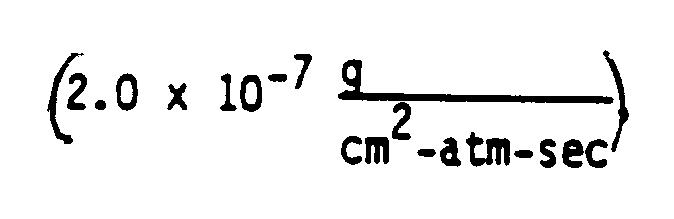
produced by the process of- (1) casting a solution of a cellulose derivative, preferably cellulose acetate, more preferably cellulose diacetate, and at least one liquid selected from the group consisting of acetone, dimethylformamide, dimethylacetamide, dimethylsulfoxide, 1-methyl-2-pyrrolidone, formamide, dioxane, triethylphosphate, acetic acid, tetrahydrofuran, and water, onto a suitable surface,
- (2) quenching the film of (1) in water at a temperature of 0°C to 40°C,
- (3) annealing the quenched film of (2) in water at 75°C to 95°C,
- (4) conditioning the annealed film of (3) in water containing a polyhydric compound selected from the group consisting of glycerol, ethylene glycol, and propylene glycol,
- (5) drying said conditioned film.
- If desired, steps (3) and (4) may be combined.
- The quenching of (2) preferably will be carried out for 0.1 to 5 minutes using a water bath at 0°C to 40°C and usually following a brief period of air evaporation of the liquids.
- The osmotic promoter may be chosen from various materials which provide a favorable osmotic pressure difference between the outside and the inside of the packet. Preferred are relatively low molecular weight compounds, preferably below 1000 molecular weight, such as sodium chloride, sugars, and other water soluble ionic salts, such as ammonium sulfate and calcium chloride. The amount of the osmotic promoter used is related to the amount of water to be taken up within the packet, the surface area of the packet, the desired rate of water uptake and the osmotic pressure which the compound is able to develop. Thus, less would be needed of a low molecular weight compound such as sodium chloride than of a higher molecular weight compound such as sugar. Broadly, the amount of promoter will be 0.001 to 1 g per cm³ of packet volume.
- The packets may be fabricated in any form which is convenient for the intended end use. Individual packets can be made but preferably they will be produced as sheets in which the individual packets are defined by the sealing of two adjacent films in regular patterns, such as by heat or adhesives. An impermeable film also may be incorporated in the packets if desired.
- As discussed in our earlier application, osmotic membranes may be made from many materials. The membranes must pass large amounts of water and reject the osmotic promoter in order to maintain the pressure differentials. Ideally, the membrane should pass not only water but the salts and other compounds found in the bodily fluid which is to be absorbed. In practice, the ideal performance is only approximately achieved since the membrane which rejects the osmotic promoter usually will not easily pass the solutes found in body fluids. The membranes may be selected from those used as reverse osmosis membranes and may include cellulose acetate and derivatives thereof, polysulfone, polyelectrolyte complexes, long chain polyamides, interpenetrating polymer networks and interfacially formed reaction products as discussed in US Patent Application Serial No. 247,828 corresponding to EP-A-0360565. For practical applications cost as well as performance must be considered and therefore for many applications cellulose acetate will be the material of choice for the osmotic membrane of the invention.
- The methods for casting of cellulosic membranes are rather well known to those skilled in the art. An early example of such technique is found in US-A-3 133 137 which disclosed preparation of cellulose acetate membranes for desalination of water at relatively high pressure differentials. These membranes were cast from a solution using a solvent, water, and a pore-producing perchlorate salt. Subsequently, cellulose acetate membranes were cast from organic solutions including acetone and formamide, for example as in US-A-3 657 115. The process which is used must be developed by experimentation and the properties of the finished membrane may or may not meet the particular requirements which are established for the selected end use. As noted above, the membranes used in experiments reported in my earlier application had capacity for large amounts of water but the rate at which the uptake occurred was not as rapid as would be desired for many applications. Clearly, in some applications the amount of fluid to be absorbed would be relatively uniform and small, while In others the amount would be large and intermittent. Thus, the membrane suitable for one application would not be useful in another application and one could not be certain that a membrane could meet the design criteria. It has been found that the method of preparing a cellulosic membrane can greatly affect its usefulness.
- In general, a cellulosic membrane may be produced by casting a solution of a cellulose derivative, preferably cellulose acetate, more preferably cellulose diacetate, on a surface, such as glass or a plastic film, leveling the applied solution to produce a uniform film, and removing the solvent. The cast film is then conditioned, removed from the supporting surface and fabricated in the desired packet format.
- Preferably, the cellulose derivative will be cellulose diacetate or triacetate or a mixture of the two, dissolved in at least one liquid selected from the group consisting of acetone, dimethylformamide, dimethylacetamide, dimethylsulfoxide, 1-methyl-2-pyrrolidone, formamide, dioxane, tetraethylphosphate, acetic acid, tetrahydrofuran, and water.
- In a particularly preferred embodiment a solution of 15 to 25% cellulose diacetate dissolved in a suitable liquid mixture, such as acetone and formamide, is placed on a surface, particularly a plastic film, and leveled with a knife edge or its equivalent and then quenched in a water bath to solidify the membrane and to remove the solvent. Then the film is immersed in water at 75°C to 95°C to anneal the film and then conditioned with an aqueous solution of a polyhydric compound such as glycerol, and thereafter dried in air. The cellulose acetate solution may contain in addition to acetone up to 40% by weight of other liquids such as dimethylformamide, dimethylacetamide, dimethylsulfoxide, 1-methyl-2-pyrrolidone, formamide, dioxane, triethylphosphate, acetic acid, tetrahydrofuran, and water. The quenching of the film in water provides an asymmetric structure which promotes the desired osmotic properties. The water temperature is usually maintained in the range of 0°C to 40°C. Residence time in the water should be 0.1 to 5 minutes. Following this quenching step the film has solidified and may be removed from the support or left on the support for the subsequent conditioning steps. The film is annealed at a temperature of 75°C to 95°C for a period of 0.1 to 30 minutes. Then the film is conditioned by immersing it in water at a temperature of 0°C to 95°C containing 5 to 50 vol. % of glycerol or another suitable material such as ethylene glycol or propylene glycol. If desired, the annealing and conditioning steps may be combined.
- The finished film may be characterized by having a thickness of 5 to 50 »m, preferably less than 30 »m, an hydraulic
permeability of at least 4.93 x 10⁻⁵ cm³/cm²-MPa-sec
and a salt
permeability of less than 1.974 x 10⁻⁶ g/cm²-MPa-sec
- Permeability values can be determined by using an osmotic cell experiment as described by M. Matsuda and C. Kamizawa in Desalination, 49 (1984) 367-378.

- Jv
- = water flux
- Js
- = solute flux
- Lp
- = hydraulic permeability
- ω
- = salt permeability
- ΔP
- = pressure difference across membrane
- Δπ
- = osmotic pressure difference across membrane
- σ
- = reflection coefficient
-
C s - = mean solute concentration
- Preferably, the hydraulic permeability is greater than 9.869 x 10⁻⁵ cm³/cm²-MPa-sec (1 x 10⁻⁵ cm³/cm²-sec-atm) and the salt permeability is less than 9.869 x 10⁻⁷ g/cm²-MPa-sec (1 x 10⁻⁷ g/cm²-sec-atm). The ratio of water to salt permeabilities thus would be 100 or more.
- Generally, the osmotic promoter will have a molecular weight below 1000, preferably below 500. In my earlier application I discussed potentially useful osmotic promoters, emphasizing the salts of Groups IA and IIA of the Periodic Table and particularly the halides of such metals. Sodium chloride is a particularly useful member of this group from both the standpoint of cost and performance. Other materials which may be used as osmotic promoters are sugars, polyhydric compounds such as ethylene glycol, ammonium compounds such as ammonium chloride, lactic acid, bicarbonates, and the like. The amount to be used will be fundamentally affected by the molecular weight of the promoter and its rejection by the membrane. Practically, the amount of the promoter will also be affected by the volume of the liquid to be absorbed by the packet since the promoter will be diluted by the water which passes through the membrane and the osmotic pressure differential will be reduced, which in turn reduces the flow of water through the membrane. On the other hand, if too much promoter is enclosed within the packet the water may continue to enter until substantial pressures are developed and the packet could be ruptured - an undesirable outcome if one wishes to retain the fluid within the packet. Thus the actual amount of the promoter which is used will depend upon the design parameters of the intended application, the size and strength of the packet, and the inherent ability of the promoter to develop an osmotic pressure differential. Broadly, the amount of promoter employed would be expected to be within the range of 0.001 to 1 grams per cubic centimeter of the packet volume.
- As I suggested in our earlier application, packets capable of picking up and retaining water or body fluids could be made in many forms. Generally, it is desirable that the packet be flexible since a stiff inflexible membrane would limit the packet's capacity and risk failure due to excessive pressure buildup. Thus, a flexible packet would be preferred in order to provide maximum capacity from the smallest initial volume. Any shape could be adopted which would be efficient in use and inexpensive to produce, although such requirements relate to practical application of the invention rather than to its effectiveness. The packets should be capable of withstanding an external pressure of at least 0.1 psig (0.689 kpa).
- In one embodiment the packets would be formed from two sheets, one could be relatively impermeable and the other comprising a membrane of the invention or both could be such membranes. In the simplest form the two sheets could be joined at their edges as by gluing, heat sealing or the like. The two sheets would then become a single packet the size of the sheets. The packet could be included in a composite structure designed to pickup and retain fluids, which could include wood fluff or other absorbing materials, outer nonabsorbent sheets, fasteners and the like.
- The membrane should be kept as thin as possible while retaining the needed strength. Thus, the preferred thickness is 5 to 50 »m, preferably less than 30 »m. Casting the membrane on a temporary support avoids unnecessary weight since the support is later separated before the packets are assembled. The amount of water taken up by the packets relative to the weight of the membrane is very large, as the examples below illustrate - 3000% or greater.
- A more preferred embodiment is found in the division of the single packet described above into smaller packets by sealing the two sheets along interior lines, subdividing the two sheets into many smaller packets in a single unitary structure. Such a configuration has the advantage of avoiding a massive failure of the structure when filled with water since it is less likely that all of the sub-packets would fail at once. A desirable packet size has been found to be 3 cm by 10 cm.
- A solution of 22% cellulose diacetate (acetyl content: 39.4%, viscosity (ASTM-A): 44 sec.) with 33% formamide and 45% acetone was cast with a knife edge upon a polyethylene support film. After a 22 second evaporation time, the film was quenched in a 20°C water bath. The membrane was removed from the support and annealed 15 minutes in 80°C water, then immersed in 25 vol.% glycerol for about 30 minutes. The film was air dried to give a membrane with an average thickness of 25 »m, and then subjected to the following tests.
- An osmotic cell was used to clamp a 20.27 cm² piece of membrane between a solution of water and 3% sodium chloride. With reference to equations 1 and 2 previously described, and using a reflection coefficient of 0.8, a hydraulic permeability of 1.283 x 10⁻⁴ cm³/cm²-MPa-sec (1.30 x 10⁻⁵ cm³/cm²-sec-atm) and salt permeability of 1.974 x 10⁻⁶ g/cm²-MPa-sec (2.00 x 10⁻⁷ g/cm²-sec-atm) were determined.
- As a practical test of the membrane of this invention a packet with surface area of 12.4 cm² was prepared by heat sealing after enclosing 0.110 grams of sodium chloride. To prepare the packet, a section of membrane was folded, then sealed along two edges to form an envelope where salt will be contained. Two edges of the envelope are formed by the heat seal, the third edge is the formed by the fold. The salt is placed within this envelope, and the fourth edge sealed. The packet was placed in 40 ml of stirred water and the weight gain and salt leakage from the packet was monitored. These results are listed in Table A. The average initial rate of the packet was 0.0225 g/min/cm².

- A solution of 22.5% cellulose diacetate (acetyl content: 39.4%, viscosity (ASTM-A): 44 seconds) with 30% formamide and 47.5% acetone was cast with a knife edge upon a polyester support film. After a 26 second evaporation time, the film was quenched in a 25°C water bath. The membrane was removed from the support and annealed 10 minutes in 85°C water, then immersed in 25 vol.% glycerol for about 30 minutes. The film was air dried to give membrane with an average thickness of 25 »m.
- As in the previous Example, an osmotic cell was used to measure osmotic transport parameters for this membrane. Using a reflection coefficient of 0.95, a hydraulic permeability of 1.559 x 10⁻⁴ cm²/cm²-MPa-sec (1.58 x 10⁻⁵ cm³/cm²-sec-atm) and salt permeability of 3.95 x 10⁻⁷ g/cm²-MPa-sec (0.40 x 10⁻⁷ g/cm²-sec-atm) were determined.
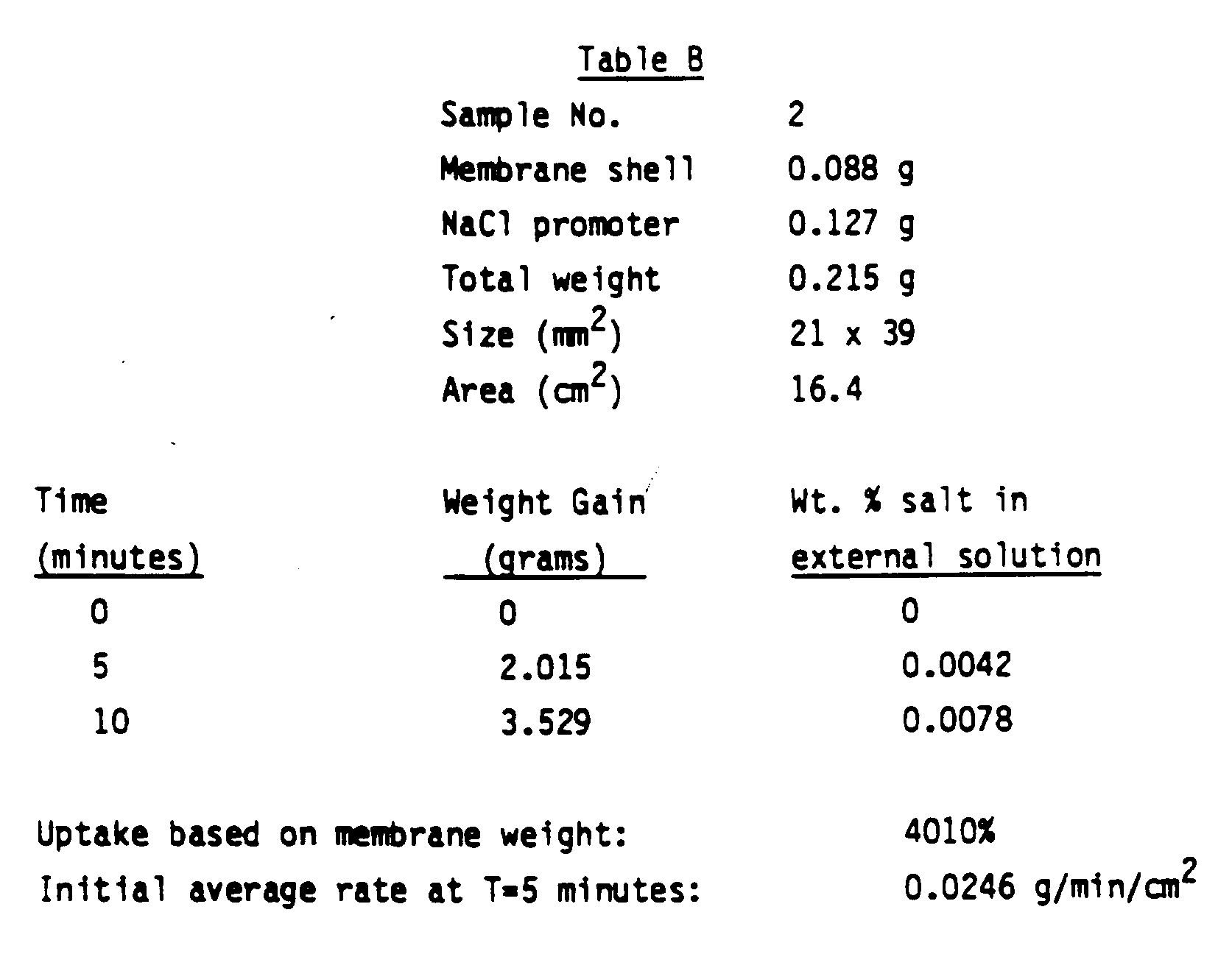
- A test packet with surface area of 16.4 cm² was prepared by heat sealing as described above, wherein this packet contained 0.127 grams of sodium chloride. The packet was placed in 100 ml of stirred water and the weight gain and salt leakage from the packet was monitored. These results are listed in Table B. The average initial uptake rate of the packet for the first five minutes was 0.0246 g/min/cm².
- This Example further illustrates how small changes in the process used to prepare the membrane allows control of the final properties. This test showed less salt leakage from the packet than observed in the previous Example, corresponding to the lower value for salt permeability. The transport ratio of water to salt, based on the permeability values determined with the osmotic cell, was 395.
- Membranes were prepared as before using a casting solution of 18 wt.% cellulose diacetate, 30 wt.% formamide, and 52 wt.% acetone, by casting upon a glass support plate. After 20 seconds the membrane was quenched in 20°C water, delaminated, and then heated for 15 minutes in 80°C water. The film was then soaked in an aqueous 30 wt.% glycerol solution for about 30 minutes, and then air dried. The resultant membrane thickness was 22 »m. The packets were formed with heat sealed edges as previously described and then tested against 10 ml of an unstirred synthetic urine solution containing 2 wt.% urea, 1 wt.% NaCl, 0.03 wt.% CaCl₂.2H₂O, and 0.06 wt.% MgCl₂.6H₂O. The results are given in Table C. The average initial rate was 0.0185 g/min/cm². At the end of 60 minutes, the packet had absorbed 38% of the available liquid. The percent increase in weight due to absorbed water is also calculated based on the weight of the membrane used to form the packet.

- Membranes were prepared as before using a casting solution of 23 wt.% cellulose diacetate, 28 wt.% formamide, and 49 wt.% acetone, by casting upon a polyethylene support film. After 20 seconds the membrane was immersed in 20°C water, delaminated, and then heated for 15 minutes in 80°C water. The film was then soaked in aqueous 25 vol.% glycerol solution for about 30 minutes, and then air dried. The packets listed in Table D were formed with heat sealed edges, and then tested against 8 ml of the synthetic solution described in the previous Example 3. Packet 4 was prepared with sodium chloride as promoter, while Packet 5 used glucose. The packet with glucose as promoter has a slower initial rate than that with sodium chloride.

- Membranes were prepared as before using a casting solution of 22 wt.% cellulose diacetate, 20 wt.% 1-methyl-2-pyrrolidone, and 58 wt.% acetone, by casting upon a polyester support film. After 20 seconds the film was immersed in 25°C water, delaminated, and then heated for 15 minutes in 80°C water. The film was then soaked in 25 vol.% glycerol solution for about 30 minutes, and then air dried. The resultant film was 18 »m thick, and used to form the absorbent packets listed in Table E. These tests were against 100 ml of stirred water, and both the weight gain of the packet and salt content of the external solution were monitored.

- Membranes were prepared as in Example 2, but with an evaporation time of 18 seconds. The resultant film had a thickness of 18 »m. This membrane was used to shape an absorbent packet that was tested against 100 ml of stirred water. The test listed in Table F was halted at 8 minutes, and 900 gram weight placed on top of the packet, whereupon no leaks were observed. If this weight is distributed over the total surface area of the membrane, then the packet withstood 1.1 psig (7.58 kPa gauge) without loss of absorbed water.

- Membranes were prepared with the process in Example 2. The resultant membrane had a thickness of 25 »m. A large packet was prepared as described above but with 5 internal compartments, each comprising about 1/5th the surface area and 1/5th of the sodium chloride content. The overall packet dimensions were 88 by 93 mm². The absorption was tested against 300 ml of stirred water. From Table G, an initial water absorption rate at 5 minutes of 0.0161 g/min/cm² was observed.

- Membranes were prepared with the process in Example 2, but the hot water and glycerol treatment were combined into a single step of 3 minutes in 92°C solution of 20 vol.% glycerol. The resultant membrane was 25 »m thick. A packet formed from this membrane was tested against 100 ml of stirred water, and the results are listed in Table H. An initial absorption rate of 0.0204 g/min/cm² was observed.

Claims (11)
- An absorbent article capable of absorbing water and retaining said water against an external pressure which comprises:(a) an osmotic promoter;(b) a cellulosic membrane encapsulating said promoter having a thickness of 5 to 50 »m obtainable by the process of(1) casting a solution of a cellulose derivative, and at least one liquid selected from the group consisting of acetone, dimethylformamide, dimethylacetamide, dimethylsulfoxide, 1-methyl-2-pyrrolidone, formamide, dioxane, tetraethylphosphate, acetic acid, tetrahydrofuran, and water, onto a suitable surface to form a film,(2) removing the liquid from the film of (1)(3) annealing the film of (2) in water,(4) conditioning the annealed film of (3) in water containing a conditioning agent selected from the group consisting of glycerol, ethylene glycol, and propylene glycol,(5) drying the conditioned film of (4).
- The absorbent article of Claim 1 wherein said osmotic promoter has a molecular weight below 1000.
- The absorbent article of Claim 2 wherein said osmotic promoter is sodium chloride and/or sugar.
- The absorbent article of Claim 2 wherein 0.001 to 1 g of osmotic promoter is used for each cm³ of packet volume.
- The absorbent article of Claim 1 wherein said cellulosic membrane consists essentially of cellulose acetate and/or cellulose diacetate.
- The absorbent article of Claim 1 wherein said solution of (1) comprises 15 to 25 weight percent of cellulose acetate.
- The absorbent article of Claim 1 wherein the removal of the liquid (b) (1) comprises evaporating a portion of said liquid and thereafter quenching the resulting film in water at a temperature of 0°C to 40°C.
- The absorbent article of Claim 1 wherein said cellulosic membrane has an hydraulic permeability of at least 4.93 x 10⁻⁵ cm³/cm²-MPa-sec (0.5 x 10⁻⁵ cm³/cm²-atm-sec).
- The absorbent article of Claim 1 wherein said cellulosic membrane has a salt permeability of less than 1.974 x 10⁻⁶ g/cm²-MPa-sec (2x10⁻⁷g/cm²atm-sec).
- The absorbent article of Claim 1 wherein said annealing of (b)(3) is carried out in water at a temperature of 75°C to 95°C.
- The absorbent article of Claim 1 wherein said conditioning of (b)(4) is carried out in water at a temperature of 0°C to 95°C containing as a conditioning agent glycerol.
Applications Claiming Priority (3)
| Application Number | Priority Date | Filing Date | Title |
|---|---|---|---|
| US447722 | 1989-12-08 | ||
| US07/447,722 US5108383A (en) | 1989-12-08 | 1989-12-08 | Membranes for absorbent packets |
| PCT/US1990/006998 WO1991008778A1 (en) | 1989-12-08 | 1990-11-30 | Membranes for absorbent packets |
Publications (2)
| Publication Number | Publication Date |
|---|---|
| EP0504228A1 EP0504228A1 (en) | 1992-09-23 |
| EP0504228B1 true EP0504228B1 (en) | 1995-08-16 |
Family
ID=23777479
Family Applications (1)
| Application Number | Title | Priority Date | Filing Date |
|---|---|---|---|
| EP91900533A Expired - Lifetime EP0504228B1 (en) | 1989-12-08 | 1990-11-30 | Membranes for absorbent packets |
Country Status (9)
| Country | Link |
|---|---|
| US (1) | US5108383A (en) |
| EP (1) | EP0504228B1 (en) |
| JP (1) | JPH05502598A (en) |
| KR (1) | KR920703130A (en) |
| AT (1) | ATE126446T1 (en) |
| AU (1) | AU631475B2 (en) |
| CA (1) | CA2069487A1 (en) |
| DE (1) | DE69021738D1 (en) |
| WO (1) | WO1991008778A1 (en) |
Families Citing this family (213)
| Publication number | Priority date | Publication date | Assignee | Title |
|---|---|---|---|---|
| US5330459A (en) * | 1993-06-23 | 1994-07-19 | The Procter & Gamble Company | Disposable absorbent article having an inflatable spacer |
| AU6919194A (en) * | 1993-06-23 | 1995-01-17 | Procter & Gamble Company, The | Disposable absorbent article with selectively expandable or inflatable components |
| US5447771A (en) * | 1993-06-30 | 1995-09-05 | E. I. Du Pont De Nemours And Company | Fiber bilobal cross-sections and carpets prepared therefrom having a silk-like luster and soft hand |
| US5846213A (en) * | 1997-06-16 | 1998-12-08 | The University Of Western Ontario | Cellulose membrane and method for manufacture thereof |
| WO2000000130A1 (en) | 1998-06-29 | 2000-01-06 | The Procter & Gamble Company | Liquid transport member for high flux rates against gravity |
| AU8378298A (en) | 1998-06-29 | 2000-01-17 | Procter & Gamble Company, The | Liquid transport member having high permeability bulk regions and high thresholdpressure port regions |
| WO2000000701A1 (en) | 1998-06-29 | 2000-01-06 | The Procter & Gamble Company | Liquid transport member for high flux rates between a port region and an opening |
| ES2293728T3 (en) | 1998-06-29 | 2008-03-16 | THE PROCTER & GAMBLE COMPANY | DISPOSABLE TREATMENT ARTICLE THAT HAS A SENSITIVE SYSTEM. |
| US6673057B1 (en) | 1998-06-29 | 2004-01-06 | The Procter & Gamble Company | High flux liquid transport members comprising two different permeability regions |
| US6686314B2 (en) | 1998-07-10 | 2004-02-03 | Ming Xu | Receiver/transfer media for printing and transfer process |
| US6215038B1 (en) | 1999-05-28 | 2001-04-10 | Kimberly-Clark Worldwide, Inc. | Diaper with osmotic pressure control |
| WO2000072892A1 (en) * | 1999-05-28 | 2000-12-07 | Kimberly-Clark Worldwide, Inc. | Diaper with osmotic pressure control |
| US6579457B1 (en) | 1999-06-29 | 2003-06-17 | The Procter & Gamble Company | Liquid transport member for high flux rates between a port region and an opening |
| US6811842B1 (en) | 1999-06-29 | 2004-11-02 | The Procter & Gamble Company | Liquid transport member for high flux rates between two port regions |
| EP1112729A1 (en) * | 1999-12-23 | 2001-07-04 | The Procter & Gamble Company | Liquid removal system having reduced dimensions and reduced weight |
| EP1110523A1 (en) * | 1999-12-23 | 2001-06-27 | The Procter & Gamble Company | Liquid handling systems comprising three-dimensionally shaped membranes |
| US11229472B2 (en) | 2001-06-12 | 2022-01-25 | Cilag Gmbh International | Modular battery powered handheld surgical instrument with multiple magnetic position sensors |
| US8182501B2 (en) | 2004-02-27 | 2012-05-22 | Ethicon Endo-Surgery, Inc. | Ultrasonic surgical shears and method for sealing a blood vessel using same |
| US20060025741A1 (en) * | 2004-07-28 | 2006-02-02 | The Procter & Gamble Company | Highly deformable tampon |
| US7713253B2 (en) * | 2004-07-28 | 2010-05-11 | The Procter & Gamble Company | Deformable tampon comprising an inner wrap and outer wrap |
| JP5009159B2 (en) | 2004-10-08 | 2012-08-22 | エシコン・エンド−サージェリィ・インコーポレイテッド | Ultrasonic surgical instrument |
| US20070191713A1 (en) | 2005-10-14 | 2007-08-16 | Eichmann Stephen E | Ultrasonic device for cutting and coagulating |
| US7621930B2 (en) | 2006-01-20 | 2009-11-24 | Ethicon Endo-Surgery, Inc. | Ultrasound medical instrument having a medical ultrasonic blade |
| US8911460B2 (en) | 2007-03-22 | 2014-12-16 | Ethicon Endo-Surgery, Inc. | Ultrasonic surgical instruments |
| US8057498B2 (en) | 2007-11-30 | 2011-11-15 | Ethicon Endo-Surgery, Inc. | Ultrasonic surgical instrument blades |
| US8142461B2 (en) | 2007-03-22 | 2012-03-27 | Ethicon Endo-Surgery, Inc. | Surgical instruments |
| US8808319B2 (en) | 2007-07-27 | 2014-08-19 | Ethicon Endo-Surgery, Inc. | Surgical instruments |
| US8523889B2 (en) | 2007-07-27 | 2013-09-03 | Ethicon Endo-Surgery, Inc. | Ultrasonic end effectors with increased active length |
| US9044261B2 (en) | 2007-07-31 | 2015-06-02 | Ethicon Endo-Surgery, Inc. | Temperature controlled ultrasonic surgical instruments |
| US8430898B2 (en) | 2007-07-31 | 2013-04-30 | Ethicon Endo-Surgery, Inc. | Ultrasonic surgical instruments |
| US8512365B2 (en) | 2007-07-31 | 2013-08-20 | Ethicon Endo-Surgery, Inc. | Surgical instruments |
| CN101883531B (en) | 2007-10-05 | 2014-07-02 | 伊西康内外科公司 | Ergonomic surgical instruments |
| US10010339B2 (en) | 2007-11-30 | 2018-07-03 | Ethicon Llc | Ultrasonic surgical blades |
| US9089360B2 (en) | 2008-08-06 | 2015-07-28 | Ethicon Endo-Surgery, Inc. | Devices and techniques for cutting and coagulating tissue |
| US9700339B2 (en) | 2009-05-20 | 2017-07-11 | Ethicon Endo-Surgery, Inc. | Coupling arrangements and methods for attaching tools to ultrasonic surgical instruments |
| US8663220B2 (en) | 2009-07-15 | 2014-03-04 | Ethicon Endo-Surgery, Inc. | Ultrasonic surgical instruments |
| US8574231B2 (en) * | 2009-10-09 | 2013-11-05 | Ethicon Endo-Surgery, Inc. | Surgical instrument for transmitting energy to tissue comprising a movable electrode or insulator |
| US8939974B2 (en) | 2009-10-09 | 2015-01-27 | Ethicon Endo-Surgery, Inc. | Surgical instrument comprising first and second drive systems actuatable by a common trigger mechanism |
| US9060775B2 (en) | 2009-10-09 | 2015-06-23 | Ethicon Endo-Surgery, Inc. | Surgical generator for ultrasonic and electrosurgical devices |
| US8747404B2 (en) * | 2009-10-09 | 2014-06-10 | Ethicon Endo-Surgery, Inc. | Surgical instrument for transmitting energy to tissue comprising non-conductive grasping portions |
| US10172669B2 (en) * | 2009-10-09 | 2019-01-08 | Ethicon Llc | Surgical instrument comprising an energy trigger lockout |
| US8906016B2 (en) | 2009-10-09 | 2014-12-09 | Ethicon Endo-Surgery, Inc. | Surgical instrument for transmitting energy to tissue comprising steam control paths |
| US10441345B2 (en) | 2009-10-09 | 2019-10-15 | Ethicon Llc | Surgical generator for ultrasonic and electrosurgical devices |
| US11090104B2 (en) | 2009-10-09 | 2021-08-17 | Cilag Gmbh International | Surgical generator for ultrasonic and electrosurgical devices |
| US8486096B2 (en) | 2010-02-11 | 2013-07-16 | Ethicon Endo-Surgery, Inc. | Dual purpose surgical instrument for cutting and coagulating tissue |
| US8951272B2 (en) | 2010-02-11 | 2015-02-10 | Ethicon Endo-Surgery, Inc. | Seal arrangements for ultrasonically powered surgical instruments |
| US8469981B2 (en) | 2010-02-11 | 2013-06-25 | Ethicon Endo-Surgery, Inc. | Rotatable cutting implement arrangements for ultrasonic surgical instruments |
| US8696665B2 (en) | 2010-03-26 | 2014-04-15 | Ethicon Endo-Surgery, Inc. | Surgical cutting and sealing instrument with reduced firing force |
| US8623044B2 (en) | 2010-04-12 | 2014-01-07 | Ethicon Endo-Surgery, Inc. | Cable actuated end-effector for a surgical instrument |
| US8834518B2 (en) | 2010-04-12 | 2014-09-16 | Ethicon Endo-Surgery, Inc. | Electrosurgical cutting and sealing instruments with cam-actuated jaws |
| US8709035B2 (en) | 2010-04-12 | 2014-04-29 | Ethicon Endo-Surgery, Inc. | Electrosurgical cutting and sealing instruments with jaws having a parallel closure motion |
| US8496682B2 (en) | 2010-04-12 | 2013-07-30 | Ethicon Endo-Surgery, Inc. | Electrosurgical cutting and sealing instruments with cam-actuated jaws |
| US8535311B2 (en) | 2010-04-22 | 2013-09-17 | Ethicon Endo-Surgery, Inc. | Electrosurgical instrument comprising closing and firing systems |
| US8685020B2 (en) | 2010-05-17 | 2014-04-01 | Ethicon Endo-Surgery, Inc. | Surgical instruments and end effectors therefor |
| GB2480498A (en) | 2010-05-21 | 2011-11-23 | Ethicon Endo Surgery Inc | Medical device comprising RF circuitry |
| US8790342B2 (en) | 2010-06-09 | 2014-07-29 | Ethicon Endo-Surgery, Inc. | Electrosurgical instrument employing pressure-variation electrodes |
| US8888776B2 (en) | 2010-06-09 | 2014-11-18 | Ethicon Endo-Surgery, Inc. | Electrosurgical instrument employing an electrode |
| WO2011156257A2 (en) | 2010-06-09 | 2011-12-15 | Ethicon Endo-Surgery, Inc. | Electrosurgical instrument employing an electrode |
| US8795276B2 (en) | 2010-06-09 | 2014-08-05 | Ethicon Endo-Surgery, Inc. | Electrosurgical instrument employing a plurality of electrodes |
| US8926607B2 (en) | 2010-06-09 | 2015-01-06 | Ethicon Endo-Surgery, Inc. | Electrosurgical instrument employing multiple positive temperature coefficient electrodes |
| US9005199B2 (en) | 2010-06-10 | 2015-04-14 | Ethicon Endo-Surgery, Inc. | Heat management configurations for controlling heat dissipation from electrosurgical instruments |
| US8753338B2 (en) | 2010-06-10 | 2014-06-17 | Ethicon Endo-Surgery, Inc. | Electrosurgical instrument employing a thermal management system |
| US8764747B2 (en) | 2010-06-10 | 2014-07-01 | Ethicon Endo-Surgery, Inc. | Electrosurgical instrument comprising sequentially activated electrodes |
| US8834466B2 (en) | 2010-07-08 | 2014-09-16 | Ethicon Endo-Surgery, Inc. | Surgical instrument comprising an articulatable end effector |
| US9149324B2 (en) | 2010-07-08 | 2015-10-06 | Ethicon Endo-Surgery, Inc. | Surgical instrument comprising an articulatable end effector |
| US20120016413A1 (en) | 2010-07-14 | 2012-01-19 | Ethicon Endo-Surgery, Inc. | Surgical fastening devices comprising rivets |
| US8453906B2 (en) | 2010-07-14 | 2013-06-04 | Ethicon Endo-Surgery, Inc. | Surgical instruments with electrodes |
| US8795327B2 (en) | 2010-07-22 | 2014-08-05 | Ethicon Endo-Surgery, Inc. | Electrosurgical instrument with separate closure and cutting members |
| US8979844B2 (en) | 2010-07-23 | 2015-03-17 | Ethicon Endo-Surgery, Inc. | Electrosurgical cutting and sealing instrument |
| US8979843B2 (en) | 2010-07-23 | 2015-03-17 | Ethicon Endo-Surgery, Inc. | Electrosurgical cutting and sealing instrument |
| US9011437B2 (en) | 2010-07-23 | 2015-04-21 | Ethicon Endo-Surgery, Inc. | Electrosurgical cutting and sealing instrument |
| US8702704B2 (en) | 2010-07-23 | 2014-04-22 | Ethicon Endo-Surgery, Inc. | Electrosurgical cutting and sealing instrument |
| US9192431B2 (en) | 2010-07-23 | 2015-11-24 | Ethicon Endo-Surgery, Inc. | Electrosurgical cutting and sealing instrument |
| US8979890B2 (en) | 2010-10-01 | 2015-03-17 | Ethicon Endo-Surgery, Inc. | Surgical instrument with jaw member |
| US8628529B2 (en) | 2010-10-26 | 2014-01-14 | Ethicon Endo-Surgery, Inc. | Surgical instrument with magnetic clamping force |
| US8715277B2 (en) | 2010-12-08 | 2014-05-06 | Ethicon Endo-Surgery, Inc. | Control of jaw compression in surgical instrument having end effector with opposing jaw members |
| US9259265B2 (en) | 2011-07-22 | 2016-02-16 | Ethicon Endo-Surgery, Llc | Surgical instruments for tensioning tissue |
| US9044243B2 (en) | 2011-08-30 | 2015-06-02 | Ethcon Endo-Surgery, Inc. | Surgical cutting and fastening device with descendible second trigger arrangement |
| US9314292B2 (en) | 2011-10-24 | 2016-04-19 | Ethicon Endo-Surgery, Llc | Trigger lockout mechanism |
| WO2013119545A1 (en) | 2012-02-10 | 2013-08-15 | Ethicon-Endo Surgery, Inc. | Robotically controlled surgical instrument |
| US9439668B2 (en) | 2012-04-09 | 2016-09-13 | Ethicon Endo-Surgery, Llc | Switch arrangements for ultrasonic surgical instruments |
| US20140005640A1 (en) | 2012-06-28 | 2014-01-02 | Ethicon Endo-Surgery, Inc. | Surgical end effector jaw and electrode configurations |
| US20140005705A1 (en) | 2012-06-29 | 2014-01-02 | Ethicon Endo-Surgery, Inc. | Surgical instruments with articulating shafts |
| US9820768B2 (en) | 2012-06-29 | 2017-11-21 | Ethicon Llc | Ultrasonic surgical instruments with control mechanisms |
| US9326788B2 (en) | 2012-06-29 | 2016-05-03 | Ethicon Endo-Surgery, Llc | Lockout mechanism for use with robotic electrosurgical device |
| US9226767B2 (en) | 2012-06-29 | 2016-01-05 | Ethicon Endo-Surgery, Inc. | Closed feedback control for electrosurgical device |
| US9198714B2 (en) | 2012-06-29 | 2015-12-01 | Ethicon Endo-Surgery, Inc. | Haptic feedback devices for surgical robot |
| US9351754B2 (en) | 2012-06-29 | 2016-05-31 | Ethicon Endo-Surgery, Llc | Ultrasonic surgical instruments with distally positioned jaw assemblies |
| US20140005702A1 (en) | 2012-06-29 | 2014-01-02 | Ethicon Endo-Surgery, Inc. | Ultrasonic surgical instruments with distally positioned transducers |
| US9393037B2 (en) | 2012-06-29 | 2016-07-19 | Ethicon Endo-Surgery, Llc | Surgical instruments with articulating shafts |
| US9408622B2 (en) | 2012-06-29 | 2016-08-09 | Ethicon Endo-Surgery, Llc | Surgical instruments with articulating shafts |
| WO2014052181A1 (en) | 2012-09-28 | 2014-04-03 | Ethicon Endo-Surgery, Inc. | Multi-function bi-polar forceps |
| US9095367B2 (en) | 2012-10-22 | 2015-08-04 | Ethicon Endo-Surgery, Inc. | Flexible harmonic waveguides/blades for surgical instruments |
| US20140135804A1 (en) | 2012-11-15 | 2014-05-15 | Ethicon Endo-Surgery, Inc. | Ultrasonic and electrosurgical devices |
| US10226273B2 (en) | 2013-03-14 | 2019-03-12 | Ethicon Llc | Mechanical fasteners for use with surgical energy devices |
| US9295514B2 (en) | 2013-08-30 | 2016-03-29 | Ethicon Endo-Surgery, Llc | Surgical devices with close quarter articulation features |
| US9814514B2 (en) | 2013-09-13 | 2017-11-14 | Ethicon Llc | Electrosurgical (RF) medical instruments for cutting and coagulating tissue |
| US9861428B2 (en) | 2013-09-16 | 2018-01-09 | Ethicon Llc | Integrated systems for electrosurgical steam or smoke control |
| US9265926B2 (en) | 2013-11-08 | 2016-02-23 | Ethicon Endo-Surgery, Llc | Electrosurgical devices |
| US9526565B2 (en) | 2013-11-08 | 2016-12-27 | Ethicon Endo-Surgery, Llc | Electrosurgical devices |
| GB2521228A (en) | 2013-12-16 | 2015-06-17 | Ethicon Endo Surgery Inc | Medical device |
| GB2521229A (en) | 2013-12-16 | 2015-06-17 | Ethicon Endo Surgery Inc | Medical device |
| US9795436B2 (en) | 2014-01-07 | 2017-10-24 | Ethicon Llc | Harvesting energy from a surgical generator |
| US9408660B2 (en) | 2014-01-17 | 2016-08-09 | Ethicon Endo-Surgery, Llc | Device trigger dampening mechanism |
| US9554854B2 (en) | 2014-03-18 | 2017-01-31 | Ethicon Endo-Surgery, Llc | Detecting short circuits in electrosurgical medical devices |
| US10092310B2 (en) | 2014-03-27 | 2018-10-09 | Ethicon Llc | Electrosurgical devices |
| US10463421B2 (en) | 2014-03-27 | 2019-11-05 | Ethicon Llc | Two stage trigger, clamp and cut bipolar vessel sealer |
| US10524852B1 (en) | 2014-03-28 | 2020-01-07 | Ethicon Llc | Distal sealing end effector with spacers |
| US9737355B2 (en) | 2014-03-31 | 2017-08-22 | Ethicon Llc | Controlling impedance rise in electrosurgical medical devices |
| US9913680B2 (en) | 2014-04-15 | 2018-03-13 | Ethicon Llc | Software algorithms for electrosurgical instruments |
| US9757186B2 (en) | 2014-04-17 | 2017-09-12 | Ethicon Llc | Device status feedback for bipolar tissue spacer |
| US9700333B2 (en) | 2014-06-30 | 2017-07-11 | Ethicon Llc | Surgical instrument with variable tissue compression |
| WO2016016704A2 (en) * | 2014-07-28 | 2016-02-04 | Indian Institute Of Technology Hyderabad | Cellulose acetate based non-woven nanofiber matrix with high absorbency properties for female hygiene products |
| US10285724B2 (en) | 2014-07-31 | 2019-05-14 | Ethicon Llc | Actuation mechanisms and load adjustment assemblies for surgical instruments |
| US9877776B2 (en) | 2014-08-25 | 2018-01-30 | Ethicon Llc | Simultaneous I-beam and spring driven cam jaw closure mechanism |
| US10194976B2 (en) | 2014-08-25 | 2019-02-05 | Ethicon Llc | Lockout disabling mechanism |
| US10194972B2 (en) | 2014-08-26 | 2019-02-05 | Ethicon Llc | Managing tissue treatment |
| US10639092B2 (en) | 2014-12-08 | 2020-05-05 | Ethicon Llc | Electrode configurations for surgical instruments |
| US10159524B2 (en) | 2014-12-22 | 2018-12-25 | Ethicon Llc | High power battery powered RF amplifier topology |
| US9848937B2 (en) | 2014-12-22 | 2017-12-26 | Ethicon Llc | End effector with detectable configurations |
| US10092348B2 (en) | 2014-12-22 | 2018-10-09 | Ethicon Llc | RF tissue sealer, shear grip, trigger lock mechanism and energy activation |
| US10111699B2 (en) | 2014-12-22 | 2018-10-30 | Ethicon Llc | RF tissue sealer, shear grip, trigger lock mechanism and energy activation |
| US10245095B2 (en) | 2015-02-06 | 2019-04-02 | Ethicon Llc | Electrosurgical instrument with rotation and articulation mechanisms |
| US10321950B2 (en) | 2015-03-17 | 2019-06-18 | Ethicon Llc | Managing tissue treatment |
| US10342602B2 (en) | 2015-03-17 | 2019-07-09 | Ethicon Llc | Managing tissue treatment |
| US10595929B2 (en) | 2015-03-24 | 2020-03-24 | Ethicon Llc | Surgical instruments with firing system overload protection mechanisms |
| US10314638B2 (en) | 2015-04-07 | 2019-06-11 | Ethicon Llc | Articulating radio frequency (RF) tissue seal with articulating state sensing |
| US10117702B2 (en) | 2015-04-10 | 2018-11-06 | Ethicon Llc | Surgical generator systems and related methods |
| US10130410B2 (en) | 2015-04-17 | 2018-11-20 | Ethicon Llc | Electrosurgical instrument including a cutting member decouplable from a cutting member trigger |
| US9872725B2 (en) | 2015-04-29 | 2018-01-23 | Ethicon Llc | RF tissue sealer with mode selection |
| US11020140B2 (en) | 2015-06-17 | 2021-06-01 | Cilag Gmbh International | Ultrasonic surgical blade for use with ultrasonic surgical instruments |
| US10034704B2 (en) | 2015-06-30 | 2018-07-31 | Ethicon Llc | Surgical instrument with user adaptable algorithms |
| US10898256B2 (en) | 2015-06-30 | 2021-01-26 | Ethicon Llc | Surgical system with user adaptable techniques based on tissue impedance |
| US11051873B2 (en) | 2015-06-30 | 2021-07-06 | Cilag Gmbh International | Surgical system with user adaptable techniques employing multiple energy modalities based on tissue parameters |
| US11129669B2 (en) | 2015-06-30 | 2021-09-28 | Cilag Gmbh International | Surgical system with user adaptable techniques based on tissue type |
| US10765470B2 (en) | 2015-06-30 | 2020-09-08 | Ethicon Llc | Surgical system with user adaptable techniques employing simultaneous energy modalities based on tissue parameters |
| US10357303B2 (en) | 2015-06-30 | 2019-07-23 | Ethicon Llc | Translatable outer tube for sealing using shielded lap chole dissector |
| US10154852B2 (en) | 2015-07-01 | 2018-12-18 | Ethicon Llc | Ultrasonic surgical blade with improved cutting and coagulation features |
| US20170086909A1 (en) | 2015-09-30 | 2017-03-30 | Ethicon Endo-Surgery, Llc | Frequency agile generator for a surgical instrument |
| US10959771B2 (en) | 2015-10-16 | 2021-03-30 | Ethicon Llc | Suction and irrigation sealing grasper |
| US10595930B2 (en) | 2015-10-16 | 2020-03-24 | Ethicon Llc | Electrode wiping surgical device |
| US10179022B2 (en) | 2015-12-30 | 2019-01-15 | Ethicon Llc | Jaw position impedance limiter for electrosurgical instrument |
| US10959806B2 (en) | 2015-12-30 | 2021-03-30 | Ethicon Llc | Energized medical device with reusable handle |
| US10575892B2 (en) | 2015-12-31 | 2020-03-03 | Ethicon Llc | Adapter for electrical surgical instruments |
| US12193698B2 (en) | 2016-01-15 | 2025-01-14 | Cilag Gmbh International | Method for self-diagnosing operation of a control switch in a surgical instrument system |
| US11134978B2 (en) | 2016-01-15 | 2021-10-05 | Cilag Gmbh International | Modular battery powered handheld surgical instrument with self-diagnosing control switches for reusable handle assembly |
| US11129670B2 (en) | 2016-01-15 | 2021-09-28 | Cilag Gmbh International | Modular battery powered handheld surgical instrument with selective application of energy based on button displacement, intensity, or local tissue characterization |
| US10716615B2 (en) | 2016-01-15 | 2020-07-21 | Ethicon Llc | Modular battery powered handheld surgical instrument with curved end effectors having asymmetric engagement between jaw and blade |
| US11229471B2 (en) | 2016-01-15 | 2022-01-25 | Cilag Gmbh International | Modular battery powered handheld surgical instrument with selective application of energy based on tissue characterization |
| US10555769B2 (en) | 2016-02-22 | 2020-02-11 | Ethicon Llc | Flexible circuits for electrosurgical instrument |
| US10702329B2 (en) | 2016-04-29 | 2020-07-07 | Ethicon Llc | Jaw structure with distal post for electrosurgical instruments |
| US10646269B2 (en) | 2016-04-29 | 2020-05-12 | Ethicon Llc | Non-linear jaw gap for electrosurgical instruments |
| US10856934B2 (en) | 2016-04-29 | 2020-12-08 | Ethicon Llc | Electrosurgical instrument with electrically conductive gap setting and tissue engaging members |
| US10987156B2 (en) | 2016-04-29 | 2021-04-27 | Ethicon Llc | Electrosurgical instrument with electrically conductive gap setting member and electrically insulative tissue engaging members |
| US10485607B2 (en) | 2016-04-29 | 2019-11-26 | Ethicon Llc | Jaw structure with distal closure for electrosurgical instruments |
| US10456193B2 (en) | 2016-05-03 | 2019-10-29 | Ethicon Llc | Medical device with a bilateral jaw configuration for nerve stimulation |
| US10245064B2 (en) | 2016-07-12 | 2019-04-02 | Ethicon Llc | Ultrasonic surgical instrument with piezoelectric central lumen transducer |
| US10893883B2 (en) | 2016-07-13 | 2021-01-19 | Ethicon Llc | Ultrasonic assembly for use with ultrasonic surgical instruments |
| US10842522B2 (en) | 2016-07-15 | 2020-11-24 | Ethicon Llc | Ultrasonic surgical instruments having offset blades |
| US10376305B2 (en) | 2016-08-05 | 2019-08-13 | Ethicon Llc | Methods and systems for advanced harmonic energy |
| US10285723B2 (en) | 2016-08-09 | 2019-05-14 | Ethicon Llc | Ultrasonic surgical blade with improved heel portion |
| USD847990S1 (en) | 2016-08-16 | 2019-05-07 | Ethicon Llc | Surgical instrument |
| US10828056B2 (en) | 2016-08-25 | 2020-11-10 | Ethicon Llc | Ultrasonic transducer to waveguide acoustic coupling, connections, and configurations |
| US10952759B2 (en) | 2016-08-25 | 2021-03-23 | Ethicon Llc | Tissue loading of a surgical instrument |
| US10751117B2 (en) | 2016-09-23 | 2020-08-25 | Ethicon Llc | Electrosurgical instrument with fluid diverter |
| US10603064B2 (en) | 2016-11-28 | 2020-03-31 | Ethicon Llc | Ultrasonic transducer |
| US11266430B2 (en) | 2016-11-29 | 2022-03-08 | Cilag Gmbh International | End effector control and calibration |
| US11033325B2 (en) | 2017-02-16 | 2021-06-15 | Cilag Gmbh International | Electrosurgical instrument with telescoping suction port and debris cleaner |
| US10799284B2 (en) | 2017-03-15 | 2020-10-13 | Ethicon Llc | Electrosurgical instrument with textured jaws |
| US11497546B2 (en) | 2017-03-31 | 2022-11-15 | Cilag Gmbh International | Area ratios of patterned coatings on RF electrodes to reduce sticking |
| US10603117B2 (en) | 2017-06-28 | 2020-03-31 | Ethicon Llc | Articulation state detection mechanisms |
| US10820920B2 (en) | 2017-07-05 | 2020-11-03 | Ethicon Llc | Reusable ultrasonic medical devices and methods of their use |
| US11033323B2 (en) | 2017-09-29 | 2021-06-15 | Cilag Gmbh International | Systems and methods for managing fluid and suction in electrosurgical systems |
| US11484358B2 (en) | 2017-09-29 | 2022-11-01 | Cilag Gmbh International | Flexible electrosurgical instrument |
| US11490951B2 (en) | 2017-09-29 | 2022-11-08 | Cilag Gmbh International | Saline contact with electrodes |
| US11723729B2 (en) | 2019-06-27 | 2023-08-15 | Cilag Gmbh International | Robotic surgical assembly coupling safety mechanisms |
| US11612445B2 (en) | 2019-06-27 | 2023-03-28 | Cilag Gmbh International | Cooperative operation of robotic arms |
| US11413102B2 (en) | 2019-06-27 | 2022-08-16 | Cilag Gmbh International | Multi-access port for surgical robotic systems |
| US11376082B2 (en) | 2019-06-27 | 2022-07-05 | Cilag Gmbh International | Robotic surgical system with local sensing of functional parameters based on measurements of multiple physical inputs |
| US11607278B2 (en) | 2019-06-27 | 2023-03-21 | Cilag Gmbh International | Cooperative robotic surgical systems |
| US11547468B2 (en) | 2019-06-27 | 2023-01-10 | Cilag Gmbh International | Robotic surgical system with safety and cooperative sensing control |
| US11944366B2 (en) | 2019-12-30 | 2024-04-02 | Cilag Gmbh International | Asymmetric segmented ultrasonic support pad for cooperative engagement with a movable RF electrode |
| US12262937B2 (en) | 2019-12-30 | 2025-04-01 | Cilag Gmbh International | User interface for surgical instrument with combination energy modality end-effector |
| US11986234B2 (en) | 2019-12-30 | 2024-05-21 | Cilag Gmbh International | Surgical system communication pathways |
| US12053224B2 (en) | 2019-12-30 | 2024-08-06 | Cilag Gmbh International | Variation in electrode parameters and deflectable electrode to modify energy density and tissue interaction |
| US11779329B2 (en) | 2019-12-30 | 2023-10-10 | Cilag Gmbh International | Surgical instrument comprising a flex circuit including a sensor system |
| US11937863B2 (en) | 2019-12-30 | 2024-03-26 | Cilag Gmbh International | Deflectable electrode with variable compression bias along the length of the deflectable electrode |
| US11779387B2 (en) | 2019-12-30 | 2023-10-10 | Cilag Gmbh International | Clamp arm jaw to minimize tissue sticking and improve tissue control |
| US12064109B2 (en) | 2019-12-30 | 2024-08-20 | Cilag Gmbh International | Surgical instrument comprising a feedback control circuit |
| US20210196361A1 (en) | 2019-12-30 | 2021-07-01 | Ethicon Llc | Electrosurgical instrument with monopolar and bipolar energy capabilities |
| US12336747B2 (en) | 2019-12-30 | 2025-06-24 | Cilag Gmbh International | Method of operating a combination ultrasonic / bipolar RF surgical device with a combination energy modality end-effector |
| US11452525B2 (en) | 2019-12-30 | 2022-09-27 | Cilag Gmbh International | Surgical instrument comprising an adjustment system |
| US11660089B2 (en) | 2019-12-30 | 2023-05-30 | Cilag Gmbh International | Surgical instrument comprising a sensing system |
| US12349961B2 (en) | 2019-12-30 | 2025-07-08 | Cilag Gmbh International | Electrosurgical instrument with electrodes operable in bipolar and monopolar modes |
| US11786291B2 (en) | 2019-12-30 | 2023-10-17 | Cilag Gmbh International | Deflectable support of RF energy electrode with respect to opposing ultrasonic blade |
| US11950797B2 (en) | 2019-12-30 | 2024-04-09 | Cilag Gmbh International | Deflectable electrode with higher distal bias relative to proximal bias |
| US12023086B2 (en) | 2019-12-30 | 2024-07-02 | Cilag Gmbh International | Electrosurgical instrument for delivering blended energy modalities to tissue |
| US12343063B2 (en) | 2019-12-30 | 2025-07-01 | Cilag Gmbh International | Multi-layer clamp arm pad for enhanced versatility and performance of a surgical device |
| US12076006B2 (en) | 2019-12-30 | 2024-09-03 | Cilag Gmbh International | Surgical instrument comprising an orientation detection system |
| US12082808B2 (en) | 2019-12-30 | 2024-09-10 | Cilag Gmbh International | Surgical instrument comprising a control system responsive to software configurations |
| US11707318B2 (en) | 2019-12-30 | 2023-07-25 | Cilag Gmbh International | Surgical instrument with jaw alignment features |
| US11911063B2 (en) | 2019-12-30 | 2024-02-27 | Cilag Gmbh International | Techniques for detecting ultrasonic blade to electrode contact and reducing power to ultrasonic blade |
| US12114912B2 (en) | 2019-12-30 | 2024-10-15 | Cilag Gmbh International | Non-biased deflectable electrode to minimize contact between ultrasonic blade and electrode |
| US11812957B2 (en) | 2019-12-30 | 2023-11-14 | Cilag Gmbh International | Surgical instrument comprising a signal interference resolution system |
| US20210196357A1 (en) | 2019-12-30 | 2021-07-01 | Ethicon Llc | Electrosurgical instrument with asynchronous energizing electrodes |
| US11986201B2 (en) | 2019-12-30 | 2024-05-21 | Cilag Gmbh International | Method for operating a surgical instrument |
| US11696776B2 (en) | 2019-12-30 | 2023-07-11 | Cilag Gmbh International | Articulatable surgical instrument |
| US12471982B2 (en) | 2020-12-02 | 2025-11-18 | Cilag Gmbh International | Method for tissue treatment by surgical instrument |
| US12358136B2 (en) | 2021-06-30 | 2025-07-15 | Cilag Gmbh International | Grasping work determination and indications thereof |
| US11974829B2 (en) | 2021-06-30 | 2024-05-07 | Cilag Gmbh International | Link-driven articulation device for a surgical device |
| US11931026B2 (en) | 2021-06-30 | 2024-03-19 | Cilag Gmbh International | Staple cartridge replacement |
| US12508021B2 (en) | 2021-11-01 | 2025-12-30 | Cilag Gmbh International | Devices, systems, and methods for detecting tissue and foreign objects during a surgical operation |
| US11957342B2 (en) | 2021-11-01 | 2024-04-16 | Cilag Gmbh International | Devices, systems, and methods for detecting tissue and foreign objects during a surgical operation |
Family Cites Families (5)
| Publication number | Priority date | Publication date | Assignee | Title |
|---|---|---|---|---|
| US3133137A (en) * | 1960-11-29 | 1964-05-12 | Univ California | High flow porous membranes for separating water from saline solutions |
| US3657115A (en) * | 1971-01-27 | 1972-04-18 | Us Interior | Semipermeable membranes their use and method for preparation wherein the membranes are stretched during the initial gelation period |
| SE431934B (en) * | 1981-12-11 | 1984-03-12 | Carl Gustaf Kamme | ABSORPTION BODY WITH SEMIPERMEABLE MEMBRANE |
| JPS61249341A (en) * | 1985-04-27 | 1986-11-06 | Showa Denko Kk | Dehydrating tool |
| MY104654A (en) * | 1988-09-22 | 1994-05-31 | Allied Signal Inc | Osmotic absorbents. |
-
1989
- 1989-12-08 US US07/447,722 patent/US5108383A/en not_active Expired - Fee Related
-
1990
- 1990-11-30 WO PCT/US1990/006998 patent/WO1991008778A1/en not_active Ceased
- 1990-11-30 DE DE69021738T patent/DE69021738D1/en not_active Expired - Lifetime
- 1990-11-30 AU AU68977/91A patent/AU631475B2/en not_active Ceased
- 1990-11-30 AT AT91900533T patent/ATE126446T1/en not_active IP Right Cessation
- 1990-11-30 CA CA002069487A patent/CA2069487A1/en not_active Abandoned
- 1990-11-30 EP EP91900533A patent/EP0504228B1/en not_active Expired - Lifetime
- 1990-11-30 JP JP3501114A patent/JPH05502598A/en active Pending
- 1990-11-30 KR KR1019920701355A patent/KR920703130A/en not_active Withdrawn
Also Published As
| Publication number | Publication date |
|---|---|
| WO1991008778A1 (en) | 1991-06-27 |
| US5108383A (en) | 1992-04-28 |
| JPH05502598A (en) | 1993-05-13 |
| CA2069487A1 (en) | 1991-06-09 |
| EP0504228A1 (en) | 1992-09-23 |
| KR920703130A (en) | 1992-12-17 |
| DE69021738D1 (en) | 1995-09-21 |
| AU6897791A (en) | 1991-07-18 |
| ATE126446T1 (en) | 1995-09-15 |
| AU631475B2 (en) | 1992-11-26 |
Similar Documents
| Publication | Publication Date | Title |
|---|---|---|
| US5108383A (en) | Membranes for absorbent packets | |
| US5009824A (en) | Process for preparing an asymmetrical macroporous membrane polymer | |
| DE3878326T3 (en) | Art lung of the membrane type and method for its use. | |
| JP4453248B2 (en) | Method for producing hollow fiber membrane and hollow fiber membrane module | |
| JPH0716256A (en) | Wound dressing | |
| KR20040040433A (en) | Hollow Fiber Membrane for Purifying Blood | |
| CA2202969C (en) | Selectively permeable hollow fiber membrane and process for producing same | |
| EP0012630B1 (en) | Process for producing a cellulose acetate-type permselective membrane, permselective membrane thus produced, and use of such membrane in artificial kidney | |
| NO143862B (en) | THIN POLYCARBONATE MEMBRANE, PREMISES FOR USE IN HOME MODELY | |
| CA2535850C (en) | Surface treatment of the membrane and associated product | |
| JPS5812028B2 (en) | Polycarbonate membrane for blood dialysis | |
| US4279846A (en) | Process for preparing semipermeable membrane having selective permeability | |
| US4308145A (en) | Relatively thick polycarbonate membranes for use in hemodialysis | |
| US3847822A (en) | Asymmetric membrane of polyvinyl pyrrolidone-cellulose acetate blends for use as hemodialysis membranes | |
| CA1062413A (en) | Polycarbonate membranes and production thereof | |
| JPS5814906A (en) | Permeable membrane | |
| US20100032376A1 (en) | Membrane unit element, semipermeable membrane, filtration device, and processes for manufacturing the same | |
| JPH0245062A (en) | Hollow yarn membrane for blood thickening device | |
| PH26222A (en) | Osmotic absorbents | |
| JP4678063B2 (en) | Hollow fiber membrane module | |
| JPH0970525A (en) | Polysulfone-based permselective separation membrane | |
| JP4284436B2 (en) | Method for producing leukocyte removal filter material and filter material | |
| JPS61272057A (en) | Dry serum separator | |
| JPH11333268A (en) | Separation membrane excellent in adhesive property | |
| Zapol et al. | therapy and heals [1, 2]. |
Legal Events
| Date | Code | Title | Description |
|---|---|---|---|
| PUAI | Public reference made under article 153(3) epc to a published international application that has entered the european phase |
Free format text: ORIGINAL CODE: 0009012 |
|
| 17P | Request for examination filed |
Effective date: 19920508 |
|
| AK | Designated contracting states |
Kind code of ref document: A1 Designated state(s): AT BE CH DE DK ES FR GB GR IT LI LU NL SE |
|
| RAP1 | Party data changed (applicant data changed or rights of an application transferred) |
Owner name: ALLIEDSIGNAL INC. |
|
| 17Q | First examination report despatched |
Effective date: 19940715 |
|
| GRAA | (expected) grant |
Free format text: ORIGINAL CODE: 0009210 |
|
| AK | Designated contracting states |
Kind code of ref document: B1 Designated state(s): AT BE CH DE DK ES FR GB GR IT LI LU NL SE |
|
| PG25 | Lapsed in a contracting state [announced via postgrant information from national office to epo] |
Ref country code: IT Free format text: LAPSE BECAUSE OF FAILURE TO SUBMIT A TRANSLATION OF THE DESCRIPTION OR TO PAY THE FEE WITHIN THE PRESCRIBED TIME-LIMIT;WARNING: LAPSES OF ITALIAN PATENTS WITH EFFECTIVE DATE BEFORE 2007 MAY HAVE OCCURRED AT ANY TIME BEFORE 2007. THE CORRECT EFFECTIVE DATE MAY BE DIFFERENT FROM THE ONE RECORDED. Effective date: 19950816 Ref country code: GR Free format text: LAPSE BECAUSE OF FAILURE TO SUBMIT A TRANSLATION OF THE DESCRIPTION OR TO PAY THE FEE WITHIN THE PRESCRIBED TIME-LIMIT Effective date: 19950816 Ref country code: AT Effective date: 19950816 Ref country code: ES Free format text: THE PATENT HAS BEEN ANNULLED BY A DECISION OF A NATIONAL AUTHORITY Effective date: 19950816 Ref country code: DK Effective date: 19950816 Ref country code: FR Free format text: THE PATENT HAS BEEN ANNULLED BY A DECISION OF A NATIONAL AUTHORITY Effective date: 19950816 Ref country code: NL Free format text: LAPSE BECAUSE OF FAILURE TO SUBMIT A TRANSLATION OF THE DESCRIPTION OR TO PAY THE FEE WITHIN THE PRESCRIBED TIME-LIMIT Effective date: 19950816 Ref country code: BE Effective date: 19950816 |
|
| REF | Corresponds to: |
Ref document number: 126446 Country of ref document: AT Date of ref document: 19950915 Kind code of ref document: T |
|
| REF | Corresponds to: |
Ref document number: 69021738 Country of ref document: DE Date of ref document: 19950921 |
|
| PG25 | Lapsed in a contracting state [announced via postgrant information from national office to epo] |
Ref country code: SE Effective date: 19951116 |
|
| PG25 | Lapsed in a contracting state [announced via postgrant information from national office to epo] |
Ref country code: DE Effective date: 19951117 |
|
| PG25 | Lapsed in a contracting state [announced via postgrant information from national office to epo] |
Ref country code: LU Free format text: LAPSE BECAUSE OF NON-PAYMENT OF DUE FEES Effective date: 19951130 |
|
| PGFP | Annual fee paid to national office [announced via postgrant information from national office to epo] |
Ref country code: CH Payment date: 19951130 Year of fee payment: 6 |
|
| EN | Fr: translation not filed | ||
| NLV1 | Nl: lapsed or annulled due to failure to fulfill the requirements of art. 29p and 29m of the patents act | ||
| PLBE | No opposition filed within time limit |
Free format text: ORIGINAL CODE: 0009261 |
|
| STAA | Information on the status of an ep patent application or granted ep patent |
Free format text: STATUS: NO OPPOSITION FILED WITHIN TIME LIMIT |
|
| 26N | No opposition filed | ||
| PGFP | Annual fee paid to national office [announced via postgrant information from national office to epo] |
Ref country code: GB Payment date: 19961009 Year of fee payment: 7 |
|
| PG25 | Lapsed in a contracting state [announced via postgrant information from national office to epo] |
Ref country code: LI Free format text: LAPSE BECAUSE OF FAILURE TO SUBMIT A TRANSLATION OF THE DESCRIPTION OR TO PAY THE FEE WITHIN THE PRESCRIBED TIME-LIMIT Effective date: 19961130 Ref country code: CH Free format text: LAPSE BECAUSE OF FAILURE TO SUBMIT A TRANSLATION OF THE DESCRIPTION OR TO PAY THE FEE WITHIN THE PRESCRIBED TIME-LIMIT Effective date: 19961130 |
|
| PG25 | Lapsed in a contracting state [announced via postgrant information from national office to epo] |
Ref country code: GB Free format text: LAPSE BECAUSE OF NON-PAYMENT OF DUE FEES Effective date: 19971130 |
|
| GBPC | Gb: european patent ceased through non-payment of renewal fee |
Effective date: 19971130 |