EP0502956B1 - Production of recombinant human interleukin-1 inhibitor - Google Patents
Production of recombinant human interleukin-1 inhibitor Download PDFInfo
- Publication number
- EP0502956B1 EP0502956B1 EP91900515A EP91900515A EP0502956B1 EP 0502956 B1 EP0502956 B1 EP 0502956B1 EP 91900515 A EP91900515 A EP 91900515A EP 91900515 A EP91900515 A EP 91900515A EP 0502956 B1 EP0502956 B1 EP 0502956B1
- Authority
- EP
- European Patent Office
- Prior art keywords
- plasmid
- sepharose
- ion exchange
- gene
- protein
- Prior art date
- Legal status (The legal status is an assumption and is not a legal conclusion. Google has not performed a legal analysis and makes no representation as to the accuracy of the status listed.)
- Expired - Lifetime
Links
Images

Classifications
-
- C—CHEMISTRY; METALLURGY
- C12—BIOCHEMISTRY; BEER; SPIRITS; WINE; VINEGAR; MICROBIOLOGY; ENZYMOLOGY; MUTATION OR GENETIC ENGINEERING
- C12N—MICROORGANISMS OR ENZYMES; COMPOSITIONS THEREOF; PROPAGATING, PRESERVING, OR MAINTAINING MICROORGANISMS; MUTATION OR GENETIC ENGINEERING; CULTURE MEDIA
- C12N1/00—Microorganisms; Compositions thereof; Processes of propagating, maintaining or preserving microorganisms or compositions thereof; Processes of preparing or isolating a composition containing a microorganism; Culture media therefor
- C12N1/20—Bacteria; Culture media therefor
-
- C—CHEMISTRY; METALLURGY
- C07—ORGANIC CHEMISTRY
- C07K—PEPTIDES
- C07K14/00—Peptides having more than 20 amino acids; Gastrins; Somatostatins; Melanotropins; Derivatives thereof
- C07K14/435—Peptides having more than 20 amino acids; Gastrins; Somatostatins; Melanotropins; Derivatives thereof from animals; from humans
- C07K14/52—Cytokines; Lymphokines; Interferons
- C07K14/54—Interleukins [IL]
Definitions
- the present inventors have found certain combinations of fermentations, isolation, and purification techniques which are capable of producing commercial quantities of highly purified IL-1i. These methods are described in this application.
- commercial quantities is intended to mean at least several to tens to hundreds of grams of highly purified product obtained from each 100 liters of fermentation broth.
- highly purified product is meant a material of sufficient purity to be administered to humans.
- highly purified product has less than 5 E.U. per dose of endotoxin and less than 0.0025% contamination by E. coli protein.
- IL-1i interleukin-1 inhibitor
- an improved strain for the production of IL-1i is described herein. That strain, named SGE90, is capable of producing at least 50 grams of highly purified IL-1li per 100 liters of fermentation broth when used in the methods described herein.
- One method which is preferred for production of IL-1i described herein includes the following steps:
- the first ionic exchange step is conducted with a column filled with the cation exchange resin S-Sepharose.
- the second ion exchange step is conducted with a column filled with the anion exchange resin
- a column filled with a cation exchange resin preferably S-Sepharose, is used.
- Figure 1 depicts the construction of pRJ1 and pRJ2 as set forth in Example 1.
- the present invention relates to a process for the production of IL-Li, allowing the production of commercial quantities of IL-Li.
- commercial quantities is intended to mean that at least several to tens to hundreds of grams of highly purified product from each 100 liters of fermentation broth are produced.
- one of the preferred methods for production of IL-1i described herein includes the following steps:
- An optional third ion exchange step may also be conducted. Such an optional step would be performed immediately after the second ion exchange step.
- the process for the production of IL-li utilizes a first ion exchange column.
- the preferred column (described in Example 2), is filled with cationic S-sepharose resin.
- Other interchangeable resins may also be used, including but not limited to resins such as SP-C25 Sephadex, CM Sephadex, CM Sepharose, or CM cellulose.
- a second ion exchange column is then used for further purification of the IL-li.
- Q-Sepharose is used as an anion exchange resin in this column.
- other comparable resins including but not limited to resins such as DEAE-Sepharose, Q-Sephadex, or DEAE-cellulose may be employed.
- a third ion exchange step is included immediately after the second ion exchange step.
- a cation exchange column is used.
- This column preferably contains S-Sepharose resin, however other interchangeable resins may also be used.
- Such other resins include, but are not limited to, SP-25 Sephadex, CM Sephadex, CM Sepharose, CM cellulose or CM Toyopearl.
- the assays which have been developed for these purposes include a reverse phase HPLC (RP-HPLC) assay, an ion exchange HPLC (IE-HPLC), an SDS-PAGE assay, a size exclusion assay, a trypsin peptide map, and an assay for biological activity.
- RP-HPLC reverse phase HPLC
- IE-HPLC ion exchange HPLC
- SDS-PAGE assay SDS-PAGE assay
- size exclusion assay a size exclusion assay
- trypsin peptide map a trypsin peptide map
- an assay for biological activity When tested in the first four of these assays, the highly-purified IL-1i produced by the present methods is greater than 90% pure.
- the highly purified IL-li is at least 98% pure for both Mono Q and Mono S columns.
- the highly purified IL-li when tested in the SDS-PAGE assay, is at least 99.5% pure, and is at least 98% pure when tested in size exclusion assay.
- the trypsin peptide map of the highly purified IL-li matches the pattern theoretically expected.
- the highly purified IL-1i demonstrates inhibition of It-1 in the bioassay.
- the lambda phage GTlO-IL-1i-2a (ATCC #40488) was digested with EcoRI and the 1.7 kb fragment carrying the IL-1i cDNA was purified by gel electrophoresis. This fragment was ligated to EcoRI-digested Bluescript SKM13-(Stratagene), resulting in the plasmid BS-IL-li#2.
- the T7 expression vector used for IL-li production is called pT5T. It is essentially the same as pJU1003 [Squires, et al., J. Biol. Chem. (1988) 31:16297-16302], except that there is a short stretch of DNA between the unique Bg12 site 5' to the T7 promoter and the Clal site in the tetracycline resistance gene.
- the sequence of this DNA is:
- the vector was linearized with BamH1 and Smal restriction enzymes.
- The-plasmid BS-IL-1i#2 was digested with Pf1M1 and Scal and the 453 bp fragment carrying the sequence coding for amino acids 4 to 152 of the mature IL-1i gene along with the termination codon and 3 bp of the 3' untranslated region was purified by polyacrylamide gel electrophoresis.
- Oligonucleotides with the sequences: were synthesized, phosphorylated at their 5' ends and annealed. These oligonucleotides contain sequences essential for the translational coupling of the T7 ⁇ 10 gene to the IL-1i gene.
- a mixture containing the annealed oligonucleotides, the linearized vector fragment and the 453 bp IL-li gene fragment was treated with T4 DNA ligase and then used to transform the E. coli strain JM109 (See Figure 1).
- pRJ1 carries sequences coding for a variant of the IL-li protein.
- the amino-terminal sequence of this variant is Met-Pro-Pro-Ser-... rather than Arg-Pro-Ser-... which is the amino-terminal sequence of the natural human protein.
- the aim here was to express a protein that is as close as possible to the natural protein, and that was done by mutagenizing the DNA coding for the IL-1i protein such that it codes for Met-Arg-Pro-Ser-..., as follows.
- the gene for IL-1i in pRJ1 was removed by digesting the plasmid at the unique BamHl and Pstl sites. The 1375 bp fragment was cloned between the BamH1 and Pst1 sites of M13 mp 19 and designated M13-IL-1i1.
- Oligonucleotide site directed mutagenesis was performed on isolated single stand DNA of M13-IL-1i1 according to the procedure described in the BioRad Mutagene mutagenesis kit.
- the mutagenic oligonucleotide sequence is given below, along with the corresponding amino-terminal amino acid sequence of the mutated IL-1i:
- This mutagenesis produced M13-IL-1i2 which differs from M13-IL-1i1 in that the IL-li protein encoded on this plasmid has the desired amino-terminal sequence and that the codons for Arg and Pro are those used preferably by E. coli .
- pRJ2 was transformed into the E. coli strain BL21 (DE3) for expression.
- This strain [described in Studier and Moffat J. Mol. Biol. (1986) 189:113-130] contains the T7 RNA polymerase gene under control of the IPTG inducible lac promoter on a nonexcisable lysogenic lambda bacteriophage.
- rIL-1i High level expression of rIL-1i was achieved by growing the cells [BL21(DE3)pRJ2] in Luria broth with 15 ⁇ g/ml tetracycline up to a cell density corresponding to an A 600 of 0.8. IPTG was added to a final concentration of 1.0 mM and the cells were allowed to grow for four hours. The cells were harvested by centrifugation and the rIL-1i was purified from the soluble cell lysate by standard protein chemistry techniques.
- the plasmid pJU1003 (Squires, et al.) was cut with Hind3 and BamH1 and fused to a synthetic Human Pancreatic Secretory Trypsin Inhibitor (HPSTI) gene whose sequence is: by cutting the HPSTI gene with PvuI and Hind3 and ligating the PvuI/Hind3 fragment to the BamHI-Hind3 cut plasmid using a double stranded oligonucleotide adaptor with the sequence:
- This synthetic HPSTI gene codes for a protein consisting of the signal (or leader) peptide for the E. coli ompA protein fused to the mature HPSTI protein.
- Plasmid pDDl was digested with BstX1 and Hind3.
- the plasmid pT5T (described above) was cut with BamH1 and Smal.
- the plasmid BS-IL-1i#2 was cut with the Pf1M1 and Scal, releasing a fragment 453 bp in length which codes for a portion of the IL-1i protein (see above).
- the BamH1/Smal cut pT5T, the 453 bp IL-1i fragment, and an oligonucleotide adaptor with the sequence: were fused to produce the plasmid pDD2.
- Plasmid pDD2 was cut with BstX1 and Hind3, releasing a 499 bp fragment which codes for all of the IL-1i protein and a portion of the ompA signal sequence. This 499 bp fragment was fused to BstX1/Hind3 cut pDD1, resulting in the plasmid pDD3.
- Plasmid pKK223-3 purchased from Pharmacia. Plasmid pKK223-3 carries a partial gene for tetracycline resistance. This non-functional gene was replaced by a complete tetracycline resistance gene carried on plasmid pBR322. Plasmid pKK223-3 was digested completely with Sphl and partially with BamH1. A 4.4 kilobase pair fragment was gel purified and combined with a synthetic adaptor with the sequence: and a 539 base pair fragment of DNA from a Cla1 - Sph1 digest of the tetracycline resistance gene of pBR322 (PL Biochemicals, 27-4891-01). The resulting plasmid was designated pCJ1.
- a Xhol linker purchased from New England Biolabs was inserted into plasmid pCJ1's PvuII site to form plasmid pCJX-1. This insertion disrupts the rop gene which controls plasmid copy number.
- An EcoRl fragment containing the lacl gene was purified from plasmid pMC9 [Calos, et al., Proc. Natl. Acad. Sci. USA (1983), 80:3015-3019] then inserted into the Xhol site with Xhol to EcoRl adaptors having the sequence:
- the polylinker sequence between the EcoR1 and Pst1 sites in plasmid pKK223-3 was next replaced with a polylinker sequence shown here:
- the plasmid vector so obtained is designated pCJXI-1.
- tetracycline resistance gene was replaced with a similar gene which had the recognition sites for restriction enzymes Hind3, BamH1, and Sal1 destroyed by bisulfite mutagenesis.
- the following procedure was used to mutate the tetracycline resistance gene of pBR322. Plasmid pBR322 was cut with Hind3, then mutagenized with sodium bisulfite [Shortle and Nathans, Proc. Natl. Acad. Sci. USA (1978) 5:2170-2174]. The mutagenized DNA was ligated to form circular DNA, then cut with Hind3 to linearize any plasmid that escaped mutagenesis. E.
- Plasmids were isolated from tetracycline resistance colonies and checked for loss of the Hind3 site in the tetracycline resistance gene. The successfully mutated plasmid was designated pT1. A similar procedure was followed to mutagenize the BamHl site in pTl, yielding plasmid pT2. Plasmid pT2 in turn was mutagenized to remove the Sall site, forming plasmid pT3.
- a C1a1-BsmH1 fragment of pT3 carrying the mutated tetracycline resistance gene was isolated and used to replace the homologous fragment of pCJXI-1 to form pT3XI-2.
- the mutated tetracycline resistance gene still encodes a functional protein.
- FGF basic Fibroblast Growth Factor
- the FGF synthetic gene was first inserted into M13mp18 between the EcoR1 and Hind3 sites and sequenced. The structure this gene is: Relevant features of the gene are highlighted.
- pT3XI-2- ⁇ 1OTC3FGFSyn was cut with BamH1 and Hind3, which resulted in the linearization of the 7.4 kb expression vector and the release of the insert DNA.
- the DNA was then cut with Ncol and Smal, which further fragmented the insert DNA.
- pDD3 was digested with BamH1 and Hind3 and the 546 bp IL-1i fragment was gel purified and fused with the BamH1/Hind3-cut pT3XI-2- ⁇ lOTC3FGFSyn 7.4 kb vector DNA fragment, resulting in the plasmid pDD4.
- the plasmid pDD4 carries DNA coding for the ompA signal sequence and the full length of the IL-li protein as it was derived from the original cDNA. Plasmid pDD4 was cut with BamHl and Spel, thus releasing a small fragment (170 bp) carrying the sequences for the ompA signal peptide and the codons for the first 29 amino acid residues of the IL-li protein, and the large (7.8 kb) vector fragment. The large BamHl/Spel vector fragment was fused to two small fragments of DNA assembled from four synthetic oligonucleotides.
- sequences of these fragments are: These fragments carry sequences coding for the first 29 residues of the IL-1i protein using E. coli preferred codons [according to deBoer and Kastelein in From Gene to Protein: Steps Dictating the Maximal Level for Gene Expression (1986) Davis and Reznikoff, eds. pp. 225-283, Butterworths, NY] and a unique Sacl site after the sixth codon of IL-1i. The resulting plasmid is called pDD5.
- Plasmid pDD5 was digested with BamHl and Sacl. The large (7.8 kb) vector fragment resulting from this digestion was ligated to a synthetic fragment of DNA: that codes for the first 6 residues of the IL-1i protein, but utilizes codons that prevent the formation of any hairpin loops near the 5' end of the mRNA, especially involving the "Shine-Dalgarno" sequence or the initiation codon for the IL-1i protein. This resulted in the formation of pDD6 which is the expression vector for production of IL-1i. Plasmid pDD6 was transformed into JM107 to yield the production strain SGE90.
- Ampules of a culture of SGE90 are prepared to be used for seed as follows. A culture streak is grown on Luria agar supplemented with 15 mg/l tetracycline HCl at 37°C. A single colony is picked and grown in Luria broth supplemented with 15 mg/l tetracycline HCl at 37°C. Growth is monitored by absorbance at 660 nm (henceforth referred to as OD). When the culture reaches about 1 OD it is aseptically centrifuged and resuspended in 20% glycerol:Luria broth (1:1). It is then distributed into ampules (1.5 ml per ampule) and stored at -70°C. Working stocks are made from this cell bank by growing one ampule in Luria broth supplemented with 15 mg/l tetracycline HCl to about 1 OD, then preparing ampules as above.
- the fermentor used is prepared by thawing ampules in 40°C tap water and inoculating 1 ml from the ampule prep into each of two 2 liter flasks containing 0.5 liter of Seed Media (Formula 1). The flasks are incubated for about 8 hours on a shaker at 37°C at 350 rpm. The seed OD reaches about 3-4 by this time.
- 500 ml of the seed culture is used to inoculate 10 liters of Fermentation Media (Formula 2). This seed tank is then grown at 37°C for 5-6 hours with pH control at 7.0, until the OD reaches approximately 5. The seed tank is then used to inoculate the fermentor.
- the fermentation is carried out in 1600 liters of Fermentation Media (Formula 2). Temperature is controlled at 37°C. Dissolved oxygen is maintained at 30% (saturation with air at 3 psig). pH is controlled at 7.0 by the addition of HCl and NaOH as required.
- OD OD synthesis of IL-1i is induced by the addition of Isopropyl-B-D-thiogalactoside (IPTG) to a final concentration of 150 uM. Fermentation is continued until the culture reaches an OD of about 40. Cell yield is about 150 kg solids per 1600 liters fermentation media.
- IPTG Isopropyl-B-D-thiogalactoside
- Cells are recovered using a desludging centrifuge (for example an Alfa Laval BTUX 510) and washed with 150 mM NaCl. Cells are resuspended to approximately 16% solids in 150 mM Nacl and then frozen and stored at -20°C.
- a desludging centrifuge for example an Alfa Laval BTUX 510
- Eluate is collected by following the absorbance at 280 nm and collecting the peak eluting during the salt gradient. Recovery is about 55 g of IL-1i in about 10 1 of the pooled fractions from 20 1 of clarified cell lysate.
- Eluate is collected by following the absorbance at 280 nm and collecting the peak eluting during the salt gradient. Recovery is about 45 g of IL-li in about 10 1 of the pooled fractions from 7 1 of Diafiltrate 1.
- IL-1i produced in E. coli has a sequence identical to that of IL-1i-x from human monocytes with the exception that the N-terminus has an additional methionine residue. This residue can be removed by incubating the inhibitor with the exoprotease Aminopeptidase 1 from S. cerevisiae .
- recombinant IL-1i from the first S-Sepharose or the Q-Sepharose step of purification
- 10 mg of recombinant IL-1i is incubated with 1 mg of yeast Aminopeptidase 1 purified as described by Change and Smith (J. Biol. Chem. 264 , 6979, (1989)), in 50 mM ammonium carbonate pH 8.0 for 6 hours.
- the desmethionyl IL-1i is purified from the reaction mixture by further S-Sepharose chromatography.
- this step of the production process for desmethionyl can be avoided by expressing the IL-1i in an E. coli which contains the cDNA for yeast Aminopeptidase 1 enzyme in a suitable expression vector.
- This E. coli should also be unable to express the gene for Aminopeptidase P (Yoshimoto et al. J. Biochem (Tokyo) 104 93 (1988)) since removal of the N-terminal methionine will otherwise lead to removal of the N-terminal arginine.
- Brownlee RP-300 (C8) (220 mm x 4.6mm, 7 micron)
- Bio-Sil TSK 250 (7.5 mm x 30 cm)
- Sample is diluted 1:1 with Sample Buffer. The samples are then heated for 15 minutes at 65°C, spun and loaded onto the gel.
- Protein Reported MW Insulin (A and B) 2,300 and 3,400 Bovine Trypsin Inhibitor 5,200 Lysozyme 14,300 ⁇ -Lactoglobulin 18,400 Alpha-Chymotrypsin 25,700 Ovalbumin 43,000 5 ug of the protein mixture is loaded onto the SDS PAGE gel.
- the assay for IL-1 inhibitor is based on an IL-1 assay developed by S. Nakai, K. Mizuno, M. Kaneta and Y. Hirai. ( Biochem. Biophys. Res. Comm. 154:1189-1196. 1988).
- the principle of this assay is that prolonged exposure to IL-1 is cytotoxic to the human melanoma cell line A375. The cytotoxicity is mediated via the IL-1 receptor. IL-li antagonizes this cytotoxicity in a dose dependent manner by competing with IL-1 for binding to the IL-1 receptor.
- the level of toxicity can be quantitated by staining the live cells with crystal violet, extracting the stain from the cells by overnight incubation in 100% ethanol, and measuring the optical density of the extracted stain with a spectrophotometer.
- the rationale for the use of the A375 melanoma cell bioassay is that it is a simple and direct method for measuring both IL-1 and IL-1i activity.
- Most other assays that have been described in the literature depend on the ability of IL-1 to activate other products, such as prostaglandin E2 and lactic acid in fibroblasts, and interleukin-2 in T-cells. These secondary products are then measured in order to determine the level of IL-1 present. Although all of these IL-1 activities are receptor mediated, the existence of more than one stage makes these alternative assays cumbersome and subject to a greater probability of error.
Landscapes
- Chemical & Material Sciences (AREA)
- Health & Medical Sciences (AREA)
- Life Sciences & Earth Sciences (AREA)
- Organic Chemistry (AREA)
- Zoology (AREA)
- Genetics & Genomics (AREA)
- Medicinal Chemistry (AREA)
- Engineering & Computer Science (AREA)
- Biochemistry (AREA)
- General Health & Medical Sciences (AREA)
- Biophysics (AREA)
- Bioinformatics & Cheminformatics (AREA)
- Proteomics, Peptides & Aminoacids (AREA)
- Gastroenterology & Hepatology (AREA)
- Toxicology (AREA)
- Biotechnology (AREA)
- Wood Science & Technology (AREA)
- Molecular Biology (AREA)
- Biomedical Technology (AREA)
- Virology (AREA)
- Microbiology (AREA)
- Tropical Medicine & Parasitology (AREA)
- General Engineering & Computer Science (AREA)
- Preparation Of Compounds By Using Micro-Organisms (AREA)
- Micro-Organisms Or Cultivation Processes Thereof (AREA)
- Medicines That Contain Protein Lipid Enzymes And Other Medicines (AREA)
- Peptides Or Proteins (AREA)
- Medicines Containing Material From Animals Or Micro-Organisms (AREA)
Abstract
Description
- In the recombinant-DNA field, many proteins have been prepared in the laboratory in an amount suitable for research purposes. However, even though techniques to produce research quantities of these proteins have been optimized, these laboratory production and purification processes are often inadequate to produce commercial quantities of the desired protein which is of a quality sufficient to be used as a human pharmaceutical.
- In order to produce commercial quantities of a given protein of an appropriate quality, unique fermentation, isolation, and purification techniques are often required. Moreover, the combination of the techniques and the order in which they are practiced often affect the amount of the protein recovered and the purity of the final product.
- As previously described in co-pending U.S. patent applications Serial Numbers 199,915, 238,713, 248,521 and 266,531 filed May 27, 1988, August 31, 1988, September 23, 1988, and November 3, 1988, respectively, a unique protein named human interleukin-1 inhibitor has been isolated. These applications, specifically incorporated herein by reference, also describe methods for producing recombinant human interleukin-1 inhibitor, hereinafter referred to as "IL-1i, in laboratory quantities in transformed organisms useful in laboratory methods. However, these methods did not result in production of commercial quantities of IL-1i of a quality suitable for administration to humans.
- The present inventors have found certain combinations of fermentations, isolation, and purification techniques which are capable of producing commercial quantities of highly purified IL-1i. These methods are described in this application. As used herein, the term "commercial quantities" is intended to mean at least several to tens to hundreds of grams of highly purified product obtained from each 100 liters of fermentation broth. By "highly purified product" is meant a material of sufficient purity to be administered to humans. In a preferred embodiment, "highly purified product" has less than 5 E.U. per dose of endotoxin and less than 0.0025% contamination by E. coli protein.
- It is an object of the present invention to provide a method for the production of commercial quantities of recombinant human interleukin-1 inhibitor. This object is achieved by the methods for the production of interleukin-1 inhibitor (IL-1i) described herein. In order to achieve this object, an improved strain for the production of IL-1i is described herein. That strain, named SGE90, is capable of producing at least 50 grams of highly purified IL-1li per 100 liters of fermentation broth when used in the methods described herein.
- One method which is preferred for production of IL-1i described herein includes the following steps:
- (1) fermentation of Escherichia coli comprising a plasmid containing a DNA encoding IL-1i;
- (2) cell processing, including:
- (a) cell recovery,
- (b) lysis, and
- (c) clarification of the lysates;
- (3) a first ion exchange step using a cationic resin;
- (4) a second ion exchange step using a anionic resin;
- (5) subsequent processing steps including concentration and diafiltration.
- In a preferred embodiment,
the first ionic exchange step is conducted with a column filled with the cation exchange resin S-Sepharose. Also in the preferred embodiment, the second ion exchange step is conducted with a column filled with the anion exchange resin - Q-Sepharose. If the optional third ion exchange step is added, a column filled with a cation exchange resin, preferably S-Sepharose, is used.
- It is to be understood that both the foregoing general description and the following detailed description are exemplary and explanatory only, and are not restrictive of the invention as claimed. The accompanying drawings, which are incorporated in and constitute a part of this specification, illustrates various embodiments of the invention and, together with the description, serve to explain the principles of the invention.
- Figure 1 depicts the construction of pRJ1 and pRJ2 as set forth in Example 1.
- Reference will now be made in detail to the presently preferred embodiments of the invention, which, together with the following examples, serve to explain the principles of the invention.
- As noted above, the present invention relates to a process for the production of IL-Li, allowing the production of commercial quantities of IL-Li. As used herein, the term "commercial quantities" is intended to mean that at least several to tens to hundreds of grams of highly purified product from each 100 liters of fermentation broth are produced.
- As noted previously, one of the preferred methods for production of IL-1i described herein includes the following steps:
- (1) fermentation of E. coli comprising a plasmid containing a DNA encoding IL-1i;
- (2) cell processing, including:
- (a) cell recovery,
- (b) lysis, and
- (c) clarification of the lysates;
- (3) a first ion exchange step using a cationic resin
- (4) a second ion exchange step using a anionic resin
- (5) subsequent processing steps including concentration and diafiltration.
- An optional third ion exchange step may also be conducted. Such an optional step would be performed immediately after the second ion exchange step.
- The fermentation and cell processing steps for use in E. coli contemplated in this invention include those routinely known to one of ordinary skill in the art. Preferred embodiments of these steps are set forth in the examples which follow. However, any comparable procedures may be inserted in the place of those preferred procedures set forth below.
- The process for the production of IL-li utilizes a first ion exchange column. As noted previously, the preferred column (described in Example 2), is filled with cationic S-sepharose resin. Other interchangeable resins may also be used, including but not limited to resins such as SP-C25 Sephadex, CM Sephadex, CM Sepharose, or CM cellulose. A second ion exchange column is then used for further purification of the IL-li. As noted above, in the preferred embodiment Q-Sepharose is used as an anion exchange resin in this column. In addition, other comparable resins including but not limited to resins such as DEAE-Sepharose, Q-Sephadex, or DEAE-cellulose may be employed.
- In one embodiment of the present invention, a third ion exchange step is included immediately after the second ion exchange step. In this optional third step, a cation exchange column is used. This column preferably contains S-Sepharose resin, however other interchangeable resins may also be used. Such other resins include, but are not limited to, SP-25 Sephadex, CM Sephadex, CM Sepharose, CM cellulose or CM Toyopearl.
- Following these steps,subsequent process steps are undertaken. These include a concentration step and diafiltration of the IL-1i. The parameters of these steps are routinely known to those of ordinary skill in the art, in light of the teachings found in the examples which follow.
- Important to the operation of this process is a suitable set of quantitative analytical tools to evaluate yield and purity.
- As described in greater detail in the procedures in Example 4, the assays which have been developed for these purposes include a reverse phase HPLC (RP-HPLC) assay, an ion exchange HPLC (IE-HPLC), an SDS-PAGE assay, a size exclusion assay, a trypsin peptide map, and an assay for biological activity. When tested in the first four of these assays, the highly-purified IL-1i produced by the present methods is greater than 90% pure. Preferably, when tested in the IE-HPLC, the highly purified IL-li is at least 98% pure for both Mono Q and Mono S columns. Preferably, when tested in the SDS-PAGE assay, the highly purified IL-li is at least 99.5% pure, and is at least 98% pure when tested in size exclusion assay. The trypsin peptide map of the highly purified IL-li matches the pattern theoretically expected. The highly purified IL-1i demonstrates inhibition of It-1 in the bioassay.
- The following examples are provided to illustrate certain preferred embodiment of the present invention. These examples are intended to be illustrative only and are not intended to limit the scope of the claims appended hereto. All references provided in these examples are specifically incorporated herein by reference.
- The lambda phage GTlO-IL-1i-2a (ATCC #40488) was digested with EcoRI and the 1.7 kb fragment carrying the IL-1i cDNA was purified by gel electrophoresis. This fragment was ligated to EcoRI-digested Bluescript SKM13-(Stratagene), resulting in the plasmid BS-IL-li#2.
- The T7 expression vector used for IL-li production is called pT5T. It is essentially the same as pJU1003 [Squires, et al., J. Biol. Chem. (1988) 31:16297-16302], except that there is a short stretch of DNA between the unique Bg12 site 5' to the T7 promoter and the Clal site in the tetracycline resistance gene. The sequence of this DNA is:

- The vector was linearized with BamH1 and Smal restriction enzymes. The-plasmid BS-IL-1i#2 was digested with Pf1M1 and Scal and the 453 bp fragment carrying the sequence coding for amino acids 4 to 152 of the mature IL-1i gene along with the termination codon and 3 bp of the 3' untranslated region was purified by polyacrylamide gel electrophoresis. Oligonucleotides with the sequences:were synthesized, phosphorylated at their 5' ends and annealed. These oligonucleotides contain sequences essential for the translational coupling of the T7 Φ10 gene to the IL-1i gene. A mixture containing the annealed oligonucleotides, the linearized vector fragment and the 453 bp IL-li gene fragment was treated with T4 DNA ligase and then used to transform the E. coli strain JM109 (See Figure 1).

- Once a plasmid was isolated and shown to have the correct sequence, it was designated pRJ1. pRJ1 carries sequences coding for a variant of the IL-li protein. The amino-terminal sequence of this variant is Met-Pro-Pro-Ser-... rather than Arg-Pro-Ser-... which is the amino-terminal sequence of the natural human protein. The aim here was to express a protein that is as close as possible to the natural protein, and that was done by mutagenizing the DNA coding for the IL-1i protein such that it codes for Met-Arg-Pro-Ser-..., as follows. The gene for IL-1i in pRJ1 was removed by digesting the plasmid at the unique BamHl and Pstl sites. The 1375 bp fragment was cloned between the BamH1 and Pst1 sites of M13 mp 19 and designated M13-IL-1i1.
- Oligonucleotide site directed mutagenesis was performed on isolated single stand DNA of M13-IL-1i1 according to the procedure described in the BioRad Mutagene mutagenesis kit. The mutagenic oligonucleotide sequence is given below, along with the corresponding amino-terminal amino acid sequence of the mutated IL-1i:This mutagenesis produced M13-IL-1i2 which differs from M13-IL-1i1 in that the IL-li protein encoded on this plasmid has the desired amino-terminal sequence and that the codons for Arg and Pro are those used preferably by E. coli.

- The mutagenized IL-1i gene was then transferred back into pT5T using the same procedure as described above. This second expression plasmid is designated pRJ2. pRJ2 was transformed into the E. coli strain BL21 (DE3) for expression. This strain [described in Studier and Moffat J. Mol. Biol. (1986) 189:113-130] contains the T7 RNA polymerase gene under control of the IPTG inducible lac promoter on a nonexcisable lysogenic lambda bacteriophage. High level expression of rIL-1i was achieved by growing the cells [BL21(DE3)pRJ2] in Luria broth with 15 µg/ml tetracycline up to a cell density corresponding to an A600 of 0.8. IPTG was added to a final concentration of 1.0 mM and the cells were allowed to grow for four hours. The cells were harvested by centrifugation and the rIL-1i was purified from the soluble cell lysate by standard protein chemistry techniques.
- The plasmid pJU1003 (Squires, et al.) was cut with Hind3 and BamH1 and fused to a synthetic Human Pancreatic Secretory Trypsin Inhibitor (HPSTI) gene whose sequence is:
 by cutting the HPSTI gene with PvuI and Hind3 and ligating the PvuI/Hind3 fragment to the BamHI-Hind3 cut plasmid using a double stranded oligonucleotide adaptor with the sequence:
 This synthetic HPSTI gene codes for a protein consisting of the signal (or leader) peptide for the E. coli ompA protein fused to the mature HPSTI protein. Thus, the purpose of this manipulation was to incorporate sequences coding for the ompA signal peptide into pJU1003, for work described below. The resulting plasmid is pDD1. Plasmid pDDl was digested with BstX1 and Hind3.
- The plasmid pT5T (described above) was cut with BamH1 and Smal. The plasmid BS-IL-1i#2 was cut with the Pf1M1 and Scal, releasing a
fragment 453 bp in length which codes for a portion of the IL-1i protein (see above). The BamH1/Smal cut pT5T, the 453 bp IL-1i fragment, and an oligonucleotide adaptor with the sequence:were fused to produce the plasmid pDD2. Plasmid pDD2 was cut with BstX1 and Hind3, releasing a 499 bp fragment which codes for all of the IL-1i protein and a portion of the ompA signal sequence. This 499 bp fragment was fused to BstX1/Hind3 cut pDD1, resulting in the plasmid pDD3.
- The starting plasmid for this construction was plasmid pKK223-3 purchased from Pharmacia. Plasmid pKK223-3 carries a partial gene for tetracycline resistance. This non-functional gene was replaced by a complete tetracycline resistance gene carried on plasmid pBR322. Plasmid pKK223-3 was digested completely with Sphl and partially with BamH1. A 4.4 kilobase pair fragment was gel purified and combined with a synthetic adaptor with the sequence:and a 539 base pair fragment of DNA from a Cla1 - Sph1 digest of the tetracycline resistance gene of pBR322 (PL Biochemicals, 27-4891-01). The resulting plasmid was designated pCJ1.

- Next a Xhol linker purchased from New England Biolabs was inserted into plasmid pCJ1's PvuII site to form plasmid pCJX-1. This insertion disrupts the rop gene which controls plasmid copy number. An EcoRl fragment containing the lacl gene was purified from plasmid pMC9 [Calos, et al., Proc. Natl. Acad. Sci. USA (1983), 80:3015-3019] then inserted into the Xhol site with Xhol to EcoRl adaptors having the sequence:

- The polylinker sequence between the EcoR1 and Pst1 sites in plasmid pKK223-3 was next replaced with a polylinker sequence shown here:The plasmid vector so obtained is designated pCJXI-1.

- Finally, the tetracycline resistance gene was replaced with a similar gene which had the recognition sites for restriction enzymes Hind3, BamH1, and Sal1 destroyed by bisulfite mutagenesis. The following procedure was used to mutate the tetracycline resistance gene of pBR322. Plasmid pBR322 was cut with Hind3, then mutagenized with sodium bisulfite [Shortle and Nathans, Proc. Natl. Acad. Sci. USA (1978) 5:2170-2174]. The mutagenized DNA was ligated to form circular DNA, then cut with Hind3 to linearize any plasmid that escaped mutagenesis. E. coli JM109 [Yanish-Perron et al., Gene (1985) 33:103-119] was transformed with the plasmid, then plated on selective media. Plasmids were isolated from tetracycline resistance colonies and checked for loss of the Hind3 site in the tetracycline resistance gene. The successfully mutated plasmid was designated pT1. A similar procedure was followed to mutagenize the BamHl site in pTl, yielding plasmid pT2. Plasmid pT2 in turn was mutagenized to remove the Sall site, forming plasmid pT3. A C1a1-BsmH1 fragment of pT3 carrying the mutated tetracycline resistance gene was isolated and used to replace the homologous fragment of pCJXI-1 to form pT3XI-2. The mutated tetracycline resistance gene still encodes a functional protein.
- Initially a "gene" for basic Fibroblast Growth Factor (FGF) was synthesized. This "gene" codes for the same sequence as that reported for FGF by Sommer et al., but uses the codons that are found preferably in highly expressed genes in E. coli. The structure of this is such that the coding portion is preceded by a translational coupler sequence (see Squires, et al., 1988) to ensure efficient initiation of translation.
- The FGF synthetic gene was first inserted into M13mp18 between the EcoR1 and Hind3 sites and sequenced. The structure this gene is:
 Relevant features of the gene are highlighted.
- It was then isolated by digestion with BamHl and Hind3 and inserted into BamH1/Hind3 cut pJU1003 (Squires, et al., 1988) yielding pJU1003-synFGF. This plasmid was cut with Xbal and Hind3 and the Xbal/Hind3 fragment carrying the FGF gene was isolated. This fragment was ligated into pT3X1-2 cut with EcoR1 and Hind3, using an EcoR1-Xbal linker:The new plasmid is designated pT3XI-2-Φ1OTC3FGFsyn.

- pT3XI-2-Φ1OTC3FGFSyn was cut with BamH1 and Hind3, which resulted in the linearization of the 7.4 kb expression vector and the release of the insert DNA. The DNA was then cut with Ncol and Smal, which further fragmented the insert DNA. pDD3 was digested with BamH1 and Hind3 and the 546 bp IL-1i fragment was gel purified and fused with the BamH1/Hind3-cut pT3XI-2-ΦlOTC3FGFSyn 7.4 kb vector DNA fragment, resulting in the plasmid pDD4.
- The plasmid pDD4 carries DNA coding for the ompA signal sequence and the full length of the IL-li protein as it was derived from the original cDNA. Plasmid pDD4 was cut with BamHl and Spel, thus releasing a small fragment (170 bp) carrying the sequences for the ompA signal peptide and the codons for the first 29 amino acid residues of the IL-li protein, and the large (7.8 kb) vector fragment. The large BamHl/Spel vector fragment was fused to two small fragments of DNA assembled from four synthetic oligonucleotides. The sequences of these fragments are:These fragments carry sequences coding for the first 29 residues of the IL-1i protein using E. coli preferred codons [according to deBoer and Kastelein in From Gene to Protein: Steps Dictating the Maximal Level for Gene Expression (1986) Davis and Reznikoff, eds. pp. 225-283, Butterworths, NY] and a unique Sacl site after the sixth codon of IL-1i. The resulting plasmid is called pDD5.

- Plasmid pDD5 was digested with BamHl and Sacl. The large (7.8 kb) vector fragment resulting from this digestion was ligated to a synthetic fragment of DNA:that codes for the first 6 residues of the IL-1i protein, but utilizes codons that prevent the formation of any hairpin loops near the 5' end of the mRNA, especially involving the "Shine-Dalgarno" sequence or the initiation codon for the IL-1i protein. This resulted in the formation of pDD6 which is the expression vector for production of IL-1i. Plasmid pDD6 was transformed into JM107 to yield the production strain SGE90.

- Ampules of a culture of SGE90 are prepared to be used for seed as follows. A culture streak is grown on Luria agar supplemented with 15 mg/l tetracycline HCl at 37°C. A single colony is picked and grown in Luria broth supplemented with 15 mg/l tetracycline HCl at 37°C. Growth is monitored by absorbance at 660 nm (henceforth referred to as OD). When the culture reaches about 1 OD it is aseptically centrifuged and resuspended in 20% glycerol:Luria broth (1:1). It is then distributed into ampules (1.5 ml per ampule) and stored at -70°C. Working stocks are made from this cell bank by growing one ampule in Luria broth supplemented with 15 mg/l tetracycline HCl to about 1 OD, then preparing ampules as above.
- The fermentor used is prepared by thawing ampules in 40°C tap water and inoculating 1 ml from the ampule prep into each of two 2 liter flasks containing 0.5 liter of Seed Media (Formula 1). The flasks are incubated for about 8 hours on a shaker at 37°C at 350 rpm. The seed OD reaches about 3-4 by this time.
- 500 ml of the seed culture is used to inoculate 10 liters of Fermentation Media (Formula 2). This seed tank is then grown at 37°C for 5-6 hours with pH control at 7.0, until the OD reaches approximately 5. The seed tank is then used to inoculate the fermentor.
- The fermentation is carried out in 1600 liters of Fermentation Media (Formula 2). Temperature is controlled at 37°C. Dissolved oxygen is maintained at 30% (saturation with air at 3 psig). pH is controlled at 7.0 by the addition of HCl and NaOH as required.
- Growth is monitored by OD. At approximately 10 OD synthesis of IL-1i is induced by the addition of Isopropyl-B-D-thiogalactoside (IPTG) to a final concentration of 150 uM. Fermentation is continued until the culture reaches an OD of about 40. Cell yield is about 150 kg solids per 1600 liters fermentation media.
- Cells are recovered using a desludging centrifuge (for example an Alfa Laval BTUX 510) and washed with 150 mM NaCl. Cells are resuspended to approximately 16% solids in 150 mM Nacl and then frozen and stored at -20°C.
- Fourteen kg of resuspended cells (about 2.2 kg solids) are thawed. EDTA is added to 5 mM and the cells are lysed with two passes through a high pressure homogenizer. The pH is adjusted to 5.5 using 1 M acetic acid. The lysate is diluted to 20±2 liters with water and clarified by centrifugation at 14,000 x G for 20 minutes.
-
(a) Column Specifications. The column used is an Amicon G300x250 filled with 7.5 liter of S-Sepharose resin (Pharmacia). All solutions are pumped through the column at 500 ml/min.
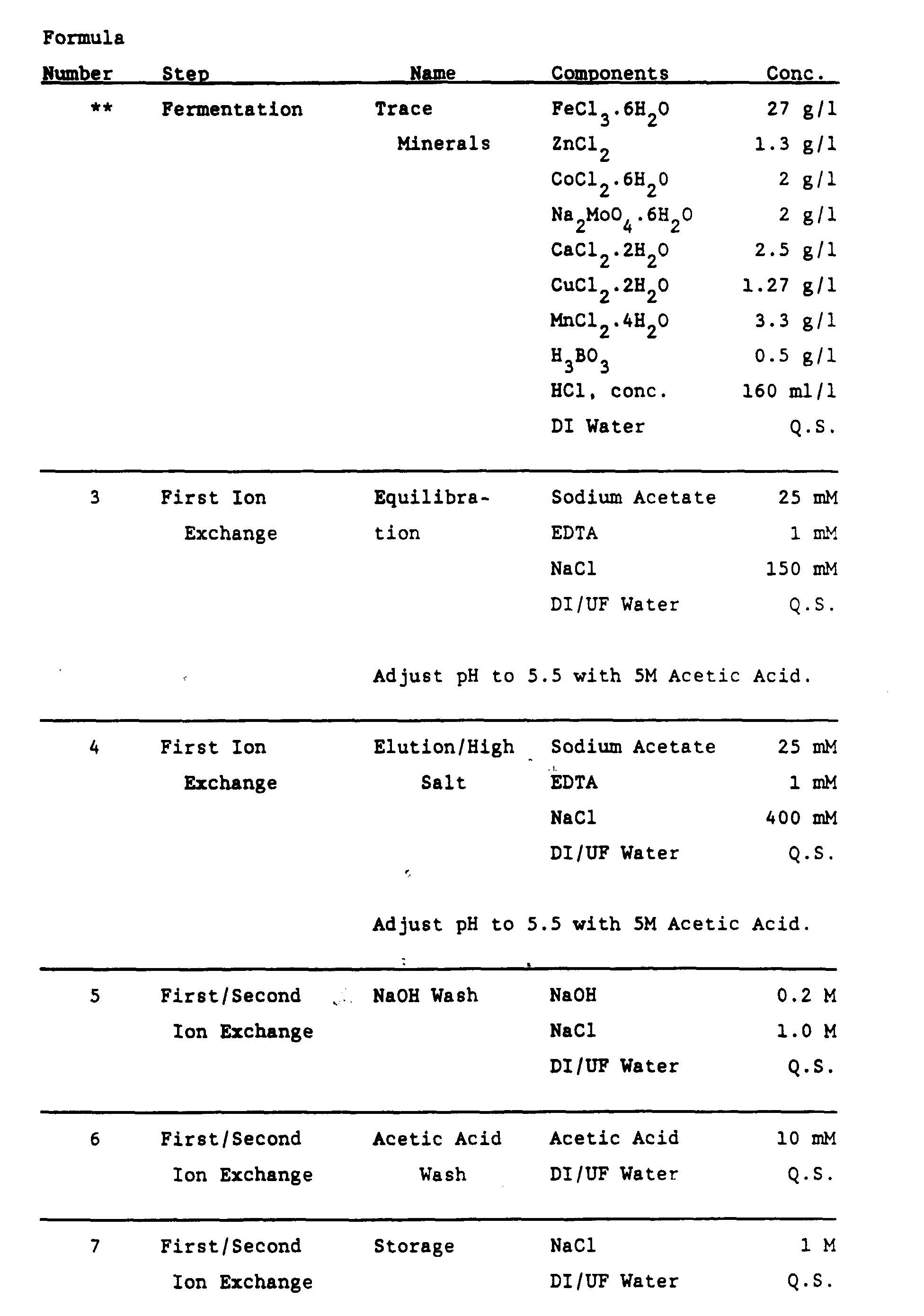
(b) Column operation. The following buffer sequence is used for each cycle on the column. Buffer formulas are given in Example 4.Solution Formula Number Volume Equilibration 3 20 1 Clarified Cell lysate 15-25 1 Equilibration 3 20 1 Salt Gradient Elution* 3/4 40 1 NaOH Wash 5 10 1 Acetic Acid Wash 6 5 1 Storage 7 20 1 *Salt gradient is run from 150-400 mM NaCl. - Eluate is collected by following the absorbance at 280 nm and collecting the peak eluting during the salt gradient. Recovery is about 55 g of IL-1i in about 10 1 of the pooled fractions from 20 1 of clarified cell lysate.
-
(a) Diafiltration. The pooled eluate is concentrated if desired using a YM10 membrane (Amicon) and then the salt is removed by diafiltration using 4 volumes of Second ion exchange Equilibration buffer (Formula 8). A precipitate which forms at this step is removed by filtration through 3 uM and 0.22 uM filters.
(b) Column specifications. The column used is an Amicon G180x250, filled with 5 liters of Q-sepharose (Pharmacia). All solutions are pumped through the columns at 350 ml/min.
(c) Column Operation. The following buffer sequence is used for each cycle on the column. Buffer formulas are given in Appendix A.Solution Formula Number Volume Equilibration 8 20 1 Diafiltrate 5-10 1 Equilibration 8 20 1 Salt Gradient Elution* 8/9 40 1 NaOH Wash 5 10 1 Acetic Acid Wash 6 5 1 Storage 7 20 1 *Salt gradient is run from 0 to 100 mM NaCl. - Eluate is collected by following the absorbance at 280 nm and collecting the peak eluting during the salt gradient. Recovery is about 45 g of IL-li in about 10 1 of the pooled fractions from 7 1 of Diafiltrate 1.
- (a) Concentration and Diafiltration. The pooled eluate from the second ion exchange column is concentrated to approximately 6 1 using YMlO membrane (Amicon). The material is then diafiltered against 5 volumes of Diafiltration buffer (Formula 10). Final concentration then takes place to approximately 1-2 1, with a target concentration of 10-30 g/ 1. The precipitate which forms at this step is removed by filtration through 3 uM and 0.22 uM filters. The final concentrate is then filtered through a 0.22 uM filter into sterile, pyrogen free tubes and stored at -70°C. Recovery is about 80% from the pooled fractions from the second ion exchange column.
- IL-1i produced in E. coli has a sequence identical to that of IL-1i-x from human monocytes with the exception that the N-terminus has an additional methionine residue. This residue can be removed by incubating the inhibitor with the exoprotease Aminopeptidase 1 from S. cerevisiae.
- 10 mg of recombinant IL-1i (from the first S-Sepharose or the Q-Sepharose step of purification) is incubated with 1 mg of yeast Aminopeptidase 1 purified as described by Change and Smith (J. Biol. Chem. 264, 6979, (1989)), in 50 mM ammonium carbonate pH 8.0 for 6 hours. The desmethionyl IL-1i is purified from the reaction mixture by further S-Sepharose chromatography.
- If wished, this step of the production process for desmethionyl can be avoided by expressing the IL-1i in an E. coli which contains the cDNA for yeast Aminopeptidase 1 enzyme in a suitable expression vector. This E. coli should also be unable to express the gene for Aminopeptidase P (Yoshimoto et al. J. Biochem (Tokyo) 104 93 (1988)) since removal of the N-terminal methionine will otherwise lead to removal of the N-terminal arginine.
- It will be apparent to those skilled in the art that various modifications and variations can be made in the processes of the present invention. Thus, it is intended that the present invention cover the modifications and variations of these processes provided they come within the scope of the appended claims and their equivalents.
-


-
- Beckman 114 Solvent Delivery Module
- Beckman 165 Variable Wavelength Detector
- Beckman System Gold Analog Interface Module 406
- Beckman System Gold, Personal Chromatograph
- Software
-
Brownlee RP-300 (C8) (220 mm x 4.6mm, 7 micron) -
- Channel A, 215 nm
- Channel B, 280 nm
- Range: 0 - 0.05 AUFS
-
- A: 0.1% TFA in Water
- B: 0.1% TFA in Acetonitrile
-
Time (min) Percent B Duration 0 0 5 5 30 30 (Start Gradient) 35 50 40 75 100 5 (End Gradient) 85 0 5 95 0 End - 1.0 ml/min
- Dilute sample to 0.1 - 0.5 mg/ml with water.
- 100 ul
-
Chemical Supplier cat. No. TFA Sigma T-6508 Acetonitrile, HPLC Grade Baker 9017-03 - Beckman System Gold
- Programmable Sovent Module 126
- Scanning Detector Module 167
- Remote Interface Module
- HP Series 1050 Autosampler
- System Gold, Personal Chromatograph Software
- Pharmacia
Mono Q HR 5/5 - 280 nm
-
- A: 20 mM TRIS, pH 7.5
- B: 20 mM TRIS, pH 7.5 + 250 mM NaCl
- 0% to 100% B in 60 minutes
- 0.5 ml/min.
- None
- 25 ug
- Beckman System Gold
- Programmable Solvent Module 126
- Scanning Detector Module 167
- Remote Interface Module
- HP Series 1050 Autosampler
- System Gold, Personal Chromatograph Software
- Pharmacia
Mono S HR 5/5 - 280 nm
-
- A: 25 mM NaAc, pH 5.5 + 1 mM EDTA
- B: 25 mM NaAc, pH 5.5 + 1 mM EDTA + 500 mM NaCl
- 0% to 60% B in 36 minutes
- 0.5 ml/min
- None
- 25 ug
-
- Beckman 114 Solvent Delivery Module
- Beckman 165 Variable Wavelength Detector
- Beckman System Gold Analog Interface Module 406
- Beckman System Gold, Personal Chromatograph
- Software
- Bio-Sil TSK 250 (7.5 mm x 30 cm)
- 280 nm
Range: 0 - 0.2 AU - 25mM Na Acetate and 0.5M NaCl, pH 5.5
- 0.5 mls/min
- Dilute IL-li solution with mobile phase to a final concentration of approximately 2 mg/ml
- 50 ul
- Follow procedure outlined by Lammli in J. Mol.
- Biol., 80, 575-599 (1973).
-
Acrylamide 15% TRIS pH 8.8 375 mM SDS 0.1% -
Acrylamide pH 6.8 5% SDS 0.1% - Sample is diluted 1:1 with Sample Buffer. The samples are then heated for 15 minutes at 65°C, spun and loaded onto the gel.
-
TRIS pH 6.8 250mM SDS 2.5% 2- Mercaptoethanol 5% Glycerol 12.5% - 50 V until samples have reached the separating gel. 100V until the bromophenol blue runs out of the gel.
-
Ethanol 45.4% Acetic Acid 9.0% Water 45.5% Coomassie Brillant Blue 2.5% - Stain overnight at room temperature with gentle shaking.
-
Methanol 30.0% Acetic Acid 12.5% Water 57.5% - Destain overnight or until background is clear at room temperature.
-
Protein Reported MW Insulin (A and B) 2,300 and 3,400 Bovine Trypsin Inhibitor 5,200 Lysozyme 14,300 β-Lactoglobulin 18,400 Alpha-Chymotrypsin 25,700 Ovalbumin 43,000 -
1. Reagents - 1.1 Trypsin sequencing grade; Boehringer Mannheim GmbH.
- 1.2 Urea ultra pure; BRL.
- 1.3 Milli-Q water.
- 1.4 Trifluoroacetic acid; Pierce.
- 1.5 HPLC grade acetonitrile; J.T. Baker.
- 1.6 Tris
- 1.7 CaCl2
- 2.1 HPLC system
- Beckman 114 Solvent Delivery Module
- Beckman 165 Variable Wavelength Detector
- Beckman System Gold Analog Interface Module 406
- Beckman System Gold, Personal Chromatograph Software
- 2.2 Column
BrowLee RP-300 (C8) (220mm x 4.6mm, 7 micron) - 2.3 Heating/cooling water bath
- 3.1 Trypsin; Dissolve 0.1 mg in 0.1 ml of 0.1mM HCl; Store frozen at -20°C, stable for months without loss of activity.
- 3.2 Urea: 8 M urea in Milli Q water, make fresh daily.
- 3.3 2M Tris HCl pH 8.0 and 0.1M Tris HCl pH 8.0.
- 3.4 3mM CaCl2
- 4.1 Denature of IL-li in 6M urea and 0.1M Tris HCl pH 8.0 final concentration at about 3 mg/ml protein for 10 minutes at 37°C.
- 4.2 Dilute into a solution of 0.1M Tris HCl pH 8.0 containing 0.3mM CaCl2 (1:2 vol/vol) to give a final concentration of 2M urea.
- 4.3 Add trypsin solution (solution number 3.1) to give 1% by weight of the protein. Mix well.
- 4.4 Incubate at 37°C for 1 hr and additional 1% by weight of trypsin is added.
- 4.5 Stop digest after an additional 3 hrs by freezing at -20°C or by acidification with 10% trifluoroacetic acid, final concentration 0.1%.
- 4.6 Inject onto the HPLC column.
- Channel A: 215 nm
- Channel B: 200 nm
- Range: 0-0.5 AU
- A: 0.1% TFA in water
- B: 0.1% TFA in acetonitrile
- The assay for IL-1 inhibitor is based on an IL-1 assay developed by S. Nakai, K. Mizuno, M. Kaneta and Y. Hirai. (Biochem. Biophys. Res. Comm. 154:1189-1196. 1988). The principle of this assay is that prolonged exposure to IL-1 is cytotoxic to the human melanoma cell line A375. The cytotoxicity is mediated via the IL-1 receptor. IL-li antagonizes this cytotoxicity in a dose dependent manner by competing with IL-1 for binding to the IL-1 receptor. The level of toxicity can be quantitated by staining the live cells with crystal violet, extracting the stain from the cells by overnight incubation in 100% ethanol, and measuring the optical density of the extracted stain with a spectrophotometer. The rationale for the use of the A375 melanoma cell bioassay is that it is a simple and direct method for measuring both IL-1 and IL-1i activity. Most other assays that have been described in the literature depend on the ability of IL-1 to activate other products, such as prostaglandin E2 and lactic acid in fibroblasts, and interleukin-2 in T-cells. These secondary products are then measured in order to determine the level of IL-1 present. Although all of these IL-1 activities are receptor mediated, the existence of more than one stage makes these alternative assays cumbersome and subject to a greater probability of error.
2. Equipment
3. Solution
4. Method
5. Reverse-phase of peptide fragments produced by trypsin digestion.
5.1 HPLC system and column as in Section 2.
5.2 Detector settings:
5.3 Mobile phase:
5.4 Gradient conditions
| Time (min) | Percent B | Duration |
| 0 | 0 | 0 |
| 5 | 40 | 80 |
| 85 | 100 | 5 |
| 95 | 0 | 5 |
| 120 | 0 | End |
5.5 Flow rate
1.0 ml/min
5.6 Sample preparation None
5.7 Injection volume 50 to 100 ul
Claims (11)
- A method for the production of interleukin-1 inhibitor (IL-1i), comprising:(1) fermentation of Escherichia coli comprising a plasmid containing a DNA encoding IL-li;(2) cell processing, including:(a) cell recovery,(b) lysis, and(c) clarification of the lysates;(3) a first ion exchange step using a cationic resin;(4) a second ion exchange step using a anionic resin;(5) subsequent processing steps including concentration and diafiltration.
- The method of claim 1 wherein the plasmid is pDD6, which plasmid is obtainable as described in Example 1.
- The method of claim 1 wherein the cationic resin is selected from the group consisting of S-Sepharose, SP-C25 Sephadex, CM Sephadex, CM Sepharose, CM cellulose, or CM Toyopearl.
- The method of claim 3 wherein the cationic resin is S-Sepharose.
- The method of claim 1 wherein the anionic resin is selected from the group consisting of Q-Sepharose, DEAE-Sepharose, Q-Sephadex and DEAE cellulose.
- The method of claim 5 wherein the anionic resin is Q-Sepharose.
- The method of claim 1 which further comprises a third ion exchange step conducted immediately prior to the final processing steps.
- The method of claim 7 wherein the third ion exchange step is conducted using a cationic resin.
- The method of claim 8 wherein the cationic resin is selected from the group consisting of S-Sepharose, SP-C25 Sephadex, CM Sephadex, CM Sepharose, CM cellulose, or CM Toyopearl.
- The method of claim 9 wherein the cationic resin is S-Sepharose.
- A method for preparing plasmid pDD6, wherein said plasmid is constructed as described in Example 1.
Applications Claiming Priority (3)
| Application Number | Priority Date | Filing Date | Title |
|---|---|---|---|
| US44265289A | 1989-11-29 | 1989-11-29 | |
| US442652 | 1989-11-29 | ||
| PCT/US1990/006979 WO1991008285A1 (en) | 1989-11-29 | 1990-11-29 | Production of recombinant human interleukin-1 inhibitor |
Publications (3)
| Publication Number | Publication Date |
|---|---|
| EP0502956A1 EP0502956A1 (en) | 1992-09-16 |
| EP0502956A4 EP0502956A4 (en) | 1992-12-09 |
| EP0502956B1 true EP0502956B1 (en) | 1997-04-23 |
Family
ID=23757611
Family Applications (1)
| Application Number | Title | Priority Date | Filing Date |
|---|---|---|---|
| EP91900515A Expired - Lifetime EP0502956B1 (en) | 1989-11-29 | 1990-11-29 | Production of recombinant human interleukin-1 inhibitor |
Country Status (16)
| Country | Link |
|---|---|
| US (1) | US5453490A (en) |
| EP (1) | EP0502956B1 (en) |
| JP (1) | JP3014007B2 (en) |
| KR (1) | KR0182819B1 (en) |
| AT (1) | ATE152172T1 (en) |
| AU (1) | AU651955B2 (en) |
| BR (1) | BR9007883A (en) |
| CA (1) | CA2068320C (en) |
| DE (1) | DE69030582T2 (en) |
| DK (1) | DK0502956T3 (en) |
| ES (1) | ES2103305T3 (en) |
| FI (1) | FI104733B (en) |
| GR (1) | GR3024031T3 (en) |
| HU (1) | HUT64582A (en) |
| NO (1) | NO305290B1 (en) |
| WO (1) | WO1991008285A1 (en) |
Cited By (1)
| Publication number | Priority date | Publication date | Assignee | Title |
|---|---|---|---|---|
| US7619066B2 (en) | 2004-04-02 | 2009-11-17 | Amgen Inc. | IL-1ra variants |
Families Citing this family (45)
| Publication number | Priority date | Publication date | Assignee | Title |
|---|---|---|---|---|
| US5075222A (en) | 1988-05-27 | 1991-12-24 | Synergen, Inc. | Interleukin-1 inhibitors |
| US6858409B1 (en) | 1988-05-27 | 2005-02-22 | Amgen Inc. | Nucleic acids encoding interleukin-1 inhibitors and processes for preparing interleukin-1 inhibitors |
| US6159460A (en) * | 1988-05-27 | 2000-12-12 | Amgen Inc. | Method for treating interleukin-1 mediated diseases |
| US6552170B1 (en) | 1990-04-06 | 2003-04-22 | Amgen Inc. | PEGylation reagents and compounds formed therewith |
| US5861476A (en) * | 1994-02-02 | 1999-01-19 | Affymax Technologies N.V. | Peptides and compounds that bind to the IL-1 receptor |
| US5608035A (en) * | 1994-02-02 | 1997-03-04 | Affymax Technologies N.V. | Peptides and compounds that bind to the IL-1 receptor |
| US5880096A (en) * | 1994-02-02 | 1999-03-09 | Affymax Technologies N.V. | Peptides and compounds that bind to the IL-1 receptor |
| US5786331A (en) * | 1994-02-02 | 1998-07-28 | Affymax Technologies N.V. | Peptides and compounds that bind to the IL-1 receptor |
| US5837495A (en) * | 1994-10-13 | 1998-11-17 | Applied Research Systems Ars Holding N.V. | DNA encoding interleukin-1 antagonist |
| IT1270662B (en) * | 1994-10-13 | 1997-05-07 | Applied Research Systems | INTERLEUCHIN-1 ANTAGONIST |
| US5981713A (en) * | 1994-10-13 | 1999-11-09 | Applied Research Systems Ars Holding N.V. | Antibodies to intereleukin-1 antagonists |
| TW555765B (en) * | 1996-07-09 | 2003-10-01 | Amgen Inc | Low molecular weight soluble tumor necrosis factor type-I and type-II proteins |
| CA2273852C (en) * | 1996-12-06 | 2009-09-29 | Amgen Inc. | Combination therapy using an il-1 inhibitor for treating il-1 mediated diseases |
| US6294170B1 (en) | 1997-08-08 | 2001-09-25 | Amgen Inc. | Composition and method for treating inflammatory diseases |
| US6013253A (en) * | 1997-08-15 | 2000-01-11 | Amgen, Inc. | Treatment of multiple sclerosis using consensus interferon and IL-1 receptor antagonist |
| US6660843B1 (en) * | 1998-10-23 | 2003-12-09 | Amgen Inc. | Modified peptides as therapeutic agents |
| US8106098B2 (en) | 1999-08-09 | 2012-01-31 | The General Hospital Corporation | Protein conjugates with a water-soluble biocompatible, biodegradable polymer |
| CA2451955C (en) | 2001-06-26 | 2015-09-29 | Abgenix, Inc. | Antibodies to opgl |
| US20030191056A1 (en) | 2002-04-04 | 2003-10-09 | Kenneth Walker | Use of transthyretin peptide/protein fusions to increase the serum half-life of pharmacologically active peptides/proteins |
| CN104178491B (en) | 2002-09-06 | 2018-07-03 | 安姆根有限公司 | Therapeutic human anti-IL-1R1 monoclonal antibody |
| AR056806A1 (en) | 2005-11-14 | 2007-10-24 | Amgen Inc | RANKL- PTH / PTHRP ANTIBODY CHEMICAL MOLECULES |
| US20070248653A1 (en) * | 2006-04-20 | 2007-10-25 | Cochrum Kent C | Hemostatic compositions and methods for controlling bleeding |
| US7833527B2 (en) | 2006-10-02 | 2010-11-16 | Amgen Inc. | Methods of treating psoriasis using IL-17 Receptor A antibodies |
| AU2008289552B2 (en) * | 2007-08-16 | 2014-10-09 | The Schepens Eye Research Institute, Inc. | Therapeutic compositions for treatment of inflammation of ocular and adnexal tissues |
| EP2217258B1 (en) | 2007-11-14 | 2014-03-26 | General Regeneratives Limited | Use of interleukin-1 receptor antagonist as a myeloprotective agent |
| EP2620139B1 (en) | 2008-02-27 | 2016-07-20 | Biomet Biologics, LLC | Interleukin-1 receptor antagonist rich solutions |
| TW201117824A (en) | 2009-10-12 | 2011-06-01 | Amgen Inc | Use of IL-17 receptor a antigen binding proteins |
| CN101690801B (en) | 2009-10-26 | 2012-08-01 | 上海交通大学 | Application of interleukin-1 receptor antagonist and medicinal composition thereof |
| SG187231A1 (en) | 2010-07-29 | 2013-02-28 | Eleven Biotherapeutics Inc | Chimeric il-1 receptor type i agonists and antagonists |
| US20140234330A1 (en) | 2011-07-22 | 2014-08-21 | Amgen Inc. | Il-17 receptor a is required for il-17c biology |
| CA2843197A1 (en) * | 2011-07-29 | 2013-02-07 | Eleven Biotherapeutics, Inc. | Purified proteins |
| WO2013170636A1 (en) | 2012-05-18 | 2013-11-21 | 爱德迪安(北京)生物技术有限公司 | Protein and protein conjugate for diabetes treatment, and applications thereof |
| CN107693781B (en) | 2013-03-13 | 2021-11-09 | 巴扎德制药公司 | Chimeric cytokine formulations for ocular delivery |
| US20140271589A1 (en) | 2013-03-15 | 2014-09-18 | Biomet Biologics, Llc | Treatment of collagen defects using protein solutions |
| US9758806B2 (en) * | 2013-03-15 | 2017-09-12 | Biomet Biologics, Llc | Acellular compositions for treating inflammatory disorders |
| US9950035B2 (en) | 2013-03-15 | 2018-04-24 | Biomet Biologics, Llc | Methods and non-immunogenic compositions for treating inflammatory disorders |
| US10143725B2 (en) | 2013-03-15 | 2018-12-04 | Biomet Biologics, Llc | Treatment of pain using protein solutions |
| US9895418B2 (en) | 2013-03-15 | 2018-02-20 | Biomet Biologics, Llc | Treatment of peripheral vascular disease using protein solutions |
| US20160296600A1 (en) | 2013-11-11 | 2016-10-13 | Ascendis Pharma Relaxin Division A/S | Relaxin Prodrugs |
| EP3074507B1 (en) | 2013-11-26 | 2022-01-05 | Biomet Biologics, LLC | Methods of mediating macrophage phenotypes |
| WO2015191783A2 (en) | 2014-06-10 | 2015-12-17 | Abbvie Inc. | Biomarkers for inflammatory disease and methods of using same |
| WO2018022982A1 (en) | 2016-07-29 | 2018-02-01 | Trustees Of Boston University | Age-associated clonal hematopoiesis accelerates cardio-metabolic disease development |
| US11285196B2 (en) | 2017-03-13 | 2022-03-29 | Eslam Abbas Baseuny | Multivalent biologic constructs for inducing a therapeutic modulation of cellular response and uses thereof |
| WO2020035482A1 (en) | 2018-08-13 | 2020-02-20 | Iltoo Pharma | Combination of interleukin-2 with an interleukin 1 inhibitor, conjugates and therapeutic uses thereof |
| EP4526469A1 (en) | 2022-05-16 | 2025-03-26 | Institut National de la Santé et de la Recherche Médicale | Methods for assessing the exhaustion of hematopoietic stems cells induced by chronic inflammation |
Family Cites Families (5)
| Publication number | Priority date | Publication date | Assignee | Title |
|---|---|---|---|---|
| JP3014099B2 (en) * | 1987-08-26 | 2000-02-28 | バイオジェン インコーポレイテッド | Biological materials, production of biological materials and methods of using such materials for therapy |
| US5075222A (en) * | 1988-05-27 | 1991-12-24 | Synergen, Inc. | Interleukin-1 inhibitors |
| KR0148009B1 (en) * | 1988-05-27 | 1998-08-01 | 그래고리 비. 아보트 | Interleukin-1 inhibitors |
| AU7683391A (en) * | 1990-04-27 | 1991-11-27 | Upjohn Company, The | Modified interleukin-1 inhibitors |
| EP0534978B1 (en) * | 1990-05-01 | 1999-03-24 | Chiron Corporation | Interleukin-1 antagonist and uses thereof |
-
1990
- 1990-11-29 HU HU9201777A patent/HUT64582A/en unknown
- 1990-11-29 AU AU69007/91A patent/AU651955B2/en not_active Expired
- 1990-11-29 BR BR909007883A patent/BR9007883A/en not_active Application Discontinuation
- 1990-11-29 JP JP3501112A patent/JP3014007B2/en not_active Expired - Lifetime
- 1990-11-29 AT AT91900515T patent/ATE152172T1/en not_active IP Right Cessation
- 1990-11-29 DE DE69030582T patent/DE69030582T2/en not_active Expired - Lifetime
- 1990-11-29 WO PCT/US1990/006979 patent/WO1991008285A1/en not_active Ceased
- 1990-11-29 CA CA002068320A patent/CA2068320C/en not_active Expired - Lifetime
- 1990-11-29 ES ES91900515T patent/ES2103305T3/en not_active Expired - Lifetime
- 1990-11-29 DK DK91900515.7T patent/DK0502956T3/en active
- 1990-11-29 EP EP91900515A patent/EP0502956B1/en not_active Expired - Lifetime
-
1992
- 1992-05-27 FI FI922434A patent/FI104733B/en active
- 1992-05-29 NO NO922138A patent/NO305290B1/en not_active IP Right Cessation
- 1992-05-29 KR KR1019920701272A patent/KR0182819B1/en not_active Expired - Lifetime
-
1994
- 1994-08-30 US US08/298,180 patent/US5453490A/en not_active Expired - Lifetime
-
1997
- 1997-07-09 GR GR970401686T patent/GR3024031T3/en unknown
Non-Patent Citations (3)
| Title |
|---|
| Biotechniques, vol. 10, 1 December 1983; G. Sofer et al, pages 198-203 * |
| Journal of Experimental Medicine, vol. 168, November 1988; D.L. Rosenstreich et al., pages 1767-1778 * |
| Nature, vol. 343, no. 6256, 25 January 1990; C.H. Hannum et al, pages 336-340 * |
Cited By (2)
| Publication number | Priority date | Publication date | Assignee | Title |
|---|---|---|---|---|
| US7619066B2 (en) | 2004-04-02 | 2009-11-17 | Amgen Inc. | IL-1ra variants |
| US10765747B2 (en) | 2004-04-02 | 2020-09-08 | Swedish Orphan Biovitrum Ab (Publ) | Methods of reducing aggregation of IL-1ra |
Also Published As
| Publication number | Publication date |
|---|---|
| DK0502956T3 (en) | 1997-10-20 |
| KR0182819B1 (en) | 1999-04-01 |
| FI104733B (en) | 2000-03-31 |
| KR920703792A (en) | 1992-12-18 |
| HUT64582A (en) | 1994-01-28 |
| JPH05503007A (en) | 1993-05-27 |
| HK1006856A1 (en) | 1999-03-19 |
| US5453490A (en) | 1995-09-26 |
| GR3024031T3 (en) | 1997-10-31 |
| NO922138L (en) | 1992-05-29 |
| FI922434L (en) | 1992-05-27 |
| EP0502956A1 (en) | 1992-09-16 |
| BR9007883A (en) | 1992-09-29 |
| DE69030582T2 (en) | 1998-06-25 |
| AU6900791A (en) | 1991-06-26 |
| NO305290B1 (en) | 1999-05-03 |
| NO922138D0 (en) | 1992-05-29 |
| EP0502956A4 (en) | 1992-12-09 |
| HU9201777D0 (en) | 1992-12-28 |
| AU651955B2 (en) | 1994-08-11 |
| WO1991008285A1 (en) | 1991-06-13 |
| ATE152172T1 (en) | 1997-05-15 |
| CA2068320C (en) | 2000-10-17 |
| DE69030582D1 (en) | 1997-05-28 |
| JP3014007B2 (en) | 2000-02-28 |
| ES2103305T3 (en) | 1997-09-16 |
| CA2068320A1 (en) | 1991-05-30 |
| FI922434A0 (en) | 1992-05-27 |
Similar Documents
| Publication | Publication Date | Title |
|---|---|---|
| AU651955B2 (en) | Production of recombinant human interleukin-1 inhibitor | |
| US5304473A (en) | A-C-B proinsulin, method of manufacturing and using same, and intermediates in insulin production | |
| JP2644794B2 (en) | A new type of colony stimulating factor-1 | |
| EP0251037B1 (en) | Novel human TNF polypeptide mutants and DNAs encoding said mutants | |
| AU646014B2 (en) | Novel platelet-derived growth factor B chain analogs and method for homogeneous production thereof | |
| IE881597L (en) | Expression of Human Proapolipoprotein A-I | |
| EP1428883A1 (en) | Megakaryocyte stimulating factors | |
| NO301888B1 (en) | A process for producing fusion proteins comprising GM-CSF and IL-3, DNA sequence encoding such and recombinant expression vector comprising such DNA sequence | |
| EP0200748B1 (en) | Human tumor necrosis factor | |
| WO1992013073A1 (en) | Pdgf-b analogues | |
| EP1185675B1 (en) | Escherichia coli strain secreting human granulocyte colony stimulating factor (g-csf) | |
| GB2253852A (en) | Vectors incorporating inducible selection genes | |
| US5656458A (en) | Expression and processing of amino terminus acetylated FGF's in yeast | |
| DK173380B1 (en) | Preparation with mitogenic activity against human foreskin fibroblasts, method for preparing a human, basic | |
| HK1006856B (en) | Production of recombinant human interleukin-1 inhibitor | |
| JP2675294B2 (en) | Human tumor necrosis factor | |
| EP0504291A4 (en) | Novel proteins with oncostatin m activity and process for their preparation |
Legal Events
| Date | Code | Title | Description |
|---|---|---|---|
| PUAI | Public reference made under article 153(3) epc to a published international application that has entered the european phase |
Free format text: ORIGINAL CODE: 0009012 |
|
| 17P | Request for examination filed |
Effective date: 19920513 |
|
| AK | Designated contracting states |
Kind code of ref document: A1 Designated state(s): AT BE CH DE DK ES FR GB GR IT LI LU NL SE |
|
| A4 | Supplementary search report drawn up and despatched |
Effective date: 19921022 |
|
| AK | Designated contracting states |
Kind code of ref document: A4 Designated state(s): AT BE CH DE DK ES FR GB GR IT LI LU NL SE |
|
| 17Q | First examination report despatched |
Effective date: 19950224 |
|
| GRAG | Despatch of communication of intention to grant |
Free format text: ORIGINAL CODE: EPIDOS AGRA |
|
| GRAG | Despatch of communication of intention to grant |
Free format text: ORIGINAL CODE: EPIDOS AGRA |
|
| GRAH | Despatch of communication of intention to grant a patent |
Free format text: ORIGINAL CODE: EPIDOS IGRA |
|
| RAP1 | Party data changed (applicant data changed or rights of an application transferred) |
Owner name: AMGEN BOULDER INC. |
|
| GRAH | Despatch of communication of intention to grant a patent |
Free format text: ORIGINAL CODE: EPIDOS IGRA |
|
| GRAA | (expected) grant |
Free format text: ORIGINAL CODE: 0009210 |
|
| AK | Designated contracting states |
Kind code of ref document: B1 Designated state(s): AT BE CH DE DK ES FR GB GR IT LI LU NL SE |
|
| REF | Corresponds to: |
Ref document number: 152172 Country of ref document: AT Date of ref document: 19970515 Kind code of ref document: T |
|
| REG | Reference to a national code |
Ref country code: CH Ref legal event code: EP Ref country code: CH Ref legal event code: NV Representative=s name: KIRKER & CIE SA |
|
| REF | Corresponds to: |
Ref document number: 69030582 Country of ref document: DE Date of ref document: 19970528 |
|
| ET | Fr: translation filed | ||
| REG | Reference to a national code |
Ref country code: ES Ref legal event code: FG2A Ref document number: 2103305 Country of ref document: ES Kind code of ref document: T3 |
|
| REG | Reference to a national code |
Ref country code: GR Ref legal event code: FG4A Free format text: 3024031 |
|
| REG | Reference to a national code |
Ref country code: DK Ref legal event code: T3 |
|
| PLBE | No opposition filed within time limit |
Free format text: ORIGINAL CODE: 0009261 |
|
| STAA | Information on the status of an ep patent application or granted ep patent |
Free format text: STATUS: NO OPPOSITION FILED WITHIN TIME LIMIT |
|
| 26N | No opposition filed | ||
| REG | Reference to a national code |
Ref country code: CH Ref legal event code: PFA Free format text: AMGEN BOULDER INC. TRANSFER- AMGEN INC. |
|
| REG | Reference to a national code |
Ref country code: GB Ref legal event code: 732E |
|
| NLS | Nl: assignments of ep-patents |
Owner name: AMGEN INC. |
|
| REG | Reference to a national code |
Ref country code: FR Ref legal event code: TP |
|
| REG | Reference to a national code |
Ref country code: GB Ref legal event code: IF02 |
|
| PGFP | Annual fee paid to national office [announced via postgrant information from national office to epo] |
Ref country code: SE Payment date: 20091106 Year of fee payment: 20 Ref country code: DE Payment date: 20091126 Year of fee payment: 20 Ref country code: CH Payment date: 20091113 Year of fee payment: 20 Ref country code: AT Payment date: 20091111 Year of fee payment: 20 Ref country code: DK Payment date: 20091117 Year of fee payment: 20 Ref country code: ES Payment date: 20091201 Year of fee payment: 20 Ref country code: LU Payment date: 20091118 Year of fee payment: 20 |
|
| PGFP | Annual fee paid to national office [announced via postgrant information from national office to epo] |
Ref country code: NL Payment date: 20091104 Year of fee payment: 20 |
|
| PGFP | Annual fee paid to national office [announced via postgrant information from national office to epo] |
Ref country code: GB Payment date: 20091125 Year of fee payment: 20 Ref country code: FR Payment date: 20091123 Year of fee payment: 20 Ref country code: IT Payment date: 20091119 Year of fee payment: 20 |
|
| PGFP | Annual fee paid to national office [announced via postgrant information from national office to epo] |
Ref country code: BE Payment date: 20091130 Year of fee payment: 20 Ref country code: GR Payment date: 20091015 Year of fee payment: 20 |
|
| BE20 | Be: patent expired |
Owner name: *AMGEN INC. Effective date: 20101129 |
|
| REG | Reference to a national code |
Ref country code: NL Ref legal event code: V4 Effective date: 20101129 |
|
| REG | Reference to a national code |
Ref country code: CH Ref legal event code: PL |
|
| REG | Reference to a national code |
Ref country code: DK Ref legal event code: EUP |
|
| REG | Reference to a national code |
Ref country code: GB Ref legal event code: PE20 Expiry date: 20101128 |
|
| PG25 | Lapsed in a contracting state [announced via postgrant information from national office to epo] |
Ref country code: NL Free format text: LAPSE BECAUSE OF EXPIRATION OF PROTECTION Effective date: 20101129 |
|
| EUG | Se: european patent has lapsed | ||
| PG25 | Lapsed in a contracting state [announced via postgrant information from national office to epo] |
Ref country code: GB Free format text: LAPSE BECAUSE OF EXPIRATION OF PROTECTION Effective date: 20101128 |
|
| PG25 | Lapsed in a contracting state [announced via postgrant information from national office to epo] |
Ref country code: DE Free format text: LAPSE BECAUSE OF EXPIRATION OF PROTECTION Effective date: 20101129 |
|
| REG | Reference to a national code |
Ref country code: ES Ref legal event code: FD2A Effective date: 20130725 |
|
| PG25 | Lapsed in a contracting state [announced via postgrant information from national office to epo] |
Ref country code: ES Free format text: LAPSE BECAUSE OF EXPIRATION OF PROTECTION Effective date: 20101130 |