EP0496595B1 - Aniline derivatives and process for producing the same - Google Patents
Aniline derivatives and process for producing the same Download PDFInfo
- Publication number
- EP0496595B1 EP0496595B1 EP92300543A EP92300543A EP0496595B1 EP 0496595 B1 EP0496595 B1 EP 0496595B1 EP 92300543 A EP92300543 A EP 92300543A EP 92300543 A EP92300543 A EP 92300543A EP 0496595 B1 EP0496595 B1 EP 0496595B1
- Authority
- EP
- European Patent Office
- Prior art keywords
- formula
- derivative
- chlorine
- compound
- nitroaniline
- Prior art date
- Legal status (The legal status is an assumption and is not a legal conclusion. Google has not performed a legal analysis and makes no representation as to the accuracy of the status listed.)
- Expired - Lifetime
Links
- 0 *c1c(*)cc(C2*CC2)cc1 Chemical compound *c1c(*)cc(C2*CC2)cc1 0.000 description 8
- VWWAILZUSKHANH-UHFFFAOYSA-N CC1C(C)CC(C)C(C)C1 Chemical compound CC1C(C)CC(C)C(C)C1 VWWAILZUSKHANH-UHFFFAOYSA-N 0.000 description 1
Classifications
-
- C—CHEMISTRY; METALLURGY
- C07—ORGANIC CHEMISTRY
- C07D—HETEROCYCLIC COMPOUNDS
- C07D239/00—Heterocyclic compounds containing 1,3-diazine or hydrogenated 1,3-diazine rings
- C07D239/02—Heterocyclic compounds containing 1,3-diazine or hydrogenated 1,3-diazine rings not condensed with other rings
- C07D239/24—Heterocyclic compounds containing 1,3-diazine or hydrogenated 1,3-diazine rings not condensed with other rings having three or more double bonds between ring members or between ring members and non-ring members
- C07D239/28—Heterocyclic compounds containing 1,3-diazine or hydrogenated 1,3-diazine rings not condensed with other rings having three or more double bonds between ring members or between ring members and non-ring members with hetero atoms or with carbon atoms having three bonds to hetero atoms with at the most one bond to halogen, directly attached to ring carbon atoms
- C07D239/46—Two or more oxygen, sulphur or nitrogen atoms
- C07D239/52—Two oxygen atoms
- C07D239/54—Two oxygen atoms as doubly bound oxygen atoms or as unsubstituted hydroxy radicals
-
- A—HUMAN NECESSITIES
- A01—AGRICULTURE; FORESTRY; ANIMAL HUSBANDRY; HUNTING; TRAPPING; FISHING
- A01N—PRESERVATION OF BODIES OF HUMANS OR ANIMALS OR PLANTS OR PARTS THEREOF; BIOCIDES, e.g. AS DISINFECTANTS, AS PESTICIDES OR AS HERBICIDES; PEST REPELLANTS OR ATTRACTANTS; PLANT GROWTH REGULATORS
- A01N43/00—Biocides, pest repellants or attractants, or plant growth regulators containing heterocyclic compounds
- A01N43/48—Biocides, pest repellants or attractants, or plant growth regulators containing heterocyclic compounds having rings with two nitrogen atoms as the only ring hetero atoms
- A01N43/54—1,3-Diazines; Hydrogenated 1,3-diazines
-
- C—CHEMISTRY; METALLURGY
- C07—ORGANIC CHEMISTRY
- C07C—ACYCLIC OR CARBOCYCLIC COMPOUNDS
- C07C271/00—Derivatives of carbamic acids, i.e. compounds containing any of the groups, the nitrogen atom not being part of nitro or nitroso groups
- C07C271/06—Esters of carbamic acids
- C07C271/08—Esters of carbamic acids having oxygen atoms of carbamate groups bound to acyclic carbon atoms
- C07C271/26—Esters of carbamic acids having oxygen atoms of carbamate groups bound to acyclic carbon atoms with the nitrogen atom of at least one of the carbamate groups bound to a carbon atom of a six-membered aromatic ring
- C07C271/28—Esters of carbamic acids having oxygen atoms of carbamate groups bound to acyclic carbon atoms with the nitrogen atom of at least one of the carbamate groups bound to a carbon atom of a six-membered aromatic ring to a carbon atom of a non-condensed six-membered aromatic ring
-
- C—CHEMISTRY; METALLURGY
- C07—ORGANIC CHEMISTRY
- C07C—ACYCLIC OR CARBOCYCLIC COMPOUNDS
- C07C311/00—Amides of sulfonic acids, i.e. compounds having singly-bound oxygen atoms of sulfo groups replaced by nitrogen atoms, not being part of nitro or nitroso groups
- C07C311/01—Sulfonamides having sulfur atoms of sulfonamide groups bound to acyclic carbon atoms
- C07C311/02—Sulfonamides having sulfur atoms of sulfonamide groups bound to acyclic carbon atoms of an acyclic saturated carbon skeleton
- C07C311/08—Sulfonamides having sulfur atoms of sulfonamide groups bound to acyclic carbon atoms of an acyclic saturated carbon skeleton having the nitrogen atom of at least one of the sulfonamide groups bound to a carbon atom of a six-membered aromatic ring
Definitions
- the present invention relates to intermediates useful for producing a 6-haloalkyl-3-phenyluracil derivative [described in JP-A-2-400475 (1990) and JP-A-3-314391 (1991)] which is useful as a herbicide and a to process for producing said intermediates and derivative.
- N-(3-amino-4-chlorophenyl)methanesulfonamide is described in DE-C-2938633 and DE-C-3124172
- methyl 5-amino-2-chlorocarbanilate is described in DE-C-2703838
- methyl 2-chloro-5-nitrocarbanilate is described in US-A-2860166, DE-C-2703838, DE-C-2725146, DE-C-2846625 and DE-C-2926049
- ethyl 5-amino-2-chlorocarbanilate is described in US-A-3920444
- ethyl 2-chloro-5-nitrocarbanilate is described in Justus Liebigs Ann. Chem.
- N-(4-fluoro-3-nitrophenyl)methanesulfonamide is described in US-A-4507479, a methyl ester and a phenyl ester of 2-fluoro-5-nitrocarbanilic acid are discribed in US-A-4226613, and a methyl ester and a phenyl ester of 5-amino-2-fluorocarbanilic acid (since they are not isolated, the physical properties are not described) are described in US-A-4227007.
- the present invention provides a process for producing a sulfoneamide derivative of formula (6): wherein X and Y independently are a halogen atom, R is C1-C4 alkyl or C1-C3 haloalkyl and R' is C1-C4 alkyl or phenyl, which process comprises halogenating an anilide derivative of formula (5): wherein X, R and R' are as defined above.
- the anilide derivative of formula (5) may be produced by reacting a diamine derivative of formula (2): wherein X and R are as defined above, with a halogenoformate of formula (12): Hal ⁇ CO2R' (12) wherein Hal represents a halogen atom and R' is as defined above.
- the diamine derivative of formula (2) may be produced by reducing a nitroaniline derivative of formula (1): wherein X and R are as defined above.
- the nitroaniline derivative of formula (1) may be produced by reacting a 4-halogeno-3-nitroaniline of formula (9): wherein X is as defined above, with an alkylsulfonyl halide of formula (11): Hal ⁇ SO2R (11) wherein Hal represents a halogen atom and R is as defined above.
- the anilide derivative of formula (5) may also be produced by reacting an aminocarbanilide derivative of formula (4): wherein X and R' are as defined above, with an alkylsulfonyl halide of formula (11) as defined above.
- the aminocarbanilide derivative of formula (4) may be produced by reducing a nitrocarbanilide derivative of formula (3): wherein R' and X are as defined above.
- the nitrocarbanilide derivative of formula (3) may be produced by reacting a 2-halogeno-5-nitroaniline of formula (10): wherein X is as defined above, with a halogenoformate of formula (12) as defined above.
- the present invention also provides a nitroaniline derivative of formula (1) as defined above with the provisos that when X is fluorine R is not methyl, and when X is chlorine R is not methyl, chloromethyl or trifluoromethyl.
- the present invention additionally provides a diamine derivative of formula (2) as defined above with the proviso that when X is chlorine R is not methyl or trifluoromethyl.
- the present invention additionally provides a process for producing a nitroaniline derivative of formula (1) as defined above with the proviso that when X is chlorine R is not methyl, chloromethyl or trifluoromethyl or a diamine derivative of formula (2) as defined above with the proviso that when X is chlorine R is not trifluoromethyl, which process comprises; either
- the present invention further provides a nitrocarbanilide derivative of formula (3) as defined above with the proviso that when X is fluorine or chlorine R' is not methyl, when X is fluorine R' is not phenyl, and when X is chlorine R' is not ethyl; an aminocarbanilide derivative of formula (4) as defined above with the provisos that when X is fluorine or chlorine R' is not methyl, when X is fluorine R' is not phenyl, and when X is chlorine R' is not ethyl; an anilide derivative of formula (5) as defined above with the proviso that when X is chlorine and R is trifluoromethyl R' is not ethyl; and a sulfonamide derivative of formula (6) as defined above.
- the present invention further provides a process for producing a nitrocarbanilide derivative of formula (3) as defined above, an aminocarbanilide derivative of formula (4) as defined above, an anilide derivative of formula (5) as defined above with the proviso that when X is chlorine and R is trifluoromethyl R' is not ethyl, or a sulfonamide derivative of formula (6) as defined above, which process comprises;
- the present invention yet further provides a process for producing a 6-haloalkyl-3-phenyluracil derivative of formula (8) wherein X, Y and R are as defined above, which process comprises either;
- route 1 shows a process of producing a compound (5) with a high yield by subjecting a nitroaniline derivative (9) to sulfoneamidation, reducing the thus-obtained sulfoneamide derivative and carbamating the reduced product.
- Route 2 shows a process of producing a compound (5) with a high yield by carbamating a nitroaniline derivative (10), reducing the carbamated derivative and subjecting the reduced product to sulfoneamidation, and a process of producing a compound (6) with a high yield by halogenating the thus-obtained compound (5) positionally selectively.
- a compound (8) can be manufactured from the thus-obtained compound (6) [described in JP-A-2-400475 (1990) and JP-A-3-314391 (1991)] by the following routes: (wherein X, Y, R and R' are as defined above, and R'' is C1-C6 alkyl, phenyl or benzyl).
- compound (11) 0.5 to 3.0 mol of compound (11), preferably 0.8 to 1.5 mol, based on compound (9) is used.
- 0.5 to 10 mol of a base, preferably 0.8 to 5.0 mol, based on compound (9) is used.
- the base may be used as a solvent.
- Examples of the base are nitrogen-containing organic bases such as pyridine, triethylamine, N,N-dimethylaniline, N,N-diethylaniline, 4-(N,N-dimethylamino)pyridine and 1,4-diazabicyclo[2.2.2]octane, and inorganic bases such as sodium hydroxide, potassium hydroxide, sodium carbonate, potassium carbonate and sodium hydrogencarbonate.
- nitrogen-containing organic bases such as pyridine, triethylamine, N,N-dimethylaniline, N,N-diethylaniline, 4-(N,N-dimethylamino)pyridine and 1,4-diazabicyclo[2.2.2]octane
- inorganic bases such as sodium hydroxide, potassium hydroxide, sodium carbonate, potassium carbonate and sodium hydrogencarbonate.
- a solvent is ordinarily necessary for the reaction.
- the solvent are aliphatic hydrocarbons such as hexane, heptane, ligroin and petroleum ether; aromatic hydrocarbons such as benzene, toluene, xylene and chlorobenzene; halogenated hydrocarbons such as chloroform and methylene chloride; ethers such as diethyl ether, dioxane and tetrahydrofuran; ketones such as acetone and methyl ethyl ketone; nitriles such as acetonitrile and isobutylonitrile; tertiary amines such as pyridine and N,N-diethylaniline; acid amides such as N,N-dimethylacetamide, N,N-dimethylformamide and N-methylpyrrolidone; sulfur-containing compounds such as dimethylsulfoxide and sulfolane; and mixtures thereof.
- the aromatic hydrocarbons
- the reaction temperature is ordinarily -10 to 180°C, preferably 0°C to the reflux temperature.
- the reaction time is ordinarily 1 to 72 hours, preferably 2 to 48 hours.
- a reagent reduction and catalytic hydrogenation may be adopted.
- Examples of the reducing agent are metals and metal salts such as zinc, aluminium, tin, stannous chloride and iron.
- the reaction ordinarily requires a solvent.
- the solvent are organic acids such as formic acid and acetic acid; inorganic acids such as hydrochloric acid, hydrobromic acid and sulfuric acid; esters such as ethyl acetate and butyl acetate; ketones such as acetone and methyl ethyl ketone; ethers such as tetrahydrofuran and dioxane; alcohols such as methanol and ethanol; water; and mixtures thereof.
- the reaction temperature is ordinarily 0 to 150°C, preferably 40°C to the reflux temperature.
- the reaction time is ordinarily 15 minutes to 24 hours, preferably 0.5 to 8 hours.
- platinum catalysts such as platinum oxide (IV), platinum black, platinum carbon powder, and platinum carbon sulfide powder
- palladium catalysts such as palladium carbon powder, palladium alumina powder, palladium black and palladium oxide
- osmium catalysts such as osmium carbon powder
- rhenium catalysts such as rhenium carbon powder
- nickel catalysts such as Raney nickel.
- the reaction ordinarily requires a solvent.
- the solvent are organic acids such as formic acid and acetic acid; esters such as ethyl acetate and butyl acetate; ethers such as diethyl ether, tetrahydrofuran and dioxane; alcohols such as methanol and ethanol; aliphatic hydrocarbons such as cyclohexane and heptane; aromatic hydrocarbons such as benzene and toluene; acid amides such as N,N-dimethylformamide; water; and mixtures thereof.
- the organic acides, ethers, alcohols, aliphatic hydrocarbons, water and mixtures thereof are preferable.
- the reaction temperature is ordinarily 0 to 200°C, preferably 25 to 150°C.
- the reaction time is ordinarily 0.5 to 24 hours, preferably 1 to 12 hours.
- the reaction pressure is ordinarily 0 to 200 atm, preferably 0 to 100 atm (Gauge).
- a base preferably 0.8 to 1.5 mol, based on compound (2).
- the base may be used as a solvent.
- Examples of the base are nitrogen-containing organic bases such as pyridine, triethylamine, N,N-dimethylaniline, N,N-diethylaniline, 4-(N,N-dimethylamino)pyridine and 1,4-diazabicyclo[2.2.2]octane and inorganic bases such as sodium hydroxide, potassium hydroxide, sodium carbonate, potassium carbonate and sodium hydrogencarbonate.
- nitrogen-containing organic bases such as pyridine, triethylamine, N,N-dimethylaniline, N,N-diethylaniline, 4-(N,N-dimethylamino)pyridine and 1,4-diazabicyclo[2.2.2]octane
- inorganic bases such as sodium hydroxide, potassium hydroxide, sodium carbonate, potassium carbonate and sodium hydrogencarbonate.
- a solvent is ordinarily necessary for the reaction.
- the solvent are aliphatic hydrocarbons such as hexane, heptane, ligroin and petroleum ether; aromatic hydrocarbons such as benzene, toluene, xylene and chlorobenzene; halogenated hydrocarbons such as chloroform and methylene chloride; ethers such as diethyl ether, dioxane and tetrahydrofuran; ketones such as acetone and methyl ethyl ketone; nitriles such as acetonitrile and isobutylonitrile; tertiary amines such as pyridine and N,N-diethylaniline; acid amides such as N,N-dimethylacetamide, N,N-dimethylformamide and N-methylpyrrolidone; sulfur-containing compounds such as dimethylsulfoxide and sulfolane; and mixtures thereof.
- the aromatic hydrocarbons
- the reaction temperatrure is ordinarily -10°C to the reflux temperature.
- the reaction time is ordinarily 0.5 to 72 hours, preferably 1 to 12 hours.
- a base preferably 0.8 to 1.6 mol, based on compound (10)
- the base may be used as a solvent.
- Examples of the base are nitrogen-containing organic bases such as pyridine, triethylamine, N,N-dimethylaniline, N,N-diethylaniline, 4-(N,N-dimethylamino)pyridine and 1,4-diazabicyclo[2.2.2]octane and inorganic bases such as sodium hydroxide, potassium hydroxide, sodium carbonate, potassium carbonate and sodium hydrogencarbonate.
- nitrogen-containing organic bases such as pyridine, triethylamine, N,N-dimethylaniline, N,N-diethylaniline, 4-(N,N-dimethylamino)pyridine and 1,4-diazabicyclo[2.2.2]octane
- inorganic bases such as sodium hydroxide, potassium hydroxide, sodium carbonate, potassium carbonate and sodium hydrogencarbonate.
- a solvent is ordinarily necessary for the reaction.
- the solvent are aliphatic hydrocarbons such as hexane, heptane, ligroin and petroleum ether; aromatic hydrocarbons such as benzene, toluene, xylene and chlorobenzene; halogenated hydrocarbons such as chloroform and methylene chloride; ethers such as diethyl ether, dioxane and tetrahydrofuran; ketones such as acetone and methyl ethyl ketone; nitriles such as acetonitrile and isobutylonitrile; tertiary amines such as pyridine and N,N-diethylaniline; acid amides such as N,N-dimethylacetamide, N,N-dimethylformamide and N-methylpyrrolidone; sulfur-containing compounds such as dimethylsulfoxide and sulfolane; and mixtures thereof.
- the aromatic hydrocarbons
- the reaction temperature is ordinarily -10°C to the reflux temperature.
- the reaction time is ordinarily 0.5 to 72 hours, preferably 1 to 48 hours.
- a base preferably 0.8 to 5.0 mol, based on compound (4).
- the base may be used as a solvent.
- Examples of the base are nitrogen-containing organic bases such as pyridine, triethylamine, N,N-dimethylaniline, N,N-diethylaniline, 4-(N,N-dimethylamino)pyridine and 1,4-diazabicyclo[2.2.2]octane, and inorganic bases such as sodium hydroxide, potassium hydroxide, sodium carbonate, potassium carbonate and sodium hydrogencarbonate.
- nitrogen-containing organic bases such as pyridine, triethylamine, N,N-dimethylaniline, N,N-diethylaniline, 4-(N,N-dimethylamino)pyridine and 1,4-diazabicyclo[2.2.2]octane
- inorganic bases such as sodium hydroxide, potassium hydroxide, sodium carbonate, potassium carbonate and sodium hydrogencarbonate.
- a solvent is ordinarily necessary for the reaction.
- the solvent are aliphatic hydrocarbons such as hexane, heptane, ligroin and petroleum ether; aromatic hydrocarbons such as benzene, toluene, xylene and chlorobenzene; halogenated hydrocarbons such as chloroform and methylene chloride; ethers such as diethyl ether, dioxane and tetrahydrofuran; ketones such as acetone and methyl ethyl ketone; nitriles such as acetonitrile and isobutylonitrile; tertiary amines such as pyridine and N,N-diethylaniline; acid amides such as N,N-dimethylacetamide, N,N-dimethylformamide and N-methylpyrrolidone; sulfur-containing compounds such as dimethylsulfoxide and sulfolane; and mixtures thereof.
- the aromatic hydrocarbons
- the reaction temperature is ordinarily -10 to 180 °C, preferably 0 °C to the reflux temperature.
- the reaction time is ordinarily 1 to 72 hours, preferably 2 to 48 hours.
- halogenating agent preferably 0.8 to 1.5 mol, based on compound (5).
- halogenating agent examples include halogens such as chlorine and bromine, hydrogen chloride, sulfuryl chloride, N-chlorosuccineimide, N-bromosuccineimide, N-chloroisocyanuric acid, cuprous bromide and antimony pentachloride.
- a solvent is ordinarily necessary for the reaction.
- the solvent are organic acids such as formic acid and acetic acid; aliphatic hydrocarbons such as hexane, heptane, ligroin and petroleum ether; aromatic hydrocarbons such as benzene, toluene, xylene and chlorobenzene; halogenated hydrocarbons such as chloroform and methylene chloride; ethers such as diethyl ether, dioxane and tetrahydrofuran; sulfolane; water; and mixtures thereof.
- the organic acids, ethers, water and mixtures thereof are preferable.
- the reaction temperature is ordinarily 0 to 200 °C, preferably 10 to 130°C.
- the reaction time is ordinarily 0.5 to 24 hours, preferably 1 to 12 hours.
- the thus-obtained sulfoneamide derivative (6) is used as an intermediate for producing a 6-haloalkyl-3-phenyluracil derivative, which is useful as a herbicide, as is seen from the later-described Reference Examples.
- the diamine derivative (2), the nitrocarbanilide derivative (3), the aminocarbanilide derivative (4) and the anilide derivative (5) are also useful intermediates for producing the sulfoneamide derivative (6).
- the resultant solution was dried over anhydrous sodium sulfate, and the ethyl acetate was distilled off to obtain the crude procut (crystals).
- the crude product was washed with diisopropyl ether, thereby obtaining 126 g of the objective product (yield: 94%) in the form of light brown crystals.
- Sterilized diluvial soil was placed into a plastic box [15 cm(long) x 22 cm(wide) x 6 cm(deep)] , and sowed at random with the seeds of Echinochloa crus-qalli , Digitaria , adscendens , Cyperus microiria , Solanum nigrum , Galinsoga ciliata , Rorippa indica , rice, corn, wheat, soybean and cotton.
- the diluvial soil was then covered with soil to a depth of about 1 cm, and the wettable powder diluted with water was uniformly sprayed onto the surface of the soil at a predetermined rate.
- the herbicidal effect on the respective grasses was examined after 3 weeks in accordance with the following evaluation criteria:
Landscapes
- Organic Chemistry (AREA)
- Chemical & Material Sciences (AREA)
- Life Sciences & Earth Sciences (AREA)
- Dentistry (AREA)
- Health & Medical Sciences (AREA)
- Engineering & Computer Science (AREA)
- Plant Pathology (AREA)
- General Health & Medical Sciences (AREA)
- Wood Science & Technology (AREA)
- Zoology (AREA)
- Environmental Sciences (AREA)
- Pest Control & Pesticides (AREA)
- Agronomy & Crop Science (AREA)
- Organic Low-Molecular-Weight Compounds And Preparation Thereof (AREA)
- Polymers With Sulfur, Phosphorus Or Metals In The Main Chain (AREA)
Abstract
Description
- The present invention relates to intermediates useful for producing a 6-haloalkyl-3-phenyluracil derivative [described in JP-A-2-400475 (1990) and JP-A-3-314391 (1991)] which is useful as a herbicide and a to process for producing said intermediates and derivative.
- As aniline derivatives, N-(3-amino-4-chlorophenyl)methanesulfonamide is described in DE-C-2938633 and DE-C-3124172, methyl 5-amino-2-chlorocarbanilate is described in DE-C-2703838, methyl 2-chloro-5-nitrocarbanilate is described in US-A-2860166, DE-C-2703838, DE-C-2725146, DE-C-2846625 and DE-C-2926049, ethyl 5-amino-2-chlorocarbanilate is described in US-A-3920444, ethyl 2-chloro-5-nitrocarbanilate is described in Justus Liebigs Ann. Chem. vol 721. p.14, N-(4-fluoro-3-nitrophenyl)methanesulfonamide is described in US-A-4507479, a methyl ester and a phenyl ester of 2-fluoro-5-nitrocarbanilic acid are discribed in US-A-4226613, and a methyl ester and a phenyl ester of 5-amino-2-fluorocarbanilic acid (since they are not isolated, the physical properties are not described) are described in US-A-4227007.
- These references only describe these derivatives as intermediates or byproducts, and the processes for producing these derivatives are not always satisfactory. Provision of a more advantageous process is, therefore, demanded.
- In addition, no benzene derivative having both carbonate and sulfoneamide functional groups and substituted by one or two halogen atom is known.
- As a result of earnest investigations of a process for producing a 6-haloalkyl-3-phenyluracil derivative [described in JP-A-2-400475 (1990) and JP-A-3-314391 (1991)] which is useful as a herbicide, it has been found that intermediates obtainable in accordance with the following scheme are useful as an intermediate for producing the 6-haloalkyl-3-phenyluracil derivative:

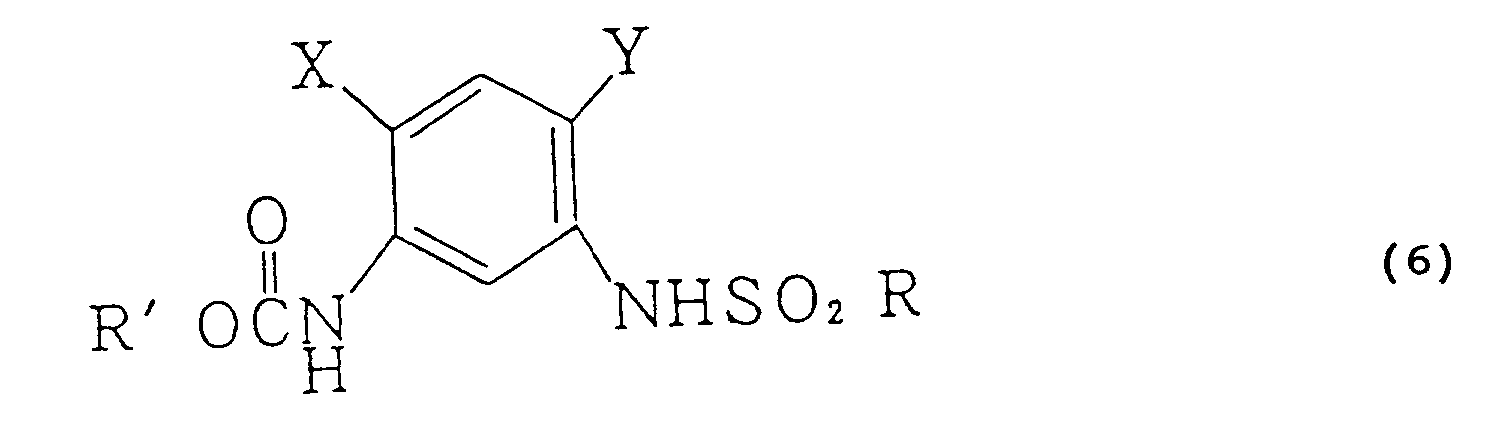
(wherein X,Y and Hal independently are halogen atoms, R is C₁-C₄ alkyl or C₁-C₃ haloalkyl and R' is C₁-C₄ alkyl or phenyl). - The present invention provides a process for producing a sulfoneamide derivative of formula (6):

wherein X and Y independently are a halogen atom, R is C₁-C₄ alkyl or C₁-C₃ haloalkyl and R' is C₁-C₄ alkyl or phenyl, which process comprises halogenating an anilide derivative of formula (5):
wherein X, R and R' are as defined above. - The anilide derivative of formula (5) may be produced by reacting a diamine derivative of formula (2):

wherein X and R are as defined above, with a halogenoformate of formula (12):
Hal―CO₂R' (12)
wherein Hal represents a halogen atom and R' is as defined above. - The diamine derivative of formula (2) may be produced by reducing a nitroaniline derivative of formula (1):

wherein X and R are as defined above. - The nitroaniline derivative of formula (1) may be produced by reacting a 4-halogeno-3-nitroaniline of formula (9):

wherein X is as defined above, with an alkylsulfonyl halide of formula (11):
Hal―SO₂R (11)
wherein Hal represents a halogen atom and R is as defined above. - The anilide derivative of formula (5) may also be produced by reacting an aminocarbanilide derivative of formula (4):

wherein X and R' are as defined above, with an alkylsulfonyl halide of formula (11) as defined above. - The aminocarbanilide derivative of formula (4) may be produced by reducing a nitrocarbanilide derivative of formula (3):

wherein R' and X are as defined above. - The nitrocarbanilide derivative of formula (3) may be produced by reacting a 2-halogeno-5-nitroaniline of formula (10):

wherein X is as defined above, with a halogenoformate of formula (12) as defined above. - The present invention also provides a nitroaniline derivative of formula (1) as defined above with the provisos that when X is fluorine R is not methyl, and when X is chlorine R is not methyl, chloromethyl or trifluoromethyl.
- The present invention additionally provides a diamine derivative of formula (2) as defined above with the proviso that when X is chlorine R is not methyl or trifluoromethyl.
- The present invention additionally provides a process for producing a nitroaniline derivative of formula (1) as defined above with the proviso that when X is chlorine R is not methyl, chloromethyl or trifluoromethyl or a diamine derivative of formula (2) as defined above with the proviso that when X is chlorine R is not trifluoromethyl, which process comprises; either
- (a) reacting a 4-halogeno-3-nitroaniline of formula (9) as defined above with an alkylsulfonyl halide of formula (11) as defined above, thereby obtaining a said nitroaniline derivative of formula (1); or
- (b) reducing a nitroaniline derivative of formula (1) as defined above, thereby obtaining a said diamine derivative of formula (2).
- The present invention further provides a nitrocarbanilide derivative of formula (3) as defined above with the proviso that when X is fluorine or chlorine R' is not methyl, when X is fluorine R' is not phenyl, and when X is chlorine R' is not ethyl; an aminocarbanilide derivative of formula (4) as defined above with the provisos that when X is fluorine or chlorine R' is not methyl, when X is fluorine R' is not phenyl, and when X is chlorine R' is not ethyl;
an anilide derivative of formula (5) as defined above with the proviso that when X is chlorine and R is trifluoromethyl R' is not ethyl; and a sulfonamide derivative of formula (6) as defined above. - The present invention further provides a process for producing a nitrocarbanilide derivative of formula (3) as defined above,
an aminocarbanilide derivative of formula (4) as defined above, an anilide derivative of formula (5) as defined above with the proviso that when X is chlorine and R is trifluoromethyl R' is not ethyl, or
a sulfonamide derivative of formula (6) as defined above, which process comprises; - (c) reacting a 2-halogeno-5-nitroaniline of formula (10) as defined above with a halogenoformate of formula (12) as defined above, thereby obtaining said nitrocarbanilide derivative of formula (3);
- (d) reducing a nitrocarbanilide derivative of formula (3) as defined above, thereby obtaining a said aminocarbanilide derivative of formula (4);
- (e) reacting an aminocarbanilide derivative of formula (4) as defined above with an alkylsulfonyl halide of formula (11) as defined above, thereby obtaining said anilide derivative of formula (5); or
- (f) halogenating an anilide derivative of formula (5) as defined above, thereby obtaining a said sulfonamide derivative of formula (6).
- The present invention yet further provides a process for producing a 6-haloalkyl-3-phenyluracil derivative of formula (8)

wherein X, Y and R are as defined above, which process comprises either; - (a) reacting a sulfonamide derivative of formula (6) as defined above with a compound of formula (14):

- or (b) reacting a sulfonamide derivative of formula (6) as defined above with a compound of formula (13):

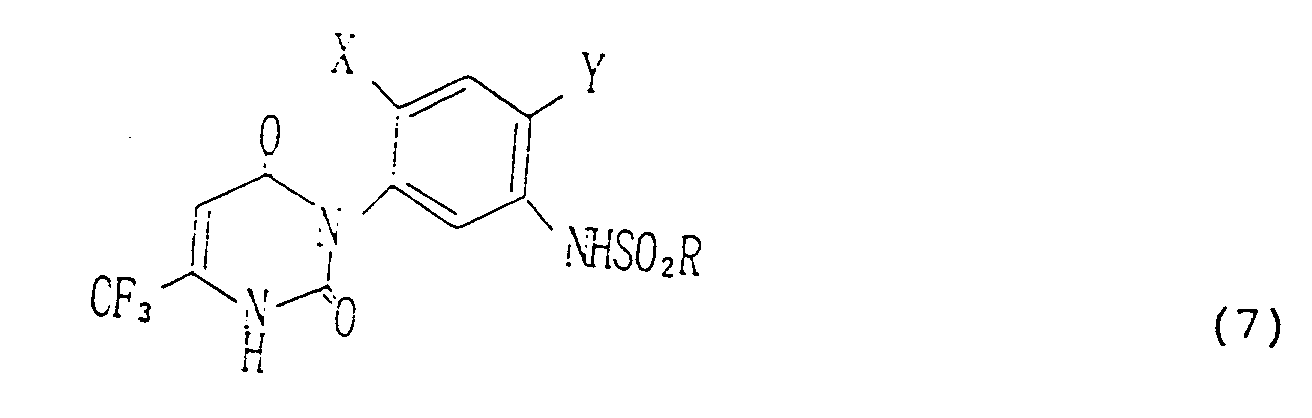
- In the above-described scheme, route 1 shows a process of producing a compound (5) with a high yield by subjecting a nitroaniline derivative (9) to sulfoneamidation, reducing the thus-obtained sulfoneamide derivative and carbamating the reduced product. Route 2 shows a process of producing a compound (5) with a high yield by carbamating a nitroaniline derivative (10), reducing the carbamated derivative and subjecting the reduced product to sulfoneamidation, and a process of producing a compound (6) with a high yield by halogenating the thus-obtained compound (5) positionally selectively.
- These steps may be carried out either sequentially or continuously by appropriately selecting the conditions. A compound (8) can be manufactured from the thus-obtained compound (6) [described in JP-A-2-400475 (1990) and JP-A-3-314391 (1991)] by the following routes:

(wherein X, Y, R and R' are as defined above, and R'' is C₁-C₆ alkyl, phenyl or benzyl). - The steps in the scheme will now be explained in more detail:
- Ordinarily, 0.5 to 3.0 mol of compound (11), preferably 0.8 to 1.5 mol, based on compound (9) is used. 0.5 to 10 mol of a base, preferably 0.8 to 5.0 mol, based on compound (9) is used. The base may be used as a solvent.
- Examples of the base are nitrogen-containing organic bases such as pyridine, triethylamine, N,N-dimethylaniline, N,N-diethylaniline, 4-(N,N-dimethylamino)pyridine and 1,4-diazabicyclo[2.2.2]octane, and inorganic bases such as sodium hydroxide, potassium hydroxide, sodium carbonate, potassium carbonate and sodium hydrogencarbonate.
- A solvent is ordinarily necessary for the reaction. Examples of the solvent are aliphatic hydrocarbons such as hexane, heptane, ligroin and petroleum ether; aromatic hydrocarbons such as benzene, toluene, xylene and chlorobenzene; halogenated hydrocarbons such as chloroform and methylene chloride; ethers such as diethyl ether, dioxane and tetrahydrofuran; ketones such as acetone and methyl ethyl ketone; nitriles such as acetonitrile and isobutylonitrile; tertiary amines such as pyridine and N,N-diethylaniline; acid amides such as N,N-dimethylacetamide, N,N-dimethylformamide and N-methylpyrrolidone; sulfur-containing compounds such as dimethylsulfoxide and sulfolane; and mixtures thereof. Among these, the aromatic hydrocarbons, halogenated hydrocarbons, tertiary amines and mixtures thereof are preferable.
- The reaction temperature is ordinarily -10 to 180°C, preferably 0°C to the reflux temperature.
- The reaction time is ordinarily 1 to 72 hours, preferably 2 to 48 hours.
- For reduction, a reagent reduction and catalytic hydrogenation may be adopted.
- Ordinarily, 1 to 20 mol of a reducing agent, preferably 2 to 10 mol, based on compound (1), is used.
- Examples of the reducing agent are metals and metal salts such as zinc, aluminium, tin, stannous chloride and iron.
- The reaction ordinarily requires a solvent. Examples of the solvent are organic acids such as formic acid and acetic acid; inorganic acids such as hydrochloric acid, hydrobromic acid and sulfuric acid; esters such as ethyl acetate and butyl acetate; ketones such as acetone and methyl ethyl ketone; ethers such as tetrahydrofuran and dioxane; alcohols such as methanol and ethanol; water; and mixtures thereof.
- The reaction temperature is ordinarily 0 to 150°C, preferably 40°C to the reflux temperature.
- The reaction time is ordinarily 15 minutes to 24 hours, preferably 0.5 to 8 hours.
- Ordinarily, 2.8 to 3.2 mol of hydrogen, preferably 2.9 to 3.1 mol, based on compound (1), is used. 0.001 to 10 wt% of a catalyst, preferably 0.005 to 5 wt%, based on compound (1), is used.
- Examples of the catalyst are platinum catalysts such as platinum oxide (IV), platinum black, platinum carbon powder, and platinum carbon sulfide powder; palladium catalysts such as palladium carbon powder, palladium alumina powder, palladium black and palladium oxide; osmium catalysts such as osmium carbon powder; rhenium catalysts such as rhenium carbon powder; and nickel catalysts such as Raney nickel.
- It is possible to add an inorganic acid such as sulfuric acid, hydrochloric acid, phosphoric acid and perchloric acid, and a base such as pyridine and triethylamine in order to accelerate the reaction.
- The reaction ordinarily requires a solvent. Examples of the solvent are organic acids such as formic acid and acetic acid; esters such as ethyl acetate and butyl acetate; ethers such as diethyl ether, tetrahydrofuran and dioxane; alcohols such as methanol and ethanol; aliphatic hydrocarbons such as cyclohexane and heptane; aromatic hydrocarbons such as benzene and toluene; acid amides such as N,N-dimethylformamide; water; and mixtures thereof. Among these, the organic acides, ethers, alcohols, aliphatic hydrocarbons, water and mixtures thereof are preferable.
- The reaction temperature is ordinarily 0 to 200°C, preferably 25 to 150°C.
- The reaction time is ordinarily 0.5 to 24 hours, preferably 1 to 12 hours.
- The reaction pressure is ordinarily 0 to 200 atm, preferably 0 to 100 atm (Gauge).
- Ordinarily, 0.5 to 2.0 mol of compound (12), preferably 0.8 to 1.2 mol, based on compound (2), is used.
- Ordinarily, 0.5 to 2.0 mol of a base, preferably 0.8 to 1.5 mol, based on compound (2), is used. The base may be used as a solvent.
- Examples of the base are nitrogen-containing organic bases such as pyridine, triethylamine, N,N-dimethylaniline, N,N-diethylaniline, 4-(N,N-dimethylamino)pyridine and 1,4-diazabicyclo[2.2.2]octane and inorganic bases such as sodium hydroxide, potassium hydroxide, sodium carbonate, potassium carbonate and sodium hydrogencarbonate.
- A solvent is ordinarily necessary for the reaction. Examples of the solvent are aliphatic hydrocarbons such as hexane, heptane, ligroin and petroleum ether; aromatic hydrocarbons such as benzene, toluene, xylene and chlorobenzene; halogenated hydrocarbons such as chloroform and methylene chloride; ethers such as diethyl ether, dioxane and tetrahydrofuran; ketones such as acetone and methyl ethyl ketone; nitriles such as acetonitrile and isobutylonitrile; tertiary amines such as pyridine and N,N-diethylaniline; acid amides such as N,N-dimethylacetamide, N,N-dimethylformamide and N-methylpyrrolidone; sulfur-containing compounds such as dimethylsulfoxide and sulfolane; and mixtures thereof. Among these, the aromatic hydrocarbons, halogenated hydrocarbons, ketones, nitriles, tertiary amines and mixtures thereof are preferable.
- The reaction temperatrure is ordinarily -10°C to the reflux temperature.
- The reaction time is ordinarily 0.5 to 72 hours, preferably 1 to 12 hours.
- Ordinarily 0.5 to 2.0 mol of compound (12), preferably 0.8 to 1.5 mol, based on compound (10), is used.
- Ordinarily, 0.5 to 2.0 mol of a base, preferably 0.8 to 1.6 mol, based on compound (10), is used. The base may be used as a solvent.
- Examples of the base are nitrogen-containing organic bases such as pyridine, triethylamine, N,N-dimethylaniline, N,N-diethylaniline, 4-(N,N-dimethylamino)pyridine and 1,4-diazabicyclo[2.2.2]octane and inorganic bases such as sodium hydroxide, potassium hydroxide, sodium carbonate, potassium carbonate and sodium hydrogencarbonate.
- A solvent is ordinarily necessary for the reaction. Examples of the solvent are aliphatic hydrocarbons such as hexane, heptane, ligroin and petroleum ether; aromatic hydrocarbons such as benzene, toluene, xylene and chlorobenzene; halogenated hydrocarbons such as chloroform and methylene chloride; ethers such as diethyl ether, dioxane and tetrahydrofuran; ketones such as acetone and methyl ethyl ketone; nitriles such as acetonitrile and isobutylonitrile; tertiary amines such as pyridine and N,N-diethylaniline; acid amides such as N,N-dimethylacetamide, N,N-dimethylformamide and N-methylpyrrolidone; sulfur-containing compounds such as dimethylsulfoxide and sulfolane; and mixtures thereof. Among these, the aromatic hydrocarbons, halogenated hydrocarbons, ketones, nitriles, tertiary amines and mixtures thereof are preferable.
- The reaction temperature is ordinarily -10°C to the reflux temperature.
- The reaction time is ordinarily 0.5 to 72 hours, preferably 1 to 48 hours.
- The reaction is carried out under the same conditions as those in (B): Production of compound (2) from compound (1).
- Ordinarily, 0.5 to 3.0 mol of compound (11), preferably 0.8 to 1.5 mol, based on compound (4), is used.
- Ordinarily, 0.5 to 10 mol of a base, preferably 0.8 to 5.0 mol, based on compound (4), is used. The base may be used as a solvent.
- Examples of the base are nitrogen-containing organic bases such as pyridine, triethylamine, N,N-dimethylaniline, N,N-diethylaniline, 4-(N,N-dimethylamino)pyridine and 1,4-diazabicyclo[2.2.2]octane, and inorganic bases such as sodium hydroxide, potassium hydroxide, sodium carbonate, potassium carbonate and sodium hydrogencarbonate.
- A solvent is ordinarily necessary for the reaction. Examples of the solvent are aliphatic hydrocarbons such as hexane, heptane, ligroin and petroleum ether; aromatic hydrocarbons such as benzene, toluene, xylene and chlorobenzene; halogenated hydrocarbons such as chloroform and methylene chloride; ethers such as diethyl ether, dioxane and tetrahydrofuran; ketones such as acetone and methyl ethyl ketone; nitriles such as acetonitrile and isobutylonitrile; tertiary amines such as pyridine and N,N-diethylaniline; acid amides such as N,N-dimethylacetamide, N,N-dimethylformamide and N-methylpyrrolidone; sulfur-containing compounds such as dimethylsulfoxide and sulfolane; and mixtures thereof. Among these, the aromatic hydrocarbons, halogenated hydrocarbons, tertiary amines and mixture thereofs are preferable.
- The reaction temperature is ordinarily -10 to 180 °C, preferably 0 °C to the reflux temperature.
- The reaction time is ordinarily 1 to 72 hours, preferably 2 to 48 hours.
- Ordinarily, 0.5 to 5.0 mol of a halogenating agent, preferably 0.8 to 1.5 mol, based on compound (5), is used.
- Examples of the halogenating agent are halogens such as chlorine and bromine, hydrogen chloride, sulfuryl chloride, N-chlorosuccineimide, N-bromosuccineimide, N-chloroisocyanuric acid, cuprous bromide and antimony pentachloride.
- A solvent is ordinarily necessary for the reaction. Examples of the solvent are organic acids such as formic acid and acetic acid; aliphatic hydrocarbons such as hexane, heptane, ligroin and petroleum ether; aromatic hydrocarbons such as benzene, toluene, xylene and chlorobenzene; halogenated hydrocarbons such as chloroform and methylene chloride; ethers such as diethyl ether, dioxane and tetrahydrofuran; sulfolane; water; and mixtures thereof. Among these, the organic acids, ethers, water and mixtures thereof are preferable.
- The reaction temperature is ordinarily 0 to 200 °C, preferably 10 to 130°C.
- The reaction time is ordinarily 0.5 to 24 hours, preferably 1 to 12 hours.
- The thus-obtained sulfoneamide derivative (6) is used as an intermediate for producing a 6-haloalkyl-3-phenyluracil derivative, which is useful as a herbicide, as is seen from the later-described Reference Examples.
- The diamine derivative (2), the nitrocarbanilide derivative (3), the aminocarbanilide derivative (4) and the anilide derivative (5) are also useful intermediates for producing the sulfoneamide derivative (6).
- Intermediates and a process for producing the same according to the present invention and a process for producing a herbicide by using the intermediate of the present invention will be explained in more detail with reference to the following Examples.
-

- 20.2 g (0.129 mol) of 4-fluoro-3-nitroaniline was dissolved in 120 ml of pyridine, and 17.8 g (0.136 mol) of ethanesulfonyl chloride was added dropwise to the solution at a temperature of not higher than 5 °C. Thereafter the temperature was raised to room temperature and the reaction was continued for one night. After the pyridine was distilled off, the thus-obtained product was dissolved in ethyl acetate and washed with diluted hydrochloric acid twice, then with water, and with saturated saline solution. The solution was dried over anhydrous sodium sulfate, and the ethyl acetate was distilled off to obtain the crude product (crystals). The crude product was washed with diisopropyl ether, thereby obtaining 29.7 g of the objective product (yield: 93%) in the form of brown crystals. Melting point: 133 to 136 °C
¹H-NMR (d₆- DMSO): δ
1.36 (3H, t, J = 7Hz), 3.16 (2H, q, J = 7Hz), 7.31 (1H, dd, J = 10 Hz), 7.63 (1H, ddd, J = 2, 7, 10Hz), 8.07 (1H, dd, J = 2, 7Hz), 10.66 (1H, br s) -

- A mixture of 63.1 g (1.13 mol) of iron powder and 120 ml of an aqueous solution of 5% acetic acid was heated to 80 °C, and a mixed solution of 28.0 g (0.113 mol) of N-(4-fluoro-3-nitrophenyl)ethanesulfonamide, 116 ml of acetic acid and 116 ml of ethyl acetate was slowly added dropwise to the resultant mixture. After the reaction was continued for 3 hours, the insolubles were filtered out and washed with ethyl acetate. Thereafter the filtrate was distilled to remove the solvent, and the product was dissolved in ethyl acetate and washed with saturated sodium hydrogencarbonate, water and saturated saline solution. The solution was dried over anhydrous sodium sulfate, and the ethyl acetate was distilled off to obtain the crude product (crystals). The crude product was washed with diisopropyl ether, thereby obtaining 22.0 g of the objective product (yield: 89%) in the form of light yellow crystals.
Melting point: 106 to 108 °C
¹H-NMR (d₆-DMSO): δ
1.28 (3H, t, J = 7Hz), 3.05 (2H, q, J = 7Hz), 4.40 (2H, br s), 6.48 (1H, ddd, J = 2, 7, 10Hz), 6.77 (1H, dd, J = 2, 7Hz), 6.89 (1H, dd, J = 10Hz) -

- 10.0 g (50.5 mmol) of ethyl 5-amino-2-fluorcarbanilate was dissolved in 60 ml of pyridine, and 6.82 g (53.0 mmol) of ethanesulfonyl chloride was added dropwise to the solution at a temperature of not higher than 5 °C. Thereafter the temperature was raised to room temperature and the reaction was continued for one night. After the pyridine was distilled off, the thus-obtained product was dissolved in ethyl acetate and washed with diluted hydrochloric acid twice, then with water, and with saturated saline solution. The solution was dried over anhydrous sodium sulfate, and the ethyl acetate was distilled off to obtain the crude product (crystals). The crude product was recrystallized from ethyl acetate-diisopropyl ether, thereby obtaining 9.74 g of the objective product (yield: 67%) in the form of white crystals.

- 10.7 g (98.2 mmol) of ethyl chloroformate was added drop-wise to a mixture of 21.4 g (98.2 mmol) of N-(3-amino-4-fluorophenyl) ethanesulfonamide, 7.76 g (98.2 mmol) of pyridine and 214 ml of dichloromethane at a temperature of not higher than 5 °C. Thereafter the temperature was raised to room temperature and the reaction was continued for 5 hours. After the dichloromethane layer was separated out by adding water to the reaction mixture, the dichloromethane layer was washed with saturated saline solution and dried over anhydrous sodium sulfate. Thereafter the dichloromethane was distilled off to obtain the crude product (crystals). The crude product was washed with diisopropyl ether, thereby obtaining 28.0 g of the objective product (yield: 98%) in the form of white crystals.Melting point: 107 to 110 °C
¹H-NMR (d₆ - DMSO): δ
1.30 (6H, t, J = 7Hz), 3.06 (2H, q, J = 7Hz), 4.22 (1H, q, J = 7Hz), 7.00 (2H, br d, J = 8Hz), 7.94 (1H, br d, J = 7Hz), 8.19 (1H, br s), 10.41 (1H, br s) -

- 10.7 g (98.9 mmol) of ethyl chloroformate was added drop-wise to a mixture of 15.0 g (94.2 mmol) of 2-fluoro-5-nitroaniline, 8.20 g (104 mmol) of pyridine and 150 ml of dichloromethane at a temperature of not higher than 5°C. Thereafter the temperature was raised to room temperature and the reaction was continued for one night. After the dichloromethane layer was separated out by adding water to the reaction mixture, the dichloromethane layer was washed with saturated saline solution and dried over anhydrous sodium sulfate. Thereafter the dichloromethane was distilled off to obtain the crude product (crystals). The crude product was washed with hexane, thereby obtaining 21.1 g of the objective product (yield: 98%) in the form of ocher crystals.
Melting point: 90 to 92°C
¹H-NMR (CDCl₃): δ
1.34 (3H, t, J = 7Hz), 4.30 (2H, q, J = 7Hz), 7.22 (1H, br, s), 7.22 (1H, t, J = 9Hz), 7.91 (1H, ddd, J = 3, 6, 9Hz), 9.03 (1H, dd, J = 3, 6Hz) -

- A mixture of 39.4 g (706 mmol) of iron powder and 75 ml of an aqueous solution of 5% acetic acid was heated to 80°C, and a mixed solution of 16.1 g (70.6 mmol) of ethyl 2-fluoro-5-nitrocarbanilate, 72 ml of acetic acid and 72 ml of ethyl acetate was slowly added dropwise to the mixture. After the reaction was continued for 3 hours, the insolubles were filtered out and washed with ethyl acetate. Thereafter the filtrate was distilled to remove the solvent, and the resultant product was dissolved in ethyl acetate and washed with saturated sodium hydrogen-carbonate, water and saturated saline solution. The solution was dried over anhydrous sodium sulfate, and the ethyl acetate was distilled off to obtain the crude product (crystals). The crude product was washed with diisopropyl ether, thereby obtaining 12.8 g of the objective product (yield: 91%) in the form of light yellow crystals.
Melting point: 88 to 89°C
¹H-NMR (CDCl₃): δ
1.24 (3H, t, J = 7Hz), 3.78 (2H, br s), 4.19 (2H, q, J = 7Hz), 6.23 (1H, ddd, J = 2, 7, 10Hz), 6.80 (1H, dd, J = 10 Hz), 7.23 (1H, br s), 7.44 (1H, dd, J = 2, 7Hz) -

- 1.00 g (3.45 mmol) of ethyl 5-ethylsulfonylamino-2-fluorocarbanilate was dissolved in 10 ml of acetic acid, and chlorine gas was added to the resultant solution at a temperature of not higher than 25°C until the starting material disappeared. After the reaction was completed, the surplus chlorine gas was removed by blowing nitrogen gas thereinto, and diisopropyl ether was added. The precipitated crystals were filtered out to obtain 0.76 g of the objective product (yield: 68%) in the form of white crystals.

- 0.50 g (1.72 mmol) of ethyl 5-ethylsulfonylamino-2-fluorocarbanilate was added to 4 ml of sulfuryl chloride. The sulfuryl chloride was distilled off after 10 minutes, and the resultant product was dissolved in ethyl acetate. The solution was washed with water and a saturated saline solution, and dried over anhydrous sodium sulfate. The ethyl acetate was distilled off to obtain the crude product. The crude product was washed with diisopropyl ether, thereby obtaining 0.21 g of the objective product (yield: 38%) in the form of white crystals.

- 0.50 g (1.72 mmol) of ethyl 5-ethylsulfonylamino-2-fluorocarbanilate was dissolved in a mixed solution of 12 ml of acetic acid and 1 ml of water, and chlorine gas was added to the resultant solution at a temperature of not higher than 25°C until the starting material disappeared. After the reaction was completed, the surplus chlorine gas was removed by blowing nitrogen gas thereinto, and water was added. The precipitated crystals were filtered out and dried to obtain 0.49 g of the objective product (yield: 88%) in the form of white crystals.
Melting point: 162 to 164 °C
¹H-NMR (d₆-DMSO): δ
1.28 (3H, t, J = 7Hz), 1.32 (3H, t, J = 7Hz), 3.08 (2H, q, J = 7Hz), 4.12 (2H, q, J = 7Hz), 7.13 (1H, d, J = 9Hz), 7.88 (1H, d, J = 7Hz), 8.88 (1H, br s), 8.94 (1H, br s) -

- 50.4 mg (5 wt%) of platinum oxide (Adams catalyst) was added to a mixture of 1.00 g (4.03 mmol) of N-(4-fluoro-3-nitrophenyl)ethanesulfoneamide and 40 ml of ethanol, and the resultant mixture was stirred until 285 ml of hydrogen was absorbed. The reaction mixture was filtered through a glass filter to remove the catalyst, and the solvent was then distilled off under a reduced pressure. Thus, 850 mg of the objective product (yield: 97%) was obtained in the form of light brown crystals.
-

- 22.1 g (229 mmol) of methyl chloroformate was added drop-wise to a mixture of 50.0 g (229 mmol) of N-(3-amino-4-fluorophenyl)ethanesulfonamide, 18.1 g (229 mmol) of pyridine and 500 ml of dichloromethane at a temperature of not higher than 5 °C. Thereafter the temperature was raised to room temperature and the reaction was continued for 5 hours. After the dichloromethane layer was separated out by adding water to the resultant mixture, the dichloromethane layer was washed with saturated saline solution and dried over anhydrous sodium sulfate. Thereafter the dichloromethane was distilled off to obtain the crude product (crystals). The crude product was washed with diisopropyl ether, thereby obtaining 61.0 g of the objective product (yield: 96%) in the form of light brown crystals.
-

- 100.3 mg (10 wt%) of 5% palladium carbon (containing water) was added to a mixture of 1.00 g (4.39 mmol) of ethyl 2-fluoro-5-nitrocarbanilate and 20 ml of ethanol, and the resultant mixture was stirred until 309 ml of hydrogen was absorbed. The reaction mixture was filtered to remove the catalyst, and the solvent was then distilled off under a reduced pressure. Thus, 700 mg of the objective product (yield: 81%) was obtained in the form of light brown crystals.
-
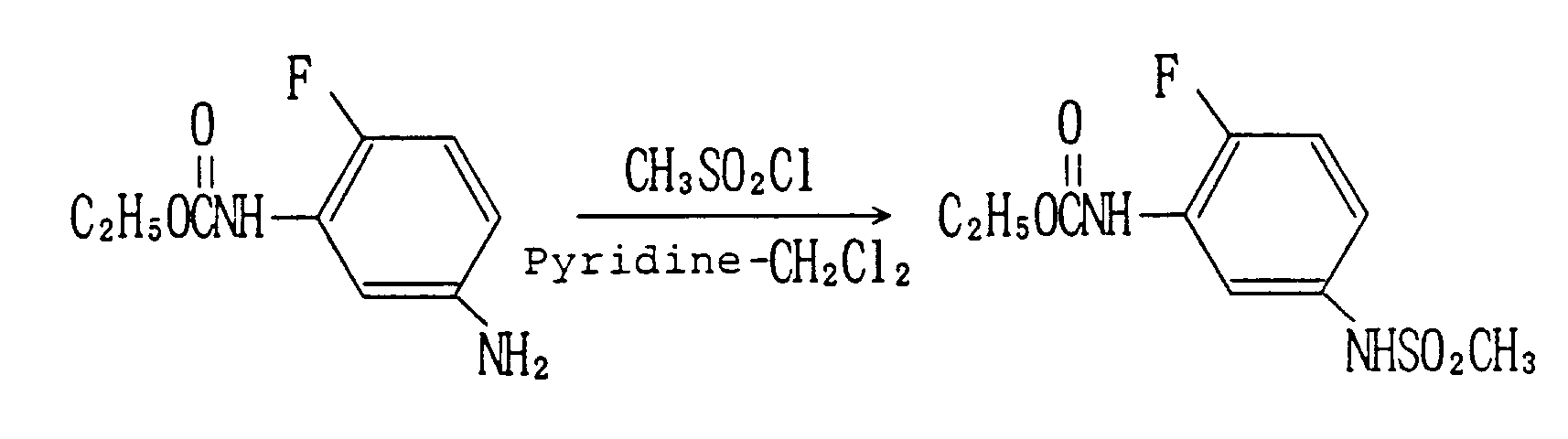
- 61.1 g (533 mmol) of methanesulfonyl chloride was added dropwise to a mixture of 96.0 g (485 mmol) of ethyl 5-amino-2-fluorocarbanilate, 46.0 g (582 mmol) of pyridine and 700 ml of dichloromethane at a temperature of not higher than 5 °C. Thereafter the temperature was raised to room temperature and the reaction was continued for one night. After the solvent was distilled off, the resultant product was dissolved in ethyl acetate and washed with diluted hydrochloric acid twice, then with water, and with saturated saline solution. The resultant solution was dried over anhydrous sodium sulfate, and the ethyl acetate was distilled off to obtain the crude procut (crystals). The crude product was washed with diisopropyl ether, thereby obtaining 126 g of the objective product (yield: 94%) in the form of light brown crystals.
-

- 0.50 g (1.72 mmol) of ethyl 5-ethylsulfonylamino-2-fluorocarbanilate was dissolved in a mixture of 5 ml of dioxane and 1 ml of water, and chlorine gas was added to the resultant solution at a temperature of not higher than 25 °C until the starting material disappeared. After the reaction was completed, the surplus chlorine gas was removed by blowing nitrogen gas thereinto, and water was added. The precipitates crystals were filtered out and dried to obtain 0.48 g of the objective product (yield: 86%) in the form of light brown crystals.
-

- 80.6 g (292 mmol) of ethyl 5-methylsulfonylamino-2-fluorocarbanilate was dissolved in a mixture of 1075 ml of acetic acid and 100 ml of water, and chlorine gas was added to the resultant solulion at a temperature of not higher than 25 °C until the starting material disappeared. After the reaction was completed, the surplus chlorine gas was removed by blowing nitrogen gas thereinto, and hexane was added. The precipitates crystals were filtered out to obtain 81.4 g of the objective product (yield: 90%) in the form of yellow crystals.
-

- 1.06 g (5.77 mmol) of ethyl 3-amino-4,4,4-trifluorocrotonate was dissolved in 6.2 ml of N,N-dimethylformamide and 0.82 g (14.4 mmol) of sodium methoxide was added thereto. The reaction mixture was cooled to not higher than 5 °C after 10 minutes, and 1.56 g (4.81 mmol) of ethyl 4-chloro-5-ethylsulfonylamino-2-fluorocarbanilate was added thereto. The resultant mixture was heated to 110 °C and reacted for 4 hours. After the reaction was completed, N,N-dimethylformamide was distilled off and the resultant product was dissolved in water. The thus-obtained solution was washed with diethyl ether 3 times and thereafter concentrated hydrochloric acid was added thereto to pH 2. The precipitated crystals were filtered out, washed with water and dried to obtain 1.54 g of the objective product (yield: 77%) in the form of light yellow crystals.
Melting point: 190 to 192 °C
¹H-NMR (d₆-DMSO): δ
1.36 (3H, t, J = 7Hz), 3.12 (2H, q, J = 7Hz), 6.19 (1H, s), 7.44 (1H, d, J = 9Hz), 7.58 (1H, d, J = 7Hz), 8.86 (1H, br s), 9.20 (1H, br s) -

- 1.00 g (2.41 mmol) of 3-(4-chloro-5-ethylsulfonylamino-2-fluorophenyl)-6-trifluoromethyl-2,4 (1H, 3H)-pyrimidinedione was dissolved in 10 ml of acetone, and 0.17 g (1.20 mmol) of anhydrous potassium carbonate and 0.23 ml (2.41 mmol) of dimethyl sulfate were added thereto and the reaction was continued for 1.5 hours. After acetone was distilled off, the reaction product was dissolved in ethyl acetate, washed with water and saturated saline solution, and dried over anhydrous sodium sulfate. Thereafter the ethyl acetate was distilled off to obtain a crude product. The crude product was recrystallized from chloroformdiethyl ether, thereby obtaining 0.61 g of the objective product (yield: 59 %) in the form of light yellow crystals.
Melting point: 176 to 177 °C
¹H-NMR (d₆-DMSO): δ
1.32 (3H, t, J = 7Hz), 3.06 (2H, q, J = 7Hz), 3.43 (3H, s), 6.23 (1H, s), 7.29 (1H, d, J = 9Hz), 7.41 (1H, d, J = 7Hz), 9.11 (1H, br s) - 50 parts of 3-(4-chloro-5-ethylsulfonylamino-2-fluorophenyl)-1-methyl-6-trifluoromethyl-2,4-(1H,3H)-pyrimidinedione, 47 parts of Zeeklite (Kaolin clay, produced by Zeeklite Mining Industries Co., Ltd.), 2 parts of Sorpol 5039 (anionic surfactant, produced by Toho Chemical Ind. Co., Ltd.) and 1 part of Carplex (white carbon, produced by Shionogi Co., Ltd.) were uniformly mixed and pulverized to produce a wettable powder.
- Sterilized diluvial soil was placed into a plastic box [15 cm(long) x 22 cm(wide) x 6 cm(deep)] , and sowed at random with the seeds of Echinochloa crus-qalli, Digitaria, adscendens, Cyperus microiria, Solanum nigrum, Galinsoga ciliata, Rorippa indica, rice, corn, wheat, soybean and cotton. The diluvial soil was then covered with soil to a depth of about 1 cm, and the wettable powder diluted with water was uniformly sprayed onto the surface of the soil at a predetermined rate. The herbicidal effect on the respective grasses was examined after 3 weeks in accordance with the following evaluation criteria:
-
- 5:
- Growth control rate of more than 90% (almost completely withered)
- 4:
- Growth control rate of from 70 to 90%
- 3:
- Growth control rate of from 40 to 70%
- 2:
- Growth control rate of from 20 to 40%
- 1:
- Growth control rate of from 5 to 20%
- 0:
- Growth control rate of less than 5% (almost non-effective)
- T:
- weight of the weed growth above the soil surface of the treated area,
- N:
- weight of the weed grown above the soil surface of the non-treated area.
- In Table 1, the respective symbols represent the following grasses.
- N (Echinochloa crus-qalli), M (Digitaria adscendens), K (Cyperus microiria), H (Solanum nigrum), D (Galinsoga ciliata), I (Rorippa indica), R (rice), T (corn), W (wheat), S (soybean) and C (cotton)
Table 1 Dosage (g/ha) N M K H D I R T W S C 10 5 3 5 5 5 5 0 0 0 0 2 20 5 4 5 5 5 5 1 0 0 0 4 40 5 5 5 5 5 5 3 0 0 0 5
The above growth control rates were calculated by the following equation:

Claims (13)
- A process for producing a sulfonamide derivative of formula (6):

- A process according to claim 1 in which the anilide derivative of formula (5) is produced by reacting a diamine derivative of formula (2):

Hal―CO₂R' (12)
wherein Hal represents a halogen atom and R' is as defined in claim 1. - A process according to claim 2 in which the diamine derivative of formula (2) is produced by reducing a nitroaniline derivative of formula (1):

- A process according to claim 3 in which the nitroaniline derivative of formula (1) is produced by reacting a 4-halogeno-3-nitroaniline of formula (9):

Hal―SO₂R (11)
wherein Hal represents a halogen atom and R is as defined in claim 1. - A process according to claim 1 in which the anilide derivative of formula (5) is produced by reacting an aminocarbanilide derivative of formula (4):

- A process according to claim 5 in which the aminocarbanilide derivative of formula (4) is produced by reducing a nitrocarbanilide derivative of formula (3):

- A process according to claim 6 in which the nitrocarbanilide derivative of formula (3) is produced by reacting a 2-halogeno-5-nitroaniline of formula (10):

- A nitroaniline derivative of formula (1) as defined in claim 3 with the provisos that when X is fluorine R is not methyl, and when X is chlorine R is not methyl, chloromethyl or trifluoromethyl; and a diamine derivative of formula (2) as defined in claim 2 with the proviso that when X is chlorine R is not methyl or trifluoromethyl.
- A process for producing a nitroaniline derivative of formula (1) as defined in claim 3 with the proviso that when X is chlorine R is not methyl, chloromethyl or trifluoromethyl or a diamine derivative of formula (2) as defined in claim 2 with the proviso that when X is chlorine R is not trifluoromethyl, which process comprises; either(a) reacting a 4-halogeno-3-nitroaniline of formula (9) as defined in claim 4 with an alkylsulfonyl halide of formula (11) as defined in claim 4, thereby obtaining a said nitroaniline derivative of formula (1); or(b) reducing a nitroaniline derivative of formula (1) as defined in claim 3, thereby obtaining a said diamine derivative of formula (2).
- A nitrocarbanilide derivative of formula (3) as defined in claim 6 with the provisos that when X is fluorine or chlorine R' is not methyl, when X is fluorine R' is not phenyl, and when X is chlorine R' is not ethyl;
an aminocarbanilide derivative of formula (4) as defined in claim 5 with the provisos that when X is fluorine or chlorine R' is not methyl, when X is fluorine R' is not phenyl, and when X is chlorine R' is not ethyl;
an anilide derivative of formula (5) as defined in claim 1 with the proviso that when X is chlorine and R is trifluoromethyl R' is not ethyl;
and
a sulfonamide derivative of formula (6) as defined in claim 1. - A process for producing a nitrocarbanilide derivative of formula (3) as defined in claim 6, an aminocarbanilide derivative of formula (4) as defined in claim 5,
an anilide derivative of formula (5) as defined in claim 1 with the proviso that when X is chlorine and R is trifluoromethyl R' is not ethyl, or
a sulfonamide derivative of formula (6) as defined in claim 1, which process comprises;(c) reacting a 2-halogeno-5-nitroaniline of formula (10) as defined in claim 7 with a halogenoformate of formula (12) as defined in claim 7, thereby obtaining a said nitrocarbanilide derivative of formula (3);(d) reducing a nitrocarbanilide derivative of formula (3) as defined in claim 6, thereby obtaining a said aminocarbanilide derivative of formula (4);(e) reacting an aminocarbanilide derivative of formula (4) as defined in claim 5 with an alkylsulfonyl halide of formula (11) as defined in claim 4, thereby obtaining said anilide derivative of formula (5); or(f) halogenating an anilide derivative of formula (5) as defined in claim 1, thereby obtaining a said sulfonamide derivative of formula (6). - A process for producing a 6-haloalkyl-3-phenyluracil derivative of formula (8)
 (a) reacting a sulfonamide derivative of formula (6) as defined in claim 1 with a compound of formula (14):
 or (b) reacting a sulfonamide derivative of formula (6) as defined in claim 1 with a compound of formula (13):

- A process according to claim 12 which further comprises formulating the compound of formula (8) thus obtained with a herbicidally acceptable carrier or diluent.
Applications Claiming Priority (4)
| Application Number | Priority Date | Filing Date | Title |
|---|---|---|---|
| JP6332/91 | 1991-01-23 | ||
| JP633291 | 1991-01-23 | ||
| JP319421/91 | 1991-12-03 | ||
| JP31942191A JP3312629B2 (en) | 1991-01-23 | 1991-12-03 | Aniline derivatives and manufacturing method |
Publications (2)
| Publication Number | Publication Date |
|---|---|
| EP0496595A1 EP0496595A1 (en) | 1992-07-29 |
| EP0496595B1 true EP0496595B1 (en) | 1995-09-06 |
Family
ID=26340443
Family Applications (1)
| Application Number | Title | Priority Date | Filing Date |
|---|---|---|---|
| EP92300543A Expired - Lifetime EP0496595B1 (en) | 1991-01-23 | 1992-01-22 | Aniline derivatives and process for producing the same |
Country Status (5)
| Country | Link |
|---|---|
| US (1) | US5416236A (en) |
| EP (1) | EP0496595B1 (en) |
| JP (1) | JP3312629B2 (en) |
| AT (1) | ATE127449T1 (en) |
| DE (1) | DE69204480T2 (en) |
Families Citing this family (5)
| Publication number | Priority date | Publication date | Assignee | Title |
|---|---|---|---|---|
| US5962372A (en) * | 1994-04-25 | 1999-10-05 | Bayer Aktiengesellschaft | N-cyanoaryl nitrogen heterocycles |
| WO1998028280A1 (en) * | 1996-12-23 | 1998-07-02 | Fmc Corporation | Certain 3-[2,4-disubstituted-5-(substituted amino)phenyl]-1-substituted-6-trifluoromethyl-2,4-(1h,3h)-pyrimidinedione derivatives as herbicides |
| US5817814A (en) * | 1997-05-01 | 1998-10-06 | Fmc Corporation | Method for the preparation of benzyluracils |
| DE19800531A1 (en) * | 1998-01-09 | 1999-07-15 | Bayer Ag | Process for the preparation of N- (3-amino-4-fluorophenyl) sulfonamides, N- (3-amino-4-fluorophenyl) carboxamides and N- (3-amino-4-fluorophenyl) - carbamates |
| AU2001260607A1 (en) * | 2000-05-24 | 2001-12-03 | Nissan Chemical Industries Ltd. | Nitrile compounds and process for their preparation |
Family Cites Families (15)
| Publication number | Priority date | Publication date | Assignee | Title |
|---|---|---|---|---|
| BE465025A (en) * | 1945-01-27 | |||
| CH510386A (en) * | 1969-04-30 | 1971-07-31 | Ciba Geigy Ag | Use of halomethylsulfanyl compounds as selective herbicides |
| US3758688A (en) | 1969-06-12 | 1973-09-11 | Riker Laboratories Inc | Substituted sulfonanilides in the treatment of inflammation |
| US3639474A (en) | 1969-06-12 | 1972-02-01 | Minnesota Mining & Mfg | N-substituted perfluoroalkane-sulfonamides |
| US4163659A (en) | 1970-12-21 | 1979-08-07 | Minnesota Mining And Manufacturing Company | Stunting plant growth with N-substituted perfluoroalkanesulfonamides |
| US3920444A (en) | 1970-12-21 | 1975-11-18 | Minnesota Mining & Mfg | Method comprising the use of N-substituted perfluoroalkyanesulfonamides as herbicidal and plant growth modifying agents, and composition |
| US4349378A (en) * | 1978-07-25 | 1982-09-14 | Fbc Limited | Compounds useful as pesticides |
| DE2938633A1 (en) * | 1979-09-25 | 1981-04-09 | Bayer Ag, 5090 Leverkusen | AZO DYES AND THE PRODUCTION AND USE THEREOF FOR COLORING SYNTHESIS FIBERS |
| DE3264031D1 (en) * | 1981-07-06 | 1985-07-11 | Eastman Kodak Co | Color-forming sulfonamidodiphenylamines, photographic elements containing them and corresponding phenazine dyes |
| US4483986A (en) * | 1982-05-03 | 1984-11-20 | Eli Lilly And Company | 4-Nitrobenzophenone compounds |
| US4629811A (en) * | 1982-05-03 | 1986-12-16 | Eli Lilly And Company | 3-sulfonylamino-4-aminobenzophenone derivatives |
| US4507320A (en) * | 1983-12-07 | 1985-03-26 | Smithkline Beckman Corporation | Dopaminergic agonist N,N-di-n-propyl-4-hydroxy-3-methanesulfonamidophenethylamine |
| US4885367A (en) * | 1987-11-19 | 1989-12-05 | Taisho Pharmaceutical Co., Ltd. | Sulfonanilide compounds |
| US5084084A (en) * | 1989-07-14 | 1992-01-28 | Nissan Chemical Industries Ltd. | Uracil derivatives and herbicides containing the same as active ingredient |
| EP0416684B1 (en) * | 1989-09-05 | 1997-01-29 | Eastman Kodak Company | Photographic yellow couplers, method for their preparation and intermediates therefor |
-
1991
- 1991-12-03 JP JP31942191A patent/JP3312629B2/en not_active Expired - Fee Related
-
1992
- 1992-01-22 AT AT92300543T patent/ATE127449T1/en not_active IP Right Cessation
- 1992-01-22 EP EP92300543A patent/EP0496595B1/en not_active Expired - Lifetime
- 1992-01-22 DE DE69204480T patent/DE69204480T2/en not_active Expired - Fee Related
-
1994
- 1994-06-23 US US08/264,761 patent/US5416236A/en not_active Expired - Fee Related
Also Published As
| Publication number | Publication date |
|---|---|
| US5416236A (en) | 1995-05-16 |
| JP3312629B2 (en) | 2002-08-12 |
| DE69204480D1 (en) | 1995-10-12 |
| DE69204480T2 (en) | 1996-05-02 |
| ATE127449T1 (en) | 1995-09-15 |
| EP0496595A1 (en) | 1992-07-29 |
| JPH054959A (en) | 1993-01-14 |
Similar Documents
| Publication | Publication Date | Title |
|---|---|---|
| US4988704A (en) | Pyrimidine derivative, process for preparing same and argicultural or horticultural fungicidal composition containing same | |
| EP0567133B1 (en) | Picolinic acid derivatives and herbicidal compositions | |
| JPH05140080A (en) | Phenyl sulfonamide derivative | |
| WO1997048684A1 (en) | Preparation of fungicidal quinazolinones and useful intermediates | |
| JP2560358B2 (en) | Imidazole derivative and process for producing the same | |
| EP0496595A1 (en) | Aniline derivatives and process for producing the same | |
| EP0617014B1 (en) | Oxime ether compound, processes for preparing the same and fungicide containing the same | |
| KR900006837B1 (en) | Process for preparing pyrimidine derivatives | |
| JPWO2002032882A1 (en) | Method for producing substituted aniline compound | |
| EP0727423B1 (en) | Process for the preparation of sulfonylurea derivatives and intermediates for this process | |
| KR100302346B1 (en) | A method of preparing 6-hydroxy-2-oxo-1,2,3,4-tetrahydroquinoline | |
| KR100392869B1 (en) | Preparation of 4,6-Dimethoxy-2-((Phenoxycarbonyl)Amino)-Pyrimidine | |
| JP3190410B2 (en) | Method for producing sulfonylurea | |
| EP1357113B1 (en) | 6-(1-fluoroethyl)-5-iodo-4-aminopyrimidine compounds, process for preparation of the same, and pest controllers for agricultural and horticultural use | |
| JP2730019B2 (en) | Aralkylamine derivatives, their production and fungicides | |
| DD262656A5 (en) | PROCESS FOR THE PREPARATION OF SULPHONYLISOTHIOROUS SUBSTANCES | |
| JP2002155045A (en) | Aniline derivative and method for producing the same | |
| US5380843A (en) | Process for the preparation of phenyl (1,3,5-triazin-2-yl)carbamates | |
| CN1376145A (en) | A meta-nitro phenol derivative and a process for producing it | |
| JP4136110B2 (en) | Biarylalkylenecarbamic acid derivatives and agricultural and horticultural fungicides | |
| US20190330180A1 (en) | Process for the preparation of herbicidal pyridinylimidazolone compounds | |
| JP3048080B2 (en) | Piperidine derivative, production method thereof and plant growth regulator | |
| JPH09165353A (en) | Process for producing compound, intermediate compound thereof and process for producing them | |
| JP2000186089A (en) | 5-Azolylpyrimidine derivatives, their production and fungicides for agricultural and horticultural use | |
| Gomaa | Reaction of N1, N2-diarylamidines with 2-(1, 5-dihydro-3-methyl-5-oxo-1-phenyl-4H-pyrazol-4-ylidene) propanedinitrile |
Legal Events
| Date | Code | Title | Description |
|---|---|---|---|
| PUAI | Public reference made under article 153(3) epc to a published international application that has entered the european phase |
Free format text: ORIGINAL CODE: 0009012 |
|
| AK | Designated contracting states |
Kind code of ref document: A1 Designated state(s): AT BE CH DE DK ES FR GB GR IT LI LU MC NL PT SE |
|
| RIN1 | Information on inventor provided before grant (corrected) |
Inventor name: FUKUDA, KENZOU Inventor name: KITO, HIROSHI Inventor name: KAWAMURA, YASUO Inventor name: SATOW, JUN Inventor name: ITOH, KAORU |
|
| 17P | Request for examination filed |
Effective date: 19921009 |
|
| 17Q | First examination report despatched |
Effective date: 19940303 |
|
| GRAA | (expected) grant |
Free format text: ORIGINAL CODE: 0009210 |
|
| AK | Designated contracting states |
Kind code of ref document: B1 Designated state(s): AT BE CH DE DK ES FR GB GR IT LI LU MC NL PT SE |
|
| PG25 | Lapsed in a contracting state [announced via postgrant information from national office to epo] |
Ref country code: IT Free format text: LAPSE BECAUSE OF FAILURE TO SUBMIT A TRANSLATION OF THE DESCRIPTION OR TO PAY THE FEE WITHIN THE PRE;WARNING: LAPSES OF ITALIAN PATENTS WITH EFFECTIVE DATE BEFORE 2007 MAY HAVE OCCURRED AT ANY TIME BEFORE 2007. THE CORRECT EFFECTIVE DATE MAY BE DIFFERENT FROM THE ONE RECORDED.SCRIBED TIME-LIMIT Effective date: 19950906 Ref country code: MC Free format text: LAPSE BECAUSE OF NON-PAYMENT OF DUE FEES Effective date: 19950906 Ref country code: DK Effective date: 19950906 Ref country code: BE Effective date: 19950906 Ref country code: AT Effective date: 19950906 Ref country code: GR Free format text: LAPSE BECAUSE OF FAILURE TO SUBMIT A TRANSLATION OF THE DESCRIPTION OR TO PAY THE FEE WITHIN THE PRESCRIBED TIME-LIMIT Effective date: 19950906 Ref country code: ES Free format text: THE PATENT HAS BEEN ANNULLED BY A DECISION OF A NATIONAL AUTHORITY Effective date: 19950906 |
|
| REF | Corresponds to: |
Ref document number: 127449 Country of ref document: AT Date of ref document: 19950915 Kind code of ref document: T |
|
| REF | Corresponds to: |
Ref document number: 69204480 Country of ref document: DE Date of ref document: 19951012 |
|
| ET | Fr: translation filed | ||
| PG25 | Lapsed in a contracting state [announced via postgrant information from national office to epo] |
Ref country code: SE Effective date: 19951206 Ref country code: PT Effective date: 19951206 |
|
| PG25 | Lapsed in a contracting state [announced via postgrant information from national office to epo] |
Ref country code: LU Free format text: LAPSE BECAUSE OF NON-PAYMENT OF DUE FEES Effective date: 19960131 |
|
| RIN2 | Information on inventor provided after grant (corrected) |
Free format text: KAWAMURA, YASUO * SATOW, JUN * FUKUDA, KENZOU * ITOH, KAORU * KITA, HIROSHI |
|
| PLBE | No opposition filed within time limit |
Free format text: ORIGINAL CODE: 0009261 |
|
| 26N | No opposition filed | ||
| REG | Reference to a national code |
Ref country code: GB Ref legal event code: IF02 |
|
| PGFP | Annual fee paid to national office [announced via postgrant information from national office to epo] |
Ref country code: NL Payment date: 20030130 Year of fee payment: 12 |
|
| PG25 | Lapsed in a contracting state [announced via postgrant information from national office to epo] |
Ref country code: NL Free format text: LAPSE BECAUSE OF NON-PAYMENT OF DUE FEES Effective date: 20040801 |
|
| NLV4 | Nl: lapsed or anulled due to non-payment of the annual fee |
Effective date: 20040801 |
|
| PGFP | Annual fee paid to national office [announced via postgrant information from national office to epo] |
Ref country code: FR Payment date: 20050110 Year of fee payment: 14 |
|
| PGFP | Annual fee paid to national office [announced via postgrant information from national office to epo] |
Ref country code: GB Payment date: 20050119 Year of fee payment: 14 |
|
| PGFP | Annual fee paid to national office [announced via postgrant information from national office to epo] |
Ref country code: DE Payment date: 20050120 Year of fee payment: 14 |
|
| PGFP | Annual fee paid to national office [announced via postgrant information from national office to epo] |
Ref country code: CH Payment date: 20050127 Year of fee payment: 14 |
|
| PG25 | Lapsed in a contracting state [announced via postgrant information from national office to epo] |
Ref country code: GB Free format text: LAPSE BECAUSE OF NON-PAYMENT OF DUE FEES Effective date: 20060122 |
|
| PG25 | Lapsed in a contracting state [announced via postgrant information from national office to epo] |
Ref country code: LI Free format text: LAPSE BECAUSE OF NON-PAYMENT OF DUE FEES Effective date: 20060131 Ref country code: CH Free format text: LAPSE BECAUSE OF NON-PAYMENT OF DUE FEES Effective date: 20060131 Ref country code: FR Free format text: LAPSE BECAUSE OF NON-PAYMENT OF DUE FEES Effective date: 20060131 |
|
| PG25 | Lapsed in a contracting state [announced via postgrant information from national office to epo] |
Ref country code: DE Free format text: LAPSE BECAUSE OF NON-PAYMENT OF DUE FEES Effective date: 20060801 |
|
| REG | Reference to a national code |
Ref country code: CH Ref legal event code: PL |
|
| GBPC | Gb: european patent ceased through non-payment of renewal fee |
Effective date: 20060122 |
|
| REG | Reference to a national code |
Ref country code: FR Ref legal event code: ST Effective date: 20060929 |