EP0495697A1 - Verfahren zum Erkennen der Gestalt eines Bildes - Google Patents
Verfahren zum Erkennen der Gestalt eines Bildes Download PDFInfo
- Publication number
- EP0495697A1 EP0495697A1 EP92400063A EP92400063A EP0495697A1 EP 0495697 A1 EP0495697 A1 EP 0495697A1 EP 92400063 A EP92400063 A EP 92400063A EP 92400063 A EP92400063 A EP 92400063A EP 0495697 A1 EP0495697 A1 EP 0495697A1
- Authority
- EP
- European Patent Office
- Prior art keywords
- image
- type
- dimension
- shape
- geometric
- Prior art date
- Legal status (The legal status is an assumption and is not a legal conclusion. Google has not performed a legal analysis and makes no representation as to the accuracy of the status listed.)
- Withdrawn
Links
Images


Classifications
-
- G—PHYSICS
- G06—COMPUTING OR CALCULATING; COUNTING
- G06V—IMAGE OR VIDEO RECOGNITION OR UNDERSTANDING
- G06V10/00—Arrangements for image or video recognition or understanding
- G06V10/40—Extraction of image or video features
- G06V10/42—Global feature extraction by analysis of the whole pattern, e.g. using frequency domain transformations or autocorrelation
Definitions
- the invention relates to a method for recognizing an image shape.
- the invention is applicable in particular to industrial or space robotic medical imaging, and to the optical processing of documents.
- the general field is that of image analysis, and more particularly that of pattern recognition. This involves detecting and identifying in an image shapes corresponding to objects that belong to a set of classes defined in advance. Recognition must be invariant by certain transformations (translation, rotation, scale ).
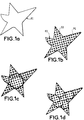
- FIGS. 1a to 1d represent an example of application of the method of the invention to a star type shape as shown in FIG. 1a.
- the image form FI of FIG. 1a is transformed into a surface SI represented in FIG. 1b.
- the surface is superimposed on a frame of PI image points. More precisely, each point contained within the contour is assigned position information (coordinates).
- the surface SI is scanned using a geometric figure such as a circle or a polygon of the largest possible dimension and incorporating a certain number of points. pictures ..
- a neural network used is a three-layer network of neural cells as shown in FIG. 3.
- the first layer corresponds to the number of types of samples or, according to what has been described above, to the various measurements of dimensions of the surfaces scanned and comprises p neurons.
- the third layer includes n neurons corresponding to the number of possible forms identifiable by the system.
- the intermediate layer has a number of neurons which can typically be of value np
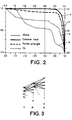
- the spectral functions of these different shapes are shown in Figure 2.
- the curve “b” represents the spectral function of the bone shape.
- Curve “c” represents the spectral function of the circular shape and curve “d” represents the spectral function of the elongated shape.
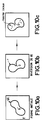
- a linear element is used which is moved parallel to a direction so as to sweep the surface, this linear element always being included inside the contour of the surface.
- the scanned surface is as shown in Figure 4b. This operation is carried out several times with elements of different lengths. These different operations will therefore give different scanned surfaces due to the irregular shape of the image surface.
- the spectral function is carried out as before, then the analysis in a neural network which has been the subject of training.
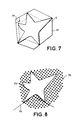
- an envelope of the image and more precisely an envelope called the "weak" convex envelope of the image is calculated as will be described with reference to FIG. 7.
- the form E to be analyzed is entered in a geometric element H1 whose sides are tangent to the form E and are parallel to the main directions either of the grid of points (FIG. 1b) or of the geometric element. Then, the surface of the element H1 not covered by the form E is scanned using geometric elements h1 by moving each geometric element h1 parallel to selected sides of the element H1. This last operation is repeated several times using geometrical elements h1 of different dimensions which gives the scanned surface which is delimited by dotted lines in FIG. 7. The surface obtained previously is then divided by scanning the image surface, by the surface of the weak convex envelope. We then carry out, as before, the spectral function and then the analysis of the spectral function in a neural network.
- the image shape FI is superimposed as above on a frame of XL image elements, but the part of the frame outside the contour of the shape is considered. Then, with geometric figures, such as G1, we sweep the outer contour of the shape. The dimension of the unswept area is determined. The operation is repeated with geometric figures (G1) of different dimensions. This gives different unscaned surfaces and all the dimensions of these surfaces also provide the spectral function of the image shape.
- the curve calculated in binary form X is the spectral function.
- H is a hexagon of size 1 u: is a factor of variation in size of the hexagon
- R is the size of the largest hexagon inscribed in the surface
- a (X uRH ) is the area of the surface to be measured
- lim ⁇ ⁇ - ⁇ : is the convex envelope of the shape obtained for example by inscribing the shape in a hexagon (figure 7) and A (lim ⁇ ⁇ - ⁇ X - ⁇ H ) then corresponds to the surface of this hexagon.
- the spectral function and the elongation factor are invariant by rotation, translation and change of scale of the shape.
- the analysis of an image can be made by carrying out a transformation of the image and by analyzing the transformed image.
- the inverse of an image is the result of an image by the mathematical transformation called inversion.
- the inversion transforms a curve into a curve.
- ⁇ E the border of the image E and choose a point O inside ⁇ E and a positive value of k
- the inversion of center O and of ratio k transforms ⁇ X into a closed curve ⁇
- l inverse of a point M belonging to the image E is outside the curve ⁇
- the inverse of a point M belonging to the outside of the image E is inside the curve ⁇ .
- the surfaces obtained are divided by the surface of the weak convex envelope and the spectral function obtained in a neural network is analyzed.
- FIG. 9 represents a block diagram of the method of the invention.
- the original image is photographed by a camera, then transformed into a surface during a step called binarization.
- This spectral function is supplied to a neural network or neural discriminator which has been the subject of prior learning.
- the neural network finally provides the result of the image analysis during the "decision" phase.
- FIG. 2 represents the spectral functions which are deduced therefrom.
- the learning base included 50 examples, as well as the test base. The results are presented by the following confusion matrices:
Landscapes
- Engineering & Computer Science (AREA)
- Computer Vision & Pattern Recognition (AREA)
- Physics & Mathematics (AREA)
- General Physics & Mathematics (AREA)
- Multimedia (AREA)
- Theoretical Computer Science (AREA)
- Image Analysis (AREA)
Applications Claiming Priority (2)
| Application Number | Priority Date | Filing Date | Title |
|---|---|---|---|
| FR9100365 | 1991-01-15 | ||
| FR9100365A FR2671648B1 (fr) | 1991-01-15 | 1991-01-15 | Procede de reconnaissance d'une forme d'image. |
Publications (1)
| Publication Number | Publication Date |
|---|---|
| EP0495697A1 true EP0495697A1 (de) | 1992-07-22 |
Family
ID=9408669
Family Applications (1)
| Application Number | Title | Priority Date | Filing Date |
|---|---|---|---|
| EP92400063A Withdrawn EP0495697A1 (de) | 1991-01-15 | 1992-01-10 | Verfahren zum Erkennen der Gestalt eines Bildes |
Country Status (3)
| Country | Link |
|---|---|
| EP (1) | EP0495697A1 (de) |
| JP (1) | JPH04344577A (de) |
| FR (1) | FR2671648B1 (de) |
Cited By (2)
| Publication number | Priority date | Publication date | Assignee | Title |
|---|---|---|---|---|
| NL2006950C2 (en) * | 2011-06-16 | 2012-12-18 | Kampri Support B V | Cleaning of crockery. |
| CN110180186A (zh) * | 2019-05-28 | 2019-08-30 | 北京奇思妙想信息技术有限公司 | 一种地形图转换方法及系统 |
Families Citing this family (1)
| Publication number | Priority date | Publication date | Assignee | Title |
|---|---|---|---|---|
| CN117057031A (zh) * | 2023-07-24 | 2023-11-14 | 北京科技大学 | 基于多区间几何相似度的飞行器敏感性分析方法及装置 |
-
1991
- 1991-01-15 FR FR9100365A patent/FR2671648B1/fr not_active Expired - Fee Related
-
1992
- 1992-01-10 EP EP92400063A patent/EP0495697A1/de not_active Withdrawn
- 1992-01-16 JP JP4025691A patent/JPH04344577A/ja not_active Withdrawn
Non-Patent Citations (2)
| Title |
|---|
| IEEE TRANSACTIONS ON PATTERN ANALYSIS AND MACHINE INTELLGENCE, vol. 11, no. 7, Juillet 1989, NEW YORK US pages 694 - 700; MING-HUA CHEN ET AL.: 'A Multiscaling Approach Based on Morphological Filtering' * |
| PROCEEDINGS OF EUSIPCO-88, FOURTH EUROPEAN SIGNAL CONFERENCE: SIGNAL PROCESSING IV: THEORIES AND APPLICATIONS, GREBOBLE, FRANCE Septembre 1988, pages 251 - 254; M. BINAGHI ET AL.: 'Description and recognition of multidimensional signals using rotation and' * |
Cited By (3)
| Publication number | Priority date | Publication date | Assignee | Title |
|---|---|---|---|---|
| NL2006950C2 (en) * | 2011-06-16 | 2012-12-18 | Kampri Support B V | Cleaning of crockery. |
| WO2012173479A1 (en) * | 2011-06-16 | 2012-12-20 | Kampri Support B.V. | Method and system for cleaning of crockery, using electronic vision system and manipulator |
| CN110180186A (zh) * | 2019-05-28 | 2019-08-30 | 北京奇思妙想信息技术有限公司 | 一种地形图转换方法及系统 |
Also Published As
| Publication number | Publication date |
|---|---|
| JPH04344577A (ja) | 1992-12-01 |
| FR2671648A1 (fr) | 1992-07-17 |
| FR2671648B1 (fr) | 1995-03-10 |
Similar Documents
| Publication | Publication Date | Title |
|---|---|---|
| Xia et al. | Fusion of hyperspectral and LiDAR data with a novel ensemble classifier | |
| EP0115462B1 (de) | Verfahren zum automatischen Erkennen eines Bildes auf der Basis eines korrespondierenden Referenzbildes | |
| US12340498B2 (en) | Defect detection using synthetic data and machine learning | |
| EP3640843A1 (de) | Verfahren zur extraktion von merkmalen eines fingerabdrucks, der durch ein eingangsbild dargestellt wird | |
| EP0521548A1 (de) | Neuronalnetzwerk-Anlage und -Verfahren für Datenklassifizierung | |
| CN109977899B (zh) | 一种物品识别的训练、推理以及增加新种类的方法和系统 | |
| Tombak et al. | Pixel-based classification of SAR images using feature attribute profiles | |
| Ji et al. | Discerning the painter’s hand: machine learning on surface topography | |
| Wang et al. | Fake modern Chinese painting identification based on spectral–spatial feature fusion on hyperspectral image | |
| Nemade et al. | Co-occurrence patterns based fruit quality detection for hierarchical fruit image annotation | |
| CN121121226A (zh) | 一种基于小样本的粮食作物籽粒分类检测方法及系统 | |
| Van Der Maaten et al. | Towards automatic coin classification | |
| EP1035493A1 (de) | Verfahren zur Mustererkennung | |
| FR2719384A1 (fr) | Procédé de trajectographie d'objets et dispositif de mise en Óoeuvre de ce procédé. | |
| Marpu | Geographic object based image analysis | |
| FR2671648A1 (fr) | Procede de reconnaissance d'une forme d'image. | |
| CN116468789B (zh) | 基于多先验融合策略的图像伪造定位方法、介质及系统 | |
| WO2021123209A1 (fr) | Procédé de segmentation d'une image d'entrée représentant un document comportant des informations structurées | |
| CN117994240A (zh) | 多尺度二级光学遥感图像条纹噪声智能检测方法及装置 | |
| Ghorpade et al. | 3D shape representation with spatial probabilistic distribution of intrinsic shape keypoints | |
| CN115797958A (zh) | 货币识别方法、装置、设备及存储介质 | |
| CN114359896A (zh) | 多模态人工智能识别物体结合区块链数据存证的溯源系统 | |
| CN115471494A (zh) | 基于图像处理的沃柑质检方法、装置、装备及存储介质 | |
| EP0578558A1 (de) | Verfahren zur Identifizierung von Objekten in einem Bild | |
| CN118229551B (zh) | 变电设备图像融合方法、装置以及计算机产品 |
Legal Events
| Date | Code | Title | Description |
|---|---|---|---|
| PUAI | Public reference made under article 153(3) epc to a published international application that has entered the european phase |
Free format text: ORIGINAL CODE: 0009012 |
|
| AK | Designated contracting states |
Kind code of ref document: A1 Designated state(s): DE FR GB |
|
| 17P | Request for examination filed |
Effective date: 19921008 |
|
| RAP1 | Party data changed (applicant data changed or rights of an application transferred) |
Owner name: THOMSON-CSF |
|
| 17Q | First examination report despatched |
Effective date: 19960312 |
|
| STAA | Information on the status of an ep patent application or granted ep patent |
Free format text: STATUS: THE APPLICATION IS DEEMED TO BE WITHDRAWN |
|
| 18D | Application deemed to be withdrawn |
Effective date: 19980801 |