EP0495264B1 - Method for the production of feed and feed additive for marine species and crawfish. - Google Patents
Method for the production of feed and feed additive for marine species and crawfish. Download PDFInfo
- Publication number
- EP0495264B1 EP0495264B1 EP91203435A EP91203435A EP0495264B1 EP 0495264 B1 EP0495264 B1 EP 0495264B1 EP 91203435 A EP91203435 A EP 91203435A EP 91203435 A EP91203435 A EP 91203435A EP 0495264 B1 EP0495264 B1 EP 0495264B1
- Authority
- EP
- European Patent Office
- Prior art keywords
- iron
- feed
- tmao
- fish
- salmon
- Prior art date
- Legal status (The legal status is an assumption and is not a legal conclusion. Google has not performed a legal analysis and makes no representation as to the accuracy of the status listed.)
- Expired - Lifetime
Links
- 238000004519 manufacturing process Methods 0.000 title description 6
- 238000000034 method Methods 0.000 title description 3
- 239000003674 animal food additive Substances 0.000 title 1
- XEEYBQQBJWHFJM-UHFFFAOYSA-N Iron Chemical compound [Fe] XEEYBQQBJWHFJM-UHFFFAOYSA-N 0.000 claims description 181
- 229910052742 iron Inorganic materials 0.000 claims description 89
- UYPYRKYUKCHHIB-UHFFFAOYSA-N trimethylamine N-oxide Chemical compound C[N+](C)(C)[O-] UYPYRKYUKCHHIB-UHFFFAOYSA-N 0.000 claims description 66
- 241000251468 Actinopterygii Species 0.000 claims description 48
- 229910052500 inorganic mineral Inorganic materials 0.000 claims description 14
- 239000011707 mineral Substances 0.000 claims description 14
- 108090000623 proteins and genes Proteins 0.000 claims description 8
- 102000004169 proteins and genes Human genes 0.000 claims description 8
- 239000007788 liquid Substances 0.000 claims description 4
- 150000002632 lipids Chemical class 0.000 claims description 3
- 235000020660 omega-3 fatty acid Nutrition 0.000 claims description 3
- 241000894007 species Species 0.000 claims description 3
- 235000014633 carbohydrates Nutrition 0.000 claims description 2
- 150000001720 carbohydrates Chemical class 0.000 claims description 2
- 239000003755 preservative agent Substances 0.000 claims description 2
- 239000011782 vitamin Substances 0.000 claims description 2
- 235000013343 vitamin Nutrition 0.000 claims description 2
- 229940088594 vitamin Drugs 0.000 claims description 2
- 229930003231 vitamin Natural products 0.000 claims description 2
- 239000000853 adhesive Substances 0.000 claims 1
- 230000001070 adhesive effect Effects 0.000 claims 1
- 239000000945 filler Substances 0.000 claims 1
- 235000019688 fish Nutrition 0.000 description 48
- 241000972773 Aulopiformes Species 0.000 description 22
- 235000019515 salmon Nutrition 0.000 description 22
- 210000004369 blood Anatomy 0.000 description 15
- 239000008280 blood Substances 0.000 description 15
- 235000019733 Fish meal Nutrition 0.000 description 13
- 239000004467 fishmeal Substances 0.000 description 13
- 210000000952 spleen Anatomy 0.000 description 10
- HCHKCACWOHOZIP-UHFFFAOYSA-N Zinc Chemical compound [Zn] HCHKCACWOHOZIP-UHFFFAOYSA-N 0.000 description 9
- 210000004185 liver Anatomy 0.000 description 9
- 239000002994 raw material Substances 0.000 description 9
- 239000011701 zinc Substances 0.000 description 9
- 229910052725 zinc Inorganic materials 0.000 description 9
- PWHULOQIROXLJO-UHFFFAOYSA-N Manganese Chemical compound [Mn] PWHULOQIROXLJO-UHFFFAOYSA-N 0.000 description 8
- 229910052748 manganese Inorganic materials 0.000 description 8
- 239000011572 manganese Substances 0.000 description 8
- 210000002216 heart Anatomy 0.000 description 6
- 239000000243 solution Substances 0.000 description 6
- 238000007792 addition Methods 0.000 description 5
- 230000000694 effects Effects 0.000 description 5
- 239000000203 mixture Substances 0.000 description 5
- 238000011282 treatment Methods 0.000 description 5
- 238000010521 absorption reaction Methods 0.000 description 4
- 239000000654 additive Substances 0.000 description 4
- 235000021323 fish oil Nutrition 0.000 description 4
- XLYOFNOQVPJJNP-UHFFFAOYSA-N water Substances O XLYOFNOQVPJJNP-UHFFFAOYSA-N 0.000 description 4
- 241000772415 Neovison vison Species 0.000 description 3
- 241000277263 Salmo Species 0.000 description 3
- 208000025865 Ulcer Diseases 0.000 description 3
- 230000000996 additive effect Effects 0.000 description 3
- 208000007502 anemia Diseases 0.000 description 3
- 239000012527 feed solution Substances 0.000 description 3
- 230000009467 reduction Effects 0.000 description 3
- 230000001105 regulatory effect Effects 0.000 description 3
- 231100000397 ulcer Toxicity 0.000 description 3
- CWYNVVGOOAEACU-UHFFFAOYSA-N Fe2+ Chemical compound [Fe+2] CWYNVVGOOAEACU-UHFFFAOYSA-N 0.000 description 2
- 208000007536 Thrombosis Diseases 0.000 description 2
- 238000004458 analytical method Methods 0.000 description 2
- 238000009360 aquaculture Methods 0.000 description 2
- 244000144974 aquaculture Species 0.000 description 2
- 238000010241 blood sampling Methods 0.000 description 2
- 239000002738 chelating agent Substances 0.000 description 2
- 239000012141 concentrate Substances 0.000 description 2
- 230000003247 decreasing effect Effects 0.000 description 2
- 235000005911 diet Nutrition 0.000 description 2
- 230000037213 diet Effects 0.000 description 2
- 210000003743 erythrocyte Anatomy 0.000 description 2
- 238000002474 experimental method Methods 0.000 description 2
- 230000007246 mechanism Effects 0.000 description 2
- 210000000056 organ Anatomy 0.000 description 2
- 208000032544 Cicatrix Diseases 0.000 description 1
- 101000766307 Gallus gallus Ovotransferrin Proteins 0.000 description 1
- IMQLKJBTEOYOSI-GPIVLXJGSA-N Inositol-hexakisphosphate Chemical class OP(O)(=O)O[C@H]1[C@H](OP(O)(O)=O)[C@@H](OP(O)(O)=O)[C@H](OP(O)(O)=O)[C@H](OP(O)(O)=O)[C@@H]1OP(O)(O)=O IMQLKJBTEOYOSI-GPIVLXJGSA-N 0.000 description 1
- 206010065973 Iron Overload Diseases 0.000 description 1
- 241000124008 Mammalia Species 0.000 description 1
- 241001465754 Metazoa Species 0.000 description 1
- 229910019142 PO4 Inorganic materials 0.000 description 1
- 238000013459 approach Methods 0.000 description 1
- 230000008901 benefit Effects 0.000 description 1
- 239000011230 binding agent Substances 0.000 description 1
- 230000015572 biosynthetic process Effects 0.000 description 1
- 230000036765 blood level Effects 0.000 description 1
- 238000009395 breeding Methods 0.000 description 1
- 230000001488 breeding effect Effects 0.000 description 1
- 210000000170 cell membrane Anatomy 0.000 description 1
- 230000000254 damaging effect Effects 0.000 description 1
- 230000001627 detrimental effect Effects 0.000 description 1
- 201000010099 disease Diseases 0.000 description 1
- 208000037265 diseases, disorders, signs and symptoms Diseases 0.000 description 1
- 238000001035 drying Methods 0.000 description 1
- 235000021321 essential mineral Nutrition 0.000 description 1
- 238000009313 farming Methods 0.000 description 1
- 239000003925 fat Substances 0.000 description 1
- 235000019197 fats Nutrition 0.000 description 1
- 229940013317 fish oils Drugs 0.000 description 1
- 230000003862 health status Effects 0.000 description 1
- 208000019622 heart disease Diseases 0.000 description 1
- 238000010438 heat treatment Methods 0.000 description 1
- 238000000338 in vitro Methods 0.000 description 1
- 239000004615 ingredient Substances 0.000 description 1
- 239000003112 inhibitor Substances 0.000 description 1
- 210000000936 intestine Anatomy 0.000 description 1
- 238000011835 investigation Methods 0.000 description 1
- 235000012054 meals Nutrition 0.000 description 1
- 239000011259 mixed solution Substances 0.000 description 1
- 238000002156 mixing Methods 0.000 description 1
- 235000021048 nutrient requirements Nutrition 0.000 description 1
- 229940012843 omega-3 fatty acid Drugs 0.000 description 1
- 239000006014 omega-3 oil Substances 0.000 description 1
- 150000003891 oxalate salts Chemical class 0.000 description 1
- 235000021317 phosphate Nutrition 0.000 description 1
- 150000003013 phosphoric acid derivatives Chemical class 0.000 description 1
- 235000002949 phytic acid Nutrition 0.000 description 1
- 238000009372 pisciculture Methods 0.000 description 1
- 230000003389 potentiating effect Effects 0.000 description 1
- 239000000843 powder Substances 0.000 description 1
- 238000001556 precipitation Methods 0.000 description 1
- 230000008569 process Effects 0.000 description 1
- 238000012545 processing Methods 0.000 description 1
- 230000002035 prolonged effect Effects 0.000 description 1
- 230000002285 radioactive effect Effects 0.000 description 1
- 238000005070 sampling Methods 0.000 description 1
- 231100000241 scar Toxicity 0.000 description 1
- 230000037387 scars Effects 0.000 description 1
- 239000000126 substance Substances 0.000 description 1
- 230000002195 synergetic effect Effects 0.000 description 1
- 238000003786 synthesis reaction Methods 0.000 description 1
- 238000012360 testing method Methods 0.000 description 1
- 230000007723 transport mechanism Effects 0.000 description 1
- 235000013311 vegetables Nutrition 0.000 description 1
Images


Classifications
-
- A—HUMAN NECESSITIES
- A23—FOODS OR FOODSTUFFS; TREATMENT THEREOF, NOT COVERED BY OTHER CLASSES
- A23K—FODDER
- A23K50/00—Feeding-stuffs specially adapted for particular animals
- A23K50/80—Feeding-stuffs specially adapted for particular animals for aquatic animals, e.g. fish, crustaceans or molluscs
-
- A—HUMAN NECESSITIES
- A23—FOODS OR FOODSTUFFS; TREATMENT THEREOF, NOT COVERED BY OTHER CLASSES
- A23K—FODDER
- A23K20/00—Accessory food factors for animal feeding-stuffs
- A23K20/10—Organic substances
- A23K20/105—Aliphatic or alicyclic compounds
-
- Y—GENERAL TAGGING OF NEW TECHNOLOGICAL DEVELOPMENTS; GENERAL TAGGING OF CROSS-SECTIONAL TECHNOLOGIES SPANNING OVER SEVERAL SECTIONS OF THE IPC; TECHNICAL SUBJECTS COVERED BY FORMER USPC CROSS-REFERENCE ART COLLECTIONS [XRACs] AND DIGESTS
- Y10—TECHNICAL SUBJECTS COVERED BY FORMER USPC
- Y10S—TECHNICAL SUBJECTS COVERED BY FORMER USPC CROSS-REFERENCE ART COLLECTIONS [XRACs] AND DIGESTS
- Y10S426/00—Food or edible material: processes, compositions, and products
- Y10S426/805—Pet food for dog, cat, bird, or fish
Definitions
- the present invention relates to use of trimethylamine-oxide (TMAO) to provide a feed for marine species, fish and crawfish, which is reducing the availability of the mineral iron in the feed.
- TMAO trimethylamine-oxide
- Chelators is a common denomination for all substances which are able to form complexes with iron, and thereby to reduce the availability of the mineral. Damaging effects caused by too high iron doses can therefore possibly be eliminated through the use of chelators or inhibitors for iron absorbtion and result in that a greater part of the iron being excreted without being absorbed.
- TMAO Trimetylaminoxide
- TMAO in processed fish feed does not have the ability to precipitate iron. This is the case because TMAO undergoes changes by heating. Under production of fish meal, the fish is heated over prolonged time. During the feed production the raw material is additionally heated passing through an extruder or other processing apparatus followed by a final drying step to remove remaining water.
- TMAO to provide a fish feed where the amount of bio available iron can be controlled. Another object is to allow for the continued use of marine fish meal as a protein source for fish feed. Another object of the invention is to use TMAO to provide a fish feed and a method for producing it, where the amount of bio available iron is controlled to obtain an optimal synergetic effect between iron and the n-3 fatty acids present.
- the time of blood sampling may be critical. Therefore, to provide documentation of the total effects of TMAO on iron uptake, blood samples at different time intervals after feeding may be needed. In addition, it is urgent to measure the level of radio iron in liver and spleen of fish fed different levels of TMAO. If more radioiron is found in the spleen of fish fed no TMAO than in those fed TMAO, cell membrane damage in the red blood cells may be suggested.
- Iron overload may be connected to heart disease in farmed Atlantic salmon. Therefore, the iron taken up by the heart after 96 hours was measured (Table 2). Fish fed TMAO in the diet had significantly reduced iron level in the heart compared to fish in the control group (p ⁇ 0.005). Table 2 Levels of iron in blood, liver, spleen and heart at different time intervals after feeding in Atlantic salmon fed an iron solution with and without TMAO.
- the number of fish was 5 in each treatment, except for TMAO/24 hours and Control/48 hours where the number was 4.
- the number of fish was 5 in each treatment.
- Standard fish feed compositions contain basically protein and lipids and some carbohydrates as main components. Additionally other components such as binding agents, preservatives, vitamins and minerals are added. The ingredients are mixed together in the required proportions and the mixing can be performed with or without the addition of water or liquid to produce a dry, soft or wet feed.
- protein source is preferably used fish meal and as lipid is used marine fats and preferably fish oils or fish oil concentrates.
- the mineral mix used should be without iron additives. Even if it requires considerable skill and know-how to produce a high quality feed, the basic process is well known in the prior art and need not be described in detail here.
- the n-3 content of the feed can be adjusted to be in the area Prom 2.0 % to 8.5% while the amount of iron will vary between 100 - 400 mg/kg dry feed depending on the selected raw materials.
- the pH of the feed should not be lower than 5.5, and preferably be adjusted between 6 - 7.
- the required amount of TMAO can be calculated on the basis of the curve and equation presented in Fig. 1. From regression equation, it may be estimated the amount of TMAO needed to reduce the uptake of iron to desired level.
- the TMAO is preferably in the form of trimethylamine-oxide modified molecules.
- TMAO can be added preferably in the form of a dry powder with various amounts of TMAO or mixed with a dry fish meal. Alternatively it can be dissolved and diluted in water or liquid and added to the feed mixture.
Landscapes
- Life Sciences & Earth Sciences (AREA)
- Chemical & Material Sciences (AREA)
- Polymers & Plastics (AREA)
- Animal Husbandry (AREA)
- Zoology (AREA)
- Engineering & Computer Science (AREA)
- Food Science & Technology (AREA)
- Insects & Arthropods (AREA)
- Marine Sciences & Fisheries (AREA)
- Birds (AREA)
- Feed For Specific Animals (AREA)
- Fodder In General (AREA)
Description
- The present invention relates to use of trimethylamine-oxide (TMAO) to provide a feed for marine species, fish and crawfish, which is reducing the availability of the mineral iron in the feed.
- The abundant access to marine raw materials in the form of fish meal, has resulted in that the (Norwegian) aquaculture industry to a great extent has used such raw materials in feed blends. Additionally fish meal has prooved to be especially well suited as a source of proteins in the feed. Analysis of commercial fish meal products show great variations in the iron content, normally from 140 to 300 mg total iron per kg meal. This is the main cause for the relatively high and varying content of iron in commercial fish feed products, where there are normal variations from 200 to 400 mg total iron per kg feed. Because iron in vegetable raw materials in general is less available, interalia because of the content of phosphates, phytates and oxalates, than iron from animal raw materials, the use of marine raw materials has lead to a high content of bio available iron in feed used by the aquaculture industry. However, this has been considered as an additional advantage using such raw materials for the production of fish feed.
- In our prior published European patent application EP 458380 it was shown that the level of iron in the existing feed for farmed salmon is far too high, and that this will reduce the growth and even increase the risk for diseases.
- To obtain an optimal synergy between iron and omega-3 fatty acids it was shown that even the lowest level of 120 mg total iron per kg feed can be too high, in spite that this level of iron is significantly lower than that is generally considered as required. Cfr. Watanabe Nutrient requirements of cold water fishes, No 16, National Academy Press, Washington DC, 1981, where levels of iron from 250 - 400 mg iron/kg feed is recommended.
- In carrying out additional tests we have now found that there is present approximately three times as much depot iron in the liver in cultured salmon as in the lever of wild salmon. Excess iron is stored in the liver rather than being used for heamoglobine synthesis. This confirms that there exists a significant iron unbalance in present day fish feed.
- Thus, it is the object of the invention to add TMAO to provide a feed and to establish conditions for feeding which will lead to a reduction of the availability of the mineral iron in the feed in comparison with a standard feed.
- To improve the iron balance it is necessary to reduce the amount of iron in the feed. A reduction of the iron content of the feed to approximately 100 mg / kg can be done by selecting and using commercial fish meal products having a lowest possible content of iron. Additionally there must be used mineral blends whithout iron addition. This very time consuming and economically costly method, appears today as the only possibility to produce a commercial fish meal based feed with an iron content of approximately 100 mg iron / kg dry feed.
- Due to the fact that an additional lowering of the iron content is necessary, this can only be obtained through the use of specially selected protein products. This will make the feed so expensive that the whole farming business may be uneconomical. There may also occur a lack of suitable protein raw materials, at the same time as this will have negative economic consequences for the traditional fish meal producers.
- Special studies have been initiated for if possible to explain why farmed salmon which is fed traditionally has much a pronounced iron inbalance and a poorer health status than wild salmon.
- There may basically be three explanations of the iron inbalance:
- 1. The wild fish is regulating its uptake of iron in an up to now unknown way.
- 2. There is too high content of iron in the feed.
- 3. The availability of the iron present in the feed is too high.
- Our prior extensive investigations on farmed salmon seem to indicate that it has not a regulating mechanism for iron uptake comparable with what is known from mammals. It is natural to assume that this will also apply for wild salmon and other wild fish species.
- Because raw marine fish and crawfish is a natural feed for wild salmon and fish meal makes up a significant part of commercial fish feed, we have presumed that the main difference between the feed of wild salmon compared with farmed salmon is not the total content of iron only but also the availability of the iron present.
- Chelators is a common denomination for all substances which are able to form complexes with iron, and thereby to reduce the availability of the mineral. Damaging effects caused by too high iron doses can therefore possibly be eliminated through the use of chelators or inhibitors for iron absorbtion and result in that a greater part of the iron being excreted without being absorbed.
- We have developed the hypothesis that the iron unbalance is created because the iron in commercial fish meal is more readily available than the iron in raw fish. The reason for this is that a raw marine fish has a high natural content of the N-containing base Trimetylaminoxide (TMAO, (CH₃)₃NO). TMAO is known for its potent precipitation of iron. Because TMAO is naturally available in all marine fishes and crawfish, it is also a natural part of the feed used by the wild salmon.
- Furthermore TMAO is detected in the intestines of fish, which is the place where the uptake of iron is occuring. A number of analyses have additionally shown that the TMAO content in fish will increase with decreasing sea temperatures. With basis in our prior discoveries, cfr. the above mentioned patent application EP-458380, it is by these low sea temperatures of special importance for the salmon to reduce the uptake of iron. The reason is that in vitro studies have shown, that the red blood cells will agglutinate and form a clot when the blood contains more iron than the transport mechanisms (serumtransferrin) can take care off. This can lead to thrombosis in the fish. Thrombosis is, according to our experience, probably the cause of winter ulcers in the fish. Winter ulcers are surface scars on the side of the salmon. By low sea temperatures they occur frequently and have detrimental economical consequences, because the ulcers give a high mortality and the slaughtered fish is degraded to production fish.
- Thus, while wild fish is consequently taking up low amounts of iron from its natural feed. This is not the case for farmed salmon.
- The reason for this is that TMAO in processed fish feed does not have the ability to precipitate iron. This is the case because TMAO undergoes changes by heating. Under production of fish meal, the fish is heated over prolonged time. During the feed production the raw material is additionally heated passing through an extruder or other processing apparatus followed by a final drying step to remove remaining water.
- We have now surprisingly found that the addition of synthetic TMAO will in fact lower the iron absorption in farmed salmon. The salmon was fed with the iron isotope ⁵⁹Fe, with or without addition of synthetic TMAO and blood analysed after 24 hours. We found marked lower radioactivity in those fishes which had received TMAO additive compared with those who did not receive TMAO additive. This illustrates that TMAO will lower the iron absorbtion in farmed salmon.
- The marked difference between iron availability in raw and processed (cooked) fish is documented within the fur breeding industry. In this connection we refer to A. Skrede: Meldinger fra Norges Landbrukshøgskole vol. 62, nr. 4. and to SU-A-682218 (AS KAREL BIOLOGY). Here is documented that mink fed with raw fish acquired anemia (low levels of blood haemoglobin) which caused white underfur, resulting in a product without economic value.
Mink which were fed with boiled fish did however not develop anemia and had a normal fur. - The reason for this is that raw fish has a high content of active TMAO. TMAO caused anemia because free iron was transferred to undisolvable ironoxihydroxide. These experiences were made for the first time within the fur industry 20 - 25 years ago and relates to lack of bioavailable iron in mink feed.
- Our new knowledge pertaining to the absence of a iron uptake regulating mechanism in farmed salmon indicates that a feed for the fish farming industry will need a different approach: how can the amounts of bioavailable iron be reduced to obtain an optimal uptake of iron.
- Thus it is the main object of the present invention to use TMAO to provide a fish feed where the amount of bio available iron can be controlled.
Another object is to allow for the continued use of marine fish meal as a protein source for fish feed. Another object of the invention is to use TMAO to provide a fish feed and a method for producing it, where the amount of bio available iron is controlled to obtain an optimal synergetic effect between iron and the n-3 fatty acids present. - These and also other objects are obtained with the invention as defined in the accompanying patent claims 1 - 7 and which is essentially characterized by the use of TMAO in fish feed.
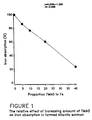
- The invention will now be described in more detail in connection with the results obtained in experiments 1 - 3 and as illustrated in the drawings, where fig 1 shows the decreasing bio availability of iron with increasing additions of TMAO,
- Fig. 2
- the reduced uptake of iron in the blood, liver, spleen and heart of farmed salmon when TMAO is present and
- Fig. 3
- that TMAO shows a preferance towards iron compared with other essential minerals as zinc and manganeze.
-
- r:
- correlation coefficient
- df:
- degree of freedom
- P:
- probability
- SD:
- Standard deviation
- Twentyfive salmon were divided into 5 groups, each of 5 fish. They were all fed a solution of 200 ferrous iron and 5 different levels of TMAO : 0, 5, 10, 20 and 40 times the amount of iron. All fish were blood sampled after 24 hours for determination of content of radioiron in the blood. We observed a highly significant and linear correlation between iron absorbed and TMAO added in the final solution (r = -0.998, df = 4, p<0.001, Table 1 and FIGURE 1).
TABLE 1 Effect of increasing amount of TMAO in the feed solution on iron absorption in Atlantic salmon. Proportion TMAO to Fe Number of fish Uptake of iron in the blood g +/- SD Absorption relative to control Control 5 4.16 +/- 1.04 100.0% 5:1 4 3.60 +/- 1.04 86.5% 10:1 5 3.20 +/- 0.60 76.9% 20:1 5 2.52 +/- 0.71 60.5% 40:1 4 0.98 +/- 0.78 23.6% - The time of blood sampling may be critical. Therefore, to provide documentation of the total effects of TMAO on iron uptake, blood samples at different time intervals after feeding may be needed. In addition, it is urgent to measure the level of radio iron in liver and spleen of fish fed different levels of TMAO. If more radioiron is found in the spleen of fish fed no TMAO than in those fed TMAO, cell membrane damage in the red blood cells may be suggested.
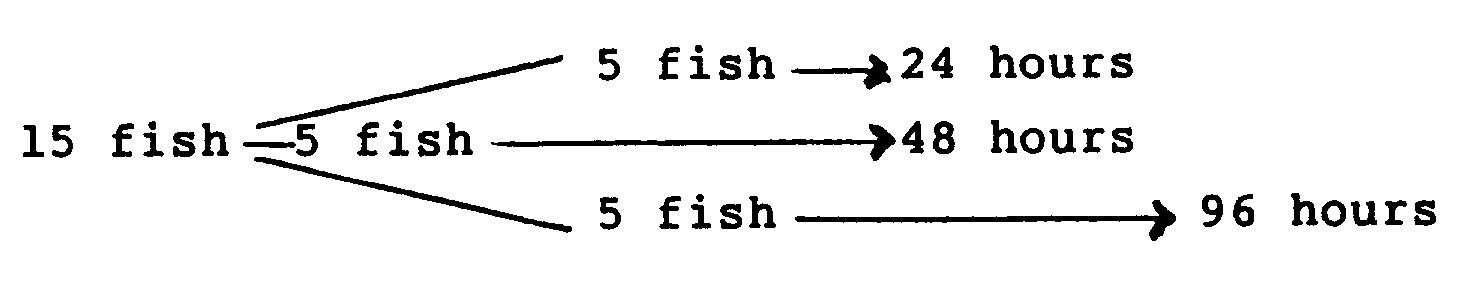
- Thirty salmon were divided into 2 groups of 15 fish each. All fish in the control group were administrated a feed solution of 200µg ferrous iron without any TMAO. The remaining fish being fed the same amount of iron together with 8 mg TMAO (TMAO : Fe = 40 : 1).
- Blood, liver and spleen were sampled from each group at 3 different time intervals after feeding :
We observed reduced uptake of iron in blood, liver and spleen at all time intervals after feeding for fish fed TMAO (Table 2 and FIGURE 2). The reduced uptake of iron in the TMAO group compared to the control group was significant at all time intervals and organs except for : blood after 48 hours (p<0.1), spleen after 48 hours and spleen after 96 hours (p<0.1). - Iron overload may be connected to heart disease in farmed Atlantic salmon. Therefore, the iron taken up by the heart after 96 hours was measured (Table 2). Fish fed TMAO in the diet had significantly reduced iron level in the heart compared to fish in the control group (p<0.005).
Table 2 Levels of iron in blood, liver, spleen and heart at different time intervals after feeding in Atlantic salmon fed an iron solution with and without TMAO. Organs Treatment Sampling time after feeding 24 hours (µg +/- SD) 48 hours (µg +/- SD) 96 hours (µg +/- SD) Blood Control 3.43 +/- 1.56 6.58 +/- 4.85 8.85 +/- 5.06 Blood TMAO 0.81 +/- 0.39 1.71 +/- 1.74 2.93 +/- 1.14 Liver Control 2.18 +/- 0.97 2.87 +/- 0.65 3.31 +/- 1.11 Liver TMAO 0.42 +/- 0.12 0.81 +/- 0.66 0.84 +/- 0.19 Spleen Control 0.08 +/- 0.05 0.11 +/- 0.04 0.26 +/- 0.15 Spleen TMAO 0.02 +/- 0.01 0.09 +/- 0.07 0.12 +/- 0.04 Heart Control not sampled not sampled 0.029+/- 0.012 Heart TMAO not sampled not sampled 0.008+/- 0.002 - The number of fish was 5 in each treatment, except for TMAO/24 hours and Control/48 hours where the number was 4.
- In
trial 1 and 2, the effect of TMAO on iron uptake without any influence of other minerals was studied. It is, however, of major importance to know if TMAO also affects the uptake of other minerals. Thus, we studied the effects of TMAO on a mixed diet containing radioactive isotopes of 3 different minerals. -
- i) ⁶⁵Zn
- ii) ⁵⁴Mn
- iii) ⁵⁹Fe
- Fish fed TMAO and a mixed solution of all minerals had significantly reduced level of radioiron in the blood compared to fish in the control group (p<0.001). TMAO did not reduce the uptake of zinc and manganese (Table 3, FIGURE 3)
In the experiment with one single mineral in solution, TMAO reduced the uptake as follows: iron = 82% (p<0.05), zinc = 30% (not significant) and manganese = 69% (not significant).Table 3 Effects of TMAO on a mixed feed solution of iron, zinc and manganese. Mineral Treatment Blood level ( g) Reduced absorption relative to control Statistics Iron Control 10.44 ± 3.18 Iron TMAO 2.10 ± 1.10 80 % p<0.001 Zinc Control 10.44 ± 2.05 Zinc TMAO 10.05 ± 2.54 4 % n.s. Manganese Control 0.12 ± 0.03 Manganese TMAO 0.12 ± 0.09 0 % n.s. - The number of fish was 5 in each treatment.
- Standard fish feed compositions contain basically protein and lipids and some carbohydrates as main components. Additionally other components such as binding agents, preservatives, vitamins and minerals are added. The ingredients are mixed together in the required proportions and the mixing can be performed with or without the addition of water or liquid to produce a dry, soft or wet feed. As protein source is preferably used fish meal and as lipid is used marine fats and preferably fish oils or fish oil concentrates. The mineral mix used should be without iron additives. Even if it requires considerable skill and know-how to produce a high quality feed, the basic process is well known in the prior art and need not be described in detail here. By varying the amount of fish oil or fish oil concentrates used, the n-3 content of the feed can be adjusted to be in the area Prom 2.0 % to 8.5% while the amount of iron will vary between 100 - 400 mg/kg dry feed depending on the selected raw materials. Also the pH of the feed should not be lower than 5.5, and preferably be adjusted between 6 - 7.
- The required amount of TMAO can be calculated on the basis of the curve and equation presented in Fig. 1. From regression equation, it may be estimated the amount of TMAO needed to reduce the uptake of iron to desired level.
The TMAO is preferably in the form of trimethylamine-oxide modified molecules. TMAO can be added preferably in the form of a dry powder with various amounts of TMAO or mixed with a dry fish meal. Alternatively it can be dissolved and diluted in water or liquid and added to the feed mixture. - Based on the average content of iron and n-3 given above, using fish meal as protein source and fish oil as liquid source and
pH - The importance of reducing the iron availability through the use of TMAO in the fish feed or through its use as an additive is not only related to farmed salmon but apply also for other farmed marine species, for feeding small fry as well as for feeding grown fish.
The fishes were fed a solution of 200 g iron, 150 g zinc and 50 g manganese each. Two treatments were used, controle and TMAO. The amount of TMAO added was 40 times that of iron, 53 times that of zinc and 160 times that of manganese. The time of blood sampling was 24 hours after feeding. In addition to the mixed mineral solution, it was made individual studies for iron, zinc and manganese.
Claims (7)
- Use of trimethylamine-oxide (TMAO) in dry or liquid form for the preparation of a feed for marine species, fish and crawfish, which contains proteins, lipids and carbohydrates in combination with one or more additional components, wherein the content of biological available iron is controlled to below approximately 100 mg/kg dry feed.
- Use according to claim 1,
characterized in that
the feed contains 2.0-8.5% by weight based on dry feed of n-3 fatty acids. - Use according to claim 1,
characterized in that
the feed contains fillers. - Use according to claim 1,
characterized in that
the feed contains adhesives. - Use according to claim 1,
characterized in that
the feed contains preservatives. - Use according to claim 1,
characterized in that
the feed contains vitamins. - Use according to claim 1,
characterized in that
the feed contains minerals.
Applications Claiming Priority (2)
| Application Number | Priority Date | Filing Date | Title |
|---|---|---|---|
| NO910150A NO910150D0 (en) | 1991-01-14 | 1991-01-14 | FOR MARINE FISH AND CANCER. |
| NO910150 | 1991-01-14 |
Publications (2)
| Publication Number | Publication Date |
|---|---|
| EP0495264A1 EP0495264A1 (en) | 1992-07-22 |
| EP0495264B1 true EP0495264B1 (en) | 1994-09-07 |
Family
ID=19893792
Family Applications (1)
| Application Number | Title | Priority Date | Filing Date |
|---|---|---|---|
| EP91203435A Expired - Lifetime EP0495264B1 (en) | 1991-01-14 | 1991-12-30 | Method for the production of feed and feed additive for marine species and crawfish. |
Country Status (10)
| Country | Link |
|---|---|
| US (1) | US5262184A (en) |
| EP (1) | EP0495264B1 (en) |
| AR (1) | AR244046A1 (en) |
| CA (1) | CA2058867C (en) |
| DK (1) | DK0495264T3 (en) |
| ES (1) | ES2062676T3 (en) |
| FI (1) | FI108914B (en) |
| IE (1) | IE73211B1 (en) |
| IS (1) | IS1707B (en) |
| NO (2) | NO910150D0 (en) |
Families Citing this family (9)
| Publication number | Priority date | Publication date | Assignee | Title |
|---|---|---|---|---|
| NO944028D0 (en) * | 1994-10-21 | 1994-10-21 | Norsk Hydro As | Feed and method for improving salt water tolerance in farmed fish |
| USD385706S (en) | 1995-10-02 | 1997-11-04 | Guseman Debbie T | Wall covering |
| US6143333A (en) * | 1998-11-13 | 2000-11-07 | Purina Mills, Inc. | Method of preparing a packaged fish attractant block |
| US7026111B2 (en) * | 2001-10-15 | 2006-04-11 | Beckman Coulter, Inc. | Methods and reagents for improved cell-based assays |
| NO319624B1 (en) | 2003-09-15 | 2005-09-05 | Trouw Internat Bv | Fish feed for salmonids in fresh water and use of such feed. |
| CN103431244B (en) * | 2013-09-09 | 2015-11-11 | 华中师范大学 | A kind of vitamin feed and additive improving Procambius clarkii juvenile prawn immunity |
| DE102017104108B4 (en) | 2017-02-28 | 2023-12-21 | OSRAM Opto Semiconductors Gesellschaft mit beschränkter Haftung | OPTOELECTRONIC COMPONENT WITH LASER DIODE |
| CN112021220A (en) * | 2020-07-20 | 2020-12-04 | 余庆县兴民城乡经济统筹发展有限责任公司 | Crayfish breeding method |
| CN115885904A (en) * | 2023-01-05 | 2023-04-04 | 宁波大学 | Method for improving low salt stress tolerance of seawater crabs |
Family Cites Families (4)
| Publication number | Priority date | Publication date | Assignee | Title |
|---|---|---|---|---|
| US3911117A (en) * | 1971-12-20 | 1975-10-07 | Fredrik Ender | Raw fish and iron chelated with glutamic or ribonucleic acid in a mink diet |
| FR2561871B1 (en) * | 1984-03-30 | 1988-07-29 | Groupe Etu Realisa Navales | METHOD AND COMPOSITIONS FOR ATTRACTING MARINE CARNIVORES |
| FR2588156B1 (en) * | 1985-10-03 | 1988-07-29 | Grp Etu Rech Navales | METHOD AND COMPOSITION FOR ATTRACTING AND RETAINING FISH |
| NO168152L (en) * | 1990-05-23 | 1991-10-14 | Norsk Hydro As | Fish feed |
-
1991
- 1991-01-14 NO NO910150A patent/NO910150D0/en unknown
- 1991-12-24 IS IS3798A patent/IS1707B/en unknown
- 1991-12-30 EP EP91203435A patent/EP0495264B1/en not_active Expired - Lifetime
- 1991-12-30 ES ES91203435T patent/ES2062676T3/en not_active Expired - Lifetime
- 1991-12-30 DK DK91203435.2T patent/DK0495264T3/en active
-
1992
- 1992-01-03 US US07/816,735 patent/US5262184A/en not_active Expired - Lifetime
- 1992-01-07 CA CA002058867A patent/CA2058867C/en not_active Expired - Fee Related
- 1992-01-07 NO NO920083A patent/NO177522C/en unknown
- 1992-01-13 IE IE920092A patent/IE73211B1/en not_active IP Right Cessation
- 1992-01-13 AR AR92321621A patent/AR244046A1/en active
- 1992-01-14 FI FI920153A patent/FI108914B/en active
Also Published As
| Publication number | Publication date |
|---|---|
| ES2062676T3 (en) | 1994-12-16 |
| CA2058867C (en) | 1999-04-06 |
| FI920153A0 (en) | 1992-01-14 |
| EP0495264A1 (en) | 1992-07-22 |
| NO177522C (en) | 1995-10-04 |
| CA2058867A1 (en) | 1992-07-15 |
| FI108914B (en) | 2002-04-30 |
| NO920083L (en) | 1992-07-15 |
| US5262184A (en) | 1993-11-16 |
| IE920092A1 (en) | 1992-07-15 |
| IE73211B1 (en) | 1997-05-07 |
| NO910150D0 (en) | 1991-01-14 |
| FI920153L (en) | 1992-07-15 |
| IS3798A7 (en) | 1992-07-15 |
| AR244046A1 (en) | 1993-10-29 |
| DK0495264T3 (en) | 1995-02-20 |
| NO177522B (en) | 1995-06-26 |
| IS1707B (en) | 1998-12-10 |
| NO920083D0 (en) | 1992-01-07 |
Similar Documents
| Publication | Publication Date | Title |
|---|---|---|
| CA2362953C (en) | Animal feed supplement for the nutritional enrichment of animal produce | |
| DE69101595T2 (en) | METHOD FOR GROWING MEAT PRODUCING ANIMALS TO INCREASE THE DEVELOPMENT OF Lean Meat. | |
| 佐藤秀一 et al. | Mineral nutrition in fish. XIX Availability to rainbow trout of zinc in white fish meal and of various zinc compounds. | |
| DE69706419T2 (en) | METHOD FOR ENRICHING DOCOSAHEXAIC ACID IN THE MILK OF MILK-PROVIDING ANIMALS | |
| Chanjula et al. | Effect of feeding rubber seed kernel and palm kernel cake in combination on nutrient utilization, rumen fermentation characteristics, and microbial populations in goats fed on Briachiaria humidicola hay-based diets | |
| KR20200027951A (en) | How to improve meat quality | |
| 佐藤秀一 et al. | Mineral nutrition in fish. XXII. Availability to rainbow trout of zinc contained in various types of fish meals. | |
| US6017564A (en) | Treatment of stressed animals with dihydroxyquinoline compounds | |
| EP0495264A1 (en) | Method for the production of feed and feed additive for marine species and crawfish. | |
| RU2201104C2 (en) | Method of producing feed for fish and feed for fish | |
| Viyakarn | Mineral Nutrition in Fish-XXVI. A Simple Method for Determination of Available Phosphorus Content in Fish Diet. | |
| 渡辺武 et al. | Nutritional evaluation of brown meals as a protein source in diets for rainbow trout. | |
| 佐藤秀一 et al. | Mineral requirement in fish. XVII Changes of mineral compositions in whole body of rainbow trout during growing stages. | |
| DE602004007801T2 (en) | METHOD FOR PREVENTING THYROID THYROID FUNCTION IN THE CAT AND COMPOSITIONS WITH RESTRICTED SELENIC AND JODIC CONTENT | |
| O'Kelly et al. | Monensin induced metabolic changes in cattle fed a restricted intake of lucerne hay | |
| Shetty et al. | Mineral composition of pigeon milk | |
| Kääntee et al. | Comparative effects of barley feed and sodium selenite on selenium levels in hen eggs and tissues | |
| RU2804619C1 (en) | Method of feeding young pigs during the fattening period | |
| RU2179803C1 (en) | Preparation to prevent technological stress in cattle | |
| Ata et al. | Effects of Sesame meal substitution on carcass parameters and meat quality of growing male lambs | |
| Robinson | Effects of high‐protein “finishing” feeds on performance and fat content of channel catfish | |
| SU865262A1 (en) | Feed addition for hens | |
| Arango et al. | Effect of Dietary Hemp Cake Inclusion on the In Vivo and Post Mortem Performances of Holstein Veal Calves. Animals 2022, 12, 2922 | |
| Työppönen et al. | Hepatic and splenic content of iron, copper, zinc, and manganese in anemic mink | |
| Gebert | Effects of microbial phytase and vitamin E in fat supplemented diets for growing pigs and laying hens on performance, nutrient utilization and product stability against oxidative alterations |
Legal Events
| Date | Code | Title | Description |
|---|---|---|---|
| PUAI | Public reference made under article 153(3) epc to a published international application that has entered the european phase |
Free format text: ORIGINAL CODE: 0009012 |
|
| AK | Designated contracting states |
Kind code of ref document: A1 Designated state(s): DK ES FR GB GR SE |
|
| 17P | Request for examination filed |
Effective date: 19920702 |
|
| 17Q | First examination report despatched |
Effective date: 19921130 |
|
| GRAA | (expected) grant |
Free format text: ORIGINAL CODE: 0009210 |
|
| AK | Designated contracting states |
Kind code of ref document: B1 Designated state(s): DK ES FR GB GR SE |
|
| ET | Fr: translation filed | ||
| REG | Reference to a national code |
Ref country code: ES Ref legal event code: FG2A Ref document number: 2062676 Country of ref document: ES Kind code of ref document: T3 |
|
| EAL | Se: european patent in force in sweden |
Ref document number: 91203435.2 |
|
| REG | Reference to a national code |
Ref country code: GR Ref legal event code: FG4A Free format text: 3014002 |
|
| REG | Reference to a national code |
Ref country code: DK Ref legal event code: T3 |
|
| PLBE | No opposition filed within time limit |
Free format text: ORIGINAL CODE: 0009261 |
|
| STAA | Information on the status of an ep patent application or granted ep patent |
Free format text: STATUS: NO OPPOSITION FILED WITHIN TIME LIMIT |
|
| 26N | No opposition filed | ||
| REG | Reference to a national code |
Ref country code: GB Ref legal event code: IF02 |
|
| PGFP | Annual fee paid to national office [announced via postgrant information from national office to epo] |
Ref country code: GR Payment date: 20061113 Year of fee payment: 16 |
|
| PGFP | Annual fee paid to national office [announced via postgrant information from national office to epo] |
Ref country code: SE Payment date: 20061206 Year of fee payment: 16 |
|
| PGFP | Annual fee paid to national office [announced via postgrant information from national office to epo] |
Ref country code: FR Payment date: 20061208 Year of fee payment: 16 |
|
| PGFP | Annual fee paid to national office [announced via postgrant information from national office to epo] |
Ref country code: GB Payment date: 20061227 Year of fee payment: 16 Ref country code: DK Payment date: 20061227 Year of fee payment: 16 |
|
| PGFP | Annual fee paid to national office [announced via postgrant information from national office to epo] |
Ref country code: ES Payment date: 20070122 Year of fee payment: 16 |
|
| REG | Reference to a national code |
Ref country code: DK Ref legal event code: EBP |
|
| EUG | Se: european patent has lapsed | ||
| GBPC | Gb: european patent ceased through non-payment of renewal fee |
Effective date: 20071230 |
|
| PG25 | Lapsed in a contracting state [announced via postgrant information from national office to epo] |
Ref country code: SE Free format text: LAPSE BECAUSE OF NON-PAYMENT OF DUE FEES Effective date: 20071231 |
|
| REG | Reference to a national code |
Ref country code: FR Ref legal event code: ST Effective date: 20081020 |
|
| PG25 | Lapsed in a contracting state [announced via postgrant information from national office to epo] |
Ref country code: GB Free format text: LAPSE BECAUSE OF NON-PAYMENT OF DUE FEES Effective date: 20071230 |
|
| PG25 | Lapsed in a contracting state [announced via postgrant information from national office to epo] |
Ref country code: DK Free format text: LAPSE BECAUSE OF NON-PAYMENT OF DUE FEES Effective date: 20080102 |
|
| REG | Reference to a national code |
Ref country code: ES Ref legal event code: FD2A Effective date: 20071231 |
|
| PG25 | Lapsed in a contracting state [announced via postgrant information from national office to epo] |
Ref country code: FR Free format text: LAPSE BECAUSE OF NON-PAYMENT OF DUE FEES Effective date: 20071231 Ref country code: ES Free format text: LAPSE BECAUSE OF NON-PAYMENT OF DUE FEES Effective date: 20071231 |
|
| PG25 | Lapsed in a contracting state [announced via postgrant information from national office to epo] |
Ref country code: GR Free format text: LAPSE BECAUSE OF NON-PAYMENT OF DUE FEES Effective date: 20080702 |