EP0494842B1 - Rigid contact lenses with improved oxygen permeability - Google Patents
Rigid contact lenses with improved oxygen permeability Download PDFInfo
- Publication number
- EP0494842B1 EP0494842B1 EP92810002A EP92810002A EP0494842B1 EP 0494842 B1 EP0494842 B1 EP 0494842B1 EP 92810002 A EP92810002 A EP 92810002A EP 92810002 A EP92810002 A EP 92810002A EP 0494842 B1 EP0494842 B1 EP 0494842B1
- Authority
- EP
- European Patent Office
- Prior art keywords
- methacrylate
- poly
- dimethylsiloxane
- weight
- reaction product
- Prior art date
- Legal status (The legal status is an assumption and is not a legal conclusion. Google has not performed a legal analysis and makes no representation as to the accuracy of the status listed.)
- Expired - Lifetime
Links
Classifications
-
- C—CHEMISTRY; METALLURGY
- C08—ORGANIC MACROMOLECULAR COMPOUNDS; THEIR PREPARATION OR CHEMICAL WORKING-UP; COMPOSITIONS BASED THEREON
- C08F—MACROMOLECULAR COMPOUNDS OBTAINED BY REACTIONS ONLY INVOLVING CARBON-TO-CARBON UNSATURATED BONDS
- C08F283/00—Macromolecular compounds obtained by polymerising monomers on to polymers provided for in subclass C08G
-
- C—CHEMISTRY; METALLURGY
- C08—ORGANIC MACROMOLECULAR COMPOUNDS; THEIR PREPARATION OR CHEMICAL WORKING-UP; COMPOSITIONS BASED THEREON
- C08F—MACROMOLECULAR COMPOUNDS OBTAINED BY REACTIONS ONLY INVOLVING CARBON-TO-CARBON UNSATURATED BONDS
- C08F290/00—Macromolecular compounds obtained by polymerising monomers on to polymers modified by introduction of aliphatic unsaturated end or side groups
- C08F290/08—Macromolecular compounds obtained by polymerising monomers on to polymers modified by introduction of aliphatic unsaturated end or side groups on to polymers modified by introduction of unsaturated side groups
- C08F290/14—Polymers provided for in subclass C08G
- C08F290/148—Polysiloxanes
-
- C—CHEMISTRY; METALLURGY
- C08—ORGANIC MACROMOLECULAR COMPOUNDS; THEIR PREPARATION OR CHEMICAL WORKING-UP; COMPOSITIONS BASED THEREON
- C08F—MACROMOLECULAR COMPOUNDS OBTAINED BY REACTIONS ONLY INVOLVING CARBON-TO-CARBON UNSATURATED BONDS
- C08F290/00—Macromolecular compounds obtained by polymerising monomers on to polymers modified by introduction of aliphatic unsaturated end or side groups
- C08F290/02—Macromolecular compounds obtained by polymerising monomers on to polymers modified by introduction of aliphatic unsaturated end or side groups on to polymers modified by introduction of unsaturated end groups
- C08F290/06—Polymers provided for in subclass C08G
- C08F290/068—Polysiloxanes
-
- G—PHYSICS
- G02—OPTICS
- G02B—OPTICAL ELEMENTS, SYSTEMS OR APPARATUS
- G02B1/00—Optical elements characterised by the material of which they are made; Optical coatings for optical elements
- G02B1/04—Optical elements characterised by the material of which they are made; Optical coatings for optical elements made of organic materials, e.g. plastics
- G02B1/041—Lenses
- G02B1/043—Contact lenses
Definitions
- Rigid contact lenses are an important segment of the contact lens market because they alone can be manufactured with the precision required to correct the more severe vision defects, like astigmatism.
- RGP Rigid-Gaspermeable Contact Lenses
- phase separation can lead to unacceptable haziness and the polymers hardness is reduced to a level where machining and polishing the polymer and lens become impossible and dimensional stability is sacrificed.
- EP-A-288 567 relates to hard contact lens material, the oxygen permeability of which is in the range of 35 to 64 Barrer units. It shows good impact strength.
- the rigid and tough, highly oxygen permeable polymers of this invention are the copolymerization product of:
- the preferred amount of (A) is 3-15 % by weight.
- the preferred amount of (B) is 25-45 % by weight.
- the preferred amount of (C) is 20-45 % by weight.
- the preferred amount of (D) is 0-15 % by weight.
- the preferred amount of (E) is 1-20 % by weight.
- the preferred amount of (F) is 3-15 % by weight.
- Preferred polymers are the copolymerization product of: (A) 3-15 %, (B) 25-45 %, (C) 20-45 %, (D) 0-15 %, (E) 1-20 % and (F) 3-15 %, all by weight.
- the subunits having an index x 1 and those subunits having an index y, y 1 , or y 2 are randomly distributed in the macromer and are not necessarily present as two blocks as the formulae might suggest.
- vinyl-unsaturated reactive monomer means in the context of this invention a vinyl monomer of the group described above which contains a reactive group capable of reacting with the reactive group of the chosen poly(siloxane), and can be a hydroxy, amino, carboxy, oxirane, thiol, anhydride or isocyanate group.
- polymers wherein (A) is the reaction product of a poly(dimethylsiloxane)-polyol of structure (A-1), (A-2) or (A-4) with an isocyanato substituted vinyl monomer or with the reaction product of equimolar amounts of a hydroxy or amino-functional vinyl compound with an aliphatic or cycloaliphatic diisocyanate, and (E) is a di- or triacrylate or methacrylate of 100-1000 molecular weight, divinylbenzene, or is the reaction product of equivalent amounts of a hydroxy or aminofunctional vinyl compound with an aliphatic or cycloaliphatic diisocyanate or with a isocyanato substituted vinyl compound.
- polymers wherein (A) is the reaction product of a poly(dimethylsiloxane)-polyol or polyamine of structure (A-1), (A-2) or (A-4) and the isocyanato substituted vinyl monomer is 2-isocyanatoethyl methacrylate or m-isopropenyl- ⁇ , ⁇ -dimethylbenzyl isocyanate, or is the reaction product of equimolar amounts of 2-hydroxyethyl methacrylate, N-t-butyl-2-aminoethyl methacrylate or allyl alcohol with isophorone diisocyanate or 3,3,4(4,4,3)trimethylhexane-1,6-diisocyanate, and (E) is a di- or triacrylate or methacrylate of 100-1000 molecular weight, divinylbenzene, or is the reaction product of equimolar amounts of 2-hydroxyethyl methacrylate, N-t-butyl
- (A) is the reaction product of a poly(dimethylsiloxane)-diol or diamine of structure (A-1) wherein X is oxygen or -NH-, y is zero, x 1 is 20-50, and the isocyanato substituted vinyl compound is 2-isocyanatoethyl methacrylate or m-isopropenyl- ⁇ , ⁇ -dimethylbenzyl isocyanate, or the reaction product of equimolar amounts of 2-hydroxyethyl methacrylate, N-t-butyl-2-aminoethyl methacrylate or allyl alcohol with isophorone diisocyanate or 3,3,4(4,4,3)trimethylhexane-1,6-diisocyanate, and in which
- (A) is the reaction product of a poly(dimethylsiloxane)-tetrol of structure (A-2) with an isocyanato substituted vinyl monomer derived from the group consisting of the acrylates, methacrylates, styrene or allyl containing compounds; with 2-isocyanatoethyl methacrylate or m-isopropenyl- ⁇ , ⁇ -dimethylbenzyl isocyanate being preferred isocyanato substituted vinyl monomers.
- (A) is the reaction product of a poly(dimethylsiloxane)-polyamine of structure (A-1), (A-3) or (A-4) with an isocyanato substituted vinyl monomer derived from the group consisting of the acrylates, methacrylates, styrene or allyl group containing compounds, with 2-isocyanatoethyl methacrylate or m-isopropenyl- ⁇ , ⁇ -dimethylbenzyl isocyanate being the most preferred isocyanato substituted vinyl monomer.
- (A) is the reaction product of a poly(dimethylsiloxane) polyol of structure (A-4) with an isocyanato substituted vinyl monomer derived from the group consisting of the acrylates, methacrylates, styrene or allyl group containing compounds, with 2-isocyanatoethyl methacrylate, m-isopropenyl- ⁇ , ⁇ -dimethylbenzyl isocyanate, or the reaction product of equimolar amounts of a hydroxy or aminofunctional vinyl compound with an aliphatic or cycloaliphatic diisocyanate being the most preferred isocyanato substituted vinyl monomers.
- the poly(dimethylsiloxane) macromers (A) thus contain, attached to the polysiloxane chain through a Si-C bond, multiple acrylate, methacrylate, styryl or allyl groups attached to the polysiloxane chain, and are thus obtained by reaction of poly(dimethylsiloxane) polyalkanols, polyamines, polythiols, polyacids or polyepoxides with a hydroxy, amino, mercapto or carboxy substituted vinyl compound, or with an oxirane or isocyanato substituted vinyl monomer derived from the group of acrylate, methacrylate, vinylether, allyl or styrene, as for instance described in U.S. patents Nos. 4,136,250; 4,189,546; 4,208,362; 4,276,402; 4,486,577; 4,605,712; 4,837,289.
- Typical examples of useful macromers (A) are the reaction products of poly(dimethylsiloxane)-alkanols and amines of the aforementioned structures with acrylic or methacrylic acid or the corresponding acid chlorides, or with a vinyl substituted isocyanate.
- Poly(dimethylsiloxane)-alkanols can also be reacted with glycidyl methacrylate and maleic or itaconic anhydrides to form copolymerizable macromers.
- the alkyl moiety has preferably up to 8 carbon atoms, more preferably up to 3 carbon atoms.
- oligosiloxanyl-alkyl acrylates and methacrylates include: tris-(trimethylsiloxy)-silyl-propyl (meth)acrylate, triphenyldimethyl-disiloxanylmethyl (meth)-acrylate, pentamethyl-disiloxanyl-methyl (meth)acrylate, tert-butyl-tetramethyl-disiloxanylethyl (meth)acrylate, methyl di(trimethylsiloxy)silyl-propyl-glyceryl (meth)-acrylate, heptamethyl-cyclotetrasiloxymethyl methacrylate; heptamethyl-cyclotetrasiloxy-propyl methacrylate; (trimethylsilyl)-decamethyl-pentasiloxy-propyl methacrylate; undecamethyl pentasiloxypropyl methacrylate.
- the monomer is tris-(trimethylsiloxy)-s
- Fluorine substituted alkyl acrylates and methacrylates include: hexafluoroisopropyl acrylate and methacrylate, perfluorocyclohexyl acrylate and methacrylate, and the acrylate or methacrylate esters or amides of the formula wherein R f is -(CF 2 ) t CF 3 , R 3 is hydrogen or methyl, X is oxygen or -NR 4 -, wherein R 4 is an alkyl group with 1 to 5 carbon atoms, r is an integer from 1-4, t is an integer from 0-7, W is a direct bond or a group of the structure -NR 4 -OC-; -NR 4 SO 2 -(CH 2 ) r -; -NR 4 SO 2 -;-S-(CH 2 ) r -; -NR 4 -(CH 2 ) r -NR 4 SO 2 - or -NHCO-.
- Typical examples are 1,1,2,2-tetrahydroperfluorooctyl acrylate and methacrylate, 1,1 -dihydroperfluorobutyl acrylate and methacrylate and 1,1,2,2-tetrahydroperfluorobutyl methacrylamide or acrylamide.
- fluotinated monomers include the acrylates and methacrylates of fluoro-alkyl substituted amido-alcohols, such as of C 7 F 15 CON(C 2 H 5 )C 2 H 4 OH; of sulfonamido-alcohols, such as of C 8 F 17 C 2 H 4 SO 2 N(CH 3 )C 4 H 8 OH and C 8 F 17 SO 2 N(C 2 H 5 )C 2 H 4 OH; of perfluoroether alcohols, such as of C 3 F 7 -O(C 3 F 6 O) 2 CF(CF 3 )-CH 2 OH or (CF 3 ) 2 CF-O(CF 2 CF 2 ) 2 -CH 2 CH 2 OH; and the acrylates and methacrylates of fluorin
- Typical comonomers (D) whose homopolymers have a Shore-D hardness of at least 85, include: methyl methacrylate; cyclohexyl-, trimethylcyclohexyl-, isobornyl-, cyclopentadienyl-, t-butyl-, phenyl- and benzyl methacrylates and acrylates as well as isopropyl methacrylate; styrene and alpha-methyl styrene, and t-butylstyrene.
- Preferred are methyl, cyclohexyl, isobornyl and trimethylcyclohexyl methacrylate, with trimethylcyclohexyl methacrylate being most preferred.
- the amount of comonomers (D) is 0 % by weight, i.e. comonomer (D) is absent.
- said comonomer (D) is devoid of a bulky hydrocarbon substituent as defined in EP-A-455587.
- comonomers which are defined in EP-A-455587 as hydrophobic vinyl components with a bulky substituent (monomer d) in said patent application are disclaimed from the comonomers (D) of this patent application.
- such hydrophobic vinyl components with a bulky substituent as defined in EP-A-344487 may be used as comonomers (D) provided that in these cases macromer (A) is different from a polysiloxanediol having a molecular weight of 400 to 8000 of formula (A-1) wherein y is zero, which has been reacted with isophorone diisocyanate or tolylene-2,4-diisocyanate and then with a hydroxy compound selected from the hydroxyalkyl esters, in which alkyl has from 2 to 4 carbon atoms, of acrylic acid, methacrylic acid, maleic acid or fumaric acid and the hydroxyalkyl vinyl ethers in which alkyl has from 2 to 4 carbon atoms.
- Typical poly-vinyl crosslinking comonomers (E) include: the diacrylates and dimethacrylates of 1,2-ethylene glycol, 1,2- and 1,3-propanediol and of 1,3- and 1,4-butane-, 1,5-pentane- and 1,6-hexanediol; the diacrylates and dimethacrylates of diethylene-, triethylene- and tetraethylene glycol, and of neopentylglycol, di-(2-hydroxyethyl) sulfone and thiodiethylene glycol; trimethylolpropane triacrylate and trimethacrylate, di-mitrethylolpropane tetraacrylate, pentaerythritol tetraacrylate and tetramethacrylate, di-pentaerythritol monohydroxy pentaacrylate; bisphenol-A- and ethoxylated bisphenol-A-dimethacrylate, tris
- silicone containing diacrylates and dimethacrylates for example bis(3-methacryloxypropyl)-tetra-methyl disiloxane and bis(3-methacryloxypropyl)-tetra-(trimethylsiloxy) disiloxane, and fluorinated compounds, like 2-(1-thia-2,2,3,3-tetrahydro)tridecaf1uorononyl butane-1,4-diol di(meth)acrylate.
- Preferred crosslinking comonomers (E) are ethylene glycol di(meth)acrylate, neopentyl glycol di(meth)acrylate and the reaction products of equivalent amounts of 2-hydroxyethyl acrylate and methacrylate or N-t-butyl-3-aminopropyl methacrylate with isophorone diisocyanate or 3,3,4(4,4,3)trimethylhexane-1,6-diisocyanate, or with 2-isocyanatoethyl methacrylate or m-isopropenyl- ⁇ , ⁇ -dimethylbenzyl isocyanate; also preferred are 1,3-di-(3-methacryloxypropyl)-1,1,3,3,-tetramethyl disiloxane and 1,3-di-(3-methacryloxypropyl)-1,1,3,3-tetra-(trimethylsiloxy)-disiloxane. Most preferred are the reaction products of equivalent amounts of 2-hydroxyethy
- Typical water soluble, copolymerizable comonomers include: 2-hydroxyethyl, 3-hydroxypropyl, 2,3-dihydroxypropyl, ethoxyethyl, diethoxyethyl, triethoxyethyl acrylate and methacrylate; 3-hydroxypropyl methacrylamide; N-vinylpyrrolidone, vinyl acetamide, N-methyl acrylamide and methacrylamide, N,N-dimethylacrylamide and methacrylamide; N,N-dimethyl-2-aminoethyl methacrylate and N,N-dimethyl-3-aminpropyl methacrylamide; acrylic and methacrylic acid; styrene sulfonic acid and 3-methacrylamido-1-methyl propane sulfonic acid and vinyl phosphonic acid.
- Also useful comonomers (F) in the context of this invention are the anhydrides of maleic and itaconic acid and glycidyl methacrylate, whose anhydride and oxirane groups can after polymerization easily be hydrolized into water solubilizing moieties.
- Preferred watersoluble comonomers (F) are methacrylic acid, N,N-dimethylacrylamide and 2-hydroxyethyl methacrylate, with methacrylic acid being most preferred.
- poly-vinylunsaturated poly(dimethylsiloxane) macromers which are esters can be synthesized from the corresponding polyols and polyamines by reaction with acrylic or methacrylic acid or the corresponding acid chlorides or methylesters via conventional esterification or transesterification reactions.
- Preferred poly-(dimethylsiloxane) macromers are synthesized from the reactive poly-(siloxanes) by a two-step process, in which the polysiloxane diol or diamine is first reacted with more than the equivalent amount of a aliphatic, aromatic or cycloaliphatic diisocyanate, and, secondly, capped by reacting the pending isocyanate groups with an isocyanate-reactive vinyl monomer, like an hydroxy or amino functional acrylate or methacrylate.
- the synthesis of such macromers is described in U.S. Patent Nos. 4,486,577; 4,734,475, 4,734,405 and 4,923,906.
- the poly(dimethylsiloxane) macromers are synthesized from poly(dimethylsiloxane)-diols or diamines of structure (A-1), in which x 1 is 20-50 and y is zero, by reaction with at least four moles of a diisocyanate, like isophorone diisocyanate, followed by reaction of the excess isocyanate groups in a second step with a vinyl-unsaturated isocyanate-reactive compound, like 2-hydroxyethyl methacrylate; simultaneously a diurethane-divinyl monomer, which is a preferred crosslinking agent (E), is formed as a byproduct, acting as a toughening and, unexpectedly, oxygen permeability enhancing component.
- A-1 poly(dimethylsiloxane)-diols or diamines of structure (A-1), in which x 1 is 20-50 and y is zero, by reaction with at least four moles of a diisocyanate, like iso
- such macromers with narrow molecular weight distribution and without chain extension can be synthesized by reaction of the polysiloxane diol or diamine with an approximately equivalent amount of a vinyl unsaturated isocyanate;
- typical isocyanates include 2-isocyanatoethyl methacrylate, 2-isocyanatoethyl acrylate, 3-isocyanatopropyl methacrylate, 1-methyl-2-isocyanatoethyl methacrylate, and 1,1-dimethyl-2-isocyanatoethyl acrylate.
- Such compounds and their preparation are disclosed, for example, in U.S. Patent No. 2,718,516 and British Patent No. 1,252,099, and such macromers are described in U.S. Patent Nos. 4,605,712 and 4,837,298.
- isocyanates include styrene isocyanate and m-isopropenyl-alpha, alpha-dimethylbenzyl isocyanate.
- Useful diisocyanates include ethylene diisocyanate, 1,2-diisocyanatopropane, 1,3-diisocyanatopropane, 1,6-diisocyanatohexane, 1,2-diisocyanatocyclohexane, 1,3-diisocyanatocyclohexane, 1,4-diisocyanatobenzene, bis(4-isocyanatocyclohexyl)methane, bis-(4-isocyanatocyclohexenyl)methane, bis(4-isocyanatophenyl)methane, 2,6- and 2,4-toluene diisocyanate; 3,3'-dichloro-4,4'-diisocyanatobiphenyl; tris(4-isocyanatophenyl)methane, 1,5-diisocyanato-naphthalene, hydrogenated toluene diisocyanate; 1-
- Isocyanate-reactive, active hydrogen containing vinyl compounds useful for carrying out the second step of the macromer synthesis are, for example, 2- and 3-hydroxypropyl acrylate and methacrylate; 4-hydroxybutyl acrylate and methacrylate; glycerol dimethacrylate; hydroxyethyl maleate and fumarate; 2-hydroxyethyl- and 4-hydroxy-butyl vinyl ether, N-(3-hydroxy-propyl)-methacrylamide; vinyl-benzyl alcohol and allyl alcohol.
- reaction is carried out either in bulk or in solution at room temperature or slightly elevated temperatures; for urethane linkage formation a catalyst is preferably used, like triethylamine or dibutyltin-dilaurate and the like.
- the diisocyanate is an aliphatic or cycloaliphatic diisocyanate, most preferably isophorone diisocyanate;
- the isocyanate-reactive vinyl monomer is preferably 2-hydroxyethyl methacrylate, N-t-butyl-3-aminoethyl methacrylate or allyl alcohol, most preferably 2-hydroxyethyl methacrylate or N-t-butyl-3-aminoethyl methacrylate.
- a further embodiment of the invention is a process for making a poly(siloxane)-polyvinyl macromer with a molecular weight dispersity D identical or lower than that of the hydroxy or amino functional poly(siloxane), which consists of reacting an hydroxy- or amino functional poly(dimethylsiloxane) with an aliphatic or cycloaliphatic diisocyanate in a molar ratio of 1 mol functional poly(dimethylsiloxane) to at least 4 moles of the diisocyanate, followed by reaction of the remaining isocyanate groups with equivalent amounts of an active hydrogen containing vinyl monomer.
- said hydroxy- or amino functional poly(dimethylsiloxane) is of structure (A-1) wherein y is zero which is reacted with an aliphatic or cycloaliphatic diisocyanate in a molar ratio of 1 mol functional poly(dimethylsiloxane) to at least 4 moles of the diisocyanate, followed by reaction of the remaining isocyanate groups with equivalent amounts of an isocyanate-reactive vinyl monomer.
- the diisocyanate is isophorone diisocyanate or 3,3,4(4,4,3)trimethylhexane-1,6-diisocyanate and the isocyanate-reactive vinyl monomer is 2-hydroxyethyl (meth)acrylate or N-t-butyl-2-aminoethyl methacrylate.
- the final polymer is preferably synthesized by mixing the appropriate amounts of macromer and comonomers, addition of a free-radical generating initiator and exposing the deoxygenated mixture, conveniently in a mold, to either UV or heat until polymerization is complete.
- the mold can consist of plastic cups for making button blanks, or of circular rods or flat sheets from which buttons can be cut for final machining into a contact lens.
- the lenses can be also molded in lens casting molds, in which either both or only one surface is optically true.
- thermally activated initiators are organic peroxides and hydroperoxides, and azo-compounds.
- Representative examples of such initiators include benzoyl peroxide, tertiary-butyl perbenzoate, diisopropyl peroxydicarbonate, cumene hydroperoxide, azo-bis(isobutyronitrile), and the like.
- thermal initiator from about 0.01 to 5 % by weight of thermal initiator is used.
- thermal polymerization is carried out at a very slow rate, that is low temperature, over a long period of time, usually more than 24 hours, in order to avoid excessive exotherming of the reaction and the accompanying formation of optical defects, like schlieren and other distortions.
- UV-initiated polymerization is carried out using photoinitiators.
- photoinitiators are well known and have been described, for example, in polymerization art, e.g. Chapter II of "Photochemistry” by Calvert and Pitts, John Wiley & Sons (1966).
- the preferred initiators are photoinitiators which facilitate polymerization when the composition is irradiated.
- initiators include acyloin and derivatives thereof, such as benzoin, benzoin methyl ether, benzoin ethyl ether, benzoin isopropyl ether, benzoin isobutyl ether and ⁇ -methylbenzoin; diketones such as benzil and diacetyl, etc.; ketones such as acetophenone, ⁇ , ⁇ , ⁇ -tribromoacetophenone, ⁇ , ⁇ -diethoxyacetophenone (DEAP), 2-hydroxy-2-methyl-1-phenyl-1-propanone, o-nitro- ⁇ , ⁇ , ⁇ -tribromoacetophenone, benzophenone and p,p'-tetramethyldiamino-benzophenone; ⁇ -acyloxime esters such as benzil(O-ethoxycarbonyl)- ⁇ -monoxime; ketone/amine combinations such as benzophenone/N-methyldiethanolamine, benzophenone/tributy
- photoinitiator Preferably, about 0.1 to 1.0 % of photoinitiator is used in the polymerizable compositions.
- UV initiated polymerization is also preferably carried out using an initial phase of low intensity UV - 1 x 10 -2 ⁇ W/cm 2 - for several hours or until the mixture has gelled, before completing the cure at high intensitiy - 12 x 10 -2 ⁇ W/cm 2 . It is also possible to combine an initial, slow thermal cure cycle with a following high intensity UV cure.
- the polymers are annealed and post-cured by heating them in a vacuum oven for one hour to 100°C and allowing them to slowly cool down to room temperatur.
- DK (barrers) cm 3 (STP) cm 10 -10 cm 2 sec cm Hg
- Silicone analysis was done by atomic absorption, fluorine analysis by the combustion method.
- Examples 1-11 describe the synthesis of poly(dimethylsiloxane) [PDMS] urethane- and urea vinyl macromers.
- Example 1 Preparation of poly-siloxane bis-urethane methacrylate macromer.
- Example 2 Synthesis of macromers with excess diisocyanates and reduced dispersity.
- IPDI isophorone-diisocyanate
- the solution is kept under dry air and is cooled by an ice-water bath to 15°C. 8.08 g (0.0621 moles) of distilled 2-hydroxyethyl methacrylate (HEMA) are added while stirring. After 15 min the ice-water bath is removed; the mixture turns cloudy due to formation of some IPDI-HEMA diadduct; it is stirred at room temperature, overnight, under dry air.
- HEMA 2-hydroxyethyl methacrylate
- the milky white liquid is stored in a brown bottle in the refrigerator. It consists of 33 % macromer with dispersity D of 1.4,33 % IPDI-di-HEMA [IP(HE) 2 ] and 33 % F 6 MA.
- Example 3 23.8 g (0.107 moles) isophorone-diisocyanate and 40.14 g hexafluoroisopropyl methacrylate (F 6 MA) are placed into a 100 ml 3-necked round bottomed flask. The flask is fitted with a mechanical stirrer, thermometer and gas inlet adaptor and is kept under dry air and cooled by an ice-water bath.
- F 6 MA hexafluoroisopropyl methacrylate
- the solution is kept under dry air and is cooled by an ice-water bath to 15°C. 25.9 g (0.199 moles) of distilled 2-hydroxyethyl methacrylate (HEMA) are added while stirring. After 15 min the ice-water bath is removed; the mixture turns cloudy due to formation of some IPDI-HEMA diadduct; it is stirred at room temperature, overnight, under dry air.
- HEMA 2-hydroxyethyl methacrylate
- Examples 4-6 Following the procedure of examples 2 and 3 respectively, PDMS-macromers are prepared from PDMS-diols and PDMS-diamines and using varying amounts of excess isophorone diisocyanate; these macromers and the macromers of the previous examples are listed, together with their molecular weight dispersities and the percentage of IPDI-diHEMA adduct formed, in the following table: Ex. Nr.
- the molecular weight distributions, as measured by D, are narrower for macromers made with a large excess of IPDI (Ex. 1,2,4); D for examples 3, 5 and 6 are close to the theoretical values calculated for non-chain extended macromers, which are 1.7 for example 3, 1.5 for example 5 and 1.6 for example 6.
- Example 7a The procedure of example 2 is repeated, but instead of isophorone diisocyanate, 3,3,4(4,4,3)-trimethylhexane- 1,6-diisocyanate is used in equivalent amounts, and instead of 2-hydroxyethyl methacrylate, N-t-butylaminoethyl methacrylate is used in the final isocyanate capping step. A clear, viscous PDMS-macromer solution is obtained.
- Example 7b The procedure of example 2 is repeated, but instead of 2-hydroxyethyl methacrylate, allyl alcohol is used in the final isocyanate capping step. A clear, viscous PDMS-macromer solution is obtained.
- Example 8 Synthesis of tetra-(urethane) terminated poly(dimethylsiloxane).
- Example 9 Synthesis of PDMS-di vinyl macromers from PDMS-diols and diamines and 2-isocyanatoethyl methacrylate.
- IEM 2-isocyanatoethyl methacrylate
- Example 11 Synthesis of urea-styryl terminated PDMS-macromer and an urea crosslinker.
- Example 12 30 g of the polysiloxane macromer prepared according to example 1 are mixed with 17.5 g hexafluoroisopropyl methacrylate, 9.4 g ethyleneglycol dimethacrylate and 5.6 g methacrylic acid; 0.06 g DARACURE 1173 (UNIROYAL Corp.) are added and the mixture is thoroughly degassed and then stored under nitrogen. One portion of the mixture is used to prepare a 1.0 mm thick sheet between MYLAR lined glass plates, using silicone cord as a spacer and held together by clamps. The mold is exposed to UV light from a Black Light Blue (SYLVANIA) lamp for 3 hours, after which time the polymer is removed from the mold to be used for testing.
- SYLVANIA Black Light Blue
- Another part of the monomer-macromer mixture is filled with a fixed-volume syringe into cylindrical polypropylene molds of 14 mm diameter and 8 mm height and sealed by a loose fitting, convex-polypropylene cover.
- the molds are inserted in a tray and irradiated in a nitrogen sparged box, using the lamps described above, first from below only at an intensity of 1 x 10 -2 ⁇ W/cm 2 for 8 hours, then from the top and below for three additional hours at an intensity of 12 x 10 -2 ⁇ W/cm 2 .
- buttons are opened and the polymer buttons removed, annealed at 100°C for one hour and allowed to cool to room temperature.
- Several buttons are cut in half, both parallel and normal to the round surface and the cut surfaces are polished to measure hardness. From another button a 0.2 mm thick slice is cut for oxygen permeability measurements.
- Example 13-16 Following the procedure of example 12, polymers with various compositions are prepared in sheet and button form. Their compositions and properties are shown, together with those of example 12 and Fluoroperm-92, a commercial RGP lens material, in the following tables.
- Example Composition % by weight Si-Mac TMMA Si-M F 6 MA F 3 MA EDMA Si 6 X MAA 12 48 - - 28 - 15 - 9 13 36 1.5 11 21 7.5 11 3 9 14 24 3.0 22 14 15 8 5 9 15 12 4.5 34 7 22 4 8 9 16 - 6.0 45 - 30 - 10 9
- JPX is a commercial RGP polymer from Japan; FP-92 is Fluoroperm-92, a commercial RGP contact lens material from PARAGON OPTICAL Corp.
- Examples 17-22 Using the procedure of example 12, the following polymers are synthesized with the macromer of example 1:
- All polymers contain 9 % methacrylic acid comonomer.
- Si-Mac Ex. Nr. D Composition, % by weight Si-Mac TMMA Si-M F 6 MA IP(HE) 2 EDMA Si 6 X 23 2 1.4 7 5 34 35 7 - 3 24 4 1.5 12 5 36 30 8 - - 25 1 1.7 15 - 34 29 - 13 - 26 3 1.8 7 8 34 35 7 - - 27 2 1.4 7 5 34 35 7 3 - 28 6 1.6 7 8 34 35 7 - - 29 2 1.4 12 5 33 29 12 - - 30 2 1.4 15 - 31 30 15 - - 31 5 7 8 36 35 4 - 1 32 3 1.8 7 5 40 35 4 - - -
- D is polymer molecular weight dispersity, MW w /MW n .
- JPX is an experimental RGP polymer from Japan; FP-92 is a commercial RGP lens material marketed by PARAGON OPTICAL Corp.
- Example 33 Example 31 is repeated, but using instead of trimethylcyclohexyl methacrylate, the same amount of methyl methacrylate. A clear polymer is obtained with a Shore-D hardness of 78 and an oxygen permeability DK of 73.
- Example 34 Example 31 is repeated, but using instead of trimethylcyclohexyl methacrylate, the same amount of isobornyl methacrylate. A clear polymer is obtained with a Shore-D hardness of 79 and an oxygen permeability DK of 75.
- Example 35 Example 31 is repeated, but using instead of trimethylcyclohexyl methacrylate, the same amount of t-butylstyrene. A clear polymer is obtained with a Shore-D hardness of 75 and an oxygen permeability DK of 76.
- Example 36 Example 31 is repeated, but using instead of trimethylcyclohexyl methacrylate, the same amount of cyclohexyl methacrylate.
- a clear polymer is obtained with a Shore-D hardness of 78 and an oxygen permeability DK of 73.
- Example 37 Example 21 is repeated, using the allyl-terminated macromer of example 7b. A clear polymer is obtained with a Shore-D hardness of 75 and and oxygen permeability DK of 74.
- Example 38 Example 21 is repeated, using the tetra-methacrylate terminated macromer of example 8. A clear polymer is obtained with a Shore-D hardness of 77 and an oxygen permeability DK of 73.
- Example 39 Example 26 is repeated, using the urea-styryl macromer and styrylmethacrylate crosslinking comonomer of example 11. A clear polymer is obtained with a Shore-D hardness of 79 and an oxygen permeability DK of 80.
- a clear polymer is obtained with a Shore-D hardness of 79 and an oxygen permeability DK of 78.
- IPDI isophorone diisocyanate
- 180 ⁇ l dibutyltin dilaurate are mechanically stirred in a 1 l flask which is thermostated at 20°C. 700 g (0.713 mol OH) poly(dimethylsiloxane)-diol (
- HEMA 2-hydroxyethyl methacrylate
- the resulting product as analysed by gel permeation chromatography, consists of a polysiloxane macromer with a dispersity of 1.4 and a little amount of HEMA-capped IPDI due to the excess of IPDI.
Landscapes
- Chemical & Material Sciences (AREA)
- Health & Medical Sciences (AREA)
- Chemical Kinetics & Catalysis (AREA)
- Medicinal Chemistry (AREA)
- Polymers & Plastics (AREA)
- Organic Chemistry (AREA)
- Physics & Mathematics (AREA)
- General Physics & Mathematics (AREA)
- Optics & Photonics (AREA)
- Eyeglasses (AREA)
- Macromonomer-Based Addition Polymer (AREA)
- Addition Polymer Or Copolymer, Post-Treatments, Or Chemical Modifications (AREA)
Abstract
Description
- (A-1) is a poly(dimethylsiloxane)-polyol, polythiol, polyamine, or polyacid of
structure
wherein

- X is oxygen, sulfur, -NH- or -COO- (which is bound with its carbon atom to R1),
- R1 is a linear or branched alkylene group with 2-7 carbon atoms,
- x1 is an integer from 10-100 and
- y is 0 to 4;



- (A) 10 % by weight of the reaction product of poly(dimethylsiloxane) di(alkylene-ol) with two equivalents isophorone diisocyanate and thereafter with 2 equivalents hydroxyethyl methacrylate,
- (B) 35 % by weight tris-(trimethylsiloxy)-silylpropyl methacrylate,
- (C) 35 % by weight trifluoroethyl methacrylate,
- (D) 5 % by weight 3,3,5-trimethylcyclohexyl methacrylate,
- (E) 5 % by weight 3,5-bis(3-methacroyloxypropyl)-3,5-bis(trimethylsiloxy)-1,1,1,7,7,7-hexamethyltetrasiloxane, and
- (F) 10 % by weight methacrylic acid; and of
- (A) 5 % by weight of the reaction product of poly(dimethylsiloxane) di(alkylene-ol) with two equivalents isophorone diisocyanate and thereafter with 2 equivalents hydroxyethyl methacrylate,
- (B) 30 % by weight tris-(trimethylsiloxy)-silylpropyl methacrylate,
- (C) 39 % by weight hexafluoroisopropyl methacrylate,
- (D) 3 % by weight 3,3,5-trimethylcyclohexyl methacrylate,
- (E) 14 % by weight 3,5-bis(3-methacroyloxypropyl)-3,5-bis(trimethylsiloxy)-1,1,1,7,7,7-hexamethyltetrasiloxane, and
- (F) 9 % by weight methacrylic acid.

R3 is hydrogen or methyl,
X is oxygen or -NR4-, wherein R4 is an alkyl group with 1 to 5 carbon atoms,
r is an integer from 1-4,
t is an integer from 0-7,
W is a direct bond or a group of the structure -NR4-OC-; -NR4SO2-(CH2)r-; -NR4SO2-;-S-(CH2)r-; -NR4-(CH2)r-NR4SO2- or -NHCO-.
| Ex. Nr. | PDMS Reactant Structure | Mol Ratio | D | IP(HE)2 % | |||
| R1 | X | MW | PDMS/IPDI | ||||
| 1 | A-1; | s-propyl | -O- | 2708 | 1:2 | 1.7 | 0 |
| 4 | A-1; | s-propyl | -O- | 2708 | 1:7 | 1.5 | 27 |
| 2 | A-1; | s-propyl | -O- | 2708 | 1:9 | 1.4 | 33 |
| 5 | A-1; | n-propyl | -O- | 2233 | 1:5.5 | 1.5 | 24 |
| 6 | A-1; | n-hexyl | -O- | 2332 | 1:8.3 | 1.6 | 33 |
| 3 | A-1; | n-propyl | -NH- | 2628 | 1:8.9 | 1.8 | 33 |
| Example | Composition, % by weight | |||||||
| Si-Mac | TMMA | Si-M | F6MA | F3MA | EDMA | Si6X | MAA | |
| 12 | 48 | - | - | 28 | - | 15 | - | 9 |
| 13 | 36 | 1.5 | 11 | 21 | 7.5 | 11 | 3 | 9 |
| 14 | 24 | 3.0 | 22 | 14 | 15 | 8 | 5 | 9 |
| 15 | 12 | 4.5 | 34 | 7 | 22 | 4 | 8 | 9 |
| 16 | - | 6.0 | 45 | - | 30 | - | 10 | 9 |
| Ex. Nr. | Sh-D | T.St. | Y.Mod. | El. % | O2DK | B | Si % | F % |
| kg/mm2 | ||||||||
| 12 | 69 | 1.8 | 44 | 12 | 89 | n | 14 | 14 |
| 13 | 71 | 1.8 | 49 | 9 | 78 | n | 14 | 13 |
| 14 | 75 | 2.9 | 53 | 8 | 73 | n | 14 | 12 |
| 15 | 77 | 2.3 | 56 | 7 | 69 | n | 15 | 11 |
| 16 | 78 | 0.6 | 58 | 1.6 | 64 | vb | 15 | 10 |
| JPX | 68 | 73 | n | 11 | 15 | |||
| FP-92 | 80 | 44 | n | 15 | 6 |
| Example Nr. | Polymer Composition, % by weight | ||||||
| Si-Mac | TMMA | Si-M | F6MA | EDMA | Si6X | MAA | |
| 17 | 5 | 6 | 30 | 35 | - | 15 | 9 |
| 18 | 7 | 5 | 34 | 35 | - | 10 | 9 |
| 19 | 12 | 5 | 34 | 29 | 3 | 8 | 9 |
| 20 | 12 | 11 | 34 | 29 | 5 | - | 9 |
| 21 | 12 | 4 | 35 | 35 | 5 | - | 9 |
| 22 | 15 | - | 34 | 29 | 13 | - | 9 |
Table of examples 17-22 polymer properties.
| Ex. Nr. | Sh-D | T.St. | Y.Mod. | El. % | O2DK | Si % | F % |
| kg/mm2 | |||||||
| 17 | 76 | 1.4 | 68 | 6 | 77 | 13 | 17 |
| 18 | 75 | 2.0 | 66 | 5 | 79 | 14 | 17 |
| 19 | 75 | 2.0 | 62 | 7 | 80 | 14 | 14 |
| 20 | 77 | 1.6 | 66 | 5 | 70 | 12 | 14 |
| 21 | 75 | 3.2 | 63 | 7 | 74 | 13 | 17 |
| 22 | 76 | 1.4 | 65 | 6 | 79 | 13 | 14 |
| JPX | 68 | 73 | 11 | 15 | |||
| FP-92 | 80 | 44 | 15 | 6 |
| Ex. Nr. | Si-Mac Ex. Nr. | D | Composition, % by weight | ||||||
| Si-Mac | TMMA | Si-M | F6MA | IP(HE)2 | EDMA | Si6X | |||
| 23 | 2 | 1.4 | 7 | 5 | 34 | 35 | 7 | - | 3 |
| 24 | 4 | 1.5 | 12 | 5 | 36 | 30 | 8 | - | - |
| 25 | 1 | 1.7 | 15 | - | 34 | 29 | - | 13 | - |
| 26 | 3 | 1.8 | 7 | 8 | 34 | 35 | 7 | - | - |
| 27 | 2 | 1.4 | 7 | 5 | 34 | 35 | 7 | 3 | - |
| 28 | 6 | 1.6 | 7 | 8 | 34 | 35 | 7 | - | - |
| 29 | 2 | 1.4 | 12 | 5 | 33 | 29 | 12 | - | - |
| 30 | 2 | 1.4 | 15 | - | 31 | 30 | 15 | - | - |
| 31 | 5 | 7 | 8 | 36 | 35 | 4 | - | 1 | |
| 32 | 3 | 1.8 | 7 | 5 | 40 | 35 | 4 | - | - |
| Ex. Nr. | Si-Mac Ex. Nr. | D | Mol Ratio PDMS/IPDI | Shore-D hardness | O2DK |
| 23 | 2 | 1.4 | 1/9 | 79 | 74 |
| 24 | 4 | 1.5 | 1/7 | 77 | 79 |
| 25 | 1 | 1.7 | 1/2 | 76 | 79 |
| 26 | 3 | 1.8 | 1/8.9 | 79 | 75 |
| 27 | 2 | 1.4 | 1/8 | 80 | 66 |
| 28 | 6 | 1.6 | 1/8.3 | 79 | 73 |
| 29 | 2 | 1.4 | 1/9 | 79 | 63 |
| 30 | 2 | 1.4 | 1/9 | 75 | 75 |
| 31 | 5 | 1.5 | 1/5.5 | 78 | 79 |
| 32 | 3 | 1.8 | 1/8.9 | 77 | 102 |
| JPX | 68 | 73 | |||
| FP-92 | 80 | 45 |
JPX is an experimental RGP polymer from Japan; FP-92 is a commercial RGP lens material marketed by PARAGON OPTICAL Corp.
Claims (25)
- A process for the manufacture of a rigid and tough, highly oxygen permeable polymer consisting of the copolymerization product of:characterized in that (A) is the reaction product of a poly(dimethylsiloxane)-polyol or polyamine of structure (A-1), (A-2), A-3) or (A-4) with an oxirane or isocyanato substituted vinyl-unsaturated reactive monomer derived from the group consisting of the acrylates, methacrylates, styrene or allyl containing compounds; or (A) is the reaction product of a poly(dimethylsiloxane)-polyoxirane of structure (A-5) or (A-6) with an carboxy, amino, mercapto or hydroxy substituted vinyl-unsaturated reactive monomer derived from the group consisting of the acrylates, methacrylates, styrene or allyl containing compounds; or (A) is the reaction product of a poly(dimethylsiloxane)-polythiol of structure (A-1) or (A-4) with glycidyl methacrylate or an isocyanato substituted vinyl-unsaturated reactive monomer, or (A) is the reaction product of a poly(dimethylsiloxane)-polyacid of structure (A-1) or (A-4) with glycidyl methacrylate or an hydroxy or amino substituted vinyl-unsaturated reactive monomer,(A) 1-15 % by weight of a linear or branched poly(dimethylsiloxane) macromer having a number average molecular weight Mn of about 1000 to 8000, said macromer containing at least two terminal or pendent polymerizable olefinic groups attached to the poly-(siloxane) chain through an Si-C bond,(B) 10-50 % by weight of an oligosiloxanyl-alkyl acrylate or methacrylate with from 2-10 Si atoms,(C) 10-50 % by weight of a fluorine substituted alkyl acrylate or methacrylate with from 3-21 F-atoms in the alkyl group,(D) 0-30 % by weight of a copolymerizable vinyl monomer whose homopolymer has a Shore D hardness of at least 85,(E) 1-25 % by weight of a di- or polyvinyl crosslinking monomer of 100 to 1000 molecular weight, and(F) 0-15 % of a water-soluble, copolymerizable vinyl monomer,
whereinwith the exception of the polymers which are the copolymerization product of(A-1) is a poly(dimethylsiloxane)-polyol, polythiol, polyamine, or polyacid of structurewherein X is oxygen, sulfur, -NH- or -COO- (which is bound with its carbon atom to R1),R1 is a linear or branched alkylene group with 2-7 carbon atoms,x1 is an integer from 10-100 andy is 0 to 4;(A-2) is a poly(dimethylsiloxane)-tetrol of structure:(A-3) is a poly(dimethylsiloxane)-polyamine of structure:wherein x1 is defined as hereinbefore and y1 is 1-5;
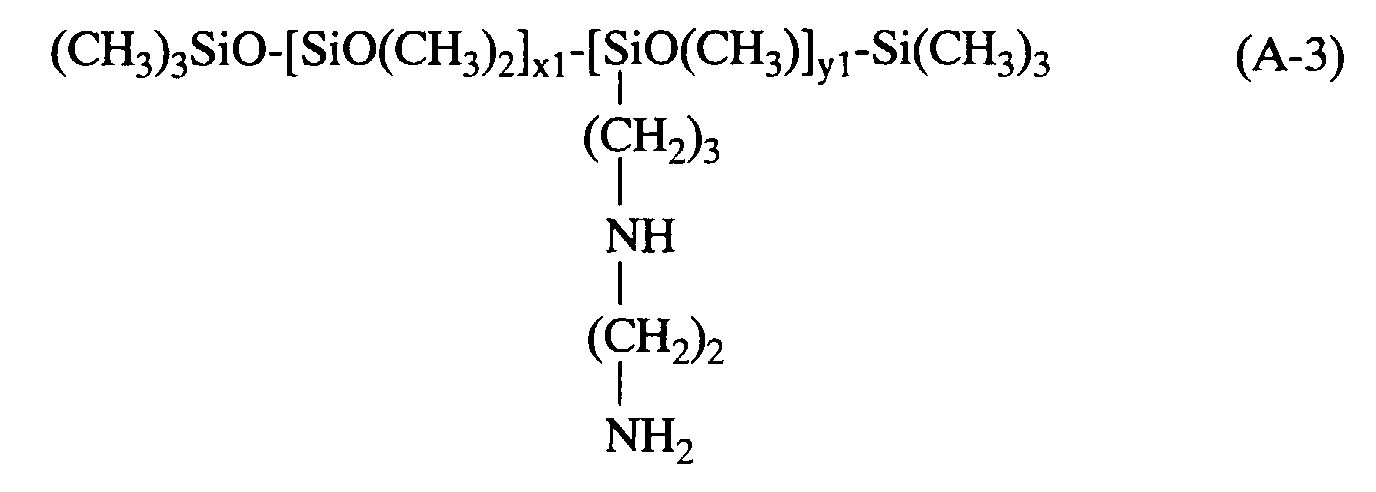 (A-4) is a poly(dimethylsiloxane)-polyol, polythiol, polyamine, or polyacid of structure:wherein y2 is 2-6 and x1, X and R1 are as described above;
 and (A-5) and (A-6) are a poly(dimethylsiloxane)-polyoxirane of structure:or
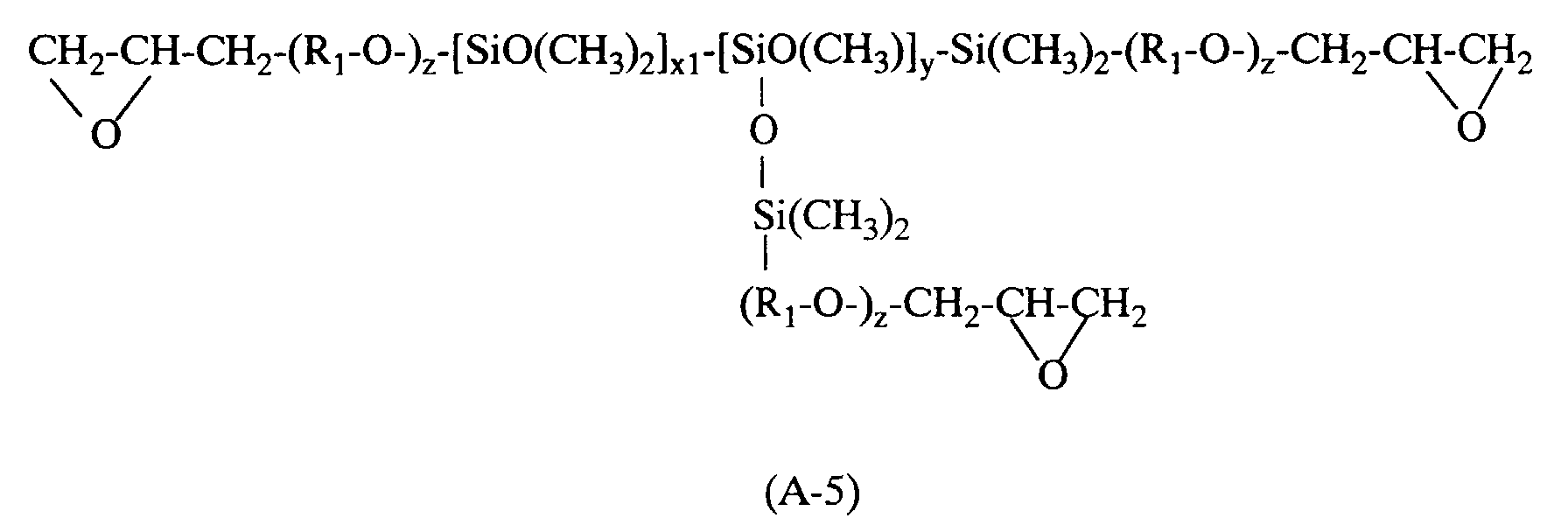 wherein R1, x1, y and y2 are as defined above and z is zero or 1,
 (A) 10 % by weight of the reaction product of poly(dimethylsiloxane) di(alkylene-ol) with two equivalents isophorone diisocyanate and thereafter with 2 equivalents hydroxyethyl methacrylate,(B) 40 % by weight tris-(trimethylsiloxy)-silylpropyl methacrylate,(C) 29 % by weight trifluoroethyl methacrylate,(D) 3 % by weight 3,3,5-trimethylcyclohexyl methacrylate,(E) 9 % by weight 3,5-bis(3-methacroyloxypropyl)-3,5-bis(trimethylsiloxy)-1,1,1,7,7,7-hexamethyltetrasiloxane, and(F) 9 % by weight methacrylic acid; and of(A) 10 % by weight of the reaction product of poly(dimethylsiloxane) di(alkylene-ol) with two equivalents isophorone diisocyanate and thereafter with 2 equivalents hydroxyethyl methacrylate,(B) 35 % by weight tris-(trimethylsiloxy)-silylpropyl methacrylate,(C) 35 % by weight trifluoroethyl methacrylate,(D) 5 % by weight 3,3,5-trimethylcyclohexyl methacrylate,(E) 5 % by weight 3,5-bis(3-methacroyloxypropyl)-3,5-bis(trimethylsiloxy)-1,1,1,7,7,7-hexamethyltetrasiloxane, and(F) 10 % by weight methacrylic acid; and ofwhich process is characterized by mixing the appropriate amounts of macromer and comonomers, addition of a free-radical generating initiator and exposing the deoxygenated mixture, conveniently in a mold, to either UV or heat until polymerization is complete.(A) 5 % by weight of the reaction product of poly(dimethylsiloxane) di(alkylene-ol) with two equivalents isophorone diisocyanate and thereafter with 2 equivalents hydroxyethyl methacrylate,(B) 30 % by weight tris-(trimethylsiloxy)-silylpropyl methacrylate,(C) 39 % by weight hexafluoroisopropyl methacrylate,(D) 3 % by weight 3,3,5-trimethylcyclohexyl methacrylate,(E) 14 % by weight 3,5-bis(3-methacroyloxypropyl)-3,5-bis(trimethylsiloxy)-1,1,1,7,7,7-hexamethyltetrasiloxane, and(F) 9 % by weight methacrylic acid,
 - A process according to claim 1 for the manufacture of the copolymerization product of:
(A) 3-15 %, (B) 25-45 %, (C) 20-45 %, (D) 0-15 %, (E) 1-20 % and (F) 3-15 %, all by weight. - A process according to claim 2, wherein (A) has a number average molecular weight Mn of about 1000 to 5000,(B) is tris-(trimethylsiloxy)-silylpropyl methacrylate,(C) is hexafluoroisopropyl methacrylate or trifluoroethyl methacrylate,(D) is methyl methacrylate, cyclohexyl methacrylate, trimethylcyclohexyl methacrylate or isobornyl methacrylate,(E) is a di- or triacrylate or methacrylate of 100-1000 molecular weight, divinylbenzene, 3,5-bis(3-methacroyloxypropyl)-3,5-bis(trimethylsiloxy)-1,1,1,7,7,7-hexamethyltetrasiloxane, 1,3-bis(3-methacroyloxypropyl)-1,1,3,3-tetramethyldisiloxane, or the reaction product of equivalent amounts of an hydroxy or amino functional vinyl compound with a diisocyanate or with a isocyanato substituted vinyl compound, and(F) is acrylic or methacrylic acid, N,N-dimethylacrylamide, 2-hydroxyethyl acrylate or methacrylate, maleic or itaconic anhydride, or N-vinylpyrrolidone.
- A process according to claim 3, wherein (A) is the reaction product of a poly(dimethylsiloxane)-polyol or polyamine of structure (A-1), (A-2), (A-3) or (A-4) with an oxirane or isocyanato substituted vinyl monomer derived from the group consisting of the acrylates, methacrylates, styrene or allyl containing compounds.
- A process according to claim 3, wherein (A) is the reaction product of a poly(dimethylsiloxane)-polyoxirane of structure (A-5) or (A-6) with an carboxy, amino, mercapto or hydroxy substituted vinyl monomer derived from the group consisting of the acrylates, methacrylates, styrene or allyl containing compounds.
- A process according to claim 3, wherein (A) is the reaction product of a poly(dimethylsiloxane)-polythiol of structure (A-1) or (A-4) with glycidyl methacrylate or an isocyanato substituted vinyl monomer.
- A process according to claim 3, wherein (A) is the reaction product of a poly(dimethylsiloxane)-polyacid of structure (A-1) or (A-4) with glycidyl methacrylate or an hydroxy or amino substituted vinyl monomer.
- A process according to claim 3, wherein (A) is the reaction product of a poly(dimethylsiloxane)-polyol of structure (A-1), (A-2) or (A-4) with an isocyanato substituted vinyl monomer or with the reaction product of equimolar amounts of a hydroxy or amino-functional vinyl compound with an aliphatic or cycloaliphatic diisocyanate, and (E) is a di- or triacrylate or methacrylate of 100-1000 molecular weight, divinylbenzene, or is the reaction product of equivalent amounts of a hydroxy or aminofunctional vinyl compound with an aliphatic or cycloaliphatic diisocyanate or with a isocyanato substituted vinyl compound.
- A process according to claim 2, wherein (A) is the reaction product of a poly(dimethylsiloxane)-polyol or polyamine of structure (A-1), (A-2) or (A-4) and the isocyanato substituted vinyl monomer is 2-isocyanatoethyl methacrylate or m-isopropenyl-α,α-dimethylbenzyl isocyanate, or is the reaction product of equimolar amounts of 2-hydroxyethyl methacrylate, N-t-butyl-2-aminoethyl methacrylate or allyl alcohol with isophorone diisocyanate or 3,3,4(4,4,3)trimethylhexane-1,6-diisocyanate, and (E) is a di- or triacrylate or methacrylate of 100-1000 molecular weight, divinylbenzene, or is the reaction product of equimolar amounts of 2-hydroxyethyl methacrylate, N-t-butyl-2-aminoethyl methacrylate or allyl alcohol and isophorone diisocyanate or 3,3,4(4,4,3)trimethylhexane-1,6-diisocyanate, or with 2-isocyanatoethyl-methacrylate or m-isopropenyl-α,α-dimethylbenzyl isocyanate.
- A process according to claim 2, wherein (A) is the reaction product of a poly(dimethylsiloxane)-diol of structure (A-1) wherein X is oxygen, y is zero, x1 is 20-50, and the isocyanato substituted vinyl compound is 2-isocyanatoethyl methacrylate or m-isopropenyl-α,α-dimethylbenzyl isocyanate, or the reaction product of equimolar amounts of 2-hydroxyethyl methacrylate, N-t-butyl-2-aminoethyl methacrylate or allyl alcohol with isophorone diisocyanate or 3,3,4(4,4,3)trimethylhexane-1,6-diisocyanate, and in which(B) is tris-(trimethylsiloxy)-silylpropyl methacrylate,(C) is hexafluoroisopropyl methacrylate,(D) is trimethylcyclohexyl methacrylate,(E) is a di- or triacrylate or methacrylate of 100-1000 molecular weight, divinylbenzene, or is the reaction product of equimolar amounts of 2-hydroxyethyl methacrylate, N-t-butyl-2-aminoethyl methacrylate or allyl alcohol and isophorone diisocyanate or 3,3,4(4,4,3)trimethylhexane-1,6-diisocyanate, or with 2-isocyanatoethyl methacrylate or m-isopropenyl-a,a-dimethylbenzyl isocyanate, and(F) is methacrylic acid.
- A process according to claim 2, wherein (A) is the reaction product of a poly(dimethylsiloxane)-diamine of structure (A-1) wherein X is -NH-, y is zero, x1 is 20-50, and the isocyanato substituted vinyl compound is 2-isocyanatoethyl methacrylate or m-isopropenyl-α,α-dimethylbenzyl isocyanate, or the reaction product of equimolar amounts of 2-hydroxyethyl methacrylate, N-t-butyl-2-aminoethyl methacrylate or allyl alcohol with isophorone diisocyanate or 3,3,4(4,4,3)trimethylhexane-1,6-diisocyanate, and in which(B) is tris-(trimethylsiloxy)-silylpropyl methacrylate,(C) is hexafluoroisopropyl methacrylate,(D) is trimethylcyclohexyl methacrylate,(E) is a di- or triacrylate or methacrylate of 100-1000 molecular weight, divinylbenzene, or is the reaction product of equimolar amounts of 2-hydroxyethyl methacrylate, N-t-butyl-2-aminoethyl methacrylate or allyl alcohol and isophorone diisocyanate or 3,3,4(4,4,3)trimethylhexane-1,6-diisocyanate, or with 2-isocyanatoethyl methacrylate or m-isopropenyl-a,a-dimethylbenzyl isocyanate, and(F) is methacrylic acid.
- A process according to claim 2, wherein (A) is the reaction product of a poly(dimethylsiloxane)-tetrol of structure (A-2) with an isocyanato substituted vinyl monomer derived from the group consisting of the acrylates, methacrylates, styrene or allyl containing compounds.
- A process according to claim 12, wherein the isocyanato substituted vinyl monomer is 2-isocyanatoethyl methacrylate or m-isopropenyl-α,α-dimethylbenzyl isocyanate.
- A process according to claim 2, wherein (A) is the reaction product of a poly(dimethylsiloxane)-polyamine of structure (A-1), (A-3) or (A-4) with an isocyanato substituted vinyl monomer derived from the group consisting of the acrylates, methacrylates, styrene or allyl group containing compounds.
- A process according to claim 14, wherein the isocyanato substituted vinyl monomer is 2-isocyanatoethyl methacrylate or m-isopropenyl-α,α-dimethylbenzyl isocyanate.
- A process according to claim 2, wherein (A) is the reaction product of a poly(dimethylsiloxane) polyol of structure (A-4) with an isocyanato substituted vinyl monomer derived from the group consisting of the acrylates, methacrylates, styrene or allyl group containing compounds.
- A process according to claim 16, wherein the isocyanato substituted vinyl monomer is 2-isocyanatoethyl methacrylate, m-isopropenyl-α,α-dimethylbenzyl isocyanate, or the reaction product of equimolar amounts of a hydroxy or aminofunctional vinyl compound with an aliphatic or cycloaliphatic diisocyanate.
- A process according to claim 9, wherein the isocyanato substituted vinyl monomer is 2-isocyanatoethyl methacrylate or m-isopropenyl-α,α-dimethylbenzyl isocyanate.
- A process according to claim 10, wherein the isocyanato substituted vinyl monomer is 2-isocyanatoethyl methacrylate or m-isopropenyl-α,α-dimethylbenzyl isocyanate.
- A process according to claim 11, wherein the isocyanato substituted vinyl monomer is 2-isocyanatoethyl methacrylate or m-isopropenyl-α,α-dimethylbenzyl isocyanate.
- A contact lens comprising a polymer as defined in claim 1.
- A contact lens consisting essentially of a polymer as defined in claim 1.
- A process for the manufacture of a contact lens from a polymer as defined in claim 1.
- The use of a polymer as defined in claim 1 for the manufacture of a contact lens.
Applications Claiming Priority (2)
| Application Number | Priority Date | Filing Date | Title |
|---|---|---|---|
| US07/638,949 US5194556A (en) | 1991-01-09 | 1991-01-09 | Rigid contact lenses with improved oxygen permeability |
| US638949 | 1991-01-09 |
Publications (3)
| Publication Number | Publication Date |
|---|---|
| EP0494842A2 EP0494842A2 (en) | 1992-07-15 |
| EP0494842A3 EP0494842A3 (en) | 1992-08-05 |
| EP0494842B1 true EP0494842B1 (en) | 1998-04-22 |
Family
ID=24562117
Family Applications (1)
| Application Number | Title | Priority Date | Filing Date |
|---|---|---|---|
| EP92810002A Expired - Lifetime EP0494842B1 (en) | 1991-01-09 | 1992-01-06 | Rigid contact lenses with improved oxygen permeability |
Country Status (14)
| Country | Link |
|---|---|
| US (1) | US5194556A (en) |
| EP (1) | EP0494842B1 (en) |
| JP (2) | JP3322898B2 (en) |
| KR (1) | KR920014841A (en) |
| AT (1) | ATE165375T1 (en) |
| AU (1) | AU654520B2 (en) |
| CA (1) | CA2058896C (en) |
| DE (1) | DE69225151T2 (en) |
| DK (1) | DK0494842T3 (en) |
| ES (1) | ES2115660T3 (en) |
| GR (1) | GR3026729T3 (en) |
| IE (1) | IE920062A1 (en) |
| SG (1) | SG49603A1 (en) |
| TW (1) | TW222655B (en) |
Cited By (1)
| Publication number | Priority date | Publication date | Assignee | Title |
|---|---|---|---|---|
| DE102007039501A1 (en) * | 2007-08-21 | 2009-02-26 | Evonik Röhm Gmbh | New polymerisable isocyanate and polymers containing this isocyanate |
Families Citing this family (38)
| Publication number | Priority date | Publication date | Assignee | Title |
|---|---|---|---|---|
| US5194556A (en) * | 1991-01-09 | 1993-03-16 | Ciba-Geigy Corporation | Rigid contact lenses with improved oxygen permeability |
| JP3195662B2 (en) * | 1992-08-24 | 2001-08-06 | 株式会社メニコン | Ophthalmic lens materials |
| JP2774233B2 (en) * | 1992-08-26 | 1998-07-09 | 株式会社メニコン | Ophthalmic lens materials |
| US5310571A (en) * | 1992-09-01 | 1994-05-10 | Allergan, Inc. | Chemical treatment to improve oxygen permeability through and protein deposition on hydrophilic (soft) and rigid gas permeable (RGP) contact lenses |
| US5760100B1 (en) * | 1994-09-06 | 2000-11-14 | Ciba Vision Corp | Extended wear ophthalmic lens |
| US7468398B2 (en) * | 1994-09-06 | 2008-12-23 | Ciba Vision Corporation | Extended wear ophthalmic lens |
| JP3530287B2 (en) * | 1995-10-24 | 2004-05-24 | 株式会社メニコン | Low water content ophthalmic lens material, low water content ophthalmic lens molded article thereof, low water content ophthalmic lens made thereof, and method for producing the same |
| JP2000501853A (en) * | 1995-12-08 | 2000-02-15 | ノバルティス アクチエンゲゼルシャフト | How to make contact lenses |
| JPH1017624A (en) * | 1996-06-28 | 1998-01-20 | Toray Dow Corning Silicone Co Ltd | Silicone-modified vinyl polymer and method for producing the same |
| FR2752463A1 (en) * | 1996-08-14 | 1998-02-20 | Gervais Claude Rene | Highly permeable rigid contact lens with no water content |
| AU7533696A (en) * | 1996-12-13 | 1998-06-18 | Ciba-Geigy Ag | New materials |
| US5981675A (en) * | 1998-12-07 | 1999-11-09 | Bausch & Lomb Incorporated | Silicone-containing macromonomers and low water materials |
| US20010049400A1 (en) * | 1999-10-25 | 2001-12-06 | Azaam Alli | Method of making an optical polymer |
| JP4438162B2 (en) * | 2000-02-24 | 2010-03-24 | 東レ株式会社 | Method for producing polymer for ophthalmic lens and ophthalmic lens |
| AU2001278757B2 (en) * | 2001-08-17 | 2008-03-06 | Johnson & Johnson Vision Care, Inc. | Method for producing polymer for ophthalmic lens and ophthalmic lens |
| WO2003042265A1 (en) * | 2001-11-13 | 2003-05-22 | Toray Industries, Inc. | Polymer and ophthalmic lenses made by using the same |
| FR2832717B1 (en) * | 2001-11-26 | 2004-07-09 | Essilor Int | RADICAL-POLYMERIZABLE COMPOSITION CONDUCTING ORGANIC SHOCK-RESISTANT GLASSES |
| US7216975B2 (en) * | 2003-07-15 | 2007-05-15 | Shinn-Gwo Hong | Method for preparing the reactive tinting compound and the tinted contact lens |
| GB0327067D0 (en) | 2003-11-21 | 2003-12-24 | Dow Corning | Polymeric products useful as oil repellents |
| WO2007041166A2 (en) | 2005-09-30 | 2007-04-12 | The Lagado Corporation | Highly oxygen permeable rigid contact lenses from polyacetylenes |
| JP5006061B2 (en) | 2006-02-07 | 2012-08-22 | 日本合成化学工業株式会社 | Long-fiber nonwoven fabric made of water-soluble polyvinyl alcohol resin |
| US7601766B2 (en) | 2006-06-30 | 2009-10-13 | Bausch & Lomb Incorporated | Carboxylic siloxanyl monomers with pendant polymerizable groups |
| KR101090654B1 (en) * | 2006-10-02 | 2011-12-07 | 히다치 가세고교 가부시끼가이샤 | Epoxy resin molding material for sealing and electronic component device |
| US7939579B1 (en) * | 2008-07-09 | 2011-05-10 | Contamac Limited | Hydrogels and methods of manufacture |
| US8440738B2 (en) * | 2008-07-09 | 2013-05-14 | Timothy Higgs | Silicone hydrogels and methods of manufacture |
| NZ591769A (en) * | 2008-11-13 | 2012-06-29 | Novartis Ag | Polysiloxane copolymers with terminal hydrophilic polymer chains |
| US8163206B2 (en) * | 2008-12-18 | 2012-04-24 | Novartis Ag | Method for making silicone hydrogel contact lenses |
| RU2576622C2 (en) | 2010-07-30 | 2016-03-10 | Новартис Аг | Amphiphilic polysiloxane prepolymers and their application |
| CN101928498B (en) * | 2010-08-24 | 2014-04-23 | 中国电力科学研究院 | Fluorosilicone-modified acrylic resin hydrophobic anti-corrosion paint |
| CA2813469C (en) | 2010-10-06 | 2016-01-12 | Novartis Ag | Polymerizable chain-extended polysiloxanes with pendant hydrophilic groups |
| RU2576317C2 (en) | 2010-10-06 | 2016-02-27 | Новартис Аг | Silicone-containing prepolymers subjected to water processing and versions of application thereof |
| CA2811013C (en) | 2010-10-06 | 2016-01-19 | Novartis Ag | Chain-extended polysiloxane crosslinkers with dangling hydrophilic polymer chains |
| JP5805192B2 (en) * | 2011-07-19 | 2015-11-04 | 株式会社ブリヂストン | PHOTOCURABLE RESIN COMPOSITION, WATERWIRE MEMBER AND FUNCTIONAL PANEL USING THE SAME |
| US8937133B2 (en) | 2012-09-25 | 2015-01-20 | National Chiao Tung University | Dissoluble PDMS-modified p(HEMA-MAA) amphiphilic copolymer and method for fabricating the same |
| TWI535793B (en) * | 2013-01-31 | 2016-06-01 | 明基材料股份有限公司 | Material for contact lenses, method for manufacturing contact lenses and contact lenses obtained thereby |
| US9528869B2 (en) | 2014-12-16 | 2016-12-27 | Schlumberger Technology Corporation | Method of compensating for changes in water properties in a multiphase flow meter |
| US11035983B2 (en) * | 2016-09-26 | 2021-06-15 | Verily Life Sciences Llc | Cast-moldable, high refractive index, rigid, gas permeable polymer formulations for an accommodating contact lens |
| CN114026187B (en) * | 2019-06-27 | 2023-03-10 | 3M创新有限公司 | Metal-polymer hybrid materials with high refractive index |
Family Cites Families (36)
| Publication number | Priority date | Publication date | Assignee | Title |
|---|---|---|---|---|
| US3808178A (en) * | 1972-06-16 | 1974-04-30 | Polycon Laboratories | Oxygen-permeable contact lens composition,methods and article of manufacture |
| US4275184A (en) * | 1974-10-01 | 1981-06-23 | Rhone-Poulenc Industries | Ethylenic silicon compounds and thermoplastic elastomers obtained therefrom |
| US4208362A (en) * | 1975-04-21 | 1980-06-17 | Bausch & Lomb Incorporated | Shaped body of at least two polymerized materials and method to make same |
| US4136250A (en) * | 1977-07-20 | 1979-01-23 | Ciba-Geigy Corporation | Polysiloxane hydrogels |
| US4189546A (en) * | 1977-07-25 | 1980-02-19 | Bausch & Lomb Incorporated | Polysiloxane shaped article for use in biomedical applications |
| US4130708A (en) * | 1977-12-09 | 1978-12-19 | Ppg Industries, Inc. | Siloxane urethane acrylate radiation curable compounds for use in coating compositions |
| US4276402A (en) * | 1979-09-13 | 1981-06-30 | Bausch & Lomb Incorporated | Polysiloxane/acrylic acid/polcyclic esters of methacrylic acid polymer contact lens |
| DE3005024A1 (en) * | 1980-02-11 | 1981-08-20 | Prof. Dr. Ernst 7400 Tübingen Bayer | CHIRAL POLYSILOXANES, METHOD FOR THE PRODUCTION AND USE THEREOF |
| US4486577A (en) * | 1982-10-12 | 1984-12-04 | Ciba-Geigy Corporation | Strong, silicone containing polymers with high oxygen permeability |
| CA1236624A (en) * | 1983-04-28 | 1988-05-10 | Minnesota Mining And Manufacturing Company | Ophthalmic devices fabricated from urethane acrylates of polysiloxane alcohols |
| US4605712A (en) * | 1984-09-24 | 1986-08-12 | Ciba-Geigy Corporation | Unsaturated polysiloxanes and polymers thereof |
| CA1279143C (en) * | 1985-01-29 | 1991-01-15 | Nick Stoyan | Oxygen-permeable lenses |
| JPS61285425A (en) * | 1985-06-12 | 1986-12-16 | Nippon Contact Lens:Kk | Contact lens material |
| JPS61285426A (en) * | 1985-06-12 | 1986-12-16 | Nippon Contact Lens:Kk | Contact lens material |
| US4661573A (en) * | 1986-04-14 | 1987-04-28 | Paragon Optical Inc. | Lens composition articles and method of manufacture |
| JPS62296118A (en) * | 1986-06-17 | 1987-12-23 | Seiko Epson Corp | Contact lens |
| JP2532406B2 (en) * | 1986-09-30 | 1996-09-11 | ホ−ヤ株式会社 | Oxygen permeable hard contact lens material with excellent impact resistance |
| US4740533A (en) * | 1987-07-28 | 1988-04-26 | Ciba-Geigy Corporation | Wettable, flexible, oxygen permeable, substantially non-swellable contact lens containing block copolymer polysiloxane-polyoxyalkylene backbone units, and use thereof |
| US4734475A (en) * | 1986-12-15 | 1988-03-29 | Ciba-Geigy Corporation | Wettable surface modified contact lens fabricated from an oxirane containing hydrophobic polymer |
| US4780515A (en) * | 1987-02-05 | 1988-10-25 | Bausch & Lomb Incorporated | Continuous-wear lenses having improved physical properties |
| US4837289A (en) * | 1987-04-30 | 1989-06-06 | Ciba-Geigy Corporation | UV- and heat curable terminal polyvinyl functional macromers and polymers thereof |
| US4923906A (en) * | 1987-04-30 | 1990-05-08 | Ciba-Geigy Corporation | Rigid, gas-permeable polysiloxane contact lenses |
| US4766189A (en) * | 1987-08-13 | 1988-08-23 | Fused Kontacts Of Chicago, Inc. | Compositions for making improved gas permeable contact lenses |
| JPH0312415A (en) * | 1989-06-08 | 1991-01-21 | Mitsui Petrochem Ind Ltd | Copolymer and contact lens made thereof |
| JPH0312416A (en) * | 1989-06-08 | 1991-01-21 | Mitsui Petrochem Ind Ltd | Copolymer and contact lends made thereof |
| US5032658A (en) * | 1989-10-17 | 1991-07-16 | Polymer Technology Corporation | Polymeric compositions useful in oxygen permeable contact lenses |
| ES2064987T3 (en) * | 1989-12-29 | 1995-02-01 | Hoya Corp | MATERIAL FOR CONTACT LENSES AND CONTACT LENS. |
| JP2619095B2 (en) * | 1990-01-30 | 1997-06-11 | 旭化成工業株式会社 | Oxygen permeable material |
| JPH03240021A (en) * | 1990-02-19 | 1991-10-25 | Asahi Chem Ind Co Ltd | Contact lens material |
| JPH03257420A (en) * | 1990-03-08 | 1991-11-15 | Asahi Chem Ind Co Ltd | Oxygen permeable contact lens material |
| DE69101464T2 (en) * | 1990-04-26 | 1994-07-14 | Ciba Geigy | Unsaturated urea polysiloxanes. |
| EP0455587B1 (en) * | 1990-05-02 | 1995-07-19 | Ciba-Geigy Ag | New polymers and hard gas-permeable contact lenses made therefrom |
| JP3014408B2 (en) * | 1990-05-18 | 2000-02-28 | ノバルティス アクチエンゲゼルシャフト | Method for producing oxygen-permeable polymer material |
| JP2947911B2 (en) * | 1990-10-05 | 1999-09-13 | ノバルティス アクチエンゲゼルシャフト | Method for producing oxygen-permeable polymer material |
| JP3043390B2 (en) * | 1990-10-19 | 2000-05-22 | ノバルティス アクチエンゲゼルシャフト | Method for producing oxygen-permeable polymer material |
| US5194556A (en) * | 1991-01-09 | 1993-03-16 | Ciba-Geigy Corporation | Rigid contact lenses with improved oxygen permeability |
-
1991
- 1991-01-09 US US07/638,949 patent/US5194556A/en not_active Expired - Lifetime
-
1992
- 1992-01-06 DE DE69225151T patent/DE69225151T2/en not_active Expired - Lifetime
- 1992-01-06 EP EP92810002A patent/EP0494842B1/en not_active Expired - Lifetime
- 1992-01-06 SG SG1996000723A patent/SG49603A1/en unknown
- 1992-01-06 ES ES92810002T patent/ES2115660T3/en not_active Expired - Lifetime
- 1992-01-06 AU AU10088/92A patent/AU654520B2/en not_active Ceased
- 1992-01-06 DK DK92810002T patent/DK0494842T3/en active
- 1992-01-06 AT AT92810002T patent/ATE165375T1/en not_active IP Right Cessation
- 1992-01-07 CA CA002058896A patent/CA2058896C/en not_active Expired - Fee Related
- 1992-01-08 JP JP01834392A patent/JP3322898B2/en not_active Expired - Fee Related
- 1992-01-08 IE IE006292A patent/IE920062A1/en not_active IP Right Cessation
- 1992-01-08 KR KR1019920000113A patent/KR920014841A/en not_active Abandoned
- 1992-01-08 TW TW081100106A patent/TW222655B/zh active
-
1998
- 1998-04-28 GR GR980400918T patent/GR3026729T3/en unknown
-
2002
- 2002-03-11 JP JP2002065116A patent/JP2002284828A/en active Pending
Cited By (1)
| Publication number | Priority date | Publication date | Assignee | Title |
|---|---|---|---|---|
| DE102007039501A1 (en) * | 2007-08-21 | 2009-02-26 | Evonik Röhm Gmbh | New polymerisable isocyanate and polymers containing this isocyanate |
Also Published As
| Publication number | Publication date |
|---|---|
| KR920014841A (en) | 1992-08-25 |
| HK1009064A1 (en) | 1999-05-21 |
| GR3026729T3 (en) | 1998-07-31 |
| AU1008892A (en) | 1992-07-16 |
| TW222655B (en) | 1994-04-21 |
| US5194556A (en) | 1993-03-16 |
| CA2058896C (en) | 2004-08-03 |
| AU654520B2 (en) | 1994-11-10 |
| ES2115660T3 (en) | 1998-07-01 |
| EP0494842A3 (en) | 1992-08-05 |
| ATE165375T1 (en) | 1998-05-15 |
| DE69225151T2 (en) | 1998-10-22 |
| EP0494842A2 (en) | 1992-07-15 |
| JPH05117349A (en) | 1993-05-14 |
| DE69225151D1 (en) | 1998-05-28 |
| DK0494842T3 (en) | 1998-11-30 |
| JP3322898B2 (en) | 2002-09-09 |
| CA2058896A1 (en) | 1992-07-10 |
| SG49603A1 (en) | 2001-01-16 |
| IE920062A1 (en) | 1992-07-15 |
| JP2002284828A (en) | 2002-10-03 |
Similar Documents
| Publication | Publication Date | Title |
|---|---|---|
| US5194556A (en) | Rigid contact lenses with improved oxygen permeability | |
| US4486577A (en) | Strong, silicone containing polymers with high oxygen permeability | |
| US5334681A (en) | Fluorine and/or silicone containing poly(alkylene-oxide)-block copolymer hydrogels and contact lenses thereof | |
| US4605712A (en) | Unsaturated polysiloxanes and polymers thereof | |
| US5115056A (en) | Fluorine and/or silicone containing poly(alkylene-oxide)-block copolymers and contact lenses thereof | |
| US4837289A (en) | UV- and heat curable terminal polyvinyl functional macromers and polymers thereof | |
| US4923906A (en) | Rigid, gas-permeable polysiloxane contact lenses | |
| EP0362145B1 (en) | Crosslinked siloxane-urethane polymer contact lens | |
| CN101094879B (en) | Polysiloxane prepolymers for biomedical devices | |
| US7344731B2 (en) | Rigid gas permeable lens material | |
| EP0493320B1 (en) | Fluorine and/or Silicone containing poly(alkylene-oxide)-block copolymer hydrogels and contact lenses thereof | |
| AU638066B2 (en) | Reactive silicone and/or fluorine containing hydrophilic prepolymers and polymers thereof | |
| CA2041136A1 (en) | Unsaturated urea polysiloxanes | |
| US5480946A (en) | Unsaturated urea polysiloxanes | |
| NO881852L (en) | TERMINAL POLYVINYL FUNCTIONAL MACROMERS, POLYMERS DERAVOG CONTACT LENSES MADE THEREOF. | |
| HK1009064B (en) | Rigid contact lenses with improved oxygen permeability |
Legal Events
| Date | Code | Title | Description |
|---|---|---|---|
| PUAI | Public reference made under article 153(3) epc to a published international application that has entered the european phase |
Free format text: ORIGINAL CODE: 0009012 |
|
| PUAL | Search report despatched |
Free format text: ORIGINAL CODE: 0009013 |
|
| AK | Designated contracting states |
Kind code of ref document: A2 Designated state(s): AT BE CH DE DK ES FR GB GR IT LI LU NL PT SE |
|
| AK | Designated contracting states |
Kind code of ref document: A3 Designated state(s): AT BE CH DE DK ES FR GB GR IT LI LU NL PT SE |
|
| 17P | Request for examination filed |
Effective date: 19921204 |
|
| 17Q | First examination report despatched |
Effective date: 19950713 |
|
| RAP1 | Party data changed (applicant data changed or rights of an application transferred) |
Owner name: NOVARTIS AG |
|
| GRAG | Despatch of communication of intention to grant |
Free format text: ORIGINAL CODE: EPIDOS AGRA |
|
| GRAG | Despatch of communication of intention to grant |
Free format text: ORIGINAL CODE: EPIDOS AGRA |
|
| GRAH | Despatch of communication of intention to grant a patent |
Free format text: ORIGINAL CODE: EPIDOS IGRA |
|
| GRAH | Despatch of communication of intention to grant a patent |
Free format text: ORIGINAL CODE: EPIDOS IGRA |
|
| GRAA | (expected) grant |
Free format text: ORIGINAL CODE: 0009210 |
|
| AK | Designated contracting states |
Kind code of ref document: B1 Designated state(s): AT BE CH DE DK ES FR GB GR IT LI LU NL PT SE |
|
| REF | Corresponds to: |
Ref document number: 165375 Country of ref document: AT Date of ref document: 19980515 Kind code of ref document: T |
|
| REG | Reference to a national code |
Ref country code: CH Ref legal event code: EP |
|
| ET | Fr: translation filed | ||
| REF | Corresponds to: |
Ref document number: 69225151 Country of ref document: DE Date of ref document: 19980528 |
|
| ITF | It: translation for a ep patent filed | ||
| REG | Reference to a national code |
Ref country code: ES Ref legal event code: FG2A Ref document number: 2115660 Country of ref document: ES Kind code of ref document: T3 |
|
| REG | Reference to a national code |
Ref country code: PT Ref legal event code: SC4A Free format text: AVAILABILITY OF NATIONAL TRANSLATION Effective date: 19980703 |
|
| REG | Reference to a national code |
Ref country code: DK Ref legal event code: T3 |
|
| PLBE | No opposition filed within time limit |
Free format text: ORIGINAL CODE: 0009261 |
|
| 26N | No opposition filed | ||
| REG | Reference to a national code |
Ref country code: GB Ref legal event code: IF02 |
|
| PGFP | Annual fee paid to national office [announced via postgrant information from national office to epo] |
Ref country code: NL Payment date: 20031211 Year of fee payment: 13 Ref country code: BE Payment date: 20031211 Year of fee payment: 13 |
|
| PGFP | Annual fee paid to national office [announced via postgrant information from national office to epo] |
Ref country code: SE Payment date: 20031216 Year of fee payment: 13 Ref country code: CH Payment date: 20031216 Year of fee payment: 13 |
|
| PGFP | Annual fee paid to national office [announced via postgrant information from national office to epo] |
Ref country code: DK Payment date: 20031217 Year of fee payment: 13 |
|
| PGFP | Annual fee paid to national office [announced via postgrant information from national office to epo] |
Ref country code: GR Payment date: 20031218 Year of fee payment: 13 Ref country code: LU Payment date: 20031218 Year of fee payment: 13 |
|
| PGFP | Annual fee paid to national office [announced via postgrant information from national office to epo] |
Ref country code: AT Payment date: 20031219 Year of fee payment: 13 |
|
| PGFP | Annual fee paid to national office [announced via postgrant information from national office to epo] |
Ref country code: ES Payment date: 20040109 Year of fee payment: 13 |
|
| PGFP | Annual fee paid to national office [announced via postgrant information from national office to epo] |
Ref country code: PT Payment date: 20040114 Year of fee payment: 13 |
|
| PG25 | Lapsed in a contracting state [announced via postgrant information from national office to epo] |
Ref country code: LU Free format text: LAPSE BECAUSE OF NON-PAYMENT OF DUE FEES Effective date: 20050106 Ref country code: IT Free format text: LAPSE BECAUSE OF NON-PAYMENT OF DUE FEES;WARNING: LAPSES OF ITALIAN PATENTS WITH EFFECTIVE DATE BEFORE 2007 MAY HAVE OCCURRED AT ANY TIME BEFORE 2007. THE CORRECT EFFECTIVE DATE MAY BE DIFFERENT FROM THE ONE RECORDED. Effective date: 20050106 Ref country code: AT Free format text: LAPSE BECAUSE OF NON-PAYMENT OF DUE FEES Effective date: 20050106 |
|
| PG25 | Lapsed in a contracting state [announced via postgrant information from national office to epo] |
Ref country code: SE Free format text: LAPSE BECAUSE OF NON-PAYMENT OF DUE FEES Effective date: 20050107 Ref country code: ES Free format text: LAPSE BECAUSE OF NON-PAYMENT OF DUE FEES Effective date: 20050107 |
|
| PG25 | Lapsed in a contracting state [announced via postgrant information from national office to epo] |
Ref country code: LI Free format text: LAPSE BECAUSE OF NON-PAYMENT OF DUE FEES Effective date: 20050131 Ref country code: DK Free format text: LAPSE BECAUSE OF NON-PAYMENT OF DUE FEES Effective date: 20050131 Ref country code: CH Free format text: LAPSE BECAUSE OF NON-PAYMENT OF DUE FEES Effective date: 20050131 Ref country code: BE Free format text: LAPSE BECAUSE OF NON-PAYMENT OF DUE FEES Effective date: 20050131 |
|
| PG25 | Lapsed in a contracting state [announced via postgrant information from national office to epo] |
Ref country code: PT Free format text: LAPSE BECAUSE OF NON-PAYMENT OF DUE FEES Effective date: 20050706 |
|
| BERE | Be: lapsed |
Owner name: *NOVARTIS A.G. Effective date: 20050131 |
|
| PG25 | Lapsed in a contracting state [announced via postgrant information from national office to epo] |
Ref country code: NL Free format text: LAPSE BECAUSE OF NON-PAYMENT OF DUE FEES Effective date: 20050801 |
|
| PG25 | Lapsed in a contracting state [announced via postgrant information from national office to epo] |
Ref country code: GR Free format text: LAPSE BECAUSE OF NON-PAYMENT OF DUE FEES Effective date: 20050802 |
|
| EUG | Se: european patent has lapsed | ||
| REG | Reference to a national code |
Ref country code: DK Ref legal event code: EBP |
|
| REG | Reference to a national code |
Ref country code: CH Ref legal event code: PL |
|
| REG | Reference to a national code |
Ref country code: PT Ref legal event code: MM4A Effective date: 20050706 |
|
| NLV4 | Nl: lapsed or anulled due to non-payment of the annual fee |
Effective date: 20050801 |
|
| REG | Reference to a national code |
Ref country code: ES Ref legal event code: FD2A Effective date: 20050107 |
|
| BERE | Be: lapsed |
Owner name: *NOVARTIS A.G. Effective date: 20050131 |
|
| PGFP | Annual fee paid to national office [announced via postgrant information from national office to epo] |
Ref country code: FR Payment date: 20080108 Year of fee payment: 17 |
|
| REG | Reference to a national code |
Ref country code: FR Ref legal event code: ST Effective date: 20091030 |
|
| PG25 | Lapsed in a contracting state [announced via postgrant information from national office to epo] |
Ref country code: FR Free format text: LAPSE BECAUSE OF NON-PAYMENT OF DUE FEES Effective date: 20090202 |
|
| PGFP | Annual fee paid to national office [announced via postgrant information from national office to epo] |
Ref country code: IT Payment date: 20080128 Year of fee payment: 17 |
|
| PGRI | Patent reinstated in contracting state [announced from national office to epo] |
Ref country code: IT Effective date: 20091201 |
|
| PGFP | Annual fee paid to national office [announced via postgrant information from national office to epo] |
Ref country code: GB Payment date: 20100106 Year of fee payment: 19 Ref country code: DE Payment date: 20091231 Year of fee payment: 19 |
|
| PGRI | Patent reinstated in contracting state [announced from national office to epo] |
Ref country code: IT Effective date: 20091201 |
|
| GBPC | Gb: european patent ceased through non-payment of renewal fee |
Effective date: 20110106 |
|
| PG25 | Lapsed in a contracting state [announced via postgrant information from national office to epo] |
Ref country code: GB Free format text: LAPSE BECAUSE OF NON-PAYMENT OF DUE FEES Effective date: 20110106 |
|
| REG | Reference to a national code |
Ref country code: DE Ref legal event code: R119 Ref document number: 69225151 Country of ref document: DE Effective date: 20110802 |
|
| PG25 | Lapsed in a contracting state [announced via postgrant information from national office to epo] |
Ref country code: DE Free format text: LAPSE BECAUSE OF NON-PAYMENT OF DUE FEES Effective date: 20110802 |