EP0494283B1 - 1,4-benzodioxane derivatives, process for the preparation thereof and pharmaceutical compositions therefrom - Google Patents
1,4-benzodioxane derivatives, process for the preparation thereof and pharmaceutical compositions therefrom Download PDFInfo
- Publication number
- EP0494283B1 EP0494283B1 EP91912540A EP91912540A EP0494283B1 EP 0494283 B1 EP0494283 B1 EP 0494283B1 EP 91912540 A EP91912540 A EP 91912540A EP 91912540 A EP91912540 A EP 91912540A EP 0494283 B1 EP0494283 B1 EP 0494283B1
- Authority
- EP
- European Patent Office
- Prior art keywords
- oxy
- methyl
- benzodioxan
- decyl
- alkyl
- Prior art date
- Legal status (The legal status is an assumption and is not a legal conclusion. Google has not performed a legal analysis and makes no representation as to the accuracy of the status listed.)
- Expired - Lifetime
Links
- 238000000034 method Methods 0.000 title claims abstract description 53
- 238000002360 preparation method Methods 0.000 title claims abstract description 13
- 230000008569 process Effects 0.000 title claims abstract description 8
- 239000008194 pharmaceutical composition Substances 0.000 title claims abstract description 5
- BNBQRQQYDMDJAH-UHFFFAOYSA-N benzodioxan Chemical class C1=CC=C2OCCOC2=C1 BNBQRQQYDMDJAH-UHFFFAOYSA-N 0.000 title abstract description 6
- 150000001875 compounds Chemical class 0.000 claims description 87
- 239000000203 mixture Substances 0.000 claims description 26
- 125000002496 methyl group Chemical group [H]C([H])([H])* 0.000 claims description 24
- IJGRMHOSHXDMSA-UHFFFAOYSA-N Atomic nitrogen Chemical compound N#N IJGRMHOSHXDMSA-UHFFFAOYSA-N 0.000 claims description 14
- 125000000217 alkyl group Chemical group 0.000 claims description 11
- 125000004169 (C1-C6) alkyl group Chemical group 0.000 claims description 10
- PAMIQIKDUOTOBW-UHFFFAOYSA-N 1-methylpiperidine Chemical compound CN1CCCCC1 PAMIQIKDUOTOBW-UHFFFAOYSA-N 0.000 claims description 10
- YNAVUWVOSKDBBP-UHFFFAOYSA-N Morpholine Chemical compound C1COCCN1 YNAVUWVOSKDBBP-UHFFFAOYSA-N 0.000 claims description 10
- 229910052757 nitrogen Inorganic materials 0.000 claims description 10
- 238000006243 chemical reaction Methods 0.000 claims description 8
- 239000002904 solvent Substances 0.000 claims description 8
- 125000003118 aryl group Chemical group 0.000 claims description 7
- 229910052739 hydrogen Inorganic materials 0.000 claims description 7
- 239000001257 hydrogen Substances 0.000 claims description 7
- -1 1,4-benzodioxan-2-yl Chemical group 0.000 claims description 5
- 125000003710 aryl alkyl group Chemical group 0.000 claims description 5
- 150000002431 hydrogen Chemical class 0.000 claims description 5
- RAXXELZNTBOGNW-UHFFFAOYSA-N 1H-imidazole Chemical compound C1=CNC=N1 RAXXELZNTBOGNW-UHFFFAOYSA-N 0.000 claims description 4
- NQRYJNQNLNOLGT-UHFFFAOYSA-O Piperidinium(1+) Chemical compound C1CC[NH2+]CC1 NQRYJNQNLNOLGT-UHFFFAOYSA-O 0.000 claims description 4
- JUJWROOIHBZHMG-UHFFFAOYSA-N Pyridine Chemical compound C1=CC=NC=C1 JUJWROOIHBZHMG-UHFFFAOYSA-N 0.000 claims description 4
- FZWLAAWBMGSTSO-UHFFFAOYSA-N Thiazole Chemical compound C1=CSC=N1 FZWLAAWBMGSTSO-UHFFFAOYSA-N 0.000 claims description 4
- 125000002704 decyl group Chemical group [H]C([H])([H])C([H])([H])C([H])([H])C([H])([H])C([H])([H])C([H])([H])C([H])([H])C([H])([H])C([H])([H])C([H])([H])* 0.000 claims description 4
- 125000004051 hexyl group Chemical group [H]C([H])([H])C([H])([H])C([H])([H])C([H])([H])C([H])([H])C([H])([H])* 0.000 claims description 4
- RWRDLPDLKQPQOW-UHFFFAOYSA-N tetrahydropyrrole Natural products C1CCNC1 RWRDLPDLKQPQOW-UHFFFAOYSA-N 0.000 claims description 4
- 150000001450 anions Chemical class 0.000 claims description 3
- 229910052736 halogen Inorganic materials 0.000 claims description 3
- 150000002367 halogens Chemical class 0.000 claims description 3
- BCMCBBGGLRIHSE-UHFFFAOYSA-N 1,3-benzoxazole Chemical compound C1=CC=C2OC=NC2=C1 BCMCBBGGLRIHSE-UHFFFAOYSA-N 0.000 claims description 2
- LJQVRIHRGZPJKG-UHFFFAOYSA-N 1-[10-(2,3-dihydro-1,4-benzodioxin-3-ylmethoxy)decyl]-1-methylpiperidin-1-ium Chemical compound C1OC2=CC=CC=C2OC1COCCCCCCCCCC[N+]1(C)CCCCC1 LJQVRIHRGZPJKG-UHFFFAOYSA-N 0.000 claims description 2
- VRLYFJMOJHHIDL-UHFFFAOYSA-N 1-[10-(2,3-dihydro-1,4-benzodioxin-3-ylmethoxy)decyl]piperidine Chemical compound C1OC2=CC=CC=C2OC1COCCCCCCCCCCN1CCCCC1 VRLYFJMOJHHIDL-UHFFFAOYSA-N 0.000 claims description 2
- TUSNVXQVXXMWHC-UHFFFAOYSA-N 1-[10-[10-(2,3-dihydro-1,4-benzodioxin-3-ylmethoxy)decoxy]decyl]-1-methylpiperidin-1-ium Chemical compound C1OC2=CC=CC=C2OC1COCCCCCCCCCCOCCCCCCCCCC[N+]1(C)CCCCC1 TUSNVXQVXXMWHC-UHFFFAOYSA-N 0.000 claims description 2
- VRLYFJMOJHHIDL-JOCHJYFZSA-N 1-[10-[[(3r)-2,3-dihydro-1,4-benzodioxin-3-yl]methoxy]decyl]piperidine Chemical compound C([C@H]1OC2=CC=CC=C2OC1)OCCCCCCCCCCN1CCCCC1 VRLYFJMOJHHIDL-JOCHJYFZSA-N 0.000 claims description 2
- HNRPWHHPSCWNEA-UHFFFAOYSA-N 1-[16-(2,3-dihydro-1,4-benzodioxin-3-ylmethoxy)hexadecyl]-1-methylpiperidin-1-ium Chemical compound C1OC2=CC=CC=C2OC1COCCCCCCCCCCCCCCCC[N+]1(C)CCCCC1 HNRPWHHPSCWNEA-UHFFFAOYSA-N 0.000 claims description 2
- SUQZGKUEKNPXBL-UHFFFAOYSA-N 1-[16-(2,3-dihydro-1,4-benzodioxin-3-ylmethoxy)hexadecyl]piperidine Chemical compound C1OC2=CC=CC=C2OC1COCCCCCCCCCCCCCCCCN1CCCCC1 SUQZGKUEKNPXBL-UHFFFAOYSA-N 0.000 claims description 2
- DBFOGZWLVVOSGK-UHFFFAOYSA-N 1-[6-[10-(2,3-dihydro-1,4-benzodioxin-3-ylmethoxy)decoxy]hexyl]-1-methylpiperidin-1-ium Chemical compound C1OC2=CC=CC=C2OC1COCCCCCCCCCCOCCCCCC[N+]1(C)CCCCC1 DBFOGZWLVVOSGK-UHFFFAOYSA-N 0.000 claims description 2
- FDWZAOGDOVQOLD-UHFFFAOYSA-N 1-methylpyrrolinium Chemical compound C[N+]1=CCCC1 FDWZAOGDOVQOLD-UHFFFAOYSA-N 0.000 claims description 2
- QOONGLRJUQBTKS-UHFFFAOYSA-N 10-(2,3-dihydro-1,4-benzodioxin-3-ylmethoxy)decyl-triethylazanium Chemical compound C1=CC=C2OC(COCCCCCCCCCC[N+](CC)(CC)CC)COC2=C1 QOONGLRJUQBTKS-UHFFFAOYSA-N 0.000 claims description 2
- QKSSSKWIUMGXMQ-UHFFFAOYSA-N 10-(2,3-dihydro-1,4-benzodioxin-3-ylmethoxy)decyl-trimethylazanium Chemical compound C1=CC=C2OC(COCCCCCCCCCC[N+](C)(C)C)COC2=C1 QKSSSKWIUMGXMQ-UHFFFAOYSA-N 0.000 claims description 2
- YSMBUDRVXMWYBH-UHFFFAOYSA-N 10-[10-(2,3-dihydro-1,4-benzodioxin-3-ylmethoxy)decoxy]decyl-trimethylazanium Chemical compound C1=CC=C2OC(COCCCCCCCCCCOCCCCCCCCCC[N+](C)(C)C)COC2=C1 YSMBUDRVXMWYBH-UHFFFAOYSA-N 0.000 claims description 2
- WJJJULPUHKUPIE-UHFFFAOYSA-N 16-(2,3-dihydro-1,4-benzodioxin-3-ylmethoxy)hexadecyl-triethylazanium Chemical compound C1=CC=C2OC(COCCCCCCCCCCCCCCCC[N+](CC)(CC)CC)COC2=C1 WJJJULPUHKUPIE-UHFFFAOYSA-N 0.000 claims description 2
- AJFVAFMUTQCVRS-UHFFFAOYSA-N 16-(2,3-dihydro-1,4-benzodioxin-3-ylmethoxy)hexadecyl-trimethylazanium Chemical compound C1=CC=C2OC(COCCCCCCCCCCCCCCCC[N+](C)(C)C)COC2=C1 AJFVAFMUTQCVRS-UHFFFAOYSA-N 0.000 claims description 2
- HYZJCKYKOHLVJF-UHFFFAOYSA-N 1H-benzimidazole Chemical compound C1=CC=C2NC=NC2=C1 HYZJCKYKOHLVJF-UHFFFAOYSA-N 0.000 claims description 2
- VLYDTSKBTJMCHR-UHFFFAOYSA-N 4-[10-(2,3-dihydro-1,4-benzodioxin-3-ylmethoxy)decyl]-4-methylmorpholin-4-ium Chemical compound C1OC2=CC=CC=C2OC1COCCCCCCCCCC[N+]1(C)CCOCC1 VLYDTSKBTJMCHR-UHFFFAOYSA-N 0.000 claims description 2
- HKYLNHJYJQDFRI-UHFFFAOYSA-N 4-[10-(2,3-dihydro-1,4-benzodioxin-3-ylmethoxy)decyl]morpholine Chemical compound C1OC2=CC=CC=C2OC1COCCCCCCCCCCN1CCOCC1 HKYLNHJYJQDFRI-UHFFFAOYSA-N 0.000 claims description 2
- MJGUFJPXFLZJQX-UHFFFAOYSA-N 6-[10-(2,3-dihydro-1,4-benzodioxin-3-ylmethoxy)decoxy]hexyl-trimethylazanium Chemical compound C1=CC=C2OC(COCCCCCCCCCCOCCCCCC[N+](C)(C)C)COC2=C1 MJGUFJPXFLZJQX-UHFFFAOYSA-N 0.000 claims description 2
- VRLYFJMOJHHIDL-QFIPXVFZSA-N C([C@@H]1OC2=CC=CC=C2OC1)OCCCCCCCCCCN1CCCCC1 Chemical compound C([C@@H]1OC2=CC=CC=C2OC1)OCCCCCCCCCCN1CCCCC1 VRLYFJMOJHHIDL-QFIPXVFZSA-N 0.000 claims description 2
- DQDNGEQKVKUURZ-UHFFFAOYSA-N C1OC2=CC=CC=C2OC1COCCCCCCCCCCOCCCCCCCCCCN1CCCCC1 Chemical compound C1OC2=CC=CC=C2OC1COCCCCCCCCCCOCCCCCCCCCCN1CCCCC1 DQDNGEQKVKUURZ-UHFFFAOYSA-N 0.000 claims description 2
- UFHFLCQGNIYNRP-UHFFFAOYSA-N Hydrogen Chemical compound [H][H] UFHFLCQGNIYNRP-UHFFFAOYSA-N 0.000 claims description 2
- SJRJJKPEHAURKC-UHFFFAOYSA-N N-Methylmorpholine Chemical compound CN1CCOCC1 SJRJJKPEHAURKC-UHFFFAOYSA-N 0.000 claims description 2
- ZCQWOFVYLHDMMC-UHFFFAOYSA-N Oxazole Chemical compound C1=COC=N1 ZCQWOFVYLHDMMC-UHFFFAOYSA-N 0.000 claims description 2
- WTKZEGDFNFYCGP-UHFFFAOYSA-N Pyrazole Chemical compound C=1C=NNC=1 WTKZEGDFNFYCGP-UHFFFAOYSA-N 0.000 claims description 2
- SMWDFEZZVXVKRB-UHFFFAOYSA-N Quinoline Chemical compound N1=CC=CC2=CC=CC=C21 SMWDFEZZVXVKRB-UHFFFAOYSA-N 0.000 claims description 2
- 125000004103 aminoalkyl group Chemical group 0.000 claims description 2
- IOJUPLGTWVMSFF-UHFFFAOYSA-N benzothiazole Chemical compound C1=CC=C2SC=NC2=C1 IOJUPLGTWVMSFF-UHFFFAOYSA-N 0.000 claims description 2
- 125000003178 carboxy group Chemical group [H]OC(*)=O 0.000 claims description 2
- 125000002768 hydroxyalkyl group Chemical group 0.000 claims description 2
- AWJUIBRHMBBTKR-UHFFFAOYSA-N isoquinoline Chemical compound C1=NC=CC2=CC=CC=C21 AWJUIBRHMBBTKR-UHFFFAOYSA-N 0.000 claims description 2
- 125000004433 nitrogen atom Chemical group N* 0.000 claims description 2
- 125000004430 oxygen atom Chemical group O* 0.000 claims description 2
- 125000002924 primary amino group Chemical group [H]N([H])* 0.000 claims description 2
- 150000003839 salts Chemical class 0.000 claims description 2
- 125000001424 substituent group Chemical group 0.000 claims description 2
- 230000000259 anti-tumor effect Effects 0.000 abstract description 6
- 239000003146 anticoagulant agent Substances 0.000 abstract description 5
- 230000004931 aggregating effect Effects 0.000 abstract description 3
- 230000000702 anti-platelet effect Effects 0.000 abstract description 3
- CSCPPACGZOOCGX-UHFFFAOYSA-N Acetone Chemical compound CC(C)=O CSCPPACGZOOCGX-UHFFFAOYSA-N 0.000 description 65
- 150000001412 amines Chemical class 0.000 description 54
- LFQSCWFLJHTTHZ-UHFFFAOYSA-N Ethanol Chemical compound CCO LFQSCWFLJHTTHZ-UHFFFAOYSA-N 0.000 description 47
- PVFOHMXILQEIHX-UHFFFAOYSA-N 8-[(6-bromo-1,3-benzodioxol-5-yl)sulfanyl]-9-[2-(2-bromophenyl)ethyl]purin-6-amine Chemical compound C=1C=2OCOC=2C=C(Br)C=1SC1=NC=2C(N)=NC=NC=2N1CCC1=CC=CC=C1Br PVFOHMXILQEIHX-UHFFFAOYSA-N 0.000 description 38
- RTZKZFJDLAIYFH-UHFFFAOYSA-N Diethyl ether Chemical compound CCOCC RTZKZFJDLAIYFH-UHFFFAOYSA-N 0.000 description 32
- 238000005481 NMR spectroscopy Methods 0.000 description 30
- 239000007787 solid Substances 0.000 description 29
- 238000002425 crystallisation Methods 0.000 description 25
- 230000008025 crystallization Effects 0.000 description 25
- ZMXDDKWLCZADIW-UHFFFAOYSA-N N,N-Dimethylformamide Chemical compound CN(C)C=O ZMXDDKWLCZADIW-UHFFFAOYSA-N 0.000 description 24
- 239000000243 solution Substances 0.000 description 19
- HVAUUPRFYPCOCA-AREMUKBSSA-N 2-O-acetyl-1-O-hexadecyl-sn-glycero-3-phosphocholine Chemical compound CCCCCCCCCCCCCCCCOC[C@@H](OC(C)=O)COP([O-])(=O)OCC[N+](C)(C)C HVAUUPRFYPCOCA-AREMUKBSSA-N 0.000 description 18
- VEXZGXHMUGYJMC-UHFFFAOYSA-N Hydrochloric acid Chemical compound Cl VEXZGXHMUGYJMC-UHFFFAOYSA-N 0.000 description 18
- NQRYJNQNLNOLGT-UHFFFAOYSA-N Piperidine Chemical compound C1CCNCC1 NQRYJNQNLNOLGT-UHFFFAOYSA-N 0.000 description 18
- 108010003541 Platelet Activating Factor Proteins 0.000 description 18
- HEDRZPFGACZZDS-MICDWDOJSA-N Trichloro(2H)methane Chemical compound [2H]C(Cl)(Cl)Cl HEDRZPFGACZZDS-MICDWDOJSA-N 0.000 description 18
- 239000000460 chlorine Substances 0.000 description 16
- 239000012458 free base Substances 0.000 description 16
- YXFVVABEGXRONW-UHFFFAOYSA-N Toluene Chemical compound CC1=CC=CC=C1 YXFVVABEGXRONW-UHFFFAOYSA-N 0.000 description 15
- WEVYAHXRMPXWCK-UHFFFAOYSA-N Acetonitrile Chemical compound CC#N WEVYAHXRMPXWCK-UHFFFAOYSA-N 0.000 description 12
- XEKOWRVHYACXOJ-UHFFFAOYSA-N Ethyl acetate Chemical compound CCOC(C)=O XEKOWRVHYACXOJ-UHFFFAOYSA-N 0.000 description 12
- LYKMMUBOEFYJQG-UHFFFAOYSA-N piperoxan Chemical compound C1OC2=CC=CC=C2OC1CN1CCCCC1 LYKMMUBOEFYJQG-UHFFFAOYSA-N 0.000 description 12
- 150000003863 ammonium salts Chemical class 0.000 description 11
- AZUYLZMQTIKGSC-UHFFFAOYSA-N 1-[6-[4-(5-chloro-6-methyl-1H-indazol-4-yl)-5-methyl-3-(1-methylindazol-5-yl)pyrazol-1-yl]-2-azaspiro[3.3]heptan-2-yl]prop-2-en-1-one Chemical compound ClC=1C(=C2C=NNC2=CC=1C)C=1C(=NN(C=1C)C1CC2(CN(C2)C(C=C)=O)C1)C=1C=C2C=NN(C2=CC=1)C AZUYLZMQTIKGSC-UHFFFAOYSA-N 0.000 description 9
- GWQOQQVKVOOHTI-UHFFFAOYSA-N 2,3-dihydro-1,4-benzodioxin-3-ylmethanol Chemical compound C1=CC=C2OC(CO)COC2=C1 GWQOQQVKVOOHTI-UHFFFAOYSA-N 0.000 description 9
- UHOVQNZJYSORNB-UHFFFAOYSA-N Benzene Chemical compound C1=CC=CC=C1 UHOVQNZJYSORNB-UHFFFAOYSA-N 0.000 description 9
- OKKJLVBELUTLKV-UHFFFAOYSA-N Methanol Chemical compound OC OKKJLVBELUTLKV-UHFFFAOYSA-N 0.000 description 9
- ZMANZCXQSJIPKH-UHFFFAOYSA-N Triethylamine Chemical compound CCN(CC)CC ZMANZCXQSJIPKH-UHFFFAOYSA-N 0.000 description 9
- 125000001495 ethyl group Chemical group [H]C([H])([H])C([H])([H])* 0.000 description 8
- ULTHEAFYOOPTTB-UHFFFAOYSA-N 1,4-dibromobutane Chemical compound BrCCCCBr ULTHEAFYOOPTTB-UHFFFAOYSA-N 0.000 description 7
- 238000005160 1H NMR spectroscopy Methods 0.000 description 7
- 208000010110 spontaneous platelet aggregation Diseases 0.000 description 7
- 239000000725 suspension Substances 0.000 description 7
- HEDRZPFGACZZDS-UHFFFAOYSA-N Chloroform Chemical compound ClC(Cl)Cl HEDRZPFGACZZDS-UHFFFAOYSA-N 0.000 description 6
- FAPWRFPIFSIZLT-UHFFFAOYSA-M Sodium chloride Chemical class [Na+].[Cl-] FAPWRFPIFSIZLT-UHFFFAOYSA-M 0.000 description 6
- WYURNTSHIVDZCO-UHFFFAOYSA-N Tetrahydrofuran Chemical compound C1CCOC1 WYURNTSHIVDZCO-UHFFFAOYSA-N 0.000 description 6
- 230000009471 action Effects 0.000 description 6
- 239000002585 base Substances 0.000 description 6
- AOJDZKCUAATBGE-UHFFFAOYSA-N bromomethane Chemical compound Br[CH2] AOJDZKCUAATBGE-UHFFFAOYSA-N 0.000 description 6
- VLKZOEOYAKHREP-UHFFFAOYSA-N n-Hexane Chemical compound CCCCCC VLKZOEOYAKHREP-UHFFFAOYSA-N 0.000 description 6
- 238000011282 treatment Methods 0.000 description 6
- GTQHJCOHNAFHRE-UHFFFAOYSA-N 1,10-dibromodecane Chemical compound BrCCCCCCCCCCBr GTQHJCOHNAFHRE-UHFFFAOYSA-N 0.000 description 5
- 229940008309 acetone / ethanol Drugs 0.000 description 5
- 238000004587 chromatography analysis Methods 0.000 description 5
- 230000001472 cytotoxic effect Effects 0.000 description 5
- 230000000694 effects Effects 0.000 description 5
- 239000011541 reaction mixture Substances 0.000 description 5
- BFFCOBVZZNTPIT-UHFFFAOYSA-N 3-(4-bromobutoxymethyl)-2,3-dihydro-1,4-benzodioxine Chemical compound C1=CC=C2OC(COCCCCBr)COC2=C1 BFFCOBVZZNTPIT-UHFFFAOYSA-N 0.000 description 4
- VYPSYNLAJGMNEJ-UHFFFAOYSA-N Silicium dioxide Chemical compound O=[Si]=O VYPSYNLAJGMNEJ-UHFFFAOYSA-N 0.000 description 4
- 125000001797 benzyl group Chemical group [H]C1=C([H])C([H])=C(C([H])=C1[H])C([H])([H])* 0.000 description 4
- 210000004027 cell Anatomy 0.000 description 4
- 239000003153 chemical reaction reagent Substances 0.000 description 4
- 239000000741 silica gel Substances 0.000 description 4
- 229910002027 silica gel Inorganic materials 0.000 description 4
- QTBSBXVTEAMEQO-UHFFFAOYSA-N Acetic acid Natural products CC(O)=O QTBSBXVTEAMEQO-UHFFFAOYSA-N 0.000 description 3
- CPELXLSAUQHCOX-UHFFFAOYSA-M Bromide Chemical compound [Br-] CPELXLSAUQHCOX-UHFFFAOYSA-M 0.000 description 3
- YMWUJEATGCHHMB-UHFFFAOYSA-N Dichloromethane Chemical compound ClCCl YMWUJEATGCHHMB-UHFFFAOYSA-N 0.000 description 3
- MUBZPKHOEPUJKR-UHFFFAOYSA-N Oxalic acid Natural products OC(=O)C(O)=O MUBZPKHOEPUJKR-UHFFFAOYSA-N 0.000 description 3
- KWYUFKZDYYNOTN-UHFFFAOYSA-M Potassium hydroxide Chemical compound [OH-].[K+] KWYUFKZDYYNOTN-UHFFFAOYSA-M 0.000 description 3
- PMZURENOXWZQFD-UHFFFAOYSA-L Sodium Sulfate Chemical compound [Na+].[Na+].[O-]S([O-])(=O)=O PMZURENOXWZQFD-UHFFFAOYSA-L 0.000 description 3
- HEMHJVSKTPXQMS-UHFFFAOYSA-M Sodium hydroxide Chemical compound [OH-].[Na+] HEMHJVSKTPXQMS-UHFFFAOYSA-M 0.000 description 3
- 210000004369 blood Anatomy 0.000 description 3
- 239000008280 blood Substances 0.000 description 3
- GDTBXPJZTBHREO-UHFFFAOYSA-N bromine Substances BrBr GDTBXPJZTBHREO-UHFFFAOYSA-N 0.000 description 3
- 229910052794 bromium Inorganic materials 0.000 description 3
- HPNMFZURTQLUMO-UHFFFAOYSA-N diethylamine Chemical compound CCNCC HPNMFZURTQLUMO-UHFFFAOYSA-N 0.000 description 3
- 208000037265 diseases, disorders, signs and symptoms Diseases 0.000 description 3
- 230000005764 inhibitory process Effects 0.000 description 3
- 239000012074 organic phase Substances 0.000 description 3
- 150000003904 phospholipids Chemical class 0.000 description 3
- 238000010992 reflux Methods 0.000 description 3
- 229910000104 sodium hydride Inorganic materials 0.000 description 3
- YLQBMQCUIZJEEH-UHFFFAOYSA-N tetrahydrofuran Natural products C=1C=COC=1 YLQBMQCUIZJEEH-UHFFFAOYSA-N 0.000 description 3
- 238000002560 therapeutic procedure Methods 0.000 description 3
- XLYOFNOQVPJJNP-UHFFFAOYSA-N water Substances O XLYOFNOQVPJJNP-UHFFFAOYSA-N 0.000 description 3
- MHFRGQHAERHWKZ-HHHXNRCGSA-N (R)-edelfosine Chemical compound CCCCCCCCCCCCCCCCCCOC[C@@H](OC)COP([O-])(=O)OCC[N+](C)(C)C MHFRGQHAERHWKZ-HHHXNRCGSA-N 0.000 description 2
- SGRHVVLXEBNBDV-UHFFFAOYSA-N 1,6-dibromohexane Chemical compound BrCCCCCCBr SGRHVVLXEBNBDV-UHFFFAOYSA-N 0.000 description 2
- FMMYVWWRPIWZJF-UHFFFAOYSA-N 3-(10-bromodecoxymethyl)-2,3-dihydro-1,4-benzodioxine Chemical compound C1=CC=C2OC(COCCCCCCCCCCBr)COC2=C1 FMMYVWWRPIWZJF-UHFFFAOYSA-N 0.000 description 2
- FVGIJQYOUMQEGE-UHFFFAOYSA-N 3-(6-bromohexoxymethyl)-2,3-dihydro-1,4-benzodioxine Chemical compound C1=CC=C2OC(COCCCCCCBr)COC2=C1 FVGIJQYOUMQEGE-UHFFFAOYSA-N 0.000 description 2
- 229960005536 Alkyl-lysophospholipid Drugs 0.000 description 2
- WKBOTKDWSSQWDR-UHFFFAOYSA-N Bromine atom Chemical compound [Br] WKBOTKDWSSQWDR-UHFFFAOYSA-N 0.000 description 2
- IAZDPXIOMUYVGZ-UHFFFAOYSA-N Dimethylsulphoxide Chemical compound CS(C)=O IAZDPXIOMUYVGZ-UHFFFAOYSA-N 0.000 description 2
- WSFSSNUMVMOOMR-UHFFFAOYSA-N Formaldehyde Chemical compound O=C WSFSSNUMVMOOMR-UHFFFAOYSA-N 0.000 description 2
- 208000001953 Hypotension Diseases 0.000 description 2
- JVTAAEKCZFNVCJ-UHFFFAOYSA-N Lactic Acid Natural products CC(O)C(O)=O JVTAAEKCZFNVCJ-UHFFFAOYSA-N 0.000 description 2
- FYYHWMGAXLPEAU-UHFFFAOYSA-N Magnesium Chemical compound [Mg] FYYHWMGAXLPEAU-UHFFFAOYSA-N 0.000 description 2
- AFVFQIVMOAPDHO-UHFFFAOYSA-N Methanesulfonic acid Chemical compound CS(O)(=O)=O AFVFQIVMOAPDHO-UHFFFAOYSA-N 0.000 description 2
- KDLHZDBZIXYQEI-UHFFFAOYSA-N Palladium Chemical compound [Pd] KDLHZDBZIXYQEI-UHFFFAOYSA-N 0.000 description 2
- 208000037273 Pathologic Processes Diseases 0.000 description 2
- KEAYESYHFKHZAL-UHFFFAOYSA-N Sodium Chemical compound [Na] KEAYESYHFKHZAL-UHFFFAOYSA-N 0.000 description 2
- QAOWNCQODCNURD-UHFFFAOYSA-N Sulfuric acid Chemical compound OS(O)(=O)=O QAOWNCQODCNURD-UHFFFAOYSA-N 0.000 description 2
- FEWJPZIEWOKRBE-UHFFFAOYSA-N Tartaric acid Natural products [H+].[H+].[O-]C(=O)C(O)C(O)C([O-])=O FEWJPZIEWOKRBE-UHFFFAOYSA-N 0.000 description 2
- 230000002776 aggregation Effects 0.000 description 2
- 238000004220 aggregation Methods 0.000 description 2
- 238000005804 alkylation reaction Methods 0.000 description 2
- 208000003455 anaphylaxis Diseases 0.000 description 2
- 239000005557 antagonist Substances 0.000 description 2
- 239000002246 antineoplastic agent Substances 0.000 description 2
- 125000001246 bromo group Chemical group Br* 0.000 description 2
- GZUXJHMPEANEGY-UHFFFAOYSA-N bromomethane Chemical compound BrC GZUXJHMPEANEGY-UHFFFAOYSA-N 0.000 description 2
- KRKNYBCHXYNGOX-UHFFFAOYSA-N citric acid Natural products OC(=O)CC(O)(C(O)=O)CC(O)=O KRKNYBCHXYNGOX-UHFFFAOYSA-N 0.000 description 2
- 231100000433 cytotoxic Toxicity 0.000 description 2
- 230000003013 cytotoxicity Effects 0.000 description 2
- 231100000135 cytotoxicity Toxicity 0.000 description 2
- 238000010511 deprotection reaction Methods 0.000 description 2
- 208000035475 disorder Diseases 0.000 description 2
- 238000011156 evaluation Methods 0.000 description 2
- 235000019256 formaldehyde Nutrition 0.000 description 2
- XMBWDFGMSWQBCA-UHFFFAOYSA-N hydrogen iodide Chemical compound I XMBWDFGMSWQBCA-UHFFFAOYSA-N 0.000 description 2
- INQOMBQAUSQDDS-UHFFFAOYSA-N iodomethane Chemical compound IC INQOMBQAUSQDDS-UHFFFAOYSA-N 0.000 description 2
- 239000011777 magnesium Substances 0.000 description 2
- 229910052749 magnesium Inorganic materials 0.000 description 2
- 238000000655 nuclear magnetic resonance spectrum Methods 0.000 description 2
- 239000003960 organic solvent Substances 0.000 description 2
- 230000009054 pathological process Effects 0.000 description 2
- 230000000144 pharmacologic effect Effects 0.000 description 2
- 238000000425 proton nuclear magnetic resonance spectrum Methods 0.000 description 2
- 102000005962 receptors Human genes 0.000 description 2
- 108020003175 receptors Proteins 0.000 description 2
- 239000012047 saturated solution Substances 0.000 description 2
- 239000011780 sodium chloride Substances 0.000 description 2
- 239000012312 sodium hydride Substances 0.000 description 2
- 238000003756 stirring Methods 0.000 description 2
- HJUGFYREWKUQJT-UHFFFAOYSA-N tetrabromomethane Chemical compound BrC(Br)(Br)Br HJUGFYREWKUQJT-UHFFFAOYSA-N 0.000 description 2
- 125000001412 tetrahydropyranyl group Chemical group 0.000 description 2
- 239000003848 thrombocyte activating factor antagonist Substances 0.000 description 2
- JOXIMZWYDAKGHI-UHFFFAOYSA-N toluene-4-sulfonic acid Chemical compound CC1=CC=C(S(O)(=O)=O)C=C1 JOXIMZWYDAKGHI-UHFFFAOYSA-N 0.000 description 2
- GETQZCLCWQTVFV-UHFFFAOYSA-N trimethylamine Chemical compound CN(C)C GETQZCLCWQTVFV-UHFFFAOYSA-N 0.000 description 2
- 210000004881 tumor cell Anatomy 0.000 description 2
- FMMYVWWRPIWZJF-KRWDZBQOSA-N (3S)-3-(10-bromodecoxymethyl)-2,3-dihydro-1,4-benzodioxine Chemical compound BrCCCCCCCCCCOC[C@H]1COC2=CC=CC=C2O1 FMMYVWWRPIWZJF-KRWDZBQOSA-N 0.000 description 1
- FMMYVWWRPIWZJF-QGZVFWFLSA-N (3r)-3-(10-bromodecoxymethyl)-2,3-dihydro-1,4-benzodioxine Chemical compound C1=CC=C2O[C@H](COCCCCCCCCCCBr)COC2=C1 FMMYVWWRPIWZJF-QGZVFWFLSA-N 0.000 description 1
- BJEPYKJPYRNKOW-REOHCLBHSA-N (S)-malic acid Chemical compound OC(=O)[C@@H](O)CC(O)=O BJEPYKJPYRNKOW-REOHCLBHSA-N 0.000 description 1
- NWUYHJFMYQTDRP-UHFFFAOYSA-N 1,2-bis(ethenyl)benzene;1-ethenyl-2-ethylbenzene;styrene Chemical compound C=CC1=CC=CC=C1.CCC1=CC=CC=C1C=C.C=CC1=CC=CC=C1C=C NWUYHJFMYQTDRP-UHFFFAOYSA-N 0.000 description 1
- RYHBNJHYFVUHQT-UHFFFAOYSA-N 1,4-Dioxane Chemical compound C1COCCO1 RYHBNJHYFVUHQT-UHFFFAOYSA-N 0.000 description 1
- IBODDUNKEPPBKW-UHFFFAOYSA-N 1,5-dibromopentane Chemical compound BrCCCCCBr IBODDUNKEPPBKW-UHFFFAOYSA-N 0.000 description 1
- OGFAWKRXZLGJSK-UHFFFAOYSA-N 1-(2,4-dihydroxyphenyl)-2-(4-nitrophenyl)ethanone Chemical compound OC1=CC(O)=CC=C1C(=O)CC1=CC=C([N+]([O-])=O)C=C1 OGFAWKRXZLGJSK-UHFFFAOYSA-N 0.000 description 1
- FIQPXHJOSCCUPV-UHFFFAOYSA-M 1-[10-(2,3-dihydro-1,4-benzodioxin-3-ylmethoxy)decyl]-1-methylpiperidin-1-ium bromide Chemical compound [Br-].O1C(COC2=C1C=CC=C2)COCCCCCCCCCC[N+]1(CCCCC1)C FIQPXHJOSCCUPV-UHFFFAOYSA-M 0.000 description 1
- RNSYKKVSRVHEMB-UHFFFAOYSA-N 1-[10-(2,3-dihydro-1,4-benzodioxin-3-ylmethoxy)decyl]piperidine hydrochloride Chemical compound C1CCN(CC1)CCCCCCCCCCOCC2COC3=CC=CC=C3O2.Cl RNSYKKVSRVHEMB-UHFFFAOYSA-N 0.000 description 1
- WYMQQTGIDVZFJG-UHFFFAOYSA-M 1-[10-[10-(2,3-dihydro-1,4-benzodioxin-3-ylmethoxy)decoxy]decyl]-1-methylpiperidin-1-ium bromide Chemical compound [Br-].O1C(COC2=C1C=CC=C2)COCCCCCCCCCCOCCCCCCCCCC[N+]1(CCCCC1)C WYMQQTGIDVZFJG-UHFFFAOYSA-M 0.000 description 1
- APJWAUHVAQKORX-UHFFFAOYSA-N 1-[10-[10-(2,3-dihydro-1,4-benzodioxin-3-ylmethoxy)decoxy]decyl]piperidine hydrochloride Chemical compound C1CCN(CC1)CCCCCCCCCCOCCCCCCCCCCOCC2COC3=CC=CC=C3O2.Cl APJWAUHVAQKORX-UHFFFAOYSA-N 0.000 description 1
- RNSYKKVSRVHEMB-VZYDHVRKSA-N 1-[10-[[(3R)-2,3-dihydro-1,4-benzodioxin-3-yl]methoxy]decyl]piperidine hydrochloride Chemical compound C1CCN(CC1)CCCCCCCCCCOC[C@@H]2COC3=CC=CC=C3O2.Cl RNSYKKVSRVHEMB-VZYDHVRKSA-N 0.000 description 1
- RNSYKKVSRVHEMB-FTBISJDPSA-N 1-[10-[[(3S)-2,3-dihydro-1,4-benzodioxin-3-yl]methoxy]decyl]piperidine hydrochloride Chemical compound C1CCN(CC1)CCCCCCCCCCOC[C@H]2COC3=CC=CC=C3O2.Cl RNSYKKVSRVHEMB-FTBISJDPSA-N 0.000 description 1
- BKTXACIUAGSBAL-UHFFFAOYSA-M 1-[16-(2,3-dihydro-1,4-benzodioxin-3-ylmethoxy)hexadecyl]-1-methylpiperidin-1-ium bromide Chemical compound [Br-].O1C(COC2=C1C=CC=C2)COCCCCCCCCCCCCCCCC[N+]1(CCCCC1)C BKTXACIUAGSBAL-UHFFFAOYSA-M 0.000 description 1
- FUEOCCMACFAHGS-UHFFFAOYSA-N 1-[16-(2,3-dihydro-1,4-benzodioxin-3-ylmethoxy)hexadecyl]piperidine hydrochloride Chemical compound C1CCN(CC1)CCCCCCCCCCCCCCCCOCC2COC3=CC=CC=C3O2.Cl FUEOCCMACFAHGS-UHFFFAOYSA-N 0.000 description 1
- LQQQQFCJUUXSTG-UHFFFAOYSA-M 1-[4-(2,3-dihydro-1,4-benzodioxin-3-ylmethoxy)butyl]-1-methylpiperidin-1-ium iodide Chemical compound [I-].O1C(COC2=C1C=CC=C2)COCCCC[N+]1(CCCCC1)C LQQQQFCJUUXSTG-UHFFFAOYSA-M 0.000 description 1
- VTCFTLFPQSTSJH-UHFFFAOYSA-N 1-[4-(2,3-dihydro-1,4-benzodioxin-3-ylmethoxy)butyl]piperidine Chemical compound C1OC2=CC=CC=C2OC1COCCCCN1CCCCC1 VTCFTLFPQSTSJH-UHFFFAOYSA-N 0.000 description 1
- UCZMVOUCVOUOPH-UHFFFAOYSA-N 1-[4-(2,3-dihydro-1,4-benzodioxin-3-ylmethoxy)butyl]piperidine hydrochloride Chemical compound C1CCN(CC1)CCCCOCC2COC3=CC=CC=C3O2.Cl UCZMVOUCVOUOPH-UHFFFAOYSA-N 0.000 description 1
- UDMQZKXYKXYIPR-UHFFFAOYSA-M 1-[5-(2,3-dihydro-1,4-benzodioxin-3-ylmethoxy)pentyl]-1-methylpiperidin-1-ium iodide Chemical compound [I-].O1C(COC2=C1C=CC=C2)COCCCCC[N+]1(CCCCC1)C UDMQZKXYKXYIPR-UHFFFAOYSA-M 0.000 description 1
- PSWJLWDAIIYRTL-UHFFFAOYSA-N 1-[5-(2,3-dihydro-1,4-benzodioxin-3-ylmethoxy)pentyl]piperidine hydrochloride Chemical compound C1CCN(CC1)CCCCCOCC2COC3=CC=CC=C3O2.Cl PSWJLWDAIIYRTL-UHFFFAOYSA-N 0.000 description 1
- YPNXORZJSKZPRS-UHFFFAOYSA-M 1-[6-(2,3-dihydro-1,4-benzodioxin-3-ylmethoxy)hexyl]-1-methylpiperidin-1-ium iodide Chemical compound [I-].O1C(COC2=C1C=CC=C2)COCCCCCC[N+]1(CCCCC1)C YPNXORZJSKZPRS-UHFFFAOYSA-M 0.000 description 1
- FFNWCEJNKKHSAE-UHFFFAOYSA-N 1-[6-(2,3-dihydro-1,4-benzodioxin-3-ylmethoxy)hexyl]piperidine hydrochloride Chemical compound C1CCN(CC1)CCCCCCOCC2COC3=CC=CC=C3O2.Cl FFNWCEJNKKHSAE-UHFFFAOYSA-N 0.000 description 1
- RYCNUMLMNKHWPZ-SNVBAGLBSA-N 1-acetyl-sn-glycero-3-phosphocholine Chemical compound CC(=O)OC[C@@H](O)COP([O-])(=O)OCC[N+](C)(C)C RYCNUMLMNKHWPZ-SNVBAGLBSA-N 0.000 description 1
- HDZDZPPCJBETLS-UHFFFAOYSA-N 10-(2,3-dihydro-1,4-benzodioxin-3-ylmethoxy)-N,N-diethyldecan-1-amine hydrochloride Chemical compound CCN(CC)CCCCCCCCCCOCC1COC2=CC=CC=C2O1.Cl HDZDZPPCJBETLS-UHFFFAOYSA-N 0.000 description 1
- VCCIKIKHVDTDJB-UHFFFAOYSA-N 10-(2,3-dihydro-1,4-benzodioxin-3-ylmethoxy)decan-1-ol Chemical compound C1=CC=C2OC(COCCCCCCCCCCO)COC2=C1 VCCIKIKHVDTDJB-UHFFFAOYSA-N 0.000 description 1
- QUYPQHJPCPPYHG-UHFFFAOYSA-M 10-(2,3-dihydro-1,4-benzodioxin-3-ylmethoxy)decyl-triethylazanium bromide Chemical compound [Br-].O1C(COC2=C1C=CC=C2)COCCCCCCCCCC[N+](CC)(CC)CC QUYPQHJPCPPYHG-UHFFFAOYSA-M 0.000 description 1
- GWCQFXOKFDFHDW-UHFFFAOYSA-M 10-(2,3-dihydro-1,4-benzodioxin-3-ylmethoxy)decyl-trimethylazanium bromide Chemical compound [Br-].O1C(COC2=C1C=CC=C2)COCCCCCCCCCC[N+](C)(C)C GWCQFXOKFDFHDW-UHFFFAOYSA-M 0.000 description 1
- PHPWABBHTALQID-UHFFFAOYSA-M 10-[10-(2,3-dihydro-1,4-benzodioxin-3-ylmethoxy)decoxy]decyl-trimethylazanium bromide Chemical compound [Br-].O1C(COC2=C1C=CC=C2)COCCCCCCCCCCOCCCCCCCCCC[N+](C)(C)C PHPWABBHTALQID-UHFFFAOYSA-M 0.000 description 1
- NEPJWYCAKDCMIX-UHFFFAOYSA-M 16-(2,3-dihydro-1,4-benzodioxin-3-ylmethoxy)hexadecyl-triethylazanium bromide Chemical compound [Br-].O1C(COC2=C1C=CC=C2)COCCCCCCCCCCCCCCCC[N+](CC)(CC)CC NEPJWYCAKDCMIX-UHFFFAOYSA-M 0.000 description 1
- ZEAYVWCQSOVOSK-UHFFFAOYSA-M 16-(2,3-dihydro-1,4-benzodioxin-3-ylmethoxy)hexadecyl-trimethylazanium bromide Chemical compound [Br-].O1C(COC2=C1C=CC=C2)COCCCCCCCCCCCCCCCC[N+](C)(C)C ZEAYVWCQSOVOSK-UHFFFAOYSA-M 0.000 description 1
- LBLYYCQCTBFVLH-UHFFFAOYSA-N 2-Methylbenzenesulfonic acid Chemical compound CC1=CC=CC=C1S(O)(=O)=O LBLYYCQCTBFVLH-UHFFFAOYSA-N 0.000 description 1
- LBLYYCQCTBFVLH-UHFFFAOYSA-M 2-methylbenzenesulfonate Chemical compound CC1=CC=CC=C1S([O-])(=O)=O LBLYYCQCTBFVLH-UHFFFAOYSA-M 0.000 description 1
- KYTQFSPYGLBDLT-UHFFFAOYSA-N 3-(16-bromohexadecoxymethyl)-2,3-dihydro-1,4-benzodioxine Chemical compound C1=CC=C2OC(COCCCCCCCCCCCCCCCCBr)COC2=C1 KYTQFSPYGLBDLT-UHFFFAOYSA-N 0.000 description 1
- QSSQNBJINHRIOZ-UHFFFAOYSA-N 3-(5-bromopentoxymethyl)-2,3-dihydro-1,4-benzodioxine Chemical compound C1=CC=C2OC(COCCCCCBr)COC2=C1 QSSQNBJINHRIOZ-UHFFFAOYSA-N 0.000 description 1
- WYJCLEFOAQNFAM-UHFFFAOYSA-N 3-[10-(10-bromodecoxy)decoxymethyl]-2,3-dihydro-1,4-benzodioxine Chemical compound BrCCCCCCCCCCOCCCCCCCCCCOCC1COC2=C(O1)C=CC=C2 WYJCLEFOAQNFAM-UHFFFAOYSA-N 0.000 description 1
- UXWQTWJTMFUFAU-UHFFFAOYSA-N 3-[10-(6-bromohexoxy)decoxymethyl]-2,3-dihydro-1,4-benzodioxine Chemical compound BrCCCCCCOCCCCCCCCCCOCC1COC2=C(O1)C=CC=C2 UXWQTWJTMFUFAU-UHFFFAOYSA-N 0.000 description 1
- BMYNFMYTOJXKLE-UHFFFAOYSA-N 3-azaniumyl-2-hydroxypropanoate Chemical compound NCC(O)C(O)=O BMYNFMYTOJXKLE-UHFFFAOYSA-N 0.000 description 1
- BFNNDNBJHFNGTI-UHFFFAOYSA-N 4-(2,3-dihydro-1,4-benzodioxin-3-ylmethoxy)-N,N-diethylbutan-1-amine hydrochloride Chemical compound CCN(CC)CCCCOCC1COC2=CC=CC=C2O1.Cl BFNNDNBJHFNGTI-UHFFFAOYSA-N 0.000 description 1
- DUXUJIINKLVILU-UHFFFAOYSA-M 4-(2,3-dihydro-1,4-benzodioxin-3-ylmethoxy)butyl-triethylazanium bromide Chemical compound [Br-].O1C(COC2=C1C=CC=C2)COCCCC[N+](CC)(CC)CC DUXUJIINKLVILU-UHFFFAOYSA-M 0.000 description 1
- GNDHJUWCNZVCPF-UHFFFAOYSA-M 4-(2,3-dihydro-1,4-benzodioxin-3-ylmethoxy)butyl-trimethylazanium bromide Chemical compound [Br-].O1C(COC2=C1C=CC=C2)COCCCC[N+](C)(C)C GNDHJUWCNZVCPF-UHFFFAOYSA-M 0.000 description 1
- DCWJIUBLQULXIO-UHFFFAOYSA-M 4-[10-(2,3-dihydro-1,4-benzodioxin-3-ylmethoxy)decyl]-4-methylmorpholin-4-ium iodide Chemical compound [I-].O1C(COC2=C1C=CC=C2)COCCCCCCCCCC[N+]1(CCOCC1)C DCWJIUBLQULXIO-UHFFFAOYSA-M 0.000 description 1
- POGZHVNCVPTTQE-UHFFFAOYSA-N 4-[10-(2,3-dihydro-1,4-benzodioxin-3-ylmethoxy)decyl]morpholine hydrochloride Chemical compound C1COCCN1CCCCCCCCCCOCC2COC3=CC=CC=C3O2.Cl POGZHVNCVPTTQE-UHFFFAOYSA-N 0.000 description 1
- XGQFZHMFEHJSPF-UHFFFAOYSA-M 4-[4-(2,3-dihydro-1,4-benzodioxin-3-ylmethoxy)butyl]-4-methylmorpholin-4-ium iodide Chemical compound [I-].O1C(COC2=C1C=CC=C2)COCCCC[N+]1(CCOCC1)C XGQFZHMFEHJSPF-UHFFFAOYSA-M 0.000 description 1
- KLIPUFVSKRIFTJ-UHFFFAOYSA-N 4-[4-(2,3-dihydro-1,4-benzodioxin-3-ylmethoxy)butyl]morpholine hydrochloride Chemical compound C1COCCN1CCCCOCC2COC3=CC=CC=C3O2.Cl KLIPUFVSKRIFTJ-UHFFFAOYSA-N 0.000 description 1
- SXYFAHXMJGFMRO-UHFFFAOYSA-M 4-[5-(2,3-dihydro-1,4-benzodioxin-3-ylmethoxy)pentyl]-4-methylmorpholin-4-ium iodide Chemical compound [I-].O1C(COC2=C1C=CC=C2)COCCCCC[N+]1(CCOCC1)C SXYFAHXMJGFMRO-UHFFFAOYSA-M 0.000 description 1
- NEELUYJFAIOGJN-UHFFFAOYSA-N 4-[5-(2,3-dihydro-1,4-benzodioxin-3-ylmethoxy)pentyl]morpholine hydrochloride Chemical compound C1COCCN1CCCCCOCC2COC3=CC=CC=C3O2.Cl NEELUYJFAIOGJN-UHFFFAOYSA-N 0.000 description 1
- SAWCBGGLTBKFRI-UHFFFAOYSA-M 4-[6-(2,3-dihydro-1,4-benzodioxin-3-ylmethoxy)hexyl]-4-methylmorpholin-4-ium iodide Chemical compound [I-].O1C(COC2=C1C=CC=C2)COCCCCCC[N+]1(CCOCC1)C SAWCBGGLTBKFRI-UHFFFAOYSA-M 0.000 description 1
- MQORTORLSUNQGV-UHFFFAOYSA-N 4-[6-(2,3-dihydro-1,4-benzodioxin-3-ylmethoxy)hexyl]morpholine hydrochloride Chemical compound C1COCCN1CCCCCCOCC2COC3=CC=CC=C3O2.Cl MQORTORLSUNQGV-UHFFFAOYSA-N 0.000 description 1
- FIZFUTLAABRPRY-UHFFFAOYSA-M 5-(2,3-dihydro-1,4-benzodioxin-3-ylmethoxy)pentyl-trimethylazanium bromide Chemical compound [Br-].O1C(COC2=C1C=CC=C2)COCCCCC[N+](C)(C)C FIZFUTLAABRPRY-UHFFFAOYSA-M 0.000 description 1
- PXRKCOCTEMYUEG-UHFFFAOYSA-N 5-aminoisoindole-1,3-dione Chemical compound NC1=CC=C2C(=O)NC(=O)C2=C1 PXRKCOCTEMYUEG-UHFFFAOYSA-N 0.000 description 1
- KVGYINWCHYBEEH-UHFFFAOYSA-N 6-(2,3-dihydro-1,4-benzodioxin-3-ylmethoxy)-N,N-diethylhexan-1-amine hydrochloride Chemical compound CCN(CC)CCCCCCOCC1COC2=CC=CC=C2O1.Cl KVGYINWCHYBEEH-UHFFFAOYSA-N 0.000 description 1
- PHQPIXJFDBPQDI-UHFFFAOYSA-M 6-(2,3-dihydro-1,4-benzodioxin-3-ylmethoxy)hexyl-triethylazanium bromide Chemical compound [Br-].O1C(COC2=C1C=CC=C2)COCCCCCC[N+](CC)(CC)CC PHQPIXJFDBPQDI-UHFFFAOYSA-M 0.000 description 1
- JVSJKVNNPMMSHK-UHFFFAOYSA-M 6-(2,3-dihydro-1,4-benzodioxin-3-ylmethoxy)hexyl-trimethylazanium bromide Chemical compound [Br-].O1C(COC2=C1C=CC=C2)COCCCCCC[N+](C)(C)C JVSJKVNNPMMSHK-UHFFFAOYSA-M 0.000 description 1
- ZCYVEMRRCGMTRW-UHFFFAOYSA-N 7553-56-2 Chemical compound [I] ZCYVEMRRCGMTRW-UHFFFAOYSA-N 0.000 description 1
- NLXLAEXVIDQMFP-UHFFFAOYSA-N Ammonia chloride Chemical class [NH4+].[Cl-] NLXLAEXVIDQMFP-UHFFFAOYSA-N 0.000 description 1
- 206010002198 Anaphylactic reaction Diseases 0.000 description 1
- 206010002199 Anaphylactic shock Diseases 0.000 description 1
- BSYNRYMUTXBXSQ-UHFFFAOYSA-N Aspirin Chemical compound CC(=O)OC1=CC=CC=C1C(O)=O BSYNRYMUTXBXSQ-UHFFFAOYSA-N 0.000 description 1
- LSNNMFCWUKXFEE-UHFFFAOYSA-M Bisulfite Chemical compound OS([O-])=O LSNNMFCWUKXFEE-UHFFFAOYSA-M 0.000 description 1
- SZIHNOKYQDCLDE-UHFFFAOYSA-M Br[Mg]CCCCCCOCC1COc2ccccc2O1 Chemical compound Br[Mg]CCCCCCOCC1COc2ccccc2O1 SZIHNOKYQDCLDE-UHFFFAOYSA-M 0.000 description 1
- 206010006482 Bronchospasm Diseases 0.000 description 1
- COVZYZSDYWQREU-UHFFFAOYSA-N Busulfan Chemical compound CS(=O)(=O)OCCCCOS(C)(=O)=O COVZYZSDYWQREU-UHFFFAOYSA-N 0.000 description 1
- ZAMOUSCENKQFHK-UHFFFAOYSA-N Chlorine atom Chemical compound [Cl] ZAMOUSCENKQFHK-UHFFFAOYSA-N 0.000 description 1
- 239000005749 Copper compound Substances 0.000 description 1
- 239000007818 Grignard reagent Substances 0.000 description 1
- 206010061218 Inflammation Diseases 0.000 description 1
- CTQNGGLPUBDAKN-UHFFFAOYSA-N O-Xylene Chemical compound CC1=CC=CC=C1C CTQNGGLPUBDAKN-UHFFFAOYSA-N 0.000 description 1
- 241000283977 Oryctolagus Species 0.000 description 1
- 241000283973 Oryctolagus cuniculus Species 0.000 description 1
- 108700023400 Platelet-activating factor receptors Proteins 0.000 description 1
- 206010040070 Septic Shock Diseases 0.000 description 1
- VMHLLURERBWHNL-UHFFFAOYSA-M Sodium acetate Chemical compound [Na+].CC([O-])=O VMHLLURERBWHNL-UHFFFAOYSA-M 0.000 description 1
- 206010052779 Transplant rejections Diseases 0.000 description 1
- GLNADSQYFUSGOU-GPTZEZBUSA-J Trypan blue Chemical compound [Na+].[Na+].[Na+].[Na+].C1=C(S([O-])(=O)=O)C=C2C=C(S([O-])(=O)=O)C(/N=N/C3=CC=C(C=C3C)C=3C=C(C(=CC=3)\N=N\C=3C(=CC4=CC(=CC(N)=C4C=3O)S([O-])(=O)=O)S([O-])(=O)=O)C)=C(O)C2=C1N GLNADSQYFUSGOU-GPTZEZBUSA-J 0.000 description 1
- GWQOQQVKVOOHTI-SSDOTTSWSA-N [(3r)-2,3-dihydro-1,4-benzodioxin-3-yl]methanol Chemical compound C1=CC=C2O[C@H](CO)COC2=C1 GWQOQQVKVOOHTI-SSDOTTSWSA-N 0.000 description 1
- GWQOQQVKVOOHTI-ZETCQYMHSA-N [(3s)-2,3-dihydro-1,4-benzodioxin-3-yl]methanol Chemical compound C1=CC=C2O[C@@H](CO)COC2=C1 GWQOQQVKVOOHTI-ZETCQYMHSA-N 0.000 description 1
- 229960001138 acetylsalicylic acid Drugs 0.000 description 1
- 239000004480 active ingredient Substances 0.000 description 1
- 150000001298 alcohols Chemical class 0.000 description 1
- 150000001338 aliphatic hydrocarbons Chemical class 0.000 description 1
- 150000008052 alkyl sulfonates Chemical class 0.000 description 1
- 230000029936 alkylation Effects 0.000 description 1
- BJEPYKJPYRNKOW-UHFFFAOYSA-N alpha-hydroxysuccinic acid Natural products OC(=O)C(O)CC(O)=O BJEPYKJPYRNKOW-UHFFFAOYSA-N 0.000 description 1
- 230000036783 anaphylactic response Effects 0.000 description 1
- 229940040526 anhydrous sodium acetate Drugs 0.000 description 1
- 239000004004 anti-anginal agent Substances 0.000 description 1
- 230000001088 anti-asthma Effects 0.000 description 1
- 230000003110 anti-inflammatory effect Effects 0.000 description 1
- 230000002785 anti-thrombosis Effects 0.000 description 1
- 239000000043 antiallergic agent Substances 0.000 description 1
- 229940124345 antianginal agent Drugs 0.000 description 1
- 239000000924 antiasthmatic agent Substances 0.000 description 1
- 229940127219 anticoagulant drug Drugs 0.000 description 1
- 239000002220 antihypertensive agent Substances 0.000 description 1
- 239000000010 aprotic solvent Substances 0.000 description 1
- 150000004945 aromatic hydrocarbons Chemical class 0.000 description 1
- 125000005228 aryl sulfonate group Chemical group 0.000 description 1
- 208000006673 asthma Diseases 0.000 description 1
- QVGXLLKOCUKJST-UHFFFAOYSA-N atomic oxygen Chemical compound [O] QVGXLLKOCUKJST-UHFFFAOYSA-N 0.000 description 1
- SRSXLGNVWSONIS-UHFFFAOYSA-M benzenesulfonate Chemical compound [O-]S(=O)(=O)C1=CC=CC=C1 SRSXLGNVWSONIS-UHFFFAOYSA-M 0.000 description 1
- 229940077388 benzenesulfonate Drugs 0.000 description 1
- SRSXLGNVWSONIS-UHFFFAOYSA-N benzenesulfonic acid Chemical compound OS(=O)(=O)C1=CC=CC=C1 SRSXLGNVWSONIS-UHFFFAOYSA-N 0.000 description 1
- AGEZXYOZHKGVCM-UHFFFAOYSA-N benzyl bromide Chemical compound BrCC1=CC=CC=C1 AGEZXYOZHKGVCM-UHFFFAOYSA-N 0.000 description 1
- 238000005574 benzylation reaction Methods 0.000 description 1
- 125000000051 benzyloxy group Chemical group [H]C1=C([H])C([H])=C(C([H])=C1[H])C([H])([H])O* 0.000 description 1
- 230000005540 biological transmission Effects 0.000 description 1
- 238000009835 boiling Methods 0.000 description 1
- RDHPKYGYEGBMSE-UHFFFAOYSA-N bromoethane Chemical compound CCBr RDHPKYGYEGBMSE-UHFFFAOYSA-N 0.000 description 1
- 230000007885 bronchoconstriction Effects 0.000 description 1
- 239000002775 capsule Substances 0.000 description 1
- 229910052799 carbon Inorganic materials 0.000 description 1
- 239000003054 catalyst Substances 0.000 description 1
- 238000005119 centrifugation Methods 0.000 description 1
- 229910052801 chlorine Inorganic materials 0.000 description 1
- 238000007796 conventional method Methods 0.000 description 1
- 150000001880 copper compounds Chemical class 0.000 description 1
- HCJWWBBBSCXJMS-UHFFFAOYSA-J copper;dilithium;tetrachloride Chemical compound [Li+].[Li+].[Cl-].[Cl-].[Cl-].[Cl-].[Cu+2] HCJWWBBBSCXJMS-UHFFFAOYSA-J 0.000 description 1
- 230000001085 cytostatic effect Effects 0.000 description 1
- 201000010099 disease Diseases 0.000 description 1
- KPUWHANPEXNPJT-UHFFFAOYSA-N disiloxane Chemical compound [SiH3]O[SiH3] KPUWHANPEXNPJT-UHFFFAOYSA-N 0.000 description 1
- 210000003743 erythrocyte Anatomy 0.000 description 1
- CCIVGXIOQKPBKL-UHFFFAOYSA-M ethanesulfonate Chemical compound CCS([O-])(=O)=O CCIVGXIOQKPBKL-UHFFFAOYSA-M 0.000 description 1
- 150000002170 ethers Chemical class 0.000 description 1
- 230000007717 exclusion Effects 0.000 description 1
- 238000001914 filtration Methods 0.000 description 1
- BCDGQXUMWHRQCB-UHFFFAOYSA-N glycine methyl ketone Natural products CC(=O)CN BCDGQXUMWHRQCB-UHFFFAOYSA-N 0.000 description 1
- 150000004795 grignard reagents Chemical class 0.000 description 1
- 239000001963 growth medium Substances 0.000 description 1
- 150000004820 halides Chemical class 0.000 description 1
- 238000010438 heat treatment Methods 0.000 description 1
- 210000005260 human cell Anatomy 0.000 description 1
- 238000005984 hydrogenation reaction Methods 0.000 description 1
- 238000007327 hydrogenolysis reaction Methods 0.000 description 1
- 229940071870 hydroiodic acid Drugs 0.000 description 1
- 230000007062 hydrolysis Effects 0.000 description 1
- 238000006460 hydrolysis reaction Methods 0.000 description 1
- 230000036543 hypotension Effects 0.000 description 1
- 208000021822 hypotensive Diseases 0.000 description 1
- 230000001077 hypotensive effect Effects 0.000 description 1
- 239000005457 ice water Substances 0.000 description 1
- 239000012442 inert solvent Substances 0.000 description 1
- 230000004054 inflammatory process Effects 0.000 description 1
- 150000007529 inorganic bases Chemical class 0.000 description 1
- 229910052740 iodine Inorganic materials 0.000 description 1
- 239000011630 iodine Substances 0.000 description 1
- 239000003456 ion exchange resin Substances 0.000 description 1
- 229920003303 ion-exchange polymer Polymers 0.000 description 1
- 208000028867 ischemia Diseases 0.000 description 1
- 239000004310 lactic acid Substances 0.000 description 1
- 208000032839 leukemia Diseases 0.000 description 1
- 150000002632 lipids Chemical class 0.000 description 1
- 239000001630 malic acid Substances 0.000 description 1
- 235000011090 malic acid Nutrition 0.000 description 1
- 230000037353 metabolic pathway Effects 0.000 description 1
- 229910052751 metal Inorganic materials 0.000 description 1
- 239000002184 metal Substances 0.000 description 1
- 229940102396 methyl bromide Drugs 0.000 description 1
- 150000007522 mineralic acids Chemical class 0.000 description 1
- 150000007524 organic acids Chemical class 0.000 description 1
- 229910052760 oxygen Inorganic materials 0.000 description 1
- 239000001301 oxygen Substances 0.000 description 1
- 229910052763 palladium Inorganic materials 0.000 description 1
- 239000000546 pharmaceutical excipient Substances 0.000 description 1
- 239000012071 phase Substances 0.000 description 1
- 125000001997 phenyl group Chemical group [H]C1=C([H])C([H])=C(*)C([H])=C1[H] 0.000 description 1
- IPNPIHIZVLFAFP-UHFFFAOYSA-N phosphorus tribromide Chemical compound BrP(Br)Br IPNPIHIZVLFAFP-UHFFFAOYSA-N 0.000 description 1
- 229950004354 phosphorylcholine Drugs 0.000 description 1
- 102000030769 platelet activating factor receptor Human genes 0.000 description 1
- 230000010118 platelet activation Effects 0.000 description 1
- 210000004623 platelet-rich plasma Anatomy 0.000 description 1
- NTTOTNSKUYCDAV-UHFFFAOYSA-N potassium hydride Chemical compound [KH] NTTOTNSKUYCDAV-UHFFFAOYSA-N 0.000 description 1
- 229910000105 potassium hydride Inorganic materials 0.000 description 1
- 230000003389 potentiating effect Effects 0.000 description 1
- 210000004765 promyelocyte Anatomy 0.000 description 1
- 238000011321 prophylaxis Methods 0.000 description 1
- 125000006239 protecting group Chemical group 0.000 description 1
- 230000036303 septic shock Effects 0.000 description 1
- QZAYGJVTTNCVMB-UHFFFAOYSA-N serotonin Chemical compound C1=C(O)C=C2C(CCN)=CNC2=C1 QZAYGJVTTNCVMB-UHFFFAOYSA-N 0.000 description 1
- NLJMYIDDQXHKNR-UHFFFAOYSA-K sodium citrate Chemical compound O.O.[Na+].[Na+].[Na+].[O-]C(=O)CC(O)(CC([O-])=O)C([O-])=O NLJMYIDDQXHKNR-UHFFFAOYSA-K 0.000 description 1
- 229960000999 sodium citrate dihydrate Drugs 0.000 description 1
- 230000006641 stabilisation Effects 0.000 description 1
- 238000011105 stabilization Methods 0.000 description 1
- 239000007858 starting material Substances 0.000 description 1
- 239000000126 substance Substances 0.000 description 1
- 238000006467 substitution reaction Methods 0.000 description 1
- BDHFUVZGWQCTTF-UHFFFAOYSA-M sulfonate Chemical compound [O-]S(=O)=O BDHFUVZGWQCTTF-UHFFFAOYSA-M 0.000 description 1
- 235000020357 syrup Nutrition 0.000 description 1
- 239000006188 syrup Substances 0.000 description 1
- 239000003826 tablet Substances 0.000 description 1
- 239000011975 tartaric acid Substances 0.000 description 1
- 230000001225 therapeutic effect Effects 0.000 description 1
- 230000009466 transformation Effects 0.000 description 1
- RIOQSEWOXXDEQQ-UHFFFAOYSA-N triphenylphosphine Chemical compound C1=CC=CC=C1P(C=1C=CC=CC=1)C1=CC=CC=C1 RIOQSEWOXXDEQQ-UHFFFAOYSA-N 0.000 description 1
- 238000005406 washing Methods 0.000 description 1
- 239000008096 xylene Substances 0.000 description 1
Classifications
-
- C—CHEMISTRY; METALLURGY
- C07—ORGANIC CHEMISTRY
- C07D—HETEROCYCLIC COMPOUNDS
- C07D319/00—Heterocyclic compounds containing six-membered rings having two oxygen atoms as the only ring hetero atoms
- C07D319/10—1,4-Dioxanes; Hydrogenated 1,4-dioxanes
- C07D319/14—1,4-Dioxanes; Hydrogenated 1,4-dioxanes condensed with carbocyclic rings or ring systems
- C07D319/16—1,4-Dioxanes; Hydrogenated 1,4-dioxanes condensed with carbocyclic rings or ring systems condensed with one six-membered ring
- C07D319/20—1,4-Dioxanes; Hydrogenated 1,4-dioxanes condensed with carbocyclic rings or ring systems condensed with one six-membered ring with substituents attached to the hetero ring
Definitions
- the present invention relates to novel 1,4-benzodioxane derivatives having antitumor and antiplatelet aggregating activities, to a process for the preparation thereof and to pharmaceutical compositions containing them.
- Platelet activating factor or 1-O-alkyl-2-acetyl-sn-glyceryl-3-phosphorylcholine, of formula A wherein z is 15 or 17, is a potent cell mediator of phospholipid nature, which is ascribed to play a paramount role in various pathological processes, such as asthma, anaphylaxis, septic shock, transplant rejection, inflammation, ulcerogenesis and ischemia [P. Braquet et al., Pharmacol. Rev., 39(2), 97 (1987)].
- PAF Platelet activating factor
- PAF-antagonists can be interesting in therapy for the treatment of those pathological processes in which PAF is directly or indirectly involved.
- alkyl-lyso-phospholipids which are structurally related to PAF and lyso-phosphatidylcholine; for example, ET-18-OCH3, of formula B Said compounds show a marked antitumor activity in various pharmacological models [W.E. Berdel and P.G. Munder in "PAF and related lipid mediators", Ed. F. Snyder, Plenum Press, New York, 1987, p. 449].
- ET-18-OCH3 and other analogues due to the structural relationship thereof with PAF, have some of PAF actions, such as serotonine release, bronchoconstriction, platelet aggregation and hypotension. Said actions are contra-indicated in case of antitumor treatment and they can cause remarkable circulatory disorders.
- a compound having the cytostatic action of those phospholipids which are related with compound B, and lacking the PAF-like action or, even better, capable to block PAF action on the specific cell receptors thereof, could advantageously be used in human therapy as an antitumor agent, without suffering from the drawbacks of compound B.
- the PAF-antagonistic properties will allow the use of such a compound in any disorder related to said mediator.
- the present invention relates to novel 1,4-benzodioxane derivatives and pharmaceutically acceptable salts thereof, as well as to a process for the preparation thereof and to pharmaceutical compositions containing them.
- the present invention also relates to the stereoisomers of compounds (I) and the mixtures thereof.
- lower alkyl means straight or branched C1-C6 alkyl groups
- aralkyl means straight or branched C1-C6 alkyl groups substituted with an aromatic ring, preferably a phenyl ring.
- the compounds of the present invention are a novel structural class, since the compounds of formula (I) having a long side-chain, with m+n ⁇ 4 , have not hitherto been disclosed.
- compounds (I) have marked cytotoxic and/or PAF-antagonist activities.
- no 1,4-benzodioxane derivative has hitherto been found to have such pharmacological activities.
- Preferred compounds of the invention are those in which:
- Particularly preferred compounds are the following ones: N-[10-[[(1,4-benzodioxan-2-yl)methyl]oxy]decyl]-N,N,N-trimethylammonium, N-[16-[[(1,4-benzodioxan-2-yl)methyl]oxy]hexadecyl]-N,N,N-trimethylammonium, N-[6-[[10-[[[(1,4-benzodioxan-2-yl)methyl]oxy]decyl]oxy]hexyl]-N,N,N-trimethylammonium, N-[10-[[10-[[[(1,4-benzodioxan-2-yl)methyl]oxy]decyl]oxy]decyl]-N,N,N-trimethylammonium, N-[10-[[[[(1,4-benzodioxan-2-yl)methyl]oxy]decyl]oxy]dec
- compounds (I) can be prepared by reacting a compound of formula (II) wherein X is an appropriate leaving group, for example halogen (such as chlorine, bromine or iodine), lower alkylsulfonate (such as methanesulfonate), arylsulfonate (such as benzenesulfonate or toluenesulfonate), with a nitrogen base of formula NR1R2R3, in a suited solvent, which can be selected either from aprotic dipolar solvents, such as acetonitrile or dimethylformamide; aromatic hydrocarbons, such as benzene, toluene or xylene; halogenated aliphatic hydrocarbons, such as chloroform or dichloromethane, or ethers, such as ethyl ether, tetrahydrofuran or dioxane; or it can be the nitrogen base NR1R2R3 itself.
- halogen such as chlorine, bro
- a compound of formula (II) can be obtained, for example, by reacting 1,4-benzodioxane-2-ylmethanol (IV) with a compound (V) of formula Y-(CH2) m -A-(CH2) n -X, wherein Y is an appropriate leaving group (for example bromide, iodide, mesylate or tosylate) and X has the above mentioned meanings or (especially when m and n are different from each other), it is a suitably protected alcohol, for example by means of a benzyl group.
- step a comprises reacting the compound of formula (IV) first with a strong base, such as sodium hydride or potassium hydride, then with compound (V) in a dipolar aprotic solvent, such as dimethylformamide or dimethyl sulfoxide.
- a strong base such as sodium hydride or potassium hydride
- compound (V) in a dipolar aprotic solvent, such as dimethylformamide or dimethyl sulfoxide.
- the reaction is carried out at a temperature ranging from 15 to 100°C, for a time between 1 and 24 hours.
- X is a O-protecting group
- this step is followed by deprotection to the corresponding alcohol (for example by hydrogenation on palladium catalyst, when the protecting group is a benzyl group) and by transformation of said alcohol into a second leaving group X (such as bromide, tosylate or any one of the above mentioned ones).
- a compound of formula (II), in which A is oxygen, X , m and n have the above mentioned meanings, can also be obtained in two steps by reacting benzodioxanyl-methanol (IV) with a compound of formula Z-(CH2) m -OP, wherein Z is an appropriate leaving group (such as an halide or an alcohol sulfonate) and P is an oxygen-protecting group (such as benzyl, silyl ether or tetrahydropyranyl), followed by deprotection of the alcohol and by a second alkylation with a compound Y-(CH2) n -X, wherein Y, X and n have the above mentioned meanings.
- step b the alkylation reaction of (IV) (step b ) to give intermediate compound (VI) is carried out under similar conditions to those for step a , with the same kind of reagents and solvents.
- Step c consists in reacting the resulting alcohol with a compound Y(CH2) n X, using the same reagents and conditions as those used in step a to obtain compound (II).
- step d of Scheme 1 gives compounds of formula (I), by reacting a compound of formula (II) with a nitrogen base (III) of formula NR1R2R3.
- Step d is conveniently carried out in an inert organic solvent, such as benzene, toluene, chloroform, acetonitrile, dimethylformamide, ethanol or methanol, at a temperature from 15°C to the reflux temperature of the solvent.
- the reaction can be effected in a sealed tube having thick walls.
- the X ⁇ anion can be replaced by another anion, for example by chromatography on a ion exchange resin.
- a compound of formula (I), wherein at least one of the R1, R2 or R3 groups is a lower alkyl group can also be obtained starting from a compound of formula (I) in which at least one of the R1, R2 or R3 groups is hydrogen, by treatment with an inorganic base, such as sodium hydroxide, to obtain the free nitrogen base, followed by reaction with a compound of formula XR, wherein X has the above mentioned meanings and R is a lower alkyl group.
- Examples of reactives XR are methyl iodide, methyl bromide or ethyl bromide.
- This reaction is conveniently carried out in an inert organic solvent such as toluene, benzene, chloroform, acetonitrile, dimethylformamide, ethanol or methanol, at a temperature from 0°C to the solvent reflux temperature.
- an inert organic solvent such as toluene, benzene, chloroform, acetonitrile, dimethylformamide, ethanol or methanol
- compounds (I) of the present invention inhibit PAF-induced platelet aggregation, thus they are valuable as PAF-antagonists in the treatment of those diseases this substance is involved with. Further, compounds (I) have also a marked antitumor activity, which has been determined, for example, as the cytotoxic activity against tumor cells. Therefore compounds (I) can be used as useful antitumor agents. Contrarily to PAF, benzodioxanes of the present invention show no negative effects related to this mediator, which promotes the therapeutical use thereof, since they show a remarkable decrease in undesired side-effects.
- the compounds of the invention can be used in human therapy as antitumor, antiasthmatic, antithrombotic, anti-inflammatory, anti-allergic agents as well as in prophylaxis of anaphylactic shock. Moreover, they can be used as hypotensive or antianginal agents.
- the compounds of the invention can be formulated according to conventional techniques and excipients, such as those described in "Remington's Pharmaceutical Science Handbook", Mack Pub. Co., New York, U.S.A. Examples of said forms include capsules, tablets, syrups and the like, containing 1 to 1000 mg of the active ingredient per unitary dose.
- Example 12 Following the procedure described in Example 12, starting from the bromo-derivative prepared in Example 2a, the title amine is obtained as the free base in a 90% yield. From this amine the hydrochloride is prepared which, by crystallization from anhydrous acetone, gives a white solid, m.p. 134-135°C. The most significant NMR data are reported in Table I.
- Example 12 Following the procedure described in Example 12, starting from the bromo-derivative prepared in Example 3a, the title amine is obtained as the free base in a 88% yield. From this amine the hydrochloride is prepared which, by crystallization from anhydrous acetone, gives a white solid, m.p. 108-110°C. The most significant NMR data of the title amine are reported in Tables I and II.
- Example 12 Following the procedure described in Example 12, starting from the bromo-derivative prepared in Example 4a, the title amine is obtained as the free base, in a 87% yield. From this amine the hydrochloride is prepared which, by crystallization from an anhydrous acetone/ethyl ether mixture, gives a white solid, m.p. 121-122°C. The most significant NMR data of the title amine are reported in Tables I and II.
- Example 12 Following the procedure described in Example 12, starting from the bromo-derivative prepared in Example 1a and using morpholine instead of piperidine, the title amine is obtained as the free base, in a 92% yield. From this amine the hydrochloride is prepared which, by crystallization from an anhydrous acetone/ethanol mixture, gives a white solid, m.p. 151-152°C. The most significant NMR data of the title amine are reported in Tables I and II.
- Example 12 Following the procedure described in Example 12, starting from the bromo-derivative prepared in Example 2a and using morpholine instead of piperidine, the title amine is obtained as the free base in a 88% yield. From this amine the hydrochloride is prepared which, by crystallization from an anhydrous acetone/ethanol mixture, gives a white solid, m.p. 139-140°C. The most significant NMR data are reported in Table I.
- Example 12 Following the procedure described in Example 12, starting from the bromo-derivative prepared in Example 3a and using morpholine instead of piperidine, the title amine is obtained as the free base in a 95% yield. From this amine the hydrochloride is prepared which, by crystallization from an anhydrous acetone/ethanol mixture, gives a white solid, m.p. 103-105°C. The most significant NMR data of the title amine are reported in Tables I and II.
- Example 12 Following the procedure described in Example 12, starting from the bromo-derivative prepared in Example 4a and using morpholine instead of piperidine, the title amine is obtained as the free base in a 95% yield. From this amine the hydrochloride is prepared which, by crystallization from anhydrous acetone, gives a white solid, m.p. 119-122°C. The most significant NMR data of the title amine are reported in Tables I and II.
- Example 13 Following the procedure described in Example 20, starting from the amine prepared in Example 13, the title compound is obtained in a 82% yield. This compound, by crystallization from an anhydrous acetone/absolute ethanol mixture, gives a slightly yellow solid, m.p. 120-121°C. The most significant NMR data of the title amine are reported in Tables I and II.
- Example 14 Following the procedure described in Example 20, starting from the amine prepared in Example 14, the title compound is obtained in a 85% yield. This compound, by crystallization from an anhydrous acetone/absolute ethanol mixture, gives a white solid, m.p. 120-121.5°C. The most significant NMR data of the title amine are reported in Tables I and II.
- Example 12 Following the procedure described in Example 12, starting from the bromo-derivative prepared in Example 4a and using N-methylpiperidine instead of piperidine, the title compound is obtained in a 78% yield. This compound, by crystallization from anhydrous acetone, gives a white solid, m.p. 104-105°C. The most significant NMR data are reported in Tables I and II.
- Example 12 Following the procedure described in Example 12, starting from the bromo-derivative prepared in Example 5a and using N-methylpiperidine instead of piperidine, the title compound is obtained in a 72% yield. This compound, by crystallization from anhydrous acetone, gives a white solid, m.p. 140-141°C. The most significant NMR data of the title amine are reported in Tables I and II.
- Example 12 Following the procedure described in Example 12, starting from the bromo-derivative prepared in Example 6b, using N-methylpiperidine instead of piperidine, the title compound is obtained in a 80% yield. This compound, by crystallization from anhydrous acetone, gives a white-yellowish solid, m.p. 73-74°C.
- Example 12 Following the procedure described in Example 12, starting from the bromo-derivative prepared in Example 7a and using N-methylpiperidine instead of piperidine, the title compound is obtained in a 80% yield. This compound, by crystallization from anhydrous acetone, gives a white-yellowish solid, m.p. 106-107°C.
- Example 16 Following the procedure described in Example 20, starting from the amine prepared in Example 16, the title compound is obtained in a 89% yield. This compound, by crystallization from an anhydrous acetone/absolute ethanol mixture, gives a white solid, m.p. 160-161°C. The most significant NMR data of the title amine are reported in Tables I and II.
- Example 20 Following the procedure described in Example 20, starting from the amine prepared in Example 18, the title compound is obtained in a 88% yield. This compound, by crystallization from an anhydrous acetone/absolute ethanol mixture, gives a white solid, m.p. 142-143°C. The most significant NMR data of the title amine are reported in Tables I and II.
- Example 19 Following the procedure described in Example 20, starting from the amine prepared in Example 19, the title compound is obtained in a 84% yield. This compound, by crystallization from an anhydrous acetone/ethyl ether mixture, gives a white solid, m.p. 112-114°C. The most significant NMR data of the title amine are reported in Tables I and II.
- Example 31 Following the procedure described in Example 31, starting from the bromo-derivative prepared in Example 3a, the title amine is obtained as the free base in a 86% yield. From this amine the hydrochloride is prepared which, by crystallization from anhydrous acetone, gives a white solid, m.p. 90-92°C. The most significant NMR data of the title amine are reported in Tables I and II.
- Example 31 Following the procedure described in Example 31, starting from the bromo-derivative prepared in Example 4a, the title amine is obtained as the free base in a 85% yield. From this amine the hydrochloride is prepared which, by crystallization from anhydrous acetone, gives a white solid. The most significant NMR data of the title amine are reported in Table I.
- Example 12 Following the procedure described in Example 12, starting from the bromo-derivative prepared in Example 5a, the title amine is obtained as the free base in a 83% yield. From this amine the hydrochloride is prepared which, by crystallization from an anhydrous acetone/ethyl ether mixture, gives a white solid, m.p. 129-130°C. The most significant NMR data of the title amine are reported in Table I.
- Example 12 Following the procedure described in Example 12, starting from the bromo-derivative prepared in Example 7a, the title amine is obtained as the free base in a 87% yield. From this amine the hydrochloride is prepared which, by crystallization from an anhydrous acetone/ethyl ether mixture, gives a white solid, m.p. 113-114°C.
- Platelets are prepared starting from blood samples obtained by means of a carotid cannula from male albino New Zealand rabbits (2-2.5 kg), subjected to anticoagulant treatment with sodium citrate dihydrate (3.2%) 1:10. Blood is centrifuged (150xg, 10 min, 22°C) to separate the platelet-rich plasma fraction (PRP) from erythrocytes. Platelets are separated from plasmatic components by serial washings and centrifugations (Blood, 1986, 62:337), thereafter they are suspended in a physiological buffer at a concentration of 5 x 10⁵/ml.
- a 400 ⁇ l volume of the above mentioned suspension is placed into the cuvette of a multicanal aggregometer (Aggrecoder HU) where it is kept at constant temperature and stirring.
- platelets are added with 50 ⁇ l of physiological buffer containing 100 ⁇ M acetylsalicylic acid and apirase 5 mg/ml, in order to block any non PAF-related platelet activation metabolic pathways.
- the platelet suspensions are added with 50 ⁇ l of the different solutions to be tested. Changes in light transmission, due to platelet aggregation in the suspension, are recorded and expressed as percent platelet aggregation, according to the procedure by Born and Cross (J. Physiol., 1962, 162:67). Standard curve is performed with PAF within a concentration range of 0.1-1 nM.
- Capability to inhibit PAF-induced platelet aggregation is evaluated by means of the aggregometry technique in suspensions of rabbit washed platelets, obtained by means of the same procedure as described in Example 32.
- the inhibition potency of the products under test expressed as the corresponding IC50, is evaluated on the maximum aggregation values obtained in PAF standard curve.
- the results obtained from the tests, in which PAF-antagonist activity was measured, are reported in Table III.
- HL-60 Line cells obtained starting from human promyelocyte leukemia, are incubated in 6-well culture plates for 24 hours at 37°C, at a concentration of 1 x 10⁶ cells/ml, in the presence of the test products, which have previously been dissolved in the culture medium. Cytotoxicity is measured by means of the Trypan Blue exclusion technique (Practical Immunology, pp 29-32, Oxford, England : Blackwell Scientific Publications, 1976). Cytotoxic activities of the products, expressed as IC50, are reported in Table IV. TABLE IV Cytotoxic effect on HL-60 tumor cells. Compound of Example n° Cytotoxicity EC50 ( ⁇ M) 4 70 5 18 6 11 7 15 10 30 15 20 16 18 19 30 23 20 24 6 25 3 26 28 30 30 30
Landscapes
- Chemical & Material Sciences (AREA)
- Organic Chemistry (AREA)
- Pharmaceuticals Containing Other Organic And Inorganic Compounds (AREA)
- Heterocyclic Carbon Compounds Containing A Hetero Ring Having Nitrogen And Oxygen As The Only Ring Hetero Atoms (AREA)
- Heterocyclic Compounds That Contain Two Or More Ring Oxygen Atoms (AREA)
- Nitrogen- Or Sulfur-Containing Heterocyclic Ring Compounds With Rings Of Six Or More Members (AREA)
Abstract
Description
- The present invention relates to novel 1,4-benzodioxane derivatives having antitumor and antiplatelet aggregating activities, to a process for the preparation thereof and to pharmaceutical compositions containing them.
- Platelet activating factor (PAF), or 1-O-alkyl-2-acetyl-sn-glyceryl-3-phosphorylcholine, of formula A

wherein z is 15 or 17,
is a potent cell mediator of phospholipid nature, which is ascribed to play a paramount role in various pathological processes, such as asthma, anaphylaxis, septic shock, transplant rejection, inflammation, ulcerogenesis and ischemia [P. Braquet et al., Pharmacol. Rev., 39(2), 97 (1987)]. - Various searches evidenced the existence of a specific PAF-receptor in various human cells, as well as the capability of different compounds to antagonize PAF action at the level of said receptor [K. Cooper and M.J. Parry, Ann. Rep. Med. Chem., 24, 81 (1989)].
- Therefore, specific PAF-antagonists can be interesting in therapy for the treatment of those pathological processes in which PAF is directly or indirectly involved.
- Another class of synthetic phospholipids is represented by those named alkyl-lyso-phospholipids (ALPs), which are structurally related to PAF and lyso-phosphatidylcholine; for example, ET-18-OCH₃, of formula B
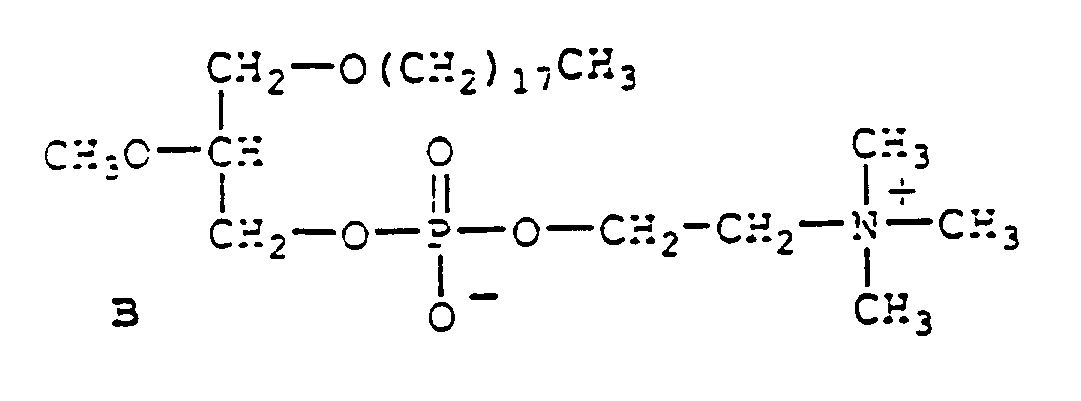
Said compounds show a marked antitumor activity in various pharmacological models [W.E. Berdel and P.G. Munder in "PAF and related lipid mediators", Ed. F. Snyder, Plenum Press, New York, 1987, p. 449]. Undoubtedly, ET-18-OCH₃ and other analogues, due to the structural relationship thereof with PAF, have some of PAF actions, such as serotonine release, bronchoconstriction, platelet aggregation and hypotension. Said actions are contra-indicated in case of antitumor treatment and they can cause remarkable circulatory disorders. - As a consequence, a compound having the cytostatic action of those phospholipids which are related with compound B, and lacking the PAF-like action or, even better, capable to block PAF action on the specific cell receptors thereof, could advantageously be used in human therapy as an antitumor agent, without suffering from the drawbacks of compound B. Moreover, the PAF-antagonistic properties will allow the use of such a compound in any disorder related to said mediator.
- The present invention relates to novel 1,4-benzodioxane derivatives and pharmaceutically acceptable salts thereof, as well as to a process for the preparation thereof and to pharmaceutical compositions containing them.
- Specifically, the present invention relates to compounds of formula (I)

wherein R¹, R² and R³, which can be the same or different, are hydrogen, lower alkyl, aryl or lower aralkyl groups;
or R¹R²R³N⁺ is an aromatic cyclic ammonium group, such as 1-pyridinium, 1-quinolinium, 2-isoquinolinium, 1-imidazolium, 1-pyrazolium, 3-thiazolium, 3-oxazolium, 1-benzimidazolium, 3-benzothiazolium or 3-benzoxazolium, having on its ring from 1 to 3 substituents, such as lower alkyl, halogen, lower hydroxyalkyl, amino, lower aminoalkyl or carboxy;
or R¹R²R³N⁺ is a non aromatic cyclic ammonium group, in which two of groups (R¹, R² or R³), together with the nitrogen atom, form a ring such as 1-pyrrolidine, 1-piperidine, 4-morpholine, 1-piperazine or 1-perhydroazepine and the remaining group is hydrogen or lower alkyl;
m and n, which can be the same or different, are an integer from 2 to 12;
A is either a single covalent bond (i.e., it represents no groups), or it is an oxygen atom;
X⁻ is a pharmaceutically acceptable anion from an inorganic acid (hydrochloric, hydrobromic, hydroiodic or sulfuric acid) or from a carboxylic organic acid (such as acetic, lactic, oxalic, tartaric, citric or malic acid), or from an organic sulfonic acid (such as methanesulfonic, ethanesulfonic, benzenesulfonic or toluenesulfonic acid). - The present invention also relates to the stereoisomers of compounds (I) and the mixtures thereof.
- As herein used, "lower alkyl" means straight or branched C₁-C₆ alkyl groups; "aralkyl" means straight or branched C₁-C₆ alkyl groups substituted with an aromatic ring, preferably a phenyl ring.
- The compounds of the present invention are a novel structural class, since the compounds of formula (I) having a long side-chain, with

- Moreover, compounds (I) have marked cytotoxic and/or PAF-antagonist activities. In fact, no 1,4-benzodioxane derivative has hitherto been found to have such pharmacological activities.
- Preferred compounds of the invention are those in which:
-

- R¹, R² and R³ are hydrogen, lower alkyl, aryl or lower aralkyl groups, preferably methyl or ethyl;
- R¹R²R³N⁺ is an aromatic cyclic ammonium group as defined above, preferably 1-pyridinium, 1-imidazolium or 3-thiazolium;
- R¹R²R³N⁺ is a non aromatic cyclic ammonium group as defined above, preferably a 1-pyrrolidinium, 1-piperidinium, 4-morpholinium, 1-methyl-1-pyrrolinium, 1-methyl-1-piperidinium or 4-methyl-4-morpholinium group.
- Particularly preferred compounds are the following ones:
N-[10-[[(1,4-benzodioxan-2-yl)methyl]oxy]decyl]-N,N,N-trimethylammonium,
N-[16-[[(1,4-benzodioxan-2-yl)methyl]oxy]hexadecyl]-N,N,N-trimethylammonium,
N-[6-[[10-[[(1,4-benzodioxan-2-yl)methyl]oxy]decyl]oxy]hexyl]-N,N,N-trimethylammonium,
N-[10-[[10-[[(1,4-benzodioxan-2-yl)methyl]oxy]decyl]oxy]decyl]-N,N,N-trimethylammonium,
N-[10-[[(1,4-benzodioxan-2-yl)methyl]oxy]decyl]-N,N,N-triethylammonium,
N-[16-[[(1,4-benzodioxan-2-yl)methyl]oxy]hexadecyl]-N,N,N-triethylammonium,
N-[10-[[(1,4-benzodioxan-2-yl)methyl]oxy]decyl]-N-methylpiperidinium,
N-[16-[[(1,4-benzodioxan-2-yl)methyl]oxy]hexadecyl]-N-methylpiperidinium,
N-[6-[[10-[[(1,4-benzodioxan-2-yl)methyl]oxy]decyl]oxy]hexyl]-N-methylpiperidinium,
N-[10-[[10-[[(1,4-benzodioxan-2-yl)methyl]oxy]decyl]oxy]decyl]-N-methylpiperidinium,
N-[10-[[(1,4-benzodioxan-2-yl)methyl]oxy]decyl]-N-methylmorpholinium,
N-[10-[[(1,4-benzodioxan-2-yl)methyl]oxy]decyl]piperidinium,
N-[16-[[(1,4-benzodioxan-2-yl)methyl]oxy]hexadecyl]piperidinium,
N-[10-[[6-[[(1,4-benzodioxan-2-yl)methyl]oxy]decyl]oxy]hexyl]piperidinium,
N-[10-[[10-[[(1,4-benzodioxan-2-yl)methyl]oxy]decyl]oxy]decyl]piperidinium,
N-[10-[[(1,4-benzodioxan-2-yl)methyl]oxy]decyl]morpholinium,
(2S)-N-[10-[[(1,4-benzodioxan-2-yl)methyl]oxy]decyl]piperidinium,
(2R)-N-[10-[[(1,4-benzodioxan-2-yl)methyl]oxy]decyl]piperidinium, wherein X⁻ is as defined above. - According to the present invention, compounds (I) can be prepared by reacting a compound of formula (II)

wherein X is an appropriate leaving group, for example halogen (such as chlorine, bromine or iodine), lower alkylsulfonate (such as methanesulfonate), arylsulfonate (such as benzenesulfonate or toluenesulfonate),
with a nitrogen base of formula NR¹R²R³, in a suited solvent, which can be selected either from aprotic dipolar solvents, such as acetonitrile or dimethylformamide; aromatic hydrocarbons, such as benzene, toluene or xylene; halogenated aliphatic hydrocarbons, such as chloroform or dichloromethane, or ethers, such as ethyl ether, tetrahydrofuran or dioxane; or it can be the nitrogen base NR¹R²R³ itself. The reaction is carried out at a temperature ranging from 15°C to the solvent's reflux temperature, for a time ranging from 1 to 48 hours. Thereafter, the resulting compound (I) can optionally be salified. - Starting compound (II) can be prepared according to the following Reaction Scheme 1.

Both compound (IV) and the preparation thereof in the racemic and enantiomerically pure forms are described in literature [A. Delgado, G. Leclerc, M.C. Lobato and D. Mauleon, Tetrahedron Lett. 29, 3671 (1988), and references cited therein]. - According to step a of Scheme 1, a compound of formula (II) can be obtained, for example, by reacting 1,4-benzodioxane-2-ylmethanol (IV) with a compound (V) of formula Y-(CH₂)m-A-(CH₂)n-X, wherein Y is an appropriate leaving group (for example bromide, iodide, mesylate or tosylate) and X has the above mentioned meanings or (especially when m and n are different from each other), it is a suitably protected alcohol, for example by means of a benzyl group. Compounds of formula (V) are commercially available and, if not, they can easily be prepared starting from the corresponding alcohols HO-(CH₂)m-A-(CH₂)n-OH. Thus, compounds (V) in which X is benzyloxy and Y is bromine can be prepared, for example, starting from the corresponding 1,ω-diol by mono-benzylation (1 benzyl bromide equivalent, 1 NaH equivalent), followed by substitution of the remaining OH by bromine (by means of phosphorous tribromide, phosphorus pentabromide or the reagent consisting of triphenyl phosphin and carbon tetrabromide, all of them in an inert solvent). After that, step a comprises reacting the compound of formula (IV) first with a strong base, such as sodium hydride or potassium hydride, then with compound (V) in a dipolar aprotic solvent, such as dimethylformamide or dimethyl sulfoxide. The reaction is carried out at a temperature ranging from 15 to 100°C, for a time between 1 and 24 hours. When X is a O-protecting group, this step is followed by deprotection to the corresponding alcohol (for example by hydrogenation on palladium catalyst, when the protecting group is a benzyl group) and by transformation of said alcohol into a second leaving group X (such as bromide, tosylate or any one of the above mentioned ones).
- According to steps b and c of Scheme 1, a compound of formula (II), in which A is oxygen, X , m and n have the above mentioned meanings, can also be obtained in two steps by reacting benzodioxanyl-methanol (IV) with a compound of formula Z-(CH₂)m-OP, wherein Z is an appropriate leaving group (such as an halide or an alcohol sulfonate) and P is an oxygen-protecting group (such as benzyl, silyl ether or tetrahydropyranyl), followed by deprotection of the alcohol and by a second alkylation with a compound Y-(CH₂)n-X, wherein Y, X and n have the above mentioned meanings. More particularly, the alkylation reaction of (IV) (step b) to give intermediate compound (VI) is carried out under similar conditions to those for step a, with the same kind of reagents and solvents. Compound (VI) can easily be deprotected according to well-known methods (for example, by hydrogenolysis when P is a benzyl group or by hydrolysis with hydrochloric acid when R is a tetrahydropyranyl group), thereby obtaining an alcohol (VI) (A-P = OH). Step c consists in reacting the resulting alcohol with a compound Y(CH₂)nX, using the same reagents and conditions as those used in step a to obtain compound (II).
- A compound of formula (II) in which A is a single bond, X, m and n have the above mentioned meanings, can also be obtained starting from a compound (VI), wherein A-P = Br, preparing a Grignard reagent by treatment with metal magnesium, then adding said reagent to a compound of formula Y(CH₂)nX (wherein Y, X and n have the above mentioned meanings), said addition being catalysed by copper compounds (such as lithium tetrachlorocuprate).
- Finally, step d of Scheme 1 gives compounds of formula (I), by reacting a compound of formula (II) with a nitrogen base (III) of formula NR¹R²R³. Step d is conveniently carried out in an inert organic solvent, such as benzene, toluene, chloroform, acetonitrile, dimethylformamide, ethanol or methanol, at a temperature from 15°C to the reflux temperature of the solvent. Where the nitrogen base has a boiling point below 30°C (for example when R¹ = R² = R³ = CH₃), the reaction can be effected in a sealed tube having thick walls. Once compound (I) has been obtained, the X⁻ anion can be replaced by another anion, for example by chromatography on a ion exchange resin.
- Alternatively, a compound of formula (I), wherein at least one of the R¹, R² or R³ groups is a lower alkyl group, can also be obtained starting from a compound of formula (I) in which at least one of the R¹, R² or R³ groups is hydrogen, by treatment with an inorganic base, such as sodium hydroxide, to obtain the free nitrogen base, followed by reaction with a compound of formula XR, wherein X has the above mentioned meanings and R is a lower alkyl group. Examples of reactives XR are methyl iodide, methyl bromide or ethyl bromide. This reaction is conveniently carried out in an inert organic solvent such as toluene, benzene, chloroform, acetonitrile, dimethylformamide, ethanol or methanol, at a temperature from 0°C to the solvent reflux temperature.
- As already stated, compounds (I) of the present invention inhibit PAF-induced platelet aggregation, thus they are valuable as PAF-antagonists in the treatment of those diseases this substance is involved with. Further, compounds (I) have also a marked antitumor activity, which has been determined, for example, as the cytotoxic activity against tumor cells. Therefore compounds (I) can be used as useful antitumor agents. Contrarily to PAF, benzodioxanes of the present invention show no negative effects related to this mediator, which promotes the therapeutical use thereof, since they show a remarkable decrease in undesired side-effects.
- The compounds of the invention can be used in human therapy as antitumor, antiasthmatic, antithrombotic, anti-inflammatory, anti-allergic agents as well as in prophylaxis of anaphylactic shock. Moreover, they can be used as hypotensive or antianginal agents.
- For this purpose, the compounds of the invention can be formulated according to conventional techniques and excipients, such as those described in "Remington's Pharmaceutical Science Handbook", Mack Pub. Co., New York, U.S.A. Examples of said forms include capsules, tablets, syrups and the like, containing 1 to 1000 mg of the active ingredient per unitary dose.
- The following Examples further illustrate the invention.
-
- a) 2-[[(4-Bromobutyl)oxy]methyl]-1,4-benzodioxane (II, A = single bond, X = Br, m = n = 2).
A suspension of sodium hydride (50%, 7.20 g, 0.15 mole) in 100 ml of anhydrous dimethylformamide is prepared, which is then added first with a solution of 1,4-dibromobutane (28.08 g, 0.13 mole) in 25 ml of anhydrous dimethylformamide, then with a solution of 2-hydroxymethyl-1,4-benzodioxane (IV, 8.30 g, 0.05 mole) in 25 ml of anhydrous dimethylformamide, dropwise. The reaction mixture is stirred at 60°C for 18 hours, thereafter ethanol and water (400 ml) are added. The mixture is extracted with ethyl ether (4 x 50 ml), the ether phases are washed with a saturated sodium chloride solution, dried over anhydrous sodium sulfate and evaporated to dryness. The resulting residue is distilled under reduced pressure (0.5 - 2 Torr), thus removing the 1,4-dibromobutane excess (b.p. 40°C, bath temperature). Bromo-derivative 1a, distilling at 90-110°C, is obtained in a 78% yield .
¹H NMR (200 MHz, CDCl₃) δ(TMS): 1.82 and 2.10 (m, 4H, central CH₂ of the chain), 3.45 - 3.80 (m, 6H, CH₂OCH₂ + CH₂Br), 4.12 (dd, 1H, benzodioxane C²H), 4.36 (m, 2H, benzodioxane C³H₂), 6.90 (m, 4H, benzodioxane C⁵H-C⁸H). - b) Preparation of the title compound.
A solution of 4 g of dry trimethylamine in 20 ml of anhydrous acetonitrile is prepared in a sealed reaction tube, keeping it cold with a solid CO₂ and acetone outer bath. 3.01 g (0.01 mole) of bromo-derivative 1a are added to this solution, the reactor is sealed and immersed in an oil bath at 60-70°C. After 18 hours the reaction mixture is cooled, solvent is evaporated to dryness and the residue is crystallized twice from anhydrous acetone-anhydrous ethyl ether, to obtain the title ammonium salt in an 81% yield, m.p. 142-143°C. The most significant NMR data are reported in Tables I and II. -
- a) 2-[[(5-Bromopentyl)oxy]methyl]-1,4-benzodioxane (II, A = single bond, X = Br, m = 3, n = 2).
Following the procedure described in Example 1a, but using 1,5-dibromopentane instead of 1,4-dibromobutane, the desired bromo-derivative is obtained in a 84% yield.
¹H NMR (200 MHz, CDCl₃) δ(TMS): 1.48-1.97 (m, 6H, chain central CH₂), 3.44 (t, 2H, CH₂Br), 3.50-3.80 (m, 4H, CH₂OCH₂), 4.08 (dd, 1H, benzodioxane C²H), 4.30 (m, 2H, benzodioxane C³H₂), 6.89 (m, 4H, benzodioxane C⁵H-C⁸H). - b) Preparation of the title compound.
Following the procedure described in Example 1b, starting from the bromo-derivative prepared in 2a, the title ammonium salt is obtained in a 90% yield, m.p. 159-160°C. The most significant NMR data are reported in Tables I and II. -
- a) 2-[[(6-Bromohexyl)oxy]methyl]-1,4-benzodioxane (II, A = single bond, X = Br, m = 4, n = 2).
Following the procedure described in Example 1a, but using 1,6-dibromohexane instead of 1,4-dibromobutane, the desired bromo-derivative is obtained in a 86% yield.
¹H NMR (200 MHz, CDCl₃) δ(TMS): 1.35-1.91 (m, 8H, chain central CH₂), 3.34 (t, 2H, CH₂Br), 3.42-3.75 (m, 4H, CH₂OCH₂), 4.03 (dd, 1H, benzodioxane C²H), 4.25 (m, 2H, benzodioxane C³H₂), 6.83 (m, 4H, benzodioxane C⁵H-C⁸H). - b) Preparation of the title compound.
Following the procedure described in Example 1b, starting from the bromo-derivative prepared in 3a, the title ammonium salt is obtained in a 89% yield, m.p. 157-159°C. The most significant NMR data are reported in Tables I and II. -
- a) 2-[[(10-Bromodecyl)oxy]methyl]-1,4-benzodioxane (II, A = single bond, X = Br, m = 8, n = 2).
Following the procedure described in Example 1a, but using 1,10-dibromodecane instead of 1,4-dibromobutane, the desired bromo-derivative is obtained in a 73% yield.
¹H NMR (300 MHz, CDCl₃) δ(TMS): 1.28-1.85 (m, 16H, chain central CH₂), 3.37 (t, 2H, CH₂Br), 3.48-3.70 (m, 4H, CH₂OCH₂), 4.04 (dd, 1H, benzodioxane C²H), 4.31 (m, 2H, benzodioxane C³H₂), 6.85 (m, 4H, benzodioxane C⁵H-C⁸H). - b) Preparation of the title compound
Following the procedure described in Example 1b, starting from the bromo-derivative prepared in 4a, the title ammonium salt is obtained in a 83% yield, m.p. 164-165°C. The most significant NMR data are reported in Tables I and II. -
- a) 2-[[(16-Bromohexadecyl)oxy]methyl]-1,4-benzodioxane (II, A = single bond, X = Br, m = 8, n = 8).
An ether solution of 6-[(1,4-benzodioxan-2-yl)methoxy]hexylmagnesium bromide is prepared starting from 3.29 g (0.01 mole) of 2-[[(6-bromohexyl)oxy]methyl]-1,4-benzodioxane and 0.243 g (0.01 mole) of magnesium in 80 ml of anhydrous tetrahydrofuran. The solution is cooled to 0°C and slowly added to a thoroughly stirred solution of 1,10-dibromodecane (3 g, 0.01 mole) and Li₂CuCl₄ (0.001 mole) in 50 ml of anhydrous tetrahydrofuran, keeping temperature below 10°C during the addition. The resulting suspension is left under stirring at room temperature for 18 hours, after which 200 ml of a saturated ammonium chloride solution is added. The reaction mixture is extracted with ethyl ether, the organic phases are washed with a saturated sodium chloride solution, dried over anhydrous sodium sulfate and evaporated to dryness. By chromatography on silica gel column, eluting with an hexane/ethyl ether 7:3 mixture, the title bromo-derivative is obtained, in a 55% yield.
¹H NMR (300 MHz, CDCl₃) δ(TMS): 1.30 (broad signal, 24H, chain central CH₂), 1.57 (m, 2H, CH₂-C-Br), 1.83 (m, 2H, CH₂-C-O), 3.39 (t, 2H, CH₂Br), 3.48 (t, 2H, chain CH₂O), 3.64 (m, 2H, CH₂O), 4.04 (dd, 1H, benzodioxane C²H), 4.32 (m, 2H, benzodioxane C³H₂), 6.84 (m, 4H, benzodioxane C⁵H-C⁸H). - b) Preparation of the title compound.
Following the procedure described in Example 1b, starting from the bromo-derivative prepared in 5a, the title ammonium salt is obtained in a 91% yield, m.p. 184-186°C. The most significant NMR data are reported in Table I. -
- a) 10-[[(1,4-Benzodioxan-2-yl)methyl]oxy]decane-1-ol (VI, A-P = OH, m = 10).
3.85 g (0.01 mole) of 2-[[(10-bromodecyl)oxy]methyl]-1,4-benzodioxane (obtained according to Example 4a) and 3.5 g (0.05 mole) of anhydrous sodium acetate are dissolved in 100 ml of anhydrous dimethylformamide. The reaction mixture is stirred and heated to 80-90°C for 18 hours, after that it is poured onto an ice-water excess and extracted with ethyl ether (3 x 60 ml). The organic phases are washed with a sodium chloride saturated solution, dried over anhydrous sodium sulfate and evaporated to dryness. The residue is dissolved in 100 ml of methanol, then added with 7 g (0.1 mole) of 80% potassium hydroxide in 30 ml of water. The resulting mixture is refluxed for two hours, then cooled and evaporated to 1/4th of the original volume, finally it is diluted with 100 ml of water. The solution is extracted with ethyl ether, the organic phases are washed with a sodium chloride saturated solution, evaporated to dryness and the residue is subjected to chromatography on silica gel column, eluting with an hexane/ethyl ether 3:1 mixture, to obtain the title alcohol in a 91% yield. - b) 2-[[[10-[(6-Bromohexyl)oxy]decyl]oxy]methyl]-1,4-benzodioxane (II, A = O, X = Br, m = 10, n = 6).
Starting from the alcohol prepared in 6a and 1,6-dibromohexane, following the procedure described in Example 4a, bromo-derivative 6b is obtained in a 63% yield.
¹H NMR (300 MHz, CDCl₃) δ(TMS): 1.20-1.32 (broad signal, 22H, chain central CH₂), 1.50 (m, 4H, CH₂-C-O), 1.86 (m, 2H, CH₂-C-Br), 3.34-3.68 (complex system, 6H, CH₂-O and CH₂Br), 4.00 (dd, 1H, benzodioxane C²H), 4.22 (m, 2H, benzodioxane C³H₂), 6.8 (m, aromatic 4H). - c) Preparation of the title compound.
Following the procedure described in Example 1b, starting from the bromo-derivative prepared in 6b, the title ammonium salt is obtained in a 70% yield, m.p. 99-100°C. -
- a) 2-[[[10-[(10-Bromodecyl)oxy]decyl]oxy]methyl]-1,4-benzodioxane (II, A = O, X = Br, m = n = 10).
Starting from the alcohol prepared in Example 6a and 1,10-dibromodecane, following the procedure described in Example 4a, the desired bromo-derivative is obtained in a 79% yield.
¹H NMR (300 MHz, CDCl₃) δ(TMS): 1.14-1.32 (broad signal, chain central CH₂), 1.33-1.58 (broad signal, 4H, CH₂-C-O), 3.34-3.68 (complex system, 6H, CH₂-O and CH₂-Br), 4.00 (dd, 1H, benzodioxane C²H), 4.22 (m, 2H, benzodioxane C³H₂), 6.8 (m, aromatic 4H). - b) Preparation of the title compound.
Following the procedure described in Example 1b, starting from the bromo-derivative prepared in 7a, the title ammonium salt is obtained in a 76% yield, m.p. 165-166°C. - 6.02 g (0.02 mole) of 2-[[(4-bromobutyl)oxy]methyl]-1,4-benzodioxane, obtained according to the procedure described in Example 1a, are dissolved in 50 ml of absolute ethanol and 20 ml of distilled triethylamine. The solution is refluxed for 12 hours, thereafter a second portion of 10 ml of triethylamine is added and heating is continued for 12 more hours. The resulting solution is cooled, evaporated to dryness and the residue is crystallized from an anhydrous acetone/triethylamine mixture to obtain the title ammonium salt in a 88% yield, in form of a white solid, m.p. 60-62°C. The most significant NMR data are reported in Tables I and II.
- Following the procedure described in Example 8, starting from the bromo-derivative prepared in Example 3a, the title ammonium salt is obtained in a 87% yield, m.p. 64-66°C. The most significant NMR data are reported in Tables I and II.
- Following the procedure described in Example 8, starting from the bromo-derivative prepared in Example 4a, the title ammonium salt is obtained in a 85% yield, m.p. 52-53°C. The most significant NMR data are reported in Tables I and II.
- Following the procedure described in Example 8, starting from the bromo-derivative prepared in Example 5a, the title ammonium salt is obtained in a 82% yield, m.p. 67-69°C. The most significant NMR data are reported in Table I.
- 3.01 g (0.01 mole) of 2-[[(4-bromobutyl)oxy]methyl]-1,4-benzodioxane, obtained as described in Example 1a, are dissolved in 15 ml of distilled piperidine. The solution is refluxed for 4 hours, then it is evaporated to dryness and the residue is subjected to chromatography on silica gel column, eluting with an ethyl acetate/ethanol/diethylamine 95:3:2 mixture, to obtain the title amine as the free base in a 84% yield. From this amine the hydrochloride is prepared which, by crystallization from an anhydrous acetone/ethanol mixture, gives a white solid, m.p. 110-113°C. The most significant NMR data of the title amine are reported in Tables I and II.
- Following the procedure described in Example 12, starting from the bromo-derivative prepared in Example 2a, the title amine is obtained as the free base in a 90% yield. From this amine the hydrochloride is prepared which, by crystallization from anhydrous acetone, gives a white solid, m.p. 134-135°C. The most significant NMR data are reported in Table I.
- Following the procedure described in Example 12, starting from the bromo-derivative prepared in Example 3a, the title amine is obtained as the free base in a 88% yield. From this amine the hydrochloride is prepared which, by crystallization from anhydrous acetone, gives a white solid, m.p. 108-110°C. The most significant NMR data of the title amine are reported in Tables I and II.
- Following the procedure described in Example 12, starting from the bromo-derivative prepared in Example 4a, the title amine is obtained as the free base, in a 87% yield. From this amine the hydrochloride is prepared which, by crystallization from an anhydrous acetone/ethyl ether mixture, gives a white solid, m.p. 121-122°C. The most significant NMR data of the title amine are reported in Tables I and II.
- Following the procedure described in Example 12, starting from the bromo-derivative prepared in Example 1a and using morpholine instead of piperidine, the title amine is obtained as the free base, in a 92% yield. From this amine the hydrochloride is prepared which, by crystallization from an anhydrous acetone/ethanol mixture, gives a white solid, m.p. 151-152°C. The most significant NMR data of the title amine are reported in Tables I and II.
- Following the procedure described in Example 12, starting from the bromo-derivative prepared in Example 2a and using morpholine instead of piperidine, the title amine is obtained as the free base in a 88% yield. From this amine the hydrochloride is prepared which, by crystallization from an anhydrous acetone/ethanol mixture, gives a white solid, m.p. 139-140°C. The most significant NMR data are reported in Table I.
- Following the procedure described in Example 12, starting from the bromo-derivative prepared in Example 3a and using morpholine instead of piperidine, the title amine is obtained as the free base in a 95% yield. From this amine the hydrochloride is prepared which, by crystallization from an anhydrous acetone/ethanol mixture, gives a white solid, m.p. 103-105°C. The most significant NMR data of the title amine are reported in Tables I and II.
- Following the procedure described in Example 12, starting from the bromo-derivative prepared in Example 4a and using morpholine instead of piperidine, the title amine is obtained as the free base in a 95% yield. From this amine the hydrochloride is prepared which, by crystallization from anhydrous acetone, gives a white solid, m.p. 119-122°C. The most significant NMR data of the title amine are reported in Tables I and II.
- A solution of 3.05 g (0.01 mole) of N-[4-[[(1,4-benzodioxan-2-yl)methyl]oxy]butyl]piperidine (obtained as described in Example 12) as the free base, in 10 ml anhydrous acetone and 30 ml anhydrous toluene is prepared. A solution of 14 g (0.1 mole) of methyl iodide in 10 ml of anhydrous toluene is dropped into the above solution. The reaction mixture is stirred at room temperature for 24 hours, then the resulting solid is recovered by filtration and crystallized from an anhydrous acetone/absolute ethanol mixture, to obtain a slightly yellow solid, m.p. 129-130°C. The most significant NMR data of the title amine are reported in Tables I and II.
- Following the procedure described in Example 20, starting from the amine prepared in Example 13, the title compound is obtained in a 82% yield. This compound, by crystallization from an anhydrous acetone/absolute ethanol mixture, gives a slightly yellow solid, m.p. 120-121°C. The most significant NMR data of the title amine are reported in Tables I and II.
- Following the procedure described in Example 20, starting from the amine prepared in Example 14, the title compound is obtained in a 85% yield. This compound, by crystallization from an anhydrous acetone/absolute ethanol mixture, gives a white solid, m.p. 120-121.5°C. The most significant NMR data of the title amine are reported in Tables I and II.
- Following the procedure described in Example 12, starting from the bromo-derivative prepared in Example 4a and using N-methylpiperidine instead of piperidine, the title compound is obtained in a 78% yield. This compound, by crystallization from anhydrous acetone, gives a white solid, m.p. 104-105°C. The most significant NMR data are reported in Tables I and II.
- Following the procedure described in Example 12, starting from the bromo-derivative prepared in Example 5a and using N-methylpiperidine instead of piperidine, the title compound is obtained in a 72% yield. This compound, by crystallization from anhydrous acetone, gives a white solid, m.p. 140-141°C. The most significant NMR data of the title amine are reported in Tables I and II.
- Following the procedure described in Example 12, starting from the bromo-derivative prepared in Example 6b, using N-methylpiperidine instead of piperidine, the title compound is obtained in a 80% yield. This compound, by crystallization from anhydrous acetone, gives a white-yellowish solid, m.p. 73-74°C.
- Following the procedure described in Example 12, starting from the bromo-derivative prepared in Example 7a and using N-methylpiperidine instead of piperidine, the title compound is obtained in a 80% yield. This compound, by crystallization from anhydrous acetone, gives a white-yellowish solid, m.p. 106-107°C.
- Following the procedure described in Example 20, starting from the amine prepared in Example 16, the title compound is obtained in a 89% yield. This compound, by crystallization from an anhydrous acetone/absolute ethanol mixture, gives a white solid, m.p. 160-161°C. The most significant NMR data of the title amine are reported in Tables I and II.
- Following the procedure described in Example 20, starting from the amine prepared in Example 17, the title compound is obtained in a 83% yield. This compound, by crystallization from an anhydrous acetone/absolute ethanol mixture, gives a white solid, m.p. 133-135°C. The most significant NMR data are reported in Table I.
- Following the procedure described in Example 20, starting from the amine prepared in Example 18, the title compound is obtained in a 88% yield. This compound, by crystallization from an anhydrous acetone/absolute ethanol mixture, gives a white solid, m.p. 142-143°C. The most significant NMR data of the title amine are reported in Tables I and II.
- Following the procedure described in Example 20, starting from the amine prepared in Example 19, the title compound is obtained in a 84% yield. This compound, by crystallization from an anhydrous acetone/ethyl ether mixture, gives a white solid, m.p. 112-114°C. The most significant NMR data of the title amine are reported in Tables I and II.
- 3.01 g (0.01 mole) of 2-[[(4-bromobutyl)oxy]methyl]-1,4-benzodioxane, obtained as described in Example 1a, are dissolved in 15 ml of distilled diethylamine. The solution is refluxed for 6 hours, after that it is evaporated to dryness and the residue is subjected to chromatography on silica gel column, eluting with an ethyl acetate/diethylamine 98:2 mixture, to obtain the title amine as the free base, in a 88% yield. From this amine the hydrochloride is prepared which, by crystallization from an anhydrous acetone/ethanol mixture, gives a white solid, m.p. 93-94°C. The most significant NMR data are reported in Table I.
- Following the procedure described in Example 31, starting from the bromo-derivative prepared in Example 3a, the title amine is obtained as the free base in a 86% yield. From this amine the hydrochloride is prepared which, by crystallization from anhydrous acetone, gives a white solid, m.p. 90-92°C. The most significant NMR data of the title amine are reported in Tables I and II.
- Following the procedure described in Example 31, starting from the bromo-derivative prepared in Example 4a, the title amine is obtained as the free base in a 85% yield. From this amine the hydrochloride is prepared which, by crystallization from anhydrous acetone, gives a white solid. The most significant NMR data of the title amine are reported in Table I.
- Following the procedure described in Example 12, starting from the bromo-derivative prepared in Example 5a, the title amine is obtained as the free base in a 83% yield. From this amine the hydrochloride is prepared which, by crystallization from an anhydrous acetone/ethyl ether mixture, gives a white solid, m.p. 129-130°C. The most significant NMR data of the title amine are reported in Table I.
- Following the procedure described in Example 12, starting from the bromo-derivative prepared in Example 7a, the title amine is obtained as the free base in a 87% yield. From this amine the hydrochloride is prepared which, by crystallization from an anhydrous acetone/ethyl ether mixture, gives a white solid, m.p. 113-114°C.
-
- a) (2S)-2-[[(10-Bromodecyl)oxy]methyl]-1,4-benzodioxane (II, A = single bond, X = Br, m = 8, n =2).
Following the procedure described in Example 1a, but using 1,10-dibromodecane instead of 1,4-dibromobutane, and (2S)-2-hydroxymethyl-1,4-benzodioxane, [α]D = -34° (c=0.6; ethanol), the title bromo-derivative is obtained in a 90% yield. This compound has specific rotatory power [α]D = -13.4° (c=0.6; ethanol) and the same ¹H NMR spectrum (300 MHz, CDCl₃) as that of the bromo-derivative obtained in Example 4a. - b) Following the procedure described in Example 12, starting from the bromo-derivative prepared in 36a, the title amine is obtained as the free base, having specific rotatory power [α]D = +11.7° (c=0.45; ethanol), in a 83% yield. From this amine the hydrochloride is prepared which, by crystallization from an anhydrous ethyl acetate/ethyl ether mixture, gives a white solid, m.p. 118.5-119.0°C. The NMR spectra of the title amine are the same as those of the compound prepared in Example 15.
-
- a) (2R)-2-[[(10-Bromodecyl)oxy]methyl]-1,4-benzodioxane (II, A = single bond, X = Br, m = 8, n =2).
Following the procedure described in Example 1a, but using 1,10-dibromodecane instead of 1,4-dibromobutane, and (2R)-2-hydroxymethyl-1,4-benzodioxane, having [α]D = +34° (c=0.6; ethanol), the title bromo-derivative is obtained in a 90% yield. This compound has specific rotatory power [α]D = +13.4° (c=0.6; ethanol) and the same ¹H NMR spectrum (300 MHz, CDCl₃) as that of the bromo-derivative obtained in Example 4a. - b) Following the procedure described in Example 12, starting from the bromo-derivative prepared in 37a, the title amine is obtained as the free base, having specific rotatory power [α]D = -11.7° (c=0.45; ethanol), in a 83% yield. From this amine the hydrochloride is prepared which, by crystallization from an anhydrous ethyl acetate/ethyl ether mixture, gives a white solid, m.p. 119-119.5°C. The NMR spectra of the title amine are the same as those of the compound prepared in Example 15.
- Platelets are prepared starting from blood samples obtained by means of a carotid cannula from male albino New Zealand rabbits (2-2.5 kg), subjected to anticoagulant treatment with sodium citrate dihydrate (3.2%) 1:10. Blood is centrifuged (150xg, 10 min, 22°C) to separate the platelet-rich plasma fraction (PRP) from erythrocytes. Platelets are separated from plasmatic components by serial washings and centrifugations (Blood, 1986, 62:337), thereafter they are suspended in a physiological buffer at a concentration of 5 x 10⁵/ml. A 400 µl volume of the above mentioned suspension is placed into the cuvette of a multicanal aggregometer (Aggrecoder HU) where it is kept at constant temperature and stirring. After stabilization, platelets are added with 50 µl of physiological buffer containing 100 µM acetylsalicylic acid and apirase 5 mg/ml, in order to block any non PAF-related platelet activation metabolic pathways. Subsequently the platelet suspensions are added with 50 µl of the different solutions to be tested. Changes in light transmission, due to platelet aggregation in the suspension, are recorded and expressed as percent platelet aggregation, according to the procedure by Born and Cross (J. Physiol., 1962, 162:67). Standard curve is performed with PAF within a concentration range of 0.1-1 nM.
- The results from the tests in which PAF activity was measured are reported in Table III.
TABLE III Platelet aggregating effect and inhibition PAF-induced platelet aggregation. Compound of Example n° Aggregation EC₅₀ (µM) Paf-antagonism IC₅₀ (µM) 4 - 130 5 - 20 8 >190 - 10 - 90 21 >190 - 23 - 75 30 - 190 - Capability to inhibit PAF-induced platelet aggregation is evaluated by means of the aggregometry technique in suspensions of rabbit washed platelets, obtained by means of the same procedure as described in Example 32. For this purpose, the inhibition potency of the products under test, expressed as the corresponding IC₅₀, is evaluated on the maximum aggregation values obtained in PAF standard curve. The results obtained from the tests, in which PAF-antagonist activity was measured, are reported in Table III.
- Suspensions of HL-60 Line cells, obtained starting from human promyelocyte leukemia, are incubated in 6-well culture plates for 24 hours at 37°C, at a concentration of 1 x 10⁶ cells/ml, in the presence of the test products, which have previously been dissolved in the culture medium. Cytotoxicity is measured by means of the Trypan Blue exclusion technique (Practical Immunology, pp 29-32, Oxford, England : Blackwell Scientific Publications, 1976). Cytotoxic activities of the products, expressed as IC₅₀, are reported in Table IV.
TABLE IV Cytotoxic effect on HL-60 tumor cells. Compound of Example n° Cytotoxicity EC₅₀ (µM) 4 70 5 18 6 11 7 15 10 30 15 20 16 18 19 30 23 20 24 6 25 3 26 28 30 30


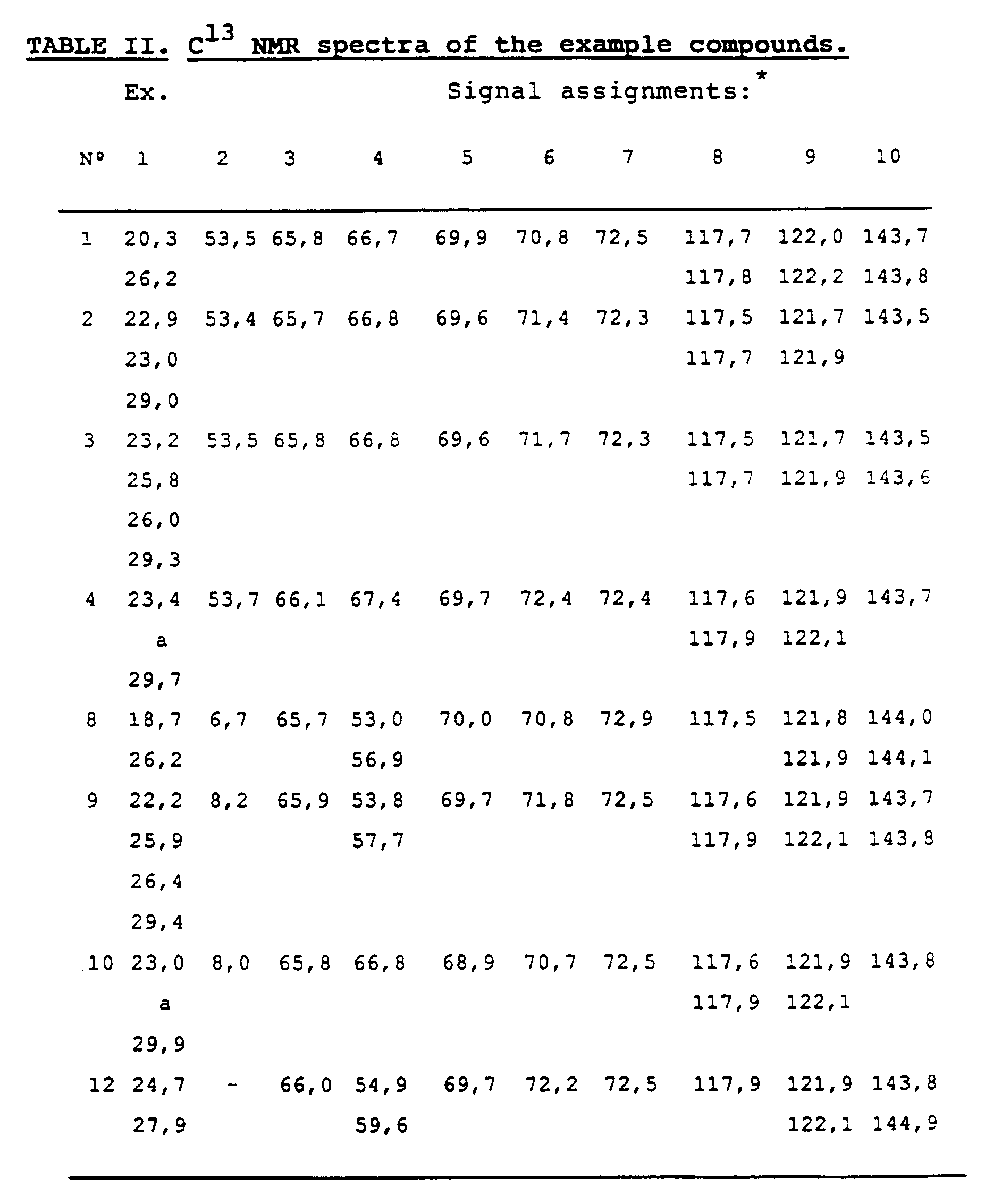


Claims (9)
- Compounds of formula (I)

or R¹R²R³N⁺ is an aromatic cyclic ammonium group, selected from 1-pyridinium, 1-quinolinium, 2-isoquinolinium, 1-imidazolium, 1-pyrazolium, 3-thiazolium, 3-oxazolium, 1-benzimidazolium, 3-benzothiazolium or 3-benzoxazolium, having on its ring from 1 to 3 substituents, selected from straight or branched C₁-C₆ alkyl, halogen, hydroxyalkyl in which the alkyl portion is straight or branched C₁-C₆ alkyl, amino, aminoalkyl in which the alkyl portion is straight or branched C₁-C₆ alkyl, or carboxy;
or R¹R²R³N⁺ is a non aromatic cyclic ammonium group, in which two of groups (R¹, R² or R³), together with the nitrogen atom, form a ring selected from 1-pyrrolidine, 1-piperidine, 4-morpholine, 1-piperazine or 1-perhydroazepine and the remaining group is hydrogen or straight or branched C₁-C₆ alkyl;
m and n, which can be the same or different, are an integer from 2 to 12;
A is either a single covalent bond or it is an oxygen atom;
X⁻ is a pharmaceutically acceptable anion,
stereoisomers of compounds (I) and the mixtures thereof, and pharmaceutically acceptable salts thereof. - Compounds as claimed in claim 1, wherein

- Compounds according to claim 1 or 2, wherein R¹, R² and R³ are hydrogen, straight or branched C₁-C₆ alkyl, aryl or aralkyl, in which the alkyl portion is straight or branched C₁-C₆ alkyl.
- Compounds according to claim 1 or 2, wherein R¹R²R³N⁺ is an aromatic cyclic ammonium group selected from 1-pyridinium, 1-imidazolium or 3-thiazolium.
- Compounds according to claim 1 or 2, wherein R¹R²R³N⁺ is a non aromatic cyclic ammonium group selected from 1-pyrrolidinium, 1-piperidinium, 4-morpholinium, 1-methyl-1-pyrrolinium, 1-methyl-1-piperidinium or 4-methyl-4-morpholinium.
- Compounds according to any one of claims 1-5, selected from:
N-[10-[[(1,4-benzodioxan-2-yl)methyl]oxy]decyl]-N,N,N-trimethylammonium,
N-[16-[[(1,4-benzodioxan-2-yl)methyl]oxy]hexadecyl]-N,N,N-trimethylammonium,
N-[6-[[10-[[(1,4-benzodioxan-2-yl)methyl]oxy]decyl]oxy]hexyl]-N,N,N-trimethylammonium,
N-[10-[[10-[[(1,4-benzodioxan-2-yl)methyl]oxy]decyl]oxy]decyl]-N,N,N-trimethylammonium,
N-[10-[[(1,4-benzodioxan-2-yl)methyl]oxy]decyl]-N,N,N-triethylammonium,
N-[16-[[(1,4-benzodioxan-2-yl)methyl]oxy]hexadecyl]-N,N,N-triethylammonium,
N-[10-[[(1,4-benzodioxan-2-yl)methyl]oxy]decyl]-N-methylpiperidinium,
N-[16-[[(1,4-benzodioxan-2-yl)methyl]oxy]hexadecyl]-N-methylpiperidinium,
N-[6-[[10-[[(1,4-benzodioxan-2-yl)methyl]oxy]decyl]oxy]hexyl]-N-methylpiperidinium,
N-[10-[[10-[[(1,4-benzodioxan-2-yl)methyl]oxy]decyl]oxy]decyl]-N-methylpiperidinium,
N-[10-[[(1,4-benzodioxan-2-yl)methyl]oxy]decyl]-N-methylmorpholinium,
N-[10-[[(1,4-benzodioxan-2-yl)methyl]oxy]decyl]piperidinium,
N-[16-[[(1,4-benzodioxan-2-yl)methyl]oxy]hexadecyl]piperidinium,
N-[10-[[6-[[(1,4-benzodioxan-2-yl)methyl]oxy]decyl]oxy]hexyl]piperidinium,
N-[10-[[10-[[(1,4-benzodioxan-2-yl)methyl]oxy]decyl]oxy]decyl]piperidinium,
N-[10-[[(1,4-benzodioxan-2-yl)methyl]oxy]decyl]morpholinium,
(2S)-N-[10-[[(1,4-benzodioxan-2-yl)methyl]oxy]decyl]piperidinium,
(2R)-N-[10-[[(1,4-benzodioxan-2-yl)methyl]oxy]decyl]piperidinium, wherein X⁻ is as defined in claim 1 - A process for the preparation of the compounds claimed in claims 1 to 6, in which process a compound of formula (II)

- A process according to claim 7, in which process the reaction is carried out in the nitrogen base NR¹R²R³ itself as the solvent.
- Pharmaceutical compositions containing as the active principle a compound of claims 1-6 in admixture with a suitable carrier.
Applications Claiming Priority (3)
| Application Number | Priority Date | Filing Date | Title |
|---|---|---|---|
| ES9002029A ES2023759A6 (en) | 1990-07-27 | 1990-07-27 | 1,4-benzodioxane derivatives, process for the preparation thereof and pharmaceutical compositions therefrom. |
| ES9002029 | 1990-07-27 | ||
| PCT/EP1991/001289 WO1992002517A1 (en) | 1990-07-27 | 1991-07-10 | 1,4-benzodioscane derivatives, process for the preparation thereof and pharmaceutical compositions therefrom |
Publications (2)
| Publication Number | Publication Date |
|---|---|
| EP0494283A1 EP0494283A1 (en) | 1992-07-15 |
| EP0494283B1 true EP0494283B1 (en) | 1995-10-11 |
Family
ID=8268340
Family Applications (1)
| Application Number | Title | Priority Date | Filing Date |
|---|---|---|---|
| EP91912540A Expired - Lifetime EP0494283B1 (en) | 1990-07-27 | 1991-07-10 | 1,4-benzodioxane derivatives, process for the preparation thereof and pharmaceutical compositions therefrom |
Country Status (6)
| Country | Link |
|---|---|
| EP (1) | EP0494283B1 (en) |
| AT (1) | ATE128977T1 (en) |
| AU (1) | AU8184291A (en) |
| DE (1) | DE69113772D1 (en) |
| ES (1) | ES2023759A6 (en) |
| WO (1) | WO1992002517A1 (en) |
Families Citing this family (3)
| Publication number | Priority date | Publication date | Assignee | Title |
|---|---|---|---|---|
| WO1995003822A2 (en) * | 1993-07-27 | 1995-02-09 | Mario Bigazzi | Use of relaxin as therapeutic or preventing agent |
| CN103965186B (en) * | 2013-01-25 | 2016-05-18 | 江苏恩华药业股份有限公司 | Benzodioxan-Ben Bing Evil (thiophene) azoles piperidine derivative and application thereof |
| KR20240057318A (en) | 2022-10-21 | 2024-05-02 | 고려대학교 산학협력단 | Novel 1,1-dioxo-1,2-benzisothiazole derivatives and pharmaceutical use thereof |
Family Cites Families (1)
| Publication number | Priority date | Publication date | Assignee | Title |
|---|---|---|---|---|
| FR2358142A1 (en) * | 1976-07-12 | 1978-02-10 | Parcor | Sedative, antiarrhythmic benzodioxan derivs. - prepd. by treating 2-hydroxymethyl-benzodioxan with substd. amino-alkyl halide |
-
1990
- 1990-07-27 ES ES9002029A patent/ES2023759A6/en not_active Expired - Fee Related
-
1991
- 1991-07-10 EP EP91912540A patent/EP0494283B1/en not_active Expired - Lifetime
- 1991-07-10 AU AU81842/91A patent/AU8184291A/en not_active Abandoned
- 1991-07-10 DE DE69113772T patent/DE69113772D1/en not_active Expired - Lifetime
- 1991-07-10 AT AT91912540T patent/ATE128977T1/en active
- 1991-07-10 WO PCT/EP1991/001289 patent/WO1992002517A1/en not_active Ceased
Also Published As
| Publication number | Publication date |
|---|---|
| ES2023759A6 (en) | 1992-02-01 |
| EP0494283A1 (en) | 1992-07-15 |
| AU8184291A (en) | 1992-03-02 |
| WO1992002517A1 (en) | 1992-02-20 |
| ATE128977T1 (en) | 1995-10-15 |
| DE69113772D1 (en) | 1995-11-16 |
Similar Documents
| Publication | Publication Date | Title |
|---|---|---|
| EP0001900B1 (en) | 9-thia-12-azaprostanoic acid derivatives and compositions containing them | |
| EP0434561B1 (en) | 1-Naphthyl-piperazine derivatives, process for their preparation and pharmaceutical compositions containing them | |
| JP2011525182A (en) | Method for the preparation of proapoptotic agent ABT-263 | |
| EP1337528B1 (en) | Benzothiophene derivative compounds, process of preparation and use thereof | |
| JP2005501841A5 (en) | ||
| US6323235B1 (en) | Benzene-condensed heterocyclic derivatives and their uses | |
| JPS6339868A (en) | Di (lower alkyl) phenol derivative | |
| EP0130833A1 (en) | Coumarin compounds, their preparation, and pharmaceutical compositions containing them | |
| EP0402150A1 (en) | New 2,5-diaryl tetrahydrofurans and analogs therof as PAF antagonists | |
| JPH0473432B2 (en) | ||
| FR2512820A1 (en) | NOVEL BENZOTHIAZOLINE DERIVATIVES USEFUL AS MEDICAMENTS AND PROCESS FOR THEIR PREPARATION | |
| US5134151A (en) | 2-picolylamine derivatives | |
| WO1992002517A1 (en) | 1,4-benzodioscane derivatives, process for the preparation thereof and pharmaceutical compositions therefrom | |
| Girotra et al. | Development, synthesis, and biological evaluation of (-)-trans-(2S, 5S)-2-[3-[(2-oxopropyl) sulfonyl]-4-n-propoxy-5-(3-hydroxypropoxy)-phenyl]-5-(3, 4, 5-trimethoxyphenyl) tetrahydrofuran, a potent orally active platelet-activating factor (PAF) antagonist and its water-soluble prodrug phosphate ester | |
| KR950011748B1 (en) | Sulfenamide derivatives and preparation methods thereof | |
| US4997843A (en) | 2,4-disubstituted derivatives of tetrahydrofuran useful for the treatment of PAF mediated illnesses | |
| FR2522000A1 (en) | NOVEL THIOPYRANNOPYRIMIDINES, PARTICULARLY USEFUL AS HYPOGLYCEMIC AGENTS, AND THEIR MANUFACTURE | |
| SU1194272A3 (en) | Method of producing indolysine derivatives or salts thereof with organic or inorganic acid | |
| EP0303348B1 (en) | 2-amino-5-hydroxy-4-pyrimidones | |
| EP0353777A2 (en) | New 2,5-disubstituted tetrahydrofuran derivatives | |
| US4102887A (en) | Intermediates used in the preparation of phenyl-pyridylamine derivatives | |
| JP2678758B2 (en) | Novel propane derivative | |
| EP0381098A2 (en) | New 4-substituted 2-alkoxytetrahydrofuran derivatives | |
| US4659859A (en) | 2-alkoxy-1-alkoxy phosphoryl dichlorides | |
| KR20250103481A (en) | Novel preparation method for Flavonoid derivatives |
Legal Events
| Date | Code | Title | Description |
|---|---|---|---|
| PUAI | Public reference made under article 153(3) epc to a published international application that has entered the european phase |
Free format text: ORIGINAL CODE: 0009012 |
|
| AK | Designated contracting states |
Kind code of ref document: A1 Designated state(s): AT BE CH DE DK ES FR GB GR IT LI LU NL SE |
|
| 17P | Request for examination filed |
Effective date: 19920311 |
|
| 17Q | First examination report despatched |
Effective date: 19941021 |
|
| GRAA | (expected) grant |
Free format text: ORIGINAL CODE: 0009210 |
|
| AK | Designated contracting states |
Kind code of ref document: B1 Designated state(s): AT BE CH DE DK ES FR GB GR IT LI LU NL SE |
|
| PG25 | Lapsed in a contracting state [announced via postgrant information from national office to epo] |
Ref country code: IT Free format text: LAPSE BECAUSE OF FAILURE TO SUBMIT A TRANSLATION OF THE DESCRIPTION OR TO PAY THE FEE WITHIN THE PRE;WARNING: LAPSES OF ITALIAN PATENTS WITH EFFECTIVE DATE BEFORE 2007 MAY HAVE OCCURRED AT ANY TIME BEFORE 2007. THE CORRECT EFFECTIVE DATE MAY BE DIFFERENT FROM THE ONE RECORDED.SCRIBED TIME-LIMIT Effective date: 19951011 Ref country code: CH Effective date: 19951011 Ref country code: DK Effective date: 19951011 Ref country code: AT Effective date: 19951011 Ref country code: NL Free format text: LAPSE BECAUSE OF FAILURE TO SUBMIT A TRANSLATION OF THE DESCRIPTION OR TO PAY THE FEE WITHIN THE PRESCRIBED TIME-LIMIT Effective date: 19951011 Ref country code: LI Effective date: 19951011 Ref country code: BE Effective date: 19951011 Ref country code: GR Free format text: LAPSE BECAUSE OF FAILURE TO SUBMIT A TRANSLATION OF THE DESCRIPTION OR TO PAY THE FEE WITHIN THE PRESCRIBED TIME-LIMIT Effective date: 19951011 Ref country code: ES Free format text: THE PATENT HAS BEEN ANNULLED BY A DECISION OF A NATIONAL AUTHORITY Effective date: 19951011 Ref country code: FR Effective date: 19951011 |
|
| REF | Corresponds to: |
Ref document number: 128977 Country of ref document: AT Date of ref document: 19951015 Kind code of ref document: T |
|
| REF | Corresponds to: |
Ref document number: 69113772 Country of ref document: DE Date of ref document: 19951116 |
|
| PG25 | Lapsed in a contracting state [announced via postgrant information from national office to epo] |
Ref country code: SE Effective date: 19960111 |
|
| PG25 | Lapsed in a contracting state [announced via postgrant information from national office to epo] |
Ref country code: DE Effective date: 19960112 |
|
| NLV1 | Nl: lapsed or annulled due to failure to fulfill the requirements of art. 29p and 29m of the patents act | ||
| EN | Fr: translation not filed | ||
| REG | Reference to a national code |
Ref country code: CH Ref legal event code: PL |
|
| PG25 | Lapsed in a contracting state [announced via postgrant information from national office to epo] |
Ref country code: GB Effective date: 19960710 |
|
| PG25 | Lapsed in a contracting state [announced via postgrant information from national office to epo] |
Ref country code: LU Free format text: LAPSE BECAUSE OF NON-PAYMENT OF DUE FEES Effective date: 19960731 |
|
| PLBE | No opposition filed within time limit |
Free format text: ORIGINAL CODE: 0009261 |
|
| STAA | Information on the status of an ep patent application or granted ep patent |
Free format text: STATUS: NO OPPOSITION FILED WITHIN TIME LIMIT |
|
| 26N | No opposition filed | ||
| GBPC | Gb: european patent ceased through non-payment of renewal fee |
Effective date: 19960710 |