EP0493414B1 - Polyimide resin laminates - Google Patents
Polyimide resin laminates Download PDFInfo
- Publication number
- EP0493414B1 EP0493414B1 EP90913331A EP90913331A EP0493414B1 EP 0493414 B1 EP0493414 B1 EP 0493414B1 EP 90913331 A EP90913331 A EP 90913331A EP 90913331 A EP90913331 A EP 90913331A EP 0493414 B1 EP0493414 B1 EP 0493414B1
- Authority
- EP
- European Patent Office
- Prior art keywords
- resin composition
- thermosetting resin
- bisphenol
- resin
- dicyandiamide
- Prior art date
- Legal status (The legal status is an assumption and is not a legal conclusion. Google has not performed a legal analysis and makes no representation as to the accuracy of the status listed.)
- Expired - Lifetime
Links
- 229920001721 polyimide Polymers 0.000 title description 3
- 239000009719 polyimide resin Substances 0.000 title description 3
- 229920005989 resin Polymers 0.000 claims abstract description 24
- 239000011347 resin Substances 0.000 claims abstract description 24
- IISBACLAFKSPIT-UHFFFAOYSA-N bisphenol A Chemical compound C=1C=C(O)C=CC=1C(C)(C)C1=CC=C(O)C=C1 IISBACLAFKSPIT-UHFFFAOYSA-N 0.000 claims abstract description 18
- 229930185605 Bisphenol Natural products 0.000 claims abstract description 17
- QGBSISYHAICWAH-UHFFFAOYSA-N dicyandiamide Chemical compound NC(N)=NC#N QGBSISYHAICWAH-UHFFFAOYSA-N 0.000 claims abstract description 16
- 229920003192 poly(bis maleimide) Polymers 0.000 claims abstract description 16
- 229920001187 thermosetting polymer Polymers 0.000 claims abstract description 16
- XQUPVDVFXZDTLT-UHFFFAOYSA-N 1-[4-[[4-(2,5-dioxopyrrol-1-yl)phenyl]methyl]phenyl]pyrrole-2,5-dione Chemical compound O=C1C=CC(=O)N1C(C=C1)=CC=C1CC1=CC=C(N2C(C=CC2=O)=O)C=C1 XQUPVDVFXZDTLT-UHFFFAOYSA-N 0.000 claims abstract description 15
- NDRKXFLZSRHAJE-UHFFFAOYSA-N 1,2,3,4,5-pentabromo-6-(2,3,4-tribromophenyl)benzene Chemical group BrC1=C(Br)C(Br)=CC=C1C1=C(Br)C(Br)=C(Br)C(Br)=C1Br NDRKXFLZSRHAJE-UHFFFAOYSA-N 0.000 claims abstract description 10
- AZDCYKCDXXPQIK-UHFFFAOYSA-N ethenoxymethylbenzene Chemical compound C=COCC1=CC=CC=C1 AZDCYKCDXXPQIK-UHFFFAOYSA-N 0.000 claims abstract description 9
- 150000008442 polyphenolic compounds Chemical class 0.000 claims abstract description 9
- 235000013824 polyphenols Nutrition 0.000 claims abstract description 9
- 239000011342 resin composition Substances 0.000 claims description 36
- -1 alkylene radicals Chemical class 0.000 claims description 15
- 229910052794 bromium Inorganic materials 0.000 claims description 13
- 125000004432 carbon atom Chemical group C* 0.000 claims description 7
- 239000003063 flame retardant Substances 0.000 claims description 7
- 239000011203 carbon fibre reinforced carbon Substances 0.000 claims description 5
- 150000003254 radicals Chemical class 0.000 claims description 5
- RNFJDJUURJAICM-UHFFFAOYSA-N 2,2,4,4,6,6-hexaphenoxy-1,3,5-triaza-2$l^{5},4$l^{5},6$l^{5}-triphosphacyclohexa-1,3,5-triene Chemical compound N=1P(OC=2C=CC=CC=2)(OC=2C=CC=CC=2)=NP(OC=2C=CC=CC=2)(OC=2C=CC=CC=2)=NP=1(OC=1C=CC=CC=1)OC1=CC=CC=C1 RNFJDJUURJAICM-UHFFFAOYSA-N 0.000 claims description 4
- 229910052739 hydrogen Inorganic materials 0.000 claims description 4
- 229910052757 nitrogen Inorganic materials 0.000 claims description 3
- 229910052760 oxygen Inorganic materials 0.000 claims description 3
- 125000000843 phenylene group Chemical group C1(=C(C=CC=C1)*)* 0.000 claims description 3
- 229910052717 sulfur Inorganic materials 0.000 claims description 3
- 239000004744 fabric Substances 0.000 claims description 2
- 230000003014 reinforcing effect Effects 0.000 claims 1
- 230000000979 retarding effect Effects 0.000 claims 1
- ZMXDDKWLCZADIW-UHFFFAOYSA-N N,N-Dimethylformamide Chemical compound CN(C)C=O ZMXDDKWLCZADIW-UHFFFAOYSA-N 0.000 description 18
- 239000000203 mixture Substances 0.000 description 15
- 239000011521 glass Substances 0.000 description 12
- GDTBXPJZTBHREO-UHFFFAOYSA-N bromine Substances BrBr GDTBXPJZTBHREO-UHFFFAOYSA-N 0.000 description 9
- 150000001875 compounds Chemical class 0.000 description 9
- WKBOTKDWSSQWDR-UHFFFAOYSA-N Bromine atom Chemical compound [Br] WKBOTKDWSSQWDR-UHFFFAOYSA-N 0.000 description 8
- 150000004984 aromatic diamines Chemical class 0.000 description 7
- 238000006243 chemical reaction Methods 0.000 description 5
- 239000002904 solvent Substances 0.000 description 5
- VEORPZCZECFIRK-UHFFFAOYSA-N 3,3',5,5'-tetrabromobisphenol A Chemical compound C=1C(Br)=C(O)C(Br)=CC=1C(C)(C)C1=CC(Br)=C(O)C(Br)=C1 VEORPZCZECFIRK-UHFFFAOYSA-N 0.000 description 4
- RTZKZFJDLAIYFH-UHFFFAOYSA-N Diethyl ether Chemical compound CCOCC RTZKZFJDLAIYFH-UHFFFAOYSA-N 0.000 description 4
- 238000000034 method Methods 0.000 description 4
- 229910000679 solder Inorganic materials 0.000 description 4
- 239000007787 solid Substances 0.000 description 4
- VPWNQTHUCYMVMZ-UHFFFAOYSA-N 4,4'-sulfonyldiphenol Chemical class C1=CC(O)=CC=C1S(=O)(=O)C1=CC=C(O)C=C1 VPWNQTHUCYMVMZ-UHFFFAOYSA-N 0.000 description 3
- CSCPPACGZOOCGX-UHFFFAOYSA-N Acetone Chemical compound CC(C)=O CSCPPACGZOOCGX-UHFFFAOYSA-N 0.000 description 3
- UHOVQNZJYSORNB-UHFFFAOYSA-N Benzene Chemical compound C1=CC=CC=C1 UHOVQNZJYSORNB-UHFFFAOYSA-N 0.000 description 3
- RYGMFSIKBFXOCR-UHFFFAOYSA-N Copper Chemical compound [Cu] RYGMFSIKBFXOCR-UHFFFAOYSA-N 0.000 description 3
- PEEHTFAAVSWFBL-UHFFFAOYSA-N Maleimide Chemical compound O=C1NC(=O)C=C1 PEEHTFAAVSWFBL-UHFFFAOYSA-N 0.000 description 3
- YXFVVABEGXRONW-UHFFFAOYSA-N Toluene Chemical compound CC1=CC=CC=C1 YXFVVABEGXRONW-UHFFFAOYSA-N 0.000 description 3
- ZFSLODLOARCGLH-UHFFFAOYSA-N isocyanuric acid Chemical compound OC1=NC(O)=NC(O)=N1 ZFSLODLOARCGLH-UHFFFAOYSA-N 0.000 description 3
- 238000004519 manufacturing process Methods 0.000 description 3
- 239000003039 volatile agent Substances 0.000 description 3
- 239000004593 Epoxy Substances 0.000 description 2
- 230000002411 adverse Effects 0.000 description 2
- 125000003118 aryl group Chemical group 0.000 description 2
- 230000015572 biosynthetic process Effects 0.000 description 2
- 229910052802 copper Inorganic materials 0.000 description 2
- 239000010949 copper Substances 0.000 description 2
- 239000003431 cross linking reagent Substances 0.000 description 2
- 150000004985 diamines Chemical class 0.000 description 2
- 238000010438 heat treatment Methods 0.000 description 2
- 230000000704 physical effect Effects 0.000 description 2
- 229920000642 polymer Polymers 0.000 description 2
- CMQUQOHNANGDOR-UHFFFAOYSA-N 2,3-dibromo-4-(2,4-dibromo-5-hydroxyphenyl)phenol Chemical compound BrC1=C(Br)C(O)=CC=C1C1=CC(O)=C(Br)C=C1Br CMQUQOHNANGDOR-UHFFFAOYSA-N 0.000 description 1
- 0 CC(C(N*NCC(C(*)=C(*)C(C)=O)=*)=O)=C(*)C(C)=O Chemical compound CC(C(N*NCC(C(*)=C(*)C(C)=O)=*)=O)=C(*)C(C)=O 0.000 description 1
- HNUALPPJLMYHDK-UHFFFAOYSA-N C[CH]C Chemical compound C[CH]C HNUALPPJLMYHDK-UHFFFAOYSA-N 0.000 description 1
- FXHOOIRPVKKKFG-UHFFFAOYSA-N N,N-Dimethylacetamide Chemical compound CN(C)C(C)=O FXHOOIRPVKKKFG-UHFFFAOYSA-N 0.000 description 1
- SECXISVLQFMRJM-UHFFFAOYSA-N N-Methylpyrrolidone Chemical compound CN1CCCC1=O SECXISVLQFMRJM-UHFFFAOYSA-N 0.000 description 1
- 238000010521 absorption reaction Methods 0.000 description 1
- 239000000654 additive Substances 0.000 description 1
- 230000000996 additive effect Effects 0.000 description 1
- 125000005907 alkyl ester group Chemical group 0.000 description 1
- 229910052799 carbon Inorganic materials 0.000 description 1
- 150000001732 carboxylic acid derivatives Chemical class 0.000 description 1
- 239000003795 chemical substances by application Substances 0.000 description 1
- 239000002131 composite material Substances 0.000 description 1
- 238000001816 cooling Methods 0.000 description 1
- 239000011889 copper foil Substances 0.000 description 1
- 229940113088 dimethylacetamide Drugs 0.000 description 1
- 150000002170 ethers Chemical class 0.000 description 1
- 239000000835 fiber Substances 0.000 description 1
- 238000009472 formulation Methods 0.000 description 1
- 150000003949 imides Chemical group 0.000 description 1
- 125000005647 linker group Chemical group 0.000 description 1
- 239000000463 material Substances 0.000 description 1
- 125000004433 nitrogen atom Chemical group N* 0.000 description 1
- 229920000620 organic polymer Polymers 0.000 description 1
- 238000006116 polymerization reaction Methods 0.000 description 1
- 239000012783 reinforcing fiber Substances 0.000 description 1
- 239000012779 reinforcing material Substances 0.000 description 1
- 238000005070 sampling Methods 0.000 description 1
- 230000002195 synergetic effect Effects 0.000 description 1
- 238000003786 synthesis reaction Methods 0.000 description 1
- 239000002966 varnish Substances 0.000 description 1
- XLYOFNOQVPJJNP-UHFFFAOYSA-N water Substances O XLYOFNOQVPJJNP-UHFFFAOYSA-N 0.000 description 1
- 238000004804 winding Methods 0.000 description 1
Classifications
-
- C—CHEMISTRY; METALLURGY
- C08—ORGANIC MACROMOLECULAR COMPOUNDS; THEIR PREPARATION OR CHEMICAL WORKING-UP; COMPOSITIONS BASED THEREON
- C08F—MACROMOLECULAR COMPOUNDS OBTAINED BY REACTIONS ONLY INVOLVING CARBON-TO-CARBON UNSATURATED BONDS
- C08F22/00—Homopolymers and copolymers of compounds having one or more unsaturated aliphatic radicals each having only one carbon-to-carbon double bond, and at least one being terminated by a carboxyl radical and containing at least one other carboxyl radical in the molecule; Salts, anhydrides, esters, amides, imides or nitriles thereof
- C08F22/36—Amides or imides
- C08F22/40—Imides, e.g. cyclic imides
-
- C—CHEMISTRY; METALLURGY
- C08—ORGANIC MACROMOLECULAR COMPOUNDS; THEIR PREPARATION OR CHEMICAL WORKING-UP; COMPOSITIONS BASED THEREON
- C08F—MACROMOLECULAR COMPOUNDS OBTAINED BY REACTIONS ONLY INVOLVING CARBON-TO-CARBON UNSATURATED BONDS
- C08F222/00—Copolymers of compounds having one or more unsaturated aliphatic radicals, each having only one carbon-to-carbon double bond, and at least one being terminated by a carboxyl radical and containing at least one other carboxyl radical in the molecule; Salts, anhydrides, esters, amides, imides, or nitriles thereof
- C08F222/36—Amides or imides
- C08F222/40—Imides, e.g. cyclic imides
- C08F222/404—Imides, e.g. cyclic imides substituted imides comprising oxygen other than the carboxy oxygen
-
- C—CHEMISTRY; METALLURGY
- C08—ORGANIC MACROMOLECULAR COMPOUNDS; THEIR PREPARATION OR CHEMICAL WORKING-UP; COMPOSITIONS BASED THEREON
- C08G—MACROMOLECULAR COMPOUNDS OBTAINED OTHERWISE THAN BY REACTIONS ONLY INVOLVING UNSATURATED CARBON-TO-CARBON BONDS
- C08G73/00—Macromolecular compounds obtained by reactions forming a linkage containing nitrogen with or without oxygen or carbon in the main chain of the macromolecule, not provided for in groups C08G12/00 - C08G71/00
- C08G73/06—Polycondensates having nitrogen-containing heterocyclic rings in the main chain of the macromolecule
- C08G73/10—Polyimides; Polyester-imides; Polyamide-imides; Polyamide acids or similar polyimide precursors
- C08G73/12—Unsaturated polyimide precursors
-
- C—CHEMISTRY; METALLURGY
- C08—ORGANIC MACROMOLECULAR COMPOUNDS; THEIR PREPARATION OR CHEMICAL WORKING-UP; COMPOSITIONS BASED THEREON
- C08G—MACROMOLECULAR COMPOUNDS OBTAINED OTHERWISE THAN BY REACTIONS ONLY INVOLVING UNSATURATED CARBON-TO-CARBON BONDS
- C08G73/00—Macromolecular compounds obtained by reactions forming a linkage containing nitrogen with or without oxygen or carbon in the main chain of the macromolecule, not provided for in groups C08G12/00 - C08G71/00
- C08G73/06—Polycondensates having nitrogen-containing heterocyclic rings in the main chain of the macromolecule
- C08G73/10—Polyimides; Polyester-imides; Polyamide-imides; Polyamide acids or similar polyimide precursors
- C08G73/12—Unsaturated polyimide precursors
- C08G73/123—Unsaturated polyimide precursors the unsaturated precursors comprising halogen-containing substituents
-
- C—CHEMISTRY; METALLURGY
- C08—ORGANIC MACROMOLECULAR COMPOUNDS; THEIR PREPARATION OR CHEMICAL WORKING-UP; COMPOSITIONS BASED THEREON
- C08G—MACROMOLECULAR COMPOUNDS OBTAINED OTHERWISE THAN BY REACTIONS ONLY INVOLVING UNSATURATED CARBON-TO-CARBON BONDS
- C08G73/00—Macromolecular compounds obtained by reactions forming a linkage containing nitrogen with or without oxygen or carbon in the main chain of the macromolecule, not provided for in groups C08G12/00 - C08G71/00
- C08G73/06—Polycondensates having nitrogen-containing heterocyclic rings in the main chain of the macromolecule
- C08G73/10—Polyimides; Polyester-imides; Polyamide-imides; Polyamide acids or similar polyimide precursors
- C08G73/12—Unsaturated polyimide precursors
- C08G73/124—Unsaturated polyimide precursors the unsaturated precursors containing oxygen in the form of ether bonds in the main chain
-
- H—ELECTRICITY
- H05—ELECTRIC TECHNIQUES NOT OTHERWISE PROVIDED FOR
- H05K—PRINTED CIRCUITS; CASINGS OR CONSTRUCTIONAL DETAILS OF ELECTRIC APPARATUS; MANUFACTURE OF ASSEMBLAGES OF ELECTRICAL COMPONENTS
- H05K1/00—Printed circuits
- H05K1/02—Details
- H05K1/03—Use of materials for the substrate
- H05K1/0313—Organic insulating material
- H05K1/032—Organic insulating material consisting of one material
- H05K1/0346—Organic insulating material consisting of one material containing N
-
- Y—GENERAL TAGGING OF NEW TECHNOLOGICAL DEVELOPMENTS; GENERAL TAGGING OF CROSS-SECTIONAL TECHNOLOGIES SPANNING OVER SEVERAL SECTIONS OF THE IPC; TECHNICAL SUBJECTS COVERED BY FORMER USPC CROSS-REFERENCE ART COLLECTIONS [XRACs] AND DIGESTS
- Y10—TECHNICAL SUBJECTS COVERED BY FORMER USPC
- Y10S—TECHNICAL SUBJECTS COVERED BY FORMER USPC CROSS-REFERENCE ART COLLECTIONS [XRACs] AND DIGESTS
- Y10S428/00—Stock material or miscellaneous articles
- Y10S428/901—Printed circuit
-
- Y—GENERAL TAGGING OF NEW TECHNOLOGICAL DEVELOPMENTS; GENERAL TAGGING OF CROSS-SECTIONAL TECHNOLOGIES SPANNING OVER SEVERAL SECTIONS OF THE IPC; TECHNICAL SUBJECTS COVERED BY FORMER USPC CROSS-REFERENCE ART COLLECTIONS [XRACs] AND DIGESTS
- Y10—TECHNICAL SUBJECTS COVERED BY FORMER USPC
- Y10T—TECHNICAL SUBJECTS COVERED BY FORMER US CLASSIFICATION
- Y10T428/00—Stock material or miscellaneous articles
- Y10T428/31504—Composite [nonstructural laminate]
- Y10T428/31551—Of polyamidoester [polyurethane, polyisocyanate, polycarbamate, etc.]
- Y10T428/31623—Next to polyamide or polyimide
-
- Y—GENERAL TAGGING OF NEW TECHNOLOGICAL DEVELOPMENTS; GENERAL TAGGING OF CROSS-SECTIONAL TECHNOLOGIES SPANNING OVER SEVERAL SECTIONS OF THE IPC; TECHNICAL SUBJECTS COVERED BY FORMER USPC CROSS-REFERENCE ART COLLECTIONS [XRACs] AND DIGESTS
- Y10—TECHNICAL SUBJECTS COVERED BY FORMER USPC
- Y10T—TECHNICAL SUBJECTS COVERED BY FORMER US CLASSIFICATION
- Y10T428/00—Stock material or miscellaneous articles
- Y10T428/31504—Composite [nonstructural laminate]
- Y10T428/31721—Of polyimide
Definitions
- the invention relates generally to cross-linked, heat resistant, thermosetting polyimide resin compositions, used in the manufacture of laminates for the electronics industry. More particularly, it relates to a novel polyimide resin composition which avoids the aromatic diamines now in common commercial use.
- Thermosetting resin compositions prepared from bisimides and aromatic diamines are in commercial use. In some instances, such compositions are prepared as prepolymers and combined with epoxy compounds and crosslinked with dicyandiamide or other agents.
- thermosetting resin compositions are produced by reacting bismaleimides (including a prepolymer chain-extended with an aromatic diamine) with styrene-terminated bisphenol (and/or the tetrabromo substituted compound). It is characteristic of these compositions to be blended together, combined with reinforcing materials, and cured to prepare laminates. Such compositions are not chemically reacted until the laminates are formed. Such resin compositions are shown to have a desirably low dielectric constant, but they exhibit low peel strength and are too brittle, and improved resin compositions have been sought.
- thermosetting resin composition consisting essentially of:
- thermosetting resin composition comprising (a) a polyfunctional maleimide, (b) at least one member selected from alkenylphenols and alkenylphenol ethers, and (c) an alkyl ester of polyvalent carboxylic acid, or cyanuric or isocyanuric acid, and a prepolymer obtained by preliminarily heating the thermosetting resin composition can be used as a solventless type varnish for impregnating e.g. electric windings, or for preparing a prepreg, and can give a cured product on heating having excellent heat resistance and electrical insulating properties.
- thermosetting resin composition which had many desirable properties. It has been found that better flame retardant properties could be obtained for laminates using such resins, but the resin-flame retardant combinations have been found to have unexpected synergistic properties, as well as seen in the discussion which follows.
- thermosetting resin compositions of the invention can replace those made by reacting a bisimide with an aromatic diamine. Such resin compositions are polymerized and then crosslinked by use of dicyandiamide or related compounds. The present resin composition, however, introduce dicyandiamide as an intrinsic element of the composition, and thereby producing a superior laminate, as will be seen.
- Bisimides are compounds having the general formula D(CO)2N-A-N(CO)2D where D is a divalent radical containing a carbon-carbon double bond and A is a linking group which may be a divalent radical having at least 2 carbon atoms.
- D is a divalent radical containing a carbon-carbon double bond
- A is a linking group which may be a divalent radical having at least 2 carbon atoms.
- BMI bismaleimide
- the bisimide compound will be selected to provide resins having improved toughness, low water absorption, low dielectric constant, and excellent thermal resistance.
- Resin compositions of the invention are comprised mainly of the bisimide, in amounts from from from 80 to 98 weight %, preferably 94 to 98 weight percent.
- the prepolymers of bisimides and aromatic diamines of the prior art contain smaller amounts of the bisimides than are employed in the present resin compositions.
- the bisimide can react with the diamine through the unsaturated carbon-carbon bond of the imide ring, but it may also react with itself in the same manner.
- a further component of the composition is dicyandiamide, which is more commonly used in other resin systems as a crosslinking agent once the bisimide and diamine have formed a prepolymer.
- the dicyandiamide here is believed to take an essential, although not fully understood, role in the polymer formation and not to be merely a cross-linking agent.
- This compound has the formula It is capable of reacting with the carbon-carbon double bond of the bismaleimide to extend the polymer chain.
- polyphenols used in the resin compositions of the invention are polyphenols or a vinyl benzyl ether of a bisphenol preferably bisphenols, particularly those within the following formula: where:
- the polyphenols are present in the resin composition in amounts from 1 to 10 wt.%, preferably 1 to 2 wt.%
- the bisimide is a bismaleimide and the thermosetting resin composition may comprise (a) a bismaleimide having the formula: where:
- bisphenols containing bromine improves flame retardant properties of laminates prepared from the above described resin compositions. For some compositions and for some end uses it may be necessary to add additional flame retardants in order to meet required tests.
- the inventors have discovered that, contrary to experience with epoxy-based laminates, that bismaleimide-based laminates respond differently to the addition of bromine containing compounds. In particular, certain compounds are not sufficiently effective and/or may adversely affect other properties of the laminates. Generally, the amount of bromine present in the finished laminate does not predict the results of the usual flammability tests.
- octabromodiphenyl oxide is capable of providing laminates which meet the UL-94 test for flammability while retaining the other physical properties characteristic of the bismaleimide-bisphenoldicyandiamide resin compositions described above. Sufficient amounts of the octabromodiphenyl oxide are added to the resin formulation to meet the UL-94 test for flammability, up to a maximum of 5 weight percent, after which the other physical properties are adversely affected.
- the improved bismaleimide resin compositions may be prepared by reacting the three components in a solvent at an elevated temperature to form a prepolymer.
- a suitable solvent such as dimethyl formamide (DMF), N-methylpyrrolidone, dimethyl acetamide, acetone, benzene, and toluene
- the bismaleimide is added to the solvent and mixed until dissolved.
- the temperature is increased to the desired reaction temperature, 120 to 140°C, at which time the second and third components are added and mixed.
- the three-component mixture in the solvent will be maintained at the reaction temperature for a sufficient period of time to partially complete the reaction. Polymerization is completed during the manufacture of laminates.
- the octabromodiphenyl oxide is added before impregnating the reinforcing fibers.
- the resin compositions of the invention may be used to prepare laminates for the electronics industry by techniques generally in use in the field. Generally, the resin compositions are diluted with a solvent and then used to impregnate a fabric with fibers of glass, high strength organic polymers, and the like familiar to those skilled in the art, and then dried at an elevated temperature. The resulting composite may then be laminated with other layers, such as copper foil, and then baked to fully cure the finished laminate. Such laminates may be used in fabrication of printed circuit boards having improved properties.
- the resins were prepared by this procedure.
- Dimethylformamide (DMF) was added to a glass flask and heated to 100°C.
- the bismaleimide resin (Skybond 3000 supplied by Monsanto) was added to the DMF and the temperature returned to 100°C, when dicyandiamide and the bisphenol ("STTBBPA", a vinyl benzyl ether of a brominated bisphenol A) were added to the mixture.
- STTBBPA a vinyl benzyl ether of a brominated bisphenol A
- the flask was heated to 140°C and maintained at that temperature until the desired degree of reaction is reached. This was determined by sampling the mixture and determining the gel time by stroke cure method on a cure plate. When the resin composition had a gel time of 6-7 minutes at 171°C, the reaction was stopped by cooling the flask. The flame retardent compounds were added and the resin composition was then ready for use.
Landscapes
- Chemical & Material Sciences (AREA)
- Health & Medical Sciences (AREA)
- Chemical Kinetics & Catalysis (AREA)
- Medicinal Chemistry (AREA)
- Polymers & Plastics (AREA)
- Organic Chemistry (AREA)
- Laminated Bodies (AREA)
- Compositions Of Macromolecular Compounds (AREA)
- Reinforced Plastic Materials (AREA)
- Bulkheads Adapted To Foundation Construction (AREA)
Abstract
Description
- The invention relates generally to cross-linked, heat resistant, thermosetting polyimide resin compositions, used in the manufacture of laminates for the electronics industry. More particularly, it relates to a novel polyimide resin composition which avoids the aromatic diamines now in common commercial use.
- Thermosetting resin compositions prepared from bisimides and aromatic diamines are in commercial use. In some instances, such compositions are prepared as prepolymers and combined with epoxy compounds and crosslinked with dicyandiamide or other agents.
- While resin compositions derived from bisimides and aromatic diamines perform well in electronic laminates, they have several disadvantages. If substitute materials could be found that had improved performance, contained no free aromatic diamines, were less brittle and met UL flammability rating V-O, they should find ready acceptance in the marketplace.
- In commonly assigned application Serial No. 850,660 now abandoned, thermosetting resin compositions are produced by reacting bismaleimides (including a prepolymer chain-extended with an aromatic diamine) with styrene-terminated bisphenol (and/or the tetrabromo substituted compound). It is characteristic of these compositions to be blended together, combined with reinforcing materials, and cured to prepare laminates. Such compositions are not chemically reacted until the laminates are formed. Such resin compositions are shown to have a desirably low dielectric constant, but they exhibit low peel strength and are too brittle, and improved resin compositions have been sought.
- Our prior EP-A-0411050 (corresponding to WO89/10379) falls within the state of the art according to Article 54(3) EPC. It discloses a thermosetting resin composition consisting essentially of:
- (a) a bisimide having the formula:

- A =
- alkylene radicals having 1 to 20 carbon atoms, cycloalkylene radicals having 4 to 40 carbon atoms, heterocyclic radicals containing at least one of O, S, and N, phenylene or polycyclic aromatic radicals
- D =
- divalent radicals containing a carbon-carbon double bond
- (b) a polyphenol or a vinyl benzyl ether of a bisphenol; and
- (c) dicyandiamide.
- US-A-4752641 discloses a thermosetting resin composition comprising (a) a polyfunctional maleimide, (b) at least one member selected from alkenylphenols and alkenylphenol ethers, and (c) an alkyl ester of polyvalent carboxylic acid, or cyanuric or isocyanuric acid, and a prepolymer obtained by preliminarily heating the thermosetting resin composition can be used as a solventless type varnish for impregnating e.g. electric windings, or for preparing a prepreg, and can give a cured product on heating having excellent heat resistance and electrical insulating properties.
- In the above-mentioned EP-A-0411050, an improved thermosetting resin composition was disclosed which had many desirable properties. It has been found that better flame retardant properties could be obtained for laminates using such resins, but the resin-flame retardant combinations have been found to have unexpected synergistic properties, as well as seen in the discussion which follows.
- An improved resin composition suitable for use in laminates for the electronics industry is now provided, consisting of
- (a) a bisimide having the formula:

- A
- comprises at least one of alkylene radicals having 1 to 20 carbon atoms, cycloalkylene radicals having 4 to 40 carbon atoms, heterocyclic radicals containing at least one of O, S, and N, phenylene or polycyclic aromatic radicals.
- D
- is divalent radicals containing a carbon-carbon double bond
- (b) a polyphenol or a vinyl benzyl ether of a bisphenol;
- (c) dicyandiamide, where the weight of (a), (b), and (c) are 80 to 98%/1 to 10%/ and 0.1 to 10%, respectively, based on the total weight of (a), (b), and (c); and additionally containing (d) octabromodiphenyl oxide in an effective amount up to 5 weight percent, based on the resin.
- The thermosetting resin compositions of the invention can replace those made by reacting a bisimide with an aromatic diamine. Such resin compositions are polymerized and then crosslinked by use of dicyandiamide or related compounds. The present resin composition, however, introduce dicyandiamide as an intrinsic element of the composition, and thereby producing a superior laminate, as will be seen.
- Bisimides are compounds having the general formula D(CO)₂N-A-N(CO)₂D where D is a divalent radical containing a carbon-carbon double bond and A is a linking group which may be a divalent radical having at least 2 carbon atoms. Particularly preferred are bismaleimide (BMI) compounds where A comprises an isopropyl radical or an ether linkage between two or more phenyl radicals which are attached to the nitrogen atoms.
- For purposes of the present invention, the bisimide compound will be selected to provide resins having improved toughness, low water absorption, low dielectric constant, and excellent thermal resistance.
- Resin compositions of the invention are comprised mainly of the bisimide, in amounts from from 80 to 98 weight %, preferably 94 to 98 weight percent. Typically, the prepolymers of bisimides and aromatic diamines of the prior art contain smaller amounts of the bisimides than are employed in the present resin compositions. The bisimide can react with the diamine through the unsaturated carbon-carbon bond of the imide ring, but it may also react with itself in the same manner. In the resin compositions of the invention, a further component of the composition is dicyandiamide, which is more commonly used in other resin systems as a crosslinking agent once the bisimide and diamine have formed a prepolymer. The dicyandiamide here is believed to take an essential, although not fully understood, role in the polymer formation and not to be merely a cross-linking agent.
- This compound has the formula

It is capable of reacting with the carbon-carbon double bond of the bismaleimide to extend the polymer chain. - Only relatively small amounts of dicyandiamide are required, (0.1 to 10 wt.% of the resin composition). Preferably, 1.5 to 3 wt.% would be reacted to form the resin composition.
- The polyphenols used in the resin compositions of the invention are polyphenols or a vinyl benzyl ether of a bisphenol preferably bisphenols, particularly those within the following formula:

where: - Z =
- H, CH₂ = CH-C₆H₄-CH₂-
- E =
-

- B =
- H, Br, CH₃
- The polyphenols are present in the resin composition in amounts from 1 to 10 wt.%, preferably 1 to 2 wt.% In a preferred embodiment the bisimide is a bismaleimide and the thermosetting resin composition may comprise (a) a bismaleimide having the formula:

where: - A is
- -C₆H₄-CH₂-C₆H₄-,


- R₁, R₂, R₃, R₄ =
- H, CH₃, C₂H₅, C₃H₇, C₄H₉, C₅H₁₁
- Z =
- H, CH₂ = CH-C₆H₄-CH₂
- E =
-

- B =
- H, Br, CH₃
- Particularly preferred embodiments include those which have bismaleimides where A is

or -C₆H₄-CH₂-C₆H₄-;
R₁, R₂, R₃, R₄ are each H; and bisphenols or bisphenol ethers where Z is H or
CH₂ = CH-C₆H₄-CH₂-; E is
and B is H or Br. - Use of bisphenols containing bromine improves flame retardant properties of laminates prepared from the above described resin compositions. For some compositions and for some end uses it may be necessary to add additional flame retardants in order to meet required tests. The inventors have discovered that, contrary to experience with epoxy-based laminates, that bismaleimide-based laminates respond differently to the addition of bromine containing compounds. In particular, certain compounds are not sufficiently effective and/or may adversely affect other properties of the laminates. Generally, the amount of bromine present in the finished laminate does not predict the results of the usual flammability tests. It has been found that octabromodiphenyl oxide is capable of providing laminates which meet the UL-94 test for flammability while retaining the other physical properties characteristic of the bismaleimide-bisphenoldicyandiamide resin compositions described above. Sufficient amounts of the octabromodiphenyl oxide are added to the resin formulation to meet the UL-94 test for flammability, up to a maximum of 5 weight percent, after which the other physical properties are adversely affected.
- The improved bismaleimide resin compositions may be prepared by reacting the three components in a solvent at an elevated temperature to form a prepolymer. One convenient procedure is to warm a suitable solvent, such as dimethyl formamide (DMF), N-methylpyrrolidone, dimethyl acetamide, acetone, benzene, and toluene, to a temperature at which the chosen bismaleimide will be dissolved, say 90 to 100°C. The bismaleimide is added to the solvent and mixed until dissolved. Then the temperature is increased to the desired reaction temperature, 120 to 140°C, at which time the second and third components are added and mixed. The three-component mixture in the solvent will be maintained at the reaction temperature for a sufficient period of time to partially complete the reaction. Polymerization is completed during the manufacture of laminates. The octabromodiphenyl oxide is added before impregnating the reinforcing fibers.
- The resin compositions of the invention may be used to prepare laminates for the electronics industry by techniques generally in use in the field. Generally, the resin compositions are diluted with a solvent and then used to impregnate a fabric with fibers of glass, high strength organic polymers, and the like familiar to those skilled in the art, and then dried at an elevated temperature. The resulting composite may then be laminated with other layers, such as copper foil, and then baked to fully cure the finished laminate. Such laminates may be used in fabrication of printed circuit boards having improved properties.
- In the following examples, unless otherwise specified, the resins were prepared by this procedure. Dimethylformamide (DMF) was added to a glass flask and heated to 100°C. The bismaleimide resin (Skybond 3000 supplied by Monsanto) was added to the DMF and the temperature returned to 100°C, when dicyandiamide and the bisphenol ("STTBBPA", a vinyl benzyl ether of a brominated bisphenol A) were added to the mixture. The flask was heated to 140°C and maintained at that temperature until the desired degree of reaction is reached. This was determined by sampling the mixture and determining the gel time by stroke cure method on a cure plate. When the resin composition had a gel time of 6-7 minutes at 171°C, the reaction was stopped by cooling the flask. The flame retardent compounds were added and the resin composition was then ready for use.
- A series of laminates were prepared with varying amounts of two bromine flame-retardant compounds, octabromo diphenyl oxide according to the invention (samples 1-3) and for comparison tetrabromobisphenol A (samples 4-6). The composition of each resin, its processing into laminate, and the results of tests on the laminates are shown in the following tables.
TABLE A Composition 1 2 3 Bismaleimide, grs. 562 645 562 STTBBPA, grs 25 29 25 Dicyandiamide, grs. 11 13 11 Octobromodiphenyl Oxide, grs. 18 35 42 Dimethylformamide, grs. 546 640 568 Processing Resin Solids 53% 53% 53% Bromine % per Solids 4.02% 5.52% 6.83% Resin Gel Time at 171 deg. C 355 sec. 357 sec. 367 sec. Resin Content 108 glass style 60.6% 62.3% 61.6% Resin Content 7628 style glass 39.5% 40.8% 38.8% Cure Time at 176 deg. C 4 min. 4 min. 4 min. Press Cycle at 176 deg. C 2-1/2 hrs. 2-1/2 hrs. 2-1/2 hrs. Postbake at 218 deg. C 16 hrs. 16 hrs. 16 hrs. Test Results Bromine % 4.02 5.52 6.83 Resin % (1) 59.1 62.2 60.6 Flow % (1) 26.3 29.6 26.4 Volatile % (1) 2.80 3.58 4.57 Flammability-A (2) average 3.2 1.0 0.7 single high 8.4 3.9 2.0 Solder Blister-550 F (3) 1169 1044 1165 (1) Style 108 glass bonding sheet, target 62% ± 5% resin; 30% ± 5% flow; 4% maximum volatiles (2) 8 ply style 7628 glass
Target flammability values are 2.5 seconds average and 5.0 seconds maximum for any one test.(3) 5 mil (127 »m) thickness, 2 ply style 108 glass, 1 oz. (0.28 N) copper both sides, target 600 seconds -
TABLE B Composition 4 5 5 Bismaleimide, grs. 562 595 666 STTBBPA, grs 25 27 30 Dicyandiamide, grs. 11 12 13 Tetrabromobisphenol A, grs. 26 43 68 Diamethylformamide, grs. 552 600 688 Processing Resin Solids 53% 53% 53% Bromine % per Solids 4.05% 5.42% 6.79% Resin Gel Time at 171 deg. C 309 sec. 300 sec. 275 sec. Resin Content 108 glass style 60.9% 60.7% 61.0% Resin Content 7628 style glass 41.7% 40.3% 42.6% Cure Time at 176 deg. C 3-1/2 min. 3-1/2 min. 3-1/2 min. Press Cycle at 176 deg. C 2-1/2 hrs. 2-1/2 hrs. 2-1/2 hrs. Postbake of 218 deg. C 16 hrs. 16 hrs. 16 hrs. Test Results Bromine % 4.05 5.42 6.79 Resin % (1) 60.0 59.5 59.3 Flow % (1) 26.0 26.7 28.3 Volatile % (1) 3.36 4.48 5.87 Flammability-A (2) average 3.0 3.3 2.3 single high 9.2 11.0 8.1 Solder Blister-550 F (3) 498 215 7 (1) Style 108 glass bonding sheets, targets 62% ± 5% resin; 30% ± 5% flow; 4% maximum volatiles (2) 8 ply style 7628 Glass,
Target flammability values are 2.5 seconds average and 5.0 seconds maximum for any one test.(3) 5 mil (127 »m) thickness, 2 ply style 108 glass, 1 oz. (0.28 N) copper both sides, target 600 seconds - It can be seen from Table A that increasing the amount of octabromodiphenyl oxide reduces the flammability test results to within the target range, while the solder blister test apparently is not significantly affected. However, tetrabromobisphenol, even at about the same total bromine content does not reduce the flammability results effectively but at the same time reduces the solder blister test and percent volatiles results to unacceptable values. It is concluded that the octabromo-diphenyl oxide is uniquely effective as a flame retardant additive for the bismaleimide-based resins of the invention.

where:
Claims (8)
- A thermosetting resin composition consisting of(a) a bisimide having the formula:
 A comprises at least one of alkylene radicals having 1 to 20 carbon atoms, cycloalkylene radicals having 4 to 40 carbon atoms, heterocyclic radicals containing at least one of O, S, and N, phenylene or polycyclic aromatic radicals.D is divalent radicals containing a carbon-carbon double bond(b) a polyphenol or a vinyl benzyl ether of a bisphenol;(c) dicyandiamide, where the weight of (a), (b), and (c) are 80 to 98%/1 to 10%/ and 0.1 to 10%, respectively, based on the total weight of (a), (b), and (c); characterized by additionally containing (d) octabromodiphenyl oxide in an effective amount up to 5 weight percent, based on the resin.
 - A thermosetting resin composition of Claim 1 consisting of:(a) a bismaleimide;(b) a bisphenol or a vinyl benzyl ether of a bisphenol;(c) dicyandiamide, and(d) octabromodiphenyl oxide.
- A thermosetting resin composition of Claim 1 wherein the weights of (a), (b), and (c) are ≧ 94%/1 to 2%/1 and 1.5 to 3% respectively.
- A thermosetting resin composition of Claim 2 wherein(a) is:
 A = -C₆H₄-CH₂-C₆H₄-,


 R₁, R₂, R₃, R₄ = H, CH₃, C₂H₅, C₃H₇, C₄H₉, C₅H₁₁(b) is
 Z = H, CH₂ = CH-C₆H₄-CH₂-E =
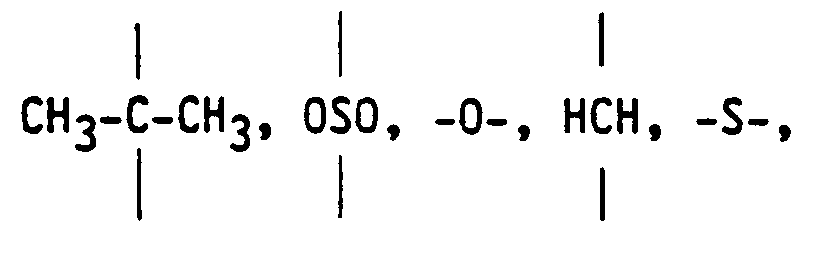 B = H, Br, CH₃
 - A thermosetting resin composition of Claim 4 wherein(a) is
 and (b) is:
- A flame resistant laminate comprising a reinforcing fabric and a thermosetting resin composition of Claim 2.
- The flame retardant laminate of Claim 6 wherein the resin composition is defined in Claim 4.
- A flame retarding laminate of Claim 7 wherein(a) is
 and(b) is:
Applications Claiming Priority (3)
| Application Number | Priority Date | Filing Date | Title |
|---|---|---|---|
| US413883 | 1989-09-28 | ||
| US07/413,883 US5004775A (en) | 1988-04-28 | 1989-09-28 | Polyimide resin laminates |
| PCT/US1990/003361 WO1991005002A1 (en) | 1989-09-28 | 1990-06-13 | Polyimide resin laminates |
Publications (2)
| Publication Number | Publication Date |
|---|---|
| EP0493414A1 EP0493414A1 (en) | 1992-07-08 |
| EP0493414B1 true EP0493414B1 (en) | 1995-03-08 |
Family
ID=23639065
Family Applications (1)
| Application Number | Title | Priority Date | Filing Date |
|---|---|---|---|
| EP90913331A Expired - Lifetime EP0493414B1 (en) | 1989-09-28 | 1990-06-13 | Polyimide resin laminates |
Country Status (7)
| Country | Link |
|---|---|
| US (1) | US5004775A (en) |
| EP (1) | EP0493414B1 (en) |
| JP (1) | JPH05500525A (en) |
| KR (1) | KR927003690A (en) |
| AT (1) | ATE119555T1 (en) |
| DE (1) | DE69017699T2 (en) |
| WO (1) | WO1991005002A1 (en) |
Families Citing this family (6)
| Publication number | Priority date | Publication date | Assignee | Title |
|---|---|---|---|---|
| US5334696A (en) * | 1992-12-18 | 1994-08-02 | Allied Signal Inc. | Polyimide resin laminates |
| US5302723A (en) * | 1993-10-04 | 1994-04-12 | Monsanto Company | Process for preparing flame retardant bisimide compositions |
| US5393887A (en) * | 1993-10-04 | 1995-02-28 | Monsanto Company | Bisimide compositions |
| US6908960B2 (en) | 1999-12-28 | 2005-06-21 | Tdk Corporation | Composite dielectric material, composite dielectric substrate, prepreg, coated metal foil, molded sheet, composite magnetic substrate, substrate, double side metal foil-clad substrate, flame retardant substrate, polyvinylbenzyl ether resin composition, thermosettin |
| DE102008057921A1 (en) | 2008-11-19 | 2010-05-20 | Döhre, Sven, Dipl.-Inf. | Flashlight holder for bicycle, comprises flexible toothed belt, whose diameter varies continuously over screw, where flashlight mounting and guide rail mounting are arranged to rotate against each other |
| JP7056201B2 (en) * | 2018-02-14 | 2022-04-19 | 昭和電工マテリアルズ株式会社 | Thermosetting resin composition, prepreg, laminated board, printed wiring board and high-speed communication compatible module |
Family Cites Families (4)
| Publication number | Priority date | Publication date | Assignee | Title |
|---|---|---|---|---|
| JPS5871924A (en) * | 1981-10-23 | 1983-04-28 | Hitachi Ltd | Thermosetting resin composition and its prepolymer |
| JPH07103192B2 (en) * | 1984-03-02 | 1995-11-08 | 株式会社日立製作所 | Thermosetting resin composition |
| US4774282A (en) * | 1986-11-20 | 1988-09-27 | Amoco Corporation | Thermoset composition comprising aromatic cyanate ester, allyl ethers of bisphenol and bismaleimide |
| US4876325A (en) * | 1988-04-28 | 1989-10-24 | Allied-Signal Inc. | Polyimide resin from bis-imide, polyphenol and dicyandiamide |
-
1989
- 1989-09-28 US US07/413,883 patent/US5004775A/en not_active Expired - Fee Related
-
1990
- 1990-06-13 DE DE69017699T patent/DE69017699T2/en not_active Expired - Fee Related
- 1990-06-13 JP JP2512468A patent/JPH05500525A/en active Pending
- 1990-06-13 KR KR1019920700675A patent/KR927003690A/en not_active Withdrawn
- 1990-06-13 EP EP90913331A patent/EP0493414B1/en not_active Expired - Lifetime
- 1990-06-13 AT AT90913331T patent/ATE119555T1/en not_active IP Right Cessation
- 1990-06-13 WO PCT/US1990/003361 patent/WO1991005002A1/en not_active Ceased
Also Published As
| Publication number | Publication date |
|---|---|
| DE69017699T2 (en) | 1995-09-14 |
| US5004775A (en) | 1991-04-02 |
| JPH05500525A (en) | 1993-02-04 |
| WO1991005002A1 (en) | 1991-04-18 |
| DE69017699D1 (en) | 1995-04-13 |
| KR927003690A (en) | 1992-12-18 |
| ATE119555T1 (en) | 1995-03-15 |
| EP0493414A1 (en) | 1992-07-08 |
Similar Documents
| Publication | Publication Date | Title |
|---|---|---|
| US4526838A (en) | Polyamino-bis-imide resin | |
| US4393188A (en) | Thermosetting prepolymer from polyfunctional maleimide and bis maleimide | |
| DE60201097T2 (en) | Curable resin composition and its use | |
| KR101508084B1 (en) | Halogen-free high-tg resin composition and prepreg and laminae fabricated by using the same | |
| CA1056541A (en) | Heat-resistant resin composition comprising polyaminobismaleimide, polyepoxy compound and aromatic vinyl copolymer and method for using the same | |
| US4876325A (en) | Polyimide resin from bis-imide, polyphenol and dicyandiamide | |
| US5334696A (en) | Polyimide resin laminates | |
| KR0155542B1 (en) | Thermosetting resin composition printed circuit board using the resin composition nd process for producing printed circuit board | |
| JPH01121356A (en) | laminate board | |
| US5004775A (en) | Polyimide resin laminates | |
| EP0317216B1 (en) | Polyaminobisimide resins | |
| JPH06271669A (en) | Flame-retardant thermosetting resin composition with low dielectric constant | |
| US5206074A (en) | Adhesives on polymide films and methods of preparing them | |
| JP3261061B2 (en) | Resin composition for laminate, prepreg and laminate using the composition | |
| KR930004277B1 (en) | Resin compositions and laminate produced therefrom | |
| JPH02286723A (en) | Laminating resin composition and laminate | |
| EP0467474A2 (en) | Cyanamide-cured maleimide/epoxy resin compositions | |
| JPS63168439A (en) | Epoxy resin composition for laminated sheet | |
| JPH02185516A (en) | Thermosetting resin composition and prepreg and laminate using the same | |
| JPH02185517A (en) | Thermosetting resin composition and prepreg and laminate using the same | |
| US5414059A (en) | Low bromine-content materials for manufacturing printed circuit boards | |
| JPS59191726A (en) | Thermosetting resin composition | |
| JPH04185622A (en) | Thermosetting resin composition | |
| CS247273B1 (en) | Polyimide binder and process for its production | |
| JPH1112463A (en) | Resin composition for printed circuit board, varnish, prepreg, and laminate for printed circuit board prepared therefrom |
Legal Events
| Date | Code | Title | Description |
|---|---|---|---|
| PUAI | Public reference made under article 153(3) epc to a published international application that has entered the european phase |
Free format text: ORIGINAL CODE: 0009012 |
|
| 17P | Request for examination filed |
Effective date: 19920320 |
|
| AK | Designated contracting states |
Kind code of ref document: A1 Designated state(s): AT BE CH DE DK ES FR GB IT LI LU NL SE |
|
| 17Q | First examination report despatched |
Effective date: 19931014 |
|
| RAP1 | Party data changed (applicant data changed or rights of an application transferred) |
Owner name: ALLIEDSIGNAL INC. |
|
| GRAA | (expected) grant |
Free format text: ORIGINAL CODE: 0009210 |
|
| AK | Designated contracting states |
Kind code of ref document: B1 Designated state(s): AT BE CH DE DK ES FR GB IT LI LU NL SE |
|
| PG25 | Lapsed in a contracting state [announced via postgrant information from national office to epo] |
Ref country code: IT Free format text: LAPSE BECAUSE OF FAILURE TO SUBMIT A TRANSLATION OF THE DESCRIPTION OR TO PAY THE FEE WITHIN THE PRE;WARNING: LAPSES OF ITALIAN PATENTS WITH EFFECTIVE DATE BEFORE 2007 MAY HAVE OCCURRED AT ANY TIME BEFORE 2007. THE CORRECT EFFECTIVE DATE MAY BE DIFFERENT FROM THE ONE RECORDED.SCRIBED TIME-LIMIT Effective date: 19950308 Ref country code: LI Effective date: 19950308 Ref country code: DK Effective date: 19950308 Ref country code: ES Free format text: THE PATENT HAS BEEN ANNULLED BY A DECISION OF A NATIONAL AUTHORITY Effective date: 19950308 Ref country code: CH Effective date: 19950308 Ref country code: BE Effective date: 19950308 Ref country code: AT Effective date: 19950308 Ref country code: NL Free format text: LAPSE BECAUSE OF NON-PAYMENT OF DUE FEES Effective date: 19950308 |
|
| REF | Corresponds to: |
Ref document number: 119555 Country of ref document: AT Date of ref document: 19950315 Kind code of ref document: T |
|
| REF | Corresponds to: |
Ref document number: 69017699 Country of ref document: DE Date of ref document: 19950413 |
|
| ET | Fr: translation filed | ||
| PG25 | Lapsed in a contracting state [announced via postgrant information from national office to epo] |
Ref country code: SE Effective date: 19950608 |
|
| PG25 | Lapsed in a contracting state [announced via postgrant information from national office to epo] |
Ref country code: GB Effective date: 19950613 |
|
| REG | Reference to a national code |
Ref country code: CH Ref legal event code: PL |
|
| PG25 | Lapsed in a contracting state [announced via postgrant information from national office to epo] |
Ref country code: LU Free format text: LAPSE BECAUSE OF NON-PAYMENT OF DUE FEES Effective date: 19950630 |
|
| NLV1 | Nl: lapsed or annulled due to failure to fulfill the requirements of art. 29p and 29m of the patents act | ||
| PLBE | No opposition filed within time limit |
Free format text: ORIGINAL CODE: 0009261 |
|
| STAA | Information on the status of an ep patent application or granted ep patent |
Free format text: STATUS: NO OPPOSITION FILED WITHIN TIME LIMIT |
|
| GBPC | Gb: european patent ceased through non-payment of renewal fee |
Effective date: 19950613 |
|
| 26N | No opposition filed | ||
| PG25 | Lapsed in a contracting state [announced via postgrant information from national office to epo] |
Ref country code: FR Effective date: 19960229 |
|
| PG25 | Lapsed in a contracting state [announced via postgrant information from national office to epo] |
Ref country code: DE Effective date: 19960301 |
|
| REG | Reference to a national code |
Ref country code: FR Ref legal event code: ST |