EP0490253B1 - Magenta toner for developing electrostatic images - Google Patents
Magenta toner for developing electrostatic images Download PDFInfo
- Publication number
- EP0490253B1 EP0490253B1 EP91120833A EP91120833A EP0490253B1 EP 0490253 B1 EP0490253 B1 EP 0490253B1 EP 91120833 A EP91120833 A EP 91120833A EP 91120833 A EP91120833 A EP 91120833A EP 0490253 B1 EP0490253 B1 EP 0490253B1
- Authority
- EP
- European Patent Office
- Prior art keywords
- charge control
- toner
- control agent
- magenta toner
- images
- Prior art date
- Legal status (The legal status is an assumption and is not a legal conclusion. Google has not performed a legal analysis and makes no representation as to the accuracy of the status listed.)
- Expired - Lifetime
Links
- 0 C*1(C2)C(C=O)=CC=C(C)C2C(*)C1 Chemical compound C*1(C2)C(C=O)=CC=C(C)C2C(*)C1 0.000 description 4
Images


Classifications
-
- C—CHEMISTRY; METALLURGY
- C09—DYES; PAINTS; POLISHES; NATURAL RESINS; ADHESIVES; COMPOSITIONS NOT OTHERWISE PROVIDED FOR; APPLICATIONS OF MATERIALS NOT OTHERWISE PROVIDED FOR
- C09B—ORGANIC DYES OR CLOSELY-RELATED COMPOUNDS FOR PRODUCING DYES, e.g. PIGMENTS; MORDANTS; LAKES
- C09B35/00—Disazo and polyazo dyes of the type A<-D->B prepared by diazotising and coupling
- C09B35/02—Disazo dyes
- C09B35/021—Disazo dyes characterised by two coupling components of the same type
- C09B35/033—Disazo dyes characterised by two coupling components of the same type in which the coupling component is an arylamide of an o-hydroxy-carboxylic acid or of a beta-keto-carboxylic acid
-
- C—CHEMISTRY; METALLURGY
- C08—ORGANIC MACROMOLECULAR COMPOUNDS; THEIR PREPARATION OR CHEMICAL WORKING-UP; COMPOSITIONS BASED THEREON
- C08K—Use of inorganic or non-macromolecular organic substances as compounding ingredients
- C08K5/00—Use of organic ingredients
- C08K5/16—Nitrogen-containing compounds
- C08K5/22—Compounds containing nitrogen bound to another nitrogen atom
- C08K5/23—Azo-compounds
- C08K5/235—Diazo and polyazo compounds
-
- C—CHEMISTRY; METALLURGY
- C09—DYES; PAINTS; POLISHES; NATURAL RESINS; ADHESIVES; COMPOSITIONS NOT OTHERWISE PROVIDED FOR; APPLICATIONS OF MATERIALS NOT OTHERWISE PROVIDED FOR
- C09B—ORGANIC DYES OR CLOSELY-RELATED COMPOUNDS FOR PRODUCING DYES, e.g. PIGMENTS; MORDANTS; LAKES
- C09B35/00—Disazo and polyazo dyes of the type A<-D->B prepared by diazotising and coupling
- C09B35/02—Disazo dyes
- C09B35/039—Disazo dyes characterised by the tetrazo component
- C09B35/205—Disazo dyes characterised by the tetrazo component the tetrazo component being a derivative of a diaryl- or triaryl- alkane or-alkene
- C09B35/21—Disazo dyes characterised by the tetrazo component the tetrazo component being a derivative of a diaryl- or triaryl- alkane or-alkene of diarylmethane or triarylmethane
-
- G—PHYSICS
- G03—PHOTOGRAPHY; CINEMATOGRAPHY; ANALOGOUS TECHNIQUES USING WAVES OTHER THAN OPTICAL WAVES; ELECTROGRAPHY; HOLOGRAPHY
- G03G—ELECTROGRAPHY; ELECTROPHOTOGRAPHY; MAGNETOGRAPHY
- G03G9/00—Developers
- G03G9/08—Developers with toner particles
- G03G9/09—Colouring agents for toner particles
- G03G9/0906—Organic dyes
- G03G9/091—Azo dyes
Definitions
- the present invention relates to a magenta toner powder for developing electrostatic images used for electrophotography, electrostatic recording, electrostatic printing and other purposes, with a red dis-azo dye having the triphenylmethane structure.
- This kind of color toners basically comprise a toner resin and a coloring agent.
- a light-colored or colorless charge control agent providing a positive or negative charge is often added.
- this toner is used as a two-component developing agent, the electrostatic latent image formed on a photoreceptor by charging and the exposure is made visible by developing it with the toner charged together mixing with a carrier and transferring the resulting toner image onto transfer paper or another transferee.
- each toner is required to have a good spectral property and transparency for color reproduction.
- Transparency is also required in toners used for color electrophotography for overhead projectors (hereinafter referred to as OHP). It should also be noted that these toners are required not to be prone to discoloration, fading or bleeding due to light or heat.
- Organic pigments are generally most often used as coloring agents for color toners. However, most organic pigments are unsuitable for imparting a color to toners to yield color toners which are required to be transparent in superposing development because they are incompatible with binder resin.
- Japanese Patent Unexamined Publication No. 295069/1987 discloses color toners incorporating various oil-soluble dyes or dispersion dyes
- Japanese Patent Unexamined Publication No. 15555/1987 discloses a magenta toner incorporating a Rhodamine dye
- Japanese Patent Unexamined Publication No. 217465/1989 discloses a magenta toner incorporating an anthraquinone dispersion dye.
- color toners incorporating an oil-soluble dye or dispersion dye which is soluble in resin can cause copied image quality deterioration during long term repeated use, thus posing a problem to be solved.
- DE 32 20 772 A1 relates to a photoreceptor for electrophotography.
- the electro photographic photoreceptor incorporates a disazo pigment suitable for use as a charge generation material for the light-sensitive layer.
- a disazo pigment having triphenylmethane structure is shown as a photoreceptor, i.e. OPC (organic photoconductor), used for example in photosensitive drums in copying machines.
- the magenta toner for developing electrostatic images of the present invention comprises a resin and at least one kind of the dis-azo dye represented by the following formula [I]: wherein X represents methyl group, ethyl group or alkoxy group having 1 to 4 carbon atoms; Y represents hydrogen atom or methyl group; R1 and R independently represent hydrogen atom, alkyl group, alkoxy group or halogen atom; Q and Q' represent naphthol AS residue.
- This magenta toner for developing electrostatic images is good in transparency, color fastness to light, heat resistance, bleeding resistance and spectral property, offers good color reproduction as a toner for full-color images and yield good copied images even in long term repeated use.
- magenta toner for developing electrostatic images incorporates at least one kind of the dis-azo dye represented by Formula [I] above, a binder resin and a charge control agent, wherein said binder resin and charge control agent are substantially colorless.
- this magenta toner for developing electrostatic images is not prone to cause tone degradation in toner images and is capable of offering a uniform and stable triboelectrical chargeability even when it is used continuously or under changing conditions.
- the magenta toner for developing electrostatic images of the present invention may also comprise a composition obtained by polymerizing a polymerizable composition containing a polymerizable monomer and at least one kind of the dis-azo dye represented by Formula [I] in the presence of a polymerization initiator.
- This toner has still better transparency and permits better color reproduction as a toner for full-color images.
- Figure 1 shows the near ultraviolet-visible light absorption spectrum of Example Dye 1.
- Figure 2 shows the near ultraviolet-visible light absorption spectrum of Example Dye 3.
- Figure 3 shows the near ultraviolet-visible light absorption spectrum of Example Dye 9.
- Figure 4 shows the near ultraviolet-visible light absorption spectrum of Example Dye 10.
- the dye represented by Formula [I] for the present invention can be synthesized as follows:
- an aniline (A) and a benzaldehyde (B) are condensed to a compound (C), which is then tetrazotized and coupled with a naphthol AS to yield the dye represented by Formula [I].
- X represents methyl group, ethyl group or an alkoxy group having 1 to 4 carbon atoms such as methoxy, ethoxy, propoxy or butoxy
- Y represents hydrogen atom or methyl group
- R1 and R independently represent hydrogen atom, alkyl group such as methyl, ethyl, propyl, iso-propyl, butyl, iso-butyl, sec-butyl, tert-butyl, amyl or iso-amyl, alkoxy group such as methoxy, ethoxy, propoxy or butoxy or atom of halogen such as chlorine, bromine or iodine.
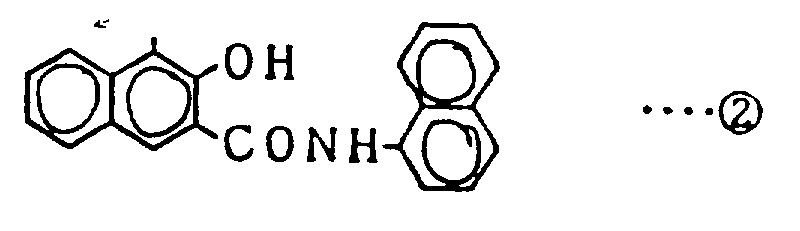
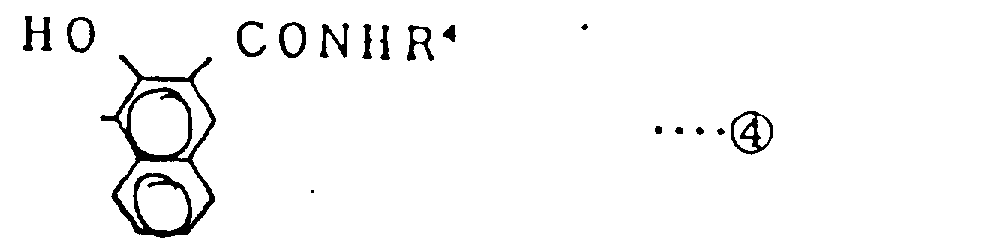
- Q and Q' are naphthol AS residues represented by the following formulas 1 through 4, and Q and Q' may be identical or not.
- n represents an integer of 0 to 3; (R3) n represents no substituent or one, two or three substituent(s); each R3 substituent independently represent alkyl group such as methyl, ethyl, propyl, iso-propyl, butyl, iso-butyl, sec-butyl, tert-butyl, amyl or iso-amyl, alkoxy group such as methoxy, ethoxy, propoxy or butoxy, atom of halogen such as chlorine, bromine or iodine or a nitro group.
- R3 substituent independently represent alkyl group such as methyl, ethyl, propyl, iso-propyl, butyl, iso-butyl, sec-butyl, tert-butyl, amyl or iso-amyl, alkoxy group such as methoxy, ethoxy, propoxy or butoxy, atom of halogen such as chlorine, bromine or iod
- R4 represents alkyl group such as methyl, ethyl, propyl, iso-propyl, butyl, iso-butyl, sec-butyl, tert-butyl, amyl or iso-amyl or hydroxyalkyl group such as hydroxymethyl, ⁇ -hydroxyetlhyl, ⁇ -hydroxyethyl, hydroxypropyl, hydroxybutyl or hydroxyamyl.
- Naphthol AS compounds are exemplified by the following compounds (a) through (k), all of which are commercially available.
- ⁇ max shows the maximum value of visible light absorption wavelength of each example dye determined in chloroform solvent using the 8451A Diode Array Spectrophotometer (trade name, produced by Hewlett-Packard).
- the near ultraviolet-visible absorption spectra of Example Dyes 1, 3, 9 and 10 determined in the same manner as above are shown in Figures 1, 2, 3 and 4, respectively.
- the abscissa indicates wavelength and the ordinate indicates absorbance.
- the magenta toner for developing electrostatic images of the present invention can incorporate almost any conventional toner resin or binder resin.
- the toner resin or binder resin which is preferably used for the present invention is required to be transparent, substantially colorless (colored to such extent that toner images do not undergo tone deterioration), capable of dissolving or melt-mixing the dis-azo dye represented by Formula [I] for the present invention and positively or negatively chargeable per se or by the addition of a charge control agent, to become fluid under appropriate heat or pressure conditions and to be finely pulverizable.
- Such resins which can be preferably used include polystyrene resin, acryl and acrylic resins, styrene-(meth)acrylate copolymer, styrene-methacrylate copolymer and polyester resin.
- Other usable resins include epoxy resin, polyamide resin, polyvinylal resin, polyethylene resin, polypropylene resin and polyolefin. These resins may be used singly or in combination of two or more kinds.
- the magenta toner for developing electrostatic images of the present invention may contain a positively or negatively charging charge control agent to improve its chargeability.
- the charge control agent is preferably substantially colorless.
- substantially colorless means that the color is such that toner images do not undergo tone deterioration.
- Charge control agents which can be preferably used for negatively chargeable toners to provide a negative charge are metal complexes of aromatic o-oxycarboxylic acid, metal complexes of aromatic o-aminocarboxylic acid and metal complexes of aromatic dicarboxylic acid.
- metal complexes include the metal complexes of salicylic acid or alkyl salicylic acid disclosed in Japanese Patent Examined Publication No. 42752/1980 (e.g., chromium complex of 3,5-di-tertiary-butylsalicylic acid, chromium complex of salicylic acid), the zinc complexes of aromatic o-oxycarboxylic acid disclosed in Japanese Patent Unexamined Publication No.
- 69073/1986 e.g., zinc complex of 3,5-di-tertiary-butylsalicylic acid, zinc complex of oxynaphthoic acid
- the aluminum complexes of aromatico-oxycarboxylic acid and aluminum complexes of aromatic o-aminocarboxylic acid disclosed in Japanese Patent Unexamined Publication Nos. 208865/1988 and 105262/1989 the chromium or zinc complexes of aromatic dicarboxylic aciddisclosed in Japanese Patent Unexamined Publication No. 73963/1986.
- Positively charging charge control agents which can be preferably used for positively chargeable toners are quaternary ammonium salt compounds and polyamine compounds.
- charge control agents include the quaternary ammonium salt compounds disclosed in US Patent No. 4,654,175 and Japanese Patent Examined Publication No. 54694/1989 and the polyamine resin disclosed in Japanese Patent Examined Publication No. 13284/1978.
- This kind of charge control agents are commercially available under trade names of Bontron E-81, Bontron E-84, Bontron E-88, Bontron P-51 and Bontron P-52 (trade names, produced by Orient Chemical Industries Ltd.).
- Examples of polymerizable monomers used in the magenta toner for developing electrostatic images described above include vinyl aromatic monomers such as styrene and methylstyrene, acrylic monomers such as methyl acrylate, ethyl acrylate, phenyl acrylate, methyl methacrylate, butyl methacrylate, 2-ethylhexyl methacrylate and ethyl -hydroxyacrylate, vinyl esters such as vinyl acetate and vinyl propionate, vinyl ethers such as vinyl-n-butyl ether and vinylphenyl ether and unsaturated monoolefins such as ethylene and propylene.
- vinyl aromatic monomers such as styrene and methylstyrene
- acrylic monomers such as methyl acrylate, ethyl acrylate, phenyl acrylate, methyl methacrylate, butyl methacrylate, 2-ethylhexyl methacrylate and ethy
- the toner of the present invention preferably contains the dis-azo dye represented by Formula [I] in an amount of 0.5 to 10 parts by weight, more preferably 1 to 5 parts by weight per 100 parts by weight of resin or binder resin.
- the content of the dis-azo dye represented by Formula [I] in the polymerizable composition described above is preferably 10 to 20% by weight.
- the content of the polymeric composition is preferably 2 to 50 parts by weight, more preferably 5 to 20 parts by weight per 100 parts by weight of resin or binder resin.
- the toner of the present invention may incorporate one or more other coloring agents, as long as the purpose or effect thereof is not interfered with.
- the amount of charge control agent is preferably 0.1 to 10 parts by weight, more preferably 0.5 to 5 parts by weight per 100 parts by weight of toner resin or binder resin.
- additives other than the charge control agent such as a fluidity improving agent and image peeling preventing agent.
- magenta toner for developing electrostatic images of the present invention is, for example, produced as follows:
- a toner of 5 to 20 ⁇ m in average particle size can be obtained by thoroughly mixing the dis-azo dye represented by Formula [I] or the above-mentioned polymeric compositioIn containing the dye, a resin or binder resin, a chrarge control agent and, if necessary, a magnetic material, a fluidizing agent and other additives using a ball mill or another mechanical mixer, subsequently kneading the mixture in a molten state using a hot kneader such as a heat roll, kneader or extruder, cooling and solidifying the mixture, and then pulverizing the mixture and classifying the particles.
- a hot kneader such as a heat roll, kneader or extruder
- Other usable methods include the method in which the starting material is dispersed in binder resin solution and then spray dried, and the polymerizing toner production method in which a given set of materials are mixed in a monomer for binder resin to yield an emulsified suspension which is then polymerized to yield the desired toner (e.g., the methods described in Japanese Patent Unexamined Publication Nos. 260461/1989 and 32365/1990.
- development can be achieved by the two-component magnetic brush developing process and other processes using the toner in mixture with carrier powder.
- any known carrier can be used.
- the carrier include iron powder, nickel powder, ferrite powder arid glass beads of about 50 to 200 ⁇ m in particle size, and such materials as coated with acrylate copolymer, styrene-acrylate copolymer, styrene-methacrylate copolymer, silicone resin, polyamide resin, ethylene fluoride resin or the like.
- the toner of the present invention When using the toner of the present invention as a single-component developer, a small amount of finely divided magnetic powder of ferromagnetic material such as iron powder, nickel powder or ferrite powder may be added and dispersed upon preparing the toner as described above. Examples of developing processes which can be used in this case include contact development and jumping development.
- reaction mixture After being alkalized in an aqueous solution of caustic soda, the reaction mixture was subjected to steam distillation, followed by residue filtration. The solid separated by filtration was washed with water and dried to yield 130 g of an unpurified base compound.
- This compound was purified with an about 3-fold amount of alcohol to yield a white powder represented by the following structural formula. Its melting point was 203 to 205 °C.
- Example Dye 11 The resulting crystal was separated by filtration, washed with water and dried to yield 25 g of a red powder of dye (Example Dye 11).
- Polymeric Compositions 3 through 17 were prepared in the same manner as in above Examples except that the dyes were replaced with Example Dyes 3 through 17 listed in Table 1 and the type and amount of polymerization initiator were varied as appropriate.
- Styrene-acryl copolymer [HIMER TB-1000 (trade name), produced by Sanyo Kasei Co., Ltd.].... 100 parts
- the above ingredients were uniformly pre-mixed using a high-speed mixer, and then kneaded in a molten state using an extruder, cooled, and roughly milled in a vibration mill.
- the obtained coarse product was finely pulverized using an air jet mill equipped with a classifier to obtain a fine powder of toner of 5 to 20 ⁇ m in particle size.
- This developer was found to be -20.2 ⁇ C/g in the amount of initial blowoff charges.
- the amounts of initial blowoff charges of this developer under low-temperature low-humidity conditions (5°C, 30% relative humidity) and high-temperature high-humidity conditions (35 °C, 90% relative humidity) were -20.3 ⁇ C/g and -20.5 ⁇ C/g, respectively, indicating very high stability.
- Polyester [HP-301, produced by The Nippon Synthetic Chemical Industry, Co., Ltd.].... 100 parts
- Example 2 The above ingredients were treated in the same manner as in Example 1 to yield a toner. Three parts of the obtained toner was admixed with 97 parts of an iron powder carrier [TEFV200/300 (trade name), produced by Nippon Teppun Co., Ltd.] to yield a developer. This developer was found to be -22.4 ⁇ C/g in the amount of initial blowoff charges.
- Styrene-acryl copolymer [HIMER TB-1000 (trade name), produced by Sanyo Kasei Co., Ltd.].... 100 parts Polymeric Composition 1.... 15 parts Charge control agent [Bontron E-88 (trade name), produced by Orient Chemical Industries Ltd.].... 1 part Low polymer propylene [Biscal 550-P (trade name), produced by Sanyo Kasei Co., Ltd.].... 10 parts
- Example 2 The above ingredients were treated in the same manner as in Example 1 to yield a toner. Three parts of the obtained toner was admixed with 97 parts of an iron powder carrier [TEFV200/300 (trade name), produced by Nippon Teppun Co., Ltd.] to yield a developer. This developer was found to be -20.2 ⁇ C/g in the amount of initial blowoff charges.
- Styrene-acryl copolymer [HIMER TB-1000 (trade name), produced by Sanyo Kasei Co., Ltd.].... 100 parts
- Example 2 The above ingredients were treated in the same manner as in Example 1 to yield a toner. Three parts of the obtained toner was admixed with 97 parts of an iron powder carrier [TEFV200/300 (trade name), produced by Nippon Teppun Co., Ltd.] to yield a developer. This developer was found to be +22.8 ⁇ C/g in the amount of initial blowoff charges.
- Styrene-acryl copolymer [HIMER TB-1000 (trade name), produced by Sanyo Kasei Co., Ltd.].... 100 parts
- Battery 550-P (trade name), produced by Sanyo Kasei Co., Ltd.].
- a toner was prepared and used to form copied images in the same manner as in Example 1 except that the dis-azo dye used in Example 1 (Example Dye 1) was replaced with C. I. Solvent Red 22 (C.I. 21250).
- the initially obtained copied images had a distinct red color, but repeated copying for a long period resulted in uneven copying with color density degradation and fogging.
- a toner was prepared and used to form copied images in the same manner as in Example 1 except that the dis-azo dye used in Example 1 (Example Dye 1) was replaced with C. I. Pigment Red 61 (C.I. 24830:1).
- the initially obtained copied images had a distinct red color, but the image density was lower than that obtained in Example 1 and repeated copying for a long period resulted in uneven copying with color density degradation. Also, the images copied on an OHP sheet lacked transparency and were not suitable for use for OHP.
Landscapes
- Chemical & Material Sciences (AREA)
- Organic Chemistry (AREA)
- Health & Medical Sciences (AREA)
- Chemical Kinetics & Catalysis (AREA)
- Medicinal Chemistry (AREA)
- Polymers & Plastics (AREA)
- Physics & Mathematics (AREA)
- General Physics & Mathematics (AREA)
- Developing Agents For Electrophotography (AREA)
- Optical Filters (AREA)
- Compositions Of Macromolecular Compounds (AREA)
Description
- The present invention relates to a magenta toner powder for developing electrostatic images used for electrophotography, electrostatic recording, electrostatic printing and other purposes, with a red dis-azo dye having the triphenylmethane structure.
- In recent years, there have been increasing demands for color toners which offer images of various desired colors as necessary with the diversification of purpose of use of copying machines and printing machines, etc. So-called three primary color toners, which offer yellow, magenta and cyan colors, respectively, are important in obtaining full-color images.
- This kind of color toners basically comprise a toner resin and a coloring agent. To improve toner chargeability, a light-colored or colorless charge control agent providing a positive or negative charge is often added. When this toner is used as a two-component developing agent, the electrostatic latent image formed on a photoreceptor by charging and the exposure is made visible by developing it with the toner charged together mixing with a carrier and transferring the resulting toner image onto transfer paper or another transferee.
- To obtain a full-color image by superposing toner images of yellow, magenta and cyan colors, the three subtractive primaries, using such toners for color electrophotography etc., each toner is required to have a good spectral property and transparency for color reproduction. Transparency is also required in toners used for color electrophotography for overhead projectors (hereinafter referred to as OHP). It should also be noted that these toners are required not to be prone to discoloration, fading or bleeding due to light or heat.
- Organic pigments are generally most often used as coloring agents for color toners. However, most organic pigments are unsuitable for imparting a color to toners to yield color toners which are required to be transparent in superposing development because they are incompatible with binder resin.
- A number of means have been proposed to meet such requirements as far as possible. For example, Japanese Patent Unexamined Publication No. 295069/1987 discloses color toners incorporating various oil-soluble dyes or dispersion dyes; Japanese Patent Unexamined Publication No. 15555/1987 discloses a magenta toner incorporating a Rhodamine dye; Japanese Patent Unexamined Publication No. 217465/1989 discloses a magenta toner incorporating an anthraquinone dispersion dye.
- However, color toners incorporating an oil-soluble dye or dispersion dye which is soluble in resin can cause copied image quality deterioration during long term repeated use, thus posing a problem to be solved.
- DE 32 20 772 A1 relates to a photoreceptor for electrophotography. The electro photographic photoreceptor incorporates a disazo pigment suitable for use as a charge generation material for the light-sensitive layer. A disazo pigment having triphenylmethane structure is shown as a photoreceptor, i.e. OPC (organic photoconductor), used for example in photosensitive drums in copying machines.
- It is an object of the present invention to provide a magenta toner for developing electrostatic images which is good in transparency, color fastness to light, heat resistance, bleeding resistance and spectral property and which offers good color reproduction as a toner for full-color images.
- As a means for accomplishing the object described above, the magenta toner for developing electrostatic images of the present invention comprises a resin and at least one kind of the dis-azo dye represented by the following formula [I]:

- This magenta toner for developing electrostatic images is good in transparency, color fastness to light, heat resistance, bleeding resistance and spectral property, offers good color reproduction as a toner for full-color images and yield good copied images even in long term repeated use.
- Also, the magenta toner for developing electrostatic images incorporates at least one kind of the dis-azo dye represented by Formula [I] above, a binder resin and a charge control agent, wherein said binder resin and charge control agent are substantially colorless.
- Incorporating the substantially colorless binder resin and charge control agent, this magenta toner for developing electrostatic images is not prone to cause tone degradation in toner images and is capable of offering a uniform and stable triboelectrical chargeability even when it is used continuously or under changing conditions.
- The magenta toner for developing electrostatic images of the present invention may also comprise a composition obtained by polymerizing a polymerizable composition containing a polymerizable monomer and at least one kind of the dis-azo dye represented by Formula [I] in the presence of a polymerization initiator.
- This toner has still better transparency and permits better color reproduction as a toner for full-color images.
- Figure 1 shows the near ultraviolet-visible light absorption spectrum of Example Dye 1.
- Figure 2 shows the near ultraviolet-visible light absorption spectrum of Example Dye 3.
- Figure 3 shows the near ultraviolet-visible light absorption spectrum of Example Dye 9.
- Figure 4 shows the near ultraviolet-visible light absorption spectrum of Example Dye 10.
- The dye represented by Formula [I] for the present invention can be synthesized as follows:
- First, an aniline (A)


- With respect to the above formulas (A), (B) and (C), X, Y, R¹ and R have the same definitions as in Formula [I].
- X represents methyl group, ethyl group or an alkoxy group having 1 to 4 carbon atoms such as methoxy, ethoxy, propoxy or butoxy; Y represents hydrogen atom or methyl group; R¹ and R independently represent hydrogen atom, alkyl group such as methyl, ethyl, propyl, iso-propyl, butyl, iso-butyl, sec-butyl, tert-butyl, amyl or iso-amyl, alkoxy group such as methoxy, ethoxy, propoxy or butoxy or atom of halogen such as chlorine, bromine or iodine.
- With respect to Formula [I], Q and Q' are naphthol AS residues represented by the following formulas ① through ④, and Q and Q' may be identical or not.


- With respect to Formula ①, n represents an integer of 0 to 3; (R³)n represents no substituent or one, two or three substituent(s); each R³ substituent independently represent alkyl group such as methyl, ethyl, propyl, iso-propyl, butyl, iso-butyl, sec-butyl, tert-butyl, amyl or iso-amyl, alkoxy group such as methoxy, ethoxy, propoxy or butoxy, atom of halogen such as chlorine, bromine or iodine or a nitro group.
- With respect to Formula ④, R⁴ represents alkyl group such as methyl, ethyl, propyl, iso-propyl, butyl, iso-butyl, sec-butyl, tert-butyl, amyl or iso-amyl or hydroxyalkyl group such as hydroxymethyl, α-hydroxyetlhyl, β-hydroxyethyl, hydroxypropyl, hydroxybutyl or hydroxyamyl.
- Naphthol AS compounds are exemplified by the following compounds (a) through (k), all of which are commercially available.
- (a) Naphthol AS

- (b) Naphthol AS-D

- (c) Naphthol AS-RL

- (d) Naphthol AS-OL

- (e) Naphthol AS-PH

- (f) Naphthol AS-E

- (g) Naphthol AS-TR

- (h) Naphthol AS-BO

- (i) Naphthol AS-SW

- (j) Naphthol AS-BS

- (k) Naphthol BD-1

- Examples of the dye represented by Formula [I] for the present invention are given in Table 1.
Table 1 Example Dye Number Aniline component Benzaldehyde component Coupler component λ max (nm) X Y R¹ R Q Q' 1 CH₃ CH₃ H H b b 522 558 2 CH₃ CH₃ H H c c 522 556 3 CH₃ CH₃ H H e e 520 554 4 CH₃ CH₃ H H a a 522 556 5 CH₃ H H H a a 516 548 6 OCH₃ H H H a a 530 560 7 CH₃ H CH₃ (para) CH₃ (ortho) b b 520 540 8 OCH₃ H C₂H₅ (para) H c c 526 556 9 CH₃ H i-C₄H₉(para) H h h 520 556 10 CH₃ CH₃ OCH₃ (para) H c c 522 556 11 CH₃ CH₃ i-C₄H₉ (para) H f f 524 558 12 CH₃ H C₂H₅ (para) H g g 516 552 13 CH₃ H H C1 (ortho) f f 520 552 14 CH₃ CH₃ H H a b 522 558 15 OCH₃ H OCH₃ (para) H c c 528 560 16 CH₃ CH₃ H H j j 526 562 17 CH₃ CH₃ H H k k 512 544 - In Table 1, λ max shows the maximum value of visible light absorption wavelength of each example dye determined in chloroform solvent using the 8451A Diode Array Spectrophotometer (trade name, produced by Hewlett-Packard). The near ultraviolet-visible absorption spectra of Example Dyes 1, 3, 9 and 10 determined in the same manner as above are shown in Figures 1, 2, 3 and 4, respectively. In Figures 1 through 4, the abscissa indicates wavelength and the ordinate indicates absorbance.
- The magenta toner for developing electrostatic images of the present invention can incorporate almost any conventional toner resin or binder resin. The toner resin or binder resin which is preferably used for the present invention is required to be transparent, substantially colorless (colored to such extent that toner images do not undergo tone deterioration), capable of dissolving or melt-mixing the dis-azo dye represented by Formula [I] for the present invention and positively or negatively chargeable per se or by the addition of a charge control agent, to become fluid under appropriate heat or pressure conditions and to be finely pulverizable.
- Examples of such resins which can be preferably used include polystyrene resin, acryl and acrylic resins, styrene-(meth)acrylate copolymer, styrene-methacrylate copolymer and polyester resin. Other usable resins include epoxy resin, polyamide resin, polyvinylal resin, polyethylene resin, polypropylene resin and polyolefin. These resins may be used singly or in combination of two or more kinds.
- The magenta toner for developing electrostatic images of the present invention may contain a positively or negatively charging charge control agent to improve its chargeability. The charge control agent is preferably substantially colorless. Here, "substantially colorless" means that the color is such that toner images do not undergo tone deterioration.
- Charge control agents which can be preferably used for negatively chargeable toners to provide a negative charge are metal complexes of aromatic o-oxycarboxylic acid, metal complexes of aromatic o-aminocarboxylic acid and metal complexes of aromatic dicarboxylic acid. Examples of such metal complexes include the metal complexes of salicylic acid or alkyl salicylic acid disclosed in Japanese Patent Examined Publication No. 42752/1980 (e.g., chromium complex of 3,5-di-tertiary-butylsalicylic acid, chromium complex of salicylic acid), the zinc complexes of aromatic o-oxycarboxylic acid disclosed in Japanese Patent Unexamined Publication No. 69073/1986 (e.g., zinc complex of 3,5-di-tertiary-butylsalicylic acid, zinc complex of oxynaphthoic acid), the aluminum complexes of aromatico-oxycarboxylic acid and aluminum complexes of aromatic o-aminocarboxylic acid disclosed in Japanese Patent Unexamined Publication Nos. 208865/1988 and 105262/1989, and the chromium or zinc complexes of aromatic dicarboxylic aciddisclosed in Japanese Patent Unexamined Publication No. 73963/1986.
- Positively charging charge control agents which can be preferably used for positively chargeable toners are quaternary ammonium salt compounds and polyamine compounds. Examples of such charge control agents include the quaternary ammonium salt compounds disclosed in US Patent No. 4,654,175 and Japanese Patent Examined Publication No. 54694/1989 and the polyamine resin disclosed in Japanese Patent Examined Publication No. 13284/1978. This kind of charge control agents are commercially available under trade names of Bontron E-81, Bontron E-84, Bontron E-88, Bontron P-51 and Bontron P-52 (trade names, produced by Orient Chemical Industries Ltd.).
- Examples of polymerizable monomers used in the magenta toner for developing electrostatic images described above include vinyl aromatic monomers such as styrene and methylstyrene, acrylic monomers such as methyl acrylate, ethyl acrylate, phenyl acrylate, methyl methacrylate, butyl methacrylate, 2-ethylhexyl methacrylate and ethyl -hydroxyacrylate, vinyl esters such as vinyl acetate and vinyl propionate, vinyl ethers such as vinyl-n-butyl ether and vinylphenyl ether and unsaturated monoolefins such as ethylene and propylene.
- Examples of polymerization initiators which can be used for this magenta toner for developing electrostatic images include azo type initiators such as
2,2'-azobisisobutyronitrile,
2,2'-azobis-2-methylbutyronitrile and
2-t-butylazo-2-cyanopropane and peroxide type initiators such as t-butyl hydroperoxide, di-t-butyl peroxide and benzoyl peroxide. - Although any method of polymerization can be used to polymerize the polymerizable composition described above, solution polymerization, suspension polymerization, mass polymerization, etc. are practically useful.
- The toner of the present invention preferably contains the dis-azo dye represented by Formula [I] in an amount of 0.5 to 10 parts by weight, more preferably 1 to 5 parts by weight per 100 parts by weight of resin or binder resin.
- The content of the dis-azo dye represented by Formula [I] in the polymerizable composition described above is preferably 10 to 20% by weight.
- With respect to the toner of the present invention when it comprises a composition obtained by polymerizing this polymerizable composition, the content of the polymeric composition is preferably 2 to 50 parts by weight, more preferably 5 to 20 parts by weight per 100 parts by weight of resin or binder resin.
- The toner of the present invention may incorporate one or more other coloring agents, as long as the purpose or effect thereof is not interfered with.
- The amount of charge control agent is preferably 0.1 to 10 parts by weight, more preferably 0.5 to 5 parts by weight per 100 parts by weight of toner resin or binder resin.
- To improve toner quality, it is preferable to internally or externally add one or more additives other than the charge control agent, such as a fluidity improving agent and image peeling preventing agent.
- The magenta toner for developing electrostatic images of the present invention is, for example, produced as follows:
- A toner of 5 to 20 µm in average particle size can be obtained by thoroughly mixing the dis-azo dye represented by Formula [I] or the above-mentioned polymeric compositioIn containing the dye, a resin or binder resin, a chrarge control agent and, if necessary, a magnetic material, a fluidizing agent and other additives using a ball mill or another mechanical mixer, subsequently kneading the mixture in a molten state using a hot kneader such as a heat roll, kneader or extruder, cooling and solidifying the mixture, and then pulverizing the mixture and classifying the particles.
- Other usable methods include the method in which the starting material is dispersed in binder resin solution and then spray dried, and the polymerizing toner production method in which a given set of materials are mixed in a monomer for binder resin to yield an emulsified suspension which is then polymerized to yield the desired toner (e.g., the methods described in Japanese Patent Unexamined Publication Nos. 260461/1989 and 32365/1990.
- When using the toner of the present invention as a two-component developer, development can be achieved by the two-component magnetic brush developing process and other processes using the toner in mixture with carrier powder.
- Any known carrier can be used. Examples of the carrier include iron powder, nickel powder, ferrite powder arid glass beads of about 50 to 200 µm in particle size, and such materials as coated with acrylate copolymer, styrene-acrylate copolymer, styrene-methacrylate copolymer, silicone resin, polyamide resin, ethylene fluoride resin or the like.
- When using the toner of the present invention as a single-component developer, a small amount of finely divided magnetic powder of ferromagnetic material such as iron powder, nickel powder or ferrite powder may be added and dispersed upon preparing the toner as described above. Examples of developing processes which can be used in this case include contact development and jumping development.
- The present invention is hereinafter described in more detail by means of the following examples, but these are not to be construed as limitative on the present invention. In the description below, "part(s) by weight" are referred to as "part(s)" for short.
- A mixture of 121 g (1 mol) of 2,5-xylidine, 53 g (0.5 mol) of benzaldehyde, 70 g of concentrate hydrochloric acid and 150 g of chlorobenzene was reacted while refluxing for 7 hours.
- After being alkalized in an aqueous solution of caustic soda, the reaction mixture was subjected to steam distillation, followed by residue filtration. The solid separated by filtration was washed with water and dried to yield 130 g of an unpurified base compound.
- This compound was purified with an about 3-fold amount of alcohol to yield a white powder represented by the following structural formula. Its melting point was 203 to 205 °C.

- 8.3 g of 4,4'-benzylidene-di-2,5-xylidine was dissolved and dispersed in 80 g of water containing 12 g of concentrate hydrochloric acid. After cooling the solution to under 5 °C, a solution of 7 g of sodium nitrite in a small amount of water was dropwise added thereto for tetrazotization.
- Separately, 13.6 g of naphthol AS-D was dissolved in 200 g of water containing 4.5 g of caustic soda. To this solution, 1 g of a nonionic dispersing agent was added, followed by addition of ice to cool the mixture to under 5 °C to yield a coupler solution.
- To this coupler solution, the tetrazonium salt solution prepared above was dropwise added for coupling. The resulting crystal was separated by filtration, washed with water and dried to yield 22.5 g of a red powder of dye (Example Dye 1).
- 9.7 g of 4,4'-(p-isobutylbenzylidene)-di-2,5-xylidine was dissolved in 100 g of acetic acid. To this solution, 10 g of concentrate hydrochloric acid was added. After cooling the solution to under 5 °C, a solution of 3.5 g of sodium nitrite in a small amount of water was dropwise added thereto for tetrazotization.
- 14.9 g of naphthol AS-E was dissolved in 100 g of DMF. To this solution, 2 g of a nonionic surfactant was added, followed by cooling to under 10 °C to yield a coupler solution.
- While keeping the coupler solution alkaline by dropwise addition of a dilute aqueous solution of caustic soda, the tetrazonium salt solution prepared above was dropwise added thereto for coupling.
- The resulting crystal was separated by filtration, washed with water and dried to yield 25 g of a red powder of dye (Example Dye 11).
- 140 parts of styrene, 60 parts of n-butyl methacrylate, 50 parts of hydroxyethyl methacrylate, 30 parts of
Example Dye 1 and 300 parts of toluene were placed in a three-necked flask equipped with a reflex condenser, and 2 parts of azoisobutyronitrile was added, followed by polymerization at 85 to 100 °C for 10 hours. After completion of the reaction , the unreacted monomer and toluene were removed to yield Polymeric Composition 1. - 100 parts of styrene, 100 parts of n-butyl methacrylate, 50 parts of hydroxyethyl methacrylate, 50 parts of
Example Dye 2 and 300 parts of toluene were placed in a three-necked flask equipped with a reflex condenser, and 5 parts of azoisobutyronitrile was added, followed by polymerization at 75 to 90 °C for 10 hours. After completion of the reaction, the unreacted monomer and toluene were removed to yield Polymeric Composition 2. - Polymeric Compositions 3 through 17 were prepared in the same manner as in above Examples except that the dyes were replaced with Example Dyes 3 through 17 listed in Table 1 and the type and amount of polymerization initiator were varied as appropriate.
- Styrene-acryl copolymer [HIMER TB-1000 (trade name), produced by Sanyo Kasei Co., Ltd.].... 100 parts
Example Dye 1.... 3 parts
Charge control agent [Bontron E-84 (trade name), produced by Orient Chemical Industries Ltd.].... 1.5 parts
Low polymer propylene [Biscal 550-P (trade name), produced by Sanyo Kasei Co., Ltd.].... 10 parts - The above ingredients were uniformly pre-mixed using a high-speed mixer, and then kneaded in a molten state using an extruder, cooled, and roughly milled in a vibration mill. The obtained coarse product was finely pulverized using an air jet mill equipped with a classifier to obtain a fine powder of toner of 5 to 20 µm in particle size.
- 5 parts of this toner was admixed with 95 parts of a resin-coated iron powder carrier [F813-150 (trade name), produced by Nippon Teppun Co., Ltd.) to yield a developer.
- This developer was found to be -20.2 µ C/g in the amount of initial blowoff charges. The amounts of initial blowoff charges of this developer under low-temperature low-humidity conditions (5°C, 30% relative humidity) and high-temperature high-humidity conditions (35 °C, 90% relative humidity) were -20.3 µ C/g and -20.5 µ C/g, respectively, indicating very high stability.
- When this developer was used for a commercial copying machine (selenium drum type) to form toner images, fog-free very distinct glossy magenta color images were obtained. Even long term repeated use permitted the obtainment of stable copies free of quality degradation.
- Polyester [HP-301, produced by The Nippon Synthetic Chemical Industry, Co., Ltd.].... 100 parts
Example Dye 6.... 3 parts
Charge control agent [Bontron E-81 (trade name), produced by Orient Chemical Industries Ltd.].... 1.2 parts
Low polymer propylene [Biscal 550-P (trade name), produced by Sanyo Kasei Co., Ltd.].... 10 parts - The above ingredients were treated in the same manner as in Example 1 to yield a toner. Three parts of the obtained toner was admixed with 97 parts of an iron powder carrier [TEFV200/300 (trade name), produced by Nippon Teppun Co., Ltd.] to yield a developer. This developer was found to be -22.4 µ C/g in the amount of initial blowoff charges.
- When copies were taken in the same manner as in Example 1, this developer gave fog-free distinct magenta images with high thin-line reproducibility. Even long term repeated use permitted the obtainment of stable copies free of image quality degradation.
- Styrene-acryl copolymer [HIMER TB-1000 (trade name), produced by Sanyo Kasei Co., Ltd.].... 100 parts
Polymeric Composition 1.... 15 parts
Charge control agent [Bontron E-88 (trade name), produced by Orient Chemical Industries Ltd.].... 1 part
Low polymer propylene [Biscal 550-P (trade name), produced by Sanyo Kasei Co., Ltd.].... 10 parts - The above ingredients were treated in the same manner as in Example 1 to yield a toner. Three parts of the obtained toner was admixed with 97 parts of an iron powder carrier [TEFV200/300 (trade name), produced by Nippon Teppun Co., Ltd.] to yield a developer. This developer was found to be -20.2 µ C/g in the amount of initial blowoff charges.
- When the developer was used for a commercial color copying machine [produced by Canon Inc.] to take copies, fog-free very distinct magenta images were obtained. Even long term repeated use permitted the obtainment of stable copies free of image quality degradation.
- When images were formed using this developer on images formed using a yellow toner developer and images were formed thereon using a cyan toner developer, color images with good color reproduction were obtained.
- Styrene-acryl copolymer [HIMER TB-1000 (trade name), produced by Sanyo Kasei Co., Ltd.].... 100 parts
Example Dye 11.... 2.5 parts
Charge control agent [Bontron P-51 (trade name), produced by Orient Chemical Industries Ltd.].... 1.2 parts
Low polymer propylene [Biscal 550-P (trade name), produced by Sanyo Kasei Co., Ltd.].... 10 parts - The above ingredients were treated in the same manner as in Example 1 to yield a toner. Three parts of the obtained toner was admixed with 97 parts of an iron powder carrier [TEFV200/300 (trade name), produced by Nippon Teppun Co., Ltd.] to yield a developer. This developer was found to be +22.8 µ C/g in the amount of initial blowoff charges.
- When the developer was used for a commercial copying machine [Canon NP (trade name), produced by Canon Inc.] to take copies, fog-free very distinct magenta images were obtained. Even long term repeated use permitted the obtainment of stable copies free of image quality degradation.
- When copied images on an OHP sheet were projected on a screen using an OHP, images with distinct magenta color were obtained.
- Styrene-acryl copolymer [HIMER TB-1000 (trade name), produced by Sanyo Kasei Co., Ltd.].... 100 parts
Example Dye 9.... 5 parts
Iron sesquioxide (Fe₂O₃).... 15 parts Charge control agent [Bontron P-51 (trade name), produced by Orient Chemical Industries Ltd.].... 1 part
Low polymer propylene [Biscal 550-P (trade name), produced by Sanyo Kasei Co., Ltd.].... 10 parts - The above ingredients were uniformly pre-mixed using a ball mill to yield a premix, which was then kneaded in a molten state using a twin-screw extruder [PCM-30 (trade name), produced by Ikegai Seisakusho Co., Ltd.], cooled and thereafter roughly crushed, finely pulverized and classified to yield a single-component toner of 5 to 15 µm in particle size.
- When this toner was used for a commercial copying machine [NP-201 (trade name), produced by Canon Inc.] to form toner images, fog-free magenta images were obtained with high quality.
- A toner was prepared and used to form copied images in the same manner as in Example 1 except that the dis-azo dye used in Example 1 (Example Dye 1) was replaced with C. I. Solvent Red 22 (C.I. 21250). The initially obtained copied images had a distinct red color, but repeated copying for a long period resulted in uneven copying with color density degradation and fogging.
- A toner was prepared and used to form copied images in the same manner as in Example 1 except that the dis-azo dye used in Example 1 (Example Dye 1) was replaced with C. I. Pigment Red 61 (C.I. 24830:1). The initially obtained copied images had a distinct red color, but the image density was lower than that obtained in Example 1 and repeated copying for a long period resulted in uneven copying with color density degradation. Also, the images copied on an OHP sheet lacked transparency and were not suitable for use for OHP.
Claims (5)
- A magenta toner powder for developing electrostatic images which comprises a resin and at least one kind of the dis-azo dye represented by the following formula [I]:



 where n = 0-3R³ = alkyl, alkoxy, halogen or nitroR⁴ = alkyl or hydroxyalkyl
 - The magenta toner powder for developing electrocstatic images of claim 1 further comprising a charge control agent, wherein said binder resin and charge control agent are substantially colorless.
- The magenta toner powder for developing electrostatic images of claim 2 wherein said charge control agent is negatively charging charge control agent selected from the group consisting of metal complexes of aromatic o-oxycarboxylic acid, metal complexes of aromatic o-aminocarboxylic acid and metal complexes of aromatic dicarboxylic acid.
- The magenta toner powder for developing electrostatic images of claim 2 wherein said charge control agent is a positively charging charge control agent selected from the group consisting of quaternary ammonium salt compounds and polyamine compounds.
- The magenta toner powder for developing electrostatic images of one of claims 1 to 4 further comprising a polymeric composition of at least one kind of said dis azo dye represented by formula (I) and a polymer.
Priority Applications (1)
| Application Number | Priority Date | Filing Date | Title |
|---|---|---|---|
| EP94106889A EP0614934B1 (en) | 1990-12-14 | 1991-12-04 | Colored resin, colored molded resin member and color filter |
Applications Claiming Priority (4)
| Application Number | Priority Date | Filing Date | Title |
|---|---|---|---|
| JP2410888A JP3057099B2 (en) | 1990-12-14 | 1990-12-14 | Magenta toner for developing electrostatic images |
| JP410888/90 | 1990-12-14 | ||
| JP41726190A JP3086483B2 (en) | 1990-12-28 | 1990-12-28 | Colored resin and related technologies |
| JP417261/90 | 1990-12-28 |
Related Child Applications (2)
| Application Number | Title | Priority Date | Filing Date |
|---|---|---|---|
| EP94106889.2 Division-Into | 1991-12-04 | ||
| EP94106889A Division EP0614934B1 (en) | 1990-12-14 | 1991-12-04 | Colored resin, colored molded resin member and color filter |
Publications (3)
| Publication Number | Publication Date |
|---|---|
| EP0490253A2 EP0490253A2 (en) | 1992-06-17 |
| EP0490253A3 EP0490253A3 (en) | 1993-02-24 |
| EP0490253B1 true EP0490253B1 (en) | 1996-03-06 |
Family
ID=26582994
Family Applications (2)
| Application Number | Title | Priority Date | Filing Date |
|---|---|---|---|
| EP91120833A Expired - Lifetime EP0490253B1 (en) | 1990-12-14 | 1991-12-04 | Magenta toner for developing electrostatic images |
| EP94106889A Expired - Lifetime EP0614934B1 (en) | 1990-12-14 | 1991-12-04 | Colored resin, colored molded resin member and color filter |
Family Applications After (1)
| Application Number | Title | Priority Date | Filing Date |
|---|---|---|---|
| EP94106889A Expired - Lifetime EP0614934B1 (en) | 1990-12-14 | 1991-12-04 | Colored resin, colored molded resin member and color filter |
Country Status (2)
| Country | Link |
|---|---|
| EP (2) | EP0490253B1 (en) |
| DE (2) | DE69131184T2 (en) |
Families Citing this family (3)
| Publication number | Priority date | Publication date | Assignee | Title |
|---|---|---|---|---|
| DE19623565C2 (en) * | 1996-06-13 | 2000-12-14 | Clariant Gmbh | Toner for electrophotographic developers containing an azomage pigment |
| US6159649A (en) * | 1996-06-13 | 2000-12-12 | Clariant Gmbh | Electrophotographic, resin-containing, electret, or inkjet compositions containing magenta azo pigment and use thereof |
| CN104999586A (en) * | 2015-07-29 | 2015-10-28 | 巢湖市荣达塑业有限公司 | Jet fluid for mixing of waste plastic particles |
Family Cites Families (8)
| Publication number | Priority date | Publication date | Assignee | Title |
|---|---|---|---|---|
| JPS55127175A (en) * | 1979-03-26 | 1980-10-01 | Nippon Sheet Glass Co Ltd | Preparation of colored antifogging product |
| JPS56130762A (en) * | 1980-03-17 | 1981-10-13 | Konishiroku Photo Ind Co Ltd | Manufacture of toner for electrostatic charge development |
| JPS5844703B2 (en) * | 1980-11-27 | 1983-10-05 | 大日精化工業株式会社 | Polybutylene terephthalate coloring composition |
| US4427753A (en) * | 1981-06-02 | 1984-01-24 | Canon Kabushiki Kaisha | Electrophotographic photosensitive member with disazo or trisazo compound |
| JPS61228044A (en) * | 1985-04-03 | 1986-10-11 | Dainippon Ink & Chem Inc | Colorant for polyolefin |
| JPS6317565A (en) * | 1986-07-10 | 1988-01-25 | Minolta Camera Co Ltd | Transparent resin-molded light-receiving element and its manufacture |
| JPS63155004A (en) * | 1986-12-18 | 1988-06-28 | Casio Comput Co Ltd | color filter |
| JPH02238439A (en) * | 1989-03-10 | 1990-09-20 | Seiko Epson Corp | Transmission type liquid crystal electrooptical device |
-
1991
- 1991-12-04 DE DE1991631184 patent/DE69131184T2/en not_active Expired - Fee Related
- 1991-12-04 EP EP91120833A patent/EP0490253B1/en not_active Expired - Lifetime
- 1991-12-04 EP EP94106889A patent/EP0614934B1/en not_active Expired - Lifetime
- 1991-12-04 DE DE1991617689 patent/DE69117689T2/en not_active Expired - Fee Related
Non-Patent Citations (1)
| Title |
|---|
| DATABASE WPIL Week 1081, Derwent Publications Ltd., London, GB; AN 81-16208D (10) & JP-A-55 166 654 * |
Also Published As
| Publication number | Publication date |
|---|---|
| DE69131184T2 (en) | 1999-12-16 |
| DE69131184D1 (en) | 1999-06-02 |
| DE69117689T2 (en) | 1996-11-07 |
| DE69117689D1 (en) | 1996-04-11 |
| EP0614934B1 (en) | 1999-04-28 |
| EP0490253A2 (en) | 1992-06-17 |
| EP0490253A3 (en) | 1993-02-24 |
| EP0614934A1 (en) | 1994-09-14 |
Similar Documents
| Publication | Publication Date | Title |
|---|---|---|
| US4433040A (en) | Electrophotographic toner containing a metal complex dye | |
| EP0441255B1 (en) | Dicyanoimidazole compound derivative, magenta toner, colored resin, colored molded resin member and color filter incorporating it | |
| EP0141377B1 (en) | Metal complexes | |
| JPH0475263B2 (en) | ||
| JPS62163061A (en) | Electrophotographic toner | |
| EP0712049B1 (en) | Calixarenes as charge control agents and toner | |
| EP3291013B1 (en) | Yellow toner | |
| US5952145A (en) | Calix arene charge control agent and toner for developing electrostatic images | |
| CA2507010C (en) | Charge control agent and toner for electrostatic image development and image formation process | |
| EP0490253A2 (en) | Magenta toner for developing electrostatic images | |
| JPS62129358A (en) | Metal complex salt compound and toner for electro-photography | |
| US5254420A (en) | Magenta toner for developing electrostatic images, colored resin, colored molded resin member and color filter | |
| WO2018021250A1 (en) | Magenta toner | |
| JPH02213854A (en) | magenta toner | |
| US5164283A (en) | Electrophotographic developing powder | |
| JPH06332264A (en) | Electrostatic charge image developing toner | |
| JP2841100B2 (en) | Toner and color filter | |
| JPH0667467A (en) | Post-dyeing color toner dye and color toner | |
| JPH043172A (en) | Magenta toner for developing electrostatic charge image and associated technique thereof | |
| JP3461046B2 (en) | Positively chargeable toner for developing electrostatic images | |
| JP2006064902A (en) | toner | |
| JP3461045B2 (en) | Toner for developing electrostatic images | |
| JPH0973193A (en) | Toner for developing electrostatic images | |
| JPH0228144B2 (en) | ||
| JPH05173369A (en) | Dye and composition for red color toner |
Legal Events
| Date | Code | Title | Description |
|---|---|---|---|
| PUAI | Public reference made under article 153(3) epc to a published international application that has entered the european phase |
Free format text: ORIGINAL CODE: 0009012 |
|
| AK | Designated contracting states |
Kind code of ref document: A2 Designated state(s): CH DE FR GB LI |
|
| PUAL | Search report despatched |
Free format text: ORIGINAL CODE: 0009013 |
|
| 17P | Request for examination filed |
Effective date: 19921113 |
|
| AK | Designated contracting states |
Kind code of ref document: A3 Designated state(s): CH DE FR GB LI |
|
| 17Q | First examination report despatched |
Effective date: 19931015 |
|
| GRAA | (expected) grant |
Free format text: ORIGINAL CODE: 0009210 |
|
| AK | Designated contracting states |
Kind code of ref document: B1 Designated state(s): CH DE FR GB LI |
|
| ET | Fr: translation filed | ||
| REF | Corresponds to: |
Ref document number: 69117689 Country of ref document: DE Date of ref document: 19960411 |
|
| REG | Reference to a national code |
Ref country code: CH Ref legal event code: NV Representative=s name: BOVARD AG PATENTANWAELTE |
|
| PLBE | No opposition filed within time limit |
Free format text: ORIGINAL CODE: 0009261 |
|
| STAA | Information on the status of an ep patent application or granted ep patent |
Free format text: STATUS: NO OPPOSITION FILED WITHIN TIME LIMIT |
|
| 26N | No opposition filed | ||
| REG | Reference to a national code |
Ref country code: GB Ref legal event code: IF02 |
|
| PGFP | Annual fee paid to national office [announced via postgrant information from national office to epo] |
Ref country code: GB Payment date: 20021122 Year of fee payment: 12 |
|
| PGFP | Annual fee paid to national office [announced via postgrant information from national office to epo] |
Ref country code: FR Payment date: 20021217 Year of fee payment: 12 |
|
| PGFP | Annual fee paid to national office [announced via postgrant information from national office to epo] |
Ref country code: DE Payment date: 20021220 Year of fee payment: 12 |
|
| PGFP | Annual fee paid to national office [announced via postgrant information from national office to epo] |
Ref country code: CH Payment date: 20021224 Year of fee payment: 12 |
|
| PG25 | Lapsed in a contracting state [announced via postgrant information from national office to epo] |
Ref country code: GB Free format text: LAPSE BECAUSE OF NON-PAYMENT OF DUE FEES Effective date: 20031204 |
|
| PG25 | Lapsed in a contracting state [announced via postgrant information from national office to epo] |
Ref country code: LI Free format text: LAPSE BECAUSE OF NON-PAYMENT OF DUE FEES Effective date: 20031231 Ref country code: CH Free format text: LAPSE BECAUSE OF NON-PAYMENT OF DUE FEES Effective date: 20031231 |
|
| PG25 | Lapsed in a contracting state [announced via postgrant information from national office to epo] |
Ref country code: DE Free format text: LAPSE BECAUSE OF NON-PAYMENT OF DUE FEES Effective date: 20040701 |
|
| GBPC | Gb: european patent ceased through non-payment of renewal fee |
Effective date: 20031204 |
|
| REG | Reference to a national code |
Ref country code: CH Ref legal event code: PL |
|
| PG25 | Lapsed in a contracting state [announced via postgrant information from national office to epo] |
Ref country code: FR Free format text: LAPSE BECAUSE OF NON-PAYMENT OF DUE FEES Effective date: 20040831 |
|
| REG | Reference to a national code |
Ref country code: FR Ref legal event code: ST |