EP0486466B1 - Verfahren zum kontrollierten und gesteuerten aeroben biologischen Abbau von organischen Abfällen - Google Patents
Verfahren zum kontrollierten und gesteuerten aeroben biologischen Abbau von organischen Abfällen Download PDFInfo
- Publication number
- EP0486466B1 EP0486466B1 EP19910890279 EP91890279A EP0486466B1 EP 0486466 B1 EP0486466 B1 EP 0486466B1 EP 19910890279 EP19910890279 EP 19910890279 EP 91890279 A EP91890279 A EP 91890279A EP 0486466 B1 EP0486466 B1 EP 0486466B1
- Authority
- EP
- European Patent Office
- Prior art keywords
- process according
- substrate
- degradation
- degraded
- oxygen
- Prior art date
- Legal status (The legal status is an assumption and is not a legal conclusion. Google has not performed a legal analysis and makes no representation as to the accuracy of the status listed.)
- Expired - Lifetime
Links
- 238000000034 method Methods 0.000 title claims abstract description 30
- 239000010815 organic waste Substances 0.000 title claims abstract description 13
- 238000000354 decomposition reaction Methods 0.000 title abstract description 8
- 239000000463 material Substances 0.000 claims abstract description 52
- 239000000758 substrate Substances 0.000 claims abstract description 37
- 230000015556 catabolic process Effects 0.000 claims abstract description 33
- 238000006731 degradation reaction Methods 0.000 claims abstract description 32
- 239000007789 gas Substances 0.000 claims abstract description 27
- 239000000203 mixture Substances 0.000 claims abstract description 16
- QVGXLLKOCUKJST-UHFFFAOYSA-N atomic oxygen Chemical compound [O] QVGXLLKOCUKJST-UHFFFAOYSA-N 0.000 claims abstract description 14
- 229910052760 oxygen Inorganic materials 0.000 claims abstract description 14
- 239000001301 oxygen Substances 0.000 claims abstract description 14
- 239000002699 waste material Substances 0.000 claims abstract description 10
- 229910052757 nitrogen Inorganic materials 0.000 claims abstract description 7
- 241000233866 Fungi Species 0.000 claims abstract description 6
- 241000894006 Bacteria Species 0.000 claims abstract description 5
- 230000002906 microbiologic effect Effects 0.000 claims abstract description 5
- 150000001875 compounds Chemical class 0.000 claims abstract description 3
- 235000015097 nutrients Nutrition 0.000 claims description 12
- 244000005700 microbiome Species 0.000 claims description 11
- 239000000440 bentonite Substances 0.000 claims description 9
- 229910000278 bentonite Inorganic materials 0.000 claims description 9
- SVPXDRXYRYOSEX-UHFFFAOYSA-N bentoquatam Chemical compound O.O=[Si]=O.O=[Al]O[Al]=O SVPXDRXYRYOSEX-UHFFFAOYSA-N 0.000 claims description 9
- VYPSYNLAJGMNEJ-UHFFFAOYSA-N Silicium dioxide Chemical compound O=[Si]=O VYPSYNLAJGMNEJ-UHFFFAOYSA-N 0.000 claims description 8
- 239000000126 substance Substances 0.000 claims description 6
- 239000013543 active substance Substances 0.000 claims description 5
- KKCBUQHMOMHUOY-UHFFFAOYSA-N Na2O Inorganic materials [O-2].[Na+].[Na+] KKCBUQHMOMHUOY-UHFFFAOYSA-N 0.000 claims description 4
- PNEYBMLMFCGWSK-UHFFFAOYSA-N aluminium oxide Inorganic materials [O-2].[O-2].[O-2].[Al+3].[Al+3] PNEYBMLMFCGWSK-UHFFFAOYSA-N 0.000 claims description 4
- 229910052681 coesite Inorganic materials 0.000 claims description 4
- 229910052593 corundum Inorganic materials 0.000 claims description 4
- 229910052906 cristobalite Inorganic materials 0.000 claims description 4
- JEIPFZHSYJVQDO-UHFFFAOYSA-N iron(III) oxide Inorganic materials O=[Fe]O[Fe]=O JEIPFZHSYJVQDO-UHFFFAOYSA-N 0.000 claims description 4
- 229910052698 phosphorus Inorganic materials 0.000 claims description 4
- 239000000377 silicon dioxide Substances 0.000 claims description 4
- 235000012239 silicon dioxide Nutrition 0.000 claims description 4
- 239000010802 sludge Substances 0.000 claims description 4
- 229910052682 stishovite Inorganic materials 0.000 claims description 4
- 235000013619 trace mineral Nutrition 0.000 claims description 4
- 239000011573 trace mineral Substances 0.000 claims description 4
- 229910052905 tridymite Inorganic materials 0.000 claims description 4
- 229910001845 yogo sapphire Inorganic materials 0.000 claims description 4
- 239000011368 organic material Substances 0.000 claims description 3
- 238000006065 biodegradation reaction Methods 0.000 claims description 2
- 229940036811 bone meal Drugs 0.000 claims description 2
- 239000002374 bone meal Substances 0.000 claims description 2
- ODINCKMPIJJUCX-UHFFFAOYSA-N calcium oxide Inorganic materials [Ca]=O ODINCKMPIJJUCX-UHFFFAOYSA-N 0.000 claims description 2
- 235000013305 food Nutrition 0.000 claims description 2
- CPLXHLVBOLITMK-UHFFFAOYSA-N magnesium oxide Inorganic materials [Mg]=O CPLXHLVBOLITMK-UHFFFAOYSA-N 0.000 claims description 2
- 239000010893 paper waste Substances 0.000 claims description 2
- NOTVAPJNGZMVSD-UHFFFAOYSA-N potassium monoxide Inorganic materials [K]O[K] NOTVAPJNGZMVSD-UHFFFAOYSA-N 0.000 claims description 2
- 238000003825 pressing Methods 0.000 claims description 2
- 239000000523 sample Substances 0.000 claims description 2
- 239000010902 straw Substances 0.000 claims description 2
- 150000002927 oxygen compounds Chemical class 0.000 claims 3
- 230000001105 regulatory effect Effects 0.000 claims 3
- -1 preferably N 0.5% Inorganic materials 0.000 claims 2
- AXCZMVOFGPJBDE-UHFFFAOYSA-L calcium dihydroxide Chemical compound [OH-].[OH-].[Ca+2] AXCZMVOFGPJBDE-UHFFFAOYSA-L 0.000 claims 1
- 239000000920 calcium hydroxide Substances 0.000 claims 1
- 229910001861 calcium hydroxide Inorganic materials 0.000 claims 1
- 235000011116 calcium hydroxide Nutrition 0.000 claims 1
- 239000002801 charged material Substances 0.000 claims 1
- 230000001737 promoting effect Effects 0.000 claims 1
- 239000000725 suspension Substances 0.000 claims 1
- QGZKDVFQNNGYKY-UHFFFAOYSA-N Ammonia Chemical compound N QGZKDVFQNNGYKY-UHFFFAOYSA-N 0.000 abstract description 56
- IJGRMHOSHXDMSA-UHFFFAOYSA-N Atomic nitrogen Chemical compound N#N IJGRMHOSHXDMSA-UHFFFAOYSA-N 0.000 abstract description 10
- 229910017464 nitrogen compound Inorganic materials 0.000 abstract description 5
- 150000002830 nitrogen compounds Chemical class 0.000 abstract description 5
- 229910000069 nitrogen hydride Inorganic materials 0.000 description 24
- 239000000047 product Substances 0.000 description 9
- 239000002002 slurry Substances 0.000 description 5
- OKTJSMMVPCPJKN-UHFFFAOYSA-N Carbon Chemical compound [C] OKTJSMMVPCPJKN-UHFFFAOYSA-N 0.000 description 4
- 229910052799 carbon Inorganic materials 0.000 description 4
- 238000006243 chemical reaction Methods 0.000 description 4
- 102000004190 Enzymes Human genes 0.000 description 3
- 108090000790 Enzymes Proteins 0.000 description 3
- 229910021529 ammonia Inorganic materials 0.000 description 3
- 235000013312 flour Nutrition 0.000 description 3
- 125000002924 primary amino group Chemical group [H]N([H])* 0.000 description 3
- XLYOFNOQVPJJNP-UHFFFAOYSA-N water Substances O XLYOFNOQVPJJNP-UHFFFAOYSA-N 0.000 description 3
- 239000003054 catalyst Substances 0.000 description 2
- 230000003197 catalytic effect Effects 0.000 description 2
- 239000007795 chemical reaction product Substances 0.000 description 2
- 230000000694 effects Effects 0.000 description 2
- QJGQUHMNIGDVPM-UHFFFAOYSA-N nitrogen group Chemical group [N] QJGQUHMNIGDVPM-UHFFFAOYSA-N 0.000 description 2
- 239000002689 soil Substances 0.000 description 2
- 238000009423 ventilation Methods 0.000 description 2
- 241000186361 Actinobacteria <class> Species 0.000 description 1
- 235000008733 Citrus aurantifolia Nutrition 0.000 description 1
- 229910021578 Iron(III) chloride Inorganic materials 0.000 description 1
- 229910017976 MgO 4 Inorganic materials 0.000 description 1
- 235000011941 Tilia x europaea Nutrition 0.000 description 1
- 230000001133 acceleration Effects 0.000 description 1
- 230000004913 activation Effects 0.000 description 1
- 238000005273 aeration Methods 0.000 description 1
- 238000010923 batch production Methods 0.000 description 1
- 150000001720 carbohydrates Chemical class 0.000 description 1
- 239000000969 carrier Substances 0.000 description 1
- 239000012876 carrier material Substances 0.000 description 1
- 230000001143 conditioned effect Effects 0.000 description 1
- 230000007812 deficiency Effects 0.000 description 1
- 230000000593 degrading effect Effects 0.000 description 1
- 238000003795 desorption Methods 0.000 description 1
- 238000010586 diagram Methods 0.000 description 1
- 239000004744 fabric Substances 0.000 description 1
- 238000011081 inoculation Methods 0.000 description 1
- RBTARNINKXHZNM-UHFFFAOYSA-K iron trichloride Chemical compound Cl[Fe](Cl)Cl RBTARNINKXHZNM-UHFFFAOYSA-K 0.000 description 1
- 239000004571 lime Substances 0.000 description 1
- 230000002503 metabolic effect Effects 0.000 description 1
- 238000012544 monitoring process Methods 0.000 description 1
- 230000007935 neutral effect Effects 0.000 description 1
- 238000004064 recycling Methods 0.000 description 1
- 239000010801 sewage sludge Substances 0.000 description 1
- 239000007858 starting material Substances 0.000 description 1
- 231100000331 toxic Toxicity 0.000 description 1
- 230000002588 toxic effect Effects 0.000 description 1
- 238000011179 visual inspection Methods 0.000 description 1
- 239000002351 wastewater Substances 0.000 description 1
Images
Classifications
-
- C—CHEMISTRY; METALLURGY
- C05—FERTILISERS; MANUFACTURE THEREOF
- C05F—ORGANIC FERTILISERS NOT COVERED BY SUBCLASSES C05B, C05C, e.g. FERTILISERS FROM WASTE OR REFUSE
- C05F17/00—Preparation of fertilisers characterised by biological or biochemical treatment steps, e.g. composting or fermentation
- C05F17/10—Addition or removal of substances other than water or air to or from the material during the treatment
- C05F17/15—Addition or removal of substances other than water or air to or from the material during the treatment the material being gas
-
- C—CHEMISTRY; METALLURGY
- C05—FERTILISERS; MANUFACTURE THEREOF
- C05F—ORGANIC FERTILISERS NOT COVERED BY SUBCLASSES C05B, C05C, e.g. FERTILISERS FROM WASTE OR REFUSE
- C05F17/00—Preparation of fertilisers characterised by biological or biochemical treatment steps, e.g. composting or fermentation
- C05F17/20—Preparation of fertilisers characterised by biological or biochemical treatment steps, e.g. composting or fermentation using specific microorganisms or substances, e.g. enzymes, for activating or stimulating the treatment
-
- C—CHEMISTRY; METALLURGY
- C05—FERTILISERS; MANUFACTURE THEREOF
- C05F—ORGANIC FERTILISERS NOT COVERED BY SUBCLASSES C05B, C05C, e.g. FERTILISERS FROM WASTE OR REFUSE
- C05F17/00—Preparation of fertilisers characterised by biological or biochemical treatment steps, e.g. composting or fermentation
- C05F17/70—Controlling the treatment in response to process parameters
-
- Y—GENERAL TAGGING OF NEW TECHNOLOGICAL DEVELOPMENTS; GENERAL TAGGING OF CROSS-SECTIONAL TECHNOLOGIES SPANNING OVER SEVERAL SECTIONS OF THE IPC; TECHNICAL SUBJECTS COVERED BY FORMER USPC CROSS-REFERENCE ART COLLECTIONS [XRACs] AND DIGESTS
- Y02—TECHNOLOGIES OR APPLICATIONS FOR MITIGATION OR ADAPTATION AGAINST CLIMATE CHANGE
- Y02P—CLIMATE CHANGE MITIGATION TECHNOLOGIES IN THE PRODUCTION OR PROCESSING OF GOODS
- Y02P20/00—Technologies relating to chemical industry
- Y02P20/141—Feedstock
- Y02P20/145—Feedstock the feedstock being materials of biological origin
-
- Y—GENERAL TAGGING OF NEW TECHNOLOGICAL DEVELOPMENTS; GENERAL TAGGING OF CROSS-SECTIONAL TECHNOLOGIES SPANNING OVER SEVERAL SECTIONS OF THE IPC; TECHNICAL SUBJECTS COVERED BY FORMER USPC CROSS-REFERENCE ART COLLECTIONS [XRACs] AND DIGESTS
- Y02—TECHNOLOGIES OR APPLICATIONS FOR MITIGATION OR ADAPTATION AGAINST CLIMATE CHANGE
- Y02W—CLIMATE CHANGE MITIGATION TECHNOLOGIES RELATED TO WASTEWATER TREATMENT OR WASTE MANAGEMENT
- Y02W30/00—Technologies for solid waste management
- Y02W30/40—Bio-organic fraction processing; Production of fertilisers from the organic fraction of waste or refuse
Definitions
- the invention relates to a method for the controlled and controlled aerobic biodegradation of organic waste, the substrate to be degraded, which is optionally inoculated with a mixture of bacteria and fungi, being placed on top of the material already in microbiological degradation and the converted material below is withdrawn and an oxygen-containing gas is supplied for the decomposition.
- the present invention has for its object to provide a method of the type mentioned, with which the degradation of the nitrogen-containing compounds can be controlled in a targeted manner.
- this object is achieved in that, depending on the NH3 content of the exhaust air and / or on the NH3 content, which is measured by measuring probes in the interior of the substrate being degraded, and depending on the pH of this substrate, the oxygen-containing gas CO2 is added is, in the case of such organic wastes which contain little or no nitrogen, these are mixed with organic and / or inorganic nitrogen compounds or wastes containing them before or during their task on the material to be broken down.
- the direct metabolic product of the microorganisms that break down nitrogen compounds and a corresponding consequential effect of the breakdown is thus used for regulation, namely the lowered pH value. A very precise regulation can thus take place, whereby the optimal conditions for the clearing of the connections can always be maintained.
- the amount of fresh substrate to be applied and the time of application depending on the NH3 value of the exhaust air can be controlled, whereby a reduction in the NH3 content of the exhaust air is achieved in that the relative concentration of CO2 in the substrate to be degraded increases when the amount of fresh substrate added .
- CO2 and / or a CO2-containing medium can be added to the fresh substrate before the task on the material being degraded. So that the microorganisms always find optimal conditions for their activity, additional nutrients for the microorganisms can be added to the substrate to be degraded before or during its application to the material being degraded.
- N, P, K, Mg, Ca and Si can be added as nutrients, preferably N 0.5%, P 1.0%, K 2.5%, Mg 3%, Ca 6%, Si 43% , with organic material (bone meal 9%) and inert carrier material 35% of the nutrient mixture being added. Furthermore, the degradation of catalytically supporting substances can be added to the substrate to be degraded before or during its application to the material being degraded, which likewise leads to an equalization and acceleration of the degradation.
- the catalytic acting substance from SiO2, Al2O3, Fe2O3, K2O, CaO, Na2O, MgO and trace elements, preferably SiO2 50%, Al2O3 15%, Fe2O3 10%, K2O 3%, CaO 5%, Na2O 5% and MgO 4 , 5%, the rest being supplemented by trace elements.
- the temperature of the material being degraded can be kept at about 36 to 40 ° C., but at most up to about 60 ° C., as a result of which the microorganisms can work at their optimum temperature.
- the temperature in the material being mined can be kept within the specified limits by means of the gas introduced. It can also be controlled by entering the CO2-containing gas, the temperature of the substrate.
- the addition of fresh substrate can take place independently of the removal of the degraded substrate. This is because the composition of the feed material is subject to fluctuations and therefore the time required for optimal degradation is not the same length.
- the dwell time and the quantity of the discharge material must be adapted to the respective conditions, which leads to fluctuations in the quantity to be discharged.
- the amount of discharge will always be only a fraction of the total content of the reactor. This content of the reactor slowly migrates through the rotting container, depending on the degree of rotting, and is accordingly converted into a humus-like product. In order to discharge the rotten good at the right time, the amount of extracted good can be controlled depending on the pH value.
- the pH of the freshly applied product can be kept below pH 13.
- the pH of the discharge material can be between pH 7 and 8.5.
- the temperature and / or the NH3 concentration can also be used to determine the correct discharge time, and likewise a visual inspection of the goods arriving at the bottom of the rotting container.
- the temperature distribution within the reactor is measured over the entire contents of the reactor, specifically by means of appropriately arranged temperature sensors. This provides a precise means of monitoring the course of the dismantling.
- the oxygen-containing gas can be conducted in cocurrent or in countercurrent to the material to be mined. This then depends on the type of rotting. If more oxygen-containing gas is required at certain points in the goods to be mined, the oxygen-containing gas can also be introduced directly into the goods to be mined via lances. This prevents islands from forming within the material, in which the material to be mined has clumped together and thus prevents gas throughput. In addition, it is achieved that the CO2 content in all areas of the reactor is just adjustable according to the respective degradation. In this regard, the CO2 content can be measured not only in the exhaust air, but also in at least one point of the material being mined.
- the supply of the oxygen-containing gas can take place continuously or batchwise.
- the exhaust air can be recirculated for the purpose of utilizing the CO2 contained in the exhaust air and possibly for further degradation.
- the exhaust air can be passed in whole or in part through an NH3 filter, for example a slurry of bentonite flour, before it is reintroduced if the NH3 content is too high, thereby avoiding that too high NH3 values are contained in the rotting material and in the exhaust air, which, on the one hand, may inhibit the growth of microorganisms and, on the other hand, also pollute the exhaust air.
- the bentonite flour could also be added directly to the material to be mined.
- the organic wastes containing the nitrogen compounds can also be used in a mixture with other organic wastes which do not contain any nitrogen compounds, such as waste paper, straw and the like, so that other organic wastes, which as such do not rot easily, can be used quickly can be subjected to microbiological degradation.
- sludge that is difficult to dewater for example sludge from the food industry, can additionally be pressed with Ca / OH) 2 before pressing are mixed, so that sludges of this type can also be processed without problems in the process according to the invention.
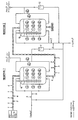
- the 2-reactor system shown consists, as the name suggests, of two rotator reactors connected in series, the material to be mined first going through reactor I and then reactor II.
- the material is gassed accordingly with CO2-containing gas, the gas either being circulated or formed directly by fresh air mixed with CO2.
- the starting product is mixed with a nutrient solution for the microorganisms and furthermore also provided with a mixture which catalytically supports the decomposition process. If the wastes containing the amino compounds are also to be treated which do not contain any amino compounds, the products are also mixed before the feed to the reactor I in order to achieve mixtures which are as uniform as possible. Furthermore, an optimal C / N ratio is set.
- bentonite flour can be added to the feed from the outset, which can adsorb NH3.
- the nutrient solution is referred to as "feed” and the catalytically active substances are referred to as "catalyst”.
- a mixture of bacteria and fungi called “enzyme solution” is added to the starting material, the actinomycetes forming an essential part of this mixture.
- the fresh material to be added to the material already being mined is adjusted to a moisture content at which the dry matter content is approximately 35 to 40%. If the product is too dry, the product is additionally moistened, but if it is too moist, the mixture can be tested using chamber filter presses or the like.
- the amount of the feed is chosen so that the rotted amount drawn off at the bottom of the reactor is replaced. Since, as already mentioned, the amount withdrawn is not constant, but fluctuates depending on the degree of degradation and the rate of degradation, the quantity of goods to be dismantled will also fluctuate accordingly.
- the rotted material drawn off at the bottom of the first reactor is then fed to the second reactor, carbon carriers, a so-called “enzyme solution”, a catalytically active substance and a nutrient being able to be added to the removed material depending on the composition of the material and degree of degradation.
- the nutrients in an amount of about 1 to 5% of the total and the catalytically active substance also in an amount of 1 up to 5% added.
- the mixture of bacteria and fungi used for the microbiological degradation of the substrate can be added to the material to be broken down either in the form of a new inoculation of the entire material or by partial recycling of part of the end product of the second reactor.
- the material to be abandoned on the first reactor can also be conditioned with FeCl3 and / or lime.
- sensors can be used to determine the CO2 content, the NH3 content, the temperature, the pH and the like in the interior of the container. protrude into it.
- the oxygen-containing gas which is mixed with CO2, is fresh air in the present case, but could also be a different gas mixture specifically geared to the material to be mined.
- This gas is in accordance with the present variant introduced either from below or from above, or by means of ventilation lances protruding into the material in the material being degraded, the CO2 addition to the introduced gas starting at the latest when there is an NH3 concentration in the exhaust gas of 200 ppm.
- the concentration of CO2 in the supply air is a maximum of about 2.5 to 3 vol .-%, the CO2 addition is especially important when starting the reactor, since it then leads to a rapid increase in the NH3 concentration in the Exhaust air comes, which can be avoided by adding CO2.
- the decomposition reaction With the addition of CO2, the decomposition reaction also starts more quickly. After the reaction has started, the CO2 addition is throttled depending on the NH3 concentration of the exhaust air. In some cases, it could even be stopped entirely, if, due to the high addition of carbon-containing compounds, such a large amount of CO2 arises in the decomposition reaction that the desired concentration of CO2 in the exhaust gas, ie about 14% CO2 in the exhaust gas, is exceeded .
- the supply air for the second reactor can consist partly of the exhaust air from the first reactor and / or partly of the exhaust air of the second reactor and partly of fresh air. It should be noted, however, that the NH3 value in the air does not become too large, in which case the exhaust air from the reactors is filled via special NH3 filters, which in the present case are filled with a bentonite slurry (referred to as bentonite solution in the drawing) are. If the exhaust air from the first reactor is introduced into the second reactor, ammonia concentrations in the exhaust air from the first reactor are permissible up to 100 ppm.
- the reactor exhaust air can no longer be used as supply air, unless - as already mentioned - an NH3 filter is interposed.
- 43.25 kg of sewage sludge, 7.30 kg of sawdust as a carbon carrier, 1.25 kg of nutrient solution for the microorganisms, 1.25 kg of the substance which promotes catalytic degradation were added to the first reactor, 11 a microorganism slurry and 0.11 water were used. This mixture was introduced into a test reactor with a content of 200 l mixed well.
- the reactor was aerated with a defined amount of air, CO2 being supplied for the start and for the control of the reactor according to the NH3 content of the exhaust air has been. Furthermore, the amount of air was controlled so that the reaction temperature inside the reactor was kept at 36 to 40 ° C, maximum at 59 ° C. The CO2 content in the exhaust air fluctuated and rose to a maximum of 16 vol .-%. The ammonia portion of the exhaust air also fluctuated and rose to 1,000 ppm. The supply air was humidified to 90% relative humidity. To start the decomposition reaction, the reactor was heated to a temperature of about 35 ° C.
- the pH of the substrate was 11.5 on the first day of the degradation reaction, about 9.9 on the third day, 7.6 on the seventh day, and the substrate was discharged from the reactor at a pH of 8.45.
- the entire discharged substrate showed a homogeneous, visible fungus without ammonia smell.
- the cloth of the mined product was mushroom-like, according to forest soil.
- This substrate removed from reactor I was transferred to the second reactor, 31 kg of substrate being provided with 5.8 kg of sawdust, 0.625 kg of nutrients, 0.625 kg of the catalytically active substance, 0.11 of the microorganism slurry and 0.11 of water . This material, too, was mixed accordingly and introduced into a 200 l reactor.
- This reactor was again ventilated with a defined amount of air, the addition to the reactor also being controlled again as a function of the NH 3 content of the exhaust air.
- the reaction temperature was kept at a value between 30 and 37 °, but not more than 45 °, by the addition of air.
- the CO2 content of the exhaust air fluctuated up to 14 vol .-%, and the NH3 content fluctuated up to 70 ppm.
- the supply air was humidified to about 90% relative humidity.
- reactor II was also heated to a temperature of 35 ° C., which was then reduced to 30 ° C.
- the substrate introduced had a pH of 8.45, the pH had dropped to 8.15 on the 15th day, then to 8.03 on the 26th day and the pH was 7.4 at the end of the degradation.
- the degraded product had a very good mushroom-like odor (like fresh forest soil), had no NH3 odor and the pH was, as stated, almost neutral.
Landscapes
- Chemical & Material Sciences (AREA)
- Health & Medical Sciences (AREA)
- Microbiology (AREA)
- Molecular Biology (AREA)
- Biochemistry (AREA)
- Biotechnology (AREA)
- Chemical Kinetics & Catalysis (AREA)
- General Chemical & Material Sciences (AREA)
- Life Sciences & Earth Sciences (AREA)
- Engineering & Computer Science (AREA)
- Organic Chemistry (AREA)
- Tropical Medicine & Parasitology (AREA)
- Processing Of Solid Wastes (AREA)
- Treatment Of Sludge (AREA)
- Micro-Organisms Or Cultivation Processes Thereof (AREA)
- Activated Sludge Processes (AREA)
Applications Claiming Priority (2)
| Application Number | Priority Date | Filing Date | Title |
|---|---|---|---|
| AT2327/90 | 1990-11-16 | ||
| AT0232790A AT395709B (de) | 1990-11-16 | 1990-11-16 | Verfahren zum kontrollierten und gesteuerten aeroben biologischen abbau von aminoverbindungen enthaltenden organischen abfaellen |
Publications (2)
| Publication Number | Publication Date |
|---|---|
| EP0486466A1 EP0486466A1 (de) | 1992-05-20 |
| EP0486466B1 true EP0486466B1 (de) | 1995-04-12 |
Family
ID=3532300
Family Applications (1)
| Application Number | Title | Priority Date | Filing Date |
|---|---|---|---|
| EP19910890279 Expired - Lifetime EP0486466B1 (de) | 1990-11-16 | 1991-11-14 | Verfahren zum kontrollierten und gesteuerten aeroben biologischen Abbau von organischen Abfällen |
Country Status (6)
| Country | Link |
|---|---|
| EP (1) | EP0486466B1 (cs) |
| AT (2) | AT395709B (cs) |
| CS (1) | CS346991A3 (cs) |
| DE (1) | DE59105167D1 (cs) |
| HU (1) | HUT60699A (cs) |
| PL (1) | PL292391A1 (cs) |
Families Citing this family (10)
| Publication number | Priority date | Publication date | Assignee | Title |
|---|---|---|---|---|
| US5275733A (en) * | 1990-11-30 | 1994-01-04 | N-Viro Energy Systems Ltd. | Process to stabilize wastewater sludge |
| DE19547784C2 (de) * | 1995-12-20 | 1998-02-26 | Herhof Umwelttechnik Gmbh | Verfahren und Vorrichtung zum Kompostieren von organischen Stoffen |
| CH691807A5 (de) * | 1996-05-28 | 2001-10-31 | Terravera S A | Humigene und biogene Stoffgemische aus partiell biokatalytisch abgebauten Reststoffen. |
| ATE273257T1 (de) * | 1998-05-04 | 2004-08-15 | Bioprodukte Prof Steinberg Gmb | Verfahren zur stickstoffgesättigten inertisierung lignocellulosehaltiger reststoffe und faserstoffe aus nachwachsenden rohstoffen für die verwendung als torfersatz |
| AU2002328381A1 (en) * | 2001-07-04 | 2003-01-21 | Naturem Environnement | Method for treating waste, devices and compositions for carrying out said method |
| FI116521B (fi) | 2002-05-21 | 2005-12-15 | Preseco Oy | Menetelmä eloperäisen materiaalin käsittelemiseksi |
| FI116835B (fi) | 2003-11-11 | 2006-03-15 | Preseco Oy | Menetelmä eloperäisen materiaalin käsittelemiseksi |
| PL1553069T3 (pl) * | 2003-12-16 | 2013-01-31 | Ewald Harrer | Sposób sterowania lub regulowania procesów kompostowania |
| US6966983B1 (en) * | 2004-10-01 | 2005-11-22 | Mixing And Mass Transfer Technologies, Llc | Continuous multistage thermophilic aerobic sludge digestion system |
| DE102017214461A1 (de) * | 2017-08-18 | 2019-02-21 | Lmengineering Gmbh | Verfahren zur Herstellung eines Düngemittels, ein Düngemittel enthaltend Ammoniumcarbonat sowie eine Vorrichtung und deren Verwendung |
Family Cites Families (4)
| Publication number | Priority date | Publication date | Assignee | Title |
|---|---|---|---|---|
| US3138448A (en) * | 1961-03-28 | 1964-06-23 | Schulze Karl Ludwig | Method for control of aerobic decomposition |
| JPS5441269A (en) * | 1977-09-07 | 1979-04-02 | Kaoru Mihashi | Method of effectively removing nitrogen from exhaust water by intermittent aeration |
| US4384878A (en) * | 1980-08-04 | 1983-05-24 | Armerad Betong Vagforbattringar Ab | Method and apparatus for composting compostable organic materials such as organic wastes and strongly aqueous fossile materials |
| EP0221219A1 (fr) * | 1985-10-31 | 1987-05-13 | Mouawad, Paul | Amendement biologique pour l'agriculture, préparé à partir de boues résiduaires de stations d'épuration et son procédé de fabrication |
-
1990
- 1990-11-16 AT AT0232790A patent/AT395709B/de not_active IP Right Cessation
-
1991
- 1991-11-14 DE DE59105167T patent/DE59105167D1/de not_active Expired - Fee Related
- 1991-11-14 AT AT91890279T patent/ATE121062T1/de not_active IP Right Cessation
- 1991-11-14 EP EP19910890279 patent/EP0486466B1/de not_active Expired - Lifetime
- 1991-11-14 PL PL29239191A patent/PL292391A1/xx unknown
- 1991-11-14 HU HU913574A patent/HUT60699A/hu unknown
- 1991-11-15 CS CS913469A patent/CS346991A3/cs unknown
Also Published As
| Publication number | Publication date |
|---|---|
| AT395709B (de) | 1993-02-25 |
| EP0486466A1 (de) | 1992-05-20 |
| PL292391A1 (en) | 1992-06-15 |
| ATE121062T1 (de) | 1995-04-15 |
| HU913574D0 (en) | 1992-03-30 |
| HUT60699A (en) | 1992-10-28 |
| ATA232790A (de) | 1992-07-15 |
| DE59105167D1 (de) | 1995-05-18 |
| CS346991A3 (en) | 1992-06-17 |
Similar Documents
| Publication | Publication Date | Title |
|---|---|---|
| DE3024813C2 (cs) | ||
| EP0132503B1 (de) | Verfahren zum Abscheiden gasförmiger, flüchtiger und/oder flüssiger Verunreinigungen aus Abgasen | |
| EP0486466B1 (de) | Verfahren zum kontrollierten und gesteuerten aeroben biologischen Abbau von organischen Abfällen | |
| EP0085757B1 (de) | Verfahren zum Abscheiden gasförmiger, flüchtiger und/oder flüssiger Verunreinigungen aus Abgasen | |
| DE69502313T2 (de) | Verfahren zur biologischen Reinigung von Gasströmen | |
| DE3725988C2 (de) | Verfahren zum Humifizieren von Klärschlämmen | |
| EP0846655B1 (de) | Erdalkalimetallperoxid-Produkt | |
| DE3806820A1 (de) | Verfahren zur verwertung von unausgereiftem kompost | |
| EP0336119B1 (de) | Verfahren zum Dekontaminieren von sauerstoffhaltigen Gasen, insbesondere von Abgasen | |
| EP0022120A1 (de) | Verfahren zum Spalten und Aufarbeiten von Emulsionen von Ölen und Fetten | |
| DE68908936T2 (de) | Pilzdüngemittel und Verfahren zu dessen Herstellung. | |
| DE2253009A1 (de) | Verfahren zum kompostieren von klaerschlamm durch einen ueber die luftzufuhr steuerbaren rotteprozess | |
| EP0449184A1 (de) | Verfahren zum Behandeln von Gülle | |
| AT401051B (de) | Verfahren zur erzeugung von erde | |
| EP0535544B1 (de) | Verfahren zur Abwasseraufbereitung | |
| DE2100636A1 (en) | Composting organic waste - partic household garbage | |
| DE4123798C1 (cs) | ||
| DE3531605A1 (de) | Reaktor zur behandlung organischer massen und verfahren zur erzielung mehrerer zwischen- und endprodukte aus diesen massen | |
| DE3623242C2 (cs) | ||
| AT400683B (de) | Verfahren zum aeroben mikrobiologischen dekontaminieren von gasen | |
| DE4124956C1 (en) | Decontamination of crumbly structure of e.g. soil - comprises injection of lignin decomposing agent and treatment of closed system with oxygen@-contg. gases e.g. air | |
| DE2423744B2 (de) | Verfahren zum Kompostieren von Klärschlamm | |
| EP0810983B1 (de) | Verfahren und vorrichtung zum kompostieren von organischen stoffen | |
| DE2415067A1 (de) | Verfahren zur rottebehandlung von feinkoernigem kompostrohgut im wirbelschichtreaktor | |
| DE3635843A1 (de) | Verfahren zur abtrennung von ammoniak aus abluft oder abwasser |
Legal Events
| Date | Code | Title | Description |
|---|---|---|---|
| PUAI | Public reference made under article 153(3) epc to a published international application that has entered the european phase |
Free format text: ORIGINAL CODE: 0009012 |
|
| AK | Designated contracting states |
Kind code of ref document: A1 Designated state(s): AT BE CH DE DK ES FR GB GR IT LI LU NL SE |
|
| 17P | Request for examination filed |
Effective date: 19920831 |
|
| 17Q | First examination report despatched |
Effective date: 19940615 |
|
| GRAA | (expected) grant |
Free format text: ORIGINAL CODE: 0009210 |
|
| AK | Designated contracting states |
Kind code of ref document: B1 Designated state(s): AT BE CH DE DK ES FR GB GR IT LI LU NL SE |
|
| PG25 | Lapsed in a contracting state [announced via postgrant information from national office to epo] |
Ref country code: IT Free format text: LAPSE BECAUSE OF FAILURE TO SUBMIT A TRANSLATION OF THE DESCRIPTION OR TO PAY THE FEE WITHIN THE PRE;WARNING: LAPSES OF ITALIAN PATENTS WITH EFFECTIVE DATE BEFORE 2007 MAY HAVE OCCURRED AT ANY TIME BEFORE 2007. THE CORRECT EFFECTIVE DATE MAY BE DIFFERENT FROM THE ONE RECORDED.SCRIBED TIME-LIMIT Effective date: 19950412 Ref country code: ES Free format text: THE PATENT HAS BEEN ANNULLED BY A DECISION OF A NATIONAL AUTHORITY Effective date: 19950412 Ref country code: GR Free format text: LAPSE BECAUSE OF FAILURE TO SUBMIT A TRANSLATION OF THE DESCRIPTION OR TO PAY THE FEE WITHIN THE PRESCRIBED TIME-LIMIT Effective date: 19950412 Ref country code: FR Effective date: 19950412 Ref country code: NL Free format text: LAPSE BECAUSE OF NON-PAYMENT OF DUE FEES Effective date: 19950412 Ref country code: BE Effective date: 19950412 Ref country code: DK Effective date: 19950412 |
|
| REF | Corresponds to: |
Ref document number: 121062 Country of ref document: AT Date of ref document: 19950415 Kind code of ref document: T |
|
| REF | Corresponds to: |
Ref document number: 59105167 Country of ref document: DE Date of ref document: 19950518 |
|
| GBT | Gb: translation of ep patent filed (gb section 77(6)(a)/1977) |
Effective date: 19950612 |
|
| PG25 | Lapsed in a contracting state [announced via postgrant information from national office to epo] |
Ref country code: SE Effective date: 19950712 |
|
| EN | Fr: translation not filed | ||
| NLV1 | Nl: lapsed or annulled due to failure to fulfill the requirements of art. 29p and 29m of the patents act | ||
| PG25 | Lapsed in a contracting state [announced via postgrant information from national office to epo] |
Ref country code: AT Effective date: 19951114 Ref country code: GB Effective date: 19951114 |
|
| PG25 | Lapsed in a contracting state [announced via postgrant information from national office to epo] |
Ref country code: CH Effective date: 19951130 Ref country code: LI Effective date: 19951130 Ref country code: LU Free format text: LAPSE BECAUSE OF NON-PAYMENT OF DUE FEES Effective date: 19951130 |
|
| PLBE | No opposition filed within time limit |
Free format text: ORIGINAL CODE: 0009261 |
|
| STAA | Information on the status of an ep patent application or granted ep patent |
Free format text: STATUS: NO OPPOSITION FILED WITHIN TIME LIMIT |
|
| 26N | No opposition filed | ||
| GBPC | Gb: european patent ceased through non-payment of renewal fee |
Effective date: 19951114 |
|
| REG | Reference to a national code |
Ref country code: CH Ref legal event code: PL |
|
| PGFP | Annual fee paid to national office [announced via postgrant information from national office to epo] |
Ref country code: DE Payment date: 19961120 Year of fee payment: 6 |
|
| PG25 | Lapsed in a contracting state [announced via postgrant information from national office to epo] |
Ref country code: DE Free format text: LAPSE BECAUSE OF NON-PAYMENT OF DUE FEES Effective date: 19980801 |