EP0484542A1 - Lubricant composition for metal working - Google Patents
Lubricant composition for metal working Download PDFInfo
- Publication number
- EP0484542A1 EP0484542A1 EP91908465A EP91908465A EP0484542A1 EP 0484542 A1 EP0484542 A1 EP 0484542A1 EP 91908465 A EP91908465 A EP 91908465A EP 91908465 A EP91908465 A EP 91908465A EP 0484542 A1 EP0484542 A1 EP 0484542A1
- Authority
- EP
- European Patent Office
- Prior art keywords
- carbon atoms
- straight chain
- alcohol
- metal working
- oil
- Prior art date
- Legal status (The legal status is an assumption and is not a legal conclusion. Google has not performed a legal analysis and makes no representation as to the accuracy of the status listed.)
- Granted
Links
Classifications
-
- C—CHEMISTRY; METALLURGY
- C10—PETROLEUM, GAS OR COKE INDUSTRIES; TECHNICAL GASES CONTAINING CARBON MONOXIDE; FUELS; LUBRICANTS; PEAT
- C10M—LUBRICATING COMPOSITIONS; USE OF CHEMICAL SUBSTANCES EITHER ALONE OR AS LUBRICATING INGREDIENTS IN A LUBRICATING COMPOSITION
- C10M127/00—Lubricating compositions characterised by the additive being a non- macromolecular hydrocarbon
- C10M127/02—Lubricating compositions characterised by the additive being a non- macromolecular hydrocarbon well-defined aliphatic
-
- C—CHEMISTRY; METALLURGY
- C10—PETROLEUM, GAS OR COKE INDUSTRIES; TECHNICAL GASES CONTAINING CARBON MONOXIDE; FUELS; LUBRICANTS; PEAT
- C10M—LUBRICATING COMPOSITIONS; USE OF CHEMICAL SUBSTANCES EITHER ALONE OR AS LUBRICATING INGREDIENTS IN A LUBRICATING COMPOSITION
- C10M101/00—Lubricating compositions characterised by the base-material being a mineral or fatty oil
- C10M101/02—Petroleum fractions
-
- C—CHEMISTRY; METALLURGY
- C10—PETROLEUM, GAS OR COKE INDUSTRIES; TECHNICAL GASES CONTAINING CARBON MONOXIDE; FUELS; LUBRICANTS; PEAT
- C10M—LUBRICATING COMPOSITIONS; USE OF CHEMICAL SUBSTANCES EITHER ALONE OR AS LUBRICATING INGREDIENTS IN A LUBRICATING COMPOSITION
- C10M105/00—Lubricating compositions characterised by the base-material being a non-macromolecular organic compound
- C10M105/02—Well-defined hydrocarbons
- C10M105/04—Well-defined hydrocarbons aliphatic
-
- C—CHEMISTRY; METALLURGY
- C10—PETROLEUM, GAS OR COKE INDUSTRIES; TECHNICAL GASES CONTAINING CARBON MONOXIDE; FUELS; LUBRICANTS; PEAT
- C10M—LUBRICATING COMPOSITIONS; USE OF CHEMICAL SUBSTANCES EITHER ALONE OR AS LUBRICATING INGREDIENTS IN A LUBRICATING COMPOSITION
- C10M129/00—Lubricating compositions characterised by the additive being an organic non-macromolecular compound containing oxygen
- C10M129/02—Lubricating compositions characterised by the additive being an organic non-macromolecular compound containing oxygen having a carbon chain of less than 30 atoms
- C10M129/04—Hydroxy compounds
- C10M129/06—Hydroxy compounds having hydroxy groups bound to acyclic or cycloaliphatic carbon atoms
-
- C—CHEMISTRY; METALLURGY
- C10—PETROLEUM, GAS OR COKE INDUSTRIES; TECHNICAL GASES CONTAINING CARBON MONOXIDE; FUELS; LUBRICANTS; PEAT
- C10M—LUBRICATING COMPOSITIONS; USE OF CHEMICAL SUBSTANCES EITHER ALONE OR AS LUBRICATING INGREDIENTS IN A LUBRICATING COMPOSITION
- C10M129/00—Lubricating compositions characterised by the additive being an organic non-macromolecular compound containing oxygen
- C10M129/02—Lubricating compositions characterised by the additive being an organic non-macromolecular compound containing oxygen having a carbon chain of less than 30 atoms
- C10M129/04—Hydroxy compounds
- C10M129/06—Hydroxy compounds having hydroxy groups bound to acyclic or cycloaliphatic carbon atoms
- C10M129/08—Hydroxy compounds having hydroxy groups bound to acyclic or cycloaliphatic carbon atoms containing at least 2 hydroxy groups
-
- C—CHEMISTRY; METALLURGY
- C10—PETROLEUM, GAS OR COKE INDUSTRIES; TECHNICAL GASES CONTAINING CARBON MONOXIDE; FUELS; LUBRICANTS; PEAT
- C10M—LUBRICATING COMPOSITIONS; USE OF CHEMICAL SUBSTANCES EITHER ALONE OR AS LUBRICATING INGREDIENTS IN A LUBRICATING COMPOSITION
- C10M129/00—Lubricating compositions characterised by the additive being an organic non-macromolecular compound containing oxygen
- C10M129/02—Lubricating compositions characterised by the additive being an organic non-macromolecular compound containing oxygen having a carbon chain of less than 30 atoms
- C10M129/04—Hydroxy compounds
- C10M129/10—Hydroxy compounds having hydroxy groups bound to a carbon atom of a six-membered aromatic ring
-
- C—CHEMISTRY; METALLURGY
- C10—PETROLEUM, GAS OR COKE INDUSTRIES; TECHNICAL GASES CONTAINING CARBON MONOXIDE; FUELS; LUBRICANTS; PEAT
- C10M—LUBRICATING COMPOSITIONS; USE OF CHEMICAL SUBSTANCES EITHER ALONE OR AS LUBRICATING INGREDIENTS IN A LUBRICATING COMPOSITION
- C10M129/00—Lubricating compositions characterised by the additive being an organic non-macromolecular compound containing oxygen
- C10M129/02—Lubricating compositions characterised by the additive being an organic non-macromolecular compound containing oxygen having a carbon chain of less than 30 atoms
- C10M129/04—Hydroxy compounds
- C10M129/10—Hydroxy compounds having hydroxy groups bound to a carbon atom of a six-membered aromatic ring
- C10M129/14—Hydroxy compounds having hydroxy groups bound to a carbon atom of a six-membered aromatic ring containing at least 2 hydroxy groups
-
- C—CHEMISTRY; METALLURGY
- C10—PETROLEUM, GAS OR COKE INDUSTRIES; TECHNICAL GASES CONTAINING CARBON MONOXIDE; FUELS; LUBRICANTS; PEAT
- C10M—LUBRICATING COMPOSITIONS; USE OF CHEMICAL SUBSTANCES EITHER ALONE OR AS LUBRICATING INGREDIENTS IN A LUBRICATING COMPOSITION
- C10M129/00—Lubricating compositions characterised by the additive being an organic non-macromolecular compound containing oxygen
- C10M129/02—Lubricating compositions characterised by the additive being an organic non-macromolecular compound containing oxygen having a carbon chain of less than 30 atoms
- C10M129/26—Carboxylic acids; Salts thereof
- C10M129/28—Carboxylic acids; Salts thereof having carboxyl groups bound to acyclic or cycloaliphatic carbon atoms
- C10M129/38—Carboxylic acids; Salts thereof having carboxyl groups bound to acyclic or cycloaliphatic carbon atoms having 8 or more carbon atoms
- C10M129/40—Carboxylic acids; Salts thereof having carboxyl groups bound to acyclic or cycloaliphatic carbon atoms having 8 or more carbon atoms monocarboxylic
-
- C—CHEMISTRY; METALLURGY
- C10—PETROLEUM, GAS OR COKE INDUSTRIES; TECHNICAL GASES CONTAINING CARBON MONOXIDE; FUELS; LUBRICANTS; PEAT
- C10M—LUBRICATING COMPOSITIONS; USE OF CHEMICAL SUBSTANCES EITHER ALONE OR AS LUBRICATING INGREDIENTS IN A LUBRICATING COMPOSITION
- C10M133/00—Lubricating compositions characterised by the additive being an organic non-macromolecular compound containing nitrogen
- C10M133/02—Lubricating compositions characterised by the additive being an organic non-macromolecular compound containing nitrogen having a carbon chain of less than 30 atoms
- C10M133/04—Amines, e.g. polyalkylene polyamines; Quaternary amines
- C10M133/12—Amines, e.g. polyalkylene polyamines; Quaternary amines having amino groups bound to a carbon atom of a six-membered aromatic ring
-
- C—CHEMISTRY; METALLURGY
- C10—PETROLEUM, GAS OR COKE INDUSTRIES; TECHNICAL GASES CONTAINING CARBON MONOXIDE; FUELS; LUBRICANTS; PEAT
- C10M—LUBRICATING COMPOSITIONS; USE OF CHEMICAL SUBSTANCES EITHER ALONE OR AS LUBRICATING INGREDIENTS IN A LUBRICATING COMPOSITION
- C10M143/00—Lubricating compositions characterised by the additive being a macromolecular hydrocarbon or such hydrocarbon modified by oxidation
- C10M143/04—Lubricating compositions characterised by the additive being a macromolecular hydrocarbon or such hydrocarbon modified by oxidation containing propene
-
- C—CHEMISTRY; METALLURGY
- C10—PETROLEUM, GAS OR COKE INDUSTRIES; TECHNICAL GASES CONTAINING CARBON MONOXIDE; FUELS; LUBRICANTS; PEAT
- C10M—LUBRICATING COMPOSITIONS; USE OF CHEMICAL SUBSTANCES EITHER ALONE OR AS LUBRICATING INGREDIENTS IN A LUBRICATING COMPOSITION
- C10M143/00—Lubricating compositions characterised by the additive being a macromolecular hydrocarbon or such hydrocarbon modified by oxidation
- C10M143/06—Lubricating compositions characterised by the additive being a macromolecular hydrocarbon or such hydrocarbon modified by oxidation containing butene
-
- C—CHEMISTRY; METALLURGY
- C10—PETROLEUM, GAS OR COKE INDUSTRIES; TECHNICAL GASES CONTAINING CARBON MONOXIDE; FUELS; LUBRICANTS; PEAT
- C10M—LUBRICATING COMPOSITIONS; USE OF CHEMICAL SUBSTANCES EITHER ALONE OR AS LUBRICATING INGREDIENTS IN A LUBRICATING COMPOSITION
- C10M145/00—Lubricating compositions characterised by the additive being a macromolecular compound containing oxygen
- C10M145/18—Macromolecular compounds obtained otherwise than by reactions only involving carbon-to-carbon unsaturated bonds
- C10M145/24—Polyethers
- C10M145/26—Polyoxyalkylenes
- C10M145/28—Polyoxyalkylenes of alkylene oxides containing 2 carbon atoms only
-
- C—CHEMISTRY; METALLURGY
- C10—PETROLEUM, GAS OR COKE INDUSTRIES; TECHNICAL GASES CONTAINING CARBON MONOXIDE; FUELS; LUBRICANTS; PEAT
- C10M—LUBRICATING COMPOSITIONS; USE OF CHEMICAL SUBSTANCES EITHER ALONE OR AS LUBRICATING INGREDIENTS IN A LUBRICATING COMPOSITION
- C10M145/00—Lubricating compositions characterised by the additive being a macromolecular compound containing oxygen
- C10M145/18—Macromolecular compounds obtained otherwise than by reactions only involving carbon-to-carbon unsaturated bonds
- C10M145/24—Polyethers
- C10M145/26—Polyoxyalkylenes
- C10M145/30—Polyoxyalkylenes of alkylene oxides containing 3 carbon atoms only
-
- C—CHEMISTRY; METALLURGY
- C10—PETROLEUM, GAS OR COKE INDUSTRIES; TECHNICAL GASES CONTAINING CARBON MONOXIDE; FUELS; LUBRICANTS; PEAT
- C10M—LUBRICATING COMPOSITIONS; USE OF CHEMICAL SUBSTANCES EITHER ALONE OR AS LUBRICATING INGREDIENTS IN A LUBRICATING COMPOSITION
- C10M145/00—Lubricating compositions characterised by the additive being a macromolecular compound containing oxygen
- C10M145/18—Macromolecular compounds obtained otherwise than by reactions only involving carbon-to-carbon unsaturated bonds
- C10M145/24—Polyethers
- C10M145/26—Polyoxyalkylenes
- C10M145/36—Polyoxyalkylenes etherified
-
- C—CHEMISTRY; METALLURGY
- C10—PETROLEUM, GAS OR COKE INDUSTRIES; TECHNICAL GASES CONTAINING CARBON MONOXIDE; FUELS; LUBRICANTS; PEAT
- C10M—LUBRICATING COMPOSITIONS; USE OF CHEMICAL SUBSTANCES EITHER ALONE OR AS LUBRICATING INGREDIENTS IN A LUBRICATING COMPOSITION
- C10M169/00—Lubricating compositions characterised by containing as components a mixture of at least two types of ingredient selected from base-materials, thickeners or additives, covered by the preceding groups, each of these compounds being essential
- C10M169/04—Mixtures of base-materials and additives
-
- C—CHEMISTRY; METALLURGY
- C10—PETROLEUM, GAS OR COKE INDUSTRIES; TECHNICAL GASES CONTAINING CARBON MONOXIDE; FUELS; LUBRICANTS; PEAT
- C10M—LUBRICATING COMPOSITIONS; USE OF CHEMICAL SUBSTANCES EITHER ALONE OR AS LUBRICATING INGREDIENTS IN A LUBRICATING COMPOSITION
- C10M173/00—Lubricating compositions containing more than 10% water
- C10M173/02—Lubricating compositions containing more than 10% water not containing mineral or fatty oils
-
- C—CHEMISTRY; METALLURGY
- C10—PETROLEUM, GAS OR COKE INDUSTRIES; TECHNICAL GASES CONTAINING CARBON MONOXIDE; FUELS; LUBRICANTS; PEAT
- C10M—LUBRICATING COMPOSITIONS; USE OF CHEMICAL SUBSTANCES EITHER ALONE OR AS LUBRICATING INGREDIENTS IN A LUBRICATING COMPOSITION
- C10M2201/00—Inorganic compounds or elements as ingredients in lubricant compositions
- C10M2201/02—Water
-
- C—CHEMISTRY; METALLURGY
- C10—PETROLEUM, GAS OR COKE INDUSTRIES; TECHNICAL GASES CONTAINING CARBON MONOXIDE; FUELS; LUBRICANTS; PEAT
- C10M—LUBRICATING COMPOSITIONS; USE OF CHEMICAL SUBSTANCES EITHER ALONE OR AS LUBRICATING INGREDIENTS IN A LUBRICATING COMPOSITION
- C10M2203/00—Organic non-macromolecular hydrocarbon compounds and hydrocarbon fractions as ingredients in lubricant compositions
- C10M2203/003—Organic non-macromolecular hydrocarbon compounds and hydrocarbon fractions as ingredients in lubricant compositions used as base material
-
- C—CHEMISTRY; METALLURGY
- C10—PETROLEUM, GAS OR COKE INDUSTRIES; TECHNICAL GASES CONTAINING CARBON MONOXIDE; FUELS; LUBRICANTS; PEAT
- C10M—LUBRICATING COMPOSITIONS; USE OF CHEMICAL SUBSTANCES EITHER ALONE OR AS LUBRICATING INGREDIENTS IN A LUBRICATING COMPOSITION
- C10M2203/00—Organic non-macromolecular hydrocarbon compounds and hydrocarbon fractions as ingredients in lubricant compositions
- C10M2203/02—Well-defined aliphatic compounds
-
- C—CHEMISTRY; METALLURGY
- C10—PETROLEUM, GAS OR COKE INDUSTRIES; TECHNICAL GASES CONTAINING CARBON MONOXIDE; FUELS; LUBRICANTS; PEAT
- C10M—LUBRICATING COMPOSITIONS; USE OF CHEMICAL SUBSTANCES EITHER ALONE OR AS LUBRICATING INGREDIENTS IN A LUBRICATING COMPOSITION
- C10M2203/00—Organic non-macromolecular hydrocarbon compounds and hydrocarbon fractions as ingredients in lubricant compositions
- C10M2203/02—Well-defined aliphatic compounds
- C10M2203/022—Well-defined aliphatic compounds saturated
-
- C—CHEMISTRY; METALLURGY
- C10—PETROLEUM, GAS OR COKE INDUSTRIES; TECHNICAL GASES CONTAINING CARBON MONOXIDE; FUELS; LUBRICANTS; PEAT
- C10M—LUBRICATING COMPOSITIONS; USE OF CHEMICAL SUBSTANCES EITHER ALONE OR AS LUBRICATING INGREDIENTS IN A LUBRICATING COMPOSITION
- C10M2203/00—Organic non-macromolecular hydrocarbon compounds and hydrocarbon fractions as ingredients in lubricant compositions
- C10M2203/02—Well-defined aliphatic compounds
- C10M2203/024—Well-defined aliphatic compounds unsaturated
-
- C—CHEMISTRY; METALLURGY
- C10—PETROLEUM, GAS OR COKE INDUSTRIES; TECHNICAL GASES CONTAINING CARBON MONOXIDE; FUELS; LUBRICANTS; PEAT
- C10M—LUBRICATING COMPOSITIONS; USE OF CHEMICAL SUBSTANCES EITHER ALONE OR AS LUBRICATING INGREDIENTS IN A LUBRICATING COMPOSITION
- C10M2203/00—Organic non-macromolecular hydrocarbon compounds and hydrocarbon fractions as ingredients in lubricant compositions
- C10M2203/04—Well-defined cycloaliphatic compounds
-
- C—CHEMISTRY; METALLURGY
- C10—PETROLEUM, GAS OR COKE INDUSTRIES; TECHNICAL GASES CONTAINING CARBON MONOXIDE; FUELS; LUBRICANTS; PEAT
- C10M—LUBRICATING COMPOSITIONS; USE OF CHEMICAL SUBSTANCES EITHER ALONE OR AS LUBRICATING INGREDIENTS IN A LUBRICATING COMPOSITION
- C10M2203/00—Organic non-macromolecular hydrocarbon compounds and hydrocarbon fractions as ingredients in lubricant compositions
- C10M2203/04—Well-defined cycloaliphatic compounds
- C10M2203/045—Well-defined cycloaliphatic compounds used as base material
-
- C—CHEMISTRY; METALLURGY
- C10—PETROLEUM, GAS OR COKE INDUSTRIES; TECHNICAL GASES CONTAINING CARBON MONOXIDE; FUELS; LUBRICANTS; PEAT
- C10M—LUBRICATING COMPOSITIONS; USE OF CHEMICAL SUBSTANCES EITHER ALONE OR AS LUBRICATING INGREDIENTS IN A LUBRICATING COMPOSITION
- C10M2203/00—Organic non-macromolecular hydrocarbon compounds and hydrocarbon fractions as ingredients in lubricant compositions
- C10M2203/06—Well-defined aromatic compounds
-
- C—CHEMISTRY; METALLURGY
- C10—PETROLEUM, GAS OR COKE INDUSTRIES; TECHNICAL GASES CONTAINING CARBON MONOXIDE; FUELS; LUBRICANTS; PEAT
- C10M—LUBRICATING COMPOSITIONS; USE OF CHEMICAL SUBSTANCES EITHER ALONE OR AS LUBRICATING INGREDIENTS IN A LUBRICATING COMPOSITION
- C10M2203/00—Organic non-macromolecular hydrocarbon compounds and hydrocarbon fractions as ingredients in lubricant compositions
- C10M2203/10—Petroleum or coal fractions, e.g. tars, solvents, bitumen
- C10M2203/1006—Petroleum or coal fractions, e.g. tars, solvents, bitumen used as base material
-
- C—CHEMISTRY; METALLURGY
- C10—PETROLEUM, GAS OR COKE INDUSTRIES; TECHNICAL GASES CONTAINING CARBON MONOXIDE; FUELS; LUBRICANTS; PEAT
- C10M—LUBRICATING COMPOSITIONS; USE OF CHEMICAL SUBSTANCES EITHER ALONE OR AS LUBRICATING INGREDIENTS IN A LUBRICATING COMPOSITION
- C10M2203/00—Organic non-macromolecular hydrocarbon compounds and hydrocarbon fractions as ingredients in lubricant compositions
- C10M2203/10—Petroleum or coal fractions, e.g. tars, solvents, bitumen
- C10M2203/102—Aliphatic fractions
- C10M2203/1025—Aliphatic fractions used as base material
-
- C—CHEMISTRY; METALLURGY
- C10—PETROLEUM, GAS OR COKE INDUSTRIES; TECHNICAL GASES CONTAINING CARBON MONOXIDE; FUELS; LUBRICANTS; PEAT
- C10M—LUBRICATING COMPOSITIONS; USE OF CHEMICAL SUBSTANCES EITHER ALONE OR AS LUBRICATING INGREDIENTS IN A LUBRICATING COMPOSITION
- C10M2203/00—Organic non-macromolecular hydrocarbon compounds and hydrocarbon fractions as ingredients in lubricant compositions
- C10M2203/10—Petroleum or coal fractions, e.g. tars, solvents, bitumen
- C10M2203/104—Aromatic fractions
- C10M2203/1045—Aromatic fractions used as base material
-
- C—CHEMISTRY; METALLURGY
- C10—PETROLEUM, GAS OR COKE INDUSTRIES; TECHNICAL GASES CONTAINING CARBON MONOXIDE; FUELS; LUBRICANTS; PEAT
- C10M—LUBRICATING COMPOSITIONS; USE OF CHEMICAL SUBSTANCES EITHER ALONE OR AS LUBRICATING INGREDIENTS IN A LUBRICATING COMPOSITION
- C10M2203/00—Organic non-macromolecular hydrocarbon compounds and hydrocarbon fractions as ingredients in lubricant compositions
- C10M2203/10—Petroleum or coal fractions, e.g. tars, solvents, bitumen
- C10M2203/106—Naphthenic fractions
- C10M2203/1065—Naphthenic fractions used as base material
-
- C—CHEMISTRY; METALLURGY
- C10—PETROLEUM, GAS OR COKE INDUSTRIES; TECHNICAL GASES CONTAINING CARBON MONOXIDE; FUELS; LUBRICANTS; PEAT
- C10M—LUBRICATING COMPOSITIONS; USE OF CHEMICAL SUBSTANCES EITHER ALONE OR AS LUBRICATING INGREDIENTS IN A LUBRICATING COMPOSITION
- C10M2203/00—Organic non-macromolecular hydrocarbon compounds and hydrocarbon fractions as ingredients in lubricant compositions
- C10M2203/10—Petroleum or coal fractions, e.g. tars, solvents, bitumen
- C10M2203/108—Residual fractions, e.g. bright stocks
- C10M2203/1085—Residual fractions, e.g. bright stocks used as base material
-
- C—CHEMISTRY; METALLURGY
- C10—PETROLEUM, GAS OR COKE INDUSTRIES; TECHNICAL GASES CONTAINING CARBON MONOXIDE; FUELS; LUBRICANTS; PEAT
- C10M—LUBRICATING COMPOSITIONS; USE OF CHEMICAL SUBSTANCES EITHER ALONE OR AS LUBRICATING INGREDIENTS IN A LUBRICATING COMPOSITION
- C10M2205/00—Organic macromolecular hydrocarbon compounds or fractions, whether or not modified by oxidation as ingredients in lubricant compositions
- C10M2205/02—Organic macromolecular hydrocarbon compounds or fractions, whether or not modified by oxidation as ingredients in lubricant compositions containing acyclic monomers
- C10M2205/024—Propene
-
- C—CHEMISTRY; METALLURGY
- C10—PETROLEUM, GAS OR COKE INDUSTRIES; TECHNICAL GASES CONTAINING CARBON MONOXIDE; FUELS; LUBRICANTS; PEAT
- C10M—LUBRICATING COMPOSITIONS; USE OF CHEMICAL SUBSTANCES EITHER ALONE OR AS LUBRICATING INGREDIENTS IN A LUBRICATING COMPOSITION
- C10M2205/00—Organic macromolecular hydrocarbon compounds or fractions, whether or not modified by oxidation as ingredients in lubricant compositions
- C10M2205/02—Organic macromolecular hydrocarbon compounds or fractions, whether or not modified by oxidation as ingredients in lubricant compositions containing acyclic monomers
- C10M2205/026—Butene
-
- C—CHEMISTRY; METALLURGY
- C10—PETROLEUM, GAS OR COKE INDUSTRIES; TECHNICAL GASES CONTAINING CARBON MONOXIDE; FUELS; LUBRICANTS; PEAT
- C10M—LUBRICATING COMPOSITIONS; USE OF CHEMICAL SUBSTANCES EITHER ALONE OR AS LUBRICATING INGREDIENTS IN A LUBRICATING COMPOSITION
- C10M2205/00—Organic macromolecular hydrocarbon compounds or fractions, whether or not modified by oxidation as ingredients in lubricant compositions
- C10M2205/02—Organic macromolecular hydrocarbon compounds or fractions, whether or not modified by oxidation as ingredients in lubricant compositions containing acyclic monomers
- C10M2205/028—Organic macromolecular hydrocarbon compounds or fractions, whether or not modified by oxidation as ingredients in lubricant compositions containing acyclic monomers containing aliphatic monomers having more than four carbon atoms
-
- C—CHEMISTRY; METALLURGY
- C10—PETROLEUM, GAS OR COKE INDUSTRIES; TECHNICAL GASES CONTAINING CARBON MONOXIDE; FUELS; LUBRICANTS; PEAT
- C10M—LUBRICATING COMPOSITIONS; USE OF CHEMICAL SUBSTANCES EITHER ALONE OR AS LUBRICATING INGREDIENTS IN A LUBRICATING COMPOSITION
- C10M2207/00—Organic non-macromolecular hydrocarbon compounds containing hydrogen, carbon and oxygen as ingredients in lubricant compositions
- C10M2207/02—Hydroxy compounds
- C10M2207/021—Hydroxy compounds having hydroxy groups bound to acyclic or cycloaliphatic carbon atoms
-
- C—CHEMISTRY; METALLURGY
- C10—PETROLEUM, GAS OR COKE INDUSTRIES; TECHNICAL GASES CONTAINING CARBON MONOXIDE; FUELS; LUBRICANTS; PEAT
- C10M—LUBRICATING COMPOSITIONS; USE OF CHEMICAL SUBSTANCES EITHER ALONE OR AS LUBRICATING INGREDIENTS IN A LUBRICATING COMPOSITION
- C10M2207/00—Organic non-macromolecular hydrocarbon compounds containing hydrogen, carbon and oxygen as ingredients in lubricant compositions
- C10M2207/02—Hydroxy compounds
- C10M2207/021—Hydroxy compounds having hydroxy groups bound to acyclic or cycloaliphatic carbon atoms
- C10M2207/022—Hydroxy compounds having hydroxy groups bound to acyclic or cycloaliphatic carbon atoms containing at least two hydroxy groups
-
- C—CHEMISTRY; METALLURGY
- C10—PETROLEUM, GAS OR COKE INDUSTRIES; TECHNICAL GASES CONTAINING CARBON MONOXIDE; FUELS; LUBRICANTS; PEAT
- C10M—LUBRICATING COMPOSITIONS; USE OF CHEMICAL SUBSTANCES EITHER ALONE OR AS LUBRICATING INGREDIENTS IN A LUBRICATING COMPOSITION
- C10M2207/00—Organic non-macromolecular hydrocarbon compounds containing hydrogen, carbon and oxygen as ingredients in lubricant compositions
- C10M2207/02—Hydroxy compounds
- C10M2207/023—Hydroxy compounds having hydroxy groups bound to carbon atoms of six-membered aromatic rings
-
- C—CHEMISTRY; METALLURGY
- C10—PETROLEUM, GAS OR COKE INDUSTRIES; TECHNICAL GASES CONTAINING CARBON MONOXIDE; FUELS; LUBRICANTS; PEAT
- C10M—LUBRICATING COMPOSITIONS; USE OF CHEMICAL SUBSTANCES EITHER ALONE OR AS LUBRICATING INGREDIENTS IN A LUBRICATING COMPOSITION
- C10M2207/00—Organic non-macromolecular hydrocarbon compounds containing hydrogen, carbon and oxygen as ingredients in lubricant compositions
- C10M2207/02—Hydroxy compounds
- C10M2207/023—Hydroxy compounds having hydroxy groups bound to carbon atoms of six-membered aromatic rings
- C10M2207/024—Hydroxy compounds having hydroxy groups bound to carbon atoms of six-membered aromatic rings having at least two phenol groups but no condensed ring
-
- C—CHEMISTRY; METALLURGY
- C10—PETROLEUM, GAS OR COKE INDUSTRIES; TECHNICAL GASES CONTAINING CARBON MONOXIDE; FUELS; LUBRICANTS; PEAT
- C10M—LUBRICATING COMPOSITIONS; USE OF CHEMICAL SUBSTANCES EITHER ALONE OR AS LUBRICATING INGREDIENTS IN A LUBRICATING COMPOSITION
- C10M2207/00—Organic non-macromolecular hydrocarbon compounds containing hydrogen, carbon and oxygen as ingredients in lubricant compositions
- C10M2207/02—Hydroxy compounds
- C10M2207/023—Hydroxy compounds having hydroxy groups bound to carbon atoms of six-membered aromatic rings
- C10M2207/026—Hydroxy compounds having hydroxy groups bound to carbon atoms of six-membered aromatic rings with tertiary alkyl groups
-
- C—CHEMISTRY; METALLURGY
- C10—PETROLEUM, GAS OR COKE INDUSTRIES; TECHNICAL GASES CONTAINING CARBON MONOXIDE; FUELS; LUBRICANTS; PEAT
- C10M—LUBRICATING COMPOSITIONS; USE OF CHEMICAL SUBSTANCES EITHER ALONE OR AS LUBRICATING INGREDIENTS IN A LUBRICATING COMPOSITION
- C10M2207/00—Organic non-macromolecular hydrocarbon compounds containing hydrogen, carbon and oxygen as ingredients in lubricant compositions
- C10M2207/02—Hydroxy compounds
- C10M2207/023—Hydroxy compounds having hydroxy groups bound to carbon atoms of six-membered aromatic rings
- C10M2207/027—Neutral salts thereof
-
- C—CHEMISTRY; METALLURGY
- C10—PETROLEUM, GAS OR COKE INDUSTRIES; TECHNICAL GASES CONTAINING CARBON MONOXIDE; FUELS; LUBRICANTS; PEAT
- C10M—LUBRICATING COMPOSITIONS; USE OF CHEMICAL SUBSTANCES EITHER ALONE OR AS LUBRICATING INGREDIENTS IN A LUBRICATING COMPOSITION
- C10M2207/00—Organic non-macromolecular hydrocarbon compounds containing hydrogen, carbon and oxygen as ingredients in lubricant compositions
- C10M2207/10—Carboxylix acids; Neutral salts thereof
- C10M2207/12—Carboxylix acids; Neutral salts thereof having carboxyl groups bound to acyclic or cycloaliphatic carbon atoms
- C10M2207/125—Carboxylix acids; Neutral salts thereof having carboxyl groups bound to acyclic or cycloaliphatic carbon atoms having hydrocarbon chains of eight up to twenty-nine carbon atoms, i.e. fatty acids
-
- C—CHEMISTRY; METALLURGY
- C10—PETROLEUM, GAS OR COKE INDUSTRIES; TECHNICAL GASES CONTAINING CARBON MONOXIDE; FUELS; LUBRICANTS; PEAT
- C10M—LUBRICATING COMPOSITIONS; USE OF CHEMICAL SUBSTANCES EITHER ALONE OR AS LUBRICATING INGREDIENTS IN A LUBRICATING COMPOSITION
- C10M2207/00—Organic non-macromolecular hydrocarbon compounds containing hydrogen, carbon and oxygen as ingredients in lubricant compositions
- C10M2207/10—Carboxylix acids; Neutral salts thereof
- C10M2207/12—Carboxylix acids; Neutral salts thereof having carboxyl groups bound to acyclic or cycloaliphatic carbon atoms
- C10M2207/125—Carboxylix acids; Neutral salts thereof having carboxyl groups bound to acyclic or cycloaliphatic carbon atoms having hydrocarbon chains of eight up to twenty-nine carbon atoms, i.e. fatty acids
- C10M2207/126—Carboxylix acids; Neutral salts thereof having carboxyl groups bound to acyclic or cycloaliphatic carbon atoms having hydrocarbon chains of eight up to twenty-nine carbon atoms, i.e. fatty acids monocarboxylic
-
- C—CHEMISTRY; METALLURGY
- C10—PETROLEUM, GAS OR COKE INDUSTRIES; TECHNICAL GASES CONTAINING CARBON MONOXIDE; FUELS; LUBRICANTS; PEAT
- C10M—LUBRICATING COMPOSITIONS; USE OF CHEMICAL SUBSTANCES EITHER ALONE OR AS LUBRICATING INGREDIENTS IN A LUBRICATING COMPOSITION
- C10M2207/00—Organic non-macromolecular hydrocarbon compounds containing hydrogen, carbon and oxygen as ingredients in lubricant compositions
- C10M2207/10—Carboxylix acids; Neutral salts thereof
- C10M2207/12—Carboxylix acids; Neutral salts thereof having carboxyl groups bound to acyclic or cycloaliphatic carbon atoms
- C10M2207/129—Carboxylix acids; Neutral salts thereof having carboxyl groups bound to acyclic or cycloaliphatic carbon atoms having hydrocarbon chains of thirty or more carbon atoms
-
- C—CHEMISTRY; METALLURGY
- C10—PETROLEUM, GAS OR COKE INDUSTRIES; TECHNICAL GASES CONTAINING CARBON MONOXIDE; FUELS; LUBRICANTS; PEAT
- C10M—LUBRICATING COMPOSITIONS; USE OF CHEMICAL SUBSTANCES EITHER ALONE OR AS LUBRICATING INGREDIENTS IN A LUBRICATING COMPOSITION
- C10M2207/00—Organic non-macromolecular hydrocarbon compounds containing hydrogen, carbon and oxygen as ingredients in lubricant compositions
- C10M2207/28—Esters
- C10M2207/281—Esters of (cyclo)aliphatic monocarboxylic acids
-
- C—CHEMISTRY; METALLURGY
- C10—PETROLEUM, GAS OR COKE INDUSTRIES; TECHNICAL GASES CONTAINING CARBON MONOXIDE; FUELS; LUBRICANTS; PEAT
- C10M—LUBRICATING COMPOSITIONS; USE OF CHEMICAL SUBSTANCES EITHER ALONE OR AS LUBRICATING INGREDIENTS IN A LUBRICATING COMPOSITION
- C10M2207/00—Organic non-macromolecular hydrocarbon compounds containing hydrogen, carbon and oxygen as ingredients in lubricant compositions
- C10M2207/28—Esters
- C10M2207/282—Esters of (cyclo)aliphatic oolycarboxylic acids
-
- C—CHEMISTRY; METALLURGY
- C10—PETROLEUM, GAS OR COKE INDUSTRIES; TECHNICAL GASES CONTAINING CARBON MONOXIDE; FUELS; LUBRICANTS; PEAT
- C10M—LUBRICATING COMPOSITIONS; USE OF CHEMICAL SUBSTANCES EITHER ALONE OR AS LUBRICATING INGREDIENTS IN A LUBRICATING COMPOSITION
- C10M2207/00—Organic non-macromolecular hydrocarbon compounds containing hydrogen, carbon and oxygen as ingredients in lubricant compositions
- C10M2207/28—Esters
- C10M2207/283—Esters of polyhydroxy compounds
-
- C—CHEMISTRY; METALLURGY
- C10—PETROLEUM, GAS OR COKE INDUSTRIES; TECHNICAL GASES CONTAINING CARBON MONOXIDE; FUELS; LUBRICANTS; PEAT
- C10M—LUBRICATING COMPOSITIONS; USE OF CHEMICAL SUBSTANCES EITHER ALONE OR AS LUBRICATING INGREDIENTS IN A LUBRICATING COMPOSITION
- C10M2207/00—Organic non-macromolecular hydrocarbon compounds containing hydrogen, carbon and oxygen as ingredients in lubricant compositions
- C10M2207/28—Esters
- C10M2207/286—Esters of polymerised unsaturated acids
-
- C—CHEMISTRY; METALLURGY
- C10—PETROLEUM, GAS OR COKE INDUSTRIES; TECHNICAL GASES CONTAINING CARBON MONOXIDE; FUELS; LUBRICANTS; PEAT
- C10M—LUBRICATING COMPOSITIONS; USE OF CHEMICAL SUBSTANCES EITHER ALONE OR AS LUBRICATING INGREDIENTS IN A LUBRICATING COMPOSITION
- C10M2209/00—Organic macromolecular compounds containing oxygen as ingredients in lubricant compositions
- C10M2209/10—Macromolecular compoundss obtained otherwise than by reactions only involving carbon-to-carbon unsaturated bonds
- C10M2209/103—Polyethers, i.e. containing di- or higher polyoxyalkylene groups
- C10M2209/104—Polyethers, i.e. containing di- or higher polyoxyalkylene groups of alkylene oxides containing two carbon atoms only
-
- C—CHEMISTRY; METALLURGY
- C10—PETROLEUM, GAS OR COKE INDUSTRIES; TECHNICAL GASES CONTAINING CARBON MONOXIDE; FUELS; LUBRICANTS; PEAT
- C10M—LUBRICATING COMPOSITIONS; USE OF CHEMICAL SUBSTANCES EITHER ALONE OR AS LUBRICATING INGREDIENTS IN A LUBRICATING COMPOSITION
- C10M2209/00—Organic macromolecular compounds containing oxygen as ingredients in lubricant compositions
- C10M2209/10—Macromolecular compoundss obtained otherwise than by reactions only involving carbon-to-carbon unsaturated bonds
- C10M2209/103—Polyethers, i.e. containing di- or higher polyoxyalkylene groups
- C10M2209/105—Polyethers, i.e. containing di- or higher polyoxyalkylene groups of alkylene oxides containing three carbon atoms only
-
- C—CHEMISTRY; METALLURGY
- C10—PETROLEUM, GAS OR COKE INDUSTRIES; TECHNICAL GASES CONTAINING CARBON MONOXIDE; FUELS; LUBRICANTS; PEAT
- C10M—LUBRICATING COMPOSITIONS; USE OF CHEMICAL SUBSTANCES EITHER ALONE OR AS LUBRICATING INGREDIENTS IN A LUBRICATING COMPOSITION
- C10M2209/00—Organic macromolecular compounds containing oxygen as ingredients in lubricant compositions
- C10M2209/10—Macromolecular compoundss obtained otherwise than by reactions only involving carbon-to-carbon unsaturated bonds
- C10M2209/103—Polyethers, i.e. containing di- or higher polyoxyalkylene groups
- C10M2209/108—Polyethers, i.e. containing di- or higher polyoxyalkylene groups etherified
-
- C—CHEMISTRY; METALLURGY
- C10—PETROLEUM, GAS OR COKE INDUSTRIES; TECHNICAL GASES CONTAINING CARBON MONOXIDE; FUELS; LUBRICANTS; PEAT
- C10M—LUBRICATING COMPOSITIONS; USE OF CHEMICAL SUBSTANCES EITHER ALONE OR AS LUBRICATING INGREDIENTS IN A LUBRICATING COMPOSITION
- C10M2211/00—Organic non-macromolecular compounds containing halogen as ingredients in lubricant compositions
- C10M2211/04—Organic non-macromolecular compounds containing halogen as ingredients in lubricant compositions containing carbon, hydrogen, halogen, and oxygen
- C10M2211/044—Acids; Salts or esters thereof
-
- C—CHEMISTRY; METALLURGY
- C10—PETROLEUM, GAS OR COKE INDUSTRIES; TECHNICAL GASES CONTAINING CARBON MONOXIDE; FUELS; LUBRICANTS; PEAT
- C10M—LUBRICATING COMPOSITIONS; USE OF CHEMICAL SUBSTANCES EITHER ALONE OR AS LUBRICATING INGREDIENTS IN A LUBRICATING COMPOSITION
- C10M2211/00—Organic non-macromolecular compounds containing halogen as ingredients in lubricant compositions
- C10M2211/08—Halogenated waxes
-
- C—CHEMISTRY; METALLURGY
- C10—PETROLEUM, GAS OR COKE INDUSTRIES; TECHNICAL GASES CONTAINING CARBON MONOXIDE; FUELS; LUBRICANTS; PEAT
- C10M—LUBRICATING COMPOSITIONS; USE OF CHEMICAL SUBSTANCES EITHER ALONE OR AS LUBRICATING INGREDIENTS IN A LUBRICATING COMPOSITION
- C10M2215/00—Organic non-macromolecular compounds containing nitrogen as ingredients in lubricant Compositions
- C10M2215/02—Amines, e.g. polyalkylene polyamines; Quaternary amines
- C10M2215/04—Amines, e.g. polyalkylene polyamines; Quaternary amines having amino groups bound to acyclic or cycloaliphatic carbon atoms
-
- C—CHEMISTRY; METALLURGY
- C10—PETROLEUM, GAS OR COKE INDUSTRIES; TECHNICAL GASES CONTAINING CARBON MONOXIDE; FUELS; LUBRICANTS; PEAT
- C10M—LUBRICATING COMPOSITIONS; USE OF CHEMICAL SUBSTANCES EITHER ALONE OR AS LUBRICATING INGREDIENTS IN A LUBRICATING COMPOSITION
- C10M2215/00—Organic non-macromolecular compounds containing nitrogen as ingredients in lubricant Compositions
- C10M2215/02—Amines, e.g. polyalkylene polyamines; Quaternary amines
- C10M2215/06—Amines, e.g. polyalkylene polyamines; Quaternary amines having amino groups bound to carbon atoms of six-membered aromatic rings
-
- C—CHEMISTRY; METALLURGY
- C10—PETROLEUM, GAS OR COKE INDUSTRIES; TECHNICAL GASES CONTAINING CARBON MONOXIDE; FUELS; LUBRICANTS; PEAT
- C10M—LUBRICATING COMPOSITIONS; USE OF CHEMICAL SUBSTANCES EITHER ALONE OR AS LUBRICATING INGREDIENTS IN A LUBRICATING COMPOSITION
- C10M2215/00—Organic non-macromolecular compounds containing nitrogen as ingredients in lubricant Compositions
- C10M2215/02—Amines, e.g. polyalkylene polyamines; Quaternary amines
- C10M2215/06—Amines, e.g. polyalkylene polyamines; Quaternary amines having amino groups bound to carbon atoms of six-membered aromatic rings
- C10M2215/064—Di- and triaryl amines
-
- C—CHEMISTRY; METALLURGY
- C10—PETROLEUM, GAS OR COKE INDUSTRIES; TECHNICAL GASES CONTAINING CARBON MONOXIDE; FUELS; LUBRICANTS; PEAT
- C10M—LUBRICATING COMPOSITIONS; USE OF CHEMICAL SUBSTANCES EITHER ALONE OR AS LUBRICATING INGREDIENTS IN A LUBRICATING COMPOSITION
- C10M2215/00—Organic non-macromolecular compounds containing nitrogen as ingredients in lubricant Compositions
- C10M2215/02—Amines, e.g. polyalkylene polyamines; Quaternary amines
- C10M2215/06—Amines, e.g. polyalkylene polyamines; Quaternary amines having amino groups bound to carbon atoms of six-membered aromatic rings
- C10M2215/064—Di- and triaryl amines
- C10M2215/065—Phenyl-Naphthyl amines
-
- C—CHEMISTRY; METALLURGY
- C10—PETROLEUM, GAS OR COKE INDUSTRIES; TECHNICAL GASES CONTAINING CARBON MONOXIDE; FUELS; LUBRICANTS; PEAT
- C10M—LUBRICATING COMPOSITIONS; USE OF CHEMICAL SUBSTANCES EITHER ALONE OR AS LUBRICATING INGREDIENTS IN A LUBRICATING COMPOSITION
- C10M2215/00—Organic non-macromolecular compounds containing nitrogen as ingredients in lubricant Compositions
- C10M2215/02—Amines, e.g. polyalkylene polyamines; Quaternary amines
- C10M2215/06—Amines, e.g. polyalkylene polyamines; Quaternary amines having amino groups bound to carbon atoms of six-membered aromatic rings
- C10M2215/066—Arylene diamines
-
- C—CHEMISTRY; METALLURGY
- C10—PETROLEUM, GAS OR COKE INDUSTRIES; TECHNICAL GASES CONTAINING CARBON MONOXIDE; FUELS; LUBRICANTS; PEAT
- C10M—LUBRICATING COMPOSITIONS; USE OF CHEMICAL SUBSTANCES EITHER ALONE OR AS LUBRICATING INGREDIENTS IN A LUBRICATING COMPOSITION
- C10M2215/00—Organic non-macromolecular compounds containing nitrogen as ingredients in lubricant Compositions
- C10M2215/02—Amines, e.g. polyalkylene polyamines; Quaternary amines
- C10M2215/06—Amines, e.g. polyalkylene polyamines; Quaternary amines having amino groups bound to carbon atoms of six-membered aromatic rings
- C10M2215/067—Polyaryl amine alkanes
-
- C—CHEMISTRY; METALLURGY
- C10—PETROLEUM, GAS OR COKE INDUSTRIES; TECHNICAL GASES CONTAINING CARBON MONOXIDE; FUELS; LUBRICANTS; PEAT
- C10M—LUBRICATING COMPOSITIONS; USE OF CHEMICAL SUBSTANCES EITHER ALONE OR AS LUBRICATING INGREDIENTS IN A LUBRICATING COMPOSITION
- C10M2215/00—Organic non-macromolecular compounds containing nitrogen as ingredients in lubricant Compositions
- C10M2215/02—Amines, e.g. polyalkylene polyamines; Quaternary amines
- C10M2215/06—Amines, e.g. polyalkylene polyamines; Quaternary amines having amino groups bound to carbon atoms of six-membered aromatic rings
- C10M2215/068—Amines, e.g. polyalkylene polyamines; Quaternary amines having amino groups bound to carbon atoms of six-membered aromatic rings having amino groups bound to polycyclic aromatic ring systems, i.e. systems with three or more condensed rings
-
- C—CHEMISTRY; METALLURGY
- C10—PETROLEUM, GAS OR COKE INDUSTRIES; TECHNICAL GASES CONTAINING CARBON MONOXIDE; FUELS; LUBRICANTS; PEAT
- C10M—LUBRICATING COMPOSITIONS; USE OF CHEMICAL SUBSTANCES EITHER ALONE OR AS LUBRICATING INGREDIENTS IN A LUBRICATING COMPOSITION
- C10M2215/00—Organic non-macromolecular compounds containing nitrogen as ingredients in lubricant Compositions
- C10M2215/24—Organic non-macromolecular compounds containing nitrogen as ingredients in lubricant Compositions having hydrocarbon substituents containing thirty or more carbon atoms, e.g. nitrogen derivatives of substituted succinic acid
- C10M2215/26—Amines
-
- C—CHEMISTRY; METALLURGY
- C10—PETROLEUM, GAS OR COKE INDUSTRIES; TECHNICAL GASES CONTAINING CARBON MONOXIDE; FUELS; LUBRICANTS; PEAT
- C10M—LUBRICATING COMPOSITIONS; USE OF CHEMICAL SUBSTANCES EITHER ALONE OR AS LUBRICATING INGREDIENTS IN A LUBRICATING COMPOSITION
- C10M2219/00—Organic non-macromolecular compounds containing sulfur, selenium or tellurium as ingredients in lubricant compositions
- C10M2219/02—Sulfur-containing compounds obtained by sulfurisation with sulfur or sulfur-containing compounds
- C10M2219/022—Sulfur-containing compounds obtained by sulfurisation with sulfur or sulfur-containing compounds of hydrocarbons, e.g. olefines
-
- C—CHEMISTRY; METALLURGY
- C10—PETROLEUM, GAS OR COKE INDUSTRIES; TECHNICAL GASES CONTAINING CARBON MONOXIDE; FUELS; LUBRICANTS; PEAT
- C10M—LUBRICATING COMPOSITIONS; USE OF CHEMICAL SUBSTANCES EITHER ALONE OR AS LUBRICATING INGREDIENTS IN A LUBRICATING COMPOSITION
- C10M2219/00—Organic non-macromolecular compounds containing sulfur, selenium or tellurium as ingredients in lubricant compositions
- C10M2219/02—Sulfur-containing compounds obtained by sulfurisation with sulfur or sulfur-containing compounds
- C10M2219/024—Sulfur-containing compounds obtained by sulfurisation with sulfur or sulfur-containing compounds of esters, e.g. fats
-
- C—CHEMISTRY; METALLURGY
- C10—PETROLEUM, GAS OR COKE INDUSTRIES; TECHNICAL GASES CONTAINING CARBON MONOXIDE; FUELS; LUBRICANTS; PEAT
- C10M—LUBRICATING COMPOSITIONS; USE OF CHEMICAL SUBSTANCES EITHER ALONE OR AS LUBRICATING INGREDIENTS IN A LUBRICATING COMPOSITION
- C10M2219/00—Organic non-macromolecular compounds containing sulfur, selenium or tellurium as ingredients in lubricant compositions
- C10M2219/06—Thio-acids; Thiocyanates; Derivatives thereof
- C10M2219/062—Thio-acids; Thiocyanates; Derivatives thereof having carbon-to-sulfur double bonds
- C10M2219/066—Thiocarbamic type compounds
- C10M2219/068—Thiocarbamate metal salts
-
- C—CHEMISTRY; METALLURGY
- C10—PETROLEUM, GAS OR COKE INDUSTRIES; TECHNICAL GASES CONTAINING CARBON MONOXIDE; FUELS; LUBRICANTS; PEAT
- C10M—LUBRICATING COMPOSITIONS; USE OF CHEMICAL SUBSTANCES EITHER ALONE OR AS LUBRICATING INGREDIENTS IN A LUBRICATING COMPOSITION
- C10M2223/00—Organic non-macromolecular compounds containing phosphorus as ingredients in lubricant compositions
- C10M2223/02—Organic non-macromolecular compounds containing phosphorus as ingredients in lubricant compositions having no phosphorus-to-carbon bonds
- C10M2223/04—Phosphate esters
-
- C—CHEMISTRY; METALLURGY
- C10—PETROLEUM, GAS OR COKE INDUSTRIES; TECHNICAL GASES CONTAINING CARBON MONOXIDE; FUELS; LUBRICANTS; PEAT
- C10M—LUBRICATING COMPOSITIONS; USE OF CHEMICAL SUBSTANCES EITHER ALONE OR AS LUBRICATING INGREDIENTS IN A LUBRICATING COMPOSITION
- C10M2223/00—Organic non-macromolecular compounds containing phosphorus as ingredients in lubricant compositions
- C10M2223/02—Organic non-macromolecular compounds containing phosphorus as ingredients in lubricant compositions having no phosphorus-to-carbon bonds
- C10M2223/04—Phosphate esters
- C10M2223/042—Metal salts thereof
-
- C—CHEMISTRY; METALLURGY
- C10—PETROLEUM, GAS OR COKE INDUSTRIES; TECHNICAL GASES CONTAINING CARBON MONOXIDE; FUELS; LUBRICANTS; PEAT
- C10M—LUBRICATING COMPOSITIONS; USE OF CHEMICAL SUBSTANCES EITHER ALONE OR AS LUBRICATING INGREDIENTS IN A LUBRICATING COMPOSITION
- C10M2223/00—Organic non-macromolecular compounds containing phosphorus as ingredients in lubricant compositions
- C10M2223/02—Organic non-macromolecular compounds containing phosphorus as ingredients in lubricant compositions having no phosphorus-to-carbon bonds
- C10M2223/04—Phosphate esters
- C10M2223/043—Ammonium or amine salts thereof
-
- C—CHEMISTRY; METALLURGY
- C10—PETROLEUM, GAS OR COKE INDUSTRIES; TECHNICAL GASES CONTAINING CARBON MONOXIDE; FUELS; LUBRICANTS; PEAT
- C10M—LUBRICATING COMPOSITIONS; USE OF CHEMICAL SUBSTANCES EITHER ALONE OR AS LUBRICATING INGREDIENTS IN A LUBRICATING COMPOSITION
- C10M2223/00—Organic non-macromolecular compounds containing phosphorus as ingredients in lubricant compositions
- C10M2223/02—Organic non-macromolecular compounds containing phosphorus as ingredients in lubricant compositions having no phosphorus-to-carbon bonds
- C10M2223/04—Phosphate esters
- C10M2223/045—Metal containing thio derivatives
-
- C—CHEMISTRY; METALLURGY
- C10—PETROLEUM, GAS OR COKE INDUSTRIES; TECHNICAL GASES CONTAINING CARBON MONOXIDE; FUELS; LUBRICANTS; PEAT
- C10N—INDEXING SCHEME ASSOCIATED WITH SUBCLASS C10M RELATING TO LUBRICATING COMPOSITIONS
- C10N2010/00—Metal present as such or in compounds
- C10N2010/04—Groups 2 or 12
-
- C—CHEMISTRY; METALLURGY
- C10—PETROLEUM, GAS OR COKE INDUSTRIES; TECHNICAL GASES CONTAINING CARBON MONOXIDE; FUELS; LUBRICANTS; PEAT
- C10N—INDEXING SCHEME ASSOCIATED WITH SUBCLASS C10M RELATING TO LUBRICATING COMPOSITIONS
- C10N2010/00—Metal present as such or in compounds
- C10N2010/12—Groups 6 or 16
-
- C—CHEMISTRY; METALLURGY
- C10—PETROLEUM, GAS OR COKE INDUSTRIES; TECHNICAL GASES CONTAINING CARBON MONOXIDE; FUELS; LUBRICANTS; PEAT
- C10N—INDEXING SCHEME ASSOCIATED WITH SUBCLASS C10M RELATING TO LUBRICATING COMPOSITIONS
- C10N2020/00—Specified physical or chemical properties or characteristics, i.e. function, of component of lubricating compositions
- C10N2020/01—Physico-chemical properties
-
- C—CHEMISTRY; METALLURGY
- C10—PETROLEUM, GAS OR COKE INDUSTRIES; TECHNICAL GASES CONTAINING CARBON MONOXIDE; FUELS; LUBRICANTS; PEAT
- C10N—INDEXING SCHEME ASSOCIATED WITH SUBCLASS C10M RELATING TO LUBRICATING COMPOSITIONS
- C10N2040/00—Specified use or application for which the lubricating composition is intended
- C10N2040/10—Running-in-oil ; Grinding
-
- C—CHEMISTRY; METALLURGY
- C10—PETROLEUM, GAS OR COKE INDUSTRIES; TECHNICAL GASES CONTAINING CARBON MONOXIDE; FUELS; LUBRICANTS; PEAT
- C10N—INDEXING SCHEME ASSOCIATED WITH SUBCLASS C10M RELATING TO LUBRICATING COMPOSITIONS
- C10N2040/00—Specified use or application for which the lubricating composition is intended
- C10N2040/20—Metal working
-
- C—CHEMISTRY; METALLURGY
- C10—PETROLEUM, GAS OR COKE INDUSTRIES; TECHNICAL GASES CONTAINING CARBON MONOXIDE; FUELS; LUBRICANTS; PEAT
- C10N—INDEXING SCHEME ASSOCIATED WITH SUBCLASS C10M RELATING TO LUBRICATING COMPOSITIONS
- C10N2040/00—Specified use or application for which the lubricating composition is intended
- C10N2040/20—Metal working
- C10N2040/22—Metal working with essential removal of material, e.g. cutting, grinding or drilling
-
- C—CHEMISTRY; METALLURGY
- C10—PETROLEUM, GAS OR COKE INDUSTRIES; TECHNICAL GASES CONTAINING CARBON MONOXIDE; FUELS; LUBRICANTS; PEAT
- C10N—INDEXING SCHEME ASSOCIATED WITH SUBCLASS C10M RELATING TO LUBRICATING COMPOSITIONS
- C10N2040/00—Specified use or application for which the lubricating composition is intended
- C10N2040/20—Metal working
- C10N2040/24—Metal working without essential removal of material, e.g. forming, gorging, drawing, pressing, stamping, rolling or extruding; Punching metal
-
- C—CHEMISTRY; METALLURGY
- C10—PETROLEUM, GAS OR COKE INDUSTRIES; TECHNICAL GASES CONTAINING CARBON MONOXIDE; FUELS; LUBRICANTS; PEAT
- C10N—INDEXING SCHEME ASSOCIATED WITH SUBCLASS C10M RELATING TO LUBRICATING COMPOSITIONS
- C10N2040/00—Specified use or application for which the lubricating composition is intended
- C10N2040/20—Metal working
- C10N2040/241—Manufacturing joint-less pipes
-
- C—CHEMISTRY; METALLURGY
- C10—PETROLEUM, GAS OR COKE INDUSTRIES; TECHNICAL GASES CONTAINING CARBON MONOXIDE; FUELS; LUBRICANTS; PEAT
- C10N—INDEXING SCHEME ASSOCIATED WITH SUBCLASS C10M RELATING TO LUBRICATING COMPOSITIONS
- C10N2040/00—Specified use or application for which the lubricating composition is intended
- C10N2040/20—Metal working
- C10N2040/242—Hot working
-
- C—CHEMISTRY; METALLURGY
- C10—PETROLEUM, GAS OR COKE INDUSTRIES; TECHNICAL GASES CONTAINING CARBON MONOXIDE; FUELS; LUBRICANTS; PEAT
- C10N—INDEXING SCHEME ASSOCIATED WITH SUBCLASS C10M RELATING TO LUBRICATING COMPOSITIONS
- C10N2040/00—Specified use or application for which the lubricating composition is intended
- C10N2040/20—Metal working
- C10N2040/243—Cold working
-
- C—CHEMISTRY; METALLURGY
- C10—PETROLEUM, GAS OR COKE INDUSTRIES; TECHNICAL GASES CONTAINING CARBON MONOXIDE; FUELS; LUBRICANTS; PEAT
- C10N—INDEXING SCHEME ASSOCIATED WITH SUBCLASS C10M RELATING TO LUBRICATING COMPOSITIONS
- C10N2040/00—Specified use or application for which the lubricating composition is intended
- C10N2040/20—Metal working
- C10N2040/244—Metal working of specific metals
-
- C—CHEMISTRY; METALLURGY
- C10—PETROLEUM, GAS OR COKE INDUSTRIES; TECHNICAL GASES CONTAINING CARBON MONOXIDE; FUELS; LUBRICANTS; PEAT
- C10N—INDEXING SCHEME ASSOCIATED WITH SUBCLASS C10M RELATING TO LUBRICATING COMPOSITIONS
- C10N2040/00—Specified use or application for which the lubricating composition is intended
- C10N2040/20—Metal working
- C10N2040/244—Metal working of specific metals
- C10N2040/245—Soft metals, e.g. aluminum
-
- C—CHEMISTRY; METALLURGY
- C10—PETROLEUM, GAS OR COKE INDUSTRIES; TECHNICAL GASES CONTAINING CARBON MONOXIDE; FUELS; LUBRICANTS; PEAT
- C10N—INDEXING SCHEME ASSOCIATED WITH SUBCLASS C10M RELATING TO LUBRICATING COMPOSITIONS
- C10N2040/00—Specified use or application for which the lubricating composition is intended
- C10N2040/20—Metal working
- C10N2040/244—Metal working of specific metals
- C10N2040/246—Iron or steel
-
- C—CHEMISTRY; METALLURGY
- C10—PETROLEUM, GAS OR COKE INDUSTRIES; TECHNICAL GASES CONTAINING CARBON MONOXIDE; FUELS; LUBRICANTS; PEAT
- C10N—INDEXING SCHEME ASSOCIATED WITH SUBCLASS C10M RELATING TO LUBRICATING COMPOSITIONS
- C10N2040/00—Specified use or application for which the lubricating composition is intended
- C10N2040/20—Metal working
- C10N2040/244—Metal working of specific metals
- C10N2040/247—Stainless steel
-
- C—CHEMISTRY; METALLURGY
- C10—PETROLEUM, GAS OR COKE INDUSTRIES; TECHNICAL GASES CONTAINING CARBON MONOXIDE; FUELS; LUBRICANTS; PEAT
- C10N—INDEXING SCHEME ASSOCIATED WITH SUBCLASS C10M RELATING TO LUBRICATING COMPOSITIONS
- C10N2050/00—Form in which the lubricant is applied to the material being lubricated
- C10N2050/01—Emulsions, colloids, or micelles
-
- C—CHEMISTRY; METALLURGY
- C10—PETROLEUM, GAS OR COKE INDUSTRIES; TECHNICAL GASES CONTAINING CARBON MONOXIDE; FUELS; LUBRICANTS; PEAT
- C10N—INDEXING SCHEME ASSOCIATED WITH SUBCLASS C10M RELATING TO LUBRICATING COMPOSITIONS
- C10N2080/00—Special pretreatment of the material to be lubricated, e.g. phosphatising or chromatising of a metal
Definitions
- the present invention relates to a lubricating oil composition for metal working, particularly to a lubricating oil composition which comprises a specific type of straight chain olefin, alcohol and the like, and which has excellent detergency (removability) of abrasion dust produced in metal working of aluminum and aluminum alloy.
- the present inventors have earnestly pursued the studies in order to develop a lubricating oil for metal working which has excellent removability (detergency) of abrasion dust produced in metal working such as plastic working, cutting, and grinding performed on various kinds of metal such as aluminum, steel and brass, and alloys thereof, which is excellent in workability and capable of finishing the surface of a worked material in an excellent condition.
- the present invention is accomplished on the basis of the findings mentioned above.
- a lubricating oil composition for metal working comprising (a) a base oil containing, as an essential component, straight chain olefin having 6 to 40 carbon atoms and (b) at least one member of compounds selected from the group consisting of alcohol, glycol, polyalkylene glycol, a derivative of polyalkylene glycol, and fatty acid.
- a lubricating oil composition for metal working comprising (a) the above-mentioned base oil and (c) at least one member of compounds selected from the group consisting of phenolic compounds and amine compounds.
- the straight chain olefin constituting the base oil of the component (a) has 6 to 40 carbon atoms as described above.
- the straight chain olefin with the carbon atoms of less than 6 is undesirable because of a low flash point. If the number of carbon atoms is more than 40, the practical use is difficult because of a solid state. Furthermore, there become difficult the mixing with and the dissolving in mineral oil, synthetic oil, and other additives.
- the straight chain olefin having more than 40 carbon atoms is not popular and is difficult to be available.
- the composition having one double bond in a molecule and 6 to 30 carbon atoms is preferable.
- ⁇ -olefin namely, n- ⁇ -olefin having 12 to 30 carbon atoms are most preferable.
- examples for the straight chain olefin may include 1-octene, 1-decene, 1-dodecene, 1-tetradecene, 1-hexadecene, 1-octadecene, 1-eicocene, or mixtures thereof.
- the straight chain olefin can be produced by various methods. For example, there may be used ethylene oligomer obtained by polymerization of ethylene in an ordinary method.
- the above-mentioned straight chain olefin can be used alone as the base oil of the component (a).
- mineral oil and/or synthetic oil may be used together with the straight chain olefin.
- Water may also be added.
- Mineral oil and synthetic oil to be added have usually a kinematic viscosity of 0.5 to 500 cSt at a temperature of 40 °C, preferably, 0.5 to 30 cSt.
- V arious kinds of mineral oil can be used, for example, distillate oil obtained through atmospheric distillation of paraffinic crude oil, intermediate crude oil, or naphthenic crude oil, or through vacuum distillation of residual oil in atmospheric distillation.
- refined-oils obtained by refining the distillate oil in a usual method, such as solvent refining, hydrogenation refining, dewax treating, and clay treating.
- solvent refining such as solvent refining, hydrogenation refining, dewax treating, and clay treating.
- the resultant lubricating oil has an improved oxidation stability.
- synthetic oil there may be used various types of olefin other than the above-mentioned straight chain olefin (for example, branched chain olefin such as polybutene and polypropylene), and hydrogenated product of such olefin.
- olefin other than the above-mentioned straight chain olefin (for example, branched chain olefin such as polybutene and polypropylene), and hydrogenated product of such olefin.
- polybutene having low molecular weight, polypropylene having low molecular weight, and ⁇ -olefin oligomer having 8 to 14 carbon atoms are preferable.
- the resultant lubricating oil emits less odor during its use so as to improve working environment. Further, degreasing ability on the surface of a worked product is improved.
- the amount of the straight chain olefin is usually at least 3% by weight, preferably 5 to 60% by weight, while the amount of the mineral oil and/or the synthetic oil is at most 97% by weight, preferably, 95 to 40% by weight, although no specific limitation is given to the mixing ratio.
- the lubricating oil of an emulsion type is obtained in which the straight chain olefin is dispersed in water. According to the present invention, the lubricating oil of this type can be used.
- the component (b) in the composition according to the present invention there is used one member selected from the group consisting of alcohol, glycol, polyalkylene glycol, a derivative of polyalkylene glycol, and fatty acid, or a combination of two or more members.
- alcohol various alcohols may be used, and among them, aliphatic alcohol is preferable. Branched chain saturated or unsaturated aliphatic alcohol having 6 to 40 carbon atoms (especially 8 to 30 carbon atoms), or straight chain saturated or unsaturated aliphatic alcohol having 6 to 20 carbon atoms (especially 8 to 18 carbon atoms) is more preferable. The alcohol having less than 6 carbon atoms is rapidly consumed due to evaporation or splashing during its use and thus is economically disadvantageous. Branched chain alcohol having more than 40 carbon atoms or straight chain alcohol having more than 20 carbon atoms is sometimes undesirable since it may be insoluble in the base oil of the component (a).
- Examples for such alcohol may include octyl (2-ethylhexyl) alcohol, decyl alcohol, lauryl alcohol, myristyl alcohol, cetyl alcohol, stearyl alcohol, eicosyl alcohol, oleyl alcohol, isostearyl alcohol, oxoalcohol, and the like.
- the amount of the alcohol is not limited, but it is suitable to use 0.05 to 50% by weight, preferably, 0.1 to 20% by weight, based on total amount of the composition.
- glycol various kinds of glycol may be used. Generally, there is used glycol having 2 to 6 carbon atoms, for example, ethylene glycol, propylene glycol, trimethylene glycol, 1,4-butanediol, 1,5-pentanediol, and the like.
- the amount of glycol is usually 0.05 to 50 % by weight, preferably, 0.1 to 20% by weight, based on the total amount of the composition, which is similar to that of the above-mentioned alcohol.
- polyalkylene glycol or derivatives thereof there are various kinds of polyalkylene glycol or derivatives thereof. Among them, the compound which is represented by the following general formula (I) is preferable.
- R1-O(R2-O) n -R3 (I) (In the formula, R1 and R3 individually denotes a hydrogen atom, an alkyl group having 1 to 20 carbon atoms, an C7-C24- alkyl-substituted phenyl group, or a phenyl group; and R2 denotes an ethylene group, a propylene group, or a butylene group; n is an integer of 2 to 50.)
- Glycerol derivative of polyethylene glycol or fatty acid ester of polyethylene glycol can also be used besides the compound given by the above-mentioned general formula (I).
- the amount of glycol is usually 0.05 to 50% by weight, preferably 0.1 to 20% by weight, based on the total amount of the composition, which is similar to that of the above-mentioned alcohol.
- fatty acid there are used straight/branched chain saturated/unsaturated fatty acid having 6 to 40 carbon atoms (preferably 8 to 20 carbon atoms). There is a risk that fatty acid having less than 6 carbon atoms are rapidly consumed due to evaporation or splashing during its use, while fatty acid having more than 40 carbon atoms is sometimes insoluble in the base oil of the component (a).
- fatty acid examples include caprylic acid, capric acid, lauric acid, myristic acid, palmitic acid, stearic acid, arachic acid, behenic acid, isostearic acid, undecylenic acid, oleic acid, linoleic acid, linolenic acid, arachidonic acid, and the like.
- the amount of fatty acid is usually 0.05 to 1.0% by weight, based on the total amount of the composition. If the amount of fatty acid exceeds 1.0% by weight, the anti-stain ability in annealing is unfavorably deteriorated.
- the composition according to the present invention comprises the above-mentioned components (a) and (b).
- the component (b) or, alternatively, in addition to the components (a) and (b), it is possible to blend the component (c) comprising at least one compound selected from the group consisting of phenolic compounds and amine compounds.
- phenolic compounds can be used.
- the phenolic compound represented by the following general formula (II) or (III) is used.
- each of R4 and R5 denotes an alkyl group having 1 to 8 carbon atoms
- each of R6 and R7 denotes a hydrogen atom or an alkyl group having 1 to 6 carbon atoms.
- DBPC 2,6-di-tert-butyl-4-metylphenol
- DBPC 2,6-di-tert-butyl-4-ethylphenol
- 2,2'-methylenebis (4-ethyl-6-tert-butylphenol) 2,2'-methylenebis (4-ethyl-6-tert-butylphenol
- each of R8 and R11 denotes a hydrogen atom or an alkyl group having 1 to 10 carbon atoms
- each of R9 and R10 denotes an alkyl group having 1 to 20 carbon atoms
- each of R12 to R14 denotes a hydrogen atom or an alkyl group having 1 to 20 carbon atoms.
- di-p-octyldiphenylamine, di-p-butyldiphenylamine, di-p-nonyldiphenylamine, phenyl- ⁇ -naphthylamine, phenyl- ⁇ -naphtylamine, and the like are preferable.
- the amount of the component (c) is preferably not less than 0.1% by weight, more preferably 0.1 to 2.0% by weight, based on the total amount of the composition.
- an oiliness agent an extreme-pressure agent, a rust inhibitor, a corrosion inhibitor, a defoaming agent, or the like may be blended with the composition according to the present invention.
- a JIS A 5052 H16 aluminum plate (a coiled plate having a thickness of 1.2 mm and a width of 60 mm) was prepared as a material to be rolled. With each lubricating oil for rolling, the plate was rolled by a four-stage rolling mill having a work roll diameter of 135 mm at a rolling speed of 100 m/min. under forward tensions of 170 kgf and 400 kgf. The rolling process was carried out in such a manner that the reduction was stepwise increased per 20 m length during one pass as 50.0 ⁇ 54.2 ⁇ 58.3 ⁇ 60.8 ⁇ 63.3 ⁇ 65.8 ⁇ 68.3 (%). As to the plate having a thickness of 0.38 mm (a draft of 68.3 %) after the rolling process (after seven passes), the rolling load was measured. Abrasion dust detergency and anti-stain ability were evaluated by the following methods.
- a cellophane tape was stuck onto the surface of the aluminum plate after rolling so as to pick up abrasion dust adhering thereto. Then, the tape was applied on a white paper sheet to visually determine a degree of contamination by abrasion dust. Thus, the detergency for abrasion dust adhering to the surface of the aluminum plate was evaluated. The results thus obtained are shown in Table 1.
- the aluminum plate after rolling was cut into piece having a short length of 10 cm.
- the stack of several tens of the cut pieces were fixed by a thick steel plate and annealed in a small-size annealing furnace.
- the heating process in the annealing furnace comprises the step of: heating in an air atmosphere with a temperature rising rate of 5 °C/min. until the temperature reaches 330 °C; holding for 30 minutes; and cooling. After completion of the heating process, a degree of occurrence of annealing stains on the annealed plate was visually determined. Thus, the anti-stain ability was evaluated. The results are shown in Table 1.
- a cylindrical aluminum alloy material (AC-4A-T6) having a diameter of 80 mm was prepared as a material to be cut.
- the aluminum alloy material was cut to form an end face by the use of a cutting tool (cemented carbide P20) under the cutting condition that a cutting depth (t) is 1 mm and a feed rate (f) is 0.1 mm/revolution.
- abrasion dust detergency is improved in metal working (plastic working such as rolling, drawing, blanking, drawing, cold forging; cutting; and grinding) for various kinds of metals and alloys thereof while anti-stain ability in annealing of a worked material is improved.
- a lubricating oil composition according to the present invention is widely and effectively used as a metal working oil in plastic working, cutting, or grinding of various kinds of metals and alloys such as aluminum, aluminum alloy, aluminum foil.
Landscapes
- Chemical & Material Sciences (AREA)
- Oil, Petroleum & Natural Gas (AREA)
- Chemical Kinetics & Catalysis (AREA)
- General Chemical & Material Sciences (AREA)
- Organic Chemistry (AREA)
- Engineering & Computer Science (AREA)
- Lubricants (AREA)
Abstract
Description
- The present invention relates to a lubricating oil composition for metal working, particularly to a lubricating oil composition which comprises a specific type of straight chain olefin, alcohol and the like, and which has excellent detergency (removability) of abrasion dust produced in metal working of aluminum and aluminum alloy.
- Generally, when straight chain-α-olefin is used as a lubricant in metal working such as plastic working (rolling or drawing), cutting, and grinding, working dust (abrasion dust) is adhered to the surface of a worked material after the working is finished. This results in deterioration of quality of a worked product and has unfavorable influence on the following working process.
- For example, when an aluminum plate is rolled with the straight chain-α-olefin, aluminum abrasion dust is adhered to a rolled plate. If the rolled plate is annealed without removing such dust, annealing irregularity occurs very frequently. In case an aluminum foil is rolled by the use of the straight chain-α-olefin, there is afear that pinholes are made on the aluminum foil because of the presence of abrasion dust. Likewise, abrasion dust is adhered to a worked material in cutting and grinding processes to cause various troubles.
- In view of the above, the present inventors have earnestly pursued the studies in order to develop a lubricating oil for metal working which has excellent removability (detergency) of abrasion dust produced in metal working such as plastic working, cutting, and grinding performed on various kinds of metal such as aluminum, steel and brass, and alloys thereof, which is excellent in workability and capable of finishing the surface of a worked material in an excellent condition.
- As a result, it has been found out that the above-mentioned object is accomplished when a base oil containing straight chain olefin having 6 to 40 carbon atoms is used together with alcohol, glycol, polyalkylene glycol, or fatty acid.
- The present invention is accomplished on the basis of the findings mentioned above.
- According to the present invention, there is provided a lubricating oil composition for metal working, comprising (a) a base oil containing, as an essential component, straight chain olefin having 6 to 40 carbon atoms and (b) at least one member of compounds selected from the group consisting of alcohol, glycol, polyalkylene glycol, a derivative of polyalkylene glycol, and fatty acid.
- According to the present invention, there is also provided a lubricating oil composition for metal working, comprising (a) the above-mentioned base oil and (c) at least one member of compounds selected from the group consisting of phenolic compounds and amine compounds.
- In the composition according to the present invention, the straight chain olefin constituting the base oil of the component (a) has 6 to 40 carbon atoms as described above. The straight chain olefin with the carbon atoms of less than 6 is undesirable because of a low flash point. If the number of carbon atoms is more than 40, the practical use is difficult because of a solid state. Furthermore, there become difficult the mixing with and the dissolving in mineral oil, synthetic oil, and other additives. In addition, the straight chain olefin having more than 40 carbon atoms is not popular and is difficult to be available. Among many kinds of the straight chain olefin, the composition having one double bond in a molecule and 6 to 30 carbon atoms is preferable. In particular, α-olefin (namely, n-α-olefin) having 12 to 30 carbon atoms are most preferable.
- Specifically, examples for the straight chain olefin may include 1-octene, 1-decene, 1-dodecene, 1-tetradecene, 1-hexadecene, 1-octadecene, 1-eicocene, or mixtures thereof. The straight chain olefin can be produced by various methods. For example, there may be used ethylene oligomer obtained by polymerization of ethylene in an ordinary method.
- According to the present invention, the above-mentioned straight chain olefin can be used alone as the base oil of the component (a). Alternatively, mineral oil and/or synthetic oil may be used together with the straight chain olefin. Water may also be added. Mineral oil and synthetic oil to be added have usually a kinematic viscosity of 0.5 to 500 cSt at a temperature of 40 °C, preferably, 0.5 to 30 cSt. V arious kinds of mineral oil can be used, for example, distillate oil obtained through atmospheric distillation of paraffinic crude oil, intermediate crude oil, or naphthenic crude oil, or through vacuum distillation of residual oil in atmospheric distillation. Alternatively, there may be used refined-oils obtained by refining the distillate oil in a usual method, such as solvent refining, hydrogenation refining, dewax treating, and clay treating. When such mineral oil is mixed with the above-mentioned straight chain olefin, the resultant lubricating oil has an improved oxidation stability.
- As synthetic oil, there may be used various types of olefin other than the above-mentioned straight chain olefin (for example, branched chain olefin such as polybutene and polypropylene), and hydrogenated product of such olefin. In particular, polybutene having low molecular weight, polypropylene having low molecular weight, and α-olefin oligomer having 8 to 14 carbon atoms are preferable. When such synthetic oil is mixed with the above-mentioned straight chain olefin, the resultant lubricating oil emits less odor during its use so as to improve working environment. Further, degreasing ability on the surface of a worked product is improved.
- In case the mineral oil or the synthetic oil is mixed with the above-mentioned straight chain olefin to constitute the base oil of the component (a), the amount of the straight chain olefin is usually at least 3% by weight, preferably 5 to 60% by weight, while the amount of the mineral oil and/or the synthetic oil is at most 97% by weight, preferably, 95 to 40% by weight, although no specific limitation is given to the mixing ratio.
- When water is used instead of the mineral oil or the synthetic oil, the lubricating oil of an emulsion type is obtained in which the straight chain olefin is dispersed in water. According to the present invention, the lubricating oil of this type can be used.
- Then, as the component (b) in the composition according to the present invention, there is used one member selected from the group consisting of alcohol, glycol, polyalkylene glycol, a derivative of polyalkylene glycol, and fatty acid, or a combination of two or more members.
- As alcohol, various alcohols may be used, and among them, aliphatic alcohol is preferable. Branched chain saturated or unsaturated aliphatic alcohol having 6 to 40 carbon atoms (especially 8 to 30 carbon atoms), or straight chain saturated or unsaturated aliphatic alcohol having 6 to 20 carbon atoms (especially 8 to 18 carbon atoms) is more preferable. The alcohol having less than 6 carbon atoms is rapidly consumed due to evaporation or splashing during its use and thus is economically disadvantageous. Branched chain alcohol having more than 40 carbon atoms or straight chain alcohol having more than 20 carbon atoms is sometimes undesirable since it may be insoluble in the base oil of the component (a).
- Examples for such alcohol may include octyl (2-ethylhexyl) alcohol, decyl alcohol, lauryl alcohol, myristyl alcohol, cetyl alcohol, stearyl alcohol, eicosyl alcohol, oleyl alcohol, isostearyl alcohol, oxoalcohol, and the like. The amount of the alcohol is not limited, but it is suitable to use 0.05 to 50% by weight, preferably, 0.1 to 20% by weight, based on total amount of the composition.
- As to glycol, various kinds of glycol may be used. Generally, there is used glycol having 2 to 6 carbon atoms, for example, ethylene glycol, propylene glycol, trimethylene glycol, 1,4-butanediol, 1,5-pentanediol, and the like. The amount of glycol is usually 0.05 to 50 % by weight, preferably, 0.1 to 20% by weight, based on the total amount of the composition, which is similar to that of the above-mentioned alcohol. Furthermore, there are various kinds of polyalkylene glycol or derivatives thereof. Among them, the compound which is represented by the following general formula (I) is preferable.
R¹-O(R²-O)n-R³ (I)
(In the formula, R¹ and R³ individually denotes a hydrogen atom, an alkyl group having 1 to 20 carbon atoms, an C₇-C₂₄- alkyl-substituted phenyl group, or a phenyl group; and R² denotes an ethylene group, a propylene group, or a butylene group; n is an integer of 2 to 50.) - More specifically, poly(n=6)ethyleneglycol-monobutylether, poly(n=5)propyleneglycol-monononylether, poly(n=10)ethyleneglycol-dipropylether, and the like may be used. Glycerol derivative of polyethylene glycol or fatty acid ester of polyethylene glycol can also be used besides the compound given by the above-mentioned general formula (I). The amount of glycol is usually 0.05 to 50% by weight, preferably 0.1 to 20% by weight, based on the total amount of the composition, which is similar to that of the above-mentioned alcohol.
- As fatty acid, there are used straight/branched chain saturated/unsaturated fatty acid having 6 to 40 carbon atoms (preferably 8 to 20 carbon atoms). There is a risk that fatty acid having less than 6 carbon atoms are rapidly consumed due to evaporation or splashing during its use, while fatty acid having more than 40 carbon atoms is sometimes insoluble in the base oil of the component (a). Examples for such fatty acid may include caprylic acid, capric acid, lauric acid, myristic acid, palmitic acid, stearic acid, arachic acid, behenic acid, isostearic acid, undecylenic acid, oleic acid, linoleic acid, linolenic acid, arachidonic acid, and the like. The amount of fatty acid is usually 0.05 to 1.0% by weight, based on the total amount of the composition. If the amount of fatty acid exceeds 1.0% by weight, the anti-stain ability in annealing is unfavorably deteriorated.
- As described, the composition according to the present invention comprises the above-mentioned components (a) and (b). Instead of the component (b) or, alternatively, in addition to the components (a) and (b), it is possible to blend the component (c) comprising at least one compound selected from the group consisting of phenolic compounds and amine compounds.
- Various kinds of phenolic compounds can be used. Generally, the phenolic compound represented by the following general formula (II) or (III) is used.
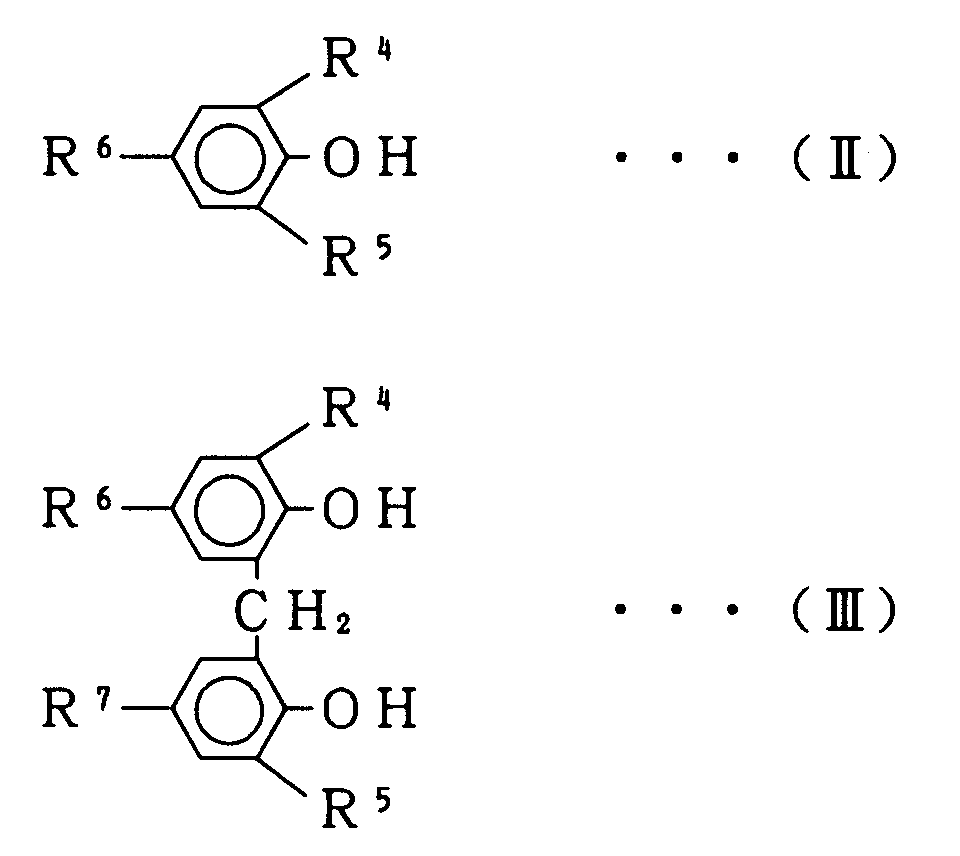
(In the formula, each of R⁴ and R⁵ denotes an alkyl group having 1 to 8 carbon atoms, and each of R⁶ and R⁷ denotes a hydrogen atom or an alkyl group having 1 to 6 carbon atoms.) Specifically, 2,6-di-tert-butyl-4-metylphenol (DBPC), 2,6-di-tert-butyl-4-ethylphenol, 2,2'-methylenebis (4-methyl-6-tert-butylphenol), 2,2'-methylenebis (4-ethyl-6-tert-butylphenol), and the like are preferable. - As amine compounds, there are used various amine compounds, and it is suitable to employ usually the compounds represented by the following general formula (IV) or (V):

(In the formula, each of R⁸ and R¹¹ denotes a hydrogen atom or an alkyl group having 1 to 10 carbon atoms, each of R⁹ and R¹⁰ denotes an alkyl group having 1 to 20 carbon atoms, and each of R¹² to R¹⁴ denotes a hydrogen atom or an alkyl group having 1 to 20 carbon atoms.) - Specifically, di-p-octyldiphenylamine, di-p-butyldiphenylamine, di-p-nonyldiphenylamine, phenyl-α-naphthylamine, phenyl-β-naphtylamine, and the like are preferable.
- The amount of the component (c) is preferably not less than 0.1% by weight, more preferably 0.1 to 2.0% by weight, based on the total amount of the composition.
- If desired, a suitable amount of an oiliness agent, an extreme-pressure agent, a rust inhibitor, a corrosion inhibitor, a defoaming agent, or the like may be blended with the composition according to the present invention.
- Then, more detailed description will be made regarding the present invention with reference to examples and comparative examples.
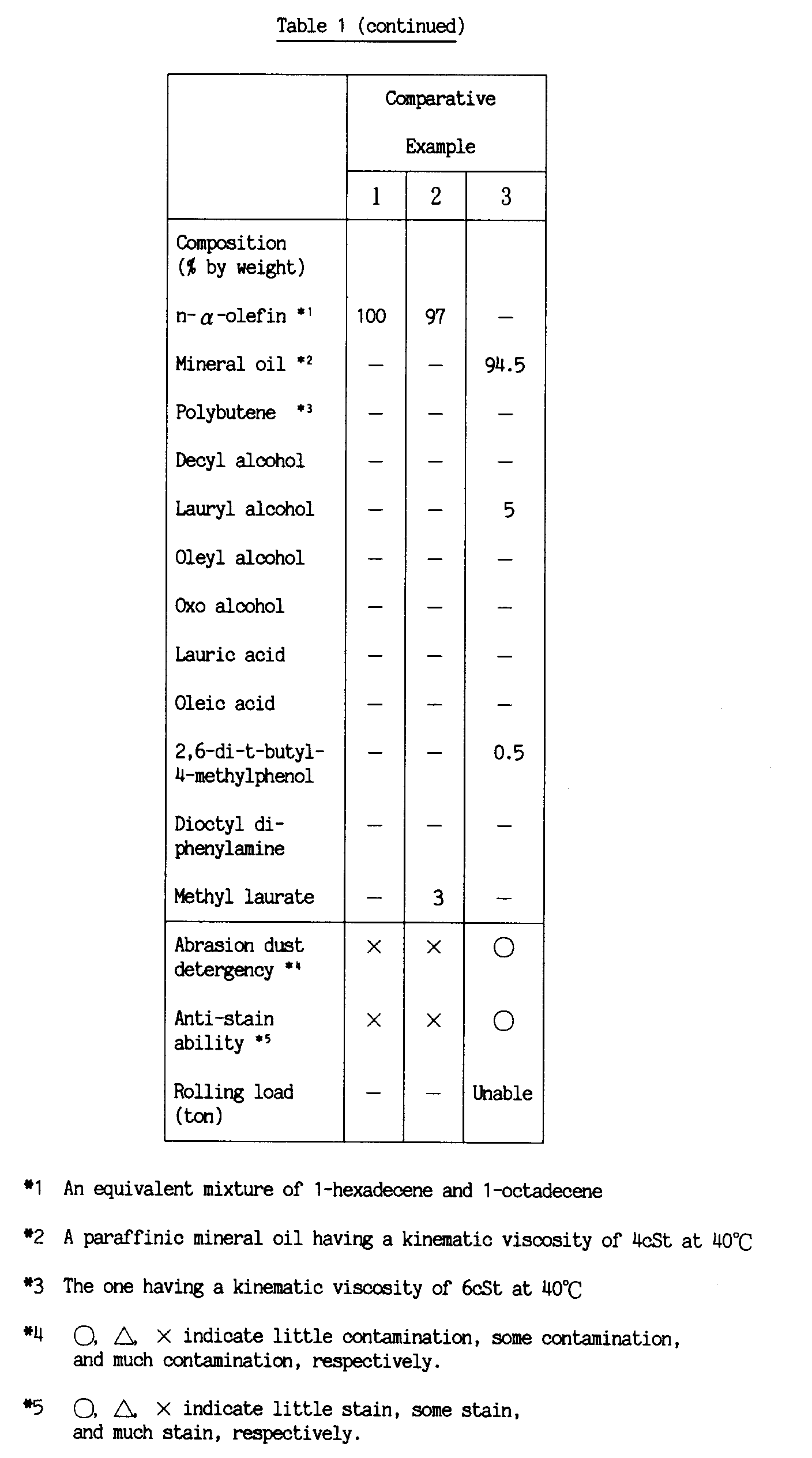
- The following rolling test was carried out by the use of lubricating oil for rolling which has the composition shown in Table 1
- A JIS A 5052 H16 aluminum plate (a coiled plate having a thickness of 1.2 mm and a width of 60 mm) was prepared as a material to be rolled. With each lubricating oil for rolling, the plate was rolled by a four-stage rolling mill having a work roll diameter of 135 mm at a rolling speed of 100 m/min. under forward tensions of 170 kgf and 400 kgf. The rolling process was carried out in such a manner that the reduction was stepwise increased per 20 m length during one pass as 50.0→ 54.2→ 58.3→ 60.8→ 63.3→ 65.8→ 68.3 (%). As to the plate having a thickness of 0.38 mm (a draft of 68.3 %) after the rolling process (after seven passes), the rolling load was measured. Abrasion dust detergency and anti-stain ability were evaluated by the following methods.
- A cellophane tape was stuck onto the surface of the aluminum plate after rolling so as to pick up abrasion dust adhering thereto. Then, the tape was applied on a white paper sheet to visually determine a degree of contamination by abrasion dust. Thus, the detergency for abrasion dust adhering to the surface of the aluminum plate was evaluated. The results thus obtained are shown in Table 1.
-
- The aluminum plate after rolling was cut into piece having a short length of 10 cm. The stack of several tens of the cut pieces were fixed by a thick steel plate and annealed in a small-size annealing furnace.
- The heating process in the annealing furnace comprises the step of: heating in an air atmosphere with a temperature rising rate of 5 °C/min. until the temperature reaches 330 °C; holding for 30 minutes; and cooling. After completion of the heating process, a degree of occurrence of annealing stains on the annealed plate was visually determined. Thus, the anti-stain ability was evaluated. The results are shown in Table 1.

- The following cutting test was carried out by the use of lubricating oil for cutting which has the composition shown in Table 2.
- A cylindrical aluminum alloy material (AC-4A-T6) having a diameter of 80 mm was prepared as a material to be cut. The aluminum alloy material was cut to form an end face by the use of a cutting tool (cemented carbide P20) under the cutting condition that a cutting depth (t) is 1 mm and a feed rate (f) is 0.1 mm/revolution.
- After the cutting, the surface roughness (R max) of the cut end face was measured while the surface thereof was observed. The results are shown in Table 2.

- As described above, by the use of a lubricating oil composition according to the present invention, abrasion dust detergency is improved in metal working (plastic working such as rolling, drawing, blanking, drawing, cold forging; cutting; and grinding) for various kinds of metals and alloys thereof while anti-stain ability in annealing of a worked material is improved.
- Accordingly, a lubricating oil composition according to the present invention is widely and effectively used as a metal working oil in plastic working, cutting, or grinding of various kinds of metals and alloys such as aluminum, aluminum alloy, aluminum foil.
Claims (5)
- A lubricating oil composition for metal working, comprising: (a) a base oil containing, as an essential component, straight chain olefin having 6 to 40 carbon atoms; and (b) at least one compound selected from the group consisting of alcohol, glycol, polyalkylene glycol, derivative of polyalkylene glycol, and fatty acid.
- A lubricating oil composition for metal working, comprising: (a) a base oil which is a mixture of straight chain olefin having 6 to 40 carbon atoms and mineral oil and/or synthetic oil; (b) at least one compound selected from the group consisting of alcohol, glycol, polyalkylene glycol, derivative of polyalkylene glycol and fatty acid.
- A lubricating oil composition for metal working according to Claim 1 or 2, further comprising the additional component of (c) at least one compound selected from the group consisting of phenolic compounds and amine compounds.
- A lubricating oil composition for metal working, comprising: (a) a base oil containing, as an essential component, straight chain olefin having 6 to 40 carbon atoms; and (c) at least one compound selected from the group consisting of phenolic compounds and amine compounds.
- A lubricating oil composition for metal working, comprising: (a) a base oil which is mixture of straight chain olefin having 6 to 40 carbon atoms and mineral oil and/or synthetic oil; and (c) at least one compound selected from the group consisting of phenolic compounds and amine compounds.
Applications Claiming Priority (3)
| Application Number | Priority Date | Filing Date | Title |
|---|---|---|---|
| JP121361/90 | 1990-05-14 | ||
| JP12136190 | 1990-05-14 | ||
| PCT/JP1991/000534 WO1991018074A1 (en) | 1990-05-14 | 1991-04-23 | Lubricant composition for metal working |
Publications (3)
| Publication Number | Publication Date |
|---|---|
| EP0484542A1 true EP0484542A1 (en) | 1992-05-13 |
| EP0484542A4 EP0484542A4 (en) | 1992-10-21 |
| EP0484542B1 EP0484542B1 (en) | 1995-11-15 |
Family
ID=14809351
Family Applications (1)
| Application Number | Title | Priority Date | Filing Date |
|---|---|---|---|
| EP91908465A Expired - Lifetime EP0484542B1 (en) | 1990-05-14 | 1991-04-23 | Lubricant composition for metal working |
Country Status (4)
| Country | Link |
|---|---|
| EP (1) | EP0484542B1 (en) |
| KR (1) | KR970010855B1 (en) |
| DE (1) | DE69114672T2 (en) |
| WO (1) | WO1991018074A1 (en) |
Cited By (7)
| Publication number | Priority date | Publication date | Assignee | Title |
|---|---|---|---|---|
| EP0632125A1 (en) * | 1993-07-02 | 1995-01-04 | Idemitsu Kosan Company Limited | Metal working oil composition |
| EP0692669A1 (en) * | 1993-07-02 | 1996-01-17 | Hydro-Quebec | Additives for lubricants used in rolling lithium strips into thin foils |
| EP0690121A3 (en) * | 1994-06-27 | 1996-07-31 | Carrier Corp | Metal forming lubricant |
| EP1000674A3 (en) * | 1994-07-12 | 2000-11-29 | Hydro-Quebec | Method of producing a thin sheet of an alkali metal or an alkalimetal alloy by rolling a metal strip in presence of a lubricating composition |
| CN1068037C (en) * | 1995-11-29 | 2001-07-04 | 出光兴产株式会社 | metalworking oil composition |
| EP3957708A1 (en) | 2020-08-17 | 2022-02-23 | Speira GmbH | Cooling lubricant for the cold rolling of aluminium |
| US12116544B2 (en) * | 2020-10-26 | 2024-10-15 | Dow Global Technologies Llc | Metal working fluids foam control agent |
Families Citing this family (7)
| Publication number | Priority date | Publication date | Assignee | Title |
|---|---|---|---|---|
| JP3490148B2 (en) * | 1994-08-10 | 2004-01-26 | 出光興産株式会社 | Lubricating oil composition for metalworking |
| JP3354024B2 (en) * | 1994-12-22 | 2002-12-09 | 株式会社神戸製鋼所 | Lubricants for low-temperature forming of aluminum and aluminum alloy sheets |
| KR20020039565A (en) * | 2000-11-22 | 2002-05-27 | 이구택 | Grinding and polishing oil for steel sheet having low mist |
| JP2002322487A (en) * | 2001-04-26 | 2002-11-08 | Idemitsu Kosan Co Ltd | Lubricating oil composition for metalworking |
| JP2003096482A (en) * | 2001-09-21 | 2003-04-03 | Nippon Oil Corp | Lubricating oil composition for aluminum processing |
| JP2003096481A (en) * | 2001-09-21 | 2003-04-03 | Nippon Oil Corp | Lubricating oil composition for aluminum processing |
| JP4741816B2 (en) * | 2004-07-09 | 2011-08-10 | 住友軽金属工業株式会社 | Cold rolling lubricant |
Family Cites Families (9)
| Publication number | Priority date | Publication date | Assignee | Title |
|---|---|---|---|---|
| GB964268A (en) * | 1961-12-05 | 1964-07-22 | Aluminium Lab Ltd | Improvements in or relating to lubricants |
| US3288715A (en) * | 1963-10-24 | 1966-11-29 | Gen Electric | Fabricating aluminum products with olefin lubricants |
| US3536622A (en) * | 1967-12-11 | 1970-10-27 | Sinclair Research Inc | Biodegradable emulsifiable lubricant compositions |
| DE3035016C2 (en) * | 1980-09-12 | 1985-02-21 | Schweizerische Aluminium Ag, Chippis | Oil-in-water emulsion for cold rolling light metals |
| JPS63202697A (en) * | 1987-02-18 | 1988-08-22 | Nippon Guriisu Kk | Metal working oiling agent for planishing |
| JPH01153794A (en) * | 1987-12-10 | 1989-06-15 | Hakutou Kagaku Kk | Lubricating oil for cold working of aluminum |
| JPH0726110B2 (en) * | 1988-09-20 | 1995-03-22 | 株式会社日立製作所 | Conductive wire manufacturing method |
| JP2551459B2 (en) * | 1988-05-10 | 1996-11-06 | 株式会社日立製作所 | Lubricant for wire drawing |
| US5072067A (en) * | 1988-11-15 | 1991-12-10 | Idemitsu Kosan Company Limited | Lubricating oil composition |
-
1991
- 1991-04-23 WO PCT/JP1991/000534 patent/WO1991018074A1/en not_active Ceased
- 1991-04-23 EP EP91908465A patent/EP0484542B1/en not_active Expired - Lifetime
- 1991-04-23 DE DE69114672T patent/DE69114672T2/en not_active Expired - Lifetime
- 1991-04-23 KR KR1019920700066A patent/KR970010855B1/en not_active Expired - Lifetime
Cited By (13)
| Publication number | Priority date | Publication date | Assignee | Title |
|---|---|---|---|---|
| US5599780A (en) * | 1992-07-02 | 1997-02-04 | Idemitsu Kosan Co., Ltd. | Metal working oil composition |
| EP0632125A1 (en) * | 1993-07-02 | 1995-01-04 | Idemitsu Kosan Company Limited | Metal working oil composition |
| EP0692669A1 (en) * | 1993-07-02 | 1996-01-17 | Hydro-Quebec | Additives for lubricants used in rolling lithium strips into thin foils |
| EP0690121A3 (en) * | 1994-06-27 | 1996-07-31 | Carrier Corp | Metal forming lubricant |
| EP1000674A3 (en) * | 1994-07-12 | 2000-11-29 | Hydro-Quebec | Method of producing a thin sheet of an alkali metal or an alkalimetal alloy by rolling a metal strip in presence of a lubricating composition |
| CN1068037C (en) * | 1995-11-29 | 2001-07-04 | 出光兴产株式会社 | metalworking oil composition |
| EP3957708A1 (en) | 2020-08-17 | 2022-02-23 | Speira GmbH | Cooling lubricant for the cold rolling of aluminium |
| WO2022038111A1 (en) | 2020-08-17 | 2022-02-24 | Speira Gmbh | Cooling lubricant for cold rolling aluminum |
| CN115885025A (en) * | 2020-08-17 | 2023-03-31 | 斯佩拉有限公司 | Cooling lubricant for cold rolling of aluminium |
| KR20230052281A (en) * | 2020-08-17 | 2023-04-19 | 스페이라 게엠베하 | Cooling lubricant for aluminum cold rolling |
| CN115885025B (en) * | 2020-08-17 | 2024-05-24 | 斯佩拉有限公司 | Cooling lubricants for cold rolled aluminum |
| US12215295B2 (en) | 2020-08-17 | 2025-02-04 | Speira Gmbh | Cooling lubricant for cold rolling aluminum |
| US12116544B2 (en) * | 2020-10-26 | 2024-10-15 | Dow Global Technologies Llc | Metal working fluids foam control agent |
Also Published As
| Publication number | Publication date |
|---|---|
| DE69114672T2 (en) | 1996-04-18 |
| DE69114672D1 (en) | 1995-12-21 |
| EP0484542B1 (en) | 1995-11-15 |
| EP0484542A4 (en) | 1992-10-21 |
| KR970010855B1 (en) | 1997-07-01 |
| KR927003454A (en) | 1992-12-18 |
| WO1991018074A1 (en) | 1991-11-28 |
Similar Documents
| Publication | Publication Date | Title |
|---|---|---|
| KR100799420B1 (en) | Ultra-low oil supply cutting or grinding oil composition | |
| EP0484542B1 (en) | Lubricant composition for metal working | |
| KR950014394B1 (en) | Lubricating oil composition for working | |
| US5171903A (en) | Lubricating oil composition | |
| JP2002511109A (en) | High performance metalworking oil | |
| JP6355339B2 (en) | Metalworking fluid composition, processing method using the same, and metalworked part manufactured by the metalworking method | |
| JP3490148B2 (en) | Lubricating oil composition for metalworking | |
| US4670168A (en) | Aqueous metal removal fluid | |
| US20120177938A1 (en) | Metalworking fluid, metal working method and metal work product | |
| US8044004B2 (en) | Metalworking oil composition, metalworking method and metalwork | |
| KR900004510B1 (en) | Lubricating method for machine tools using sliding surface and metal co-working agent | |
| JP3860711B2 (en) | Oil composition for cutting / grinding with ultra-trace oil supply | |
| JP2001192686A (en) | Oil solution composition for cutting / grinding processing with very small amount of oil supply | |
| US4956109A (en) | Lubricating oil | |
| JP3501244B2 (en) | Metalworking oil composition | |
| JP2869187B2 (en) | Lubricating oil composition for metalworking | |
| JP2993653B2 (en) | Lubricating oil composition for aluminum plastic working | |
| JP4988178B2 (en) | Rust prevention oil composition | |
| JP5340322B2 (en) | Rust prevention oil composition | |
| JP4990527B2 (en) | Lubricating oil composition for metal working | |
| JP4729361B2 (en) | Rust prevention oil composition | |
| JPWO1991018074A1 (en) | Lubricating oil composition for metal processing | |
| JP4679998B2 (en) | Rust prevention oil composition | |
| JP2005290451A (en) | Rust preventive composition | |
| JPH0445557B2 (en) |
Legal Events
| Date | Code | Title | Description |
|---|---|---|---|
| PUAI | Public reference made under article 153(3) epc to a published international application that has entered the european phase |
Free format text: ORIGINAL CODE: 0009012 |
|
| AK | Designated contracting states |
Kind code of ref document: A1 Designated state(s): DE FR GB IT SE |
|
| 17P | Request for examination filed |
Effective date: 19920521 |
|
| A4 | Supplementary search report drawn up and despatched |
Effective date: 19920831 |
|
| AK | Designated contracting states |
Kind code of ref document: A4 Designated state(s): DE FR GB IT SE |
|
| 17Q | First examination report despatched |
Effective date: 19930122 |
|
| GRAA | (expected) grant |
Free format text: ORIGINAL CODE: 0009210 |
|
| AK | Designated contracting states |
Kind code of ref document: B1 Designated state(s): DE FR GB IT SE |
|
| PG25 | Lapsed in a contracting state [announced via postgrant information from national office to epo] |
Ref country code: IT Free format text: LAPSE BECAUSE OF FAILURE TO SUBMIT A TRANSLATION OF THE DESCRIPTION OR TO PAY THE FEE WITHIN THE PRE;WARNING: LAPSES OF ITALIAN PATENTS WITH EFFECTIVE DATE BEFORE 2007 MAY HAVE OCCURRED AT ANY TIME BEFORE 2007. THE CORRECT EFFECTIVE DATE MAY BE DIFFERENT FROM THE ONE RECORDED.SCRIBED TIME-LIMIT Effective date: 19951115 |
|
| REF | Corresponds to: |
Ref document number: 69114672 Country of ref document: DE Date of ref document: 19951221 |
|
| ET | Fr: translation filed | ||
| PG25 | Lapsed in a contracting state [announced via postgrant information from national office to epo] |
Ref country code: SE Effective date: 19960215 |
|
| PLBE | No opposition filed within time limit |
Free format text: ORIGINAL CODE: 0009261 |
|
| STAA | Information on the status of an ep patent application or granted ep patent |
Free format text: STATUS: NO OPPOSITION FILED WITHIN TIME LIMIT |
|
| 26N | No opposition filed | ||
| REG | Reference to a national code |
Ref country code: GB Ref legal event code: IF02 |
|
| PGFP | Annual fee paid to national office [announced via postgrant information from national office to epo] |
Ref country code: GB Payment date: 20100325 Year of fee payment: 20 |
|
| PGFP | Annual fee paid to national office [announced via postgrant information from national office to epo] |
Ref country code: FR Payment date: 20100521 Year of fee payment: 20 |
|
| PGFP | Annual fee paid to national office [announced via postgrant information from national office to epo] |
Ref country code: DE Payment date: 20100430 Year of fee payment: 20 |
|
| REG | Reference to a national code |
Ref country code: DE Ref legal event code: R071 Ref document number: 69114672 Country of ref document: DE |
|
| REG | Reference to a national code |
Ref country code: GB Ref legal event code: PE20 Expiry date: 20110422 |
|
| PG25 | Lapsed in a contracting state [announced via postgrant information from national office to epo] |
Ref country code: GB Free format text: LAPSE BECAUSE OF EXPIRATION OF PROTECTION Effective date: 20110422 |
|
| PG25 | Lapsed in a contracting state [announced via postgrant information from national office to epo] |
Ref country code: DE Free format text: LAPSE BECAUSE OF EXPIRATION OF PROTECTION Effective date: 20110423 |