EP0484304A1 - Electrolyte solution sequestering agents for electrochemical cells having carbonaceous electrodes - Google Patents
Electrolyte solution sequestering agents for electrochemical cells having carbonaceous electrodes Download PDFInfo
- Publication number
- EP0484304A1 EP0484304A1 EP91850159A EP91850159A EP0484304A1 EP 0484304 A1 EP0484304 A1 EP 0484304A1 EP 91850159 A EP91850159 A EP 91850159A EP 91850159 A EP91850159 A EP 91850159A EP 0484304 A1 EP0484304 A1 EP 0484304A1
- Authority
- EP
- European Patent Office
- Prior art keywords
- cell
- alkali metal
- electrolyte
- group
- crown
- Prior art date
- Legal status (The legal status is an assumption and is not a legal conclusion. Google has not performed a legal analysis and makes no representation as to the accuracy of the status listed.)
- Withdrawn
Links
- 239000003352 sequestering agent Substances 0.000 title claims abstract description 44
- 239000008151 electrolyte solution Substances 0.000 title claims abstract description 25
- 239000003792 electrolyte Substances 0.000 claims abstract description 75
- 239000002904 solvent Substances 0.000 claims abstract description 46
- 238000009830 intercalation Methods 0.000 claims abstract description 32
- 150000001340 alkali metals Chemical class 0.000 claims abstract description 27
- 150000003839 salts Chemical class 0.000 claims abstract description 25
- 229910052783 alkali metal Inorganic materials 0.000 claims abstract description 23
- OKTJSMMVPCPJKN-UHFFFAOYSA-N Carbon Chemical compound [C] OKTJSMMVPCPJKN-UHFFFAOYSA-N 0.000 claims abstract description 20
- 239000007772 electrode material Substances 0.000 claims abstract description 18
- 238000005087 graphitization Methods 0.000 claims abstract description 17
- 238000000034 method Methods 0.000 claims abstract description 16
- 239000000203 mixture Substances 0.000 claims abstract description 11
- 229910001413 alkali metal ion Inorganic materials 0.000 claims abstract description 9
- 229910052799 carbon Inorganic materials 0.000 claims abstract description 9
- 239000003513 alkali Substances 0.000 claims abstract description 7
- 230000000536 complexating effect Effects 0.000 claims abstract description 7
- 239000003960 organic solvent Substances 0.000 claims abstract description 4
- 229910052744 lithium Inorganic materials 0.000 claims description 46
- WHXSMMKQMYFTQS-UHFFFAOYSA-N Lithium Chemical compound [Li] WHXSMMKQMYFTQS-UHFFFAOYSA-N 0.000 claims description 28
- 150000003983 crown ethers Chemical class 0.000 claims description 18
- 239000000463 material Substances 0.000 claims description 15
- RTZKZFJDLAIYFH-UHFFFAOYSA-N Diethyl ether Chemical compound CCOCC RTZKZFJDLAIYFH-UHFFFAOYSA-N 0.000 claims description 14
- XTHFKEDIFFGKHM-UHFFFAOYSA-N Dimethoxyethane Chemical compound COCCOC XTHFKEDIFFGKHM-UHFFFAOYSA-N 0.000 claims description 14
- 239000003575 carbonaceous material Substances 0.000 claims description 14
- -1 transition metal chalcogenide Chemical class 0.000 claims description 11
- PXHVJJICTQNCMI-UHFFFAOYSA-N Nickel Chemical compound [Ni] PXHVJJICTQNCMI-UHFFFAOYSA-N 0.000 claims description 8
- 229910052723 transition metal Inorganic materials 0.000 claims description 8
- XQQZRZQVBFHBHL-UHFFFAOYSA-N 12-crown-4 Chemical compound C1COCCOCCOCCO1 XQQZRZQVBFHBHL-UHFFFAOYSA-N 0.000 claims description 7
- KMTRUDSVKNLOMY-UHFFFAOYSA-N Ethylene carbonate Chemical compound O=C1OCCO1 KMTRUDSVKNLOMY-UHFFFAOYSA-N 0.000 claims description 7
- RUOJZAUFBMNUDX-UHFFFAOYSA-N propylene carbonate Chemical compound CC1COC(=O)O1 RUOJZAUFBMNUDX-UHFFFAOYSA-N 0.000 claims description 7
- RYHBNJHYFVUHQT-UHFFFAOYSA-N 1,4-Dioxane Chemical compound C1COCCO1 RYHBNJHYFVUHQT-UHFFFAOYSA-N 0.000 claims description 6
- XEEYBQQBJWHFJM-UHFFFAOYSA-N Iron Chemical compound [Fe] XEEYBQQBJWHFJM-UHFFFAOYSA-N 0.000 claims description 6
- WYURNTSHIVDZCO-UHFFFAOYSA-N Tetrahydrofuran Chemical compound C1CCOC1 WYURNTSHIVDZCO-UHFFFAOYSA-N 0.000 claims description 6
- 239000002739 cryptand Substances 0.000 claims description 6
- AMXOYNBUYSYVKV-UHFFFAOYSA-M lithium bromide Chemical compound [Li+].[Br-] AMXOYNBUYSYVKV-UHFFFAOYSA-M 0.000 claims description 6
- 229910001540 lithium hexafluoroarsenate(V) Inorganic materials 0.000 claims description 6
- 150000001335 aliphatic alkanes Chemical class 0.000 claims description 5
- QSZMZKBZAYQGRS-UHFFFAOYSA-N lithium;bis(trifluoromethylsulfonyl)azanide Chemical compound [Li+].FC(F)(F)S(=O)(=O)[N-]S(=O)(=O)C(F)(F)F QSZMZKBZAYQGRS-UHFFFAOYSA-N 0.000 claims description 5
- 150000003624 transition metals Chemical class 0.000 claims description 5
- DHKHKXVYLBGOIT-UHFFFAOYSA-N 1,1-Diethoxyethane Chemical compound CCOC(C)OCC DHKHKXVYLBGOIT-UHFFFAOYSA-N 0.000 claims description 4
- VFTFKUDGYRBSAL-UHFFFAOYSA-N 15-crown-5 Chemical compound C1COCCOCCOCCOCCO1 VFTFKUDGYRBSAL-UHFFFAOYSA-N 0.000 claims description 4
- JWUJQDFVADABEY-UHFFFAOYSA-N 2-methyltetrahydrofuran Chemical compound CC1CCCO1 JWUJQDFVADABEY-UHFFFAOYSA-N 0.000 claims description 4
- 229910000552 LiCF3SO3 Inorganic materials 0.000 claims description 4
- 125000004432 carbon atom Chemical group C* 0.000 claims description 4
- 239000010941 cobalt Substances 0.000 claims description 4
- 229910017052 cobalt Inorganic materials 0.000 claims description 4
- GUTLYIVDDKVIGB-UHFFFAOYSA-N cobalt atom Chemical compound [Co] GUTLYIVDDKVIGB-UHFFFAOYSA-N 0.000 claims description 4
- 229910052759 nickel Inorganic materials 0.000 claims description 4
- ZZXUZKXVROWEIF-UHFFFAOYSA-N 1,2-butylene carbonate Chemical compound CCC1COC(=O)O1 ZZXUZKXVROWEIF-UHFFFAOYSA-N 0.000 claims description 3
- VFRGATWKSPNXLT-UHFFFAOYSA-N 1,2-dimethoxybutane Chemical compound CCC(OC)COC VFRGATWKSPNXLT-UHFFFAOYSA-N 0.000 claims description 3
- LEEANUDEDHYDTG-UHFFFAOYSA-N 1,2-dimethoxypropane Chemical compound COCC(C)OC LEEANUDEDHYDTG-UHFFFAOYSA-N 0.000 claims description 3
- VDFVNEFVBPFDSB-UHFFFAOYSA-N 1,3-dioxane Chemical compound C1COCOC1 VDFVNEFVBPFDSB-UHFFFAOYSA-N 0.000 claims description 3
- JRRDISHSXWGFRF-UHFFFAOYSA-N 1-[2-(2-ethoxyethoxy)ethoxy]-2-methoxyethane Chemical compound CCOCCOCCOCCOC JRRDISHSXWGFRF-UHFFFAOYSA-N 0.000 claims description 3
- YZWVMKLQNYGKLJ-UHFFFAOYSA-N 1-[2-[2-(2-ethoxyethoxy)ethoxy]ethoxy]-2-methoxyethane Chemical compound CCOCCOCCOCCOCCOC YZWVMKLQNYGKLJ-UHFFFAOYSA-N 0.000 claims description 3
- XEZNGIUYQVAUSS-UHFFFAOYSA-N 18-crown-6 Chemical compound C1COCCOCCOCCOCCOCCO1 XEZNGIUYQVAUSS-UHFFFAOYSA-N 0.000 claims description 3
- VYZAMTAEIAYCRO-UHFFFAOYSA-N Chromium Chemical compound [Cr] VYZAMTAEIAYCRO-UHFFFAOYSA-N 0.000 claims description 3
- 229910015044 LiB Inorganic materials 0.000 claims description 3
- 229910001290 LiPF6 Inorganic materials 0.000 claims description 3
- 229910012423 LiSO3F Inorganic materials 0.000 claims description 3
- ZOKXTWBITQBERF-UHFFFAOYSA-N Molybdenum Chemical compound [Mo] ZOKXTWBITQBERF-UHFFFAOYSA-N 0.000 claims description 3
- RTAQQCXQSZGOHL-UHFFFAOYSA-N Titanium Chemical compound [Ti] RTAQQCXQSZGOHL-UHFFFAOYSA-N 0.000 claims description 3
- 229910052804 chromium Inorganic materials 0.000 claims description 3
- 239000011651 chromium Substances 0.000 claims description 3
- SBZXBUIDTXKZTM-UHFFFAOYSA-N diglyme Chemical compound COCCOCCOC SBZXBUIDTXKZTM-UHFFFAOYSA-N 0.000 claims description 3
- BDUPRNVPXOHWIL-UHFFFAOYSA-N dimethyl sulfite Chemical compound COS(=O)OC BDUPRNVPXOHWIL-UHFFFAOYSA-N 0.000 claims description 3
- 229930195733 hydrocarbon Natural products 0.000 claims description 3
- 150000002430 hydrocarbons Chemical class 0.000 claims description 3
- 229910052742 iron Inorganic materials 0.000 claims description 3
- MHCFAGZWMAWTNR-UHFFFAOYSA-M lithium perchlorate Chemical compound [Li+].[O-]Cl(=O)(=O)=O MHCFAGZWMAWTNR-UHFFFAOYSA-M 0.000 claims description 3
- 229910001486 lithium perchlorate Inorganic materials 0.000 claims description 3
- 229910001537 lithium tetrachloroaluminate Inorganic materials 0.000 claims description 3
- 229910001496 lithium tetrafluoroborate Inorganic materials 0.000 claims description 3
- WPBNNNQJVZRUHP-UHFFFAOYSA-L manganese(2+);methyl n-[[2-(methoxycarbonylcarbamothioylamino)phenyl]carbamothioyl]carbamate;n-[2-(sulfidocarbothioylamino)ethyl]carbamodithioate Chemical compound [Mn+2].[S-]C(=S)NCCNC([S-])=S.COC(=O)NC(=S)NC1=CC=CC=C1NC(=S)NC(=O)OC WPBNNNQJVZRUHP-UHFFFAOYSA-L 0.000 claims description 3
- 239000011733 molybdenum Substances 0.000 claims description 3
- 229910052750 molybdenum Inorganic materials 0.000 claims description 3
- HXJUTPCZVOIRIF-UHFFFAOYSA-N sulfolane Chemical compound O=S1(=O)CCCC1 HXJUTPCZVOIRIF-UHFFFAOYSA-N 0.000 claims description 3
- YLQBMQCUIZJEEH-UHFFFAOYSA-N tetrahydrofuran Natural products C=1C=COC=1 YLQBMQCUIZJEEH-UHFFFAOYSA-N 0.000 claims description 3
- 239000010936 titanium Substances 0.000 claims description 3
- 229910052719 titanium Inorganic materials 0.000 claims description 3
- 229910052720 vanadium Inorganic materials 0.000 claims description 3
- XKEHLMZHBXCJGZ-UHFFFAOYSA-N 1,4,7,10,13,16,19-heptaoxacyclohenicosane Chemical compound C1COCCOCCOCCOCCOCCOCCO1 XKEHLMZHBXCJGZ-UHFFFAOYSA-N 0.000 claims description 2
- PVDDBYSFGBWICV-UHFFFAOYSA-N 1,4,8,11-tetraoxacyclotetradecane Chemical compound C1COCCOCCCOCCOC1 PVDDBYSFGBWICV-UHFFFAOYSA-N 0.000 claims description 2
- 125000005605 benzo group Chemical group 0.000 claims description 2
- 238000005229 chemical vapour deposition Methods 0.000 claims description 2
- BBGKDYHZQOSNMU-UHFFFAOYSA-N dicyclohexano-18-crown-6 Chemical compound O1CCOCCOC2CCCCC2OCCOCCOC2CCCCC21 BBGKDYHZQOSNMU-UHFFFAOYSA-N 0.000 claims description 2
- 239000002006 petroleum coke Substances 0.000 claims description 2
- 238000000197 pyrolysis Methods 0.000 claims description 2
- LCGLNKUTAGEVQW-UHFFFAOYSA-N Dimethyl ether Chemical compound COC LCGLNKUTAGEVQW-UHFFFAOYSA-N 0.000 claims 2
- LEONUFNNVUYDNQ-UHFFFAOYSA-N vanadium atom Chemical compound [V] LEONUFNNVUYDNQ-UHFFFAOYSA-N 0.000 claims 2
- 210000004027 cell Anatomy 0.000 description 87
- 230000002687 intercalation Effects 0.000 description 23
- 239000010405 anode material Substances 0.000 description 21
- 206010040844 Skin exfoliation Diseases 0.000 description 17
- 238000004299 exfoliation Methods 0.000 description 17
- 229940021013 electrolyte solution Drugs 0.000 description 15
- 229910002804 graphite Inorganic materials 0.000 description 13
- 239000010439 graphite Substances 0.000 description 13
- 239000006182 cathode active material Substances 0.000 description 11
- 229910052751 metal Inorganic materials 0.000 description 11
- 239000002184 metal Substances 0.000 description 11
- 238000000354 decomposition reaction Methods 0.000 description 8
- 150000002500 ions Chemical class 0.000 description 7
- 230000002427 irreversible effect Effects 0.000 description 7
- NUJOXMJBOLGQSY-UHFFFAOYSA-N manganese dioxide Chemical compound O=[Mn]=O NUJOXMJBOLGQSY-UHFFFAOYSA-N 0.000 description 6
- 238000006243 chemical reaction Methods 0.000 description 5
- 230000001351 cycling effect Effects 0.000 description 5
- 239000011230 binding agent Substances 0.000 description 4
- 239000010406 cathode material Substances 0.000 description 4
- 150000001875 compounds Chemical class 0.000 description 4
- 239000013078 crystal Substances 0.000 description 4
- 229910052708 sodium Inorganic materials 0.000 description 4
- 239000011734 sodium Substances 0.000 description 4
- 238000012360 testing method Methods 0.000 description 4
- DGAQECJNVWCQMB-PUAWFVPOSA-M Ilexoside XXIX Chemical compound C[C@@H]1CC[C@@]2(CC[C@@]3(C(=CC[C@H]4[C@]3(CC[C@@H]5[C@@]4(CC[C@@H](C5(C)C)OS(=O)(=O)[O-])C)C)[C@@H]2[C@]1(C)O)C)C(=O)O[C@H]6[C@@H]([C@H]([C@@H]([C@H](O6)CO)O)O)O.[Na+] DGAQECJNVWCQMB-PUAWFVPOSA-M 0.000 description 3
- ZLMJMSJWJFRBEC-UHFFFAOYSA-N Potassium Chemical compound [K] ZLMJMSJWJFRBEC-UHFFFAOYSA-N 0.000 description 3
- 238000013459 approach Methods 0.000 description 3
- 229910052798 chalcogen Inorganic materials 0.000 description 3
- 229910021645 metal ion Inorganic materials 0.000 description 3
- 150000002739 metals Chemical class 0.000 description 3
- VLKZOEOYAKHREP-UHFFFAOYSA-N n-Hexane Chemical compound CCCCCC VLKZOEOYAKHREP-UHFFFAOYSA-N 0.000 description 3
- 229920000642 polymer Polymers 0.000 description 3
- 229910052700 potassium Inorganic materials 0.000 description 3
- 239000011591 potassium Substances 0.000 description 3
- 239000000243 solution Substances 0.000 description 3
- 238000007614 solvation Methods 0.000 description 3
- XLYOFNOQVPJJNP-UHFFFAOYSA-N water Substances O XLYOFNOQVPJJNP-UHFFFAOYSA-N 0.000 description 3
- 229920002943 EPDM rubber Polymers 0.000 description 2
- 229920003171 Poly (ethylene oxide) Polymers 0.000 description 2
- 229910003092 TiS2 Inorganic materials 0.000 description 2
- 239000011149 active material Substances 0.000 description 2
- 239000000654 additive Substances 0.000 description 2
- 239000006229 carbon black Substances 0.000 description 2
- 230000008859 change Effects 0.000 description 2
- 230000001427 coherent effect Effects 0.000 description 2
- 238000000151 deposition Methods 0.000 description 2
- 230000000694 effects Effects 0.000 description 2
- 238000001704 evaporation Methods 0.000 description 2
- 239000011888 foil Substances 0.000 description 2
- 238000010438 heat treatment Methods 0.000 description 2
- 239000004615 ingredient Substances 0.000 description 2
- 239000007788 liquid Substances 0.000 description 2
- GRVDJDISBSALJP-UHFFFAOYSA-N methyloxidanyl Chemical compound [O]C GRVDJDISBSALJP-UHFFFAOYSA-N 0.000 description 2
- 230000035515 penetration Effects 0.000 description 2
- 229920001343 polytetrafluoroethylene Polymers 0.000 description 2
- 239000004810 polytetrafluoroethylene Substances 0.000 description 2
- 239000000843 powder Substances 0.000 description 2
- 230000002441 reversible effect Effects 0.000 description 2
- 239000002002 slurry Substances 0.000 description 2
- ZUHZGEOKBKGPSW-UHFFFAOYSA-N tetraglyme Chemical compound COCCOCCOCCOCCOC ZUHZGEOKBKGPSW-UHFFFAOYSA-N 0.000 description 2
- NLMDJJTUQPXZFG-UHFFFAOYSA-N 1,4,10,13-tetraoxa-7,16-diazacyclooctadecane Chemical compound C1COCCOCCNCCOCCOCCN1 NLMDJJTUQPXZFG-UHFFFAOYSA-N 0.000 description 1
- AUFVJZSDSXXFOI-UHFFFAOYSA-N 2.2.2-cryptand Chemical compound C1COCCOCCN2CCOCCOCCN1CCOCCOCC2 AUFVJZSDSXXFOI-UHFFFAOYSA-N 0.000 description 1
- HDLXPNDSLDLJHF-UHFFFAOYSA-N 4,7,13,16,21-pentaoxa-1,10-diazabicyclo[8.8.5]tricosane Chemical compound C1COCCOCCN2CCOCCOCCN1CCOCC2 HDLXPNDSLDLJHF-UHFFFAOYSA-N 0.000 description 1
- LVNQVIZBPSRXAN-UHFFFAOYSA-N 4,7,13,18-tetraoxa-1,10-diazabicyclo[8.5.5]icosane Chemical compound C1COCCOCCN2CCOCCN1CCOCC2 LVNQVIZBPSRXAN-UHFFFAOYSA-N 0.000 description 1
- 239000004215 Carbon black (E152) Substances 0.000 description 1
- XDTMQSROBMDMFD-UHFFFAOYSA-N Cyclohexane Chemical compound C1CCCCC1 XDTMQSROBMDMFD-UHFFFAOYSA-N 0.000 description 1
- 229910013864 LiCo0.92Sn0.08O2 Inorganic materials 0.000 description 1
- 229910012713 LiCo1-xNixO2 Inorganic materials 0.000 description 1
- 229910012964 LiCo1−xNixO2 Inorganic materials 0.000 description 1
- 229910032387 LiCoO2 Inorganic materials 0.000 description 1
- 229910003005 LiNiO2 Inorganic materials 0.000 description 1
- 229910002097 Lithium manganese(III,IV) oxide Inorganic materials 0.000 description 1
- 229910018688 LixC6 Inorganic materials 0.000 description 1
- 239000004743 Polypropylene Substances 0.000 description 1
- BUGBHKTXTAQXES-UHFFFAOYSA-N Selenium Chemical compound [Se] BUGBHKTXTAQXES-UHFFFAOYSA-N 0.000 description 1
- NINIDFKCEFEMDL-UHFFFAOYSA-N Sulfur Chemical compound [S] NINIDFKCEFEMDL-UHFFFAOYSA-N 0.000 description 1
- ATJFFYVFTNAWJD-UHFFFAOYSA-N Tin Chemical compound [Sn] ATJFFYVFTNAWJD-UHFFFAOYSA-N 0.000 description 1
- 238000002441 X-ray diffraction Methods 0.000 description 1
- 229910006247 ZrS2 Inorganic materials 0.000 description 1
- DZVPMKQTULWACF-UHFFFAOYSA-N [B].[C].[N] Chemical compound [B].[C].[N] DZVPMKQTULWACF-UHFFFAOYSA-N 0.000 description 1
- GOPYZMJAIPBUGX-UHFFFAOYSA-N [O-2].[O-2].[Mn+4] Chemical class [O-2].[O-2].[Mn+4] GOPYZMJAIPBUGX-UHFFFAOYSA-N 0.000 description 1
- XHCLAFWTIXFWPH-UHFFFAOYSA-N [O-2].[O-2].[O-2].[O-2].[O-2].[V+5].[V+5] Chemical class [O-2].[O-2].[O-2].[O-2].[O-2].[V+5].[V+5] XHCLAFWTIXFWPH-UHFFFAOYSA-N 0.000 description 1
- 230000002411 adverse Effects 0.000 description 1
- 125000004429 atom Chemical group 0.000 description 1
- QVGXLLKOCUKJST-UHFFFAOYSA-N atomic oxygen Chemical compound [O] QVGXLLKOCUKJST-UHFFFAOYSA-N 0.000 description 1
- 230000015572 biosynthetic process Effects 0.000 description 1
- 244000309464 bull Species 0.000 description 1
- 150000001768 cations Chemical class 0.000 description 1
- 210000003850 cellular structure Anatomy 0.000 description 1
- 150000001787 chalcogens Chemical class 0.000 description 1
- 239000002738 chelating agent Substances 0.000 description 1
- IVMYJDGYRUAWML-UHFFFAOYSA-N cobalt(ii) oxide Chemical class [Co]=O IVMYJDGYRUAWML-UHFFFAOYSA-N 0.000 description 1
- 239000000571 coke Substances 0.000 description 1
- 239000004020 conductor Substances 0.000 description 1
- 230000008602 contraction Effects 0.000 description 1
- 230000002596 correlated effect Effects 0.000 description 1
- 230000000875 corresponding effect Effects 0.000 description 1
- 238000013461 design Methods 0.000 description 1
- 229960004132 diethyl ether Drugs 0.000 description 1
- 238000007599 discharging Methods 0.000 description 1
- 230000009977 dual effect Effects 0.000 description 1
- 239000011262 electrochemically active material Substances 0.000 description 1
- 239000003759 ester based solvent Substances 0.000 description 1
- 239000007888 film coating Substances 0.000 description 1
- 238000009501 film coating Methods 0.000 description 1
- 230000012010 growth Effects 0.000 description 1
- 125000005842 heteroatom Chemical group 0.000 description 1
- 125000000623 heterocyclic group Chemical group 0.000 description 1
- 230000006872 improvement Effects 0.000 description 1
- 238000011065 in-situ storage Methods 0.000 description 1
- 238000010348 incorporation Methods 0.000 description 1
- 239000012212 insulator Substances 0.000 description 1
- 239000010416 ion conductor Substances 0.000 description 1
- 150000002642 lithium compounds Chemical class 0.000 description 1
- 229920002521 macromolecule Polymers 0.000 description 1
- AMWRITDGCCNYAT-UHFFFAOYSA-L manganese oxide Inorganic materials [Mn].O[Mn]=O.O[Mn]=O AMWRITDGCCNYAT-UHFFFAOYSA-L 0.000 description 1
- PPNAOCWZXJOHFK-UHFFFAOYSA-N manganese(2+);oxygen(2-) Chemical class [O-2].[Mn+2] PPNAOCWZXJOHFK-UHFFFAOYSA-N 0.000 description 1
- 238000004519 manufacturing process Methods 0.000 description 1
- 229910001507 metal halide Inorganic materials 0.000 description 1
- 150000005309 metal halides Chemical class 0.000 description 1
- 239000007769 metal material Substances 0.000 description 1
- 238000002156 mixing Methods 0.000 description 1
- 238000012986 modification Methods 0.000 description 1
- 230000004048 modification Effects 0.000 description 1
- 229910052961 molybdenite Inorganic materials 0.000 description 1
- CWQXQMHSOZUFJS-UHFFFAOYSA-N molybdenum disulfide Chemical compound S=[Mo]=S CWQXQMHSOZUFJS-UHFFFAOYSA-N 0.000 description 1
- 229910052982 molybdenum disulfide Inorganic materials 0.000 description 1
- 229910000480 nickel oxide Inorganic materials 0.000 description 1
- 125000004433 nitrogen atom Chemical group N* 0.000 description 1
- QJGQUHMNIGDVPM-UHFFFAOYSA-N nitrogen group Chemical group [N] QJGQUHMNIGDVPM-UHFFFAOYSA-N 0.000 description 1
- 231100000252 nontoxic Toxicity 0.000 description 1
- 230000003000 nontoxic effect Effects 0.000 description 1
- GNRSAWUEBMWBQH-UHFFFAOYSA-N oxonickel Chemical compound [Ni]=O GNRSAWUEBMWBQH-UHFFFAOYSA-N 0.000 description 1
- 229910052760 oxygen Inorganic materials 0.000 description 1
- 239000001301 oxygen Substances 0.000 description 1
- 239000002245 particle Substances 0.000 description 1
- 230000000737 periodic effect Effects 0.000 description 1
- 229910052699 polonium Inorganic materials 0.000 description 1
- HZEBHPIOVYHPMT-UHFFFAOYSA-N polonium atom Chemical compound [Po] HZEBHPIOVYHPMT-UHFFFAOYSA-N 0.000 description 1
- 229920000570 polyether Polymers 0.000 description 1
- 229920001155 polypropylene Polymers 0.000 description 1
- 238000002360 preparation method Methods 0.000 description 1
- 238000003825 pressing Methods 0.000 description 1
- 230000008569 process Effects 0.000 description 1
- 230000009467 reduction Effects 0.000 description 1
- 230000003252 repetitive effect Effects 0.000 description 1
- 229910052711 selenium Inorganic materials 0.000 description 1
- 239000011669 selenium Substances 0.000 description 1
- 238000003860 storage Methods 0.000 description 1
- PTISTKLWEJDJID-UHFFFAOYSA-N sulfanylidenemolybdenum Chemical class [Mo]=S PTISTKLWEJDJID-UHFFFAOYSA-N 0.000 description 1
- 229910052717 sulfur Inorganic materials 0.000 description 1
- 239000011593 sulfur Substances 0.000 description 1
- 229910052714 tellurium Inorganic materials 0.000 description 1
- PORWMNRCUJJQNO-UHFFFAOYSA-N tellurium atom Chemical compound [Te] PORWMNRCUJJQNO-UHFFFAOYSA-N 0.000 description 1
- 125000000101 thioether group Chemical group 0.000 description 1
- 238000012546 transfer Methods 0.000 description 1
- 230000007704 transition Effects 0.000 description 1
- YFNKIDBQEZZDLK-UHFFFAOYSA-N triglyme Chemical compound COCCOCCOCCOC YFNKIDBQEZZDLK-UHFFFAOYSA-N 0.000 description 1
- GPPXJZIENCGNKB-UHFFFAOYSA-N vanadium Chemical compound [V]#[V] GPPXJZIENCGNKB-UHFFFAOYSA-N 0.000 description 1
- 229910001935 vanadium oxide Inorganic materials 0.000 description 1
Images


Classifications
-
- H—ELECTRICITY
- H01—ELECTRIC ELEMENTS
- H01M—PROCESSES OR MEANS, e.g. BATTERIES, FOR THE DIRECT CONVERSION OF CHEMICAL ENERGY INTO ELECTRICAL ENERGY
- H01M4/00—Electrodes
- H01M4/02—Electrodes composed of, or comprising, active material
- H01M4/36—Selection of substances as active materials, active masses, active liquids
- H01M4/58—Selection of substances as active materials, active masses, active liquids of inorganic compounds other than oxides or hydroxides, e.g. sulfides, selenides, tellurides, halogenides or LiCoFy; of polyanionic structures, e.g. phosphates, silicates or borates
- H01M4/583—Carbonaceous material, e.g. graphite-intercalation compounds or CFx
- H01M4/587—Carbonaceous material, e.g. graphite-intercalation compounds or CFx for inserting or intercalating light metals
-
- H—ELECTRICITY
- H01—ELECTRIC ELEMENTS
- H01M—PROCESSES OR MEANS, e.g. BATTERIES, FOR THE DIRECT CONVERSION OF CHEMICAL ENERGY INTO ELECTRICAL ENERGY
- H01M10/00—Secondary cells; Manufacture thereof
- H01M10/05—Accumulators with non-aqueous electrolyte
- H01M10/052—Li-accumulators
-
- H—ELECTRICITY
- H01—ELECTRIC ELEMENTS
- H01M—PROCESSES OR MEANS, e.g. BATTERIES, FOR THE DIRECT CONVERSION OF CHEMICAL ENERGY INTO ELECTRICAL ENERGY
- H01M10/00—Secondary cells; Manufacture thereof
- H01M10/05—Accumulators with non-aqueous electrolyte
- H01M10/056—Accumulators with non-aqueous electrolyte characterised by the materials used as electrolytes, e.g. mixed inorganic/organic electrolytes
- H01M10/0564—Accumulators with non-aqueous electrolyte characterised by the materials used as electrolytes, e.g. mixed inorganic/organic electrolytes the electrolyte being constituted of organic materials only
- H01M10/0566—Liquid materials
- H01M10/0567—Liquid materials characterised by the additives
-
- H—ELECTRICITY
- H01—ELECTRIC ELEMENTS
- H01M—PROCESSES OR MEANS, e.g. BATTERIES, FOR THE DIRECT CONVERSION OF CHEMICAL ENERGY INTO ELECTRICAL ENERGY
- H01M10/00—Secondary cells; Manufacture thereof
- H01M10/05—Accumulators with non-aqueous electrolyte
- H01M10/056—Accumulators with non-aqueous electrolyte characterised by the materials used as electrolytes, e.g. mixed inorganic/organic electrolytes
- H01M10/0564—Accumulators with non-aqueous electrolyte characterised by the materials used as electrolytes, e.g. mixed inorganic/organic electrolytes the electrolyte being constituted of organic materials only
- H01M10/0566—Liquid materials
- H01M10/0568—Liquid materials characterised by the solutes
-
- Y—GENERAL TAGGING OF NEW TECHNOLOGICAL DEVELOPMENTS; GENERAL TAGGING OF CROSS-SECTIONAL TECHNOLOGIES SPANNING OVER SEVERAL SECTIONS OF THE IPC; TECHNICAL SUBJECTS COVERED BY FORMER USPC CROSS-REFERENCE ART COLLECTIONS [XRACs] AND DIGESTS
- Y02—TECHNOLOGIES OR APPLICATIONS FOR MITIGATION OR ADAPTATION AGAINST CLIMATE CHANGE
- Y02E—REDUCTION OF GREENHOUSE GAS [GHG] EMISSIONS, RELATED TO ENERGY GENERATION, TRANSMISSION OR DISTRIBUTION
- Y02E60/00—Enabling technologies; Technologies with a potential or indirect contribution to GHG emissions mitigation
- Y02E60/10—Energy storage using batteries
-
- Y—GENERAL TAGGING OF NEW TECHNOLOGICAL DEVELOPMENTS; GENERAL TAGGING OF CROSS-SECTIONAL TECHNOLOGIES SPANNING OVER SEVERAL SECTIONS OF THE IPC; TECHNICAL SUBJECTS COVERED BY FORMER USPC CROSS-REFERENCE ART COLLECTIONS [XRACs] AND DIGESTS
- Y02—TECHNOLOGIES OR APPLICATIONS FOR MITIGATION OR ADAPTATION AGAINST CLIMATE CHANGE
- Y02P—CLIMATE CHANGE MITIGATION TECHNOLOGIES IN THE PRODUCTION OR PROCESSING OF GOODS
- Y02P70/00—Climate change mitigation technologies in the production process for final industrial or consumer products
- Y02P70/50—Manufacturing or production processes characterised by the final manufactured product
Definitions
- the present invention relates to means and methods for preventing the exfoliation of highly graphitic carbonaceous electrode materials used in electrochemical cells, which exfoliation is associated with the decomposition of the cell electrolyte solvent.
- the present invention relates to electrochemical cells having electrodes of highly graphitic carbonaceous materials and electrolyte solutions to which sequestering agents have been added to prevent co-intercalation of the electrolyte solvent into the graphite electrode during initial cell discharge, which co-intercalation causes exfoliation of the graphite electrode.
- Electrochemical cells useful as electrical storage batteries usually incorporate a metal-containing anode and a cathode including an active material which can take up ions of the metal.
- An electrolyte incorporating ions of the metal is disposed in contact with the anode and the cathode.
- metal ions leave the anode, enter the electrolyte and are taken up in the active material of the cathode, resulting in the release of electrical energy.
- the reaction between the metal ions and the cathode-active material is reversible, the process can be reversed by applying electrical energy to the cell.
- Rechargeable cells are commonly referred to in the battery art as "secondary" cells.
- useful secondary cells can be made using a light alkaline metal such as sodium, potassium, and particularly, lithium, as the source of the metal ions exchanged between the anode and cathode through the electrolyte.
- a light alkaline metal such as sodium, potassium, and particularly, lithium
- These metals are particularly useful in combination with a cathode-active material that is a sulfide or oxide of a transition metal, i.e., a metal capable of assuming plural different valence states.
- these alkaline metals such as lithium have been used in electrochemical cells in their pure metal state, as the cell counterelectrode in combination with the transition metal cathode-active material. See, for example, Dampier, J. Electrochem. Soc. , 121(5) , 656-660 (1974).
- This reaction can be correlated to the tendency of highly graphitic carbonaceous intercalation hosts to exfoliate when initially intercalated with lithium metal.
- Exfoliation can be defined as the change in an intercalation host material resulting in an increase in its surface area subsequent to intercalation with lithium metal as compared to the surface area prior to intercalation.
- Highly graphitic carbonaceous materials have an organized layered structure, which layers are easily separated or exfoliated.
- the amount of electrolyte consumed upon initial intercalation is substantially proportional to the surface area of the carbonaceous intercalation host, so that the exfoliation of highly graphitic carbonaceous intercalation hosts upon initial charging results in the consumption of greater electrolyte solvent and loss of cell capacity and performance properties than occurs with carbonaceous or other intercalation hosts that do not suffer from exfoliation.
- the first is to form a dual phase carbonaceous intercalation host having a mean degree of graphitization of at least about 0.40, with one phase having a degree of graphitization greater than 0.40 and the other phase having a degree of graphitization less than about 0.40.
- the other approach maintains the carbonaceous intercalation host at a temperature greater than about 50°C during the initial intercalation of the host with lithium. Both approaches provide a carbonaceous intercalation host resistant to exfoliation during the initial lithium intercalation.
- a solution to the exfoliation problem that does not require the replacement of single-phase highly graphitic intercalation hosts or the heat treatment of same would be highly desirable.
- one aspect of the present invention provides a secondary electrochemical cell having a first electrode and a counterelectrode each capable of reversibly incorporating an alkali metal, an alkali metal incorporated in at least one of the electrodes and an electrolyte solution of a salt of the alkali metal and at least one sequestering agent dissolved in an organic solvent, wherein the first electrode includes a single-phase carbonaceous material having a degree of graphitization greater than about 0.40.
- degree of graphitization refers to a parameter of the microstructure of the carbonaceous material having a numerical value between 0 and 1.0.
- carbon having a high degree of graphitization has a more ordered microstructure more closely resembling the microstructure of graphite, whereas carbon having a low degree of graphitization has a less ordered microstructure more closely resembling that of coke.
- Carbon having a high degree of graphitization provides significant advantages with respect to charge capacity and also with respect to variation of cell voltage with state of charge during operation.
- Another aspect of the present invention provides a method for intercalating alkali metal ions into a highly graphitic carbonaceous electrode material by contacting the electrode material with an electrolyte solution of an electrolyte solvent, an alkali metal electrolyte salt, and at least one sequestering agent capable of complexing with the alkali moiety of the electrolyte salt, which electrolyte solution is also in contact with a counterelectrode, and applying a current between the electrode material and counterelectrode so that the alkali metal ions intercalate into the electrode material from the electrolyte solution, which sequestering agent substantially prevents cointercalation of the electrolyte solvent with the alkali metal ions into the electrode material.
- the electrochemical cells and methods of the invention solve the exfoliation and initial capacity loss problems in the use of highly graphitic carbonaceous materials as alkali metal intercalable anode materials in electrochemical cells.
- electrolyte solvent decomposition occurs during the first cell discharge, when the electrolyte solvent reacts with the carbonaceous anode material to form a passivating film on the surface of the carbonaceous material that is insoluble in the electrolyte solvent.
- the electrolyte solvent decomposes and is consumed until all the available surface area of the carbonaceous material is coated with the passivating film of the electrolyte solvent decomposition products, which film coating is an ionic conductor for alkali ions but an electronic insulator.
- the alkali ions in the electrolyte solution are coordinated by a solvation sphere made up of molecules of the electrolyte solvent.
- the ions typically have a diameter of two Angstroms, while the solvation sphere is typically ten times the size.
- the electrolyte solvent solvation sphere may be co-intercalated with the alkali ions into the highly graphitic carbonaceous anode material, and when this occurs, the organized layered structure of the graphitic material separates. This is defined as exfoliation, which creates freshly exposed carbonaceous 'surfaces with which more electrolyte decomposition can occur.
- FIG. 1 depicts a typical electrode assembly in which a current collector 1 supported by a backing 2 on which the cathode 3 of an electrochemically active material in particulate form is layered.
- Anode 4 is layered on conductive metallic support 5 and the two electrodes are sandwiched with a porous separator 6, such as a sheet of porous polypropylene, disposed therebetween to form a sheet-like flexible sandwich 11.
- this layered assembly is wound around a metallic center post 7 to form a spiral assembly 8.
- the spiral assembly is then placed into the cell container 9, which is covered with a cell cap 10.
- the conductive metallic support 5 and current collector 1 are connected by conventional means that are not shown with container 9 and cap 10, respectfully.
- the container 9 and cap 10 are insulated from each other and serve as terminals for the finished cell.
- the cell need not incorporate means for applying pressure on the anode.
- Such "stack pressure" in lithium metal anode cells minimizes dendritic and spongy growths on the lithium that gradually reduce cell capacity and ultimately contact the cathode, causing the cell to fail.
- Both electrodes are in contact with an electrolyte solution including an electrolyte salt of an alkali metal dissolved in one or more organic solvents, which electrolyte salt is not capable of being oxidized in the cell at the fully charged potential. Also dissolved in the electrolyte solvent are one or more sequestering agents capable of complexing with the alkali metal moiety of the electrolyte salt.
- Sequestering agents capable of complexing with the alkali moiety of the electrolyte salt include glymes and macroheterocyclic compounds such as crown ethers, and structurally related cryptands.
- glymes suitable for use with the present invention include those disclosed in co-pending and commonly owned U.S. Patent Application Serial Number 524,175, the disclosure of which is hereby incorporated herein by reference thereto.
- glyme is a generic name for a family of glycoldiethers having the basic formula RO-(C2H4O) n -OR1 where n is generally between about 1 and about 20 and R and R1 can be the same or different and generally include short chain normal alkanes.
- a monoglyme has an n of 1, a diglyme has an n of 2, a triglyme has an n of 3, a tetraglyme has an n of 4, and so on.
- Dimethoxy ethane also known as methyl monoglyme, or DME has a formula CH3OC2H4OCH3.
- Diethoxy ethane or ethyl monoglyme has a formula C2H5OC2H4OC2H5.
- Methyl triglyme has a formula of CH3O(C2H4O)3CH3.
- Methyl tetraglyme has a formula CH3O(C2H4O)4CH3.
- Typical glymes suitable for use with the present invention have n between 1 and about 20 and R and R1 independently selected from normal alkanes up to four carbon atoms in length.
- Preferred glymes have n between 1 and about 10, with R and R1 being selected from normal alkanes up to two carbon atoms in length.
- the most preferred glymes are methyl monoglyme, ethyl monoglyme, methyl diglyme, methyl triglyme and methyl tetraglyme.
- Crown ethers are macrocyclic polyethers containing repetitive units of the structure -C-C-O-or -C-C-C-O-.
- the resulting compound is a rigid heterocycle with a bi-dimensional cavity disposed within the center of the macromolecule with the ethereal oxygens facing inwardly of the cavity in coplanar fashion.
- Cryptands are similar in structure to crown ethers with the exception that two hetero oxygens are replaced in the latter with tertiary nitrogen atoms so as to enable the formation of a third crossing chain.
- crown ethers suitable for use with the present invention are those described in U.S. Patent Nos. 3,562,295; 3,687,978 and 3,987,061 to Pedersen, the disclosures of which are hereby incorporated herein by reference thereto.
- Preferred crown ethers include 12 crown 4 ether, benzo 14 crown 4 ether, dicyclohexyl 18 crown 6 ether, 15 crown 5 ether, 18 crown 6 ether and 21 crown 7 ether. More preferred crown ethers include 12 crown 4 ether, 15 crown 5 ether and 18 crown 6 ether.
- the selection of a crown ether for use with a particular alkaline moiety can be readily determined by one of ordinary skill in the art without undue experimentation. The objective is the selection of a crown ether having atoms of optimum cavity size to permit penetration of the guest cation without penetration of the electrolyte solvent. This is best determined by preparing test cells in accordance with the present invention and determining with which materials the least amount of cell capacity loss occurs.
- the most preferred crown ether for lithium cations is 12 crown 4 ether, while for sodium cations, the most preferred crown ether is 15 crown 5 ether.
- Examples of cryptands suitable for use with the present invention include cryptand 211, cryptand 221 and cryptand 222.
- Other macroheterocyclic compounds suitable for use with the present invention include crown, lantern and clam macrocyclic hetero imine compounds of U.S. Patent No. 3,848,949 to Pedersen; macromonocyclic compounds of U.S. Patent No.3,966,766 to Lehn; multiheteromacrocycles of U.S. Patent Nos. 3,965,116 and 4,001,279 to Cram; aroylcrownethers of U.S. Patent Nos. 3,997,565 and 4,024,158 to Kauer; the macroheterocyclic complexes of U.S. Patent No. 3,686,225 to Pedersen and the nitrogen-containing chelating agents of U.S. Patent No. 4,670,363 to Whitney, the disclosures all of which are hereby incorporated herein by reference thereto.
- the anode includes highly graphitic carbonaceous materials capable of reversibly intercalating alkali metals, the exfoliation of which is prevented by the addition of the sequestering agents of the present invention to the electrolyte solution.
- the highly graphitic carbonaceous anode materials suitable for use with the present invention have a degree of graphitization above about 0.40, preferably above 0.80 and most preferably about 1.0.
- the spacing d between graphite layers is measured by standard X-ray diffraction techniques.
- the positions of diffraction peaks corresponding to the (002), (004) and (006) Miller Indices are measured, and standard least-squares techniques are employed to derive spacing which minimizes the total error for all of these peaks.
- highly graphitic carbonaceous anode materials include graphites such as synthetic graphites including Lonza KS graphite powders, Lonza T graphite powders, Kish graphite and the like and natural graphites from various sources, as well as other carbonaceous materials such as petroleum cokes heat treated at temperatures above 2100°C, carbons prepared by chemical vapor deposition or pyrolysis of hydrocarbons and the like.
- the highly graphitic carbonaceous anode materials of the present invention may contain non-carbon components so long as the crystal structure of the materials maintains the required degree of graphitization.
- non-carbon components such as boron-carbon-nitrogen materials are known having a highly graphitic suitable crystal structure that are disclosed in Kaner, et al., Mat. Res. Bull. , 22 , 399-404 (1987), the disclosure of which is hereby incorporated herein by reference thereto.
- any carbon-containing material, the crystal structure of which possesses the required degree of graphitization is suitable for use with the present invention.
- Suitable alkali metals include sodium, potassium and lithium.
- the preferred alkali metal is lithium.
- Suitable cathode materials include metal-chalcogen combinations, particularly transition metal-chalcogen combinations, metal halides, and the like. Chalcogens are understood by those of ordinary skill in the art to include the chemically-related elements from Group VI of the periodic table, namely oxygen, sulfur, selenium, tellurium and polonium.
- Preferred transition metals include manganese, nickel, iron, chromium, titanium, vanadium, molybdenum and cobalt.
- Preferred compositions include molybdenum sulfides, vanadium oxides and manganese oxides. MoS2, V6O13, Mo6S8 and MnO2 are more preferred, with MnO2 being most preferred. Even more preferred is the gamma-phase MnO2 disclosed in commonly-owned U.S. Patent No. 4,959,282 to Dahn, the disclosure of which is hereby incorporated herein by reference thereto.
- Lithiated carbon is a reactive material that is difficult to handle in air.
- it is produced in-situ in the cell. This can be accomplished by placing a sheet of lithium metal between the anode and porous separator so that the lithium sheet lies adjacent to, and in contact with the anode, as disclosed in the above-cited U.S. Patent Application Serial No. 350,396 to Fong.
- the addition of the electrolyte to the cell causes the lithium metal in the sheet to intercalate into the carbonaceous anode material, because the lithium metal has a higher electrochemical potential than the anode.
- this sacrificial or consumable mass of lithium may be omitted, and the cell assembled with a lithiated cathode-active material.
- the cell when assembled, is in the discharged state.
- the carbonaceous anode material is lithiated by applying an externally generated electrical potential in order to charge the cell and draw lithium to the cathode-active material, through the electrolyte and into the carbonaceous anode material.
- This approach ordinarily is most practical when the cathode-active material, in its lithiated form, is stable in air and, hence, can be handled readily.
- air-stable lithiated cathode materials include lithiated nickel oxide, the preparation of which for cathode fabrication is disclosed in co-pending U.S. Patent Application No. 556,754 to Dahn , lithiated cobalt oxides and lithiated mixed oxides of cobalt with nickel or tin.
- suitable oxides are LiNiO2, LiCoO2, LiMn2O4, LiCo 0.92 Sn 0.08 O2 and LiCo 1-x Ni x O2.
- Other less air-stable lithiated cathode-active material suitable for use with the present invention include the lithiated chevrel-phase materials disclosed in U.S. Patent No. 4,917,871 to Dahn and the lithiated manganese dioxides disclosed in U.S. Patent No. 4,959,282 to Dahn.
- the cathode may include the cathode-active material in particulate form with a suitable inner polymeric binder, such as the polymer of ethylene propylene diene monomer, commonly referred to as EPDM, a polyfluorinated hydrocarbon such as polytetrafluoroethylene (PTFE), or polyethylene oxide (PEO).
- a suitable inner polymeric binder such as the polymer of ethylene propylene diene monomer, commonly referred to as EPDM, a polyfluorinated hydrocarbon such as polytetrafluoroethylene (PTFE), or polyethylene oxide (PEO).
- EPDM polymer of ethylene propylene diene monomer
- PTFE polytetrafluoroethylene
- PEO polyethylene oxide
- the cathode maintain its electrical conductivity at all states of charge. Conductivity may be enhanced by adding an electrically-conductive chemically-inert material, such as a carbonaceous material like graphite or carbon black, to the cathode.
- an electrically-conductive chemically-inert material such as a carbonaceous material like graphite or carbon black
- the cathode is typically fabricated by depositing a slurry of the cathode material, the electrically conductive inert material, the binder and a fugitive liquid carrier such as cyclohexane, on the cathode current collector, and then evaporating the carrier to leave a coherent mass in electrical contact with the current collector.
- the anode may include the highly graphitic carbonaceous anode material in particulate form with a suitable inert polymeric binder at a level of about 2% by weight or less of polymer to anode material. Expansion and contraction of the anode during cell cycling can cause the carbonaceous particles to lose electrically conductive contact with one another. Conductivity can be similarly enhanced by adding an electrically-conductive material, such as carbon black, to the anode material.
- an electrically-conductive material such as carbon black
- the anode is similarly fabricated by depositing a slurry of the highly graphitic carbonaceous anode material, the electrically-conductive inert material, the binder and a fugitive liquid carrier such as hexane on the electrically-conductive anode support and then evaporating the carrier to leave a coherent mass in electrical contact with the support.
- the electrolyte solution includes an electrolyte salt of the alkali metal exchanged between the cathode and anode dissolved in the electrolyte solvent.
- the electrolyte salt should be compatible with both the cathode-active material, the highly graphitic carbonaceous anode material and the sequestering agent.
- suitable lithium electrolyte salts include LiAsF6, LiPF6, LiClO4, LiBF4, LiB(C6H5)4, LiCF3SO3, LiN(CF3SO2)2, LiSO3F, LiAlCl4, LiBr, and mixtures thereof. LiAsF6, LiCF3SO3, LiN(CF3SO2)2 and mixtures thereof are preferred.
- the concentration of the lithium compound in the electrolyte solvent preferably is about 0.5 molar to 1.5 molar and, more preferably, is about 1.0 molar.
- the electrolyte solvent preferably includes ester solvents, such as propylene carbonate (PC), ethylene carbonate (EC), butylene carbonate or mixtures thereof.
- ester solvents such as propylene carbonate (PC), ethylene carbonate (EC), butylene carbonate or mixtures thereof.
- PC propylene carbonate
- EC ethylene carbonate
- PC propylene carbonate
- EC ethylene carbonate
- PC propylene carbonate
- EC ethylene carbonate
- butylene carbonate preferably includes ethylene carbonate
- the ratio of PC to EC by volume is preferably about 1:3 to about 3:1, more preferably about 1:2 to 2:1, and even more preferably, about 1:1.
- Other solvents may be used such as 2-methyl tetrahydrofuran (2-MTHF), tetrahydrofuran, sulfolane, dimethylsulfite, p-dioxane, 1,3-dioxane, dimethoxyethane (DME)
- DME is a glyme.
- the glymes When included in the electrolyte solvents for use in combination with the highly graphitic carbonaceous anode materials of the present invention, the glymes also function as sequestering agents. While not essential, one or more other sequestering agents such as crown ethers may also be dissolved in the electrolyte solvent. However, a cell having an electrolyte solvent containing a glyme and no other sequestering agent is defined as including a sequestering agent in accordance with the present invention.
- the electrolyte solution also includes at least one of the sequestering agents of the present invention dissolved in the electrolyte solvent, at a molar concentration at least about equal to the molar concentration of the electrolyte salt. That is, the molar ratio of sequestering agent to electrolyte salt is preferably greater than about 1:1. The ratio is more preferably greater than about 2:1. The concentration of sequestering agent will depend upon the efficiency with which the sequestering agent complexes with the alkali metal moiety. The most efficient sequestering agent for lithium cations is 12 crown 4 ether. Accordingly, the preferred molar ratio of 12 crown 4 ether to electrolyte salt is about 1:1.
- the efficiency of a sequestering agent can be readily determined by one of ordinary skill in the art without undue experimentation. Like the selection of a crown ether, this is best determined by preparing test cells in accordance with the present invention and determining the degree of cell capacity loss that occurs with each sequestering agent.
- Three test cells are assembled using a lithium metal anode, a graphite cathode and an electrolyte of 1M LiAsF6 in PC electrolyte solvent.
- No sequestering agent is used in the cell of Example 1.
- 12 crown 4 ether is added to the electrolyte solvent of the cell of Example 2 at a solution concentration of 1M.
- the electrolyte solvent of the cell of Example 3 has a 1M concentration of tetraglyme.
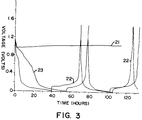
- Voltage-time curves of the initial discharging and subsequent cycling are shown in FIG. 3.
- the cells of Examples 2 and 3 with sequestering agents show minimal irreversible capacity 22, 23 during the first discharge, while the cell of Example 1 without sequestering agent shows only irreversible capacity 21. In the cell of Example 1, the decomposition reactions do not stop until substantially all the electrolyte in the cell is decomposed.
- Example 1-3 Three test cells are prepared as in Examples 1-3, using LiN(CF3SO2)2 as the electrolyte salt instead of LiAsF6.
- the cells are cycled as in Examples 1-3 and voltage-time curves of the cycling are shown in FIG. 4. Similar results are observed, with the cells of Examples 5 and 6 with sequestering agents showing minimal irreversible capacity 35, 36 during the first discharge, while the cell of Example 4 without sequestering agent show only irreversible capacity 34, with decomposition reactions continuing until substantially all the electrolyte in the cell is decomposed.
- Table I summarizes the effect of sequestering agent addition to the electrolyte solvent of Li/graphite cells:
- the secondary electrochemical cells and methods of making these cells in accordance with the present invention provide commercially feasible rechargeable batteries which do not suffer from the problems of exfoliation and initial capacity loss previously encountered.
Landscapes
- Chemical & Material Sciences (AREA)
- General Chemical & Material Sciences (AREA)
- Chemical Kinetics & Catalysis (AREA)
- Electrochemistry (AREA)
- Inorganic Chemistry (AREA)
- Engineering & Computer Science (AREA)
- Manufacturing & Machinery (AREA)
- General Physics & Mathematics (AREA)
- Condensed Matter Physics & Semiconductors (AREA)
- Physics & Mathematics (AREA)
- Secondary Cells (AREA)
- Battery Electrode And Active Subsutance (AREA)
- Carbon And Carbon Compounds (AREA)
Abstract
A secondary electrochemical cell including a first electrode (4) and a counterelectrode (3) each capable of reversibly incorporating an alkali metal, an alkali metal incorporated in at least one of the electrodes and an electrolyte solution containing an organic solvent, a salt of the alkali metal and at least one sequestering agent capable of complexing with the alkali moiety of the electrolyte salt, characterized in that the first electrode includes a carbon composition having a degree of graphitization greater than about 0.40. A method for intercalating alkali metal ions into a highly graphitic carbonaceous electrode material by contacting the electrode material with an electrolyte solution of an electrolyte solvent, an alkali metal electrolyte salt and at least one sequestering agent capable of complexing with the alkali metal moiety of the electrolyte salt, which electrolyte solution is also in contact with a counterelectrode, and applying a current between the electrode material and counterelectrode so that the alkali metal ions intercalate into the electrode material from the electrolyte solution, which sequestering agent substantially prevents cointercalation of the electrolyte solvent with the alkali metal ions into the electrode material.
Description
- The present invention relates to means and methods for preventing the exfoliation of highly graphitic carbonaceous electrode materials used in electrochemical cells, which exfoliation is associated with the decomposition of the cell electrolyte solvent. In particular, the present invention relates to electrochemical cells having electrodes of highly graphitic carbonaceous materials and electrolyte solutions to which sequestering agents have been added to prevent co-intercalation of the electrolyte solvent into the graphite electrode during initial cell discharge, which co-intercalation causes exfoliation of the graphite electrode.
- Electrochemical cells useful as electrical storage batteries usually incorporate a metal-containing anode and a cathode including an active material which can take up ions of the metal. An electrolyte incorporating ions of the metal is disposed in contact with the anode and the cathode. During discharge of the cell, metal ions leave the anode, enter the electrolyte and are taken up in the active material of the cathode, resulting in the release of electrical energy. Provided that the reaction between the metal ions and the cathode-active material is reversible, the process can be reversed by applying electrical energy to the cell. If such a reversible cathode-active material is provided in a cell having the appropriate physical configuration and an appropriate electrolyte, the cell can be recharged and reused. Rechargeable cells are commonly referred to in the battery art as "secondary" cells.
- It has long been known that useful secondary cells can be made using a light alkaline metal such as sodium, potassium, and particularly, lithium, as the source of the metal ions exchanged between the anode and cathode through the electrolyte. These metals are particularly useful in combination with a cathode-active material that is a sulfide or oxide of a transition metal, i.e., a metal capable of assuming plural different valence states. In the past, these alkaline metals such as lithium have been used in electrochemical cells in their pure metal state, as the cell counterelectrode in combination with the transition metal cathode-active material. See, for example, Dampier, J. Electrochem. Soc., 121(5), 656-660 (1974). It is common knowledge that water reacts violently with alkaline metals such as sodium, potassium and lithium in their pure metal state. Not only must water be excluded from any component of the cell having an alkaline metal counterelectrode, extreme care must be taken during cell assembly to avoid exposure of the counterelectrode metal material to ambient moisture and other sources of water.
- Secondary lithium cell researchers have sought to develop a rechargeable lithium cell containing no metallic lithium. Cells have been developed using instead of a lithium metal anode, a lithium intercalation host that operates near the potential of lithium, such as carbonaceous materials.
- Replacing lithium metal counterelectrodes with lithium intercalation host counterelectrodes removes the restrictions lithium metal electrodes place upon cell design and choice of electrolytes and also the adverse effect lithium metal places upon cycling performance and safety in the finished cell. Highly graphitic carbonaceous materials are ideal lithium intercalation hosts. Highly graphitic carbonaceous materials such as graphite are inexpensive, non-toxic and are capable of incorporation into electrochemical cells having relatively high specific capacities. The drawback to use of such materials is that upon the initial charging of the cell, when lithium is intercalated into the host, an irreversible reaction occurs in which lithium and the cell electrolyte solvent are consumed, resulting in an initial capacity loss for the cell and a reduction of the cell's overall performance. This reaction can be correlated to the tendency of highly graphitic carbonaceous intercalation hosts to exfoliate when initially intercalated with lithium metal. Exfoliation can be defined as the change in an intercalation host material resulting in an increase in its surface area subsequent to intercalation with lithium metal as compared to the surface area prior to intercalation. Highly graphitic carbonaceous materials have an organized layered structure, which layers are easily separated or exfoliated. The amount of electrolyte consumed upon initial intercalation is substantially proportional to the surface area of the carbonaceous intercalation host, so that the exfoliation of highly graphitic carbonaceous intercalation hosts upon initial charging results in the consumption of greater electrolyte solvent and loss of cell capacity and performance properties than occurs with carbonaceous or other intercalation hosts that do not suffer from exfoliation.
- Two solutions have been offered to the problem of exfoliation of highly graphitic carbonaceous intercalation hosts to prevent the excessive consumption of cell electrolyte solvent and consequent loss of cell capacity and performance properties. The first is to form a dual phase carbonaceous intercalation host having a mean degree of graphitization of at least about 0.40, with one phase having a degree of graphitization greater than 0.40 and the other phase having a degree of graphitization less than about 0.40. The other approach maintains the carbonaceous intercalation host at a temperature greater than about 50°C during the initial intercalation of the host with lithium. Both approaches provide a carbonaceous intercalation host resistant to exfoliation during the initial lithium intercalation. However, a solution to the exfoliation problem that does not require the replacement of single-phase highly graphitic intercalation hosts or the heat treatment of same would be highly desirable.
- Co-intercalation of electrolyte solvent with lithium into TiS₂ and ZrS₂ host electrodes is disclosed by McKinnon, J. Eletrochem. Soc., 132(2), 364 (1985). Morita et al., J. Electro. Soc., 134(9), 2107 (1987) discloses that the addition of crown ether sequestering agents to electrolyte solutions limits solvent co-intercalation into TiS₂ electrode hosts. U.S. Patent No. 4,132,837 to Soffer discloses that the addition of sequestering agents such as crown ethers to electrolyte solutions reduces the tendency of the electrolyte solvent to degrade in the presence of lithium metal anodes. None of these references, however, provide any guidance as to how to solve the exfoliation problem.
- It has now been discovered that the addition of a sequestering agent such as a glyme, crown ether or cryptand to electrolyte solutions of secondary cells having highly graphitic carbonaceous anode materials prevents exfoliation of the material upon the initial intercalation of an alkali metal such as lithium. Accordingly, one aspect of the present invention provides a secondary electrochemical cell having a first electrode and a counterelectrode each capable of reversibly incorporating an alkali metal, an alkali metal incorporated in at least one of the electrodes and an electrolyte solution of a salt of the alkali metal and at least one sequestering agent dissolved in an organic solvent, wherein the first electrode includes a single-phase carbonaceous material having a degree of graphitization greater than about 0.40.
- The term "degree of graphitization" refers to a parameter of the microstructure of the carbonaceous material having a numerical value between 0 and 1.0. In general, carbon having a high degree of graphitization has a more ordered microstructure more closely resembling the microstructure of graphite, whereas carbon having a low degree of graphitization has a less ordered microstructure more closely resembling that of coke. Carbon having a high degree of graphitization provides significant advantages with respect to charge capacity and also with respect to variation of cell voltage with state of charge during operation.
- Another aspect of the present invention provides a method for intercalating alkali metal ions into a highly graphitic carbonaceous electrode material by contacting the electrode material with an electrolyte solution of an electrolyte solvent, an alkali metal electrolyte salt, and at least one sequestering agent capable of complexing with the alkali moiety of the electrolyte salt, which electrolyte solution is also in contact with a counterelectrode, and applying a current between the electrode material and counterelectrode so that the alkali metal ions intercalate into the electrode material from the electrolyte solution, which sequestering agent substantially prevents cointercalation of the electrolyte solvent with the alkali metal ions into the electrode material.
- The electrochemical cells and methods of the invention solve the exfoliation and initial capacity loss problems in the use of highly graphitic carbonaceous materials as alkali metal intercalable anode materials in electrochemical cells.
- Without being bound by any particular theory of operation, it is believed that electrolyte solvent decomposition occurs during the first cell discharge, when the electrolyte solvent reacts with the carbonaceous anode material to form a passivating film on the surface of the carbonaceous material that is insoluble in the electrolyte solvent. During this reaction, the electrolyte solvent decomposes and is consumed until all the available surface area of the carbonaceous material is coated with the passivating film of the electrolyte solvent decomposition products, which film coating is an ionic conductor for alkali ions but an electronic insulator.
- It is further believed that the alkali ions in the electrolyte solution are coordinated by a solvation sphere made up of molecules of the electrolyte solvent. The ions typically have a diameter of two Angstroms, while the solvation sphere is typically ten times the size. During intercalation, the electrolyte solvent solvation sphere may be co-intercalated with the alkali ions into the highly graphitic carbonaceous anode material, and when this occurs, the organized layered structure of the graphitic material separates. This is defined as exfoliation, which creates freshly exposed carbonaceous 'surfaces with which more electrolyte decomposition can occur.
- Accordingly, it is believed that by preventing solvent co-intercalation into the highly graphitic carbonaceous anode material during cell charging by the addition to the electrolyte solution of sequestering agents, exfoliation of the carbonaceous electrode material is eliminated, thereby significantly reducing the anode surface area available for decomposition of the electrolyte solvent. Furthermore, the electrolyte solvent decomposition is significantly reduced without resort to less graphitic carbon phases or heat treatment of the carbonaceous anode material during initial alkaline intercalation.
- These and other aspects of the present invention will become apparent, as will a better understanding of the structure and operation of the present invention, when reference is made to the description which follows, taken with the drawings in which:
-
- FIG. 1 is a schematic, idealized view of an electrode assembly according to one embodiment of the invention;
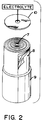
- FIG. 2 is a schematic, idealized view of a cell according to one embodiment of the invention;
- FIGS. 3 and 4 are graphs showing cell voltages versus time for Li/graphite cells having various electrolyte sequestering agent additives compared to control cells having no additives.
- A non-aqueous secondary cell according to one embodiment of the present invention is depicted in FIGS. 1 and 2. FIG. 1 depicts a typical electrode assembly in which a current collector 1 supported by a
backing 2 on which the cathode 3 of an electrochemically active material in particulate form is layered.Anode 4 is layered on conductive metallic support 5 and the two electrodes are sandwiched with aporous separator 6, such as a sheet of porous polypropylene, disposed therebetween to form a sheet-like flexible sandwich 11. As depicted in FIG.2, this layered assembly is wound around a metallic center post 7 to form aspiral assembly 8. The spiral assembly is then placed into thecell container 9, which is covered with acell cap 10. The conductive metallic support 5 and current collector 1 are connected by conventional means that are not shown withcontainer 9 andcap 10, respectfully. Thecontainer 9 and cap 10 are insulated from each other and serve as terminals for the finished cell. - Because a lithium metal anode is not used, the cell need not incorporate means for applying pressure on the anode. Such "stack pressure" in lithium metal anode cells minimizes dendritic and spongy growths on the lithium that gradually reduce cell capacity and ultimately contact the cathode, causing the cell to fail.
- Both electrodes are in contact with an electrolyte solution including an electrolyte salt of an alkali metal dissolved in one or more organic solvents, which electrolyte salt is not capable of being oxidized in the cell at the fully charged potential. Also dissolved in the electrolyte solvent are one or more sequestering agents capable of complexing with the alkali metal moiety of the electrolyte salt.
- Sequestering agents capable of complexing with the alkali moiety of the electrolyte salt include glymes and macroheterocyclic compounds such as crown ethers, and structurally related cryptands. Examples of glymes suitable for use with the present invention include those disclosed in co-pending and commonly owned U.S. Patent Application Serial Number 524,175, the disclosure of which is hereby incorporated herein by reference thereto.
- As explained in the above-cited co-pending patent application, glyme is a generic name for a family of glycoldiethers having the basic formula RO-(C₂H₄O)n-OR₁ where n is generally between about 1 and about 20 and R and R₁ can be the same or different and generally include short chain normal alkanes. A monoglyme has an n of 1, a diglyme has an n of 2, a triglyme has an n of 3, a tetraglyme has an n of 4, and so on. Dimethoxy ethane, also known as methyl monoglyme, or DME has a formula CH₃OC₂H₄OCH₃. Diethoxy ethane or ethyl monoglyme has a formula C₂H₅OC₂H₄OC₂H₅. Methyl triglyme has a formula of CH₃O(C₂H₄O)₃CH₃. Methyl tetraglyme has a formula CH₃O(C₂H₄O)₄CH₃. Typical glymes suitable for use with the present invention have n between 1 and about 20 and R and R₁ independently selected from normal alkanes up to four carbon atoms in length. Preferred glymes have n between 1 and about 10, with R and R₁ being selected from normal alkanes up to two carbon atoms in length. The most preferred glymes are methyl monoglyme, ethyl monoglyme, methyl diglyme, methyl triglyme and methyl tetraglyme.
- It is known to use glymes as electrolyte solvents with lithium metal anode cells. Until now, it was not known that the use of glymes with cells having highly graphitic carbonaceous anode materials would prevent the exfoliation of the graphitic structure of the anode.
- Crown ethers are macrocyclic polyethers containing repetitive units of the structure -C-C-O-or -C-C-C-O-. The resulting compound is a rigid heterocycle with a bi-dimensional cavity disposed within the center of the macromolecule with the ethereal oxygens facing inwardly of the cavity in coplanar fashion. Cryptands are similar in structure to crown ethers with the exception that two hetero oxygens are replaced in the latter with tertiary nitrogen atoms so as to enable the formation of a third crossing chain.
- Examples of crown ethers suitable for use with the present invention are those described in U.S. Patent Nos. 3,562,295; 3,687,978 and 3,987,061 to Pedersen, the disclosures of which are hereby incorporated herein by reference thereto.
- Preferred crown ethers include 12
crown 4 ether, benzo 14crown 4 ether, dicyclohexyl 18crown 6 ether, 15 crown 5 ether, 18crown 6 ether and 21 crown 7 ether. More preferred crown ethers include 12crown 4 ether, 15 crown 5 ether and 18crown 6 ether. The selection of a crown ether for use with a particular alkaline moiety can be readily determined by one of ordinary skill in the art without undue experimentation. The objective is the selection of a crown ether having atoms of optimum cavity size to permit penetration of the guest cation without penetration of the electrolyte solvent. This is best determined by preparing test cells in accordance with the present invention and determining with which materials the least amount of cell capacity loss occurs. The most preferred crown ether for lithium cations is 12crown 4 ether, while for sodium cations, the most preferred crown ether is 15 crown 5 ether. - Examples of cryptands suitable for use with the present invention include cryptand 211,
cryptand 221 and cryptand 222. Other macroheterocyclic compounds suitable for use with the present invention include crown, lantern and clam macrocyclic hetero imine compounds of U.S. Patent No. 3,848,949 to Pedersen; macromonocyclic compounds of U.S. Patent No.3,966,766 to Lehn; multiheteromacrocycles of U.S. Patent Nos. 3,965,116 and 4,001,279 to Cram; aroylcrownethers of U.S. Patent Nos. 3,997,565 and 4,024,158 to Kauer; the macroheterocyclic complexes of U.S. Patent No. 3,686,225 to Pedersen and the nitrogen-containing chelating agents of U.S. Patent No. 4,670,363 to Whitney, the disclosures all of which are hereby incorporated herein by reference thereto. - With respect to the other cell components of the present invention, the anode includes highly graphitic carbonaceous materials capable of reversibly intercalating alkali metals, the exfoliation of which is prevented by the addition of the sequestering agents of the present invention to the electrolyte solution. The highly graphitic carbonaceous anode materials suitable for use with the present invention have a degree of graphitization above about 0.40, preferably above 0.80 and most preferably about 1.0. As used in this disclosure, the term "degree of graphitization" refers to the value g according to the formula:

- The highly graphitic carbonaceous anode materials of the present invention may contain non-carbon components so long as the crystal structure of the materials maintains the required degree of graphitization. For example, boron-carbon-nitrogen materials are known having a highly graphitic suitable crystal structure that are disclosed in Kaner, et al., Mat. Res. Bull., 22, 399-404 (1987), the disclosure of which is hereby incorporated herein by reference thereto. Generally, any carbon-containing material, the crystal structure of which possesses the required degree of graphitization, is suitable for use with the present invention.
- Suitable alkali metals, the ions of which are exchanged between the cathode and anode include sodium, potassium and lithium. The preferred alkali metal is lithium.
- Suitable cathode materials include metal-chalcogen combinations, particularly transition metal-chalcogen combinations, metal halides, and the like. Chalcogens are understood by those of ordinary skill in the art to include the chemically-related elements from Group VI of the periodic table, namely oxygen, sulfur, selenium, tellurium and polonium. Preferred transition metals include manganese, nickel, iron, chromium, titanium, vanadium, molybdenum and cobalt. Preferred compositions include molybdenum sulfides, vanadium oxides and manganese oxides. MoS₂, V₆O₁₃, Mo₆S₈ and MnO₂ are more preferred, with MnO₂ being most preferred. Even more preferred is the gamma-phase MnO₂ disclosed in commonly-owned U.S. Patent No. 4,959,282 to Dahn, the disclosure of which is hereby incorporated herein by reference thereto.
- Lithiated carbon is a reactive material that is difficult to handle in air. Preferably, it is produced in-situ in the cell. This can be accomplished by placing a sheet of lithium metal between the anode and porous separator so that the lithium sheet lies adjacent to, and in contact with the anode, as disclosed in the above-cited U.S. Patent Application Serial No. 350,396 to Fong. The addition of the electrolyte to the cell causes the lithium metal in the sheet to intercalate into the carbonaceous anode material, because the lithium metal has a higher electrochemical potential than the anode.
- Alternatively, this sacrificial or consumable mass of lithium may be omitted, and the cell assembled with a lithiated cathode-active material. In such a case, the cell, when assembled, is in the discharged state. The carbonaceous anode material is lithiated by applying an externally generated electrical potential in order to charge the cell and draw lithium to the cathode-active material, through the electrolyte and into the carbonaceous anode material. This approach ordinarily is most practical when the cathode-active material, in its lithiated form, is stable in air and, hence, can be handled readily. Examples of such air-stable lithiated cathode materials include lithiated nickel oxide, the preparation of which for cathode fabrication is disclosed in co-pending U.S. Patent Application No. 556,754 to Dahn, lithiated cobalt oxides and lithiated mixed oxides of cobalt with nickel or tin. Among the suitable oxides are LiNiO₂, LiCoO₂, LiMn₂O₄, LiCo0.92Sn0.08O₂ and LiCo1-xNixO₂. Other less air-stable lithiated cathode-active material suitable for use with the present invention include the lithiated chevrel-phase materials disclosed in U.S. Patent No. 4,917,871 to Dahn and the lithiated manganese dioxides disclosed in U.S. Patent No. 4,959,282 to Dahn.
- The cathode may include the cathode-active material in particulate form with a suitable inner polymeric binder, such as the polymer of ethylene propylene diene monomer, commonly referred to as EPDM, a polyfluorinated hydrocarbon such as polytetrafluoroethylene (PTFE), or polyethylene oxide (PEO). Preferably, about 2% by weight or less of the polymer to cathode material is used.
- It is desirable that the cathode maintain its electrical conductivity at all states of charge. Conductivity may be enhanced by adding an electrically-conductive chemically-inert material, such as a carbonaceous material like graphite or carbon black, to the cathode.
- In assembling the cells of the present invention, the cathode is typically fabricated by depositing a slurry of the cathode material, the electrically conductive inert material, the binder and a fugitive liquid carrier such as cyclohexane, on the cathode current collector, and then evaporating the carrier to leave a coherent mass in electrical contact with the current collector.
- Likewise, the anode may include the highly graphitic carbonaceous anode material in particulate form with a suitable inert polymeric binder at a level of about 2% by weight or less of polymer to anode material. Expansion and contraction of the anode during cell cycling can cause the carbonaceous particles to lose electrically conductive contact with one another. Conductivity can be similarly enhanced by adding an electrically-conductive material, such as carbon black, to the anode material.
- In assembling the cell of the present invention, the anode is similarly fabricated by depositing a slurry of the highly graphitic carbonaceous anode material, the electrically-conductive inert material, the binder and a fugitive liquid carrier such as hexane on the electrically-conductive anode support and then evaporating the carrier to leave a coherent mass in electrical contact with the support.
- The cathode assembly is then combined with the anode assembly with the porous polymeric electrode separator sandwiched therebetween. If the cathode-active material is non-lithiated or insufficiently lithiated, a sheet of lithium metal foil is sandwiched between either the anode assembly or the cathode assembly and the porous separator. As shown in FIG. 1, a sheet of
lithium foil 12 is placed betweenanode 4 andseparator 6 so that the surface of the sheet is coextensive with the surface of the anode and the thickness of the sheet is chosen so that the correct amount of lithium is present for intercalation into the anode. The layered assembly is then wound around the metallic center post to form a spiral assembly that is then placed into the cell container to which is added the electrolyte solution into which the sequestering agent has been dissolved. The cell container is then covered with the cell cap. - The electrolyte solution includes an electrolyte salt of the alkali metal exchanged between the cathode and anode dissolved in the electrolyte solvent. The electrolyte salt should be compatible with both the cathode-active material, the highly graphitic carbonaceous anode material and the sequestering agent. When the alkali metal is lithium, suitable lithium electrolyte salts include LiAsF₆, LiPF₆, LiClO₄, LiBF₄, LiB(C₆H₅)₄, LiCF₃SO₃, LiN(CF₃SO₂)₂, LiSO₃F, LiAlCl₄, LiBr, and mixtures thereof. LiAsF₆, LiCF₃SO₃, LiN(CF₃SO₂)₂ and mixtures thereof are preferred. The concentration of the lithium compound in the electrolyte solvent preferably is about 0.5 molar to 1.5 molar and, more preferably, is about 1.0 molar.
- The electrolyte solvent preferably includes ester solvents, such as propylene carbonate (PC), ethylene carbonate (EC), butylene carbonate or mixtures thereof. When the solvent includes both PC and EC, the ratio of PC to EC by volume is preferably about 1:3 to about 3:1, more preferably about 1:2 to 2:1, and even more preferably, about 1:1. Other solvents may be used such as 2-methyl tetrahydrofuran (2-MTHF), tetrahydrofuran, sulfolane, dimethylsulfite, p-dioxane, 1,3-dioxane, dimethoxyethane (DME) and diethylether. Of the lower viscosity solvents, DME is preferred. One useful electrolyte solvent includes about 50% DME and 50% EC, all by volume. References in this disclosure to percentages of solvent ingredients by volume should be understood as referring to the volume of the individual ingredients prior to mixing.
- DME is a glyme. When included in the electrolyte solvents for use in combination with the highly graphitic carbonaceous anode materials of the present invention, the glymes also function as sequestering agents. While not essential, one or more other sequestering agents such as crown ethers may also be dissolved in the electrolyte solvent. However, a cell having an electrolyte solvent containing a glyme and no other sequestering agent is defined as including a sequestering agent in accordance with the present invention.
- The electrolyte solution also includes at least one of the sequestering agents of the present invention dissolved in the electrolyte solvent, at a molar concentration at least about equal to the molar concentration of the electrolyte salt. That is, the molar ratio of sequestering agent to electrolyte salt is preferably greater than about 1:1. The ratio is more preferably greater than about 2:1. The concentration of sequestering agent will depend upon the efficiency with which the sequestering agent complexes with the alkali metal moiety. The most efficient sequestering agent for lithium cations is 12
crown 4 ether. Accordingly, the preferred molar ratio of 12crown 4 ether to electrolyte salt is about 1:1. The efficiency of a sequestering agent can be readily determined by one of ordinary skill in the art without undue experimentation. Like the selection of a crown ether, this is best determined by preparing test cells in accordance with the present invention and determining the degree of cell capacity loss that occurs with each sequestering agent. - The following examples serve to provide further appreciation of the invention, but are not meant in any way to restrict the effective scope of the invention.
- Three test cells are assembled using a lithium metal anode, a graphite cathode and an electrolyte of 1M LiAsF₆ in PC electrolyte solvent. No sequestering agent is used in the cell of Example 1. 12
crown 4 ether is added to the electrolyte solvent of the cell of Example 2 at a solution concentration of 1M. The electrolyte solvent of the cell of Example 3 has a 1M concentration of tetraglyme. - The cells are then discharged to transfer lithium metal from the anode to the graphite, where it intercalates or reacts with electrolyte using the same discharge currents for each cell, which discharge currents correspond to a change of x=1 in LixC₆ in 40 hours in the absence of irreversible reactions. Voltage-time curves of the initial discharging and subsequent cycling are shown in FIG. 3. The cells of Examples 2 and 3 with sequestering agents show minimal
irreversible capacity irreversible capacity 21. In the cell of Example 1, the decomposition reactions do not stop until substantially all the electrolyte in the cell is decomposed. - Three test cells are prepared as in Examples 1-3, using LiN(CF₃SO₂)₂ as the electrolyte salt instead of LiAsF₆. The cells are cycled as in Examples 1-3 and voltage-time curves of the cycling are shown in FIG. 4. Similar results are observed, with the cells of Examples 5 and 6 with sequestering agents showing minimal
irreversible capacity irreversible capacity 34, with decomposition reactions continuing until substantially all the electrolyte in the cell is decomposed. - Table I summarizes the effect of sequestering agent addition to the electrolyte solvent of Li/graphite cells:

- The foregoing examples establish that the addition of sequestering agents to the electrolyte solvents of electrochemical cells having highly graphitic carbonaceous anode materials virtually eliminates the irreversible capacity that occurs on the first intercalation of lithium into the highly graphitic carbonaceous anode materials, with a consequential improvement in the cycling capacity of the cells.
- As will be readily appreciated, numerous variations and combinations of the features set forth above can be utilized without departing from the present invention as set forth in the claims. Such variations are not regarded as a departure from the spirit and scope of the invention, and all such modifications are intended to be included within the scope of the following claims.
- The secondary electrochemical cells and methods of making these cells in accordance with the present invention provide commercially feasible rechargeable batteries which do not suffer from the problems of exfoliation and initial capacity loss previously encountered.
Claims (23)
- A secondary electrochemical cell comprising a first electrode (4) and a counterelectrode (3) each capable of reversibly incorporating an alkali metal, an alkali metal incorporated in at least one of said electrodes and an electrolyte comprising an organic solvent, a salt of said alkali metal and at least one sequestering agent capable of complexing with the alkali moiety of said electrolyte salt, characterized by said first electrode including a composition consisting essentially of carbon having a degree of graphitization greater than about 0.40.
- A cell as claimed in claim 1, characterized in that said degree of graphitization is greater than about 0.80.
- A cell as claimed in claim 2, characterized in that said degree of graphitization is about 1.00.
- A cell as claimed in claim 1, characterized in that said first electrode includes a composition consisting essentially of a highly graphitic carbonaceous material selected from the group consisting of synthetic graphites, natural graphites, petroleum cokes heat-treated at temperatures above 2100°C, carbons prepared by chemical vapor deposition or pyrolysis of hydrocarbons.
- A cell as claimed in claim 1 or 4, characterized in that said alkali metal is lithium.
- A cell as claimed in claim 1 or 4, characterized in that said at least one sequestering agent is selected from the group consisting of glymes, crown ethers, cryptands and combinations thereof.
- A cell as claimed in claim 6, characterized in that said sequestering agent includes a glyme having a structure represented by the formula:
RO-(C₂H₄O)n-OR₁
wherein n is between 1 and about 20 and R and R₁ are independently selected from the group consisting of short-chained normal alkanes up to about four carbon atoms in length. - A cell as claimed in claim 7, characterized in that n is between 1 and about 10 and R and R₁ are independently selected from the group consisting of normal alkanes up to two carbon atoms in length.
- A cell as claimed in claim 8, characterized in that said glymes are selected from the group consisting of methyl monoglyme, ethyl monoglyme, methyl diglyme, methyl triglyme and methyl tetraglyme.
- A cell as claimed in claim 6, characterized in that said sequestering agent includes a crown ether selected from the group consisting of 12 crown 4 ether, benzo 14 crown 4 ether, dicyclohexyl 18 crown 6 ether, 15 crown 5 ether, 18 crown 6 ether and 21 crown 7 ether.
- A cell as claimed in claim 1, 4 or 6 characterized in that said molar ratio of said sequestering agent to said electrolyte salt is greater than about 1:1.
- A cell as claimed in claim 1, 4 or 6 characterized in that said electrolyte solution comprises one or more solvents selected from the group consisting of ethylene carbonate, propylene carbonate, butylene carbonate, 2-methyl tetrahydrofuran, tetrahydrofuran, sulfolane, dimethylsulfite, p-dioxane, 1,3-dioxane, dimethyl ether and diethoxyethane.
- A cell as claimed in claim 1, 4 or 6 characterized in that said alkali metal electrolyte salt is selected from the group consisting of LiAsF₆, LiPF₆, LiClO₄, LiBF₄, LiB(C₆H₅)₄, LiCF₃SO₃, LiN(CF₃SO₂)₂, LiSO₃F, LiAlCl₄, LiBr and mixtures thereof.
- A cell as claimed in claim 1, 4 or 6 characterized in that said counterelectrode includes a transition metal chalcogenide material.
- A cell as claimed in claim 14, characterized in that said transition metal is selected from the group consisting of manganese, nickel, iron, chromium, titanium, vanadium, molybdenum, cobalt and mixtures thereof.
- A cell as claimed in claim 4, characterized in that said transition metal chalcogenide is lithiated.
- A method for intercalating alkali metal ions into a highly graphitic carbonaceous electrode material, said method characterized by the steps of:
contacting said electrode material with an electrolyte solution of an electrolyte solvent, an alkali metal electrolyte salt and at least one sequestering agent capable of complexing with the alkali metal moiety of said electrolyte salt, which electrolyte solution is also in contact with a counterelectrode (3); and
applying a current between said highly graphitic carbonaceous electrode material and said counterelectrode so that said alkali metal ions intercalate into said highly graphitic carbonaceous electrode material from said electrolyte solution;
whereby said sequestering agent substantially prevents cointercalation of said electrolyte solvent with said alkali metal ions with said highly graphitic carbonaceous electrode material. - The method as claimed in claim 17, characterized in that said highly graphitic carbonaceous electrode material has a degree of graphitization greater than about 0.40.
- The method as claimed in claim 17, said sequestering agents are selected from the group consisting of glymes, crown ethers and cryptands.
- A method as claimed in claim 17, characterized in that said electrolyte solution comprises one or more solvents selected from the group consisting of ethylene carbonate, propylene carbonate, butylene carbonate, 2-methyl tetrahydrofuran, tetrahydrofuran, sulfolane, dimethylsulfite, p-dioxane, 1,3-dioxane, dimethoxyethane and diethyl ether.
- A method as claimed in claim 17 or 20, characterized in that said alkali metal electrolyte salt is selected from the group consisting of LiAsF₆, LiPF₆, LiClO₄, LiBF₄, LiB(C₆H₅)₄ , LiCF₃SO₃, LiN(CF₃SO₂)₂, LiSO₃F, LiAlCl₄, LiBr and mixtures thereof.
- A method as claimed in claim 17 or 20, characterized in that said counterelectrode includes a transition metal chalcogenide material.
- A method as claimed in claim 22, characterized in that said transition metal is selected from the group consisting manganese, nickel, iron, chromium, titanium, vanadium, molybdenum, cobalt and mixtures thereof.
Applications Claiming Priority (2)
| Application Number | Priority Date | Filing Date | Title |
|---|---|---|---|
| US602497 | 1990-10-24 | ||
| US07/602,497 US5130211A (en) | 1990-10-24 | 1990-10-24 | Electrolyte solution sequestering agents for electrochemical cells having carbonaceous electrodes |
Publications (1)
| Publication Number | Publication Date |
|---|---|
| EP0484304A1 true EP0484304A1 (en) | 1992-05-06 |
Family
ID=24411588
Family Applications (1)
| Application Number | Title | Priority Date | Filing Date |
|---|---|---|---|
| EP91850159A Withdrawn EP0484304A1 (en) | 1990-10-24 | 1991-06-11 | Electrolyte solution sequestering agents for electrochemical cells having carbonaceous electrodes |
Country Status (4)
| Country | Link |
|---|---|
| US (1) | US5130211A (en) |
| EP (1) | EP0484304A1 (en) |
| JP (1) | JPH0613110A (en) |
| CA (1) | CA2043779A1 (en) |
Cited By (2)
| Publication number | Priority date | Publication date | Assignee | Title |
|---|---|---|---|---|
| EP0752727A1 (en) * | 1995-07-03 | 1997-01-08 | General Motors Corporation | Method for manufacturing lithium-deactivated carbon anodes |
| WO2015136855A1 (en) * | 2014-03-14 | 2015-09-17 | Toyota Jidosha Kabushiki Kaisha | Nonaqueous electrolyte secondary battery, method for producing same and nonaqueous electrolyte |
Families Citing this family (87)
| Publication number | Priority date | Publication date | Assignee | Title |
|---|---|---|---|---|
| AU665575B2 (en) * | 1991-09-30 | 1996-01-11 | Wilson Greatbatch Ltd. | Autoclavable electrochemical cell |
| US5686138A (en) * | 1991-11-12 | 1997-11-11 | Sanyo Electric Co., Ltd. | Lithium secondary battery |
| CA2098248C (en) * | 1993-06-11 | 1999-03-16 | Jeffrey Raymond Dahn | Electron acceptor substituted carbons for use as anodes in rechargeable lithium batteries |
| US5439760A (en) * | 1993-11-19 | 1995-08-08 | Medtronic, Inc. | High reliability electrochemical cell and electrode assembly therefor |
| CA2114902C (en) | 1994-02-03 | 2001-01-16 | David S. Wainwright | Aqueous rechargeable battery |
| US5571635A (en) * | 1994-04-15 | 1996-11-05 | National Research Council Of Canada | Electrolyte for a secondary cell |
| US5529859A (en) * | 1994-04-15 | 1996-06-25 | National Research Council Of Canada | Elecrolyte for a secondary cell |
| FR2719161B1 (en) * | 1994-04-22 | 1996-08-02 | Accumulateurs Fixes | Electrochemical rechargeable lithium battery with carbon anode. |
| CA2122770C (en) * | 1994-05-03 | 2000-10-03 | Moli Energy (1990) Limited | Carbonaceous host compounds and use as anodes in rechargeable batteries |
| US5503717A (en) * | 1994-06-13 | 1996-04-02 | Kang; Feiyu | Method of manufacturing flexible graphite |
| CA2127621C (en) | 1994-07-08 | 1999-12-07 | Alfred Macdonald Wilson | Carbonaceous insertion compounds and use as anodes in rechargeable batteries |
| US5491041A (en) * | 1994-10-14 | 1996-02-13 | Eic Laboratories, Inc. | Solid-state secondary batteries with graphite anodes |
| US6030720A (en) * | 1994-11-23 | 2000-02-29 | Polyplus Battery Co., Inc. | Liquid electrolyte lithium-sulfur batteries |
| US6358643B1 (en) | 1994-11-23 | 2002-03-19 | Polyplus Battery Company | Liquid electrolyte lithium-sulfur batteries |
| JPH10512390A (en) * | 1995-01-13 | 1998-11-24 | エス・アール・アイ・インターナシヨナル | Organic liquid electrolyte and plasticizer |
| CA2144037C (en) * | 1995-03-03 | 2000-12-05 | Jiayu Simon Xue | Carbonaceous insertion compounds and use as anodes in rechargeable batteries |
| US6337159B1 (en) * | 1995-03-07 | 2002-01-08 | Ramot University Authority For Applied Research & Industrial Development Ltd. | Lithium anode with solid electrolyte interface |
| US5569558A (en) * | 1995-06-05 | 1996-10-29 | Wilson Greatbatch Ltd. | Reduced voltage delay additive for nonaqueous electrolyte in alkali metal electrochemical cell |
| US5705689A (en) * | 1995-06-19 | 1998-01-06 | Associated Universities, Inc. | Aza compounds as anion receptors |
| JPH09129236A (en) * | 1995-08-25 | 1997-05-16 | Furukawa Battery Co Ltd:The | Negative active material for lithium secondary battery and lithium secondary battery |
| US5712059A (en) * | 1995-09-26 | 1998-01-27 | Valence Technology, Inc. | Carbonaceous electrode and compatible electrolyte solvent |
| US5759715A (en) * | 1995-09-26 | 1998-06-02 | Valence Technology, Inc. | Lithium ion batteries containing pre-lithiated electrodes |
| US5643695A (en) * | 1995-09-26 | 1997-07-01 | Valence Technology, Inc. | Carbonaceous electrode and compatible electrolyte |
| DE69710787T2 (en) | 1996-05-22 | 2002-11-21 | Moltech Corp., Tucson | COMPOSITE CATHODES, ELECTROCHEMICAL CELLS WITH COMPOSITE CATHODES AND METHOD FOR THE PRODUCTION THEREOF |
| US5756062A (en) * | 1996-05-29 | 1998-05-26 | Ucar Carbon Technology Corporation | Chemically modified graphite for electrochemical cells |
| US6203946B1 (en) | 1998-12-03 | 2001-03-20 | Valence Technology, Inc. | Lithium-containing phosphates, method of preparation, and uses thereof |
| US5780182A (en) * | 1996-11-04 | 1998-07-14 | Valence Technology, Inc. | Propylene carbonate based electrolyte for lithium ion electrochemical cell |
| US5910381A (en) * | 1997-04-17 | 1999-06-08 | Barker; Jeremy | Chlorinated diethyl carbonate solvent for battery |
| KR20010041259A (en) * | 1998-12-25 | 2001-05-15 | 마츠시타 덴끼 산교 가부시키가이샤 | Lithium secondary cell |
| US6153333A (en) | 1999-03-23 | 2000-11-28 | Valence Technology, Inc. | Lithium-containing phosphate active materials |
| USH1946H1 (en) | 1999-06-30 | 2001-03-06 | United States Of America | Tertiary polyamines as additives to lithium-ion cell electrolytes to provide lithium-ion cell having improved properties |
| US7524584B2 (en) * | 2000-04-27 | 2009-04-28 | Valence Technology, Inc. | Electrode active material for a secondary electrochemical cell |
| US8057769B2 (en) * | 2000-04-27 | 2011-11-15 | Valence Technology, Inc. | Method for making phosphate-based electrode active materials |
| US6964827B2 (en) * | 2000-04-27 | 2005-11-15 | Valence Technology, Inc. | Alkali/transition metal halo- and hydroxy-phosphates and related electrode active materials |
| US6387568B1 (en) * | 2000-04-27 | 2002-05-14 | Valence Technology, Inc. | Lithium metal fluorophosphate materials and preparation thereof |
| US6777132B2 (en) * | 2000-04-27 | 2004-08-17 | Valence Technology, Inc. | Alkali/transition metal halo—and hydroxy-phosphates and related electrode active materials |
| US6645452B1 (en) | 2000-11-28 | 2003-11-11 | Valence Technology, Inc. | Methods of making lithium metal cathode active materials |
| WO2002097907A2 (en) * | 2001-04-06 | 2002-12-05 | Valence Technology, Inc. | Sodium ion batteries |
| US6815122B2 (en) | 2002-03-06 | 2004-11-09 | Valence Technology, Inc. | Alkali transition metal phosphates and related electrode active materials |
| US20030190527A1 (en) * | 2002-04-03 | 2003-10-09 | James Pugh | Batteries comprising alkali-transition metal phosphates and preferred electrolytes |
| US7482097B2 (en) * | 2002-04-03 | 2009-01-27 | Valence Technology, Inc. | Alkali-transition metal phosphates having a +3 valence non-transition element and related electrode active materials |
| US7422823B2 (en) * | 2002-04-03 | 2008-09-09 | Valence Technology, Inc. | Alkali-iron-cobalt phosphates and related electrode active materials |
| DE10314826B4 (en) * | 2003-04-01 | 2007-01-25 | Dilo Trading Ag | Process for the production of electrodes, electrodes and use of the electrodes |
| US7041239B2 (en) * | 2003-04-03 | 2006-05-09 | Valence Technology, Inc. | Electrodes comprising mixed active particles |
| US20070141468A1 (en) * | 2003-04-03 | 2007-06-21 | Jeremy Barker | Electrodes Comprising Mixed Active Particles |
| WO2008013409A1 (en) * | 2006-07-28 | 2008-01-31 | Lg Chem, Ltd. | Secondary batteries comprising eutectic mixture and preparation method thereof |
| US8658309B2 (en) * | 2006-08-11 | 2014-02-25 | California Institute Of Technology | Dissociating agents, formulations and methods providing enhanced solubility of fluorides |
| CN100463287C (en) * | 2006-09-20 | 2009-02-18 | 广州天赐高新材料股份有限公司 | Electrolyte for high rate lithium-ion batteries |
| JP5094084B2 (en) * | 2006-09-28 | 2012-12-12 | 三洋電機株式会社 | Nonaqueous electrolyte secondary battery |
| US8673067B2 (en) * | 2009-05-21 | 2014-03-18 | Battelle Memorial Institute | Immobilized fluid membranes for gas separation |
| US8715392B2 (en) * | 2009-05-21 | 2014-05-06 | Battelle Memorial Institute | Catalyzed CO2-transport membrane on high surface area inorganic support |
| WO2010137862A2 (en) | 2009-05-26 | 2010-12-02 | 주식회사 엘지화학 | Lithium secondary battery with high energy density |
| US20110059364A1 (en) * | 2009-09-10 | 2011-03-10 | Battelle Memorial Institute | Air electrodes for high-energy metal air batteries and methods of making the same |
| US8481187B2 (en) | 2009-09-10 | 2013-07-09 | Battelle Memorial Institute | High-energy metal air batteries |
| US9039788B2 (en) * | 2009-11-18 | 2015-05-26 | Battelle Memorial Institute | Methods for making anodes for lithium ion batteries |
| US8568930B2 (en) * | 2009-12-18 | 2013-10-29 | GM Global Technology Operations LLC | Lithium ion battery |
| US8785054B2 (en) * | 2009-12-18 | 2014-07-22 | GM Global Technology Operations LLC | Lithium ion battery |
| KR20130112704A (en) * | 2010-05-06 | 2013-10-14 | 타이코 일렉트로닉스 저팬 지.케이. | Ptc device and secondary battery equipped with same |
| JP2011249216A (en) * | 2010-05-28 | 2011-12-08 | Fdk Energy Co Ltd | Lithium battery |
| US9023520B2 (en) | 2011-01-12 | 2015-05-05 | GM Global Technology Operations LLC | Lithium ion battery |
| US9077038B2 (en) | 2011-01-12 | 2015-07-07 | GM Global Technology Operations LLC | Lithium ion batteries |
| CN102306791B (en) | 2011-08-18 | 2014-08-06 | 合肥国轩高科动力能源股份公司 | A kind of preparation method of carbon-coated non-stoichiometric ratio lithium iron phosphorus oxide material |
| EP2971259B8 (en) | 2013-03-13 | 2018-11-21 | NantEnergy, Inc. | Synergistic additives for electrochemical cells with electrodeposited fuel |
| US9269998B2 (en) | 2013-03-13 | 2016-02-23 | Fluidic, Inc. | Concave gas vent for electrochemical cell |
| US9865854B2 (en) | 2013-09-30 | 2018-01-09 | GM Global Technology Operations LLC | Lithium ion battery separators and electrodes |
| US9362542B2 (en) | 2013-09-30 | 2016-06-07 | GM Global Technology Operations LLC | Lithium ion battery components with chelating agents having oriented permanent dipole moments |
| US9799916B2 (en) | 2013-09-30 | 2017-10-24 | GM Global Technology Operations LLC | Lithium ion battery electrodes |
| US10243241B2 (en) | 2015-12-01 | 2019-03-26 | GM Global Technology Operations LLC | Lithium ion battery with transition metal ion traps |
| US10050313B2 (en) | 2016-06-19 | 2018-08-14 | GM Global Technology Operations LLC | Lithium ion battery |
| US10008749B2 (en) | 2016-06-19 | 2018-06-26 | GM Global Technology Operations LLC | Lithium ion battery |
| US9938217B2 (en) | 2016-07-01 | 2018-04-10 | Res Usa, Llc | Fluidized bed membrane reactor |
| WO2018004992A1 (en) | 2016-07-01 | 2018-01-04 | Res Usa, Llc | Conversion of methane to dimethyl ether |
| US10189763B2 (en) | 2016-07-01 | 2019-01-29 | Res Usa, Llc | Reduction of greenhouse gas emission |
| JP2019521497A (en) | 2016-07-22 | 2019-07-25 | ナントエナジー,インク. | Water and carbon dioxide management system in the electrochemical cell |
| US11228066B2 (en) | 2016-07-22 | 2022-01-18 | Form Energy, Inc. | Mist elimination system for electrochemical cells |
| US10950893B2 (en) | 2016-12-19 | 2021-03-16 | Honda Motor Co., Ltd. | Liquid electrolyte for battery |
| JP6802911B2 (en) * | 2017-05-01 | 2020-12-23 | 株式会社村田製作所 | Negative electrode for lithium ion secondary battery and lithium ion secondary battery |
| US10581117B2 (en) | 2017-07-07 | 2020-03-03 | GM Global Technology Operations LLC | Iron ion trapping van der Waals gripper additives for electrolyte systems in lithium-ion batteries |
| US10581119B2 (en) | 2017-07-07 | 2020-03-03 | GM Global Technology Operations LLC | Polymeric ion traps for suppressing or minimizing transition metal ions and dendrite formation or growth in lithium-ion batteries |
| US10418668B2 (en) | 2017-07-07 | 2019-09-17 | GM Global Technology Operations LLC | Electrolyte system including complexing agent to suppress or minimize metal contaminants and dendrite formation in lithium ion batteries |
| PL3709427T3 (en) | 2017-12-01 | 2024-11-25 | Daikin Industries, Ltd. | Electrolyte, electrochemical device, lithium ion secondary battery, and module |
| GB201720745D0 (en) | 2017-12-13 | 2018-01-24 | Faradion Ltd | Non-aqueous electrolyte compositions |
| CN112805868A (en) | 2018-06-29 | 2021-05-14 | 福恩能源公司 | Metal air electrochemical cell frame |
| CN119481486A (en) | 2018-06-29 | 2025-02-18 | 福恩能源公司 | Rolling diaphragm seal |
| US11424484B2 (en) | 2019-01-24 | 2022-08-23 | Octet Scientific, Inc. | Zinc battery electrolyte additive |
| CN114207915A (en) | 2019-06-28 | 2022-03-18 | 福恩能源公司 | Device architecture for metal-air battery |
| WO2021226399A1 (en) | 2020-05-06 | 2021-11-11 | Form Energy, Inc. | Decoupled electrode electrochemical energy storage system |
Citations (3)
| Publication number | Priority date | Publication date | Assignee | Title |
|---|---|---|---|---|
| US4132837A (en) * | 1978-03-30 | 1979-01-02 | University Patents, Inc. | Electrochemical cells with non-aqueous electrolytes containing macroheterocyclic compounds |
| EP0201038A1 (en) * | 1985-04-30 | 1986-11-12 | Toshiba Battery Co., Ltd. | Secondary battery using non-aqueous solvent |
| EP0251677A2 (en) * | 1986-06-24 | 1988-01-07 | Sharp Kabushiki Kaisha | Graphite intercalation compound electrodes for rechargeable batteries and a method for the manufacture of the same |
Family Cites Families (3)
| Publication number | Priority date | Publication date | Assignee | Title |
|---|---|---|---|---|
| US4707423A (en) * | 1982-06-10 | 1987-11-17 | Celanese Corporation | Electric storage battery and process for the manufacture thereof |
| JPS59151779A (en) * | 1983-02-19 | 1984-08-30 | Hitachi Maxell Ltd | Lithium organic secondary battery |
| DE3406472A1 (en) * | 1984-02-23 | 1985-08-29 | Basf Ag, 6700 Ludwigshafen | ELECTROCHEMICAL CELL OR BATTERY |
-
1990
- 1990-10-24 US US07/602,497 patent/US5130211A/en not_active Expired - Fee Related
-
1991
- 1991-06-03 CA CA002043779A patent/CA2043779A1/en not_active Abandoned
- 1991-06-11 EP EP91850159A patent/EP0484304A1/en not_active Withdrawn
- 1991-07-22 JP JP3206488A patent/JPH0613110A/en active Pending
Patent Citations (3)
| Publication number | Priority date | Publication date | Assignee | Title |
|---|---|---|---|---|
| US4132837A (en) * | 1978-03-30 | 1979-01-02 | University Patents, Inc. | Electrochemical cells with non-aqueous electrolytes containing macroheterocyclic compounds |
| EP0201038A1 (en) * | 1985-04-30 | 1986-11-12 | Toshiba Battery Co., Ltd. | Secondary battery using non-aqueous solvent |
| EP0251677A2 (en) * | 1986-06-24 | 1988-01-07 | Sharp Kabushiki Kaisha | Graphite intercalation compound electrodes for rechargeable batteries and a method for the manufacture of the same |
Cited By (3)
| Publication number | Priority date | Publication date | Assignee | Title |
|---|---|---|---|---|
| EP0752727A1 (en) * | 1995-07-03 | 1997-01-08 | General Motors Corporation | Method for manufacturing lithium-deactivated carbon anodes |
| US5743921A (en) * | 1995-07-03 | 1998-04-28 | General Motors Corporation | Method of making a cell using a lithium-deactivated carbon anode |
| WO2015136855A1 (en) * | 2014-03-14 | 2015-09-17 | Toyota Jidosha Kabushiki Kaisha | Nonaqueous electrolyte secondary battery, method for producing same and nonaqueous electrolyte |
Also Published As
| Publication number | Publication date |
|---|---|
| CA2043779A1 (en) | 1992-04-25 |
| US5130211A (en) | 1992-07-14 |
| JPH0613110A (en) | 1994-01-21 |
Similar Documents
| Publication | Publication Date | Title |
|---|---|---|
| US5130211A (en) | Electrolyte solution sequestering agents for electrochemical cells having carbonaceous electrodes | |
| EP0931365B1 (en) | Electrolyte comprising fluoro-ethylene carbonate and propylene carbonate, for alkali metal-ion secondary battery | |
| KR100458099B1 (en) | Lithium-containing, lithium-intercalating phosphates and their use as the positive or negative electrode material in a lithium secondary battery | |
| CA2214186C (en) | Negative electrode for a rechargeable lithium battery | |
| KR101799505B1 (en) | Positive electrode active material, positive electrode, and nonaqueous electrolyte cell | |
| CA2032137C (en) | Carbonaceous electrodes for lithium cells | |
| EP0880187B1 (en) | Non-aqueous electrolyte secondary battery | |
| US8586246B2 (en) | Positive electrode active material, positive electrode using the same and non-aqueous electrolyte secondary battery | |
| US5529859A (en) | Elecrolyte for a secondary cell | |
| EP0688057B1 (en) | Lithium ion secondary battery | |
| EP0713256B1 (en) | Lithium secondary battery and process for preparing negative-electrode active material for use in the same | |
| EP1347524B1 (en) | Positive electrode active material and nonaqueous electrolyte secondary cell | |
| US5069683A (en) | Process of making a rechargeable battery | |
| US5756062A (en) | Chemically modified graphite for electrochemical cells | |
| EP1415355A2 (en) | Improved lithium-ion batteries | |
| KR100512620B1 (en) | Electr0de material for non-aqueous solvent secondary cell, electrode and secondary cell | |
| US20230317916A1 (en) | High energy li batteries with lean lithium metal anodes and methods for prelithiation | |
| US5571635A (en) | Electrolyte for a secondary cell | |
| JPH09245830A (en) | Non-aqueous electrolyte secondary battery | |
| JP3480764B2 (en) | Non-aqueous electrolyte secondary battery | |
| US5639576A (en) | Heteroatom incorporated coke for electrochemical cell electrode | |
| JP3135613B2 (en) | Lithium secondary battery | |
| CA2186273C (en) | Electrolyte for a secondary cell | |
| WO2003058732A1 (en) | New electrode materials for a rechargeable electrochemical cell | |
| JPH0536440A (en) | Lithium secondary battery |
Legal Events
| Date | Code | Title | Description |
|---|---|---|---|
| PUAI | Public reference made under article 153(3) epc to a published international application that has entered the european phase |
Free format text: ORIGINAL CODE: 0009012 |
|
| AK | Designated contracting states |
Kind code of ref document: A1 Designated state(s): AT BE CH DE DK ES FR GB GR IT LI LU NL SE |
|
| 17P | Request for examination filed |
Effective date: 19920421 |
|
| 17Q | First examination report despatched |
Effective date: 19940422 |
|
| STAA | Information on the status of an ep patent application or granted ep patent |
Free format text: STATUS: THE APPLICATION IS DEEMED TO BE WITHDRAWN |
|
| 18D | Application deemed to be withdrawn |
Effective date: 19940903 |