EP0484147A1 - Propanil dispersible granule formulation - Google Patents
Propanil dispersible granule formulation Download PDFInfo
- Publication number
- EP0484147A1 EP0484147A1 EP91310048A EP91310048A EP0484147A1 EP 0484147 A1 EP0484147 A1 EP 0484147A1 EP 91310048 A EP91310048 A EP 91310048A EP 91310048 A EP91310048 A EP 91310048A EP 0484147 A1 EP0484147 A1 EP 0484147A1
- Authority
- EP
- European Patent Office
- Prior art keywords
- propanil
- less
- dispersible
- granules
- percent
- Prior art date
- Legal status (The legal status is an assumption and is not a legal conclusion. Google has not performed a legal analysis and makes no representation as to the accuracy of the status listed.)
- Granted
Links
- LFULEKSKNZEWOE-UHFFFAOYSA-N propanil Chemical compound CCC(=O)NC1=CC=C(Cl)C(Cl)=C1 LFULEKSKNZEWOE-UHFFFAOYSA-N 0.000 title claims abstract description 53
- 239000000203 mixture Substances 0.000 title claims abstract description 42
- 239000008187 granular material Substances 0.000 title claims description 61
- 238000009472 formulation Methods 0.000 title abstract description 21
- XLYOFNOQVPJJNP-UHFFFAOYSA-N water Substances O XLYOFNOQVPJJNP-UHFFFAOYSA-N 0.000 claims description 33
- 238000000034 method Methods 0.000 claims description 24
- 239000002245 particle Substances 0.000 claims description 22
- 239000004094 surface-active agent Substances 0.000 claims description 22
- 239000002270 dispersing agent Substances 0.000 claims description 19
- 239000000080 wetting agent Substances 0.000 claims description 16
- 230000008569 process Effects 0.000 claims description 12
- 238000001035 drying Methods 0.000 claims description 11
- 239000002518 antifoaming agent Substances 0.000 claims description 10
- UHZZMRAGKVHANO-UHFFFAOYSA-M chlormequat chloride Chemical compound [Cl-].C[N+](C)(C)CCCl UHZZMRAGKVHANO-UHFFFAOYSA-M 0.000 claims description 10
- 239000007884 disintegrant Substances 0.000 claims description 10
- VYPSYNLAJGMNEJ-UHFFFAOYSA-N silicon dioxide Inorganic materials O=[Si]=O VYPSYNLAJGMNEJ-UHFFFAOYSA-N 0.000 claims description 8
- 238000002156 mixing Methods 0.000 claims description 7
- -1 silica compound Chemical class 0.000 claims description 7
- 238000003801 milling Methods 0.000 claims description 6
- 229920001732 Lignosulfonate Polymers 0.000 claims description 2
- 239000000377 silicon dioxide Substances 0.000 claims 2
- 235000019357 lignosulphonate Nutrition 0.000 claims 1
- PSZYNBSKGUBXEH-UHFFFAOYSA-M naphthalene-1-sulfonate Chemical compound C1=CC=C2C(S(=O)(=O)[O-])=CC=CC2=C1 PSZYNBSKGUBXEH-UHFFFAOYSA-M 0.000 claims 1
- 229920001296 polysiloxane Polymers 0.000 claims 1
- 230000002363 herbicidal effect Effects 0.000 abstract description 6
- 239000004009 herbicide Substances 0.000 abstract description 6
- 239000000047 product Substances 0.000 description 14
- 239000000575 pesticide Substances 0.000 description 10
- 239000004480 active ingredient Substances 0.000 description 9
- 238000001125 extrusion Methods 0.000 description 9
- 239000007787 solid Substances 0.000 description 9
- 239000000428 dust Substances 0.000 description 7
- 239000003795 chemical substances by application Substances 0.000 description 6
- 239000008233 hard water Substances 0.000 description 6
- 239000000463 material Substances 0.000 description 6
- 238000002360 preparation method Methods 0.000 description 6
- 239000006185 dispersion Substances 0.000 description 5
- 239000004615 ingredient Substances 0.000 description 5
- 238000005259 measurement Methods 0.000 description 5
- 238000002844 melting Methods 0.000 description 5
- 238000012360 testing method Methods 0.000 description 5
- VMHLLURERBWHNL-UHFFFAOYSA-M Sodium acetate Chemical compound [Na+].CC([O-])=O VMHLLURERBWHNL-UHFFFAOYSA-M 0.000 description 4
- UIIMBOGNXHQVGW-UHFFFAOYSA-M Sodium bicarbonate Chemical compound [Na+].OC([O-])=O UIIMBOGNXHQVGW-UHFFFAOYSA-M 0.000 description 4
- YDEXUEFDPVHGHE-GGMCWBHBSA-L disodium;(2r)-3-(2-hydroxy-3-methoxyphenyl)-2-[2-methoxy-4-(3-sulfonatopropyl)phenoxy]propane-1-sulfonate Chemical compound [Na+].[Na+].COC1=CC=CC(C[C@H](CS([O-])(=O)=O)OC=2C(=CC(CCCS([O-])(=O)=O)=CC=2)OC)=C1O YDEXUEFDPVHGHE-GGMCWBHBSA-L 0.000 description 4
- 238000005469 granulation Methods 0.000 description 4
- 230000003179 granulation Effects 0.000 description 4
- 238000012545 processing Methods 0.000 description 4
- 235000017281 sodium acetate Nutrition 0.000 description 4
- 239000001632 sodium acetate Substances 0.000 description 4
- 241000218645 Cedrus Species 0.000 description 3
- IAYPIBMASNFSPL-UHFFFAOYSA-N Ethylene oxide Chemical compound C1CO1 IAYPIBMASNFSPL-UHFFFAOYSA-N 0.000 description 3
- 229910000831 Steel Inorganic materials 0.000 description 3
- 238000005054 agglomeration Methods 0.000 description 3
- 230000002776 aggregation Effects 0.000 description 3
- 238000000227 grinding Methods 0.000 description 3
- 239000007788 liquid Substances 0.000 description 3
- 150000003839 salts Chemical class 0.000 description 3
- 239000010959 steel Substances 0.000 description 3
- 239000000725 suspension Substances 0.000 description 3
- IJGRMHOSHXDMSA-UHFFFAOYSA-N Atomic nitrogen Chemical compound N#N IJGRMHOSHXDMSA-UHFFFAOYSA-N 0.000 description 2
- VTYYLEPIZMXCLO-UHFFFAOYSA-L Calcium carbonate Chemical compound [Ca+2].[O-]C([O-])=O VTYYLEPIZMXCLO-UHFFFAOYSA-L 0.000 description 2
- QAOWNCQODCNURD-UHFFFAOYSA-N Sulfuric acid Chemical compound OS(O)(=O)=O QAOWNCQODCNURD-UHFFFAOYSA-N 0.000 description 2
- 125000000129 anionic group Chemical group 0.000 description 2
- 239000011230 binding agent Substances 0.000 description 2
- 239000012530 fluid Substances 0.000 description 2
- BXWNKGSJHAJOGX-UHFFFAOYSA-N hexadecan-1-ol Chemical compound CCCCCCCCCCCCCCCCO BXWNKGSJHAJOGX-UHFFFAOYSA-N 0.000 description 2
- 230000036961 partial effect Effects 0.000 description 2
- 239000003090 pesticide formulation Substances 0.000 description 2
- 230000000704 physical effect Effects 0.000 description 2
- 239000000843 powder Substances 0.000 description 2
- 229910000030 sodium bicarbonate Inorganic materials 0.000 description 2
- 235000017557 sodium bicarbonate Nutrition 0.000 description 2
- 239000000243 solution Substances 0.000 description 2
- 239000002904 solvent Substances 0.000 description 2
- 238000003860 storage Methods 0.000 description 2
- 238000009736 wetting Methods 0.000 description 2
- ALSTYHKOOCGGFT-KTKRTIGZSA-N (9Z)-octadecen-1-ol Chemical compound CCCCCCCC\C=C/CCCCCCCCO ALSTYHKOOCGGFT-KTKRTIGZSA-N 0.000 description 1
- XFRVVPUIAFSTFO-UHFFFAOYSA-N 1-Tridecanol Chemical compound CCCCCCCCCCCCCO XFRVVPUIAFSTFO-UHFFFAOYSA-N 0.000 description 1
- CBQDTCDOVVBGMN-UHFFFAOYSA-N 2-methyl-3-octylphenol Chemical compound CCCCCCCCC1=CC=CC(O)=C1C CBQDTCDOVVBGMN-UHFFFAOYSA-N 0.000 description 1
- DUIOKRXOKLLURE-UHFFFAOYSA-N 2-octylphenol Chemical compound CCCCCCCCC1=CC=CC=C1O DUIOKRXOKLLURE-UHFFFAOYSA-N 0.000 description 1
- OYPRJOBELJOOCE-UHFFFAOYSA-N Calcium Chemical compound [Ca] OYPRJOBELJOOCE-UHFFFAOYSA-N 0.000 description 1
- CURLTUGMZLYLDI-UHFFFAOYSA-N Carbon dioxide Chemical compound O=C=O CURLTUGMZLYLDI-UHFFFAOYSA-N 0.000 description 1
- 241000287828 Gallus gallus Species 0.000 description 1
- DGAQECJNVWCQMB-PUAWFVPOSA-M Ilexoside XXIX Chemical compound C[C@@H]1CC[C@@]2(CC[C@@]3(C(=CC[C@H]4[C@]3(CC[C@@H]5[C@@]4(CC[C@@H](C5(C)C)OS(=O)(=O)[O-])C)C)[C@@H]2[C@]1(C)O)C)C(=O)O[C@H]6[C@@H]([C@H]([C@@H]([C@H](O6)CO)O)O)O.[Na+] DGAQECJNVWCQMB-PUAWFVPOSA-M 0.000 description 1
- IGFHQQFPSIBGKE-UHFFFAOYSA-N Nonylphenol Natural products CCCCCCCCCC1=CC=C(O)C=C1 IGFHQQFPSIBGKE-UHFFFAOYSA-N 0.000 description 1
- 241000219000 Populus Species 0.000 description 1
- XUIMIQQOPSSXEZ-UHFFFAOYSA-N Silicon Chemical compound [Si] XUIMIQQOPSSXEZ-UHFFFAOYSA-N 0.000 description 1
- UIIMBOGNXHQVGW-DEQYMQKBSA-M Sodium bicarbonate-14C Chemical compound [Na+].O[14C]([O-])=O UIIMBOGNXHQVGW-DEQYMQKBSA-M 0.000 description 1
- DBMJMQXJHONAFJ-UHFFFAOYSA-M Sodium laurylsulphate Chemical compound [Na+].CCCCCCCCCCCCOS([O-])(=O)=O DBMJMQXJHONAFJ-UHFFFAOYSA-M 0.000 description 1
- 229920002472 Starch Polymers 0.000 description 1
- ULUAUXLGCMPNKK-UHFFFAOYSA-N Sulfobutanedioic acid Chemical class OC(=O)CC(C(O)=O)S(O)(=O)=O ULUAUXLGCMPNKK-UHFFFAOYSA-N 0.000 description 1
- 239000011149 active material Substances 0.000 description 1
- 230000002411 adverse Effects 0.000 description 1
- 238000013019 agitation Methods 0.000 description 1
- 125000001931 aliphatic group Chemical class 0.000 description 1
- 125000002877 alkyl aryl group Chemical group 0.000 description 1
- XAGFODPZIPBFFR-UHFFFAOYSA-N aluminium Chemical compound [Al] XAGFODPZIPBFFR-UHFFFAOYSA-N 0.000 description 1
- 229910052782 aluminium Inorganic materials 0.000 description 1
- 229920005550 ammonium lignosulfonate Polymers 0.000 description 1
- 239000007864 aqueous solution Substances 0.000 description 1
- 239000007900 aqueous suspension Substances 0.000 description 1
- 150000001491 aromatic compounds Chemical class 0.000 description 1
- QVGXLLKOCUKJST-UHFFFAOYSA-N atomic oxygen Chemical compound [O] QVGXLLKOCUKJST-UHFFFAOYSA-N 0.000 description 1
- 230000015572 biosynthetic process Effects 0.000 description 1
- JIJAYWGYIDJVJI-UHFFFAOYSA-N butyl naphthalene-1-sulfonate Chemical compound C1=CC=C2C(S(=O)(=O)OCCCC)=CC=CC2=C1 JIJAYWGYIDJVJI-UHFFFAOYSA-N 0.000 description 1
- 239000011575 calcium Substances 0.000 description 1
- 229910052791 calcium Inorganic materials 0.000 description 1
- 229910000019 calcium carbonate Inorganic materials 0.000 description 1
- 229920005551 calcium lignosulfonate Polymers 0.000 description 1
- 235000011089 carbon dioxide Nutrition 0.000 description 1
- 125000002091 cationic group Chemical group 0.000 description 1
- 229960000541 cetyl alcohol Drugs 0.000 description 1
- 239000004927 clay Substances 0.000 description 1
- 238000005056 compaction Methods 0.000 description 1
- 230000002860 competitive effect Effects 0.000 description 1
- 239000007859 condensation product Substances 0.000 description 1
- 238000001816 cooling Methods 0.000 description 1
- 229920001577 copolymer Polymers 0.000 description 1
- 230000007812 deficiency Effects 0.000 description 1
- 239000003085 diluting agent Substances 0.000 description 1
- GVGUFUZHNYFZLC-UHFFFAOYSA-N dodecyl benzenesulfonate;sodium Chemical compound [Na].CCCCCCCCCCCCOS(=O)(=O)C1=CC=CC=C1 GVGUFUZHNYFZLC-UHFFFAOYSA-N 0.000 description 1
- 230000000694 effects Effects 0.000 description 1
- 239000003995 emulsifying agent Substances 0.000 description 1
- 238000005538 encapsulation Methods 0.000 description 1
- 230000002708 enhancing effect Effects 0.000 description 1
- 150000002148 esters Chemical class 0.000 description 1
- 235000012438 extruded product Nutrition 0.000 description 1
- 150000002191 fatty alcohols Chemical class 0.000 description 1
- 239000012467 final product Substances 0.000 description 1
- 230000009969 flowable effect Effects 0.000 description 1
- 239000011888 foil Substances 0.000 description 1
- 238000010438 heat treatment Methods 0.000 description 1
- 230000006872 improvement Effects 0.000 description 1
- 239000011261 inert gas Substances 0.000 description 1
- 230000000266 injurious effect Effects 0.000 description 1
- 238000004898 kneading Methods 0.000 description 1
- 239000000787 lecithin Substances 0.000 description 1
- 235000010445 lecithin Nutrition 0.000 description 1
- 238000004519 manufacturing process Methods 0.000 description 1
- 230000008018 melting Effects 0.000 description 1
- 238000012986 modification Methods 0.000 description 1
- 230000004048 modification Effects 0.000 description 1
- 239000012768 molten material Substances 0.000 description 1
- PSZYNBSKGUBXEH-UHFFFAOYSA-N naphthalene-1-sulfonic acid Chemical class C1=CC=C2C(S(=O)(=O)O)=CC=CC2=C1 PSZYNBSKGUBXEH-UHFFFAOYSA-N 0.000 description 1
- 229910052757 nitrogen Inorganic materials 0.000 description 1
- SNQQPOLDUKLAAF-UHFFFAOYSA-N nonylphenol Chemical compound CCCCCCCCCC1=CC=CC=C1O SNQQPOLDUKLAAF-UHFFFAOYSA-N 0.000 description 1
- 235000012149 noodles Nutrition 0.000 description 1
- 229940055577 oleyl alcohol Drugs 0.000 description 1
- XMLQWXUVTXCDDL-UHFFFAOYSA-N oleyl alcohol Natural products CCCCCCC=CCCCCCCCCCCO XMLQWXUVTXCDDL-UHFFFAOYSA-N 0.000 description 1
- 150000002894 organic compounds Chemical class 0.000 description 1
- 239000001301 oxygen Substances 0.000 description 1
- 229910052760 oxygen Inorganic materials 0.000 description 1
- 235000012771 pancakes Nutrition 0.000 description 1
- 239000008188 pellet Substances 0.000 description 1
- 150000002989 phenols Chemical class 0.000 description 1
- 150000003014 phosphoric acid esters Chemical class 0.000 description 1
- 229920000058 polyacrylate Polymers 0.000 description 1
- QQONPFPTGQHPMA-UHFFFAOYSA-N propylene Natural products CC=C QQONPFPTGQHPMA-UHFFFAOYSA-N 0.000 description 1
- 125000004805 propylene group Chemical group [H]C([H])([H])C([H])([*:1])C([H])([H])[*:2] 0.000 description 1
- 230000009467 reduction Effects 0.000 description 1
- 230000002829 reductive effect Effects 0.000 description 1
- 238000005096 rolling process Methods 0.000 description 1
- 239000013049 sediment Substances 0.000 description 1
- 238000007873 sieving Methods 0.000 description 1
- 229910052710 silicon Inorganic materials 0.000 description 1
- 239000010703 silicon Substances 0.000 description 1
- 239000000344 soap Substances 0.000 description 1
- 239000011734 sodium Substances 0.000 description 1
- 229910052708 sodium Inorganic materials 0.000 description 1
- 229940080264 sodium dodecylbenzenesulfonate Drugs 0.000 description 1
- 235000019333 sodium laurylsulphate Nutrition 0.000 description 1
- 229920005552 sodium lignosulfonate Polymers 0.000 description 1
- 159000000000 sodium salts Chemical class 0.000 description 1
- RCIJACVHOIKRAP-UHFFFAOYSA-N sodium;1,4-dioctoxy-1,4-dioxobutane-2-sulfonic acid Chemical compound [Na+].CCCCCCCCOC(=O)CC(S(O)(=O)=O)C(=O)OCCCCCCCC RCIJACVHOIKRAP-UHFFFAOYSA-N 0.000 description 1
- 239000007921 spray Substances 0.000 description 1
- 229910001220 stainless steel Inorganic materials 0.000 description 1
- 239000010935 stainless steel Substances 0.000 description 1
- 239000008107 starch Substances 0.000 description 1
- 235000019698 starch Nutrition 0.000 description 1
- 125000005504 styryl group Chemical group 0.000 description 1
- 239000000126 substance Substances 0.000 description 1
- 150000003871 sulfonates Chemical class 0.000 description 1
- 231100000331 toxic Toxicity 0.000 description 1
- 230000002588 toxic effect Effects 0.000 description 1
- 229940087291 tridecyl alcohol Drugs 0.000 description 1
- 238000005303 weighing Methods 0.000 description 1
Classifications
-
- A—HUMAN NECESSITIES
- A01—AGRICULTURE; FORESTRY; ANIMAL HUSBANDRY; HUNTING; TRAPPING; FISHING
- A01N—PRESERVATION OF BODIES OF HUMANS OR ANIMALS OR PLANTS OR PARTS THEREOF; BIOCIDES, e.g. AS DISINFECTANTS, AS PESTICIDES OR AS HERBICIDES; PEST REPELLANTS OR ATTRACTANTS; PLANT GROWTH REGULATORS
- A01N37/00—Biocides, pest repellants or attractants, or plant growth regulators containing organic compounds containing a carbon atom having three bonds to hetero atoms with at the most two bonds to halogen, e.g. carboxylic acids
- A01N37/18—Biocides, pest repellants or attractants, or plant growth regulators containing organic compounds containing a carbon atom having three bonds to hetero atoms with at the most two bonds to halogen, e.g. carboxylic acids containing the group —CO—N<, e.g. carboxylic acid amides or imides; Thio analogues thereof
- A01N37/22—Biocides, pest repellants or attractants, or plant growth regulators containing organic compounds containing a carbon atom having three bonds to hetero atoms with at the most two bonds to halogen, e.g. carboxylic acids containing the group —CO—N<, e.g. carboxylic acid amides or imides; Thio analogues thereof the nitrogen atom being directly attached to an aromatic ring system, e.g. anilides
-
- A—HUMAN NECESSITIES
- A01—AGRICULTURE; FORESTRY; ANIMAL HUSBANDRY; HUNTING; TRAPPING; FISHING
- A01N—PRESERVATION OF BODIES OF HUMANS OR ANIMALS OR PLANTS OR PARTS THEREOF; BIOCIDES, e.g. AS DISINFECTANTS, AS PESTICIDES OR AS HERBICIDES; PEST REPELLANTS OR ATTRACTANTS; PLANT GROWTH REGULATORS
- A01N33/00—Biocides, pest repellants or attractants, or plant growth regulators containing organic nitrogen compounds
Definitions
- This invention relates to novel dispersible granule formulations of the herbicide propanil and processes for their preparation.
- Water dispersible granular pesticide formulations are known. These formulations are desirable because they avoid the use of potentially toxic solvents and permit the use of easily-disposable paper containers or water soluble containers. Potential exposure of pesticide applicators and the general public to the pesticide or solvent is thereby reduced.
- Typical dispersible granular pesticide formulations are described for example in GB-A-1,433,882, EP-A-0,252,896 and US-A- 3,920,442.
- GB 1,433,882 describes a process for preparing dispersible granules by blending premilled, water-insoluble, active ingredient, dispersing agents, disintegrating agent and wetting agents in an aqueous suspension. The aqueous mix is extruded to form granules which are then dried to yield the final product.
- US-A-3,920,442 describes water dispersible pesticide aggregates containing 5 to 95% by weight of pesticide. The aggregates are prepared by contacting the finely divided solid ingredients in a fluidized bed with a fine spray of water or a solution of the binder-dispersant followed by drying.
- Propanil herbicide is N-(3,4-dichlorophenyl)propionamide.
- Dispersible granular (DG) formulations are designated propanil DG or dry flowable (DF).
- the percentage active ingredient in the formulation is sometimes indicated, as for example, propanil 80 DG or propanil 60 DG.
- a DG herbicide composition designed for dispersion in a liquid carrier should ideally have a high content of active material, should be readily dispersible in the carrier and should then form a dispersion which is as stable as possible, requiring the minimum of subsequent agitation for homogeneity.
- the liquid carrier will, of course, for convenience normally be water.
- Low-melting solids such as propanil present an especially difficult problem in the preparation of a dispersible granule formulation.
- the low-melting solid herein defined as melting below 100° C., tends to melt or become sticky during or subsequent to the grinding process which is a necessary step in preparing dispersible granules.
- EP-A-0,252,896 describes a possible solution to this problem which requires micro-encapsulation of low-melting pesticides prior to granulation. However, microencapsulation involves additional processing steps and adds to the cost of the overall formulation.
- this invention provides a process for producing a dispersible propanil granule comprising:
- a further aspect of the invention provides a dispersible granule comprising at least 60 percent by weight propanil, said granule having a suspensibility of at least 70 percent, preferably at least 80%, and being dispersible in fewer than 15 cylinder inversions.
- granular form granules substantially all of which have a mean particle size of at least 1 mm., i.e a particle size much larger than the mean particle size of a powder, the mean particle size of which is measured in microns.
- the granule has less than 0.3% by weight of particles less than 45 microns in diameter after 10 minutes of attrition.
- a more preferred granule of this invention is a dispersible granule comprising at least 80% propanil, said granule having a suspensibility of at least 65%, preferably at least 80% and dispersibility in less than 15 cylinder inversions.
- the mixture to be formed into dispersible granules will generally contain one or more surfactants and, optionally, flow enhancing agents, dispersants, wetting agents and defoaming agents.
- the suspensibility test was performed according to the procedure of the Collaborative International Pesticides Analytical Council (CIPAC) Handbook, Vol. 1, Ed. G. R. RAW (1970), Method Number MT 15.1.
- Standard hard water (342 ppm as calcium carbonate) was prepared according to CIPAC method MT 18.1.4., also known as Army Hard Water. Suspensibility is measured as a 0.9% to 2.0% weight/volume dispersion in standard hard water.
- Dispersibility is measured by placing one gram of the dispersible granules in 100 ml of 342 ppm hardness water and repeatedly slowly inverting the test cylinder until the material is completely dispersed. Preferably, dispersion should be complete in 15 or fewer cylinder inversions.
- “Attrition” as used in this application is defined as the reduction in particle size which occurs when propanil granules are shaken with steel balls as described in Example 1(c)(3).
- surfactant is used in the broad sense to include materials which may be referred to as emulsifying agents, dispersing agents and wetting agents, and the surfactant component may comprise one or more surfactants selected from the anionic, cationic and nonionic type.
- surfactants of the anionic type include soaps, salts of aliphatic monoesters of sulfuric acid such as sodium lauryl sulfate, salts of sulfonated aromatic compounds, for example sodium dodecylbenzene sulfonate, sodium, calcium or ammonium lignosulfonate or butylnaphthalene sulfonate, and a mixture of the sodium salts of diisopropyl- and triiso-propylnapthalene sulfonates.
- Suitable agents of the non-ionic type include, for example, the condensation products of ethylene oxide with fatty alcohols such as oleyl alcohol or cetyl alcohol, or with alkyl phenols such as octyl phenol, nonyl phenol and octyl cresol.
- Other non-ionic agents are the partial esters with ethylene oxide and the lecithins and phosphorylated surfactants such as phosphorylated ethylene oxide/propylene oxideblock copolymer and ethyoxylated and phosphorylated styryl substituted phenol.
- the surfactant component will comprise at least one wetting agent such as those selected from alkyl naphthalene sulfonates, alkylaryl polyoxyethylene ammonium sulfonates phosphate esters, sulfosuccinates and nonionics such as tridecyl alcohol ethoxylate; and/or at least one dispersing agent such as those selected from the group of naphthalene sulfonates, lignosulfonates, polyacrylates and phosphate esters.
- wetting agent such as those selected from alkyl naphthalene sulfonates, alkylaryl polyoxyethylene ammonium sulfonates phosphate esters, sulfosuccinates and nonionics such as tridecyl alcohol ethoxylate
- dispersing agent such as those selected from the group of naphthalene sulfonates, lignosulfonates, polyacrylates and phosphate esters.
- the total surfactant component will comprise from 0.1 to 25% and preferably from 1 to 15% by weight of the dry weight of the composition.
- a dispersing agent is a surfactant which facilitates the dispersion of the pesticide particles when the product is added to a liquid, for example water.
- the dispersing agents used are preferably water-soluble ones.
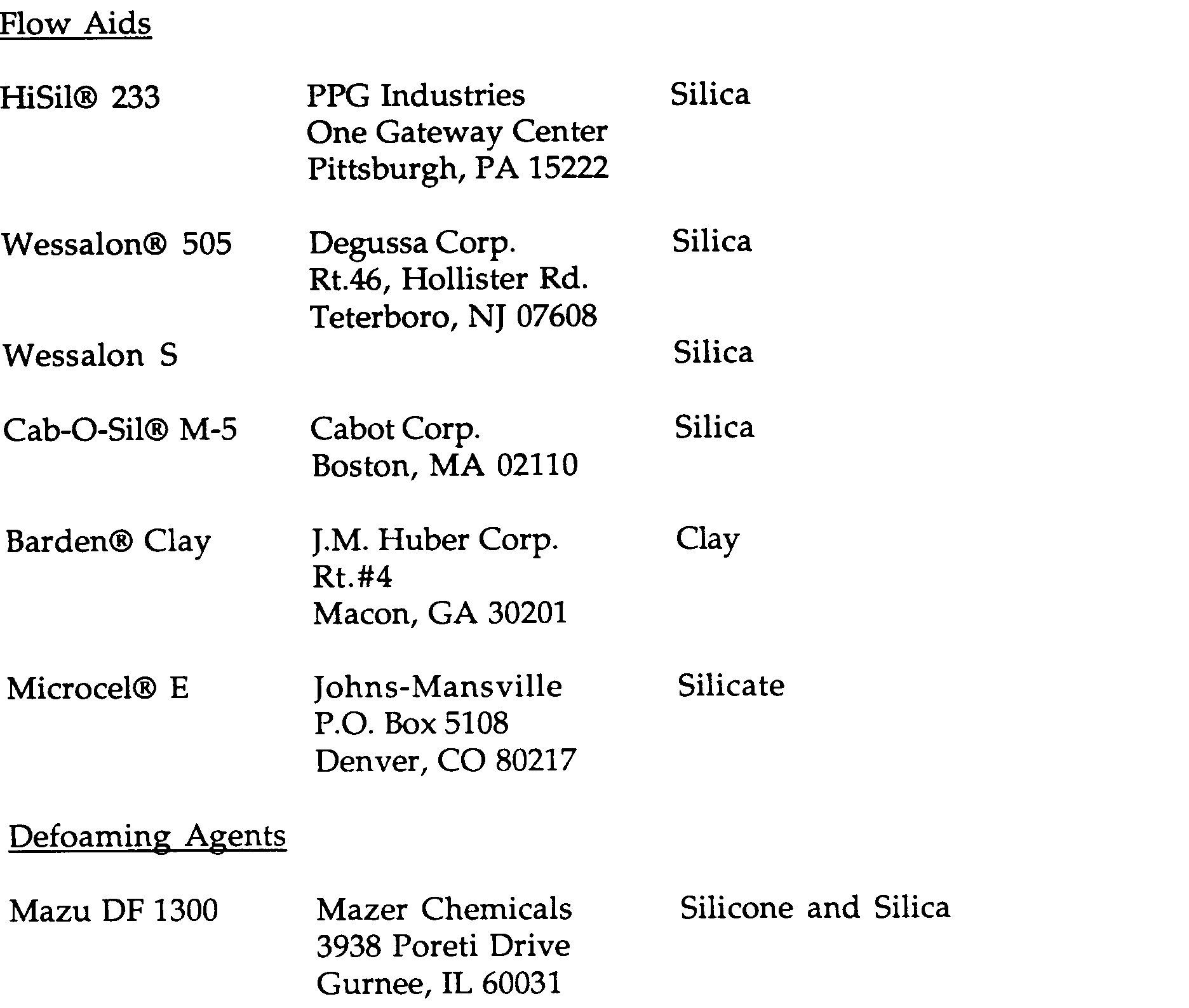
- Examples of dispersants preferred for the dispersible granule formulations of this invention include: Tamol 731®, Polyfon®H, Polyfon O, Reax® 88B, Morwet® D-425, Reax 45DA, Polyfon T, Polyfon F, Polyfon H, LignosolTM XD-65, Reax 45L, Reax 85A, Reax 910, Polyfon OD, PC-825 Polyfon T. Most preferred dispersants are: Reax 85A and Polyfon H.
- surfactants preferred as wetting agents for the dispersible granule formulations of this invention include Morwet® B, Morwet EFW, Sellogen® DFL, Morwet IP, Igepon® AC-78, Igepon T-77, Aerosol OT-B, and Surfactant XN-45S. Most preferred wetting agents are Morwet B and Surfactant XN-45S.
- surfactants act as dispersing agents to some degree, and also to some degree as wetting agents; most surface-active agents are, however, more efficient in one capacity than the other.
- the worker of ordinary skill in the formulation art can select a surfactant most suitable for the purpose in view.
- Flow aids such as clays or silica particles may be used to minimize these problems.
- Flow aids preferred for the propanil dispersible granular include HiSil® 233, Wessalon® 50S, Cab-O-Sil® M-5, Wessalon S, Barden® Clay, and Microcel® E. Most preferred are HiSil 233 and Wessalon 50S.
- the flow aid content of the dispersible granule may vary from 0 to 10% and preferably from 1 to 8%.
- Defoaming agents may be used in amounts of 0.1% to 5%; a preferred range is about 0.2% to 1.0%.
- the preferred defoaming agent is Mazu DF-1300.
- Disintegrants which are water soluble, organic compounds such as starch or sugar or inorganic salts such as sodium acetate or sodium bicarbonate, are sometimes used in dispersible granule formulations. See GB 1,433,882 for example. We have found that these disintegrants have adverse effects on the propanil dispersible granules of this invention. Formulations containing disintegrants were found to be more dusty and disperse less effectively than the granules of this invention.
- Dust is herein defined as particles having a diameter less than 45 microns.
- a solid having less than 0.3% by weight dust is defined as “non-dusty” while a solid with more than 4% dust is defined as “very dusty”.
- Solids with 0.3-4% dust are defined as “dusty”.
- Dust content and resistance to attrition of the propanil dispersible granules of this invention are minimized by forming the granules by the preferred mode of extrusion.
- composition of this invention comprises by weight percent: propanil 80%; dispersant, Reax 85A, 9.2%; flow aid, HiSil, 4.0%; wetting agent, surfactant XN-45S, 2.0%; defoaming agent, Mazu DF-1300, 0.5%; and water, less than 1%.
- the dispersible granules of this invention are generally prepared by milling one or more surfactants, combined with an amount of propanil sufficient to achieve at least 60% active ingredient in said granules, to a particle size of less than 20 microns, preferably less than 15 microns and more preferably less than 10 microns, thereby forming a pre-mix; adding to said pre-mix less than 25% water, based on the total weight of the composition optionally adding a wetting agent and mixing until a paste is obtained; granulating said paste; and drying the granules thus produced.
- pre-mix refers to a mixture of active ingredient, plus optionally dispersant, flow aid and defoaming agent; the above ingredients are generally milled to a partial size of 3 to 15 microns, preferably about 8 to 9 microns to form the pre-mix.
- the final composition is prepared from the pre-mix by adding water, optionally containing a dissolved wetting agent, thus forming a "paste", then blending, agglomerating and drying.
- Agglomeration or granulation may be accomplished by any operable means such as tabletting, pan agglomeration, or extrusion. Extrusion is the preferred method.
- Suspensibility of the granule is proportional to the amount of water added to the premix prior to extrusion granulation. In the case of however, addition of too much water will cause sticking of the extrudate as it exits the extruder.
- the relationship of water content of premix and suspensibility is shown in the table below.
- the preferred amount of water to be added to the premix is 18 to 20 parts per 100 parts of premix.
- the dispersible granules are dried.
- High drying temperatures are injurious to the product.
- the preferred drying temperature is less than 60° C. and more preferably less than 40° C. Drying may be accomplished by any suitable drying means which supplies inert gas at a controlled temperature. A two stage fluid bed dryer is preferred.
- a preferred process for producing the propanil dispersible granules of this invention comprises:
- the coarse milled propanil was blended with other formulation ingredients in a Marion mixer (Mfg. for Rapid Machinery Co., Marion Mixer, Iowa by Texas Div. Tranter Inc. Old Burk Road, Wichita Falls, TX USA) in the following ratio of ingredients: and mixed for 20 minutes.
- a Marion mixer Mfg. for Rapid Machinery Co., Marion Mixer, Iowa by Texas Div. Tranter Inc. Old Burk Road, Wichita Falls, TX USA
- the above blend was transferred to a Bantam micropulverizer, (obtainable from Mikropul, 10 Chantaur Road, Summit, NJ 07901, USA, fitted with a 0.42 inch (1.1 cm) screen and automatic feed; the grinding chamber was cooled with dry ice.
- the mean particle size of micropulverized product was 43.8 microns.
- micropulverized product was then air milled in an 8 ⁇ horizontal (pancake) jet mill, Fluid Energy Processing and Equipment Co., 153 Penn Energy, Hatfield, PA 19440.
- An Accu-Rate feeder (Accurate Feeder, 746 E. Milwauke Street, White Water, WI 53190, USA) was fitted with a 2 ⁇ screw feed nozzle positioned to deliver micropulverized material to the air mill. High pressure nitrogen was used for both feeding and grinding to maintain an oxygen concentration below 10%. The ground material was collected in the air bag.
- Propanil premix (98.0 parts by weight), Surfactant XN-45S (60% aqueous solution, 3.33 parts by weight) and water (16.67 parts by weight) were mixed in a Kitchen Aid mixer, (Hobart, Kitchen Aid Div. Troy, Ohio, USA) for approximately 2-3 minutes.
- the mixture was transferred to a KAR 130 extruder, (Tsu Tsui Rikagaku Kikai Co., Ltd., Japan) fitted with a 1.0 mm screen. After extrusion, the extrudate was air dried to a moisture content of 1-2% at a temperature of less than 40° C.
- % suspensibility [1 - weight of residue] x 111
- One gram propanil DG was added to 100 ml of Army Hard Water in a 100 ml glass-stoppered graduated cylinder. The cylinder was inverted until the DG was completely dispersed and the number of inversions was recorded.
- the steel balls were removed from the pan and the granules were transferred to the top of the nested sieves in the order of 20, 60, 100, 200, 325 mesh and bottom pan.
- the nested screens were inserted into the Ro-top and shaken for 15 minutes. The amount of residue on each sieve and bottom pan was determined. The weight percent of each fraction was determined by sieving before and after the attrition test.
- DG Approximately 5 grams DG was weighed to the nearest 0.01 g in a preweighed pan, and dried 24 hours ( ⁇ 1 hour) at 60°C. at approximately 15 mm Hg pressure.
- the percent moisture loss was measured by weighing the residue.
- a number of formulations of propanil DG were prepared with active ingredient content ranging from 60.4% to 90.2%.
- the procedure for preparing these granular formulations followed the general procedure of Example 1, except that Morwet B, Polyfon H and Barden Clay were substituted for Surfactant XN-45S, Reax 85A and HiSil 233, respectively. No antifoam agent was used. The results are shown in the Table II below.
- Propanil 80DG was prepared with 0, 2 and 4 percent of the disintegrants sodium bicarbonate and sodium acetate. Various physical properties were measured using air dried, extruded product. Use of disintegrants, at either level, worsened dispersibility in water although there was some slight improvement in suspensibility with 2 percent sodium bicarbonate or 4 percent sodium acetate after 2 and 5 minutes. Samples containing sodium acetate required additional water in the wetting step to allow proper extrusion.
- Propanil 80 DG was compared with commercial products from Cedar and Terra. Suspensibility was measured initially and after storage at 40° C and 54°C for 1 to 4 weeks. The results are shown in Table IV.
- the Cedar product was rated very dusty having approximately 5% by weight of particles less than 45 microns in diameter after attrition.
- the Terra product was rated dusty.
- two lots of the granules of this invention had 0.184% and 0.239% by weight of particles less than 45 microns in diameter after attrition and were rated non-dusty.
Landscapes
- Life Sciences & Earth Sciences (AREA)
- Dentistry (AREA)
- Wood Science & Technology (AREA)
- Plant Pathology (AREA)
- Health & Medical Sciences (AREA)
- Engineering & Computer Science (AREA)
- Agronomy & Crop Science (AREA)
- General Health & Medical Sciences (AREA)
- Pest Control & Pesticides (AREA)
- Zoology (AREA)
- Environmental Sciences (AREA)
- Agricultural Chemicals And Associated Chemicals (AREA)
- Acyclic And Carbocyclic Compounds In Medicinal Compositions (AREA)
- Medicinal Preparation (AREA)
- Organic Low-Molecular-Weight Compounds And Preparation Thereof (AREA)
Abstract
Description
- This invention relates to novel dispersible granule formulations of the herbicide propanil and processes for their preparation.
- Water dispersible granular pesticide formulations are known. These formulations are desirable because they avoid the use of potentially toxic solvents and permit the use of easily-disposable paper containers or water soluble containers. Potential exposure of pesticide applicators and the general public to the pesticide or solvent is thereby reduced.
- Typical dispersible granular pesticide formulations are described for example in GB-A-1,433,882, EP-A-0,252,896 and US-A- 3,920,442. GB 1,433,882 describes a process for preparing dispersible granules by blending premilled, water-insoluble, active ingredient, dispersing agents, disintegrating agent and wetting agents in an aqueous suspension. The aqueous mix is extruded to form granules which are then dried to yield the final product. US-A-3,920,442 describes water dispersible pesticide aggregates containing 5 to 95% by weight of pesticide. The aggregates are prepared by contacting the finely divided solid ingredients in a fluidized bed with a fine spray of water or a solution of the binder-dispersant followed by drying.
- In attempts at making pesticide granules, it has often been found that granules or agglomerates prepared from the formulated wettable powders of the art using well-known agglomerating techniques and using water as the agglomerating agent, are not easily dispersible in water. On the other hand, agglomerates which are readily water-dispersible are often not sufficiently resistant to attrition and form a fine dust fraction upon handling and shipping. If conventional binders are added to make the granules strong, then they are not dispersible in water. Techniques such as tabletting, extrusion and rolling which involve high-pressure compaction of moistened mixtures containing finely divided pesticides, diluents, binder and dispersant, as described in US-A-3,617,246, lead to dense pellets, tablets, plates, and rods which are subsequently dried and crushed. These techniques have also been used to form granules containing up to 50 % of active pesticide, but the resulting granules are not rapidly or completely water dispersible and are not suitable for use in preparing sprayable suspensions.
- Propanil herbicide is N-(3,4-dichlorophenyl)propionamide. Dispersible granular (DG) formulations are designated propanil DG or dry flowable (DF). The percentage active ingredient in the formulation is sometimes indicated, as for example, propanil 80 DG or propanil 60 DG.
- A DG herbicide composition designed for dispersion in a liquid carrier should ideally have a high content of active material, should be readily dispersible in the carrier and should then form a dispersion which is as stable as possible, requiring the minimum of subsequent agitation for homogeneity. The liquid carrier will, of course, for convenience normally be water.
- Low-melting solids such as propanil present an especially difficult problem in the preparation of a dispersible granule formulation. The low-melting solid, herein defined as melting below 100° C., tends to melt or become sticky during or subsequent to the grinding process which is a necessary step in preparing dispersible granules. EP-A-0,252,896 describes a possible solution to this problem which requires micro-encapsulation of low-melting pesticides prior to granulation. However, microencapsulation involves additional processing steps and adds to the cost of the overall formulation.
- In the case of the herbicide propanil, it has not heretofore been possible to produce a dispersible granular product which combines the features of a high active ingredient content and good suspensibility and dispersant properties, as well as resistance to attrition-thereby avoiding the formation of a dust.
- Commercial formulations of propanil dispersible granules are available, but these products have deficiencies in that the active ingredient content is relatively low and/or they fail to provide adequate suspension or dispersibility characteristics or are not resistant to attrition.
- We have now discovered a process for producing dispersible granule formulations of propanil herbicide which can provide, granules containing more than 60% active ingredient which also have good suspensibility and dispersibility characteristics, and which resist attrition.
- Accordingly in one aspect this invention provides a process for producing a dispersible propanil granule comprising:
- a) combining one or more surfactants with propanil and milling to a particle size of less than 20 microns to form a pre-mix;
- b) adding less than 25 percent by weight water and optionally a wetting agent to said pre-mix and mixing until a paste is obtained;
- c) granulating said paste thereby producing granules; and
- d) drying said granules.
- A further aspect of the invention provides a dispersible granule comprising at least 60 percent by weight propanil, said granule having a suspensibility of at least 70 percent, preferably at least 80%, and being dispersible in fewer than 15 cylinder inversions.
- By granular form is meant granules substantially all of which have a mean particle size of at least 1 mm., i.e a particle size much larger than the mean particle size of a powder, the mean particle size of which is measured in microns.
- Preferably, the granule has less than 0.3% by weight of particles less than 45 microns in diameter after 10 minutes of attrition.
- A more preferred granule of this invention is a dispersible granule comprising at least 80% propanil, said granule having a suspensibility of at least 65%, preferably at least 80% and dispersibility in less than 15 cylinder inversions.
- In addition to the active ingredient, propanil, the mixture to be formed into dispersible granules will generally contain one or more surfactants and, optionally, flow enhancing agents, dispersants, wetting agents and defoaming agents.
- The suspensibility test was performed according to the procedure of the Collaborative International Pesticides Analytical Council (CIPAC) Handbook, Vol. 1, Ed. G. R. RAW (1970), Method Number MT 15.1. Standard hard water (342 ppm as calcium carbonate) was prepared according to CIPAC method MT 18.1.4., also known as Army Hard Water. Suspensibility is measured as a 0.9% to 2.0% weight/volume dispersion in standard hard water.
- Dispersibility is measured by placing one gram of the dispersible granules in 100 ml of 342 ppm hardness water and repeatedly slowly inverting the test cylinder until the material is completely dispersed. Preferably, dispersion should be complete in 15 or fewer cylinder inversions.
- "Attrition" as used in this application is defined as the reduction in particle size which occurs when propanil granules are shaken with steel balls as described in Example 1(c)(3).
- The term "surfactant" is used in the broad sense to include materials which may be referred to as emulsifying agents, dispersing agents and wetting agents, and the surfactant component may comprise one or more surfactants selected from the anionic, cationic and nonionic type.
- Examples of surfactants of the anionic type include soaps, salts of aliphatic monoesters of sulfuric acid such as sodium lauryl sulfate, salts of sulfonated aromatic compounds, for example sodium dodecylbenzene sulfonate, sodium, calcium or ammonium lignosulfonate or butylnaphthalene sulfonate, and a mixture of the sodium salts of diisopropyl- and triiso-propylnapthalene sulfonates. Suitable agents of the non-ionic type include, for example, the condensation products of ethylene oxide with fatty alcohols such as oleyl alcohol or cetyl alcohol, or with alkyl phenols such as octyl phenol, nonyl phenol and octyl cresol. Other non-ionic agents are the partial esters with ethylene oxide and the lecithins and phosphorylated surfactants such as phosphorylated ethylene oxide/propylene oxideblock copolymer and ethyoxylated and phosphorylated styryl substituted phenol.
- Preferably the surfactant component will comprise at least one wetting agent such as those selected from alkyl naphthalene sulfonates, alkylaryl polyoxyethylene ammonium sulfonates phosphate esters, sulfosuccinates and nonionics such as tridecyl alcohol ethoxylate; and/or at least one dispersing agent such as those selected from the group of naphthalene sulfonates, lignosulfonates, polyacrylates and phosphate esters.
- Typically the total surfactant component will comprise from 0.1 to 25% and preferably from 1 to 15% by weight of the dry weight of the composition.
- In the context of this specification a dispersing agent is a surfactant which facilitates the dispersion of the pesticide particles when the product is added to a liquid, for example water. The dispersing agents used are preferably water-soluble ones. Examples of dispersants preferred for the dispersible granule formulations of this invention include: Tamol 731®, Polyfon®H, Polyfon O, Reax® 88B, Morwet® D-425, Reax 45DA, Polyfon T, Polyfon F, Polyfon H, Lignosol™ XD-65, Reax 45L, Reax 85A, Reax 910, Polyfon OD, PC-825 Polyfon T. Most preferred dispersants are: Reax 85A and Polyfon H.
- Examples of surfactants preferred as wetting agents for the dispersible granule formulations of this invention include Morwet® B, Morwet EFW, Sellogen® DFL, Morwet IP, Igepon® AC-78, Igepon T-77, Aerosol OT-B, and Surfactant XN-45S. Most preferred wetting agents are Morwet B and Surfactant XN-45S.
- All surfactants act as dispersing agents to some degree, and also to some degree as wetting agents; most surface-active agents are, however, more efficient in one capacity than the other. The worker of ordinary skill in the formulation art can select a surfactant most suitable for the purpose in view.
- Small particles of a low-melting solid such as propanil often tend to stick together thereby causing flow problems in processing the material. Flow aids such as clays or silica particles may be used to minimize these problems. Flow aids preferred for the propanil dispersible granular include HiSil® 233, Wessalon® 50S, Cab-O-Sil® M-5, Wessalon S, Barden® Clay, and Microcel® E. Most preferred are HiSil 233 and Wessalon 50S. The flow aid content of the dispersible granule may vary from 0 to 10% and preferably from 1 to 8%.
- Addition of a silicon-containing antifoaming agent is desirable to aid in the processing and use of propanil dispersible granules. Defoaming agents may be used in amounts of 0.1% to 5%; a preferred range is about 0.2% to 1.0%. The preferred defoaming agent is Mazu DF-1300.
- Disintegrants, which are water soluble, organic compounds such as starch or sugar or inorganic salts such as sodium acetate or sodium bicarbonate, are sometimes used in dispersible granule formulations. See GB 1,433,882 for example. We have found that these disintegrants have adverse effects on the propanil dispersible granules of this invention. Formulations containing disintegrants were found to be more dusty and disperse less effectively than the granules of this invention.
- "Dust" is herein defined as particles having a diameter less than 45 microns. A solid having less than 0.3% by weight dust is defined as "non-dusty" while a solid with more than 4% dust is defined as "very dusty". Solids with 0.3-4% dust are defined as "dusty".
- Dust content and resistance to attrition of the propanil dispersible granules of this invention are minimized by forming the granules by the preferred mode of extrusion.
- The most preferred composition of this invention comprises by weight percent: propanil 80%; dispersant, Reax 85A, 9.2%; flow aid, HiSil, 4.0%; wetting agent, surfactant XN-45S, 2.0%; defoaming agent, Mazu DF-1300, 0.5%; and water, less than 1%.
- Examples of dispersant, wetting agents, flow aids and defoaming agents useful in this invention are shown in Table I.

- The dispersible granules of this invention are generally prepared by milling one or more surfactants, combined with an amount of propanil sufficient to achieve at least 60% active ingredient in said granules, to a particle size of less than 20 microns, preferably less than 15 microns and more preferably less than 10 microns, thereby forming a pre-mix; adding to said pre-mix less than 25% water, based on the total weight of the composition optionally adding a wetting agent and mixing until a paste is obtained; granulating said paste; and drying the granules thus produced.
- The term "pre-mix" as used herein refers to a mixture of active ingredient, plus optionally dispersant, flow aid and defoaming agent; the above ingredients are generally milled to a partial size of 3 to 15 microns, preferably about 8 to 9 microns to form the pre-mix.
- The final composition is prepared from the pre-mix by adding water, optionally containing a dissolved wetting agent, thus forming a "paste", then blending, agglomerating and drying.
- Preferred compositions of pre-mix and final composition are shown below.

- Agglomeration or granulation may be accomplished by any operable means such as tabletting, pan agglomeration, or extrusion. Extrusion is the preferred method.
- Suspensibility of the granule is proportional to the amount of water added to the premix prior to extrusion granulation. In the case of however, addition of too much water will cause sticking of the extrudate as it exits the extruder. The relationship of water content of premix and suspensibility is shown in the table below.

- The preferred amount of water to be added to the premix is 18 to 20 parts per 100 parts of premix.
- After the granulation/agglomeration step, the dispersible granules are dried. For storage stability, it is important to reduce the residual water to at least 2% and preferably below 1%. High drying temperatures are injurious to the product. The preferred drying temperature is less than 60° C. and more preferably less than 40° C. Drying may be accomplished by any suitable drying means which supplies inert gas at a controlled temperature. A two stage fluid bed dryer is preferred.
- A preferred process for producing the propanil dispersible granules of this invention comprises:
- (a) milling a mixture of propanil, dispersant and flow aid to a particle size between 3 and 15 microns;
- (b) adding a wetting agent dissolved in 12-20% water (based on the total weight of ingredients) to the milled mixture of step (a) and mixing until a homogeneous, extrudable paste is obtained;
- (c) extruding the paste obtained in step (b);
- (d) drying the extruded granules at a temperature of less than 60° C. to a moisture content of less than about 2%.
- The following examples describe the preparation of the propanil dispersable granules of this invention and are intended only to illustrate the invention and not intended to limit its scope.
- Technical propanil (97%) was melted by heating at 110°C. for 24 hours. The molten material was then poured into aluminum foil lined trays to a depth of about one inch. After cooling at room temperature for 24 hours, the solid was broken up and milled in a coffee mill. The ground material classified as follows:

- The coarse milled propanil was blended with other formulation ingredients in a Marion mixer (Mfg. for Rapid Machinery Co., Marion Mixer, Iowa by Texas Div. Tranter Inc. Old Burk Road, Wichita Falls, TX USA) in the following ratio of ingredients:
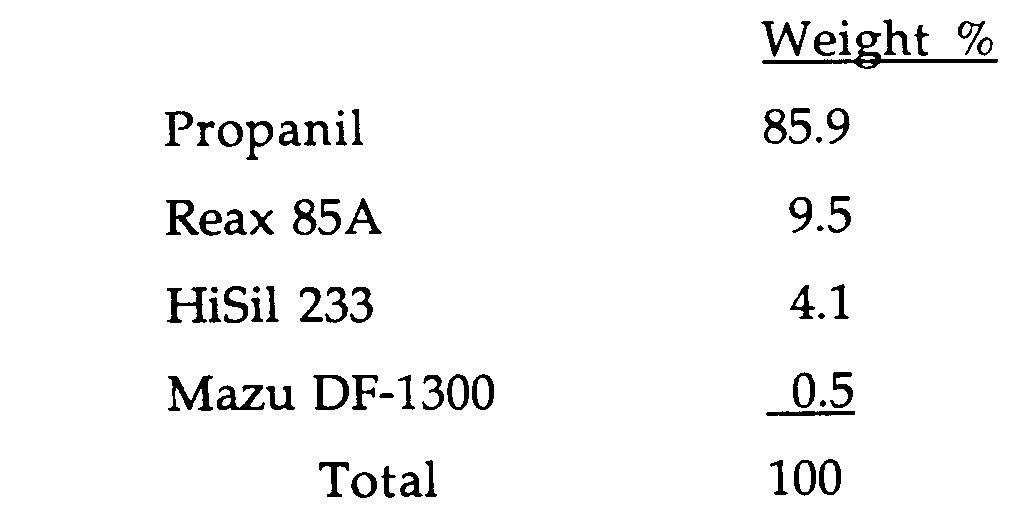
and mixed for 20 minutes. - The above blend was transferred to a Bantam micropulverizer, (obtainable from Mikropul, 10 Chantaur Road, Summit, NJ 07901, USA, fitted with a 0.42 inch (1.1 cm) screen and automatic feed; the grinding chamber was cooled with dry ice. The mean particle size of micropulverized product was 43.8 microns.
- The micropulverized product was then air milled in an 8˝ horizontal (pancake) jet mill, Fluid Energy Processing and Equipment Co., 153 Penn Energy, Hatfield, PA 19440. An Accu-Rate feeder, (Accurate Feeder, 746 E. Milwauke Street, White Water, WI 53190, USA) was fitted with a 2˝ screw feed nozzle positioned to deliver micropulverized material to the air mill. High pressure nitrogen was used for both feeding and grinding to maintain an oxygen concentration below 10%. The ground material was collected in the air bag.

- Under these conditions the milling rate was 8-10 lbs. (3.6-4.5 kg)/hour. The mean particle size was 9.1 microns. This product constituted propanil 80 DG premix.
- Propanil premix (98.0 parts by weight), Surfactant XN-45S (60% aqueous solution, 3.33 parts by weight) and water (16.67 parts by weight) were mixed in a Kitchen Aid mixer, (Hobart, Kitchen Aid Div. Troy, Ohio, USA) for approximately 2-3 minutes.
- The mixture was transferred to a KAR 130 extruder, (Tsu Tsui Rikagaku Kikai Co., Ltd., Japan) fitted with a 1.0 mm screen. After extrusion, the extrudate was air dried to a moisture content of 1-2% at a temperature of less than 40° C.
- One gram of propanil DG was placed in a glass-stoppered graduated cylinder containing 99 ml of Army Hard Water at 25°. The cylinder was inverted 30 times over a period of 90 seconds and allowed to stand for 30 minutes. The bottom 10 ml was separated, evaporated and dried for 48 hours at 60°C; and the resulting residue was used to calculate suspensibility by the following formula.
% suspensibility = [1 - weight of residue] x 111
- One gram propanil DG was added to 100 ml of Army Hard Water in a 100 ml glass-stoppered graduated cylinder. The cylinder was inverted until the DG was completely dispersed and the number of inversions was recorded.
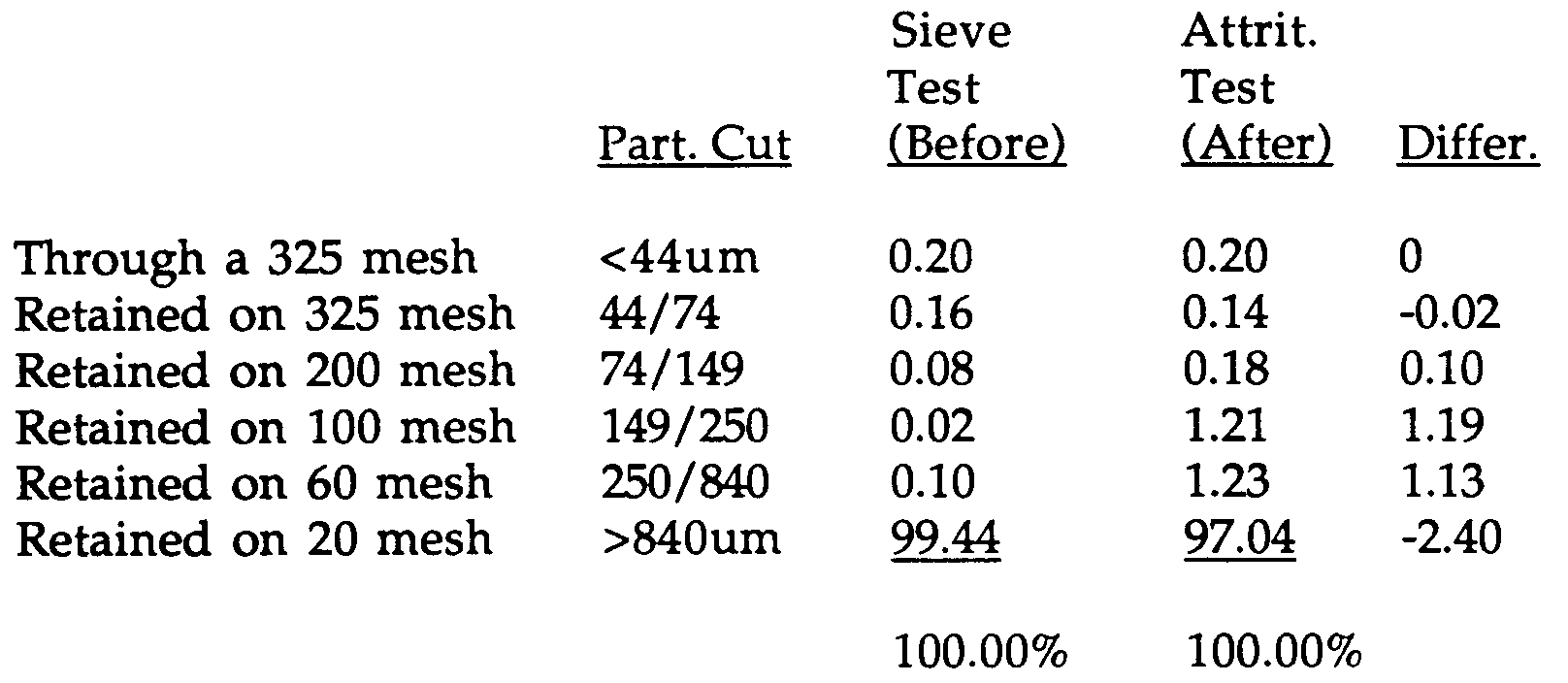
- Ten 3/8 inch (1cm) steel balls and 50 g propanil DG were placed in the bottom pan of 8 inch (20 cm) diameter stainless steel sieves. The pan was shaken on a Ro-tap sieve shaker with a hammer tapper for 10 minutes.
- The steel balls were removed from the pan and the granules were transferred to the top of the nested sieves in the order of 20, 60, 100, 200, 325 mesh and bottom pan. The nested screens were inserted into the Ro-top and shaken for 15 minutes. The amount of residue on each sieve and bottom pan was determined. The weight percent of each fraction was determined by sieving before and after the attrition test.
- Approximately 5 grams DG was weighed to the nearest 0.01 g in a preweighed pan, and dried 24 hours (± 1 hour) at 60°C. at approximately 15 mm Hg pressure.
- The percent moisture loss was measured by weighing the residue.
- One gram DG was added to 100ml Army Hard Water in a centrifuge tube and inverted 15 times slowly. The tube was then placed in a 30°C. water bath and readings (ml of sediment) were taken at 2, 5, 30 minutes.
- After 30 minutes, suspension poured through a 120 mesh screen. The screen washed with 1 liter water and residue weight noted.
Results of the above measurements were as follows:
- An increase of 2.4% particles below 840um (20 mesh) occurred following the attrition test. This increase was confined to particles within the range of 250um to 74um. No increase of percent particles below 44um occurred. Initial percentage below 44um was 0.2%. Data for the study are given in the following table.
- A number of formulations of propanil DG were prepared with active ingredient content ranging from 60.4% to 90.2%. The procedure for preparing these granular formulations followed the general procedure of Example 1, except that Morwet B, Polyfon H and Barden Clay were substituted for Surfactant XN-45S, Reax 85A and HiSil 233, respectively. No antifoam agent was used. The results are shown in the Table II below.

- Propanil 80DG was prepared with 0, 2 and 4 percent of the disintegrants sodium bicarbonate and sodium acetate. Various physical properties were measured using air dried, extruded product. Use of disintegrants, at either level, worsened dispersibility in water although there was some slight improvement in suspensibility with 2 percent sodium bicarbonate or 4 percent sodium acetate after 2 and 5 minutes. Samples containing sodium acetate required additional water in the wetting step to allow proper extrusion.
- Using Propanil 80DG premix (milled but not extruded), a control and alternative extruded formulations containing 2 and 4 percent disintegrants were made. These were prepared according to the procedure of Example 1 and all compositions used 2 percent (solids) Surfactant XN-45S in the wetting step at the rate of 18:100 water to premix. The complete compositions were:

- Suspensibility, dispersibility, residual moisture, and disintegration/suspensibility (as specified in GB 1,433,882, pg. 4) were determined as described in Example 1. Results are shown in Table III.

- The products of GB 1,433,882 containing disintegrants were rated dusty while the control granules of this invention were rated non-dusty.
- Cedar Chemical Corp., 5100 Poplar, Memphis, TN 38137 produces a 50% propanil dispersible granule. Terra International, Inc., Terra Centre 600 Fourth Street, Sioux City, IA 51101, produces a 60% propanil dispersible granule.
- Propanil 80 DG was compared with commercial products from Cedar and Terra. Suspensibility was measured initially and after storage at 40° C and 54°C for 1 to 4 weeks. The results are shown in Table IV.
- The Cedar product was rated very dusty having approximately 5% by weight of particles less than 45 microns in diameter after attrition. The Terra product was rated dusty. In contrast, two lots of the granules of this invention had 0.184% and 0.239% by weight of particles less than 45 microns in diameter after attrition and were rated non-dusty.

- Although the invention has been described in regard to its preferred embodiments, which constitute the best mode presently known to the inventors, it should be understood that various changes and modifications as would be obvious to one having ordinary skill in this art may be made without departing from the scope of the invention which is defined in the claims.
Claims (11)
- Process for producing a dispersible propanil granule comprising:a) combining one or more surfactants with propanil and milling to a particle size of less than 20 microns to form a pre-mix;b) adding less than 25 percent by weight water and optionally a wetting agent to said pre-mix and mixing until a paste is obtained;c) granulating said paste thereby producing granules; andd) drying said granules.
- Process according to claim 1 wherein the amount of propanil employed is such that the final granules formed have a propanil content of at least 60% by weight, preferably at least 80%.
- Process according to claim 1 or 2 wherein granulating step (c) is preferred by extruding the paste.
- Process according to any preceding claim wherein one or more of a dispersant, a flowing and a defoaming agent are added during step (b).
- Process according to any preceding claim comprising the steps of:a) milling a mixture of propanil, dispersant and flow aid to a particle size between 3 and 15 microns;b) adding a wetting agent dissolved in 12-20 percent by weight water to the milled mixture of step (a) and mixing until a homogeneous, extrudable paste is obtained;c) extruding said paste to form granules; andd) drying said extruded granules at a temperature of less than 60°C, preferably lengthan 40°C to a moisture content of less than 2%, preferably less than 1 %.
- A dispersible granule comprising at least 60 percent by weight propanil, and having having a suspensibility of at least 70 percent, preferably at least 80%, and being dispersible in fewer than 15 cylinder inversions.
- A dispersible granule according to claim 6 comprising at least 65 percent, preferably at least 80% by weight of propanil.
- Dispersible granule according to claim 6 or 7 having less than 0.30 weight percent of particles which are less than 45 microns in diameter after 10 minutes of attrition as hereinbefore defined.
- A dispersible granule according to any one of claims 6 to 8 further comprising a dispersant, preferably a sulfonated lignin, and/or a flow aid, preferably a silica compound, and/or a wetting agent, preferably a naphthalene sulfonate or polyoxyethylene sulfate, and/or a defoaming agent, preferably a silicone or silica compound.
- A dispersible granule according to any one of claims 6 to 9 which is substantially free of disintegrant.
- A dispersible granule according to any one of claims 6 to 10, made by a process according to any one of claims 1 to 5.
Applications Claiming Priority (2)
| Application Number | Priority Date | Filing Date | Title |
|---|---|---|---|
| US60664290A | 1990-10-31 | 1990-10-31 | |
| US606642 | 1990-10-31 |
Publications (3)
| Publication Number | Publication Date |
|---|---|
| EP0484147A1 true EP0484147A1 (en) | 1992-05-06 |
| EP0484147B1 EP0484147B1 (en) | 1998-08-26 |
| EP0484147B2 EP0484147B2 (en) | 2001-06-13 |
Family
ID=24428837
Family Applications (1)
| Application Number | Title | Priority Date | Filing Date |
|---|---|---|---|
| EP91310048A Expired - Lifetime EP0484147B2 (en) | 1990-10-31 | 1991-10-30 | Propanil dispersible granule formulation |
Country Status (17)
| Country | Link |
|---|---|
| US (1) | US5532209A (en) |
| EP (1) | EP0484147B2 (en) |
| JP (1) | JP3310681B2 (en) |
| KR (1) | KR100204383B1 (en) |
| AT (1) | ATE170041T1 (en) |
| BG (1) | BG60043B2 (en) |
| BR (1) | BR9104675A (en) |
| CA (1) | CA2054054C (en) |
| DE (1) | DE69130048T3 (en) |
| DK (1) | DK0484147T4 (en) |
| ES (1) | ES2121771T5 (en) |
| HR (1) | HRP940946A2 (en) |
| HU (1) | HUT59278A (en) |
| MX (1) | MX9101749A (en) |
| PH (1) | PH30967A (en) |
| PT (1) | PT99387B (en) |
| RO (1) | RO111148B1 (en) |
Cited By (4)
| Publication number | Priority date | Publication date | Assignee | Title |
|---|---|---|---|---|
| WO2000042846A1 (en) * | 1999-01-22 | 2000-07-27 | Agform Limited | Process for producing granules |
| SG82000A1 (en) * | 1998-07-02 | 2001-07-24 | Nat Starch Chem Invest | Method of making encapsulated electronic component with reworkable package encapsulants |
| WO2005120227A3 (en) * | 2004-06-14 | 2006-03-30 | Agform Ltd | Process for producing a granular agrochemical composition |
| EP3644740B1 (en) | 2017-05-10 | 2024-07-10 | Vadakekuttu, Thankapan | Agricultural compositions |
Families Citing this family (4)
| Publication number | Priority date | Publication date | Assignee | Title |
|---|---|---|---|---|
| AU4782099A (en) | 1998-07-16 | 2000-02-07 | Aventis Cropscience Gmbh | Herbicides |
| WO2014106962A1 (en) | 2013-01-07 | 2014-07-10 | 삼아제약 주식회사 | Novel fast-dissolving granule formulation having improved solubility |
| US20160262379A1 (en) | 2013-10-21 | 2016-09-15 | Hicap Formulations Ltd. | Controlled release formulations of herbicides |
| CN115530160B (en) * | 2022-09-22 | 2023-08-18 | 祥霖美丰生物科技(淮安)有限公司 | Propanil dry suspension concentrate and preparation method thereof |
Citations (6)
| Publication number | Priority date | Publication date | Assignee | Title |
|---|---|---|---|---|
| US3657446A (en) * | 1966-09-15 | 1972-04-18 | Georgia Pacific Corp | Process for preparation of a pesticide in dry form |
| FR2215171A1 (en) * | 1973-01-29 | 1974-08-23 | Ici Ltd | |
| GB1399005A (en) * | 1972-03-08 | 1975-06-25 | Ciba Geigy Ag | Herbicidal compositions |
| EP0135963A2 (en) * | 1983-09-20 | 1985-04-03 | Norddeutsche Affinerie Ag | Granular composition of active substances dispersable in aqueous media and sparingly soluble or insoluble in water |
| FR2595544A1 (en) * | 1986-03-12 | 1987-09-18 | Kao Corp | Granular biocidal composition |
| WO1989000079A1 (en) * | 1987-07-01 | 1989-01-12 | Ici Australia Operations Proprietary Limited | Water dispersible granules |
Family Cites Families (10)
| Publication number | Priority date | Publication date | Assignee | Title |
|---|---|---|---|---|
| IL28110A (en) * | 1966-06-28 | 1971-01-28 | Philips Nv | Pesticide granules and methods of preparing such granules |
| US3920442A (en) * | 1972-09-18 | 1975-11-18 | Du Pont | Water-dispersible pesticide aggregates |
| US4197112A (en) * | 1977-10-12 | 1980-04-08 | E. I. Du Pont De Nemours And Company | Water-dispersible herbicide compositions |
| US4280833A (en) * | 1979-03-26 | 1981-07-28 | Monsanto Company | Encapsulation by interfacial polycondensation, and aqueous herbicidal composition containing microcapsules produced thereby |
| US4411692A (en) * | 1981-03-26 | 1983-10-25 | Monsanto Company | Flowable herbicides |
| US4511395A (en) † | 1982-12-20 | 1985-04-16 | American Cyanamid Company | Method for the preparation of water dispersible granular herbicidal compositions with increased thermal stability |
| AT387577B (en) * | 1984-09-26 | 1989-02-10 | Eszakmagyar Vegyimuevek | METHOD FOR PRODUCING N-ALKYL / EN / -N- / O, O- DISUBSTITUTED THIOPHOSPHORYL / -N'N'DISUBSTITUATED-GLYCINAMIDES AND ACARICIDES, INSECTICIDES AND FUNGICIDES CONTAINING THESE COMPOUNDS |
| US4936901A (en) * | 1986-07-09 | 1990-06-26 | Monsanto Company | Formulations of water-dispersible granules and process for preparation thereof |
| DK352187A (en) * | 1986-07-09 | 1988-01-10 | Monsanto Co | WATER DISPERSIBLE GRANULATE AND PROCEDURES FOR PRODUCING THEREOF |
| JP3069665B2 (en) † | 1990-03-15 | 2000-07-24 | 住友化学工業株式会社 | Agricultural granular wettable powder composition |
-
1991
- 1991-10-23 CA CA002054054A patent/CA2054054C/en not_active Expired - Fee Related
- 1991-10-24 PH PH43338A patent/PH30967A/en unknown
- 1991-10-24 MX MX9101749A patent/MX9101749A/en unknown
- 1991-10-25 KR KR1019910018904A patent/KR100204383B1/en not_active Expired - Lifetime
- 1991-10-29 BR BR919104675A patent/BR9104675A/en not_active IP Right Cessation
- 1991-10-30 PT PT99387A patent/PT99387B/en not_active IP Right Cessation
- 1991-10-30 ES ES91310048T patent/ES2121771T5/en not_active Expired - Lifetime
- 1991-10-30 EP EP91310048A patent/EP0484147B2/en not_active Expired - Lifetime
- 1991-10-30 RO RO148654A patent/RO111148B1/en unknown
- 1991-10-30 DK DK91310048T patent/DK0484147T4/en active
- 1991-10-30 AT AT91310048T patent/ATE170041T1/en not_active IP Right Cessation
- 1991-10-30 DE DE69130048T patent/DE69130048T3/en not_active Expired - Fee Related
- 1991-10-31 HU HU913434A patent/HUT59278A/en unknown
- 1991-10-31 BG BG095410A patent/BG60043B2/en unknown
- 1991-10-31 JP JP28651191A patent/JP3310681B2/en not_active Expired - Fee Related
-
1994
- 1994-11-21 HR HRP1721/91A patent/HRP940946A2/en not_active Application Discontinuation
-
1995
- 1995-06-06 US US08/465,066 patent/US5532209A/en not_active Expired - Lifetime
Patent Citations (6)
| Publication number | Priority date | Publication date | Assignee | Title |
|---|---|---|---|---|
| US3657446A (en) * | 1966-09-15 | 1972-04-18 | Georgia Pacific Corp | Process for preparation of a pesticide in dry form |
| GB1399005A (en) * | 1972-03-08 | 1975-06-25 | Ciba Geigy Ag | Herbicidal compositions |
| FR2215171A1 (en) * | 1973-01-29 | 1974-08-23 | Ici Ltd | |
| EP0135963A2 (en) * | 1983-09-20 | 1985-04-03 | Norddeutsche Affinerie Ag | Granular composition of active substances dispersable in aqueous media and sparingly soluble or insoluble in water |
| FR2595544A1 (en) * | 1986-03-12 | 1987-09-18 | Kao Corp | Granular biocidal composition |
| WO1989000079A1 (en) * | 1987-07-01 | 1989-01-12 | Ici Australia Operations Proprietary Limited | Water dispersible granules |
Cited By (5)
| Publication number | Priority date | Publication date | Assignee | Title |
|---|---|---|---|---|
| SG82000A1 (en) * | 1998-07-02 | 2001-07-24 | Nat Starch Chem Invest | Method of making encapsulated electronic component with reworkable package encapsulants |
| WO2000042846A1 (en) * | 1999-01-22 | 2000-07-27 | Agform Limited | Process for producing granules |
| US6893589B1 (en) | 1999-01-22 | 2005-05-17 | Agform Limited | Process for producing granules |
| WO2005120227A3 (en) * | 2004-06-14 | 2006-03-30 | Agform Ltd | Process for producing a granular agrochemical composition |
| EP3644740B1 (en) | 2017-05-10 | 2024-07-10 | Vadakekuttu, Thankapan | Agricultural compositions |
Also Published As
| Publication number | Publication date |
|---|---|
| HRP940946A2 (en) | 1997-02-28 |
| PT99387A (en) | 1992-10-30 |
| ES2121771T3 (en) | 1998-12-16 |
| DK0484147T4 (en) | 2001-08-27 |
| BR9104675A (en) | 1992-06-16 |
| DK0484147T3 (en) | 1999-05-25 |
| CA2054054C (en) | 2002-11-26 |
| HU913434D0 (en) | 1992-01-28 |
| ES2121771T5 (en) | 2001-10-16 |
| BG60043B2 (en) | 1993-08-30 |
| EP0484147B1 (en) | 1998-08-26 |
| KR920007531A (en) | 1992-05-27 |
| DE69130048D1 (en) | 1998-10-01 |
| DE69130048T3 (en) | 2001-10-31 |
| ATE170041T1 (en) | 1998-09-15 |
| EP0484147B2 (en) | 2001-06-13 |
| PH30967A (en) | 1997-12-23 |
| MX9101749A (en) | 1992-07-01 |
| RO111148B1 (en) | 1996-07-30 |
| JPH04264004A (en) | 1992-09-18 |
| DE69130048T2 (en) | 1999-05-20 |
| JP3310681B2 (en) | 2002-08-05 |
| CA2054054A1 (en) | 1992-05-01 |
| PT99387B (en) | 1999-04-30 |
| HUT59278A (en) | 1992-05-28 |
| US5532209A (en) | 1996-07-02 |
| KR100204383B1 (en) | 1999-06-15 |
Similar Documents
| Publication | Publication Date | Title |
|---|---|---|
| EP0633722B1 (en) | Water dispersible granules of liquid pesticides | |
| CN108849952B (en) | Pyraclostrobin water-dispersible solid composition and preparation method thereof | |
| EP0484147B2 (en) | Propanil dispersible granule formulation | |
| EP0843515B9 (en) | Free-flowing, non-dusting water dispersible granules of a water-insoluble, hydrophobic agriculturally active chemical | |
| EP0631473B1 (en) | Water dispersible granules of low melting point pesticides | |
| US5714439A (en) | Propanil dispersible granule | |
| AU3820399A (en) | Improved extrusion process | |
| JP2003286105A (en) | Granular wettable powder | |
| EP0503869B1 (en) | Oxyfluorfen dispersible granule formulations | |
| EP1161145B1 (en) | Process for producing granules | |
| JPH11315004A (en) | Formulation for water surface application | |
| EP0922388B1 (en) | Stable, dry compositions for use as herbicides | |
| JP5207262B2 (en) | Granular wettable powder | |
| KR20040080440A (en) | A process for preparation of chemically stable, dry-flow, low compact, dust free, soluble granules of phosphoroamidothioates | |
| JPH09157108A (en) | Agrochemical granule excellent in dissolution of agrochemical active ingredient in water of surface of paddy field | |
| JP2001294501A (en) | Pesticide wettable powder | |
| NZ246828A (en) | Water-dispersible granules of low melting point pesticides | |
| HRP940942A2 (en) | Oxyfluorfen dispersible granule formulations |
Legal Events
| Date | Code | Title | Description |
|---|---|---|---|
| PUAI | Public reference made under article 153(3) epc to a published international application that has entered the european phase |
Free format text: ORIGINAL CODE: 0009012 |
|
| 17P | Request for examination filed |
Effective date: 19911111 |
|
| AK | Designated contracting states |
Kind code of ref document: A1 Designated state(s): AT BE CH DE DK ES FR GB GR IT LI LU NL SE |
|
| 17Q | First examination report despatched |
Effective date: 19940629 |
|
| GRAG | Despatch of communication of intention to grant |
Free format text: ORIGINAL CODE: EPIDOS AGRA |
|
| GRAG | Despatch of communication of intention to grant |
Free format text: ORIGINAL CODE: EPIDOS AGRA |
|
| GRAG | Despatch of communication of intention to grant |
Free format text: ORIGINAL CODE: EPIDOS AGRA |
|
| GRAH | Despatch of communication of intention to grant a patent |
Free format text: ORIGINAL CODE: EPIDOS IGRA |
|
| GRAH | Despatch of communication of intention to grant a patent |
Free format text: ORIGINAL CODE: EPIDOS IGRA |
|
| GRAA | (expected) grant |
Free format text: ORIGINAL CODE: 0009210 |
|
| AK | Designated contracting states |
Kind code of ref document: B1 Designated state(s): AT BE CH DE DK ES FR GB GR IT LI LU NL SE |
|
| REF | Corresponds to: |
Ref document number: 170041 Country of ref document: AT Date of ref document: 19980915 Kind code of ref document: T |
|
| REG | Reference to a national code |
Ref country code: CH Ref legal event code: EP |
|
| REF | Corresponds to: |
Ref document number: 69130048 Country of ref document: DE Date of ref document: 19981001 |
|
| REG | Reference to a national code |
Ref country code: CH Ref legal event code: NV Representative=s name: ARDIN & CIE S.A. |
|
| ET | Fr: translation filed | ||
| REG | Reference to a national code |
Ref country code: ES Ref legal event code: FG2A Ref document number: 2121771 Country of ref document: ES Kind code of ref document: T3 |
|
| REG | Reference to a national code |
Ref country code: DK Ref legal event code: T3 |
|
| PLBQ | Unpublished change to opponent data |
Free format text: ORIGINAL CODE: EPIDOS OPPO |
|
| PLBI | Opposition filed |
Free format text: ORIGINAL CODE: 0009260 |
|
| PLBF | Reply of patent proprietor to notice(s) of opposition |
Free format text: ORIGINAL CODE: EPIDOS OBSO |
|
| 26 | Opposition filed |
Opponent name: COLLAG LIMITED Effective date: 19990525 |
|
| NLR1 | Nl: opposition has been filed with the epo |
Opponent name: COLLAG LIMITED |
|
| PLBF | Reply of patent proprietor to notice(s) of opposition |
Free format text: ORIGINAL CODE: EPIDOS OBSO |
|
| PLBF | Reply of patent proprietor to notice(s) of opposition |
Free format text: ORIGINAL CODE: EPIDOS OBSO |
|
| PLAW | Interlocutory decision in opposition |
Free format text: ORIGINAL CODE: EPIDOS IDOP |
|
| PLAW | Interlocutory decision in opposition |
Free format text: ORIGINAL CODE: EPIDOS IDOP |
|
| PUAH | Patent maintained in amended form |
Free format text: ORIGINAL CODE: 0009272 |
|
| STAA | Information on the status of an ep patent application or granted ep patent |
Free format text: STATUS: PATENT MAINTAINED AS AMENDED |
|
| 27A | Patent maintained in amended form |
Effective date: 20010613 |
|
| AK | Designated contracting states |
Kind code of ref document: B2 Designated state(s): AT BE CH DE DK ES FR GB GR IT LI LU NL SE |
|
| ITF | It: translation for a ep patent filed | ||
| REG | Reference to a national code |
Ref country code: CH Ref legal event code: NV Representative=s name: MICHELI & CIE INGENIEURS-CONSEILS Ref country code: CH Ref legal event code: AEN Free format text: MAINTIEN DU BREVET DONT L'ETENDUE A ETE MODIFIEE |
|
| NLR2 | Nl: decision of opposition | ||
| ET3 | Fr: translation filed ** decision concerning opposition | ||
| REG | Reference to a national code |
Ref country code: DK Ref legal event code: T4 |
|
| NLR3 | Nl: receipt of modified translations in the netherlands language after an opposition procedure | ||
| REG | Reference to a national code |
Ref country code: GB Ref legal event code: 732E |
|
| REG | Reference to a national code |
Ref country code: ES Ref legal event code: DC2A Kind code of ref document: T5 Effective date: 20010903 |
|
| BECA | Be: change of holder's address |
Free format text: 20011210 *DOW AGROSCIENCES LLC:9330 ZIONSVILLE ROAD, INDIANAPOLIS IN 46268-1054 |
|
| BECH | Be: change of holder |
Free format text: 20011210 *DOW AGROSCIENCES LLC |
|
| REG | Reference to a national code |
Ref country code: GB Ref legal event code: IF02 |
|
| REG | Reference to a national code |
Ref country code: CH Ref legal event code: PUE Owner name: ROHM AND HAAS COMPANY TRANSFER- ROHM AND HAAS ASIA |
|
| PG25 | Lapsed in a contracting state [announced via postgrant information from national office to epo] |
Ref country code: GR Free format text: THE PATENT HAS BEEN ANNULLED BY A DECISION OF A NATIONAL AUTHORITY Effective date: 20020201 |
|
| REG | Reference to a national code |
Ref country code: FR Ref legal event code: TP |
|
| PGFP | Annual fee paid to national office [announced via postgrant information from national office to epo] |
Ref country code: DK Payment date: 20030908 Year of fee payment: 13 Ref country code: CH Payment date: 20030908 Year of fee payment: 13 |
|
| PGFP | Annual fee paid to national office [announced via postgrant information from national office to epo] |
Ref country code: SE Payment date: 20030911 Year of fee payment: 13 |
|
| PGFP | Annual fee paid to national office [announced via postgrant information from national office to epo] |
Ref country code: DE Payment date: 20030915 Year of fee payment: 13 |
|
| PGFP | Annual fee paid to national office [announced via postgrant information from national office to epo] |
Ref country code: LU Payment date: 20031003 Year of fee payment: 13 |
|
| PGFP | Annual fee paid to national office [announced via postgrant information from national office to epo] |
Ref country code: GB Payment date: 20031008 Year of fee payment: 13 |
|
| PGFP | Annual fee paid to national office [announced via postgrant information from national office to epo] |
Ref country code: BE Payment date: 20031013 Year of fee payment: 13 |
|
| PGFP | Annual fee paid to national office [announced via postgrant information from national office to epo] |
Ref country code: AT Payment date: 20031022 Year of fee payment: 13 |
|
| PGFP | Annual fee paid to national office [announced via postgrant information from national office to epo] |
Ref country code: NL Payment date: 20031031 Year of fee payment: 13 |
|
| PG25 | Lapsed in a contracting state [announced via postgrant information from national office to epo] |
Ref country code: AT Free format text: LAPSE BECAUSE OF NON-PAYMENT OF DUE FEES Effective date: 20041030 Ref country code: LU Free format text: LAPSE BECAUSE OF NON-PAYMENT OF DUE FEES Effective date: 20041030 Ref country code: GB Free format text: LAPSE BECAUSE OF NON-PAYMENT OF DUE FEES Effective date: 20041030 |
|
| PG25 | Lapsed in a contracting state [announced via postgrant information from national office to epo] |
Ref country code: BE Free format text: LAPSE BECAUSE OF NON-PAYMENT OF DUE FEES Effective date: 20041031 Ref country code: CH Free format text: LAPSE BECAUSE OF NON-PAYMENT OF DUE FEES Effective date: 20041031 Ref country code: LI Free format text: LAPSE BECAUSE OF NON-PAYMENT OF DUE FEES Effective date: 20041031 Ref country code: SE Free format text: LAPSE BECAUSE OF NON-PAYMENT OF DUE FEES Effective date: 20041031 |
|
| PG25 | Lapsed in a contracting state [announced via postgrant information from national office to epo] |
Ref country code: DK Free format text: LAPSE BECAUSE OF NON-PAYMENT OF DUE FEES Effective date: 20041101 |
|
| BERE | Be: lapsed |
Owner name: *DOW AGROSCIENCES LLC Effective date: 20041031 |
|
| PG25 | Lapsed in a contracting state [announced via postgrant information from national office to epo] |
Ref country code: NL Free format text: LAPSE BECAUSE OF NON-PAYMENT OF DUE FEES Effective date: 20050501 |
|
| PG25 | Lapsed in a contracting state [announced via postgrant information from national office to epo] |
Ref country code: DE Free format text: LAPSE BECAUSE OF NON-PAYMENT OF DUE FEES Effective date: 20050503 |
|
| EUG | Se: european patent has lapsed | ||
| REG | Reference to a national code |
Ref country code: DK Ref legal event code: EBP |
|
| REG | Reference to a national code |
Ref country code: CH Ref legal event code: PL |
|
| GBPC | Gb: european patent ceased through non-payment of renewal fee |
Effective date: 20041030 |
|
| NLV4 | Nl: lapsed or anulled due to non-payment of the annual fee |
Effective date: 20050501 |
|
| BERE | Be: lapsed |
Owner name: *DOW AGROSCIENCES LLC Effective date: 20041031 |
|
| PGFP | Annual fee paid to national office [announced via postgrant information from national office to epo] |
Ref country code: GR Payment date: 20071026 Year of fee payment: 17 |
|
| REG | Reference to a national code |
Ref country code: FR Ref legal event code: TP |
|
| PGFP | Annual fee paid to national office [announced via postgrant information from national office to epo] |
Ref country code: FR Payment date: 20101028 Year of fee payment: 20 |
|
| PGFP | Annual fee paid to national office [announced via postgrant information from national office to epo] |
Ref country code: IT Payment date: 20100927 Year of fee payment: 20 |
|
| PGFP | Annual fee paid to national office [announced via postgrant information from national office to epo] |
Ref country code: ES Payment date: 20101015 Year of fee payment: 20 |
|
| REG | Reference to a national code |
Ref country code: ES Ref legal event code: FD2A Effective date: 20140827 |
|
| PG25 | Lapsed in a contracting state [announced via postgrant information from national office to epo] |
Ref country code: ES Free format text: LAPSE BECAUSE OF EXPIRATION OF PROTECTION Effective date: 20111031 |