EP0483740B1 - Aqueous soluble infrared antihalation dyes - Google Patents
Aqueous soluble infrared antihalation dyes Download PDFInfo
- Publication number
- EP0483740B1 EP0483740B1 EP91118378A EP91118378A EP0483740B1 EP 0483740 B1 EP0483740 B1 EP 0483740B1 EP 91118378 A EP91118378 A EP 91118378A EP 91118378 A EP91118378 A EP 91118378A EP 0483740 B1 EP0483740 B1 EP 0483740B1
- Authority
- EP
- European Patent Office
- Prior art keywords
- dye
- layer
- antihalation
- support
- photosensitive
- Prior art date
- Legal status (The legal status is an assumption and is not a legal conclusion. Google has not performed a legal analysis and makes no representation as to the accuracy of the status listed.)
- Expired - Lifetime
Links
- 239000000975 dye Substances 0.000 title description 59
- -1 polyethylene terephthalate Polymers 0.000 claims description 37
- 150000001768 cations Chemical class 0.000 claims description 6
- 229910052801 chlorine Inorganic materials 0.000 claims description 6
- 125000004432 carbon atom Chemical group C* 0.000 claims description 5
- 229920000139 polyethylene terephthalate Polymers 0.000 claims description 5
- 239000005020 polyethylene terephthalate Substances 0.000 claims description 5
- DGAQECJNVWCQMB-PUAWFVPOSA-M Ilexoside XXIX Chemical group C[C@@H]1CC[C@@]2(CC[C@@]3(C(=CC[C@H]4[C@]3(CC[C@@H]5[C@@]4(CC[C@@H](C5(C)C)OS(=O)(=O)[O-])C)C)[C@@H]2[C@]1(C)O)C)C(=O)O[C@H]6[C@@H]([C@H]([C@@H]([C@H](O6)CO)O)O)O.[Na+] DGAQECJNVWCQMB-PUAWFVPOSA-M 0.000 claims 3
- 229910052708 sodium Inorganic materials 0.000 claims 3
- 239000011734 sodium Substances 0.000 claims 3
- 125000001183 hydrocarbyl group Chemical group 0.000 claims 2
- 239000010410 layer Substances 0.000 description 85
- 230000005855 radiation Effects 0.000 description 19
- YMWUJEATGCHHMB-UHFFFAOYSA-N Dichloromethane Chemical compound ClCCl YMWUJEATGCHHMB-UHFFFAOYSA-N 0.000 description 18
- 108010010803 Gelatin Proteins 0.000 description 17
- 239000008273 gelatin Substances 0.000 description 17
- 229920000159 gelatin Polymers 0.000 description 17
- 235000019322 gelatine Nutrition 0.000 description 17
- 235000011852 gelatine desserts Nutrition 0.000 description 17
- ZMXDDKWLCZADIW-UHFFFAOYSA-N N,N-Dimethylformamide Chemical compound CN(C)C=O ZMXDDKWLCZADIW-UHFFFAOYSA-N 0.000 description 12
- 239000000839 emulsion Substances 0.000 description 11
- 229910052709 silver Inorganic materials 0.000 description 11
- 239000004332 silver Substances 0.000 description 11
- 150000003839 salts Chemical class 0.000 description 10
- QTBSBXVTEAMEQO-UHFFFAOYSA-N Acetic acid Chemical compound CC(O)=O QTBSBXVTEAMEQO-UHFFFAOYSA-N 0.000 description 9
- WFDIJRYMOXRFFG-UHFFFAOYSA-N Acetic anhydride Chemical compound CC(=O)OC(C)=O WFDIJRYMOXRFFG-UHFFFAOYSA-N 0.000 description 9
- XEKOWRVHYACXOJ-UHFFFAOYSA-N Ethyl acetate Chemical compound CCOC(C)=O XEKOWRVHYACXOJ-UHFFFAOYSA-N 0.000 description 9
- OKKJLVBELUTLKV-UHFFFAOYSA-N Methanol Chemical compound OC OKKJLVBELUTLKV-UHFFFAOYSA-N 0.000 description 9
- 239000000203 mixture Substances 0.000 description 9
- CSCPPACGZOOCGX-UHFFFAOYSA-N Acetone Chemical compound CC(C)=O CSCPPACGZOOCGX-UHFFFAOYSA-N 0.000 description 8
- XLYOFNOQVPJJNP-UHFFFAOYSA-N water Substances O XLYOFNOQVPJJNP-UHFFFAOYSA-N 0.000 description 8
- KFZMGEQAYNKOFK-UHFFFAOYSA-N Isopropanol Chemical compound CC(C)O KFZMGEQAYNKOFK-UHFFFAOYSA-N 0.000 description 6
- 239000000460 chlorine Substances 0.000 description 6
- LEQAOMBKQFMDFZ-UHFFFAOYSA-N glyoxal Chemical compound O=CC=O LEQAOMBKQFMDFZ-UHFFFAOYSA-N 0.000 description 6
- RKJUIXBNRJVNHR-UHFFFAOYSA-N indolenine group Chemical group N1=CCC2=CC=CC=C12 RKJUIXBNRJVNHR-UHFFFAOYSA-N 0.000 description 6
- 238000000034 method Methods 0.000 description 6
- 238000002360 preparation method Methods 0.000 description 5
- 238000010992 reflux Methods 0.000 description 5
- 238000003786 synthesis reaction Methods 0.000 description 5
- VEXZGXHMUGYJMC-UHFFFAOYSA-M Chloride anion Chemical compound [Cl-] VEXZGXHMUGYJMC-UHFFFAOYSA-M 0.000 description 4
- RTZKZFJDLAIYFH-UHFFFAOYSA-N Diethyl ether Chemical compound CCOCC RTZKZFJDLAIYFH-UHFFFAOYSA-N 0.000 description 4
- LFQSCWFLJHTTHZ-UHFFFAOYSA-N Ethanol Chemical compound CCO LFQSCWFLJHTTHZ-UHFFFAOYSA-N 0.000 description 4
- CTQNGGLPUBDAKN-UHFFFAOYSA-N O-Xylene Chemical group CC1=CC=CC=C1C CTQNGGLPUBDAKN-UHFFFAOYSA-N 0.000 description 4
- 230000015572 biosynthetic process Effects 0.000 description 4
- 239000011248 coating agent Substances 0.000 description 4
- 238000000576 coating method Methods 0.000 description 4
- 238000001816 cooling Methods 0.000 description 4
- 150000002430 hydrocarbons Chemical group 0.000 description 4
- 230000003287 optical effect Effects 0.000 description 4
- 239000011541 reaction mixture Substances 0.000 description 4
- 230000003595 spectral effect Effects 0.000 description 4
- 125000000391 vinyl group Chemical group [H]C([*])=C([H])[H] 0.000 description 4
- CPELXLSAUQHCOX-UHFFFAOYSA-M Bromide Chemical compound [Br-] CPELXLSAUQHCOX-UHFFFAOYSA-M 0.000 description 3
- KEAYESYHFKHZAL-UHFFFAOYSA-N Sodium Chemical class [Na] KEAYESYHFKHZAL-UHFFFAOYSA-N 0.000 description 3
- VMHLLURERBWHNL-UHFFFAOYSA-M Sodium acetate Chemical compound [Na+].CC([O-])=O VMHLLURERBWHNL-UHFFFAOYSA-M 0.000 description 3
- HEMHJVSKTPXQMS-UHFFFAOYSA-M Sodium hydroxide Chemical compound [OH-].[Na+] HEMHJVSKTPXQMS-UHFFFAOYSA-M 0.000 description 3
- 230000002411 adverse Effects 0.000 description 3
- 238000011161 development Methods 0.000 description 3
- 238000001914 filtration Methods 0.000 description 3
- 229940015043 glyoxal Drugs 0.000 description 3
- XLYOFNOQVPJJNP-UHFFFAOYSA-M hydroxide Chemical compound [OH-] XLYOFNOQVPJJNP-UHFFFAOYSA-M 0.000 description 3
- 239000011229 interlayer Substances 0.000 description 3
- 239000000463 material Substances 0.000 description 3
- 239000004848 polyfunctional curative Substances 0.000 description 3
- 238000011160 research Methods 0.000 description 3
- 230000001235 sensitizing effect Effects 0.000 description 3
- 239000001632 sodium acetate Substances 0.000 description 3
- 235000017281 sodium acetate Nutrition 0.000 description 3
- 239000003381 stabilizer Substances 0.000 description 3
- FLHJIAFUWHPJRT-UHFFFAOYSA-N 2,3,3-trimethylindole Chemical compound C1=CC=C2C(C)(C)C(C)=NC2=C1 FLHJIAFUWHPJRT-UHFFFAOYSA-N 0.000 description 2
- JWUQFQYYMGMPKE-UHFFFAOYSA-N 2-chloro-3-(hydroxymethylidene)cyclohexene-1-carbaldehyde Chemical compound OC=C1CCCC(C=O)=C1Cl JWUQFQYYMGMPKE-UHFFFAOYSA-N 0.000 description 2
- 0 CC(C(*=*C(CC1)=C(*)C1=*)=C*N=O)(c1c(C)cccc1)N* Chemical compound CC(C(*=*C(CC1)=C(*)C1=*)=C*N=O)(c1c(C)cccc1)N* 0.000 description 2
- CDBYLPFSWZWCQE-UHFFFAOYSA-L Sodium Carbonate Chemical compound [Na+].[Na+].[O-]C([O-])=O CDBYLPFSWZWCQE-UHFFFAOYSA-L 0.000 description 2
- FKNQFGJONOIPTF-UHFFFAOYSA-N Sodium cation Chemical compound [Na+] FKNQFGJONOIPTF-UHFFFAOYSA-N 0.000 description 2
- 239000000654 additive Substances 0.000 description 2
- 229910052783 alkali metal Inorganic materials 0.000 description 2
- 239000000084 colloidal system Substances 0.000 description 2
- 150000001875 compounds Chemical class 0.000 description 2
- 239000012043 crude product Substances 0.000 description 2
- 238000002425 crystallisation Methods 0.000 description 2
- 230000008025 crystallization Effects 0.000 description 2
- 125000004122 cyclic group Chemical group 0.000 description 2
- JHIVVAPYMSGYDF-UHFFFAOYSA-N cyclohexanone Chemical compound O=C1CCCCC1 JHIVVAPYMSGYDF-UHFFFAOYSA-N 0.000 description 2
- BGTOWKSIORTVQH-UHFFFAOYSA-N cyclopentanone Chemical compound O=C1CCCC1 BGTOWKSIORTVQH-UHFFFAOYSA-N 0.000 description 2
- 125000000219 ethylidene group Chemical group [H]C(=[*])C([H])([H])[H] 0.000 description 2
- 238000000605 extraction Methods 0.000 description 2
- 229940078552 o-xylene Drugs 0.000 description 2
- XHXFXVLFKHQFAL-UHFFFAOYSA-N phosphoryl trichloride Chemical compound ClP(Cl)(Cl)=O XHXFXVLFKHQFAL-UHFFFAOYSA-N 0.000 description 2
- 229920000728 polyester Polymers 0.000 description 2
- 229920000642 polymer Polymers 0.000 description 2
- 239000000047 product Substances 0.000 description 2
- 239000012264 purified product Substances 0.000 description 2
- 229920006395 saturated elastomer Polymers 0.000 description 2
- 229910001415 sodium ion Inorganic materials 0.000 description 2
- 239000007787 solid Substances 0.000 description 2
- 238000001228 spectrum Methods 0.000 description 2
- 125000004964 sulfoalkyl group Chemical group 0.000 description 2
- 238000003325 tomography Methods 0.000 description 2
- 229920002554 vinyl polymer Polymers 0.000 description 2
- FSSPGSAQUIYDCN-UHFFFAOYSA-N 1,3-Propane sultone Chemical compound O=S1(=O)CCCO1 FSSPGSAQUIYDCN-UHFFFAOYSA-N 0.000 description 1
- JKFYKCYQEWQPTM-UHFFFAOYSA-N 2-azaniumyl-2-(4-fluorophenyl)acetate Chemical compound OC(=O)C(N)C1=CC=C(F)C=C1 JKFYKCYQEWQPTM-UHFFFAOYSA-N 0.000 description 1
- BUZICZZQJDLXJN-UHFFFAOYSA-N 3-azaniumyl-4-hydroxybutanoate Chemical compound OCC(N)CC(O)=O BUZICZZQJDLXJN-UHFFFAOYSA-N 0.000 description 1
- 241001136792 Alle Species 0.000 description 1
- 241000283690 Bos taurus Species 0.000 description 1
- BHPQYMZQTOCNFJ-UHFFFAOYSA-N Calcium cation Chemical compound [Ca+2] BHPQYMZQTOCNFJ-UHFFFAOYSA-N 0.000 description 1
- OKTJSMMVPCPJKN-UHFFFAOYSA-N Carbon Chemical compound [C] OKTJSMMVPCPJKN-UHFFFAOYSA-N 0.000 description 1
- 239000004215 Carbon black (E152) Substances 0.000 description 1
- 229920002284 Cellulose triacetate Polymers 0.000 description 1
- 229920002307 Dextran Polymers 0.000 description 1
- JLVVSXFLKOJNIY-UHFFFAOYSA-N Magnesium ion Chemical compound [Mg+2] JLVVSXFLKOJNIY-UHFFFAOYSA-N 0.000 description 1
- 239000004698 Polyethylene Substances 0.000 description 1
- 239000004793 Polystyrene Substances 0.000 description 1
- NPYPAHLBTDXSSS-UHFFFAOYSA-N Potassium ion Chemical compound [K+] NPYPAHLBTDXSSS-UHFFFAOYSA-N 0.000 description 1
- 206010070834 Sensitisation Diseases 0.000 description 1
- BQCADISMDOOEFD-UHFFFAOYSA-N Silver Chemical compound [Ag] BQCADISMDOOEFD-UHFFFAOYSA-N 0.000 description 1
- 229910021607 Silver chloride Inorganic materials 0.000 description 1
- 229910021612 Silver iodide Inorganic materials 0.000 description 1
- 229920006362 Teflon® Polymers 0.000 description 1
- 229920004890 Triton X-100 Polymers 0.000 description 1
- XTXRWKRVRITETP-UHFFFAOYSA-N Vinyl acetate Chemical compound CC(=O)OC=C XTXRWKRVRITETP-UHFFFAOYSA-N 0.000 description 1
- 235000005811 Viola adunca Nutrition 0.000 description 1
- 240000009038 Viola odorata Species 0.000 description 1
- 235000013487 Viola odorata Nutrition 0.000 description 1
- 235000002254 Viola papilionacea Nutrition 0.000 description 1
- NNLVGZFZQQXQNW-ADJNRHBOSA-N [(2r,3r,4s,5r,6s)-4,5-diacetyloxy-3-[(2s,3r,4s,5r,6r)-3,4,5-triacetyloxy-6-(acetyloxymethyl)oxan-2-yl]oxy-6-[(2r,3r,4s,5r,6s)-4,5,6-triacetyloxy-2-(acetyloxymethyl)oxan-3-yl]oxyoxan-2-yl]methyl acetate Chemical compound O([C@@H]1O[C@@H]([C@H]([C@H](OC(C)=O)[C@H]1OC(C)=O)O[C@H]1[C@@H]([C@@H](OC(C)=O)[C@H](OC(C)=O)[C@@H](COC(C)=O)O1)OC(C)=O)COC(=O)C)[C@@H]1[C@@H](COC(C)=O)O[C@@H](OC(C)=O)[C@H](OC(C)=O)[C@H]1OC(C)=O NNLVGZFZQQXQNW-ADJNRHBOSA-N 0.000 description 1
- 239000006096 absorbing agent Substances 0.000 description 1
- 238000010521 absorption reaction Methods 0.000 description 1
- 238000000862 absorption spectrum Methods 0.000 description 1
- DHKHKXVYLBGOIT-UHFFFAOYSA-N acetaldehyde Diethyl Acetal Natural products CCOC(C)OCC DHKHKXVYLBGOIT-UHFFFAOYSA-N 0.000 description 1
- 150000001241 acetals Chemical class 0.000 description 1
- 150000001298 alcohols Chemical class 0.000 description 1
- 125000003545 alkoxy group Chemical group 0.000 description 1
- 125000000217 alkyl group Chemical group 0.000 description 1
- 238000000149 argon plasma sintering Methods 0.000 description 1
- 230000004888 barrier function Effects 0.000 description 1
- 239000011324 bead Substances 0.000 description 1
- 210000000988 bone and bone Anatomy 0.000 description 1
- 239000006227 byproduct Substances 0.000 description 1
- 229910001424 calcium ion Inorganic materials 0.000 description 1
- 229910052799 carbon Inorganic materials 0.000 description 1
- 125000003178 carboxy group Chemical group [H]OC(*)=O 0.000 description 1
- 150000007942 carboxylates Chemical class 0.000 description 1
- 229920002678 cellulose Polymers 0.000 description 1
- 239000003795 chemical substances by application Substances 0.000 description 1
- 125000001309 chloro group Chemical group Cl* 0.000 description 1
- 229920001577 copolymer Polymers 0.000 description 1
- 239000013078 crystal Substances 0.000 description 1
- 125000000596 cyclohexenyl group Chemical group C1(=CCCCC1)* 0.000 description 1
- 125000002433 cyclopentenyl group Chemical group C1(=CCCC1)* 0.000 description 1
- 125000001511 cyclopentyl group Chemical group [H]C1([H])C([H])([H])C([H])([H])C([H])(*)C1([H])[H] 0.000 description 1
- 230000002939 deleterious effect Effects 0.000 description 1
- 229940075894 denatured ethanol Drugs 0.000 description 1
- 238000003745 diagnosis Methods 0.000 description 1
- 239000006185 dispersion Substances 0.000 description 1
- 230000000694 effects Effects 0.000 description 1
- 238000011156 evaluation Methods 0.000 description 1
- NBVXSUQYWXRMNV-UHFFFAOYSA-N fluoromethane Chemical compound FC NBVXSUQYWXRMNV-UHFFFAOYSA-N 0.000 description 1
- 150000004676 glycans Chemical class 0.000 description 1
- PCHJSUWPFVWCPO-UHFFFAOYSA-N gold Chemical compound [Au] PCHJSUWPFVWCPO-UHFFFAOYSA-N 0.000 description 1
- 239000010931 gold Substances 0.000 description 1
- 229910052737 gold Inorganic materials 0.000 description 1
- 150000002344 gold compounds Chemical class 0.000 description 1
- 150000004820 halides Chemical class 0.000 description 1
- 229930195733 hydrocarbon Natural products 0.000 description 1
- 125000004435 hydrogen atom Chemical group [H]* 0.000 description 1
- XMBWDFGMSWQBCA-UHFFFAOYSA-N hydrogen iodide Chemical compound I XMBWDFGMSWQBCA-UHFFFAOYSA-N 0.000 description 1
- 125000002887 hydroxy group Chemical group [H]O* 0.000 description 1
- 238000003384 imaging method Methods 0.000 description 1
- 239000003112 inhibitor Substances 0.000 description 1
- 150000002500 ions Chemical class 0.000 description 1
- 150000002504 iridium compounds Chemical class 0.000 description 1
- 239000000314 lubricant Substances 0.000 description 1
- 229910001425 magnesium ion Inorganic materials 0.000 description 1
- 239000006224 matting agent Substances 0.000 description 1
- 229960002523 mercuric chloride Drugs 0.000 description 1
- LWJROJCJINYWOX-UHFFFAOYSA-L mercury dichloride Chemical compound Cl[Hg]Cl LWJROJCJINYWOX-UHFFFAOYSA-L 0.000 description 1
- DZVCFNFOPIZQKX-LTHRDKTGSA-M merocyanine Chemical compound [Na+].O=C1N(CCCC)C(=O)N(CCCC)C(=O)C1=C\C=C\C=C/1N(CCCS([O-])(=O)=O)C2=CC=CC=C2O\1 DZVCFNFOPIZQKX-LTHRDKTGSA-M 0.000 description 1
- 150000002734 metacrylic acid derivatives Chemical class 0.000 description 1
- 150000002736 metal compounds Chemical class 0.000 description 1
- WSFSSNUMVMOOMR-NJFSPNSNSA-N methanone Chemical compound O=[14CH2] WSFSSNUMVMOOMR-NJFSPNSNSA-N 0.000 description 1
- 230000007935 neutral effect Effects 0.000 description 1
- MHYFEEDKONKGEB-UHFFFAOYSA-N oxathiane 2,2-dioxide Chemical compound O=S1(=O)CCCCO1 MHYFEEDKONKGEB-UHFFFAOYSA-N 0.000 description 1
- 239000004014 plasticizer Substances 0.000 description 1
- 229920003229 poly(methyl methacrylate) Polymers 0.000 description 1
- 229920002401 polyacrylamide Polymers 0.000 description 1
- 229920000058 polyacrylate Polymers 0.000 description 1
- 229920000768 polyamine Polymers 0.000 description 1
- 229920000573 polyethylene Polymers 0.000 description 1
- 239000004926 polymethyl methacrylate Substances 0.000 description 1
- 229920001282 polysaccharide Polymers 0.000 description 1
- 239000005017 polysaccharide Substances 0.000 description 1
- 229920002223 polystyrene Polymers 0.000 description 1
- 229920002689 polyvinyl acetate Polymers 0.000 description 1
- 239000011118 polyvinyl acetate Substances 0.000 description 1
- 229920002451 polyvinyl alcohol Polymers 0.000 description 1
- 229910001414 potassium ion Inorganic materials 0.000 description 1
- 239000002244 precipitate Substances 0.000 description 1
- 238000012545 processing Methods 0.000 description 1
- KXXXUIKPSVVSAW-UHFFFAOYSA-K pyranine Chemical compound [Na+].[Na+].[Na+].C1=C2C(O)=CC(S([O-])(=O)=O)=C(C=C3)C2=C2C3=C(S([O-])(=O)=O)C=C(S([O-])(=O)=O)C2=C1 KXXXUIKPSVVSAW-UHFFFAOYSA-K 0.000 description 1
- 239000001397 quillaja saponaria molina bark Substances 0.000 description 1
- 239000011347 resin Substances 0.000 description 1
- 229920005989 resin Polymers 0.000 description 1
- 230000004044 response Effects 0.000 description 1
- 229930182490 saponin Natural products 0.000 description 1
- 150000007949 saponins Chemical class 0.000 description 1
- 239000004065 semiconductor Substances 0.000 description 1
- 230000008313 sensitization Effects 0.000 description 1
- ADZWSOLPGZMUMY-UHFFFAOYSA-M silver bromide Chemical compound [Ag]Br ADZWSOLPGZMUMY-UHFFFAOYSA-M 0.000 description 1
- 229940045105 silver iodide Drugs 0.000 description 1
- HKZLPVFGJNLROG-UHFFFAOYSA-M silver monochloride Chemical compound [Cl-].[Ag+] HKZLPVFGJNLROG-UHFFFAOYSA-M 0.000 description 1
- 239000002002 slurry Substances 0.000 description 1
- 238000002791 soaking Methods 0.000 description 1
- 229910000029 sodium carbonate Inorganic materials 0.000 description 1
- 239000002904 solvent Substances 0.000 description 1
- 125000005504 styryl group Chemical group 0.000 description 1
- 239000000126 substance Substances 0.000 description 1
- 125000001424 substituent group Chemical group 0.000 description 1
- BDHFUVZGWQCTTF-UHFFFAOYSA-M sulfonate Chemical compound [O-]S(=O)=O BDHFUVZGWQCTTF-UHFFFAOYSA-M 0.000 description 1
- 239000004094 surface-active agent Substances 0.000 description 1
- 229920001059 synthetic polymer Polymers 0.000 description 1
- CBXCPBUEXACCNR-UHFFFAOYSA-N tetraethylammonium Chemical compound CC[N+](CC)(CC)CC CBXCPBUEXACCNR-UHFFFAOYSA-N 0.000 description 1
- QEMXHQIAXOOASZ-UHFFFAOYSA-N tetramethylammonium Chemical compound C[N+](C)(C)C QEMXHQIAXOOASZ-UHFFFAOYSA-N 0.000 description 1
- ANRHNWWPFJCPAZ-UHFFFAOYSA-M thionine Chemical compound [Cl-].C1=CC(N)=CC2=[S+]C3=CC(N)=CC=C3N=C21 ANRHNWWPFJCPAZ-UHFFFAOYSA-M 0.000 description 1
- ITMCEJHCFYSIIV-UHFFFAOYSA-M triflate Chemical compound [O-]S(=O)(=O)C(F)(F)F ITMCEJHCFYSIIV-UHFFFAOYSA-M 0.000 description 1
Classifications
-
- C—CHEMISTRY; METALLURGY
- C09—DYES; PAINTS; POLISHES; NATURAL RESINS; ADHESIVES; COMPOSITIONS NOT OTHERWISE PROVIDED FOR; APPLICATIONS OF MATERIALS NOT OTHERWISE PROVIDED FOR
- C09B—ORGANIC DYES OR CLOSELY-RELATED COMPOUNDS FOR PRODUCING DYES, e.g. PIGMENTS; MORDANTS; LAKES
- C09B23/00—Methine or polymethine dyes, e.g. cyanine dyes
- C09B23/0066—Methine or polymethine dyes, e.g. cyanine dyes the polymethine chain being part of a carbocyclic ring,(e.g. benzene, naphtalene, cyclohexene, cyclobutenene-quadratic acid)
-
- G—PHYSICS
- G03—PHOTOGRAPHY; CINEMATOGRAPHY; ANALOGOUS TECHNIQUES USING WAVES OTHER THAN OPTICAL WAVES; ELECTROGRAPHY; HOLOGRAPHY
- G03C—PHOTOSENSITIVE MATERIALS FOR PHOTOGRAPHIC PURPOSES; PHOTOGRAPHIC PROCESSES, e.g. CINE, X-RAY, COLOUR, STEREO-PHOTOGRAPHIC PROCESSES; AUXILIARY PROCESSES IN PHOTOGRAPHY
- G03C1/00—Photosensitive materials
- G03C1/005—Silver halide emulsions; Preparation thereof; Physical treatment thereof; Incorporation of additives therein
- G03C1/06—Silver halide emulsions; Preparation thereof; Physical treatment thereof; Incorporation of additives therein with non-macromolecular additives
- G03C1/08—Sensitivity-increasing substances
- G03C1/10—Organic substances
- G03C1/12—Methine and polymethine dyes
- G03C1/127—Methine and polymethine dyes the polymethine chain forming part of a carbocyclic ring
-
- G—PHYSICS
- G03—PHOTOGRAPHY; CINEMATOGRAPHY; ANALOGOUS TECHNIQUES USING WAVES OTHER THAN OPTICAL WAVES; ELECTROGRAPHY; HOLOGRAPHY
- G03C—PHOTOSENSITIVE MATERIALS FOR PHOTOGRAPHIC PURPOSES; PHOTOGRAPHIC PROCESSES, e.g. CINE, X-RAY, COLOUR, STEREO-PHOTOGRAPHIC PROCESSES; AUXILIARY PROCESSES IN PHOTOGRAPHY
- G03C1/00—Photosensitive materials
- G03C1/76—Photosensitive materials characterised by the base or auxiliary layers
- G03C1/825—Photosensitive materials characterised by the base or auxiliary layers characterised by antireflection means or visible-light filtering means, e.g. antihalation
- G03C1/83—Organic dyestuffs therefor
- G03C1/832—Methine or polymethine dyes
Definitions
- This invention relates to filter dyes that absorb infrared radiation and are useful as antihalation dyes in infrared sensitive photographic elements. Specifically this invention relates to photographic elements which contain sulfoalkyl substituted indolenine infrared antihalation dyes which show low stain.
- An antihalation layer may be: (1) a backing layer, positioned on the side of the support opposite that bearing the radiation sensitive layer or layers; (2) an undercoat layer, located between the support and the radiation sensitive layer; (3) an interlayer, situated between two radiation sensitive layers; and/or (4) a filter layer, located above the photosensitive layer or layers.
- Photographic elements are often used in conjunction with equipment whose output is recorded by exposing the element with infrared radiation emitted by, for example, semiconductor laser diodes.
- infrared radiation emitted by, for example, semiconductor laser diodes.
- digital information from, for example, computer assisted tomography equipment is often output for viewing onto photographic elements.
- These elements are generally exposed with diode lasers which emit radiation whose wavelength is from about 730 nm to around 900 nm, generally around 800 nm.
- Other diode lasers emit around 750 nm, 780 nm, 820 nm, or 870 nm.
- Photographic elements used in conjunction with such output devices often require antihalation layers. These layers require antihalation dyes which absorb in the indicated spectral regions. In addition to absorbing the radiation used to expose the photosensitive layer, the antihalation dye should leave little or no undesirable stain after the element is processed. Stain can adversely affect the quality of the image, potentially making the image unusable or, in the case of medical recording film, producing an improper diagnosis.
- Indolenium dyes which absorb infrared radiation are known. Sato, Japanese Patent Application Publication 63-33477, discloses infrared sensitive light recording media containing certain sulfoalkyl substituted indolenium dyes. The dyes absorb infrared radiation so that pits are formed in the light recording media.
- Laganis U.S. Patent 4,882,265, the disclosure of which is incorporated by reference, discloses photographic elements comprising an antihalation backing containing certain indolenium dyes. The dyes disclosed by Laganis, however, produce low levels of dye stain and may leave undesirable residues in process equipment.
- this invention is a dye useful as an infrared antihalation dye in a photosensitive element, said dye being represented by the following structure: wherein X is F, Cl, or Br; R is a hydrocarbon moiety containing from two to five carbon atoms; and Y is a cation.
- X is Cl.
- R is -(CH2)3- or -(CH2)4-.
- the invention is a photosensitive element comprising an antihalation layer with low dye stain, said element comprising:
- the photosensitive layer and the antihalation layer are present on opposite sides of the support.
- X is Cl.
- R is -(CH2)3- or -(CH2)4-.
- the invention is a photographic element comprising a support, a photosensitive layer, and an antihalation layer comprising an absorbing amount of a novel antihalation dye described herein.
- the photosensitive layer is present on the first side of the support.
- the layer is either in direct contact with the first side of the support or that there may be one or more intervening layers between the layer and the first side of the support.
- the second side of the support it is meant that the layer is either in direct contact with the second side of the support or that there may be one or more intervening layers between the layer and the second side of the support.
- Additional photosensitive layers and antihalation layers may be present on either side of the support.
- the antihalation layer is either: (1) a backing layer, present on the second side of the support; (2) an undercoat layer, present on the first side of the support between the support and the radiation sensitive layer or layers; (3) an interlayer, present on the first side of the support and situated between two radiation sensitive layers in cases in which more than one radiation sensitive layer is present; and/or (4) a filter layer, present on the first side of the support, with the photosensitive layer or layers located between it and the support.
- subbing layers, antistat layers, overcoats, etc may be present. These conventional layers may be present either between the photosensitive layer and/or the antihalation layer and the support, between the photosensitive layer and the antihalation layer in the case in which both layers are present on the same side of the support, or on the side of the photosensitive layer and/or the antihalation layer away from the support.
- the antihalation layer comprises an absorbing amount of an antihalation dye represented by the following structure: wherein X is F, Cl, or Br; R is a hydrocarbon moiety containing from two to five carbon atoms; and Y is a cation.
- "Hydrocarbon moiety” means a group composed of carbon and hydrogen atoms. The group may be saturated or unsaturated; straight chain, branched chain, or cyclic.
- Representative saturated R groups include straight chain groups, such as -(CH2)2-, -(CH2)3-, -(CH2)4-, and -(CH2)5-; branched chain groups, such as -(CH2)2-(CH) (CH3)-(CH2)-; and cyclic groups, such as cyclopentyl.
- Unsaturated R groups include such groups as, for example, -(CH2) (CH) (CH) (CH2)-.
- Dyes of this structure absorb in the near infrared region of the spectrum, e.g., in the spectral region of from 700 nm to 900 nm, and may be used in infrared antihalation layers for photosensitive elements. They are cleanly washed out during development of the element and so leave little or no dye stain. Surprisingly, these dyes produce much less dye stain than the corresponding compounds which contain a cyclohexene ring in place of the cyclopentene ring.
- the counter ion, Y may be any of numerous cations, such as, for example: alkali metal cations, i.e., sodium ion, potassium ion, etc.; alkaline earths, i.e., calcium ion, magnesium ion, etc.; and quaternary ammonium ions, i.e., tetramethyl ammonium, tetraethyl ammonium, etc. Alkali metal cations, especially sodium ion, are preferred.
- X is chlorine.
- R is -(CH2)3- or -(CH2)4-. In solution these dyes absorb at 805 nm and so are particularly useful as antihalation dyes in photosensitive elements intended for use with diode lasers which emit in the 790 nm to 820 nm region of the spectrum.
- Contemplated equivalents are dyes in which the R group contains substituents, such as, for example, hydroxyl, alkoxyl, carboxyl, carboxylate, sulfonate, etc., which do not adversely affect the properties of the dye, such as, for example, absorption in the infrared and water solubility, required in the practice of this invention, as well as dyes in which the two R groups are different but in which the properties of the dye required in the practice of this invention are not adversely affected.
- substituents such as, for example, hydroxyl, alkoxyl, carboxyl, carboxylate, sulfonate, etc.
- the antihalation layer also comprises a vehicle.
- vehicles are well-known in the art and include hydrophilic colloids, such as, for example, gelatin, which may be derived from various sources, such as, for example, cattle bone, pigskin, etc.; gelatin derivatives, such as, for example, phthalated gelatin, acetylated gelatin, etc.; polysaccharides, such as, for example, dextran, etc.; synthetic polymers, such as, for example, poly(vinyl alcohol) and water soluble partially hydrolyzed poly(vinyl acetate); acrylamide polymers; polymers of alkyl and sulfoalkyl acrylates and methacrylates; polyamines; poly(vinyl acetals), such as, for example, polyvinyl acetal, etc.; poly(vinyl ethers); etc. Gelatin is preferred.
- the dye can be dissolved in methanol, ethanol, or another suitable solvent, and added to an aqueous dispersion or melt of the vehicle.
- "Absorbing amount of an antihalation dye” means an amount of dye at least sufficient to impart antihalation properties to the layer yet not sufficient to cause any deleterious side effects.
- an optical density of about 0.25 at the wavelength used for imaging is preferred.
- the concentration of dye required to attain this optical density can be calculated from the thickness of the antihalation layer and the absorption spectrum of the antihalation dye, which can be determined by conventional spectrophotometric techniques.
- the dyes are typically present in the antihalation layer in an amount of 0.005 to 0.05 g/m2, preferably 0.01 to 0.03 g/m2.
- the photosensitive layer or layers of the photosensitive element comprises a component which is responsive to infrared radiation.
- the photosensitive component is, preferably, a conventional gelatino silver halide emulsion or a hydrophilic colloid silver halide emulsion.
- Conventional photographic silver halide emulsions employing any of the commonly known halides, such as silver chloride, silver bromide, silver iodide, and mixture thereof, may be used. These may be of varied content and may be negative and/or positive working.
- the radiation sensitive layer also comprises a vehicle.
- vehicle are well-known in the art and include the materials useful as vehicles for the antihalation layer, described above.
- a preferred vehicle is gelatin.
- the layer may be hardened by addition of a conventional hardening agent, such as, for example, formaldehyde, glyoxal.
- a conventional hardening agent such as, for example, formaldehyde, glyoxal.
- Conventional additives may also be present for specific purposes, such as, for example, to enhance and stabilize the response of the emulsion.
- the photosensitive component may be sensitized to infrared radiation by techniques known in the art. Sensitization of silver halide may be accomplished with chemical sensitizers, such as, for example, gold compounds, iridium compounds, or with other group VIII metal compounds, or with spectral sensitizing dyes, such as, for example, cyanine dyes, merocyanine dyes, styryls, etc.
- chemical sensitizers such as, for example, gold compounds, iridium compounds, or with other group VIII metal compounds
- spectral sensitizing dyes such as, for example, cyanine dyes, merocyanine dyes, styryls, etc.
- AgIBr grains with about 98.8 mol% bromide and about 1.2 mol%, in which the silver halide grains have a grain size of about 0.01 to 0.04 cubic micrometers dispersed in gelatin may be used to advantage.
- the sensitizing dye shown in the Example may also be used to advantage to sensitize the emulsion to infrared radiation.
- the support can be any of a number of supports for photosensitive elements known in the art. These include polymeric films such as, for example: cellulose ester, such as, for example cellulose triacetate, etc.; polyesters of dibasic aromatic carboxylic acids and divalent alcohols, such as, for example, poly(ethylene terephthalate), poly(ethylene isophthalate), etc.; paper; polymer coated paper; copolymerized vinyl compounds, such as, for example, vinyl acetate/vinyl chloride copolymer; polystyrene; polyacrylates; etc. Dyes may be incorporated into the support to impart a color thereto.
- polymeric films such as, for example: cellulose ester, such as, for example cellulose triacetate, etc.
- polyesters of dibasic aromatic carboxylic acids and divalent alcohols such as, for example, poly(ethylene terephthalate), poly(ethylene isophthalate), etc.
- paper polymer coated paper
- copolymerized vinyl compounds such as, for example, vinyl
- Preferred supports include polyesters made according to Alles, U.S. Patent 2,779,684. These supports are particularly suitable because of their dimensional stability.
- a particularly preferred support is poly(ethylene terephthalate).
- the element may comprise any of a number of the other conventional additives and layers, such as are disclosed in any of the above incorporated references. These include, for example, optical brighteners, antifoggants, emulsion stabilizers, image stabilizers, filter dyes, intergrain absorbers, light-scattering materials, gelatin hardeners, coating aids, surfactants, overcoat layers, interlayer and barrier layers, antistat layers, plasticizers and lubricants, matting agents, development inhibitor-releasing compounds, etc.
- the element can be prepared by coating the layers onto the support using coating techniques which are conventional in the art.
- 2,3,3-Trimethylindole (16.0 g, 0.01 mol) was heated with 10.4 ml melted 1,4-butanesultone and 20 mL o -xylene at 146°C for 4 hours. The orange solution was cooled to 60°C before adding acetone to dilute and induce crystallization. After cooling to room temperature, the product was collected by filtration, washed with acetone, and dried to yield 22.15 g of quaternary salt, mp 236°C.
- 2,3,3-Trimethylindole (8.0 g, 0.01 mol) was heated with 4.4 ml melted 1,3-propanesultone and 10 ml o -xylene at 140-150°C for 4 hours. The slurry was cooled to 60 °C before adding acetone to dilute and induce further crystallization. After cooling to room temperature, the product was collected by filtration, washed with acetone, and dried to yield 12.9 g of quaternary salt, mp 238°C.
- Exposure may be carried out by any source which emits in the near infrared, such as, for example, a diode laser.
- the element is particularly useful with sources which emit in the range of 780 nm to 820 nm.
- Processing the element is carried out by conventional developing techniques such as are described, for example, in any of the references incorporated herein.
- the photosensitive elements of this invention are particularly useful for producing hardcopy output, for example, medical data, of images formed from an electronic modality, such as, for example, various types of medical diagnostic equipment, such as, for example, computer assisted tomography equipment.
- Glyoxal hardener was added to produce 0.031 g glyoxal/g of gelatin.
- the coated layer was passed through a conventional dryer in which cold air first sets the gelatin and then warm dry air removes the water and alcohol.
- the resulting element consisted of a polyethylene terephthalate support bearing an antihalation layer containing 4.5 g gelatin/m2.
- a silver halide emulsion consisting of, for example, AgIBr grains (about 98.8 mol% bromide and about 1.2 mol% iodide) about 0.01 to 0.04 cubic micrometers, or AgClBr grains (about 70% chloride and about 30% bromide) about 0.01 to 0.045 cubic micrometers, may be prepared in a small amount of gelatin. After redispersion, this material may be sensitized with gold and mercuric chloride and tetramethylthiuram monosulfide as well-known to those skilled in the art.
- the silver halide emulsion may be coated onto the element consisting of a support bearing the antihalation layer prepared above.
- the silver halide may be coated onto the side of the support opposite that containing the antihalation layer.
- a coating weight of about 2.5-3.2 g of silver/m2 may be used.
- a hardened gelatin antiabrasion layer containing a matte, e.g., poly(methyl methacrylate), Teflon® fluorocarbon resin, or polyethylene beads, may be coated over the photosensitive layer.
Landscapes
- Chemical & Material Sciences (AREA)
- Physics & Mathematics (AREA)
- Engineering & Computer Science (AREA)
- Materials Engineering (AREA)
- General Physics & Mathematics (AREA)
- Organic Chemistry (AREA)
- Spectroscopy & Molecular Physics (AREA)
- Chemical Kinetics & Catalysis (AREA)
- Indole Compounds (AREA)
- Non-Silver Salt Photosensitive Materials And Non-Silver Salt Photography (AREA)
- Plural Heterocyclic Compounds (AREA)
Description
- This invention relates to filter dyes that absorb infrared radiation and are useful as antihalation dyes in infrared sensitive photographic elements. Specifically this invention relates to photographic elements which contain sulfoalkyl substituted indolenine infrared antihalation dyes which show low stain.
- Scattered and reflected incident radiation can expose a radiation sensitive layer in regions in which exposure is not desired. The use of antihalation layers to prevent this unwanted exposure is well known. Typically these auxiliary layers contain a dye, known as antihalation dye, which absorbs the incident radiation. An antihalation layer may be: (1) a backing layer, positioned on the side of the support opposite that bearing the radiation sensitive layer or layers; (2) an undercoat layer, located between the support and the radiation sensitive layer; (3) an interlayer, situated between two radiation sensitive layers; and/or (4) a filter layer, located above the photosensitive layer or layers.
- Photographic elements are often used in conjunction with equipment whose output is recorded by exposing the element with infrared radiation emitted by, for example, semiconductor laser diodes. For example, in the medical diagnostics field, digital information from, for example, computer assisted tomography equipment, is often output for viewing onto photographic elements. These elements are generally exposed with diode lasers which emit radiation whose wavelength is from about 730 nm to around 900 nm, generally around 800 nm. Other diode lasers emit around 750 nm, 780 nm, 820 nm, or 870 nm.
- Photographic elements used in conjunction with such output devices often require antihalation layers. These layers require antihalation dyes which absorb in the indicated spectral regions. In addition to absorbing the radiation used to expose the photosensitive layer, the antihalation dye should leave little or no undesirable stain after the element is processed. Stain can adversely affect the quality of the image, potentially making the image unusable or, in the case of medical recording film, producing an improper diagnosis.
- Indolenium dyes which absorb infrared radiation are known. Sato, Japanese Patent Application Publication 63-33477, discloses infrared sensitive light recording media containing certain sulfoalkyl substituted indolenium dyes. The dyes absorb infrared radiation so that pits are formed in the light recording media. Laganis, U.S. Patent 4,882,265, the disclosure of which is incorporated by reference, discloses photographic elements comprising an antihalation backing containing certain indolenium dyes. The dyes disclosed by Laganis, however, produce low levels of dye stain and may leave undesirable residues in process equipment.
- In one embodiment this invention is a dye useful as an infrared antihalation dye in a photosensitive element, said dye being represented by the following structure:

wherein X is F, Cl, or Br; R is a hydrocarbon moiety containing from two to five carbon atoms; and Y is a cation. - In a preferred embodiment X is Cl. In a more preferred embodiment R is -(CH₂)₃- or -(CH₂)₄-.
- In another embodiment, the invention is a photosensitive element comprising an antihalation layer with low dye stain, said element comprising:
- (A) a support, comprising a first side and a second side;
- (B) at least one photosensitive layer; and
- (C) an antihalation layer, said antihalation layer comprising an absorbing amount of an antihalation dye represented by the following structure:
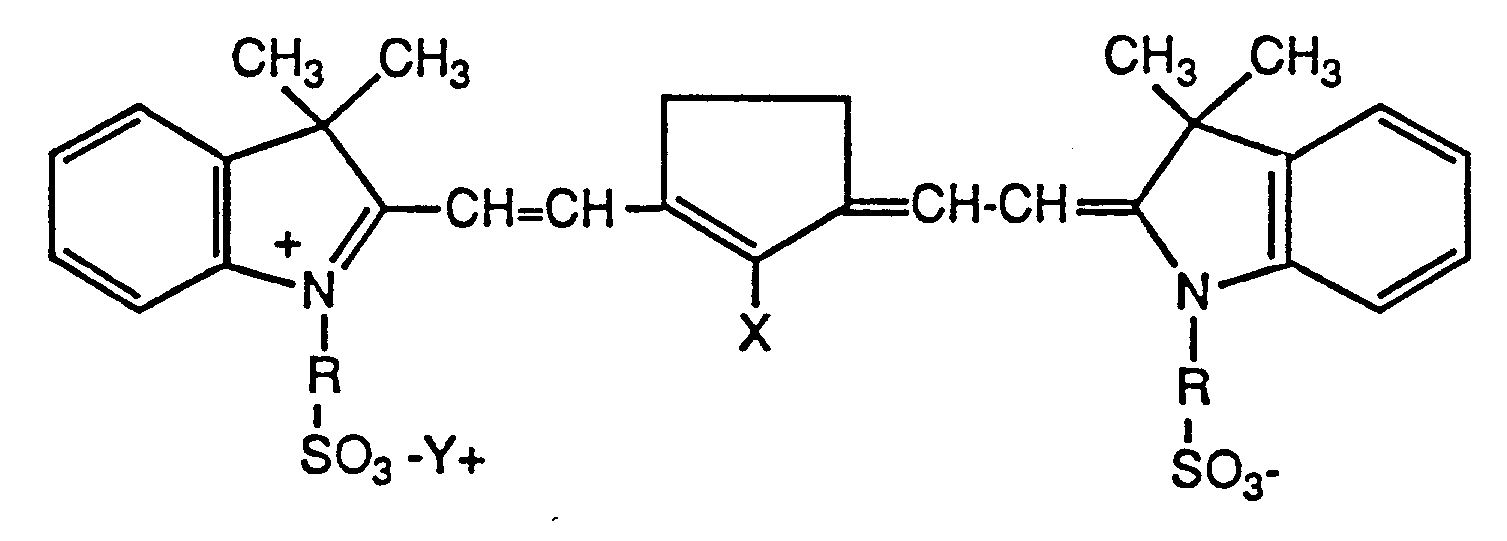
- In a preferred embodiment the photosensitive layer and the antihalation layer are present on opposite sides of the support.
- In a more preferred embodiment X is Cl. In a still more preferred embodiment R is -(CH₂)₃- or -(CH₂)₄-.
- The invention is a photographic element comprising a support, a photosensitive layer, and an antihalation layer comprising an absorbing amount of a novel antihalation dye described herein. The photosensitive layer is present on the first side of the support. By "present on the first side of the support" it is meant that the layer is either in direct contact with the first side of the support or that there may be one or more intervening layers between the layer and the first side of the support. By "present on the second side of the support" it is meant that the layer is either in direct contact with the second side of the support or that there may be one or more intervening layers between the layer and the second side of the support. Additional photosensitive layers and antihalation layers may be present on either side of the support.
- The antihalation layer is either: (1) a backing layer, present on the second side of the support; (2) an undercoat layer, present on the first side of the support between the support and the radiation sensitive layer or layers; (3) an interlayer, present on the first side of the support and situated between two radiation sensitive layers in cases in which more than one radiation sensitive layer is present; and/or (4) a filter layer, present on the first side of the support, with the photosensitive layer or layers located between it and the support.
- Other conventional layers, such as, for example, subbing layers, antistat layers, overcoats, etc, may be present. These conventional layers may be present either between the photosensitive layer and/or the antihalation layer and the support, between the photosensitive layer and the antihalation layer in the case in which both layers are present on the same side of the support, or on the side of the photosensitive layer and/or the antihalation layer away from the support.
- The antihalation layer comprises an absorbing amount of an antihalation dye represented by the following structure:

wherein X is F, Cl, or Br; R is a hydrocarbon moiety containing from two to five carbon atoms; and Y is a cation. "Hydrocarbon moiety" means a group composed of carbon and hydrogen atoms. The group may be saturated or unsaturated; straight chain, branched chain, or cyclic. Representative saturated R groups include straight chain groups, such as -(CH₂)₂-, -(CH₂)₃-, -(CH₂)₄-, and -(CH₂)₅-; branched chain groups, such as -(CH₂)₂-(CH) (CH₃)-(CH₂)-; and cyclic groups, such as cyclopentyl. Unsaturated R groups include such groups as, for example, -(CH₂) (CH) (CH) (CH₂)-. - Dyes of this structure absorb in the near infrared region of the spectrum, e.g., in the spectral region of from 700 nm to 900 nm, and may be used in infrared antihalation layers for photosensitive elements. They are cleanly washed out during development of the element and so leave little or no dye stain. Surprisingly, these dyes produce much less dye stain than the corresponding compounds which contain a cyclohexene ring in place of the cyclopentene ring.
- The counter ion, Y, may be any of numerous cations, such as, for example: alkali metal cations, i.e., sodium ion, potassium ion, etc.; alkaline earths, i.e., calcium ion, magnesium ion, etc.; and quaternary ammonium ions, i.e., tetramethyl ammonium, tetraethyl ammonium, etc. Alkali metal cations, especially sodium ion, are preferred.
- In the preferred dyes, X is chlorine. In the more preferred dyes R is -(CH₂)₃- or -(CH₂)₄-. In solution these dyes absorb at 805 nm and so are particularly useful as antihalation dyes in photosensitive elements intended for use with diode lasers which emit in the 790 nm to 820 nm region of the spectrum.
- Contemplated equivalents are dyes in which the R group contains substituents, such as, for example, hydroxyl, alkoxyl, carboxyl, carboxylate, sulfonate, etc., which do not adversely affect the properties of the dye, such as, for example, absorption in the infrared and water solubility, required in the practice of this invention, as well as dyes in which the two R groups are different but in which the properties of the dye required in the practice of this invention are not adversely affected.
- The antihalation layer also comprises a vehicle. Such vehicles are well-known in the art and include hydrophilic colloids, such as, for example, gelatin, which may be derived from various sources, such as, for example, cattle bone, pigskin, etc.; gelatin derivatives, such as, for example, phthalated gelatin, acetylated gelatin, etc.; polysaccharides, such as, for example, dextran, etc.; synthetic polymers, such as, for example, poly(vinyl alcohol) and water soluble partially hydrolyzed poly(vinyl acetate); acrylamide polymers; polymers of alkyl and sulfoalkyl acrylates and methacrylates; polyamines; poly(vinyl acetals), such as, for example, polyvinyl acetal, etc.; poly(vinyl ethers); etc. Gelatin is preferred.
- To prepare the antihalation layer the dye can be dissolved in methanol, ethanol, or another suitable solvent, and added to an aqueous dispersion or melt of the vehicle. "Absorbing amount of an antihalation dye" means an amount of dye at least sufficient to impart antihalation properties to the layer yet not sufficient to cause any deleterious side effects. For antihalation layers an optical density of about 0.25 at the wavelength used for imaging is preferred. Using techniques well known to those skilled in the art, the concentration of dye required to attain this optical density can be calculated from the thickness of the antihalation layer and the absorption spectrum of the antihalation dye, which can be determined by conventional spectrophotometric techniques. The dyes are typically present in the antihalation layer in an amount of 0.005 to 0.05 g/m², preferably 0.01 to 0.03 g/m².
- The photosensitive layer or layers of the photosensitive element comprises a component which is responsive to infrared radiation. The photosensitive component is, preferably, a conventional gelatino silver halide emulsion or a hydrophilic colloid silver halide emulsion. Conventional photographic silver halide emulsions employing any of the commonly known halides, such as silver chloride, silver bromide, silver iodide, and mixture thereof, may be used. These may be of varied content and may be negative and/or positive working.
- The radiation sensitive layer also comprises a vehicle. Such vehicles are well-known in the art and include the materials useful as vehicles for the antihalation layer, described above. A preferred vehicle is gelatin.
- The layer may be hardened by addition of a conventional hardening agent, such as, for example, formaldehyde, glyoxal. Conventional additives may also be present for specific purposes, such as, for example, to enhance and stabilize the response of the emulsion.
- The preparation of silver halide emulsions is well known in the art. Silver halide emulsions, their preparation, and the preparation of photosensitive layers therefrom, are described in: Research Disclosure, Item 17643, December, 1978; Research Disclosure, Item 18431, August, 1979; Research Disclosure, Item 22534, January, 1983; and Abbott, U.S. Patent 4,425,426, the disclosures of which are incorporated by reference.
- The photosensitive component may be sensitized to infrared radiation by techniques known in the art. Sensitization of silver halide may be accomplished with chemical sensitizers, such as, for example, gold compounds, iridium compounds, or with other group VIII metal compounds, or with spectral sensitizing dyes, such as, for example, cyanine dyes, merocyanine dyes, styryls, etc.
- AgIBr grains with about 98.8 mol% bromide and about 1.2 mol%, in which the silver halide grains have a grain size of about 0.01 to 0.04 cubic micrometers dispersed in gelatin may be used to advantage. The sensitizing dye shown in the Example may also be used to advantage to sensitize the emulsion to infrared radiation.
- The support can be any of a number of supports for photosensitive elements known in the art. These include polymeric films such as, for example: cellulose ester, such as, for example cellulose triacetate, etc.; polyesters of dibasic aromatic carboxylic acids and divalent alcohols, such as, for example, poly(ethylene terephthalate), poly(ethylene isophthalate), etc.; paper; polymer coated paper; copolymerized vinyl compounds, such as, for example, vinyl acetate/vinyl chloride copolymer; polystyrene; polyacrylates; etc. Dyes may be incorporated into the support to impart a color thereto.
- Preferred supports include polyesters made according to Alles, U.S. Patent 2,779,684. These supports are particularly suitable because of their dimensional stability. A particularly preferred support is poly(ethylene terephthalate).
- The element may comprise any of a number of the other conventional additives and layers, such as are disclosed in any of the above incorporated references. These include, for example, optical brighteners, antifoggants, emulsion stabilizers, image stabilizers, filter dyes, intergrain absorbers, light-scattering materials, gelatin hardeners, coating aids, surfactants, overcoat layers, interlayer and barrier layers, antistat layers, plasticizers and lubricants, matting agents, development inhibitor-releasing compounds, etc. The element can be prepared by coating the layers onto the support using coating techniques which are conventional in the art.
- 2,3,3-Trimethylindole (16.0 g, 0.01 mol) was heated with 10.4 ml melted 1,4-butanesultone and 20 mL o-xylene at 146°C for 4 hours. The orange solution was cooled to 60°C before adding acetone to dilute and induce crystallization. After cooling to room temperature, the product was collected by filtration, washed with acetone, and dried to yield 22.15 g of quaternary salt, mp 236°C.
- Dimethylformamide (40 ml) and 40 ml dichloromethane were mixed and cooled to 5°C. Phosphorous oxychloride (37 ml) was dissolved in 40 ml dichloromethane and added dropwise to the dimethylformamide/dichloromethane solution at rate to maintain the temperature below 25°C. Cyclopentanone (8.8 g, 0.104 mol) was added and the mixture heated to reflux for 3 hours. After cooling to room temperature, the reaction mixture was poured into 200 ml of ice and allowed to sit overnight. The quenched reaction mixture was filtered twice to remove tarry by-products, then treated with sodium carbonate until the mixture was neutral. The resulting brown precipitate was collected by filtration, water washed, and dried to give 12.20 g blue-violet solid, mp 90-94°C, λmax = 425 nm (ε - 38,000).
- 2,3,3-Trimethyl-(4-sulfobutyl)indolenium, inner salt (5.9 g, 0.02 mol), 2-chloro-3-(dimethylaminomethylene)-1-(dimethyliminiummethyl)-cyclopent-1-ene chloride (2.49 g, 0.01 mol), and sodium acetate (1.64 g, 0.02 mol) were dissolved in 50 ml of acetic acid and 40 ml of acetic anhydride. The mixture was heated at reflux for 1 hour, cooled to room temperature, and poured into 400 ml of stirred ethyl acetate. After settling, the mixture was filtered to yield 7.07 g crude product. Repeated extraction with hot 2-propanol yielded purified product, mp 260°C, λmax = 805 nm (ε = 218,000).
- 2,3,3-Trimethylindole (8.0 g, 0.01 mol) was heated with 4.4 ml melted 1,3-propanesultone and 10 ml o-xylene at 140-150°C for 4 hours. The slurry was cooled to 60 °C before adding acetone to dilute and induce further crystallization. After cooling to room temperature, the product was collected by filtration, washed with acetone, and dried to yield 12.9 g of quaternary salt, mp 238°C.
- 2,3,3-Trimethyl-(4-sulfopropyl)indolenium, inner salt (5.62 g, 0.02 mol), 2-chloro-3-(dimethylaminomethylene)-1-(dimethyliminiummethyl)-cyclopent-1-ene chloride (2.49 g, 0.01 mol), and sodium acetate (1.64 g, 0.02 mol) were dissolved in 50 ml of acetic acid and 40 ml of acetic anhydride. The mixture was heated at reflux for 30 minutes, cooled to room temperature, and poured into 400 ml stirred ethyl acetate. After settling, the mixture was filtered to yield 4.64 g crude product. Repeated extraction with hot 2-propanol yielded purified product, mp 260°C, λmax = 805 nm (ε = 230,000).
- Control Dye A is described is Laganis, U.S. Patent 4,882,265, the disclosure of which is incorporated by reference. λmax = 795 nm.
- Dimethylformamide (40 ml) and 40 ml dichloromethane were mixed and cooled to 5°C. Phosphorous oxychloride (37 ml) was dissolved in 40 ml dichloromethane and added dropwise to the dimethylformamide/dichloromethane solution at rate to maintain the temperature below 25°C. Cyclohexanone (10 g, 0.102 mol) was added and the mixture heated at reflux for 3 hours. After cooling to room temperature, the reaction mixture was poured into 200 ml of ice and allowed to sit overnight. The quenched reaction mixture was filtered to collect 3.59 g solid, mp 127°C, λmax = 325 nm (ε = 14,000).
- 2,3,3-Trimethyl-(4-sulfobutyl)indolenium, inner salt (5.62 g, 0.02 mol), 2-chloro-3-(hydroxymethylene)-1-formyl-cyclohex-1-ene (2.49 g, 0.01 mol), and sodium acetate (34.28 g, 0.04 mol) were dissolved in 40 ml of acetic acid and 30 ml of acetic anhydride. The mixture was heated at reflux for 10 min, cooled to room temperature, and poured into 400 ml of stirred ethyl ether: After settling, the ether was decanted and remaining oil taken up in methanol and poured into a 10-fold volume of ethyl acetate. The resulting crystals were collected and dried to give 4.08 g, mp 223°C, λmax = 780 (ε = 201,000).
- When appropriately exposed and processed, the photosensitive elements of this invention will yield an image. Exposure may be carried out by any source which emits in the near infrared, such as, for example, a diode laser. The element is particularly useful with sources which emit in the range of 780 nm to 820 nm. Processing the element is carried out by conventional developing techniques such as are described, for example, in any of the references incorporated herein.
- The photosensitive elements of this invention are particularly useful for producing hardcopy output, for example, medical data, of images formed from an electronic modality, such as, for example, various types of medical diagnostic equipment, such as, for example, computer assisted tomography equipment.
- The advantageous properties of this invention can be observed by reference to the following examples which illustrate, but do not limit, the invention. All parts and percentages are by weight unless other indicated.
-
- Control Dye A
- 3H-Indolium, 2-[2-[2-chloro-3-[2-(1,3-dihydro-3,3-dimethyl-2H-indol-2-ylidene)ethylidene)-1-cyclopenten-1-yl]ethenyl]-1,3,3-trimethyl-, trifluoromethanesulfonate
- Control Dye B
- 3H-Indolium, 2-[2-[2-chloro-3-[2-[1,3-dihydro-3,3-dimethyl-1-(4-sulfobutyl)-2H-indol-2-ylidene]ethylidene]-1-cyclohexen-1-yl]ethenyl]-3,3-dimethyl-1-(4-sulfobutyl)-, hydroxide, inner salt, monosodium salt
- Dye 1
- 3H-Indolium, 2-[2-[2-chloro-3-[2-[1,3-dihydro-3,3-dimethyl-1-(4-sulfobutyl)-2H-indol-2-ylidene]ethylidene]-1-cyclohexen-1-yl]ethenyl]-3,3-dimethyl- 1-(4-sulfobutyl)-, hydroxide, inner salt, monosodium salt
- Dye 2
- 3H-Indolium, 2-[2-[2-chloro-3-[2-[1,3-dihydro-3,3-dimethyl-1-(3-sulfopropyl)-2H-indol-2-ylidene]-ethylidene]-1-cyclopenten-1-yl]-ethenyl]-3,3-dimethyl-1-(3-sulfopropyl)-, hydroxide, inner salt, monosodium salt
- Preparation of antihalation layer. A 7% gelatin solution was made by cold soaking and then dissolving dry gelatin (200 g) in water (4,434 g). To this solution was added: denatured ethanol (100 g); 5.35% sodium hydroxide solution (1.5 g); 10.5% Triton® X-100 in water (3.45 g); Saponin (3.1 g); and an amount of 0.03% solution of the dye to be evaluated in methanol adequate to produce the desired concentration. The aqueous gelatin solution was then coated onto an about 180 micrometers thick polyethylene terephthalate support suitably subbed as described in Alles, U.S. Pat No. 2,779,684. Glyoxal hardener was added to produce 0.031 g glyoxal/g of gelatin. The coated layer was passed through a conventional dryer in which cold air first sets the gelatin and then warm dry air removes the water and alcohol. The resulting element consisted of a polyethylene terephthalate support bearing an antihalation layer containing 4.5 g gelatin/m².
- Evaluation of antihalation layer. The element was immersed in standard medical X-ray developer for about 20 s, fixed, washed and dried. Images were visually evaluated for stain on an arbitrary scale of 0 to 12. Results are given in Table 1.
Table 1 Dye Amounta ODb Stain Color Stain Levelc None 0 0.05 none 0 Control A 4.15 0.32 green 5 Control B 2.65 0.23 green 8 Control B 6.1 0.30 green 12 Dye 1 2.65 0.33 green 3 Dye 1 6.1 0.48 green 7 Dye 2 2.65 0.23 green 0 Dye 2 6.1 0.33 green 5 a mg of dye/g of gelatin b Optical density at 820 nm before development c 0-2 is excellent; 3-7 good; 8-11 fair; 12 poor - Emulsion and Film Preparation. To prepare a photosensitive element comprising the antihalation layer of this invention, a silver halide emulsion consisting of, for example, AgIBr grains (about 98.8 mol% bromide and about 1.2 mol% iodide) about 0.01 to 0.04 cubic micrometers, or AgClBr grains (about 70% chloride and about 30% bromide) about 0.01 to 0.045 cubic micrometers, may be prepared in a small amount of gelatin. After redispersion, this material may be sensitized with gold and mercuric chloride and tetramethylthiuram monosulfide as well-known to those skilled in the art. Conventional antifoggants, stabilizers, and hardeners may be added as well as a spectral sensitizing dye of the following structure:

To prepare the photosensitive layer, the silver halide emulsion may be coated onto the element consisting of a support bearing the antihalation layer prepared above. The silver halide may be coated onto the side of the support opposite that containing the antihalation layer. A coating weight of about 2.5-3.2 g of silver/m² may be used. A hardened gelatin antiabrasion layer containing a matte, e.g., poly(methyl methacrylate), Teflon® fluorocarbon resin, or polyethylene beads, may be coated over the photosensitive layer.


Claims (20)
- A dye, useful as an infrared antihalation dye in a photosensitive element, said dye being represented by the following structure:

- The dye of claim 1 wherein X is Cl.
- The dye of claim 2 wherein R is selected from the group consisting of -(CH₂)₂-, -(CH₂)₃-, -(CH₂)₄-, -(CH₂)₅-, and -(CH₂)₂-(CH) (CH₃)-(CH₂)-.
- The dye of claim 2 wherein Y is sodium.
- The dye of claim 2 wherein R is -(CH₂)₃-.
- The dye of claim 2 wherein R is -(CH₂)₄-.
- A photosensitive element comprising an antihalation layer with low dye stain, said element comprising:(A) a support, comprising a first side and a second side;(B) at least one photosensitive layer; and(C) an antihalation layer, said antihalation layer comprising an absorbing amount of an antihalation dye represented by the following structure:

- The element of claim 7 wherein X is Cl.
- The element of claim 8 wherein R is selected from the group consisting of -(CH₂)₂-, -(CH₂)₃-, -(CH₂)₄-, -(CH₂)₅-, and -(CH₂)₂-(CH) (CH3)-(CH₂)-.
- The element of claim 8 wherein Y is sodium.
- The element of claim 9 wherein R is -(CH₂)₃-.
- The element of claim 9 wherein R is -(CH₂)₄-.
- The element of claim 7 wherein said photosensitive layer and said antihalation layer are both present on said first side of said support.
- The element of claim 7 wherein said photosensitive layer is present on said first side of said support and said antihalation layer is present on said second side of said support.
- The element of claim 14 wherein X is Cl.
- The element of claim 15 wherein R is selected from the group consisting of -(CH₂)₂-, -(CH₂)₃-, -(CH₂)₄-, -(CH₂)₅-, and -(CH₂)₂-(CH) (CH₃)-(CH₂)-.
- The element of claim 16 wherein said support is polyethylene terephthalate film.
- The element of claim 16 wherein Y is sodium.
- The element of claim 16 wherein R is -(CH₂)₃-.
- The element of claim 16 wherein R is -(CH₂)₄-.
Applications Claiming Priority (2)
| Application Number | Priority Date | Filing Date | Title |
|---|---|---|---|
| US07/606,305 US5107063A (en) | 1990-10-31 | 1990-10-31 | Aqueous soluble infrared antihalation dyes |
| US606305 | 1990-10-31 |
Publications (2)
| Publication Number | Publication Date |
|---|---|
| EP0483740A1 EP0483740A1 (en) | 1992-05-06 |
| EP0483740B1 true EP0483740B1 (en) | 1995-05-10 |
Family
ID=24427432
Family Applications (1)
| Application Number | Title | Priority Date | Filing Date |
|---|---|---|---|
| EP91118378A Expired - Lifetime EP0483740B1 (en) | 1990-10-31 | 1991-10-29 | Aqueous soluble infrared antihalation dyes |
Country Status (6)
| Country | Link |
|---|---|
| US (1) | US5107063A (en) |
| EP (1) | EP0483740B1 (en) |
| JP (1) | JPH07119966B2 (en) |
| AU (1) | AU633765B2 (en) |
| CA (1) | CA2054087A1 (en) |
| DE (1) | DE69109619T2 (en) |
Families Citing this family (22)
| Publication number | Priority date | Publication date | Assignee | Title |
|---|---|---|---|---|
| IT1251638B (en) * | 1991-10-28 | 1995-05-17 | Minnesota Mining & Mfg | SILVER HALIDE PHOTOGRAPHIC ELEMENTS |
| JP2884277B2 (en) * | 1992-05-11 | 1999-04-19 | 富士写真フイルム株式会社 | Silver halide photographic material |
| JP2955803B2 (en) * | 1992-07-22 | 1999-10-04 | 富士写真フイルム株式会社 | Silver halide photographic material |
| EP0626427B1 (en) * | 1993-05-26 | 2001-08-16 | Agfa-Gevaert N.V. | Near infra-red dyes and photographic element containing such dyes |
| US5330884A (en) * | 1993-05-26 | 1994-07-19 | E. I. Du Pont De Nemours And Company | Photographic element with near-infrared antihalation layer |
| DE69514648T2 (en) | 1995-06-27 | 2000-07-13 | Agfa-Gevaert N.V., Mortsel | Process for the production of an image by the heat process |
| DE69514658T2 (en) | 1995-09-14 | 2000-07-13 | Agfa-Gevaert N.V., Mortsel | Thermal imaging medium and method using it |
| DE69612501T2 (en) | 1996-12-04 | 2001-10-25 | Agfa-Gevaert N.V., Mortsel | Process for producing an improved image produced by heat |
| US6159657A (en) | 1999-08-31 | 2000-12-12 | Eastman Kodak Company | Thermal imaging composition and member containing sulfonated ir dye and methods of imaging and printing |
| US7261998B2 (en) * | 2001-04-04 | 2007-08-28 | Eastman Kodak Company | Imageable element with solvent-resistant polymeric binder |
| US7172850B2 (en) * | 2002-04-10 | 2007-02-06 | Eastman Kodak Company | Preparation of solvent-resistant binder for an imageable element |
| US7659046B2 (en) * | 2002-04-10 | 2010-02-09 | Eastman Kodak Company | Water-developable infrared-sensitive printing plate |
| US7018775B2 (en) * | 2003-12-15 | 2006-03-28 | Eastman Kodak Company | Infrared absorbing N-alkylsulfate cyanine compounds |
| US7008751B2 (en) | 2004-08-04 | 2006-03-07 | Eastman Kodak Company | Thermally switchable imageable elements containing betaine-containing co-polymers |
| US8227621B2 (en) * | 2005-06-30 | 2012-07-24 | Li-Cor, Inc. | Cyanine dyes and methods of use |
| US8344158B2 (en) * | 2007-08-15 | 2013-01-01 | Washington University | Fluorescent polymethine cyanine dyes |
| US20090214436A1 (en) | 2008-02-18 | 2009-08-27 | Washington University | Dichromic fluorescent compounds |
| EP3553075B1 (en) | 2012-01-23 | 2025-01-08 | Washington University | Goggle imaging systems and methods |
| US10806804B2 (en) | 2015-05-06 | 2020-10-20 | Washington University | Compounds having RD targeting motifs and methods of use thereof |
| CN105733364B (en) * | 2016-04-19 | 2019-06-11 | 北京印刷学院 | A kind of water-based near-infrared absorption inkjet ink and preparation method thereof |
| CN111051072B (en) | 2017-08-31 | 2021-08-03 | 富士胶片株式会社 | Lithographic printing plate original, lithographic printing plate production method and lithographic printing method |
| WO2021119423A1 (en) | 2019-12-13 | 2021-06-17 | Washington University | Near infrared fluorescent dyes, formulations and related methods |
Citations (1)
| Publication number | Priority date | Publication date | Assignee | Title |
|---|---|---|---|---|
| US4882265A (en) * | 1988-05-18 | 1989-11-21 | E. I. Du Pont De Nemours And Company | Infrared laser recording film |
Family Cites Families (6)
| Publication number | Priority date | Publication date | Assignee | Title |
|---|---|---|---|---|
| JPS6333477A (en) * | 1986-07-28 | 1988-02-13 | Nippon Kayaku Co Ltd | Indolenine based compound and optical recording medium containing said compound |
| US4876181A (en) * | 1987-04-24 | 1989-10-24 | Eastman Kodak Company | Photographic elements containing infrared filter dyes |
| US4871656A (en) * | 1987-04-24 | 1989-10-03 | Eastman Kodak Company | Photographic silver halide elements containing infrared filter dyes |
| EP0288076B1 (en) * | 1987-04-24 | 1991-09-04 | EASTMAN KODAK COMPANY (a New Jersey corporation) | Infrared filter dyes for photographic elements |
| DE3721850A1 (en) * | 1987-07-02 | 1989-01-12 | Bayer Ag | Indoline-carbocyanine dyes |
| US4959294A (en) * | 1988-04-14 | 1990-09-25 | Minnesota Mining And Manufacturing Company | Infra-red sensitising dyes for silver halide |
-
1990
- 1990-10-31 US US07/606,305 patent/US5107063A/en not_active Expired - Lifetime
-
1991
- 1991-10-23 CA CA002054087A patent/CA2054087A1/en not_active Abandoned
- 1991-10-29 EP EP91118378A patent/EP0483740B1/en not_active Expired - Lifetime
- 1991-10-29 DE DE69109619T patent/DE69109619T2/en not_active Expired - Lifetime
- 1991-10-30 JP JP3284638A patent/JPH07119966B2/en not_active Expired - Fee Related
- 1991-10-30 AU AU86835/91A patent/AU633765B2/en not_active Ceased
Patent Citations (1)
| Publication number | Priority date | Publication date | Assignee | Title |
|---|---|---|---|---|
| US4882265A (en) * | 1988-05-18 | 1989-11-21 | E. I. Du Pont De Nemours And Company | Infrared laser recording film |
Also Published As
| Publication number | Publication date |
|---|---|
| EP0483740A1 (en) | 1992-05-06 |
| US5107063A (en) | 1992-04-21 |
| AU8683591A (en) | 1992-05-07 |
| JPH07119966B2 (en) | 1995-12-20 |
| AU633765B2 (en) | 1993-02-04 |
| DE69109619T2 (en) | 1995-11-09 |
| DE69109619D1 (en) | 1995-06-14 |
| CA2054087A1 (en) | 1992-05-01 |
| JPH04285949A (en) | 1992-10-12 |
Similar Documents
| Publication | Publication Date | Title |
|---|---|---|
| US5107063A (en) | Aqueous soluble infrared antihalation dyes | |
| EP0299435B1 (en) | Photographic oxonol colour filter dyes | |
| US4882265A (en) | Infrared laser recording film | |
| EP0748465B1 (en) | Dihydroperimidine squarylium dyes as antihalation and acutance materials for photographic and photothermographic articles | |
| EP0703494A1 (en) | Silver halide photographic material containing infrared absorbing colorant | |
| EP0307868A2 (en) | Silver halide photographic material | |
| EP0341958A2 (en) | Silver halide photographic material | |
| JPH05313304A (en) | Silver halide photographic sensitive material | |
| JPH09179236A (en) | Novel non-sensitizing infrared dye for use in photographic element | |
| EP0523465A1 (en) | Silver halide photographic elements | |
| EP0377961B1 (en) | Infrared-sensitive photographic materials incorporating antihalation and/or acutance dye | |
| US4959294A (en) | Infra-red sensitising dyes for silver halide | |
| JP3616173B2 (en) | Silver halide photographic light-sensitive material and image forming method | |
| US4920040A (en) | Silver halide photographic light-sensitive material for a laser light exposure | |
| US5164291A (en) | Light sensitive element having an antihalation layer | |
| US5077186A (en) | Silver halide photographic light-sensitive dye containing element | |
| US5041550A (en) | Infra-red sensitizing dyes for silver halide | |
| JPH02110548A (en) | Infrared photosensitive phorographic element | |
| US5075209A (en) | Silver halide photographic light-sensitive material | |
| EP0828183A1 (en) | Photographic element comprising infrared absorber dyes | |
| EP0626427B1 (en) | Near infra-red dyes and photographic element containing such dyes | |
| EP0751421B1 (en) | Photographic materials comprising cyanine dyes with chain sulphone substituent | |
| EP0539786A1 (en) | Silver halide photographic elements | |
| JP2660421B2 (en) | Silver halide photographic material | |
| JP3440167B2 (en) | Trimethine compound and silver halide photographic material using the same |
Legal Events
| Date | Code | Title | Description |
|---|---|---|---|
| PUAI | Public reference made under article 153(3) epc to a published international application that has entered the european phase |
Free format text: ORIGINAL CODE: 0009012 |
|
| AK | Designated contracting states |
Kind code of ref document: A1 Designated state(s): BE CH DE FR GB IT LI LU NL |
|
| 17P | Request for examination filed |
Effective date: 19920723 |
|
| 17Q | First examination report despatched |
Effective date: 19940909 |
|
| GRAA | (expected) grant |
Free format text: ORIGINAL CODE: 0009210 |
|
| AK | Designated contracting states |
Kind code of ref document: B1 Designated state(s): BE CH DE FR GB IT LI LU NL |
|
| PG25 | Lapsed in a contracting state [announced via postgrant information from national office to epo] |
Ref country code: NL Free format text: LAPSE BECAUSE OF NON-PAYMENT OF DUE FEES Effective date: 19950510 Ref country code: LI Effective date: 19950510 Ref country code: CH Effective date: 19950510 |
|
| REF | Corresponds to: |
Ref document number: 69109619 Country of ref document: DE Date of ref document: 19950614 |
|
| ET | Fr: translation filed | ||
| ITF | It: translation for a ep patent filed | ||
| REG | Reference to a national code |
Ref country code: CH Ref legal event code: PL |
|
| PG25 | Lapsed in a contracting state [announced via postgrant information from national office to epo] |
Ref country code: LU Free format text: LAPSE BECAUSE OF NON-PAYMENT OF DUE FEES Effective date: 19951031 |
|
| NLV1 | Nl: lapsed or annulled due to failure to fulfill the requirements of art. 29p and 29m of the patents act | ||
| PLBE | No opposition filed within time limit |
Free format text: ORIGINAL CODE: 0009261 |
|
| STAA | Information on the status of an ep patent application or granted ep patent |
Free format text: STATUS: NO OPPOSITION FILED WITHIN TIME LIMIT |
|
| 26N | No opposition filed | ||
| REG | Reference to a national code |
Ref country code: GB Ref legal event code: 732E |
|
| REG | Reference to a national code |
Ref country code: FR Ref legal event code: TP |
|
| PGFP | Annual fee paid to national office [announced via postgrant information from national office to epo] |
Ref country code: BE Payment date: 19981216 Year of fee payment: 8 |
|
| PG25 | Lapsed in a contracting state [announced via postgrant information from national office to epo] |
Ref country code: BE Free format text: LAPSE BECAUSE OF NON-PAYMENT OF DUE FEES Effective date: 19991031 |
|
| BERE | Be: lapsed |
Owner name: E.I. DU PONT DE NEMOURS AND CY Effective date: 19991031 |
|
| REG | Reference to a national code |
Ref country code: GB Ref legal event code: 732E |
|
| REG | Reference to a national code |
Ref country code: GB Ref legal event code: 746 Effective date: 20010618 |
|
| REG | Reference to a national code |
Ref country code: FR Ref legal event code: TP |
|
| REG | Reference to a national code |
Ref country code: GB Ref legal event code: IF02 |
|
| REG | Reference to a national code |
Ref country code: FR Ref legal event code: D6 |
|
| PG25 | Lapsed in a contracting state [announced via postgrant information from national office to epo] |
Ref country code: IT Free format text: LAPSE BECAUSE OF NON-PAYMENT OF DUE FEES Effective date: 20051029 |
|
| REG | Reference to a national code |
Ref country code: GB Ref legal event code: 732E |
|
| REG | Reference to a national code |
Ref country code: FR Ref legal event code: TP |
|
| PGFP | Annual fee paid to national office [announced via postgrant information from national office to epo] |
Ref country code: FR Payment date: 20100903 Year of fee payment: 20 |
|
| PGFP | Annual fee paid to national office [announced via postgrant information from national office to epo] |
Ref country code: GB Payment date: 20100827 Year of fee payment: 20 |
|
| PGFP | Annual fee paid to national office [announced via postgrant information from national office to epo] |
Ref country code: DE Payment date: 20100827 Year of fee payment: 20 |
|
| REG | Reference to a national code |
Ref country code: DE Ref legal event code: R071 Ref document number: 69109619 Country of ref document: DE |
|
| REG | Reference to a national code |
Ref country code: DE Ref legal event code: R071 Ref document number: 69109619 Country of ref document: DE |
|
| REG | Reference to a national code |
Ref country code: GB Ref legal event code: PE20 Expiry date: 20111028 |
|
| PG25 | Lapsed in a contracting state [announced via postgrant information from national office to epo] |
Ref country code: GB Free format text: LAPSE BECAUSE OF EXPIRATION OF PROTECTION Effective date: 20111028 |
|
| PG25 | Lapsed in a contracting state [announced via postgrant information from national office to epo] |
Ref country code: DE Free format text: LAPSE BECAUSE OF EXPIRATION OF PROTECTION Effective date: 20111030 |