EP0481746B1 - Recovery of surfactant from papermaking process - Google Patents
Recovery of surfactant from papermaking process Download PDFInfo
- Publication number
- EP0481746B1 EP0481746B1 EP91309515A EP91309515A EP0481746B1 EP 0481746 B1 EP0481746 B1 EP 0481746B1 EP 91309515 A EP91309515 A EP 91309515A EP 91309515 A EP91309515 A EP 91309515A EP 0481746 B1 EP0481746 B1 EP 0481746B1
- Authority
- EP
- European Patent Office
- Prior art keywords
- surfactant
- foam
- depleted
- liquid
- enriched
- Prior art date
- Legal status (The legal status is an assumption and is not a legal conclusion. Google has not performed a legal analysis and makes no representation as to the accuracy of the status listed.)
- Expired - Lifetime
Links
Images

Classifications
-
- C—CHEMISTRY; METALLURGY
- C02—TREATMENT OF WATER, WASTE WATER, SEWAGE, OR SLUDGE
- C02F—TREATMENT OF WATER, WASTE WATER, SEWAGE, OR SLUDGE
- C02F11/00—Treatment of sludge; Devices therefor
- C02F11/12—Treatment of sludge; Devices therefor by de-watering, drying or thickening
-
- D—TEXTILES; PAPER
- D21—PAPER-MAKING; PRODUCTION OF CELLULOSE
- D21F—PAPER-MAKING MACHINES; METHODS OF PRODUCING PAPER THEREON
- D21F11/00—Processes for making continuous lengths of paper, or of cardboard, or of wet web for fibre board production, on paper-making machines
- D21F11/002—Processes for making continuous lengths of paper, or of cardboard, or of wet web for fibre board production, on paper-making machines by using a foamed suspension
-
- D—TEXTILES; PAPER
- D21—PAPER-MAKING; PRODUCTION OF CELLULOSE
- D21H—PULP COMPOSITIONS; PREPARATION THEREOF NOT COVERED BY SUBCLASSES D21C OR D21D; IMPREGNATING OR COATING OF PAPER; TREATMENT OF FINISHED PAPER NOT COVERED BY CLASS B31 OR SUBCLASS D21G; PAPER NOT OTHERWISE PROVIDED FOR
- D21H17/00—Non-fibrous material added to the pulp, characterised by its constitution; Paper-impregnating material characterised by its constitution
- D21H17/03—Non-macromolecular organic compounds
- D21H17/05—Non-macromolecular organic compounds containing elements other than carbon and hydrogen only
- D21H17/09—Sulfur-containing compounds
Definitions
- foamed liquid collected from the foam-fiber furnish in saveall 22 is withdrawn through line 28 to foam silo 30.
- a water slurry of pulp containing on the order of 0.5 to 7 weight percent fiber, preferably in the range of from about 2.5 to about 4.5 percent fiber, is drawn from a machine chest 36 through line 37 and flow control valve 38 to line 33 and added to the foamed liquid from silo 30 in the amount necessary to form the foam-fiber furnish of the desired consistency in the range of from about 0.1 to about 3 weight percent fiber, preferably in the range of 0.3 to 1.2 percent fiber, for the production of the fibrous web by papermaking machine 10.
- the foam-fiber furnish is delivered by positive displacement fan pump 32 to pressurized headbox 20 through conduit 34.
- the rate of pulp feed in line 37 to the fan pump is controlled by valve 38 governed by controller 78 based on signals from basis weight meter 80, consistency meter 39 and flow meter 40, all of conventional design, to produce webs of the desired basis weight at the production speed of the forming felt 11 of papermaking machine 10.
- separation means physically moving or transporting the foam or lighter portions of it away from the liquid or dense phase, or alternatively, of course, physically moving or transporting the liquid or dense phase away so that liquid does not drain into the dense phase from the foam.
- admixture as used herein is intended to include all aggregations of more than one component whether multi phase or single phase, a solution, dispersion, colloid, suspension, foam, emulsion, froth, physical mixture, or other structure.
- Liquid from liquid separation unit 45 is introduced into surfactant recovery unit 55 through line 56.
- Unit 55 includes means 60 for introducing air for the purpose described below.
- Aerators 60 disposed within the lower portion of surfactant recovery unit 55 may be of any construction which is capable of generating a stable, free draining foam from the foamable liquid admixture of interest including pressurized air aerators, turbine aerators, Denver cells, jet aerators, porous diffusers and the like.
- the foam phase formed above the dense phase is sufficiently stable for a foam residence time of at least several seconds, preferably of at least about 10 seconds, more preferably of at least 30 seconds, to allow drainage of relatively purified liquid back into the dense phase.
- a foam is termed a "stable, free draining" foam.
- lower energy is required for use of aerators of the type illustrated in Figs. 2, 3, and 4 as compared with jet aeration, dissolved air flotation, or turbine aeration.
- the relative volumes of air per volume of surfactant supplied to surfactant recovery unit 55 to achieve the desired extent of recovery of surfactant is best determined by trial. As a general rule an air to liquid ratio by volume of about 5:1 to 20:1, preferably from about 6:1 to 12:1, is satisfactory for each surfactant recovery unit in the line.
Landscapes
- Life Sciences & Earth Sciences (AREA)
- Hydrology & Water Resources (AREA)
- Engineering & Computer Science (AREA)
- Environmental & Geological Engineering (AREA)
- Water Supply & Treatment (AREA)
- Chemical & Material Sciences (AREA)
- Organic Chemistry (AREA)
- Paper (AREA)
- Emulsifying, Dispersing, Foam-Producing Or Wetting Agents (AREA)
- Removal Of Specific Substances (AREA)
Abstract
Description
- Replacing water with foam provides many advantages in papermaking. However, in addition to substantial problems involved in merely making that substitution, environmental problems involved with use of large amounts of surfactants have become increasingly severe as environmental regulations become more stringent. The combination of both sets of problems have done much to impede large scale commercial implementation of most, if not all, of the papermaking processes replacing water with foam which have been suggested over the last quarter century. The present invention largely obviates the environmental problems previously associated with foam substitution as it provides an economical, practical means of concentrating the surfactant in streams recovered from the process. In many cases, the surfactant, the stream bearing it or both, may be purified to such an extent that they may be reused, thus moving us many steps closer to the common dream of the papermaker and the ecologist--a closed process. Thus, broadly this invention relates to a method for recovery of surfactant from an aqueous admixture. In one of its more specific aspects, this invention relates to recovery of reusable surfactant from discarded foamed liquid in a foam forming papermaking process and reuse of the recovered surfactant in the process. In still another of its more specific aspects, this invention relates to a wet web forming process wherein a foamed fiber furnish is prepared by mixing a water slurry of fibers with a foamed liquid comprising water, air, and surfactant, a fibrous web is formed on a moving felt or wire on a papermaking machine with recovery of foamed liquid therefrom, part of the foamed liquid is recycled to make up further amounts of furnish and part of the foamed liquid is processed for recovery of surfactant for reuse in the process. Water from which the surfactant is recovered by the method of this invention may be so processed to the extent necessary to meet environmental purity requirements for discharge into lakes and streams, as well as for reuse or recycle into the papermaking process. The process may be used also in conjunction with other papermaking processes employing foamable admixture of surfactants, for example, a foam assisted dewatering process.
- The manufacture of high grade paper products such as towels and tissue, especially facial tissue and bathroom tissue, by forming a dispersion of wood fibers in a foamed aqueous carrier and depositing the resulting foam-fiber furnish on a forming wire of a papermaking machine is known in the art. A disclosure of pertinent prior art relating to foam forming processes is included in U.S. Patent No. 4,443,297 incorporated herein by reference. In such processes, all of the foamable liquid recovered from the forming wire is recycled in the process.
- The invention is directed to a method and apparatus for the recovery of surfactant, e.g., an alpha olefin sulfonate, e.g containing at least about 10 carbon atom or a peg 6 lauramide, from a foamed or foamable aqueous admixture containing surfactant, usually of the order of 150 to 1000 parts per million (ppm) surfactant by weight.
- According to the present invention, there is provided a method of recovering surfactant from a foamed aqueous admixture recovered from a fibrous web forming process, comprising:
- (a) draining surfactant-depleted liquid which is substantially free of entrained bubbles from said foamed aqueous admixture, thereby forming a surfactant-enriched foam;
- (b) separating the surfactant-enriched foam from the surfactant-depleted liquid; and
- (c) returning surfactant in said surfactant-enriched foam to said fibrous web forming process.
- Suitably, the surfactant may be returned to the web-forming process in the form of a stream having a concentration of surfactant exceeding that of said foamed aqueous admixture.
- In a preferred embodiment, the method comprises the additional steps of subjecting the surfactant-depleted liquid to at least one additional surfactant separation step comprising the sub-steps of
- (i) forming a stable foam from surfactant-depleted liquid produced in the preceding step by passing bubbles of air therethrough;
- (ii) draining surfactant-depleted liquid from said stable foam produced in the preceding step, thereby forming a second surfactant-enriched foam;
- (iii) separating surfactant-enriched foam produced in (ii) from surfactant-depleted liquid produced in (ii); and
- (iv) returning surfactant in the surfactant-enriched foam obtained in at least one of said additional steps to said fibrous web forming process.
- Surfactant returned to the fibrous web forming process may be returned in the form of a stream having a concentration of surfactant in excess of that of said foamed aqueous admixture;
- In one aspect of this preferred embodiment, at least a portion of the surfactant in the surfactant-depleted liquid from sub-step (ii) of the last surfactant separation step is returned to said fibrous web forming process. Suitably it is returned in the form of a stream having a concentration of surfactant less than that of said aqueous foamed admixture.
- In another aspect of this preferred embodiment, the surfactant-depleted liquid is subjected to sufficient additional surfactant separation steps to reduce the concentration of surfactant to below 10 ppm by weight. The final surfactant-depleted liquid so obtained may then be discharged to the environment.
- Air may be separated from this surfactant-depleted liquid prior to discharging it to the environment.
- In accordance with a further aspect of the invention, there is provided a method of producing a stream enriched in concentration of surfactant from a stream of a surfactant-containing foamable aqueous admixture recovered from a fibrous web forming process, comprising:
- (a) forming a stable foam by passing air bubbles through said foamable aqueous admixture;
- (b) draining surfactant-depleted liquid which is substantially free of entrained bubbles from said stable foam, thereby forming a surfactant-enriched foam;
- (c) separating the surfactant-enriched foam from the surfactant-depleted liquid; and
- (d) returning surfactant in said surfactant-enriched foam to said fibrous web forming process.
- Suitably, the surfactant may be returned to the web-forming process in the form of a stream having a concentration of surfactant exceeding that of said foamable aqueous admixture.
- The surfactant-depleted liquid may be subjected to at least one further separation step as described above and at least a portion of the liquid recovered from the last step may be returned to the fibrous web forming process or may be discharged to the environment, as described above.
- The invention also provides a method of recovering a surfactant-depleted water surfactant admixture from a foamed aqueous admixture discharged from a fibrous web forming process comprising the steps of:
- (a) draining surfactant-depleted liquid which is substantially free of entrained bubbles from said foamed aqueous admixture, thereby forming a first surfactant-enriched foam;
- (b) separating the first surfactant-enriched foam from the surfactant-depleted liquid thereby forming a first surfactant-enriched overflow and a first surfactant-depleted underflow;
- (c) providing the surfactant-depleted underflow as a foamable aqueous admixture feed stream to at least one aqueous purification step comprising the substeps of:
- (i) forming a stable foam from said feed stream by passing air bubbles therethough;
- (ii) separating surfactant-depleted aqueous liquid which is substantially free of entrained bubbles from said foam by drainage, thereby forming surfactant-enriched foam; and
- (iii) separating said surfactant-enriched foam from said surfactant-depleted liquid thereby forming a surfactant-enriched overflow from said surfactant-enriched foam and a surfactant-depleted underflow from the surfactant-depleted aqueous liquid.
- Surfactant in the surfactant-enriched foam overflow may advantageously be returned to the fibrous web forming process.
- In the manner described above, the surfactant-depleted underflow may also be returned to the fibrous web forming process or may be discharged to the environment.
- Further according to the invention, there is provided a method of separating a feed stream of foamable aqueous admixture discharged from a fibrous web forming process into a surfactant-enriched stream and a usable surfactant-depleted stream comprising the steps of:
- (a) forming a stable foam by passing air bubbles through said feed stream;
- (b) draining surfactant-depleted aqueous liquid which is substantially free of entrained bubbles from said stable foam, thereby forming a surfactant-enriched foam;
- (c) separating the surfactant-enriched foam from the surfactant-depleted liquid thereby forming a surfactant-enriched overflow stream from the surfactant-enriched foam and a surfactant-depleted aqueous underflow stream from the surfactant-depleted aqueous liquid; and
- (d) returning surfactant in said surfactant-depleted aqueous underflow stream to said fibrous web forming process.
- Suitably, the surfactant may be returned in step (d) in the form of a stream having a concentration of surfactant less than that of said feed stream.
- Preferably surfactant-enriched foam separated from surfactant-depleted liquid in any of the above procedures may be treated to separate air from it by rupturing bubbles contained therein, thereby forming a resolved surfactant enriched foam before returning surfactant in said foam to said fibrous web forming process.
- In a preferred embodiment, the fibrous web forming process is a forming process in which a foamed aqueous furnish containing surfactant is present in a headbox and drainage of surfactant-depleted liquid from surfactant-enriched foam is allowed to continue until the concentration of surfactant in the surfactant-enriched foam is at least substantially equivalent to the concentration of surfactant in the foamed aqueous furnish in said headbox, which is suitably at least 30 ppm.
- The foamable or foamed aqueous admixture subject to the process of the invention may comprise, for example, at least about 30 ppm surfactant, about 1 percent to about 97 percent of liquid aqueous phase, by volume, and from about 3 percent to about 99 percent air distributed through said liquid aqueous phase.
- Where in a process according to the invention a stable foam is formed by passing air bubbles through a foamable aqueous admixture, at least 50% by volume or at least 50% by number of said air bubbles may be between about 1 mm and 5 mm in size.
- The concentration of the surfactant in surfactant-enriched foam obtained by a process of the invention may exceed 100 ppm by weight.
- In one embodiment of the invention, each stable foam formed by a process according to the invention is sufficiently stable to allow surfactant-depleted liquid to be drained from it for a period of at least about 30 seconds and each step of draining surfactant depleted liquid from a stable foam is allowed to continue for at least about 30 seconds.
- In accordance with one aspect of the invention, foamed liquid is separated into reusable surfactant admixture and a purified aqueous stream by a multi-stage process including drainage, aeration, and foam resolution. First, foamed liquid is drained creating a more-dense fraction of foamable liquid impoverished in surfactant and a less-dense fraction of foam enriched in surfactant. Subsequently, these fractions are separated from each other and the dense fraction from the drainage stage, optionally combined with foamable liquid from other sources in the papermaking operation, is aerated with air bubbles, preferably of a uniform size range of from about 1 to 5 mm, to form a stable, free draining foam enriched in surfactant from which a more-dense phase of surfactant-depleted liquid is drained, separated from the foam, and upon which other aeration stages may be imposed if desired or necessary. The resulting foams may be broken or resolved to remove air therefrom, and the resulting surfactant-enriched foamed liquid or foamable liquid stream recycled to the process. Alternatively, in some cases, foam may be recycled without being resolved.
- The surfactant content of a foamed aqueous liquid containing of the order of 500 ppm or more surfactant may be reduced by the process of the invention to non-foamable water containing about 10 parts per million or less, and as low as about 3 ppm, by repeating the aeration, drainage and separation steps in sequential stages. Foaming of the water containing surfactant usually ceases at about 3 to 10 ppm. In many cases, it will be advantageous to recycle surfactant-depleted water to other operations in the web forming process such as, for example, pulping, repulping, showers, washers, and other applications for which water of this quality is suitable.
- In some applications wherein the stream from which the surfactant is to be recovered is primarily foamable liquid rather than a foamed liquid, the drainage step may occur in the liquid return lines without requiring a separate drainage apparatus.
- The invention will now be described in greater detail with reference to preferred embodiments thereof and with the aid of the accompanying drawings in which
- Fig. 1 is a diagrammatic representation of a papermaking machine with auxiliary equipment for the preparation of a foamed aqueous furnish from low consistency pulp illustrating one application of the process of this invention.
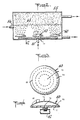
- Fig. 2 is a diagrammatic elevational view, partly in vertical cross section, illustrating one preferred form of apparatus useful in carrying out the process of this invention.
- Fig. 3 is a plan view of a non-clogging sparger element of the apparatus of Fig. 2.
- Fig. 4 is an elevational cross-sectional view of one of the non-clogging spargers of Figs. 2 and 3.
- With reference to Fig. 1, an illustrative process and apparatus for foam forming a fibrous web, and the recovery of surfactant from excess foam in accordance with this invention are illustrated diagrammatically. In this particular embodiment, a
papermaking machine 10 is illustrated; this machine is known in the art as a crescent former, and corresponds to that described in U.S. Patent No. 3,326,745
The web forming end or wet end of the papermaking machine includes a liquid permeable forming felt or fabric 11 and a pressing wire orscreen 12 of the type used in the art for wet forming of nonwoven webs. Forming felt 11 is also referred to hereinafter as a moving foraminous support means. Forming felt 11 is suitably constructed of nylon or polyester woven mesh with a fine synthetic batt attached to form a thick, liquid permeable fabric which is supported in a conventional manner on rolls including breast roll 15 and a couch roll or pressing roll, such as asuction pressure roll 16. Pressingwire 12 is similarly supported onrolls including rolls 18 and 19 which are so positioned relative to breast roll 15 as to cause thepressing wire 12 to converge on the forming felt 11 at the cylindrical breast roll 15 at an acute angle relative to felt 11. The felt 11 andwire 12 move in the same direction at the same speed and in the direction of rotation of breast roll 15. - In this machine,
wire 12 and forming felt 11 converge at the upper surface of forming roll 15 to form a wedge shaped space or nip into which a jet of a foamed fiber furnish is directed from apressurized headbox 20.Wire 12 is so tensioned that as it passes over the felt 11 on the surface of breast roll 15, the foamed liquid-fiber dispersion is pressed betweenwire 12 and felt 11 forcing liquid throughwire 12 intosaveall 22 where it is collected as foamed liquid having an air content in the range of 55 to 75 percent by volume for reuse in the process. The wet web W formed in the process is carried by felt 11 to pressingroll 16 where it is transferred to thedrum 26 of a Yankee dryer. Liquid is pressed from the wet web by pressingroll 16 as the wet web is transferred to drum 26 of the dryer where it is dried and creped by crepingblade 27. The finished web is collected on take-up roll 28. It will be evident that some of the surfactant necessary to form the foamed aqueous liquid used in the process normally remains in the web. - In this particular embodiment of a wet web foam forming process, foamed liquid is first formed as described in U.S. Patent No. 4,443,299. To initiate start-up, water from a suitable source, not illustrated, is added to the
silo 30 throughline 31 with sufficient surfactant to produce the desired foamed liquid. For example, an aqueous solution of a suitable anionic surfactant, such as an alpha olefin sulfonate available from Witco Corp., New York, under the tradename Witconate AOS may be used to produce a satisfactory aqueous foam at a preferred concentration in the range of from about 150 ppm to about 350 ppm by weight. A number of surfactants suitable as a water additive for purposes of the present invention are available on the market, being generally classified a nonionic, anionic, cationic, or amphoteric surfactants. The surfactant concentration required usually will be in the range of 150 to 1000 ppm by weight. A preferred nonionic surfactant is a peg-6 lauramide marketed under the tradename Mazamide L-5AC by Mazer Chemical Co., Chicago. - Selection of a surfactant is dependent upon chemical characteristics of such other additives as may be commonly used in the manufacture of fibrous webs. U.S. Patents Nos. 3,716,449 and 3,871,952 disclose specific nonionic, anionic, and cationic surfactants that have been found suitable for forming fibrous webs from dispersions of fibers in foam. U.S. Patent No. 4,056,456 discloses additional surfactants, including some classified as amphoteric surfactants, which are suitable for use in the practice of the present invention. The disclosures of these patents are included by reference in the present application for their teachings of surfactants materials. It is to be understood that there are a number of other surfactant materials available which are capable of modifying the interfacial tension between water and gas or air to form semi-stable aqueous carrier media and which are suitable for recovery of surfactant from aqueous foams containing such surface active agents by the process of this invention. Those skilled in the art appreciate that appropriate blends of surfactants may be in some cases be desirable.
- A preferred method of generating the aqueous foam as the carrier of the fibers in the furnish is that disclosed in U.S. Patent 4,443,299. As a specific example of start-up, foamed liquid carrier is initially generated by driving the forming felt 11 and
wire 12 at a speed of about 12.7 m·sec⁻¹ 2500 feet per minute (fpm) with the tension of thepressing wire 12 adjusted to range of from about 3.5 KN·m⁻¹ (20 pli (pounds per linear inch)) to about 10.5 KN·m⁻¹ (60 pli), suitably about 52.5 KN·m⁻¹ (30 pli). Positivedisplacement fan pump 32 is energized to pump an aqueous surfactant solution, containing e.g. 300 ppm of an anionic surfactant, fromsilo 30 throughlines wire 12. The pressure and flow rate of the foamable liquid at the headbox is regulated to achieve a jet velocity of from about 90% to about 150% of the speed of the forming felt 11 andwire 12, both during foam formation and subsequent web formation. Typically, the speed of the jet is about 110% of the speed of the felt and wire. Forming felt and wire speeds in the range of from about 5.08 m·sec⁻¹ (1000 feet per minute (fpm)) to about 35.56 m·sec⁻¹ (7000 fpm) or more may be employed in the formation of web W. - As the foamable liquid impinges on the forming felt 11, it is distributed over the surface of the felt, and the pressure created as the
outer wire 12 moves onto the inner felt 11, combined with the force of liquid jetted fromheadbox 20 on theouter wire 12, causes the foamable liquid to flow through interstices of theouter wire 12 into thesaveall 22. The forces produced by closure of thewire 12 onto forming felt 11 and the linear speed and the force of impingement of the liquid jet fromheadbox 20 onto the wire produce combined centrifugal, compressive and shear forces on the liquid passing throughheadbox 20 andwire 12. These forces are sufficient to entrain air traveling with the wire as well as air in its interstices, and thus to generate the desired foamed liquid containing for example 60 to 70 volume percent air. - The foamed liquid collected in
saveall 22 and at pressingroll 16 is returned tofoam silo 30 by way ofconduit 28. The foamable liquid and recycled foamed liquid are pumped again, in continuous cyclic manner, fromtank 30 byfan pump 32 to headbox 20 for passage throughwire 12 and return to silo 30 viaconduit 28. Typically, over an operating period of about 5 to 30 cycles, the air content of the foamable liquid is increased from almost nil to a preferred value for steady operation in the range of about 60 to about 70 percent air by volume with a maximum bubble size, for example, in a range from about 20 microns to about 200 microns, i.e., of a size less than the lengths of the fibers which are used in the furnish. Optimum relationships of bubble dimensions to fiber dimensions are dealt with in the referenced U.S. Patent Nos. 3,716,449 and 3,871,952 and are preferred in the process of the present invention. When the air content of the foamed liquid reaches the desired steady operating level, e.g., 60 to 70 volume percent, paper forming is initiated by adding fiber to the foamed liquid to form the foamed fiber furnish. During the web forming operation, foamed liquid is continuously generated or regenerated on the wire of the papermaking machine in the manner just described. - In accordance with this invention, foamed liquid collected from the foam-fiber furnish in
saveall 22 is withdrawn throughline 28 tofoam silo 30. A water slurry of pulp containing on the order of 0.5 to 7 weight percent fiber, preferably in the range of from about 2.5 to about 4.5 percent fiber, is drawn from amachine chest 36 throughline 37 andflow control valve 38 toline 33 and added to the foamed liquid fromsilo 30 in the amount necessary to form the foam-fiber furnish of the desired consistency in the range of from about 0.1 to about 3 weight percent fiber, preferably in the range of 0.3 to 1.2 percent fiber, for the production of the fibrous web by papermakingmachine 10. The foam-fiber furnish is delivered by positivedisplacement fan pump 32 topressurized headbox 20 throughconduit 34. The rate of pulp feed inline 37 to the fan pump is controlled byvalve 38 governed bycontroller 78 based on signals frombasis weight meter 80,consistency meter 39 and flowmeter 40, all of conventional design, to produce webs of the desired basis weight at the production speed of the forming felt 11 ofpapermaking machine 10. - The pulp slurry supplied to the system from
machine chest 36 introduces water into the system at a greater rate than that at which water is removed from the system by the wet web. In accordance with this invention, the resulting excess foamed liquid recovered from thesaveall 22 is supplied to aliquid separation unit 45 throughline 42. In the illustrated embodiment, pump 43, responsive tocontroller 44, maintains a substantially constant inventory of foam of the desired air content insilo 30 in response to signals from pressure sensor 41a at the base ofsilo 30 and from density meter 41b inline 34. -
Liquid separation unit 45 may comprise a container into which foamed liquid is introduced fromline 42. In theseparation unit 45, a heavier, liquid rich phase drains and then is separated from a lighter, liquid lean foam phase. The separated foam phase is discharged from the upper part of the container throughline 47 to afoam resolution unit 48 which separates air from foamed liquid. - As used herein, the term "resolving" means the removal of a substantial portion, or all, of the gaseous component from the foam as distinguished from "drainage" in which a substantial portion of the liquid is removed from the foam without removing a substantial portion of the gaseous component. Thus, a "resolved foam" may contain no gas or it may still contain relatively large amounts of gas. In foam resolving or resolution, it is usually intended to rupture bubbles contained in the foam so that the gas contained therein may be separated from the admixture of gas and liquid, while in drainage, it is usually intended that bubbles are only minimally disturbed at most so that surfactant-depleted liquid may be removed therefrom. By "separation" or "separating", I mean physically moving or transporting the foam or lighter portions of it away from the liquid or dense phase, or alternatively, of course, physically moving or transporting the liquid or dense phase away so that liquid does not drain into the dense phase from the foam. The term "admixture" as used herein is intended to include all aggregations of more than one component whether multi phase or single phase, a solution, dispersion, colloid, suspension, foam, emulsion, froth, physical mixture, or other structure. As used herein "fibrous web forming process" should be understood broadly to include forming of paper or nonwovens, as well as auxiliary processes such as, for example, pulping, repulping, showering, washing, deinking, fiber recovery, padding, additive impregnation, coating, drying, dewatering and the like.
- Drainage accomplished in
liquid separation unit 45 results in recovery of a surfactant-enriched foam phase which is separated or recovered throughline 47 from the foamed liquid supplied to theliquid separation unit 42. Similarly, a surfactant-depleted liquid phase is separated from the surfactant-enriched foam phase and recovered throughline 56. It has been found, for example, that the liquid leaving theliquid separation unit 45 throughline 56 has a surfactant concentration equivalent to about half that of the foamed liquid entering the liquid separation unit throughline 42 while the drained foam has a concentration of over about 100 ppm by weight, preferably over about 300 ppm, sore preferably in the range of about 400 to about 700 ppm by weight. - Foam leaving
liquid separation unit 45 throughline 47 is resolved down to an air content of 50 to 80% air by volume infoam resolution unit 48, air being separated from the resulting surfactant-enriched foam which is then returned tosilo 30 throughconduit 51. It has been found that a straight blade radial blower operates satisfactorily as a foam resolver. Alternatively, so-called "foam breaking devices" such as those described in K.S. Ng et al, Pulp and Paper Canada, Vol. 78, No. 2, Feb. 1977, pp 37-42, may be used. In the process of this invention, foamed liquids containing any amount of air up to about 80% by volume may be advantageously returned tosilo 30. - Liquid from
liquid separation unit 45, optionally combined with liquid inline 86 from other sources, such assuction pressure roll 16,couch pit 82, orvacuum box 84, is introduced into surfactant recovery unit 55 throughline 56. Unit 55 includesmeans 60 for introducing air for the purpose described below. Aerators 60 disposed within the lower portion of surfactant recovery unit 55 may be of any construction which is capable of generating a stable, free draining foam from the foamable liquid admixture of interest including pressurized air aerators, turbine aerators, Denver cells, jet aerators, porous diffusers and the like. These units can serve fairly well when used with admixtures containing relatively small amounts of surfactants such as below about 30 ppm by weight, but as concentrations increase, these aerators, particularly jet aerators, become less and less practical. At high concentrations of surfactant, such as above about 100 ppm, problems associated with these units, particularly conventional jet aerators, can become almost, if not completely, prohibitive. The presence of cellulosic fibers can contribute to problems with many of these units. However, I have now found that major operational advantages are obtained by use of non-clogging aerators of the type illustrated in Figures 2, 3, and 4 hereof which significantly reduce residence time and hence overall volume of the separation units while also achieving high surfactant recovery efficiency by generating stable, free draining foams from admixtures containing substantial amounts of fiber along with extremely high concentrations of surfactant. These advantages flow from the use of bibles of a critically controlled, narrow size distribution in the range of about 1 mm to about 5 mm. It has been found that if bubbles having an excessively wide non-uniform distribution of bubble sizes are used, excessive coalescence results which is detrimental to effective surfactant separation. Small bubbles (on the order of 0.1 mm or less) tend to rise very slowly through the surfactant-containing admixture and tend to become entrained in the dense phase discharge carrying surfactant along and thereby reducing separation efficiency. Larger bubbles (on the order of 10 mm or more) are less effective because they rupture easily, have low interfacial area relative to their volume, and form a less stable foam. Thus, large bubbles are relatively ineffective both for entraining surfactant and in forming a foam which has a high capacity for surfactant. Small bubbles are undesirable for the foam phase as drainage of liquid is slowed, thereby causing marked increase in residence time or volume required for effecting a desired degree of separation. Thus, if the bubbles used are too small, not only will excessive amounts of surfactant remain in the dense phase removed by drainage, but also the surfactant in the foam phase may not be easily concentrated to such a level that it is suitable for reuse in the papermaking process. By creating bubbles of a relatively uniform size distribution in the range of about 1 mm to about 5 mm, it is possible to achieve reductions of well over an order of magnitude in the residence time or volume required to effect a desired degree of separation as compared to aerators producing either non-uniform bubbles or bubbles significantly larger or smaller than those of the desired size range. It is possible to empirically verify that the size distribution of the bubbles generated is sufficiently close to that desired if the dense phase leaving the surfactant recovery unit is substantially free of a significant amount of air bubbles entrained in the stream and at the same time, the foam phase formed above the dense phase is sufficiently stable for a foam residence time of at least several seconds, preferably of at least about 10 seconds, more preferably of at least 30 seconds, to allow drainage of relatively purified liquid back into the dense phase. Such a foam is termed a "stable, free draining" foam. Further, lower energy is required for use of aerators of the type illustrated in Figs. 2, 3, and 4 as compared with jet aeration, dissolved air flotation, or turbine aeration. In the embodiment illustrated, a plurality of units are shown as a preferred embodiment rather than one larger tank. Air from a suitable source is supplied to theaerators 60 fromair supply line 61 andmanifold 62. As air is bubbled through the foamable liquid 63 in surfactant recovery unit (SRU) 55, stable, free draining foam containing recovered surfactant is generated which drains and accumulates in the free space above the liquid 63 and after drainage is discharged through line 64 tofoam resolving unit 65 of the type described hereinabove (i.e. foam resolver 48). The present process differs from usual so-called foam fractionation waste water treatment processes such as those low surfactant concentration processes described in Rose et al, TAPPI Vol. 51, No. 7, p. 314, in which drainage is said to be undesirable and steps to avoid it are employed, see page 317. Rather, in this process, two usable streams can be obtained by purifying both the aqueous phase and the surfactant by a process employing and promoting drainage from a stable free draining foam. It is extremely advantageous to allow drainage to continue until the concentration of surfactant in the foam is at least about the concentration of surfactant in the foam fiber furnish in the headbox. - The relative volumes of air per volume of surfactant supplied to surfactant recovery unit 55 to achieve the desired extent of recovery of surfactant is best determined by trial. As a general rule an air to liquid ratio by volume of about 5:1 to 20:1, preferably from about 6:1 to 12:1, is satisfactory for each surfactant recovery unit in the line.
- As used throughout this specification, the term "air" is to be understood to comprise all gases having substantially more than 50% by volume of nitrogen content, which includes atmospheric air or gases derived from atmospheric air, whether oxygen depleted as a combustion exhaust gas, or enriched in other gases, such as carbon dioxide, carbon monoxide, oxides of nitrogen or other contaminants.
- Resolved foam recovered from
foam resolution unit 65 is returned to thesilo 30 throughline 51. Air is separated from the foamed liquid fromfoam resolver 65 in separator 66 which may take the form of an open tank. - It is preferable to employ a plurality of surfactant recovery units in series relative to the flow of liquid therethrough to reduce the surfactant concentration to a sufficiently low level to permit discharge of the excess water as waste water or for reuse in the papermaking process and at the same time to minimize the space required for the SRU. By means of the processing steps of this invention, the surfactant concentration may be reduced to a value of the order of 3 to 5 ppm which is usually suitable for other applications in papermaking as well as being considered environmentally acceptable in waste water discharge.
- To this end, liquid from surfactant recovery unit 55 which is partially depleted in surfactant content is drawn off through line 68 and introduced into second stage
surfactant recovery unit 69 which may be identical in construction with unit 55.Non-clogging aerators 60 inunit 69 are supplied with air or gas through line 71 andmanifold 72. Waste water depleted in surfactant may be discharged from the system throughline 73 or alternatively treated along with other plant waste waters. Foam enriched in surfactant is drawn off through line 74 tofoam resolver 75. Liquid containing recovered surfactant is discharged fromfoam resolver 75 through air separator 76 intoline 51 and returned tosilo 30. - With reference to Figs. 2 to 4 of the drawings, a preferred form of an
aerator 60 is illustrated. The particular aerator consists of a flat or upward facingconvex dish 77 suitably formed of plastic and having a centraltubular passageway 78 through which air frommanifold 62 may flow freely. The upper surface of the dish is covered by a highlyelastic diaphragm 79 provided with multiple uniform appropriatelysized perforations 80 which in use produce uniform bubbles in the desired size range. The center ofdiaphragm 79 is free of perforations, thus when air pressure is applied throughpassageway 78 , thediaphragm 79 lifts and stretches as illustrated in Fig. 2 and Fig. 4, opening the multiple perforations and allowing air to escape intoliquid 63 with the formation of appropriately sized bubbles. The bubbles form foam enriched in surfactant which collects in the space aboveliquid 63 and is discharged from thevessel 65 through line 64. Aerators of this type are sold by Roediger, Inc. Pittsburgh, PA, and are marketed under the tradename ROEFLEX Diaphragm Air Diffusers. - When air pressure is removed,
diaphragm 79 retracts and sealsperforations 80 againstdish 77 while the air supply is sealed by retraction of the imperforate center ofdiaphragm 79 against tubular passageway . The use of this aerator obviates the usual requirement for stringent filtration of the air supplied to the aerator. - As illustrated in Fig. 1, surfactant recovery units may be advantageously employed in series. In the embodiment illustrated,
surfactant recovery unit 69 is a duplicate of surfactant recovery unit 55. Any number of such units may be employed, preferably in series but also possibly in parallel, or both, as required for the desired extent of recovery of surfactant or purification of waste water from the process. For operational flexibility and reliability, several lines in parallel are preferred, each line comprising multiple surfactant recovery units in series. - As a specific example, excess foamed liquid from the web forming system discarded through
line 42 and containing 280 ppm Witconate AOS will contain about 155 ppm by weight after drainage inunit 45 while the surfactant concentration in the foam removed throughline 47 will be about 600 ppm. After combining with foamable liquid fromline 86 containing about 60 ppm by weight of surfactant, the concentration in line 87 fed into SRU 55 is about 87 ppm by weight. The surfactant concentration in the liquid drawn from surfactant recovery unit 55 through line 68 will be about 57 ppm. The surfactant concentration in the foam leaving surfactant recovery unit 55 through line 64 is also about 600 ppm. A feed flow rate throughline 56 of about 100 liters per minute (1/m) per square meter of unit floor area and an air flow rate of about 600 standard liters per minute per square meter of floor area is sufficient for this separation. In each case, the air content of the foam is about 99 percent by volume. The surfactant content of the liquid leaving surfactant recovery unit 55 through line 68 is reduced to about 32 ppm insurfactant recovery unit 69. The foam fromsurfactant recovery unit 69 which is drawn through line 74 to thefoam resolver 75 also contains about 600 ppm surfactant by weight. The surfactant concentration of the dense phase fromsurfactant recovery unit 69 may be reduced to 5 ppm or less in one additional successive surfactant recovery unit, not illustrated. The surfactant concentration in the foam from each of the several surfactant recovery units is substantially constant at about 600 ppm. - Foam resolvers, per se, are known in the art. A preferred foam resolver for use in the process of this invention is a radial blower of the the marketed by Chicago Blower Corporation.
- While the present invention has been described with respect to its application to a so-called crescent type papermaking machine utilizing a foam-fiber furnish, it is to be understood that its application is not limited to any specific type of wet forming papermaking machine employing a foamed fiber furnish, nor to any specific type of papermaking process employing foam.
Claims (23)
- A method of recovering surfactant from a foamed aqueous admixture recovered from a fibrous web forming process, comprising:(a) draining surfactant-depleted liquid which is substantially free of entrained bubbles from said foamed aqueous admixture, thereby forming a surfactant-enriched foam;(b) separating the surfactant-enriched foam from the surfactant-depleted liquid; and(c) returning surfactant in said surfactant-enriched foam to said fibrous web forming process.
- A method as claimed in claim 1 wherein the foamed aqueous mixture comprises a stable foam formed by passing air bubbles through a foamable aqueous admixture recovered from a fibrous web forming process.
- A method as claimed in claim 1 or claim 2 in which the surfactant-enriched foam separated from the surfactant-depleted liquid forms a surfactant-enriched overflow stream and the surfactant-depleted liquid forms a surfactant-depleted underflow stream and surfactant in said surfactant-depleted aqueous underflow stream is returned to said fibrous web forming process.
- A method as claimed in claim 3 wherein said surfactant-depleted aqueous underflow stream is returned to said fibrous web forming process.
- A method as claimed in claim 1 or claim 2 wherein the surfactant-depleted liquid is subjected to at least one additional surfactant separation step comprising the substeps of:(i) forming a stable foam from surfactant-depleted liquid produced in the preceding step by passing air bubbles therethrough;(ii) draining surfactant-depleted iiquid from said stable foam produced in sub-step (i), thereby forming surfactant-enriched foam;(iii) separating the surfactant-enriched foam produced in (ii) from the surfactant-depleted liquid formed in (ii); and(iv) returning surfactant in the surfactant-enriched foam obtained in at least one of said additional separation steps to said fibrous web forming process.
- A method as claimed in claim 5 in which surfactant in the surfactant-depleted liquid from substep (ii) of the last surfactant separation step is returned to said fibrous web forming process.
- A method as claimed in claim 5 wherein surfactant-depleted liquid from substep (ii) of the last surfactant separation step is returned to said fibrous web forming process.
- A method as claimed in claim 5 wherein sufficient additional surfactant separation steps are employed to reduce the concentration of surfactant in the surfactant-depleted liquid of substep (iii) of the last surfactant separation step to below less than 10 ppm by weight, and the final surfactant-depleted liquid so obtained is discharged to the environment in the form of an aqueous discharge stream comprising less than 10 ppm by weight of said surfactant.
- A method as claimed in any one of claims 1 to 8 wherein said foamed aqueous admixture comprises at least about 30 ppm by weight of surfactant, from about 1 percent to about 97 percent of a liquid aqueous phase by volume, and from about 3 percent to about 99 percent of air distributed through said liquid aqueous phase.
- A method as claimed in any one of claims 1 to 9 in which in step (c) the surfactant is returned to said web-forming process in the form of a stream wherein the concentration of surfactant exceeds that of the foamed aqueous admixture.
- A method as claimed in any one of claims 2 to 10 wherein at least 50% by volume or at least 50% by number of said air bubbles are between about 1mm and 5mm in size.
- A method of separating a feed stream of foamable aqueous admixture discharged from a fibrous web forming process into a surfactant-enriched stream and a usable surfactant-depleted stream comprising an aqueous purification comprising the steps of:(a) forming a stable foam by passing air bubbles through said feed stream;(b) draining surfactant-depleted aqueous liquid which is substantially free of entrained bubbles from said stable foam, thereby forming a surfactant-enriched foam; and(c) separating the surfactant-enriched foam from the surfactant-depleted liquid thereby forming a surfactant-enriched overflow stream from the surfactant-enriched foam and a surfactant-depleted aqueous underflow stream from the surfactant-depleted aqueous liquid.
- A method as claimed in claim 12 in which said feed stream of foamable aqueous admixture itself comprises a surfactant depleted underflow said underflow having been obtained by the steps of:(i) draining surfactant-depleted liquid which is substantially free of entrained bubbles from a foamed aqueous admixture discharged from a fibrous web forming process, thereby forming a first surfactant-enriched foam; and(ii) separating the first surfactant-enriched foam from the surfactant-depleted liquid thereby forming a surfactant-enriched overflow and said surfactant-depleted underflow.
- A method as claimed in claim 12 or claim 13 wherein the surfactant depleted underflow stream formed in step (c) is provided as a foamable aqueous admixture feed stream to at least one further aqueous purification having the sub-steps (a) to (c) of claim 12.
- A method as claimed in claim 12, claim 13 or claim 14 wherein surfactant in the surfactant-depleted underflow from the last step (c) is returned to said fibrous web forming process.
- A method as claimed in claim 12, claim 13 or claim 14 wherein surfactant-depleted underflow from the last step (c) is returned to said fibrous web forming process.
- A method as claimed in any one of claims 12 to 16 wherein sufficient aqueous purification steps are employed to reduce the concentration of surfactant in the surfactant-depleted underflow of the last surfactant separation step to below less than 10 ppm by weight, and the final surfactant-depleted liquid so obtained is discharged to the environment in the form of an aqueous discharge stream comprising less than 10 ppm by weight of said surfactant.
- A method as claimed in claim 8 or claim 17 wherein air is separated from the surfactant-depleted underflow of the last surfactant separation step prior to discharging it to the environment.
- A method as claimed in any one of claims 1 to 18 wherein surfactant-enriched foam separated from surfactant-depleted liquid is treated to separate air from it by rupturing bubbles contained therein, thereby forming a resolved surfactant-enriched foam, prior to returning surfactant in said resolved surfactant-enriched foam to said fibrous web forming process.
- A method as claimed in claim 19 wherein said fibrous web forming process is a forming process in which a foamed aqueous furnish containing surfactant is present in a headbox and the concentration of surfactant in the resolved surfactant-enriched foam being returned to the fibrous web forming process is at least substantially equivalent to the concentration of surfactant in the foamed aqueous furnish in said headbox.
- A method as claimed in any one of claims 1 to 20 wherein the concentration of the surfactant in the surfactant-enriched foam exceeds about 100 ppm by weight.
- A method as claimed in any one of claims 2 to 21 wherein each stable foam formed is sufficiently stable to allow surfactant-depleted liquid to be drained therefrom for a period of at least about 30 seconds and wherein each step of draining surfactant-depleted liquid from a stable foam is allowed to continue for at least about 30 seconds.
- A method as claimed in any one of claims 1 to 22 wherein the surfactant is an alpha olefin sulfonate having at least about 10 carbon atoms.
Applications Claiming Priority (2)
| Application Number | Priority Date | Filing Date | Title |
|---|---|---|---|
| US59899590A | 1990-10-17 | 1990-10-17 | |
| US598995 | 1990-10-17 |
Publications (2)
| Publication Number | Publication Date |
|---|---|
| EP0481746A1 EP0481746A1 (en) | 1992-04-22 |
| EP0481746B1 true EP0481746B1 (en) | 1996-05-29 |
Family
ID=24397766
Family Applications (1)
| Application Number | Title | Priority Date | Filing Date |
|---|---|---|---|
| EP91309515A Expired - Lifetime EP0481746B1 (en) | 1990-10-17 | 1991-10-16 | Recovery of surfactant from papermaking process |
Country Status (7)
| Country | Link |
|---|---|
| US (1) | US6287417B1 (en) |
| EP (1) | EP0481746B1 (en) |
| JP (1) | JP3225465B2 (en) |
| AT (1) | ATE138704T1 (en) |
| CA (1) | CA2053504C (en) |
| DE (1) | DE69119864T2 (en) |
| ES (1) | ES2087251T3 (en) |
Cited By (1)
| Publication number | Priority date | Publication date | Assignee | Title |
|---|---|---|---|---|
| EP3821066A1 (en) * | 2018-07-13 | 2021-05-19 | Paptic OY | Water-dispersible composite structure and method of producing the same |
Families Citing this family (21)
| Publication number | Priority date | Publication date | Assignee | Title |
|---|---|---|---|---|
| FR2696482B1 (en) * | 1992-10-07 | 1994-11-04 | Kaysersberg Sa | Process for manufacturing paper or nonwoven in a foam medium. |
| FR2715671B1 (en) * | 1994-02-01 | 1996-03-15 | Kaysersberg Sa | Method of manufacturing a sheet of paper or nonwoven in a foam medium, using a nonionic surfactant. |
| SE503065C2 (en) * | 1994-07-13 | 1996-03-18 | Moelnlycke Ab | Method and apparatus for producing a foam-shaped fiber or paper web |
| FI112392B (en) | 1996-12-19 | 2003-11-28 | Ahlstrom Glassfibre Oy | Method and plant for treating a flotation mixture that arises and / or is needed in the preparation of a fibrous web formed by the so-called. flotation |
| CN1116477C (en) * | 1996-12-19 | 2003-07-30 | 阿尔斯特罗姆纸业集团有限公司 | Using centrifugal pump in foam process of producing non-woven webs |
| FI126092B (en) | 2012-03-28 | 2016-06-30 | Teknologian Tutkimuskeskus Vtt Oy | peat structures |
| FI125024B (en) | 2012-11-22 | 2015-04-30 | Teknologian Tutkimuskeskus Vtt | Moldable fibrous product and process for its preparation |
| FI125943B (en) | 2013-09-26 | 2016-04-15 | Teknologian Tutkimuskeskus Vtt Oy | Substrate structures based on moss moss and a method for making them |
| FI126474B (en) | 2014-11-24 | 2016-12-30 | Paptic Oy | Fiber sheets and fibrous sheets comprising structures |
| FI127679B (en) | 2015-01-29 | 2018-11-30 | Teknologian Tutkimuskeskus Vtt Oy | Thermoplastic fibrous materials and a method of producing the same |
| SE1550985A1 (en) * | 2015-07-07 | 2016-09-06 | Stora Enso Oyj | Shaped tray or plate of fibrous material and a method of manufacturing the same |
| EP3371368B1 (en) | 2015-11-03 | 2021-03-17 | Kimberly-Clark Worldwide, Inc. | Paper tissue with high bulk and low lint |
| US10519607B2 (en) | 2016-05-23 | 2019-12-31 | Gpcp Ip Holdings Llc | Dissolved air de-bonding of a tissue sheet |
| CA3034508C (en) | 2016-09-01 | 2022-03-29 | Essity Hygiene And Health Aktiebolag | Process and apparatus for wetlaying nonwovens |
| MX376250B (en) | 2016-12-22 | 2025-03-07 | Kimberly Clark Co | PROCESS AND SYSTEM FOR REORIENTING FIBERS IN THE FOAM FORMATION PROCESS. |
| US12331465B2 (en) | 2017-04-28 | 2025-06-17 | Kimberly-Clark Worldwide, Inc. | Foam-formed fibrous sheets with crimped staple fibers |
| MX2020004101A (en) | 2017-11-29 | 2020-07-24 | Kimberly Clark Co | Fibrous sheet with improved properties. |
| CN112469857B (en) | 2018-07-25 | 2022-06-17 | 金伯利-克拉克环球有限公司 | Method for producing three-dimensional foam-laid nonwovens |
| WO2022098362A1 (en) * | 2020-11-06 | 2022-05-12 | Kimberly-Clark Worldwide, Inc. | Method and system for determining surfactant concentration in industrial processes |
| CN121263571A (en) * | 2023-03-29 | 2026-01-02 | 金伯利-克拉克环球有限公司 | Liquid level control separator for foam formation |
| WO2025085057A1 (en) * | 2023-10-18 | 2025-04-24 | Kimberly-Clark Worldwide, Inc. | Method and system for recovering organic compounds |
Citations (1)
| Publication number | Priority date | Publication date | Assignee | Title |
|---|---|---|---|---|
| EP0481745A1 (en) * | 1990-10-17 | 1992-04-22 | James River Corporation Of Virginia | Foam forming method and apparatus |
Family Cites Families (15)
| Publication number | Priority date | Publication date | Assignee | Title |
|---|---|---|---|---|
| GB1129757A (en) * | 1966-05-31 | 1968-10-09 | Wiggins Teape Res Dev | Method of producing a thixotropic liquid suspending medium particularly for the forming of non-woven fibrous webs |
| GB1279210A (en) | 1970-05-26 | 1972-06-28 | Wiggins Teape Res Dev | Non-woven fibrous material |
| FI65459C (en) | 1972-04-07 | 1984-05-10 | Wiggins Teape Res Dev | FRAMEWORK FOR THE FRAMEWORK OF FIXED FIBERS |
| US3938782A (en) | 1972-04-07 | 1976-02-17 | Wiggins Teape Research & Development Limited | Apparatus for producing a foamed fibre dispersion |
| US3798122A (en) * | 1972-06-26 | 1974-03-19 | Kimberly Clark Co | Method and apparatus for the production of fibrous sheets |
| GB1431603A (en) | 1973-11-26 | 1976-04-14 | Wiggins Teape Ltd | Forming non-woven fibrous material |
| JPS5841112B2 (en) | 1975-09-17 | 1983-09-09 | ライオン株式会社 | Hiion sponge cutlet seizaigan Yuuhaisuinoshiyorihouhou |
| US4443299A (en) | 1980-08-18 | 1984-04-17 | James River-Dixie/Northern, Inc. | Apparatus and method for the manufacture of a non-woven fibrous web |
| US4443297A (en) | 1980-08-18 | 1984-04-17 | James River-Dixie/Northern, Inc. | Apparatus and method for the manufacture of a non-woven fibrous web |
| US4498956A (en) * | 1981-09-25 | 1985-02-12 | James River-Norwalk, Inc. | Apparatus and method for the manufacture of a non-woven fibrous web |
| US4543156A (en) | 1982-05-19 | 1985-09-24 | James River-Norwalk, Inc. | Method for manufacture of a non-woven fibrous web |
| US4488932A (en) | 1982-08-18 | 1984-12-18 | James River-Dixie/Northern, Inc. | Fibrous webs of enhanced bulk and method of manufacturing same |
| US4686006A (en) | 1984-04-16 | 1987-08-11 | James River - Norwalk, Inc. | Apparatus and method for the manufacture of fibrous webs |
| US4764253A (en) | 1986-01-06 | 1988-08-16 | James River-Norwalk, Inc. | Method for controlling feed of foamed fiber slurries |
| US4869782A (en) | 1988-02-12 | 1989-09-26 | James River-Norwalk, Inc. | Method of producing high bulking anfractuous cellulosic fiber using anhydrous liquid ammonia |
-
1991
- 1991-10-16 EP EP91309515A patent/EP0481746B1/en not_active Expired - Lifetime
- 1991-10-16 DE DE69119864T patent/DE69119864T2/en not_active Expired - Lifetime
- 1991-10-16 ES ES91309515T patent/ES2087251T3/en not_active Expired - Lifetime
- 1991-10-16 AT AT91309515T patent/ATE138704T1/en not_active IP Right Cessation
- 1991-10-16 CA CA002053504A patent/CA2053504C/en not_active Expired - Lifetime
- 1991-10-17 JP JP33297291A patent/JP3225465B2/en not_active Expired - Fee Related
- 1991-12-17 US US07/807,750 patent/US6287417B1/en not_active Expired - Lifetime
Patent Citations (1)
| Publication number | Priority date | Publication date | Assignee | Title |
|---|---|---|---|---|
| EP0481745A1 (en) * | 1990-10-17 | 1992-04-22 | James River Corporation Of Virginia | Foam forming method and apparatus |
Non-Patent Citations (1)
| Title |
|---|
| Tappi Journal, July 1968, Vol. 51, No. 7, pages 314-321 * |
Cited By (1)
| Publication number | Priority date | Publication date | Assignee | Title |
|---|---|---|---|---|
| EP3821066A1 (en) * | 2018-07-13 | 2021-05-19 | Paptic OY | Water-dispersible composite structure and method of producing the same |
Also Published As
| Publication number | Publication date |
|---|---|
| ES2087251T3 (en) | 1996-07-16 |
| ATE138704T1 (en) | 1996-06-15 |
| CA2053504C (en) | 2000-04-18 |
| JPH05140886A (en) | 1993-06-08 |
| US6287417B1 (en) | 2001-09-11 |
| CA2053504A1 (en) | 1992-04-18 |
| DE69119864D1 (en) | 1996-07-04 |
| EP0481746A1 (en) | 1992-04-22 |
| JP3225465B2 (en) | 2001-11-05 |
| DE69119864T2 (en) | 1996-10-02 |
Similar Documents
| Publication | Publication Date | Title |
|---|---|---|
| CA2053504C (en) | Recovery of surfactant from papermaking process | |
| US4443297A (en) | Apparatus and method for the manufacture of a non-woven fibrous web | |
| US6500302B2 (en) | Foam forming method and apparatus | |
| US4543156A (en) | Method for manufacture of a non-woven fibrous web | |
| US4498956A (en) | Apparatus and method for the manufacture of a non-woven fibrous web | |
| US4443299A (en) | Apparatus and method for the manufacture of a non-woven fibrous web | |
| US5567278A (en) | Process and apparatus for circulating backwater in a papermaking machine | |
| US5273624A (en) | Pressurized flotation module and method for pressurized foam separation | |
| US5069751A (en) | Hydrocyclone deinking of paper during recycling | |
| US3837999A (en) | Method of controlling the orientation of fibers in a foam formed sheet | |
| JP2618686B2 (en) | Method of forming fibrous or particulate layer | |
| FI965307A0 (en) | Process for making a foamy fiber or paper web | |
| US3067087A (en) | Manufacture of paper of organic hydrophobic fibers | |
| NZ264280A (en) | Papermaking backwater solids retention process: separation of backwater into high and low solids streams | |
| EP0424426B1 (en) | Method and apparatus for the removal of light material from a fiber suspension | |
| US5234480A (en) | Method and apparatus for decreasing problems caused by residual or reaction gases or gases harmful to a process | |
| EP0150777B1 (en) | Method for the manufacture of a non-woven fibrous web | |
| EP0786030B1 (en) | Washing pulp using an endless support fabric | |
| WO1996011297A9 (en) | Washing pulp using an endless support fabric | |
| FI91980B (en) | Method and apparatus for separating fibers from zero water | |
| WO1993023135A1 (en) | Apparatus and process for pumping and separating a mixture of gas and liquid | |
| US7544271B1 (en) | Open flotation de-inking module for recycled paper | |
| JP2004019025A (en) | Method for producing deinked pulp and method for producing regenerated paper | |
| CHANG | Wastewater Reduction, Pinch Technology | |
| JPH0227476B2 (en) |
Legal Events
| Date | Code | Title | Description |
|---|---|---|---|
| PUAI | Public reference made under article 153(3) epc to a published international application that has entered the european phase |
Free format text: ORIGINAL CODE: 0009012 |
|
| AK | Designated contracting states |
Kind code of ref document: A1 Designated state(s): AT BE CH DE DK ES FR GB GR IT LI LU NL SE |
|
| 17P | Request for examination filed |
Effective date: 19921009 |
|
| 17Q | First examination report despatched |
Effective date: 19940926 |
|
| GRAH | Despatch of communication of intention to grant a patent |
Free format text: ORIGINAL CODE: EPIDOS IGRA |
|
| GRAA | (expected) grant |
Free format text: ORIGINAL CODE: 0009210 |
|
| AK | Designated contracting states |
Kind code of ref document: B1 Designated state(s): AT BE CH DE DK ES FR GB GR IT LI LU NL SE |
|
| PG25 | Lapsed in a contracting state [announced via postgrant information from national office to epo] |
Ref country code: BE Effective date: 19960529 Ref country code: CH Effective date: 19960529 Ref country code: DK Effective date: 19960529 Ref country code: AT Effective date: 19960529 Ref country code: NL Free format text: LAPSE BECAUSE OF FAILURE TO SUBMIT A TRANSLATION OF THE DESCRIPTION OR TO PAY THE FEE WITHIN THE PRESCRIBED TIME-LIMIT Effective date: 19960529 Ref country code: LI Effective date: 19960529 Ref country code: GR Free format text: LAPSE BECAUSE OF FAILURE TO SUBMIT A TRANSLATION OF THE DESCRIPTION OR TO PAY THE FEE WITHIN THE PRESCRIBED TIME-LIMIT Effective date: 19960529 |
|
| REF | Corresponds to: |
Ref document number: 138704 Country of ref document: AT Date of ref document: 19960615 Kind code of ref document: T |
|
| ITF | It: translation for a ep patent filed | ||
| REG | Reference to a national code |
Ref country code: ES Ref legal event code: BA2A Ref document number: 2087251 Country of ref document: ES Kind code of ref document: T3 |
|
| REF | Corresponds to: |
Ref document number: 69119864 Country of ref document: DE Date of ref document: 19960704 |
|
| REG | Reference to a national code |
Ref country code: ES Ref legal event code: FG2A Ref document number: 2087251 Country of ref document: ES Kind code of ref document: T3 |
|
| PG25 | Lapsed in a contracting state [announced via postgrant information from national office to epo] |
Ref country code: SE Effective date: 19960829 |
|
| ET | Fr: translation filed | ||
| PG25 | Lapsed in a contracting state [announced via postgrant information from national office to epo] |
Ref country code: LU Free format text: LAPSE BECAUSE OF NON-PAYMENT OF DUE FEES Effective date: 19961031 |
|
| NLV1 | Nl: lapsed or annulled due to failure to fulfill the requirements of art. 29p and 29m of the patents act | ||
| REG | Reference to a national code |
Ref country code: CH Ref legal event code: PL |
|
| PLBE | No opposition filed within time limit |
Free format text: ORIGINAL CODE: 0009261 |
|
| STAA | Information on the status of an ep patent application or granted ep patent |
Free format text: STATUS: NO OPPOSITION FILED WITHIN TIME LIMIT |
|
| 26N | No opposition filed | ||
| REG | Reference to a national code |
Ref country code: GB Ref legal event code: IF02 |
|
| PGFP | Annual fee paid to national office [announced via postgrant information from national office to epo] |
Ref country code: FR Payment date: 20101104 Year of fee payment: 20 |
|
| PGFP | Annual fee paid to national office [announced via postgrant information from national office to epo] |
Ref country code: DE Payment date: 20101022 Year of fee payment: 20 |
|
| PGFP | Annual fee paid to national office [announced via postgrant information from national office to epo] |
Ref country code: GB Payment date: 20101021 Year of fee payment: 20 Ref country code: IT Payment date: 20101027 Year of fee payment: 20 |
|
| PGFP | Annual fee paid to national office [announced via postgrant information from national office to epo] |
Ref country code: ES Payment date: 20101021 Year of fee payment: 20 |
|
| REG | Reference to a national code |
Ref country code: DE Ref legal event code: R071 Ref document number: 69119864 Country of ref document: DE |
|
| REG | Reference to a national code |
Ref country code: DE Ref legal event code: R071 Ref document number: 69119864 Country of ref document: DE |
|
| REG | Reference to a national code |
Ref country code: GB Ref legal event code: PE20 Expiry date: 20111015 |
|
| REG | Reference to a national code |
Ref country code: ES Ref legal event code: FD2A Effective date: 20120206 |
|
| PG25 | Lapsed in a contracting state [announced via postgrant information from national office to epo] |
Ref country code: GB Free format text: LAPSE BECAUSE OF EXPIRATION OF PROTECTION Effective date: 20111015 |
|
| PG25 | Lapsed in a contracting state [announced via postgrant information from national office to epo] |
Ref country code: ES Free format text: LAPSE BECAUSE OF EXPIRATION OF PROTECTION Effective date: 20111017 |
|
| PG25 | Lapsed in a contracting state [announced via postgrant information from national office to epo] |
Ref country code: DE Free format text: LAPSE BECAUSE OF EXPIRATION OF PROTECTION Effective date: 20111017 |