EP0480552B1 - Procédé pour traiter des matières compound fibreuses - Google Patents
Procédé pour traiter des matières compound fibreuses Download PDFInfo
- Publication number
- EP0480552B1 EP0480552B1 EP91250275A EP91250275A EP0480552B1 EP 0480552 B1 EP0480552 B1 EP 0480552B1 EP 91250275 A EP91250275 A EP 91250275A EP 91250275 A EP91250275 A EP 91250275A EP 0480552 B1 EP0480552 B1 EP 0480552B1
- Authority
- EP
- European Patent Office
- Prior art keywords
- treatment area
- process according
- matrix material
- radiation source
- ordinates
- Prior art date
- Legal status (The legal status is an assumption and is not a legal conclusion. Google has not performed a legal analysis and makes no representation as to the accuracy of the status listed.)
- Expired - Lifetime
Links
- 238000000034 method Methods 0.000 title claims description 52
- 239000002131 composite material Substances 0.000 title claims description 7
- 239000004033 plastic Substances 0.000 claims description 40
- 229920003023 plastic Polymers 0.000 claims description 40
- 239000011159 matrix material Substances 0.000 claims description 35
- 230000005855 radiation Effects 0.000 claims description 35
- 230000008569 process Effects 0.000 claims description 29
- 239000002657 fibrous material Substances 0.000 claims description 18
- 230000006870 function Effects 0.000 claims description 5
- 238000003825 pressing Methods 0.000 claims description 3
- 238000002604 ultrasonography Methods 0.000 claims description 3
- 238000000354 decomposition reaction Methods 0.000 claims description 2
- 230000007423 decrease Effects 0.000 claims 1
- 238000003384 imaging method Methods 0.000 claims 1
- 230000001678 irradiating effect Effects 0.000 claims 1
- 230000000717 retained effect Effects 0.000 claims 1
- 230000008439 repair process Effects 0.000 description 16
- 229920003002 synthetic resin Polymers 0.000 description 11
- 239000000057 synthetic resin Substances 0.000 description 11
- 239000000835 fiber Substances 0.000 description 10
- 230000006378 damage Effects 0.000 description 8
- 239000000463 material Substances 0.000 description 8
- 238000011161 development Methods 0.000 description 4
- 230000018109 developmental process Effects 0.000 description 4
- 230000002411 adverse Effects 0.000 description 3
- 239000004744 fabric Substances 0.000 description 3
- 238000004026 adhesive bonding Methods 0.000 description 2
- 238000010276 construction Methods 0.000 description 2
- 230000006735 deficit Effects 0.000 description 2
- 230000032798 delamination Effects 0.000 description 2
- 238000005516 engineering process Methods 0.000 description 2
- 238000011156 evaluation Methods 0.000 description 2
- 239000007788 liquid Substances 0.000 description 2
- 239000002245 particle Substances 0.000 description 2
- 239000000126 substance Substances 0.000 description 2
- 239000004831 Hot glue Substances 0.000 description 1
- 230000009471 action Effects 0.000 description 1
- 230000006399 behavior Effects 0.000 description 1
- 230000005540 biological transmission Effects 0.000 description 1
- 230000015572 biosynthetic process Effects 0.000 description 1
- 239000004918 carbon fiber reinforced polymer Substances 0.000 description 1
- 238000005253 cladding Methods 0.000 description 1
- 238000007796 conventional method Methods 0.000 description 1
- 230000007797 corrosion Effects 0.000 description 1
- 238000005260 corrosion Methods 0.000 description 1
- 239000000428 dust Substances 0.000 description 1
- 230000000694 effects Effects 0.000 description 1
- 239000003822 epoxy resin Substances 0.000 description 1
- 239000012530 fluid Substances 0.000 description 1
- 238000010438 heat treatment Methods 0.000 description 1
- 230000001771 impaired effect Effects 0.000 description 1
- 238000004519 manufacturing process Methods 0.000 description 1
- 238000011089 mechanical engineering Methods 0.000 description 1
- 238000013021 overheating Methods 0.000 description 1
- 229920000647 polyepoxide Polymers 0.000 description 1
- 238000000275 quality assurance Methods 0.000 description 1
- 230000009467 reduction Effects 0.000 description 1
- 230000002787 reinforcement Effects 0.000 description 1
- 239000012783 reinforcing fiber Substances 0.000 description 1
- 238000007493 shaping process Methods 0.000 description 1
- 239000007858 starting material Substances 0.000 description 1
- 229920001169 thermoplastic Polymers 0.000 description 1
- 229920001187 thermosetting polymer Polymers 0.000 description 1
- 239000004416 thermosoftening plastic Substances 0.000 description 1
- XLYOFNOQVPJJNP-UHFFFAOYSA-N water Substances O XLYOFNOQVPJJNP-UHFFFAOYSA-N 0.000 description 1
Images


Classifications
-
- B—PERFORMING OPERATIONS; TRANSPORTING
- B29—WORKING OF PLASTICS; WORKING OF SUBSTANCES IN A PLASTIC STATE IN GENERAL
- B29C—SHAPING OR JOINING OF PLASTICS; SHAPING OF MATERIAL IN A PLASTIC STATE, NOT OTHERWISE PROVIDED FOR; AFTER-TREATMENT OF THE SHAPED PRODUCTS, e.g. REPAIRING
- B29C73/00—Repairing of articles made from plastics or substances in a plastic state, e.g. of articles shaped or produced by using techniques covered by this subclass or subclass B29D
- B29C73/02—Repairing of articles made from plastics or substances in a plastic state, e.g. of articles shaped or produced by using techniques covered by this subclass or subclass B29D using liquid or paste-like material
-
- B—PERFORMING OPERATIONS; TRANSPORTING
- B29—WORKING OF PLASTICS; WORKING OF SUBSTANCES IN A PLASTIC STATE IN GENERAL
- B29C—SHAPING OR JOINING OF PLASTICS; SHAPING OF MATERIAL IN A PLASTIC STATE, NOT OTHERWISE PROVIDED FOR; AFTER-TREATMENT OF THE SHAPED PRODUCTS, e.g. REPAIRING
- B29C71/00—After-treatment of articles without altering their shape; Apparatus therefor
- B29C71/04—After-treatment of articles without altering their shape; Apparatus therefor by wave energy or particle radiation, e.g. for curing or vulcanising preformed articles
-
- B—PERFORMING OPERATIONS; TRANSPORTING
- B29—WORKING OF PLASTICS; WORKING OF SUBSTANCES IN A PLASTIC STATE IN GENERAL
- B29C—SHAPING OR JOINING OF PLASTICS; SHAPING OF MATERIAL IN A PLASTIC STATE, NOT OTHERWISE PROVIDED FOR; AFTER-TREATMENT OF THE SHAPED PRODUCTS, e.g. REPAIRING
- B29C73/00—Repairing of articles made from plastics or substances in a plastic state, e.g. of articles shaped or produced by using techniques covered by this subclass or subclass B29D
- B29C73/24—Apparatus or accessories not otherwise provided for
- B29C73/30—Apparatus or accessories not otherwise provided for for local pressing or local heating
-
- B—PERFORMING OPERATIONS; TRANSPORTING
- B29—WORKING OF PLASTICS; WORKING OF SUBSTANCES IN A PLASTIC STATE IN GENERAL
- B29K—INDEXING SCHEME ASSOCIATED WITH SUBCLASSES B29B, B29C OR B29D, RELATING TO MOULDING MATERIALS OR TO MATERIALS FOR MOULDS, REINFORCEMENTS, FILLERS OR PREFORMED PARTS, e.g. INSERTS
- B29K2105/00—Condition, form or state of moulded material or of the material to be shaped
- B29K2105/06—Condition, form or state of moulded material or of the material to be shaped containing reinforcements, fillers or inserts
Definitions
- the invention relates to a method of the type specified in the preamble of claim 1.
- the components made of fiber composite materials are for the most part not overstressed and thus damaged by the operating loads, but above all by impact, overheating or peeling stresses that are difficult to assess. Therefore predominate with regard to possible fiber breaks, such damage cases in which matrix destruction and delamination are predominant.
- repair techniques from aircraft construction are known to remedy these damage cases. These are usually based on working out the damaged laminate, in particular by sanding, and then replacing the removed laminate layers with appropriate repair laminate layers.
- the repair laminate layers are connected to the starting material by curing the synthetic resin using cold or hot glue technology.
- repair panels made of different materials are applied to the possible damage area by gluing, riveting or screwing on.
- a disadvantage of the known repair methods is that the original geometry of the components is changed, in particular by riveting and screwing on, and the range of use of the components is thereby restricted. Furthermore, the repair procedures all lead to an unnecessary enlargement of the actual damage area, since undamaged material is also removed, fibers are cut and the continuity of the flow of force is interrupted. The result is large repair areas even with small damage, increased use of materials to maintain the support cross-section and high repair costs due to the complicated techniques.
- the invention is based on the object of specifying a method of the type mentioned at the outset which, while avoiding the disadvantages mentioned, enables process steps to be repaired easily and quickly, the original strength properties of the damaged workpiece essentially being able to be restored.
- the invention is based on the finding that the matrix material can be deliberately removed from the damaged area by means of a radiation source without destroying the fibers or the reinforcement structure.
- the fiber material thus exposed can thus be provided again with liquid matrix material and cured in accordance with the original composite.
- the new matrix material is simultaneously connected to the further matrix material of the plastic workpiece, so that the mechanical properties of the plastic workpiece can be completely restored in this way.
- a homogeneous material structure in the entire plastic workpiece is also restored. This advantageously also avoids that the cross section of the plastic workpiece changes with the treatment process. Furthermore, it is possible to quickly and easily repair the damage to the plastic workpiece without great effort.
- the treatment or repair of the plastic workpiece takes place in succession in the following steps: First, the plastic workpiece is arranged in the radiation area of a high-energy radiation source and fixed there with respect to the radiation source. The treatment area points in the direction of the radiation source. The treatment area is then irradiated with high-energy radiation in such a way that the matrix material located there decomposes. The decomposed matrix material is then removed. The repair process is completed by introducing new matrix material to replace the removed matrix material into the treatment area and by curing the introduced new matrix material.
- the repair quality is improved on the one hand and the repair speed is increased on the other hand.
- a lower material requirement in relation to the conventional methods is necessary, since no expensive fiber material, but only matrix material is used and the old fiber material remains in the component accordingly. It has proven to be advantageous for the persons carrying out the process that occupational hygiene is improved. The previous grinding of the treatment area is no longer necessary and thus the harmful grinding dust.
- a detachable holding device can also be attached to the plastic workpiece. Both times, the plastic workpiece can thus be arranged and fixed in a manner suitable for the treatment of the radiation source, in particular by means of quick-release fasteners arranged on the holder or on the holding device. After the new matrix material has hardened, the holder or the detachable holding device is then removed again from the plastic workpiece.
- the plastic workpiece is placed in a mold and then, in particular in the treatment area, heated and applied with contact pressure.
- High-strength plastic workpieces can thus also be repaired using the method according to the invention without the strength properties of the plastic workpiece being impaired thereby.
- the radiation source is switched on and deflected via a control unit.
- the coordinates or another geometric description of the treatment area are first transmitted via an input unit to the control unit.
- the radiation source then scans the entire treatment area of the plastic workpiece one after the other according to the entered coordinates and thus detaches the matrix material from the fiber composite.
- the coordinates of the treatment area of the plastic workpiece are preferably determined either by a computer tomograph or an ultrasound device, each with an evaluation unit, and transmitted to the control unit of the radiation source. Even complicated treatment areas of the workpieces to be repaired are thus easy to grasp.
- the input of the coordinates proceeds in the following steps: First, the beam emitted by the radiation source is guided point by point with respect to the operating power with reduced light wave power via the input unit to the edge area of the treatment area. For each point controlled in this way, the respective coordinates of the point are transferred as limit values to a memory connected to the control unit, and the extent and / or the area of the treatment area are thus read into the memory one after the other. The respective coordinates of the point are determined and determined via the deflection of the radiation source. Furthermore, the data relating to the layer thickness, the depth coordinates, are entered directly into the memory via further actuation means.
- a possible different surface formation is met in that the radiation is modulated by the control unit as a function of the entered depth coordinates of the treatment area.
- the individual treatment areas for entering the coordinates are therefore additionally scanned with the radiation source in the manner mentioned and the different depth coordinates are entered into the memory.
- the deflection speed of the radiation source can optionally also be controlled as a function of the entered depth coordinates of the treatment area so that the deflection speed is reduced as the surface depth of the treatment area increases.
- the data in the memory are successively set to zero and thus the data relating to the already scanned treatment area are deleted in the memory.
- the treatment area is scanned repeatedly, with each passing of a point of the treatment area a value relating to the modulation and / or the deflection speed is subtracted from the entered depth value, so that the corresponding values are set to zero at the end of the scanning process.
- Intermediate values are preferably obtained by interpolation in order to record all coordinates of the treatment surface in the memory calculated with neighboring coordinates by the control unit and stored in the memory.
- the radiation source is arranged below the plastic workpiece, since the decomposed matrix material falls out with the irradiation. Impairment of the radiation source by falling decomposed matrix material particles is advantageously avoided by arranging a wall that is transparent for high-energy radiation between the radiation source and the plastic workpiece. The wall is preferably moved laterally during the scanning process, so that the particles released from the treatment area fall onto the wall and are transported out of the radiation area.
- the removal of the matrix material is all the better and the faster if a laser is used as the radiation source.
- a laser which generates a light wavelength which is in the ultraviolet range, so that the matrix material connecting the fiber material is essentially decomposed by irradiation.
- the decomposed matrix material is simply sucked off by means of a suction device.
- fiber material is additionally introduced after the decomposed matrix material has been removed. This counteracts a reduction in the cross-section of the support as a result of fiber breaks, the transmission of force not by adhesion, but by a positive connection with high strength.
- the fiber material is least affected by the irradiation if a laser is used which releases the matrix material from the treatment area by heat-free decomposition.
- An EXIMER laser is therefore particularly suitable as a radiation source.
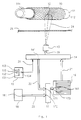
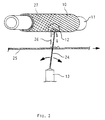
- FIGS. 1 to 5 show the individual method steps of an exemplary embodiment of the invention in different schematic representations.
- a hollow cylindrical plastic component 10 made of fiber composite material is placed on a holder 11 adapted to the plastic component 10 and is connected to it in a frictionally locking manner.
- the holder 11 has a greater length than the plastic component 10.
- the holder 11 therefore protrudes from the plastic component 10 on both sides and can therefore be fixed easily in appropriately designed fastening means of the further holding device.
- the plastic component 10 arranged on the holder 11 is also easy to handle for the individual process steps, without however having to touch it itself.
- the holder 11 can thereby be connected to the further holding device in an advantageous manner, in particular via quick-release fasteners, and thus be spatially fixed.
- a circular area 12 of the plastic component 10, shown with a dashed border, is damaged by delamination and is repaired in accordance with the method steps described below.
- the plastic component 10 arranged on the holder 11 is first in a predetermined position to a laser 13 on the further holding device fixed, the treatment area 12 being in the radiation area of the laser 13 and thus pointing in the direction of the laser 13.
- a control unit 14 a first input unit 15, a memory 16, an addresser 17 and a further input unit 18 are provided for controlling the laser 13.
- the laser 13 is connected to the control unit 14, which in turn is connected to the first input unit 15 and the memory 16 via data lines 19 to 21.
- the first input unit 15 has five keys 151 to 155.
- the control unit 14 enables the laser beam 24 to be deflected in the direction indicated on the key 151 to 154.
- the laser beam 24 is deflected depending on the actuation duration of the keys 151 to 155.
- the button 155 the data relating to the deflection and thus indirectly the coordinates of the illuminated point of the treatment area 12 are read into the memory 16.
- intermediate values can also be determined by the control unit by interpolating two adjacent values.
- a data line 22 connects an output 141 of the control unit 14 to an input 171 of the addressing unit 17.
- An output 181 of the further input unit 18 is connected via a data line 23 to a further input 172 of the addressing unit 17.
- An output 173 of the addresser 17 is connected to the input 161 of the memory 16.
- the coordinates of the treatment area 12 are determined and fed to the memory 16.
- the power of the laser 13 is first reduced in relation to the subsequent scanning process by a controller arranged on the laser 13 such that the material of the plastic component 10 is not adversely affected by the radiation 24.
- the laser beam 24 is then guided via the buttons 151 to 154 to the edge of the treatment area and then across the surface of the treatment area point by point, the button 155 being pressed at each individual point of the treatment area 12.
- the button 155 is pressed, the data relating to the deflection of the laser 13, and thus indirectly also the coordinates of the respectively illuminated point, are fed to the memory 16 via the addressing device 17.
- the depth coordinate of the respective point is entered manually using a keyboard of the further output unit 18 and assigned to the stored data in the memory by the addresser 17.
- Data for the control and the power of the laser 13 are thus written into the memory 16 for each point of the treatment area 12.
- the speed of the deflection of the laser 13 can also be controlled and corresponding data can be stored in the memory 16 for this purpose.
- a wall 25 which is transparent for high-energy radiation is arranged between the laser 13, but will be discussed later.
- the laser 13 used is an EXCIMER laser, Excited Dimer Laser, which generates a laser beam 24 with a light wavelength in the ultraviolet range, that is to say approximately 250 to 350 nm.
- a light wavelength in the ultraviolet range that is to say approximately 250 to 350 nm.
- the required energy range is between 50 and 150 watts.
- the laser 13 is switched on by the control unit 14 in accordance with the data entered in the memory 16 and is guided over the treatment area 12 with a light wave power that decomposes the synthetic resin 26.
- the treatment area 12 is thus scanned one after the other, so that the synthetic resin 26 detaches from the plastic component 12 or the fiber material 27 and falls onto the wall 25.
- the light wave power of the laser 13 is modulated as a function of the entered depth coordinates, so that the synthetic resin, regardless of its surface arrangement, is illuminated with a constant light wave power of the laser 13.
- the movement arrows here represent the deflection movements of the laser 13 during the scanning.
- the memory is deleted point by point in accordance with the scanning process.
- the wall 25 continuously moves to the side so that the laser beam 24 can pass through the wall 25 unhindered during the scanning process.
- the decomposed synthetic resin 26 can also be sucked off by a corresponding device.
- the holder 11 with the plastic component 10 is rotated after the scanning, namely until the treatment area 12 points upwards.
- the exposed fiber material 27 is reinforced after scanning, especially in order to counter the impairment of the strength properties of the plastic component 10 which may be caused by broken fibers of the fiber material 27.
- liquid new synthetic resin 26 is poured into the treatment area 12, the plastic component 10 is surrounded by a mold 29 and then cured in an oven under the action of heat, see FIG. 4.
- the plastic component 10 is fully usable again. With the method, the plastic component 10 can thus be completely restored.
- the data relating to the treatment area 12 are determined by a computer tomograph or by an ultrasound device each with an evaluation unit and via the addressing device 17 in the Entered memory 16 and assigned there corresponding data relating to the scanning process.
Landscapes
- Engineering & Computer Science (AREA)
- Mechanical Engineering (AREA)
- Processing And Handling Of Plastics And Other Materials For Molding In General (AREA)
Claims (15)
- Procédé de réparation de pièces en matière composite partiellement endommagées, caractérisé en ce qu'on procède aux opérations suivantes :- on irradie la zone de traitement (12) par un rayonnement riche en énergie, de sorte que la matière de matrice (26) qui s'y trouve se désintègre ;- on enlève la matière de matrice (26) désintégrée ;- on applique dans la zone de traitement (12) une nouvelle matière de matrice (26) qui vient remplacer la matière de matrice (26) enlevée ; et- on durcit la nouvelle matière de matrice (26) appliquée.
- Procédé selon la revendication 1, caractérisé en ce que pour l'opération de traitement, la pièce en matière plastique (10) est fixée sur un support (11), ou un dispositif de support amovible est ajouté à la pièce en matière plastique (10), le support (11) ou le dispositif de support amovible étant à nouveau enlevé de la pièce en matière plastique (10) après le durcissement de la nouvelle matière de matrice (26).
- Procédé selon l'une ou l'autre des revendications 1 et 2, caractérisé en ce que pour l'opération de durcissement de la nouvelle matière de matrice (26) appliquée dans la zone de traitement (12), la pièce en matière plastique (10) est placée dans un moule et ensuite chauffée en particulier dans la zone de traitement (12) et soumise à une pression de contact.
- Procédé selon l'une quelconque des revendications précédentes, caractérisé en ce que l'intensité de la source (13) de rayonnement est influencée au moyen d'une unité de commande (14) et/ou déviée dans deux directions de coordonnées, les coordonnées ou une autre description géométrique de la zone de traitement (12) étant tout d'abord transmises à l'unité de commande (14) par l'intermédiaire d'une unité d'entrée (15, 18), ensuite la source (13) de rayonnement parcourt en la balayant progressivement la totalité de la zone de traitement (12) selon les coordonnées entrées.
- Procédé selon la revendication 4, caractérisé en ce que l'entrée des plages de coordonnées se fait selon les étapes suivantes :- le rayon de la source (13) de rayonnement est conduit ponctuellement sur la zone de bordure avec une puissance réduite par rapport à la puissance maximale, par l'intermédiaire de l'unité d'entrée (15) ;- par l'intermédiaire d'un moyen d'actionnement (155), les coordonnées respectives sont transmises en tant que limites de la zone de traitement, dans une mémoire (16) raccordée à l'unité de commande (14), dans deux directions du point ainsi visé ;- les données concernant la profondeur de la zone de traitement (12), en tant que troisième direction de coordonnées, sont transmises directement dans la mémoire (16) par l'intermédiaire d'autres moyens d'actionnement.
- Procédé selon la revendication 5, caractérisé en ce que la valeur de la troisième direction de coordonnées, associée respectivement aux diiférentes valeurs de coordonnées, par rapport aux deux directions de coordonnées, est maintenue comme contenu de mémoire dans des emplacements de la mémoire.
- Procédé selon la revendication 4, caractérisé en ce que les limites de coordonnées ou une description géométrique de la zone de traitement (12) sont déterminées par un tomographe à ordinateur, un appareil à ultrasons ou un autre procédé d'imagerie, et par une unité d'analyse qui y est raccordée, et transmises à l'unité de commande (14).
- Procédé selon l'une quelconque des revendications 4 à 7, caractérisé en ce que le rayonnement est modulé lors du balayage par l'unité de commande (14) en fonction des coordonnées de profondeur de la zone de traitement (12) respectivement entrées.
- Procédé selon l'une quelconque des revendications 4 à 8, caractérisé en ce que pendant le balayage de la zone de traitement (12), la vitesse de déviation de la source (13) de rayonnement est commandée en fonction des coordonnées de profondeur entrées de la zone de traitement (12), de telle sorte que la vitesse de déviation diminue avec l'accroissement de la profondeur de la zone de traitement (12).
- Procédé selon l'une quelconque des revendications 4 à 9, caractérisé en ce que la zone de traitement (12) est balayée de façon répétée, une valeur concernant la modulation et/ou la vitesse de déviation étant soustraite de la valeur entrée à chaque balayage d'un point de la zone de traitement (12), de sorte que l'irradiation de la zone concernée est interrompue lorsqu'une valeur zéro est atteinte.
- Procédé selon l'une quelconque des revendications précédentes, caractérisé en ce que la source de rayonnement utilisée est un laser (13) qui engendre en particulier une longueur d'onde lumineuse qui est située dans la gamme de l'ultraviolet, de sorte que la matière de matrice (26) qui relie la matière renforcée par des libres (27) est essentiellement désintégrée par l'irradiation.
- Procédé selon la revendication 11, caractérisé en ce que la matière de matrice (26) désintégrée est aspirée au moyen d'un dispositif d'aspiration.
- Procédé selon l'une quelconque des revendications précédentes, caractérisé en ce qu'on applique en supplément de la matière renforcée par des fibres (28) dans la zone de traitement (12) nettoyée de la matière de matrice (26) désintégrée.
- Procédé selon l'une quelconque des revendications précédentes, caractérisé en ce que la matière renforcée par des fibres (28) est extraite de la zone de traitement (12) par désintégration sans échauffement.
- Procédé selon l'une quelconque des revendications 12 à 14, caractérisé en ce que la source de rayonnement utilisée est un laser EXIMER(13).
Applications Claiming Priority (2)
| Application Number | Priority Date | Filing Date | Title |
|---|---|---|---|
| DE4032861A DE4032861A1 (de) | 1990-10-12 | 1990-10-12 | Verfahren zur behandlung von faserverbundwerkstoffen |
| DE4032861 | 1990-10-12 |
Publications (2)
| Publication Number | Publication Date |
|---|---|
| EP0480552A1 EP0480552A1 (fr) | 1992-04-15 |
| EP0480552B1 true EP0480552B1 (fr) | 1995-01-25 |
Family
ID=6416405
Family Applications (1)
| Application Number | Title | Priority Date | Filing Date |
|---|---|---|---|
| EP91250275A Expired - Lifetime EP0480552B1 (fr) | 1990-10-12 | 1991-10-08 | Procédé pour traiter des matières compound fibreuses |
Country Status (2)
| Country | Link |
|---|---|
| EP (1) | EP0480552B1 (fr) |
| DE (2) | DE4032861A1 (fr) |
Families Citing this family (5)
| Publication number | Priority date | Publication date | Assignee | Title |
|---|---|---|---|---|
| DE59400868D1 (de) * | 1993-02-10 | 1996-11-28 | Klaus Kalwar | Vorrichtung zur Wiederherstellung einer beschädigten Beschichtung einer Walze |
| FR2829722B1 (fr) * | 2001-09-17 | 2003-12-05 | Cmpe | Procede de reparation d'un joint d'etancheite d'une porte d'avion et dispositif de mise en oeuvre de ce procede |
| DE102010031795B4 (de) | 2010-07-20 | 2015-05-28 | Lufthansa Technik Ag | Verfahren zur Reparatur von Gasturbinenbauteilen aus keramischen Verbundwerkstoffen und Vorrichtung zur Durchführung des Verfahrens |
| GB201905925D0 (en) * | 2019-04-29 | 2019-06-12 | Rolls Royce Plc | Repair method |
| CN113085229B (zh) * | 2021-04-22 | 2022-02-15 | 同济大学 | 碳纤维增强热固性树脂基复合材料分层损伤修复装置及方法 |
Family Cites Families (3)
| Publication number | Priority date | Publication date | Assignee | Title |
|---|---|---|---|---|
| GB1295074A (fr) * | 1969-03-28 | 1972-11-01 | ||
| FR2598405A1 (fr) * | 1986-05-07 | 1987-11-13 | Bouvet Vernis | Procede de reparation de bouteilles |
| KR100190423B1 (ko) * | 1989-06-06 | 1999-06-01 | 기타지마 요시도시 | 에멀젼마스크 등의결함 수정방법 및 장치 |
-
1990
- 1990-10-12 DE DE4032861A patent/DE4032861A1/de not_active Withdrawn
-
1991
- 1991-10-08 EP EP91250275A patent/EP0480552B1/fr not_active Expired - Lifetime
- 1991-10-08 DE DE59104391T patent/DE59104391D1/de not_active Expired - Fee Related
Also Published As
| Publication number | Publication date |
|---|---|
| DE4032861A1 (de) | 1992-04-16 |
| EP0480552A1 (fr) | 1992-04-15 |
| DE59104391D1 (de) | 1995-03-09 |
Similar Documents
| Publication | Publication Date | Title |
|---|---|---|
| EP0456121B1 (fr) | Procédé pour le pliage d'objets plats ainsi que la machine de pliage pour la mise en oeuvre du procédé | |
| DE102011014017B4 (de) | Verfahren zur Vorbehandlung eines Faserverbundwerkstoffs | |
| DE69803928T2 (de) | Gerät für in-situ-reparatur einer verbundmaterialstruktur mit beschädigter stellen und verfahren hierzu | |
| DE69019570T2 (de) | Verfahren und Vorrichtung zur Herstellung von dreidimensionalen Objekten. | |
| DE3807476C2 (fr) | ||
| DE102014215935A1 (de) | Vorrichtung und Verfahren zur Fertigung von Bauteilen aus einem faserverstärkten Verbundmaterial | |
| DE102013112933A1 (de) | Verfahren zum Reparieren von Faser-Kunststoff-Verbünden | |
| DE3903153A1 (de) | Oberflaechenbehandlung von faserverbundwerkstoffen | |
| DE102016117798A1 (de) | Verfahren zur Herstellung eines vorgeformten Verbundhalbzeugs sowie Verfahren zur Herstellung eines Faserverbundbauteils | |
| EP0480552B1 (fr) | Procédé pour traiter des matières compound fibreuses | |
| DE102015204029A1 (de) | Stanzverfahren für eine faserverstärkte Harzplatte und Herstellungsverfahren für ein faserverstärktes Harzprodukt | |
| EP1473131A2 (fr) | Procédé pour la fabrication de préformes textiles à partir de produits textiles semi-finis | |
| EP2497624A2 (fr) | Demi-produit en fibre comprenant une âme et procédé de fabrication d'un composant en matière synthétique renforcé par des fibres | |
| EP3034276B1 (fr) | Composant ayant une connexion par liaison de matière et procédé de jointure | |
| DE102018125853A1 (de) | Vorrichtung zur additiven Fertigung | |
| AT512563A2 (de) | Faserwerkstoffrohling sowie Verfahren zur Herstellung eines Faserwerkstoffverbundbauteils | |
| EP1857611B1 (fr) | Procédé de réparation de la surface d'un support en forme de plaque | |
| EP2447049A1 (fr) | Procédé et dispositif destinés à la fabrication composants en fibres composites | |
| DE102017114970A1 (de) | Vorrichtung und Verfahren zum Veredeln von Werkstücken | |
| DE102016224217A1 (de) | Vorrichtung und Verfahren zum Beschichten eines Werkstücks | |
| DE3913723C2 (fr) | ||
| EP1424214B1 (fr) | Méthode et dispositif pour le lissage et la compression de la surface des crayons ou analogue | |
| DE19700518A1 (de) | Vorrichtung und Verfahren zum Verformen von thermoplastischen Material zum Verbinden zweier Bauteile | |
| WO2023217628A1 (fr) | Dispositif d'ouverture de soupapes, dispositif de nettoyage laser, ensemble de traitement de moule, segment de moule, procédé et produit de programme informatique | |
| EP3406428B1 (fr) | Procédé de fabrication d'un composant d'un matériau composite fibreux |
Legal Events
| Date | Code | Title | Description |
|---|---|---|---|
| PUAI | Public reference made under article 153(3) epc to a published international application that has entered the european phase |
Free format text: ORIGINAL CODE: 0009012 |
|
| AK | Designated contracting states |
Kind code of ref document: A1 Designated state(s): AT BE CH DE DK ES FR GB GR IT LI LU NL SE |
|
| RBV | Designated contracting states (corrected) |
Designated state(s): DE FR GB IT |
|
| 17P | Request for examination filed |
Effective date: 19920729 |
|
| 17Q | First examination report despatched |
Effective date: 19940321 |
|
| GRAA | (expected) grant |
Free format text: ORIGINAL CODE: 0009210 |
|
| AK | Designated contracting states |
Kind code of ref document: B1 Designated state(s): DE FR GB IT |
|
| PG25 | Lapsed in a contracting state [announced via postgrant information from national office to epo] |
Ref country code: IT Free format text: LAPSE BECAUSE OF FAILURE TO SUBMIT A TRANSLATION OF THE DESCRIPTION OR TO PAY THE FEE WITHIN THE PRESCRIBED TIME-LIMIT;WARNING: LAPSES OF ITALIAN PATENTS WITH EFFECTIVE DATE BEFORE 2007 MAY HAVE OCCURRED AT ANY TIME BEFORE 2007. THE CORRECT EFFECTIVE DATE MAY BE DIFFERENT FROM THE ONE RECORDED. Effective date: 19950125 Ref country code: GB Effective date: 19950125 Ref country code: FR Effective date: 19950125 |
|
| REF | Corresponds to: |
Ref document number: 59104391 Country of ref document: DE Date of ref document: 19950309 |
|
| EN | Fr: translation not filed | ||
| GBV | Gb: ep patent (uk) treated as always having been void in accordance with gb section 77(7)/1977 [no translation filed] |
Effective date: 19950125 |
|
| PLBE | No opposition filed within time limit |
Free format text: ORIGINAL CODE: 0009261 |
|
| STAA | Information on the status of an ep patent application or granted ep patent |
Free format text: STATUS: NO OPPOSITION FILED WITHIN TIME LIMIT |
|
| PGFP | Annual fee paid to national office [announced via postgrant information from national office to epo] |
Ref country code: DE Payment date: 19951211 Year of fee payment: 5 |
|
| 26N | No opposition filed | ||
| PG25 | Lapsed in a contracting state [announced via postgrant information from national office to epo] |
Ref country code: DE Effective date: 19970701 |