EP0477828A2 - Hydroxylation of methyl groups in aromatic heterocyclic compounds by microorganisms - Google Patents
Hydroxylation of methyl groups in aromatic heterocyclic compounds by microorganisms Download PDFInfo
- Publication number
- EP0477828A2 EP0477828A2 EP91116165A EP91116165A EP0477828A2 EP 0477828 A2 EP0477828 A2 EP 0477828A2 EP 91116165 A EP91116165 A EP 91116165A EP 91116165 A EP91116165 A EP 91116165A EP 0477828 A2 EP0477828 A2 EP 0477828A2
- Authority
- EP
- European Patent Office
- Prior art keywords
- plasmid
- reaction
- carried out
- dna
- microorganisms
- Prior art date
- Legal status (The legal status is an assumption and is not a legal conclusion. Google has not performed a legal analysis and makes no representation as to the accuracy of the status listed.)
- Granted
Links
- 244000005700 microbiome Species 0.000 title claims abstract description 28
- 125000002496 methyl group Chemical group [H]C([H])([H])* 0.000 title claims abstract description 17
- 230000033444 hydroxylation Effects 0.000 title claims description 7
- 238000005805 hydroxylation reaction Methods 0.000 title claims description 7
- 125000006615 aromatic heterocyclic group Chemical group 0.000 title 1
- 108090000623 proteins and genes Proteins 0.000 claims abstract description 35
- 238000000034 method Methods 0.000 claims abstract description 34
- 108010034306 xylene monooxygenase Proteins 0.000 claims abstract description 18
- 125000003118 aryl group Chemical group 0.000 claims abstract description 8
- DAXJNUBSBFUTRP-RTQNCGMRSA-N (8r,9s,10r,13s,14s)-6-(hydroxymethyl)-10,13-dimethyl-7,8,9,11,12,14,15,16-octahydro-6h-cyclopenta[a]phenanthrene-3,17-dione Chemical compound O=C1C=C[C@]2(C)[C@H]3CC[C@](C)(C(CC4)=O)[C@@H]4[C@@H]3CC(CO)C2=C1 DAXJNUBSBFUTRP-RTQNCGMRSA-N 0.000 claims abstract description 6
- 230000002759 chromosomal effect Effects 0.000 claims abstract description 3
- 230000000640 hydroxylating effect Effects 0.000 claims abstract description 3
- 239000013612 plasmid Substances 0.000 claims description 77
- 238000006243 chemical reaction Methods 0.000 claims description 20
- 241000589776 Pseudomonas putida Species 0.000 claims description 16
- 239000013604 expression vector Substances 0.000 claims description 15
- 239000000758 substrate Substances 0.000 claims description 15
- 230000009466 transformation Effects 0.000 claims description 13
- 241000589516 Pseudomonas Species 0.000 claims description 9
- 125000000623 heterocyclic group Chemical group 0.000 claims description 9
- 108010021809 Alcohol dehydrogenase Proteins 0.000 claims description 8
- 241001646716 Escherichia coli K-12 Species 0.000 claims description 7
- 102000007698 Alcohol dehydrogenase Human genes 0.000 claims description 6
- 238000003776 cleavage reaction Methods 0.000 claims description 6
- 230000007017 scission Effects 0.000 claims description 6
- 125000004432 carbon atom Chemical group C* 0.000 claims description 5
- 230000002906 microbiologic effect Effects 0.000 claims description 5
- IJGRMHOSHXDMSA-UHFFFAOYSA-N Atomic nitrogen Chemical compound N#N IJGRMHOSHXDMSA-UHFFFAOYSA-N 0.000 claims description 4
- 229910052799 carbon Inorganic materials 0.000 claims description 4
- 239000001963 growth medium Substances 0.000 claims description 4
- 125000001424 substituent group Chemical group 0.000 claims description 4
- 241000589291 Acinetobacter Species 0.000 claims description 2
- 241000589158 Agrobacterium Species 0.000 claims description 2
- 241000588722 Escherichia Species 0.000 claims description 2
- 241000589180 Rhizobium Species 0.000 claims description 2
- NINIDFKCEFEMDL-UHFFFAOYSA-N Sulfur Chemical compound [S] NINIDFKCEFEMDL-UHFFFAOYSA-N 0.000 claims description 2
- QVGXLLKOCUKJST-UHFFFAOYSA-N atomic oxygen Chemical compound [O] QVGXLLKOCUKJST-UHFFFAOYSA-N 0.000 claims description 2
- 125000005842 heteroatom Chemical group 0.000 claims description 2
- 229910052757 nitrogen Inorganic materials 0.000 claims description 2
- 229910052760 oxygen Inorganic materials 0.000 claims description 2
- 239000001301 oxygen Substances 0.000 claims description 2
- 229910052717 sulfur Inorganic materials 0.000 claims description 2
- 239000011593 sulfur Substances 0.000 claims description 2
- 241001136239 Cymbidium hybrid cultivar Species 0.000 claims 1
- 238000004519 manufacturing process Methods 0.000 abstract description 15
- LFQSCWFLJHTTHZ-UHFFFAOYSA-N Ethanol Chemical compound CCO LFQSCWFLJHTTHZ-UHFFFAOYSA-N 0.000 abstract description 6
- 108010020056 Hydrogenase Proteins 0.000 abstract 1
- 241000588724 Escherichia coli Species 0.000 description 16
- FAPWRFPIFSIZLT-UHFFFAOYSA-M Sodium chloride Chemical compound [Na+].[Cl-] FAPWRFPIFSIZLT-UHFFFAOYSA-M 0.000 description 15
- TWRXJAOTZQYOKJ-UHFFFAOYSA-L Magnesium chloride Chemical compound [Mg+2].[Cl-].[Cl-] TWRXJAOTZQYOKJ-UHFFFAOYSA-L 0.000 description 14
- 239000012634 fragment Substances 0.000 description 14
- 239000007983 Tris buffer Substances 0.000 description 13
- LENZDBCJOHFCAS-UHFFFAOYSA-N tris Chemical compound OCC(N)(CO)CO LENZDBCJOHFCAS-UHFFFAOYSA-N 0.000 description 13
- XLYOFNOQVPJJNP-UHFFFAOYSA-N water Chemical compound O XLYOFNOQVPJJNP-UHFFFAOYSA-N 0.000 description 10
- 239000006916 nutrient agar Substances 0.000 description 9
- 239000011780 sodium chloride Substances 0.000 description 9
- KFZMGEQAYNKOFK-UHFFFAOYSA-N Isopropanol Chemical compound CC(C)O KFZMGEQAYNKOFK-UHFFFAOYSA-N 0.000 description 8
- 239000004098 Tetracycline Substances 0.000 description 8
- 238000000246 agarose gel electrophoresis Methods 0.000 description 8
- 239000000243 solution Substances 0.000 description 8
- 229960002180 tetracycline Drugs 0.000 description 8
- 229930101283 tetracycline Natural products 0.000 description 8
- 235000019364 tetracycline Nutrition 0.000 description 8
- 150000003522 tetracyclines Chemical class 0.000 description 8
- 101150110790 xylB gene Proteins 0.000 description 8
- 101100157012 Thermoanaerobacterium saccharolyticum (strain DSM 8691 / JW/SL-YS485) xynB gene Proteins 0.000 description 7
- 239000000872 buffer Substances 0.000 description 7
- 238000002955 isolation Methods 0.000 description 7
- 229910001629 magnesium chloride Inorganic materials 0.000 description 7
- 239000013598 vector Substances 0.000 description 7
- KCXVZYZYPLLWCC-UHFFFAOYSA-N EDTA Chemical compound OC(=O)CN(CC(O)=O)CCN(CC(O)=O)CC(O)=O KCXVZYZYPLLWCC-UHFFFAOYSA-N 0.000 description 6
- YXFVVABEGXRONW-UHFFFAOYSA-N Toluene Chemical compound CC1=CC=CC=C1 YXFVVABEGXRONW-UHFFFAOYSA-N 0.000 description 6
- VHJLVAABSRFDPM-ZXZARUISSA-N dithioerythritol Chemical compound SC[C@H](O)[C@H](O)CS VHJLVAABSRFDPM-ZXZARUISSA-N 0.000 description 6
- 239000012528 membrane Substances 0.000 description 6
- 108091008146 restriction endonucleases Proteins 0.000 description 6
- 230000006801 homologous recombination Effects 0.000 description 5
- 238000002744 homologous recombination Methods 0.000 description 5
- 238000011534 incubation Methods 0.000 description 5
- 238000002360 preparation method Methods 0.000 description 5
- 102000012410 DNA Ligases Human genes 0.000 description 4
- 108010061982 DNA Ligases Proteins 0.000 description 4
- 230000001580 bacterial effect Effects 0.000 description 4
- 238000005119 centrifugation Methods 0.000 description 4
- ZMMJGEGLRURXTF-UHFFFAOYSA-N ethidium bromide Chemical compound [Br-].C12=CC(N)=CC=C2C2=CC=C(N)C=C2[N+](CC)=C1C1=CC=CC=C1 ZMMJGEGLRURXTF-UHFFFAOYSA-N 0.000 description 4
- 229960005542 ethidium bromide Drugs 0.000 description 4
- 230000006698 induction Effects 0.000 description 4
- BPHPUYQFMNQIOC-NXRLNHOXSA-N isopropyl beta-D-thiogalactopyranoside Chemical compound CC(C)S[C@@H]1O[C@H](CO)[C@H](O)[C@H](O)[C@H]1O BPHPUYQFMNQIOC-NXRLNHOXSA-N 0.000 description 4
- UXVMQQNJUSDDNG-UHFFFAOYSA-L Calcium chloride Chemical compound [Cl-].[Cl-].[Ca+2] UXVMQQNJUSDDNG-UHFFFAOYSA-L 0.000 description 3
- RTZKZFJDLAIYFH-UHFFFAOYSA-N Diethyl ether Chemical compound CCOCC RTZKZFJDLAIYFH-UHFFFAOYSA-N 0.000 description 3
- LRHPLDYGYMQRHN-UHFFFAOYSA-N N-Butanol Chemical compound CCCCO LRHPLDYGYMQRHN-UHFFFAOYSA-N 0.000 description 3
- 239000002202 Polyethylene glycol Substances 0.000 description 3
- 240000004808 Saccharomyces cerevisiae Species 0.000 description 3
- 239000011543 agarose gel Substances 0.000 description 3
- -1 alkyl radicals Chemical class 0.000 description 3
- 239000001110 calcium chloride Substances 0.000 description 3
- 229910001628 calcium chloride Inorganic materials 0.000 description 3
- 235000011148 calcium chloride Nutrition 0.000 description 3
- 230000021615 conjugation Effects 0.000 description 3
- 238000010276 construction Methods 0.000 description 3
- 238000012217 deletion Methods 0.000 description 3
- 230000037430 deletion Effects 0.000 description 3
- 238000001035 drying Methods 0.000 description 3
- 229930027917 kanamycin Natural products 0.000 description 3
- 229960000318 kanamycin Drugs 0.000 description 3
- SBUJHOSQTJFQJX-NOAMYHISSA-N kanamycin Chemical compound O[C@@H]1[C@@H](O)[C@H](O)[C@@H](CN)O[C@@H]1O[C@H]1[C@H](O)[C@@H](O[C@@H]2[C@@H]([C@@H](N)[C@H](O)[C@@H](CO)O2)O)[C@H](N)C[C@@H]1N SBUJHOSQTJFQJX-NOAMYHISSA-N 0.000 description 3
- 229930182823 kanamycin A Natural products 0.000 description 3
- 239000000203 mixture Substances 0.000 description 3
- 235000015097 nutrients Nutrition 0.000 description 3
- 238000013492 plasmid preparation Methods 0.000 description 3
- 229920001223 polyethylene glycol Polymers 0.000 description 3
- 239000002244 precipitate Substances 0.000 description 3
- 238000001556 precipitation Methods 0.000 description 3
- 239000006152 selective media Substances 0.000 description 3
- 238000001228 spectrum Methods 0.000 description 3
- 239000000725 suspension Substances 0.000 description 3
- LCZUOKDVTBMCMX-UHFFFAOYSA-N 2,5-Dimethylpyrazine Chemical compound CC1=CN=C(C)C=N1 LCZUOKDVTBMCMX-UHFFFAOYSA-N 0.000 description 2
- GWQOOADXMVQEFT-UHFFFAOYSA-N 2,5-Dimethylthiophene Chemical compound CC1=CC=C(C)S1 GWQOOADXMVQEFT-UHFFFAOYSA-N 0.000 description 2
- QMHIMXFNBOYPND-UHFFFAOYSA-N 4-methylthiazole Chemical compound CC1=CSC=N1 QMHIMXFNBOYPND-UHFFFAOYSA-N 0.000 description 2
- 229920000936 Agarose Polymers 0.000 description 2
- ZGTMUACCHSMWAC-UHFFFAOYSA-L EDTA disodium salt (anhydrous) Chemical compound [Na+].[Na+].OC(=O)CN(CC([O-])=O)CCN(CC(O)=O)CC([O-])=O ZGTMUACCHSMWAC-UHFFFAOYSA-L 0.000 description 2
- YLQBMQCUIZJEEH-UHFFFAOYSA-N Furan Chemical compound C=1C=COC=1 YLQBMQCUIZJEEH-UHFFFAOYSA-N 0.000 description 2
- CTQNGGLPUBDAKN-UHFFFAOYSA-N O-Xylene Chemical compound CC1=CC=CC=C1C CTQNGGLPUBDAKN-UHFFFAOYSA-N 0.000 description 2
- KYQCOXFCLRTKLS-UHFFFAOYSA-N Pyrazine Chemical compound C1=CN=CC=N1 KYQCOXFCLRTKLS-UHFFFAOYSA-N 0.000 description 2
- KAESVJOAVNADME-UHFFFAOYSA-N Pyrrole Chemical compound C=1C=CNC=1 KAESVJOAVNADME-UHFFFAOYSA-N 0.000 description 2
- 239000002253 acid Substances 0.000 description 2
- 229960000723 ampicillin Drugs 0.000 description 2
- AVKUERGKIZMTKX-NJBDSQKTSA-N ampicillin Chemical compound C1([C@@H](N)C(=O)N[C@H]2[C@H]3SC([C@@H](N3C2=O)C(O)=O)(C)C)=CC=CC=C1 AVKUERGKIZMTKX-NJBDSQKTSA-N 0.000 description 2
- 239000003242 anti bacterial agent Substances 0.000 description 2
- 229940088710 antibiotic agent Drugs 0.000 description 2
- WPYMKLBDIGXBTP-UHFFFAOYSA-N benzoic acid Chemical compound OC(=O)C1=CC=CC=C1 WPYMKLBDIGXBTP-UHFFFAOYSA-N 0.000 description 2
- 230000003115 biocidal effect Effects 0.000 description 2
- 230000033228 biological regulation Effects 0.000 description 2
- 230000015572 biosynthetic process Effects 0.000 description 2
- AIYUHDOJVYHVIT-UHFFFAOYSA-M caesium chloride Chemical compound [Cl-].[Cs+] AIYUHDOJVYHVIT-UHFFFAOYSA-M 0.000 description 2
- 238000004113 cell culture Methods 0.000 description 2
- 239000006285 cell suspension Substances 0.000 description 2
- 238000010367 cloning Methods 0.000 description 2
- 150000001875 compounds Chemical class 0.000 description 2
- 238000010790 dilution Methods 0.000 description 2
- 239000012895 dilution Substances 0.000 description 2
- 238000000855 fermentation Methods 0.000 description 2
- 230000004151 fermentation Effects 0.000 description 2
- 239000012737 fresh medium Substances 0.000 description 2
- 239000007788 liquid Substances 0.000 description 2
- 239000002609 medium Substances 0.000 description 2
- 230000003287 optical effect Effects 0.000 description 2
- 230000003647 oxidation Effects 0.000 description 2
- 238000007254 oxidation reaction Methods 0.000 description 2
- 239000000047 product Substances 0.000 description 2
- 230000000717 retained effect Effects 0.000 description 2
- 239000000523 sample Substances 0.000 description 2
- 239000007858 starting material Substances 0.000 description 2
- 239000006228 supernatant Substances 0.000 description 2
- 238000012546 transfer Methods 0.000 description 2
- 238000005406 washing Methods 0.000 description 2
- 239000008096 xylene Substances 0.000 description 2
- PMCOWOCKUQWYRL-UHFFFAOYSA-N 2,4-dimethylpyrimidine Chemical compound CC1=CC=NC(C)=N1 PMCOWOCKUQWYRL-UHFFFAOYSA-N 0.000 description 1
- 239000001934 2,5-dimethylpyrazine Substances 0.000 description 1
- OSBLTNPMIGYQGY-UHFFFAOYSA-N 2-amino-2-(hydroxymethyl)propane-1,3-diol;2-[2-[bis(carboxymethyl)amino]ethyl-(carboxymethyl)amino]acetic acid;boric acid Chemical compound OB(O)O.OCC(N)(CO)CO.OC(=O)CN(CC(O)=O)CCN(CC(O)=O)CC(O)=O OSBLTNPMIGYQGY-UHFFFAOYSA-N 0.000 description 1
- VXLYOURCUVQYLN-UHFFFAOYSA-N 2-chloro-5-methylpyridine Chemical compound CC1=CC=C(Cl)N=C1 VXLYOURCUVQYLN-UHFFFAOYSA-N 0.000 description 1
- SDXAWLJRERMRKF-UHFFFAOYSA-N 3,5-dimethyl-1h-pyrazole Chemical compound CC=1C=C(C)NN=1 SDXAWLJRERMRKF-UHFFFAOYSA-N 0.000 description 1
- 101100323010 Acinetobacter baylyi (strain ATCC 33305 / BD413 / ADP1) alkR gene Proteins 0.000 description 1
- 229920001817 Agar Polymers 0.000 description 1
- 102000005369 Aldehyde Dehydrogenase Human genes 0.000 description 1
- 108020002663 Aldehyde Dehydrogenase Proteins 0.000 description 1
- 102000002260 Alkaline Phosphatase Human genes 0.000 description 1
- 108020004774 Alkaline Phosphatase Proteins 0.000 description 1
- 241000894006 Bacteria Species 0.000 description 1
- 239000005711 Benzoic acid Substances 0.000 description 1
- 102000005297 Cytochrome P-450 CYP4A Human genes 0.000 description 1
- 108010081498 Cytochrome P-450 CYP4A Proteins 0.000 description 1
- DYDCUQKUCUHJBH-UWTATZPHSA-N D-Cycloserine Chemical compound N[C@@H]1CONC1=O DYDCUQKUCUHJBH-UWTATZPHSA-N 0.000 description 1
- DYDCUQKUCUHJBH-UHFFFAOYSA-N D-Cycloserine Natural products NC1CONC1=O DYDCUQKUCUHJBH-UHFFFAOYSA-N 0.000 description 1
- GUBGYTABKSRVRQ-WFVLMXAXSA-N DEAE-cellulose Chemical compound OC1C(O)C(O)C(CO)O[C@H]1O[C@@H]1C(CO)OC(O)C(O)C1O GUBGYTABKSRVRQ-WFVLMXAXSA-N 0.000 description 1
- 230000007023 DNA restriction-modification system Effects 0.000 description 1
- 101100364969 Dictyostelium discoideum scai gene Proteins 0.000 description 1
- 102000004190 Enzymes Human genes 0.000 description 1
- 108090000790 Enzymes Proteins 0.000 description 1
- 241001131785 Escherichia coli HB101 Species 0.000 description 1
- WQZGKKKJIJFFOK-GASJEMHNSA-N Glucose Natural products OC[C@H]1OC(O)[C@H](O)[C@@H](O)[C@@H]1O WQZGKKKJIJFFOK-GASJEMHNSA-N 0.000 description 1
- 102000016943 Muramidase Human genes 0.000 description 1
- 108010014251 Muramidase Proteins 0.000 description 1
- 101100364971 Mus musculus Scai gene Proteins 0.000 description 1
- 108010062010 N-Acetylmuramoyl-L-alanine Amidase Proteins 0.000 description 1
- JOCBASBOOFNAJA-UHFFFAOYSA-N N-tris(hydroxymethyl)methyl-2-aminoethanesulfonic acid Chemical compound OCC(CO)(CO)NCCS(O)(=O)=O JOCBASBOOFNAJA-UHFFFAOYSA-N 0.000 description 1
- 239000000020 Nitrocellulose Substances 0.000 description 1
- PCNDJXKNXGMECE-UHFFFAOYSA-N Phenazine Natural products C1=CC=CC2=NC3=CC=CC=C3N=C21 PCNDJXKNXGMECE-UHFFFAOYSA-N 0.000 description 1
- ISWSIDIOOBJBQZ-UHFFFAOYSA-N Phenol Chemical compound OC1=CC=CC=C1 ISWSIDIOOBJBQZ-UHFFFAOYSA-N 0.000 description 1
- 241000589517 Pseudomonas aeruginosa Species 0.000 description 1
- 241000589781 Pseudomonas oleovorans Species 0.000 description 1
- 101100156993 Pseudomonas putida xylC gene Proteins 0.000 description 1
- WTKZEGDFNFYCGP-UHFFFAOYSA-N Pyrazole Chemical compound C=1C=NNC=1 WTKZEGDFNFYCGP-UHFFFAOYSA-N 0.000 description 1
- CZPWVGJYEJSRLH-UHFFFAOYSA-N Pyrimidine Chemical compound C1=CN=CN=C1 CZPWVGJYEJSRLH-UHFFFAOYSA-N 0.000 description 1
- VMHLLURERBWHNL-UHFFFAOYSA-M Sodium acetate Chemical compound [Na+].CC([O-])=O VMHLLURERBWHNL-UHFFFAOYSA-M 0.000 description 1
- 238000002105 Southern blotting Methods 0.000 description 1
- 229930006000 Sucrose Natural products 0.000 description 1
- CZMRCDWAGMRECN-UGDNZRGBSA-N Sucrose Chemical compound O[C@H]1[C@H](O)[C@@H](CO)O[C@@]1(CO)O[C@@H]1[C@H](O)[C@@H](O)[C@H](O)[C@@H](CO)O1 CZMRCDWAGMRECN-UGDNZRGBSA-N 0.000 description 1
- 239000008051 TBE buffer Substances 0.000 description 1
- 239000007994 TES buffer Substances 0.000 description 1
- FZWLAAWBMGSTSO-UHFFFAOYSA-N Thiazole Chemical compound C1=CSC=N1 FZWLAAWBMGSTSO-UHFFFAOYSA-N 0.000 description 1
- 238000010521 absorption reaction Methods 0.000 description 1
- 239000008351 acetate buffer Substances 0.000 description 1
- DPKHZNPWBDQZCN-UHFFFAOYSA-N acridine orange free base Chemical compound C1=CC(N(C)C)=CC2=NC3=CC(N(C)C)=CC=C3C=C21 DPKHZNPWBDQZCN-UHFFFAOYSA-N 0.000 description 1
- 239000008272 agar Substances 0.000 description 1
- 239000003905 agrochemical Substances 0.000 description 1
- 150000001335 aliphatic alkanes Chemical class 0.000 description 1
- 125000001931 aliphatic group Chemical group 0.000 description 1
- 238000000376 autoradiography Methods 0.000 description 1
- 235000010233 benzoic acid Nutrition 0.000 description 1
- DZBUGLKDJFMEHC-UHFFFAOYSA-N benzoquinolinylidene Natural products C1=CC=CC2=CC3=CC=CC=C3N=C21 DZBUGLKDJFMEHC-UHFFFAOYSA-N 0.000 description 1
- 230000015556 catabolic process Effects 0.000 description 1
- 230000006037 cell lysis Effects 0.000 description 1
- YTRQFSDWAXHJCC-UHFFFAOYSA-N chloroform;phenol Chemical compound ClC(Cl)Cl.OC1=CC=CC=C1 YTRQFSDWAXHJCC-UHFFFAOYSA-N 0.000 description 1
- 229960003077 cycloserine Drugs 0.000 description 1
- 229930007927 cymene Natural products 0.000 description 1
- 238000006731 degradation reaction Methods 0.000 description 1
- 238000000432 density-gradient centrifugation Methods 0.000 description 1
- 229960003964 deoxycholic acid Drugs 0.000 description 1
- KXGVEGMKQFWNSR-LLQZFEROSA-N deoxycholic acid Chemical compound C([C@H]1CC2)[C@H](O)CC[C@]1(C)[C@@H]1[C@@H]2[C@@H]2CC[C@H]([C@@H](CCC(O)=O)C)[C@@]2(C)[C@@H](O)C1 KXGVEGMKQFWNSR-LLQZFEROSA-N 0.000 description 1
- 238000001514 detection method Methods 0.000 description 1
- 230000001079 digestive effect Effects 0.000 description 1
- 239000003814 drug Substances 0.000 description 1
- 230000000694 effects Effects 0.000 description 1
- 239000012149 elution buffer Substances 0.000 description 1
- 229940088598 enzyme Drugs 0.000 description 1
- 230000007717 exclusion Effects 0.000 description 1
- 230000002068 genetic effect Effects 0.000 description 1
- 239000008103 glucose Substances 0.000 description 1
- 238000009396 hybridization Methods 0.000 description 1
- 125000002887 hydroxy group Chemical group [H]O* 0.000 description 1
- 150000002460 imidazoles Chemical class 0.000 description 1
- 230000000415 inactivating effect Effects 0.000 description 1
- 230000002779 inactivation Effects 0.000 description 1
- 230000002401 inhibitory effect Effects 0.000 description 1
- 238000003780 insertion Methods 0.000 description 1
- 230000037431 insertion Effects 0.000 description 1
- 239000000543 intermediate Substances 0.000 description 1
- 229940079865 intestinal antiinfectives imidazole derivative Drugs 0.000 description 1
- 230000002934 lysing effect Effects 0.000 description 1
- 239000004325 lysozyme Substances 0.000 description 1
- 229960000274 lysozyme Drugs 0.000 description 1
- 235000010335 lysozyme Nutrition 0.000 description 1
- 238000002156 mixing Methods 0.000 description 1
- 230000035772 mutation Effects 0.000 description 1
- 229920001220 nitrocellulos Polymers 0.000 description 1
- HFPZCAJZSCWRBC-UHFFFAOYSA-N p-cymene Chemical compound CC(C)C1=CC=C(C)C=C1 HFPZCAJZSCWRBC-UHFFFAOYSA-N 0.000 description 1
- 239000008188 pellet Substances 0.000 description 1
- WVDDGKGOMKODPV-ZQBYOMGUSA-N phenyl(114C)methanol Chemical compound O[14CH2]C1=CC=CC=C1 WVDDGKGOMKODPV-ZQBYOMGUSA-N 0.000 description 1
- 229960002292 piperacillin Drugs 0.000 description 1
- IVBHGBMCVLDMKU-GXNBUGAJSA-N piperacillin Chemical compound O=C1C(=O)N(CC)CCN1C(=O)N[C@H](C=1C=CC=CC=1)C(=O)N[C@@H]1C(=O)N2[C@@H](C(O)=O)C(C)(C)S[C@@H]21 IVBHGBMCVLDMKU-GXNBUGAJSA-N 0.000 description 1
- 229920000259 polyoxyethylene lauryl ether Polymers 0.000 description 1
- 238000000746 purification Methods 0.000 description 1
- 150000004892 pyridazines Chemical class 0.000 description 1
- 150000003222 pyridines Chemical class 0.000 description 1
- 230000001105 regulatory effect Effects 0.000 description 1
- 230000000754 repressing effect Effects 0.000 description 1
- 230000000284 resting effect Effects 0.000 description 1
- 230000035939 shock Effects 0.000 description 1
- 239000011734 sodium Substances 0.000 description 1
- 239000001632 sodium acetate Substances 0.000 description 1
- 235000017281 sodium acetate Nutrition 0.000 description 1
- 239000007787 solid Substances 0.000 description 1
- 239000005720 sucrose Substances 0.000 description 1
- 238000012360 testing method Methods 0.000 description 1
- 150000003577 thiophenes Chemical class 0.000 description 1
- 238000013518 transcription Methods 0.000 description 1
- 230000035897 transcription Effects 0.000 description 1
- PIEPQKCYPFFYMG-UHFFFAOYSA-N tris acetate Chemical compound CC(O)=O.OCC(N)(CO)CO PIEPQKCYPFFYMG-UHFFFAOYSA-N 0.000 description 1
- 238000005199 ultracentrifugation Methods 0.000 description 1
Classifications
-
- C—CHEMISTRY; METALLURGY
- C12—BIOCHEMISTRY; BEER; SPIRITS; WINE; VINEGAR; MICROBIOLOGY; ENZYMOLOGY; MUTATION OR GENETIC ENGINEERING
- C12N—MICROORGANISMS OR ENZYMES; COMPOSITIONS THEREOF; PROPAGATING, PRESERVING, OR MAINTAINING MICROORGANISMS; MUTATION OR GENETIC ENGINEERING; CULTURE MEDIA
- C12N9/00—Enzymes; Proenzymes; Compositions thereof; Processes for preparing, activating, inhibiting, separating or purifying enzymes
- C12N9/0004—Oxidoreductases (1.)
- C12N9/0069—Oxidoreductases (1.) acting on single donors with incorporation of molecular oxygen, i.e. oxygenases (1.13)
-
- C—CHEMISTRY; METALLURGY
- C12—BIOCHEMISTRY; BEER; SPIRITS; WINE; VINEGAR; MICROBIOLOGY; ENZYMOLOGY; MUTATION OR GENETIC ENGINEERING
- C12N—MICROORGANISMS OR ENZYMES; COMPOSITIONS THEREOF; PROPAGATING, PRESERVING, OR MAINTAINING MICROORGANISMS; MUTATION OR GENETIC ENGINEERING; CULTURE MEDIA
- C12N15/00—Mutation or genetic engineering; DNA or RNA concerning genetic engineering, vectors, e.g. plasmids, or their isolation, preparation or purification; Use of hosts therefor
- C12N15/09—Recombinant DNA-technology
- C12N15/63—Introduction of foreign genetic material using vectors; Vectors; Use of hosts therefor; Regulation of expression
- C12N15/74—Vectors or expression systems specially adapted for prokaryotic hosts other than E. coli, e.g. Lactobacillus, Micromonospora
- C12N15/78—Vectors or expression systems specially adapted for prokaryotic hosts other than E. coli, e.g. Lactobacillus, Micromonospora for Pseudomonas
-
- C—CHEMISTRY; METALLURGY
- C12—BIOCHEMISTRY; BEER; SPIRITS; WINE; VINEGAR; MICROBIOLOGY; ENZYMOLOGY; MUTATION OR GENETIC ENGINEERING
- C12P—FERMENTATION OR ENZYME-USING PROCESSES TO SYNTHESISE A DESIRED CHEMICAL COMPOUND OR COMPOSITION OR TO SEPARATE OPTICAL ISOMERS FROM A RACEMIC MIXTURE
- C12P17/00—Preparation of heterocyclic carbon compounds with only O, N, S, Se or Te as ring hetero atoms
-
- C—CHEMISTRY; METALLURGY
- C12—BIOCHEMISTRY; BEER; SPIRITS; WINE; VINEGAR; MICROBIOLOGY; ENZYMOLOGY; MUTATION OR GENETIC ENGINEERING
- C12P—FERMENTATION OR ENZYME-USING PROCESSES TO SYNTHESISE A DESIRED CHEMICAL COMPOUND OR COMPOSITION OR TO SEPARATE OPTICAL ISOMERS FROM A RACEMIC MIXTURE
- C12P17/00—Preparation of heterocyclic carbon compounds with only O, N, S, Se or Te as ring hetero atoms
- C12P17/10—Nitrogen as only ring hetero atom
Definitions
- the invention relates to a new microbiological process for the hydroxylation of methyl groups in aromatic 5- or 6-atom heterocycles, and to new hybrid plasmids and new production strains which are particularly suitable for the process.
- hydroxymethylated heterocycles are, for example, important intermediates for the production of pharmaceuticals and agrochemicals.
- a microbiological process for the terminal hydroxylation of aliphatic side chains by means of genetically modified microorganisms is known from EP-A 0 277 674.
- This reaction is catalyzed by the alkane hydroxylase, encoded by the alkBA genes from the OCT plasmid of Pseudomonas oleovorans .
- These microorganisms have been genetically modified so that they are no longer able to oxidize the resulting hydroxyl groups to the acid.
- the natural expression and regulation (alkR) of these genes was retained.
- These microorganisms have no activity for the oxidation of methyl groups in heterocycles, but only catalyze the hydroxylation of alkanes and alkylated compounds with alkyl radicals with 6 to 12 carbon atoms.
- This strain contains both the xyl genes which code for the enzymes of xylene degradation and the genes which are responsible for the regulation of the xyl genes on the plasmid pWWO.
- the properties, the identification, the cloning, the selection and the restriction maps of the genes xylMABCN responsible for the oxidation of the methyl group are also known.
- the function of the xylN gene is still unknown. However, no microbiological process is known which can hydroxylate methyl groups in aromatic 5- or 6-atom heterocycles. In addition, such specifically hydroxymethylated heterocycles are chemically difficult to access.
- the object of the present invention was therefore to provide a microbiological process for the specific hydroxylation of methyl groups in aromatic 5- or 6-atom heterocycles to give the corresponding pure hydroxymethylated derivatives to develop, whereby the products may not be further catabolized.
- microorganisms expediently contain the genes for the formation of a xylene monooxygenase from the Pseudomonas TOL plasmid pWWO, which are characterized by the restriction map below and are already described in J.Bacteriol. 171 (1989), pp.5048-5055:
- Pseudomonas putida with the TOL plasmid pWWO can be used as the source for the xylene monooxygenase genes, which can be obtained, for example, from ATCC 33015 from the American Type Culture Collection.
- the genetic information coding for the xylene monooxygenase can then be obtained by a) isolating the TOL plasmid DNA from this microorganism, which serves as the source for the DNA, then b) this TOL plasmid DNA to isolate the gene for the xylene monooxygenase is digested and the specific gene sequence is then c) introduced into an expression vector, whereby d) a hybrid plasmid is formed.
- This hybrid plasmid can then be introduced into a microorganism e) (host strain) suitable for the method by means of transformation f). This transformed host strain then forms the production strain g) (after selection h)) for the fermentation process i) according to the invention.
- the TOL plasmid DNA can be obtained by methods customary in the art, such as, for example, the method by Hansen and Olsen (J.Bacteriol. 135, 1978, pp. 227-238) or Humphreys et al. (Biochim. Biophys. Acta 383, 1975, pp.457-483).
- the method of Humphreys et al. Is expediently used for the isolation of large amounts of TOL plasmid DNA. (Biochim. Biophys. Acta 383, 1975, pp. 457-483) by completely lysing Pseudomonas putida (ATCC 33015) and then isolating the TOL plasmid by density gradient centrifugation.
- the TOL plasmid DNA is expediently cleaved with the restriction enzymes SalI and HindIII, the DNA section coding for the xylene monooxygenase then being agarose-gel electrophoresis according to the Current Protocols in Molecular Biology, John Wiley and Sons, New York, 1987, section 2.6 "Isolation and Purification of Large DNA-Restriction Fragments from Agarose Gels".
- this DNA segment is characterized by the following restriction map and contains no genes which code for an effective alcohol dehydrogenase:
- the gene segment obtained in this way can be ligated to a hybrid plasmid using conventional molecular biological techniques with an expression vector DNA which has previously been cut equally.
- Expression vectors usually contain a suitable, usually regulable promoter. One or more unique cleavage sites for restriction enzymes are conveniently located behind this promoter in the direction of transcription. The desired gene segment whose expression one is interested in is then usually inserted into these interfaces. All that are listed in Table 1 are expediently used as expression vectors.
- Expression vectors are expediently used for the method according to the invention broad host range, such as pME285, pKT240, pMMB67EH or pMMB67EH *.
- hybrid plasmids pLO3, pLO4 and pLO5 which are expediently formed in this way are likewise part of the invention, have a broad host spectrum and can accordingly be used in host strains with a high substrate and starting material tolerance. These hybrid plasmids are expediently decoupled from the natural regulatory system. Accordingly, hybrid plasmid pLO4 (consisting of expression vector pMMB67EH and the TOL plasmid gene characterized by the restriction map with the promoter P tac described above ) is controlled by the repressor gene lacIq . The expression of the TOL plasmid genes can therefore be induced with isopropylthiogalactoside (IPTG).
- IPTG isopropylthiogalactoside
- the expression of the TOL plasmid genes in hybrid plasmid pLO5 (consisting of expression vector pMMB67EH * and the TOL plasmid gene characterized by the restriction map on p. 4) with Promoter P tac , is permanent (constitutive), due to the lack of repressor gene lacIq , induced.
- the repressor gene lacIq in pMMB67EH * is mutated by introducing kanamycin resistance. It is also possible to use a hybrid plasmid with a narrower host spectrum.
- pGSH2836 with a lambda P L promoter it is useful to use pGSH2836 with a lambda P L promoter as a hybrid plasmid with a narrower host spectrum, the expression of the TOL plasmid genes being permanently (constitutively) induced.
- Escherichia coli ( E. coli ) K12 * serves as the host for pGSH2836, the chromosomally integrated repressor gene cI857 must be inactivated by temperature in order to achieve expression of the lambda P L promoter.
- the hybrid plasmid pGSH2836 is deposited in E.coli K12 * under the number DSM 6154 at the German Collection for Microorganisms and Cell Cultures GmbH, Mascheroderweg 1b, D-3300 Braunschweig.
- the hybrid plasmids pLO4 and pLO5 are stored in E.coli K12 * (pLO4) or in Pseudomonas putida (pLO5) as described in the following sections.
- the resulting hybrid plasmids can be introduced into a variety of host strains.
- Host strains with high substrate and starting material tolerance are expediently used, such as, for example, those of the genus Pseudomonas , Acinetobacter , Rhizobium , Agrobacterium or Escherichia .
- hybrid plasmids can be introduced into the host strains described above by customary methods, preferably by the method of Lederberg and Cohen (J. Bacteriol. 119, 1974, pp. 1072-1074).
- microorganisms transformed with the hybrid plasmids pLO3, pLO4 and pLO5 are new and thus also part of the invention.
- Microorganism E. coli K12 * is preferably transformed with hybrid plasmid pLO4, deposited on August 29, 1990, under the number DSM 6153 or microorganism Pseudomonas putida JD7 transformed with hybrid plasmid pLO5, deposited on August 29, 1990, under the number DSM 6152 and its descendants and mutants , applied.
- the deposit was made to the German Collection of Microorganisms and Cell Cultures GmbH, Mascheroderweg 1b, D-3300 Braunschweig.
- microorganisms as production strains which contain a natural TOL plasmid and in which the gene which codes for an effective alcohol dehydrogenase is then removed or inactivated.
- the inactivation or removal can be carried out by classic mutation, for example with acridine orange via a transposon insertion, or by the following method of "gene replacements" with homologous recombination (A.Zimmermann et al, Molecular Microbiology 5, 1991, pp. 1483-1490).
- the expression of the TOL plasmid genes then takes place in these production strains, for example by induction with compounds such as toluene, xylene or cymene.
- the alcohol dehydrogenase gene is expediently removed in such a way that a previously produced auxiliary hybrid plasmid, in which the alcohol dehydrogenase gene has already been removed, is incorporated into the natural TOL plasmid by homologous recombination ("gene replacement" with homologous recombination). This absorption then expediently removes the alcohol dehydrogenase in the natural TOL plasmid.
- the transformants can usually be selected on minimal medium glucose agar with an appropriate inhibitory concentration of suitable antibiotics.
- the antibiotic resistance brands used are listed in Table 1.
- the production strains obtained by the processes described above and their descendants and mutants are used for the process according to the invention for the hydroxylation of methyl groups in aromatic 5- or 6-atom heterocycles.
- Methylated aromatic 5- or 6-atom heterocycles which contain one or more heteroatoms from the series consisting of oxygen, nitrogen and sulfur can be used as substrates for the reaction.
- Suitable 5-atom heterocycles are, for example, methylated thiophene, furan, pyrrole, thiazole, pyrazole and imidazole derivatives which have no substituents on the adjacent carbon atom of the methyl group to be hydroxylated.
- 6-atom heterocycles are, for example, methylated pyridine, pyrimidine, pyrazine and pyridazine derivatives which have no substituents on the adjacent carbon atom of the methyl group to be hydroxylated.
- 6-atom heterocycles 2-chloro-5-methylpyridine, 2,5-dimethylpyrazine and 2,6-dimethylpyrimidine.
- the reaction can take place either with a single or continuous addition of substrate, so that the substrate concentration in the culture medium does not exceed 20% (w / v) or (v / v) for liquid substrates.
- the substrate is preferably added such that the substrate concentration in the culture medium does not exceed 5% (w / v) or (v / v).
- the reaction is usually carried out with resting cells in a pH range from 4 to 11, preferably from 6 to 10.
- the reaction is usually carried out at a temperature of 15 to 50 ° C, preferably at a temperature of 25 to 45 ° C. After the reaction, the corresponding hydroxymethyl derivative can be isolated in a known manner.
- the plasmid DNA cut with SalI and HindIII (4 units per ⁇ g plasmid DNA in each case) was subjected to preparative agarose gel electrophoresis, (0.6% (w / v) agarose in TBE buffer (0.09 M Tris-borate , 2.5 mM Na2 EDTA, pH 8.3, ethidium bromide (100 ⁇ g / 100 ml)).
- DEAE cellulose membrane cut into small strips was arranged in H2O and inserted into slots in the agarose gel immediately in front of the desired DNA fragment band. DNA was run onto the membrane in the stress field. If necessary, higher DNA bands were retained with an additional membrane.
- the accumulated DNA was removed from the membrane with 500 ⁇ l elution buffer (20 mM Tris, pH 7.5, 1 mM Na 2 EDTA, 1.5 M NaCl) Washed off at 65 ° C for 1 h. Membrane was removed and rinsed off. Ethidium bromide was extracted from the DNA solution with H2O-saturated n-butanol, and DNA was precipitated with isopropanol. Drying the precipitation in the Speed Vac® Concentrator. Resuspension of the fragment preparation in 0.01 M Tris buffer, 0.001 M Na2 EDTA, pH 8.0.
- the pMMB67EH vector DNA (2 ⁇ g) with 10 units of SalI and HindIII each in the corresponding ligation buffer (20 mM Tris buffer, 10 mM DTT (dithioerythritol), 10 mM MgCl2, 0.6 mM ATP, pH 7 , 2) cut. This cut DNA was then dephosphorilized with 4.8 units of alkaline phosphatase. The DNA was repeatedly precipitated with isopropanol and washed.
- the respective DNA samples (in different proportions with an excess of the insert DNA) were combined, subjected to isopropanol precipitation, and the dried precipitates were placed in 40 to 100 ⁇ l of ligation buffer added (20 mM Tris buffer, 10 mM DTT, 10 mM MgCl2, 0.6 mM ATP, pH 7.2).
- the ligation was carried out after adding 0.2 units of T4 DNA ligase per ⁇ g of DNA overnight with incubation at 12 to 16 ° C. The ligation mixture was then used directly for the transformation.
- the expression vector pMMB67EH * was prepared and, corresponding to example 1.3 a), the xylMA genes were then ligated into this vector.
- the respective cell suspensions were then made up to 5 ml filled with preheated Nutrient Yeast Broth (Oxoid, Wesel, FRG), incubated for 1 h without shaking and for another hour with shaking to express the genes at the optimal growth temperature of the recipient cells (E.coli S17-1) . Aliquots of the transformed cultures were placed on appropriate selective media (nutrient agar, 100 ⁇ g ampicillin per ml).
- the hybrid plasmid pLO4 was isolated in accordance with Examples 1.1 and 1.2 from the E. coli S17-1 strain with pLO4. E.coli K12 * was then transformed with the hybrid plasmid pLO4 according to the method in Example 1.4 a). The selection was made accordingly with the selective medium (nutrient agar, 100 ⁇ g ampicillin per ml)
- the hybrid plasmid pLO5 was transformed into Pseudomonas putida JD7.
- the selection was made with selective medium (nutrient agar, 50 ⁇ g kanamycin per ml)
- Hybrid plasmid pLO3 was produced in accordance with Example 1.3.
- the hybrid plasmids were in accordance with Examples 1.4 and 1.5 pGSH2836, pLO3, pLO4 and pLO5 were transformed into the host strains E. coli K12 * , Pseudomonas aeruginosa PAO25, Pseudomonas putida JD7 and Pseudomonas putida .
- the conversion rates of these production strains are summarized in Table 2.
- genes xylMABCN were isolated from the plasmid pGSH2816 (Haramaya et al., J.Bacteriol. 171, 1989) using EcoRI and HpaI restriction and subsequently in the vector pBR322, which had been cut in the same way (Bolivar et al., Gene 2, 1977, p. 95 ff) ligated.
- the pBR322-DNA (2 ⁇ g) with 10 units EcoRI and ScaI each was separated in the restriction buffer (50 mM Tris, 10 mM MgCl2, 100 mM preparative agarose gel electrophoresis.
- the desired 3850 bp band was as in Example 9.1.1 described, isolated.
- the respective DNA samples (in different proportions with excess of the insert DNA) were combined, mixed with ligation buffer (20 mM Tris, 10 M DTT, 10 mM MgCl2, 0.6 mM ATP, pH 7.2) and after Add 1 unit of T4 DNA ligase incubated overnight at 12 to 16 ° C. The ligation mixture was then used directly for the transformation.
- ligation buffer (20 mM Tris, 10 M DTT, 10 mM MgCl2, 0.6 mM ATP, pH 7.2
- 5 ⁇ g pLO10-DNA were cut with 22 units of HindIII in the restriction buffer (10mM Tris, 10mM MgCl2, 50mM NaCl, 1mM DTT, pH 7.5) and a preparative agarose gel electrophoresis subject. Two fragments with sizes of 3.8 kb and 2.9 kb were isolated as described in Example 9.1.1 and taken up in 45 and 30 ⁇ l of water. They contained the vector pBR322 and the region of the xyl genes except xylB.
- Example 9.2.1 Both of the fragments isolated in Example 9.2.1 were used for ligation as described in Example 9.1.2b. For this purpose, 45 ul fragment 3.8 kb, 30 ul fragment 2.8 kb, 10 ul ligation buffer, 10 ul 10 mM ATP and 1 ul T4 DNA ligase were mixed and incubated overnight at 12 to 16 ° C. The DNA was then precipitated with ethanol and taken up in 10 ⁇ l of water.
- Example 9.2.2 The DNA obtained according to Example 9.2.2 was used directly for the transformation of E.coli HB101 (corresponding to Example 9.1.2c). Transformed cells were selected on nutrient agar with tetracycline (25 ⁇ g / ⁇ l).
- E.coli HB101 containing pRK2013 was selected as the host for pLO11. Using the functions encoded on pRK2013, mobilization into other gram-negative bacteria such as Pseudomonas putida JD7 with pWW0 is possible. Isolated pLO11 DNA was transformed into E. coli HB101 containing pRK2013 as described in Example 9.1.2a. The selection was carried out on nutrient agar with tetracycline (25 ⁇ g / ⁇ l) and kanamycin (25 ⁇ g / ⁇ l).
- pWW0 'DNA of the clones obtained was isolated according to the method of Kado and Liu (J.Bacteriol. 145, pp.1365-1373 (1981)). For this purpose, 1 ml of overnight culture was centrifuged off and resuspended in 40 mM Tris-acetate buffer, 2 mM EDTA, pH 7.9. The cells were lysed by adding 200 ⁇ l of 3% SDS, pH 12.6, incubated for 1 h at 65 ° C. and then extracted several times with phenol-chloroform (1: 1). The aqueous DNA solution was freed of phenol by repeated washing with diethyl ether and 1/10 volume of 3 M sodium acetate, pH 4.8 was added.
- the DNA was then precipitated with ethanol and, after drying, taken up in 100 ⁇ l of water. Approx. 40 ul of this DNA sample were cut with 100 units EcoRI and 5 units HpaI in the digestive buffer (50 mM Tris, 10 mM MgCl2, 100 mM NaCl, 1 mM DTT, pH 7.5) and subjected to agarose gel electrophoresis. The DNA transferred to nitrocellulose membranes was hybridized against 500 ng of a 32 P-ATP labeled pLO11 probe. The 1.4 kb xylB deletion was immediately recognizable after autoradiography.
- E. coli K12 * with pLO4 (DSM No. 6153) were stabilized overnight at 30 ° C. in Nutrient Yeast Broth (Oxoid, Wesel, FRG) with the addition of the corresponding antibiotic listed in Table 1 according to the method in Example 1.4 the plasmids attracted. An aliquot was then transferred to fresh medium and incubated for a further 2 h at 30 ° C. before the xylene monooxygenase genes were induced in accordance with the expression system (Table 1). This was done by adding 1 mM IPTG to induce expression by the tac promoter. The induction phase was between 2 and 4 hours.
- the bacterial suspension was centrifuged and the cell pellet was then resuspended in fresh medium without the addition of antibiotics. so that an OD650 of 10 occurred.
- This suspension was then mixed with 0.1% (v / v for liquid substrates, w / v for solid substrates) of the heterocycles to be oxidized and further incubated at 30 ° C. After certain time intervals, the bacterial suspension was examined for product formation.
- Example 10 Pseudomonas putida JD7 was grown with pLO5. Due to the lack of lacIg repressing morning , induction with IPTG was not necessary. The strain was used in accordance with Example 10 to convert the heterocycles.
- E.coli K12 * with pGSH2836 (DSM No. 6154) was used for the reaction. Induction was carried out by inactivating the repression morning cI857 by exposure to temperature at 42 ° C for 2 h.
- Example 10 the production strains produced in Examples 2 to 8 were used for the reaction.
Landscapes
- Chemical & Material Sciences (AREA)
- Life Sciences & Earth Sciences (AREA)
- Organic Chemistry (AREA)
- Engineering & Computer Science (AREA)
- Health & Medical Sciences (AREA)
- Genetics & Genomics (AREA)
- Wood Science & Technology (AREA)
- Zoology (AREA)
- Bioinformatics & Cheminformatics (AREA)
- Biotechnology (AREA)
- General Engineering & Computer Science (AREA)
- Microbiology (AREA)
- Biochemistry (AREA)
- General Health & Medical Sciences (AREA)
- Biomedical Technology (AREA)
- Chemical Kinetics & Catalysis (AREA)
- Molecular Biology (AREA)
- General Chemical & Material Sciences (AREA)
- Medicinal Chemistry (AREA)
- Physics & Mathematics (AREA)
- Biophysics (AREA)
- Plant Pathology (AREA)
- Preparation Of Compounds By Using Micro-Organisms (AREA)
- Micro-Organisms Or Cultivation Processes Thereof (AREA)
- Organic Low-Molecular-Weight Compounds And Preparation Thereof (AREA)
Abstract
Beschrieben wird ein Verfahren mit Mikroorganismen, die Gene enthalten, die eine aktive Xylol-Monooxygenase bilden, keine wirksame, chromosomal- oder plasmidcodierte Alkoholhydrogenase bilden und damit befähigt sind zur Hydroxylierung von Methylgruppen an aromatischen 5- oder 6-Atom-Heterocyclen zum entsprechenden Hydroxymethylderivat, sowie die Verwendung dieser Mikroorganismen zur Herstellung von hydroxymethylierten 5- oder 6-Atom-Heterocyclen. Desweiteren wird ein Verfahren zur Herstellung von hydroxymethylierten 5- oder 6-Atom-Heterocyclen mit diesen Mikroorganismen beschrieben.A process is described with microorganisms which contain genes which form an active xylene monooxygenase, do not form an effective, chromosomal or plasmid-coded alcohol hydrogenase and are therefore capable of hydroxylating methyl groups on aromatic 5- or 6-atom heterocycles to give the corresponding hydroxymethyl derivative, and the use of these microorganisms for the production of hydroxymethylated 5- or 6-atom heterocycles. Furthermore, a method for the production of hydroxymethylated 5- or 6-atom heterocycles with these microorganisms is described.
Description
Die Erfindung betrifft ein neues mikrobiologisches Verfahren zur Hydroxylierung von Methylgruppen in aromatischen 5- oder 6-Atom-Heterocyclen sowie für das Verfahren besonders geeignete neue Hybridplasmide und neue Produktionsstämme.The invention relates to a new microbiological process for the hydroxylation of methyl groups in aromatic 5- or 6-atom heterocycles, and to new hybrid plasmids and new production strains which are particularly suitable for the process.
Diese hydroxymethylierten Heterocyclen sind beispielsweise wichtige Zwischenprodukte zur Herstellung von Pharmazeutika und Agrochemikalien.These hydroxymethylated heterocycles are, for example, important intermediates for the production of pharmaceuticals and agrochemicals.
Ein mikrobiologisches Verfahren zur terminalen Hydroxylierung von aliphatischen Seitenketten mittels gentechnologisch veränderten Mikroorganismen ist aus der EP-A 0 277 674 bekannt. Diese Reaktion wird durch die Alkan-Hydroxylase, kodiert durch die Gene alkBA aus dem OCT-Plasmid von Pseudomonas oleovorans katalysiert.
Diese Mikroorganismen wurden genetisch so verändert, dass sie nicht mehr befähigt sind, die entstandenen Hydroxylgruppen zur Säure weiter zu oxidieren. Die natürliche Expression und Regulation (alkR) dieser Gene wurde jedoch beibehalten.
Diese Mikroorganismen besitzen keine Aktivität für die Oxidation von Methylgruppen in Heterocyclen, sondern katalysieren nur die Hydroxylierung von Alkanen und alkylierten Verbindungen mit Alkylresten mit 6 bis 12 Kohlenstoffatomen.A microbiological process for the terminal hydroxylation of aliphatic side chains by means of genetically modified microorganisms is known from EP-A 0 277 674. This reaction is catalyzed by the alkane hydroxylase, encoded by the alkBA genes from the OCT plasmid of Pseudomonas oleovorans .
These microorganisms have been genetically modified so that they are no longer able to oxidize the resulting hydroxyl groups to the acid. However, the natural expression and regulation (alkR) of these genes was retained.
These microorganisms have no activity for the oxidation of methyl groups in heterocycles, but only catalyze the hydroxylation of alkanes and alkylated compounds with alkyl radicals with 6 to 12 carbon atoms.
Weiter ist aus Harayama et al., J.Bacteriol. 171, 1989, S.5048-5055 bekannt, dass Mikroorganismen der Spezies Pseudomonas putida mit dem Plasmid pWWO die Methylgruppe an Toluol in 3 Schritten zur Benzoesäure oxidieren können. Durch Einwirkung der Xylol-Monooxygenase (xylMA) entsteht dabei zuerst Benzylalkohol, welcher dann in zwei weiteren Schritten, katalysiert durch eine Alkohol- (xylB) und eine Aldehyddehydrogenase (xylC), zur Säure überführt wird.
In diesem Stamm liegen sowohl die xyl-Gene, die für die Enzyme des Xylol- Abbaus kodieren, als auch die Gene, welche für die Regulation der xyl-Gene verantwortlich sind auf dem Plasmid pWWO.
So sind daraus auch die Eigenschaften, die Identifikation, die Klonierung, die Selektion sowie die Restriktionskarten der für die Oxidation der Methylgruppe verantwortlichen Gene xylMABCN bekannt. Die Funktion des Gens xylN ist noch unbekannt. Es ist jedoch kein mikrobiologisches Verfahren bekannt, das Methylgruppen in aromatischen 5- oder 6-Atom-Heterocyclen hydroxylieren kann.
Chemisch sind solche spezifisch hydroxymethylierten Heterocyclen ausserdem nur schwer zugänglich.Furthermore, Harayama et al., J.Bacteriol. 171, 1989, p.5048-5055 that microorganisms of the species Pseudomonas putida can use the plasmid pWWO to oxidize the methyl group on toluene in 3 steps to benzoic acid. The action of xylene monooxygenase (xylMA) first produces benzyl alcohol, which is then converted into acid in two further steps, catalyzed by an alcohol (xylB) and an aldehyde dehydrogenase (xylC) .
This strain contains both the xyl genes which code for the enzymes of xylene degradation and the genes which are responsible for the regulation of the xyl genes on the plasmid pWWO.
The properties, the identification, the cloning, the selection and the restriction maps of the genes xylMABCN responsible for the oxidation of the methyl group are also known. The function of the xylN gene is still unknown. However, no microbiological process is known which can hydroxylate methyl groups in aromatic 5- or 6-atom heterocycles.
In addition, such specifically hydroxymethylated heterocycles are chemically difficult to access.
Die Aufgabe der vorliegenden Erfindung bestand daher darin, ein mikrobiologisches Verfahren zur spezifischen Hydroxylierung von Methylgruppen in aromatischen 5- oder 6-Atom-Heterocyclen zu den entsprechenden reinen hydroxymethylierten Derivaten zu entwickeln, wobei die Produkte nicht weiter katabolisiert werden dürfen.The object of the present invention was therefore to provide a microbiological process for the specific hydroxylation of methyl groups in aromatic 5- or 6-atom heterocycles to give the corresponding pure hydroxymethylated derivatives to develop, whereby the products may not be further catabolized.
Diese Aufgabe wurde gemäss Patentanspruch 1 gelöst. Erfindungsgemäss wird das Verfahren mit Mikroorganismen durchgeführt, die
- a) die Gene von einem Pseudomonas TOL-Plasmid enthalten, die eine aktive Xylol-Monooxygenase bilden
- b) keine wirksame chromosomal- oder plasmid-codierte Alkohol-Dehydrogenase bilden
- a) contain the genes from a Pseudomonas TOL plasmid which form an active xylene monooxygenase
- b) do not form an effective chromosomal or plasmid-encoded alcohol dehydrogenase
Zweckmässig enthalten die Mikroorganismen die Gene zur Bildung einer Xylol-Monooxygenase von dem Pseudomonas TOL-Plasmid pWWO, die durch nachstehende Restriktionskarte charakterisiert und bereits in J.Bacteriol. 171 (1989), S.5048-5055 beschrieben sind:

Als Quelle für die Xylol-Monooxygenase-Gene kann Pseudomonas putida mit dem TOL-Plasmid pWWO angewendet werden, der z.B. unter ATCC 33015 bei der American Type Culture Collection bezogen werden kann. Pseudomonas putida with the TOL plasmid pWWO can be used as the source for the xylene monooxygenase genes, which can be obtained, for example, from ATCC 33015 from the American Type Culture Collection.
Die genetische Information, die für die Xylol-Monooxygenase codiert, kann dann dadurch erhalten werden, indem man a) die TOL-Plasmid-DNA aus diesem Mikroorganismus, der als Quelle für die DNA dient, isoliert, dann b) diese TOL-Plasmid-DNA zur Isolation des Gens für die Xylol-Monooxygenase verdaut und die spezifische Gen-Sequenz dann c) in einen Expressionsvektor einführt, wobei dadurch d) ein Hybridplasmid entsteht. Dieses Hybridplasmid kann dann in einen für das Verfahren geeigneten Mikroorganismus e) (Wirtsstamm) mittels Transformation f) eingebracht werden. Dieser transformierte Wirtsstamm bildet dann den Produktionsstamm g) (nach Selektion h)) für das erfindungsgemässe Fermentations-Verfahren i).The genetic information coding for the xylene monooxygenase can then be obtained by a) isolating the TOL plasmid DNA from this microorganism, which serves as the source for the DNA, then b) this TOL plasmid DNA to isolate the gene for the xylene monooxygenase is digested and the specific gene sequence is then c) introduced into an expression vector, whereby d) a hybrid plasmid is formed. This hybrid plasmid can then be introduced into a microorganism e) (host strain) suitable for the method by means of transformation f). This transformed host strain then forms the production strain g) (after selection h)) for the fermentation process i) according to the invention.
Die TOL-Plasmid-DNA kann nach fachmännisch üblichen Methoden erhalten werden, wie beispielsweise nach der Methode von Hansen und Olsen (J.Bacteriol. 135, 1978, S.227-238) oder Humphreys et al. (Biochim. Biophys. Acta 383, 1975, S.457-483). Zweckmässig wird für die Isolation von grossen Mengen TOL-Plasmid-DNA die Methode von Humphreys et al. (Biochim. Biophys. Acta 383, 1975, S.457-483) angewendet, indem Pseudomonas putida (ATCC 33015) vollständig lysiert wird und anschliessend über Dichtegradientenzentrifugation das TOL-Plasmid isoliert wird.The TOL plasmid DNA can be obtained by methods customary in the art, such as, for example, the method by Hansen and Olsen (J.Bacteriol. 135, 1978, pp. 227-238) or Humphreys et al. (Biochim. Biophys. Acta 383, 1975, pp.457-483). The method of Humphreys et al. Is expediently used for the isolation of large amounts of TOL plasmid DNA. (Biochim. Biophys. Acta 383, 1975, pp. 457-483) by completely lysing Pseudomonas putida (ATCC 33015) and then isolating the TOL plasmid by density gradient centrifugation.
Zweckmässig wird nach Isolation der TOL-Plasmid-DNA die TOL-Plasmid-DNA mit den Restriktionsenzymen SalI und HindIII gespalten, wobei dann der DNA-Abschnitt der für die Xylol-Monooxygenase codiert, über Agarose-Gel-Elektrophorese, gemäss Current Protocols in Molecular Biology, John Wiley and Sons, New York, 1987, Abschnitt 2.6 "Isolation and Purification of Large DNA-Restriction Fragments from Agarose Gels", isoliert werden kann.
Dieser DNA-Abschnitt ist, wie zuvor schon beschrieben, durch nachstehende Restriktionskarte charakterisiert und enthält keine Gene, die für eine wirksame Alkoholdehydrogenase codieren:
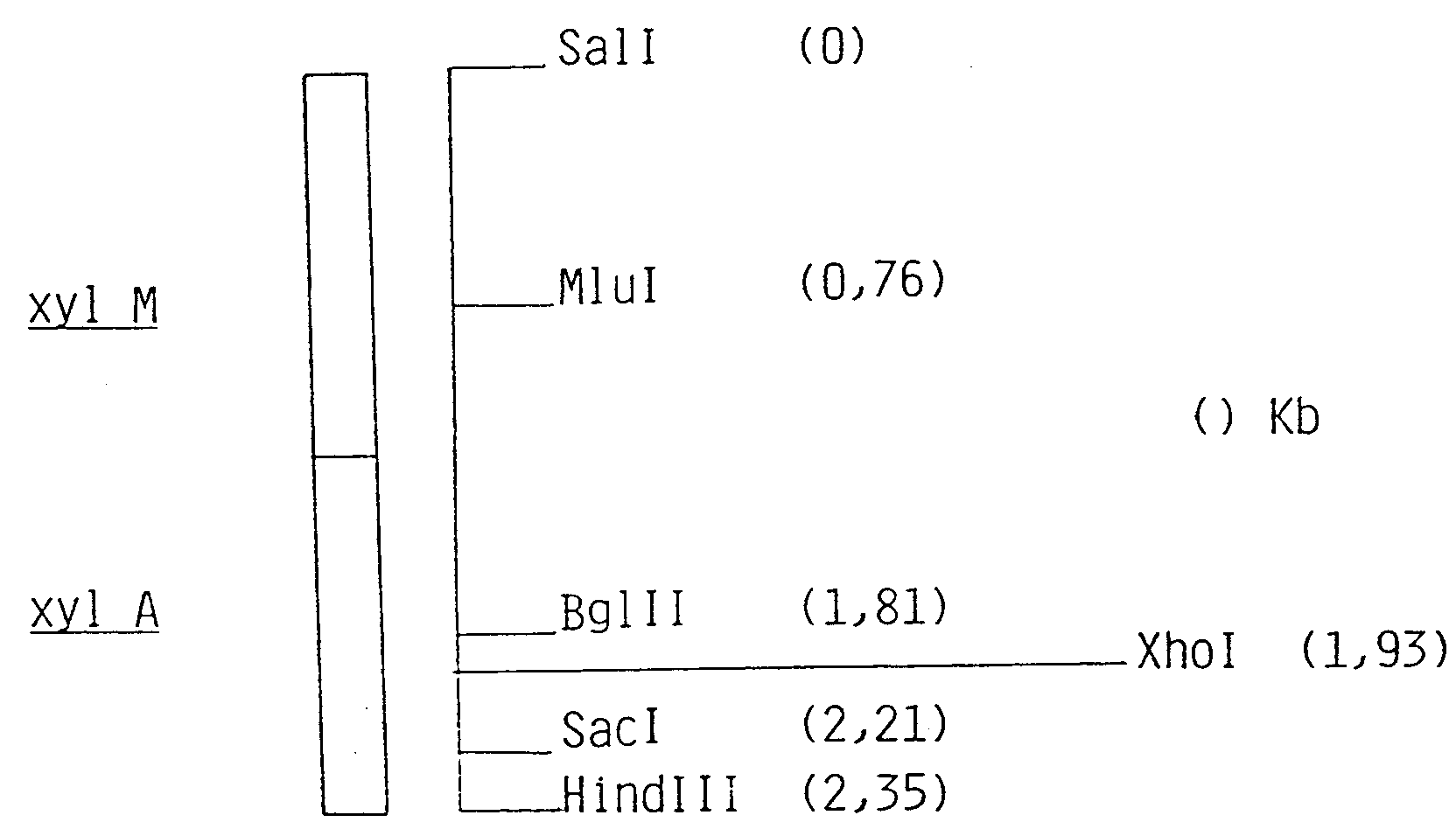
As previously described, this DNA segment is characterized by the following restriction map and contains no genes which code for an effective alcohol dehydrogenase:
Der so erhaltene Genabschnitt kann mittels üblichen molekularbiologischen Techniken mit einer zuvor gleichermassen geschnittenen Expressionsvektor-DNA zu einem Hybridplasmid ligiert werden.
Expressions-Vektoren enthalten üblicherweise einen geeigneten, meist regulierbaren Promotor. Hinter diesem Promotor liegen günstigerweise in Transkriptionsrichtung eine oder mehrere singuläre Schnittstellen für Restriktionsenzyme. In diese Schnittstellen wird dann üblicherweise der gewünschte Genabschnitt inseriert, an dessen Expression man interessiert ist.
Zweckmässig werden als Expressionsvektoren alle, die in Tabelle 1 aufgeführt sind, angewendet. Für das erfindungsgemässe Verfahren werden zweckmässig Expressionsvektoren mit breitem Wirtsspektrum (broad host range) wie pME285, pKT240, pMMB67EH oder pMMB67EH* angewendet.
Zweckmässig werden diese Expressionsvektoren mit den Restriktionsenzymen SalI und HindIII geschnitten, und die entstandenen Restriktionsenden mit der isolierten TOL-Plasmid-DNA anschliessend mittels beispielsweise T4-DNA-Ligase ligiert. Gegebenenfalls können auch weitere Methoden zur Ligation angewendet werden, wie z.B. die, die in Current Protocols in Molecular Biology, John Wiley and Sons, New York, 1989, Abschnitt 3.16, Subcloning of DNA-fragments, beschrieben sind.The gene segment obtained in this way can be ligated to a hybrid plasmid using conventional molecular biological techniques with an expression vector DNA which has previously been cut equally.
Expression vectors usually contain a suitable, usually regulable promoter. One or more unique cleavage sites for restriction enzymes are conveniently located behind this promoter in the direction of transcription. The desired gene segment whose expression one is interested in is then usually inserted into these interfaces.
All that are listed in Table 1 are expediently used as expression vectors. Expression vectors are expediently used for the method according to the invention broad host range, such as pME285, pKT240, pMMB67EH or pMMB67EH *.
These expression vectors are expediently cut with the restriction enzymes SalI and HindIII, and the resulting restriction ends are then ligated with the isolated TOL plasmid DNA using, for example, T4 DNA ligase. If necessary, other methods of ligation can also be used, such as those described in Current Protocols in Molecular Biology, John Wiley and Sons, New York, 1989, Section 3.16, Subcloning of DNA fragments.
Die zweckmässig so entstandenen Hybridplasmide pLO3, pLO4 und pLO5 sind ebenfalls Bestandteil der Erfindung, weisen ein breites Wirtsspektrum auf und können dementsprechend in Wirtsstämme mit hoher Substrat- und Edukttoleranz eingesetzt werden.
Zweckmässig sind diese Hybridplasmide vom natürlichen Regulationssystem entkoppelt.
Demgemäss wird Hybridplasmid pLO4 (bestehend aus Expressionsvektor pMMB67EH und dem TOL-Plasmid-Gen charakterisiert durch die zuvor beschriebene Restriktionskarte mit dem Promotor Ptac) kontrolliert durch das Repressorgen lacIq.
Die Expression der TOL-Plasmid-Gene lässt sich demnach mit Isopropylthiogalactosid (IPTG) induzieren.
Die Expression der TOL-Plasmid-Gene in Hybridplasmid pLO5 (bestehend aus Expressionsvektor pMMB67EH* und dem TOL-Plasmid-Gen charakterisiert durch die Restriktionskarte auf S. 4), mit Promotor Ptac, ist permanent (konstitutiv), aufgrund des fehlenden Repressorgens lacIq, induziert.
Zweckmässig wird hierfür durch Einführung einer Kanamycin-Resistenz das Repressorgen lacIq in pMMB67EH* mutiert. Ebenso ist es möglich ein Hybridplasmid mit einem engeren Wirtsspektrum anzuwenden. Zweckmässig wird als Hybridplasmid mit engerem Wirtsspektrum pGSH2836 mit Promotor lambda PL angewendet, wobei die Expression der TOL-Plasmid-Gene permanent (konstitutiv) induziert sind. Dient beispielsweise Escherichia coli (E.coli) K12* als Wirt für pGSH2836 muss durch Temperatur das dort chromosomal integrierte Repressorgen cI857 inaktiviert werden, um eine Expression des Promotors lambda PL zu erreichen.
Das Hybridplasmid pGSH2836, ist hinterlegt in E.coli K12* unter der Nummer DSM 6154 bei der Deutschen Sammlung für Mikroorganismen und Zellkulturen GmbH, Mascheroderweg 1b, D-3300 Braunschweig. Die Hybridplasmide pLO4 und pLO5 sind wie in den folgenden Abschnitten beschrieben wird, in E.coli K12* (pLO4) oder in Pseudomonas putida (pLO5) hinterlegt.The hybrid plasmids pLO3, pLO4 and pLO5 which are expediently formed in this way are likewise part of the invention, have a broad host spectrum and can accordingly be used in host strains with a high substrate and starting material tolerance.
These hybrid plasmids are expediently decoupled from the natural regulatory system.
Accordingly, hybrid plasmid pLO4 (consisting of expression vector pMMB67EH and the TOL plasmid gene characterized by the restriction map with the promoter P tac described above ) is controlled by the repressor gene lacIq .
The expression of the TOL plasmid genes can therefore be induced with isopropylthiogalactoside (IPTG).
The expression of the TOL plasmid genes in hybrid plasmid pLO5 (consisting of expression vector pMMB67EH * and the TOL plasmid gene characterized by the restriction map on p. 4) with Promoter P tac , is permanent (constitutive), due to the lack of repressor gene lacIq , induced.
For this purpose, the repressor gene lacIq in pMMB67EH * is mutated by introducing kanamycin resistance. It is also possible to use a hybrid plasmid with a narrower host spectrum. It is useful to use pGSH2836 with a lambda P L promoter as a hybrid plasmid with a narrower host spectrum, the expression of the TOL plasmid genes being permanently (constitutively) induced. For example, if Escherichia coli ( E. coli ) K12 * serves as the host for pGSH2836, the chromosomally integrated repressor gene cI857 must be inactivated by temperature in order to achieve expression of the lambda P L promoter.
The hybrid plasmid pGSH2836 is deposited in E.coli K12 * under the number DSM 6154 at the German Collection for Microorganisms and Cell Cultures GmbH, Mascheroderweg 1b, D-3300 Braunschweig. The hybrid plasmids pLO4 and pLO5 are stored in E.coli K12 * (pLO4) or in Pseudomonas putida (pLO5) as described in the following sections.
Aufgrund des breiten Wirtsspektrums können die so entstandenen Hybridplasmide (pLO3, pLO4, pLO5) in eine Vielzahl von Wirtsstämmen eingebracht werden.
Zweckmässig werden Wirtsstämme mit hoher Substrat- und Edukttoleranz eingesetzt wie z.B. die der Gattung Pseudomonas, Acinetobacter, Rhizobium, Agrobacterium oder Escherichia.Due to the wide range of hosts, the resulting hybrid plasmids (pLO3, pLO4, pLO5) can be introduced into a variety of host strains.
Host strains with high substrate and starting material tolerance are expediently used, such as, for example, those of the genus Pseudomonas , Acinetobacter , Rhizobium , Agrobacterium or Escherichia .
Das Einbringen der Hybridplasmide in die zuvor beschriebenen Wirtsstämme kann nach üblichen Methoden erfolgen, vorzugsweise nach der Methode von Lederberg und Cohen (J.Bacteriol. 119, 1974, S.1072-1074).The hybrid plasmids can be introduced into the host strains described above by customary methods, preferably by the method of Lederberg and Cohen (J. Bacteriol. 119, 1974, pp. 1072-1074).
Als Produktionsstämme werden zweckmässig, alle die in Tabelle 2 aufgeführten angewendet. Die mit den Hybridplasmiden pLO3, pLO4 und pLO5 transformierten Mikroorganismen (Tabelle 2) sind neu und damit ebenfalls Bestandteil der Erfindung.
Vorzugsweise wird Mikroorganismus E.coli K12* transformiert mit Hybridplasmid pLO4, hinterlegt am 29.8.1990, unter der Nummer DSM 6153 oder Mikroorganismus Pseudomonas putida JD7 transformiert mit Hybridplasmid pLO5, hinterlegt am 29.8.1990, unter der Nummer DSM 6152 sowie deren Deszendenten und Mutanten, angewendet.
Die Hinterlegung erfolgte bei der Deutschen Sammlung von Mikroorganismen und Zellkulturen GmbH, Mascheroderweg 1b, D-3300 Braunschweig.
Es können auch solche Mikroorganismen als Produktionsstämme eingesetzt werden, die ein natürliches TOL-Plasmid enthalten und bei denen dann das Gen, welches für eine wirksame Alkoholdehydrogenase codiert, entfernt oder inaktiviert ist. Die Inaktivierung bzw. Entfernung kann durch klassische Mutation z.B. mit Acridin Orange über eine Transposon-Insertion oder durch die nachstehende Methode des "Gene-replacements" mit homologer Rekombination (A.Zimmermann et al, Molecular Microbiology 5, 1991, S.1483-1490) erfolgen. In diesen Produktionsstämmen erfolgt dann die Expression der TOL-Plasmid-Gene beispielsweise durch Induktion mit Verbindungen wie Toluol, Xylol oder Cymol.As production strains, all those listed in Table 2 are expediently used. The microorganisms transformed with the hybrid plasmids pLO3, pLO4 and pLO5 (Table 2) are new and thus also part of the invention.
Microorganism E. coli K12 * is preferably transformed with hybrid plasmid pLO4, deposited on August 29, 1990, under the number DSM 6153 or microorganism Pseudomonas putida JD7 transformed with hybrid plasmid pLO5, deposited on August 29, 1990, under the number DSM 6152 and its descendants and mutants , applied.
The deposit was made to the German Collection of Microorganisms and Cell Cultures GmbH, Mascheroderweg 1b, D-3300 Braunschweig.
It is also possible to use such microorganisms as production strains which contain a natural TOL plasmid and in which the gene which codes for an effective alcohol dehydrogenase is then removed or inactivated. The inactivation or removal can be carried out by classic mutation, for example with acridine orange via a transposon insertion, or by the following method of "gene replacements" with homologous recombination (A.Zimmermann et al, Molecular Microbiology 5, 1991, pp. 1483-1490). The expression of the TOL plasmid genes then takes place in these production strains, for example by induction with compounds such as toluene, xylene or cymene.
Die Entfernung des Alkohol-Dehydrogenase-Gens erfolgt zweckmässig derart, dass ein zuvor hergestelltes Hilfs-Hybridplasmid, in dem das Alkohol-Dehydrogenase-Gen bereits entfernt ist, durch homologe Rekombination in das natürliche TOL-Plasmid aufgenommen wird ("Gene-replacement" mit homologer Rekombination).
Durch diese Aufnahme wird dann zweckmässig die Alkohol-Dehydrogenase im natürlichen TOL-Plasmid entfernt.The alcohol dehydrogenase gene is expediently removed in such a way that a previously produced auxiliary hybrid plasmid, in which the alcohol dehydrogenase gene has already been removed, is incorporated into the natural TOL plasmid by homologous recombination ("gene replacement" with homologous recombination).
This absorption then expediently removes the alcohol dehydrogenase in the natural TOL plasmid.
Die Transformanten können üblicherweise auf Minimalmedium-Glucose-Agar mit entsprechender Inhibierungskonzentration geeigneter Antibiotika selektioniert werden. Die angewendeten Antibiotika-Resistenzmarken sind in Tabelle 1 aufgeführt.The transformants can usually be selected on minimal medium glucose agar with an appropriate inhibitory concentration of suitable antibiotics. The antibiotic resistance brands used are listed in Table 1.
Erfindungsgemäss werden die nach den zuvor beschriebenen Verfahren erhaltenen Produktionsstämme sowie deren Deszendenten und Mutanten für das erfindungsgemässe Verfahren zur Hydroxylierung von Methylgruppen in aromatischen 5- oder 6-Atom-Heterocyclen eingesetzt.
Als Substrate für die Umsetzung können methylierte aromatische 5- oder 6-Atom-Heterocyclen verwendet werden, die ein oder mehrere Heteroatome aus der Reihe Sauerstoff, Stickstoff, Schwefel enthalten. Geeignete 5-Atom-Heterocyclen sind beispielsweise methylierte Thiophen-, Furan-, Pyrrol-, Thiazol-, Pyrazol- und Imidazol-derivate, die keinen Substituenten am benachbarten Kohlenstoffatom der zu hydroxylierenden Methylgruppe aufweisen. Vorzugsweise werden als 5-Atom-Heterocyclen, 3,5-Dimethylpyrazol, 4-Methylthiazol und 2,5-Dimethylthiophen, angewendet.
Geeignete 6-Atom-Heterocyclen sind beispielsweise methylierte Pyridin-, Pyrimidin-, Pyrazin- und Pyridazin-derivate, die keinen Substituenten am benachbarten Kohlenstoffatom der zu hydroxylierenden Methylgruppe aufweisen. Vorzugsweise werden als 6-Atom-Heterocyclen, 2-Chlor-5-methylpyridin, 2,5-Dimethylpyrazin und 2,6-Dimethylpyrimidin, angewendet.
Vor der Substratzugabe werden die Zellen bis zu einer optischen Dichte bei 650 nm (OD₆₅₀) von 1 bis 200 im Kulturmedium angezogen, vorzugsweise bis zu einer optischen Dichte von 5 bis 100.
Die Umsetzung kann entweder unter einmaliger oder kontinuierlicher Substratzugabe erfolgen, so dass die Substratkonzentration im Kulturmedium 20% (w/v) bzw. (v/v) für flüssige Substrate nicht übersteigt.
Vorzugsweise erfolgt die Substratzugabe so, dass die Substratkonzentration im Kulturmedium 5% (w/v) bzw. (v/v) nicht übersteigt.
Die Umsetzung wird üblicherweise mit ruhenden Zellen in einem pH-Bereich von 4 bis 11, vorzugsweise von 6 bis 10, durchgeführt.
Die Umsetzung wird üblicherweise bei einer Temperatur von 15 bis 50°C, vorzugsweise bei einer Temperatur von 25 bis 45°C, durchgeführt.
Nach der Umsetzung können die entsprechenden Hydroxymethylderivat auf bekannte Art und Weise isoliert werden.According to the invention, the production strains obtained by the processes described above and their descendants and mutants are used for the process according to the invention for the hydroxylation of methyl groups in aromatic 5- or 6-atom heterocycles.
Methylated aromatic 5- or 6-atom heterocycles which contain one or more heteroatoms from the series consisting of oxygen, nitrogen and sulfur can be used as substrates for the reaction. Suitable 5-atom heterocycles are, for example, methylated thiophene, furan, pyrrole, thiazole, pyrazole and imidazole derivatives which have no substituents on the adjacent carbon atom of the methyl group to be hydroxylated. Preferably used as 5-atom heterocycles, 3,5-dimethylpyrazole, 4-methylthiazole and 2,5-dimethylthiophene.
Suitable 6-atom heterocycles are, for example, methylated pyridine, pyrimidine, pyrazine and pyridazine derivatives which have no substituents on the adjacent carbon atom of the methyl group to be hydroxylated. Preferably used as 6-atom heterocycles, 2-chloro-5-methylpyridine, 2,5-dimethylpyrazine and 2,6-dimethylpyrimidine.
Before the substrate is added, the cells are grown to an optical density at 650 nm (OD₆₅₀) of 1 to 200 in the culture medium, preferably up to an optical density of 5 to 100.
The reaction can take place either with a single or continuous addition of substrate, so that the substrate concentration in the culture medium does not exceed 20% (w / v) or (v / v) for liquid substrates.
The substrate is preferably added such that the substrate concentration in the culture medium does not exceed 5% (w / v) or (v / v).
The reaction is usually carried out with resting cells in a pH range from 4 to 11, preferably from 6 to 10.
The reaction is usually carried out at a temperature of 15 to 50 ° C, preferably at a temperature of 25 to 45 ° C.
After the reaction, the corresponding hydroxymethyl derivative can be isolated in a known manner.
Die Zellen von 1 l einer ausgewachsenen Bakterienkultur, Pseudomonas putida pWWO (ATCC 33015), wurden abzentrifugiert. Nach Resuspension der Zellen in 10 ml 25% Saccharose in 0,05 M Tris-Puffer, pH 8,0 wurden 1,5 ml Lysozymlösung, (20 mg/ml in 0,25 M Tris-Puffer, pH 8,0) hinzugegeben. Anschliessend Inkubation für 5 min. auf Eis; Zugabe von 10 ml 0,25 M Na₂EDTA (pH 8) und weitere Inkubation für 5 min. auf Eis.
Dann Zugabe von 15 ml Brij® Polyoxyethylenlaurylether/DCL-Lösung (1% Brij® 58, 0,4% Natriumdeoxycholat in 0,01 M Tris-Puffer, 0,001 M Na₂EDTA, pH 8,0). Gutes, gleichmässiges Durchmischen, Inkubation auf Eis für 30 min. bis zur vollständigen Zellyse.
Nach Zentrifugation für 45 min. bei 4°C bei 16 000 UpM, wurde der Überstand in autoklavierten Messzylinder dekantiert. Zugabe von 3% (w/v) NaCl und 10% PEG (Polyethylenglykol). Durch vorsichtiges Wenden des mit Parafilm verschlossenen Zylinders wurde eine Lösung erzielt. Inkubation für 2 h bei 4°C. Zentrifugation für 2 min bei 5 000 UpM. Anschliessend Dekantieren des Ueberstandes und Lösen des Niederschlags in 5 ml TES- Puffer (0,05 M Tris, 0,005 M Na₂ EDTA, 0,05 M NaCl, pH 8,0); Überführung in, autoklaviertes 15 ml Corex-Röhrchen mit 8,0 g Calciumchlorid. Nach Zugabe von 0,6 ml Ethidiumbromidlösung (10 mg/ml) wurde für 30 min auf Eis inkubiert.
Zentrifugation für 30 min bei 4°C bei 12 000 UpM. Dann wurde vorsichtig dekantiert zur Entfernung des ausgefallenen PEG aus der Lösung. Ultrazentrifugation der Lösung in geschlossenen Röhrchen mit 50TI-Rotor bei 40 000 UpM für 30 h bei 18°C. Danach Isolierung der Plasmidbande aus den CsCl₂-Gradienten mit einer Kanüle vor dem UV-Transilluminator.
Entfernung von Ethidiumbromid aus dem Plasmidpräparat durch Ausschütteln mit n-Butanol. Isopropanolfällung der Plasmid-DNA und Trocknen des Niederschlags im Speed Vac® Concentrator. Resuspension des Plasmidpräparats in 0,01 M Tris-Puffer, 0,001 M Na₂ EDTA, pH 8,0).The cells from 1 l of an adult bacterial culture, Pseudomonas putida pWWO (ATCC 33015), were centrifuged off. After resuspension of the cells in 10 ml of 25% sucrose in 0.05 M Tris buffer, pH 8.0, 1.5 ml of lysozyme solution (20 mg / ml in 0.25 M Tris buffer, pH 8.0) were added . Then incubate for 5 min. on ice; Add 10 ml 0.25 M Na₂EDTA (pH 8) and further incubate for 5 min. on ice.
Then add 15 ml of Brij® polyoxyethylene lauryl ether / DCL solution (1% Brij® 58, 0.4% sodium deoxycholate in 0.01 M Tris buffer, 0.001 M Na₂EDTA, pH 8.0). Good, even mixing, incubation on ice for 30 min. until complete cell lysis.
After centrifugation for 45 min. at 4 ° C at 16,000 rpm, the supernatant was decanted in an autoclaved measuring cylinder. Add 3% (w / v) NaCl and 10% PEG (polyethylene glycol). A solution was achieved by carefully turning the cylinder sealed with Parafilm. Incubation for 2 h at 4 ° C. Centrifugation for 2 min at 5,000 rpm. Then decanting the supernatant and dissolving the precipitate in 5 ml of TES buffer (0.05 M Tris, 0.005 M Na₂ EDTA, 0.05 M NaCl, pH 8.0); Transfer to an autoclaved 15 ml Corex tube with 8.0 g Calcium chloride. After adding 0.6 ml of ethidium bromide solution (10 mg / ml), the mixture was incubated on ice for 30 min.
Centrifugation for 30 min at 4 ° C at 12,000 rpm. It was then carefully decanted to remove the precipitated PEG from the solution. Ultracentrifugation of the solution in closed tubes with a 50TI rotor at 40,000 rpm for 30 h at 18 ° C. Then isolate the plasmid band from the CsCl₂ gradient with a cannula in front of the UV transilluminator.
Removal of ethidium bromide from the plasmid preparation by shaking with n-butanol. Isopropanol precipitation of the plasmid DNA and drying of the precipitate in the Speed Vac® Concentrator. Resuspension of the plasmid preparation in 0.01 M Tris buffer, 0.001 M Na₂ EDTA, pH 8.0).
Die mit SalI und HindIII (jeweils 4 Units pro µg Plasmid-DNA) geschnittene Plasmid-DNA wurde einer präparativen Agarose-Gelelektrophorese unterworfen, (0,6% (w/v) Agarose in TBE-Puffer (0,09 M Tris-Borat, 2,5 mM Na₂ EDTA, pH 8,3, Ethidiumbromid (100 µg/100 ml)).
In kleine Streifen geschnittene DEAE-Cellulose-Membran wurde in H₂O angerichtet und in Schlitze im Agarosegel unmittelbar vor der gewünschten DNA-Fragmentbande gesteckt. DNA wurde im Spannungsfeld auf die Membran auflaufen gelassen. Gegebenenfalls höhere DNA-Banden wurden mit weiterer Membran zurückgehalten. Die aufgelaufene DNA wurde von der Membran mit 500 µl Elutionspuffer (20 mM Tris, pH 7,5, 1 mM Na₂ EDTA, 1,5 M NaCl) während 1 h bei 65°C abgewaschen.
Membran wurde entfernt und abgespült. Ethidiumbromid wurde mit H₂O-gesättigtem n-Butanol aus der DNA-Lösung extrahiert, DNA mit Isopropanol präzipitiert.
Trocknen des Niederschlags im Speed Vac® Concentrator. Resuspension des Fragmentpräparats in 0,01 M Tris-Puffer, 0,001 M Na₂ EDTA, pH 8,0.The plasmid DNA cut with SalI and HindIII (4 units per µg plasmid DNA in each case) was subjected to preparative agarose gel electrophoresis, (0.6% (w / v) agarose in TBE buffer (0.09 M Tris-borate , 2.5 mM Na₂ EDTA, pH 8.3, ethidium bromide (100 µg / 100 ml)).
DEAE cellulose membrane cut into small strips was arranged in H₂O and inserted into slots in the agarose gel immediately in front of the desired DNA fragment band. DNA was run onto the membrane in the stress field. If necessary, higher DNA bands were retained with an additional membrane. The accumulated DNA was removed from the membrane with 500 μl elution buffer (20 mM Tris, pH 7.5, 1 mM Na 2 EDTA, 1.5 M NaCl) Washed off at 65 ° C for 1 h.
Membrane was removed and rinsed off. Ethidium bromide was extracted from the DNA solution with H₂O-saturated n-butanol, and DNA was precipitated with isopropanol.
Drying the precipitation in the Speed Vac® Concentrator. Resuspension of the fragment preparation in 0.01 M Tris buffer, 0.001 M Na₂ EDTA, pH 8.0.
Vor der Ligation wurde die pMMB67EH-Vektor-DNA (2µg) mit je 10 Units SalI und HindIII in dem entsprechenden Ligationspuffer (20 mM Tris-Puffer, 10 mM DTT (Dithioerythritol), 10 mM MgCl₂, 0,6 mM ATP, pH 7,2) geschnitten.
Diese geschnittene DNA wurde anschliessend mit 4,8 Units alkalischer Phosphatase dephosphoriliert. Die DNA wurde wiederholt mit Isopropanol ausgefällt und gewaschen.Before the ligation, the pMMB67EH vector DNA (2 μg) with 10 units of SalI and HindIII each in the corresponding ligation buffer (20 mM Tris buffer, 10 mM DTT (dithioerythritol), 10 mM MgCl₂, 0.6 mM ATP, pH 7 , 2) cut.
This cut DNA was then dephosphorilized with 4.8 units of alkaline phosphatase. The DNA was repeatedly precipitated with isopropanol and washed.
Zur Ligation wurden die jeweiligen DNA-Proben (in verschiedenen Mengenverhältnissen bei Ueberschuss der Insert-DNA) zusammengegeben, einer Isopropanolfällung unterzogen, und die getrockneten Niederschläge wurden in 40 bis 100 µl Ligationspuffer aufgenommen (20 mM Tris-Puffer, 10 mM DTT, 10 mM MgCl₂, 0,6 mM ATP, pH 7,2). Die Ligation erfolgte nach Zugabe von 0,2 Units T4-DNA-Ligase pro µg DNA über Nacht unter Inkubation bei 12 bis 16°C.
Anschliessend wurde das Ligationsgemisch direkt zur Transformation eingesetzt.For the ligation, the respective DNA samples (in different proportions with an excess of the insert DNA) were combined, subjected to isopropanol precipitation, and the dried precipitates were placed in 40 to 100 μl of ligation buffer added (20 mM Tris buffer, 10 mM DTT, 10 mM MgCl₂, 0.6 mM ATP, pH 7.2). The ligation was carried out after adding 0.2 units of T4 DNA ligase per µg of DNA overnight with incubation at 12 to 16 ° C.
The ligation mixture was then used directly for the transformation.
Analog zu Beispiel 1.3 a) wurde der Expressionsvektor pMMB67EH* vorbereitet und entsprechend zu Beispiel 1.3 a) wurde dann die xylMA-Gene in diesen Vektor ligiert.Analogously to example 1.3 a), the expression vector pMMB67EH * was prepared and, corresponding to example 1.3 a), the xylMA genes were then ligated into this vector.
Die Zellen einer 25 ml-Kultur von E.coli S17-1 als Hilfsstamm wurden bei einer OD₅₄₆=2,0 geerntet und nach der Methode von Lederberg und Cohen (J.Bacteriol. 119 (1974), 1072-1074) kompetent gemacht.
Nach Waschen dieser Zellen in 10 ml 0,1 M MgCl₂ wurden die Zellen für 30 min in 10 ml 0,1 CaCl₂ auf Eis inkubiert.
Zentrifugation und Resuspension dieser Zellen in 1 ml 0,1 M CaCl₂. Je 0,2 ml der Zellsuspension wurden mit 0,5 µg ligierter Hybrid-Plasmid-DNA zur Transformation vermischt. Inkubation für mehr als 30 min auf Eis, 2-minütiger Hitzeschock bei 42°C.
Anschliessend wurden die jeweiligen Zellsuspensionen auf 5 ml mit vorgewärmten Nutrient Yeast Broth (Oxoid, Wesel, BRD) aufgefüllt, für 1 h ohne Schütteln und eine weitere Stunde mit Schütteln zur Expression der Gene bei optimaler Wachstumstemperatur der Rezipientenzellen (E.coli S17-1) inkubiert. Aliquots der transformierten Kulturen wurden auf entsprechende Selektivmedien (Nutrient Agar, 100 µg Ampicillin pro ml) plaziert.The cells of a 25 ml culture of E. coli S17-1 as auxiliary strain were harvested at an OD₅₄₆ = 2.0 and made competent according to the method of Lederberg and Cohen (J.Bacteriol. 119 (1974), 1072-1074).
After washing these cells in 10 ml 0.1 M MgCl₂, the cells were incubated for 30 min in 10 ml 0.1 CaCl₂ on ice.
Centrifugation and resuspension of these cells in 1 ml 0.1 M CaCl₂. 0.2 ml portions of the cell suspension were mixed with 0.5 μg ligated hybrid plasmid DNA for transformation. Incubation for more than 30 min on ice, 2-minute heat shock at 42 ° C.
The respective cell suspensions were then made up to 5 ml filled with preheated Nutrient Yeast Broth (Oxoid, Wesel, FRG), incubated for 1 h without shaking and for another hour with shaking to express the genes at the optimal growth temperature of the recipient cells (E.coli S17-1) . Aliquots of the transformed cultures were placed on appropriate selective media (nutrient agar, 100 μg ampicillin per ml).
Aus dem E.coli S17-1-Stamm mit pLO4 wurde das Hybridplasmid pLO4 entsprechend zu Beispiel 1.1 und 1.2 isoliert. Anschliessend wurde E.coli K12* entsprechend der Methode in Beispiel 1.4 a) mit dem Hybridplasmid pLO4 transformiert. Die Selektion erfolgte entsprechend mit dem Selektivmedium (Nutrient Agar, 100 µg Ampicillin pro ml)The hybrid plasmid pLO4 was isolated in accordance with Examples 1.1 and 1.2 from the E. coli S17-1 strain with pLO4. E.coli K12 * was then transformed with the hybrid plasmid pLO4 according to the method in Example 1.4 a). The selection was made accordingly with the selective medium (nutrient agar, 100 µg ampicillin per ml)
Entsprechend zu Beispiel 1.4 wurde das Hybridplasmid pLO5 in Pseudomonas putida JD7 transformiert.
Die Selektion erfolgte mit Selektivmedium (Nutrient Agar, 50 µg Kanamycin pro ml)In accordance with example 1.4, the hybrid plasmid pLO5 was transformed into Pseudomonas putida JD7.
The selection was made with selective medium (nutrient agar, 50 µg kanamycin per ml)
Entsprechend zu Beispiel 1.3 wurde Hybridplasmid pLO3 hergestellt.
Entsprechend zu den Beispielen 1.4 und 1.5 wurden die Hybridplasmide pGSH2836, pLO3, pLO4 und pLO5 in die Wirtsstämme E.coli K12*, Pseudomonas aeruginosa PAO25, Pseudomonas putida JD7 und Pseudomonas putida, transformiert.
Die Umsetzungsraten dieser Produktionsstämme sind in Tabelle 2 zusammengefasst.Hybrid plasmid pLO3 was produced in accordance with Example 1.3.
The hybrid plasmids were in accordance with Examples 1.4 and 1.5 pGSH2836, pLO3, pLO4 and pLO5 were transformed into the host strains E. coli K12 * , Pseudomonas aeruginosa PAO25, Pseudomonas putida JD7 and Pseudomonas putida .
The conversion rates of these production strains are summarized in Table 2.
Die Gene xylMABCN wurden aus dem Plasmid pGSH2816 (Haramaya et al., J.Bacteriol. 171, 1989) mittels EcoRI und HpaI-Restriktion isoliert und anschliessend in den gleichermassen geschnittenen Vektor pBR322 (Bolivar et al., Gene 2, 1977, S.95 ff) ligiert.The genes xylMABCN were isolated from the plasmid pGSH2816 (Haramaya et al., J.Bacteriol. 171, 1989) using EcoRI and HpaI restriction and subsequently in the vector pBR322, which had been cut in the same way (Bolivar et al., Gene 2, 1977, p. 95 ff) ligated.
Die mit EcoRI und HpaI (jeweils 5 Units pro µg DNA) geschnittene pGSH2816-DNA wurde mittels präparativer Agarose-Gelelektrophorese aufgetrennt (0,7% Agarose in 0,09 M Tris-Borat, 2,5 mM Na-EDTA, pH 8,3) und die DNA-Fragmente der gesuchten Grösse wurden isoliert (entsprechend zu Beispiel 1.2).The pGSH2816-DNA cut with EcoRI and HpaI (5 units per µg DNA each) was separated by means of preparative agarose gel electrophoresis (0.7% agarose in 0.09 M Tris-borate, 2.5 mM Na-EDTA, pH 8, 3) and the DNA fragments of the size sought were isolated (corresponding to example 1.2).
Vor der Ligation wurde die pBR322-DNA (2 µg) mit je 10 Units EcoRI und ScaI in dem Restriktionspuffer (50 mM Tris, 10 mM MgCl₂, 100 mM präparativen Agarose-Gelelektrophorese getrennt. Die gewünschte 3850 bp grosse Bande wurde, wie in Beispiel 9.1.1 beschrieben, isoliert.Before the ligation, the pBR322-DNA (2 μg) with 10 units EcoRI and ScaI each was separated in the restriction buffer (50 mM Tris, 10 mM MgCl₂, 100 mM preparative agarose gel electrophoresis. The desired 3850 bp band was as in Example 9.1.1 described, isolated.
Zur Ligation wurden die jeweiligen DNA-Proben (in verschiedenen Mengenverhältnissen bei Überschuss der Insert-DNA) zusammengegeben, mit Ligationspuffer versetzt (20 mM Tris, 10 M DTT, 10 mM MgCl₂, 0,6 mM ATP, pH 7,2) und nach Hinzufügen von 1 Unit T4-DNA-Ligase über Nacht bei 12 bis 16°C inkubiert. Anschliessend wurde das Ligationsgemisch direkt zur Transformation eingesetzt.For ligation, the respective DNA samples (in different proportions with excess of the insert DNA) were combined, mixed with ligation buffer (20 mM Tris, 10 M DTT, 10 mM MgCl₂, 0.6 mM ATP, pH 7.2) and after Add 1 unit of T4 DNA ligase incubated overnight at 12 to 16 ° C. The ligation mixture was then used directly for the transformation.
Die Selektion erfolgte auf Nutrient Agar mit Tetracyclin (25 µg/µl). Nach Restriktionskontrolle wurden grössere Mengen von pLO10-DNA mittels CsCl-Gradient aufgereinigt.The selection was made on nutrient agar with tetracycline (25 µg / µl). After restriction control, large amounts of pLO10 DNA were purified using a CsCl gradient.
5µg pLO10-DNA wurden mit 22 Units HindIII im Restriktionspuffer geschnitten (10 mM Tris, 10 mM MgCl₂, 50 mM NaCl, 1 mM DTT, pH 7,5) und einer präparativen Agarose-Gelelektrophorese unterworfen. Zwei Fragmente mit Grössen von 3,8 kb bzw. 2,9 kb wurden, wie in Beispiel 9.1.1 beschrieben, isoliert und in 45 bzw. 30 µl Wasser aufgenommen. Sie enthielten den Vektor pBR322 und den Bereich der xyl-Gene ausser xylB. 5µg pLO10-DNA were cut with 22 units of HindIII in the restriction buffer (10mM Tris, 10mM MgCl₂, 50mM NaCl, 1mM DTT, pH 7.5) and a preparative agarose gel electrophoresis subject. Two fragments with sizes of 3.8 kb and 2.9 kb were isolated as described in Example 9.1.1 and taken up in 45 and 30 μl of water. They contained the vector pBR322 and the region of the xyl genes except xylB.
Beide der in Beispiel 9.2.1 isolierten Fragmente wurden, wie in Beispiel 9.1.2b beschrieben, zur Ligation eingesetzt. Dazu wurden 45 µl Fragment 3,8 kb, 30 µl Fragment 2,8 kb, 10 µl Ligationspuffer, 10 µl 10 mM ATP und 1 µl T4-DNA-Ligase gemischt und über Nacht bei 12 bis 16°C inkubiert. Anschliessend wurde die DNA mit Ethanol gefällt und in 10 µl Wasser aufgenommen.Both of the fragments isolated in Example 9.2.1 were used for ligation as described in Example 9.1.2b. For this purpose, 45 ul fragment 3.8 kb, 30 ul fragment 2.8 kb, 10 ul ligation buffer, 10 ul 10 mM ATP and 1 ul T4 DNA ligase were mixed and incubated overnight at 12 to 16 ° C. The DNA was then precipitated with ethanol and taken up in 10 μl of water.
Die nach Beispiel 9.2.2 erhaltene DNA wurde direkt zur Transformation von E.coli HB101 verwendet (entsprechend zu Beispiel 9.1.2c).
Transformierte Zellen wurden auf Nutrient Agar mit Tetracyclin (25 µg/µl) selektioniert.The DNA obtained according to Example 9.2.2 was used directly for the transformation of E.coli HB101 (corresponding to Example 9.1.2c).
Transformed cells were selected on nutrient agar with tetracycline (25 µg / µl).
E.coli HB101 enthaltend pRK2013 wurde als Wirt für pLO11 ausgewählt. Mittels der auf pRK2013 codierten Funktionen ist eine Mobilisierung in andere gram-negative Bakterien wie z.B. Pseudomonas putida JD7 mit pWW0 möglich.
Isolierte pLO11-DNA wurde wie in Beispiel 9.1.2a beschrieben in E.coli HB101 enthaltend pRK2013 transformiert. Die Selektion erfolgte auf Nutrient Agar mit Tetracyclin (25 µg/µl) und Kanamycin (25 µg/µl). E.coli HB101 containing pRK2013 was selected as the host for pLO11. Using the functions encoded on pRK2013, mobilization into other gram-negative bacteria such as Pseudomonas putida JD7 with pWW0 is possible.
Isolated pLO11 DNA was transformed into E. coli HB101 containing pRK2013 as described in Example 9.1.2a. The selection was carried out on nutrient agar with tetracycline (25 µg / µl) and kanamycin (25 µg / µl).
Von Übernacht-Kulturen der beiden Konjugationspartner wurden 2 ml abzentrifugiert, mehrfach in 0,9% NaCl (Saline) gewaschen, in 100 µl Saline aufgenommen und auf Nutrient Agar Platten gemischt. Die Platten wurden zur Konjugation für 6 h bei 30°C inkubiert. Der entstandene Bakterienrasen wurde in 1 ml Saline resuspendiert und in geeigneten Verdünnungen auf Nutrient Agar mit Tetracyclin (50 µg/µl) plattiert. Unter den erhaltenen Transkonjuganten sollten einige aufgrund homologer Rekombination pLO11 in das TOL-Plasmid aufgenommen haben.From overnight cultures of the two conjugation partners, 2 ml were centrifuged off, washed several times in 0.9% NaCl (saline), taken up in 100 μl saline and mixed on nutrient agar plates. The plates were incubated for 6 h at 30 ° C for conjugation. The resulting bacterial turf was resuspended in 1 ml saline and plated in suitable dilutions on nutrient agar with tetracycline (50 µg / µl). Among the transconjugants obtained, some should have included pLO11 in the TOL plasmid due to homologous recombination.
Um mittels homologer Rekombination xylB auf dem TOS-Plasmid pWW0 in Pseudomonas putida JD7 zu entfernen, wurden ca. über 100 Generationen der zuvor erhaltenen E.coli-Transkonjuganten ohne Selektionsdruck durch Tetracyclin angezogen (kultiviert). Dabei war die Exclusion (Entfernung) von Vektor pBR322 und intaktem xylB-Gen erwünscht.
Um die Anzahl Tetracyclin-sensitiver xylB-Mutanten zu erhöhen, wurde dann eine Selektion gegen den integrierten Vektor pBR322 durchgeführt:
Zellen wurden in 25 ml Komplexmedium Nutrient Yeast Broth (Oxoid, Wesel, BRD) Tetracyclin (50 µg/µl) aufgenommen und bis zu einer OD₆₅₀ von ca. 3,0 bei 30°C inkubiert. Danach wurden 500 µg/ml Cycloserin C und 100 µg/ml Piperacillin zugegeben. Nach mehrstündiger Inkubation bei 30°C trat eine fast vollständige Lyse der Zellen ein. Überlebende Zellen wurden abzentrifugiert, mehrfach in Saline gewaschen und in geeignete Verdünnungen auf Nutrient Agar plattiert. Bis zu 85% der erhaltenen Kolonien waren Tetracyclin-sensitiv.In order to remove xylB on the TOS plasmid pWW0 in Pseudomonas putida JD7 by means of homologous recombination, about 100 generations of the E. coli transconjugants obtained previously were grown (cultured) without selection pressure by tetracycline. The exclusion (removal) of vector pBR322 and intact xylB gene was desired.
In order to increase the number of tetracycline-sensitive xylB mutants, a selection was then carried out against the integrated vector pBR322:
Cells were taken up in 25 ml of nutrient yeast broth complex medium (Oxoid, Wesel, FRG) tetracycline (50 µg / µl) and incubated up to an OD₆₅₀ of approx. 3.0 at 30 ° C. After that 500 µg / ml cycloserine C and 100 µg / ml piperacillin were added. After incubation for several hours at 30 ° C., the cells were almost completely lysed. Surviving cells were centrifuged off, washed several times in saline and plated in suitable dilutions on nutrient agar. Up to 85% of the colonies obtained were sensitive to tetracycline.
pWW0'-DNA der erhaltenen Klone wurde entsprechend der Methode von Kado und Liu (J.Bacteriol. 145, S.1365-1373 (1981)) isoliert. Dazu wurde 1 ml Übernacht-Kultur abzentrifugiert und in 40 mM Tris-Acetat-Puffer, 2 mM EDTA, pH 7,9 resuspendiert. Die Zellen wurden durch Zugabe von 200 µl 3% SDS, pH 12,6 lysiert, 1 h bei 65°C inkubiert und anschliessend mehrfach mit Phenol-Chloroform (1:1) extrahiert.
Die wässrige DNA-Lösung wurde durch wiederholtes Waschen mit Diethylether von Phenol befreit und mit 1/10 Volumen 3 M Natrium-Acetat, pH 4,8 versetzt.
Danach wurde die DNA mit Ethanol präzipitiert und nach Trocknen in 100 µl Wasser aufgenommen.
Ca. 40 µl dieser DNA-Probe wurden mit 100 Units EcoRI und 5 Units HpaI im Verdauungspuffer (50 mM Tris, 10 mM MgCl₂, 100 mM NaCl, 1 mM DTT, pH 7,5) geschnitten und einer Agarose-Gelelektrophorese unterworfen. Die auf Nitrocellulose-Membranen transferierte DNA wurde gegen 500 ng einer ³²P-ATP markierten pLO11 Sonde hybridisiert. Die 1,4 kb xylB-Deletion war nach Autoradiographie direkt erkennbar.pWW0 'DNA of the clones obtained was isolated according to the method of Kado and Liu (J.Bacteriol. 145, pp.1365-1373 (1981)). For this purpose, 1 ml of overnight culture was centrifuged off and resuspended in 40 mM Tris-acetate buffer, 2 mM EDTA, pH 7.9. The cells were lysed by adding 200 μl of 3% SDS, pH 12.6, incubated for 1 h at 65 ° C. and then extracted several times with phenol-chloroform (1: 1).
The aqueous DNA solution was freed of phenol by repeated washing with diethyl ether and 1/10 volume of 3 M sodium acetate, pH 4.8 was added.
The DNA was then precipitated with ethanol and, after drying, taken up in 100 μl of water.
Approx. 40 ul of this DNA sample were cut with 100 units EcoRI and 5 units HpaI in the digestive buffer (50 mM Tris, 10 mM MgCl₂, 100 mM NaCl, 1 mM DTT, pH 7.5) and subjected to agarose gel electrophoresis. The DNA transferred to nitrocellulose membranes was hybridized against 500 ng of a 32 P-ATP labeled pLO11 probe. The 1.4 kb xylB deletion was immediately recognizable after autoradiography.
E.coli K12* mit pLO4 (DSM-Nr. 6153) wurden über Nacht bei 30°C in Nutrient Yeast Broth (Oxoid, Wesel, BRD) unter Zusatz von dem in Tabelle 1 aufgeführten entsprechenden Antibiotikum entsprechend der Methode in Beispiel 1.4 zur Stabilisierung der Plasmide angezogen. Danach wurde ein Aliquot in frisches Medium übertragen und für weitere 2 h bei 30°C inkubiert, bevor die Xylol-Monooxygenase-Gene entsprechend dem Expressionssystem (Tabelle 1) induziert wurden. Dies geschah durch Zugabe von 1 mM IPTG zur Induktion der Expression durch den tac-Promotor. Die Induktionsphase betrug jeweils zwischen 2 und 4 h. Die Bakteriensuspension wurde zentrifugiert, und das Zellpellet dann in frisches Medium ohne Zusatz von Antibiotika resuspendiert, so dass sich eine OD₆₅₀ von 10 einstellte. Diese Suspension wurde danach mit 0,1% (v/v für flüssige Substrate, w/v für feste Substrate) der zu oxidierenden Heterocyclen versetzt und bei 30°C weiterinkubiert. Nach bestimmten Zeitabständen wurde die Bakteriensuspension auf Produktbildung hin untersucht. E. coli K12 * with pLO4 (DSM No. 6153) were stabilized overnight at 30 ° C. in Nutrient Yeast Broth (Oxoid, Wesel, FRG) with the addition of the corresponding antibiotic listed in Table 1 according to the method in Example 1.4 the plasmids attracted. An aliquot was then transferred to fresh medium and incubated for a further 2 h at 30 ° C. before the xylene monooxygenase genes were induced in accordance with the expression system (Table 1). This was done by adding 1 mM IPTG to induce expression by the tac promoter. The induction phase was between 2 and 4 hours. The bacterial suspension was centrifuged and the cell pellet was then resuspended in fresh medium without the addition of antibiotics. so that an OD₆₅₀ of 10 occurred. This suspension was then mixed with 0.1% (v / v for liquid substrates, w / v for solid substrates) of the heterocycles to be oxidized and further incubated at 30 ° C. After certain time intervals, the bacterial suspension was examined for product formation.
Entsprechend zu Beispiel 10 wurde Pseudomonas putida JD7 mit pLO5 angezüchtet.
Aufgrund des fehlenden Repressorgens lacIg konnte auf eine Induktion mit IPTG verzichtet werden. Der Stamm wurde entsprechend zu Beispiel 10 zur Umsetzung der Heterocyclen eingesetzt.According to Example 10, Pseudomonas putida JD7 was grown with pLO5.
Due to the lack of lacIg repressing morning , induction with IPTG was not necessary. The strain was used in accordance with Example 10 to convert the heterocycles.
Entsprechend zu Beispiel 10 wurde E.coli K12* mit pGSH2836 (DSM-Nr. 6154) für die Umsetzung eingesetzt.
Die Induktion erfolgte durch Inaktivierung des Repressorgens cI857 durch Temperatureinwirkung für 2 h bei 42°C.In accordance with Example 10, E.coli K12 * with pGSH2836 (DSM No. 6154) was used for the reaction.
Induction was carried out by inactivating the repression morning cI857 by exposure to temperature at 42 ° C for 2 h.
Entsprechend zu Beispiel 10 wurden die in den Beispielen 2 bis 8 hergestellten Produktionsstämme für die Umsetzung eingesetzt.According to Example 10, the production strains produced in Examples 2 to 8 were used for the reaction.
Die Ergebnisse der Umsatzraten der verschiedenen Heterocyclen mit dem Produktionsstamm von Beispiel 12, sind in Tabelle 3 zusammengefasst.
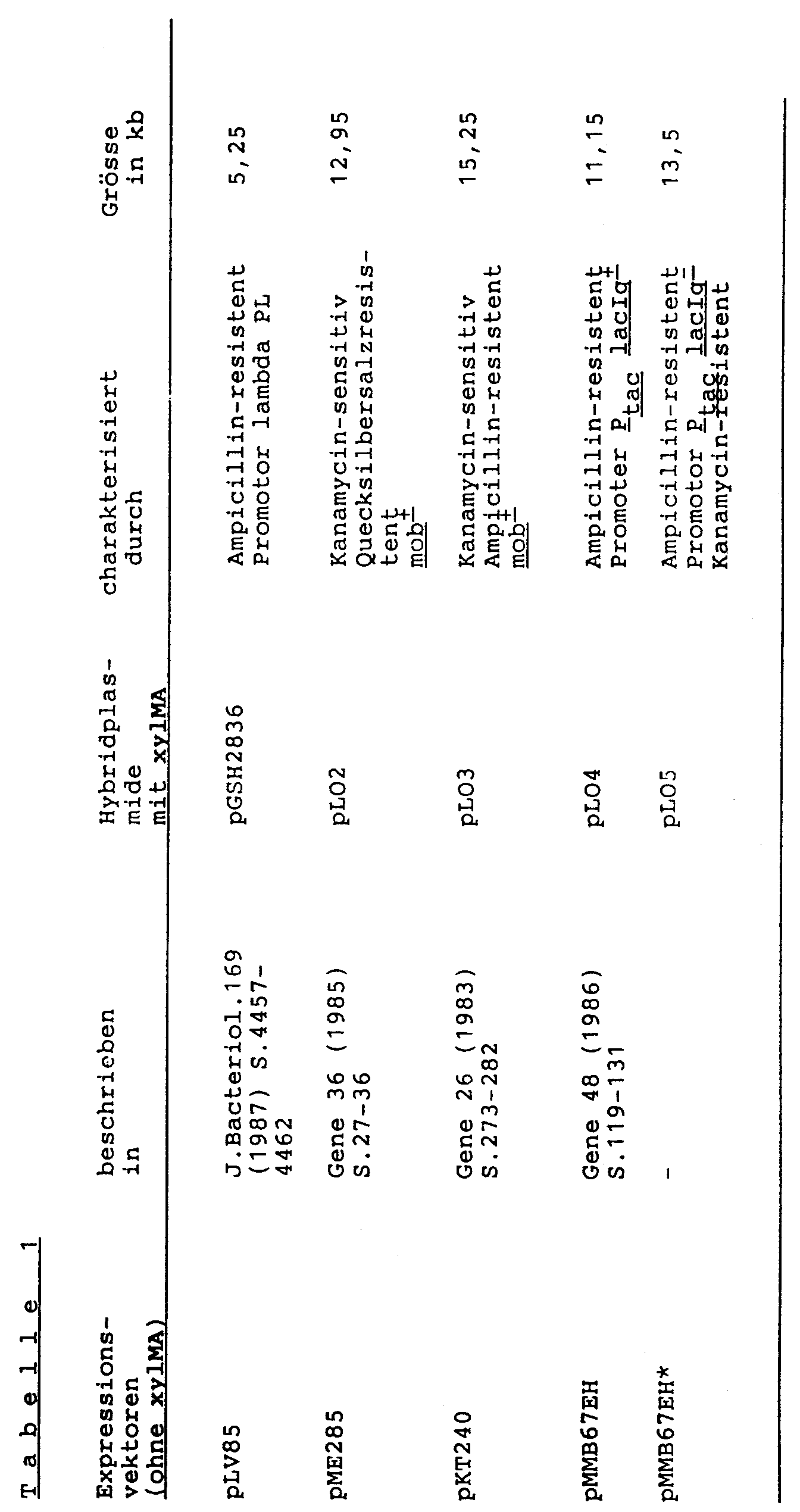


Claims (14)

Applications Claiming Priority (2)
| Application Number | Priority Date | Filing Date | Title |
|---|---|---|---|
| CH306690 | 1990-09-24 | ||
| CH3066/90 | 1990-09-24 |
Publications (3)
| Publication Number | Publication Date |
|---|---|
| EP0477828A2 true EP0477828A2 (en) | 1992-04-01 |
| EP0477828A3 EP0477828A3 (en) | 1993-03-31 |
| EP0477828B1 EP0477828B1 (en) | 1995-02-01 |
Family
ID=4247870
Family Applications (1)
| Application Number | Title | Priority Date | Filing Date |
|---|---|---|---|
| EP91116165A Expired - Lifetime EP0477828B1 (en) | 1990-09-24 | 1991-09-23 | Hydroxylation of methyl groups in aromatic heterocyclic compounds by microorganisms |
Country Status (9)
| Country | Link |
|---|---|
| US (1) | US5217884A (en) |
| EP (1) | EP0477828B1 (en) |
| JP (1) | JPH05130875A (en) |
| AT (1) | ATE118043T1 (en) |
| CZ (1) | CZ279464B6 (en) |
| DE (1) | DE59104472D1 (en) |
| DK (1) | DK0477828T3 (en) |
| HU (1) | HUT63200A (en) |
| RU (1) | RU2088667C1 (en) |
Cited By (4)
| Publication number | Priority date | Publication date | Assignee | Title |
|---|---|---|---|---|
| WO1995002061A1 (en) * | 1993-07-05 | 1995-01-19 | Basf Aktiengesellschaft | Biotechnological process for producing alcohols, aldehydes and carboxylic acids |
| US5784088A (en) * | 1993-07-20 | 1998-07-21 | Canon Kabushiki Kaisha | Ink jet recording apparatus using recording unit with ink cartridge having ink inducing element |
| US5891710A (en) * | 1991-11-21 | 1999-04-06 | Lonza Ltd. | Microorganisms for the stabilization of plasmids |
| WO2001031047A3 (en) * | 1999-10-27 | 2002-02-07 | Basf Ag | Microbiological methods for the producing of aromatic aldehydes and/or carboxylic acids |
Families Citing this family (7)
| Publication number | Priority date | Publication date | Assignee | Title |
|---|---|---|---|---|
| FI922125L (en) * | 1991-06-21 | 1992-12-22 | Lonza Ag | MIKROBIDOGISKT FOERFARANDE FOER FRAMSTAELLNING AV 5-HYDROXIPYRAZINCARBOXYL ACID |
| CZ282939B6 (en) * | 1992-03-04 | 1997-11-12 | Lonza A.G. | NITROGENOUS HYDROXY HETEROCYCLIC CARBOXYLIC ACIDS, PROCESS OF THEIR PREPARATION AND MICRO-ORGANISMS Ki101DSN6920 |
| US6156946A (en) * | 1996-04-12 | 2000-12-05 | Exxon Research And Engineering Company | Biological activation of aromatics for chemical processing and/or upgrading of aromatic compounds, petroleum, coal, resid, bitumen and other petrochemical streams |
| US20030077768A1 (en) * | 2001-08-10 | 2003-04-24 | Bramucci Michael G. | Use of xylene monooxygenase for the oxidation of substituted polycyclic aromatic compounds |
| DE10225371A1 (en) * | 2002-06-06 | 2003-12-18 | Bayer Ag | Microbiological process for enantioselective (S) -hydroxylation |
| ES2331911T3 (en) * | 2002-06-17 | 2010-01-20 | Saltigo Gmbh | PROCEDURE FOR THE PREPARATION OF MONO-N-SULFONILATED DIAMINS. |
| CN107974428A (en) * | 2017-12-13 | 2018-05-01 | 迪沙药业集团有限公司 | A kind of recombination bacillus coli and the method for converting production 5-Methylpyrazine-2-carboxylic acid |
Family Cites Families (2)
| Publication number | Priority date | Publication date | Assignee | Title |
|---|---|---|---|---|
| NL8700085A (en) * | 1987-01-15 | 1988-08-01 | Rijksuniversiteit | METHOD FOR PREPARING COMPOUNDS WITH TERMINAL HYDROXYL OR EPOXY GROUP; USEFUL MICROORGANISMS FOR THAT. |
| GB8807939D0 (en) * | 1988-04-05 | 1988-05-05 | Univ Brunel | Regulatory cassette for expression vectors |
-
1991
- 1991-09-16 CZ CS912825A patent/CZ279464B6/en unknown
- 1991-09-18 JP JP3238226A patent/JPH05130875A/en not_active Withdrawn
- 1991-09-23 RU SU915001709A patent/RU2088667C1/en active
- 1991-09-23 HU HU913035A patent/HUT63200A/en unknown
- 1991-09-23 DE DE59104472T patent/DE59104472D1/en not_active Expired - Fee Related
- 1991-09-23 US US07/764,176 patent/US5217884A/en not_active Expired - Fee Related
- 1991-09-23 EP EP91116165A patent/EP0477828B1/en not_active Expired - Lifetime
- 1991-09-23 AT AT91116165T patent/ATE118043T1/en not_active IP Right Cessation
- 1991-09-23 DK DK91116165.1T patent/DK0477828T3/en not_active Application Discontinuation
Cited By (8)
| Publication number | Priority date | Publication date | Assignee | Title |
|---|---|---|---|---|
| US5891710A (en) * | 1991-11-21 | 1999-04-06 | Lonza Ltd. | Microorganisms for the stabilization of plasmids |
| WO1995002061A1 (en) * | 1993-07-05 | 1995-01-19 | Basf Aktiengesellschaft | Biotechnological process for producing alcohols, aldehydes and carboxylic acids |
| US5753471A (en) * | 1993-07-05 | 1998-05-19 | Basf Aktiengesellschaft | Biotechnological perparation of alcohols, aldehydes and carboxylic acids |
| US5784088A (en) * | 1993-07-20 | 1998-07-21 | Canon Kabushiki Kaisha | Ink jet recording apparatus using recording unit with ink cartridge having ink inducing element |
| US6454399B2 (en) | 1993-07-20 | 2002-09-24 | Canon Kabushiki Kaisha | Ink jet recording apparatus using recording unit with ink cartridge having ink inducing element |
| US6565199B2 (en) | 1993-07-20 | 2003-05-20 | Canon Kabushiki Kaisha | Ink jet recording apparatus using recording unit with ink cartridge having ink inducing element |
| US6783220B2 (en) | 1993-07-20 | 2004-08-31 | Canon Kabushiki Kaisha | Ink jet recording apparatus using recording unit with ink cartridge having ink inducing element |
| WO2001031047A3 (en) * | 1999-10-27 | 2002-02-07 | Basf Ag | Microbiological methods for the producing of aromatic aldehydes and/or carboxylic acids |
Also Published As
| Publication number | Publication date |
|---|---|
| EP0477828A3 (en) | 1993-03-31 |
| DK0477828T3 (en) | 1995-04-10 |
| HU913035D0 (en) | 1992-01-28 |
| JPH05130875A (en) | 1993-05-28 |
| DE59104472D1 (en) | 1995-03-16 |
| US5217884A (en) | 1993-06-08 |
| CS282591A3 (en) | 1992-04-15 |
| RU2088667C1 (en) | 1997-08-27 |
| ATE118043T1 (en) | 1995-02-15 |
| HUT63200A (en) | 1993-07-28 |
| CZ279464B6 (en) | 1995-05-17 |
| EP0477828B1 (en) | 1995-02-01 |
Similar Documents
| Publication | Publication Date | Title |
|---|---|---|
| EP0334841B1 (en) | Micro-organisms and plasmids for producing 2,4-dichlorophenoxy acetic acid (2,4-d)-monooxygenase and process for producing these plasmids and strains | |
| DE68927486T2 (en) | Method of integrating a specific gene into the bacterial chromosome and bacterium obtained by this method | |
| EP0796914B1 (en) | Alcohol dehydrogenase and its use in the enzymatic production of chiral hydroxy-compounds | |
| EP0477828B1 (en) | Hydroxylation of methyl groups in aromatic heterocyclic compounds by microorganisms | |
| EP0276832A2 (en) | Process for the preparation of cetogulonic acid | |
| US4680264A (en) | Class II mobilizable gram-negative plasmid | |
| DE4018441A1 (en) | RECOMBINANT RESTRICTIONAL ENZYME SAU3AI | |
| DE68924761T2 (en) | NEW COENZYME INDEPENDENT L-SORBOSONE DEHYDROGENASE. | |
| EP0798384A1 (en) | Biotechnological method of producing biotin | |
| EP0290768B1 (en) | Process for the production of glucose dehydrogenase from Bacillus megaterium | |
| EP0219034B1 (en) | Process for the preparation of mesophilic microorganisms containing d-hydantoinase active at a higher temperature | |
| EP0543344B1 (en) | Microorganismes for plasmid stabilisation | |
| EP0938584B1 (en) | Method of preparing (s) - or (r) -3,3,3-trifluoro-2-hydroxy-2- methylpropionic acid | |
| DE69120315T2 (en) | Recombinant DNA expression vectors and DNA compositions encoding isopenicillin N epimerase activity | |
| JPS62155081A (en) | Novel microorganism and production of biotin by fermentation with said microorganism | |
| EP0502524B1 (en) | Microbiological process for terminal hydroxylation of ethyl-groups on aromatic 5- or 6-membered heterocycles | |
| DE69019890T2 (en) | Process for the production of the Spiroplasma sp. DNA methylase. | |
| EP0187138B1 (en) | Microorganism and plasmid for the constitutive synthesis of creatine amidino hydrolase and method for their production | |
| DE4024158A1 (en) | CLONING AND OVEREXPRESSION OF GLUCOSE-6-PHOSPHATE DEHYDROGENASE FROM LEUCONOSTOC DEXTRANICUS | |
| EP0733704B1 (en) | Controlable expression system | |
| DE69218034T2 (en) | Esterase genes, esterase, recombinant plasmids and transformants containing them, and methods for producing optically active carboxylic acid and its enantiomeric esters by these transformants | |
| EP0279273B1 (en) | DNA sequences, plasmids, microorganisms and process for producing quinolin acid | |
| DE69131665T2 (en) | GENE EXPRESSION SYSTEM | |
| EP0285949B1 (en) | Genetic control unit, and system for cloning and expression | |
| Nguyen et al. | Nif-hybrids of Enterobacter cloacae: selection for nif-gene integration with nif-plasmids containing the Mu transposon |
Legal Events
| Date | Code | Title | Description |
|---|---|---|---|
| PUAI | Public reference made under article 153(3) epc to a published international application that has entered the european phase |
Free format text: ORIGINAL CODE: 0009012 |
|
| AK | Designated contracting states |
Kind code of ref document: A2 Designated state(s): AT BE CH DE DK FR GB IT LI NL |
|
| PUAL | Search report despatched |
Free format text: ORIGINAL CODE: 0009013 |
|
| AK | Designated contracting states |
Kind code of ref document: A3 Designated state(s): AT BE CH DE DK FR GB IT LI NL |
|
| 17P | Request for examination filed |
Effective date: 19930924 |
|
| 17Q | First examination report despatched |
Effective date: 19940706 |
|
| GRAA | (expected) grant |
Free format text: ORIGINAL CODE: 0009210 |
|
| RAP1 | Party data changed (applicant data changed or rights of an application transferred) |
Owner name: LONZA AG |
|
| AK | Designated contracting states |
Kind code of ref document: B1 Designated state(s): AT BE CH DE DK FR GB IT LI NL |
|
| REF | Corresponds to: |
Ref document number: 118043 Country of ref document: AT Date of ref document: 19950215 Kind code of ref document: T |
|
| ITF | It: translation for a ep patent filed | ||
| REF | Corresponds to: |
Ref document number: 59104472 Country of ref document: DE Date of ref document: 19950316 |
|
| REG | Reference to a national code |
Ref country code: DK Ref legal event code: T3 |
|
| ET | Fr: translation filed | ||
| GBT | Gb: translation of ep patent filed (gb section 77(6)(a)/1977) |
Effective date: 19950427 |
|
| PLBE | No opposition filed within time limit |
Free format text: ORIGINAL CODE: 0009261 |
|
| STAA | Information on the status of an ep patent application or granted ep patent |
Free format text: STATUS: NO OPPOSITION FILED WITHIN TIME LIMIT |
|
| 26N | No opposition filed | ||
| REG | Reference to a national code |
Ref country code: CH Ref legal event code: PL |
|
| REG | Reference to a national code |
Ref country code: CH Ref legal event code: PL |
|
| PGFP | Annual fee paid to national office [announced via postgrant information from national office to epo] |
Ref country code: GB Payment date: 19960819 Year of fee payment: 6 |
|
| PGFP | Annual fee paid to national office [announced via postgrant information from national office to epo] |
Ref country code: FR Payment date: 19960906 Year of fee payment: 6 |
|
| PGFP | Annual fee paid to national office [announced via postgrant information from national office to epo] |
Ref country code: DK Payment date: 19960911 Year of fee payment: 6 Ref country code: BE Payment date: 19960911 Year of fee payment: 6 |
|
| PGFP | Annual fee paid to national office [announced via postgrant information from national office to epo] |
Ref country code: AT Payment date: 19960913 Year of fee payment: 6 |
|
| PGFP | Annual fee paid to national office [announced via postgrant information from national office to epo] |
Ref country code: NL Payment date: 19960916 Year of fee payment: 6 |
|
| PGFP | Annual fee paid to national office [announced via postgrant information from national office to epo] |
Ref country code: DE Payment date: 19961022 Year of fee payment: 6 |
|
| PGFP | Annual fee paid to national office [announced via postgrant information from national office to epo] |
Ref country code: CH Payment date: 19961223 Year of fee payment: 6 |
|
| REG | Reference to a national code |
Ref country code: CH Ref legal event code: AEN Free format text: DAS PATENT WAR IRRTUEMLICH GELOESCHT WORDEN.ES WURDE REAKTIVIERT. |
|
| PG25 | Lapsed in a contracting state [announced via postgrant information from national office to epo] |
Ref country code: GB Free format text: LAPSE BECAUSE OF NON-PAYMENT OF DUE FEES Effective date: 19970923 Ref country code: DK Free format text: LAPSE BECAUSE OF NON-PAYMENT OF DUE FEES Effective date: 19970923 Ref country code: AT Free format text: LAPSE BECAUSE OF NON-PAYMENT OF DUE FEES Effective date: 19970923 |
|
| REG | Reference to a national code |
Ref country code: DK Ref legal event code: EBP |
|
| PG25 | Lapsed in a contracting state [announced via postgrant information from national office to epo] |
Ref country code: LI Free format text: LAPSE BECAUSE OF NON-PAYMENT OF DUE FEES Effective date: 19970930 Ref country code: FR Free format text: THE PATENT HAS BEEN ANNULLED BY A DECISION OF A NATIONAL AUTHORITY Effective date: 19970930 Ref country code: CH Free format text: LAPSE BECAUSE OF NON-PAYMENT OF DUE FEES Effective date: 19970930 Ref country code: BE Free format text: LAPSE BECAUSE OF NON-PAYMENT OF DUE FEES Effective date: 19970930 |
|
| BERE | Be: lapsed |
Owner name: LONZA A.G. Effective date: 19970930 |
|
| PG25 | Lapsed in a contracting state [announced via postgrant information from national office to epo] |
Ref country code: NL Free format text: LAPSE BECAUSE OF NON-PAYMENT OF DUE FEES Effective date: 19980401 |
|
| GBPC | Gb: european patent ceased through non-payment of renewal fee |
Effective date: 19970923 |
|
| REG | Reference to a national code |
Ref country code: CH Ref legal event code: PL |
|
| NLV4 | Nl: lapsed or anulled due to non-payment of the annual fee |
Effective date: 19980401 |
|
| PG25 | Lapsed in a contracting state [announced via postgrant information from national office to epo] |
Ref country code: DE Free format text: LAPSE BECAUSE OF NON-PAYMENT OF DUE FEES Effective date: 19980603 |
|
| REG | Reference to a national code |
Ref country code: FR Ref legal event code: ST |
|
| PG25 | Lapsed in a contracting state [announced via postgrant information from national office to epo] |
Ref country code: IT Free format text: LAPSE BECAUSE OF NON-PAYMENT OF DUE FEES;WARNING: LAPSES OF ITALIAN PATENTS WITH EFFECTIVE DATE BEFORE 2007 MAY HAVE OCCURRED AT ANY TIME BEFORE 2007. THE CORRECT EFFECTIVE DATE MAY BE DIFFERENT FROM THE ONE RECORDED. Effective date: 20050923 |