EP0476640A1 - High performance tire treads and tires - Google Patents
High performance tire treads and tires Download PDFInfo
- Publication number
- EP0476640A1 EP0476640A1 EP91115926A EP91115926A EP0476640A1 EP 0476640 A1 EP0476640 A1 EP 0476640A1 EP 91115926 A EP91115926 A EP 91115926A EP 91115926 A EP91115926 A EP 91115926A EP 0476640 A1 EP0476640 A1 EP 0476640A1
- Authority
- EP
- European Patent Office
- Prior art keywords
- tire
- copolymer
- alkyne
- conjugated diene
- weight
- Prior art date
- Legal status (The legal status is an assumption and is not a legal conclusion. Google has not performed a legal analysis and makes no representation as to the accuracy of the status listed.)
- Granted
Links
- 239000000203 mixture Substances 0.000 claims abstract description 117
- 229920001577 copolymer Polymers 0.000 claims abstract description 115
- 229920001971 elastomer Polymers 0.000 claims abstract description 73
- 150000001993 dienes Chemical class 0.000 claims abstract description 64
- 239000000806 elastomer Substances 0.000 claims abstract description 45
- 239000006229 carbon black Substances 0.000 claims abstract description 34
- 239000003054 catalyst Substances 0.000 claims abstract description 33
- 125000004432 carbon atom Chemical group C* 0.000 claims abstract description 23
- 229930195733 hydrocarbon Natural products 0.000 claims abstract description 23
- 150000002430 hydrocarbons Chemical class 0.000 claims abstract description 23
- -1 vinyl aromatic compound Chemical class 0.000 claims abstract description 21
- 239000004215 Carbon black (E152) Substances 0.000 claims abstract description 18
- 229920002554 vinyl polymer Polymers 0.000 claims abstract description 17
- 239000002904 solvent Substances 0.000 claims abstract description 13
- WYURNTSHIVDZCO-UHFFFAOYSA-N Tetrahydrofuran Chemical compound C1CCOC1 WYURNTSHIVDZCO-UHFFFAOYSA-N 0.000 claims abstract description 12
- 229910052783 alkali metal Inorganic materials 0.000 claims abstract description 12
- 150000001340 alkali metals Chemical class 0.000 claims abstract description 12
- 150000002902 organometallic compounds Chemical class 0.000 claims abstract description 12
- 125000001183 hydrocarbyl group Chemical group 0.000 claims abstract description 10
- 230000000379 polymerizing effect Effects 0.000 claims abstract description 8
- YLQBMQCUIZJEEH-UHFFFAOYSA-N tetrahydrofuran Natural products C=1C=COC=1 YLQBMQCUIZJEEH-UHFFFAOYSA-N 0.000 claims abstract description 6
- 239000007795 chemical reaction product Substances 0.000 claims abstract description 3
- KAKZBPTYRLMSJV-UHFFFAOYSA-N Butadiene Chemical group C=CC=C KAKZBPTYRLMSJV-UHFFFAOYSA-N 0.000 claims description 48
- 239000003921 oil Substances 0.000 claims description 45
- PPBRXRYQALVLMV-UHFFFAOYSA-N Styrene Chemical compound C=CC1=CC=CC=C1 PPBRXRYQALVLMV-UHFFFAOYSA-N 0.000 claims description 30
- RRHGJUQNOFWUDK-UHFFFAOYSA-N Isoprene Chemical compound CC(=C)C=C RRHGJUQNOFWUDK-UHFFFAOYSA-N 0.000 claims description 17
- YXFVVABEGXRONW-UHFFFAOYSA-N Toluene Chemical compound CC1=CC=CC=C1 YXFVVABEGXRONW-UHFFFAOYSA-N 0.000 claims description 15
- PMJHHCWVYXUKFD-SNAWJCMRSA-N (E)-1,3-pentadiene Chemical group C\C=C\C=C PMJHHCWVYXUKFD-SNAWJCMRSA-N 0.000 claims description 9
- PMJHHCWVYXUKFD-UHFFFAOYSA-N piperylene Natural products CC=CC=C PMJHHCWVYXUKFD-UHFFFAOYSA-N 0.000 claims description 9
- 239000010692 aromatic oil Substances 0.000 claims description 8
- 125000001931 aliphatic group Chemical group 0.000 claims description 7
- 125000000217 alkyl group Chemical group 0.000 claims description 7
- WHXSMMKQMYFTQS-UHFFFAOYSA-N Lithium Chemical group [Li] WHXSMMKQMYFTQS-UHFFFAOYSA-N 0.000 claims description 6
- 229910052744 lithium Inorganic materials 0.000 claims description 6
- 150000001345 alkine derivatives Chemical class 0.000 claims description 4
- UMIPWJGWASORKV-UHFFFAOYSA-N oct-1-yne Chemical group CCCCCCC#C UMIPWJGWASORKV-UHFFFAOYSA-N 0.000 claims description 4
- 239000010690 paraffinic oil Substances 0.000 claims description 3
- 239000006235 reinforcing carbon black Substances 0.000 claims description 2
- 150000002900 organolithium compounds Chemical class 0.000 claims 1
- 125000001979 organolithium group Chemical group 0.000 claims 1
- 238000000034 method Methods 0.000 abstract description 24
- 239000004606 Fillers/Extenders Substances 0.000 abstract description 5
- 230000008569 process Effects 0.000 abstract description 3
- VLKZOEOYAKHREP-UHFFFAOYSA-N n-Hexane Chemical compound CCCCCC VLKZOEOYAKHREP-UHFFFAOYSA-N 0.000 description 43
- 235000019241 carbon black Nutrition 0.000 description 29
- 239000005060 rubber Substances 0.000 description 28
- 238000006116 polymerization reaction Methods 0.000 description 23
- 238000006243 chemical reaction Methods 0.000 description 18
- 229910052751 metal Inorganic materials 0.000 description 16
- 239000002184 metal Substances 0.000 description 16
- 239000000178 monomer Substances 0.000 description 16
- 229920000642 polymer Polymers 0.000 description 11
- 239000000047 product Substances 0.000 description 11
- 229920003048 styrene butadiene rubber Polymers 0.000 description 10
- 239000000463 material Substances 0.000 description 9
- IJGRMHOSHXDMSA-UHFFFAOYSA-N Atomic nitrogen Chemical compound N#N IJGRMHOSHXDMSA-UHFFFAOYSA-N 0.000 description 8
- KFZMGEQAYNKOFK-UHFFFAOYSA-N Isopropanol Chemical compound CC(C)O KFZMGEQAYNKOFK-UHFFFAOYSA-N 0.000 description 8
- MZRVEZGGRBJDDB-UHFFFAOYSA-N N-Butyllithium Chemical compound [Li]CCCC MZRVEZGGRBJDDB-UHFFFAOYSA-N 0.000 description 8
- 125000003118 aryl group Chemical group 0.000 description 8
- 150000001875 compounds Chemical class 0.000 description 8
- 238000002360 preparation method Methods 0.000 description 7
- UHOVQNZJYSORNB-UHFFFAOYSA-N Benzene Chemical compound C1=CC=CC=C1 UHOVQNZJYSORNB-UHFFFAOYSA-N 0.000 description 6
- OKKJLVBELUTLKV-UHFFFAOYSA-N Methanol Chemical compound OC OKKJLVBELUTLKV-UHFFFAOYSA-N 0.000 description 6
- 239000000945 filler Substances 0.000 description 6
- 150000001338 aliphatic hydrocarbons Chemical class 0.000 description 5
- 239000003085 diluting agent Substances 0.000 description 5
- 239000003607 modifier Substances 0.000 description 5
- 125000000391 vinyl group Chemical group [H]C([*])=C([H])[H] 0.000 description 5
- SDJHPPZKZZWAKF-UHFFFAOYSA-N 2,3-dimethylbuta-1,3-diene Chemical compound CC(=C)C(C)=C SDJHPPZKZZWAKF-UHFFFAOYSA-N 0.000 description 4
- OKTJSMMVPCPJKN-UHFFFAOYSA-N Carbon Chemical compound [C] OKTJSMMVPCPJKN-UHFFFAOYSA-N 0.000 description 4
- 241001441571 Hiodontidae Species 0.000 description 4
- 239000006236 Super Abrasion Furnace Substances 0.000 description 4
- YZSKZXUDGLALTQ-UHFFFAOYSA-N [Li][C] Chemical compound [Li][C] YZSKZXUDGLALTQ-UHFFFAOYSA-N 0.000 description 4
- 238000005299 abrasion Methods 0.000 description 4
- 238000007792 addition Methods 0.000 description 4
- 239000003963 antioxidant agent Substances 0.000 description 4
- 229910052799 carbon Inorganic materials 0.000 description 4
- 238000007334 copolymerization reaction Methods 0.000 description 4
- DIOQZVSQGTUSAI-UHFFFAOYSA-N decane Chemical compound CCCCCCCCCC DIOQZVSQGTUSAI-UHFFFAOYSA-N 0.000 description 4
- 238000009472 formulation Methods 0.000 description 4
- 238000010438 heat treatment Methods 0.000 description 4
- UAEPNZWRGJTJPN-UHFFFAOYSA-N methylcyclohexane Chemical compound CC1CCCCC1 UAEPNZWRGJTJPN-UHFFFAOYSA-N 0.000 description 4
- 238000002156 mixing Methods 0.000 description 4
- 229910052757 nitrogen Inorganic materials 0.000 description 4
- 239000012299 nitrogen atmosphere Substances 0.000 description 4
- 238000011925 1,2-addition Methods 0.000 description 3
- ZCYVEMRRCGMTRW-UHFFFAOYSA-N 7553-56-2 Chemical compound [I] ZCYVEMRRCGMTRW-UHFFFAOYSA-N 0.000 description 3
- QGJOPFRUJISHPQ-UHFFFAOYSA-N Carbon disulfide Chemical compound S=C=S QGJOPFRUJISHPQ-UHFFFAOYSA-N 0.000 description 3
- XDTMQSROBMDMFD-UHFFFAOYSA-N Cyclohexane Chemical compound C1CCCCC1 XDTMQSROBMDMFD-UHFFFAOYSA-N 0.000 description 3
- 229920002943 EPDM rubber Polymers 0.000 description 3
- DGAQECJNVWCQMB-PUAWFVPOSA-M Ilexoside XXIX Chemical compound C[C@@H]1CC[C@@]2(CC[C@@]3(C(=CC[C@H]4[C@]3(CC[C@@H]5[C@@]4(CC[C@@H](C5(C)C)OS(=O)(=O)[O-])C)C)[C@@H]2[C@]1(C)O)C)C(=O)O[C@H]6[C@@H]([C@H]([C@@H]([C@H](O6)CO)O)O)O.[Na+] DGAQECJNVWCQMB-PUAWFVPOSA-M 0.000 description 3
- ZLMJMSJWJFRBEC-UHFFFAOYSA-N Potassium Chemical compound [K] ZLMJMSJWJFRBEC-UHFFFAOYSA-N 0.000 description 3
- VYPSYNLAJGMNEJ-UHFFFAOYSA-N Silicium dioxide Chemical compound O=[Si]=O VYPSYNLAJGMNEJ-UHFFFAOYSA-N 0.000 description 3
- 239000002174 Styrene-butadiene Substances 0.000 description 3
- 150000004945 aromatic hydrocarbons Chemical class 0.000 description 3
- 239000012298 atmosphere Substances 0.000 description 3
- 238000009835 boiling Methods 0.000 description 3
- 239000011630 iodine Substances 0.000 description 3
- 229910052740 iodine Inorganic materials 0.000 description 3
- 150000002739 metals Chemical class 0.000 description 3
- GYNNXHKOJHMOHS-UHFFFAOYSA-N methyl-cycloheptane Natural products CC1CCCCCC1 GYNNXHKOJHMOHS-UHFFFAOYSA-N 0.000 description 3
- 239000002480 mineral oil Substances 0.000 description 3
- 238000012986 modification Methods 0.000 description 3
- 230000004048 modification Effects 0.000 description 3
- OFBQJSOFQDEBGM-UHFFFAOYSA-N n-pentane Natural products CCCCC OFBQJSOFQDEBGM-UHFFFAOYSA-N 0.000 description 3
- 229910052700 potassium Inorganic materials 0.000 description 3
- 239000011591 potassium Substances 0.000 description 3
- 229910052708 sodium Inorganic materials 0.000 description 3
- 239000011734 sodium Substances 0.000 description 3
- 238000012360 testing method Methods 0.000 description 3
- 238000004448 titration Methods 0.000 description 3
- BOGRNZQRTNVZCZ-AATRIKPKSA-N (3e)-3-methylpenta-1,3-diene Chemical compound C\C=C(/C)C=C BOGRNZQRTNVZCZ-AATRIKPKSA-N 0.000 description 2
- OGQVROWWFUXRST-FNORWQNLSA-N (3e)-hepta-1,3-diene Chemical compound CCC\C=C\C=C OGQVROWWFUXRST-FNORWQNLSA-N 0.000 description 2
- AHAREKHAZNPPMI-AATRIKPKSA-N (3e)-hexa-1,3-diene Chemical compound CC\C=C\C=C AHAREKHAZNPPMI-AATRIKPKSA-N 0.000 description 2
- BOGRNZQRTNVZCZ-UHFFFAOYSA-N 1,2-dimethyl-butadiene Natural products CC=C(C)C=C BOGRNZQRTNVZCZ-UHFFFAOYSA-N 0.000 description 2
- QTYUSOHYEPOHLV-FNORWQNLSA-N 1,3-Octadiene Chemical compound CCCC\C=C\C=C QTYUSOHYEPOHLV-FNORWQNLSA-N 0.000 description 2
- PJXJBPMWCKMWLS-UHFFFAOYSA-N 2-methyl-3-methylidenepent-1-ene Chemical compound CCC(=C)C(C)=C PJXJBPMWCKMWLS-UHFFFAOYSA-N 0.000 description 2
- KUFLEYZWYCAZCC-UHFFFAOYSA-N 2-methylhexa-1,3-diene Chemical compound CCC=CC(C)=C KUFLEYZWYCAZCC-UHFFFAOYSA-N 0.000 description 2
- PAYRUJLWNCNPSJ-UHFFFAOYSA-N Aniline Chemical compound NC1=CC=CC=C1 PAYRUJLWNCNPSJ-UHFFFAOYSA-N 0.000 description 2
- LZZYPRNAOMGNLH-UHFFFAOYSA-M Cetrimonium bromide Chemical compound [Br-].CCCCCCCCCCCCCCCC[N+](C)(C)C LZZYPRNAOMGNLH-UHFFFAOYSA-M 0.000 description 2
- RGSFGYAAUTVSQA-UHFFFAOYSA-N Cyclopentane Chemical compound C1CCCC1 RGSFGYAAUTVSQA-UHFFFAOYSA-N 0.000 description 2
- 244000043261 Hevea brasiliensis Species 0.000 description 2
- 239000006238 High Abrasion Furnace Substances 0.000 description 2
- IMNFDUFMRHMDMM-UHFFFAOYSA-N N-Heptane Chemical compound CCCCCCC IMNFDUFMRHMDMM-UHFFFAOYSA-N 0.000 description 2
- CTQNGGLPUBDAKN-UHFFFAOYSA-N O-Xylene Chemical compound CC1=CC=CC=C1C CTQNGGLPUBDAKN-UHFFFAOYSA-N 0.000 description 2
- 239000006242 Semi-Reinforcing Furnace Substances 0.000 description 2
- NINIDFKCEFEMDL-UHFFFAOYSA-N Sulfur Chemical compound [S] NINIDFKCEFEMDL-UHFFFAOYSA-N 0.000 description 2
- 238000010521 absorption reaction Methods 0.000 description 2
- HSFWRNGVRCDJHI-UHFFFAOYSA-N alpha-acetylene Natural products C#C HSFWRNGVRCDJHI-UHFFFAOYSA-N 0.000 description 2
- 238000004458 analytical method Methods 0.000 description 2
- 230000003078 antioxidant effect Effects 0.000 description 2
- 239000002199 base oil Substances 0.000 description 2
- KDKYADYSIPSCCQ-UHFFFAOYSA-N but-1-yne Chemical compound CCC#C KDKYADYSIPSCCQ-UHFFFAOYSA-N 0.000 description 2
- 229910052792 caesium Inorganic materials 0.000 description 2
- TVFDJXOCXUVLDH-UHFFFAOYSA-N caesium atom Chemical compound [Cs] TVFDJXOCXUVLDH-UHFFFAOYSA-N 0.000 description 2
- 239000003795 chemical substances by application Substances 0.000 description 2
- 238000007796 conventional method Methods 0.000 description 2
- 150000001924 cycloalkanes Chemical class 0.000 description 2
- 230000001419 dependent effect Effects 0.000 description 2
- 238000009826 distribution Methods 0.000 description 2
- SNRUBQQJIBEYMU-UHFFFAOYSA-N dodecane Chemical compound CCCCCCCCCCCC SNRUBQQJIBEYMU-UHFFFAOYSA-N 0.000 description 2
- 230000000694 effects Effects 0.000 description 2
- 239000000839 emulsion Substances 0.000 description 2
- 125000002534 ethynyl group Chemical group [H]C#C* 0.000 description 2
- 229910052730 francium Inorganic materials 0.000 description 2
- KLMCZVJOEAUDNE-UHFFFAOYSA-N francium atom Chemical compound [Fr] KLMCZVJOEAUDNE-UHFFFAOYSA-N 0.000 description 2
- 238000005227 gel permeation chromatography Methods 0.000 description 2
- 230000009477 glass transition Effects 0.000 description 2
- 230000005484 gravity Effects 0.000 description 2
- DMEGYFMYUHOHGS-UHFFFAOYSA-N heptamethylene Natural products C1CCCCCC1 DMEGYFMYUHOHGS-UHFFFAOYSA-N 0.000 description 2
- 125000004435 hydrogen atom Chemical group [H]* 0.000 description 2
- 239000003999 initiator Substances 0.000 description 2
- IJDNQMDRQITEOD-UHFFFAOYSA-N n-butane Chemical compound CCCC IJDNQMDRQITEOD-UHFFFAOYSA-N 0.000 description 2
- 239000002245 particle Substances 0.000 description 2
- 239000003208 petroleum Substances 0.000 description 2
- 238000012545 processing Methods 0.000 description 2
- 238000000425 proton nuclear magnetic resonance spectrum Methods 0.000 description 2
- 229920005604 random copolymer Polymers 0.000 description 2
- 239000011541 reaction mixture Substances 0.000 description 2
- 238000010058 rubber compounding Methods 0.000 description 2
- 229910052701 rubidium Inorganic materials 0.000 description 2
- IGLNJRXAVVLDKE-UHFFFAOYSA-N rubidium atom Chemical compound [Rb] IGLNJRXAVVLDKE-UHFFFAOYSA-N 0.000 description 2
- 229920006395 saturated elastomer Polymers 0.000 description 2
- 239000000126 substance Substances 0.000 description 2
- 125000001424 substituent group Chemical group 0.000 description 2
- 229910052717 sulfur Inorganic materials 0.000 description 2
- 239000011593 sulfur Substances 0.000 description 2
- 229920003051 synthetic elastomer Polymers 0.000 description 2
- 239000005061 synthetic rubber Substances 0.000 description 2
- 238000004073 vulcanization Methods 0.000 description 2
- 239000008096 xylene Substances 0.000 description 2
- CORMBJOFDGICKF-UHFFFAOYSA-N 1,3,5-trimethoxy 2-vinyl benzene Natural products COC1=CC(OC)=C(C=C)C(OC)=C1 CORMBJOFDGICKF-UHFFFAOYSA-N 0.000 description 1
- VDNSZPNSUQRUMS-UHFFFAOYSA-N 1-cyclohexyl-4-ethenylbenzene Chemical compound C1=CC(C=C)=CC=C1C1CCCCC1 VDNSZPNSUQRUMS-UHFFFAOYSA-N 0.000 description 1
- WJNKJKGZKFOLOJ-UHFFFAOYSA-N 1-dodecyl-4-ethenylbenzene Chemical compound CCCCCCCCCCCCC1=CC=C(C=C)C=C1 WJNKJKGZKFOLOJ-UHFFFAOYSA-N 0.000 description 1
- KPLXLTQPPCAJHY-UHFFFAOYSA-N 1-ethenyl-2,4-di(propan-2-yl)naphthalene Chemical compound C1=CC=CC2=C(C=C)C(C(C)C)=CC(C(C)C)=C21 KPLXLTQPPCAJHY-UHFFFAOYSA-N 0.000 description 1
- HVOKBODBWQEEGI-UHFFFAOYSA-N 1-ethenyl-3,5-diethylbenzene Chemical compound CCC1=CC(CC)=CC(C=C)=C1 HVOKBODBWQEEGI-UHFFFAOYSA-N 0.000 description 1
- QDLUTRRUISEVDW-UHFFFAOYSA-N 1-ethenyl-3,5-diphenoxybenzene Chemical compound C=1C(OC=2C=CC=CC=2)=CC(C=C)=CC=1OC1=CC=CC=C1 QDLUTRRUISEVDW-UHFFFAOYSA-N 0.000 description 1
- ACIJYLHNXMGEES-UHFFFAOYSA-N 1-ethenyl-3-(4-hexylphenyl)benzene Chemical compound C1=CC(CCCCCC)=CC=C1C1=CC=CC(C=C)=C1 ACIJYLHNXMGEES-UHFFFAOYSA-N 0.000 description 1
- XTUJFEHBYGQMFD-UHFFFAOYSA-N 1-ethenyl-3-hexyl-5-methylbenzene Chemical compound CCCCCCC1=CC(C)=CC(C=C)=C1 XTUJFEHBYGQMFD-UHFFFAOYSA-N 0.000 description 1
- UAJRSHJHFRVGMG-UHFFFAOYSA-N 1-ethenyl-4-methoxybenzene Chemical compound COC1=CC=C(C=C)C=C1 UAJRSHJHFRVGMG-UHFFFAOYSA-N 0.000 description 1
- UDBOTPBQDGDMHZ-UHFFFAOYSA-N 1-ethenyl-4-methoxynaphthalene Chemical compound C1=CC=C2C(OC)=CC=C(C=C)C2=C1 UDBOTPBQDGDMHZ-UHFFFAOYSA-N 0.000 description 1
- VVTGQMLRTKFKAM-UHFFFAOYSA-N 1-ethenyl-4-propylbenzene Chemical compound CCCC1=CC=C(C=C)C=C1 VVTGQMLRTKFKAM-UHFFFAOYSA-N 0.000 description 1
- UVRJZDWOXMDOLE-UHFFFAOYSA-N 1-ethenyl-5-(2,4,6-trimethylphenyl)naphthalene Chemical compound CC1=CC(C)=CC(C)=C1C1=CC=CC2=C(C=C)C=CC=C12 UVRJZDWOXMDOLE-UHFFFAOYSA-N 0.000 description 1
- KXHFPILRDXTWCG-UHFFFAOYSA-N 1-ethenyl-6-phenoxynaphthalene Chemical compound C=1C=C2C(C=C)=CC=CC2=CC=1OC1=CC=CC=C1 KXHFPILRDXTWCG-UHFFFAOYSA-N 0.000 description 1
- ZUJBNWMWGTYWMW-UHFFFAOYSA-N 1-ethenyl-6-propan-2-ylnaphthalene Chemical compound C=CC1=CC=CC2=CC(C(C)C)=CC=C21 ZUJBNWMWGTYWMW-UHFFFAOYSA-N 0.000 description 1
- HGJHLJMJLXNPCN-UHFFFAOYSA-N 1-ethenyl-8-phenylnaphthalene Chemical compound C=12C(C=C)=CC=CC2=CC=CC=1C1=CC=CC=C1 HGJHLJMJLXNPCN-UHFFFAOYSA-N 0.000 description 1
- CGHIBGNXEGJPQZ-UHFFFAOYSA-N 1-hexyne Chemical compound CCCCC#C CGHIBGNXEGJPQZ-UHFFFAOYSA-N 0.000 description 1
- IGGDKDTUCAWDAN-UHFFFAOYSA-N 1-vinylnaphthalene Chemical compound C1=CC=C2C(C=C)=CC=CC2=C1 IGGDKDTUCAWDAN-UHFFFAOYSA-N 0.000 description 1
- QWQNFXDYOCUEER-UHFFFAOYSA-N 2,3-ditert-butyl-4-methylphenol Chemical compound CC1=CC=C(O)C(C(C)(C)C)=C1C(C)(C)C QWQNFXDYOCUEER-UHFFFAOYSA-N 0.000 description 1
- HMWCQCYUKQZPRA-UHFFFAOYSA-N 2,4-dimethyl-3-methylidenepent-1-ene Chemical compound CC(C)C(=C)C(C)=C HMWCQCYUKQZPRA-UHFFFAOYSA-N 0.000 description 1
- LOVYCUYJRWLTSU-UHFFFAOYSA-N 2-(3,4-dichlorophenoxy)-n,n-diethylethanamine Chemical compound CCN(CC)CCOC1=CC=C(Cl)C(Cl)=C1 LOVYCUYJRWLTSU-UHFFFAOYSA-N 0.000 description 1
- FZLHAQMQWDDWFI-UHFFFAOYSA-N 2-[2-(oxolan-2-yl)propan-2-yl]oxolane Chemical compound C1CCOC1C(C)(C)C1CCCO1 FZLHAQMQWDDWFI-UHFFFAOYSA-N 0.000 description 1
- CKHZIQSIFVVOPV-UHFFFAOYSA-N 2-benzyl-6-ethenylnaphthalene Chemical compound C1=CC2=CC(C=C)=CC=C2C=C1CC1=CC=CC=C1 CKHZIQSIFVVOPV-UHFFFAOYSA-N 0.000 description 1
- PDELBHCVXBSVPJ-UHFFFAOYSA-N 2-ethenyl-1,3,5-trimethylbenzene Chemical compound CC1=CC(C)=C(C=C)C(C)=C1 PDELBHCVXBSVPJ-UHFFFAOYSA-N 0.000 description 1
- SRMZYEFPTMKJKC-UHFFFAOYSA-N 2-ethenyl-3,6-diethylnaphthalene Chemical compound C1=C(C=C)C(CC)=CC2=CC(CC)=CC=C21 SRMZYEFPTMKJKC-UHFFFAOYSA-N 0.000 description 1
- AZGSYWLMNASAIP-UHFFFAOYSA-N 2-ethenyl-5-hexoxy-1,3-dimethylbenzene Chemical compound CCCCCCOC1=CC(C)=C(C=C)C(C)=C1 AZGSYWLMNASAIP-UHFFFAOYSA-N 0.000 description 1
- NXQCTTGTKAKPIJ-UHFFFAOYSA-N 2-ethenyl-5-methoxy-n,n-dipropylaniline Chemical compound CCCN(CCC)C1=CC(OC)=CC=C1C=C NXQCTTGTKAKPIJ-UHFFFAOYSA-N 0.000 description 1
- QKZQFURPHHQMCN-UHFFFAOYSA-N 2-ethoxy-3-methylhexa-1,3-diene Chemical compound CCOC(=C)C(C)=CCC QKZQFURPHHQMCN-UHFFFAOYSA-N 0.000 description 1
- UNBLCMHLEQHORH-UHFFFAOYSA-N 2-ethoxy-3-methylidenepent-1-ene Chemical compound CCOC(=C)C(=C)CC UNBLCMHLEQHORH-UHFFFAOYSA-N 0.000 description 1
- LYGKSUOGJYYSOI-UHFFFAOYSA-N 2-methoxybuta-1,3-diene Chemical compound COC(=C)C=C LYGKSUOGJYYSOI-UHFFFAOYSA-N 0.000 description 1
- PHFWUIVYQMKDDL-UHFFFAOYSA-N 2-methylbuta-1,3-diene;penta-1,3-diene Chemical class CC=CC=C.CC(=C)C=C PHFWUIVYQMKDDL-UHFFFAOYSA-N 0.000 description 1
- KXYAVSFOJVUIHT-UHFFFAOYSA-N 2-vinylnaphthalene Chemical compound C1=CC=CC2=CC(C=C)=CC=C21 KXYAVSFOJVUIHT-UHFFFAOYSA-N 0.000 description 1
- QTTAWIGVQMSWMV-UHFFFAOYSA-N 3,4-dimethylhexa-1,3-diene Chemical compound CCC(C)=C(C)C=C QTTAWIGVQMSWMV-UHFFFAOYSA-N 0.000 description 1
- NKNFAANDGREMJT-UHFFFAOYSA-N 3-ethenyl-1-(4-methylphenyl)naphthalene Chemical compound C1=CC(C)=CC=C1C1=CC(C=C)=CC2=CC=CC=C12 NKNFAANDGREMJT-UHFFFAOYSA-N 0.000 description 1
- CTNXNQQXFSVMIY-UHFFFAOYSA-N 3-ethylidenehex-1-ene Chemical compound CCCC(=CC)C=C CTNXNQQXFSVMIY-UHFFFAOYSA-N 0.000 description 1
- WGWGXWSBPXLXTA-UHFFFAOYSA-N 3-ethylpent-1-yne Chemical compound CCC(CC)C#C WGWGXWSBPXLXTA-UHFFFAOYSA-N 0.000 description 1
- USCSRAJGJYMJFZ-UHFFFAOYSA-N 3-methyl-1-butyne Chemical compound CC(C)C#C USCSRAJGJYMJFZ-UHFFFAOYSA-N 0.000 description 1
- GITIYCQMJWQMKC-UHFFFAOYSA-N 3-methylhepta-1,3-diene Chemical compound CCCC=C(C)C=C GITIYCQMJWQMKC-UHFFFAOYSA-N 0.000 description 1
- PLHJCCHSCFNKCC-UHFFFAOYSA-N 3-methylpent-1-yne Chemical compound CCC(C)C#C PLHJCCHSCFNKCC-UHFFFAOYSA-N 0.000 description 1
- SALPZWUZFRNPQX-UHFFFAOYSA-N 4,5-dimethylideneoctane Chemical compound CCCC(=C)C(=C)CCC SALPZWUZFRNPQX-UHFFFAOYSA-N 0.000 description 1
- JLBJTVDPSNHSKJ-UHFFFAOYSA-N 4-Methylstyrene Chemical compound CC1=CC=C(C=C)C=C1 JLBJTVDPSNHSKJ-UHFFFAOYSA-N 0.000 description 1
- NZGZIYSKIDVYSM-UHFFFAOYSA-N 4-ethenyl-1,2,7,8-tetramethylnaphthalene Chemical compound C=CC1=CC(C)=C(C)C2=C(C)C(C)=CC=C21 NZGZIYSKIDVYSM-UHFFFAOYSA-N 0.000 description 1
- XUMATWBCBIETCP-UHFFFAOYSA-N 4-ethenyl-2-n,7-n-dimethylnaphthalene-2,7-diamine Chemical compound C=CC1=CC(NC)=CC2=CC(NC)=CC=C21 XUMATWBCBIETCP-UHFFFAOYSA-N 0.000 description 1
- GQWAOUOHRMHSHL-UHFFFAOYSA-N 4-ethenyl-n,n-dimethylaniline Chemical compound CN(C)C1=CC=C(C=C)C=C1 GQWAOUOHRMHSHL-UHFFFAOYSA-N 0.000 description 1
- ZSNRMRKAYAJYRZ-UHFFFAOYSA-N 4-methylidenehex-2-ene Chemical compound CCC(=C)C=CC ZSNRMRKAYAJYRZ-UHFFFAOYSA-N 0.000 description 1
- ISOZCELAVOWCBX-UHFFFAOYSA-N 5-ethenyl-1-n,3-n-diethylbenzene-1,3-diamine Chemical compound CCNC1=CC(NCC)=CC(C=C)=C1 ISOZCELAVOWCBX-UHFFFAOYSA-N 0.000 description 1
- UGWOAPBVIGCNOV-UHFFFAOYSA-N 5-ethenyldec-5-ene Chemical compound CCCCC=C(C=C)CCCC UGWOAPBVIGCNOV-UHFFFAOYSA-N 0.000 description 1
- ANLGTIOZTQKMGM-UHFFFAOYSA-N 5-ethynyl-2-methyloctane Chemical compound CCCC(C#C)CCC(C)C ANLGTIOZTQKMGM-UHFFFAOYSA-N 0.000 description 1
- CVLVQJAXBADOOC-UHFFFAOYSA-N 6-ethenyl-1,2-diethyl-7-methyl-4-propylnaphthalene Chemical compound CC1=C(C=C)C=C2C(CCC)=CC(CC)=C(CC)C2=C1 CVLVQJAXBADOOC-UHFFFAOYSA-N 0.000 description 1
- DHNDHEGZRUFPAN-UHFFFAOYSA-N 6-ethenyl-1-(3-phenylpropyl)naphthalene Chemical compound C=1C=CC2=CC(C=C)=CC=C2C=1CCCC1=CC=CC=C1 DHNDHEGZRUFPAN-UHFFFAOYSA-N 0.000 description 1
- RRGRCBYNXFIHGR-UHFFFAOYSA-N 8-butyl-3-ethenyl-1-propylnaphthalene Chemical compound C=CC1=CC(CCC)=C2C(CCCC)=CC=CC2=C1 RRGRCBYNXFIHGR-UHFFFAOYSA-N 0.000 description 1
- 229920008128 Ameripol Polymers 0.000 description 1
- CAQWNKXTMBFBGI-UHFFFAOYSA-N C.[Na] Chemical compound C.[Na] CAQWNKXTMBFBGI-UHFFFAOYSA-N 0.000 description 1
- KLNMWIFOOOAKQD-UHFFFAOYSA-N CC(C)(C)CC(C)(C)[Cs] Chemical compound CC(C)(C)CC(C)(C)[Cs] KLNMWIFOOOAKQD-UHFFFAOYSA-N 0.000 description 1
- FWDBZJBJTDRIIY-UHFFFAOYSA-N CC(C)(C)[K] Chemical compound CC(C)(C)[K] FWDBZJBJTDRIIY-UHFFFAOYSA-N 0.000 description 1
- DFGLZFZXSHRQEA-UHFFFAOYSA-N CC(C)[K] Chemical compound CC(C)[K] DFGLZFZXSHRQEA-UHFFFAOYSA-N 0.000 description 1
- LFQSCWFLJHTTHZ-UHFFFAOYSA-N Ethanol Chemical compound CCO LFQSCWFLJHTTHZ-UHFFFAOYSA-N 0.000 description 1
- NHTMVDHEPJAVLT-UHFFFAOYSA-N Isooctane Chemical compound CC(C)CC(C)(C)C NHTMVDHEPJAVLT-UHFFFAOYSA-N 0.000 description 1
- 241001495453 Parthenium argentatum Species 0.000 description 1
- KPLPGCUTYIGQDH-UHFFFAOYSA-N [Li]C#CC([Li])([Li])CCCCC Chemical compound [Li]C#CC([Li])([Li])CCCCC KPLPGCUTYIGQDH-UHFFFAOYSA-N 0.000 description 1
- WXZIKFXSSPSWSR-UHFFFAOYSA-N [Li]CCCCC Chemical compound [Li]CCCCC WXZIKFXSSPSWSR-UHFFFAOYSA-N 0.000 description 1
- 238000002835 absorbance Methods 0.000 description 1
- 239000000654 additive Substances 0.000 description 1
- 125000003545 alkoxy group Chemical group 0.000 description 1
- 125000002877 alkyl aryl group Chemical group 0.000 description 1
- BHELZAPQIKSEDF-UHFFFAOYSA-N allyl bromide Chemical compound BrCC=C BHELZAPQIKSEDF-UHFFFAOYSA-N 0.000 description 1
- XYLMUPLGERFSHI-UHFFFAOYSA-N alpha-Methylstyrene Chemical compound CC(=C)C1=CC=CC=C1 XYLMUPLGERFSHI-UHFFFAOYSA-N 0.000 description 1
- 150000001491 aromatic compounds Chemical class 0.000 description 1
- 239000003849 aromatic solvent Substances 0.000 description 1
- 125000003710 aryl alkyl group Chemical group 0.000 description 1
- 125000004104 aryloxy group Chemical group 0.000 description 1
- 125000004429 atom Chemical group 0.000 description 1
- 239000002585 base Substances 0.000 description 1
- 230000009286 beneficial effect Effects 0.000 description 1
- 230000015572 biosynthetic process Effects 0.000 description 1
- 229920001400 block copolymer Polymers 0.000 description 1
- MTAZNLWOLGHBHU-UHFFFAOYSA-N butadiene-styrene rubber Chemical compound C=CC=C.C=CC1=CC=CC=C1 MTAZNLWOLGHBHU-UHFFFAOYSA-N 0.000 description 1
- 239000001273 butane Substances 0.000 description 1
- 150000001721 carbon Chemical group 0.000 description 1
- CREMABGTGYGIQB-UHFFFAOYSA-N carbon carbon Chemical compound C.C CREMABGTGYGIQB-UHFFFAOYSA-N 0.000 description 1
- 239000011203 carbon fibre reinforced carbon Substances 0.000 description 1
- 230000003197 catalytic effect Effects 0.000 description 1
- 230000008859 change Effects 0.000 description 1
- 229920005556 chlorobutyl Polymers 0.000 description 1
- 229920003211 cis-1,4-polyisoprene Polymers 0.000 description 1
- 238000005345 coagulation Methods 0.000 description 1
- 230000015271 coagulation Effects 0.000 description 1
- 238000000576 coating method Methods 0.000 description 1
- 238000013329 compounding Methods 0.000 description 1
- 239000007822 coupling agent Substances 0.000 description 1
- 125000000753 cycloalkyl group Chemical group 0.000 description 1
- ILLHQJIJCRNRCJ-UHFFFAOYSA-N dec-1-yne Chemical compound CCCCCCCCC#C ILLHQJIJCRNRCJ-UHFFFAOYSA-N 0.000 description 1
- 125000004663 dialkyl amino group Chemical group 0.000 description 1
- JVSWJIKNEAIKJW-UHFFFAOYSA-N dimethyl-hexane Natural products CCCCCC(C)C JVSWJIKNEAIKJW-UHFFFAOYSA-N 0.000 description 1
- ZVDBUOGYYYNMQI-UHFFFAOYSA-N dodec-1-yne Chemical compound CCCCCCCCCCC#C ZVDBUOGYYYNMQI-UHFFFAOYSA-N 0.000 description 1
- 238000002036 drum drying Methods 0.000 description 1
- 150000002148 esters Chemical class 0.000 description 1
- 125000002573 ethenylidene group Chemical group [*]=C=C([H])[H] 0.000 description 1
- BLHLJVCOVBYQQS-UHFFFAOYSA-N ethyllithium Chemical compound [Li]CC BLHLJVCOVBYQQS-UHFFFAOYSA-N 0.000 description 1
- 238000001125 extrusion Methods 0.000 description 1
- 238000010528 free radical solution polymerization reaction Methods 0.000 description 1
- 239000006232 furnace black Substances 0.000 description 1
- 239000011521 glass Substances 0.000 description 1
- UCIDYSLOTJMRAM-UHFFFAOYSA-N hexadec-1-yne Chemical compound CCCCCCCCCCCCCCC#C UCIDYSLOTJMRAM-UHFFFAOYSA-N 0.000 description 1
- 229920001519 homopolymer Polymers 0.000 description 1
- 239000003701 inert diluent Substances 0.000 description 1
- 208000015181 infectious disease Diseases 0.000 description 1
- 239000004615 ingredient Substances 0.000 description 1
- 229910052500 inorganic mineral Inorganic materials 0.000 description 1
- 230000002452 interceptive effect Effects 0.000 description 1
- 229920003049 isoprene rubber Polymers 0.000 description 1
- 239000004816 latex Substances 0.000 description 1
- 229920000126 latex Polymers 0.000 description 1
- 239000007788 liquid Substances 0.000 description 1
- 150000002642 lithium compounds Chemical class 0.000 description 1
- UBJFKNSINUCEAL-UHFFFAOYSA-N lithium;2-methylpropane Chemical compound [Li+].C[C-](C)C UBJFKNSINUCEAL-UHFFFAOYSA-N 0.000 description 1
- WGOPGODQLGJZGL-UHFFFAOYSA-N lithium;butane Chemical compound [Li+].CC[CH-]C WGOPGODQLGJZGL-UHFFFAOYSA-N 0.000 description 1
- XBEREOHJDYAKDA-UHFFFAOYSA-N lithium;propane Chemical compound [Li+].CC[CH2-] XBEREOHJDYAKDA-UHFFFAOYSA-N 0.000 description 1
- 238000011068 loading method Methods 0.000 description 1
- 238000004519 manufacturing process Methods 0.000 description 1
- 238000005259 measurement Methods 0.000 description 1
- 150000001247 metal acetylides Chemical class 0.000 description 1
- 239000011707 mineral Substances 0.000 description 1
- 238000000465 moulding Methods 0.000 description 1
- 229920003052 natural elastomer Polymers 0.000 description 1
- 229920001194 natural rubber Polymers 0.000 description 1
- IYDNQWWOZQLMRH-UHFFFAOYSA-N octadec-1-yne Chemical compound CCCCCCCCCCCCCCCCC#C IYDNQWWOZQLMRH-UHFFFAOYSA-N 0.000 description 1
- TVMXDCGIABBOFY-UHFFFAOYSA-N octane Chemical compound CCCCCCCC TVMXDCGIABBOFY-UHFFFAOYSA-N 0.000 description 1
- HDBWAWNLGGMZRQ-UHFFFAOYSA-N p-Vinylbiphenyl Chemical compound C1=CC(C=C)=CC=C1C1=CC=CC=C1 HDBWAWNLGGMZRQ-UHFFFAOYSA-N 0.000 description 1
- TZRHLKRLEZJVIJ-UHFFFAOYSA-N parecoxib Chemical compound C1=CC(S(=O)(=O)NC(=O)CC)=CC=C1C1=C(C)ON=C1C1=CC=CC=C1 TZRHLKRLEZJVIJ-UHFFFAOYSA-N 0.000 description 1
- 229960004662 parecoxib Drugs 0.000 description 1
- 150000002978 peroxides Chemical class 0.000 description 1
- NHKJPPKXDNZFBJ-UHFFFAOYSA-N phenyllithium Chemical compound [Li]C1=CC=CC=C1 NHKJPPKXDNZFBJ-UHFFFAOYSA-N 0.000 description 1
- 239000004014 plasticizer Substances 0.000 description 1
- 239000002574 poison Substances 0.000 description 1
- 231100000614 poison Toxicity 0.000 description 1
- 239000002244 precipitate Substances 0.000 description 1
- 238000001556 precipitation Methods 0.000 description 1
- VBTCAHMANZTRMG-UHFFFAOYSA-N prop-2-ynylcyclopentane Chemical compound C#CCC1CCCC1 VBTCAHMANZTRMG-UHFFFAOYSA-N 0.000 description 1
- 150000003254 radicals Chemical class 0.000 description 1
- 230000035484 reaction time Effects 0.000 description 1
- 230000003014 reinforcing effect Effects 0.000 description 1
- 238000010008 shearing Methods 0.000 description 1
- 239000000377 silicon dioxide Substances 0.000 description 1
- 239000002002 slurry Substances 0.000 description 1
- 239000007787 solid Substances 0.000 description 1
- 238000001179 sorption measurement Methods 0.000 description 1
- 230000003595 spectral effect Effects 0.000 description 1
- 229910001220 stainless steel Inorganic materials 0.000 description 1
- 239000010935 stainless steel Substances 0.000 description 1
- 238000003860 storage Methods 0.000 description 1
- 150000003440 styrenes Chemical class 0.000 description 1
- XTQHKBHJIVJGKJ-UHFFFAOYSA-N sulfur monoxide Chemical compound S=O XTQHKBHJIVJGKJ-UHFFFAOYSA-N 0.000 description 1
- 239000000454 talc Substances 0.000 description 1
- 229910052623 talc Inorganic materials 0.000 description 1
- 238000010998 test method Methods 0.000 description 1
- XLYOFNOQVPJJNP-UHFFFAOYSA-N water Substances O XLYOFNOQVPJJNP-UHFFFAOYSA-N 0.000 description 1
Images

Classifications
-
- C—CHEMISTRY; METALLURGY
- C08—ORGANIC MACROMOLECULAR COMPOUNDS; THEIR PREPARATION OR CHEMICAL WORKING-UP; COMPOSITIONS BASED THEREON
- C08F—MACROMOLECULAR COMPOUNDS OBTAINED BY REACTIONS ONLY INVOLVING CARBON-TO-CARBON UNSATURATED BONDS
- C08F236/00—Copolymers of compounds having one or more unsaturated aliphatic radicals, at least one having two or more carbon-to-carbon double bonds
- C08F236/02—Copolymers of compounds having one or more unsaturated aliphatic radicals, at least one having two or more carbon-to-carbon double bonds the radical having only two carbon-to-carbon double bonds
- C08F236/04—Copolymers of compounds having one or more unsaturated aliphatic radicals, at least one having two or more carbon-to-carbon double bonds the radical having only two carbon-to-carbon double bonds conjugated
- C08F236/10—Copolymers of compounds having one or more unsaturated aliphatic radicals, at least one having two or more carbon-to-carbon double bonds the radical having only two carbon-to-carbon double bonds conjugated with vinyl-aromatic monomers
-
- B—PERFORMING OPERATIONS; TRANSPORTING
- B60—VEHICLES IN GENERAL
- B60C—VEHICLE TYRES; TYRE INFLATION; TYRE CHANGING; CONNECTING VALVES TO INFLATABLE ELASTIC BODIES IN GENERAL; DEVICES OR ARRANGEMENTS RELATED TO TYRES
- B60C1/00—Tyres characterised by the chemical composition or the physical arrangement or mixture of the composition
- B60C1/0016—Compositions of the tread
-
- C—CHEMISTRY; METALLURGY
- C08—ORGANIC MACROMOLECULAR COMPOUNDS; THEIR PREPARATION OR CHEMICAL WORKING-UP; COMPOSITIONS BASED THEREON
- C08K—Use of inorganic or non-macromolecular organic substances as compounding ingredients
- C08K3/00—Use of inorganic substances as compounding ingredients
- C08K3/02—Elements
- C08K3/04—Carbon
-
- C—CHEMISTRY; METALLURGY
- C08—ORGANIC MACROMOLECULAR COMPOUNDS; THEIR PREPARATION OR CHEMICAL WORKING-UP; COMPOSITIONS BASED THEREON
- C08K—Use of inorganic or non-macromolecular organic substances as compounding ingredients
- C08K5/00—Use of organic ingredients
- C08K5/01—Hydrocarbons
-
- C—CHEMISTRY; METALLURGY
- C08—ORGANIC MACROMOLECULAR COMPOUNDS; THEIR PREPARATION OR CHEMICAL WORKING-UP; COMPOSITIONS BASED THEREON
- C08L—COMPOSITIONS OF MACROMOLECULAR COMPOUNDS
- C08L9/00—Compositions of homopolymers or copolymers of conjugated diene hydrocarbons
- C08L9/06—Copolymers with styrene
Definitions
- This invention relates to high performance tires comprising treads made of elastomer compositions comprising ultra high molecular weight copolymers of conjugated dienes such as 1,3-butadiene and aromatic vinyl compounds such as styrene. More particularly, this invention relates to tire treads made of such compositions wherein the copolymers are prepared using a trimetalated 1-alkyne catalyst.
- High performance tires for general as well as special purposes generally are characterized as having improved traction, improved handling, lower wear and higher heat resistance than standard passenger tires. Accordingly, high performance tires will include treads made from compounds which generally have the following properties: high hysteresis loss, high tensile strength, low durometer, low viscosity, high thermal resistance, skid resistance, etc. High performance tires are useful in automobiles and motorcycles for highway or track use.
- conjugated dienes such as 1,3-conjugated dienes to form elastomeric homopolymers and copolymers utilizing various initiator systems
- polymerizations can be initiated with organometallic compounds wherein the metal is a Group I metal such as lithium.
- organometallic compounds wherein the metal is a Group I metal such as lithium.
- U.S. Patent 4,677,165 describes rubber compositions useful particularly for tire treads which comprise: a styrene-butadiene copolymer rubber prepared by random copolymerization of styrene with 1,3-butadiene by solution polymerization techniques utilizing an organic lithium compound as catalyst; from 80 to 250 phr of carbon black having a surface area of 100 to 400 m 2 /g; and 30 to 280 phr of an aromatic oil. It is essential that the styrene-butadiene copolymer satisfies six requirements as identified in the specification and claims including the presence of one or more specific groups introduced into a molecular terminal or chain of the copolymer.
- U.S. Patent 2,964,083 describes curable rubber tire tread stock and pneumatic tires having a tread portion made of such stock.
- the tread stock comprises a copolymer containing a major amount of a conjugated diolefinic compound and a minor amount of a copolymerizable monoolefinic compound such as styrene, a fine reinforcing high abrasion carbon black and at least 30 parts by weight of a compatible soft oil per 100 parts by weight of the copolymer.
- Styrene-butadiene elastomers comprising blends of different styrene-butadiene copolymers are described as being useful for treads of high performance tires in U.S. Patent 4,866,131.
- the elastomers can be extended with oil to increase the hysteresis loss value.
- Aromatic oils having a viscosity gravity constant according to ASTM D-2501 in the range of 0.900 to 1.100 are described as suitable.
- the use of a low temperature plasticizer ester and/or a naphthenic or paraffinic softener to improve the properties of carbon black filled styrene-butadiene rubbers is described in U.S. Patent 4,748,199.
- U.S. Patent 4,791,178 describes rubber compositions for use in tires which comprise certain mixtures of copolymers of a conjugated diene and monovinyl aromatic hydrocarbons.
- an extender oil be blended into rubber compositions in amounts of from 30-200 parts by weight based on 100 parts by weight of the rubber component. Amounts of from 50 to 200 parts of oil are preferred.
- the use of 60 to 200 parts by weight of carbon black having an average particle size of not more that 300A° also is disclosed as producing rubber composition with high hysteresis loss.
- High performance tires comprise treads made of elastomer compositions comprising ultra high molecular weight copolymer compositions of 1,3-conjugated dienes and aromatic vinyl compounds having a weight average molecular weight of greater than about 1,000,000.
- the ultra high molecular weight copolymer compositions which are also characterized as having an intrinsic viscosity in tetrahydrofuran of at least about 4.0 may be obtained by a process which comprises polymerizing a 1,3- conjugated diene and a vinyl aromatic compound in a hydrocarbon solvent in the presence of a trimetalated 1-alkyne catalyst which comprises the reaction product of a 1-alkyne containing at least 4 carbon atoms, an organo metallic compound R°M and a 1,3-conjugated diene wherein R is a hydrocarbyl group, M is an alkali metal, the mole ratio of R° M to 1-alkyne is about 3:1 and the mole ratio of conjugated diene to 1- alkyne is from about 2:1 to about 30:1.
- Tire treads prepared from such vulcanizable elastomer compositions exhibit high tensile strength, high wear resistance, high mechanical strength and high gripping ability.
- the drawing is a graph of torque versus time identifying the points ML in , ML 1 + 4 , AL 80 and AL 1 + 4 + 5 used in determining percent relaxation of the copolymers used in the invention.
- the elastomer compositions useful in preparing the treads of the performance tires of the present invention comprise an ultra high molecular weight copolymer composition of 1,3-conjugated dienes and aromatic vinyl compounds having a weight average molecular weight of greater than about 1,000,000.
- the tread composition also comprises an extender oil and carbon black.
- the elastomer compositions of the present invention will contain large amounts of oil such as from about 30 or 50 parts to about 300 parts by weight of oil per 100 parts by weight of the copolymer (A), and up to about 250 parts by weight of at least one reinforcing carbon black per 100 parts of the copolymer composition (A).
- the copolymers useful in the present invention are of the type generally referred to as ultra high molecular weight copolymer compositions.
- the copolymer compositions are obtained by copolymerizing 1,3-conjugated dienes with aromatic vinyl compounds.
- the ultra high molecular weight copolymer compositions obtained in accordance with the present invention are essentially free of gel and are further characterized as having a weight average molecular weight of greater than about 1,000,000.
- Ultra high molecular weight copolymer compositions can be prepared by the method having a weight average molecular weight of greater than 1,100,000.
- Other characterizing features of the ultra high molecular weight copolymers include inherent viscosity, dilute solution viscosity and percent relaxation as determined using a Mooney viscometer.
- the copolymer compositions are characterized as having an intrinsic viscosity ( 77 ) in tetrahydrofuran of at least 4.0, and in another embodiment, the copolymers have an intrinsic viscosity in tetrahydrofuran of at least about 4.5.
- the ultra high molecular weight compositions useful in the invention may also be characterized in terms of percent relaxation as determined by a procedure which will be discussed more fully below.
- the compositions are characterized by percent relaxation values of at least about 30% to 100%, and more particularly relaxations of from about 30% to about 70%.
- the ultra high molecular weight compositions also may be characterized as having a dilute solution viscosity in toluene of at least about 3.5 dl/g, and in one embodiment, the copolymers will have a dilute solution viscosity of at least about 4.0 dl/g.
- the ultra high molecular weight copolymers generally will be characterized by an Mw/Mn of at least about 1.9, more often, between about 2.0 or 2.5 and 5.0.
- the Mooney viscosity (ML, + 4 @ 100 C) of the copolymers is greater than 200.
- the copolymer compositions also may be characterized by their molecular weight distribution.
- the copolymer compositions contain a large fraction of copolymer having a number average molecular weight of greater than 1,000,000 and a small fraction of copolymer having a number average molecular weight of less than 100,000.
- the copolymer is characterized as comprising at least 30%, preferably more than about 35% by weight of a fraction having a number average molecular weight of greater than 1,000,000, and less than 8% by weight, preferably less than 5% by weight, of a fraction having a number average molecular weight of less than 100,000.
- the glass transition temperature of the copolymers is generally greater than about -60 ° C and more often is greater than about -55 ° C. Ranges of -50 ° C to -10 ° C or 0 ° C are also useful.
- the copolymer compositions useful in the present invention are copolymers of a 1,3-conjugated diene monomer and an aromatic vinyl monomer.
- the relative amount of conjugated diene and aromatic vinyl monomers included in the copolymers may be varied over a wide range depending upon the desired copolymer properties.
- the amount of conjugated diene in the copolymer may vary from 10 to about 90% by weight and the amount of aromatic vinyl compound from about 10 to about 90% by weight.
- the copolymers will comprise from about 50 to about 70% by weight of the conjugated diene and from about 30 to about 50% by weight of the aromatic vinyl compound.
- the conjugated diene monomers useful in preparing the copolymers generally are 1,3-dienes, and they contain from 4 to 12 carbon atoms and preferably from 4 to 8 carbon atoms per molecule.
- these dienes include the following: 1,3-butadiene, isoprene, 2,3-dimethyl-1,3-butadiene, 1,3-pentadiene (piperylene), 2-methyl-3-ethyl-1,3-butadiene, 3-methyl-1,3-pentadiene, 2-ethyl-1,3-pentadiene, 1,3-hexadiene, 2-methyl-1,3-hexadiene, 1,3-heptadiene, 3-methyl-1,3-heptadiene, 1,3-octadiene, 3-butyl-1,3-octadiene, 3,4-dimethyl-1,3-hexadiene, 3-n-propyl-1,3-pentadiene, 4,5-diethyl-1,
- dialkyl butadienes it is preferred that the alkyl groups contain from 1 to 3 carbon atoms.
- Conjugated dienes containing alkoxy substituents along the chain can also be employed, such as 2-methoxy-1,3-butadiene, 2-ethoxy-3-ethyl-1,3-butadiene, and 2-ethoxy-3-methyl-1,3-hexadiene.
- the aromatic vinyl compounds include styrene, 1-vinyl-naphthalene, 2-vinylnaphthalene, and alkyl, cycloalkyl, aryl, alkaryl, aralkyl, alkoxy, aryloxy, and dialkylamino derivatives thereof in which the total number of carbon atoms in the combined substituents is generally not greater than 12.
- aromatic monomers examples include p-methylstyrene, alpha-methylstyrene, 3,5-diethylstyrene, 4-n-propylstyrene, 2,4,6-trimethylstyrene, 4-dodecylstyrene, 3-methyl-5-n-hexylstyrene, 4-cyclohexylstyrene, 4-phenylstyrene,2-ethyl-4-benzylstyrene,4-p-tolylstyrene,2,3,4,5-tetramethylstyrene,4-(4-phenyl-n-butyl)styrene, 3-(4-n-hexylphenyl)styrene, 4-methoxystyrene, 3,5-diphenoxystyrene, 2,6-dimethyl-4-hexoxystyrene, 4-dimethylaminostyrene, 3,5-diethylamin
- Preferred copolymers are those obtained from 1,3-butadiene, isoprene or piperylene with styrene. More particularly, copolymers of 1,3-butadiene and styrene are preferred.
- the ultra high molecular weight copolymers useful in the present invention are obtained by polymerizing a 1,3-conjugated diene and an aromatic vinyl compound in the presence of a catalyst which is a trimetalated 1-alkyne.
- the trimetalated 1-alkyne catalysts are characterized by the formula wherein R is a hydrocarbyl group, M is an alkali metal, R 1 is a divalent oligomeric hydrocarbyl group comprising moieties derived from a 1,3-conjugated diene, and the total number moieties derived from a 1,3- conjugated diene in all of the R 1 groups in Formula I is from about 2 to about 30.
- the hydrocarbyl group R may be a saturated aliphatic, saturated cycloaliphatic or an aromatic group generally containing up to about 20 carbon atoms.
- R is an alkyl group containing from 1 to 15 carbon atoms.
- R is an alkyl group containing 1 to 6 carbon atoms.
- R is an alkyl group containing from about 3 to 9 carbon atoms.
- M is an alkali metal including lithium, sodium, potassium, rubidium, cesium and francium. Lithium, sodium and potassium are preferred alkali metals, and lithium is the most preferred alkali metal.
- the substituent R 1 is a divalent oligomeric hydrocarbyl group comprising moieties derived from a 1,3- conjugated diene.
- the conjugated dienes may be any of a variety of 1,3-conjugated dienes including those containing from 4 to 12 carbon atoms, and preferably from 4 to 8 carbon atoms per molecule.
- conjugated dienes include: 1,3-butadiene; isoprene; 2,3-dimethyl-1,3-butadiene; 1,3-pentadiene(piperylene); 2-methyl-3-ethyl-1,3-butadiene; 3-methyl-1,3-pentadiene; 1,3-hexadiene; 2-methyl-1,3-hexadiene; 1,3-heptadiene; 1,3-octadiene; etc.
- the moieties of the oligomeric group R 1 are derived from 1,3-butadiene, isoprene or piperylene.
- the number of moieties derived from a conjugated diene in the R 1 groups of the composition of Formula I may be varied over a range of from 2 to about 30. Generally, the total number of moieties derived from a conjugated diene in the two R 1 groups in the composition of Formula I is from about 3 to about 30. In one preferred embodiment, the total number of conjugated diene derived moieties in all of the R 1 groups in the composition of Formula I is from about 8 to about 20.
- the number of moieties derived from a conjugated diene in the oligomeric groups R 1 can be varied to provide compositions of Formula I having a weight average molecular weight of from about 200 to about 3000.
- the weight average molecular weight of the compositions of Formula I is within a range of from about 800 to about 2000.
- the hydrocarbon-soluble trimetalated 1-alkyne compositions characterized by Formula I can be obtained by reacting a 1-alkyne containing at least 4 carbon atoms, an organometallic compound R° M, and a conjugated diene at a temperature above about 70 C, wherein the mole ratio of R ° M to 1-alkyne is about 3:1.
- the 1-alkyne may be represented by the formula wherein R is a hydrocarbyl group.
- 1-alkyne compounds include 1-butyne; 1-hexyne; 1-octyne; 1-decyne, 1-dodecyne; 1-hexadecyne; 1-octadecyne; 3-methyl-1-butyne; 3-methyl-1-pentyne; 3-ethyl-1-pentyne; 3-propyl-6-methyl-1-heptyne; 3-cyclopentyl-1-propyne; etc.
- the organometallic compound may be represented by the formula R°M wherein R is a hydrocarbyl group which may be a saturated aliphatic group, a saturated cycloaliphatic group, or an aromatic group. Generally, R will contain up to about 20 carbon atoms. M is an alkali metal including lithium, sodium, potassium, rubidium, cesium and francium.
- organometallic compound R°M include: methylsodium, ethyllithium; propyllithium; isopropylpotassium, n-butyllithium, s-butyllithium; t-butyl- potassium; t-butyllithium; pentyllithium; n-amylrubidium; tert-octylcesium; phenyllithium; naphthyllithium; etc.
- the conjugated dienes which are reacted with the intermediate to form the desired compositions are preferably 1,3-conjugated dienes of the type which have been described above.
- trimetalated 1-alkyne catalysts are prepared by the method which comprises the steps of
- the reaction of the 1-alkyne with the organometallic compound followed by reaction with the conjugated diene can be carried out in the presence of an inert diluent, and particularly, in the presence of a hydrocarbon such as an aliphatic, cycloaliphatic or aromatic hydrocarbon.
- a hydrocarbon such as an aliphatic, cycloaliphatic or aromatic hydrocarbon.
- suitable hydrocarbon diluents include n-butane, n-hexane, isooctane, decane, dodecane, cyclohexane, methylcyclohexane, benzene, toluene, xylene, etc.
- Preferred hydrocarbons are aliphatic hydrocarbons containing from four to about 10 carbon atoms per molecule. Mixtures of hydrocarbons can also be utilized.
- the reaction between the 1-alkyne and the organometallic compound to form the intermediate can be effected at temperatures of 20-30 ° C, and the reaction is generally conducted in an inert atmosphere such as under nitrogen. The reaction generally is conducted at atmospheric pressure.
- the intermediate obtained from the first step is a trimetalated alkyne which is either insoluble or only slightly soluble in hydrocarbons.
- the reaction between the intermediate and the conjugated diene to form a hydrocarbon soluble product is conducted at a temperature above 70 ° C and more generally at a temperature of from about 70 ° C to about 150°C.
- the reaction generally is completed in less than about 5 hours, and the reaction results in a change in the color of the solution from a yellow to red or reddish brown.
- the reaction is completed in about 3 hours.
- the reaction is completed in less than 3 hours. If the reaction mixture is heated for too long a period, the catalytic activity of the resulting product may be reduced.
- the product of this reaction is a trimetalated alkyne containing two divalent oligomeric hydrocarbyl groups comprising moieties derived from the conjugated diene.
- the mole ratio of conjugated diene to 1-alkyne in the intermediate is at least about 2:1 and may be as high as 30:1. In one preferred embodiment, the mole ratio of conjugated diene to 1-alkyne is in a range of from about 8:1 to about 20:1.
- trimetalated compounds used in this invention contain active as well as inactive metal.
- the presence of at least two different types of carbon metal linkages in the compositions of this invention can be shown by both chemical and physical evidence.
- Titration of the compositions of this invention show about 67% of the total carbon-metal linkages are "active" corresponding to trimetalated alkynes.
- Ultraviolet and visible spectral studies show peak absorbances at 300-340 NM and 400-450 NM for the compositions of this invention corresponding to inactive and active metal linkages, respectively.
- catalyst compositions are soluble in hydrocarbon solvents.
- soluble in hydrocarbon solvents and “hydrocarbon soluble” as used in the specifications and claims indicate that the materials (polymer) are soluble in hydrocarbons, particularly aliphatic hydrocarbons such as n-hexane, to the extent of at least about 5 grams of material per 100 grams of solvent at about 25 ° C.
- the solutions are stable in an inert atmosphere at room temperature for an extended period of time.
- the copolymers useful in the present invention are prepared by polymerizing the conjugated diene and the vinyl aromatic compound in a hydrocarbon solvent in the presence of the above-described trimetalated 1-alkyne catalyst.
- the polymerization temperature may range from about 0°C to about 160°C or higher, but generally, the polymerization is conducted at a temperature of between about 75 ° C and 150°C for a period of from about 10 minutes to 2 or 3 hours. In a preferred embodiment, the polymerization is conducted at a temperature in the vicinity of about 100 ° C for a period of about 15 minutes to one hour.
- the desired ultra high molecular weight copolymers can be obtained consistently at this relatively high temperature in a relatively short period of time.
- the copolymers may be random or block copolymers, but random copolymers are preferred.
- the actual temperature utilized in the polymerization reaction will depend upon the desired polymerization rate, the product desired, and the particular catalyst or catalyst system utilized.
- the polymerization may be conducted under a negative pressure or an elevated pressure to avoid a loss of monomer and solvent, particularly when the temperatures used are at or above the boiling point of either or both.
- an inert atmosphere such as nitrogen can be used, and the usual precautions are taken to exclude materials such as water and air that will inactivate or poison the catalyst.
- the polymerization reaction is generally conducted in a hydrocarbon solvent or diluent.
- hydrocarbon solvents can be used including aliphatic, cycloaliphatic and aromatic hydrocarbons.
- aliphatic hydrocarbons such as hexane and cyclohexane are preferred.
- examples of the aliphatic hydrocarbons useful as solvent/diluent in the polymerization reaction generally will contain from about 3 to about 20 carbon atoms, and more preferably from about 5 to about 10 carbon atoms.
- Examples of such aliphatic hydrocarbons include butane, pentane, hexane, heptane, octane, decane, etc.
- Cycloalkanes containing from 5 to 20 and preferably from 5 to about 10 carbon atoms also are useful.
- Examples of such cycloalkanes include cyclopentane, cyclohexane, methyl cyclohexane, and cycloheptane.
- Aromatic solvents which may be utilized include benzene, toluene and xylene. Individual diluents can be employed, or combinations of hydrocarbons such as a hydrocarbon distillate fraction may be utilized.
- the elastomer contains from about 15 to about 70% of 1,2 or vinyl units based on the amount of conjugated diolefin in the copolymers.
- Various compositions, referred to in the art as modifier compositions, can be included in the copolymerization mixture to increase the amount of 1,2-structure in the copolymers.
- any of the modified compositions which have been described in the prior art which will combine with the trimetalated 1-alkyne catalyst of the present invention to produce ultra high molecular weight copolymers having increased amounts of 1,2-structure can be utilized in the method of the present invention.
- Modifier compounds which have been found to be particularly useful in combination with the trimetalated 1-alkyne catalyst are those described in copending U.S. application Serial No. - (Attorney docket 8912068; inventors: J. W. Kang, G. B. Seaver, and T. Hashimoto). The disclosure of this patent application relating to the modifier compounds is hereby incorporated by reference.
- trimetalated 1-alkyne catalyst and the optional modifier(s) utilized in the polymerization reaction are amounts designed to result in the formation of a copolymer having the desired properties described above.
- the amounts utilized in a particular copolymerization reaction will depend upon a number of factors including the types and amounts of monomers being copolymerized, the desired molecular weight and molecular weight distribution, etc.
- One of the desirable features of the catalyst used in the method of the invention is that only small amounts of the catalysts are required to produce the desired copolymer, and this results in a cost savings.
- the millimole ratio of the catalyst to the weight of the monomers which is employed in the preparation of the copolymers is expressed as the number of millimoles of active metal in the catalysts based on metal per 100 grams of monomer (PHGM).
- PHGM metal per 100 grams of monomer
- the ratio of millimoles of active metal PHGM may range from about 0.4 to about 0.7.
- the weight average molecular weight of the copolymers of the present invention tends to decrease.
- the ratio of millimoles of active metal PHGM will range from about 0.45 to about 0.65.
- 1,2-units or 1,2-microstructure refers to the mode of addition of a growing polymer chain with a conjugated diene monomer unit. Either 1,2-addition or 1,4- addition can occur. In terms of nomenclature, this results in a 1,2-unit or microstructure for the monomer unit in the polymer chain when 1,3-butadiene is a monomer. When isoprene is the monomer, 3,4- microstructure most generally results with a smaller amount of 1,2-microstructure in the polymer chain. Naming of the polymer structure which results from 1,2-addition is thus dependent on the monomers being polymerized.
- the term 1,2-unit or 1,2-microstructure is employed to determine the microstructure which results from 1,2-addition of conjugated dienes.
- the microstructure of the ultra high molecular weight copolymers of the present invention is determined using proton NMR.
- the copolymers useful in this invention can be prepared containing relatively high amounts of 1,2 units (vinyl) such as from 10 to 80% by weight of 1,2 units.
- the copolymers contain from about 15 to about 50% of 1,2 or vinyl units based on the amount of butadiene incorporated into the copolymer (referred to as "butadiene base").
- the copolymers will contain more 1,2-units such as from 60 to 80%.
- Samples may be withdrawn from the reactor periodically during the polymerization reaction to determine percent conversion (by measuring the total solids), color and character of the reaction mass.
- the reaction time of the polymerization is dependent upon several factors including the polymerization temperature and the catalyst concentration. Generally complete conversion to polymer can be obtained at temperatures of about 100 °C in about 15 minutes to one hour.
- the product can be dropped from the reactor or combined with an alcohol such as methanol or isopropanol, or other liquid medium which deactivates the initiator and coagulates and precipitates the polymer product.
- an alcohol such as methanol or isopropanol, or other liquid medium which deactivates the initiator and coagulates and precipitates the polymer product.
- an amount of isopropanol equal in weight to the amount of diluent (e.g., hexane) used is sufficient to effect coagulation and precipitation.
- an antioxidant such as about 1% of di-tertiary butyl paracresol in the isopropanol.
- the polymer product is recovered and dried to remove solvent.
- the intrinsic viscosity ( ⁇ ) of the copolymers used in the present invention is determined by the general procedure utilized for DSV except that the intrinsic viscosity is the average of four data points obtained with four different concentrations.
- the glass transition temperature (Tg) of the copolymers used in the present invention is determined using a DuPont 1090 thermal analyzer with a 910 Differential Scanning Colorimeter System and following the manufacturer's recommended procedure. The onset, infection and offset temperatures are calculated in accordance with the Interactive DSC Data Analysis-Program V2D.
- the relaxation properties of the copolymers used in the present invention are determined using a Bendix Scott STI/200 Mooney Viscometer and a modification of the conventional method for measuring the "shearing viscosity" of rubber and rubber-like materials such as SBR.
- the sample is placed between the platens which are then closed.
- the sample is warmed at 100 °C for one minute, and the rotor is turned on.
- the Mooney value (ML1 +4) is determined and the rotor is turned off.
- Measurement of the relaxation is begun, and a relaxation time (AL 80 ) is recorded when the torque reaches 20% (T 80 ) of the Mooney value ML 1 + 4 .
- T 80 20%
- the torque is again observed and recorded as AL 1+4+5 , and the platens are opened.
- the percent relaxation is calculated as follows:
- a typical graph of the torque versus time for this test procedure is shown in the drawing wherein the various values utilized in computation of percent relaxation such as ML, +4 and AL 1 + 4 + 5 are noted.
- the copolymers used in the present invention are characterized by a percent relaxation as defined above of from about 20% to about 80%. More often, the percent relation will be between about 30 or even 40% and about 70%.
- values for number average molecular weight (Mn) and weight average molecular weight (Mw) are determined in tetrahydrofuran using GPC as described above.
- the microstructure of the copolymers e.g., 1,4 units, 1,2 units, etc., is determined utilizing proton NMR in carbon disulfide.
- Example 1 is substantially repeated with the exception that the blend composition is varied in each polymerization.
- Hexane, styrene, 1,3-butadiene in the amounts shown in Table II are placed in a two gallon reactor under a nitrogen atmosphere. The polymerization is carried out for 60 minutes under the conditions shown in Table II.
- Example 1 is substantially repeated with the exception that the blend composition is varied in each polymerization.
- the amounts of hexane, styrene and 1,3-butadiene and the reaction conditions are shown in Table III.
- Example 1 The general procedure of Example 1 is repeated except that the amount of styrene and 1,3-butadiene is varied.
- the properties of the copolymer thus obtained are summarized in the following Table IV. Also included in Table IV are properties of other SBR copolymers for comparison purposes.
- Controls 1 and 3 are solution SBRs.
- Control-2 is an emulsion SBR available from Ameripol under the designation E-1721.
- the elastomer component of elastomer compositions of the present invention may comprise a mixture of the copolymer (A) and at least one other material or synthetic rubber including other solution and emulsion SBRs.
- the elastomer component may comprise from about 10% to 100% by weight of the copolymer (A) described herein and from zero to about 90% by weight of another rubber.
- synthetic rubbers include rubber-like polymers produced by polymerizing aliphatic, conjugated diolefins, especially those containing 4 to 8 carbon atoms such as butadiene, isoprene pentadienes, etc.
- the rubbers contain unsaturated carbon chains, and such rubbers are known in the art as shown by ANSI/ASTM Standard D1418-79A where these rubbers are referred to as R rubbers.
- R rubbers The following is a non-exclusive list of R class rubbers which can be used with the copolymer (A) elastomer in this invention.
- NR includes both hevea and guayule rubber as well as mixtures thereof.
- the rubbers used herein having carbon-carbon unsaturation also may be other than the above-described R rubbers.
- examples of such rubbers include EPDM and EPR.
- EPDM rubbers are derived from ethylene-propylenediene monomer and generally about 3 to 8% of their carbon bonds are unsaturated bonds.
- the vulcanizable elastomer compositions used in the present invention often and generally will contain oil which serves as an extender of the above-described copolymers.
- oil which is compatible with and capable of extending the ultra high molecular weight copolymer compositions can be used in the preparation of the elastomer compositions of the present invention.
- the oils may be either natural or synthetic oils provided that they are compatible with the copolymers and capable of extending the copolymers. Natural oils, and in particular, petroleum base oils such as mineral oils, are preferred types of oil useful in the present invention.
- the oils may be naphthenic oils, paraffinic or aromatic oils. These oils are substantially hydrocarbon oils, often hydrocarbon mineral oils, usually petroleum base oils.
- the alternative classification of highly aromatic, aromatic, naphthenic, and paraffinic corresponds to the 101, 102, 103 and 104 types, respectively.
- the oils will be blends comprising various mixtures of naphthenic, or paraffinic or aromatic oils.
- the oil should have a boiling point above 230 ° C and preferably above 290 C.
- Mineral oils having low aniline point or high aromatic content are preferred, particularly when the rubber contains high amounts of styrene and other aromatic components.
- Aromatic oils generally are characterized as having a viscosity gravity content (VGC) as determined by ASTM procedure D-2501 of from 0.900 to 1.100.
- VGC viscosity gravity content
- the particular oil which is selected for blending with the copolymers will be determined by the intended use of the rubber article being produced. For example, where the tires are to be utilized in cold climates, it is desired that the rubber treads have low temperature flexibility, and this may be accomplished by utilizing hydrocarbon oils of low pour point. In such instances, the oils may have boiling points lower than the 230 ° C indicated above.
- Preferred oils for extending the copolymers used in preparing the treads of the present invention are low volatile aromatic oils.
- the elastomers useful in the present invention comprising the above-described copolymers and oil can be prepared containing very large amounts of oil, and in particular, the elastomer compositions of the present invention can be prepared containing from 30 to about 300 parts of oil per 100 parts of copolymer without loss of desirable properties. Blends comprising 80, 100, 150 or even 250 parts of oil per 100 parts of copolymer are easily prepared and have been found to exhibit desirable and useful properties.
- Carbon black fillers which may be included in the vulcanizable elastomers useful in this invention include any of the commonly available, commercially-produced carbon blacks but those having a surface area (EMSA) of at least 7 m 2 /g and more preferably at least 35 m 2 /g up to 200 m 2 /g or higher are preferred. In one preferred embodiment the surface area of the carbon black is at least 80 m 2 /g.
- Surface area values used in this application are those determined by ASTM test D-1765 using the cetyl-trimethyl-ammonium bromide (CTAB) technique.
- CTAB cetyl-trimethyl-ammonium bromide
- the useful carbon blacks are furnace black, channel blacks and lamp blacks.
- examples of the carbon blacks include super abrasion furnace (SAF) blacks, high abrasion furnace (HAF) blacks, fast extrusion furnace (FEF) blacks, fine furnace (FF) blacks, intermediate super abrasion furnace (ISAF) blacks, semi-reinforcing furnace (SRF) blacks, medium processing channel blacks, hard processing channel blacks and conducting channel blacks.
- SAF super abrasion furnace
- HAF high abrasion furnace
- FEF fast extrusion furnace
- FF fine furnace
- ISRF intermediate super abrasion furnace
- SRF semi-reinforcing furnace
- High surface area, small particle size, high structure carbon blacks are preferred for use in the high performance tread compounds of this invention. Surface areas of at least about 80 m 2 /g up to about 140 m 2 /g are preferred in one embodiment.
- Examples of such blacks include SAF (N100-N199), ISAF (N200-N299) and FAF (N300-N399) blacks. Those carbon blacks designated HAF-HS and ISAF-HS are particularly useful.
- iodine adsorption Another measure of surface area is iodine adsorption as determined by ASTM D1510. Structure of carbon blacks is assessed by DBP absorption according to ASTM D2414. Carbon blacks having iodine numbers of 170-190 mg/g and DBP absorption value of 130-160 cc/100g are preferred in ultra high performance tire treads.
- An example of such a carbon black is HV-3396 from Witco Chemical which has an iodine number of about 185 and a DBP of about 140-145.
- the carbon blacks may be in pelletized form or an unpelletized flocculent mass. Preferably, for more uniform mixing, unpelletized carbon black is preferred.
- the elastomer compositions comprising the blends of copolymer, oil, and carbon black can be prepared by any of the techniques known to those skilled in the art.
- the blends can be prepared on roll mills or in internal mixers such as a Banbury mixer.
- the oil may be blended with the copolymer with incremental additions of the oil or with a single addition of the oil.
- the oil can be added to a latex of the copolymer or a portion of the oil added to the copolymer initially and additional oil added during blending with other additives.
- curing agents When curing agents are mixed with the elastomer compositions, they may be conventional types such as sulfur- or peroxide-based curing systems. They are used in conventional amounts and incorporated in the uncured compositions of the invention by known techniques and procedures. Fillers (in addition to carbon black) may be, and often are present as is known to those skilled in the art. Typical fillers include glass, talc, silica ("white carbon black””) and similar finely divided mineral materials. In addition to the fillers, other materials normally used in conventional rubber formulations such as antioxidants, accelerators, retarders, promoters and the like may be incorporated into the vulcanizable elastomer compositions used to prepare tire treads.
- the vulcanizable (curable) compositions containing the elastomer compositions can be prepared by conventional techniques using various types of mills, blenders and mixers known in the art.
- the cured compositions can be made by the same techniques followed by curing.
- the temperature used in formulating the rubber compositions of this invention range from ambient to those normally used in the art such as 75-175 or even higher depending upon a particular modified rubber composition being processed. Because of the shear forces involved in formulating the rubber compositions, the formulation process is exothermic and high temperatures are normal.
- the tire tread vulcanizates of the present invention are made by vulcanizing a mixture comprising at least one of the elastomer compositions of the invention, fillers, conventional curing systems and agents such as sulfur, antioxidants, accelerators, retarders, coupling agents, promoters, etc.
- the vulcanizates are prepared by curing these compositions under conditions of temperature and time customarily used in the art.
- the elastomer composition including carbon black and other fillers are mixed, the sulfur and accelerators are added, and the mixture is cured.
- Other mixing sequences can be used, but it is essential to have the copolymer and carbon black product intimately combined before vulcanization.
- the Lambourn abrasion resistance of the elastomer compositions may be evaluated in the laboratory in the following manner:
- the viscoelastic properties of the cured compounded elastomers of the invention and several control examples are determined using a dynastat mechanical spectrometer tester available from IMASS Inc., Accord, MA 02018. The test is conducted at 1.000 Hz at room temperature. Values are reported in the following tables as M', and the unit is MPa.
- Example I and Controls 4 and 5 are cured by heating at 160°C for 20 minutes. Some properties of the cured elastomers are summarized in Table VIII.
- Example II and Control-6 are cured by heating at 170°C for 15 minutes. Some properties of the cured elastomers are shown in Table X.
- Among the desirable and beneficial properties which may be obtained with tire treads made with the vulcanized elastomer compositions containing the ultra high molecular weight copolymers described herein are high hysteresis (tan delta), low modulus, low durometer, better reversion, and increased wear and traction. Low modulus and low durometer are observed particularly when larger amounts of oil are included in the elastomer compositions.
- the vulcanizable and vulcanized elastomer compositions based on the use of the ultra high molecular weight copolymers can be molded or shaped to the desired tire treads by known techniques.
- the tread can be applied during the building of the green tire in which an uncured, shaped tread of the formulation of the present invention is built into the carcass following which the green tire is shaped and cured.
- the tread can be applied to a cured tire carcass from which the previous tread has been buffed or abraded away and the uncured, shaped tread of the present invention cured thereon as a retread.
- the elastomer compositions of the invention are useful in high performance tires for specialized utilities and for general purposes.
- the invention is applicable to both automobile and motorcycle tires.
Landscapes
- Chemical & Material Sciences (AREA)
- Health & Medical Sciences (AREA)
- Chemical Kinetics & Catalysis (AREA)
- Medicinal Chemistry (AREA)
- Polymers & Plastics (AREA)
- Organic Chemistry (AREA)
- Engineering & Computer Science (AREA)
- Mechanical Engineering (AREA)
- Addition Polymer Or Copolymer, Post-Treatments, Or Chemical Modifications (AREA)
- Compositions Of Macromolecular Compounds (AREA)
- Tires In General (AREA)
- Transition And Organic Metals Composition Catalysts For Addition Polymerization (AREA)
Abstract
Description
- This invention relates to high performance tires comprising treads made of elastomer compositions comprising ultra high molecular weight copolymers of conjugated dienes such as 1,3-butadiene and aromatic vinyl compounds such as styrene. More particularly, this invention relates to tire treads made of such compositions wherein the copolymers are prepared using a trimetalated 1-alkyne catalyst.
- Various polymers have been used to prepare tire treads and to improve the properties and performance of the treads. High performance tires for general as well as special purposes generally are characterized as having improved traction, improved handling, lower wear and higher heat resistance than standard passenger tires. Accordingly, high performance tires will include treads made from compounds which generally have the following properties: high hysteresis loss, high tensile strength, low durometer, low viscosity, high thermal resistance, skid resistance, etc. High performance tires are useful in automobiles and motorcycles for highway or track use.
- The polymerization of conjugated dienes such as 1,3-conjugated dienes to form elastomeric homopolymers and copolymers utilizing various initiator systems is known. For example, such polymerizations can be initiated with organometallic compounds wherein the metal is a Group I metal such as lithium. These polymers and copolymers of conjugated dienes are useful for tire rubbers, molded rubber goods, molding compounds, surface coatings, etc.
- Various organometallic compounds have been described in the literature as useful in the polymerization and copolymerization of conjugated dienes. Among the catalysts which have been proposed are various alkali metal acetylides. For example, U.S. Patent 3,303,225 describes the use of metalated 1-acetylenes as active catalysts in the polymerization of vinylidene-containing monomers. Alkali metal acetylides containing one or more metal atoms are prepared by reacting an organo alkali metal compound with an acetylene under conditions to effect step-wise replacement of, first, the acetylenic hydrogen atom, and, second, the hydrogen atoms attached to the carbon atom which is alpha to the acetylenic linkage.
- U.S. Patent 4,677,165 describes rubber compositions useful particularly for tire treads which comprise: a styrene-butadiene copolymer rubber prepared by random copolymerization of styrene with 1,3-butadiene by solution polymerization techniques utilizing an organic lithium compound as catalyst; from 80 to 250 phr of carbon black having a surface area of 100 to 400 m2/g; and 30 to 280 phr of an aromatic oil. It is essential that the styrene-butadiene copolymer satisfies six requirements as identified in the specification and claims including the presence of one or more specific groups introduced into a molecular terminal or chain of the copolymer.
- U.S. Patent 2,964,083 describes curable rubber tire tread stock and pneumatic tires having a tread portion made of such stock. The tread stock comprises a copolymer containing a major amount of a conjugated diolefinic compound and a minor amount of a copolymerizable monoolefinic compound such as styrene, a fine reinforcing high abrasion carbon black and at least 30 parts by weight of a compatible soft oil per 100 parts by weight of the copolymer.
- Styrene-butadiene elastomers comprising blends of different styrene-butadiene copolymers are described as being useful for treads of high performance tires in U.S. Patent 4,866,131. The elastomers can be extended with oil to increase the hysteresis loss value. Aromatic oils having a viscosity gravity constant according to ASTM D-2501 in the range of 0.900 to 1.100 are described as suitable. The use of a low temperature plasticizer ester and/or a naphthenic or paraffinic softener to improve the properties of carbon black filled styrene-butadiene rubbers is described in U.S. Patent 4,748,199.
- U.S. Patent 4,791,178 describes rubber compositions for use in tires which comprise certain mixtures of copolymers of a conjugated diene and monovinyl aromatic hydrocarbons. To obtain high hysteresis loss, the patentees suggest that an extender oil be blended into rubber compositions in amounts of from 30-200 parts by weight based on 100 parts by weight of the rubber component. Amounts of from 50 to 200 parts of oil are preferred. The use of 60 to 200 parts by weight of carbon black having an average particle size of not more that 300A° also is disclosed as producing rubber composition with high hysteresis loss.
- High performance tires are described herein which comprise treads made of elastomer compositions comprising ultra high molecular weight copolymer compositions of 1,3-conjugated dienes and aromatic vinyl compounds having a weight average molecular weight of greater than about 1,000,000. The ultra high molecular weight copolymer compositions which are also characterized as having an intrinsic viscosity in tetrahydrofuran of at least about 4.0 may be obtained by a process which comprises polymerizing a 1,3- conjugated diene and a vinyl aromatic compound in a hydrocarbon solvent in the presence of a trimetalated 1-alkyne catalyst which comprises the reaction product of a 1-alkyne containing at least 4 carbon atoms, an organo metallic compound R°M and a 1,3-conjugated diene wherein R is a hydrocarbyl group, M is an alkali metal, the mole ratio of R° M to 1-alkyne is about 3:1 and the mole ratio of conjugated diene to 1- alkyne is from about 2:1 to about 30:1. Tire treads prepared from such vulcanizable elastomer compositions exhibit high tensile strength, high wear resistance, high mechanical strength and high gripping ability.
- The drawing is a graph of torque versus time identifying the points MLin, ML1 +4, AL80 and AL1 +4 +5 used in determining percent relaxation of the copolymers used in the invention.
- The elastomer compositions useful in preparing the treads of the performance tires of the present invention comprise an ultra high molecular weight copolymer composition of 1,3-conjugated dienes and aromatic vinyl compounds having a weight average molecular weight of greater than about 1,000,000. Optionally, and preferably, the tread composition also comprises an extender oil and carbon black. In preferred embodiments, the elastomer compositions of the present invention will contain large amounts of oil such as from about 30 or 50 parts to about 300 parts by weight of oil per 100 parts by weight of the copolymer (A), and up to about 250 parts by weight of at least one reinforcing carbon black per 100 parts of the copolymer composition (A).
- The copolymers useful in the present invention are of the type generally referred to as ultra high molecular weight copolymer compositions. In particular, the copolymer compositions are obtained by copolymerizing 1,3-conjugated dienes with aromatic vinyl compounds. The ultra high molecular weight copolymer compositions obtained in accordance with the present invention are essentially free of gel and are further characterized as having a weight average molecular weight of greater than about 1,000,000. Ultra high molecular weight copolymer compositions can be prepared by the method having a weight average molecular weight of greater than 1,100,000. Other characterizing features of the ultra high molecular weight copolymers include inherent viscosity, dilute solution viscosity and percent relaxation as determined using a Mooney viscometer. In one embodiment, the copolymer compositions are characterized as having an intrinsic viscosity (77) in tetrahydrofuran of at least 4.0, and in another embodiment, the copolymers have an intrinsic viscosity in tetrahydrofuran of at least about 4.5.
- The ultra high molecular weight compositions useful in the invention may also be characterized in terms of percent relaxation as determined by a procedure which will be discussed more fully below. In one embodiment, the compositions are characterized by percent relaxation values of at least about 30% to 100%, and more particularly relaxations of from about 30% to about 70%.
- The ultra high molecular weight compositions also may be characterized as having a dilute solution viscosity in toluene of at least about 3.5 dl/g, and in one embodiment, the copolymers will have a dilute solution viscosity of at least about 4.0 dl/g. The ultra high molecular weight copolymers generally will be characterized by an Mw/Mn of at least about 1.9, more often, between about 2.0 or 2.5 and 5.0. The Mooney viscosity (ML, +4 @ 100 C) of the copolymers is greater than 200.
- The copolymer compositions also may be characterized by their molecular weight distribution. The copolymer compositions contain a large fraction of copolymer having a number average molecular weight of greater than 1,000,000 and a small fraction of copolymer having a number average molecular weight of less than 100,000. In one embodiment of the present invention, the copolymer is characterized as comprising at least 30%, preferably more than about 35% by weight of a fraction having a number average molecular weight of greater than 1,000,000, and less than 8% by weight, preferably less than 5% by weight, of a fraction having a number average molecular weight of less than 100,000. The glass transition temperature of the copolymers is generally greater than about -60 ° C and more often is greater than about -55 ° C. Ranges of -50 ° C to -10 ° C or 0 ° C are also useful.
- The copolymer compositions useful in the present invention are copolymers of a 1,3-conjugated diene monomer and an aromatic vinyl monomer. The relative amount of conjugated diene and aromatic vinyl monomers included in the copolymers may be varied over a wide range depending upon the desired copolymer properties. Thus, the amount of conjugated diene in the copolymer may vary from 10 to about 90% by weight and the amount of aromatic vinyl compound from about 10 to about 90% by weight. In one embodiment, the copolymers will comprise from about 50 to about 70% by weight of the conjugated diene and from about 30 to about 50% by weight of the aromatic vinyl compound.
- Monomers.
- The conjugated diene monomers useful in preparing the copolymers generally are 1,3-dienes, and they contain from 4 to 12 carbon atoms and preferably from 4 to 8 carbon atoms per molecule. Examples of these dienes include the following: 1,3-butadiene, isoprene, 2,3-dimethyl-1,3-butadiene, 1,3-pentadiene (piperylene), 2-methyl-3-ethyl-1,3-butadiene, 3-methyl-1,3-pentadiene, 2-ethyl-1,3-pentadiene, 1,3-hexadiene, 2-methyl-1,3-hexadiene, 1,3-heptadiene, 3-methyl-1,3-heptadiene, 1,3-octadiene, 3-butyl-1,3-octadiene, 3,4-dimethyl-1,3-hexadiene, 3-n-propyl-1,3-pentadiene, 4,5-diethyl-1,3-butadiene, 2,3-di-n-propyl-1,3-butadiene, 2-methyl-3-isopropyl-1,3-butadiene, and the like. Among the dialkyl butadienes, it is preferred that the alkyl groups contain from 1 to 3 carbon atoms. Conjugated dienes containing alkoxy substituents along the chain can also be employed, such as 2-methoxy-1,3-butadiene, 2-ethoxy-3-ethyl-1,3-butadiene, and 2-ethoxy-3-methyl-1,3-hexadiene.
- The aromatic vinyl compounds include styrene, 1-vinyl-naphthalene, 2-vinylnaphthalene, and alkyl, cycloalkyl, aryl, alkaryl, aralkyl, alkoxy, aryloxy, and dialkylamino derivatives thereof in which the total number of carbon atoms in the combined substituents is generally not greater than 12. Examples of these aromatic monomers include p-methylstyrene, alpha-methylstyrene, 3,5-diethylstyrene, 4-n-propylstyrene, 2,4,6-trimethylstyrene, 4-dodecylstyrene, 3-methyl-5-n-hexylstyrene, 4-cyclohexylstyrene, 4-phenylstyrene,2-ethyl-4-benzylstyrene,4-p-tolylstyrene,2,3,4,5-tetramethylstyrene,4-(4-phenyl-n-butyl)styrene, 3-(4-n-hexylphenyl)styrene, 4-methoxystyrene, 3,5-diphenoxystyrene, 2,6-dimethyl-4-hexoxystyrene, 4-dimethylaminostyrene, 3,5-diethylaminostyrene, 4-methoxy-6-di-n-propylaminostyrene, 4,5-dimethyl-1-vinyl- naphthalene,3-ethyl-1-vinylnaphthalene, 6-isopropyl-1-vinyl-naphthalene, 2,4-diisopropyl-1-vinyl-naphthalene, 3,4,5,6-tetramethyl-1-vinylnaphthalene, 3,6-di-n-hexyl-1-vlnyl-naphthalene, 8-phenyl-1-vinyl-naphthalene, 5-(2,4,6-trimethylphenyl)-1-vinylnaphthalene, 3,6-diethyl-2-vinylnaphthalene, 7-dodecy!-2-viny!naphtha!ene, 4-n-propyl-5-n-butyl-2-vinylnaphthalene, 6-benzyl-2-vinylnaphthalene, 3-methyl-5,6-diethyl-8-n-propyl-2-vinyl- naphthalene, 4-p-tolyl-2-vinylnaphthalene, 5-(3-phenyl-n-propyl)-2-vinylnaphthalene, 4-methoxy-1-vinylnaphthalene, 6-phenoxyl-1-vinylnaphthalene, 3,6-dimethylamino-1-vinylnaphthalene, and the like. Other examples of vinyl substituted aromatic compounds are found in U.S. Patent 3,377,404, the disclosure with respect to which is incorporated herein by reference. Preferred aromatic vinyl compounds include the styrenes, particularly, styrene.
- Preferred copolymers are those obtained from 1,3-butadiene, isoprene or piperylene with styrene. More particularly, copolymers of 1,3-butadiene and styrene are preferred.
- In one embodiment, the ultra high molecular weight copolymers useful in the present invention are obtained by polymerizing a 1,3-conjugated diene and an aromatic vinyl compound in the presence of a catalyst which is a trimetalated 1-alkyne. The trimetalated 1-alkyne catalysts are characterized by the formula

- The hydrocarbyl group R may be a saturated aliphatic, saturated cycloaliphatic or an aromatic group generally containing up to about 20 carbon atoms. In one embodiment, R is an alkyl group containing from 1 to 15 carbon atoms. In another embodiment, R is an alkyl group containing 1 to 6 carbon atoms. In yet another embodiment, R is an alkyl group containing from about 3 to 9 carbon atoms. M is an alkali metal including lithium, sodium, potassium, rubidium, cesium and francium. Lithium, sodium and potassium are preferred alkali metals, and lithium is the most preferred alkali metal.
- The substituent R1 is a divalent oligomeric hydrocarbyl group comprising moieties derived from a 1,3- conjugated diene. The conjugated dienes may be any of a variety of 1,3-conjugated dienes including those containing from 4 to 12 carbon atoms, and preferably from 4 to 8 carbon atoms per molecule. Specific examples of the conjugated dienes include: 1,3-butadiene; isoprene; 2,3-dimethyl-1,3-butadiene; 1,3-pentadiene(piperylene); 2-methyl-3-ethyl-1,3-butadiene; 3-methyl-1,3-pentadiene; 1,3-hexadiene; 2-methyl-1,3-hexadiene; 1,3-heptadiene; 1,3-octadiene; etc. In one preferred embodiment, the moieties of the oligomeric group R1 are derived from 1,3-butadiene, isoprene or piperylene.
- The number of moieties derived from a conjugated diene in the R1 groups of the composition of Formula I may be varied over a range of from 2 to about 30. Generally, the total number of moieties derived from a conjugated diene in the two R1 groups in the composition of Formula I is from about 3 to about 30. In one preferred embodiment, the total number of conjugated diene derived moieties in all of the R1 groups in the composition of Formula I is from about 8 to about 20. The number of moieties derived from a conjugated diene in the oligomeric groups R1 can be varied to provide compositions of Formula I having a weight average molecular weight of from about 200 to about 3000. In one preferred embodiment, the weight average molecular weight of the compositions of Formula I is within a range of from about 800 to about 2000. The hydrocarbon-soluble trimetalated 1-alkyne compositions characterized by Formula I can be obtained by reacting a 1-alkyne containing at least 4 carbon atoms, an organometallic compound R° M, and a conjugated diene at a temperature above about 70 C, wherein the mole ratio of R ° M to 1-alkyne is about 3:1. The 1-alkyne may be represented by the formula
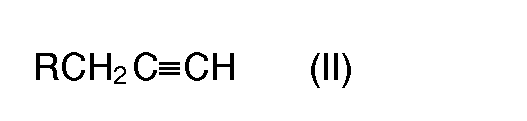
- The organometallic compound may be represented by the formula R°M wherein R is a hydrocarbyl group which may be a saturated aliphatic group, a saturated cycloaliphatic group, or an aromatic group. Generally, R will contain up to about 20 carbon atoms. M is an alkali metal including lithium, sodium, potassium, rubidium, cesium and francium. Representative examples of the organometallic compound R°M include: methylsodium, ethyllithium; propyllithium; isopropylpotassium, n-butyllithium, s-butyllithium; t-butyl- potassium; t-butyllithium; pentyllithium; n-amylrubidium; tert-octylcesium; phenyllithium; naphthyllithium; etc. The conjugated dienes which are reacted with the intermediate to form the desired compositions are preferably 1,3-conjugated dienes of the type which have been described above.
- In a preferred embodiment, the trimetalated 1-alkyne catalysts are prepared by the method which comprises the steps of
- (a) reacting a 1-alkyne with an organometallic compound R° M in a mole ratio of about 1:3 to form an intermediate, and
- (b) reacting said intermediate with a conjugated diene at a temperature of at least about 70 ° C. The mole ratio of conjugated diene to 1-alkyne in the reaction is at least about 2:1 and may be as high as about 30:1. More generally, the ratio will be in the range of from about 8:1 to 20:1.
- The reaction of the 1-alkyne with the organometallic compound followed by reaction with the conjugated diene can be carried out in the presence of an inert diluent, and particularly, in the presence of a hydrocarbon such as an aliphatic, cycloaliphatic or aromatic hydrocarbon. Representative examples of suitable hydrocarbon diluents include n-butane, n-hexane, isooctane, decane, dodecane, cyclohexane, methylcyclohexane, benzene, toluene, xylene, etc. Preferred hydrocarbons are aliphatic hydrocarbons containing from four to about 10 carbon atoms per molecule. Mixtures of hydrocarbons can also be utilized.
- The reaction between the 1-alkyne and the organometallic compound to form the intermediate can be effected at temperatures of 20-30 ° C, and the reaction is generally conducted in an inert atmosphere such as under nitrogen. The reaction generally is conducted at atmospheric pressure. The intermediate obtained from the first step is a trimetalated alkyne which is either insoluble or only slightly soluble in hydrocarbons.
- The reaction between the intermediate and the conjugated diene to form a hydrocarbon soluble product is conducted at a temperature above 70 ° C and more generally at a temperature of from about 70 ° C to about 150°C. The reaction generally is completed in less than about 5 hours, and the reaction results in a change in the color of the solution from a yellow to red or reddish brown. At about 80 ° C the reaction is completed in about 3 hours. At higher temperatures, the reaction is completed in less than 3 hours. If the reaction mixture is heated for too long a period, the catalytic activity of the resulting product may be reduced. The product of this reaction is a trimetalated alkyne containing two divalent oligomeric hydrocarbyl groups comprising moieties derived from the conjugated diene. Relatively small amounts of the conjugated diene are reacted with the intermediate in the second step. The mole ratio of conjugated diene to 1-alkyne in the intermediate is at least about 2:1 and may be as high as 30:1. In one preferred embodiment, the mole ratio of conjugated diene to 1-alkyne is in a range of from about 8:1 to about 20:1.
- The trimetalated compounds used in this invention contain active as well as inactive metal. The presence of at least two different types of carbon metal linkages in the compositions of this invention can be shown by both chemical and physical evidence. Gilman titration with allyl bromide distinguishes between metal acetylide (-C=C-M) which is inactive and other carbon metal linkages (-C-C-M) which are active, J. Organometal Chem., 1 (1963) 8. Titration of the compositions of this invention show about 67% of the total carbon-metal linkages are "active" corresponding to trimetalated alkynes. Ultraviolet and visible spectral studies show peak absorbances at 300-340 NM and 400-450 NM for the compositions of this invention corresponding to inactive and active metal linkages, respectively.
- An important property of these catalyst compositions is that they are soluble in hydrocarbon solvents. The terms "soluble in hydrocarbon solvents" and "hydrocarbon soluble" as used in the specifications and claims indicate that the materials (polymer) are soluble in hydrocarbons, particularly aliphatic hydrocarbons such as n-hexane, to the extent of at least about 5 grams of material per 100 grams of solvent at about 25 ° C. The solutions are stable in an inert atmosphere at room temperature for an extended period of time.
- The following examples illustrate the preparation of the hydrocarbon soluble trimetalated 1-alkyne compositions useful as catalysts in the present invention. Additional examples of useful catalysts are found in copending U.S. application Serial No. (Attorney Docket No. 8912068; Inventors J.W. Kang, G. B. Seaver, and T. Hashimoto) filed the same day as this application. The disclosure of this copending application is hereby incorporated by reference for its description of additional catalysts.
- Unless otherwise indicated in the following examples and elsewhere in the specification and claims, all parts and percentages are by weight, temperatures are in degrees centigrade and pressure is at or near atmospheric pressure.
- To a solution of 0.55 ml. of 1-octyne (3.73mM) in dry hexane contained in a 7-ounce bottle equipped with rubber liner and three-hole crown cap are charged 7 ml. of n-butyllithium (11.2mM, 1.6M solution) through a disposable syringe at room temperature under nitrogen. The resulting slurry is shaken vigorously to complete the reaction, and the resulting pale yellow solution is allowed to stand at room temperature for one hour. To this solution is charged 25 gms. of 1,3-butadiene in hexane (24.2% butadiene, 112mM butadiene). The mixture is tumbled in a bath heated to about 80 °C for three hours, and the resulting reddish brown solution is cooled and stored. Analysis of the solution obtained in this manner but the Gilman technique indicates active carbon-lithium linkage of 63.6%. The calculated active carbon-lithium linkage based on 1,3,3-trilithio-octyne is 66.7%.
- To a one-gallon reactor equipped with thermometer, stirrer, heating means, pressure means, inlet and outlet ports are charged 450 gms. of dry hexane, 436 gms. (1008mM) of n-butyllithium (1.54M) in hexane, and a solution of 37 gms. (336.3mM) of 1-octyne in 35 gms. of dry hexane. The reaction mixture is maintained under a nitrogen atmosphere as the n-butyllithium and octyne are added to the reactor. After the above ingredients are added to the reactor, the mixture is stirred at room temperature for 30 minutes under nitrogen, and 816.5 gms. of a 1,3-butadiene/hexane blend containing 200 gms. of 1,3-butadiene are added to the reactor. This mixture is stirred at 85 ° C for 120 minutes whereupon a homogeneous reddish-brown solution is obtained. This solution is allowed to cool to room temperature and transferred to storage tank under a nitrogen atmosphere. Gilman's titration indicates the presence of 62.34% active carbon-lithium linkages at 0.2628 molarity. The calculated active carbon-lithium linkage is 66.7%.
- Two-hundred grams of the catalyst solution is coagulated with excess methanol in the presence of an antioxidant (e.g., 1% di-tertiary-butyl-para cresol). The resulting oily product is dried at 50°C under vacuum. Gel permeation chromatography analysis of the product indicates a 1123 Mw.
- The copolymers useful in the present invention are prepared by polymerizing the conjugated diene and the vinyl aromatic compound in a hydrocarbon solvent in the presence of the above-described trimetalated 1-alkyne catalyst. The polymerization temperature may range from about 0°C to about 160°C or higher, but generally, the polymerization is conducted at a temperature of between about 75 ° C and 150°C for a period of from about 10 minutes to 2 or 3 hours. In a preferred embodiment, the polymerization is conducted at a temperature in the vicinity of about 100 ° C for a period of about 15 minutes to one hour. The desired ultra high molecular weight copolymers can be obtained consistently at this relatively high temperature in a relatively short period of time. Effecting polymerization with about 100% conversion in one hour or less allows for more effective use of labor and equipment which represents a substantial savings in the commercial production of the copolymers. The copolymers may be random or block copolymers, but random copolymers are preferred.
- The actual temperature utilized in the polymerization reaction will depend upon the desired polymerization rate, the product desired, and the particular catalyst or catalyst system utilized. The polymerization may be conducted under a negative pressure or an elevated pressure to avoid a loss of monomer and solvent, particularly when the temperatures used are at or above the boiling point of either or both. Also, an inert atmosphere such as nitrogen can be used, and the usual precautions are taken to exclude materials such as water and air that will inactivate or poison the catalyst.
- The polymerization reaction is generally conducted in a hydrocarbon solvent or diluent. Various hydrocarbon solvents can be used including aliphatic, cycloaliphatic and aromatic hydrocarbons. In one embodiment, aliphatic hydrocarbons such as hexane and cyclohexane are preferred. Examples of the aliphatic hydrocarbons useful as solvent/diluent in the polymerization reaction generally will contain from about 3 to about 20 carbon atoms, and more preferably from about 5 to about 10 carbon atoms. Examples of such aliphatic hydrocarbons include butane, pentane, hexane, heptane, octane, decane, etc. Cycloalkanes containing from 5 to 20 and preferably from 5 to about 10 carbon atoms also are useful. Examples of such cycloalkanes include cyclopentane, cyclohexane, methyl cyclohexane, and cycloheptane. Aromatic solvents which may be utilized include benzene, toluene and xylene. Individual diluents can be employed, or combinations of hydrocarbons such as a hydrocarbon distillate fraction may be utilized.
- In many applications, it is desirable to increase the ratio of 1,2-structure (vinyl) in the copolymers in order to increase the cure rate in free radical cure systems. For example, in one preferred embodiment of this invention, the elastomer contains from about 15 to about 70% of 1,2 or vinyl units based on the amount of conjugated diolefin in the copolymers. Various compositions, referred to in the art as modifier compositions, can be included in the copolymerization mixture to increase the amount of 1,2-structure in the copolymers. Any of the modified compositions which have been described in the prior art which will combine with the trimetalated 1-alkyne catalyst of the present invention to produce ultra high molecular weight copolymers having increased amounts of 1,2-structure can be utilized in the method of the present invention. Modifier compounds which have been found to be particularly useful in combination with the trimetalated 1-alkyne catalyst are those described in copending U.S. application Serial No. - (Attorney docket 8912068; inventors: J. W. Kang, G. B. Seaver, and T. Hashimoto). The disclosure of this patent application relating to the modifier compounds is hereby incorporated by reference.
- The amounts of trimetalated 1-alkyne catalyst and the optional modifier(s) utilized in the polymerization reaction are amounts designed to result in the formation of a copolymer having the desired properties described above. The amounts utilized in a particular copolymerization reaction will depend upon a number of factors including the types and amounts of monomers being copolymerized, the desired molecular weight and molecular weight distribution, etc. One of the desirable features of the catalyst used in the method of the invention is that only small amounts of the catalysts are required to produce the desired copolymer, and this results in a cost savings.
- The millimole ratio of the catalyst to the weight of the monomers which is employed in the preparation of the copolymers is expressed as the number of millimoles of active metal in the catalysts based on metal per 100 grams of monomer (PHGM). In the trimetalated 1-alkyne catalyst of the present invention wherein the metals are in the 1,3,3-positions, the metal in the 1-position is inactive whereas the metals in the 3- position are active metals. Generally, the ratio of millimoles of active metal PHGM may range from about 0.4 to about 0.7. At the higher ratios, the weight average molecular weight of the copolymers of the present invention tends to decrease. Thus, in one preferred embodiment, the ratio of millimoles of active metal PHGM will range from about 0.45 to about 0.65.
- The term 1,2-units or 1,2-microstructure as used in the present application refers to the mode of addition of a growing polymer chain with a conjugated diene monomer unit. Either 1,2-addition or 1,4- addition can occur. In terms of nomenclature, this results in a 1,2-unit or microstructure for the monomer unit in the polymer chain when 1,3-butadiene is a monomer. When isoprene is the monomer, 3,4- microstructure most generally results with a smaller amount of 1,2-microstructure in the polymer chain. Naming of the polymer structure which results from 1,2-addition is thus dependent on the monomers being polymerized. For simplicity, the term 1,2-unit or 1,2-microstructure is employed to determine the microstructure which results from 1,2-addition of conjugated dienes. The microstructure of the ultra high molecular weight copolymers of the present invention is determined using proton NMR. The copolymers useful in this invention can be prepared containing relatively high amounts of 1,2 units (vinyl) such as from 10 to 80% by weight of 1,2 units. In one preferred embodiment the copolymers contain from about 15 to about 50% of 1,2 or vinyl units based on the amount of butadiene incorporated into the copolymer (referred to as "butadiene base"). In another embodiment the copolymers will contain more 1,2-units such as from 60 to 80%.
- Samples may be withdrawn from the reactor periodically during the polymerization reaction to determine percent conversion (by measuring the total solids), color and character of the reaction mass. The reaction time of the polymerization is dependent upon several factors including the polymerization temperature and the catalyst concentration. Generally complete conversion to polymer can be obtained at temperatures of about 100 °C in about 15 minutes to one hour.
- When the polymerization reaction has progressed to the desired degree, the product can be dropped from the reactor or combined with an alcohol such as methanol or isopropanol, or other liquid medium which deactivates the initiator and coagulates and precipitates the polymer product. Generally, an amount of isopropanol equal in weight to the amount of diluent (e.g., hexane) used is sufficient to effect coagulation and precipitation. It is also customary and advantageous to include an antioxidant such as about 1% of di-tertiary butyl paracresol in the isopropanol. The polymer product is recovered and dried to remove solvent.
- The molecular weights and the dilute solution viscosity (DSV) in toluene of the copolymers reported herein, are determined by techniques described in copending U.S. application Serial No. - (Attorney Docket No. 8912068) filed the same day as this application. The disclosures regarding molecular weight and DSV determinations are hereby incorporated by reference.
- The intrinsic viscosity (η) of the copolymers used in the present invention is determined by the general procedure utilized for DSV except that the intrinsic viscosity is the average of four data points obtained with four different concentrations.
- The glass transition temperature (Tg) of the copolymers used in the present invention is determined using a DuPont 1090 thermal analyzer with a 910 Differential Scanning Colorimeter System and following the manufacturer's recommended procedure. The onset, infection and offset temperatures are calculated in accordance with the Interactive DSC Data Analysis-Program V2D.
- The relaxation properties of the copolymers used in the present invention are determined using a Bendix Scott STI/200 Mooney Viscometer and a modification of the conventional method for measuring the "shearing viscosity" of rubber and rubber-like materials such as SBR. In this procedure, the sample is placed between the platens which are then closed. The sample is warmed at 100 °C for one minute, and the rotor is turned on. After four minutes, the Mooney value (ML1 +4) is determined and the rotor is turned off. Measurement of the relaxation is begun, and a relaxation time (AL80) is recorded when the torque reaches 20% (T80) of the Mooney value ML1 +4. After a total of 10 minutes, the torque is again observed and recorded as AL1+4+5, and the platens are opened. The percent relaxation is calculated as follows:
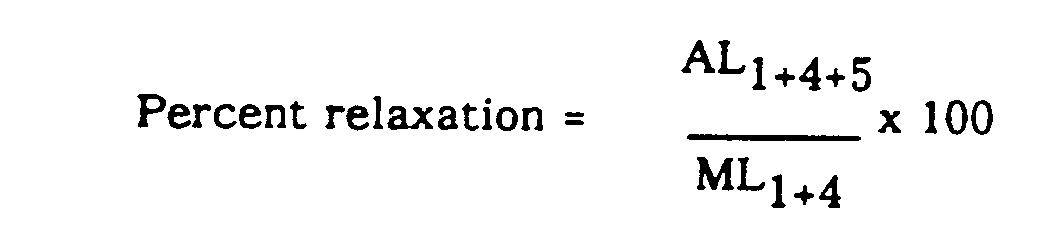
- A typical graph of the torque versus time for this test procedure is shown in the drawing wherein the various values utilized in computation of percent relaxation such as ML, +4 and AL1 +4 +5 are noted. In general, the copolymers used in the present invention are characterized by a percent relaxation as defined above of from about 20% to about 80%. More often, the percent relation will be between about 30 or even 40% and about 70%.
- The following examples illustrate the copolymers useful in the present invention and methods for their preparation. Additional examples of copolymers are found in copending U.S. application Serial No. (Attorney Docket No. 8912068) filed the same day as this application. The disclosure of this copending application is hereby incorporated by reference for its description of additional copolymers.
- Unless otherwise indicated in the following examples and elsewhere in the specification and claims, values for number average molecular weight (Mn) and weight average molecular weight (Mw) are determined in tetrahydrofuran using GPC as described above. The microstructure of the copolymers (e.g., 1,4 units, 1,2 units, etc., is determined utilizing proton NMR in carbon disulfide.
- To a two-gallon stainless steel reactor equipped with thermometer, stirrer, heating means, pressure means, inlet and outlet ports which is maintained under a nitrogen atmosphere, a styrene/butadiene/hexane blend as described in Table I is charged along with 19 ml. of a one normal solution of 2,2'-di-(tetrahydrofuryl) propane in hexane (modifier), and 3.8 mM of the uncoagulated catalyst solution of Example B. The temperature of the mixture within the reactor is raised from room temperature to 100°C. The polymerization is conducted under the conditions listed in Table I. The resulting copolymer is coagulated with excess of isopropanol containing about 1% of di-tertiary butyl-para-cresol followed by drum drying. The copolymer obtained in each example and its properties are shown in Table I.

- Example 1 is substantially repeated with the exception that the blend composition is varied in each polymerization. Hexane, styrene, 1,3-butadiene in the amounts shown in Table II are placed in a two gallon reactor under a nitrogen atmosphere. The polymerization is carried out for 60 minutes under the conditions shown in Table II.

- Example 1 is substantially repeated with the exception that the blend composition is varied in each polymerization. The amounts of hexane, styrene and 1,3-butadiene and the reaction conditions are shown in Table III.

- The general procedure of Example 1 is repeated except that the amount of styrene and 1,3-butadiene is varied. The properties of the copolymer thus obtained are summarized in the following Table IV. Also included in Table IV are properties of other SBR copolymers for comparison purposes. Controls 1 and 3 are solution SBRs. Control-2 is an emulsion SBR available from Ameripol under the designation E-1721.

- The elastomer component of elastomer compositions of the present invention may comprise a mixture of the copolymer (A) and at least one other material or synthetic rubber including other solution and emulsion SBRs. Thus in one embodiment, the elastomer component may comprise from about 10% to 100% by weight of the copolymer (A) described herein and from zero to about 90% by weight of another rubber. Examples of synthetic rubbers include rubber-like polymers produced by polymerizing aliphatic, conjugated diolefins, especially those containing 4 to 8 carbon atoms such as butadiene, isoprene pentadienes, etc. The rubbers contain unsaturated carbon chains, and such rubbers are known in the art as shown by ANSI/ASTM Standard D1418-79A where these rubbers are referred to as R rubbers. The following is a non-exclusive list of R class rubbers which can be used with the copolymer (A) elastomer in this invention.
- ABR - Acrylate-butadiene
- BR - Butadiene
- CIIR - Chloro-isobutene-isoprene
- CR - Chloroprene
- IR - Isoprene, synthetic
- NBR - Nitrile-butadiene
- NCR - Nitrile-chloroprene
- NIR - Nitrile-isoprene
- NR - Natural rubber
- SCR - Styrene-chloroprene
- SIR - Styrene-isoprene rubbers
- Of these, the NR, IR, BR, or mixtures of two or more of these are typically used. Compositions containing the copolymer of this invention and NR as the rubber portion are often used. In the context of this invention, NR includes both hevea and guayule rubber as well as mixtures thereof.
- The rubbers used herein having carbon-carbon unsaturation also may be other than the above-described R rubbers. Examples of such rubbers include EPDM and EPR. EPDM rubbers are derived from ethylene-propylenediene monomer and generally about 3 to 8% of their carbon bonds are unsaturated bonds.
- The vulcanizable elastomer compositions used in the present invention often and generally will contain oil which serves as an extender of the above-described copolymers. Any oil which is compatible with and capable of extending the ultra high molecular weight copolymer compositions can be used in the preparation of the elastomer compositions of the present invention. Thus, the oils may be either natural or synthetic oils provided that they are compatible with the copolymers and capable of extending the copolymers. Natural oils, and in particular, petroleum base oils such as mineral oils, are preferred types of oil useful in the present invention. The oils may be naphthenic oils, paraffinic or aromatic oils. These oils are substantially hydrocarbon oils, often hydrocarbon mineral oils, usually petroleum base oils. A number of specific useful oils are disclosed in U.S. Patent 2,964,083, and in particular in Table 1 in columns 9-12 and in U.S. Patent 4,748,199,
column 5 lines 27-37. These patents are hereby incorporated by reference for their disclosure of specific oils useful as extenders in this invention. - The American Society for Testing and Materials has suggested and published the following classification for oil types (ASTM designation, D-2226).

- The alternative classification of highly aromatic, aromatic, naphthenic, and paraffinic corresponds to the 101, 102, 103 and 104 types, respectively.
- Most often, the oils will be blends comprising various mixtures of naphthenic, or paraffinic or aromatic oils. In one embodiment, the oil should have a boiling point above 230 ° C and preferably above 290 C. Mineral oils having low aniline point or high aromatic content are preferred, particularly when the rubber contains high amounts of styrene and other aromatic components. Aromatic oils generally are characterized as having a viscosity gravity content (VGC) as determined by ASTM procedure D-2501 of from 0.900 to 1.100. Naphthenics and paraffinics generally have a VGC of less than 0.900.
- The particular oil which is selected for blending with the copolymers will be determined by the intended use of the rubber article being produced. For example, where the tires are to be utilized in cold climates, it is desired that the rubber treads have low temperature flexibility, and this may be accomplished by utilizing hydrocarbon oils of low pour point. In such instances, the oils may have boiling points lower than the 230 ° C indicated above. Preferred oils for extending the copolymers used in preparing the treads of the present invention are low volatile aromatic oils.
- It has been discovered that the elastomers useful in the present invention comprising the above-described copolymers and oil can be prepared containing very large amounts of oil, and in particular, the elastomer compositions of the present invention can be prepared containing from 30 to about 300 parts of oil per 100 parts of copolymer without loss of desirable properties. Blends comprising 80, 100, 150 or even 250 parts of oil per 100 parts of copolymer are easily prepared and have been found to exhibit desirable and useful properties.
- Carbon black fillers which may be included in the vulcanizable elastomers useful in this invention include any of the commonly available, commercially-produced carbon blacks but those having a surface area (EMSA) of at least 7 m2/g and more preferably at least 35 m2/g up to 200 m2/g or higher are preferred. In one preferred embodiment the surface area of the carbon black is at least 80 m2/g. Surface area values used in this application are those determined by ASTM test D-1765 using the cetyl-trimethyl-ammonium bromide (CTAB) technique. Among the useful carbon blacks are furnace black, channel blacks and lamp blacks. More specifically, examples of the carbon blacks include super abrasion furnace (SAF) blacks, high abrasion furnace (HAF) blacks, fast extrusion furnace (FEF) blacks, fine furnace (FF) blacks, intermediate super abrasion furnace (ISAF) blacks, semi-reinforcing furnace (SRF) blacks, medium processing channel blacks, hard processing channel blacks and conducting channel blacks. Other carbon blacks which may be utilized include acetylene blacks. Mixtures of two or more of the above blacks can be used in preparing the carbon black products of the invention. Typical values for surface areas of usable carbon blacks are summarized in the following Table V.

- High surface area, small particle size, high structure carbon blacks are preferred for use in the high performance tread compounds of this invention. Surface areas of at least about 80 m2/g up to about 140 m2/g are preferred in one embodiment. Examples of such blacks include SAF (N100-N199), ISAF (N200-N299) and FAF (N300-N399) blacks. Those carbon blacks designated HAF-HS and ISAF-HS are particularly useful.
- Another measure of surface area is iodine adsorption as determined by ASTM D1510. Structure of carbon blacks is assessed by DBP absorption according to ASTM D2414. Carbon blacks having iodine numbers of 170-190 mg/g and DBP absorption value of 130-160 cc/100g are preferred in ultra high performance tire treads. An example of such a carbon black is HV-3396 from Witco Chemical which has an iodine number of about 185 and a DBP of about 140-145.
- The carbon blacks may be in pelletized form or an unpelletized flocculent mass. Preferably, for more uniform mixing, unpelletized carbon black is preferred.
- It has been discovered that it is possible to include large amounts of carbon black in the elastomer compositions used in the invention. Up to about 250 parts of carbon black can be included per 100 parts of copolymer (A). Loadings of from 50 to 250 parts of carbon black per 100 parts of copolymer are often used to obtain desirable properties.
- The elastomer compositions comprising the blends of copolymer, oil, and carbon black can be prepared by any of the techniques known to those skilled in the art. For example, the blends can be prepared on roll mills or in internal mixers such as a Banbury mixer. When it is desired to prepare elastomer compositions containing high amounts of oil, the oil may be blended with the copolymer with incremental additions of the oil or with a single addition of the oil. Alternatively, the oil can be added to a latex of the copolymer or a portion of the oil added to the copolymer initially and additional oil added during blending with other additives.
- When curing agents are mixed with the elastomer compositions, they may be conventional types such as sulfur- or peroxide-based curing systems. They are used in conventional amounts and incorporated in the uncured compositions of the invention by known techniques and procedures. Fillers (in addition to carbon black) may be, and often are present as is known to those skilled in the art. Typical fillers include glass, talc, silica ("white carbon black"") and similar finely divided mineral materials. In addition to the fillers, other materials normally used in conventional rubber formulations such as antioxidants, accelerators, retarders, promoters and the like may be incorporated into the vulcanizable elastomer compositions used to prepare tire treads.
- The vulcanizable (curable) compositions containing the elastomer compositions can be prepared by conventional techniques using various types of mills, blenders and mixers known in the art. The cured compositions can be made by the same techniques followed by curing.
- The temperature used in formulating the rubber compositions of this invention range from ambient to those normally used in the art such as 75-175 or even higher depending upon a particular modified rubber composition being processed. Because of the shear forces involved in formulating the rubber compositions, the formulation process is exothermic and high temperatures are normal.
- A general and a typical compounding recipe for preparing the vulcanizable elastomer compositions useful in preparing the high performance tire treads of this invention are shown in the following Table VI.

- The tire tread vulcanizates of the present invention are made by vulcanizing a mixture comprising at least one of the elastomer compositions of the invention, fillers, conventional curing systems and agents such as sulfur, antioxidants, accelerators, retarders, coupling agents, promoters, etc. The vulcanizates are prepared by curing these compositions under conditions of temperature and time customarily used in the art. Typically, the elastomer composition including carbon black and other fillers are mixed, the sulfur and accelerators are added, and the mixture is cured. Other mixing sequences can be used, but it is essential to have the copolymer and carbon black product intimately combined before vulcanization.
- The following examples illustrate the preparation of curable and cured elastomer compositions useful in preparing the tire treads of the present invention. An internal mixer such as a Brabender or small size Banbury, and a roll mill are used to prepare the uncured rubber formulations in accordance with techniques well known to those skilled in the art.
- The Lambourn abrasion resistance of the elastomer compositions may be evaluated in the laboratory in the following manner:
- First, a time at which the torque of the elastomer composition takes the maximum value is measured by a rheometer, and vulcanization is carried out for a time 1.2 times as long as thus measured time. Then, the Lambourn abrasion of the vulcanized elastomer composition is evaluated at a given wear rate (e.g., 25%) under load of 4.5 kg, and shown by index taking a value a Control as 100. The larger the index, the better the Lambourn abrasion resistance.
- The viscoelastic properties of the cured compounded elastomers of the invention and several control examples are determined using a dynastat mechanical spectrometer tester available from IMASS Inc., Accord, MA 02018. The test is conducted at 1.000 Hz at room temperature. Values are reported in the following tables as M', and the unit is MPa.
- The components and formulation used in the preparation of the curable compounded elastomers are summarized in the following Table VII.

- The compositions of Example I and
Controls 
- The components and formulation used in the preparation of the curable compounded elastomers are summarized in Table IX.

- The compositions of Example II and Control-6 are cured by heating at 170°C for 15 minutes. Some properties of the cured elastomers are shown in Table X.

- Among the desirable and beneficial properties which may be obtained with tire treads made with the vulcanized elastomer compositions containing the ultra high molecular weight copolymers described herein are high hysteresis (tan delta), low modulus, low durometer, better reversion, and increased wear and traction. Low modulus and low durometer are observed particularly when larger amounts of oil are included in the elastomer compositions. The vulcanizable and vulcanized elastomer compositions based on the use of the ultra high molecular weight copolymers can be molded or shaped to the desired tire treads by known techniques. The tread can be applied during the building of the green tire in which an uncured, shaped tread of the formulation of the present invention is built into the carcass following which the green tire is shaped and cured. Alternatively, the tread can be applied to a cured tire carcass from which the previous tread has been buffed or abraded away and the uncured, shaped tread of the present invention cured thereon as a retread. Tires gripping ability and, furthermore, possesses very good balance between the hysteresis loss value as an indication of the road gripping ability and other important characteristics such as rupture strength, heat resistance and wear resistance which are required for tires to be used under very severe conditions.
- As tire tread material, the elastomer compositions of the invention are useful in high performance tires for specialized utilities and for general purposes. The invention is applicable to both automobile and motorcycle tires.
- While the invention has been explained in relation to its preferred embodiments, it is to be understood that various modifications thereof will become apparent to those skilled in the art upon reading the specification. Therefore, it is to be understood that the invention disclosed herein is intended to cover such modifications as fall within the scope of the appended claims.
Claims (24)
Applications Claiming Priority (2)
| Application Number | Priority Date | Filing Date | Title |
|---|---|---|---|
| US07/586,065 US5272203A (en) | 1990-09-21 | 1990-09-21 | High performance tire treads and tires |
| US586065 | 1990-09-21 |
Publications (2)
| Publication Number | Publication Date |
|---|---|
| EP0476640A1 true EP0476640A1 (en) | 1992-03-25 |
| EP0476640B1 EP0476640B1 (en) | 1998-02-04 |
Family
ID=24344167
Family Applications (1)
| Application Number | Title | Priority Date | Filing Date |
|---|---|---|---|
| EP91115926A Expired - Lifetime EP0476640B1 (en) | 1990-09-21 | 1991-09-19 | High performance tire treads and tires |
Country Status (6)
| Country | Link |
|---|---|
| US (1) | US5272203A (en) |
| EP (1) | EP0476640B1 (en) |
| JP (1) | JP3157216B2 (en) |
| CA (1) | CA2051937C (en) |
| DE (1) | DE69128862T2 (en) |
| ES (1) | ES2111549T3 (en) |
Cited By (5)
| Publication number | Priority date | Publication date | Assignee | Title |
|---|---|---|---|---|
| EP0502728A1 (en) * | 1991-03-05 | 1992-09-09 | Bridgestone Corporation | Pneumatic tires |
| US6221975B1 (en) | 1998-12-19 | 2001-04-24 | Korea Kumho Petrochemical Co., Ltd. | Process for preparing random copolymer functionalized at both terminals |
| WO2010035990A2 (en) | 2008-09-23 | 2010-04-01 | 주식회사 엘지화학 | Bifunctional organic lithium initiator and conjugate diene system copolymer produced using same |
| ITMI20121495A1 (en) * | 2012-09-07 | 2014-03-08 | Versalis Spa | PROCEDURE FOR THE PREPARATION OF DIENIC POLYMERS OR OF VINYLARENE-DIENE STATISTICAL COPOLYMERS |
| IT201600131325A1 (en) * | 2016-12-27 | 2018-06-27 | Pirelli | Elastomeric compositions comprising natural Guayule gums for tire and tire components which comprise them |
Families Citing this family (21)
| Publication number | Priority date | Publication date | Assignee | Title |
|---|---|---|---|---|
| MY115289A (en) * | 1992-08-27 | 2003-05-31 | Cabot Corp | Carbon blacks containing epdm compositions having either a high gloss or a textured matte finish |
| JP3378313B2 (en) * | 1993-09-10 | 2003-02-17 | 株式会社ブリヂストン | Rubber composition |
| US5508336A (en) * | 1993-12-29 | 1996-04-16 | Bridgestone Corporation | Rubber composition |
| DE4400996C2 (en) * | 1994-01-14 | 1997-04-24 | Uniroyal Englebert Gmbh | Tire tread |
| US5750615A (en) * | 1996-11-26 | 1998-05-12 | The Goodyear Tire & Rubber Company | Use of fullerene carbon in curable rubber compounds |
| US5730910A (en) * | 1997-01-03 | 1998-03-24 | Bridgestone/Firestone, Inc. | Method for preparing polymetalated compositions |
| JPH11116736A (en) * | 1997-10-13 | 1999-04-27 | Bridgestone Corp | Rubber composition and pneumatic tire made of the same |
| EP2268675B1 (en) | 2008-04-14 | 2013-11-27 | Bridgestone Corporation | Processes for recovering rubber from natural rubber latex |
| JP5513338B2 (en) * | 2010-09-24 | 2014-06-04 | 株式会社ブリヂストン | Butadiene polymer, process for producing the same, rubber composition and tire |
| JP5281109B2 (en) * | 2011-04-05 | 2013-09-04 | 住友ゴム工業株式会社 | Rubber composition for cap tread and studless tire |
| US12359004B2 (en) | 2012-03-06 | 2025-07-15 | Bridgestone Corporation | Processes for the removal of rubber from non-Hevea plants |
| RU2017130331A (en) | 2012-03-06 | 2019-02-05 | Бриджстоун Корпорейшн | METHOD FOR ISSUING RUBBER FROM MATERIAL BRIQUETTES AND MATERIAL BRIQUETTES CONTAINING VEGETABLE MATERIAL OF GUAULA |
| JP2013185059A (en) * | 2012-03-07 | 2013-09-19 | Bridgestone Corp | Polymer and producing method thereof, rubber composition containing the polymer, and tire having the rubber composition |
| AU2013262725B2 (en) | 2012-05-16 | 2016-10-06 | Bridgestone Corporation | Compositions containing purified non-Hevea rubber and related purification methods |
| AU2013277335B2 (en) | 2012-06-18 | 2016-08-11 | Bridgestone Corporation | Systems and methods for the management of waste associated with processing guayule shrubs to extract rubber |
| AU2013277296B2 (en) | 2012-06-18 | 2016-08-11 | Bridgestone Corporation | Methods for desolventization of bagasse |
| EP2861627B1 (en) | 2012-06-18 | 2017-03-01 | Bridgestone Corporation | Methods for increasing the extractable rubber content of non-hevea plant matter |
| WO2015038707A1 (en) | 2013-09-11 | 2015-03-19 | Bridgestone Corporation | Processes for the removal of rubber from tks plant matter |
| JP6926881B2 (en) * | 2017-09-21 | 2021-08-25 | 住友ゴム工業株式会社 | Rubber composition for tread and tires |
| US10775105B2 (en) | 2018-11-19 | 2020-09-15 | Bridgestone Corporation | Methods for the desolventization of bagasse |
| CN113174116B (en) * | 2021-06-15 | 2022-07-01 | 河北金威新型建筑材料有限公司 | Flexible foam rubber-plastic heat-insulating material |
Citations (4)
| Publication number | Priority date | Publication date | Assignee | Title |
|---|---|---|---|---|
| US2964083A (en) * | 1950-11-20 | 1960-12-13 | Gen Tire & Rubber Co | Pneumatic tires and tread stock composition |
| US3303225A (en) * | 1962-12-26 | 1967-02-07 | Phillips Petroleum Co | Production of polymetallated 1-acetylenes |
| US4028484A (en) * | 1971-10-29 | 1977-06-07 | Morton Avery A | Alfin polymerized rubber |
| US4201848A (en) * | 1976-01-01 | 1980-05-06 | Japan Synthetic Rubber Co., Ltd. | Process for preparing polymers having high molecular weight |
Family Cites Families (41)
| Publication number | Priority date | Publication date | Assignee | Title |
|---|---|---|---|---|
| US3135716A (en) * | 1958-11-06 | 1964-06-02 | Phillips Petroleum Co | Process for preparing terminally reactive polymers |
| US3157604A (en) * | 1960-10-24 | 1964-11-17 | Phillips Petroleum Co | Polymerization initiators |
| US3193590A (en) * | 1961-08-10 | 1965-07-06 | Phillips Petroleum Co | Method of preparing organolithium polymerization initiators |
| US3159587A (en) * | 1961-08-21 | 1964-12-01 | Phillips Petroleum Co | Organopolylithium polymerization initiators and their preparation |
| US3296150A (en) * | 1962-08-27 | 1967-01-03 | Phillips Petroleum Co | Organopolylithium polymerization initiators and their preparation |
| US3438957A (en) * | 1964-11-09 | 1969-04-15 | Phillips Petroleum Co | Metalated acetylenic polymers and their preparation |
| US3640899A (en) * | 1969-01-30 | 1972-02-08 | Phillips Petroleum Co | Reaction product of hydrocarbylmonolithium and 1 3-butadiene as polymerization initiator |
| US3784637A (en) * | 1969-01-30 | 1974-01-08 | Phillips Petroleum Co | Multifunctional polymerization initiators from vinylsilanes or vinylphosphines and organomonolithium compounds |
| US3644322A (en) * | 1969-02-03 | 1972-02-22 | Phillips Petroleum Co | Polymerization of conjugated dienes and monovinyl aromatic compounds with multifunctional polymerization initiators |
| US3787510A (en) * | 1969-02-03 | 1974-01-22 | Phillips Petroleum Co | Multifunctional polymerization initiators |
| US3725368A (en) * | 1970-01-19 | 1973-04-03 | Lithium Corp | Preparation of polymers |
| US3668263A (en) * | 1970-01-19 | 1972-06-06 | Lithium Corp | Organolithium polymerization initiators and use thereof in polymerization processes |
| US3769267A (en) * | 1971-02-16 | 1973-10-30 | Firestone Tire & Rubber Co | Process for polymerization of conjugated dienes |
| US3954894A (en) * | 1973-05-18 | 1976-05-04 | Lithium Corporation Of America | Organotrilithium polymerization initiators |
| JPS5223380B2 (en) * | 1973-09-12 | 1977-06-23 | ||
| US3903168A (en) * | 1973-11-23 | 1975-09-02 | Du Pont | Stable anionic polymerization initiator |
| JPS533791B2 (en) * | 1974-05-15 | 1978-02-09 | ||
| US3984387A (en) * | 1974-08-07 | 1976-10-05 | The Dow Chemical Company | Preparation of linear α-olefin polymers having ultra high molecular weight |
| US4189555A (en) * | 1974-12-23 | 1980-02-19 | Compagnie Generale Des Etablissements Michelin | Continuous solution polymerization process |
| US3975453A (en) * | 1975-02-24 | 1976-08-17 | Foote Mineral Company | Process for preparing butynyllithium |
| US4196154A (en) * | 1977-10-11 | 1980-04-01 | The Dow Chemical Company | Soluble multifunctional lithium containing initiator |
| JPS5527337A (en) * | 1978-08-18 | 1980-02-27 | Asahi Chem Ind Co Ltd | Isoprene-butadiene copolymer rubber having improved processability |
| US4339397A (en) * | 1979-11-26 | 1982-07-13 | Shin-Etsu Chemical Co., Ltd. | Method for the preparation of a sodium salt of 1-alkyne compound |
| US4497748A (en) * | 1981-07-13 | 1985-02-05 | The General Tire & Rubber Company | Preparation of lithium initiator for the preparation of star polymers |
| CA1196139A (en) * | 1982-02-26 | 1985-10-29 | Hiroshi Furukawa | Elastomer composition |
| US4399078A (en) * | 1982-03-15 | 1983-08-16 | Lithium Corporation Of America | Hydrocarbon solvent solutions of complexes of N-butyllithium and ethyllithium |
| US4859748A (en) * | 1982-04-02 | 1989-08-22 | The Dow Chemical Company | Process for anionic polymerization in a continuous stirred tank reactor |
| JPS59102602A (en) * | 1982-12-01 | 1984-06-13 | Bridgestone Corp | Pneumatic radial tire |
| US4429091A (en) * | 1983-03-09 | 1984-01-31 | The Firestone Tire & Rubber Company | Oligomeric oxolanyl alkanes as modifiers for polymerization of dienes using lithium-based initiators |
| JPS60215403A (en) * | 1984-04-10 | 1985-10-28 | Bridgestone Corp | Low fuel consumption tire with all weather performance |
| DE3580213D1 (en) * | 1984-07-18 | 1990-11-29 | Bridgestone Corp | RUBBER BLOCK FOR RUNNINGS. |
| JPH0662727B2 (en) * | 1984-08-27 | 1994-08-17 | 日本合成ゴム株式会社 | Rubber composition |
| JPS61203145A (en) * | 1985-03-05 | 1986-09-09 | Bridgestone Corp | Rubber composition for tire tread |
| JPS6236437A (en) * | 1985-08-12 | 1987-02-17 | Bridgestone Corp | Rubber composition for tire treads |
| JPS6296545A (en) * | 1985-10-23 | 1987-05-06 | Yokohama Rubber Co Ltd:The | Rubber composition for tire treads |
| WO1987004172A1 (en) * | 1986-01-10 | 1987-07-16 | Asahi Kasei Kogyo Kabushiki Kaisha | Rubber for tire tread and its composition |
| JPH06104760B2 (en) * | 1986-10-17 | 1994-12-21 | 日本合成ゴム株式会社 | Rubber composition |
| JPS63118343A (en) * | 1986-11-07 | 1988-05-23 | Japan Synthetic Rubber Co Ltd | Conjugated diene rubber composition |
| JPH0653833B2 (en) * | 1987-01-13 | 1994-07-20 | 横浜ゴム株式会社 | Rubber composition for tire tread |
| DE3711920A1 (en) * | 1987-04-08 | 1988-10-27 | Basf Ag | METHOD FOR PRODUCING MULTIFUNCTIONAL INITIATORS FOR ANIONIC POLYMERIZATION, OLIGOMERS MULTIFUNCTIONAL INITIATORS, USE OF THE POLYMER RECEIVED FOR PRODUCING OPTIONALLY FUNCTIONALIZED POLYMERS AND ALSO PREPARATIONS |
| US4871794A (en) * | 1987-06-30 | 1989-10-03 | Bridgestone Corporation | Pneumatic tires |
-
1990
- 1990-09-21 US US07/586,065 patent/US5272203A/en not_active Expired - Lifetime
-
1991
- 1991-09-19 DE DE69128862T patent/DE69128862T2/en not_active Expired - Lifetime
- 1991-09-19 EP EP91115926A patent/EP0476640B1/en not_active Expired - Lifetime
- 1991-09-19 ES ES91115926T patent/ES2111549T3/en not_active Expired - Lifetime
- 1991-09-20 JP JP26861091A patent/JP3157216B2/en not_active Expired - Fee Related
- 1991-09-20 CA CA002051937A patent/CA2051937C/en not_active Expired - Lifetime
Patent Citations (4)
| Publication number | Priority date | Publication date | Assignee | Title |
|---|---|---|---|---|
| US2964083A (en) * | 1950-11-20 | 1960-12-13 | Gen Tire & Rubber Co | Pneumatic tires and tread stock composition |
| US3303225A (en) * | 1962-12-26 | 1967-02-07 | Phillips Petroleum Co | Production of polymetallated 1-acetylenes |
| US4028484A (en) * | 1971-10-29 | 1977-06-07 | Morton Avery A | Alfin polymerized rubber |
| US4201848A (en) * | 1976-01-01 | 1980-05-06 | Japan Synthetic Rubber Co., Ltd. | Process for preparing polymers having high molecular weight |
Cited By (15)
| Publication number | Priority date | Publication date | Assignee | Title |
|---|---|---|---|---|
| EP0502728A1 (en) * | 1991-03-05 | 1992-09-09 | Bridgestone Corporation | Pneumatic tires |
| US6221975B1 (en) | 1998-12-19 | 2001-04-24 | Korea Kumho Petrochemical Co., Ltd. | Process for preparing random copolymer functionalized at both terminals |
| WO2010035990A2 (en) | 2008-09-23 | 2010-04-01 | 주식회사 엘지화학 | Bifunctional organic lithium initiator and conjugate diene system copolymer produced using same |
| US8207282B2 (en) | 2008-09-23 | 2012-06-26 | Lg Chem, Ltd. | Bifunctional organolithium initiator and conjugated diene copolymers prepared using the same |
| ITMI20121495A1 (en) * | 2012-09-07 | 2014-03-08 | Versalis Spa | PROCEDURE FOR THE PREPARATION OF DIENIC POLYMERS OR OF VINYLARENE-DIENE STATISTICAL COPOLYMERS |
| WO2014037861A1 (en) * | 2012-09-07 | 2014-03-13 | Versalis S.P.A. | Process for the preparation of diene polymers or of random vinyl arene-diene copolymers |
| CN104603158A (en) * | 2012-09-07 | 2015-05-06 | 维尔萨利斯股份公司 | Process for the preparation of diene polymers or of random vinyl arene-diene copolymers |
| KR20150052846A (en) * | 2012-09-07 | 2015-05-14 | 베르살리스 에스.피.에이. | Process for the preparation of diene polymers or of random vinyl arene-diene copolymers |
| US9447209B2 (en) | 2012-09-07 | 2016-09-20 | Versalis S.P.A. | Process for the preparation of diene polymers or of random vinyl arene-diene copolymers |
| CN104603158B (en) * | 2012-09-07 | 2017-03-08 | 维尔萨利斯股份公司 | Technique for diene polymer or the preparation of random ethylene base aromatic hydrocarbons diene copolymers |
| RU2644357C2 (en) * | 2012-09-07 | 2018-02-09 | ВЕРСАЛИС С.п.А. | Method for obtaining diene polymers or random vinylarine-diene copolymers |
| IT201600131325A1 (en) * | 2016-12-27 | 2018-06-27 | Pirelli | Elastomeric compositions comprising natural Guayule gums for tire and tire components which comprise them |
| WO2018122688A1 (en) * | 2016-12-27 | 2018-07-05 | Pirelli Tyre S.P.A. | Elastomeric compositions comprising natural rubbers from guayule for tyre components and tyres comprising the same |
| CN110087906A (en) * | 2016-12-27 | 2019-08-02 | 倍耐力轮胎股份公司 | What it is for tyre element includes the elastic composition of the natural rubber from guayule rubber and tire including the tyre element |
| CN110087906B (en) * | 2016-12-27 | 2021-11-30 | 倍耐力轮胎股份公司 | Elastomeric composition for a tire component comprising natural rubber from guayule and tire comprising said tire component |
Also Published As
| Publication number | Publication date |
|---|---|
| US5272203A (en) | 1993-12-21 |
| EP0476640B1 (en) | 1998-02-04 |
| DE69128862D1 (en) | 1998-03-12 |
| DE69128862T2 (en) | 1998-05-28 |
| JPH04252242A (en) | 1992-09-08 |
| CA2051937C (en) | 2005-08-09 |
| JP3157216B2 (en) | 2001-04-16 |
| CA2051937A1 (en) | 1992-03-22 |
| ES2111549T3 (en) | 1998-03-16 |
Similar Documents
| Publication | Publication Date | Title |
|---|---|---|
| US5272203A (en) | High performance tire treads and tires | |
| AU597204B2 (en) | Rubber composition | |
| US5260370A (en) | Oil extended ultra high molecular weight elastomers | |
| JP5349745B2 (en) | Non-random styrene-butadiene rubber | |
| US9969833B2 (en) | Cold flow reduced polymers with good processing behaviour | |
| JP3319639B2 (en) | Method for producing conjugated diene polymer, styrene-butadiene polymer and rubber composition thereof | |
| JPH09136993A (en) | Diene polymer rubber composition | |
| EP0491229B1 (en) | Pneumatic tires for heavy-load vehicles | |
| EP0476641B1 (en) | Ultra high molecular weight elastomer composition | |
| EP0491199B1 (en) | Continuous process for preparing copolymers of conjugated dienes and aromatic vinyl compounds | |
| US5202387A (en) | Elastomer with outstanding characteristics for use in making tire tread compounds | |
| KR20230088294A (en) | Methods of manufacturing conjugated diene-based polymers and the polymers, rubbers and tires made therefrom | |
| US7884168B2 (en) | Heterogeneous rubbery polymers having random, tapered, and block portions therein and methods of making same | |
| EP0476662B1 (en) | Ultra high molecular weight copolymers of conjugated dienes and aromatic vinyl compounds | |
| JP2587275B2 (en) | Rubber composition for tire | |
| JPH0641537B2 (en) | Styrene-butadiene copolymer rubber composition with excellent flex resistance | |
| JPH0676516B2 (en) | Rubber composition for tire tread | |
| JPH0657764B2 (en) | Rubber composition for tire tread | |
| JPH0676515B2 (en) | Rubber composition for tire tread |
Legal Events
| Date | Code | Title | Description |
|---|---|---|---|
| PUAI | Public reference made under article 153(3) epc to a published international application that has entered the european phase |
Free format text: ORIGINAL CODE: 0009012 |
|
| AK | Designated contracting states |
Kind code of ref document: A1 Designated state(s): DE ES FR GB IT LU |
|
| 17P | Request for examination filed |
Effective date: 19920916 |
|
| 17Q | First examination report despatched |
Effective date: 19931022 |
|
| GRAG | Despatch of communication of intention to grant |
Free format text: ORIGINAL CODE: EPIDOS AGRA |
|
| GRAG | Despatch of communication of intention to grant |
Free format text: ORIGINAL CODE: EPIDOS AGRA |
|
| GRAH | Despatch of communication of intention to grant a patent |
Free format text: ORIGINAL CODE: EPIDOS IGRA |
|
| GRAH | Despatch of communication of intention to grant a patent |
Free format text: ORIGINAL CODE: EPIDOS IGRA |
|
| GRAA | (expected) grant |
Free format text: ORIGINAL CODE: 0009210 |
|
| AK | Designated contracting states |
Kind code of ref document: B1 Designated state(s): DE ES FR GB IT LU |
|
| REF | Corresponds to: |
Ref document number: 69128862 Country of ref document: DE Date of ref document: 19980312 |
|
| REG | Reference to a national code |
Ref country code: ES Ref legal event code: FG2A Ref document number: 2111549 Country of ref document: ES Kind code of ref document: T3 |
|
| ET | Fr: translation filed | ||
| ITF | It: translation for a ep patent filed | ||
| PG25 | Lapsed in a contracting state [announced via postgrant information from national office to epo] |
Ref country code: LU Free format text: LAPSE BECAUSE OF NON-PAYMENT OF DUE FEES Effective date: 19980919 |
|
| PLBE | No opposition filed within time limit |
Free format text: ORIGINAL CODE: 0009261 |
|
| STAA | Information on the status of an ep patent application or granted ep patent |
Free format text: STATUS: NO OPPOSITION FILED WITHIN TIME LIMIT |
|
| 26N | No opposition filed | ||
| REG | Reference to a national code |
Ref country code: GB Ref legal event code: IF02 |
|
| PGFP | Annual fee paid to national office [announced via postgrant information from national office to epo] |
Ref country code: ES Payment date: 20090929 Year of fee payment: 19 |
|
| PGFP | Annual fee paid to national office [announced via postgrant information from national office to epo] |
Ref country code: GB Payment date: 20090916 Year of fee payment: 19 |
|
| PGFP | Annual fee paid to national office [announced via postgrant information from national office to epo] |
Ref country code: DE Payment date: 20090917 Year of fee payment: 19 |
|
| PGFP | Annual fee paid to national office [announced via postgrant information from national office to epo] |
Ref country code: FR Payment date: 20091012 Year of fee payment: 19 Ref country code: IT Payment date: 20090916 Year of fee payment: 19 |
|
| GBPC | Gb: european patent ceased through non-payment of renewal fee |
Effective date: 20100919 |
|
| PG25 | Lapsed in a contracting state [announced via postgrant information from national office to epo] |
Ref country code: IT Free format text: LAPSE BECAUSE OF NON-PAYMENT OF DUE FEES Effective date: 20100919 |
|
| REG | Reference to a national code |
Ref country code: FR Ref legal event code: ST Effective date: 20110531 |
|
| REG | Reference to a national code |
Ref country code: DE Ref legal event code: R119 Ref document number: 69128862 Country of ref document: DE Effective date: 20110401 |
|
| PG25 | Lapsed in a contracting state [announced via postgrant information from national office to epo] |
Ref country code: FR Free format text: LAPSE BECAUSE OF NON-PAYMENT OF DUE FEES Effective date: 20100930 Ref country code: DE Free format text: LAPSE BECAUSE OF NON-PAYMENT OF DUE FEES Effective date: 20110401 |
|
| PG25 | Lapsed in a contracting state [announced via postgrant information from national office to epo] |
Ref country code: GB Free format text: LAPSE BECAUSE OF NON-PAYMENT OF DUE FEES Effective date: 20100919 |
|
| REG | Reference to a national code |
Ref country code: ES Ref legal event code: FD2A Effective date: 20111019 |
|
| PG25 | Lapsed in a contracting state [announced via postgrant information from national office to epo] |
Ref country code: ES Free format text: LAPSE BECAUSE OF NON-PAYMENT OF DUE FEES Effective date: 20100920 |