EP0476635A2 - Sich selbst identifizierende Objekte in Rechnersystemen - Google Patents
Sich selbst identifizierende Objekte in Rechnersystemen Download PDFInfo
- Publication number
- EP0476635A2 EP0476635A2 EP91115873A EP91115873A EP0476635A2 EP 0476635 A2 EP0476635 A2 EP 0476635A2 EP 91115873 A EP91115873 A EP 91115873A EP 91115873 A EP91115873 A EP 91115873A EP 0476635 A2 EP0476635 A2 EP 0476635A2
- Authority
- EP
- European Patent Office
- Prior art keywords
- virtual
- debug
- addresses
- objects
- virtual table
- Prior art date
- Legal status (The legal status is an assumption and is not a legal conclusion. Google has not performed a legal analysis and makes no representation as to the accuracy of the status listed.)
- Ceased
Links
Images




Classifications
-
- G—PHYSICS
- G06—COMPUTING OR CALCULATING; COUNTING
- G06F—ELECTRIC DIGITAL DATA PROCESSING
- G06F8/00—Arrangements for software engineering
- G06F8/40—Transformation of program code
- G06F8/41—Compilation
-
- G—PHYSICS
- G06—COMPUTING OR CALCULATING; COUNTING
- G06F—ELECTRIC DIGITAL DATA PROCESSING
- G06F9/00—Arrangements for program control, e.g. control units
- G06F9/06—Arrangements for program control, e.g. control units using stored programs, i.e. using an internal store of processing equipment to receive or retain programs
- G06F9/44—Arrangements for executing specific programs
- G06F9/448—Execution paradigms, e.g. implementations of programming paradigms
- G06F9/4488—Object-oriented
Definitions
- the present invention relates to computer software compilation systems and methods which support run-time data type identification of instantiations of classes.
- instantiations of classes are also called objects.
- the present invention relates to computer software compilation systems and methods which support run-time data type identification of objects in computer programming languages which support polymorphism.
- Polymorphism is the ability to call a variety of functions using exactly the same interface.
- the present invention is adapted and intended to operate with computer programming languages (such as C++) which use derived classes and virtual functions to implement polymorphism, where virtual function calls are implemented as indirect function calls through tables of function addresses generated by compilers. Such tables are called virtual tables.
- This patent document often refers to a C++ computer programming language to illustrate the features, structure, and operation of the present invention. This patent document also refers to the C++ computer programming language to describe the background of the present invention.
- the references to the C++ computer programming language are included in this patent document for illustrative purposes only.
- the present invention is not limited to the C++ computer programming language. Rather, the present invention is adapted and intended to operate with computer programming languages which support polymorphism and which use virtual tables to store virtual member function addresses.
- the C++ computer programming language is an example of such a computer programming language.
- Conventional C++ translators, compilers, and debuggers do not support run-time data type identification of objects in computer programs. In other words, accurate data type information for the objects in the computer programs which are produced using the conventional C++ translators and compilers is not available at run-time. Consequently, the conventional C++ debuggers are not adapted to extract and utilize the accurate, run-time data type information for the objects in the computer programs which are produced using the conventional C++ translators and compilers.
- the unavailability of such data type information during run-time limits the functionality of the debuggers. For example, without access to such data type information during run-time, the debuggers cannot reliably refer to pointers and reference variables to determine and use the actual data types of the objects (where the pointers and reference variables point to the objects). Also, the debuggers cannot reliably use the pointers and reference variables to completely and accurately display the objects' contents.
- ANIMAL is declared as a class having two virtual member functions, x() and y().
- a dog_ptr 136 and a horse_ptr 134 are declared as pointers to type ANIMAL.
- the dog_ptr 136 and horse_ptr 134 are assigned to point to objects 124, 122, respectively, of type ANIMAL.
- Figure 1 graphically presents an object code representation 102 of the class and pointer declarations and the object instantiations from Table 1.
- the object code representation 102 is generated by the conventional C++ translators and compilers.
- the object code representation 102 includes a member function x() code segment 106 and a member function y() code segment 108.
- the object code representation 102 also includes a virtual table 104 which is associated with the class ANIMAL.
- virtual tables are associated with classes that contain virtual member functions.
- the virtual table 104 includes an entry 110, 112 for the member function y() and an entry 114, 116 for the member function x().
- virtual tables associated with a class include one entry for each member function in the class.
- the entry 110, 112 for the member function y() includes a field 112 that contains a pointer 118 to the member function y() code segment 108.
- the pointer 118 represents a virtual member function address of the member function y() code segment 108.
- the entry 110, 112 also includes a field 110 that contains information related to calling the member function y() code segment 108.
- the entry 114, 116 for the member function x() includes fields 114, 116 that are analogous to those of the entry 110, 112 for the member function y().
- the objects 122, 124 of the type ANIMAL include self-descriptive information.
- the self-descriptive information includes virtual table address fields 126, 128, respectively.
- the virtual table address fields 126, 128 contain virtual table addresses 130, 132, respectively, which point to the virtual table 104 associated with the class ANIMAL.
- objects of the same class contain virtual table addresses which point to the same virtual table.
- the statement i ( * dog_ptr).x(); calls the member function x() associated with the object 124 pointed to by the dog_ptr 136 (and also associated with the ANIMAL class) and assigns the integer returned by x() to a variable i.
- the member function x() code segment 106 is accessed via the pointer 120 in the virtual table 104.
- the virtual table 104 is accessed via the virtual table address 132 in the object 124.
- the object 124 is accessed via the dog_ptr 136.
- ONE is declared as a class having a data member I1 and a virtual member function mem_1().
- TWO is declared as a class having a data member I2 and a virtual member function mem_2().
- THREE is a derived class of the ONE and TWO classes and has a data member I3.
- a Ptr3 226 is declared as a pointer to the class THREE and is assigned to point to an object 202 of the class THREE.
- Figure 2 graphically presents an object code representation 102 of the statements from Table 2. Specifically, Figure 2 graphically presents an internal layout of the instantiated object 202 of the class THREE.
- the object code representation 102 is generated by the conventional C++ translators and compilers.
- the object 202 includes the data members I1 206, I2 210, and I3 214.
- the object 202 also includes a virtual table address field 208 which contains a virtual table address 220 of a virtual table 216.
- the object 202 also includes a virtual table address field 212 which contains a virtual table address 222 of a virtual table 218.
- the virtual tables 216, 218 are similar to the virtual table 104 shown in Figure 1. Since the Ptr3 226 is declared as a pointer to the class THREE, the debugger and the innovative type inquiry operators can use the Ptr3 226 to determine the actual data type of the object 202. Also, since the Ptr3 226 points to the beginning of the object 202, the debugger can use the Ptr3 226 to completely and accurately display the contents of the object 202.
- the debugger can use the Ptr1 224 to completely and accurately display the contents of the object 202.
- Ptr1 224 is declared as a pointer to the class ONE, the debugger and the innovative type inquiry operators cannot use the Ptr1 224 to determine the actual data type of the object 202.
- Ptr2 228 is declared as a pointer to the class TWO, the debugger and the innovative type inquiry operators cannot use the Ptr2 228 to determine the actual data type of the object 202. Also, because Ptr2 228 does not point to the beginning of the object 202, the debugger cannot use the Ptr2 228 to completely and accurately display the contents of the object 202.
- Prior approaches for solving such inadequacies of the conventional C++ translators, compilers, and debuggers involve explicit user intervention.
- computer programmers are required to modify class declarations in the computer programs by adding additional members to the class declarations.
- the additional members are used to store the actual data types of the objects.
- the actual data types of the objects are stored in the additional members. Consequently, data type identification of the objects during run-time is possible by referring to the additional members.
- the present invention is directed to software compilation systems and methods which support run-time data type identification of objects in computer programs.
- the present invention is directed to computer software compilation systems and methods which support run-time data type identification of objects in computer programming languages which support polymorphism.
- Polymorphism is the ability to call a variety of functions using exactly the same interface.
- the present invention is adapted and intended to operate with computer programming languages (such as C++) which use derived classes and virtual functions to implement polymorphism, where virtual function calls are implemented as indirect function calls through tables of function addresses generated by compilers. Such tables are called virtual tables.
- the present invention comprises improved translators, improved compilers, and improved debuggers.
- the present invention comprises a first approach and a second approach for supporting run-time data type identification of the objects in the computer programs.
- the improved compiler and translator store modified debug information in an object code file.
- the modified debug information contains information regarding multiple virtual tables.
- a debug lookup table is constructed from the modified debug information.
- the improved debugger uses the debug lookup table to determine the actual data types of the objects, and to completely and accurately display the objects' contents.
- the innovative type inquiry operators reference the debug lookup table to determine the actual data types of the objects during run-time.
- the improved compiler and translator create concatenated virtual tables.
- the improved compiler and translator store modified debug information in the object code file.
- the modified debug information contains information regarding the concatenated virtual tables.
- the debug lookup table is constructed from the modified debug information.
- the improved debugger uses the debug lookup table to determine the actual data types of the objects, and to completely and accurately display the objects' contents.
- the innovative type inquiry operators reference the concatenated virtual tables to determine the actual data types of the objects during run-time.
- the operation of the compiler, translator, and debugger according to the first and second approaches of the present invention is transparent to computer programmers and operators. Therefore, the compiler, translator, and debugger support run-time data type identification of the objects in the computer programs in a user-friendly and error-free manner.
- the present invention 328 is directed to software compilation systems and methods which support run-time data type identification of objects in computer programs 402.
- the present invention is directed to computer software compilation systems and methods which support run-time data type identification of objects in computer programming languages which support polymorphism.
- Polymorphism is the ability to call a variety of functions using exactly the same interface.
- the present invention is adapted and intended to operate with computer programming languages (such as C++) which use derived classes and virtual functions to implement polymorphism, where virtual function calls are implemented as indirect function calls through tables of function addresses generated by compilers. Such tables are called virtual tables.
- the present invention 328 comprises improved translators 504, improved compilers 406, and improved debuggers 420.
- the present invention 328 is not limited to the C++ computer programming language. Rather, the present invention 328 is adapted and intended to operate with computer programming languages which support polymorphism and which use virtual tables to store virtual member function addresses .
- the C++ computer programming language is an example of such a computer programming language.
- the present invention is an application computer program 328 which operates on a computer platform 302.
- the computer platform 302 includes certain hardware units 308 including a central processing unit (CPU) 312, a random access memory (RAM) 310, and an input/output interface 314.
- the application computer program 328 may reside on the RAM 310.
- the computer platform 302 also includes an operating system 304, and may include microinstruction code 306.
- Various peripheral components may be connected to the computer platform 302, such as a terminal 318, a data storage device 322, and a printing device 326.
- the computer platform 302 is a HP9000 Series 300, 600, or 800 computer platform and the operating system 304 which runs thereon is HP-UX version 7.0.
- the application computer program 328 of the present invention 328 is preferably written in the C++ computer programming language.
- a first embodiment of the present invention 328 comprises the compiler 406, a linker 430, and the debugger 420.
- a second embodiment of the present invention 328 comprises a translator/compiler combination 502, which includes the translator 504 and a compiler 506.
- the translator/compiler combination 502 performs the functions of the compiler 406 of the first embodiment.
- the structure and operation of the translator 504 and compiler 506 of the second embodiment is similar to that of the compiler 406 of the first embodiment. Therefore, the structure and operation of the translator 504 and compiler 506 of the second embodiment, with regard to the features and functions of the present invention 328 as taught and suggested in this patent document, should be obvious to persons with ordinary skill in the art based on the following detailed discussion of the structure and operation of the compiler 406 of the first embodiment.
- Some aspects of the present invention 328 can be implemented using existing compiler, translator, linker, and debugger technology. However, modifications upon existing compiler, translator, and debugger technology are necessary to achieve the improvements of the present invention 328. The following discussions focus on these modifications upon existing compiler, translator, and debugger technology. For a general discussion of existing compiler, translator, linker, and debugger technology, see Compilers, Principles, Techniques, and Tools by Alfred V. Aho, Ravi Sethi, and Jeffrey D. Ullman (Addison Wesley 1986), which is herein incorporated in its entirety by reference.
- the present invention 328 comprises a first approach and a second approach for supporting run-time data type identification of the objects in the computer programs 402.
- the improved compiler 406 stores modified debug information 416 in an object code file 412.
- the modified debug information 416 contains information regarding multiple virtual tables 1208, 1216, 1220, 1224.
- a debug lookup table 1236 is constructed from the modified debug information 416.
- the improved debugger 420 uses the debug lookup table 1236 to determine the actual data types of the objects, and to completely and accurately display and modify the objects' contents.
- a lookup table that is similar to the debug lookup table 1236 can be generated.
- innovative type inquiry operators can reference the lookup table to determine the actual data types of the objects during run-time.
- the improved compiler 406 creates concatenated virtual tables 1318.
- the improved compiler 406 stores the modified debug information 416 in the object code file 412.
- the modified debug information 416 contains information regarding the concatenated virtual tables 1318.
- the debug lookup table 1236 is constructed from the modified debug information 416.
- the improved debugger 420 uses the debug lookup table 1236 to determine the actual data types of the objects, and to completely and accurately display and modify the objects' contents.
- the innovative type inquiry operators reference the concatenated virtual tables 1318 to determine the actual data types of the objects during run-time.
- the operation of the compiler 406 and debugger 420 according to the first and second approaches of the present invention 328 is transparent to computer programmers and operators. Therefore, the compiler 406 and debugger 420 support run-time data type identification of the objects in the computer programs 402 in a user-friendly and error-free manner.
- the first embodiment of the present invention 328 comprises the compiler 406, the linker 430, and the debugger 420.
- the compiler 406 receives the source code 402 and generates object code 414 and the debug information 416.
- the object code 414 and the debug information 416 are stored in the object code file 412.
- the linker 430 links the object code file 412 with other object code files 432 and forms an executable file 438.
- the executable file 438 includes at least the object code 414 and the debug information 416.
- the debugger 420 receives the executable file 438 and, under the direction of a user (not shown in Figure 4), uses the object code 414 and the debug information 416 in the executable file 438 to identify and correct errors in the source code 402.
- FIG. 6 A structural diagram/functional flowchart of the compiler 406 is shown in Figure 6.
- rectangles represent software modules/processes and ovals represent the inputs and outputs of the software modules/processes.
- the compiler 406 includes a scanner/parser 602, a semantic analyzer 610, a debug information generator 620, and a code generator 624.
- the scanner/parser 602 receives the source code 402 and builds an abstract syntax tree 606.
- the AST 606 essentially models the structure of the source code 402 being compiled.
- the AST 606 is composed of subtrees which represent declarations, function definitions, statements, and expressions.
- the semantic analyzer 610 receives the AST 606 as input.
- the semantic analyzer 610 "decorates" the nodes of the AST 606 with pointers to symbol table and type table entries (not shown in Figure 6) to produce a decorated abstract syntax tree 614.
- the code generator 624 receives the decorated abstract syntax tree 614 as input.
- the code generator 1130 generates the object code 414 from the decorated abstract syntax tree 614 and places the object code 414 in the object code file 412.
- the debug information generator 620 also receives the decorated abstract syntax tree 614 as input.
- the debug information generator 620 generates and stores modified debug information 416 in the object code file 412.
- the modified debug information 416 contains information regarding the multiple virtual tables 1208, 1216, 1220, 1224.
- the modified debug information 416 contains information regarding the concatentated virtual tables 1318.
- the debug information generator 620 is described in detail below.
- FIG. 7 A structural diagram/functional flowchart of the debugger 420 is shown in Figure 7.
- Figure 7 other than the terminal 318 and a user 714, rectangles represent software modules/processes and ovals represent the inputs and outputs of the software modules/processes.
- the debugger 420 includes a preprocessor 702 and a main debugger 710.
- the preprocessor 702 receives the executable file 438 (comprising the object code 414 and debug information 416) and generates a preprocessed debug information 706.
- the preprocessed debug information 706 is the same as the contents of the executable file 438, except the preprocessor 702 removes duplicate information, fixes up pointers between various parts of the debug information 416, and collects certain data into several special tables which are added to the preprocessed debug information 706 for use by the main debugger 710.
- the preprocessor 702 generates the debug lookup table 1236.
- the debug lookup table 1236 allows the main debugger 710 to accurately and completely determine at run-time the data type of objects referenced by pointers and reference variables.
- the main debugger 710 receives the preprocessed debug information 706. Under the direction of a user 714, who communicates with the main debugger 710 via the terminal 318, the main debugger 710 uses the preprocessed debug information 706 to aid the user 714 in locating and correcting errors in the source code 402.
- the main debugger 710 uses the preprocessed debug information 706 to, among other things, display the source code 402, display an assembly code translation of the source code 402 generated by the compiler 406, to control and alter the flow of execution through the source code 402, to display variable types, and to view and set variable values.
- the debugger 420 constructs the debug lookup table 1236.
- the debugger 420 uses the debug lookup table 1236 to determine the actual data types of the objects, to completely and accurately display the objects' contents, and to allow the user 714 to modify the objects' contents.
- the debugger 420 is discussed in detail below.
- This section describes the operation of the debug information generator 620 and the debugger 420 according to the first approach of the present invention 328.
- this section describes the format of the debug lookup table 1236.
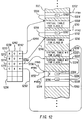
- Figure 12 illustrates a corresponding debug lookup table 1236 according to the first approach of the present invention.
- a ptr1 1202 is declared as a pointer of class A and assigned to point to an object 1204 of class A.
- the object 1204 contains a virtual table address 1206 which points to a virtual table 1208.
- a ptr2 1210 is declared as a pointer of class B and assigned to point to an object 1212 of class B.
- the object 1212 contains a virtual table address 1214 which points to a virtual table 1216.
- a ptr4 1234 is declared as a pointer of class B and assigned to point to an object 1226/1228/1260 of class C.
- the object 1226/1228/1260 contains virtual table addresses 1218, 1222 which point to virtual tables 1220, 1224, respectively.
- the debug lookup table 1236 contains an entry 1270, 1272, 1274, 1276 for every virtual table.
- the entries 1270, 1272, 1274, 1276 contain three fields: a class type identification field 1238, an object offset field 1240, and a virtual table address field 1242.
- the virtual table address field 1242 contains the virtual table addresses 1244, 1246, 1248, 1250 of the virtual tables 1208, 1216, 1224, 1220 associated with the entries 1270, 1272, 1274, 1276.
- the class type identification field 1238 contains data type information of the objects associated with the virtual table addresses in the virtual table address fields 1242.
- the debug lookup table 1236 entry 1270 stores a virtual table address 1244.
- the virtual table address 1244 points to a virtual table 1208.
- the virtual table 1208 is associated with the class A. Therefore, the class type identification field 1238 associated with the entry 1270 identifies the class A.
- the object offset field 1240 contains pointer object offsets to the beginning of objects. As shown in Figure 12, for example, the ptr4 1234 does not point to the beginning of the object 1226/1228/1260. Specifically, the ptr4 1234 is displaced by an object offset of d (d is equal, in this case, to the size of an object of class A) from the beginning of the object 1226/1228/1260. Therefore, the object offset field 1240 of entry 1276 (the entry 1276 stores a virtual table address 1250 which is equal to a virtual table address 1218 associated with the ptr4 1234) contains a value equal to the offset d.
- d is equal, in this case, to the size of an object of class A
- Figure 8 illustrates the manner in which the debug information generator 620 generates the modified debug information 416 according to the first approach of the present invention 328.
- Step 806 the debug information generator 620 locates the classes to which the objects 1204, 1212, 1226/1228/1260 belong in the decorated AST 614. The debug information generator 620 then determines locations 1280, 1282, 1286, 1284 in the objects 1204, 1212, 1226/1228/1260 where the virtual table addresses 1206, 1214, 1218, 1222 are stored.
- Step 810 the debug information generator 620 stores the locations 1280, 1282, 1286, 1284 in the modified debug information 416 (these locations are offsets inside the objects where pointers to the virtual tabled are stored).
- the debug information generator 620 reads the virtual table addresses 1206, 1214, 1218, 1222 from the objects 1204, 1212, 1226/1228/1260.
- the debug information generator 620 also determines the object offsets. As noted above (with reference to Figure 12), the object offsets represent pointer offsets to the beginning of objects.
- Step 818 the debug information generator 620 stores the virtual table addresses 1206, 1214, 1218, 1222 and the object offsets in the modified debug information 416.
- Steps 806, 810, 814, and 818 are repeated for all objects which are instantiations of classes containing virtual functions.
- Figure 9 presents a functional flowchart of the high-level operation of the debugger 420 according to the first approach of the present invention.
- Step 906 the debugger 420 uses the modified debug information 416 to create the debug lookup table 1236.
- the debugger 420 receives user requests.
- the user may request the debugger 420 to display the source code 402, display the assembly code translation of the source code 402 generated by the compiler 406, to control and alter the flow of execution through the source code 402, to display variable types, and to view and set variable values.
- Step 914 the debugger 420 processes the user requests.
- the debugger 420 refers to the debug lookup table 1236 when it must determine the data types of objects, accurately and completely display the contents of objects, or allow the user 714 to modify the contents of the objects.
- Step 1006 the debugger 420 reads the virtual table address 1286 in the object 1226/1228/1260 referenced by the ptr4 1234.
- the debugger 420 searches the debug lookup table 1236 for an entry whose virtual table address (in the virtual table address field 1242) is equal to that read in Step 1006. For the present example, the debugger 420 locates the entry 1276. Then, the debugger 420 reads the class type identification field 1238 of the entry 1276 to determine the data type of the object 1226/1228/1260 pointed to by the ptr4 1234. For the present example, the debugger 420 correctly determines that the data type is class C.
- Step 1014 the debugger 420 uses the data type information to finish the processing of the user request.
- the debugger 420 may simply display the data type information.
- the flowchart in Figure 10 for determining the data types of objects referenced by pointers or reference variables, is also applicable for the innovative type inquiry operators.
- the compiler 406 could emit a lookup table 1236 to the object code 414.
- the innovative type inquiry operators could refer to the lookup table 1236 (according to the flowchart in Figure 10) to determine the data type of objects during run-time.
- Step 1106 the debugger 420 reads the virtual table address 1286 in the object 1226/1228/1260 that is referenced by the ptr4 1234.
- the debugger 420 searches the debug lookup table 1236 for an entry whose virtual table address (in the virtual table address field 1242) is equal to that read in Step 1106. For the present example, the debugger 420 locates the entry 1276. Then, the debugger 420 reads the object offset field 1240 of the entry 1276. For the present example, the debugger 420 reads the object offset d. As shown in Figure 12, the offset d represents the object offset of the ptr4 1234 from the beginning of the object 1226/1228/1260.
- Step 1114 the debugger 420 calculates a start address of the object 1226/1228/1260.
- the debugger 420 calculates the start address by subtracting the object offset d from the ptr4 1234.
- Step 1118 the debugger 420 uses the start address to display the contents of the object 1226/1228/1260 to the user.
- Step 1118' the debugger 420 uses the start address to modify the contents of the object 1226/1228/1260.
- This section describes the operation of the debug information generator 620 and the main debugger 710 according to the second approach of the present invention 328.
- the second approach is an improvement of the first approach.
- the first approach enables the debugger 420 to accurately determine the data type of objects, to accurately and completely display the contents of the objects, and to allow the user 714 to modify the contents of the objects. Also, the first approach enables the innovative type inquiry operators to accurately determine the data type of objects during run-time.
- the first approach is relatively inefficient with regard to enabling the innovative type inquiry operators to determine the data type of objects during run-time.
- the second approach of the present invention 328 solves the efficiency problem of the first approach by using the concatenated virtual tables 1318, rather than the multiple virtual tables 1208, 1216, 1220, 1224.
- a unique, distinct concatenated virtual table 1318 is generated for each class.
- the concatenated virtual table 1318 may be made up from only one virtual table, but for other classes, the concatenated virtual table 1318 may contain multiple virtual tables.
- This section describes the second approach of the present invention 328 by first describing the format of the concatenated virtual tables 1318.
- Figure 13 illustrates a corresponding concatenated virtual table 1318 and a debug lookup table 1236 according to the second approach of the present invention 328.
- a ptr2 1336 is declared as a pointer of class B and assigned to point to an object 1390 of class D.
- the object 1390 contains virtual table addresses 1312, 1314, 1316 that point to virtual tables 1360, 1362, 1364, respectively.
- compilers 406 emit multiple virtual tables for an object. This is shown in Figure 12, where the compiler 406 emitted the multiple virtual tables 1220, 1224 for the object 1226/1228/1260.
- the term "multiple" means that the virtual tables are not contiguous in memory.
- the multiple virtual tables 1220, 1224 essentially comprise two fields, a field 112, 116 containing a pointer to a member function code segment and a field 110, 114 containing information related to calling the member function code segment. This is shown in Figure 1.
- the compiler 406 emits a concatenated virtual table 1318 for an object 1390 of class D. This is shown in Figure 13, where the compiler 406 emitted the concatenated virtual table 1318 for the object 1390.
- the concatenated virtual table 1318 contains virtual tables 1360, 1362, 1364.
- the term "concatenated" means that the virtual tables are contiguous in memory.
- the virtual tables 1360, 1362, 1364 emitted by the compiler 406 contain three fields 1306, 1308, 1310.
- the field 1306 corresponds to the field 112, 116 containing the pointer to the member function code segment.
- the field 1310 corresponds to the field 110, 114 containing information related to calling the member function code segment.
- the additional field 1308 contains pointer table offset values.
- a pointer table offset value associated with a particular virtual table represents a displacement from the beginning of the virtual table to the beginning of a concatenated virtual table for which the virtual table is a part.
- the pointer table offset value for the virtual table 1364 is I2, because the beginning of the virtual table 1364, pointed to by virtual table address 1316, is displaced I2 from the beginning of the concatenated virtual table 1318, pointed to by the virtual table address 1302.
- the pointer table offset values in the table offset fields 1308 are distinct from the pointer object offset values in the object offset fields 1240 in the debug lookup table 1236.
- the compiler 406 emits concatenated virtual tables 1318, rather than multiple virtual tables 1220, 1224, for objects according to the second approach of the present invention 328.
- the virtual tables 1360, 1362, 1364 contained in the concatenated virtual tables 1318, and emitted by the compiler 406, contain the table offset field 1308 in addition to the fields 1306 and 1310.
- the debug information generator 620 generates the modified debug information 416.
- the manner in which the debug information generator 620 generates the modified debug information 416 is the same for both the first and second approaches of the present invention 328. Therefore, the operation of the debug information generator 620 according to the second approach of the present invention 328 is adequately described above with reference to Figure 8.
- An innovative "typeof()" operator is an example of such a C++ type inquiry operator.
- the typeof() operator receives a pointer (or a reference variable) to an object and returns a data type indication of the object's data type.
- the typeof() operator returns the same data type indication for all pointers associated with the object.
- the typeof() operator returns the virtual table address 1302 for the ptr1 1332, ptr2 1336, ptr3 1338, and ptr4 1334.
- the data type indication is the virtual table address 1302 of the start of the concatenated virtual table 1318.
- Step 1406 the C++ operator or function, such as typeof(), reads the virtual table address 1314 in the object 1390 referenced by the ptr2 1336.
- Step 1410 the C++ operator or function, such as typeof(), uses the virtual table address 1314 to access the virtual table 1362 and read the table offset field 1308.
- the table offset value I1 is read.
- Step 1414 the C++ operator or function, such as typeof(), calculates the start address of the concatenated virtual table 1318.
- the start address of the concatenated virtual table 1318 is equal to the virtual table address 1302.
- the start address is calculated by subtracting the table offset value I1 from the virtual table address 1314.
- Step 1418 the C++ operator or function retains the start address that was calculated in Step 1414 for further processing.
- the typeof() operator may simply return the start address of the concatenated virtual table 1318.
- the operation of the debugger 420 is the same for both the first and second approaches of the present invention 328. Therefore, the operation of the debugger 420 according to the second approach of the present invention 328 is adequately described above with reference to Figures 9, 10, and 11.
- first and second approaches of the present invention 328 are applicable only to classes which contain virtual member functions.
- compile-time switches could be implemented to emit pointers to unique tables inside all structures (except for those structures which are explicitly declared with 'extern "C"'). Such compile-time switches would ensure that the present invention 328 would apply to all classes.
- concatenated virtual tables 1318 are useful for implementing other innovative operators and functions.
- a "sizeof()" operator for objects referenced by pointers and reference variables could be implemented.
- the sizeof() operator would receive pointers (or reference variables) to objects and return the actual size of the object, as opposed to the size of the class specified in the declaration of the pointer or reference variable.
Landscapes
- Engineering & Computer Science (AREA)
- Software Systems (AREA)
- Theoretical Computer Science (AREA)
- General Engineering & Computer Science (AREA)
- Physics & Mathematics (AREA)
- General Physics & Mathematics (AREA)
- Debugging And Monitoring (AREA)
- Devices For Executing Special Programs (AREA)
Applications Claiming Priority (2)
| Application Number | Priority Date | Filing Date | Title |
|---|---|---|---|
| US586778 | 1990-09-21 | ||
| US07/586,778 US5361351A (en) | 1990-09-21 | 1990-09-21 | System and method for supporting run-time data type identification of objects within a computer program |
Publications (2)
| Publication Number | Publication Date |
|---|---|
| EP0476635A2 true EP0476635A2 (de) | 1992-03-25 |
| EP0476635A3 EP0476635A3 (en) | 1993-04-07 |
Family
ID=24347078
Family Applications (1)
| Application Number | Title | Priority Date | Filing Date |
|---|---|---|---|
| EP19910115873 Ceased EP0476635A3 (en) | 1990-09-21 | 1991-09-18 | Self identifying objects in computer systems |
Country Status (3)
| Country | Link |
|---|---|
| US (1) | US5361351A (de) |
| EP (1) | EP0476635A3 (de) |
| JP (1) | JP3405996B2 (de) |
Cited By (6)
| Publication number | Priority date | Publication date | Assignee | Title |
|---|---|---|---|---|
| WO1995018410A1 (en) * | 1993-12-30 | 1995-07-06 | Taligent, Inc. | Object-oriented invocation framework |
| EP0784264A3 (de) * | 1995-12-21 | 2004-06-30 | International Business Machines Corporation | Rechnerimplementiertes Verfahren zur Bestimmung eines Minimalcodesets für ein ausführbares Programm in einem Datenverarbeitungssystem |
| EP1594063A1 (de) | 2004-05-05 | 2005-11-09 | Siemens Aktiengesellschaft | Verfahren zum Überprüfen von Steuerungsprogrammen |
| US8291386B2 (en) | 2008-08-21 | 2012-10-16 | International Business Machines Corporation | System and process for debugging object-oriented programming code |
| US8683439B2 (en) | 2008-08-21 | 2014-03-25 | International Business Machines Corporation | System and process for debugging object-oriented programming code leveraging preprocessors |
| US8752020B2 (en) | 2008-08-21 | 2014-06-10 | International Business Machines Corporation | System and process for debugging object-oriented programming code leveraging runtime metadata |
Families Citing this family (76)
| Publication number | Priority date | Publication date | Assignee | Title |
|---|---|---|---|---|
| US5297284A (en) * | 1991-04-09 | 1994-03-22 | Microsoft Corporation | Method and system for implementing virtual functions and virtual base classes and setting a this pointer for an object-oriented programming language |
| US5822590A (en) * | 1991-10-31 | 1998-10-13 | Texas Instruments Incorporated | dbX: a persistent programming language model |
| US5432936A (en) * | 1992-04-09 | 1995-07-11 | Microsoft Corporation | Method for implementing pointers to members in a compiler for an object-oriented programming language |
| US5535318A (en) * | 1992-04-30 | 1996-07-09 | Ricoh Company, Ltd. | Debugging system for a hierarchically structured page description language |
| JPH06124211A (ja) * | 1992-10-14 | 1994-05-06 | Fujitsu Ltd | プログラム解析装置 |
| US5590329A (en) * | 1994-02-04 | 1996-12-31 | Lucent Technologies Inc. | Method and apparatus for detecting memory access errors |
| US6139198A (en) * | 1994-10-04 | 2000-10-31 | International Business Machines Corporation | System and method for enabling tracing of program execution in an object-oriented system |
| FI946209A0 (fi) * | 1994-12-30 | 1994-12-30 | Nokia Telecommunications Oy | Foerfarande foer jaemfoerande av attributvaerden hos kontrollerbara objektuttryck i ett naetelement |
| US5740440A (en) * | 1995-01-06 | 1998-04-14 | Objective Software Technology | Dynamic object visualization and browsing system |
| US5727212A (en) * | 1995-04-12 | 1998-03-10 | International Business Machines Corporation | Object oriented device driver system for procedural device drivers |
| US5699509A (en) * | 1995-06-07 | 1997-12-16 | Abbott Laboratories | Method and system for using inverted data to detect corrupt data |
| US5675730A (en) * | 1995-07-07 | 1997-10-07 | Sun Microsystems, Inc. | Method and apparatus for extensible type-specific data presentation by a debugger |
| US5761510A (en) * | 1995-11-07 | 1998-06-02 | Microsoft Corporation | Method for error identification in a program interface |
| US6158045A (en) * | 1995-11-13 | 2000-12-05 | Object Technology Licensing Corporation | Portable debugging services utilizing a client debugger object and a server debugger object with flexible addressing support |
| US5956479A (en) * | 1995-11-13 | 1999-09-21 | Object Technology Licensing Corporation | Demand based generation of symbolic information |
| US6003037A (en) * | 1995-11-14 | 1999-12-14 | Progress Software Corporation | Smart objects for development of object oriented software |
| US5701490A (en) * | 1996-01-16 | 1997-12-23 | Sun Microsystems, Inc. | Method and apparatus for compiler symbol table organization with no lookup in semantic analysis |
| US6072950A (en) * | 1996-06-18 | 2000-06-06 | Microsoft Corporation | Pointer analysis by type inference combined with a non-pointer analysis |
| US5754860A (en) * | 1996-07-23 | 1998-05-19 | Digital Equipment Corporation | Method and apparatus for software testing using a differential testing technique to test compilers |
| JP3777666B2 (ja) * | 1996-08-28 | 2006-05-24 | 株式会社日立製作所 | データベース処理方法およびシステム |
| US5822589A (en) * | 1996-12-06 | 1998-10-13 | Hewlett-Packard Company | Method for locating errors in a computer program |
| US5884078A (en) | 1997-01-31 | 1999-03-16 | Sun Microsystems, Inc. | System, method and article of manufacture for creating an object oriented component having multiple bidirectional ports for use in association with a java application or applet |
| US6496870B1 (en) | 1997-01-31 | 2002-12-17 | Sun Microsystems, Inc. | System, method and article of manufacture for collaboration with an application |
| US6014518A (en) * | 1997-06-26 | 2000-01-11 | Microsoft Corporation | Terminating polymorphic type inference program analysis |
| US6247173B1 (en) | 1997-09-24 | 2001-06-12 | Hewlett-Packard Company | Computer compiler optimizer for reducing computer resource consumption during dependence analysis after loop unrolling |
| US6938245B1 (en) * | 1997-10-29 | 2005-08-30 | Veritas Operating Corporation | Interactive debugging system with debug data base system |
| US6106571A (en) * | 1998-01-29 | 2000-08-22 | Applied Microsystems Corporation | Relocatable instrumentation tags for testing and debugging a computer program |
| US6848108B1 (en) * | 1998-06-30 | 2005-01-25 | Microsoft Corporation | Method and apparatus for creating, sending, and using self-descriptive objects as messages over a message queuing network |
| US6108659A (en) * | 1998-12-22 | 2000-08-22 | Computer Associates Think, Inc. | Method and apparatus for executing stored code objects in a database |
| US6490695B1 (en) * | 1999-01-22 | 2002-12-03 | Sun Microsystems, Inc. | Platform independent memory image analysis architecture for debugging a computer program |
| AU5638600A (en) * | 1999-06-25 | 2001-01-31 | Genaissance Pharmaceuticals, Inc. | Methods for obtaining and using haplotype data |
| US7058517B1 (en) | 1999-06-25 | 2006-06-06 | Genaissance Pharmaceuticals, Inc. | Methods for obtaining and using haplotype data |
| US7152228B2 (en) | 1999-07-08 | 2006-12-19 | Science Applications International Corporation | Automatically generated objects within extensible object frameworks and links to enterprise resources |
| US6973417B1 (en) | 1999-11-05 | 2005-12-06 | Metrowerks Corporation | Method and system for simulating execution of a target program in a simulated target system |
| US6931326B1 (en) | 2000-06-26 | 2005-08-16 | Genaissance Pharmaceuticals, Inc. | Methods for obtaining and using haplotype data |
| EP1174791B1 (de) * | 2000-07-10 | 2017-09-27 | Microsoft Technology Licensing, LLC | Vereinheitlichtes Datentypsystem und Verfahren |
| GB2366399B (en) * | 2000-08-26 | 2005-02-16 | Ibm | Recognition of command related items in object code |
| US6760905B1 (en) * | 2000-09-21 | 2004-07-06 | Curl Corporation | Lazy compilation of template-generated classes in dynamic compilation execution environments |
| US6799718B2 (en) * | 2001-07-10 | 2004-10-05 | Borland Software Corp. | Development assistance for mixed-language sources |
| US20040267458A1 (en) * | 2001-12-21 | 2004-12-30 | Judson Richard S. | Methods for obtaining and using haplotype data |
| US7607066B2 (en) * | 2002-06-26 | 2009-10-20 | Microsoft Corporation | Auto suggestion of coding error correction |
| US20060048094A1 (en) * | 2004-08-26 | 2006-03-02 | Microsoft Corporation | Systems and methods for decoupling inputs and outputs in a workflow process |
| US20060048095A1 (en) * | 2004-08-31 | 2006-03-02 | Microsoft Corporation | Local type alias inference system and method |
| US7685574B2 (en) * | 2004-09-29 | 2010-03-23 | Microsoft Corporation | Constrained execution regions |
| US20060095890A1 (en) * | 2004-11-01 | 2006-05-04 | Reeves Robert L | Embedded detection objects |
| US7958493B2 (en) * | 2006-01-20 | 2011-06-07 | Kevin Edward Lindsey | Type inference system and method |
| US20080126878A1 (en) * | 2006-11-28 | 2008-05-29 | International Business Machines Corporation | Highlighting anomalies when displaying trace results |
| US8930909B1 (en) * | 2007-07-13 | 2015-01-06 | The Mathworks, Inc. | Debugging using presentation layer representations of objects |
| US8914774B1 (en) | 2007-11-15 | 2014-12-16 | Appcelerator, Inc. | System and method for tagging code to determine where the code runs |
| US8954989B1 (en) | 2007-11-19 | 2015-02-10 | Appcelerator, Inc. | Flexible, event-driven JavaScript server architecture |
| US8260845B1 (en) | 2007-11-21 | 2012-09-04 | Appcelerator, Inc. | System and method for auto-generating JavaScript proxies and meta-proxies |
| US8719451B1 (en) | 2007-11-23 | 2014-05-06 | Appcelerator, Inc. | System and method for on-the-fly, post-processing document object model manipulation |
| US8566807B1 (en) | 2007-11-23 | 2013-10-22 | Appcelerator, Inc. | System and method for accessibility of document object model and JavaScript by other platforms |
| US8819539B1 (en) | 2007-12-03 | 2014-08-26 | Appcelerator, Inc. | On-the-fly rewriting of uniform resource locators in a web-page |
| US8756579B1 (en) | 2007-12-03 | 2014-06-17 | Appcelerator, Inc. | Client-side and server-side unified validation |
| US8806431B1 (en) | 2007-12-03 | 2014-08-12 | Appecelerator, Inc. | Aspect oriented programming |
| US8527860B1 (en) | 2007-12-04 | 2013-09-03 | Appcelerator, Inc. | System and method for exposing the dynamic web server-side |
| US8938491B1 (en) | 2007-12-04 | 2015-01-20 | Appcelerator, Inc. | System and method for secure binding of client calls and server functions |
| US8335982B1 (en) | 2007-12-05 | 2012-12-18 | Appcelerator, Inc. | System and method for binding a document object model through JavaScript callbacks |
| US8285813B1 (en) | 2007-12-05 | 2012-10-09 | Appcelerator, Inc. | System and method for emulating different user agents on a server |
| US8639743B1 (en) | 2007-12-05 | 2014-01-28 | Appcelerator, Inc. | System and method for on-the-fly rewriting of JavaScript |
| US7530060B1 (en) * | 2008-01-08 | 2009-05-05 | International Business Machines Corporation | Methods and computer program product for optimizing binaries with coding style formalization |
| US8291079B1 (en) | 2008-06-04 | 2012-10-16 | Appcelerator, Inc. | System and method for developing, deploying, managing and monitoring a web application in a single environment |
| US8880678B1 (en) | 2008-06-05 | 2014-11-04 | Appcelerator, Inc. | System and method for managing and monitoring a web application using multiple cloud providers |
| US7979450B2 (en) * | 2008-09-15 | 2011-07-12 | Xsevo Systems, Inc. | Instance management of code in a database |
| US20100042585A1 (en) * | 2008-08-14 | 2010-02-18 | Dustin Kurt Adler | Command Interpretation |
| US8171045B2 (en) * | 2008-07-31 | 2012-05-01 | Xsevo Systems, Inc. | Record based code structure |
| US7596620B1 (en) | 2008-11-04 | 2009-09-29 | Aptana, Inc. | System and method for developing, deploying, managing and monitoring a web application in a single environment |
| US8307350B2 (en) * | 2009-01-14 | 2012-11-06 | Microsoft Corporation | Multi level virtual function tables |
| US9111036B2 (en) * | 2010-04-30 | 2015-08-18 | Red Hat, Inc. | Preloading unwind data for non-intrusive backtracing |
| US8713529B2 (en) * | 2010-07-30 | 2014-04-29 | Red Hat, Inc. | Replacing memory pointers with implicit pointers to be used in compiler-generated debug output |
| US11336534B2 (en) | 2015-03-31 | 2022-05-17 | British Telecommunications Public Limited Company | Network operation |
| GB2541034A (en) | 2015-07-31 | 2017-02-08 | British Telecomm | Network operation |
| JP7073813B2 (ja) * | 2018-03-16 | 2022-05-24 | 富士通株式会社 | 制御プログラム、制御方法および情報処理装置 |
| CN111104097B (zh) * | 2019-12-13 | 2023-06-30 | 上海众源网络有限公司 | 一种数据写入、读取方法及装置 |
| CN114416085B (zh) * | 2021-12-31 | 2024-09-20 | 北京五八信息技术有限公司 | 一种数据处理方法、装置、电子设备及存储介质 |
Family Cites Families (6)
| Publication number | Priority date | Publication date | Assignee | Title |
|---|---|---|---|---|
| US4373697A (en) * | 1980-12-29 | 1983-02-15 | Caterpillar Tractor Co. | Pulse width modulated constant current servo driver |
| JPH0630066B2 (ja) * | 1983-10-24 | 1994-04-20 | 株式会社日立製作所 | テーブル型言語翻訳方法 |
| US4667290A (en) * | 1984-09-10 | 1987-05-19 | 501 Philon, Inc. | Compilers using a universal intermediate language |
| US4845975A (en) * | 1986-11-28 | 1989-07-11 | Caterpillar Inc. | Method for monitoring a work vehicle suspension |
| US4931928A (en) * | 1988-11-09 | 1990-06-05 | Greenfeld Norton R | Apparatus for analyzing source code |
| US5093914A (en) * | 1989-12-15 | 1992-03-03 | At&T Bell Laboratories | Method of controlling the execution of object-oriented programs |
-
1990
- 1990-09-21 US US07/586,778 patent/US5361351A/en not_active Expired - Lifetime
-
1991
- 1991-09-18 EP EP19910115873 patent/EP0476635A3/en not_active Ceased
- 1991-09-20 JP JP24115391A patent/JP3405996B2/ja not_active Expired - Fee Related
Non-Patent Citations (4)
| Title |
|---|
| ALFRED V. AHO ET AL.: 'Compilers: Principles, Techniques, and Tools' 1986 , ADDISON-WESLEY PUBLISHING COMPANY , READING, MA US pages 10 - 15, 33 - 40, 279 - 293 * |
| SOFTWARE PRACTICE & EXPERIENCE vol. 17, no. 8, August 1987, CHICHESTER GB pages 503 - 512 STEPHEN C. DEWHURST: 'Flexible Symbol Table Structures for Compiling C++' * |
| SYSTEMS & COMPUTERS IN JAPAN vol. 18, no. 2, February 1987, NEW YORK US pages 77 - 88 HIDEAKI TSUBOTANI ET AL.: 'Construction of a Software Development Environment Based on a High-Level Language Architecture' * |
| USENIX TECHNICAL CONFERENCE WINTER 1986, DENVER, COLORADO US pages 62 - 71 T.A. CARGILL: 'The Feel of Pi' * |
Cited By (6)
| Publication number | Priority date | Publication date | Assignee | Title |
|---|---|---|---|---|
| WO1995018410A1 (en) * | 1993-12-30 | 1995-07-06 | Taligent, Inc. | Object-oriented invocation framework |
| EP0784264A3 (de) * | 1995-12-21 | 2004-06-30 | International Business Machines Corporation | Rechnerimplementiertes Verfahren zur Bestimmung eines Minimalcodesets für ein ausführbares Programm in einem Datenverarbeitungssystem |
| EP1594063A1 (de) | 2004-05-05 | 2005-11-09 | Siemens Aktiengesellschaft | Verfahren zum Überprüfen von Steuerungsprogrammen |
| US8291386B2 (en) | 2008-08-21 | 2012-10-16 | International Business Machines Corporation | System and process for debugging object-oriented programming code |
| US8683439B2 (en) | 2008-08-21 | 2014-03-25 | International Business Machines Corporation | System and process for debugging object-oriented programming code leveraging preprocessors |
| US8752020B2 (en) | 2008-08-21 | 2014-06-10 | International Business Machines Corporation | System and process for debugging object-oriented programming code leveraging runtime metadata |
Also Published As
| Publication number | Publication date |
|---|---|
| JPH04247536A (ja) | 1992-09-03 |
| EP0476635A3 (en) | 1993-04-07 |
| US5361351A (en) | 1994-11-01 |
| JP3405996B2 (ja) | 2003-05-12 |
Similar Documents
| Publication | Publication Date | Title |
|---|---|---|
| US5361351A (en) | System and method for supporting run-time data type identification of objects within a computer program | |
| US5680622A (en) | System and methods for quickly detecting shareability of symbol and type information in header files | |
| US6434742B1 (en) | Symbol for automatically renaming symbols in files during the compiling of the files | |
| US5850550A (en) | No preprocessor and a source level debugger for embedded SQL in a 3GL | |
| USRE38104E1 (en) | Method and apparatus for resolving data references in generated code | |
| Johnson et al. | TS: An optimizing compiler for Smalltalk | |
| US7120898B2 (en) | Intermediate representation for multiple exception handling models | |
| US6014518A (en) | Terminating polymorphic type inference program analysis | |
| Wirth et al. | Compiler construction | |
| EP0537257B1 (de) | Integrierte hierarchische darstellung von rechnerprogrammen für ein software-entwicklungssystem | |
| Grant et al. | DyC: an expressive annotation-directed dynamic compiler for C | |
| US6353925B1 (en) | System and method for lexing and parsing program annotations | |
| Somogyi et al. | Mercury, an efficient purely declarative logic programming language | |
| US5048018A (en) | Debugging parallel programs by serialization | |
| US5408665A (en) | System and methods for linking compiled code with extended dictionary support | |
| EP0643851B1 (de) | Fehlerbeseitiger, der die zuordnung zwischen dem quellprogramm und optimierten objektcode beinhaltet. | |
| US8458678B2 (en) | Compiler supporting programs as data objects | |
| EP0476667A2 (de) | Erzeugung von symbolischer Fehlersuchinformation in einer Übersetzterumgebung | |
| US6202202B1 (en) | Pointer analysis by type inference for programs with structured memory objects and potentially inconsistent memory object accesses | |
| US5535394A (en) | Methods for distinguishing dynamically allocated storage along different call paths and for providing a compact representation of alias analysis | |
| US6072950A (en) | Pointer analysis by type inference combined with a non-pointer analysis | |
| US5758163A (en) | Method and apparatus for record fields usage checking at compile time | |
| Somogyi et al. | The Implementation of Mercury, an Efficient Purely Declarative Logic Programming Language. | |
| US5150474A (en) | Method for transferring arguments between object programs by switching address modes according to mode identifying flag | |
| CN111767033A (zh) | 用于机械臂程序开发的编程系统及功能扩展方法 |
Legal Events
| Date | Code | Title | Description |
|---|---|---|---|
| PUAI | Public reference made under article 153(3) epc to a published international application that has entered the european phase |
Free format text: ORIGINAL CODE: 0009012 |
|
| AK | Designated contracting states |
Kind code of ref document: A2 Designated state(s): DE FR GB IT |
|
| PUAL | Search report despatched |
Free format text: ORIGINAL CODE: 0009013 |
|
| AK | Designated contracting states |
Kind code of ref document: A3 Designated state(s): DE FR GB IT |
|
| 17P | Request for examination filed |
Effective date: 19930702 |
|
| 17Q | First examination report despatched |
Effective date: 19970623 |
|
| GRAG | Despatch of communication of intention to grant |
Free format text: ORIGINAL CODE: EPIDOS AGRA |
|
| STAA | Information on the status of an ep patent application or granted ep patent |
Free format text: STATUS: THE APPLICATION HAS BEEN REFUSED |
|
| 18R | Application refused |
Effective date: 19990326 |