EP0474751B1 - Verfahren für die analyse von nervensignalen - Google Patents
Verfahren für die analyse von nervensignalen Download PDFInfo
- Publication number
- EP0474751B1 EP0474751B1 EP90909190A EP90909190A EP0474751B1 EP 0474751 B1 EP0474751 B1 EP 0474751B1 EP 90909190 A EP90909190 A EP 90909190A EP 90909190 A EP90909190 A EP 90909190A EP 0474751 B1 EP0474751 B1 EP 0474751B1
- Authority
- EP
- European Patent Office
- Prior art keywords
- type
- stimulus
- evg
- oscillations
- potentials
- Prior art date
- Legal status (The legal status is an assumption and is not a legal conclusion. Google has not performed a legal analysis and makes no representation as to the accuracy of the status listed.)
- Expired - Lifetime
Links
Images

Classifications
-
- A—HUMAN NECESSITIES
- A61—MEDICAL OR VETERINARY SCIENCE; HYGIENE
- A61B—DIAGNOSIS; SURGERY; IDENTIFICATION
- A61B5/00—Measuring for diagnostic purposes; Identification of persons
- A61B5/40—Detecting, measuring or recording for evaluating the nervous system
- A61B5/4029—Detecting, measuring or recording for evaluating the nervous system for evaluating the peripheral nervous systems
- A61B5/4035—Evaluating the autonomic nervous system
-
- A—HUMAN NECESSITIES
- A61—MEDICAL OR VETERINARY SCIENCE; HYGIENE
- A61B—DIAGNOSIS; SURGERY; IDENTIFICATION
- A61B5/00—Measuring for diagnostic purposes; Identification of persons
- A61B5/24—Detecting, measuring or recording bioelectric or biomagnetic signals of the body or parts thereof
- A61B5/316—Modalities, i.e. specific diagnostic methods
- A61B5/388—Nerve conduction study, e.g. detecting action potential of peripheral nerves
-
- A—HUMAN NECESSITIES
- A61—MEDICAL OR VETERINARY SCIENCE; HYGIENE
- A61B—DIAGNOSIS; SURGERY; IDENTIFICATION
- A61B5/00—Measuring for diagnostic purposes; Identification of persons
- A61B5/24—Detecting, measuring or recording bioelectric or biomagnetic signals of the body or parts thereof
- A61B5/25—Bioelectric electrodes therefor
- A61B5/279—Bioelectric electrodes therefor specially adapted for particular uses
- A61B5/28—Bioelectric electrodes therefor specially adapted for particular uses for electrocardiography [ECG]
- A61B5/282—Holders for multiple electrodes
-
- A—HUMAN NECESSITIES
- A61—MEDICAL OR VETERINARY SCIENCE; HYGIENE
- A61B—DIAGNOSIS; SURGERY; IDENTIFICATION
- A61B5/00—Measuring for diagnostic purposes; Identification of persons
- A61B5/72—Signal processing specially adapted for physiological signals or for diagnostic purposes
- A61B5/7235—Details of waveform analysis
- A61B5/7264—Classification of physiological signals or data, e.g. using neural networks, statistical classifiers, expert systems or fuzzy systems
Definitions
- the invention refers to prognostic medicine, viz. to neurofysiology.
- the purpose of the invention is to increase the accuracy of the determination of the condition of the vegetative part of the nervous system, exposure or sympatheticotonia, parasympatheticotonia or normotonia (eutonia) by recording of the potentials from the skin of the body, or from the surface of the organs that can be reached by electrodes (stomach, mouth etc.), under the effect of the sensory or any other stimuli according to the amplitude or other indexes of the potentials.
- the results of the measurements are estimated to record from fingers and toes from the palmary sides of the hands and feet or from other parts of the skin of the body, or from the surface of the organs that can be reached by electrodes, if possible symmetrically from the right and the left part from the body or many regions of the body.
- the active electrodes can be placed in the palmary side of the fingers and toes, right and left.
- the active electrodes can be placed also on any electro-active points of the skin or organs that can be reached.
- the passive electrodes can be placed on electrical low-active parts of the body.
- the registration of the potentials can be made from one point, two symmetrical points, from hands and feet at the same time or from combinations of some electro-active points of the skin or surface of organs that can be reached by electrodes, so the registration can be made polygraphical.
- stimulations oval, electrical, visual, acustical, emotional etc.
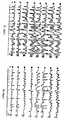
- EMG electrovegetograms
- the table shows the occurrence of the five types in normal persons .
- the first type was found (hypersympatheticotonia), in 31.5 % - the second type (presympatheticotonia), in 39.6 % cases - type III (vegetative normotonia), in 18.8 % - type IV (preparasympatheticotonia) and in 4 % - type V (hyperparasympatheticotonia).
- the extreme types I and V were found in 10 % of the patients.
- EVG reveals among practically healthy people, those 10 % with severe pathology of the vegetative part of the nervous system, who are definitely threatened in future with severe diseases: hypertonic disease with insults and infarctions, glaucoma and other eye diseases, diseases of the gastro-intestinal tract (gastric ulcer, colitis, dyskinesias).
- EVG identifies another 50 % of the people who believe themselves healthy, but who also have significant alterations in vegetative innervation which is a most important "factor of risk", real probability of falling ill with one of the above-mentioned diseases.
- the potentials are much lower than on others in the immediate surroundings. This can give wrong indications.
- search the skin region with a split electrode, of which the two electrodes come together by one registration.
- the potential from fingers will be registrated by two electrodes. So one electrode is put on the phalange of the second finger and one on the phalange of the third finger. It might be necessary to put other electrodes on the phalanges of other fingers and all electrodes come together in one thread. If the skin of one finger is thick, the potential will be recorded from the other finger. In this way the risk of making no registration mistakes is minimized.
- Patent B aged 29, diagnosis: practically healthy, pulse 72/m. arterial pressure 120/75 mm Hg, respiration 12/min. Tests clinostatic standing 74 recumbent 68 orthostatic recumbent 68 standing 76 Aschner's test initial 62 afterwards 54 sweating hands a little moist at usual temperature feet a little moist at usual temperature dermographism hands and feet pink.
- Electrovegetogram was recorded for this patient using the method described.
- EVG suggests vegetative normotonia. In this condition the patient is practically healthy.
- Patient C aged 24, diagnosis: practically healthy. Pulse 70/min, arterial pressure 115/70 mm Hg, respiration 14/min. Tests clinostatic standing 72 recumbent 68 orthostatic recumbent 64 standing 74 Aschner's test initial 64 afterwards 54 sweating hands a little moist at usual temperature feet a little moist at usual temperature dermographism hand and feet pink.
- EVG vegetative part of the nervous system. It is also difficult to determine the condition of the vegetative part of the nervous system. EVG was registrated for this patient. In the background curve, potentials with the amplitude up to 1 mV and frequency of 14/min. were recorded. Distinct reciprocal potentials (1 mV) to acoustical stimuli were found, that is EVG suggests vegetative normotonia.
- Patient K aged 25, diagnosis: practically healthy. Pulse 72, arterial pressure 120/70 mm Hg, respiration 14/min. Tests clinostatic standing 70 recumbent 64 orthostatic recumbent 62 standing 70 Aschner's test initial 64 afterwards 56 sweating hands a little moist at usual temperature feet a little moist at usual temperature dermographism hand and feet pink.
- Patient L aged 23, diagnosis: practically healthy, pulse 90/min., arterial pressure 140/100 mm Hg, respiration 22/min.
- Patient K aged 20, diagnosis: practically healthy, pulse 62/min. arterial pressure 100/60 mm Hg, respiration 11/min.
- Clinical symptomatics allow to think of the prevalence of the parasympathetic part of the nervous system, but it is difficult to determine the degree of this prevalence.
- an electrovegetogram of the patient was recorded.
- the background activity at a voltage of 1-2 mV and a frequency of 12-14 oscillations/min. was found.
- the reciprocal reactions of light stimuli were distinct (1-3 mV) which allows to draw a conclusion of distinct parasympatheticotonia (Fig. 1, type IV - preparasympatheticotonia). Based on this conclusion a treatment aimed at the decrease in the parasympathetic tonus is recommended.
- Patient S aged 24, married, has a child. Diagnosis: practically healthy, pulse 56/min., arterial pressure 100/60 mm Hg, respiration 10/min. Tests clinostatic standing 58 recumbent 50 orthostatic recumbent 50 standing 56 Aschner's test initial 56 afterwards 48 sweating hands sweaty feet cool dermographism hands red feet stable.
- Patient K aged 26, married, has a child. Pulse 60/min., arterial pressure 90/60 mm Hg, respiration 126/min. Tests clinostatic standing 64 recumbent 50 orthostatic recumbent 50 standing 56 Aschner's test initial 56 afterwards 52 sweating hands sweaty feet cool dermographism hands red feet stable.
- the patient has marked parasympatheticotonia. Recording to skin potentials from the upper third of the inner femoral surfaces in both sides shows practically absent potentials (up to - 0.25 mV).
- EVG Olfactori stimuli in EVG evoke responding potentials with amplitude up to 0.5-0.7 (EVG of type II). According to the patient's words, she is marked with hyposexuality, libido is absent.
- EVG recording from the hips inner surfaces upper thirds marks it possible to diagnose the degree of patient's sexuality.
Landscapes
- Health & Medical Sciences (AREA)
- Life Sciences & Earth Sciences (AREA)
- Neurology (AREA)
- Surgery (AREA)
- General Health & Medical Sciences (AREA)
- Biophysics (AREA)
- Pathology (AREA)
- Engineering & Computer Science (AREA)
- Biomedical Technology (AREA)
- Heart & Thoracic Surgery (AREA)
- Medical Informatics (AREA)
- Molecular Biology (AREA)
- Veterinary Medicine (AREA)
- Animal Behavior & Ethology (AREA)
- Physics & Mathematics (AREA)
- Public Health (AREA)
- Neurosurgery (AREA)
- Physiology (AREA)
- Cardiology (AREA)
- Measurement Of The Respiration, Hearing Ability, Form, And Blood Characteristics Of Living Organisms (AREA)
- Measuring Pulse, Heart Rate, Blood Pressure Or Blood Flow (AREA)
- Measurement And Recording Of Electrical Phenomena And Electrical Characteristics Of The Living Body (AREA)
- Medicines Containing Material From Animals Or Micro-Organisms (AREA)
- Measurement Of Mechanical Vibrations Or Ultrasonic Waves (AREA)
- Heat-Pump Type And Storage Water Heaters (AREA)
Claims (5)
- Verfahren zur Bestimmung des Zustandes des vegetativen Teils des Nervensystems einer Person durch Aufzeichnung des Potentiale von Bereichen des Körpers der Person, bei dem der Person ein sensorischer Stimulus gegeben wird und sowohl das Hintergrundoszillationspotential als auch das auf dem Stimulus reagierende Potential mittels Elektroden, die auf der Haut oder der Oberfläche eines Organs angebracht sind, aufgezeichnet werden, und bei dem die Amplituden der Oszillationen und der Reaktionen gemeinsam zur Bestimmung des Zustandes des Nervensystems genutzt werden.
- Verfahren gemäß Anspruch 1, bei dem der Stimulus wiederholt gegeben wird.
- Verfahren nach Anspruch 1 oder 2, bei dem:- die Abwesenheit von Hintergrundoszillation von bis zu 0,25 mV zusammen mit der Abwesenheit eines auf den Stimulus reagierenden Potentials als Hypersympathetikotonie (Typ I) identifiziert wird;- die Abwesenheit von Hintergrundoszillationen zusammen mit einer Reaktion auf den Stimulus von 0,5 mV oder höher als Präsympathetikotonie (Typ II) identifiziert wird;- die Anwesenheit von Hintergrundoszillationen von 0,25 bis 1 mV zusammen mit einer Stimulusreaktion von 0,5 mV oder höher als vegetative Normotonie oder Eutonia (Typ III) identifiziert wird;- die Anwesenheit von ausgeprägten Hintergrundoszillationen von 1 bis 2 mV zusammen mit einer Stimulusreaktion von 0,5 mV oder höher als Präparasympathetikotonie (Typ IV) identifiziert wird; und- die Anwesenheit von hohen Hintergrundoszillationen zusammen mit einer Stimulusreaktion von 0,5 oder höher, insbesondere 1 mV und höher, als Parasympathetikotonie (Typ V) identifiziert wird.
- Verfahren nach Anspruch 3, bei dem die Aufzeichnung während zwei oder mehr Tage wiederholt wird, insbesondere wenn einer der Typen III, IV und V identifiziert wird.
- Verfahren nach einem der Ansprüche 1-4, bei dem die Aufzeichnung an mehr als einem Körperteil durchgeführt wird.
Applications Claiming Priority (3)
| Application Number | Priority Date | Filing Date | Title |
|---|---|---|---|
| NL8901367A NL8901367A (nl) | 1989-05-30 | 1989-05-30 | Werkwijze voor het bepalen van zenuwsignalen. |
| NL8901367 | 1989-05-30 | ||
| PCT/NL1990/000079 WO1990014794A1 (en) | 1989-05-30 | 1990-05-30 | A method for assaying neural signals |
Publications (2)
| Publication Number | Publication Date |
|---|---|
| EP0474751A1 EP0474751A1 (de) | 1992-03-18 |
| EP0474751B1 true EP0474751B1 (de) | 1997-04-23 |
Family
ID=19854744
Family Applications (1)
| Application Number | Title | Priority Date | Filing Date |
|---|---|---|---|
| EP90909190A Expired - Lifetime EP0474751B1 (de) | 1989-05-30 | 1990-05-30 | Verfahren für die analyse von nervensignalen |
Country Status (6)
| Country | Link |
|---|---|
| EP (1) | EP0474751B1 (de) |
| AT (1) | ATE151972T1 (de) |
| DE (1) | DE69030576T2 (de) |
| IL (1) | IL94575A0 (de) |
| NL (1) | NL8901367A (de) |
| WO (1) | WO1990014794A1 (de) |
Families Citing this family (2)
| Publication number | Priority date | Publication date | Assignee | Title |
|---|---|---|---|---|
| WO1992019154A1 (en) * | 1991-04-29 | 1992-11-12 | Lerner, Inna | Method for determining sensory functions |
| NL9100740A (nl) * | 1991-04-29 | 1992-11-16 | Eduard Naumovich Lerner | Inrichting voor toepassing bij het bepalen van de toestand van het vegetatieve deel van het zenuwstelsel van een organisme. |
Family Cites Families (2)
| Publication number | Priority date | Publication date | Assignee | Title |
|---|---|---|---|---|
| US4064870A (en) * | 1976-05-19 | 1977-12-27 | Centrul De Protectia Si Igiena Muncii | Method and device for evaluating nerve impulse propagation velocity and latency of electrodermal reflexes |
| US4557271A (en) * | 1983-05-11 | 1985-12-10 | Stoller Kenneth P | Method and apparatus for detecting body illness, dysfunction, disease and/or pathology |
-
1989
- 1989-05-30 NL NL8901367A patent/NL8901367A/nl not_active Application Discontinuation
-
1990
- 1990-05-30 DE DE69030576T patent/DE69030576T2/de not_active Expired - Fee Related
- 1990-05-30 EP EP90909190A patent/EP0474751B1/de not_active Expired - Lifetime
- 1990-05-30 WO PCT/NL1990/000079 patent/WO1990014794A1/en not_active Ceased
- 1990-05-30 AT AT90909190T patent/ATE151972T1/de not_active IP Right Cessation
- 1990-05-31 IL IL94575A patent/IL94575A0/xx unknown
Also Published As
| Publication number | Publication date |
|---|---|
| IL94575A0 (en) | 1991-03-10 |
| ATE151972T1 (de) | 1997-05-15 |
| DE69030576T2 (de) | 1997-11-13 |
| EP0474751A1 (de) | 1992-03-18 |
| DE69030576D1 (de) | 1997-05-28 |
| NL8901367A (nl) | 1990-12-17 |
| WO1990014794A1 (en) | 1990-12-13 |
Similar Documents
| Publication | Publication Date | Title |
|---|---|---|
| Bohannon et al. | Rehabilitation goals of patients with hemiplegia | |
| Bond et al. | Residual effects of hypnotics | |
| Renaud et al. | The stress of Stroop performance: Physiological and emotional responses to color–word interference, task pacing, and pacing speed | |
| Raskin et al. | Diagnosis of conversion reactions: predictive value of psychiatric criteria | |
| Whanger et al. | Clinical correlates of the vibratory sense in elderly psychiatric patients | |
| Hare | Cardiovascular components of orienting and defensive responses | |
| Davis et al. | Cognitive-behavioral recovery in comatose patients following auditory sensory stimulation | |
| DUCHOWNY et al. | Visual evoked responses in childhood cortical blindness after head trauma and meningitis: a longitudinal study of six cases | |
| Ahmed | Use of somatosensory evoked responses in the prediction of outcome from coma | |
| Gilcreast et al. | Effect of electrical stimulation on foot skin perfusion in persons with or at risk for diabetic foot ulcers | |
| Gaupp et al. | False heart-rate feedback and reciprocal inhibition by aversion relief in the treatment of snake avoidance behavior | |
| Roessler et al. | Ego Strength and Physiological Responsivity: 1. The Relationship of the Barron ES Scale to Skin Resistance, Finger Blood Volume, Heart Rate, and Muscle Potential Responses to Sound | |
| EP0474751B1 (de) | Verfahren für die analyse von nervensignalen | |
| Smith et al. | Effects of threat of shock and control over shock on finger pulse volume, pulse rate and systolic blood pressure | |
| Donat et al. | Psychophysiological discriminants of depression at rest and in response to stress | |
| Kohen-Raz et al. | Some observations on tetra-ataxiametric patterns of static balance and their relation to mental and scholastic achievements | |
| Mattsson | Communicated anxiety in a two-person situation. | |
| Carmon et al. | Thresholds for pressure and sharpness in the right and left hands | |
| Vogel | The relationship of age and intelligence to autonomic functioning. | |
| Weiss | Birth order and physiological stress response | |
| Pampiglione | Brain development and the EEG of normal children of various ethnical groups | |
| Cbiederman et al. | Behavioral, physiological, and self-evaluative effects of anxiety on the self-control of pain | |
| Benton et al. | Simple and choice reaction times in schizophrenia | |
| Marmor et al. | Electro-encephalography in cases of head injury | |
| Fuhr et al. | Electrocutaneous reflexes in upper limbs–reliability and normal values in adults |
Legal Events
| Date | Code | Title | Description |
|---|---|---|---|
| PUAI | Public reference made under article 153(3) epc to a published international application that has entered the european phase |
Free format text: ORIGINAL CODE: 0009012 |
|
| AK | Designated contracting states |
Kind code of ref document: A1 Designated state(s): AT BE CH DE DK ES FR GB IT LI LU NL SE |
|
| 17P | Request for examination filed |
Effective date: 19911224 |
|
| 17Q | First examination report despatched |
Effective date: 19930325 |
|
| RIN1 | Information on inventor provided before grant (corrected) |
Inventor name: LERNER, EDUARD, NAUMOVICH Inventor name: LERNER, LEONID |
|
| GRAH | Despatch of communication of intention to grant a patent |
Free format text: ORIGINAL CODE: EPIDOS IGRA |
|
| GRAH | Despatch of communication of intention to grant a patent |
Free format text: ORIGINAL CODE: EPIDOS IGRA |
|
| GRAA | (expected) grant |
Free format text: ORIGINAL CODE: 0009210 |
|
| RAP1 | Party data changed (applicant data changed or rights of an application transferred) |
Owner name: LERNER, INNA Owner name: LERNER, EDWARD NAUMOVICH |
|
| AK | Designated contracting states |
Kind code of ref document: B1 Designated state(s): AT BE CH DE DK ES FR GB IT LI LU NL SE |
|
| PG25 | Lapsed in a contracting state [announced via postgrant information from national office to epo] |
Ref country code: IT Free format text: LAPSE BECAUSE OF FAILURE TO SUBMIT A TRANSLATION OF THE DESCRIPTION OR TO PAY THE FEE WITHIN THE PRESCRIBED TIME-LIMIT;WARNING: LAPSES OF ITALIAN PATENTS WITH EFFECTIVE DATE BEFORE 2007 MAY HAVE OCCURRED AT ANY TIME BEFORE 2007. THE CORRECT EFFECTIVE DATE MAY BE DIFFERENT FROM THE ONE RECORDED. Effective date: 19970423 Ref country code: DK Effective date: 19970423 Ref country code: LI Free format text: LAPSE BECAUSE OF FAILURE TO SUBMIT A TRANSLATION OF THE DESCRIPTION OR TO PAY THE FEE WITHIN THE PRESCRIBED TIME-LIMIT Effective date: 19970423 Ref country code: CH Free format text: LAPSE BECAUSE OF FAILURE TO SUBMIT A TRANSLATION OF THE DESCRIPTION OR TO PAY THE FEE WITHIN THE PRESCRIBED TIME-LIMIT Effective date: 19970423 Ref country code: ES Free format text: THE PATENT HAS BEEN ANNULLED BY A DECISION OF A NATIONAL AUTHORITY Effective date: 19970423 Ref country code: AT Effective date: 19970423 |
|
| REF | Corresponds to: |
Ref document number: 151972 Country of ref document: AT Date of ref document: 19970515 Kind code of ref document: T |
|
| REG | Reference to a national code |
Ref country code: CH Ref legal event code: EP |
|
| REF | Corresponds to: |
Ref document number: 69030576 Country of ref document: DE Date of ref document: 19970528 |
|
| PG25 | Lapsed in a contracting state [announced via postgrant information from national office to epo] |
Ref country code: LU Free format text: LAPSE BECAUSE OF NON-PAYMENT OF DUE FEES Effective date: 19970530 |
|
| RAP2 | Party data changed (patent owner data changed or rights of a patent transferred) |
Owner name: LERNER, EDWARD NAUMOVICH Owner name: LERNER, LEONID |
|
| PG25 | Lapsed in a contracting state [announced via postgrant information from national office to epo] |
Ref country code: SE Effective date: 19970723 |
|
| NLT2 | Nl: modifications (of names), taken from the european patent patent bulletin |
Owner name: LERNER, EDWARD NAUMOVICH EN LERNER, LEONID |
|
| ET | Fr: translation filed | ||
| REG | Reference to a national code |
Ref country code: CH Ref legal event code: PL |
|
| PLBE | No opposition filed within time limit |
Free format text: ORIGINAL CODE: 0009261 |
|
| STAA | Information on the status of an ep patent application or granted ep patent |
Free format text: STATUS: NO OPPOSITION FILED WITHIN TIME LIMIT |
|
| 26N | No opposition filed | ||
| REG | Reference to a national code |
Ref country code: GB Ref legal event code: IF02 |
|
| PGFP | Annual fee paid to national office [announced via postgrant information from national office to epo] |
Ref country code: BE Payment date: 20020502 Year of fee payment: 13 |
|
| PGFP | Annual fee paid to national office [announced via postgrant information from national office to epo] |
Ref country code: GB Payment date: 20020522 Year of fee payment: 13 |
|
| PGFP | Annual fee paid to national office [announced via postgrant information from national office to epo] |
Ref country code: FR Payment date: 20020530 Year of fee payment: 13 |
|
| PGFP | Annual fee paid to national office [announced via postgrant information from national office to epo] |
Ref country code: NL Payment date: 20020531 Year of fee payment: 13 |
|
| PGFP | Annual fee paid to national office [announced via postgrant information from national office to epo] |
Ref country code: DE Payment date: 20020711 Year of fee payment: 13 |
|
| PG25 | Lapsed in a contracting state [announced via postgrant information from national office to epo] |
Ref country code: GB Free format text: LAPSE BECAUSE OF NON-PAYMENT OF DUE FEES Effective date: 20030530 |
|
| PG25 | Lapsed in a contracting state [announced via postgrant information from national office to epo] |
Ref country code: BE Free format text: LAPSE BECAUSE OF NON-PAYMENT OF DUE FEES Effective date: 20030531 |
|
| BERE | Be: lapsed |
Owner name: *LERNER INNA Effective date: 20030531 Owner name: *LERNER EDWARD NAUMOVICH Effective date: 20030531 |
|
| PG25 | Lapsed in a contracting state [announced via postgrant information from national office to epo] |
Ref country code: NL Free format text: LAPSE BECAUSE OF NON-PAYMENT OF DUE FEES Effective date: 20031201 |
|
| PG25 | Lapsed in a contracting state [announced via postgrant information from national office to epo] |
Ref country code: DE Free format text: LAPSE BECAUSE OF NON-PAYMENT OF DUE FEES Effective date: 20031202 |
|
| GBPC | Gb: european patent ceased through non-payment of renewal fee |
Effective date: 20030530 |
|
| PG25 | Lapsed in a contracting state [announced via postgrant information from national office to epo] |
Ref country code: FR Free format text: LAPSE BECAUSE OF NON-PAYMENT OF DUE FEES Effective date: 20040130 |
|
| NLV4 | Nl: lapsed or anulled due to non-payment of the annual fee |
Effective date: 20031201 |
|
| REG | Reference to a national code |
Ref country code: FR Ref legal event code: ST |