EP0474364A2 - Mustervergleichsvorrichtung - Google Patents
Mustervergleichsvorrichtung Download PDFInfo
- Publication number
- EP0474364A2 EP0474364A2 EP91307207A EP91307207A EP0474364A2 EP 0474364 A2 EP0474364 A2 EP 0474364A2 EP 91307207 A EP91307207 A EP 91307207A EP 91307207 A EP91307207 A EP 91307207A EP 0474364 A2 EP0474364 A2 EP 0474364A2
- Authority
- EP
- European Patent Office
- Prior art keywords
- sequence
- component type
- base component
- input
- match
- Prior art date
- Legal status (The legal status is an assumption and is not a legal conclusion. Google has not performed a legal analysis and makes no representation as to the accuracy of the status listed.)
- Withdrawn
Links
- 230000003287 optical effect Effects 0.000 claims abstract description 11
- 238000002834 transmittance Methods 0.000 claims 1
- 108091028043 Nucleic acid sequence Proteins 0.000 description 8
- 238000000034 method Methods 0.000 description 6
- 229920002477 rna polymer Polymers 0.000 description 5
- 108020004414 DNA Proteins 0.000 description 4
- 102000053602 DNA Human genes 0.000 description 4
- 238000001444 catalytic combustion detection Methods 0.000 description 4
- 230000003247 decreasing effect Effects 0.000 description 2
- 238000010586 diagram Methods 0.000 description 2
- 241001465754 Metazoa Species 0.000 description 1
- 238000004458 analytical method Methods 0.000 description 1
- 230000005540 biological transmission Effects 0.000 description 1
- 230000010354 integration Effects 0.000 description 1
- 238000003909 pattern recognition Methods 0.000 description 1
- 230000002123 temporal effect Effects 0.000 description 1
Images


Classifications
-
- G—PHYSICS
- G16—INFORMATION AND COMMUNICATION TECHNOLOGY [ICT] SPECIALLY ADAPTED FOR SPECIFIC APPLICATION FIELDS
- G16B—BIOINFORMATICS, i.e. INFORMATION AND COMMUNICATION TECHNOLOGY [ICT] SPECIALLY ADAPTED FOR GENETIC OR PROTEIN-RELATED DATA PROCESSING IN COMPUTATIONAL MOLECULAR BIOLOGY
- G16B30/00—ICT specially adapted for sequence analysis involving nucleotides or amino acids
- G16B30/10—Sequence alignment; Homology search
Definitions
- This invention relates to pattern matching apparatus, and particularly to apparatus for matching genome sequences.
- a genome sequence is a one-dimensional code which represents the order of base components in deoxyribonucleic acid (DNA) and ribonucleic acid (RNA). Such sequences can be used to study hereditary characteristics in animals and plants.
- the base components are represented by their initial letters A,C,G and T, respectively, for DNA, the letter T being replaced by the letter U for RNA.
- the genome sequences may be very long, e.g. of the order of billions of bases.
- An example of a small section of a DNA sequence might be A-A-C-C-A-T-A-G....
- apparatus for comparing an input genome sequence, comprising a plurality of base component types, with one or more reference sequences to detect a match or near match therebetween, the apparatus comprising means to generate a respective input signal for each base component type, the input signal indicating each occcurrence of the respective base component type in the input sequence; respective optical correlator means for each base component type, each correlator means being responsive to the respective input signal to detect a match or near match between the occurrences of the respective base component type in the input sequence and occurrences of that component type in the reference sequence or any of said reference sequences and to produce in response thereto a respective correlation signal; and means responsive to the correlation signals from all of said correlator means to provide an indication of a match or near match between said input sequence and said reference sequence or any of said reference sequences.
- apparatus 1 for effecting a known one-dimensional correlation technique comprises a mask 2 which is formed with successive elements 3 along its length having different light transmission values representing a reference data sequence.
- the mask 2 is illuminated by a light source 4, which may comprise, for example, one or more light-emitting diodes.
- the intensity of the light from the source 4 is modulated, from instant to instant, by a supply 5, in accordance with an input data sequence.
- a linear array 6 of CCD devices 7 is located behind the mask 2, with a respective device 7 aligned with each element 3.
- the charge on the devices is shifted along the array, from left to right in the figure, by clock pulses from a clock generator 8, in synchronism with the input rate of the data modulating the light source 4.
- the apparatus operates on a time delay and integration (TDI) process, providing cross correlation between the input data and the reference data by producing output current maxima on an output line 9 whenever matching of input and reference data bits is found.
- TDI time delay and integration
- the temporal positions of the maxima in the correlation output signal on the line 9 indicate the times at which correspondence between the input data and the reference data has occurred. In this way, correspondence between a number of successive data input bits and successive reference data bits can be detected.
- the mask 2 can be readily replaced by another bearing different reference data.
- the mask may be constituted by electrically-updateable elements or an electrically-addressed spatial light modulator.
- an input signal representing a test DNA sequence is fed into a decoder 10 from source 61.
- a section of the sequence of base components A,C,G and T may be, for example, ----ACGTACTG as shown, the left-hand component in the sequence being entered first into the decoder 10.
- the decoder separates the A-representing signals from the C-representing signals, and so on, and provides respective A,C,G and T binary "1" pulses on output lines 11,12,13 and 14 when those base components appear in the decoder input.
- pulses 15 and 16 in first and fifth time slots on the "A" line 11; pulses 17 and 18 in second and sixth time slots on the "C" line 12; pulses 19 and 20 in third and eighth time slots on the "G" line 13; and pulses 21 and 22 in fourth and seventh time slots on the "T" line 14.
- the pulses on the lines 11-14 are fed to respective correlators 23-26, each of which may be similar to the TDI apparatus 1 of Figure 1.
- the pulses on the respective line 11-14 will be used to modulate a light source in the correlator, and an A,C,G or T reference sequence, as the case may be, will be stored in the correlator mask.
- the accumulated charge will be stepped along the respective CCD array in synchronism with the overall data rate on the lines 11-14, i.e. in synchronism with the passing of the time slots 1-8.
- Each correlator 23-26 will produce an output signal, on a respective output line 27-30, containing maxima corresponding to correlation between the A,C,G or T components in the input sequence and in the respective reference sequence.
- the signals on the lines 27-30 are fed to a decision-making circuit 31 which produces an output having maxima the magnitude of which indicates the closeness of matching between the sequences, and the timing of which indicates the locations of the matching sections of the sequences.
- the circuit 31 compares the signal on each of its input lines 27-30 with a threshold value, performs the weighted sum of the thresholded signals, and compares the result with a threshold value.
- the threshold values and/or the weights can be set to give a greater significance to a match in some channels (i.e. the A,C,G and T correlator channels ) than in others.
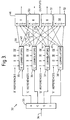
- FIG 3 illustrates an alternative embodiment of the invention, in which a genome pattern matching apparatus 32 comprises a decoder 33, similar to the decoder 10 of Figure 2, to which an input DNA sequence is fed via a line 34.
- the A,C,G and T outputs of the decoder 33 are fed to respective correlators 35-38, as before,but in this case each correlator has a plurality of reference sequences.
- each correlator is shown as having four reference sequences as I, II, III and IV, such that the sequences I of the four correlators together consitute a first reference DNA sequence section; the reference sequences II together constitute a second, different, reference DNA sequence section, and so on.
- the "A" channel correlator 35 comprises four masks or spatial light modulators, each associated with a respective row of CCDs of a two-dimensional CCD array. As each "A" input pulse is received by the correlator 35, the input pulse causes modulation of the output of four light sources, each associated with a respective one of the masks. The correlator therefore produces four "A” correlation signals which are fed out via respective output lines 39-42.
- the C, G and T correlators 36,37 and 38, respectively, operate in the same manner, so that each produces four outputs.
- the output on the line 39 and the outputs from the correlators 36, 37, and 38 on lines 43,44 and 45, respectively, all relating to the reference sequence I, are fed to a "sequence I" decision-making circuit 46.
- the outputs on lines 40,47,48 and 49 relating to the reference sequence II are fed to a decision-making circuit 50.
- the outputs relating to the reference sequences III and IV are fed to decision-making circuits 51 and 52.
- the circuits 46,50,51 and 52 all act in a similar manner to the circuit 31 of Figure 2 to produce outputs relating to matching or near matching of the input DNA sequence section with the respective reference sequence section I, II, III or IV. A number of reference sequence sections can thereby be searched for during a single pass of the input DNA sequence.
- the apparatus of the present invention would be used to find matches (or near matches) of a test sequence with a reference sequence.
- the optical processor is much faster than an electronic counterpart, so rapid matching is possible. Once a match or near-match is found, a more versatile all-electronic procedure might be used to analyse the matching part of the test sequence in more detail.
- the input to the decoder 10 or 34 could be taken from a computer memory such as a disc drive, or from a data communications link.
- the level of the cross-correlation signal for non-matching codes is reduced with respect to the near-matching or matching cases, thereby increasing the discrimination of the system.
Landscapes
- Physics & Mathematics (AREA)
- Life Sciences & Earth Sciences (AREA)
- Chemical & Material Sciences (AREA)
- Analytical Chemistry (AREA)
- Biophysics (AREA)
- Proteomics, Peptides & Aminoacids (AREA)
- Health & Medical Sciences (AREA)
- Engineering & Computer Science (AREA)
- Bioinformatics & Cheminformatics (AREA)
- Bioinformatics & Computational Biology (AREA)
- Biotechnology (AREA)
- Evolutionary Biology (AREA)
- General Health & Medical Sciences (AREA)
- Medical Informatics (AREA)
- Spectroscopy & Molecular Physics (AREA)
- Theoretical Computer Science (AREA)
- Measuring Or Testing Involving Enzymes Or Micro-Organisms (AREA)
- Management, Administration, Business Operations System, And Electronic Commerce (AREA)
- Image Analysis (AREA)
- Apparatus Associated With Microorganisms And Enzymes (AREA)
- Image Processing (AREA)
- Information Retrieval, Db Structures And Fs Structures Therefor (AREA)
Applications Claiming Priority (2)
| Application Number | Priority Date | Filing Date | Title |
|---|---|---|---|
| GB9017570A GB2246889A (en) | 1990-08-10 | 1990-08-10 | Pattern matching apparatus |
| GB9017570 | 1990-08-10 |
Publications (2)
| Publication Number | Publication Date |
|---|---|
| EP0474364A2 true EP0474364A2 (de) | 1992-03-11 |
| EP0474364A3 EP0474364A3 (en) | 1993-09-29 |
Family
ID=10680464
Family Applications (1)
| Application Number | Title | Priority Date | Filing Date |
|---|---|---|---|
| EP19910307207 Withdrawn EP0474364A3 (en) | 1990-08-10 | 1991-08-06 | Pattern matching apparatus |
Country Status (3)
| Country | Link |
|---|---|
| EP (1) | EP0474364A3 (de) |
| JP (1) | JPH0728972A (de) |
| GB (1) | GB2246889A (de) |
Families Citing this family (1)
| Publication number | Priority date | Publication date | Assignee | Title |
|---|---|---|---|---|
| RU2118844C1 (ru) * | 1997-10-30 | 1998-09-10 | Ростовское высшее военное командно-инженерное училище ракетных войск им.Неделина М.И. | Оптическое устройство для определения максимального сигнала |
-
1990
- 1990-08-10 GB GB9017570A patent/GB2246889A/en not_active Withdrawn
-
1991
- 1991-08-06 EP EP19910307207 patent/EP0474364A3/en not_active Withdrawn
- 1991-08-09 JP JP3223580A patent/JPH0728972A/ja active Pending
Non-Patent Citations (2)
| Title |
|---|
| PROCEEDINGS SPIE CONFERENCE DIGITAL AND OPTICAL SHAPE REPRESENTATION AND PATTERN RECOGNITION vol. 938, 4-6 April 1988, ORLANDO US pages 238 - 245 M.D. GILDNER ET AL. 'DNA sequence analysisby optical pattern recognition' * |
| PROCEEDINGS SPIE CONFERENCE OPTICAL INFORMATION-PROCESSING SYSTEMS AND ARCHITECTURES II vol. 1347, 9-12 July 1990, SAN DIEGO US pages 221 - 230 W.A. CHRISTENS-BARRY ET AL. 'Vander Lugt correlation of DNA sequence data' * |
Also Published As
| Publication number | Publication date |
|---|---|
| JPH0728972A (ja) | 1995-01-31 |
| GB9017570D0 (en) | 1990-09-26 |
| GB2246889A (en) | 1992-02-12 |
| EP0474364A3 (en) | 1993-09-29 |
Similar Documents
| Publication | Publication Date | Title |
|---|---|---|
| Matsumoto et al. | CNN cloning template: Connected component detector | |
| US5095459A (en) | Optical neural network | |
| US4567609A (en) | Automatic character recognition system | |
| US4470048A (en) | Range profile target classifier | |
| RU2001107130A (ru) | Способы и устройство связи, основанные на ортогональных последовательностях адамара, имеющих выбранные корреляционные свойства | |
| ES8701396A1 (es) | Un sistema de aprendizaje probabilistico | |
| GB2419208A (en) | Optical correlation employing an optical bit delay | |
| EP0036150A2 (de) | System zur Mustererkennung nach dem Mehrfach-Ähnlichkeitsverfahren | |
| US4743753A (en) | Method and apparatus for carrying out fiber optic time domain reflectomery wherein Golay complementary sequences are applied | |
| TW342478B (en) | Time series signal predicting apparatus | |
| US4651297A (en) | Two-dimensional image correlator | |
| EP0474364A2 (de) | Mustervergleichsvorrichtung | |
| US4641273A (en) | General time, space and frequency multiplexed acousto-optic correlator | |
| EP0910174A3 (de) | Einrichtung und Verfahren zur Spreizspektrumkommunikation mittels Kodesprungmodulation | |
| SE8500799D0 (sv) | Sett att identifiera foremal | |
| ATE203343T1 (de) | Verfahren zur detektion von coden in zweidimensionalen bildern | |
| CN101371489A (zh) | 模式匹配装置 | |
| EP0577687A1 (de) | Verfahren und anordnung zum identifikation | |
| US3816735A (en) | Multi-channel optical correlator system | |
| RU2105343C1 (ru) | Устройство для ситуационного управления | |
| US4510579A (en) | Fast correlation system | |
| WO1992011591A1 (en) | Optical processing system | |
| SU1501109A1 (ru) | Устройство дл селекции признаков изображений объектов | |
| JPS60153575A (ja) | 文字読取方法 | |
| CN114707154A (zh) | 一种基于序列模型的智能合约可重入漏洞检测方法及系统 |
Legal Events
| Date | Code | Title | Description |
|---|---|---|---|
| PUAI | Public reference made under article 153(3) epc to a published international application that has entered the european phase |
Free format text: ORIGINAL CODE: 0009012 |
|
| AK | Designated contracting states |
Kind code of ref document: A2 Designated state(s): CH DE FR LI |
|
| PUAL | Search report despatched |
Free format text: ORIGINAL CODE: 0009013 |
|
| AK | Designated contracting states |
Kind code of ref document: A3 Designated state(s): CH DE FR LI |
|
| STAA | Information on the status of an ep patent application or granted ep patent |
Free format text: STATUS: THE APPLICATION IS DEEMED TO BE WITHDRAWN |
|
| 18D | Application deemed to be withdrawn |
Effective date: 19940301 |