EP0473432B1 - Color printing - Google Patents
Color printing Download PDFInfo
- Publication number
- EP0473432B1 EP0473432B1 EP91307919A EP91307919A EP0473432B1 EP 0473432 B1 EP0473432 B1 EP 0473432B1 EP 91307919 A EP91307919 A EP 91307919A EP 91307919 A EP91307919 A EP 91307919A EP 0473432 B1 EP0473432 B1 EP 0473432B1
- Authority
- EP
- European Patent Office
- Prior art keywords
- color
- highlight
- highlight color
- colors
- image
- Prior art date
- Legal status (The legal status is an assumption and is not a legal conclusion. Google has not performed a legal analysis and makes no representation as to the accuracy of the status listed.)
- Expired - Lifetime
Links
- 239000003086 colorant Substances 0.000 claims description 99
- 238000013507 mapping Methods 0.000 claims description 59
- 229920006395 saturated elastomer Polymers 0.000 claims description 58
- 238000000034 method Methods 0.000 claims description 17
- 239000000976 ink Substances 0.000 description 9
- 230000006870 function Effects 0.000 description 7
- 238000004040 coloring Methods 0.000 description 5
- 239000000463 material Substances 0.000 description 4
- 238000004364 calculation method Methods 0.000 description 3
- 230000004069 differentiation Effects 0.000 description 3
- 238000003384 imaging method Methods 0.000 description 3
- 239000013598 vector Substances 0.000 description 3
- 238000010586 diagram Methods 0.000 description 2
- 244000025254 Cannabis sativa Species 0.000 description 1
- 241000533901 Narcissus papyraceus Species 0.000 description 1
- 238000012937 correction Methods 0.000 description 1
- 230000002708 enhancing effect Effects 0.000 description 1
- 238000002474 experimental method Methods 0.000 description 1
- 235000021384 green leafy vegetables Nutrition 0.000 description 1
- 230000003993 interaction Effects 0.000 description 1
- 239000000203 mixture Substances 0.000 description 1
- 230000007935 neutral effect Effects 0.000 description 1
- 230000008569 process Effects 0.000 description 1
- 238000012545 processing Methods 0.000 description 1
- 230000009467 reduction Effects 0.000 description 1
- 230000035945 sensitivity Effects 0.000 description 1
- 238000001228 spectrum Methods 0.000 description 1
- 230000009466 transformation Effects 0.000 description 1
Images





Classifications
-
- G—PHYSICS
- G01—MEASURING; TESTING
- G01D—MEASURING NOT SPECIALLY ADAPTED FOR A SPECIFIC VARIABLE; ARRANGEMENTS FOR MEASURING TWO OR MORE VARIABLES NOT COVERED IN A SINGLE OTHER SUBCLASS; TARIFF METERING APPARATUS; MEASURING OR TESTING NOT OTHERWISE PROVIDED FOR
- G01D15/00—Component parts of recorders for measuring arrangements not specially adapted for a specific variable
-
- H—ELECTRICITY
- H04—ELECTRIC COMMUNICATION TECHNIQUE
- H04N—PICTORIAL COMMUNICATION, e.g. TELEVISION
- H04N1/00—Scanning, transmission or reproduction of documents or the like, e.g. facsimile transmission; Details thereof
- H04N1/46—Colour picture communication systems
- H04N1/56—Processing of colour picture signals
-
- H—ELECTRICITY
- H04—ELECTRIC COMMUNICATION TECHNIQUE
- H04N—PICTORIAL COMMUNICATION, e.g. TELEVISION
- H04N1/00—Scanning, transmission or reproduction of documents or the like, e.g. facsimile transmission; Details thereof
- H04N1/46—Colour picture communication systems
- H04N1/56—Processing of colour picture signals
- H04N1/60—Colour correction or control
- H04N1/6058—Reduction of colour to a range of reproducible colours, e.g. to ink- reproducible colour gamut
Definitions
- the present invention relates to printing a highlight color image mapped from a full-color image and, more particularly, to highlight color printing which preserves information important to the viewer.
- Color images are a significant element in today's printing industry. As a result, electronic color printers and color image creation tools have been increasingly developed to obtain color images using electronic printing methods. Much color printing is performed using full color, the gamut of colors including tints and shades of the full color spectrum - reds, greens, blues and their combinations. A significant amount of color printing, however, can be performed using a highlight color. In this type of printing, only two inks are used in the printing process. These inks comprise black and a highlight color (usually red or blue). Electronic printers may be designed specifically for highlight color printing. The highlight color printer is generally faster and less expensive than the full-color printer since only two inks are processed, as opposed to the three or four inks which must be processed in order to obtain full-color images.
- the gamut of full colors is a three-dimensional volume which can be represented by the double hexagonal cone 10 illustrated in Figure 1 of the accompanying drawings.
- shades vary from dark to light as one moves upwards vertically.
- Tints vary from unsaturated grays to fullysaturated colors as one moves out radially.
- Hues vary as one moves angularly in the hexagonal central plane.
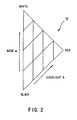
- the gamut of colors available to a highlight printer can be represented by the two-dimensional triangle 12 illustrated in Figure 2. This is a slice from the full color double hexagonal cone of Figure 1 at the angle of the highlight hue.
- Prior attempts to print a full-color image on a highlight color printer involved mapping the three-dimensional double hexagonal cone of Figure 1 to the two-dimensional triangle of Figure 2.
- the printer makes its best effort to render the highlight color image by mapping the full color specification into the set of colors which it can produce. In such a mapping, many different colors in the full-color space will be mapped to the same color in the highlight color space. Information important to the viewer is often lost.
- US-A-4,903,048 discloses color imaging using ink pattern designs in conjunction with registered two-color imaging to form simulated color images.
- a printing apparatus is described which is used to perform the two-color imaging.
- US-A-4,554,241 discloses a method of printing a realistic image of an original on a sheet. Two printing plates are used to print different impressions with two different coloring media.
- US-A-4,636,839 discloses a method and apparatus for generating color matte signals. RGB color components are calculated from hue, saturation and luminance value inputs. A new luminance value Y and color difference components CR and CB are calculated from these RGB values. Various algorithms are disclosed which are used for color calculation.
- US-A-4,670,780 discloses a method for matching hard copy colors to display colors for registered ink jet copiers.
- a color transformation for matching hard copy color to display color consists of an MSW color space which restricts the hard copy color to certain percentages of binary mixtures of inks (M), single inks (S) and paper white (W).
- Color data in XYZ are converted to the MSW space, and unreachable display colors are matched into reachable hard copy colors. Corrections for color shifts because of interactions of the inks are also disclosed.
- US-A-4,761,669 discloses an electrophotographic highlight color printing machine in which printing is done in at least two different colors. Methods for transferring multiple color images simultaneously are disclosed.
- US-A-4,682,186 discloses a method for forming a color image by using a plurality of coloring materials and controlling quantities of the coloring materials. When a density to be reproduced exceeds the density reproducible for that coloring material, the quantities of other coloring materials are reduced.
- US-A-4,907,078 discloses a method of reproducing color images wherein two charge-coupled devices of different wavelengths are used to scan a full-color document. The outputs of the charge-coupled devices are fed into a lookup table to determine the appropriate color in a two-color system. The output from the table is then recorded on a piece of paper. The system can be used for any type of copier.
- US-A-4,894,665 discloses a method of generating an expanded color set of a low resolution color printer wherein a four-color printer can be expanded to twelve colors by printing a black dot next to a line to make the line seem darker. Two algorithms are provided for determining whether or not a line is critical and for enhancing a line.
- US-A-4,908,779 discloses a display pattern processing apparatus wherein a system can be programmed to convert a full-color image into a number of other formats. An example is shown wherein an RGB image is converted into a two-color image.
- the present invention provides a mapping of full color images to highlight color images in which information important to the viewer is preserved.
- the fully-saturated color for any given hue in the full-color image is mapped to the apex of a color triangle, the position of the apex varying according to hue, and the apex being at some point within a triangle of printable colors.
- the set of the apex points for different hues describes the set of highlight colors generated by the mapping of fully-saturated colors.
- the fully saturated colors slide around a locus curve until the hue of the highlight color is mapped to the right-most apex of the highlight gamut triangle.
- the mapping is performed such that there is no more highlight color in the mapped image than is present in the original full color image.
- Triangle 14 defines the highlight color space comprising the different colors available to a highlight printer.
- Triangle 14 has an apex 16 corresponding to the fully-saturated hue of the highlight color.
- Points 18 and 20 define the amounts of white and black, respectively, available to a highlight color printer.
- the triangle of possible colors 14 will be mapped to a triangle of printable colors 22.
- the fully-saturated color for the given hue maps to the apex 24 of the result color triangle 22.
- the position of apex 24 varies according to hue. If the hue matches that of highlight color, the apex 24 of the result color triangle 22 will coincide with the apex 16 of the triangle of possible colors 14, and the mapping will be the identity. For other hues, the apex 24 will be at some point within the triangle 14 of possible colors.
- the set of the apex points for different hues defines the set of highlight colors generated by the mapping of fully-saturated colors.
- the information which should be preserved depends upon how the color is being used. For pictorial images, most of the information lies in the luminance. For this reason, black and white photographs are easily recognizable. The hue in pictorial images is of secondary importance. For example, it is desirable to view a color image in which the sky is blue, the grass is green and faces are of flesh tones.
- the information derived is from the presence or absence of color rather than a gray level.
- a colored area with the same luminance as a gray area should look different.
- Highlight color documents may also vary in saturation.
- the function MAX returns the maximum of its arguments
- the function MIN returns the minimum of its arguments.
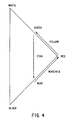
- Figure 4 illustrates the locus of mapping fully-saturated colors as set forth in the above example.
- the arrows define the path of the apex corresponding to fully-saturated colors for given hues.
- every mapped fully-saturated color is unique. Excellent results are achieved for presentation graphics applications. Any non-gray color is mapped to a non-gray result, and lightness saturation behavior is preserved. This provides very good results for highlight color applications.
- Luminance accounts for white and black, but luminance also includes the eye's sensitivity to different hues (for example, blue looks darker than yellow). While a picture is quite recognizable, dark hues such as blue may be mapped to lighter colors than light hues such as yellow. Even more significant are some unpleasant color shifts. As an example, when blue highlight color is used, unnatural blue flesh tones can be obtained in a mapped highlight color image.
- mapping better suited for pictorial images using a red highlight color is herein described.
- the luminance of the original image is preserved.
- the function MAX returns the maximum of its arguments and the function MIN returns the minimum of its arguments.
- Figure 5 illustrates the locus of fully-saturated colors using this mapping particularly applicable to pictorial images.
- mappings can be used to also improve the behavior of presentation graphics. As indicated above, this mapping would also preserve the luminance and restrict the amount of highlight color to no more than is present in the original full-color image. In addition, however, further small reductions can be made in the amount of highlight color as a function of hue in order to disambiguate fully-saturated colors which would otherwise be indistinguishable.
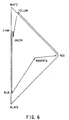
- Figure 6 illustrates the locus of fully-saturated colors for the above described example of mapping full color images to highlight color images particularly applicable to both pictorial images and presentation graphics. Improved behavior is achieved in colors which mapped to the same result in the previous example. The removal of ambiguities enables fully-saturated colors in the mapped image to be further distinguished while preserving luminance and restricting the amount of highlight color to no more than is present in the original full-color image.
- mappings are used to map full-color images to red highlight color images
- the mappings can be generalized to enable mapping from full-color images to arbitrary highlight color images, not just red highlight color images.
- Mapping to arbitrary highlight color images also preserves the general luminance and saturation behavior and maps fully-saturated colors to a continuous, unique collection of highlight colors.
- Figure 7 illustrates the locus of fully-saturated colors especially for an arbitrary highlight hue.
- the fully-saturated colors are slid around the locus triangle of Figure 7 until the hue at the right-most apex of thetriangle corresponds to that of the arbitrary highlight color.
- An operation for the reorientation of saturated colors can be carried out by a simple computer algorithm based on the definition of hue proposed by A. R. Smith in "Color Gamut Transform Pairs", Computer Graphics, Vol. 12, No. 3, pp. 12-19 (1978).
- a hue value in the range [0,6] is determined by adding a number based on which of the r, g, b components is largest, to an offset based on the relative strength of the second largest component.
- red (1,0,0) has hue
- green (0,1,0) has hue 2
- blue (0,0, 1) has hue 4.
- the secondary colors yellow, cyan, and magenta have values 1, 3, and 5 respectively.
- the algorithm uses a hue difference equal to the hue of a sample color minus the hue of the highlight color.
- a hue difference of 0 indicates that the sample color matches the hue of the highlight color. If the sample color is fully saturated (at least one of its r, g, b components is 1 and at least one is 0) and the sample matches the highlight hue, then it will be mapped to the right-most apex of the triangle in highlight space. Following around the hexagon of fully-saturated colors shown in Figure 8 from the highlight color gives an increasing hue difference from 0 to 6, corresponding to the desired slide of the saturated colors around the locus triangle.
- the implementation takes the form of nested conditionals yielding six cases corresponding to the six possible orderings of relative strengths of the three color components.
- the implementation calculates the variable hdiff which is the hue difference multiplied by the amount of chrominance d, since this is what is ultimately needed, and combining the computations avoids a division.
- the amount of highlight color and white (or black) can be determined from the amount of chrominance and white in the original sample and the position of the corresponding fully-saturated color.
- a program fragment written in the C programming language which does this is:
- variable hlhue which is derived from the highlight color as indicated below:
- the program also contains a scale factor n which determines the size of the triangle formed by the locus of saturated colors.
- hlhue the value of hlhue can be computed.
- n the desired size parameter n, when known, can be used to simplify some of the indicated arithmetic in the program fragment defined above. This should be done to reduce the amount of calculation required for mapping an individual color.
- mapping is particularly effective for presentation graphics. It preserves the relative lightness behavior but does not completely preserve luminance. All saturated colors are mapped to different non-neutral colors in the highlight color plane. The mapping differentiates colors as well as indicates that the areas were colored in the original full color image.
- Full-color pictorial images can be mapped into arbitrary highlight colors while preserving luminance and including no more of the highlight color than was present in the full color image. To achieve this, however, one must define how much of one color is present in another color.
- One way this can be achieved is by expressing colors in the original full-color image and in the highlight color in the YES coordinate system.
- Y is the luminance
- E and S are the chrominance components.
- the E coordinate is the red-green scale
- the S coordinate is the yellow-blue scale.
- the measure of color similarity is based on the chrominance components.
- Y 0.253r + 0.684g + 0.063b
- E (r- g)/2
- S (r + g)/4 - b/2
- the cube of the cosine function is used to measure the similarity of colors by determining the cosine of the angle between chrominance vectors.
- This cosine measure gives 1 when the colors are aligned, and reduces to 0 when the vectors are at right angles. It is easily calculated from the dot product of the vectors.
- the cosine measure gives the projection of one color onto another.
- Figure 9 illustrates the locus of fully-saturated colors for a red highlight color obtained using the mapping.
- mapping of pictorial images preserves the luminance, while ensuring that there is no more highlight color in the mapped image than is present in the full color image and while generating natural looking pictorial images.
- Figure 10 is a block diagram of a printer 100 which maps full-color images to highlight color images.
- Printer 100 contains a computer 110 which determines the coordinates required for the above-described image mappings. Once these coordinates are determined, computer 110 controls printer 100 to generate the mapped images.
- a printing apparatus such as that described in US-A-4,903,048 can be used to accomplish the mapping operation of the present invention.
- mappings from full-color to highlight color as described above provide excellent results for both pictorial image and presentation graphics applications.
- the shades and tints for each hue are mapped to a corresponding triangle of colors in the plane of the highlight hue.
- the apex of the triangle of result colors is varied within the triangle of possible result colors according to hue. Differentiations are provided in the result color for the fully-saturated cases while preserving relative saturation and lightness behavior.
- the triangle of result colors can exactly match the triangle of possible colors when the original hue matches the highlight hue, thereby specifying highlight colors in a manner consistent with full-color specifications.
- mappings based on maximum and minimum functions are provided when the highlight color used is red. More general mappings are further provided which are used for arbitrary highlight colors.
- mappings do not exclude alternative mappings which preserve lightness and saturation behavior by mapping the colors of a given hue to a triangle of colors within the highlight gamut.
Landscapes
- Engineering & Computer Science (AREA)
- Multimedia (AREA)
- Signal Processing (AREA)
- Physics & Mathematics (AREA)
- General Physics & Mathematics (AREA)
- Facsimile Image Signal Circuits (AREA)
- Color Image Communication Systems (AREA)
- Image Processing (AREA)
- Processing Of Color Television Signals (AREA)
Description
- The present invention relates to printing a highlight color image mapped from a full-color image and, more particularly, to highlight color printing which preserves information important to the viewer.
- Color images are a significant element in today's printing industry. As a result, electronic color printers and color image creation tools have been increasingly developed to obtain color images using electronic printing methods. Much color printing is performed using full color, the gamut of colors including tints and shades of the full color spectrum - reds, greens, blues and their combinations. A significant amount of color printing, however, can be performed using a highlight color. In this type of printing, only two inks are used in the printing process. These inks comprise black and a highlight color (usually red or blue). Electronic printers may be designed specifically for highlight color printing. The highlight color printer is generally faster and less expensive than the full-color printer since only two inks are processed, as opposed to the three or four inks which must be processed in order to obtain full-color images.
- The gamut of full colors is a three-dimensional volume which can be represented by the double
hexagonal cone 10 illustrated in Figure 1 of the accompanying drawings. In this representation, shades vary from dark to light as one moves upwards vertically. Tints vary from unsaturated grays to fullysaturated colors as one moves out radially. Hues vary as one moves angularly in the hexagonal central plane. - The gamut of colors available to a highlight printer can be represented by the two-
dimensional triangle 12 illustrated in Figure 2. This is a slice from the full color double hexagonal cone of Figure 1 at the angle of the highlight hue. - Prior attempts to print a full-color image on a highlight color printer involved mapping the three-dimensional double hexagonal cone of Figure 1 to the two-dimensional triangle of Figure 2. The printer makes its best effort to render the highlight color image by mapping the full color specification into the set of colors which it can produce. In such a mapping, many different colors in the full-color space will be mapped to the same color in the highlight color space. Information important to the viewer is often lost.
- US-A-4,903,048 discloses color imaging using ink pattern designs in conjunction with registered two-color imaging to form simulated color images. A printing apparatus is described which is used to perform the two-color imaging.
- US-A-4,554,241 discloses a method of printing a realistic image of an original on a sheet. Two printing plates are used to print different impressions with two different coloring media.
- US-A-4,636,839 discloses a method and apparatus for generating color matte signals. RGB color components are calculated from hue, saturation and luminance value inputs. A new luminance value Y and color difference components CR and CB are calculated from these RGB values. Various algorithms are disclosed which are used for color calculation.
- US-A-4,670,780 discloses a method for matching hard copy colors to display colors for registered ink jet copiers. A color transformation for matching hard copy color to display color consists of an MSW color space which restricts the hard copy color to certain percentages of binary mixtures of inks (M), single inks (S) and paper white (W). Color data in XYZ are converted to the MSW space, and unreachable display colors are matched into reachable hard copy colors. Corrections for color shifts because of interactions of the inks are also disclosed.
- US-A-4,761,669 discloses an electrophotographic highlight color printing machine in which printing is done in at least two different colors. Methods for transferring multiple color images simultaneously are disclosed.
- US-A-4,682,186 discloses a method for forming a color image by using a plurality of coloring materials and controlling quantities of the coloring materials. When a density to be reproduced exceeds the density reproducible for that coloring material, the quantities of other coloring materials are reduced.
- US-A-4,907,078 discloses a method of reproducing color images wherein two charge-coupled devices of different wavelengths are used to scan a full-color document. The outputs of the charge-coupled devices are fed into a lookup table to determine the appropriate color in a two-color system. The output from the table is then recorded on a piece of paper. The system can be used for any type of copier.
- US-A-4,894,665 discloses a method of generating an expanded color set of a low resolution color printer wherein a four-color printer can be expanded to twelve colors by printing a black dot next to a line to make the line seem darker. Two algorithms are provided for determining whether or not a line is critical and for enhancing a line.
- US-A-4,908,779 discloses a display pattern processing apparatus wherein a system can be programmed to convert a full-color image into a number of other formats. An example is shown wherein an RGB image is converted into a two-color image.
- While the related art attempts to map a full-color image to a highlight color image, it does not recognize that certain information from the full-color image should be preserved, depending upon how the color is being used and what type of image is being created. Accordingly, information is lost in these devices.
- Accordingly the present invention provides a mapping of full color images to highlight color images in which information important to the viewer is preserved. The fully-saturated color for any given hue in the full-color image is mapped to the apex of a color triangle, the position of the apex varying according to hue, and the apex being at some point within a triangle of printable colors. The set of the apex points for different hues describes the set of highlight colors generated by the mapping of fully-saturated colors. For an arbitrary highlight hue, the fully saturated colors slide around a locus curve until the hue of the highlight color is mapped to the right-most apex of the highlight gamut triangle. In creating pictorial images, the mapping is performed such that there is no more highlight color in the mapped image than is present in the original full color image.
- The basic inventive concept is claimed in
independent claims 1,5,6,9,13 and 14. - The invention will be described by way of example with reference to the accompanying drawings, in which like reference numerals refer to like elements and wherein:
- Figure 1 illustrates a three-dimensional full-color space;
- Figure 2 illustrates a two-dimensional triangle of colors available to a highlight printer;
- Figure 3 illustrates a two-dimensional triangle of colors printable by a highlight color printer for any given hue;
- Figure 4 illustrates a locus of mapping fully-saturated colors;
- Figure 5 illustrates an alternative locus of fully-saturated colors especially useful for pictorial images;
- Figure 6 illustrates an alternative locus of fully-saturated colors especially useful for both pictorial and presentation graphics;
- Figure 7 illustrates a locus of fully-saturated colors especially useful for presentation graphics images for an arbitrary highlight color;
- Figure 8 illustrates a hexagon of fully-saturated colors;
- Figure 9 illustrates a locus of fully saturated colors especially useful for pictorial images for an arbitrary highlight color, and
- Figure 10 is a block diagram of a device for mapping a full color image to a highlight color image.
- Referring now to the drawings, and particularly to Figure 3 thereof, the mapping of full-color images to highlight color images is described. Triangle 14 defines the highlight color space comprising the different colors available to a highlight printer.
Triangle 14 has anapex 16 corresponding to the fully-saturated hue of the highlight color.Points - To preserve information desirable in both presentation graphics and pictorial image applications, it is desirable to derive diverse colors for fully-saturated hues in the full-color image while still preserving the basic luminance and saturation behavior. For any given hue, the triangle of
possible colors 14 will be mapped to a triangle ofprintable colors 22. The fully-saturated color for the given hue maps to the apex 24 of theresult color triangle 22. The position ofapex 24 varies according to hue. If the hue matches that of highlight color, the apex 24 of theresult color triangle 22 will coincide with the apex 16 of the triangle ofpossible colors 14, and the mapping will be the identity. For other hues, the apex 24 will be at some point within thetriangle 14 of possible colors. The set of the apex points for different hues defines the set of highlight colors generated by the mapping of fully-saturated colors. - The information which should be preserved depends upon how the color is being used. For pictorial images, most of the information lies in the luminance. For this reason, black and white photographs are easily recognizable. The hue in pictorial images is of secondary importance. For example, it is desirable to view a color image in which the sky is blue, the grass is green and faces are of flesh tones.
- When color is used to highlight an image, the information derived is from the presence or absence of color rather than a gray level. A colored area with the same luminance as a gray area should look different. Highlight color documents may also vary in saturation.
- In presentation graphics such as graphs and charts, by contrast, most of the information is in the hue. In this application, one usually selects strongly saturated colors for impact, using hue to differentiate them. An example of a mapping particularly applicable to presentation graphics is now described. In this example, red is used as the highlight color of the printer. The red, green and blue coordinates (r, g and b) of the full color image are determined. Each coordinate ranges between 0 and 1, with 0 meaning no color (black) and 1 meaning full color. Once the respective amounts of the red, green and blue coordinates of the full color image are determined, the resulting highlight color image can be determined by specifying the amounts of highlight color (h), white (w) and black (k) in the highlight color image in accordance with:

- The function MAX returns the maximum of its arguments, and the function MIN returns the minimum of its arguments.
- Figure 4 illustrates the locus of mapping fully-saturated colors as set forth in the above example. The arrows define the path of the apex corresponding to fully-saturated colors for given hues. In this mapping, every mapped fully-saturated color is unique. Excellent results are achieved for presentation graphics applications. Any non-gray color is mapped to a non-gray result, and lightness saturation behavior is preserved. This provides very good results for highlight color applications.
- As discussed above, it is important to preserve luminance in pictorial applications. While the above example preserves the relative lightness behavior, it is not as effective in preserving luminance. Luminance accounts for white and black, but luminance also includes the eye's sensitivity to different hues (for example, blue looks darker than yellow). While a picture is quite recognizable, dark hues such as blue may be mapped to lighter colors than light hues such as yellow. Even more significant are some unpleasant color shifts. As an example, when blue highlight color is used, unnatural blue flesh tones can be obtained in a mapped highlight color image.
- An example of a mapping better suited for pictorial images using a red highlight color is herein described. Using this type of mapping, the luminance of the original image is preserved. In addition, there is never more highlight color present in the resultant highlight color image than the amount of that hue present in the original full-color image. The luminance of the original full color image depends on the basic colors of the rgb color coordinates, but can be approximated by:


- Figure 5 illustrates the locus of fully-saturated colors using this mapping particularly applicable to pictorial images.
- A slight variation in this mapping can be used to also improve the behavior of presentation graphics. As indicated above, this mapping would also preserve the luminance and restrict the amount of highlight color to no more than is present in the original full-color image. In addition, however, further small reductions can be made in the amount of highlight color as a function of hue in order to disambiguate fully-saturated colors which would otherwise be indistinguishable.
- For this mapping, also using red as the highlight color, the following two constraints are added to the determination of the resulting mapped highlight color image:



- Figure 6 illustrates the locus of fully-saturated colors for the above described example of mapping full color images to highlight color images particularly applicable to both pictorial images and presentation graphics. Improved behavior is achieved in colors which mapped to the same result in the previous example. The removal of ambiguities enables fully-saturated colors in the mapped image to be further distinguished while preserving luminance and restricting the amount of highlight color to no more than is present in the original full-color image.
- While the above-described mappings are used to map full-color images to red highlight color images, the mappings can be generalized to enable mapping from full-color images to arbitrary highlight color images, not just red highlight color images. Mapping to arbitrary highlight color images also preserves the general luminance and saturation behavior and maps fully-saturated colors to a continuous, unique collection of highlight colors.
- Figure 7 illustrates the locus of fully-saturated colors especially for an arbitrary highlight hue. To generalize to the arbitrary highlight hue, the fully-saturated colors are slid around the locus triangle of Figure 7 until the hue at the right-most apex of thetriangle corresponds to that of the arbitrary highlight color.
- An operation for the reorientation of saturated colors can be carried out by a simple computer algorithm based on the definition of hue proposed by A. R. Smith in "Color Gamut Transform Pairs", Computer Graphics, Vol. 12, No. 3, pp. 12-19 (1978). A hue value in the range [0,6] is determined by adding a number based on which of the r, g, b components is largest, to an offset based on the relative strength of the second largest component. Under this definition, red (1,0,0) has hue 0, green (0,1,0) has hue 2 and blue (0,0, 1) has hue 4. The secondary colors yellow, cyan, and magenta have values 1, 3, and 5 respectively.
- The algorithm uses a hue difference equal to the hue of a sample color minus the hue of the highlight color. A hue difference of 0 indicates that the sample color matches the hue of the highlight color. If the sample color is fully saturated (at least one of its r, g, b components is 1 and at least one is 0) and the sample matches the highlight hue, then it will be mapped to the right-most apex of the triangle in highlight space. Following around the hexagon of fully-saturated colors shown in Figure 8 from the highlight color gives an increasing hue difference from 0 to 6, corresponding to the desired slide of the saturated colors around the locus triangle. Assuming a fixed sample (r, g, b), there is a corresponding fully-saturated color x and its hue difference, a corresponding point on the locus triangle (hxwx) and thus a triangle into which the sample must be mapped.
- The mapped result for a sample color (r, g, b) depends upon: the amount of white in the sample, given by the minimum component m = MIN(r,g,b); the amount of color in the sample, given by the difference d = MAX(r,g,b)-m; and the position of the apex point in highlight-white coordinates (hx, wx). The amount of highlight is the amount of color scaled by the highlight component of the apex, h = d hx. The amount of white is the amount of white in the sample plus a term for the white shift of the apex, w = m + d wx.
- The implementation takes the form of nested conditionals yielding six cases corresponding to the six possible orderings of relative strengths of the three color components. One can determine the hue for a sample color and subtract from it the hue of the highlight color. The resulting difference can then be used to determine the point of the fully-saturated color. The value 0 always corresponds to the right-most apex of the triangle. The implementation calculates the variable hdiff which is the hue difference multiplied by the amount of chrominance d, since this is what is ultimately needed, and combining the computations avoids a division. Finally, the amount of highlight color and white (or black) can be determined from the amount of chrominance and white in the original sample and the position of the corresponding fully-saturated color. A program fragment written in the C programming language which does this is:


- The program makes use of the variable hlhue which is derived from the highlight color as indicated below:

- The program also contains a scale factor n which determines the size of the triangle formed by the locus of saturated colors. To replicate the simple mapping given in the first example for red highlight, one would use hlhue = 0 and n = 0.5. Experiments with various other highlight hues indicate that the value n = 0.5 may actually be smaller than the optimum. Increasing this value increases the differentiation of the saturated colors at the expense of colors available for the mapping of the unsaturated colors. A value of n = 0.75 gives better results. Note that a value of n = 1 would map the locus of saturated colors to the boundary of producible colors. This would give maximum differentiation of the saturated colors, but would map a third of all color space into gray.
- Once the highlight color is known, the value of hlhue can be computed. This result and the desired size parameter n, when known, can be used to simplify some of the indicated arithmetic in the program fragment defined above. This should be done to reduce the amount of calculation required for mapping an individual color.
- Note that some assumptions have been made to simplify this mapping. It is assumed that the sample colors have coordinates in the range [0,1] and no provisions have been made for out-of-gamut colors. Also, in order for the samples that match the highlight color to pass through this mapping unchanged, the highlight color must lie on the gamut boundary.
- The above-described mapping is particularly effective for presentation graphics. It preserves the relative lightness behavior but does not completely preserve luminance. All saturated colors are mapped to different non-neutral colors in the highlight color plane. The mapping differentiates colors as well as indicates that the areas were colored in the original full color image.
- Full-color pictorial images can be mapped into arbitrary highlight colors while preserving luminance and including no more of the highlight color than was present in the full color image. To achieve this, however, one must define how much of one color is present in another color. One way this can be achieved is by expressing colors in the original full-color image and in the highlight color in the YES coordinate system. In this coordinate system, Y is the luminance and E and S are the chrominance components. The E coordinate is the red-green scale, and the S coordinate is the yellow-blue scale. Using this coördinate system, the measure of color similarity is based on the chrominance components. The Y, E and S are determined in accordance with:


- The cube of the cosine function is used to measure the similarity of colors by determining the cosine of the angle between chrominance vectors. This cosine measure gives 1 when the colors are aligned, and reduces to 0 when the vectors are at right angles. It is easily calculated from the dot product of the vectors. The cosine measure gives the projection of one color onto another. The YES coordinates of the highlight color YhEhSh, and the YES coordinates of the sample color YsEsSs, are used to obtain the following cosine cubed mapping to highlight and white amounts h and w, respectively:


- The above-described mapping of pictorial images preserves the luminance, while ensuring that there is no more highlight color in the mapped image than is present in the full color image and while generating natural looking pictorial images.
- Figure 10 is a block diagram of a
printer 100 which maps full-color images to highlight color images.Printer 100 contains acomputer 110 which determines the coordinates required for the above-described image mappings. Once these coordinates are determined,computer 110controls printer 100 to generate the mapped images. A printing apparatus, such as that described in US-A-4,903,048 can be used to accomplish the mapping operation of the present invention. - The mappings from full-color to highlight color as described above provide excellent results for both pictorial image and presentation graphics applications. The shades and tints for each hue are mapped to a corresponding triangle of colors in the plane of the highlight hue. The apex of the triangle of result colors is varied within the triangle of possible result colors according to hue. Differentiations are provided in the result color for the fully-saturated cases while preserving relative saturation and lightness behavior. The triangle of result colors can exactly match the triangle of possible colors when the original hue matches the highlight hue, thereby specifying highlight colors in a manner consistent with full-color specifications.
- Simple mappings based on maximum and minimum functions are provided when the highlight color used is red. More general mappings are further provided which are used for arbitrary highlight colors.
- Just as several illustrative mappings were presented, many are possible giving different tradeoffs of image quality, ease of calculation, generality and information preserved. Thus, the exemplary mappings do not exclude alternative mappings which preserve lightness and saturation behavior by mapping the colors of a given hue to a triangle of colors within the highlight gamut.
Claims (16)
- A method of mapping a full-color image to a highlight color image producible by a highlight color printer (100) which can print in only two colors, comprising the steps of:defining a substantially planar triangular color space (14) comprising a complete set of possible colors available to the highlight color printer, the triangular color space having a base (w) defined between two points (18,20), representing no color and a fully saturated first highlight color, and an apex (16) corresponding to a fully saturated second highlight color (h) of the highlight color printer;determining, within the triangular color space, a location (24) of a fully-saturated color for any given hue in the full-color image; andmapping a color space for the given hue to a triangle (22) of printable colors by the highlight color printer, the triangle of printable colors being a subset of the triangular color space and having its apex (24) coinciding with the location of the fully-saturated color of the given hue.
- The method as claimed in claim 1, further comprising the steps of:selecting black as the first highlight color;selecting red as the second highlight color; andmapping to the triangle of printable colors by:a) determining the respective amounts of the red, green and blue coordinates (r, g, b) in the full-color image, each coordinate ranging between 0 and 1, andb) determining a resulting highlight color image by specifying the amounts of highlight color (h), white (w) and black (k) in the highlight color image in accordance with:


- The method as claimed in claim 1, further comprising the steps of:preserving the luminance of the full-color image in the mapped image, wherein the luminance (y) is determined by:
 a) determining the respective amounts of the red, green and blue coöordinates (r,g,b) in the full-color image, each coördinate ranging between 0 and 1, andb) determining a resulting mapped highlight color image by determining highlight color (h), white (w) and black (k) in accordance with:
- The method as claimed in claim 3, further comprising the step of:
distinguishing fully-saturated colors in the mapped image by determining the resulting mapped highlight color image by determining h in accordance with:
- A method of mapping a full-color image to an arbitrary highlight color image producible by a highlight color printer which can print in only two colors, comprising the steps of:defining a substantially-planar triangular color space comprising a complete set of possible colors for a highlight color printer, the triangular color space having a base (w) defined between two points (18,20), representing no color and a fully saturated first highlight color, and an apex (16) corresponding to a fully saturated second highlight color (h) of the highlight color printer;defining, in the color space, a locus curve of fully-saturated colors;identifying the hue of the highlight color of the printer;sliding the fully-saturated colors around the locus curve until the hue at an extreme point of the curve relative to the white/black axis corresponds to the hue of the highlight color, andmapping the color space into a triangle of printable colors by the highlight color printer for a given hue, the triangle being a subset of the color space and having its apex coinciding with the location of a fully-saturated color of the given hue.
- A method of mapping a full-color image to a highlight color image producible by a highlight color printer which can print in only two colors, comprising the steps of:expressing the highlight color and a given color of the full-color image in color coordinates of a YES color coordinate system determined by the following formulas:Y (luminance) = 0.253r + 0.684g + 0.063b;E (chrominance component red-green scale) = (r - g)/2;S (chrominance component yellow-blue scale) = (r + 9)/4 - b/2; andusing the color coordinates of the highlight color (YhEhSh) and the given color (YsEsSs) to map the full-color image to a highlight color image;wherein pictorial images are generated such that there is no more highlight color in the mapped image than is present in the full-color image.
- The method as claimed in claim 6, further comprising the steps of:
determining the respective amounts of the red, green and blue coördinates (r, g, b) in the highlight color and the given color, each coordinate ranging between 0 and 1. - The method as claimed in claim 7, further comprising the step of:
mapping the full-color image to the highlight color image by specifying the amounts of highlight color (h), white (w) and black (k) in the highlight color image in accordance with:
- Apparatus for mapping a full-color image to a highlight color image producible by a highlight color printer which can print in only two colors, comprising:means for defining a substantially-planar triangular color space comprising a complete set of possible colors for a highlight color printer, the triangular color space having a base (w) defined between two points (18,20), representing no color and a fully saturated first highlight color, and an apex (16) corresponding to a fully saturated second highlight color (h) of the highlight color printer;means for determining within the triangular color space the location of a fully-saturated color for any given hue in the full-color image, andmeans for mapping the color space for the given hue to a triangle of printable colors by the highlight color printer, the triangle being a subset of the color space and having its apex coinciding with the location of the fully-saturated color of the given hue.
- The apparatus as claimed in claim 9, further comprising:means for specifying red as the highlight color; andthe mapping means including:a) means for determining the respective amounts of the red, green and blue coördinates (r, g, b) in the full-color image, each coördinate ranging between 0 and 1; andb) means for determining a resulting highlight color image by specifying the amounts of highlight color (h), white (w) and black (k) in the highlight color image in accordance with:

- The apparatus as claimed in claim 9, further comprising:means for preserving the luminance of the full-color image in the mapped image, wherein the luminance (y) is determined by:
 the preserving means including:a) means for determining the respective amounts of the red, green and blue coördinates (r,g,b) in the full color image, each coördinate ranging between 0 and 1; andb) means for determining a resulting mapped highlight color image by determining highlight color (h), white (w) and black (k) in accordance with:
- The apparatus as claimed in claim 11, further comprising:
means for distinguishing fully-saturated colors in the mapped image by determining the resulting mapped highlight color image by determining h in accordance with:
- Apparatus for mapping a full color image to an arbitrary highlight color image producible by a highlight color printer which can print in only two colors, comprising:first means for defining a substantially planar triangular color space comprising a complete set of possible colors for a highlight color printer, the triangular color space having a base (w) defined between two points (18,20), representing no color and a fully saturated first highlight color, and an apex (16) corresponding to a fully saturated second highlight color (h) of the highlight color printer;second means for defining, in the color space, a locus curve of fully-saturated colors;means for identifying the hue of the highlight color of the printer;means for sliding the fully-saturated colors around the locus curve until the hue at an extreme point of the curve remote from the black/white axis corresponds to the hue of the highlight color, andmeans for mapping the color space for a given hue into a triangle of printable colors by the highlight color printer, the triangle being a subset of the color space and having its apex coinciding with the location of a fully-saturated color of the given hue.
- Apparatus for mapping a full-color image to a highlight color image producible by a highlight color printer which can print in only two colors, comprising:means for expressing the highlight color and a given color of the full-color image in color coordinates of a YES color coordinate system determined by the following formulas:Y (luminance) = 0.253r + 0.684g + 0.063b;E (chrominance component red-green scale) = (r - g)/2;S (chrominance component yellow-blue scale) = (r + g)/4 - b/2; and means for using the color coordinates of the highlight color (YhEhSh) and the given color (YsEsSs) to map the full-color image to a highlight color image;wherein pictorial images are generated such that there is no more highlight color in the mapped image than is present in the full-color image.
- The apparatus as claimed in claim 14, further comprising:
means for determining the respective amounts of the red, green and blue coordinates (r, g, b) in the highlight color and the given color, each coördinate (r, g, b) ranging between 0 and 1. - The apparatus as claimed in claim 15, further comprising:
means for mapping the full-color image to the highlight color image by specifying the amounts of highlight color (h), white (w) and black (k) in the highlight color image in accordance with:


Applications Claiming Priority (2)
| Application Number | Priority Date | Filing Date | Title |
|---|---|---|---|
| US07/574,145 US5237517A (en) | 1990-08-29 | 1990-08-29 | Color printing having a highlight color image mapped from a full color image |
| US574145 | 1990-08-29 |
Publications (3)
| Publication Number | Publication Date |
|---|---|
| EP0473432A2 EP0473432A2 (en) | 1992-03-04 |
| EP0473432A3 EP0473432A3 (en) | 1992-08-26 |
| EP0473432B1 true EP0473432B1 (en) | 1997-06-25 |
Family
ID=24294870
Family Applications (1)
| Application Number | Title | Priority Date | Filing Date |
|---|---|---|---|
| EP91307919A Expired - Lifetime EP0473432B1 (en) | 1990-08-29 | 1991-08-29 | Color printing |
Country Status (4)
| Country | Link |
|---|---|
| US (1) | US5237517A (en) |
| EP (1) | EP0473432B1 (en) |
| JP (1) | JP3102808B2 (en) |
| DE (1) | DE69126647T2 (en) |
Cited By (1)
| Publication number | Priority date | Publication date | Assignee | Title |
|---|---|---|---|---|
| WO2004017034A1 (en) | 2002-07-26 | 2004-02-26 | Koenig & Bauer Aktiengesellschaft | Method for analyzing the color deviations in images using an image sensor |
Families Citing this family (43)
| Publication number | Priority date | Publication date | Assignee | Title |
|---|---|---|---|---|
| US5349451A (en) * | 1992-10-29 | 1994-09-20 | Linotype-Hell Ag | Method and apparatus for processing color values |
| JP3210099B2 (en) * | 1992-11-05 | 2001-09-17 | キヤノン株式会社 | Image processing apparatus and image processing method |
| US5612795A (en) * | 1992-11-12 | 1997-03-18 | Linotype-Hell Ag | HSL corrections in CMY color space |
| US5680230A (en) * | 1993-09-09 | 1997-10-21 | Canon Kabushiki Kaisha | Image processing method and apparatus thereof |
| US5588093A (en) * | 1993-12-17 | 1996-12-24 | Xerox Corporation | Color mapping to preserve detail |
| US5574666A (en) * | 1994-05-13 | 1996-11-12 | Canon Information Systems, Inc. | Color printing method and apparatus using gamut mapping in Munsell space |
| AUPN113395A0 (en) * | 1995-02-14 | 1995-03-09 | Canon Information Systems Research Australia Pty Ltd | Colour conversion method |
| US5668636A (en) * | 1995-12-20 | 1997-09-16 | Xerox Corporation | Embedded data controlled digital highlight color copier |
| US5699277A (en) * | 1996-01-02 | 1997-12-16 | Intel Corporation | Method and apparatus for source clipping a video image in a video delivery system |
| US6046118A (en) * | 1996-08-02 | 2000-04-04 | E. I. Du Pont De Nemours And Company | Composite sheet material |
| US6185013B1 (en) * | 1996-12-23 | 2001-02-06 | Xerox Corporation | Color printing having a plural highlight color image map in a full color image |
| JPH11313219A (en) * | 1998-01-20 | 1999-11-09 | Fujitsu Ltd | Color data conversion method |
| US6633407B1 (en) * | 1998-04-29 | 2003-10-14 | Lg Electronics, Inc. | HMMD color space and method for quantizing color using HMMD space and color spreading |
| US6498868B1 (en) | 1998-06-11 | 2002-12-24 | Xerox Corporation | Image scaling using pattern matching to select among scaling algorithms |
| US6252580B1 (en) | 1998-07-09 | 2001-06-26 | Xerox Corporation | Mapping highlight colors to black-and-white textures |
| US6115493A (en) * | 1998-08-05 | 2000-09-05 | Xerox Corporation | Technique for fast computation of highlight color mappings |
| US6426802B1 (en) * | 1999-01-19 | 2002-07-30 | Xerox Corporation | Complementary halftone screens for highlight printing |
| KR100512118B1 (en) * | 1999-06-10 | 2005-09-02 | 엘지전자 주식회사 | Method of quantization being the best suited in a color space |
| US6721069B1 (en) | 1999-10-28 | 2004-04-13 | Xerox Corporation | Mapping from full color to highlight color and texture |
| US6833937B1 (en) * | 2000-01-21 | 2004-12-21 | Lexmark International, Inc. | Methods and apparatus for color mapping |
| DE10008286C1 (en) * | 2000-02-23 | 2001-09-13 | Oce Printing Systems Gmbh | Process for printing an image in two colors |
| US6775028B1 (en) | 2000-02-24 | 2004-08-10 | Lexmark International, Inc. | Non-linear method of mapping the lightness and chroma of a display device gamut onto a printing device gamut |
| DE10017830A1 (en) * | 2000-04-10 | 2001-10-11 | Oce Printing Systems Gmbh | Process for mapping color values of a color image onto the color values of a highlight color image |
| DE10017831B4 (en) * | 2000-04-10 | 2006-09-07 | OCé PRINTING SYSTEMS GMBH | Method and system for editing a color conversion table |
| US6972869B2 (en) * | 2000-12-18 | 2005-12-06 | Xerox Corporation | Mapping color to colorant amounts when colorants have similar hue |
| US6989839B2 (en) * | 2003-06-19 | 2006-01-24 | Xerox Corporation | Method for converting color to monochrome to maintain differentiability |
| US7505171B2 (en) * | 2003-08-27 | 2009-03-17 | Xerox Corporation | Full user-intent color data stream imaging methods and systems |
| JP4313130B2 (en) * | 2003-09-18 | 2009-08-12 | 株式会社リコー | Image forming apparatus, image forming method, and program for executing the method by computer |
| US7145656B2 (en) * | 2003-12-15 | 2006-12-05 | E. I. Du Pont De Nemours And Company | Computer-implemented method for matching paint |
| US7583837B2 (en) * | 2004-01-15 | 2009-09-01 | Xerox Corporation | Method and system for preparing grayscale image files for highlight printing on a four color printer |
| US7616342B2 (en) * | 2004-12-03 | 2009-11-10 | Xerox Corporation | Mechanism for allowing content-independent imaging date stream object usage |
| DE102005040339B4 (en) * | 2005-08-25 | 2007-08-02 | OCé PRINTING SYSTEMS GMBH | Method for mapping color values of a color image to the color values of a highlight color image with at least two highlight color colors and corresponding printing system |
| US7324768B2 (en) * | 2005-09-29 | 2008-01-29 | Lexmark International, Inc. | Method and device for determining one or more operating points in an image forming device |
| US7835031B2 (en) * | 2007-03-23 | 2010-11-16 | Xerox Corporation | Output pure color tints or black for full-color input |
| US7760937B2 (en) * | 2007-03-29 | 2010-07-20 | Xerox Corporation | Automatic conversion of full color images to highlight color images |
| US8064691B2 (en) * | 2007-05-15 | 2011-11-22 | Creative Lifestyle, Inc. | Method for identifying color in machine and computer vision applications |
| US9536322B1 (en) | 2007-05-15 | 2017-01-03 | Peter Harmon Smith | Implementation of multi-camera tracking applications using rich color transition curve target sequences |
| US8526717B2 (en) | 2007-05-15 | 2013-09-03 | Vision Interface Technologies, LLC | Rich color transition curve tracking method |
| US8339662B2 (en) * | 2007-09-27 | 2012-12-25 | Xerox Corporation | HLC images from a color scanning system |
| DE102009017516A1 (en) | 2009-04-20 | 2010-10-28 | OCé PRINTING SYSTEMS GMBH | Method for printing full color object as highlight-color object, involves creating print job with full-color object, where print job is delivered in standardized printing data language to printing system |
| DE102010007348A1 (en) | 2010-02-09 | 2011-08-11 | Chromasens GmbH, 78467 | Method for scanning two-dimensional image in office, involves combining individual image excerpts to objective image with higher resolution transverse to travelling direction than resolution of individual line arrays |
| JP5968617B2 (en) | 2011-12-13 | 2016-08-10 | 武蔵エンジニアリング株式会社 | Clamp for piping connection |
| JP2023013472A (en) * | 2021-07-16 | 2023-01-26 | セイコーエプソン株式会社 | printer |
Citations (2)
| Publication number | Priority date | Publication date | Assignee | Title |
|---|---|---|---|---|
| US4758885A (en) * | 1985-06-17 | 1988-07-19 | Canon Kabushiki Kaisha | Method of processing color image |
| EP0321983A2 (en) * | 1987-12-23 | 1989-06-28 | Minolta Camera Kabushiki Kaisha | Method for processing color image and apparatus therefor |
Family Cites Families (11)
| Publication number | Priority date | Publication date | Assignee | Title |
|---|---|---|---|---|
| JPS6098764A (en) * | 1983-11-04 | 1985-06-01 | Canon Inc | Color picture forming method |
| US4554241A (en) * | 1984-04-02 | 1985-11-19 | Wallace Edwards | Color reproduction process |
| GB2158319A (en) * | 1984-04-26 | 1985-11-06 | Philips Electronic Associated | A method of and apparatus for generating colour matte signals |
| US4908779A (en) * | 1985-04-02 | 1990-03-13 | Nec Corporation | Display pattern processing apparatus |
| US4670780A (en) * | 1985-05-28 | 1987-06-02 | Tektronix, Inc. | Method of matching hardcopy colors to video display colors in which unreachable video display colors are converted into reachable hardcopy colors in a mixture-single-white (MSW) color space |
| JPS6260359A (en) * | 1985-09-11 | 1987-03-17 | Ricoh Co Ltd | Method for processing color picture information |
| US4933878A (en) * | 1988-07-07 | 1990-06-12 | Texas Instruments Incorporated | Graphics data processing apparatus having non-linear saturating operations on multibit color data |
| US4751535A (en) * | 1986-10-15 | 1988-06-14 | Xerox Corporation | Color-matched printing |
| US4761669A (en) * | 1987-05-21 | 1988-08-02 | Xerox Corporation | Highlight color printing |
| US4903048A (en) * | 1988-11-28 | 1990-02-20 | Xerox Corporation | Simulated color imaging using only two different colorants/toners |
| US4894665A (en) * | 1989-04-20 | 1990-01-16 | Honeywell Inc. | Method of generating an expanded color set of a low resolution color printer |
-
1990
- 1990-08-29 US US07/574,145 patent/US5237517A/en not_active Expired - Lifetime
-
1991
- 1991-08-22 JP JP03211121A patent/JP3102808B2/en not_active Expired - Fee Related
- 1991-08-29 EP EP91307919A patent/EP0473432B1/en not_active Expired - Lifetime
- 1991-08-29 DE DE69126647T patent/DE69126647T2/en not_active Expired - Fee Related
Patent Citations (2)
| Publication number | Priority date | Publication date | Assignee | Title |
|---|---|---|---|---|
| US4758885A (en) * | 1985-06-17 | 1988-07-19 | Canon Kabushiki Kaisha | Method of processing color image |
| EP0321983A2 (en) * | 1987-12-23 | 1989-06-28 | Minolta Camera Kabushiki Kaisha | Method for processing color image and apparatus therefor |
Cited By (3)
| Publication number | Priority date | Publication date | Assignee | Title |
|---|---|---|---|---|
| WO2004017034A1 (en) | 2002-07-26 | 2004-02-26 | Koenig & Bauer Aktiengesellschaft | Method for analyzing the color deviations in images using an image sensor |
| US7609878B2 (en) | 2002-07-26 | 2009-10-27 | Koenig & Bauer Aktiengesellschaft | Method for analyzing the color deviations in images using an image sensor |
| EP1525442B1 (en) * | 2002-07-26 | 2011-06-01 | Koenig & Bauer Aktiengesellschaft | Method for analyzing the color deviations in images using an image sensor |
Also Published As
| Publication number | Publication date |
|---|---|
| JP3102808B2 (en) | 2000-10-23 |
| DE69126647D1 (en) | 1997-07-31 |
| US5237517A (en) | 1993-08-17 |
| EP0473432A3 (en) | 1992-08-26 |
| EP0473432A2 (en) | 1992-03-04 |
| JPH04234262A (en) | 1992-08-21 |
| DE69126647T2 (en) | 1997-12-11 |
Similar Documents
| Publication | Publication Date | Title |
|---|---|---|
| US5237517A (en) | Color printing having a highlight color image mapped from a full color image | |
| EP1427184B1 (en) | Color gamut mapping using a cost function | |
| EP0929190B1 (en) | Method and apparatus for correcting luminance and chrominance data in digital color images | |
| EP1014685B1 (en) | Dynamic optimized color LUT transformations based upon image requirements | |
| JP4234281B2 (en) | Printing system | |
| US5305119A (en) | Color printer calibration architecture | |
| EP0676892B1 (en) | Color printer calibration with improved color mapping linearity | |
| US6185013B1 (en) | Color printing having a plural highlight color image map in a full color image | |
| US6781716B1 (en) | Color conversion method, color conversion apparatus, and color conversion definition storage medium | |
| EP0998131A2 (en) | Color printing system and method | |
| EP0611230A1 (en) | Method and associated apparatus for transforming input color values in an input color space to output color values in an output color space | |
| US20030072016A1 (en) | Color conversion with hue straightening using multiple look-up tables and interpolation | |
| US5710872A (en) | Color image recording device, system, and method | |
| US7123391B2 (en) | Color image processing method and apparatus | |
| JP2001045310A (en) | Image processing apparatus, method, and recording medium | |
| US20070030498A1 (en) | Color processing method and apparatus | |
| US7835031B2 (en) | Output pure color tints or black for full-color input | |
| JP3794182B2 (en) | Color image signal processing apparatus and color image signal processing method | |
| EP1483897A1 (en) | Choice of chromophores in two color imaging systems | |
| EP0996281A2 (en) | Color image processing method and system | |
| JP4380503B2 (en) | Lookup table creation method and separation method | |
| EP1830556B1 (en) | Multicolorant separation system and method. | |
| Iwata et al. | Computer simulation of printed colors on textile materials | |
| JP3412699B2 (en) | Image forming device | |
| JPH06268855A (en) | Color image forming device |
Legal Events
| Date | Code | Title | Description |
|---|---|---|---|
| PUAI | Public reference made under article 153(3) epc to a published international application that has entered the european phase |
Free format text: ORIGINAL CODE: 0009012 |
|
| AK | Designated contracting states |
Kind code of ref document: A2 Designated state(s): DE FR GB IT |
|
| PUAL | Search report despatched |
Free format text: ORIGINAL CODE: 0009013 |
|
| AK | Designated contracting states |
Kind code of ref document: A3 Designated state(s): DE FR GB IT |
|
| 17P | Request for examination filed |
Effective date: 19930203 |
|
| 17Q | First examination report despatched |
Effective date: 19950223 |
|
| GRAG | Despatch of communication of intention to grant |
Free format text: ORIGINAL CODE: EPIDOS AGRA |
|
| GRAH | Despatch of communication of intention to grant a patent |
Free format text: ORIGINAL CODE: EPIDOS IGRA |
|
| GRAH | Despatch of communication of intention to grant a patent |
Free format text: ORIGINAL CODE: EPIDOS IGRA |
|
| GRAA | (expected) grant |
Free format text: ORIGINAL CODE: 0009210 |
|
| AK | Designated contracting states |
Kind code of ref document: B1 Designated state(s): DE FR GB IT |
|
| REF | Corresponds to: |
Ref document number: 69126647 Country of ref document: DE Date of ref document: 19970731 |
|
| ITF | It: translation for a ep patent filed | ||
| ET | Fr: translation filed | ||
| PLBE | No opposition filed within time limit |
Free format text: ORIGINAL CODE: 0009261 |
|
| STAA | Information on the status of an ep patent application or granted ep patent |
Free format text: STATUS: NO OPPOSITION FILED WITHIN TIME LIMIT |
|
| 26N | No opposition filed | ||
| REG | Reference to a national code |
Ref country code: GB Ref legal event code: IF02 |
|
| PGFP | Annual fee paid to national office [announced via postgrant information from national office to epo] |
Ref country code: FR Payment date: 20060808 Year of fee payment: 16 |
|
| PGFP | Annual fee paid to national office [announced via postgrant information from national office to epo] |
Ref country code: GB Payment date: 20060823 Year of fee payment: 16 |
|
| PGFP | Annual fee paid to national office [announced via postgrant information from national office to epo] |
Ref country code: DE Payment date: 20060824 Year of fee payment: 16 |
|
| PGFP | Annual fee paid to national office [announced via postgrant information from national office to epo] |
Ref country code: IT Payment date: 20060831 Year of fee payment: 16 |
|
| GBPC | Gb: european patent ceased through non-payment of renewal fee |
Effective date: 20070829 |
|
| REG | Reference to a national code |
Ref country code: FR Ref legal event code: ST Effective date: 20080430 |
|
| PG25 | Lapsed in a contracting state [announced via postgrant information from national office to epo] |
Ref country code: DE Free format text: LAPSE BECAUSE OF NON-PAYMENT OF DUE FEES Effective date: 20080301 |
|
| PG25 | Lapsed in a contracting state [announced via postgrant information from national office to epo] |
Ref country code: FR Free format text: LAPSE BECAUSE OF NON-PAYMENT OF DUE FEES Effective date: 20070831 |
|
| PG25 | Lapsed in a contracting state [announced via postgrant information from national office to epo] |
Ref country code: GB Free format text: LAPSE BECAUSE OF NON-PAYMENT OF DUE FEES Effective date: 20070829 |
|
| PG25 | Lapsed in a contracting state [announced via postgrant information from national office to epo] |
Ref country code: IT Free format text: LAPSE BECAUSE OF NON-PAYMENT OF DUE FEES Effective date: 20070829 |