EP0470634B1 - Producing para-aramid pulp by means of gravity-induced shear forces - Google Patents
Producing para-aramid pulp by means of gravity-induced shear forces Download PDFInfo
- Publication number
- EP0470634B1 EP0470634B1 EP91113389A EP91113389A EP0470634B1 EP 0470634 B1 EP0470634 B1 EP 0470634B1 EP 91113389 A EP91113389 A EP 91113389A EP 91113389 A EP91113389 A EP 91113389A EP 0470634 B1 EP0470634 B1 EP 0470634B1
- Authority
- EP
- European Patent Office
- Prior art keywords
- solution
- para
- pulp
- gel
- conveyer
- Prior art date
- Legal status (The legal status is an assumption and is not a legal conclusion. Google has not performed a legal analysis and makes no representation as to the accuracy of the status listed.)
- Expired - Lifetime
Links
- 229920003235 aromatic polyamide Polymers 0.000 title claims description 47
- 230000005484 gravity Effects 0.000 title claims description 7
- 239000000499 gel Substances 0.000 claims description 87
- 229920000642 polymer Polymers 0.000 claims description 67
- 238000000034 method Methods 0.000 claims description 54
- -1 poly(p-phenylene terephthalamide) Polymers 0.000 claims description 22
- 239000007788 liquid Substances 0.000 claims description 20
- 150000004820 halides Chemical class 0.000 claims description 19
- 238000006116 polymerization reaction Methods 0.000 claims description 18
- 238000005520 cutting process Methods 0.000 claims description 17
- 230000000379 polymerizing effect Effects 0.000 claims description 16
- 239000002904 solvent Substances 0.000 claims description 15
- 125000003118 aryl group Chemical group 0.000 claims description 14
- 150000004984 aromatic diamines Chemical class 0.000 claims description 10
- 229920003366 poly(p-phenylene terephthalamide) Polymers 0.000 claims description 8
- 239000006193 liquid solution Substances 0.000 claims description 7
- 238000004519 manufacturing process Methods 0.000 claims description 7
- 150000001408 amides Chemical class 0.000 claims description 6
- 238000013019 agitation Methods 0.000 claims 1
- 230000003287 optical effect Effects 0.000 claims 1
- 239000000243 solution Substances 0.000 description 193
- 238000011534 incubation Methods 0.000 description 19
- 239000000835 fiber Substances 0.000 description 17
- 238000006243 chemical reaction Methods 0.000 description 12
- XLYOFNOQVPJJNP-UHFFFAOYSA-N water Substances O XLYOFNOQVPJJNP-UHFFFAOYSA-N 0.000 description 12
- 239000000725 suspension Substances 0.000 description 11
- IJGRMHOSHXDMSA-UHFFFAOYSA-N Atomic nitrogen Chemical compound N#N IJGRMHOSHXDMSA-UHFFFAOYSA-N 0.000 description 10
- 239000002253 acid Substances 0.000 description 8
- 150000004985 diamines Chemical class 0.000 description 8
- LXEJRKJRKIFVNY-UHFFFAOYSA-N terephthaloyl chloride Chemical compound ClC(=O)C1=CC=C(C(Cl)=O)C=C1 LXEJRKJRKIFVNY-UHFFFAOYSA-N 0.000 description 8
- SECXISVLQFMRJM-UHFFFAOYSA-N N-Methylpyrrolidone Chemical compound CN1CCCC1=O SECXISVLQFMRJM-UHFFFAOYSA-N 0.000 description 6
- CBCKQZAAMUWICA-UHFFFAOYSA-N 1,4-phenylenediamine Chemical compound NC1=CC=C(N)C=C1 CBCKQZAAMUWICA-UHFFFAOYSA-N 0.000 description 5
- 229920002313 fluoropolymer Polymers 0.000 description 5
- 239000004811 fluoropolymer Substances 0.000 description 5
- 229910052757 nitrogen Inorganic materials 0.000 description 5
- 239000000376 reactant Substances 0.000 description 5
- QAOWNCQODCNURD-UHFFFAOYSA-N Sulfuric acid Chemical compound OS(O)(=O)=O QAOWNCQODCNURD-UHFFFAOYSA-N 0.000 description 4
- 229920001577 copolymer Polymers 0.000 description 4
- 238000002955 isolation Methods 0.000 description 4
- 230000033001 locomotion Effects 0.000 description 4
- 239000000463 material Substances 0.000 description 4
- 238000002156 mixing Methods 0.000 description 4
- 238000006386 neutralization reaction Methods 0.000 description 4
- UXVMQQNJUSDDNG-UHFFFAOYSA-L Calcium chloride Chemical compound [Cl-].[Cl-].[Ca+2] UXVMQQNJUSDDNG-UHFFFAOYSA-L 0.000 description 3
- 229920001730 Moisture cure polyurethane Polymers 0.000 description 3
- 239000004760 aramid Substances 0.000 description 3
- 229910001628 calcium chloride Inorganic materials 0.000 description 3
- 239000001110 calcium chloride Substances 0.000 description 3
- 230000001112 coagulating effect Effects 0.000 description 3
- 238000010924 continuous production Methods 0.000 description 3
- 238000001125 extrusion Methods 0.000 description 3
- 238000010438 heat treatment Methods 0.000 description 3
- 239000000203 mixture Substances 0.000 description 3
- 239000013055 pulp slurry Substances 0.000 description 3
- 238000001179 sorption measurement Methods 0.000 description 3
- 238000009987 spinning Methods 0.000 description 3
- 229910001508 alkali metal halide Inorganic materials 0.000 description 2
- 150000008045 alkali metal halides Chemical class 0.000 description 2
- 239000012670 alkaline solution Substances 0.000 description 2
- 230000005540 biological transmission Effects 0.000 description 2
- 206010061592 cardiac fibrillation Diseases 0.000 description 2
- 239000002131 composite material Substances 0.000 description 2
- 238000001816 cooling Methods 0.000 description 2
- 238000009826 distribution Methods 0.000 description 2
- 230000002600 fibrillogenic effect Effects 0.000 description 2
- 238000010528 free radical solution polymerization reaction Methods 0.000 description 2
- 239000011521 glass Substances 0.000 description 2
- 229920001519 homopolymer Polymers 0.000 description 2
- 238000005259 measurement Methods 0.000 description 2
- 238000002360 preparation method Methods 0.000 description 2
- 239000011541 reaction mixture Substances 0.000 description 2
- 238000007670 refining Methods 0.000 description 2
- 238000005549 size reduction Methods 0.000 description 2
- 238000003756 stirring Methods 0.000 description 2
- 125000001424 substituent group Chemical group 0.000 description 2
- 125000000542 sulfonic acid group Chemical group 0.000 description 2
- 238000010998 test method Methods 0.000 description 2
- AVQQQNCBBIEMEU-UHFFFAOYSA-N 1,1,3,3-tetramethylurea Chemical compound CN(C)C(=O)N(C)C AVQQQNCBBIEMEU-UHFFFAOYSA-N 0.000 description 1
- 125000001989 1,3-phenylene group Chemical group [H]C1=C([H])C([*:1])=C([H])C([*:2])=C1[H] 0.000 description 1
- WZCQRUWWHSTZEM-UHFFFAOYSA-N 1,3-phenylenediamine Chemical compound NC1=CC=CC(N)=C1 WZCQRUWWHSTZEM-UHFFFAOYSA-N 0.000 description 1
- 125000001140 1,4-phenylene group Chemical group [H]C1=C([H])C([*:2])=C([H])C([H])=C1[*:1] 0.000 description 1
- IQNTUYCIRRCRDY-UHFFFAOYSA-N 2,5-dichlorobenzene-1,4-dicarbonyl chloride Chemical compound ClC(=O)C1=CC(Cl)=C(C(Cl)=O)C=C1Cl IQNTUYCIRRCRDY-UHFFFAOYSA-N 0.000 description 1
- 125000004959 2,6-naphthylene group Chemical group [H]C1=C([H])C2=C([H])C([*:1])=C([H])C([H])=C2C([H])=C1[*:2] 0.000 description 1
- MGLZGLAFFOMWPB-UHFFFAOYSA-N 2-chloro-1,4-phenylenediamine Chemical compound NC1=CC=C(N)C(Cl)=C1 MGLZGLAFFOMWPB-UHFFFAOYSA-N 0.000 description 1
- MSWAXXJAPIGEGZ-UHFFFAOYSA-N 2-chlorobenzene-1,4-dicarbonyl chloride Chemical compound ClC(=O)C1=CC=C(C(Cl)=O)C(Cl)=C1 MSWAXXJAPIGEGZ-UHFFFAOYSA-N 0.000 description 1
- OBCSAIDCZQSFQH-UHFFFAOYSA-N 2-methyl-1,4-phenylenediamine Chemical compound CC1=CC(N)=CC=C1N OBCSAIDCZQSFQH-UHFFFAOYSA-N 0.000 description 1
- NTNUPCREDHXJEL-UHFFFAOYSA-N 2-methylbenzene-1,4-dicarbonyl chloride Chemical compound CC1=CC(C(Cl)=O)=CC=C1C(Cl)=O NTNUPCREDHXJEL-UHFFFAOYSA-N 0.000 description 1
- NDXGRHCEHPFUSU-UHFFFAOYSA-N 3-(3-aminophenyl)aniline Chemical group NC1=CC=CC(C=2C=C(N)C=CC=2)=C1 NDXGRHCEHPFUSU-UHFFFAOYSA-N 0.000 description 1
- NZUHAGMVTPMOIV-UHFFFAOYSA-N 3-(3-carbonochloridoylphenoxy)benzoyl chloride Chemical compound ClC(=O)C1=CC=CC(OC=2C=C(C=CC=2)C(Cl)=O)=C1 NZUHAGMVTPMOIV-UHFFFAOYSA-N 0.000 description 1
- NMTYZEFTDQDWBF-UHFFFAOYSA-N 3-(3-carbonochloridoylphenyl)sulfonylbenzoyl chloride Chemical compound ClC(=O)C1=CC=CC(S(=O)(=O)C=2C=C(C=CC=2)C(Cl)=O)=C1 NMTYZEFTDQDWBF-UHFFFAOYSA-N 0.000 description 1
- QSPMTSAELLSLOQ-UHFFFAOYSA-N 3-(4-aminophenyl)aniline Chemical group C1=CC(N)=CC=C1C1=CC=CC(N)=C1 QSPMTSAELLSLOQ-UHFFFAOYSA-N 0.000 description 1
- CGRZXNMHQUZZDX-UHFFFAOYSA-N 3-(4-carbonochloridoylphenoxy)benzoyl chloride Chemical compound C1=CC(C(=O)Cl)=CC=C1OC1=CC=CC(C(Cl)=O)=C1 CGRZXNMHQUZZDX-UHFFFAOYSA-N 0.000 description 1
- IRULYGRXMPOARD-UHFFFAOYSA-N 3-(4-carbonochloridoylphenyl)sulfonylbenzoyl chloride Chemical compound C1=CC(C(=O)Cl)=CC=C1S(=O)(=O)C1=CC=CC(C(Cl)=O)=C1 IRULYGRXMPOARD-UHFFFAOYSA-N 0.000 description 1
- OSUWBBMPVXVSOA-UHFFFAOYSA-N 4-(4-carbonochloridoylphenoxy)benzoyl chloride Chemical compound C1=CC(C(=O)Cl)=CC=C1OC1=CC=C(C(Cl)=O)C=C1 OSUWBBMPVXVSOA-UHFFFAOYSA-N 0.000 description 1
- QDBOAKPEXMMQFO-UHFFFAOYSA-N 4-(4-carbonochloridoylphenyl)benzoyl chloride Chemical compound C1=CC(C(=O)Cl)=CC=C1C1=CC=C(C(Cl)=O)C=C1 QDBOAKPEXMMQFO-UHFFFAOYSA-N 0.000 description 1
- ACJYZTIHYXBBSN-UHFFFAOYSA-N 4-(4-carbonochloridoylphenyl)sulfonylbenzoyl chloride Chemical compound C1=CC(C(=O)Cl)=CC=C1S(=O)(=O)C1=CC=C(C(Cl)=O)C=C1 ACJYZTIHYXBBSN-UHFFFAOYSA-N 0.000 description 1
- WRDNCFQZLUCIRH-UHFFFAOYSA-N 4-(7-azabicyclo[2.2.1]hepta-1,3,5-triene-7-carbonyl)benzamide Chemical compound C1=CC(C(=O)N)=CC=C1C(=O)N1C2=CC=C1C=C2 WRDNCFQZLUCIRH-UHFFFAOYSA-N 0.000 description 1
- XPAQFJJCWGSXGJ-UHFFFAOYSA-N 4-amino-n-(4-aminophenyl)benzamide Chemical compound C1=CC(N)=CC=C1NC(=O)C1=CC=C(N)C=C1 XPAQFJJCWGSXGJ-UHFFFAOYSA-N 0.000 description 1
- VSCADKGMBQAGNC-UHFFFAOYSA-N 4-aminobenzoyl chloride;hydrochloride Chemical compound Cl.NC1=CC=C(C(Cl)=O)C=C1 VSCADKGMBQAGNC-UHFFFAOYSA-N 0.000 description 1
- DIPZEIHGILEXRR-UHFFFAOYSA-N 6-aminonaphthalene-2-carbonyl chloride;hydrochloride Chemical compound Cl.C1=C(C(Cl)=O)C=CC2=CC(N)=CC=C21 DIPZEIHGILEXRR-UHFFFAOYSA-N 0.000 description 1
- 229920000271 Kevlar® Polymers 0.000 description 1
- FXHOOIRPVKKKFG-UHFFFAOYSA-N N,N-Dimethylacetamide Chemical compound CN(C)C(C)=O FXHOOIRPVKKKFG-UHFFFAOYSA-N 0.000 description 1
- 238000010521 absorption reaction Methods 0.000 description 1
- 230000002411 adverse Effects 0.000 description 1
- 125000000217 alkyl group Chemical group 0.000 description 1
- 150000001412 amines Chemical group 0.000 description 1
- 239000010425 asbestos Substances 0.000 description 1
- FDQSRULYDNDXQB-UHFFFAOYSA-N benzene-1,3-dicarbonyl chloride Chemical compound ClC(=O)C1=CC=CC(C(Cl)=O)=C1 FDQSRULYDNDXQB-UHFFFAOYSA-N 0.000 description 1
- HFACYLZERDEVSX-UHFFFAOYSA-N benzidine Chemical group C1=CC(N)=CC=C1C1=CC=C(N)C=C1 HFACYLZERDEVSX-UHFFFAOYSA-N 0.000 description 1
- 230000015572 biosynthetic process Effects 0.000 description 1
- 125000001309 chloro group Chemical group Cl* 0.000 description 1
- 239000000470 constituent Substances 0.000 description 1
- 238000007796 conventional method Methods 0.000 description 1
- 230000001419 dependent effect Effects 0.000 description 1
- 229940113088 dimethylacetamide Drugs 0.000 description 1
- 238000004090 dissolution Methods 0.000 description 1
- 229920001971 elastomer Polymers 0.000 description 1
- 239000000806 elastomer Substances 0.000 description 1
- 230000001747 exhibiting effect Effects 0.000 description 1
- 239000007789 gas Substances 0.000 description 1
- 238000001879 gelation Methods 0.000 description 1
- 238000000227 grinding Methods 0.000 description 1
- 239000011261 inert gas Substances 0.000 description 1
- 230000000977 initiatory effect Effects 0.000 description 1
- 239000004761 kevlar Substances 0.000 description 1
- 238000012886 linear function Methods 0.000 description 1
- 229940018564 m-phenylenediamine Drugs 0.000 description 1
- 238000012423 maintenance Methods 0.000 description 1
- 125000000956 methoxy group Chemical group [H]C([H])([H])O* 0.000 description 1
- KQSABULTKYLFEV-UHFFFAOYSA-N naphthalene-1,5-diamine Chemical compound C1=CC=C2C(N)=CC=CC2=C1N KQSABULTKYLFEV-UHFFFAOYSA-N 0.000 description 1
- XYQUZYVBQYBQDB-UHFFFAOYSA-N naphthalene-1,5-dicarbonyl chloride Chemical compound C1=CC=C2C(C(=O)Cl)=CC=CC2=C1C(Cl)=O XYQUZYVBQYBQDB-UHFFFAOYSA-N 0.000 description 1
- GOGZBMRXLADNEV-UHFFFAOYSA-N naphthalene-2,6-diamine Chemical compound C1=C(N)C=CC2=CC(N)=CC=C21 GOGZBMRXLADNEV-UHFFFAOYSA-N 0.000 description 1
- NZZGQZMNFCTNAM-UHFFFAOYSA-N naphthalene-2,6-dicarbonyl chloride Chemical compound C1=C(C(Cl)=O)C=CC2=CC(C(=O)Cl)=CC=C21 NZZGQZMNFCTNAM-UHFFFAOYSA-N 0.000 description 1
- 239000002245 particle Substances 0.000 description 1
- 230000000704 physical effect Effects 0.000 description 1
- 239000002685 polymerization catalyst Substances 0.000 description 1
- 238000004886 process control Methods 0.000 description 1
- 230000001681 protective effect Effects 0.000 description 1
- 238000010926 purge Methods 0.000 description 1
- 239000012744 reinforcing agent Substances 0.000 description 1
- 229910052895 riebeckite Inorganic materials 0.000 description 1
- 239000007787 solid Substances 0.000 description 1
- 229910001220 stainless steel Inorganic materials 0.000 description 1
- 239000010935 stainless steel Substances 0.000 description 1
- 239000000126 substance Substances 0.000 description 1
- 238000003828 vacuum filtration Methods 0.000 description 1
- YSGSDAIMSCVPHG-UHFFFAOYSA-N valyl-methionine Chemical compound CSCCC(C(O)=O)NC(=O)C(N)C(C)C YSGSDAIMSCVPHG-UHFFFAOYSA-N 0.000 description 1
- 238000005406 washing Methods 0.000 description 1
- 238000002166 wet spinning Methods 0.000 description 1
Images

Classifications
-
- D—TEXTILES; PAPER
- D01—NATURAL OR MAN-MADE THREADS OR FIBRES; SPINNING
- D01D—MECHANICAL METHODS OR APPARATUS IN THE MANUFACTURE OF ARTIFICIAL FILAMENTS, THREADS, FIBRES, BRISTLES OR RIBBONS
- D01D5/00—Formation of filaments, threads, or the like
- D01D5/38—Formation of filaments, threads, or the like during polymerisation
-
- D—TEXTILES; PAPER
- D01—NATURAL OR MAN-MADE THREADS OR FIBRES; SPINNING
- D01D—MECHANICAL METHODS OR APPARATUS IN THE MANUFACTURE OF ARTIFICIAL FILAMENTS, THREADS, FIBRES, BRISTLES OR RIBBONS
- D01D5/00—Formation of filaments, threads, or the like
- D01D5/40—Formation of filaments, threads, or the like by applying a shearing force to a dispersion or solution of filament formable polymers, e.g. by stirring
-
- D—TEXTILES; PAPER
- D01—NATURAL OR MAN-MADE THREADS OR FIBRES; SPINNING
- D01F—CHEMICAL FEATURES IN THE MANUFACTURE OF ARTIFICIAL FILAMENTS, THREADS, FIBRES, BRISTLES OR RIBBONS; APPARATUS SPECIALLY ADAPTED FOR THE MANUFACTURE OF CARBON FILAMENTS
- D01F6/00—Monocomponent artificial filaments or the like of synthetic polymers; Manufacture thereof
- D01F6/58—Monocomponent artificial filaments or the like of synthetic polymers; Manufacture thereof from homopolycondensation products
- D01F6/60—Monocomponent artificial filaments or the like of synthetic polymers; Manufacture thereof from homopolycondensation products from polyamides
- D01F6/605—Monocomponent artificial filaments or the like of synthetic polymers; Manufacture thereof from homopolycondensation products from polyamides from aromatic polyamides
Definitions
- the present invention relates to a method for producing para-aramid pulp by means of gravity-induced shear forces and pulp made thereby.
- para-aramid pulp such as the poly(p-phenylene terephthalamide) pulp sold under the trademark Kevlar R by E. I. du Pont de Nemours & Co. has been steadily increasing. Due to its high temperature stability, strength and wear resistance, para-aramid pulp is increasingly being used in brake linings and gaskets to replace asbestos. Para-aramid pulp is used in newly-developed papers, laminates and composites for applications requiring high strength and temperature stability; and para-aramid pulp is finding use as a reinforcing agent in composite elastomer structures such as in tires and hoses and the like.
- para-aramid pulp is produced by spinning oriented, continuous fibers of the para-aramid polymer in accordance with a dry-jet wet spinning process such as that disclosed in U.S. Pat. No. 3,767,756 and then mechanically converting the fibers into pulp.
- the spinning of para-aramid fibers is an expensive and complicated process.
- the present invention provides a method for producing para-aramid pulp by means of gravitational forces.
- Para-aramid pulp is made by a method comprising
- the invention also, provides an apparatus for orienting polymer dissolved in a polymerizing polymer solution by means of gravity-induced shear forces, comprising:
- Fig. 1 illustrates the process of this invention as it might be practiced on an immobile inclined support.
- FIGs. 2 and 3 illustrate the process of this invention as it might be practiced on moving inclined supports.
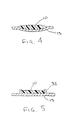
- Figs. 4 and 5 represent cross-sectional depictions of two embodiments of inclined supports.
- the solution is poured onto an inclined support which is at an angle of 5 to 75 degrees with the horizontal and which is moving upward from the horizontal.
- the angle and movement are established to provide mean shear of 1 to 35 sec -1 and preferably 2 to 10 or perhaps as high as 15 sec -1 .
- the solution is maintained on the support until it gels and, in a preferred embodiment, is incubated thereon.
- the solution, once gelled, is cut transversely with the flow of the solution on the support.
- the gel is incubated in a manner, and under conditions, which will result in increased para-aramid molecular weight.
- Para-aramid pulp is isolated from the transversely cut gel by, for example, being mechanically agitated in a liquid medium.
- the cut gel can be added to a mill containing an aqueous alkaline solution. In the mill, the gel is neutralized and coagulated and is simultaneously size reduced to produce a pulp slurry from which the pulp is easily recovered.
- Other acceptable liquid media include water, amide solvents, such as N-methyl pyrrolidone, and the like.
- the method of this invention produces pulp directly from a polymerization reaction mixture without extrusion and eliminates the need for special extrusion equipment, materials, and processes.
- the para-aramid is a homopolymer -- poly(p-phenylene terephthalamide).
- the only chemicals needed for the method are p-phenylene diamine, terephthaloyl chloride, the polymerizing solvent system, and a coagulating liquid for isolating the pulp from the gel.
- the method of this invention is particularly well-suited for continuous pulp production on a commercial scale.
- the para-aramid pulp product of this invention consists essentially of pulp-like short, fibrillated, fibers of para-aramid free of sulfonic acid groups and having an inherent viscosity of between 2.0 and 4.5 dl/g and having a width of between 1 ⁇ m to 150 ⁇ m, a length of between 0.1 mm and 35 mm, and a surface area of greater than about 2 m 2 /g.
- the pulp consists essentially of poly(p-phenylene terephthalamide) (PPD-T).
- para-aramid in relation to this invention is intended to refer to para-oriented, wholly aromatic polycarbonamide polymers and copolymers consisting essentially of recurring units of the formula wherein AR 1 and AR 2 , which may be the same or different, represent divalent, para-oriented aromatic groups.
- para-oriented is meant that the chain extending bonds from aromatic groups are either coaxial or parallel and oppositely directed, for example, substituted or unsubstituted aromatic groups including 1,4-phenylene, 4,4'-biphenylene, 2,6-naphthylene, and 1,5-naphthalene.
- para-aramid is also intended to encompass para-aramid copolymers of two or more para-oriented comonomers including minor amounts of comonomers where the acid and amine functions coexist on the same aromatic species, for example, copolymers produced from reactants such as 4-aminobenzoyl chloride hydrochloride, 6-amino-2-naphthoyl chloride hydrochloride, and the like.
- para-aramid is intended to encompass copolymers containing minor amounts of comonomers containing aromatic groups which are not para-oriented, such as, for example, m-phenylene and 3,4'-biphenylene.
- the method for producing para-aramid pulp in accordance with this invention includes contacting, in an amide solvent system, generally stoichiometric amounts of aromatic diamine consisting essentially of para-oriented aromatic diamine and aromatic diacid halide consisting essentially of para-oriented aromatic diacid halide to produce a polymer or copolymer in accordance with Formula I above.
- aromatic diamine consisting essentially of para-oriented aromatic diamine
- aromatic diacid halide consisting essentially of para-oriented aromatic diacid halide
- aromatic diamines and aromatic diacid halides and para-oriented aromatic amino acid halides employed in this invention must be such that the resulting polymer has the characteristics typified by para-aramids and forms an optically anisotropic solution in the manner called for in the method of the invention and will cause the polymerization solution to gel when the inherent viscosity of the polymer is between 2 and 3 dl/g at the appropriate solution concentration.
- At least 80 mole percent of the aromatic diamine is p-phenylene diamine and at 80 mole percent of the aromatic diacid halide is a terephthaloyl halide, for example, terephthaloyl chloride.
- the remainder of the aromatic diamine can be other para-oriented diamines including, for example, 4,4'-diaminobiphenyl, 2-methyl-p-phenylene diamine, 2-chloro-p-phenylene diamine, 2,6-naphthalene diamine, 1,5-naphthalene diamine, 4,4'-diaminobenzanilide, and the like.
- One or more of such para-oriented diamines can be employed in amounts up to 20 mole percent together with p-phenylene diamine.
- the remainder of the aromatic diamine may include diamines which are not para-oriented such as m-phenylene diamine, 3,3'-diaminobiphenyl, 3,4'-diaminobiphenyl, 3,3'-oxydiphenylenediamine, 3,4'-oxydiphenylenediamine, 3,3'-sulfonyldiphenylene-diamine, 3,4'-sulfonyldiphenylenediamine, 4,4'-oxydiphenylenediamine, 4,4'-sulfonyldiphenylenediamine, and the like, although it is typically necessary to limit the quantity of such coreactants to about 5 mole percent.
- the remainder of the diacid halide can be para-oriented acid halides such as 4,4'-dibenzoyl chloride, 2-chloroterephthaloyl chloride, 2,5-dichloroterephthaloyl chloride, 2-methylterephthaloyl chloride, 2,6-naphthalene dicarboxylic acid chloride, 1,5-naphthalene dicarboxylic acid chloride, and the like.
- para-oriented acid halides can be employed in amounts up to about 20 mole percent together with terephthaloyl chloride.
- diacid halides which are not para-oriented can be employed in amounts usually not greatly exceeding about 5 mole percent such as isophthaloyl chloride, 3,3'-dibenzoyl chloride, 3,4'-dibenzoyl chloride, 3,3'-oxydibenzoyl chloride, 3,4'-oxydibenzoyl chloride, 3,3'-sulfonyldibenzoyl chloride, 3,4'-sulfonyldibenzoyl chloride, 4,4'-oxydibenzoyl chloride, 4,4'-sulfonyldibenzoyl chloride, and the like.
- p-phenylenediamine is reacted with terephthaloyl chloride to produce homopolymer poly(p-phenylene terephthalamide).
- Suitable amide solvents, or mixtures of such solvents include N-methyl pyrrolidone (NMP), dimethyl acetamide, and tetramethyl urea containing an alkali metal halide. Particularly preferred is NMP and calcium chloride with the percentage of calcium chloride in the solvent being between 4-10% based on the weight of NMP.
- low temperature solution polymerization is preferably accomplished by first preparing a cooled solution of the diamine in the amide solvent containing alkali metal halide. To this solution the diacid halide is added. While the diacid halide can be added all at once, it has been found to be preferred to add it in two stages. In the first stage, the diacid halide is added to the diamine solution cooled to between 0°C and 20°C until the mole ratio of acid halide to diamine is between 0.3 and 0.5. The resulting low molecular weight "pre-polymer" solution is then cooled to remove the heat of reaction.
- the remainder of the acid halide is added to the pre-polymer solution while agitating and cooling the solution, if desired.
- a mixer such as is disclosed in U.S. Pat. No. 3,849,074 can be advantageously used for mixing the acid halide into the pre-polymer solution.
- the second stage addition is suitably carried out in an all-surface-wiped continuous mixer.
- the reaction mixture is sensitive to moisture and it is desirable to minimize exposure to humid air and other sources of water.
- reaction rate In establishing the polymerizing para-aramid solution of this invention, it is desirable to achieve a carefully controlled reaction rate. Generally, polymerization catalysts are unnecessary for adequate polymerization and should not be used when they make the reaction rate more difficult to control. Nevertheless, the reaction rate must be sufficiently high that the solution gels within a reasonable time after being poured onto the inclined support so that orientation generated by the gravitational flow of the solution will not be lost before gelling and so that the solution will be gelled while still on the support. Typical reaction rates can be such that a time period on the order of 1-10 minutes is required for the thoroughly mixed liquid solution containing all reactants to gel to a "soft" gel. For a continuous process employing an all-surface-wiped mixer to perform the polymerization, control of the reaction of a solution with a certain concentration of reactants can be performed by adjusting the hold-up time in the mixer and/or the temperature of the solution.
- the solution is poured onto the inclined support to cause a flow which produces an anisotropic condition in which domains of polymer chains are oriented in the direction of flow.
- the solution continues to polymerize during and after the flow initiated by the pouring step; and the pouring step should be initiated early enough that the inherent viscosity of the polymer is within the proper range when the solution is first subjected to the flow.
- the step of pouring the solution onto an inclined support causes a flow of the solution adequate to orient the polymer solely due to the shear forces of gravity, including any movement of the inclined support.
- the liquid solution is optically anisotropic, that is, microscopic domains of the solution are birefringent and a bulk sample of the solution depolarizes plane polarized light because the light transmission properties of the microscopic domains of the solution vary with direction.
- the alignment of the polymer chains within the domains is responsible for the light transmission properties of the solution.
- the actively-polymerizing solution flows on the inclined support, the polymer chains in the solution become oriented in the direction of the flow.
- pouring of the liquid solution does not result in any orientation of the polymer.
- Pouring the solution for purposes of this invention, means causing the liquid to flow out of a hole having only a slight thickness or causing the liquid to flow over a weir or out of a vessel without other restraint. Pouring does not cause orientation -- orientation is caused by flow on the inclined support.
- the mean shear in the solution due to that flow is less than 35 sec -1 , preferably less than 15 sec -1 , and most preferably from 2 to 10 sec -1 . It is a surprising element of this invention that flow generating such low shear is effective to orient the para-aramid molecules to the extent necessary to make pulp. It was surprising that the shear resulting merely from gravitational flow is adequate to cause an orientation sufficient to yield a fibrous pulp product. Before this invention, it was believed that shear of at least 15 sec -1 was necessary for pulp manufacture.
- the flow of this invention is laminar, substantially unidirectional, and is entirely or substantially due to gravitational forces.
- To pour a viscous solution onto a stationary inclined support is to initiate purely gravitational flow. When the inclined support is in motion, the solution flow is still caused by gravitational forces.
- To visualize the infinitesimal contribution of any movement by the inclined support one can think of a conveyer which is not inclined and one can easily conclude that solution poured onto the conveyer would be conveyed but would not flow. Due to the viscous nature of the solution, the flow caused by gravity in practice of this invention is laminar flow and is substantially unidirectional.
- Mean Shear is a linear function of the liquid thickness; and because the shear rate can be seen to be zero when h equals zero at the free surface of the liquid, the Mean Shear is understood to be one-half of the Maximum Shear Rate. Mean Shear has been calculated in the Examples herein where Mean Shear is reported.
- the oriented anisotropic solution formed during flow orientation is maintained on the inclined support for a time sufficient to permit polymerization to continue until the solution becomes a gel.
- Maintaining the solution on the inclined support may, also, include incubating the polymer. Maintaining the solution on the inclined support is only necessary until the solution gels to the point that it can be removed from the support; however, the gel can be incubated further on the support or after it has been removed therefrom. "Incubating" is intended to refer to the maintenance of conditions which result in continued polymerization and/or fibril growth and which maintain the orientation of the oriented anisotropic solution. The conditions for incubation can be varied as the incubation is continued. Incubation starts with orientation of the solution and ends with isolation of the pulp from the gel.
- Incubation can commence when polymer chains in the anisotropic solution are oriented and remain oriented through increase in viscosity to gelation.
- the viscosity of the actively-polymerizing solution is in a range such that orientation of the polymer chains in solution will not become appreciably unoriented before the solution gels.
- the solution viscosity at the commencement of incubation can vary within a range dependent on the concentration and the inherent viscosity of the polymer in the solution.
- a suitable viscosity range at the commencement of incubation generally corresponds to the viscosity of a poly(p-phenylene terephthalamide)-NMP-CaCl 2 solution with a polymer concentration of between about 6.5 and 11% and having an inherent viscosity of the polymer in the range of 2 to 3 dl/g.
- the polymerizing solution is poured onto the inclined support at anytime after all components of the solution have been combined and before the polymerization reaction has created a solution viscosity so high that the solution will not flow.
- all orientation of the polymer chains is achieved solely by flow of the solution on the inclined support. There is no orientation of polymer chains in the solution until the solution has been poured onto the inclined support and no significant orientation is accomplished merely by the pouring.
- the temperature of the solution during flow can be controlled to adjust the reaction rate and the solution viscosity. Until the solution gels, it is desirable for the temperature to be between 15°C and 60°C, preferably between 25°C and 60°C, to maintain a high reaction rate. Most preferably, the temperature is maintained between 40°C and 60°C until the solution has become a firm gel. Above 40°C a high reaction rate is achieved and it is believed that, above 40°C, better pulp formation in the gel also results. In the preferred embodiment employing a moving conveyer as the inclined support, incubation is commenced on the support as the solution contacts the support and is conveyed away from the point of pouring; and the solution is maintained on the support for a sufficient time so that the solution can gel.
- the solution on the support can be heated to reach the above-described temperature range and thus increase the reaction rate so that gelling on the belt occurs typically within a matter of minutes.
- gelling to a degree that it can be cut can be made to occur within about 2-8 minutes after the initiation of incubation.
- transversely is intended to refer to any cutting angle which is not parallel with the flow of the solution.
- the transverse cutting of the gel is performed so that the maximum length of the pulp fibers can be controlled.
- transverse cutting of the recently-gelled solution results in more uniform pulp fiber lengths.
- cutting in the transverse direction is suitably accomplished by cutting the gel into discrete pieces on the conveyer, or immediately after it leaves the conveyer, with a wire cutter having a cutting stroke proportional with the belt speed to assure uniformly cut lengths.
- the gel is cut at intervals ranging from 5 to 35mm and, preferably, less than 25 millimeters. The gel is cut when it has hardened sufficiently that the gel pieces do not stick to the cutter and are not greatly disrupted during normal handling.
- Incubation can be continued after cutting so that the polymerization can continue to increase the inherent viscosity of the polymer and facilitate the growth of pulp length.
- the temperature is preferably maintained above room temperature, preferably between 40-55°C.
- the duration of continued incubation is variable depending on the product desired but should generally be longer than about 20 minutes at 40-55°C; and can be as much as 8 hours or more at those temperatures or higher. Continued incubation affects the size distribution of the pulp produced since continued incubation, in conjunction with cutting, increases the average length of the fibers in the pulp.
- Additional incubation can be performed as a separate process step by storing the cut gel pieces at the elevated temperatures and the material can be consolidated in, for example, containers or on a slow moving conveyer, to decrease space requirements.
- the hardened gel pieces are stable and there is no need to employ special protective measures other than to prevent contact with water and with humid air.
- Pulp is isolated from the cut gel after incubation. Isolation is accomplished by reducing the size of the material such as by shredding or grinding the gel and washing the resulting mass.
- the gel from which the pulp is isolated contains the polymerization bye-products, one of which is acid. Isolation of the pulp generally includes neutralization of that acid. Size reduction can be performed before or, preferably simultaneously with, neutralization. Size reduction and neutralization are suitably performed by contacting the gel with an alkaline solution in a mill or grinder; and it may also be useful to use a mechanical refiner.
- the pulp slurry produced is washed, preferably in stages, to remove the polymerization solvent and other constituents of the gel. Solvent can be recovered from both the neutralization solution and the wash water for reuse.
- the pulp slurry is dewatered, such as by vacuum filtration, and optionally dried, such as in an air-circulation oven. If desired, the pulp can be supplied in wet, uncollapsed, "never-dried” form containing at least 30% water based on the weight of the dry pulp.
- Fig. 1 illustrates the process of the present invention as it might be practiced on an immobile inclined support.
- Polymerizing para-aramid solution 10 is established, either in vessel 11 or elsewhere and then transferred to vessel 11.
- Vessel 11 is intended to represent, generally, a source of polymerizing solution, whether it be from an actual vessel or directly from a polymerizing reactor.
- Solution 10 is poured onto inclined support 12 and permitted to flow down the support until it gels. After solution 10 has gelled, it is cut transversely to the direction of flow and incubated.
- Fig. 2 shows an embodiment of this invention using a continuously renewable, moving, conveyer as the inclined support.
- solution 10 is poured from vessel 11 onto moving belt 13 of conveyer 14.
- Solution 10 can be poured continuously or not, as desired.
- Conveyer 14 includes rollers 15 and 16, at least one of which is driven for moving belt 13.
- Belt 13 is set at an angle 17 with the horizontal. Angle 17 can be from 5 to 75 degrees.
- Belt 13 can be flat or concave or it can include a trough with walls to contain the solution.
- Fig. 4 shows a cross sectional representation of belt 13 made to have a slightly concave shape to assist in containing solution 10.
- FIG. 5 shows a cross sectional representation of belt 13 made with parallel, longitudinal, walls 32 defining a trough to assist in laterally containing solution 10.
- the lower limit for angle 17 is whatever angle which will permit substantially unidirectional flow of the solution. Less than 5 degrees does not cause adequate flow to accomplish the object of the process and more than 75 degrees gives rise to process control problems.
- the lower limit for angle 17 appears to be about 15 degrees.
- Cut pieces 20 are incubated and the pulp of this invention is isolated by shredding or refining them, as previously disclosed herein.
- the length of conveyer 14 can be adjusted such that the gel can be incubated on belt 13 before being cut.
- Fig. 3 shows an embodiment of this invention wherein conveyer 22 is divided into an inclined support section 23 and a horizontal section 24, both defined by rollers 25, 26, 27, and 28, at least one of which is driven.
- Solution 10 is poured from vessel 11 onto inclined support section 23 and the solution is gelled at any time before or slightly after the end of the section, at roller 26.
- Cutting means 29 is used to cut the gelled solution 10 on horizontal section 24 before or after operated incubation heaters 30, optionally used to assure appropriate incubation conditions. If it is desired or required for any particular reason, heaters 30 can be placed over solution 10 on the inclined support section 23 in the device of this Fig. 3 or over the inclined support sections of the devices of Figs. 1 or 2.
- Cut pieces 31 of gelled solution 10 are removed from conveyer 22 at roller 27 and are collected in container 21 for isolation of the pulp. It is, also, possible to place the conveyer within an oven or the confines of heated blankets, with or without the added benefit of an inert gas, to maintain the gelled solution at an elevated temperature.
- the pulp produced by the process of this invention consists essentially of short fibrillated fibers of para-aramid, preferably p-phenylene terephthalamide, having an inherent viscosity of at least 2 dl/g. Since the method does not involve spinning from a sulfuric acid solution, the para-aramid is free of sulfonic acid groups.
- the width of the pulp-like fibers produced in this process range from less than 1 ⁇ m to 150 ⁇ m.
- the length of pulp-like fibers produced in this process may range from 0.1 mm to 35 mm, but will never exceed the interval of the transversely cut gel.
- the pulp is also characterized by fibrils having a wavy, articulated structure. Surface area of this product measured by gas adsorption methods is greater than 2 m 2 /g versus that of an equivalent amount of unpulped, spun fiber of less than 0.1 m 2 /g indicating a high level of fibrillation.
- the pulp fiber When the pulp is not dried to below 30% water based on the weight of the dry pulp ("never-dried"), the pulp fiber has an uncollapsed structure which is not available in pulp produced from spun fiber.
- the pulp product of this invention when used in customary applications, such as friction products and gaskets, provides performance substantially equivalent with pulp made by conventional techniques, that is, by cutting and refining of spun fiber even though the inherent viscosity of the polymer in the pulp of this invention may be lower than that in pulp produced from spun fiber.
- c concentration (0.5 gram of polymer in 100 ml of solvent) of the polymer solution
- ⁇ rel relative viscosity
- the inherent viscosity values reported and specified herein are determined using concentrated sulfuric acid (96% H 2 SO 4 ).
- One-half gram of dried pulp is placed in a one-liter blender jar along with 150 milliliters of water, and the pulp is soaked for 30 seconds.
- the blender is operated for 2 minutes at about 13,500 rpm.
- the contents of the blender are transferred to a 250 milliliter glass beaker; and residual pulp fibers are rinsed from the blender jar with a few milliliters more of water.
- the settled height of the suspended layer of pulp is measured in millimeters to provide the suspension depth.
- the glass beaker has an internal diameter of about 63 millimeters and the height of the water column in the beaker is about 50 millimeters.
- Suspension depth is believed to be a measure of the degree of fibrillation and length to width ratio (L/W) for the pulp product of this invention.
- L/W length to width ratio
- pulp exhibiting a suspension depth of greater than 20 millimeters has been considered to be acceptable.
- pulp is made in accordance with the process of this invention.
- the process requires the use of an actively polymerizing solution of para-aramid polymer which is of a proper inherent viscosity and solution concentration to be anisotropic under conditions of laminar flow at very low mean shear.
- the solution is made as follows (parts are parts, by weight), either on a batch or continuous basis:
- a solution of calcium chloride (42 parts) in anhydrous N-methyl pyrrolidone (513 parts) is prepared by stirring and heating at about 90°C. After cooling the solution to about 25°C in a dry nitrogen purge, 29.3 parts of p-phenylene diamine is added with mixing and the resulting solution is cooled to about 10°C.
- a first portion of anhydrous terephthaloyl chloride (TCl) (19.25 parts) is added with stirring. After dissolution of the first portion of TCl, the solution is cooled to a temperature of -5 to 30°C and the remaining portion of TCl (35.75 parts) is added with vigorous mixing until dissolved. Vigorous mixing is continued during the resulting polymerization.
- the solution is poured onto an inclined support to commence the process.
- the procedure, above, is for preparation of a solution wherein the polymer concentration is 10%, by weight. If solutions of different concentrations are desired, the amount of solvent can be adjusted accordingly; and the characteristics of the solution may vary from those described above.
- pulp was made by the process of this invention using an inclined support having an adjustable angle with the horizontal.
- the actively-polymerizing solution described above was poured onto the support while the support was set at a variety of angles.
- the support was a flat plate made of stainless steel and was similar to that shown in Fig. 1.
- a portion of the solution was transferred directly from the mixer and held in a vessel at the top of the inclined support for a time indicated in the Table, below, to permit a degree of continued polymerization.
- the solution was poured onto the support and it flowed down the support until the solution gelled and the viscosity became so high that it would no longer flow.
- the gelled solution was cut at about 1/2 inch intervals transversely to the direction of the flow. The pieces of cut gel were placed in an oven where they were heated at about 45°C for about 60 minutes.
- Acceptable pulp was isolated from the cut gel for all of the times and inclination angles tested (Items 1-6 of the table, below) by immersing the gel in water in a Waring Blendor cup and operating the Blendor at high speed for several minutes. The resulting pulp was filtered, immersed in water, and stirred in the Blendor for a short time four additional times and then dried. Inherent viscosity was determined on the polymer of the dried pulp product. Item Solids (%) Time (sec) Angle (deg) Flow Distance (cm) Inherent Viscosity dl/g 1 10.7 16 60 96 -- 2 " 23 60 81 2.9 3 " 40 60 53 3.2 4 " 16 75 >107 2.8 5 " 23 75 -- 2.9 6 9.2 20 45 -- -- --
- pulp was made by the process of this invention using an inclined support in the form of a conveyer similar to that shown in Fig. 2.
- the surface of the conveyer was made from a fluoropolymer to facilitate removal of the gelled solution; and the conveyer was about 1.5 meters long and was set at various angles with the horizontal.
- a PPD-T solution as described above but at a polymer concentration of 9.6%, was poured at a rate of about 16.4 grams per second onto the bottom of the conveyer.
- the conveyer was set to move at various speeds; but always fast enough to prevent the solution from running off of the lower end of the conveyer as the solution was poured.
- the pouring was stopped and the conveyer was stopped.
- the solution was permitted to run back down the conveyer until it gelled and the viscosity was so high that it would no longer flow.
- the gel was cut at intervals of about 1 to 2 centimeters transversely to the solution flow and the cut gel was transferred from the conveyer to an oven where it was heated at about 45°C for 60 minutes.
- Acceptable pulp (Items 1-8 of the table, below) was isolated from the gel by the same technique as was described in Example 1, above.
- Item Angle (deg) Exit Inh Conv. speed (cm/s) Inherent Viscosity dl/g Suspension Depth, (mm) 1 45 1.34 16.3 3.28 51 2 45 1.34 37.6 -- 24 3 45 1.17 18.8 2.64 23 4 45 1.17 37.6 2.89 40 5 45 1.19 16.3 3.05 26 6 30 1.19 27.4 2.86 26 7 30 1.17 9.1 2.98 43 8 30 1.17 37.6 2.63 39
- pulp was made by the process of this invention using an inclined support in the form of a conveyer.
- the surface of the conveyer was made from a fluoropolymer to facilitate removal of the gelled solution; and the conveyer was about 1.5 meters long and was set at an angle of about 45 degrees with the horizontal.
- the polymer in the solution had an inherent viscosity of about 1.1 dl/g.
- the conveyer was set to move at a speed of 16.5 centimeters per second - just enough to prevent the solution from running off of the lower end of the conveyer as the solution was poured. When the poured solution reached the top of the conveyer, the pouring was stopped and the conveyer was stopped. The solution was permitted to run back down the conveyer until it gelled and the viscosity was so high that it would no longer flow. About two minutes after stopping the conveyer, the gel was cut at intervals of about 1 to 2 centimeters transversely to the solution flow and the cut gel was transferred from the conveyer to an oven where it was heated at about 45°C for 60 minutes.
- Pulp was isolated from the gel by the same technique as was described in Example 1, above.
- the pulp exhibited a weighted and arithmetic average length of 0.74 and 0.32 mm, respectively, and had a surface area of 7 square meters per gram.
- Pulp lengths were determined using a Kajaani particle size distribution tester identified as Kajaani Model FS-100 sold by Valmet Automation Company, Finland; and the surface area was determined as a single point BET nitrogen adsorption using a Strolein Surface Area Meter.
- pulp was made by the process of this invention using an inclined support in the form of a conveyer.
- the surface of the conveyer was made from a fluoropolymer to facilitate removal of the gelled solution; and the conveyer was about 1.5 meters long and was set at an angle of about 30 degrees with the horizontal.
- the polymer in the solution had an inherent viscosity of about 1.15 dl/g.
- the conveyer was set to move downward at a speed of 9.1 centimeters per second. When the poured solution reached the bottom of the conveyer, the pouring was stopped and the conveyer was stopped. The solution was permitted to run down the conveyer until it gelled and the viscosity was so high that it would no longer flow. The gel was cut at intervals of about 1 centimeter transversely to the solution flow and the cut gel was transferred from the conveyer to an oven where it was heated at about 45°C for 60 minutes.
- Pulp was isolated from the gel by the same technique as was described in Example 1, above.
- the pulp had an inherent viscosity of 2.81 dl/g and exhibited a suspension depth of 23 mm.
- pulp was made by the process of this invention using a longer conveyer as the inclined support.
- the conveyer was about 6 meters long and was set at an angle of about 45 degrees with the horizontal.
- a PPD-T solution as described above but at a polymer concentration of 8.1%, was poured at a rate of about 18.7 grams per second onto the bottom of the conveyer.
- the polymer in the solution had an inherent viscosity of about 1.56 dl/g.
- the conveyer was set to move at a speed of 17.8 centimeters per second. When the poured solution reached the top of the conveyer, the pouring was stopped and the conveyer was stopped. The solution was permitted to run back down the conveyer until it gelled and the viscosity was so high that it would no longer flow.
- the gel was cut at intervals of about 1.1 centimeter transversely to the solution flow and the cut gel was transferred from the conveyer to an oven where it was heated at about 45°C for 60 minutes.
- Pulp was isolated from the gel by the same technique as was described in Example 1, above.
- the pulp had an inherent viscosity of 2.81 dl/g, exhibited a weighted and arithmetic average length of 1.06 and 0.42mm, respectively, and had a surface area of 5.9 square meters per gram and a Canadian Standard Freeness of 682 milliliters. Canadian Standard Freeness determinations were made in accordance with TAPPI Standard T227 m-58.
- pulp was made by the process of this invention using a conveyer having a shallow trough built thereon as the inclined support.
- the surface of the trough was made from a fluoropolymer to facilitate removal of the gelled solution.
- the trough was about 2.5 centimeters wide; and conveyer was about 1.5 meters long and was set at various angles with the horizontal.
- the polymer in the solution had an inherent viscosity of about 1.2 dl/g.
- the conveyer was set to move at various speeds. There was no runoff from the conveyer at those speeds. When the poured solution reached the top of the conveyer, the pouring was stopped and the conveyer was stopped. The solution was permitted to run back down the conveyer until it gelled and the viscosity was so high that it would no longer flow. The conveyer was then started again and strips of the gel were removed from the conveyer and cut at intervals of about 1 centimeter transversely to the solution flow. The cut gel was transferred to an oven where it was heated at about 45°C for 60 minutes.
- Acceptable pulp (Items 1-7 of the table, below) was isolated from the gel by the same technique as was described in Example 1, above.
- Item Angle (deg) Conv. Speed (cm/s) Mean Shear (Sec -1 ) Suspension Depth (mm) 1 34 13.7 11 50 2 34 17.3 6 45 3 20 12.7 9 44 4 20 15.2 5 50 5 10 8.6 5 46 6 10 10.7 3 39 7 34 12.2 - 49
- the density of the solution was taken as 1.05 g/cc and the surface velocity of the flowing liquid was determined by measuring the time for a particle floating on the surface of the liquid to travel about 15 centimeters after contact with the inclined support.
- pulp was made by the process of this invention using a conveyer having a shallow trough built thereon as the inclined support.
- the surface of the trough was made from a fluoropolymer to facilitate removal of the gelled solution.
- the trough was about 2.5 centimeters wide; and conveyer was about 6 meters long and was set at an angle of about 10 degrees with the horizontal.
- a PPD-T solution as described above but at a polymer concentration of 8.35%, was poured at a rate of about 18.1 grams per second into the trough at the bottom of the conveyer.
- the polymer in the solution had an inherent viscosity of about 1.2 to 1.4 dl/g.
- the conveyer was set to move at a speed of 5.6 to 12.2 centimeters per second. There was no runoff from the conveyer at those speeds. When the poured solution reached the top of the conveyer, the pouring was stopped and the conveyer was stopped. The solution was permitted to run back down the conveyer until it gelled and the viscosity was so high that it would no longer flow.
- the conveyer was then started again and strips of the gel were removed from the conveyer about 1 to 1.5 meters long. The strips were cut at intervals of about 1 centimeter transversely to the solution flow and the cut gel was transferred from the conveyer to an oven where it was heated at about 45°C for 60 minutes.
- Pulp was isolated from the gel by the same technique as was described in Example 1, above.
- the pulp had an inherent viscosity of 2.71 to 3.26 dl/g, a surface area of 7 square meters per gram, and a Canadian Standard Freeness of 750 milliliters.
- pulp was made by the process of this invention using the device of Example 7 except that the conveyer was wrapped with heating blankets to maintain the temperature on the conveyer at 40 to 70°C along 6.1 meters of its length.
- the conveyer was set to move at a speed of 8.3 centimeters per second - enough to prevent the solution from running off of the lower end of the conveyer as the solution was poured.
- the pouring was stopped and the conveyer was stopped for the time necessary for the solution to gel.
- the conveyer was then started again and strips of the gel were removed from the conveyer about 1 to 1.5 meters long. The strips were cut at intervals of about 1 centimeter transversely to the solution flow and the cut gel was transferred from the conveyer to an oven where it was heated at about 45°C for 60 minutes.
- Pulp was isolated from the gel using a hammer mill equipped with a full hammer stack.
- the pulp had an inherent viscosity of 3.3 dl/g, a surface area of 3.4 square meters per gram, and a Canadian Standard Freeness of 750 milliliters.
- the pulp product of this example was refined in a laboratory refiner to further modify the physical properties of the pulp.
- the refiner was a disk refiner made by Sprout-Bauer with a 30 centimeter diameter.
- the plate pattern was identified as #18034.
- a suspension of 200 grams of the pulp in 6 liters of water was poured into a screw feeder which fed the refiner running at a disk speed of 1800 rpm with a gap of 0.64mm between the plates.
- the suspension was collected in a bucket and was passed through the refiner again.
- the gap between the plates was reduced to 0.38mm and the suspension was passed through the refiner 15 more times.
- the gap was then reduced to 0.25mm and the suspension was passed through the refiner 20 more times.
- the surface area of the resultant pulp was 9.4 square meters per gram and the Canadian Standard Freeness was 498 milliliters.
- Example 8 a series of runs was made using the inclined support of Example 8, above, and varying the polymer concentration, the conveyer speed, and the incubation time.
- the solution density was 1.05 g/cc and the solution was poured at rates of 18.9 g/sec for Items 1-3, 22.3 g/sec for Items 4 and 5, and 25.6 g/sec for Item 6, in the table, below.
- PPD-T solutions as described above but at polymer concentrations indicated in the table of this example, were poured at a rate of about 14.1 to 20.2 grams per second into the trough at the bottom of the conveyer.
- the conveyer was set to move at various speeds adequate to prevent run off at the lower end of the conveyer and, yet, permit gellation of the solution before it reached the top of the conveyer.
- the gel was cut at intervals of about 2 centimeters transversely to the solution flow using a rotating wire cutter. The cut gel was placed in an oven where it was heated at about 46-51°C for 8 hours. Pulp was isolated from the gel by the same technique as was described in Example 1, above.
- the pulp exhibited inherent viscosities and suspension depths as indicated in the table.
- the solution density was 1.05 g/cc and the solution was poured at rates of 14.1 g/sec for Item 1, 15.8 g/sec for Items 2 and 3, 17.6 g/sec for Items 4 and 5, and 20.2 g/sec for Item 6, of the table, below.
- a PPD-T solution at a polymer concentration of 10.7% was poured at a rate of about 35.4 grams per second onto the bottom of the conveyer.
- the conveyer was set to move at various speeds adequate to prevent run off at the lower end of the conveyer and, yet, permit gellation of the solution before it reached the top of the conveyer.
- the gel was cut at intervals of about 2.5 centimeters transversely to the solution flow using a rotating wire cutter. The cut gel was placed in an oven where it was heated at about 49°C for 8 hours. Pulp was isolated from the gel by the same technique as was described in Example 1, above. The pulp exhibited inherent viscosities and suspension depths as indicated in the table, below.
- the solution density was 1.05 g/cc and the surface velocity was determined to be 6.1 cm/sec.
Landscapes
- Engineering & Computer Science (AREA)
- Textile Engineering (AREA)
- Chemical & Material Sciences (AREA)
- Mechanical Engineering (AREA)
- Chemical Kinetics & Catalysis (AREA)
- General Chemical & Material Sciences (AREA)
- Dispersion Chemistry (AREA)
- Paper (AREA)
- Artificial Filaments (AREA)
- Spinning Methods And Devices For Manufacturing Artificial Fibers (AREA)
Description

- d =
- density of the liquid
- g =
- gravitational constant (980 cm/sec2)
- B =
- 90° minus angle of inclination with the horizontal
- h =
- depth of the liquid
- m =
- viscosity of the liquid
- V(s) =
- surface velocity of the flowing liquid
- Vcon =
- velocity of the inclined support
- Q =
- volumetric liquid flow rate
- W =
- width of the flowing liquid
Preferably, gelling to a degree that it can be cut, can be made to occur within about 2-8 minutes after the initiation of incubation.
| Item | Solids (%) | Time (sec) | Angle (deg) | Flow Distance (cm) | Inherent Viscosity dl/g |
| 1 | 10.7 | 16 | 60 | 96 | -- |
| 2 | " | 23 | 60 | 81 | 2.9 |
| 3 | " | 40 | 60 | 53 | 3.2 |
| 4 | " | 16 | 75 | >107 | 2.8 |
| 5 | " | 23 | 75 | -- | 2.9 |
| 6 | 9.2 | 20 | 45 | -- | -- |
| Item | Angle (deg) | Exit Inh | Conv. speed (cm/s) | Inherent Viscosity dl/g | Suspension Depth, (mm) |
| 1 | 45 | 1.34 | 16.3 | 3.28 | 51 |
| 2 | 45 | 1.34 | 37.6 | -- | 24 |
| 3 | 45 | 1.17 | 18.8 | 2.64 | 23 |
| 4 | 45 | 1.17 | 37.6 | 2.89 | 40 |
| 5 | 45 | 1.19 | 16.3 | 3.05 | 26 |
| 6 | 30 | 1.19 | 27.4 | 2.86 | 26 |
| 7 | 30 | 1.17 | 9.1 | 2.98 | 43 |
| 8 | 30 | 1.17 | 37.6 | 2.63 | 39 |
| Item | Angle (deg) | Conv. Speed (cm/s) | Mean Shear (Sec-1) | Suspension Depth (mm) |
| 1 | 34 | 13.7 | 11 | 50 |
| 2 | 34 | 17.3 | 6 | 45 |
| 3 | 20 | 12.7 | 9 | 44 |
| 4 | 20 | 15.2 | 5 | 50 |
| 5 | 10 | 8.6 | 5 | 46 |
| 6 | 10 | 10.7 | 3 | 39 |
| 7 | 34 | 12.2 | - | 49 |
| Item | Soln (%) | Inh Visc | Conv Speed | Incub Time | Susp. Depth | Mean Shear | |
| (dl/g) | |||||||
| Soln | Pulp | (cm/s) | (hr) | (mm) | (sec-1) | ||
| 1 | 8 | 1.68 | 3.18 | 7.7-8.1 | 6 | 53 | 3 |
| 2 | 8 | 1.58 | 3.55 | 8.6 | 6 | 40 | 4 |
| 3 | 8 | 1.75 | 3.96 | 7.4 | 6 | 57 | -- |
| 4 | 6.8 | 1.48 | 3.75 | 6.6 | 8 | 35 | 2 |
| 5 | 6.8 | 1.62 | 3.09 | 7.1 | 8 | 46 | 2 |
| 6 | 5.9 | 1.62 | 3.94 | 8.1 | 8 | 15 | 3 |
| Item | Soln | Inh Visc | Conv Speed | Susp. Depth | Mean Shear | |
| (dl/g) | ||||||
| (%) | Soln | Pulp | (cm/s) | (mm) | (Sec-1) | |
| 1 | 10.7 | 1.46 | 4.0 | 5.3 | 50 | 2 |
| 2 | 9.6 | 1.29 | 2.9 | 6.7 | 58 | 3 |
| 3 | 9.6 | 1.47 | 3.4 | 7.6 | 54 | 3 |
| 4 | 8.6 | 1.34 | 3.2 | 8.4 | 53 | 4 |
| 5 | 8.6 | 1.53 | 3.5 | 7.9 | 53 | 4 |
| 6 | 7.5 | 1.51 | 3.1 | 8.1 | 56 | -- |
| Item | Inh Visc | Conv Speed | Susp.Depth | Mean Shear | |
| (dl/g) | |||||
| Soln | Pulp | (cm/s) | (mm) | (sec-1) | |
| 1 | 1.12 | 3.7 | 12.2 | 44 | 4 |
| 2 | 1.07 | 3.9 | 12.8 | 50 | 4 |
| 3 | 0.89 | -- | 11.9 | 52 | 4 |
Claims (10)
- A method for producing a para-aramid pulp comprising:a) establishing a polymerizing para-aramid solution;b) pouring the solution on an inclined support having an angle with the horizontal adequate to cause flow of the solution which produces an optically anisotropic liquid solution;c) maintaining the solution on the support until the solution gels;d) isolating para-aramid pulp from the gel.
- The method of Claim 1 wherein the inclined support is moving, preferably upward.
- The method of Claim 1 wherein the flow of the solution is entirely due to gravitational forces and wherein the angle of incline for the support is from 5 to 75 degrees with the horizontal.
- The method of Claim 1 wherein the gelled solution from step c) is cut at selected intervals transversely with respect to the flow of the solution.
- The method of Claim 1 wherein the flow of the solution is such that the solution is subjected to a mean shear of 1 to 35 sec-1.
- The method of Claim 1 wherein the para-aramid is poly(p-phenylene terephthalamide) and has an inherent viscosity of 0.5 to 2.2 dl/g in the solution as it is poured on the inclined support.
- The method of Claim 1 wherein said polymerizing solution is caused to flow while maintaining the temperature of the solution between 15°C and 60°C.
- A method for producing a para-aramid pulp comprising:a) establishing a liquid, actively-polymerizing solution containing polymer chains of a para-aramid by contacting with agitation substantially stoichiometric amounts of aromatic diacid halide consisting essentially of a para-oriented aromatic diacid halide and aromatic diamine consisting essentially of a para-oriented aromatic diamine in a substantially anhydrous amide solvent system;b) pouring the liquid solution, when the inherent viscosity of the para-aramid is between 0.5 and 2.2 dl/g, on an inclined support having an angle with the horizontal adequate to cause flow of the solution which produces an optical anisotropic liquid solution containing domains of polymer chains within which the polymer chains of para-aramid are substantially oriented in the direction of flow;c) maintaining the solution on the support for at least a duration sufficient for said solution to become a gel;d) cutting the gel at selected intervals transversely with respect to the flow of the solution;e) isolating para-aramid pulp from the gel.
- The method of Claim 8 wherein the para-aramid is poly(p-phenylene terephthalamide).
- An apparatus for orienting polymer dissolved in a polymerizing polymer solution by means of gravity-induced shear forces, comprising:a) a continuously renewable, longitudinal, support surface inclined from the horizontal;b) means adjacent the support surface for pouring the polymerizing polymer solution onto the support surface;c) means for moving the support surface to continuously present a new portion of the support surface to the poured polymer solution;d) means for maintaining the polymer solution on the support surface for a time adequate to permit polymerization of the polymer to continue until the solution becomes a gel;e) means for removing the gel from the support surface.
Applications Claiming Priority (2)
| Application Number | Priority Date | Filing Date | Title |
|---|---|---|---|
| US564147 | 1990-08-09 | ||
| US07/564,147 US5106560A (en) | 1990-08-09 | 1990-08-09 | Producing para-aramid pulp by means of gravity-induced shear forces |
Publications (3)
| Publication Number | Publication Date |
|---|---|
| EP0470634A2 EP0470634A2 (en) | 1992-02-12 |
| EP0470634A3 EP0470634A3 (en) | 1992-12-09 |
| EP0470634B1 true EP0470634B1 (en) | 1998-06-24 |
Family
ID=24253339
Family Applications (1)
| Application Number | Title | Priority Date | Filing Date |
|---|---|---|---|
| EP91113389A Expired - Lifetime EP0470634B1 (en) | 1990-08-09 | 1991-08-09 | Producing para-aramid pulp by means of gravity-induced shear forces |
Country Status (5)
| Country | Link |
|---|---|
| US (1) | US5106560A (en) |
| EP (1) | EP0470634B1 (en) |
| JP (1) | JP3004096B2 (en) |
| KR (1) | KR0185400B1 (en) |
| DE (1) | DE69129647T2 (en) |
Families Citing this family (10)
| Publication number | Priority date | Publication date | Assignee | Title |
|---|---|---|---|---|
| TW226417B (en) * | 1992-05-28 | 1994-07-11 | Sumitomo Chemical Co | |
| US5532059A (en) * | 1994-09-29 | 1996-07-02 | E. I. Du Pont De Nemours And Company | Poly(p-phenylene terephthalamide) pulp |
| JP3063838B2 (en) | 1997-10-02 | 2000-07-12 | 日本電気株式会社 | Audio / video synchronous playback apparatus and method |
| US7033632B2 (en) * | 2002-05-06 | 2006-04-25 | Schreiber Foods, Inc. | Casting food products to controlled dimensions |
| CN100436665C (en) * | 2003-05-08 | 2008-11-26 | 帝人阿拉米德有限公司 | Para-aramid non-fibrous polymer solution having high relative viscosity |
| JP4778833B2 (en) * | 2006-05-19 | 2011-09-21 | 帝人テクノプロダクツ株式会社 | Laminate substrate and prepreg, and laminate |
| US8765217B2 (en) * | 2008-11-04 | 2014-07-01 | Entrotech, Inc. | Method for continuous production of (meth)acrylate syrup and adhesives therefrom |
| US20100113692A1 (en) * | 2008-11-04 | 2010-05-06 | Mcguire Jr James E | Apparatus for Continuous Production of Partially Polymerized Compositions |
| US8329079B2 (en) * | 2009-04-20 | 2012-12-11 | Entrochem, Inc. | Method and apparatus for continuous production of partially polymerized compositions and polymers therefrom |
| CN116005486B (en) * | 2022-12-27 | 2024-07-16 | 东华大学 | Para-aramid paper and preparation method thereof |
Family Cites Families (10)
| Publication number | Priority date | Publication date | Assignee | Title |
|---|---|---|---|---|
| US2485249A (en) * | 1944-02-19 | 1949-10-18 | Davison Chemical Corp | Process and apparatus for manufacturing gels |
| US3187379A (en) * | 1962-07-02 | 1965-06-08 | Midland Ross Corp | Forming a gelatinous solution into ribbon-like bodies |
| US3767756A (en) * | 1972-06-30 | 1973-10-23 | Du Pont | Dry jet wet spinning process |
| US4389357A (en) * | 1981-06-26 | 1983-06-21 | Ashland Oil, Inc. | Method for preparing thermosetting resins |
| KR840000726B1 (en) * | 1982-08-30 | 1984-05-24 | 전학제 | Method for producing short fibers of aromatic polyamide |
| FR2559666B1 (en) * | 1984-02-21 | 1986-08-08 | Tech Cuir Centre | PROCESS FOR THE MANUFACTURE OF COLLAGEN TUBES, ESPECIALLY LOW-DIAMETER TUBES, AND APPLICATION OF THE TUBES OBTAINED IN THE FIELD OF VASCULAR PROSTHESES AND NERVOUS SUTURES |
| DE3544770A1 (en) * | 1985-12-18 | 1987-06-19 | Stockhausen Chem Fab Gmbh | METHOD AND DEVICE FOR THE CONTINUOUS PRODUCTION OF POLYMERISATES AND COPOLYMERISATES OF ACRYLIC ACID AND / OR METHACRYLIC ACID |
| US4737407A (en) * | 1986-03-10 | 1988-04-12 | Essex Composite Systems | Thermoset plastic pellets and method and apparatus for making such pellets |
| US4876040A (en) * | 1986-05-15 | 1989-10-24 | Kolon Industries, Inc. | Two-stage process for preparing aromatic polyamide fiber |
| US5028372A (en) * | 1988-06-30 | 1991-07-02 | E. I. Du Pont De Nemours And Company | Method for producing para-aramid pulp |
-
1990
- 1990-08-09 US US07/564,147 patent/US5106560A/en not_active Expired - Lifetime
-
1991
- 1991-08-08 KR KR1019910013688A patent/KR0185400B1/en not_active Expired - Lifetime
- 1991-08-09 DE DE69129647T patent/DE69129647T2/en not_active Expired - Fee Related
- 1991-08-09 JP JP3224867A patent/JP3004096B2/en not_active Expired - Fee Related
- 1991-08-09 EP EP91113389A patent/EP0470634B1/en not_active Expired - Lifetime
Also Published As
| Publication number | Publication date |
|---|---|
| JPH04245908A (en) | 1992-09-02 |
| KR0185400B1 (en) | 1999-05-15 |
| DE69129647T2 (en) | 1999-02-25 |
| DE69129647D1 (en) | 1998-07-30 |
| US5106560A (en) | 1992-04-21 |
| JP3004096B2 (en) | 2000-01-31 |
| EP0470634A2 (en) | 1992-02-12 |
| KR920004665A (en) | 1992-03-27 |
| EP0470634A3 (en) | 1992-12-09 |
Similar Documents
| Publication | Publication Date | Title |
|---|---|---|
| US5028372A (en) | Method for producing para-aramid pulp | |
| CA2161663C (en) | Rigid rod polymer based on pyridobisimidazole | |
| US5106560A (en) | Producing para-aramid pulp by means of gravity-induced shear forces | |
| CA1154921A (en) | Process for producing aromatic polyimide filaments | |
| CA2097037C (en) | Para-aramid dope of low degree of polymerization, para-aramid fiber and para-aramid pulp produced therefrom and processes for producing the same | |
| EP0104410B1 (en) | Highly oriented aromatic polyamide short fiber | |
| EP0392559B1 (en) | Oriented, shaped articles of pulpable para-aramid/meta-aramid blends | |
| KR101088312B1 (en) | Non-fiber polymer solution consisting of para-aramid with high relative viscosity | |
| US5202184A (en) | Method and apparatus for producing para-aramid pulp and pulp produced thereby | |
| JP2008208514A (en) | Para-type wholly aromatic polyamide pulp | |
| EP0391646B1 (en) | A process for the preparation of a poly(paraphenylene terephthalamide) fibrous gel composition and a process to produce poly (Paraphenylene terephthalamide) paper from the composition | |
| US5124436A (en) | Aromatic copolyamide | |
| JP2897592B2 (en) | Low polymerization degree para-aramid dope, para-aramid fiber and para-aramid pulp produced therefrom, and methods for producing them | |
| US5128440A (en) | Wholly aromatic polyamide from alkylsulfonyl aromatic diamine | |
| JP4204643B2 (en) | Aromatic polyamide pulp and method for producing the same | |
| US4011203A (en) | Aromatic polyamide from piperazine, p-phenylene diamine and terephthaloyl halide | |
| CN1031078C (en) | Method and apparatus for producing para-aramid pulp and pulp produced thereby | |
| US3827998A (en) | Anisotropic dopes of polyamides in concentrated sulfuric acid | |
| EP0192454A2 (en) | Process for preparing High strength cellulosic fibers | |
| JP3405022B2 (en) | Aromatic polyamide composition | |
| RU2045332C1 (en) | Method for production of paraaramide pulp | |
| US3869419A (en) | Anisotropic dopes of polyamides from fumaric and/or mesaconic acid | |
| KR101002298B1 (en) | Process for producing wholly aromatic polyamide filament | |
| US3767609A (en) | Process for the salt free manufacture of articles from linear aromatic polyamides in a lactam solvent | |
| KR920006371B1 (en) | Manufacturing process of aromatic polyamide fiber |
Legal Events
| Date | Code | Title | Description |
|---|---|---|---|
| PUAI | Public reference made under article 153(3) epc to a published international application that has entered the european phase |
Free format text: ORIGINAL CODE: 0009012 |
|
| AK | Designated contracting states |
Kind code of ref document: A2 Designated state(s): DE ES GB NL |
|
| PUAL | Search report despatched |
Free format text: ORIGINAL CODE: 0009013 |
|
| AK | Designated contracting states |
Kind code of ref document: A3 Designated state(s): DE ES GB NL |
|
| 17P | Request for examination filed |
Effective date: 19930428 |
|
| 17Q | First examination report despatched |
Effective date: 19961220 |
|
| GRAG | Despatch of communication of intention to grant |
Free format text: ORIGINAL CODE: EPIDOS AGRA |
|
| GRAG | Despatch of communication of intention to grant |
Free format text: ORIGINAL CODE: EPIDOS AGRA |
|
| GRAH | Despatch of communication of intention to grant a patent |
Free format text: ORIGINAL CODE: EPIDOS IGRA |
|
| GRAH | Despatch of communication of intention to grant a patent |
Free format text: ORIGINAL CODE: EPIDOS IGRA |
|
| GRAA | (expected) grant |
Free format text: ORIGINAL CODE: 0009210 |
|
| AK | Designated contracting states |
Kind code of ref document: B1 Designated state(s): DE ES GB NL |
|
| PG25 | Lapsed in a contracting state [announced via postgrant information from national office to epo] |
Ref country code: ES Free format text: THE PATENT HAS BEEN ANNULLED BY A DECISION OF A NATIONAL AUTHORITY Effective date: 19980624 |
|
| REF | Corresponds to: |
Ref document number: 69129647 Country of ref document: DE Date of ref document: 19980730 |
|
| PLBE | No opposition filed within time limit |
Free format text: ORIGINAL CODE: 0009261 |
|
| STAA | Information on the status of an ep patent application or granted ep patent |
Free format text: STATUS: NO OPPOSITION FILED WITHIN TIME LIMIT |
|
| 26N | No opposition filed | ||
| REG | Reference to a national code |
Ref country code: GB Ref legal event code: IF02 |
|
| PGFP | Annual fee paid to national office [announced via postgrant information from national office to epo] |
Ref country code: GB Payment date: 20050803 Year of fee payment: 15 Ref country code: NL Payment date: 20050803 Year of fee payment: 15 |
|
| PGFP | Annual fee paid to national office [announced via postgrant information from national office to epo] |
Ref country code: DE Payment date: 20050804 Year of fee payment: 15 |
|
| PG25 | Lapsed in a contracting state [announced via postgrant information from national office to epo] |
Ref country code: NL Free format text: LAPSE BECAUSE OF NON-PAYMENT OF DUE FEES Effective date: 20070301 Ref country code: DE Free format text: LAPSE BECAUSE OF NON-PAYMENT OF DUE FEES Effective date: 20070301 |
|
| GBPC | Gb: european patent ceased through non-payment of renewal fee |
Effective date: 20060809 |
|
| NLV4 | Nl: lapsed or anulled due to non-payment of the annual fee |
Effective date: 20070301 |
|
| PG25 | Lapsed in a contracting state [announced via postgrant information from national office to epo] |
Ref country code: GB Free format text: LAPSE BECAUSE OF NON-PAYMENT OF DUE FEES Effective date: 20060809 |