EP0470442A2 - Improved scuff-masking coatings for glass articles - Google Patents
Improved scuff-masking coatings for glass articles Download PDFInfo
- Publication number
- EP0470442A2 EP0470442A2 EP91112463A EP91112463A EP0470442A2 EP 0470442 A2 EP0470442 A2 EP 0470442A2 EP 91112463 A EP91112463 A EP 91112463A EP 91112463 A EP91112463 A EP 91112463A EP 0470442 A2 EP0470442 A2 EP 0470442A2
- Authority
- EP
- European Patent Office
- Prior art keywords
- composition
- percent
- component
- amount
- present
- Prior art date
- Legal status (The legal status is an assumption and is not a legal conclusion. Google has not performed a legal analysis and makes no representation as to the accuracy of the status listed.)
- Ceased
Links
- 239000011521 glass Substances 0.000 title claims abstract description 33
- 238000000576 coating method Methods 0.000 title abstract description 28
- 239000000203 mixture Substances 0.000 claims abstract description 76
- 239000003085 diluting agent Substances 0.000 claims abstract description 12
- 239000008199 coating composition Substances 0.000 claims abstract description 6
- 125000004432 carbon atom Chemical group C* 0.000 claims description 16
- 229920001296 polysiloxane Polymers 0.000 claims description 15
- 229930195733 hydrocarbon Natural products 0.000 claims description 12
- 239000004215 Carbon black (E152) Substances 0.000 claims description 10
- XMSXQFUHVRWGNA-UHFFFAOYSA-N Decamethylcyclopentasiloxane Chemical compound C[Si]1(C)O[Si](C)(C)O[Si](C)(C)O[Si](C)(C)O[Si](C)(C)O1 XMSXQFUHVRWGNA-UHFFFAOYSA-N 0.000 claims description 8
- 229910052814 silicon oxide Inorganic materials 0.000 claims description 8
- CPUDPFPXCZDNGI-UHFFFAOYSA-N triethoxy(methyl)silane Chemical compound CCO[Si](C)(OCC)OCC CPUDPFPXCZDNGI-UHFFFAOYSA-N 0.000 claims description 8
- 150000001733 carboxylic acid esters Chemical class 0.000 claims description 7
- 229940086555 cyclomethicone Drugs 0.000 claims description 7
- HIQIXEFWDLTDED-UHFFFAOYSA-N 4-hydroxy-1-piperidin-4-ylpyrrolidin-2-one Chemical compound O=C1CC(O)CN1C1CCNCC1 HIQIXEFWDLTDED-UHFFFAOYSA-N 0.000 claims description 6
- YHWCPXVTRSHPNY-UHFFFAOYSA-N butan-1-olate;titanium(4+) Chemical compound [Ti+4].CCCC[O-].CCCC[O-].CCCC[O-].CCCC[O-] YHWCPXVTRSHPNY-UHFFFAOYSA-N 0.000 claims description 6
- 125000002496 methyl group Chemical group [H]C([H])([H])* 0.000 claims description 6
- 125000000217 alkyl group Chemical group 0.000 claims description 4
- STJDVFLIFYPTDX-UHFFFAOYSA-N dimethyl-(2-phenylethyl)-trimethylsilyloxysilane Chemical compound C[Si](C)(C)O[Si](C)(C)CCC1=CC=CC=C1 STJDVFLIFYPTDX-UHFFFAOYSA-N 0.000 claims description 2
- 239000002131 composite material Substances 0.000 claims 8
- 239000011248 coating agent Substances 0.000 abstract description 24
- 125000003262 carboxylic acid ester group Chemical class [H]C([H])([*:2])OC(=O)C([H])([H])[*:1] 0.000 abstract 1
- 239000003054 catalyst Substances 0.000 description 16
- 239000012530 fluid Substances 0.000 description 16
- OKKJLVBELUTLKV-UHFFFAOYSA-N Methanol Chemical compound OC OKKJLVBELUTLKV-UHFFFAOYSA-N 0.000 description 15
- 230000000873 masking effect Effects 0.000 description 12
- -1 hydrocarbon radical Chemical class 0.000 description 10
- 238000000034 method Methods 0.000 description 10
- 239000004447 silicone coating Substances 0.000 description 9
- 238000009472 formulation Methods 0.000 description 7
- XLYOFNOQVPJJNP-UHFFFAOYSA-N water Substances O XLYOFNOQVPJJNP-UHFFFAOYSA-N 0.000 description 7
- 125000004122 cyclic group Chemical group 0.000 description 6
- 235000013405 beer Nutrition 0.000 description 5
- 239000004615 ingredient Substances 0.000 description 5
- 239000007787 solid Substances 0.000 description 5
- LFQSCWFLJHTTHZ-UHFFFAOYSA-N Ethanol Chemical compound CCO LFQSCWFLJHTTHZ-UHFFFAOYSA-N 0.000 description 4
- 230000009021 linear effect Effects 0.000 description 4
- JLUFWMXJHAVVNN-UHFFFAOYSA-N methyltrichlorosilane Chemical class C[Si](Cl)(Cl)Cl JLUFWMXJHAVVNN-UHFFFAOYSA-N 0.000 description 4
- BFXIKLCIZHOAAZ-UHFFFAOYSA-N methyltrimethoxysilane Chemical compound CO[Si](C)(OC)OC BFXIKLCIZHOAAZ-UHFFFAOYSA-N 0.000 description 4
- 238000010992 reflux Methods 0.000 description 4
- 239000004927 clay Substances 0.000 description 3
- 230000000694 effects Effects 0.000 description 3
- 230000007062 hydrolysis Effects 0.000 description 3
- 238000006460 hydrolysis reaction Methods 0.000 description 3
- 239000000463 material Substances 0.000 description 3
- 125000001997 phenyl group Chemical group [H]C1=C([H])C([H])=C(*)C([H])=C1[H] 0.000 description 3
- 150000003254 radicals Chemical class 0.000 description 3
- 239000011347 resin Substances 0.000 description 3
- 229920005989 resin Polymers 0.000 description 3
- NUPSHWCALHZGOV-UHFFFAOYSA-N Decyl acetate Chemical compound CCCCCCCCCCOC(C)=O NUPSHWCALHZGOV-UHFFFAOYSA-N 0.000 description 2
- 206010037867 Rash macular Diseases 0.000 description 2
- CDBYLPFSWZWCQE-UHFFFAOYSA-L Sodium Carbonate Chemical compound [Na+].[Na+].[O-]C([O-])=O CDBYLPFSWZWCQE-UHFFFAOYSA-L 0.000 description 2
- 125000003545 alkoxy group Chemical group 0.000 description 2
- 230000015572 biosynthetic process Effects 0.000 description 2
- 239000002537 cosmetic Substances 0.000 description 2
- MMXKVMNBHPAILY-UHFFFAOYSA-N ethyl laurate Chemical compound CCCCCCCCCCCC(=O)OCC MMXKVMNBHPAILY-UHFFFAOYSA-N 0.000 description 2
- 150000002430 hydrocarbons Chemical class 0.000 description 2
- 239000005055 methyl trichlorosilane Substances 0.000 description 2
- RJMRIDVWCWSWFR-UHFFFAOYSA-N methyl(tripropoxy)silane Chemical compound CCCO[Si](C)(OCCC)OCCC RJMRIDVWCWSWFR-UHFFFAOYSA-N 0.000 description 2
- 230000005012 migration Effects 0.000 description 2
- 238000013508 migration Methods 0.000 description 2
- LSTDYDRCKUBPDI-UHFFFAOYSA-N palmityl acetate Chemical compound CCCCCCCCCCCCCCCCOC(C)=O LSTDYDRCKUBPDI-UHFFFAOYSA-N 0.000 description 2
- 238000009928 pasteurization Methods 0.000 description 2
- 239000004014 plasticizer Substances 0.000 description 2
- 235000014214 soft drink Nutrition 0.000 description 2
- 238000004381 surface treatment Methods 0.000 description 2
- 238000012360 testing method Methods 0.000 description 2
- GYZQBXUDWTVJDF-UHFFFAOYSA-N tributoxy(methyl)silane Chemical compound CCCCO[Si](C)(OCCCC)OCCCC GYZQBXUDWTVJDF-UHFFFAOYSA-N 0.000 description 2
- GPAAEXYTRXIWHR-UHFFFAOYSA-N (1-methylpiperidin-1-ium-1-yl)methanesulfonate Chemical compound [O-]S(=O)(=O)C[N+]1(C)CCCCC1 GPAAEXYTRXIWHR-UHFFFAOYSA-N 0.000 description 1
- DNIAPMSPPWPWGF-GSVOUGTGSA-N (R)-(-)-Propylene glycol Chemical compound C[C@@H](O)CO DNIAPMSPPWPWGF-GSVOUGTGSA-N 0.000 description 1
- WPWHSFAFEBZWBB-UHFFFAOYSA-N 1-butyl radical Chemical group [CH2]CCC WPWHSFAFEBZWBB-UHFFFAOYSA-N 0.000 description 1
- 125000003903 2-propenyl group Chemical group [H]C([*])([H])C([H])=C([H])[H] 0.000 description 1
- GVTFIGQDTWPFTA-UHFFFAOYSA-N 4-bromo-2-chloro-1-isothiocyanatobenzene Chemical compound ClC1=CC(Br)=CC=C1N=C=S GVTFIGQDTWPFTA-UHFFFAOYSA-N 0.000 description 1
- 229920000298 Cellophane Polymers 0.000 description 1
- 239000004971 Cross linker Substances 0.000 description 1
- BLRPTPMANUNPDV-UHFFFAOYSA-N Silane Chemical compound [SiH4] BLRPTPMANUNPDV-UHFFFAOYSA-N 0.000 description 1
- CIUQDSCDWFSTQR-UHFFFAOYSA-N [C]1=CC=CC=C1 Chemical compound [C]1=CC=CC=C1 CIUQDSCDWFSTQR-UHFFFAOYSA-N 0.000 description 1
- UKLDJPRMSDWDSL-UHFFFAOYSA-L [dibutyl(dodecanoyloxy)stannyl] dodecanoate Chemical compound CCCCCCCCCCCC(=O)O[Sn](CCCC)(CCCC)OC(=O)CCCCCCCCCCC UKLDJPRMSDWDSL-UHFFFAOYSA-L 0.000 description 1
- 238000005299 abrasion Methods 0.000 description 1
- GYGAZRPDUOHMAF-UHFFFAOYSA-N acetic acid elaidylester Natural products CCCCCCCCC=CCCCCCCCCOC(C)=O GYGAZRPDUOHMAF-UHFFFAOYSA-N 0.000 description 1
- 239000002253 acid Substances 0.000 description 1
- 150000001298 alcohols Chemical class 0.000 description 1
- 125000001931 aliphatic group Chemical group 0.000 description 1
- 229910052784 alkaline earth metal Inorganic materials 0.000 description 1
- 239000007864 aqueous solution Substances 0.000 description 1
- 125000003710 aryl alkyl group Chemical group 0.000 description 1
- 125000003118 aryl group Chemical group 0.000 description 1
- 235000013361 beverage Nutrition 0.000 description 1
- ZFMQKOWCDKKBIF-UHFFFAOYSA-N bis(3,5-difluorophenyl)phosphane Chemical compound FC1=CC(F)=CC(PC=2C=C(F)C=C(F)C=2)=C1 ZFMQKOWCDKKBIF-UHFFFAOYSA-N 0.000 description 1
- 229910052799 carbon Inorganic materials 0.000 description 1
- 239000003093 cationic surfactant Substances 0.000 description 1
- 239000003518 caustics Substances 0.000 description 1
- 238000006243 chemical reaction Methods 0.000 description 1
- 238000009833 condensation Methods 0.000 description 1
- 230000005494 condensation Effects 0.000 description 1
- 238000004132 cross linking Methods 0.000 description 1
- 125000000596 cyclohexenyl group Chemical group C1(=CCCCC1)* 0.000 description 1
- 125000001511 cyclopentyl group Chemical group [H]C1([H])C([H])([H])C([H])([H])C([H])(*)C1([H])[H] 0.000 description 1
- 125000002704 decyl group Chemical group [H]C([H])([H])C([H])([H])C([H])([H])C([H])([H])C([H])([H])C([H])([H])C([H])([H])C([H])([H])C([H])([H])C([H])([H])* 0.000 description 1
- 239000012975 dibutyltin dilaurate Substances 0.000 description 1
- 238000003618 dip coating Methods 0.000 description 1
- VCZVPMCCBMEIIG-UHFFFAOYSA-N docosyl butanoate Chemical compound CCCCCCCCCCCCCCCCCCCCCCOC(=O)CCC VCZVPMCCBMEIIG-UHFFFAOYSA-N 0.000 description 1
- QYDYPVFESGNLHU-UHFFFAOYSA-N elaidic acid methyl ester Natural products CCCCCCCCC=CCCCCCCCC(=O)OC QYDYPVFESGNLHU-UHFFFAOYSA-N 0.000 description 1
- 239000000839 emulsion Substances 0.000 description 1
- 125000003700 epoxy group Chemical group 0.000 description 1
- 125000004185 ester group Chemical group 0.000 description 1
- 238000005530 etching Methods 0.000 description 1
- 125000001495 ethyl group Chemical group [H]C([H])([H])C([H])([H])* 0.000 description 1
- 238000000227 grinding Methods 0.000 description 1
- 239000008240 homogeneous mixture Substances 0.000 description 1
- 230000001771 impaired effect Effects 0.000 description 1
- 229940023733 isopropyl behenate Drugs 0.000 description 1
- 125000001449 isopropyl group Chemical group [H]C([H])([H])C([H])(*)C([H])([H])[H] 0.000 description 1
- 229940074928 isopropyl myristate Drugs 0.000 description 1
- XUGNVMKQXJXZCD-UHFFFAOYSA-N isopropyl palmitate Chemical compound CCCCCCCCCCCCCCCC(=O)OC(C)C XUGNVMKQXJXZCD-UHFFFAOYSA-N 0.000 description 1
- 229940075495 isopropyl palmitate Drugs 0.000 description 1
- 238000002386 leaching Methods 0.000 description 1
- 239000007788 liquid Substances 0.000 description 1
- 238000002454 metastable transfer emission spectrometry Methods 0.000 description 1
- 125000000956 methoxy group Chemical group [H]C([H])([H])O* 0.000 description 1
- QYDYPVFESGNLHU-KHPPLWFESA-N methyl oleate Chemical compound CCCCCCCC\C=C/CCCCCCCC(=O)OC QYDYPVFESGNLHU-KHPPLWFESA-N 0.000 description 1
- 229940073769 methyl oleate Drugs 0.000 description 1
- 239000008267 milk Substances 0.000 description 1
- 235000013336 milk Nutrition 0.000 description 1
- 210000004080 milk Anatomy 0.000 description 1
- 238000002156 mixing Methods 0.000 description 1
- QJGQUHMNIGDVPM-UHFFFAOYSA-N nitrogen group Chemical group [N] QJGQUHMNIGDVPM-UHFFFAOYSA-N 0.000 description 1
- GYGAZRPDUOHMAF-KHPPLWFESA-N oleyl acetate Chemical compound CCCCCCCC\C=C/CCCCCCCCOC(C)=O GYGAZRPDUOHMAF-KHPPLWFESA-N 0.000 description 1
- 125000000962 organic group Chemical group 0.000 description 1
- 125000004430 oxygen atom Chemical group O* 0.000 description 1
- 238000004806 packaging method and process Methods 0.000 description 1
- 238000009304 pastoral farming Methods 0.000 description 1
- 238000002360 preparation method Methods 0.000 description 1
- 125000002924 primary amino group Chemical group [H]N([H])* 0.000 description 1
- BDERNNFJNOPAEC-UHFFFAOYSA-N propan-1-ol Chemical compound CCCO BDERNNFJNOPAEC-UHFFFAOYSA-N 0.000 description 1
- IZQHTCYPZWOMFQ-UHFFFAOYSA-N propan-2-yl docosanoate Chemical compound CCCCCCCCCCCCCCCCCCCCCC(=O)OC(C)C IZQHTCYPZWOMFQ-UHFFFAOYSA-N 0.000 description 1
- 238000009877 rendering Methods 0.000 description 1
- 238000006748 scratching Methods 0.000 description 1
- 230000002393 scratching effect Effects 0.000 description 1
- 238000007086 side reaction Methods 0.000 description 1
- 229910000077 silane Inorganic materials 0.000 description 1
- 229920002545 silicone oil Polymers 0.000 description 1
- 229910000029 sodium carbonate Inorganic materials 0.000 description 1
- 239000000243 solution Substances 0.000 description 1
- 239000007858 starting material Substances 0.000 description 1
- 238000003756 stirring Methods 0.000 description 1
- 239000000758 substrate Substances 0.000 description 1
- ZOYFEXPFPVDYIS-UHFFFAOYSA-N trichloro(ethyl)silane Chemical class CC[Si](Cl)(Cl)Cl ZOYFEXPFPVDYIS-UHFFFAOYSA-N 0.000 description 1
- 239000013638 trimer Substances 0.000 description 1
- 125000000391 vinyl group Chemical group [H]C([*])=C([H])[H] 0.000 description 1
- 229920002554 vinyl polymer Polymers 0.000 description 1
Classifications
-
- C—CHEMISTRY; METALLURGY
- C09—DYES; PAINTS; POLISHES; NATURAL RESINS; ADHESIVES; COMPOSITIONS NOT OTHERWISE PROVIDED FOR; APPLICATIONS OF MATERIALS NOT OTHERWISE PROVIDED FOR
- C09D—COATING COMPOSITIONS, e.g. PAINTS, VARNISHES OR LACQUERS; FILLING PASTES; CHEMICAL PAINT OR INK REMOVERS; INKS; CORRECTING FLUIDS; WOODSTAINS; PASTES OR SOLIDS FOR COLOURING OR PRINTING; USE OF MATERIALS THEREFOR
- C09D183/00—Coating compositions based on macromolecular compounds obtained by reactions forming in the main chain of the macromolecule a linkage containing silicon, with or without sulfur, nitrogen, oxygen, or carbon only; Coating compositions based on derivatives of such polymers
- C09D183/04—Polysiloxanes
-
- B—PERFORMING OPERATIONS; TRANSPORTING
- B32—LAYERED PRODUCTS
- B32B—LAYERED PRODUCTS, i.e. PRODUCTS BUILT-UP OF STRATA OF FLAT OR NON-FLAT, e.g. CELLULAR OR HONEYCOMB, FORM
- B32B9/00—Layered products comprising a layer of a particular substance not covered by groups B32B11/00 - B32B29/00
- B32B9/04—Layered products comprising a layer of a particular substance not covered by groups B32B11/00 - B32B29/00 comprising such particular substance as the main or only constituent of a layer, which is next to another layer of the same or of a different material
-
- C—CHEMISTRY; METALLURGY
- C03—GLASS; MINERAL OR SLAG WOOL
- C03C—CHEMICAL COMPOSITION OF GLASSES, GLAZES OR VITREOUS ENAMELS; SURFACE TREATMENT OF GLASS; SURFACE TREATMENT OF FIBRES OR FILAMENTS MADE FROM GLASS, MINERALS OR SLAGS; JOINING GLASS TO GLASS OR OTHER MATERIALS
- C03C17/00—Surface treatment of glass, not in the form of fibres or filaments, by coating
- C03C17/28—Surface treatment of glass, not in the form of fibres or filaments, by coating with organic material
- C03C17/30—Surface treatment of glass, not in the form of fibres or filaments, by coating with organic material with silicon-containing compounds
Definitions
- This invention relates to coating compositions for masking scuff marks on glass articles. More particularly, this invention relates to improved fast curing coating compositions for masking scuff marks on glass bottles.
- Glass vessels which are used for beer, soft drinks, milk and the like in some countries are generally returnable and are recovered after use from the market and reused.
- bottling processes e.g., packaging, or transportation
- such bottles undergo considerable abrasion damage, e.g., grazing, scratching, galling, scoring, and similar abrasive action (hereinafter referred to collectively as "scuffing") whereby scuff marks are left on the surfaces of the glass bottles.
- Scuffing phenomena is aggravated by mechanical grinding due to bottle-to-bottle pressure, mould lines, guide rails, and caustic etching and leaching. As a result, the appearance of the glass bottles is markedly impaired, and the commodity value of the resulting bottled beverages is lowered.
- U.S. Patent No. 4,273,834 to Yokokura et al. disclose a scuff-masking composition for glass vessels, wherein the composition comprises an organopolysiloxane terminated with a phenyl group, a methyl group, and an alkoxy group, and a curing catalyst, e.g., tetrabutyltitanate or dibutyltin dilaurate.
- a curing catalyst e.g., tetrabutyltitanate or dibutyltin dilaurate.
- the ratio of the phenyl, methyl, and alkoxy groups to one another is critical to the scuff-masking properties of the coating in Yokokura.
- U.S. Patent No. 4,656,221 to Kurita et al. discloses a composition for concealing graze marks on transparent glass bottles, the composition comprising a polydiorganosiloxane containing silicon-bonded organic groups selected from phenyl groups, aralkyl groups, and alkyl groups, a film-forming polyorganosiloxane containing a straight-chain diorganosiloxane portion and a cross-linking portion formed by the reaction of an amino or nitrogen group with an epoxy group and an oxygen atom, a cationic surfactant, and water.
- a polydiorganosiloxane containing silicon-bonded organic groups selected from phenyl groups, aralkyl groups, and alkyl groups discloses a film-forming polyorganosiloxane containing a straight-chain diorganosiloxane portion and a cross-linking portion formed by the reaction of an amino or nitrogen group with an epoxy group and an oxygen atom, a cati
- U.S. Patent No. 4,467,068 to Maruyama et al. is directed to a composition for concealing grazes or scratches on glass surfaces, wherein the composition comprises an emulsion formed from a composition (A) which has as its principal ingredient a film-forming polyorganosiloxane and a composition (B) which has as its principal ingredient a liquid polydiorganosiloxane.
- Another surface treatment presently used in Japan involves the use of a silicone coating containing organooxy-chainstopped organopolysilsequioxane, high levels of volatile diluent, e.g., greater than 75%, and low levels of curing catalyst.
- This silicone coating has several major drawbacks.
- One drawback to the silicone coating described above is its inherent slow cure rate, i.e., approximately 2 to 4 days depending on the ambient conditions, which is the result of the coating's high content or volatile diluent and low content of curing catalyst, which inhibit cure rate.
- the slow cure rate in turn causes the coating to be tacky for a longer period of time.
- the increase in the tackiness period presents a problem because, in the United States, after the coating has been applied to the bottle surface, beer and soft drink bottles are packaged in clay-coated paper containers.
- the tackiness of the silicone coating on the bottle during the curing process causes the coating to pick up clay material from the paper container, resulting in blemishes on the surface of the coated bottle.
- the longer the coating is tacky the more clay material is picked up and the more blemishes that result.
- the low solids silicone coating described above appears to coat the wet bottle completely but upon cure, the coating becomes uneven and forms blotches on the bottle surface, resulting in incomplete masking of scuff marks and an unattractive appearance.
- the present invention is based on the discovery that the cure rate and masking properties of a silicone coating composition containing an organooxy-chainstopped organopolysilsequioxane and a volatile diluent is improved by using higher levels of a tetraorganotitanate curing catalyst and zero or low levels of volatile diluent.
- the present invention provides an improved curable coating composition suitable for concealing scuff marks on glass articles, comprising by weight:
- composition of this invention provides a coating for concealing scuff marks on glass articles, e.g., glass bottles, wherein the coating cures faster and masks wet bottle surfaces completely.
- the present invention is further directed to glass articles, particularly glass bottles, having deposited on the surface thereof the curable and cured compositions of this invention.
- composition of the present invention comprises by weight (A) from about 70 to about 100 percent of a component comprising by weight (1) from about 50 to 75 percent of an organooxy-chainstopped organopolysilsequioxane; (2) from about 5 to about 15 percent of tetraorganotitanate; (3) from about 0 to about 25 percent of an organotriorganooxysilane: and (4) from about 0 to about 15 percent of a carboxylic acid ester, and (B) from about 0 to about 30 percent of a volatile diluent.
- Component (A) is present in an amount ranging from 70 to about 100, preferably from about 80 to 100, and most preferably from about 90 to about 100, percent by weight based on the combined weight of components (A) and (B).
- Component (A)(1) is an organooxy-chainstopped polyorganosilsequioxane having a viscosity of from about 5 to about 1000, preferably from about 5-500, and most preferably from about 10 to about 200 and consisting essentially of RSi0 3/2 units and R(R'0) 3 - 2n SiO n units, wherein R and R 1 are independently monovalent hydrocarbon radicals containing from 1 to about 20, preferably from about 1-12, and most preferably from about 1 to about 8, carbon atoms, the ratio of RSi0 3/2 units to R(R 1 O) 3-2n SiO n units being from about 1:1 to about 50:1, preferably from about 3:1 to about 20:1, and most preferably from about 4:1 to about 8:1.
- radicals represented by R and R 1 include alkyl groups such as methyl, ethyl, and isopropyl; cycloaliphatic radicals such as cyclopentyl and cyclohexenyl; olefinic radicals, such as vinyl and allyl; and the phenyl radical.
- R and R 1 are both methyl groups.
- Component (A)(1) is present in an amount within the range of 50 to 75, preferably from about 60 to about 70, and most preferably from about 60 to about 65, percent by weight based on the total weight or component (A).
- Component (A)(1) can be prepared by the low acid partial hydrolysis of an organotriorganooxysilane in the presence of an aqueous solution of an aliphatic alcohol.
- a catalyst, HCI is introduced at a controlled low level as organotrichlorosilane. This minimizes the HCI/methanol side reaction which produces water, altering the critical hydrolysis stoichiometry.
- Partial hydrolysis followed by a vacuum strip to 60-70 C at 20 torr in the presence of an alkaline earth metal carbonate provides a resin having a 5 to 10 weight percent methoxy content based on solids.
- suitable organotriorganooxysilanes as starting materials for the component (A)(1) resin include methyltrimethoxysilane, methyltriethoxysilane, methyltripropoxysilane, methyltributoxysilane, and the like. Methyltrimethoxysilane is preferred.
- Suitable aliphatic alcohols include methanol, ethanol, propanol, and the like. Methanol is preferred.
- organotrichlorosilanes examples include methyltrichlorosilanes, ethyltrichlorosilanes, and the like. Methyltrichlorosilanes are preferred.
- Component (A)(2) is a tetraorganotitanate having the general formula
- R 2 is a monovalent hydrocarbon radical containing from about 1 to about 10 carbon atoms, and preferably from about 2 to about 8 carbon atoms. Most preferably, R 2 is a butyl radical, i.e., component (A)-(2) is most preferably tetrabutyltitanate.
- Component (A)(2) acts as a catalyst or cross-linker for the Component (A)(1) resin.
- Component (A)(2) is critical to the present invention. If there is too little present, cure rate remains substantially slow. Too much of Component (A)(2) results in the formation of a white film, i.e., Ti0 2 , on the wet surface of the bottle. Too avoid these problems, Component (A)(2) is present in an amount within the range of from about 5 to about 15, preferably from about 8 to about 15, and most preferably from about 12 to about 15, percent by weight, based on the weight of component (A).
- Component (A)(3) is an organotriorganooxysilane having the general formula R 3 (R 4 0) 3 Si, wherein R 3 and R 4 are independently monovalent hydrocarbon radicals containing from 1 to about 20, preferably from about 1 to about 12, and most preferably from about 1 to about 8, carbon atoms.
- suitable organotriorganooxysilanes include methyltrialkoxysilane such as, for example, methyltrimethoxysilane, methyltriethoxysilane, methyltripropoxysilane, and methyltributoxysilane.
- Component (A)(3) is methyltriethoxysilane.
- Component (A)(3) can be obtained by alkoxylation of an organotrichlorosilane, e.g., methyltrichlorosilane, with suitable alcohols, e.g., ethanol, according to conventional processes.
- organotrichlorosilane e.g., methyltrichlorosilane
- suitable alcohols e.g., ethanol
- Component (A)(3) is present in an amount within the range of from about 0 to about 25, preferably from about 10 to about 20, and most preferably from about 14 to about 20 percent by weight, based on the weight of component A.
- Component (A)(3) in the composition of this invention is to accelerate the cure rate.
- Component (A)(4) is a carboxylic acid ester.
- Carboxylic acid esters having from about 6 to about 22 carbon atoms are preferred. They can be either aliphatic or aromatic and can contain either one or more ester groups. Examples of suitable carboxylic acid esters include ethyl laurate, isopropyl myristate, isopropyl palmitate, isopropyl behenate, decyl acetate, behenyl butyrate, hexadecyl acetate, decyl de- canoate, methyl oleate, lauryl laurate, oleyl acetate, and dioctyladipate. Especially preferred for use in this invention is isopropyl myristate.
- Component (A)(4) is present in an amount within the range of from 0 to about 15, preferably from about 5 to about 15, and most preferably from about 8 to about 12, percent by weight, based on the weight of component A.
- Component (A)(4) functions as a plasticizer in the composition.
- composition of this invention comprises (B) from about 0 to about 30 percent by weight based on the total weight of components (A) and (B) of a second component comprising a volatile diluent.
- Component (B) is a volatile silicone or organic fluid.
- volatile refers to those materials which have a measurable vapor pressure at ambient conditions.
- Suitable volatile silicone fluids may be cyclic or linear.
- a description of various volatile silicone oils is found in Todd, et al., "Volatile Silicone Fluids for Cosmetics", 91 Cosmetics and Toiletries, 27-32 (1976), incorporated by reference herein.
- Linear volatile silicones generally have viscosities of less than about five centistokes at 25 C., whereas the cyclic silicones have viscosities of less than about 10 centistokes.
- the volatile silicone fluid can be any combination of tetramer, pentamer, and hexamer, or a low viscosity diorgano fluid.
- suitable cyclic volatile silicone fluids can be represented by the formula: wherein R 5 is a 1 to 3 carbon alkyl group and x is a number from 3 to 10, preferably from 3 to 7.
- volatile silicone fluids useful in the present invention include, for example, (a) (i) SF 1202, containing a pentamer in a minimum amount of 95%, and 5% of other cyclics; (ii) SF 1204, containing 85% of pentamer and 15% of tetramer; (iii) SF 1173, containing 95% of tetramer and 5% of other cyclics; all of the foregoing products being available from General Electric Company; and (b) Dow Corning 344 fluid, wherein R 5 is methyl and wherein the fluid typically comprises by weight about 88% tetramer, about 11.8% pentamer, and traces of trimer and hexamer.
- the preferred volatile silicone fluids for use in this invention are cyclics such as cyclomethicone pentamer and the cyclomethicone tetramer, and linears such as phenethylpentamethyldisiloxane.
- the most preferred volatile silicone fluid is the cyclomethicone pentamer.
- Suitable volatile organic fluids are linear or branched isoparaffinic hydrocarbons having about 6 to about 16 carbon atoms and preferably about 10 to about 14 carbon atoms.
- the most preferred isoparaffinic hydrocarbons are those available from Exxon Corporation and having the designation ISOPAR (Registered Trade Mark).
- the composition of this invention does not require the presence of the volatile fluid. When it is present, it is critical that the amount of the volatile fluid be relatively low. If there is too much of the volatile fluid present, the cure rate of the composition will be slow, resulting in the problems discussed previously herein.
- the volatile fluid is present in the composition of this invention in an amount within the range of from 0 to about 30, preferably from about 0 to about 20, and most preferably from about 0 to about 10, percent by weight of the total composition.
- composition of the present invention can be prepared by mixing the organotriorganooxysilane (Component (A)(3)) and the polyorganosilsequioxane (Component (A)(1)), followed by the addition of the plasticizer (Component (A)(4)). The ingredients are blended until uniform. The catalyst (Component (A)(2)) is then added to the mixture.
- the curable composition is then applied to the surface of a bottle or other glass article by brush- coating, puff-coating, dip-coating, and the like, and the bottle is allowed to stand at room temperature until curing is complete.
- the thickness of the coating can be varied according to the degree of thickness needed to effectively conceal the scuff marks. Typically, the thickness of the coat is be within the range of from about 1.3 to about 4.0 microns.
- the coating formed on the surface of the glass bottle has a refractive index of from about 1.35 to about 1.45, preferably from about 1.40 to about 1.45.
- Example 1 illustrates a method for making methoxy-chainstopped polymethylsilsequioxane, used as component (A)(1) in the examples below.
- a methyltrimethoxysilane (81 parts) was charged to a glass-lined hydrolyzer fitted with a reflux condenser. Methanol (9.2 parts) was then added to the hydrolyzer. Methyltrichlorosilane was then added in an amount sufficient to provide an HCI concentration of at least 900 ppm.
- Water (9.8 parts) was charged to a suitable addition vessel and added to the silane blend over a period of 15-30 minutes. The solution heated to reflux (approximately 65 C) quite readily. At the end of the water addition, reflux was continued at 120° C for 30-60 minutes, with heat being applied as necessary, to remove the methanol. After refluxing was complete, 0.31 part of sodium carbonate was added to the refluxed mixture. The mixture was then refluxed at 145° C at 45 torr until a solids content of 95% were obtained.
- Example 2 illustrates the preparation of the composition of this invention.
- the methoxy-chainstopped polymethylsilsequioxane prepared in Example 1 was mixed with methyltriethoxysilane and isopropyl myristate at room temperature with continous stirring. The ingredients were stirred until a homogeneous mixture was formed. Tetrabutyl titanate was then added and the resulting mixture was stirred until uniform. The composition was then applied to the surface of a wet 12 ounce beer bottle by a combination of brush- and puff-coating techniques and allowed to cure. The laboratory temperature was approximately 72° F and the relative humidity was approximately 40%. The thickness of the coating was from about 1.3 to about 4.0 microns per bottle.
- compositions having the formulations set forth in Table 1 below were prepared according to the method described in Example 2 above.
- the term “MPMS” in the tables below represents the methoxy-chainstopped polymethylsilsequioxane prepared in Example 1 above.
- MTES refers to methyltriethoxysilane
- IPM refers to isopropyl myristate
- TBT refers to tetrabutyltitanate.
- the compositions prepared in Examples 3-10 were tested for cure time, masking properties, and adhesion.
- the cure time refers to the period of time required by the coating to cure throughout its thickness. The degree of masking was determined by observation with the naked eye. Completeness of cure and adhesion were determined by means of rub-off and migration testing. Rub-off occurs when a silicone coating fails to adhere to the substrate and can be rubbed off in little balls of cured silicone by gentle finger pressure. Migration is detected by the Scotch (trademark) cellophane tape test. The coating is considered well cured and migration-free if a piece of No. 610 Scotch tape will stick to itself after having been first firmly pressed into the silicone coating, then removed and doubled back on itself. The results are presented in Table 2 below.
- Examples 11-14 further illustrate the effect of catalyst level on cure time.
- Four compositions were prepared having the formulations set forth in Table 3 below. The percentage values are % by weight based on the total weight of the composition.
- compositions of the samples prepared in Examples 15-20 are shown in Table 5 below. These formulations were coated onto bottles at 0.06 to 0.09 grams per bottle, at thicknesses of 2.4 to about 3.6 microns. The samples were tested for cure time and masking properties at 25 C and 60% humidity, in accordance with the procedures described previously herein. The results are shown in Table 5.
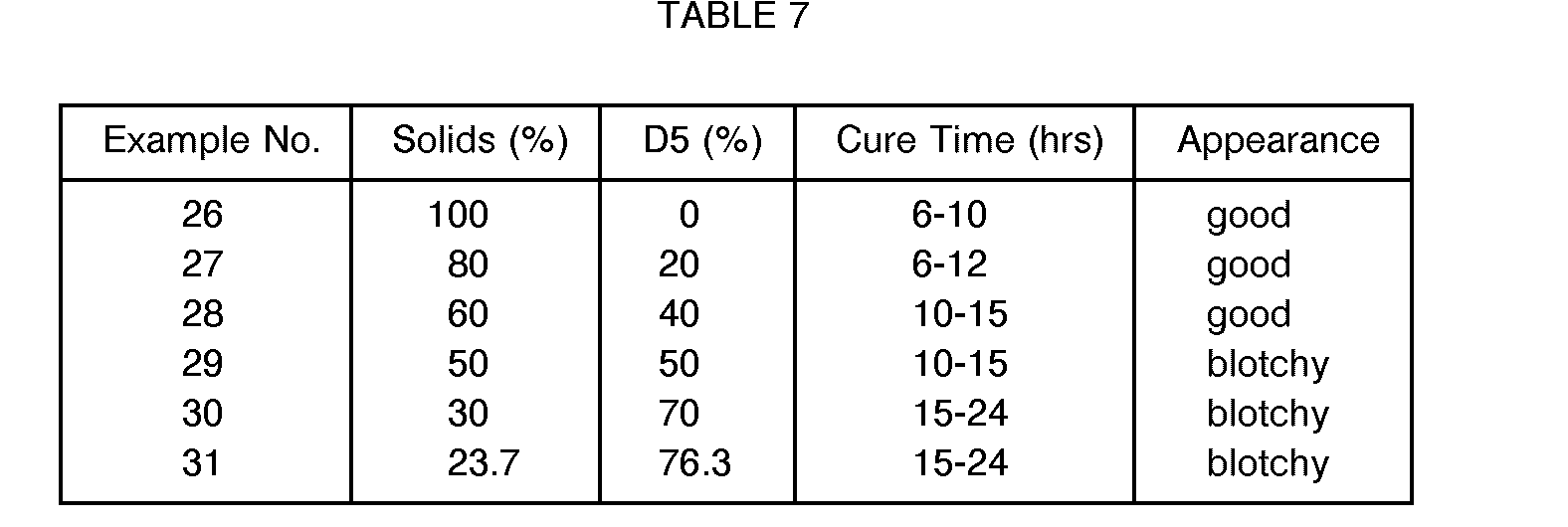
- Examples 26-31 illustrate the effect of the diluent, specifically, pentamer, on the cure time and appearance of the coatings having the compositions set forth in Table 7 below.
- Each of the samples prepared in these examples had a solids content containing the following formulation:
Landscapes
- Chemical & Material Sciences (AREA)
- Engineering & Computer Science (AREA)
- Materials Engineering (AREA)
- Chemical Kinetics & Catalysis (AREA)
- Life Sciences & Earth Sciences (AREA)
- Organic Chemistry (AREA)
- General Chemical & Material Sciences (AREA)
- Geochemistry & Mineralogy (AREA)
- Wood Science & Technology (AREA)
- Ceramic Engineering (AREA)
- Paints Or Removers (AREA)
- Surface Treatment Of Glass (AREA)
- Details Of Rigid Or Semi-Rigid Containers (AREA)
Abstract
Description
- This invention relates to coating compositions for masking scuff marks on glass articles. More particularly, this invention relates to improved fast curing coating compositions for masking scuff marks on glass bottles.
- Glass vessels which are used for beer, soft drinks, milk and the like in some countries are generally returnable and are recovered after use from the market and reused. During bottling processes, e.g., packaging, or transportation, such bottles undergo considerable abrasion damage, e.g., grazing, scratching, galling, scoring, and similar abrasive action (hereinafter referred to collectively as "scuffing") whereby scuff marks are left on the surfaces of the glass bottles. Scuffing phenomena is aggravated by mechanical grinding due to bottle-to-bottle pressure, mould lines, guide rails, and caustic etching and leaching. As a result, the appearance of the glass bottles is markedly impaired, and the commodity value of the resulting bottled beverages is lowered.
- Efforts have been made to improve glass formulations and surface treatments for concealing scuff marks on bottle surfaces. Reference is made, for example, to U.S. Patent Nos. 4,273,834 (Yokokura et al.); 4,656,221 (Kurita et al.); and 4,467,068 (Maruyama et al.).
- U.S. Patent No. 4,273,834 to Yokokura et al. (Yokokura) disclose a scuff-masking composition for glass vessels, wherein the composition comprises an organopolysiloxane terminated with a phenyl group, a methyl group, and an alkoxy group, and a curing catalyst, e.g., tetrabutyltitanate or dibutyltin dilaurate. The ratio of the phenyl, methyl, and alkoxy groups to one another is critical to the scuff-masking properties of the coating in Yokokura.
- U.S. Patent No. 4,656,221 to Kurita et al. (Kurita) discloses a composition for concealing graze marks on transparent glass bottles, the composition comprising a polydiorganosiloxane containing silicon-bonded organic groups selected from phenyl groups, aralkyl groups, and alkyl groups, a film-forming polyorganosiloxane containing a straight-chain diorganosiloxane portion and a cross-linking portion formed by the reaction of an amino or nitrogen group with an epoxy group and an oxygen atom, a cationic surfactant, and water.
- U.S. Patent No. 4,467,068 to Maruyama et al. (Maruyama) is directed to a composition for concealing grazes or scratches on glass surfaces, wherein the composition comprises an emulsion formed from a composition (A) which has as its principal ingredient a film-forming polyorganosiloxane and a composition (B) which has as its principal ingredient a liquid polydiorganosiloxane.
- Another surface treatment presently used in Japan involves the use of a silicone coating containing organooxy-chainstopped organopolysilsequioxane, high levels of volatile diluent, e.g., greater than 75%, and low levels of curing catalyst. This silicone coating has several major drawbacks.
- One drawback to the silicone coating described above is its inherent slow cure rate, i.e., approximately 2 to 4 days depending on the ambient conditions, which is the result of the coating's high content or volatile diluent and low content of curing catalyst, which inhibit cure rate. The slow cure rate in turn causes the coating to be tacky for a longer period of time. The increase in the tackiness period presents a problem because, in the United States, after the coating has been applied to the bottle surface, beer and soft drink bottles are packaged in clay-coated paper containers. The tackiness of the silicone coating on the bottle during the curing process causes the coating to pick up clay material from the paper container, resulting in blemishes on the surface of the coated bottle. Thus, the longer the coating is tacky, the more clay material is picked up and the more blemishes that result.
- Another drawback to the silicone coating described above is its inability to completely coat "wet" bottle surfaces. In the United States, beer undergoes a pasteurization process wherein the bottle containing beer is immersed in a cold water bath and chilled. After completion of the pasteurization process, the chilled bottle is removed from the water bath and dried. However, water forms on the surface of the chilled bottle's surface as a result of condensation caused by the temperature difference between the chilled bottle and the ambient atmosphere, rendering the surface of the bottle wet.
- The low solids silicone coating described above appears to coat the wet bottle completely but upon cure, the coating becomes uneven and forms blotches on the bottle surface, resulting in incomplete masking of scuff marks and an unattractive appearance.
- It is an object of this invention, therefore, to provide a fast curing scuff-masking coating for glass articles.
- It is a further object of this invention to provide a fast curing scuff-masking coating for glass articles, wherein the coating cures to form a uniform and non-blotchy coating on wet glass surfaces.
- These objects are achieved in the present invention.
- The present invention is based on the discovery that the cure rate and masking properties of a silicone coating composition containing an organooxy-chainstopped organopolysilsequioxane and a volatile diluent is improved by using higher levels of a tetraorganotitanate curing catalyst and zero or low levels of volatile diluent.
- The present invention provides an improved curable coating composition suitable for concealing scuff marks on glass articles, comprising by weight:
- (A) from about 70 to about 100 percent of a component comprising by weight:
- (1) from about 50 to 75 percent of an organooxy-chainstopped organopolysilsequioxane having a viscosity of from about 5 to about 1000 centipoise at 25 C and consisting essentially of RSi03/2 units and R(R1O)3-2nSiOn units, wherein n is a number equal to 0, 1/2, or 1, wherein R and R1 are independently a monovalent hydrocarbon radical containing from 1 to about 20 carbon atoms, the ratio of RSi03/2 units to R(R'0)3-2nSiOn units being from about 1:1 to about 50:1;
- (2) from about 5 to about 15 percent of tetraorganotitanate, having the general formula Ti (OR2)4
wherein R2 is a monovalent hydrocarbon radical containing from about 1 to about 10 carbon atoms; - (3) from about 0 to about 25 percent of an organotriorganooxysilane having the general formula R3- (R40)3Si, wherein R3 and R4 are independently monovalent hydrocarbon radicals containing from 1 to about 20 carbon atoms; and
- (4) from about 0 to about 15 percent of a carboxylic acid ester; and
- (B) from about 0 to about 30 percent of a volatile diluent.
- The composition of this invention provides a coating for concealing scuff marks on glass articles, e.g., glass bottles, wherein the coating cures faster and masks wet bottle surfaces completely.
- The present invention is further directed to glass articles, particularly glass bottles, having deposited on the surface thereof the curable and cured compositions of this invention.
- The composition of the present invention comprises by weight (A) from about 70 to about 100 percent of a component comprising by weight (1) from about 50 to 75 percent of an organooxy-chainstopped organopolysilsequioxane; (2) from about 5 to about 15 percent of tetraorganotitanate; (3) from about 0 to about 25 percent of an organotriorganooxysilane: and (4) from about 0 to about 15 percent of a carboxylic acid ester, and (B) from about 0 to about 30 percent of a volatile diluent.
- Component (A) is present in an amount ranging from 70 to about 100, preferably from about 80 to 100, and most preferably from about 90 to about 100, percent by weight based on the combined weight of components (A) and (B).
- Component (A)(1) is an organooxy-chainstopped polyorganosilsequioxane having a viscosity of from about 5 to about 1000, preferably from about 5-500, and most preferably from about 10 to about 200 and consisting essentially of RSi03/2 units and R(R'0)3-2nSiOn units, wherein R and R1 are independently monovalent hydrocarbon radicals containing from 1 to about 20, preferably from about 1-12, and most preferably from about 1 to about 8, carbon atoms, the ratio of RSi03/2 units to R(R1O)3-2nSiOn units being from about 1:1 to about 50:1, preferably from about 3:1 to about 20:1, and most preferably from about 4:1 to about 8:1. Examples of radicals represented by R and R1 include alkyl groups such as methyl, ethyl, and isopropyl; cycloaliphatic radicals such as cyclopentyl and cyclohexenyl; olefinic radicals, such as vinyl and allyl; and the phenyl radical. Preferably, R and R1 are both methyl groups.
- Component (A)(1) is present in an amount within the range of 50 to 75, preferably from about 60 to about 70, and most preferably from about 60 to about 65, percent by weight based on the total weight or component (A).
- Component (A)(1) can be prepared by the low acid partial hydrolysis of an organotriorganooxysilane in the presence of an aqueous solution of an aliphatic alcohol. A catalyst, HCI, is introduced at a controlled low level as organotrichlorosilane. This minimizes the HCI/methanol side reaction which produces water, altering the critical hydrolysis stoichiometry. Partial hydrolysis followed by a vacuum strip to 60-70 C at 20 torr in the presence of an alkaline earth metal carbonate provides a resin having a 5 to 10 weight percent methoxy content based on solids.
- Examples of suitable organotriorganooxysilanes as starting materials for the component (A)(1) resin include methyltrimethoxysilane, methyltriethoxysilane, methyltripropoxysilane, methyltributoxysilane, and the like. Methyltrimethoxysilane is preferred.
- Examples of suitable aliphatic alcohols include methanol, ethanol, propanol, and the like. Methanol is preferred.
- Examples of suitable organotrichlorosilanes include methyltrichlorosilanes, ethyltrichlorosilanes, and the like. Methyltrichlorosilanes are preferred.
- Component (A)(2) is a tetraorganotitanate having the general formula
- wherein R2 is a monovalent hydrocarbon radical containing from about 1 to about 10 carbon atoms, and preferably from about 2 to about 8 carbon atoms. Most preferably, R2 is a butyl radical, i.e., component (A)-(2) is most preferably tetrabutyltitanate.
- Component (A)(2) acts as a catalyst or cross-linker for the Component (A)(1) resin.
- The amount of Component (A)(2) is critical to the present invention. If there is too little present, cure rate remains substantially slow. Too much of Component (A)(2) results in the formation of a white film, i.e., Ti02, on the wet surface of the bottle. Too avoid these problems, Component (A)(2) is present in an amount within the range of from about 5 to about 15, preferably from about 8 to about 15, and most preferably from about 12 to about 15, percent by weight, based on the weight of component (A).
- Component (A)(3) is an organotriorganooxysilane having the general formula R3(R40)3Si, wherein R3 and R4 are independently monovalent hydrocarbon radicals containing from 1 to about 20, preferably from about 1 to about 12, and most preferably from about 1 to about 8, carbon atoms. Examples of suitable organotriorganooxysilanes include methyltrialkoxysilane such as, for example, methyltrimethoxysilane, methyltriethoxysilane, methyltripropoxysilane, and methyltributoxysilane. Preferably, Component (A)(3) is methyltriethoxysilane.
- Component (A)(3) can be obtained by alkoxylation of an organotrichlorosilane, e.g., methyltrichlorosilane, with suitable alcohols, e.g., ethanol, according to conventional processes.
- Component (A)(3) is present in an amount within the range of from about 0 to about 25, preferably from about 10 to about 20, and most preferably from about 14 to about 20 percent by weight, based on the weight of component A.
- The function of Component (A)(3) in the composition of this invention is to accelerate the cure rate.
- Component (A)(4) is a carboxylic acid ester. Carboxylic acid esters having from about 6 to about 22 carbon atoms are preferred. They can be either aliphatic or aromatic and can contain either one or more ester groups. Examples of suitable carboxylic acid esters include ethyl laurate, isopropyl myristate, isopropyl palmitate, isopropyl behenate, decyl acetate, behenyl butyrate, hexadecyl acetate, decyl de- canoate, methyl oleate, lauryl laurate, oleyl acetate, and dioctyladipate. Especially preferred for use in this invention is isopropyl myristate.
- Component (A)(4) is present in an amount within the range of from 0 to about 15, preferably from about 5 to about 15, and most preferably from about 8 to about 12, percent by weight, based on the weight of component A.
- Component (A)(4) functions as a plasticizer in the composition.
- The composition of this invention comprises (B) from about 0 to about 30 percent by weight based on the total weight of components (A) and (B) of a second component comprising a volatile diluent. Component (B) is a volatile silicone or organic fluid. As used herein, "volatile" refers to those materials which have a measurable vapor pressure at ambient conditions.
- Suitable volatile silicone fluids may be cyclic or linear. A description of various volatile silicone oils is found in Todd, et al., "Volatile Silicone Fluids for Cosmetics", 91 Cosmetics and Toiletries, 27-32 (1976), incorporated by reference herein. Linear volatile silicones generally have viscosities of less than about five centistokes at 25 C., whereas the cyclic silicones have viscosities of less than about 10 centistokes.
- In general, the volatile silicone fluid can be any combination of tetramer, pentamer, and hexamer, or a low viscosity diorgano fluid. Generally, suitable cyclic volatile silicone fluids can be represented by the formula:

- Examples of volatile silicone fluids useful in the present invention include, for example, (a) (i) SF 1202, containing a pentamer in a minimum amount of 95%, and 5% of other cyclics; (ii) SF 1204, containing 85% of pentamer and 15% of tetramer; (iii) SF 1173, containing 95% of tetramer and 5% of other cyclics; all of the foregoing products being available from General Electric Company; and (b) Dow Corning 344 fluid, wherein R5 is methyl and wherein the fluid typically comprises by weight about 88% tetramer, about 11.8% pentamer, and traces of trimer and hexamer.
- The preferred volatile silicone fluids for use in this invention are cyclics such as cyclomethicone pentamer and the cyclomethicone tetramer, and linears such as phenethylpentamethyldisiloxane. The most preferred volatile silicone fluid is the cyclomethicone pentamer.
- Examples of suitable volatile organic fluids are linear or branched isoparaffinic hydrocarbons having about 6 to about 16 carbon atoms and preferably about 10 to about 14 carbon atoms. The most preferred isoparaffinic hydrocarbons are those available from Exxon Corporation and having the designation ISOPAR (Registered Trade Mark).
- The composition of this invention does not require the presence of the volatile fluid. When it is present, it is critical that the amount of the volatile fluid be relatively low. If there is too much of the volatile fluid present, the cure rate of the composition will be slow, resulting in the problems discussed previously herein. Thus, the volatile fluid is present in the composition of this invention in an amount within the range of from 0 to about 30, preferably from about 0 to about 20, and most preferably from about 0 to about 10, percent by weight of the total composition.
- The composition of the present invention can be prepared by mixing the organotriorganooxysilane (Component (A)(3)) and the polyorganosilsequioxane (Component (A)(1)), followed by the addition of the plasticizer (Component (A)(4)). The ingredients are blended until uniform. The catalyst (Component (A)(2)) is then added to the mixture.
- The curable composition is then applied to the surface of a bottle or other glass article by brush- coating, puff-coating, dip-coating, and the like, and the bottle is allowed to stand at room temperature until curing is complete. The thickness of the coating can be varied according to the degree of thickness needed to effectively conceal the scuff marks. Typically, the thickness of the coat is be within the range of from about 1.3 to about 4.0 microns. The coating formed on the surface of the glass bottle has a refractive index of from about 1.35 to about 1.45, preferably from about 1.40 to about 1.45.
- In order that those skilled in the art may better understand the practice of the present invention, the following examples are given by way of illustration and not by way of limitation.
- Example 1 illustrates a method for making methoxy-chainstopped polymethylsilsequioxane, used as component (A)(1) in the examples below.
- A methyltrimethoxysilane (81 parts) was charged to a glass-lined hydrolyzer fitted with a reflux condenser. Methanol (9.2 parts) was then added to the hydrolyzer. Methyltrichlorosilane was then added in an amount sufficient to provide an HCI concentration of at least 900 ppm. Water (9.8 parts) was charged to a suitable addition vessel and added to the silane blend over a period of 15-30 minutes. The solution heated to reflux (approximately 65 C) quite readily. At the end of the water addition, reflux was continued at 120° C for 30-60 minutes, with heat being applied as necessary, to remove the methanol. After refluxing was complete, 0.31 part of sodium carbonate was added to the refluxed mixture. The mixture was then refluxed at 145° C at 45 torr until a solids content of 95% were obtained.
- Example 2 illustrates the preparation of the composition of this invention.
- The methoxy-chainstopped polymethylsilsequioxane prepared in Example 1 was mixed with methyltriethoxysilane and isopropyl myristate at room temperature with continous stirring. The ingredients were stirred until a homogeneous mixture was formed. Tetrabutyl titanate was then added and the resulting mixture was stirred until uniform. The composition was then applied to the surface of a wet 12 ounce beer bottle by a combination of brush- and puff-coating techniques and allowed to cure. The laboratory temperature was approximately 72° F and the relative humidity was approximately 40%. The thickness of the coating was from about 1.3 to about 4.0 microns per bottle.
- In the examples below, the amounts of the ingredients recited in the tables are expressed in terms of "%", which refers to percent by weight based on the weight of the total composition.
- Eight compositions having the formulations set forth in Table 1 below were prepared according to the method described in Example 2 above. The term "MPMS" in the tables below represents the methoxy-chainstopped polymethylsilsequioxane prepared in Example 1 above. The term "MTES" refers to methyltriethoxysilane, "IPM" refers to isopropyl myristate, and "TBT" refers to tetrabutyltitanate.

- The compositions prepared in Examples 3-10 were tested for cure time, masking properties, and adhesion. The cure time refers to the period of time required by the coating to cure throughout its thickness. The degree of masking was determined by observation with the naked eye. Completeness of cure and adhesion were determined by means of rub-off and migration testing. Rub-off occurs when a silicone coating fails to adhere to the substrate and can be rubbed off in little balls of cured silicone by gentle finger pressure. Migration is detected by the Scotch (trademark) cellophane tape test. The coating is considered well cured and migration-free if a piece of No. 610 Scotch tape will stick to itself after having been first firmly pressed into the silicone coating, then removed and doubled back on itself. The results are presented in Table 2 below.

- All of the samples prepared in Examples 3-10 provided complete masking of the wet bottle surface and excellent adhesion between the coating and the glass surface. However, cure times were found to vary according to the amount of catalyst, i.e, TBT, used. The compositions containing between about 13 to about 15 percent by weight of TBT, i.e., Examples 4, 5, 7, and 10, had cure times of 30 minutes whereas those containing about 1 percent by weight of TBT, i.e., Examples 3, 6, 8, and 9, had cure times of more than 24 hours. Thus, the higher amounts of TBT were critical to attaining fast cure rates.
- Examples 11-14 further illustrate the effect of catalyst level on cure time. Four compositions were prepared having the formulations set forth in Table 3 below. The percentage values are % by weight based on the total weight of the composition.

- The cure time and masking data for the compositions prepared in Examples 11-14 were measured in accordance with procedures previously described and are shown in Table 4 below.

- The data presented in Table 4 indicates that there is a proportional relationship between the amount of catalyst used and the cure time. The more catalyst present, the faster the cure. All the samples prepared in Examples 11-14 exhibited complete cure and complete masking properties.
- In Examples 15-20, the influence of catalyst levels on compositions containing diluent, specifically, the pentamer, D5, was measured.
- The compositions of the samples prepared in Examples 15-20 are shown in Table 5 below. These formulations were coated onto bottles at 0.06 to 0.09 grams per bottle, at thicknesses of 2.4 to about 3.6 microns. The samples were tested for cure time and masking properties at 25 C and 60% humidity, in accordance with the procedures described previously herein. The results are shown in Table 5.

- The data presented in Table 5 shows that lower levels of catalyst and higher levels of D5 result in slower cure time.
- In Examples 21-25 below, the effect of TBT catalyst level on the cure time and masking properties of the compositions having the following formulation were tested:

- In the samples prepared in Examples 21-25, the catalyst levels varied as shown in Table 6. The cure time and masking properties of the samples are also shown in Table 6.

- Although cure time is reduced, the formulations prepared in Examples 21-25 produced a blotchy coating on the wet bottle surface at increasing levels of the TBT catalyst. These results indicate that the high diluent content of the samples prevented the formation of uniform coatings on the wet glass bottle surfaces.
- Examples 26-31 illustrate the effect of the diluent, specifically, pentamer, on the cure time and appearance of the coatings having the compositions set forth in Table 7 below. Each of the samples prepared in these examples had a solids content containing the following formulation:

- The samples prepared in Examples 26-31 differed in the amount of solids contained therein. The cure time and appearance properties of the coatings prepared in these examples are shown in Table 7 below:

Claims (35)
Applications Claiming Priority (2)
| Application Number | Priority Date | Filing Date | Title |
|---|---|---|---|
| US07/564,927 US5095086A (en) | 1990-08-08 | 1990-08-08 | Scuff-masking coatings for glass articles |
| US564927 | 1990-08-08 |
Publications (2)
| Publication Number | Publication Date |
|---|---|
| EP0470442A2 true EP0470442A2 (en) | 1992-02-12 |
| EP0470442A3 EP0470442A3 (en) | 1992-05-20 |
Family
ID=24256468
Family Applications (1)
| Application Number | Title | Priority Date | Filing Date |
|---|---|---|---|
| EP19910112463 Ceased EP0470442A3 (en) | 1990-08-08 | 1991-07-25 | Improved scuff-masking coatings for glass articles |
Country Status (5)
| Country | Link |
|---|---|
| US (1) | US5095086A (en) |
| EP (1) | EP0470442A3 (en) |
| JP (1) | JPH04231353A (en) |
| KR (1) | KR920004288A (en) |
| CA (1) | CA2042174A1 (en) |
Cited By (4)
| Publication number | Priority date | Publication date | Assignee | Title |
|---|---|---|---|---|
| EP0532253A1 (en) * | 1991-09-10 | 1993-03-17 | General Electric Company | Abrasion resistant coating compositions for glass articles |
| WO1995015928A3 (en) * | 1993-12-07 | 1995-07-27 | Dsm Nv | Coating system for glass adhesion retention |
| EP1731227A1 (en) * | 2005-06-10 | 2006-12-13 | Arkema Inc. | Scratch masking coating for glass containers |
| WO2017097249A1 (en) | 2015-12-09 | 2017-06-15 | 可口可乐公司 | Polishing process and polishing apparatus for glass product |
Families Citing this family (1)
| Publication number | Priority date | Publication date | Assignee | Title |
|---|---|---|---|---|
| US20100273696A1 (en) * | 2009-04-23 | 2010-10-28 | Herbert Hopfstock | Composition and method for the prevention and removal of unwanted paint on a surface |
Family Cites Families (16)
| Publication number | Priority date | Publication date | Assignee | Title |
|---|---|---|---|---|
| US4111890A (en) * | 1977-12-19 | 1978-09-05 | Sws Silicones Corporation | Curable organopolysiloxane compositions containing titanium esters |
| JPS5556040A (en) * | 1978-10-14 | 1980-04-24 | Kirin Brewery Co Ltd | Glass container scratch cover |
| JPS5950188B2 (en) * | 1979-07-18 | 1984-12-06 | 麒麟麦酒株式会社 | Composition for shielding scratches on glass containers |
| DE2941105C2 (en) * | 1978-10-14 | 1982-04-08 | Kirin Beer K.K. | Use of a polysiloxane composition for coating glass objects, in particular for covering scratches on glass bottles |
| JPS5721457A (en) * | 1980-07-11 | 1982-02-04 | Toray Silicone Co Ltd | Primer composition |
| US4467068A (en) * | 1983-05-18 | 1984-08-21 | Toshiba Silicone Co., Ltd. | Composition for concealing graze marks on glass |
| US4681908A (en) * | 1983-11-09 | 1987-07-21 | Dow Corning Corporation | Hard organopolysiloxane release coating |
| JPH064496B2 (en) * | 1984-06-20 | 1994-01-19 | 東芝シリコ−ン株式会社 | Scratch-shielding agent for transparent glass bottles |
| JPS61265381A (en) * | 1985-05-20 | 1986-11-25 | Hitachi Ltd | Gas injector for screw compressor |
| US4801445A (en) * | 1985-07-29 | 1989-01-31 | Shiseido Company Ltd. | Cosmetic compositions containing modified powder or particulate material |
| US4677147A (en) * | 1986-03-24 | 1987-06-30 | Dow Corning Corporation | Bakeware release coating |
| DE3786328T2 (en) * | 1986-09-30 | 1993-10-21 | Kanegafuchi Chemical Ind | Curable composition based on a silicone-functional organic polymer. |
| JPH0751634B2 (en) * | 1986-10-20 | 1995-06-05 | 東芝シリコ−ン株式会社 | Surface-treated spherical polymethylsilsesquioxane powder |
| JPH0213A (en) * | 1987-10-13 | 1990-01-05 | Hitachi Chem Co Ltd | Composition for forming protective film for transparent electrode of liquid crystal display element |
| US4895766A (en) * | 1988-03-23 | 1990-01-23 | General Electric Company | Bakeware coating |
| JPH0745332B2 (en) * | 1989-04-27 | 1995-05-17 | アサヒビール株式会社 | Scratch-shielding agent for glass container, glass container in which scratches are shielded, and method for shielding scratches in glass container |
-
1990
- 1990-08-08 US US07/564,927 patent/US5095086A/en not_active Expired - Lifetime
-
1991
- 1991-05-09 CA CA002042174A patent/CA2042174A1/en not_active Abandoned
- 1991-07-25 EP EP19910112463 patent/EP0470442A3/en not_active Ceased
- 1991-08-02 JP JP3216560A patent/JPH04231353A/en active Pending
- 1991-08-07 KR KR1019910013639A patent/KR920004288A/en not_active Withdrawn
Cited By (4)
| Publication number | Priority date | Publication date | Assignee | Title |
|---|---|---|---|---|
| EP0532253A1 (en) * | 1991-09-10 | 1993-03-17 | General Electric Company | Abrasion resistant coating compositions for glass articles |
| WO1995015928A3 (en) * | 1993-12-07 | 1995-07-27 | Dsm Nv | Coating system for glass adhesion retention |
| EP1731227A1 (en) * | 2005-06-10 | 2006-12-13 | Arkema Inc. | Scratch masking coating for glass containers |
| WO2017097249A1 (en) | 2015-12-09 | 2017-06-15 | 可口可乐公司 | Polishing process and polishing apparatus for glass product |
Also Published As
| Publication number | Publication date |
|---|---|
| CA2042174A1 (en) | 1992-02-09 |
| US5095086A (en) | 1992-03-10 |
| EP0470442A3 (en) | 1992-05-20 |
| KR920004288A (en) | 1992-03-27 |
| JPH04231353A (en) | 1992-08-20 |
Similar Documents
| Publication | Publication Date | Title |
|---|---|---|
| EP0395077B1 (en) | Abrasion-concealing agent for glass containers, abrasion-concealed glass container, and method for concealing abrasions on glass containers | |
| EP0144167B1 (en) | Hard organopolysiloxane release coating | |
| US5232783A (en) | Abrasion resistant coatings for glass articles | |
| EP0390083B1 (en) | Liquid silicone resin compositions | |
| US5567764A (en) | Curable silicone coatings containing alkoxy and alkenyl functional siloxanes | |
| JPH0138414B2 (en) | ||
| JPH05507955A (en) | Antifouling paint composition | |
| US4467068A (en) | Composition for concealing graze marks on glass | |
| EP0273705B1 (en) | Curable silicone composition for corrosion protection | |
| CA1257730A (en) | Composition for concealing graze marks on transparent glass bottle | |
| US5095086A (en) | Scuff-masking coatings for glass articles | |
| GB2301829A (en) | Silicone solventless pressure sensitive adhesive compositions | |
| GB2054624A (en) | Masking of abrasion injury on glass articles | |
| CZ287863B6 (en) | Mixture for treating substrates containing silicon | |
| EP0412564A2 (en) | Process of curing methylhydrosiloxanes | |
| JP2819162B2 (en) | Scratching agent for glass containers | |
| JP3290406B2 (en) | Emulsion composition for coating glass container and glass container coated with emulsion composition | |
| JP3915903B2 (en) | Scratch shielding agent for glass container and glass container | |
| JP2864674B2 (en) | Scratching agent for glass containers | |
| JP4824862B2 (en) | Glass container scratching agent | |
| JPH0316934A (en) | Agent for masking scratch of glass vessel | |
| JPH0780498B2 (en) | Scratch-shielding agent for glass containers and glass containers with scratches shielded | |
| JP2694090B2 (en) | Scratch-shielding agent for containers and containers with scratches shielded | |
| JP2004043239A (en) | Scratching agent for glass container and glass container | |
| JPH11302543A (en) | Surface protective polishing agent |
Legal Events
| Date | Code | Title | Description |
|---|---|---|---|
| PUAI | Public reference made under article 153(3) epc to a published international application that has entered the european phase |
Free format text: ORIGINAL CODE: 0009012 |
|
| AK | Designated contracting states |
Kind code of ref document: A2 Designated state(s): AT BE DE DK ES FR GB IT NL |
|
| PUAL | Search report despatched |
Free format text: ORIGINAL CODE: 0009013 |
|
| AK | Designated contracting states |
Kind code of ref document: A3 Designated state(s): AT BE DE DK ES FR GB IT NL |
|
| 17P | Request for examination filed |
Effective date: 19921109 |
|
| 17Q | First examination report despatched |
Effective date: 19931206 |
|
| STAA | Information on the status of an ep patent application or granted ep patent |
Free format text: STATUS: THE APPLICATION HAS BEEN REFUSED |
|
| 18R | Application refused |
Effective date: 19950126 |