EP0470292B1 - Method for preserving the freshness of eggs - Google Patents
Method for preserving the freshness of eggs Download PDFInfo
- Publication number
- EP0470292B1 EP0470292B1 EP90119857A EP90119857A EP0470292B1 EP 0470292 B1 EP0470292 B1 EP 0470292B1 EP 90119857 A EP90119857 A EP 90119857A EP 90119857 A EP90119857 A EP 90119857A EP 0470292 B1 EP0470292 B1 EP 0470292B1
- Authority
- EP
- European Patent Office
- Prior art keywords
- composition
- freshness
- eggs
- carbon atoms
- acid
- Prior art date
- Legal status (The legal status is an assumption and is not a legal conclusion. Google has not performed a legal analysis and makes no representation as to the accuracy of the status listed.)
- Expired - Lifetime
Links
Images


Classifications
-
- A—HUMAN NECESSITIES
- A23—FOODS OR FOODSTUFFS; TREATMENT THEREOF, NOT COVERED BY OTHER CLASSES
- A23B—PRESERVATION OF FOODS, FOODSTUFFS OR NON-ALCOHOLIC BEVERAGES; CHEMICAL RIPENING OF FRUIT OR VEGETABLES
- A23B5/00—Preservation of eggs or egg products
- A23B5/08—Preserving with chemicals
- A23B5/12—Preserving with chemicals in the form of liquids or solids
- A23B5/14—Organic compounds; Microorganisms; Enzymes
-
- A—HUMAN NECESSITIES
- A23—FOODS OR FOODSTUFFS; TREATMENT THEREOF, NOT COVERED BY OTHER CLASSES
- A23B—PRESERVATION OF FOODS, FOODSTUFFS OR NON-ALCOHOLIC BEVERAGES; CHEMICAL RIPENING OF FRUIT OR VEGETABLES
- A23B5/00—Preservation of eggs or egg products
- A23B5/06—Coating eggs with a protective layer; Compositions or apparatus therefor
Definitions
- This invention relates to a method for preserving the degree of freshness of poultry eggs, such as hen'eggs, quail eggs, and duck eggs.
- a present method for preserving the degree of freshness of eggs comprises coating the surface of a shell egg with mineral oil such as liquid paraffin or an emulsion thereof.
- the degree of freshness of eggs can be preserved for several months by such a treatment.
- the coating with liquid paraffin is not preferable because such coating induces surface stickiness.
- there is a safety problem because liquid paraffin is a fraction of mineral oil.
- compositions comprising a triglyceride of saturated fatty acids ( I ), as an active base, of the following general formula: wherein : R1, R2 and R3 are the same or different, linear aliphatic hydrocarbon groups containing from 5 to 21 carbon atoms.
- compositions comprising a triglyceride of saturated fatty acids ( I ) , as an active base, of the following general formula: wherein : R1, R2 and R3 are the same or different, linear aliphatic hydrocarbon groups containing from 5 to 21 carbon atoms, and as an essential ingredient, a fatty acid ( II ) containing from 12 to 22 carbon atoms in an amount of from 0.001 to 5.0 % by weight on the basis of the total weight of a composition.
- a composition comprising a triglyceride of saturated fatty acids ( I ) , as an active base, of the following general formula: wherein : R1, R2 and R3 are the same or different, linear aliphatic hydrocarbon groups containing from 5 to 21 carbon atoms, and as an essential ingredient, a fatty acid ( II ) containing from 12 to 22 carbon atoms in an amount of from 0.001 to 5.0 % by weight on the basis of the total weight of a composition.
- the triglyceride of saturated fatty acids ( I ) of this invention is of the following general formula: wherein : R1, R2 and R3 are the same or different, linear aliphatic hydrocarbon groups containing from 5 to 21 carbon atoms.
- the triglyceride of saturated fatty acids which does not come within the scope of the claims of this invention is not preferable because it has problems of low atomization, surface stickiness, cold fluidity, or safety to human body.
- Typical examples of the preferred linear aliphatic hydrocarbon group represented by R1, R2 or R3 of the present invention include pentyl, hexyl , heptyl, octyl, nonyl, decyl, undecyl, dodecyl, tridecyl, tetradecyl, pentadecyl, hexadecyl, heptadecyl, octadecyl, nonadecyl, eicocyl, henicocyl, pentenyl, hexenyl, heptenyl, octenyl, nonenyl, decenyl, undecenyl, dodecenyl, tridecenyl, tetradecenyl, pentadecenyl, hexadecenyl, heptadecenyl, octadecenyl, nonadec
- one typical process comprises: hydrolyzing a fat to prepare fatty acid and glycerin, extracting said fatty acid to obtain a desired fatty acid fraction suitable for the present invention, and then esterifying the fatty acid fraction with glycerin.
- a combined use of a triglyceride of saturated fatty acids with a fatty acid containing from 12 to 22 carbon atoms, preferably with a saturated fatty acid containing from 12 to 20 carbon atoms, may extend further a period of time during which the degree of freshness of shell eggs is preserved.
- Any fatty acids such as a naturally-occurring fatty acid or a synthetic fatty acid containing from 12 to 22 carbon atoms may be employed in the present invention, with a linear or branched chain fatty acid being acceptable.
- Typical examples of the fatty acid of the present invention include lauric acid, tridecylic acid, myristic acid, pentadecylic acid, palmitic acid, heptadecylic acid, stearic acid, nonadecanic acid, arachic acid, behenic acid, oleic acid, elaidic acid, cetoleicacid, erucic acid, brassidic acid, linoleic acid, linolenic acid, arachidonic acid, stearolic acid, mixtures thereof, and the like.
- a saturated fatty acid containing 14, 16, 18 or 20 carbon atoms, or mixtures thereof is preferred.
- the amount of the fatty acid containing from 12 to 22 carbon atoms, if it is necessary to be incorporated, is in the range from 0.001 to 5.0 % by weight, preferably from 0.01 to 0.5 % by weight on the basis of the total weight of a composition.
- An addition of a small amount of germicide and/or fungicide and concurrently antioxidant to the present compositions may prolong further the period of time during which the degree of freshness of shell eggs is preserved.
- Typical examples of germicide or fungicide include bleaching powder, a high-power bleaching powder, hypochlorous acid, sodium hypochlorite, and the like.
- the amount of the germicide and/or the fungicide employed in the present invention is in the range from 50 to 20,000 ppm by weight, preferably from 100 to 15,000 ppm by weight on the basis of the total weight of a composition.
- additives may be added optionally to the compositions of the present invention to strengthen further the effect of the compositions.
- Such optional additives should be entirely nontoxic to the human body.
- Preferred germicides used in the present compositions include alcohols such as ethyl alcohol and oleyl alcohol; citric acid; the oil and fats manufactured from animals and plants and partially hydrogenated products thereof; higher fatty acid esters such as methyl laurate and butyl stearate.
- Preferred fungicides and concurrently antioxidants used in the present compositions include tert-butyl hydroxyanisol, dibutyl hydroxytoluene, tocopherols (vitamin E), and the like.
- One or more of the optional additives can be incorporated into a composition of the present invention. Although the amount of said additive may be selected suitably, an amount of less than 3.0 % by weight, preferably an amount ranging from 0.001 to 3.0 % by weight on the basis of the total weight of a composition is usually appropriate.
- a method for preserving the degree of freshness of poultry shell eggs comprising spraying the surface of a poultry shell egg with a composition of the invention, said the composition comprising a triglyceride of fatty acids.
- An example of such spraying process comprises coating the surface of a shell egg with a mist comprising particles having a particle size in the range from 1 to 100 ⁇ m, preferably 10 to 20 ⁇ m.
- a mist comprising particles having a particle size in the range from 1 to 100 ⁇ m, preferably 10 to 20 ⁇ m.
- the treatment results in a decrease of coatings whereby a prolonged period of time for spraying will be necessary to obtain a desired coatings.
- the particle size is too large, the treatment results in an excess of coatings and in an increase of stickiness of the shell whereby a period of time for preserving the freshness of eggs will be shortened.
- the duration of spraying is in the range from 2 to 10 seconds, preferably 4 to 7 seconds.
- a nozzle which is capable of produce a mist comprising particles having a particule size in the range from 10 to 20 ⁇ m is most preferable.
- Japanese Utility Model Application Publication No. 9246/S-63 and No. 8561/H-2 described the nozzles of this kind, and the disclosures of which are incorporated by reference.
- Figure 1 through 4 are individually graphs illustrating the results of the test for the compositions in Example 1 through 9 and Comparative Example 1 through 3 of this invention.
- Figure 5 is a schematic elevation view in section showing the contents of a hen'egg rested on a glass plate (a), wherein (b) is a dense white, (c) is a thin white, (d) is a yolk, and H is the height of a dense white (b).
- the degree of freshness of poultry shell eggs will be able to preserved for a much longer period of time, and the burden of the waste disposal of inferior shell eggs collected from the market will be greatly relieved.
- a composition of the present invention comprising said triglyceride of saturated fatty acids is entirely safe to the fuman body.
Landscapes
- Life Sciences & Earth Sciences (AREA)
- Engineering & Computer Science (AREA)
- Chemical & Material Sciences (AREA)
- Polymers & Plastics (AREA)
- Wood Science & Technology (AREA)
- Zoology (AREA)
- Food Science & Technology (AREA)
- General Chemical & Material Sciences (AREA)
- Chemical Kinetics & Catalysis (AREA)
- Microbiology (AREA)
- Meat, Egg Or Seafood Products (AREA)
- Food Preservation Except Freezing, Refrigeration, And Drying (AREA)
- Storage Of Fruits Or Vegetables (AREA)
Description
- This invention relates to a method for preserving the degree of freshness of poultry eggs, such as hen'eggs, quail eggs, and duck eggs.
- When a new-laid poultry shell egg has been stored without washing in a room for a period of from 16 to 42 days, bacteria will be detected in the contents of the egg. However, such a washing is not preferable because washing will destroy a protective cuticula layer on the surface of an egg which is impregnable to most bacteria. As the result, the invasion of bacteria will be in evidence in the contents of the shell egg in about 9 days after washing. Therefore, new-laid poultry shell eggs are usually delivered to retailers' stores the day after laying and displayed for sale on their shelves for at most 3 days. After the term expired, the eggs left unsold are treated to make processed foodstuffs. Judging from the delivery and sanitary point of view, it is worthwhile to prolong the present period of time during which the degree of freshness of eggs is preserved. A present method for preserving the degree of freshness of eggs comprises coating the surface of a shell egg with mineral oil such as liquid paraffin or an emulsion thereof. The degree of freshness of eggs can be preserved for several months by such a treatment. However, the coating with liquid paraffin is not preferable because such coating induces surface stickiness. Further, there is a safety problem because liquid paraffin is a fraction of mineral oil. Although poultry shell eggs are usually pasteurized to sterilize salmonelas which may be mixed in fecal matters in certain cases. However, said sterilization process does not influence significantly over the preservation of the degree of freshness of eggs.
- There is a continuing demand for improvements in the method for preserving the degree of freshness of poultry shell eggs and the composition for the freshness-preservation of poultry shell eggs.
- It is the object of this invention to provide a new, safe and effective method for making the degree of freshness of poultry shell eggs keep long.
- The benefits and advantages of the present invention are achieved in accordance with the composition aspects thereof by providing a method which comprises spraying the surface of a shell egg with an effective amount of a composition comprising a triglyceride of saturated fatty acids (I), as an active base, of the following general formula:

wherein : R¹, R² and R³ are the same or different, linear aliphatic hydrocarbon groups containing from 5 to 21 carbon atoms. - The benefits and advantage of the present invention are also achieved in accordance with the composition aspects thereof by providing a method which comprises spraying the surface of a shell egg, with an effective amount of a composition comprising a triglyceride of saturated fatty acids (I) , as an active base, of the following general formula:
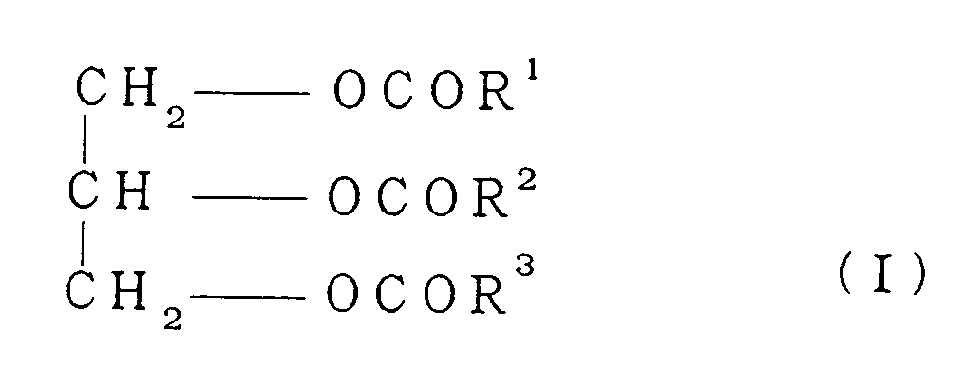
wherein : R¹, R² and R³ are the same or different, linear aliphatic hydrocarbon groups containing from 5 to 21 carbon atoms, and as an essential ingredient, a fatty acid (II) containing from 12 to 22 carbon atoms in an amount of from 0.001 to 5.0 % by weight on the basis of the total weight of a composition. - The triglyceride of saturated fatty acids (I) of this invention is of the following general formula:

wherein : R¹, R² and R³ are the same or different, linear aliphatic hydrocarbon groups containing from 5 to 21 carbon atoms. - The triglyceride of saturated fatty acids which does not come within the scope of the claims of this invention is not preferable because it has problems of low atomization, surface stickiness, cold fluidity, or safety to human body.
- Typical examples of the preferred linear aliphatic hydrocarbon group represented by R¹, R² or R³ of the present invention include pentyl, hexyl , heptyl, octyl, nonyl, decyl, undecyl, dodecyl, tridecyl, tetradecyl, pentadecyl, hexadecyl, heptadecyl, octadecyl, nonadecyl, eicocyl, henicocyl, pentenyl, hexenyl, heptenyl, octenyl, nonenyl, decenyl, undecenyl, dodecenyl, tridecenyl, tetradecenyl, pentadecenyl, hexadecenyl, heptadecenyl, octadecenyl, nonadecenyl, eicocenyl, henicocenyl, and the like. Among them, a linear alkyl group containing from 5 to 21 carbon atoms, more preferably 5 to 11 carbon atoms, is preferable because of its oxidative stability.
- Although any processes for manufacturing such a trigryceride of saturated fatty acids of the present invention may be acceptable, one typical process comprises:
hydrolyzing a fat to prepare fatty acid and
glycerin,
extracting said fatty acid to obtain a desired fatty acid fraction suitable for the present invention, and then
esterifying the fatty acid fraction with glycerin. - As can be seen from the fact that the triglycerides of the present invention have been approved as food additives by the Health and Welfare Ministry of Japan, said triglycerides are entirely nontoxic to the human body.
- Although single use of a triglyceride of saturated fatty acids may be acceptable, a combined use of a triglyceride of saturated fatty acids with a fatty acid containing from 12 to 22 carbon atoms, preferably with a saturated fatty acid containing from 12 to 20 carbon atoms, may extend further a period of time during which the degree of freshness of shell eggs is preserved.
- Any fatty acids such as a naturally-occurring fatty acid or a synthetic fatty acid containing from 12 to 22 carbon atoms may be employed in the present invention, with a linear or branched chain fatty acid being acceptable. Typical examples of the fatty acid of the present invention include lauric acid, tridecylic acid, myristic acid, pentadecylic acid, palmitic acid, heptadecylic acid, stearic acid, nonadecanic acid, arachic acid, behenic acid, oleic acid, elaidic acid, cetoleicacid, erucic acid, brassidic acid, linoleic acid, linolenic acid, arachidonic acid, stearolic acid, mixtures thereof, and the like. Among them, a saturated fatty acid containing 14, 16, 18 or 20 carbon atoms, or mixtures thereof is preferred.
- These fatty acids have been designated as odorants in the legal definition of the term "food additive", and sorted into the standard raw materials used in the production of cosmetics and it is clear that they are perfectly harmless and safe to the human body.
- The amount of the fatty acid containing from 12 to 22 carbon atoms, if it is necessary to be incorporated, is in the range from 0.001 to 5.0 % by weight, preferably from 0.01 to 0.5 % by weight on the basis of the total weight of a composition.
- An addition of a small amount of germicide and/or fungicide and concurrently antioxidant to the present compositions may prolong further the period of time during which the degree of freshness of shell eggs is preserved.
- Typical examples of germicide or fungicide include bleaching powder, a high-power bleaching powder, hypochlorous acid, sodium hypochlorite, and the like.
- The amount of the germicide and/or the fungicide employed in the present invention is in the range from 50 to 20,000 ppm by weight, preferably from 100 to 15,000 ppm by weight on the basis of the total weight of a composition.
- Other additives may be added optionally to the compositions of the present invention to strengthen further the effect of the compositions. Such optional additives should be entirely nontoxic to the human body. Preferred germicides used in the present compositions include alcohols such as ethyl alcohol and oleyl alcohol; citric acid; the oil and fats manufactured from animals and plants and partially hydrogenated products thereof; higher fatty acid esters such as methyl laurate and butyl stearate. Preferred fungicides and concurrently antioxidants used in the present compositions include tert-butyl hydroxyanisol, dibutyl hydroxytoluene, tocopherols (vitamin E), and the like. One or more of the optional additives can be incorporated into a composition of the present invention. Although the amount of said additive may be selected suitably, an amount of less than 3.0 % by weight, preferably an amount ranging from 0.001 to 3.0 % by weight on the basis of the total weight of a composition is usually appropriate.
- According to the present invention, there is provided a method for preserving the degree of freshness of poultry shell eggs wherein the method comprises spraying the surface of a poultry shell egg with a composition of the invention, said the composition comprising a triglyceride of fatty acids.
- An example of such spraying process comprises coating the surface of a shell egg with a mist comprising particles having a particle size in the range from 1 to 100 µm, preferably 10 to 20 µm. When the particule size is too small, the treatment results in a decrease of coatings whereby a prolonged period of time for spraying will be necessary to obtain a desired coatings. When the particle size is too large, the treatment results in an excess of coatings and in an increase of stickiness of the shell whereby a period of time for preserving the freshness of eggs will be shortened.
- In the case of particule size in the range from 10 to 20 µm, the duration of spraying is in the range from 2 to 10 seconds, preferably 4 to 7 seconds.
- Although any types of spraying nozzle may be acceptable, a nozzle which is capable of produce a mist comprising particles having a particule size in the range from 10 to 20 µm is most preferable. Japanese Utility Model Application Publication No. 9246/S-63 and No. 8561/H-2 described the nozzles of this kind, and the disclosures of which are incorporated by reference.
- Figure 1 through 4 are individually graphs illustrating the results of the test for the compositions in Example 1 through 9 and Comparative Example 1 through 3 of this invention.
- Figure 5 is a schematic elevation view in section showing the contents of a hen'egg rested on a glass plate (a), wherein (b) is a dense white, (c) is a thin white, (d) is a yolk, and H is the height of a dense white (b).
- In order to further illustrate the method of the invention, the following specific examples are provided. It will be understood that the examples as hereinafter set forth are provided for illustrative purposes and are not intended to be limiting of the invention as herein disclosed and set forth in the subjoined claims.
- A hen'egg shell was sprayed with each of the following compositions of the present invention for 5 seconds. Haugh units were measured at 20°C. under a humidity of 70 % after storage for 5 days, 10 days and 15 days respectively. The test was run on each of 3 eggs for one composition. Figure 1 through 3 give the results of the test. Example 1 through 3 show the results of the test for Composition A (Figure 1), Example 4 through 6 show the results of the test for Composition B (Figure 2), and Example 7 through 9 show the results of the test for Composition C (Figure 3). Figure 4 gives the results of the blank test (Comparative Example 1 through 3).

Such Haugh unit can be computed from the following equation.
wherein W is the weight of a hen'egg, and H is the height of a dense white as is shown in Figure 5. - Thus according to the present invention, the degree of freshness of poultry shell eggs will be able to preserved for a much longer period of time, and the burden of the waste disposal of inferior shell eggs collected from the market will be greatly relieved.
- As can be seen from the fact that a triglyceride of saturated fatty acids or a fatty acid of this invention has been designated as one of the food additives, a composition of the present invention comprising said triglyceride of saturated fatty acids is entirely safe to the fuman body.
- Further, it is noteworthy that there is no possibility of suffocation of shell eggs because the coatings on the shell formed by the present invention is permeable to air.
Claims (4)
- A method for preserving the degree of freshness of poultry eggs which comprises spraying the surface of a shell egg with an effective amount of a composition comprising a triglyceride of saturated fatty acids (I) , as an active base, of the following general formula:

- A method for preserving the degree of freshness of poultry eggs which comprises spraying over the surface of a shell egg with an effective amount of a composition comprising a triglyceride of saturated fatty acids (I) , as an active base, of the following general formula:

- The method of claim 1 or claim 2 wherein said composition contains in addition a germicide and/or a fungicide in an amount of from 50 to 20,000 ppm by weight on the basis of the total weight of a composition.
- The method of claim 1, claim 2 or claim 3 wherein said spraying is carried out by spraying with a mist comprising finely divided particles having a particle size in the range of from 1 to 100 µm.
Applications Claiming Priority (2)
| Application Number | Priority Date | Filing Date | Title |
|---|---|---|---|
| JP2174991A JP2782377B2 (en) | 1990-07-02 | 1990-07-02 | How to preserve egg freshness |
| JP174991/90 | 1990-07-02 |
Publications (2)
| Publication Number | Publication Date |
|---|---|
| EP0470292A1 EP0470292A1 (en) | 1992-02-12 |
| EP0470292B1 true EP0470292B1 (en) | 1993-09-01 |
Family
ID=15988309
Family Applications (1)
| Application Number | Title | Priority Date | Filing Date |
|---|---|---|---|
| EP90119857A Expired - Lifetime EP0470292B1 (en) | 1990-07-02 | 1990-10-16 | Method for preserving the freshness of eggs |
Country Status (4)
| Country | Link |
|---|---|
| US (1) | US5340596A (en) |
| EP (1) | EP0470292B1 (en) |
| JP (1) | JP2782377B2 (en) |
| DE (1) | DE69003097T2 (en) |
Families Citing this family (6)
| Publication number | Priority date | Publication date | Assignee | Title |
|---|---|---|---|---|
| JP2749764B2 (en) * | 1993-09-10 | 1998-05-13 | 奥本製粉株式会社 | Shelled eggs and method of maintaining freshness of shelled eggs |
| EP1036511A3 (en) * | 1999-03-15 | 2001-08-29 | Ralf M. Kern | Method for preservation and composition for use therewith |
| HUP0101423A2 (en) * | 2001-04-05 | 2003-01-28 | Antal Kovács | Disinfected egg with surface treatment and process for its produced |
| US8187650B2 (en) * | 2008-08-13 | 2012-05-29 | Joong-Min Park | Egg tray and fixer and method of processing eggs using the same |
| US10563128B2 (en) | 2014-01-10 | 2020-02-18 | Proton Power, Inc. | Methods for aerosol capture |
| CN103976007A (en) * | 2014-05-29 | 2014-08-13 | 南通天乐农业科技有限公司 | Egg preservation method |
Family Cites Families (6)
| Publication number | Priority date | Publication date | Assignee | Title |
|---|---|---|---|---|
| US2014646A (en) * | 1933-02-08 | 1935-09-17 | Kennedy | Method of applying a preservative to eggs |
| US2184063A (en) * | 1936-08-01 | 1939-12-19 | Washington Co Operative Egg An | Process of preserving eggs and apparatus for carrying out said process |
| US2618562A (en) * | 1950-03-29 | 1952-11-18 | Harry A Mulvany | Preservation of eggs |
| US3148649A (en) * | 1963-06-28 | 1964-09-15 | Wilbur E Fernandes | Method of treating eggs |
| US3997674A (en) * | 1975-02-25 | 1976-12-14 | Tsukihoshi Kasei Kabushiki Kaisha | Preservation of agricultural products |
| JPS5618540A (en) * | 1979-07-26 | 1981-02-21 | Riken Vitamin Co Ltd | Preservation of bird egg |
-
1990
- 1990-07-02 JP JP2174991A patent/JP2782377B2/en not_active Expired - Fee Related
- 1990-10-16 DE DE90119857T patent/DE69003097T2/en not_active Expired - Fee Related
- 1990-10-16 EP EP90119857A patent/EP0470292B1/en not_active Expired - Lifetime
-
1992
- 1992-10-27 US US07/967,531 patent/US5340596A/en not_active Expired - Fee Related
Also Published As
| Publication number | Publication date |
|---|---|
| JPH0463541A (en) | 1992-02-28 |
| JP2782377B2 (en) | 1998-07-30 |
| DE69003097D1 (en) | 1993-10-07 |
| EP0470292A1 (en) | 1992-02-12 |
| DE69003097T2 (en) | 1994-01-13 |
| US5340596A (en) | 1994-08-23 |
Similar Documents
| Publication | Publication Date | Title |
|---|---|---|
| DE60216944T3 (en) | MICROBICIDE FORMULATION CONTAINING ESSENTIAL OILS OR DERIVATIVES | |
| DE2927994C2 (en) | ||
| EP0762837B1 (en) | Process for improving the shelf life of and/or stabilising products which can spoil under the action of microbes | |
| DE69937339T2 (en) | BACTERICIDAL | |
| DE69310571T2 (en) | Agents containing allyl isothiacynate and their use | |
| DE112006003360B4 (en) | Modified coconut oils with a broad antimicrobial spectrum | |
| US2967128A (en) | Bird repellent | |
| EP0969738B1 (en) | Propionic acid, ammonia, propanediol and water solutions and the use thereof | |
| PL169954B1 (en) | Antimicrobial composition PL PL PL | |
| JP3148812B2 (en) | Potato germination inhibitor | |
| WO1990004331A1 (en) | Bacteriostatic and bactericidal composition and methods of use thereof | |
| US5340596A (en) | Method for preserving the degree of freshness of eggs | |
| US20230099513A1 (en) | Repellant formulation and method | |
| DE3874749T2 (en) | PRESERVATION PROCEDURE FOR FISH. | |
| RU2045198C1 (en) | Emulsion concentrate | |
| JP4302895B2 (en) | Poultry productivity improver and productivity improvement method | |
| US5171596A (en) | Method for fresh preservation of foodstuffs | |
| JP3742315B2 (en) | Oil-in-water emulsion | |
| US3759719A (en) | Preservation of fruits with sulfs 5-acetyl-8-hydroxy-quinoline preservation of fruits with sulate and dihydrogen phosphate salts of | |
| EP1053686A1 (en) | Compositions for the preserving treatment of feeds | |
| RU2131197C1 (en) | Emulsion concentrate | |
| US2963374A (en) | Process for suppressing food spoilage and composition therefor | |
| CA3210704A1 (en) | Use of mixtures comprising glycerol and glycerides of organic acids in agricultural and forestry | |
| JPH0647272A (en) | Oil-in-water emulsion | |
| EP1036511A2 (en) | Method for preservation and composition for use therewith |
Legal Events
| Date | Code | Title | Description |
|---|---|---|---|
| PUAI | Public reference made under article 153(3) epc to a published international application that has entered the european phase |
Free format text: ORIGINAL CODE: 0009012 |
|
| AK | Designated contracting states |
Kind code of ref document: A1 Designated state(s): DE FR GB IT |
|
| 17P | Request for examination filed |
Effective date: 19920309 |
|
| 17Q | First examination report despatched |
Effective date: 19930105 |
|
| GRAA | (expected) grant |
Free format text: ORIGINAL CODE: 0009210 |
|
| AK | Designated contracting states |
Kind code of ref document: B1 Designated state(s): DE FR GB IT |
|
| ITF | It: translation for a ep patent filed | ||
| REF | Corresponds to: |
Ref document number: 69003097 Country of ref document: DE Date of ref document: 19931007 |
|
| ET | Fr: translation filed | ||
| PLBE | No opposition filed within time limit |
Free format text: ORIGINAL CODE: 0009261 |
|
| STAA | Information on the status of an ep patent application or granted ep patent |
Free format text: STATUS: NO OPPOSITION FILED WITHIN TIME LIMIT |
|
| 26N | No opposition filed | ||
| PGFP | Annual fee paid to national office [announced via postgrant information from national office to epo] |
Ref country code: GB Payment date: 19990930 Year of fee payment: 10 |
|
| PGFP | Annual fee paid to national office [announced via postgrant information from national office to epo] |
Ref country code: FR Payment date: 19991018 Year of fee payment: 10 |
|
| PGFP | Annual fee paid to national office [announced via postgrant information from national office to epo] |
Ref country code: DE Payment date: 19991228 Year of fee payment: 10 |
|
| PG25 | Lapsed in a contracting state [announced via postgrant information from national office to epo] |
Ref country code: GB Free format text: LAPSE BECAUSE OF NON-PAYMENT OF DUE FEES Effective date: 20001016 |
|
| GBPC | Gb: european patent ceased through non-payment of renewal fee |
Effective date: 20001016 |
|
| PG25 | Lapsed in a contracting state [announced via postgrant information from national office to epo] |
Ref country code: FR Free format text: LAPSE BECAUSE OF NON-PAYMENT OF DUE FEES Effective date: 20010629 |
|
| PG25 | Lapsed in a contracting state [announced via postgrant information from national office to epo] |
Ref country code: DE Free format text: LAPSE BECAUSE OF NON-PAYMENT OF DUE FEES Effective date: 20010703 |
|
| REG | Reference to a national code |
Ref country code: FR Ref legal event code: ST |
|
| PG25 | Lapsed in a contracting state [announced via postgrant information from national office to epo] |
Ref country code: IT Free format text: LAPSE BECAUSE OF NON-PAYMENT OF DUE FEES;WARNING: LAPSES OF ITALIAN PATENTS WITH EFFECTIVE DATE BEFORE 2007 MAY HAVE OCCURRED AT ANY TIME BEFORE 2007. THE CORRECT EFFECTIVE DATE MAY BE DIFFERENT FROM THE ONE RECORDED. Effective date: 20051016 |