EP0469544B1 - Production process of an azine dye having excellent heat- and light-resistance - Google Patents
Production process of an azine dye having excellent heat- and light-resistance Download PDFInfo
- Publication number
- EP0469544B1 EP0469544B1 EP91112792A EP91112792A EP0469544B1 EP 0469544 B1 EP0469544 B1 EP 0469544B1 EP 91112792 A EP91112792 A EP 91112792A EP 91112792 A EP91112792 A EP 91112792A EP 0469544 B1 EP0469544 B1 EP 0469544B1
- Authority
- EP
- European Patent Office
- Prior art keywords
- nigrosine dye
- nigrosine
- products
- preparing
- dye
- Prior art date
- Legal status (The legal status is an assumption and is not a legal conclusion. Google has not performed a legal analysis and makes no representation as to the accuracy of the status listed.)
- Expired - Lifetime
Links
Images




Classifications
-
- C—CHEMISTRY; METALLURGY
- C09—DYES; PAINTS; POLISHES; NATURAL RESINS; ADHESIVES; COMPOSITIONS NOT OTHERWISE PROVIDED FOR; APPLICATIONS OF MATERIALS NOT OTHERWISE PROVIDED FOR
- C09B—ORGANIC DYES OR CLOSELY-RELATED COMPOUNDS FOR PRODUCING DYES, e.g. PIGMENTS; MORDANTS; LAKES
- C09B17/00—Azine dyes
-
- C—CHEMISTRY; METALLURGY
- C09—DYES; PAINTS; POLISHES; NATURAL RESINS; ADHESIVES; COMPOSITIONS NOT OTHERWISE PROVIDED FOR; APPLICATIONS OF MATERIALS NOT OTHERWISE PROVIDED FOR
- C09B—ORGANIC DYES OR CLOSELY-RELATED COMPOUNDS FOR PRODUCING DYES, e.g. PIGMENTS; MORDANTS; LAKES
- C09B67/00—Influencing the physical, e.g. the dyeing or printing properties of dyestuffs without chemical reactions, e.g. by treating with solvents grinding or grinding assistants, coating of pigments or dyes; Process features in the making of dyestuff preparations; Dyestuff preparations of a special physical nature, e.g. tablets, films
- C09B67/0096—Purification; Precipitation; Filtration
Definitions
- the present invention relates to a process for the preparation of an azine dye having excellent heat- and light-resistance. More particularly, the present invention relates to a process for the preparation of the azine dye, which comprises eliminating by-products from the azine dye, such as C. I. Solvent Black 5 and C. I. Solvent Black 7 by the use of organic solvents.
- a nigrosine dye such as C. I. Solvent Black 5 and C. I. Solvent Black 7 is an azine dye which is usually produced by condensation of aniline hydrochlorides with nitrobenzenes in the presence of catalysts such as iron chlorides.
- the nigrosine dye is a mixture which comprises a number of azine compounds and by-products.
- the major components of the crude azine dye are blue-black dyes or purple-black dyes having a framework of phenazine, phenazineazine or triphenazineoxazine.
- the conventional nigrosine dye comprises the wide variety of colored or colorless by-products other than the major components.
- These by-products are responsible for the degradation in color strength, heat-resistance and light-resistance of the nigrosine dye, which impart detrimental effects on performance qualities. (i.e. the initial color strength, the aging stability, the fastness properties, the safety properties) when used for many applications (e.g. a colorant of synthetic resin, a printing ink, a writing ink, a recording solution and a charge control agent).
- these by-products are the indispensable components for the color shade and other properties of the nigrosine dye.
- An object of the present invention is to provide a process for the preparation of the azine dye having excellent heat-and light-resistance.
- the process of the present invention accordingly, eliminates the by-products from the crude azine dye easily and effectively. It has been considered that these by-products are unable to be eliminated by the conventional physical purification means such as supercentrifugation or precision filtration.
- the process of the present invention comprises (a) mixing crude azine dye, produced by condensation of anilines or aniline hydrochlorides with nitrobenzenes in the presence of catalysts, with organic solvents; and (b) extracting by-products from the crude azine dye mixture.
- Another object of the present invention is to provide a dye having excellent heat-resistance and light-resistance which can preferably be employed as a colorant for heat-resistant resin materials such as polyamide, as a colorant and a charge control agent for an electrostatic image developing toner (i.e. positively chargeable toner), and as a colorant for writing ink composition having a good aging stability.
- the dye accordingly, is the nigrosine dye having broad color shade between 400 nm and 700 nm, and having relatively higher molecular weight and aging stability due to the lack of the by-products ranging in the lower molecular side. Similar to the conventional nigrosine dye, the mutagenic property of the dye according to the present invention is proved to be negative by Ames test.
- the dye is produced by the abovenoted process of the present invention.
- Fig. 1 indicates the Rf values of nigrosine and by-products, as well as color shades thereof.
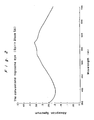
- Fig. 2 is a visible light absorption spectrum of the starting material Spirit Black SA.
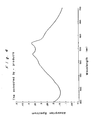
- Fig. 3 is a visible light absorption spectrum of the purified dye of the present invention.
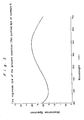
- Fig. 4 is a visible light absorption spectrum of the by-products extracted from the starting material Spirit Black SA.
- Fig. 5 is a elution curve of the starting material Spirit Black SA obtained by gel permeation chromatography.
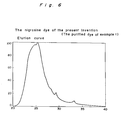
- Fig. 6 is a elution curve of the purified dye of the present invention obtained by gel permeation chromatography.
- Fig. 7 is a elution curve of the by-products extracted from the starting material Spirit Black SA obtained by gel permeation chromatography.
- Fig. 8 indicates the result in differential thermal analysis of the conventional nigrosine dye Nigrosine Base EX.
- Fig. 9 indicates the result in differential thermal analysis of the purified nigrosine dye according to the present invention.
- the crude azine dyes which can be used in the present invention as starting materials can be Nigrosine Spirit Soluble corresponding to C. I. Solvent Black 5 (e.g. Orient Spirit Black AB and SA); and Nigrosine Base corresponding to C. I. Solvent Black 7 (e.g. Orient Nigrosine Base EE and EX, Phenol Black LN (Bayer AG) and Nigrosine Base BA (Bayer AG)).
- Nigrosine Spirit Soluble corresponding to C. I. Solvent Black 5 (e.g. Orient Spirit Black AB and SA); and Nigrosine Base corresponding to C. I. Solvent Black 7 (e.g. Orient Nigrosine Base EE and EX, Phenol Black LN (Bayer AG) and Nigrosine Base BA (Bayer AG)).
- the nigrosine is prepared by the condensation of the aniline hydrochlorides with the nitro compounds.
- the aniline hydrochlorides can have alkyl substituted nucleus.
- the nitro compounds can be alkyl substituted nitrobenzenes, nitrophenols or nitrocresols.
- the resulting nigrosine condensation product may directly be employed in the present invention.
- a proper amount of anilines may be recovered from the product prior to use.
- Inorganic compounds may also be eliminated from the product prior to use by alkaline treatment, by washing with water, or by the other means such as described in JP-B-29901/1981.
- Nigrosine hydrochlorides such as C. I. Solvent Black 5 may preferably be used in the present invention.
- the nigrosine condensation product as abovementioned is more preferred.
- the organic solvent employed in the present invention can be aromatic solvents (e.g. benzene, toluene, xylene, chlorotoluene, o-dichlorobenzene, cresol); petrolic solvents (e.g. aliphatic or alicyclic hydrocarbon solvents such as n-hexane, n-heptane, 2-methyl pentane, n-octane, iso-octane, n-nonane, n-decane, cyclohexane and methyl cyclohexane); alcohols (e.g. propanol, butanol, pentanol and amyl alcohol); Cellosolves (e.g.
- ethylene glycol monomethyl ether ethylene glycol monoethyl ether and propylene glycol monomethyl ether
- ketones e.g. methyl ethyl ketone, diethyl ketone and methyl isobutyl ketone
- esters e.g. ethyl acetate, propyl acetate and butyl acetate
- the other solvents such as dioxane and butyl ether.
- the preferred organic solvents are xylene, dichlorobenzene, n-hexane, methyl ethyl ketone and ethyl acetate.
- the organic solvent can be used alone or in combination.
- the solvents substantially unable to dissolve the purified azine dye of the present invention are preferred.
- the amount of the organic solvents employed in the present invention can vary dependent upon the type of the starting dye materials. If the starting material is the powdered nigrosine, 5-10 folds by weight of the organic solvents based on the weight of the powdered nigrosine is preferred. If the starting material is the nigrosine condensation product containing excess anilines, 2-5 folds by weight of the organic solvents based on the weight of the condensation products is preferred.
- the process of the present invention comprises mixing, or mixing and heating the conventional crude azine dye with the organic solvents. Since the major components abovementioned of the azine dye are substantially insoluble into the organic solvents, the resulting mixture is maintained in the solid/liquid separated phase. Then, the major components and the organic solvents containing the by-products can easily be separated by the conventional separation means such as filtration and centrifugation. A Soxhlet's extractor may also be used in the present invention.
- the resulting purified dye comprises the major components (unextracted residue) not less than 85 % by weight, preferably not less than 90 % by weight.
- the by-products contained in the conventional crude azine dye are extracted. More than 20 kinds of the by-products are selectively extracted and removed. It is believed that the by-products are color or substantially colorless components which are contained in the dye in a very small amount. The total amount of these by-products is about 25 % by weight based on the weight of the conventional nigrosine dye. Many of these by-products are susceptible to decomposition or alternation due to heating or oxidation.
- the by-products eliminated from the crude azine dye according to the present invention has 0.1-1.0 of Rf value in thin layer chromatographic analysis.
- the Rf value is given in the chromatographing by the use of Silica Gel 60, F254, 20x20 cm, 0.25 mm thick (Merck & Co., Inc.) as adsorbent, and 10/1 weight ratio of benzene/methanol solution as eluent.
- the Rf values of the nigrosine and the by-products, as well as color shades thereof are indicated in Fig. 1.
- the difference of the solubility into the organic solvents between the major components and the by-products is taken advantage.
- the by-products extracted effectively according to the present invention generally have 0.5-0.9 of Rf value.
- the effective Rf value can vary dependent upon the organic solvent utilized as eluent.
- the efficiency of the by-products elimination depends on the pH of the dye utilized as the starting material, or on the post-treatment of the condensation product.
- the non-polar organic solvents such as xylene, dichlorobenzene and n-hexane can preferably be employed in this instance.
- the nigrosine dyes or the nigrosine condensation products containing the nigrosine dyes are the alkali treated Nigrosine Base (e.g. C. I. Solvent Black 7), it is preferred that the polar organic solvents such as alcohols and ketones are employed. If the non-polar organic solvents are utilized in this instance, the loss of the major components may increase.
- the alkali treated Nigrosine Base e.g. C. I. Solvent Black 7
- the both polar and non-polar organic solvents can be employed provided that the azine dyes must not agglomerate in the selected organic solvents under heating condition. In this instance, more than one extraction processes may be carried out to improve the purity of the resulting dye.
- the starting material Spirit Black SA, the resulting residue and the extract (in benzene) were analyzed by elemental analysis, visible light absorption spectroscopy and gel permeation chromatography. Heat-resistance and light-resistance of the starting material Spirit Black SA and the resulting purified dye (the resulting residue) were then evaluated.
- Table 1 shows the results obtained by elemental analysis.
- Table 1 Sample Carbon% Hydrogen% Nitrogen% Spirit Black SA 75.98 4.42 14.40 residue 73.13 4.22 14.19 extract 79.47 4.72 13.87
- the homogeneous solutions of 0.01 parts of the samples into 100 parts of the toluene/ethanol (1/1 by weight) solvent were prepared. Ten ml of the solution were then dissolved into the toluene/ethanol solvent to obtain the 100 ml of the diluted solution samples.
- the solution samples were analyzed by visible light absorption spectroscopy using a UV-Visible spectrophotometer HP-8451A commercially available from Hewlett-Packard Co.
- Fig. 2-4 show visible light absorption spectra of the respective samples.
- sample pellets were prepared from the molten mixture of 0.5 g of the starting material Spirit Black SA or 0.5 g of the purified nigrosine dye (the residue) with 500 g of nylon 6 at 285 °C respectively.
- the pellets were then formed to plates by an injection molder at 300 °C in 10 minutes holding. Heat-resistance of the resulting plates were evaluated by visual inspection of their color change. The results are shown in Table 2.
- the well mixed solution of 57.0 parts of a nigrosine condensation product with 43.0 parts of aniline was prepared. Into the solution was added dropwise 250 parts of xylene over 1 hour while mixing was continued. The mixture was stirred for 3 hours, and then filtered. The resulting residue was dried at 80 °C under reduced pressure to provide 30.5 parts of a purified nigrosine compound.
- the starting material Nigrosine Base EX and the purified nigrosine compound were analyzed by differential thermal analysis. First, 1.0 parts of each samples were weighed onto aluminum cups. The cups were then heated from 50 °C to 600 °C at the rate of 10 °C/min under air feeding at 200 ml/min to obtain TG/DTA curves. As an analytic apparatus, TG/DTA 200 which is available from Seiko Instruments Inc. was used. The results are shown in Fig. 8 and Fig. 9. Fig. 8 and Fig. 9 indicate that the purified nigrosine dye according to the present invention has excellent heat-resistance.
Landscapes
- Chemical & Material Sciences (AREA)
- Organic Chemistry (AREA)
- Chemical Kinetics & Catalysis (AREA)
- Inks, Pencil-Leads, Or Crayons (AREA)
- Optical Filters (AREA)
- Compositions Of Macromolecular Compounds (AREA)
- Luminescent Compositions (AREA)
- Coloring (AREA)
Description
- The present invention relates to a process for the preparation of an azine dye having excellent heat- and light-resistance. More particularly, the present invention relates to a process for the preparation of the azine dye, which comprises eliminating by-products from the azine dye, such as C. I. Solvent Black 5 and C. I. Solvent Black 7 by the use of organic solvents.
- A nigrosine dye such as C. I. Solvent Black 5 and C. I. Solvent Black 7 is an azine dye which is usually produced by condensation of aniline hydrochlorides with nitrobenzenes in the presence of catalysts such as iron chlorides.
- The nigrosine dye is a mixture which comprises a number of azine compounds and by-products. The major components of the crude azine dye are blue-black dyes or purple-black dyes having a framework of phenazine, phenazineazine or triphenazineoxazine.
- Thus, the conventional nigrosine dye comprises the wide variety of colored or colorless by-products other than the major components. These by-products are responsible for the degradation in color strength, heat-resistance and light-resistance of the nigrosine dye, which impart detrimental effects on performance qualities. (i.e. the initial color strength, the aging stability, the fastness properties, the safety properties) when used for many applications (e.g. a colorant of synthetic resin, a printing ink, a writing ink, a recording solution and a charge control agent). However, it has been believed that these by-products are the indispensable components for the color shade and other properties of the nigrosine dye.
- An object of the present invention is to provide a process for the preparation of the azine dye having excellent heat-and light-resistance. The process of the present invention, accordingly, eliminates the by-products from the crude azine dye easily and effectively. It has been considered that these by-products are unable to be eliminated by the conventional physical purification means such as supercentrifugation or precision filtration. The process of the present invention comprises (a) mixing crude azine dye, produced by condensation of anilines or aniline hydrochlorides with nitrobenzenes in the presence of catalysts, with organic solvents; and (b) extracting by-products from the crude azine dye mixture.
- Another object of the present invention is to provide a dye having excellent heat-resistance and light-resistance which can preferably be employed as a colorant for heat-resistant resin materials such as polyamide, as a colorant and a charge control agent for an electrostatic image developing toner (i.e. positively chargeable toner), and as a colorant for writing ink composition having a good aging stability. The dye, accordingly, is the nigrosine dye having broad color shade between 400 nm and 700 nm, and having relatively higher molecular weight and aging stability due to the lack of the by-products ranging in the lower molecular side. Similar to the conventional nigrosine dye, the mutagenic property of the dye according to the present invention is proved to be negative by Ames test. The dye is produced by the abovenoted process of the present invention.
- Fig. 1 indicates the Rf values of nigrosine and by-products, as well as color shades thereof.
- Fig. 2 is a visible light absorption spectrum of the starting material Spirit Black SA.
- Fig. 3 is a visible light absorption spectrum of the purified dye of the present invention.
- Fig. 4 is a visible light absorption spectrum of the by-products extracted from the starting material Spirit Black SA.
- Fig. 5 is a elution curve of the starting material Spirit Black SA obtained by gel permeation chromatography.
- Fig. 6 is a elution curve of the purified dye of the present invention obtained by gel permeation chromatography.
- Fig. 7 is a elution curve of the by-products extracted from the starting material Spirit Black SA obtained by gel permeation chromatography.
- Fig. 8 indicates the result in differential thermal analysis of the conventional nigrosine dye Nigrosine Base EX.
- Fig. 9 indicates the result in differential thermal analysis of the purified nigrosine dye according to the present invention.
- The crude azine dyes which can be used in the present invention as starting materials can be Nigrosine Spirit Soluble corresponding to C. I. Solvent Black 5 (e.g. Orient Spirit Black AB and SA); and Nigrosine Base corresponding to C. I. Solvent Black 7 (e.g. Orient Nigrosine Base EE and EX, Phenol Black LN (Bayer AG) and Nigrosine Base BA (Bayer AG)).
- Usually, the nigrosine is prepared by the condensation of the aniline hydrochlorides with the nitro compounds. The aniline hydrochlorides can have alkyl substituted nucleus. The nitro compounds can be alkyl substituted nitrobenzenes, nitrophenols or nitrocresols.
- The resulting nigrosine condensation product may directly be employed in the present invention. Alternatively, a proper amount of anilines may be recovered from the product prior to use. Inorganic compounds may also be eliminated from the product prior to use by alkaline treatment, by washing with water, or by the other means such as described in JP-B-29901/1981. Nigrosine hydrochlorides such as C. I. Solvent Black 5 may preferably be used in the present invention. However, the nigrosine condensation product as abovementioned is more preferred.
- The organic solvent employed in the present invention can be aromatic solvents (e.g. benzene, toluene, xylene, chlorotoluene, o-dichlorobenzene, cresol); petrolic solvents (e.g. aliphatic or alicyclic hydrocarbon solvents such as n-hexane, n-heptane, 2-methyl pentane, n-octane, iso-octane, n-nonane, n-decane, cyclohexane and methyl cyclohexane); alcohols (e.g. propanol, butanol, pentanol and amyl alcohol); Cellosolves (e.g. ethylene glycol monomethyl ether, ethylene glycol monoethyl ether and propylene glycol monomethyl ether); ketones (e.g. methyl ethyl ketone, diethyl ketone and methyl isobutyl ketone); esters (e.g. ethyl acetate, propyl acetate and butyl acetate); and the other solvents such as dioxane and butyl ether. The preferred organic solvents are xylene, dichlorobenzene, n-hexane, methyl ethyl ketone and ethyl acetate. The organic solvent can be used alone or in combination. The solvents substantially unable to dissolve the purified azine dye of the present invention are preferred.
- The amount of the organic solvents employed in the present invention can vary dependent upon the type of the starting dye materials. If the starting material is the powdered nigrosine, 5-10 folds by weight of the organic solvents based on the weight of the powdered nigrosine is preferred. If the starting material is the nigrosine condensation product containing excess anilines, 2-5 folds by weight of the organic solvents based on the weight of the condensation products is preferred.
- The process of the present invention comprises mixing, or mixing and heating the conventional crude azine dye with the organic solvents. Since the major components abovementioned of the azine dye are substantially insoluble into the organic solvents, the resulting mixture is maintained in the solid/liquid separated phase. Then, the major components and the organic solvents containing the by-products can easily be separated by the conventional separation means such as filtration and centrifugation. A Soxhlet's extractor may also be used in the present invention. The resulting purified dye comprises the major components (unextracted residue) not less than 85 % by weight, preferably not less than 90 % by weight.
- According to the present invention, most of the by-products contained in the conventional crude azine dye are extracted. More than 20 kinds of the by-products are selectively extracted and removed. It is believed that the by-products are color or substantially colorless components which are contained in the dye in a very small amount. The total amount of these by-products is about 25 % by weight based on the weight of the conventional nigrosine dye. Many of these by-products are susceptible to decomposition or alternation due to heating or oxidation.
- The by-products eliminated from the crude azine dye according to the present invention has 0.1-1.0 of Rf value in thin layer chromatographic analysis. The Rf value is given in the chromatographing by the use of Silica Gel 60, F254, 20x20 cm, 0.25 mm thick (Merck & Co., Inc.) as adsorbent, and 10/1 weight ratio of benzene/methanol solution as eluent. The Rf values of the nigrosine and the by-products, as well as color shades thereof are indicated in Fig. 1.
- In the present invention, the difference of the solubility into the organic solvents between the major components and the by-products is taken advantage. The by-products extracted effectively according to the present invention generally have 0.5-0.9 of Rf value. However, the effective Rf value can vary dependent upon the organic solvent utilized as eluent.
- The efficiency of the by-products elimination depends on the pH of the dye utilized as the starting material, or on the post-treatment of the condensation product. When the condensation products of the nigrosine hydrochlorides are utilized as the starting material, it is possible to obtain an increased efficiency in elimination of the by-products. The non-polar organic solvents such as xylene, dichlorobenzene and n-hexane can preferably be employed in this instance.
- On the other hand, when the nigrosine dyes or the nigrosine condensation products containing the nigrosine dyes are the alkali treated Nigrosine Base (e.g. C. I. Solvent Black 7), it is preferred that the polar organic solvents such as alcohols and ketones are employed. If the non-polar organic solvents are utilized in this instance, the loss of the major components may increase.
- However, when the Soxhlet's extraction is utilized, the both polar and non-polar organic solvents can be employed provided that the azine dyes must not agglomerate in the selected organic solvents under heating condition. In this instance, more than one extraction processes may be carried out to improve the purity of the resulting dye.
- The present invention will be more specifically described by the following non-limiting examples, wherein all parts are by weight unless otherwise specified.
- Into a Soxhlet's extractor were added 50.8 parts of Spirit Black SA (Orient Chemical Industries Ltd.). The Soxhlet's extraction was then carried out over 48 hours using 1000 parts of benzene as the solvent. The resulting residue was dried at 80 oC under reduced pressure to provide 37.9 parts of purified nigrosine compound.
- The starting material Spirit Black SA, the resulting residue and the extract (in benzene) were analyzed by elemental analysis, visible light absorption spectroscopy and gel permeation chromatography. Heat-resistance and light-resistance of the starting material Spirit Black SA and the resulting purified dye (the resulting residue) were then evaluated.
- Table 1 shows the results obtained by elemental analysis.
Table 1 Sample Carbon% Hydrogen% Nitrogen% Spirit Black SA 75.98 4.42 14.40 residue 73.13 4.22 14.19 extract 79.47 4.72 13.87 - The homogeneous solutions of 0.01 parts of the samples into 100 parts of the toluene/ethanol (1/1 by weight) solvent were prepared. Ten ml of the solution were then dissolved into the toluene/ethanol solvent to obtain the 100 ml of the diluted solution samples. The solution samples were analyzed by visible light absorption spectroscopy using a UV-Visible spectrophotometer HP-8451A commercially available from Hewlett-Packard Co. Fig. 2-4 show visible light absorption spectra of the respective samples.
- The homogeneous solutions of 0.03 parts of the samples into 10 parts of dimethylformamide were prepared. The solution samples were analyzed by gel permeation chromatography under the following condition.
Column: Shodex (Showa Denko K. K.) KD-803 + 802 x 2 Elimination limit molecular weight 5000 Number of theoretical plates 16000 Eluent: dimethylformamide (0.01mol LiBr) Flow: 1 ml/min Detector: UV-Visible spectrophotometer SPD-6AV (SHIMADZU CORPORATION) Wavelength 560nm - According to the conventional procedure, sample pellets were prepared from the molten mixture of 0.5 g of the starting material Spirit Black SA or 0.5 g of the purified nigrosine dye (the residue) with 500 g of nylon 6 at 285 °C respectively. The pellets were then formed to plates by an injection molder at 300 °C in 10 minutes holding. Heat-resistance of the resulting plates were evaluated by visual inspection of their color change. The results are shown in Table 2.
- According to the conventional procedure, said colored pellets were formed to sample plates at 240 °C. The resulting plates were then irradiated for 20 hours by the use of carbon-arc fadeometer. Light-resistance of the plates were evaluated by visual inspection of their color change. The results are shown in Table 2.
Table 2 Spirit Black SA Purified dye Color change observed not observed with time brown → black black Color intensity low high Heat-resistance low* high Light-resistance low* high * High degree of color change was observed. - Into a Soxhlet's extractor were added 50.9 parts of Spirit Black SA (Orient Chemical Industries Ltd.). Soxhlet's extraction were then carried out over 48 hours using 500 parts of isopropyl alcohol as the solvent. The resulting residue was dried at 80 °C under reduced pressure to provide 42.5 parts of purified nigrosine compound.
- The well mixed solution of 57.0 parts of a nigrosine condensation product with 43.0 parts of aniline was prepared. Into the solution was added dropwise 250 parts of xylene over 1 hour while mixing was continued. The mixture was stirred for 3 hours, and then filtered. The resulting residue was dried at 80 °C under reduced pressure to provide 30.5 parts of a purified nigrosine compound.
- The well mixed solution of 100.0 parts of Nigrosine Base EX (Orient Chemical Industries Ltd.) with 150 parts of aniline was prepared. Into the solution was added dropwise 600 parts of xylene over 1 hour while mixing was continued. The mixture was stirred for 3 hours at room temperature, and then filtered. The resulting residue was dried at 80 oC under reduced pressure to provide 63.5 parts of purified nigrosine compound.
- The starting material Nigrosine Base EX and the purified nigrosine compound were analyzed by differential thermal analysis. First, 1.0 parts of each samples were weighed onto aluminum cups. The cups were then heated from 50 °C to 600 °C at the rate of 10 °C/min under air feeding at 200 ml/min to obtain TG/DTA curves. As an analytic apparatus, TG/DTA 200 which is available from Seiko Instruments Inc. was used. The results are shown in Fig. 8 and Fig. 9. Fig. 8 and Fig. 9 indicate that the purified nigrosine dye according to the present invention has excellent heat-resistance.
- The well mixed solution of 30.1 parts of Nigrosine Base EX (Orient Chemical Industries Ltd.) and 200.5 parts of methyl ethyl ketone were prepared. The mixture was stirred for 3 hours at room temperature, and then filtered under reduced pressure. The resulting residue was dried at 80 °C under reduced pressure to provide 21.4 parts of purified nigrosine compound.
- The well mixed solution of 30.6 parts of Nigrosine Base EX (Orient Chemical Industries Ltd.) with 201.7 parts of ethyl acetate was prepared. The mixture was stirred for 3 hours at room temperature, and then filtered under reduced pressure. The resulting residue was dried at 80 °C under reduced pressure to provide 25.5 parts of purified nigrosine compound.
- Spirit Black SA, Nigrosine Base EX and the purified nigrosine dyes of example 1-6 were determined in the major components content by the use of iatron scan TH-10 (Yatron Co.) First, 0.001 parts of said samples were dissolved into 1 parts of benzene/methanol (1/1 by weight) solvent. Three µl of the each solutions were spotted onto chromato-lods S III respectively. The chromato-lods were then developed using benzene/methanol (10/2 by weight) solvent, and dried. The dried chromato-lods were measured on the scanner. The results are shown in Table 3.
Table 3 Samples Major Components Content % Spirit Black SA 71.5 Nigrosine Base EX 77.3 Example 1 93.7 Example 2 85.8 Example 3 88.2 Example 4 91.3 Example 5 86.5 Example 6 85.2
Claims (10)
- A process for preparing a nigrosine dye having excellent heat- and light-resistance comprising ;(a) mixing crude nigrosine dye, produced by condensation of anilines or aniline hydrochlorides with nitrobenzenes in the presence of catalysts, with an organic solvent; and(b) extracting by-products from the crude nigrosine dye mixture.
- A process for preparing the nigrosine dye according to claim 1, wherein the mixing is conducted with heating.
- A process for preparing the nigrosine dye according to claim 1, wherein the crude nigrosine dye is selected from the group consisting of C. I. Solvent Black 5 and C. I. Solvent Black 7.
- A process for preparing the nigrosine dye according to claim 1, wherein the organic solvent is selected from the group consisting of aromatic hydrocarbons, aliphatic hydrocarbons, alicyclic hydrocarbons, alcohols, ketones and esters.
- A process for preparing the nigrosine dye according to claim 1, wherein the by-products being eliminated are the components having 0.1-1.0 of Rf value in thin layer chromatographic analysis.
- A process for enhancing the heat- and light-resistance of nigrosine dye obtained by the condensation of anilines or hydrochlorides thereof with nitrobenzenes, comprising(a) mixing crude nigrosine dye with an organic solvent; and(b) extracting by-products from the crude nigrosine dye mixture.
- A process for preparing the nigrosine dye according to claim 6, wherein the mixing is conducted with heating.
- A process for preparing the nigrosine dye according to claim 6, wherein the crude nigrosine dye is selected from the group consisting of C. I. Solvent Black 5 and C. I. Solvent Black 7.
- A process for preparing the nigrosine dye according to claim 6, wherein the organic solvent is selected from the group consisting of aromatic hydrocarbons, aliphatic hydrocarbons, alicyclic hydrocarbons, alcohols, ketones and esters.
- A process for preparing the nigrosine dye according to claim 6, wherein the by-products being eliminated are the components having 0.1-1.0 of Rf value in thin layer chromatographic analysis.
Applications Claiming Priority (2)
| Application Number | Priority Date | Filing Date | Title |
|---|---|---|---|
| JP2205679A JP2798487B2 (en) | 1990-07-31 | 1990-07-31 | Azine dyes with excellent heat and light resistance |
| JP205679/90 | 1990-07-31 |
Publications (3)
| Publication Number | Publication Date |
|---|---|
| EP0469544A2 EP0469544A2 (en) | 1992-02-05 |
| EP0469544A3 EP0469544A3 (en) | 1992-06-03 |
| EP0469544B1 true EP0469544B1 (en) | 1997-06-04 |
Family
ID=16510899
Family Applications (1)
| Application Number | Title | Priority Date | Filing Date |
|---|---|---|---|
| EP91112792A Expired - Lifetime EP0469544B1 (en) | 1990-07-31 | 1991-07-30 | Production process of an azine dye having excellent heat- and light-resistance |
Country Status (5)
| Country | Link |
|---|---|
| US (1) | US5281709A (en) |
| EP (1) | EP0469544B1 (en) |
| JP (1) | JP2798487B2 (en) |
| CA (1) | CA2046939A1 (en) |
| DE (1) | DE69126376T2 (en) |
Families Citing this family (9)
| Publication number | Priority date | Publication date | Assignee | Title |
|---|---|---|---|---|
| DE4418842A1 (en) * | 1994-05-30 | 1995-12-07 | Hoechst Ag | Colourless, thermostable, non-toxic cyclised oligo- or poly:saccharide use as charge controller or enhancer |
| DE19517034A1 (en) * | 1995-05-10 | 1996-11-14 | Hoechst Ag | Use of inclusion compounds of ring-shaped polysaccharides as charge control agents |
| JP3873355B2 (en) * | 1997-02-26 | 2007-01-24 | オリヱント化学工業株式会社 | Polyethylene terephthalate resin composition, masterbatch thereof, and method for modifying polyethylene terephthalate resin |
| JP3496653B2 (en) * | 2001-04-19 | 2004-02-16 | 東洋インキ製造株式会社 | Electrostatic image developing toner, charge control agent for toner, and method of manufacturing the same |
| WO2005021657A1 (en) * | 2003-08-28 | 2005-03-10 | Orient Chemical Industries, Ltd. | Nigrosine dye and process for producing the same |
| US20070010602A1 (en) * | 2004-08-26 | 2007-01-11 | Tetsuji Kihara | Nigrosine dye and process for producing the same |
| CN103044962B (en) * | 2012-12-26 | 2014-09-17 | 辽宁恒星精细化工有限公司 | Aniline black pigment producing method |
| DE102015211632A1 (en) * | 2015-06-23 | 2016-12-29 | Fraunhofer-Gesellschaft zur Förderung der angewandten Forschung e.V. | Retarded crystallization polymer composition, crystallization behavior affecting additive composition, method of reducing the crystallization point, and use of an additive composition |
| CA3057311A1 (en) * | 2017-03-20 | 2018-09-27 | Esprix Technologies, LP. | Ames negative sublimation toner |
Family Cites Families (14)
| Publication number | Priority date | Publication date | Assignee | Title |
|---|---|---|---|---|
| DE86109C (en) * | ||||
| DE90212C (en) * | ||||
| US1896244A (en) * | 1927-03-28 | 1933-02-07 | Calco Chemical Co Inc | Dyes of the azine class and manufacture thereof |
| US2058666A (en) * | 1934-03-29 | 1936-10-27 | Firm Of J R Geigy A G | Water insoluble indulines and their manufacture |
| US2045069A (en) * | 1934-03-29 | 1936-06-23 | Firm Of J R Geigy A G | Manufacture of water-insoluble indulines |
| US2328759A (en) * | 1937-06-19 | 1943-09-07 | Gen Aniline & Film Corp | Removing odor of nigrosines and indulines |
| JPS52135336A (en) * | 1976-05-10 | 1977-11-12 | Orient Chemical Ind | Process for manufacture of nigrosine series dyestuffs |
| DE3000529A1 (en) * | 1980-01-09 | 1981-07-16 | Bayer Ag, 5090 Leverkusen | METHOD FOR PRODUCING ANILINE CONDENSATION DYES |
| US4359577A (en) * | 1980-04-04 | 1982-11-16 | American Cyanamid Company | Non-pyrophoric nigrosine base |
| US4383859A (en) * | 1981-05-18 | 1983-05-17 | International Business Machines Corporation | Ink jet inks and method of making |
| JPS5968374A (en) * | 1982-10-13 | 1984-04-18 | Orient Kagaku Kogyo Kk | Nigrosine dye and its preparation |
| DE3615571A1 (en) * | 1986-05-09 | 1987-11-12 | Bayer Ag | Toners for electrophotography |
| US4775754A (en) * | 1987-10-07 | 1988-10-04 | Minnesota Mining And Manufacturing Company | Preparation of leuco dyes |
| JPH01279978A (en) * | 1988-05-06 | 1989-11-10 | Orient Chem Ind Ltd | Purification of dye |
-
1990
- 1990-07-31 JP JP2205679A patent/JP2798487B2/en not_active Expired - Lifetime
-
1991
- 1991-07-12 CA CA002046939A patent/CA2046939A1/en not_active Abandoned
- 1991-07-15 US US07/730,051 patent/US5281709A/en not_active Expired - Lifetime
- 1991-07-30 DE DE69126376T patent/DE69126376T2/en not_active Expired - Fee Related
- 1991-07-30 EP EP91112792A patent/EP0469544B1/en not_active Expired - Lifetime
Also Published As
| Publication number | Publication date |
|---|---|
| US5281709A (en) | 1994-01-25 |
| DE69126376D1 (en) | 1997-07-10 |
| CA2046939A1 (en) | 1992-02-01 |
| DE69126376T2 (en) | 1998-01-22 |
| EP0469544A3 (en) | 1992-06-03 |
| EP0469544A2 (en) | 1992-02-05 |
| JP2798487B2 (en) | 1998-09-17 |
| JPH0488064A (en) | 1992-03-19 |
Similar Documents
| Publication | Publication Date | Title |
|---|---|---|
| EP0761772B1 (en) | Soluble chromophors containing solubility-enhancing groups which separate easily therefrom | |
| DE69800715T2 (en) | SOLUBLE CHROMOPHORE CONTAINING GROUPS WITH IMPROVED SOLUBILITY | |
| EP0648770B1 (en) | Pyrrolo[3,4-c]pyrroles | |
| JP3362865B2 (en) | Internal salt of perylene compound, production method thereof and use thereof | |
| DE69729521T2 (en) | Anthraquinone compounds | |
| JP3366697B2 (en) | Long wavelength ultraviolet absorber and method for producing the same | |
| US5281709A (en) | Production of an azine dye having excellent heat- and light-resistance | |
| EP0763539A2 (en) | Novel phthalocyanine or naphthalocyanine derivative | |
| DE60008472T2 (en) | Fluorescent diketopyrrolopyrroles | |
| KR100316495B1 (en) | Perylene amidine imide dye, its manufacturing method and uses | |
| EP0877058B1 (en) | Diketopyrrolopyrrol compositions | |
| US5916488A (en) | Polyimide resin compositions for optical filters | |
| CN118451146B (en) | Fluorinated phthalocyanine compound, coloring composition, and ink for inkjet | |
| EP0340792B1 (en) | Purification of C.I. solvent black 3 | |
| US3022298A (en) | Dioxazine dyestuffs | |
| Sinclair et al. | The visible spectra of some 1, 4‐diaminoanthraquinone disperse dyes in solvents and on polymer substrates | |
| EP0232222A2 (en) | Process for the preparation of brominated pyrrolo-[3,4-c]-pyrroles | |
| EP0843704A1 (en) | Coloured polymers | |
| JPH01233401A (en) | Green dye for filter | |
| EP0573809A1 (en) | Liquid azo dye and ink composition containing the same | |
| Kim et al. | Synthesis and Physical Properties of New Violet Color Filter Dye for Image Sensors | |
| Alston | Characterization of PMR-15 polyimide composition in thermo-oxidatively exposed graphite fiber composites | |
| JP3226685B2 (en) | Quinophthalone compounds | |
| KR0148909B1 (en) | Water insoluble disperse dye mixture and its dyeing and printing on polyester fiber | |
| GB1603071A (en) | Anthraquinonoid disperse dyes |
Legal Events
| Date | Code | Title | Description |
|---|---|---|---|
| PUAI | Public reference made under article 153(3) epc to a published international application that has entered the european phase |
Free format text: ORIGINAL CODE: 0009012 |
|
| AK | Designated contracting states |
Kind code of ref document: A2 Designated state(s): CH DE FR GB LI |
|
| PUAL | Search report despatched |
Free format text: ORIGINAL CODE: 0009013 |
|
| AK | Designated contracting states |
Kind code of ref document: A3 Designated state(s): CH DE FR GB LI |
|
| 17P | Request for examination filed |
Effective date: 19921202 |
|
| 17Q | First examination report despatched |
Effective date: 19951114 |
|
| GRAG | Despatch of communication of intention to grant |
Free format text: ORIGINAL CODE: EPIDOS AGRA |
|
| GRAH | Despatch of communication of intention to grant a patent |
Free format text: ORIGINAL CODE: EPIDOS IGRA |
|
| GRAH | Despatch of communication of intention to grant a patent |
Free format text: ORIGINAL CODE: EPIDOS IGRA |
|
| GRAA | (expected) grant |
Free format text: ORIGINAL CODE: 0009210 |
|
| AK | Designated contracting states |
Kind code of ref document: B1 Designated state(s): CH DE FR GB LI |
|
| REG | Reference to a national code |
Ref country code: CH Ref legal event code: EP Ref country code: CH Ref legal event code: NV Representative=s name: A. BRAUN, BRAUN, HERITIER, ESCHMANN AG PATENTANWAE |
|
| REF | Corresponds to: |
Ref document number: 69126376 Country of ref document: DE Date of ref document: 19970710 |
|
| ET | Fr: translation filed | ||
| PLBE | No opposition filed within time limit |
Free format text: ORIGINAL CODE: 0009261 |
|
| STAA | Information on the status of an ep patent application or granted ep patent |
Free format text: STATUS: NO OPPOSITION FILED WITHIN TIME LIMIT |
|
| 26N | No opposition filed | ||
| REG | Reference to a national code |
Ref country code: GB Ref legal event code: IF02 |
|
| PGFP | Annual fee paid to national office [announced via postgrant information from national office to epo] |
Ref country code: GB Payment date: 20050718 Year of fee payment: 15 |
|
| PGFP | Annual fee paid to national office [announced via postgrant information from national office to epo] |
Ref country code: FR Payment date: 20050726 Year of fee payment: 15 |
|
| PGFP | Annual fee paid to national office [announced via postgrant information from national office to epo] |
Ref country code: CH Payment date: 20050810 Year of fee payment: 15 |
|
| PGFP | Annual fee paid to national office [announced via postgrant information from national office to epo] |
Ref country code: DE Payment date: 20050831 Year of fee payment: 15 |
|
| PG25 | Lapsed in a contracting state [announced via postgrant information from national office to epo] |
Ref country code: GB Free format text: LAPSE BECAUSE OF NON-PAYMENT OF DUE FEES Effective date: 20060730 |
|
| PG25 | Lapsed in a contracting state [announced via postgrant information from national office to epo] |
Ref country code: LI Free format text: LAPSE BECAUSE OF NON-PAYMENT OF DUE FEES Effective date: 20060731 Ref country code: CH Free format text: LAPSE BECAUSE OF NON-PAYMENT OF DUE FEES Effective date: 20060731 |
|
| PG25 | Lapsed in a contracting state [announced via postgrant information from national office to epo] |
Ref country code: DE Free format text: LAPSE BECAUSE OF NON-PAYMENT OF DUE FEES Effective date: 20070201 |
|
| REG | Reference to a national code |
Ref country code: CH Ref legal event code: PL |
|
| GBPC | Gb: european patent ceased through non-payment of renewal fee |
Effective date: 20060730 |
|
| REG | Reference to a national code |
Ref country code: FR Ref legal event code: ST Effective date: 20070330 |
|
| PG25 | Lapsed in a contracting state [announced via postgrant information from national office to epo] |
Ref country code: FR Free format text: LAPSE BECAUSE OF NON-PAYMENT OF DUE FEES Effective date: 20060731 |