EP0464980B1 - 1-Phenylimidazole derivatives process for their preparation and use - Google Patents
1-Phenylimidazole derivatives process for their preparation and use Download PDFInfo
- Publication number
- EP0464980B1 EP0464980B1 EP91301291A EP91301291A EP0464980B1 EP 0464980 B1 EP0464980 B1 EP 0464980B1 EP 91301291 A EP91301291 A EP 91301291A EP 91301291 A EP91301291 A EP 91301291A EP 0464980 B1 EP0464980 B1 EP 0464980B1
- Authority
- EP
- European Patent Office
- Prior art keywords
- trifluoromethylphenyl
- imidazole
- tetrafluoroethyl
- chloro
- methyl
- Prior art date
- Legal status (The legal status is an assumption and is not a legal conclusion. Google has not performed a legal analysis and makes no representation as to the accuracy of the status listed.)
- Expired - Lifetime
Links
- 0 CC(*)=NC(*)=CN Chemical compound CC(*)=NC(*)=CN 0.000 description 1
Classifications
-
- C—CHEMISTRY; METALLURGY
- C07—ORGANIC CHEMISTRY
- C07D—HETEROCYCLIC COMPOUNDS
- C07D233/00—Heterocyclic compounds containing 1,3-diazole or hydrogenated 1,3-diazole rings, not condensed with other rings
- C07D233/54—Heterocyclic compounds containing 1,3-diazole or hydrogenated 1,3-diazole rings, not condensed with other rings having two double bonds between ring members or between ring members and non-ring members
- C07D233/64—Heterocyclic compounds containing 1,3-diazole or hydrogenated 1,3-diazole rings, not condensed with other rings having two double bonds between ring members or between ring members and non-ring members with substituted hydrocarbon radicals attached to ring carbon atoms, e.g. histidine
-
- C—CHEMISTRY; METALLURGY
- C07—ORGANIC CHEMISTRY
- C07D—HETEROCYCLIC COMPOUNDS
- C07D231/00—Heterocyclic compounds containing 1,2-diazole or hydrogenated 1,2-diazole rings
- C07D231/02—Heterocyclic compounds containing 1,2-diazole or hydrogenated 1,2-diazole rings not condensed with other rings
- C07D231/10—Heterocyclic compounds containing 1,2-diazole or hydrogenated 1,2-diazole rings not condensed with other rings having two or three double bonds between ring members or between ring members and non-ring members
- C07D231/12—Heterocyclic compounds containing 1,2-diazole or hydrogenated 1,2-diazole rings not condensed with other rings having two or three double bonds between ring members or between ring members and non-ring members with only hydrogen atoms, hydrocarbon or substituted hydrocarbon radicals, directly attached to ring carbon atoms
-
- C—CHEMISTRY; METALLURGY
- C07—ORGANIC CHEMISTRY
- C07D—HETEROCYCLIC COMPOUNDS
- C07D233/00—Heterocyclic compounds containing 1,3-diazole or hydrogenated 1,3-diazole rings, not condensed with other rings
- C07D233/54—Heterocyclic compounds containing 1,3-diazole or hydrogenated 1,3-diazole rings, not condensed with other rings having two double bonds between ring members or between ring members and non-ring members
- C07D233/56—Heterocyclic compounds containing 1,3-diazole or hydrogenated 1,3-diazole rings, not condensed with other rings having two double bonds between ring members or between ring members and non-ring members with only hydrogen atoms or radicals containing only hydrogen and carbon atoms, attached to ring carbon atoms
-
- C—CHEMISTRY; METALLURGY
- C07—ORGANIC CHEMISTRY
- C07D—HETEROCYCLIC COMPOUNDS
- C07D233/00—Heterocyclic compounds containing 1,3-diazole or hydrogenated 1,3-diazole rings, not condensed with other rings
- C07D233/54—Heterocyclic compounds containing 1,3-diazole or hydrogenated 1,3-diazole rings, not condensed with other rings having two double bonds between ring members or between ring members and non-ring members
- C07D233/66—Heterocyclic compounds containing 1,3-diazole or hydrogenated 1,3-diazole rings, not condensed with other rings having two double bonds between ring members or between ring members and non-ring members with hetero atoms or with carbon atoms having three bonds to hetero atoms with at the most one bond to halogen, e.g. ester or nitrile radicals, directly attached to ring carbon atoms
- C07D233/84—Sulfur atoms
-
- C—CHEMISTRY; METALLURGY
- C07—ORGANIC CHEMISTRY
- C07D—HETEROCYCLIC COMPOUNDS
- C07D249/00—Heterocyclic compounds containing five-membered rings having three nitrogen atoms as the only ring hetero atoms
- C07D249/02—Heterocyclic compounds containing five-membered rings having three nitrogen atoms as the only ring hetero atoms not condensed with other rings
- C07D249/08—1,2,4-Triazoles; Hydrogenated 1,2,4-triazoles
-
- C—CHEMISTRY; METALLURGY
- C07—ORGANIC CHEMISTRY
- C07D—HETEROCYCLIC COMPOUNDS
- C07D401/00—Heterocyclic compounds containing two or more hetero rings, having nitrogen atoms as the only ring hetero atoms, at least one ring being a six-membered ring with only one nitrogen atom
- C07D401/02—Heterocyclic compounds containing two or more hetero rings, having nitrogen atoms as the only ring hetero atoms, at least one ring being a six-membered ring with only one nitrogen atom containing two hetero rings
- C07D401/04—Heterocyclic compounds containing two or more hetero rings, having nitrogen atoms as the only ring hetero atoms, at least one ring being a six-membered ring with only one nitrogen atom containing two hetero rings directly linked by a ring-member-to-ring-member bond
Definitions
- the present invention relates to a novel 1-phenylimidazole derivative having the formula [I]: wherein R is a hydrogen atom or a methyl group; X is a fluorine atom, a chlorine atom or a nitro group; Y is a fluorine atom or a chlorine atom; Z is a hydrogen atom, a fluorine atom, a chlorine atom or a bromine atom, a process for producing the same and insecticides containing the same as an active ingredient.
- 1-phenylimidazole derivatives having the formula [I]: wherein R is a hydrogen atom or a methyl group; X is a fluorine atom, a chlorine atom or a nitro group; Y is a fluorine atom or a chlorine atom; Z is a hydrogen atom, a fluorine atom, a chlorine atom or a bromine atom, a process for producing the same and insecticides containing the same as an active ingredient.
- the compounds of the present invention can be produced according to the following reaction scheme. wherein R, X, Y and Z are each as defined above and A is a halogen atom.
- the compound of the present invention can be produced by reacting halide compounds having the formula [III] with imidazole derivatives having the formula [II].
- the reaction may be carried out at about -5°C to about 150°C for about 1 to 24 hours in a solvent in the presence of a reagent for removing a hydrogen halide.
- the amounts of the reagents used in the reaction may be 1-2 equivalents of the halide compounds having the formula [III] and 1-4 equivalents of the reagent for removing a hydrogen halide to one equivalent of the imidazole derivatives having the formula [II].
- Examples of the solvent which is used for the both reactions described above include aliphatic hydrocarbons such as hexane, heptane, ligroin, petroleum ether, etc.; aromatic hydrocarbons such as benzene, toluene, xylene, etc.; halogenated hydrocarbons such as chloroform, carbon tetrachloride, dichloroethane, chlorobenzene, dichlorobenzene, etc.; ethers such as diethyl ether, diisopropyl ether, dioxan, tetrahydrofuran, ethylene glycol dimethyl ether, etc.; ketones such as acetone, methyl ethyl ketone, methyl isobutyl ketone, isophorone, cyclohexanone, etc.; esters such as ethyl acetate, butyl acetate, etc.; nitro compounds such as nitroethane, nitrobenzene, etc.;
- Examples of the reagent of removing hydrogen halide include organic bases such as pyridine, triethylamine, N,N-diethylaniline, etc.; inorganic bases such as sodium hydroxide, potassium hydroxide, sodium carbonate, potassium carbonate, sodium hydrogen carbonate, calcium carbonate, sodium hydride, etc.; alkali metal alkoxides such as sodium methoxide, sodium ethoxide, etc.
- the product may further be purified by chromatography, distillation, recrystallization, etc.
- the imidazole derivatives having the formula [II] and the halide compounds having the formula [III] which are used as raw materials for the compounds of the present invention are prepared by the methods described in J. Org. Chem., 47 , 2867 (1982), Japan Patent (laid open) 86-286,370 and U.S. Patent 3,888,932, U.S. Patent 3,928,416, European Patent 23,100, European Patent 34,402, British Patent 1,121,211 respectively, or in a manner similar to the methods.
- Examples of harmful insects against which the compounds of the present invention exhibit remarkable effects include the following: Harmful insects belonging to Hemiptera:
- Planthoppers such as small brown planthopper ( Laodelphax striatellus ), brown plant hopper( Nilaparvata lugens ), white-backed rice planthopper ( Sogatella furcifera ), etc.; leafhoppers such as green rice leafhopper ( Nephotettix cinticeps ), ( Nephotettix virescens ), etc.; aphids, bugs, whiteflies, scales, lace bugs, psyllids, etc. Lepidoptera:
- Pyralid moths such as rice stem borer ( Chilo suppressalis ), rice leafroller ( Cnaphalocrocis medinalis ), Indian meal moth ( Plodia interpunctella ), etc.; moths such as tobacco cutworm ( Spodoptera litura ), rice armyworm ( Pseudaletia separata ), cabbage armyworm ( Mamestra brassicae ), etc.; Pieridae such as common cabbageworm ( Pieris rapae crucivora ), etc.; Tortricidae or tortricid moths such as Adoxophyes spp., Grapholita spp., etc.; Carposinidae, lyonetiid moths (Lyonetiidae), tussock moths (Lymantriidae), beet semi-looper ( Autographa nigrisigna ); harmful insects belonging to Agrothis spp.
- Mosquitos such as common mosquito ( Culex pipiens pallens ), Culex tritaeniorhynchus , etc.; Aedes spp. such as Aedes aegypti , Aedes albopictus , etc.; Anopheles spp.
- Corn root worms such as western corn root-worm ( Diabrotica virgifera ), southern corn root worm ( Diabrotica undecimpunctata ), etc.; scarabs (Scarabaeidae) such as cupreous chafer ( Anomala cuprea ), soybeen beetle ( Anomala rufocuprea ), etc.; weevils such as maize weevil ( Sitophilus zeamais ), rice water weevil ( Lissorhoptrus oryzophilus ), adzuki bean weevil ( Callosobruchys chineneis ), etc.; darkling beetles (Tenebrionidae) such as yellow mealworm ( Tenebrio molitor ), red flour beetle ( Tribolium castaneum ), etc.; leaf beetles (Chrysomelidae) such as cucurbit leaf beetle ( Aulacophora femoralis ),
- German cockroach ( Blattella germanica ), smokybrown cockroach ( Periplaneta fuliginosa ), American cockroach ( Periplaneta americana ), brown cockroach ( Periplaneta brunnea ), oriental cockroach ( Blatta orientalis ), etc. Harmful insects belonging to Thysanoptera:
- Thrips palmi Thrips hawaiiensis , etc. Harmful insects belonging to Hymenoptera:
- ants Formidae
- hornets Vespidae
- bethylid wasps Bethylidae
- sawflies Teenthredinidae
- cabbage sawfly Athalia rosae ruficornis
- Reticulitermes speratus Reticulitermes speratus , Formosan subterranean termite ( Coptotermes formosanus ), etc.
- the compounds of the present invention are very effective to the insects which develop the resistance against conventional insecticides.
- the compounds of the present invention are used as the active ingredient of insecticidal compositions
- the compounds may be used as they are, without adding any other components but in general, the compounds are mixed with a solid carrier, a liquid carrier, a gaseous carrier, a feed, etc. and, if necessary and desired, the mixture is further supplemented with a surfactant and other adjuvants used to prepare insecticidal preparations and prepared into forms such as oil sprays, emulsifiable concentrates, wettable powders, flowable concentrates, granules, dusts, aerosol, fumigants (fogging, etc.), poison bait, etc.
- a surfactant and other adjuvants used to prepare insecticidal preparations and prepared into forms such as oil sprays, emulsifiable concentrates, wettable powders, flowable concentrates, granules, dusts, aerosol, fumigants (fogging, etc.), poison bait, etc.
- formulations may contain any effective amount of the insecticide, generally 0.01 to 95% by weight of the compounds of the present invention as the active ingredient, together with an inert carrier.
- solid carrier used for making formulations examples include fine powders or granulates, etc. of clays (kaolin clay, diatomaceous earth, synthetic hydrated silicon dioxide, bentonite, Fubasami clay, terra alba, etc.), talc, ceramics, other inorganic minerals (sericite, quartz, sulfur, activated carbon, calcium carbonate, hydrated silica, etc.), chemical fertilizers (ammonium sulfate, ammonium phosphate, ammonium nitrate, urea, ammonium chloride, etc.), etc.
- liquid carrier examples include water, alcohols (methanol, ethnaol, etc.), ketones (acetone, methyl ethyl ketone, etc.), aromatic hydrocarbons (benzene, toluene, xylene, ethylbenzene, methylnaphthalene, etc.), aliphatic hydrocarbons (hexane, cyclohexane, kerosene, gas oil, etc.), esters (ethyl acetate, butyl acetate, etc.), nitriles (acetonitrile, isobutyronitrile, etc.), ethers (diisopropyl ether, dioxan, etc.), acid amides (N,N-dimethylformamide, N,N-dimethylacetamide, etc.), halogenated hydrocarbons (dichloromethane, trichloroethane, carbon tetrachloride, etc.), dimethylsulfoxide
- surfactant examples include alkyl sulfates, alkyl sulfonic acid salts, alkylaryl sulfonic acid salts, alkyl aryl ethers and polyoxyethylene derivatives thereof, polyethylene glycol ether, polyvalent alcohol esters, sugar alcohol derivatives, etc.
- the stabilizer examples include PAP (acidic isopropyl phosphate), BHT (2,6-di-tert-butyl-4-methylphenol), BHA (mixture of 2-tert-butyl-4-methoxyphenol and 3-tert-butyl-4-methoxyphenol), vegetable oils, mineral oils, surfactants, fatty acids or esters thereof, and the like.
- PAP acidic isopropyl phosphate
- BHT 2,6-di-tert-butyl-4-methylphenol
- BHA mixture of 2-tert-butyl-4-methoxyphenol and 3-tert-butyl-4-methoxyphenol
- vegetable oils mineral oils
- surfactants fatty acids or esters thereof, and the like.
- feed components such as crop powders, essential vegetable oil, sugars, crystalline cellulose etc.
- antioxidants such as dibutylhydroxytoluene, nordihyroguaiaretic acid, etc.
- preservatives such as dehydroacetic acid, etc.
- feeding error preventing agents such as red pepper powders, etc.
- incentive flavor such as cheese flavor, onion flavor, etc.
- formulations may be used as they are or after diluting with water, etc.
- the formulations may be used as admixture with other insecticides, nematocides, acaricides, bacteriocides, herbicides, plant growth regulators, synergistic agents, fertilizers, soil conditioners, animal feed, etc., or may also be used simultaneously with them, without mixing therewith.
- the dose is generally 0.1 g to 100 g per 10 ares; when emulsifiable concentrates, wettable powders, flowable concentrates, etc. are used after diluting them with water, the concentration is 0.1 ppm to 500 ppm. Granules, dusts, etc. may be used as they are, without diluting them.
- emulsifiable concentrates, wettable powders, flowable concentrates, etc. are diluted with water in a concentration of 0.1 ppm to 500 ppm; oils, aerosol, fumigants, poison baits, etc. may be used as they are.
- doses and concentrations may vary depending upon kind of formulations, timing for application, place applied, method for application, kinds of insect, condition of damages, etc. and may be increased or decreased, irrespective of the ranges set forth above.
- 0.2 part of Compound (24) of the present invention 0.2 part of d-allethrin, 0.2 part of d-phenothrin, 5 parts of xylene, 3.4 parts of deodorized kerosene and 1 part of emulsifier [ATMOS 300 (registered trademark, Atlas Chemical Co., Ltd.)] are mixed with each other and dissolved.
- the solution and 50 parts of distilled water are filled in an aerosol container. After a valve is mounted to the container, 40 parts of propellant (liquefied petroleum gas) are filled under pressure through the valve to give water-based aerosol.
- propellant liquefied petroleum gas
- Acetone is added to 0.4 g of Compound (19) of the present invention, 0.4 g of d-allethrin and 0.4 g of piperonyl butoxide to dissolve and make the whole volume 10 ml.
- This solution 0.5 ml, is uniformly impregnated with a base material for electric mat (a mixture of cotton linter and pulp solidified in a plate-like form) having 2.5 cm x 1.5 cm and a thickness of 0.3 cm to give an electric mosquito mat.
- a base material for electric mat a mixture of cotton linter and pulp solidified in a plate-like form having 2.5 cm x 1.5 cm and a thickness of 0.3 cm to give an electric mosquito mat.
- Test Example 1 Insecticidal test on nymphs of brown planthopper
- the emulsifiable concentrate of the test compound prepared according to Formulation Example 1 was diluted with water (corresponding to 500, 5 or 0.5 ppm) and a rice plant seedling (length of about 12 cm) was immersed in the dilution for a minute. After air-drying, the rice plant seedling was put in a test tube and about 30 nymphs of brown planthopper ( Nilaparvata lugens) were released. Six days after, the nymphs were observed if they were alive or dead. Criterion for the judgement is as follows.
- a filter paper which is of the same size was laid down and 1 ml of an aqueous dilution (500 or 50 ppm) of the emulsifiable concentrate of the test compound prepared according to Formulation Example 1 was dropped onto the filter paper and one corn sprout was put as feed. About 30 eggs of southern corn rootworm ( Diabrotica undecimpunctata ) were put in the cup. Eight days after the cup was covered, dead or alive larvae hatched were examined. Criterion for the judgement is as follows.
- Each of the soils was packed into a polyethylene cup having a diameter of 5.6 cm and a height of 5.8 cm, into which were planted two seeds of maize of which root had grown up to a length of 2-3 cm. Then, 10 third-instar larvae of southern corn rootworm ( Diabrotica undecimpunctat a howardi ) were allowed to live in the cup. Two days later, the numbers of controlled insects (dead and moribund) and uncontrolled insects (vigor) were counted for efficacy (%). The results are shown in Table 6.
- the emulsifiable concentrate of the test compound prepared according to Formulation Example 1 was diluted with water and 0.7 ml of the dilution was added to 100 ml of ion exchange water (concentration of the effective ingredient was 3.5 ppm). In the mixture were released 20 last instar larvae of common mosquito ( Culex pipiens pallens ). One day after the release, mortality was examined.
- Criterion for the judgement is as follows.
- Test Example 5 Insecticidal test on German cockroach
Landscapes
- Chemical & Material Sciences (AREA)
- Organic Chemistry (AREA)
- Agricultural Chemicals And Associated Chemicals (AREA)
- Plural Heterocyclic Compounds (AREA)
- Nitrogen And Oxygen Or Sulfur-Condensed Heterocyclic Ring Systems (AREA)
- Nitrogen Condensed Heterocyclic Rings (AREA)
Description
- The present invention relates to a novel 1-phenylimidazole derivative having the formula [I]:

wherein R is a hydrogen atom or a methyl group; X is a fluorine atom, a chlorine atom or a nitro group; Y is a fluorine atom or a chlorine atom; Z is a hydrogen atom, a fluorine atom, a chlorine atom or a bromine atom, a process for producing the same and insecticides containing the same as an active ingredient. - It is described in U.S. Patent 3,868,458, U.S. Patent 3,940,484 and U.S. Patent 3,996,366 that a certain imidazole derivative is useful as an active ingredient of insecticide.
- As a result of extensive investigations on compounds having an excellent insecticidal effect, the present inventors have found 1-phenylimidazole derivatives having the formula [I], which exhibit an extremely high insecticidal effect, and thus have accomplished the present invention.
- According to the present invention, there are provided 1-phenylimidazole derivatives having the formula [I]:

wherein R is a hydrogen atom or a methyl group; X is a fluorine atom, a chlorine atom or a nitro group; Y is a fluorine atom or a chlorine atom; Z is a hydrogen atom, a fluorine atom, a chlorine atom or a bromine atom, a process for producing the same and insecticides containing the same as an active ingredient. - The compounds of the present invention can be produced according to the following reaction scheme.

wherein R, X, Y and Z are each as defined above and A is a halogen atom. - The compound of the present invention can be produced by reacting halide compounds having the formula [III] with imidazole derivatives having the formula [II]. The reaction may be carried out at about -5°C to about 150°C for about 1 to 24 hours in a solvent in the presence of a reagent for removing a hydrogen halide.
- The amounts of the reagents used in the reaction may be 1-2 equivalents of the halide compounds having the formula [III] and 1-4 equivalents of the reagent for removing a hydrogen halide to one equivalent of the imidazole derivatives having the formula [II].
- Examples of the solvent which is used for the both reactions described above include aliphatic hydrocarbons such as hexane, heptane, ligroin, petroleum ether, etc.; aromatic hydrocarbons such as benzene, toluene, xylene, etc.; halogenated hydrocarbons such as chloroform, carbon tetrachloride, dichloroethane, chlorobenzene, dichlorobenzene, etc.; ethers such as diethyl ether, diisopropyl ether, dioxan, tetrahydrofuran, ethylene glycol dimethyl ether, etc.; ketones such as acetone, methyl ethyl ketone, methyl isobutyl ketone, isophorone, cyclohexanone, etc.; esters such as ethyl acetate, butyl acetate, etc.; nitro compounds such as nitroethane, nitrobenzene, etc.; nitriles such as acetonitrile, isobutyronitrile, etc.; tertiary amines such as pyridine, triethylamine, N,N-diethylaniline, tributylamine, N-methylmorpholine, etc.; acid amides such as formamide, N,N-dimethylformamide, N,N-dimethylacetamide, etc.; sulfur compounds such as dimethylsulfoxide, sulfolane, etc.; or mixtures thereof.
- Examples of the reagent of removing hydrogen halide include organic bases such as pyridine, triethylamine, N,N-diethylaniline, etc.; inorganic bases such as sodium hydroxide, potassium hydroxide, sodium carbonate, potassium carbonate, sodium hydrogen carbonate, calcium carbonate, sodium hydride, etc.; alkali metal alkoxides such as sodium methoxide, sodium ethoxide, etc.
- After completion of the reaction, post-treatment follows in a conventional manner. If necessary and desired, the product may further be purified by chromatography, distillation, recrystallization, etc.
- The imidazole derivatives having the formula [II] and the halide compounds having the formula [III] which are used as raw materials for the compounds of the present invention are prepared by the methods described in J. Org. Chem., 47, 2867 (1982), Japan Patent (laid open) 86-286,370 and U.S. Patent 3,888,932, U.S. Patent 3,928,416, European Patent 23,100, European Patent 34,402, British Patent 1,121,211 respectively, or in a manner similar to the methods.
- Examples of the compounds of the present invention are shown in Table 1 below.


- Examples of harmful insects against which the compounds of the present invention exhibit remarkable effects include the following:
Harmful insects belonging to Hemiptera: - Planthoppers such as small brown planthopper (Laodelphax striatellus), brown plant hopper(Nilaparvata lugens), white-backed rice planthopper (Sogatella furcifera), etc.; leafhoppers such as green rice leafhopper (Nephotettix cinticeps), (Nephotettix virescens), etc.; aphids, bugs, whiteflies, scales, lace bugs, psyllids, etc.
Lepidoptera: - Pyralid moths such as rice stem borer (Chilo suppressalis), rice leafroller (Cnaphalocrocis medinalis), Indian meal moth (Plodia interpunctella), etc.; moths such as tobacco cutworm (Spodoptera litura), rice armyworm (Pseudaletia separata), cabbage armyworm (Mamestra brassicae), etc.; Pieridae such as common cabbageworm (Pieris rapae crucivora), etc.; Tortricidae or tortricid moths such as Adoxophyes spp., Grapholita spp., etc.; Carposinidae, lyonetiid moths (Lyonetiidae), tussock moths (Lymantriidae), beet semi-looper (Autographa nigrisigna); harmful insects belonging to Agrothis spp. such as turnip cutworm (Agrothis segetum), black cutworm (Agrothis ipsilon); harmful insects belonging to Hiliothis spp.; diamondback moth (Plutella xylostella), clothes moths (Tineidae), casemaking clothes moth (Tinea translucens), webbing clothes moth (Tineola bisselliella); etc.
Harmful insects belonging to Diptera: - Mosquitos such as common mosquito (Culex pipiens pallens), Culex tritaeniorhynchus, etc.; Aedes spp. such as Aedes aegypti, Aedes albopictus, etc.; Anopheles spp. such as Anopheles sinensis, etc.; midges (Chironomidae); Muscidae such as housefuly (Musca domestica), false stablefly (Muscina stabulans), etc.; Calliphoridae; Sarcophagidae; lesser housefly (Fannia canicularis); Anthomyiidae or anthomyiid flies such as seedcorn maggot (Delia platura), onion maggot (Delia antiqua), etc.; fruit flies (Tephritidae); small fruit flies (Drosophilidae); moth flies (Psychodidae); black flies (Simuliidae); Tabanidae; stable flies (Stomoxyidae); etc.
Harmful insects belonging to Coleoptera: - Corn root worms such as western corn root-worm (Diabrotica virgifera), southern corn root worm (Diabrotica undecimpunctata), etc.; scarabs (Scarabaeidae) such as cupreous chafer (Anomala cuprea), soybeen beetle (Anomala rufocuprea), etc.; weevils such as maize weevil (Sitophilus zeamais), rice water weevil (Lissorhoptrus oryzophilus), adzuki bean weevil (Callosobruchys chineneis), etc.; darkling beetles (Tenebrionidae) such as yellow mealworm (Tenebrio molitor), red flour beetle (Tribolium castaneum), etc.; leaf beetles (Chrysomelidae) such as cucurbit leaf beetle (Aulacophora femoralis), striped flea beetles (Phyllotreta striolata), etc.; Anobiidae; Epilachna spp. such as twenty-eight-spotted ladybirds (Epilachna vigintioctopunctata), etc.; powderpost beetles (Lyctidae); false powderpost beetles (Bostrychidae), Cerambycidae; robe beetle (Paederus fusipes), etc.
Harmful insects belonging to Dictyoptera: - German cockroach (Blattella germanica), smokybrown cockroach (Periplaneta fuliginosa), American cockroach (Periplaneta americana), brown cockroach (Periplaneta brunnea), oriental cockroach (Blatta orientalis), etc.
Harmful insects belonging to Thysanoptera: - Thrips palmi, flower thrips (Thrips hawaiiensis), etc.
Harmful insects belonging to Hymenoptera: - ants (Formicidae); hornets (Vespidae); bethylid wasps (Bethylidae); sawflies (Tenthredinidae) such as cabbage sawfly (Athalia rosae ruficornis), etc. Harmful insects belonging to Orthoptera:
- mole crickets (Gryllotalpidae); grasshoppers (Acrididae), etc.;
Harmful insects belonging to Aphaniptera: - Purex irritans, etc.
Harmful insects belonging to Anoplura: - Pediculus humanus capitis, Phthirus pubis, etc.
Harmful insects belonging to Isoptera: - Reticulitermes speratus, Formosan subterranean termite (Coptotermes formosanus), etc.
- Moreover, the compounds of the present invention are very effective to the insects which develop the resistance against conventional insecticides.
- In the case that the compounds of the present invention are used as the active ingredient of insecticidal compositions, the compounds may be used as they are, without adding any other components but in general, the compounds are mixed with a solid carrier, a liquid carrier, a gaseous carrier, a feed, etc. and, if necessary and desired, the mixture is further supplemented with a surfactant and other adjuvants used to prepare insecticidal preparations and prepared into forms such as oil sprays, emulsifiable concentrates, wettable powders, flowable concentrates, granules, dusts, aerosol, fumigants (fogging, etc.), poison bait, etc.
- These formulations may contain any effective amount of the insecticide, generally 0.01 to 95% by weight of the compounds of the present invention as the active ingredient, together with an inert carrier.
- Examples of the solid carrier used for making formulations include fine powders or granulates, etc. of clays (kaolin clay, diatomaceous earth, synthetic hydrated silicon dioxide, bentonite, Fubasami clay, terra alba, etc.), talc, ceramics, other inorganic minerals (sericite, quartz, sulfur, activated carbon, calcium carbonate, hydrated silica, etc.), chemical fertilizers (ammonium sulfate, ammonium phosphate, ammonium nitrate, urea, ammonium chloride, etc.), etc. Examples of the liquid carrier include water, alcohols (methanol, ethnaol, etc.), ketones (acetone, methyl ethyl ketone, etc.), aromatic hydrocarbons (benzene, toluene, xylene, ethylbenzene, methylnaphthalene, etc.), aliphatic hydrocarbons (hexane, cyclohexane, kerosene, gas oil, etc.), esters (ethyl acetate, butyl acetate, etc.), nitriles (acetonitrile, isobutyronitrile, etc.), ethers (diisopropyl ether, dioxan, etc.), acid amides (N,N-dimethylformamide, N,N-dimethylacetamide, etc.), halogenated hydrocarbons (dichloromethane, trichloroethane, carbon tetrachloride, etc.), dimethylsulfoxide; vegetable oils such as soybean oil, cotton seed oil, etc. Examples of the gaseous carrier, i.e., propellant, include freon gas, butane gas, LPG (liquefied petroleum gas), dimethyl ether, carbon dioxide, etc.
- Examples of the surfactant include alkyl sulfates, alkyl sulfonic acid salts, alkylaryl sulfonic acid salts, alkyl aryl ethers and polyoxyethylene derivatives thereof, polyethylene glycol ether, polyvalent alcohol esters, sugar alcohol derivatives, etc.
- Examples of the adjuvants such as binders, dispersing agents, etc. for formulations include casein, gelatin, polysaccharides (starch powders, gum arabic, cellulose derivatives, alginic acid, etc.), lignin derivatives, bentonite, sugars, synthetic water-soluble high molecular substances (polyvinyl alcohol, polyvinyl-pyrrolidone, polyacrylic acid, etc.). Examples of the stabilizer include PAP (acidic isopropyl phosphate), BHT (2,6-di-tert-butyl-4-methylphenol), BHA (mixture of 2-tert-butyl-4-methoxyphenol and 3-tert-butyl-4-methoxyphenol), vegetable oils, mineral oils, surfactants, fatty acids or esters thereof, and the like.
- As a base material for the poison baits, there are, for example, feed components such as crop powders, essential vegetable oil, sugars, crystalline cellulose etc.; antioxidants such as dibutylhydroxytoluene, nordihyroguaiaretic acid, etc.; preservatives such as dehydroacetic acid, etc.; feeding error preventing agents such as red pepper powders, etc.; incentive flavor such as cheese flavor, onion flavor, etc.
- The thus obtained formulations may be used as they are or after diluting with water, etc. Alternatively, the formulations may be used as admixture with other insecticides, nematocides, acaricides, bacteriocides, herbicides, plant growth regulators, synergistic agents, fertilizers, soil conditioners, animal feed, etc., or may also be used simultaneously with them, without mixing therewith.
- Where the compounds of the present invention are used as insecticides for agricultural use, the dose is generally 0.1 g to 100 g per 10 ares; when emulsifiable concentrates, wettable powders, flowable concentrates, etc. are used after diluting them with water, the concentration is 0.1 ppm to 500 ppm. Granules, dusts, etc. may be used as they are, without diluting them. For purposes of household and public hygiene, emulsifiable concentrates, wettable powders, flowable concentrates, etc. are diluted with water in a concentration of 0.1 ppm to 500 ppm; oils, aerosol, fumigants, poison baits, etc. may be used as they are.
- These doses and concentrations may vary depending upon kind of formulations, timing for application, place applied, method for application, kinds of insect, condition of damages, etc. and may be increased or decreased, irrespective of the ranges set forth above.
- Hereafter the present invention is described in more detail, by referring to synthesis examples, formulation examples and test examples.
- To a solution of 0.41 g (2 mmol) of 4(5)-(2-chloro-1,1,2,2-tetrafluoroethyl)imidazole in 5 ml of N,N-dimethylformamide was added 80 mg (2 mmol) of an oily sodium hydride (60%) while cooling with ice, followed by stirring at the same temperature for 10 minutes. After the reaction was completed, to the reaction mixture was added dropwise 0.50 g (2 mmol) of 3,4,5-trichlorobenzotrifluoride, followed by stirring at 80-90°C for 7 hours. After the reaction was completed, the reaction mixture was poured into water, and extracted with ethyl acetate. Further, then the residue was washed with brine, dried over magnesium sulfate, and concentrated under reduced pressure. The obtained product was subjected to silica gel chromatography to give 0.23 g of 1-(2,6-dichloro-4-trifluoromethylphenyl)-4-(2-chloro-1,1,2,2-tetrafluoroethyl)imidazole.
m.p. 101.2°C - To a solution of 0.43 g (2 mmol) of 2-methyl-4(5)-(2-chloro-1,1,2,2-tetrafluoroethyl)imidazole in 5 ml of N,N-dimethylformamide was added both of 0.41 g (3 mmol) of anhydrous potassium carbonate and 0.47 g (2 mmol) of 3,5-dichloro-4-fluorobenzotrifluoride, followed by stirring at 80-90°C for 7 hours. After cooling the reaction mixture was poured into water, and extracted with ethyl acetate. Further, then the residue was washed with brine, dried over magnesium sulfate, and concentrated under reduced pressure. The obtained product was subjected to silica gel chromatography to give 0.33 g of 1-(2,6-dichloro-4-trifluoromethylphenyl)-2-methyl-4-(2-chloro-1,1,2,2-tetrafluoroethyl)imidazole.
m.p. 134.3°C - Examples of the present invention prepared in the same manner as above are shown in Table 2.


- Next, Formulation examples are shown, wherein parts are all by weight and the compounds of the present invention are designated by the compound numbers shown in Table 2.
- After 10 parts each of Compounds (1) through (27) of the present invention are dissolved in 35 parts of xylene and 35 parts of dimethylformamide, 14 parts of polyoxyethylene styrylphenyl ether and 6 parts of calcium dodecylbenzenesulfonate are added to the solutions. The resulting mixtures are thoroughly mixed stirred to give 10% emulsifiable concentrate, respectively.
- After 20 parts of Compound (1) through (27) of the present invention are added to a mixture of 4 parts of sodium laurylsulfate, 2 parts of calcium lignisulfonate, 20 parts of synthetic hydrated silicon dioxide fine powders and 54 parts of diatomaceous earth, the mixture is mixed and stirred with a juice mixer to give 20% wettable powder.
- After 5 parts of synthetic hydrated silicon dioxide fine powders, 5 parts of sodium dodecylbenzenesulfonate, 30 parts of bentonite and 55 parts of clay are added to 5 parts of Compound (1) through (27) of the present invention, the mixture is thoroughly mixed and stirred. A suitable amount of water is further added to the mixture followed by stirring. The mixture is granulated with a granulator and air-dried to give 5% granule.
- After 1 part of Compound (22) of the present invention is dissolved in a appropriate amount of acetone, 5 parts of synthetic hydrated silicon dioxide fine powders, 0.3 parts of PAP and 93.7 parts of clay are added to the solution. The mixture is mixed and stirred with a juice mixer and acetone is evaporated off to give 1% dust.
- After 20 parts of Compound (23) of the present invention and 1.5 part of sorbitan trioleate are mixed with 28.5 parts of an aqueous solution containing 2 parts of polyvinyl alcohol, the mixture is finely divided (less than 3 µ in particle diameter) with a sand grinder. Then, 40 parts of aqueous solution containing 0.05 part of xanthane gum and 0.1 part of aluminum magnesium silicate are added to the powders and 10 parts of propylene glycol are further added thereto. The mixture is thoroughly mixed and stirred to give 20% flowable concentrate for aqueous suspension.
- After 0.1 part of Compound (1) through (27) of the present invention is dissolved in 5 parts of xylene and 5 parts of trichloroethane, the solution is mixed with 89.9 parts of deodorized kerosene to give 0.1% oil spray.
- After 0.1 part of Compound (1) through (27) of the present invention, 0.2 part of tetramethrin, 0.1 part of d-phenothrin, 10 parts of trichloroethane and 59.6 parts of deodorized kerosene are mixed with each other and dissolved. The solution is filled in an aerosol container. After a valve is mounted to the container, 30 parts of propellant (liquefied petroleum gas) are filled under pressure through the valve to give oil-based aerosol.
- After 0.2 part of Compound (24) of the present invention, 0.2 part of d-allethrin, 0.2 part of d-phenothrin, 5 parts of xylene, 3.4 parts of deodorized kerosene and 1 part of emulsifier [ATMOS 300 (registered trademark, Atlas Chemical Co., Ltd.)] are mixed with each other and dissolved. The solution and 50 parts of distilled water are filled in an aerosol container. After a valve is mounted to the container, 40 parts of propellant (liquefied petroleum gas) are filled under pressure through the valve to give water-based aerosol.
- After 0.3 part of d-allethrin is added to 0.3 g of Compound (20) of the present invention, the mixture is dissolved in 20 ml of acetone. The solution is then uniformly mixed with 99.4 g of carrier for mosquito-=coil (taba powder : sake lees powder : wood powder of 4 : 3 : 3) with stirring and 120 ml of water is then added to the mixture. The mixture is thoroughly kneaded, molded and dried to give mosquito-coil.
- Acetone is added to 0.4 g of Compound (19) of the present invention, 0.4 g of d-allethrin and 0.4 g of piperonyl butoxide to dissolve and make the whole volume 10 ml. This solution, 0.5 ml, is uniformly impregnated with a base material for electric mat (a mixture of cotton linter and pulp solidified in a plate-like form) having 2.5 cm x 1.5 cm and a thickness of 0.3 cm to give an electric mosquito mat.
- After 100 mg of Compound (16) of the present invention is dissolved in a appropriate amount of acetone, the solution is impregnated with a porous ceramic plate having 4.0 cm x 4.0 cm and a thickness of 1.2 cm to give a fumigant.
- After 10 mg of Compound (1) through (27) of the present invention is dissolved in a 0.5 ml acetone, the solution is applied to 5 g of the powder of dry animal food. The powder is dried to give a 0.5% poison bait.
- Next, effectiveness of the compounds of the present invention as the active ingredient of insecticidal compositions is described below, with reference to test examples, wherein the compounds of the present invention are designated by the compound numbers shown in Table 2 and compounds used for comparison and control are designated by the compound numbers shown in Table 3.

- The emulsifiable concentrate of the test compound prepared according to Formulation Example 1 was diluted with water (corresponding to 500, 5 or 0.5 ppm) and a rice plant seedling (length of about 12 cm) was immersed in the dilution for a minute. After air-drying, the rice plant seedling was put in a test tube and about 30 nymphs of brown planthopper (Nilaparvata lugens) were released. Six days after, the nymphs were observed if they were alive or dead. Criterion for the judgement is as follows.
- a: no insect was alive.
- b: alive insects were 5 or less.
- c: alive insects were 6 or more.
- The results are shown in Table 4.


- On the bottom of a polyethylene cup having a diameter of 5.5 cm, a filter paper which is of the same size was laid down and 1 ml of an aqueous dilution (500 or 50 ppm) of the emulsifiable concentrate of the test compound prepared according to Formulation Example 1 was dropped onto the filter paper and one corn sprout was put as feed. About 30 eggs of southern corn rootworm (Diabrotica undecimpunctata) were put in the cup. Eight days after the cup was covered, dead or alive larvae hatched were examined. Criterion for the judgement is as follows.
- a: no insect was alive.
- b: alive insects were 5 or less.
- c: alive insects were 6 or more.
- The results are shown in Table 5.


- Five milliliters of an aqueous dilution of an emulsifiable concentrate of the test compound prepared according to Formulation Example 1 was mixed with 50 g of a 16 mesh soil. The concentration of the active ingredient in the soil was controlled to 0.25 or 0.125 ppm.
- Each of the soils was packed into a polyethylene cup having a diameter of 5.6 cm and a height of 5.8 cm, into which were planted two seeds of maize of which root had grown up to a length of 2-3 cm. Then, 10 third-instar larvae of southern corn rootworm (Diabrotica undecimpunctata howardi) were allowed to live in the cup. Two days later, the numbers of controlled insects (dead and moribund) and uncontrolled insects (vigor) were counted for efficacy (%). The results are shown in Table 6.

- The emulsifiable concentrate of the test compound prepared according to Formulation Example 1 was diluted with water and 0.7 ml of the dilution was added to 100 ml of ion exchange water (concentration of the effective ingredient was 3.5 ppm). In the mixture were released 20 last instar larvae of common mosquito (Culex pipiens pallens). One day after the release, mortality was examined.
- Criterion for the judgement is as follows.
- a: 90% or more
- b: not less than 10% but less than 90%
- c: less than 10%
- The results are shown in Table 7.

- On the bottom of a polyethylene cup having a diameter of 5.5 cm, a filter paper which is of the same size was laid down and 0.7 ml of an aqueous dilution (500 ppm) of the emulsifiable concentrate of the test compound prepared according to Formulation Example 1 was dropped onto the filter paper. As feed, 30 mg of sucrose was uniformly spread thereon. In the cup, 10 adult males of German cockroach (Blattella germanica) were released. Six days after the cup was covered, dead or alive insects were examined to determine mortality.
- The results are shown in Table 8.

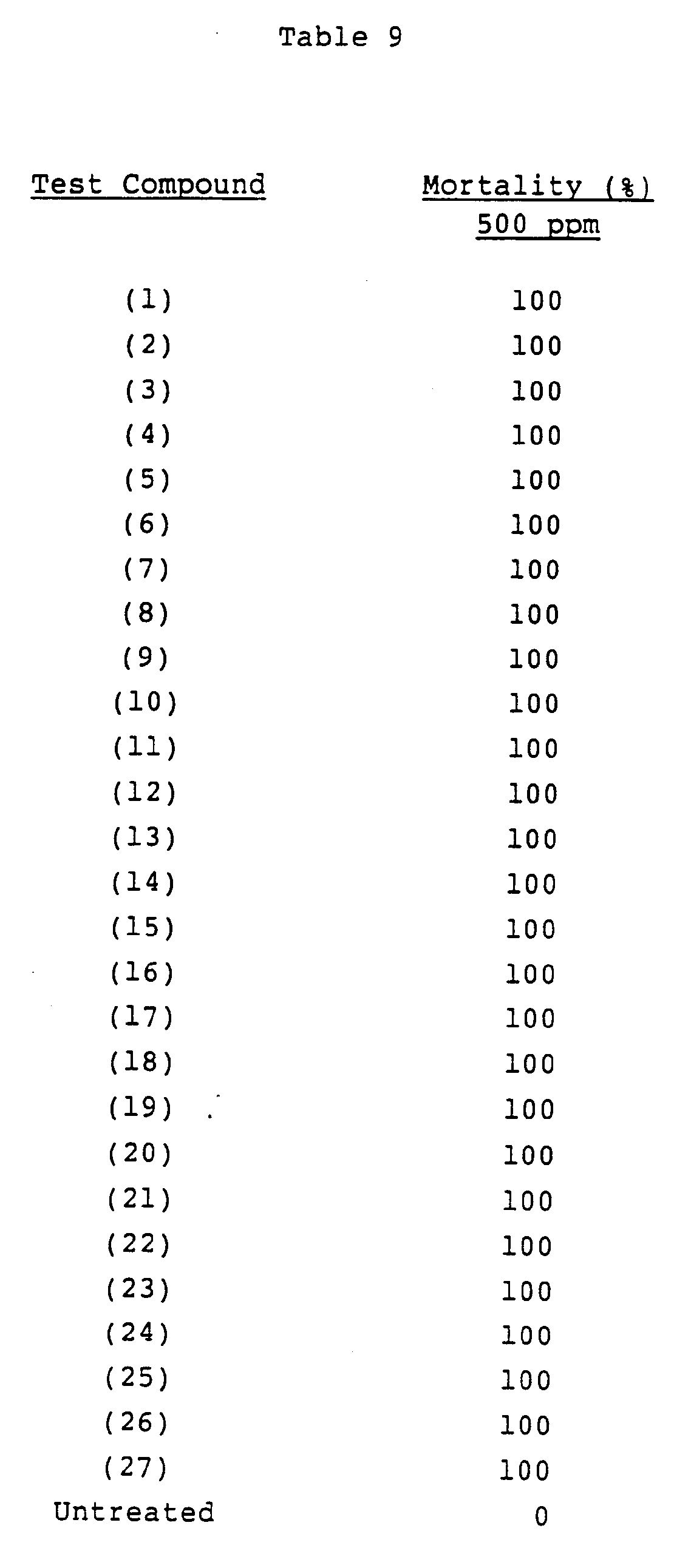
- On the bottom of a polyethylene cup having a diameter of 5.5 cm, a filter paper which is of the same size was laid down and 0.7 ml of an aqueous dilution (500 ppm) of the emulsifiable concentrate of the test compound prepared according to Formulation Example 1 was dropped onto the filter paper. As feed, 30 mg of sucrose was uniformly spread thereon. In the cup, 10 adult females of housefly (Musca domestica) were released. Forty eight hours after the cup was covered, dead or alive insects were examined to determine mortality (2 replications). The results are shown in Table 9.
Claims (6)
- A 1-phenylimidazole derivative having the formula:

- A 1-phenylimidazole derivative according to claim 1, which is 1-(2,6-difluoro-4-trifluoromethylphenyl)-4-(1,1,2,2-tetrafluoroethyl)imidazole,
1-(2,6-difluoro-4-trifluoromethylphenyl)-4-pentafluoroethylimidazole,
1-(2,6-difluoro-4-trifluoromethylphenyl)-4-(2-bromo-1,1,2,2-tetrafluoroethyl)imidazole,
1-(2-chloro-6-fluoro-4-trifluoromethylphenyl)-4-(1,1,2,2-tetrafluoroethyl)imidazole,
1-(2-chloro-6-fluoro-4-trifluoromethylphenyl)-4-pentafluoroethylimidazole,
1-(2-chloro-6-fluoro-4-trifluoromethylphenyl)-4-(2-chloro-1,1,2,2-tetrafluoroethyl)imidazole,
1-(2-chloro-6-fluoro-4-trifluoromethylphenyl)-4-(2-bromo-1,1,2,2-tetrafluoroethyl)imidazole,
1-(2,6-dichloro-4-trifluoromethylphenyl)-4-(1,1,2,2-tetrafluoroethyl)imidazole,
1-(2,6-dichloro-4-trifluoromethylphenyl)-4-pentafluoroethylimidazole,
1-(2,6-dichloro-4-trifluoromethylphenyl)-4-(2-chloro-1,1,2,2-tetrafluoroethyl)imidazole,
1-(2,6-dichloro-4-trifluoromethylphenyl)-4-(2-bromo-1,1,2,2-tetrafluoroethyl)imidazole,
1-(2,6-dichloro-4-trifluoromethylphenyl)-2-methyl-4-pentafluoroethylimidazole,
1-(2,6-dichloro-4-trifluoromethylphenyl)-2-methyl-4-(2-bromo-1,1,2,2-tetrafluoroethyl)imidazole,
1-(2-chloro-6-fluoro-4-trifluoromethylphenyl)-2-methyl-4-(1,1,2,2-tetrafluoroethyl)imidazole,
1-(2-chloro-6-fluoro-4-trifluoromethylphenyl)-2-methyl-4-pentafluoroethylimidazole,
1-(2-chloro-6-fluoro-4-trifluoromethylphenyl)-2-methyl-4-(2-chloro-1,1,2,2-tetrafluoroethyl)imidazole,
1-(2-chloro-6-fluoro-4-trifluoromethylphenyl)-2-methyl-4-(2-bromo-1,1,2,2-tetrafluoroethyl)imidazole,
1-(2,6-dichloro-4-trifluoromethylphenyl)-2-methyl-4-(1,1,2,2-tetrafluoroethyl)imidazole,
1-(2,6-dichloro-4-trifluoromethylphenyl)-2-methyl-4-pentafluoroethylimidazole,
1-(2,6-dichloro-4-trifluoromethylphenyl)-2-methyl-4-(2-chloro-1,1,2,2-tetrafluoroethyl) imidazole, or
1-(2,6-dichloro-4-trifluoromethylphenyl)-2-methyl-4-(2-bromo-1,1,2,2-tetrafluoroethyl)imidazole. - A process for producing a 1-phenylimidazole derivative according to claim 1, which comprises reacting a halide compound having the formula:


- An insecticidal composition which comprises a 1-phenylimidazole derivative according to claim 1 and an inert carrier.
- A method for controlling insect pests which comprises applying a 1-phenylimidazole derivative according to claim 1 to the insect pests or to a locus where insect pests may propagate.
- Use of a 1-phenylimidazole derivative according to claim 1 as a insecticide.
Applications Claiming Priority (4)
| Application Number | Priority Date | Filing Date | Title |
|---|---|---|---|
| JP17313590 | 1990-06-29 | ||
| JP173135/90 | 1990-06-29 | ||
| JP23543990 | 1990-09-04 | ||
| JP235439/90 | 1990-09-04 |
Publications (2)
| Publication Number | Publication Date |
|---|---|
| EP0464980A1 EP0464980A1 (en) | 1992-01-08 |
| EP0464980B1 true EP0464980B1 (en) | 1994-08-03 |
Family
ID=26495230
Family Applications (2)
| Application Number | Title | Priority Date | Filing Date |
|---|---|---|---|
| EP91301291A Expired - Lifetime EP0464980B1 (en) | 1990-06-29 | 1991-02-19 | 1-Phenylimidazole derivatives process for their preparation and use |
| EP91301290A Expired - Lifetime EP0464979B1 (en) | 1990-06-29 | 1991-02-19 | A 1-pyridylimidazole derivative and its production and use |
Family Applications After (1)
| Application Number | Title | Priority Date | Filing Date |
|---|---|---|---|
| EP91301290A Expired - Lifetime EP0464979B1 (en) | 1990-06-29 | 1991-02-19 | A 1-pyridylimidazole derivative and its production and use |
Country Status (14)
| Country | Link |
|---|---|
| US (2) | US5122530A (en) |
| EP (2) | EP0464980B1 (en) |
| KR (2) | KR920000729A (en) |
| AU (2) | AU633183B2 (en) |
| BR (2) | BR9100662A (en) |
| CA (2) | CA2036147A1 (en) |
| CZ (2) | CZ279536B6 (en) |
| DE (2) | DE69103230T2 (en) |
| ES (2) | ES2057754T3 (en) |
| HU (2) | HU206951B (en) |
| IL (2) | IL97279A (en) |
| MY (2) | MY104626A (en) |
| SK (1) | SK278039B6 (en) |
| YU (2) | YU30391A (en) |
Families Citing this family (34)
| Publication number | Priority date | Publication date | Assignee | Title |
|---|---|---|---|---|
| KR910021381A (en) * | 1990-02-20 | 1991-12-20 | 모리 히데오 | 4-tert-butylimidazole derivatives, and preparation method and use thereof |
| CA2036147A1 (en) * | 1990-06-29 | 1991-12-30 | Hiroki Tomioka | A 1-pyridylimidazole derivative and its production and use |
| US5252590A (en) * | 1991-06-28 | 1993-10-12 | Sumitomo Chemical Company, Limited | 1-pyridylimidazole derivative |
| EP0599183A1 (en) * | 1992-11-25 | 1994-06-01 | Rhone-Poulenc Agrochimie | Manufacturing of pesticides and intermediates |
| JP3715994B2 (en) * | 1993-12-21 | 2005-11-16 | 住友化学株式会社 | Pest control agent |
| US6413542B1 (en) | 1996-03-29 | 2002-07-02 | Merial | Direct pour-on antiparasitic skin solution and methods for treating, preventing and controlling myasis |
| ES2359973T3 (en) * | 1998-03-19 | 2011-05-30 | MERCK SHARP & DOHME CORP. | LIQUID POLYMER COMPOSITIONS FOR THE CONTROLLED RELEASE OF BIOACTIVE SUBSTANCES. |
| US6787342B2 (en) | 2000-02-16 | 2004-09-07 | Merial Limited | Paste formulations |
| US20040077703A1 (en) * | 2002-10-02 | 2004-04-22 | Soll Mark D. | Nodulisporic acid derivative spot-on formulations for combating parasites |
| US7262214B2 (en) | 2003-02-26 | 2007-08-28 | Merial Limited | 1-N-arylpyrazole derivatives in prevention of arthropod-borne and mosquito-borne diseases |
| US7531186B2 (en) * | 2003-12-17 | 2009-05-12 | Merial Limited | Topical formulations comprising 1-N-arylpyrazole derivatives and amitraz |
| US20050234119A1 (en) * | 2004-04-16 | 2005-10-20 | Soll Mark D | Antiparasitical agents and methods for treating, preventing and controlling external parasites in animals |
| US8362086B2 (en) | 2005-08-19 | 2013-01-29 | Merial Limited | Long acting injectable formulations |
| MX2008016411A (en) | 2006-07-05 | 2009-04-28 | Aventis Agriculture | 1-aryl-5-alkyl pyrazole derivative compounds, processes of making and methods of using thereof. |
| ES2614931T3 (en) * | 2006-08-04 | 2017-06-02 | Beth Israel Deaconess Medical Center | Pyruvate kinase inhibitors and disease treatment methods |
| SG171751A1 (en) * | 2008-11-19 | 2011-07-28 | Merial Ltd | Compositions comprising an aryl pyrazole and/ or a formamidine methods and uses thereof |
| US9173728B2 (en) | 2008-11-19 | 2015-11-03 | Merial Inc. | Multi-cavity container having offset indentures for dispensing fluids |
| CA2758071C (en) * | 2009-04-06 | 2018-01-09 | Agios Pharmaceuticals, Inc. | Pyruvate kinase m2 modulators, therapeutic compositions and related methods of use |
| ES2619557T3 (en) | 2009-05-04 | 2017-06-26 | Agios Pharmaceuticals, Inc. | PKM2 activators for use in cancer treatment |
| EP2448581B1 (en) | 2009-06-29 | 2016-12-07 | Agios Pharmaceuticals, Inc. | Therapeutic compositions and related methods of use |
| SG10201403696UA (en) | 2009-06-29 | 2014-10-30 | Agios Pharmaceuticals Inc | Therapeutic compounds and compositions |
| EP2512467A1 (en) | 2009-12-17 | 2012-10-24 | Merial Limited | Compositions comprising macrocyclic lactone compounds and spirodioxepinoindoles |
| UA108641C2 (en) | 2010-04-02 | 2015-05-25 | PARASITICID COMPOSITION CONTAINING FOUR ACTIVE AGENTS AND METHOD OF APPLICATION | |
| CA2821975A1 (en) | 2010-12-17 | 2012-06-21 | Shunqi Yan | N-(4-(azetidine-1-carbonyl)phenyl)-(hetero-) arylsulfonamide derivatives as pyruvate kinase m2 pkm2 modulators |
| WO2012088314A1 (en) | 2010-12-21 | 2012-06-28 | Agios Pharmaceuticals, Inc. | Bicyclic pkm2 activators |
| TWI549947B (en) | 2010-12-29 | 2016-09-21 | 阿吉歐斯製藥公司 | Therapeutic compounds and compositions |
| US9181231B2 (en) | 2011-05-03 | 2015-11-10 | Agios Pharmaceuticals, Inc | Pyruvate kinase activators for use for increasing lifetime of the red blood cells and treating anemia |
| JP6272754B2 (en) | 2011-05-03 | 2018-01-31 | アジオス ファーマシューティカルズ, インコーポレイテッド | Method of using pyruvate kinase activator |
| JP6249568B2 (en) | 2011-11-17 | 2017-12-20 | メリアル インコーポレイテッド | Composition comprising arylpyrazole and substituted imidazole, method of use thereof |
| JO3626B1 (en) | 2012-02-23 | 2020-08-27 | Merial Inc | Topical formulations containing fipronil and permethrin and how to use them |
| TWI579274B (en) | 2012-04-20 | 2017-04-21 | 龍馬躍公司 | Improved processes for the preparation of 1-aryl-5-alkyl pyrazole compounds |
| WO2014139144A1 (en) | 2013-03-15 | 2014-09-18 | Agios Pharmaceuticals, Inc. | Therapeutic compounds and compositions |
| US10864193B2 (en) | 2014-10-31 | 2020-12-15 | Boehringer Ingelheim Animal Health USA Inc. | Parasiticidal compositions comprising fipronil at high concentrations |
| RS64777B1 (en) | 2015-06-11 | 2023-11-30 | Agios Pharmaceuticals Inc | Methods of using pyruvate kinase activators |
Family Cites Families (14)
| Publication number | Priority date | Publication date | Assignee | Title |
|---|---|---|---|---|
| GB1408877A (en) * | 1971-12-07 | 1975-10-08 | Boots Co Ltd | Substituted imidazoles and their use as pesticides |
| US4048188A (en) * | 1971-12-07 | 1977-09-13 | The Boots Company Limited | 1-Carbonamido imidazoles |
| US3996366A (en) * | 1973-11-19 | 1976-12-07 | The Boots Company Limited | Thio derivatives of imidazol-1-yl carboxamides |
| US3940484A (en) * | 1971-12-07 | 1976-02-24 | The Boots Company Limited | Insecticidal compositions and methods of combatting insects using substituted imidazoles |
| SE447653B (en) * | 1978-11-14 | 1986-12-01 | Eisai Co Ltd | IMIDAZOLD DERIVATIVES AND PHARMACEUTICAL COMPOSITION CONTAINING SUCH DERIVATIVES |
| US4600430A (en) * | 1985-02-22 | 1986-07-15 | Eli Lilly And Company | Pyridinylimidazolidinone compounds |
| US4634711A (en) * | 1985-08-02 | 1987-01-06 | Smithkline Beckman Corporation | Pyridylalkyl imidazole-2-thiols |
| DE3614364A1 (en) * | 1986-04-28 | 1987-10-29 | Hoechst Ag | 1-PHENYL IMIDAZOLE COMPOUNDS, METHOD FOR THE PRODUCTION THEREOF AND THEIR USE AS GROWTH REGULATORS |
| CA1334092C (en) * | 1986-07-11 | 1995-01-24 | David John Carini | Angiotensin ii receptor blocking imidazoles |
| FI91754C (en) * | 1986-12-02 | 1994-08-10 | Tanabe Seiyaku Co | An analogous method for preparing an imidazole derivative useful as a medicament |
| DE3811574A1 (en) * | 1988-03-31 | 1989-10-19 | Schering Ag | N-SUBSTITUTED IMIDAZOLES, METHODS FOR THEIR PRODUCTION AND THEIR USE IN MEDICINAL PRODUCTS |
| CA2015366C (en) * | 1989-05-05 | 2001-09-11 | Rhone-Poulenc Agrochimie | Pesticidal 1-arylimidazoles |
| KR910021381A (en) * | 1990-02-20 | 1991-12-20 | 모리 히데오 | 4-tert-butylimidazole derivatives, and preparation method and use thereof |
| CA2036147A1 (en) * | 1990-06-29 | 1991-12-30 | Hiroki Tomioka | A 1-pyridylimidazole derivative and its production and use |
-
1991
- 1991-02-12 CA CA002036147A patent/CA2036147A1/en not_active Abandoned
- 1991-02-12 CA CA002036148A patent/CA2036148A1/en not_active Abandoned
- 1991-02-18 KR KR1019910002564A patent/KR920000729A/en not_active Withdrawn
- 1991-02-18 MY MYPI91000253A patent/MY104626A/en unknown
- 1991-02-18 KR KR1019910002563A patent/KR920000745A/en not_active Withdrawn
- 1991-02-18 MY MYPI91000254A patent/MY104627A/en unknown
- 1991-02-19 IL IL9727991A patent/IL97279A/en not_active IP Right Cessation
- 1991-02-19 DE DE69103230T patent/DE69103230T2/en not_active Expired - Fee Related
- 1991-02-19 BR BR919100662A patent/BR9100662A/en unknown
- 1991-02-19 EP EP91301291A patent/EP0464980B1/en not_active Expired - Lifetime
- 1991-02-19 HU HU91549A patent/HU206951B/en not_active IP Right Cessation
- 1991-02-19 ES ES91301290T patent/ES2057754T3/en not_active Expired - Lifetime
- 1991-02-19 EP EP91301290A patent/EP0464979B1/en not_active Expired - Lifetime
- 1991-02-19 BR BR919100663A patent/BR9100663A/en unknown
- 1991-02-19 HU HU91548A patent/HUT58058A/en unknown
- 1991-02-19 ES ES91301291T patent/ES2057755T3/en not_active Expired - Lifetime
- 1991-02-19 DE DE69103231T patent/DE69103231T2/en not_active Expired - Fee Related
- 1991-02-19 IL IL97278A patent/IL97278A0/en unknown
- 1991-02-20 US US07/658,324 patent/US5122530A/en not_active Expired - Fee Related
- 1991-02-20 AU AU71186/91A patent/AU633183B2/en not_active Ceased
- 1991-02-20 YU YU30391A patent/YU30391A/en unknown
- 1991-02-20 CZ CS91440A patent/CZ279536B6/en unknown
- 1991-02-20 AU AU71188/91A patent/AU633184B2/en not_active Ceased
- 1991-02-20 CZ CS91441A patent/CZ279634B6/en unknown
- 1991-02-20 SK SK440-91A patent/SK278039B6/en unknown
- 1991-02-20 US US07/658,326 patent/US5153215A/en not_active Expired - Fee Related
- 1991-02-20 YU YU30491A patent/YU30491A/en unknown
Also Published As
Similar Documents
| Publication | Publication Date | Title |
|---|---|---|
| US5153215A (en) | 1-phenylimidazole derivative and its use | |
| EP0445931B1 (en) | A 4-tert.-butyl imidazole derivative and its production and use | |
| US5252590A (en) | 1-pyridylimidazole derivative | |
| RU2139279C1 (en) | Ether derivatives, agent for controlling insects, and phenol compounds | |
| EP0435616B1 (en) | An oxadiazolinone derivative and its production and use | |
| EP0345801B1 (en) | Novel carboxylic acid esters, methods for producing them and insecticides containing them as an active ingredient | |
| US5055491A (en) | Carboxylic acid esters, methods for producing them and insecticides and/or acaricides containing them as an active ingredient | |
| RU2026294C1 (en) | Derivatives of 1-pyridylimidazole and insecticide composition | |
| EP0484688B1 (en) | Aromatic compounds, their production process and their compositions for the control of insect pests | |
| US5137907A (en) | 1-(3-(4-(3,5-difluorophenoxy) phenoxy) propyl) - pyrazole, and its production and use | |
| US5252610A (en) | Aromatic compounds and their compositions for the control of insect pests | |
| US5607963A (en) | Maleimide pesticides and compositions thereof | |
| EP0514833B1 (en) | Amide derivatives, their production processes and their compositions for the control of insect pests | |
| US5232949A (en) | 3-(4-substituted-2-chlorophenoxy)propionaldoxime ethyl ether compounds, their production processes and their compositions for the control of insect pests | |
| EP0488236B1 (en) | Aromatic compounds, their production processes and their compositions for the control of insect pests |
Legal Events
| Date | Code | Title | Description |
|---|---|---|---|
| PUAI | Public reference made under article 153(3) epc to a published international application that has entered the european phase |
Free format text: ORIGINAL CODE: 0009012 |
|
| AK | Designated contracting states |
Kind code of ref document: A1 Designated state(s): BE CH DE ES FR GB IT LI NL |
|
| 17P | Request for examination filed |
Effective date: 19920525 |
|
| 17Q | First examination report despatched |
Effective date: 19931018 |
|
| GRAA | (expected) grant |
Free format text: ORIGINAL CODE: 0009210 |
|
| AK | Designated contracting states |
Kind code of ref document: B1 Designated state(s): BE CH DE ES FR GB IT LI NL |
|
| ITF | It: translation for a ep patent filed | ||
| REF | Corresponds to: |
Ref document number: 69103231 Country of ref document: DE Date of ref document: 19940908 |
|
| ET | Fr: translation filed | ||
| REG | Reference to a national code |
Ref country code: ES Ref legal event code: FG2A Ref document number: 2057755 Country of ref document: ES Kind code of ref document: T3 |
|
| PGFP | Annual fee paid to national office [announced via postgrant information from national office to epo] |
Ref country code: GB Payment date: 19950209 Year of fee payment: 5 |
|
| PGFP | Annual fee paid to national office [announced via postgrant information from national office to epo] |
Ref country code: NL Payment date: 19950228 Year of fee payment: 5 |
|
| PLBE | No opposition filed within time limit |
Free format text: ORIGINAL CODE: 0009261 |
|
| STAA | Information on the status of an ep patent application or granted ep patent |
Free format text: STATUS: NO OPPOSITION FILED WITHIN TIME LIMIT |
|
| 26N | No opposition filed | ||
| PGFP | Annual fee paid to national office [announced via postgrant information from national office to epo] |
Ref country code: BE Payment date: 19951220 Year of fee payment: 6 |
|
| PGFP | Annual fee paid to national office [announced via postgrant information from national office to epo] |
Ref country code: FR Payment date: 19951229 Year of fee payment: 6 |
|
| PGFP | Annual fee paid to national office [announced via postgrant information from national office to epo] |
Ref country code: CH Payment date: 19960202 Year of fee payment: 6 |
|
| PGFP | Annual fee paid to national office [announced via postgrant information from national office to epo] |
Ref country code: ES Payment date: 19960205 Year of fee payment: 6 |
|
| PG25 | Lapsed in a contracting state [announced via postgrant information from national office to epo] |
Ref country code: GB Effective date: 19960219 |
|
| PGFP | Annual fee paid to national office [announced via postgrant information from national office to epo] |
Ref country code: DE Payment date: 19960430 Year of fee payment: 6 |
|
| PG25 | Lapsed in a contracting state [announced via postgrant information from national office to epo] |
Ref country code: NL Effective date: 19960901 |
|
| GBPC | Gb: european patent ceased through non-payment of renewal fee |
Effective date: 19960219 |
|
| NLV4 | Nl: lapsed or anulled due to non-payment of the annual fee |
Effective date: 19960901 |
|
| PG25 | Lapsed in a contracting state [announced via postgrant information from national office to epo] |
Ref country code: ES Free format text: LAPSE BECAUSE OF NON-PAYMENT OF DUE FEES Effective date: 19970220 |
|
| PG25 | Lapsed in a contracting state [announced via postgrant information from national office to epo] |
Ref country code: LI Effective date: 19970228 Ref country code: CH Effective date: 19970228 Ref country code: BE Effective date: 19970228 |
|
| BERE | Be: lapsed |
Owner name: SUMITOMO CHEMICAL CY LTD Effective date: 19970228 |
|
| REG | Reference to a national code |
Ref country code: CH Ref legal event code: PL |
|
| PG25 | Lapsed in a contracting state [announced via postgrant information from national office to epo] |
Ref country code: FR Effective date: 19971030 |
|
| PG25 | Lapsed in a contracting state [announced via postgrant information from national office to epo] |
Ref country code: DE Effective date: 19971101 |
|
| REG | Reference to a national code |
Ref country code: FR Ref legal event code: ST |
|
| REG | Reference to a national code |
Ref country code: ES Ref legal event code: FD2A Effective date: 19990301 |
|
| PG25 | Lapsed in a contracting state [announced via postgrant information from national office to epo] |
Ref country code: IT Free format text: LAPSE BECAUSE OF NON-PAYMENT OF DUE FEES;WARNING: LAPSES OF ITALIAN PATENTS WITH EFFECTIVE DATE BEFORE 2007 MAY HAVE OCCURRED AT ANY TIME BEFORE 2007. THE CORRECT EFFECTIVE DATE MAY BE DIFFERENT FROM THE ONE RECORDED. Effective date: 20050219 |