EP0460062B1 - Huperzine a analogs - Google Patents
Huperzine a analogs Download PDFInfo
- Publication number
- EP0460062B1 EP0460062B1 EP90904089A EP90904089A EP0460062B1 EP 0460062 B1 EP0460062 B1 EP 0460062B1 EP 90904089 A EP90904089 A EP 90904089A EP 90904089 A EP90904089 A EP 90904089A EP 0460062 B1 EP0460062 B1 EP 0460062B1
- Authority
- EP
- European Patent Office
- Prior art keywords
- huperzine
- group
- linear
- ethyl acetate
- branched alkyl
- Prior art date
- Legal status (The legal status is an assumption and is not a legal conclusion. Google has not performed a legal analysis and makes no representation as to the accuracy of the status listed.)
- Expired - Lifetime
Links
- 0 C*(C(C1C2*=C(*)C1)(C2=*=C1I=C1)C(C=CC(*)N1)=C1Cl1CC1)*=C Chemical compound C*(C(C1C2*=C(*)C1)(C2=*=C1I=C1)C(C=CC(*)N1)=C1Cl1CC1)*=C 0.000 description 3
Classifications
-
- C—CHEMISTRY; METALLURGY
- C07—ORGANIC CHEMISTRY
- C07D—HETEROCYCLIC COMPOUNDS
- C07D221/00—Heterocyclic compounds containing six-membered rings having one nitrogen atom as the only ring hetero atom, not provided for by groups C07D211/00 - C07D219/00
- C07D221/02—Heterocyclic compounds containing six-membered rings having one nitrogen atom as the only ring hetero atom, not provided for by groups C07D211/00 - C07D219/00 condensed with carbocyclic rings or ring systems
- C07D221/22—Bridged ring systems
-
- A—HUMAN NECESSITIES
- A61—MEDICAL OR VETERINARY SCIENCE; HYGIENE
- A61P—SPECIFIC THERAPEUTIC ACTIVITY OF CHEMICAL COMPOUNDS OR MEDICINAL PREPARATIONS
- A61P43/00—Drugs for specific purposes, not provided for in groups A61P1/00-A61P41/00
-
- C—CHEMISTRY; METALLURGY
- C07—ORGANIC CHEMISTRY
- C07D—HETEROCYCLIC COMPOUNDS
- C07D215/00—Heterocyclic compounds containing quinoline or hydrogenated quinoline ring systems
- C07D215/02—Heterocyclic compounds containing quinoline or hydrogenated quinoline ring systems having no bond between the ring nitrogen atom and a non-ring member or having only hydrogen atoms or carbon atoms directly attached to the ring nitrogen atom
- C07D215/16—Heterocyclic compounds containing quinoline or hydrogenated quinoline ring systems having no bond between the ring nitrogen atom and a non-ring member or having only hydrogen atoms or carbon atoms directly attached to the ring nitrogen atom with hetero atoms or with carbon atoms having three bonds to hetero atoms with at the most one bond to halogen, e.g. ester or nitrile radicals, directly attached to ring carbon atoms
- C07D215/48—Carbon atoms having three bonds to hetero atoms with at the most one bond to halogen
Definitions
- the present invention relates to analogs of huperzine A as defined in claim 1.
- Huperzine A which is a Lycopodium alkaloid, has been isolated from the plant Huperzia serrata. It has been shown to inhibit the cholinesterase enzyme and, therefore, has been tested for the treatment of diseases of the cholinergic system.
- Huperzine A is being studied for the treatment of myasthenia gravis, Alzheimer's dementia and for the improvement of senile memory loss. See J. Liu, et al., The Structures of Huperzine A and B, Two New Alkaloids Exhibiting Marked Anticholinesterase Activity, Can. J. Chem., 64, 837-839 (1986).
- the compounds according to the present invention may be prepared via the synthesis of a bridged fused ring pyridine of the general formula I: which comprises:
- the bridged fused ring pyridine of the general formula I can be converted to the compound of general formula IV, which includes huperzine A and the analogs of huperzine A of the present invention: wherein:
- the compounds of general formula IV are capable of inhibiting the cholinesterase enzymes.
- the fused ring pyridine of general formula II can be prepared by utilizing SCHEME I, below.
- the starting material is a monoprotected diketone 1.
- the monoprotected diketone 1 is reacted with pyrrolidine and the resulting enamine is heated with acrylamide to provide the lactam 2.
- the lactam intermediate is then converted by a dehydrogenation procedure to the pyridone 3.
- the ketone carbonyl group is now deprotected and an ⁇ -carboalkoxylation reaction is carried out to provide the ⁇ -keto ester material 5, which corresponds to a molecule of general formula II.
- the bridged fused ring pyridine of general formula I can be converted to a compound of general formula IV, which includes huperzine A and the analogs of huperzine A of the invention: wherein:
- huperzine A is the preferred compound to synthesize, preferably:
- the bridged fused ring pyridine 6 is converted to the bridged ketone 7 by various dehydrating conditions. It is preferred that the alcohol is activated for elimination by transformation to its mesylate derivative, which is then heated in sodium acetate and acetic acid to provide the bridged ketone 7.
- a thermal isomerization reaction employing thiophenol and azoisobutyronitrile (AIBN) can be carried out to form ester 9.
- the ester 9 is then transformed to the urethane derivative 10 by carrying out a standard Curtius reaction, which comprises hydrolyzing the ester to its acid, converting the acid to an acid chloride, followed by heating the acid chloride with sodium azide and then with methanol.
- a standard Curtius reaction which comprises hydrolyzing the ester to its acid, converting the acid to an acid chloride, followed by heating the acid chloride with sodium azide and then with methanol.
- a dealkylating agent e.g. trimethylsilyl iodide.
- the pyridine'ring is generated from the pyridone ring by a process involving pyridine N-oxide formation by use of a peracid, treatment with acetic anhydride, and then acid hydrolysis [M. Katada, J. Pharm. Soc. Japan, 67, 51 (1947)].
- This conversion step is best performed prior to the TMSI promoted cleavage of the urethane and can be performed at an earlier stage if required. Some modification may be required to avoid competing olefin epoxidation and/or oxidation of the acyclic amino group.
- the carbomethoxy group of 10 is removed by base hydrolysis, and the resulting free amine is sequentially alkylated to introduce R 5 and R 6 or R 5 alone.
- An appropriate alkyl halide or tosylate, or a reductive amination procedure is employed in introducing these groups.
- huperzine A is the preferred compound to synthesize, preferably:
- intermediate 13 is deprotonated with a base and the resulting anion is reacted with R 7 X, where X is some suitable leaving group such as tosylate, mesylate, or halide.
- the double bond of 7 is subjected to an olefin isomerization reaction using a suitable metal catalyst (e.g., Fe(CO) 5 , (Ph 3 P) 4 Ru(MeCN), HCo(CO) 4 ), or by hydrating the double bond of 7 in the Markovnikov sense (H + , H 2 O), and then carrying out a subsequent dehydration reaction.
- a suitable metal catalyst e.g., Fe(CO) 5 , (Ph 3 P) 4 Ru(MeCN), HCo(CO) 4
- the intermediate 15 is then used in the place of 7 in the foregoing reactions to provide the double bond regiosomers of 11, 13, and 14.
- Saturated analogs 18 of huperzine A are readily obtained by subjecting 6 to a Barton deoxygenation procedure [the alcohol is converted to its thiocarbonyl ester, and a tin hydride reduction carried out; see D. H. R. Barton and W. B. Motherwell, Pure Appl. Chem., 53, 15 (1981)].
- Intermediate 17 is then carried through reaction steps identical to those employed above for the conversion of 7 to 11, 13, or 14 in order to acquire the saturated analogs 18 of huperzine A.
- the one carbon homologs 20 of huperzine A can be obtained from 9 by reduction of ester to alcohol, conversion of alcohol to azide, and reduction of the azide to amine with LAH to afford 19.
- Amine alkylation procedures like those described for the conversion of 10 to 13 and 13 to 14 can be employed to procure the analog 21.
- access to the homolog 22 (a double bond regioisomer of 21) can be achieved.
- the compounds of general formula IV are capable of inhibiting the cholinesterase enzymes and, therefore, are useful as pharmaceutical agents for mammals, especially for humans, for the treatment of disorders wherein cholinesterase enzymes are involved. Examples of such disorders are myasthenia gravis, Alzheimer's dementia and the improvement of senile memory loss.
- the compounds of general formula IV can be administered to a human subject either alone or, preferably, in combination with pharmaceutically acceptable carriers or diluents, optionally with known adjuvants, such as alum, in a pharmaceutical composition, according to standard pharmaceutical practice.
- the compounds can be administered orally or parenterally, including intravenous, intramuscular, intraperitoneal, subcutaneous and topical administration.
- a compound of general formula IV can be administered, for example, in the form of tablets or capsules, or as an aqueous solution or suspension.
- carriers which are commonly used include lactose and corn starch, and lubricating agents, such as magnesium stearate, are commonly added.
- useful diluents include lactose and dried corn starch.
- aqueous suspensions are required for oral use, the active ingredient is combined with 'emulsifying and suspending agents. If desired, certain sweetening and/or flavoring agents may be added.
- sterile solutions of the active ingredient are usually prepared, and the pH of the solutions should be suitably adjusted and buffered.
- the total concentration of solutes should be controlled in order to render the preparations isotonic.
- the daily dosage will normally be determined by the prescribing physician with the dosage generally varying according to the age, weight, and response of the individual patient, as well as the severity of the patient's symptoms.
- an effective daily dosage will be in the range of from about .05 mg/kg to about 1 mg/kg of body weight, and preferably, of from .1 mg/kg to about .5 mg/kg of body weight, administered in single or divided doses. In some cases, however, it may be necessary to use dosages outside these limits.
- the solution was quenched with methanol (20 mL) and allowed to warm to room temperature. The solution was then poured into a mixture of NaIO 4 (10.88g, 0.051 mol) in 300 mL of H 2 O-MeOH-THF (1:1:1). Another 100 mL of THF was used to rinse the reaction flask and combined with the above mixture. The mixture was stirred at room temperature for 24 h.
- the benzyl protected pyridone 4 (1.33g, 4.48 mmol) was stirred with Pd(OH) 2 (20 wt. %) in acetic acid under a H 2 -filled balloon at room temperature overnight. The solution was filtered and the acetic acid solvent was removed by rotary evaporation. Toluene was added to the residue, and the solution was again evaporated to remove the remaining acetic acid. The crude product ( 80%) was used directly in the following O-methylation reaction.
- n-BuLi (2.57 mL, 3.80 mmol) was added dropwise to a mixture of ethyltriphenylphosphonium bromide (1.59g, 4.28 mmol) in 15 mL of dry THF at room temperature under nitrogen. The reaction mixture was stirred at room temperature for 30 min. and then cooled to 0°C. The ketone (273 mg, 0.951 mmol) in 5 mL of dry THF was added dropwise to this mixture at 0°C. The resulting mixture was allowed to warm to room temperature, and stirred at room temperature for 4 h. The reaction was quenched with water.
- olefin 8 (79 mg, 0.26 mmol) was heated with azoisobutyronitrile (87 mg, 0.52 mmol) in 10 mL of thiophenol at 130°C under nitrogen for 24 h. The solution was cooled, diluted with CH 2 Cl 2 , and washed with 10% NaOH (5 times) and brine. After drying and concentration, the crude product was used directly in the next hydrolysis reaction. 1 H NMR analysis revealed olefin 9 to be comprised of an 80/20 mixture of the E and Z-alkenes, respectively.
- Rats were killed by decapitation and the brains were rapidly extirpated.
- the cortex was dissected out on ice according to the method of Glowinski and Iversen. (See J. Neurochem. 13, 655 (1966)).
- Samples were homogenized in ice cold 0.32 M sucrose. Homogenates were centrifuged at 1000 x g for 10 minutes to remove cell nuclei and heavy debris. The supernatant was then aspirated off and spun again (12000 x g) for 20 minutes to form a'pellet (Whittaker's P 2 fraction) containing synaptosomes and mitochondria. See E.G. Gray et al., J. Anatomy, 96,70(1962). The pellet was resuspended in 0.32 M sucrose. A portion of this synaptosome-rich fraction was added in triplicate to ice-cold pH 7.4 Krebs-Ringer medium.
- Toluene-based scintillation fluid was added to the vial, to extract the released labelled acetate into the organic phase. Under these conditions the unhydrolyzed labelled acetylcholine remains unextracted in the small aqueous reaction volume from which its weak beta-particles of decay do not escape to excite the scintillator. Thus, the sample can be counted directly in the same reaction vial, in which the hydrolysis of sample by acetylcholinesterase has occurred.
- synthetic racemic huperzine A had an IC 50 of 6 x 10 -7 M. This was very similar to the IC 50 value of natural huperzine A (10 -7 M). Also, the 1-carbon analog inhibited the cholinesterase enzyme, but to a lesser extent than huperzine A.
Landscapes
- Chemical & Material Sciences (AREA)
- Organic Chemistry (AREA)
- Health & Medical Sciences (AREA)
- General Health & Medical Sciences (AREA)
- Veterinary Medicine (AREA)
- General Chemical & Material Sciences (AREA)
- Medicinal Chemistry (AREA)
- Nuclear Medicine, Radiotherapy & Molecular Imaging (AREA)
- Bioinformatics & Cheminformatics (AREA)
- Pharmacology & Pharmacy (AREA)
- Life Sciences & Earth Sciences (AREA)
- Animal Behavior & Ethology (AREA)
- Engineering & Computer Science (AREA)
- Public Health (AREA)
- Chemical Kinetics & Catalysis (AREA)
- Pharmaceuticals Containing Other Organic And Inorganic Compounds (AREA)
- Nitrogen Condensed Heterocyclic Rings (AREA)
- Heterocyclic Carbon Compounds Containing A Hetero Ring Having Nitrogen And Oxygen As The Only Ring Hetero Atoms (AREA)
- Preparation Of Compounds By Using Micro-Organisms (AREA)
- Organic Low-Molecular-Weight Compounds And Preparation Thereof (AREA)
- Polysaccharides And Polysaccharide Derivatives (AREA)
- Medicines Containing Material From Animals Or Micro-Organisms (AREA)
- Nitrogen And Oxygen Or Sulfur-Condensed Heterocyclic Ring Systems (AREA)
- Other In-Based Heterocyclic Compounds (AREA)
- Pyridine Compounds (AREA)
- Acyclic And Carbocyclic Compounds In Medicinal Compositions (AREA)
Abstract
Description
- The present invention relates to analogs of huperzine A as defined in claim 1.
- Huperzine A, which is a Lycopodium alkaloid, has been isolated from the plant Huperzia serrata. It has been shown to inhibit the cholinesterase enzyme and, therefore, has been tested for the treatment of diseases of the cholinergic system. For example, Huperzine A is being studied for the treatment of myasthenia gravis, Alzheimer's dementia and for the improvement of senile memory loss. See J. Liu, et al., The Structures of Huperzine A and B, Two New Alkaloids Exhibiting Marked Anticholinesterase Activity, Can. J. Chem., 64, 837-839 (1986).
- The compounds according to the present invention may be prepared via the synthesis of a bridged fused ring pyridine of the general formula I:which comprises:

- (A) contacting a fused ring pyridine having general
formula II:
with an unsaturated carbon bridge having the general formula III:
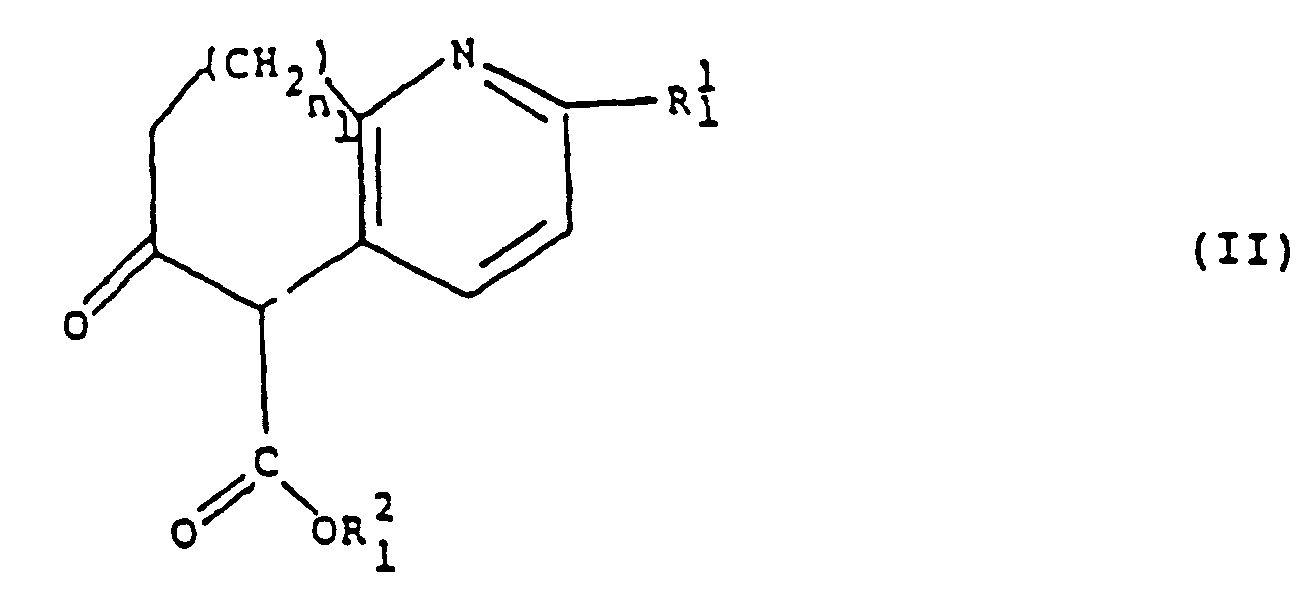 in a suitable solvent comprising an amine base catalyst having a pKa of from about 11 to about 20 to form the bridged fused ring pyridine of general formula I;
 wherein:
- R 1 / 1 is selected from the group consisting of H and C1 - C8 linear or branched alkoxy;
- R 2 / 1 is selected from the group consisting of C1 - C8 linear or branched alkyl;
- R 3 / 2 is selected from the group consisting of H and C1 - C8 linear or branched alkyl;
- R 1 / 3 is selected from the group consisting of H and C1 - C8 linear or branched alkoxy;
- R 2 / 3 is selected from the group consisting of C1 - C8 linear or branched alkyl;
- R 3 / 3 is selected from the group consisting of H and C1 - C8 linear or branched alkyl;
- n1 is an integer from 0 to 4; and
- n2 is an integer from 0 to 4;
- R 2 / 1 = R 2 / 3; R 1 / 1 = R 1 / 3; R 3 / 2= R 3 / 3 and n1 = n2.
-
- The bridged fused ring pyridine of the general formula I can be converted to the compound of general formula IV, which includes huperzine A and the analogs of huperzine A of the present invention:wherein:
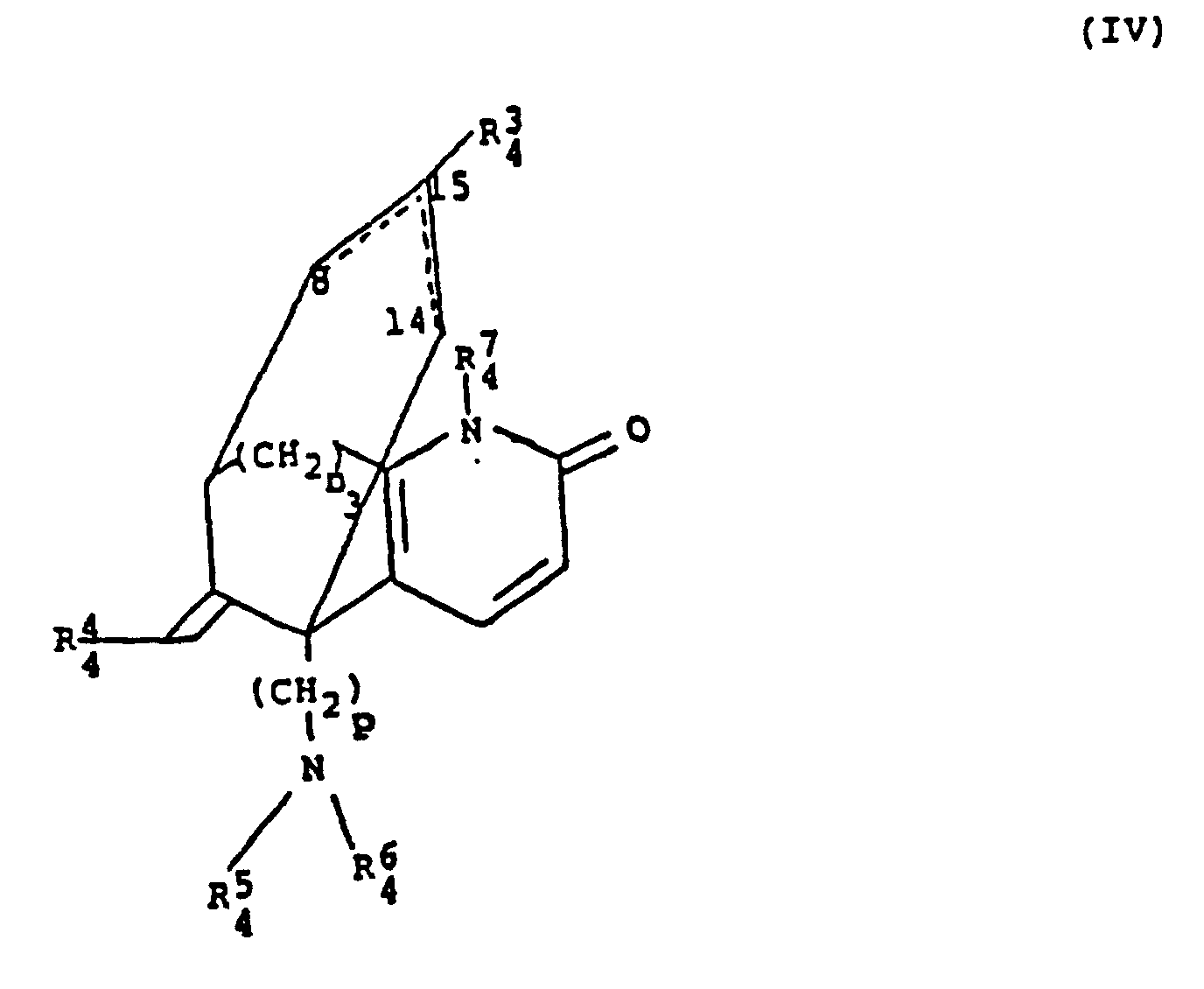
- R 3 / 4 is selected from the group consisting of H and C1 - C8 linear or branched alkyl;
- R 4 / 4 is selected from the group consisting of H and C1 - C8 linear or branched alkyl;
- R 5 / 4 is selected from the group consisting of H and C1 - C8 linear or branched alkyl;
- R 6 / 4 is selected from the group consisting of H and C1 - C8 linear or branched alkyl;
- R 7 / 4 is selected from the group consisting of H and C1 - C8 linear of branched alkyl;
- n3 is an integer from 0 to 4;
- p is 0 or 1;
-
- The compounds of general formula IV are capable of inhibiting the cholinesterase enzymes.
- It should be noted that no stereochemistry is implied by the general formulas utilized in the present invention; all stereoisomers are included in each general formula.
- The fused ring pyridine of general formula II can be prepared by utilizing SCHEME I, below.
- The starting material is a monoprotected diketone 1. The monoprotected diketone 1 is reacted with pyrrolidine and the resulting enamine is heated with acrylamide to provide the lactam 2. The lactam intermediate is then converted by a dehydrogenation procedure to the pyridone 3. Next, this pyridone is alkylated on oxygen to provide the alkoxypyridine derivative 4 (R1=OR). The ketone carbonyl group is now deprotected and an α-carboalkoxylation reaction is carried out to provide the β-keto ester material 5, which corresponds to a molecule of general formula II.
Pyridone 3 can also be converted to a fused ring pyridine of general formula II (or 5) with R1 = H by reducing the pyridone carbonyl group of 3 to hydroxyl and carrying out a subsequent dehydration step. Removal of the ketal protecting group and a carboalkoxylation reaction the provide II (or 5) with R1 = H.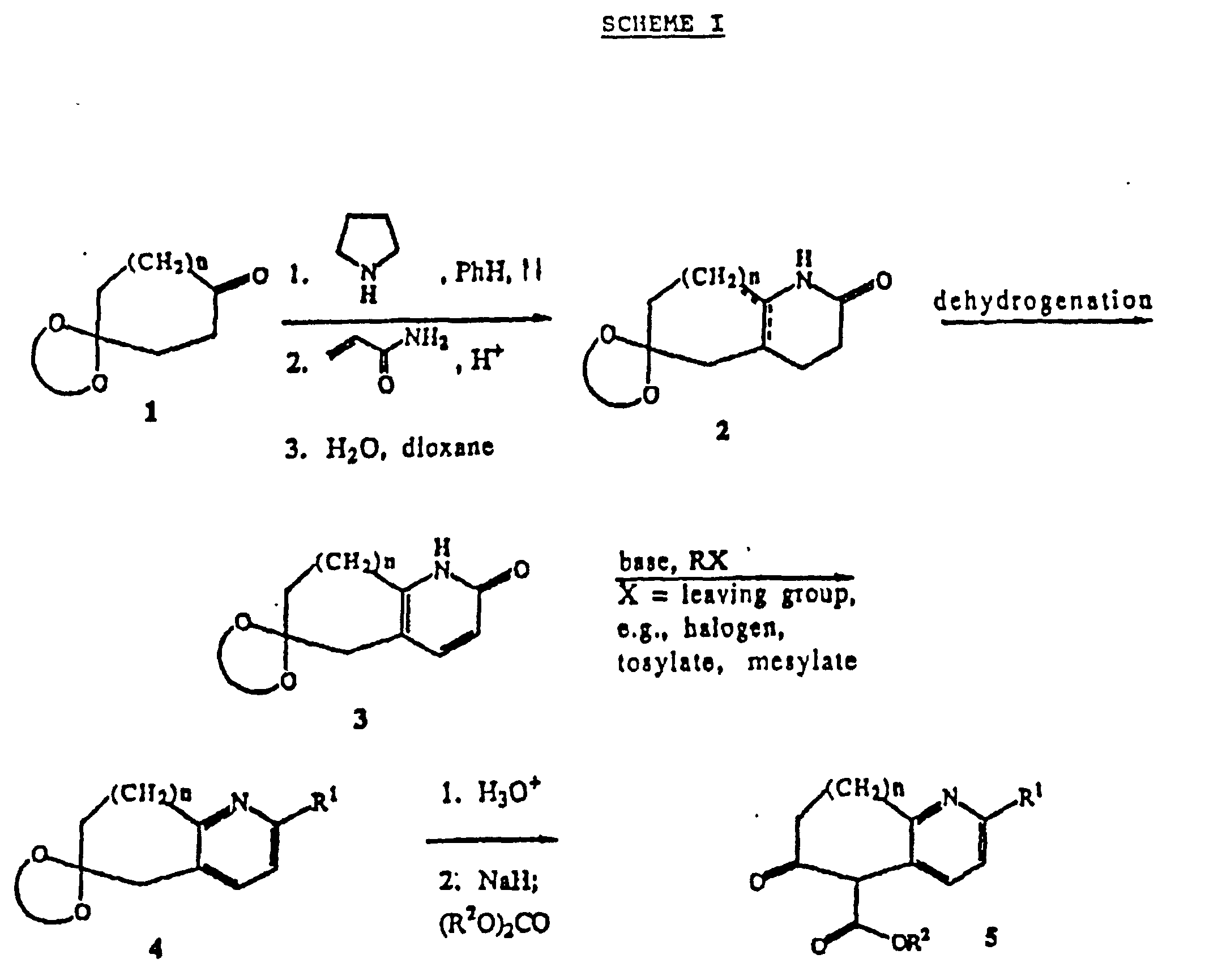
- The bridged fused ring pyridine of general formula I can be converted to a compound of general formula IV, which includes huperzine A and the analogs of huperzine A of the invention:wherein:

- R 3 / 4 is selected from the group consisting of H and C1 - C8 linear or branched alkyl;
- R 4 / 4 is selected from the group consisting of H and C1 - C8 linear or branched alkyl;
- R 5 / 4 is selected from the group consisting of H and C1 - C8 linear or branched alkyl;
- R 6 / 4 is selected from the group consisting of H and C1 - C8 linear or branched alkyl;
- R 7 / 4 is selected from the group consisting of H and C1 - C8 linear of branched alkyl;
- n3 is an integer from 0 to 4;
- p is 0 or 1;
-
- Since huperzine A is the preferred compound to synthesize, preferably:
- R 3 / 4 is CH3;
- R 4 / 4 is CH3;
- R 5 / 4 is H;
- R 6 / 4 is H;
- R 7 / 4 is H;
- n3 is 1;
- p is 0
-
- Even more preferred of such preferred embodiment is the E-stereoisomer of general formula IV, which represents huperzine A.
- The compounds of general formula IV can be prepared by utilizing scheme II, hereinbelow.
- The bridged fused ring pyridine 6 is converted to the bridged ketone 7 by various dehydrating conditions. It is preferred that the alcohol is activated for elimination by transformation to its mesylate derivative, which is then heated in sodium acetate and acetic acid to provide the bridged ketone 7.
- The bridged ketone 7 is then reacted with the desired alkylidenephosphorane (Ph3P=CHR4 wherein R4 is H or a C1-C8 linear or branched alkyl) in a suitable solvent, e.g. tetrahydrofuran or ether, to provide the olefin 8 (note: where R4 is alkyl, a cis/trans mixture is formed). To obtain the olefinic product of predominantly E-stereochemistry, a thermal isomerization reaction employing thiophenol and azoisobutyronitrile (AIBN) can be carried out to form ester 9.
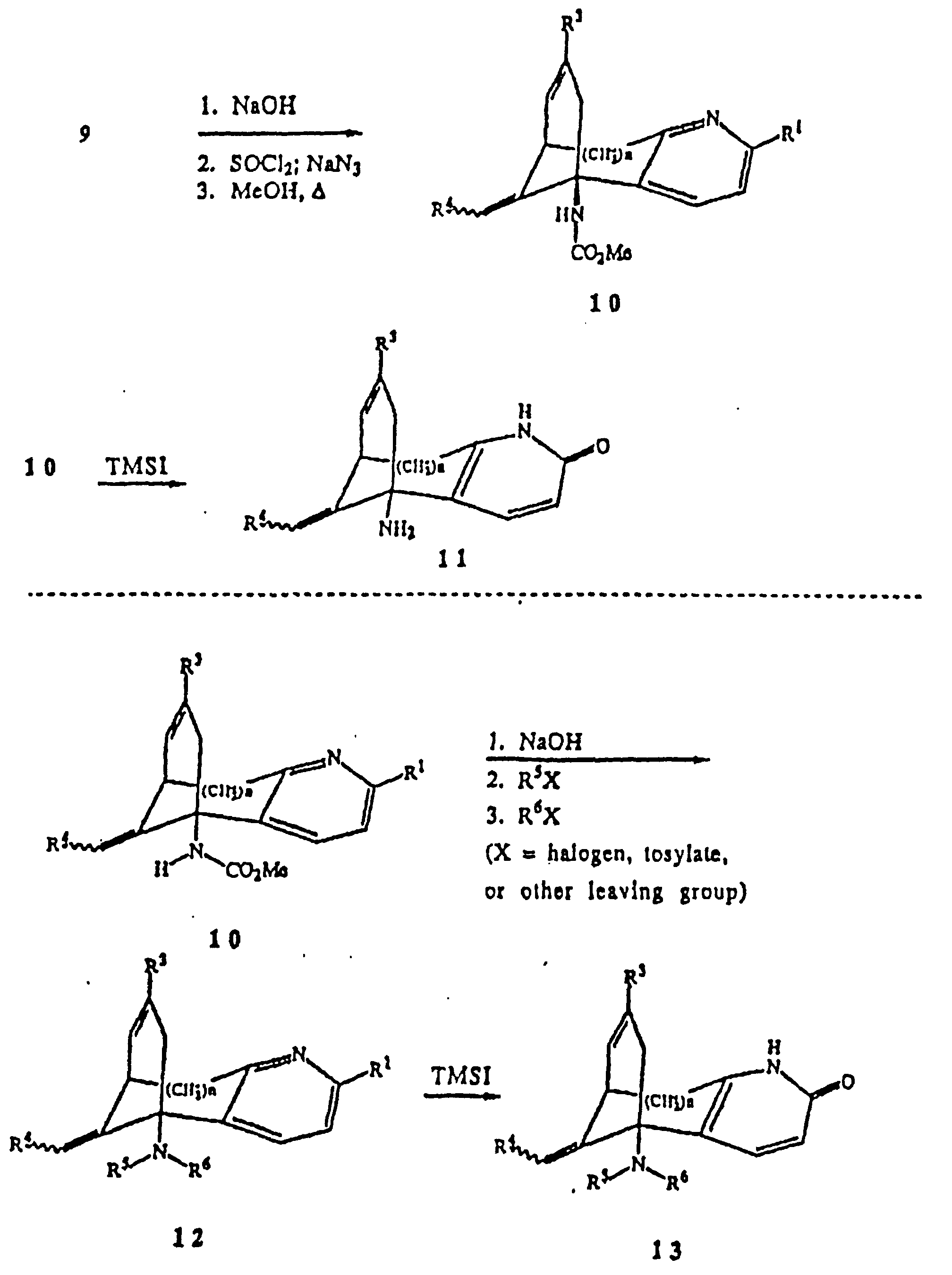
- The ester 9 is then transformed to the urethane derivative 10 by carrying out a standard Curtius reaction, which comprises hydrolyzing the ester to its acid, converting the acid to an acid chloride, followed by heating the acid chloride with sodium azide and then with methanol.
- Urethane 10 can then be converted to amine 11 (huperzine A if R3 = R4 = CH3 and n=1) by effecting cleavage of both the alkyl group R1 (where R1=OR) and the carbomethoxy group by reacting urethane 10 with a dealkylating agent, e.g. trimethylsilyl iodide.
- In cases where R1 in the accompanying structures is H, the pyridine'ring is generated from the pyridone ring by a process involving pyridine N-oxide formation by use of a peracid, treatment with acetic anhydride, and then acid hydrolysis [M. Katada, J. Pharm. Soc. Japan, 67, 51 (1947)]. This conversion step is best performed prior to the TMSI promoted cleavage of the urethane and can be performed at an earlier stage if required. Some modification may be required to avoid competing olefin epoxidation and/or oxidation of the acyclic amino group.
- To procure the N-alkyl amino substituted derivatives 13 of huperzine A, the carbomethoxy group of 10 is removed by base hydrolysis, and the resulting free amine is sequentially alkylated to introduce R5 and R6 or R5 alone. An appropriate alkyl halide or tosylate, or a reductive amination procedure is employed in introducing these groups. Lastly, the alkoxypyridine intermediate 12 (where R1 = OR)is cleaved to the pyridone 13 by 0-dealkylation using a reagent such as TMSI.
- Another aspect of the present invention is the pyridine intermediate 12 having the general formula V:wherein:
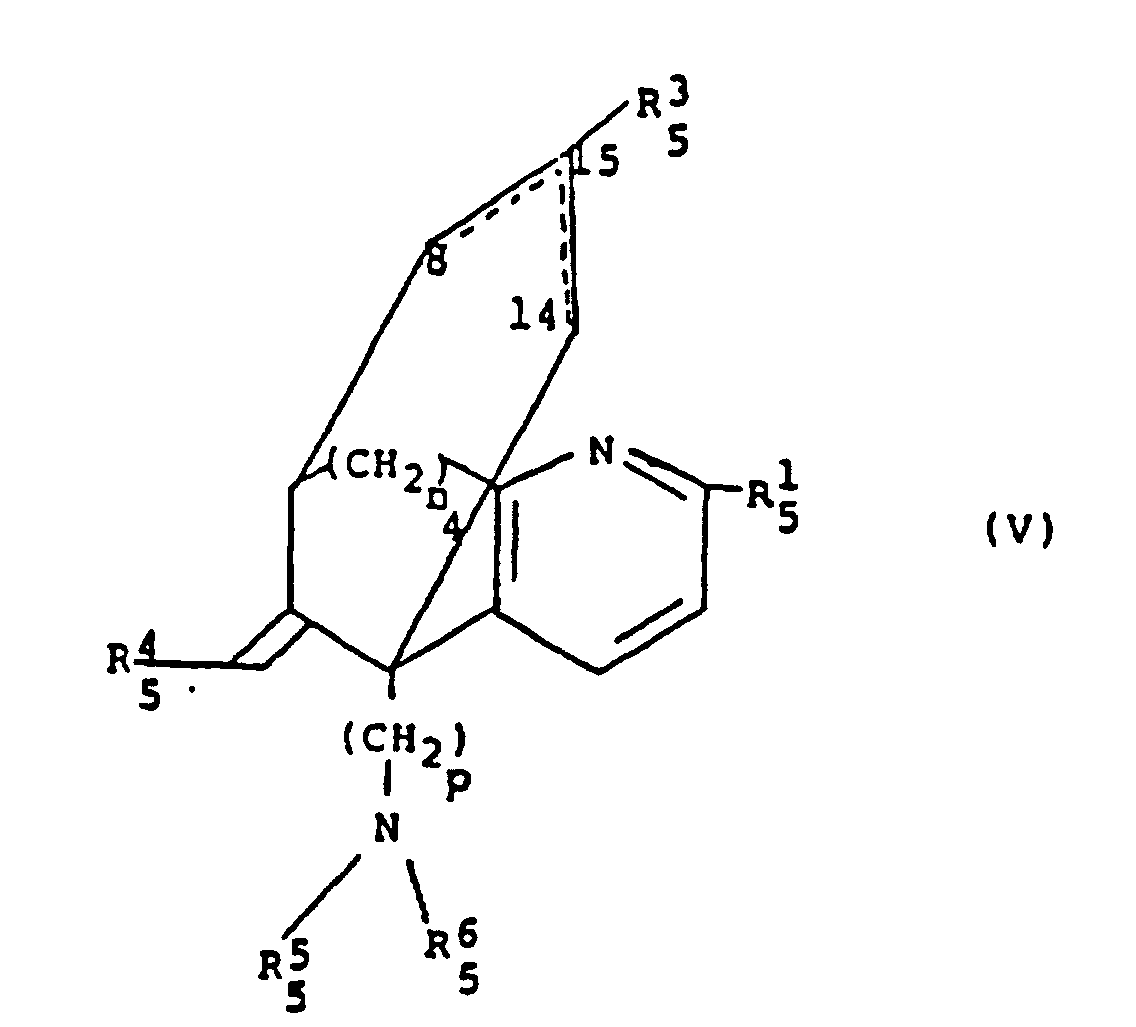
- R 1 / 5 is selected from the group consisting of H and C1 - C8 linear or branched alkoxy;
- R 3 / 5 is selected from the group consisting of H and C1 - C8 linear or branched alkyl;
- R 4 / 5 is selected from the group consisting of H and C1 - C8 linear or branched alkyl;
- R 5 / 5 is selected from the group consisting of H and C1 - C8 linear or branched alkyl;
- R 6 / 5 is selected from the group consisting of H and C1 - C8 linear or branched alkyl;
- n4 is an integer from 0 to 4;
- p is 0 or 1;
-
- Since huperzine A is the preferred compound to synthesize, preferably:
- R 1 / 5 is OCH3;
- R 3 / 5 is CH3;
- R 4 / 5 is CH3;
- R 5 / 5 is H;
- R 6 / 5 is H;
- n4 is 1;
- p is 0; and
-
- Even more preferred of such preferred embodiment is the E-stereoisomer of general formula V, which is capable of being converted to huperzine A.
- To obtain the huperzine analogs 14 containing an alkyl group (R7) on the pyridine ring nitrogen, intermediate 13 is deprotonated with a base and the resulting anion is reacted with R7X, where X is some suitable leaving group such as tosylate, mesylate, or halide.
- To obtain the double bond regioisomer 16 of huperzine A, the double bond of 7 is subjected to an olefin isomerization reaction using a suitable metal catalyst (e.g., Fe(CO)5, (Ph3P)4Ru(MeCN), HCo(CO)4), or by hydrating the double bond of 7 in the Markovnikov sense (H+, H2O), and then carrying out a subsequent dehydration reaction.
- The intermediate 15 is then used in the place of 7 in the foregoing reactions to provide the double bond regiosomers of 11, 13, and 14.
- Saturated analogs 18 of huperzine A are readily obtained by subjecting 6 to a Barton deoxygenation procedure [the alcohol is converted to its thiocarbonyl ester, and a tin hydride reduction carried out; see D. H. R. Barton and W. B. Motherwell, Pure Appl. Chem., 53, 15 (1981)]. Intermediate 17 is then carried through reaction steps identical to those employed above for the conversion of 7 to 11, 13, or 14 in order to acquire the saturated analogs 18 of huperzine A.
- The one carbon homologs 20 of huperzine A can be obtained from 9 by reduction of ester to alcohol, conversion of alcohol to azide, and reduction of the azide to amine with LAH to afford 19. The alkoxypyridine intermediate 19 (where R1 = OR) is then transformed to 20 by o-dealkylation using a reagent such as TMSI. Amine alkylation procedures like those described for the conversion of 10 to 13 and 13 to 14 can be employed to procure the analog 21. By starting with 15 and carrying out a similar sequence of reactions to those described hereinabove beginning with a Wittig step, access to the homolog 22 (a double bond regioisomer of 21) can be achieved.



- The compounds of general formula IV are capable of inhibiting the cholinesterase enzymes and, therefore, are useful as pharmaceutical agents for mammals, especially for humans, for the treatment of disorders wherein cholinesterase enzymes are involved. Examples of such disorders are myasthenia gravis, Alzheimer's dementia and the improvement of senile memory loss.
- The compounds of general formula IV can be administered to a human subject either alone or, preferably, in combination with pharmaceutically acceptable carriers or diluents, optionally with known adjuvants, such as alum, in a pharmaceutical composition, according to standard pharmaceutical practice. The compounds can be administered orally or parenterally, including intravenous, intramuscular, intraperitoneal, subcutaneous and topical administration.
- For oral use of a compound of general formula IV, such compound can be administered, for example, in the form of tablets or capsules, or as an aqueous solution or suspension. In the case of tablets for oral use, carriers which are commonly used include lactose and corn starch, and lubricating agents, such as magnesium stearate, are commonly added. For oral administration in capsule form, useful diluents include lactose and dried corn starch. When aqueous suspensions are required for oral use, the active ingredient is combined with 'emulsifying and suspending agents. If desired, certain sweetening and/or flavoring agents may be added. For intramuscular, intraperitoneal, subcutaneous and intravenous. use, sterile solutions of the active ingredient are usually prepared, and the pH of the solutions should be suitably adjusted and buffered. For intravenous use, the total concentration of solutes should be controlled in order to render the preparations isotonic.
- When a compound according to general formula IV is used as in a human subject, the daily dosage will normally be determined by the prescribing physician with the dosage generally varying according to the age, weight, and response of the individual patient, as well as the severity of the patient's symptoms. However, in most instances, an effective daily dosage will be in the range of from about .05 mg/kg to about 1 mg/kg of body weight, and preferably, of from .1 mg/kg to about .5 mg/kg of body weight, administered in single or divided doses. In some cases, however, it may be necessary to use dosages outside these limits.
- It should be noted that in the examples the numbers following the named tompounds refer to the numbered compounds of Scheme I and Scheme II. Also, the variables stated in the examples correspond to the variables of the general formulas.
- In a 500 mL round-bottomed flask equipped with a water separator and a condenser were placed 25 g (0.16 mol) of 1,4-cyclohexanedione monoethylene ketal, 27 mL (0.32 mol) of pyrrolidine, 1 g of p-toluenesulphonic acid, and 250 mL of benzene. The mixture was refluxed until no more water separated in the water separator. Benzene was evaporated and the residue was dissolved in 250 mL of dioxane. To this solution was added 34 g (0.48 mol) of acrylamide and the mixture was refluxed overnight. Water (100 mL) was added and the solution was refluxed for 12 h. After cooling down to room temperature, the dioxane was removed by rotary evaporation and the aqueous residue was extracted with CHCl3. The extracts were washed with brine, dried with anhydrous MgSO4, and filtered. After evaporation of the solvent, the residue was chromatographed on silica gel with ethyl acetate as the eluent. The yield was 20g (59%).
- Potassium hydride (1.38g, 0.0348 mol) was added in several portions to a mixture of the lactams 2 and 3 (4.85g, 0.023 mol), benzyl chloride (5.3 mL, 0.0464 mol), and a catalytic amount of tetrabutylammonium iodide in 250 ml of dry THF. The mixture was stirred at room temperature overnight with the protection of a drying tube. Water was added dropwise to quench the excess KH, and the THF was removed by rotary evaporation. The aqueous residue was extracted with ethyl acetate. The extracts were washed with brine, dried with anhydrous MgSO4, and filtered. Evaporation of the solvent, and purification of the residue by flash chromatography (ethyl acetate gave 6.95 g of the N-benzylated product (quantitative yield).
- To a solution of diisopropylamine (6.2 mL, 0.044 mol) in 100 mL of dry THF at 0°C under N2 was added n-BuLi (24 mL of 1.6M n-BuLi in hexanes, 0.038 mol). The solution was stirred at 0°C for 20 min. and then cooled to -78°C. A solution of the above benzyl protected lactams (3.80g, 0.0127 mol) in 100 mL of dry THF was added at -78°C. The color of the reaction mixture immediately turned deep blue. After stirring at -78°C for 2 h, a solution of phenylselenyl chloride (4.87g, 0.0254 mol) in 20 mL of dry THF was added dropwise, and the resulting solution was stirred at -78°C for 15 min.
- The solution was quenched with methanol (20 mL) and allowed to warm to room temperature. The solution was then poured into a mixture of NaIO4 (10.88g, 0.051 mol) in 300 mL of H2O-MeOH-THF (1:1:1). Another 100 mL of THF was used to rinse the reaction flask and combined with the above mixture. The mixture was stirred at room temperature for 24 h.
- THF and methanol were removed by rotary evaporation, and the aqueous residue was extracted with ethyl acetate. Concentration of the ethyl acetate solution gave a red syrup. The syrup was dissolved in 100 mL of MeOH. Et3N (1.8 mL, 0.0127 mol) was added, and the solution was refluxed overnight. Concentration and column chromatography (ethyl acetate) gave 2.78 (74%) of the N-benzyl derivative of 3 as a red syrup.
- The benzyl protected pyridone 4 (1.33g, 4.48 mmol) was stirred with Pd(OH)2 (20 wt. %) in acetic acid under a H2-filled balloon at room temperature overnight. The solution was filtered and the acetic acid solvent was removed by rotary evaporation. Toluene was added to the residue, and the solution was again evaporated to remove the remaining acetic acid. The crude product ( 80%) was used directly in the following O-methylation reaction.
- The crude pyridone ( 80% x 4.48 mmol) was stirred with a mixture of Ag2CO3 (2 mol equivalent), iodomethane (10 mol equivalent), and chloroform (50 mL) in the dark at room temperature overnight. Filtration, concentration and silica gel chromatography (40% ethyl acetate/hexanes as eluent) gave 0.74g (75% for the two steps) of product 5.
-
- (1) The ketal 4(1.71g) was refluxed in 5% HCl-acetone (1:1) overnight. Acetone was removed on a rotary evaporator and the aqueous layer was basified with solid NaHCO3. The resulting mixture was extracted with ethyl acetate. The organic extracts were washed with brine, dried over anhydrous MgSO4, and filtered. Concentration and flash chromatography (30% ethyl acetate/hexanes) gave 1.16g (85%) of the product as a sticky solid.
- (2) The above ketone (1.16g, 6.55 mmol) in 10 mL of dimethyl carbonate was added dropwise to a mixture of KH (1.05g, 26.2 mmol) in 40 mL of dimethyl carbonate under nitrogen at room temperature. The mixture was refluxed for 3 h. The reaction was quenched with methanol, and the solution was neutralized with a saturated NH4Cl solution. The methanol was removed by rotary evaporation, and the aqueous residue was extracted with ethyl acetate. The ethyl acetate extracts were washed with brine, dried over anhydrous MgSO4, and filtered. Concentration and flash chromatography (20% ethyl acetate/hexanes) gave 1.34g (87%) of 5 as a solid.
-
- The β-keto ester 5(502 mg, 2.15 mmol) was stirred with methacrolein (1.76 mL, 21.4 mmol) and 1,1,3,3-tetramethyl-guanidine (54 µL, 0.42 mmol) in dry CH2Cl2 at room temperature overnight. Concentration and flash chromatography (40% ethyl acetate/hexanes) gave 604 mg (93%) of the bridged adduct 6.
-
- (1) Mesyl chloride (1.89 mL, 24.5 mmol) was added dropwise to a solution of the alcohol 6(1.87g, 6.13 mmol), triethylamine (8.46 mL, 61.3 mmol), and a catalytic amount of 4-N,N-dimethylaminopyridine in 50 mL of dry CH2Cl2 at room temperature. The solution was stirred for 6 h at room temperature. The solution was diluted with CH2Cl2, washed with NH4Cl (sat.), dried, and concentrated to give 2.26g (96%) of the crude mesylate.
- (2) The crude mesylate (2.26g, 5.90 mmol) was heated with anhydrous NaOAc (0.48g, 5.9 mmol) in AcOH at 120°C under N2 for 24.h. The acetic acid was removed by rotary evaporation at 50 °C. The residue was dissolved in ethyl acetate, washed with saturated Na2CO3 and brine, and dried. Evaporation of the ethyl acetate and flash chromatography of the residue (20% and then 40% ethyl acetate/hexanes) gave 521 mg (31% or 47% based on 66% conversion) of 7 as a solid and 0.76g (34%) of the starting material.
-
- n-BuLi (2.57 mL, 3.80 mmol) was added dropwise to a mixture of ethyltriphenylphosphonium bromide (1.59g, 4.28 mmol) in 15 mL of dry THF at room temperature under nitrogen. The reaction mixture was stirred at room temperature for 30 min. and then cooled to 0°C. The ketone (273 mg, 0.951 mmol) in 5 mL of dry THF was added dropwise to this mixture at 0°C. The resulting mixture was allowed to warm to room temperature, and stirred at room temperature for 4 h. The reaction was quenched with water. The THF was removed by rotary evaporation, and the aqueous residue was extracted with ethyl acetate. The ethyl acetate extracts were washed with brine, dried, and concentrated. Flash chromatography (10% ethyl acetate/hexanes) gave 208 mg (73%) of olefin 8 as a 10:90 E/Z-mixture.
- The olefin 8 (79 mg, 0.26 mmol) was heated with azoisobutyronitrile (87 mg, 0.52 mmol) in 10 mL of thiophenol at 130°C under nitrogen for 24 h. The solution was cooled, diluted with CH2Cl2, and washed with 10% NaOH (5 times) and brine. After drying and concentration, the crude product was used directly in the next hydrolysis reaction. 1H NMR analysis revealed olefin 9 to be comprised of an 80/20 mixture of the E and Z-alkenes, respectively.
- The crude ester (0.26 mmol, E/Z = 80/20) was dissolved in a 1:1 mixture of 20% NaOH and THF. Enough MeOH was added to convert the heterogeneous mixture to a homogenous one, and this solution was refluxed under nitrogen for 2 days. THF and MeOH were removed by rotary evaporation, and the aqueous residue was extracted with CH2Cl2. These organic extracts were washed with brine, dried, and concentrated to give the unhydrolyzed Z-ester which can be recycled through the isomerization step. The aqueous residue was adjusted to a pH of 7 with concentrated HCl. Extraction with CH2Cl2, drying, and concentration gave the crude acid which was further purified by column chromatography (20% ethyl acetate/hexanes and then ethyl acetate) to afford 36 mg (61% based on the E-ester) of pure acid.
- Thionyl chloride (51 µ, 0.65 mmol) was added dropwise to a solution of the acid (36 mg 0.13 mmol) in 5 mL of toluene under nitrogen at room temperature. The solution was heated at 80°C for 2 h, and then cooled to room temperature. Sodium azide (82 mg, 1.3 mmol) was added, and the mixture was heated at 80°C overnight. The toluene was removed by rotary evaporation, 5 mL of MeOH was added, and the resulting mixture was refluxed for 8 h. The methanol was removed by rotary evaporation, and the residue was dissolved in ethyl acetate. The solution was washed with brine, dried, and concentrated. Flash chromatography (20% ethyl acetate/hexanes) gave 15 mg (37%) of the urethane 10.
- Iodotrimethylsilane (50 µM, 0.35 mmol) was added dropwise to a solution of the carbamate 10 (7 mg, 0.02 mmol) in 2 mL of chloroform under nitrogen at room temperature. The solution was then refluxed overnight. Methanol (2 mL) was added, and the solution was refluxed for an additional 2 h. Concentration and flash chromatography on silica gel half-saturated with ammonia (3% methanol in chloroform) gave 4 mg (70%) of huperzine A along with 2 mg (30%) of the partially deprotected carbamate.
The following is the spectral data for EXAMPLE I: - 2 (isomer ratio = 85/15): Rf = 0.30 (ethyl acetate); IR 2900-3700 (br.), 3211, 3063, 2951, 1676, 1473, 1392, 1340, 1255, 1213, 1126, 1097, 1061, 1020, 993, 947, 920, 733 cm-1; 1H NHR δ 8.45 (br. s, 0.85 H), 7.73 (br. s, 0.15 H), 4.83-4.87 (m, 0.85 H), 3.90-4.03 (m, 4 H), 1.51-2.56 (four groups of multiplets, 9.15 H); mass spectrum (m/z) 209 (M+), 123, 86, exact mass calcd. for C11H15NO3 209.1052, found 209.1051.
- N-Benzyl derivative of 2: (isomer ratio - 70/30): Rf = 0.46 (ethyl acetate); IR 2949, 2889, 1668, 1645, 1496, 1454, 1429, 1396, 1375, 1286, 1192, 1145, 1101, 1061, 1026, 947, 698 cm-1; 1H NMR δ 7.13-7.32 (m, 5H), 5.41 (d, 0.7 H, J = 16.1 Hz), 4.84 - 4.87 (m. 1.3 H), 4.50 (d. 0.7 H, J = 16.1 Hz), 3.91-4.03 (m, 4 H), 1.58-2.81 (four groups of multiplets, 9.3 H); mass spectrum (m/z) 299 (M+), 213, 185, 91, exact mass calcd. for C18H21NO3 299.1521, found 299.1521.
- N-Benzyl derivative of Pyridine 3: Rf = 0.17 (ethyl acetate); IR 2957, 2887, 1664, 1593, 1545, 1496, 1454, 1419, 1398, 1373, 1269, 1228, 1207, 1167, 1113, 1062, 1028, 947, 862, 827, 733, 702 cm-1; 1H NMR δ 7.06- 7.34 (m, 6 H), 6.57 (d, 1H, J = 9.3 Hz), 5.34 (s 2 H), 3.97-4.02 (m, 4 H), 2.80 (t, 2 H, J = 6.6 Hz), 2.73 (s, 2 H), 1.83 (t, 2H, J - 6.7 Hz); mass spectrum (m/z) 297 (M+), 206, 134, 91, exact mass calcd for C18H19NO3 297.1365, found 297.1364.
- 3: mp = dec. above 250 °C, IR 2930, 1639, 1620, 1554, 1506, 1464, 1446, 1379, 1269, 1130, 1097, 1061, 1014, 949, 837, 696 cm-1; 1H NMR δ 12.56 (br. s, 1 H), 7.14 (d, 1H, J = 9.3 Hz), 6.40 (d, 1 H, J = 9.3 Hz), 4.02 (s, 4 H), 2.89 (t, 2 H, J = 6.6 Hz), 2.71 (s, 2 H), 1.93 (t, 2H, J = 6.6 Hz), 13C NMR δ 165.0, 143.4, 141.8, 117.3, 111.9, 107.3, 64.6, 36.2, 30.1, 25.7; mass spectrum (m/z) 207 (M+), 164, 134, 86, 69, 57, exact mass calcd for C11H13NO3 207.0895, found 207.0896.
- 4: mp = 77.5-78.5 °C; Rf = 0.48 (40% ethyl acetate in hexanes); IR 2942, 2885, 1601, 1581, 1478, 1466, 1457, 1429, 1420, 1313, 1259, 1120, 1094, 1061, 1032, 1018, 947, 817 cm-1; 1H NMR δ 7.22 (d, 1 H, J = 8.3 Hz), 6.52 (d, 1 H, J = 8.3 Hz), 4.03 (s, 4 H), 3.88 (s, 3 H), 3.01 (t, 2 H, J = 6.8 Hz), 2.89 (s, 2 H), 2.01 (t, 2H, J = 6.8 Hz); mass spectrum (m/z) 221 (M+), 148, 134, 64, exact mass calcd for C12H15NO3 221.1052, found 221.1053.
- Ketone derived from 4: Rf = 0.44 (40% ethyl acetate in hexanes); IR 2945, 2916, 2891, 1712, 1604, 1582, 1482, 1430, 1337, 1318, 1309, 1296, 1267, 1195, 1188, 1182, 1166, 1108, 1032, 859, 825 cm-1; 1H NMR δ 7.30 (d, 1 H, J = 8.3 Hz), 6.61 (d, 1 H, J = 8.3 Hz), 3.93 (s, 3 H), 3.51 (s, 2 H), 3.16 (t, 2 H, J - 6.9 Hz), 2.66 (t, 2 H, J = 6.9 Hz); 13C NMR δ 209.4, 162.7, 153.5, 138.8, 120.2, 108.8, 53.4, 42.5, 38.0, 30.9; mass spectrum (m/z) 177 (M+), 162, 148, 106, exact mass calcd for C10H11NO2 177.0790, found 177.0790.
- 5: Rf = 0.33 (20% ethyl acetate in hexanes); IR 2954, 2895, 2837, 1641, 1603, 1568, 1477, 1448, 1427, 1317, 1263, 1226, 1116, 1059, 1035, 1016, 941, 918, 825, 785, 640, 625 cm-1; 1H NMR δ 13.16 (s, 1 H), 7.90 (d, 1 H, J = 8.7 Hz), 6.56 (d, 1 H, J = 8.7 Hz), 3.91 (s, 3 H), 3.90 (s, 3 H), 2.94 (t, 2 H, J = 8.7 Hz), 6.56 (d, 1 H, J = 8.7 Hz), 3.91 (s, 3H), 3.90 (s, 3 H), 2.94 (t, 2 H, J = 7.8 Hz), 6.56 (d, 1 H, J = 8.7 Hz), 3.91 (s, 3 H), 3.90 (s, 3 H), 2.94 (t, 2 H, J = 7.8 Hz), 2.63 (t, 2 H, J = 7.8 Hz); 13C NMR δ 176.7, 171.9, 161.1, 151.1, 136.1, 119.8, 107.2, 98.2, 53.3, 51.7, 29.9, 29.0; mass spectrum (m/z) 235 (M+), 203, 148, exact mass calcd for C12H13NO4 235.0845, found 235.0845.
- 6: Rf = 0.30-0.35 (40% ethyl acetate in hexanes); IR 3100-3600 (br), 2953, 1743, 1603, 1576, 1481, 1423, 1325, 1269, 1155, 1118, 1078, 1034, 983, 827, 758 cm-1; 1H NMR (one of the isomers) δ 7.02 (d, 1 H, J = 8.6 Hz), 6.60 (d, 1 H, J = 8.6 Hz), 3.91 (s, 3 H), 3.81 (s, 3 H), 3.62-3.69 (m, 2 H), 3.03 - 3.25 (m, 2H), 2.23 (br. s, -OH), 1.98-2.04 (m, 2 H), 1.48-1.59 (m, 1H), 1.03 (d, 3 H, J = 6.4 Hz), mass spectrum (m/z) 305 (M+), 273, 248, 188, 55, exact mass calcd for C16H19NO5 305.1263, found 305.1264.
- 7: Rf = 0.27 (20% ethyl acetate in hexanes); IR 2947, 1745, 1603, 1576, 1479, 1423, 1327, 1263, 1194, 1138, 1111, 1082, 1024, 831.cm-1; 1H NMR (500 MHz) δ 7.11 (d, 1 H, J = 8.6 Hz), 6.62 (d, 1 H, J = 8.6 Hz), 5.42-5.43 (m, 1H), 3.92 (s, 3 H), 3.76 (s, 3 H), 3.36-3.42 (m, 2 H), 3.18 (d, 1H, J = 18.2 Hz), 3.15 (m, 1 H), 2.13 (d, 1H, J = 17.5 Hz) 1.60 (s, 3 H), 13C NMR δ 207.5, 171.4, 163.2, 150.7, 137.7, 133.6, 126.4, 123.8, 109.6, 60.1, 53.4, 52.7, 46.9, 46.0, 40.4, 22.3; mass spectrum (m/z) 287 (M+), 255, 228, 200, 184, exact mass calcd for C16H17NO4 287.1158, found 287.1157.
- 8 (Z-olefin); Rf = 0.39 (20% ethyl acetate in hexanes); IR 2909, 1732, 1601, 1578, 1558, 1475, 1423, 1321, 1252, 1205, 1151, 1111, 1086, 1030, 1003, 902, 827, 735, 638 cm-1; 1H NMR δ 7.09 (d, 1 H, J = 8.5 Hz), 6.54 (d, 1 H, J = 8.6 Hz), 5.51 (q, 1 H, J = 7.3 Hz), 5.40-5.42 (m, 1 H), 3.89 (s, 3 H), 3.71 (s, 3 H), 2.99-3.19 (m, 3 H), 2.81 (d, 1 H, J = 16.5 Hz); 2.21 (d, 1 H, J = 17.0 Hz), 1.57 (s, 3 H), 1.51 (d, 1 H, J = 16.5 Hz); 2.21 (d, 1 H, J = 17.0 Hz), 1.57 (s, 3 H), 1.51 (d, 3 H, J = 7.3 Hz); mass spectrum (m/z) 299 (M+), 240, 57, exact mass calcd for C18H21NO3 299.1521, found 299.1521.
- Acid from 9: Rf = 0.39 (ethyl acetate); IR 2500-3500 (br), 2932, 2594, 1705, 1599, 1578, 1477, 1423, 1379, 1323, 1269, 1128, 1111, 1076, 1030, 956, 908, 823, 777, 760, 735, 681, 646 cm-1; 1H NMR δ 7.25 (d, 1 H, J = 8.5 Hz), 6.57 (d, 1 H, J = 8.5 Hz), 5.40-5.42 (m, 1 H), 5.31 (q, 1 H, J = 6.7 Hz), 3.89 3.89 (s, 3 H), 3.62 (m, 1 H), 2.84-3.12 (m, 3 H), 2.18 (d, 1 H, J = 17.0 Hz); 2.74 (d, 3 H, J = 6.8 Hz), 1.54 (s, 3 H), 2.18 (d, 1 H, J = 17.0 Hz); 2.74 (d, 3 H, J = 6.8 Hz), 1.54 (s, 3 H); mass spectrum (m/z) 285 (M+), 240, 84, exact mass calcd for C17H19NO3 285.1365, found 285.1365.
- 10: Rf = 0.15 (20% ethyl acetate in hexanes); IR 3331 (br), 2930, 1716, 1597, 1581, 1558, 1522, 1475, 1421, 1321, 1304, 1257, 1103, 1068, 1032, 914, 827, 777, 733 cm-1; 1H NMR δ 7.56 (d, 1 H, J = 8.6 Hz), 6.55 (d, 1 H, J = 8.6 Hz), 5.54-5.56 (m, 1 H), 5.36 (q, 1 H, J = 6.8 Hz), 4.98 (s, -NH), 3.88 (s, 3 H), 3.66 (br.s, 1 H), 3.62 (s, 3 H) 3.07 (br. d, 1 H, J = 17.4 Hz), 2.82 (dd, 1 H, J = 16.7, 1.6 Hz), 2.57 (br. d, 1 H, J = 15 Hz), 2.23 (d, 1 H, J - 15.6 Hz), 1.72 (d, 3 H, J = 6.8 Hz), 1.51 (s, 3 H); mass spectrum 314 (M+), 224, 84, 69, exact mass calcd for C18H22N2O3 314.1630, found 314.1630.
- Synthetic Huperzine-A: Rf = 0.10 (basic SiO2, CHCl3-Acetone-MeOH: 50/45/5); IR 3277, 2928, 1655, 1616, 1558, 1458, 1406, 1377, 1306, 1174, 1118, 912, 833, 769, 731, 659 cm-1; 1H NMR δ 12.42 (br. s, pyridone -NH), 7.90 (d, 1 H, J = 9.3 Hz), 6.42 (d, 1 H, J = 9.6 Hz), 5.49 (q, 1 H, J - 6.7 Hz), 5.42 (m, 1 H), 3.61 (m, 1 H), 2.89 (dd, 1 H, J = 16.8, 5.1 Hz), 2.70 (d, 1 H, J = 15.9 Hz), 2.14 (br. s, 2 H), 1.68 (d, 3 H, J = 6.6 Hz), 1.61 (br. s, -NH2), 1.55 (s, 3 H); mass spectrum (m/z) 242 (M+), 227, 187, 57, exact mass calcd for C15H18N2O 242.1419, found 242.1419.
-
- The ability of natural huperzine A and synthetic racemic huperzine A, and the propylidene compound ( general formula IV, R 3 / 4 = CH3, R 4 / 4 = CH2 CH3, R 5 / 4 = R 6 / 4 = R 7 / 4 = H, n=1, p=O, with a double bond between carbon 8 and carbon 15), which is the 1-carbon analog of huperzine A, to inhibit the cholinesterase enzymes was determined.
- Rats were killed by decapitation and the brains were rapidly extirpated. The cortex was dissected out on ice according to the method of Glowinski and Iversen. (See J. Neurochem. 13, 655 (1966)). Samples were homogenized in ice cold 0.32 M sucrose. Homogenates were centrifuged at 1000 x g for 10 minutes to remove cell nuclei and heavy debris. The supernatant was then aspirated off and spun again (12000 x g) for 20 minutes to form a'pellet (Whittaker's P2 fraction) containing synaptosomes and mitochondria. See E.G. Gray et al., J. Anatomy, 96,70(1962). The pellet was resuspended in 0.32 M sucrose. A portion of this synaptosome-rich fraction was added in triplicate to ice-cold pH 7.4 Krebs-Ringer medium.
- Assay of acetylcholinesterase was carried out according to the method of Johnson and Russell. See C.D. Johnson et al., Anal. Biochem., 64,229(1978). Acetylcholine labelled in the acetate moiety was enzymatically hydrolyzed by incubation for 10 minutes at room temperature in the presence of the above synaptosome-rich fraction containing endogenous acetylcholinesterase enzyme. The reaction was terminated by addition of a "stopping mixture" containing chloroacetic acid (1.0M), sodium hydroxide (0.5H) and sodium chloride (2.0M) to the reaction vial. Toluene-based scintillation fluid was added to the vial, to extract the released labelled acetate into the organic phase. Under these conditions the unhydrolyzed labelled acetylcholine remains unextracted in the small aqueous reaction volume from which its weak beta-particles of decay do not escape to excite the scintillator. Thus, the sample can be counted directly in the same reaction vial, in which the hydrolysis of sample by acetylcholinesterase has occurred.
- Inhibition of cholinesterase activity was estimated, in triplicate, in the presence of a wide range of concentrations (10-9 to 10-3M).
- The results are shown in Table I.
EXTENT OF CHOLINESTERASE ENZYME INHIBITION Structural Name Synthesized M.W. IC50 IC50/IC50 of Huperzine A Natural Huperzine A 242 10-7M - Synthesized Huperzine A 242 6 x 10⁻⁷M 1.0 1-carbon Analog 256 10-4M 166.6 - As shown in Table 1, synthetic racemic huperzine A had an IC50 of 6 x 10 -7M. This was very similar to the IC50 value of natural huperzine A (10-7M). Also, the 1-carbon analog inhibited the cholinesterase enzyme, but to a lesser extent than huperzine A.
with the proviso: R 3 / 2 = R 3 / 3 = R 3 / 4.
with the proviso: R 3 / 2 = R 3 / 3 = R 3 / 4.
Claims (5)
- A compound having general formula IV:wherein:
 R4 3 is selected from the group consisting of H and C1-C8 linear or branched alkyl:R4 4 is selected from the group consisting of H and C1-C8 linear or branched alkyl:R4 5 is selected from the group consisting of H and C1-C8 linear or branched alkyl:R4 6 is H selected from the group consisting of H and and C1-C8 linear or branched alkyl:R7 4 is selected from the group consisting of H and C1-C8 linear of branched alkyl;n3 is an integer from 0 to 4;p is 0 or 1;
with the proviso:
when n3 is 1, and R4 3 and R4 4 is CH3, then:i. each of R5 4, R4 6 and R4 7 is not H;ii. R4 5 is not CH3, and each of R4 6 and R4 7 is not H;iii. each of R4 5 and R4 6 is not CH3 and R7 4 is not H; andiv. each of R4 5, R4 6 and R4 7 is not CH3. - A pharmaceutical composition comprising a therapeutically effective amount for the inhibition of the cholinesterase enzymes in a mammal of one or more compounds of formula IV of claim 1 and a pharmaceutically acceptable carrier.
- A compound of formula IV of claim 1 for use as a medicament.
- A compound of claim 3 for use for the inhibition of the cholinesterase enzymes in a mammal.
- Use of a compound of claim 1 for the preparation of a medicament for the inhibition of the cholinesterase enzymes in a mammal.
Priority Applications (2)
| Application Number | Priority Date | Filing Date | Title |
|---|---|---|---|
| EP00201492A EP1026157B1 (en) | 1989-02-21 | 1990-02-21 | Method for the synthesis of huperzine A and analogs thereof and compounds useful therein |
| EP01203687A EP1167354B1 (en) | 1989-02-21 | 1990-02-21 | Racemic huperzine A |
Applications Claiming Priority (3)
| Application Number | Priority Date | Filing Date | Title |
|---|---|---|---|
| US313118 | 1989-02-21 | ||
| US07/313,118 US4929731A (en) | 1989-02-21 | 1989-02-21 | Method for the synthesis of huperzine A and analogs thereof and compounds useful therein |
| PCT/US1990/000925 WO1990009993A2 (en) | 1989-02-21 | 1990-02-21 | Method for the synthesis of huperzine a and analogs thereof and compounds useful therein |
Related Child Applications (2)
| Application Number | Title | Priority Date | Filing Date |
|---|---|---|---|
| EP01203687A Division EP1167354B1 (en) | 1989-02-21 | 1990-02-21 | Racemic huperzine A |
| EP00201492A Division EP1026157B1 (en) | 1989-02-21 | 1990-02-21 | Method for the synthesis of huperzine A and analogs thereof and compounds useful therein |
Publications (3)
| Publication Number | Publication Date |
|---|---|
| EP0460062A1 EP0460062A1 (en) | 1991-12-11 |
| EP0460062A4 EP0460062A4 (en) | 1992-07-01 |
| EP0460062B1 true EP0460062B1 (en) | 2002-06-12 |
Family
ID=23214460
Family Applications (3)
| Application Number | Title | Priority Date | Filing Date |
|---|---|---|---|
| EP90904089A Expired - Lifetime EP0460062B1 (en) | 1989-02-21 | 1990-02-21 | Huperzine a analogs |
| EP00201492A Expired - Lifetime EP1026157B1 (en) | 1989-02-21 | 1990-02-21 | Method for the synthesis of huperzine A and analogs thereof and compounds useful therein |
| EP01203687A Expired - Lifetime EP1167354B1 (en) | 1989-02-21 | 1990-02-21 | Racemic huperzine A |
Family Applications After (2)
| Application Number | Title | Priority Date | Filing Date |
|---|---|---|---|
| EP00201492A Expired - Lifetime EP1026157B1 (en) | 1989-02-21 | 1990-02-21 | Method for the synthesis of huperzine A and analogs thereof and compounds useful therein |
| EP01203687A Expired - Lifetime EP1167354B1 (en) | 1989-02-21 | 1990-02-21 | Racemic huperzine A |
Country Status (9)
| Country | Link |
|---|---|
| US (1) | US4929731A (en) |
| EP (3) | EP0460062B1 (en) |
| JP (1) | JP2933386B2 (en) |
| AT (3) | ATE330943T1 (en) |
| CA (2) | CA2047744C (en) |
| DE (3) | DE69034226T2 (en) |
| DK (2) | DK1167354T3 (en) |
| ES (2) | ES2173858T3 (en) |
| WO (1) | WO1990009993A2 (en) |
Families Citing this family (22)
| Publication number | Priority date | Publication date | Assignee | Title |
|---|---|---|---|---|
| US5177082A (en) * | 1985-11-05 | 1993-01-05 | Yu Chao Mei | Huperzines and analogs |
| US5104880A (en) * | 1991-05-01 | 1992-04-14 | Mayo Foundation For Medical Education And Research | Huperzine a analogs as acetylcholinesterase inhibitors |
| US5206393A (en) * | 1991-09-30 | 1993-04-27 | Union Carbide Chemicals & Plastics Technology Corporation | Oxa-bicyclic polyfunctional compounds and preparation thereof |
| US5145973A (en) * | 1991-09-30 | 1992-09-08 | Union Carbide Chemicals & Plastics Technology Corporation | Oxa-Bicyclic polyfunctional compounds and preparation thereof |
| US5547960A (en) * | 1994-09-07 | 1996-08-20 | Mayo Foundation For Medical Education And Research | C-10 analogs of huperzine a |
| USRE38460E1 (en) | 1994-12-28 | 2004-03-09 | Shanghai Institute Of Materia Medica Chinese Academy Of Sciences | Huperzine A derivatives, their preparation and their use |
| CN1125725A (en) * | 1994-12-28 | 1996-07-03 | 中国科学院上海药物研究所 | A kind of hycolin base derivative and its application |
| US6524616B1 (en) * | 1999-06-25 | 2003-02-25 | Wake Forest University Health Services | Compositions and methods for treating or preventing neurodegeneration and cognitive decline and dysfunction associated with alzheimer's disease, aging, other dementia related disorders and estrogen deficiency related conditions |
| US6271379B1 (en) * | 2000-03-08 | 2001-08-07 | Georgetown University | Intermediates useful for the synthesis of huperzine A |
| US6436972B1 (en) | 2000-04-10 | 2002-08-20 | Dalhousie University | Pyridones and their use as modulators of serine hydrolase enzymes |
| US6369052B1 (en) | 2000-08-07 | 2002-04-09 | Georgetown University | Combination of huperzine and nicotinic compounds as a neuroprotective agent |
| KR100390777B1 (en) * | 2000-12-19 | 2003-07-10 | 한국화학연구원 | A process for preparing pyridone derivative |
| US6967206B2 (en) | 2002-12-05 | 2005-11-22 | Access Business Group International Llc | Compositions and methods for increasing growth hormone levels |
| US20060264455A1 (en) * | 2005-05-23 | 2006-11-23 | Schachter Steven C | Use of huperzine for disorders |
| US8097726B2 (en) * | 2006-05-17 | 2012-01-17 | Industrial Technology Research Institute | Huperzine a compound for treatment of alzheimer's disease |
| US20090247754A1 (en) * | 2008-03-25 | 2009-10-01 | Debiopharm S.A. | Method of preparing huperzine a and derivatives thereof |
| US20110224245A1 (en) * | 2008-09-04 | 2011-09-15 | President And Fellows Of Harvard College | Treatment Of Neurological Disorders Using Huperzine |
| CN104496900A (en) * | 2014-12-15 | 2015-04-08 | 陕西嘉禾植物化工有限责任公司 | Method for preparing 2-methoxy-6-one-5,7,8-trihydro-quinoline |
| CN104496998B (en) * | 2014-12-15 | 2017-07-11 | 陕西嘉禾生物科技股份有限公司 | A kind of preparation method of hydrogen spiral shell [1, the 3 dioxolane 2] quinoline of 1 ' benzyl, 2 ' ketone 5 ', 7 ', 8 ' three |
| CN109705038B (en) * | 2017-10-25 | 2020-11-03 | 广州市朗启医药科技有限责任公司 | The synthetic method of Huperzine A |
| CN114716449B (en) * | 2022-04-12 | 2023-09-29 | 浙江工业大学 | A kind of preparation method of 2-methoxy-6-ethylene glycol ketal-5,7,8-trihydroquinoline |
| CN119431243B (en) * | 2025-01-09 | 2025-06-10 | 万邦德制药集团有限公司 | Deuterated huperzine A compound or pharmaceutically acceptable salt thereof as well as preparation method and application thereof |
-
1989
- 1989-02-21 US US07/313,118 patent/US4929731A/en not_active Expired - Lifetime
-
1990
- 1990-02-21 DE DE69034226T patent/DE69034226T2/en not_active Expired - Fee Related
- 1990-02-21 AT AT00201492T patent/ATE330943T1/en not_active IP Right Cessation
- 1990-02-21 ES ES90904089T patent/ES2173858T3/en not_active Expired - Lifetime
- 1990-02-21 AT AT01203687T patent/ATE239709T1/en not_active IP Right Cessation
- 1990-02-21 EP EP90904089A patent/EP0460062B1/en not_active Expired - Lifetime
- 1990-02-21 DE DE69033970T patent/DE69033970T2/en not_active Expired - Fee Related
- 1990-02-21 ES ES01203687T patent/ES2194003T3/en not_active Expired - Lifetime
- 1990-02-21 CA CA002047744A patent/CA2047744C/en not_active Expired - Fee Related
- 1990-02-21 DK DK01203687T patent/DK1167354T3/en active
- 1990-02-21 DE DE69034070T patent/DE69034070T2/en not_active Expired - Fee Related
- 1990-02-21 WO PCT/US1990/000925 patent/WO1990009993A2/en not_active Ceased
- 1990-02-21 JP JP2504063A patent/JP2933386B2/en not_active Expired - Fee Related
- 1990-02-21 EP EP00201492A patent/EP1026157B1/en not_active Expired - Lifetime
- 1990-02-21 AT AT90904089T patent/ATE219061T1/en not_active IP Right Cessation
- 1990-02-21 EP EP01203687A patent/EP1167354B1/en not_active Expired - Lifetime
- 1990-02-21 DK DK90904089T patent/DK0460062T3/en active
- 1990-02-21 CA CA002296915A patent/CA2296915A1/en not_active Abandoned
Also Published As
| Publication number | Publication date |
|---|---|
| CA2296915A1 (en) | 1990-08-22 |
| EP1167354B1 (en) | 2003-05-07 |
| DE69034226T2 (en) | 2007-06-21 |
| DE69034070T2 (en) | 2003-12-18 |
| US4929731A (en) | 1990-05-29 |
| EP1026157B1 (en) | 2006-06-21 |
| HK1030604A1 (en) | 2001-05-11 |
| EP0460062A1 (en) | 1991-12-11 |
| EP1167354A3 (en) | 2002-01-09 |
| JP2933386B2 (en) | 1999-08-09 |
| DE69033970T2 (en) | 2002-10-02 |
| ATE219061T1 (en) | 2002-06-15 |
| ES2194003T3 (en) | 2003-11-16 |
| ATE330943T1 (en) | 2006-07-15 |
| EP0460062A4 (en) | 1992-07-01 |
| CA2047744C (en) | 2000-05-02 |
| ES2173858T3 (en) | 2002-11-01 |
| EP1026157A3 (en) | 2004-08-11 |
| DE69034226D1 (en) | 2006-08-03 |
| DK0460062T3 (en) | 2002-08-26 |
| WO1990009993A2 (en) | 1990-09-07 |
| CA2047744A1 (en) | 1990-08-22 |
| WO1990009993A3 (en) | 1990-11-01 |
| ATE239709T1 (en) | 2003-05-15 |
| DE69034070D1 (en) | 2003-06-12 |
| DK1167354T3 (en) | 2003-09-01 |
| EP1026157A2 (en) | 2000-08-09 |
| EP1167354A2 (en) | 2002-01-02 |
| DE69033970D1 (en) | 2002-07-18 |
Similar Documents
| Publication | Publication Date | Title |
|---|---|---|
| US5869672A (en) | Huperzine A and analogs thereof | |
| EP1026157B1 (en) | Method for the synthesis of huperzine A and analogs thereof and compounds useful therein | |
| US4625034A (en) | 1,2-Dihydro; 1,2,3,4-tetrahydro; 5,8 dihydro; and 5,6,7,8-tetrahydroquinoline derivatives | |
| JPH04503513A (en) | Synthesis of huperzine A and its analogues and compounds useful therein | |
| US4228169A (en) | 1,9-Dihydroxyoctahydrobenzo[c]quinolines and 1-hydroxyhexahydrobenzo[c]quinoline-9(8H)-ones as antiemetic agents | |
| US20030105124A1 (en) | Substituted benzolactam compounds | |
| JP2927893B2 (en) | Fucosidase inhibitor | |
| CA2019799A1 (en) | Fucosidase inhibitor | |
| Leonard | Chapter IV Senecio Alkaloids | |
| IE43736B1 (en) | 3-aminomethylene-6 7-dimethoxy-2-methyl-4-oxo-1,2,3,4-tetrahydro-1-quinoline carboxylic acid esters | |
| EP1175417B1 (en) | Substituted benzolactam compounds | |
| US4351833A (en) | 9-Amino-1-hydroxyoctahydrobenzo[c]quinolines and derivatives thereof as analgesics and anti-emetics | |
| HK1030604B (en) | Method for the synthesis of huperzine a and analogs thereof and compounds useful therein | |
| JP3042902B2 (en) | Hexahydropyrrolo [2,3-b] indolecarbamate, -urea, -amide and related compounds | |
| EP0035821A1 (en) | Quinoline derivatives, pharmaceutical compositions containing such compounds, and method for the preparation of these compounds | |
| US4285867A (en) | Pharmacologically active 4-[2-hydroxy-4-(substituted)phenyl]naphthalen-2(1H)-ones and 2-ols, derivatives thereof and intermediates therefor | |
| JPH01131159A (en) | Production of intermediate useful for production of acrydinylamino methane sulfone anilide derivative | |
| Natsume et al. | Synthesis of a compound having a palustrine structure | |
| US5153325A (en) | Fucosidase inhibitor | |
| US4202984A (en) | β-(Hexahydro-2,6-methano-3-benzazocin-11-yl)propionic acids, esters and amides | |
| US5096909A (en) | Fucosidase inhibitor | |
| US4486609A (en) | Pharmacologically active 4-[2-hydroxy-4-(substituted)phenyl]naphthalen-2(1H)-ones and 2-ols, derivatives thereof and intermediates therefor | |
| US4835192A (en) | Pharmacologically active 4-[2-hydroxy-4-(substituted)phenyl]naphthalen-2(1H)-ones and 2-ols, derivatives thereof and intermediates therefor | |
| EP0664293A1 (en) | 2-Phenyl-7-azabicycloheptanes and 6-phenyl-8-azabicyclo | |
| US4739079A (en) | Pharmacologically active 4-[2-hydroxy-4-(substituted)phenyl]naphthalen-2(1H)-ones and 2-ols, derivatives thereof and intermediates therefor |
Legal Events
| Date | Code | Title | Description |
|---|---|---|---|
| PUAI | Public reference made under article 153(3) epc to a published international application that has entered the european phase |
Free format text: ORIGINAL CODE: 0009012 |
|
| 17P | Request for examination filed |
Effective date: 19910820 |
|
| AK | Designated contracting states |
Kind code of ref document: A1 Designated state(s): AT BE CH DE DK ES FR GB IT LI LU NL SE |
|
| RIN1 | Information on inventor provided before grant (corrected) |
Inventor name: XIA, YAN Inventor name: KOZIKOWSKI, ALAIN, P. |
|
| A4 | Supplementary search report drawn up and despatched |
Effective date: 19920508 |
|
| AK | Designated contracting states |
Kind code of ref document: A4 Designated state(s): AT BE CH DE DK ES FR GB IT LI LU NL SE |
|
| RAP1 | Party data changed (applicant data changed or rights of an application transferred) |
Owner name: MAYO FOUNDATION FOR MEDICAL EDUCATION AND RESEARCH |
|
| 17Q | First examination report despatched |
Effective date: 19941114 |
|
| RTI1 | Title (correction) |
Free format text: HUPERZINE A AND ANALOGS THEREOF |
|
| GRAG | Despatch of communication of intention to grant |
Free format text: ORIGINAL CODE: EPIDOS AGRA |
|
| RTI1 | Title (correction) |
Free format text: HUPERZINE A ANALOGS |
|
| GRAG | Despatch of communication of intention to grant |
Free format text: ORIGINAL CODE: EPIDOS AGRA |
|
| GRAH | Despatch of communication of intention to grant a patent |
Free format text: ORIGINAL CODE: EPIDOS IGRA |
|
| GRAG | Despatch of communication of intention to grant |
Free format text: ORIGINAL CODE: EPIDOS AGRA |
|
| GRAH | Despatch of communication of intention to grant a patent |
Free format text: ORIGINAL CODE: EPIDOS IGRA |
|
| GRAG | Despatch of communication of intention to grant |
Free format text: ORIGINAL CODE: EPIDOS AGRA |
|
| GRAH | Despatch of communication of intention to grant a patent |
Free format text: ORIGINAL CODE: EPIDOS IGRA |
|
| GRAH | Despatch of communication of intention to grant a patent |
Free format text: ORIGINAL CODE: EPIDOS IGRA |
|
| GRAA | (expected) grant |
Free format text: ORIGINAL CODE: 0009210 |
|
| AK | Designated contracting states |
Kind code of ref document: B1 Designated state(s): AT BE CH DE DK ES FR GB IT LI LU NL SE |
|
| REF | Corresponds to: |
Ref document number: 219061 Country of ref document: AT Date of ref document: 20020615 Kind code of ref document: T |
|
| REG | Reference to a national code |
Ref country code: GB Ref legal event code: FG4D |
|
| REG | Reference to a national code |
Ref country code: CH Ref legal event code: EP |
|
| REG | Reference to a national code |
Ref country code: CH Ref legal event code: NV Representative=s name: KIRKER & CIE SA |
|
| REF | Corresponds to: |
Ref document number: 69033970 Country of ref document: DE Date of ref document: 20020718 |
|
| ET | Fr: translation filed | ||
| REG | Reference to a national code |
Ref country code: DK Ref legal event code: T3 |
|
| REG | Reference to a national code |
Ref country code: ES Ref legal event code: FG2A Ref document number: 2173858 Country of ref document: ES Kind code of ref document: T3 |
|
| PGFP | Annual fee paid to national office [announced via postgrant information from national office to epo] |
Ref country code: GB Payment date: 20030226 Year of fee payment: 14 |
|
| PLBE | No opposition filed within time limit |
Free format text: ORIGINAL CODE: 0009261 |
|
| STAA | Information on the status of an ep patent application or granted ep patent |
Free format text: STATUS: NO OPPOSITION FILED WITHIN TIME LIMIT |
|
| 26N | No opposition filed |
Effective date: 20030313 |
|
| PGFP | Annual fee paid to national office [announced via postgrant information from national office to epo] |
Ref country code: SE Payment date: 20030829 Year of fee payment: 14 Ref country code: LU Payment date: 20030829 Year of fee payment: 14 Ref country code: DK Payment date: 20030829 Year of fee payment: 14 Ref country code: BE Payment date: 20030829 Year of fee payment: 14 Ref country code: AT Payment date: 20030829 Year of fee payment: 14 |
|
| PG25 | Lapsed in a contracting state [announced via postgrant information from national office to epo] |
Ref country code: LU Free format text: LAPSE BECAUSE OF NON-PAYMENT OF DUE FEES Effective date: 20040221 Ref country code: GB Free format text: LAPSE BECAUSE OF NON-PAYMENT OF DUE FEES Effective date: 20040221 Ref country code: AT Free format text: LAPSE BECAUSE OF NON-PAYMENT OF DUE FEES Effective date: 20040221 |
|
| PG25 | Lapsed in a contracting state [announced via postgrant information from national office to epo] |
Ref country code: SE Free format text: LAPSE BECAUSE OF NON-PAYMENT OF DUE FEES Effective date: 20040222 |
|
| PG25 | Lapsed in a contracting state [announced via postgrant information from national office to epo] |
Ref country code: BE Free format text: LAPSE BECAUSE OF NON-PAYMENT OF DUE FEES Effective date: 20040228 |
|
| PG25 | Lapsed in a contracting state [announced via postgrant information from national office to epo] |
Ref country code: DK Free format text: LAPSE BECAUSE OF NON-PAYMENT OF DUE FEES Effective date: 20040301 |
|
| BERE | Be: lapsed |
Owner name: *MAYO FOUNDATION FOR MEDICAL EDUCATION AND RESEARC Effective date: 20040228 |
|
| PGFP | Annual fee paid to national office [announced via postgrant information from national office to epo] |
Ref country code: DE Payment date: 20040831 Year of fee payment: 15 Ref country code: CH Payment date: 20040831 Year of fee payment: 15 |
|
| PGFP | Annual fee paid to national office [announced via postgrant information from national office to epo] |
Ref country code: ES Payment date: 20040906 Year of fee payment: 15 |
|
| REG | Reference to a national code |
Ref country code: DK Ref legal event code: EBP |
|
| EUG | Se: european patent has lapsed | ||
| GBPC | Gb: european patent ceased through non-payment of renewal fee |
Effective date: 20040221 |
|
| PG25 | Lapsed in a contracting state [announced via postgrant information from national office to epo] |
Ref country code: ES Free format text: LAPSE BECAUSE OF NON-PAYMENT OF DUE FEES Effective date: 20050222 |
|
| PG25 | Lapsed in a contracting state [announced via postgrant information from national office to epo] |
Ref country code: LI Free format text: LAPSE BECAUSE OF NON-PAYMENT OF DUE FEES Effective date: 20050228 Ref country code: CH Free format text: LAPSE BECAUSE OF NON-PAYMENT OF DUE FEES Effective date: 20050228 |
|
| PGFP | Annual fee paid to national office [announced via postgrant information from national office to epo] |
Ref country code: NL Payment date: 20050823 Year of fee payment: 16 |
|
| PGFP | Annual fee paid to national office [announced via postgrant information from national office to epo] |
Ref country code: FR Payment date: 20050825 Year of fee payment: 16 |
|
| PG25 | Lapsed in a contracting state [announced via postgrant information from national office to epo] |
Ref country code: DE Free format text: LAPSE BECAUSE OF NON-PAYMENT OF DUE FEES Effective date: 20050901 |
|
| REG | Reference to a national code |
Ref country code: CH Ref legal event code: PL |
|
| PGFP | Annual fee paid to national office [announced via postgrant information from national office to epo] |
Ref country code: IT Payment date: 20060228 Year of fee payment: 17 |
|
| REG | Reference to a national code |
Ref country code: ES Ref legal event code: FD2A Effective date: 20050222 |
|
| PG25 | Lapsed in a contracting state [announced via postgrant information from national office to epo] |
Ref country code: NL Free format text: LAPSE BECAUSE OF NON-PAYMENT OF DUE FEES Effective date: 20060901 |
|
| NLV4 | Nl: lapsed or anulled due to non-payment of the annual fee |
Effective date: 20060901 |
|
| REG | Reference to a national code |
Ref country code: FR Ref legal event code: ST Effective date: 20061031 |
|
| PG25 | Lapsed in a contracting state [announced via postgrant information from national office to epo] |
Ref country code: FR Free format text: LAPSE BECAUSE OF NON-PAYMENT OF DUE FEES Effective date: 20060228 |
|
| PG25 | Lapsed in a contracting state [announced via postgrant information from national office to epo] |
Ref country code: IT Free format text: LAPSE BECAUSE OF NON-PAYMENT OF DUE FEES Effective date: 20070221 |