EP0460032B1 - Novel vitamin d analogues - Google Patents
Novel vitamin d analogues Download PDFInfo
- Publication number
- EP0460032B1 EP0460032B1 EP90903793A EP90903793A EP0460032B1 EP 0460032 B1 EP0460032 B1 EP 0460032B1 EP 90903793 A EP90903793 A EP 90903793A EP 90903793 A EP90903793 A EP 90903793A EP 0460032 B1 EP0460032 B1 EP 0460032B1
- Authority
- EP
- European Patent Office
- Prior art keywords
- compound
- triene
- pregna
- seco
- tert
- Prior art date
- Legal status (The legal status is an assumption and is not a legal conclusion. Google has not performed a legal analysis and makes no representation as to the accuracy of the status listed.)
- Expired - Lifetime
Links
- 229940046008 vitamin d Drugs 0.000 title description 3
- 150000001875 compounds Chemical class 0.000 claims abstract description 123
- 239000000203 mixture Substances 0.000 claims abstract description 51
- 125000002887 hydroxy group Chemical group [H]O* 0.000 claims abstract description 14
- 125000000217 alkyl group Chemical group 0.000 claims abstract description 5
- 238000001727 in vivo Methods 0.000 claims abstract description 5
- 125000004432 carbon atom Chemical group C* 0.000 claims abstract description 4
- 229910019142 PO4 Inorganic materials 0.000 claims abstract description 3
- 239000010452 phosphate Substances 0.000 claims abstract description 3
- -1 p-toluenesulphonyloxy Chemical group 0.000 claims description 35
- 238000000034 method Methods 0.000 claims description 33
- 238000006243 chemical reaction Methods 0.000 claims description 9
- 239000012279 sodium borohydride Substances 0.000 claims description 8
- 229910000033 sodium borohydride Inorganic materials 0.000 claims description 8
- 239000003054 catalyst Substances 0.000 claims description 4
- 239000001257 hydrogen Substances 0.000 claims description 4
- 229910052739 hydrogen Inorganic materials 0.000 claims description 4
- QVGXLLKOCUKJST-UHFFFAOYSA-N atomic oxygen Chemical compound [O] QVGXLLKOCUKJST-UHFFFAOYSA-N 0.000 claims description 3
- 125000002837 carbocyclic group Chemical group 0.000 claims description 3
- 150000001721 carbon Chemical group 0.000 claims description 3
- 229910052799 carbon Inorganic materials 0.000 claims description 3
- 238000010511 deprotection reaction Methods 0.000 claims description 3
- 238000004519 manufacturing process Methods 0.000 claims description 3
- 239000001301 oxygen Substances 0.000 claims description 3
- 229910052760 oxygen Inorganic materials 0.000 claims description 3
- 239000008194 pharmaceutical composition Substances 0.000 claims description 3
- 230000002829 reductive effect Effects 0.000 claims description 3
- 238000003786 synthesis reaction Methods 0.000 claims description 3
- UFHFLCQGNIYNRP-UHFFFAOYSA-N Hydrogen Chemical compound [H][H] UFHFLCQGNIYNRP-UHFFFAOYSA-N 0.000 claims description 2
- 230000015572 biosynthetic process Effects 0.000 claims description 2
- 229910052736 halogen Inorganic materials 0.000 claims description 2
- 150000002367 halogens Chemical class 0.000 claims description 2
- 150000002431 hydrogen Chemical class 0.000 claims description 2
- 125000006527 (C1-C5) alkyl group Chemical group 0.000 claims 1
- 239000012752 auxiliary agent Substances 0.000 claims 1
- 239000000969 carrier Substances 0.000 claims 1
- 231100000252 nontoxic Toxicity 0.000 claims 1
- 230000003000 nontoxic effect Effects 0.000 claims 1
- 238000011282 treatment Methods 0.000 abstract description 22
- 208000037265 diseases, disorders, signs and symptoms Diseases 0.000 abstract description 12
- 230000024245 cell differentiation Effects 0.000 abstract description 6
- 230000002159 abnormal effect Effects 0.000 abstract description 5
- 208000006673 asthma Diseases 0.000 abstract description 5
- 230000004663 cell proliferation Effects 0.000 abstract description 5
- 201000010099 disease Diseases 0.000 abstract description 5
- 208000023275 Autoimmune disease Diseases 0.000 abstract description 4
- 206010020772 Hypertension Diseases 0.000 abstract description 4
- 206010012601 diabetes mellitus Diseases 0.000 abstract description 4
- 210000000987 immune system Anatomy 0.000 abstract description 4
- 208000027866 inflammatory disease Diseases 0.000 abstract description 4
- 206010039073 rheumatoid arthritis Diseases 0.000 abstract description 4
- 238000011321 prophylaxis Methods 0.000 abstract description 3
- RTZKZFJDLAIYFH-UHFFFAOYSA-N Diethyl ether Chemical compound CCOCC RTZKZFJDLAIYFH-UHFFFAOYSA-N 0.000 description 125
- XEKOWRVHYACXOJ-UHFFFAOYSA-N Ethyl acetate Chemical compound CCOC(C)=O XEKOWRVHYACXOJ-UHFFFAOYSA-N 0.000 description 99
- 238000002360 preparation method Methods 0.000 description 96
- 239000000243 solution Substances 0.000 description 63
- 238000005481 NMR spectroscopy Methods 0.000 description 56
- YMWUJEATGCHHMB-UHFFFAOYSA-N Dichloromethane Chemical compound ClCCl YMWUJEATGCHHMB-UHFFFAOYSA-N 0.000 description 49
- IJGRMHOSHXDMSA-UHFFFAOYSA-N Atomic nitrogen Chemical compound N#N IJGRMHOSHXDMSA-UHFFFAOYSA-N 0.000 description 42
- OKKJLVBELUTLKV-UHFFFAOYSA-N Methanol Chemical compound OC OKKJLVBELUTLKV-UHFFFAOYSA-N 0.000 description 36
- 239000003921 oil Substances 0.000 description 33
- 235000019198 oils Nutrition 0.000 description 32
- VYPSYNLAJGMNEJ-UHFFFAOYSA-N Silicium dioxide Chemical compound O=[Si]=O VYPSYNLAJGMNEJ-UHFFFAOYSA-N 0.000 description 31
- WYURNTSHIVDZCO-UHFFFAOYSA-N Tetrahydrofuran Chemical compound C1CCOC1 WYURNTSHIVDZCO-UHFFFAOYSA-N 0.000 description 30
- 239000011541 reaction mixture Substances 0.000 description 30
- 239000000741 silica gel Substances 0.000 description 30
- 229910002027 silica gel Inorganic materials 0.000 description 30
- 238000004587 chromatography analysis Methods 0.000 description 29
- WEVYAHXRMPXWCK-UHFFFAOYSA-N Acetonitrile Chemical compound CC#N WEVYAHXRMPXWCK-UHFFFAOYSA-N 0.000 description 27
- ZMANZCXQSJIPKH-UHFFFAOYSA-N Triethylamine Chemical compound CCN(CC)CC ZMANZCXQSJIPKH-UHFFFAOYSA-N 0.000 description 27
- 239000003208 petroleum Substances 0.000 description 27
- 238000009472 formulation Methods 0.000 description 25
- 229910052757 nitrogen Inorganic materials 0.000 description 21
- XLYOFNOQVPJJNP-UHFFFAOYSA-N water Substances O XLYOFNOQVPJJNP-UHFFFAOYSA-N 0.000 description 21
- MWPLVEDNUUSJAV-UHFFFAOYSA-N anthracene Chemical compound C1=CC=CC2=CC3=CC=CC=C3C=C21 MWPLVEDNUUSJAV-UHFFFAOYSA-N 0.000 description 20
- 239000004480 active ingredient Substances 0.000 description 19
- YLQBMQCUIZJEEH-UHFFFAOYSA-N tetrahydrofuran Natural products C=1C=COC=1 YLQBMQCUIZJEEH-UHFFFAOYSA-N 0.000 description 15
- GMRQFYUYWCNGIN-ZVUFCXRFSA-N 1,25-dihydroxy vitamin D3 Chemical compound C1([C@@H]2CC[C@@H]([C@]2(CCC1)C)[C@@H](CCCC(C)(C)O)C)=CC=C1C[C@@H](O)C[C@H](O)C1=C GMRQFYUYWCNGIN-ZVUFCXRFSA-N 0.000 description 12
- XEZNGIUYQVAUSS-UHFFFAOYSA-N 18-crown-6 Chemical compound C1COCCOCCOCCOCCOCCO1 XEZNGIUYQVAUSS-UHFFFAOYSA-N 0.000 description 11
- FAPWRFPIFSIZLT-UHFFFAOYSA-M Sodium chloride Chemical compound [Na+].[Cl-] FAPWRFPIFSIZLT-UHFFFAOYSA-M 0.000 description 10
- 229940126214 compound 3 Drugs 0.000 description 10
- 239000007788 liquid Substances 0.000 description 10
- 229920006395 saturated elastomer Polymers 0.000 description 10
- KWYUFKZDYYNOTN-UHFFFAOYSA-M Potassium hydroxide Chemical compound [OH-].[K+] KWYUFKZDYYNOTN-UHFFFAOYSA-M 0.000 description 9
- UIIMBOGNXHQVGW-UHFFFAOYSA-M Sodium bicarbonate Chemical compound [Na+].OC([O-])=O UIIMBOGNXHQVGW-UHFFFAOYSA-M 0.000 description 9
- HEMHJVSKTPXQMS-UHFFFAOYSA-M Sodium hydroxide Chemical compound [OH-].[Na+] HEMHJVSKTPXQMS-UHFFFAOYSA-M 0.000 description 9
- YXFVVABEGXRONW-UHFFFAOYSA-N Toluene Chemical compound CC1=CC=CC=C1 YXFVVABEGXRONW-UHFFFAOYSA-N 0.000 description 9
- RZVAJINKPMORJF-UHFFFAOYSA-N Acetaminophen Chemical compound CC(=O)NC1=CC=C(O)C=C1 RZVAJINKPMORJF-UHFFFAOYSA-N 0.000 description 8
- KRHYYFGTRYWZRS-UHFFFAOYSA-N Fluorane Chemical compound F KRHYYFGTRYWZRS-UHFFFAOYSA-N 0.000 description 8
- CSNNHWWHGAXBCP-UHFFFAOYSA-L Magnesium sulfate Chemical compound [Mg+2].[O-][S+2]([O-])([O-])[O-] CSNNHWWHGAXBCP-UHFFFAOYSA-L 0.000 description 8
- 239000000543 intermediate Substances 0.000 description 8
- 239000005297 pyrex Substances 0.000 description 8
- 208000035475 disorder Diseases 0.000 description 7
- ZMXDDKWLCZADIW-UHFFFAOYSA-N N,N-Dimethylformamide Chemical compound CN(C)C=O ZMXDDKWLCZADIW-UHFFFAOYSA-N 0.000 description 6
- XRWSZZJLZRKHHD-WVWIJVSJSA-N asunaprevir Chemical compound O=C([C@@H]1C[C@H](CN1C(=O)[C@@H](NC(=O)OC(C)(C)C)C(C)(C)C)OC1=NC=C(C2=CC=C(Cl)C=C21)OC)N[C@]1(C(=O)NS(=O)(=O)C2CC2)C[C@H]1C=C XRWSZZJLZRKHHD-WVWIJVSJSA-N 0.000 description 6
- 229940125961 compound 24 Drugs 0.000 description 6
- 239000012043 crude product Substances 0.000 description 6
- 230000000694 effects Effects 0.000 description 6
- 239000004615 ingredient Substances 0.000 description 6
- VLKZOEOYAKHREP-UHFFFAOYSA-N n-Hexane Chemical compound CCCCCC VLKZOEOYAKHREP-UHFFFAOYSA-N 0.000 description 6
- LPNYRYFBWFDTMA-UHFFFAOYSA-N potassium tert-butoxide Chemical compound [K+].CC(C)(C)[O-] LPNYRYFBWFDTMA-UHFFFAOYSA-N 0.000 description 6
- 239000000843 powder Substances 0.000 description 6
- 108020003175 receptors Proteins 0.000 description 6
- 102000005962 receptors Human genes 0.000 description 6
- 239000000725 suspension Substances 0.000 description 6
- AOSZTAHDEDLTLQ-AZKQZHLXSA-N (1S,2S,4R,8S,9S,11S,12R,13S,19S)-6-[(3-chlorophenyl)methyl]-12,19-difluoro-11-hydroxy-8-(2-hydroxyacetyl)-9,13-dimethyl-6-azapentacyclo[10.8.0.02,9.04,8.013,18]icosa-14,17-dien-16-one Chemical compound C([C@@H]1C[C@H]2[C@H]3[C@]([C@]4(C=CC(=O)C=C4[C@@H](F)C3)C)(F)[C@@H](O)C[C@@]2([C@@]1(C1)C(=O)CO)C)N1CC1=CC=CC(Cl)=C1 AOSZTAHDEDLTLQ-AZKQZHLXSA-N 0.000 description 5
- 229940126657 Compound 17 Drugs 0.000 description 5
- LFQSCWFLJHTTHZ-UHFFFAOYSA-N Ethanol Chemical compound CCO LFQSCWFLJHTTHZ-UHFFFAOYSA-N 0.000 description 5
- 239000012267 brine Substances 0.000 description 5
- 239000002775 capsule Substances 0.000 description 5
- 239000006071 cream Substances 0.000 description 5
- RAXXELZNTBOGNW-UHFFFAOYSA-N imidazole Natural products C1=CNC=N1 RAXXELZNTBOGNW-UHFFFAOYSA-N 0.000 description 5
- 239000011780 sodium chloride Substances 0.000 description 5
- HPALAKNZSZLMCH-UHFFFAOYSA-M sodium;chloride;hydrate Chemical compound O.[Na+].[Cl-] HPALAKNZSZLMCH-UHFFFAOYSA-M 0.000 description 5
- 239000007921 spray Substances 0.000 description 5
- 238000010626 work up procedure Methods 0.000 description 5
- 206010028980 Neoplasm Diseases 0.000 description 4
- 201000004681 Psoriasis Diseases 0.000 description 4
- 201000011510 cancer Diseases 0.000 description 4
- 210000004027 cell Anatomy 0.000 description 4
- 238000001816 cooling Methods 0.000 description 4
- 238000004821 distillation Methods 0.000 description 4
- 239000003480 eluent Substances 0.000 description 4
- 239000010410 layer Substances 0.000 description 4
- 229910052943 magnesium sulfate Inorganic materials 0.000 description 4
- 235000019341 magnesium sulphate Nutrition 0.000 description 4
- 239000012044 organic layer Substances 0.000 description 4
- 239000002245 particle Substances 0.000 description 4
- 239000003380 propellant Substances 0.000 description 4
- 238000000746 purification Methods 0.000 description 4
- 235000017557 sodium bicarbonate Nutrition 0.000 description 4
- 229910000030 sodium bicarbonate Inorganic materials 0.000 description 4
- 239000007787 solid Substances 0.000 description 4
- 238000003756 stirring Methods 0.000 description 4
- 239000003826 tablet Substances 0.000 description 4
- 125000000999 tert-butyl group Chemical group [H]C([H])([H])C(*)(C([H])([H])[H])C([H])([H])[H] 0.000 description 4
- FPGGTKZVZWFYPV-UHFFFAOYSA-M tetrabutylammonium fluoride Chemical compound [F-].CCCC[N+](CCCC)(CCCC)CCCC FPGGTKZVZWFYPV-UHFFFAOYSA-M 0.000 description 4
- KQZLRWGGWXJPOS-NLFPWZOASA-N 1-[(1R)-1-(2,4-dichlorophenyl)ethyl]-6-[(4S,5R)-4-[(2S)-2-(hydroxymethyl)pyrrolidin-1-yl]-5-methylcyclohexen-1-yl]pyrazolo[3,4-b]pyrazine-3-carbonitrile Chemical compound ClC1=C(C=CC(=C1)Cl)[C@@H](C)N1N=C(C=2C1=NC(=CN=2)C1=CC[C@@H]([C@@H](C1)C)N1[C@@H](CCC1)CO)C#N KQZLRWGGWXJPOS-NLFPWZOASA-N 0.000 description 3
- 229940126639 Compound 33 Drugs 0.000 description 3
- OPFJDXRVMFKJJO-ZHHKINOHSA-N N-{[3-(2-benzamido-4-methyl-1,3-thiazol-5-yl)-pyrazol-5-yl]carbonyl}-G-dR-G-dD-dD-dD-NH2 Chemical compound S1C(C=2NN=C(C=2)C(=O)NCC(=O)N[C@H](CCCN=C(N)N)C(=O)NCC(=O)N[C@H](CC(O)=O)C(=O)N[C@H](CC(O)=O)C(=O)N[C@H](CC(O)=O)C(N)=O)=C(C)N=C1NC(=O)C1=CC=CC=C1 OPFJDXRVMFKJJO-ZHHKINOHSA-N 0.000 description 3
- OFBQJSOFQDEBGM-UHFFFAOYSA-N Pentane Chemical compound CCCCC OFBQJSOFQDEBGM-UHFFFAOYSA-N 0.000 description 3
- PNUZDKCDAWUEGK-CYZMBNFOSA-N Sitafloxacin Chemical compound C([C@H]1N)N(C=2C(=C3C(C(C(C(O)=O)=CN3[C@H]3[C@H](C3)F)=O)=CC=2F)Cl)CC11CC1 PNUZDKCDAWUEGK-CYZMBNFOSA-N 0.000 description 3
- LNUFLCYMSVYYNW-ZPJMAFJPSA-N [(2r,3r,4s,5r,6r)-2-[(2r,3r,4s,5r,6r)-6-[(2r,3r,4s,5r,6r)-6-[(2r,3r,4s,5r,6r)-6-[[(3s,5s,8r,9s,10s,13r,14s,17r)-10,13-dimethyl-17-[(2r)-6-methylheptan-2-yl]-2,3,4,5,6,7,8,9,11,12,14,15,16,17-tetradecahydro-1h-cyclopenta[a]phenanthren-3-yl]oxy]-4,5-disulfo Chemical compound O([C@@H]1[C@@H](COS(O)(=O)=O)O[C@@H]([C@@H]([C@H]1OS(O)(=O)=O)OS(O)(=O)=O)O[C@@H]1[C@@H](COS(O)(=O)=O)O[C@@H]([C@@H]([C@H]1OS(O)(=O)=O)OS(O)(=O)=O)O[C@@H]1[C@@H](COS(O)(=O)=O)O[C@H]([C@@H]([C@H]1OS(O)(=O)=O)OS(O)(=O)=O)O[C@@H]1C[C@@H]2CC[C@H]3[C@@H]4CC[C@@H]([C@]4(CC[C@@H]3[C@@]2(C)CC1)C)[C@H](C)CCCC(C)C)[C@H]1O[C@H](COS(O)(=O)=O)[C@@H](OS(O)(=O)=O)[C@H](OS(O)(=O)=O)[C@H]1OS(O)(=O)=O LNUFLCYMSVYYNW-ZPJMAFJPSA-N 0.000 description 3
- 229940125773 compound 10 Drugs 0.000 description 3
- 229940126086 compound 21 Drugs 0.000 description 3
- 229940125877 compound 31 Drugs 0.000 description 3
- 230000004069 differentiation Effects 0.000 description 3
- 229930195733 hydrocarbon Natural products 0.000 description 3
- 230000000968 intestinal effect Effects 0.000 description 3
- ZLVXBBHTMQJRSX-VMGNSXQWSA-N jdtic Chemical compound C1([C@]2(C)CCN(C[C@@H]2C)C[C@H](C(C)C)NC(=O)[C@@H]2NCC3=CC(O)=CC=C3C2)=CC=CC(O)=C1 ZLVXBBHTMQJRSX-VMGNSXQWSA-N 0.000 description 3
- 230000004048 modification Effects 0.000 description 3
- 238000012986 modification Methods 0.000 description 3
- 230000001575 pathological effect Effects 0.000 description 3
- 239000000651 prodrug Substances 0.000 description 3
- 229940002612 prodrug Drugs 0.000 description 3
- 239000000047 product Substances 0.000 description 3
- FVAUCKIRQBBSSJ-UHFFFAOYSA-M sodium iodide Chemical compound [Na+].[I-] FVAUCKIRQBBSSJ-UHFFFAOYSA-M 0.000 description 3
- 239000002904 solvent Substances 0.000 description 3
- 239000000126 substance Substances 0.000 description 3
- 230000009885 systemic effect Effects 0.000 description 3
- MTQPZXNVDIKRAK-UHFFFAOYSA-N tert-butyl-(4-chlorobutoxy)-dimethylsilane Chemical compound CC(C)(C)[Si](C)(C)OCCCCCl MTQPZXNVDIKRAK-UHFFFAOYSA-N 0.000 description 3
- BCNZYOJHNLTNEZ-UHFFFAOYSA-N tert-butyldimethylsilyl chloride Chemical compound CC(C)(C)[Si](C)(C)Cl BCNZYOJHNLTNEZ-UHFFFAOYSA-N 0.000 description 3
- 230000001225 therapeutic effect Effects 0.000 description 3
- 230000000699 topical effect Effects 0.000 description 3
- 150000003710 vitamin D derivatives Chemical class 0.000 description 3
- UAOUIVVJBYDFKD-XKCDOFEDSA-N (1R,9R,10S,11R,12R,15S,18S,21R)-10,11,21-trihydroxy-8,8-dimethyl-14-methylidene-4-(prop-2-enylamino)-20-oxa-5-thia-3-azahexacyclo[9.7.2.112,15.01,9.02,6.012,18]henicosa-2(6),3-dien-13-one Chemical compound C([C@@H]1[C@@H](O)[C@@]23C(C1=C)=O)C[C@H]2[C@]12C(N=C(NCC=C)S4)=C4CC(C)(C)[C@H]1[C@H](O)[C@]3(O)OC2 UAOUIVVJBYDFKD-XKCDOFEDSA-N 0.000 description 2
- GLGNXYJARSMNGJ-VKTIVEEGSA-N (1s,2s,3r,4r)-3-[[5-chloro-2-[(1-ethyl-6-methoxy-2-oxo-4,5-dihydro-3h-1-benzazepin-7-yl)amino]pyrimidin-4-yl]amino]bicyclo[2.2.1]hept-5-ene-2-carboxamide Chemical compound CCN1C(=O)CCCC2=C(OC)C(NC=3N=C(C(=CN=3)Cl)N[C@H]3[C@H]([C@@]4([H])C[C@@]3(C=C4)[H])C(N)=O)=CC=C21 GLGNXYJARSMNGJ-VKTIVEEGSA-N 0.000 description 2
- SZUVGFMDDVSKSI-WIFOCOSTSA-N (1s,2s,3s,5r)-1-(carboxymethyl)-3,5-bis[(4-phenoxyphenyl)methyl-propylcarbamoyl]cyclopentane-1,2-dicarboxylic acid Chemical compound O=C([C@@H]1[C@@H]([C@](CC(O)=O)([C@H](C(=O)N(CCC)CC=2C=CC(OC=3C=CC=CC=3)=CC=2)C1)C(O)=O)C(O)=O)N(CCC)CC(C=C1)=CC=C1OC1=CC=CC=C1 SZUVGFMDDVSKSI-WIFOCOSTSA-N 0.000 description 2
- GHYOCDFICYLMRF-UTIIJYGPSA-N (2S,3R)-N-[(2S)-3-(cyclopenten-1-yl)-1-[(2R)-2-methyloxiran-2-yl]-1-oxopropan-2-yl]-3-hydroxy-3-(4-methoxyphenyl)-2-[[(2S)-2-[(2-morpholin-4-ylacetyl)amino]propanoyl]amino]propanamide Chemical compound C1(=CCCC1)C[C@@H](C(=O)[C@@]1(OC1)C)NC([C@H]([C@@H](C1=CC=C(C=C1)OC)O)NC([C@H](C)NC(CN1CCOCC1)=O)=O)=O GHYOCDFICYLMRF-UTIIJYGPSA-N 0.000 description 2
- WWTBZEKOSBFBEM-SPWPXUSOSA-N (2s)-2-[[2-benzyl-3-[hydroxy-[(1r)-2-phenyl-1-(phenylmethoxycarbonylamino)ethyl]phosphoryl]propanoyl]amino]-3-(1h-indol-3-yl)propanoic acid Chemical compound N([C@@H](CC=1C2=CC=CC=C2NC=1)C(=O)O)C(=O)C(CP(O)(=O)[C@H](CC=1C=CC=CC=1)NC(=O)OCC=1C=CC=CC=1)CC1=CC=CC=C1 WWTBZEKOSBFBEM-SPWPXUSOSA-N 0.000 description 2
- QFLWZFQWSBQYPS-AWRAUJHKSA-N (3S)-3-[[(2S)-2-[[(2S)-2-[5-[(3aS,6aR)-2-oxo-1,3,3a,4,6,6a-hexahydrothieno[3,4-d]imidazol-4-yl]pentanoylamino]-3-methylbutanoyl]amino]-3-(4-hydroxyphenyl)propanoyl]amino]-4-[1-bis(4-chlorophenoxy)phosphorylbutylamino]-4-oxobutanoic acid Chemical compound CCCC(NC(=O)[C@H](CC(O)=O)NC(=O)[C@H](Cc1ccc(O)cc1)NC(=O)[C@@H](NC(=O)CCCCC1SC[C@@H]2NC(=O)N[C@H]12)C(C)C)P(=O)(Oc1ccc(Cl)cc1)Oc1ccc(Cl)cc1 QFLWZFQWSBQYPS-AWRAUJHKSA-N 0.000 description 2
- IWZSHWBGHQBIML-ZGGLMWTQSA-N (3S,8S,10R,13S,14S,17S)-17-isoquinolin-7-yl-N,N,10,13-tetramethyl-2,3,4,7,8,9,11,12,14,15,16,17-dodecahydro-1H-cyclopenta[a]phenanthren-3-amine Chemical compound CN(C)[C@H]1CC[C@]2(C)C3CC[C@@]4(C)[C@@H](CC[C@@H]4c4ccc5ccncc5c4)[C@@H]3CC=C2C1 IWZSHWBGHQBIML-ZGGLMWTQSA-N 0.000 description 2
- SHBVBFIYAYAQNJ-UHFFFAOYSA-N (7-bromo-2-methylheptan-2-yl)oxy-trimethylsilane Chemical compound C[Si](C)(C)OC(C)(C)CCCCCBr SHBVBFIYAYAQNJ-UHFFFAOYSA-N 0.000 description 2
- NNHZJIVWTCCQSE-UHFFFAOYSA-N (8-bromo-2-methyloctan-2-yl)oxy-trimethylsilane Chemical group C[Si](C)(C)OC(C)(C)CCCCCCBr NNHZJIVWTCCQSE-UHFFFAOYSA-N 0.000 description 2
- WZZBNLYBHUDSHF-DHLKQENFSA-N 1-[(3s,4s)-4-[8-(2-chloro-4-pyrimidin-2-yloxyphenyl)-7-fluoro-2-methylimidazo[4,5-c]quinolin-1-yl]-3-fluoropiperidin-1-yl]-2-hydroxyethanone Chemical compound CC1=NC2=CN=C3C=C(F)C(C=4C(=CC(OC=5N=CC=CN=5)=CC=4)Cl)=CC3=C2N1[C@H]1CCN(C(=O)CO)C[C@@H]1F WZZBNLYBHUDSHF-DHLKQENFSA-N 0.000 description 2
- ONBQEOIKXPHGMB-VBSBHUPXSA-N 1-[2-[(2s,3r,4s,5r)-3,4-dihydroxy-5-(hydroxymethyl)oxolan-2-yl]oxy-4,6-dihydroxyphenyl]-3-(4-hydroxyphenyl)propan-1-one Chemical compound O[C@@H]1[C@H](O)[C@@H](CO)O[C@H]1OC1=CC(O)=CC(O)=C1C(=O)CCC1=CC=C(O)C=C1 ONBQEOIKXPHGMB-VBSBHUPXSA-N 0.000 description 2
- UNILWMWFPHPYOR-KXEYIPSPSA-M 1-[6-[2-[3-[3-[3-[2-[2-[3-[[2-[2-[[(2r)-1-[[2-[[(2r)-1-[3-[2-[2-[3-[[2-(2-amino-2-oxoethoxy)acetyl]amino]propoxy]ethoxy]ethoxy]propylamino]-3-hydroxy-1-oxopropan-2-yl]amino]-2-oxoethyl]amino]-3-[(2r)-2,3-di(hexadecanoyloxy)propyl]sulfanyl-1-oxopropan-2-yl Chemical compound O=C1C(SCCC(=O)NCCCOCCOCCOCCCNC(=O)COCC(=O)N[C@@H](CSC[C@@H](COC(=O)CCCCCCCCCCCCCCC)OC(=O)CCCCCCCCCCCCCCC)C(=O)NCC(=O)N[C@H](CO)C(=O)NCCCOCCOCCOCCCNC(=O)COCC(N)=O)CC(=O)N1CCNC(=O)CCCCCN\1C2=CC=C(S([O-])(=O)=O)C=C2CC/1=C/C=C/C=C/C1=[N+](CC)C2=CC=C(S([O-])(=O)=O)C=C2C1 UNILWMWFPHPYOR-KXEYIPSPSA-M 0.000 description 2
- LOYZVRIHVZEDMW-UHFFFAOYSA-N 1-bromo-3-methylbut-2-ene Chemical compound CC(C)=CCBr LOYZVRIHVZEDMW-UHFFFAOYSA-N 0.000 description 2
- PZGDSLUWUZUIOL-UHFFFAOYSA-N 2-(6-bromo-2-methylhexan-2-yl)oxyoxane Chemical compound BrCCCCC(C)(C)OC1CCCCO1 PZGDSLUWUZUIOL-UHFFFAOYSA-N 0.000 description 2
- WBLJEKTXDGGMDH-UHFFFAOYSA-N 2-(6-bromo-3-ethylhexan-3-yl)oxyoxane Chemical compound BrCCCC(CC)(CC)OC1CCCCO1 WBLJEKTXDGGMDH-UHFFFAOYSA-N 0.000 description 2
- WOEGQGYRKUXGOR-UHFFFAOYSA-N 2-[tert-butyl(dimethyl)silyl]oxy-3-methylbutanal Chemical compound CC(C)C(C=O)O[Si](C)(C)C(C)(C)C WOEGQGYRKUXGOR-UHFFFAOYSA-N 0.000 description 2
- YSUIQYOGTINQIN-UZFYAQMZSA-N 2-amino-9-[(1S,6R,8R,9S,10R,15R,17R,18R)-8-(6-aminopurin-9-yl)-9,18-difluoro-3,12-dihydroxy-3,12-bis(sulfanylidene)-2,4,7,11,13,16-hexaoxa-3lambda5,12lambda5-diphosphatricyclo[13.2.1.06,10]octadecan-17-yl]-1H-purin-6-one Chemical compound NC1=NC2=C(N=CN2[C@@H]2O[C@@H]3COP(S)(=O)O[C@@H]4[C@@H](COP(S)(=O)O[C@@H]2[C@@H]3F)O[C@H]([C@H]4F)N2C=NC3=C2N=CN=C3N)C(=O)N1 YSUIQYOGTINQIN-UZFYAQMZSA-N 0.000 description 2
- TVTJUIAKQFIXCE-HUKYDQBMSA-N 2-amino-9-[(2R,3S,4S,5R)-4-fluoro-3-hydroxy-5-(hydroxymethyl)oxolan-2-yl]-7-prop-2-ynyl-1H-purine-6,8-dione Chemical compound NC=1NC(C=2N(C(N(C=2N=1)[C@@H]1O[C@@H]([C@H]([C@H]1O)F)CO)=O)CC#C)=O TVTJUIAKQFIXCE-HUKYDQBMSA-N 0.000 description 2
- QBWKPGNFQQJGFY-QLFBSQMISA-N 3-[(1r)-1-[(2r,6s)-2,6-dimethylmorpholin-4-yl]ethyl]-n-[6-methyl-3-(1h-pyrazol-4-yl)imidazo[1,2-a]pyrazin-8-yl]-1,2-thiazol-5-amine Chemical compound N1([C@H](C)C2=NSC(NC=3C4=NC=C(N4C=C(C)N=3)C3=CNN=C3)=C2)C[C@H](C)O[C@H](C)C1 QBWKPGNFQQJGFY-QLFBSQMISA-N 0.000 description 2
- CSCPPACGZOOCGX-UHFFFAOYSA-N Acetone Chemical compound CC(C)=O CSCPPACGZOOCGX-UHFFFAOYSA-N 0.000 description 2
- NLXLAEXVIDQMFP-UHFFFAOYSA-N Ammonia chloride Chemical compound [NH4+].[Cl-] NLXLAEXVIDQMFP-UHFFFAOYSA-N 0.000 description 2
- ROFVEXUMMXZLPA-UHFFFAOYSA-N Bipyridyl Chemical group N1=CC=CC=C1C1=CC=CC=N1 ROFVEXUMMXZLPA-UHFFFAOYSA-N 0.000 description 2
- BQXUPNKLZNSUMC-YUQWMIPFSA-N CCN(CCCCCOCC(=O)N[C@H](C(=O)N1C[C@H](O)C[C@H]1C(=O)N[C@@H](C)c1ccc(cc1)-c1scnc1C)C(C)(C)C)CCOc1ccc(cc1)C(=O)c1c(sc2cc(O)ccc12)-c1ccc(O)cc1 Chemical compound CCN(CCCCCOCC(=O)N[C@H](C(=O)N1C[C@H](O)C[C@H]1C(=O)N[C@@H](C)c1ccc(cc1)-c1scnc1C)C(C)(C)C)CCOc1ccc(cc1)C(=O)c1c(sc2cc(O)ccc12)-c1ccc(O)cc1 BQXUPNKLZNSUMC-YUQWMIPFSA-N 0.000 description 2
- HEDRZPFGACZZDS-UHFFFAOYSA-N Chloroform Chemical compound ClC(Cl)Cl HEDRZPFGACZZDS-UHFFFAOYSA-N 0.000 description 2
- 239000001828 Gelatine Substances 0.000 description 2
- PEDCQBHIVMGVHV-UHFFFAOYSA-N Glycerine Chemical compound OCC(O)CO PEDCQBHIVMGVHV-UHFFFAOYSA-N 0.000 description 2
- 239000007818 Grignard reagent Substances 0.000 description 2
- 208000037147 Hypercalcaemia Diseases 0.000 description 2
- DTXXSJZBSTYZKE-ZDQKKZTESA-N Maxacalcitol Chemical compound C1(/[C@@H]2CC[C@@H]([C@]2(CCC1)C)[C@@H](OCCC(C)(C)O)C)=C\C=C1\C[C@@H](O)C[C@H](O)C1=C DTXXSJZBSTYZKE-ZDQKKZTESA-N 0.000 description 2
- JUJWROOIHBZHMG-UHFFFAOYSA-N Pyridine Chemical compound C1=CC=NC=C1 JUJWROOIHBZHMG-UHFFFAOYSA-N 0.000 description 2
- RAHZWNYVWXNFOC-UHFFFAOYSA-N Sulphur dioxide Chemical compound O=S=O RAHZWNYVWXNFOC-UHFFFAOYSA-N 0.000 description 2
- 229930003316 Vitamin D Natural products 0.000 description 2
- QYSXJUFSXHHAJI-XFEUOLMDSA-N Vitamin D3 Natural products C1(/[C@@H]2CC[C@@H]([C@]2(CCC1)C)[C@H](C)CCCC(C)C)=C/C=C1\C[C@@H](O)CCC1=C QYSXJUFSXHHAJI-XFEUOLMDSA-N 0.000 description 2
- LJOOWESTVASNOG-UFJKPHDISA-N [(1s,3r,4ar,7s,8s,8as)-3-hydroxy-8-[2-[(4r)-4-hydroxy-6-oxooxan-2-yl]ethyl]-7-methyl-1,2,3,4,4a,7,8,8a-octahydronaphthalen-1-yl] (2s)-2-methylbutanoate Chemical compound C([C@H]1[C@@H](C)C=C[C@H]2C[C@@H](O)C[C@@H]([C@H]12)OC(=O)[C@@H](C)CC)CC1C[C@@H](O)CC(=O)O1 LJOOWESTVASNOG-UFJKPHDISA-N 0.000 description 2
- SMNRFWMNPDABKZ-WVALLCKVSA-N [[(2R,3S,4R,5S)-5-(2,6-dioxo-3H-pyridin-3-yl)-3,4-dihydroxyoxolan-2-yl]methoxy-hydroxyphosphoryl] [[[(2R,3S,4S,5R,6R)-4-fluoro-3,5-dihydroxy-6-(hydroxymethyl)oxan-2-yl]oxy-hydroxyphosphoryl]oxy-hydroxyphosphoryl] hydrogen phosphate Chemical compound OC[C@H]1O[C@H](OP(O)(=O)OP(O)(=O)OP(O)(=O)OP(O)(=O)OC[C@H]2O[C@H]([C@H](O)[C@@H]2O)C2C=CC(=O)NC2=O)[C@H](O)[C@@H](F)[C@@H]1O SMNRFWMNPDABKZ-WVALLCKVSA-N 0.000 description 2
- KGNDCEVUMONOKF-UGPLYTSKSA-N benzyl n-[(2r)-1-[(2s,4r)-2-[[(2s)-6-amino-1-(1,3-benzoxazol-2-yl)-1,1-dihydroxyhexan-2-yl]carbamoyl]-4-[(4-methylphenyl)methoxy]pyrrolidin-1-yl]-1-oxo-4-phenylbutan-2-yl]carbamate Chemical compound C1=CC(C)=CC=C1CO[C@H]1CN(C(=O)[C@@H](CCC=2C=CC=CC=2)NC(=O)OCC=2C=CC=CC=2)[C@H](C(=O)N[C@@H](CCCCN)C(O)(O)C=2OC3=CC=CC=C3N=2)C1 KGNDCEVUMONOKF-UGPLYTSKSA-N 0.000 description 2
- 239000011230 binding agent Substances 0.000 description 2
- 239000008280 blood Substances 0.000 description 2
- 210000004369 blood Anatomy 0.000 description 2
- 244000309464 bull Species 0.000 description 2
- 235000020964 calcitriol Nutrition 0.000 description 2
- 239000011612 calcitriol Substances 0.000 description 2
- 229940125797 compound 12 Drugs 0.000 description 2
- 229940126543 compound 14 Drugs 0.000 description 2
- 229940125758 compound 15 Drugs 0.000 description 2
- 229940126142 compound 16 Drugs 0.000 description 2
- 229940125782 compound 2 Drugs 0.000 description 2
- 229940125810 compound 20 Drugs 0.000 description 2
- 229940126208 compound 22 Drugs 0.000 description 2
- 229940125833 compound 23 Drugs 0.000 description 2
- 229940125846 compound 25 Drugs 0.000 description 2
- 229940125851 compound 27 Drugs 0.000 description 2
- 229940127204 compound 29 Drugs 0.000 description 2
- 229940125898 compound 5 Drugs 0.000 description 2
- 238000002425 crystallisation Methods 0.000 description 2
- 230000008025 crystallization Effects 0.000 description 2
- 125000000753 cycloalkyl group Chemical group 0.000 description 2
- XEBCWEDRGPSHQH-UHFFFAOYSA-N diisopropyl tartrate Chemical compound CC(C)OC(=O)C(O)C(O)C(=O)OC(C)C XEBCWEDRGPSHQH-UHFFFAOYSA-N 0.000 description 2
- 239000003085 diluting agent Substances 0.000 description 2
- 238000010790 dilution Methods 0.000 description 2
- 239000012895 dilution Substances 0.000 description 2
- 229940079593 drug Drugs 0.000 description 2
- 239000003814 drug Substances 0.000 description 2
- 239000003937 drug carrier Substances 0.000 description 2
- 238000001035 drying Methods 0.000 description 2
- FCZCIXQGZOUIDN-UHFFFAOYSA-N ethyl 2-diethoxyphosphinothioyloxyacetate Chemical compound CCOC(=O)COP(=S)(OCC)OCC FCZCIXQGZOUIDN-UHFFFAOYSA-N 0.000 description 2
- 230000002349 favourable effect Effects 0.000 description 2
- 239000000706 filtrate Substances 0.000 description 2
- 125000000524 functional group Chemical group 0.000 description 2
- 229920000159 gelatin Polymers 0.000 description 2
- 235000019322 gelatine Nutrition 0.000 description 2
- 239000008187 granular material Substances 0.000 description 2
- 150000004795 grignard reagents Chemical class 0.000 description 2
- JAXFJECJQZDFJS-XHEPKHHKSA-N gtpl8555 Chemical compound OC(=O)C[C@H](N)C(=O)N[C@@H](CCC(O)=O)C(=O)N[C@@H](C(C)C)C(=O)N[C@@H](C(C)C)C(=O)N1CCC[C@@H]1C(=O)N[C@H](B1O[C@@]2(C)[C@H]3C[C@H](C3(C)C)C[C@H]2O1)CCC1=CC=C(F)C=C1 JAXFJECJQZDFJS-XHEPKHHKSA-N 0.000 description 2
- 230000000148 hypercalcaemia Effects 0.000 description 2
- 208000030915 hypercalcemia disease Diseases 0.000 description 2
- 230000001939 inductive effect Effects 0.000 description 2
- 239000006210 lotion Substances 0.000 description 2
- 239000000314 lubricant Substances 0.000 description 2
- 238000000465 moulding Methods 0.000 description 2
- 239000002674 ointment Substances 0.000 description 2
- 230000003647 oxidation Effects 0.000 description 2
- 238000007254 oxidation reaction Methods 0.000 description 2
- NTTOTNSKUYCDAV-UHFFFAOYSA-N potassium hydride Chemical compound [KH] NTTOTNSKUYCDAV-UHFFFAOYSA-N 0.000 description 2
- 229910000105 potassium hydride Inorganic materials 0.000 description 2
- 230000003389 potentiating effect Effects 0.000 description 2
- 230000009467 reduction Effects 0.000 description 2
- 239000007858 starting material Substances 0.000 description 2
- 239000012258 stirred mixture Substances 0.000 description 2
- 239000004094 surface-active agent Substances 0.000 description 2
- VITKGSRLLBWWDN-UHFFFAOYSA-N tert-butyl-(6-chlorohexoxy)-dimethylsilane Chemical compound CC(C)(C)[Si](C)(C)OCCCCCCCl VITKGSRLLBWWDN-UHFFFAOYSA-N 0.000 description 2
- VEPTXBCIDSFGBF-UHFFFAOYSA-M tetrabutylazanium;fluoride;trihydrate Chemical compound O.O.O.[F-].CCCC[N+](CCCC)(CCCC)CCCC VEPTXBCIDSFGBF-UHFFFAOYSA-M 0.000 description 2
- 238000011200 topical administration Methods 0.000 description 2
- 150000005671 trienes Chemical class 0.000 description 2
- IMNIMPAHZVJRPE-UHFFFAOYSA-N triethylenediamine Chemical compound C1CN2CCN1CC2 IMNIMPAHZVJRPE-UHFFFAOYSA-N 0.000 description 2
- RIOQSEWOXXDEQQ-UHFFFAOYSA-N triphenylphosphine Chemical compound C1=CC=CC=C1P(C=1C=CC=CC=1)C1=CC=CC=C1 RIOQSEWOXXDEQQ-UHFFFAOYSA-N 0.000 description 2
- 210000004881 tumor cell Anatomy 0.000 description 2
- 239000011710 vitamin D Substances 0.000 description 2
- 235000019166 vitamin D Nutrition 0.000 description 2
- NMNQVDTUGWOUNT-UHFFFAOYSA-N (1-bromo-4-propylheptan-4-yl)oxy-trimethylsilane Chemical group CCCC(CCC)(O[Si](C)(C)C)CCCBr NMNQVDTUGWOUNT-UHFFFAOYSA-N 0.000 description 1
- BLWGJQZULCEFMA-ZPURXJTESA-N (1r,3s,5z)-5-[(2e)-2-[(1r,3as,7ar)-1-[(2s)-1-(2-hydroxy-2-methylpropoxy)propan-2-yl]-7a-methyl-2,3,3a,5,6,7-hexahydro-1h-inden-4-ylidene]ethylidene]-4-methylidenecyclohexane-1,3-diol Chemical compound C1(/[C@@H]2CC[C@@H]([C@]2(CCC1)C)[C@@H](COCC(C)(C)O)C)=C\C=C1\C[C@@H](O)C[C@H](O)C1=C BLWGJQZULCEFMA-ZPURXJTESA-N 0.000 description 1
- MHOKEDZUBNFWLW-UHFFFAOYSA-N (6-bromo-2-methylhexan-2-yl)oxy-trimethylsilane Chemical compound C[Si](C)(C)OC(C)(C)CCCCBr MHOKEDZUBNFWLW-UHFFFAOYSA-N 0.000 description 1
- GBOJOSOOECWXOM-UHFFFAOYSA-N (6-bromo-3-ethylhexan-3-yl)oxy-trimethylsilane Chemical compound C[Si](C)(C)OC(CC)(CC)CCCBr GBOJOSOOECWXOM-UHFFFAOYSA-N 0.000 description 1
- PDFVXJKQWWSSHR-UHFFFAOYSA-N (7-bromo-3-ethylheptan-3-yl)oxy-trimethylsilane Chemical compound C[Si](C)(C)OC(CC)(CC)CCCCBr PDFVXJKQWWSSHR-UHFFFAOYSA-N 0.000 description 1
- SYTBZMRGLBWNTM-SNVBAGLBSA-N (R)-flurbiprofen Chemical compound FC1=CC([C@H](C(O)=O)C)=CC=C1C1=CC=CC=C1 SYTBZMRGLBWNTM-SNVBAGLBSA-N 0.000 description 1
- GMRQFYUYWCNGIN-UHFFFAOYSA-N 1,25-Dihydroxy-vitamin D3' Natural products C1CCC2(C)C(C(CCCC(C)(C)O)C)CCC2C1=CC=C1CC(O)CC(O)C1=C GMRQFYUYWCNGIN-UHFFFAOYSA-N 0.000 description 1
- XAOFMTDKQYEOES-UHFFFAOYSA-N 1-bromo-5-methylhexane Chemical group CC(C)CCCCBr XAOFMTDKQYEOES-UHFFFAOYSA-N 0.000 description 1
- GYNODAIHCUNXDZ-UHFFFAOYSA-N 1-chloro-4,4-dimethoxy-5,5-dimethylhexane Chemical compound COC(C(C)(C)C)(OC)CCCCl GYNODAIHCUNXDZ-UHFFFAOYSA-N 0.000 description 1
- NQQHQWSRTXRJHH-UHFFFAOYSA-N 1-diethoxyphosphoryl-3-methylbutan-2-one Chemical compound CCOP(=O)(OCC)CC(=O)C(C)C NQQHQWSRTXRJHH-UHFFFAOYSA-N 0.000 description 1
- FJJYHTVHBVXEEQ-UHFFFAOYSA-N 2,2-dimethylpropanal Chemical compound CC(C)(C)C=O FJJYHTVHBVXEEQ-UHFFFAOYSA-N 0.000 description 1
- CHHHXKFHOYLYRE-UHFFFAOYSA-M 2,4-Hexadienoic acid, potassium salt (1:1), (2E,4E)- Chemical compound [K+].CC=CC=CC([O-])=O CHHHXKFHOYLYRE-UHFFFAOYSA-M 0.000 description 1
- JRRDJCGCEKUFRF-UHFFFAOYSA-N 2-(5-bromo-2-methylpentan-2-yl)oxyoxane Chemical group BrCCCC(C)(C)OC1CCCCO1 JRRDJCGCEKUFRF-UHFFFAOYSA-N 0.000 description 1
- GTRAXDDLFWZEQX-UHFFFAOYSA-N 2-(6-bromo-3-ethylhexan-2-yl)oxyoxane Chemical compound BrCCCC(CC)C(C)OC1CCCCO1 GTRAXDDLFWZEQX-UHFFFAOYSA-N 0.000 description 1
- RWGYZPQJJABSGP-UHFFFAOYSA-N 2-[tert-butyl(dimethyl)silyl]oxy-3-methylbutan-1-ol Chemical compound CC(C)C(CO)O[Si](C)(C)C(C)(C)C RWGYZPQJJABSGP-UHFFFAOYSA-N 0.000 description 1
- LUTZQLLTXUSAOF-UHFFFAOYSA-N 2-bromoethylidenecyclohexane Chemical group BrCC=C1CCCCC1 LUTZQLLTXUSAOF-UHFFFAOYSA-N 0.000 description 1
- WFOVEDJTASPCIR-UHFFFAOYSA-N 3-[(4-methyl-5-pyridin-4-yl-1,2,4-triazol-3-yl)methylamino]-n-[[2-(trifluoromethyl)phenyl]methyl]benzamide Chemical compound N=1N=C(C=2C=CN=CC=2)N(C)C=1CNC(C=1)=CC=CC=1C(=O)NCC1=CC=CC=C1C(F)(F)F WFOVEDJTASPCIR-UHFFFAOYSA-N 0.000 description 1
- HXHGULXINZUGJX-UHFFFAOYSA-N 4-chlorobutanol Chemical compound OCCCCCl HXHGULXINZUGJX-UHFFFAOYSA-N 0.000 description 1
- YDZBUQJQTJIIBL-UHFFFAOYSA-N 6-bromo-2-methylhexan-2-ol Chemical compound CC(C)(O)CCCCBr YDZBUQJQTJIIBL-UHFFFAOYSA-N 0.000 description 1
- JNTPTNNCGDAGEJ-UHFFFAOYSA-N 6-chlorohexan-1-ol Chemical compound OCCCCCCCl JNTPTNNCGDAGEJ-UHFFFAOYSA-N 0.000 description 1
- 208000030507 AIDS Diseases 0.000 description 1
- QTBSBXVTEAMEQO-UHFFFAOYSA-M Acetate Chemical compound CC([O-])=O QTBSBXVTEAMEQO-UHFFFAOYSA-M 0.000 description 1
- 208000002874 Acne Vulgaris Diseases 0.000 description 1
- 235000019489 Almond oil Nutrition 0.000 description 1
- 201000004384 Alopecia Diseases 0.000 description 1
- 235000003911 Arachis Nutrition 0.000 description 1
- 244000105624 Arachis hypogaea Species 0.000 description 1
- VUZKTFXFQCGDOS-UHFFFAOYSA-N C1N2C#CCC12 Chemical compound C1N2C#CCC12 VUZKTFXFQCGDOS-UHFFFAOYSA-N 0.000 description 1
- UHNRLQRZRNKOKU-UHFFFAOYSA-N CCN(CC1=NC2=C(N1)C1=CC=C(C=C1N=C2N)C1=NNC=C1)C(C)=O Chemical compound CCN(CC1=NC2=C(N1)C1=CC=C(C=C1N=C2N)C1=NNC=C1)C(C)=O UHNRLQRZRNKOKU-UHFFFAOYSA-N 0.000 description 1
- 0 C[C@](C(CC1)([C@@](C)(CCC2)C1C2=CC=C(C[C@](CC1*(C)(C)C(C)(C)C)O)C1=C)N)O* Chemical compound C[C@](C(CC1)([C@@](C)(CCC2)C1C2=CC=C(C[C@](CC1*(C)(C)C(C)(C)C)O)C1=C)N)O* 0.000 description 1
- OKTJSMMVPCPJKN-UHFFFAOYSA-N Carbon Chemical group [C] OKTJSMMVPCPJKN-UHFFFAOYSA-N 0.000 description 1
- 229910052684 Cerium Inorganic materials 0.000 description 1
- VEXZGXHMUGYJMC-UHFFFAOYSA-M Chloride anion Chemical compound [Cl-] VEXZGXHMUGYJMC-UHFFFAOYSA-M 0.000 description 1
- BUDQDWGNQVEFAC-UHFFFAOYSA-N Dihydropyran Chemical compound C1COC=CC1 BUDQDWGNQVEFAC-UHFFFAOYSA-N 0.000 description 1
- 241000792859 Enema Species 0.000 description 1
- 206010020590 Hypercalciuria Diseases 0.000 description 1
- DGAQECJNVWCQMB-PUAWFVPOSA-M Ilexoside XXIX Chemical compound C[C@@H]1CC[C@@]2(CC[C@@]3(C(=CC[C@H]4[C@]3(CC[C@@H]5[C@@]4(CC[C@@H](C5(C)C)OS(=O)(=O)[O-])C)C)[C@@H]2[C@]1(C)O)C)C(=O)O[C@H]6[C@@H]([C@H]([C@@H]([C@H](O6)CO)O)O)O.[Na+] DGAQECJNVWCQMB-PUAWFVPOSA-M 0.000 description 1
- 206010062016 Immunosuppression Diseases 0.000 description 1
- 238000012404 In vitro experiment Methods 0.000 description 1
- 102000015696 Interleukins Human genes 0.000 description 1
- 108010063738 Interleukins Proteins 0.000 description 1
- FYYHWMGAXLPEAU-UHFFFAOYSA-N Magnesium Chemical compound [Mg] FYYHWMGAXLPEAU-UHFFFAOYSA-N 0.000 description 1
- 241000124008 Mammalia Species 0.000 description 1
- 238000010934 O-alkylation reaction Methods 0.000 description 1
- 241000700159 Rattus Species 0.000 description 1
- HEDRZPFGACZZDS-MICDWDOJSA-N Trichloro(2H)methane Chemical compound [2H]C(Cl)(Cl)Cl HEDRZPFGACZZDS-MICDWDOJSA-N 0.000 description 1
- ZZOVCOIZYUGUTL-UHFFFAOYSA-N [2-[tert-butyl(dimethyl)silyl]oxy-3-methylbutyl] trifluoromethanesulfonate Chemical compound CC(C)(C)[Si](C)(C)OC(C(C)C)COS(=O)(=O)C(F)(F)F ZZOVCOIZYUGUTL-UHFFFAOYSA-N 0.000 description 1
- 239000002253 acid Substances 0.000 description 1
- 206010000496 acne Diseases 0.000 description 1
- 239000011149 active material Substances 0.000 description 1
- 239000000443 aerosol Substances 0.000 description 1
- 230000029936 alkylation Effects 0.000 description 1
- 238000005804 alkylation reaction Methods 0.000 description 1
- 239000008168 almond oil Substances 0.000 description 1
- 231100000360 alopecia Toxicity 0.000 description 1
- 235000019270 ammonium chloride Nutrition 0.000 description 1
- 238000004458 analytical method Methods 0.000 description 1
- 239000003963 antioxidant agent Substances 0.000 description 1
- 235000006708 antioxidants Nutrition 0.000 description 1
- 239000012298 atmosphere Substances 0.000 description 1
- 235000013871 bee wax Nutrition 0.000 description 1
- 239000012166 beeswax Substances 0.000 description 1
- 239000004621 biodegradable polymer Substances 0.000 description 1
- 229920002988 biodegradable polymer Polymers 0.000 description 1
- 238000009835 boiling Methods 0.000 description 1
- 229910052794 bromium Inorganic materials 0.000 description 1
- 239000000872 buffer Substances 0.000 description 1
- 239000001273 butane Substances 0.000 description 1
- GMRQFYUYWCNGIN-NKMMMXOESA-N calcitriol Chemical compound C1(/[C@@H]2CC[C@@H]([C@]2(CCC1)C)[C@@H](CCCC(C)(C)O)C)=C\C=C1\C[C@@H](O)C[C@H](O)C1=C GMRQFYUYWCNGIN-NKMMMXOESA-N 0.000 description 1
- 230000003913 calcium metabolism Effects 0.000 description 1
- GWXLDORMOJMVQZ-UHFFFAOYSA-N cerium Chemical compound [Ce] GWXLDORMOJMVQZ-UHFFFAOYSA-N 0.000 description 1
- 239000007810 chemical reaction solvent Substances 0.000 description 1
- 239000003638 chemical reducing agent Substances 0.000 description 1
- 229910052801 chlorine Inorganic materials 0.000 description 1
- 229940110456 cocoa butter Drugs 0.000 description 1
- 235000019868 cocoa butter Nutrition 0.000 description 1
- 239000007891 compressed tablet Substances 0.000 description 1
- NWFNSTOSIVLCJA-UHFFFAOYSA-L copper;diacetate;hydrate Chemical compound O.[Cu+2].CC([O-])=O.CC([O-])=O NWFNSTOSIVLCJA-UHFFFAOYSA-L 0.000 description 1
- 230000008878 coupling Effects 0.000 description 1
- 238000010168 coupling process Methods 0.000 description 1
- 238000005859 coupling reaction Methods 0.000 description 1
- 108091007930 cytoplasmic receptors Proteins 0.000 description 1
- 230000002939 deleterious effect Effects 0.000 description 1
- 230000001419 dependent effect Effects 0.000 description 1
- 238000005828 desilylation reaction Methods 0.000 description 1
- AASUFOVSZUIILF-UHFFFAOYSA-N diphenylmethanone;sodium Chemical compound [Na].C=1C=CC=CC=1C(=O)C1=CC=CC=C1 AASUFOVSZUIILF-UHFFFAOYSA-N 0.000 description 1
- 239000002270 dispersing agent Substances 0.000 description 1
- 239000012153 distilled water Substances 0.000 description 1
- 239000006196 drop Substances 0.000 description 1
- 230000004064 dysfunction Effects 0.000 description 1
- 239000003995 emulsifying agent Substances 0.000 description 1
- 239000000839 emulsion Substances 0.000 description 1
- 239000007920 enema Substances 0.000 description 1
- 229940095399 enema Drugs 0.000 description 1
- 230000002255 enzymatic effect Effects 0.000 description 1
- 150000002170 ethers Chemical class 0.000 description 1
- NLFBCYMMUAKCPC-KQQUZDAGSA-N ethyl (e)-3-[3-amino-2-cyano-1-[(e)-3-ethoxy-3-oxoprop-1-enyl]sulfanyl-3-oxoprop-1-enyl]sulfanylprop-2-enoate Chemical compound CCOC(=O)\C=C\SC(=C(C#N)C(N)=O)S\C=C\C(=O)OCC NLFBCYMMUAKCPC-KQQUZDAGSA-N 0.000 description 1
- XBPOBCXHALHJFP-UHFFFAOYSA-N ethyl 4-bromobutanoate Chemical compound CCOC(=O)CCCBr XBPOBCXHALHJFP-UHFFFAOYSA-N 0.000 description 1
- AFRWBGJRWRHQOV-UHFFFAOYSA-N ethyl 5-bromopentanoate Chemical compound CCOC(=O)CCCCBr AFRWBGJRWRHQOV-UHFFFAOYSA-N 0.000 description 1
- 125000001495 ethyl group Chemical group [H]C([H])([H])C([H])([H])* 0.000 description 1
- 238000000605 extraction Methods 0.000 description 1
- 239000000796 flavoring agent Substances 0.000 description 1
- 235000013355 food flavoring agent Nutrition 0.000 description 1
- 239000012634 fragment Substances 0.000 description 1
- 235000011187 glycerol Nutrition 0.000 description 1
- 210000000442 hair follicle cell Anatomy 0.000 description 1
- 238000010438 heat treatment Methods 0.000 description 1
- 239000005556 hormone Substances 0.000 description 1
- 229940088597 hormone Drugs 0.000 description 1
- 230000033444 hydroxylation Effects 0.000 description 1
- 238000005805 hydroxylation reaction Methods 0.000 description 1
- 230000002519 immonomodulatory effect Effects 0.000 description 1
- 208000026278 immune system disease Diseases 0.000 description 1
- 230000001506 immunosuppresive effect Effects 0.000 description 1
- 238000000338 in vitro Methods 0.000 description 1
- 239000000411 inducer Substances 0.000 description 1
- 239000003701 inert diluent Substances 0.000 description 1
- 230000002401 inhibitory effect Effects 0.000 description 1
- 230000018276 interleukin-1 production Effects 0.000 description 1
- 229940047122 interleukins Drugs 0.000 description 1
- 238000007918 intramuscular administration Methods 0.000 description 1
- 238000001990 intravenous administration Methods 0.000 description 1
- 229910052740 iodine Inorganic materials 0.000 description 1
- HVTICUPFWKNHNG-UHFFFAOYSA-N iodoethane Chemical compound CCI HVTICUPFWKNHNG-UHFFFAOYSA-N 0.000 description 1
- INQOMBQAUSQDDS-UHFFFAOYSA-N iodomethane Chemical compound IC INQOMBQAUSQDDS-UHFFFAOYSA-N 0.000 description 1
- 238000006317 isomerization reaction Methods 0.000 description 1
- 125000001449 isopropyl group Chemical group [H]C([H])([H])C([H])(*)C([H])([H])[H] 0.000 description 1
- 150000002576 ketones Chemical class 0.000 description 1
- 208000032839 leukemia Diseases 0.000 description 1
- 230000000670 limiting effect Effects 0.000 description 1
- 239000000865 liniment Substances 0.000 description 1
- 239000007937 lozenge Substances 0.000 description 1
- 239000011777 magnesium Substances 0.000 description 1
- 229910052749 magnesium Inorganic materials 0.000 description 1
- 239000000463 material Substances 0.000 description 1
- BQPIGGFYSBELGY-UHFFFAOYSA-N mercury(2+) Chemical compound [Hg+2] BQPIGGFYSBELGY-UHFFFAOYSA-N 0.000 description 1
- 230000002503 metabolic effect Effects 0.000 description 1
- 125000002496 methyl group Chemical group [H]C([H])([H])* 0.000 description 1
- LXCFILQKKLGQFO-UHFFFAOYSA-N methylparaben Chemical compound COC(=O)C1=CC=C(O)C=C1 LXCFILQKKLGQFO-UHFFFAOYSA-N 0.000 description 1
- 239000002480 mineral oil Substances 0.000 description 1
- 235000010446 mineral oil Nutrition 0.000 description 1
- 206010028537 myelofibrosis Diseases 0.000 description 1
- 208000025113 myeloid leukemia Diseases 0.000 description 1
- IJDNQMDRQITEOD-UHFFFAOYSA-N n-butane Chemical compound CCCC IJDNQMDRQITEOD-UHFFFAOYSA-N 0.000 description 1
- 125000004123 n-propyl group Chemical group [H]C([H])([H])C([H])([H])C([H])([H])* 0.000 description 1
- 239000006199 nebulizer Substances 0.000 description 1
- 238000000655 nuclear magnetic resonance spectrum Methods 0.000 description 1
- 239000007764 o/w emulsion Substances 0.000 description 1
- 239000012074 organic phase Substances 0.000 description 1
- 238000006053 organic reaction Methods 0.000 description 1
- 238000007911 parenteral administration Methods 0.000 description 1
- 239000006072 paste Substances 0.000 description 1
- 239000008024 pharmaceutical diluent Substances 0.000 description 1
- 239000000825 pharmaceutical preparation Substances 0.000 description 1
- 235000010241 potassium sorbate Nutrition 0.000 description 1
- 239000004302 potassium sorbate Substances 0.000 description 1
- 229940069338 potassium sorbate Drugs 0.000 description 1
- 239000003755 preservative agent Substances 0.000 description 1
- 230000035755 proliferation Effects 0.000 description 1
- 125000006239 protecting group Chemical group 0.000 description 1
- 230000002685 pulmonary effect Effects 0.000 description 1
- UMJSCPRVCHMLSP-UHFFFAOYSA-N pyridine Natural products COC1=CC=CN=C1 UMJSCPRVCHMLSP-UHFFFAOYSA-N 0.000 description 1
- ZDYVRSLAEXCVBX-UHFFFAOYSA-N pyridinium p-toluenesulfonate Chemical compound C1=CC=[NH+]C=C1.CC1=CC=C(S([O-])(=O)=O)C=C1 ZDYVRSLAEXCVBX-UHFFFAOYSA-N 0.000 description 1
- 230000005855 radiation Effects 0.000 description 1
- 238000010992 reflux Methods 0.000 description 1
- 208000023504 respiratory system disease Diseases 0.000 description 1
- 238000007493 shaping process Methods 0.000 description 1
- 210000004927 skin cell Anatomy 0.000 description 1
- 239000011734 sodium Substances 0.000 description 1
- 229910052708 sodium Inorganic materials 0.000 description 1
- 235000009518 sodium iodide Nutrition 0.000 description 1
- KSAVQLQVUXSOCR-UHFFFAOYSA-M sodium lauroyl sarcosinate Chemical compound [Na+].CCCCCCCCCCCC(=O)N(C)CC([O-])=O KSAVQLQVUXSOCR-UHFFFAOYSA-M 0.000 description 1
- 238000007920 subcutaneous administration Methods 0.000 description 1
- 235000010269 sulphur dioxide Nutrition 0.000 description 1
- 239000004291 sulphur dioxide Substances 0.000 description 1
- 239000000829 suppository Substances 0.000 description 1
- UPYCEVUYBCJLIP-UHFFFAOYSA-N tert-butyl-(6-iodohexoxy)-dimethylsilane Chemical compound CC(C)(C)[Si](C)(C)OCCCCCCI UPYCEVUYBCJLIP-UHFFFAOYSA-N 0.000 description 1
- FGTJJHCZWOVVNH-UHFFFAOYSA-N tert-butyl-[tert-butyl(dimethyl)silyl]oxy-dimethylsilane Chemical class CC(C)(C)[Si](C)(C)O[Si](C)(C)C(C)(C)C FGTJJHCZWOVVNH-UHFFFAOYSA-N 0.000 description 1
- DZLFLBLQUQXARW-UHFFFAOYSA-N tetrabutylammonium Chemical compound CCCC[N+](CCCC)(CCCC)CCCC DZLFLBLQUQXARW-UHFFFAOYSA-N 0.000 description 1
- JRMUNVKIHCOMHV-UHFFFAOYSA-M tetrabutylammonium bromide Chemical compound [Br-].CCCC[N+](CCCC)(CCCC)CCCC JRMUNVKIHCOMHV-UHFFFAOYSA-M 0.000 description 1
- CZDYPVPMEAXLPK-UHFFFAOYSA-N tetramethylsilane Chemical compound C[Si](C)(C)C CZDYPVPMEAXLPK-UHFFFAOYSA-N 0.000 description 1
- 239000002562 thickening agent Substances 0.000 description 1
- 238000002054 transplantation Methods 0.000 description 1
- 125000005389 trialkylsiloxy group Chemical group 0.000 description 1
- WJKHJLXJJJATHN-UHFFFAOYSA-N triflic anhydride Chemical compound FC(F)(F)S(=O)(=O)OS(=O)(=O)C(F)(F)F WJKHJLXJJJATHN-UHFFFAOYSA-N 0.000 description 1
- QYSXJUFSXHHAJI-YRZJJWOYSA-N vitamin D3 Chemical class C1(/[C@@H]2CC[C@@H]([C@]2(CCC1)C)[C@H](C)CCCC(C)C)=C\C=C1\C[C@@H](O)CCC1=C QYSXJUFSXHHAJI-YRZJJWOYSA-N 0.000 description 1
- 239000007762 w/o emulsion Substances 0.000 description 1
Classifications
-
- C—CHEMISTRY; METALLURGY
- C07—ORGANIC CHEMISTRY
- C07C—ACYCLIC OR CARBOCYCLIC COMPOUNDS
- C07C401/00—Irradiation products of cholesterol or its derivatives; Vitamin D derivatives, 9,10-seco cyclopenta[a]phenanthrene or analogues obtained by chemical preparation without irradiation
-
- A—HUMAN NECESSITIES
- A61—MEDICAL OR VETERINARY SCIENCE; HYGIENE
- A61K—PREPARATIONS FOR MEDICAL, DENTAL OR TOILETRY PURPOSES
- A61K31/00—Medicinal preparations containing organic active ingredients
- A61K31/59—Compounds containing 9, 10- seco- cyclopenta[a]hydrophenanthrene ring systems
-
- A—HUMAN NECESSITIES
- A61—MEDICAL OR VETERINARY SCIENCE; HYGIENE
- A61P—SPECIFIC THERAPEUTIC ACTIVITY OF CHEMICAL COMPOUNDS OR MEDICINAL PREPARATIONS
- A61P11/00—Drugs for disorders of the respiratory system
-
- A—HUMAN NECESSITIES
- A61—MEDICAL OR VETERINARY SCIENCE; HYGIENE
- A61P—SPECIFIC THERAPEUTIC ACTIVITY OF CHEMICAL COMPOUNDS OR MEDICINAL PREPARATIONS
- A61P3/00—Drugs for disorders of the metabolism
- A61P3/08—Drugs for disorders of the metabolism for glucose homeostasis
-
- A—HUMAN NECESSITIES
- A61—MEDICAL OR VETERINARY SCIENCE; HYGIENE
- A61P—SPECIFIC THERAPEUTIC ACTIVITY OF CHEMICAL COMPOUNDS OR MEDICINAL PREPARATIONS
- A61P35/00—Antineoplastic agents
-
- A—HUMAN NECESSITIES
- A61—MEDICAL OR VETERINARY SCIENCE; HYGIENE
- A61P—SPECIFIC THERAPEUTIC ACTIVITY OF CHEMICAL COMPOUNDS OR MEDICINAL PREPARATIONS
- A61P37/00—Drugs for immunological or allergic disorders
-
- A—HUMAN NECESSITIES
- A61—MEDICAL OR VETERINARY SCIENCE; HYGIENE
- A61P—SPECIFIC THERAPEUTIC ACTIVITY OF CHEMICAL COMPOUNDS OR MEDICINAL PREPARATIONS
- A61P9/00—Drugs for disorders of the cardiovascular system
- A61P9/12—Antihypertensives
Definitions
- This invention relates to a hitherto unknown class of compounds which shows an immunomodulating effect as well as strong activity in inducing differentiation and inhibiting undesirable proliferation of certain cells, including cancer cells and skin cells, to pharmaceutical preparations containing these compounds, to dosage units of such preparations, and to their use in the treatment and prophylaxis of autoimmune diseases, including diabetes mellitus, hypertension, inflammatory diseases such as rheumatoid arthritis and asthma as well as diseases characterized by abnormal cell differentiation and/or cell proliferation, and/or imbalance in the immune system.
- autoimmune diseases including diabetes mellitus, hypertension, inflammatory diseases such as rheumatoid arthritis and asthma as well as diseases characterized by abnormal cell differentiation and/or cell proliferation, and/or imbalance in the immune system.
- the compounds of the present invention are represented by the general formula I in which formula R stands for an alkyl group containing from 4 to 12 carbon atoms optionally substituted with a hydroxy group.
- R is a group of formula II where n is an integer from 1 to 7; R1 and R2, which may be the same or different, stand for hydrogen, lower alkyl, lower cycloalkyl, or, taken together with the carbon atom (starred in formula II) bearing the group X, R1 and R2 can form a C3-C8 carbocyclic ring; X stands for hydrogen or hydroxy.
- lower alkyl indicates a straight or branched saturated or unsaturated carbon chain containing from 1 to 5 carbon atoms
- the expression “lower cyclo-alkyl” indicates a saturated or unsaturated C3-C7 carbocyclic ring.
- the compounds of the invention can comprise several diastereoisomeric forms (e.g. R or S configuration at the starred carbon atom).
- the invention covers all these diastereoisomers in pure form and also mixtures of diastereoisomers.
- derivatives of I in which one or more of the hydroxy groups are masked as groups which can be reconverted to hydroxy groups in vivo are also within the scope of the invention ("bioreversible derivatives or prodrugs of I").
- bioreversible derivatives or prodrugs of I includes, but is not limited to, derivatives of the compounds of formula I in which one or more hydroxy groups have been transformed into -O-acyl or -O-glycosyl groups, or a phosphate ester, such masked groups being hydrolyzable in vivo.
- 1 ⁇ ,25-dihydroxy-vitamin D3 (1,25(OH)2D3) influences the effects and/or production of interleukins, indicating the potential use of this compound in the treatment of diseases characterized by a dysfunction of the immune system, e.g. autoimmune diseases and rejection of transplants.
- diseases characterized by a dysfunction of the immune system e.g. autoimmune diseases and rejection of transplants.
- other conditions characterized by an abnormal interleukin-1 production e.g. inflammatory diseases such as rheumatoid arthritis may be treated with 1,25(OH)2D3.
- 1,25(OH)2D3 is able to stimulate the differentiation of cells and inhibit excessive cell proliferation, and it has been suggested that this compound might be useful in the treatment of diseases characterized by abnormal cell proliferation and/or cell differentiation such as cancer and psoriasis.
- 1,25(OH)2D3 for the treatment of hypertension and diabetes mellitus has been suggested.
- a number of oxa-analogues of vitamin D3 are known. 1 ⁇ ,25-dihydroxy-20-oxa-21-norvitamin D3 and 1 ⁇ -hydroxy-20-oxa-21-norvitamin D3 are described in N. Kubodera et al, Chem. Pharm. Bull., 34 , 2286 (1986), 1 ⁇ ,25-dihydroxy-22-oxavitamin D3 and 25-hydroxy-22-oxavitamin D3 are described in E. Murayama et al, Chem. Pharm. Bull., 34 , 4410 (1986), J.
- 1 ⁇ ,25-dihydroxy-22-oxavitamin D3 has only one 14th as much affinity as 1 ⁇ ,25(OH)2D3 for the chick intestinal cytosolic receptor, a weaker affinity than 1,25(OH)2D3 for the receptor in a human myeloid leukemia cell line (HL-60), and a high activity as inducer of differentiation in HL-60 cells.
- HL-60 human myeloid leukemia cell line
- vitamin D analogue in the above mentioned indications is dependent not only upon a favourable ratio of binding affinity to relevant receptors compared to the intestinal receptor, but also upon the fate of the compound in the organism.
- the selectivity of the compounds is illustrated by the fact that while they have high affinities for the receptor in tumour cells (similar to or much better than that of 1,25(OH)2D3) and the concentration needed to induce cell differentiation in a human monocytic tumour cell line is the same as or considerably lower than that needed of 1,25(OH)2D3 to give the same effect, their binding affinity for the intestinal receptor is lower than that of 1,25(OH)2D3.
- the compounds are less active than 1,25(OH)2D3 in inducing hypercalciuria and hypercalcemia.
- the compounds of the invention especially suited for both local and systemic treatment and prophylaxis of human and veterinary disorders which are characterized by abnormal cell proliferation and/or cell differentiation, such as certain dermatological disorders including psoriasis and certain cancer forms, e.g. leukemia and myelofibrosis, and diseases characterized by an imbalance in the immune system, e.g autoimmune diseases, or AIDS, and to obtain desired immunosuppression as in transplantation procedures, as well as treatment of acne, diabetes mellitus and hypertension and inflammatory diseases, such as rheumatoid arthritis and asthma.
- the compounds of this invention may promote the differentiation of the hair follicle cells, these compounds may be used in the treatment of alopecia.
- the compounds of formula I may conveniently be prepared from the vitamin D-derivative 1 (or its 20R isomer) (Tetrahedron, 43 , 4609 (1987)) by the routes outlined in Scheme 1. Oxidation of 1 for example using the van Rheenen procedure (Tetrahedron Letters, 1969, 985) gives the ketone 2 , which is reduced to the 20R-alcohol 3 .
- a suitable chiral reducing agent is used 3 may be prepared with very high stereoselectivity, but 3 is conveniently prepared by NaBH4 reduction of 2 and separating the minor amount of corresponding 20S-alcohol chromatographically.
- O -Alkylation of 3 to give III is achieved by treatment under basic conditions with a side chain building block of general formula Z-R3, in which Z is a leaving group such as a halogen (Cl, Br or I) or p-toluenesulphonyloxy or methanesulphonyloxy, and R3 is R (of formula I) or optionally a radical which can be converted to R at any convenient later stage (or over several stages).
- R3 in compounds III, IV, V and VI does not necessarily have the same meaning along a particular synthetic sequence.
- the conversion of R3 to R may well involve several steps and possibly involve a temporary protection of the sensitive triene system of the molecule.
- the side chain building blocks, R3Z are either known compounds (several are described in international patent application PCT/DK89/00079) or may be prepared analogously to those described in PCT/DK89/00079.
- the R3 is typically identical with formula II in which X is a protected OH group, e.g. tetrahydropyranyloxy or trialkylsilyloxy. (Any such THP ethers R3Z, which are not described in PCT/DK89/00079, are readily prepared from the corresponding alcohol).
- the present compounds are intended for use in pharmaceutical compositions which are useful in the treatment of human and veterinary disorders as described above.
- the amount required of a compound of formula I (hereinafter referred to as the active ingredient) for therapeutic effect will, of course, vary both with the particular compound, the route of administration and the mammal under treatment.
- the compounds of the invention can be administered by the parenteral, intra-articular, enteral or topical routes. They are well absorbed when given enterally and this is the preferred route of administration in the treatment of systemic disorders. In the treatment of dermatological disorders like psoriasis, topical or enteral forms are preferred.
- the active ingredient While it is possible for an active ingredient to be administered alone as the raw chemical, it is preferable to present it as a pharmaceutical formulation. Conveniently, the active ingredient comprises from 1 ppm to 0.1% by weight of the formulation.
- dosage unit a unitary, i.e. a single dose which is capable of being administered to a patient, and which may be readily handled and packed, remaining as a physically and chemically stable unit dose comprising either the active material as such or a mixture of it with solid or liquid pharmaceutical diluents or carriers.
- compositions both for veterinary and for human medical use, of the present invention comprise an active ingredient in association with a pharmaceutically acceptable carrier therefore and optionally other therapeutic ingredient(s).
- the carrier(s) must be "acceptable” in the sense of being compatible with the other ingredients of the formulations and not deleterious to the recipient thereof.
- the formulations include e.g. those in a form suitable for oral, rectal, parenteral (including subcutaneous, intramuscular and intravenous), intra-articular and topical administration.
- the formulations may conveniently be presented in dosage unit form and may be prepared by any of the methods well known in the art of pharmacy. All methods include the step of bringing the active ingredient into association with the carrier which constitutes one or more accessory ingredients. In general, the formulations are prepared by uniformly and intimately bringing the active ingredient into association with a liquid carrier or a finely divided solid carrier or both, and then, if necessary, shaping the product into the desired formulation.
- Formulations of the present invention suitable for oral administration may be in the form of discrete units as capsules, sachets, tablets or lozenges, each containing a predetermined amount of the active ingredient; in the form of a powder or granules; in the form of a solution or a suspension in an aqueous liquid or non-aqueous liquid; or in the form of an oil-in-water emulsion or a water-in-oil emulsion.
- the active ingredient may also be administered in the form of a bolus, electuary or paste.
- a tablet may be made by compressing or moulding the active ingredient optionally with one or more accessory ingredients.
- Compressed tablets may be prepared by compressing, in a suitable machine, the active ingredient in a free-flowing form such as a powder or granules, optionally mixed by a binder, lubricant, inert diluent, surface active or dispersing agent.
- Moulded tablets may be made by moulding, in a suitable machine, a mixture of the powdered active ingredient and suitable carrier moistened with an inert liquid diluent.
- Formulations for rectal administration may be in the form of a suppository incorporating the active ingredient and a carrier such as cocoa butter, or in the form of an enema.
- Formulations suitable for parenteral administration conveniently comprise a sterile oily or aqueous preparation of the active ingredient which is preferably isotonic with the blood of the recipient.
- Formulations suitable for intra-articular administration may be in the form of a sterile aqueous preparation of the active ingredient which may be in microcrystalline form, for example, in the form of an aqueous microcrystalline suspension.
- Liposomal formulations or biodegradable polymer systems may also be used to present the active ingredient for both intra-articular and ophthalmic administration.
- Formulations suitable for topical administration include liquid or semi-liquid preparations such as liniments, lotions, applicants, oil-in-water or water-in-oil emulsions such as creams, ointments or pastes; or solutions or suspensions such as drops.
- a nebulizer or an atomizer can be used for asthma treatment inhalation of powder.
- the formulations, when dispensed, preferably have a particle size in the range of 10 to 100 ⁇ .
- Such formulations are most preferably in the form of a finely comminuted powder for pulmonary administration from a powder inhalation device or self-propelling powder-dispensing formulations.
- the effect may be achieved either by choice of a valve having the desired spray characteristics (i.e. being capable of producing a spray having the desired particle size) or by incorporating the active ingredient as a suspended powder in controlled particle size.
- These self-propelling formulations may be either powder-dispensing formulations or formulations dispensing the active ingredient as droplets of a solution or suspension.
- Self-propelling powder-dispensing formulations preferably comprise dispersed particles of solid active ingredients, and a liquid propellant having a boiling point below 18°C at atmospheric pressure.
- the liquid propellant may be any propellant known to be suitable for medicinal administration and may comprise one or more C1-C6-alkyl hydrocarbons or halogenated C1-C6-alkyl hydrocarbons or mixtures thereof; chlorinated and flourinated C1-C6-alkyl hydrocarbons are especially preferred.
- the propellant constitutes 45 to 99.9% w/w of the formulation whilst the active ingredient constitutes 1 ppm to 0.1% w/w, of the formulation.
- the formulations of this invention may include one or more additional ingredients such as diluents, buffers, flavouring agents, binders, surface active agents, thickeners, lubricants, preservatives, e.g. methyl hydroxybenzoate (including anti-oxidants), emulsifying agents and the like.
- additional ingredients such as diluents, buffers, flavouring agents, binders, surface active agents, thickeners, lubricants, preservatives, e.g. methyl hydroxybenzoate (including anti-oxidants), emulsifying agents and the like.
- compositions may further contain other therapeutically active compounds usually applied in the treatment of the above mentioned pathological conditions.
- the present invention further concerns a method for treating patients suffering from one of the above pathological conditions, said method consisting of administering to a patient in need of treatment an effective amount of one or more compounds of formula I, alone or in combination with one or more other therapeutically active compounds usually applied in the treatment of said pathological conditions.
- the treatment with the present compounds and/or with further therapeutically active compounds may be simultaneous or with intervals.
- a compound of formula I In the treatment of systemic disorders daily doses of from 0.1-100 ⁇ g, preferably from 0.2-25 ⁇ g, of a compound of formula I are administered.
- ointments, creams or lotions containing from 0.1-500 ⁇ g/g, and preferably from 1-100 ⁇ g/g, of a compound of formula I are administered.
- the oral compositions are formulated, preferably as tablets, capsules, or drops, containing from 0.05-50 ⁇ g, preferably from 0.1-25 ⁇ g, of a compound of formula I, per dosage unit.
- Ether is diethyl ether, and was dried over sodium. THF was dried over sodium-benzophenone. Petroleum ether refers to the pentane fraction. Reactions were run at room temperature unless otherwise noted. The work-up procedure referred to involves dilution with the specified solvent (otherwise the organic reaction solvent), extraction with water and then brine, drying over anhydrous MgSO4, and concentration in vacuo to give a residue.
- reaction mixture was diluted with ethyl acetate (500 ml), extracted with water (2 x 100 ml) and saturated aqueous sodium chloride (3 x 50 ml) and dried over MgSO4. Ethyl acetate was evaporated off, and the solid residue was purified by chromatography (silica gel, 10% ether in petroleum ether as eluant) to give the title compound.
- the compound was prepared according to the procedure described in Preparation 31, except that the 4-chloro-1-tert-butyldimethoxy-butane was substituted with 7-bromo-4-(1-propyl)-4-trimethylsilyloxy-heptane.
- the compound was prepared according to the procedure described in Preparation 31, except that the 4-chloro-1-tert-butyldimethylsilyloxy-butane was substituted with 1-bromo-5-methyl-hexane.
- the compound was prepared according to the procedure described in Preparation 23, except that the compound 17 prepared in Preparation 22 was substituted with the compound 13 prepared in Preparation 32.
- the compound was prepared according to the procedure described in Preparation 23, except that compound 17 prepared in Preparation 22 was substituted with compound 5 prepared in Preparation 33.
- the compound was prepared according to the procedure described in Preparation 23, except that compound 17 prepared in Preparation 22 was substituted with compound 9 prepared In Preparation 31.
- the compound was prepared using the procedure of Preparation 28, but substituting 8-bromo-2-methyl-2-trimethylsilyloxy-octane for the 7-bromo 2-methyl-2-trimethylsilyloxy-heptane.
- the 8-bromo-2-methyl-2-trimethylsilyloxy-octane used in the Preparation was prepared analogously to the method described for lower homologues in our PCT/DK89/00079.
- Example 1 1(S),3(R)-Dihydroxy-20(R)-(5'-hydroxy-5'-methyl-1'-hexyloxy)-9,10-secopregna-5(Z),7(E),10(19)-triene (Compound 109)
- the compound 33 prepared in Preparation 4 (60 mg, 0.11 mmol) was dissolved in ethyl acetate (0.5 ml) and acetonitrile (5 ml) was added. A 5% solution of hydrofluoric acid in acetonitrile/water 8:1 (0.5 ml) was added, and the solution was stirred under nitrogen for 1 hour. Ethyl acetate (50 ml) was added, and the mixture was extracted with saturated aqueous sodium hydrogen carbonate (10 ml) and water (10 ml), dried and evaporated in vacuo . The residue was purified by chromatography (silica gel, ethyl acetate as eluant) to give 109 .
- Example 7 1(S),3(R)-Dihydroxy-20(R)-(6'-hydroxy-1'-hexyloxy)-9,10-seco-pregna-5(Z),7(E),10(19)-triene (Compound 111)
- Example 8 1(S),3(R)-Dihydroxy-20(R)-(6'-hydroxy-6'-methyl-1'-heptyloxy)-9,10-seco-pregna-5(Z),7(E),10(19)-triene (Compound 112)
- the compound was prepared according to the procedure described in Example 4, except that compound 24 prepared in Preparation 16 was substituted with compound 27 prepared in Preparation 34.
- Example 10 1(S),3(R)-Dihydroxy-20(R)-(5'-methyl-1'-hexyloxy)-9,10-seco-pregna-5(Z),7(E),10(19)-triene (Compound 108)
- the compound was prepared according to the procedure described in Example 4, except that compound 24 prepared in Preparation 16 was substituted with compound 20 prepared in Preparation 35.
- Example 11 1(S),3(R)-Dihydroxy-20(R)-(4'-hydroxy-1'-butyloxy)-9,10-seco-pregna-5(Z),7(E),10(19)-triene (Compound 104)
- the compound was prepared according to the procedure described in Example 4, except that compound 24 prepared in Preparation 16 was substituted with compound 23 prepared in Preparation 36.
- Example 12 1(S),3(R)-Dihydroxy-20(R)-(2'-(1''-hydroxycyclohexyl)ethoxy)-9,10-seco-pregna-5(Z),7(E),10(19)-triene (Compound 103)
- Example 13 1(S),3(R)-Dihydroxy-20(R)-(7'-hydroxy-7'-methyl-1'-octyloxy)-9,10-seco-pregna-5(Z),7(E),10(19)-triene (Compound 113)
- 106 was dissolved in arachis oil to a final concentration of 1 ⁇ g 106/ml oil. 10 Parts by weight of gelatine, 5 parts by weight glycerine, 0.08 parts by weight potassium sorbate, and 14 parts by weight distilled water were mixed together with heating and formed into soft gelatine capsules. These were then filled each with 100 ⁇ l of the 106 in oil solution, such that each capsule contained 0.1 ⁇ g 106.
- Example 15 Dermatological Cream Containing Compound 106
Landscapes
- Health & Medical Sciences (AREA)
- Chemical & Material Sciences (AREA)
- Organic Chemistry (AREA)
- Veterinary Medicine (AREA)
- Medicinal Chemistry (AREA)
- Pharmacology & Pharmacy (AREA)
- Life Sciences & Earth Sciences (AREA)
- Animal Behavior & Ethology (AREA)
- General Health & Medical Sciences (AREA)
- Public Health (AREA)
- Nuclear Medicine, Radiotherapy & Molecular Imaging (AREA)
- General Chemical & Material Sciences (AREA)
- Chemical Kinetics & Catalysis (AREA)
- Bioinformatics & Cheminformatics (AREA)
- Engineering & Computer Science (AREA)
- Diabetes (AREA)
- Obesity (AREA)
- Emergency Medicine (AREA)
- Endocrinology (AREA)
- Hematology (AREA)
- Immunology (AREA)
- Cardiology (AREA)
- Heart & Thoracic Surgery (AREA)
- Pulmonology (AREA)
- Epidemiology (AREA)
- Pharmaceuticals Containing Other Organic And Inorganic Compounds (AREA)
- Organic Low-Molecular-Weight Compounds And Preparation Thereof (AREA)
Abstract
Description
- This invention relates to a hitherto unknown class of compounds which shows an immunomodulating effect as well as strong activity in inducing differentiation and inhibiting undesirable proliferation of certain cells, including cancer cells and skin cells, to pharmaceutical preparations containing these compounds, to dosage units of such preparations, and to their use in the treatment and prophylaxis of autoimmune diseases, including diabetes mellitus, hypertension, inflammatory diseases such as rheumatoid arthritis and asthma as well as diseases characterized by abnormal cell differentiation and/or cell proliferation, and/or imbalance in the immune system.
- The compounds of the present invention are represented by the general formula I

in which formula R stands for an alkyl group containing from 4 to 12 carbon atoms optionally substituted with a hydroxy group. - Preferably R is a group of formula II

where n is an integer from 1 to 7; R¹ and R², which may be the same or different, stand for hydrogen, lower alkyl, lower cycloalkyl, or, taken together with the carbon atom (starred in formula II) bearing the group X, R¹ and R² can form a C₃-C₈ carbocyclic ring; X stands for hydrogen or hydroxy. - In the context of this invention, the expression "lower alkyl" indicates a straight or branched saturated or unsaturated carbon chain containing from 1 to 5 carbon atoms, and the expression "lower cyclo-alkyl" indicates a saturated or unsaturated C₃-C₇ carbocyclic ring.
- As can be seen from formula I and II, depending on the meanings of R, X, R¹ and R², the compounds of the invention can comprise several diastereoisomeric forms (e.g. R or S configuration at the starred carbon atom). The invention covers all these diastereoisomers in pure form and also mixtures of diastereoisomers. In addition, derivatives of I in which one or more of the hydroxy groups are masked as groups which can be reconverted to hydroxy groups in vivo are also within the scope of the invention ("bioreversible derivatives or prodrugs of I").
- The term "bioreversible derivatives or prodrugs of I" includes, but is not limited to, derivatives of the compounds of formula I in which one or more hydroxy groups have been transformed into -O-acyl or -O-glycosyl groups, or a phosphate ester, such masked groups being hydrolyzable in vivo.
- Compounds of formula I in which R is not substituted with hydroxy are another type of prodrug. These compounds are relatively inactive in vitro, but are converted to active compounds of formula I by enzymatic hydroxylation after administration to the patient.
- It has recently been shown that 1α,25-dihydroxy-vitamin D₃ (1,25(OH)₂D₃) influences the effects and/or production of interleukins, indicating the potential use of this compound in the treatment of diseases characterized by a dysfunction of the immune system, e.g. autoimmune diseases and rejection of transplants. In addition, other conditions characterized by an abnormal interleukin-1 production, e.g. inflammatory diseases such as rheumatoid arthritis may be treated with 1,25(OH)₂D₃.
- It has also been shown that 1,25(OH)₂D₃ is able to stimulate the differentiation of cells and inhibit excessive cell proliferation, and it has been suggested that this compound might be useful in the treatment of diseases characterized by abnormal cell proliferation and/or cell differentiation such as cancer and psoriasis.
- Also, the use of 1,25(OH)₂D₃ for the treatment of hypertension and diabetes mellitus has been suggested.
- However, the therapeutic possibilities in such indications of 1,25(OH)₂D₃ are severely limited by the well known potent effect of this hormone on calcium metabolism; elevated blood concentrations will rapidly give rise to hypercalcemia. Thus, this compound and its potent synthetic analogues are not completely satisfatory for use as drugs in the treatment of e.g. psoriasis, cancer or immune diseases which may require continuous administration of the drug in relatively high doses.
- A number of oxa-analogues of vitamin D₃ are known. 1α,25-dihydroxy-20-oxa-21-norvitamin D₃ and 1α-hydroxy-20-oxa-21-norvitamin D₃ are described in N. Kubodera et al, Chem. Pharm. Bull., 34, 2286 (1986), 1α,25-dihydroxy-22-oxavitamin D₃ and 25-hydroxy-22-oxavitamin D₃ are described in E. Murayama et al, Chem. Pharm. Bull., 34, 4410 (1986), J. Abe et al, FEBS LETTER, 226, 58 (1987) and European Patent Application, publication number 184 112, and 1α,25-dihydroxy-23-oxavitamin D₃ is described in European Patent Application, publication number 78704.
- In vitro experiments indicate that some of these compounds may have advantages over 1,25(OH)₂D₃. Thus 1α,25-dihydroxy-22-oxavitamin D₃ has only one 14th as much affinity as 1α,25(OH)₂D₃ for the chick intestinal cytosolic receptor, a weaker affinity than 1,25(OH)₂D₃ for the receptor in a human myeloid leukemia cell line (HL-60), and a high activity as inducer of differentiation in HL-60 cells.
- In contrast to the compounds of the present invention the above mentioned 22-oxa-compounds have the S-configuration in the 20-position.
- The usefulness of a vitamin D analogue in the above mentioned indications is dependent not only upon a favourable ratio of binding affinity to relevant receptors compared to the intestinal receptor, but also upon the fate of the compound in the organism.
- It has now been found that the compounds of the present invention show favourable selectivity with respect to receptor binding and at the same time show high bioavailability as well as chemical and metabolic stability.
- The selectivity of the compounds is illustrated by the fact that while they have high affinities for the receptor in tumour cells (similar to or much better than that of 1,25(OH)₂D₃) and the concentration needed to induce cell differentiation in a human monocytic tumour cell line is the same as or considerably lower than that needed of 1,25(OH)₂D₃ to give the same effect, their binding affinity for the intestinal receptor is lower than that of 1,25(OH)₂D₃. In vivo in rats the compounds are less active than 1,25(OH)₂D₃ in inducing hypercalciuria and hypercalcemia.
- This renders the compounds of the invention especially suited for both local and systemic treatment and prophylaxis of human and veterinary disorders which are characterized by abnormal cell proliferation and/or cell differentiation, such as certain dermatological disorders including psoriasis and certain cancer forms, e.g. leukemia and myelofibrosis, and diseases characterized by an imbalance in the immune system, e.g autoimmune diseases, or AIDS, and to obtain desired immunosuppression as in transplantation procedures, as well as treatment of acne, diabetes mellitus and hypertension and inflammatory diseases, such as rheumatoid arthritis and asthma. As the compounds of this invention may promote the differentiation of the hair follicle cells, these compounds may be used in the treatment of alopecia.
- The compounds of formula I may conveniently be prepared from the vitamin D-derivative 1 (or its 20R isomer) (Tetrahedron, 43, 4609 (1987)) by the routes outlined in Scheme 1. Oxidation of 1 for example using the van Rheenen procedure (Tetrahedron Letters, 1969, 985) gives the ketone 2, which is reduced to the 20R-alcohol 3. When a suitable chiral reducing agent is used 3 may be prepared with very high stereoselectivity, but 3 is conveniently prepared by NaBH₄ reduction of 2 and separating the minor amount of corresponding 20S-alcohol chromatographically. O-Alkylation of 3 to give III is achieved by treatment under basic conditions with a side chain building block of general formula Z-R³, in which Z is a leaving group such as a halogen (Cl, Br or I) or p-toluenesulphonyloxy or methanesulphonyloxy, and R³ is R (of formula I) or optionally a radical which can be converted to R at any convenient later stage (or over several stages). Thus R³ in compounds III, IV, V and VI does not necessarily have the same meaning along a particular synthetic sequence. The conversion of R³ to R may well involve several steps and possibly involve a temporary protection of the sensitive triene system of the molecule. Apart from any necessary modification within the side chain (R³), the conversion of III to I involves a photoisomerisation step and a desilylation step, analogous to the steps used in the last stages of the synthesis of other vitamin D analogues (see European patent No. 0 227 826).
- The side chain building blocks, R³Z, are either known compounds (several are described in international patent application PCT/DK89/00079) or may be prepared analogously to those described in PCT/DK89/00079. The R³ is typically identical with formula II in which X is a protected OH group, e.g. tetrahydropyranyloxy or trialkylsilyloxy. (Any such THP ethers R³Z, which are not described in PCT/DK89/00079, are readily prepared from the corresponding alcohol).
- The following standard abbreviations are used throughout this disclosure: Me = methyl; Et = ethyl; Prn = n-propyl; Pri = isopropyl; But = tert-butyl; THP = tetrahydro-4H-pyran-2-yl; THF = tetrahydrofuran: Ts = p-toluenesulphonyl; TBA = tetra-(n-butyl)-ammonium.

-
- a) Oxidation e.g. with O₂ with Cu(AcO)₂, 2,2'-bipyridyl and 1,4-diazabicyclo[2,2,2]octane as catalyst.
- b) Reduction (e.g. with NaBH₄).
- c) Alkylation with the side chain fragment R³-Z in the presence of base (e.g. KOH, KOBut or KH, with or without catalyst (e.g. 18-Crown-6) in solvent, e.g. THF.
- d) Optional functional group modification in the side chain.
- e) Isomerisation with hν - triplet sensitizer, e.g. anthracene.
- f) Deprotection with TBA⁺F⁻ or HF.
- It should be noted that although the shown intermediates may have hydroxyl groups protected as tert-butyl-dimethylsilyl ethers, the scope of the invention does not exclude the use of alternative hydroxyl protecting groups well known in the art (such as those described in T.W. Greene, "Protective groups in organic synthesis", Wiley, New York, 1981), together with alternative reactions for deprotection.
- The present compounds are intended for use in pharmaceutical compositions which are useful in the treatment of human and veterinary disorders as described above.
- The amount required of a compound of formula I (hereinafter referred to as the active ingredient) for therapeutic effect will, of course, vary both with the particular compound, the route of administration and the mammal under treatment. The compounds of the invention can be administered by the parenteral, intra-articular, enteral or topical routes. They are well absorbed when given enterally and this is the preferred route of administration in the treatment of systemic disorders. In the treatment of dermatological disorders like psoriasis, topical or enteral forms are preferred.
- In the treatment of respiratory diseases like asthma an aerosol is preferred.
- While it is possible for an active ingredient to be administered alone as the raw chemical, it is preferable to present it as a pharmaceutical formulation. Conveniently, the active ingredient comprises from 1 ppm to 0.1% by weight of the formulation.
- By the term "dosage unit" is meant a unitary, i.e. a single dose which is capable of being administered to a patient, and which may be readily handled and packed, remaining as a physically and chemically stable unit dose comprising either the active material as such or a mixture of it with solid or liquid pharmaceutical diluents or carriers.
- The formulations, both for veterinary and for human medical use, of the present invention comprise an active ingredient in association with a pharmaceutically acceptable carrier therefore and optionally other therapeutic ingredient(s). The carrier(s) must be "acceptable" in the sense of being compatible with the other ingredients of the formulations and not deleterious to the recipient thereof.
- The formulations include e.g. those in a form suitable for oral, rectal, parenteral (including subcutaneous, intramuscular and intravenous), intra-articular and topical administration.
- The formulations may conveniently be presented in dosage unit form and may be prepared by any of the methods well known in the art of pharmacy. All methods include the step of bringing the active ingredient into association with the carrier which constitutes one or more accessory ingredients. In general, the formulations are prepared by uniformly and intimately bringing the active ingredient into association with a liquid carrier or a finely divided solid carrier or both, and then, if necessary, shaping the product into the desired formulation.
- Formulations of the present invention suitable for oral administration may be in the form of discrete units as capsules, sachets, tablets or lozenges, each containing a predetermined amount of the active ingredient; in the form of a powder or granules; in the form of a solution or a suspension in an aqueous liquid or non-aqueous liquid; or in the form of an oil-in-water emulsion or a water-in-oil emulsion. The active ingredient may also be administered in the form of a bolus, electuary or paste.
- A tablet may be made by compressing or moulding the active ingredient optionally with one or more accessory ingredients. Compressed tablets may be prepared by compressing, in a suitable machine, the active ingredient in a free-flowing form such as a powder or granules, optionally mixed by a binder, lubricant, inert diluent, surface active or dispersing agent. Moulded tablets may be made by moulding, in a suitable machine, a mixture of the powdered active ingredient and suitable carrier moistened with an inert liquid diluent.
- Formulations for rectal administration may be in the form of a suppository incorporating the active ingredient and a carrier such as cocoa butter, or in the form of an enema.
- Formulations suitable for parenteral administration conveniently comprise a sterile oily or aqueous preparation of the active ingredient which is preferably isotonic with the blood of the recipient.
- Formulations suitable for intra-articular administration may be in the form of a sterile aqueous preparation of the active ingredient which may be in microcrystalline form, for example, in the form of an aqueous microcrystalline suspension. Liposomal formulations or biodegradable polymer systems may also be used to present the active ingredient for both intra-articular and ophthalmic administration.
- Formulations suitable for topical administration include liquid or semi-liquid preparations such as liniments, lotions, applicants, oil-in-water or water-in-oil emulsions such as creams, ointments or pastes; or solutions or suspensions such as drops.
- For asthma treatment inhalation of powder, self-propelling or spray formulations, dispensed with a spray can, a nebulizer or an atomizer can be used. The formulations, when dispensed, preferably have a particle size in the range of 10 to 100 µ.
- Such formulations are most preferably in the form of a finely comminuted powder for pulmonary administration from a powder inhalation device or self-propelling powder-dispensing formulations. In the case of self-propelling solution and spray formulations, the effect may be achieved either by choice of a valve having the desired spray characteristics (i.e. being capable of producing a spray having the desired particle size) or by incorporating the active ingredient as a suspended powder in controlled particle size. These self-propelling formulations may be either powder-dispensing formulations or formulations dispensing the active ingredient as droplets of a solution or suspension.
- Self-propelling powder-dispensing formulations preferably comprise dispersed particles of solid active ingredients, and a liquid propellant having a boiling point below 18°C at atmospheric pressure. The liquid propellant may be any propellant known to be suitable for medicinal administration and may comprise one or more C₁-C₆-alkyl hydrocarbons or halogenated C₁-C₆-alkyl hydrocarbons or mixtures thereof; chlorinated and flourinated C₁-C₆-alkyl hydrocarbons are especially preferred. Generally, the propellant constitutes 45 to 99.9% w/w of the formulation whilst the active ingredient constitutes 1 ppm to 0.1% w/w, of the formulation.
- In addition to the aforementioned ingredients, the formulations of this invention may include one or more additional ingredients such as diluents, buffers, flavouring agents, binders, surface active agents, thickeners, lubricants, preservatives, e.g. methyl hydroxybenzoate (including anti-oxidants), emulsifying agents and the like.
- The compositions may further contain other therapeutically active compounds usually applied in the treatment of the above mentioned pathological conditions.
- The present invention further concerns a method for treating patients suffering from one of the above pathological conditions, said method consisting of administering to a patient in need of treatment an effective amount of one or more compounds of formula I, alone or in combination with one or more other therapeutically active compounds usually applied in the treatment of said pathological conditions. The treatment with the present compounds and/or with further therapeutically active compounds may be simultaneous or with intervals.
- In the treatment of systemic disorders daily doses of from 0.1-100 µg, preferably from 0.2-25 µg, of a compound of formula I are administered. In the topical treatment of dermatological disorders, ointments, creams or lotions containing from 0.1-500 µg/g, and preferably from 1-100 µg/g, of a compound of formula I are administered. The oral compositions are formulated, preferably as tablets, capsules, or drops, containing from 0.05-50 µg, preferably from 0.1-25 µg, of a compound of formula I, per dosage unit.
- The invention will now be further described in the following non-limiting Preparations and Examples:
- The exemplified compounds I are listed in Table 1. The intermediates of Scheme I referred to in the Preparations are to be identified by numbers with the corresponding formulae in Table 2.
- For nuclear magnetic resonance spectra (300 MHz) chemical shift values (δ) are quoted for deuteriochloroform solutions relative to internal tetramethylsilane (δ = 0) or chloroform (δ = 7.25). The value for a multiplet, either defined (doublet (d), triplet (t), quartet (q)) or not (m) at the approximate mid point is given unless a range is quoted (s = singlet, b = broad). Coupling constants (J) are given in Hertz, and are sometimes approximated to the nearest unit.
- Ether is diethyl ether, and was dried over sodium. THF was dried over sodium-benzophenone. Petroleum ether refers to the pentane fraction. Reactions were run at room temperature unless otherwise noted. The work-up procedure referred to involves dilution with the specified solvent (otherwise the organic reaction solvent), extraction with water and then brine, drying over anhydrous MgSO₄, and concentration in vacuo to give a residue.
Table 1 Exemplified Compounds I (R given in formula II) Compound Number Example Number Formula (II) n R¹ R² X 101 2 1 H Pri OH 102 3 2 Me Me OH 103 12 2 -(CH₂)₅- OH 104 11 3 H H OH 105 4 3 Me Me OH 106 5 3 Et Et OH 107 9 3 Pr Pr OH 108 10 4 Me Me H 109 1 4 Me Me OH 110 6 4 Et Et OH 111 7 5 H H OH 112 8 5 Me Me OH 113 13 6 Me Me OH 

- To a solution of 1(S),3(R)-bis-(tert-butyldimethylsilyloxy)-20(S)-formyl-9,10-secopregna-5(E),(7E),10(19)-triene (3.44 g, 6 mmol) (1) in N,N-dimethylformamide (150 ml), 1,4-diazabicyclo[2.2.2]octane (600 mg, 5.3 mmol), cupric acetate, monohydrate (90 mg, 0.45 mmol) and 2,2'-bipyridyl (72 mg, 0.45 mmol) were added. Air was bubbled through the well stirred solution for 6 days at 40°C.
- The reaction mixture was diluted with ethyl acetate (500 ml), extracted with water (2 x 100 ml) and saturated aqueous sodium chloride (3 x 50 ml) and dried over MgSO₄. Ethyl acetate was evaporated off, and the solid residue was purified by chromatography (silica gel, 10% ether in petroleum ether as eluant) to give the title compound.
- NMR: δ = 0.037 (s, 3H), 0.043 (s, 3H), 0.056 (s, 6H), 0.49 (s, 3H), 0.84 (s, 9H), 0.89 (s, 9H), 1.5-2.30 (m, 13H), 2.13 (s, 3H), 2.55 (dd, 1H), 2.70 (t, 1H), 2.89 (bd, 1H), 4.21 (m, 1H), 4.52 (m, 1H), 4.94 (m, 1H), 4.98 (m, 1H), 5.83 (d, 1H), 6.43 (d, 1H) ppm.
- Compound 2 (Prep. 1) (3.10 g, 5.5 mmol) was dissolved in tetrahydrofuran (140 ml) and sodium borohydride (0.35 g, 3.3 mmol) was added. Methanol was then added dropwise over 15 minutes. The reaction blend was stirred for 20 minutes, then diluted with ethyl acetate (560 ml). The solution was extracted with water (5 x 150 ml) and saturated aqueous sodium chloride (150 ml), dried over MgSO₄ and evaporated to give a colourless oil. The oily residue was purified by chromatography (silica gel, 15% ethyl acetate in petroleum ether as eluant) and crystallization from methanol to give 3.
- NMR: δ = 0.05 (m, 12H), 0.62 (s, 3H), 0.86 (s, 9H), 0.89 (s, 9H), 1.10-2.10 (m, 14H), 1.15 (d, 3H), 2.30 (bd, 1H), 2.53 (dd, 1H), 2.89 (m, 1H), 2.89 (m, 1H), 3.71 (m, 1H), 4.21 (m, 1H), 4.52 (m, 1H), 4.93 (m, 1H), 4.98 (m, 1H), 5.81 (d, 1H), 6.45 (d, 1H) ppm.
- The fractions containing the more polar 20S-isomer were evaporated to give a colourless residue which was crystallized from methanol:
NMR, δ = 0.052 (bd, 12H), 0.54 (s, 3H), 0.85 (s, 9H), 0.89 (s, 9H), 1.22 (d, 3H), 1.20-2.10 (m, 14H), 2.30 (bd, 1H), 2.55 (dd, 1H), 2.87 (m, 1H), 3.72 (m, 1H), 4.21 (m, 1H), 4.52 (m, 1H), 4.94 (bs, 1H), 4.98 (m, 1H), 5.82 (d, 1H), 6.44 (d, 1H) ppm. - To a solution of compound 3 (561 mg, 1 mmol) in dry tetrahydrofuran (10 ml) were added potassium hydroxide (0.70 g, 10 mmol), 18-Crown-6 (40 mg) and 2-(6-bromo-2-methyl-2-hexyloxy)-tetrahydro-4H-pyran (Preparation 5a) (2.7 g, 10 mmol) were added. The mixture was stirred vigorously over the week-end, the reaction mixture was filtered, and the filtrate was evaporated in vacuo.
- The residue was purified by chromatography (silica gel, 10% ether in petroleum ether as eluant) to give 14 as a colourless oil.
- NMR, δ = 0.054 (m, 12H), 0.54 (s, 3H), 0.86 (s, 9H), 0.88 (s, 9H), 1.07 (d, J=6, 3H), 1.17 (s, 3H), 1.19 (s, 3H), 1.15-1.95 (m, 23H), 2.02 (t, 1H), 2.20 (bd, 1H), 2.30 (bd, 1H), 2.53 (dd, 1H), 2.85 (m, 1H), 3.10-3.30 (m, 2H), 3.40 (m, 1H), 3.55 (m, 1H), 3.93 (m, 1H), 4.20 (m, 1H), 4.51 (m, 1H), 4.69 (m, 1H), 4.93 (m, 1H), 4.98 (m, 1H), 5.79 (d, J=11, 1H), 6.45 (d, J=H, 1H) ppm.
- A solution of compound 14 (400 mg, 0.5 mmol) anthracene (200 mg, 1.1 mmol) and triethylamine (1 drop) in dichloromethane (15 ml) under nitrogen in a Pyrex flask was irradiated with light from a high pressure ultra-violet lamp, type TQ 150Z2 (Hanau), at room temperature for 30 minutes. The solution was filtered and concentrated in vacuo to give the crude intermediate (Compund IV, Scheme 1, R³ = 5-(tetrahydro-4-H-pyran-2-yloxy)-5-methyl-1-hexyl). This was dissolved in tetrahydrofuran (THF) (15 ml) and tetra-n-butylammonium fluoride trihydrate (1.05 g, 3.3 mmol) was added. The solution was heated at 60°C under an atmosphere of nitrogen for 1 hour. After cooling, the reaction mixture was partitioned between ethyl acetate (50 ml) and saturated aqueous sodium hydrogen carbonate (10 ml). The organic layer was washed with water (10 ml), dried and concentrated. The residue was purified by chromatography (100 g, silica gel, 50% ethyl acetate in petroleum ether as eluant) to give the desired compound.
- NMR, δ = 0.56 (s, 3H), 1.07 (d, 3H), 1.18 (s, 3H), 1.20 (s, 3H), 1.1-2.05 (m, 24H), 2.17 (bd, 1H), 2.30 (dd, 1H), 2.57 (dd, 1H), 2.81 (m, 1H), 3.10-3.30 (m, 2H), 3.42 (m, 1H), 3.56 (m, 1H), 3.93 (m, 1H), 4.22 (m, 3H), 4.41 (m, 1H), 4.70 (m, 1H), 5.00 (bs, 1H), 5.33 (bs, 1H), 5.99 (d, 1H), 6.39 (d, 1H) ppm.
- To a stirred, ice-cooled solution of ethyl 5-bromo-pentanoate (18.7 ml) in dried ether (100 ml) was added dropwise over 1 hour a filtered solution of Grignard reagent, prepared from magnesium (10 g) and methyl iodide 25 ml) in dried ether (200 ml). After a further 30 minutes on the ice-bath, the reaction mixture was allowed to warm to room temperature over 30 minutes before being poured onto a stirred, ice-cooled solution of ammonium chloride (30 g) in water (200 ml). After the vigorous reaction had subsided, the ether layer was separated, and the aqueous layer was extracted with more ether. The combined ether layers were washed consecutively with water and saturated aqueous sodium chloride, dried, and concentrated in vacuo to give the crude intermediate (6-bromo-2-methyl-2-hexanol) as a pale yellow oil. This was dissolved in dichloromethane (100 ml), then 3,4-dihydro-2H-pyran (8.9 ml) and pyridinium p-toluenesulfonate (0.8 g) were added at room temperature. After 1 hour, the reaction solution was diluted with ether (250 ml) and extracted consecutively with saturated aqueous sodium hydrogen carbonate (150 ml), water (100 ml) and saturated aqueous sodium chloride (100 ml). After drying and removal of the solvent in vacuo, the product was purified by chromatography (150 g silica gel, 10% ether in petroleum ether as eluant) to give the desired compound as a colourless oil.
- NMR: δ = 1.20 (s, 3H), 1.22 (s, 3H), 1.40-1.95 (m, 12 H), 3.42 (t, 2H), 3.94 (m, 1H), 3.45 (m, 1H), 4.72 (m, 1H) ppm.
- Using a procedure analogous to that of Preparation 5a, the title compound was prepared form ethyl 4-bromobutanoate, and the Grignard reagent derived from ethyl iodide.
- NMR in agreement with structure.
- To a solution of diethyl isobutyrylmethylphosphonate (22 g), tetrabutylammonium bromide (4 g) and pivaldehyde (13 ml) in dichloromethane (340 ml) was added 4 N aqueous sodium hydroxide solution (140 ml). The mixture was stirred overnight, and, after dilution with water, the organic phase was worked up. The intermediate 5-oxo-2,2,6-trimethyl-3(E)-heptane was then isolated by distillation (b.p. 45-48°C/0.1 mBar). A stirred, ice-cooled solution of this (5 g) in a 0.4 M solution cerium III chloride in methanol (90 ml) was treated portionwise with sodium borohydride (1.4 g). After 10 minutes, the mixture was worked-up (ethyl acetate) to give the title compound as an oil.
- NMR: δ = 0.87 (d, 3H, J = 6.8), 1.02 (s, 9H), 1.50 (bs, 1H), 1.70 (m, 1H), 3.77 (bt, 1H), 5.36 (dd, 1H, J = 7.4 and 15.7), 5.65 (dd, 1H, J = 15.7 and 0.8). NOTE: This racemic compound was resolved using Sharpless' kinetic resolution procedure (J. Amer. Chem. Soc. 1981, 103, 6237) to give either the S-form (using (-)-di-isopropyl tartrate) or the R-form (using (+)-di-isopropyl tartrate). These resolved forms can be used as starting material for the following steps in the sequence here described for the conversion of the racemate to the side chain building block and then the target compound of Example 2.
- A solution of 5-hydroxy-2,2,6-trimethyl-3(E)-heptene (Preparation 6) (4.5 g), imidazole (5 g) and tert-butyldimethylsilyl chloride (5 g) in dimethylformamide (50 ml) was stirred for 1 hour. Work-up (ether) and distillation gave the intermediate 5-(tert-butydimethylsilyloxy)-2,2,6-trimethyl-3(E)-heptene as an oil. (b.p. 65-69°C/0.03 mBar). A solution of this (7 g) in methanol (100 ml) and dichloromethane (320 ml) at -70°C was treated with ozonised oxygen until the reaction was judged to be complete (tlc analysis) (40 minutes), whereupon triphenylphosphine (9 g) was added and the reaction mixture allowed to warm to room temperature. Work-up (dichloromethane) and distillation gave the title compound as an oil, b.p. 45-48°C/1 mBar.
- NMR δ = 0.04 (s, 6H), 0.90 (d, 3H), 0.92 (s, 9H), 0.95 (d, 3H), 2.01 (m, 1H), 3.70 (dd, 1H, J = 4.8 and 2.1), 9.58 (d, 1H, J = 2.1).
- A stirred, ice-cooled solution of 3-methyl-2-(tert-butyldimethylsilyloxy)butanal (Preparation 7) (0.5 g) in THF (4 ml) and ethanol (8 ml) was treated with sodium borohydride (0.1 g). After 20 minutes, the reaction mixture was worked-up (ethyl acetate) to give the intermediate 3-methyl-2-(tert-butyldimethylsilyloxy)-1-butanol as an oil. This was dissolved in dichloromethane (5 ml), cooled to 0°C, and treated with pyridine (0.5 ml) and trifluoromethansulphonic anhydride (0.5 ml). After stirring for 1 hour, the reaction mixture was worked-up (ether) to give the title compound as an oil.
- NMR: δ = 0.07 (s, 3H), 0.08 (s, 3H), 0.90 (s, 9H), 0.90 (d, 3H), 0.93 (d, 3H), 1.84 (m, 1H), 3.75 (m, 1H), 4.34 (dd, 1H, J = 9.9 and 6.8), 4.43 (d, 1H, J = 9,9 and 3.8).
- A stirred solution of Compound 3 (0.24 g), 18-Crown-6 (40 mg) and potassium tert-butoxide (0.15 g) in dry THF (4 ml) was treated with 3-methyl-2-tert-butyldimethylsilyloxy)-1-trifluoromethanesulphonyloxy)butane (Preparation 8) (0.3 g). After 15 minutes, the reaction mixture was worked-up (ether), and the residue purified by chromatography (silica gel, 2% ether in petroleum ether as eluant to give the title compound as an approx. equal mixture of diastereoisomers (epimers as position 2').
- NMR δ = 0.0-0.12 (m, 18H), 0.53 and 0.54 (2s, 3H), 0.60-2.65 (m, 52H), 2.87 (m, 1H), 3.17 (m, 1H), 3.23 (m, 1H), 3.44 (m, 1H), 3.55 (m, 1H), 4.21 (m, 1H), 4.53 (m, 1H), 4.93 (m, 1H), 4.98 (m, 1H), 5.80 (d, 1H, J = 11.4), 6.46 (d, 1H, J = 11.4).
- A stirred solution of 1(S),3(R)-bis(tert-butyldimethylsilyloxy)-20(R)-(3'-methyl-2'-tert-butyldimethylsilyloxy-1'-butoxy)-9,10-secopregna-5(E),7(E),10(19)-triene (Compound 6) (0.2 g) and tetrabutylammonium fluoride (0.7 g) in THF (5 ml) was heated at 60°C under nitrogen for 1 hour. After cooling, the reaction mixture was worked-up (ethyl acetate). Purification by chromatography (silica gel; ethyl acetate as eluant) gave the title compound.
- NMR: δ = 0.58 and 0.60 (2s, 3H), 0.92 (d, 3H, J = 6.9), 0.98 (d, 3H, J = 6.9), 1.05-2.70 (m, 20H), 2.86 (m, 2H), 3.13-3.63 (m, 5H), 4.22 (m, 1H), 4.48 (m, 1H), 4.97 (m, 1H), 5.12 (m, 1H), 5.87 (d, 1H, J = 11.4), 6.57 (d, 1H, J = 11.4).
- To a solution of compound 3 (0.61 g) in dry THF (10 ml) were added powdered potassium hydroxide (1.2 g), 18-Crown-6 (80 mg) and 3,3-dimethylallyl bromide (2.2 g). After stirring at room temperature for 24 hours, the mixture was partitioned between ether and water. The ether layer was washed with brine, dried and concentrated in vacuo to give an oil. Purification by chromatography (silica gel; 2% to 5% ether in petroleum ether as eluent) followed by crystallization from methanol gave 4 as needles.
- NMR: δ = 0.05 (bs, 12H), 0.55 (s, 3H), 0.86 (s, 9H), 0.89 (s, 9H), 1.10 (d, 3H), 1.65 (m, 3H), 1.72 (m, 3H), 1.05-1.82 (m, 10H), 1.90 (m, 1H), 2.03 (bt, 1H), 2.14 (m, 1H), 2.30 (m, 1H), 2.54 (dd, 1H), 2.87 (m, 1H), 3.30 (m, 1H), 3.78 (m, 1H), 4.06 (m, 1H), 4.21 (m, 1H), 4.52 (m, 1H), 4.93 (m, 1H), 4.98 (m, 1H), 5.33 (m, 1H), 5.80 (d, 1H, J = 11.5), 6.46 (d, 1H, J = 11.5).
- NB: This preparation illustrates the protection of the triene system of III as an SO₂-adduct to allow efficient functional group modification in the side chain.
- A solution of compound 4 (100 mg) in a few drops of ether was treated at -10°C with liquid sulphur dioxide (3 ml). The stirred mixture was allowed to warm spontaneously under a slow stream of nitrogen, and after 30 minutes the residual volatile material was removed on the rotary evaporator. The residue was dissolved in THF (2 ml) and treated with a mixture prepared by adding THF (1 ml) to a solution of mercury II acetate (100 mg) in water (1 ml). The reaction mixture was stirred at 5°C for 18 hours and then treated with 3N NaOH (3 ml) followed by a solution of NaBH₄ (0.05 g) in 3N NaOH (2 ml). Ethyl acetate was added and the mixture filtered through celite. The organic layer was washed with brine, dried and concentrated in vacuo to give a gum. This was dissolved/suspended in 96% ethanol (4 ml) together with sodium bicarbonate (0.2 g) and the stirred mixture was heated under reflux under nitrogen for 80 minutes. After cooling, the ethyl acetate was added and the mixture was extracted with water. The organic layer was washed with water. The organic layer was washed with brine, dried and concentrated in vacuo to give a residue. Purification by chromatography (silica gel, 5% to 30% ether in petroleum ether as eluent) gave 7.
- NMR: δ = 0.05 (m, 12H), 0.54 (s, 3H), 0.85 (s, 9H), 0.89 (s, 9H), 1.13 (d, 3H), 1.22 (s, 3H), 1.23 (s, 3H), 1.00-2.20 (m, 15H), 2.30 (bd, 1H), 2.53 (dd, 1H), 2.86 (m, 1H), 3.27 (m, 1H), 3.45 (m, 1H), 3.55 (s, 1H), 3.83 (m, 1H), 4.21 (m, 1H), 4.52 (m, 1H), 4.93 (m, 1H), 4.98 (m, 1H), 5.79 (d, 1H, J = 11.4), 6.45 (d, 1H, J = 11.4).
- A solution under nitrogen of compound 7 (40 mg) in dichloromethane (4 ml) containing anthracene (20 mg) and triethylamine (50 µl) in a Pyrex flask was irradiated with light from a high pressure ultra-violet lamp (type TQ150Z2 (Hanau) at 15°C for 30 minutes. The reaction mixture was filtered and concentrated in vacuo to give a residue. Purification by chromatography (silica gel, 30% ether in petroleum ether as eluent) gave 21.
- NMR in agreement with structure.
- To a solution of compound 3 (561 mg, 1.0 mmol) in dry tetrahydrofuran (10 ml) potassium tert-butoxide (0.4 g, 3.6 mmol), 18-Crown-6 (80 mg) and 2-(6-bromo-3-ethyl-3-hexyloxy)-tetrahydro-4H-pyran (Preparation 5b) (1.08 g, 3.68 mmol) were added. The mixture was stirred overnight and diluted with ethyl acetate (60 ml), then washed with water (3 x 10 ml) and saturated aqueous sodium chloride (10 ml), dried over MgSO₄ and concentrated in vacuo. The compound was then purified by chromatography (150 g silica gel, 10% ether in petroleum ether as eluant) to give the desired compound as a colourless oil.
- NMR: δ = 0.05 (m, 12H), 0.55 (s, 3H), 0.82 (m, 6H), 0.86 (s, 9H), 0.89 (s, 9H), 1.07 (d, 3H), J = 6), 1.0-2.1 (m, 25 H), 2.03 (bt, 1H), 2.18 (bd, 1H), 2.30 (bd, 1H), 2.54 (dd, 1H), 2.87 (bd, 1H), 3.12 (m, 1H), 3.25 (m, 1H), 3.42 (m, 1H), 3.55 (m, 1H), 3.95 (m, 1H), 4.21 (m, 1H), 4.52 (m, 1H), 4.68 (m, 1H), 4.92 (bs, 1H), 4.98 (bs, 1H), 5.79 (d, 1H, J = 11), 6.46 (d, 1H, J = 11) ppm.
- By following the procedure of Preparation 14 and substituting 2-(5-bromo-2-methyl-2-pentyloxy)-tetrahydro-4H-pyran for 2-(6-bromo-3-ethyl-3-hexyloxy)-tetrahydro-4H-pyran, the desired compound was obtained as a colourless oil.
- NMR: δ = 0.05 (m, 12H), 0.55 (s, 3H), 0.86 (s, 9H), 0.89 (s, 9H), 1.07 (d, 3H, J = 6), 1.19 (s, 3H), 1.20 (s, 3H), 0.9-2.0 (m, 21 H), 2.03 (m, 1H), 2.16 (bd, 1H), 2.30 (bd, 1H), 2.55 (dd, 1H), 2.87 (bd, 1H), 3.15 (m, 1H), 3.25 (m, 1H), 3.43 (m, 1H), 3.55 (m, 1H), 3.93 (m, 1H), 4.21 (m, 1H), 4.52 (m, 1H), 4.71 (m, 1H), 4.93 (bs, 1H), 4.98 (bs, 1H), 5.80 (d, 1H, J = 11), 6.46 (d, 1H, J = 11) ppm.
- A solution of the compound 10 prepared in Preparation 15 (200 mg, 0.27 mmol), anthracene (200 mg, 1.1 mmol) and triethylamine (1 drop) in dichloromethane (15 ml) under nitrogen in a Pyrex flask was irradiated with light from a high pressure ultraviolet lamp, type TQ150Z2 (Hanau) at about 10°C for 30 minutes. The reaction blend was filtered, concentrated in vacuo and purified by chromatography (30 g silica gel, 50% ether in petroleum ether as eluant) to give the desired compound as a colourless oil.
- NMR: δ = 0.05 (m, 12H), 0.53 (s, 3H), 0.87 (m, 18H), 1.06 (d, 3H, J = 6), 1.18 (s, 3H), 1.20 (s, 3H), 1.0-1.9 (m, 21 H), 1.98 (bt, 1H), 2.16 (m, 2H), 2.43 (dd, 1H), 2.82 (bd, 1H), 3.18 (m, 1H), 3.24 (m, 1H), 3.43 (m, 1H), 3.53 (m, 1H), 3.93 (m, 1H), 4.18 (m, 1H), 4.36 (m, 1H), 4.70 (m, 1H), 4.85 (bs, 1H), 5.16 (bs, 1H), 5.99 (d, 1H, J = 11), 6.24 (d, 1H, J = 11) ppm.
- By following the procedure of Preparation 16 and substituting the compound 11 prepared in Preparation 14 for the compound 10 prepared in Preparation 15, the desired compound was obtained as a colourless oil.
- NMR: δ = 0.05 (m, 12H), 0.53 (s, 3H), 0.82 (m, 6H), 0.87 (s, 18H), 1.06 (d, 3H, J = 6), 1.0-1.9 (m, 25 H), 1.98 (bt, 1H), 2.19 (m, 2H), 2.44 (dd, 1H), 2.82 (bd, 1H), 3.12 (m, 1H), 3.25 (m, 1H), 3.43 (m, 1H), 3.55 (m, 1H), 3.93 (m, 1H), 4.18 (m, 1H), 4.36 (m, 1H), 4.69 (m, 1H), 4.85 (bs, 1H), 5.16 (bs, 1H), 5.99 (d, 1H, J = 11), 6.24 (d, 1H, J = 11) ppm.
- To a solution of 3 (561 mg, 1.0 mmol) in dry tetrahydrofuran (10 ml) potassium tert-butoxide (0.65 g, 5.8 mmol), 18-Crown-6 (120 mg) and 6-bromo-2-methyl-2-trimethylsilyloxy-hexan (1.4 ml, 5.0 mmol) were added. The reaction mixture was stirred for 2 hours and worked-up (ether). The crude product was purified by chromatography (40 g silica gel, 2% ether in petroleum ether as eluant) to give a colourless oil,which crystallized from methanol.
- M.p.: 75.5 - 77.5°C.
- NMR: δ = 0.05-0.09 (m, 21H), 0.55 (s, 3H), 0.86 (s,9H), 0.89 (s, 9H), 1.07 (d, 3H), 1.18 (s, 6H), 1.15-2.0 (m, 17H), 2.02 (t, 1H), 2.17 (d, 1H), 2.31 (d, 1H), 2.55 (dd, 1H), 2.85 (bd, 1H), 3.15 (m, 1H), 3.26 (m, 1H), 3.56 (m, 1H), 4.21 (m, 1H), 4.53 (m, 1H), 4.93 (bs, 1H), 4.99 (bs, 1H), 5.79 (d, 1H), 6.46 (d, 1H) ppm.
- To a solution of compound 3 (561 mg, 1.0 mmol) in dry tetrahydrofuran (10 ml), potassium tert-butoxide 0.45 g, 4.0 mmol), 18-Crown-6 (80 mg) and 7-bromo-3-ethyl-3-trimethylsilyloxy-heptane (0.44 ml, 1.5 mol) were added. The reaction blend was stirred for 4 hours and worked-up (ethyl acetate). The crude product was purified by chromatography (100 g silica gel, 5% ether in petroleum ether as eluant) to give a colourless oil which crystallized from methanol.
- M.p.: 70.5 - 72.5°C.
- NMR: δ = 0.04-0.10 (m, 21H), 0.55 (s, 3H), 0.80 (dt, 6H), 0.86 (s, 9H), 0.89 (s, 9H), 1.07 (d, 3H), 1.43 (dq, 4H), 1.00-1.96 (m, 17H), 2.04 (bt, 1H), 2.17 (bd, 1H), 2.30 (bd, 1H), 2.55 (dd, 1H), 2.86 (bd, 1H), 3.15 (m, 1H), 3.26 (m, 1H), 3.58 (m, 1H), 4.21 (m, 1H), 4.52 (m, 1H), 4.93 (m, 1H), 4.98 (m, 1H), 5.80 (d, 1H, J = 11.3), 6.46 (d, 1H, J = 11.3) ppm.
- To a solution of 6-chloro-hexan-1-ol (6.8 ml, 75.4 mmol) in dry dichloromethane (100 ml) tert-butyldimethylsilylchloride (12.5 g, 83 mmol) and imidazol (10.21 g, 150 mmol) were added, and the reaction mixture stirred overnight at room temperature. Work-up (dichloromethane) and distillilation gave the title compound as an oil.
- B.p.: 130-134°C/12 mBar.
- NMR: δ = 0.03 (s, 6H), 0.88 (s, 9H), 1.27-1.60 (m, 6H), 1.77 (m, 2H), 3.52 (t, 2H), 3.59 (t, 2H) ppm.
- A solution of sodium iodide (13.5 g, 90 mmol) and 1-(tert-butyldimethylsilyloxy)-6-chloro-hexane (Preparation 20) (8.35 g, 22 mmol) in acetone (70 ml) was refluxed overnight. The reaction mixture was cooled to room temperature and filtered. The filtrate was worked-up (hexane) to give the desired compound as yellow oil.
- NMR: δ = 0.03 (s, 6H), 0.88 (s, 9H), 1.22-1.60 (m, 6H), 1.82 (m, 2H), 3.18 (t, 2H), 3.59 (t, 2H) ppm.
- To a solution of compound 3 (516 mg, 0.9 mmol) in dry tetrahydrofuran (8 ml), potassium tert-butoxide (0.65 g, 5.8 mmol), 18-Crown-6 (100 mg) and 1-tert-butyldimethylsilyloxy)-6-iodo-hexane (Preparation 21) (1.70 ml, 5 mmol) were added. The mixture was stirred overnight and worked-up (ether). The crude product was purified by chromatography (100 g silica gel, 30% toluene in petroleum ether as eluant) to give a colourless oil which crystallized from methanol.
- M.p.: 84-87°C.
- NMR: δ = 0.03 (s, 6H), 0.06 (m, 12H), 0.54 (s, 3H), 0.86 (s, 9H), 0.87 (s, 9H), 0.89 (s, 9H), 1.07 (d, 3H), 1.10-1.82 (m, 18H), 1.92 (m, 1H), 2.03 (bt, 1H), 2.14 (bd, 1H), 2.30 (bd, 1H), 2.52 (dd, 1H), 2.87 (m, 1H), 3.22 (m, 2H), 3.55 (m, 1H), 3.58 (t, 2H), 4.21 (m, 1H), 4.52 (m, 1H), 4.93 (m, 1H), 4.98 (m, 1H), 5.80 (d, 1H, J = 11.4), 6.46 (d, 1H, J = 11.4) ppm.
- A solution of the compound 17 prepared in Preparation 22 (238 mg, 0.3 mmol), anthracene (150 mg, 0.8 mmol) and triethylamine (2 drops) in dichloromethane (12 ml) under nitrogen in a Pyrex flask was irradiated with light from a high pressure ultra-violet lamp, type TQ150Z2 (Hanau) at 15°C for 30 minutes. The reaction mixture was filtered, concentrated in vacuo and purified by chromatography (40 g silica gel, 10% ether in petroleum ether as eluant) to give the desired compound as a colourless oil.
- NMR: δ = 0.03 (s, 6H), 0.04 (m, 6H), 0.05 (s, 6H), 0.53 (s, 3H), 0.86 (s, 9H), 0.87 (s, 9H), 0.88 (s, 9H), 1.06 (d, 3H), 1.00-2.30 (m, 22H), 2.44 (dd, 1H), 2.82 (bd, 1H), 3.20 (m, 2H), 3.55 (m, 1H), 3.58 (t, 2H), 4.18 (m, 1H), 4.36 (m, 1H), 4.86 (m, 1H), 5.16 (m, 1H), 5.99 (d, 1H, J = 11.3), 6.24 (d, 1H, J = 11.3) ppm.
- A solution of the compound 16 prepared in Preparation 19 (300 mg, 0.4 mmol), anthracene (300 mg, 1.7 mmol) and triethylamine (1 drop) in dichloromethane (15 ml) under nitrogen in a Pyrex flask was irradiated with light from a high pressure ultra-violet lamp, type TQ150Z2 (Hanau) at 15°C for 45 minutes. The reaction mixture was filtered, concentrated in vacuo and purified by chromatography (15 g silica gel, 30% toluene in petroleum ether as eluant) to give the desired compound as a colourless oil.
- NMR: δ = 0.05 (s, 6H), 0.06 (s, 6H), 0.08 (s, 9H), 0.54 (s, 3H), 0.80 (ds, 6H), 0.87 (s, 18H), 1.07 (d, 3H), 1.43 (bq, 4H), 1.00-2.25 (m, 20H), 2.45 (dd, 1H), 2.82 (bd, 1H), 3.15 (m, 1H), 3.24 (m, 1H), 3.57 (m, 1H), 4.18 (m, 1H), 4.35 (m, 1H), 4.86 (m, 1H), 5.16 (m, 1H), 5.99 (d, 1H, J = 11.3), 6.24 (d, 1H, J = 11.3) ppm.
- A solution of the compound 15 prepared in Preparation 18 (3.50 g, 4.7 mol), anthracene (2.2 g, 12 mmol) and triethylamine (0.5 ml) in dichloromethane (175 ml) under nitrogen in a Pyrex flask was irradiated with light from a high pressure ultra-violet lamp, type TQ150Z2 (Hanau) at 15°C for 2 hours. The reaction mixture was filtered, concentrated in vacuo and purified by chromatography (75 g silica gel, 5% ether in petroleum ether as eluant) to give the desired compound as a colourless oil.
- NMR: δ = 0.05-0.10 (m, 21H), 0.54 (s, 3H), 0.87 (s, 18H), 1.06 (d, 3H), 1.18 (s, 6H), 1.15-1.90 (m, 17H), 1.99 (t, 1H), 2.15 (m, 1H), 2.17 (m, 1H), 2.44 (dd, 1H), 2.81 (m, 1H), 3.20 (m, 2H), 3.56 (m, 1H), 4.18 (m, 1H), 4.36 (m, 1H), 4.86 (bd, 1H), 5.16 (bs, 1H), 5.98 (d, 1H), 6.23 (d, 1H) ppm.
- A solution of potassium tert-butoxide (1.95 g, 17 mmol) in dry tetrahydrofuran (15 ml) was added dropwise via a syringe over 40 minutes to a solution of compound 3 (1.68 g, 3 mmol), 18-Crown-6 (600 mg) and 6-bromo-3-ethyl-3-trimethylsilyloxy-hexane (2.53 ml, 9 mmol) in dry tetrahydrofuran (20 ml) stirred under nitrogen. The resulting solution was stirred for 45 minutes and worked-up (hexane). The crude product was purified by chromatrography (140 g silica gel, 30% toluene in petroleum ether as eluant) to give a colourless oil which crystallized from methanol.
- M.p.: 52-57°C.
- NMR: δ = 0.05-0.1 (m, 21H), 0.55 (s, 3H), 0.80 (dt, 6H), 0.86 (s, 9H), 0.89 (s, 9H), 1.07 (d, 3H), 1.10-2.05 (m, 20H), 2.18 (d, 1H), 2.30 (d, 1H), 2.54 (dd, 1H), 2.86 (bd, 1H), 3.12 (m, 1H), 32.5 (m, 1H), 3.55 (m, 1H), 4.21 (m, 1H), 4.52 (m, 1H), 4.93 (bs, 1H), 4.98 (bs, 1H), 5.79 (d, 1H), 6.46 (d, 1H) ppm.
- A solution of the compound 12 prepared in Preparation 26 (1.0 g, 1.3 mmol), anthracene (1.0 g, 5.6 mmol) and triethylamine (3 drops) in dichloromethane (70 ml) under nitrogen in a Pyrex flask was irradiated with light from a high pressure ultra-violet lamp, type TQ150Z2 (Hanau) at 15°C for 55 minutes. The reaction mixture was filtered, concentrated in vacuo, and purified by chromatography (35 g silica gel, 2% ether in petroleum ether as eluant) to give the desired compound as a colourless oil.
- NMR: δ = 0.05-0.10 (m, 21H), 0.54 (s, 3H), 0.80 (dt, 6H), 0.87 (s, 18H), 1.06 (d, 3H), 1.0-2.05 (m, 20H), 2.16 (d, 1H), 2.20 (m, 1H), 2.43 (dd, 1H), 2.81 (dd, 1H), 3.12 (m, 1H), 3.24 (m, 1H), 3.55 (m, 1H), 4.18 (m, 1H), 4.35 (m, 1H), 4.85 (bd, 1H), 5.16 (bs, 1H), 5.98 (d, 1H), 6.23 (d, 1H) ppm.
- A solution of 18-Crown-6 (264 mg, 1 mmol) in dry tetrahydrofuran (4 ml) was added dropwise via a syringe over 3 minutes to a mixture of compound 3 (561 mg, 1 mmol), 7-bromo-2-methyl-2-trimethylsilyloxy-heptane (1.5 ml, 4 mmol) and potassium hydride (0.6 ml, 20% suspension in oil) stirred under nitrogen. The resulting solution was stirred for 3 hours and worked-up (ether). The crude product was purified by chromatography (75 g silica gel, 5% ether in petroleum ether as eluant) to give a colourless oil which crystallized from methanol.
- NMR: δ = 0.06 (m, 12H), 0.08 (s, 9H), 0.54 (s, 3H), 0.86 (s, 9H), 0.89 (s, 9H), 1.07 (d, 3H), 1.18 (s, 6H), 1.00-1.83 (m, 18H), 1.90 (m, 1H), 2.03 (bt, 1H), 2.15 (bd, 1H), 2.31 (bd, 1H), 2.55 (dd, 1H), 2.87 (bd, 1H), 3.20 (m, 1H), 3.53 (m, 1H), 4.21 (m, 1H), 4.53 (m, 1H), 4.93 (m, 1H), 4.98 (m, 1H), 5.80 (d, 1H, J = 11.4), 4.46 (d, 1H, J = 11.4) ppm.
- A solution of the compound 18 prepared in Preparation 28 (400 mg, 0152 mmol), anthracene (300 mg, 1.7 mmol) and triethylamine (3 drops) in dichloromethane (20 ml) under nitrogen in a Pyrex flask was irradiated with light from a high pressure ultra-violet lamp, type TQ150Z2 (Hanau) at 15°C for 30 minutes. The reaction mixture was filtered, concentrated in vacuo and purified by chromatography (35 g silica gel, 5% ether in petroleum ether as eluant) to give the desired compound as a colourless gum.
- NMR: δ = 0.05 (m, 12H), 0.08 (s, 9H), 0.53 (s, 3H), 0.87 (s, 18H), 1.06 (d, 3H), 1.18 (s, 6H), 1.00-2.30 (m, 22H), 2.44 (dd, 1H), 2.81 (bd, 1H), 3.21 (m, 2H), 3.54 (m, 1H), 4.18 (m, 1H), 4.37 (m, 1H), 4.86 (m, 1H), 5.17 (m, 1H), 5.99 (d, 1H, J = 11.3), 6.24 (d, 1H, J = 11.3) ppm.
- To a solution of 4-chloro-butan-1-ol (10 ml, 100 mmol) in dry dichlormethane (100 ml) tert-butyldimethylsilylchloride (20.8 g, 120 mmol) and imidazol (13.61 g, 200 mmol) were added, and the reaction mixture was stirred overnight at room temperature. Work-up (ethyl acetate) distillation gave the title compound as an oil.
- B.p.: 89-92°C/12 mBar.
- NMR: δ = 0.04 (s, 6H9, 0.88 (s, 9H), 1.65 (m, 2H), 1.84 (m, 2H), 3.56 (t, 2H), 3.63 (t, 2H) ppm.
- A solution of 18-Crown-6 (264 mg, 1 mmol) in dry tetrahydrofuran (4 ml) was added dropwise via a syringe over 2 minutes to a mixture of compound 3 (561 mg, 1 mmol) 4-chloro-1-tert-butyldimethylsilyloxy-butane (Preparation 30) (1.5 ml, 5 mmol) and potassium hydride (0.6 ml, 20% suspension in oil) stirred under nitrogen. The resulting solution was stirred for 3 1/2 hours and worked-up (ether). The crude product was purified by chromatography (75 g silica gel, 5% ether in petroleum ether as eluant) to give a colourless gum which crystalized from methanol.
- M.p.: 91-96°C.
- NMR: δ = 0.03 (m, 6H), 0.06 (s, 12H), 0.54 (s, 3H), 0.86 (s, 9H), 0.88 (s, 9H), 0.89 (s, 9H), 1.06 (d, 3H), 1.00-1.83 (m, 14H), 1.92 (m, 1H), 2.03 (bt, 1H), 2.14 (bd, 1H), 2.30 (bd, 1H), 2.54 (dd, 1H), 2.86 (bd, 1H), 3.23 (m, 2H), 3.57 (dd, 1H), 3.61 (t, 2H), 4.21 (m, 1H), 4.53 (m, 1H), 4.93 (m, 1H), 4.98 (m, 1H), 5.79 (d, 1H, J = 11.4), 6.46 (d, 1H), J = 11.4) ppm.
- The compound was prepared according to the procedure described in Preparation 31, except that the 4-chloro-1-tert-butyldimethoxy-butane was substituted with 7-bromo-4-(1-propyl)-4-trimethylsilyloxy-heptane.
- NMR: δ = 0.05 (m, 12H), 0.07 (s, 9H), 0.55 (s, 3H), 0.86 (s, 9H), 0.87 (m, 6H), 0.89 (s, 9H), 1.07 (d, 3H), 1.00-1.85 (m, 22H), 1.91 (m, 1H), 2.03 (bt, 1H), 2.19 (bd, 1H), 2.30 (bd, 1H), 2.55 (dd, 1H), 2.87 (bd, 1H), 3.11 (m, 2H), 3.25 (dd, 1H), 3.55 (t, 1H), 4.22 (m, 1H), 4.53 (m, 1H), 4.93 (m, 1H), 4.93 (m, 1H), 4.98 (m, 1H), 5.80 (d, 1H, J = 11.3), 6.46 (d, 1H), J = 11.3) ppm.
- The compound was prepared according to the procedure described in Preparation 31, except that the 4-chloro-1-tert-butyldimethylsilyloxy-butane was substituted with 1-bromo-5-methyl-hexane.
- M.p.: 79.5-81°C.
- NMR: δ = 0.06 (m, 12H), 0.55 (s, 3H), 0.85 (s, 6H), 0.86 (s, 9H), 0.89 (s, 9H), 1.07 (d, 3H), 1.00-1.85 (m, 17H), 1.91 (m, 1H), 2.03 (bt, 1H), 2.16 (bd, 1H), 2.31 (bd, 1H), 2.55 (dd, 1H), 2.87 (bd, 1H), 3.16 (m, 2H), 3.24 (m, 1H), 3.55 (m, 1H), 4.21 (m, 1H), 4.53 (m, 1H), 4.93 (m, 1H), 4.98 (m, 1H), 5.80 (d, 1H, J = 11.4), 6.46 (d, 1H), J = 11.4) ppm.
- The compound was prepared according to the procedure described in Preparation 23, except that the compound 17 prepared in Preparation 22 was substituted with the compound 13 prepared in Preparation 32.
- NMR: δ = 0.04 (m, 6H), 0.05 (s, 6H), 0.07 (s, 9H), 0.54 (s, 3H), 0.80-0.93 (m, 24H), 1.06 (d, 3H), 1.00-2.07 (m, 24H), 2.19 (m, 2H), 2.45 (dd, 1H), 2.82 (bd, 1H), 3.12 (m, 1H), 3.24 (m, 2H), 3.55 (m, 1H), 4.18 (m, 1H), 4.36 (m, 1H), 4.86 (m, H), 5.17 (m, 1H), 5.99 (d, 1H, J = 11.2), 6.24 (d, 1H, J = 11.2) ppm.
- The compound was prepared according to the procedure described in Preparation 23, except that compound 17 prepared in Preparation 22 was substituted with compound 5 prepared in Preparation 33.
- NMR: δ = 0.05 (s, 6H), 0.06 (s, 6H), 0.53 (s, 3H), 0.85 (d, 6H), 0.87 (s, 18H, 1.06 (d, 3H), 1.00-1.92 (m, 18H), 1.98 (bt, 1H), 2.18 (m, 2H), 2.44 (dd, 1H), 2.82 (bd, 1H), 3.18 (m, 2H), 3.55 (m, 1H), 4.17 (m, 1H), 4.36 (m, 1H), 4.86 (m, 1H), 5.16 (m, 1H), 5.99 (d, 1H, J = 11.3), 6.24 (d, 1H, J = 11.3) ppm.
- The compound was prepared according to the procedure described in Preparation 23, except that compound 17 prepared in Preparation 22 was substituted with compound 9 prepared In Preparation 31.
- NMR: δ = 0.05 (m, 18H), 0.53 (s, 3H), 0.87 m, 27H), 1.06 (d, 3H), 1.00-2.30 (m, 18H), 2.44 (dd, 1H), 2.82 (bd 1H), 3.22 (m, 2H), 3.57 (m, 1H), 3.61 (t, 1H), 4.18 (m, 1H), 4.36 (m, 1H), 4.86 (m, 1H), 5.17 (m, 1H), 5.99 (d, 1H, J = 11.3), 6.24 (d, 1H, J = 11.3) ppm.
- Using the procedure of Preparation 11, but substituting 2-cyclohexylidene-1-bromoethane (2.5 g) for the 3,3-dimethylallyl bromide the intermediate compound III

was obtained. This compound (100 mg) was substituted for compound 4 in the procedure of Preparation 12 to give 8. - NMR in agreement with structure.
- The compound was prepared using the procedure of Preparation 13, but substituting compound 8 for compound 7.
- NMR in agreement with structure.
- The compound was prepared using the procedure of Preparation 28, but substituting 8-bromo-2-methyl-2-trimethylsilyloxy-octane for the 7-bromo 2-methyl-2-trimethylsilyloxy-heptane.
- NMR in agreement with structure.
- The 8-bromo-2-methyl-2-trimethylsilyloxy-octane used in the Preparation was prepared analogously to the method described for lower homologues in our PCT/DK89/00079.
- B.p.: 92-95°C/0.1 mmHg.
- NMR: δ = 0.09 (s, 9H), 1.18 (s, 6H), 1.2-1.5 (m, 8H), 1.85 (m, 2H), and 3.40 (t, 2H).
- The compound was prepared using the procedure of Preparation 29, but substituting compound 19 for compound 18.
- NMR in agreement with structure.
- The compound 33 prepared in Preparation 4 (60 mg, 0.11 mmol) was dissolved in ethyl acetate (0.5 ml) and acetonitrile (5 ml) was added. A 5% solution of hydrofluoric acid in acetonitrile/water 8:1 (0.5 ml) was added, and the solution was stirred under nitrogen for 1 hour. Ethyl acetate (50 ml) was added, and the mixture was extracted with saturated aqueous sodium hydrogen carbonate (10 ml) and water (10 ml), dried and evaporated in vacuo. The residue was purified by chromatography (silica gel, ethyl acetate as eluant) to give 109.
- NMR: δ = 0.56 (s, 3H), 1.07 (d, 3H), 1.20 (s, 6H), 1.10-2.05 (m, 24H), 2.15 (bd, 1H), 2.30 (dd, 1H), 2.60 (dd, 1H), 2.72 (m, 1H), 3.20 (m, 2H), 3.57 (m, 1H), 4.21 (m, 1H), 4.42 (m, 1H), 5.00 (bs, 1H), 5.32 (bs, 1H), 5.99 (d, 1H), 6.38 (d, 1H) ppm.
- The same compound was obtained when compound 28 (Preparation 25) was used as starting material instead of compound 33.
- A solution of 1(S),3(R)-dihydroxy-20(R)-2'-hydroxy-3'-methyl-1'-butoxy)-9,10-secopregna-5(E),7(E),10(19)-triene (Compound 34) (80 mg) triethylamine (0.2 ml) and anthracene (50 mg) in dichloromethane (8 ml) was illuminated with a radiation from a high pressure ultra-violet lamp (type TQ 150Z; Hanau) for 1 hour. The solution was then filtered and concentrated and the product purified by chromatography (silica gel; ethyl acetate as eluant) to give the title compound. The approx. 1:1 mixture of 2'-epimers obtained from the sequence involving the racemic side chain building block gave the following NMR: δ = 0.54 and 0.56 (2s, 3H), 0.89 (d, 3H, J = 6.8), 0.96 (d, 3H, J = 6.8), 1.02-2.10 (m, 19H), 2.30 (m, 1H), 2.58 (m, 1H), 2.82 (m, 1H), 3.10-3.61 (m, 5H), 4.21 (m, 1H), 4.41 (m, 1H), 4.98 (m, 1H), 5.31 (m, 1H), 5.98 (d, 1H, J = 11.2), 6.36 (d, 1H, J = 11.2).
- A solution of compound 21 (35 mg) in acetonitrile (4 ml) and 40% aqueous hydrofluoric acid (0.2 ml) was stirred at room temperature under nitrogen for 1 hour. Ethyl acetate was added and the mixture was extracted with saturated sodium hydrogen carbonate solution and then brine. The ethyl acetate solution was dried and concentrated in vacuo to give a residue which was purified by chromatography (silica gel, ethyl acetate as eluent) to give the title compound.
- NMR: δ = 0.54 (s, 3H), 1.12 (d, 3H), 1.21 (s, 3H), 1.23 (s, 3H), 1.35-2.20 (m, 17H), 2.30 (dd, 1H), 2.57 (dd, 1H), 2.81 (m, 1H), 3.25 (m, 1H), 3.44 (m, 1H), 3.55 (s, 1H), 3.82 (m, 1H), 4.21 (m, 1H), 4.42 (m, 1H), 4.98 (m, 1H), 5.31 (m, 1H), 5.98 (d, 1H, J = 11.3), 6.37 (d, 1H, J = 11.3).
- Compound 24 prepared in Preparation 16 (128 mg, 0.2 mmol) was dissolved in ethyl acetate (0.2 ml) and acetonitrile (4.4 ml) was added under vigorous stirring. A solution of 5% hydrofIuoric acid in acetonitrile/water 8:1 (1.94 ml) was added, and the reaction mixture was stirred under nitrogen at room temperature for 45 minutes. The reaction mixture was worked-up (ethyl acetate) and purified by chromatography (35 g silica gel, 80% ethyl acetate in petroleum ether as eluant) to give the desired compound as a colourless oil.
- NMR: δ = 0.54 (s, 3H), 1.08 (d, 3H), 1.20 (s, 6H), 1.05-2.50 (m, 21H), 2.59 (dd, 1H), 2.81 (bd, 1H), 3.25 (m, 2H), 3.54 (m, 1H), 4.21 (m, 1H), 4.42 (m, 1H), 4.99 (m, 1H), 5.31 (m, 1H), 5.98 (d, 1H, J = 11.3), 6.37 (d, 1, J = 11.3) ppm.
- By following the procedure of Example 4 and substituting compound 25 or 26 (Preparation 17 or 27) for compound 24, the desired compound was obtained as a colourless gum.
- NMR: δ = 0.56 (s, 3H), 0.85 (dt, 6H), 1.09 (d, 3H), 1.47 (bq, 1H), 1.00-2.22 (m, 20H), 2.31 (dd, 1H), 2.61 (bd, 1H), 2.83 (bd, 1H), 3.25 (m, 2H), 3.55 (m, 1H), 4.23 (m, 1H), 4.43 (m, 1H), 5.00 (m, 1H), 5.31 (m, 1H), 6.00 (d, 1H, J = 11.3), 6.39 (d, 1H, J = 11.3) ppm.
- Compound 29 prepared in Preparation 24 (40 mg, 0.085 mmol) was dissolved in ethyl acetate (0.1 ml) and acetonitrile (2.3 ml) was added. A solution of 5% hydrofluoric acid in acetonitrile/water 8:1 (1.05 ml) was added, and the reaction mixture was stirred under nitrogen at room temperature for 40 minutes. The reaction mixture was worked-up (ethyl acetate) and purified by chromatography (30 g silica gel, 50% ethyl acetate in petroleum ether as eluant) to give the desired compound.
- NMR: δ = 0.56 (s, 3H), 0.85 (t, 6H), 1.08 (d, 3H), 1.45 (q, 4H), 1.02-2.09 (m, 21H), 2.17 (bd, 1H), 2.32 (dd, 1H), 2.60 (dd, 1H), 2.83 (bd, 1H), 3.20 (m, 2H), 3.59 (m, 1H), 4.23 (m, 1H), 4.42 (m, 1H), 5.00 (m, 1H), 5.31 (m, 1H), 6.00 (d, 1H, J = 11.3), 6.39 (d, 1H, J = 11.3) ppm.
- Compound 30 prepared in Preparation 23 (233 mg, 0.3 mmol) was dissolved in ethyl acetate (0.6 ml) and acetonitrile (8 ml) was added under vigorous stirring. A solution of 5% hydrofluoric acid in acetonitrile/water 8:1 (4.0 ml) was added, and the reaction mixture was stirred under nitrogen at room temperature for 90 minutes. The reaction mixture was worked-up (ethyl acetate) and purified by chromatography (40 g silica gel, 80% ethyl acetate in petroleum ether as eluant) to give the desired compound as a colourless gum.
- NMR: δ = 0.55 (s, 3H), 1.07 (d, 3H), 1.00-2.22 (m, 24H), 2.31 (dd, 1H), 2.60 (dd, 1H), 2.83 (bd, 1H), 3.22 (m, 2H), 3.55 (m, 1H), 3.64 (t, 2H), 4.23 (m, 1H), 4.43 (m, 1H), 5.00 (m, 1H), 5.32 (m, 1H), 6.00 (d, 1H, J = 11.3), 6.39 (d, 1H, J = 11.3) ppm.
- A solution of compound 31 prepared in Preparation 29 (300 mg) and tetrabutylammonium fluoride trihydrate (1.16 g) was stirred under nitrogen at 60°C for 60 minutes. After cooling, the reaction mixture was worked-up (ethyl acetate) and purified by chromatography (35 g silica gel, 80% ethyl acetate in petroleum ether as eluant) to give the desired compound as a colourless gum.
- NMR: δ = 0.55 s, 3H), 1.07 (d, 3H), 1.20 (s, 6H), 1.00-2.22 (m, 24H), 2.30 (dd, 1H), 2.60 (dd, 1H), 2.84 (bd, 1H), 3.22 (m, 1H), 3.55 (m, 1H), 4.22 (m, 1H), 4.43 (m, 1H), 5.00 (m, 1H), 5.32 (m, 1H), 6.00 (d, 1H, 11.3), 6.39 (d, 1H, J = 11.3) ppm.
- The compound was prepared according to the procedure described in Example 4, except that compound 24 prepared in Preparation 16 was substituted with compound 27 prepared in Preparation 34.
- NMR: δ = 0.55 (s, 3H), 0.91 (t, 6H), 1.09 (d, 3H), 1.1-2.05 (m, 25H), 2.15 (bd, 1H), 2.32 (dd, 1H), 2.60 (bd, 1H), 2.82 (m, 1H), 3.22 (m, 2H), 3.56 (m, 1H), 4.23 (m, 1H), 4.43 (m, 1H), 5.00 (bs, 1H), 5.32 (bs, 1H), 5.99 (d, 1H), 6.48 (d, 1H) ppm.
- The compound was prepared according to the procedure described in Example 4, except that compound 24 prepared in Preparation 16 was substituted with compound 20 prepared in Preparation 35.
- NMR: δ = 0.56 (s, 3H), 0.86 (d, 6H), 1.07 (d, 3H), 1.00-2.07 (m, 21H), 2.16 (bd, 1H), 2.31 (dd, 1H), 2.60 (bd, 1H), 2.82 (bd, 1H), 3.20 (m, 2H), 3.55 (m, 1H), 4.23 (m, 1H), 4.43 (m, 1H), 5.00 (bs, 1H), 5.32 (m, 1H), 6.00 (d, 1H, J = 11.3), 6.39 (d, 1H, J = 11.3) ppm.
- The compound was prepared according to the procedure described in Example 4, except that compound 24 prepared in Preparation 16 was substituted with compound 23 prepared in Preparation 36.
- NMR: δ = 0.56 (s, 3H), 1.10 (d, 3H), 1.00-2.20 (m, 19H), 2.32 (dd, 1H), 2.62 (m, 1H), 2.84 (bd, 1H), 3.30 (m, 2H), 3.61 (m, 3H), 4.22 (m, 1H), 4.42 (m, 1H), 5.00 (m, 1H), 5.32 (m, 1H), 6.00 (d, 1H, J = 11.3), 6.39 (d, 1H, J = 11.3) ppm.
- The compound was prepared using the procedure of Example 3, but substituting compound 22 for compound 21.
- NMR in agreement with structure.
- The compound was prepared using the procedure of Example 8, but substituting compound 32 for compound 31.
- NMR in agreement with structure.
- 106 was dissolved in arachis oil to a final concentration of 1 µg 106/ml oil. 10 Parts by weight of gelatine, 5 parts by weight glycerine, 0.08 parts by weight potassium sorbate, and 14 parts by weight distilled water were mixed together with heating and formed into soft gelatine capsules. These were then filled each with 100 µl of the 106 in oil solution, such that each capsule contained 0.1 µg 106.
- In 1 g almond oil was dissolved 0.05 mg 106. To this solution was added 40 g of mineral oil and 20 g of self-emulsifying beeswax. The mixture was heated to liquify. After the addition of 40 ml hot water, the mixture was mixed well. The resulting cream contains approximately 0.5 µg of 106 per gram of cream.
Claims (12)
- A method for producing a compound of the formula I
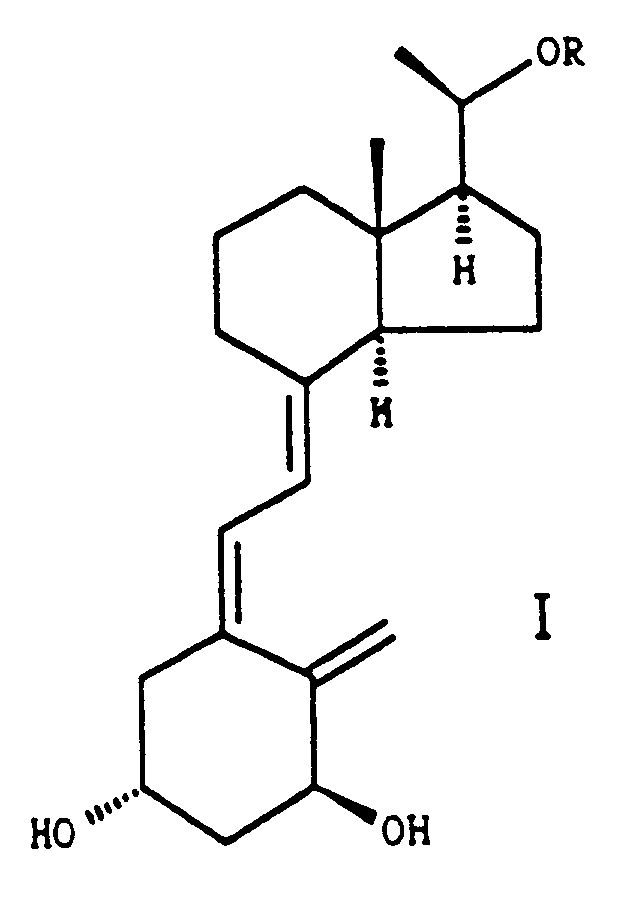 a) 1(S),3(R)-bis-(tert-butyldimethylsilyloxy)-20(S)formyl-9,10-seco-pregna-5(E),7(E),10(19)-triene is oxidized with oxygen in the presence of a basic catalyst, to form 1(S),3(R)-bis-(tert-butyldimethylsilyloxy)-9,10-seco-pregna-5(E),7(E),10(19)-triene-20-one;b) 1(S),3(R)-bis-(tert-butyldimethylsilyloxy)-9,10-seco-pregna-5(E),7(E),10(19)-triene-20-one is reduced e.g. by sodium borohydride, to form 1(S),3(R)-bis-(tert-butyldimethylsilyloxy)-9,10-seco-pregna-5(E),7(E),10(19)-triene-20(R)-ol;c) 1(S),3(R)-bis-(tert-butyldimethylsilyloxy)-9,10-seco-pregna-5(E),7(E),10(19)-triene-20(R)-ol is alkylated under basic conditions with a side chain building block of formula Z-R³, in which Z is a leaving group such as halogen, p-toluenesulphonyloxy or methanesulphonyloxy, to form a compound of formula III
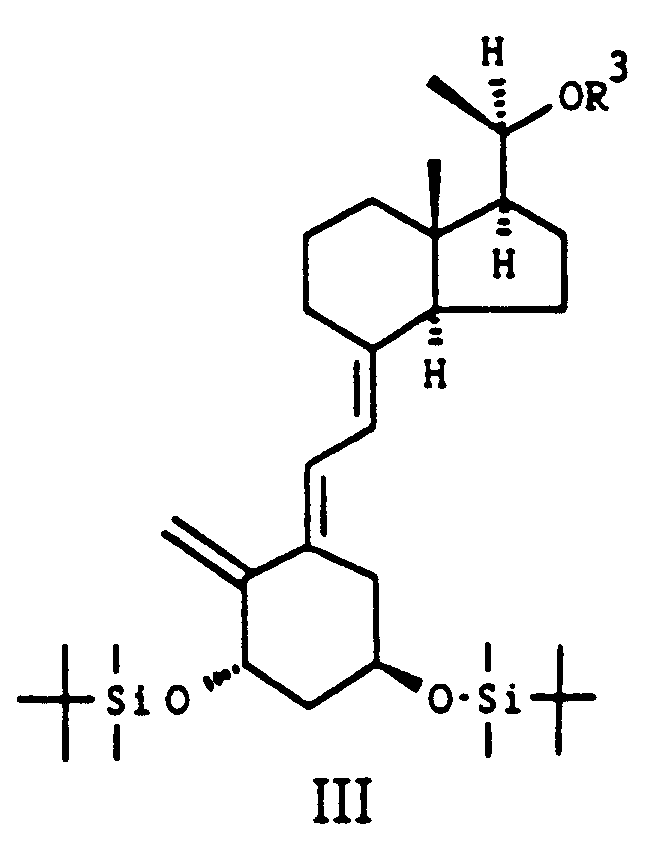 d) a compound of the above formula III is subjected to a triplet-sensitized photoisomerisation, and, if necessary, conversion of R³ to R and deprotection, to form the desired compound of formula I of claim 1 or an analogue thereof.
 - A method according to claim 1, in which R is a group of formula II
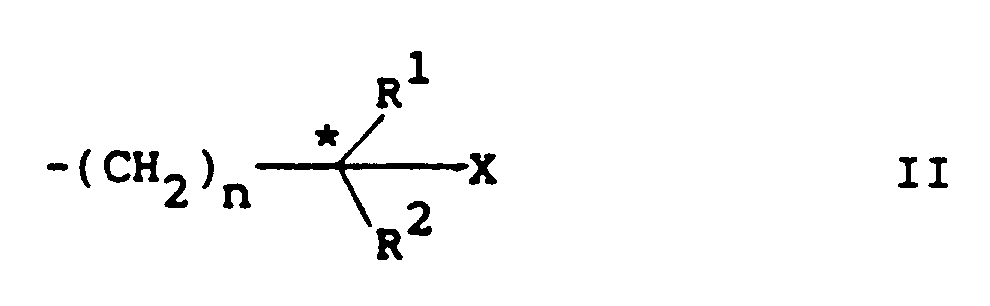
- A method according to claim 1, wherein a diastereoisomer of a compound according to claims 1 or 2, in pure form, or a mixture of diastereoisomers of a compound according to claim 1 or 2 is prepared.
- A method according to claim 1, wherein a compound is prepared which is selected from the group consisting ofa) 1(S),3(R)-Dihydroxy-20(R)-(4'-hydroxy-4'-ethyl-1'-hexyloxy)-9,10-seco-pregna-5(Z),7(E),10(19)-trieneb) 1(S),3(R)-Dihydroxy-20(R)-(6'-hydroxy-1'-hexyloxy)-9,10-seco-pregna-5(Z),7(E),10(19)-trienec) 1(S),3(R)-Dihydroxy-20(R)-(5'-hydroxy-5'-ethyl-1'-heptyloxy)-9,10-seco-pregna-5(Z),7(E),10(19)-triened) 1(S),3(R)-Dihydroxy-20(R)-(5'-hydroxy-5'-methyl-1'-hexyloxy)-9,10-seco-pregna-5(Z),7(E),10(19)-trienee) 1(S),3(R)-Dihydroxy-20(R)-(5'-methyl-1'-hexyloxy)-9,10-seco-pregna-5(Z),7(E),10(19)-trienef) 1(S),3(R)-Dihydroxy-20(R)-(4'-hydroxy-4'-(1''-propyl)-1'-heptyloxy)-9,10-seco-pregna-5(Z),7(E),10(19)-trieneg) 1(S),3(R)-Dihydroxy-20(R)-(4'-hydroxy-4'-methyl-1'-pentyloxy)-9,10-seco-pregna-5(Z),7(E),10(19)-trieneh) 1(S),3(R)-Dihydroxy-20(R)-(3'-hydroxy-3'-methyl-1'-butyloxy)-9,10-seco-pregna-5(Z),7(E),10(19)-triene.
- A method for producing the intermediate for the synthesis of compounds of formula I and analogues thereof which is 1(S),3(R)-bis(tert-butyldimethylsilyloxy)-9,10-seco-pregna-5(E),7(E),10(19)-triene-20(R)-ol, in whicha) 1(S),3(R)-bis-(tert-butyldimethylsilyloxy)-20(S)formyl-9,10-seco-pregna-5(E),7(E),10(19)-triene is oxidized with oxygen in the presence of a basic catalyst, to form 1(S),3(R)-bis-(tert-butyldimethylsilyloxy)-9,10-seco-pregna-5(E),7(E),10(19)-triene-20-one; andb) 1(S),3(R)-bis-(tert-butyldimethylsilyloxy)-9,10-seco-pregna-5(E),7(E),10(19)-triene-20-one is reduced e.g. by sodium borohydride, to form 1(S),3(R)-bis-(tert-butyldimethylsilyloxy)-9,10-seco-pregna-5(E),7(E),10(19)-triene-20(R)-ol.
- A method for preparing a pharmaceutical composition containing an effective amount of one or more of the compounds as defined in claim 1,which comprises incorporating one or more of said compounds into pharmaceutically acceptable, non-toxic carriers and/or auxiliary agents.
- A method according to claim 6 wherein the composition is prepared in dosage unit form.
- A method according to claim 7 wherein the dosage unit contains from 0.05 - 50 µg, preferably from 0.1 - 25 µg of a compound of formula I.
Applications Claiming Priority (4)
| Application Number | Priority Date | Filing Date | Title |
|---|---|---|---|
| GB8904154 | 1989-02-23 | ||
| GB898904154A GB8904154D0 (en) | 1989-02-23 | 1989-02-23 | Chemical compounds |
| PCT/DK1990/000036 WO1990009991A1 (en) | 1989-02-23 | 1990-02-13 | Novel vitamin d analogues |
| SG131794A SG131794G (en) | 1989-02-23 | 1994-09-12 | Novel vitamin D analogues |
Publications (2)
| Publication Number | Publication Date |
|---|---|
| EP0460032A1 EP0460032A1 (en) | 1991-12-11 |
| EP0460032B1 true EP0460032B1 (en) | 1994-04-27 |
Family
ID=26295003
Family Applications (1)
| Application Number | Title | Priority Date | Filing Date |
|---|---|---|---|
| EP90903793A Expired - Lifetime EP0460032B1 (en) | 1989-02-23 | 1990-02-13 | Novel vitamin d analogues |
Country Status (22)
| Country | Link |
|---|---|
| EP (1) | EP0460032B1 (en) |
| JP (1) | JP2807083B2 (en) |
| KR (1) | KR0163194B1 (en) |
| AT (1) | ATE104957T1 (en) |
| AU (1) | AU627001B2 (en) |
| CA (1) | CA2044280C (en) |
| DE (1) | DE69008517T2 (en) |
| DK (1) | DK0460032T3 (en) |
| ES (1) | ES2055905T3 (en) |
| FI (1) | FI92929C (en) |
| GB (1) | GB8904154D0 (en) |
| HK (1) | HK128894A (en) |
| HU (1) | HU211025B (en) |
| IE (1) | IE63123B1 (en) |
| LT (1) | LT3983B (en) |
| LV (1) | LV10428B (en) |
| NO (1) | NO178065C (en) |
| PT (1) | PT93232B (en) |
| RO (1) | RO109939B1 (en) |
| RU (1) | RU2037484C1 (en) |
| SG (1) | SG131794G (en) |
| WO (1) | WO1990009991A1 (en) |
Families Citing this family (30)
| Publication number | Priority date | Publication date | Assignee | Title |
|---|---|---|---|---|
| GB8904153D0 (en) * | 1989-02-23 | 1989-04-05 | Leo Pharm Prod Ltd | Chemical compounds |
| DE4011682A1 (en) * | 1990-04-06 | 1991-10-10 | Schering Ag | 24-OXA DERIVATIVES IN THE VITAMIN D SERIES |
| GB9015774D0 (en) * | 1990-07-18 | 1990-09-05 | Leo Pharm Prod Ltd | Novel treatment |
| US5486509A (en) * | 1991-06-28 | 1996-01-23 | University Of Miami | Method of preventing and treating chemotherapy-induced alopecia |
| AU666563B2 (en) * | 1992-08-07 | 1996-02-15 | Wisconsin Alumni Research Foundation | Preparation of 19-nor-vitamin D compounds |
| GB9220272D0 (en) * | 1992-09-25 | 1992-11-11 | Leo Pharm Prod Ltd | Chemical compounds |
| GB9220439D0 (en) * | 1992-09-28 | 1992-11-11 | Leo Pharm Prod Ltd | Chemical compounds |
| US5449668A (en) * | 1993-06-04 | 1995-09-12 | Duphar International Research B.V. | Vitamin D compounds and method of preparing these compounds |
| US6306844B1 (en) | 1997-03-17 | 2001-10-23 | Wisconsin Alumni Research Foundation | Use of 2α-methyl-19-nor-20(S)-1α, 25-dihydroxyvitamin D3 to increase bone strength |
| US6392071B1 (en) | 1997-03-17 | 2002-05-21 | Wisconsin Alumni: Research Foundation | 26,27-homologated-20-EPI-2-alkylidene-19-nor-vitamin D compounds |
| US6316642B1 (en) | 1997-03-17 | 2001-11-13 | Wisconsin Alumni Research Foundation | 26,27-Homologated-20-EPI-2alkyl-19-nor-vitamin D compounds |
| US5945410A (en) * | 1997-03-17 | 1999-08-31 | Wisconsin Alumni Research Foundation | 2-alkyl-19-nor-vitamin D compounds |
| US6359152B2 (en) | 1997-07-21 | 2002-03-19 | Wisconsin Alumni Research Foundation | 18-substituted-19-nor-vitamin D compounds |
| US5939406A (en) * | 1997-07-21 | 1999-08-17 | Wisconsin Alumni Research Foundation | 18-substituted-19-nor-vitamin D compounds |
| HU226610B1 (en) * | 1998-03-04 | 2009-04-28 | Teijin Ltd | Activated vitamin d3 emulsion-type lotions |
| US5962707A (en) * | 1998-08-18 | 1999-10-05 | Wisconsin Alumni Research Foundation | 19-nor-vitamin D3 compounds with calcemic activity |
| ES2388425T5 (en) * | 1999-04-23 | 2020-02-12 | Leo Pharma As | Non-aqueous pharmaceutical composition for dermal use to treat psoriasis comprising a vitamin D, a corticosteroid and a solvent component |
| AU2001248777A1 (en) * | 2000-04-19 | 2001-10-30 | Chugai Seiyaku Kabushiki Kaisha | Vitamin d derivatives |
| US20030018017A1 (en) * | 2001-01-25 | 2003-01-23 | Deluca Hector F. | Method of treatment of type I diabetes |
| RU2317992C2 (en) * | 2003-02-25 | 2008-02-27 | Кей Эн Си Лэборэтериз Ко., Лтд. | Novel intermediate compounds for synthesis of vitamin d derivatives |
| KR20050120787A (en) | 2003-04-10 | 2005-12-23 | 위스콘신 얼럼나이 리서어치 화운데이션 | 2-propylidene-19-nor-vitamin d compounds |
| US6894037B2 (en) | 2003-07-03 | 2005-05-17 | Wisconsin Alumni Research Foundation | 2-methylene-19-nor-20(S)-25-methyl-1α-hydroxycalciferol and its uses |
| US7713951B2 (en) | 2004-04-09 | 2010-05-11 | Wisconsin Alumni Research Foundation | 2-alkylidene-18,19-dinor-vitamin D compounds |
| EP1812011A1 (en) | 2004-11-12 | 2007-08-01 | Bioxell S.p.a. | Combined use of vitamin d derivatives and anti-proliferative agents for treating bladder cancer |
| CA2648193A1 (en) | 2006-04-05 | 2007-10-18 | Wisconsin Alumni Research Foundation | 1.alpha.-hydroxy-2-(3'-hydroxypropylidene)-19-nor-vitamin d compounds and methods of making and use thereof |
| US8377913B2 (en) * | 2007-11-20 | 2013-02-19 | Abbvie Inc. | Vitamin D receptor activators and methods of making |
| JP5563324B2 (en) * | 2010-02-03 | 2014-07-30 | フォーモサ・ラボラトリーズ・インコーポレーテッド | MAXA CALCITOL INTERMEDIATE AND PROCESS FOR PRODUCING THE SAME |
| WO2012122451A2 (en) | 2011-03-09 | 2012-09-13 | Teva Pharmaceutical Industries Ltd. | Polymorphs of maxacalcitol and process for the preparation of maxacalcitol |
| CN102796134B (en) * | 2012-08-31 | 2015-07-01 | 甘肃皓天化学科技有限公司 | Preparation method for Maxacalcitol intermediate |
| CN103910666A (en) * | 2014-04-15 | 2014-07-09 | 湖南华腾制药有限公司 | Method for preparing maxacalcitol |
Family Cites Families (5)
| Publication number | Priority date | Publication date | Assignee | Title |
|---|---|---|---|---|
| IL67153A (en) | 1981-11-02 | 1986-12-31 | Res Inst Medicine Chem | Intermediates in the production of vitamin d analogues and method for their production |
| CA1332841C (en) * | 1984-11-27 | 1994-11-01 | Noboru Kubodera | Vitamin d derivatives and process for producing the same |
| DE3666587D1 (en) | 1985-08-02 | 1989-11-30 | Leo Pharm Prod Ltd | Novel vitamin d analogues |
| EP0412110B1 (en) | 1988-04-21 | 1993-07-07 | Leo Pharmaceutical Products Ltd. A/S (Lovens Kemiske Fabrik Produktionsaktieselskab) | Novel vitamin d analogues |
| GB8904153D0 (en) * | 1989-02-23 | 1989-04-05 | Leo Pharm Prod Ltd | Chemical compounds |
-
1989
- 1989-02-23 GB GB898904154A patent/GB8904154D0/en active Pending
-
1990
- 1990-02-13 JP JP2504126A patent/JP2807083B2/en not_active Expired - Fee Related
- 1990-02-13 HU HU902300A patent/HU211025B/en not_active IP Right Cessation
- 1990-02-13 KR KR1019910700655A patent/KR0163194B1/en not_active Expired - Fee Related
- 1990-02-13 DK DK90903793.9T patent/DK0460032T3/en active
- 1990-02-13 DE DE69008517T patent/DE69008517T2/en not_active Expired - Fee Related
- 1990-02-13 AT AT9090903793T patent/ATE104957T1/en not_active IP Right Cessation
- 1990-02-13 CA CA002044280A patent/CA2044280C/en not_active Expired - Fee Related
- 1990-02-13 RO RO148060A patent/RO109939B1/en unknown
- 1990-02-13 AU AU51983/90A patent/AU627001B2/en not_active Ceased
- 1990-02-13 EP EP90903793A patent/EP0460032B1/en not_active Expired - Lifetime
- 1990-02-13 WO PCT/DK1990/000036 patent/WO1990009991A1/en not_active Ceased
- 1990-02-13 ES ES90903793T patent/ES2055905T3/en not_active Expired - Lifetime
- 1990-02-22 PT PT93232A patent/PT93232B/en not_active IP Right Cessation
-
1991
- 1991-06-19 IE IE42190A patent/IE63123B1/en not_active IP Right Cessation
- 1991-07-25 NO NO912902A patent/NO178065C/en not_active IP Right Cessation
- 1991-08-12 FI FI913812A patent/FI92929C/en active
- 1991-08-22 RU SU915001741A patent/RU2037484C1/en not_active IP Right Cessation
-
1993
- 1993-09-28 LV LVP-93-1106A patent/LV10428B/en unknown
- 1993-12-06 LT LTIP1536A patent/LT3983B/en not_active IP Right Cessation
-
1994
- 1994-09-12 SG SG131794A patent/SG131794G/en unknown
- 1994-11-17 HK HK128894A patent/HK128894A/en not_active IP Right Cessation
Also Published As
Similar Documents
| Publication | Publication Date | Title |
|---|---|---|
| AU627001B2 (en) | Novel vitamin d analogues | |
| EP0522013B1 (en) | Novel vitamin d analogues | |
| EP0648207B1 (en) | Vitamin d analogues | |
| EP0667856B1 (en) | Novel vitamin d analogues | |
| US5401732A (en) | Vitamin D analogues | |
| EP0506794B1 (en) | Novel vitamin d analogues | |
| EP0460034B1 (en) | Novel vitamin d analogues | |
| US5589471A (en) | Vitamin D analogues containing a hydroxy or alkylated hydroxy group in the 20-position | |
| EP0662953B1 (en) | Novel vitamin d analogues | |
| EP0865428B1 (en) | Vitamin d analogues | |
| AU713630B2 (en) | Novel vitamin D analogues | |
| US5378695A (en) | Vitamin D analogues | |
| CZ280203B6 (en) | Vitamin d derivatives with homologic side chains, process of their preparation, pharmaceutical preparations in which said derivatives are comprised and their use |
Legal Events
| Date | Code | Title | Description |
|---|---|---|---|
| PUAI | Public reference made under article 153(3) epc to a published international application that has entered the european phase |
Free format text: ORIGINAL CODE: 0009012 |
|
| 17P | Request for examination filed |
Effective date: 19910802 |
|
| AK | Designated contracting states |
Kind code of ref document: A1 Designated state(s): AT BE CH DE DK ES FR GB IT LI LU NL SE |
|
| 17Q | First examination report despatched |
Effective date: 19930408 |
|
| GRAA | (expected) grant |
Free format text: ORIGINAL CODE: 0009210 |
|
| AK | Designated contracting states |
Kind code of ref document: B1 Designated state(s): AT BE CH DE DK ES FR GB IT LI LU NL SE |
|
| REF | Corresponds to: |
Ref document number: 104957 Country of ref document: AT Date of ref document: 19940515 Kind code of ref document: T |
|
| ITF | It: translation for a ep patent filed | ||
| REF | Corresponds to: |
Ref document number: 69008517 Country of ref document: DE Date of ref document: 19940601 |
|
| REG | Reference to a national code |
Ref country code: DK Ref legal event code: T3 |
|
| ET | Fr: translation filed | ||
| REG | Reference to a national code |
Ref country code: ES Ref legal event code: FG2A Ref document number: 2055905 Country of ref document: ES Kind code of ref document: T3 |
|
| EAL | Se: european patent in force in sweden |
Ref document number: 90903793.9 |
|
| PLBE | No opposition filed within time limit |
Free format text: ORIGINAL CODE: 0009261 |
|
| STAA | Information on the status of an ep patent application or granted ep patent |
Free format text: STATUS: NO OPPOSITION FILED WITHIN TIME LIMIT |
|
| 26N | No opposition filed | ||
| REG | Reference to a national code |
Ref country code: GB Ref legal event code: IF02 |
|
| PGFP | Annual fee paid to national office [announced via postgrant information from national office to epo] |
Ref country code: AT Payment date: 20020118 Year of fee payment: 13 |
|
| PGFP | Annual fee paid to national office [announced via postgrant information from national office to epo] |
Ref country code: LU Payment date: 20020205 Year of fee payment: 13 |
|
| PGFP | Annual fee paid to national office [announced via postgrant information from national office to epo] |
Ref country code: BE Payment date: 20020208 Year of fee payment: 13 |
|
| PG25 | Lapsed in a contracting state [announced via postgrant information from national office to epo] |
Ref country code: LU Free format text: LAPSE BECAUSE OF NON-PAYMENT OF DUE FEES Effective date: 20030213 Ref country code: AT Free format text: LAPSE BECAUSE OF NON-PAYMENT OF DUE FEES Effective date: 20030213 |
|
| PG25 | Lapsed in a contracting state [announced via postgrant information from national office to epo] |
Ref country code: BE Free format text: LAPSE BECAUSE OF NON-PAYMENT OF DUE FEES Effective date: 20030228 |
|
| PGFP | Annual fee paid to national office [announced via postgrant information from national office to epo] |
Ref country code: NL Payment date: 20040116 Year of fee payment: 15 |
|
| PGFP | Annual fee paid to national office [announced via postgrant information from national office to epo] |
Ref country code: DK Payment date: 20040123 Year of fee payment: 15 |
|
| PGFP | Annual fee paid to national office [announced via postgrant information from national office to epo] |
Ref country code: GB Payment date: 20040204 Year of fee payment: 15 |
|
| PGFP | Annual fee paid to national office [announced via postgrant information from national office to epo] |
Ref country code: SE Payment date: 20040219 Year of fee payment: 15 Ref country code: FR Payment date: 20040219 Year of fee payment: 15 |
|
| PGFP | Annual fee paid to national office [announced via postgrant information from national office to epo] |
Ref country code: CH Payment date: 20040223 Year of fee payment: 15 |
|
| PGFP | Annual fee paid to national office [announced via postgrant information from national office to epo] |
Ref country code: ES Payment date: 20040311 Year of fee payment: 15 |
|
| PGFP | Annual fee paid to national office [announced via postgrant information from national office to epo] |
Ref country code: DE Payment date: 20040331 Year of fee payment: 15 |
|
| PG25 | Lapsed in a contracting state [announced via postgrant information from national office to epo] |
Ref country code: IT Free format text: LAPSE BECAUSE OF NON-PAYMENT OF DUE FEES;WARNING: LAPSES OF ITALIAN PATENTS WITH EFFECTIVE DATE BEFORE 2007 MAY HAVE OCCURRED AT ANY TIME BEFORE 2007. THE CORRECT EFFECTIVE DATE MAY BE DIFFERENT FROM THE ONE RECORDED. Effective date: 20050213 Ref country code: GB Free format text: LAPSE BECAUSE OF NON-PAYMENT OF DUE FEES Effective date: 20050213 |
|
| PG25 | Lapsed in a contracting state [announced via postgrant information from national office to epo] |
Ref country code: SE Free format text: LAPSE BECAUSE OF NON-PAYMENT OF DUE FEES Effective date: 20050214 Ref country code: ES Free format text: LAPSE BECAUSE OF NON-PAYMENT OF DUE FEES Effective date: 20050214 |
|
| PG25 | Lapsed in a contracting state [announced via postgrant information from national office to epo] |
Ref country code: LI Free format text: LAPSE BECAUSE OF NON-PAYMENT OF DUE FEES Effective date: 20050228 Ref country code: DK Free format text: LAPSE BECAUSE OF NON-PAYMENT OF DUE FEES Effective date: 20050228 Ref country code: CH Free format text: LAPSE BECAUSE OF NON-PAYMENT OF DUE FEES Effective date: 20050228 |
|
| PG25 | Lapsed in a contracting state [announced via postgrant information from national office to epo] |
Ref country code: NL Free format text: LAPSE BECAUSE OF NON-PAYMENT OF DUE FEES Effective date: 20050901 Ref country code: DE Free format text: LAPSE BECAUSE OF NON-PAYMENT OF DUE FEES Effective date: 20050901 |
|
| REG | Reference to a national code |
Ref country code: DK Ref legal event code: EBP |
|
| EUG | Se: european patent has lapsed | ||
| GBPC | Gb: european patent ceased through non-payment of renewal fee |
Effective date: 20050212 |
|
| REG | Reference to a national code |
Ref country code: CH Ref legal event code: PL |
|
| PG25 | Lapsed in a contracting state [announced via postgrant information from national office to epo] |
Ref country code: FR Free format text: LAPSE BECAUSE OF NON-PAYMENT OF DUE FEES Effective date: 20051031 |
|
| NLV4 | Nl: lapsed or anulled due to non-payment of the annual fee |
Effective date: 20050901 |
|
| REG | Reference to a national code |
Ref country code: FR Ref legal event code: ST Effective date: 20051031 |
|
| REG | Reference to a national code |
Ref country code: ES Ref legal event code: FD2A Effective date: 20050214 |