EP0459830A1 - Pharmacologically active CNS compounds - Google Patents
Pharmacologically active CNS compounds Download PDFInfo
- Publication number
- EP0459830A1 EP0459830A1 EP91304963A EP91304963A EP0459830A1 EP 0459830 A1 EP0459830 A1 EP 0459830A1 EP 91304963 A EP91304963 A EP 91304963A EP 91304963 A EP91304963 A EP 91304963A EP 0459830 A1 EP0459830 A1 EP 0459830A1
- Authority
- EP
- European Patent Office
- Prior art keywords
- pyrimidine
- hydrogen
- diamino
- amino
- compound
- Prior art date
- Legal status (The legal status is an assumption and is not a legal conclusion. Google has not performed a legal analysis and makes no representation as to the accuracy of the status listed.)
- Ceased
Links
- 150000001875 compounds Chemical class 0.000 title claims abstract description 58
- 239000001257 hydrogen Substances 0.000 claims abstract description 40
- 229910052739 hydrogen Inorganic materials 0.000 claims abstract description 40
- 150000003839 salts Chemical class 0.000 claims abstract description 34
- 125000005843 halogen group Chemical group 0.000 claims abstract description 24
- UFHFLCQGNIYNRP-UHFFFAOYSA-N Hydrogen Chemical compound [H][H] UFHFLCQGNIYNRP-UHFFFAOYSA-N 0.000 claims abstract description 21
- 150000002431 hydrogen Chemical class 0.000 claims abstract description 17
- 125000000217 alkyl group Chemical group 0.000 claims abstract description 16
- -1 nitro, amino, sulphonamido Chemical group 0.000 claims abstract description 14
- 125000003710 aryl alkyl group Chemical group 0.000 claims abstract description 8
- 125000003118 aryl group Chemical group 0.000 claims abstract description 8
- 229910052757 nitrogen Inorganic materials 0.000 claims abstract description 7
- 125000002837 carbocyclic group Chemical group 0.000 claims abstract description 5
- 125000004356 hydroxy functional group Chemical group O* 0.000 claims abstract description 5
- 125000004656 alkyl sulfonylamino group Chemical group 0.000 claims abstract description 4
- 125000001188 haloalkyl group Chemical group 0.000 claims abstract description 4
- 125000005842 heteroatom Chemical group 0.000 claims abstract description 4
- 125000004433 nitrogen atom Chemical group N* 0.000 claims abstract description 4
- 238000000034 method Methods 0.000 claims description 10
- 125000002924 primary amino group Chemical group [H]N([H])* 0.000 claims description 8
- VKXFTTQQDQALOS-UHFFFAOYSA-N 6-(2,3-dichlorophenyl)pyrimidine-2,4-diamine Chemical compound NC1=NC(N)=CC(C=2C(=C(Cl)C=CC=2)Cl)=N1 VKXFTTQQDQALOS-UHFFFAOYSA-N 0.000 claims description 6
- 239000012458 free base Substances 0.000 claims description 5
- 238000004519 manufacturing process Methods 0.000 claims description 5
- SNQQAPSTIYMHHY-UHFFFAOYSA-N 6-(2-chlorophenyl)pyrimidine-2,4-diamine Chemical compound NC1=NC(N)=CC(C=2C(=CC=CC=2)Cl)=N1 SNQQAPSTIYMHHY-UHFFFAOYSA-N 0.000 claims description 4
- 125000003282 alkyl amino group Chemical group 0.000 claims description 4
- 125000001309 chloro group Chemical group Cl* 0.000 claims description 4
- 125000004663 dialkyl amino group Chemical group 0.000 claims description 4
- ZEAZGTREIAIRQJ-UHFFFAOYSA-N 6-naphthalen-1-ylpyrimidine-2,4-diamine Chemical compound NC1=NC(N)=CC(C=2C3=CC=CC=C3C=CC=2)=N1 ZEAZGTREIAIRQJ-UHFFFAOYSA-N 0.000 claims description 3
- CZPWVGJYEJSRLH-UHFFFAOYSA-N Pyrimidine Chemical compound C1=CN=CN=C1 CZPWVGJYEJSRLH-UHFFFAOYSA-N 0.000 claims description 3
- 125000002023 trifluoromethyl group Chemical group FC(F)(F)* 0.000 claims description 3
- IAZGHFBVBNHEAF-UHFFFAOYSA-N 2-(4-methylpiperazin-1-yl)-6-(2,3,5-trichlorophenyl)pyrimidin-4-amine Chemical compound C1CN(C)CCN1C1=NC(N)=CC(C=2C(=C(Cl)C=C(Cl)C=2)Cl)=N1 IAZGHFBVBNHEAF-UHFFFAOYSA-N 0.000 claims description 2
- XMGDJDHQJROJRH-UHFFFAOYSA-N 5-methyl-6-(2,3,5-trichlorophenyl)pyrimidine-2,4-diamine Chemical compound CC1=C(N)N=C(N)N=C1C1=CC(Cl)=CC(Cl)=C1Cl XMGDJDHQJROJRH-UHFFFAOYSA-N 0.000 claims description 2
- IXFJCJRYTUTBLY-UHFFFAOYSA-N 5-nitro-6-(2,3,5-trichlorophenyl)pyrimidine-2,4-diamine Chemical compound NC1=NC(N)=C([N+]([O-])=O)C(C=2C(=C(Cl)C=C(Cl)C=2)Cl)=N1 IXFJCJRYTUTBLY-UHFFFAOYSA-N 0.000 claims description 2
- MBFJDIRRZOKWAP-UHFFFAOYSA-N 6-(2,3,5-trichlorophenyl)-5-(trifluoromethyl)pyrimidine-2,4-diamine Chemical compound NC1=NC(N)=C(C(F)(F)F)C(C=2C(=C(Cl)C=C(Cl)C=2)Cl)=N1 MBFJDIRRZOKWAP-UHFFFAOYSA-N 0.000 claims description 2
- IPBIPOGXEOFKAN-UHFFFAOYSA-N 6-(2,3,5-trichlorophenyl)pyrimidine-2,4-diamine Chemical compound NC1=NC(N)=CC(C=2C(=C(Cl)C=C(Cl)C=2)Cl)=N1 IPBIPOGXEOFKAN-UHFFFAOYSA-N 0.000 claims description 2
- IXNVCXCKMZIHFJ-UHFFFAOYSA-N 6-(3,5-dichlorophenyl)-5-methylpyrimidine-2,4-diamine Chemical compound CC1=C(N)N=C(N)N=C1C1=CC(Cl)=CC(Cl)=C1 IXNVCXCKMZIHFJ-UHFFFAOYSA-N 0.000 claims description 2
- RTYCDLMEJXHKKJ-UHFFFAOYSA-N 6-(4-amino-2,3,5-trichlorophenyl)-5-methylpyrimidine-2,4-diamine Chemical compound CC1=C(N)N=C(N)N=C1C1=CC(Cl)=C(N)C(Cl)=C1Cl RTYCDLMEJXHKKJ-UHFFFAOYSA-N 0.000 claims description 2
- FIPRHNNOIKTGTD-UHFFFAOYSA-N 6-(4-amino-2,3,5-trichlorophenyl)pyrimidine-2,4-diamine Chemical compound NC1=NC(N)=CC(C=2C(=C(Cl)C(N)=C(Cl)C=2)Cl)=N1 FIPRHNNOIKTGTD-UHFFFAOYSA-N 0.000 claims description 2
- SJLNUHYGWYAKRH-UHFFFAOYSA-N 6-(4-amino-3,5-dichlorophenyl)-5-methylpyrimidine-2,4-diamine Chemical compound CC1=C(N)N=C(N)N=C1C1=CC(Cl)=C(N)C(Cl)=C1 SJLNUHYGWYAKRH-UHFFFAOYSA-N 0.000 claims description 2
- JRMNLHJVDGCYHH-UHFFFAOYSA-N 6-(4-amino-3,5-dichlorophenyl)pyrimidine-2,4-diamine Chemical compound NC1=NC(N)=CC(C=2C=C(Cl)C(N)=C(Cl)C=2)=N1 JRMNLHJVDGCYHH-UHFFFAOYSA-N 0.000 claims description 2
- IVCPRYGUXAYFQY-UHFFFAOYSA-N n,n-dimethyl-6-(2,3,5-trichlorophenyl)-2h-pyrimidin-1-amine Chemical compound CN(C)N1CN=CC=C1C1=CC(Cl)=CC(Cl)=C1Cl IVCPRYGUXAYFQY-UHFFFAOYSA-N 0.000 claims description 2
- 238000002360 preparation method Methods 0.000 claims description 2
- WHUUTDBJXJRKMK-VKHMYHEASA-N L-glutamic acid Chemical compound OC(=O)[C@@H](N)CCC(O)=O WHUUTDBJXJRKMK-VKHMYHEASA-N 0.000 abstract description 14
- 229930195712 glutamate Natural products 0.000 abstract description 14
- 238000011282 treatment Methods 0.000 abstract description 8
- 208000012902 Nervous system disease Diseases 0.000 abstract description 6
- 239000002858 neurotransmitter agent Substances 0.000 abstract description 6
- 230000000626 neurodegenerative effect Effects 0.000 abstract description 5
- 238000011321 prophylaxis Methods 0.000 abstract description 5
- HEDRZPFGACZZDS-UHFFFAOYSA-N Chloroform Chemical compound ClC(Cl)Cl HEDRZPFGACZZDS-UHFFFAOYSA-N 0.000 description 46
- OKKJLVBELUTLKV-UHFFFAOYSA-N Methanol Chemical compound OC OKKJLVBELUTLKV-UHFFFAOYSA-N 0.000 description 39
- 239000000243 solution Substances 0.000 description 30
- 239000000203 mixture Substances 0.000 description 27
- VYPSYNLAJGMNEJ-UHFFFAOYSA-N Silicium dioxide Chemical compound O=[Si]=O VYPSYNLAJGMNEJ-UHFFFAOYSA-N 0.000 description 26
- RTZKZFJDLAIYFH-UHFFFAOYSA-N Diethyl ether Chemical compound CCOCC RTZKZFJDLAIYFH-UHFFFAOYSA-N 0.000 description 24
- XLYOFNOQVPJJNP-UHFFFAOYSA-N water Substances O XLYOFNOQVPJJNP-UHFFFAOYSA-N 0.000 description 22
- 238000009472 formulation Methods 0.000 description 19
- CSNNHWWHGAXBCP-UHFFFAOYSA-L Magnesium sulfate Chemical compound [Mg+2].[O-][S+2]([O-])([O-])[O-] CSNNHWWHGAXBCP-UHFFFAOYSA-L 0.000 description 18
- LFQSCWFLJHTTHZ-UHFFFAOYSA-N Ethanol Chemical compound CCO LFQSCWFLJHTTHZ-UHFFFAOYSA-N 0.000 description 15
- 239000004480 active ingredient Substances 0.000 description 13
- 239000000377 silicon dioxide Substances 0.000 description 13
- YMWUJEATGCHHMB-UHFFFAOYSA-N Dichloromethane Chemical compound ClCCl YMWUJEATGCHHMB-UHFFFAOYSA-N 0.000 description 12
- 238000004440 column chromatography Methods 0.000 description 11
- ZRALSGWEFCBTJO-UHFFFAOYSA-N Guanidine Chemical compound NC(N)=N ZRALSGWEFCBTJO-UHFFFAOYSA-N 0.000 description 10
- WEVYAHXRMPXWCK-UHFFFAOYSA-N Acetonitrile Chemical compound CC#N WEVYAHXRMPXWCK-UHFFFAOYSA-N 0.000 description 9
- 239000012043 crude product Substances 0.000 description 9
- 229910052943 magnesium sulfate Inorganic materials 0.000 description 9
- 235000019341 magnesium sulphate Nutrition 0.000 description 9
- 239000012074 organic phase Substances 0.000 description 9
- 239000000725 suspension Substances 0.000 description 9
- PEDCQBHIVMGVHV-UHFFFAOYSA-N Glycerine Chemical compound OCC(O)CO PEDCQBHIVMGVHV-UHFFFAOYSA-N 0.000 description 8
- HEDRZPFGACZZDS-MICDWDOJSA-N Trichloro(2H)methane Chemical group [2H]C(Cl)(Cl)Cl HEDRZPFGACZZDS-MICDWDOJSA-N 0.000 description 8
- 210000003169 central nervous system Anatomy 0.000 description 8
- 239000003826 tablet Substances 0.000 description 8
- KEAYESYHFKHZAL-UHFFFAOYSA-N Sodium Chemical compound [Na] KEAYESYHFKHZAL-UHFFFAOYSA-N 0.000 description 7
- 208000037265 diseases, disorders, signs and symptoms Diseases 0.000 description 7
- 239000004615 ingredient Substances 0.000 description 7
- 239000007788 liquid Substances 0.000 description 7
- 238000003756 stirring Methods 0.000 description 7
- IJGRMHOSHXDMSA-UHFFFAOYSA-N Atomic nitrogen Chemical compound N#N IJGRMHOSHXDMSA-UHFFFAOYSA-N 0.000 description 6
- VEXZGXHMUGYJMC-UHFFFAOYSA-N Hydrochloric acid Chemical compound Cl VEXZGXHMUGYJMC-UHFFFAOYSA-N 0.000 description 6
- 238000002347 injection Methods 0.000 description 6
- 239000007924 injection Substances 0.000 description 6
- FYSNRJHAOHDILO-UHFFFAOYSA-N thionyl chloride Chemical compound ClS(Cl)=O FYSNRJHAOHDILO-UHFFFAOYSA-N 0.000 description 6
- YXHKONLOYHBTNS-UHFFFAOYSA-N Diazomethane Chemical compound C=[N+]=[N-] YXHKONLOYHBTNS-UHFFFAOYSA-N 0.000 description 5
- 241000124008 Mammalia Species 0.000 description 5
- CHJJGSNFBQVOTG-UHFFFAOYSA-N N-methyl-guanidine Natural products CNC(N)=N CHJJGSNFBQVOTG-UHFFFAOYSA-N 0.000 description 5
- 239000007963 capsule composition Substances 0.000 description 5
- 208000015114 central nervous system disease Diseases 0.000 description 5
- 230000006378 damage Effects 0.000 description 5
- SWSQBOPZIKWTGO-UHFFFAOYSA-N dimethylaminoamidine Natural products CN(C)C(N)=N SWSQBOPZIKWTGO-UHFFFAOYSA-N 0.000 description 5
- 208000035475 disorder Diseases 0.000 description 5
- 229960004198 guanidine Drugs 0.000 description 5
- 239000002904 solvent Substances 0.000 description 5
- 239000002253 acid Substances 0.000 description 4
- 230000002490 cerebral effect Effects 0.000 description 4
- 238000006243 chemical reaction Methods 0.000 description 4
- 238000013270 controlled release Methods 0.000 description 4
- 150000002084 enol ethers Chemical class 0.000 description 4
- 206010015037 epilepsy Diseases 0.000 description 4
- 239000008187 granular material Substances 0.000 description 4
- 230000000302 ischemic effect Effects 0.000 description 4
- 239000011541 reaction mixture Substances 0.000 description 4
- 239000007787 solid Substances 0.000 description 4
- 238000002560 therapeutic procedure Methods 0.000 description 4
- NFCYTWXLYPXRGR-UHFFFAOYSA-N 6-(2,4-dichlorophenyl)pyrimidine-2,4-diamine Chemical compound NC1=NC(N)=CC(C=2C(=CC(Cl)=CC=2)Cl)=N1 NFCYTWXLYPXRGR-UHFFFAOYSA-N 0.000 description 3
- 102100024746 Dihydrofolate reductase Human genes 0.000 description 3
- 239000008346 aqueous phase Substances 0.000 description 3
- 210000004556 brain Anatomy 0.000 description 3
- 239000002775 capsule Substances 0.000 description 3
- 239000000969 carrier Substances 0.000 description 3
- 238000001816 cooling Methods 0.000 description 3
- 108020001096 dihydrofolate reductase Proteins 0.000 description 3
- 230000000694 effects Effects 0.000 description 3
- 239000007903 gelatin capsule Substances 0.000 description 3
- 235000011187 glycerol Nutrition 0.000 description 3
- 229960000789 guanidine hydrochloride Drugs 0.000 description 3
- PJJJBBJSCAKJQF-UHFFFAOYSA-N guanidinium chloride Chemical compound [Cl-].NC(N)=[NH2+] PJJJBBJSCAKJQF-UHFFFAOYSA-N 0.000 description 3
- 230000005764 inhibitory process Effects 0.000 description 3
- 125000002496 methyl group Chemical group [H]C([H])([H])* 0.000 description 3
- 239000008194 pharmaceutical composition Substances 0.000 description 3
- 239000000843 powder Substances 0.000 description 3
- 239000000047 product Substances 0.000 description 3
- 239000008213 purified water Substances 0.000 description 3
- 239000000829 suppository Substances 0.000 description 3
- LNETULKMXZVUST-UHFFFAOYSA-N 1-naphthoic acid Chemical compound C1=CC=C2C(C(=O)O)=CC=CC2=C1 LNETULKMXZVUST-UHFFFAOYSA-N 0.000 description 2
- ATCRIUVQKHMXSH-UHFFFAOYSA-N 2,4-dichlorobenzoic acid Chemical compound OC(=O)C1=CC=C(Cl)C=C1Cl ATCRIUVQKHMXSH-UHFFFAOYSA-N 0.000 description 2
- MBLQCEBCGPRVBB-UHFFFAOYSA-N 3-naphthalen-1-yl-3-oxopropanenitrile Chemical compound C1=CC=C2C(C(CC#N)=O)=CC=CC2=C1 MBLQCEBCGPRVBB-UHFFFAOYSA-N 0.000 description 2
- RIYCFDXSWWCORE-UHFFFAOYSA-N 6-(4-chlorophenyl)-5-methylpyrimidine-2,4-diamine Chemical compound CC1=C(N)N=C(N)N=C1C1=CC=C(Cl)C=C1 RIYCFDXSWWCORE-UHFFFAOYSA-N 0.000 description 2
- 208000024827 Alzheimer disease Diseases 0.000 description 2
- 208000020925 Bipolar disease Diseases 0.000 description 2
- 208000000094 Chronic Pain Diseases 0.000 description 2
- FBPFZTCFMRRESA-FSIIMWSLSA-N D-Glucitol Natural products OC[C@H](O)[C@H](O)[C@@H](O)[C@H](O)CO FBPFZTCFMRRESA-FSIIMWSLSA-N 0.000 description 2
- ZZSNKZQZMQGXPY-UHFFFAOYSA-N Ethyl cellulose Chemical compound CCOCC1OC(OC)C(OCC)C(OCC)C1OC1C(O)C(O)C(OC)C(CO)O1 ZZSNKZQZMQGXPY-UHFFFAOYSA-N 0.000 description 2
- 208000023105 Huntington disease Diseases 0.000 description 2
- 235000010643 Leucaena leucocephala Nutrition 0.000 description 2
- 240000007472 Leucaena leucocephala Species 0.000 description 2
- 208000019695 Migraine disease Diseases 0.000 description 2
- 208000002193 Pain Diseases 0.000 description 2
- CZMRCDWAGMRECN-UGDNZRGBSA-N Sucrose Chemical compound O[C@H]1[C@H](O)[C@@H](CO)O[C@@]1(CO)O[C@@H]1[C@H](O)[C@@H](O)[C@H](O)[C@@H](CO)O1 CZMRCDWAGMRECN-UGDNZRGBSA-N 0.000 description 2
- 229930006000 Sucrose Natural products 0.000 description 2
- XSQUKJJJFZCRTK-UHFFFAOYSA-N Urea Chemical compound NC(N)=O XSQUKJJJFZCRTK-UHFFFAOYSA-N 0.000 description 2
- 230000001154 acute effect Effects 0.000 description 2
- 125000004414 alkyl thio group Chemical group 0.000 description 2
- 239000002585 base Substances 0.000 description 2
- 208000028683 bipolar I disease Diseases 0.000 description 2
- 125000004432 carbon atom Chemical group C* 0.000 description 2
- 230000001684 chronic effect Effects 0.000 description 2
- 201000010099 disease Diseases 0.000 description 2
- 239000003814 drug Substances 0.000 description 2
- 239000000839 emulsion Substances 0.000 description 2
- 230000002461 excitatory amino acid Effects 0.000 description 2
- 239000003257 excitatory amino acid Substances 0.000 description 2
- 238000011049 filling Methods 0.000 description 2
- 239000000796 flavoring agent Substances 0.000 description 2
- 125000004435 hydrogen atom Chemical group [H]* 0.000 description 2
- 208000014674 injury Diseases 0.000 description 2
- PYZRQGJRPPTADH-UHFFFAOYSA-N lamotrigine Chemical compound NC1=NC(N)=NN=C1C1=CC=CC(Cl)=C1Cl PYZRQGJRPPTADH-UHFFFAOYSA-N 0.000 description 2
- 239000000314 lubricant Substances 0.000 description 2
- HQKMJHAJHXVSDF-UHFFFAOYSA-L magnesium stearate Chemical compound [Mg+2].CCCCCCCCCCCCCCCCCC([O-])=O.CCCCCCCCCCCCCCCCCC([O-])=O HQKMJHAJHXVSDF-UHFFFAOYSA-L 0.000 description 2
- RFVULUSGHFRDHJ-UHFFFAOYSA-N methyl 2,3-dichlorobenzoate Chemical compound COC(=O)C1=CC=CC(Cl)=C1Cl RFVULUSGHFRDHJ-UHFFFAOYSA-N 0.000 description 2
- VCRWILYAWSRHBN-UHFFFAOYSA-N methyl 2,4-dichlorobenzoate Chemical compound COC(=O)C1=CC=C(Cl)C=C1Cl VCRWILYAWSRHBN-UHFFFAOYSA-N 0.000 description 2
- HMRROBKAACRWBP-UHFFFAOYSA-N methyl naphthalene-1-carboxylate Chemical compound C1=CC=C2C(C(=O)OC)=CC=CC2=C1 HMRROBKAACRWBP-UHFFFAOYSA-N 0.000 description 2
- 206010027599 migraine Diseases 0.000 description 2
- 238000000465 moulding Methods 0.000 description 2
- 201000000980 schizophrenia Diseases 0.000 description 2
- WXMKPNITSTVMEF-UHFFFAOYSA-M sodium benzoate Chemical compound [Na+].[O-]C(=O)C1=CC=CC=C1 WXMKPNITSTVMEF-UHFFFAOYSA-M 0.000 description 2
- 235000010234 sodium benzoate Nutrition 0.000 description 2
- 239000004299 sodium benzoate Substances 0.000 description 2
- 239000000600 sorbitol Substances 0.000 description 2
- 238000007920 subcutaneous administration Methods 0.000 description 2
- 239000005720 sucrose Substances 0.000 description 2
- 206010044652 trigeminal neuralgia Diseases 0.000 description 2
- 125000000229 (C1-C4)alkoxy group Chemical group 0.000 description 1
- PVOAHINGSUIXLS-UHFFFAOYSA-N 1-Methylpiperazine Chemical compound CN1CCNCC1 PVOAHINGSUIXLS-UHFFFAOYSA-N 0.000 description 1
- QAOJBHRZQQDFHA-UHFFFAOYSA-N 2,3-dichlorobenzoic acid Chemical compound OC(=O)C1=CC=CC(Cl)=C1Cl QAOJBHRZQQDFHA-UHFFFAOYSA-N 0.000 description 1
- IIIBLZWDWAXKNN-UHFFFAOYSA-N 3-(2,3-dichlorophenyl)-3-oxopropanenitrile Chemical compound ClC1=CC=CC(C(=O)CC#N)=C1Cl IIIBLZWDWAXKNN-UHFFFAOYSA-N 0.000 description 1
- AKSMJAXTUMPWCX-UHFFFAOYSA-N 3-(2,4-dichlorophenyl)-3-oxopropanenitrile Chemical compound ClC1=CC=C(C(=O)CC#N)C(Cl)=C1 AKSMJAXTUMPWCX-UHFFFAOYSA-N 0.000 description 1
- RGQMMCAWKASJGS-UHFFFAOYSA-N 6-(4-chlorophenyl)pyrimidine-2,4-diamine Chemical compound NC1=NC(N)=CC(C=2C=CC(Cl)=CC=2)=N1 RGQMMCAWKASJGS-UHFFFAOYSA-N 0.000 description 1
- QPUIIKQIKWAGAF-UHFFFAOYSA-N 6-naphthalen-2-ylpyrimidine-2,4-diamine Chemical compound NC1=NC(N)=CC(C=2C=C3C=CC=CC3=CC=2)=N1 QPUIIKQIKWAGAF-UHFFFAOYSA-N 0.000 description 1
- 241000416162 Astragalus gummifer Species 0.000 description 1
- 206010003694 Atrophy Diseases 0.000 description 1
- 208000017667 Chronic Disease Diseases 0.000 description 1
- 235000005979 Citrus limon Nutrition 0.000 description 1
- 244000131522 Citrus pyriformis Species 0.000 description 1
- 239000001856 Ethyl cellulose Substances 0.000 description 1
- 108010010803 Gelatin Proteins 0.000 description 1
- 208000010496 Heart Arrest Diseases 0.000 description 1
- 206010020994 Hypoglycaemia neonatal Diseases 0.000 description 1
- CKLJMWTZIZZHCS-REOHCLBHSA-N L-aspartic acid Chemical compound OC(=O)[C@@H](N)CC(O)=O CKLJMWTZIZZHCS-REOHCLBHSA-N 0.000 description 1
- GUBGYTABKSRVRQ-QKKXKWKRSA-N Lactose Natural products OC[C@H]1O[C@@H](O[C@H]2[C@H](O)[C@@H](O)C(O)O[C@@H]2CO)[C@H](O)[C@@H](O)[C@H]1O GUBGYTABKSRVRQ-QKKXKWKRSA-N 0.000 description 1
- 206010028921 Neonatal anoxia Diseases 0.000 description 1
- 208000025966 Neurological disease Diseases 0.000 description 1
- 101710138657 Neurotoxin Proteins 0.000 description 1
- 239000002202 Polyethylene glycol Substances 0.000 description 1
- 229920002472 Starch Polymers 0.000 description 1
- 229920001615 Tragacanth Polymers 0.000 description 1
- FVECELJHCSPHKY-WTFKENEKSA-N Veratrine (amorphous) Chemical compound C1=C(OC)C(OC)=CC=C1C(=O)O[C@@H]1[C@]2(O)O[C@@]34C[C@@]5(O)[C@H](CN6[C@@H](CC[C@H](C)C6)[C@@]6(C)O)[C@]6(O)[C@@H](O)C[C@@]5(O)[C@@H]4CC[C@H]2[C@]3(C)CC1 FVECELJHCSPHKY-WTFKENEKSA-N 0.000 description 1
- 208000027418 Wounds and injury Diseases 0.000 description 1
- 150000007513 acids Chemical class 0.000 description 1
- 125000003545 alkoxy group Chemical group 0.000 description 1
- 150000001412 amines Chemical class 0.000 description 1
- 239000001961 anticonvulsive agent Substances 0.000 description 1
- 239000003963 antioxidant agent Substances 0.000 description 1
- 235000006708 antioxidants Nutrition 0.000 description 1
- 239000003125 aqueous solvent Substances 0.000 description 1
- 229940009098 aspartate Drugs 0.000 description 1
- 230000037444 atrophy Effects 0.000 description 1
- 125000000440 benzylamino group Chemical group [H]N(*)C([H])([H])C1=C([H])C([H])=C([H])C([H])=C1[H] 0.000 description 1
- 239000011230 binding agent Substances 0.000 description 1
- 230000004071 biological effect Effects 0.000 description 1
- 230000015572 biosynthetic process Effects 0.000 description 1
- 239000008280 blood Substances 0.000 description 1
- 210000004369 blood Anatomy 0.000 description 1
- 239000000872 buffer Substances 0.000 description 1
- 239000004202 carbamide Substances 0.000 description 1
- 230000000747 cardiac effect Effects 0.000 description 1
- UWGBIKPRXRSRNM-UHFFFAOYSA-N cevadine Natural products CC=C(C)/C(=O)OC1CCC2(C)C3CCC4C5(O)CC(O)C6(O)C(CN7CC(C)CCC7C6(C)O)C5(O)CC24OCC13O UWGBIKPRXRSRNM-UHFFFAOYSA-N 0.000 description 1
- 239000003610 charcoal Substances 0.000 description 1
- 239000003795 chemical substances by application Substances 0.000 description 1
- 229940110456 cocoa butter Drugs 0.000 description 1
- 235000019868 cocoa butter Nutrition 0.000 description 1
- 239000007891 compressed tablet Substances 0.000 description 1
- 238000007906 compression Methods 0.000 description 1
- 230000006835 compression Effects 0.000 description 1
- 238000005520 cutting process Methods 0.000 description 1
- 230000002939 deleterious effect Effects 0.000 description 1
- 239000003085 diluting agent Substances 0.000 description 1
- 239000002270 dispersing agent Substances 0.000 description 1
- 239000006185 dispersion Substances 0.000 description 1
- 239000002552 dosage form Substances 0.000 description 1
- 229940079593 drug Drugs 0.000 description 1
- 239000003937 drug carrier Substances 0.000 description 1
- 238000001035 drying Methods 0.000 description 1
- 230000002500 effect on skin Effects 0.000 description 1
- 235000019325 ethyl cellulose Nutrition 0.000 description 1
- 229920001249 ethyl cellulose Polymers 0.000 description 1
- 125000001495 ethyl group Chemical group [H]C([H])([H])C([H])([H])* 0.000 description 1
- 230000000763 evoking effect Effects 0.000 description 1
- 235000019634 flavors Nutrition 0.000 description 1
- 235000013355 food flavoring agent Nutrition 0.000 description 1
- 229920000159 gelatin Polymers 0.000 description 1
- 239000008273 gelatin Substances 0.000 description 1
- 235000019322 gelatine Nutrition 0.000 description 1
- 235000011852 gelatine desserts Nutrition 0.000 description 1
- 239000011521 glass Substances 0.000 description 1
- 229940049906 glutamate Drugs 0.000 description 1
- 208000000747 high pressure neurological syndrome Diseases 0.000 description 1
- 239000003701 inert diluent Substances 0.000 description 1
- 239000003112 inhibitor Substances 0.000 description 1
- 238000007918 intramuscular administration Methods 0.000 description 1
- 238000001990 intravenous administration Methods 0.000 description 1
- 238000010253 intravenous injection Methods 0.000 description 1
- SUMDYPCJJOFFON-UHFFFAOYSA-N isethionic acid Chemical class OCCS(O)(=O)=O SUMDYPCJJOFFON-UHFFFAOYSA-N 0.000 description 1
- 239000008101 lactose Substances 0.000 description 1
- 229960001848 lamotrigine Drugs 0.000 description 1
- 210000004185 liver Anatomy 0.000 description 1
- 239000007937 lozenge Substances 0.000 description 1
- 230000001050 lubricating effect Effects 0.000 description 1
- 235000019359 magnesium stearate Nutrition 0.000 description 1
- 239000000155 melt Substances 0.000 description 1
- 238000002844 melting Methods 0.000 description 1
- 230000008018 melting Effects 0.000 description 1
- 239000012528 membrane Substances 0.000 description 1
- 150000007522 mineralic acids Chemical class 0.000 description 1
- 238000002156 mixing Methods 0.000 description 1
- 238000012986 modification Methods 0.000 description 1
- 230000004048 modification Effects 0.000 description 1
- 208000015122 neurodegenerative disease Diseases 0.000 description 1
- 230000000926 neurological effect Effects 0.000 description 1
- 210000002569 neuron Anatomy 0.000 description 1
- 230000002887 neurotoxic effect Effects 0.000 description 1
- 239000002581 neurotoxin Substances 0.000 description 1
- 231100000618 neurotoxin Toxicity 0.000 description 1
- 231100000252 nontoxic Toxicity 0.000 description 1
- 230000003000 nontoxic effect Effects 0.000 description 1
- 150000007524 organic acids Chemical class 0.000 description 1
- 238000007911 parenteral administration Methods 0.000 description 1
- 235000010603 pastilles Nutrition 0.000 description 1
- 239000008188 pellet Substances 0.000 description 1
- 230000000144 pharmacologic effect Effects 0.000 description 1
- 239000008363 phosphate buffer Substances 0.000 description 1
- 125000004193 piperazinyl group Chemical group 0.000 description 1
- 239000004033 plastic Substances 0.000 description 1
- 229920003023 plastic Polymers 0.000 description 1
- 229920001223 polyethylene glycol Polymers 0.000 description 1
- 229920000036 polyvinylpyrrolidone Polymers 0.000 description 1
- 239000001267 polyvinylpyrrolidone Substances 0.000 description 1
- 235000013855 polyvinylpyrrolidone Nutrition 0.000 description 1
- 235000020004 porter Nutrition 0.000 description 1
- 230000003389 potentiating effect Effects 0.000 description 1
- 238000000746 purification Methods 0.000 description 1
- 238000007493 shaping process Methods 0.000 description 1
- QDRKDTQENPPHOJ-UHFFFAOYSA-N sodium ethoxide Chemical compound [Na+].CC[O-] QDRKDTQENPPHOJ-UHFFFAOYSA-N 0.000 description 1
- 210000000278 spinal cord Anatomy 0.000 description 1
- 229910001220 stainless steel Inorganic materials 0.000 description 1
- 239000010935 stainless steel Substances 0.000 description 1
- 238000010561 standard procedure Methods 0.000 description 1
- 239000008107 starch Substances 0.000 description 1
- 235000019698 starch Nutrition 0.000 description 1
- 239000008227 sterile water for injection Substances 0.000 description 1
- 239000000126 substance Substances 0.000 description 1
- 239000004094 surface-active agent Substances 0.000 description 1
- 238000001356 surgical procedure Methods 0.000 description 1
- 239000000375 suspending agent Substances 0.000 description 1
- 238000003786 synthesis reaction Methods 0.000 description 1
- 239000006188 syrup Substances 0.000 description 1
- 235000020357 syrup Nutrition 0.000 description 1
- 230000001225 therapeutic effect Effects 0.000 description 1
- 239000002562 thickening agent Substances 0.000 description 1
- 238000011200 topical administration Methods 0.000 description 1
- 230000000699 topical effect Effects 0.000 description 1
- 239000000196 tragacanth Substances 0.000 description 1
- 235000010487 tragacanth Nutrition 0.000 description 1
- 229940116362 tragacanth Drugs 0.000 description 1
- 230000008733 trauma Effects 0.000 description 1
- 239000008215 water for injection Substances 0.000 description 1
Classifications
-
- C—CHEMISTRY; METALLURGY
- C07—ORGANIC CHEMISTRY
- C07D—HETEROCYCLIC COMPOUNDS
- C07D239/00—Heterocyclic compounds containing 1,3-diazine or hydrogenated 1,3-diazine rings
- C07D239/02—Heterocyclic compounds containing 1,3-diazine or hydrogenated 1,3-diazine rings not condensed with other rings
- C07D239/24—Heterocyclic compounds containing 1,3-diazine or hydrogenated 1,3-diazine rings not condensed with other rings having three or more double bonds between ring members or between ring members and non-ring members
- C07D239/28—Heterocyclic compounds containing 1,3-diazine or hydrogenated 1,3-diazine rings not condensed with other rings having three or more double bonds between ring members or between ring members and non-ring members with hetero atoms or with carbon atoms having three bonds to hetero atoms with at the most one bond to halogen, directly attached to ring carbon atoms
- C07D239/46—Two or more oxygen, sulphur or nitrogen atoms
- C07D239/48—Two nitrogen atoms
-
- A—HUMAN NECESSITIES
- A61—MEDICAL OR VETERINARY SCIENCE; HYGIENE
- A61P—SPECIFIC THERAPEUTIC ACTIVITY OF CHEMICAL COMPOUNDS OR MEDICINAL PREPARATIONS
- A61P25/00—Drugs for disorders of the nervous system
-
- A—HUMAN NECESSITIES
- A61—MEDICAL OR VETERINARY SCIENCE; HYGIENE
- A61P—SPECIFIC THERAPEUTIC ACTIVITY OF CHEMICAL COMPOUNDS OR MEDICINAL PREPARATIONS
- A61P25/00—Drugs for disorders of the nervous system
- A61P25/18—Antipsychotics, i.e. neuroleptics; Drugs for mania or schizophrenia
-
- A—HUMAN NECESSITIES
- A61—MEDICAL OR VETERINARY SCIENCE; HYGIENE
- A61P—SPECIFIC THERAPEUTIC ACTIVITY OF CHEMICAL COMPOUNDS OR MEDICINAL PREPARATIONS
- A61P25/00—Drugs for disorders of the nervous system
- A61P25/28—Drugs for disorders of the nervous system for treating neurodegenerative disorders of the central nervous system, e.g. nootropic agents, cognition enhancers, drugs for treating Alzheimer's disease or other forms of dementia
-
- A—HUMAN NECESSITIES
- A61—MEDICAL OR VETERINARY SCIENCE; HYGIENE
- A61P—SPECIFIC THERAPEUTIC ACTIVITY OF CHEMICAL COMPOUNDS OR MEDICINAL PREPARATIONS
- A61P9/00—Drugs for disorders of the cardiovascular system
- A61P9/10—Drugs for disorders of the cardiovascular system for treating ischaemic or atherosclerotic diseases, e.g. antianginal drugs, coronary vasodilators, drugs for myocardial infarction, retinopathy, cerebrovascula insufficiency, renal arteriosclerosis
Definitions
- the present invention relates to a series of substituted 6-aryl pyrimidines, to methods for their manufacture, to pharmaceutical formulations containing them and to their use in therapy, in particular the treatment of a range of central nervous system (CNS) disorders and disease states.
- CNS central nervous system
- Glutamate is an excitatory amino acid which functions as a neurotransmitter. However, when its extracellular concentration is sufficiently high, glutamate acts as a powerful neurotoxin, capable of killing neurones in the central nervous system, (Rothman & Olney (1986) Prog.Brain.Res., 63 , 69).
- the neurotoxic effect of glutamate has been implicated in a number of central nervous system disorders and disease states including cerebral ischaemic damage and chronic neurodegenerative disorders, such as Alzheimer's disease, motor system disorders, and Huntington's chorea, ( Meldrum Clinical Science (1985) 68 113-122).
- glutamate has been implicated in other neurological disorders such as epilepsy, manic depression, depression, schizophrenia, high pressure neurological syndrome, chronic pain, trigeminal neuralgia and migraine.
- EP-A-021121 there is disclosed a group of 3,5-diamino-6-(substituted phenyl)-1,2,4-triazines which are active in the treatment of CNS disorders, for example in the treatment of epilepsy.
- 3,5-diamino-6-(2,3-dichlorophenyl)-1,2,4-triazine (lamotrigine)
- lamotrigine 3,5-diamino-6-(2,3-dichlorophenyl)-1,2,4-triazine
- the present invention provides a compound of formula (I) or a salt thereof wherein R1 and R2 are the same or different and are each selected from hydroxy, or a group NR9R10 wherein R9 and R10 are each hydrogen, alkyl, aryl, arylalkyl or together with the nitrogen atom to which they are attached form a ring, optionally containing a further heteroatom and optionally further substituted by alkyl, aryl or arylalkyl; R3 is selected from hydrogen, haloalkyl, alkyl and halo; R4 to R8 are the same or different, and are each selected from hydrogen, halo-, nitro, amino, sulphonamido or alkylsulphonylamino; with the proviso that at least one of R4 to R8 is other than hydrogen, and with the further proviso that when R1 and R2 are both amino, R3 is hydrogen or methyl, and R6 is chloro, then one of R4, R5, R7 or
- a compound of formula (I) or salt thereof wherein R1 and R2 are the same or different and are each selected from amino, alkylamino, dialkylamino, morpholino, piperazinyl, or N′-alkyl piperazinyl; R3 is hydrogen, alkyl or trifluoromethyl; R4 is halo or hydrogen; R5 is halo or hydrogen; R6 is halo, nitro, amino or hydrogen; R7 is halo or hydrogen; R8 is halo or hydrogen; provided that when R6 is chloro, and R1 and R2 are both amino and R3 is hydrogen or methyl, then one of R4, R5, R7 and R8 is other than hydrogen.
- Preferred alkyl moieties are those with 1 to 6 carbon atoms, more preferably 1 to 4 carbon atoms, and most preferably methyl or ethyl.
- Preferred halo radicals are chloro.
- 2,4-diamino-6-aryl pyrimidines Three 2,4-diamino-6-aryl pyrimidines are known, namely 2,4-diamino-6-(4-chlorophenyl)pyrimidine; 2,4-diamino-5-methyl-6-(4-chlorophenyl)pyrimidine; and 2,4-diamino-6-( ⁇ -naphthyl)pyrimidine (see Russell, J.Chem.Soc. (1954) p2951 and Falco et al ., and Brit.J.Pharmacol. (1951) 6 , 185). No biological activity has been ascribed to these compounds.
- the present invention provides a compound of formula (Ia) or a pharmaceutically acceptable salt thereof wherein R1 and R2 are the same or different and are each selected from hydroxy, or a group NR9R10 wherein R9 and R10 are each hydrogen, alkyl, aryl, arylalkyl or together with the nitrogen atom to which they are attached form a ring, optionally containing a further heteroatom and optionally further substituted by alkyl, aryl or arylalkyl; R3 is selected from hydrogen, haloalkyl, alkyl and halo; R4 to R8 are the same or different and are each selected from hydrogen, halo, nitro, amino, sulphonamido or alkylsulphonylamino; or R4 and R5 or R5 and R6 may together form a carbocyclic ring; with the proviso that at least one of R4 to R8 is other than hydrogen; for use in therapy.
- the invention provides a compound of formula (Ia) or a pharmaceutically acceptable salt thereof wherein R1 and R2 are the same or different and are each selected from amino, alkylamino, dialkylamino, morpholino, piperazinyl, or N′-alkyl piperazinyl; R3 is hydrogen, alkyl or trifluoromethyl; R4 is halo or hydrogen; R5 is halo or hydrogen; R6 is halo, nitro, amino or hydrogen; R7 is halo or hydrogen; R8 is halo or hydrogen; or R5 and R6 may form a carbocyclic ring; for use in therapy.
- Preferred compounds of formula (I) include:- 2,4-Diamino-6-(2,3-dichlorophenyl)pyrimidine; 2,4-Diamino-6-(2-chlorophenyl)pyrimidine; 2,4-Diamino-6-(2,4-dichlorophenyl)pyrimidine; 2,4-Diamino-5-methyl-6-(4-chlorophenyl)pyrimidine; 2,4-Diamino-6-( ⁇ -naphthyl)pyrimidine; 2,4-Diamino-6-(2,3,5-trichlorophenyl)pyrimidine; .
- Compounds of formula (Ia) may be used in the treatment or prophylaxis in a mammal of a neurodegenerative or other neurological disorder of the central nervous system, the aetiology of which includes excessive release of the neurotransmitter glutamate.
- Such conditions can be either acute or chronic.
- Acute condition include cerebral ischaemic damage which may arise from a variety of causes including stroke, cardiac arrest, cardiac bypass surgery, neonatal anoxia and hypoglycaemia; and also physical injury or trauma of the spinal cord or brain.
- Chronic disorders include Alzheimer's disease, Huntington's chorea, Olivopontocerebrellar atrophy and motor system disorders.
- Other neurological conditions which may be treated with a compound of formula (Ia) include depression, manic depression, schizophrenia, chronic pain, epilepsy, trigeminal neuralgia and migraine.
- the present invention provides a method for the treatment or prophylaxis in a mammal, including man, of a neurodegenerative or other neurological disorder of the central nervous system, the aetiology of which includes excessive release of the neurotransmitter glutamate which comprises administering to the said mammal a non-toxiceffective amount of a compound of formula (Ia) or a salt thereof.
- the invention provides a method of treating a mammal predisposed to or having increased extracellular glutamate levels of the CNS comprising the administration to the said mammal of a non-toxic, effective amount of a compound of formula (Ia) or a pharmaceutically acceptable salt thereof.
- the invention also provides a compound of formula (Ia) or a salt thereof for use in therapy, in particular the treatment or prophylaxis of a neurodegenerative or other neurological disorder of the central nervous system, the aetiology of which includes excessive release of the neurotransmitter glutamate.
- the invention further provides the use of a compound of formula (Ia) or a salt thereof for the manufacture of a medicament for treatment or prophylaxis of a neurodegenerative or other neurological disorder of the central nervous system, the aetiology of which includes excessive release of the neurotransmitter glutamate.
- the present invention includes compounds of formula (I) and (Ia) in the form of salts, in particular acid addition salts.
- Suitable salts include those formed with both organic or inorganic acids.
- Such acid addition salts will normally be pharmaceutically acceptable although salts of non-pharmaceutically acceptable acids may be of utility in the preparation and purification of the compound in question.
- preferred salts include those formed from hydrochloric, hydrobromic, sulphuric, citric, tartaric, phosphoric, lactic, pyruvic, acetic, succinic, oxalic, fumaric, maleic, oxaloacetic, methanesulphonic, ethanesulphonic, p -toluenesulphonic, benzenesulphonic and isethionic acids.
- Salts of the compounds of formulae (I) and (Ia) can be made by reacting the appropriate compound in the form of the free base with the appropriate acid.
- the formulations of the present invention comprise a compound of formula (Ia), as above defined, or a pharmaceutically acceptable salt thereof together with one or more pharmaceutically acceptable carriers therefor and optionally other therapeutic ingredients.
- the carrier(s) must be 'acceptable' in the sense of being compatible with the other ingredients of the formulation and not deleterious to the recipient thereof.
- the formulations include those suitable for oral, parenteral (including subcutaneous, intradermal, intramuscular and intravenous), rectal and topical (including dermal, buccal and sublingual) administration although the most suitable route may depend upon for example the condition and disorder of the recipient.
- the formulations may conveniently be presented in unit dosage form and may be prepared by any of the methods well known in the art of pharmacy. All methods include the step of bringing into association a compound of formula (Ia) or a pharmaceutically acceptable salt thereof ("active ingredient”) with the carrier which constitutes one or more accessory ingredients.
- active ingredient a compound of formula (Ia) or a pharmaceutically acceptable salt thereof
- the formulations are prepared by uniformly and intimately bringing into association the active ingredient with liquid carriers or finely divided solid carriers or both and then, if necessary, shaping the product into the desired formulation.
- Formulations of the present invention suitable for oral administration may be presented as discrete units such as capsules, cachets or tablets each containing a predetermined amount of the active ingredient; as a powder or granules; as a solution or a suspension in an aqueous liquid or a non-aqueous liquid; or as an oil-in-water liquid emulsion or a water-in-oil liquid emulsion.
- the active ingredient may also be presented as a bolus, electuary or paste.
- a tablet may be made by compression or moulding, optionally with one or more accessory ingredients.
- Compressed tablets may be prepared by compressing in a suitable machine the active ingredient in a free-flowing form such as a powder or granules, optionally mixed with a binder, lubricant, inert diluent, lubricating, surface active or dispersing agent.
- Moulded tablets may be made by moulding in a suitable machine a mixture of the powdered compound moistened with an inert liquid diluent.
- the tablets may optionally be coated or scored and may be formulated so as to provide slow or controlled release of the active ingredient therein.
- Formulations for parenteral administration include aqueous and non-aqueous sterile injection solutions which may contain anti-oxidants, buffers, bacteriostats and solutes which render the formulation isotonic with the blood of the intended recipient; and aqueous and non-aqueous sterile suspensions which may include suspending agents and thickening agents.
- the formulations may be presented in unit-dose or multi-dose containers, for example sealed ampoules and vials, and may be stored in a freeze-dried (lyophilised) condition requiring only the addition of the sterile liquid carrier, for example, water-for-injection, immediately prior to use.
- Extemporaneous injection solutions and suspensions may be prepared from sterile powders, granules and tablets of the kind previously described.
- Formulations for rectal administration may be presented as a suppository with the usual carriers such as cocoa butter or polyethylene glycol.
- Formulations for topical administration in the mouth include lozenges comprising the active ingredient in a flavoured basis such as sucrose and acacia or tragacanth, and pastilles comprising the active ingredient in a basis such as gelatin and glycerin or sucrose and acacia.
- Preferred unit dosage formulations are those containing an effective dose, an hereinbelow recited, or an appropriate fraction thereof, of the active ingredient.
- formulations of this invention may include other agents conventional in the art having regard to the type of formulation in question, for example those suitable for oral administration may include flavouring agents.
- Tablets or other forms of presentation provided in discrete units may conveniently contain an amount of compound of formula (Ia) which is effective at such dosage or as a multiple of the same, for instance, units containing 5mg to 500mg, usually around 10mg to 250mg.
- the compounds of the formula (Ia) are preferably used to treat CNS disorders or diseases by oral administration or injection (intraparenteral or subcutaneous).
- the precise amount of compound administered to a patient will be the responsibility of the attendant physician.
- the dose employed will depend on a number of factors, including the age and sex of the patient, the precise disorder being treated, and its severity.
- the dose range is likely to be significantly lower than when treating a patient after stroke to alleviate cerebral ischaemic damage.
- the route of administration is likely to vary depending on the condition and its severity.
- CNS disorder such as to alleviate cerebral ischaemic damage as herein described compounds of formula (Ia) may typically be administered either orally or by injection at a dose of from 0.1 to 30 mg/kg per day.
- the dose range for adult humans is generally in the range from 8 to 2,400 mg/day and preferably in the order of 35 to 1050 mg/day.
- the present invention provides a method of manufacturing a compound of formula (Ia) which comprises reacting a compound of formula (II) wherein R4, R5, R6, R7 and R8 are as defined above and L is a leaving group with a compound of formula (III) or a salt thereof, wherein R1 is as defined above and isolating the compound of formula (Ia) as the free base or a salt thereof and optionally converting one compound of formula (Ia) into another compound of formula (Ia) and optionally converting the compound of formula (Ia) in the form of the free base into a salt thereof, or optionally converting one salt into another salt thereof.
- Certain compounds of formula (III) may of course exist in corresponding tautomeric form.
- R1 is hydroxy as the corresponding urea.
- R1 is a group NR9R10 as defined above.
- R1 is amino, alkylamino, dialkylamino, morpholino, piperazinyl or N -methylpiperazinyl.
- reaction of the compounds of formula (II) and (III) is carried out in a non-aqueous solvent, for example an alkanol, eg. ethanol, at elevated temperatures (eg. from 80 to 150°C).
- a base preferably an alkanoxide, eg. sodium ethoxide is generally added where the compound of formula (III) is used as a salt.
- Compound of formula (II) may be made by methods known in the art (see, for example, JACS, 1951, 73, 3763) for example by reaction of the ⁇ -ketonitrile with diazomethane.
- R1 is piperazinyl or alkyl piperazinyl
- R1 is alkylthio
- This reaction is preferably carried out at room temperature in a suitable solvent such as water.
- 2,3-Dichlorobenzoic acid (50g:Aldrich) was refluxed with thionyl chloride (250m1) for 1 hour. The solution was filtered and evaporated to dryness under reduced pressure. The resulting oil was added dropwise to dry methanol (200ml) with stirring at room temperature. After 1 hour the resulting solution was evaporated to dryness under reduced pressure and the residue taken up in ether. The organic phase was washed twice with water, charcoaled, filtered and dried over magnesium sulphate. Yield, 34gms, Mp. 36-38°C.
- 2,3-Dichlorobenzoylacetonitri1e (2.8g) was dissolved in ether and this solution added to an excess of diazomethane in ether solution, with stirring and ice-bath cooling. The solution was gradually allowed to warm to room temperature and allowed to stand overnight. The solution was evaporated to dryness under reduced pressure and the crude product purified by column chromatography on silica, eluting with chloroform. The resulting solid was recrystallised from methanol. Yield 1.47g, Mp. 93-95°C.
- the enol ether (0.7g) was added to a suspension of guanidine (from guanidine hydrochloride (0.67g) and sodium metal (0.16g)) in dry ethanol (40ml) and total heated to 130°C in a sealed vessel for 18 hours.
- the reaction mixture was evaporated to low volume, taken up in chloroform and washed with water.
- the organic phase was dried over magnesium sulphate, filtered and evaporated to dryness.
- the crude product was purified by column chromatography on silica, eluting with chloroform, and 2% methanol in chloroform. Yield 0.15g.
- 2-Chlorobenzoy1acetonitri1e (5g: Lancaster Synthesis) was dissolved in the minimum of dichloromethane and added to an excess of diazomethane in ether solution, with stirring and ice-bath cooling. The solution was gradually allowed to warm to room temperature and left to stand overnight. The solution was evaporated to dryness under reduced pressure and the crude product purified by column chromatography on silica, eluting with dichloromethane. Yield 4.85g, Mp. 42-44°C.
- the enol ether (4.75g) was added to a suspension of guanidine (from guanidine hydrochloride (4.68g) and sodium metal (1.13g)) in dry ethanol (125ml) and the total heated to 150°C in a sealed vessel for 18 hours.
- the reaction mixture was evaporated to low volume, taken up in chloroform and washed with water.
- the organic phase was dried over magnesium sulphate, filtered and evaporated to dryness.
- the crude product was purified by column chromatography on silica, eluting with chloroform, and 2% methanol in chloroform. Yield 0.5g.
- 2,4-Dichlorobenzoic acid 50g: Aldrich
- thionyl chloride 250ml
- the solution was filtered and evaporated to drynesn under reduced pressure.
- the resulting oil was added dropwise to dry methanol (200ml) with stirring at room temperature. After 1 hour the resulting solution was evaporated to dryness under reduced pressure and the residue taken up in ether.
- the organic phase was washed twice with water, charcoaled filtered and dried over magnesium sulphate. Yield 40g of a yellow oil.
- the drug was mixed with the lactose and starch and granulated with a solution of the polyvinylpyrrolidone in water.
- the resultant granules were dried, mixed with magnesium stearate and compressed to give tablets.
- the salt of the compound of Formula (Ia) was dissolved in sterile water for injection.
- Example I The compound of Example I as a salt is dissolved in most of the phosphate buffer at 35-40°C, then made up to volume and filtered through a sterile micropore filter into sterile 10ml glass vials (Type 1) which are sealed with sterile closures and overseals.
- the active compound may be any compound of formula (Ia) or pharmaceutically acceptable salt thereof.
- Formulation A may be prepared by admixing the ingredients and filling two-part hard gelatin capsules with the resulting mixture.
- Capsules may be prepared by melting the Macrogel 4000 BP, dispersing the active ingredient in the melt, and filling two-part hard gelatin capsules therewith.
- the controlled-release capsule formulation may be prepared by extruding mixed ingredients (a) to (c) using an extruder, then spheronising and drying the extrudate.
- the dried pellets are coated with ethyl cellulose (d) as a controlled-release membrane and filled into two-part hard gelatin capsules.
- the sodium benzoate is dissolved in a portion of the purified water and the sorbitol solution added.
- the active ingredient is added and dissolved.
- the resulting solution is mixed with the glycerol and then made up to the required volume with the purified water.
- Witepsol H15 is melted in a steam-jacketed pan at 45°C maximum.
- the active ingredient is sifted through a 200 ⁇ m sieve and added to the molten base with mixing, using a Silverson fitted with a cutting head, until a smooth dispersion is achieved. Maintaining the mixture at 45°C, the remaining Witepsol H15 is added to the suspension which is stirred to ensure a homogenous mix.
- the entire suspension is then passed through a 250 ⁇ m stainless steel screen and, with continuous stirring, allowed to cool to 440°C. At a temperature of 38-40°C, 2.02g aliquots of the mixture are filled into suitable plastic moulds and the suppositories allowed to cool to room temperature.
Landscapes
- Health & Medical Sciences (AREA)
- Chemical & Material Sciences (AREA)
- Engineering & Computer Science (AREA)
- Bioinformatics & Cheminformatics (AREA)
- Organic Chemistry (AREA)
- Veterinary Medicine (AREA)
- Life Sciences & Earth Sciences (AREA)
- Neurosurgery (AREA)
- Chemical Kinetics & Catalysis (AREA)
- General Chemical & Material Sciences (AREA)
- Medicinal Chemistry (AREA)
- Nuclear Medicine, Radiotherapy & Molecular Imaging (AREA)
- Neurology (AREA)
- Pharmacology & Pharmacy (AREA)
- Biomedical Technology (AREA)
- Animal Behavior & Ethology (AREA)
- General Health & Medical Sciences (AREA)
- Public Health (AREA)
- Psychiatry (AREA)
- Urology & Nephrology (AREA)
- Heart & Thoracic Surgery (AREA)
- Vascular Medicine (AREA)
- Cardiology (AREA)
- Hospice & Palliative Care (AREA)
- Pharmaceuticals Containing Other Organic And Inorganic Compounds (AREA)
Abstract
The invention relates to compounds of formula (I) and salts thereof
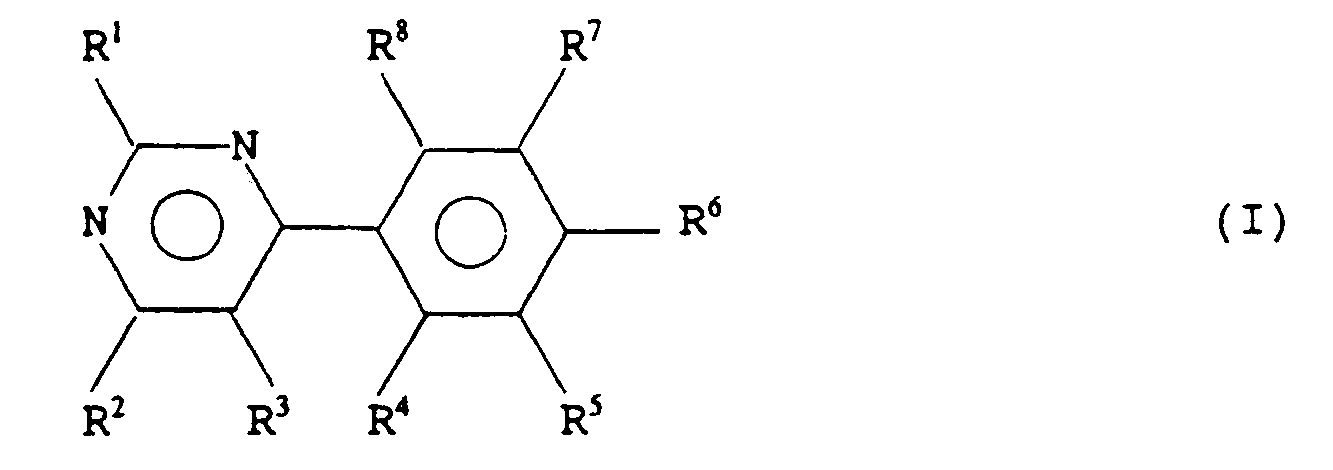
wherein R¹ and R² are the same or different and are each selected from hydroxy, or a group NR⁹R¹⁰ wherein R⁹ and R¹⁰ are each hydrogen, alkyl, aryl, arylalkyl or together with the nitrogen atom to which they are attached form a ring, optionally containing a further heteroatom and optionally further substituted by alkyl, aryl or arylalkyl;
R³ is selected from hydrogen, haloalkyl, alkyl and halo, R⁴ to R⁸ are the same or different, and are each selected from hydrogen, halo, nitro, amino, sulphonamido or alkylsulphonylamino;
or R⁴ and R⁵ or R⁵ and R⁶ may together form a carbocyclic ring;
with the proviso that at least one of R⁴ to R⁸ is other than hydrogen.
wherein R¹ and R² are the same or different and are each selected from hydroxy, or a group NR⁹R¹⁰ wherein R⁹ and R¹⁰ are each hydrogen, alkyl, aryl, arylalkyl or together with the nitrogen atom to which they are attached form a ring, optionally containing a further heteroatom and optionally further substituted by alkyl, aryl or arylalkyl;
R³ is selected from hydrogen, haloalkyl, alkyl and halo, R⁴ to R⁸ are the same or different, and are each selected from hydrogen, halo, nitro, amino, sulphonamido or alkylsulphonylamino;
or R⁴ and R⁵ or R⁵ and R⁶ may together form a carbocyclic ring;
with the proviso that at least one of R⁴ to R⁸ is other than hydrogen.
The compounds may be used for the treatment or prophylaxis of a neurodegenerative or other neurological disorder of the CNS, the aetiology of which includes excessive release of the neurotransmitter glutamate.
Description
- The present invention relates to a series of substituted 6-aryl pyrimidines, to methods for their manufacture, to pharmaceutical formulations containing them and to their use in therapy, in particular the treatment of a range of central nervous system (CNS) disorders and disease states.
- Glutamate is an excitatory amino acid which functions as a neurotransmitter. However, when its extracellular concentration is sufficiently high, glutamate acts as a powerful neurotoxin, capable of killing neurones in the central nervous system, (Rothman & Olney (1986) Prog.Brain.Res., 63, 69). The neurotoxic effect of glutamate has been implicated in a number of central nervous system disorders and disease states including cerebral ischaemic damage and chronic neurodegenerative disorders, such as Alzheimer's disease, motor system disorders, and Huntington's chorea, (Meldrum Clinical Science (1985) 68 113-122). In addition, glutamate has been implicated in other neurological disorders such as epilepsy, manic depression, depression, schizophrenia, high pressure neurological syndrome, chronic pain, trigeminal neuralgia and migraine.
- In EP-A-021121 there is disclosed a group of 3,5-diamino-6-(substituted phenyl)-1,2,4-triazines which are active in the treatment of CNS disorders, for example in the treatment of epilepsy. One compound described in that application, 3,5-diamino-6-(2,3-dichlorophenyl)-1,2,4-triazine (lamotrigine), has been shown to inhibit the release of the excitatory amino acids, glutamate and aspartate, (Leach et al Epilepsia 27, 490-497 1986, A.A. Miller et al New anticonvulsant drugs. Ed. Meldrum and Porter 165-177, 1987).
- A novel class of 6-aryl pyrimidine compounds has now been found that are potent inhibitors of extracellular glutamate release.
- Accordingly, the present invention provides a compound of formula (I) or a salt thereof

wherein R¹ and R² are the same or different and are each selected from hydroxy, or a group NR⁹R¹⁰ wherein R⁹ and R¹⁰ are each hydrogen, alkyl, aryl, arylalkyl or together with the nitrogen atom to which they are attached form a ring, optionally containing a further heteroatom and optionally further substituted by alkyl, aryl or arylalkyl;
R³ is selected from hydrogen, haloalkyl, alkyl and halo;
R⁴ to R⁸ are the same or different, and are each selected from hydrogen, halo-, nitro, amino, sulphonamido or alkylsulphonylamino;
with the proviso that at least one of R⁴ to R⁸ is other than hydrogen, and with the further proviso that when R¹ and R² are both amino, R³ is hydrogen or methyl, and R⁶ is chloro, then one of R⁴, R⁵, R⁷ or R⁸ is other than hydrogen. - According to a preferred embodiment of the present invention, there is provided a compound of formula (I) or salt thereof, wherein R¹ and R² are the same or different and are each selected from amino, alkylamino, dialkylamino, morpholino, piperazinyl, or N′-alkyl piperazinyl;
R³ is hydrogen, alkyl or trifluoromethyl;
R⁴ is halo or hydrogen;
R⁵ is halo or hydrogen;
R⁶ is halo, nitro, amino or hydrogen;
R⁷ is halo or hydrogen;
R⁸ is halo or hydrogen;
provided that when R⁶ is chloro, and R¹ and R² are both amino and R³ is hydrogen or methyl, then one of R⁴, R⁵, R⁷ and R⁸ is other than hydrogen. - Preferred alkyl moieties are those with 1 to 6 carbon atoms, more preferably 1 to 4 carbon atoms, and most preferably methyl or ethyl. Preferred halo radicals are chloro.
- Three 2,4-diamino-6-aryl pyrimidines are known, namely 2,4-diamino-6-(4-chlorophenyl)pyrimidine; 2,4-diamino-5-methyl-6-(4-chlorophenyl)pyrimidine; and 2,4-diamino-6-(β-naphthyl)pyrimidine (see Russell, J.Chem.Soc. (1954) p2951 and Falco et al., and Brit.J.Pharmacol. (1951) 6, 185). No biological activity has been ascribed to these compounds.
- Accordingly the present invention provides a compound of formula (Ia) or a pharmaceutically acceptable salt thereof

wherein R¹ and R² are the same or different and are each selected from hydroxy, or a group NR⁹R¹⁰ wherein R⁹ and R¹⁰ are each hydrogen, alkyl, aryl, arylalkyl or together with the nitrogen atom to which they are attached form a ring, optionally containing a further heteroatom and optionally further substituted by alkyl, aryl or arylalkyl;
R³ is selected from hydrogen, haloalkyl, alkyl and halo;
R⁴ to R⁸ are the same or different and are each selected from hydrogen, halo, nitro, amino, sulphonamido or alkylsulphonylamino;
or R⁴ and R⁵ or R⁵ and R⁶ may together form a carbocyclic ring;
with the proviso that at least one of R⁴ to R⁸ is other than hydrogen;
for use in therapy. - According to a preferred embodiment, the invention provides a compound of formula (Ia) or a pharmaceutically acceptable salt thereof wherein R¹ and R² are the same or different and are each selected from amino, alkylamino, dialkylamino, morpholino, piperazinyl, or N′-alkyl piperazinyl;
R³ is hydrogen, alkyl or trifluoromethyl;
R⁴ is halo or hydrogen;
R⁵ is halo or hydrogen;
R⁶ is halo, nitro, amino or hydrogen;
R⁷ is halo or hydrogen;
R⁸ is halo or hydrogen;
or R⁵ and R⁶ may form a carbocyclic ring;
for use in therapy. - Preferred compounds of formula (I) include:-
2,4-Diamino-6-(2,3-dichlorophenyl)pyrimidine;
2,4-Diamino-6-(2-chlorophenyl)pyrimidine;
2,4-Diamino-6-(2,4-dichlorophenyl)pyrimidine;
2,4-Diamino-5-methyl-6-(4-chlorophenyl)pyrimidine;
2,4-Diamino-6-(α-naphthyl)pyrimidine;
2,4-Diamino-6-(2,3,5-trichlorophenyl)pyrimidine; .
2,4-Diamino-5-methyl-6-(2,3,5-trichlorophenyl)pyrimidine;
2,4-Diamino-5-trifluoromethyl-6-(2,3,5-trichlorophenyl) pyrimidine;
2,4-Diamino-5-nitro-6-(2,3,5-trichlorophenyl)pyrimidine;
2,4-Diamino-5-methyl-6-(4-amino-3,5-dichlorophenyl) pyrimidine;
2,4-Diamino-5-methyl-6-(3,5-dichlorophenyl)pyrimidine;
4-Amino-2-N,N-dimethylamino-6-(2,3,5-trichlorophenyl) pyrimidine;
4-Amino-2-N-morpholino-6-(2,3,5-trichlorophenyl)pyrimidine;
4-Amino-2-(4-methylpiperazin-1-yl)-6-(2,3,5-trichlorophenyl) pyrimidine;
2,4-Diamino-5-methyl-6-(4-amino-2,3,5-trichlorophenyl) pyrimidine;
2,4-Diamino-6-(4-amino-3,5-dichlorophenyl)pyrimidine;
2,4-Diamino-6-(4-amino-2,3,5-trichlorophenyl)pyrimidine. - Compounds of formula (Ia) may be used in the treatment or prophylaxis in a mammal of a neurodegenerative or other neurological disorder of the central nervous system, the aetiology of which includes excessive release of the neurotransmitter glutamate. Such conditions can be either acute or chronic. Acute condition include cerebral ischaemic damage which may arise from a variety of causes including stroke, cardiac arrest, cardiac bypass surgery, neonatal anoxia and hypoglycaemia; and also physical injury or trauma of the spinal cord or brain. Chronic disorders include Alzheimer's disease, Huntington's chorea, Olivopontocerebrellar atrophy and motor system disorders. Other neurological conditions which may be treated with a compound of formula (Ia) include depression, manic depression, schizophrenia, chronic pain, epilepsy, trigeminal neuralgia and migraine.
- According to a further aspect, the present invention provides a method for the treatment or prophylaxis in a mammal, including man, of a neurodegenerative or other neurological disorder of the central nervous system, the aetiology of which includes excessive release of the neurotransmitter glutamate which comprises administering to the said mammal a non-toxiceffective amount of a compound of formula (Ia) or a salt thereof.
- In particular, the invention provides a method of treating a mammal predisposed to or having increased extracellular glutamate levels of the CNS comprising the administration to the said mammal of a non-toxic, effective amount of a compound of formula (Ia) or a pharmaceutically acceptable salt thereof.
- The invention also provides a compound of formula (Ia) or a salt thereof for use in therapy, in particular the treatment or prophylaxis of a neurodegenerative or other neurological disorder of the central nervous system, the aetiology of which includes excessive release of the neurotransmitter glutamate. The invention further provides the use of a compound of formula (Ia) or a salt thereof for the manufacture of a medicament for treatment or prophylaxis of a neurodegenerative or other neurological disorder of the central nervous system, the aetiology of which includes excessive release of the neurotransmitter glutamate.
- The present invention includes compounds of formula (I) and (Ia) in the form of salts, in particular acid addition salts. Suitable salts include those formed with both organic or inorganic acids. Such acid addition salts will normally be pharmaceutically acceptable although salts of non-pharmaceutically acceptable acids may be of utility in the preparation and purification of the compound in question. Thus, preferred salts include those formed from hydrochloric, hydrobromic, sulphuric, citric, tartaric, phosphoric, lactic, pyruvic, acetic, succinic, oxalic, fumaric, maleic, oxaloacetic, methanesulphonic, ethanesulphonic, p-toluenesulphonic, benzenesulphonic and isethionic acids. Salts of the compounds of formulae (I) and (Ia) can be made by reacting the appropriate compound in the form of the free base with the appropriate acid.
- While it is possible for the compounds of formula (Ia) to be administered as the raw chemical, it is preferable to present them as a pharmaceutical formulation. The formulations of the present invention comprise a compound of formula (Ia), as above defined, or a pharmaceutically acceptable salt thereof together with one or more pharmaceutically acceptable carriers therefor and optionally other therapeutic ingredients. The carrier(s) must be 'acceptable' in the sense of being compatible with the other ingredients of the formulation and not deleterious to the recipient thereof.
- The formulations include those suitable for oral, parenteral (including subcutaneous, intradermal, intramuscular and intravenous), rectal and topical (including dermal, buccal and sublingual) administration although the most suitable route may depend upon for example the condition and disorder of the recipient. The formulations may conveniently be presented in unit dosage form and may be prepared by any of the methods well known in the art of pharmacy. All methods include the step of bringing into association a compound of formula (Ia) or a pharmaceutically acceptable salt thereof ("active ingredient") with the carrier which constitutes one or more accessory ingredients. In general the formulations are prepared by uniformly and intimately bringing into association the active ingredient with liquid carriers or finely divided solid carriers or both and then, if necessary, shaping the product into the desired formulation.
- Formulations of the present invention suitable for oral administration may be presented as discrete units such as capsules, cachets or tablets each containing a predetermined amount of the active ingredient; as a powder or granules; as a solution or a suspension in an aqueous liquid or a non-aqueous liquid; or as an oil-in-water liquid emulsion or a water-in-oil liquid emulsion. The active ingredient may also be presented as a bolus, electuary or paste.
- A tablet may be made by compression or moulding, optionally with one or more accessory ingredients. Compressed tablets may be prepared by compressing in a suitable machine the active ingredient in a free-flowing form such as a powder or granules, optionally mixed with a binder, lubricant, inert diluent, lubricating, surface active or dispersing agent. Moulded tablets may be made by moulding in a suitable machine a mixture of the powdered compound moistened with an inert liquid diluent. The tablets may optionally be coated or scored and may be formulated so as to provide slow or controlled release of the active ingredient therein.
- Formulations for parenteral administration include aqueous and non-aqueous sterile injection solutions which may contain anti-oxidants, buffers, bacteriostats and solutes which render the formulation isotonic with the blood of the intended recipient; and aqueous and non-aqueous sterile suspensions which may include suspending agents and thickening agents. The formulations may be presented in unit-dose or multi-dose containers, for example sealed ampoules and vials, and may be stored in a freeze-dried (lyophilised) condition requiring only the addition of the sterile liquid carrier, for example, water-for-injection, immediately prior to use. Extemporaneous injection solutions and suspensions may be prepared from sterile powders, granules and tablets of the kind previously described.
- Formulations for rectal administration may be presented as a suppository with the usual carriers such as cocoa butter or polyethylene glycol.
- Formulations for topical administration in the mouth, for example buccally or sublingually, include lozenges comprising the active ingredient in a flavoured basis such as sucrose and acacia or tragacanth, and pastilles comprising the active ingredient in a basis such as gelatin and glycerin or sucrose and acacia.
- Preferred unit dosage formulations are those containing an effective dose, an hereinbelow recited, or an appropriate fraction thereof, of the active ingredient.
- It should be understood that in addition to the ingredients particularly mentioned above, the formulations of this invention may include other agents conventional in the art having regard to the type of formulation in question, for example those suitable for oral administration may include flavouring agents.
- Tablets or other forms of presentation provided in discrete units may conveniently contain an amount of compound of formula (Ia) which is effective at such dosage or as a multiple of the same, for instance, units containing 5mg to 500mg, usually around 10mg to 250mg.
- The compounds of the formula (Ia) are preferably used to treat CNS disorders or diseases by oral administration or injection (intraparenteral or subcutaneous). The precise amount of compound administered to a patient will be the responsibility of the attendant physician. However the dose employed will depend on a number of factors, including the age and sex of the patient, the precise disorder being treated, and its severity. Thus for example when treating a patient with epilepsy the dose range is likely to be significantly lower than when treating a patient after stroke to alleviate cerebral ischaemic damage. Moreover, the route of administration is likely to vary depending on the condition and its severity.
- Nonetheless, for treating a CNS disorder such as to alleviate cerebral ischaemic damage as herein described compounds of formula (Ia) may typically be administered either orally or by injection at a dose of from 0.1 to 30 mg/kg per day. The dose range for adult humans is generally in the range from 8 to 2,400 mg/day and preferably in the order of 35 to 1050 mg/day.
- Compounds of the present invention may be made by any methods known in the art to make analogous compounds (see, for example, JACS 73, (1951) p3763).
- The present invention provides a method of manufacturing a compound of formula (Ia) which comprises reacting a compound of formula (II)

wherein R⁴, R⁵, R⁶, R⁷ and R⁸ are as defined above and L is a leaving group with a compound of formula (III)
or a salt thereof, wherein R¹ is as defined above and isolating the compound of formula (Ia) as the free base or a salt thereof and optionally converting one compound of formula (Ia) into another compound of formula (Ia) and optionally converting the compound of formula (Ia) in the form of the free base into a salt thereof, or optionally converting one salt into another salt thereof. - Certain compounds of formula (III) may of course exist in corresponding tautomeric form. For example, when R¹ is hydroxy as the corresponding urea.
- Examples of suitable leaving groups L include alkoxy, particularly C₁₋₄alkoxy, halo, alkylthio, particularly C₁₋₄alkylthio or substituted amino, eg. anilino, morpholino, C₁₋₄alkylamino or benzylamino. Preferably in formula (III), R¹ is a group NR⁹R¹⁰ as defined above. Advantageously R¹ is amino, alkylamino, dialkylamino, morpholino, piperazinyl or N-methylpiperazinyl.
- Preferably the reaction of the compounds of formula (II) and (III) is carried out in a non-aqueous solvent, for example an alkanol, eg. ethanol, at elevated temperatures (eg. from 80 to 150°C). A base, preferably an alkanoxide, eg. sodium ethoxide is generally added where the compound of formula (III) is used as a salt.
- Compound of formula (II) may be made by methods known in the art (see, for example, JACS, 1951, 73, 3763) for example by reaction of the β-ketonitrile with diazomethane.
- Compounds of formula (III) when R¹ is piperazinyl or alkyl piperazinyl can be made by standard methods for example by reaction of a known compound of formula (III) where R¹ is alkylthio with the appropriate amine, eg. N-methylpiperazine. This reaction is preferably carried out at room temperature in a suitable solvent such as water.
- The invention is illustrated by the following examples.
- 2,3-Dichlorobenzoic acid (50g:Aldrich) was refluxed with thionyl chloride (250m1) for 1 hour. The solution was filtered and evaporated to dryness under reduced pressure. The resulting oil was added dropwise to dry methanol (200ml) with stirring at room temperature. After 1 hour the resulting solution was evaporated to dryness under reduced pressure and the residue taken up in ether. The organic phase was washed twice with water, charcoaled, filtered and dried over magnesium sulphate. Yield, 34gms, Mp. 36-38°C.
- Sodium metal (2.3g) was dissolved in dry methanol (100ml) and the solution they evaporated to dryness under reduced pressure. To this residue were added dry acetonitrile (26ml) and methyl 2,3-dichlorobenzoate (20.5g) and the mixture stirred and refluxed under nitrogen overnight. Total was poured into water (100ml) and extracted with ether. The aqueous phase was then carefully acidified to pH6 with 2N hydrochloric acid, and extracted with chloroform. The organic phase was then washed with water, dried over magnesium sulphate, filtered and evaporated to dryness. The resulting oil was purified by column chromatography on silica, eluting with chloroform. Yield 1.75g.
- 2,3-Dichlorobenzoylacetonitri1e (2.8g) was dissolved in ether and this solution added to an excess of diazomethane in ether solution, with stirring and ice-bath cooling. The solution was gradually allowed to warm to room temperature and allowed to stand overnight. The solution was evaporated to dryness under reduced pressure and the crude product purified by column chromatography on silica, eluting with chloroform. The resulting solid was recrystallised from methanol. Yield 1.47g, Mp. 93-95°C.
- The enol ether (0.7g) was added to a suspension of guanidine (from guanidine hydrochloride (0.67g) and sodium metal (0.16g)) in dry ethanol (40ml) and total heated to 130°C in a sealed vessel for 18 hours. The reaction mixture was evaporated to low volume, taken up in chloroform and washed with water. The organic phase was dried over magnesium sulphate, filtered and evaporated to dryness. The crude product was purified by column chromatography on silica, eluting with chloroform, and 2% methanol in chloroform. Yield 0.15g.
- This product was re-chromatographed on silica, eluting with chloroform, and 2% and 5% methanol in chloroform. Yield 0.09g, Mp 180-2°C.
NMR: Solvent = CDCl₃
Assignment: 7.50 (d,1H), 7.38(d,1H), 7.25(t,1H), 6.05(s,1H), 4.60-4.90(br.d,4H). - 2-Chlorobenzoy1acetonitri1e (5g: Lancaster Synthesis) was dissolved in the minimum of dichloromethane and added to an excess of diazomethane in ether solution, with stirring and ice-bath cooling. The solution was gradually allowed to warm to room temperature and left to stand overnight. The solution was evaporated to dryness under reduced pressure and the crude product purified by column chromatography on silica, eluting with dichloromethane. Yield 4.85g, Mp. 42-44°C.
- The enol ether (4.75g) was added to a suspension of guanidine (from guanidine hydrochloride (4.68g) and sodium metal (1.13g)) in dry ethanol (125ml) and the total heated to 150°C in a sealed vessel for 18 hours. The reaction mixture was evaporated to low volume, taken up in chloroform and washed with water. The organic phase was dried over magnesium sulphate, filtered and evaporated to dryness. The crude product was purified by column chromatography on silica, eluting with chloroform, and 2% methanol in chloroform. Yield 0.5g. This product was re-chromatographed on silica, eluting with chloroform, and 2% methanol in chloroform. Mp. 165-7°C.
NMR: Solvent = CDCl₃.
Assignment 6.85-7.15 (m,4H), 5.70(s,1H), 5.40(br.s,2H), 4.87(br.s,2H). - 2,4-Dichlorobenzoic acid (50g: Aldrich) was refluxed with thionyl chloride (250ml) for 1 hour. The solution was filtered and evaporated to drynesn under reduced pressure. The resulting oil was added dropwise to dry methanol (200ml) with stirring at room temperature. After 1 hour the resulting solution was evaporated to dryness under reduced pressure and the residue taken up in ether. The organic phase was washed twice with water, charcoaled filtered and dried over magnesium sulphate. Yield 40g of a yellow oil.
- Sodium metal (2.3g) was dissolved in dry methanol (100ml) and the solution then evaporated to dryness under reduced pressure. To this residue were added dry acetonitrile (26ml) and methyl 2,4-dichlorobenzoate (20.5g) and the mixture stirred and refluxed under nitrogen overnight. Total was poured into water (100ml) and extracted with ether. The aqueous phase was then carefully acidified to pH5-6 with 2N hydrochloric acid, and extracted with chloroform. The organic phase was then washed with water, dried over magnesium sulphate, filtered and evaporated to dryness. The resulting oil was purified by column chromatography on silica eluting with chloroform. Yield 2.42g of a pale lemon solid.
- 2,4-Dichlorobenzoylacetonitrile (5.5g) was dissolved/suspended in ether (100ml) and stirred in an ice bath whilst a solution of diazomethane (c.1.25g) in ether (150ml) was added dropwise. The solution was gradually allowed to warm to room temperature and allowed to stand overnight. The solution was evaporated to dryness under reduced pressure and the crude product purified by column chromatography on silica eluting with dichloromethane. Yield 4.8g.
- The enol ether (2.8g) was added to a suspension of guanidine [from guanidine hydrochioride (2.68g) and sodium metal (0.64g)] in dry ethanol (100ml) and total heated to 160°C in a sealed vessel for 18 hours. Reaction mixture was evaporated to low volume, taken up in chloroform and washed with water. Organic phase was dried over magnesium sulphate filtered and evaporated to dryness. The crude product was twice purified by column chromatography on silica, eluting with chloroform, and 2% methanol in chloroform. Yield 0.21g. mp. = 170-4°C.
NMR: Solvent = CDCl₃
Assignment 7.50 (d,1H), 7.47 (s,1H), 7.32 (dd,1H), 6.12 (s,1H), 4.60-5.00 (br.d, 4H). - 1-Naphthoic acid (50g: Aldrich) was refluxed with thionyl chloride (250ml) for 1 hour. The solution was treated with charcoal, filtered and evaporated to dryness under reduced pressure. The resulting oil was added dropwise to dry methanol (200ml) with stirring at room temperature. After 1 hour the resulting solution was evaporated to dryness under reduced pressure and the residue taken up in ether. The organic phase was washed twice with water, charcoaled, filtered and dried over magnesium sulphate. Yield 38g. of a yellow oil.
- Sodium metal (1.15g) was dissolved in dry methanol (30ml) and solution then evaporated to dryness under reduced pressure. To this residue were added dry acetonitrile (13.5ml) and methyl 1-naphthoate (9.3g) and the mixture stirred and refluxed under nitrogen overnight. Total was poured into water (50ml) and extracted with ether. The aqueous phase was then carefully acidified to pH6-7 with 2N hydrochloric acid and the resulting solid filtered off and washed with water. The crude product was purified by column chromatography on silica, eluting with chloroform. Yield 0.93g. mp. = 95-96°C.
- 1-Naphthoylacetonitrile (6.9g) was dissolved in dichloromethane (100ml) and this solution added to an excess of diazomethane in ether solution with stirring and ice-bath cooling. The solution was gradually allowed to warm to room temperature and allowed to stand overnight. The solution was evaporated to dryness under reduced pressure and the crude product purified by column chromatography on silica, eluting with chloroform. Yield 6.6g.
- The enol ether (3.8g) was added to a suspension of guanidine [from guanidine hydrochloride (3.44g) and sodium metal (0.83g)] in dry ethanol (150ml) and total heated to 150°C in a sealed vessel for 18 hours. Reaction mixture was evaporated to low volume, taken up in chloroform and washed with water. Organic phase was dried over magnesium sulphate, filtered and evaporated to dryness. The crude product was purified by column chromatography on silica, eluting with chloroform, and 5% methanol in chloroform. Yield 1.1g. mp. = 93-95°C.
NMR: Solvent = CDCl₃
Assignment 8.15 (m,1H), 7.85 (m,2H), 7.50 (m,4H), 6.08 (s,1H), 5.00 (br.s,2H), 4.80 (br.s, 2H). - Compounds of formula (Ia) were tested for their effect on veratrine-evoked release of glutamate from rat brain slices according to the protocol described in Epilepsia 27(5): 490-497, 1986. The protocol for testing for inhibition of DHFR activity was a modification of that set out in Biochemical Pharmacology Vol.20 pp 561-574, 1971.
- The results are given in Table 1, the IC₅₀ being the concentration of compound to cause 50% of DHFR enzyme activity.

-

- The drug was mixed with the lactose and starch and granulated with a solution of the polyvinylpyrrolidone in water. The resultant granules were dried, mixed with magnesium stearate and compressed to give tablets.
- The salt of the compound of Formula (Ia) was dissolved in sterile water for injection.
-

- The compound of Example I as a salt is dissolved in most of the phosphate buffer at 35-40°C, then made up to volume and filtered through a sterile micropore filter into sterile 10ml glass vials (Type 1) which are sealed with sterile closures and overseals.
- In the following Examples, the active compound may be any compound of formula (Ia) or pharmaceutically acceptable salt thereof.
- Formulation A may be prepared by admixing the ingredients and filling two-part hard gelatin capsules with the resulting mixture.

-

- Capsules may be prepared by melting the Macrogel 4000 BP, dispersing the active ingredient in the melt, and filling two-part hard gelatin capsules therewith.
-
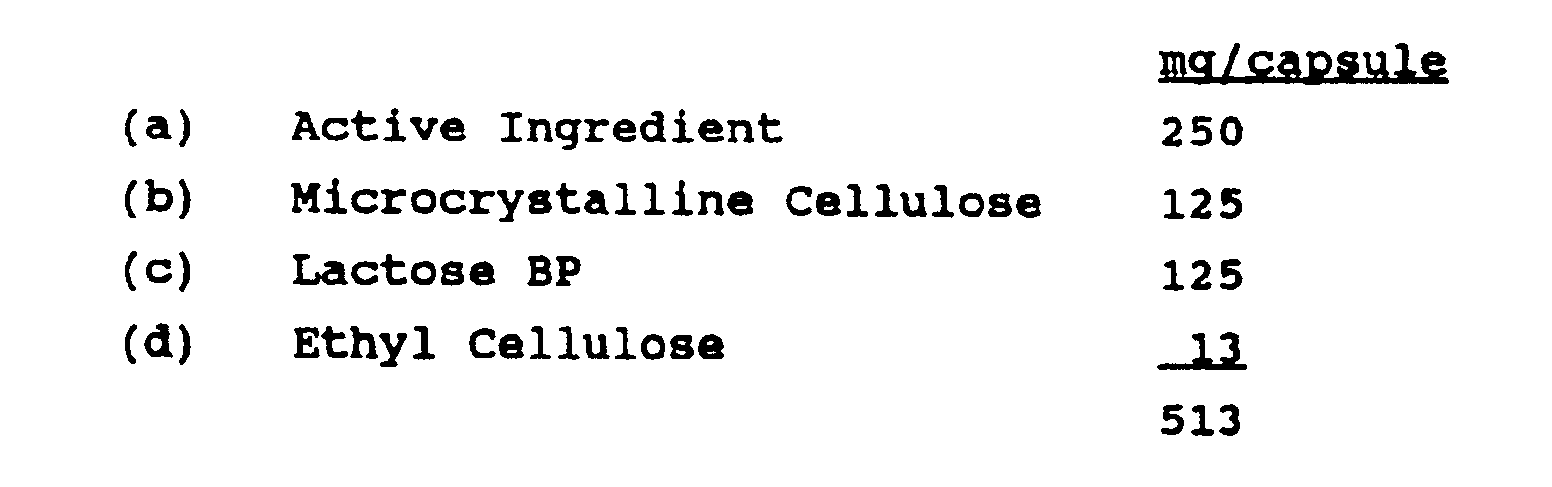
- The controlled-release capsule formulation may be prepared by extruding mixed ingredients (a) to (c) using an extruder, then spheronising and drying the extrudate. The dried pellets are coated with ethyl cellulose (d) as a controlled-release membrane and filled into two-part hard gelatin capsules.
-
- Active ingredient
- 0.2500 g
- Sorbitol Solution
- 1.5000 g
- Glycerol
- 1.0000 g
- Sodium Benzoate
- 0.0050 g
- Flavour
- 0.0125 ml
- Purified Water q.s. to
- 5.0 ml
- The sodium benzoate is dissolved in a portion of the purified water and the sorbitol solution added. The active ingredient is added and dissolved. The resulting solution is mixed with the glycerol and then made up to the required volume with the purified water.
-

- One fifth of the Witepsol H15 is melted in a steam-jacketed pan at 45°C maximum. The active ingredient is sifted through a 200µm sieve and added to the molten base with mixing, using a Silverson fitted with a cutting head, until a smooth dispersion is achieved. Maintaining the mixture at 45°C, the remaining Witepsol H15 is added to the suspension which is stirred to ensure a homogenous mix. The entire suspension is then passed through a 250µm stainless steel screen and, with continuous stirring, allowed to cool to 440°C. At a temperature of 38-40°C, 2.02g aliquots of the mixture are filled into suitable plastic moulds and the suppositories allowed to cool to room temperature.
Claims (9)
- A process for the preparation of a compound of formula (Ia) or a salt thereof

R³ is selected from hydrogen, haloalkyl, alkyl and halo,
R⁴ to R⁸ are the same or different, and are each selected from hydrogen, halo, nitro, amino, sulphonamido or alkylsulphonylamino;
or R⁴ and R⁵ or R⁵ and R⁶ may together form a carbocyclic ring;
with the proviso that at least one of R⁴ to R⁸ is other than hydrogen;
which comprises reacting a compound of formula (II)

and isolating the compound of formula (Ia) as the free base or a salt thereof;
and optionally converting one compound of formula (Ia) into another compound of formula (Ia); and
optionally converting the compound of formula (Ia) in the form of the free base into a salt thereof, or optionally converting one salt into another salt. - A process as claimed in Claim 1 for the production of a compound wherein:
R¹ and R² are the same or different and are each selected from amino, alkylamino, dialkylamino, morpholino, piperazinyl, or N′-alkyl piperazinyl;
R³ is hydrogen, alkyl or trifluoromethyl;
R⁴ is halo or hydrogen;
R⁵ is halo or hydrogen;
R⁶ is halo, nitro, amino or hydrogen;
R⁷ is halo or hydrogen;
R⁸ is halo or hydrogen;
or R⁴ and R⁵ may together form a carbocyclic ring;
provided that when R⁶ is chloro, and R¹ and R² are both amino and R³ is hydrogen, then one of R⁴, R⁵, R⁷ and R⁸ is other than hydrogen. - A process as claimed in Claim 1 for the production of a compound selected from:
2,4-Diamino-6-(2,3-dichlorophenyl)pyrimidine;
2,4-Diamino-6-(2-chlorophenyl)pyrimidine;
2,4-Diamino-6-(2,4-dichloropheny1)pyrimidine;
2,4-Diamino-5-methyl-6-(4-chloropheny1)pyrimidine;
2,4-Diamino-6-(α-naphthyl)pyrimidine;
2,4-Diamino-6-(2,3,5-trichlorophenyl)pyrimidine;
2,4-Diamino-5-methyl-6-(2,3,5-trichlorophenyl)pyrimidine;
2,4-Diamino-5-trifluoromethyl-6-(2,3,5-trichlorophenyl) pyrimidine;
2,4-Diamino-5-nitro-6-(2,3,5-trichlorophenyl)pyrimidine;
2,4-Diamino-5-methyl-6-(4-amino-3,5-dichlorophenyl) pyrimidine;
2,4-Diamino-5-methyl-6-(3,5-dichlorophenyl)pyrimidine;
4-Amino-2-N,N-dimethylamino-6-(2,3,5-trichlorophenyl) pyrimidine;
4-Amino-2-N-morpholino-6-(2,3,5-trichlorophenyl)pyrimidine;
4-Amino-2-(4-methylpiperazin-1-yl)-6-(2,3,5-trichlorophenyl) pyrimidine;
2,4-Diamino-5-methyl-6-(4-amino-2,3,5-trichlorophenyl) pyrimidine;
2,4-Diamino-6-(4-amino-3,5-dichlorophenyl)pyrimidine;
2,4-Diamino-6-(4-amino-2,3,5-trichlorophenyl)pyrimidine;
or a salt thereof.
Applications Claiming Priority (2)
| Application Number | Priority Date | Filing Date | Title |
|---|---|---|---|
| GB9012311 | 1990-06-01 | ||
| GB909012311A GB9012311D0 (en) | 1990-06-01 | 1990-06-01 | Pharmacologically active cns compounds |
Publications (1)
| Publication Number | Publication Date |
|---|---|
| EP0459830A1 true EP0459830A1 (en) | 1991-12-04 |
Family
ID=10676959
Family Applications (1)
| Application Number | Title | Priority Date | Filing Date |
|---|---|---|---|
| EP91304963A Ceased EP0459830A1 (en) | 1990-06-01 | 1991-05-31 | Pharmacologically active CNS compounds |
Country Status (11)
| Country | Link |
|---|---|
| EP (1) | EP0459830A1 (en) |
| JP (1) | JPH05320142A (en) |
| AU (1) | AU646669B2 (en) |
| CA (1) | CA2043671A1 (en) |
| FI (1) | FI912621A7 (en) |
| GB (1) | GB9012311D0 (en) |
| HU (1) | HU209576B (en) |
| IE (1) | IE911859A1 (en) |
| NZ (1) | NZ238359A (en) |
| PT (1) | PT97804A (en) |
| ZA (1) | ZA914166B (en) |
Cited By (24)
| Publication number | Priority date | Publication date | Assignee | Title |
|---|---|---|---|---|
| WO1994002147A1 (en) * | 1992-07-27 | 1994-02-03 | The Wellcome Foundation Limited | Water-dispersible tablets |
| WO1994014780A1 (en) * | 1992-12-18 | 1994-07-07 | The Wellcome Foundation Limited | Pyrimidine, pyridine, pteridinone and indazole derivatives as enzyme inhibitors |
| US5459158A (en) * | 1992-12-18 | 1995-10-17 | Burroughs Wellcome Co. | Pharmaceutical compositions of indazoles and methods of use thereof |
| US5556639A (en) * | 1991-01-30 | 1996-09-17 | Glaxo Wellcome Inc. | Water-dispersible tablets |
| FR2741879A1 (en) * | 1995-12-05 | 1997-06-06 | Esteve Labor Dr | FLUOROPHENYL-TRIAZINE AND PYRIMIDINE DERIVATIVES, THEIR PREPARATION AND THEIR USE AS MEDICINAL PRODUCTS |
| WO1997044326A1 (en) * | 1996-05-23 | 1997-11-27 | F. Hoffmann-La Roche Ag | Aryl pyrimidine derivatives |
| WO1998025594A3 (en) * | 1996-12-12 | 1998-09-17 | Smithkline Beecham Plc | Lamotrigine in the treatment and prophylaxis of migraine |
| RU2128996C1 (en) * | 1994-09-09 | 1999-04-20 | Ниппон Синяку Ко., Лтд. | Heterocyclic derivative and a drug |
| US5952331A (en) * | 1996-05-23 | 1999-09-14 | Syntex (Usa) Inc. | Aryl pyrimidine derivatives |
| US5958934A (en) * | 1996-05-23 | 1999-09-28 | Syntex (U.S.A.) Inc. | Aryl pyrimidine derivatives and uses thereof |
| US6265405B1 (en) | 1997-12-22 | 2001-07-24 | Glaxo Wellcome Inc. | Triazine compounds for treatment of CNS disorders |
| WO2004048365A1 (en) | 2002-11-21 | 2004-06-10 | Chiron Corporation | 2,4,6-trisubstituted pyrimidines as phosphotidylinositol (pi) 3-kinase inhibitors and their use in the treatment of cancer |
| WO2005014556A1 (en) * | 2003-08-05 | 2005-02-17 | Bayer Healthcare Ag | 2-aminopyrimidine derivatives |
| EP2008653A1 (en) | 2007-06-28 | 2008-12-31 | Charité-Universitätsmedizin Berlin | Serotonergic compounds for treating neuronal illnesses |
| DE102007051090A1 (en) | 2007-06-28 | 2009-01-08 | Charité - Universitätsmedizin Berlin | Use of a serotonergic compound as a neuroprotective agent for treating focal cerebral ischemia after the development of an acute phase ischemia, for the neuro-regeneration during the treatment of neuronal disease and to treat e.g. stroke |
| WO2008116185A3 (en) * | 2007-03-21 | 2009-03-12 | Neurocrine Biosciences Inc | Substituted pyrimidines as adenosine receptor antagonists |
| US7566712B2 (en) | 2003-07-16 | 2009-07-28 | Neurogen Corporation | Biaryl piperazinyl-pyridine analogues |
| US7662830B2 (en) | 2004-08-13 | 2010-02-16 | Neurogen Corporation | Substituted biaryl piperazinyl-pyridine analogues |
| US8173647B2 (en) | 2007-02-06 | 2012-05-08 | Gordana Atallah | PI 3-kinase inhibitors and methods of their use |
| US8217035B2 (en) | 2006-01-20 | 2012-07-10 | Novartis Ag | Pyrimidine derivatives used as PI-3-kinase inhibitors |
| US8865894B2 (en) | 2012-02-24 | 2014-10-21 | Novartis Ag | Oxazolidin-2-one compounds and uses thereof |
| US8957068B2 (en) | 2011-09-27 | 2015-02-17 | Novartis Ag | 3-pyrimidin-4-yl-oxazolidin-2-ones as inhibitors of mutant IDH |
| US9296733B2 (en) | 2012-11-12 | 2016-03-29 | Novartis Ag | Oxazolidin-2-one-pyrimidine derivative and use thereof for the treatment of conditions, diseases and disorders dependent upon PI3 kinases |
| US9434719B2 (en) | 2013-03-14 | 2016-09-06 | Novartis Ag | 3-pyrimidin-4-yl-oxazolidin-2-ones as inhibitors of mutant IDH |
Citations (3)
| Publication number | Priority date | Publication date | Assignee | Title |
|---|---|---|---|---|
| DE3008693A1 (en) * | 1979-03-19 | 1980-10-02 | Upjohn Co | 6-ARYL-PYRIMIDINE COMPOUNDS |
| EP0021121A1 (en) * | 1979-06-01 | 1981-01-07 | The Wellcome Foundation Limited | 1,2,4-Triazine derivatives, process for preparing such compounds and pharmaceutical compositions containing them |
| EP0343050A1 (en) * | 1988-05-17 | 1989-11-23 | Synthelabo | 6-Phenyl-3-piperazinylalkyl 1H,3H-pyrimidinedione-2,4 derivatives, their preparation and their use in therapy |
-
1990
- 1990-06-01 GB GB909012311A patent/GB9012311D0/en active Pending
-
1991
- 1991-05-30 ZA ZA914166A patent/ZA914166B/en unknown
- 1991-05-31 FI FI912621A patent/FI912621A7/en not_active Application Discontinuation
- 1991-05-31 EP EP91304963A patent/EP0459830A1/en not_active Ceased
- 1991-05-31 NZ NZ238359A patent/NZ238359A/en unknown
- 1991-05-31 JP JP3235336A patent/JPH05320142A/en active Pending
- 1991-05-31 AU AU78098/91A patent/AU646669B2/en not_active Ceased
- 1991-05-31 IE IE185991A patent/IE911859A1/en unknown
- 1991-05-31 CA CA002043671A patent/CA2043671A1/en not_active Abandoned
- 1991-05-31 PT PT97804A patent/PT97804A/en not_active Application Discontinuation
- 1991-05-31 HU HU911828A patent/HU209576B/en not_active IP Right Cessation
Patent Citations (3)
| Publication number | Priority date | Publication date | Assignee | Title |
|---|---|---|---|---|
| DE3008693A1 (en) * | 1979-03-19 | 1980-10-02 | Upjohn Co | 6-ARYL-PYRIMIDINE COMPOUNDS |
| EP0021121A1 (en) * | 1979-06-01 | 1981-01-07 | The Wellcome Foundation Limited | 1,2,4-Triazine derivatives, process for preparing such compounds and pharmaceutical compositions containing them |
| EP0343050A1 (en) * | 1988-05-17 | 1989-11-23 | Synthelabo | 6-Phenyl-3-piperazinylalkyl 1H,3H-pyrimidinedione-2,4 derivatives, their preparation and their use in therapy |
Cited By (38)
| Publication number | Priority date | Publication date | Assignee | Title |
|---|---|---|---|---|
| US5660860A (en) * | 1991-01-30 | 1997-08-26 | Glaxo Wellcome Inc. | Water-dispersible tablets |
| US5556639A (en) * | 1991-01-30 | 1996-09-17 | Glaxo Wellcome Inc. | Water-dispersible tablets |
| WO1994002147A1 (en) * | 1992-07-27 | 1994-02-03 | The Wellcome Foundation Limited | Water-dispersible tablets |
| WO1994014780A1 (en) * | 1992-12-18 | 1994-07-07 | The Wellcome Foundation Limited | Pyrimidine, pyridine, pteridinone and indazole derivatives as enzyme inhibitors |
| US5459158A (en) * | 1992-12-18 | 1995-10-17 | Burroughs Wellcome Co. | Pharmaceutical compositions of indazoles and methods of use thereof |
| RU2128996C1 (en) * | 1994-09-09 | 1999-04-20 | Ниппон Синяку Ко., Лтд. | Heterocyclic derivative and a drug |
| WO1997020827A1 (en) * | 1995-12-05 | 1997-06-12 | Laboratorios Del Dr. Esteve, S.A. | Fluorophenyl-triazine and pyrimidine derivatives as compounds acting on the central nervous system |
| ES2128960A1 (en) * | 1995-12-05 | 1999-05-16 | Esteve Labor Dr | Fluorophenyl-triazine and pyrimidine derivatives as compounds acting on the central nervous system |
| FR2741879A1 (en) * | 1995-12-05 | 1997-06-06 | Esteve Labor Dr | FLUOROPHENYL-TRIAZINE AND PYRIMIDINE DERIVATIVES, THEIR PREPARATION AND THEIR USE AS MEDICINAL PRODUCTS |
| CN1109675C (en) * | 1996-05-23 | 2003-05-28 | 弗·哈夫曼-拉罗切有限公司 | Aryl pyrimidine derivatives |
| US5863924A (en) * | 1996-05-23 | 1999-01-26 | Syntex (U.S.A.) Inc. | Aryl pyrimidine derivatives |
| US5952331A (en) * | 1996-05-23 | 1999-09-14 | Syntex (Usa) Inc. | Aryl pyrimidine derivatives |
| US5958934A (en) * | 1996-05-23 | 1999-09-28 | Syntex (U.S.A.) Inc. | Aryl pyrimidine derivatives and uses thereof |
| WO1997044326A1 (en) * | 1996-05-23 | 1997-11-27 | F. Hoffmann-La Roche Ag | Aryl pyrimidine derivatives |
| WO1998025594A3 (en) * | 1996-12-12 | 1998-09-17 | Smithkline Beecham Plc | Lamotrigine in the treatment and prophylaxis of migraine |
| US6265405B1 (en) | 1997-12-22 | 2001-07-24 | Glaxo Wellcome Inc. | Triazine compounds for treatment of CNS disorders |
| US6465461B1 (en) | 1997-12-22 | 2002-10-15 | Smithkline Beecham Corporation | Triazine compounds for treatment of CNS disorders |
| WO2004048365A1 (en) | 2002-11-21 | 2004-06-10 | Chiron Corporation | 2,4,6-trisubstituted pyrimidines as phosphotidylinositol (pi) 3-kinase inhibitors and their use in the treatment of cancer |
| US7423148B2 (en) | 2002-11-21 | 2008-09-09 | Chiron Corporation | Small molecule PI 3-kinase inhibitors and methods of their use |
| US7767669B2 (en) | 2002-11-21 | 2010-08-03 | Novartis Ag | Small molecule PI 3-kinase inhibitors and methods of their use |
| US7566712B2 (en) | 2003-07-16 | 2009-07-28 | Neurogen Corporation | Biaryl piperazinyl-pyridine analogues |
| WO2005014556A1 (en) * | 2003-08-05 | 2005-02-17 | Bayer Healthcare Ag | 2-aminopyrimidine derivatives |
| US7662830B2 (en) | 2004-08-13 | 2010-02-16 | Neurogen Corporation | Substituted biaryl piperazinyl-pyridine analogues |
| US8334382B2 (en) | 2004-08-13 | 2012-12-18 | Neurogen Corporation | Substituted biaryl piperazinyl-pyridine analogues |
| US8217035B2 (en) | 2006-01-20 | 2012-07-10 | Novartis Ag | Pyrimidine derivatives used as PI-3-kinase inhibitors |
| US8563549B2 (en) | 2006-01-20 | 2013-10-22 | Novartis Ag | Pyrimidine derivatives used as PI-3 kinase inhibitors |
| US8173647B2 (en) | 2007-02-06 | 2012-05-08 | Gordana Atallah | PI 3-kinase inhibitors and methods of their use |
| WO2008116185A3 (en) * | 2007-03-21 | 2009-03-12 | Neurocrine Biosciences Inc | Substituted pyrimidines as adenosine receptor antagonists |
| DE102007051090A1 (en) | 2007-06-28 | 2009-01-08 | Charité - Universitätsmedizin Berlin | Use of a serotonergic compound as a neuroprotective agent for treating focal cerebral ischemia after the development of an acute phase ischemia, for the neuro-regeneration during the treatment of neuronal disease and to treat e.g. stroke |
| EP2008653A1 (en) | 2007-06-28 | 2008-12-31 | Charité-Universitätsmedizin Berlin | Serotonergic compounds for treating neuronal illnesses |
| US8957068B2 (en) | 2011-09-27 | 2015-02-17 | Novartis Ag | 3-pyrimidin-4-yl-oxazolidin-2-ones as inhibitors of mutant IDH |
| US8865894B2 (en) | 2012-02-24 | 2014-10-21 | Novartis Ag | Oxazolidin-2-one compounds and uses thereof |
| US9458177B2 (en) | 2012-02-24 | 2016-10-04 | Novartis Ag | Oxazolidin-2-one compounds and uses thereof |
| US9296733B2 (en) | 2012-11-12 | 2016-03-29 | Novartis Ag | Oxazolidin-2-one-pyrimidine derivative and use thereof for the treatment of conditions, diseases and disorders dependent upon PI3 kinases |
| US10202371B2 (en) | 2012-11-12 | 2019-02-12 | Novartis Ag | Oxazolidin-2-one-pyrimidine derivatives and the use thereof as phosphatidylinositol-3-kinase inhibitors |
| US9434719B2 (en) | 2013-03-14 | 2016-09-06 | Novartis Ag | 3-pyrimidin-4-yl-oxazolidin-2-ones as inhibitors of mutant IDH |
| US9688672B2 (en) | 2013-03-14 | 2017-06-27 | Novartis Ag | 3-pyrimidin-4-yl-oxazolidin-2-ones as inhibitors of mutant IDH |
| US10112931B2 (en) | 2013-03-14 | 2018-10-30 | Novartis Ag | 3-pyrimidin-4-yl-oxazolidin-2-ones as inhibitors of mutant IDH |
Also Published As
| Publication number | Publication date |
|---|---|
| FI912621A0 (en) | 1991-05-31 |
| HUT58303A (en) | 1992-02-28 |
| AU646669B2 (en) | 1994-03-03 |
| FI912621L (en) | 1991-12-02 |
| JPH05320142A (en) | 1993-12-03 |
| FI912621A7 (en) | 1991-12-02 |
| NZ238359A (en) | 1993-09-27 |
| GB9012311D0 (en) | 1990-07-18 |
| CA2043671A1 (en) | 1991-12-02 |
| HU209576B (en) | 1994-08-29 |
| IE911859A1 (en) | 1991-12-04 |
| AU7809891A (en) | 1991-12-05 |
| PT97804A (en) | 1992-03-31 |
| HU911828D0 (en) | 1991-12-30 |
| ZA914166B (en) | 1993-02-24 |
Similar Documents
| Publication | Publication Date | Title |
|---|---|---|
| EP0459830A1 (en) | Pharmacologically active CNS compounds | |
| EP0372934B1 (en) | Pharmacologically active CNS compounds | |
| EP0459819B1 (en) | Pharmacologically active CNS compound | |
| BG60427B2 (en) | 1,2,4-TRIAZINE DERIVATIVES, METHOD OF PREPARATION AND PHARMACEUTICAL COMPOSITIONS CONTAINING THEM | |
| EP0459829A1 (en) | Pharmacologically active CNS compounds | |
| RU2171256C2 (en) | 4-amino-2-(4-methylpiperazine-1-yl)-5-(2,3,5-trichlorophenyl)- -pyrimidine and its salts of acid addition, methods of their synthesis (variants) and pharmaceutical composition | |
| HK1004092B (en) | Pharmacologically active cns compounds | |
| IE84435B1 (en) | Pharmacologically active CNS compounds | |
| CZ287401B6 (en) | Pyrimidine derivatives, process of their preparation and pharmaceutical preparation containing thereof | |
| CZ287351B6 (en) | 4-Amino-2-(4-methylpiperazin-1-yl)-5-(2,3,5-trichlorophenyl)pyrimidine, process of its preparation and pharmaceutical preparation containing thereof |
Legal Events
| Date | Code | Title | Description |
|---|---|---|---|
| PUAI | Public reference made under article 153(3) epc to a published international application that has entered the european phase |
Free format text: ORIGINAL CODE: 0009012 |
|
| 17P | Request for examination filed |
Effective date: 19910614 |
|
| AK | Designated contracting states |
Kind code of ref document: A1 Designated state(s): AT BE CH DE DK ES FR GB GR IT LI LU NL SE |
|
| 17Q | First examination report despatched |
Effective date: 19940603 |
|
| STAA | Information on the status of an ep patent application or granted ep patent |
Free format text: STATUS: THE APPLICATION HAS BEEN REFUSED |
|
| 18R | Application refused |
Effective date: 19960524 |