EP0456154B1 - Improved pH and concentration meter - Google Patents
Improved pH and concentration meter Download PDFInfo
- Publication number
- EP0456154B1 EP0456154B1 EP91107309A EP91107309A EP0456154B1 EP 0456154 B1 EP0456154 B1 EP 0456154B1 EP 91107309 A EP91107309 A EP 91107309A EP 91107309 A EP91107309 A EP 91107309A EP 0456154 B1 EP0456154 B1 EP 0456154B1
- Authority
- EP
- European Patent Office
- Prior art keywords
- housing
- electrode
- concentration
- values
- sample solution
- Prior art date
- Legal status (The legal status is an assumption and is not a legal conclusion. Google has not performed a legal analysis and makes no representation as to the accuracy of the status listed.)
- Expired - Lifetime
Links
- 239000012088 reference solution Substances 0.000 claims description 14
- 239000000243 solution Substances 0.000 claims description 11
- 239000012488 sample solution Substances 0.000 claims description 10
- 238000005070 sampling Methods 0.000 claims description 3
- 230000000717 retained effect Effects 0.000 claims 1
- 238000005259 measurement Methods 0.000 description 12
- 238000000034 method Methods 0.000 description 5
- 239000008151 electrolyte solution Substances 0.000 description 4
- 238000011088 calibration curve Methods 0.000 description 3
- 238000002848 electrochemical method Methods 0.000 description 3
- 229940021013 electrolyte solution Drugs 0.000 description 3
- 238000013459 approach Methods 0.000 description 2
- 230000000295 complement effect Effects 0.000 description 2
- 230000014509 gene expression Effects 0.000 description 2
- 239000000463 material Substances 0.000 description 2
- 230000004044 response Effects 0.000 description 2
- 239000000523 sample Substances 0.000 description 2
- 239000007864 aqueous solution Substances 0.000 description 1
- 230000000712 assembly Effects 0.000 description 1
- 238000000429 assembly Methods 0.000 description 1
- QVGXLLKOCUKJST-UHFFFAOYSA-N atomic oxygen Chemical compound [O] QVGXLLKOCUKJST-UHFFFAOYSA-N 0.000 description 1
- 238000009529 body temperature measurement Methods 0.000 description 1
- 238000010276 construction Methods 0.000 description 1
- 230000001419 dependent effect Effects 0.000 description 1
- 239000012153 distilled water Substances 0.000 description 1
- 230000005611 electricity Effects 0.000 description 1
- 239000007789 gas Substances 0.000 description 1
- 239000011521 glass Substances 0.000 description 1
- GPRLSGONYQIRFK-UHFFFAOYSA-N hydron Chemical compound [H+] GPRLSGONYQIRFK-UHFFFAOYSA-N 0.000 description 1
- 238000009434 installation Methods 0.000 description 1
- 238000012986 modification Methods 0.000 description 1
- 230000004048 modification Effects 0.000 description 1
- 239000002991 molded plastic Substances 0.000 description 1
- 239000001301 oxygen Substances 0.000 description 1
- 229910052760 oxygen Inorganic materials 0.000 description 1
- 238000004806 packaging method and process Methods 0.000 description 1
- 238000003918 potentiometric titration Methods 0.000 description 1
- 238000006479 redox reaction Methods 0.000 description 1
- 230000035945 sensitivity Effects 0.000 description 1
- 238000000926 separation method Methods 0.000 description 1
- 238000010561 standard procedure Methods 0.000 description 1
- 210000003813 thumb Anatomy 0.000 description 1
- 230000000007 visual effect Effects 0.000 description 1
- XLYOFNOQVPJJNP-UHFFFAOYSA-N water Chemical compound O XLYOFNOQVPJJNP-UHFFFAOYSA-N 0.000 description 1
Images



Classifications
-
- G—PHYSICS
- G01—MEASURING; TESTING
- G01N—INVESTIGATING OR ANALYSING MATERIALS BY DETERMINING THEIR CHEMICAL OR PHYSICAL PROPERTIES
- G01N27/00—Investigating or analysing materials by the use of electric, electrochemical, or magnetic means
- G01N27/26—Investigating or analysing materials by the use of electric, electrochemical, or magnetic means by investigating electrochemical variables; by using electrolysis or electrophoresis
- G01N27/28—Electrolytic cell components
-
- G—PHYSICS
- G01—MEASURING; TESTING
- G01N—INVESTIGATING OR ANALYSING MATERIALS BY DETERMINING THEIR CHEMICAL OR PHYSICAL PROPERTIES
- G01N27/00—Investigating or analysing materials by the use of electric, electrochemical, or magnetic means
- G01N27/26—Investigating or analysing materials by the use of electric, electrochemical, or magnetic means by investigating electrochemical variables; by using electrolysis or electrophoresis
- G01N27/416—Systems
- G01N27/4163—Systems checking the operation of, or calibrating, the measuring apparatus
- G01N27/4165—Systems checking the operation of, or calibrating, the measuring apparatus for pH meters
Definitions
- the invention relates generally to the field of instrumentation for electrochemical measurement, and in particular to an improved meter for determining pH and concentration values for ionic solutions.
- Typical metering arrangements include an ion-sensitive electrode that the user immerses in an electrolyte solution of interest, support circuitry, and display means for presenting to the user measurements of selected characteristics associated with ionic species in solution.
- meters capable of measuring hydrogen-ion concentration (generally in pH units) of aqueous solutions, absolute ion concentration (generally in units of equivalents/liter), dissolved oxygen concentration (generally in parts per million), and absolute or relative potential (generally in millivolts, and used in potentiometric titrations).
- Meters may be configured for visual display only, or adapted for interface to portable printers or even standalone computers.
- DE-OS 29 37 227 discloses an electrical pH-measuring device, configured with a display 16, which uses a Positive-Temperature-Coefficient (PTC) resistor 6 in the sampling electrode, and tables of characteristic curve values for respective pH-value ranges, stored in a ROM 14, to automatically select an appropriate characteristic curve and use that curve in determining the pH value of the sampled solution.
- PTC Positive-Temperature-Coefficient
- circuit boards, output ports, power supply and display components are often independently bolted into the main housing at various unrelated points, requiring separate installation operations for each.
- a fundamental operational requirement of all electrochemical measurement instruments is user-performed calibration, which readies the meter for each use.
- Calibration is generally accomplished by sequentially immersing the electrode in each of a group of "reference solutions” of known pH or ionic concentration values and having temperature levels similar to those of the electrolyte solutions that will be measured.
- the current flows sensed by the meter as the electrode is introduced into each reference solutions are used as data points to orient a calibration curve that relates current flow to pH or concentration.
- This curve based on the well-known Nernst equation, has a known, characteristic shape. With the dimensions and location of the calibration curve established by the reference measurements, values for pH or concentration can be obtained from the observed current flows obtained by immersing the electrode in solutions of interest.
- Another object of the invention is to provide an electrochemical metering apparatus that requires minimal assembly time.
- a further object of the invention is to provide an electrochemical metering apparatus that facilitates highly accurate calibrations.
- the present invention comprises an electrochemical metering apparatus (according to claim 1) that provides for convenient storage and presentation of the analytical electrode, simple assembly, and two calibration modes.
- the electrode storage and presentation assembly of the present invention comprises a ring-shaped support disposed on the main housing, which permits the user to introduce the electrode into a sample solution while simultaneously observing the meter's output.
- the electrode When not in use, the electrode may be conveniently stored in a compartment integral with the housing.
- the invention may also comprise a foldable support assembly that facilitates angular orientation of the main housing.
- the component parts of the invention are designed in a modular form for ease of assembly. All structural components are intended to fit together with interlocking tabs and windows. A serial port fits within the construction of the main housing without the need for bolts, and battery clips that depend directly from the circuit board obviate the need for wiring connections.
- the present invention features two calibration modes.
- a "segment addition” mode permits separation of the voltage/concentration curve into individually plotted regions, the number of which depends on the number of reference solutions used in the calibration procedure. The segment corresponding most closely to the measured potential of a sample solution is used to calculate concentration.
- a plurality of reference solutions are used to establish metered voltage/concentration combinations that are compared with expected, known values. Any discrepancies therebetween furnish a "noise level" value associated with the apparatus that can be used to more precisely define the orientation of the voltage/concentration curve.
- FIGS. 1-8 illustrate the novel mechanical features of the present invention.
- the basic device is an electrochemical metering apparatus that comprises a housing 40, display 42 and keypad 44.
- housing 40 Contained within housing 40 (and not shown) is suitable support circuitry, some of which will be described in greater detail hereinbelow, for converting potential differences detected by an electrode into concentration or pH units based on the well-known Nernst equation.
- the keys of keypad 44 permit the user to select various different modes of operation, as are standard in the art.
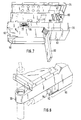
- FIG. 1 and FIG. 8 show a ring-shaped support 30 that is snapped into or otherwise disposed on housing 40, and which admits an electrode (shown in ghost in FIG. 1).
- the diameter of support 30 is approximately equal to that of a standard electrode barrel, such that when an electrode is slidably introduced therein, it will come to rest when its cap meets the top of support 30.
- the electrode will also not exhibit lateral movement if the diameter of support 30 is well-chosen.
- Thumb rest 46 which can be a depression molded into housing 40, further contributes to the user's comfortable grip when handling the apparatus.
- the invention also features a storage compartment 50 having an axial bore 52 of diameter approximately equal to that of a standard electrode barrel.
- the electrode is introduced into bore 52 through aperture 54.
- a removable stopper 56 which, when in place, maintains the electrode in a moist condition.
- bore 52 may be flushed to remove any solidified material that has accumulated therein.
- FIG. 7 illustrates another feature of the invention, namely, a foldable support assembly.
- This assembly comprises a support member 60 that is attached to bottom housing component 70 by means of a hinge.
- the hinge permits support member 60 to rotate from a rest position against bottom housing member, 70 through an arc, until arriving at the extended position depicted in FIG. 7.
- support member 60 fits snugly within a complementary depression in bottom housing member 70.
- Frictional member 62 which may be fabricated of rubber or other suitable material, is disposed at the forward end of bottom housing member 70.
- frictional member 62 helps prevent movement of the device (e.g., as a consequence of the user pressing the keys of keypad 44).
- the apparatus of the present invention is designed to permit rapid and convenient assembly of its component parts. All structural components may be fabricated of injection-molded plastic with interlocking tabs and windows. As shown in the exploded view of FIG. 7, the housing denoted by reference numeral 40 in FIG. 1 actually consists of bottom and top housing components 70 and 75, respectively. Disposed therebetween is a printed circuit board 80, on which is mounted display 42 and the various electronic support circuitry necessary for operation. This support circuitry converts analog signals received from the electrode into digital form, and performs calculations thereon to produce a value for the concentration or pH parameter selected by the user. This value is ultimately converted into driver signals that direct presentation of the value on display 42.
- serial port 77 which preferably comprises an RS-232 connector having mounting tabs and a set of conductive prongs.
- the support circuitry can provide to external devices both the digitized potential value sensed by the electrode and the derived numerical result.
- Serial port 77 is fitted through aperture 79 and the mounting tabs thereof held in place by printed cirucit board 80. Recall that housing members 70 and 75 are held together by interlocking tabs and windows, thereby securing circuit board 80 in a fixed position, which permits circuit board 80 to buttress serial port 77 against the inner wall of bottom housing member 70 without the need for bolts.
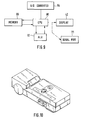
- Serial port 77 can be used, for example, to attach the apparatus of the present invention to an external printer. As shown in FIGS. 10 and 11, such a printer can be designed with dimensions similar to that of the measurement apparatus and equipped with a complementary serial port.
- circuit board 80 The components of circuit board 80 are powered by a battery that fits within a suitably shaped depression within bottom housing member 70. This depression is covered by removable plate 82. Contacts 85, which depend directly from circuit board 80, engage the battery terminals and conduct electricity to circuit board 80. Terminals 85 fit through apertures in the battery depression.
- the apparatus further comprises a novel calculation and calibration module, distributed within a series of components (as will be hereinafter described) situated on circuit board 80, that facilitates precise measurements.
- Eqs. 1 and 2 Although the curve specified by Eqs. 1 and 2 has a characteristic shape, its orientation naturally depends on the value of E 0 .
- the standard method of obtaining a value for E 0 is to immerse the electrode in a solution of known temperature and concentration, and then use Eq. 3 to calculate E 0 .
- the Nernst equation does not always return completely accurate values. It is possible, for example, for internal metering characteristics to cause changes in sensitivity over the range of measured voltages, thereby producing concentration values that deviate from true according to the magnitude of the sensed voltage.
- the present invention permits the user to establish baseline E 0 values for several reference solutions having different known electrochemical potentials.
- the E 0 value derived from a reference potential close to that of a sample's measured potential can be used to calculate its concentration, thereby "fine tuning" the Nernst equation to the sample's potential. More precisely, the curve specified by Eq. 1 or 2 is segmented into regions lying between the known values of- the reference solutions.
- the invention first determines the region within which the measured potential fits. The invention then retrieves the associated E 0 value, and proceeds to calculate the concentration according to Eq. 1 or 2.
- the calculation and calibration module are shown schematically in FIG. 9.
- the module comprises a central-processor unit (CPU) 90 which cooperates with an arithmetic and logic unit (ALU) 92 to receive input and perform calculations.
- CPU 90 receives input information from an analog-to-ditigal (A/D) converter 94, which itself receives analog signals directly from the electrode.
- a memory bank 96 holds the instructions and "scratchpad" registers necessary for CPU 90 and ALU 92 to perform the requisite calculations; it also retains values for the known equivalent ion concentrations and potentials of the reference solutions.
- CPU output is transferred to display 42 and, possibly, to serial port 77.
- the user first establishes E 0 values for the reference solutions by entering the known concentration and voltage values and taking actual voltage measurements. These values are stored in memory 96.
- CPU 90 and ALU 92 perform comparison operations with the values in memory 96 to determine which reference potential exceeds the newly measured value by the least amount.
- the E 0 value associated with this reference potential is used to calculate the concentration of the sample solution according to Eq. 1 or 2.
- Another approach to calibration offered by the present invention assumes that the deviations in E 0 along the Nernst curve are due to a constant noise value associated with the measurement apparatus. This value can then be derived by comparing potential values obtained for a plurality of reference solutions with the known potential values for those solutions. Such an approach is useful where the Nernst curve "bottoms out", i.e., where the voltage response to differences in concentration is too small for ordinary calibration procedures. This procedure has been found particularly useful where the measured differences among three reference solutions do not exceed 10 millivolts.
- E 0 E - k([t+273.15]/298.15)log([C+A]/C iso ) If more than one reference solution is employed, individual derived adjustment values can be averaged, or an intermediate adjustment value that minimizes differences among the E 0 values established using regression techniques.
- A can be derived by immersing the electrode into a distilled water solution and obtaining the measurement registered by the metering apparatus. This deviation from the expected value of zero can be used to calculate A according to Eq. 6.
- this form of calibration uses one or more measurement points to redefine the overall equation, which is then used for calculation at any measured potential.
Landscapes
- Chemical & Material Sciences (AREA)
- Life Sciences & Earth Sciences (AREA)
- Health & Medical Sciences (AREA)
- Physics & Mathematics (AREA)
- Chemical Kinetics & Catalysis (AREA)
- Electrochemistry (AREA)
- Molecular Biology (AREA)
- Analytical Chemistry (AREA)
- Biochemistry (AREA)
- General Health & Medical Sciences (AREA)
- General Physics & Mathematics (AREA)
- Immunology (AREA)
- Pathology (AREA)
- Investigating Or Analyzing Materials By The Use Of Electric Means (AREA)
- Investigating Or Analysing Biological Materials (AREA)
Description
- The invention relates generally to the field of instrumentation for electrochemical measurement, and in particular to an improved meter for determining pH and concentration values for ionic solutions.
- Portable analytical instruments such as pH and concentration meters offer significant convenience to laboratory personnel, who must contend with a wide variety of experimental conditions and types of measurement. Typical metering arrangements include an ion-sensitive electrode that the user immerses in an electrolyte solution of interest, support circuitry, and display means for presenting to the user measurements of selected characteristics associated with ionic species in solution.
- Currently available instrumentation includes meters capable of measuring hydrogen-ion concentration (generally in pH units) of aqueous solutions, absolute ion concentration (generally in units of equivalents/liter), dissolved oxygen concentration (generally in parts per million), and absolute or relative potential (generally in millivolts, and used in potentiometric titrations). Meters may be configured for visual display only, or adapted for interface to portable printers or even standalone computers.
- For example, DE-OS 29 37 227 discloses an electrical pH-measuring device, configured with a display 16, which uses a Positive-Temperature-Coefficient (PTC) resistor 6 in the sampling electrode, and tables of characteristic curve values for respective pH-value ranges, stored in a
ROM 14, to automatically select an appropriate characteristic curve and use that curve in determining the pH value of the sampled solution. - Despite the versatility of such instrumentation, considerable effort on the part of the manufacturer is often required for assembly, and the units are not always convenient to operate. Conventional analytical electrodes consist of immersible glass tubing assemblies connected by wires to the analytical instrument. The electrode is usually first placed into the sample solution, and the meter subsequently positioned for reading. Repetition of this two-step procedure can cause wires to become dislodged in the course of experimental work, or result in electrode breakage if the metering apparatus is suddently moved. Users also often misplace electrodes upon disengagement thereof from the apparatus.
- Conventional packaging for metering instruments is often more expensive than necessary, because designers tend to neglect component interrelationships that can be exploited to facilitate modular assembly. For example, circuit boards, output ports, power supply and display components are often independently bolted into the main housing at various unrelated points, requiring separate installation operations for each.
- A fundamental operational requirement of all electrochemical measurement instruments is user-performed calibration, which readies the meter for each use. Calibration is generally accomplished by sequentially immersing the electrode in each of a group of "reference solutions" of known pH or ionic concentration values and having temperature levels similar to those of the electrolyte solutions that will be measured. The current flows sensed by the meter as the electrode is introduced into each reference solutions are used as data points to orient a calibration curve that relates current flow to pH or concentration. This curve, based on the well-known Nernst equation, has a known, characteristic shape. With the dimensions and location of the calibration curve established by the reference measurements, values for pH or concentration can be obtained from the observed current flows obtained by immersing the electrode in solutions of interest.
- One limitation associated with many known calibration systems is the narrow range of values along the curve that may be used as data points for curve orientation. The narrower the range of reference values, the less reliable will be the resulting calibration curve due to ambiguities in its orientation. A second limitation relates to noise associated with the meter circuitry itself which, if not accounted for during calibration, can jeopardize the validity of measurements.
- Accordingly, it is an object of the invention to provide an electrochemical metering apparatus that offers a high degree of operational convenience.
- Another object of the invention is to provide an electrochemical metering apparatus that requires minimal assembly time.
- A further object of the invention is to provide an electrochemical metering apparatus that facilitates highly accurate calibrations.
- The present invention comprises an electrochemical metering apparatus (according to claim 1) that provides for convenient storage and presentation of the analytical electrode, simple assembly, and two calibration modes.
- The electrode storage and presentation assembly of the present invention comprises a ring-shaped support disposed on the main housing, which permits the user to introduce the electrode into a sample solution while simultaneously observing the meter's output. When not in use, the electrode may be conveniently stored in a compartment integral with the housing. The invention may also comprise a foldable support assembly that facilitates angular orientation of the main housing.
- The component parts of the invention are designed in a modular form for ease of assembly. All structural components are intended to fit together with interlocking tabs and windows. A serial port fits within the construction of the main housing without the need for bolts, and battery clips that depend directly from the circuit board obviate the need for wiring connections.
- The present invention features two calibration modes. A "segment addition" mode permits separation of the voltage/concentration curve into individually plotted regions, the number of which depends on the number of reference solutions used in the calibration procedure. The segment corresponding most closely to the measured potential of a sample solution is used to calculate concentration.
- In an alternative calibration mode, a plurality of reference solutions are used to establish metered voltage/concentration combinations that are compared with expected, known values. Any discrepancies therebetween furnish a "noise level" value associated with the apparatus that can be used to more precisely define the orientation of the voltage/concentration curve.
- The foregoing discussion will be understood more readily from the following detailed description of the invention, when taken in conjunction with the accompanying drawings, in which:
- FIG. 1 is an isometric view of the present invention in assembled form;
- FIG. 2 is an elevational view of the present invention in assembled form, taken from the left side;
- FIG. 3 is a bottom view of the present invention in assembled form;
- FIG. 4 is an elevational view of the present invention in assembled form, taken from the right side;
- FIG. 5 is an elevational view of the present invention in assembled form, taken from the front;
- FIG. 6 is an elevational view of the present invention in assembled form, taken from the rear;
- FIG. 7 is an exploded view of the various components of the present invention;
- FIG. 8 is a detail of the electrode storage and presentation assembly;
- FIG. 9 is a schematic representation of the various components of the calculation and calibration module;
- FIG. 10 is a perspective view of a printing device suitable for use in conjunction with the present invention;
- FIG. 11 is a plan view of the present invention in combination with the printer shown in FIG. 10.
- FIGS. 1-8 illustrate the novel mechanical features of the present invention. As shown in FIG. 1, the basic device is an electrochemical metering apparatus that comprises a
housing 40,display 42 andkeypad 44. Contained within housing 40 (and not shown) is suitable support circuitry, some of which will be described in greater detail hereinbelow, for converting potential differences detected by an electrode into concentration or pH units based on the well-known Nernst equation. The keys ofkeypad 44 permit the user to select various different modes of operation, as are standard in the art. - Refer now to FIG. 1 and FIG. 8, which show a ring-
shaped support 30 that is snapped into or otherwise disposed onhousing 40, and which admits an electrode (shown in ghost in FIG. 1). The diameter ofsupport 30 is approximately equal to that of a standard electrode barrel, such that when an electrode is slidably introduced therein, it will come to rest when its cap meets the top ofsupport 30. The electrode will also not exhibit lateral movement if the diameter ofsupport 30 is well-chosen. This configuration permits convenient presentation of the electrode to a container of electrolyte solution during the metering operation, and allows the user to retain, in one hand, both the instrument and the electrode as a single unit.Thumb rest 46, which can be a depression molded intohousing 40, further contributes to the user's comfortable grip when handling the apparatus. - To facilitate convenient storage of the electrode when not in use, the invention also features a
storage compartment 50 having anaxial bore 52 of diameter approximately equal to that of a standard electrode barrel. The electrode is introduced intobore 52 throughaperture 54. At the opposite ofstorage compartment 50 is aremovable stopper 56 which, when in place, maintains the electrode in a moist condition. Whenstopper 56 is disengaged fromstorage compartment 50, bore 52 may be flushed to remove any solidified material that has accumulated therein. - FIG. 7 illustrates another feature of the invention, namely, a foldable support assembly. This assembly comprises a
support member 60 that is attached tobottom housing component 70 by means of a hinge. The hinge permitssupport member 60 to rotate from a rest position against bottom housing member, 70 through an arc, until arriving at the extended position depicted in FIG. 7. When in the rest position,support member 60 fits snugly within a complementary depression inbottom housing member 70.Frictional member 62, which may be fabricated of rubber or other suitable material, is disposed at the forward end ofbottom housing member 70. Whensupport member 60 is extended and the device rested on a flat surface,frictional member 62 helps prevent movement of the device (e.g., as a consequence of the user pressing the keys of keypad 44). - The apparatus of the present invention is designed to permit rapid and convenient assembly of its component parts. All structural components may be fabricated of injection-molded plastic with interlocking tabs and windows. As shown in the exploded view of FIG. 7, the housing denoted by
reference numeral 40 in FIG. 1 actually consists of bottom andtop housing components circuit board 80, on which is mounteddisplay 42 and the various electronic support circuitry necessary for operation. This support circuitry converts analog signals received from the electrode into digital form, and performs calculations thereon to produce a value for the concentration or pH parameter selected by the user. This value is ultimately converted into driver signals that direct presentation of the value ondisplay 42. - The value may also be communicated to external devices through
serial port 77, which preferably comprises an RS-232 connector having mounting tabs and a set of conductive prongs. Using the standard RS-232 protocol, the support circuitry can provide to external devices both the digitized potential value sensed by the electrode and the derived numerical result.Serial port 77 is fitted throughaperture 79 and the mounting tabs thereof held in place by printedcirucit board 80. Recall thathousing members circuit board 80 in a fixed position, which permitscircuit board 80 to buttressserial port 77 against the inner wall ofbottom housing member 70 without the need for bolts. -
Serial port 77 can be used, for example, to attach the apparatus of the present invention to an external printer. As shown in FIGS. 10 and 11, such a printer can be designed with dimensions similar to that of the measurement apparatus and equipped with a complementary serial port. - The components of
circuit board 80 are powered by a battery that fits within a suitably shaped depression withinbottom housing member 70. This depression is covered byremovable plate 82.Contacts 85, which depend directly fromcircuit board 80, engage the battery terminals and conduct electricity tocircuit board 80.Terminals 85 fit through apertures in the battery depression. - The apparatus further comprises a novel calculation and calibration module, distributed within a series of components (as will be hereinafter described) situated on
circuit board 80, that facilitates precise measurements. Electrochemical measurements are typically performed according to the Nernst equation which, in its base-10 logarithmic form, is as follows:
- Eq. 1 can be rewritten to accomodate measurements in degrees Centrigade as follows:


- Although the curve specified by Eqs. 1 and 2 has a characteristic shape, its orientation naturally depends on the value of E0. The standard method of obtaining a value for E0 is to immerse the electrode in a solution of known temperature and concentration, and then use Eq. 3 to calculate E0. Unfortunately, due to the imprecision of electrochemical measuring devices, the Nernst equation does not always return completely accurate values. It is possible, for example, for internal metering characteristics to cause changes in sensitivity over the range of measured voltages, thereby producing concentration values that deviate from true according to the magnitude of the sensed voltage.
- In order to enhance the accuracy of measurements, the present invention permits the user to establish baseline E0 values for several reference solutions having different known electrochemical potentials. The E0 value derived from a reference potential close to that of a sample's measured potential can be used to calculate its concentration, thereby "fine tuning" the Nernst equation to the sample's potential. More precisely, the curve specified by Eq. 1 or 2 is segmented into regions lying between the known values of- the reference solutions. When the user introduces the electrode into a solution of unknown concentration, the invention first determines the region within which the measured potential fits. The invention then retrieves the associated E0 value, and proceeds to calculate the concentration according to Eq. 1 or 2.
- The value of E0 between points is calculated according to the following equations:


- The calculation and calibration module are shown schematically in FIG. 9. The module comprises a central-processor unit (CPU) 90 which cooperates with an arithmetic and logic unit (ALU) 92 to receive input and perform calculations.
CPU 90 receives input information from an analog-to-ditigal (A/D)converter 94, which itself receives analog signals directly from the electrode. Amemory bank 96 holds the instructions and "scratchpad" registers necessary forCPU 90 andALU 92 to perform the requisite calculations; it also retains values for the known equivalent ion concentrations and potentials of the reference solutions. After calculations have been performed, CPU output is transferred to display 42 and, possibly, toserial port 77. - Accordingly, the user first establishes E0 values for the reference solutions by entering the known concentration and voltage values and taking actual voltage measurements. These values are stored in
memory 96. When the electrode is immersed in a solution of unknown concentration,CPU 90 andALU 92 perform comparison operations with the values inmemory 96 to determine which reference potential exceeds the newly measured value by the least amount. The E0 value associated with this reference potential is used to calculate the concentration of the sample solution according to Eq. 1 or 2. - Another approach to calibration offered by the present invention assumes that the deviations in E0 along the Nernst curve are due to a constant noise value associated with the measurement apparatus. This value can then be derived by comparing potential values obtained for a plurality of reference solutions with the known potential values for those solutions. Such an approach is useful where the Nernst curve "bottoms out", i.e., where the voltage response to differences in concentration is too small for ordinary calibration procedures. This procedure has been found particularly useful where the measured differences among three reference solutions do not exceed 10 millivolts.
- Thus, modifying Eq. 3 to account for the adjustment parameter (denoted as A),

- Alternatively, A can be derived by immersing the electrode into a distilled water solution and obtaining the measurement registered by the metering apparatus. This deviation from the expected value of zero can be used to calculate A according to Eq. 6.
- Thus, instead of segmenting the Nernst curve into regions, this form of calibration uses one or more measurement points to redefine the overall equation, which is then used for calculation at any measured potential.
- The terms and expressions which have been employed are used as terms of description and not of limitation, and there is no intention, in the use of such terms and expressions, of excluding any equivalents of the features shown and described or portions thereof, but it is recognized that various modifications are possible within the scope of the invention claimed.
Claims (9)
- An electrochemical metering apparatus for measuring the equivalent ion concentration of a sample solution, havingmemory means (96) for storing values of a plurality of known equivalent ion concentrations and measured potential differences at such concentrations;an electrode means that responds to a potential difference representative of the concentration of ionic species in solution;an analogue/digital converter (94) for converting analogue values measured by the electrode means into digital values; processor means (90) connected to the memory means (96) for calculating the equivalent ion concentration in the sample solution, based on the value measured by the sampling electrode;means (42; 77) for outputting the value of the calculated equivalent ion concentration; andinput means (44) for receiving electrode signals representative of the potential difference of a sample solution and transferring the signals to the processor meanscharacterised in that
the processor means (90) is further adapted for calculating the equivalent ion concentration of the sample solution based on a baseline potential that is calculated from:(i) the stored measured potential difference that least exceeds the potential difference of the sample solution measured by the electrode means, and(ii) its stored related equivalent ion concentration. - The apparatus of claim 1, wherein the outputting means includes a serial port (77) furnishing a digital concentration value signal.
- The apparatus of claim 2, wherein the serial port (77) is adapted for connection to a printer (5).
- The apparatus of claim 1, wherein the outputting means includes a digital display (42).
- The apparatus of claim 1, wherein the apparatus includes a housing (40; 70, 75) and an electrode support (30) fixed to the housing and serving to hold an electrode in a fixed alignment with respect to the housing during each sampling operation.
- The apparatus of claim 1, wherein the apparatus includes a housing (40; 70, 75) and an integrally formed grip means (46) on the housing which facilitates single-handed operation of the apparatus.
- The apparatus of claim 1, wherein the apparatus includes a housing (40; 70, 75), a hinge (60) pivotably attached to the housing, and frictional means (62) discouraging movement of the housing while the foldable support is pivoted away from the housing.
- The apparatus of claim 1, wherein the apparatus includes a housing (40; 70, 75), and a circuit board (80) mounted in the housing and bearing elongated conductive strips (85) for engaging terminals of a battery retained in position by a removable portion (82) of the housing.
- The apparatus of claim 1, wherein the processor means (90) calculates, according to the Nernst equation, a baseline potential for each of the plurality of known equivalent ion concentrations stored in the memory means (96),computes differences among the respective baseline potentials for different reference solutions,calculates a concentration correction value which, when added to the known equivalent ion concentrations to produce adjusted ion concentrations, minimizes differences among the baseline potentials associated with the adjusted ion concentrations, andcalculates, and stores in the memory means (96), new values for the baseline potentials, based on the adjusted ion concentrations.
Applications Claiming Priority (2)
| Application Number | Priority Date | Filing Date | Title |
|---|---|---|---|
| US521731 | 1990-05-10 | ||
| US07/521,731 US5108578A (en) | 1990-05-10 | 1990-05-10 | Ph and concentration meter |
Publications (3)
| Publication Number | Publication Date |
|---|---|
| EP0456154A2 EP0456154A2 (en) | 1991-11-13 |
| EP0456154A3 EP0456154A3 (en) | 1992-01-08 |
| EP0456154B1 true EP0456154B1 (en) | 1997-12-10 |
Family
ID=24077906
Family Applications (1)
| Application Number | Title | Priority Date | Filing Date |
|---|---|---|---|
| EP91107309A Expired - Lifetime EP0456154B1 (en) | 1990-05-10 | 1991-05-06 | Improved pH and concentration meter |
Country Status (4)
| Country | Link |
|---|---|
| US (1) | US5108578A (en) |
| EP (1) | EP0456154B1 (en) |
| JP (1) | JPH05126781A (en) |
| DE (1) | DE69128373T2 (en) |
Cited By (1)
| Publication number | Priority date | Publication date | Assignee | Title |
|---|---|---|---|---|
| WO2010142282A1 (en) | 2009-06-08 | 2010-12-16 | Udo Braatz | Method and arrangement for determining liquid parameters |
Families Citing this family (7)
| Publication number | Priority date | Publication date | Assignee | Title |
|---|---|---|---|---|
| US5804971A (en) * | 1996-03-01 | 1998-09-08 | Nomadics, Inc. | Modular card based meter |
| US6836332B2 (en) * | 2001-09-25 | 2004-12-28 | Tennessee Scientific, Inc. | Instrument and method for testing fluid characteristics |
| DE102010001228A1 (en) | 2010-01-26 | 2011-02-17 | Basf Se | Separating acrylic acid from a product gas mixture of heterogeneously catalyzed partial gas phase oxidation of a precursor compound to acrylic acid comprises cooling product gas mixture and adding cooled mixture into absorption column |
| WO2011000808A2 (en) | 2009-07-01 | 2011-01-06 | Basf Se | Method for separating acrylic acid from the product gas mixture of a heterogeneously catalyzed partial gas phase oxidation of at least one c3-precursor compound |
| DE102009027401A1 (en) | 2009-07-01 | 2010-02-18 | Basf Se | Separating acrylic acid comprises cooling product gas mixture of partial gas phase oxidation of three carbon precursor compound in cooler and providing cooled product gas mixture with (non)evaporated cooling liquid into absorption column |
| US9851337B2 (en) * | 2013-12-06 | 2017-12-26 | The University Of Akron | Universal water condition monitoring device |
| CN108137465B (en) | 2015-08-07 | 2021-06-01 | 巴斯夫欧洲公司 | Method for preparing acrylic acid |
Family Cites Families (9)
| Publication number | Priority date | Publication date | Assignee | Title |
|---|---|---|---|---|
| DE7906843U1 (en) * | 1979-11-08 | Dipl.-Ing. Ulrich Knick Elektronische Messgeraete, 1000 Berlin | Measuring device | |
| DE8216206U1 (en) * | 1982-10-14 | Dipl.Ing. Ulrich Knick Elektronische Meßgeräte GmbH & Co, 1000 Berlin | Quivers for measuring probes, in particular pH measuring electrodes | |
| US3902982A (en) * | 1973-03-31 | 1975-09-02 | New Cosmos Electric Co | Apparatus for measuring residual chlorine |
| US4090925A (en) * | 1976-08-09 | 1978-05-23 | J & M Instruments Corp. | PH measuring instrument and method |
| US4225410A (en) * | 1978-12-04 | 1980-09-30 | Technicon Instruments Corporation | Integrated array of electrochemical sensors |
| DE2937227C2 (en) * | 1979-09-14 | 1982-09-23 | Dipl.Ing. Ulrich Knick Elektronische Meßgeräte GmbH & Co, 1000 Berlin | Method for calibrating an electrometric pH measuring device and a device for carrying out the method |
| US4618929A (en) * | 1983-05-04 | 1986-10-21 | Akron City Hospital | Portable circuit and method for performing a time study and analysis of bodily ionic characteristics |
| AT395482B (en) * | 1987-08-20 | 1993-01-25 | Avl Verbrennungskraft Messtech | METHOD FOR DETERMINING A PHYSICAL OR CHEMICAL MEASURING SIZE |
| US4912417A (en) * | 1989-02-21 | 1990-03-27 | Fisher Scientific Company | Measurement of pH and specific ion concentration |
-
1990
- 1990-05-10 US US07/521,731 patent/US5108578A/en not_active Expired - Fee Related
-
1991
- 1991-05-06 EP EP91107309A patent/EP0456154B1/en not_active Expired - Lifetime
- 1991-05-06 DE DE69128373T patent/DE69128373T2/en not_active Expired - Fee Related
- 1991-05-09 JP JP3104492A patent/JPH05126781A/en active Pending
Cited By (1)
| Publication number | Priority date | Publication date | Assignee | Title |
|---|---|---|---|---|
| WO2010142282A1 (en) | 2009-06-08 | 2010-12-16 | Udo Braatz | Method and arrangement for determining liquid parameters |
Also Published As
| Publication number | Publication date |
|---|---|
| JPH05126781A (en) | 1993-05-21 |
| EP0456154A2 (en) | 1991-11-13 |
| DE69128373T2 (en) | 1998-06-18 |
| US5108578A (en) | 1992-04-28 |
| EP0456154A3 (en) | 1992-01-08 |
| DE69128373D1 (en) | 1998-01-22 |
Similar Documents
| Publication | Publication Date | Title |
|---|---|---|
| US5198093A (en) | pH and concentration meter | |
| Maas et al. | Ion-selective electrodes for sodium and potassium: a new problem of what is measured and what should be reported. | |
| US7372277B2 (en) | Method and apparatus for providing stable voltage to analytical system | |
| US4946562A (en) | Apparatus and methods for sensing fluid components | |
| EP0300027B1 (en) | Apparatus and methods for sensing fluid components | |
| USRE30007E (en) | Hematocrit measurements by electrical conductivity | |
| US20140048425A1 (en) | Method and apparatus for Assay of Electrochemical Properties | |
| KR100980316B1 (en) | Strip having thermal compensating function and method for measuring blood sugar using it | |
| CA2412204A1 (en) | Determination of sample volume adequacy in biosensor devices | |
| EP0840122A3 (en) | Method and apparatus for calibrating a sensor element | |
| CA2521370A1 (en) | Biosensor system | |
| WO1992008963A1 (en) | Automatic fluid sampling and monitoring apparatus and method | |
| EP0153830A1 (en) | Engine air/fuel ratio sensing device | |
| EP0152293A2 (en) | Engine air/fuel ratio sensing device | |
| CA2010018A1 (en) | Measurement of ph and specific ion concentration | |
| US5108578A (en) | Ph and concentration meter | |
| US4461998A (en) | Ion selective measurements | |
| US4452672A (en) | Process and apparatus for polarographic determination of oxygen and carbon dioxide | |
| Van Den Berg et al. | Determination of alkalinities of estuarine waters by a two-point potentiometric titration | |
| US7110887B2 (en) | Residual chlorine meter | |
| EP0579632A1 (en) | Electrode calibration | |
| JP2557794B2 (en) | Ion concentration measuring device | |
| EP0350116A2 (en) | Electrochemical cell for measuring ionic activity in a solution and its method of use | |
| EP4239328A1 (en) | Testing implement and measuring device | |
| JPS62240848A (en) | Humor component assaymeter |
Legal Events
| Date | Code | Title | Description |
|---|---|---|---|
| PUAI | Public reference made under article 153(3) epc to a published international application that has entered the european phase |
Free format text: ORIGINAL CODE: 0009012 |
|
| AK | Designated contracting states |
Kind code of ref document: A2 Designated state(s): CH DE DK FR GB LI |
|
| PUAL | Search report despatched |
Free format text: ORIGINAL CODE: 0009013 |
|
| AK | Designated contracting states |
Kind code of ref document: A3 Designated state(s): CH DE DK FR GB LI |
|
| 17P | Request for examination filed |
Effective date: 19920703 |
|
| 17Q | First examination report despatched |
Effective date: 19941102 |
|
| GRAG | Despatch of communication of intention to grant |
Free format text: ORIGINAL CODE: EPIDOS AGRA |
|
| GRAG | Despatch of communication of intention to grant |
Free format text: ORIGINAL CODE: EPIDOS AGRA |
|
| GRAH | Despatch of communication of intention to grant a patent |
Free format text: ORIGINAL CODE: EPIDOS IGRA |
|
| GRAH | Despatch of communication of intention to grant a patent |
Free format text: ORIGINAL CODE: EPIDOS IGRA |
|
| GRAA | (expected) grant |
Free format text: ORIGINAL CODE: 0009210 |
|
| AK | Designated contracting states |
Kind code of ref document: B1 Designated state(s): CH DE DK FR GB LI |
|
| PG25 | Lapsed in a contracting state [announced via postgrant information from national office to epo] |
Ref country code: LI Free format text: LAPSE BECAUSE OF FAILURE TO SUBMIT A TRANSLATION OF THE DESCRIPTION OR TO PAY THE FEE WITHIN THE PRESCRIBED TIME-LIMIT Effective date: 19971210 Ref country code: DK Free format text: LAPSE BECAUSE OF NON-PAYMENT OF DUE FEES Effective date: 19971210 Ref country code: CH Free format text: LAPSE BECAUSE OF FAILURE TO SUBMIT A TRANSLATION OF THE DESCRIPTION OR TO PAY THE FEE WITHIN THE PRESCRIBED TIME-LIMIT Effective date: 19971210 |
|
| REG | Reference to a national code |
Ref country code: CH Ref legal event code: EP |
|
| REF | Corresponds to: |
Ref document number: 69128373 Country of ref document: DE Date of ref document: 19980122 |
|
| ET | Fr: translation filed | ||
| REG | Reference to a national code |
Ref country code: CH Ref legal event code: PL |
|
| PLBE | No opposition filed within time limit |
Free format text: ORIGINAL CODE: 0009261 |
|
| STAA | Information on the status of an ep patent application or granted ep patent |
Free format text: STATUS: NO OPPOSITION FILED WITHIN TIME LIMIT |
|
| 26N | No opposition filed | ||
| PGFP | Annual fee paid to national office [announced via postgrant information from national office to epo] |
Ref country code: FR Payment date: 20000517 Year of fee payment: 10 |
|
| PGFP | Annual fee paid to national office [announced via postgrant information from national office to epo] |
Ref country code: GB Payment date: 20010518 Year of fee payment: 11 |
|
| PGFP | Annual fee paid to national office [announced via postgrant information from national office to epo] |
Ref country code: DE Payment date: 20010727 Year of fee payment: 11 |
|
| REG | Reference to a national code |
Ref country code: GB Ref legal event code: IF02 |
|
| PG25 | Lapsed in a contracting state [announced via postgrant information from national office to epo] |
Ref country code: GB Free format text: LAPSE BECAUSE OF NON-PAYMENT OF DUE FEES Effective date: 20020506 |
|
| PG25 | Lapsed in a contracting state [announced via postgrant information from national office to epo] |
Ref country code: DE Free format text: LAPSE BECAUSE OF NON-PAYMENT OF DUE FEES Effective date: 20021203 |
|
| GBPC | Gb: european patent ceased through non-payment of renewal fee |
Effective date: 20020506 |
|
| PG25 | Lapsed in a contracting state [announced via postgrant information from national office to epo] |
Ref country code: FR Free format text: LAPSE BECAUSE OF NON-PAYMENT OF DUE FEES Effective date: 20030131 |
|
| REG | Reference to a national code |
Ref country code: FR Ref legal event code: ST |
|
| PG25 | Lapsed in a contracting state [announced via postgrant information from national office to epo] |
Ref country code: FR Free format text: LAPSE BECAUSE OF NON-PAYMENT OF DUE FEES Effective date: 20010531 |