EP0454869B1 - Electrostatic information recording medium and electrostatic information recording/reproducing method - Google Patents
Electrostatic information recording medium and electrostatic information recording/reproducing method Download PDFInfo
- Publication number
- EP0454869B1 EP0454869B1 EP90916816A EP90916816A EP0454869B1 EP 0454869 B1 EP0454869 B1 EP 0454869B1 EP 90916816 A EP90916816 A EP 90916816A EP 90916816 A EP90916816 A EP 90916816A EP 0454869 B1 EP0454869 B1 EP 0454869B1
- Authority
- EP
- European Patent Office
- Prior art keywords
- recording medium
- layer
- information
- electrostatic information
- glass transition
- Prior art date
- Legal status (The legal status is an assumption and is not a legal conclusion. Google has not performed a legal analysis and makes no representation as to the accuracy of the status listed.)
- Expired - Lifetime
Links
Images

Classifications
-
- G—PHYSICS
- G11—INFORMATION STORAGE
- G11B—INFORMATION STORAGE BASED ON RELATIVE MOVEMENT BETWEEN RECORD CARRIER AND TRANSDUCER
- G11B9/00—Recording or reproducing using a method not covered by one of the main groups G11B3/00 - G11B7/00; Record carriers therefor
- G11B9/08—Recording or reproducing using a method not covered by one of the main groups G11B3/00 - G11B7/00; Record carriers therefor using electrostatic charge injection; Record carriers therefor
-
- G—PHYSICS
- G03—PHOTOGRAPHY; CINEMATOGRAPHY; ANALOGOUS TECHNIQUES USING WAVES OTHER THAN OPTICAL WAVES; ELECTROGRAPHY; HOLOGRAPHY
- G03G—ELECTROGRAPHY; ELECTROPHOTOGRAPHY; MAGNETOGRAPHY
- G03G15/00—Apparatus for electrographic processes using a charge pattern
- G03G15/04—Apparatus for electrographic processes using a charge pattern for exposing, i.e. imagewise exposure by optically projecting the original image on a photoconductive recording material
- G03G15/04036—Details of illuminating systems, e.g. lamps, reflectors
- G03G15/04045—Details of illuminating systems, e.g. lamps, reflectors for exposing image information provided otherwise than by directly projecting the original image onto the photoconductive recording material, e.g. digital copiers
- G03G15/04072—Details of illuminating systems, e.g. lamps, reflectors for exposing image information provided otherwise than by directly projecting the original image onto the photoconductive recording material, e.g. digital copiers by laser
-
- G—PHYSICS
- G03—PHOTOGRAPHY; CINEMATOGRAPHY; ANALOGOUS TECHNIQUES USING WAVES OTHER THAN OPTICAL WAVES; ELECTROGRAPHY; HOLOGRAPHY
- G03G—ELECTROGRAPHY; ELECTROPHOTOGRAPHY; MAGNETOGRAPHY
- G03G15/00—Apparatus for electrographic processes using a charge pattern
- G03G15/22—Apparatus for electrographic processes using a charge pattern involving the combination of more than one step according to groups G03G13/02 - G03G13/20
- G03G15/221—Machines other than electrographic copiers, e.g. electrophotographic cameras, electrostatic typewriters
-
- G—PHYSICS
- G03—PHOTOGRAPHY; CINEMATOGRAPHY; ANALOGOUS TECHNIQUES USING WAVES OTHER THAN OPTICAL WAVES; ELECTROGRAPHY; HOLOGRAPHY
- G03G—ELECTROGRAPHY; ELECTROPHOTOGRAPHY; MAGNETOGRAPHY
- G03G5/00—Recording-members for original recording by exposure, e.g. to light, to heat or to electrons; Manufacture thereof; Selection of materials therefor
- G03G5/02—Charge-receiving layers
-
- G—PHYSICS
- G11—INFORMATION STORAGE
- G11B—INFORMATION STORAGE BASED ON RELATIVE MOVEMENT BETWEEN RECORD CARRIER AND TRANSDUCER
- G11B11/00—Recording on or reproducing from the same record carrier wherein for these two operations the methods are covered by different main groups of groups G11B3/00 - G11B7/00 or by different subgroups of group G11B9/00; Record carriers therefor
- G11B11/08—Recording on or reproducing from the same record carrier wherein for these two operations the methods are covered by different main groups of groups G11B3/00 - G11B7/00 or by different subgroups of group G11B9/00; Record carriers therefor using recording by electric charge or by variation of electric resistance or capacitance
Definitions
- the present invention relates to an electrostatic information-recording medium which can electrostatically record information by an exposure process with the application of voltage or other processes and reproduce the information at any desired time. More particularly, this invention is directed to an electrostatic information-recording medium which is improved in terms of the capability to carry electrostatic information and a process for recording and reproducing the electrostatic information.
- This invention has for its object to improve the capability of an electrostatic information recording medium to carry electrostatic information, and seeks to provide an electrostatic information-recording medium improved in terms of the capability to carry electrostatic information and a process for recording and reproducing electrostatic information with such a recording medium.
- an electrostatic information-recording medium including an electrode layer and a charge-retaining layer, characterized in that said charge-retaining layer comprises a laminate of a resin layer having a low glass transition temperature with a heat-resistant, insulating layer.
- a process for recording and reproducing electrostatic information according to this aspect of this invention is characterized by using an electrostatic information-recording medium as such, said recording medium including an electrode layer and a charge-retaining layer, said charge-retaining layer comprising a laminate of a resin layer having a low glass transition temperature with a heat-resistant, insulating layer, and
- a process for recording and reproducing electrostatic information with the electrostatic information-recording medium comprises the steps of locating a photosensitive member including a photosensitive layer on at least an electrode layer in opposite relation to the said recording medium, and
- a high-molecular or polymer material has its own glass transition temperature. At a region lower than the glass transition point, one segment of its molecular chain is considered not to move as a whole due to its limited heat energy. At a region higher than the glass transition point, its heat energy considered to be so increased that several or more atoms forming its molecular chain can move as a whole, imparting electrical conductivity to it.
- the first electrostatic information-recording medium is of the structure in which a resin layer having a low glass transition temperature and a heat-resistant, insulating layer are laminated on an electrode. After charge informations are recorded on the surface of the recording medium, it is heated at a temperature higher than the glass transition temperature of the resin having a low glass transition temperature, whereby the charge informations are allowed to migrate through the resin layer having a low glass transition temperature, so that the charge informations can be stabilized in the recording medium.
- the heat-resistant resin layer is required to be formed of a material capable of blocking charges at the heating temperature or temperatures at which the electrostatic information-recording medium is usually used. With the recording medium cooled, the charge information thus attracted into the recording medium are protected in the resin layer having a low glass transition temperature, which has resumed its insulating properties, and accumulated stably therein. Thus, it is presumed that they are not affected by atmospheric moisture, etc.
- This electrostatic information-recording medium can retain electrostatic information stably, even when allowed to stand in the absence of heat.
- the accumulated electrostatic information can be instantaneously stabilized by heating the recording medium forcedly. It is noted that when the electrostatic information is gradually stabilized by allowing it to stand in the absence of heat, there is a fear that the accumulated charges may fall into disarray. However, such a fear can be eliminated by forced heating.
- the accumulated charges can also be retained in a stabilized state by cooling after heating.
- the electrostatic information retained in this electrostatic information-recording medium are very stable because of being accumulated in the charge-retaining layer, and can be easily reproduced in the form of information of high quality and high resolution because a potential difference between the electrode and the surface potential can be easily detected.
- the charge-retaining layer is a laminate of a fluoropolymer layer and a pentafluorostyrene polymer layer having a weight-average molecular weight of 10,000 to 2,000,000 (this polymer layer will be hereinafter simply referred to as the pentafluorostyrene polymer layer).
- the process for recording and reproducing electrostatic information with this embodiment of the electrostatic information-recording medium comprises the steps of: locating a photosensitive member including a photoconductive layer on at least an electrode layer in opposite and contact or non-contact relation to said electrostatic information-recording medium obtained by the successive lamination of a fluoropolymer layer and a pentafluorostyrene polymer layer having a weight-average molecular weight of 10,000 to 2,000,000 on at least one electrode layer, and forming an electrostatic charge pattern on said recording medium by exposing said recording medium to light with the application of voltage between both the electrodes or applying voltage between both the electrodes while said recording medium is exposed to light.
- the charge-retaining layer of the electrostatic information-recording medium is formed by the lamination of a fluoropolymer layer and a pentafluorostyrene polymer layer on at least an electrode layer, it is possible to obtain an electrostatic information-recording medium which is improved in terms of the capability to retain charges, esp., in terms of the capability to retain positive, charge information charges.
- High heat- and humidity-resistance that the fluoropolymer layer per se possesses also makes it possible to improve this recording medium further.
- some fluoropolymer layers are less capable of retaining positive, charge information and the pentafluorostyrene layer per se is less capable of carrying charges as well.
- the capability of the recording medium to retain charges can be increased by laminating together the fluoropolymer and pentafluorostyrene polymer layers to form a charge-retaining layer.
- the pentafluorostyrene polymer layer has the pysical properties of being improved in terms of the capability to retain charges when heated at an elevated temperature. It is presumed that such physical properties play some role in the capability of the laminate to retain charges.
- the process for recording and reproducing electrostatic information where an electrostatic latent image corresponding to an exposure pattern is formed on said electrostatic information-recording medium by locating it in opposite relation to a photosensitive member and exposing it to light with the application of voltage between both the electrodes or applying voltage between both the electrodes while it is exposed to light - can be used for planar analog recording.
- the electrostatic information carried in the recording medium is accumulated in electrostatic charge unit, it is possible to record the information with high quality and resolution.
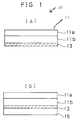
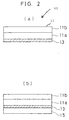
- Figs. 1 and 2 are each a sectional sketch of the electrostatic information-recording medium according to this invention.
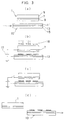
- Fig. 3 is a diagrammatic sketch for illustrating the process for recording and reproducing electrostatic information.
- Fig. 4 is a diagrammatic sketch illustrating the stabilization of electrostatic information in the electrostatic information-recording medium.
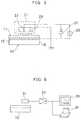
- Fig. 5 is a diagrammatic sketch showing an example of a D.C. amplification type of potential reading system.
- Fig. 6 is a diagrammatic sketch of how to record and reproduce electrostatic information.
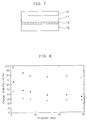
- Fig. 7 is a sectional sketch of the alternative embodimnent of the electrostatic information-recording medium.
- Fig. 8 is a graphic view for illustrating the capability of an electrostatic information-recording medium, prepared in Example 2, to carry charges.
- reference numeral 10 stands for an electrostatic information-recording medium, 11 a charge-retaining layer, 11 a a resin layer having a low glass transition temperature, 11 b a heat-resistant, insulating layer, 13 an electrode and 15 a support.
- the electrostatic information-recording medium of this invention is of the structure wherein the electrode 13 is laminated thereon with the heat-resistant resin layer 11 b and the resin layer 11 a having a low glass transition temperature in that order, as shown in Fig. la, and the second embodiment is of the structure wherein the electrode 13 is laminated thereon with the resin layer 11 a having a low glass transition temperature and the heat-resistant, insulating layer 11 b in that order, as illustrated in Fig. 2 a .
- the resin - which forms the resin layer having a low glass transition temperature in this charge-retaining layer - is required to have an insulating property of 10 14 ⁇ cm or more as expressed in terms of specific resistance at a temperature lower than that glass transition temperature.
- a resin is generally known to vary in its physical properties due to a change in the motion of its molecular chains. Even when the resin is used as a material which forms a charge-retaining layer, however, the insulating property drops at temperatures higher than the glass transition temperature, so that even when charges are accumulated on it, they leak out immediately. For that reason, it is desired to use a class of resin having a glass transition temperature of 20°C or higher in ordinary environment in which it is used.
- the resins having a low glass transition temperature may include such thermoplastic resins as polyethylene, ethylene-vinyl acetate copolymers, ethylene/ethyl acrylate-ethylene/methyl acrylate copolymers, polypropylene, polybutylene, methylpentene resin, polystyrene, poly-para-xylenes, polyvinyl acetate, polyacrylate, polymethacrylate, vinyl chloride resin, polyvinylidene chloride resin, fluoropolymers, polyacrylonitrile, polyvinyl ether, polyvinyl ketone, polyether, polycarbonate, thermoplastic polyester, polyamide, diene plastics, polyurethane plastics, petroleum resin, rosin derivatives and terpene resin; such polymers as aromatic polyamide, polyphenylene, polyxylylene, polyphenylene oxide, polysulfone and aromatic heterocyclic polymers; silicone resin and inorganic types of plastics; and naturally occurring rubber, cellulose, protein
- These resins may be formed into layers as by coating or dipping of a solution of them in a suitable solvent.
- electrostatic information on the electrostatic information-recording medium it is accumulated while migrating apparently through the resin layer under the action of an electric field.
- this layer has a relation to the capability of the accumulated charges to be retained and makes a difference in the potential of the accumulated charges retained depending upon the type and thickness of resin.
- thermosetting resins as phenolic resin, furan resin, xylene-formaldehyde resin, ketone-formaldehyde resin, urea resin, melamine resin, aniline resin, alkyd resin, unsaturated polyester resin, epoxy resin, triacyl isocyanurate, formaldehyde resin of tris(2-hydroxyethyl) isocyanurate resin, acrolein resin, phosphonitrile dihalide type of polymeric derivatives, curing maleimide resin, thermosetting cyclopentadiene resin, products obtained by the crosslinking reaction of cyclic urea resin and triazine resin; such thermoplastic resins as polyethylene, ethylene-vinyl acetate copolymers, ethylene/ethyl acrylate-ethylene/methyl acrylate copolymers
- a resin having a glass transition temperature higher than that of the resin - which forms the above-mentioned resin layer having a low glass transition temperature it is preferred to use a resin having a glass transition temperature higher than that of the resin - which forms the above-mentioned resin layer having a low glass transition temperature.
- a resin having a glass transition temperature of 40°C or higher it is preferred to use a resin having a glass transition temperature of 40°C or higher.
- styrene resins having molecular weights (Mw) of 348 and 53200 have glass transition temperatures of - 14°C and 53°C, respectively.
- Mw molecular weights
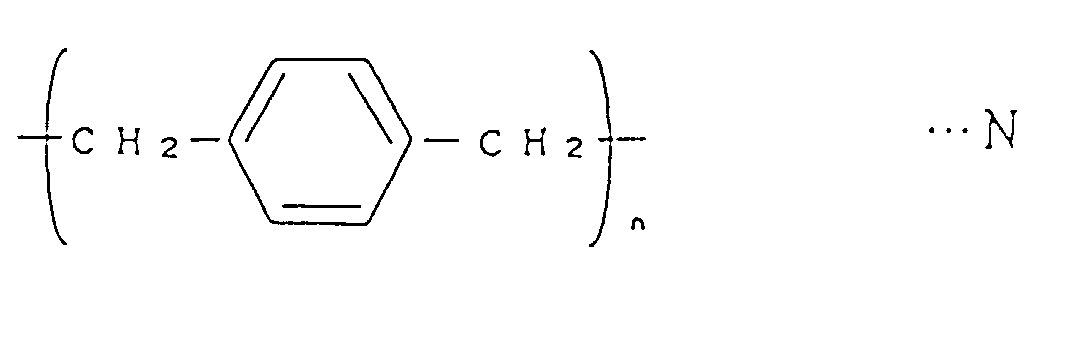
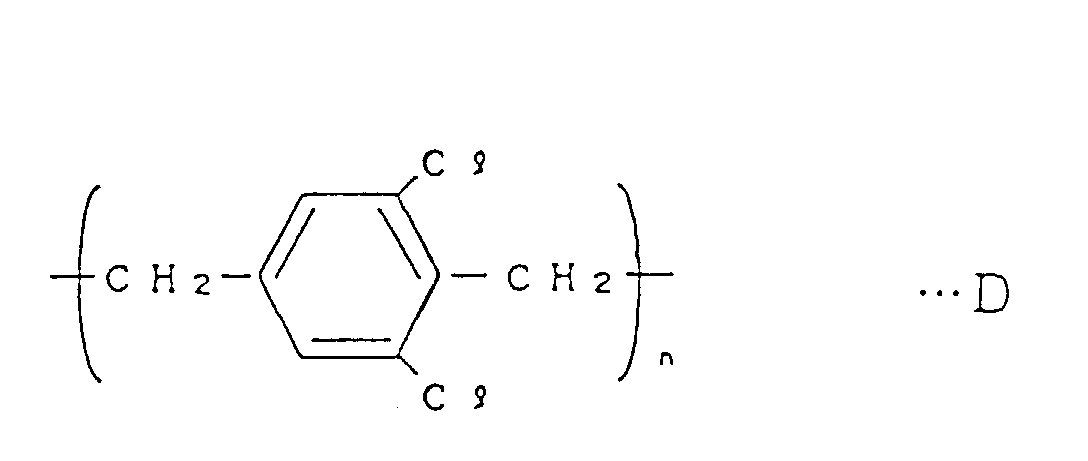
- the heat-resistant, insulating resin are fluoropolymers such as polytetrafluoroethylene, fluorinated ethylene propylene, tetrafluoroethylene-perfluoroalkyl vinyl ether copolymers, polyether ether ketone resin and poly-para-xylenes having the following structural formulae:
- Parylene C poly(monochloro-p-xylene) - having a chlorine atom at one of sites on the benzene ring other than the main chain site
- D type Parylene D - poly(dichloro-p-xylene) - having chlorine atoms at two of such sites.
- These heat-resistant layers may be formed as by coating or dipping of a solution of the resin dissolved in a suitable solvent.
- inorganic materials for instance, SiO 2 , Al 2 O 3 , ZrO 2 , TiO 2 , As 2 O 3 , B 2 O 3 , Bi 2 O 3 , CdS, CaO, CeO 2 , Cr 2 O 3 , CoO, GeO 2 , HfO 2 , Fe 2 O 3 , La 2 O 3 , MgO, MnO 2 , Nd 2 O 3 , Nb 2 O 5 , PbO, Sb 2 O 3 , SeO 2 , Ta 2 O 5 , WO 3 , V 2 O 5 , Y 2 O 5 , Y 2 O 3 , BaTiO 3 , Bi 2 TiO 5 , CaO-SrO, CaO-Y 2 O 3 , Cr-SiO 2 , LiTaO 3 , PbTiO 3 , PbZrO 3 , ZrO 2 -Co
- the resin layer having a low glass transition temperature and the heat-resistant resin layer may both contain finely divided, photoconductive or electrically conductive materials in order to stabilize charges carried thereby.
- the finely divided, photoconductive materials used may include such inorganic photoconductors as amorphous silicon, crystalline silicon, amorphous selenium, crystalline selenium, cadmium sulfide and zinc oxide or such organic photoconductors as polyvinyl-carbazole, phthalocyanine and azo pigments.
- IA alkali metals
- IB copper group
- IIA alkali earth metals
- IIB zinc group
- IIIA aluminium group
- IIIB rare earth metals
- IVB titanium group
- VB vanadium group
- VIB chromium group
- VIIB mangaganese group
- VIII iron and platinum groups
- IVA carbon group, e.g., carbon, silicon, germanium, tin and lead
- VA nitrogen group, e.g. antimony and bismuth
- VIA oxygen group, e.g.
- the metals may be used in the form of metal ions, finely divided metal alloys, organic metals or complexes.
- the above-mentioned elements may be used in the form of oxides, phosphates, sulfates or halogenides. Particular preference is given to carbon, gold, copper and aluminium.
- these photoconductive or electrically conductive materials coalesce on the heated resin layer in a state as ultrafine as about 10-0.1 pm in size, so that they can penetrate through the resin layer and exist therein.
- the fine particles may be dispersed in a resin solution at the time of coating.
- the heat-resistant, insulating layer 11 b shown in Fig. 1, should preferably have a thickness of 0.1 ⁇ m or more. At less than 0.1 pm in thickness, charges opposite in polarity to the accumulated information-carrying charges are likely to be injected in that layer due to tunneling and other phenomena,- bringing about charge leakage.
- the resin layer 11 a having a low glass transition temperature should preferably be made as thin as possible. This is because for one thing, at more than 100 pm in thickness it is difficult to read potential when the information-carrying charges are reproduced; for another, a certain resolution is required when the information-carrying charges are reproduced. In addition, the thicker the resin layer, the more likely is the electric line of force to fall into disarray. However, it is understood that at less than 0.1 pm in thickness, the resin layer is greatly affected by pinholes, etc., failing to serve well.
- the electrode of the electrostatic information-recording medium which is not critical with the exception that it has a specific resistance value of 10 6 ⁇ cm or less, may be formed of electrically conductive films of inorganic metals or inorganic metal oxides, or of such organic materials as quaternary ammonium salts. Such electrodes may be formed by suitable procedures such as vapor deposition, sputtering, CVD, coating, plating, dipping and electrolytic polymerization.
- the thickness of the electrode should be varied depending upon the electrical properties of the material forming it and the magnitude of voltage applied for recording information.
- an aluminium electrode may be about 100 to 3000 angstroms in thickness, and be formed between the support and the charge-retaining layer over all the surfaces or according to the pattern of the charge-retaining layer formed.
- the charge-retaining layer is formed of a film material having a certain strength in itself, such an electrode material as mentioned above may be formed on that film material by means of vapor deposition or the like.
- the electrostatic information-recording medium according to this invention may include a support.
- Figs. 1 b and 2 b show embodiments of the electrostatic information-recording medium including a support.
- a support 15 is not critical in terms of material and thickness, if it has enough strength to support the recording medium well.
- use may be made of flexible plastic films, metal foils or paper, or rigid glass, plastic or metal sheets (which may also serve as an electrode).
- a flexible plastic film may be used and when the recording medium is required to have strength, on the other hand, a rigid sheet or an inorganic material such as glass may be used. It is noted that such a support can be dispensed with, if the charge-retaining layer is formed of a film material having a certain strength in itself.
- the electrostatic information-recording medium according to this invention may be required to be transparent to light when recording or reproducing information. This may be achieved by providing anti-reflection film and/or regulating the thicknesses of the electrode and charge-retaining layers, thereby imparting an anti-reflection effect to the recording medium.
- the electrostatic information-recording medium may be provided in various forms depending upon what type of information is to be recorded or how to record information. For instance, when used with an electrostatic camera (set forth in co-pending Japanese Patent Application No. 63(1988)-121591 specifcation), it may be in the form of an ordinary film (for single or continuous frames), a card or a disk. When used to record digital or analog information as by laser, it may similarly be in the form of a tape, disc or card.
- reference numeral 1 stands for a photosensitive member, 5 a support, 7 an electrode, 9 a photoconductive layer, 10 an electrostatic information-recording medium, 11 a charge-retaining layer, 13 an electrode, 15 a support, 17 a power source and 18 information-light.
- a photosensitive member for recording information in the electrostatic information-recording medium according to this invention, a photosensitive member is used, in which a photoconductive layer such as an a-selenium layer or an organic photoconductive layer is laminated on an electrode.
- the photosensitive member 1 is formed by laminating the electrode 7, having a thickness of 1000 angstroms and consisting of indium oxide-tin oxide (ITO), on the glass support 5 of 1 mm in thickness and laminating the photoconductive layer 9 of about 10 ⁇ m in thickness on the electrode 7, and is then located in opposition to the electrostatic information-recording medium 10 through a gap of about 10 ⁇ m.
- ITO indium oxide-tin oxide
- the power source 17 is put off, as shown in Fig. 3 c , and the electrostatic information-recording medium 10 is then separated from the photosensitive member 1 (see Fig. 3 d ) to accumulate the charge information on the surface of the recording medium.
- the electrostatic information-recording medium is heated to a temperature that is higher than the glass transition temperature of the resin layer having a low glass transition temperature but lower than the charge leakage temperature of the heat-resistant, insulating layer after the charge information have been accumulated in the form of surface potential, whereby the electrostatic information can be stabilized.
- Fig. 4 a for the electrostatic information-recording medium shown in Fig. 1
- Fig. 4 b for the electrostatic information-recording medium shown in Fig.
- the reason why the electrostatic information can be stabilized by heating would be that the charge information or charges induced thereby migrate apparently through the resin layer having a low glass transition temperature - made electrically conductive by heating - under the action of an electric field, and are stored in the resin layer electrically insulated by cooling.
- a recording member constructed from a photosensitive material and the electrostatic information-recording medium is used in place of a photographic film to form an electrostatic latent image on the charge-retaining layer depending upon the quantity of incident light.
- the shutter used may be of either the mechanical or the electrical type.
- a color filter may also be used to separate optical information into R, G and B components through a prism and extract them as parallel beams.
- one frame may then be formed either by three sets of electrostatic information-recording media separated into the R, G and B colors or by a set of R, G and B images arranged on one plane.
- argon laser 514.488 nm
- helium-neon laser (633 nm)
- semiconductor laser 780 nm, 810 nm
- the electrode may be of the same polarity as that of the carrier of the photosensitive member.
- laser exposure corresponding to picture image, character, cord or line signals is carried out by scanning.
- Analog recording of information such as picture images is made by the modulation of the intensity of laser light, while digital recording of characters, cords or line pictures is done by the on-off control of laser light.
- Dotted imaging may also be carried out under the dot generator on-off control of laser light. It is noted that the spectral properties of the photoconductive layer in the photosensitive member need not be panchromatic, and may be well sensitive to the wavelength of the laser light source.
- the electrostatic information-recording medium may be equally applicable to recording and reproducing electrostatic information with an electrode needle or ion-flow head, or with an optical printer such as a laser printer.
- FIG. 5 An example of reading potential in reproducing electrostatic information is illustrated in Fig. 5, wherein the same parts as in Fig. 1 are indicated by the same reference numerals. It is noted that reference numeral 10 stands for an electrostatic information-recording medium, 21 a potential reader, 23 a detecting electrode, 15 a guard electrode, 27 a capacitor and 29 a voltmeter.
- the potential reader 21 is first located in opposition to the surface of the charge-retaining layer. Then, an electric field established by the charges accumulated on the charge-retaining layer acts on the detecting electrode 23, inducing on the surface of the detector 23 charges in the same amount of those on the recording medium. Since the capacitor 27 is charged with charges opposite in polarity to such induced charges, there is a potential difference corresponding to the accumulated charges across the capacitor's electrode, which can be in turn read on the voltmeter 29, thereby determining the potential of the charge-retaining information.
- an electrostatic latent image can be produced in the form of electrical signals by scanning the surface of the charge-retaining layer with the reader 21.
- an electric field an electric line of force
- the guard electrode 25 may be grounded around the detecting electrode. According to such an arrangement in which the electric line of force acts vertically to a plane, it is possible to read the potential of a region having an area nearly equal to that of the detecting electrode.
- Fig. 6 is a schematic view showing the process for reproducing electrostatic information according to this invention, with reference numeral 31 indicating a potential reader, 33 an amplifier, 35 a CRT and 37 a printer.
- a charge potential is detected by the potential reader 31, and the resulting output is amplified by the amplifier 33 for display on the CRT 35 or printing-out with the printer 37.
- the region to be read may be arbitrarily selected and outputted at any desired time, or may be repeatedly reproduced. Reading may also be optically achieved with a material whose optical properties vary by an electric field, for instance, an electrooptical crystal. Since the electrostatic latent image is obtained in the form of electrical signals, it may further be recorded in other recording media, if required.
- the first electrostatic information-recording medium according to this invention and how to record and reproduce electrostatic information with this recording medium will now be explained in greater detail with reference to the following examples.
- An aluminium electrode was deposited by vacuum vapor deposition (10 -5 Torr) at a film thickness of 1000 angstroms on a heat-resistant, insulating layer formed of a tetrafluoroethylene-hexafluoropropylene copolymer (FEP) film (made by Du Pont) having a glass transition temperature of 130°C, a specific resistance of 10 18 ⁇ cm or higher, a water absorption of 0.01% and a thickness of 12.5 pm.
- FEP tetrafluoroethylene-hexafluoropropylene copolymer
- this electrostatic information-recording medium was charged on the resin layer having a low glass transition temperature to a surface potential of ⁇ 100V by corona charging, followed by heating at 40°C for 60 seconds in an oven.
- the surface potential although changed to ⁇ 90V, was found to be retained in the electrostatic information-recording medium.
- the surface potential was found to be kept at ⁇ 90V. Even allowed to stand under accelerated testing conditions at 60°C and 20% R.H.for 30 days, a surface potential of ⁇ 80V was maintained, and even when allowed to stand under high-humidity conditions of 95% R.H. at 40°C for 30 days, a surface potential of ⁇ 70V was maintained.
- An aluminium electrode was deposited by vacuum vapor deposition (10 -5 Torr) on a 1-mm thick glass substrate at a film thickness of 1000 angstroms, and a 5% solution of a fluoropolymer ("Cytop" - trade name - made by Asahi Glass Co., Ltd. and having a glass transition temperature of 100°C, a water absorption of 0.01% and a specific resistance of 1 x 10 18 ⁇ cm) in a fluorine type of solvent was coated on the aluminium electrode by a blade coater 8 mil, followed by drying at room temperature for 3 hours. Thus, a heat-resistant resin layer of about 7 ⁇ m in thickness was obtained.
- this electrostatic information-recording medium was charged thereon to a surface potential of ⁇ 100V by corona charging, followed by heating at 45°C for 60 seconds in an oven.
- the surface potential although changed to ⁇ +80V, was found to be retained in the electrostatic information-recording medium.
- the surface potential was found to be kept at ⁇ 80V. Even when allowed to stand under accelerated testing conditions at 60°C and 20% R.H. for 30 days, a surface potential of ⁇ 70 V was maintained, and even when allowed to stand under high-humidity conditions of 95% R.H. at 40°C for 30 days, a surface potential of ⁇ 60 V was maintained.
- Such an electrostatic information-recording medium as shown in Fig. 2 was prepared by following the procedures of Ex. 2 with the exception that the heat-resistant, insulating layer and the resin layer having a low transition temperature were reversed in the order of deposition.
- This electrostatic information-recording medium was charged thereon to a surface potential of ⁇ 100V by corona charging, followed by heating at 45°C for 60 seconds in an oven. As a result, although the surface potential was changed to ⁇ 80V, the electrostatic information was found to be retained in the electrostatic information-recording medium.
- a 1.7- ⁇ m thick, thermally oxidized silicon layer (made by Mitsubishi Metal Corporation) formed by the thermal oxidation of a silicon wafer was used as a heat-resistant, insulating material.
- a 40% solution of a poly ( ⁇ -pinene) having a glass transition temperature of 64°C ("Picolight A115" made by Riken Hercules Co., Ltd.) in 40 % monochlorobenzene was spin-coated (at 3000 rpm for 20 seconds) on the silicon layer at a dry coverage of 2.5 ⁇ m to form a resin layer having a low transition temperature, thereby preparing such an electrostatic information-recording medium as shown in Fig. 1.
- this electrostatic information-recording medium was then charged on the resin layer having a low glass transition temperature to a surface potential of ⁇ 170V by corona charging, followed by heating at 100°C for 1 hour on a hot plate.
- the surface potential although changed to +150V or -120V, was found to be retained in the electrostatic information-recording medium.
- the surface potential was found to be kept at +150V or -120V. Even when allowed to stand under accelerated testing conditions at 60°C and 20% R.H. for 30 days, a surface potential of +140V or -110 V was maintained, and even when allowed to stand under high-humidity conditions of 95% R.H. at 40°C for 30 days, a surface potential of +140V or -100V was maintained.
- a 1.7- ⁇ m thick, thermally oxidized silicon layer (made by Mitsubishi Metal Corporation) formed by the thermal oxidation of a silicon wafer was used as a heat-resistant, insulating material.
- a 40% solution of a poly ( ⁇ -pinene) having a glass transition temperature of 63.5°C ("Picolight S115" made by Riken Hercules Co., Ltd.) in 40% monochlorobenzene was spin-coated (at 2000 rpm for 20 seconds) on the silicon layer at a dry coverage of 4.4 ⁇ m to form a resin layer having a low transition temperature, thereby preparing such an electrostatic information-recording medium as shown in Fig. 1.
- this electrostatic information-recording medium was then charged on the resin layer having a low glass transition temperature to a surface potential of ⁇ 250V by corona charging, followed by heating at 100°C for 1 hour on a hot plate.
- the surface potential although changed to ⁇ 110V, was found to be carried in the electrostatic information-recording medium.
- the surface potential was found to be kept at ⁇ 110V. Even when allowed to stand under accelerated testing conditions at 60°C and 20% R.H. for 30 days, a surface potential of ⁇ 100V was maintained, and even when allowed to stand under high-humidity conditions of 95% R.H. at 40°C for 30 days, a surface potential of ⁇ 105V was maintained.
- a 1.7- ⁇ m thick, thermally oxidized silicon layer (made by Mitsubishi Metal Corporation) formed by the thermal oxidation of a silicon wafer was used as a heat-resistant, insulating material.
- a 40% solution of a poly (a-pinene) having a glass transition temperature of 64°C ("Picolight A115" made by Riken Hercules Co., Ltd.) in 40% monochlorobenzene was spin-coated (at 3000 rpm for 20 seconds) on the silicon layer at a dry coverage of 2.5 pm to form a resin layer having a low transition temperature, thereby preparing such an electrostatic information-recording medium as shown in Fig. 9.
- this electrostatic information-recording medium was then charged on the resin layer having a low glass transition temperature to a surface potential of ⁇ 170V by corona charging, followed by heating at 100°C for 1 hour on a hot plate.
- the surface potential was found to be kept at ⁇ 170V. Even when allowed to stand under accelerated testing conditions at 60°C and 20% R.H. for 30 days, a surface potential of +150V or -120V was maintained, and even when allowed to stand under high-humidity conditions of 95% R.H. at 40°C for 30 days, a surface potential of +160V or - 135V was maintained.
- a mixed solution composed of 10 g of poly-N-vinylcarbazole (made by Anan Koryo K.K.), 10 g of 2,4,7-trinitrofluorenone, 2 g of a polyester resin (as a binder; "Vylon 200" made by Toyobo Co., Ltd.) and 90 g of tetrahydrofuran (THF) was prepared in a dark place, and was then coated on a glass substrate (of 1 mm in thickness) sputtered with an ITO electrode at a thickness of about 1000 angstroms with the use of a doctor blade.
- the product was dried at 60°C for about 1 hour while supplying air thereto to obtain a photosensitive member having a photoconductive layer of about 10 pm in thickness. For complete drying purposes, air drying was carried out for a further 1 day.
- the above-mentioned photosensitive member and the electrostatic information-recording medium prepared in Ex. 1 were exposed to light with the application of voltage to obtain a charge image of -150 V at a line pattern width of 20 ⁇ m. After that, they were heated at 40°C for 60 seconds.
- an electrostatic information-recording medium including on an electrode an FEP layer alone was prepared according to the procedures of Ex. 1, and was then used to record electrostatic information in a similar manner as mentioned above.
- the electrostatic information-recording media according to this invention and for the purpose of comparison were subjected to accelerated testing at 40°C and 95% R.H. for 30 days to determine their surface potentials. Also, these were used for reproduction by toner development.
- the electrostatic information-recording medium of this invention was decreased to a surface potential of -140 V but remained stable there, and the pattern of 20 pm could be resolved by toner development.
- the comparative medium including no resin layer having a low glass transition temperature was found to undergo no change in the surface potential or remain at -150V, but failed to resolve the 20-pm pattern by reproduction by toner development.
- the second electrostatic information-recording medium of this invention is shown at 3 in the sectional view presented as Fig. 7, wherein reference numeral 11 stands for a fluoropolymer layer, 12 a pentafluorostyrene polymer layer, 13 an electrode and 15 a support.
- the fluoropolymer layer 11 is formed of a fluoropolymer having an insulating property of 10 14 ⁇ cm or more as expressed in terms of specific resistance.
- fluoropolymers for instance, use may be made of poly (tetrafluoroethylene) (PTFE), tetrafluoroethylene-perfluoroalkyl vinyl ether copolymer (PFA), tetrafluoroethylene-hexafluoropropylene copolymer (FEP), tetrafluoroethylene-hexafuloropropylene-perfluoroalkyl vinyl ether copolymer (EPE), tetrafluoroethylene-ethylene copolymer (ETFE), poly(chlorotrifluoroethylene) (PCTFE) and chlorotrifluoroethylene-ethylene copolymer (ECTFE).
- PTFE poly (tetrafluoroethylene)
- PFA tetrafluoroethylene-perfluoroalkyl vinyl ether copolymer
- FEP tetrafluoroethylene-hexafluoropropylene copolymer
- EPE tetrafluoroethylene-hexa
- these resins may be used in admixture with thermoplastic resin, thermosetting resin, radiation curing resin such as ultraviolet or electron beam curing resin or engineering plastics whose hydrogen atoms are partly or wholly substituted by fluorine atoms, or fluorine-containing resins.
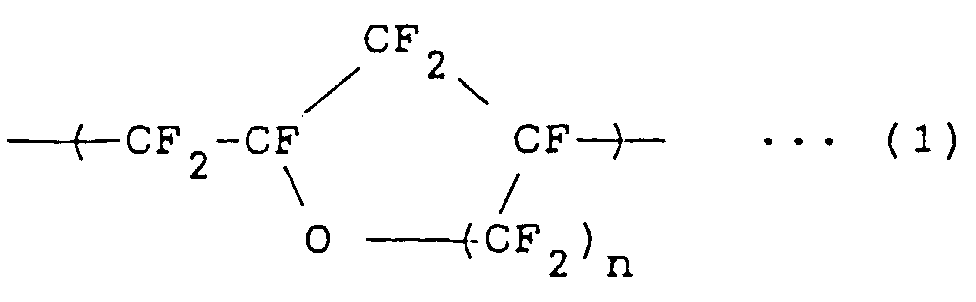
- Fluorine-containing thermoplastic resin comprising a cyclic recurring unit (units) represented by the following general formulae: and/or wherein n is 1 or 2, and having such a molecular weight as to give an intrinsic viscosity of at least 0.1 at 50°C, or Fluorine-containing thermoplastic resin comprising (a) a cyclic recurring unit (units) represented by the following general formulae: and/or wherein n is 1 or 2, and (b) a recurring unit represented by the following general formula: -(CF 2 -CFX)- wherein X is F, Cl, -O-CF 2 CF 2 CF 3 , -O-CF 2 CF(CF 3 )OCF 2 CF 2 SO 3 F or -O-CF 2 CF 2 CF 2 COOCH 3 , with the content of the recurring unit (a) being at least 80%, and having such a molecular weight as to give an
- a layer of such a fluoropolymer may be laminated on the electrode layer by coating or dipping of a solution of the fluoropolymer dissolved in a fluorine type of solvent.
- a fluoropolymer film may be applied on the electrode through an adhesive or the like.
- an electrode-forming material may be laminated on one side of the fluoropolymer film by means of vapor deposition, etc., while a pentafluorostyrene polymer layer may be coated on the other side.
- the fluoropolymer layer may preferably have a thickness of 0.1 to 5 ⁇ m.
- This copolymer is then obtained by the radical, anionic or cationic polymerization of 100-1% by weight of pentafluorostyrene with 0-99% by weight of the comonomer.
- the fluoropolymer may be treated on the surface by plasma or other means to increase the capability to be coated prior to providing the pentafluorostyrene polymer.
- the pentafluorostyrene polymer used may preferably have a molecular weight of 10,000 to 2,000,000.
- a solution of the pentafluorostyrene polymer dissolved in a fluorine type of solvent may be provided on the above-mentioned fluoropolymer layer by coating or dipping.
- the pentafluorostyrene polymer layer may have a thickness of 0.1 ⁇ m to 5 ⁇ m, but should preferably be thinner than the fluoropolymer layer.
- these fluoropolymer and pentafluorostyrene polymer layers may additionally contain photoconductive and electrically conductive materials in an ultrafine form.
- the support 15 and electrode 13 used may be the same as used with the first electrostatic information-recording medium.
- the electrostatic information-recording medium may be provided on the surface with a protective plastic film to protect it against surface failure or attenuation of the information-carrying charges stored.
- a plastic solution may be coated or otherwise vapor-deposited on the surface of that medium.
- the protecting film may be a few hundreds angstroms to a few tens ⁇ m in thickness, at which the reproduction of information can be well achieved.
- the fluoropolymer and pentafluorostyrene polymer layers may be successively provided on the photoconductive layer formed on the electrode.
- the recording and reproduction of information with the second electrostatic information-recording medium may be carried out, as illustrated in Fig. 3, wherein reference numeral 1 is a photosensitive member, 5 a support for a photoconductive layer, 7 an electrode formed in the photosensitive member, 9 a photoconductive layer and 17 a power source.
- the photosensitive member for instance, is formed by providing an about 10-pm thick, organic photoconductive layer 9 on the surface of a 1000-angstrom thick, ITO transparent electrode layer 7 formed on a 1-mm thick glass support 5.
- an electrostatic information-recording medium 3 is first located with respect to the photosensitive member 1 through a gap of about 10 pm.
- a portion of the photoconductor 9, on which the light impinges, is made so electrically conductive that the recording medium discharge and accumulates thereon information-retaining charges. It is understood that the light 18 may be allowed to be incident upon the photoconductor 9 through the photosensitive member 1.
- the power source 17 is put off to separate the recording medium 10 from the photosensitive member 1. In this manner, the formation of an electrostatic latent image is completed.
- the obtained resolution is as high as that achieved with silver photography, and the information-retaining charges are protected in the charge-retaining layer and stored over an extended period without discharging.
- electrostatic information-recording medium This may be achieved with an electrostatic camera or laser.
- a recording member constructed from a photosensitive material and the electrostatic information-recording medium is used in place of a photographic film.
- the shutter used may be of either the mechanical or the electrical type.
- a color filter may also be used to separate optical information into R, G and B components through a prism and extract them as parallel beams.
- one frame may then be formed either by three sets of electrostatic information-recording media separated into the R, G and B colors or by a set of R, G and B images arranged on one plane.
- argon laser 514.488 nm
- helium-neon laser (633 nm)
- semiconductor laser 780 nm, 810 nm
- the electrode may be of the same ( polarity as that of the carrier of the photosensitive member.
- laser exposure corresponding to picture image, character, cord or line signals is carried out by scanning.
- Analog recording of information such as picture images is made by the modulation of the intensity of laser light, while digital recording of characters, cords or line pictures is done by the on-off control of laser light.
- Dotted imaging may also be carried out under the dot generator on-off control of laser light. It is noted that the spectral properties of the photoconductive layer in the photosensitive member need not be panchromatic, and may be well sensitive to the wavelength of the laser light source.
- This electrostatic information-recording medium may be used as an electrostatic recording medium using an electrode needle or ion-flow head, an optical printer such as a laser printer, or a recording medium making use of electron beam or ion impinging. In particular, this is best-suited for an electrostatic information-recording medium using a photosensitive member.
- pentafluorostyrene made by Central Yakuhin K.K.
- pentafluorostyrene purified by distillation under reduced pressure (48°C/20mmHg) and 0.06 g of azobisisobutyronitrile were placed in an ampule made of pressure-resistant glass, in which they were frozen and degasified twice. After that, pentafluorostyrene was radically polymerized in a warm bath of 60°C for 24 hours to obtain a polymer.
- the solution was poured in a large amount of methanol to obtain precipitates, which were then reprecipitated in a similar system to obtain precipitates.
- the precipitates were recovered and dried under vacuum to obtain a pentafluorostyrene polymer in an amount of 38 g (or in a 95 % yield).
- This polymer was found to have a glass transition temperature of 108°C, as measured by thermal analysis and a weight-average molecular weight of 250,000 calculated as polystyrene, as determined by GPC.
- these recording media After heating, these recording media had all a thickness of 3 ⁇ m.
- the thus obtained media were measured for their glass transition temperatures, while the pentafluorostyrene polymer films were released therefrom.
- the glass transition temperatures were found to be 98°C for the medium heated at 80°C; 99°C for the medium heated at 100°C; 104°C for the medium heated at 130°C; and 108°C for the medium heated at 150°C.
- each of these recording media was charged on the charge-retaining layer to a surface potential of ⁇ 120V with the use of a corona charger to determine the capability to retain charges.
- the recording media heated at varied temperatures were subjected to accelerated testing under high humidity conditions of 95% R.H. at 40°C over a period of 30 days.
- the surface potentials found are set out below. Heating Temperature (°C) Residual Potential (V) 80 ⁇ 30 100 ⁇ 30 130 ⁇ 70 150 ⁇ 75
- An ITO electrode layer was deposited on a 1-mm thick glass substrate at a thickness of 1000 angstroms by vacuum vapor deposition (10 -5 Torr). Coated on this electrode was a 7% by weight solution of a fluorine-containing resin ("Cytop" made by Asahi Glass Co., Ltd. and having a water absorption of 0.01 % and a specific resistance value of 1 x 10 18 ⁇ cm) dissolved in perfluoro (2-butyltetrahydrofuran) by a blade coater, followed by 3-hour air drying. After that, the product was heated at 150°C for 1 hour for the lamination of a fluoropolymer layer of about 2 ⁇ m in thickness.
- a fluorine-containing resin made by Asahi Glass Co., Ltd. and having a water absorption of 0.01 % and a specific resistance value of 1 x 10 18 ⁇ cm
- Coated on the fluoropolymer layer was a 4% by weight solution of polypentafluorostyrene in 1,3-ditrifluoromethyl-benzene by spin coating (at 2000 rpm for 20 seconds), followed by 3-hour air drying. After that, the product was heated at 150°C for 1 hour to prepare an electrostatic information-recording medium having a charge-retaining layer at a total thickness of 3 ⁇ m.
- the thus obtained recording medium was charged thereon to a surface potential of ⁇ 120V by a corona charger.
- Fig. 8 there is shown how the stability of plus charges retained in the electrostatic information-recording medium changed with the lapse of time, while it was held at 60°C and 25% R.H.
- the electrostatic information-recording medium ( ⁇ ) formed by laminating a polypentafluorostyrene layer on a fluoropolymer layer is superior in the capability to carry charges under high temperature conditions to a medium consisting only of either a fluoro-polymer layer ( ⁇ ) or a polypentafluorostyrene layer ( ⁇ ).
- a 100-g solution - having a solid content of 2% - of 3 parts of a bis-azo type of pigment having the above-mentioned structural formula and 1 part of polyvinyl acetal resin - both serving as charge-generating materials - dissolved in a mixed solvent consisting of dioxane and cyclohexane at 1:1 was well dispersed in a ball mill to prepare a dispersion, which was then coated on the surface of an ITO transparent electrode layer (having a thickness of about 500 angstroms and a resistance value of 80 ⁇ / ⁇ ) formed on a glass substrate with the use of a 2-mil gap blade coater. Subsequent 1-hour drying at 100°C gave a charge-generating layer of 0.3 ⁇ m in thickness.
- the electrostatic information-recording medium was exposed through the photosensitive member to light emanating from a halogen lamp light source at a luminous intensity of 1000 luxes for 0.1 second, thereby forming an electrostatic latent image on the recording medium.
- a potential difference between the electrode and the surface of the recording medium was measured with a surface potentiometer shown in Fig. 5 ("Treck Model 344).
- the recording medium was found to have a surface potential of +100V, but the unexposed region was found to have a surface potential of 0 V.
- electrostatic information-recording media and processes for recording and reproducing electrostatic information according to this invention are applicable to fields relating to electrostatic information recording.
Landscapes
- Physics & Mathematics (AREA)
- General Physics & Mathematics (AREA)
- Optics & Photonics (AREA)
- Photoreceptors In Electrophotography (AREA)
- Electrophotography Using Other Than Carlson'S Method (AREA)
Description
locating a photosensitive member including a photosensitive layer on at least an electrode layer in opposite relation to the said recording medium, and
locating a photosensitive member including a photoconductive layer on at least an electrode layer in opposite and contact or non-contact relation to said electrostatic information-recording medium obtained by the successive lamination of a fluoropolymer layer and a pentafluorostyrene polymer layer having a weight-average molecular weight of 10,000 to 2,000,000 on at least one electrode layer, and forming an electrostatic charge pattern on said recording medium by exposing said recording medium to light with the application of voltage between both the electrodes or applying voltage between both the electrodes while said recording medium is exposed to light.

Fluorine-containing thermoplastic resin comprising a cyclic recurring unit (units) represented by the following general formulae:



| Heating Temperature (°C) | Residual Potential (V) |
| 80 | ±60 |
| 100 | ±70 |
| 130 | ±90 |
| 150 | ±100 |
| Heating Temperature (°C) | Residual Potential (V) |
| 80 | ±30 |
| 100 | ±40 |
| 130 | ±50 |
| 150 | ±75 |
| Heating Temperature (°C) | Residual Potential (V) |
| 80 | ±30 |
| 100 | ±30 |
| 130 | ±70 |
| 150 | ±75 |

Claims (7)
- An electrostatic information-recording medium including an electrode layer and a charge-retaining layer, characterized in that said charge-retaining layer comprises a laminate of a resin layer having a low glass transition temperature with a heat-resistant, insulating layer.
- An electrostatic information-recording medium as claimed in Claim 1, wherein the resin layer having a low glass transition temperature and the heat-resistant, insulating layer are laminated on the electrode layer in that order.
- An electrostatic information-recording medium as claimed in Claim 1, wherein the heat-resistant, insulating layer and the resin layer having a low glass transition temperature are laminated on the electrode layer in that order.
- A process for recording and reproducing electrostatic information, characterized by:recording the information in an electrostatic information-recording medium as such, said recording medium comprising an electrode layer and a charge-retaining layer, said charge-retaining layer comprising a laminate of a resin layer having a low glass transition temperature with a heat-resistant, insulating layer, orrecording the information in said recording medium while said recording medium is heated at a temperature higher than said glass transition temperature of said resin layer having a low glass transition temperature, orrecording the information in said recording medium and, then, heating said recording medium at a temperature higher than the glass transition temperature of said resin layer having a low glass transition temperature.
- A process for recording and reproducing electrostatic information, characterized by:locating a photosensitive member including a photosensitive layer on at least an electrode layer in opposite relation to an electrostatic information-recording medium including an electrode layer and a charge-retaining layer, said charge-retaining layer comprising a laminate of a resin layer having a low glass transition temperature with a heat-resistant, insulating layer, andrecording the information in said recording medium by exposing said recording medium to light with the application of voltage between both said electrode layers or applying voltage between said both electrode layers while said recording medium is exposed to light, orrecording the information in said recording medium while said recording medium is heated at a temperature higher than the glass transition temperature of said resin layer having a low glass transition temperature, orrecording the information in said recording medium and, then, heating said recording medium at a temperature higher than the glass transition temperature of said resin layer having a low glass transition temperature.
- An electrostatic information-recording medium as claimed in Claim 1, wherein the charge-retaing layer is a laminate of a fluoropolymer layer and a pentafluorostyrene polymer layer having a weight-average molecular weight of 10,000 to 2,000,000.
- A process for recording and reproducing electrostatic information on an electrostatic information-recording medium according to Claim 1 or 6, characterized by:locating a photosensitive member including a photoconductive layer on at least an electrode layer in opposite and contact or non-contact relation to said electrostatic information-recording medium obtained by the successive lamination of a fluoropolymer layer and a pentafluorostyrene polymer layer having a weight-average molecular weight of 10,000 to 2,000,000 on at least an electrode layer, andforming an electrostatic charge pattern on said recording medium by exposing said recording medium to light with the application of voltage between both said electrodes or applying voltage between both said electrodes while said recording medium is exposed to light.
Priority Applications (1)
| Application Number | Priority Date | Filing Date | Title |
|---|---|---|---|
| EP97116775A EP0818712B1 (en) | 1989-11-17 | 1990-11-16 | Electrostatic information-recording media and process for recording and reproducing electrostatic information |
Applications Claiming Priority (9)
| Application Number | Priority Date | Filing Date | Title |
|---|---|---|---|
| JP29916689A JPH03158859A (en) | 1989-11-17 | 1989-11-17 | Electrostatic charge injection type information recording medium and information recording method |
| JP299165/89 | 1989-11-17 | ||
| JP29916589A JP2892059B2 (en) | 1989-11-17 | 1989-11-17 | Laminated information recording medium and information recording method |
| JP299166/89 | 1989-11-17 | ||
| JP6037490A JPH037943A (en) | 1989-03-18 | 1990-03-12 | Electrostatic information recording medium and electrostatic information recording method |
| JP60374/90 | 1990-03-12 | ||
| JP18754690A JP2878413B2 (en) | 1990-07-16 | 1990-07-16 | Charge holding medium and electrostatic information recording method |
| JP187546/90 | 1990-07-16 | ||
| PCT/JP1990/001496 WO1991007701A1 (en) | 1989-11-17 | 1990-11-16 | Electrostatic information recording medium and electrostatic information recording/reproducing method |
Related Child Applications (1)
| Application Number | Title | Priority Date | Filing Date |
|---|---|---|---|
| EP97116775A Division EP0818712B1 (en) | 1989-11-17 | 1990-11-16 | Electrostatic information-recording media and process for recording and reproducing electrostatic information |
Publications (3)
| Publication Number | Publication Date |
|---|---|
| EP0454869A1 EP0454869A1 (en) | 1991-11-06 |
| EP0454869A4 EP0454869A4 (en) | 1993-02-24 |
| EP0454869B1 true EP0454869B1 (en) | 1998-04-08 |
Family
ID=27463905
Family Applications (1)
| Application Number | Title | Priority Date | Filing Date |
|---|---|---|---|
| EP90916816A Expired - Lifetime EP0454869B1 (en) | 1989-11-17 | 1990-11-16 | Electrostatic information recording medium and electrostatic information recording/reproducing method |
Country Status (3)
| Country | Link |
|---|---|
| EP (1) | EP0454869B1 (en) |
| DE (2) | DE69032219T2 (en) |
| WO (1) | WO1991007701A1 (en) |
Families Citing this family (4)
| Publication number | Priority date | Publication date | Assignee | Title |
|---|---|---|---|---|
| EP0595255B1 (en) * | 1992-10-26 | 2001-03-28 | Dai Nippon Printing Co., Ltd. | Photoelectric sensor, information recording system, and information recording method |
| EP0613054A1 (en) * | 1993-02-22 | 1994-08-31 | Matsushita Electric Industrial Co., Ltd. | Electrostatic recording sheet and electrostatic recording method |
| DE69425184T2 (en) * | 1993-04-26 | 2001-03-22 | Dai Nippon Printing Co., Ltd. | Photoelectric sensor, recording system, and method for data recording and reprography |
| JPH08321646A (en) * | 1995-03-17 | 1996-12-03 | Dainippon Printing Co Ltd | Optical sensor, information recording device, and information recording / reproducing method |
Citations (5)
| Publication number | Priority date | Publication date | Assignee | Title |
|---|---|---|---|---|
| DE2255585A1 (en) * | 1971-11-13 | 1973-05-17 | Tomoegawa Paper Mfg Co Ltd | Electrostatic recording element - with highly pigmented recording/unpigmented insulating layer accepts aqueous inks |
| JPS4922135A (en) * | 1972-06-16 | 1974-02-27 | ||
| US3992204A (en) * | 1973-08-06 | 1976-11-16 | Minnesota Mining And Manufacturing Company | Method and medium for producing electrostatic charge patterns |
| JPS6136752A (en) * | 1984-07-30 | 1986-02-21 | Canon Inc | Recording medium of electrostatic recording device |
| JPH01296255A (en) * | 1988-05-24 | 1989-11-29 | Dainippon Printing Co Ltd | Electrostatic charge retaining medium |
Family Cites Families (13)
| Publication number | Priority date | Publication date | Assignee | Title |
|---|---|---|---|---|
| BE598591A (en) * | 1959-12-28 | |||
| JPS4910703B1 (en) * | 1969-07-11 | 1974-03-12 | ||
| JPS52142841U (en) * | 1977-04-22 | 1977-10-29 | ||
| JPS56113186A (en) * | 1980-02-12 | 1981-09-05 | Olympus Optical Co Ltd | Electrophotographic device |
| JPS56156840A (en) * | 1980-05-09 | 1981-12-03 | Toshiba Corp | Electrostatic light recording method |
| JPS57205741A (en) * | 1981-06-15 | 1982-12-16 | Matsushita Electric Ind Co Ltd | Electrostatic recording material |
| JPS58136036A (en) * | 1982-02-08 | 1983-08-12 | Tomoegawa Paper Co Ltd | electrostatic recorder |
| JPS58154847A (en) * | 1982-03-10 | 1983-09-14 | Tomoegawa Paper Co Ltd | Method for preventing fog of electrostatic recording material |
| US4628017A (en) * | 1984-11-02 | 1986-12-09 | Ricoh Company, Limited | Electrostatic image forming method |
| JPS61122683A (en) * | 1984-11-19 | 1986-06-10 | Nippon Telegr & Teleph Corp <Ntt> | Electrostatic recorder |
| JPH0750540B2 (en) * | 1986-02-06 | 1995-05-31 | ソニー株式会社 | Recording / playback device |
| JP2677988B2 (en) * | 1986-11-04 | 1997-11-17 | 松下電器産業株式会社 | Electrostatic recording method |
| JP3906518B2 (en) * | 1997-04-25 | 2007-04-18 | 松下電器産業株式会社 | Built-in alkaline water conditioner |
-
1990
- 1990-11-16 DE DE69032219T patent/DE69032219T2/en not_active Expired - Fee Related
- 1990-11-16 EP EP90916816A patent/EP0454869B1/en not_active Expired - Lifetime
- 1990-11-16 DE DE1990634248 patent/DE69034248T2/en not_active Expired - Fee Related
- 1990-11-16 WO PCT/JP1990/001496 patent/WO1991007701A1/en not_active Ceased
Patent Citations (5)
| Publication number | Priority date | Publication date | Assignee | Title |
|---|---|---|---|---|
| DE2255585A1 (en) * | 1971-11-13 | 1973-05-17 | Tomoegawa Paper Mfg Co Ltd | Electrostatic recording element - with highly pigmented recording/unpigmented insulating layer accepts aqueous inks |
| JPS4922135A (en) * | 1972-06-16 | 1974-02-27 | ||
| US3992204A (en) * | 1973-08-06 | 1976-11-16 | Minnesota Mining And Manufacturing Company | Method and medium for producing electrostatic charge patterns |
| JPS6136752A (en) * | 1984-07-30 | 1986-02-21 | Canon Inc | Recording medium of electrostatic recording device |
| JPH01296255A (en) * | 1988-05-24 | 1989-11-29 | Dainippon Printing Co Ltd | Electrostatic charge retaining medium |
Also Published As
| Publication number | Publication date |
|---|---|
| DE69032219D1 (en) | 1998-05-14 |
| DE69032219T2 (en) | 1998-09-03 |
| EP0454869A1 (en) | 1991-11-06 |
| WO1991007701A1 (en) | 1991-05-30 |
| EP0454869A4 (en) | 1993-02-24 |
| DE69034248D1 (en) | 2007-09-13 |
| DE69034248T2 (en) | 2008-04-17 |
Similar Documents
| Publication | Publication Date | Title |
|---|---|---|
| US5424156A (en) | Electrostatic information recording medium and method of recording and reproducing electrostatic information | |
| JP3046649B2 (en) | Electrostatic information recording medium and electrostatic information recording / reproducing method | |
| US5527589A (en) | Electrostatic information recording medium | |
| CA1339152C (en) | Electrostatic information recording medium and electrostatic informationrecording and reproducing method | |
| US5571646A (en) | Electrostatic information-recording media and process for recording and reproducing electrostatic information | |
| EP0454869A1 (en) | Electrostatic information recording medium and electrostatic information recording/reproducing method | |
| EP0818712A2 (en) | Electrostatic information-recording media and process for recording and reproducing electrostatic information | |
| JP2902036B2 (en) | Electrostatic information recording / reproducing method | |
| JP3157306B2 (en) | Electrostatic information recording medium and electrostatic information recording method | |
| JP3200451B2 (en) | Electrostatic information recording medium | |
| JPH037943A (en) | Electrostatic information recording medium and electrostatic information recording method | |
| JP3725574B2 (en) | Electrostatic information recording method | |
| JP3122495B2 (en) | Internal charge holding medium and method of manufacturing the same | |
| EP0471851B1 (en) | Electrostatic information recording medium | |
| JP2878413B2 (en) | Charge holding medium and electrostatic information recording method | |
| JP2892059B2 (en) | Laminated information recording medium and information recording method | |
| JP2826119B2 (en) | Photoreceptor having photoelectron doubling effect and electrostatic image recording method | |
| JP2980349B2 (en) | Electrostatic information recording method | |
| JP3112515B2 (en) | Electrostatic information recording method | |
| JP2962780B2 (en) | Photoreceptor and electrostatic information recording method | |
| JPH02203353A (en) | Charge holding medium having protective film | |
| JPH0470759A (en) | Photosensitive body and electrostatic information recording method | |
| JPH02244053A (en) | Manufacture of electric charge retaining medium | |
| JPH02275960A (en) | Charge holding medium and charge holding method | |
| JPH0473656A (en) | Photosensitive body and method for recording electrostatic information |
Legal Events
| Date | Code | Title | Description |
|---|---|---|---|
| PUAI | Public reference made under article 153(3) epc to a published international application that has entered the european phase |
Free format text: ORIGINAL CODE: 0009012 |
|
| 17P | Request for examination filed |
Effective date: 19910808 |
|
| AK | Designated contracting states |
Kind code of ref document: A1 Designated state(s): DE FR GB IT |
|
| A4 | Supplementary search report drawn up and despatched |
Effective date: 19930105 |
|
| AK | Designated contracting states |
Kind code of ref document: A4 Designated state(s): DE FR GB IT |
|
| 17Q | First examination report despatched |
Effective date: 19960207 |
|
| GRAG | Despatch of communication of intention to grant |
Free format text: ORIGINAL CODE: EPIDOS AGRA |
|
| GRAG | Despatch of communication of intention to grant |
Free format text: ORIGINAL CODE: EPIDOS AGRA |
|
| GRAH | Despatch of communication of intention to grant a patent |
Free format text: ORIGINAL CODE: EPIDOS IGRA |
|
| GRAH | Despatch of communication of intention to grant a patent |
Free format text: ORIGINAL CODE: EPIDOS IGRA |
|
| GRAA | (expected) grant |
Free format text: ORIGINAL CODE: 0009210 |
|
| AK | Designated contracting states |
Kind code of ref document: B1 Designated state(s): DE FR GB IT |
|
| DX | Miscellaneous (deleted) | ||
| REF | Corresponds to: |
Ref document number: 69032219 Country of ref document: DE Date of ref document: 19980514 |
|
| ITF | It: translation for a ep patent filed | ||
| ET | Fr: translation filed | ||
| PLBE | No opposition filed within time limit |
Free format text: ORIGINAL CODE: 0009261 |
|
| STAA | Information on the status of an ep patent application or granted ep patent |
Free format text: STATUS: NO OPPOSITION FILED WITHIN TIME LIMIT |
|
| 26N | No opposition filed | ||
| REG | Reference to a national code |
Ref country code: GB Ref legal event code: IF02 |
|
| PGFP | Annual fee paid to national office [announced via postgrant information from national office to epo] |
Ref country code: FR Payment date: 20041029 Year of fee payment: 15 |
|
| PGFP | Annual fee paid to national office [announced via postgrant information from national office to epo] |
Ref country code: GB Payment date: 20041101 Year of fee payment: 15 |
|
| PGFP | Annual fee paid to national office [announced via postgrant information from national office to epo] |
Ref country code: DE Payment date: 20041206 Year of fee payment: 15 |
|
| PG25 | Lapsed in a contracting state [announced via postgrant information from national office to epo] |
Ref country code: IT Free format text: LAPSE BECAUSE OF NON-PAYMENT OF DUE FEES;WARNING: LAPSES OF ITALIAN PATENTS WITH EFFECTIVE DATE BEFORE 2007 MAY HAVE OCCURRED AT ANY TIME BEFORE 2007. THE CORRECT EFFECTIVE DATE MAY BE DIFFERENT FROM THE ONE RECORDED. Effective date: 20051116 Ref country code: GB Free format text: LAPSE BECAUSE OF NON-PAYMENT OF DUE FEES Effective date: 20051116 |
|
| PG25 | Lapsed in a contracting state [announced via postgrant information from national office to epo] |
Ref country code: DE Free format text: LAPSE BECAUSE OF NON-PAYMENT OF DUE FEES Effective date: 20060601 |
|
| GBPC | Gb: european patent ceased through non-payment of renewal fee |
Effective date: 20051116 |
|
| PG25 | Lapsed in a contracting state [announced via postgrant information from national office to epo] |
Ref country code: FR Free format text: LAPSE BECAUSE OF NON-PAYMENT OF DUE FEES Effective date: 20060731 |
|
| REG | Reference to a national code |
Ref country code: FR Ref legal event code: ST Effective date: 20060731 |