EP0452843B1 - Process for preparing prostaglandin analogs using organozirconium compounds - Google Patents
Process for preparing prostaglandin analogs using organozirconium compounds Download PDFInfo
- Publication number
- EP0452843B1 EP0452843B1 EP91105951A EP91105951A EP0452843B1 EP 0452843 B1 EP0452843 B1 EP 0452843B1 EP 91105951 A EP91105951 A EP 91105951A EP 91105951 A EP91105951 A EP 91105951A EP 0452843 B1 EP0452843 B1 EP 0452843B1
- Authority
- EP
- European Patent Office
- Prior art keywords
- recited
- alkyllithium
- cyclopentenone
- equivalents
- equivalent
- Prior art date
- Legal status (The legal status is an assumption and is not a legal conclusion. Google has not performed a legal analysis and makes no representation as to the accuracy of the status listed.)
- Expired - Lifetime
Links
- 0 *CC(CC1O)C2(CC2)C1*#**[N+](*)[O-] Chemical compound *CC(CC1O)C2(CC2)C1*#**[N+](*)[O-] 0.000 description 2
Classifications
-
- C—CHEMISTRY; METALLURGY
- C07—ORGANIC CHEMISTRY
- C07F—ACYCLIC, CARBOCYCLIC OR HETEROCYCLIC COMPOUNDS CONTAINING ELEMENTS OTHER THAN CARBON, HYDROGEN, HALOGEN, OXYGEN, NITROGEN, SULFUR, SELENIUM OR TELLURIUM
- C07F1/00—Compounds containing elements of Groups 1 or 11 of the Periodic Table
- C07F1/08—Copper compounds
-
- C—CHEMISTRY; METALLURGY
- C07—ORGANIC CHEMISTRY
- C07C—ACYCLIC OR CARBOCYCLIC COMPOUNDS
- C07C405/00—Compounds containing a five-membered ring having two side-chains in ortho position to each other, and having oxygen atoms directly attached to the ring in ortho position to one of the side-chains, one side-chain containing, not directly attached to the ring, a carbon atom having three bonds to hetero atoms with at the most one bond to halogen, and the other side-chain having oxygen atoms attached in gamma-position to the ring, e.g. prostaglandins ; Analogues or derivatives thereof
-
- Y—GENERAL TAGGING OF NEW TECHNOLOGICAL DEVELOPMENTS; GENERAL TAGGING OF CROSS-SECTIONAL TECHNOLOGIES SPANNING OVER SEVERAL SECTIONS OF THE IPC; TECHNICAL SUBJECTS COVERED BY FORMER USPC CROSS-REFERENCE ART COLLECTIONS [XRACs] AND DIGESTS
- Y02—TECHNOLOGIES OR APPLICATIONS FOR MITIGATION OR ADAPTATION AGAINST CLIMATE CHANGE
- Y02P—CLIMATE CHANGE MITIGATION TECHNOLOGIES IN THE PRODUCTION OR PROCESSING OF GOODS
- Y02P20/00—Technologies relating to chemical industry
- Y02P20/50—Improvements relating to the production of bulk chemicals
- Y02P20/55—Design of synthesis routes, e.g. reducing the use of auxiliary or protecting groups
Definitions
- the invention herein is directed to a process for preparing prostaglandin analogs which can be performed in a single reaction vessel, in high yields and in the proper stereoconfiguration for the prostaglandin analogs.
- the process is performed using higher order cuprate complexes which are derived from the reaction of a cuprate complex with an alkenyl zirconium compound.
- the higher order cuprate complexes are useful for preparing omega side chains of prostaglandin analogs and more specifically, 16-hydroxy prostaglandin analog side chains.
- zirconium compounds to prepare prostaglandins is shown in published European patent application 153,689 which describes the preparation of prostaglandin intermediates.
- the application describes a zirconium compound of the formula wherein X is a halogen and P1 represents a hydrolyzable protecting group.
- the zirconium compound is reacted with a compound having the formula wherein CO2P2 represents a hydrolyzable ester group, in an anhydrous, inert organic solvent which contains a salt or a complex of a transition metal as a catalyst.
- the reaction mixture is treated with a protonating agent to produce a prostaglandin analog compound of the formula
- the reference describes the use of the zirconium compounds to add an unsaturated omega side chain on a cyclopentenone to form a prostaglandin analog.
- the reference discloses that the reaction occurs in the presence of a salt or a complex of a transition metal catalyst which includes salts or complexes of nickel, cobalt, iron, manganese and palladium.
- the reference's preferred complex is a complex or salt of nickel (I) which is produced in situ in the reaction by using a nickel (II) salt (or complex) and a reducing agent.
- the present invention is directed to a process for preparing prostaglandin analogs (derivatives) using an organozirconium intermediate in reaction with a copper containing reagent to prepare a higher order cuprate complex.
- the higher order cuprate complex is reacted with a cyclopentenone to produce the prostaglandin derivative.
- R1 contains 1 to 20 carbon atoms which can have vinyl unsaturation.
- R1 can contain cycloalkyl or cycloalkenyl moities where the cycloalkyl contains 3 to 6 carbon atoms.
- R1 can be substituted with hydroxy, tri-lower-alkylsiloxy, tetrahydropyranyloxy, tetrahydrofuranyloxy, halo or phenoxy.
- the E-alkenyl zirconium intermediate is reacted with an alkyllithium and a copper-containing reagent selected from: R2Cu(CN)Li or the mixture CuCN and R2Li to produce a higher order cuprate complex intermediate of the formula wherein R2 can be alkyl, alkenyl, alkynyl, aryl or heteroaromatic such as 2-thienyl.
- the above higher order cuprate intermediate can be reacted with a cyclopentenone of the formula wherein R ⁇ can be an alkyl, alkenyl, or alkynyl of 1 to 6 carbons and can contain heteroatoms such as sulfur or oxygen and R3 can be hydrogen or a lower alkyl, R4 represents a hydrolyzable protecting group, to produce a prostaglandin derivative having the general formula
- This invention herein further includes bringing into reactive contact an alkyne, zirconocene chloride hydride, a copper (I) salt such as copper cyanide, an alkyllithium or an alkynyllithium, and a suitable cyclopentenone of the formula in a solvent such as THF, to produce a prostaglandin of the formula wherein the vinyl lower side chain in the product was initially attached to zirconium.
- the invention herein is directed to a process for preparing a higher order cuprate complex and prostaglandin derivatives from such a higher order cuprate complex.
- the process herein is advantageous in that the process can be performed in a single reaction vessel to completion either in forming the higher order cuprate complex or in forming the prostaglandin derivative in a stereospecific manner.
- the invention herein is directed to a process for preparing prostaglandin derivatives comprising the steps of:
- the invention herein is directed to a method for preparing a higher order cuprate complex by the above mentioned process.
- the formed higher order cuprate complex can be used in further reaction sequences as is known for cuprate reagents for example to make prostaglandin derivatives.
- the process is performed by reacting an alkyne and a zirconocene chloride hydride, Cp2Zr(H)Cl, to produce an E-alkenyl zirconium intermediate.
- Cp represents a cyclopentadienyl anion group.
- R1 contains 1 to 20 carbon atoms which can have vinyl unsaturation.
- R1 can contain cycloalkyl or cycloalkenyl moieties where the cycloalkyl contains 3 to 6 carbon atoms.
- R1 can be substituted with hydroxy, tri-lower-alkylsiloxy, tetrahydropyranyloxy, tetrahydrofuranyloxy, halo or phenoxy; and wherein R2 can be alkyl, alkenyl, alkynyl, aryl or heteroaromatic such as 2-thienyl.
- the higher order cuprate complex intermediate need not be isolated but can be reacted with an appropriate cyclopentenone to produce a prostaglandin derivative of the formula wherein R ⁇ can be an alkyl, alkenyl, alkynyl of 1 to 6 carbons. R ⁇ can contain heteroatoms such as sulfur or oxygen. R3 can be hydrogen or a lower alkyl and R4 represents a hydrolyzable protecting group.
- alkyl used herein refers to straight chain and branched alkyl groups with 1 to 7 carbon atoms, such as methyl, ethyl, propyl and butyl.
- halogen or “halo” refer to halogen atoms such as fluorine, chlorine, bromine and iodine.
- aryl refers to a mononuclear aromatic hydrocarbon group, such as phenyl, which can be unsubstituted or can be substituted in one or more positions by lower alkylenedioxy, halogen, nitro, lower alkyl or lower alkoxy groups; and polynuclear aryl groups, such as naphthyl, anthryl, phenanthryl and azulyl, which can be substituted by one or more of the groups mentioned above.
- the preferred aryl groups are substituted and unsubstituted mononuclear aryl groups, especially phenyl.
- hydrolyzable protecting group designates any protecting group which can be hydrolyzed with the formation of the group that it protects. Hydroxyl groups can be protected by forming hydrolyzable esters, acetals or ethers. Examples of groups that are suitable for forming esters to protect organic acids are lower alkyl groups or-halo lower alkyl groups.
- a suitable ether protecting group can be a hydrolyzable lower alkyl ether, such as tertiary butyl ether and tetrahydropyranyl ether.
- ether groups are arylmethyl ethers, such as benzyl, benzhydryl or trityl ethers or ⁇ -lower-alkoxy-lower alkyl ethers, such as methoxymethyl ether, methoxypropyl ether or allyl ether, or tri-substituted silyl ethers in which the substituent is a lower alkyl and/or aryl group, such as trimethylsilyl ether, triethylsilyl ether or dimethyl tertiarybutylsilyl ether and dimethylphenylsilyl ether.
- arylmethyl ethers such as benzyl, benzhydryl or trityl ethers or ⁇ -lower-alkoxy-lower alkyl ethers, such as methoxymethyl ether, methoxypropyl ether or allyl ether, or tri-substituted silyl ethers in which the substituent is
- a wedge shaped bond ( ) represents a substituent which has the ⁇ orientation (above the plane of the molecule) and a broken line ( ) represents a substituent that is in the ⁇ orientation (below the plane of the molecule) and a wavy line ( ) represents a substituent which is either in the ⁇ or ⁇ orientation or is a mixture of these isomers.
- reaction Schemes I-II The two reaction schemes illustrate the process herein and the variations in the process, any of which can be followed to produce a prostaglandin derivative.
- Each of the reaction sequences shown in the reaction schemes can be performed in a single reaction vessel which provides a particularly unique benefit for using the process herein as the performance of the process in a single reaction vessel ("one-pot" reaction) eliminates steps of separating and isolating intermediates and the need for having additional reaction vessels.
- a terminal alkyne is reacted with Cp2Zr(H)Cl in a suitable solvent such as tetrahydrofuran (THF) to produce a zirconium intermediate of the indicated formula.
- the zirconium intermediate is reacted sequentially with two equivalents of an alkyllithium such as n-butyllithium (n-BuLi) or methyllithium (CH3Li), copper cyanide (CuCN), an alkyllithium such as methyllithium (CH3Li) and an appropriate enone which results in the prostaglandin derivative which is represented in this Scheme I as having TMS and TES (trimethylsilyl and triethylsilyl) protective groups for the hydroxyl moieties on the prostaglandin derivative.
- TMS and TES trimethylsilyl and triethylsilyl
- reaction sequence shown in Scheme II illustrates another method for preparing prostaglandin derivatives using the invention herein.
- reaction Scheme II a terminal alkyne is reacted with zirconocene chloride hydride to yield a zirconium intermediate which is reacted with two equivalents of alkyllithium followed by a lower order cuprate complex, R2Cu(CN)Li, and a suitable enone to provide the prostaglandin derivative.
- the reaction sequence is performed in a temperature range from about -50°C to about -78°C.
- any conventional inert organic solvent or solvent mixture can be used.
- Aromatic hydrocarbons such as benzene and toluene and ether solvents such as tetrahydrofuran are especially preferred.
- Temperatures in the range of -50° to -78°C are preferred for performing the reaction with a temperature range from -50° to -60°C being especially preferred.
- This example illustrates a one-pot preparation of a prostaglandin using the method herein and in particular following the reaction sequence shown in reaction Scheme I.
- a dry, round bottom flask was charged with 776 mg (3.00 mmol) of zirconocene chloride hydride and 4 ml of dry THF under nitrogen.
- a solution of 604 mg (2.85 mmol) of 4-methyl-4-trimethylsilyloxy-1-octyne in 6 ml of THF was added by cannula.
- the mixture was stirred at room temperature for approximately 30 minutes and cooled to -50°C.
- the mixture was treated with 3.56 ml of n-butyllithium (1.6M in hexane, 5.7 mmol) for ten minutes.
- Deprotection was carried out by stirring the protected prostaglandin in 25 ml of 20% aqueous acetone in the presence of a catalytic amount of pyridinium p-toluenesulfonate (PPTS) for 4 hours to give 383 mg (71%) of ( ⁇ )-methyl (11 ⁇ ,13E)-11,16-dihydroxy-16-methyl-9-oxoprost-13-en-1-oate after isolation and purification by chromatography on silica gel (ethyl acetate/hexane, gradient elution).
- PPTS pyridinium p-toluenesulfonate
- Example 1 The procedure of Example 1 was repeated in every essential detail with the exception that the indicated enones, alkynes, and corresponding products shown in the following Table 1 were prepared.
- the enones had the following structures and the Ph in the stuctures in the Table represents a phenyl group.
- This example illustrates the method herein employing reaction Scheme II to produce a prostaglandin derivative.
- To an argon filled, flame-dried flask was added 776 mg (7.0 mmol) of zirconocene chloride hydride under nitrogen. The flask was protected from light with foil. To this flash was added 4 ml of THF, followed by a solution of 604 mg (2.85 mmol) of 4-methyl-4-trimethylsilyloxy-1-octyne in 6 ml THF and 2 ml THF rinse. The reaction mixture was stirred at room temperature for approximately 30 minutes to give a light orange solution.
- n-butyllithium (3.56 ml, 5.7 mmol, 1.6M) dropwise by a syringe. The temperature was maintained at about -70°C during the addition. The mixture was warmed gradually to -30°C over fifteen minutes and held at -30°C for fifteen minutes to give a deeper, orange-colored zirconium solution. The solution was recooled to -78°C and the copper solution was added by cannula while maintaining the temperature at about -78°C. The reaction mixture was warmed briefly to -30°C and recooled to -78°C.
- the combined organic layers were washed twice with saturated ammonium chloride/ammonium hydroxide (9:1), and dried over anhydrous Na2SO4; filtered through Celite and concentrated at reduced pressure.
- the residue was dissolved in 50 ml of 4:1 acetone and water and treated with 50 mg PPTS and stirred at room temperature for four hours.
- the residue was partitioned between 20 ml saturated NaCl solution and 75 ml ethyl acetate.
- the aqueous phase was extracted with two 25-ml portions of ethyl acetate and the combined organic layers were washed with 10 ml saturated NaCl solution and dried over anhydrous Na2SO4.
- This example illustrates a one-pot preparation of a prostaglandin using the method herein and in particular following the reaction sequence shown in reaction Scheme I.
- a dry, round bottom flask was charged with 776 mg (3.00 mmol) of zirconocene chloride hydride and 4 ml of dry THF under nitrogen.
- a solution of 604 mg (2.85 mmol) of 4-methyl-4-trimethylsilyloxy-1-octyne in 6 ml of THF was added by cannula.
- the mixture was stirred at room temperature for approximately 30 minutes and cooled to -50°C.
- the mixture was treated with 6.27 ml of methyllithium (1.39M in cumene/THF, 8.7 mmol) for fifteen minutes.
- To the vessel was added 254 mg (2.84 mmol) of copper cyanide and the mixture was stirred for one hour at -50°C to generate an orange cuprate solution.
- This example illustrates a one-pot preparation of a prostaglandin using the method herein and in particular following the reaction sequence shown in reaction Scheme I.
- the aqueous layer was extracted twice with 25 ml portions of ether.
- the combined organic layers were washed with saturated ammonium chloride/ammonium hydroxide (9:1), dried over anhydrous Na2SO4 and filtered through a pad of silica gel.
- the solvent was removed under vacuum to give the protected prostaglandin as a pale yellow oil.
- Deprotection was carried out by stirring the protected prostaglandin in 25 ml of 20% aqueous acetone in the presence of a catalytic amount of pyridinium p-toluenesulfonate (PPTS) for 4 hours to give 383 mg (71%) of ( ⁇ )-methyl (11 ⁇ ,13E)-11,16-dihydroxy-16-methyl-9-oxoprost-13-en-1-oate after isolation and purification by chromatography on silica gel (ethyl acetate/hexane, gradient elution).
- PPTS pyridinium p-toluenesulfonate
- This example illustrates a one-pot preparation of a prostaglandin using the method herein and in particular following the reaction sequence shown in reaction Scheme I.
- a dry, round bottom flask was charged with 776 mg (3.00 mmol) of zirconocene chloride hydride and 4 ml of dry THF under argon.
- a solution of 604 mg (2.85 mmol) of 4-methyl-4-trimethylsilyloxy-1-octyne in 6 ml of THF was added by cannula.
- the mixture was stirred at room temperature for approximately 30 minutes and cooled to -50°C.
- To the vessel was added 254 mg (2.84 mmol) of copper cyanide and the mixture was stirred for fifteen minutes at -50°C.
- the quenched mixture was stirred for thirty minutes at room temperature and passed through a pad of Celite.
- the Celite pad was washed successively with saturated ammonium chloride and ether.
- the aqueous layer was extracted twice with 25 ml portions of ether.
- the combined organic layers were washed with saturated ammonium chloride/ammonium hydroxide (9:1), dried over anhydrous Na2SO4 and filtered through a pad of silica gel.
- the solvent was removed under vacuum to give the protected prostaglandin as a pale yellow oil.
- Deprotection was carried out by stirring the protected prostaglandin in 25 ml of 20% aqueous acetone in the presence of a catalytic amount of pyridinium p-toluenesulfonate (PPTS) for 4 hours to give 553 mg of crude deprotected prostaglandin.
- the contained yield of product was determined by HPLC quantitation of an aliquot of crude mixture versus a standardized curve of reference standard (4. 6mm X 25cm Zorbax Sil, 2 ml/min. 80/17/3 isooctane/dioxane/acetonitrile). In this manner, a 55% yield of ( ⁇ )-methyl (11 ⁇ , 4Z,13E)-11,16-dihydroxy-16-methyl-9-oxoprosta-4, 13-dien-1-oate was obtained.
- a dry round bottom flask was charged with 776 mg (3.00 mmol) of zirconocene chloride hydride, 254 mg (2.85 mmol) of copper cyanide and 4 ml of dry tetrahydrofuran under argon.
- a solution of 604 mg (2.85 mmol) of 4-methyl-4-trimethylsilyloxy-1-octyne in 6 ml of THF was added by cannula. The mixture was stirred at room temperatue for approximately 30 minutes and cooled to -50°C.
- the quenched mixture was stirred for thirty minutes at room temperature and passed through a pad of Celite.
- the Celite pad was washed successively with saturated ammonium chloride and ether.
- the aqueous layer was extracted twice with 25 ml portions of ether.
- the combined organic layers were washed with saturated ammonium chloride/ammonium hydroxide (9:1),dried over anhydrous Na2SO4 and filtered through a pad of silica gel.
- the solvent was removed under vacuum to give the protected prostaglandin as a pale yellow oil.
- Deprotection was carried out by stirring the protected prostaglandin in 25 ml of 20% aqueous acetone in the presence of a catalytic amount of pyridinium p-toluenesulfonate (PPTS) for 4 hours to give 682 mg of crude deprotected prostaglandin.
- the contained yield of product was determined by HPLC quantitation of an aliquot of this sample versus a standardized curve of reference standard (4.6mm X 25cm Zorbax Sil, 2ml/min 80/17/3 isooctane/dioxane/acetonitrile). In this manner, a 35% yield of ( ⁇ )-methyl (11 ⁇ ,4Z,13E)-11,16-dihydroxy-16-methyl-9-oxoprosta-4,13-dien-1-oate was obtained.
Landscapes
- Chemical & Material Sciences (AREA)
- Organic Chemistry (AREA)
- Organic Low-Molecular-Weight Compounds And Preparation Thereof (AREA)
- Pharmaceuticals Containing Other Organic And Inorganic Compounds (AREA)
- Acyclic And Carbocyclic Compounds In Medicinal Compositions (AREA)
- Catalysts (AREA)
- Low-Molecular Organic Synthesis Reactions Using Catalysts (AREA)
Abstract
Description
- The invention herein is directed to a process for preparing prostaglandin analogs which can be performed in a single reaction vessel, in high yields and in the proper stereoconfiguration for the prostaglandin analogs.
- The process is performed using higher order cuprate complexes which are derived from the reaction of a cuprate complex with an alkenyl zirconium compound. The higher order cuprate complexes are useful for preparing omega side chains of prostaglandin analogs and more specifically, 16-hydroxy prostaglandin analog side chains.
- The state of the art of higher order cuprate complexes is summarized in Synthesis, 4, p. 325, (1987) where higher order cuprate complexes of the formulae RtRCu(CN)Li₂, RtCu(2-thienyl)CNLi₂, and RtRCu(SCN)Li₂ and their uses are disclosed. Rt represents the group transferred to an organic compounds to form a carbon to carbon bond in a subsequent reaction with the disclosed higher order cuprate complex.
- The use of zirconium compounds to prepare prostaglandins is shown in published European patent application 153,689 which describes the preparation of prostaglandin intermediates. The application describes a zirconium compound of the formula

wherein X is a halogen and P¹ represents a hydrolyzable protecting group. The zirconium compound is reacted with a compound having the formula
wherein CO₂P² represents a hydrolyzable ester group, in an anhydrous, inert organic solvent which contains a salt or a complex of a transition metal as a catalyst. The reaction mixture is treated with a protonating agent to produce a prostaglandin analog compound of the formula
The reference describes the use of the zirconium compounds to add an unsaturated omega side chain on a cyclopentenone to form a prostaglandin analog. The reference discloses that the reaction occurs in the presence of a salt or a complex of a transition metal catalyst which includes salts or complexes of nickel, cobalt, iron, manganese and palladium. The reference's preferred complex is a complex or salt of nickel (I) which is produced in situ in the reaction by using a nickel (II) salt (or complex) and a reducing agent. - The present invention is directed to a process for preparing prostaglandin analogs (derivatives) using an organozirconium intermediate in reaction with a copper containing reagent to prepare a higher order cuprate complex. The higher order cuprate complex is reacted with a cyclopentenone to produce the prostaglandin derivative.
- The process is performed by reacting an alkyne of the formula
H―C≡C―R¹
with zirconocene chloride hydride, Cp₂Zr(H)Cl, to produce an E-alkenyl zirconium intermediate of the formula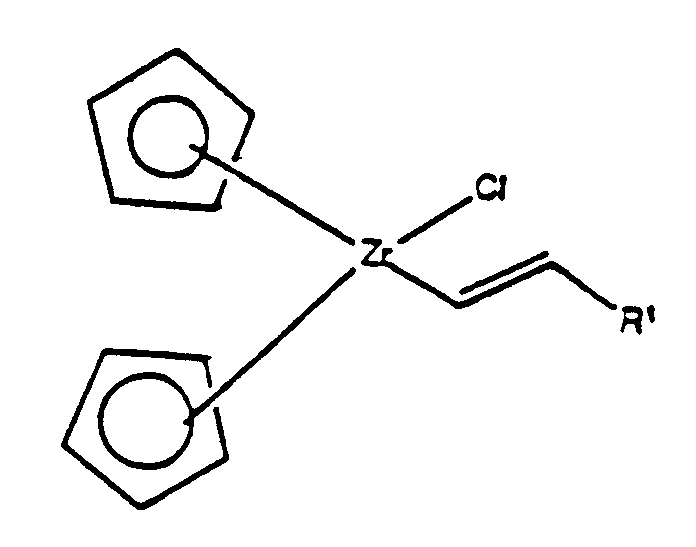
wherein R¹-CH=CH- is the omega side chain of a natural or synthetic prostaglandin and wherein any hydroxy group contained in the side chain is optimally protected by a suitable "hydrolyzable protective group." R¹ contains 1 to 20 carbon atoms which can have vinyl unsaturation. R¹ can contain cycloalkyl or cycloalkenyl moities where the cycloalkyl contains 3 to 6 carbon atoms. R¹ can be substituted with hydroxy, tri-lower-alkylsiloxy, tetrahydropyranyloxy, tetrahydrofuranyloxy, halo or phenoxy. - The E-alkenyl zirconium intermediate is reacted with an alkyllithium and a copper-containing reagent selected from: R²Cu(CN)Li or the mixture CuCN and R²Li to produce a higher order cuprate complex intermediate of the formula

wherein R² can be alkyl, alkenyl, alkynyl, aryl or heteroaromatic such as 2-thienyl. - The above higher order cuprate intermediate can be reacted with a cyclopentenone of the formula

wherein Rα can be an alkyl, alkenyl, or alkynyl of 1 to 6 carbons and can contain heteroatoms such as sulfur or oxygen and R³ can be hydrogen or a lower alkyl, R⁴ represents a hydrolyzable protecting group, to produce a prostaglandin derivative having the general formula
This invention herein further includes bringing into reactive contact an alkyne, zirconocene chloride hydride, a copper (I) salt such as copper cyanide, an alkyllithium or an alkynyllithium, and a suitable cyclopentenone of the formula
in a solvent such as THF, to produce a prostaglandin of the formula
wherein the vinyl lower side chain in the product was initially attached to zirconium. - The invention herein is directed to a process for preparing a higher order cuprate complex and prostaglandin derivatives from such a higher order cuprate complex. The process herein is advantageous in that the process can be performed in a single reaction vessel to completion either in forming the higher order cuprate complex or in forming the prostaglandin derivative in a stereospecific manner.
- The invention herein is directed to a process for preparing prostaglandin derivatives comprising the steps of:
- (a) bringing into reactive contact, in a single reaction vessel, one equivalent of an alkyne and a sufficient amount of zirconocene chloride hydride to produce an E-alkenyl zirconium intermediate;
- (b) adding to the reaction vessel (i) one equivalent of CuCN and three equivalents of an alkyllithium; or (ii) two equivalents of an alkyllithium followd by one equivalent of R²Cu(CN)Li; or (iii) two equivalents of an alkyllithium followed by one equivalent of CuCN and one equivalent of R²Li; to produce a higher order cuprate complex intermediate, wherein R² can be alkyl, substituted alkyl, alkenyl, alkynyl, aryl or heteroaromatic group;
- (c) adding to the reaction vessel a cyclopentenone to react with the higher order cuprate complex intermediate to produce the prostaglandin derivative.
- In a broader sense, the invention herein is directed to a method for preparing a higher order cuprate complex by the above mentioned process. The formed higher order cuprate complex can be used in further reaction sequences as is known for cuprate reagents for example to make prostaglandin derivatives.
- The process is performed by reacting an alkyne and a zirconocene chloride hydride, Cp₂Zr(H)Cl, to produce an E-alkenyl zirconium intermediate. Cp represents a cyclopentadienyl anion group. The E-alkenyl zirconium intermediate need not be isolated but can be reacted with an alkyllithium and a copper-containing reagent which can be: the complex R²Cu(CN)Li or the reagent mixture CuCN and R²Li to produce a higher order cuprate complex intermediate of the formula

wherein R¹-CH=CH- is the omega side chain of a natural or synthetic prostaglandin and wherein any hydroxy group contained in the side chain is optimally protected by a suitable "hydrolyzable protective group." R¹ contains 1 to 20 carbon atoms which can have vinyl unsaturation. R¹ can contain cycloalkyl or cycloalkenyl moieties where the cycloalkyl contains 3 to 6 carbon atoms. R¹ can be substituted with hydroxy, tri-lower-alkylsiloxy, tetrahydropyranyloxy, tetrahydrofuranyloxy, halo or phenoxy; and wherein R² can be alkyl, alkenyl, alkynyl, aryl or heteroaromatic such as 2-thienyl. - The higher order cuprate complex intermediate need not be isolated but can be reacted with an appropriate cyclopentenone to produce a prostaglandin derivative of the formula

wherein Rα can be an alkyl, alkenyl, alkynyl of 1 to 6 carbons. Rα can contain heteroatoms such as sulfur or oxygen. R³ can be hydrogen or a lower alkyl and R⁴ represents a hydrolyzable protecting group. The expression "alkyl" used herein refers to straight chain and branched alkyl groups with 1 to 7 carbon atoms, such as methyl, ethyl, propyl and butyl. The expressions "halogen" or "halo" refer to halogen atoms such as fluorine, chlorine, bromine and iodine. The expression "aryl" refers to a mononuclear aromatic hydrocarbon group, such as phenyl, which can be unsubstituted or can be substituted in one or more positions by lower alkylenedioxy, halogen, nitro, lower alkyl or lower alkoxy groups; and polynuclear aryl groups, such as naphthyl, anthryl, phenanthryl and azulyl, which can be substituted by one or more of the groups mentioned above. The preferred aryl groups are substituted and unsubstituted mononuclear aryl groups, especially phenyl. - The expression "hydrolyzable protecting group" designates any protecting group which can be hydrolyzed with the formation of the group that it protects. Hydroxyl groups can be protected by forming hydrolyzable esters, acetals or ethers. Examples of groups that are suitable for forming esters to protect organic acids are lower alkyl groups or-halo lower alkyl groups. A suitable ether protecting group can be a hydrolyzable lower alkyl ether, such as tertiary butyl ether and tetrahydropyranyl ether. Other ether groups are arylmethyl ethers, such as benzyl, benzhydryl or trityl ethers or α-lower-alkoxy-lower alkyl ethers, such as methoxymethyl ether, methoxypropyl ether or allyl ether, or tri-substituted silyl ethers in which the substituent is a lower alkyl and/or aryl group, such as trimethylsilyl ether, triethylsilyl ether or dimethyl tertiarybutylsilyl ether and dimethylphenylsilyl ether.
- In the structural formulas herein, a wedge shaped bond () represents a substituent which has the β orientation (above the plane of the molecule) and a broken line (
 ) represents a substituent that is in the α orientation (below the plane of the molecule) and a wavy line (
 ) represents a substituent which is either in the α or β orientation or is a mixture of these isomers.
- The invention herein is illustrated in the following reaction Schemes I-II. The two reaction schemes illustrate the process herein and the variations in the process, any of which can be followed to produce a prostaglandin derivative. Each of the reaction sequences shown in the reaction schemes can be performed in a single reaction vessel which provides a particularly unique benefit for using the process herein as the performance of the process in a single reaction vessel ("one-pot" reaction) eliminates steps of separating and isolating intermediates and the need for having additional reaction vessels.
- In the two reaction schemes an alkyne, which can contain additional unsaturation, is reacted with zirconocene chloride hydride to produce a zirconium intermediate which is reacted with an alkyllithium reagent, a copper complex (or reagents to produce the copper complex) and an enone ("enone" is used herein to refer to a cyclopentenone) to produce the prostaglandin derivative. In the reaction Schemes I-II, the processes described are exemplified with 4-methyl, 4-trimethylsilyloxy-1-octyne. It can be understood that other terminal alkynes, such as those described in examples 2-11, work equally well with the processes depicted in the Schemes I and II.

In the above reaction Scheme I a terminal alkyne is reacted with Cp₂Zr(H)Cl in a suitable solvent such as tetrahydrofuran (THF) to produce a zirconium intermediate of the indicated formula. The zirconium intermediate is reacted sequentially with two equivalents of an alkyllithium such as n-butyllithium (n-BuLi) or methyllithium (CH₃Li), copper cyanide (CuCN), an alkyllithium such as methyllithium (CH₃Li) and an appropriate enone which results in the prostaglandin derivative which is represented in this Scheme I as having TMS and TES (trimethylsilyl and triethylsilyl) protective groups for the hydroxyl moieties on the prostaglandin derivative. The reaction is conducted in a single reaction vessel with the reactants being added in the order indicated. The reaction is performed at a reduced temperature preferably in the range of -50°C to -78°C.
The reaction sequence shown in Scheme II illustrates another method for preparing prostaglandin derivatives using the invention herein. In reaction Scheme II a terminal alkyne is reacted with zirconocene chloride hydride to yield a zirconium intermediate which is reacted with two equivalents of alkyllithium followed by a lower order cuprate complex, R²Cu(CN)Li, and a suitable enone to provide the prostaglandin derivative. The reaction sequence is performed in a temperature range from about -50°C to about -78°C. - In the process herein any conventional inert organic solvent or solvent mixture can be used. Aromatic hydrocarbons such as benzene and toluene and ether solvents such as tetrahydrofuran are especially preferred. Temperatures in the range of -50° to -78°C are preferred for performing the reaction with a temperature range from -50° to -60°C being especially preferred.
- This example illustrates a one-pot preparation of a prostaglandin using the method herein and in particular following the reaction sequence shown in reaction Scheme I.
- A dry, round bottom flask was charged with 776 mg (3.00 mmol) of zirconocene chloride hydride and 4 ml of dry THF under nitrogen. A solution of 604 mg (2.85 mmol) of 4-methyl-4-trimethylsilyloxy-1-octyne in 6 ml of THF was added by cannula. The mixture was stirred at room temperature for approximately 30 minutes and cooled to -50°C. The mixture was treated with 3.56 ml of n-butyllithium (1.6M in hexane, 5.7 mmol) for ten minutes. To the vessel was added 254 mg (2.84 mmol) of copper cyanide and the mixture was stirred for fifteen minutes at -50°C followed by the addition of 2.09 ml of methyllithium (1.39M in cumene/THF, 2.9 mmol). The mixture was stirred for fifteen minutes to generate an orange cuprate solution. A Solution of 503 mg (1.42 mmol) of (±)-methyl 7-[(3-triethylsilyloxy)-5-oxocyclopenten-1-yl]heptanoate in 4 ml of THF was added. After stirring for thirty minutes the product was poured onto a mixture of 25 ml of saturated aqueous ammonium chloride/ammonium hydroxide (9:1) and 50 ml ether. The quenched mixture was stirred for thirty minutes at room temperature, passed through a pad of Celite and separated. The Celite pad was washed successively with saturated ammonium chloride and ether. The aqueous layer was extracted twice with 25 ml portions of ether. The combined organic layers were washed with saturated ammonium chloride/ammonium hydroxide (9:1), dried over anhydrous Na₂SO₄ and filtered through a pad of silica gel. The solvent was removed under vacuum to give the protected prostaglandin as a pale yellow oil. Deprotection was carried out by stirring the protected prostaglandin in 25 ml of 20% aqueous acetone in the presence of a catalytic amount of pyridinium p-toluenesulfonate (PPTS) for 4 hours to give 383 mg (71%) of (±)-methyl (11α,13E)-11,16-dihydroxy-16-methyl-9-oxoprost-13-en-1-oate after isolation and purification by chromatography on silica gel (ethyl acetate/hexane, gradient elution).
- The procedure of Example 1 was repeated in every essential detail with the exception that the indicated enones, alkynes, and corresponding products shown in the following Table 1 were prepared. In examples 2 through 11 the enones had the following structures and the Ph in the stuctures in the Table represents a phenyl group.


- This example illustrates the method herein employing reaction Scheme II to produce a prostaglandin derivative. To an argon filled, flame-dried flask was added 776 mg (7.0 mmol) of zirconocene chloride hydride under nitrogen. The flask was protected from light with foil. To this flash was added 4 ml of THF, followed by a solution of 604 mg (2.85 mmol) of 4-methyl-4-trimethylsilyloxy-1-octyne in 6 ml THF and 2 ml THF rinse. The reaction mixture was stirred at room temperature for approximately 30 minutes to give a light orange solution.
- To a second flask was added 254 mg (2.85 mmol) of copper cyanide under nitrogen. To the cooled flask was added 5 ml THF and the reaction mixture was cooled to -78°C. To the flask was added via syringe 2.09 ml of methyllithium (1.39M in cumene/THF, 2.9 mmol). The flask was warmed to 0°C for 12-20 minutes and recooled to -78°C.
- To the light orange colored solution of the zirconium intermediate at -78°C was added n-butyllithium (3.56 ml, 5.7 mmol, 1.6M) dropwise by a syringe. The temperature was maintained at about -70°C during the addition. The mixture was warmed gradually to -30°C over fifteen minutes and held at -30°C for fifteen minutes to give a deeper, orange-colored zirconium solution. The solution was recooled to -78°C and the copper solution was added by cannula while maintaining the temperature at about -78°C. The reaction mixture was warmed briefly to -30°C and recooled to -78°C. To the flask was added by syringe a solution of 503 mg (1.42 mmol) of (±)-methyl 7-[(3-triethylsilyloxy)-5-oxocyclopenten-1-yl]-heptanoate in 4 ml of THF. The reaction mixture was stirred at -78°C for thirty minutes and quenched into 50 ml of a mixture of saturated aqueous ammonium chloride/ammonium hydroxide (9:1) and 50 ml of ether. The reaction mixture was stirred at room temperature for thirty minutes. The aqueous layer was extracted with two 50-ml portions of ether. The combined organic layers were washed twice with saturated ammonium chloride/ammonium hydroxide (9:1), and dried over anhydrous Na₂SO₄; filtered through Celite and concentrated at reduced pressure. The residue was dissolved in 50 ml of 4:1 acetone and water and treated with 50 mg PPTS and stirred at room temperature for four hours. The residue was partitioned between 20 ml saturated NaCl solution and 75 ml ethyl acetate. The aqueous phase was extracted with two 25-ml portions of ethyl acetate and the combined organic layers were washed with 10 ml saturated NaCl solution and dried over anhydrous Na₂SO₄. The solvent was removed in vacuo to yield 765 mg of crude (±)-methyl (11α,13E)-11,16-dihydroxy-16-methyl-9-oxoprost-13-en-1-oate. The crude product was purified by column chromatography on silica gel to give 388 mg of purified product.
- This example illustrates a one-pot preparation of a prostaglandin using the method herein and in particular following the reaction sequence shown in reaction Scheme I.
- A dry, round bottom flask was charged with 776 mg (3.00 mmol) of zirconocene chloride hydride and 4 ml of dry THF under nitrogen. A solution of 604 mg (2.85 mmol) of 4-methyl-4-trimethylsilyloxy-1-octyne in 6 ml of THF was added by cannula. The mixture was stirred at room temperature for approximately 30 minutes and cooled to -50°C. The mixture was treated with 6.27 ml of methyllithium (1.39M in cumene/THF, 8.7 mmol) for fifteen minutes. To the vessel was added 254 mg (2.84 mmol) of copper cyanide and the mixture was stirred for one hour at -50°C to generate an orange cuprate solution. A solution of 503 mg (1.42 mmol) of (±)-methyl 7-[(3-triethylsilyloxy)-5-oxocyclopenten-1-yl]heptanoate in 4 ml of THF was added. After stirring for thirty minutes the product was poured onto a mixture of 25 ml of saturated aqueous ammonium chloride/ammonium hydroxide (9:1) and 50 ml ether. The benched mixture was stirred for thirty minutes at room temperature, passed through a pad of Celite and separated. The Celite pad was washed successively with saturated ammonium chloride and ether. The aqueous layer was extracted twice with 25 ml portions of ether. The combined organic layers were washed with saturated ammonium chloride/ammonium hydroxide (9:1), dried over anhydrous Na₂SO₄ and filtered through a pad of silica gel. The solvent was removed under vacuum to give the protected prostaglandin as a pale yellow oil. Deprotection was carried out by stirring the protected prostaglandin in 25 ml of 20% aqueous acetone in the presence of a catalytic amount of pyridinium p-toluenesulfonate (PPTS) for 4 hours to give 679 mg of crude (±)-methyl (11α,13E)-11,16-dihydroxy-16-methyl-9-oxoprost-13-en-1-oate after isolation. Quantitative high performance liquid chromatography analysis indicated the crude product contained 305 mg (53%) of the desired product.
- This example illustrates a one-pot preparation of a prostaglandin using the method herein and in particular following the reaction sequence shown in reaction Scheme I.
- A dry, round bottom flask was charged with 776 mg (3.00 mmol) of zirconocene chloride hydride and 4 ml of dry THF under nitrogen. A solution of 604 mg (2.85 mmol) of 4-methyl-4-trimethylsilyloxy-1-octyne in 6 ml of THF was added by cannula. The mixture was stirred at room temperature for approximately 30 minutes and cooled to -50°C. To the vessel was added 254 mg (2.84 mmol) of copper cyanide and the mixture was stirred for fifteen minutes at -50°C followed by the addition of 6.27 ml of methyllithium (1.39M in cumene/THF, 8.7 mmol). The mixture was stirred for fifteen minutes to generate an orange cuprate solution. A solution of 503 mg (1.42 mmol) of (±)-methyl 7-[(3-triethylsilyloxy)-5-oxocyclopenten-1-yl]heptanoate in 4 ml of THF was added. After stirring for thirty minutes the product was poured onto a mixture of 25 ml of saturated aqueous ammonium chloride/ammonium hydroxide (9:1) and 50 ml ether. The quenched mixture was stirred for thirty minutes at room temperature, passed through a pad of Celite and separated. The Celite pad was washed successively with saturated ammonium chloride and ether. The aqueous layer was extracted twice with 25 ml portions of ether. The combined organic layers were washed with saturated ammonium chloride/ammonium hydroxide (9:1), dried over anhydrous Na₂SO₄ and filtered through a pad of silica gel. The solvent was removed under vacuum to give the protected prostaglandin as a pale yellow oil. Deprotection was carried out by stirring the protected prostaglandin in 25 ml of 20% aqueous acetone in the presence of a catalytic amount of pyridinium p-toluenesulfonate (PPTS) for 4 hours to give 383 mg (71%) of (±)-methyl (11α,13E)-11,16-dihydroxy-16-methyl-9-oxoprost-13-en-1-oate after isolation and purification by chromatography on silica gel (ethyl acetate/hexane, gradient elution).
- This example illustrates a one-pot preparation of a prostaglandin using the method herein and in particular following the reaction sequence shown in reaction Scheme I.
- A dry, round bottom flask was charged with 776 mg (3.00 mmol) of zirconocene chloride hydride and 4 ml of dry THF under argon. A solution of 604 mg (2.85 mmol) of 4-methyl-4-trimethylsilyloxy-1-octyne in 6 ml of THF was added by cannula. The mixture was stirred at room temperature for approximately 30 minutes and cooled to -50°C. To the vessel was added 254 mg (2.84 mmol) of copper cyanide and the mixture was stirred for fifteen minutes at -50°C. The mixture was treated with 6.27 ml (1.39 M in cumene, 8.71 mmol) of methyllithium via syringe and stirring was continued at -50°C for fifteen minutes to generate a pale green solution. A solution of 501 mg (1.42 mmol) of (±)-methyl 7-[(3-triethylsilyloxy)-5-oxocyclopenten-1-yl] hept-4-en-1-oate in 4 ml of THF was added. After stirring for twenty minutes at -50°C, the product was poured onto a mixture of 25 ml of saturated aqueous ammonium chloride/ammonium hydroxide (9:1) and 50 ml ether. The quenched mixture was stirred for thirty minutes at room temperature and passed through a pad of Celite. The Celite pad was washed successively with saturated ammonium chloride and ether. The aqueous layer was extracted twice with 25 ml portions of ether. The combined organic layers were washed with saturated ammonium chloride/ammonium hydroxide (9:1), dried over anhydrous Na₂SO₄ and filtered through a pad of silica gel. The solvent was removed under vacuum to give the protected prostaglandin as a pale yellow oil. Deprotection was carried out by stirring the protected prostaglandin in 25 ml of 20% aqueous acetone in the presence of a catalytic amount of pyridinium p-toluenesulfonate (PPTS) for 4 hours to give 553 mg of crude deprotected prostaglandin. The contained yield of product was determined by HPLC quantitation of an aliquot of crude mixture versus a standardized curve of reference standard (4. 6mm X 25cm Zorbax Sil, 2 ml/min. 80/17/3 isooctane/dioxane/acetonitrile). In this manner, a 55% yield of (±)-methyl (11α, 4Z,13E)-11,16-dihydroxy-16-methyl-9-oxoprosta-4, 13-dien-1-oate was obtained.
- A dry round bottom flask was charged with 776 mg (3.00 mmol) of zirconocene chloride hydride, 254 mg (2.85 mmol) of copper cyanide and 4 ml of dry tetrahydrofuran under argon. A solution of 604 mg (2.85 mmol) of 4-methyl-4-trimethylsilyloxy-1-octyne in 6 ml of THF was added by cannula. The mixture was stirred at room temperatue for approximately 30 minutes and cooled to -50°C. The mixture was treated with 6.27 ml (1.39 M in cumene, 8.71 mmol) of methyllithium via syringe and stirring was continued at -50°C for fifteen minutes to generate an olive-green solution. A solution of 501 mg (1.42 mmol) of (±)-methyl 7-[(3-triethylsilyloxy)-5-oxocyclopenten-1-yl]hept-4-en-1-oate in 4.0 ml of THF was added. After stirring for thirty minutes at -50°C, the product was poured onto a mixture of 25 ml of saturated aqueous ammonium chloride/ammonium hydroxide (9:1) and 50 ml ether. The quenched mixture was stirred for thirty minutes at room temperature and passed through a pad of Celite. The Celite pad was washed successively with saturated ammonium chloride and ether. The aqueous layer was extracted twice with 25 ml portions of ether. The combined organic layers were washed with saturated ammonium chloride/ammonium hydroxide (9:1),dried over anhydrous Na₂SO₄ and filtered through a pad of silica gel. The solvent was removed under vacuum to give the protected prostaglandin as a pale yellow oil. Deprotection was carried out by stirring the protected prostaglandin in 25 ml of 20% aqueous acetone in the presence of a catalytic amount of pyridinium p-toluenesulfonate (PPTS) for 4 hours to give 682 mg of crude deprotected prostaglandin. The contained yield of product was determined by HPLC quantitation of an aliquot of this sample versus a standardized curve of reference standard (4.6mm X 25cm Zorbax Sil, 2ml/min 80/17/3 isooctane/dioxane/acetonitrile). In this manner, a 35% yield of (±)-methyl (11α,4Z,13E)-11,16-dihydroxy-16-methyl-9-oxoprosta-4,13-dien-1-oate was obtained.
Claims (18)
- A process for preparing a prostaglandin derivative comprising the steps of:(a) bringing into reactive contact, in a single reaction vessel, one equivalent of an alkyne and a sufficient amount of zirconocene chloride hydride to produce an E-alkenyl zirconium intermediate;(b) adding to the reaction vessel (i) one equivalent of CuCN and three equivalents of an alkyllithium; or (ii) two equivalents of an alkyllithium followd by one equivalent of R²Cu(CN)Li; or (iii) two equivalents of an alkyllithium followed by one equivalent of CuCN and one equivalent of R²Li; to produce a higher order cuprate complex intermediate, wherein R² can be alkyl, substituted alkyl, alkenyl, alkynyl, aryl or heteroaromatic group;(c) adding to the reaction vessel a cyclopentenone to react with the higher order cuprate complex intermediate to produce the prostaglandin derivative.
- A process as recited in Claim 1 wherein the prostaglandin derivative has the structural formula:

wherein Rα can be an alkyl, alkenyl, or alkynyl of 1 to 6 carbons and can contain heteroatoms sulfur or oxygen and R³ can be hydrogen or a lower alkyl; and
wherein R⁴ represents a hydrolyzable protecting group. - A process as recited in Claim 2 wherein the cyclopentenone comprises a compound of the structure

- A process as recited in Claim 2 wherein the cyclopentenone comprises a compound of the structure

- A process as recited in Claim 2 wherein the cyclopentenone comprises a compound of the structure
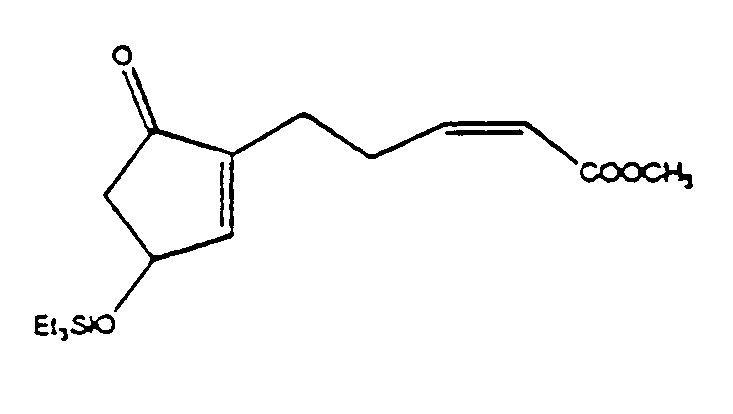
- A process as recited in Claim 2 wherein the cyclopentenone comprises a compound of the structure

- A process as recited in Claim 2 wherein the cyclopentenone comprises a compound of the structure

- A process as recited in Claim 1 wherein the copper reagent comprises R²Cu(CN)Li.
- A process as recited in Claim 1 wherein the copper reagent comprises the reagent mixture of CuCN and R²Li.
- A process as recited in Claim 1 wherein the number of equivalents of alkyllithium in the first step is at least two.
- A process as recited in Claim 1 wherein the number of equivalents of alkyllithium is at least one.
- A process as recited in Claim 1 wherein the alkyne comprises a terminal alkyne of the structural formula

- A process as recited in Claim 1 wherein the alkyne comprises a terminal alkyne of the structural formula

- A process as recited in Claim 1 wherein the alkyllithium reagent comprises methyllithium.
- A process as recited in Claim 1 wherein the alkyllithium comprises n-butyllithium.
- A process as recited in Claim 1 wherein the reactions are performed in a temperature range from -50°C to -78°C.
- A process as recited in Claim 1 wherein the reaction process is performed in a solvent comprising tetrahydrofuran.
- A process according to Claim 1 wherein three equivalents of methyllithium and one equivalent of CuCN are added to the reaction vessel containing the E-alkenyl zirconium intermediate.
Priority Applications (1)
| Application Number | Priority Date | Filing Date | Title |
|---|---|---|---|
| EP94116373A EP0643063B1 (en) | 1990-04-17 | 1991-04-15 | Process for preparing a higher cuprate complex |
Applications Claiming Priority (2)
| Application Number | Priority Date | Filing Date | Title |
|---|---|---|---|
| US07/510,349 US5055604A (en) | 1990-04-17 | 1990-04-17 | Process for preparing prostaglandin analogs using organozirconium compounds |
| US510349 | 1990-04-17 |
Related Child Applications (2)
| Application Number | Title | Priority Date | Filing Date |
|---|---|---|---|
| EP94116373A Division EP0643063B1 (en) | 1990-04-17 | 1991-04-15 | Process for preparing a higher cuprate complex |
| EP94116373.5 Division-Into | 1994-10-18 |
Publications (3)
| Publication Number | Publication Date |
|---|---|
| EP0452843A2 EP0452843A2 (en) | 1991-10-23 |
| EP0452843A3 EP0452843A3 (en) | 1992-07-29 |
| EP0452843B1 true EP0452843B1 (en) | 1995-06-14 |
Family
ID=24030385
Family Applications (2)
| Application Number | Title | Priority Date | Filing Date |
|---|---|---|---|
| EP94116373A Expired - Lifetime EP0643063B1 (en) | 1990-04-17 | 1991-04-15 | Process for preparing a higher cuprate complex |
| EP91105951A Expired - Lifetime EP0452843B1 (en) | 1990-04-17 | 1991-04-15 | Process for preparing prostaglandin analogs using organozirconium compounds |
Family Applications Before (1)
| Application Number | Title | Priority Date | Filing Date |
|---|---|---|---|
| EP94116373A Expired - Lifetime EP0643063B1 (en) | 1990-04-17 | 1991-04-15 | Process for preparing a higher cuprate complex |
Country Status (12)
| Country | Link |
|---|---|
| US (1) | US5055604A (en) |
| EP (2) | EP0643063B1 (en) |
| JP (1) | JPH04224555A (en) |
| KR (2) | KR100208496B1 (en) |
| AT (2) | ATE123768T1 (en) |
| CA (1) | CA2040468C (en) |
| DE (2) | DE69131944T2 (en) |
| DK (2) | DK0643063T3 (en) |
| ES (2) | ES2073060T3 (en) |
| GR (1) | GR3033236T3 (en) |
| IE (1) | IE911273A1 (en) |
| PT (1) | PT97368A (en) |
Families Citing this family (6)
| Publication number | Priority date | Publication date | Assignee | Title |
|---|---|---|---|---|
| US5618959A (en) * | 1995-03-10 | 1997-04-08 | Vivus Incorporated | Process for preparing prostaglandin E1, E2 and analogs thereof using furylcopper reagents |
| US6030959A (en) * | 1997-04-04 | 2000-02-29 | Monsanto Company | Gastro-specific prodrugs |
| US6413945B1 (en) * | 1997-04-04 | 2002-07-02 | Pharmacia Corporation | Gastro-specific prodrugs |
| KR20030002365A (en) * | 2001-06-29 | 2003-01-09 | 주식회사 하이닉스반도체 | Monomer for photoresist polymer of semicondutor device and method for manufacturing thereof |
| KR101045935B1 (en) | 2009-03-11 | 2011-07-01 | 연성정밀화학(주) | Method for preparing prostaglandin derivative |
| HU231185B1 (en) | 2017-07-11 | 2021-07-28 | CHINOIN Gyógyszer és Vegyészeti Termékek Gyára Zrt. | Process for preparation and purification of misoprostol |
Family Cites Families (17)
| Publication number | Priority date | Publication date | Assignee | Title |
|---|---|---|---|---|
| US3950406A (en) * | 1972-07-24 | 1976-04-13 | American Cyanamid Company | Hydroxylated 15-deoxy derivatives of 9-hydroxy-13-trans-prostenoic acid |
| US3962353A (en) * | 1972-09-29 | 1976-06-08 | Wisconsin Alumni Research Foundation | 3-Substituted iodo alkenyl compounds and methods for preparing same |
| US3962352A (en) * | 1972-09-29 | 1976-06-08 | Wisconsin Alumni Research Foundation | 3-Substituted iodo alkenyl compounds and methods for preparing same |
| US3962351A (en) * | 1972-09-29 | 1976-06-08 | Wisconsin Alumni Research Foundation | 3-Substituted iodo alkenyl compounds and methods for preparing same |
| US3932479A (en) * | 1973-04-27 | 1976-01-13 | American Cyanamid Company | Lithium 3-triphenylmethoxy-1-trans-alkenyl-dialkyl alanates |
| US4007210A (en) * | 1973-04-27 | 1977-02-08 | American Cyanamid Company | Novel 3-triphenylmethoxy-1-alkynes, 3-triphenylmethoxy-1-trans-alkenyl-dialkyl-alanes, and lithium 3-triphenyl-methoxy-1-trans-alkenyl-dialkyl-alanates |
| US3965143A (en) * | 1974-03-26 | 1976-06-22 | G. D. Searle & Co. | 16-Oxygenated prostanoic acid derivatives |
| US4983753A (en) * | 1981-05-21 | 1991-01-08 | Floyd Jr Middleton B | Precursors and synthesis of di-(methyl)-16,16-(dimethyl)-11-alpha,15-alpha beta-dihydroxy-9-oxo-2,13-trans,trans-prostadienoates |
| US4415501A (en) * | 1981-12-16 | 1983-11-15 | American Cyanamid Company | Alkenylzirconium reagents useful for prostaglandin analog synthesis |
| US4822909A (en) * | 1983-06-10 | 1989-04-18 | Asashi Glass Company Ltd. | 7-fluoroprostaglandins and process for their production |
| DK40485A (en) * | 1984-03-02 | 1985-09-03 | Hoffmann La Roche | Prostaglandin intermediates |
| DE3571319D1 (en) * | 1984-10-08 | 1989-08-10 | Teijin Ltd | Process for producing 2,3-disubstituted -4-substituted cyclopentanones, enantiomorphs, or mixtures thereof |
| US4873360A (en) * | 1986-07-10 | 1989-10-10 | Board Of Governors Of Wayne State University | Process for the preparation of cyclopentanoids and novel intermediates produced thereby |
| US4777275A (en) * | 1987-06-09 | 1988-10-11 | G. D. Searle & Co. | Process of preparing higher order cuprate complexes |
| US4904820A (en) * | 1987-06-09 | 1990-02-27 | G. D. Searle & Co. | Process for substituting a hydrocarbon group |
| US4916238A (en) * | 1988-12-13 | 1990-04-10 | Syntex (U.S.A.) Inc. | Process for preparing allenic prostanoic acid derivatives |
| US5072010A (en) * | 1990-04-04 | 1991-12-10 | University Of California | Transmetalations from zirconium to copper intermediates |
-
1990
- 1990-04-17 US US07/510,349 patent/US5055604A/en not_active Expired - Lifetime
-
1991
- 1991-04-15 ES ES91105951T patent/ES2073060T3/en not_active Expired - Lifetime
- 1991-04-15 ES ES94116373T patent/ES2143517T3/en not_active Expired - Lifetime
- 1991-04-15 KR KR1019910005994A patent/KR100208496B1/en not_active Expired - Fee Related
- 1991-04-15 PT PT97368A patent/PT97368A/en not_active Application Discontinuation
- 1991-04-15 AT AT91105951T patent/ATE123768T1/en not_active IP Right Cessation
- 1991-04-15 EP EP94116373A patent/EP0643063B1/en not_active Expired - Lifetime
- 1991-04-15 DK DK94116373T patent/DK0643063T3/en active
- 1991-04-15 DE DE69131944T patent/DE69131944T2/en not_active Expired - Fee Related
- 1991-04-15 CA CA002040468A patent/CA2040468C/en not_active Expired - Fee Related
- 1991-04-15 DK DK91105951.7T patent/DK0452843T3/en active
- 1991-04-15 AT AT94116373T patent/ATE189222T1/en not_active IP Right Cessation
- 1991-04-15 DE DE69110343T patent/DE69110343T2/en not_active Expired - Fee Related
- 1991-04-15 EP EP91105951A patent/EP0452843B1/en not_active Expired - Lifetime
- 1991-04-16 IE IE127391A patent/IE911273A1/en unknown
- 1991-04-16 JP JP3084081A patent/JPH04224555A/en active Pending
-
1998
- 1998-12-17 KR KR1019980055838A patent/KR100226368B1/en not_active Expired - Fee Related
-
2000
- 2000-04-14 GR GR20000400918T patent/GR3033236T3/en not_active IP Right Cessation
Non-Patent Citations (1)
| Title |
|---|
| J. AM. CHEM. SOC., vol. 112, 1990, pages 7440-7441, American Chemical Society;B. H. LIPSHUTZ et al.: "Hydrozirconation-transmetalation. A mild, direct route of higher order vinylic cuprates from monosubstitured acetylenes" * |
Also Published As
| Publication number | Publication date |
|---|---|
| EP0643063A3 (en) | 1995-10-11 |
| DK0452843T3 (en) | 1995-08-14 |
| DE69110343D1 (en) | 1995-07-20 |
| EP0452843A2 (en) | 1991-10-23 |
| JPH04224555A (en) | 1992-08-13 |
| US5055604A (en) | 1991-10-08 |
| ATE123768T1 (en) | 1995-06-15 |
| CA2040468A1 (en) | 1991-10-18 |
| EP0643063B1 (en) | 2000-01-26 |
| DE69131944D1 (en) | 2000-03-02 |
| ES2143517T3 (en) | 2000-05-16 |
| KR100226368B1 (en) | 1999-10-15 |
| IE911273A1 (en) | 1991-10-23 |
| GR3033236T3 (en) | 2000-09-29 |
| DE69110343T2 (en) | 1995-12-21 |
| EP0452843A3 (en) | 1992-07-29 |
| ES2073060T3 (en) | 1995-08-01 |
| ATE189222T1 (en) | 2000-02-15 |
| KR910018351A (en) | 1991-11-30 |
| KR100208496B1 (en) | 1999-07-15 |
| DK0643063T3 (en) | 2000-04-25 |
| PT97368A (en) | 1992-01-31 |
| EP0643063A2 (en) | 1995-03-15 |
| DE69131944T2 (en) | 2000-06-15 |
| CA2040468C (en) | 2004-10-26 |
Similar Documents
| Publication | Publication Date | Title |
|---|---|---|
| EP1385819A1 (en) | Process for preparing prostaglandin derivatives and stereospecific starting material thereof | |
| JP2567430B2 (en) | Carbinol derivative and method for producing the same | |
| US5055604A (en) | Process for preparing prostaglandin analogs using organozirconium compounds | |
| KR20060118555A (en) | Prostaglandin Synthesis | |
| RU2150472C1 (en) | Method of synthesis of diisopinocampheylchloroborane in reaction mixture, method of reduction of prochiral ketone | |
| US5252763A (en) | Process for preparing prostaglandin analogs | |
| Yamamoto et al. | Chemistry of cyclic phosphorus compounds. 3. Synthesis of pheromones having an. gamma.,. delta.-unsaturated ketone system from 1, 1-diphenylphospholanium perchlorate | |
| Scarpetti et al. | Fluoride ion mediated intramolecular sulfenylation of. alpha.-silyl sulfones: Ramberg-Baecklund annulation to exocyclic fused olefins | |
| Lautens et al. | Allyl 1, 1-bimetallic species: Their preparation and reactivity profile | |
| EP0294757A2 (en) | Process of preparing higher order cuprate complexes | |
| EP0362816B1 (en) | Cyclopenteneheptanoic acid derivatives and method of preparation thereof | |
| JPH0141142B2 (en) | ||
| US6255501B1 (en) | Process for preparing antiosteoporotic agents | |
| US4268453A (en) | Process for the manufacture of cholestene derivatives and novel intermediates in their manufacture | |
| JPWO2018220888A1 (en) | PGE1 core block derivative and method for producing the same | |
| US6313341B1 (en) | Process for the preparation of prostaglandins | |
| CZ278597A3 (en) | Process for preparing prostaglandin e1, e2 and analog by making use of furyl-copper compounds | |
| US6025518A (en) | Substituted cyclopentene derivatives and method for preparing the same | |
| HUP0003578A2 (en) | Process for the production of epoxide intermediates of prostaglandins | |
| US5684177A (en) | Misoprostol | |
| US4384127A (en) | Process for synthesis of optically pure prostaglandin E2 and analogs thereof | |
| JP2737304B2 (en) | Chiral ferrocene derivatives | |
| Walkup et al. | Preparation of 2-(Tetrahydrofuran-2′-YL)-l, 4-Pentadienes From γ-Allenyl Alcohols via Oxymercuration Followed by Palladium (II)-Medlated all Ylation | |
| US4440939A (en) | Process for the preparation of esters of leukotriene A | |
| EP0807634B1 (en) | Misoprostol, process for its preparation using an organometallic cuprate complex |
Legal Events
| Date | Code | Title | Description |
|---|---|---|---|
| PUAI | Public reference made under article 153(3) epc to a published international application that has entered the european phase |
Free format text: ORIGINAL CODE: 0009012 |
|
| AK | Designated contracting states |
Kind code of ref document: A2 Designated state(s): AT BE CH DE DK ES FR GB GR IT LI LU NL SE |
|
| PUAL | Search report despatched |
Free format text: ORIGINAL CODE: 0009013 |
|
| AK | Designated contracting states |
Kind code of ref document: A3 Designated state(s): AT BE CH DE DK ES FR GB GR IT LI LU NL SE |
|
| 17P | Request for examination filed |
Effective date: 19921121 |
|
| 17Q | First examination report despatched |
Effective date: 19940321 |
|
| GRAA | (expected) grant |
Free format text: ORIGINAL CODE: 0009210 |
|
| ITF | It: translation for a ep patent filed | ||
| AK | Designated contracting states |
Kind code of ref document: B1 Designated state(s): AT BE CH DE DK ES FR GB GR IT LI LU NL SE |
|
| REF | Corresponds to: |
Ref document number: 123768 Country of ref document: AT Date of ref document: 19950615 Kind code of ref document: T |
|
| XX | Miscellaneous (additional remarks) |
Free format text: TEILANMELDUNG 94116373.5 EINGEREICHT AM 15/04/91. |
|
| REF | Corresponds to: |
Ref document number: 69110343 Country of ref document: DE Date of ref document: 19950720 |
|
| REG | Reference to a national code |
Ref country code: ES Ref legal event code: FG2A Ref document number: 2073060 Country of ref document: ES Kind code of ref document: T3 |
|
| REG | Reference to a national code |
Ref country code: DK Ref legal event code: T3 |
|
| REG | Reference to a national code |
Ref country code: GR Ref legal event code: FG4A Free format text: 3016460 |
|
| ET | Fr: translation filed | ||
| PLBE | No opposition filed within time limit |
Free format text: ORIGINAL CODE: 0009261 |
|
| STAA | Information on the status of an ep patent application or granted ep patent |
Free format text: STATUS: NO OPPOSITION FILED WITHIN TIME LIMIT |
|
| 26N | No opposition filed | ||
| REG | Reference to a national code |
Ref country code: GB Ref legal event code: IF02 |
|
| PGFP | Annual fee paid to national office [announced via postgrant information from national office to epo] |
Ref country code: GB Payment date: 20050314 Year of fee payment: 15 Ref country code: DK Payment date: 20050314 Year of fee payment: 15 Ref country code: AT Payment date: 20050314 Year of fee payment: 15 |
|
| PGFP | Annual fee paid to national office [announced via postgrant information from national office to epo] |
Ref country code: NL Payment date: 20050316 Year of fee payment: 15 |
|
| PGFP | Annual fee paid to national office [announced via postgrant information from national office to epo] |
Ref country code: FR Payment date: 20050401 Year of fee payment: 15 |
|
| PGFP | Annual fee paid to national office [announced via postgrant information from national office to epo] |
Ref country code: SE Payment date: 20050404 Year of fee payment: 15 |
|
| PGFP | Annual fee paid to national office [announced via postgrant information from national office to epo] |
Ref country code: GR Payment date: 20050421 Year of fee payment: 15 Ref country code: ES Payment date: 20050421 Year of fee payment: 15 |
|
| PGFP | Annual fee paid to national office [announced via postgrant information from national office to epo] |
Ref country code: BE Payment date: 20050428 Year of fee payment: 15 |
|
| PGFP | Annual fee paid to national office [announced via postgrant information from national office to epo] |
Ref country code: DE Payment date: 20050429 Year of fee payment: 15 |
|
| PGFP | Annual fee paid to national office [announced via postgrant information from national office to epo] |
Ref country code: LU Payment date: 20050603 Year of fee payment: 15 |
|
| PGFP | Annual fee paid to national office [announced via postgrant information from national office to epo] |
Ref country code: CH Payment date: 20050613 Year of fee payment: 15 |
|
| PG25 | Lapsed in a contracting state [announced via postgrant information from national office to epo] |
Ref country code: GB Free format text: LAPSE BECAUSE OF NON-PAYMENT OF DUE FEES Effective date: 20060415 Ref country code: AT Free format text: LAPSE BECAUSE OF NON-PAYMENT OF DUE FEES Effective date: 20060415 |
|
| PG25 | Lapsed in a contracting state [announced via postgrant information from national office to epo] |
Ref country code: SE Free format text: LAPSE BECAUSE OF NON-PAYMENT OF DUE FEES Effective date: 20060416 |
|
| PG25 | Lapsed in a contracting state [announced via postgrant information from national office to epo] |
Ref country code: ES Free format text: LAPSE BECAUSE OF NON-PAYMENT OF DUE FEES Effective date: 20060417 |
|
| PG25 | Lapsed in a contracting state [announced via postgrant information from national office to epo] |
Ref country code: LU Free format text: LAPSE BECAUSE OF NON-PAYMENT OF DUE FEES Effective date: 20060430 Ref country code: LI Free format text: LAPSE BECAUSE OF NON-PAYMENT OF DUE FEES Effective date: 20060430 Ref country code: CH Free format text: LAPSE BECAUSE OF NON-PAYMENT OF DUE FEES Effective date: 20060430 Ref country code: BE Free format text: LAPSE BECAUSE OF NON-PAYMENT OF DUE FEES Effective date: 20060430 |
|
| PGFP | Annual fee paid to national office [announced via postgrant information from national office to epo] |
Ref country code: IT Payment date: 20060430 Year of fee payment: 16 |
|
| PG25 | Lapsed in a contracting state [announced via postgrant information from national office to epo] |
Ref country code: DK Free format text: LAPSE BECAUSE OF NON-PAYMENT OF DUE FEES Effective date: 20060501 |
|
| PG25 | Lapsed in a contracting state [announced via postgrant information from national office to epo] |
Ref country code: NL Free format text: LAPSE BECAUSE OF NON-PAYMENT OF DUE FEES Effective date: 20061101 Ref country code: DE Free format text: LAPSE BECAUSE OF NON-PAYMENT OF DUE FEES Effective date: 20061101 |
|
| REG | Reference to a national code |
Ref country code: DK Ref legal event code: EBP |
|
| REG | Reference to a national code |
Ref country code: CH Ref legal event code: PL |
|
| EUG | Se: european patent has lapsed | ||
| GBPC | Gb: european patent ceased through non-payment of renewal fee |
Effective date: 20060415 |
|
| NLV4 | Nl: lapsed or anulled due to non-payment of the annual fee |
Effective date: 20061101 |
|
| REG | Reference to a national code |
Ref country code: FR Ref legal event code: ST Effective date: 20061230 |
|
| REG | Reference to a national code |
Ref country code: ES Ref legal event code: FD2A Effective date: 20060417 |
|
| BERE | Be: lapsed |
Owner name: G.D. *SEARLE & CO. Effective date: 20060430 |
|
| PG25 | Lapsed in a contracting state [announced via postgrant information from national office to epo] |
Ref country code: FR Free format text: LAPSE BECAUSE OF NON-PAYMENT OF DUE FEES Effective date: 20060502 |
|
| PG25 | Lapsed in a contracting state [announced via postgrant information from national office to epo] |
Ref country code: GR Free format text: LAPSE BECAUSE OF NON-PAYMENT OF DUE FEES Effective date: 20061102 |
|
| PG25 | Lapsed in a contracting state [announced via postgrant information from national office to epo] |
Ref country code: IT Free format text: LAPSE BECAUSE OF NON-PAYMENT OF DUE FEES Effective date: 20070415 |