EP0450367A2 - Verfahren und Einrichtung zur Sprachanalyse - Google Patents
Verfahren und Einrichtung zur Sprachanalyse Download PDFInfo
- Publication number
- EP0450367A2 EP0450367A2 EP91104028A EP91104028A EP0450367A2 EP 0450367 A2 EP0450367 A2 EP 0450367A2 EP 91104028 A EP91104028 A EP 91104028A EP 91104028 A EP91104028 A EP 91104028A EP 0450367 A2 EP0450367 A2 EP 0450367A2
- Authority
- EP
- European Patent Office
- Prior art keywords
- elements
- vector
- feature
- circuitry
- selected elements
- Prior art date
- Legal status (The legal status is an assumption and is not a legal conclusion. Google has not performed a legal analysis and makes no representation as to the accuracy of the status listed.)
- Granted
Links
- 238000004458 analytical method Methods 0.000 title claims abstract description 38
- 239000013598 vector Substances 0.000 claims abstract description 109
- 239000011159 matrix material Substances 0.000 claims description 33
- 238000000034 method Methods 0.000 claims description 15
- 238000005259 measurement Methods 0.000 abstract description 12
- 230000002123 temporal effect Effects 0.000 abstract description 9
- 230000009466 transformation Effects 0.000 description 14
- 230000006870 function Effects 0.000 description 10
- 230000007704 transition Effects 0.000 description 7
- 230000008901 benefit Effects 0.000 description 5
- 238000012795 verification Methods 0.000 description 4
- 238000004364 calculation method Methods 0.000 description 3
- 238000010586 diagram Methods 0.000 description 3
- 230000008569 process Effects 0.000 description 3
- 230000003595 spectral effect Effects 0.000 description 3
- 238000012512 characterization method Methods 0.000 description 2
- 239000006185 dispersion Substances 0.000 description 2
- 230000008030 elimination Effects 0.000 description 2
- 238000003379 elimination reaction Methods 0.000 description 2
- 230000009467 reduction Effects 0.000 description 2
- 230000003068 static effect Effects 0.000 description 2
- 238000013179 statistical model Methods 0.000 description 2
- 238000007476 Maximum Likelihood Methods 0.000 description 1
- 230000004075 alteration Effects 0.000 description 1
- 238000013523 data management Methods 0.000 description 1
- 238000005516 engineering process Methods 0.000 description 1
- 238000001228 spectrum Methods 0.000 description 1
- 238000007619 statistical method Methods 0.000 description 1
- 238000006467 substitution reaction Methods 0.000 description 1
- 238000000844 transformation Methods 0.000 description 1
Images
Classifications
-
- G—PHYSICS
- G10—MUSICAL INSTRUMENTS; ACOUSTICS
- G10L—SPEECH ANALYSIS TECHNIQUES OR SPEECH SYNTHESIS; SPEECH RECOGNITION; SPEECH OR VOICE PROCESSING TECHNIQUES; SPEECH OR AUDIO CODING OR DECODING
- G10L15/00—Speech recognition
- G10L15/08—Speech classification or search
- G10L15/10—Speech classification or search using distance or distortion measures between unknown speech and reference templates
Definitions
- This invention relates in general to speech technology and more particularly to an improved method and apparatus for speech analysis.
- a speech analysis method and apparatus are provided which substantially eliminate or prevent disadvantages and problems associated with prior speech analysis systems.
- the present invention includes both apparatus and methodology for improving speech analysis.
- the speech analysis method of the present invention comprises the steps of receiving a feature vector having a plurality of elements, providing a reference model vector, and generating selected elements of the square of an error vector corresponding to the feature vector element. Selected elements of the error vector are weighted by a weight factor comprising a factor proportional to the relative variance of the respective selected element.
- the present invention provides several technical advantages over prior art devices.
- the weighted error vector provides improved recognition scoring over prior art speech analysis systems. In particular, a reduction in the number of recognition errors on the order of two has been observed when implementing the weighting feature of the present invention.
- the present invention further includes the selective generation of the observation score such that feature elements having relatively high variances are eliminated from consideration. Accordingly, there is the technical advantage that processor time and calculations are minimized. Further, there is the technical advantage that the need for memory otherwise required for additional computations is eliminated. Additionally, the selective elimination yields the technical advantage of a lesser number of errors in the recognition process.
- FIGUREs 1-3 of the drawings like numerals being used for like and corresponding parts of the various drawings.
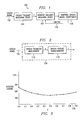
- FIGURE 1 illustrates a speech analysis system designated generally at 100.
- Speech analysis system 100 may be used in various types of speech analysis. For example, system 100 may be used to perform various speech analysis operations including, but not limited to, speech recognition and speaker verification.
- Speech analysis system 100 includes an input 102 for receiving a speech signal. Input 102 is connected to a speech "feature" measuring device 104.
- Speech feature measuring device 104 provides a sequence of feature vectors, f, periodically to an acoustic similarity measuring device 106.
- Acoustic similarity measuring device 106 interacts with a temporal speech model constraints block 108.
- the analysis performed by speech analysis system 100 occurs over a period of time.
- Acoustic similarity measuring device 106 performs statistical analysis on the feature vector for a set of predetermined speech model characterization periods known as "states".
- Temporal speech model constraints block 108 accounts for the transition between these states by imposing statistical limitations on the transitions between states of the model.
- Temporal speech model constraints block 108 communicates these limitations to acoustic similarity measuring device 106 by a feedback control line 110.
- system 100 is applicable to any standard speech recognition/speaker verification structures. The two most popular are known as DTW (dynamic time warping) and HMM (hidden Markov Model).
- Speech analysis system 100 comprises a statistical classification system utilized to analyze speech data.
- the overall operation of speech analysis system 100 is as follows.
- Speech feature measuring device 104 receives a speech signal from its input 102.
- the speech signal is then measured or calibrated over a given period of time, known as a frame.
- the frame is on the order of 10 to 20 milliseconds.
- the resultant frame measurement is in the form of a vector known as a speech "feature" (hereinafter denoted "f").
- the speech feature vector is a vector having anywhere from 2 - 200 numerical elements therein. In the preferred embodiment, the speech feature vector includes 10-20 elements.
- Each element within the speech feature vector generally reflects the amplitude of the speech signal as a function of frequency (i.e., a spectral amplitude representation).
- the particular element may reflect either the static amplitude of the speech signal at a predetermined time during the frame or alternatively, may reflect the dynamics of that amplitude, that is, the amplitude difference over a few frame periods.
- Numerous types of coefficients as known in the art may be used to modify the signal amplitude representations within the speech feature vector.
- each speech feature vector may include a number of different amplitude representations for a discrete point in time.
- Each speech feature vector, f is received by acoustic similarity measuring device 106.
- Acoustic similarity measuring device 106 compares the speech feature versus a predetermined statistical "reference" model. The comparison is manifested in the form of probability determination that a predetermined state of the statistical model underlies the speech feature vector. This probability determination is known as an "observation score". The observation score is generated for a particular "state" of the model, as discussed in more detail below.
- the speech signal received by system 100 is explained with respect to the statistical model that is provided to identify the speech signal.
- the statistical process is carried forth in order to determine the most probable and thus the best "path" of the sequence of speech features through the predetermined model of the data.
- system 100 may provide a speech recognition model to explain utterances of numerical digits (e.g. "one”, “two”, “three”, etc.).
- the model will represent in general numerical digits, and will include paths through the model representing likely speech inputs (e.g. path for "one", path for "two”, etc.).
- Each path is further broken down into “states”, which are model characterizations of the acoustics over a part of the path (e.g. sound “n” in “one”, or sound “t” in “two”).
- An observation score is generated for each state to determine the probability of the feature vector frame given the particular model reference state.
- Temporal speech model constraints block 108 interacts with acoustics similarity measuring device 106 in order to process a series of frames.
- temporal speech model constraints block 108 imposes considerations of state transitions as represented by the underlying statistical reference model.
- Temporal speech model constraints block 108 generates transition probabilities. These transition probabilities reflect the probability that one model state follows another for successive input frames. If the speech signal, when compared against the reference model, results in a state probability above a predetermined threshold, then block 108 provides a control signal via control line 110 to acoustic similarity measuring device 106 to compute the observation score for that state.
- speech feature measuring device 104 begins generating speech feature vectors as discussed above.
- acoustic similarity measuring device 106 compares the feature vector against paths through the reference model in order to generate appropriate probabilities of the feature given each reference model path. As frames are received corresponding to the initial sound "s", acoustic similarity measuring device 106 will yield high probabilities that the speech signal may represent either the model path for "six", or the model path for "seven” due to the initial consonant sound and its corresponding representative speech features.
- temporal speech model constraints 108 will then generate transitional probabilities based on the speech signal versus the reference paths for "six" and “seven". For the former reference, a transition from “s” to "i” will yield a high transition probability. However, the reference model path for "s” to "e” will yield a lesser probability. If this probability is below a predetermined threshold, then temporal speech model constraint block 108 will control acoustic similarity measuring device 106 to stop any further comparison of the path for "seven" to the speech signal.
- FIGURE 2 illustrates a block diagram of the components of speech feature measuring device 104 shown in FIGURE 1.
- Input 102 is connected to a speech parameter measurement block 112.
- Speech parameter measurement block 112 is connected to speech feature transformation block 114 which provides the feature vector discussed above.
- Speech parameter measurement block 112 receives the speech signal via input 102. For a predetermined frame of time, typically on the order of 10 to 20 milliseconds, speech parameter measurement block 112 generates a parameter vector, p.
- parameter vector p contains 10-40 elements wherein each element typically corresponds to either a static or dynamic acoustic amplitude measurement at a predetermined frequency. Thus the entire parameter vector p represents numerous measurements made on for the speech signal during the frame time period.
- Parameter vector p is output from speech parameter measurement block 112 to speech feature transformation block 114.
- the parameter vector, p is thereafter modeled as a continuous random vector.
- the parameters are assumed to be distributed as a multivariate Guassian distribution.
- p N(m pr , C pr ) Eqn.1
- m pr is the mean value of the parameter vector element
- C pr is the covariance matrix of the parameter vector element
- r is the model state which generated p.
- Speech feature transformation block 114 performs a global transformation on parameter vector, p, under a pooled covariance model.
- a pooled covariance model assumes that all model states, r, have the same covariance matrix, C pr .
- T is the global transformation matrix based on the pooled covariance model.
- the global transformation resulting from equation 2 rotates and scales each parameter vector.
- the global transformation provides a feature vector with an identity covariance matrix, i.e., having uncorrelated elements and unity variance.
- the feature vectors are distributed as multivariate Guassian with mean, m fr , and covariance, C fr of one.
- Speech feature transformation block 114 then passes each speech feature vector, f, to acoustic similarity measuring device 106 as illustrated in FIGURE 1.
- PDF (2 ⁇ ) ⁇ 1 ⁇ 2
- C fr is the full covariance matrix of the feature vector for the particular state of the reference model
- f is the feature vector
- m fr is the mean value of f for the state r of the reference model.
- the probability density function may be expressed in terms of a log probability.
- -1 ⁇ 2(f T -m fr T )C fr ⁇ 1(f-m fr ) is the quadratic factor of the log probability
- ⁇ 1 ⁇ 2] is defined as a covariance dispersion factor "CDF fr ".
- the reference covariance matrix, C fr is a positive, definite symmetric matrix.
- Equation 9 The scale factor matrix, S fr , is a diagonal matrix and, therefore, the transpose of that matrix is equal to itself.
- the log of the probability density function may be represented as a scale factor (i.e., -1/2), times a Euclidean distance represented by the error vector, E fr , plus the covariance dispersion factor.
- the observation score is defined as the logarithm of the probability density function summed over all elements of the feature vector. Thus, the observation score is: where, n is the number of elements in the feature vector.
- Equation 11 has heretofore been recognized as representing an accurate method by which to compare speech feature vectors to a reference model.
- E fri 2 weighting each squared error factor, prior to the summation as shown in Equation 11.
- more accurate results may be obtained wherein each squared error factor is weighted by a function of the state-specific variance (i.e., the eigenvalue) to the pooled covariance variance (i.e. 1).
- an improved observation score may be determined by: where, W fri is the weighting factor for element i of feature vector f generated for state r, and where W fri is a function of the variance of feature vector element i for state r relative to its pooled variance.
- W fri may be defined as: where, S fri is the ith element of S fr defined in relation to Equation 7, above, and x is an exponent which in the preferred embodiment is in the range between zero and one as discussed below.
- each error factor, E fri 2 may be weighted by a function of the relative variance factor.
- This factor represents the relative variance of the feature after transformation by the pooled covariance transformation. This is the ratio of the full covariance model variance to the pooled covariance model variance, for each eigenvector.
- FIGURE 3 illustrates a graph of the improved results obtained by the present invention.
- FIGURE 3 further illustrates that a coefficient ranging between 0 and 1 results in improved performance over the prior art solution wherein no weighting factor was utilized.
- more precise observation scores may be determined by eliminating selected elements otherwise included within the summation of Equation 14.
- more accurate observation scores may be generated by eliminating feature elements having relatively high variances (i.e., or eigenvalues) from the summation of Equation 14.
Landscapes
- Engineering & Computer Science (AREA)
- Computational Linguistics (AREA)
- Health & Medical Sciences (AREA)
- Audiology, Speech & Language Pathology (AREA)
- Human Computer Interaction (AREA)
- Physics & Mathematics (AREA)
- Acoustics & Sound (AREA)
- Multimedia (AREA)
- Complex Calculations (AREA)
Applications Claiming Priority (2)
| Application Number | Priority Date | Filing Date | Title |
|---|---|---|---|
| US50508590A | 1990-04-04 | 1990-04-04 | |
| US505085 | 1990-04-04 |
Publications (3)
| Publication Number | Publication Date |
|---|---|
| EP0450367A2 true EP0450367A2 (de) | 1991-10-09 |
| EP0450367A3 EP0450367A3 (en) | 1993-06-02 |
| EP0450367B1 EP0450367B1 (de) | 2000-01-05 |
Family
ID=24008939
Family Applications (1)
| Application Number | Title | Priority Date | Filing Date |
|---|---|---|---|
| EP91104028A Expired - Lifetime EP0450367B1 (de) | 1990-04-04 | 1991-03-15 | Verfahren und Einrichtung zur Sprachanalyse |
Country Status (3)
| Country | Link |
|---|---|
| EP (1) | EP0450367B1 (de) |
| JP (1) | JP3373532B2 (de) |
| DE (1) | DE69131886T2 (de) |
Families Citing this family (1)
| Publication number | Priority date | Publication date | Assignee | Title |
|---|---|---|---|---|
| US5333236A (en) * | 1992-09-10 | 1994-07-26 | International Business Machines Corporation | Speech recognizer having a speech coder for an acoustic match based on context-dependent speech-transition acoustic models |
-
1991
- 1991-03-15 DE DE69131886T patent/DE69131886T2/de not_active Expired - Fee Related
- 1991-03-15 EP EP91104028A patent/EP0450367B1/de not_active Expired - Lifetime
- 1991-04-04 JP JP07179791A patent/JP3373532B2/ja not_active Expired - Fee Related
Non-Patent Citations (7)
| Title |
|---|
| INTERNATIONAL CONFERENCE ON ACOUSTICS SPEECH AND SIGNAL PROCESSING vol. 1, 11 April 1988, NEW YORK, USA pages 583 - 586 VELIUS G 'Variants of cepstrum based speaker identity verification' * |
| INTERNATIONAL CONFERENCE ON ACOUSTICS SPEECH AND SIGNAL PROCESSING, vol. 1, 03 April 1990, ALBUQUERQUE, NEW MEXICO, USA; pages 273 - 276, (WANG REN-HUA ET AL.): 'A weighted distance measure based on the fine structure of feature space: application to speaker recognition' * |
| INTERNATIONAL CONFERENCE ON ACOUSTICS SPEECH AND SIGNAL PROCESSING, vol. 1, 07 April 1986, TOKYO, JAPAN; pages 753 - 756, (NAHAMOO): 'Clustering acoustic prototypes with self organizing distortion measures' * |
| INTERNATIONAL CONFERENCE ON ACOUSTICS SPEECH AND SIGNAL PROCESSING, vol. 1, 07 April 1989, TOKYO, JAPAN; pages 761 - 764, (TOHKURA): 'A weighted cepstral distance measure for speech recognition' * |
| INTERNATIONAL CONFERENCE ON ACOUSTICS SPEECH AND SIGNAL PROCESSING, vol. 1, 11 April 1988, NEW YORK, USA; pages 583 - 586, (VELIUS G): 'Variants of cepstrum based speaker identity verification' * |
| MEDITERRANEAN ELECTROTECHNICAL CONFERENCE MELECON 89 11 April 1989, LISBON PORTUGAL pages 253 - 256 LLEIDA ET AL 'feature selection through orthogonal expansion in isolated word recognition' * |
| MEDITERRANEAN ELECTROTECHNICAL CONFERENCE, MELECON' 89, 11 April 1989, LISBON, PT; pages 241 - 244, (CLASS ET AL.): 'Speaker adaptation for recognition systems with a large vocabulary' * |
Also Published As
| Publication number | Publication date |
|---|---|
| EP0450367B1 (de) | 2000-01-05 |
| JP3373532B2 (ja) | 2003-02-04 |
| DE69131886D1 (de) | 2000-02-10 |
| DE69131886T2 (de) | 2004-12-09 |
| EP0450367A3 (en) | 1993-06-02 |
| JPH04223498A (ja) | 1992-08-13 |
Similar Documents
| Publication | Publication Date | Title |
|---|---|---|
| US5345535A (en) | Speech analysis method and apparatus | |
| US6278970B1 (en) | Speech transformation using log energy and orthogonal matrix | |
| US5339385A (en) | Speaker verifier using nearest-neighbor distance measure | |
| EP0625775B1 (de) | Spracherkennungseinrichtung mit verbesserter Ausschliessung von Wörtern und Tönen welche nicht im Vokabular enthalten sind | |
| EP0744734B1 (de) | Verfahren und Gerät zur Sprecherprüfung mittels Unterscheidung der Prototypen-Zusammenstellung | |
| EP0387791B1 (de) | Verfahren und Einrichtung zur Erkennung von Signalzeitfolgen mit von Signalvariationen unabhängigem Lernen | |
| EP0694906B1 (de) | Verfahren und Vorrichtung zur Spracherkennung | |
| US5790754A (en) | Speech recognition apparatus for consumer electronic applications | |
| EP0691024B1 (de) | Verfahren und gerät zur sprechererkennung | |
| US5526465A (en) | Methods and apparatus for verifying the originator of a sequence of operations | |
| US10438613B2 (en) | Estimating pitch of harmonic signals | |
| US5684925A (en) | Speech representation by feature-based word prototypes comprising phoneme targets having reliable high similarity | |
| EP0470245B1 (de) | Spektralbewertungsverfahren zur verbesserung der widerstandsfähigkeit gegen rauschen bei der spracherkennung | |
| US6202047B1 (en) | Method and apparatus for speech recognition using second order statistics and linear estimation of cepstral coefficients | |
| US6421640B1 (en) | Speech recognition method using confidence measure evaluation | |
| JPH05216490A (ja) | 音声コード化装置及び方法並びに音声認識装置及び方法 | |
| EP1005019B1 (de) | Segmentbasiertes Verfahren zur Messung eines Ähnlichkeitsgrads für die Spracherkennung | |
| US4937870A (en) | Speech recognition arrangement | |
| Karnjanadecha et al. | Signal modeling for high-performance robust isolated word recognition | |
| EP1688913A1 (de) | Verfahren und Vorrichtung zur Wortgenauigkeitsprognose in automatischen Spracherkennungssystemen | |
| US6076058A (en) | Linear trajectory models incorporating preprocessing parameters for speech recognition | |
| WO1997040491A1 (en) | Method and recognizer for recognizing tonal acoustic sound signals | |
| US4924518A (en) | Phoneme similarity calculating apparatus | |
| EP0450367B1 (de) | Verfahren und Einrichtung zur Sprachanalyse | |
| EP1074018B1 (de) | Vorrichtung und verfahren zur spracherkennung |
Legal Events
| Date | Code | Title | Description |
|---|---|---|---|
| PUAI | Public reference made under article 153(3) epc to a published international application that has entered the european phase |
Free format text: ORIGINAL CODE: 0009012 |
|
| AK | Designated contracting states |
Kind code of ref document: A2 Designated state(s): DE FR GB IT NL |
|
| PUAL | Search report despatched |
Free format text: ORIGINAL CODE: 0009013 |
|
| AK | Designated contracting states |
Kind code of ref document: A3 Designated state(s): DE FR GB IT NL |
|
| 17P | Request for examination filed |
Effective date: 19931008 |
|
| 17Q | First examination report despatched |
Effective date: 19960722 |
|
| GRAG | Despatch of communication of intention to grant |
Free format text: ORIGINAL CODE: EPIDOS AGRA |
|
| GRAG | Despatch of communication of intention to grant |
Free format text: ORIGINAL CODE: EPIDOS AGRA |
|
| GRAH | Despatch of communication of intention to grant a patent |
Free format text: ORIGINAL CODE: EPIDOS IGRA |
|
| GRAH | Despatch of communication of intention to grant a patent |
Free format text: ORIGINAL CODE: EPIDOS IGRA |
|
| GRAA | (expected) grant |
Free format text: ORIGINAL CODE: 0009210 |
|
| AK | Designated contracting states |
Kind code of ref document: B1 Designated state(s): DE FR GB IT NL |
|
| REF | Corresponds to: |
Ref document number: 69131886 Country of ref document: DE Date of ref document: 20000210 |
|
| PGFP | Annual fee paid to national office [announced via postgrant information from national office to epo] |
Ref country code: FR Payment date: 20000329 Year of fee payment: 10 |
|
| PGFP | Annual fee paid to national office [announced via postgrant information from national office to epo] |
Ref country code: NL Payment date: 20000331 Year of fee payment: 10 |
|
| ITF | It: translation for a ep patent filed | ||
| ET | Fr: translation filed | ||
| PLBE | No opposition filed within time limit |
Free format text: ORIGINAL CODE: 0009261 |
|
| STAA | Information on the status of an ep patent application or granted ep patent |
Free format text: STATUS: NO OPPOSITION FILED WITHIN TIME LIMIT |
|
| 26N | No opposition filed | ||
| PG25 | Lapsed in a contracting state [announced via postgrant information from national office to epo] |
Ref country code: NL Free format text: LAPSE BECAUSE OF NON-PAYMENT OF DUE FEES Effective date: 20011001 |
|
| PG25 | Lapsed in a contracting state [announced via postgrant information from national office to epo] |
Ref country code: FR Free format text: LAPSE BECAUSE OF NON-PAYMENT OF DUE FEES Effective date: 20011130 |
|
| NLV4 | Nl: lapsed or anulled due to non-payment of the annual fee |
Effective date: 20011001 |
|
| REG | Reference to a national code |
Ref country code: FR Ref legal event code: ST |
|
| REG | Reference to a national code |
Ref country code: GB Ref legal event code: IF02 |
|
| REG | Reference to a national code |
Ref country code: FR Ref legal event code: RN |
|
| REG | Reference to a national code |
Ref country code: FR Ref legal event code: IC |
|
| PGFP | Annual fee paid to national office [announced via postgrant information from national office to epo] |
Ref country code: IT Payment date: 20070628 Year of fee payment: 17 |
|
| PGFP | Annual fee paid to national office [announced via postgrant information from national office to epo] |
Ref country code: DE Payment date: 20080331 Year of fee payment: 18 |
|
| PG25 | Lapsed in a contracting state [announced via postgrant information from national office to epo] |
Ref country code: IT Free format text: LAPSE BECAUSE OF NON-PAYMENT OF DUE FEES Effective date: 20080315 |
|
| PGFP | Annual fee paid to national office [announced via postgrant information from national office to epo] |
Ref country code: GB Payment date: 20090612 Year of fee payment: 19 |
|
| PG25 | Lapsed in a contracting state [announced via postgrant information from national office to epo] |
Ref country code: DE Free format text: LAPSE BECAUSE OF NON-PAYMENT OF DUE FEES Effective date: 20091001 |
|
| GBPC | Gb: european patent ceased through non-payment of renewal fee |
Effective date: 20100315 |
|
| PG25 | Lapsed in a contracting state [announced via postgrant information from national office to epo] |
Ref country code: GB Free format text: LAPSE BECAUSE OF NON-PAYMENT OF DUE FEES Effective date: 20100315 |