EP0446913A1 - Process for the preparation of chlorothiazole derivatives - Google Patents
Process for the preparation of chlorothiazole derivatives Download PDFInfo
- Publication number
- EP0446913A1 EP0446913A1 EP19910103927 EP91103927A EP0446913A1 EP 0446913 A1 EP0446913 A1 EP 0446913A1 EP 19910103927 EP19910103927 EP 19910103927 EP 91103927 A EP91103927 A EP 91103927A EP 0446913 A1 EP0446913 A1 EP 0446913A1
- Authority
- EP
- European Patent Office
- Prior art keywords
- compound
- reaction
- chloro
- chloromethyl
- mixture
- Prior art date
- Legal status (The legal status is an assumption and is not a legal conclusion. Google has not performed a legal analysis and makes no representation as to the accuracy of the status listed.)
- Granted
Links
Classifications
-
- C—CHEMISTRY; METALLURGY
- C07—ORGANIC CHEMISTRY
- C07D—HETEROCYCLIC COMPOUNDS
- C07D277/00—Heterocyclic compounds containing 1,3-thiazole or hydrogenated 1,3-thiazole rings
- C07D277/02—Heterocyclic compounds containing 1,3-thiazole or hydrogenated 1,3-thiazole rings not condensed with other rings
- C07D277/20—Heterocyclic compounds containing 1,3-thiazole or hydrogenated 1,3-thiazole rings not condensed with other rings having two or three double bonds between ring members or between ring members and non-ring members
- C07D277/32—Heterocyclic compounds containing 1,3-thiazole or hydrogenated 1,3-thiazole rings not condensed with other rings having two or three double bonds between ring members or between ring members and non-ring members with hetero atoms or with carbon atoms having three bonds to hetero atoms with at the most one bond to halogen, e.g. ester or nitrile radicals, directly attached to ring carbon atoms
-
- A—HUMAN NECESSITIES
- A01—AGRICULTURE; FORESTRY; ANIMAL HUSBANDRY; HUNTING; TRAPPING; FISHING
- A01N—PRESERVATION OF BODIES OF HUMANS OR ANIMALS OR PLANTS OR PARTS THEREOF; BIOCIDES, e.g. AS DISINFECTANTS, AS PESTICIDES OR AS HERBICIDES; PEST REPELLANTS OR ATTRACTANTS; PLANT GROWTH REGULATORS
- A01N51/00—Biocides, pest repellants or attractants, or plant growth regulators containing organic compounds having the sequences of atoms O—N—S, X—O—S, N—N—S, O—N—N or O-halogen, regardless of the number of bonds each atom has and with no atom of these sequences forming part of a heterocyclic ring
Definitions
- the present invention relates to a novel process for preparing 2-chlorothiazole compounds which are useful as intermediates for insecticides.
- Japanese Patent Application Laid Open No. 171/1990 also discloses a process comprising reaction of compound [I] with potassium phthalimide as a process for preparing compound [III].
- a simpler, less costly and higher yield process is desired.
- the invention relates to (1) a process for preparing 2-chloro-5-(chloromethyl)thiazole (compound [I]) which comprises reacting compound [II] with a chlorinating agent, (2) a process for preparing 5-(aminomethyl)-2-chlorothiazole (compound [III]) or salts thereof which comprises reacting compound [II] with a chlorinating agent to give 2-chloro-5-(chloromethyl)thiazole (compound [I]) and then reacting the compound [I] thus obtained with an aminating agent, and (3) a process for preparing 5-(aminomethyl)-2-chlorothiazole (compound [III]) or salts thereof which comprises reacting compound [I] with liquid ammonia or hexamethylenetetramine.
- the compound [I] thus produced can be converted into the compound [III] advantageously.
- Another aspect of the invention provides processes for preparing 5-(aminomethyl)-2-chlorothiazole ([III]) or salts thereof which comprises reacting compound [II] with a chlorinating agent followed by the reaction of the compound [I] thus obtained with an aminating agent, or compound [I] with liquid ammonia or hexamethylenetetramine.
- halogen such as fluorine, chlorine, bromine or iodine
- C1 ⁇ 4 alkylsulfonyloxy optionally substituted with 1 - 3 halogen atoms such as Cl, Br or F
- halogen atoms such as Cl, Br or F
- C6 ⁇ 10 arylsulfonyloxy optionally substituted with 1 - 4 lower alkyl groups (e.g. methyl or ethyl) or halogen atoms e.g.
- the "chlorinating agent” represents chlorine and compounds releasing chlorine under reaction conditions such as sulfuryl chloride.
- the “aminating agent” represents ammonia (intended in the invention to include aqueous ammonia) and compounds in which ammonia is protected to prevent polyalkylation, for example, dicarboximides such as phthalimide and succinimide, sulfonamides such as p-toluenesulfonamide and trifluoromethanesulfonamide, carboxamides such as acetamide and trifluoroacetamide, carbamic acid esters such as tert-butyl carbamate and methyl carbamate, hexamethylenetetramine and trichloroamine.
- dicarboximides such as phthalimide and succinimide
- sulfonamides such as p-toluenesulfonamide and trifluoromethanesulfonamide
- carboxamides such as acetamide and
- alkali metal salts of these compounds such as potassium amide, sodium amide, potassium phthalimide and sodium phthalimide are included.
- the protective group is removed by a known method except for the cases where ammonia or an alkali metal salt thereof is used as the aminating agent. It is especially preferred to use liquid ammonia, aqueous ammonia, potassium phthalimide, sodium phthalimide and hexamethylenetetramine as the aminating agent.
- Examples of the salts of 5-(aminomethyl)-2-chlorothiazole, namely, compound [III] include the salt with an inorganic acid such as hydrochloric, hydrobromic, hydroiodic, phosphoric, sulfuric or perchloric acid, or with an organic acid such as formic, acetic, tartaric, malic, citric, oxalic, succinic, benzoic, picric, methanesulfonic or p-toluenesulfonic acid.
- an inorganic acid such as hydrochloric, hydrobromic, hydroiodic, phosphoric, sulfuric or perchloric acid
- organic acid such as formic, acetic, tartaric, malic, citric, oxalic, succinic, benzoic, picric, methanesulfonic or p-toluenesulfonic acid.
- the process of the invention can be carried out, for example, under reaction conditions as described below.
- Leaf and stem of the 2nd-leaf-stage seedlings of rice grown in a nursery box were sprayed by means of a spray gun with 500 ppm of a test compound (the compound number as indicated in the examples referred to) prepared by dissolving 5 mg of the compound in 0.5 ml of acetone containing Tween 20® and diluting with a 3000-fold diluted solution of Dyne® (a spreader manufactured by Takeda Chemical Industries) to the predetermined concentration (500 ppm) at a rate of 10 ml of the drug solution per paper pot.
- a test compound the compound number as indicated in the examples referred to
Landscapes
- Chemical & Material Sciences (AREA)
- Organic Chemistry (AREA)
- Life Sciences & Earth Sciences (AREA)
- Agronomy & Crop Science (AREA)
- Pest Control & Pesticides (AREA)
- Plant Pathology (AREA)
- Health & Medical Sciences (AREA)
- Engineering & Computer Science (AREA)
- Dentistry (AREA)
- General Health & Medical Sciences (AREA)
- Wood Science & Technology (AREA)
- Zoology (AREA)
- Environmental Sciences (AREA)
- Thiazole And Isothizaole Compounds (AREA)
- Pharmaceuticals Containing Other Organic And Inorganic Compounds (AREA)
- Agricultural Chemicals And Associated Chemicals (AREA)
- Organic Low-Molecular-Weight Compounds And Preparation Thereof (AREA)
Abstract

wherein X represents a leaving group,
are simple and convenient reaction procedures under mild conditions without need of a large excess of a chlorinating agent. Further, processes for preparing 5-(aminomethyl)-2-chlorothiazole or salts thereof from the compound [ II ] achieve higher yields by simple, convenient and inexpensive procedures.
Description
- The present invention relates to a novel process for preparing 2-chlorothiazole compounds which are useful as intermediates for insecticides.
- It was disclosed in European Patent Application Laid Open No. 192,060 and Japanese Patent Application Laid Open No. 171/1990 that 2-chloro-5-(chloromethyl)thiazole of the formula

(optionally called compound [I] hereinbelow) and 5-(aminomethyl)-2-chlorothiazole of the formula
(optionally called compound [III] hereinbelow) or salts thereof are useful as an intermediate for insecticides. There is, however, only a specific process disclosed in Japanese Patent Application Laid Open No. 83979/1988 for preparing compound [I] in which allyl isothiocyanate is reacted with a chlorinating agent as illustrated below.
This process needs a large excess of the chlorinating agent, high temperature and furthermore involves a very vigorous reaction. Consequently, a plurality of by-products is formed in addition to merely a small amount of the desired compound [I] in the reaction, and separation thereof from the by-products is troublesome. Thus the isolated yield of compound [I] results in quite low. The process therefore can by no means be considered as a good process for preparing compound [I]. - Japanese Patent Application Laid Open No. 171/1990 also discloses a process comprising reaction of compound [I] with potassium phthalimide as a process for preparing compound [III]. However, a simpler, less costly and higher yield process is desired.
- Such being the case, it is an object of the invention to provide a process for preparing 2-chloro-5-(chloromethyl) thiazole (compound [I] ) from an allyl isothiocyanate derivative represented by the formula [II] shown below (optionally called compound [II] hereinbelow) by simple and convenient reaction procedures under mild conditions without need of a large excess of a chlorinating agent, a process for preparing 5-(aminomethyl)-2-chlorothiazole [III] or salts thereof from compound [II] via compound [I] and a novel process for preparing compound [III] or salts thereof in a higher yield by simple, convenient and inexpensive procedures.
- Extensive studies were made by us on the process for preparing compound [I] and compound [III] or salts thereof in order to achieve the above-mentioned object. As a result of these studies, we have discovered that compound [I] of a high purity can be produced in a high yield through very simple reaction procedures and aftertreatments by reacting an allyl isothiocyanate derivative represented by the formula

wherein X represents a leaving group with a chlorinating agent under mild conditions, unexpectedly without need of using a large excess of the chlorinating agent, that compound [III] or salts thereof can be produced by aminating the compound [I] thus prepared from compound [II] and that the compound [III] or salts thereof can be produced unexpectedly in a high yield by reacting the compound [I] with liquid ammonia or hexamethylenediamine. The present invention has been completed on the basis of these discoveries. - Thus the invention relates to (1) a process for preparing 2-chloro-5-(chloromethyl)thiazole (compound [I]) which comprises reacting compound [II] with a chlorinating agent, (2) a process for preparing 5-(aminomethyl)-2-chlorothiazole (compound [III]) or salts thereof which comprises reacting compound [II] with a chlorinating agent to give 2-chloro-5-(chloromethyl)thiazole (compound [I]) and then reacting the compound [I] thus obtained with an aminating agent, and (3) a process for preparing 5-(aminomethyl)-2-chlorothiazole (compound [III]) or salts thereof which comprises reacting compound [I] with liquid ammonia or hexamethylenetetramine.
- These processes are excellently simple and advantageously useful on an industrial scale in the preparation of insecticides and other valuable compounds.
- According to the invention, there are provided processes for preparing 2-chloro-5-(chloromethyl)thiazole (compound [I]) which comprises reacting the compound [II] with a chlorinating agent. The compound [I] which is excellently useful in synthesizing insecticides is selectively produced in an unexpected high yield.
- The compound [I] thus produced can be converted into the compound [III] advantageously.
- Another aspect of the invention provides processes for preparing 5-(aminomethyl)-2-chlorothiazole ([III]) or salts thereof which comprises reacting compound [II] with a chlorinating agent followed by the reaction of the compound [I] thus obtained with an aminating agent, or compound [I] with liquid ammonia or hexamethylenetetramine.
- As the leaving group defined by X in the above formula is used, for example, halogen such as fluorine, chlorine, bromine or iodine; C₁₋₄ alkylsulfonyloxy optionally substituted with 1 - 3 halogen atoms (such as Cl, Br or F) such as methanesulfonyloxy, ethanesulfonyloxy, butanesulfonyloxy or trifluoromethanesulfonyloxy; C₆₋₁₀ arylsulfonyloxy optionally substituted with 1 - 4 lower alkyl groups (e.g. methyl or ethyl) or halogen atoms (e.g. Cl, Br or F) such as benzenesulfonyoxy, p-toluenesulfonyloxy, p-bromobenzenesulfonyloxy or mesitylenesulfonyloxy; C₁₋₆ acyloxy optionally substituted with 1 - 3 halogen atoms (such as Cl,Br or F) such as acetyloxy, propionyloxy or trifluoroacetyloxy or C₆₋₁₀ arylcarbonyloxy such as benzoyloxy. Usually, the compound [II] wherein X is chlorine (2-chloroallyl isothiocyanate) is most readily available.
- The "chlorinating agent" represents chlorine and compounds releasing chlorine under reaction conditions such as sulfuryl chloride. The "aminating agent" represents ammonia (intended in the invention to include aqueous ammonia) and compounds in which ammonia is protected to prevent polyalkylation, for example, dicarboximides such as phthalimide and succinimide, sulfonamides such as p-toluenesulfonamide and trifluoromethanesulfonamide, carboxamides such as acetamide and trifluoroacetamide, carbamic acid esters such as tert-butyl carbamate and methyl carbamate, hexamethylenetetramine and trichloroamine. Additionally, if feasible, alkali metal salts of these compounds such as potassium amide, sodium amide, potassium phthalimide and sodium phthalimide are included. The protective group is removed by a known method except for the cases where ammonia or an alkali metal salt thereof is used as the aminating agent. It is especially preferred to use liquid ammonia, aqueous ammonia, potassium phthalimide, sodium phthalimide and hexamethylenetetramine as the aminating agent.
- Examples of the salts of 5-(aminomethyl)-2-chlorothiazole, namely, compound [III] include the salt with an inorganic acid such as hydrochloric, hydrobromic, hydroiodic, phosphoric, sulfuric or perchloric acid, or with an organic acid such as formic, acetic, tartaric, malic, citric, oxalic, succinic, benzoic, picric, methanesulfonic or p-toluenesulfonic acid.
- The process of the invention can be carried out, for example, under reaction conditions as described below.
- (A) 2-Chloro-5-(chloromethyl)thiazole (compound [I]) can be prepared by reacting an allyl isothiocyanate derivative [II] with a chlorinating agent.

The reaction may be carried out in the absence of solvent. It may also be done following dilution with a solvent that is inert under reaction conditions. As the solvent are preferred, for example, halogenated hydrocarbons such as dichloromethane, chloroform, carbon tetrachloride, 1,2-dichloroethane, 1,1,1-trichloroethane and 1,1,2,2-tetrachloroethane.
The chlorinating agent is used usually in an amount of 1 - 1.5 equivalents on the bais of the allyl isothiocyante derivative [II], but an excess amount (2 - 10 equivalents) may also be used as required. When chlorine is used as a chlorinating agent, gaseous chlorine may directly be introduced into the reaction system, or a solution in an appropriate solvent (such as chloroform or carbon tetrachloride) may be employed.
The reaction may be carried out at a temperature between -20 °C and 150°C. A temperature between 0°C and 60 °C is especially preferred.
It is believed that the reaction proceeds via a mechanism shown below.
Thus, chlorine is added to an allyl isothiocyanate derivative [II] to form a sulfenyl chloride derivative [IV] (called compound [IV] hereinbelow). Compound [IV] is then subjected to cyclization addition to give a 2-thiazoline derivative represented by the formula [V] (called compound [V]). Compound [V] in turn releases HX spontaneously or by heating or with a base to be converted to 2-chloro-5-(chloromethyl)thiazole (compound [I]). In some cases, HX salt of compound [I] (called compound [VI]) or HX adduct of of compound [I] (called compound [VII]) is formed as an intermediate at this atage.
The reaction, if conducted at a low temperature or in diluted solution, tends to terminate upon formation of compound [IV] or compound [V], but if conducted at a high temperature and in the absence of solvent or in concentrated solution, tends to proceed until the desired 2-chloro-5-(chloromethyl)thiazole ([I]) is formed. Therefore, compound [I] may be prepared either by first carrying out the reaction at a low temperature or in diluted solution to produce compound [IV] or [V] as the main product and then raising the reaction temperature or concentrating, or doing both to produce compound [I], or by carrying out the reaction at a high temperature and in the absence of solvent or in concentrated solution from the beginning to produce compound [I]. The "low temperature", "high temperature", "diluted solution" and "concentrated solution" herein referred to are variable depending upon such factors as nature of the chlorinating agent, scale of the reaction and reaction time and cannot be specified. Usually, however, the "low temperature" represents a temperature between -20 - 20 °C, the "high temperature" a temperature between 30 - 100 °C, the "diluted solution" a solution in a concentration of about 20% or below, and the "concentrated solution" a solution in a concentration of about 40% or above.
In some cases, compound [I] is advantageously prepared by first producing the intermediate [V], [VI] or [VII] and then reacting it with a base. As the base are preferably used inorganic bases such as, for example, sodium hydrogen carbonate, potassium hydrogen carbonate, sodium carbonate, potassium carbonate, sodium hydroxide, potassium carbonate and calcium hydroxide. In some cases, however, organic bases such as ammonia, triethylamine, pyridine, lutidine, collidine and DBU (1,8-diazabicyclo[5.4.0]undec-7-ene) may also be employed. The base is usually used in an amount of 0.5 - 2.0 equivalents, preferably 1.0 - 1.5 equivalents, on the basis of compound [II]. An excess amount (2 - 10 equivalents) may also be used if the reaction is not hindered. The base may be used either as such or in solution in water for an inorganic base or in water or an appropriate solvent for an organic base. In the case where chlorine is used as the chlorinating agent, the base may be included from the beginning if the reaction is not hindered.
The allyl isothiocyanate derivatives [II], the starting materials in the present reaction are known substances, partly, or can be prepared by a method per se known. For example, the preparation can be effected by reacting a propene derivative (of the formula [VIII]) with a metal salt or ammonium salt of thiocyanic acid.
If the reaction is carried out at a low temperature (e. g. 80°C or below), the first reaction product is usually a mixture of an allyl thiocyanate derivative (called compound [IX] hereinbelow) and an allyl isothiocyanate derivative [II] (compound [IX] only in some cases), but the compound [IX] can be rearranged by heating (e. g. 100 °C to 150°C) to the desired product [II]. As the case may be, the compound [IX] can be converted into the desired product [II] by re-heating after transient isolation, or by heating in situ. Of course, the compound [II] may directly be produced by conducting the reaction at a high temperature (e. g. 100 °C to 150°C) from the beginning. The compound [II] thus produced can be reacted with the chlorinating agent after isolation and/or purification, or without such treatments. It will be appreciated that the compound [I] can be produced via the compound [II] from the compound [VIII]. - (B) 5-(Aminomethyl)-2-chlorothiazole (compound [III]) or salts thereof can be prepared by reacting an allyl isothiocyanate derivative [II] with a chlorinating agent to form 2-chloro-5-(chloromethyl)thiazole (compound [I]) and then reacting the resulting compound [I] with an aminating agent.

In the reaction, compound [I] is first prepared according to the conditions described for the method (A). The resulting compound [I] may be isolated and purified, or in some cases, it can be reacted with an aminating agent without isolation and purification. The aminating agent is preferably used in an amount of 0.8-1.5 equivalents on the basis of the compound [I] and may be used about 1.5 -50 equivalents in some cases.
This step is often carried out in an appropriate solvent, though it may be done in the absence of solvent. As the solvent is used, for example, water, an alcohol such as methanol, ethanol, n-propanol or isopropanol, an aromatic hydrocarbon such as benzene, toluene or xylene, a halogenated hydrocarbon such as dichloromethane or chloroform, a saturated hydrocarbon such as hexane, heptane or cyclohexane, an ether such as diethyl ether, tetrahydrofuran (called THF for short hereinbelow) or dioxane, a nitrile such as acetonitrile, a sulfoxide such as dimethylsulfoxide (called DMSO for short hereinbelow), a carboxamide such as N,N-dimethylformamide (called DMF for short hereinbelow), or an ester such as ethyl acetate. These solvents may be used either alone, or as required, in combination of two or more in an appropriate ratio, for example, a ratio of 1:1 - 1:10. If the reaction mixture is not in homogeneous phase, the reaction may also be carried out in the presence of a phase transfer catalyst, for example, a quaternary ammonium salt such as triethylbenzylammonium chloride, tri-n-octylmethylammonium chloride, trimethyldecylammonium chloride or tetramethylammonium bromide, or a crown ether.
This step may also be promoted by the addition of 0.1 - 10 equivalents, preferably 1.0 - 3 equivalents of a base. As the base may be used an inorganic base such as sodium hydrogen carbonate, potassium hydrogen carbonate, sodium carbonate, potassium carbonate, sodium hydroxide, potassium hydroxide, calcium hydroxide, phenyllithium, butyllithium, sodium hydride, potassium hydride, sodium methoxide, sodium ethoxide, metallic sodium or metallic potassium, or an organic base such as triethylamine, tributylamine, N,N-dimethylaniline, pyridine, lutidine, collidine, 4-(dimethylamino)pyridine, or DBU. Said organic base itself may also be used as a solvent.
The reaction temperature and time in this step are usually -20°C - 150°C and 10 min.- 50 hours, preferably 0°C - 100°C and 1 hour - 20 hours, respectively.
It is necessary to remove the protective group which is known per se except for the case where ammonia (including aqueous ammonia) or an an alkali metal salt thereof is used as the aminating agent. The removal can be effected in accordance with the procedures described, for example, in "Shin Jikken Kagaku Koza" (New Textbook Series of Chemical Experiments)(Maruzen), vol. 14-III, pp.1342 - 1349 and references cited therein.
More preferred reaction conditions with (i) aqueous ammonia, (ii) liquid ammonia, (iii) potassium or sodium phthalimide and (iv) hexamethylenetetramine as the aminating agent will be described below.- (i) With aqueous ammonia as the aminating agent

It is preferable to use aqueous ammonia in an amount about 5 to 50 equivalents to compound [I] as ammonia in order to avoid formation of polyalkylated products. The reaction solvent is preferably water, an alcohol or a nitrile as mentioned above, for example. The reaction temperatures and times are preferably 50°C - 100°C and 30 min.- 5 hours, respectively. In some cases, the reaction under high pressure (preferably from 1.1 to 10 atmospheres) can also reduce formation of polyalkylated products. - (ii) With liquid ammonia as the aminating agent

It is preferable to use an excess amount of ammonia (in an approximately 5 to 100-fold excess to the compound [I]) likewise in the reaction condition (i). Advantageously, the reaction is carried out under high pressure (preferably from 1.1 to 100 atomospheres).
The reaction can be carried out in the presence of a solvent as mentioned above, though it may be done in the absence of a solvent. Examples of such solvents may include those mentioned above such as water, an alcohol, an aromatic hydrocarbon, a halogenated hydrocarbon, a saturated hydrocarbon, an ether, an nitrile, a sulfoxide, a carboxamide, or an ester. Reaction temperatures can be preferably in the range of from about -20°C to +100°C. Reaction times can vary from about 30 minutes to about 40 hours. - (iii) With potassium or sodium phthalimide as the aminating agent

First, compound [I] and potassium or sodium phthalimide are reacted to produce an intermediate [X]. It is preferable to use potassium or sodium phthalimide in an amount of 1.0 - 1.5 equivalents on the basis of the compound [I]. The solvent may include those mentioned above such as alcohols, ethers, nitriles, ketones, sulfoxides and carboxylic acid amides, and DMF is particularly preferred. Using DMF as the solvent, the reaction temperature and time are preferably 10°C - 60°C and 1 hour - 10 hours, respectively.
Next, the intermediate [X] thus obtained is subjected to deprotection after or without isolation and purification. Hydrazinolysis is preferred for the deprotection though acid or alkaline hydrolysis is also applicable. Thus, the intermediate [X] and 1.0 - 1.2 equivalents of hydrazine (or hydrazine hydrate) on the basis of the intermediate [X] can be reacted in an appropriate solvent (for example, alcohols and nitriles as mentioned above) at 0°C - 100°C for 1 hour - 10 hours to give compound [III] or a salt thereof. - (iv) With hexamethylenetetramine as the aminating agent

First, compound [I] and hexamethylenetetramine are reacted to give a quaternary ammonium salt intermediate [XI]. Hexamethylenetetramine is used preferably in an amount of 1.0 - 1.5 equivalents on the basis of the compound [I]. The solvent is preferably an alcohol, a halogenated hydrocarbon or a nitrile as mentioned above though a variety of solvents may be employed. The reaction temperature and time are preferably 20°C - 100°C and 1 - 10 hours, respectively. The intermediate [XI] is preferably isolated at this stage but may be converted without isolation into compound [III]. Acid hydrolysis is usually employed for the hydrolysis of the intermediate [XI]. Thus, the intermediate [XI] is reacted preferably with 5 - 50 equivalents of an inorganic acid (such as hydrochloric, hydrobromic or sulfuric acid) on the basis of [XI]. The solvent is preferably water, an alcohol or a nitrile as mentioned above. When an organic solvent is used, it is preferably one containing about 5 - 50% of water. The reaction temperature and time are preferably 20 - 100°C and 20 min. - 5 hours, respectively.
- (i) With aqueous ammonia as the aminating agent
- (C) 5-(Aminomethyl)-2-chlorothiazole [(II)] can be prepared by reacting 2-chloro-5-(chloromethyl)thiazole ([I]) with liquid ammonia or hexamethylenetetramine.

The reaction can proceed under the same reaction conditions as mentioned for the reaction of compound [I] obtained from compound [II] with an aminating agent in the latter part of the method (B). More preferably, the conditions under "(ii) with liquid ammonia as the aminating agent and (iii) with hexamethylenetetramine as the aminating agent" may be employed.
The compound [I] and compound [III] or salts thereof thus produced can be isolated by a known method such as concentration, concentration under reduced pressure, distillation, fractional distillation, solvent extraction, pH change, solvent change, chromatography, crystallization or recrystallization.
In the case where compound [III] is obtained in the above-mentioned process in free form, it can be converted by a conventional method into a salt, or vice versa.
As stated above, compound [I] and compound [III] or salts thereof are useful as a starting material for known insecticidal compounds. Moreover, it has been found that they are also useful as a starting material for novel insecticides. Thus, compound [I] prepared by the process according to the present invention is reacted with a compound represented by the formula

It is preferable in the preparation of [XIII] to use about 0.8 - 1.5 equivalents of compound [I] on the basis of compound [XII]. However, a large excess of [I] may be used if the reaction is not hindered. The reaction may be carried out in the presence of a base and/or a cesium salt such as cesium chloride to promote reaction. As the base may be employed, for example, those which are referred to in the method (B) above. The base may be used in an amount of from 0.5 equivalent to a large excess, preferably about 0.8 - 1.5 equivalents on the basis of the compound [XII]. When an organic base is employed as the base it can also serve as a solvent. The cesium salt may be used in a catalytic amount (0.1 to 10 mol % to compound [XII]).
Usually, it is preferable to carry out the reaction in a solvent as mentioned in the method (B). If the reaction system is not in homogeneous phase a phase transfer catalyst may also be employed as stated in the method (B).
The reaction temperature is usually -20°C - 150°C, preferably 0 - 80°C. The reaction time is usually in the range of 10 min. - 50 hours, preferably of 2 hours - 20 hours.
In addition, compound [III] or a salt thereof prepared according to the process of the invention is reacted with a compound represented by the formula

It is preferable to use about 0.8 - 2.0 equivalents of compound [III] or a salt thereof on the basis of the compound [XIV] or a salt thereof. However, about 2.0 - 20 equivalents may be employed if the reaction is not hindered.
The reaction is carried out usually in a solvent as mentioned in the method (B) though it may also be done in the absence of solvent. A phase transfer catalyst may also be employed as stated in the method (B) if the reaction system is not in homogeneous phase.
The reaction may also be promoted by adding a base and/or a metallic salt in an amount of 0.01 - 10 equivalents, preferably 0.1 - 3 equivalents on the basis of the compound [XIV]. As the base may be used, for example, those which are referred to in the method (B). When an organic base is used it can also serve as a solvent. As the metal salt may be employed, for example, copper salts such as copper chloride, bromide, acetate and sulfate and mercury salts such as mercury chloride, nitrate and acetate.
Temperature and time of the reaction are usually -50°C - 150°C and 10 min. - 50 hours, preferably -30°C - 100°C and 30 min. - 20 hours, respectively.
As the lower alkyl group represented by R¹, R² and R³ in the above formula is used, for example, methyl, ethyl, propyl or isopropyl, and as the lower carboxylic acyl, for example, formyl, acetyl or propionyl. As the cyclic amino group reperesented by R¹ and R² taken together with the adjacent nitrogen atom is used, for example, aziridino, azetidino, pyrrolidino, piperidino or morpholino.
As the lower alkoxy group represented by Y is used, for example, methoxy, ethoxy, propoxy or isopropoxy, and as the lower alkylthio, for example, methylthio, ethylthio, propylthio or isopropylthio.
As the salt of compounds [XII], [XIII], [XIV] and [XV] are used, for example, those which are mentioned above for compound [III].
As described above, use of the process according to the invention enables production of compounds [XIII] or salts thereof from compound [II] via compound [I], as well as of compounds [XV] or salts thereof from compound [II] via compound [I] and compound [III] or a salt thereof, or from compound [I] via compound [III] or a salt thereof.
Compounds [XIII] or salts thereof and compounds [XV] or salts thereof thus prepared possess a high insecticidal activity. - The invention will be described in more detail below with reference to Examples and Reference Examples. However, the invention is not intended to be limited to these examples.
- Elution of the column chromatography in the examples and the reference examples were made under observation with TLC (thin layer chromatography). There were employed in the TLC observation Kieselgel 60F₂₅₄ (70 - 230 mesh, Merck) as the TLC plate, a solvent used as the eluent in the chromatography as the developing solvent and a UV detector as the detecting method. As the silica gel for column chromatography was used Kieselgel 60 (70 - 230 mesh, Merck). The NMR represents a proton NMR using tetramethylsilane as the internal standard, being measured on VARIAN EM390 (90 MHz) and being indicated in terms of all δ value in ppm. The figures in ( ) for a mixed solvent used as the developing solvent indicate volume ratio of the solvents in the mixture.
- Abbreviations in the examples and the reference examples have the following meanings.
- Me: methyl, Et: ethyl, s: singlet, br: broad, d: doublet, t: triplet, q: quartet, m: multiplet, dd:doublet of doublet, J: coupling constant, Hz: herz, CDCl₃: deutero-chloroform, DMSO-d₆: deutero-DMSO, %: % by weight, mp: melting point, bp: boiling point and room temperature means a temperature of ca. 15- 25°C.
- The foregoing is merely illustrative of the invention and is not intended to limit the invention to the disclosed compounds and procedures. Variations and changes which are obvious to one skilled in the art are intended to be within the scope and nature of the invention.
- Into a mixture of 13.4 g of 2-chloroallyl isothiocyanate and 10 mℓ of chloroform was introduced gaseous chlorine under cooling with ice (inner temperature of 10°C or below) over one hour and 40 min. Weight of the gaseous chlorine absorbed was 7.71 g. At this stage, the products, according to NMR, were estimated as 2-aza-1,4-dichloro-1,4-pentadienesulfenyl chloride

(NMR(CDCℓ ₃) : 4.33(2H, m), 5.38(1H, m), 5.53 (1H, m))
and 2,5-dichloro-5-(chloromethyl)-2-thiazoline
(NMR(CDCℓ ₃) : 4.08(2H, m), 4.58(2H, m))
Removal of the bath raised the temperature, and a water bath was applied to maintain the inner temperature at 40°C or below. After 4 hours exothermic reaction did not occur, when the bath was removed. 2-Chloro-5-(chloromethyl)thiazole was yielded as the main product at this stage.
The chloroform was removed by distillation followed by distillation under reduced pressure to give 13.3 g of 2-chloro-5-(chloromethyl)thiazole in a yield of 73%. Bp 108 - 110°C/18 mmHg, mp ca. 30°C. NMR (CDCl₃) : 4.72(2H, s), 7.51 (1H, s). - To a mixture of 50 g of 2-chloroallyl isothiocyanate and 50mℓ of chloroform was added 60.1 g of sulfuryl chloride over one hour and 30 min, maintaining the inner temperature at 30°C or below in water bath. The bath was removed, and the mixture was allowed to react at room temperature for additional 2 hours and 30 min. The inner temperature reached 36°C at maximum due to slow exothermic reaction during that period of time. The solvent and the excess of the sulfuryl chloride were removed by distillation. The residue was dissolved in 400 mℓ of dichloromethane, and the solution washed with aqueous sodium bicarbonate and water and dried over magnesium sulfate and then concentrated. The residue was subjected to distillation under reduced pressure to give 51.7 g of 2-chloro-5-(chloromethyl)thiazole. Yield: 82%, purity: > 90%, bp: 110°C/20 mmHg.
- To 11.6 g of 2-chloroallyl isothiocyanate was dropwise added 103 mℓ of a 0.834 M carbon tetrachloride solution of chlorine over one hour and 30 min. while cooling with ice (inner temperature of 5°C or below). After stirring was continued for 1 hour under cooling with ice and for 4 hours at room temperature, it was estimated according to NMR that the product was only 2-aza-1,4-dichloro-1,4-pentadienesulfenyl chloride with a small amount of starting material. Distillation of the carbon tetrachloride under normal pressure from the reaction solution afforded 2-chloro-5-(chloromethyl)thiazole as the main product.
- To 1.00 g of sulfuryl chloride was added 0.43 g of 2-chloroallyl isothiocyanate over 3 min., and the mixture stirred at room temperature for 30 min. To the reaction solution was added 10 mℓ of carbon tetrachloride, and the reaction mixture concentrated under reduced pressure at a temperature of 10°C or below. The main product at this stage was estimated as 2,5-dichloro-5-(chloromethyl)-2-thiazoline, and heating at 60°C for 30 min. yielded 2-chloro-5-(chloromethyl)thiazole as the main product.
- To 0.50 g of sulfuryl chloride was dropwise added 0.22 g of 2-chloroallyl isothiocyanate over 3 min. while cooling with ice. Stirring was continued under cooling with ice for 1 additional hour followed by addition of 10 mℓ of chloroform. The reaction mixture was concentrated under reduced pressure at a temperature of 20°C or below. The main product at this stage was estimated as 2,5-dichloro-5-(chloromethyl)-2-thiazoline, and further concentration at 40 °C - 60°C converted the main product to the substance which was estimated as 2-chloro-5-(chloromethyl)thiazole hydrochloride or 2,2-dichloro-5-(chloromethyl)-4-thiazoline.
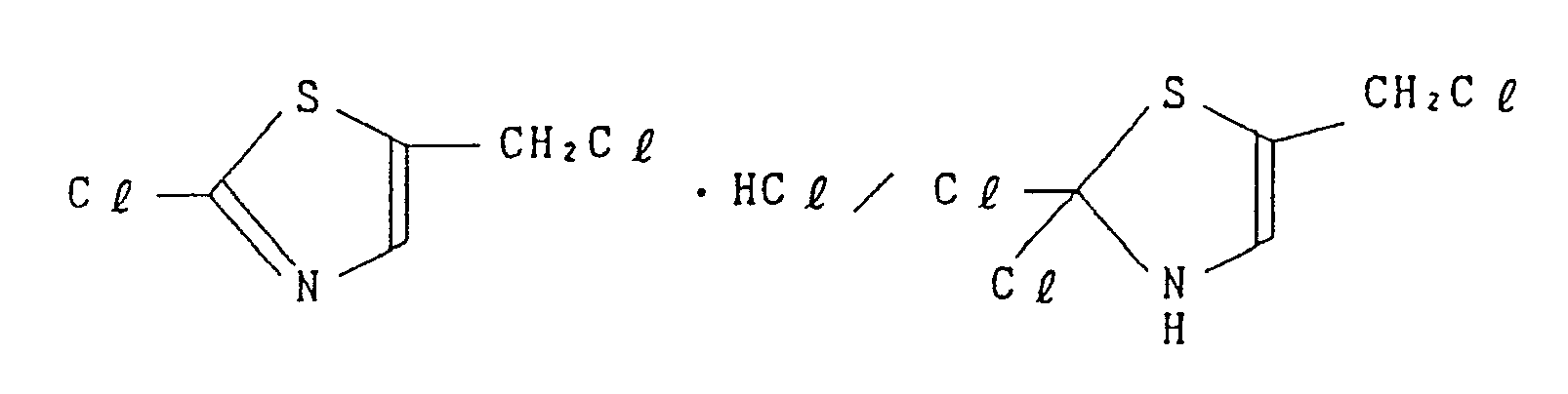
(NMR(CDCℓ ₃) : 4.79(2H, s), 7.70(1H, s)) - Addition of chloroform to this product followed by addition of diluted aqueous ammonia or aqueous sodium bicarbonate and stirring at 20°C or below yielded 2-chloro-5-(chloromethyl)thiazole.
- A mixture of 1.0 g of 2-chloro-5-(chloromethyl)thiazole obtained by the procedures in Example 2, 4 mℓ of 25% aqueous ammonia and 6 mℓ of acetonitrile was placed in a stainless steel autoclave and reacted at 80°C for 2 hours.
After cooling, 0.6 m ℓ of a 10N aqueous solution of sodium hydroxide and 12 mℓ of ethanol were added, and the mixture stirred at room temperature for 30min. The reaction mixture was concentrated followed by addition of 20 mℓ of dichloromethane and dried over anhydrous magnesium sulfate. Insoluble materials were separated by filtration and the filtrate was then concentrated. The concentrate was purified by column chromatography (eluted with dichloromethane-methanol 10:1) to afford 0.49 g of 5-(aminomethyl)-2-chlorothiazole as yellow liquid. NMR (CDCl₃): 1.66(2H, s), 4.02(2H, s), 7.36 (1H, s). - A mixture of 0.50 g of 2-chloro-5-(chloromethyl)thiazole, 4 mℓ of 25% aqueous ammonia and 6 mℓ of acetonitrile was heated under reflux for 30 min. followed by supplement of 8 mℓ of 25% aqueous ammonia. The mixture was heated under reflux for 30 additional min. After-treatment in the same way as in Example 6 yielded 0.22 g of 5-(aminomethyl)-2-chlorothiazole.
- To a mixture of 27.5g of hexamethylenetetramine and 150 mℓ of chloroform was dropwise added 30.0 g of 2-chloro-5-(chloromethyl)thiazole over 30 min. while heating under reflux. The mixture was heated under reflux with stirring for 3 hours and then allowed to stand overnight. Crystals thus formed were separated by filtration and washed with 100 mℓ of chloroform. Combined filtrate and washing were concentrated to 100 mℓ. Crystals formed after being allowed to stand for half a day were separated by filtration and washed with 20 mℓ of chloroform. Combined filtrate and washing were treated two more times in the same way as above. There was obtained a total of 55.0 g (yield, 99.7%) of a quaternary ammonium salt.
- A mixture of 32.5 g of the quaternary ammonium salt, 104 g of 36% hydrochloric acid, 97.5 mℓ of water and 325 mℓ of ethanol was stirred at 70°C for one hour and then allowed to stand overnight. Solids then formed were separated by filtration, and the filtrate was concentrated to about a half of the original volume. Solids formed were again separated by filtration, and the filtrate was concentrated to dryness. To the residue was added 100 m ℓ of acetone, and insoluble materials collected by filtration. To the filtrate was added 250 mℓ of water, and pH adjusted with 6N aqueous sodium hydroxide to 13. The mixture was extracted three times with dichloromethane, and the dichloromethane layers washed with saturated aqueous sodium chloride, dried over anhydrous potassium carbonate and concentrated. There was obtained 14.3 g of crude 5-(aminomethyl)-2-chlorothiazole, which was purified by distillation under reduced pressure to give 10.5g of pure products, bp: 85°C/10. 5 mmHg.
- A mixture of the quaternary ammonium salt (77.1 g) obtained by the procedure in the first half of Example 8, ethanol (80 mℓ), water (160 mℓ), and 12 N hydrochloric acid (200 mℓ ) was stirred at an internal temperature ranging from 70 °C to 75°C for 2 hours and then insoluble materials were sep arated by filtration after cooling. The filtrate was concentrated to about 300 mℓ and the precipitated material again separated by filtration. The filtrate was concentrated and 300 mℓ of water was added to the concentrate followed by further concentration. The residue was washed with acetone, dissolved in 150 mℓ of water and pH adjusted with 6N aqueous sodium hydroxide to 13 under cooling with ice. The mixture was extracted three times with dichloromethane, dried over anhydrous magnesium sulfate, and concentrated to yield 28.1 g (75.6%) of 5-(aminomethyl)-2-chlorothiazole. A portion (21.2 g) of the product was distilled under reduced pressure to give 17.2 g of pure product, bp: 71-2°C/0. 7 mmHg.
- To a mixture of potassium phthalimide (10.4 g) and dry DMF (100 mℓ) was dropwise added a solution of 2-chloro-5-(chloromethyl)thiazole (9.0 g) obtained in the same manner as in Example 2, in 10 mℓ of DMF in an oil bath at 20°C over 15 min. After completion of the addition stirring was continued at 60°C for 45 min. followed by separation of insoluble materials by filtration on celite. The filtrate was concentrated under reduced pressure. To the residue was added 100 mℓ of dichloromethane again followed by separation of insoluble materials by filtration and concentration of the filtrate. The residue was purified by column chromatography (eluted with dichloromethane-ethyl acetate 20:1) to give 12.0 g of N-(2-chloro-5-thiazolylmethyl)phthalimide, mp 108 - 109°C.
- To a mixture of 12.0 g of N-(2-chloro-5-thiazolylmethyl) phthalimide and 200 mℓ of ethanol was dropwise added 3.2 g of hydrazine hydrate over 5 min. After completion of the addition the mixture was heated under reflux for one hour and cooled. White solid then formed was separated by filtration, and concentration of the filtrate afforded 4.9 g of almost pure 5-(aminomethyl)-2-chlorothiazole.
- Into an autoclave under cooling in an acetone-dry ice bath was placed 20 mℓ of liquid ammonia and a mixture of 2-chloro-5-(chloromethyl)thiazole (3.36 g) and toluene (10 m ℓ ) was added to the autoclave before sealing. The mixture was allowed to set at a bath temperature of -30°C followed by elevating to 0°C under stirring over 2.5 hours. Then stirring was continued for 7 hours in an ice bath and for 16 hours at room temperature followed by ambient pressure. The reaction mixture was transferred into 10 mℓ of 6N aqueous sodium hydroxide, and extracted two times with dichloromethane (100 mℓ and 50 mℓ). The organic layer was concentrated and then purified by column chromatography (eluted with dichloromethane-methanol 10:1) to yield 2.20 g (74.0%) of 5-(aminomethyl)-2-chlorothiazole.
- Sulfuryl chloride (1500 g) was heated to 50°C and 250 mℓ of allyl isothiocyanate was added dropwise over 5 hours. Thereafter, the mixture was heated at 80°C for additional 2 hours. After removal of sulfuryl chloride by distillation, the reaction mixture was distilled under reduced pressure (20 mmHg). A distilled fraction at bp 90 - 110°C was collected (295 g, purity: 28% estimated by gas chromatography). The fraction was further subjected to fractional distillation (Widmer fractional distilling column) to collect a distillate at bp 63 - 68°C/1.3 mmHg (118 g, purity: 50% estimated by gas chromatography). The distillate was purified by column chromatography (eluted with hexane-ether = 8:1) to yield 46 g of pure 2-chloro-5-(chloromethyl)thiazole.
- A mixture of 325.9 g of 2,3-dichloro-1-propene, 261.9 g of sodium thiocyanate and 1.5 L of acetonirile was heated under reflux for 3 hours and 30 min. Then, insoluble materials were separated by filtration, and the filtrate concentrated. To the residue was added 200 mℓ of dichloromethane again followed by separation of insoluble materials and concentration. The residue was stirred in an oil bath at 140°C for 1 hour and distilled under reduced pressure. There was obtained 339.5 g of 2-chloroallyl isothiocyanate, bp 73 - 76°C/18 mmHg.
- To a mixture of 13.0 g of N,N-dimethyl-N'-nitroguanidine, 5.90 g of powdery sodium hydroxide and 200 mℓ of dry DMF was dropwise added a solution of 2-chloro-5-(chloromethyl)thiazole in 15 mℓ of DMF over 2 hours while cooling with ice. The bath was removed, and stirring continued at room temperature for 13 hours followed by removal of the DMF by distillation under reduced pressure. To the residue was added 200 m ℓ of acetonitrile followed by separation of insoluble materials by filtration on celite. The filtrate was purified by column chromatography (eluted with dichloromethane-acetonitrile 2:1- 1:2). There was obtained 6.45 g of 1-(2-chloro-5-thiazolylmethyl)-3,3-dimethyl-2-nitroguanidine (reference compound No.1), mp 155 - 160°C. Crystallization from ethanol raised mp to 165.5 - 166.5°C. NMR (DMSO-d₆): 2.96(6H, s), 4.50(2H, d, J=5.8Hz), 7.56(1H, s), 8.53(1H, br t, J=5.8 Hz).
- Similarly, the following compounds were obtained: 1-(2-chloro-5-thiazolylmethyl)-3-ethyl-3-methyl-2-nitroguanidine (reference compound No.2, mp 165 - 167°C), 1-(2-chloro-5-thiazolylmethyl)-3,3-diethyl-2-niroguanidine (reference compound No. 3, syrup, NMR (CDCl₃): 1.23(6H, t, J=7 Hz), 3.46(4H, q, J=7.2 Hz), 4.60(2H, br s), 7.44(1H, s), 8.30(1H, br s)), 1- [1-(2-chloro-5-thiazolylmethyl)-2-nitroamidino] pyrrolidine (reference compound No.4, mp 185 - 188°C).
- To a mixture of 5.0 g of S-methyl-N-nitroisothiourea and 25 mℓ of pyridine was dropwise added 11.3 g of acetic anhydride at room temperature over 10 min. After completion of the addition the mixture was stirred at room temperature for 5 hours, and the reaction mixture concentrated. The residue was poured onto 50 mℓ of 2N hydrochloric acid, and crystals then formed collected by filtration and dried. There was obtained 5.1 g of N-acetyl-S-methyl-N'-nitroisothiourea as white crystals, mp 109 - 110°C.
- To a mixture of 0.22 g of N-acetyl-S-methyl-N'-nitroisothiourea and 5 mℓ of acetonitrile was dropwise added 0.2 g of 5-(aminomethyl)-2-chlorothiazole at -2°C. Stirring was continued at the same temperature for additional 1 hour, and then the reaction mixture concentrated. The residue solidified was recrystallized from ethanol to give 0.31 g of N-acetyl-N'-(2-chloro-5-thiazolylmethyl)-N''-nitroguanidine (reference compound No.5), mp 132 - 133°C. NMR (CDCl₃): 2.33(3H, s), 4.68(2H, d, J=6 Hz), 7.50(1H, s), 9.60(1H, br), 11.85(1H, br).
- A mixture of 6.82 g of 5-(aminomethyl)-2-chlorothiazole, 7.26 g of 1,2-dimethyl-3-nitroisothiourea, 6.72g of anhydrous potassium carbonate, 4.81 g of cuprous chloride and 150 mℓ of acetonitrile was heated under reflux for 1 hour. Insoluble materials were separated by filtration while hot, and the filtrate concentrated. The concentrate was purified by column chromatography (eluted with dichloromethane-methanol 10:1). There was obtained 7.33 g of 1-(2-chloro-5-thiazolylmethyl)-3-methyl-2-nitroguanidine (reference compound No.6), mp 172 - 174°C (recrystallized from acetonitrile). NMR(DMSO-d₆):2.83(3H, d, J=5 Hz), 4.53(2H, d, J=5 Hz), 7.61(1H, s), 8.12(1H, br s), 9.00(1H, br s).
- To a mixture of 0.50 g of 1,2-dimethyl-3-nitroisothiourea and 10 mℓ of pyridine was dropwise added 1 .03g of acetic anhydride at room temperature. The mixture was stirred at room temperature for 1 hour, and then poured onto 150 mℓ of 2N hydrochloric acid followed by extraction with 100 mℓ of chloroform. The chloroform layer was washed with 50 mℓ of 2N hydrochloric acid and then concentrated to give 0.60 g of 1-acetyl-1,2-dimethyl-3-nitroisothiourea as pale yellow liquid. NMR (CDCl₃):2.23(3H, s), 2.52(3H, s), 3.17(3H, s).
- To a mixture of 0.514 g of 1-acetyl-1,2-dimethyl-3-nitroisothiourea and 5 m ℓ of toluene was dropwise added a mixture of 0.400 g of 5-(aminomethyl)-2-chlorothiazole, 10 mℓ of toluene and 2 mℓ of ether under cooling with ice over 10 min. The mixture was stirred under cooling with ice for 2 hours, and white crystals formed were collected by filtration to give 0.230 g of N-acetyl-N'-(2-chloro-5-thiazolymethyl)-N-methyl-N''-nitroguanidine (reference compound No.7), mp 105 - 108°C. NMR (CDCl₃):2.11(3H, s), 3.08(3H, s), 4.57(2H, s), 7.53(1H, s), 9.35(1H, br s).
- To a mixture of 1,2-dimethyl-3-nitroisothiourea (2.93 g), potassium carbonate (4.07 g), and acetonitrile (60 ml) was added acetic anhydride (2.53 g) at room temperature and the mixture was stirred for 3 hour at this temperature. Insoluble materials were removed by filtration and the filtrate was concentrated. Chloroform (100 ml) was added to the residue and the mixture was washed with water twice. The chloroform layer was dried over anhydrous magnesium sulfate and concentrated to give 3.48 g of 1-acetyl-1,2-dimethyl-3-nitroisothiourea.
- To a solution of 1-acetyl-1,2-dimethyl-3-nitroisothiourea (3.41 g) in ethyl acetate (20 ml) was dropwise added a solution of 5-(aminomethyl)-2-chlorothiazole (2.65 g) in ethyl acetate (4 ml) at -25°C for 15 min. and stirring was continued for further 30 min. at -25°C. Then the mixture was allowed to warm to 20°C for 5 min. and concentrated to about 8 ml. Diisopropyl ether (4 ml) was added to the residue and the precipitates were collected by filtration to give 4.22 g of N-acetyl-N'-(2-chloro-5-thiazolymethyl)-N-methyl-N''-nitroguanidine (reference compound No.7), mp 105 - 107°C (recrystallized from ethyl acetate).
- Leaf and stem of the 2nd-leaf-stage seedlings of rice grown in a nursery box were sprayed by means of a spray gun with 500 ppm of a test compound (the compound number as indicated in the examples referred to) prepared by dissolving 5 mg of the compound in 0.5 mℓ of acetone containing Tween 20® and diluting with a 3000-fold diluted solution of Dyne® (a spreader manufactured by Takeda Chemical Industries) to the predetermined concentration (500 ppm) at a rate of 10 mℓ of the drug solution per paper pot. Water was placed in a test tube at the bottom, in which 10 larvae at the third instar of brown planthopper were released, and the test tube was closed with an aluminum stopper and placed in an incubator adjusted to 25°C. Dead larvae were counted seven days after release. It was found that all of the compounds Nos.1 - 7 exhibited 100% mortality.
- As many widely different embodiments of this invention may be made without departing from the spirit and scope thereof, it is to be understood that this invention is not limited to the specific embodiments thereof except as defined in the appended claims.
Claims (12)
- A process for preparing 2-chloro-5-(chloromethyl)thiazole represented by


- A process according to Claim 1 wherein X in the formula [ II ] is a chlorine atom.
- A process according to Claim 1 wherein the chlorinating agent is chlorine or sulfuryl chloride.
- A process for preparing 5-(aminomethyl)-2-chlorothiazole


- A process according to Claim 4 wherein X in the formula [ II ] is a chlorine atom.
- A process according to Claim 4 wherein the chlorinating agent is chlorine or sulfuryl chloride.
- A process according to Claim 4, wherein the aminating agent is ammonia.
- A process according to Claim 4, wherein the aminating agent is potassium phthalimide or sodium phthalimide.
- A process according to Claim 4, wherein the aminating agent is hexamethylenetetramine.
- A process according to Claim 4, wherein the aminating agent is liquid ammonia.
- A process for preparing 5-(aminomethyl)-2-chlorothiazole or salts thereof which comprises reacting 2-chloro-5-(chloromethyl)thiazole with liquid ammonia.
- A process for preparing 5-(aminomethyl)-2-chlorothiazole or salts thereof which comprises reacting 2-chloro-5-(chloromethyl)thiazole with hexamethylenetetramine.
Applications Claiming Priority (2)
| Application Number | Priority Date | Filing Date | Title |
|---|---|---|---|
| JP6791190 | 1990-03-16 | ||
| JP67911/90 | 1990-03-16 |
Publications (2)
| Publication Number | Publication Date |
|---|---|
| EP0446913A1 true EP0446913A1 (en) | 1991-09-18 |
| EP0446913B1 EP0446913B1 (en) | 1997-06-04 |
Family
ID=13358565
Family Applications (1)
| Application Number | Title | Priority Date | Filing Date |
|---|---|---|---|
| EP91103927A Expired - Lifetime EP0446913B1 (en) | 1990-03-16 | 1991-03-14 | Process for the preparation of chlorothiazole derivatives |
Country Status (12)
| Country | Link |
|---|---|
| US (1) | US5180833A (en) |
| EP (1) | EP0446913B1 (en) |
| JP (1) | JP3179515B2 (en) |
| KR (1) | KR100215132B1 (en) |
| AT (1) | ATE154016T1 (en) |
| CA (1) | CA2038203C (en) |
| DE (1) | DE69126350T2 (en) |
| DK (1) | DK0446913T3 (en) |
| ES (1) | ES2103753T3 (en) |
| GR (1) | GR3024285T3 (en) |
| HU (1) | HU207723B (en) |
| IL (1) | IL97565A (en) |
Cited By (33)
| Publication number | Priority date | Publication date | Assignee | Title |
|---|---|---|---|---|
| EP0763531A1 (en) * | 1995-09-14 | 1997-03-19 | Fine Organics Ltd. | Preparation of substituted thiazoles |
| WO1997010226A1 (en) * | 1995-09-11 | 1997-03-20 | Novartis Ag | Process for preparing a 2-chloro-5-chloromethyl-thiazole compound |
| GB2305172A (en) * | 1995-09-14 | 1997-04-02 | Fine Organics Ltd | Preparation of substituted thiazoles |
| EP0775700A1 (en) * | 1995-11-22 | 1997-05-28 | Kureha Chemical Industry Co., Ltd. | Process for the replacement of a primary amino group by a chlorine atom and utilization of this process for the preparation of 2-chloro-5-chloromethyl-thiazol |
| WO1997023469A1 (en) * | 1995-12-21 | 1997-07-03 | Novartis Ag | Process for the preparation of 2-chloro-5-chloromethyl-thiazole |
| EP0780384A3 (en) * | 1995-12-22 | 1997-07-09 | Bayer Ag | Process for the production of 2-chloro-5-chloromethylthiazole |
| US5648498A (en) * | 1991-10-30 | 1997-07-15 | Astra Aktiebolag | Process for the preparation of 4-methyl-5-(2-chloroethyl)-thiazole and analogues thereof |
| EP0794180A1 (en) * | 1996-02-21 | 1997-09-10 | Kuraray Co., Ltd. | Process for the preparation of 2-chloro-5-chloromethyl-1,3-thiazole |
| US5726338A (en) * | 1995-09-12 | 1998-03-10 | Takeda Chemical Industries, Ltd. | Process for producing isothiocyanate derivatives |
| WO1998028285A1 (en) * | 1996-12-20 | 1998-07-02 | Bayer Aktiengesellschaft | Method for producing 2-chloro-5-aminomethylthiazole from 2-chloro-5-methylthiazole via 2-chloro-5-chloromethylthiazole |
| WO1998032747A1 (en) * | 1997-01-22 | 1998-07-30 | Novartis Ag | Process for the preparation of thiazole derivatives |
| EP1031566A1 (en) * | 1999-02-26 | 2000-08-30 | Bayer Aktiengesellschaft | Process for the preparation of 2-chloro-5-chloromethyl-thiazole |
| WO2001036400A1 (en) * | 1999-11-15 | 2001-05-25 | Dsm Fine Chemicals Austria Nfg Gmbh & Cokg | Method for producing 2-chloro-5-chloromethyl-1,3-thiazol |
| WO2002016334A1 (en) * | 2000-08-23 | 2002-02-28 | Syngenta Participations Ag | Continuous process for the preparation of pesticidal chlorothiazoles |
| EP1213286A1 (en) * | 2000-12-08 | 2002-06-12 | Bayer Aktiengesellschaft | Bis-(2-chlorothiazolyl-5-methyl)amine and process to produce 5-aminomethyl-2-chloro-thiazol |
| WO2002016335A3 (en) * | 2000-08-23 | 2002-06-13 | Syngenta Participations Ag | Catalytic process for the preparation of thiazole derivatives |
| EP1219613A1 (en) * | 2000-12-28 | 2002-07-03 | Takeda Chemical Industries, Ltd. | Process for preparing 2-chloro-5-chloromethylthiazole |
| AT409760B (en) * | 1999-11-15 | 2002-11-25 | Dsm Fine Chem Austria Gmbh | New 3-chloro-2-isothiocyanato-propanal, its acetals, N-((5-(2-aminothiazol)yl)methyl)thiourea, (5-(2-aminothiazol)yl)methylthioformamidine and salts are used or formed in preparation of 2-chloro-5-chloromethyl-1,3-thiazole |
| WO2006109811A1 (en) * | 2005-04-07 | 2006-10-19 | Sumitomo Chemical Company, Limited | Process for producing an aminomethyl thiazole compound |
| AU2005201052B2 (en) * | 2000-08-23 | 2007-08-23 | Syngenta Participations Ag | Continuous process for the preparation of pesticidal chlorothiazoles |
| EP1577307A3 (en) * | 1996-12-19 | 2009-04-29 | Syngenta Participations AG | Preparation of thiazoles |
| EP2107058A1 (en) | 2008-03-31 | 2009-10-07 | Bayer CropScience AG | Substituted enaminothiocarbonyl compounds |
| CZ301567B6 (en) * | 2000-05-23 | 2010-04-21 | Syngenta Participations Ag | Process for preparing 2-chloro-5-chloromethyl-1,3-thiazole |
| EP2253610A1 (en) | 2007-09-18 | 2010-11-24 | Bayer CropScience AG | Method for manufacturing 4-aminobut-2-enolids |
| EP2264008A1 (en) | 2009-06-18 | 2010-12-22 | Bayer CropScience AG | Substituted enaminocarbonyl compounds |
| US7951951B2 (en) | 2006-03-31 | 2011-05-31 | Bayer Cropscience Ag | Bicyclic enamino(thio)carbonyl compounds |
| EP2327304A1 (en) | 2006-03-31 | 2011-06-01 | Bayer CropScience AG | Use of substituted enaminocarbonyl compounds for combating animal pests |
| US8138350B2 (en) | 2006-07-20 | 2012-03-20 | Bayer Cropscience Ag | N′-cyano-N-halogenalkylimidamide derivatives |
| WO2012062740A1 (en) | 2010-11-12 | 2012-05-18 | Bayer Cropscience Ag | Method for preparing 2,2-difluoroethylamine derivatives starting from n-(2,2-difluoroethyl)prop-2-en-1-amine |
| WO2012146569A1 (en) | 2011-04-26 | 2012-11-01 | Bayer Intellectual Property Gmbh | Method for producing 2-chloroallyl thiocyanate and 2-chloroallyl isothiocyanate |
| CN103741163A (en) * | 2013-12-20 | 2014-04-23 | 哈尔滨理工大学 | Synthesis method of 2-chloro-5-chloromethyl-1,3-thiazole |
| CN105175298A (en) * | 2015-08-04 | 2015-12-23 | 山东省农药科学研究院 | Synthesis and refining method of thiamethoxam intermediate 2-chloroallyl isothiocyanate |
| CN108484524A (en) * | 2018-06-21 | 2018-09-04 | 岳阳景嘉化工有限公司 | A kind of synthetic method of chloromethyl sulphur pyrolle |
Families Citing this family (24)
| Publication number | Priority date | Publication date | Assignee | Title |
|---|---|---|---|---|
| FR2685696A1 (en) * | 1991-12-30 | 1993-07-02 | Ceca Sa | PROCESS FOR OBTAINING METHYLATED TERTIARY AMINES BY REACTION OF HEXAMETHYLENETETRAMINE ON AMINES OR NITRILES. |
| PL187896B1 (en) * | 1995-06-23 | 2004-10-29 | Sumitomo Chem Takeda Agro Co | Method of obtaining derivatives of quanidine, their intermediate compounds and method of obtaining them |
| WO1998045279A1 (en) * | 1997-04-07 | 1998-10-15 | Reilly Industries, Inc. | Preparation of thiazoles using 1,3-dihalopropenes |
| WO1998045277A1 (en) * | 1997-04-07 | 1998-10-15 | Reilly Industries, Inc. | Preparation of heterocycles using 1,3-dihalopropenes |
| GB9712409D0 (en) * | 1997-06-14 | 1997-08-13 | Fine Organics Ltd | Preparation of vinyl isothiocyanates |
| TW541294B (en) * | 1998-10-12 | 2003-07-11 | Ihara Chemical Ind Co | Process for producing aminomethyl-heterocyclic derivative |
| DE19948129A1 (en) * | 1999-10-07 | 2001-04-12 | Bayer Ag | Active ingredient combinations with insecticidal and acaricidal properties |
| CN1204129C (en) * | 2000-08-10 | 2005-06-01 | 拜尔农作物科学股份公司 | Method for purifying 2-chloro-5-chloromethyl thiazole |
| IL155224A0 (en) * | 2000-10-27 | 2003-11-23 | Syngenta Participations Ag | Process for the manufacture of thiazole derivatives with pesticidal activity |
| BRPI0508698B1 (en) * | 2004-03-22 | 2015-06-02 | Sumitomo Chemical Co | Process for the purification of 2-chloro-5-chloromethyl-1,3-thiazole |
| TWI344958B (en) * | 2004-06-17 | 2011-07-11 | Sumitomo Chemical Co | Process for preparing thiazole compound |
| JP5066808B2 (en) * | 2006-01-13 | 2012-11-07 | 住友化学株式会社 | Method for producing thiazole compound |
| US20100020756A1 (en) * | 2008-07-24 | 2010-01-28 | Adapt4, Llc | Dynamically transformed channel set quality of service |
| JP5652159B2 (en) | 2009-11-30 | 2015-01-14 | 住友化学株式会社 | Process for producing 5- (aminomethyl) -2-chlorothiazole |
| JP2011217737A (en) * | 2010-03-24 | 2011-11-04 | Sumitomo Chemical Co Ltd | Method for producing 5-(aminomethyl)-2-chlorothiazole |
| JP2011200182A (en) * | 2010-03-26 | 2011-10-13 | Sumitomo Chemical Co Ltd | Method for producing 5-(aminomethyl)-2-chlorothiazole |
| CN102763669A (en) * | 2012-07-04 | 2012-11-07 | 河北威远生物化工股份有限公司 | Insecticidal pesticide composition |
| CN104016941A (en) * | 2014-03-17 | 2014-09-03 | 江苏辉腾生物医药科技有限公司 | Preparation method of 2-chlorine-5-chloromethylthiazole |
| CN104119291A (en) * | 2014-06-30 | 2014-10-29 | 绍兴文理学院 | Method for preparing 2-chlorine-5 chloromethyl thiazole |
| CN104604893A (en) * | 2014-12-31 | 2015-05-13 | 江阴苏利化学股份有限公司 | Carbazole-containing pesticide composition for controlling brevicoryne brassicae |
| CN104521964A (en) * | 2014-12-31 | 2015-04-22 | 江阴苏利化学股份有限公司 | Novel application of pesticide composition for preventing rice-stem borers containing cyclohexanone |
| CN108892630A (en) * | 2018-06-21 | 2018-11-27 | 岳阳景嘉化工有限公司 | A kind of synthetic method of 1- isothiocyanic acid base -2- chloro-2-propene |
| CN112409289A (en) * | 2020-09-17 | 2021-02-26 | 江西邦浦医药化工有限公司 | Synthetic method of 2-chloro-5-chloromethyl thiazole |
| JPWO2023136143A1 (en) * | 2022-01-11 | 2023-07-20 |
Citations (4)
| Publication number | Priority date | Publication date | Assignee | Title |
|---|---|---|---|---|
| EP0192060A1 (en) | 1985-02-04 | 1986-08-27 | Nihon Bayer Agrochem K.K. | Heterocyclic compounds |
| EP0260560A1 (en) | 1986-09-17 | 1988-03-23 | Bayer Ag | Process for the preparation of 2-chlor-5-chlormethyl thiazole |
| JPS6383979A (en) | 1986-09-26 | 1988-04-14 | Nec Corp | Loading mechanism of floating head |
| EP0302389B1 (en) * | 1987-08-01 | 1993-12-22 | Takeda Chemical Industries, Ltd. | Alpha-unsaturated amines, their production and use |
Family Cites Families (5)
| Publication number | Priority date | Publication date | Assignee | Title |
|---|---|---|---|---|
| IN170284B (en) * | 1988-10-26 | 1992-03-07 | Takeda Chemical Industries Ltd | |
| JP2779403B2 (en) * | 1988-11-29 | 1998-07-23 | 日本バイエルアグロケム株式会社 | Insecticidal nitro compounds |
| IE960441L (en) * | 1988-12-27 | 1990-06-27 | Takeda Chemical Industries Ltd | Guanidine derivatives, their production and insecticides |
| IL93159A (en) * | 1989-01-31 | 1996-11-14 | Takeda Chemical Industries Ltd | Process for the production of 1 1 1-thrihalogeno-2-nitroethanes |
| DE3911224A1 (en) * | 1989-04-07 | 1990-10-11 | Bayer Ag | METHOD FOR PRODUCING 2-CHLORINE-5-AMINOMETHYLPYRIDINE |
-
1991
- 1991-03-07 US US07/666,128 patent/US5180833A/en not_active Expired - Lifetime
- 1991-03-08 JP JP12570691A patent/JP3179515B2/en not_active Expired - Lifetime
- 1991-03-13 CA CA002038203A patent/CA2038203C/en not_active Expired - Lifetime
- 1991-03-14 HU HU91847A patent/HU207723B/en unknown
- 1991-03-14 DE DE69126350T patent/DE69126350T2/en not_active Expired - Lifetime
- 1991-03-14 EP EP91103927A patent/EP0446913B1/en not_active Expired - Lifetime
- 1991-03-14 AT AT91103927T patent/ATE154016T1/en not_active IP Right Cessation
- 1991-03-14 ES ES91103927T patent/ES2103753T3/en not_active Expired - Lifetime
- 1991-03-14 DK DK91103927.9T patent/DK0446913T3/en active
- 1991-03-15 KR KR1019910004095A patent/KR100215132B1/en not_active Expired - Lifetime
- 1991-03-15 IL IL9756591A patent/IL97565A/en not_active IP Right Cessation
-
1997
- 1997-07-30 GR GR970401934T patent/GR3024285T3/en unknown
Patent Citations (4)
| Publication number | Priority date | Publication date | Assignee | Title |
|---|---|---|---|---|
| EP0192060A1 (en) | 1985-02-04 | 1986-08-27 | Nihon Bayer Agrochem K.K. | Heterocyclic compounds |
| EP0260560A1 (en) | 1986-09-17 | 1988-03-23 | Bayer Ag | Process for the preparation of 2-chlor-5-chlormethyl thiazole |
| JPS6383979A (en) | 1986-09-26 | 1988-04-14 | Nec Corp | Loading mechanism of floating head |
| EP0302389B1 (en) * | 1987-08-01 | 1993-12-22 | Takeda Chemical Industries, Ltd. | Alpha-unsaturated amines, their production and use |
Non-Patent Citations (1)
| Title |
|---|
| NEW TEXTBOOK SERIES OF CHEMICAL EXPERIMENTS, vol. 14-111, pages 1342 - 1349 |
Cited By (60)
| Publication number | Priority date | Publication date | Assignee | Title |
|---|---|---|---|---|
| US5648498A (en) * | 1991-10-30 | 1997-07-15 | Astra Aktiebolag | Process for the preparation of 4-methyl-5-(2-chloroethyl)-thiazole and analogues thereof |
| WO1997010226A1 (en) * | 1995-09-11 | 1997-03-20 | Novartis Ag | Process for preparing a 2-chloro-5-chloromethyl-thiazole compound |
| US5726338A (en) * | 1995-09-12 | 1998-03-10 | Takeda Chemical Industries, Ltd. | Process for producing isothiocyanate derivatives |
| GB2305172B (en) * | 1995-09-14 | 1998-11-18 | Fine Organics Ltd | Preparation of substituted thiazoles |
| GB2305172A (en) * | 1995-09-14 | 1997-04-02 | Fine Organics Ltd | Preparation of substituted thiazoles |
| EP0763531A1 (en) * | 1995-09-14 | 1997-03-19 | Fine Organics Ltd. | Preparation of substituted thiazoles |
| US5811555A (en) * | 1995-11-22 | 1998-09-22 | Kureha Chemical Industry Co., Ltd. | Method for substitution of an amino group of a primary amine by a chlorine atom and a synthetic method by application thereof |
| EP0775700A1 (en) * | 1995-11-22 | 1997-05-28 | Kureha Chemical Industry Co., Ltd. | Process for the replacement of a primary amino group by a chlorine atom and utilization of this process for the preparation of 2-chloro-5-chloromethyl-thiazol |
| US8013167B1 (en) | 1995-12-21 | 2011-09-06 | Syngenta Crop Protection, Inc. | Process for the preparation of 2-chloro-5-chloromethyl-thiazole |
| WO1997023469A1 (en) * | 1995-12-21 | 1997-07-03 | Novartis Ag | Process for the preparation of 2-chloro-5-chloromethyl-thiazole |
| EP0780384A3 (en) * | 1995-12-22 | 1997-07-09 | Bayer Ag | Process for the production of 2-chloro-5-chloromethylthiazole |
| EP0794180A1 (en) * | 1996-02-21 | 1997-09-10 | Kuraray Co., Ltd. | Process for the preparation of 2-chloro-5-chloromethyl-1,3-thiazole |
| US5894073A (en) * | 1996-02-21 | 1999-04-13 | Kuraray Co., Ltd. | Process for the preparation of 2-chloro-5-chloromethyl-1,3-thiazole |
| US6245927B1 (en) * | 1996-02-21 | 2001-06-12 | Kuraray Co., Ltd. | Process for the preparation of 2-chloro-5-chloromethyl-1,3-thiazole |
| US6222057B1 (en) | 1996-02-21 | 2001-04-24 | Kuraray Co., Ltd. | Process for the preparation of 2-chloro-5-chloromethyl-1,3-thiazole |
| CN1073096C (en) * | 1996-02-21 | 2001-10-17 | 可乐丽股份有限公司 | Process for preparation of 2 -chloro -5 -cholromethyl -1, 3 -thiazole |
| EP1577307A3 (en) * | 1996-12-19 | 2009-04-29 | Syngenta Participations AG | Preparation of thiazoles |
| WO1998028285A1 (en) * | 1996-12-20 | 1998-07-02 | Bayer Aktiengesellschaft | Method for producing 2-chloro-5-aminomethylthiazole from 2-chloro-5-methylthiazole via 2-chloro-5-chloromethylthiazole |
| US6265585B1 (en) | 1997-01-22 | 2001-07-24 | Syngenta Crop Protection, Inc. | Process for the preparation of thiazole derivatives |
| WO1998032747A1 (en) * | 1997-01-22 | 1998-07-30 | Novartis Ag | Process for the preparation of thiazole derivatives |
| EP1031566A1 (en) * | 1999-02-26 | 2000-08-30 | Bayer Aktiengesellschaft | Process for the preparation of 2-chloro-5-chloromethyl-thiazole |
| WO2001036400A1 (en) * | 1999-11-15 | 2001-05-25 | Dsm Fine Chemicals Austria Nfg Gmbh & Cokg | Method for producing 2-chloro-5-chloromethyl-1,3-thiazol |
| US6812348B1 (en) | 1999-11-15 | 2004-11-02 | Dsm Fine Chemicals Austria Nfg Gmbh & Co Kg | Method for producing 2-chloro-5-chloromethyl-1,3-thiazol |
| AT409760B (en) * | 1999-11-15 | 2002-11-25 | Dsm Fine Chem Austria Gmbh | New 3-chloro-2-isothiocyanato-propanal, its acetals, N-((5-(2-aminothiazol)yl)methyl)thiourea, (5-(2-aminothiazol)yl)methylthioformamidine and salts are used or formed in preparation of 2-chloro-5-chloromethyl-1,3-thiazole |
| CZ301567B6 (en) * | 2000-05-23 | 2010-04-21 | Syngenta Participations Ag | Process for preparing 2-chloro-5-chloromethyl-1,3-thiazole |
| AU2005201052B2 (en) * | 2000-08-23 | 2007-08-23 | Syngenta Participations Ag | Continuous process for the preparation of pesticidal chlorothiazoles |
| CZ301866B6 (en) * | 2000-08-23 | 2010-07-14 | Syngenta Participations Ag | Process for preparing chlorothiazole compounds |
| RU2273636C2 (en) * | 2000-08-23 | 2006-04-10 | Зингента Партисипейшнс Аг | Method for continuous preparing chlorothiazoles used as pesticides |
| WO2002016334A1 (en) * | 2000-08-23 | 2002-02-28 | Syngenta Participations Ag | Continuous process for the preparation of pesticidal chlorothiazoles |
| US7230111B2 (en) | 2000-08-23 | 2007-06-12 | Syngenta Crop Protection, Inc. | Catalytic process for the preparation of thiazole derivatives |
| AU2001287699B2 (en) * | 2000-08-23 | 2005-04-14 | Syngenta Participations Ag | Continuous process for the preparation of pesticidal chlorothiazoles |
| CN100379731C (en) * | 2000-08-23 | 2008-04-09 | 辛根塔参与股份公司 | Continuous method for preparing insecticidal chlorthiazole |
| KR100827940B1 (en) * | 2000-08-23 | 2008-05-13 | 신젠타 파티서페이션즈 아게 | Continuous preparation method of pesticide chlorothiazole |
| KR100835547B1 (en) * | 2000-08-23 | 2008-06-09 | 신젠타 파티서페이션즈 아게 | Catalytic Preparation of Thiazole Derivatives |
| WO2002016335A3 (en) * | 2000-08-23 | 2002-06-13 | Syngenta Participations Ag | Catalytic process for the preparation of thiazole derivatives |
| CZ301840B6 (en) * | 2000-08-23 | 2010-07-07 | Syngenta Participations Ag | Process for preparing chlorothiazole compounds |
| EP1213286A1 (en) * | 2000-12-08 | 2002-06-12 | Bayer Aktiengesellschaft | Bis-(2-chlorothiazolyl-5-methyl)amine and process to produce 5-aminomethyl-2-chloro-thiazol |
| EP1219613A1 (en) * | 2000-12-28 | 2002-07-03 | Takeda Chemical Industries, Ltd. | Process for preparing 2-chloro-5-chloromethylthiazole |
| KR101317066B1 (en) * | 2005-04-07 | 2013-10-11 | 스미또모 가가꾸 가부시끼가이샤 | Process for producing an aminomethyl thiazole compound |
| WO2006109811A1 (en) * | 2005-04-07 | 2006-10-19 | Sumitomo Chemical Company, Limited | Process for producing an aminomethyl thiazole compound |
| AU2006234523B2 (en) * | 2005-04-07 | 2011-09-01 | Sumitomo Chemical Company, Limited | Process for producing an aminomethyl thiazole compound |
| US7977490B2 (en) | 2005-04-07 | 2011-07-12 | Sumitomo Chemical Company, Limited | Process for producing thiazole compound |
| US7951951B2 (en) | 2006-03-31 | 2011-05-31 | Bayer Cropscience Ag | Bicyclic enamino(thio)carbonyl compounds |
| EP2327304A1 (en) | 2006-03-31 | 2011-06-01 | Bayer CropScience AG | Use of substituted enaminocarbonyl compounds for combating animal pests |
| US8138350B2 (en) | 2006-07-20 | 2012-03-20 | Bayer Cropscience Ag | N′-cyano-N-halogenalkylimidamide derivatives |
| US8487112B2 (en) | 2007-09-18 | 2013-07-16 | Bayer Cropscience Ag | Method for producing 4-aminobut-2-enolides |
| EP2253610A1 (en) | 2007-09-18 | 2010-11-24 | Bayer CropScience AG | Method for manufacturing 4-aminobut-2-enolids |
| US8563584B2 (en) | 2008-03-31 | 2013-10-22 | Bayer Cropscience Ag | Substituted enaminothiocarbonyl compounds |
| EP2107058A1 (en) | 2008-03-31 | 2009-10-07 | Bayer CropScience AG | Substituted enaminothiocarbonyl compounds |
| EP2264008A1 (en) | 2009-06-18 | 2010-12-22 | Bayer CropScience AG | Substituted enaminocarbonyl compounds |
| US8343893B2 (en) | 2009-06-18 | 2013-01-01 | Bayer Cropscience Ag | Substituted enaminocarbonyl compounds |
| WO2010145764A1 (en) | 2009-06-18 | 2010-12-23 | Bayer Cropscience Ag | Substituted enamino carbonyl compounds |
| WO2012062740A1 (en) | 2010-11-12 | 2012-05-18 | Bayer Cropscience Ag | Method for preparing 2,2-difluoroethylamine derivatives starting from n-(2,2-difluoroethyl)prop-2-en-1-amine |
| WO2012146569A1 (en) | 2011-04-26 | 2012-11-01 | Bayer Intellectual Property Gmbh | Method for producing 2-chloroallyl thiocyanate and 2-chloroallyl isothiocyanate |
| CN103502210A (en) * | 2011-04-26 | 2014-01-08 | 拜耳知识产权有限责任公司 | Process for the preparation of 2-chloroallyl thiocyanate and 2-chloroallyl isothiocyanate |
| US8785673B2 (en) | 2011-04-26 | 2014-07-22 | Bayer Intellectual Property Gmbh | Method for producing 2-chloroallyl thiocyanate and 2-chloroallyl isothiocyanate |
| CN103741163A (en) * | 2013-12-20 | 2014-04-23 | 哈尔滨理工大学 | Synthesis method of 2-chloro-5-chloromethyl-1,3-thiazole |
| CN103741163B (en) * | 2013-12-20 | 2016-06-29 | 哈尔滨理工大学 | A kind of synthetic method of 2-chloro-5-chloromethyl-1,3-thiazole |
| CN105175298A (en) * | 2015-08-04 | 2015-12-23 | 山东省农药科学研究院 | Synthesis and refining method of thiamethoxam intermediate 2-chloroallyl isothiocyanate |
| CN108484524A (en) * | 2018-06-21 | 2018-09-04 | 岳阳景嘉化工有限公司 | A kind of synthetic method of chloromethyl sulphur pyrolle |
Also Published As
| Publication number | Publication date |
|---|---|
| KR100215132B1 (en) | 1999-08-16 |
| HU910847D0 (en) | 1991-09-30 |
| DK0446913T3 (en) | 1997-07-07 |
| US5180833A (en) | 1993-01-19 |
| GR3024285T3 (en) | 1997-10-31 |
| ATE154016T1 (en) | 1997-06-15 |
| DE69126350T2 (en) | 1997-11-06 |
| JP3179515B2 (en) | 2001-06-25 |
| JPH04234864A (en) | 1992-08-24 |
| EP0446913B1 (en) | 1997-06-04 |
| KR910016723A (en) | 1991-11-05 |
| HUT59675A (en) | 1992-06-29 |
| HU207723B (en) | 1993-05-28 |
| IL97565A (en) | 1995-06-29 |
| CA2038203C (en) | 2001-08-21 |
| IL97565A0 (en) | 1992-06-21 |
| ES2103753T3 (en) | 1997-10-01 |
| DE69126350D1 (en) | 1997-07-10 |
| CA2038203A1 (en) | 1991-09-17 |
Similar Documents
| Publication | Publication Date | Title |
|---|---|---|
| EP0446913B1 (en) | Process for the preparation of chlorothiazole derivatives | |
| AU2007323042B2 (en) | New process for the preparation of 2-imino-thiazolidin-4-one derivatives | |
| MXPA04009727A (en) | Compounds that modulate ppar activity and methods for their preparation. | |
| EP0452782B1 (en) | Novel intermediates for preparing guanidine derivatives, their preparation and use | |
| JPH01261381A (en) | Oxa(thia)diazole derivative, its production and miticide | |
| US6166215A (en) | Process for producing guanidine derivatives, intermediates therefor and their production | |
| JPH04330049A (en) | Preparation of nitroguanidine derivative | |
| US3967950A (en) | Combating weeds in rice with benzothiazole derivatives | |
| JPS62294665A (en) | Pyrimidine derivative | |
| JP3413632B2 (en) | Method for producing guanidine derivative | |
| JPH04217968A (en) | Iminothiazoline derivative, its production, herbicide containing the derivative as active component and its production intermediate | |
| IE910763A1 (en) | Process for the preparation of chlorothiazole derivatives | |
| AU8211698A (en) | Fluoroalkenecarboxylic acid derivatives, processes for their preparation and insecticidal compositions comprising them | |
| JP2010168311A (en) | Method for producing 1,2-benzoisothiazolin-3-one compound | |
| JPH059173A (en) | Production of guanidine derivative, its intermediate thereof and production thereof | |
| JP3877789B2 (en) | 2-Chloro-6-hydroxyisonicotinic acid derivative and plant disease control agent | |
| JPS62242656A (en) | Sterilizable cyanoacetamide derivative | |
| EP0030835B1 (en) | Derivatives of 2-substituted-6-phenyl-3(2h)pyridazinone, their production and pharmaceutical compositions containing them | |
| SK23199A3 (en) | Process for the preparation of nizatidine | |
| WO1997000862A1 (en) | Imino thioether compounds, process for producing the same, intermediate of the same, and bactericide/miticide | |
| MX2008013408A (en) | 2-alkenyl-3-aminothiophene derivative and method for producing the same. | |
| JP2671401B2 (en) | .ALPHA.-Aminothioacetamide derivative and its production method | |
| WO1998014438A1 (en) | Bisthiadiazole derivatives and salts thereof, disease controlling agents for agricultural and horticultural use, and method for the use thereof | |
| CN106431977A (en) | Unsaturated oxime ether compound and application thereof | |
| JP4828740B2 (en) | Process for producing 1,2,5-thiadiazoylmethanone derivative and dioxime derivative |
Legal Events
| Date | Code | Title | Description |
|---|---|---|---|
| PUAI | Public reference made under article 153(3) epc to a published international application that has entered the european phase |
Free format text: ORIGINAL CODE: 0009012 |
|
| AK | Designated contracting states |
Kind code of ref document: A1 Designated state(s): AT BE CH DE DK ES FR GB GR IT LI LU NL SE |
|
| RAP3 | Party data changed (applicant data changed or rights of an application transferred) |
Owner name: TAKEDA CHEMICAL INDUSTRIES, LTD. |
|
| 17P | Request for examination filed |
Effective date: 19920314 |
|
| 17Q | First examination report despatched |
Effective date: 19950206 |
|
| GRAG | Despatch of communication of intention to grant |
Free format text: ORIGINAL CODE: EPIDOS AGRA |
|
| GRAH | Despatch of communication of intention to grant a patent |
Free format text: ORIGINAL CODE: EPIDOS IGRA |
|
| GRAH | Despatch of communication of intention to grant a patent |
Free format text: ORIGINAL CODE: EPIDOS IGRA |
|
| GRAA | (expected) grant |
Free format text: ORIGINAL CODE: 0009210 |
|
| AK | Designated contracting states |
Kind code of ref document: B1 Designated state(s): AT BE CH DE DK ES FR GB GR IT LI LU NL SE |
|
| REF | Corresponds to: |
Ref document number: 154016 Country of ref document: AT Date of ref document: 19970615 Kind code of ref document: T |
|
| ITF | It: translation for a ep patent filed | ||
| REG | Reference to a national code |
Ref country code: CH Ref legal event code: EP Ref country code: CH Ref legal event code: NV Representative=s name: A. BRAUN, BRAUN, HERITIER, ESCHMANN AG PATENTANWAE |
|
| ET | Fr: translation filed | ||
| REG | Reference to a national code |
Ref country code: DK Ref legal event code: T3 |
|
| REF | Corresponds to: |
Ref document number: 69126350 Country of ref document: DE Date of ref document: 19970710 |
|
| REG | Reference to a national code |
Ref country code: GR Ref legal event code: FG4A Free format text: 3024285 |
|
| REG | Reference to a national code |
Ref country code: ES Ref legal event code: FG2A Ref document number: 2103753 Country of ref document: ES Kind code of ref document: T3 |
|
| PLBE | No opposition filed within time limit |
Free format text: ORIGINAL CODE: 0009261 |
|
| STAA | Information on the status of an ep patent application or granted ep patent |
Free format text: STATUS: NO OPPOSITION FILED WITHIN TIME LIMIT |
|
| 26N | No opposition filed | ||
| REG | Reference to a national code |
Ref country code: GB Ref legal event code: IF02 |
|
| REG | Reference to a national code |
Ref country code: CH Ref legal event code: PUE Owner name: SUMITOMO CHEMICAL TAKEDA AGRO COMPANY, LIMITED Free format text: TAKEDA CHEMICAL INDUSTRIES, LTD.#1-1, DOSHOMACHI 4-CHOME#CHUO-KU, OSAKA (JP) -TRANSFER TO- SUMITOMO CHEMICAL TAKEDA AGRO COMPANY, LIMITED#13-10, NIHONBASHI 2-CHOME#CHUO-KU, TOKYO (JP) |
|
| REG | Reference to a national code |
Ref country code: GB Ref legal event code: 732E |
|
| NLS | Nl: assignments of ep-patents |
Owner name: SUMITOMO CHEMICAL TAKEDA AGRO COMPANY, LIMITED |
|
| REG | Reference to a national code |
Ref country code: ES Ref legal event code: PC2A |
|
| REG | Reference to a national code |
Ref country code: FR Ref legal event code: TP |
|
| BECA | Be: change of holder's address |
Owner name: *SUMITOMO CHEMICAL CO. LTD27-1 SHINKAWA 2-CHOME, C Effective date: 20080530 |
|
| REG | Reference to a national code |
Ref country code: CH Ref legal event code: PFA Owner name: SUMITOMO CHEMICAL TAKEDA AGRO COMPANY, LIMITED Free format text: SUMITOMO CHEMICAL TAKEDA AGRO COMPANY, LIMITED#13-10, NIHONBASHI 2-CHOME#CHUO-KU, TOKYO (JP) -TRANSFER TO- SUMITOMO CHEMICAL TAKEDA AGRO COMPANY, LIMITED#13-10, NIHONBASHI 2-CHOME#CHUO-KU, TOKYO (JP) Ref country code: CH Ref legal event code: PUE Owner name: SUMITOMO CHEMICAL COMPANY, LIMITED Free format text: SUMITOMO CHEMICAL TAKEDA AGRO COMPANY, LIMITED#13-10, NIHONBASHI 2-CHOME#CHUO-KU, TOKYO (JP) -TRANSFER TO- SUMITOMO CHEMICAL COMPANY, LIMITED#27-1, SHINKAWA 2-CHOME#CHUO-KU, TOKYO (JP) |
|
| NLS | Nl: assignments of ep-patents |
Owner name: SUMITOMO CHEMICAL COMPANY, LIMITED Effective date: 20080507 |
|
| REG | Reference to a national code |
Ref country code: GB Ref legal event code: 732E |
|
| REG | Reference to a national code |
Ref country code: FR Ref legal event code: TP |
|
| PGFP | Annual fee paid to national office [announced via postgrant information from national office to epo] |
Ref country code: ES Payment date: 20100324 Year of fee payment: 20 Ref country code: LU Payment date: 20100312 Year of fee payment: 20 Ref country code: DK Payment date: 20100312 Year of fee payment: 20 Ref country code: CH Payment date: 20100323 Year of fee payment: 20 |
|
| PGFP | Annual fee paid to national office [announced via postgrant information from national office to epo] |
Ref country code: FR Payment date: 20100324 Year of fee payment: 20 Ref country code: IT Payment date: 20100317 Year of fee payment: 20 |
|
| PGFP | Annual fee paid to national office [announced via postgrant information from national office to epo] |
Ref country code: AT Payment date: 20100312 Year of fee payment: 20 Ref country code: GB Payment date: 20100310 Year of fee payment: 20 Ref country code: BE Payment date: 20100215 Year of fee payment: 20 |
|
| PGFP | Annual fee paid to national office [announced via postgrant information from national office to epo] |
Ref country code: NL Payment date: 20100316 Year of fee payment: 20 Ref country code: DE Payment date: 20100415 Year of fee payment: 20 |
|
| PGFP | Annual fee paid to national office [announced via postgrant information from national office to epo] |
Ref country code: SE Payment date: 20100310 Year of fee payment: 20 |
|
| PGFP | Annual fee paid to national office [announced via postgrant information from national office to epo] |
Ref country code: GR Payment date: 20100219 Year of fee payment: 20 |
|
| REG | Reference to a national code |
Ref country code: DE Ref legal event code: R071 Ref document number: 69126350 Country of ref document: DE |
|
| REG | Reference to a national code |
Ref country code: NL Ref legal event code: V4 Effective date: 20110314 |
|
| BE20 | Be: patent expired |
Owner name: *SUMITOMO CHEMICAL CO. LTD Effective date: 20110314 |
|
| REG | Reference to a national code |
Ref country code: CH Ref legal event code: PL |
|
| REG | Reference to a national code |
Ref country code: GB Ref legal event code: PE20 Expiry date: 20110313 |
|
| REG | Reference to a national code |
Ref country code: DK Ref legal event code: EUP |
|
| REG | Reference to a national code |
Ref country code: SE Ref legal event code: EUG |
|
| PG25 | Lapsed in a contracting state [announced via postgrant information from national office to epo] |
Ref country code: NL Free format text: LAPSE BECAUSE OF EXPIRATION OF PROTECTION Effective date: 20110314 |
|
| PG25 | Lapsed in a contracting state [announced via postgrant information from national office to epo] |
Ref country code: GB Free format text: LAPSE BECAUSE OF EXPIRATION OF PROTECTION Effective date: 20110313 |
|
| PG25 | Lapsed in a contracting state [announced via postgrant information from national office to epo] |
Ref country code: DE Free format text: LAPSE BECAUSE OF EXPIRATION OF PROTECTION Effective date: 20110314 |
|
| REG | Reference to a national code |
Ref country code: ES Ref legal event code: FD2A Effective date: 20140826 |
|
| PG25 | Lapsed in a contracting state [announced via postgrant information from national office to epo] |
Ref country code: ES Free format text: LAPSE BECAUSE OF EXPIRATION OF PROTECTION Effective date: 20110315 |