EP0446743A2 - Herbicidal sulfonylureas, process for their preparation and intermediates - Google Patents
Herbicidal sulfonylureas, process for their preparation and intermediates Download PDFInfo
- Publication number
- EP0446743A2 EP0446743A2 EP91103181A EP91103181A EP0446743A2 EP 0446743 A2 EP0446743 A2 EP 0446743A2 EP 91103181 A EP91103181 A EP 91103181A EP 91103181 A EP91103181 A EP 91103181A EP 0446743 A2 EP0446743 A2 EP 0446743A2
- Authority
- EP
- European Patent Office
- Prior art keywords
- alkyl
- hydrogen
- oder
- amino
- halogen
- Prior art date
- Legal status (The legal status is an assumption and is not a legal conclusion. Google has not performed a legal analysis and makes no representation as to the accuracy of the status listed.)
- Granted
Links
- 0 Cc1nc(N*)nc(*)c1* Chemical compound Cc1nc(N*)nc(*)c1* 0.000 description 3
Classifications
-
- C—CHEMISTRY; METALLURGY
- C07—ORGANIC CHEMISTRY
- C07D—HETEROCYCLIC COMPOUNDS
- C07D239/00—Heterocyclic compounds containing 1,3-diazine or hydrogenated 1,3-diazine rings
- C07D239/02—Heterocyclic compounds containing 1,3-diazine or hydrogenated 1,3-diazine rings not condensed with other rings
- C07D239/24—Heterocyclic compounds containing 1,3-diazine or hydrogenated 1,3-diazine rings not condensed with other rings having three or more double bonds between ring members or between ring members and non-ring members
- C07D239/28—Heterocyclic compounds containing 1,3-diazine or hydrogenated 1,3-diazine rings not condensed with other rings having three or more double bonds between ring members or between ring members and non-ring members with hetero atoms or with carbon atoms having three bonds to hetero atoms with at the most one bond to halogen, directly attached to ring carbon atoms
- C07D239/46—Two or more oxygen, sulphur or nitrogen atoms
- C07D239/47—One nitrogen atom and one oxygen or sulfur atom, e.g. cytosine
-
- A—HUMAN NECESSITIES
- A01—AGRICULTURE; FORESTRY; ANIMAL HUSBANDRY; HUNTING; TRAPPING; FISHING
- A01N—PRESERVATION OF BODIES OF HUMANS OR ANIMALS OR PLANTS OR PARTS THEREOF; BIOCIDES, e.g. AS DISINFECTANTS, AS PESTICIDES OR AS HERBICIDES; PEST REPELLANTS OR ATTRACTANTS; PLANT GROWTH REGULATORS
- A01N47/00—Biocides, pest repellants or attractants, or plant growth regulators containing organic compounds containing a carbon atom not being member of a ring and having no bond to a carbon or hydrogen atom, e.g. derivatives of carbonic acid
- A01N47/08—Biocides, pest repellants or attractants, or plant growth regulators containing organic compounds containing a carbon atom not being member of a ring and having no bond to a carbon or hydrogen atom, e.g. derivatives of carbonic acid the carbon atom having one or more single bonds to nitrogen atoms
- A01N47/28—Ureas or thioureas containing the groups >N—CO—N< or >N—CS—N<
- A01N47/36—Ureas or thioureas containing the groups >N—CO—N< or >N—CS—N< containing the group >N—CO—N< directly attached to at least one heterocyclic ring; Thio analogues thereof
-
- C—CHEMISTRY; METALLURGY
- C07—ORGANIC CHEMISTRY
- C07D—HETEROCYCLIC COMPOUNDS
- C07D239/00—Heterocyclic compounds containing 1,3-diazine or hydrogenated 1,3-diazine rings
- C07D239/02—Heterocyclic compounds containing 1,3-diazine or hydrogenated 1,3-diazine rings not condensed with other rings
- C07D239/24—Heterocyclic compounds containing 1,3-diazine or hydrogenated 1,3-diazine rings not condensed with other rings having three or more double bonds between ring members or between ring members and non-ring members
- C07D239/28—Heterocyclic compounds containing 1,3-diazine or hydrogenated 1,3-diazine rings not condensed with other rings having three or more double bonds between ring members or between ring members and non-ring members with hetero atoms or with carbon atoms having three bonds to hetero atoms with at the most one bond to halogen, directly attached to ring carbon atoms
- C07D239/46—Two or more oxygen, sulphur or nitrogen atoms
- C07D239/48—Two nitrogen atoms
-
- C—CHEMISTRY; METALLURGY
- C07—ORGANIC CHEMISTRY
- C07D—HETEROCYCLIC COMPOUNDS
- C07D239/00—Heterocyclic compounds containing 1,3-diazine or hydrogenated 1,3-diazine rings
- C07D239/02—Heterocyclic compounds containing 1,3-diazine or hydrogenated 1,3-diazine rings not condensed with other rings
- C07D239/24—Heterocyclic compounds containing 1,3-diazine or hydrogenated 1,3-diazine rings not condensed with other rings having three or more double bonds between ring members or between ring members and non-ring members
- C07D239/28—Heterocyclic compounds containing 1,3-diazine or hydrogenated 1,3-diazine rings not condensed with other rings having three or more double bonds between ring members or between ring members and non-ring members with hetero atoms or with carbon atoms having three bonds to hetero atoms with at the most one bond to halogen, directly attached to ring carbon atoms
- C07D239/46—Two or more oxygen, sulphur or nitrogen atoms
- C07D239/52—Two oxygen atoms
-
- C—CHEMISTRY; METALLURGY
- C07—ORGANIC CHEMISTRY
- C07D—HETEROCYCLIC COMPOUNDS
- C07D521/00—Heterocyclic compounds containing unspecified hetero rings
Definitions
- the invention further relates to a process for the preparation of the compounds I and their use as herbicidal compositions and intermediates for the preparation of the sulfonylureas I.
- the invention was therefore based on new compounds from the class of sulfonylpyrimidylureas with improved herbicidal properties as an object.
- the sulfonylureas defined at the outset were found.
- the sulfonylureas of the formula 1 according to the invention can be obtained by the routes A, B and C described in formula 1:
- a sulfonyl isocyanate II is reacted in a manner known per se (EP-A-162 723) in an inert organic solvent with approximately the stoichiometric amount of a 2-aminopyrimidine derivative III at a temperature of 0 to 120 ° C., preferably 10 to 100 ° C. .
- the reaction can be carried out continuously or batchwise without pressure or under pressure (up to 50 bar), preferably at 1 to 5 bar. Suitable solvents are listed in the above literature.
- a corresponding sulfonyl carbamate of the formula IV is reacted in a manner known per se (EP-A-162 723) in an inert organic solvent at a temperature between 0 and 120 ° C., preferably 10 to 100 ° C., with a 2-aminopyrimidine derivative.
- Bases such as tertiary amines can be added, thereby accelerating the reaction and improving the product quality.
- Suitable bases for this are e.g. B. tertiary amines such as pyridine, the picolines, 2,4- and 2,6-lutidine, 2,4,6-collidine, p-dimethylaminopyridine, 1,4-diaza (2,2,2) bicyclooctane (DABCO) and 1,8-diazabicyclo (5,4,0) -undec-7-ene.
- B. tertiary amines such as pyridine, the picolines, 2,4- and 2,6-lutidine, 2,4,6-collidine, p-dimethylaminopyridine, 1,4-diaza (2,2,2) bicyclooctane (DABCO) and 1,8-diazabicyclo (5,4,0) -undec-7-ene.
- the solvent used is the and / or halogenated hydrocarbons such as dichloromethane and chlorobenzene, ethers such as diethyl ether, tetrahydrofuran and dioxane, Acetonitrile, dimethylformamide and / or ethyl acetate in an amount of 100 to 4000% by weight, preferably 1000 to 2000% by weight, based on the starting materials II, IV and V.
- hydrocarbons such as dichloromethane and chlorobenzene
- ethers such as diethyl ether, tetrahydrofuran and dioxane
- Acetonitrile dimethylformamide and / or ethyl acetate
- the 2-amino-6-trifluoromethylpyrimidine derivatives IIIc are obtained in a corresponding manner if, instead of the 2,4,6-trihalogen compounds VII, the corresponding 2,4-dihalogen-6-trichloromethylpyrimidines are reacted according to formula scheme 3 (see Examples 1.1, 1.6 and 1.12).
- M 1 in Formula Villa means an alkali metal cation such as lithium, sodium and potassium cation or the equivalent of an alkaline earth metal cation such as magnesium, calcium and barium cation.
- ethers such as methyl tert-butyl ether, diethyl ether, ethyl propyl ether, n-butyl ethyl ether, di-n-butyl ether, diisobutyl ether, diisoamyl ether, di-isoopropyl ether, cyclohexyl methyl ether, tetrahydrofuran, 1, 2-dimethoxyethane, diethylene glycol dimethyl ether and anisole, chlorinated hydrocarbons such as 1,1,2,2-tetrachloroethane, 1,1-dichlorethylene, chlorobenzene, 1,2-dichlorobenzene and 1-chloronaphthalene as well as corresponding mixtures.
- chlorinated hydrocarbons such as 1,1,2,2-tetrachloroethane, 1,1-dichlorethylene, chlorobenzene, 1,2-dichlorobenzene and 1-chloronaphthalene as well as corresponding mixture
- the solvent is expediently used in an amount of 100 to 2000% by weight, preferably 500 to 1500% by weight, based on the starting material VII.
- the reaction of the starting materials VII with VIII is expediently carried out directly in excess methanol VIII as solvent.
- an alkali metal methoxide is added in an equivalent amount or an excess or deficit of up to 5%, based on the starting material VII, to a suspension of the starting material VII in 5 to 20 times the amount by weight of alcohol VIII as solvent, based on the starting material VII, within up to one hour at a temperature of -20 to 80 ° C.
- the mixture is then stirred for a further 1/2 to 8 hours at 0 to 120 ° C. preferably 0 to 100 ° C after.
- the chlorination of methoxy-pyrimidine IX with chlorine X to the trichloromethoxy-pyrimidine XI is carried out, for example, at a temperature of 60 to 180 ° C.
- Elemental chlorine or chlorine-releasing substances such as sulfuryl chloride or phosphorus pentachloride are suitable as chlorinating agents.
- Chlorine can also be produced in situ by oxidation of hydrochloric acid, for example with manganese dioxide or by anodic chlorination.
- the reaction can be carried out in the presence of an inert solvent, for example a chlorinated hydrocarbon such as chloroform, carbon tetrachloride, chlorobenzene, 1,2-, 1,3- or 1,4-dichlorobenzene, a nitrile such as acetonitrile, propionitrile, a nitro compound such as nitrobenzene, a carboxylic acid such as acetic acid, propionic acid, an acid anhydride such as acetic anhydride, an acid chloride such as chloroacetyl chloride, a-chloropropionic acid chloride, a, a-dichloropropionic acid chloride, an inorganic acid halide such as phosphorus trichloride or phosphorus oxychloride or preferably without solvent in the melt of the starting material IX.
- an inert solvent for example a chlorinated hydrocarbon such as chloroform, carbon tetrachloride, chlorobenzene, 1,
- the reaction can be accelerated by adding a radical initiator; as such, irradiation with light, preferably UV light, or the addition of a, a'-azoisobutyronitrile, is expedient, in an amount of 0.2 to 7 mol%, based on the starting material IX.
- a catalyst as such, phosphorus pentachloride is suitable, advantageously in an amount of 0.5 to 7 mol% based on the starting material IX.
- the starting material IX is introduced together with the catalyst and the chlorination is then started.
- a starting component which forms it under the reaction conditions e.g. Add phosphorus trichloride or yellow phosphorus and then start chlorination.
- Starting material IX can be reacted with chlorine in an approximately stoichiometric amount or preferably in excess, advantageously with 3.1 to 11, in particular 3.3 to 5, mol of C1 2 per equivalent methoxy in the starting material IX.
- the reaction can be carried out continuously or discontinuously at a temperature of 60 to 180 ° C., advantageously from 100 to 150 ° C., without pressure or under pressure.
- chlorination is carried out at 1 bar, it is expedient to use 3.3 to 5 mol of chlorine gas, based on one equivalent of methoxy in the starting material IX, which corresponds to a chlorine conversion of 91 to 60%.
- the chlorine conversion can be increased by applying moderate excess pressure, advantageously 1 to 10 bar, or by using a bubble column.
- the chlorine gas is advantageously allowed to come into contact with the organic phase for as long as possible, for example by stirring it vigorously or the chlorine gas having to penetrate a thick layer of the organic phase.
- the reaction time is generally about 0.5 to 12 hours.
- the procedure is such that the required amount of chlorine gas is introduced into the liquid starting material IX with vigorous stirring within 0.5 to 12 hours, preferably 1 to 10 hours, initially at a temperature of 60 to 80 C begins and this - if necessary using the exothermic nature of the reaction - continuously increases, so that towards the end the reaction is carried out at a temperature of 100 to 150 ° C.
- the exothermic character is taken into account by external cooling or suitable metering of the amount of chlorine; as the reaction subsides, the cooling bath is removed and, if necessary, can be reheated.
- the end products can be worked up and isolated in the customary manner. For example, residues of hydrogen chloride, chlorine or catalyst can be removed from the hot organic phase using an inert gas; an already quite pure crude product remains in high yield. It can be further purified by distillation or chromatography or used directly for further reactions.
- reaction of the trichloromethoxypyrimidine XI with a halogen exchange agent is carried out, for example, at a temperature of 0 to 170 ° C.
- Antimony trifluoride in the presence or absence of catalytic amounts of an antimony (V) salt, e.g. Antimony (V) chloride or hydrogen fluoride suitable.
- V antimony
- the catalyst amount of antimony (V) salt is between 1 to 20, preferably 5 to 18 mol% per trichloromethyl equivalent.
- the starting material XI is preferably metered in at 90 to 130 ° C. to the mixture of the halogen exchange medium and then heated to a temperature between 140 to 170 ° C. for between 10 and approx. 120 minutes. It is then worked up by distillation.
- reaction can also be carried out continuously, adding the starting material XI at 140 to 170 ° C. within 10 to about 120 minutes and, at the same time, distilling off the lower-boiling end product XIV formed under reduced pressure. Traces of entraining antimony salts can be extracted by extraction with conc. Remove hydrochloric acid.
- the halogen exchange can also with hydrogen fluoride at 0 to 170 ° C, preferably 40 to 120 ° C, are carried out.
- the starting material XI is mixed with an excess of 300 to 700, preferably 350 to 400 mol% hydrogen fluoride per trichloromethyl equivalent in an autoclave and stirred for 10 minutes to about 10 hours. After relaxing and removing volatile constituents, the mixture is worked up as described.
- reaction of fluoromethoxypyrimidine XIV with an amine XV is carried out, for example, at a temperature of from -80 to 40 ° C.
- R 1 is, for example hydrogen, Ci-C.
- 4-alkyl such as methyl, ethyl, n-propyl, i-propyl, n-butyl, sec-butyl, i-butyl, tert-butyl; C 3 -C 4 alkeny) such as 2-propenyl, 2-methylethenyl, 2-butenyl, 3-butenyl, 1-methyl-2-propenyl or 2-methyl-2-propenyl; C 3 -C 4 alkynyl such as propargyl, 2-butynyl, 3-butynyl or 1-methyl-2-propynyl.
- ammonia methylamine, ethylamine, n-propylamine, isopropylamine, n-butylamine, isobutylamine, sec-butylamine, tert-butylamine, 2-propenylamine, 2-methylethenylamine , 2-butenylamine, 3-butenylamine, 1-methyl-2-propenylamine, 2-methyl-2-propenylamine, propargylamine, 2-butynylamine, 3-butynylamine and 1-methyl-2-propynylamine.
- the 2,6-dihalopyrimidines XIV can be reacted in an aprotic polar solvent with the amines XV at a temperature of -80 to 40 ° C., either using an excess of the amine XV or using an organic auxiliary base.
- the solvent is expediently used in an amount of 100 to 2000% by weight, preferably 400 to 1200% by weight, based on the starting material XIV.
- 1.8 to 2.5, in particular 1.95 to 2.2 mol equivalents of the amine XV, based on the starting material XIV, are added to a mixture of starting material XIV in one of the abovementioned solvents within 0.5 to 2 hours (-80) to 40 ° C., preferably -70 to 25 ° C., is stirred for up to 3 hours until the reaction is complete and then allowed to warm up to 25 ° C. for working up.
- amine XV it is expedient to use 0.9 to 1.1 equivalents of an organic auxiliary base, based on the starting material XIV.
- Organic bases such as trimethylamine, triethylamine, N-ethyl-diisopropylamine are suitable as auxiliary bases.
- the reaction can be carried out continuously or batchwise without pressure or under pressure.
- reaction mixture is extracted with water to remove the salts, dried and the organic phase is cleaned, for. B. by chromatography.
- the organic phase can also be concentrated directly and the residue stirred with a solvent.
- the 2-amino-4-fluoroalkoxypyrimidines of the formula IIIa according to the invention are advantageously obtained in such a way that 2-amino-4-fluoroalkoxy-6-halopyrimidines of the formula Illb in which Hal represents fluorine, chlorine or bromine and R 1 and n have the abovementioned meaning, with a nucleophile of the formula XVI, in which X and R 2 have the abovementioned meaning, or its salt is reacted.
- reaction of 2-amino-4-fluoroalkoxypyrimidine IIIb with a nucleophile XVI or its salt XVla is carried out, for example, at a temperature of from -80 to 80 ° C.
- Ammonia, aliphatic amines, alcohols and thiols are suitable as nucleophiles XVI.
- amines that can be used as nucleophiles the following should be mentioned: ammonia, methylamine, ethylamine, n-propylamine, isopropylamine, n-butylamine, isobutylamine, sec-butylamine, tert-butylamine, 2-propenylamine, 2 -Methylethenylamine, 2-butenylamine, 3-butenylamine, 1-methyl-2-propenylamine, 2-methyl-2-propenylamine, propargylamine, 2-butynylamine, 3-butynylamine and 1-methyl-2-propynylamine, dimethylamine, diethylamine, di -n-propylamine, di-n-butylamine, N-methyl-ethylamine, N-ethyl-n-propylamine, N-methyl-allylamine and N-methyl-propargylamine.
- alcohols that can be used as nucleophiles the following should be mentioned: methanol, ethanol, n-propanol, i-propanol, n-butanol, i-butanol, sec-butanol, tert-butanol, 2-propenol , 2-methylethenol, 2-butenol, 3-butenol, 1-methyl-2-propenol, 2-methyl-2-propenol, propinol, 2-butinol, 3-butinol and 1-methyl-2-propinol.
- thiols which can be used as nucleophiles, the following should be mentioned: methanethiol, ethanethiol, n-propanethiol, i-propanethiol, n-butanethiol, i-butanethiol, sec-butanethiol, tert-butanethiol, 2-butenethiol , 2-Methylethenthiol, 2-Butenthiol, 3-Butenthiol, 1-Methyl-2-propenthiol, 2-Methyl-2-propenthiol, Propinthiol, 2-Butinthiol, 3-Butinthiol and 1-Methyl-2-propinthiol.
- the 4-halopyrimidines IIIb can be reacted in an aprotic polar solvent with the amines XVI at a temperature of -80 to + 80 ° C, advantageously -30 to + 20 ° C, either using an excess of the amine XVI or an organic auxiliary base is used.
- the solvent is expediently used in an amount of 100 to 2000% by weight, preferably 400 to 1200% by weight, based on the starting material IIIb.
- 1.8 to 2.5, in particular 1.95 to 2.2 mol equivalents of the amine XVI, based on the starting material Illb, are added to a mixture of starting material IIIb in one of the abovementioned solvents within 0.5 to 2 hours (-80) to 80 0 C, preferably -30 to 25 C, stirred until the reaction is complete (about 3 hours) and then allowed to warm up to 25 C for working up.
- organic auxiliary base such as trimethylamine, triethylamine, N-ethyl-diisopropylamine, triisopropylamine, N, N-dimethylaniline, N, N-dimethylcyclohexylamine, N-methylpyrrolidine, pyridine, quinoline, ⁇ -, ⁇ -, y-picoline, 2 are suitable as auxiliary bases , 4- and 2,6-lutidine and triethylene diamine.
- the procedure described for amines can be followed.
- the nucleophile is added in an amount of 0.9 to 1.3 mol equivalents, based on the starting material IIIb, within 0.5 to 2 hours together with one of the abovementioned auxiliary bases to a mixture of starting material IIIb in one of the abovementioned solvents -30 to 20 C, stirred until the reaction is complete (about 3 hours) and then allowed to warm up to 25 0 C for working up.
- ketones are also used as solvents; e.g. B. acetone, methyl ethyl ketone; dipolar aprotic solvents, e.g. B. acetonitrile, dimethylformamide, dimethylacetamide, dimethyl sulfoxide, N-methylpyrrolidone, 1,3-dimethylimidazolin-2-one; Aromatics, e.g. B. benzene, toluene, xylene or corresponding mixtures. If alcohols are used as nucleophiles, they can advantageously be used directly as solvents. Salts of alcohols or thiols which make the use of an organic auxiliary base unnecessary are particularly preferred. They are known in a known manner using alkali or alkaline earth metals or metal hydrides, e.g. B. NaH, KH, CaH 2 or LiH.
- the reaction can be carried out under pressure or under pressure, continuously or batchwise.
- reaction mixture is extracted with water to remove the salts, dried and the organic phase is purified, e.g. by chromatography.
- the reaction products are usually sufficiently pure so that only the precipitated salt has to be filtered off and the organic phase has to be concentrated.
- a sulfonamide of the formula V is reacted in a manner known per se (EP-A-141 777) in an inert organic solvent with approximately the stoichiometric amount of a phenylcarbamate VI at a temperature of 0 to 120 ° C., preferably 20 to 100 ° C. .
- the reaction can be carried out continuously or batchwise without pressure or under pressure (up to 50 bar), preferably at 1 to 5 bar.
- Suitable solvents are in addition to those listed in the literature cited above, e.g. Nitro hydrocarbons such as nitroethane and nitrobenzene, nitriles such as acetonitrile and benzonitrile, esters such as ethyl acetate, amides such as dimethylformamide and / or ketones such as acetone.
- Nitro hydrocarbons such as nitroethane and nitrobenzene, nitriles such as acetonitrile and benzonitrile, esters such as ethyl acetate, amides such as dimethylformamide and / or ketones such as acetone.
- the reaction in ethyl acetate as solvent and with pyridine or one of the above-mentioned tertiary amine as base is preferred.
- the sulfonamides required as starting materials of the formula V can be obtained from substituted anilines, e.g. Prepare anthranil esters or imides, 2-haloanilines or 2-haloalkylanilines by Meerwein reaction and subsequent reaction with ammonia.
- Suitable salts of the compounds of the formula I are agriculturally useful salts, for example alkali metal salts such as the potassium or sodium salt, alkaline earth metal salts such as the calcium, magnesium or barium salt, manganese, copper, zinc or iron salts and ammonium, phosphonium, sulfonium - or sulfoxonium salts, for example ammonium salts, tetraalkylammonium salts, benzyltrialkylammonium salts, trialkylsulfonium salts or trialkylsulfoxonium salts.
- alkali metal salts such as the potassium or sodium salt
- alkaline earth metal salts such as the calcium, magnesium or barium salt, manganese, copper, zinc or iron salts and ammonium, phosphonium, sulfonium - or sulfoxonium salts
- ammonium salts for example ammonium salts, tetraalkylammonium salts, benzylt
- the herbicidal and growth-regulating compounds 1 according to the invention or the compositions comprising them can be sprayed, for example, in the form of directly sprayable solutions, powders, suspensions, and also high-strength aqueous, oily or other suspensions or dispersions, emulsions, oil dispersions, pastes, dusts, spreading agents or granules , Atomizing, dusting, scattering or pouring can be used.
- the application forms depend on the purposes; in any case, they should ensure the finest possible distribution of the active compounds according to the invention.
- the compounds I are generally suitable for the preparation of directly sprayable solutions, emulsions, pastes or oil dispersions.
- Mineral oil fractions of medium to high boiling point such as kerosene or diesel oil, furthermore coal tar oils as well as oils of vegetable or animal origin, aliphatic, cyclic and aromatic hydrocarbons, e.g.
- Aqueous use forms can be prepared from emulsion concentrates, dispersions, pastes, wettable powders or water-dispersible granules by adding water.
- emulsions, pastes or oil dispersions the substrates as such or dissolved in an oil or solvent can be homogenized in water by means of wetting agents, adhesives, dispersants or emulsifiers.
- concentrates consisting of an active substance, wetting agent, tackifier, dispersant or emulsifier and possibly solvent or oil, which are suitable for dilution with water.
- alkali, alkaline earth, ammonium salts of aromatic sulfonic acids e.g. Lignin, phenol, naphthalene and dibutylnaphthalenesulfonic acid, as well as of fatty acids, alkyl and alkylarylsulfonates, alkyl, lauryl ether and fatty alcohol sulfates, as well as salts of sulfated hexa-, hepta- and octadecanols, and of fatty alcohol glycol ethers, condensation products of sulfonated naphthalene and its derivatives with formaldehyde, condensation products of naphthalene or naphthalenesulfonic acids with phenol and formaldehyde, polyoxyethylene octylphenol ether, ethoxylated isooctyl, octyl or nonylphenol, alkylphenol, tributylphenyl polyg
- Powders, materials for broadcasting and dusts can be prepared by mixing or grinding the active substances together with a solid carrier.
- Granules e.g. Coated, impregnated and homogeneous granules can be produced by binding the active ingredients to solid carriers.
- Solid carriers are mineral soils such as silica gel, silicas, silica gels, silicates, talc, kaolin, limestone, lime, chalk, bolus, loess, clay, dolomite, diatomaceous earth, calcium and magnesium sulfate, magnesium oxide, ground plastics, fertilizers such as ammonium sulfate, ammonium phosphate, Ammonium nitrate, ureas and vegetable products, such as cereal flour, tree bark, wood and nutshell flour, cellulose powder or other solid carriers.
- the formulations contain between 0.1 and 95% by weight, preferably between 0.5 and 90% by weight, of active ingredient.
- the active ingredients are used in a purity of 90% to 100%, preferably 95% to 100% (according to the NMR spectrum).
- the herbicidal and growth-regulating agents or the active compounds can be applied pre- or post-emergence. If the active ingredients are less compatible with certain crop plants, application techniques can be used in which the herbicidal compositions are sprayed with the aid of sprayers in such a way that the leaves of the sensitive crop plants are not struck wherever possible, while the active ingredients are applied to the leaves of undesirable plants growing below them or the uncovered floor area (post-directed, lay-by).
- the application rates of active ingredient when used as herbicides are 0.001 to 2, preferably 0.01 to 1 kg / ha of active substance (as specified), depending on the control target, the season, the target plants and the growth stage.
- the growth regulators of the formula I to be used according to the invention can be added to the crop plants both from the seed (as a seed dressing agent) and via the soil, i.e. through the root and - particularly preferably - by spraying over the leaf.
- the compounds according to the invention or compositions containing them can be used in a large number of crop plants for eliminating undesired plants.
- the compounds I according to the invention can be mixed with numerous representatives of other herbicidal or growth-regulating active compound groups and applied together.
- the filtrate (113.8 g) consisted of 83% of the title compound, 4% 2-chloro-4-dichloromethoxy-6-trichloromethylpyrimidine and 9% 2,4-dichloro-6-trichloromethylpyrimidine.
- the overall yield of the title compound was 87.6% of theory. Th.
- the active ingredients suspended or emulsified in water were applied directly after sowing by means of finely distributing nozzles.
- the tubes were lightly sprinkled to promote germination and growth and then covered with clear plastic hoods until the plants had grown. This cover causes the test plants to germinate evenly, unless this was affected by the active ingredients.
- test plants were treated with the active ingredients suspended or emulsified in water only at a height of 3 to 15 cm, depending on the growth habit.
- the application rate for post-emergence treatment was 0.015 kg / ha a.S.
- the plants were kept at 10-25 ° C and 20-35 ° C depending on the species.
- the trial period lasted 2 to 4 weeks. During this time, the plants were cared for and their response to the individual treatments was evaluated.
- Evaluation was carried out on a scale from 0 to 100. 100 means no emergence of the plants or complete destruction of at least the aerial parts and 0 means no damage or normal growth course.
- the plants used in the greenhouse experiments are composed of the following types:
- examples 6,019 broad-leaved unwanted plants can be very well combated with, at the same time, compatibility with wheat.
- test plants were grown on a culture substrate sufficiently supplied with nutrients in plastic vessels of approximately 12.5 cm in diameter.
- the color intensity of the leaves increased in line with the reduction in length growth.
- the increased chlorophyll content also suggests an increased photosynthesis rate and thus an increased yield formation.
- Young cotton plants (variety Stoneville 825, development stage: 5 to 6 developed leaves) were grown under greenhouse conditions day / night temperature 25/18 ° C, relat. Air humidity 50 to 70%) and dripping wet with aqueous preparations of the specified active ingredients (with the addition of 0.15% by weight of the fatty alcohol alkoxylate Plurafac® LF 700, based on the spray mixture).
- the converted amount of water was 1000 1 / ha. 6 days after application of the active ingredient, the number of leaves dropped was determined and the degree of defoliation in% was given as a control. No leaf fall occurred in the untreated control plants.
Landscapes
- Organic Chemistry (AREA)
- Chemical & Material Sciences (AREA)
- Life Sciences & Earth Sciences (AREA)
- Health & Medical Sciences (AREA)
- Environmental Sciences (AREA)
- Engineering & Computer Science (AREA)
- Dentistry (AREA)
- General Health & Medical Sciences (AREA)
- Wood Science & Technology (AREA)
- Zoology (AREA)
- Plant Pathology (AREA)
- Pest Control & Pesticides (AREA)
- Agronomy & Crop Science (AREA)
- Agricultural Chemicals And Associated Chemicals (AREA)
- Plural Heterocyclic Compounds (AREA)
- Organic Low-Molecular-Weight Compounds And Preparation Thereof (AREA)
- Preparation Of Compounds By Using Micro-Organisms (AREA)
- Peptides Or Proteins (AREA)
- Nitrogen Condensed Heterocyclic Rings (AREA)
Abstract
Die vorliegende Erfindung betrifft substituierte Sulfonylharnstoffe der allgemeinen Formel I,
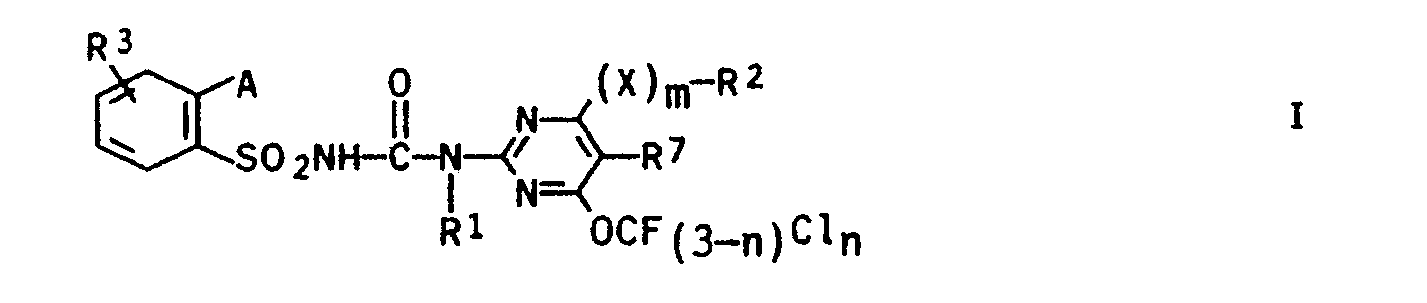
- R1 Wasserstoff, Alkyl, Alkenyl oder Alkinyl;
- R2 Halogen oder Trifluormethyl, wenn m für 0 steht oder, wenn m 1 bedeutet, Alkyl, Alkenyl oder Alkinyl sowie wenn X für O oder S und m für 1 steht, Trifluor- oder Chlordifluormethyl;
- X 0, S oder N-R4, wobei R4 für Wasserstoff oder Alkyl steht;
- R3 Wasserstoff, Halogen, Alkyl, Halogenalkyl oder Alkoxy;
- A Halogenalkyl, ein Halogenatom oder ein Rest,
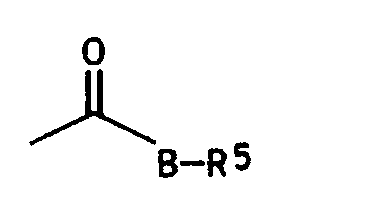
- B ein Sauerstoffatom oder eine Alkyliminogruppe N-R6;
- R5 Wasserstoff, eine ggf. substituierte Alkylgruppe, eine ggf. substituierte Cycloalkylgruppe, eine Alkenylgruppe oder eine Alkinylgruppe;
- R 1 is hydrogen, alkyl, alkenyl or alkynyl;
- R 2 is halogen or trifluoromethyl if m is 0 or if m is 1 alkyl, alkenyl or alkynyl and if X is O or S and m is 1 trifluoromethyl or chlorodifluoromethyl;
- X 0, S or NR 4 , where R 4 is hydrogen or alkyl;
- R 3 is hydrogen, halogen, alkyl, haloalkyl or alkoxy;
- A haloalkyl, a halogen atom or a radical,
- B is an oxygen atom or an alkylimino group NR 6 ;
- R 5 is hydrogen, an optionally substituted alkyl group, an optionally substituted cycloalkyl group, an alkenyl group or an alkynyl group;
Description
Die vorliegende Erfindung betrifft substituierte Sulfonylharnstoffe der allgemeinen Formel I,

- R1 Wasserstoff, C1-C4-Alkyl, C3-C6-Alkenyl oder C3-C6-Alkinyl;
- R2 Halogen oder Trifluormethyl, wenn m für 0 steht oder C1-C4-Alkyl, c3-c6-Alkenyl oder C3-C6-Alkinyl, wenn m 1 bedeutet oder Trifluor-oder Chlordifluormethyl wenn X für 0 oder S und m für 1 steht;
- X 0, S oder N-R4, wobei R4 für Wasserstoff oder C1-C4-Alkyl steht;
- R3 Wasserstoff, Halogen, C1-C4-Alkyl, c1-c4-Halogenalkyl oder C1-C4-Alkoxy;
- A c1-c4-Halogenalkyl, ein Halogenatom oder ein Rest,

- B ein Sauerstoffatom oder eine Alkyliminogruppe NR6;
- Rs Wasserstoff, eine C1-C6-Alkylgruppe, welche bis zu drei der folgenden Reste tragen kann: Halogen, C1-C4-Alkoxy, C1-C4-Alkylthio, c1-c4-Halogenalkoxy, C1-C4-Alkoxy-C1-C2-alkoxy, C3-C7-Cycloalkyl und/oder Phenyl; eine C5-C7-Cycloalkylgruppe, welche bis zu drei C1-C4-Alkylgruppen tragen kann; eine C3-C6-Alkenylgruppe oder eine C3-C6-Alkinylgruppe;
- R6 Wasserstoff, eine C1-C6-Alkylgruppe, oder gemeinsam mit R5 eine C4-C6-Alkylenkette, worin eine Methylengruppe durch ein Sauerstoffatom oder eine C1-C4-Alkyliminogruppe ersetzt sein kann, bedeutet;
- R7 Wasserstoff oder Halogen.
- R 1 is hydrogen, C 1 -C 4 alkyl, C 3 -C 6 alkenyl or C 3 -C 6 alkynyl;
- R 2 is halogen or trifluoromethyl if m is 0 or C 1 -C 4 -alkyl, c 3 -c 6 -alkenyl or C 3 -C 6 -alkynyl if m is 1 or trifluoro- or chlorodifluoromethyl if X is 0 or S and m is 1;
- X 0, S or NR 4 , where R4 is hydrogen or C 1 -C 4 alkyl;
- R 3 is hydrogen, halogen, C 1 -C 4 alkyl, c 1 -c 4 haloalkyl or C 1 -C 4 alkoxy;
- A c 1 -c 4 haloalkyl, a halogen atom or a radical,
- B is an oxygen atom or an alkylimino group NR 6 ;
- R s is hydrogen, a C 1 -C 6 -alkyl group which can carry up to three of the following radicals: halogen, C 1 -C 4 -alkoxy, C 1 -C 4 -alkylthio, c 1 -c 4 -haloalkoxy, C 1 -C 4 alkoxy-C 1 -C 2 alkoxy, C 3 -C 7 cycloalkyl and / or phenyl; a C 5 -C 7 cycloalkyl group which can carry up to three C 1 -C 4 alkyl groups; a C 3 -C 6 alkenyl group or a C 3 -C 6 alkynyl group;
- R 6 is hydrogen, a C 1 -C 6 alkyl group, or together with R 5 is a C 4 -C 6 alkylene chain, in which a methylene group can be replaced by an oxygen atom or a C 1 -C 4 alkylimino group;
- R 7 is hydrogen or halogen.
Des weiteren betrifft die Erfindung ein Verfahren zur Herstellung der Verbindungen I sowie ihre Verwendung als herbizide Mittel und Zwischenprodukte zur Herstellung der Sulfonylharnstoffe I.The invention further relates to a process for the preparation of the compounds I and their use as herbicidal compositions and intermediates for the preparation of the sulfonylureas I.
Aus der US-A-4547215 sind verschiedene Sulfonylpyrimidyl-harnstoffe als Herbizide bekannt, welche im Pyrimidinteil durch Chlor substituiert sind. In den EP-A-84020 und 169815 werden Sulfonylharnstoffe beschrieben, die im Pyrimidinteil durch den Difluormethoxy- bzw. den Bromdifluormethoxyrest substituiert sind. Diese Verbindungen lassen jedoch wegen der unbefriedigenden Selektivität gegen Schadpflanzen zu wünschen übrig.From US-A-4547215 various sulfonylpyrimidylureas are known as herbicides which are substituted by chlorine in the pyrimidine part. EP-A-84020 and 169815 describe sulfonylureas which are substituted in the pyrimidine part by the difluoromethoxy or the bromodifluoromethoxy radical. However, these compounds leave something to be desired because of the unsatisfactory selectivity against harmful plants.
Der Erfindung lagen daher neue Verbindungen aus der Klasse der Sulfonylpyrimidyl-harnstoffe mit verbesserten herbiziden Eigenschaften als Aufgabe zugrunde. Entsprechend dieser Aufgabe wurden die eingangs definierten Sulfonylharnstoffe gefunden.The invention was therefore based on new compounds from the class of sulfonylpyrimidylureas with improved herbicidal properties as an object. In accordance with this task, the sulfonylureas defined at the outset were found.
Ferner wurde gefunden, daß die Verbindungen der Formel I sowie deren Alkali- und Erdalkalimetallsalze eine gute Selektivität gegen Schadpflanzen in Kulturen wie Getreide und Mais haben.It has also been found that the compounds of the formula I and their alkali metal and alkaline earth metal salts have good selectivity against harmful plants in crops such as cereals and maize.
Außerdem wurden chemisch eigenartige Verfahren zur Herstellung der Verbindungen I gefunden. Im Vergleich zu dem Stand der Technik lassen sich die Sulfonylharnstoffe I entgegen der Erwartung regioselektiv und in hoher Ausbeute und Reinheit herstellen, wenn man ausgeht von substituierten 2-Amino-4- fluoralkoxy-6-pyrimidinen der allgemeinen Formel IIIa

- R1 Wasserstoff, C1-C4-Alkyl, C3-C6-Alkenyl oder C3-C6-Alkinyl;
- R2 C1-C4-Alkyl, C3-C6-Alkenyl oder C3-C6-Alkinyl;
- R7 Wasserstoff oder Halogen
- X O, S oder N-R1, wobei
- R4 für Wasserstoff oder C1-C4-Alkyl steht.
- R 1 is hydrogen, C 1 -C 4 alkyl, C 3 -C 6 alkenyl or C 3 -C 6 alkynyl;
- R 2 is C 1 -C 4 alkyl, C 3 -C 6 alkenyl or C 3 -C 6 alkynyl;
- R 7 is hydrogen or halogen
- XO, S or NR 1 , where
- R 4 represents hydrogen or C 1 -C 4 alkyl.
Diese Zwischenprodukte und deren Herstellung sind daher ebenfalls Gegenstand der Erfindung.These intermediates and their preparation are therefore also the subject of the invention.
Zur Herstellung von im Pyrimidinteil halogensubstituierten Verbindungen (R2 = Hai, m = 0) geht man von entsprechend substituierten 2-Amino-4-fluoralkoxy-6-halogen-pyrimidinen der Struktur Illb aus (s. Formelschema 2), deren Herstellung Gegenstand der zeitgleichen deutschen Anmeldung P 40 07 316 (O.Z. 0050/41451) ist. Pyrimidinzwischenprodukte mit m = 0 und R2 = Trifluormethyl erhält man in analoger Weise gemäß Formelschema 3.The preparation of halogen-substituted compounds in the pyrimidine part (R 2 = shark, m = 0) is based on appropriately substituted 2-amino-4-fluoroalkoxy-6-halogenopyrimidines of the structure Illb (see formula scheme 2), the preparation of which is the subject of German application P 40 07 316 (OZ 0050/41451) at the same time. Pyrimidine intermediates with m = 0 and R 2 = trifluoromethyl are obtained in an analogous manner according to formula scheme 3.
Die erfindungsgemäßen Sulfonylharnstoffe der Formel 1 sind auf den in Formelschema 1 beschriebenen Wegen A, B und C zugänglich:

Man setzt ein Sulfonylisocyanat II in an sich bekannter Weise (EP-A-162 723) in einem inerten organischen Lösungsmittel mit ungefähr der stöchiometrischen Menge eines 2-Aminopyrimidinderivats III bei einer Temperatur von 0 bis 120° C, vorzugsweise 10 bis 100° C um. Die Reaktion kann drucklos oder unter Druck (bis 50 bar), vorzugsweise bei 1 bis 5 bar, kontinuierlich oder diskontinuierlich durchgeführt werden. Geeignete Lösungsmittel sind in der obengenannten Literatur aufgeführt.A sulfonyl isocyanate II is reacted in a manner known per se (EP-A-162 723) in an inert organic solvent with approximately the stoichiometric amount of a 2-aminopyrimidine derivative III at a temperature of 0 to 120 ° C., preferably 10 to 100 ° C. . The reaction can be carried out continuously or batchwise without pressure or under pressure (up to 50 bar), preferably at 1 to 5 bar. Suitable solvents are listed in the above literature.
Man setzt ein entsprechendes Sulfonylcarbamat der Formel IV in an sich bekannter Weise (EP-A-162 723) in einem inerten organischen Lösungsmittel bei einer Temperatur zwischen 0 und 120° C, vorzugsweise 10 bis 100°C mit einem 2-Aminopyrimidinderivat um. Es können hierbei Basen wie tertiäre Amine zugesetzt werden, wodurch die Reaktion beschleunigt und die Produktqualität verbessert werden.A corresponding sulfonyl carbamate of the formula IV is reacted in a manner known per se (EP-A-162 723) in an inert organic solvent at a temperature between 0 and 120 ° C., preferably 10 to 100 ° C., with a 2-aminopyrimidine derivative. Bases such as tertiary amines can be added, thereby accelerating the reaction and improving the product quality.
Geeignete Basen hierfür sind z. B. tertiäre Amine wie Pyridin, die Picoline, 2,4- und 2,6-Lutidin, 2,4,6-Collidin, p-Dimethylaminopyridin, 1,4-Diaza(2,2,2)bicyclooctan (DABCO) und 1,8-Diazabicyclo(5,4,0)-undec-7-en.Suitable bases for this are e.g. B. tertiary amines such as pyridine, the picolines, 2,4- and 2,6-lutidine, 2,4,6-collidine, p-dimethylaminopyridine, 1,4-diaza (2,2,2) bicyclooctane (DABCO) and 1,8-diazabicyclo (5,4,0) -undec-7-ene.
Zweckmäßig verwendet man als Lösungsmittel die in der Literatur angegebenen und/oder Halogenkohlenwasserstoffe wie Dichlormethan und Chlorbenzol, Ether wie Diethylether, Tetrahydrofuran und Dioxan, Acetonitril, Dimethylformamid und/oder Essigsäureethylester in einer Menge von 100 bis 4000 Gew.%, vorzugsweise von 1000 bis 2000 Gew.%, bezogen auf die Ausgangsstoffe II, IV und V.Appropriately, the solvent used is the and / or halogenated hydrocarbons such as dichloromethane and chlorobenzene, ethers such as diethyl ether, tetrahydrofuran and dioxane, Acetonitrile, dimethylformamide and / or ethyl acetate in an amount of 100 to 4000% by weight, preferably 1000 to 2000% by weight, based on the starting materials II, IV and V.
Im Rahmen der Herstellung der erfindungsgemäßen Verbindungen sind die 2-Aminopyrimidin-Zwischenprodukte III auf folgende vorteilhafte Weise zugänglich:

In entsprechender Weise gelangt man zu den 2-Amino-6-trifluormethylpyrimidinderivaten IIIc, wenn man anstelle der 2,4,6-Trihalogenverbindungen VII die entsprechenden 2,4-Dihalogen-6-trichlormethylpyrimidine gemäß Formelschema 3 umsetzt (s. Beispiele 1.1, 1.6 und 1.12).

Ausgehend von den Zwischenprodukten XIV in Formelschema 2 und Substitution des Halogenatoms in 4-Position durch die in Formelschema 3 beschriebene Reaktionssequenz (1. CH3OH, 2. Cl2, 3. SbF3) sowie anschließende Umsetzung mit R1NH2 gelangt man zu den Zwischenprodukten Illd

Entsprechend Formelschema 2 kann man beispielsweise ein 2,4,6-Trihalogenpyrimidin VII, bekannt aus J.Med.Chem. 6, 688 (1963) oder käuflich zu erwerben, in einem aprotisch polaren Lösungsmittel
- a) mit Methanol VIII in Anwesenheit oder Abwesenheit einer Base oder
- b) mit einem Methanolat Villa in Gegenwart von Methanol VIII bei Temperaturen zwischen -40 und 120° C zum Methoxy-pyrimidin IX umsetzen. Diese Reaktionen können drucklos oder unter Druck (1 bis 10 bar, vorzugsweise 1 bis 5 bar), kontinuierlich oder diskontinuierlich durchgeführt werden.
- a) with methanol VIII in the presence or absence of a base or
- b) with a methanolate villa in the presence of methanol VIII at temperatures between -40 and 120 ° C to methoxy-pyrimidine IX. These reactions can be carried out continuously or batchwise without pressure or under pressure (1 to 10 bar, preferably 1 to 5 bar).
Hai in Formel VII steht für Fluor, Chlor oder Brom.Shark in formula VII stands for fluorine, chlorine or bromine.
M1 in Formel Villa bedeutet ein Alkalimetallkation wie Lithium-, Natrium-und Kaliumkation oder das Equivalent eines Erdalkalimetallkations wie Magnesium-, Calcium- und Bariumkation.M 1 in Formula Villa means an alkali metal cation such as lithium, sodium and potassium cation or the equivalent of an alkaline earth metal cation such as magnesium, calcium and barium cation.
Für die Umsetzung des Trihalogenpyrimidins mit Methanol VIII sind folgende Lösungsmittel geeignet: Ether wie Methyl-tert.-butylether, Diethylether, Ethylpropylether, n-Butylethylether, Di-n-butylether, Diisobutylether, Diisoamylether, Di-isoopropylether, Cyclohexylmethylether, Tetrahydrofuran, 1,2-Dimethoxyethan, Diethylenglycoldimethylether und Anisol, chlorierte Kohlenwasserstoffe wie 1,1,2,2-Tetrachlorethan, 1,1-Dichlorethylen, Chlorbenzol, 1,2-Dichlorbenzol und 1-Chlornaphthalin sowie entsprechende Gemische.The following solvents are suitable for the reaction of the trihalopyrimidine with methanol VIII: ethers such as methyl tert-butyl ether, diethyl ether, ethyl propyl ether, n-butyl ethyl ether, di-n-butyl ether, diisobutyl ether, diisoamyl ether, di-isoopropyl ether, cyclohexyl methyl ether, tetrahydrofuran, 1, 2-dimethoxyethane, diethylene glycol dimethyl ether and anisole, chlorinated hydrocarbons such as 1,1,2,2-tetrachloroethane, 1,1-dichlorethylene, chlorobenzene, 1,2-dichlorobenzene and 1-chloronaphthalene as well as corresponding mixtures.
Zweckmäßig verwendet man das Lösungsmittel in einer Menge von 100 bis 2000 Gew.%, vorzugsweise 500 bis 1500 Gew.%, bezogen auf den Ausgangsstoff VII.The solvent is expediently used in an amount of 100 to 2000% by weight, preferably 500 to 1500% by weight, based on the starting material VII.
Zweckmäßig führt man jedoch die Umsetzung der Ausgangsstoffe VII mit VIII direkt in überschüssigem Methanol VIII als Lösungsmittel durch. Gegebenenfalls gibt man ein Alkalimethanolat Villa in einer equivalenten Menge oder einem über- oder Unterschuß von bis zu 5 %, bezogen auf den Ausgangsstoff VII, zu einer Suspension des Ausgangsstoffes VII in der 5-bis 20-fachen Gewichtsmenge Alkohol VIII als Lösungsmittel, bezogen auf den Ausgangsstoff VII, innerhalb bis zu einer Stunde bei einer Temperatur von -20 bis 80° C. Zur Beendigug der Umsetzung rührt man dann noch 1/2 bis 8 Stunden bei 0 bis 120°C. vorzugsweise 0 bis 100° C nach.However, the reaction of the starting materials VII with VIII is expediently carried out directly in excess methanol VIII as solvent. If appropriate, an alkali metal methoxide is added in an equivalent amount or an excess or deficit of up to 5%, based on the starting material VII, to a suspension of the starting material VII in 5 to 20 times the amount by weight of alcohol VIII as solvent, based on the starting material VII, within up to one hour at a temperature of -20 to 80 ° C. To complete the reaction, the mixture is then stirred for a further 1/2 to 8 hours at 0 to 120 ° C. preferably 0 to 100 ° C after.
Zur Isolierung der Methoxy-pyrimidine dienen die hierfür in der Literatur üblichen Aufarbeitungsmethoden wie destillative oder chromatographische Aufarbeitung.For the isolation of the methoxy-pyrimidines, the work-up methods customary in the literature, such as distillative or chromatographic work-up, are used.
Die Chlorierung des Methoxy-pyrimidins IX mit Chlor X zu dem Trichlormethoxy-pyrimidin XI führt man beispielsweise bei einer Temperatur von 60 bis 180° C durch.The chlorination of methoxy-pyrimidine IX with chlorine X to the trichloromethoxy-pyrimidine XI is carried out, for example, at a temperature of 60 to 180 ° C.
Als Chlorierungsmittel sind elementares Chlor oder Chlor abgebende Substanzen wie Sulfurylchlorid oder Phosphorpentachlorid geeignet. Chlor kann dabei auch in situ durch Oxydation von Chlorwasserstoffsäure, beispielsweise mit Braunstein oder durch anodische Chlorierung hergestellt werden.Elemental chlorine or chlorine-releasing substances such as sulfuryl chloride or phosphorus pentachloride are suitable as chlorinating agents. Chlorine can also be produced in situ by oxidation of hydrochloric acid, for example with manganese dioxide or by anodic chlorination.
Die Umsetzung kann in Gegenwart eines inerten Lösungsmittels, beispielsweise einem chlorierten Kohlenwasserstoff wie Chloroform, Tetrachlorkohlenstoff, Chlorbenzol, 1,2-, 1,3- oder 1,4-Dichlorbenzol, einem Nitril wie Acetonitril, Propionitril, einer Nitroverbindung wie Nitrobenzol, einer Carbonsäure wie Essigsäure, Propionsäure, einem Säureanhydrid wie Essigsäureanhydrid, einem Säurechlorid wie Chloracetylchlorid, a-Chlorpropionsäurechlorid, a,a-Dichlorpropionsäurechlorid, einem anorganischen Säurehalogenid wie Phosphortrichlorid oder Phosphoroxychlorid oder bevorzugt ohne Lösungsmittel in der Schmelze des Ausgangsstoffes IX durchgeführt werden.The reaction can be carried out in the presence of an inert solvent, for example a chlorinated hydrocarbon such as chloroform, carbon tetrachloride, chlorobenzene, 1,2-, 1,3- or 1,4-dichlorobenzene, a nitrile such as acetonitrile, propionitrile, a nitro compound such as nitrobenzene, a carboxylic acid such as acetic acid, propionic acid, an acid anhydride such as acetic anhydride, an acid chloride such as chloroacetyl chloride, a-chloropropionic acid chloride, a, a-dichloropropionic acid chloride, an inorganic acid halide such as phosphorus trichloride or phosphorus oxychloride or preferably without solvent in the melt of the starting material IX.
Gegebenenfalls kann man die Reaktion durch Zugabe eines Radikalstarters beschleunigen; als solcher eignet sich die Bestrahlung mit Licht, vorzugsweise UV-Licht oder die Zugabe von a,a'-Azoisobutyronitril, zweckmäßig in einer Menge von 0,2 bis 7 mol%, bezogen auf den Ausgangsstoff IX. Man kann die Reaktion auch durch Zugabe eines Katalysators beschleunigen; als solcher eignet sich Phosphorpentachlorid, zweckmäßig in einer Menge von 0,5 bis 7 mol% bezogen auf den Ausgangsstoff IX. In diesem Fall legt man den Ausgangsstoff IX zusammen mit dem Katalysator vor und beginnt dann mit der Chlorierung. Statt des Phosphorpentachlorids kann man auch eine dieses unter den Reaktionsbedingungen bildende Ausgangskomponente, z.B. Phosphortrichlorid oder gelben Phosphor, zugeben und dann mit der Chlorierung beginnen.If necessary, the reaction can be accelerated by adding a radical initiator; as such, irradiation with light, preferably UV light, or the addition of a, a'-azoisobutyronitrile, is expedient, in an amount of 0.2 to 7 mol%, based on the starting material IX. The reaction can also be accelerated by adding a catalyst; as such, phosphorus pentachloride is suitable, advantageously in an amount of 0.5 to 7 mol% based on the starting material IX. In this case, the starting material IX is introduced together with the catalyst and the chlorination is then started. Instead of the phosphorus pentachloride, it is also possible to use a starting component which forms it under the reaction conditions, e.g. Add phosphorus trichloride or yellow phosphorus and then start chlorination.
Ausgangsstoff IX kann mit Chlor in annähernd stöchiometrischer Menge oder vorzugsweise im Überschuß, vorteilhaft mit 3,1 bis 11, insbesondere 3,3 bis 5 mol C12 je Equivalent Methoxy in dem Ausgangsstoff IX umgesetzt werden. Die Umsetzung kann bei einer Temperatur von 60 bis 180 C, vorteilhaft von 100 bis 150°C, drucklos oder unter Druck kontinuierlich oder diskontinuierlich durchgefürt werden.Starting material IX can be reacted with chlorine in an approximately stoichiometric amount or preferably in excess, advantageously with 3.1 to 11, in particular 3.3 to 5, mol of C1 2 per equivalent methoxy in the starting material IX. The reaction can be carried out continuously or discontinuously at a temperature of 60 to 180 ° C., advantageously from 100 to 150 ° C., without pressure or under pressure.
Chloriert man bei 1 bar, so werden zweckmäßig 3,3 bis 5 mol Chlorgas, bezogen auf ein Equivalent Methoxy in dem Ausgangsstoff IX, eingesetzt, was einem Chlorumsatz von 91 bis 60 % entspricht. Durch geeignete apparative Maßnahmen, z.B. durch Anwendung von mäßigem Überdruck, zweckmäßig 1 bis 10 bar, oder durch Verwendung einer Blasensäule, läßt sich der Chlorumsatz erhöhen. Vorteilhaft läßt man das Chlorgas möglichst lange mit der organischen Phase in Berührung kommen, indem diese beispielsweise stark gerührt wird oder das Chlorgas eine dicke Schicht der organischen Phase durchdringen muß.If chlorination is carried out at 1 bar, it is expedient to use 3.3 to 5 mol of chlorine gas, based on one equivalent of methoxy in the starting material IX, which corresponds to a chlorine conversion of 91 to 60%. By means of suitable equipment measures, e.g. The chlorine conversion can be increased by applying moderate excess pressure, advantageously 1 to 10 bar, or by using a bubble column. The chlorine gas is advantageously allowed to come into contact with the organic phase for as long as possible, for example by stirring it vigorously or the chlorine gas having to penetrate a thick layer of the organic phase.
Die Reaktionszeit beträgt im allgemeinen etwa 0,5 bis 12 Stunden.The reaction time is generally about 0.5 to 12 hours.
In einer bevorzugten Ausführungsform des Verfahrens geht man so vor, daß man innerhalb von 0,5 bis 12 Stunden, vorzugsweise 1 bis 10 Stunden die erforderliche Menge Chlorgas unter intensivem Rühren in den flüssigen Ausgangsstoff IX einleitet, wobei man zunächst bei einer Temperatur von 60 bis 80 C beginnt und diese - gegebenenfalls unter Ausnutzung des exothermen Charakters der Reaktion - kontinuierlich steigert, so daß gegen Ende die Umsetzung bei einer Temperatur von 100 bis 150°C durchgeführt wird. Bei größeren Reaktionsansätzen trägt man dem exothermen Charakter durch äußere Kühlung bzw. geeignete Dosierung der Chlormenge Rechnung; mit dem Abflauen der Reaktion entfernt man das Kältebad und kann gegebenenfalls noch nacherhitzen.In a preferred embodiment of the process, the procedure is such that the required amount of chlorine gas is introduced into the liquid starting material IX with vigorous stirring within 0.5 to 12 hours, preferably 1 to 10 hours, initially at a temperature of 60 to 80 C begins and this - if necessary using the exothermic nature of the reaction - continuously increases, so that towards the end the reaction is carried out at a temperature of 100 to 150 ° C. In the case of larger reaction batches, the exothermic character is taken into account by external cooling or suitable metering of the amount of chlorine; as the reaction subsides, the cooling bath is removed and, if necessary, can be reheated.
Die Aufarbeitung und Isolierung der Endstoffe kann in üblicher Weise erfolgen. Beispielsweise kann man aus der heißen organischen Phase mittels eines Inertgases Reste an Chlorwasserstoff, Chlor oder Katalysator austragen; dabei hinterbleibt in hoher Ausbeute ein bereits recht reines Rohprodukt. Durch Destillation oder Chromatographie kann es weiter gereinigt oder aber direkt für weitere Umsetzungen eingesetzt werden.The end products can be worked up and isolated in the customary manner. For example, residues of hydrogen chloride, chlorine or catalyst can be removed from the hot organic phase using an inert gas; an already quite pure crude product remains in high yield. It can be further purified by distillation or chromatography or used directly for further reactions.
Die Umsetzung des Trichlormethoxy-pyrimidins XI mit einem Halogenaustauschmittel führt man beispielsweise bei einer Temperatur von 0 bis 170° C durch.The reaction of the trichloromethoxypyrimidine XI with a halogen exchange agent is carried out, for example, at a temperature of 0 to 170 ° C.
Als Halogenaustauschmittel sind Antimontrifluorid in Gegenwart oder Abwesenheit katalytischer Mengen eines Antimon(V)salzes, z.B. Antimon(V)chlorid oder Fluorwasserstoff geeignet.Antimony trifluoride in the presence or absence of catalytic amounts of an antimony (V) salt, e.g. Antimony (V) chloride or hydrogen fluoride suitable.
Zweckmäßig verwendet man einen Überschuß von 1 bis 200, vorzugsweise 5 bis 20 mol% Antimontrifluorid pro Trichlormethylequivalent. Die Katalysatormenge an Antimon(V)salz beträgt zwischen 1 bis 20, vorzugsweise 5 bis 18 mol% pro Trichlormethylequivalent. Vorzugsweise dosiert man den Ausgangsstoff XI bei 90 bis 130°C zu der Mischung des Halogenaustauschmittels und erwärmt dann noch zwischen 10 und ca. 120 Minuten auf eine Temperatur zwischen 140 bis 170°C. Anschließend wird durch Destillation aufgearbeitet.An excess of 1 to 200, preferably 5 to 20, mol% of antimony trifluoride per trichloromethyl equivalent is expediently used. The catalyst amount of antimony (V) salt is between 1 to 20, preferably 5 to 18 mol% per trichloromethyl equivalent. The starting material XI is preferably metered in at 90 to 130 ° C. to the mixture of the halogen exchange medium and then heated to a temperature between 140 to 170 ° C. for between 10 and approx. 120 minutes. It is then worked up by distillation.
Man kann die Reaktion jedoch auch kontinuierlich führen, den Ausgangsstoff XI bei 140 bis 170°C innerhalb 10 bis ca. 120 Minuten zugeben und gleichzeitig unter vermindertem Druck den entstehenden niedriger siedenden Endstoff XIV abdestillieren. Spuren mitgerissender Antimonsalze lassen sich durch Extraktion mit konz. Salzsäure beseitigen.However, the reaction can also be carried out continuously, adding the starting material XI at 140 to 170 ° C. within 10 to about 120 minutes and, at the same time, distilling off the lower-boiling end product XIV formed under reduced pressure. Traces of entraining antimony salts can be extracted by extraction with conc. Remove hydrochloric acid.
Arbeitet man ohne Antimon(V)salz-Katalyse oder setzt nur geringe Mengen, z. B. 0,2 bis 1 mol% ein, und reduziert die Menge an Antimontrifluorid auf 60 bis 90 mol% pro Trichlormethylequivalent, so bleibt der Halogenaustausch auf der Chlordifluormethoxystufe stehen.If you work without antimony (V) salt catalysis or only use small amounts, e.g. B. 0.2 to 1 mol%, and reduces the amount of antimony trifluoride to 60 to 90 mol% per trichloromethyl equivalent, the halogen exchange remains on the chlorodifluoromethoxy stage.
Anstelle von Antimontrifluorid kann der Halogenaustausch auch mit Fluorwasserstoff bei 0 bis 170°C, vorzugsweise 40 bis 120° C, durchgeführt werden. Hierzu versetzt man in einem Autoklaven den Ausgangsstoff XI mit einem Überschuß von 300 bis 700, vorzugsweise 350 bis 400 mol% Fluorwasserstoff pro Trichlormethylequivalent und rührt 10 Minuten bis ca. 10 Stunden. Nach dem Entspannen und der Entfernung flüchtiger Bestandteile wird wie beschrieben aufgearbeitet.Instead of antimony trifluoride, the halogen exchange can also with hydrogen fluoride at 0 to 170 ° C, preferably 40 to 120 ° C, are carried out. To this end, the starting material XI is mixed with an excess of 300 to 700, preferably 350 to 400 mol% hydrogen fluoride per trichloromethyl equivalent in an autoclave and stirred for 10 minutes to about 10 hours. After relaxing and removing volatile constituents, the mixture is worked up as described.
Die Umsetzung des Fluormethoxy-pyrimidins XIV mit einem Amin XV führt man beispielsweise bei einer Temperatur von -80 bis 400 C durch.The reaction of fluoromethoxypyrimidine XIV with an amine XV is carried out, for example, at a temperature of from -80 to 40 ° C.
In Formel XV steht R1 beispielsweise für Wasserstoff, Ci-C4.-Alkyl wie Methyl, Ethyl, n-Propyl, i-Propyl, n-Butyl, sek.-Butyl, i-Butyl, tert.-Butyl; C3-C4-Alkeny) wie 2-Propenyl, 2-Methylethenyl, 2-Butenyl, 3-Butenyl, 1-Methyl-2-propenyl oder 2-Methyl-2-propenyl; C3-C4-Alkinyl wie Propargyl, 2-Butinyl, 3-Butinyl oder 1-Methyl-2-propinyl.In Formula XV, R 1 is, for example hydrogen, Ci-C. 4-alkyl such as methyl, ethyl, n-propyl, i-propyl, n-butyl, sec-butyl, i-butyl, tert-butyl; C 3 -C 4 alkeny) such as 2-propenyl, 2-methylethenyl, 2-butenyl, 3-butenyl, 1-methyl-2-propenyl or 2-methyl-2-propenyl; C 3 -C 4 alkynyl such as propargyl, 2-butynyl, 3-butynyl or 1-methyl-2-propynyl.
Unter den Aminen, welche eingesetzt werden können, sollen die folgenden erwähnt werden: Ammoniak, Methylamin, Ethylamin, n-Propylamin, Isopropylamin, n-Butylamin, Isobutylamin, sek.-Butylamin, tert.-Butylamin, 2-Propenylamin, 2-Methylethenylamin, 2-Butenylamin, 3-Butenylamin, 1-Methyl-2-propenylamin, 2-Methyl-2-propenylamin, Propargylamin, 2-Butinylamin, 3-Butinylamin und 1-Methyl-2-propinylamin.Among the amines that can be used, the following should be mentioned: ammonia, methylamine, ethylamine, n-propylamine, isopropylamine, n-butylamine, isobutylamine, sec-butylamine, tert-butylamine, 2-propenylamine, 2-methylethenylamine , 2-butenylamine, 3-butenylamine, 1-methyl-2-propenylamine, 2-methyl-2-propenylamine, propargylamine, 2-butynylamine, 3-butynylamine and 1-methyl-2-propynylamine.
Die 2,6-Dihalogen-pyrimidine XIV können in einem aprotisch polaren Lösungsmittel mit den Aminen XV bei einer Temperatur von -80 bis 40 °C umgesetzt werden, wobei man das Amin XV entweder in einem Überschuß einsetzt oder eine organische Hilfsbase verwendet.The 2,6-dihalopyrimidines XIV can be reacted in an aprotic polar solvent with the amines XV at a temperature of -80 to 40 ° C., either using an excess of the amine XV or using an organic auxiliary base.
Für die Umsetzung des 2,6-Dihalogen-pyrimidins XIV mit dem Amin XV sind beispielsweise folgende Lösungsmittel geeignet:
- Ether wie Methyl-tert.-butylether, Diethylether, Ethylpropylether, n-Butylethylether, Di-n-butylether, Diisobutylether, Diisoamylether, Diisopropylether, Cyclohexylmethylether, Tetrahydrofuran, 1,2-Dimethoxyethan, Diethylenglykoldimethylether und Anisol, Ester wie Ethylacetat, n-Butylacetat und Isobutylacetat sowie chlorierte Kohlenwasserstoffe wie Methylenchlorid, 1,1,2,2-Tetrachlorethan, 1,1-Dichlorethylen, 1,2-Dichlorethan, Chlorbenzol, 1,2-Dichlorbenzol und 1-Chlornaphthalin und Gemische dieser Lösungsmittel.
- Ethers such as methyl tert-butyl ether, diethyl ether, ethyl propyl ether, n-butyl ethyl ether, di-n-butyl ether, diisobutyl ether, diisoamyl ether, diisopropyl ether, cyclohexyl methyl ether, tetrahydrofuran, 1,2-dimethoxyethane, diethylene glycol dimethyl ether and anisole, esters such as ethyl acetate and isobutyl acetate and chlorinated hydrocarbons such as methylene chloride, 1,1,2,2-tetrachloroethane, 1,1-dichloroethylene, 1,2-dichloroethane, chlorobenzene, 1,2-dichlorobenzene and 1-chloronaphthalene and mixtures of these solvents.
Zweckmäßig verwendet man das Lösungsmittel in einer Menge von 100 bis 2000 Gew.%, vorzugsweise 400 bis 1200 Gew.%, bezogen auf den Ausgangsstoff XIV.The solvent is expediently used in an amount of 100 to 2000% by weight, preferably 400 to 1200% by weight, based on the starting material XIV.
Vorteilhaft gibt man 1,8 bis 2,5, insbesondere 1,95 bis 2,2 mol-Equivalent des Amins XV, bezogen auf den Ausgangsstoff XIV innerhalb 0,5 bis 2 Stunden zu einer Mischung von Ausgangsstoff XIV in einem der vorgenannten Lösungsmittel bei (-80) bis 400 C, vorzugsweise -70 bis 250 C, rührt bis zur Vervollständigung der Reaktion bis zu 3 Stunden nach und läßt dann zur Aufarbeitung auf 250 C erwärmen.Advantageously, 1.8 to 2.5, in particular 1.95 to 2.2 mol equivalents of the amine XV, based on the starting material XIV, are added to a mixture of starting material XIV in one of the abovementioned solvents within 0.5 to 2 hours (-80) to 40 ° C., preferably -70 to 25 ° C., is stirred for up to 3 hours until the reaction is complete and then allowed to warm up to 25 ° C. for working up.
Setzt man nur ungefähr stöchiometrische Mengen des Amins XV ein, so verwendet man zweckmäßig 0,9 bis 1,1 Equivalente einer organischen Hilfsbase, bezogen auf den Ausgangsstoff XIV. Als Hilfsbase eignen sich organische Basen wie Trimethylamin, Triethylamin, N-Ethyl-diisopropylamin, Triisopropylamin, N,N-Dimethylanilin, N,N-Dimethylcyclohexylamin, N-Methylpyrrolidin, Pyridin, Chinolin, a-,ß-, y-Picolin, 2,4-und 2,6-Lutidin und Triethylendiamin.If only approximately stoichiometric amounts of amine XV are used, it is expedient to use 0.9 to 1.1 equivalents of an organic auxiliary base, based on the starting material XIV. Organic bases such as trimethylamine, triethylamine, N-ethyl-diisopropylamine are suitable as auxiliary bases. Triisopropylamine, N, N-dimethylaniline, N, N-dimethylcyclohexylamine, N-methylpyrrolidine, pyridine, quinoline, a-, ß-, y-picoline, 2,4- and 2,6-lutidine and triethylene diamine.
Die Reaktion kann drucklos oder unter Druck kontinuierlich oder diskontinuierlich durchgeführt werden.The reaction can be carried out continuously or batchwise without pressure or under pressure.
Zur Aufarbeitung extrahiert man das Umsetzungsgemisch mit Wasser zur Entfernung der Salze, trocknet und reinigt die organische Phase, z. B. durch Chromatographie. Man kann jedoch auch direkt die organische Phase einengen und den Rückstand mit einem Lösungsmittel verrühren.For working up, the reaction mixture is extracted with water to remove the salts, dried and the organic phase is cleaned, for. B. by chromatography. However, the organic phase can also be concentrated directly and the residue stirred with a solvent.
Die erfindungsgemäßen 2-Amino-4-fluoralkoxy-pyrimidine der Formel IIIa erhält man vorteilhaft in der Weise, daß man 2-Amino-4-fluoralkoxy-6-halogen-pyrimidine der Formel Illb


Die Umsetzung kann für den Fall der Verwendung von 2-Amino-4-fluor-6-trifluormethoxypyrimidin und Methylamin durch folgendes Schema beschrieben werden:

Für den Fall der Verwendung von 2-Amino-4-fluor-6-chlordifluormethoxy-pyrimidin und Natriummethylat läßt sich die Umsetzung durch folgendes Schema wiedergeben:

Das Verfahren liefert auf einfachem und wirtschaftlichem Weg neue 2-Amino-4-fluoralkoxy-pyrimidine in hoher Ausbeute und Reinheit. Entgegen der Erwartung werden Fluoralkoxygruppen nicht substituiert. Auch das in der Etherseitenkette stehende Chloratom bleibt trotz der alkalischen Reaktionsbedingungen erhalten. Im Hinblick auf den Stand der Technik (s. z.B. EP-A-70804) sind alle diese vorteilhaften Eigenschaften überraschend.The process provides new 2-amino-4-fluoroalkoxypyrimidines in a simple and economical way in high yield and purity. Contrary to expectations, fluoroalkoxy groups are not substituted. The chlorine atom in the ether side chain is also retained despite the alkaline reaction conditions. In view of the state of the art (see e.g. EP-A-70804) all these advantageous properties are surprising.
Bevorzugte Zwischenprodukte Illa und dementsprechend bevorzugte Ausgangsstoffe Illb sind solche, in deren Formeln R1 und R2 C1-C4-Alkyl wie Methyl, Ethyl, n-Propyl, i-Propyl, n-Butyl, sek.-Butyl, i-Butyl, tert.-Butyl; C3-C4-Alkenyl wie 2-Propenyl, 2-Methylethenyl, 2-Butenyl, 3-Butenyl, 1-Methyl-2-propenyl, 2-Methyl-2-propenyl; C3-C4-Alkinyl wie Propargyl, 2-Butinyl, 3-Butinyl, 1-Methyl-2-propinyl, darüberhinaus kann R1 auch Wasserstoff bedeuten.
- X 0, S oder N-R4, wobei
- R4 für Wasserstoff, Methyl, Ethyl, n-Propyl, i-Propyl, n-Butyl, sek.-Butyl, i-Butyl oder tert.-Butyl steht,
- R7 Wasserstoff und
- n 0 oder 1 bedeuten.
- X 0, S or NR 4 , where
- R 4 represents hydrogen, methyl, ethyl, n-propyl, i-propyl, n-butyl, sec-butyl, i-butyl or tert-butyl,
- R 7 is hydrogen and
- n is 0 or 1.
Die Umsetzung des 2-Amino-4-fluoralkoxy-pyrimidins Illb mit einem Nucleophil XVI oder dessen Salz XVla führt man beispielsweise bei einer Temperatur von -80 bis 80 C durch. Als Nucleophile XVI sind Ammoniak, aliphatische Amine, Alkohole und Thiole geeignet.The reaction of 2-amino-4-fluoroalkoxypyrimidine IIIb with a nucleophile XVI or its salt XVla is carried out, for example, at a temperature of from -80 to 80 ° C. Ammonia, aliphatic amines, alcohols and thiols are suitable as nucleophiles XVI.
Unter den Aminen, welche als Nucleophile eingesetzt werden können, sollen die folgenden erwähnt werden: Ammoniak, Methylamin, Ethylamin, n-Propylamin, Isopropylamin, n-Butylamin, Isobutylamin, sek.-Butylamin, tert.-Butylamin, 2-Propenylamin, 2-Methylethenylamin, 2-Butenylamin, 3-Butenylamin, 1-Methyl-2-propenylamin, 2-Methyl-2-propenylamin, Propargylamin, 2-Butinylamin, 3-Butinylamin und 1-Methyl-2-propinylamin, Dimethylamin, Diethylamin, Di-n-propylamin, Di-n-butylamin, N-Methyl-ethylamin, N-Ethyl-n-propylamin, N-Methyl-allylamin und N-Methyl-propargylamin.Among the amines that can be used as nucleophiles, the following should be mentioned: ammonia, methylamine, ethylamine, n-propylamine, isopropylamine, n-butylamine, isobutylamine, sec-butylamine, tert-butylamine, 2-propenylamine, 2 -Methylethenylamine, 2-butenylamine, 3-butenylamine, 1-methyl-2-propenylamine, 2-methyl-2-propenylamine, propargylamine, 2-butynylamine, 3-butynylamine and 1-methyl-2-propynylamine, dimethylamine, diethylamine, di -n-propylamine, di-n-butylamine, N-methyl-ethylamine, N-ethyl-n-propylamine, N-methyl-allylamine and N-methyl-propargylamine.
Unter den Alkoholen, welche als Nucleophile eingesetzt werden können, sollen die folgenden erwähnt werden: Methanol, Ethanol, n-Propanol, i-Propanol, n-Butanol, i-Butanol, sek.-Butanol, tert.-Butanol, 2-Propenol, 2-Methylethenol, 2-Butenol, 3-Butenol, 1-Methyl-2-propenol, 2-Methyl-2-propenol, Propinol, 2-Butinol, 3-Butinol und 1-Methyl-2-propinol.Among the alcohols that can be used as nucleophiles, the following should be mentioned: methanol, ethanol, n-propanol, i-propanol, n-butanol, i-butanol, sec-butanol, tert-butanol, 2-propenol , 2-methylethenol, 2-butenol, 3-butenol, 1-methyl-2-propenol, 2-methyl-2-propenol, propinol, 2-butinol, 3-butinol and 1-methyl-2-propinol.
Unter den Thiolen, welche als Nucleophile eingesetzt werden können, sollen die folgenden erwähnt werden: Methanthiol, Ethanthiol, n-Propanthiol, i-Propanthiol, n-Butanthiol, i-Butanthiol, sek.-Butanthiol, tert.-Butanthiol, 2-Butenthiol, 2-Methylethenthiol, 2-Butenthiol, 3-Butenthiol, 1-Methyl-2-propenthiol, 2-Methyl-2-propenthiol, Propinthiol, 2-Butinthiol, 3-Butinthiol und 1-Methyl-2-propinthiol.Among the thiols which can be used as nucleophiles, the following should be mentioned: methanethiol, ethanethiol, n-propanethiol, i-propanethiol, n-butanethiol, i-butanethiol, sec-butanethiol, tert-butanethiol, 2-butenethiol , 2-Methylethenthiol, 2-Butenthiol, 3-Butenthiol, 1-Methyl-2-propenthiol, 2-Methyl-2-propenthiol, Propinthiol, 2-Butinthiol, 3-Butinthiol and 1-Methyl-2-propinthiol.
Die 4-Halogen-pyrimidine IIIb können in einem aprotisch polaren Lösungsmittel mit den Aminen XVI bei einer Temperatur von -80 bis +80°C, vorteilhaft -30 bis +20°C umgesetzt werden, wobei man das Amin XVI entweder in einem Überschuß einsetzt oder eine organische Hilfsbase verwendet.The 4-halopyrimidines IIIb can be reacted in an aprotic polar solvent with the amines XVI at a temperature of -80 to + 80 ° C, advantageously -30 to + 20 ° C, either using an excess of the amine XVI or an organic auxiliary base is used.
Für die Umsetzung des 4-Halogen-pyrimidins lllb mit dem Amin XVI sind folgende Lösungsmittel geeignet:
- Ether wie Methyl-tert.-butylether, Diethylether, Ethylpropylether, n-Butylethylether, Di-n-butylether, Diisobutylether, Diisoamylether, Diisopropylether, Cyclohexylmethylether, Tetrahydrofuran, 1,2-Dimethoxyethan, Diethylenglykoldimethylether und Anisol, Ester wie Ethylacetat, n-Butylacetat und Isobutylacetat sowie chlorierte Kohlenwasserstoffe wie Methylenchlorid 1,1,2,2-Tetrachlorethan, 1,1-Dichlorethylen, 1,2-Dichlorethan, Chlorbenzol, 1,2-Dichlorbenzol und 1-Chlornaphthalin und Gemische dieser Lösungsmittel.
- Ethers such as methyl tert-butyl ether, diethyl ether, ethyl propyl ether, n-butyl ethyl ether, di-n-butyl ether, diisobutyl ether, diisoamyl ether, diisopropyl ether, cyclohexyl methyl ether, tetrahydrofuran, 1,2-dimethoxyethane, diethylene glycol dimethyl ether and anisole, esters such as ethyl acetate and isobutyl acetate and chlorinated hydrocarbons such as methylene chloride, 1,1,2,2-tetrachloroethane, 1,1-dichloroethylene, 1,2-dichloroethane, chlorobenzene, 1,2-dichlorobenzene and 1-chloronaphthalene and mixtures of these solvents.
Zweckmäßig verwendet man das Lösungsmittel in einer Menge von 100 bis 2000 Gew.%, vorzugsweise 400 bis 1200 Gew.%, bezogen auf den Ausgangsstoff lllb.The solvent is expediently used in an amount of 100 to 2000% by weight, preferably 400 to 1200% by weight, based on the starting material IIIb.
Vorteilhaft gibt man 1,8 bis 2,5, insbesondere 1,95 bis 2,2 mol-Equivalente des Amins XVI, bezogen auf den Ausgangsstoff Illb innerhalb 0,5 bis 2 Stunden zu einer Mischung von Ausgangsstoff IIIb in einem der vorgenannten Lösungsmittel bei (-80) bis 800 C, vorzugsweise -30 bis 25 C, rührt bis zur Vervollständigung der Reaktion (ca. 3 Stunden) nach und läßt dann zur Aufarbeitung auf 25 C erwärmen.Advantageously, 1.8 to 2.5, in particular 1.95 to 2.2 mol equivalents of the amine XVI, based on the starting material Illb, are added to a mixture of starting material IIIb in one of the abovementioned solvents within 0.5 to 2 hours (-80) to 80 0 C, preferably -30 to 25 C, stirred until the reaction is complete (about 3 hours) and then allowed to warm up to 25 C for working up.
Setzt man nur ungefähr stöchiometrische Mengen des Amins XVI ein, so setzt man zweckmäßig 0,9 bis 1,1 Equivalente einer organischen Hilfsbase, bezogen auf den Ausgangsstoff Illb, zu. Als Hilfsbase eignen sich organische Basen wie Trimethylamin, Triethylamin, N-Ethyl-diisopropylamin, Triisopropylamin, N,N-Dimethylanilin, N,N-Dimethylcyclohexylamin, N-Methylpyrrolidin, Pyridin, Chinolin, α-,β-, y-Picolin, 2,4- und 2,6-Lutidin und Triethylendiamin.If only approximately stoichiometric amounts of the amine XVI are used, it is expedient to add 0.9 to 1.1 equivalents of an organic auxiliary base, based on the starting material Illb. Organic bases such as trimethylamine, triethylamine, N-ethyl-diisopropylamine, triisopropylamine, N, N-dimethylaniline, N, N-dimethylcyclohexylamine, N-methylpyrrolidine, pyridine, quinoline, α-, β-, y-picoline, 2 are suitable as auxiliary bases , 4- and 2,6-lutidine and triethylene diamine.
Wird die Umsetzung mit Alkoholen oder Thiolen durchgeführt, kann man analog der für Amine beschriebenen Reaktionsweise verfahren. Vorteilhaft gibt man das Nucleophil in einer Menge von 0,9 bis 1,3 mol-Equivalenten, bezogen auf den Ausgangsstoff IIIb innerhalb 0,5 bis 2 Stunden zusammen mit einer der vorgenannten Hilfsbasen zu einer Mischung von Ausgangsstoff lllb in einem der vorgenannten Lösungsmittel bei -30 bis 20 C, rührt bis zur Vervollständigung der Reaktion (ca. 3 Stunden) nach und läßt dann zur Aufarbeitung auf 250 C erwärmen.If the reaction is carried out with alcohols or thiols, the procedure described for amines can be followed. Advantageously, the nucleophile is added in an amount of 0.9 to 1.3 mol equivalents, based on the starting material IIIb, within 0.5 to 2 hours together with one of the abovementioned auxiliary bases to a mixture of starting material IIIb in one of the abovementioned solvents -30 to 20 C, stirred until the reaction is complete (about 3 hours) and then allowed to warm up to 25 0 C for working up.
Neben den genannten sind als Lösungsmittel auch Ketone; z. B. Aceton, Methylethylketon; dipolare aprotische Lösungsmittel, z. B. Acetonitril, Dimethylformamid, Dimethylacetamid, Dimethylsulfoxid, N-Methylpyrrolidon, 1,3-Dimethylimidazolin-2-on; Aromaten, z. B. Benzol, Toluol, Xylol oder entsprechende Gemische geeignet. Vorteilhaft kann man im Fall des Einsatzes von Alkoholen als Nucleophile diese direkt als Lösungsmittel verwenden. Besonders bevorzugt sind Salze von Alkoholen oder Thiolen, die den Einsatz einer organischen Hilfsbase entbehrlich machen. Sie werden auf bekannte Weise unter Verwendung von Alkali- oder Erdalkalimetallen oder Metallhydriden, z. B. NaH, KH, CaH2 oder LiH hergestellt.In addition to the above, ketones are also used as solvents; e.g. B. acetone, methyl ethyl ketone; dipolar aprotic solvents, e.g. B. acetonitrile, dimethylformamide, dimethylacetamide, dimethyl sulfoxide, N-methylpyrrolidone, 1,3-dimethylimidazolin-2-one; Aromatics, e.g. B. benzene, toluene, xylene or corresponding mixtures. If alcohols are used as nucleophiles, they can advantageously be used directly as solvents. Salts of alcohols or thiols which make the use of an organic auxiliary base unnecessary are particularly preferred. They are known in a known manner using alkali or alkaline earth metals or metal hydrides, e.g. B. NaH, KH, CaH 2 or LiH.
Die Reaktion kann drucklos oder unter Druck, kontinuierlich oder diskontinuierlich durchgeführt werden.The reaction can be carried out under pressure or under pressure, continuously or batchwise.
Zur Aufarbeitung extrahiert man das Umsetzungsgemisch mit Wasser zur Entfernung der Salze, trocknet und reinigt die organische Phase, z.B. durch Chromatographie. Die Umsetzungsprodukte sind jedoch meist genügend rein, so daß man nur von dem ausgefallenen Salz abzufiltrieren und die organische Phase einzuengen braucht.For working up, the reaction mixture is extracted with water to remove the salts, dried and the organic phase is purified, e.g. by chromatography. However, the reaction products are usually sufficiently pure so that only the precipitated salt has to be filtered off and the organic phase has to be concentrated.
Bevorzugte Zwischenprodukte der Formel Illa sind beispielsweise:
- 2-Amino-4-methoxy-6-trifluormethoxy-pyrimidin, 2-Amino-4-chlordifluormethoxy-6-methoxy-pyrimidin, 2-Amino-4-ethoxy-6-trifluormethoxy-pyrimidin, 2-Amino-4-chlordifluormethoxy-6-ethoxy-pyrimidin, 2-Amino-4-allyloxy-6-trifluormethoxy-pyrimidin, 2-Amino-4-allyloxy-6-chlordifluormethoxy-pyrimidin, 2-Amino-4-methylthio-6-trifluormethoxy-pyrimidin, 2-Amino-4-chlordifluormethoxy-6-methylthio-pyrimidin, 2-Amino-4-ethylthio-6-trifluormethoxy-pyrimidin, 2-Amino-4-chlordifluormethoxy-6-ethylthio-pyrimidin, 2-Amino-4-methylamino-6-trifluormethoxy-pyrimidin, 2-Amino-4-chlordifluormethoxy-6-methylamino-pyrimidin, 2-Amino-4-ethylamino-6-trifluormethoxy-pyrimidin, 2-Amino-4-chlordifluormethoxy-6-ethylamino-pyrimidin, 2-Amino-4-dimethylamino-6-trifluormethoxy-pyrimidin, 2-Amino-4-chlordifluormethoxy-6-dimethylamino-pyrimidin, 4-Methoxy-2-methylamino-6-trifluormethoxy-pyrimidin, 4-Chlordifluormethoxy-6-methoxy-2-methylamino-pyrimidin, 4-Ethoxy-2-methylamino-6-trifluormethoxy-pyrimidin, 4-Chlordifluormethoxy-6-ethoxy-2-methylamino-pyrimidin, 2,4-Bis-methylamino-6-trifluormethoxy-pyrimidin, 4-Chlordifluormethoxy-2,6-bis-methylamino-pyrimidin, 4-Ethylamino-2-methylamino-6-trifluormethoxy-pyrimidin, 4-Chlordifluormethoxy-6-ethylamino-2-methylamino-pyrimidin, 4-Dimethylamino-2-methylamino-6-trifluormethoxy-pyrimidin, 4-Chlordifluormethoxy-6-dimethylamino-2-methylamino-pyrimidin
- 2-amino-4-methoxy-6-trifluoromethoxypyrimidine, 2-amino-4-chlorodifluoromethoxy-6-methoxypyrimidine, 2-amino-4-ethoxy-6-trifluoromethoxypyrimidine, 2-amino-4-chlorodifluoromethoxy 6-ethoxypyrimidine, 2-amino-4-allyloxy-6-trifluoromethoxypyrimidine, 2-amino-4-allyloxy-6-chlorodifluoromethoxypyrimidine, 2-amino-4-methylthio-6-trifluoromethoxypyrimidine, 2- Amino-4-chlorodifluoromethoxy-6-methylthio-pyrimidine, 2-amino-4-ethylthio-6-trifluoromethoxy-pyrimidine, 2-amino-4-chlorodifluoromethoxy-6-ethylthio-pyrimidine, 2-amino-4-methylamino-6- trifluoromethoxy-pyrimidine, 2-amino-4-chlorodifluoromethoxy-6-methylamino-pyrimidine, 2-amino-4-ethylamino-6-trifluoromethoxy-pyrimidine, 2-amino-4-chlorodifluoromethoxy-6-ethylamino-pyrimidine, 2-amino- 4-dimethylamino-6-trifluoromethoxy-pyrimidine, 2-amino-4-chlorodifluoromethoxy-6-dimethylamino-pyrimidine, 4-methoxy-2-methylamino-6-trifluoromethoxy-pyrimidine, 4-chlorodifluoromethoxy-6-methoxy-2-methylamino- pyrimidine, 4-ethoxy-2-methylamino-6-trifluoromethoxypyrimidine, 4-chlorodifluorometh oxy-6-ethoxy-2-methylamino-pyrimidine, 2,4-bis-methylamino-6-trifluoromethoxy-pyrimidine, 4-chlorodifluoromethoxy-2,6-bis-methylamino-pyrimidine, 4-ethylamino-2-methylamino-6- trifluoromethoxy-pyrimidine, 4-chlorodifluoromethoxy-6-ethylamino-2-methylamino-pyrimidine, 4-dimethylamino-2-methylamino-6-trifluoromethoxy-pyrimidine, 4-chlorodifluoromethoxy-6-dimethylamino-2-methylamino-pyrimidine
Man setzt ein Sulfonamid der Formel V in an sich bekannter Weise (EP-A-141 777) in einem inerten organischen Lösungsmittel mit ungefähr der stöchiometrischen Menge eines Phenylcarbamats VI bei einer Temperatur von 0 bis 120° C, vorzugsweise 20 bis 100° C um. Die Reaktion kann drucklos oder unter Druck (bis 50 bar), vorzugsweise bei 1 bis 5 bar, kontinuierlich oder diskontinuierlich durchgeführt werden.A sulfonamide of the formula V is reacted in a manner known per se (EP-A-141 777) in an inert organic solvent with approximately the stoichiometric amount of a phenylcarbamate VI at a temperature of 0 to 120 ° C., preferably 20 to 100 ° C. . The reaction can be carried out continuously or batchwise without pressure or under pressure (up to 50 bar), preferably at 1 to 5 bar.
Geeignete Lösungsmittel sind neben den in der oben zitierten Literatur aufgeführten, z.B. Nitrokohlenwasserstoffe wie Nitroethan und Nitrobenzol, Nitrile wie Acetonitril und Benzonitril, Ester wie Essigsäureethylester, Amide wie Dimethylformamid und/oder Ketone wie Aceton. Bevorzugt wird die Umsetzung in Essigsäureethylester als Lösungsmittel und mit Pyridin oder einem der vorstehend genannten tertiären Amin als Base.Suitable solvents are in addition to those listed in the literature cited above, e.g. Nitro hydrocarbons such as nitroethane and nitrobenzene, nitriles such as acetonitrile and benzonitrile, esters such as ethyl acetate, amides such as dimethylformamide and / or ketones such as acetone. The reaction in ethyl acetate as solvent and with pyridine or one of the above-mentioned tertiary amine as base is preferred.
Die als Ausgangsstoffe der Formel V benötigten Sulfonamide lassen sich aus substituierten Anilinen, z.B. Anthranilestern oder -imiden, 2-Halogenanilinen oder 2-Halogenalkylanilinen durch Meerwein-Reaktion und anschließende Umsetzung mit Ammoniak herstellen.The sulfonamides required as starting materials of the formula V can be obtained from substituted anilines, e.g. Prepare anthranil esters or imides, 2-haloanilines or 2-haloalkylanilines by Meerwein reaction and subsequent reaction with ammonia.
Verbindungen der Formel I, in der R5 Wasserstoff bedeutet, erhält man durch Hydrolyse von Estern der Formel I, in der R5 einen C1-C6-Alkylrest bedeutet. Die Hydrolyse wird mit mindestens der doppelten Menge einer Base wie Natrium- oder Kaliumhydroxid, zweckmäßig in einem Lösungsmittelgemisch mit der 2- bis 8-fachen Menge Methanol und der 10- bis 40-fachen Menge Wasser, bezogen auf das Gewicht des entsprechenden Esters der Formel I, bei 30 bis 80 C während 1 bis 20 Stunden durchgeführt. Durch Ansäuern fällt man die Sulfonamidcarbonsäuren der Formel I aus.Compounds of the formula I in which R 5 is hydrogen are obtained by hydrolysis of esters of the formula I in which R 5 is a C 1 -C 6 -alkyl radical. The hydrolysis is carried out with at least twice the amount of a base such as sodium or potassium hydroxide, expediently in a solvent mixture with 2 to 8 times the amount of methanol and 10 to 40 times the amount of water, based on the weight of the corresponding ester of the formula I, carried out at 30 to 80 C for 1 to 20 hours. The sulfonamide carboxylic acids of the formula I are precipitated by acidification.
Im Hinblick auf die biologische Wirksamkeit sind Verbindungen der Formel I bevorzugt, in denen die Substituenten folgende Bedeutung haben:
- R1 Wasserstoff und Methyl,
- R2 Fluor, Chlor, Brom und Trifluormethyl, (m = 0), ferner Methyl, Ethyl, n-Propyl und Isopropyl (m = 1
- R3 Wasserstoff, Fluor, Chlor, Brom, Methyl, Methoxy und Trifluormethyl,
- X Sauerstoff, Schwefel und eine Aminogruppe -NR4, wobei
- R4 für Wasserstoff, Methyl und Ethyl steht,
- A Chlor, Trifluormethyl, eine Carboxylatgruppe und eine Carboxamidgruppe,
- R5 eine C1-C3-Alkylgruppe wie Methyl, Ethyl, n-Propyl und Isopropyl, eine Alkenylgruppe wie Allyl, Crotyl und Buten-1-en-3-yl; eine Alkinylgruppe wie Propargyl, But-1-in-3-yl und But-2-inyl; Halogenalkyl wie 2-Chlorethyl, 2-Chlor-n-propyl, 3-Chlor-n-propyl, 1-Chlorbut-2-yl, 2-Chlor-isobutyl, 4-Chlor-n-butyl, Chlor-tert.-butyl, 3-chlor-prop-2-yl und 2, 2, 2-Trifluorethyl; Alkoxyalkyl wie 2-Methoxyethyl, 3-Ethoxyethyl, 3-Methoxy-n-propyl, 2-Methoxy-n-propyl, 3-Methoxy-n-butyl, 1-Methoxy-but-2-yl, Methoxy-tert.-butyl, 2-Methoxy-n-butyl und 4-Methoxy-n-butyl; Alkoxyalkoxyalkyl wie 2-Methoxy-ethoxy-methyl, 2-(Ethoxy)-ethoxy-methyl, 2-(Propoxy)-ethoxy-methyl, 2-Methoxy-ethoxy-ethyl, 2-(Ethoxy)-ethoxy-ethyl und 2-(Methoxy-methoxy)-ethyl; Halogenalkoxyalkyl wie 2-(ß-Chlorethoxy)-ethyl, 3-(ß-Chlorethoxy)-n-propyl und 3-(-y-Chlor-n-pro- poxy)-n-propyl; Cycloalkyl wie Cyclopentyl und Cyclohexyl,
- R 6 Wasserstoff; Alkyl wie Methyl, Ethyl, n-Propyl, Isopropyl und n-Butyl oder gemeinsam mit R5 Tetramethylen, Pentamethylen, Hexamethylen, Ethylenoxyethylen und Ethylen-N-methylimino-ethylen,
- R7 Wasserstoff und
- n 0 oder 1.
- R 1 is hydrogen and methyl,
- R 2 fluorine, chlorine, bromine and trifluoromethyl, (m = 0), furthermore methyl, ethyl, n-propyl and isopropyl (m = 1
- R 3 is hydrogen, fluorine, chlorine, bromine, methyl, methoxy and trifluoromethyl,
- X is oxygen, sulfur and an amino group -NR 4 , where
- R 4 represents hydrogen, methyl and ethyl,
- A chlorine, trifluoromethyl, a carboxylate group and a carboxamide group,
- R 5 is a C 1 -C 3 alkyl group such as methyl, ethyl, n-propyl and isopropyl, an alkenyl group such as allyl, crotyl and buten-1-en-3-yl; an alkynyl group such as propargyl, but-1-yn-3-yl and but-2-ynyl; Haloalkyl such as 2-chloroethyl, 2-chloro-n-propyl, 3-chloro-n-propyl, 1-chlorobut-2-yl, 2-chloro-isobutyl, 4-chloro-n-butyl, chloro-tert-butyl , 3-chloro-prop-2-yl and 2, 2, 2-trifluoroethyl; Alkoxyalkyl such as 2-methoxyethyl, 3-ethoxyethyl, 3-methoxy-n-propyl, 2-methoxy-n-propyl, 3-methoxy-n-butyl, 1-methoxy-but-2-yl, methoxy-tert-butyl , 2-methoxy-n-butyl and 4-methoxy-n-butyl; Alkoxyalkoxyalkyl such as 2-methoxy-ethoxy-methyl, 2- (ethoxy) -ethoxy-methyl, 2- (propoxy) -ethoxy-methyl, 2-methoxy-ethoxy-ethyl, 2- (ethoxy) -ethoxy-ethyl and 2- (Methoxy-methoxy) ethyl; Haloalkoxyalkyl such as 2- (β-chloroethoxy) ethyl, 3- (β-chloroethoxy) -n-propyl and 3 - (- y-chloro-n-propoxy) -n-propyl; Cycloalkyl such as cyclopentyl and cyclohexyl,
- R 6 is hydrogen; Alkyl such as methyl, ethyl, n-propyl, isopropyl and n-butyl or together with R 5 tetramethylene, pentamethylene, hexamethylene, ethyleneoxyethylene and ethylene-N-methylimino-ethylene,
- R 7 is hydrogen and
- n 0 or 1.
Als Salze der Verbindungen der Formel I kommen landwirtschaftlich brauchbare Salze, beispielsweise Alkalimetallsalze wie das Kalium-oder Natriumsalz, Erdalkalimetallsalze, wie das Calcium-, Magnesium-oder Bariumsalz, Mangan-, Kupfer-, Zink- oder Eisensalze sowie Ammonium, Phosphonium-, Sulfonium- oder Sulfoxoniumsalze, beispielsweise Ammoniumsalze, Tetraalkylammoniumsalze, Benzyltrialkylammoniumsalze, Trialkylsulfoniumsalze oder Trialkylsulfoxoniumsalze in Betracht.Suitable salts of the compounds of the formula I are agriculturally useful salts, for example alkali metal salts such as the potassium or sodium salt, alkaline earth metal salts such as the calcium, magnesium or barium salt, manganese, copper, zinc or iron salts and ammonium, phosphonium, sulfonium - or sulfoxonium salts, for example ammonium salts, tetraalkylammonium salts, benzyltrialkylammonium salts, trialkylsulfonium salts or trialkylsulfoxonium salts.
Die erfindungsgemäßen herbiziden und wachstumsregulierenden Verbindungen 1 bzw. die sie enthaltenden Mittel können beispielsweise in Form von direkt versprühbaren Lösungen, Pulvern, Suspensionen, auch hochprozentigen wäßrigen, öligen oder sonstigen Suspensionen oder Dispersionen, Emulsionen, Öldispersionen, Pasten, Stäubemitteln, Streumitteln oder Granulaten durch Versprühen, Vernebeln, Verstäuben, Verstreuen oder Gießen angewendet werden. Die Anwendungformen richten sich nach den Verwendungszwecken; sie sollten in jedem Fall möglichst die feinste Verteilung der erfindungsgemäßen Wirkstoffe gewährleisten.The herbicidal and growth-regulating compounds 1 according to the invention or the compositions comprising them can be sprayed, for example, in the form of directly sprayable solutions, powders, suspensions, and also high-strength aqueous, oily or other suspensions or dispersions, emulsions, oil dispersions, pastes, dusts, spreading agents or granules , Atomizing, dusting, scattering or pouring can be used. The application forms depend on the purposes; in any case, they should ensure the finest possible distribution of the active compounds according to the invention.
Die Verbindungen I eignen sich allgemein zur Herstellung von direkt versprühbaren Lösungen, Emulsionen, Pasten oder Öldispersionen. Als inerte Zusatzstoffe kommen Mineralölfraktionen von mittlerem bis hohem Siedepunkt, wie Kerosin oder Dieselöl, ferner Kohlenteeröle sowie Öle pflanzlichen oder tierischen Ursprungs, aliphatische, cyclische und aromatische Kohlenwasserstoffe, z.B. Toluol, Xylol, Paraffin, Tetrahydronaphthalin, alkylierte Naphthaline oder deren Derivate, Methanol, Ethanol, Propanol, Butanol, Cyclohexanol, Cyclohexanon, Chlorbenzol, Isophoron oder stark polare Lösungsmittel wie N,N-Dimethylformamid, Dimethylsulfoxid, N-Methylpyrrolidon oder Wasser in Betracht.The compounds I are generally suitable for the preparation of directly sprayable solutions, emulsions, pastes or oil dispersions. Mineral oil fractions of medium to high boiling point, such as kerosene or diesel oil, furthermore coal tar oils as well as oils of vegetable or animal origin, aliphatic, cyclic and aromatic hydrocarbons, e.g. Toluene, xylene, paraffin, tetrahydronaphthalene, alkylated naphthalenes or their derivatives, methanol, ethanol, propanol, butanol, cyclohexanol, cyclohexanone, chlorobenzene, isophorone or strongly polar solvents such as N, N-dimethylformamide, dimethyl sulfoxide, N-methylpyrrolidone or water.
Wäßrige Anwendungsformen können aus Emulsionskonzentraten, Dispersionen, Pasten, netzbaren Pulvern oder wasserdispergierbaren Granulaten durch Zusatz von Wasser bereitet werden. Zur Herstellung von Emulsionen, Pasten oder Öldispersionen können die Substrate als solche oder in einem Öl oder Lösungsmittel gelöst, mittels Netz-, Haft-, Dispergier- oder Emulgiermittel in Wasser homogenisiert werden. Es können aber auch aus wirksamer Substanz, Netz-, Haft-, Dispergier- oder Emulgiermittel und eventuell Lösungsmittel oder Öl bestehende Konzentrate hergestellt werden, die zur Verdünnung mit Wasser geeignet sind.Aqueous use forms can be prepared from emulsion concentrates, dispersions, pastes, wettable powders or water-dispersible granules by adding water. To prepare emulsions, pastes or oil dispersions, the substrates as such or dissolved in an oil or solvent can be homogenized in water by means of wetting agents, adhesives, dispersants or emulsifiers. However, it is also possible to prepare concentrates consisting of an active substance, wetting agent, tackifier, dispersant or emulsifier and possibly solvent or oil, which are suitable for dilution with water.
Als oberflächenaktive Stoffe kommen die Alkali-, Erdalkali-, Ammoniumsalze von aromatischen Sulfonsäuren, z.B. Lignin-, Phenol-, Naphthalin- und Dibutylnaphthalinsulfonsäure, sowie von Fettsäuren, Alkyl-und Alkylarylsulfonaten, Alkyl-, Laurylether- und Fettalkoholsulfaten, sowie Salze sulfatierter Hexa-, Hepta-und Octadecanolen, sowie von Fettalkoholglykolether, Kondensationsprodukte von sulfoniertem Naphthalin und seiner Derivate mit Formaldehyd, Kondensationsprodukte des Naphthalins bzw. der Naphthalinsulfonsäuren mit Phenol und Formaldehyd, Polyoxyethylenoctylphenolether, ethoxyliertes Isooctyl-, Octyl- oder Nonylphenol, Alkylphenol-, Tributylphenylpolyglykolether, Alkylarylpolyetheralkohole, Isotridecylalkohol, Fettalkoholethylenoxid-Kondensate, ethoxyliertes Rizinusöl, Polyoxyethylenalkylether oder Polyoxypropylen, Laurylalkoholpolyglykoletheracetat, Sorbitester, Lignin-Sulfitablaugen oder Methylcellulose in Betracht.The alkali, alkaline earth, ammonium salts of aromatic sulfonic acids, e.g. Lignin, phenol, naphthalene and dibutylnaphthalenesulfonic acid, as well as of fatty acids, alkyl and alkylarylsulfonates, alkyl, lauryl ether and fatty alcohol sulfates, as well as salts of sulfated hexa-, hepta- and octadecanols, and of fatty alcohol glycol ethers, condensation products of sulfonated naphthalene and its derivatives with formaldehyde, condensation products of naphthalene or naphthalenesulfonic acids with phenol and formaldehyde, polyoxyethylene octylphenol ether, ethoxylated isooctyl, octyl or nonylphenol, alkylphenol, tributylphenyl polyglycol ether, alkylaryl polyether alcohols, isotridecyl alcohol, fatty alcohol, ethoxylated ethoxylated ethoxylate, ethoxylated alcohol, ethoxylated ethoxylated alcohol, fatty alcohol ethoxylated ethylene glycol, ethoxylated ethoxylated alcohol Lignin sulfite liquor or methyl cellulose into consideration.
Pulver-, Streu- und Stäubemittel können durch Mischen oder gemeinsames Vermahlen der wirksamen Substanzen mit einem festen Trägerstoff hergestellt werden.Powders, materials for broadcasting and dusts can be prepared by mixing or grinding the active substances together with a solid carrier.
Granulate, z.B. Umhüllungs-, Imprägnierungs- und Homogengranulate können durch Bindung der Wirkstoffe an feste Trägerstoffe hergestellt werden. Feste Trägerstoffe sind Mineralerden wie Silicagel, Kieselsäuren, Kieselgele, Silikate, Talkum, Kaolin, Kalkstein, Kalk, Kreide, Bolus, Löß, Ton, Dolomit, Diatomeenerde, Calcium- und Magnesiumsulfat, Magnesiumoxid, gemahlene Kunststoffe, Düngemittel, wie Ammoniumsulfat, Ammoniumphosphat, Ammoniumnitrat, Harnstoffe und pflanzliche Produkte, wie Getreidemehl, Baumrinden-, Holz- und Nußschalenmehl, Cellulosepulver oder andere feste Trägerstoffe.Granules, e.g. Coated, impregnated and homogeneous granules can be produced by binding the active ingredients to solid carriers. Solid carriers are mineral soils such as silica gel, silicas, silica gels, silicates, talc, kaolin, limestone, lime, chalk, bolus, loess, clay, dolomite, diatomaceous earth, calcium and magnesium sulfate, magnesium oxide, ground plastics, fertilizers such as ammonium sulfate, ammonium phosphate, Ammonium nitrate, ureas and vegetable products, such as cereal flour, tree bark, wood and nutshell flour, cellulose powder or other solid carriers.
Die Formulierungen enthalten zwischen 0,1 und 95 Gew.%, vorzugsweise zwischen 0,5 und 90 Gew.%, Wirkstoff. Die Wirkstoffe werden dabei in einer Reinheit von 90 % bis 100 %, vorzugsweise 95 % bis 100 % (nach NMR-Spektrum) eingesetzt.The formulations contain between 0.1 and 95% by weight, preferably between 0.5 and 90% by weight, of active ingredient. The active ingredients are used in a purity of 90% to 100%, preferably 95% to 100% (according to the NMR spectrum).
Die erfindungsgemäßen Verbindungen I können beispielsweise wie folgt formuliert werden:
- I. Man vermischt 90 Gewichtsteile der Verbindung Nr. 1.001 mit 10 Gewichtsteilen N-Methyl-a-pyrrolidon und erhält eine Lösung, die zur Anwendung in Form kleinster Tropfen geeignet ist.
- 11. 20 Gewichtsteile der Verbindung Nr. 1.003 werden in einer Mischung gelöst, die aus 80 Gewichtsteilen Xylol, 10 Gewichtsteilen des Anlagerungsproduktes von 8 bis 10 mol Ethylenoxid an 1 mol Ölsäure-N-monoethanolamid, 5 Gewichtsteilen Calciumsalz der Dodecylbenzolsulfonsäure und 5 Gewichtsteilen des Anlagerungsproduktes von 40 mol Ethylenoxid an 1 mol Ricinusöl besteht. Durch Ausgießen und feines Verteilen der Lösung in 100 000 Gewichtsteilen Wasser erhält man eine wäßrige Dispersion, die 0,02 Gew.% des Wirkstoffs enthält.
- 111. 20 Gewichtsteile der Verbindung Nr. 2.001 werden in einer Mischung gelöst, die aus 40 Gewichtsteilen Cyclohexanon, 30 Gewichtsteilen Isobutanol, 20 Gewichtsteilen des Anlagerungsproduktes von 7 mol Ethylenoxid an 1 mol Isooctylphenol und 10 Gewichtsteilen des Anlagerungsproduktes von 40 mol Ethylenoxid an 1 mol Ricinusöl besteht. Durch Eingießen und feines Verteilen der Lösung in 100 000 Gewichtsteilen Wasser erhält man eine wäßrige Dispersion, die 0,02 Gew.% des Wirkstoffs enthält.
- IV. 20 Gewichtsteile des Wirkstoffs Nr. 3.001 werden in einer Mischung gelöst, die aus 25 Gewichtsteilen Cyclohexanon, 65 Gewichtsteilen einer Mineralölfraktion vom Siedepunkt 210 bis 280 C und 10 Gewichtsteilen des Anlagerungsproduktes von 40 mol Ethylenoxid an 1 mol Ricinusöl besteht. Durch Eingießen und feines Verteilen der Lösung in 100 000 Gewichtsteilen Wasser erhält man eine wäßrige Dispersion, die 0,02 Gew.% des Wirkstoffs enthält.
- V. 20 Gewichtsteile des Wirkstoffs Nr. 5.001 werden mit 3 Gewichtsteilen des Natriumsalzes der Dilsobutylnaphthalin-a-sulfonsäure, 17 Gewichtsteilen des Natriumsalzes einer Ligninsulfonsäure aus einer Sulfit-Ablauge und 60 Gewichtsteilen pulverförmigem Kieselsäuregel gut vermischt und in einer Hammermühle vermahlen. Durch feines Verteilen der Mischung in 20 000 Gewichtsteilen Wasser erhält man eine Spritzbrühe, die 0,1 Gew.% des Wirkstoffs enthält.
- VI. 3 Gewichtsteile des Wirkstoffs Nr. 6.001 werden mit 97 Gewichtsteilen feinteiligem Kaolin vermischt. Man erhält auf diese Weise ein Stäubemittel, das 3 Gew.% des Wirkstoffs enthält.
- VII. 30 Gewichtsteile des Wirkstoffs Nr. 7.001 werden mit einer Mischung aus 92 Gewichtsteilen pulverförmigem Kieselsäuregel und 8 Gewichtsteilen Paraffinöl, das auf die Oberfläche dieses Kieselsäuregels gesprüht wurde, innig vermischt. Man erhält auf diese Weise eine Aufbereitung des Wirkstoffs mit guter Haftfähigkeit.
- VIII. 20 Gewichtsteile des Wirkstoffs Nr. 1.001 werden mit 2 Gewichtsteilen Calciumsalz der Dodecylbenzolsulfonsäure, 8 Gewichtsteilen Fettalkohol-polyglykolether, 2 Gewichtsteilen Natriumsalz eines Phenol-Harnstoff-Formaldehyd-Kondensates und 68 Gewichtsteilen eines paraffinischen Mineralöls innig vermischt. Man erhält eine stabile ölige Dispersion.
- I. 90 parts by weight of compound no. 1.001 are mixed with 10 parts by weight of N-methyl-a-pyrrolidone and a solution is obtained which is suitable for use in the form of tiny drops.
- 11. 20 parts by weight of compound no. 1.003 are dissolved in a mixture consisting of 80 parts by weight of xylene, 10 parts by weight of the adduct of 8 to 10 mol of ethylene oxide and 1 mol of oleic acid-N-monoethanolamide, 5 parts by weight of calcium salt of dodecylbenzenesulfonic acid and 5 parts by weight of the adduct of 40 mol ethylene oxide to 1 mol castor oil. By pouring the solution into 100,000 parts by weight of water and finely distributing it therein, an aqueous dispersion is obtained which contains 0.02% by weight of the active ingredient.
- 111. 20 parts by weight of compound No. 2.001 are dissolved in a mixture consisting of 40 parts by weight of cyclohexanone, 30 parts by weight of isobutanol, 20 parts by weight of the adduct of 7 mol of ethylene oxide and 1 mol of isooctylphenol and 10 parts by weight of the adduct of 40 mol of ethylene oxide and 1 mol of castor oil consists. Pouring the solution into 100,000 parts by weight of water and finely distributing it therein gives an aqueous dispersion which comprises 0.02% by weight of the active ingredient.
- IV. 20 parts by weight of active ingredient No. 3.001 are dissolved in a mixture consisting of 25 parts by weight of cyclohexanone, 65 parts by weight of a mineral oil fraction with a boiling point of 210 to 280 ° C. and 10 parts by weight of the adduct of 40 mol of ethylene oxide and 1 mol of castor oil. Pouring the solution into 100,000 parts by weight of water and finely distributing it therein gives an aqueous dispersion which comprises 0.02% by weight of the active ingredient.
- V. 20 parts by weight of active ingredient No. 5.001 are mixed well with 3 parts by weight of the sodium salt of dilsobutylnaphthalene-a-sulfonic acid, 17 parts by weight of the sodium salt of lignosulfonic acid from a sulfite waste liquor and 60 parts by weight of powdered silica gel and ground in a hammer mill. By finely distributing the mixture in 20,000 weight steep water gives a spray mixture which contains 0.1% by weight of the active ingredient.
- VI. 3 parts by weight of active ingredient No. 6.001 are mixed with 97 parts by weight of finely divided kaolin. In this way a dust is obtained which contains 3% by weight of the active ingredient.
- VII. 30 parts by weight of active ingredient No. 7.001 are intimately mixed with a mixture of 92 parts by weight of powdered silica gel and 8 parts by weight of paraffin oil which has been sprayed onto the surface of this silica gel. In this way, a preparation of the active ingredient with good adhesiveness is obtained.
- VIII. 20 parts by weight of active ingredient No. 1.001 are intimately mixed with 2 parts by weight of calcium salt of dodecylbenzenesulfonic acid, 8 parts by weight of fatty alcohol polyglycol ether, 2 parts by weight of sodium salt of a phenol-urea-formaldehyde condensate and 68 parts by weight of a paraffinic mineral oil. A stable oily dispersion is obtained.
Die Applikation der herbiziden und wachstumsregulierenden Mittel bzw. der Wirkstoffe kann im Vorauflauf- oder im Nachauflaufverfahren erfolgen. Sind die Wirkstoffe für gewisse Kulturpflanzen weniger verträglich, so können Ausbringungstechniken angewandt werden, bei welchen die herbiziden Mittel mit Hilfe der Spritzgeräte so gespritzt werden, daß die Blätter der empfindlichen Kulturpflanzen nach Möglichkeit nicht getroffen werden, während die Wirkstoffe auf die Blätter darunter wachsender unerwünschter Pflanzen oder die unbedeckte Bodenfläche gelangen (post-directed, lay-by).The herbicidal and growth-regulating agents or the active compounds can be applied pre- or post-emergence. If the active ingredients are less compatible with certain crop plants, application techniques can be used in which the herbicidal compositions are sprayed with the aid of sprayers in such a way that the leaves of the sensitive crop plants are not struck wherever possible, while the active ingredients are applied to the leaves of undesirable plants growing below them or the uncovered floor area (post-directed, lay-by).
Die Aufwandmengen an Wirkstoff bei Anwendung als Herbizide betragen je nach Bekämpfungsziel, Jahreszeit, Zielpflanzen und Wachstumsstadium 0,001 bis 2, vorzugsweise 0,01 bis 1 kg/ha aktive Substanz (a.S.).The application rates of active ingredient when used as herbicides are 0.001 to 2, preferably 0.01 to 1 kg / ha of active substance (as specified), depending on the control target, the season, the target plants and the growth stage.
Die Verbindungen der Formel I können praktisch alle Entwicklungsstadien einer Pflanze verschiedenartig beeinflussen und werden deshalb als Wachstumsregulatoren eingesetzt. Die Wirkungsvielfalt der Pflanzenwachstumsregulatoren hängt ab vor allem
- a) von der Pflanzenart und -sorte,
- b) von dem Zeitpunkt der Applikation, bezogen auf das Entwicklungsstadium der Pflanze und von der Jahreszeit,
- c) von dem Applikationsort und -verfahren z.B. (Samenbeize, Bodenbehandlung, Blattapplikation oder Stamminjektion bei Bäumen)
- d) von klimatischen Faktoren, z.B. Temperatur, Niederschlagsmenge, außerdem auch Tageslänge und Lichtintensität
- e) von der Bodenbeschaffenheit (einschließlich Düngung),
- f) von der Formulierung bzw. Anwendungsform des Wirkstoffs und schließlich
- g) von den angewendeten Konzentrationen der aktiven Substanz.
- a) the plant species and variety,
- b) the time of application, based on the development stage of the plant and the season,
- c) of the application site and method, for example (seed dressing, soil treatment, leaf application or trunk injection in trees)
- d) climatic factors such as temperature, amount of precipitation, day length and light intensity
- e) the soil conditions (including fertilization),
- f) the formulation or application form of the active ingredient and finally
- g) the concentrations of active substance used.
Aus der Reihe der verschiedenartigen Anwendungsmöglichkeiten der erfindungsgemäßen Pflanzenwachstumsregulatoren der Formel I im Pflanzenanbau, in der Landwirtschaft und im Gartenbau, werden eingige nachstehend erwähnt.
- A. Mit den erfindungsgemäß verwendbaren Verbindungen läßt sich das vegetative Wachstum der Pflanzen stark hemmen, was sich insbesondere in einer Reduzierung des Längenwachstums äußert. Die behandelten Pflanzen weisen demgemäß einen gedrungenen Wuchs auf; außerdem ist eine dunklere Blattfärbung zu beobachten.
- Als vorteilhaft für die Praxis erweist eine verminderte Intensität des Wachstums von Gräsern an Straßenrändern, Hecken, Kanalböschungen und auf Rasenflächen wie Park-, Sport- und Obstanlagen, Zierrasen und Flugplätzen, so daß der Arbeits- und kostenaufwendige Rasenschnitt reduziert werden kann.
- Von wirtschaftlichem Interesse ist auch die Erhöhung der Standfestigkeit von lageranfälligen Kulturen wie Getreide, Mais, Sonnenblumen und Soja. Die dabei verursachte Halmverkürzung und Halmverstärkung verringern oder beseitigen die Gefahr des "Lagerns" (des Umknickens) von Pflanzen unter ungünstigen Witterungsbedingungen vor der Ernte.
- Wichtig ist auch die Anwendung von Wachstumsregulatoren zur Hemmung des Längenwachstums und zur zeitlichen Veränderung des Reifeverlaufs bei Baumwolle. Damit wird ein vollständig mechanisiertes Beernten dieser wichtigen Kulturpflanze ermöglicht.
- Bei Obst- und anderen Bäumen lassen sich mit den Wachstumsregulatoren Schnittkosten einsparen. Außerdem kann die Alternanz von Obstbäumen durch Wachstumsregulatoren gebrochen werden.
- Durch Anwendung von Wachstumsregulatoren kann auch die seitliche Verzweigung der Pflanzen vermehrt oder gehemmt werden. Daran besteht Interesse, wenn z.B. bei Tabakpflanzen die Ausbildung von Seitentrieben (Geiztrieben) zugunsten des Blattwachstums gehemmt werden soll.
- Mit Wachstumsregulatoren läßt sich beispielsweise bei Winterraps auch die Frostresistenz erheblich erhöhen. Dabei werden einerseits das Längenwachstum und die Entwicklung einer zu üppigen (und dadurch besonders frostanfälligen) Blatt- bzw. Pflanzenmasse gehemmt. Andererseits werden die jungen Rapspflanzen nach der Aussaat und vor dem Einsetzen der Winterfröste trotz günstiger Wachstumsbedingungen im vegetativen Entwicklungsstadium zurückgehalten. Dadurch wird auch die Frostgefährdung solcher Pflanzen beseitigt, die zum vorzeitigen Abbau der Blühhemmung und zum Übergang in die generativen Phase neigen. Auch bei anderen Kulturen, z.B. Wintergetreide ist es vorteilhaft, wenn die Bestände durch Behandlung mit erfindungsgemäßen Verbindungen im Herbst zwar gut bestockt werden, aber nicht zu üppig in den Winter hineingehen. Dadurch kann der erhöhten Frostempfindlichkeit und - wegen der relativ geringen Blatt- bzw. Pflanzenmasse - dem Befall mit verschiedenen Krankheiten (z.B.
- Pilzkrankheit) vorgebeugt werden. Die Hemmung des vegetativen Wachstums ermöglicht außerdem bei vielen Kulturpflanzen eine dichtere Bepflanzung des Bodens, so daß ein Mehrertrag bezogen auf die Bodenfläche erzielt werden kann.
- Mit den Wachstumsregulatoren lassen sich Mehrerträge sowohl an Pflanzenteilen als auch an Pflanzeninhaltsstoffen erzielen. So ist es beispielsweise möglich, das Wachstum größerer Mengen an Knospen, Blüten, Blättern, Früchten, Samenkörnern, Wurzeln und Knollen zu induzieren, den Gehalt an Zucker in Zuckerrüben, Zuckerrohr sowie Zitrusfrüchten zu erhöhen, den Proteingehalt in Getreide oder Soja zu steigern oder Gummibäume zum vermehrten Latexfluß zu stimulieren.
- Dabei können die Verbindungen der Formel I Ertragssteigerungen durch Eingriffe in den pflanzlichen Stoffwechsel bzw. durch Förderung oder Hemmung des vegetativen und/oder des generativen Wachstums verursachen.
- C. Mit Pflanzenwachstumsregulatoren lassen sich schließlich sowohl eine Verkürzung bzw. Verlängerung der Entwicklungsstadien als auch eine Beschleunigung bzw. Verzögerung der Reife der geernteten Pflanzenteile vor oder nach der Ernte erreichen.
- Von wirtschaftlichem Interesse ist beispielsweise die Ernteerleichterung, die durch das zeitlich konzentrierte Abfallen oder Vermindern der Haftfestigkeit am Baum bei Zitrusfrüchten, Oliven oder bei anderen Arten und Sorten von Kern-, Stein- und Schalenobst ermöglicht wird. Derselbe Mechanismus, das heißt die Förderung der Ausbildung von Trenngewebe zwischen Frucht- bzw. Blatt- und Sproßteil der Pflanze ist auch für ein gut kontrollierbares Entblättern von Nutzpflanzen wie beispielsweise Baumwolle wesentlich.
- D. Mit Wachstumsregulatoren kann weiterhin der Wasserverbrauch von Pflanzen reduziert werden. Dies ist besonders wichtig für landwirtschaftliche Nutzflächen, die unter einem hohen Kostenaufwand künstlich bewässert werden müssen, z.B. in ariden oder semiariden Gebieten. Durch den Einsatz der erfindungsgemäßen Substanzen läßt sich die Intensität der Bewässerung reduzieren und damit eine kostengünstigere Bewirtschaftung durchführen. Unter dem Einfluß von Wachstumsregulatoren kommt es zu einer besseren Ausnutzung des vorhandenen Wassers, weil u.a.
- - die Öffnungsweite der Stomata reduziert wird
- - eine dickere Epidermis und Cuticula ausgebildet werden
- - die Durchwurzelung des Bodens verbessert wird und
- - das Mikroklima im Pflanzenbestand durch einen kompakteren Wuchs günstig beeinflußt wird.
- A. With the compounds which can be used according to the invention, the vegetative growth of the plants can be strongly inhibited, which manifests itself in particular in a reduction in the growth in length. The treated plants accordingly have a compact stature; a darker leaf coloration can also be observed.
- A reduced intensity of the growth of grasses on roadsides, hedges, canal embankments and on lawns such as parks, sports and orchards, ornamental lawns and airfields has proven to be advantageous in practice, so that the labor-intensive and costly lawn cutting can be reduced.
- It is also of economic interest to increase the stability of crops that are susceptible to storage, such as cereals, corn, sunflowers and soybeans. The resulting shortening and strengthening of the straw reduce or eliminate the risk of "storing" (twisting) of plants under unfavorable weather conditions before harvesting.
- It is also important to use growth regulators to inhibit the growth of length and to change the ripening process of cotton over time. This enables fully mechanized harvesting of this important crop.
- In the case of fruit and other trees, the growth regulators can save cutting costs. In addition, the alternance of fruit trees can be broken by growth regulators.
- The use of growth regulators can also increase or inhibit the lateral branching of the plants. This is of interest if, for example, the development of side shoots (stinging shoots) in favor of leaf growth is to be inhibited in tobacco plants.
- With growth regulators, for example, frost resistance can also be increased considerably in winter rape. On the one hand, the growth in length and the development of a too lush (and leaf or plant mass particularly inhibited by frost). On the other hand, the young rapeseed plants are retained in the vegetative development stage after sowing and before the onset of winter frosts, despite favorable growth conditions. This also eliminates the risk of frost for plants that tend to prematurely degrade flowering and switch to the generative phase. With other crops, for example winter cereals, it is advantageous if the stocks are well planted in autumn by treatment with compounds according to the invention, but do not go into the winter too abundantly. This can increase sensitivity to frost and - due to the relatively low leaf or plant mass - the infestation with various diseases (e.g.
- Fungal disease) can be prevented. The inhibition of vegetative growth also enables denser planting of the soil in many crop plants, so that an additional yield based on the soil area can be achieved.
- With the growth regulators, additional yields can be achieved both on parts of plants and on plant ingredients. For example, it is possible to induce the growth of larger quantities of buds, flowers, leaves, fruits, seeds, roots and tubers, to increase the sugar content in sugar beets, sugar cane and citrus fruits, to increase the protein content in cereals or soybeans or to grow rubber trees to stimulate the increased latex flow.
- The compounds of the formula I can increase yields by interfering with plant metabolism or by promoting or inhibiting vegetative and / or generative growth.
- C. Finally, plant growth regulators can both shorten or lengthen the development stages and accelerate or delay the ripeness of the harvested parts of the plant before or after the harvest.
- Ease of harvest, for example, is of economic interest, which is made possible by the time-related falling or decreasing of the adhesive strength on the tree in the case of citrus fruits, olives or other types and varieties of pome, stone and nuts. The same mechanism, that is, the promotion of the formation of separating tissue between the fruit or leaf and shoot part of the plant is also essential for a well controllable defoliation of useful plants such as cotton.
- D. Growth regulators can further reduce the water consumption of plants. This is particularly important for agricultural land that has to be artificially irrigated at a high cost, for example in arid or semi-arid areas. By using the substances according to the invention, the intensity of the irrigation can be reduced and thus more economical management can be carried out. Under the influence of growth regulators there is a better use of the water available because, among other things
- - The opening width of the stomata is reduced
- - A thicker epidermis and cuticle are formed
- - The root penetration of the soil is improved and
- - The microclimate in the crop is favorably influenced by a more compact growth.
Die erfindungsgemäß zu verwendenden Wachstumsregulatoren der Formel I können den Kulturpflanzen sowohl vom Samen her (als Saatgutbeizmittel) als auch über den Boden, d.h. durch die Wurzel sowie - besonders bevorzugt - durch Spritzung über das Blatt zugeführt werden.The growth regulators of the formula I to be used according to the invention can be added to the crop plants both from the seed (as a seed dressing agent) and via the soil, i.e. through the root and - particularly preferably - by spraying over the leaf.
Infolge der hohen Pflanzenverträglichkeit kann die Aufwandmenge stark variiert werden.Due to the high plant tolerance, the application rate can be varied widely.
In Anbetracht der Vielseitigkeit der Applikationsmethoden können die erfindungsgemäßen Verbindungen bzw. sie enthaltende Mittel in einer großen Zahl von Kulturpflanzen zur Beseitigung unerwünschter Pflanzen eingesetzt werden.In view of the versatility of the application methods, the compounds according to the invention or compositions containing them can be used in a large number of crop plants for eliminating undesired plants.
Kulturenliste:

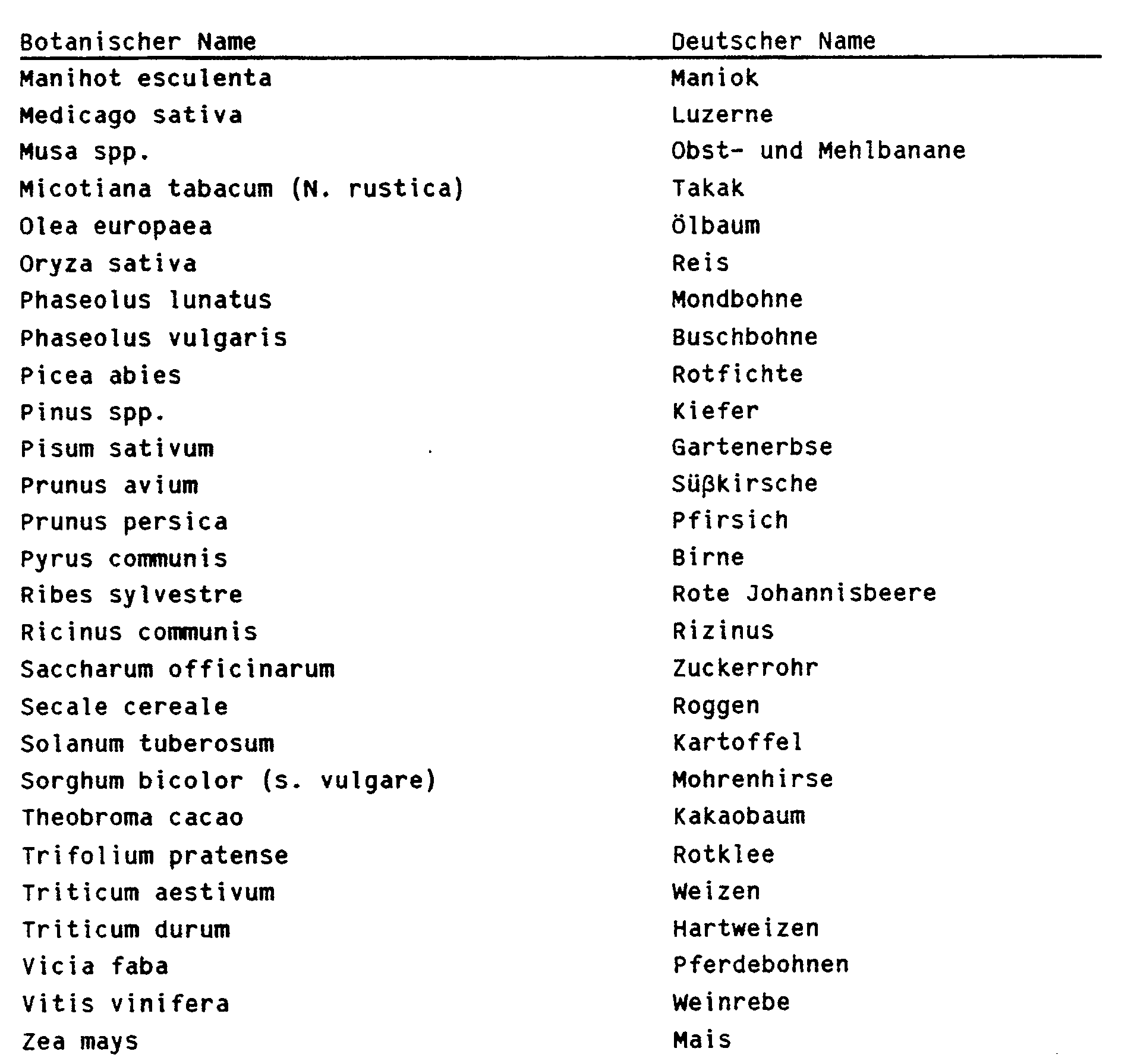
Zur Verbreiterung .des Wirkungsspektrums und zur Erzielung synergistischer Effekte können die erfindungsgemäßen Verbindungen I mit zahlreichen Vertretern anderer herbizider oder wachstumsregulierender Wirkstoffgruppen gemischt und gemeinsam ausgebracht werden. Beispielsweise kommen als Mischungspartner Diazine, 4H-3,1-Benzoxazinderivate, Benzothiadiazinone, 2,6-Dinitroaniline, N-Phenylcarbamate, Thiolcarbamate, Halogencarbonsäuren, Triazine, Amide, Harnstoffe, Diphenylether, Triazinone, Uracile, Benzofuranderivate, Cyclohexan-1,3-dionderivate, Chinolincarbonsäurederivate, Aryloxy-, Heteroaryloxyphenoxypropionsäuren sowie deren Salze, Ester und Amide und andere in Betracht.To broaden the spectrum of activity and to achieve synergistic effects, the compounds I according to the invention can be mixed with numerous representatives of other herbicidal or growth-regulating active compound groups and applied together. For example, diazines, 4H-3,1-benzoxazine derivatives, benzothiadiazinones, 2,6-dinitroanilines, N-phenylcarbamates, thiol carbamates, halocarboxylic acids, triazines, amides, ureas, diphenyl ethers, triazinones, uracils, benzofuran derivatives, cyclohexane-1,3- dione derivatives, quinoline carboxylic acid derivatives, aryloxy, heteroaryloxyphenoxypropionic acids and their salts, esters and amides and others into consideration.
Außerdem kann es von Nutzen sein, die Verbindungen I allein oder in Kombination mit anderen Herbiziden auch noch mit weiteren Pflanzenschutzmitteln gemischt gemeinsam auszubringen, beispielsweise mit Mitteln zur Bekämpfung von Schädlingen oder phytopathogenen Pilzen bzw. Bakterien. Von Interesse ist ferner die Mischbarkeit mit Mineralsalzlösungen, welche zur Behebung von Ernährungs-und Spurenelementmängeln eingesetzt werden. Es können auch nichtphytotoxische Öle und Ölkonzentrate zugesetzt werden.It may also be useful to apply the compounds I, alone or in combination with other herbicides, mixed with other crop protection agents, for example with agents for controlling pests or phytopathogenic fungi or bacteria. Also of interest is the miscibility with mineral salt solutions, which are used to correct nutritional and trace element deficiencies. Non-phytotoxic oils and oil concentrates can also be added.
Die in den nachstehenden Beispielen wiedergegeben Vorschriften wurden unter entsprechender Abwandlung der Ausgangsverbindungen zur Gewinnung weiterer Verbindungen der Formel I benutzt; die erhaltenen Verbindungen sind in den nachfolgenden Tabellen mit physikalischen Angaben aufgeführt; Verbindungen ohne diese Angaben lassen sich aus den entsprechenden Stoffen in analoger Weise aufbauen. Sie lassen aufgrund ihrer nahen strukturellen Beziehungen zu den hergestellen und untersuchten Verbindungen eine gleichartige Wirkung erwarten.The regulations reproduced in the examples below were used with appropriate modification of the starting compounds to obtain further compounds of the formula I; the compounds obtained are listed in the tables below with physical details; Connections without this information can be built up analogously from the corresponding substances. Due to their close structural relationships with the manufactured and investigated compounds, they can be expected to have a similar effect.
293,1 g (1,692 mol) 30 %ige Natriummethylatlösung wurden innerhalb 1 1/2 Stunden bei 0 bis 5°C unter Rühren zu einer Lösung von 434 g (1,692 mol) 2,6-Dichlor-4-trichlormethylpyrimidin in 1 I 1,2-Dichlorethan gegeben. Es wurde 1 Stunde bei 0 bis 5°C und 12 Stunden bei 25° C gerührt. Das Reaktionsgemisch wurde mit Wasser und mit gesättigter Kochsalzlösung extrahiert. Nach dem Trocknen über Magnesiumsulfat und Einengen erhielt man 423 g (95 % d. Th.) der Titelverbindung als fast farbloses 
In eine Mischung von 210 g (0,802 mol) a) und 260 mg (0,0016 mol) α,α'-Azoisobutyronitril wurden unter UV-Bestrahlung und gaschromatographischer Kontrolle des Reaktionsverlaufs bei einer Temperatur von zunächst 110°C Chlor eingeleitet, wobei sich auch nach Entfernen der Heizbades eine Reaktionstemperatur von 140° C einstellte. Nach dem Abklingen der Reaktion wurden während 5 1/2 Stunden bei 120° C insgesamt 341 g (4,8 mol) Chlor eingeleitet. Zu dem erkaltenden Reaktionsgemisch rührte man ab 400 C 70 ml n-Pentan zur Ausfällung hinzu. Der Niederschlag wurde abgesaugt, mit Petrolether gewaschen und getrocknet, wobei man 163 g (55 % d. Th.) der Titelverbindung vom Fp. 67-69° C erhielt.In a mixture of 210 g (0.802 mol) a) and 260 mg (0.0016 mol) of α, α'-azoisobutyronitrile, chlorine was passed in under UV irradiation and gas chromatographic control of the course of the reaction at a temperature of initially 110 ° C., during which time set a reaction temperature of 140 ° C even after removing the heating bath. After the reaction had subsided, a total of 341 g (4.8 mol) of chlorine were passed in at 120 ° C. for 5 1/2 hours. From 40 ° C., 70 ml of n-pentane were added to the cooling reaction mixture for precipitation. The precipitate was filtered off with suction, washed with petroleum ether and dried, giving 163 g (55% of theory) of the title compound, mp. 67-69 ° C.
Das Filtrat (113,8 g) bestand nach dem Gaschromatogramm zu 83 % aus der Titelverbindung, 4 % 2-Chlor-4-dichlormethoxy-6-trichlormethylpyrimidin und 9 % 2,4-Dichlor-6-trichlormethylpyrimidin. Die Gesamtausbeute der Titelverbindung betrug 87,6 % d. Th.According to the gas chromatogram, the filtrate (113.8 g) consisted of 83% of the title compound, 4% 2-chloro-4-dichloromethoxy-6-trichloromethylpyrimidine and 9% 2,4-dichloro-6-trichloromethylpyrimidine. The overall yield of the title compound was 87.6% of theory. Th.
(Herstellung nach dem Verfahren der älteren deutschen Patentanmeldung P 39 00 471 (O.Z. 0050/40474)(Production according to the procedure of the older German patent application P 39 00 471 (O.Z. 0050/40474)
Zu einer Mischung aus 250 g (1,865 mol) 2,4,6-Trifluorpyrimidin in 1,4 I Methanol wurden bei -20° C innerhalb von 45 Minuten 335,8 g (1,865 mol) 30 %iges Natriummethylat (in Methanol) gegeben und weitere 30 Minuten bei dieser Temperatur gerührt. Anschließend ließ man auf 25 C erwärmen und engte die Reaktionsmischung auf ca. 1/5 ihres Volumens ein.335.8 g (1.865 mol) of 30% sodium methylate (in methanol) were added to a mixture of 250 g (1.865 mol) of 2,4,6-trifluoropyrimidine in 1.4 I of methanol at -20 ° C. in the course of 45 minutes and stirred for a further 30 minutes at this temperature. The mixture was then allowed to warm to 25 ° C. and the reaction mixture was concentrated to about 1/5 of its volume.
Das so erhaltene Gemisch wurde zwischen Diethylether und Wasser verteilt, wonach die organische Phase über Magnesiumsulfat getrocknet und eingeengt wurde. Nach Destillation (1,1 m Kolonne, 3 mm V-Füllkörper) erhielt man 141,6 g (52 % d. Th.) der Titelverbindung von Kp.: 144-145° C.The mixture thus obtained was partitioned between diethyl ether and water, after which the organic phase was dried over magnesium sulfate and concentrated. After distillation (1.1 m column, 3 mm V packing), 141.6 g (52% of theory) of the title compound of bp .: 144-145 ° C. were obtained.
Aus dem Destillationsrückstand erhielt man durch Destillation über einen Normag-Aufsatz 114,4 g (42 % d. Th.) an 4,6-Difluor-2-methoxy-pyrimidin vom Kp.: 157-161 ° C.From the distillation residue, 114.4 g (42% of theory) of 4,6-difluoro-2-methoxy-pyrimidine of bp .: 157-161 ° C. were obtained by distillation through a Normag attachment.
210 g (2,96 mol) Chlor wurden unter UV-Bestrahlung und gaschromatographischer Kontrolle des Reaktionsverlaufs während 2 1/2 Stunden unter Rühren bei 130° C in 123 g (0,843 mol) 2,4-Difluor-6-methoxy-pyrimidin eingeleitet. Das Reaktionsgemisch wurde über eine 10-cm-Vigreux-Kolonne im Vakuum destilliert, wobei man 190,2 g (90,5 % d. Th.) der Titelverbindung vom Sdp. 40-43° C/0,2 mbar erhielt.210 g (2.96 mol) of chlorine were introduced into 123 g (0.843 mol) of 2,4-difluoro-6-methoxy-pyrimidine with UV radiation and gas chromatographic monitoring of the course of the reaction for 2 1/2 hours while stirring at 130 ° C. . The reaction mixture was distilled in vacuo through a 10 cm Vigreux column, giving 190.2 g (90.5% of theory) of the title compound, boiling point 40-43 ° C./0.2 mbar.
Unter Rühren, UV-Bestrahlung und gaschromatographischer Kontrolle des Reaktionsverlaufs wurden 303 g (4,27 mol) Chlor während 1/2 Stunde bei 80° C, 1 Stunde bei 100° C, 3 Stunden bei 120° C und 3 Stunden bei 150° C in eine Mischung von 209 g (1,168 mol) 2,6-Dichlor-4-methoxy-pyrimidin und 2 g (0,012 mol) α,α'-Azoisobutyronitril eingeleitet. Anschließend wurde das Reaktionsgemisch im Vakuum über eine 50- cm-Kolonne mit 4 mm V2-A-Raschigringen destilliert. Man erhielt 241,3 g (73 % d. Th.) der Titelverbindung vom Sdp. 87-88° C/0,4 mbar; Fp. 55-56 ° C.303 g (4.27 mol) of chlorine were stirred for 1/2 hour at 80 ° C., 1 hour at 100 ° C., 3 hours at 120 ° C., and 3 while stirring, UV irradiation and checking the course of the reaction by gas chromatography Hours at 150 ° C in a mixture of 209 g (1.168 mol) of 2,6-dichloro-4-methoxy-pyrimidine and 2 g (0.012 mol) of α, α'-azoisobutyronitrile. The reaction mixture was then distilled in vacuo through a 50 cm column with 4 mm V2-A Raschig rings. 241.3 g (73% of theory) of the title compound of bp 87-88 ° C / 0.4 mbar were obtained; Mp 55-56 ° C.
49,9 g (0,2 mol) 2,4-Difluor-6-trichlormethoxy-pyrimidin wurde bei 100°C innerhalb 15 Minuten unter Rühren zu einer Mischung von 39,3 g (0,22 mol) Antimontrifluorid und 9,38 g (0,031 mol) Antimonpentachlorid gegeben.49.9 g (0.2 mol) of 2,4-difluoro-6-trichloromethoxy-pyrimidine became at 100 ° C within 15 minutes with stirring to a mixture of 39.3 g (0.22 mol) of antimony trifluoride and 9.38 g (0.031 mol) of antimony pentachloride.
Innerhalb 25 Minuten wurde die Badtemperatur von 100 auf 150" C erhöht und 30 Minuten nachgerührt, wobei sich zwischen 120 bis 125°C Rückfluß einstellte. Durch anschließende Destillation erhielt man 37,1 g (92,7 % d. Th.) der Titelverbindung vom Sdp. 125-127° C und 
93 g (0,373 mol) 2,4-Difluor-6-trichlormethoxy-pyrimidin wurden bei 100°C innerhalb 10 Minuten unter Rühren zu einer Mischung von 44,5 g (0,249 mol) Antimontrifluorid und 0,94 g (0,0031 mol) Antimonpentachlorid gegeben. Innerhalb 25 Minuten wurde die Badtemperatur von 100 auf 175° C erhöht, wobei sich bei 145°C Rückfluß einstellte. Nach 1 1/2 Stunden Rühren wurde das Reaktionsprodukt bei 146-150°C abdestilliert. Das Destillat wurde in 200 ml Methylenchlorid gelöst, 2x mit 6 n Salzsäure extrahiert und über Magnesiumsulfat getrocknet. Nach dem Einengen im Vakuum erhielt man als Rückstand die Titelverbindung vom 
80 g (0,219 mol) 2-Chlor-4-trichlormethyl-6-trichlormethoxy-pyrimidin wurden innerhalb 5 Minuten unter Rühren bei 100°C zu einer Mischung von 93,9 g (0,525 mol) Antimontrifluorid und 18,7 g (0,0627 mol) Antimonpentachlorid gegeben. Innerhalb 10 Minuten wurde die Badtemperatur auf 140° C erhöht und 1 Stunde nachgerührt, wobei sich starker Rückfluß einstellte. Das Reaktionsprodukt wurde bei 135-140° C, gegen Schluß bei 95°C/50 mbar, überdestilliert. Das Destillat wurde in Methylenchlorid aufgenommen, mit 6 n Salzsäure extrahiert und über Magnesiumsulfat getrocknet. Nach dem Einengen im Vakuum erhielt man die Titelverbindung in einer Ausbeute von 35,9 g (65,5 % d. Th.).80 g (0.219 mol) of 2-chloro-4-trichloromethyl-6-trichloromethoxy-pyrimidine were added to a mixture of 93.9 g (0.525 mol) of antimony trifluoride and 18.7 g (0, 0627 mol) given antimony pentachloride. The bath temperature was raised to 140 ° C. in the course of 10 minutes and the mixture was stirred for 1 hour, during which a strong reflux occurred. The reaction product was distilled at 135-140 ° C, at the end at 95 ° C / 50 mbar. The distillate was taken up in methylene chloride, extracted with 6N hydrochloric acid and dried over magnesium sulfate. After concentration in vacuo, the title compound was obtained in a yield of 35.9 g (65.5% of theory).
115 g (0,407 mol) 2,4-Dichlor-6-trichlormethoxy-pyrimidin wurden innerhalb 5 Minuten unter Rühren bei 100°C zu einer Mischung von 80 g (0,447 mol) Antimontrifluorid und 18,77 g (0,0627 mol) Antimonpentachlorid gegeben, wobei sich die Reaktionstemperatur bis auf 140° C erhöhte. Es wurde noch 45 Minuten bei 150°C gerührt. Zur Destillation wurde ein Druck von 210 mbar eingestellt, wobei die Titelverbindung bei 128°C überging; letzte flüchtige Bestandteile wurden bei 110°C/22 mbar übergetrieben. Das Destillat wurde in Methylenchlorid gelöst, 3x mit 6 n Salzsäure extrahiert und über Magnesiumsulfat getrocknet. Nach dem Einengen im Vakuum erhielt man die Titelverbindung in einer Ausbeute von 80 g (84,4 % d. Th.) als farbloses Öl vom nD 25 = 1,4604.115 g (0.407 mol) of 2,4-dichloro-6-trichloromethoxy-pyrimidine were added to a mixture of 80 g (0.447 mol) of antimony trifluoride and 18.77 g (0.0627 mol) of antimony pentachloride with stirring at 100 ° C. within 5 minutes given, the reaction temperature increased to 140 ° C. The mixture was stirred at 150 ° C for 45 minutes. A pressure of 210 mbar was set for the distillation, the title compound passing over at 128 ° C .; last volatile constituents were exaggerated at 110 ° C / 22 mbar. The distillate was dissolved in methylene chloride, extracted 3 × with 6N hydrochloric acid and dried over magnesium sulfate. After concentration in vacuo, the title compound was obtained in a yield of 80 g (84.4% of theory) as a colorless oil of n D 25 = 1.4604.
9,8 g (0,578 mol) gasförmiges Ammoniak wurden innerhalb einer Stunde bei -75 bis -70° C unter Rühren in eine Mischung von 62,5 g (0,289 mol) 2,4-Difluor-6-chlordifluormethoxy-pyrimidin in 300 ml Tetrahydrofuran eingegast. Es wurde eine Stunde bei -70°C gerührt und dann auf Raumtemperatur erwärmt. Der ausgefallene Niederschlag wurde abgesaugt, zwischen Essigester und Wasser verteilt und die organische Phase über Magnesiumsulfat getrocknet. Das Reaktionsfiltrat wurde eingeengt, in der obigen Essigesterphase gelöst, über Kieselgel mit Petrolether:Ether = 5:1 chromatographiert und eingeengt. Man erhielt 46,5 g (75,3 % d. Th.) der Titelverbindung als farblose Kristalle vom Fp. 77-80° C.9.8 g (0.578 mol) of gaseous ammonia were below at -75 to -70 ° C within one hour Stir in a mixture of 62.5 g (0.289 mol) of 2,4-difluoro-6-chlorodifluoromethoxypyrimidine in 300 ml of tetrahydrofuran. The mixture was stirred at -70 ° C. for one hour and then warmed to room temperature. The precipitate was filtered off, partitioned between ethyl acetate and water and the organic phase dried over magnesium sulfate. The reaction filtrate was concentrated, dissolved in the above ethyl acetate phase, chromatographed on silica gel with petroleum ether: ether = 5: 1 and concentrated. 46.5 g (75.3% of theory) of the title compound were obtained as colorless crystals, mp. 77-80 ° C.
8,7 g (0,51 mol) gasförmiges Ammoniak wurden innerhalb 1 Stunde bei - 75 bis 70° C unter Rühren in eine Mischung von 51 g (0,255 mol) 2,4-Difluor-6-trifluormethoxy-pyrimidin in 200 ml Diethylether eingegast. Es wurde noch 1 1/2 Stunden bei -70°C und 1 Stunde bei Raumtemperatur gerührt. Das Reaktionsgemisch wurde im Vakuum eingeengt, in Methylenchlorid aufgenommen und mit Wasser extrahiert. Nach dem Trocknen der organischen Phase, Einengen und Chromatographieren über Kieselgel mit Petrolether:Ether = 8:1 erhielt man 38,1 g (75,6 % d. Th.) der Titelverbindung als farblose Kristalle vom Fp. 86-89 C.8.7 g (0.51 mol) of gaseous ammonia were added at -75 to 70 ° C. with stirring in a mixture of 51 g (0.255 mol) of 2,4-difluoro-6-trifluoromethoxy-pyrimidine in 200 ml of diethyl ether within 1 hour gassed. The mixture was stirred for 1 1/2 hours at -70 ° C and 1 hour at room temperature. The reaction mixture was concentrated in vacuo, taken up in methylene chloride and extracted with water. After drying the organic phase, concentrating and chromatographing on silica gel with petroleum ether: ether = 8: 1, 38.1 g (75.6% of theory) of the title compound were obtained as colorless crystals of mp 86-89 ° C.
4,3 g (0,25 mol) gasförmiges Ammoniak wurden innerhalb 45 Minuten unter Rühren bei -50 bis -45° C in eine Mischung von 23,3 g (0,1 mol) 2,4-Dichlor-6-trifluormethoxy-pyrimidin in 150 ml Methyl-tert.-butylether eingeleitet. Es wurde 30 Minuten bei -50° C, 1 Stunde bei -30° C und 1 Stunde bei 25° C gerührt. Der ausgefallene Niederschlag wurde abgesaugt, mit Wasser gewaschen und getrocknet, wobei man 5,4 g (33,1 % d. Th.) 4-Amino-2,4-dichlorpyrimidin vom Fp. 270-272 als Nebenprodukt erhielt. Das Filtrat wurde mit Wasser gewaschen, getrocknet, teilweise im Vakuum eingeengt und mit petrolether:Ether = 5:1 frakioniert chromatographiert, wobei man in den ersten Fraktionen 3 g (12,8 % d. Th.) Ausgangsmaterial als farbloses Öl und im Nachlauf 9 g (42 % d. Th.) der Titelverbindung als farblose Kristalle vom Fp. 55-56 C erhielt. Der Umsatz betrug 48,3 %.4.3 g (0.25 mol) of gaseous ammonia were added to a mixture of 23.3 g (0.1 mol) of 2,4-dichloro-6-trifluoromethoxy- with stirring at -50 to -45 ° C within 45 minutes. pyrimidine initiated in 150 ml of methyl tert-butyl ether. The mixture was stirred at -50 ° C for 30 minutes, at -30 ° C for 1 hour and at 25 ° C for 1 hour. The precipitate which had separated out was filtered off with suction, washed with water and dried, yielding 5.4 g (33.1% of theory) of 4-amino-2,4-dichloropyrimidine of mp 270-272 as a by-product. The filtrate was washed with water, dried, partially concentrated in vacuo and fractionated by chromatography with petroleum ether: ether = 5: 1, 3 g (12.8% of theory) of starting material in the first fractions as a colorless oil and in the wake 9 g (42% of theory) of the title compound as colorless crystals of mp 55-56 ° C. The turnover was 48.3%.
20,3 g (0,0938 mol) 4-Chlordifluormethoxy-2,6-difluor-pyrimidin wurden in 150 ml Tetrahydrofuran vorgelegt und bei -70 bis -60° C innerhalb 30 Minuten unter Rühren mit 5,8 g (0,188 mol) gasförmigem Methylamin versetzt. Es wurde jeweils 1 Stunde bei -70° C, 0°C und 25° C gerührt. Nach dem Einengen des Reaktionsgemisches im Vakuum wurde der Rückstand mit Wasser verrührt, 2x mit Essigester extrahiert und der Extrakt über Magnesiumsulfat getrocknet. Es wurde zum Teil im Vakuum eingeengt und dann über Kieselgel mit Ether/Petrolether 1:5 fraktioniert chromatographiert. Die ersten Fraktionen enthielten die Titelverbindung vom Fp. 57-61 °C in einer Ausbeute von 12,5 g (58,5 %).20.3 g (0.0938 mol) of 4-chlorodifluoromethoxy-2,6-difluoropyrimidine were placed in 150 ml of tetrahydrofuran and at -70 to -60 ° C. within 30 minutes with stirring with 5.8 g (0.188 mol) gaseous methylamine added. The mixture was stirred at -70 ° C., 0 ° C. and 25 ° C. for 1 hour in each case. After concentrating the reaction mixture in vacuo, the residue was stirred with water, extracted twice with ethyl acetate and the extract was dried over magnesium sulfate. It was partly concentrated in vacuo and then fractionally chromatographed over silica gel with ether / petroleum ether 1: 5. The first fractions contained the title compound of mp 57-61 ° C in a yield of 12.5 g (58.5%).
4,7 g (0,278 mol) gasförmiges Ammoniak wurden unter Rühren bei -75 bis -70° C innerhalb 1 Stunde in eine Mischung von 38,0 g (0,147 mol) 2-Fluor(chlor)-4-trifluormethoxy-6-trifluormethyl-pyrimidin in 150 ml Diethylether eingegast. Es wurde jeweils 2 Stunden bei -75 und nach dem Erwärmen bei 25° C gerührt. Nach dem Absaugen von dem ausgefallenen Niederschlag wurde die organische Phase mit Wasser extrahiert, getrocknet und teilweise eingeengt. Nach dem Chromatographieren mit Methyl-tert.--butylether über Kieselgel erhielt man 20,4 g (56,1 % d. Th.) der Titelverbindung vom Fp. 47-49° C.4.7 g (0.278 mol) of gaseous ammonia were stirred at -75 to -70 ° C within 1 hour in a mixture of 38.0 g (0.147 mol) of 2-fluoro (chloro) -4-trifluoromethoxy-6-trifluoromethyl -pyrimidine gasified in 150 ml of diethyl ether. The mixture was stirred at -75 for 2 hours in each case and at 25 ° C. after heating. After the precipitate had been filtered off with suction, the organic phase was extracted with water, dried and partially concentrated. After chromatography with methyl tert-butyl ether on silica gel, 20.4 g (56.1% of theory) of the title compound of mp 47-49 ° C. were obtained.
2,7 g (0,015 mol) 30 %iges Natriummethylat wurden innerhalb 15 Minuten unter Rühren bei -5 bis 0°C zu 2,95 g (0,015 mol) 2-Amino-4-fluor-6-trifluormethoxy-pyrimidin in 50 ml Methanol gegeben. Nach 1 Stunde Rühren bei 0°C und Erwärmen auf 25 °C wurde das Reaktionsgemisch im Vakuum eingeengt, mit Wasser verrührt und 2x mit Methylenchlorid extrahiert. Nach dem Trocknen und Einengen im Vakuum erhielt man 3,1 g (98 % d. Th.) der Titelverbindung mit
26,1 g (0,145 mol) 30 %iges Natriummethylat wurden innerhalb 15 Minuten unter Rühren bei -10 bis 0°C zu 31,0 g (0,145 mol) 2-Amino-4-chlordifluormethoxy-6-fluorpyrimidin in 300 ml Methanol gegeben. Es wurde 30 Minuten bei 0°C und 1 Stunde bei 25° C gerührt. Das Reaktionsgemisch wurde im Vakuum eingeengt und wie oben aufgearbeitet. Man erhielt 31,6 g (96,6 % d. Th.) der Titelverbindung als farbloses 
4,7 g (0,026 mol) 30 %iges Natriummethylat wurden innerhalb 10 Minuten unter Rühren bei 00 C zu 6,0 g (0,0263 mol) 4-Chlordifluormethoxy-6-fluor-2-methylamino-pyrimidin in 100 ml Methanol gegeben. Es wurde jeweils 1 Stunde bei 0°C und bei 25° C gerührt. Nach üblicher Aufarbeitung erhielt man 6,3 g (100 % d. Th.) der Titelverbindung vom Fp. 49-53 °C.4.7 g (0.026 mol) of 30% sodium methylate were added within 10 minutes with stirring at 0 0 C to 6.0 g (0.0263 mol) of 4-chlorodifluoromethoxy-6-fluoro-2-methylamino-pyrimidine in 100 ml of methanol given. The mixture was stirred at 0 ° C. and at 25 ° C. for 1 hour in each case. After customary working up, 6.3 g (100% of theory) of the title compound of mp 49-53 ° C. were obtained.
1,9 g (0,0417 mol) gasförmiges Dimethylamin wurden innerhalb 10 Minuten unter Rühren bei 0°C in eine Mischung von 8,9 g (0,0417 mol) 2-Amino-4-chlordifluormethoxy-6-fluor-pyrimidin in 100 ml Tetrahydrofuran eingeleitet. Es wurde 1 Stunde bei 0°C und 2 Stunden bei 25° C gerührt. Nach üblicher Aufarbeitung erhielt man 9,7 g (97,5 % d. Th.) der Titelverbindung vom Fp. 127-130° C.1.9 g (0.0417 mol) of gaseous dimethylamine were added to a mixture of 8.9 g (0.0417 mol) of 2-amino-4-chlorodifluoromethoxy-6-fluoropyrimidine in 10 minutes with stirring at 0 ° C. 100 ml of tetrahydrofuran initiated. The mixture was stirred at 0 ° C. for 1 hour and at 25 ° C. for 2 hours. After the usual work-up, 9.7 g (97.5% of theory) of the title compound of mp 127-130 ° C. were obtained.
3,6 g (0,015 mol) 2-Isocyanatosulfonyl-benzoesäuremethylester in 15 ml 1,2-Dichlorethan wurden innerhalb 15 Minuten bei 25 °C unter Rühren zu einer Mischung von 2,95 g (0,015 mol) 2-Amino-4-fluor-6-trifluormethoxy-pyrimidin in 100 ml 1,2-Dichlorethan gegeben und 12 Stunden bei 25°C gerührt. Die Reaktionslösung wurde im Vakuum eingeengt und der Rückstand mit Ether/Petrolether 1:1 verrührt. Nach dem Absaugen und Trocknen erhielt man 4,8 g (73,3 % d. Th.) der Titelverbindung vom Fp. 157-161 C.3.6 g (0.015 mol) of methyl 2-isocyanatosulfonylbenzoate in 15 ml of 1,2-dichloroethane were added to a mixture of 2.95 g (0.015 mol) of 2-amino-4-fluorine at 25 ° C. in the course of 15 minutes -6-trifluoromethoxy-pyrimidine in 100 ml of 1,2-dichloroethane and stirred at 25 ° C for 12 hours. The reaction solution was concentrated in vacuo and the residue was stirred with ether / petroleum ether 1: 1. After suction filtration and drying, 4.8 g (73.3% of theory) of the title compound of mp 157-161 C. were obtained.
2,55 g (0,01 mol) 2-Isocyanatosulfonyl-benzoesäure-ethylester in 10 ml Methylenchlorid wurden innerhalb 10 Minuten unter Rühren bei 25°C zu einer Mischung von 2,1 g (0,01 mol) 2-Amino-4-chlor-6-trifluormethoxy-pyrimidinin 100 ml Methylenchlorid gegeben. Es wurde 12 Stunden bei 25° C gerührt und von wenig Unlöslichem abgesaugt. Nach dem Einengen des Filtrats im Vakuum, Verrühren des Rückstandes mit Ether/Petrolether 1:1, Absaugen und Trocknen erhielt man 4,0 g (85,4 % d. Th.) der Titelverbindung vom Fp. 148-151 °C.2.55 g (0.01 mol) of 2-isocyanatosulfonylbenzoic acid ethyl ester in 10 ml of methylene chloride were added to a mixture of 2.1 g (0.01 mol) of 2-amino-4 with stirring at 25 ° C. within 10 minutes -chloro-6-trifluoromethoxy-pyrimidinin 100 ml of methylene chloride. The mixture was stirred at 25 ° C. for 12 hours and little insoluble material was filtered off with suction. After concentrating the filtrate in vacuo, stir the residue des with ether / petroleum ether 1: 1, suction and drying gave 4.0 g (85.4% of theory) of the title compound of mp. 148-151 ° C.
4,8 g (0,02 mol) 2-Isocyanatosulfonyl-benzoesäuremethylester in 10 ml Acetonitril wurden innerhalb 15 Minuten unter Rühren bei 25°C zu einer Mischung von 4,1 g (0,02 mol) 2-Amino-4-methoxy-6-trifluormethoxy-pyrimidin in 100 ml Acetonitril gegeben und 12 Stunden nachgerührt. Nach dem Abtrennen des ausgefallenen Niederschlages (2,4 g vom Fp. 141-143°C) wurde das Filtrat im Vakuum eingeengt und mit Ether/Petrolether verrührt, abgesaugt und getrocknet. Man erhielt weitere 4,3 g der Titelverbindung vom Fp. 141-143° C. Die Gesamtausbeute betrug 6,7 g (74,4 % d. Th.).4.8 g (0.02 mol) of methyl 2-isocyanatosulfonylbenzoate in 10 ml of acetonitrile became a mixture of 4.1 g (0.02 mol) of 2-amino-4-methoxy with stirring at 25 ° C. in the course of 15 minutes -6-trifluoromethoxy-pyrimidine in 100 ml of acetonitrile and stirred for 12 hours. After the precipitate had separated out (2.4 g, mp. 141-143 ° C.), the filtrate was concentrated in vacuo and stirred with ether / petroleum ether, suction filtered and dried. Another 4.3 g of the title compound of mp 141-143 ° C. were obtained. The overall yield was 6.7 g (74.4% of theory).
2,4 g (0,053 mol) 2-(((4-Methoxy-6-trifluormethoxy-1,3-pyrimidin-2-yl)-aminocarbonyl)aminosulfonyl)-benzoesäuremethylester (Wirkstoff-beispiel 5.001) wurden in 50 ml Methanol gelöst, bei 25 °C mit 1,0 g (0,053 mol) 30%iger Natriummethylatlösung in Methanol versetzt und 10 Minuten gerührt. Nach dem Abdestillieren des Lösungsmittels bei vermindertem Druck erhielt man 2,5 g (100 % d. Th.) der Titelverbindung vom Fp. 175°C (Zersetzung) (Wirkstoffbeispiel 5.019)2.4 g (0.053 mol) of 2 - (((4-methoxy-6-trifluoromethoxy-1,3-pyrimidin-2-yl) aminocarbonyl) aminosulfonyl) benzoic acid methyl ester (active ingredient example 5.001) were dissolved in 50 ml of methanol , at 25 ° C with 1.0 g (0.053 mol) of 30% sodium methylate solution in methanol and stirred for 10 minutes. After the solvent had been distilled off under reduced pressure, 2.5 g (100% of theory) of the title compound of mp 175 ° C. (decomposition) were obtained (active ingredient example 5.019)
In entsprechender Weise wurde die in den nachfolgenden Tabellen dargestellten Sulfonylharnstoffderivate hergestellt.

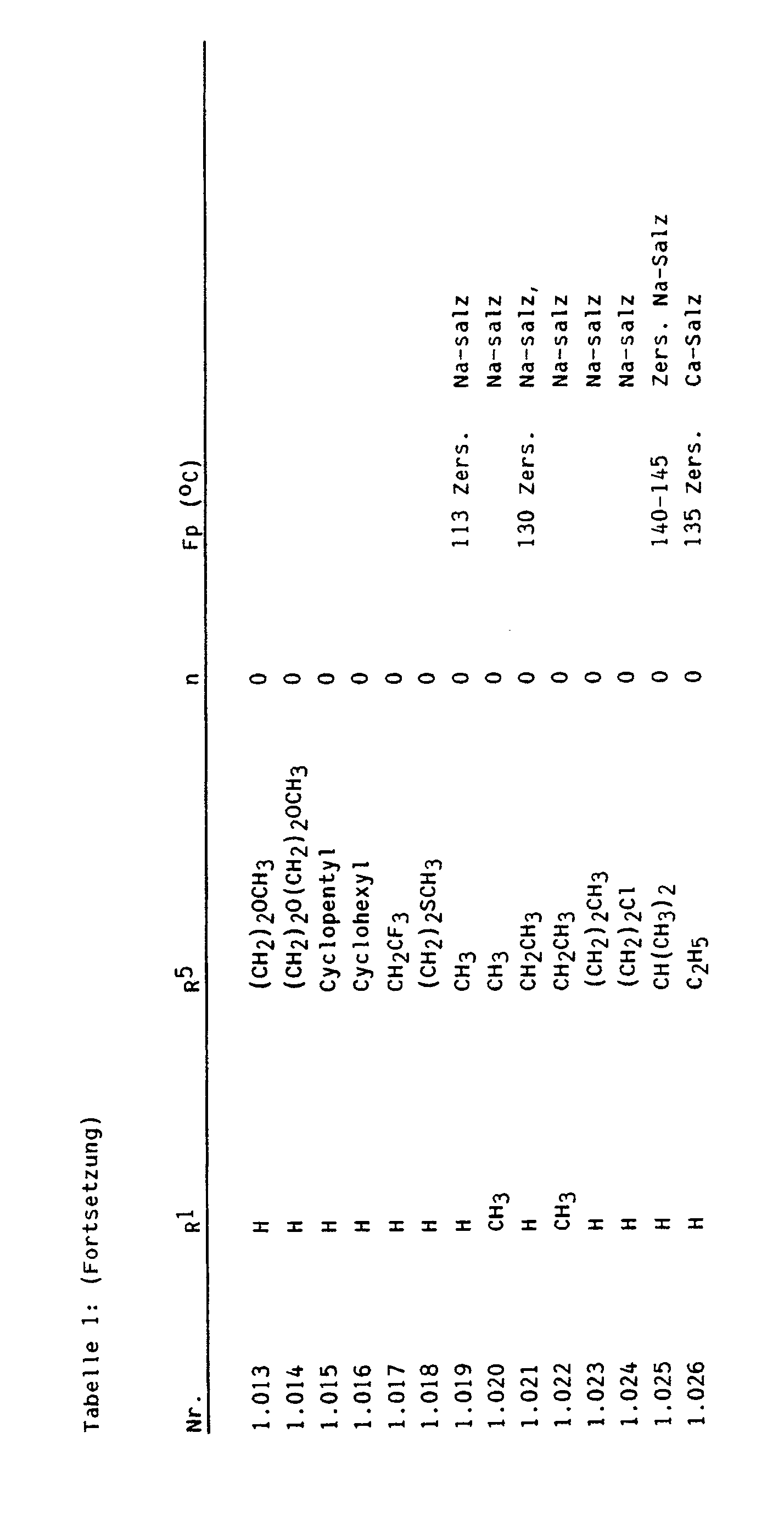


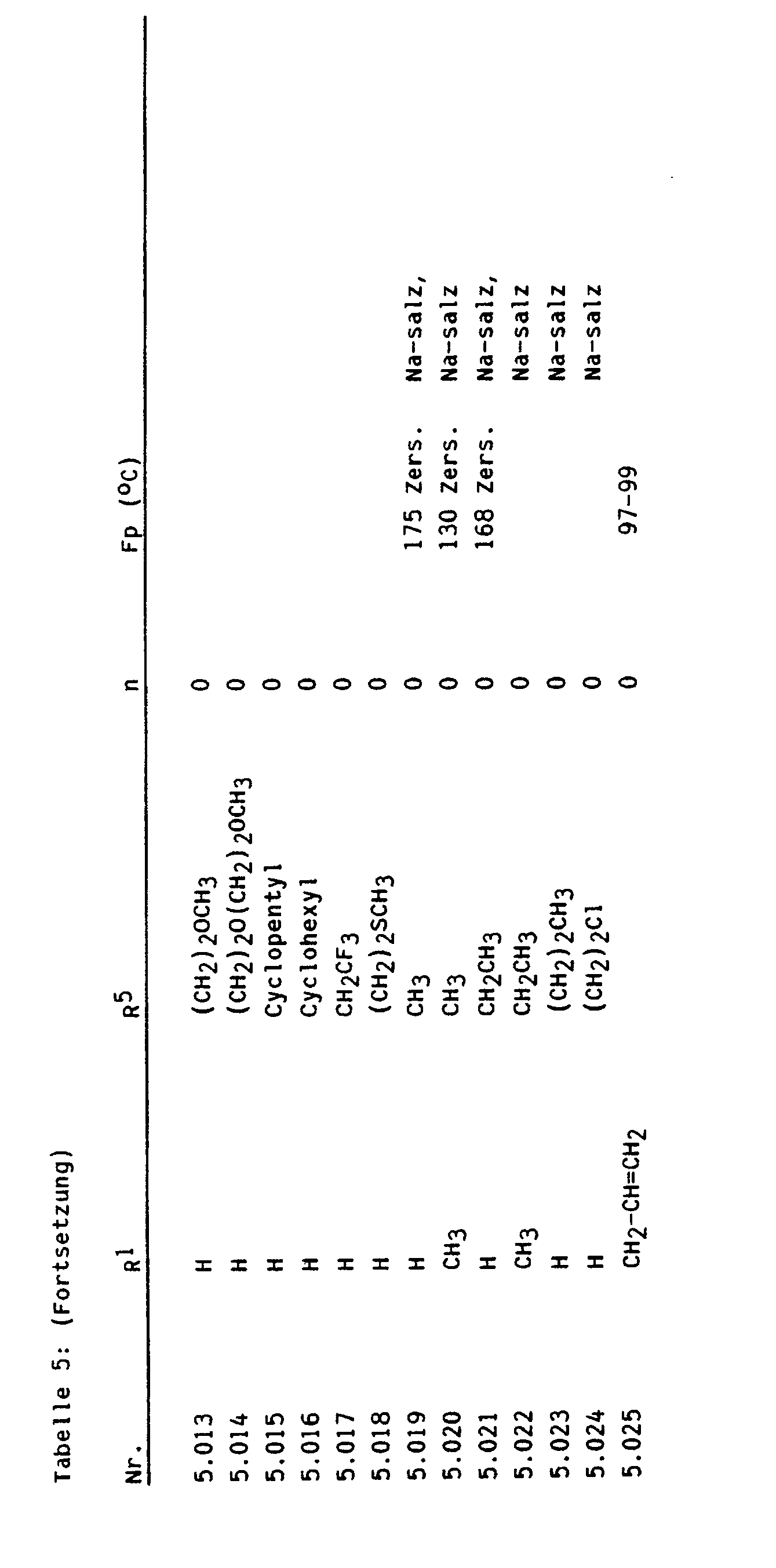

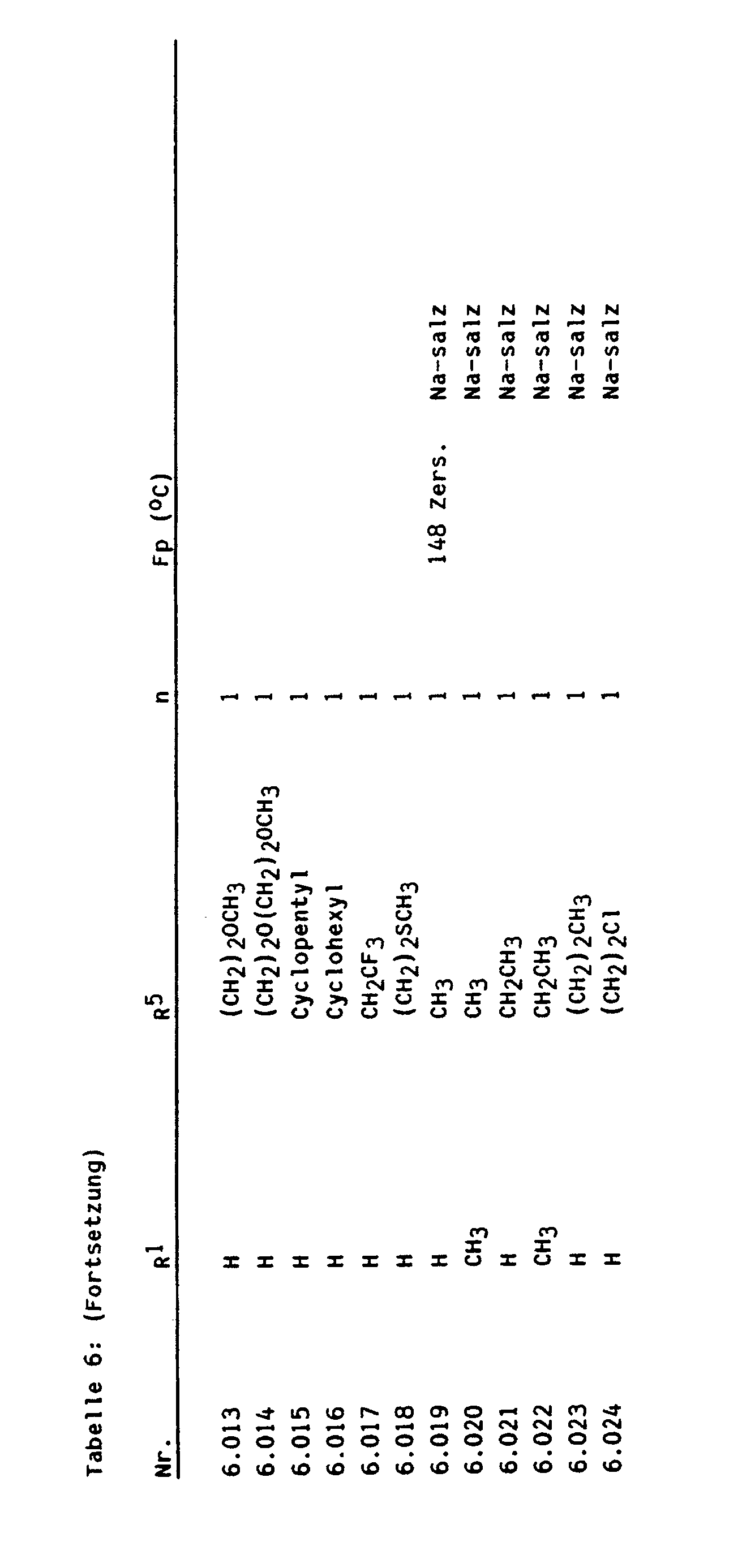


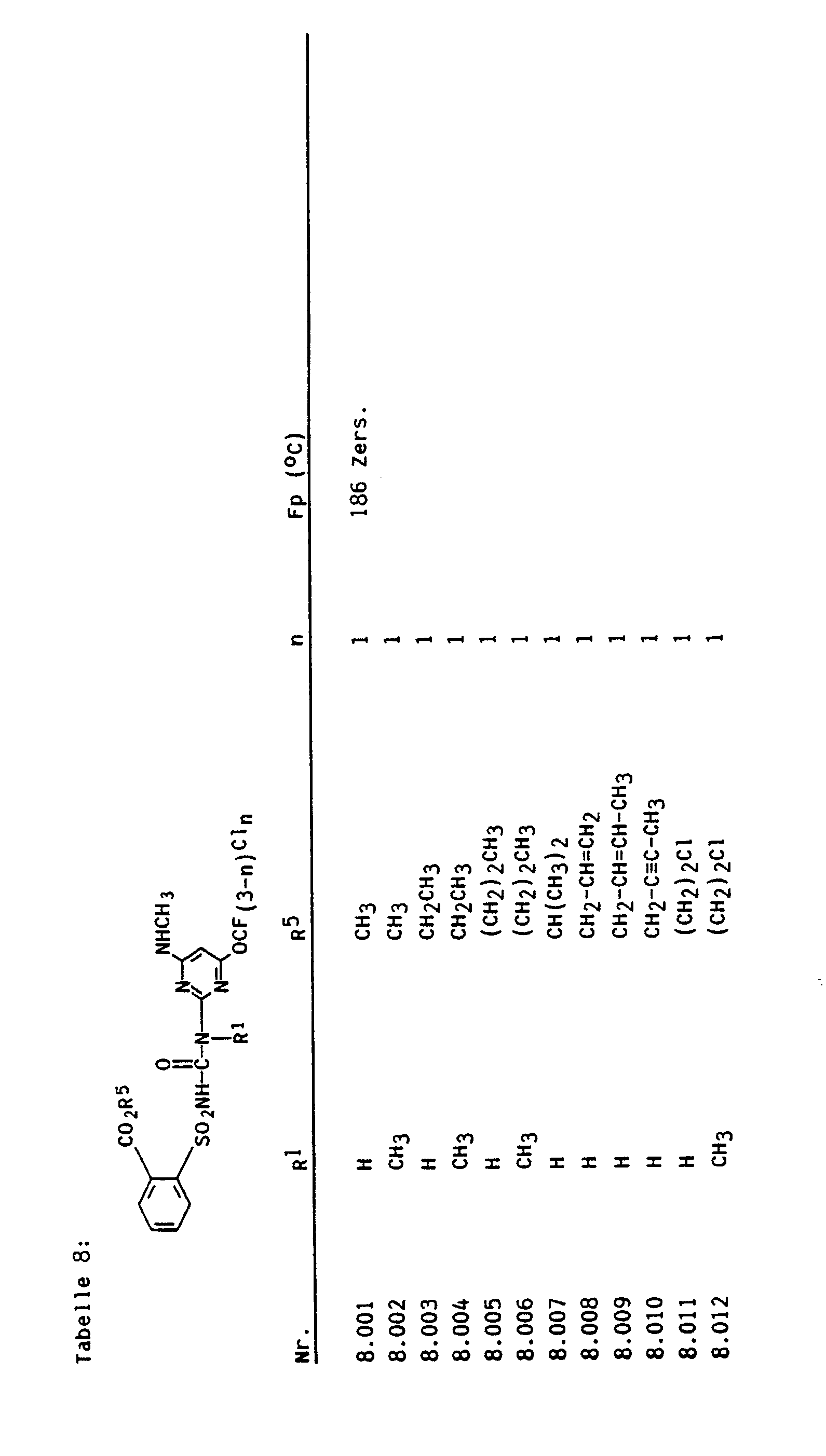

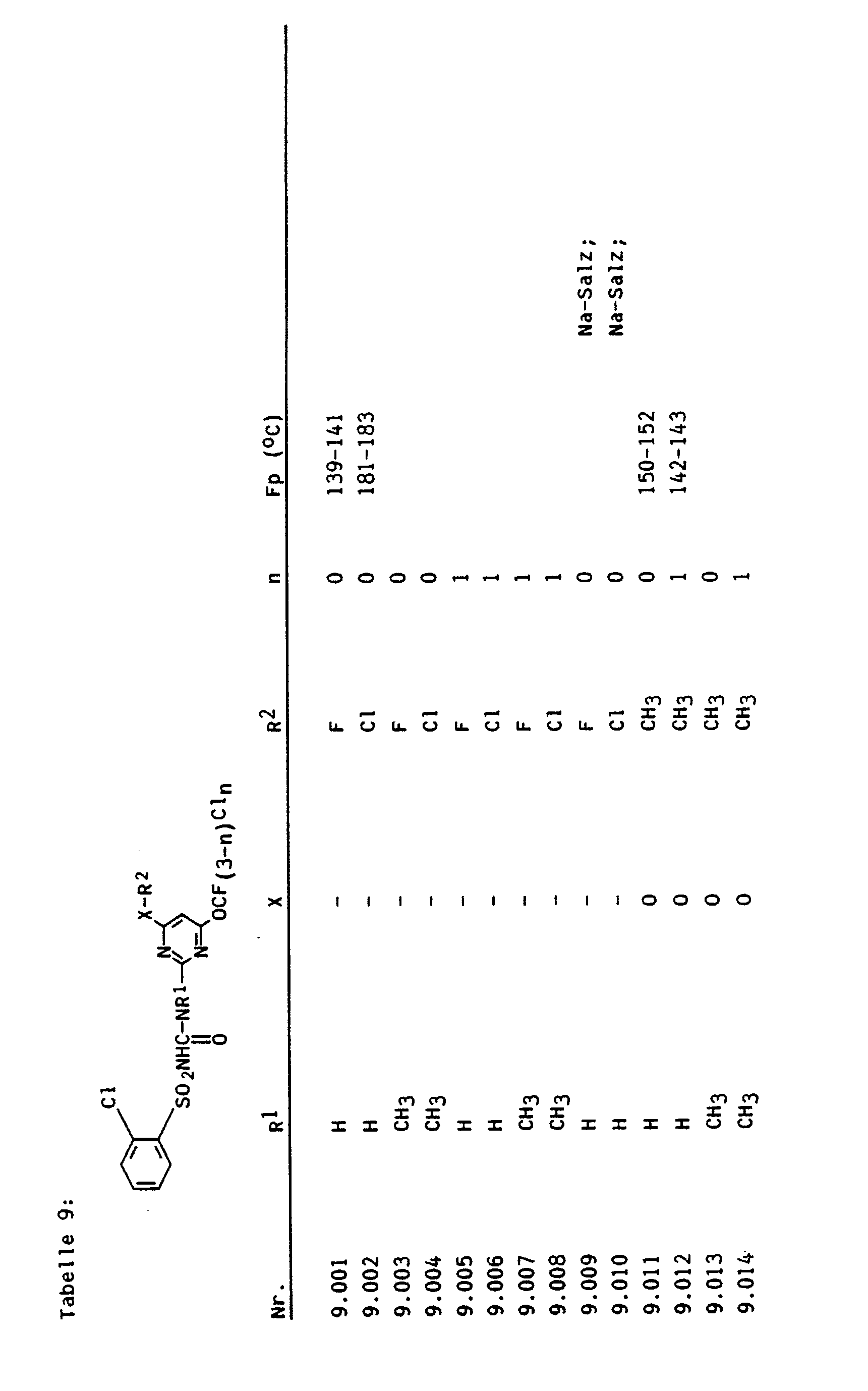


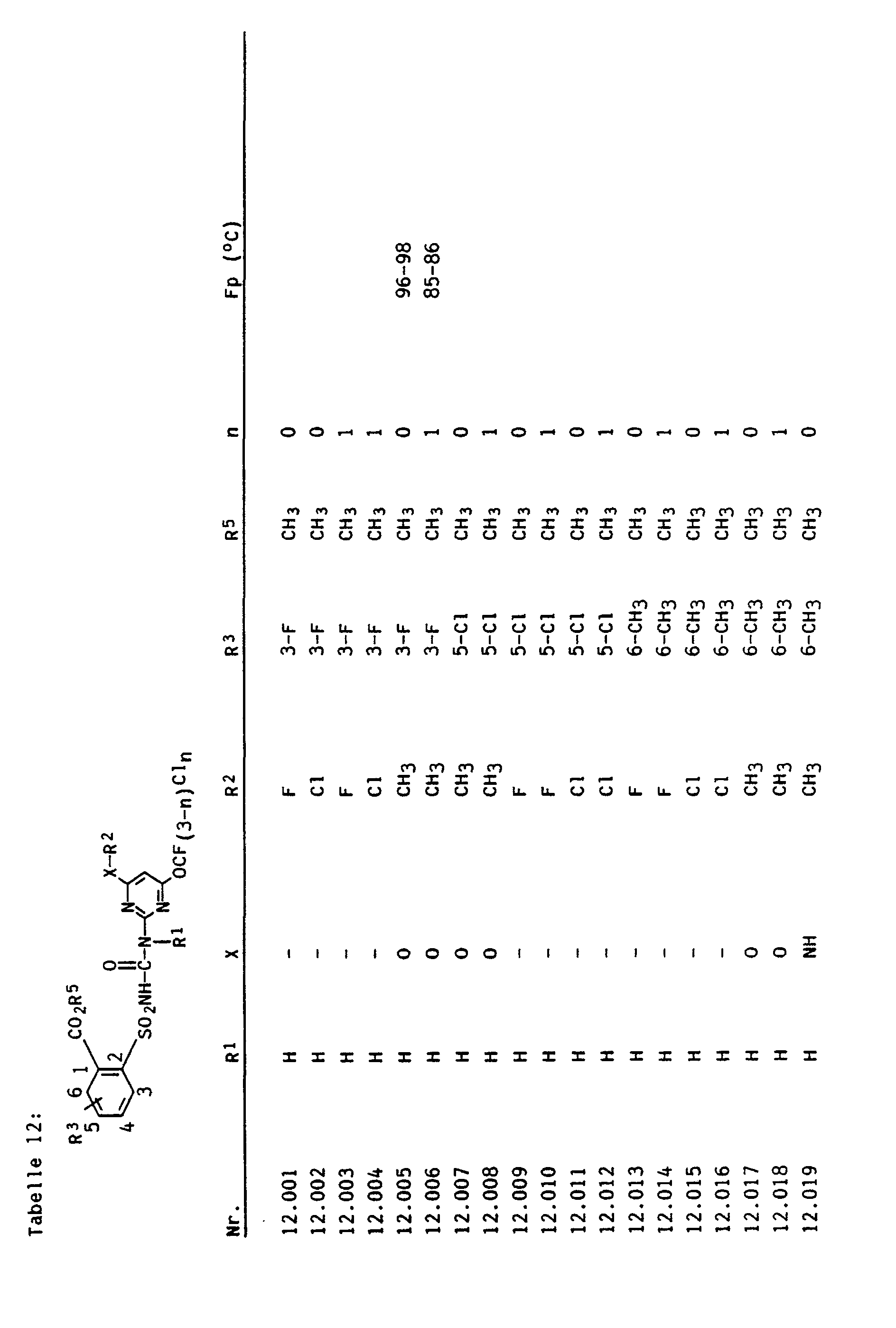


Die herbizide Wirkung der Sulfonylharnstoffe der Formel I ließ sich durch Gewächshausversuche zeigen:
- Als Kulturgefäße dienten Plastikblumentöpfe mit lehmigem Sand mit etwa 3,0 % Humus als Substrat. Die Samen der Testpflanzen wurden nach Arten getrennt eingesät.
- Plastic flower pots with loamy sand with about 3.0% humus as a substrate served as culture vessels. The seeds of the test plants were sown separately according to species.
Bei Vorauflaufbehandlung wurden die in Wasser suspendierten oder emulgierten Wirkstoffe direkt nach Einsaat mittels fein verteilender Düsen aufgebracht. Die Gefäße wurden leicht beregnet, um Keimung und Wachstum zu fördern und anschließend mit durchsichtigen Plastikhauben abgedeckt, bis die Pflanzen angewachsen waren. Diese Abdeckung bewirkt ein gleichmäßiges Keimen der Testpflanzen, sofern dies nicht durch die Wirkstoffe beeinträchtigt wurde.In pre-emergence treatment, the active ingredients suspended or emulsified in water were applied directly after sowing by means of finely distributing nozzles. The tubes were lightly sprinkled to promote germination and growth and then covered with clear plastic hoods until the plants had grown. This cover causes the test plants to germinate evenly, unless this was affected by the active ingredients.
Zum Zwecke der Nachauflaufbehandlung wurden die Testpflanzen je nach Wuchsform erst bei einer Wuchshöhe von 3 bis 15 cm mit den in Wasser suspendierten oder emulgierten Wirkstoffen behandelt. Die Aufwandmenge für die Nachauflaufbehandlung betrug 0,015 kg/ha a.S.For the purpose of post-emergence treatment, the test plants were treated with the active ingredients suspended or emulsified in water only at a height of 3 to 15 cm, depending on the growth habit. The application rate for post-emergence treatment was 0.015 kg / ha a.S.
Die Pflanzen wurden artenspezifisch bei Temperaturen von 10-25°C bzw. 20-35 °C gehalten. Die Versuchsperiode erstreckte sich über 2 bis 4 Wochen. Während dieser Zeit wurden die Pflanzen gepflegt und ihre Reaktion auf die einzelnen Behandlungen wurde ausgewertet.The plants were kept at 10-25 ° C and 20-35 ° C depending on the species. The trial period lasted 2 to 4 weeks. During this time, the plants were cared for and their response to the individual treatments was evaluated.
Bewertet wurde nach einer Skala von 0 bis 100. Dabei bedeutet 100 kein Aufgang der Pflanzen bzw. völlige Zerstörung zumindest der oberirdischen Teile und 0 keine Schädigung oder normaler Wachstumsverlauf.Evaluation was carried out on a scale from 0 to 100. 100 means no emergence of the plants or complete destruction of at least the aerial parts and 0 means no damage or normal growth course.
Die in den Gewächshausversuchen verwendeten Pflanzen setzten sich aus folgenden Arten zusammen:

Mit 0,015 kg/ha a.S. im Nachauflaufverfahren eingesetzt, lassen sich mit den Beispielen 6.019 breitblättrige unerwünschte Pflanzen sehr gut bekämpfen bei gleichzeitiger Verträglichkeit an Weizen.With 0.015 kg / ha a.S. used in the post-emergence process, examples 6,019 broad-leaved unwanted plants can be very well combated with, at the same time, compatibility with wheat.
Junge Reiskeimlinge (Sorte Bahia) wurden in einer Nährlösung kultiviert, die die jeweiligen Wirkstoffe in unterschiedlichen Konzentrationen enthielt. Nach 6 Tagen Kultur bei 25°C im Dauerlicht wurde die Wirkstoffkonzentration bestimmt, die das Längenwachstum der zweiten Blattscheide um 50 % vermindert (= Klso).Young rice seedlings (variety Bahia) were cultivated in a nutrient solution that contained the respective active ingredients in different concentrations. After 6 days of culture at 25 ° C. in continuous light, the active ingredient concentration was determined, which reduced the length growth of the second leaf sheath by 50% (= Klso).
(Details bei: W. Rademacher und J. Jung, Berichte aus dem Fachgebiet Herbologie, Heft 24, pp. 127-134, Universität Hohenheim, 1983).
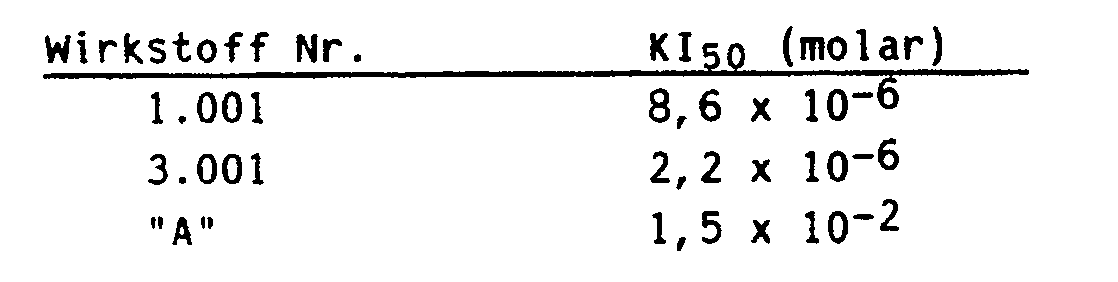
Zur Bestimmung der wachstumsregulierenden Eigenschaft der Prüfsubstanzen wurden Testpflanzen auf ausreichend mit Nährstoffen versorgtem Kultursubstrat in Kunststoffgefäßen von ca. 12,5 cm Durchmesser angezogen.In order to determine the growth-regulating property of the test substances, test plants were grown on a culture substrate sufficiently supplied with nutrients in plastic vessels of approximately 12.5 cm in diameter.
Im Nachauflaufverfahren wurden die zu prüfenden Substanzen in wäßriger Aufbereitung auf die Pflanzen gesprüht. Die beobachtete wachstumsregulierende Wirkung wurde bei Versuchsende durch Wuchshöhenmessung belegt. Die so gewonnenen Meßwerte wurden zur Wuchshöhe der unbehandelten Pflanzen in Relation gesetzt. Als Vergleichssubstanz diente CCC ("A").In the post-emergence process, the substances to be tested were sprayed onto the plants in aqueous preparation. The observed growth-regulating effect was demonstrated at the end of the test by measuring the height of the plants. The measured values obtained in this way were related to the height of the untreated plants. CCC ("A") served as the reference substance.
Gleichlaufend zur Reduzierung des Längenwachstums stieg die Farbintensität der Blätter an. Der erhöhte Chlorophyllgehalt läßt eine ebenfalls erhöhte Photosyntheserate und damit eine erhöhte Ertragsbildung erwarten.The color intensity of the leaves increased in line with the reduction in length growth. The increased chlorophyll content also suggests an increased photosynthesis rate and thus an increased yield formation.
Die Einzeldaten sind den folgenden Tabellen zu entnehmen.


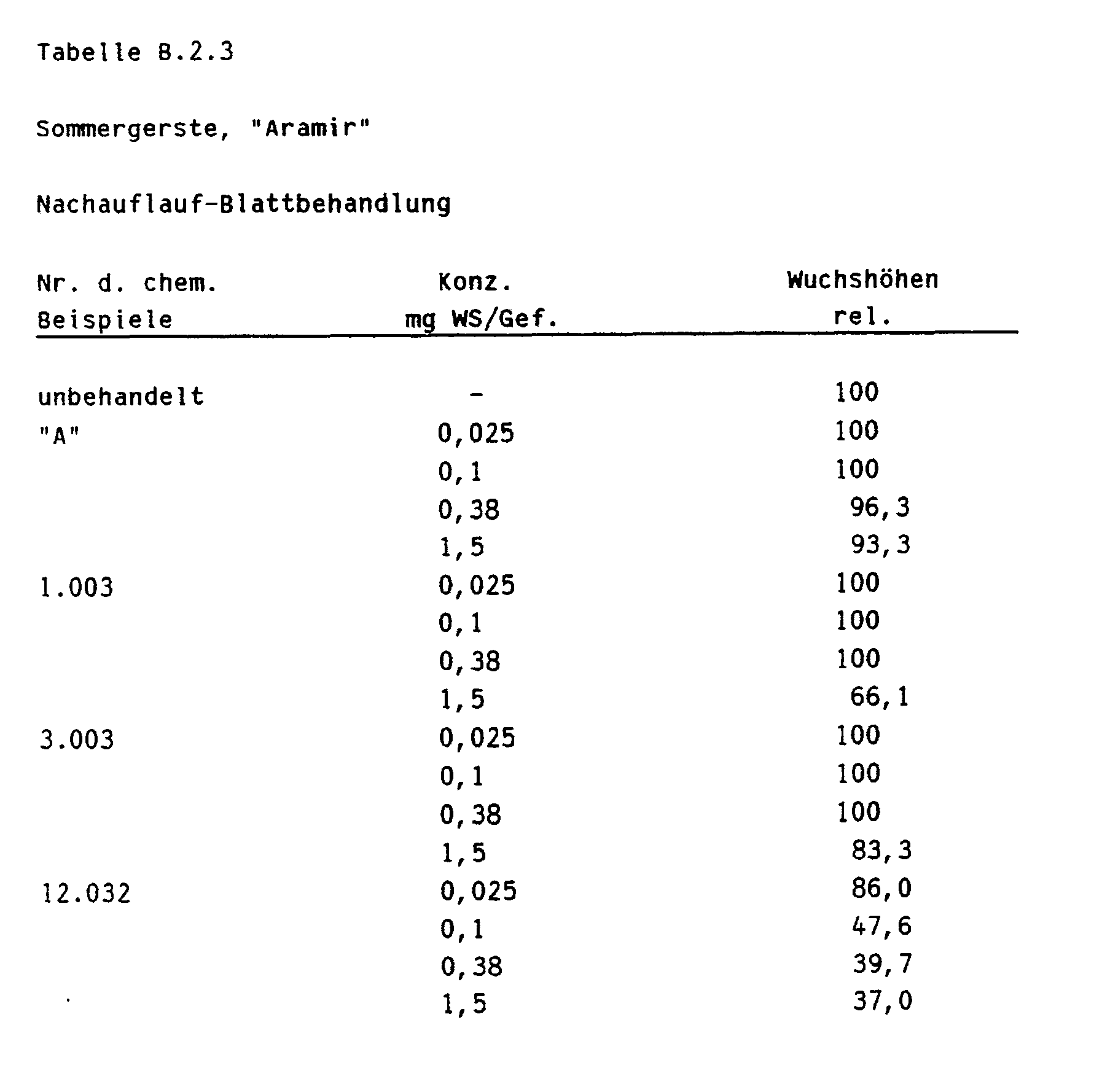

Junge Baumwollpflanzen (Sorte Stoneville 825, Entwicklungsstadium: 5 bis 6 entwickelte Laubblätter) wurden unter Gewächshausbedingungen angezogen Tag/Nachttemperatur 25/18° C, relat. Luftfeuchte 50 bis 70 %) und tropfnaß mit wäßrigen Aufbereitungen der angegebenen Wirkstoffe (unter Zusatz von 0,15 Gew.% des Fettalkoholalkoxylats Plurafac® LF 700, bezogen auf die Spritzbrühe) blattbehandelt. Die umgerechnete Wassermenge betrug 1000 1/ha. 6 Tage nach Wirkstoffapplikation wurde die Anzahl abgeworfener Blätter bestimmt und der Grad der Entblätterung in % zur Kontrolle angegeben. Bei den unbehandelten Kontrollpflanzen trat kein Blattfall auf.

Claims (15)


Applications Claiming Priority (2)
| Application Number | Priority Date | Filing Date | Title |
|---|---|---|---|
| DE4007683 | 1990-03-10 | ||
| DE4007683A DE4007683A1 (en) | 1990-03-10 | 1990-03-10 | HERBICIDAL SULFONYL UREAS, METHODS AND INTERMEDIATE PRODUCTS FOR THEIR PRODUCTION |
Publications (3)
| Publication Number | Publication Date |
|---|---|
| EP0446743A2 true EP0446743A2 (en) | 1991-09-18 |
| EP0446743A3 EP0446743A3 (en) | 1991-11-13 |
| EP0446743B1 EP0446743B1 (en) | 1995-08-02 |
Family
ID=6401916
Family Applications (1)
| Application Number | Title | Priority Date | Filing Date |
|---|---|---|---|
| EP91103181A Expired - Lifetime EP0446743B1 (en) | 1990-03-10 | 1991-03-02 | Herbicidal sulfonylureas, process for their preparation and intermediates |
Country Status (8)
| Country | Link |
|---|---|
| US (1) | US5276007A (en) |
| EP (1) | EP0446743B1 (en) |
| JP (1) | JP3038247B2 (en) |
| KR (1) | KR0169131B1 (en) |
| AT (1) | ATE125800T1 (en) |
| CA (1) | CA2037838C (en) |
| DE (2) | DE4007683A1 (en) |
| ES (1) | ES2075232T3 (en) |
Cited By (2)
| Publication number | Priority date | Publication date | Assignee | Title |
|---|---|---|---|---|
| WO1993005048A3 (en) * | 1991-08-28 | 1993-05-27 | Basf Ag | Herbicidal sulphonyl ureas, process and intermediates for producing the same |
| WO1997010714A1 (en) * | 1995-09-20 | 1997-03-27 | Basf Aktiengesellschaft | Herbicidal mixtures having a synergistic effect |
Families Citing this family (4)
| Publication number | Priority date | Publication date | Assignee | Title |
|---|---|---|---|---|
| DE4238175A1 (en) * | 1992-11-12 | 1994-05-19 | Basf Ag | Herbicides Sulfonylureas, process for their preparation and their use |
| TWI243019B (en) * | 2000-08-31 | 2005-11-11 | Basf Ag | Process for the preparation of a solid herbicidal formulation |
| AR056808A1 (en) * | 2005-11-18 | 2007-10-24 | Cheminova As | FORMULATION OF OIL IN WATER OF AVERMECTINES |
| CN106632077B (en) * | 2016-10-10 | 2019-01-22 | 上海再启生物技术有限公司 | A kind of preparation method of 2-amino-4-bromopyrimidine |
Family Cites Families (9)
| Publication number | Priority date | Publication date | Assignee | Title |
|---|---|---|---|---|
| US4592978A (en) * | 1979-11-30 | 1986-06-03 | E. I. Du Pont De Nemours And Company | Agricultural sulfonamides |
| US4478635A (en) * | 1982-01-11 | 1984-10-23 | Ciba-Geigy Corporation | N-Arylsulfonyl-N'-pyrimidinylureas |
| MA19680A1 (en) * | 1982-01-11 | 1983-10-01 | Novartis Ag | N- ARYLSULFONYL - N '- PYRIMIDINYLUREES. |
| US4518776A (en) * | 1982-07-19 | 1985-05-21 | Ciba Geigy Corporation | Process for producing sulfonylureas |
| US4547215A (en) * | 1983-03-24 | 1985-10-15 | E. I. Du Pont De Nemours And Company | Herbicidal sulfonamides |
| US4643760A (en) * | 1983-12-08 | 1987-02-17 | Ciba-Geigy Corporation | Herbicidal sulfonylureas |
| DE3565983D1 (en) * | 1984-07-26 | 1988-12-08 | Ciba Geigy Ag | N-ARYLSULFONYL-N'-TRIAZINYL- AND -PYRIMIDINYL UREAS |
| DE3642832A1 (en) * | 1986-12-16 | 1988-06-30 | Hoechst Ag | METHOD FOR PRODUCING AMINOPYRIMIDINES |
| DE4007316A1 (en) | 1990-03-08 | 1991-09-12 | Basf Ag | New 2-amino-(fluoroalkoxy-pyrimidine) derivs. - useful as intermediates in prepn. of plant protecting cpds. |
-
1990
- 1990-03-10 DE DE4007683A patent/DE4007683A1/en not_active Withdrawn
-
1991
- 1991-02-19 US US07/656,912 patent/US5276007A/en not_active Expired - Fee Related
- 1991-03-02 AT AT91103181T patent/ATE125800T1/en not_active IP Right Cessation
- 1991-03-02 ES ES91103181T patent/ES2075232T3/en not_active Expired - Lifetime
- 1991-03-02 EP EP91103181A patent/EP0446743B1/en not_active Expired - Lifetime
- 1991-03-02 DE DE59106102T patent/DE59106102D1/en not_active Expired - Lifetime
- 1991-03-08 CA CA002037838A patent/CA2037838C/en not_active Expired - Fee Related
- 1991-03-08 JP JP3043805A patent/JP3038247B2/en not_active Expired - Lifetime
- 1991-03-09 KR KR1019910003867A patent/KR0169131B1/en not_active Expired - Fee Related
Cited By (9)
| Publication number | Priority date | Publication date | Assignee | Title |
|---|---|---|---|---|
| WO1993005048A3 (en) * | 1991-08-28 | 1993-05-27 | Basf Ag | Herbicidal sulphonyl ureas, process and intermediates for producing the same |
| US5591694A (en) * | 1991-08-28 | 1997-01-07 | Basf Aktiengesellschaft | Herbicidal sulfonylureas |
| WO1997010714A1 (en) * | 1995-09-20 | 1997-03-27 | Basf Aktiengesellschaft | Herbicidal mixtures having a synergistic effect |
| US6054410A (en) * | 1995-09-20 | 2000-04-25 | Basf Aktiengesellschaft | Herbicidal mixtures having a synergistic effect |
| EP1477063A1 (en) * | 1995-09-20 | 2004-11-17 | Basf Ag | Synergistic herbicidal mixtures comprising a sulphonyl urea and dicamba |
| CZ297236B6 (en) * | 1995-09-20 | 2006-10-11 | Basf Aktiengesellschaft | Herbicidal mixtures exhibiting synergistic activity |
| EP1723851A3 (en) * | 1995-09-20 | 2007-01-03 | Basf Aktiengesellschaft | Synergistic herbicidal mixtures comprising a sulphonyl urea derivative and a dinitroaniline |
| CZ299433B6 (en) * | 1995-09-20 | 2008-07-23 | Basf Aktiengesellschaft | Herbicidal mixtures exhibiting synergistic activities |
| CZ300036B6 (en) * | 1995-09-20 | 2009-01-14 | Basf Se | Herbicidal mixtures exhibiting synergistic activities |
Also Published As
| Publication number | Publication date |
|---|---|
| EP0446743A3 (en) | 1991-11-13 |
| KR910016712A (en) | 1991-11-05 |
| DE4007683A1 (en) | 1991-09-12 |
| CA2037838A1 (en) | 1991-09-11 |
| JP3038247B2 (en) | 2000-05-08 |
| JPH05213905A (en) | 1993-08-24 |
| CA2037838C (en) | 2002-01-22 |
| DE59106102D1 (en) | 1995-09-07 |
| ES2075232T3 (en) | 1995-10-01 |
| EP0446743B1 (en) | 1995-08-02 |
| US5276007A (en) | 1994-01-04 |
| KR0169131B1 (en) | 1999-01-15 |
| ATE125800T1 (en) | 1995-08-15 |
Similar Documents
| Publication | Publication Date | Title |
|---|---|---|
| EP0136976A2 (en) | Use of phenyl pyrimidines as plant regulators | |
| EP0388871B1 (en) | Herbicidal and plant growth regulating azolylmethyloxiranes | |
| EP0243313A1 (en) | Acyl-cyclohexane diones and their oxime ethers exhibiting a herbicidal and plant growth activity | |
| EP0482349B1 (en) | Sulfonamides with herbicidal properties | |
| EP0003805A1 (en) | Pyridazone derivatives and herbicidal compositions containing them | |
| EP0414058B1 (en) | Carboxylic acid derivatives | |
| EP0177450A1 (en) | Process for the preparation of cyclohexane dione carboxylic-acid derivatives with a herbicidal and plant-growth regulating effect | |
| EP0155911A1 (en) | Purine derivatives for the regulation of plant growth | |
| EP0446743B1 (en) | Herbicidal sulfonylureas, process for their preparation and intermediates | |
| EP0469460B1 (en) | Herbicidal sulphonylureas, method for their preparation and intermediates | |
| EP0695296B1 (en) | 3-aryloxy carboxylic acid derivatives and method of preparing them | |
| EP0600967B1 (en) | Herbicidal sulphonyl ureas, process and intermediates for producing the same | |
| EP0400356B1 (en) | Sulfonamides | |
| EP0378092A1 (en) | Herbicidal sulfonyl ureas, process for preparing them and their use | |
| EP0232724B1 (en) | Cyclohexenone derivatives, process for their preparation and their use as herbicides and plant growth regulating agents | |
| EP0666254A1 (en) | 2-Aroylcydohexanediones, process for their preparation and their use as herbicide or as plant growth regulating agent | |
| EP0373472B1 (en) | Substituted sulfonyl ureas | |
| EP0192998B1 (en) | Thiazolyl amides, process for their preparation and their use in combating non-desired plant growth | |
| EP0107123B1 (en) | Aniline derivatives, process for their preparation and their use in combating undesired plant growth | |
| EP0001271A1 (en) | Heterocyclic norbornane derivatives, plant-growth regulating compositions containing these compounds and process for the preparation of these compositions | |
| EP0345637B1 (en) | N-substituted 3,4,5,6-tetrahydrophthalimide derivatives | |
| EP0230260B1 (en) | Cyclohexenone derivatives, their preparation and their use as a herbicide and plant-growth regulating agent | |
| EP0098440A2 (en) | 3,7-Dichloroquinoline derivatives, process for their preparation and their use to prevent undesired plant growth | |
| EP0114299A2 (en) | Derivatives of phenylglyoxylic acid, process for their preparation and their use to fight undesirable plant growth | |
| EP0293817A1 (en) | Cyclohexenonic compounds, a process for their preparation, their use as a herbicide or as a plant growth regulating means |
Legal Events
| Date | Code | Title | Description |
|---|---|---|---|
| PUAI | Public reference made under article 153(3) epc to a published international application that has entered the european phase |
Free format text: ORIGINAL CODE: 0009012 |
|
| AK | Designated contracting states |
Kind code of ref document: A2 Designated state(s): AT BE CH DE ES FR GB IT LI NL |
|
| PUAL | Search report despatched |
Free format text: ORIGINAL CODE: 0009013 |
|
| AK | Designated contracting states |
Kind code of ref document: A3 Designated state(s): AT BE CH DE ES FR GB IT LI NL |
|
| 17P | Request for examination filed |
Effective date: 19911008 |
|
| 17Q | First examination report despatched |
Effective date: 19940321 |
|
| GRAA | (expected) grant |
Free format text: ORIGINAL CODE: 0009210 |
|
| AK | Designated contracting states |
Kind code of ref document: B1 Designated state(s): AT BE CH DE ES FR GB IT LI NL |
|
| REF | Corresponds to: |
Ref document number: 125800 Country of ref document: AT Date of ref document: 19950815 Kind code of ref document: T |
|
| REF | Corresponds to: |
Ref document number: 59106102 Country of ref document: DE Date of ref document: 19950907 |
|
| GBT | Gb: translation of ep patent filed (gb section 77(6)(a)/1977) |
Effective date: 19950829 |
|
| REG | Reference to a national code |
Ref country code: ES Ref legal event code: FG2A Ref document number: 2075232 Country of ref document: ES Kind code of ref document: T3 |
|
| ITF | It: translation for a ep patent filed | ||
| ET | Fr: translation filed | ||
| PLBE | No opposition filed within time limit |
Free format text: ORIGINAL CODE: 0009261 |
|
| STAA | Information on the status of an ep patent application or granted ep patent |
Free format text: STATUS: NO OPPOSITION FILED WITHIN TIME LIMIT |
|
| 26N | No opposition filed | ||
| PGFP | Annual fee paid to national office [announced via postgrant information from national office to epo] |
Ref country code: AT Payment date: 20010227 Year of fee payment: 11 |
|
| PGFP | Annual fee paid to national office [announced via postgrant information from national office to epo] |
Ref country code: NL Payment date: 20010228 Year of fee payment: 11 |
|
| PGFP | Annual fee paid to national office [announced via postgrant information from national office to epo] |
Ref country code: ES Payment date: 20010307 Year of fee payment: 11 |
|
| PGFP | Annual fee paid to national office [announced via postgrant information from national office to epo] |
Ref country code: BE Payment date: 20010409 Year of fee payment: 11 |
|
| REG | Reference to a national code |
Ref country code: GB Ref legal event code: IF02 |
|
| PG25 | Lapsed in a contracting state [announced via postgrant information from national office to epo] |
Ref country code: AT Free format text: LAPSE BECAUSE OF NON-PAYMENT OF DUE FEES Effective date: 20020302 |
|
| PG25 | Lapsed in a contracting state [announced via postgrant information from national office to epo] |
Ref country code: ES Free format text: LAPSE BECAUSE OF NON-PAYMENT OF DUE FEES Effective date: 20020303 |
|
| PG25 | Lapsed in a contracting state [announced via postgrant information from national office to epo] |
Ref country code: BE Free format text: LAPSE BECAUSE OF NON-PAYMENT OF DUE FEES Effective date: 20020331 |
|
| BERE | Be: lapsed |
Owner name: *BASF A.G. Effective date: 20020331 |
|
| PG25 | Lapsed in a contracting state [announced via postgrant information from national office to epo] |
Ref country code: NL Free format text: LAPSE BECAUSE OF NON-PAYMENT OF DUE FEES Effective date: 20021001 |
|
| NLV4 | Nl: lapsed or anulled due to non-payment of the annual fee |
Effective date: 20021001 |
|
| PGFP | Annual fee paid to national office [announced via postgrant information from national office to epo] |
Ref country code: GB Payment date: 20040225 Year of fee payment: 14 |
|
| PGFP | Annual fee paid to national office [announced via postgrant information from national office to epo] |
Ref country code: CH Payment date: 20040227 Year of fee payment: 14 |
|
| PGFP | Annual fee paid to national office [announced via postgrant information from national office to epo] |
Ref country code: FR Payment date: 20040309 Year of fee payment: 14 |
|
| PGFP | Annual fee paid to national office [announced via postgrant information from national office to epo] |
Ref country code: DE Payment date: 20040311 Year of fee payment: 14 |
|
| REG | Reference to a national code |
Ref country code: ES Ref legal event code: FD2A Effective date: 20030410 |
|
| PG25 | Lapsed in a contracting state [announced via postgrant information from national office to epo] |
Ref country code: IT Free format text: LAPSE BECAUSE OF NON-PAYMENT OF DUE FEES Effective date: 20050302 Ref country code: GB Free format text: LAPSE BECAUSE OF NON-PAYMENT OF DUE FEES Effective date: 20050302 |
|
| PG25 | Lapsed in a contracting state [announced via postgrant information from national office to epo] |
Ref country code: LI Free format text: LAPSE BECAUSE OF NON-PAYMENT OF DUE FEES Effective date: 20050331 Ref country code: CH Free format text: LAPSE BECAUSE OF NON-PAYMENT OF DUE FEES Effective date: 20050331 |
|
| PG25 | Lapsed in a contracting state [announced via postgrant information from national office to epo] |
Ref country code: DE Free format text: LAPSE BECAUSE OF THE APPLICANT RENOUNCES Effective date: 20050525 |
|
| REG | Reference to a national code |
Ref country code: CH Ref legal event code: PL |
|
| GBPC | Gb: european patent ceased through non-payment of renewal fee |
Effective date: 20050302 |
|
| PG25 | Lapsed in a contracting state [announced via postgrant information from national office to epo] |
Ref country code: FR Free format text: LAPSE BECAUSE OF NON-PAYMENT OF DUE FEES Effective date: 20051130 |
|
| REG | Reference to a national code |
Ref country code: FR Ref legal event code: ST Effective date: 20051130 |