EP0445929B1 - Pflanzen - Google Patents
Pflanzen Download PDFInfo
- Publication number
- EP0445929B1 EP0445929B1 EP91301272A EP91301272A EP0445929B1 EP 0445929 B1 EP0445929 B1 EP 0445929B1 EP 91301272 A EP91301272 A EP 91301272A EP 91301272 A EP91301272 A EP 91301272A EP 0445929 B1 EP0445929 B1 EP 0445929B1
- Authority
- EP
- European Patent Office
- Prior art keywords
- wheat
- flour
- soft
- dough
- milling
- Prior art date
- Legal status (The legal status is an assumption and is not a legal conclusion. Google has not performed a legal analysis and makes no representation as to the accuracy of the status listed.)
- Revoked
Links
Images



Classifications
-
- A—HUMAN NECESSITIES
- A21—BAKING; EDIBLE DOUGHS
- A21D—TREATMENT OF FLOUR OR DOUGH FOR BAKING, e.g. BY ADDITION OF MATERIALS; BAKING; BAKERY PRODUCTS
- A21D13/00—Finished or partly finished bakery products
- A21D13/06—Products with modified nutritive value, e.g. with modified starch content
- A21D13/064—Products with modified nutritive value, e.g. with modified starch content with modified protein content
-
- A—HUMAN NECESSITIES
- A01—AGRICULTURE; FORESTRY; ANIMAL HUSBANDRY; HUNTING; TRAPPING; FISHING
- A01H—NEW PLANTS OR NON-TRANSGENIC PROCESSES FOR OBTAINING THEM; PLANT REPRODUCTION BY TISSUE CULTURE TECHNIQUES
- A01H6/00—Angiosperms, i.e. flowering plants, characterised by their botanic taxonomy
- A01H6/46—Gramineae or Poaceae, e.g. ryegrass, rice, wheat or maize
- A01H6/4678—Triticum sp. [wheat]
-
- A—HUMAN NECESSITIES
- A01—AGRICULTURE; FORESTRY; ANIMAL HUSBANDRY; HUNTING; TRAPPING; FISHING
- A01H—NEW PLANTS OR NON-TRANSGENIC PROCESSES FOR OBTAINING THEM; PLANT REPRODUCTION BY TISSUE CULTURE TECHNIQUES
- A01H5/00—Angiosperms, i.e. flowering plants, characterised by their plant parts; Angiosperms characterised otherwise than by their botanic taxonomy
- A01H5/10—Seeds
-
- A—HUMAN NECESSITIES
- A21—BAKING; EDIBLE DOUGHS
- A21D—TREATMENT OF FLOUR OR DOUGH FOR BAKING, e.g. BY ADDITION OF MATERIALS; BAKING; BAKERY PRODUCTS
- A21D2/00—Treatment of flour or dough by adding materials thereto before or during baking
- A21D2/08—Treatment of flour or dough by adding materials thereto before or during baking by adding organic substances
- A21D2/36—Vegetable material
Definitions
- This invention relates to plants and to products derived therefrom.
- Viscoelasticity is a balance between two opposite forces, extensibility (viscous flow) and elasticity, and this balance varies significantly between wheat varieties. Viscoelasticity is primarily genetically controlled although it is affected to a small extent by growing conditions. The viscoelastic properties of a dough, and the milling properties of the grain, primarily determine the types of food that can be produced from a wheat.
- Wheat is used to make bread (leavened, non-leavened, flat, round or steamed), biscuits/cookies, noodles, breakfast cereals, wafers, and batters (either for food preparations, eg. crumpets, pancakes, or as binding agents).
- the ratio of elasticity to extensibility needs to be high for leavened bread, intermediate for noodles and flat breads such as chapatis, and very low for wafers and semi-sweet biscuits.
- a bread dough has to be extensible to allow it to expand during fermentation at the proving stage of bread-making. As expansion occurs however, elastic forces must come into play so that, at optimal dough volume, expansion forces are counterbalanced by contraction (elastic) forces and these forces must be maintained until the starch gelatinises in the oven to form bread.
- Wheat breeders usually differentiate wheat lines into hard-milling varieties and soft-milling varieties.
- a soft-milling wheat adhesion between the protein and starch is weaker. Relatively little damage is caused to the starch during milling, and doughs of lower moisture content are formed. In the manufacture of dry products such as biscuits a soft-milling wheat is preferred, because less energy is needed to remove moisture during baking.
- the viscoelasticity that develops in wheat doughs is primarily a function of the protein from the endosperm, called gluten, which usually comprises between 8% and 15% of the dry weight of wheat flour.
- gluten which usually comprises between 8% and 15% of the dry weight of wheat flour.
- the biochemistry and genetics of gluten have been extensively researched, with a view to improving the bread-making quality of wheat. It is now generally recognised that high-molecular-weight (HMW) subunits of glutenin, which make up only about 6-10% of the gluten content of wheat, are the key components in conferring elasticity and dough mixing stability.
- HMW high-molecular-weight
- HMW subunits are coded by three homoeoallelic loci in bread-wheat, called Glu-A1 , Glu-B1 and Glu-D1 , and are located on the long arms of chromosomes 1A, 1B and 1D respectively.
- Each locus contains two genes, called “x” and "y”, so in principle a wheat could have six different HMW glutenin subunits.
- the "y” gene at Glu-A1 is present but non-functional in all known commercially-cultivated wheats, so the maximum number of different subunits is five.
- the "y” gene at Glu-B1 and the "x” gene at Glu-A1 are independently non-functional, so the minimum number of HMW glutenin subunits in any presently-available commercial wheat is three.
- the invention provides a soft-milling wheat genotype containing the Glu-D1 double null trait.
- This may be in the form of one or more stable true-breeding lines, or as more diverse material all of which exhibits the Glu-D1 double null trait and which can be used to introduce this trait into a breeding programme.
- the invention therefore provides soft-milling wheat from which flour giving highly extensible doughs with low or very low levels of elasticity, depending on the genotype, can be prepared. This range of elasticity is much lower than the range of elasticity currently observed in doughs from commercial soft-milling wheat.
- the wheat of the invention greatly facilitates the production of semi-sweet biscuits, non-fermented crackers, wafers, and food or food ingredients made from batters, which are made from soft-milling wheats because low water absorption by the flour is required.
- the invention provides soft-milling wheat with reduced HMW glutenin subunits having an SDS-sedimentation volume, measured as described below in Experiment 2 and corrected to 11% protein, of not greater than about 30ml, preferably not greater than about 25ml, and more preferably not greater than about 20ml.
- a soft-milling wheat in accordance with the invention can be obtained for example by transferring the Glu-D1 double null trait, eg. from "Nap Hal” or from a “Nap Hal” derivative which is hard-milling, by repetitively backcrossing into a soft-milling wheat, such as "Galahad", and selecting half grains at each generation, eg. by SDS-PAGE analysis.
- the viscoelastic properties of a wheat in accordance with the invention will be determined primarily by the number of different HMW glutenin subunits it contains. The possibilities are shown in the Table below. Possible HMW glutenin subunit combinations of genotypes in accordance with the invention Glu-A1 "x” Glu-B1 "x” Glu-B1 "y” Glu-D1 "x+y” Subunit No. 1 + + + - 3 2 - + + - 2 3 - + - - 1 4 - - + - 1 5* - + - - 1 6* - - + - 1
- L low-molecular-weight
- the invention provides a soft milling wheat capable of providing a flour from which a dough can be prepared at ambient temperature and is sufficiently inelastic to enable crisp farinaceous edible products such as biscuits, for example semi-sweet biscuits, and non-fermented crackers, to be manufactured therefrom without pretreatment of the flour with SMS.
- the invention also encompasses soft non-chemically-treated wheat flour from which a dough with low or very low elasticity can be prepared at ambient temperature.
- the invention provides soft wheat flour that does not require treatment with SMS to make a dough at ambient temperature that is sufficiently inelastic for the manufacture of crisp farinaceous edible products such as biscuits and the like.
- An important embodiment of the invention is soft wheat flour that enables the production of a dough that is sufficiently non-elastic to allow crackers to be manufactured without the need for treatment of the flour with SMS or proteolytic enzymes.
- a further embodiment is a soft wheat in which the grain protein is sufficiently soluble for gluten not to develop significantly in batter made from the wheat. This is particularly important in wafer manufacture.
- the invention also encompasses dough prepared from flour as defined in the preceding paragraphs, and to edible products made by cooking such a dough.
- the rheological properties (eg. elasticity and elastic stability) of doughs can be characterised by several types of apparatus.
- the Brabender Farinograph can be used to estimate the maximum degree of elasticity that can be tolerated to make semi-sweet biscuits without SMS treatment.
- the Farinograph should be calibrated using white flour (protein content between 10 and 11.5%) of a commonly grown bread-quality, hard milling wheat.
- white flour protein content between 10 and 11.5%
- the UK variety "Mercia" can be used, to give a band width of 80 Brabender Units at peak viscosity when peak viscosity is adjusted to the 600 Brabender Unit line.
- a genotype embodying the present invention and suitable for making semi-sweet biscuits will have a band thickness five minutes after reaching peak viscosity of less than 20 Brabender Units.
- the Degree of Softening of the dough ie. the difference in viscosity at peak and five minutes of mixing after reaching peak, should be at least 250, and preferably at least 300, Brabender Units, compared to that of 95 Brabender Units for Mercia.
- a dough having satisfactory inelastic properties can be prepared directly from the non-chemically treated flour at typical temperate climate factory temperatures, which will generally be at least 20°C.
- the number of different HMW subunits in wheat can be reduced to two or one, depending on the genotype.
- a particular aspect of the invention is a soft milling wheat flour in which the number of different HMW glutenin subunits is below 3, and the percentage of high molecular weight (HMW) subunits in glutenin is in the range of about 2 to about 6%.
- the benefits of the present invention are achieved by providing a soft milling wheat in which a Glu-D1 double null is present.
- the invention encompasses soft-milling wheat having this essential genetic characteristic.
- the invention also encompasses the use of a wheat line exhibiting the Glu-D1 double null trait in the production, eg. by breeding or genetic engineering, of soft-milling wheat.
- Galahad-7 A particular strain of semi-dwarf, red-grained, soft-milling winter wheat having this essential characteristic, designated "Galahad-7", has been deposited, in accordance with the provisions of the Budapest Treaty, in the National Collections of Industrial and Marine Bacteria, Aberdeen, Scotland under Accession No. NCIMB 40251, on 19 January 1990.
- the deposited sample which exhibits residual genetic variation, does not constitute seed that would be regarded as a true registerable plant variety. Nevertheless, the sample is true-breeding with regard to the Glu-D1 double null trait.
- the invention encompasses soft-milling wheat having the essential genetic characteristics, in terms of dough properties, exhibited by strain NCIMB 40251, and also the use of this strain in the production, eg. by breeding or genetic engineering, of soft-milling wheat.
- each of the "x" and "y” genes at Glu-D1 should be either inactive or absent. Generally, both will be absent.
- the production of a strain of wheat comprises the steps of:
- Semi-sweet biscuits are made from thin sheets of dough. Any elasticity present would cause the dough to contract when released from the rollers, ruining biscuit shape and pattern, and making biscuits difficult to stack and probably causing the biscuits to have a greater than desired hardness.
- the reducing agent SMS is added in those countries where it is permitted. This breaks down the disulphide bonds in glutenin and non-elastic glutenin subunits are released. The use of SMS is under review in those countries where it is still allowed to be used, in line with current trends in reducing food additives.
- An alternative approach is to manufacture at low temperatures so that the extensible component of gluten preferentially develops in the dough.
- Another alternative is to overmix the dough prior to sheeting. Both these processes are expensive.
- Wafers are made from batters rather than from doughs and a major problem in their manufacture is that the batters have to be pumped through tubes from the site of flour-water mixing, and then through finer nozzles to the site of wafer formation.
- gluten There is a tendency, using currently available wheat varieties, for gluten to develop and then solidify in the batters during such transit, causing blockage in the tubes and significant delays in manufacture. This is particularly the case where sugar is not included in the batter formulation.
- Pancakes and crumpets are also made from batters, as also are food binders (for instance the agent that binds bread crumbs to fish products). Gluten development can occur in conventional batter and result in a "lumpy" product. The use of wheat embodying the present invention will avoid this problem.
- a soft-milling wheat of the invention can be grown, harvested and milled to produce flour in the normal way.
- the resulting flour can be converted to dough or batter using conventional techniques and equipment, although of course the need to pre-treat the flour with SMS or other agents to reduce the dough elasticity can be avoided.
- the dough or batter can be made into cooked products such as biscuits, crackers or wafers in the normal way.
- a soft-milling wheat of the invention can be blended with other soft-milling wheat, or hard-milling wheat, either before or after milling, to decrease the dough strength of the blend.
- This line contained only one HMW glutenin subunit, subunit 7 that is coded at by the "x" gene Glu-B1 and inherited from “Galahad”. This line was designated “Galahad-7", and is the strain deposited as NCIMB 40251.
- Figure 1 of the accompanying drawings depicts SDS-PAGE analysis of seed proteins from “Galahad” (G) and “Galahad-7” (G-7).
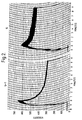
- FIG. 2 of the accompanying drawings shows Farinograph traces of "Galahad-7" (G-7) and “Galahad” (G).
- the Degree of Softening determined by the Farinograph is the difference in viscosity at peak and after mixing for a further five minutes.
- the value for "Galahad” was 110 Brabender Units, greater than expected for a strong mixing bread quality wheat, but slightly less than that for a typical biscuits/feed wheat.
- the Degree of Softening for "Galahad-7" dough was much greater, at 300 Brabender Units.
- the SDS(sodium dodecyl sulphate)-sedimentation test measures the volume of sediment after mixing wholemeal flour in a lactic acid, SDS solution under controlled conditions and then allowing to settle for a specified period.
- the larger glutenin molecules which are primarily responsible for elasticity and dough strength form a gel and increase the volume of the sediment.
- the protein molecules imparting extensibility dissolve. The method is used extensively in wheat breeding programmes to select for bread-making quality (large sedimentation volumes) and at wheat mills as a quick test for bread quality prior to accepting a grain load.
- the volume of "Apostle" a good bread-quality wheat, was 85ml at about 10.5% protein.
- the varieties are representative of the three major wheat categories grown commercially in the UK: (1) hard milling wheat of good bread-making quality; (2) hard milling feed wheat, and (3) soft milling wheat suitable for feed and biscuits.
- the SDS-sedimentation volume of "Galahad-7” was very much smaller than those of all the other varieties tested, because it contains much less gel protein.
- Gel protein consists primarily of long elastic glutenin molecules.
- FIG. 3 of the accompanying drawings shows standard Extensograph traces of "Torfrida” and “Galahad”, and Figure 4, traces of "Galahad” and “Galahad-7” whose doughs were made with increased amounts of salt in them.
- the biscuit and "Galahad” batters showed traces of gluten development during the whisking stage. Gluten continued to form during the liquidising stage and reached maximum development after 21.6 seconds for the biscuit batter and 25.2 seconds for the "Galahad” batter. The gluten was completely broken down after a further two seconds for the biscuit batter and three seconds for the "Galahad” batter. There was no discernable gluten development in the "Galahad-7" batter during whisking, and a very quick formation (3.75 seconds) and destruction (3 seconds) of gluten during the liquidising stage. At the end of the experiment, the final viscosity of the batter was determined in a viscosity cup with a 7.75 mm diameter hole. It took 230 seconds and 302 seconds for 200g batter to pass from the cup, for the biscuit blend and "Galahad” respectively. By contrast, "Galahad-7" batter was very thin and only took 59 seconds to pass from the viscosity cup.
- Wafer sheets were made from 2.52 kg of "Galahad-7" and were shown to be of acceptable quality, similar to the wafer flour control.
- DNA was extracted from leaves of (Nap Hal x Sicco 5 ), the Glu-D1 double null donor parent of "Galahad-7", digested with the restriction enzyme SstI and fractionated by agarose gel electrophoresis. The fractionated DNA was transferred to a Zetaprobe nylon membrane and probed with the radioactive cDNA pTag 1290, which specifies part of the coding sequence of a HMW glutenin subunit gene. The probe hybridised with only three DNA bands, two derived from chromosome 1A and the other from 1B. The chromosome 1D band (ie. that containing the Glu-D1 locus) that is detected in all varieties, and which usually has a size of 4.8Kb for this restriction enzyme, was absent.
Landscapes
- Life Sciences & Earth Sciences (AREA)
- Health & Medical Sciences (AREA)
- Environmental Sciences (AREA)
- Physiology (AREA)
- Botany (AREA)
- Developmental Biology & Embryology (AREA)
- Natural Medicines & Medicinal Plants (AREA)
- Engineering & Computer Science (AREA)
- Food Science & Technology (AREA)
- Molecular Biology (AREA)
- General Health & Medical Sciences (AREA)
- Nutrition Science (AREA)
- Bakery Products And Manufacturing Methods Therefor (AREA)
- Compounds Of Unknown Constitution (AREA)
- Breeding Of Plants And Reproduction By Means Of Culturing (AREA)
Claims (15)
- Weichmahlender (soft-milling) Weizen mit verringerten HMW-Gluteninuntereinhelten, mit einem SDS-Sedimentationsvolumen von nicht größer als 30 ml, korrigiert auf 11% Protein.
- Weichmahlender Weizen mit verringerten HMW-Gluteninuntereinheiten, mit einem SDS-Sedimentationsvolumen von nicht größer als 25 ml, korrigiert auf 11% Protein.
- Weichmahlender Weizen mit verringerten HMW-Gluteninunterelnheiten, mit einem SDS-Sedimentationsvolumen von nicht größer als 20 ml, korrigiert auf 11% Protein.
- Weichmahlender Weizen mit verringerten HMW-Gluteninuntereinheiten, für welchen die Brabender Farinograph-Bandweite, 5 Minuten nach Erreichen der Peak-Viskosität, weniger als 20 Brabendereinheiten beträgt und der Grad der Erweichung mindestens 250 Brabendereinheiten beträgt, wobei der Farinograph unter Verwendung von Weißmehl mit Brotqualität (Proteingehalt zwischen 10 und 11,5%) kalibriert ist, und hartmahlender (hard-milling) Weizen sowie das Verfahren nach der International Association for Cereal Chemistry (ICC) Nr. 115 mit einer 300 g Mischschüssel verwendet wird; wobei die Farinograph-Schreibspur so eingestellt wird, dass sich eine Breite des Bandes von 80 Brabendereinheiten bei der Peak-Viskosität auf der 600 Brabendereinheit-Linie ergibt.
- Weichmahlender Weizen, in welchem jedes der "x"- und "y"-Gene am Glu-D1 inaktiv oder nicht vorhanden ist.
- Weichmahlender Weizen, in welchem jedes der "x"- und "y"-Gene am Glu-D1 nicht vorhanden ist.
- Weichmahlender Weizen, der die Glu-D1 Doppel-Null-Anlage enthält und ein SDS-Sedimentationsvolumen, korrigiert auf 11% Protein, von nicht größer als 30 ml besitzt, wobei der Weizen ein Mehl ergibt, aus dem ein Teig mit sehr geringer Elastizität bei Umgebungstemperatur hergestellt werden kann, ohne die Notwendigkeit einer chemischen oder enzymatischen Vorbehandlung des Mehls.
- Weichmahlender Weizen, der die Glu-D1 Doppel-Null-Anlageenthält und ein SDS-Sedimentationsvolumen, korrigiert auf 11% Protein, von nicht größer als 30 ml besitzt, wobei der Weizen ein Mehl ergibt, aus dem ein Teig bei Umgebungstemperatur hergestellt werden kann, ohne die Notwendigkeit einer Natriummetabisulfit-Vorbehandlung des Mehls, wobei der Teig ausreichend unelastisch ist, um die Herstellung von knusprigen, mehlhaltigen, essbaren Produkten, wie Biskuits und ähnlichem, zu erlauben.
- Mehl, hergestellt aus Weizen gemäß irgendeinem der Ansprüche 1 bis 6.
- Weichweizenmehl, enthaltend weniger als drei unterschiedliche HMW-Gluteninuntereinheiten.
- Mehl nach Anspruch 10, wobei der Prozentgehalt an HMW-Gluteninuntereinheiten nicht größer als 6 ist.
- Mehl nach Anspruch 11, wobei der Prozentgehalt an HMW-Gluteninuntereinheiten mindestens 2 beträgt.
- Teig oder Rührteig, hergestellt aus Mehl gemäß irgendeinem der Ansprüche 9 bis 12.
- Essbares Produkt, hergestellt durch Zubereitung des Teiges oder des Rührteigs gemäß Anspruch 13.
- Biskuits oder ähnliches, hergestellt aus Mehl gemäß irgendeinem der Ansprüche 9 bis 12.
Applications Claiming Priority (2)
| Application Number | Priority Date | Filing Date | Title |
|---|---|---|---|
| GB909003740A GB9003740D0 (en) | 1990-02-19 | 1990-02-19 | Plants |
| GB9003740 | 1990-02-19 |
Publications (3)
| Publication Number | Publication Date |
|---|---|
| EP0445929A2 EP0445929A2 (de) | 1991-09-11 |
| EP0445929A3 EP0445929A3 (en) | 1991-11-13 |
| EP0445929B1 true EP0445929B1 (de) | 2003-05-21 |
Family
ID=10671254
Family Applications (1)
| Application Number | Title | Priority Date | Filing Date |
|---|---|---|---|
| EP91301272A Revoked EP0445929B1 (de) | 1990-02-19 | 1991-02-18 | Pflanzen |
Country Status (9)
| Country | Link |
|---|---|
| EP (1) | EP0445929B1 (de) |
| JP (1) | JPH05506775A (de) |
| AT (1) | ATE240635T1 (de) |
| AU (3) | AU665742B2 (de) |
| CA (1) | CA2075959A1 (de) |
| DE (1) | DE69133260T2 (de) |
| DK (1) | DK0445929T3 (de) |
| GB (1) | GB9003740D0 (de) |
| WO (1) | WO1991011905A1 (de) |
Families Citing this family (2)
| Publication number | Priority date | Publication date | Assignee | Title |
|---|---|---|---|---|
| GB9112556D0 (en) * | 1991-06-11 | 1991-07-31 | Unilever Plc | Plants |
| US11150171B2 (en) * | 2018-03-30 | 2021-10-19 | Perkinelmer Health Sciences, Inc. | Measuring properties of flour, dough, and other solids |
Family Cites Families (1)
| Publication number | Priority date | Publication date | Assignee | Title |
|---|---|---|---|---|
| US4406086A (en) * | 1982-03-15 | 1983-09-27 | Pioneer Hi-Bred International, Inc. | Wheat and method of producing the same |
-
1990
- 1990-02-19 GB GB909003740A patent/GB9003740D0/en active Pending
-
1991
- 1991-02-18 DE DE69133260T patent/DE69133260T2/de not_active Revoked
- 1991-02-18 DK DK91301272T patent/DK0445929T3/da active
- 1991-02-18 AU AU74589/91A patent/AU665742B2/en not_active Expired
- 1991-02-18 AT AT91301272T patent/ATE240635T1/de not_active IP Right Cessation
- 1991-02-18 CA CA002075959A patent/CA2075959A1/en not_active Abandoned
- 1991-02-18 EP EP91301272A patent/EP0445929B1/de not_active Revoked
- 1991-02-18 WO PCT/GB1991/000242 patent/WO1991011905A1/en not_active Ceased
- 1991-02-18 JP JP91505406A patent/JPH05506775A/ja active Pending
-
1995
- 1995-08-30 AU AU30347/95A patent/AU697517B2/en not_active Expired
-
1998
- 1998-08-26 AU AU81921/98A patent/AU730669B2/en not_active Expired
Also Published As
| Publication number | Publication date |
|---|---|
| AU8192198A (en) | 1998-10-29 |
| ATE240635T1 (de) | 2003-06-15 |
| EP0445929A3 (en) | 1991-11-13 |
| DE69133260T2 (de) | 2004-03-18 |
| AU665742B2 (en) | 1996-01-18 |
| JPH05506775A (ja) | 1993-10-07 |
| GB9003740D0 (en) | 1990-04-18 |
| EP0445929A2 (de) | 1991-09-11 |
| DK0445929T3 (da) | 2003-09-22 |
| AU3034795A (en) | 1995-12-07 |
| AU7458991A (en) | 1991-09-03 |
| AU697517B2 (en) | 1998-10-08 |
| DE69133260D1 (de) | 2003-06-26 |
| AU730669B2 (en) | 2001-03-08 |
| CA2075959A1 (en) | 1991-08-20 |
| WO1991011905A1 (en) | 1991-08-22 |
Similar Documents
| Publication | Publication Date | Title |
|---|---|---|
| Wheat et al. | Improvement of durum wheat pastamaking and breadmaking qualities | |
| Finney et al. | Quality of hard, soft, and durum wheats | |
| Peña | Wheat for bread and other foods | |
| Morrison et al. | The effect of group 5 chromosomes on the free polar lipids and breadmaking quality of wheat | |
| Blackman et al. | Grain quality | |
| Zhang et al. | Effect of high-molecular-weight glutenin subunit deletion on soft wheat quality properties and sugar-snap cookie quality estimated through near-isogenic lines | |
| Camerlengo et al. | Genetic factors influencing triticale quality for food | |
| Souza et al. | Breeding wheat for improved milling and baking quality | |
| Cho et al. | Influence of protein characteristics and the proportion of gluten on end-use quality in Korean wheat cultivars | |
| Uthayakumaran et al. | Development of genetically modified wheat to assess its dough functional properties | |
| Chibbar et al. | Characteristics and Uses of Waxy Wheat1 | |
| US5859315A (en) | Soft-milling wheats which produce dough with low elasticity | |
| AU665742B2 (en) | Plants | |
| Grama et al. | Hexaploid wild emmer wheat derivatives grown under New Zealand conditions 1. Relationship between protein composition and quality parameters | |
| Liu et al. | Grain quality and yield characteristics of D‐genome disomic substitution lines in ‘Langdon’(Triticum turgidum var. durum) | |
| Doekes et al. | Kernel hardness and baking quality of wheat—a genetic analysis using chromosome substitution lines | |
| CA2070713C (en) | Plants | |
| Lookhart et al. | Comparison of high-molecular-weight subunits of glutenin and baking performance of flours varying in bread-making quality | |
| Knackstedt et al. | Effects of T2BS. 2RL Wheat‐Rye Translocation on Breadmaking Quality in Wheat | |
| US20160262334A1 (en) | Wheat Lines And Improved Food Compositions | |
| Ram | Cereals: processing and nutritional quality | |
| Flavell et al. | Strategies for the improvement of wheat-grain quality using molecular genetics | |
| Bandla | A study of the rheological properties and gluten protein components associated with enhanced baking quality in durum wheat (Triticum turgidum L. var. durum) | |
| Shumate | Predicting Farinograph Stability of Wheat Flour with Mixograph and Glutomatic Tests | |
| Sharma et al. | Genetic variation for'waxy'proteins and starch characteristics of triticale. |
Legal Events
| Date | Code | Title | Description |
|---|---|---|---|
| PUAI | Public reference made under article 153(3) epc to a published international application that has entered the european phase |
Free format text: ORIGINAL CODE: 0009012 |
|
| AK | Designated contracting states |
Kind code of ref document: A2 Designated state(s): AT BE CH DE DK ES FR GB GR IT LI NL SE |
|
| PUAL | Search report despatched |
Free format text: ORIGINAL CODE: 0009013 |
|
| AK | Designated contracting states |
Kind code of ref document: A3 Designated state(s): AT BE CH DE DK ES FR GB GR IT LI NL SE |
|
| 17P | Request for examination filed |
Effective date: 19911227 |
|
| RAP3 | Party data changed (applicant data changed or rights of an application transferred) |
Owner name: UNILEVER N.V. Owner name: UNILEVER PLC |
|
| 17Q | First examination report despatched |
Effective date: 19950210 |
|
| RAP1 | Party data changed (applicant data changed or rights of an application transferred) |
Owner name: MONSANTO CO. |
|
| RAP1 | Party data changed (applicant data changed or rights of an application transferred) |
Owner name: MONSANTO TECHNOLOGY LLC |
|
| GRAH | Despatch of communication of intention to grant a patent |
Free format text: ORIGINAL CODE: EPIDOS IGRA |
|
| GRAH | Despatch of communication of intention to grant a patent |
Free format text: ORIGINAL CODE: EPIDOS IGRA |
|
| GRAA | (expected) grant |
Free format text: ORIGINAL CODE: 0009210 |
|
| AK | Designated contracting states |
Designated state(s): AT BE CH DE DK ES FR GB GR IT LI NL SE |
|
| PG25 | Lapsed in a contracting state [announced via postgrant information from national office to epo] |
Ref country code: IT Free format text: LAPSE BECAUSE OF FAILURE TO SUBMIT A TRANSLATION OF THE DESCRIPTION OR TO PAY THE FEE WITHIN THE PRE;WARNING: LAPSES OF ITALIAN PATENTS WITH EFFECTIVE DATE BEFORE 2007 MAY HAVE OCCURRED AT ANY TIME BEFORE 2007. THE CORRECT EFFECTIVE DATE MAY BE DIFFERENT FROM THE ONE RECORDED.SCRIBED TIME-LIMIT Effective date: 20030521 Ref country code: BE Free format text: LAPSE BECAUSE OF FAILURE TO SUBMIT A TRANSLATION OF THE DESCRIPTION OR TO PAY THE FEE WITHIN THE PRESCRIBED TIME-LIMIT Effective date: 20030521 Ref country code: NL Free format text: LAPSE BECAUSE OF FAILURE TO SUBMIT A TRANSLATION OF THE DESCRIPTION OR TO PAY THE FEE WITHIN THE PRESCRIBED TIME-LIMIT Effective date: 20030521 Ref country code: AT Free format text: LAPSE BECAUSE OF FAILURE TO SUBMIT A TRANSLATION OF THE DESCRIPTION OR TO PAY THE FEE WITHIN THE PRESCRIBED TIME-LIMIT Effective date: 20030521 Ref country code: CH Free format text: LAPSE BECAUSE OF FAILURE TO SUBMIT A TRANSLATION OF THE DESCRIPTION OR TO PAY THE FEE WITHIN THE PRESCRIBED TIME-LIMIT Effective date: 20030521 Ref country code: LI Free format text: LAPSE BECAUSE OF FAILURE TO SUBMIT A TRANSLATION OF THE DESCRIPTION OR TO PAY THE FEE WITHIN THE PRESCRIBED TIME-LIMIT Effective date: 20030521 |
|
| REG | Reference to a national code |
Ref country code: GB Ref legal event code: FG4D |
|
| REG | Reference to a national code |
Ref country code: CH Ref legal event code: EP |
|
| REF | Corresponds to: |
Ref document number: 69133260 Country of ref document: DE Date of ref document: 20030626 Kind code of ref document: P |
|
| PG25 | Lapsed in a contracting state [announced via postgrant information from national office to epo] |
Ref country code: SE Free format text: LAPSE BECAUSE OF FAILURE TO SUBMIT A TRANSLATION OF THE DESCRIPTION OR TO PAY THE FEE WITHIN THE PRESCRIBED TIME-LIMIT Effective date: 20030821 Ref country code: GR Free format text: LAPSE BECAUSE OF FAILURE TO SUBMIT A TRANSLATION OF THE DESCRIPTION OR TO PAY THE FEE WITHIN THE PRESCRIBED TIME-LIMIT Effective date: 20030821 |
|
| PG25 | Lapsed in a contracting state [announced via postgrant information from national office to epo] |
Ref country code: ES Free format text: LAPSE BECAUSE OF FAILURE TO SUBMIT A TRANSLATION OF THE DESCRIPTION OR TO PAY THE FEE WITHIN THE PRESCRIBED TIME-LIMIT Effective date: 20030901 |
|
| REG | Reference to a national code |
Ref country code: DK Ref legal event code: T3 |
|
| NLV1 | Nl: lapsed or annulled due to failure to fulfill the requirements of art. 29p and 29m of the patents act | ||
| REG | Reference to a national code |
Ref country code: CH Ref legal event code: PL |
|
| ET | Fr: translation filed | ||
| PGFP | Annual fee paid to national office [announced via postgrant information from national office to epo] |
Ref country code: DK Payment date: 20040123 Year of fee payment: 14 |
|
| PGFP | Annual fee paid to national office [announced via postgrant information from national office to epo] |
Ref country code: GB Payment date: 20040211 Year of fee payment: 14 |
|
| PLBI | Opposition filed |
Free format text: ORIGINAL CODE: 0009260 |
|
| PGFP | Annual fee paid to national office [announced via postgrant information from national office to epo] |
Ref country code: FR Payment date: 20040219 Year of fee payment: 14 |
|
| PLBI | Opposition filed |
Free format text: ORIGINAL CODE: 0009260 |
|
| PLAZ | Examination of admissibility of opposition: despatch of communication + time limit |
Free format text: ORIGINAL CODE: EPIDOSNOPE2 |
|
| PLBI | Opposition filed |
Free format text: ORIGINAL CODE: 0009260 |
|
| PLBQ | Unpublished change to opponent data |
Free format text: ORIGINAL CODE: EPIDOS OPPO |
|
| PLBA | Examination of admissibility of opposition: reply received |
Free format text: ORIGINAL CODE: EPIDOSNOPE4 |
|
| PLAX | Notice of opposition and request to file observation + time limit sent |
Free format text: ORIGINAL CODE: EPIDOSNOBS2 |
|
| 26 | Opposition filed |
Opponent name: GREENPEACE E.V. Effective date: 20040127 |
|
| PGFP | Annual fee paid to national office [announced via postgrant information from national office to epo] |
Ref country code: DE Payment date: 20040331 Year of fee payment: 14 |
|
| 26 | Opposition filed |
Opponent name: GROUPEMENT DES ASSOCIATIONS MEUNIERES DE L'UE (GAM Effective date: 20040219 Opponent name: GREENPEACE E.V. Effective date: 20040127 Opponent name: COMITE DES ORGANISATIONS PROFESSIONNELLES AGRICOLE Effective date: 20040223 Opponent name: DR. RUTH TIPPE"KEIN PATENT AUF LEBEN" Effective date: 20040220 |
|
| 26 | Opposition filed |
Opponent name: GROUPEMENT DES ASSOCIATIONS MEUNIERES DE L'UE (GAM Effective date: 20040219 Opponent name: GREENPEACE E.V. Effective date: 20040127 Opponent name: SAATZUCHT JOSEF BREUN GDBR Effective date: 20040223 Opponent name: COMITE DES ORGANISATIONS PROFESSIONNELLES AGRICOLE Effective date: 20040223 Opponent name: DR. RUTH TIPPE"KEIN PATENT AUF LEBEN" Effective date: 20040220 |
|
| PLAX | Notice of opposition and request to file observation + time limit sent |
Free format text: ORIGINAL CODE: EPIDOSNOBS2 |
|
| RDAF | Communication despatched that patent is revoked |
Free format text: ORIGINAL CODE: EPIDOSNREV1 |
|
| RAP2 | Party data changed (patent owner data changed or rights of a patent transferred) |
Owner name: SOCIETE RAGT 2N |
|
| RDAG | Patent revoked |
Free format text: ORIGINAL CODE: 0009271 |
|
| STAA | Information on the status of an ep patent application or granted ep patent |
Free format text: STATUS: PATENT REVOKED |
|
| 27W | Patent revoked |
Effective date: 20041003 |
|
| GBPR | Gb: patent revoked under art. 102 of the ep convention designating the uk as contracting state |
Free format text: 20041003 |