EP0445274B1 - Liquid crystalline medium - Google Patents
Liquid crystalline medium Download PDFInfo
- Publication number
- EP0445274B1 EP0445274B1 EP90914700A EP90914700A EP0445274B1 EP 0445274 B1 EP0445274 B1 EP 0445274B1 EP 90914700 A EP90914700 A EP 90914700A EP 90914700 A EP90914700 A EP 90914700A EP 0445274 B1 EP0445274 B1 EP 0445274B1
- Authority
- EP
- European Patent Office
- Prior art keywords
- trans
- compounds
- independently
- formula
- group
- Prior art date
- Legal status (The legal status is an assumption and is not a legal conclusion. Google has not performed a legal analysis and makes no representation as to the accuracy of the status listed.)
- Expired - Lifetime
Links
- 239000007788 liquid Substances 0.000 title abstract 2
- 150000001875 compounds Chemical class 0.000 claims abstract description 133
- 239000000203 mixture Substances 0.000 claims abstract description 60
- 229910052731 fluorine Inorganic materials 0.000 claims abstract description 36
- 239000011737 fluorine Substances 0.000 claims abstract description 16
- PXGOKWXKJXAPGV-UHFFFAOYSA-N Fluorine Chemical compound FF PXGOKWXKJXAPGV-UHFFFAOYSA-N 0.000 claims abstract description 14
- 239000004973 liquid crystal related substance Substances 0.000 claims description 36
- -1 oxaalkyl Chemical group 0.000 claims description 27
- 125000000217 alkyl group Chemical group 0.000 claims description 19
- 125000004432 carbon atom Chemical group C* 0.000 claims description 19
- 125000000876 trifluoromethoxy group Chemical group FC(F)(F)O* 0.000 claims description 12
- 125000005407 trans-1,4-cyclohexylene group Chemical group [H]C1([H])C([H])([H])[C@]([H])([*:2])C([H])([H])C([H])([H])[C@@]1([H])[*:1] 0.000 claims description 9
- 150000002825 nitriles Chemical group 0.000 claims description 8
- 125000003342 alkenyl group Chemical group 0.000 claims description 7
- 125000001153 fluoro group Chemical group F* 0.000 claims description 6
- 125000003709 fluoroalkyl group Chemical group 0.000 claims description 2
- 239000000463 material Substances 0.000 description 16
- 150000003254 radicals Chemical class 0.000 description 14
- 125000001140 1,4-phenylene group Chemical group [H]C1=C([H])C([*:2])=C([H])C([H])=C1[*:1] 0.000 description 10
- 239000011159 matrix material Substances 0.000 description 10
- 125000002023 trifluoromethyl group Chemical group FC(F)(F)* 0.000 description 10
- 0 C*1CCCCC1 Chemical compound C*1CCCCC1 0.000 description 9
- JFDZBHWFFUWGJE-UHFFFAOYSA-N benzonitrile Chemical compound N#CC1=CC=CC=C1 JFDZBHWFFUWGJE-UHFFFAOYSA-N 0.000 description 9
- 230000000694 effects Effects 0.000 description 8
- 230000005540 biological transmission Effects 0.000 description 7
- 239000000126 substance Substances 0.000 description 7
- LUCHFKBTWHPREI-UHFFFAOYSA-N 1-(4-propylcyclohexyl)-4-[4-(4-propylcyclohexyl)phenyl]benzene Chemical group C1CC(CCC)CCC1C1=CC=C(C=2C=CC(=CC=2)C2CCC(CCC)CC2)C=C1 LUCHFKBTWHPREI-UHFFFAOYSA-N 0.000 description 6
- 239000004990 Smectic liquid crystal Substances 0.000 description 6
- 125000005449 2-fluoro-1,4-phenylene group Chemical group [H]C1=C([*:2])C([H])=C(F)C([*:1])=C1[H] 0.000 description 5
- 125000003545 alkoxy group Chemical group 0.000 description 5
- 238000010276 construction Methods 0.000 description 5
- 230000003287 optical effect Effects 0.000 description 5
- 125000005451 3-fluoro-1,4-phenylene group Chemical group [H]C1=C([*:1])C([H])=C(F)C([*:2])=C1[H] 0.000 description 4
- 239000004988 Nematic liquid crystal Substances 0.000 description 4
- 125000000113 cyclohexyl group Chemical group [H]C1([H])C([H])([H])C([H])([H])C([H])(*)C([H])([H])C1([H])[H] 0.000 description 4
- 238000012986 modification Methods 0.000 description 4
- 230000004048 modification Effects 0.000 description 4
- 230000004044 response Effects 0.000 description 4
- OKKJLVBELUTLKV-UHFFFAOYSA-N Methanol Chemical compound OC OKKJLVBELUTLKV-UHFFFAOYSA-N 0.000 description 3
- UHOVQNZJYSORNB-UHFFFAOYSA-N c1ccccc1 Chemical compound c1ccccc1 UHOVQNZJYSORNB-UHFFFAOYSA-N 0.000 description 3
- 230000007423 decrease Effects 0.000 description 3
- 238000013461 design Methods 0.000 description 3
- 238000005516 engineering process Methods 0.000 description 3
- 230000002349 favourable effect Effects 0.000 description 3
- 238000009472 formulation Methods 0.000 description 3
- 239000011521 glass Substances 0.000 description 3
- 230000007935 neutral effect Effects 0.000 description 3
- 229910021420 polycrystalline silicon Inorganic materials 0.000 description 3
- 239000004065 semiconductor Substances 0.000 description 3
- 238000006467 substitution reaction Methods 0.000 description 3
- 239000000758 substrate Substances 0.000 description 3
- 238000003786 synthesis reaction Methods 0.000 description 3
- DURDZFYGFXPFAV-UHFFFAOYSA-N 1-ethoxy-4-[2-(4-methylphenyl)ethynyl]benzene Chemical compound C1=CC(OCC)=CC=C1C#CC1=CC=C(C)C=C1 DURDZFYGFXPFAV-UHFFFAOYSA-N 0.000 description 2
- YWDALJMLXXWXFP-UHFFFAOYSA-N 1-ethyl-4-[2-(4-methoxyphenyl)ethynyl]benzene Chemical compound C1=CC(CC)=CC=C1C#CC1=CC=C(OC)C=C1 YWDALJMLXXWXFP-UHFFFAOYSA-N 0.000 description 2
- BLTZCTNAXQCLKH-UHFFFAOYSA-N 2-(4-fluorophenyl)-5-heptylpyrimidine Chemical compound N1=CC(CCCCCCC)=CN=C1C1=CC=C(F)C=C1 BLTZCTNAXQCLKH-UHFFFAOYSA-N 0.000 description 2
- BPQLTKIPUYRZQV-UHFFFAOYSA-N 2-(4-fluorophenyl)-5-hexylpyrimidine Chemical compound N1=CC(CCCCCC)=CN=C1C1=CC=C(F)C=C1 BPQLTKIPUYRZQV-UHFFFAOYSA-N 0.000 description 2
- RWLYKSJIUZMCNQ-UHFFFAOYSA-N 2-(4-fluorophenyl)-5-pentylpyrimidine Chemical compound N1=CC(CCCCC)=CN=C1C1=CC=C(F)C=C1 RWLYKSJIUZMCNQ-UHFFFAOYSA-N 0.000 description 2
- ZYRWJSOLNLETHV-UHFFFAOYSA-N 2-fluoro-4-(5-heptylpyrimidin-2-yl)benzonitrile Chemical compound N1=CC(CCCCCCC)=CN=C1C1=CC=C(C#N)C(F)=C1 ZYRWJSOLNLETHV-UHFFFAOYSA-N 0.000 description 2
- IIDPYTLTXUNQJS-UHFFFAOYSA-N 2-fluoro-4-(5-pentylpyrimidin-2-yl)benzonitrile Chemical compound N1=CC(CCCCC)=CN=C1C1=CC=C(C#N)C(F)=C1 IIDPYTLTXUNQJS-UHFFFAOYSA-N 0.000 description 2
- FURZYCFZFBYJBT-UHFFFAOYSA-N 4-(4-pentylcyclohexyl)benzonitrile Chemical compound C1CC(CCCCC)CCC1C1=CC=C(C#N)C=C1 FURZYCFZFBYJBT-UHFFFAOYSA-N 0.000 description 2
- CSCPPACGZOOCGX-UHFFFAOYSA-N Acetone Chemical compound CC(C)=O CSCPPACGZOOCGX-UHFFFAOYSA-N 0.000 description 2
- XYGCTXFKBOBTOY-BTPMBPSQSA-N C(C)[C@@H]1CC[C@H](CC1)[C@@H]1CC[C@H](CC1)C1=CC=C(C=C1)[C@@H]1CC[C@H](CC1)CCC Chemical compound C(C)[C@@H]1CC[C@H](CC1)[C@@H]1CC[C@H](CC1)C1=CC=C(C=C1)[C@@H]1CC[C@H](CC1)CCC XYGCTXFKBOBTOY-BTPMBPSQSA-N 0.000 description 2
- JQKHCVKNAJSAIX-XYWHTSSQSA-N C(CC)[C@@H]1CC[C@H](CC1)C1=CC=C(C=C1)C#CC1=CC=C(C=C1)OC Chemical compound C(CC)[C@@H]1CC[C@H](CC1)C1=CC=C(C=C1)C#CC1=CC=C(C=C1)OC JQKHCVKNAJSAIX-XYWHTSSQSA-N 0.000 description 2
- ADQFOQFNQXFZLH-JKIUYZKVSA-N C(CC)[C@@H]1CC[C@H](CC1)C1=CC=C(C=C1)C#CC1=CC=C(C=C1)OCC Chemical compound C(CC)[C@@H]1CC[C@H](CC1)C1=CC=C(C=C1)C#CC1=CC=C(C=C1)OCC ADQFOQFNQXFZLH-JKIUYZKVSA-N 0.000 description 2
- KPRYWLQZHXTLHW-SAIGFBBZSA-N C(CC)[C@@H]1CC[C@H](CC1)C1=CC=C(C=C1)C#CC1=CC=C(C=C1)OCCC Chemical compound C(CC)[C@@H]1CC[C@H](CC1)C1=CC=C(C=C1)C#CC1=CC=C(C=C1)OCCC KPRYWLQZHXTLHW-SAIGFBBZSA-N 0.000 description 2
- IKODGORUTZMKPL-VVPTUSLJSA-N C(CC)[C@@H]1CC[C@H](CC1)[C@@H]1CC[C@H](CC1)C1=CC=C(C=C1)F Chemical compound C(CC)[C@@H]1CC[C@H](CC1)[C@@H]1CC[C@H](CC1)C1=CC=C(C=C1)F IKODGORUTZMKPL-VVPTUSLJSA-N 0.000 description 2
- LAJJSUXOYFPING-RJGYVIPASA-N C(CC)[C@@H]1CC[C@H](CC1)[C@@H]1CC[C@H](CC1)C1=CC=C(C=C1)[C@@H]1CC[C@H](CC1)CCC Chemical compound C(CC)[C@@H]1CC[C@H](CC1)[C@@H]1CC[C@H](CC1)C1=CC=C(C=C1)[C@@H]1CC[C@H](CC1)CCC LAJJSUXOYFPING-RJGYVIPASA-N 0.000 description 2
- OBHSXGMSFFIXHB-ZTWDIRFXSA-N C(CC)[C@@H]1CC[C@H](CC1)[C@@H]1CC[C@H](CC1)CCC1=C(C=C(C=C1)[C@@H]1CC[C@H](CC1)CCC)F Chemical compound C(CC)[C@@H]1CC[C@H](CC1)[C@@H]1CC[C@H](CC1)CCC1=C(C=C(C=C1)[C@@H]1CC[C@H](CC1)CCC)F OBHSXGMSFFIXHB-ZTWDIRFXSA-N 0.000 description 2
- ZHDZFSWIWPZWCF-KDNFAQGPSA-N C(CC)[C@@H]1CC[C@H](CC1)[C@@H]1CC[C@H](CC1)CCC1=CC=C(C=C1)C#N Chemical compound C(CC)[C@@H]1CC[C@H](CC1)[C@@H]1CC[C@H](CC1)CCC1=CC=C(C=C1)C#N ZHDZFSWIWPZWCF-KDNFAQGPSA-N 0.000 description 2
- SIJZZDTYVSPBAF-JOLHVKOESA-N C(CC)[C@@H]1CC[C@H](CC1)[C@@H]1CC[C@H](CC1)CCC1=CC=C(C=C1)C(F)(F)F Chemical compound C(CC)[C@@H]1CC[C@H](CC1)[C@@H]1CC[C@H](CC1)CCC1=CC=C(C=C1)C(F)(F)F SIJZZDTYVSPBAF-JOLHVKOESA-N 0.000 description 2
- VRDNRAMDWPJGBD-MVBYDDMTSA-N C(CC)[C@@H]1CC[C@H](CC1)[C@@H]1CC[C@H](CC1)CCC1=CC=C(C=C1)CCC Chemical compound C(CC)[C@@H]1CC[C@H](CC1)[C@@H]1CC[C@H](CC1)CCC1=CC=C(C=C1)CCC VRDNRAMDWPJGBD-MVBYDDMTSA-N 0.000 description 2
- FNIPGBFUEZMVHZ-JOLHVKOESA-N C(CC)[C@@H]1CC[C@H](CC1)[C@@H]1CC[C@H](CC1)CCC1=CC=C(C=C1)F Chemical compound C(CC)[C@@H]1CC[C@H](CC1)[C@@H]1CC[C@H](CC1)CCC1=CC=C(C=C1)F FNIPGBFUEZMVHZ-JOLHVKOESA-N 0.000 description 2
- VVSFWVJTRCDPCX-JOLHVKOESA-N C(CC)[C@@H]1CC[C@H](CC1)[C@@H]1CC[C@H](CC1)CCC1=CC=C(C=C1)OC(F)(F)F Chemical compound C(CC)[C@@H]1CC[C@H](CC1)[C@@H]1CC[C@H](CC1)CCC1=CC=C(C=C1)OC(F)(F)F VVSFWVJTRCDPCX-JOLHVKOESA-N 0.000 description 2
- ZAMRKAGBSRBELW-RMFMBKDTSA-N C(CC)[C@@H]1CC[C@H](CC1)[C@@H]1CC[C@H](CC1)CCC1=CC=C(C=C1)[C@@H]1CC[C@H](CC1)CCC Chemical compound C(CC)[C@@H]1CC[C@H](CC1)[C@@H]1CC[C@H](CC1)CCC1=CC=C(C=C1)[C@@H]1CC[C@H](CC1)CCC ZAMRKAGBSRBELW-RMFMBKDTSA-N 0.000 description 2
- BXWCVRLTHJYHGQ-DVAIQPOTSA-N C(CCCC)[C@@H]1CC[C@H](CC1)[C@@H]1CC[C@H](CC1)CCC1=CC=C(C=C1)C(F)(F)F Chemical compound C(CCCC)[C@@H]1CC[C@H](CC1)[C@@H]1CC[C@H](CC1)CCC1=CC=C(C=C1)C(F)(F)F BXWCVRLTHJYHGQ-DVAIQPOTSA-N 0.000 description 2
- XKRNUBKDEPFDCX-DVAIQPOTSA-N C(CCCC)[C@@H]1CC[C@H](CC1)[C@@H]1CC[C@H](CC1)CCC1=CC=C(C=C1)F Chemical compound C(CCCC)[C@@H]1CC[C@H](CC1)[C@@H]1CC[C@H](CC1)CCC1=CC=C(C=C1)F XKRNUBKDEPFDCX-DVAIQPOTSA-N 0.000 description 2
- RYMLZGLQIFOCLA-DVAIQPOTSA-N C(CCCC)[C@@H]1CC[C@H](CC1)[C@@H]1CC[C@H](CC1)CCC1=CC=C(C=C1)OC(F)(F)F Chemical compound C(CCCC)[C@@H]1CC[C@H](CC1)[C@@H]1CC[C@H](CC1)CCC1=CC=C(C=C1)OC(F)(F)F RYMLZGLQIFOCLA-DVAIQPOTSA-N 0.000 description 2
- FQZFDALKYRQQTE-VYUAXZJKSA-N C1C[C@@H](CCC)CC[C@@H]1[C@@H]1CC[C@@H](CCC=2C=C(F)C(F)=CC=2)CC1 Chemical compound C1C[C@@H](CCC)CC[C@@H]1[C@@H]1CC[C@@H](CCC=2C=C(F)C(F)=CC=2)CC1 FQZFDALKYRQQTE-VYUAXZJKSA-N 0.000 description 2
- PJBOOKMLDPERRS-PCYFZWJMSA-N C1C[C@@H](CCCCC)CC[C@@H]1C1=CC=C(C=2C=CC(=CC=2)[C@@H]2CC[C@@H](CCC)CC2)C=C1 Chemical group C1C[C@@H](CCCCC)CC[C@@H]1C1=CC=C(C=2C=CC(=CC=2)[C@@H]2CC[C@@H](CCC)CC2)C=C1 PJBOOKMLDPERRS-PCYFZWJMSA-N 0.000 description 2
- VCIVJVKSOMDCMN-SHTZXODSSA-N C1C[C@@H](CCCCC)CC[C@@H]1C1=CC=C(F)C=C1 Chemical compound C1C[C@@H](CCCCC)CC[C@@H]1C1=CC=C(F)C=C1 VCIVJVKSOMDCMN-SHTZXODSSA-N 0.000 description 2
- SROHDLSTGUIPHS-FNNYLQCESA-N C1C[C@@H](CCCCC)CC[C@@H]1[C@@H]1CC[C@@H](CCC=2C=C(F)C(F)=CC=2)CC1 Chemical compound C1C[C@@H](CCCCC)CC[C@@H]1[C@@H]1CC[C@@H](CCC=2C=C(F)C(F)=CC=2)CC1 SROHDLSTGUIPHS-FNNYLQCESA-N 0.000 description 2
- ZPNZXIUICNXXNC-QAQDUYKDSA-N C1C[C@@H](CCCCCCC)CC[C@@H]1C1=CC=C(F)C=C1 Chemical compound C1C[C@@H](CCCCCCC)CC[C@@H]1C1=CC=C(F)C=C1 ZPNZXIUICNXXNC-QAQDUYKDSA-N 0.000 description 2
- IRFASHBBYFQLFY-WGSAOQKQSA-N CCCCCCC[C@H]1CC[C@H](CCc2ccc(OC(F)(F)F)cc2)CC1 Chemical compound CCCCCCC[C@H]1CC[C@H](CCc2ccc(OC(F)(F)F)cc2)CC1 IRFASHBBYFQLFY-WGSAOQKQSA-N 0.000 description 2
- LCQAFSNKNAGTOR-WKILWMFISA-N CCCCCC[C@H]1CC[C@@H](CC1)c1ccc(F)cc1 Chemical compound CCCCCC[C@H]1CC[C@@H](CC1)c1ccc(F)cc1 LCQAFSNKNAGTOR-WKILWMFISA-N 0.000 description 2
- NBOMAZVNDYECTP-DANJKSSVSA-N CCCCC[C@H]1CC[C@@H](CC1)c1ccc(cc1)-c1ccc(cc1)[C@H]1CC[C@H](CCCCC)CC1 Chemical group CCCCC[C@H]1CC[C@@H](CC1)c1ccc(cc1)-c1ccc(cc1)[C@H]1CC[C@H](CCCCC)CC1 NBOMAZVNDYECTP-DANJKSSVSA-N 0.000 description 2
- TYXZVPMEKLRAGX-OEOGMAASSA-N CCCCC[C@H]1CC[C@@H](CC1)c1ccc(cc1)-c1ccc(cc1F)[C@H]1CC[C@H](CCCCC)CC1 Chemical group CCCCC[C@H]1CC[C@@H](CC1)c1ccc(cc1)-c1ccc(cc1F)[C@H]1CC[C@H](CCCCC)CC1 TYXZVPMEKLRAGX-OEOGMAASSA-N 0.000 description 2
- YVXWCQAAWLFDEC-QAQDUYKDSA-N CCCCC[C@H]1CC[C@H](CCc2ccc(OC(F)(F)F)cc2)CC1 Chemical compound CCCCC[C@H]1CC[C@H](CCc2ccc(OC(F)(F)F)cc2)CC1 YVXWCQAAWLFDEC-QAQDUYKDSA-N 0.000 description 2
- CBZNJTPIKWQADV-UBBSCCEASA-N CCCC[C@H]1CC[C@@H](CC1)[C@H]1CC[C@@H](CC1)c1ccc(OC(F)(F)F)cc1 Chemical compound CCCC[C@H]1CC[C@@H](CC1)[C@H]1CC[C@@H](CC1)c1ccc(OC(F)(F)F)cc1 CBZNJTPIKWQADV-UBBSCCEASA-N 0.000 description 2
- AJQMFUYBFQQAKA-VVPTUSLJSA-N CCC[C@H]1CC[C@@H](CC1)[C@H]1CC[C@@H](CC1)c1ccc(OC(F)(F)F)cc1 Chemical compound CCC[C@H]1CC[C@@H](CC1)[C@H]1CC[C@@H](CC1)c1ccc(OC(F)(F)F)cc1 AJQMFUYBFQQAKA-VVPTUSLJSA-N 0.000 description 2
- MDUQZBFHDPNORI-HDJSIYSDSA-N CCC[C@H]1CC[C@@H](CC1)c1ccc(OC)cc1 Chemical compound CCC[C@H]1CC[C@@H](CC1)c1ccc(OC)cc1 MDUQZBFHDPNORI-HDJSIYSDSA-N 0.000 description 2
- YAGVCMSXMAEADV-QAQDUYKDSA-N CCC[C@H]1CC[C@@H](CC1)c1ccc(cc1)-c1ccc(OC(F)(F)F)cc1 Chemical group CCC[C@H]1CC[C@@H](CC1)c1ccc(cc1)-c1ccc(OC(F)(F)F)cc1 YAGVCMSXMAEADV-QAQDUYKDSA-N 0.000 description 2
- QGRDPDOOFBEFCY-SHTZXODSSA-N CCC[C@H]1CC[C@H](CCc2ccc(OC(F)(F)F)cc2)CC1 Chemical compound CCC[C@H]1CC[C@H](CCc2ccc(OC(F)(F)F)cc2)CC1 QGRDPDOOFBEFCY-SHTZXODSSA-N 0.000 description 2
- PBIFTROFCZATFC-OPMHRUBESA-N CC[C@H]1CC[C@@H](CC1)[C@H]1CC[C@@H](CC1)c1ccc(OC(F)(F)F)cc1 Chemical compound CC[C@H]1CC[C@@H](CC1)[C@H]1CC[C@@H](CC1)c1ccc(OC(F)(F)F)cc1 PBIFTROFCZATFC-OPMHRUBESA-N 0.000 description 2
- QEFQOQPPCZCKQE-HDJSIYSDSA-N CC[C@H]1CC[C@H](CCc2ccc(OC(F)(F)F)cc2)CC1 Chemical compound CC[C@H]1CC[C@H](CCc2ccc(OC(F)(F)F)cc2)CC1 QEFQOQPPCZCKQE-HDJSIYSDSA-N 0.000 description 2
- HEDRZPFGACZZDS-UHFFFAOYSA-N Chloroform Chemical compound ClC(Cl)Cl HEDRZPFGACZZDS-UHFFFAOYSA-N 0.000 description 2
- 230000015572 biosynthetic process Effects 0.000 description 2
- 125000000484 butyl group Chemical group [H]C([*])([H])C([H])([H])C([H])([H])C([H])([H])[H] 0.000 description 2
- 239000003989 dielectric material Substances 0.000 description 2
- 125000004786 difluoromethoxy group Chemical group [H]C(F)(F)O* 0.000 description 2
- 125000001495 ethyl group Chemical group [H]C([H])([H])C([H])([H])* 0.000 description 2
- 125000003187 heptyl group Chemical group [H]C([*])([H])C([H])([H])C([H])([H])C([H])([H])C([H])([H])C([H])([H])C([H])([H])[H] 0.000 description 2
- 125000004051 hexyl group Chemical group [H]C([H])([H])C([H])([H])C([H])([H])C([H])([H])C([H])([H])C([H])([H])* 0.000 description 2
- 150000002500 ions Chemical class 0.000 description 2
- 238000002844 melting Methods 0.000 description 2
- 230000008018 melting Effects 0.000 description 2
- 229910044991 metal oxide Inorganic materials 0.000 description 2
- 150000004706 metal oxides Chemical class 0.000 description 2
- 125000002496 methyl group Chemical group [H]C([H])([H])* 0.000 description 2
- 125000001147 pentyl group Chemical group C(CCCC)* 0.000 description 2
- 125000001436 propyl group Chemical group [H]C([*])([H])C([H])([H])C([H])([H])[H] 0.000 description 2
- 238000010561 standard procedure Methods 0.000 description 2
- 239000007858 starting material Substances 0.000 description 2
- 238000004381 surface treatment Methods 0.000 description 2
- 239000010409 thin film Substances 0.000 description 2
- YDVUSMRUBCJGAV-UHFFFAOYSA-N 1,2-difluoro-4-[4-(4-pentylcyclohexyl)cyclohexyl]benzene Chemical compound C1CC(CCCCC)CCC1C1CCC(C=2C=C(F)C(F)=CC=2)CC1 YDVUSMRUBCJGAV-UHFFFAOYSA-N 0.000 description 1
- FSWZOZXLWVWJAH-UHFFFAOYSA-N 1,2-difluoro-4-[4-(4-propylcyclohexyl)cyclohexyl]benzene Chemical compound C1CC(CCC)CCC1C1CCC(C=2C=C(F)C(F)=CC=2)CC1 FSWZOZXLWVWJAH-UHFFFAOYSA-N 0.000 description 1
- JOLGXBQYTARJLD-UHFFFAOYSA-N 1-ethyl-4-[4-(4-pentylcyclohexyl)phenyl]benzene Chemical group C1CC(CCCCC)CCC1C1=CC=C(C=2C=CC(CC)=CC=2)C=C1 JOLGXBQYTARJLD-UHFFFAOYSA-N 0.000 description 1
- HNEGJTWNOOWEMH-UHFFFAOYSA-N 1-fluoropropane Chemical group [CH2]CCF HNEGJTWNOOWEMH-UHFFFAOYSA-N 0.000 description 1
- JMOYCPSDEMHCFG-UHFFFAOYSA-N 1-methoxy-4-(4-propylcyclohexyl)cyclohexane Chemical compound C1CC(CCC)CCC1C1CCC(OC)CC1 JMOYCPSDEMHCFG-UHFFFAOYSA-N 0.000 description 1
- AUXIEQKHXAYAHG-UHFFFAOYSA-N 1-phenylcyclohexane-1-carbonitrile Chemical class C=1C=CC=CC=1C1(C#N)CCCCC1 AUXIEQKHXAYAHG-UHFFFAOYSA-N 0.000 description 1
- 125000005450 2,3-difluoro-1,4-phenylene group Chemical group [H]C1=C([*:2])C(F)=C(F)C([*:1])=C1[H] 0.000 description 1
- SRJLZDPWUSOULH-UHFFFAOYSA-N 2-fluoro-4-(4-propylcyclohexyl)-1-[4-(4-propylcyclohexyl)phenyl]benzene Chemical group C1CC(CCC)CCC1C1=CC=C(C=2C(=CC(=CC=2)C2CCC(CCC)CC2)F)C=C1 SRJLZDPWUSOULH-UHFFFAOYSA-N 0.000 description 1
- 125000004777 2-fluoroethyl group Chemical group [H]C([H])(F)C([H])([H])* 0.000 description 1
- 125000004200 2-methoxyethyl group Chemical group [H]C([H])([H])OC([H])([H])C([H])([H])* 0.000 description 1
- 125000004975 3-butenyl group Chemical group C(CC=C)* 0.000 description 1
- VRPANQODGRNWRV-UHFFFAOYSA-N 4-(4-pentylcyclohexyl)cyclohexane-1-carboxylic acid Chemical compound C1CC(CCCCC)CCC1C1CCC(C(O)=O)CC1 VRPANQODGRNWRV-UHFFFAOYSA-N 0.000 description 1
- QKEBUASRTJNJJS-UHFFFAOYSA-N 4-[4-(4-pentylcyclohexyl)phenyl]benzonitrile Chemical group C1CC(CCCCC)CCC1C1=CC=C(C=2C=CC(=CC=2)C#N)C=C1 QKEBUASRTJNJJS-UHFFFAOYSA-N 0.000 description 1
- 125000006043 5-hexenyl group Chemical group 0.000 description 1
- KEBLEYWONLQBJZ-SCTJWGJOSA-N C(C)C1(CC=C(C=C1)C1=CC=CC=C1)[C@@H]1CC[C@H](CC1)CCC Chemical group C(C)C1(CC=C(C=C1)C1=CC=CC=C1)[C@@H]1CC[C@H](CC1)CCC KEBLEYWONLQBJZ-SCTJWGJOSA-N 0.000 description 1
- FXHITEOFMIWWHV-WTZQBIJTSA-N C(CCCC)[C@@H]1CC[C@H](CC1)C1=C(C=CC=C1)C1=CC=C(C=C1)[C@@H]1CC[C@H](CC1)CCC Chemical group C(CCCC)[C@@H]1CC[C@H](CC1)C1=C(C=CC=C1)C1=CC=C(C=C1)[C@@H]1CC[C@H](CC1)CCC FXHITEOFMIWWHV-WTZQBIJTSA-N 0.000 description 1
- URVATWMGTXBUNC-UHFFFAOYSA-N C1CC[O-]CC1 Chemical compound C1CC[O-]CC1 URVATWMGTXBUNC-UHFFFAOYSA-N 0.000 description 1
- OYOBZVHPZUVLSF-JCNLHEQBSA-N C1C[C@@H](CCC)CC[C@@H]1C1=CC=C(CC)C=C1 Chemical compound C1C[C@@H](CCC)CC[C@@H]1C1=CC=C(CC)C=C1 OYOBZVHPZUVLSF-JCNLHEQBSA-N 0.000 description 1
- OXBRRUNAAVNTOZ-SHTZXODSSA-N C1C[C@@H](CCC)CC[C@@H]1C1=CC=C(OCC)C=C1 Chemical compound C1C[C@@H](CCC)CC[C@@H]1C1=CC=C(OCC)C=C1 OXBRRUNAAVNTOZ-SHTZXODSSA-N 0.000 description 1
- JXPGQFKJNKWDKP-KTSLABGISA-N C1C[C@@H](CCC)CC[C@@H]1[C@@H]1CC[C@@H](C(O)=O)CC1 Chemical compound C1C[C@@H](CCC)CC[C@@H]1[C@@H]1CC[C@@H](C(O)=O)CC1 JXPGQFKJNKWDKP-KTSLABGISA-N 0.000 description 1
- FSWZOZXLWVWJAH-OPMHRUBESA-N C1C[C@@H](CCC)CC[C@@H]1[C@@H]1CC[C@@H](C=2C=C(F)C(F)=CC=2)CC1 Chemical compound C1C[C@@H](CCC)CC[C@@H]1[C@@H]1CC[C@@H](C=2C=C(F)C(F)=CC=2)CC1 FSWZOZXLWVWJAH-OPMHRUBESA-N 0.000 description 1
- YDVUSMRUBCJGAV-UBBSCCEASA-N C1C[C@@H](CCCCC)CC[C@@H]1[C@@H]1CC[C@@H](C=2C=C(F)C(F)=CC=2)CC1 Chemical compound C1C[C@@H](CCCCC)CC[C@@H]1[C@@H]1CC[C@@H](C=2C=C(F)C(F)=CC=2)CC1 YDVUSMRUBCJGAV-UBBSCCEASA-N 0.000 description 1
- UAEPNZWRGJTJPN-UHFFFAOYSA-N CC1CCCCC1 Chemical compound CC1CCCCC1 UAEPNZWRGJTJPN-UHFFFAOYSA-N 0.000 description 1
- CEYKVAXXLKVHOH-IFSQOONMSA-N CCCCC[C@H]1CC[C@@H](CC1)[C@H]1CC[C@@H](CC1)c1ccc(OC(F)(F)F)cc1 Chemical compound CCCCC[C@H]1CC[C@@H](CC1)[C@H]1CC[C@@H](CC1)c1ccc(OC(F)(F)F)cc1 CEYKVAXXLKVHOH-IFSQOONMSA-N 0.000 description 1
- SRJLZDPWUSOULH-LWPGTKICSA-N CCC[C@H]1CC[C@@H](CC1)c1ccc(cc1)-c1ccc(cc1F)[C@H]1CC[C@H](CCC)CC1 Chemical group CCC[C@H]1CC[C@@H](CC1)c1ccc(cc1)-c1ccc(cc1F)[C@H]1CC[C@H](CCC)CC1 SRJLZDPWUSOULH-LWPGTKICSA-N 0.000 description 1
- OTMSDBZUPAUEDD-UHFFFAOYSA-N Ethane Chemical compound CC OTMSDBZUPAUEDD-UHFFFAOYSA-N 0.000 description 1
- JNCMHMUGTWEVOZ-UHFFFAOYSA-N F[CH]F Chemical compound F[CH]F JNCMHMUGTWEVOZ-UHFFFAOYSA-N 0.000 description 1
- 108010081348 HRT1 protein Hairy Proteins 0.000 description 1
- 102100021881 Hairy/enhancer-of-split related with YRPW motif protein 1 Human genes 0.000 description 1
- XUIMIQQOPSSXEZ-UHFFFAOYSA-N Silicon Chemical compound [Si] XUIMIQQOPSSXEZ-UHFFFAOYSA-N 0.000 description 1
- 241000620457 Telestes souffia Species 0.000 description 1
- 239000000654 additive Substances 0.000 description 1
- 230000002411 adverse Effects 0.000 description 1
- 229910021417 amorphous silicon Inorganic materials 0.000 description 1
- UHYPYGJEEGLRJD-UHFFFAOYSA-N cadmium(2+);selenium(2-) Chemical compound [Se-2].[Cd+2] UHYPYGJEEGLRJD-UHFFFAOYSA-N 0.000 description 1
- 238000006243 chemical reaction Methods 0.000 description 1
- 230000003098 cholesteric effect Effects 0.000 description 1
- 238000004883 computer application Methods 0.000 description 1
- 239000000470 constituent Substances 0.000 description 1
- 125000004122 cyclic group Chemical group 0.000 description 1
- 230000003247 decreasing effect Effects 0.000 description 1
- 238000004821 distillation Methods 0.000 description 1
- 239000002019 doping agent Substances 0.000 description 1
- 239000000975 dye Substances 0.000 description 1
- 230000005684 electric field Effects 0.000 description 1
- 230000005670 electromagnetic radiation Effects 0.000 description 1
- 230000008030 elimination Effects 0.000 description 1
- 238000003379 elimination reaction Methods 0.000 description 1
- 150000002148 esters Chemical group 0.000 description 1
- 125000005745 ethoxymethyl group Chemical group [H]C([H])([H])C([H])([H])OC([H])([H])* 0.000 description 1
- 238000013213 extrapolation Methods 0.000 description 1
- 125000004216 fluoromethyl group Chemical group [H]C([H])(F)* 0.000 description 1
- 125000000524 functional group Chemical group 0.000 description 1
- 230000003993 interaction Effects 0.000 description 1
- 238000004519 manufacturing process Methods 0.000 description 1
- 238000005259 measurement Methods 0.000 description 1
- 239000002184 metal Substances 0.000 description 1
- 125000000956 methoxy group Chemical group [H]C([H])([H])O* 0.000 description 1
- 125000004184 methoxymethyl group Chemical group [H]C([H])([H])OC([H])([H])* 0.000 description 1
- 238000002156 mixing Methods 0.000 description 1
- 229910021421 monocrystalline silicon Inorganic materials 0.000 description 1
- 125000001400 nonyl group Chemical group [H]C([*])([H])C([H])([H])C([H])([H])C([H])([H])C([H])([H])C([H])([H])C([H])([H])C([H])([H])C([H])([H])[H] 0.000 description 1
- 125000002347 octyl group Chemical group [H]C([*])([H])C([H])([H])C([H])([H])C([H])([H])C([H])([H])C([H])([H])C([H])([H])C([H])([H])[H] 0.000 description 1
- 230000005693 optoelectronics Effects 0.000 description 1
- 239000003960 organic solvent Substances 0.000 description 1
- 238000000819 phase cycle Methods 0.000 description 1
- 125000001997 phenyl group Chemical group [H]C1=C([H])C([H])=C(*)C([H])=C1[H] 0.000 description 1
- 125000000286 phenylethyl group Chemical group [H]C1=C([H])C([H])=C(C([H])=C1[H])C([H])([H])C([H])([H])* 0.000 description 1
- 230000000704 physical effect Effects 0.000 description 1
- 238000002360 preparation method Methods 0.000 description 1
- 229910052710 silicon Inorganic materials 0.000 description 1
- 239000010703 silicon Substances 0.000 description 1
- 239000002904 solvent Substances 0.000 description 1
- 230000000087 stabilizing effect Effects 0.000 description 1
- 125000001424 substituent group Chemical group 0.000 description 1
- 230000009466 transformation Effects 0.000 description 1
- 230000007704 transition Effects 0.000 description 1
- GQHWSLKNULCZGI-UHFFFAOYSA-N trifluoromethoxybenzene Chemical compound FC(F)(F)OC1=CC=CC=C1 GQHWSLKNULCZGI-UHFFFAOYSA-N 0.000 description 1
- 125000000391 vinyl group Chemical group [H]C([*])=C([H])[H] 0.000 description 1
- 229920002554 vinyl polymer Polymers 0.000 description 1
- 235000012431 wafers Nutrition 0.000 description 1
- 238000010626 work up procedure Methods 0.000 description 1
Classifications
-
- C—CHEMISTRY; METALLURGY
- C09—DYES; PAINTS; POLISHES; NATURAL RESINS; ADHESIVES; COMPOSITIONS NOT OTHERWISE PROVIDED FOR; APPLICATIONS OF MATERIALS NOT OTHERWISE PROVIDED FOR
- C09K—MATERIALS FOR MISCELLANEOUS APPLICATIONS, NOT PROVIDED FOR ELSEWHERE
- C09K19/00—Liquid crystal materials
- C09K19/04—Liquid crystal materials characterised by the chemical structure of the liquid crystal components, e.g. by a specific unit
- C09K19/06—Non-steroidal liquid crystal compounds
- C09K19/08—Non-steroidal liquid crystal compounds containing at least two non-condensed rings
- C09K19/30—Non-steroidal liquid crystal compounds containing at least two non-condensed rings containing saturated or unsaturated non-aromatic rings, e.g. cyclohexane rings
-
- C—CHEMISTRY; METALLURGY
- C09—DYES; PAINTS; POLISHES; NATURAL RESINS; ADHESIVES; COMPOSITIONS NOT OTHERWISE PROVIDED FOR; APPLICATIONS OF MATERIALS NOT OTHERWISE PROVIDED FOR
- C09K—MATERIALS FOR MISCELLANEOUS APPLICATIONS, NOT PROVIDED FOR ELSEWHERE
- C09K19/00—Liquid crystal materials
- C09K19/04—Liquid crystal materials characterised by the chemical structure of the liquid crystal components, e.g. by a specific unit
- C09K19/06—Non-steroidal liquid crystal compounds
- C09K19/08—Non-steroidal liquid crystal compounds containing at least two non-condensed rings
- C09K19/30—Non-steroidal liquid crystal compounds containing at least two non-condensed rings containing saturated or unsaturated non-aromatic rings, e.g. cyclohexane rings
- C09K19/3001—Cyclohexane rings
-
- C—CHEMISTRY; METALLURGY
- C09—DYES; PAINTS; POLISHES; NATURAL RESINS; ADHESIVES; COMPOSITIONS NOT OTHERWISE PROVIDED FOR; APPLICATIONS OF MATERIALS NOT OTHERWISE PROVIDED FOR
- C09K—MATERIALS FOR MISCELLANEOUS APPLICATIONS, NOT PROVIDED FOR ELSEWHERE
- C09K19/00—Liquid crystal materials
- C09K19/04—Liquid crystal materials characterised by the chemical structure of the liquid crystal components, e.g. by a specific unit
- C09K19/06—Non-steroidal liquid crystal compounds
- C09K19/08—Non-steroidal liquid crystal compounds containing at least two non-condensed rings
- C09K19/30—Non-steroidal liquid crystal compounds containing at least two non-condensed rings containing saturated or unsaturated non-aromatic rings, e.g. cyclohexane rings
- C09K19/3001—Cyclohexane rings
- C09K19/3003—Compounds containing at least two rings in which the different rings are directly linked (covalent bond)
-
- C—CHEMISTRY; METALLURGY
- C09—DYES; PAINTS; POLISHES; NATURAL RESINS; ADHESIVES; COMPOSITIONS NOT OTHERWISE PROVIDED FOR; APPLICATIONS OF MATERIALS NOT OTHERWISE PROVIDED FOR
- C09K—MATERIALS FOR MISCELLANEOUS APPLICATIONS, NOT PROVIDED FOR ELSEWHERE
- C09K19/00—Liquid crystal materials
- C09K19/04—Liquid crystal materials characterised by the chemical structure of the liquid crystal components, e.g. by a specific unit
- C09K19/06—Non-steroidal liquid crystal compounds
- C09K19/08—Non-steroidal liquid crystal compounds containing at least two non-condensed rings
- C09K19/30—Non-steroidal liquid crystal compounds containing at least two non-condensed rings containing saturated or unsaturated non-aromatic rings, e.g. cyclohexane rings
- C09K19/3001—Cyclohexane rings
- C09K19/3028—Cyclohexane rings in which at least two rings are linked by a carbon chain containing carbon to carbon single bonds
Definitions
- Liquid crystals are mainly used as dielectrics in display devices, since the optical properties of such substances can be influenced by an applied voltage.
- Electro-optical devices based on liquid crystals are well known to the person skilled in the art and can be based on various effects. Such devices are, for example, cells with dynamic scattering, DAP cells (deformation of aligned phases), guest / host cells, TN cells with a twisted nematic ("twisted nematic”) structure, STN cells (“super-twisted nematic”), SBE cells (“super birefringence effect”) and OMI cells ("optical mode interference").
- the most common display devices are based on the Schadt-Helfrich effect and have a twisted nematic structure.
- the TFT matrix is applied to the inside of one glass plate of the display, while the other glass plate carries the transparent counter electrode on the inside. Compared to the size of the pixel electrode, the TFT is very small and practically does not disturb the image.
- This technology can also be expanded for fully color-compatible image representations, a mosaic of red, green and blue filters being arranged in such a way that a filter element is located opposite a switchable image element.
- MLC displays of this type are particularly suitable for TV applications (e.g. pocket TVs) or for high-information displays for computer applications (laptops) and in automobile or aircraft construction.
- TV applications e.g. pocket TVs
- high-information displays for computer applications (laptops) and in automobile or aircraft construction.
- difficulties arise with MLC displays due to the insufficiently high specific resistance of the liquid crystal mixtures [TOGASHI, S., SEKIGUCHI, K., TANABE, H., YAMAMOTO, E., SORIMACHI, K. , TAJIMA, E., WATANABE, H., SHIMIZU, H., Proc. Eurodisplay 84, Sept. 1984: A 210-288 Matrix LCD Controlled by Double Stage Diode Rings, p.
- the individual compounds of the formulas I to XII and their sub-formulas which can be used in the MLC displays according to the invention are either known, or they can be prepared analogously to the known compounds.
- alkyl encompasses straight-chain and branched alkyl groups having 1-7 carbon atoms, in particular the straight-chain groups methyl, ethyl, propyl, butyl, pentyl, hexyl and heptyl. Groups with 2-5 carbon atoms are generally preferred.
- alkenyl encompasses straight-chain and branched alkenyl groups having 2-7 carbon atoms, in particular the straight-chain groups.
- Particular alkenyl groups are C2-C7-1E-alkenyl, C4-C7-3E-alkenyl, C5-C7-4-alkenyl, C6-C7-5-alkenyl and C7-6-alkenyl, in particular C2-C7-1E-alkenyl, C4-C7-3E-alkenyl and C5-C7-4-alkenyl.
- alkenyl groups are vinyl, 1E-propenyl, 1E-butenyl, 1E-pentenyl, 1E-hexenyl, 1E-heptenyl, 3-butenyl, 3E-pentenyl, 3E-hexenyl, 3E-heptenyl, 4-pentenyl, 4Z-hexenyl, 4E-hexenyl , 4Z-heptenyl, 5-hexenyl, 6-heptenyl and the like. Groups of up to 5 carbon atoms are generally preferred.
- fluoroalkyl preferably encompasses straight chain groups with terminal fluorine, i.e. Fluoromethyl, 2-fluoroethyl, 3-fluoropropyl, 4-fluorobutyl, 5-fluoropentyl, 6-fluorhexyl and 7-fluoroheptyl. However, other positions of the fluorine are not excluded.
- R, X and Y By a suitable choice of the meanings of R, X and Y, the response times, the threshold voltage, the steepness of the transmission characteristics etc. can be modified in the desired manner.
- 1E-alkenyl, 3E-alkenyl, 2E-alkenyloxy and the like usually lead to shorter response times, improved nematic tendencies and a higher ratio of the elastic constants k33 (bend) and k11 (splay) compared to alkyl or alkoxy.
- 4-alkenyl residues, 3-alkenyl residues and the like generally give lower threshold voltages and smaller values of k33 / k11 compared to alkyl and alkoxy residues.
- a group -CH2CH2- in Z1 or Z2 generally leads to higher values of k33 / k11 compared to a simple covalent bond.
- Higher values of k33 / k11 enable, for example, flatter transmission characteristics in TN cells with 90 ° twist (to achieve gray tones) and steeper transmission characteristics in STN, SBE and OMI cells (higher multiplexability) and vice versa.
- the optimal quantitative ratio of the compounds of the formulas I and II + III + IV largely depends on the desired properties, on the choice of the components of the formulas I, II, III and / or IV and on the choice of further components which may be present. Suitable proportions within the range given above can easily be determined from case to case.
- the total amount of compounds of the formulas I to XII in the mixtures according to the invention is not critical.
- the mixtures can therefore contain one or more further components in order to optimize various properties.
- the observed effect on the response times and the threshold voltage is generally greater the higher the total concentration of compounds of the formulas I to XII.
- Component A preferably contains one or more compounds selected from the group consisting of II1 to II7: wherein R1 and R2 have the meaning given for formula I '.
- Component A also preferably additionally contains one or more compounds selected from the group consisting of II21 to II25: wherein R1 and R2 have the meaning given in formula I 'and the 1,4-phenylene groups in II21 to II25 can each be substituted independently or independently by fluorine.
- component A contains one or more compounds selected from the group consisting of II26 and II27: wherein C r H 2r + 1 is a straight-chain alkyl group with up to 7 C atoms.
- liquid crystal mixtures which contain one or more compounds selected from the group consisting of III 'and IV': wherein R1 and R2 have the meaning given for formula I '.
- the construction of the MFK display according to the invention from polarizers, electrode base plates and electrodes with surface treatment corresponds to the design customary for such displays.
- the term is the usual one
- the construction here is broad and also includes all modifications and modifications of the MLC display, in particular also matrix display elements based on poly-Si TFT or MIM.
- the invention also relates to corresponding liquid crystal mixtures, in particular for use in MLC displays.
- the mixtures are also suitable for many other applications, such as TN, STN or OMI.
- the liquid crystal mixture consists essentially of components A, B and C, or A and B.
- Liquid crystal mixtures containing nitrile-containing and nitrile-free fluorinated compounds are particularly preferred, the latter preferably corresponding to the formulas IIa to IIf, where X is F, Cl, -CF3, -CHF2, -OCF3, -OCHF2, -OCF2CF2H or -OC2F5.
- the ratio of nitrile-free: nitrile-containing compounds from component B is preferably> 1: 1, in particular> 2: 1. Particularly preferred ranges are 2.5: 1 to 6: 1.
- liquid crystal mixtures whose component B consists essentially of nitrile-free, fluorinated compounds are very particularly preferred.
- the abovementioned preferred compounds of the formulas IIa to IIf are preferably used.
- liquid crystal mixtures whose component B contains terminally chlorinated compounds.
- Component B may also contain 4-nucleus compounds, for example according to the formulas IIc to IIf, in which one of the rings X1 to A3 is present twice.
- the mixtures contain compounds with terminal nitrile in a proportion of 0 to 50% by weight in component B.
- Mixtures which contain no compounds with terminal nitrile are particularly preferred.
- groups such as -OCF3, -OCHF2, -OCF2CF2H or -OC2F5 stabilize ions in the displays significantly less than -OCH3 or -OC2H5.
- aliphatic alkoxy compounds of the formulas III and IV).
- the mixtures according to the invention preferably have a specific resistance at 20 ° of ⁇ 10 12 ⁇ . cm, particularly preferably> 10 13 ⁇ . cm.
- the mean ⁇ is preferably ⁇ 7, particularly preferably ⁇ 5.
- the dielectric anisotropy values of the individual compounds of components A to C are determined at 20 ° by extrapolation from a polar mixture (containing 24% p-trans-4-propylcyclohexylbenzonitrile, 36% p-trans-4-pentylcyclohexylbenzonitrile, 25% p- trans-4-heptylcyclohexylbenzonitrile and 15% 4-cyano-4 '- (trans-4-pentylcyclohexyl) biphenyl) if the compound to be determined contains a dipole in the longitudinal axis of the molecule, or from a neutral mixture (containing 22% trans -1-p-ethylphenyl-4-propylcyclohexane, 20% trans-1-p-methoxyphenyl-1-propylcyclohexane, 15% trans-1-p-ethoxyphenyl-4-propylcyclohexane, 19% 4-ethyl-4- (trans- 4-propylcycl
- the liquid crystal mixtures according to the invention make it possible at the same time to achieve a high value for the specific resistance at low viscosities, which enables excellent MKF ads to be achieved.
- the MFK displays according to the invention preferably operate in the first transmission minimum according to Gooch and Tarry [CH Gooch and HA Tarry, Electron. Lett. 10, 2-4, 1974; CH Gooch and HA Tarry, Appl. Phys., Vol. 8, 1575-1584, 1975], where in addition to particularly favorable electro-optical properties such as high slope of the characteristic and low angle dependence of the contrast (DE-PS 30 22 818) with the same threshold voltage as in an analog display in the second At least a smaller dielectric anisotropy is sufficient.
- Gooch and Tarry [CH Gooch and HA Tarry, Electron. Lett. 10, 2-4, 1974; CH Gooch and HA Tarry, Appl. Phys., Vol. 8, 1575-1584, 1975]
- electro-optical properties such as high slope of the characteristic and low
- the viscosity at 20 ° C is preferably ⁇ 25 mPa.s.
- the nematic phase range is preferably at least 70 °, in particular at least 80 °. This range preferably extends at least from -20 ° to + 70 °.
- the individual compounds of the formulas I to IV and their sub-formulas which can be used in the MLC displays according to the invention are either known, or they can be prepared analogously to the known compounds.
- X is preferably F, Cl, CF3, -OCF3, -OCHF2 or CHF2.
- the rings A1, A2 and A3 each preferably independently of one another are trans-1,4-cyclohexylene or 1,4-phenylene.
- one of the rings A1, A2 and A3 is 2- or 3-fluoro-1,4-phenylene or 2,3-difluoro-1,4-phenylene.
- the ring connected to X is preferably 1,4-phenylene, which can optionally also be mono- or disubstituted by fluorine.
- A2-X or A3-X is preferably a group selected from the formulas (a) to (h): with (a), (b), (d), (f), (g) and (h) being particularly preferred.
- R in each case denotes n-alkyl or n-alkenyl having up to 9 carbon atoms.
- Y and Z are each independently of one another H or F, but preferably one or two of the radicals Y and Z are fluorine.
- X is preferably F, Cl, -CF3, -OCF3 or -OCHF2.
- Component A preferably contains one or more compounds selected from the group consisting of II1 to II7: wherein R1 and R2 have the meaning given in claim 1.
- Component A preferably additionally contains one or more compounds selected from the group consisting of II8 to II20: wherein R1 and R2 have the meaning given in claim 1 and the 1,4-phenylene groups in II8 to II17 can each be substituted independently of one another by fluorine or multiply.
- Component A also preferably additionally contains one or more compounds selected from the group consisting of II21 to II25: wherein R1 and R2 have the meaning given in claim 1 and the 1,4-phenylene groups in II21 to II25 can in each case independently of one another also be substituted one or more times by fluorine.
- component A contains one or more compounds selected from the group consisting of II26 and II27: wherein C r H 2r + 1 is a straight-chain alkyl group with up to 7 C atoms.
- liquid crystal mixtures which, in addition to components A, B and C, additionally contain one or more compounds selected from the group consisting of III and IV: wherein R1 and R2 have the meaning given above, and / or one or more compounds selected from the group consisting of V and VI wherein R1 and R2 have the meaning given above, and / or contain one or more compounds selected from the group consisting of VII to XI wherein R1 and R2 have the meaning given above and s is 0 or 1.
- the proportion of the compounds of the formulas III to XI in the mixtures according to the invention can be seen from the following table: Sum of compounds III and IV: 0% to 40%, preferably 10% to 30% Sum of connections V and VI: 0% to 40%, preferably 5% to 20% Sum of compounds VII to XI: 0% to 20% preferably 5% to 15%
- the proportion of the compound (s) of partial formula Ia is preferably 3 to 15%, particularly preferably 5 to 10%.
- the compounds of the formula I 'and Ib can be used as components of liquid-crystalline media, in particular in displays based on the principle of the twisted cell (including more highly twisted cells such as STN, SBE, OMI etc.), the guest-host effect, the DAP effect or the effect of dynamic scattering.
- trans, trans-4- [2-p- (trans-4-propylcyclohexyl) phenylethyl] -4'-propylbicyclohexyl shows the following phase sequence: C 60 S 233 N 261 I.
- the object of the invention is to find new, stable, liquid-crystalline compounds which are preferably suitable for MLC displays and which do not show the disadvantages of the compounds from the prior art or only to a small extent.
- the compounds of the formulas I 'and Ib solve this problem excellently and enable the production of liquid-crystalline media with very high specific resistance and at the same time advantageous electro-optical properties.
- the compounds of the formula I 'and Ib show excellent solubility in many liquid-crystal base materials of very different classes of substances, even at -20 ° C.
- the compounds of the formula I 'and Ib are colorless and form nematic mesophases in a temperature range which is favorably located for electro-optical use. They are chemical and very stable to heat and light.
- the invention thus also relates to the compounds of the formula I 'and Ib and their use as components of liquid-crystalline media.
- the invention also relates to liquid-crystalline media which contain one or more compounds of the formula I 'or Ib and to liquid-crystal displays, in particular electro-optical displays, which contain such media.
- R1 and R2 are preferably alkyl or alkyl groups in which one CH2 group has been replaced by O (oxaalkyl or alkoxy).
- R 1 and / or R 2 are alkyl and / or alkoxy
- these radicals are straight-chain or branched. These radicals are preferably straight-chain and have 2, 3, 4, 5, 6 or 7 carbon atoms and are preferably ethyl, propyl, butyl, pentyl, hexyl, heptyl, ethoxy, propoxy, butoxy, pentoxy, hexoxy or heptoxy, furthermore Methyl, octyl, nonyl, methoxy, octoxy or nonoxy.
- the compounds of the formula I 'and Ib can be prepared by known standard methods. Preferred syntheses are shown below: All steps as well as the reaction compounds are known to the person skilled in the art.
- the starting materials are known (eg DE-OS 33 17 597, E. Poetsch, contacts / Darmstadt 1988 (2), pp. 15-28) or can be prepared in a simple manner in analogy to known materials.
- mixtures according to the invention which preferably consist essentially of the preferred compounds indicated for components A to C. exist, possibly also contain other compounds not explicitly mentioned here. In many cases, however, this results in less favorable properties.
- the person skilled in the art can easily determine whether, and if so in what quantities, further compounds can be used.
- the construction of the MFK display according to the invention from polarizers, electrode base plates and electrodes with surface treatment corresponds to the design customary for such displays.
- the term conventional construction is broadly encompassed here and also includes all modifications and modifications of the MLC display, in particular also matrix display elements based on poly-Si TFT or MIM.
- the dielectrics can also contain further additives known to the person skilled in the art and described in the literature. For example, 0-15% pleochroic dyes or chiral dopants can be added.
- the electro-optical data were measured in a TN cell at the 1st minimum (ie at a ⁇ n value of 0.5) at 20 ° C., unless expressly stated otherwise.
- the optical data were measured at 20 ° C, unless expressly stated otherwise.
- PCH-30CF2 9.00 PCH-50CF2 8.00 PCH-50CF2 9.00 CCH-301 7:00 CCP-30CF3 13.00 CCP-50CF3 12:00 ECCP-30CF3 8.00 ECCP-50CF3 6:00 am ECCP-3F.F 9.00 ECCP-3F 6:00 am CCEPC-33F 5.00 CCPEC-33 4.00 CCPEC-23 4.00
- CBC-33F 5.00 CCEPC-33 6:00 am CBC-55F 5.00
Landscapes
- Chemical & Material Sciences (AREA)
- Crystallography & Structural Chemistry (AREA)
- Engineering & Computer Science (AREA)
- Materials Engineering (AREA)
- Organic Chemistry (AREA)
- Liquid Crystal Substances (AREA)
- Organic Low-Molecular-Weight Compounds And Preparation Thereof (AREA)
Abstract
Description
Die vorliegende Erfindung betrifft ein flüssigkristallines Medium, dessen Verwendung für elektrooptische Zwecke und dieses Medium enthaltende Anzeigen.The present invention relates to a liquid-crystalline medium, its use for electro-optical purposes and displays containing this medium.
Flüssige Kristalle werden vor allem als Dielektrika in Anzeigevorrichtungen verwendet, da die optischen Eigenschaften solcher Substanzen durch eine angelegte Spannung beinflußt werden können. Elektrooptische Vorrichtungen auf der Basis von Flüssigkristallen sind dem Fachmann bestens bekannt und können auf verschiedenen Effekten beruhen. Derartige Vorrichtungen sind beispielsweise Zellen mit dynamischer Streuung, DAP-zellen (Deformation aufgerichteter Phasen), Gast/Wirt-Zellen, TN-Zellen mit verdrillt nematischer ("twisted nematic") Struktur, STN-Zellen ("super-twisted nematic"), SBE-Zellen ("super-birefringence effect") und OMI-Zellen ("optical mode interference"). Die gebräuchlichsten Anzeigevorrichtungen beruhen auf dem Schadt-Helfrich-Effekt und besitzen eine verdrillt nematische Struktur.Liquid crystals are mainly used as dielectrics in display devices, since the optical properties of such substances can be influenced by an applied voltage. Electro-optical devices based on liquid crystals are well known to the person skilled in the art and can be based on various effects. Such devices are, for example, cells with dynamic scattering, DAP cells (deformation of aligned phases), guest / host cells, TN cells with a twisted nematic ("twisted nematic") structure, STN cells ("super-twisted nematic"), SBE cells ("super birefringence effect") and OMI cells ("optical mode interference"). The most common display devices are based on the Schadt-Helfrich effect and have a twisted nematic structure.
Die Flüssigkristallmaterialien müssen eine gute chemische und thermische Stabilität und eine gute Stabilität gegenüber elektrischen Feldern und elektromagnetischer Strahlung besitzen. Ferner sollten die Flüssigkristallmaterialien niedere Viskositat aufweisen und in den Zellen kurze Ansprechzeiten, tiefe Schwellenspannungen und einen hohen Kontrast ergeben. Weiterhin sollten sie bei üblichen Betriebstemperaturen, d.h. in einem möglichst breiten Bereich unterhalb und oberhalb Raumtemperatur eine geeignete Mesophase besitzen, beispielsweise für die oben genannten Zellen eine nematische oder cholesterische Mesophase. Da Flüssigkristalle in der Regel als Mischungen mehrerer Komponenten zur Anwendung gelangen, ist es wichtig, daß die Komponenten untereinander gut mischbar sind. Weitere Eigenschaften, wie die elektrische Leitfähigkeit, die dielektrische Anisotropie und die optische Anisotropie, müssen je nach Zellentyp und Anwendungsgebiet unterschiedlichen Anforderungen genügen. Beispielsweise sollten Materialien für Zellen mit verdrillt nematischer Struktur eine positive dielektrische Anisotropie und eine geringe elektrische Leitfähigkeit aufweisen.The liquid crystal materials must have good chemical and thermal stability and good stability against electric fields and electromagnetic radiation. Furthermore, the liquid crystal materials should have low viscosity and result in short response times, low threshold voltages and a high contrast in the cells. Furthermore, they should have a suitable mesophase at the usual operating temperatures, ie in the widest possible range below and above room temperature, for example a nematic or cholesteric mesophase for the above-mentioned cells. Since liquid crystals are generally used as mixtures of several components, it is important that the components are readily miscible with one another. Other properties, such as electrical conductivity, dielectric anisotropy and optical anisotropy, must meet different requirements depending on the cell type and area of application. For example, materials for cells with a twisted nematic structure should have positive dielectric anisotropy and low electrical conductivity.
Beispielsweise sind für Matrix-Flüssigkristallanzeigen mit integrierten nicht-linearen Elementen zur Schaltung einzelner Bildpunkte (MFK-Anzeigen) Medien mit großer positiver dielektrischer Anisotropie, breiten nematischen Phasen, relativ niedriger Doppelbrechung, sehr hohem spezifischen Widerstand, guter UV- und Temperaturstabilität des Widerstands und geringem Dampfdruck erwünscht.For example, for matrix liquid crystal displays with integrated non-linear elements for switching individual pixels (MLC displays), media with large positive dielectric anisotropy, wide nematic phases, relatively low birefringence, very high specific resistance, good UV and temperature stability of the resistance and low Vapor pressure desired.
Matrix-Flüssigkristallanzeigen gemäß des Oberbegriffs sind bekannt. Als nichtlineare Elemente zur individuellen Schaltung der einzelnen Bildpunkte können beispielsweise aktive Elemente (d.h. Transistoren) verwendet werden. Man spricht dann von einer "aktiven Matrix", wobei man zwei Typen unterscheiden kann:
- 1. MOS (Metal Oxide Semiconductor)-Transistoren auf Silizium-Wafer als Substrat.
- 2. Dünnfilm-Transistoren (TFT) auf einer Glasplatte als Substrat.
- 1. MOS (Metal Oxide Semiconductor) transistors on silicon wafers as substrates.
- 2. Thin film transistors (TFT) on a glass plate as a substrate.
Die Verwendung von einkristallinem Silizium als Substratmaterial beschränkt die Displaygröße, da auch die modulartige Zusammensetzung verschiedener Teildisplays an den Stößen zu Problemen führt.The use of monocrystalline silicon as the substrate material limits the size of the display, since the modular composition of various partial displays at the joints also leads to problems.
Bei dem aussichtsreicheren Typ 2, welcher bevorzugt ist, wird als elektrooptischer Effekt üblicherweise der TN-Effekt verwendet. Man unterscheidet zwei Technologien: TFT's aus Verbindungshalbleitern wie z.B. CdSe oder TFT's auf der Basis von polykristallinem oder amorphem Silizium. An letzterer Technologie wird weltweit mit großer Intensität gearbeitet.With the more promising type 2, which is preferred, the TN effect is usually used as the electro-optical effect. There are two technologies: TFTs made of compound semiconductors such as CdSe or TFT's based on polycrystalline or amorphous silicon. The latter technology is being worked on with great intensity worldwide.
Die TFT-Matrix ist auf der Innenseite der einen Glasplatte der Anzeige aufgebracht, während die andere Glasplatte auf der Innenseite die transparente Gegenelektrode trägt. Im Vergleich zu der Größe der Bildpunkt-Elektrode ist der TFT sehr klein und stört das Bild praktisch nicht. Diese Technologie kann auch für voll farbtaugliche Bilddarstellungen erweitert werden, wobei ein Mosaik von roten, grünen und blauen Filtern derart angeordnet ist, daß je ein Filterelement einem schaltbaren Bildelement gegenüber liegt.The TFT matrix is applied to the inside of one glass plate of the display, while the other glass plate carries the transparent counter electrode on the inside. Compared to the size of the pixel electrode, the TFT is very small and practically does not disturb the image. This technology can also be expanded for fully color-compatible image representations, a mosaic of red, green and blue filters being arranged in such a way that a filter element is located opposite a switchable image element.
Die TFT-Anzeigen arbeiten üblicherweise als TN-Zellen mit gekreuzten Polarisatoren in Transmission und sind von hinten beleuchtet.The TFT displays usually work as TN cells with crossed polarizers in transmission and are illuminated from behind.
Der Begriff MFK-Anzeigen umfaßt hier jedes Matrix-Display mit integrierten nichtlinearen Elementen, d.h. neben der aktiven Matrix auch Anzeigen mit passiven Elementen wie Varistoren oder Dioden (MIM = Metall-Isolator-Metall).The term MFK displays here includes every matrix display with integrated non-linear elements, ie in addition to the active matrix also displays with passive elements such as varistors or diodes (MIM = metal-insulator-metal).
Derartige MFK-Anzeigen eignen sich insbesondere für TV-Anwendungen (z.B. Taschenfernseher) oder für hochinformative Displays für Rechneranwendungen (Laptop) und im Automobil- oder Flugzeugbau. Neben Problemen hinsichtlich der Winkelabhängigkeit des Kontrastes und der Schaltzeiten resultieren bei MFK-Anzeigen Schwierigkeiten bedingt durch nicht ausreichend hohen spezifischen Widerstand der Flüssigkristallmischungen [TOGASHI, S., SEKIGUCHI, K., TANABE, H., YAMAMOTO, E., SORIMACHI, K., TAJIMA, E., WATANABE, H., SHIMIZU, H., Proc. Eurodisplay 84, Sept. 1984: A 210-288 Matrix LCD Controlled by Double Stage Diode Rings, p. 141 ff, Paris; STROMER, M., Proc. Euro-display 84, Sept. 1984: Design of Thin Film Transistors for Matrix Addressing of Television Liquid Crystal Displays, p. 145 ff, Paris]. Mit abnehmendem Widerstand verschlechtert sich der Kontrast einer MFK-Anzeige und es kann das Problem der "after image elimination" auftreten. Da der spezifische Widerstand der Flüssigkristallmischung durch Wechselwirkung mit den inneren Oberflächen der Anzeige im allgemeinen über die Lebenszeit einer MFK-Anzeige abnimmt, ist ein hoher (Anfangs)-Widerstand sehr wichtig, um akzeptable Standzeiten zu erhalten. Insbesondere bei low-volt-Mischungen war es bisher nicht möglich, sehr hohe spezifische Widerstände zu realisieren. Weiterhin ist es wichtig, daß der spezifische Widerstand eine möglichst geringe Zunahme bei steigender Temperatur sowie nach Temperatur- und/oder UV-Belastung zeigt. Die MFK-Anzeigen aus dem Stand der Technik genügen nicht den heutigen Anforderungen.MLC displays of this type are particularly suitable for TV applications (e.g. pocket TVs) or for high-information displays for computer applications (laptops) and in automobile or aircraft construction. In addition to problems with the angle dependency of the contrast and the switching times, difficulties arise with MLC displays due to the insufficiently high specific resistance of the liquid crystal mixtures [TOGASHI, S., SEKIGUCHI, K., TANABE, H., YAMAMOTO, E., SORIMACHI, K. , TAJIMA, E., WATANABE, H., SHIMIZU, H., Proc. Eurodisplay 84, Sept. 1984: A 210-288 Matrix LCD Controlled by Double Stage Diode Rings, p. 141 ff, Paris; STROMER, M., Proc. Euro-display 84, Sept. 1984: Design of Thin Film Transistors for Matrix Addressing of Television Liquid Crystal Displays, p. 145 ff, Paris]. With decreasing resistance, the contrast of an MLC display deteriorates and the problem of "after image elimination" can occur. Since the resistivity of the liquid crystal mixture generally decreases over the lifetime of an MLC display due to interaction with the inner surfaces of the display, a high (initial) resistance is very important in order to obtain acceptable service lives. In the case of low-voltage mixtures in particular, it has so far not been possible to achieve very high specific resistances. It is also important that the specific resistance shows the smallest possible increase with increasing temperature and after temperature and / or UV exposure. The state-of-the-art MFK displays do not meet today's requirements.
Es besteht somit immer noch ein großer Bedarf nach MFK-Anzeigen mit sehr hohem spezifischen Widerstand bei gleichzeitig großem Arbeitstemperaturbereich, kurzen Schaltzeiten und niedriger Schwellenspannung, die diese Nachteile nicht oder nur in geringerem Maße zeigen.There is therefore still a great need for MLC displays with a very high specific resistance with a large working temperature range, short switching times and low threshold voltage, which do not show these disadvantages or only show them to a lesser extent.
Der Erfindung liegt die Aufgabe Zugrunde, Medien insbesondere für derartige MFK-Anzeigen bereitzustellen, die die oben angegebenen Nachteile nicht oder nur in geringerem Maße, gleichzeitig sehr hohe spezifische Widerstände und niedrige Schwellenspannungen aufweisen.The invention is based on the object of providing media, in particular for such MLC displays, which do not have the disadvantages indicated above or only to a lesser extent, at the same time have very high resistivities and low threshold voltages.
Es wurde nun gefunden, daß diese Aufgabe gelöst werden kann, wenn man in diesen MFK-Anzeigen erfindungsgemäße Medien verwendet.It has now been found that this object can be achieved if media according to the invention are used in these MLC displays.
Gegenstand der Erfindung ist somit ein flüssigkristallines Medium mit hohem spezifischem Widerstand auf der Basis eines Gemisches von polaren Verbindungen mit einer dielektrischen Anisotropie von über +1.5, dadurch gekennzeichnet, daß es eine oder mehrere Verbindungen ausgewählt aus der Gruppe der Verbindungen der Formeln Iae bis Iam, Ib und Ic enthält

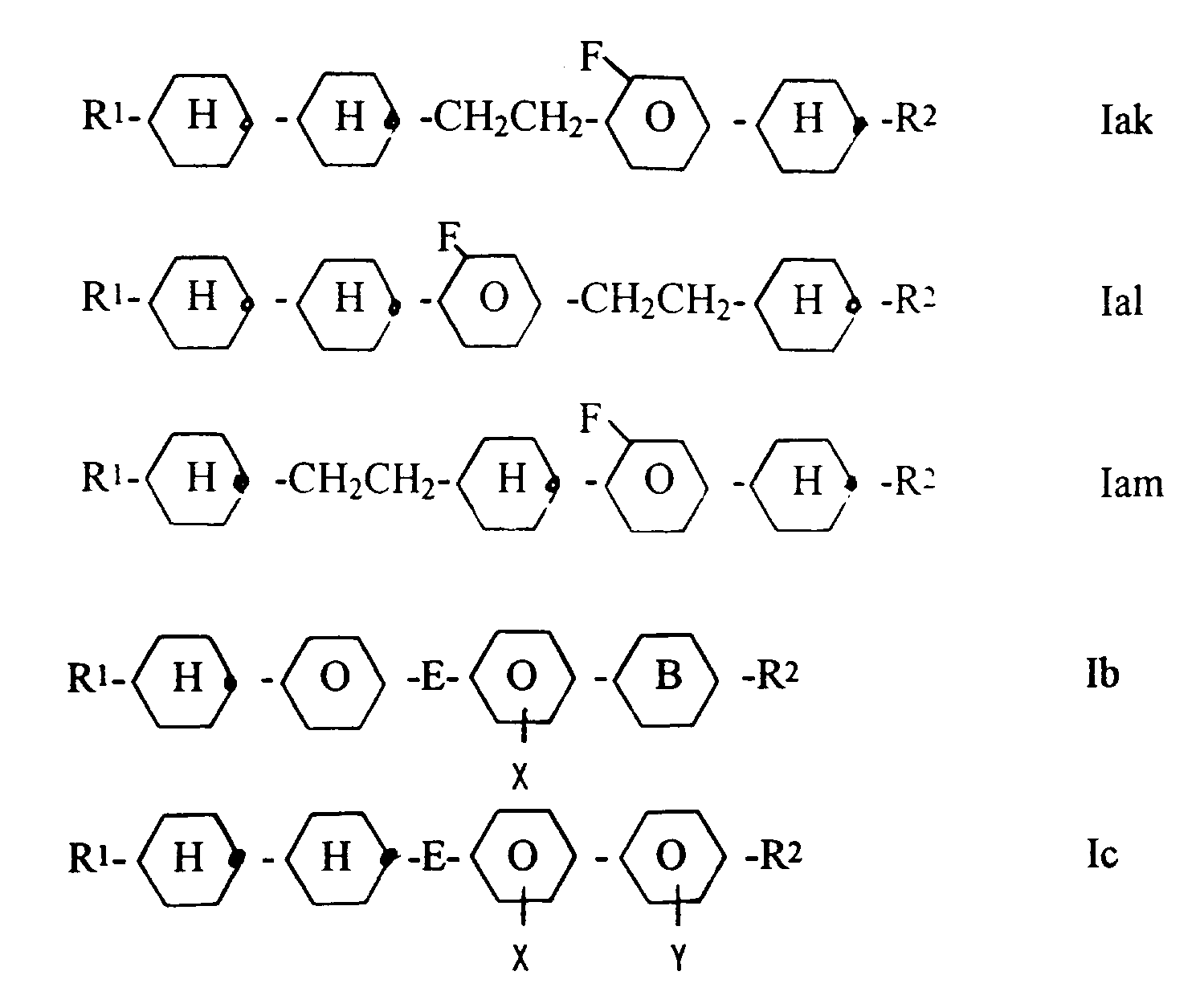
worin
die Reste E jeweils eine Einfachbindung oder einer der Reste E auch -CH₂CH₂-,
Ring B

R¹ und R² jeweils unabhängig voneinander n-Alkyl, worin auch eine CH₂-Gruppe durch -O-, -CHHal-, -CHal₂- oder -CH=CH- ersetzt sein kann und X und Y unabhängig H oder F bedeuten mit der Maßgabe, daß mindestens einer der und Molekül der Formel Ib und Ic vorhandenen Reste X und Y F bedeutet.The invention thus relates to a liquid-crystalline medium with a high specific resistance based on a mixture of polar compounds with a dielectric anisotropy of more than +1.5, characterized in that it contains one or more compounds selected from the group of the compounds of the formulas Iae to Iam, Contains Ib and Ic
wherein
the radicals E are each a single bond or one of the radicals E is also -CH₂CH₂-,
Ring B
R¹ and R² are each independently n-alkyl, in which a CH₂ group can also be replaced by -O-, -CHHal-, -CHal₂- or -CH = CH- and X and Y independently denote H or F with the proviso that that at least one of the and molecule of the formula Ib and Ic is X and YF.
Gegenstand der Erfindung sind auch elektrooptische Anzeigen (insbesondere MFK-Anzeigen mit zwei planparallelen Trägerplatten, die mit einer Umrandung eine Zelle bilden, integrierten nicht-linearen Elementen zur Schaltung einzelner Bildpunkte auf den Trägerplatten und einer in der Zelle befindlichen nematischen Flüssigkristallmischung mit positiver dielektrischer Anisotropie und hohem spezifischem Widerstand), die derartige Medien enthalten sowie die Verwendung dieser Medien für elektrooptische Zwecke.The invention also relates to electro-optical displays (in particular MLC displays with two plane-parallel carrier plates which form a cell with a border, integrated non-linear elements for switching individual pixels on the carrier plates and a nematic liquid crystal mixture in the cell with positive dielectric anisotropy and high resistivity) containing such media and the use of these media for electro-optical purposes.
Änliche Medien mit Verbindungen ohne Fluorsubstitution sind aus EP-A-84 974 bekannt. EP-A-256 636 beschreibt ähnliche Verbindungen mit lateraler Substitution am Phenylkern jedoch im Gegensatz zu den Verbindungen der Formeln Iae bis Iam, Ib und Ic mit terminal polarer Substitution durch F, Cl oder FC₃.Similar media with compounds without fluorine substitution are known from EP-A-84 974. EP-A-256 636 describes similar compounds with lateral substitution on the phenyl nucleus, however, in contrast to the compounds of the formulas Iae to Iam, Ib and Ic with terminal polar substitution by F, Cl or FC₃.
In der WO-A-88/0936 werden ähnliche Medien beschrieben. Diese basieren jedoch auf nitrilhaltigen Komponenten und weisen für MFK-Anzeigen keinen ausreichen hohen spezifischen Widerstand auf.Similar media are described in WO-A-88/0936. However, these are based on nitrile-containing components and do not have a sufficiently high specific resistance for MLC displays.
Die erfindungsgemäßen Flüssigkristallmischungen ermöglichen es bei niedrigen Viskositäten gleichzeitig Schwellenspannungen vorzugsweise ≦ 1,65 Volt, Klärpunkte oberhalb 60°, vorzugsweise oberhalb 65° und/oder einen hohen Wert für den spezifischen Widerstand zu erreichen, wodurch hervorragende MKF-Anzeigen erzielt werden können. Es versteht sich, daß durch geeignete Wahl der Komponenten der erfindungsgemäßen Mischungen auch höhere Klärpunkte (z.B. oberhalb 90°) bei höheren Schwellenspannung (Vth < 2,2 Volt) unter Erhalt der anderen vorteilhaften Eigenschaften realisiert werden können. Die erfindungsgemäßen MFK-Anzeigen arbeiten vorzugsweise im ersten Transmissionsminimum nach Gooch und Tarry [C.H. Gooch und H.A. Tarry, Electron. Lett. 10, 2-4, 1974; C.H. Gooch und H.A. Tarry, Appl. Phys., Vol. 8, 1575-1584, 1975], wobei hier neben besonders günstigen elektrooptischen Eigenschaften wie z.B. hohe Steilheit der Kennlinie und geringe Winkelabhängigkeit des Kontrastes (DE-PS 30 22 818) bei gleicher Schwellenspannung wie in einer analogen Anzeige im zweiten Minimum eine kleinerere dielektrische Anisotropie ausreichend ist. Hierdurch lassen sich unter Verwendung der erfindungsgemäßen Mischungen im ersten Minimum deutlich höhere spezifische Widerstände verwirklichen. Der Fachmann kann durch geeignete Wahl der einzelnen Komponenten und deren Gewichtsanteilen mit einfachen Routinemethoden die für eine vorgegebene Schichtdicke der MFK-Anzeige erforderliche Doppelbrechung einstellen.The liquid crystal mixtures according to the invention make it possible at the same time to achieve threshold voltages preferably ≦ 1.65 volts, clearing points above 60 °, preferably above 65 ° and / or a high value for the specific resistance at low viscosities, as a result of which excellent MKF displays can be achieved. It goes without saying that, by a suitable choice of the components of the mixtures according to the invention, higher clearing points (for example above 90 °) at higher threshold voltages (V th <2.2 volts) can be achieved while maintaining the other advantageous properties. The MFK displays according to the invention preferably operate in the first transmission minimum according to Gooch and Tarry [CH Gooch and HA Tarry, Electron. Lett. 10, 2-4, 1974; CH Gooch and HA Tarry, Appl. Phys., Vol. 8, 1575-1584, 1975], where in addition to particularly favorable electro-optical properties such as high steepness of the characteristic and low angle dependence of the contrast (DE-PS 30 22 818) same threshold voltage as in an analog display in the second minimum a smaller dielectric anisotropy is sufficient. As a result, significantly higher specific resistances can be achieved using the mixtures according to the invention in the first minimum. The person skilled in the art can set the birefringence required for a given layer thickness of the MLC display by means of suitable routine selection of the individual components and their proportions by weight.
Messungen des "Capacity Holding-ration" (HR) [S. Matsumoto et al., Liquid Crystals 5, 1320 (1989); K. Niwa et al., Proc. SID Conference, San Francisco, June 1984, p. 304 (1984); G. Weber et al., Liquid Crystals 5, 1381 (1989)] haben ergeben, daß erfindungsgemäße Mischungen enthaltend Verbindungen der Formel I eine deutlich kleinere Abnahme des HR mit steigender Temperatur aufweisen als analoge Mischungen enthaltend anstelle den Verbindungen der Formel I Cyanophenylcyclohexane der Formel

Auch die UV-Stabilität der erfindungegemäßen Mischungen ist erheblich besser, d. h. sie zeigen eine deutlich kleinere Abnahme des HR unter UV-Belastung.Capacity Holding Ration (HR) Measurements [p. Matsumoto et al., Liquid Crystals 5 , 1320 (1989); K. Niwa et al., Proc. SID Conference, San Francisco, June 1984, p. 304 (1984); G. Weber et al., Liquid Crystals 5 , 1381 (1989)] have shown that mixtures according to the invention containing compounds of the formula I have a significantly smaller decrease in HR with increasing temperature than analogous mixtures containing instead of the compounds of the formula I cyanophenylcyclohexanes of the formula
The UV stability of the mixtures according to the invention is also considerably better, ie they show a significantly smaller decrease in HR under UV exposure.
Die Viskosität bei 20 °C ist vorzugsweise ≦ 25 mPa.s. Der nematische Phasenbereich ist vorzugsweise mindestens 70°, insbesondere mindestens 80°. Vorzugsweise erstreckt sich dieser Bereich mindestens von -20° bis +70°.The viscosity at 20 ° C is preferably ≦ 25 mPa.s. The nematic phase range is preferably at least 70 °, in particular at least 80 °. This range preferably extends at least from -20 ° to + 70 °.
Die einzelnen Verbindungen der Formeln I bis XII und deren Unterformeln, die in den erfindungsgemäßen MFK-Anzeigen verwendet werden können, sind entweder bekannt, oder sie können analog zu den bekannten Verbindungen hergestellt werden.The individual compounds of the formulas I to XII and their sub-formulas which can be used in the MLC displays according to the invention are either known, or they can be prepared analogously to the known compounds.
Bevorzugte Ausführungsformen sind im folgenden angegeben:
- Medium enthält zusätzlich eine oder mehrere Verbindungen ausgewählt aus der Gruppe bestehend aus den allgemeinen Formeln II, III und IV:

- Medium enthält zusätzlich eine oder mehrere Verbindungen ausgewählt aus der Gruppe bestehend aus den allgemeinen Formeln V bis VIII:


- Medium enthält zusätzlich eine oder mehrere Verbindungen ausgewählt aus der Gruppe bestehend aus den allgemeinen Formeln IX bis XII:

- Der Anteil an Verbindungen der Formeln II bis IV zusammen beträgt im Gesamtgemisch mindestens 50 Gew.-%
- der Anteil an Verbindungen der Formeln Ia, Ib und Ic beträgt im Gesamtgemisch mindestens 10 Gew.-%
- der Anteil an Verbindungen der Formeln II bis IV im Gesamtgemisch beträgt 50 bis 70 Gew.-%
- Y in Formel I ist H

- das Medium enthält Verbindungen der Formeln II und III oder IV
- R ist geradkettiges Alkyl oder Alkenyl mit 2 bis 7 C-Atomen
- das Medium enthält weitere Verbindungen, vorzugsweise ausgewählt aus der folgenden Gruppe:
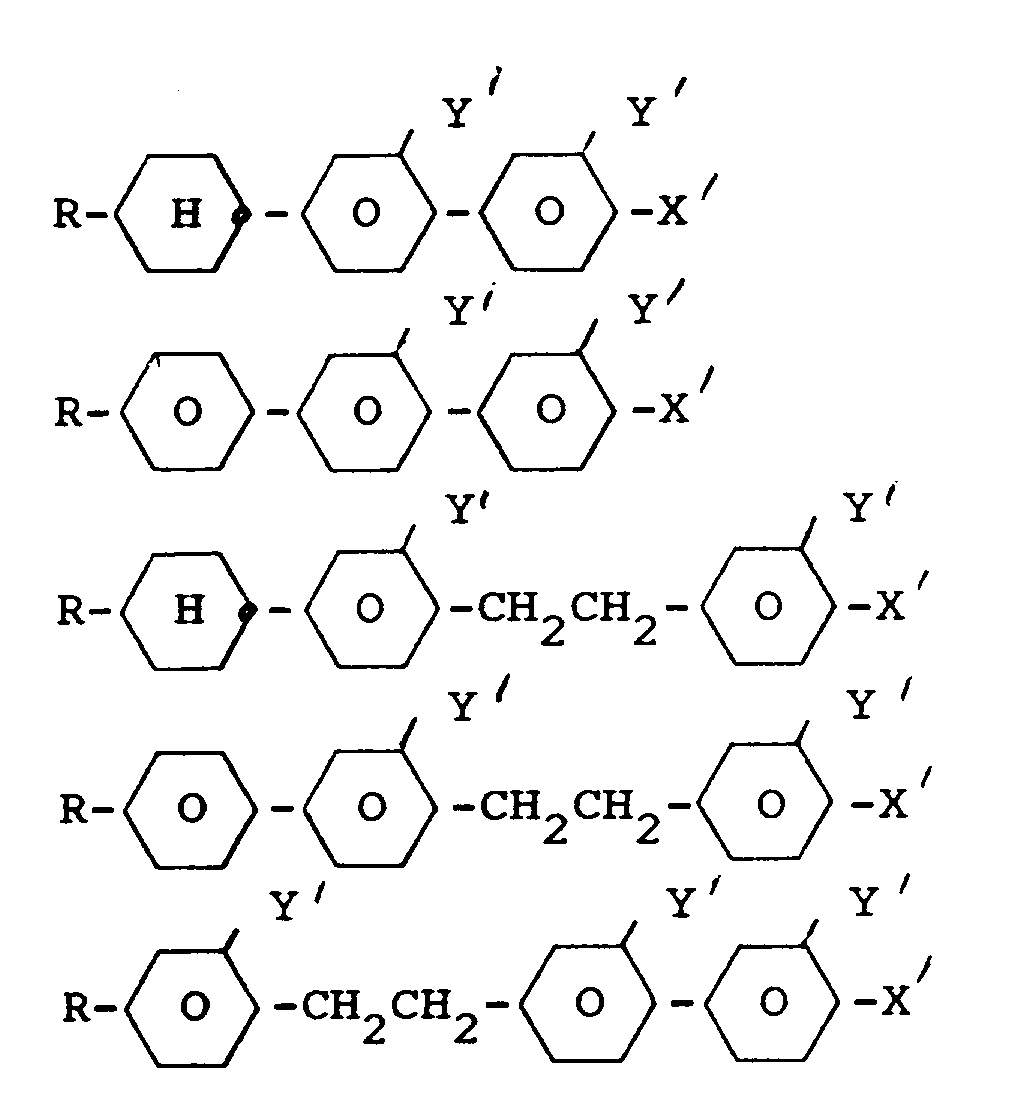

- Das Gewichtsverhältnis I: (II + III + IV) ist vorzugsweise 1 : 4 bis 1 : 1.
- Medium besteht im wesentlichen aus Verbindungen ausgewählt aus der Gruppe bestehend aus den allgemeinen Formeln I bis XII.
- Medium additionally contains one or more compounds selected from the group consisting of the general formulas II, III and IV:
- Medium additionally contains one or more compounds selected from the group consisting of the general formulas V to VIII:
- Medium additionally contains one or more compounds selected from the group consisting of the general formulas IX to XII:
- The proportion of compounds of the formulas II to IV together is at least 50% by weight in the mixture as a whole.
- the proportion of compounds of the formulas Ia, Ib and Ic in the mixture as a whole is at least 10% by weight
- the proportion of compounds of the formulas II to IV in the total mixture is 50 to 70% by weight
- Y in Formula I is H
- the medium contains compounds of the formulas II and III or IV
- R is straight-chain alkyl or alkenyl with 2 to 7 carbon atoms
- the medium contains further compounds, preferably selected from the following group:
- The weight ratio I: (II + III + IV) is preferably 1: 4 to 1: 1.
- Medium essentially consists of compounds selected from the group consisting of the general formulas I to XII.
Es wurde gefunden, daß bereits ein relativ geringer Anteil an Verbindungen der Formel I insbesondere im Gemisch mit einer oder mehreren Verbindungen der Formel II, III und/oder IV zu einer beträchtlichen Verbreiterung der Mesophase führt, wobei gleichzeitig breite nematische Phasen mit tiefen Übergangstemperaturen smektisch-nematisch beobachtet werden. Die Verbindungen der Formeln I bis IV sind farblos, stabil und untereinander und mit anderen Flüssigkristallmaterialien gut mischbar.It has been found that a relatively small proportion of compounds of the formula I, in particular in a mixture with one or more compounds of the formula II, III and / or IV, leads to a considerable broadening of the mesophase, with broad nematic phases with low transition temperatures being smectically be observed nematically. The compounds of the formulas I to IV are colorless, stable and readily miscible with one another and with other liquid crystal materials.
Der Ausdruck "Alkyl" umfaßt geradkettige und verzweigte Alkylgruppen mit 1-7 Kohlenstoffatomen, insbesondere die geradkettigen Gruppen Methyl, Ethyl, Propyl, Butyl, Pentyl, Hexyl und Heptyl. Gruppen mit 2-5 Kohlenstoffatomen sind im allgemeinen bevorzugt.The term "alkyl" encompasses straight-chain and branched alkyl groups having 1-7 carbon atoms, in particular the straight-chain groups methyl, ethyl, propyl, butyl, pentyl, hexyl and heptyl. Groups with 2-5 carbon atoms are generally preferred.
Der Ausdruck "Alkenyl" umfaßt geradkettige und verzweigte Alkenylgruppen mit 2-7 Kohlenstoffatomen, insbesondere die geradkettigen Gruppen. Besondere Alkenylgruppen sind C₂-C₇-1E-Alkenyl, C₄-C₇-3E-Alkenyl, C₅-C₇-4-Alkenyl, C₆-C₇-5-Alkenyl und C₇-6-Alkenyl, insbesondere C₂-C₇-1E-Alkenyl, C₄-C₇-3E-Alkenyl und C₅-C₇-4-Alkenyl. Beispiele bevorzugter Alkenylgruppen sind Vinyl, 1E-Propenyl, 1E-Butenyl, 1E-Pentenyl, 1E-Hexenyl, 1E-Heptenyl, 3-Butenyl, 3E-Pentenyl, 3E-Hexenyl, 3E-Heptenyl, 4-Pentenyl, 4Z-Hexenyl, 4E-Hexenyl, 4Z-Heptenyl, 5-Hexenyl, 6-Heptenyl und dergleichen. Gruppen mit bis zu 5 Kohlenstoffatomen sind im allgemeinen bevorzugt.The term "alkenyl" encompasses straight-chain and branched alkenyl groups having 2-7 carbon atoms, in particular the straight-chain groups. Particular alkenyl groups are C₂-C₇-1E-alkenyl, C₄-C₇-3E-alkenyl, C₅-C₇-4-alkenyl, C₆-C₇-5-alkenyl and C₇-6-alkenyl, in particular C₂-C₇-1E-alkenyl, C₄-C₇-3E-alkenyl and C₅-C₇-4-alkenyl. Examples of preferred alkenyl groups are vinyl, 1E-propenyl, 1E-butenyl, 1E-pentenyl, 1E-hexenyl, 1E-heptenyl, 3-butenyl, 3E-pentenyl, 3E-hexenyl, 3E-heptenyl, 4-pentenyl, 4Z-hexenyl, 4E-hexenyl , 4Z-heptenyl, 5-hexenyl, 6-heptenyl and the like. Groups of up to 5 carbon atoms are generally preferred.
Der Ausdruck "Fluoralkyl" umfaßt vorzugsweise geradkettige Gruppen mit endständigen Fluor, d.h. Fluormethyl, 2-Fluorethyl, 3-Fluorpropyl, 4-Fluorbutyl, 5-Fluorpentyl, 6-Fluorhexyl und 7-Fluorheptyl. Andere Positionen des Fluors sind jedoch nicht ausgeschlossen.The term "fluoroalkyl" preferably encompasses straight chain groups with terminal fluorine, i.e. Fluoromethyl, 2-fluoroethyl, 3-fluoropropyl, 4-fluorobutyl, 5-fluoropentyl, 6-fluorhexyl and 7-fluoroheptyl. However, other positions of the fluorine are not excluded.
Der Ausdruck "Oxaalkyl" umfaßt vorzugsweise geradkettige Reste der Formel CnH2n+1-O-(CH₂)m, worin n und m jeweils unabhängig voneinander 1 bis 6 bedeuten. Vorzugsweise ist n = 1 und m 1 bis 6.The term "oxaalkyl" preferably includes straight-chain radicals of the formula C n H 2n + 1 -O- (CH₂) m , in which n and m each independently represent 1 to 6. Preferably n = 1 and m is 1 to 6.
Durch geeignete Wahl der Bedeutungen von R, X und Y können die Ansprechzeiten` die Schwellenspannung, die Steilheit der Transmissionskennlinien etc. in gewünschter Weise modifiziert werden. Beispielsweise führen 1E-Alkenylreste, 3E-Alkenylreste, 2E-Alkenyloxyreste und dergleichen in der Regel zu kürzeren Ansprechzeiten, verbesserten nematischen Tendenzen und einem höheren Verhältnis der elastischen Konstanten k₃₃ (bend) und k₁₁ (splay) im Vergleich zu Alkyl- bzw. Alkoxyresten. 4-Alkenylreste, 3-Alkenylreste und dergleichen ergeben im allgemeinen tiefere Schwellenspannungen und kleinere Werte von k₃₃/k₁₁ im Vergleich zu Alkyl- und Alkoxyresten. Eine Gruppe -CH₂CH₂- in Z¹ bzw. Z² führt im allgemeinen zu höheren Werte von k₃₃/k₁₁ im Vergleich zu einer einfachen Kovalenzbindung. Höhere Werte von k₃₃/k₁₁ ermöglichen z.B. flachere Transmissionskennlinien in TN-Zellen mit 90° Verdrillung (zur Erzielung von Grautönen) und steilere Transmissionskennlinien in STN-, SBE- und OMI-Zellen (höhere Multiplexierbarkeit) und umgekehrt.By a suitable choice of the meanings of R, X and Y, the response times, the threshold voltage, the steepness of the transmission characteristics etc. can be modified in the desired manner. For example, 1E-alkenyl, 3E-alkenyl, 2E-alkenyloxy and the like usually lead to shorter response times, improved nematic tendencies and a higher ratio of the elastic constants k₃₃ (bend) and k₁₁ (splay) compared to alkyl or alkoxy. 4-alkenyl residues, 3-alkenyl residues and the like generally give lower threshold voltages and smaller values of k₃₃ / k₁₁ compared to alkyl and alkoxy residues. A group -CH₂CH₂- in Z¹ or Z² generally leads to higher values of k₃₃ / k₁₁ compared to a simple covalent bond. Higher values of k₃₃ / k₁₁ enable, for example, flatter transmission characteristics in TN cells with 90 ° twist (to achieve gray tones) and steeper transmission characteristics in STN, SBE and OMI cells (higher multiplexability) and vice versa.
Das optimale Mengenverhältnis der Verbindungen der Formeln I und II + III + IV hängt weitgehend von den gewünschten Eigenschaften, von der Wahl der Komponenten der Formeln I, II, III und/oder IV und von der Wahl weiterer gegebenenfalls vorhandener Komponenten ab. Geeignete Mengenverhältnisse innerhalb des oben angegebenen Bereichs können von Fall zu Fall leicht ermittelt werden.The optimal quantitative ratio of the compounds of the formulas I and II + III + IV largely depends on the desired properties, on the choice of the components of the formulas I, II, III and / or IV and on the choice of further components which may be present. Suitable proportions within the range given above can easily be determined from case to case.
Die Gesamtmenge an Verbindungen der Formeln I bis XII in den erfindungsgemaßen Gemischen ist nicht kritisch. Die Gemische können daher eine oder mehrere weitere Komponenten enthalten zwecks Optimierung verschiedener Eigenschaften. Der beobachtete Effekt auf die Ansprechzeiten und die Schwellenspannung ist jedoch in der Regel umso größer je höher die Gesamtkonzentration an Verbindungen der Formeln I bis XII ist.The total amount of compounds of the formulas I to XII in the mixtures according to the invention is not critical. The mixtures can therefore contain one or more further components in order to optimize various properties. However, the observed effect on the response times and the threshold voltage is generally greater the higher the total concentration of compounds of the formulas I to XII.
Die erfindungsgemäßen Medien können ferner eine Komponente A enthalten bestehend aus einer oder mehreren Verbindungen mit einer dielektrischen Anisotropie von -1,5 bis +1,5 der allgemeinen Formel I'

worin
- R¹ und R²
- jeweils unabhängig voneinander n-Alkyl, ω-Fluoralkyl oder n-Alkenyl mit bis zu 9 C-Atomen,
- die Ringe A¹, A² und A³
- jeweils unabhängig voneinander 1,4-Phenylen, 2- oder 3-Fluor-1,4-phenylen, trans-1,4-Cyclohexylen oder 1,4-Cyclohexenylen,
- Z¹ und Z²
- jeweils unabhängig voneinander -CH₂CH₂-oder eine Einfachbindung,
- m
- 0, 1 oder 2 bedeutet.
wherein
- R1 and R2
- each independently of one another n-alkyl, ω-fluoroalkyl or n-alkenyl with up to 9 C atoms,
- the rings A¹, A² and A³
- each independently 1,4-phenylene, 2- or 3-fluoro-1,4-phenylene, trans-1,4-cyclohexylene or 1,4-cyclohexenylene,
- Z¹ and Z²
- each independently of one another -CH₂CH₂-or a single bond,
- m
- 0, 1 or 2 means.
Komponente A enthält vorzugsweise eine oder mehrere Verbindungen ausgewählt aus der Gruppe bestehend aus II1 bis II7:
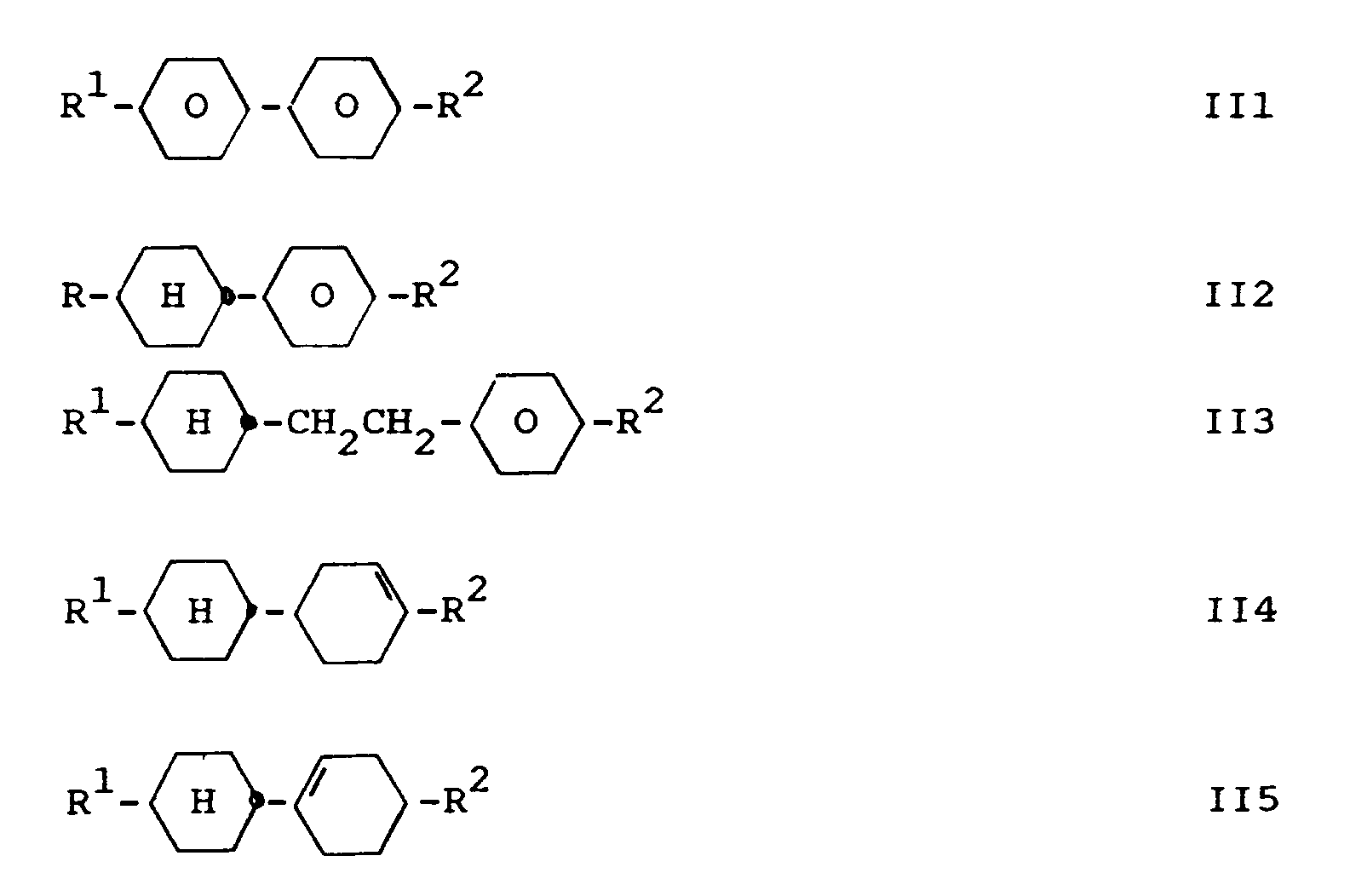

worin R¹ und R² die bei Formel I' angegebene Bedeutung haben.Component A preferably contains one or more compounds selected from the group consisting of II1 to II7:
wherein R¹ and R² have the meaning given for formula I '.
Vorzugsweise enthält Komponente A zusätzlich eine oder mehrere Verbindungen ausgewählt aus der Gruppe bestehend aus II8 bis II20:


worin R¹ und R² die bei Formel I' angegebene Bedeutung haben und die 1,4-Phenylengruppen in II8 bis II17 jeweils unabhängig voneinander auch durch Fluor ein- oder mehrfach substituiert sein können.Component A preferably additionally contains one or more compounds selected from the group consisting of II8 to II20:
wherein R¹ and R² have the meaning given in formula I 'and the 1,4-phenylene groups in II8 to II17 can each be substituted independently or independently by fluorine.
Ferner enthält Komponente A vorzugsweise zusätzlich eine oder mehrere Verbindungen ausgewählt aus der Gruppe bestehend aus II21 bis II25 enthält:


worin R¹ und R² die bei Formel I' angegebene Bedeutung haben und die 1,4-Phenylengruppen in II21 bis II25 jeweils unabhängig voneinander auch durch Fluor ein- oder mehrfach substituiert sein können.Component A also preferably additionally contains one or more compounds selected from the group consisting of II21 to II25:
wherein R¹ and R² have the meaning given in formula I 'and the 1,4-phenylene groups in II21 to II25 can each be substituted independently or independently by fluorine.
Schließlich sind derartige Mischungen bevorzugt, deren Komponente A eine oder mehrere Verbindungen ausgewählt aus der Gruppe bestehend aus II26 und II27 enthält:

worin CrH2r+1 eine geradkettige Alkylgruppe mit bis zu 7 C-Atomen ist.Finally, mixtures of this type are preferred whose component A contains one or more compounds selected from the group consisting of II26 and II27:
wherein C r H 2r + 1 is a straight-chain alkyl group with up to 7 C atoms.
In einigen Fällen erweist sich der Zusatz von Verbindungen der Formel

worin
- R¹ und R²
- die bei Formel I' angegebene Bedeutung haben
- Z⁰
- eine Einfachbindung, -CH₂CH₂-,

zur Unterdrückung smektischer Phasen als vorteilhaft, obwohl hierdurch der spezifische Widerstand erniedrigt werden kann. Zur Erzielung von für die Anwendung optimaler Parameterkombinationen kann der Fachmann leicht feststellen, ob und falls ja in welcher Menge diese Verbindungen zugesetzt sein können. Normalerweise werden weniger als 15 %, insbesondere 5-10 % verwendet.In some cases the addition of compounds of the formula proves to be
wherein
- R1 and R2
- have the meaning given in formula I '
- Z⁰
- a single bond, -CH₂CH₂-,
to suppress smectic phases as advantageous, although this can lower the specific resistance. In order to achieve optimal combinations of parameters for the application, the person skilled in the art can easily determine whether and if so in what amount these compounds can be added. Usually less than 15%, especially 5-10% is used.
Ferner bevorzugt sind Flüssigkristallmischungen, die eine oder mehrere Verbindungen ausgewählt aus der Gruppe bestehend aus III' und IV' enthalten:

worin R¹ und R² die bei Formel I' angegebene Bedeutung haben.Also preferred are liquid crystal mixtures which contain one or more compounds selected from the group consisting of III 'and IV':
wherein R¹ and R² have the meaning given for formula I '.
Der Aufbau der erfindungsgemäßen MFK-Anzeige aus Polarisatoren, Elektrodengrundplatten und Elektroden mit Oberflächenbehandlung entspricht der für derartige Anzeigen üblichen Bauweise. Dabei ist der Begriff der üblichen Bauweise hier weit gefaßt und umfaßt auch alle Abwandlungen und Modifikationen der MFK-Anzeige, insbesondere auch Matrix-Anzeigeelemente auf Basis poly-Si TFT oder MIM.The construction of the MFK display according to the invention from polarizers, electrode base plates and electrodes with surface treatment corresponds to the design customary for such displays. The term is the usual one The construction here is broad and also includes all modifications and modifications of the MLC display, in particular also matrix display elements based on poly-Si TFT or MIM.
Ein wesentlicher Unterschied der erfindungsgemäßen Anzeigen zu den bisher üblichen auf der Basis der verdrillten nematischen Zelle besteht jedoch in der Wahl der Flüssigkristallparameter der Flüssigkristallschicht.A significant difference between the displays according to the invention and those previously used on the basis of the twisted nematic cell, however, is the choice of the liquid crystal parameters of the liquid crystal layer.
Die Herstellung der erfindungsgemäß verwendbaren Flüssigkristallmischungen erfolgt in an sich üblicher Weise. In der Regel wird die gewünschte Menge der in geringerer Menge verwendeten Komponenten in der den Hauptbestandteil ausmachenden Komponenten gelöst, zweckmäßig bei erhöhter Temperatur. Es ist auch möglich, Lösungen der Komponenten in einem organischen Lösungsmittel, z.B. in Aceton, Chloroform oder Methanol, zu mischen und das Lösungsmittel nach Durchmischung wieder zu entfernen, beispielsweise durch Destillation.The liquid crystal mixtures which can be used according to the invention are prepared in a manner which is conventional per se. As a rule, the desired amount of the components used in smaller amounts is dissolved in the components which make up the main constituent, advantageously at elevated temperature. It is also possible to use solutions of the components in an organic solvent, e.g. in acetone, chloroform or methanol, and to remove the solvent after mixing, for example by distillation.
Die erfindungsgemäßen Medien enthalten vorzugsweise
- a) mindestens 10 Gew.% einer flüssigkristallinen Komponente B bestehend aus einer oder mehreren Verbindungen mit einer dielektrischen Anisotropie von über +1,5,
- b) bis zu 90 Gew.% einer flüssigkristallinen Komponente A bestehend aus einer oder mehreren Verbindungen mit einer dielektrischen Anisotropie von -1,5 bis +1,5 der allgemeinen Formel I

- R¹ und R²
- jeweils unabhängig voneinander n-Alkyl, ω-Fluoralkyl oder n-Alkenyl mit bis zu 9 C-Atomen,
- die Ringe A¹, A² und A³
- jeweils unabhängig voneinander 1,4-Phenylen, 2- oder 3-Fluor-1,4-phenylen, trans-1,4-Cyclohexylen oder 1,4-Cyclohexenylen,
- Z¹ und Z²
- jeweils unabhängig voneinander -CH₂CH₂-oder eine Einfachbindung,
- m
- 0, 1 oder 2 bedeutet, und
- c) 0 bis 20 Gew.% einer flüssigkristallinen Komponente C bestehend aus einer oder mehreren Verbindungen mit einer dielektrischen Anisotropie von unter -1,5 enthält,

worin
die Reste E jeweils eine Einfachbindung oder einer der Reste E auch -CH₂CH₂-, und L¹ oder L² H und einer der Reste L¹ und L² Fluor bedeutet,
und die nematische Flüssigkristallmischung einen nematischen Phasenbereich von mindestens 60 °C, eine Viskosität bei 20 °C von maximal 30 mPa.s und eine mittlere Dielektrizitätskonstante
- a) at least 10% by weight of a liquid-crystalline component B consisting of one or more compounds with a dielectric anisotropy of more than +1.5,
- b) up to 90% by weight of a liquid-crystalline component A consisting of one or more compounds having a dielectric anisotropy of -1.5 to +1.5 of the general formula I
- R1 and R2
- each independently of one another n-alkyl, ω-fluoroalkyl or n-alkenyl with up to 9 C atoms,
- the rings A¹, A² and A³
- each independently 1,4-phenylene, 2- or 3-fluoro-1,4-phenylene, trans-1,4-cyclohexylene or 1,4-cyclohexenylene,
- Z¹ and Z²
- each independently of one another -CH₂CH₂-or a single bond,
- m
- 0, 1 or 2 means, and
- c) 0 to 20% by weight of a liquid-crystalline component C consisting of one or more compounds with a dielectric anisotropy of less than -1.5,
wherein
the radicals E are each a single bond or one of the radicals E is also -CH₂CH₂-, and L¹ or L² H and one of the radicals L¹ and L² is fluorine,
and the nematic liquid crystal mixture has a nematic phase range of at least 60 ° C, a viscosity at 20 ° C of at most 30 mPa.s and an average dielectric constant
Gegenstand der Erfindung ist somit auch eine MFK-Anzeige mit
- zwei planparallelen Trägerplatten, die mit einer Umrandung eine Zelle bilden,
- integrierten nicht-linearen Elementen zur Schaltung einzelner Bildpunkte auf den Trägerplatten und
- einer in der Zelle befindlichen nematischen Flüssigkristallmischung mit positiver dielektrischer Anisotropie und hohem spezifischem Widerstand,
- a) mindestens 10 Gew.% einer flüssigkristallinen Komponente B bestehend aus einer oder mehreren Verbindungen mit einer dielektrischen Anisotropie von über +1,5,
- b) bis zu 90 Gew.% einer flüssigkristallinen Komponente A bestehend aus einer oder mehreren Verbindungen mit einer dielektrischen Anisotropie von -1,5 bis +1,5 der allgemeinen Formel I

- R¹ und R²
- jeweils unabhängig voneinander n-Alkyl, ω-Fluoralkyl oder n-Alkenyl mit bis zu 9 C-Atomen,
- die Ringe A¹, A² und A³
- jeweils unabhängig voneinander 1,4-Phenylen, 2- oder 3-Fluor-1,4-phenylen, trans-1,4-Cyclohexylen oder 1,4-Cyclohexenylen,
- Z¹ und Z²
- jeweils unabhängig voneinander -CH₂CH₂-oder eine Einfachbindung,
- m
- 0, 1 oder 2 bedeutet, und
- c) 0 bis 20 Gew.% einer flüssigkristallinen Komponente C bestehend aus einer oder mehreren Verbindungen mit einer dielektrischen Anisotropie von unter -1,5,
wobei die Komponente A eine oder mehrere Verbindungen der Teilformel Ia enthält
die Reste E jeweils eine Einfachbindung oder einer der Reste E auch -CH₂CH₂-, und L¹ oder L² H und einer der Reste L¹ und L² Fluor bedeutet,
und die nematische Flüssigkristallmischung einen nematischen Phasenbereich von mindestens 60 °C, eine Viskosität bei 20 °C von maximal 30 mPa.s und eine mittlere Dielektrizitätskonstante ε ≦ 8 aufweist.
- two plane-parallel carrier plates, which form a cell with a border,
- integrated non-linear elements for switching individual pixels on the carrier plates and
- a nematic liquid crystal mixture in the cell with positive dielectric anisotropy and high specific resistance,
- a) at least 10% by weight of a liquid-crystalline component B consisting of one or more compounds with a dielectric anisotropy of more than +1.5,
- b) up to 90% by weight of a liquid-crystalline component A consisting of one or more compounds having a dielectric anisotropy of -1.5 to +1.5 of the general formula I
- R1 and R2
- each independently of one another n-alkyl, ω-fluoroalkyl or n-alkenyl with up to 9 C atoms,
- the rings A¹, A² and A³
- each independently 1,4-phenylene, 2- or 3-fluoro-1,4-phenylene, trans-1,4-cyclohexylene or 1,4-cyclohexenylene,
- Z¹ and Z²
- each independently of one another -CH₂CH₂-or a single bond,
- m
- 0, 1 or 2 means, and
- c) 0 to 20% by weight of a liquid-crystalline component C consisting of one or more compounds with a dielectric anisotropy of less than -1.5,
wherein component A contains one or more compounds of sub-formula Ia
the radicals E are each a single bond or one of the radicals E is also -CH₂CH₂-, and L¹ or L² H and one of the radicals L¹ and L² is fluorine,
and the nematic liquid crystal mixture has a nematic phase range of at least 60 ° C, a viscosity at 20 ° C of at most 30 mPa.s and an average dielectric constant ε ≦ 8.
Gegenstand der Erfindung sind auch entsprechende Flüssigkristallmischungen, insbesondere zur Verwendung in MFK-Anzeigen. Die Mischungen eignen sich jedoch auch für viele andere Anwendungen, wie z.B. TN, STN oder OMI.The invention also relates to corresponding liquid crystal mixtures, in particular for use in MLC displays. However, the mixtures are also suitable for many other applications, such as TN, STN or OMI.
Der spezifische Widerstand von Flüssigkristallmischungen ist im allgemeinen hoch, wenn die dielektrische Anisotropie klein ist, da die in Mischungen mit hohem Δε vorhandenen polaren Komponenten stabilisierend auf Ionen wirken und somit eine hohe Leitfähigkeit bzw. einen niedrigen Widerstand bedingen. Es wurde nun überraschend gefunden, daß der spezifische Widerstand dann besonders hoch ist, wenn die mittlere Dielektrizitätskonstante
Komponente B kann jedoch auch im wesentlichen nur aus nitrilhaltigen Verbindungen bestehen, wobei diejenigen Verbindungen der Formeln IIa bis IIf mit X = CN bevorzugt sind. In diesem Fall besteht die Flüssigkristallmischung im wesentlichen aus den Komponenten A, B und C, bzw. A und B.However, component B can also consist essentially only of compounds containing nitrile, those compounds of the formulas IIa to IIf with X = CN being preferred. In this case, the liquid crystal mixture consists essentially of components A, B and C, or A and B.
Besonders bevorzugt sind Flüssigkristallmischungen enthaltend nitrilhaltige und nitrilfreie, fluorierte Verbindungen, wobei letztere vorzugsweise den Formeln IIa bis IIf entsprechen, worin X F, Cl, -CF₃, -CHF₂, -OCF₃, -OCHF₂, -OCF₂CF₂H oder -OC₂F₅ bedeutet.Liquid crystal mixtures containing nitrile-containing and nitrile-free fluorinated compounds are particularly preferred, the latter preferably corresponding to the formulas IIa to IIf, where X is F, Cl, -CF₃, -CHF₂, -OCF₃, -OCHF₂, -OCF₂CF₂H or -OC₂F₅.
Das Verhältnis nitrilfreie : nitrilhaltige Verbindungen aus Komponente B ist vorzugsweise > 1 : 1, insbesondere > 2 : 1. Besonders bevorzugte Bereiche sind 2,5 : 1 bis 6 : 1.The ratio of nitrile-free: nitrile-containing compounds from component B is preferably> 1: 1, in particular> 2: 1. Particularly preferred ranges are 2.5: 1 to 6: 1.
Ganz besonders bevorzugt sind jedoch Flüssigkristallmischungen, deren Komponente B im wesentlichen aus nitrilfreien, fluorierten Verbindungen besteht. Vorzugsweise kommen die oben genannten bevorzugten Verbindungen der Formeln IIa bis IIf zum Einsatz.However, liquid crystal mixtures whose component B consists essentially of nitrile-free, fluorinated compounds are very particularly preferred. The abovementioned preferred compounds of the formulas IIa to IIf are preferably used.
'Im wesentlichen' soll bedeuten, daß der Anteil weiterer Verbindungen in der entsprechenden Komponente ≦ 20 %, insbesondere ≦ 10 % ist.'Essentially' is intended to mean that the proportion of further compounds in the corresponding component is ≦ 20%, in particular ≦ 10%.
Weiterhin bevorzugt sind Flüssigkristallmischungen deren Komponente B terminal chlorierte Verbindungen enthält. Derartige Verbindungen sind dem Fachmann bekannt und entsprechen vorzugsweise den Formeln IIa bis IIf und mit X = Cl. In einer besonders bevorzugten Ausführungsform enthalten die Mischungen eine oder mehrere Verbindungen der Formel IIa bis IIf, worin A²-X bzw.

mit X = CF₃, -OCF₃, - OCHF₂ oder Cl bedeutet. Komponente B kann ferner noch 4-kernige Verbindungen enthalten, z.B. entsprechend den Formeln IIc bis IIf, worin einer der Ringe X¹ bis A³ doppelt vorhanden ist.Also preferred are liquid crystal mixtures whose component B contains terminally chlorinated compounds. Such compounds are known to the person skilled in the art and preferably correspond to the formulas IIa to IIf and where X = Cl. In a particularly preferred embodiment, the mixtures comprise one or more compounds of the formulas IIa to IIf, in which A²-X or
with X = CF₃, -OCF₃, - OCHF₂ or Cl means. Component B may also contain 4-nucleus compounds, for example according to the formulas IIc to IIf, in which one of the rings X¹ to A³ is present twice.
In einer besonders bevorzugten Ausführungsform enthalten die Mischungen Verbindungen mit terminalem Nitril in einem Anteil von 0 bis 50 Gew. % in Komponente B. Besonders bevorzugt sind Mischungen, die keine Verbindungen mit terminalem Nitril enthalten. Überraschenderweise wurde gefunden, daß Gruppen wie -OCF₃, -OCHF₂, -OCF₂CF₂H oder -OC₂F₅ Ionen in den Displays bedeutend weniger stabilisieren als -OCH₃ bzw. -OC₂H₅. Dasselbe gilt auch für aliphatisch gebundenes Alkoxy (Verbindungen der Formeln III und IV).In a particularly preferred embodiment, the mixtures contain compounds with terminal nitrile in a proportion of 0 to 50% by weight in component B. Mixtures which contain no compounds with terminal nitrile are particularly preferred. Surprisingly, it was found that groups such as -OCF₃, -OCHF₂, -OCF₂CF₂H or -OC₂F₅ stabilize ions in the displays significantly less than -OCH₃ or -OC₂H₅. The same also applies to aliphatic alkoxy (compounds of the formulas III and IV).
Die erfindungsgemaßen Mischungen haben vorzugsweise einen spezifischen Widerstand bei 20° von ≧ 10¹² Ω . cm, insbesondere bevorzugt > 10¹³ Ω . cm. Das mittlere ε ist vorzugsweise ≦ 7, insbesondere bevorzugt ≦ 5.The mixtures according to the invention preferably have a specific resistance at 20 ° of ≧ 10 12 Ω. cm, particularly preferably> 10 13 Ω. cm. The mean ε is preferably ≦ 7, particularly preferably ≦ 5.
Die Werte der dielektrischen Anisotropie der einzelnen Verbindungen der Komponenten A bis C werden bei 20° bestimmt durch Extrapolation aus einer polaren Mischung (enthaltend 24 % p-trans-4-Propylcyclohexylbenzonitril, 36 % p-trans-4-Pentylcyclohexylbenzonitril, 25 % p-trans-4-Heptylcyclohexylbenzonitril und 15 % 4-Cyan-4'-(trans-4-pentylcyclohexyl)-biphenyl) falls die zu bestimmende Verbindung einen Dipol in der Längsachse des Moleküls enthält, bzw. aus einer neutralen Mischung (enthaltend 22 % trans-1-p-Ethylphenyl-4-propylcyclohexan, 20 % trans-1-p-Methoxyphenyl-1-propylcyclohexan, 15 % trans-1-p-Ethoxyphenyl-4-propylcyclohexan, 19 % 4-Ethyl-4-(trans-4-propylcyclohexyl)-biphenyl, 14 % 4-Ethyl-4'-(trans-4-pentylcyclohexyl)-biphenyl, 5 % 4,4'-Bis-(trans-4-propylcyclohexyl)-biphenyl und 5 % 4(trans-4-Pentylcyclohexyl)-4'-(trans-4-propylcyclohexyl)-biphenyl) bei neutralen Verbindungen.The dielectric anisotropy values of the individual compounds of components A to C are determined at 20 ° by extrapolation from a polar mixture (containing 24% p-trans-4-propylcyclohexylbenzonitrile, 36% p-trans-4-pentylcyclohexylbenzonitrile, 25% p- trans-4-heptylcyclohexylbenzonitrile and 15% 4-cyano-4 '- (trans-4-pentylcyclohexyl) biphenyl) if the compound to be determined contains a dipole in the longitudinal axis of the molecule, or from a neutral mixture (containing 22% trans -1-p-ethylphenyl-4-propylcyclohexane, 20% trans-1-p-methoxyphenyl-1-propylcyclohexane, 15% trans-1-p-ethoxyphenyl-4-propylcyclohexane, 19% 4-ethyl-4- (trans- 4-propylcyclohexyl) biphenyl, 14% 4-ethyl-4 '- (trans-4-pentylcyclohexyl) biphenyl, 5% 4,4'-bis (trans-4-propylcyclohexyl) biphenyl and 5% 4 (trans -4-Pentylcyclohexyl) -4 '- (trans-4-propylcyclohexyl) biphenyl) for neutral compounds.
Die erfindungsgemäßen Flüssigkristallmischungen ermöglichen es bei niedrigen Viskositäten gleichzeitig einen hohen Wert für den spezifischen Widerstand zu erreichen, wodurch hervorragende MKF-Anzeigen erzielt werden können. Die erfindungsgemäßen MFK-Anzeigen arbeiten vorzugsweise im ersten Transmissionsminimum nach Gooch und Tarry [C.H. Gooch und H.A. Tarry, Electron. Lett. 10, 2-4, 1974; C.H. Gooch und H.A. Tarry, Appl. Phys., Vol. 8, 1575-1584, 1975], wobei hier neben besonders günstigen elektrooptischen Eigenschaften wie z.B. hohe Steilheit der Kennlinie und geringe Winkelabhängigkeit des Kontrastes (DE-PS 30 22 818) bei gleicher Schwellenspannung wie in einer analogen Anzeige im zweiten Minimum eine kleinerere dielektrische Anisotropie ausreichend ist. Hierdurch lassen sich unter Verwendung der erfindungsgemäßen Mischungen im ersten Minimum deutlich höhere spezifische Widerstände verwirklichen.The liquid crystal mixtures according to the invention make it possible at the same time to achieve a high value for the specific resistance at low viscosities, which enables excellent MKF ads to be achieved. The MFK displays according to the invention preferably operate in the first transmission minimum according to Gooch and Tarry [CH Gooch and HA Tarry, Electron. Lett. 10, 2-4, 1974; CH Gooch and HA Tarry, Appl. Phys., Vol. 8, 1575-1584, 1975], where in addition to particularly favorable electro-optical properties such as high slope of the characteristic and low angle dependence of the contrast (DE-PS 30 22 818) with the same threshold voltage as in an analog display in the second At least a smaller dielectric anisotropy is sufficient. As a result, significantly higher specific resistances can be achieved using the mixtures according to the invention in the first minimum.
Die Viskosität bei 20 °C ist vorzugsweise ≦ 25 mPa.s. Der nematische Phasenbereich ist vorzugsweise mindestens 70°, insbesondere mindestens 80°. Vorzugsweise erstreckt sich dieser Bereich mindestens von -20° bis +70°.The viscosity at 20 ° C is preferably ≦ 25 mPa.s. The nematic phase range is preferably at least 70 °, in particular at least 80 °. This range preferably extends at least from -20 ° to + 70 °.
Die einzelnen Verbindungen der Formeln I bis IV und deren Unterformeln, die in den erfindungsgemäßen MFK-Anzeigen verwendet werden können, sind entweder bekannt, oder sie können analog zu den bekannten Verbindungen hergestellt werden.The individual compounds of the formulas I to IV and their sub-formulas which can be used in the MLC displays according to the invention are either known, or they can be prepared analogously to the known compounds.
Bevorzugte erfindungsgemäß verwendbare Flüssigkristallmischungen enthalten insgesamt vorzugsweise 10 % bis 90 %, insbesondere 20 % bis 90 % an Verbindungen der Formel I. Falls Komponente B nicht überwiegend aus stark dielektrisch positiven Nitrilkomponenten zusammengesetzt ist, sondern überwiegend nur schwach dielektrisch positive Verbindungen wie zum Beispiel die im folgenden angegebenen fluorierten Verbindungen enthält, kann Komponente A unter Umständen ganz entfallen und die erfindungsgemäßen Mischungen in dieser besonderen Ausführungsform lediglich auf Komponente B und ggf. Komponente C basieren. Besonders bevorzugt sind Flüssigkristallmischungen, deren Komponente B eine oder mehrere Verbindungen ausgewählt aus der Gruppe bestehend aus Verbindungen der Formeln IIa bis IIf enthält,
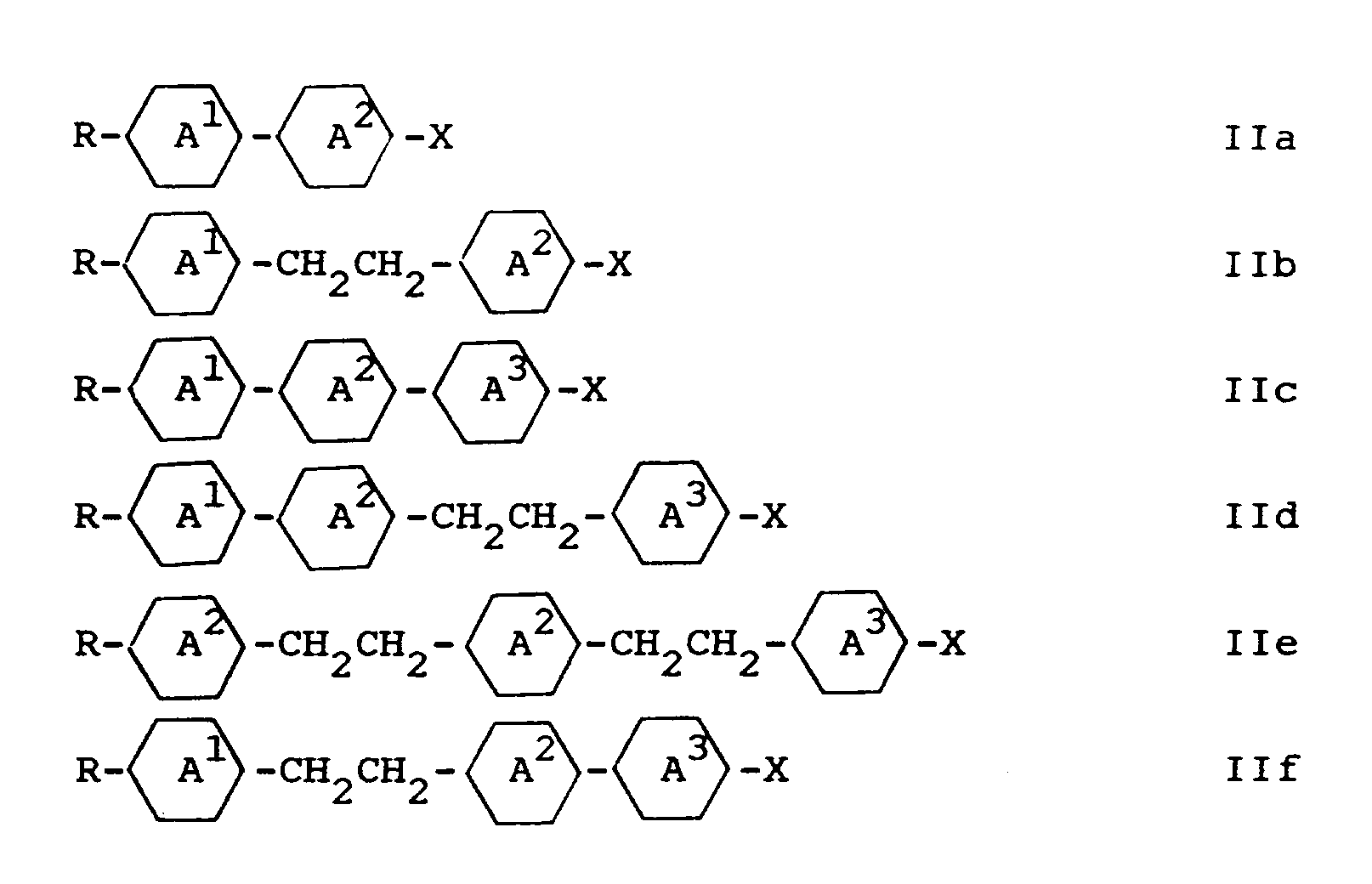
worin
- R
- n-Alkyl oder n-Alkenyl mit bis zu 9 C-Atomen,
- X
- Cyan, -NCS, F, Cl, -CF₃, -CHF₂, -OCF₃, -OCHF₂, -OCF₂CF₂H oder -OC₂F₅, und
- die Ringe A¹, A² und A³
- jeweils unabhängig voneinander 1,4-Phenylen, 2- oder 3-Fluor-1,4-phenylen, 2,3-Difluor-1,4-phenylen, trans-1,4-Cyclohexylen oder 1,4-Cyclohexenylen bedeuten.
wherein
- R
- n-alkyl or n-alkenyl with up to 9 carbon atoms,
- X
- Cyan, -NCS, F, Cl, -CF₃, -CHF₂, -OCF₃, -OCHF₂, -OCF₂CF₂H or -OC₂F₅, and
- the rings A¹, A² and A³
- each independently mean 1,4-phenylene, 2- or 3-fluoro-1,4-phenylene, 2,3-difluoro-1,4-phenylene, trans-1,4-cyclohexylene or 1,4-cyclohexenylene.
Vorzugsweise enthält Komponente B Verbindungen der Formeln IIa bis IIf, worin X Cyan bedeutet, und Verbindungen der Formeln IIa bis IIf, worin X -NCS, F, Cl, -CF₃, -CHF₂, -OCF₃, -OCHF₂, -OCF₂CF₂H oder -OC₂F₅ bedeutet, und der Anteil der Cyanverbindungen in Komponente B beträgt 0 bis 50 Gew.%.Component B preferably contains compounds of the formulas IIa to IIf, in which X is cyan, and compounds of the formulas IIa to IIf, in which X is -NCS, F, Cl, -CF₃, -CHF₂, -OCF₃, -OCHF₂, -OCF₂CF₂H or -OC₂F₅ means, and the proportion of the cyan compounds in component B is 0 to 50 wt.%.
In einer besonders bevorzugten Ausführungsform enthält Komponente B keine Verbindungen der Formeln IIa bis IIf, worin X Cyan bedeutet.In a particularly preferred embodiment, component B contains no compounds of the formulas IIa to IIf in which X is cyan.
In den Verbindungen der Teilformeln IIa bis IIf bedeutet X vorzugsweise F, Cl, CF₃, -OCF₃, -OCHF₂ oder CHF₂.In the compounds of partial formulas IIa to IIf, X is preferably F, Cl, CF₃, -OCF₃, -OCHF₂ or CHF₂.
Die Ringe A¹, A² und A³ bedeuten vorzugsweise jeweils unabhängig voneinander trans-1,4-Cyclohexylen oder 1,4-Phenylen. Einer der Ringe A¹, A² und A³ ist in einer bevorzugten Ausführungsform 2- oder 3-Fluor-1,4-phenylen oder 2,3-Difluor-1,4-phenylen. Der mit X verbundene Ring (d.h. A² in IIa und IIb bzw. A³ in IIc bis IIf) ist vorzugsweise 1,4-Phenylen, welches ggf. auch durch Fluor ein- oder zweifach substituiert sein kann. A²-X bzw. A³-X ist vorzugsweise eine Gruppe ausgewählt aus den Formeln (a) bis (h):

wobei (a), (b), (d), (f), (g) und (h) besonders bevorzugt sind.The rings A¹, A² and A³ each preferably independently of one another are trans-1,4-cyclohexylene or 1,4-phenylene. In one preferred embodiment, one of the rings A1, A2 and A3 is 2- or 3-fluoro-1,4-phenylene or 2,3-difluoro-1,4-phenylene. The ring connected to X (ie A² in IIa and IIb or A³ in IIc to IIf) is preferably 1,4-phenylene, which can optionally also be mono- or disubstituted by fluorine. A²-X or A³-X is preferably a group selected from the formulas (a) to (h):
with (a), (b), (d), (f), (g) and (h) being particularly preferred.
Besonders bevorzugte kleinere Gruppen von Verbindungen sind im folgenden angegeben:

In den Teilformeln IIa1 bis IIf3 bedeutet R jeweils n-Alkyl oder n-Alkenyl mit bis zu 9 C-Atomen. Y und Z sind jeweils unabhängig voneinander H oder F, wobei jedoch vorzugsweise einer oder zwei der Reste Y und Z Fluor bedeuten. X ist jedoch vorzugsweise F, Cl, -CF₃ , -OCF₃ oder -OCHF₂.Particularly preferred smaller groups of compounds are given below:
In the partial formulas IIa1 to IIf3, R in each case denotes n-alkyl or n-alkenyl having up to 9 carbon atoms. Y and Z are each independently of one another H or F, but preferably one or two of the radicals Y and Z are fluorine. However, X is preferably F, Cl, -CF₃, -OCF₃ or -OCHF₂.
Komponente B macht vorzugsweise 10 % bis 100 %, insbesondere 20 % bis 80 % der erfindungsgemäßen Mischungen aus.Component B preferably makes up 10% to 100%, in particular 20% to 80%, of the mixtures according to the invention.
Komponente A enthält vorzugsweise eine oder mehrere Verbindungen ausgewählt aus der Gruppe bestehend aus II1 bis II7:

worin R¹ und R² die in Anspruch 1 angegebene Bedeutung haben.Component A preferably contains one or more compounds selected from the group consisting of II1 to II7:
wherein R¹ and R² have the meaning given in claim 1.
Vorzugsweise enthält Komponente A zusätzlich eine oder mehrere Verbindungen ausgewählt aus der Gruppe bestehend aus II8 bis II20:

worin R¹ und R² die in Anspruch 1 angegebene Bedeutung haben und die 1,4-Phenylengruppen in II8 bis II17 jeweils unabhängig voneinander auch durch Fluor ein- oder mehrfach substituiert sein können.Component A preferably additionally contains one or more compounds selected from the group consisting of II8 to II20:
wherein R¹ and R² have the meaning given in claim 1 and the 1,4-phenylene groups in II8 to II17 can each be substituted independently of one another by fluorine or multiply.
Ferner enthält Komponente A vorzugsweise zusätzlich eine oder mehrere Verbindungen ausgewählt aus der Gruppe bestehend aus II21 bis II25 enthält:
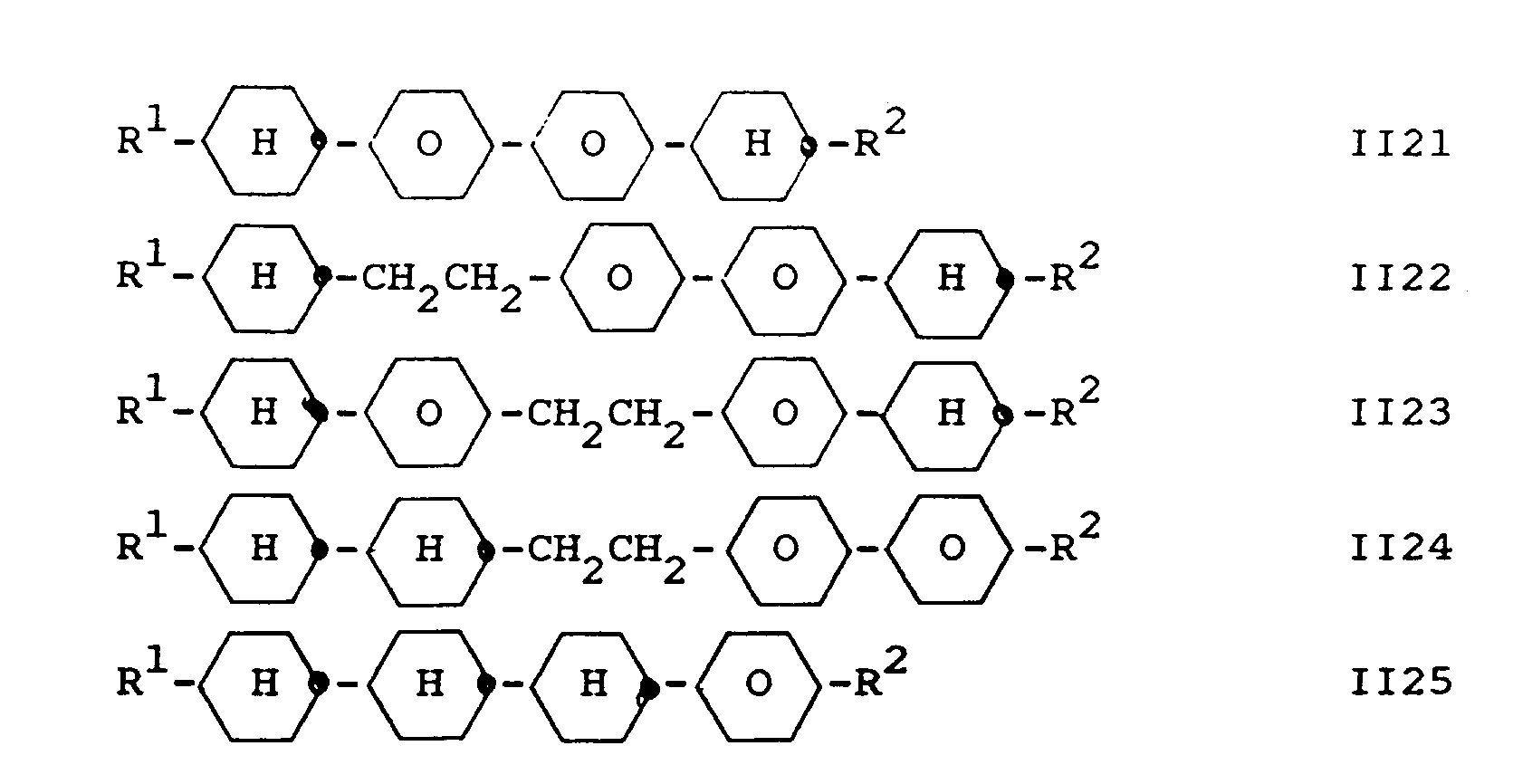
worin R¹ und R² die in Anspruch 1 angegebene Bedeutung haben und die 1,4-Phenylengruppen in II21 bis II25 jeweils unabhängig voneinander auch durch Fluor ein- oder mehrfach substituiert sein können.Component A also preferably additionally contains one or more compounds selected from the group consisting of II21 to II25:
wherein R¹ and R² have the meaning given in claim 1 and the 1,4-phenylene groups in II21 to II25 can in each case independently of one another also be substituted one or more times by fluorine.
Schließlich sind derartige Mischungen bevorzugt, deren Komponente A eine oder mehrere Verbindungen ausgewählt aus der Gruppe bestehend aus II26 und II27 enthält:
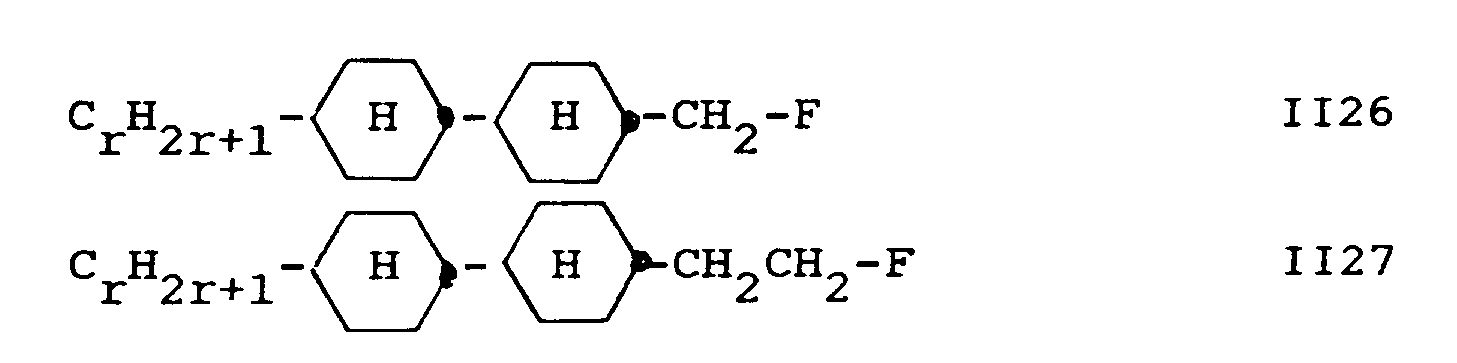
worin CrH2r+1 eine geradkettige Alkylgruppe mit bis zu 7 C-Atomen ist.Finally, mixtures of this type are preferred whose component A contains one or more compounds selected from the group consisting of II26 and II27:
wherein C r H 2r + 1 is a straight-chain alkyl group with up to 7 C atoms.
In einigen Fällen erweist es sich den Zusatz von Verbindungen der Formel

worin
- R¹ und R²
- die in Anspruch 1 angegebene Bedeutung haben
- Z⁰
- eine Einfachbindung,

zur Unterdrückung smektischer Phasen als vorteilhaft, obwohl hierdurch der spezifische Widerstand erniedrigt wird. Zur Erzielung von für die Anwendung optimaler Parameterkombinationen kann der Fachmann leicht feststellen, ob und falls ja in welcher Menge diese Verbindungen zugesetzt sein können. Normalerweise werden weniger als 15 %, insbesondere 5-10 % verwendet.In some cases it turns out to be the addition of compounds of the formula
wherein
- R1 and R2
- have the meaning given in claim 1
- Z⁰
- a single bond,
to suppress smectic phases as advantageous, although this lowers the specific resistance. In order to achieve optimal combinations of parameters for the application, the person skilled in the art can easily determine whether and if so in what amount these compounds can be added. Usually less than 15%, especially 5-10% is used.
Ferner bevorzugt sind Flüssigkristallmischungen, die neben den Komponenten A, B und C zusätzlich eine oder mehrere Verbindungen ausgewählt aus der Gruppe bestehend aus III und IV enthalten:

worin R¹ und R² die oben angegebene Bedeutung haben, und/oder eine oder mehrere Verbindungen ausgewählt aus der Gruppe bestehend aus V und VI

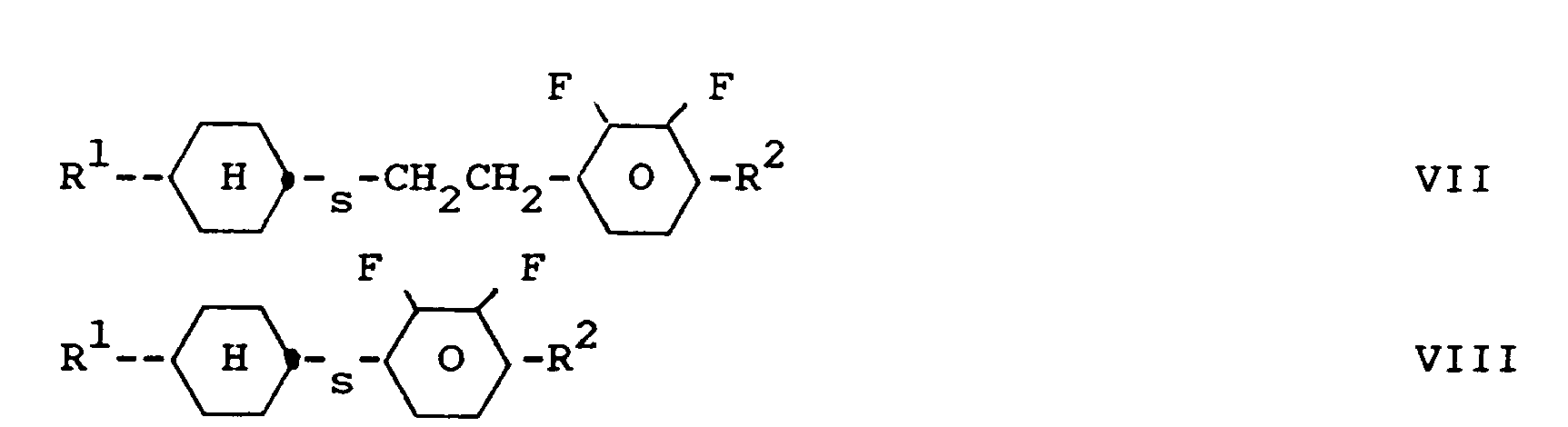
worin R¹ und R² die oben angegebene Bedeutung haben, und/oder eine oder mehrere Verbindungen ausgewählt aus der Gruppe bestehend aus VII bis XI enthalten

worin R¹ und R² die oben angegebene Bedeutung haben und s 0 oder 1 ist.Also preferred are liquid crystal mixtures which, in addition to components A, B and C, additionally contain one or more compounds selected from the group consisting of III and IV:
wherein R¹ and R² have the meaning given above, and / or one or more compounds selected from the group consisting of V and VI
wherein R¹ and R² have the meaning given above, and / or contain one or more compounds selected from the group consisting of VII to XI
wherein R¹ and R² have the meaning given above and s is 0 or 1.
Der Anteil der Verbindungen der Formeln III bis XI in den erfindungsgemäßen Mischungen (bevorzugte Bereiche) geht aus folgender Tabelle hervor:
Der Anteil der Verbindung(en) der Teilformel Ia ist vorzugsweise 3 bis 15 %, insbesondere bevorzugt 5 bis 10 %.The proportion of the compound (s) of partial formula Ia is preferably 3 to 15%, particularly preferably 5 to 10%.
Vorzugsweise enthält Komponente A eine oder mehrere Verbindungen ausgewählt aus der Gruppe bestehend aus Iae bis Iah:

und/oder
eine oder mehrere Verbindungen ausgewählt aus der Gruppe bestehend aus Iaj bis Iam:

Die Verbindungen der Formel Ia sind neu und ebenfalls Gegenstand der vorliegenden Erfindung. Sie können aus bekannten Ausgangsmaterialien nach Standardmethoden gemäß folgender Syntheseschemata hergestellt werden:


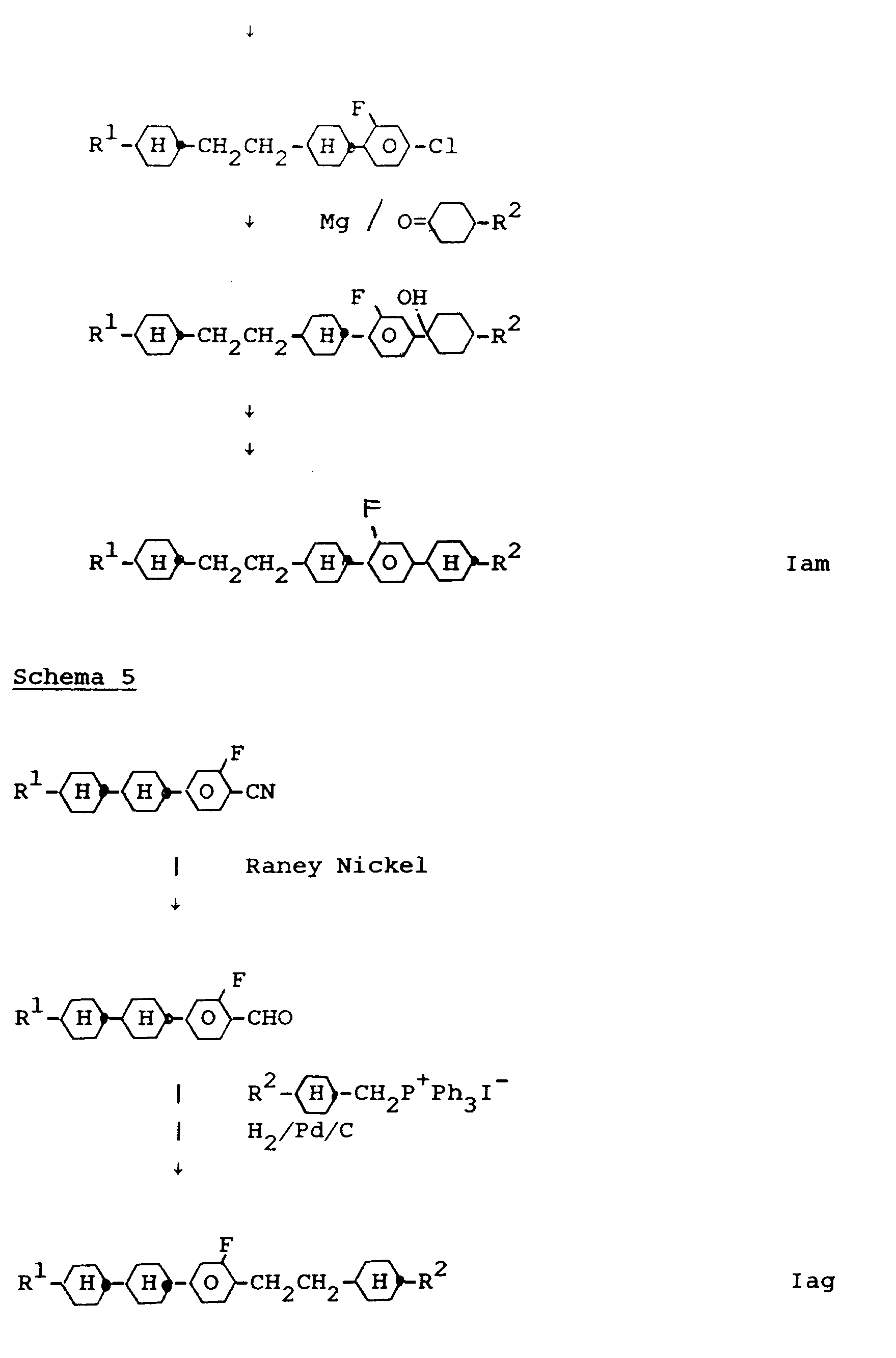


Ebenfalls neu und Gegenstand der vorliegenden Erfindung sind die Verbindungen der Formel I'

worin
- R¹ und R²
- jeweils unabhängig voneinander Alkyl mit bis zu 9 C-Atomen, worin auch eine CH₂-Gruppe durch O ersetzt sein kann,
- Ring A
- ist trans-1,4-Cyclohexylen
- Ring B
- ist trans-1,4-Cyclohexylen oder

- r
- ist 0 oder 1, und
- X und Y
- jeweils unabhängig voneinander H oder F in einer oder mehreren Lateralpositionen bedeuten,
sowie
Verbindungen der Formel Ib

worin
E eine Einfachbindung oder -CH₂CH₂-,
R¹ und R² jeweils unabhängig voneinander Alkyl mit bis zu 9 C-Atomen, worin auch eine CH₂-Gruppe durch O ersetzt sein kann,
Ring B

X und Y jeweils unabhängig voneinander H oder F in einer oder mehreren Lateralpositionen bedeuten, mit der Maßgabe, daß mindestens einer der im Molekül der Formel Ib vorhandenen Reste X oder Y Fluor bedeutet.Component A preferably contains one or more compounds selected from the group consisting of Iae to Iah:
and or
one or more compounds selected from the group consisting of Iaj to Iam:
The compounds of formula Ia are new and also a subject of the present invention. They can be produced from known starting materials by standard methods according to the following synthesis schemes:
The compounds of the formula I 'are likewise novel and are an object of the present invention.
wherein
- R1 and R2
- each independently of one another alkyl having up to 9 carbon atoms, in which a CH₂ group can also be replaced by O,
- Ring A
- is trans-1,4-cyclohexylene
- Ring B
- is trans-1,4-cyclohexylene or
- r
- is 0 or 1, and
- X and Y
- each independently of one another denote H or F in one or more lateral positions,
such as
Compounds of formula Ib
wherein
E is a single bond or -CH₂CH₂-,
R¹ and R² each independently of one another alkyl having up to 9 C atoms, in which a CH₂ group can also be replaced by O,
Ring B
X and Y each independently represent H or F in one or more lateral positions, with the proviso that at least one of the X or Y radicals present in the molecule of the formula Ib is fluorine.
Die Verbindungen der Formel I' und Ib können als Komponenten flüssigkristalliner Medien verwendet werden, insbesondere in Displays nach dem Prinzip der verdrillten Zelle (einschließlich höherverdrillter Zellen wie STN, SBE, OMI etc.), dem Guest-Host-Effekt, dem DAP-Effekt oder dem Effekt der dynamischen Streuung.The compounds of the formula I 'and Ib can be used as components of liquid-crystalline media, in particular in displays based on the principle of the twisted cell (including more highly twisted cells such as STN, SBE, OMI etc.), the guest-host effect, the DAP effect or the effect of dynamic scattering.
Ähnliche Verbindungen sind bekannt aus EP-A-0 125 563. Die dort beschriebenen Verbindungen mit 4 Ringen neigen zur Induzierung smektischer Phasen und/oder nicht ausreichender Löslichkeit besonders bei tiefen Temperaturen. Beispielsweise zeigt trans,trans-4-[2-p-(trans-4-propylcyclohexyl)-phenylethyl]-4'-propylbicyclohexyl die folgende Phasensequenz: C 60 S 233 N 261 I.Similar compounds are known from EP-A-0 125 563. The compounds with 4 rings described therein tend to induce smectic phases and / or insufficient solubility, especially at low temperatures. For example, trans, trans-4- [2-p- (trans-4-propylcyclohexyl) phenylethyl] -4'-propylbicyclohexyl shows the following phase sequence: C 60 S 233 N 261 I.
Der Erfindung liegt die Aufgabe zugrunde, neue, stabile, flüssigkristalline Verbindungen aufzufinden, die vorzugsweise für MFK-Anzeigen geeignet sind und nicht oder nur in geringem Maße die Nachteile der Verbindungen aus dem Stand der Technik zeigen.The object of the invention is to find new, stable, liquid-crystalline compounds which are preferably suitable for MLC displays and which do not show the disadvantages of the compounds from the prior art or only to a small extent.
Überraschenderweise wurde gefunden, daß die Verbindungen der Formel I' und Ib diese Aufgabe hervorragend lösen und die Herstellung von flüssigkristallinen Medien mit sehr hohem spezifischen Widerstand und gleichzeitig vorteilhaften elektrooptischen Eigenschaften ermöglichen. Die Verbindungen der Formel I' und Ib zeigen völlig überraschend eine hervorragende Löslichkeit in vielen Flüssigkristallbasismaterialien verschiedenster Substanzklassen selbst bei -20 °C.Surprisingly, it has been found that the compounds of the formulas I 'and Ib solve this problem excellently and enable the production of liquid-crystalline media with very high specific resistance and at the same time advantageous electro-optical properties. Quite surprisingly, the compounds of the formula I 'and Ib show excellent solubility in many liquid-crystal base materials of very different classes of substances, even at -20 ° C.
Die Verbindungen der Formel I' und Ib stellen somit sehr attraktive Komponenten für flüssigkristalline Medien für elektrooptische Anwendungen dar, wobei die folgenden besonders vorteilhaften Punkte herausgestellt werden können:
- (a) niedrige Schmelzpunkte, wodurch die Formulierung niedrig schmelzender Medien ermöglicht wird;
- (b) hohe Klärpunkte und ein außerordenlich breiter nematischer Bereich, wodurch die Formulierung von Medien mit breiten nematischen Bereichen ermöglicht wird;
- (c) geringe Tendenz zur Ausbildung smektischer Phasen in Kombination mit nematischen Materialien mit positiver dielektrischer Anisotropie;
- (d) hervorragende Löslichkeit in nematischen Materialien mit positiver dielektrischer Anisotropie;
- (e) die Eigenschaft, den Klärpunkt weiter zu erhöhen bei Zumischen zu Medien enthaltend dielektrisch positive nematische Materialien und eine hochklärende Komponente;
- (f) höhere Doppelbrechung im Vergleich zu bekannten Materialien mit ähnlichen thermischen und Viskositäts-Eigenschaften;
- (g) sehr geringe Temperaturabhängigkeit der Schwellenspannung;
- (h) gute chemische und photochemische Stabilität.
- (a) low melting points, which enables the formulation of low melting media;
- (b) high clearing points and an extraordinarily wide nematic area, which enables the formulation of media with wide nematic areas;
- (c) little tendency to form smectic phases in combination with nematic materials with positive dielectric anisotropy;
- (d) excellent solubility in nematic materials with positive dielectric anisotropy;
- (e) the property of further increasing the clearing point when admixed with media containing dielectric positive nematic materials and a highly clarifying component;
- (f) higher birefringence compared to known materials with similar thermal and viscosity properties;
- (g) very low temperature dependence of the threshold voltage;
- (h) good chemical and photochemical stability.
Die attraktive Kombination dieser Eigenschaften ermöglicht die Formulierung von flüssigkristallinen Medien, die denen aus dem Stand der Technik überlegen sind.The attractive combination of these properties enables the formulation of liquid-crystalline media which are superior to those of the prior art.
Die Bereitstellung der Verbindungen der Formel I' und Ib verbreitert weiterhin die Palette der unter verschiedenen technologischen Aspekten zur Herstellung nematischer Medien bereitstehender Verbindungen.The provision of the compounds of the formulas I 'and Ib further widens the range of compounds available under various technological aspects for the preparation of nematic media.
Die Verbindungen der Formel I' und Ib haben ein breites Anwendungsgebiet. Vorzugsweise werden sie zu Basismaterialien aus anderen Substanzklassen zugegeben um den Klärpunkt anzuheben ohne andere relevante physikalische Eigenschaften nachteilig zu beeinflussen.The compounds of the formula I 'and Ib have a wide range of applications. They are preferably added to base materials from other classes of substances in order to raise the clearing point without adversely affecting other relevant physical properties.
Die Verbindungen der Formel I' und Ib sind farblos und bilden in einem für die elektrooptische Anwendung günstig gelegenen Temperaturbereich nematische Mesophasen. Sie sind chemisch und gegenüber Hitze und Licht sehr stabil.The compounds of the formula I 'and Ib are colorless and form nematic mesophases in a temperature range which is favorably located for electro-optical use. They are chemical and very stable to heat and light.
Die Erfindung betrifft somit auch die Verbindungen der Formel I' und Ib und deren Verwendung als Komponenten flüssigkristalliner Medien. Die Erfindung betrifft auch flüssigkristalline Medien, die eine oder mehrere Verbindungen der Formel I' oder Ib enthalten und Flüssigkristall-Anzeigen, insbesondere elektro-optische Anzeigen, die derartige Medien enthalten.The invention thus also relates to the compounds of the formula I 'and Ib and their use as components of liquid-crystalline media. The invention also relates to liquid-crystalline media which contain one or more compounds of the formula I 'or Ib and to liquid-crystal displays, in particular electro-optical displays, which contain such media.
Die Verbindungen der Formel I' und Ib umfassen solche der bevorzugten Teilformel Ic:

sowie I'a bis I'f:
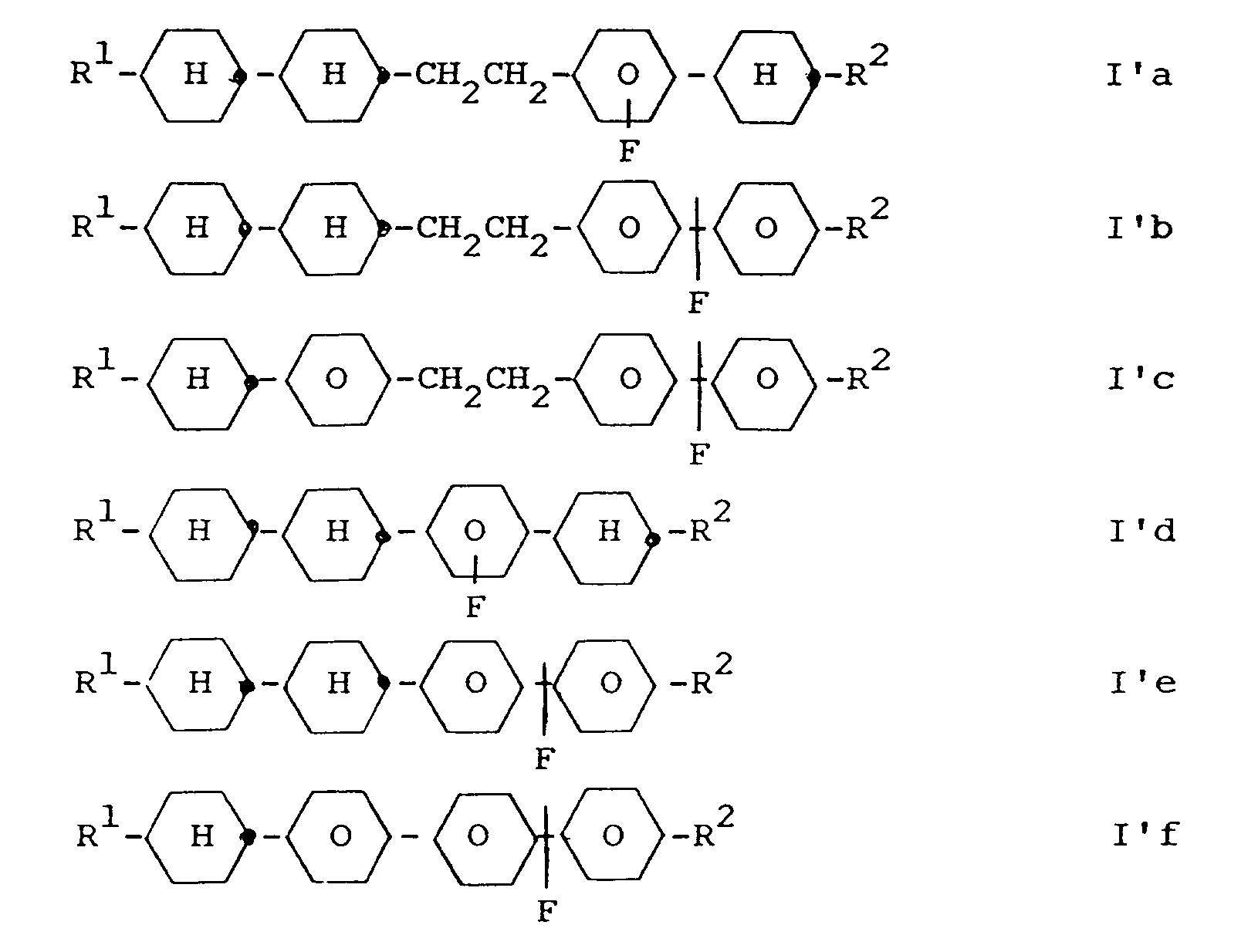
In den Verbindungen dieser Formeln bedeuten R¹ und R² vorzugsweise Alkyl oder Alkylgruppen, worin eine CH₂-Gruppe durch O ersetzt ist (Oxaalkyl oder Alkoxy).The compounds of the formula I 'and Ib include those of the preferred sub-formula Ic:
as well as I'a to I'f:
In the compounds of these formulas, R¹ and R² are preferably alkyl or alkyl groups in which one CH₂ group has been replaced by O (oxaalkyl or alkoxy).
Falls R¹ und/oder R² Alkyl und/oder Alkoxy bedeuten, sind diese Reste geradkettig oder verzweigt. Vorzugsweise sind diese Reste geradkettig und haben 2, 3, 4, 5, 6 oder 7 C-Atome und bedeuten sonst vorzugsweise Ethyl, Propyl, Butyl, Pentyl, Hexyl, Heptyl, Ethoxy, Propoxy, Butoxy, Pentoxy, Hexoxy oder Heptoxy, ferner Methyl, Octyl, Nonyl, Methoxy, Octoxy oder Nonoxy.If R 1 and / or R 2 are alkyl and / or alkoxy, these radicals are straight-chain or branched. These radicals are preferably straight-chain and have 2, 3, 4, 5, 6 or 7 carbon atoms and are preferably ethyl, propyl, butyl, pentyl, hexyl, heptyl, ethoxy, propoxy, butoxy, pentoxy, hexoxy or heptoxy, furthermore Methyl, octyl, nonyl, methoxy, octoxy or nonoxy.
Oxaalkyl ist vorzugsweise geradkettiges 2-Oxapropyl (= Methoxymethyl), 2-(= ethoxymethyl) or 3-oxabutyl (= 2-methoxyethyl), 2-, 3- or 4-oxapentyl, 2-, 3-, 4- or 5-oxahexyl, 2-, 3-, 4-, 5- or 6-oxaheptyl or 2-, 3-, 4-, 5-, 6- or 7-oxaoctyl.

ist vorzugsweise eines der Ringsysteme 1 oder 2, oder in Verbindungen der Formel I' auch 3 oder 4:

Systeme 1, 2 und 3 und insbesondere 1 sind bevorzugt.Oxaalkyl is preferably straight-chain 2-oxapropyl (= methoxymethyl), 2 - (= ethoxymethyl) or 3-oxabutyl (= 2-methoxyethyl), 2-, 3- or 4-oxapentyl, 2-, 3-, 4- or 5- oxahexyl, 2-, 3-, 4-, 5- or 6-oxaheptyl or 2-, 3-, 4-, 5-, 6- or 7-oxaoctyl.
is preferably one of the ring systems 1 or 2, or in compounds of the formula I 'also 3 or 4:
Systems 1, 2 and 3 and in particular 1 are preferred.
Die Verbindungen der Formel I' und Ib können nach bekannten Standardmethoden hergestellt werden. Bevorzugte Synthesen sind im folgenden aufgezeigt:


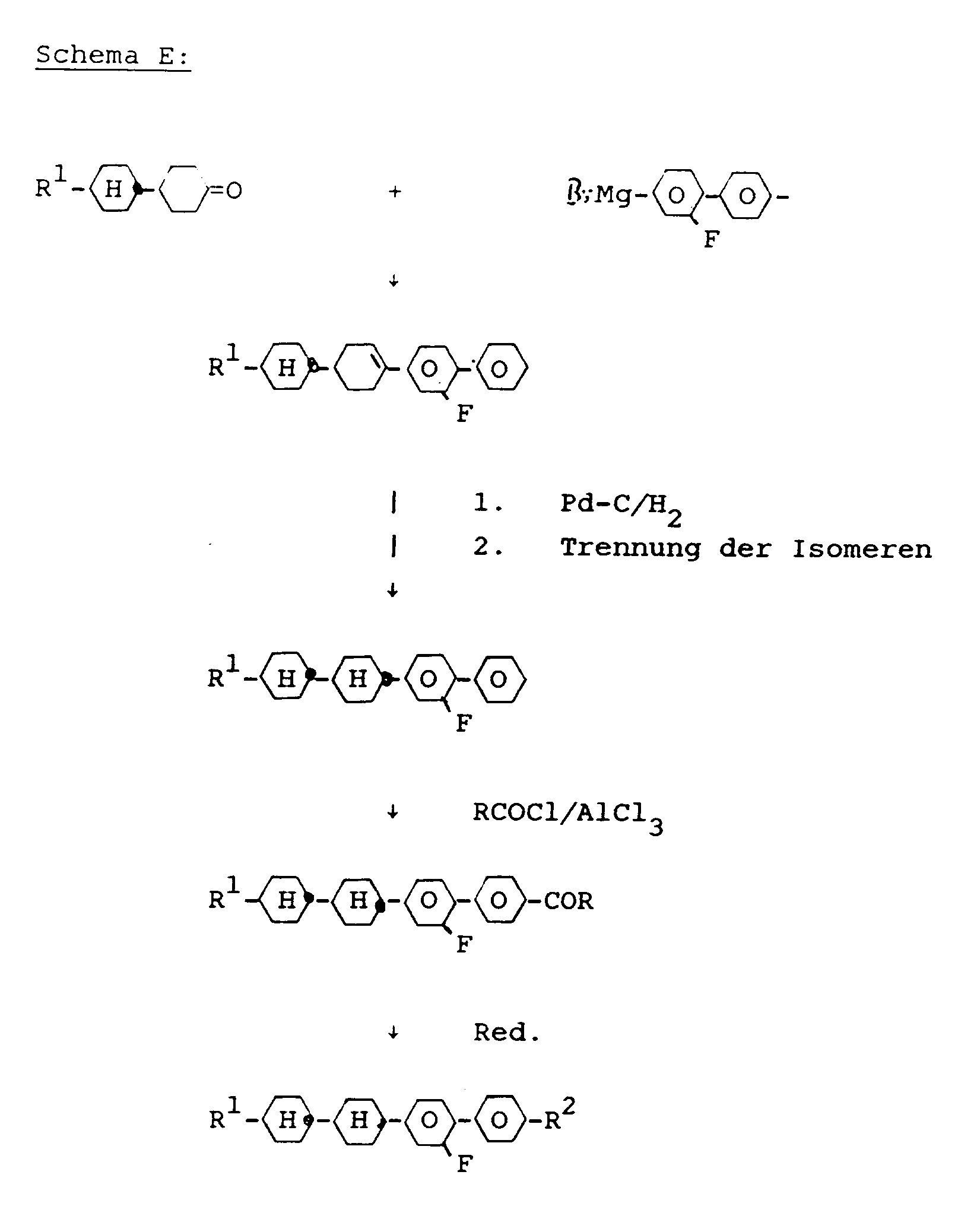
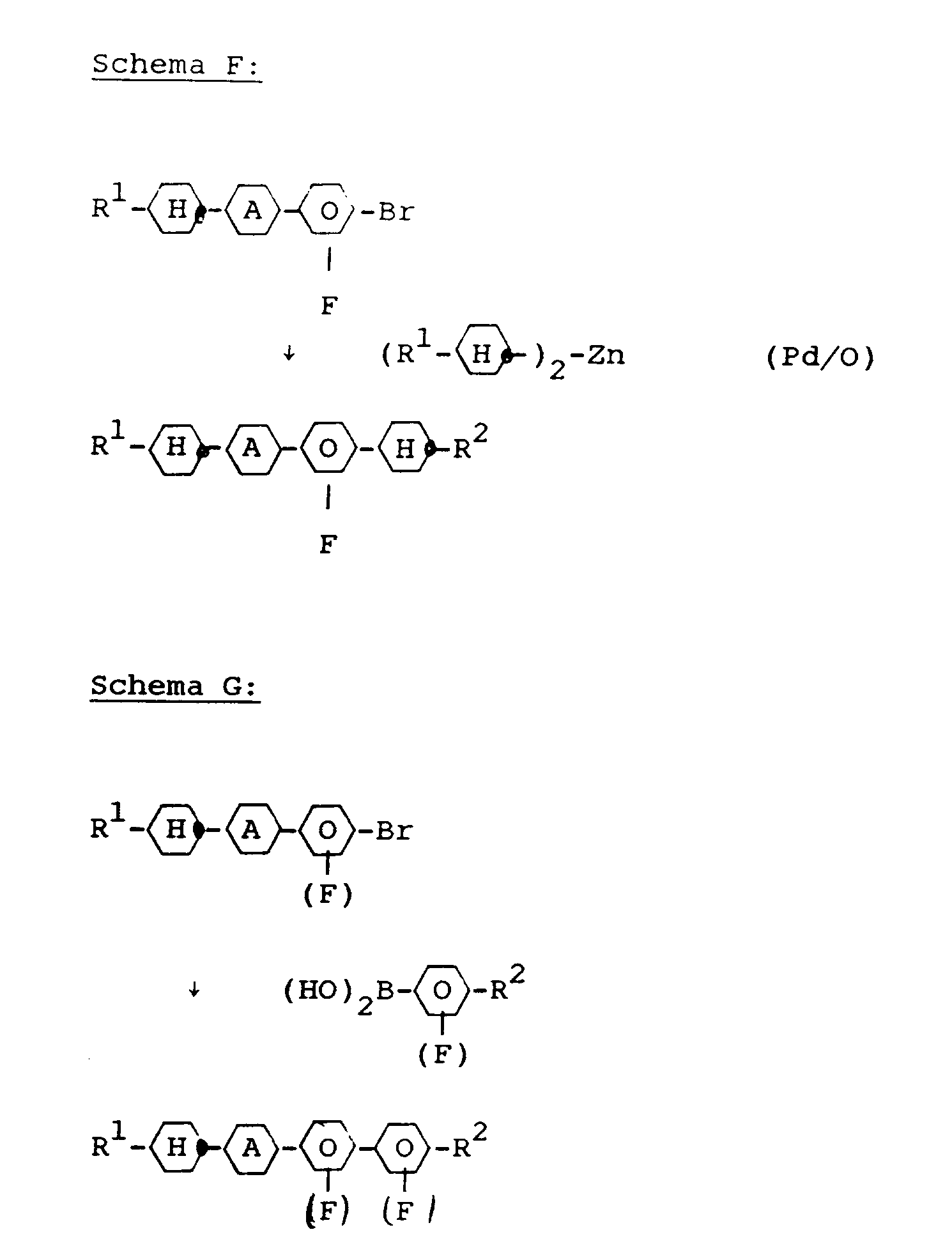
Alle Schritte ebenso wie die Reaktionsverbindungen sind dem Fachmann bekannt. Die Ausgangsmaterialien sind bekannt (z.B. DE-OS 33 17 597, E. Poetsch, Kontakte/Darmstadt 1988 (2), S. 15-28) oder können in einfacher Weise in Analogie zu bekannten Materialien hergestellt werden.The compounds of the formula I 'and Ib can be prepared by known standard methods. Preferred syntheses are shown below:
All steps as well as the reaction compounds are known to the person skilled in the art. The starting materials are known (eg DE-OS 33 17 597, E. Poetsch, contacts / Darmstadt 1988 (2), pp. 15-28) or can be prepared in a simple manner in analogy to known materials.
Es versteht sich von selbst, daß die erfindungsgemäßen Mischungen, die vorzugsweise im wesentlichen aus den für die Komponente A bis C angegebenen bevorzugten Verbindungen bestehen, gegebenenfalls auch noch weitere, hier nicht explizit genannte Verbindungen enthalten können. In vielen Fällen resultieren jedoch dann ungünstigere Eigenschaften. Der Fachmann kann leicht feststellen, ob und ggf. in welchen Mengen weitere Verbindungen zum Einsatz kommen können.It goes without saying that the mixtures according to the invention, which preferably consist essentially of the preferred compounds indicated for components A to C. exist, possibly also contain other compounds not explicitly mentioned here. In many cases, however, this results in less favorable properties. The person skilled in the art can easily determine whether, and if so in what quantities, further compounds can be used.
Der Aufbau der erfindungsgemäßen MFK-Anzeige aus Polarisatoren, Elektrodengrundplatten und Elektroden mit Oberflächenbehandlung entspricht der für derartige Anzeigen üblichen Bauweise. Dabei ist der Begriff der üblichen Bauweise hier weit gefaßt und umfaßt auch alle Abwandlungen und Modifikationen der MFK-Anzeige, insbesondere auch Matrix-Anzeigeelemente auf Basis poly-Si TFT oder MIM.The construction of the MFK display according to the invention from polarizers, electrode base plates and electrodes with surface treatment corresponds to the design customary for such displays. The term conventional construction is broadly encompassed here and also includes all modifications and modifications of the MLC display, in particular also matrix display elements based on poly-Si TFT or MIM.
Ein wesentlicher Unterschied der erfindungsgemäßen Anzeigen zu den bisher üblichen auf der Basis der verdrillten nematischen Zelle besteht jedoch in der Wahl der Flüssigkristallparameter der Flüssigkristallschicht.A significant difference between the displays according to the invention and those previously used on the basis of the twisted nematic cell, however, is the choice of the liquid crystal parameters of the liquid crystal layer.
Die Dielektrika können auch weitere, dem Fachmann bekannte und in der Literatur beschriebene Zusätze enthalten. Beispielsweise können 0-15 % pleochroitische Farbstoffe oder chirale Dotierstoffe zugesetzt werden.The dielectrics can also contain further additives known to the person skilled in the art and described in the literature. For example, 0-15% pleochroic dyes or chiral dopants can be added.
C bedeutet eine kristalline, S eine smektische, SB eine smektisch B, N eine nematische und I die isotrope Phase. V₁₀ bezeichnet die Spannung für 10 % Transmission (Blickrichtung senkrecht zur Plattenoberfläche). ton bezeichnet die Einschaltzeit und toff die Ausschaltzeit bei einer Betriebsspannung entsprechend dem 2,5-fachen Wert von V₁₀. Δn bezeichnet die optische Anisotropie und no den Brechungsindex. Δε bezeichnet die dielektrische Anisotropie ( 
Die folgenden Beispiele sollen die Erfindung erläutern, ohne sie zu begrenzen. Vor und nachstehend sind alle Temperaturen in °C angegeben. Die Prozentzahlen sind Gewichtsprozente.The following examples are intended to illustrate the invention without limiting it. All temperatures above and below are given in ° C. The percentages are percentages by weight.
In der vorliegenden Anmeldung und in den folgenden Beispielen sind die Strukturen der Flüssigkristallverbindungen durch Acronyme angegeben, wobei die Transformation in chemische Formeln gemäß folgender Tabellen A und B erfolgt. Alle Reste CnH2n+1 sind geradkettige Alkylreste mit n bzw. m C-Atomen. Die Codierung gemäß Tabelle B versteht sich von selbst. In Tabelle A ist nur das Acronym für den Grundkörper angegeben. Im Einzelfall folgt getrennt vom Acronym für den Grundkörper mit einem Strich ein Code für die Substituenten R¹, R², L¹ und L²:


Die in den Tabellen A und B aufgeführten Verbindungen sind bevorzugte Komponenten erfindungsgemäßer Medien. Besonders bevorzugt sind Verbindungen mit R² = F, Cl, CF₃, OCF₃ oder OCHF₂. L² ist H oder F und vorzugsweise F. L¹ ist vorzugsweise H.The compounds listed in Tables A and B are preferred components of media according to the invention. Compounds with R² = F, Cl, CF₃, OCF₃ or OCHF₂ are particularly preferred. L² is H or F and preferably F. L¹ is preferably H.
Im folgenden ist die Zusammensetzung der Mischungen der Beispiele 2 bis 11 angegeben, wobei die einzelnen Verbindungen wie folgt codiert sind:
- PCH-301:
- trans-1-p-Methoxyphenyl-4-propylcyclohexan
- CCH-301:
- trans,trans-4-Methoxy-4'-propylcyclohexylcyclohexan
- CBC-33F:
- 4,4'-Bis-(trans-4-propylcyclohexyl)-2-fluorbiphenyl
- CBE-55F:
- 4,4'-Bis-(trans-4-pentylcyclohexyl)-2-fluorbiphenyl
- CBC-53F:
- 4-(trans-4-Pentylcyclohexyl)-4'-(trans-4-propylcyclcohexyl)-2-fluorbiphenyl
- CBC-33:
- 4,4'-Bis-(trans-4-propylcyclohexyl)-biphenyl
- CBC-55:
- 4,4'-Bis-(trans-4-pentylcyclohexyl)-biphenyl
- CBC-53:
- 4-(trans-4-Pentylcyclohexyl)-4'-(trans-4-propylcyclohexyl)-biphenyl
- ECCP-33:
- 1-[trans-4-(trans-4-Propylcyclohexyl)-cyclohexyl]-2-(p-propylphenyl)-ethan
- CCH-51F:
- trans,trans-4-Fluormethyl-4'-pentylcyclohexylcyclohexan
- CCH-31F:
- trans,trans-4-Fluormethyl-4'-propylcyclohexylcyclohexan
- PTP-102:
- 4-Methyl-4'-ethoxy-tolan
- PTP-201:
- 4-Methoxy-4'-ethyl-tolan
- CPTP-301:
- 4-(trans-4-Propylcyclohexyl)-4'-methoxy-tolan
- CPTP-302:
- 4-(trans-4-Propylcyclohexyl)-4'-ethoxy-tolan
- CPTP-303:
- 4-(trans-4-Propylcyclohexyl)-4'-propoxy-tolan
- PCH-5F:
- trans-1-p-Fluorphenyl-4-pentylcyclohexan
- PCH-6F:
- trans-1-p-Fluorphenyl-4-hexylcyclohexan
- PCH-7F:
- trans-1-p-Fluorphenyl-4-heptylcyclohexan
- EPCH-20CF₃:
- 1-(trans-4-Ethylcyclohexyl)-2-(p-trifluormethoxyphenyl)-ethan
- EPCH-30CF₃:
- 1-(trans-4-Propylcyclohexyl)-2-(p-trifluormethoxyphenyl)-ethan
- EPCH-50CF₃:
- 1-(trans-4-Pentylcyclohexyl)-2-(p-trifluormethoxyphenyl)-ethan
- EPCH-70CF₃:
- 1-(trans-4-Heptylcyclohexyl)-2-(p-trifluormethoxyphenyl)-ethan
- PCH-30CF₃:
- trans-1-p-Trifluormethoxyphenyl-4-propylcyclohexan
- PCH-50CF₃:
- trans-1-p-Trifluormethoxyphenyl-4-pentylcyclohexan
- ECCP-30CF₃:
- 1-[trans-4-(trans-4-Propylcyclohexyl)-cyclohexyl]-2-(p-trifluormethoxyphenyl)-ethan
- ECCP-50CF₃:
- 1-[trans-4-(trans-4-Pentylcyclohexyl)-cyclohexyl]-2-(p-trifluormethoxyphenyl)-ethan
- CCP-20CF₃:
- p-[trans-4-(trans-4-Ethylcyclohexyl)-cyclohexyl]-trifluormethoxybenzol
- CCP-30CF₃:
- p-[trans-4-(trans-4-Propylcyclohexyl)-cyclohexyl]-trifluormethoxybenzol
- CCP-40CF₃:
- p-[trans-4-(trans-4-Butylcyclohexyl)-cyclohexyl]-trifluormethoxybenzol
- CCP-50CF₃:
- p-[trans-4-(trans-4-Pentylcyclohexyl)-cyclohexyl]-trifluormethoxybenzol
- BCH-30CF₃:
- 4-Trifluormethoxy-4'-(trans-4-propylcyclohexyl)-biphenyl
- ECCP-3F.F:
- 1-[trans-4-(trans-4-Propylcyclohexyl)-cyclohexyl]-2-(3,4-difluorphenyl)-ethan
- ECCP-5F.F:
- 1-[trans-4-(trans-4-Pentylcyclohexyl)-cyclohexyl]-2-(3,4-difluorphenyl)-ethan
- CCP-3F.F:
- 4-[trans-4-(trans-4-Propylcyclohexyl)-cyclohexyl]-1,2-difluorbenzol
- CCP-5F.F:
- 4-[trans-4-(trans-4-Pentylcyclohexyl)-cyclohexyl]-1,2-difluorbenzol
- CCP-3F:
- 4-[trans-4-(trans-4-Propylcyclohexyl)-cyclohexyl]-fluorbenzol
- ECCP-3F:
- 1-[trans-4-(trans-4-Propylcyclohexyl)-cyclohexyl]-2-(p-fluorphenyl)-ethan
- ECCP-5F:
- 1-[trans-4-(trans-4-Pentylcyclohexyl)-cyclohexyl]-2-(p-fluorphenyl)-ethan
- CP-3F:
- trans-4-(trans-4-Propylcyclohexyl)-cyclohexancarbonsäure-(p-fluorphenylester)
- CP-5F:
- trans-4-(trans-4-Pentylcyclohexyl)-cyclohexancarbonsäure-(p-fluorphenylester)
- PYP-5F:
- 2-p-Fluorphenyl-5-pentylpyrimidin
- PYP-6F:
- 2-p-Fluorphenyl-5-hexylpyrimidin
- PYP-7F:
- 2-p-Fluorphenyl-5-heptylpyrimidin
- PYP-30CF₃:
- 2-p-Trifluormethoxyphenyl-5-propylpyrimidin
- PYP-50CF₃:
- 2-p-Trifluormethoxyphenyl-5-pentylpyrimidin
- PYP-70CF₃:
- 2-p-Trifluormethoxyphenyl-5-heptylpyrimidin
- PCH-3:
- p-trans-4-Propylcyclohexyl-benzonitril
- PCH-4:
- p-trans-4-Butylcyclohexyl-benzonitril
- PCH-5:
- p-trans-4-Pentylcyclohexyl-benzonitril
- ECCP-3:
- 1-[trans-4-(trans-4-Propylcyclohexyl)-cyclohexyl]-2-(p-cyanphenyl)-ethan
- ECCP-3CF₃:
- 1-[trans-4-(trans-4-Propylcyclohexyl)-cyclohexyl]-2-(p-trifluormethylphenyl)-ethan
- ECCP-5CF₃:
- 1-[trans-4-(trans-4-Pentylcyclohexyl)-cyclohexyl]-2-(p-trifluormethylphenyl)-ethan
- PYP-5N.F:
- 2-(3-Fluor-4-cyanphenyl)-5-pentylpyrimidin
- PYP-7N.F:
- 2-(3-Fluor-4-cyanphenyl)-5-heptylpyrimidin
- PCH-30CF₂:
- trans-1-p-Difluormethoxyphenyl-4-propylcyclohexan
- PCH-50CF₂:
- trans-1-p-Difluormethoxyphenyl-4-pentylcyclohexan
- PCH-3-0CF₂:
- trans-1-p-Difluormethoxyphenyl-4-propylcyclohexan
- CCEPC-33:
- 1-[trans-4-(trans-4-n-Propylcyclohexyl)-cyclohexyl]-2-[p-(trans-4-n-propylcyclohexyl)-phenyl]-ethan
- CCEPC-33F:
- 1-[trans-4-(trans-4-n-Propylcyclohexyl)-cyclohexyl]-2-[4-(trans-4-n-propylcyclohexyl)-2-fluorphenyl]-ethan
- CCPC-33:
- 1-[trans-4-(trans-4-n-Propylcyclohexyl)-cyclohexyl]-4-(trans-4-n-propylcyclohexyl)-benzol
- CCPC-23:
- 1-[trans-4-(trans-4-Ethylcyclohexyl)-cyclohexyl]-4-(trans-4-n-propylcyclohexyl)-benzol
- CCPEC-33:
- 1-[trans-4-(trans-4-n-Propylcyclohexyl)-cyclohexyl]-4-[2-(trans-4-n-propylcyclohexylethyl)-benzol
- CCPEC-23:
- 1-[trans-4-(trans-4-Ethylcyclohexyl)-cyclohexyl]-4-[2-(trans-4-n-propylcyclohexylethyl)-benzol
- CECPC-33:
- 1-[trans-4-(2-trans-4-n-Propylcyclohexylethyl)-cyclohexyl]-4-(trans-4-n-propylcyclohexyl)-benzol
- PCH-301:
- trans-1-p-methoxyphenyl-4-propylcyclohexane
- CCH-301:
- trans, trans-4-methoxy-4'-propylcyclohexylcyclohexane
- CBC-33F:
- 4,4'-bis (trans-4-propylcyclohexyl) -2-fluorobiphenyl
- CBE-55F:
- 4,4'-bis (trans-4-pentylcyclohexyl) -2-fluorobiphenyl
- CBC-53F:
- 4- (trans-4-pentylcyclohexyl) -4 '- (trans-4-propylcyclcohexyl) -2-fluorobiphenyl
- CBC-33:
- 4,4'-bis (trans-4-propylcyclohexyl) biphenyl
- CBC-55:
- 4,4'-bis (trans-4-pentylcyclohexyl) biphenyl
- CBC-53:
- 4- (trans-4-pentylcyclohexyl) -4 '- (trans-4-propylcyclohexyl) biphenyl
- ECCP-33:
- 1- [trans-4- (trans-4-propylcyclohexyl) cyclohexyl] -2- (p-propylphenyl) ethane
- CCH-51F:
- trans, trans-4-fluoromethyl-4'-pentylcyclohexylcyclohexane
- CCH-31F:
- trans, trans-4-fluoromethyl-4'-propylcyclohexylcyclohexane
- PTP-102:
- 4-methyl-4'-ethoxy-tolane
- PTP-201:
- 4-methoxy-4'-ethyl-tolan
- CPTP-301:
- 4- (trans-4-propylcyclohexyl) -4'-methoxy-tolane
- CPTP-302:
- 4- (trans-4-propylcyclohexyl) -4'-ethoxy-tolane
- CPTP-303:
- 4- (trans-4-propylcyclohexyl) -4'-propoxy-tolane
- PCH-5F:
- trans-1-p-fluorophenyl-4-pentylcyclohexane
- PCH-6F:
- trans-1-p-fluorophenyl-4-hexylcyclohexane
- PCH-7F:
- trans-1-p-fluorophenyl-4-heptylcyclohexane
- EPCH-20CF₃:
- 1- (trans-4-ethylcyclohexyl) -2- (p-trifluoromethoxyphenyl) ethane
- EPCH-30CF₃:
- 1- (trans-4-propylcyclohexyl) -2- (p-trifluoromethoxyphenyl) ethane
- EPCH-50CF₃:
- 1- (trans-4-pentylcyclohexyl) -2- (p-trifluoromethoxyphenyl) ethane
- EPCH-70CF₃:
- 1- (trans-4-heptylcyclohexyl) -2- (p-trifluoromethoxyphenyl) ethane
- PCH-30CF₃:
- trans-1-p-trifluoromethoxyphenyl-4-propylcyclohexane
- PCH-50CF₃:
- trans-1-p-trifluoromethoxyphenyl-4-pentylcyclohexane
- ECCP-30CF₃:
- 1- [trans-4- (trans-4-propylcyclohexyl) cyclohexyl] -2- (p-trifluoromethoxyphenyl) ethane
- ECCP-50CF₃:
- 1- [trans-4- (trans-4-pentylcyclohexyl) cyclohexyl] -2- (p-trifluoromethoxyphenyl) ethane
- CCP-20CF₃:
- p- [trans-4- (trans-4-ethylcyclohexyl) cyclohexyl] trifluoromethoxybenzene
- CCP-30CF₃:
- p- [trans-4- (trans-4-propylcyclohexyl) cyclohexyl] trifluoromethoxybenzene
- CCP-40CF₃:
- p- [trans-4- (trans-4-butylcyclohexyl) cyclohexyl] trifluoromethoxybenzene
- CCP-50CF₃:
- p- [trans-4- (trans-4-pentylcyclohexyl) cyclohexyl] trifluoromethoxybenzene
- BCH-30CF₃:
- 4-trifluoromethoxy-4 '- (trans-4-propylcyclohexyl) biphenyl
- ECCP-3F.F:
- 1- [trans-4- (trans-4-propylcyclohexyl) cyclohexyl] -2- (3,4-difluorophenyl) ethane
- ECCP-5F.F:
- 1- [trans-4- (trans-4-pentylcyclohexyl) cyclohexyl] -2- (3,4-difluorophenyl) ethane
- CCP-3F.F:
- 4- [trans-4- (trans-4-propylcyclohexyl) cyclohexyl] -1,2-difluorobenzene
- CCP-5F.F:
- 4- [trans-4- (trans-4-pentylcyclohexyl) cyclohexyl] -1,2-difluorobenzene
- CCP-3F:
- 4- [trans-4- (trans-4-propylcyclohexyl) cyclohexyl] fluorobenzene
- ECCP-3F:
- 1- [trans-4- (trans-4-propylcyclohexyl) cyclohexyl] -2- (p-fluorophenyl) ethane
- ECCP-5F:
- 1- [trans-4- (trans-4-pentylcyclohexyl) cyclohexyl] -2- (p-fluorophenyl) ethane
- CP-3F:
- trans-4- (trans-4-propylcyclohexyl) cyclohexane carboxylic acid (p-fluorophenyl ester)
- CP-5F:
- trans-4- (trans-4-pentylcyclohexyl) cyclohexane carboxylic acid (p-fluorophenyl ester)
- PYP-5F:
- 2-p-fluorophenyl-5-pentylpyrimidine
- PYP-6F:
- 2-p-fluorophenyl-5-hexylpyrimidine
- PYP-7F:
- 2-p-fluorophenyl-5-heptylpyrimidine
- PYP-30CF₃:
- 2-p-trifluoromethoxyphenyl-5-propylpyrimidine
- PYP-50CF₃:
- 2-p-trifluoromethoxyphenyl-5-pentylpyrimidine
- PYP-70CF₃:
- 2-p-trifluoromethoxyphenyl-5-heptylpyrimidine
- PCH-3:
- p-trans-4-propylcyclohexyl benzonitrile
- PCH-4:
- p-trans-4-butylcyclohexyl benzonitrile
- PCH-5:
- p-trans-4-pentylcyclohexyl benzonitrile
- ECCP-3:
- 1- [trans-4- (trans-4-propylcyclohexyl) cyclohexyl] -2- (p-cyanophenyl) ethane
- ECCP-3CF₃:
- 1- [trans-4- (trans-4-propylcyclohexyl) cyclohexyl] -2- (p-trifluoromethylphenyl) ethane
- ECCP-5CF₃:
- 1- [trans-4- (trans-4-pentylcyclohexyl) cyclohexyl] -2- (p-trifluoromethylphenyl) ethane
- PYP-5N.F:
- 2- (3-fluoro-4-cyanophenyl) -5-pentylpyrimidine
- PYP-7N.F:
- 2- (3-fluoro-4-cyanophenyl) -5-heptylpyrimidine
- PCH-30CF₂:
- trans-1-p-difluoromethoxyphenyl-4-propylcyclohexane
- PCH-50CF₂:
- trans-1-p-difluoromethoxyphenyl-4-pentylcyclohexane
- PCH-3-0CF₂:
- trans-1-p-difluoromethoxyphenyl-4-propylcyclohexane
- CCEPC-33:
- 1- [trans-4- (trans-4-n-propylcyclohexyl) cyclohexyl] -2- [p- (trans-4-n-propylcyclohexyl) phenyl] ethane
- CCEPC-33F:
- 1- [trans-4- (trans-4-n-propylcyclohexyl) cyclohexyl] -2- [4- (trans-4-n-propylcyclohexyl) -2-fluorophenyl] ethane
- CCPC-33:
- 1- [trans-4- (trans-4-n-propylcyclohexyl) cyclohexyl] -4- (trans-4-n-propylcyclohexyl) benzene
- CCPC-23:
- 1- [trans-4- (trans-4-ethylcyclohexyl) cyclohexyl] -4- (trans-4-n-propylcyclohexyl) benzene
- CCPEC-33:
- 1- [trans-4- (trans-4-n-propylcyclohexyl) cyclohexyl] -4- [2- (trans-4-n-propylcyclohexylethyl) benzene
- CCPEC-23:
- 1- [trans-4- (trans-4-ethylcyclohexyl) cyclohexyl] -4- [2- (trans-4-n-propylcyclohexylethyl) benzene
- CECPC-33:
- 1- [trans-4- (2-trans-4-n-propylcyclohexylethyl) cyclohexyl] -4- (trans-4-n-propylcyclohexyl) benzene
Das nach Schema C erhaltene 1-(trans,trans-4-n-Propylbicyclohexyl)-2-[4-(trans-4-n-propylcyclohexyl)-3-fluorphenyl]-ethen wird an Pd/C bei Normaldruck hydriert. Nach üblicher Aufarbeitung erhält man
1-(trans,trans-4-n-Propylbicyclohexyl)-2-[4-(trans-4-n-propylcyclohexyl)-3-fluorphenyl)-ethan.The 1- (trans, trans-4-n-propylbicyclohexyl) -2- [4- (trans-4-n-propylcyclohexyl) -3-fluorophenyl] ethene obtained according to scheme C is hydrogenated on Pd / C at normal pressure. After the usual work-up you get
1- (trans, trans-4-n-propylbicyclohexyl) -2- [4- (trans-4-n-propylcyclohexyl) -3-fluorophenyl) ethane.
Die folgenden Verbindungen der Formel I' erhält man gemäß den o.a. Syntheseschemata:


Claims (13)
- Liquid-crystalline medium having high specific resistance, based on a mixture of polar compounds having a dielectric anisotropy of greater than +1.5, characterized in that it contains one or more compounds selected from the group of compounds of the formulae Iae to Iam, Ib and Ic

the radicals E are each a single bond, or one of the radicals E is alternatively -CH₂CH₂-,
ring B is
- Medium according to Claim 1, characterized in that it additionally contains one or more compounds selected from the group comprising the general formulae II, III and IV:
 R is alkyl, oxaalkyl, fluoroalkyl or alkenyl having up to 7 carbon atoms,X' is F, Cl, CF₃ or OCF₃, andY' is H or F.
 - Medium according to Claim 1 or 2, characterized in that it additionally contains one or more compounds selected from the group comprising the general formulae V to VIII:

- Medium according to Claim 2, characterized in that the proportion of compounds of the formulae II to IV together is at least 50% by weight in the total mixture.
- Medium according to one of Claims 1 to 4, characterized in that it contains no compounds containing terminal nitrile.
- Medium according to one of Claims 1 to 5, characterized in that it contains one or more compounds of the formulae Iae to Iam.
- Compounds of the formulae Iae to Iam.
- Compounds of the formula I'
 R¹ and R² are each, independently of one another, alkyl having up to 9 carbon atoms in which, in addition, one CH₂ group may be replaced by O,ring A is trans-1,4-cyclohexylene,ring B is trans-1,4-cyclohexylene or
 r is 0 or 1, andX and Y are each, independently of one another, H or F in one or more lateral positions,with the proviso that at least one of the radicals X and Y present in the molecule of the formula I' is fluorine.
 - Compounds of the formula Ib
 E is a single bond or -CH₂CH₂-,R¹ and R² are each, independently of one another, alkyl having up to 9 carbon atoms in which, in addition, one CH₂ group may be replaced by O,ring B is
 X and Y are each, independently of one another, H or F in one or more lateral positions,with the proviso that at least one of the radicals X and Y present in the molecule of the formula Ib is fluorine.
 - Compounds according to Claim 8 or 9, characterized by the sub-formulae I'a to I'f:

- Use of the liquid-crystalline medium according to Claim 1 for electrooptical purposes.
- Electrooptical liquid-crystal display containing a liquid-crystalline medium according to Claim 1.
- Display according to Claim 12, having- two plane-parallel outer plates which, together with a frame, form a cell, and- integrated nonlinear elements for switching individual image points on the outer plates.
Applications Claiming Priority (5)
| Application Number | Priority Date | Filing Date | Title |
|---|---|---|---|
| EP89115781 | 1989-08-26 | ||
| EP89115781 | 1989-08-26 | ||
| DE3929958 | 1989-09-08 | ||
| DE3929958 | 1989-09-08 | ||
| PCT/EP1990/001359 WO1991002779A1 (en) | 1989-08-26 | 1990-08-18 | Liquid crystalline medium |
Publications (2)
| Publication Number | Publication Date |
|---|---|
| EP0445274A1 EP0445274A1 (en) | 1991-09-11 |
| EP0445274B1 true EP0445274B1 (en) | 1995-01-18 |
Family
ID=25884919
Family Applications (1)
| Application Number | Title | Priority Date | Filing Date |
|---|---|---|---|
| EP90914700A Expired - Lifetime EP0445274B1 (en) | 1989-08-26 | 1990-08-18 | Liquid crystalline medium |
Country Status (5)
| Country | Link |
|---|---|
| EP (1) | EP0445274B1 (en) |
| JP (3) | JPH04501581A (en) |
| KR (1) | KR920701384A (en) |
| DE (2) | DE4026200A1 (en) |
| WO (1) | WO1991002779A1 (en) |
Families Citing this family (19)
| Publication number | Priority date | Publication date | Assignee | Title |
|---|---|---|---|---|
| WO1991013947A2 (en) * | 1990-03-09 | 1991-09-19 | MERCK Patent Gesellschaft mit beschränkter Haftung | Liquid crystalline medium |
| DE59104951D1 (en) * | 1990-04-13 | 1995-04-20 | Merck Patent Gmbh | LIQUID CRYSTAL MEDIUM. |
| GB9012751D0 (en) * | 1990-06-08 | 1990-08-01 | Merck Patent Gmbh | Liquid crystal medium |
| EP0460436B1 (en) * | 1990-06-08 | 1997-03-12 | MERCK PATENT GmbH | Supertwist liquid-.crystal display |
| DE4123389A1 (en) * | 1991-07-15 | 1993-01-21 | Merck Patent Gmbh | LIQUID CRYSTALLINE MEDIUM |
| EP0533034B1 (en) * | 1991-09-17 | 1997-04-02 | MERCK PATENT GmbH | Nematic liquid crystal mixtures |
| JPH05255667A (en) * | 1992-03-16 | 1993-10-05 | G T C:Kk | Liquid crystal composition |
| US5683624A (en) * | 1994-12-28 | 1997-11-04 | Chisso Corporation | Liquid crystal composition |
| CN1142242C (en) * | 1995-08-01 | 2004-03-17 | 默克专利股份有限公司 | liquid crystal medium |
| JP3475648B2 (en) * | 1996-03-07 | 2003-12-08 | チッソ株式会社 | Liquid crystal composition and liquid crystal display device |
| JP2004307537A (en) | 2003-04-02 | 2004-11-04 | Sumitomo Chem Co Ltd | Method for producing modified polyethylene resin and modified polyethylene resin |
| DE102006033886A1 (en) * | 2005-08-03 | 2007-02-08 | Merck Patent Gmbh | FK blends with low frequency dependency for TFT displays |
| US8617185B2 (en) | 2007-02-13 | 2013-12-31 | P Tech, Llc. | Fixation device |
| JP5531954B2 (en) | 2008-05-29 | 2014-06-25 | Jnc株式会社 | Liquid crystalline tetracyclic compound having fluorine atom, liquid crystal composition, and liquid crystal display device |
| CN102057016B (en) * | 2008-06-16 | 2014-04-16 | Jnc株式会社 | Liquid crystal composition and liquid crystal display element |
| CN102186946B (en) * | 2008-10-15 | 2014-02-12 | Jnc株式会社 | Liquid crystal composition and liquid crystal display element |
| WO2010146992A1 (en) | 2009-06-15 | 2010-12-23 | チッソ株式会社 | Pentacyclic liquid crystal compound, liquid crystal composition, and liquid crystal display element |
| JP5471189B2 (en) | 2009-09-02 | 2014-04-16 | Jnc株式会社 | Liquid crystal composition and liquid crystal display element |
| CN107629805B (en) | 2013-08-20 | 2021-04-30 | Dic株式会社 | Liquid crystal composition and liquid crystal display element using same |
Family Cites Families (9)
| Publication number | Priority date | Publication date | Assignee | Title |
|---|---|---|---|---|
| US4477369A (en) * | 1982-01-22 | 1984-10-16 | Chisso Corporation | New high temperature liquid-crystalline substances consisting of 4 or 5 six-member-rings and liquid-crystalline compositions containing same |
| DE3317597A1 (en) * | 1983-05-14 | 1984-11-15 | Merck Patent Gmbh, 6100 Darmstadt | BICYCLOHEXYLETHANE |
| DE3468860D1 (en) * | 1983-08-04 | 1988-02-25 | Merck Patent Gmbh | Nematic compounds |
| DE3410733A1 (en) * | 1984-03-23 | 1985-10-03 | Merck Patent Gmbh, 6100 Darmstadt | Cyclohexane derivatives |
| JPS61282328A (en) * | 1985-06-10 | 1986-12-12 | Chisso Corp | Cyclohexane derivative |
| GB8614676D0 (en) * | 1986-06-17 | 1986-07-23 | Secr Defence | Biphenylyl ethanes |
| GB8712464D0 (en) * | 1987-05-27 | 1987-07-01 | Merck Patent Gmbh | Liquid crystal phase |
| DE3807863A1 (en) * | 1988-03-10 | 1989-09-21 | Merck Patent Gmbh | 2,3-DIFLUORBENZENE DERIVATIVES |
| EP0365962B1 (en) * | 1988-10-20 | 1994-09-21 | MERCK PATENT GmbH | Matrix-type liquid-crystal display |
-
1990
- 1990-08-18 EP EP90914700A patent/EP0445274B1/en not_active Expired - Lifetime
- 1990-08-18 WO PCT/EP1990/001359 patent/WO1991002779A1/en not_active Ceased
- 1990-08-18 JP JP2513557A patent/JPH04501581A/en active Pending
- 1990-08-18 DE DE4026200A patent/DE4026200A1/en not_active Withdrawn
- 1990-08-18 DE DE59008310T patent/DE59008310D1/en not_active Expired - Lifetime
-
1991
- 1991-04-25 KR KR1019910700417A patent/KR920701384A/en not_active Withdrawn
-
1999
- 1999-03-08 JP JP11060700A patent/JP3076327B2/en not_active Expired - Lifetime
-
2000
- 2000-04-05 JP JP2000102915A patent/JP2000328060A/en not_active Withdrawn
Also Published As
| Publication number | Publication date |
|---|---|
| DE59008310D1 (en) | 1995-03-02 |
| WO1991002779A1 (en) | 1991-03-07 |
| JPH11315039A (en) | 1999-11-16 |
| JP2000328060A (en) | 2000-11-28 |
| EP0445274A1 (en) | 1991-09-11 |
| JPH04501581A (en) | 1992-03-19 |
| JP3076327B2 (en) | 2000-08-14 |
| DE4026200A1 (en) | 1991-02-28 |
| KR920701384A (en) | 1992-08-11 |
Similar Documents
| Publication | Publication Date | Title |
|---|---|---|
| EP0477335B1 (en) | Liquid crystalline medium | |
| EP0477330B1 (en) | Liquid crystalline medium | |
| EP0445274B1 (en) | Liquid crystalline medium | |
| EP0477329A1 (en) | Liquid crystalline medium. | |
| EP0495031A1 (en) | Liquid-crystal medium. | |
| EP0548323B1 (en) | Liquid-crystal material | |
| EP0477328A1 (en) | Liquid crystalline medium. | |
| EP0478739B1 (en) | Liquid crystalline medium | |
| EP0478738B1 (en) | Liquid crystalline medium | |
| EP0486642B1 (en) | Liquid crystalline medium | |
| EP0464176B1 (en) | Liquid crystalline medium | |
| EP0548318B1 (en) | Liquid-crystal material | |
| EP0477334B1 (en) | Liquid crystalline medium | |
| EP0481032A1 (en) | Liquid crystalline medium | |
| EP0451854B1 (en) | Liquid crystal medium | |
| DE4139553A1 (en) | Liquid crystal mixt. with specified double refraction - contains 4-substd. 3,5-di:fluoro-4-(trans-4-(substd.( alk(en)yl-cyclohexyl)-bi:phenyl cpds., used for electro=optical purposes | |
| DE4111998A1 (en) | Liq. crystal mixt. with wide nematic phase range etc. - contg. one or more substd. alkyl 1,4-cyclohexylene phenylene fluoride(s) | |
| DE4112003A1 (en) | Liq. crystal mixt. with wide nematic phase range etc. - contg. one or more substd. alkyl bis:phenylene cpds. | |
| EP0712918B1 (en) | Liquid crystalline medium | |
| DE4111824A1 (en) | Liq. crystal medium - based on mixts. of polar cpds. with linked 1.4-phenylene and 1,4-cyclohexylene rings with positive dielectric anisotropy | |
| DE4111805A1 (en) | Liq. crystal mixt. with wide nematic phase range etc. - contg. one or more opt. substd. alkyl 1,4-cyclohexylene bis-phenylene cpds. | |
| DE4111992A1 (en) | Liquid crystal medium contg. ethyl, butyl or hexyl cyclohexyl benzene cpd. - to reduce threshold voltage and use in electro=optical display | |
| DE4111766A1 (en) | Liq. crystal mixt. with wide nematic phase range etc. - contg. one or more opt. substd. alkyl 1,4-cyclohexylene bis:phenylene cpds. with ethylene linking gp. | |
| DE4112025A1 (en) | Liq. crystal mixt. with wide nematic phase range etc. - contg. one or more opt. substd. alkyl bis-(1-4-cyclohexylene) phenylene cpds. with ethylene linking gp. | |
| DE4110525A1 (en) | Liq. crystal mixt. with wide nematic phase range - contg. opt. substd. alkenyl bis-1,4-cyclohexylene phenylene halide deriv(s). |
Legal Events
| Date | Code | Title | Description |
|---|---|---|---|
| PUAI | Public reference made under article 153(3) epc to a published international application that has entered the european phase |
Free format text: ORIGINAL CODE: 0009012 |
|
| AK | Designated contracting states |
Kind code of ref document: A1 Designated state(s): DE GB NL |
|
| 17P | Request for examination filed |
Effective date: 19910820 |
|
| 17Q | First examination report despatched |
Effective date: 19930521 |
|
| GRAA | (expected) grant |
Free format text: ORIGINAL CODE: 0009210 |
|
| AK | Designated contracting states |
Kind code of ref document: B1 Designated state(s): DE GB NL |
|
| PG25 | Lapsed in a contracting state [announced via postgrant information from national office to epo] |
Ref country code: NL Effective date: 19950118 |
|
| GBT | Gb: translation of ep patent filed (gb section 77(6)(a)/1977) |
Effective date: 19950127 |
|
| REF | Corresponds to: |
Ref document number: 59008310 Country of ref document: DE Date of ref document: 19950302 |
|
| NLV1 | Nl: lapsed or annulled due to failure to fulfill the requirements of art. 29p and 29m of the patents act | ||
| PLBE | No opposition filed within time limit |
Free format text: ORIGINAL CODE: 0009261 |
|
| STAA | Information on the status of an ep patent application or granted ep patent |
Free format text: STATUS: NO OPPOSITION FILED WITHIN TIME LIMIT |
|
| 26N | No opposition filed | ||
| REG | Reference to a national code |
Ref country code: GB Ref legal event code: IF02 |
|
| PGFP | Annual fee paid to national office [announced via postgrant information from national office to epo] |
Ref country code: GB Payment date: 20090812 Year of fee payment: 20 Ref country code: DE Payment date: 20090814 Year of fee payment: 20 |
|
| REG | Reference to a national code |
Ref country code: GB Ref legal event code: PE20 Expiry date: 20100817 |
|
| PG25 | Lapsed in a contracting state [announced via postgrant information from national office to epo] |
Ref country code: GB Free format text: LAPSE BECAUSE OF EXPIRATION OF PROTECTION Effective date: 20100817 |
|
| PG25 | Lapsed in a contracting state [announced via postgrant information from national office to epo] |
Ref country code: DE Free format text: LAPSE BECAUSE OF EXPIRATION OF PROTECTION Effective date: 20100818 |